Download Now
Home Blog Page 1472

“Comparative Advertisement vis-a-vis the Trade Marks Act” – A Consumer-Manufacturer Dilemma

1

In this article, Aditya Shrivastava, Marketing Manager at iPleaders, talks about Comparative Advertisement vis-a-vis the Trade Marks Act.

“Nobody counts the number of ads you run; they just remember the impression you make.”

-Bill Bernbach

It is undeniable that in today’s competitive market, where there are innumerable products available for the consumers to choose from, marketing strategies, such as promotions and advertising are the cards that play a major role in the success of a product. Amongst the plethora of items present in the market serving almost the same purpose and being directly competitive to the other brands, it is undeniably the alluring advertisements that mark the entry of one particular prod denigration/disparagement.

The idea of such advertisements is very simple. Imagine a buyer who, in order to allure the customers, gives a superlative description of its products. Now, imagine a situation where the same advertisement is shown comparing the product with the products of other sellers boasting it to be better than them in any sense or demeaning the brand value of other products in comparison to its own. This not only deceives the consumers, it also defames and degrades the market value of the goods and services of the other sellers. Even though advertisement has been given protection under free speech and expression, such unfair derogatory trade practice cannot be given a blanket protection under this term.

It needs to be checked, that such advertisements are neither misleading to the consumers nor degrading of the competitor’s product as it kills the whole idea of fair retail competition, which was brought into the picture to break the monopoly in the market and protect the consumers. Needless to say, consumers have been the center of concern for all the market players. They are the major stakeholders in the success of the market and the economy. However, how far are the advertisers willing to go to entice them is a question worth giving a thought.

To  know more about Trademark please visit 


In a perfect market scenario, their protection and satisfaction is one major goal to be achieved in order to be a constant success. Thus, several laws have been made and have evolved with the dynamics of the developing world. Media and trademark laws are two such laws which are predominantly ruling the statutory provisions in India. They need to be learned, understood and complied with, in word and in spirit. An easy way to do it would be by taking an online course on media laws or IPR laws and getting a first-hand hang of it.

Initially, untrue and misleading advertisements formed the subject matter under Section 36A of the Monopolies and Restrictive Trade Practices Act, 1969, which dealt with ‘unfair trade practices’. However, after the Act was repealed, the definition of ‘unfair trade practices’ was incorporated under Section 2(1)(r) of the Consumer Protection Act (COPRA), 1986. The restricted scope of protection under COPRA, extending only to the consumers, left manufacturers, sellers and service providers remedyless.

The lack of available remedies for the advertisers led to the creation of a self-regulatory body called Advertising Standards Council of India (ASCI). Though ASCI provided guidelines for fair advertisements, it lacked effective implementation and became problematic when the question of protection of the products from infringement by the non-members came into consideration.

Finally, the provisions under Trade Marks Act, 1999 filled this gap. Sections such as 29(8) and 30(1) deal with infringement of trademarks when done by way of advertisements. However, such use of the trademark in lieu of “honest practices” in industrial and commercial matters has been kept as an exception to the general rule of the said provision. It provides protection where a producer is using the method of comparative advertisement to promote his/her product, diluting, tarnishing or blurring the trademarks of the competitors.

Although terms like ‘honest practices’, ‘dilution’, ‘disparagement’ have not been clearly defined under the Act, several judicial pronouncements have bridged this gap. It was clearly stated by the court in Reckitt & Colman India Ltd. Vs. M.P. Ramchandram & Anr. that any producer is free to declare his goods to be the best in the market or even better than the competitors good even if the statement is false, but while doing the same, no producer is allowed to give a statement, disparaging the competitors goods and services on his own, even if the statement is true. Thus, the truthfulness of the statement in the comparison of the products does not become an exception to the infringement caused in the comparative advertisement.

The meaning of the term ‘disparagement’ was further defined in PepsiCo. v. Hindustan Coca-Cola Ltd. where the court held that “an advertisement is considered to be defamation if it is undervaluing, bringing discredit or dishonor upon the competitor’s product. Even after the analysis of how a comparative advertisement can be both fairly benefiting and deceptive at the same time, the major question that still remained was, what is that line of distinction where it becomes derogatory for the competitor’s product? It is exactly where you need to learn the media laws to understand the same.

Imagine, a TV commercial, advertising certain product stating it to better than any other available product of different brand appearing with a blurred image in the advertisement. Now, the biggest question in this advertisement is the identification of the blurred product belonging to a particular brand in the minds of the consumer and hence disparaging its market image. This question came before The Delhi High court, in Havells v. Amritanshu where the issue was, “whether for an advertisement to be an ‘Honest’ one, should the comparison between the products involve all the features?” The court held that if only a special feature of the product making it distinct from products of his competitor is highlighted, the advertiser is allowed to do, so far as the comparison is true.

So, precisely the idea is that the owner of the trademark has the exclusive right to use it in any manner he wishes to, hence, if used by advertisers in the advertisements promoting other brands, it infringes the right by disparaging and harming the goodwill of the brand. In a nutshell, it can be understood that an infringement of a trademark can take place only under the following two scenarios:

  1. a) Use of a trademark otherwise than in accordance with honest practices in the industrial or commercial matter.
  2. b) If taken unfair advantage of, or be detrimental to the reputation of a particular trademark.

Thus, whether the comparison shown in any advertisement is detrimental to the repute of a trademark or not depends also on the understanding of the consumer and their reaction to such portrayal. Any comparative advertisement should be viewed and analyzed from the perspective of all its stakeholders, i.e. the producer/owner of the trademark, the advertiser and the consumer/viewer. You can get a good idea of it through taking specialised online courses dealing with trademark laws.

If you do a complete analysis of the laws, the status-quo leaves us with an open debate on where exactly should the line be drawn between fair comparison and comparison detrimental to the competitor’s goods. The major reason is that the target audience (consumers) who lack the technical knowledge to understand the truthfulness of the claim and can be swayed away by the enticing promotion-ideas of the advertisers.

Also, the lack of proper statutory and regulatory framework increases the problem in the practical implementation of the laws when a claim for infringement is made, as the parameters to conclude a claim, includes a number of terminologies that yet remains statutorily undefined. You need to understand such loopholes and act on them before the hands of law knock on your door.

Thus, what might in some circumstances be beneficial for the consumers, as it is giving them the complete and comparative idea of the product that they might be thinking of buying is detrimental to the producers of those goods and hence this creates a huge gap on the validity of such comparative advertisements as both the parties’ benefits are contradictory to each other.

Good luck!

Download Now

A Complete Guide to M&A in the Telecom Sector

2
M&A in Telecom Sector
Image Source - https://www.istockphoto.com/in/photos/communications-tower

This article is written by Kashish Khattar, Amity Law School, Delhi [IPU], currently enrolled in the Ace your Internship course at Lawsikho.

Introduction

India is currently the world’s second-largest telecommunications market with a subscriber base of 1.19 billion and has registered strong growth in the past decade and half. The Indian mobile economy is growing rapidly and will contribute substantially to India’s Gross Domestic Product (GDP), according to report prepared by GSM Association (GSMA) in collaboration with the Boston Consulting Group (BCG). The country is the fourth largest app economy in the world.

Motives for M&A in the Telecom Sector

  • Foreign Players willing to enter India

India being a big market for telecom has attracted attention of many foreign players. Due to expectation of growth and profitability in Indian Telecom Sector, many foreign players entered India. As it is not easy to start afresh because of spectrum limitation and other entry barriers, the foreign players have used mergers and acquisitions to expand its footprints in India.

  • Inorganic Subscriber Growth

Telecom sector in India is quite competitive. It is difficult for smaller players to compete with biggies. The big players are also keen on acquiring the customers of smaller players as the market is getting saturated.

  • Rapid change in Technology

Telecom sector has witnessed a rapid change in technology like 2G, 3G and 4G. So, to achieve economies of learning, firms are going for M&A. Indian Telecom firms are acquiring smaller companies to learn future technology.

  • Acquisition of Brand Value

Brand Name plays an important role in Indian Telecom Industry. Smaller firms can benefit a lot by merging with bigger names.

  • Limited Spectrum

India is divided into 22 circles. Each circle has limited amount of spectrum to be allocated to different players in each of 2G, 3G and 4G Technology. So to grow, it is important to acquire spectrums of other players. M&As are an easy tool to achieve this.

  • Advent of Reliance Jio

After Reliance Jio Infocomm Ltd started services in September 2016, giving a lifetime free voice calls and 3 months of free data (which was later extended till June 2017), M&As had become unavoidable in India’s hyper-competitive telecom industry. Idea Cellular and Vodafone Group Plc.’s Indian unit said  they had decided to merge in a $23-billion deal to create the world’s 2nd largest and India’s largest telecom company. Although they played down the Jio factor as a motive for the merger, it’s clear that India’s No.2 and No.3 telcos had decided that, united, they had a chance of better contending with Ambani, who has so far invested $20 billion in the network. Market Leader, Bharti Airtel Ltd also reacted to it.  Just 3 days after the declaration of the Idea-Vodafone merger, Bharti Airtel decided to buy Tikona Digital Networks Pvt. Ltd’s 4G business, including its broadband wireless access spectrum and 350 cellular sites in 5 telecom circles, for approximately Rs1,600 crore.

Therefore, EY has also said in one of it’s reports that the Indian telecoms market will shift from a fragmented mobile services industry with multiple operators to a more balanced market with three to four strong players. Consolidation will be taking a firm shape in 2018 and the new National Telecom Policy, 2018 will be a catalyst.

M&A Statistics

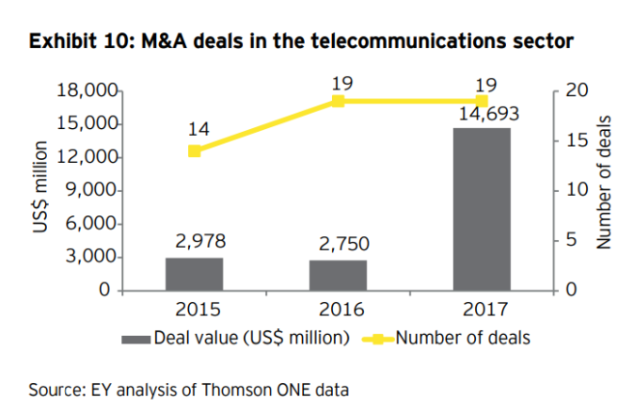
Indian telecom sector recorded $14.7 billion worth M&A deals in 2017 — more than 5-fold increase from 2016. The number of telecom M&A deals in India was 19, the same as the last year. The majority of the transactions were domestic in nature, accounting for 92 percent of the sector’s deal value and 58 percent of the deal count, according to consultancy firm EY.

Legal & Regulatory Framework related to M&A in the Telecom Sector

  1. National Telecom Policy, 2012 has simplified M&A in Telecom Service Sector while ensuring adequate competition. 100% FDI is allowed.

  2. The merger of licenses shall be for respective service category. An access service license allows provision of internet service, the merger of ISP license with services license shall also be permitted.
  3. In a service area, market share of merged entity should be less than 50%. (earlier it as only 35%) if it is more, it has to reduce it below 50% in 1 year. For calculation of market share, both subscriber base & adjusted gross revenue will be considered.
  4. Total spectrum held by merged entity should be less than 50% in a service area. If it is excess, it has to be surrendered within 1 year.
  5. An acquirer will have to pay the differential between the auction-determined market price & the administrative price for anything beyond 4.4 MHz in the GSM band and 2.5 MHz in CDMA, if an acquired company has got spectrum after paying administrative price.
  6. If due to merger/transfer of license in any service area, any entity becomes a “significant market power”, then TRAI’s Telecommunication Act of 2002 will come into place. It will take steps so as to reduce its market power.

The major M&A deals in the Telecom sector in 2017-18

  1. Bharti Airtel agreed to buy Norway-based Telenor’s India unit in February to enhance its customer base and network.
  2. UK-based Vodafone and Indian telecom operator Idea Cellular signed $11.6 billion merger agreement in March to combine their Indian operations (excluding Vodafone’s 42 percent stake in Indus Towers) to become the largest telecom operator in India.
  3. Bharti Airtel agreed to buy Tikona Digital Networks’ 4G business, including its broadband wireless access spectrum and 350 cellular sites in five telecom circles, in a deal valued at $244.5 million.
  4. Airtel also decided to acquire Tata Teleservices and Tata Teleservices Maharashtra’s consumer mobile business. Tata Teleservices will retain its enterprise business as part of the deal.
  5. Reliance Jio agreed to buy the wireless spectrum, tower assets, optical fiber network and media convergence node assets of Reliance Communications. Anil Ambani is looking for a lean organization to focus on 4G.
  6. Vodafone India and Idea Cellular sold their tower business to American Tower Corporation Telecom Infrastructure for $1.2 billion.
  7. Bharti Airtel’s tower arm Bharti Infratel Ltd and Indus Towers have announced a merger which will create a pan-India tower company with a combined revenue of Rs25,360 crore, with over 163,000 towers, operating across all 22 telecom service areas in India.

Airtel Telenor Deal: A closer analysis

Telenor India announced a merger with Bharti Airtel, which will boost Airtel’ subscriber base along with the 4G spectrum footprint. Post the merger, Airtel’s footprint in seven circles (Andhra Pradesh, Bihar, Maharashtra, Gujarat, UP (East), UP (West) and Assam) will be boosted with the addition of 43.4 MHz spectrum in the 1800 MHz band.

The Department of Telecom on April 3 had asked Bharti Airtel to submit bank guarantee of around Rs 1,700 crore before approving its merger with Telenor India. The guarantee included Rs 1,499 crore for one-time spectrum charge for the radio waves allocated to Airtel without auction, and over Rs 200 crore for spectrum payment which Telenor has to make. DoT has also sought undertaking from Airtel that the company will be liable to any pending dues with respect to merger of the two companies and all demands which may be raised by any wing of the department for Telenor India. DoT also directed Airtel to reduce its market share in Bihar telecom circle on the basis of money earned from telecom services (Adjusted Gross Revenue). DoT asked Airtel to reduce the limit to 50% within one year post the merger approval. After which, they issued their affidavit of no objection concerning the merger and moved their affidavit to he National Company Law Tribunal (“NCLT”). NCLT approved the proposed merger of Airtel and Telenor India.

Telecom companies have to routinely furnish bank guarantees to meet their contractual commitments with the licensor, which in this case is the DoT. A failure in meeting the requirements such as payment of various government fees, results in the department encashing the bank guarantee as a tool to punish the defaulter. Typically, a bank guarantee is issued by a bank or any other lending institution promising to make up for a pre-stated sum of money in case of default by the entity on whose behalf it is issued.

But, the Telecom Dispute Settlement and Appellate Tribunal (“TDSAT”) has asked DoT to grant approval to Airtel-Telenor merger without any bank guarantee, according to a Bharti spokesperson. In an interesting turn of events, the Airtel Telenor has merger has hit a roadblock, because Telenor is now considering filing for bankruptcy amid mounting daily losses and a tussle over a bank guarantee poised to delay government approval of the deal. The acquisition plan, announced in February 2017, has not closed and is well past the 12-month closure timeline expected by the two companies. DoT is likely to move to the Hon’ble Supreme Court against the TDSAT claiming their demand is backed up by M&A Rules. The Competition Commission of India, Securities Exchange Board of India, the stock exchanges and NCLT have already approved the acquisition and only DoT has to endorse it. The DoT is bent on getting a bank guarantee from Airtel equal to Rs 1,499 crore for one-time charges for airwaves allocated to the telcom and over Rs 200 crore for spectrum payment owed by Telenor before approving the deal.

Key takeaways

Reliance Jio clearly disrupted the whole telecom sector and brought about a change that everyone had been waiting for. The Indian telecom industry would now involve 3-4 major players in the market and they would be the ones competing for the first spot in terms of revenues, subscribers and profits. The case of Airtel Telenor merger has seen an interesting turn of events, only the time will tell if Airtel would manage to acquire the Indian counterpart of the Norwegian company or Telenor will have to resort to the IBC, 2016 route. M&A in Telecom sector is likely to grow in the coming times due to a lot of factors, the market has been waiting for the New National Telecom Policy, 2018. Let us see what the policy brings for the players in this hugely competitive and growing industry of the country.

Download Now

Registration of Motion Mark as Trademark

1
Trademark

About the Author

Archi Bhatia is a law graduate who currently works at a law firm in Delhi. She has interest in Intellectual Property and its confluence with new age technology. She is affiliated with Quick Company, Delhi.

In recent times intriguing types of trademarks are in trend, as with globalisation and increase in cross-border trade, the mark has become a pivotal tool to signify a company’s identity. The companies understand the importance of the internet and social media hence more, and more companies are sprucing up their logo with animation and visual effects.

The contemporary market is involved in the process of inventing new products with sensory and unique experiences for their customers to leave a mark on their customers and develop a distinct and novel reputation and so there has been a steep increase in moving logos being incorporated as a trademark of many companies.

Indian Law and Motion Trademark

Conventional and traditional trademark in the legal sense are devices, logos, and plain words which are used to distinguish one product from that of others. The technological revolution in the marketplace has persuaded companies and individual to produce a mark which is novel and experimental in nature; these strategies have brought a paradigm shift in the branding strategies and have brought revolution in technological sector of the company to aim for better and innovative ideas.

Unconventional marks go beyond the trademark definition which has been mentioned in the trademark act 1996 of Indian law. Many companies are now taking the aid of extreme branding with the help of colour, smell and sometimes even touch.

A motion trademark is a moving logo which is used by the company as an innovative marketing strategy by the companies to attract consumer towards their product. Any motion mark is made by using animation and different computer programs and any moving object which exist around that company.

Registration of Motion Mark as Trademark

Any motion mark should have the capability of depicting itself on paper while applying for registration in the intellectual property office of India. Submitting a motion mark involves the same criteria of evaluation as do other forms of trademarks, but motion marks have remained a small fraction of trademark submission in India. While submitting the registration of motion mark the company or individual has to keep in mind that any movement occurring in the mark should be represented in the sequence, it is being presented for the product.

The succession of images in the mark being registered as motion mark is the most critical aspects which may be subject to protection. Presentation of such marks is interpreted liberally by the registrar of the trademark.

Motion Mark Applications Made Till Date

Sony Ericsson submitted a flipbook depicting of up to 20 images which allowed the examiner of the trademark to flick through the pages and see the motion in the pictures. This application was initially rejected by the examiner but was then accepted on appeal.

A well-known example of a motion mark registered is Microsoft windows logo which we see once we open the windows PC or laptop.

Indian Law and Motion Trademark

Until recently, trademark application of motion marks did not fulfil the requirement of graphical representation, and hence, it was quite difficult to register it as a trademark of the company.

The rationale behind rejecting the registration of motion trademark is mostly was its inability to represent itself graphically and even if the trademark is rendered before the registrar graphically. The graphic representation must be clear, precise, self-contained, easily accessible, intelligible, durable and objective.

Section 2(1) (zb) of the Trademark Act, 1999 defines a trademark as a mark which capable of being presented graphically and is capable of distinguishing goods or services of one person from those of others and may include the shape of products, their packaging and combination of colours. Thus, the definition of the trademark under the Indian Trademark Act is an inclusive one and covers within its ambit anything that is capable of being graphically represented and distinguishing any product.

It must be noted that motion mark cannot be presented in its pure form; it will have to be presented before the registrar as a combination of marks for example sound and movement are to be presented together, like in the case of Sony Ericsson and Nokia.

The Indian Trademark Law and Practice have expanded its purview recently to accommodate protection of various and different types of non- traditional.

Concerning registration of an Unconventional trademark, a Draft manual has been developed which mentions that the trademark law is to be interpreted broadly. Draft manual elaborates on the registration and protection of trademark which are not conventional, such as colour trademark, smell trademark, the shape of goods are all protected keeping in mind public interest of the company.

A recent development witnessed in the regime of unconventional marks in India is that the registration of the sound mark by Yahoo for “Yodel”, followed by registration of the sound mark by German Company Allianz Aktiengesellschaft.

At present the Indian Trademark regime is experiencing a considerable transformation wherein new non-conventional marks are being filed more frequently.

The primary considerations for according trademark protection in India are that the mark must be capable of:

  1. Being graphically represented; and
  2. Distinguishing any product

Thus, the perception in India on the introduction of new non- traditional trademarks can primarily be remarked as positive subject to the statutory laws prevailing in India.

The rationale behind the protection of trademark

There is no doubt that trademark applications for motion marks are increasing all over the world and also in Indian trademark law. For many years India did not allow for motion mark applications, but this was changed with the publication of trademark manual. The benefits of registering motion mark in this technological order are significant.

The limitations of a static trademark are that it only protects single image whereas motion trademark would preserve several images included in the motions.

This method perpetually broadens the ambit of protection and dramatically increases the value of the brand associated with the trademark.

Conclusion

The acceptance of a motion mark is opening up new doors for business. Even though companies have been interacting with their customers using animations for a long time, but the protection of animation can now be protected under Indian Trademark law in the form of a motion mark. Motion mark as a trademark is rarely registered as they have just gained importance with technological advancement in this arena.

Download Now

Cost of Filing Divorce Petition in India

2
Law Colleges in Madhya Pradesh
Image Source - https://lawschooltoolbox.com/can-law-library-offer/

This article is written by team Legal Resolved. The article discusses the cost of filing divorce petition in India.

Divorce in recent years has gained a certain rote-like predictability. The divorce rates are up. The stigma of divorce is fading and all this because the human wants are getting more complex these days. We want more, compromise less often, and are quick to take the easy way out. Complex socio-cultural factors, convoluted legal system and divorce procedure, and the conservative mind set of society make divorce in India a very a challenging task. Generally, India lacks a central registry of divorce data but the information gleaned from family court magistrates suggest that the rate of divorce in India happens to be the highest in Mumbai, Bangalore, Delhi, Kolkata, and Lucknow.

Cost of Filing Divorce Petition

The divorce procedure in India is complex and it can take over a year to a decade, depending upon the nature of the conflict between the separated couple, the intensity of disagreements between the parties and the discretion of the judges. Hence, this leads to pending of cases in the country. The court procedure is repetitive and requires cash at each progression. For each appearance in court, your lawyer will charge a certain Amount from you. Thus, it is very essential for everyone to know what precisely can be the legal advisor’s fee one is supposed to pay for divorce cases in India. There are certain definite factors upon which a lawyer’s fee depends with regards to cases identifying with divorce in India.

Factors on which a Lawyer’s fee depends in India

Generally, the fee of a divorce lawyer depends on various factors such as whether the nature of divorce i.e. mutual consent or contested. Cost of mutual consent is generally less than the contested divorce as in the mutual consent divorce there are not many formalities involved. To be more specific let’s discuss the factors upon which normally a lawyer’s fee depends upon. They are-

  1. Lawyer’s fee depends on nature of Divorce. Contested or Uncontested (Mutual) Divorce

This is the point which plays a definitive factor in choosing the legal counsellor’s expense. A contested divorce is one what it sounds like: where one or both spouses contest (dispute) some aspect of their divorce. Therefore, the proceedings for divorce take a longer time to complete and usually involves greater pressure and increased legal fees. One party to a marriage needs a separation and other needs to stay in the bond of marriage. Hence in case of contested divorce, lawyers charge more fees as compared to the uncontested or mutual divorce which basically means that both spouses agree on all of their divorce-related issues.

2. Lawyer’s fee depends on their experience and standing in the court

It is comprehended and expected of a decent lawyer to charge more expense in relation to any other good lawyer. Often, a good and an experienced lawyer charges for per hearing which he will make in the court. He may even charge for each stage of divorce procedure including draft for each application.

3. Lawyer’s fee depends on other charges like child custody, maintenance, etc along with divorce.

One may file for divorce with other charges like child custody, maintenance, domestic violence, etc. So, when there is filing for more charges then the workload of a lawyer also increases. Accordingly, a lawyer may ask for higher fees.

4. Lawyer’s fee depends on the financial status of the party

One of the elements which a lawyer considers while deciding his expenses is the financial status of the client who wants to contest for divorce. In a practical field, it is frequently discovered that same lawyer may charge a poor agriculturist less when contrasted with a big businessman. Even there are certain liberal advocates who make all his benefit just through 10% of his cases, rest 90 % of the cases he contested for free. In this way, a legal advisor’s expense additionally relies on the financial status of the contested clients.

Grounds in the wake of divorce cases being so expensive

The grounds mainly depend upon the procedure of divorce. Hence, in order to apprehend the reason as to why the lawyers ask for a heavy amount of fees in cases of divorce, it is essential to understand the divorce proceedings of the court. The parliament has made certain provisions with regard to divorce under the Hindu Marriage Act, 1955 and section 13 of the Act deals with Divorce.

  1. If either of the spouses has, after the solemnization of the marriage had voluntary sexual intercourse with any person other than his or her spouse; or
  2. If either of the spouses has after the solemnization of the marriage, treated the petitioner with cruelty; or
  3. If either of the spouses has deserted the petitioner for a continuous period of not less than two years immediately preceding the presentation of the petition; or
  4. If either of the spouses has ceased to be a Hindu by conversion to another religion; or
  5. If either of the spouses has been incurable of unsound mind or has been suffering continuously or intermittently from mental disorder of such a kind and to such an extent that the petitioner cannot reasonably be expected to live with the respondent.
  6. If either of the spouses had been suffering from a virulent and incurable form of leprosy; or
  7. If either of the spouses has been suffering from venereal disease in a communicable form; or
  8. If either of the spouses has renounced the world by entering any religious order; or
  9. If either of the spouses has not been heard of as being alive for a period of seven years or more by those persons who would naturally have heard of it, had that party been alive.

Procedure for Contested Divorce

The main procedure of filing a contested divorce involves court proceedings. There are certain stages involved to contest a contested divorce. These are:

  • First and foremost step is to find a good attorney who will legally assist you in taking the matter to the court. Clearly, give a brief about the reasons for filing a contested divorce and provide all the documents required at the time of filing of the divorce petition.
  • After confirming the petition (with signature, affidavits, vakalatnama and required documents) it needs to be filed before the family court and after that attorney will serve it to the spouse. If there comes any bar in serving the petition to the spouse in person then it can also be served by publishing in any local newspaper and after that, you have to wait for some reasonable time to proceed further.
  • It is necessary for another party to respond within a reasonable time as the court prescribes. If your spouse does not respond within the specified time limit, he/she is in default and the court can provide an order in your favour and will proceed to the next step.
  • This procedure contains revelation where life partners can acquire definite data from each other about conjugal resources, salary, authority and some other issues applicable to their case. This disclosure procedure can be directed through written interrogations, documents requests, and testimonies. During disclosure, the life partners can make an attempt for child’s support or divorce settlement from the courts.
  • In general, the court encourages the spouses to come to an agreement before the final date of hearing. The judge may order the spouses to go to mediation where a third party attempts to give assistance to them and negotiate any unsettled issues.

Uncontested or Mutual Consent Divorce under Hindu Laws

Section 13(B) of the Hindu Marriage Act deals with the provision of divorce by mutual consent. The provision also lays down the conditions that must be fulfilled to file a mutual consent divorce in India.

Conditions for Mutual Consent Divorce

Section 13(B) of the Hindu Marriage Act, 1955 lays down certain conditions under which a petition for mutual consent divorce can be filed. It is significant to take advice from the top divorce advocates in India before filing for divorce in order to make sure that you fulfil these conditions. The following conditions to get a mutual consent divorce in India are as follows:

  1. The spouses must be living separately.
  2. The spouses must be living separately for a period of at least 1 year.
  3. The spouses must have mutually agreed that the marriage should be dissolved.

Procedure for Mutual Consent Divorce

  • The spouses, who want to obtain divorce through Mutual Consent, should discuss the matter with each other about the future course of action and must come to a decision about the children if any and their education, child custody, child maintenance, alimony, financial settlement, etc., and approach the lawyer/advocate for filing the petition in the Hon’ble Court under specific provision of law for Divorce.
  • In a mutual divorce proceeding, there are in total of two court appearances. A petition jointly signed by both parties is filed in the respective family court which is also called joint petition.
  • Cooling Off Period – There is two motion of divorce wherein the first motion, statement of both parties are recorded and then signed by both the parties on paper before the Hon’ble Court. Then a period of six months is given for reconciliation as under the Hindu Marriage Act the duration/time for obtaining mutual consent divorce is six months. But in a recent judgment, the Hon’ble Supreme Court of India has waved the six months period in a case Amardeep Singh vs. Harveen Kaur, Civil Appeal No. 11158 of 2017 [Arising out of Special Leave Petition (Civil) No. 20184 of 2017].
  • After completion of the first motion, the second motion of Divorce comes. There is a time period of 18 months within which the second motion is to be made otherwise the court will not pass the decree of the divorce. Moreover, as according to the provision of the settled law of divorce it is clear that one of the parties may withdraw their consent at any time before the passing of the decree.
  • In the final steps, a divorce decree will be granted as the Hon’ble Court may deem fit.

Documents Required

The divorce attorney files the divorce petition along with other necessary documents like-

  • Address proof of husband;
  • Address proof of wife;
  • Marriage certificate;
  • Passport size photographs of the marriage of husband and wife;
  • Evidence proving spouses are living separately for more than a year, and
  • Evidence relating to the failed attempts of reconciliation.

Further when the case proceedings are going on in the Courts; there are certain other documents which have to be presented to get a Divorce Decree:

  • Income Tax Returns (3 years);
  • Details of present income;
  • Birth and family details, and
  • The details of the assets.

Therefore, before going to take decision for divorce makes sure that you are aware of the fees of a lawyer. But one thing you must remember, it is not all about the fees but about the quality of a lawyer that you must take into consideration before filing a divorce case.

Download Now

Key Provisions of a Shareholders’ Agreement

2
Shareholder's Agreement
image source - http://www.lowpartners.com/shareholders-agreement/

In this article, Daksh Gautam, pursuing Diploma in Entrepreneurship Administration and Business Laws from NUJS, Kolkata discusses the key provisions of a Shareholders’ Agreement.

What is a Shareholder’s Agreement?

Shareholders are considered to be the true owners of the company. An agreement entered between the company and shareholders describing the rights and obligations is called the Shareholder’s Agreement. You can learn more about such types of agreements and the practical application of laws related to mergers and acquisition, by working in a law firm or by doing M&A courses.

Why do we need a Shareholder’s Agreement?

Shareholder’s agreement is entered in order to dissolve any dispute between the shareholders and the company. We can’t be sure that nothing will ever go wrong and in such case where nothing is certain, such agreements help us in dissolving the disputes if it occurs and to maintain a healthy relationship between the shareholders and the company. It also helps to protect the investment made by a shareholder and lays down the rules & regulations for the shareholders and any other party related to the company. It is essential to regulate a shareholder’s agreement because not every shareholder is same. An agreement has to be drafted keeping in mind that every person is different and has the different opinion on subjects or matter concerned. And that they may or may not agree with each other.

Key Provisions in the Shareholder’s Agreement

A Shareholder’s agreement consists of the following basic provisions:

  1. In what proportion a shareholder is going to hold the shares?
  2. Will there be the different class of shares for different category of shareholders (comprising of minority, majority & founder shareholders)
  3. If there are the new issue of shares in the market should the existing shareholders get the privilege of getting those shares first?
  4. Can the board of directors stop the issuance of any such share or can they stop the transfer of shares?
  5. What are the rules for transferring of shares?

Consent of Shareholders

It comprises of such circumstances and situations where the consent of shareholder in majority matters. For example, consent of a shareholder will be taken in the matters mentioned below:

  1. Whenever a member i.e.; manager, any member of the supervisory board is appointed, or is to be dismissed consent of shareholders is a must.
  2. Whenever drafting a financial statement or distributing the dividend.
  3. When the company wants to amend the articles of association.
  4. When entering into amalgamation or filing for bankruptcy.
  5. When dissolving the company.

An example of a consent clause is as follows:

Where this Agreement provides that any particular transaction or matter requires the consent, approval or agreement of any Shareholder such consent, approval or agreement may be given subject to such reasonable terms and conditions as that Shareholder may impose and any breach of such terms and conditions by any person subject thereto shall ipso facto be deemed to be a breach of the terms of this Agreement.

Resolving Disputes

It will be really modest to say that there will be no disputes that may arise while investing in a company. Therefore, the company has to be prepared for such events as well. A dispute not only means disputes within it also means the dispute with the rival company or competitive company.

To resolve issues with shareholders, companies normally opt for out of court settlements such as arbitration or conciliation between the company and shareholders.

An example of a dispute resolution clause is as follows:

“All disputes arising between the partners as to the interpretation, operation, or effect of any clause in this deed or any other difference arising between the partners, which cannot be mutually resolved, shall be referred to the arbitration of…………failing him to any other arbitrator chosen by the partners in writing. The decision of such an arbitrator shall be binding on the parties”

Restrictions against transfer

A shareholder’s agreement comprises of such rules where the shares can’t be easily transferred and for which a written consent has to be taken by the existing shareholders. This is not applied in case of death of a member as shares are transferred to the family i.e.; legal representatives/heir.

Right of first refusal

This right basically protects the company and the existing shareholders from sales of stocks to a competitor company or such parties with whom the company doesn’t have friendly relations. When some of the shareholders wish to sell their share, a clause in the shareholder’s agreement should state that the shareholders who wish to sell their shares have to show the right to match an offer received from a third party. This is known as the right of first refusal.

Buy-out Rights

The Shareholders’ agreement must include the clause of buy-out rights which states that when a shareholder is found incompetent due to certain major events i.e.; death, disability, bankruptcy or marital dissolution, the company or existing shareholders in such case can buy the shares of such shareholder. It also includes a clause called as “expulsion” where the existing shareholders can expel any undesirable shareholder and acquire his/her shares.

Things to be kept in mind while drafting a Shareholder’s Agreement

  • One needs to understand the need of a shareholders’ agreement including why is it necessary to create a balance between shareholders’ interests and company interests.
  • Do not make the terms ambiguous, but keep it precise which limits the terms’ interpretation. Wide interpretations cause problems in the long run.
  • Clearly, list out the rights and obligations of both parties – i.e. shareholders and the company.
  • Keep in mind that there is a high possibility that a shareholder might want to leave – clauses regarding such process should be clearly laid out.
  • Dispute resolution clauses should be clearly defined especially on the following points – mode of dispute resolution, place of such dispute resolution, powers and duties etc.
  • Restrictions on transfer of shares should be clearly defined and the process for the same should be laid out.

The above are just a few points to be kept in mind. For a detailed analysis, contact a professional who might help you draft the same.

Conclusion

Shareholder’s agreement is a mechanism which saves the company from losses and protects its interest. Every shareholder agreement has to have the key provisions stated above to create a balance between shareholder interests and the company’s interests.


Download Now

How to claim damages for illegal termination of works contract

3
Works Contract
Image Source - http://bit.ly/2X7dON2

In this article, Smita Singh, a qualified lawyer discusses how to prove contractor’s loss of profit for illegal termination of works contract.

Introduction

In the commercial world, it is common for contractors to enter into contracts for undertaking works for those who engage them (the employers), in anticipation of earning profits.

Usually, the contractor agrees to undertake such works for a price that includes cost of executing works like construction of building, manufacturing, supplying and erecting machinery etc, as well as the contractor’s expected profit.

In case of termination of such contract before completion, the contractor can claim value of the work actually undertaken. The contractor may not be able to claim value of incomplete work, to the extent it had not undertaken any work and had not incurred any costs.

However, if premature termination was brought about on account of employer’s breach, it may be possible for the contractor to claim expected profits that is lost on account of incomplete work.

This blog explains the legal position respecting such entitlement.

The statutory provision enabling claim for loss of profit

Section-73 of the Indian Contract Act, 1872, entitles a party suffering a breach of contract to receive from the breaching party compensation for loss/damage suffered on account of such breach. The innocent Party can claim two categories of damages viz.:

  • Direct damages i.e. loss that arose naturally from the breach;
  • Consequential damages which were reasonably in contemplation of the Parties to the contract at the time they made the contract, as probable result of the breach.

Loss of profit is a consequential damage. A claim for Loss of profit can thus be made only if special circumstances leading to such loss were in the knowledge of the Party in breach.

Burden of proving loss of profit

Under the law of evidence, the burden of proving entitlement for loss of profit, is placed on contractor claiming damages. The contractor should prove that:

  1. As a consequence of breach of contract the contractor suffered loss/damages;
  2. That such loss was in contemplation of the employer; and
  3. The measure of such loss.

In case of claim for loss or profit, it becomes difficult to establish with precision that what was expected profit that could not be realized on account of breach.

The expectation of profit implicit in the Works Contract

In a series of decisions the Supreme Court has settled the position that ordinarily a Contractor, while agreeing to undertake a Works Contract, reasonably expects to make profit. Reasonable expectation of profit is held to be implicit in the Works Contract. Thus, in cases of breach leading to improper termination of a works contract by employer, a contractor is presumed to have lost profit. Further, the measure of such loss is allowed to be based on some guesswork.

In Mohd. Salamatullah v. Govt. of A.P.[1]  the Supreme Court considered a case of breach of contract for manufacture and supply of guns, as a result of which the contract could not be completed. The court approved the grant of 15% of the contract price as damages in case of breach of contract. It held that the appellate court was not justified in interfering with the finding of fact given by the trial court regarding quantification of the damages even if it was based upon guesswork.

In A.T. Brij Paul Singh v. State of Gujarat[2], the Supreme Court recognized the position that in a works contract, if the party entrusting the work commits breach of the contract, the contractor is entitled to claim damages for loss of profit, which he expected to earn by undertaking the works contract. In said case, the Court without insisting  for direct proof the measure of profit lost, granted 15 per cent of the value of the remaining work, as damages for loss of profit.

In Dwaraka Das v. State of M.P.[3], Supreme Court considered a case wherein the High court  had denied the contractor’s claim for loss of profit on the ground that the contractor did not place any material on record, but had only relied upon assessment of the profits by the Income Tax Officer while assessing the income of the contractors from building contracts.

The Supreme Court relying on decisions in Mohd. Salamatullah and A.T. Brij Paul Singh wherein it had granted 15% of the contract price as loss of profit, held the contractor to be entitled to 10% of the contract price. The court stressed that when the termination of contract is contrary to law and terms of the agreement, the erring party is legally bound to compensate the other party to the agreement. The court further emphasized that in estimating the amount of loss of profits, court should make a broad evaluation instead of going into minute details

In J.G. Engineers Pvt. Ltd., Vs Union of India[4] the Supreme Court upheld the award of 10% of the value of incomplete portion of work, as loss of profit. In said case it was found that the employer was responsible for the delays/breaches; the contractor was not in the breach, and the employer had illegally terminated the contract.

The position as aforesaid is followed by several High Courts.[5]

In Kanchan Udyog Limited vs. United Spirits Limited[6] however Supreme Court insisted for proof of loss of anticipated profit. It did not accept profitability projections made in loan application, as proof of estimated profitability. In the said case the court also found that the party claiming compensation could not establish that the other party had committed any breach. Besides, the said case did not pertain to works contract.

Loss of profit not to be presumed where execution of contract was prolonged

There may be cases where the contractor completes the work, but the execution is delayed on account of breaches committed by the employer. In such cases, the contractor receives the full price including expected profits. The contractor can also prove and recover increased cost of execution (on account of escalation of cost of material and labour). Though it is possible for the contractor to recover loss of profit for prolonged period, the same may not be presumed. In order to claim loss of profit the contractor will have to lead cogent evidence. The position is succinctly stated by Supreme Court in Bharat Coking Coal Ltd. vs. L.K. Ahuja[7] in following words:

“Here when claim for escalation of wages bills and price for materials compensation has been paid and compensation for delay in the payment of the amount payable under the contract or for other extra works is to be paid with interest thereon, it is rather difficult for us to accept the proposition that in addition 15% of the total profit should be computed under the heading ‘Loss of Profit’. It is not unusual for the contractors to claim loss of profit arising out of diminution in turn over on account of delay in the matter of completion of the work. What he should establish in such a situation is that had he received the amount due under the contract, he could have utilised the same for some other business in which he could have earned profit. Unless such a plea is raised and established, claim for loss of profits could not have been granted. In this case, no such material is available on record. In the absence of any evidence, the arbitrator could not have awarded the same. This aspect was very well settled in Sunleyn (B) & Co. Ltd. vs. Cunard White Star Ltd., [1940] 1 K.B. 740 by the Court of Appeal in England.”

Conclusion

In case of termination of a works contract owing to breach by the employer, the contractor can claim loss of anticipated profits in respect of incomplete portion of work. The courts, in the light of decisions of supreme court referred supra may award 10-15% of the value of incomplete work, as lost profit. Though the decisions suggest that such loss could be presumed or be based on guesswork, it is strongly recommended that the contractor leads credible evidence in support of his claim. This could include testimony of experts, records of profit made by similar ventures, reliable profitability projections made before undertaking the venture etc.

In situations where work is completed, but is delayed on account of employer’s defaults, the claimant ought to prove that he could have used the receivable under the contract if paid on time, to utilise the same in some other venture to earn profits.

[1] (1977) 3 SCC 590

[2] (1984) 4 SCC 59

[3] (1999) 3 SCC 500

[4] (2011) 5 SCC 758

[5] Mahanagar Gas Ltd. v. Babulal Uttamchand and Co., (2013) 2 Mah LJ ; Himachal Joint Venture v. Panilpina World Transport AIR 2009 Del 88; and Delhi Development Authority vs. Polo Singh MANU/DE/1882/2002

[6] MANU/SC/0699/2017

[7] MANU/SC/0335/2004

Download Now

A synopsis of Issues and Suggestion on Section 146 of the Patents Act, 1970 suggested by Various Stakeholders to IPO

0
Section 146 of the Patents Act, 1970
Image Source - https://www.npr.org/tags/126801131/invention

This article is written by Avanish Singh. The article is a synopsis of Issues and Suggestion about Section 146 of the Patents Act, 1970 suggested by Various Stakeholders to IPO.

Under India Patent Law regime every patentee and licensee of the granted patent is required to file a statement as to the extent to which the patented invention has been worked on a commercial scale, to be filled every year, the requirement of Form 27 under Section 146 of Indian Patent Act, 1970.

There are defaults in compliance by the patentee or the Licensee fails to comply or defectively comply with the statutory requirement of Section 146 of the Act (herein referred as Patent Act). Also, IPO fails to take a strict step so as to overcome the failure of not fulfilling the compliance by several patentees or licensee in past recent years. Section 146 of Indian Patent Act reads, that every patentee or licensee (whether exclusive or otherwise) shall furnish in such manner and form and at such intervals (not being less than six months) as may be prescribed statements as to the extent to which the patented invention has been worked on a commercial scale in India.

In the Year 2015, Prof. Shammed Basheer filed a PIL before Delhi High court. The PIL filed was against IPO, for non-compliance with Section 146(r/w Rule 131) of Indian Patent Act, 1970.

In 2018, Delhi High court passed an order asking the Government of India to submit an affidavit outlining a plan for putting in place standard operating/procedure enforcement mechanism w.r.t Form 27 and take strict action against aberrant patentees or licensees.

In view of above order, the Indian patent office asked suggestions from various stakeholder regarding an issue related to working of Patents under the Patents Act, 1970 which was to be submitted on or before 30th March 2018.

On 2nd April 2018, various response as received from stakeholders regarding an issue related to the working of Patents has been uploaded on IP India portal.

Few points which have been largely discussed by most of the stakeholders are herein below:

The first point which has largely been discussed by most of the stakeholders is “One Patent One Product”. It means disclosure of patented technology by patentee which has been used in the one product. Most of the stakeholders commented on this point and said that patent could be worked across many fields, telecommunication is such an example. One product may contain many patents through cross-licensing or be the result of complex licensing arrangements. So it is impossible to provide information related to those which are embedded within a products having a plurality of patented technology incorporated within it especially for those patents which are working outside the countries. So the suggestion provided by the stakeholders includes deletion of such requirement in Form 27.

The Second point which is raised by most of the stakeholders is “quantum & value of the patented product”. Form 27 ask patentee to furnish the quantum & value of a patented product including both product manufacturing in India and outside India. It is difficult to calculate actual sale in India or outside. It is a very vague requirement which makes the compliance extremely difficult. Every county has its own timeline. It is very difficult to gather such information within a prescribed time period i.e. within 3 years.

The third point on which most of the stakeholders emphasized is about “confidentiality of information”. When a patentee goes for voluntarily licensing, it includes many commercial sensitive and confident information, public disclosure of which may prejudice to their business. Accordingly only disclosing the name of licensee and sublicensee and keeping rest of content confidential can be the new format of Form 27. Some of the stakeholders are in favor of disclosing a number of the license granted so as to ascertain if the patented invention has achieved the reasonable satisfaction of the public.

To know more about Patents please visit:


No patentee should demonstrate the “Neglectful Conduct” as far as India is concerned. In that case of receiving a demand from the third party, the Controller may ask for the foreign patent working data.

The next but not the least point which most of the stakeholders have pointed out is about compulsory licensing. According to Section 84 of Indian Patent Act, 1970 “The Compulsory Licensing” defines that a compulsory license on patent would be provided to any person interested in the reasonable requirements of the public with respect to the patented invention have not been satisfied, that the patented invention is not available to the public at a reasonably affordable price. Stakeholders say that it is a subjective question. No patentee can answer the question correctly. Demand is met adequately/partially/ to the fullest is very subjective. Definition /scale for assessment of such requirement is also not provided as per act.

About “Miscellaneous” most of the stakeholder views are that Form 27 should be computerized.

Section 122 defines “Penalties” provision under Section146. A plain reading of Rule 122 provides an understanding that if any person refuses or fails to furnish the details or information which he required to furnish under Section 146 shall be punishable with a fine which may be extended to 10 lakh rupees. One of the stakeholders has given a suggestion that if patentee wilfully filed form incorrectly or provide wrong information or knowingly failed to file the form, then in such case appropriate penalty would be to declare patent unenforceable. Otherwise, if the patentee does not do intentionally should get adequate chance to provide the details and the further controller may make necessary inquiries as it may deem fit.

Few of the stakeholders suggested giving exemption from submitting Form 27 for the first 3 years of the patent issued.

The above mentioned are few suggestions which many stakeholders have discussed and suggested. Stakeholders who gave their suggestions include eminent person form various law firms like Anand & Anand, CANON, Patterson Thuente IP, BSA, Lex Orbis, SS.Rana etc., academicians from several universities, several companies like BOSHE, Japanese IP Group, FICCI, Huawei Technologies, etc. In view of the above suggestion, it can be said that patent office needs to exhaust the old format of Form 27 and come up with new updated Form 27 covering several issues suggested by various stakeholders. This would help the patent office to reduce the overload from patentee as well as from the IPO.

Download Now

Can an employee be promoted when an enquiry is pending against him?

3
Pending Enquiry
Image Source -https://www.naukrigulf.com/career-tips/10-tips-to-get-job-promotion-at-work/

In this article, Prashanti Nerellapalli, a qualified lawyer discusses whether an employee can be promoted during any pending enquiry against him or not.

Ms. G, a government servant has put in 25 years of service in a Government department. She has to her credit all that is essential for the next promotion: seniority, passing in departmental tests, no adverse remarks in the service register and increments from time to time, best employee award etc. However, her juniors get promoted overriding her in the backdrop of a departmental enquiry pending against her. The enquiry is into an alleged misappropriation of govt funds (with no specific amounts mentioned). The preliminary enquiry report is not served on her but a charge memo comes after a delay of 5 years after the preliminary enquiry.

No witnesses are examined before levelling the charges against her.  The report of the departmental enquiry is not served on her. After a gap of another one and a half year she is called for a second enquiry. She submits her explanation denying the charges. The enquiry officer after an year and a half expresses his inability to file the enquiry report. The higher ups decide to set up a three men enquiry committee to look into the allegations.

In the meanwhile, a seniority list is circulated in the department with her name in the first place among the available candidates. This list was to be placed before Screening Committee for recommendations. Ms. G sends repeated representations to the higher ups to consider her case won\’t yield any response nor they state reasons for denying her legitimate promotion.

The issue is whether the right of an employee to get promoted stand vindicated in the backdrop of a pending departmental enquiry.

In B.George vs. I.G.Police[1] it was held that “withholding of promotion on the ground of pendency of a departmental inquiry would amount to inflicting of punishment that would be contrary to Article 16 of the Constitution.”

In Somaiah vs.Zonal Manager[2], it was held that “when disciplinary proceedings are initiated and when they are yet to be completed there is no knowing the petitioner can be found to be guilty of the charges that may be framed against him and he cant before then be punished through withholding of his promotion or by non-consideration of his case of promotion”.

The Hon’ble Apex court in Omprakash Sharma’s case[3] has held that “juniors could not score a march over erstwhile seniors on any valid principle of seniority. This would unquestionably be denial of equality under Article 16 of the Constitution of India.\”

In A.P.Naidu Vs. S.C.Rly[4] The A.P.High Court has held that withholding of the promotion on the ground of pendency of departmental enquiry would amount to violation of Art 16 of the Constitution.

The distinction between departmental proceeding and a disciplinary proceeding

  • A distinction needs to be made between a departmental proceeding and a disciplinary proceeding. A departmental proceeding is initiated by serving a charge memo. Seeking explanation from the employee by serving a questionnaire amounts to preliminary enquiry only.
  • On the other hand, a Disciplinary proceeding is said to have initiated if a charge sheet is filed against the delinquent employee. In some cases, the courts have held that candidature can be considered even after an FIR is lodged or when a criminal court has conducted thorough trial on the charges leveled as was held in Omprakash vs. UOI.

There is a clear direction from the Apex court in Premnath Bali’s case[5] that departmental enquiries cant be prolonged beyond 6 months and thereby prejudice the interests of the employee.

In B.T.Dayalan Vs. UOI (6), the Central Administrative Tribunal has citing Supreme Court said that inordinate delay in conducting an enquiry against a delinquent employee after serving the memo for minor charges will vitiate disciplinary proceedings which can be terminated or quashed without waiting for the enquiry to be completed. It was further said that a Government employee has some dignity. If one may lose money much is not lost but if he loses his dignity, he may lose everything.

Dignity of an employee, which is the prime concern, cannot be tampered with, by keeping the enquiry pending for an indefinite period. Normally the charge sheet or show cause notice should not be quashed by any judicial forum, but there were indeed exceptions to the same and delay in initiating or finalising the departmental proceeding was one such exception. There appears to be a ring of truth in the contention raised by the applicant that the enquiries are kept pending against him only with a view to stalling his promotion and to see to it that he retires on his present post in humiliation.\”

A matter that has been substantially enquired into by a criminal court and acquits the employee of the charges leveled, the department is estopped from relitigating the same matter by serving a fresh charge memo. So, also the courts have gone to the rescue of employees under suspension pending enquiry by ruling that they cant be deprived of salary or subsistence allowance during pendency of the enquiry.

In K.R.Deb Vs.Collector of Central Excise(7) it was held by the Apex court that ordering a fresh/denovo enquiry just because the disciplinary authority is not satisfied with the findings of the Enquiry officer is illegal.

Relying on the ratio of the decisions of various courts, it can be conveniently deduced that the pending enquiry is not a bar to consider an employee\’s candidature for promotion.

The sealed cover procedure, wherein the eligibility of the candidate is kept in a sealed cover till the outcome of the enquiry is known can be adapted. If the Departmental Promotion Committee/ Screening Committee finds the candidate eligible for promotion, he should be promoted with all consequential benefits after he is absolved of all the charges.

An employer can\’t blow hot and cold in the same breath. In the Illustrative case mentioned above, the employer is at fault in first not considering the case of the employee inspite of her name featuring in the seniority list, not considering her representations and has grossly violated her right to equality by showing preferential treatment to her juniors who were very much juniors to her in terms of seniority, date of appointment and age.

[1] (1973) 2 Ser L.R. 131

[2] (1979) Ser L.R. 50

[3] Omprakash Sharma Vs. Union of India AIR 1985 SC 1276.

[4] 1983 ILJ 151 A.P

5.Premnath Bali vs.Registrar High Court Delhi

6 B.T.Dayalan 13July2010

7. K.R.Deb Vs. Collector of Central Excise AIR 1974 SC1447

Download Now

Trademark issues related to Internet Domain Names

6
Domain Names
Image Source - https://www.digit.in/internet/internet-had-3307-mn-domain-names-in-q3-38767.html

In this article, Shraddha Tiwari of Bharati Vidyapeeth New Law College, Pune discusses the Trademark issues related to Internet Domain Names.

ABSTRACT

Ancient Greeks and Romans scribbled on various goods as a mark of identification. As the civilizations grew, new and better techniques of business demanded unique recognition to their products. Trademark facilitated this need. After emergence of e-commerce, business entities have started flourishing and expanding their activities on internet. However, a company cannot directly enter the cyber space without an identity. DNS was introduced as a substitute to the all numeric traditional IP address. Trademark and Domain name although sound similar are distinct but both are interrelated. Sometimes, well-known trademarks are used as domain names by hoaxers so as to deceive the customers. This act is known as “cyber squatting”. United States Patent and Trademark Office (USPTO) allows registration of domain name as trademark under certain circumstances. Courts have laid down Sleekcraft test to determine acts of trademark infringement. Trademark infringement in cyber space can be in the form of Linking and Framing, Meta tagging, Trademark dilution etc. A domain name contains Top Level and Second Level Domain names which can be registered with ICANN approved registrars such as WIPO. Settlement of domain name disputes can be through various means like ADR mechanism, agreement and Court proceedings. ICANN has set up the Uniform Dispute Resolution Policy (UDRP) to settle domain names disputes at an international level. However, the main issue while settling a domain name and trademark dispute is the jurisdictional issue because internet has no boundaries. Issues as to which court the matter should be brought, whether the decision of the court is binding on the parties who are registrants in two different countries.  

INTRODUCTION

In the modern day scenario, information technology has become a vital part of our lives. The development of internet and the exchange of data amongst different computers led to major technological as well as telecommunication revolutions. However, technology can be a boon as well as a bane. ICT has majorly contributed to the increasing number of cyber crimes in the society. 2016 report of PWC emphasized that at a global level cyber crime is the second most reported crime in the world. According to Indian Computer Emergency Response Team (CERT), 27,482 cases of cyber crime were reported from January, 2017 to June, 2017. [1]With the increasing number of cyber crimes which poses a threat to individual as well national security, there’s a need to re-invent technology which could easily tackle cyber attacks or re-frame even more stringent laws to reduce such activities. Intellectual Property (IP) and Information Technology (IT) go hand in hand and are called “sister laws”. Patent, trademark and copyrights have now occupied cyber space at a large front.

Ancient Greeks and Romans scribbled on various goods as a mark of identification. As the civilizations grew, new and better techniques of business demanded unique recognition to their products. Trademark facilitated this need. These are basically the style mark of a particular company, the manner in which they differentiate their products from that of other companies. The company can use colors, designs, numbers and various other symbols to give a unique identity to their product and distinguish it from other pirated products offered by hoaxers. The importance of trademark at a global level was first recognized in Paris convention which was subsequently followed by another agreement i.e. Trade Related Aspects of Intellectual Property Rights (TRIPS). There has been much debate on Benelux Trademark Legislation that whether the said legislation can be interpreted as conferring a function on trademarks that trademark is nothing but an investment of company’s goodwill.

After emergence of e-commerce, business entities have started flourishing and expanding their activities on internet. However, a company cannot directly enter the cyber space without an identity. Unique Internet Protocol (IP) addresses were not catchy and difficult to remember due to its all numeric characteristics. This led to the development of Domain Name Systems (DNS). DNS was introduced as a substitute to the all numeric traditional IP address. DNS basically functions to convert complex IP addresses of e-mails and websites into simple domain names for easy access by average user. Domain names are now also referred to as valuable corporate assets carrying goodwill. Some examples of Domain Name-

  • .com for commercial
  • .int for organizations established by international treaties.
  • .net for computers of network providers.

TRADEMARK AND DOMAIN NAME

While trademark provides unique identity to a product, domain names can be called as internet resource locators. Domain can also be regarded as the internet address of a company which after many years of use becomes the identity for their diversified products lines. Hence, the question here is that whether domain name can be regarded as trademarks and vice versa?  However, there has been much fuss about the resemblance of the two within the cyber world. Company has to consider number factors while applying for a domain name, which also includes inclusion of the trademark within the domain name. Domain name can be regarded as trademark and trademark can be used while registering a domain name but it is only beneficial if the same company does so. Sometimes, well-known trademarks are used as domain names by hoaxers so as to deceive the customers.

Taking example of a Dutch case law- Where a company got a trademark registered as thuisbezorgd.nl in the year 2000. Another company engaged in the same business activity under the domain name thuisbezorgen.nl. The Trademark owner filed a suit against the domain name owner contending that it deceived the customers to think that the site was theirs and that the goodwill of the company was being used by the domain name owners to earn profit. On the contrary, the domain name owner contended that the trademark lacked distinctiveness. However, the Court ruled that since the trademark was registered before the domain name, the defendants were at fault. Thus, most of the times, the company grows such a reputation that the courts grant recognition of trademark as domain name.[2]

Another case of stolen domain name being Amazon.com Inc v. Royal responder IncCivil Action CV’03 1634PHXDKD wherein defendants were charged for sending e-mails using Amazon’s domain name Amazon.com and making the customers believe that the goods/services were of Amazon. The defendants were neither affiliates of Amazon nor were doing so with the prior permission of the company. Amazon has wide range of customers all over the world and is also famous for its services both online and offline. It became a fortune 500 company after commencing operations in 1995 on the World Wide Web. Hence, it can be concluded that the domain name of the company became valuable corporate asset. Court held the defendants liable.

Thus, through the above case studies, it can be concluded that both domain names and trademarks are interrelated which ultimately affects the goodwill of the company.  United States Patent and Trademark Office (USPTO) allows registration of domain name as trademark under certain circumstances.[3] However, Domain name and trademark sound similar; there are number of differences between the two like –

  • Trademark operates in the real world while domain name operates in the cyber world.
  • The Registration of trademark is generally at a national level but domain name registration is at a global level.
  • Different persons residing in different countries can have same trademark for different goods and services since it does not generally have global impact but domain name operate at a global level and hence, two companies/persons cannot have same domain name. For instance, “Delta” is used by a number of companies like Delta Airlines, Delta Dental etc but the domain name com is used only by the airline industries.
  • Dispute with regards to trademark can be easily settled because there are no jurisdiction issues but domain name disputes are hard to settle because internet has no boundaries.
  • Trademark can refer to or relate to a specific category of a product or product line but domain names are not provided for every single product offered by a company. There can be a domain name for the entire company within which the company can have range of products.

REGISTRATION OF DOMAIN NAME

With the increasing use of internet in almost every field, there was need to have a regulating body in order to grant and maintain records of IP Address. Internet Assigned Numbers Authority (IANA) was set up under the supervision of US Government to carry out the functions such as-

  • Allocations of IP addresses.
  • Setting up protocol parameters to ensure that computers can communicate with each other.
  • Maintaining registries and making it available for general public use.

In December 1992, their contractual agreement between National Science Foundation and Network Solutions Inc (NSI) after which NSI registered domain name sites through InterNic site.In 1998 IANA was transferred to private sector when US government came up with the policy of establishing Internet Corporation for Assigned Names and Numbers (ICANN). In October 1998, ICANN superceded IANA by taking over all the functions of IANA. ICANN maintains high standards and procedures with respect to assignment and maintenance of domain name records. Any member of the ICANN community if aggrieved by ICANN staff, board or any other constituent body of ICANN can file a complaint to the Ombudsman. Article 5 of Bylaws for ICANN provides for maintaining a full-time position office of an Ombudsman who shall act as a neutral dispute resolution body to settle such disputes.

A domain name is divided into Top Level Domain (TLD) and Second Level Domain (SLD). The TLD is further divided into Generic (gTLD) and Geographic (also called country code represented as CcTLD). The nature of generic domain name is international, for example – .edu for educational institutions, .com for commercial use etc. Geographic domain name are just opposite to generic ones i.e. they are for specific countries like “.in” for India. Recently, ICANN also came up with the policy of Internationalized Domain Name (IDN) which enables registration of a domain name in local language and scripts like Arabic, Devanagari etc. which are encoded by the Unicode Standard.

Example of domain name-In www.wipo.org, “wipo” is the SLD and “.org” is the TLD. Hence, the first step before registering a domain name is to decide the TLD and SLD. Domain names are generally registered on “first come first serve basis”. Decision of SLD is of the registrant provided that it is not registered by any other company and that its name does not clash with the name of any other company. In case a domain name is already registered; the registrant can either alter the SLD or purchase it from the already registered ones via bidding, auction etc. The process of re-selling of domain names is carried on by registrars who are authorized by registries to sell the domain names. ICANN maintains a record of all the registered domain names and the process begins by checking whether the domain name for which the candidate applied is available or not. ICANN has also set up certain guidelines as to who can apply for some specific type of TLD. For example- gTLD like .com, .org are open for everyone to apply but gTLD like .AERO, .MOBI, .TEL etc are not open for all and the qualification of the candidate plays a major role in assignment of these gTLD. [4]

The registrar can be any company authorized by ICANN to do so. InterNIC website of ICANN provides detailed information about domain name registration services. After the above steps are completed the registrar takes the contact and other necessary information from the registrant and then sends the information to the registry responsible for maintaining the directory of that TLD.  For Example- The Public Interest Registry is operated by .org registry. The registrant has duty to reveal all the information including information regarding registering, managing, renewing etc of domain names to the registrar for publication in WHOIS Directory. The registrar has the power to cancel or suspend the registration of a domain name if the information provided by registrar is not accurate or of it is not renewed by the registrar.

INDIA- In India, National Centre for Software Technology (NCST) is the body that regulates country level domain name registration. On September 26, 2000 NCST added two more domain names “ind.in” (for individuals) and “gen.in” (for organizations) to facilitate registration of individuals and organizations under the .in category. The two new categories of domain name do not require the applicant’s presence in the country as an essential requirement for registration. Earlier, the applicant had to compulsorily have their offices in India to register domain name under “co.in” & “org.in” category. On October 26, 2004, the Government of India declared National Internet Exchange of India (NIXI) as the registrar of .in domain. [5]NIXI was rendered with the function of collaborating with companies who are adept registrars and fulfill the international standards of domain name registration.

SETTLEMENT OF DOMAIN NAME DISPUTES

Domain name disputes became rampant mainly because of the jurisdictional issues within the cyber space. 2016 was the year in which cyber squatting cases hit record. [6] US is the first country to introduce a legislation which is specifically for trademark infringement in cyberspace known as Anticybersquatting Infringement Act, 1999. In general, domain name disputes can be solved in the following manner-

  • By ADR mechanism such as Arbitration and Mediation.
  • By Court Proceedings
  • By agreement between the parties (Example- The parties may arrive at a mutual conclusion for some consideration).
  • By conforming to procedure for settlement of disputes as entered in the domain name registration agreement entered between registrar and registrant.

In order to overcome the problems of settling disputes, ICANN came up with the Uniform Dispute Resolution Policy (UDRP) as a mechanism to settle domain name disputes. This policy enables a trademark owner to challenge the legitimacy of a domain name. The first UDRP case was of worldwrestlingfederation.com which was filed in December 1999. The dispute came before Mediation and Arbitration Centre of World Intellectual Property Organization (WIPO) which was also the first dispute resolution provider approved by ICANN. After WIPO, ICANN expanded the application of UDRP to other organizations like Asian Domain Name Dispute Resolution Centre, National Arbitration Forum, Arab Centre for Domain Name Dispute Resolution (ACDR) etc. Organizations approved by ICANN for settlement of domain name disputes enjoy wide powers which includes-

  • Cancellation of domain names created by cyber squatters.
  • Changing the registration of domain names
  • Transferring the domain name to the complainant

UDRP under Paragraph 4 (c) expressly gives remedy to the registrants who have not acquired any trademark or service mark rights but they commonly known by the domain name involved in dispute. The process begins when a complaint is filed by a trademark owner in any one of dispute resolution service providers regarding misuse of their trademark to which the respondent has to submit response within 20 days of compliant being filed. Paragraph 4 (a) of UDRP mentions that it is the duty of the registrar to submit “mandatory administrative proceeding” in the court on behalf of the complainant. It must be noted that the fee charged in order to settle the disputes depends upon the number of panelists and the number of domain names being challenged. It is the duty of the provider to notify the parties regarding the decision of the panelists which has to be implemented within ten days after receiving the notification. The number of panelist can be either one or three. The burden of proof is on the complainant to show that-

  • The other party is misusing the complainant’s trademark which is similar to the trademark of complainant.
  • The other party does not have any legitimate interest with respect to the said domain name.
  • The other party is using the domain name in bad faith. ( circumstances regarded as evidence of use of domain name in bad faith are mentioned under paragraph 4 (b) of UDRP)

UDRP is by default applicable in all countries where domain name registrars are accredited by ICANN and it does not apply in countries where the managers do not apply for the same. For Example- Singapore has its own Singapore Domain Name Dispute Resolution Policy and hence, cases are settled by Singapore Courts according to the terms and conditions of their policy. The first case settled under the Singapore Dispute resolution policy was Viacom International v. Elitist Technologies Co. where Viacom, an entertainment company incorporated in Dealware, a State of USA. The company had wide divisions and the MTV Networks was one of its divisions operating globally engaged in telecasting television programmes globally. The complainant also had registered trademark with the initials MTV. The respondent registered a domain name in Singapore with the name www.mtv.com.sg which had close resemblance with complainant’s trademark. The complainant demanded transfer of domain name but respondent did not agree. The Court however had another view and decided that the use of the domain name by the respondent for offering e-mail services and entertainment links to customers definitely left an impact that the same was done by the complainant company which operated at a global level. Hence, the court ordered the respondent to transfer the same to the complainant.[7]

CYBER SQUATTING – The act by which one party earns profit and attracts customer by misusing the trademark of other party. The misuse can be in the form of registering a domain name having resemblance to or exactly similar to the trademark of a well-known company having goodwill. Cyber squatting is a big hindrance in the growth of e-commerce companies. Most of the time, cyber squatters coerce popular e-commerce companies to pay huge sum of money to protect their companies goodwill and also their trademark. For example, a Canadianyouth registered the name Appleimac to sell it back to Apple; several other web reporters bought back their domain name for $700 which was registered by cyber squatters as domain sites. [8]

The concept of cyber squatting can be better understood by a famous case – Intermatic Incorporated v. Dennis Toeppen[9] where the company Intermatic was the exclusive owner of the trademark “Intermatic” after registering it with US Patent and Trademark Office. The company brought an action against “Dennis Toeppen” alleging that the use of domain name “intermatic.com” by the respondent company violates section 32(1) of Federal Trademark Infringement Act, Section 43(1) of Federal Trademark dilution Act, 1995 etc. The respondent company’s contention was that they were the first ones to register with the said domain name and hence, they had priority rights over the same following the “first come first serve” rule in domain name registration.

The court however decided in the complainant’s favor mentioning that Intermatic was a famous company operating at a global level. The trademark was used by the company for almost over a period of 50 years which definitely meant that the use of the same by the respondent would lead to dilution of their trademark. Also, the respondent company did not have sufficient evidence to prove their contention. Hence, the case was decided in favor of complainant.

CASE STUDIES

Bennett Coleman & Co. Ltd v. Long Distance Telephone Company D-2000-0015, Adm Panel Decision, WIPO

This was the first on its kind case where an Indian Company got relief under ICANN’s URDP mechanism. The complainant company was engaged in the publication of Articles in Daily newspapers like “The Economic Times” and “The Times of India”. The complainant also published online version of their respective newspapers under the domain name “economicstimes.com” and “timesofindia.com” The respondents registered domain name “theeconomictimes.com” and “thetimesofindia.com”. The complainant contended that the SLD of the respondent company was same as theirs and that it was meant to attract customers using complainant’s goodwill. Hence, the use of the respective domain names similar to that of complainant was in bad faith.

The matter came before the panel of Mediation and Arbitration Centre of WIPO and the panel decided that the two domain names of respondent should stand transferred to complainant. It must be noted that this case was decided in a span of just 45 days by the help of E-magistrate mechanism. The whole procedure took place online.

Yahoo! Inc v. Akash Arora & Anr IIAD 229 (Delhi High Court:1999)

The defendants were using “yahooindia.com” as for providing internet related services. The petitioner was the owner of the trademark “Yahoo!” and also had their registered domain name “yahooindia.com”. The plaintiff registered its domain name with different countries like “yahoo.ca” for Canada. Hence, the domain name “yahoo.india could be perceived as an extension of services of “Yahoo!”. The Court treated the matter as “passing off” and did not consider the mentioning of disclaimer as a sufficient remedy. The Court granted injunction restraining the defendant under the domain name “yahooindia.com”.

Rediff Communication Ltd v. Cyberbooth and Anr AIR 272 (Bombay High Court:2000)

A judge of Bombay High Court stated “A Domain Name is more than an internet address and is entitled to equal protection as trademark”. The case was of “deceptive similarity” wherein the plaintiff filed the case claiming that the domain name “radiff.com” of defendant was deceptively similar to theirs “rediff.com”. The Court recognized that there was common “intention to deceive”. The Court held that the domain name is definitely an infringement of the plaintiff’s trademark and that it was used by defendants in bad faith.

TRADEMARK INFRINGEMENT IN CYBERSPACE

Infringement of trademark occurs when one company generally uses the trademark of another company or trademark similar to that of other company in the course of trade of goods and services to deceive the customers and earn profit by using the goodwill of other company. With the advent of internet, this process of trademark infringement has become even easier. The rival companies create websites and register domain names to deceit the customers. The concern about infringement of trademarks has been in existence since common law times. This is evident from the fact that during the common law times, the Courts laid down the various tests to determine trademark infringement like Sleekcraft test[10]. Following are the factors to be considered that under the Sleekcraft test to check whether the trademark has been infringed or not-

  • The popularity of plaintiff’s mark. The more famous the mark, the more are the chances of infringement.
  • The use of plaintiff’s trademark by defendant. If the trademark is used by defendant for similar goods within same jurisdiction as that of plaintiff, it will be easier to deceive the customers.
  • The intention of the defendant. If the defendant does so without the prior permission of the trademark owner and earns profit by the company’s goodwill then the same will fall within the ambit of trademark infringement.
  • The line of marketing that the defendant chooses. Example- The defendant sells the goods bearing plaintiff’s trademark in the same outlet or the defendant advertises the goods on internet by registering a domain name reflecting a link or which is same as plaintiff’s trademark.

One of the important factors to be considered while deciding whether there was trademark infringement or not is to see within which ambit/jurisdiction, the plaintiff’s trademark is being used. In Euromarket Designs Incorporated v. Peters and Another[11] , the claim of plaintiff was rejected wherein the plaintiff contended that defendant’s internet address “crateandbarrel-ie.com” and “crateandbarrel.ie” was infringing their trademark. The reason that the court relied on was that the plaintiff’s trademark was registered in US and it was not so famous globally. Hence, the defendant’s use of same trademark in Dublin did not leave an impression on any of plaintiff’s customers that the site was of plaintiff. Therefore, there was no trademark infringement. The case was different from that of Amazon Case wherein the company although registered in USA had a global presence and reputation.

The Trademark infringement disputes, in earlier days, were settled by the Courts based in the traditional principles of trademark law. Federal Trademark Law was enacted which basically dealt with trademark infringement in cyber space in three different ways which were cyber squatting, trademark dilution and trademark infringement. Apart from these issues various other issues concerning trademark infringement in cyberspace came before the court such as infringement by way of linking or framing, Meta tagging etc.

LINKING & FRAMING – When a user accidently or knowingly clicks on a link highlighted on a webpage known as “hypertext reference link”, a totally different webpage appears which transports the user to a new location. This whole process is termed as “linking”. Trademarks are also misused by this process of linking. Fake companies copy the trademark of well-known brands and put them in the hyperlinks highlighted on various websites. This is to deceit the consumers into believing that the website belongs to the original trademark owners. Framing is another such site wherein the developer of the webpage can guide a user to a number of new sites using hyperlinks. The first trademark infringement case with respect to linking and framing was- Washington Post v. Total News[12]wherein total news, a company allowed the users to visit external sites that was linked to their main site using hyperlink. The external sites were viewed by users within a frame full of advertisements and logos of the total news company. The plaintiff’s contention was that the links were located at such places that contained famous trademark icons of the plaintiff companies. Allegations such as trademark infringement, federal trademark dilution, false advertising were put on the company. The parties however, decided to settle the matter out of court and arrived at the conclusion that the news company must take prior permission from the plaintiff’s in order to link their sites.

META TAGGING – Every site has a keyword field. Meta tagging is nothing but manipulation of this keyword field of a search engine. The manipulators insert a word in the keyword field of a site which manipulates the search engine so that the user returns to the same site although the site may have nothing to do with the search engine. Meta- tags can also be called hidden texts which although not visible but manipulates the search engine. In In ReOppedahl & Larson v. Advanced Concepts[13], Oppendahl and Larson was a famous lawfirm with the domain name “patents.com”. They filed a case against three companies contending that the companies used Meta tagging of the words “Oppehdahl” and “Larson” to drive traffic to their sites. Court regarded this act of defendant as trademark infringement and unfair competition.

However, not all the cases of Meta tagging are regarded as trademark infringement. Only those cases wherein the plaintiff has proved that the use of their trademark in defendant’s website is in bad faith will be regarded as infringement. In Playboy Enter Inc v. Welles SD Cal 1998, The Court did not regard use of metatags as trademark infringement since it qualified the test of “fair use”. The Court said that “legitimate editorial use” of Meta tags must be allowed since these are necessary to guide the customers to the respective sites.

JURISDICTIONAL ISSUES

Internet has no boundaries. Crimes can be committed sitting at a distant place using internet. Thus, one of the major issues surrounding these crimes is the jurisdictional issue. The same is the case with trademark infringement. It may be possible that trademark is registered at a particular place and operative only in that particular jurisdiction area. In such a situation, the same trademark registered at other place in good intention cannot be said to be infringing the first one. However, there are always exceptions attached to the rule, such as the case of Amazon where although the Amazon trademark was registered at some other place, the same had a global presence. The use of the same by any other company would make the customers believe that the product is offered by that company. Hence, this would be considered as infringement. Following are the issues that come up when up comes to deciding cases with respect to trademark infringement in cyber space-

  • First and the foremost issue is of the court as to in which court the proceeding must be brought. It may be a possibility that both the complainant and respondent reside in different countries and also the trademark and domain name are registered in two different countries.
  • Secondly, whether the judgment given by a court outside the jurisdiction of the domain name registration authority be binding on that authority.
  • Every country has different laws with respect to settling disputes. In such a scenario, what is the law on which country’s law the court would rely in order to settle dispute.
  • The decision of jurisdiction also depends on the fact that whether the internet website or domain name in question is guided targeting only a particular population. Just because a website is open for everyone to access, does not mean that the infringement has taken place in every country of the world.

Playboy Enterprises Inc v. Chuckleberry Publishing Inc, Tattilo Editrice , S.p.A, Publishers Distributing Corporation, and Arcata Publications Group [14]Since 1953 PEI published a male-entertainment magazine named “PLAYBOY” globally. The magazine was available in different languages and was circulated in different countries of the world. In 1967, in Italy, Tattilo started publishing and circulating a male entertainment magazine with an English Title “PLAYMEN”. Although, the magazine had an English name, the same had content written in Italian. In July, 1979 Tattilo published and started circulating the same in USA. PEI, the plaintiff, filed a suit against Tattilo for trademark dilution, trademark infringement, unfair competition etc and requested the Court to grant injunction.

In 1981, U.S. Court issued injunction on publication and distribution of the magazine in US, and said that it had competency to do so since the magazine, although Italian, was circulated widely in US also. In January 1996, Tattilo started an internet website with the SLD “playmen.it”. The site was allowed to be accessed even by citizens of USA. The matter again went before the Court and the issue was that whether this activity was in violation of courts order of injunction. Since, the injunction was granted fifteen years ago and that the World Wide Web did not existed when the injunction was granted. The main argument of the defendant was that since the internet actually did not existed at the time when injunction was issued, the same cannot be barred now and that the injunction order does not apply to the company’s activities now.

The Court ordered the following to Tattilo-

  • Shut the users’ accounts of the citizens of US and refund the amount taken for the same.
  • Remit all the gross profit earned by Tattilo to PEI because the same was earned by using a name infringing their trademark.
  • Abstain from accepting any new subscription from US users.
  • Pay all the litigation expenses to PEI.

The paralysis of the decision of the above-mentioned case definitely reveals that although the company started and registered domain name in Italy, the same was permitted to be tried in US Court and that the decision of US court was binding on the Italian Company. Light must also be thrown on the fact that the judgment of U.S Court was solely restricting the company from performing the operation within the territorial boundaries of US because it was violating the trademark of another company which had registered its trademark in US.

CONCLUSION

With the expanding activities within the cyber world, various thought provoking issues are being raised now and often. The jurisdictional issue being one of the most widely discussed issues. Domain name and Trademarks have become a wide part of the ever-increasing e-commerce business activities. Domain names indentify a company’s presence on internet and now-a-days considered as valuable corporate assets. Domain names are generally given on “first come first serve basis” and registrars like NSI who are collaborated with National Science Foundation have got veto power towards assignment of domain name. However, these agencies can exercise the same only if the domain name in for registration is exactly similar to the other one and that the registration of this one would infringe the rights other.

Now various questions have knocked the doors of Court with respect to the same like whether domain name can be regarded as trademark? How to solve the jurisdictional issues relating to trademark infringement in cyberspace and also domain name disputes? The “PLAYBOY” case clearly indicates that the Courts can declare a judgment and can grant injunction even if the defendant company have registered their domain name in some other country. The study of “Amazon” case clearly indicates the popularity if the company is of great importance while considering case of cyber squatting. “Piracy” issues are increasing day by day. The best part about the settlement of domain name disputes is that it can be settled by any means including ADR, agreements etc. This helps the company escape lengthy court proceedings.

References

[1] Chethan Kumari, One Cyber Crime in India every 12 minutes, The Times of India, July 22, 2017, available athttps://timesofindia.indiatimes.com/india/one-cybercrime-in-india-every-10-minutes/articleshow/59707605.cms (Last seen Feb 1, 2018 at 1:00 a.m.)

[2] Stefan Kuipers, Faculty of law: Lund University, The Relationship between Domain Names and Trademarks/ Trade Names available athttp://lup.lub.lu.se/luur/download?func=downloadFile&recordOId=5470120&fileOId=5470125 (Last seen Feb 4, 2018 at 2:00 a.m.)

[3] Eric Misterovich, Domain Names as Registered Trademarks, available at https://revisionlegal.com/trademark-attorney/domain-names-as-registered-trademarks/ (Last seen Feb 4, 2018 8:30 p.m.)

[4] Nandan Kamath, Computer Internet and E-Commerce, Fifth edition, Page no. 172

[5] Thomas K. Thomas, NIXI To be Registrar for .in Domain Name, October 27, 2004, available athttp://www.thehindubusinessline.com/2004/10/27/stories/2004102701720700.htm (Last seen at Feb 6, 2018 at 2:00 p.m)

[6] Wipo Cyber Squatting Cases Hit record, available athttp://www.wipo.int/pressroom/en/articles/2017/article_0003.html (Last seen Feb 6, 2018 at 2:00 p.m)

[7] Hsiao Chung Phang, Resolving Domain Name Disputes- A Singapore Perspective, 14 SAcLJ 85 (2002), available at http://heinonline.org/HOL/PDFsearchable?handle=hein.journals/saclj14&collection=journals&section=9&id=91&print=section&sectioncount=1&ext=.pdf&nocover=&grab=A5A78889n2&uname=bharatividyapeeth.edu (Last seen Feb 8, 2018 at 2:00 pm)

[8] Tracy Kraft- Tharp, Domain Names and Trademark Law, 18 Preventive L Rep. 10 (1999) available athttp://heinonline.org/HOL/PDFsearchable?handle=hein.journals/prevlr18&collection=journals&section=9&id=10&print=section&sectioncount=1&ext=.pdf&nocover=&grab=B5B7889098&uname=bharatividyapeeth.edu (Last seen Feb 8, 2018 at 2:00 pm)

[9] 96 C, 1982 (7th Cir.:1996)

[10]http://www3.ce9.uscourts.gov/jury-instructions/node/244

[11] 96 F.2d 824, 288 (E.D.I : 2000)

[12] 97 Civ 1190 (S.D.N.Y : 1789)

[13] 373 F. 3d ,1171 (Fed. Cir. : 2004)

[14] 939 F.,1032 (S.D.N.Y :  1997)

Download Now

How can a foreign company have a fully owned subsidiary in India

2

This article is written by Harsh Jain. The article discusses how can a foreign company have a fully owned subsidiary in India. Along with holding degrees in LLB, and LLM, Harsh is NET, JRF qualified. Harsh has successfully cleared Rajasthan Judicial Services, Mains Examination, Gujarat Judicial Services pre, SBI specialist officer scale II online exam and many other competitive examinations. Also, Harsh is pursuing Diploma in Entrepreneurship Administration and Business Laws from NUJS, Kolkata.

How can a foreign company have a fully owned subsidiary in India

Foreign Company

As defined under Section 2(42) of the Companies Act, 2013, If a company or a body corporate is incorporated or registered outside India, but it has a place of business in India and is doing business in India by itself either by being physically present in India or through electronic means or through agents or it conducts its business activities in India through any other means, then such company is recognised as a foreign company.

Subsidiary Company

As per Section 2(87) of Companies Act, It is a company whose composition of Board of Directors is controlled by another company also known as a holding company exercises control over more than fifty percent of total share capital either on its own or together with its other subsidiaries. If a company is a subsidiary of a subsidiary of a holding company then also it will be considered as a subsidiary of that company. If all or majority of the Board of Directors can be appointed or removed by a holding company, then such company will be deemed to be controlled by such holding company.

Fully owned Subsidiary Company

It is not defined anywhere in the Companies Act. But, as the name itself suggests, it is nothing but a subsidiary in which a holding company owns full (100%) of the shares. Since the holding company holds all the shares, it appoints its directors and controls the subsidiary company. Both the companies may or may not be a part of the same industry. It is a good option for a company which operates in more than one country and chooses to operate a business through a fully owned subsidiary in India, but the investment will be subject to FDI policies of India.

For example: PQR Inc. of USA makes an FDI in India, and now it owns a certain percentage of shares (say 51%) of ZZZ Pvt. Ltd. of India, then PQR Inc of USA is the holding company and ZZZ Pvt. Ltd. of India is the subsidiary company. Now if in the same case if PQR Inc. of USA owns 100% shares of ZZZ Pvt. Ltd., than ZZZ Pvt. Ltd. is a fully owned subsidiary of PQR inc.

Advantages/ benefits of a fully owned subsidiary in India

Full control

Having full operational and strategic control over a subsidiary company is a great advantage for the holding company.

Greater cooperation

The holding and subsidiary companies can use a common financial system, and they can share their administrative and other expenses. This provides them a huge benefit by making things cost effective.

Keeping brand name

A WOS can keep its brand name with it, and the holding company can have a chance to branch out into new markets.

Limited liability

Here, both the companies have limited liabilities. The holding company does not have to bear the losses of the subsidiary company in case of losses to the WOS.

Protection of trade secrets

Both the companies get protection and security for their trade secrets, technical knowledge, and expertise as well as a great degree of control over the operations.

Disadvantages of a fully owned subsidiary

  1. Financial performance of the holding company can be seriously affected by any execution error or malfeasance at the end of a subsidiary company.
  2. There is a concentration of operational risk and a loss of operational flexibility.
  3. There are problems in integrating people and processes of the subsidiary company in the system of holding company due to cultural differences.
  4. Due to multi-level management, the process of making decisions can become very slow.

Modes available for forming a company

A company may choose to get registered as a private limited or a public limited company. According to Companies Act and FEMA guidelines, FDI is not permitted in Proprietorship, Partnership firms and One person companies. Investment in Limited liability partnerships also needs prior approval of RBI. Public limited companies also have many complications attached to them. Therefore, incorporating a private limited company is the simplest and quickest mode to set up a business in India for a foreign company. Moreover, further exemptions are available to private companies with lesser restrictions as compared to public limited companies. Thus, most of the foreign companies prefer to form a fully owned private limited company as a subsidiary.

Ways for operating business

In India, investments can be made, and businesses may be operated in a number of ways by the foreign companies like:

  1. Liaison/representative office
  2. Project Office
  3. Branch Office
  4. 100% Wholly owned subsidiary
  5. Joint venture company

Investment by a foreign company in India

As per Consolidated FDI Policy Circular of 2017 applicable from 28th August 2017, investment can be made by a foreign company in India through:

  • An automatic route, where approval of the government of India will not be needed by a non-resident investor for the investment.
  • Government route: all FDI proposals will be cleared by individual ministries and administrative departments of the government of India in consultation with Department of Industrial Policy and Promotion (DIPP). Earlier it was done through Foreign Investment Promotion Board, but after the government abolished it on 24th May 2017.

A list of the Competent Authorities for grant of approval for foreign investment for sectors/activities requiring Government approval is available in the Consolidated FDI Policy Circular of 2017 applicable from 28th August 2017, provided on the official website of DIPP (here).

A list of various sectors in which 100% FDI is permitted by the government is provided in the Consolidated FDI Policy Circular of 2017 applicable from 28th August 2017, provided on the official website of DIPP (here). The government continuously updates both these list and rules and regulation regarding FDI according to changing policies to make business easier and easier in India and attract more and more investment in India.

For example: 100% FDI is permitted in certain sectors of agriculture, such as:

a) Floriculture, Horticulture, and Cultivation of Vegetables & Mushrooms under controlled conditions;

b) Development and Production of seeds and planting material;

c) Animal Husbandry (including breeding of dogs), Pisciculture, Aquaculture, Apiculture; and

d) Services related to agro and allied sectors.

In other sectors of agriculture, it is not available unless it is specifically provided by government.

Similarly, it is available for Defence Industry subject to Industrial license under the Industries (Development & Regulation) Act, 1951; and Manufacturing of small arms and ammunition under the Arms Act, 1959.

Minimum requirements for a company to incorporate as a private company

  1. Minimum two shareholders [ Section 3(1) (b)].
  2. Minimum of two directors [ Section 149 (1)(a), Companies Act]. At least one of the two directors must be a resident of India. [ Section 149 (3), Companies Act]
  3. Digital signature certificates must be acquired by the directors (DSC) [ Companies (Appointment and Qualification of Directors) Rules, 2014, Rule 6(2)(a)].
  4. All the appointed directors must have Director’s identification number (DIN) [ Section 152, 153, and 164, Companies Act, read with Companies ( Appointment and Qualification of Directors) Rules, 2014 in e-form DIR-3 and Companies Director Identification Number (Second Amendment) Rules, 2011].
  5. A registered office in India [ Section 12, Companies Act].
  6. Earlier there was a condition of having a minimum paid-up share capital of Rupees one lakh, but now this condition is removed.

Procedure for incorporation of a fully owned subsidiary

Basic conditions

  • At Least 2 Promoters [Section 3(1) (b), Companies Act].
  • At Least 2 Directors [ Section 149 (1)(a), Companies Act]. At least one of the two directors must be a resident of India. [ Section 149 (3), Companies Act].
  • DSC for directors [ Companies (Appointment and Qualification of Directors) Rules, 2014, Rule 6(2)(a)].
  • DIN for directors [ Section 152, 153, and 164, Companies act, read with Companies ( Appointment and Qualification of Directors) Rules, 2014 in e-form DIR-3 and Companies Director Identification Number (Second Amendment) Rules, 2011].
  • Registered office in India [ Section 12, Companies Act].

Basic Documents Required

By an Indian

  • Address Proof.
  • PAN Card (Mandatory).
  • ID Proof.

By a Foreign National

  • Passport (Mandatory).
  • Address Proof.
  • ID proof.

Obtaining Digital Signatures

At least two directors must have a DSC. This is the first step you have to take as per Rule 6 (2)(a), Companies (Appointment and Qualification of Directors) Rules, 2014 when you register your company. More detailed rules regarding appointment and qualification of directors are available on here. More details regarding Digital Signature Certificate (DSC) is available on the official website of Ministry of Corporate Affairs (here). More details regarding registration of Digital Signature Certificate are available on the official website of Ministry of Corporate Affairs (here).

Obtaining DIN

All the directors of the company must have a DIN. To become a director you need to obtain a DIN as per Section 152, 153, and 164, Companies Act, read with Companies ( Appointment and Qualification of Directors) Rules, 2014 in e-form DIR-3 and Companies Director Identification Number (Second Amendment) Rules, 2011. You can see Companies Director Identification Number (Second Amendment) Rules, 2011, on the official website of MCA, here. If you have any questions regarding DIN or you want to know more about it, you can visit here on the official website of MCA.

Applying for the name

According to Section 4(4), Companies Act, read with Rule 9 of Companies (incorporation) Rules, 2014, you must make an application to the registrar of companies (ROC) in e-form INC-1 with a list of proposed names and prescribed fees. If a fully owned subsidiary of a foreign company wants to use the same prefix for incorporation of Indian company as it is for their foreign company, the foreign company will have to give a NOC on its letterhead regarding this. Detailed rules regarding applying for name and registration process can be seen here.

Drafting of Memorandum of Association (MOA) and Articles of Association (AOA)

Once you get the approval of ROC, next step is to draft Memorandum of Association and Articles of Association. Model Memorandum of association is given under Table A, B, C, D, and E of Schedule I of Companies Act and model Articles of Association is given under table F, G, H, I & J of Schedule I of Companies Act. For reference, you can visit the official website of MCA (here).

Following forms are to be filed after all the necessary documents are prepared

Form Attachments Mandatory/ Ad-Hoc
INC-7 1.Memorandum of Association

2.Articles of Association

3.Affidavit from Subscribers in INC-9

4.Specimen signature in INC-10

5.Declaration by professional INC-8

6.Copy of PAN Card

7.Copy of ID proofs

8.Copy of Address Proofs

9.Affidavit for non-acceptance of deposits

10.Directorship/Promotership in other companies(if more than 3)

11.Copy of License received from Competent Authority.

12.Board Resolution of Foreign Company (Body corporate subscriber)

13.Certificate of Incorporation & proof of registered office

(Foreign Body corporate subscriber)

14.Entrenched Articles

15.Proof of Nationality(In case of foreign national)

16.Declaration by the foreigner if he does not possess PAN

(as per MCA circular 16/2014)

Mandatory
17. NOC in case there is a change in the promoters

18.  Principal approval was taken from RBI for carrying NBFC activity

Ad- Hoc
DIR-12 1.Consent in DIR-2 along with ID & Address proof

2.Affidavit from Directors in INC-9

INC-22 1.Utility Bill, not older than two months old (Apostle from the Foreign Country).

2.Proof of registered office address.

3. No objection certificate in case registered office is not taken on lease.

Following documents and information is to be obtained from subscribers

S.No. Provisions Particulars Remarks
A. Section 7(1)(c) Companies Act and Rule 15 Companies (incorporation) Rules, 2014 Affidavit in form INC-9 Apostle from Foreign Company.
B. Section 7(1) (e) and Rule 16 Specimen signature with photo duly verified by notary/Banker in INC-10 of Authorized Person Apostle from Foreign Company.
C. MCA Circular 11/2013 Affidavit for non-acceptance of deposits Apostle from Foreign Company.
D. Section 7(1)(e)

and

Rule 16

In case subscriber is a Body Corporate:

  • Board Resolution for subscribing shares, making investment & Authorizing a person to subscribe & Sign MOA
  • For person authorized, documents required in point A to C shall also be required.
  • Because foreign Body Corporate,  a copy of registration & proof of registered address is also required.
An authorized person can’t become a subscriber to MOA & AOA in individual capacity at the same time

(Proviso to Rule 13(4))

E. Section 7(1)(e) and

Rule 16

The following information is also required from the subscriber:

  • Place of Birth(District & State)
  • Educational Qualification
  • Occupation
  • Duration of stay at present address, if less than one year then previous address
  • Email ID & phone no.
Address, e-mail id & phone no. should be of subscriber-only and not professional.

Following Documents and information must be obtained from the directors.

S.No. Provisions Particulars
A. Section 7(1)(c) and

Rule 15

Affidavit in form INC-9 (Apostle from foreign Company).
B. MCA Circular 11/2013 Affidavit for non-acceptance of deposits
C. Section 7(1)(g)

Rule 17

  • Consent to act as Director in DIR-2 along with ID & Address proof
  • Interest in other firms & entities (reg. No, name, amt. & percentage of investment, Designation)
D. Form DIR-2 The following information is also required from the  subscriber: –

  • Email ID & mobile no.
  • Occupation
  • PAN no.
  • No. companies in which acting as director including the name of Companies in which acting as MD/WTD/CEO/CFO/CS/ manager
  • Particulars of membership & CP no., in case member of a professional institute

Following Documents and information is needed regarding registered office of the company

All the conditions of Section 12, Companies Act, must be fulfilled. Documents required for intimation of registered office at the time of incorporation are:

S.no. Particulars
A. Complete address of Police station in whose jurisdiction the registered office is situated
B. Utility Bill, not older than 2 months old(electricity/gas/telephone/mobile bill)
C. Proof of registered office address(Conveyance/lease deed/rent agreement along with rent receipts)
D. No objection certificate in case registered office is not taken on lease.

Declarations to be made by professionals in INC-8

As per Section 7(1)(b) of Companies Act and Rule 14, Companies (Incorporation) Rules,2014, Professionals like CS, CA, CWA, Advocates etc. are required to make declarations, along with their details, on a stamp paper of a value as prescribed by the rules, that all the requirements of Companies Act and Rules made by government related to it, are fulfilled.

Certification of Incorporation

After you have submitted above-mentioned documents and forms to ROC, and he is satisfied that the documents are complete, he will issue a Certificate of Incorporation in Form 11 to you.

Certificate of Commencement of the Business:

Once the certificate of incorporation is obtained, directors of the company have to make an application to the ROC for the Certificate of Commencement of Business in form INC-21 which is verified by CS/ CA/ Cost Accountant in practice.

Declarations to be made by professionals and risks involved for them

  1. It is a requirement under e-form DIR-12 and INC-22 that the professional makes a declaration that he is engaged for the purpose of certification.
  2. As per the requirements of e-form INC-22, a declaration must be given by a professional that he has verified all the particulars and attachments from the original records.
  3. A declaration is to be made by the professional that all the attachments are clear enough to read, correct and complete.
  4. According to the requirements of e-form INC-22, a declaration must be made by a professional that he has personally visited the registered office of the company.
  5. Section 7(4) of the Companies Act says that after incorporation of the company is complete, all the original documents of the company must be preserved at its registered office. The professional is required to make a declaration while he hands over the original documents of incorporation.
  6. If there is an omission of some material fact or some false or incomplete or misleading documents are submitted, the ROC may refer the matter to e-governance division of MCA after giving an opportunity of being heard to the concerned professional. MCA may initiate proceedings under Section 447 Companies Act, against him or may ask concerned professional institute to take requisite disciplinary action against him.

Other formalities

  1. Arrange PAN no. of the company.
  2. Arrange stationary of the company.
  3. Open bank account of the company.
  4. Printed copy of new MOA and AOA.

Conclusion

It is always better to be aware of the regulatory framework before starting a business in India. It is even more important for foreign companies to be acquainted with Indian laws, especially when they are planning to have fully owned subsidiary in India as the risk is higher and the procedure is more complicated as compared to Indian companies. It will be a lot easier if you adopt the best option out of available options and most beneficial modes of business available. You must also keep in mind all the sectors in which it is allowed to have a fully owned subsidiary as discussed above. It is possible for a foreign company to have a fully owned subsidiary in India after the new policies framed by the government. But if you will not follow the procedure as discussed in this article, it will be challenging to have one.

Download Now
logo
FREE & ONLINE 3-Day Bootcamp (LIVE only) on

How Can Experienced Professionals Become Independent Directors

calender
28th, 29th Mar, 2026, 2 - 5pm (IST) &
30th Mar, 2026, 7 - 10pm (IST).
Bootcamp starting in
Days
HRS
MIN
SEC
Abhyuday AgarwalCOO & CO-Founder, LawSikho

Register now

Abhyuday AgarwalCOO & CO-Founder, LawSikho