Download Now
Home Blog Page 1496

Aadhaar Case Update – All you need to know about Aadhaar Proceedings in the Supreme Court on Day 3

0

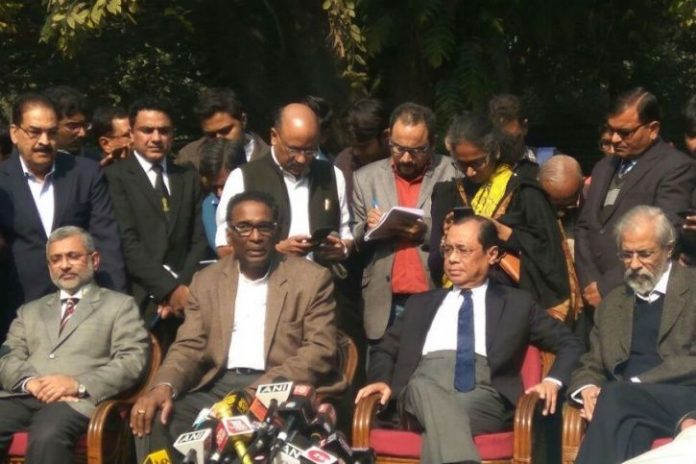
Aadhaar Bench assembled with a slight delay due to Padmavaat hearing. However, the focus of entire hearing today was the much revered Privacy judgment and the Aadhaar Act. Mr. Shyam Divan, senior advocate, continued the argument on behalf of the petitioners. He read out the following from the privacy judgment:

#1 Dangers of profiling through integrating different sets of data.
#2 Concept of informational privacy
#3 Impossible to visualise in advance all the possible harms that can result from proliferating data sets
#4 Complex issues big data and power
1# Transparency, consent and non discrimination in the context of the states relationship with the personal data.
2# Limitations on privacy – there must be a legitimate State aim, and restriction must be proportionate.
3# Privacy – integral element to right to life and any limitation must be within the constitutional framework.

Mr. Divan, “Privacy is the constitutive core of human dignity and the foundation of ordered liberty. It recognizes the individual’s right to control vital aspects of their life. It is not lost or surrendered merely by being in a public place. The interpretation of privacy must be flexible, to meet evolving challenges.” – From the privacy judgment.

Mr Divan post reading Justice Chandrachud’s plurality opinion moved on to read Justice Chelameswar’s concurring opinion in the judgment which talks about the constitution as securing freedom for every generation of Indians. He highly spoke of the inter-relationship of Article 19 (freedom of speech and expression) and Article 21 (Right to life and personal liberty) of the constitution.

The focus area of Mr. Divan’s reading from the judgment was :

#1 Privacy consisting of open court recourse, sanctuary and intimate decisions.
#2 Fundamental rights are the firewall between the individual and concentrated state power.”

He then moved on to read Justice Bobde’s concurring opinion which read as under:

#1 The Constitution transformed Indians from subject under a monarch to citizens of a Republic.
#2 Privacy in Indian intellectual thought – draws the link between privacy, dignity and liberty.
#3 Privacy as a “travelling right.” – It is a sprignboard to other rights such as speech, etc.

Mr. Divan then moved on to read part of Justice Nariman’s concurring opinion :

“#1 Privacy is not an elitist concept.
#2 The state’s argument that privacy was an elitist concept springs from its defense of the Aadhaar Act.
#3 In order to restrict privacy, the state’s interest must be ‘compelling.’

Mr. Divan moved ahead to read out Justice Kaul’s concurring opinion:

#1 Some people may not attach great importance to privacy – this is no reason to recognize it as a right.
#2 Edwards Snowden, data profiling, the definition of data profiling and the potential of profiling for both good and evil.
#3 Digital footprints – various type of data that big data can exercise.
#4 The right of the individual to control information about herself.
#5 Privacy of children require special concern.
#6 Privacy is particularly important in a country as diverse as India

Mr. Divan reads out the unanimous conclusion of the 9 judges that held that privacy is a fundamental right in the Indian Constitution.

Mr. Divan summarizes that the judgment affirms that privacy has always been a fundamental right and the correct position has been established by various judgments after Karaghsingh.

8 Takeaways from the privacy judgment, as per Mr. Divan:

#1 Privacy is a natural right, a condition precedent to the enjoyment of any fundamental right, it includes the right to control the dissemination of information.
#2 The sanctity of privacy lies in its relationship with dignity. Privacy is a postulate to human dignity itself.
#3 Privacy is integral to liberty and freedom. It is more than a derivative right – it is a foundation right.
#4 Privacy has both negative and positive components. In it’s negative concept, it protects the individual from the state. In it’s positive aspect, it casts an obligation on the state to protect its individuals from non-state actors.
#5 Privacy is not an elitist concept. Subordination of civil and political rights to economic and social rights has been used for some of the most egregious voilation in the history.
#6 Knowledge is power, information is silos. When aggregated it can be a threat to freedom.
#7 Privacy can be restricted only by a law that is just, fair and reasonable.
#8 The rule of law and necessity of judicial remedies.

Bench rose for lunch and reassembled at 2:30:

Mr. Divan starts with the Aadhaar Act and starts with definition clause. Mr. Divan starts by saying that he will be commenting post taking the court through the statute. He starts by reading out the statement of objects and reasons of the Aadhaar Act focusing on the need for proof of identity, identification of beneficiaries, transfer of benefits, etc followed by the Preamble and the Long Title.

Mr. Divan on definition clause.

#1 Authentication Process and Authentication Record – which refers to the record of time of authentication, the identity and the response of the requesting entity. Mr. Divan emphasized that thus the identity of the entity is known.
#2 Benefits, bio metric information (clause g) and core-biometric information. He states that both the clauses are open ended for interpretation.
#3 Enrollment agencies – even after the act remains private.
#4 Registrar – just as in the pre-act regime, registrar need not necessarily be a government body.
#5 Requesting entities – that submit biometric information to CIDR for authentication.
#6 Resident – Who has lived in India for at least 180 days in the last 12 months. Mr. Divan calls this definition rather curious.
#7 Service and Subsidies – Mr. Divan referred to them as open ended as well.

Mr. Divan then invited the attention of the court to section 3 of the act which deals with enrollment. He points out that the words used here are “shall be entitled to obtain”, consequently getting an Aadhaar number is a right and not an obligation. He reiterated his previous point that the authentication process is probabilistic.On counselling requirement under section 3, he said that the concept of informed consent which is reflected by the counselling requirement will become completely illusory if the mandatory character is upheld.

Mr. Divan went ahead to read section 4. He reiterated his point that the enrolment procedure is completely compromised and has no oversight. Under Section 4(3) the data can be used as a proof of identity for any purpose. He then moved to S.6. It provides for updating of the data. He states that biometric information changes over time. This compromises the whole idea of uniqueness. He went ahead to read S. 7 which effectively allows Aadhaar to be made mandatory for receiving the benefits or services. He asserts that this provision negates the right of the individual to identify herself in the reasonable alternative manner.

Mr. Divan took the court through section 4 of the act which established the UIDAI and points to section 23 which lays out the powers and functions of the UIDAI. He stated the UIDAI has been given vast powers for example, to add biometric indicator such as DNA under regulations.

He further stated that UIDAI is allowed to contact out of the security of the database. He says, “this raises a security concern and has been documented and shown in the records.” Mr. Divan stated that as per the act UIDAI has the power to deactivate the Aadhaar number. This means that it effectively has the power to deprive an individual of all her civil rights. He then pointed to section 23(3) which allows UIDAI to enter into an MoU with other bodies – public and private.

Mr. Divan then referred to Chapter VI of the Aadhaar act which deals with protection of the information. He states that, “all the information that the act says you cannot share has already been shared”

Justice Chandrachud then questioned Mr. Divan, “How does breach of the statutory provision effect the constitutionality of the act itself?”

Mr. Divan argued that the statute is unconstitutional which seeks to sanctify the Aadhaar programme, which is incompatible with the free and open democratic.

Justice Chandrachud said that there are two claims. First that the program is unconstitutional, second that there have been breaches that need to be plugged. He then questioned Mr. Divan as to whether he will be making both arguments?

Mr. Divan replied saying that the key question is whether an individual is entitled to protect herself by making a choice about which method to use to identify herself? The breaches help to substantiate the strength of this basic claim. The claim to make a choice.

He further argued that the concern is that you will end up having a complete surveillance society of this system in its present form is allowed to stand.

Mr. Divan took the court through Section 32 of the act, these deals with storage of metadata. Mr. Divan said that he is not saying that somebody’s sitting and tracking you. He meant that the architecture is what enables a surveillance state.

Justice Chandrachud questioned Mr. Divan, “We are living in a networked world, where private parties are any way tracking everyone in great detail. So how does the interpolation of an Aadhaar number really change anything?”

Mr. Kapil Sibbal, Senior Advocate answered this question by saying that, “the key issue is whether in this networked world, a single form of identity to which everything is linked is safe.”

Justice Chandrachud asked, ‘”Can’t you obviate the aggregation of datasets by specifying in the law that data can be used only for the purpose for which it is collected?’

Mr. Divan said that there is a crucial difference between private parties and the State. With private parties one can always opt out.

Justice Chandrachud asked, to what extent do you have an actual choice in today’s world, even with respect to the private parties?

Mr. Divan replied that the point is that the state has far more powers with respect to an individual than a private party.

Mr. Divan argued that in a democracy there has to be a certain amount of trust between the state and an individual. So when an individual says that she has an alternative way of identifying herself, her state needs to accord that basic trust and respect and allow it, as long as that alternative is reasonable. Mr. Divan took the court through Section 33, this deals with disclosure of information in certain cases. He then moved to section 47 – cognizance of offenses. He said that an individual does not have any locus to approach the court as per this provision. He then moved to section 48 – stating that in case of public emergency the entire record will go into the hands of central government. After which he moved to section 57 – which talks about the use of Aadhaar for other purposes than mentioned under the act. This section instead of confining the usage, extended the use to almost every entity – not just under a law but under the contract.

Justice Sikri then questioned, “What is the harm if you are just giving the number but nothing else. i.e., no biometrics.”

Mr. Divan replied you may not want to have this information spread around. The number when used with other information, publically available can be compromising.

Justice Chandrachud replied that the biometric information remains only with CIDR.
Mr. Divan said this is not the case by giving the example of fingerprints being skimmed off.
Bench rose for the day at 04:00, arguments to continue tomorrow.

For more updates and latest legal news, follow iPleaders at https://www.facebook.com/iPleaders/, you can also find us on twitter at https://twitter.com/LawSikho if you want more such legal news follow us on https://blog.ipleaders.in/.

Download Now

Adesh Kumar Sharma: An Advocate and Consultant by profession shares his opinion on NUJS Diploma Course on how it helped him in gaining knowledge on Business Law

1

Mr. Adesh Kr. Sharma is a result oriented Legal Professional with more than 13 years of experience as a legal practitioner involving legal affairs and litigation matters. He has Comprehensive knowledge of Civil Laws, Criminal Laws, Family Laws, Arbitration and Conciliation Act, Transfer of Property Act, MRTP Act, The Recovery of Debts Due to Banks and Financial Institutions, Consumer Protection Act, Specific Relief Act and Negotiable Instruments Act, Media and Advertisement Laws, Internet Laws etc.

Today I’m feeling very happy while talking about my own success story and will be much happier if my feedback helps the future of any generation who wants to know about the practical implications of Business Laws. I was into litigation for quite some time and was looking for some valuable course to enhance my knowledge without any major change in my career.

I was searching on Google for an online legal education institute and I came across NUJS. I must say, iPleaders along with NUJS is doing a brilliant job. I have gone through quite a few other courses they are offering which are content wise excellent. Both Abhyuday Agarwal and Ramanuj Mukherjee are doing a marvellous job. I truly respect their hard work and vision the way they have made Law accessible to others.

So far my experience with iPleaders was great while doing NUJS Diploma in Entrepreneurship Administration and Business Laws. The contents were full of knowledge, the webinars were of great help. My sole objective was to gain knowledge about business law. I personally felt like the theory part can be improved, otherwise, the practical orientation of the course is wonderful. All the modules were great. Modules on IPR, NGO, IT, Trade Mark, Copyright are something very new for me. So, I must say that all these modules have definitely added a new perspective to my knowledge.

Download Now

Conviction rate of Rioters in India

2
Riots in India
Image Source - https://www.theodysseyonline.com/expect-riot

In this article, Akansha Vidyarthi discusses the Conviction rate of Rioters in India.

Introduction

In India, a number of riots have occurred since independence and the number of Incidents of riots has considerably been increased in Recent years. Some of Common form of riots that have occurred in India are Communal Riot, political riots etc.It causes a great harm to public property, creates a threat to National Security, loss of lives of people.

This Article explains that why the Cases of riots are increasing but the Conviction Rates are declining over a number of years?

Punishment for Rioting in India

In India, riots in any forms are illegal and punishable under IPC and the procedure for punishing such rioters are provided in Crpc. The definition of Rioting and Its punishment is given in IPC.

What does rioting mean under Section 146 of IPC?

Situation– where the Unlawful Assembly is formed by five or more persons and force or violence used by all of them or by any person to fulfill the common object of Unlawful Assembly, then every member of such Unlawful Assembly shall be held guilty for Rioting. Example- A & five of his friends burnt the public property in protest against the Triple Talak Bill passed by the Parliament and thereby many people died. They would be held liable for Rioting under this Section.

What is the Punishment for Rioting under Section 147 of IPC?

Any person who is found guilty of Rioting under Section 146 of IPC, then they shall be Punished with-

  • Imprisonment which may extend to 2 years; or
  • Fine; or
  • Both.

What Section 148 of IPC says when rioting is done with a Deadly Weapon?

Situation- Where Rioting is done by any person with a deadly weapon or any object or weapon which can cause the death of a person. Example- X with five of his friends assembled together with Hockey Sticks, Knife, bats and caused unlawful force and violence against people of other community which results in the death of 100 people. They would be guilty under Section 148 of IPC.

Then such person shall be punished with-

  • Imprisonment which may extend to 3 years; or
  • Fine; or
  • Both.

What is the Procedure of Trial of rioters under Section 233 of CrPC?

Situation- Where the persons are accused of the commission of the same offence which has been committed by them under the same transaction, then they may be tried and charged together instead of Separately. Examples– A with seven of his friends are accused of committing riots, therefore they may be charged and tried together instead of separately.

In Bhanwarilal And Ors. vs The State Of Rajasthan held that “Where a number of people have been jointly tried, the court should consider the evidence against each of the accused separately and give definite findings against the presence of each.”

In Garib Singh and others vs State of Punjab (1973), the Court held that “In case of rioting, where a number of men are accused, the magistrate should deal with the case of each of the accused separately or discuss the evidence against of each of the accused, especially when the evidence against each of the accused is by no means equally strong.

NCRB Data on Conviction Rate of rioters in India

According to the NCRB Report, the Conviction Rate of riots have reduced over a number of years and in the Year 2016, there are least number of Convictions on riots as compared to previous years.

Year

Conviction Rate of riots

2001

27.1

2002

28.6

2003

23.2

2004

22

2005

21.6

2006

21.2

2007

19.1

2008

20.2

2009

20.3

2010

21.7

2011

21.5

2012

18.5

2013

18.9

2014

18.4

2015

18.5
2016

18.1

Is Lack of Judicial Activism responsible for Low Conviction Rates in India?

The Indian Judiciary plays a very important role in eradicating the crimes, but in cases of riots, there is a need for Judicial activism in India. As due to the Casual attitude of judiciary towards these Incidents, the number of Incidents of riots in India is increasing day by day but the Conviction rates are declining over a number of years. In most of these cases, either the cases remain pending in courts for years or the accused are acquitted because of casual attitudes of judges.

1.Recent Bhima Koregaon Incident

In the Recent Bhima Koregaon Incident, the Dalits assembled in Bhima Koregaon to celebrate the victory of Mahar soldiers who fought with the Britishers against the Peshawar soldiers who had to oppress the Dalits. The Injury to the people was not planned by the Dalits as initially they assemble peacefully without any arms and weapons. But, some Right-wing organization started calling this event as anti-national, because of which stone pelting and other violence occurred. As, a result of which Dalit calls for bandhs in Maharashtra and Pune.The Main mastermind in this incident was Jignesh Mevani and Umar Khalid as the situation of riots arises because of provocative speeches were given by them so as to call people on streets to retaliate. FIR has been registered against them by the police.

2.Muzaffarnagar riots

In 2013, The Riot between Hindu Jat and Muslim Community in Muzaffarnagar caused the death of 62 people out of which 42 are Muslims and 20 are Hindus. It is the worst violence that ever took in India. The army was deployed to bring the situation under control. The main cause of such riot is a traffic accident and an eve-teasing incident with the Hindu Jat girl which later turned into a communal violence. Police arrested 14 people. This case is still disputed and pending. Such Incidents just remain pending in courts for long duration providing no relief to the victims.

3. Vadodara riots

In 2006, Dargah riots occurred in Vadodara, Gujarat. As per the order of Municipal courts, it was ordered to remove the dargah of Syed Chishti Rashiduddin, a Sufi saint. In this incident, the police have used violence against Muslims during the Incident. In the Incident, 6 people were killed, 42 were injured. All the accused in this incident was later acquitted because of lack of any substantial proof against them, which shows the negligence on behalf of the police to conduct the investigation in the proper manner.

3. Gujarat riots

In 2002, Gujarat riots an anti-communal violence that took place in Gujarat had continued for 3 days. As a result of this, violence also took place in Ahmedabad, the trains were burnt in Godhra which cause the death of 5 Hindu pilgrims karsevak who were returning from Ayodhya on a train. The riots resulted in the Death of 1,044, 223 missing, and 2,500 injured. Out Of the dead people, 790 were Muslim and 254 were Hindu. In this case, the judges were not unbiased and the witnesses were intimidated from giving testimony. Later the case was transferred to SIT and in 2013, 249 conviction was done out of which 184 were Hindus and rest were Muslims.

Does Lack of Improper Investigation by the Police is a factor for Low Conviction Rates of Rioters in India?

The Conviction Rates of Rioters are declining and it clearly shows the negligent and casual attitude of Rioters in conducting the proper Investigation. In many of the cases, the accused are acquitted by the court because of lack of evidence against them. Therefore, the rioters go unpunished and the victims of such riots do the get any sought of relief. Just because of their improper and Independent investigations sometimes, the innocent are accused of an offence in such riots and they are acquitted after a long time.

NCRB Report on riots Committed in India

The NCRB report on the Number of riots that have been committed in India over a number of years are-

Year Number of riots
2000

80456

2001

76222

2002

68945

2003

57334
2004

59971

2005

56235
2006

56641

2007

59915

2008

66018

2009

62942

2010

67571

2011

68500

2012

74633

2013

72126

2014

76248

2015

76555

2016

72829

The NCRB Report on Rate of different types of riots

The NCRB report on the percentage of different types of riots that took place in the following years are-

Types of riots 2014 2015 2016
Agrarian 0.95 4.11 7.8
Caste Conflict 2.29 3.72 3.7
Political 2.81 3 3.21
Communal 1.86 1.21 1.4
Students 0.4 0.75 0.79
Sectarian 0.05 1.35 0.7
Industrial 0.26 0.29 0.27

NCRB Data on States with Highest Number of riot due to Caste Conflict

The NCRB data on different states in which the highest number of riots have occurred in the following years are-

States 2014 2015 2016
Uttar Pradesh 75 724 899
Bihar 6 258 521
Tamil Nadu 211 426 239
Maharashtra 388 204 178
Gujarat 101 141 123
Karnataka 87 188 80
Madhya Pradesh 168 30 73
Andhra Pradesh 19 52 45
Haryana 34 46 45
Uttarakhand 4 1 29

What Steps should the government take to prevent riots in India?

As discussed the number of riots in India are increasing day by day, it is the duty of the government to maintain peace and harmony in the State therefore in order to prevent riots in India the government should take following steps-

  • The Problems of Communalism is deep-rooted in the mindset of the people, therefore they should be made aware of the socio-economic and political causes of communalism in India;
  • Secondly, Steps should be taken to prevent the political parties spreading communalism in the society which leads to the situation of Riot;
  • Education can play a very important role in curbing such riots by teaching students about the idea of communalism ideologies that was rooted in our society during the British period;
  • States are required to take adequate steps in order to prevent riots. The laws are required to be Strengthened, the punishments for Rioters should be made more Stringent;
  • Media plays a very important role in preventing the riots. They act as a mediator between the government and the general public which can be very fruitful in order to bring the situation under control during riots;
  • Special Courts should be set up for trying the matters relating to riots;
  • Government should take steps to provide adequate reliefs to the victims of Communal riots;

Conclusions

From the above discussion, it can be concluded that India has become a hotbed of Communal riots because though the Number of cases of riots is increasing over a number of years but the rate of conviction of rioters is gradually declining which shows some kind of flaws in a legal system. There is lack of judicial activism in India in the matters of riots. Because of the casual attitude of Judiciary in such matters, the rioters go unpunished.It also shows the negligence on behalf of police officials in conducting a proper investigation and taking stringent actions against such rioters because of which sometimes the judiciary is bound to acquit the accused because of lack of proper evidence against them. It is the duty of the State to establish the National peace and to take some steps to end the misery of victims by making the laws more stringent and providing compensation to the victims of such riots and by filling the loopholes of laws.

References

  1. Banwarilal and Ors. vs. State of Rajasthan, (1993)
  2. Garib Singh And Ors. V. The state of Punjab, (1973)
Download Now

Nehal Nikhil Wagle: A first year LLM student of Mumbai University speaks on how NUJS Diploma Course helped her

0

Nehal Nikhil Wagle: A first year LLM student of Mumbai University speaks on how NUJS Diploma Course helped her.

I have done LLB from Government law college, Mumbai. Currently I’m a first year LLM student from of Mumbai University. I was looking for an online course which could add practical value to my academic profile. Came across NUJS on Google and was very impressed with the Diploma in Entrepreneurship Administration and Business Laws course.

The contents were, as well as the ancillaries described were fantastic which encouraged me to enrol. I have completed this course in 2017. The learning methodology of this course is very practical unlike the traditional courses in Law.

My experience with iPleaders was brilliant; the regular assignments allotted during the course were of great help. It helped me to recollect and write many articles. I must say, it gave me lot of confidence. The faculties were excellent and the webinars were very informative. Overall, I got much more than I expected. The entire journey was very fulfilling.

Mr. Ramanuj Mukherjee and the entire team iPleaders is doing a great job. Even the customer service was of great help during the entire course. All my queries were solved promptly and without any further ambiguity.

There was an iPleaders group on WhatsApp, which not only helped solve queries collectively and enhanced my knowledge, it also helped me interact with practising advocates and expand my network. This is something I’ll always appreciate. A brilliant endeavour indeed.

Download Now

Organisational setup and functions of Enforcement Directorate

0
Enforcement Directorate
Image Source - https://timesofindia.indiatimes.com/city/chandigarh/ed-attaches-assets-of-local-firm-in-vat-refund-scam/articleshow/62057623.cms

In this article, Himanshu Juneja discusses the organisational setup and functions of Enforcement Directorate.

About Enforcement Directorate

It is an agency which enforces laws related to the economy and fights with the problems related to economic crimes in India. It is also an Economic intelligence agency which works for the enforcement of the provisions of two main laws for the economic development of the country. Two main laws are as follows:

  • Foreign Exchange Management Act (FEMA), 1999,
  • Prevention of Money Laundering Act (PMLA), 2002.

Headquarter and other offices

This agency is a part of the Revenue Department, Financial Ministry.

  • Its HQ is situated at New Delhi which is headed by the Director of Enforcement.
  • five regional offices are in Mumbai, Chennai, Kolkata, Chandigarh, and Delhi. These offices are headed by special Directors of Enforcement.
  • its zonal offices are in Ahmedabad, Bangalore, Chandigarh, Delhi, Lucknow, Mumbai, Patna, Srinagar, Panaji, Guwahati, Hyderabad, Kochi, Chennai, Jaipur, Jalandhar, and Kolkata. These offices are headed by Joint Director.
  • Its sub-zonal offices are in Bhuvneshwar, Kozhikode, Indore, Madurai, Nagpur, Surat, Allahabad, Raipur, Ranchi, Dehradun, and Shimla. These offices are headed by Deputy Director.

Recruitment of the officers is directly and by drawing officers from other investigation agencies. So, it comprises officers of IRS(Indian Revenue Services), IPS(Indian Police Services) and IAS(Indian Administrative Services) such as Income Tax officer, Excise officer, Customs officer, and police.

History

Its history can be traced from 1956 when on the 1st May of 1956, a unit (Enforcement unit) was formed in Economic Affairs Department. It was formed for the control some issues relating to the violation of the provisions of FERA (Foreign Exchange Regulation Act),1947. This Enforcement unit was renamed as “Enforcement Directorate” in 1957 and the administrative control was transferred to Revenue department from Economic Department in 1960. Later the FERA Act was repealed after 1977 and a new Act was passed named FEMA(Foreign Exchange Management Act),1999 which came into effect from 1st June of 2000. Further the Prevention of Money Laundering Act, 2002 was passed by the parliament to prevent and control money laundering in India and to deal with such issues. Later the responsibility for the enforcement of provisions of both acts was given to the Enforcement Directorate on 1st July of 2005 and since today it is working for the enforcement of the provisions of both acts.

Characteristics of Enforcement Directorate

  • It is an investigation agency which investigates cases related to finance.
  • It is a part of Revenue Department of Finance ministry.
  • It mainly deals with two laws which are, FEMA(Foreign Exchange Management Act), and PMLA(Prevention of Money Laundering Act).
  • It works for the enforcement of provisions of these two acts.
  • It has its own courts for trial and also its own appellate tribunals.
  • It investigates and files suits in courts against those who violate the rules of FEMA and PMLA.
  • It resolves the matters or issues by adjudication and has provision for appeal in both acts.
  • It works to achieve the objects of both acts.

Way of Working: Modus Operandi

  • Work with upgraded systems and methods to improve work performance and remove outdated systems and methods.
  • The team working for better communication with each other.
  • The process of learning from Global best practices to sharpen their investigation skills.
  • Delegate tasks and strictly follow rules to deal with issues to get excellence in its working.
  • Deals with all laws for which they are responsible and try to achieve the better result.
  • Fair and reasonable investigation in all cases while investigating.
  • It collects the facts and reveals the truth without any fear.
  • Takes right decision without favoring anyone.
  • Fair actions, without bias.
  • Does not allow the abuse of power.
  • The team is responsible for the consequences of their actions and answerable for an outcome.
  • Work with the discipline to achieve their goals.

How to report matter to Enforcement Directorate

Can a person directly approach the Enforcement Directorate?

A person cannot directly approach Enforcement Directorate. But complaints relating to illegalities in foreign exchange and money laundering may be sent to the Enforcement Directorate at the following address:

Director,

Enforcement Directorate,

6th Floor, Lok Nayak Bhawan,

Khan Market,

New Delhi- 110003

Website: http://finmin.nic.in

An application can also be filed with the court to refer the matter to Enforcement Directorate and to investigate the matter by Enforcement Directorate agency.

Complaint to any other agency : If someone wants to report a matter related to the violation of FEMA or PMLA act, he has to register a complaint with any other agency or Police than ED. PMLA contains 157 sections regarding the offences related to the money laundering. These offences are called schedules or predicate offences. If such registered offence is one of any schedules or predicate offences than Enforcement Directorate can take action against such person. Officers can investigate, search and confiscate the property of such person.

Does Enforcement Directorate take action, suo motu or on a complaint?

ED can not take an action suo motu. One has to complaint to any other agency or Police first and then ED will investigate the matter and will identify the accused. Agency will investigate the matter and may attach the property of an accused person and also make an arrest and start proceeding with the violation of the provisions of FEMA and PMLA act. The matter will be resolved by the way of adjudication by courts or PMLA court.

Jurisdiction

Both FEMA or PMLA applies to the whole India including Jammu and Kashmir. So, the Enforcement Directorate can take action against any person on which this act applies. Cases under FEMA may lie in civil courts where PMLA cases will lie in criminal courts.

The agency has jurisdiction over a person or any other legal entity who commits a crime whether he is a politician or a businessman. All the public servants come under the jurisdiction of the agency if they are involved in any offence related to the money laundering.

Job opportunities for Law Graduates in Enforcement Directorate

Enforcement Directorate is increasing his offices in many other states and cities. Many zonal and sub-zonal offices have opened by the order of Central Govt and soon they will function properly. So, there is a lot of opportunities for Law Graduates. It may soon hire some legal consultant and legal advisors.

Law Graduates can get more opportunities as a legal advisor, a judge in adjudication authorities and in appellate tribunals of the agency.

Procedure followed by Enforcement Directorate for investigation

Search of place and person

After the registration of complaint to an agency or police for schedules or predicate offence under the PMLA, first of all, they have to report magistrate under section 157 of the Code of Criminal Procedure. After the approval of Magistrate, the officers may search any place, building, vehicle, and vessel or break down any locker, safe or almirah or any other receptacle for exercising his power. They are empowered to search a Person if they have reason to believe that he may be involved in any crime.

Seize property

Officers can seize any property if they have reason to believe that such property has any relation to the money laundering. Officers will follow the Code of Criminal Procedure, 1973 while confiscating or attaching any property. Section 17 and 18 of PMLA has provisions for the search and seizure of any property or person.

Section 19 of the PMLA, empowers the officers to arrest a person if they have reason to believe that such person is involved in a crime related to money laundering.

Investigation powers of Enforcement Directorate officers

Section 36 and 37 of FEMA deals with the establishment of this agency and empowers its officers to investigate the matters which contravene the provisions of this act and any other rule or order passed by the authority by exercising of the power given under this act.

Power to investigate

The officers below the rank of assistant directors are not allowed to investigate the matter and all other upper-rank officers are allowed to investigate including director of Enforcement.

Investigate any person or place

An officer of Enforcement Directorate is empowered to investigate any place, building, vehicle or any other area to find evidence for the further proceeding. He can break down any locker or almirah to find evidence and take an oath of any person.

Power to arrest a person

After investigation or at any time of investigation if they found any person guilty of a crime related to money laundering, they have the power to arrest such person and can start a legal proceeding against such person in court.

What actions are taken on the report prepared by Enforcement Directorate officer

After the investigation of the matter, officers make a report of the matter which includes the detail of the report, investigation done by officer, places, and persons investigated, attachment report of the attached property, report of an arrested person.

After the preparation of the report matter may be adjudicated in ED’s own adjudicating authority or the case may be referred to CBI court or Apex court also. The aggrieved party of the case may go to the higher court for the appeal.  The agency has its own appellate tribunal for the purpose to take an appeal.

The court on the decision of the matter may impose fine thrice of the sum involved in case of contravention of the provisions of the FEMA and may punish with rigorous imprisonment not exceeding seven years.

Functions and powers of the Agency

This investigation agency works for the enforcement of provisions of the FEMA and PMLA. It is working to achieve the objects of these acts and impose penalties on those who violate the provisions of these acts.

Some basic functions and powers are to investigate the matter, search any suspected place or person, confiscate any property purchased from laundered money, arrest any accused or person relates to such crime, file suit against accused person and some other function of its adjudication authorities and appellate authorities, such as to decide any case by taking evidence, power to penalize victim with imprisonment and fine. Some functions, procedure, and powers given in dealing acts are such as.

Investigate the contravention of FEMA

The investigation agency and its officers investigate the contravention of the provisions of Foreign Exchange Management Act,1999. If an individual or any other person violates the provisions of FEMA, officers deal with such contravention of any provision by the way of adjudication. Enforcement Directorate designates such adjudicative authority which is empowered to adjudicate and impose penalty up to thrice of the sum involved.

Investigate the offences under PMLA

The offences covered under this act are of criminal nature. The agency investigates the offences related to money laundering covered under any section of the Prevention of Money Laundering Act, 2002. Under section  5 of this act, agency and its officers are empowered to take action of attachment and confiscation of the property if they have reason to believe that such property is derived from laundered money. Further, they are also empowered to prosecute the person involved in the crime of money laundering. The Involved person may be punished with a term not less than 3 years and may extend to 7 years and with fine which may extend to rs. 5 lac. The punishment may be rigorous.

Adjudication of show cause notice under FERA

That act(Foreign Exchange Regulation Act) was passed by Indian Parliament in 1973 and came into force from 1st January 1974 and was repealed and replaced by the Foreign Exchange Management Act, 1999. It was repealed by the Govt. of Atal Bihari Vajpayee in 1998. FEMA adjudicates the show cause notices issued by the FERA authorities to many MNCs and to others up to 31-05-2005 for the alleged contravention of this act. The adjudication authorities may impose penalties.

Sponsor cases under COFEPOSA in regard to contravention of FEMA

COFEPOSA(conservation of foreign exchange and prevention of smuggling activities) act was passed in 1974 during the administration of Indira Gandhi. This act was passed to retain foreign currency in India and to prevent smuggling activities. Agency act as sponsor to cases of preventive detention under COFEPOSA in regard to contravention of the provisions of Foreign Exchange Management Act, 1999.

Cooperation with foreign countries to prevent money laundering crimes

According to section 56 of Prevention of Money Laundering Act, 2002, Central Govt. may enter into an agreement with any foreign country for enforcing the provisions of this act. Hence, agency cooperates with other foreign countries in matters relating to money laundering and restitution of assets. Agency can share information to prevent any crime related to money laundering and seek cooperation in such matters.

Case study

Jagdish Bhola Drug Racket Case

A former DSP of Punjab was arrested by Punjab police while raided at his home. Fatehgarh Police found drugs of rs. 100 crore at his residence in Mohali. A Deputy Director(Niranjan) of ED filed a case against him with many other politicians and NRI who supported him in this racket.

Niranjan has to face so many problems including his transfer from Jalandhar to Kolkata which was cancelled by the Punjab and Haryana High Court. He did plan not only to investigate in that matter but also to attach property of Rs. 1000 crore or more of many politicians of Punjab. He did all as an investigation officer of ED but later on the decision of the Court, his duty was changed to as a supervisor of the case where he could only supervise the case instead of investigating the case. The case is still going on and many other politicians with Bhola are under police investigation. Some are in Judicial custody while many in jail also. The matter is related to a drug racket of Rs. 6000 crore or more.

Vijay Mallya case

Vijay Mallya was a big businessman and also a politician of India as a member of Parliament running many of companies including airline service and liquor business in India. He took a loan of Rs. 9000 crore from many banks and did not return. Later he leaves India and he has declared a defaulter and now Indian Govt. is demanding him back from London court or Govt.

Enforcement Directorate has also filed a case against Mallya charging him with money laundering under PMLA. ED registered a case on the basis of CBI probe which alleged him and A. Raghunathan(CFO of Kingfisher Airlines) with a default of 900 crores with IDBI Bank officials.

Conclusion

Directorate Enforcement is a department of our Govt. which is working to develop our nation. As we have discussed its structure and working with its functions and powers, now we can say that it is working with some specific objects. This is Govt supporting agency to control and prevent money laundering in India. It is working with a good and clear vision to serve the nation. Many officers from many different departments work to support this agency. They investigate and resolve the matter with the process of adjudication and also perform many other functions by using their power given to them by an agency. It is functioning to strengthen our economy. It punishes fraud persons involving in money laundering and those who contravene the provisions of FEMA and PMLA. Its work for controlling and preventing money laundering and as a guardian of two important laws or acts will make India better and develop our economy.

Download Now

Dos and Don’ts in a cheque bounce case

5
Cheque Bounce
Image Source -

In this article, Kajal Srivastava discusses Dos and Don’ts in a cheque bounce case.

What do we mean by the term cheque?

A cheque is basically a negotiable instrument which directs the bank to pay some specific monetary amount from a person’s account in whose name the cheque has been issued.

The following prerequisites are required to be satisfied for qualifying a cheque as a valid-

  • It must be in written form
  • It should be an unconditional order
  • The mode of payment should be directed to some specific person
  • It should be payable on demand for some specific amount of money
  • The cheque must contain the signature of the drawer.    

What is a cheque bounce?

The occurrence of an event when a person draws a cheque in the favor of another person without maintaining sufficient amount in his account as a result of which the bank has to return the cheque, which is termed as bouncing or dishonoring of the cheque.

Legal provision for cheque bounce in India

The legal provision regarding bouncing of the cheque has been mentioned under Section 138 of the Negotiable Instruments Act, 1881. This Act says that bouncing of a cheque is a criminal offense in India and the same is punishable with an imprisonment of two years or with a fine equivalent to twice the amount of cheque, or with both.

Offenses by the companies

Section 141 of the Negotiable instrument Act states that if the offense under Section 138 has been committed by a company, then along with the company every single individual who was involved in the discharge of liability will be responsible for the guilty of an offense.

Essential ingredients for  the offense of cheque bouncing

  • The issue of cheque must have been made for the purpose of fulfilling some legally enforceable debt or any other liability.
  • It must have been presented either within a period of six months or within the period of its validity whichever is earlier.
  • The payee is obligated to issue a demand notice in writing to the drawer within a duration of 30 days regarding the nonpayment of the cheque by the bank.
  • The drawer must fail to pay the amount to the payee within a duration of 15 days from the date of receiving the above mentioned period.

Who can file a complaint about dishonoring the cheque?

The person whose cheque has been dishonored by the bank due to the insufficiency of the funds has a right to file the complaint.

What are the Dos in case of a cheque bounce   

  • Furnishing of cheque- The first and the foremost thing which is required to be done is the furnishing of cheque within the validity period of three months from the date on which it is drawn, it is to be noted that prior to this the period of validity was 6 months which has now been reduced to three months furthermore a cheque  be presented for more than once within the period of validity.
  • Notice of demand- When the event of bouncing the Cheque by the Bank occurs immediately a Notice of Demand should be sent to the Drawer. The Time Limit for Furnishing the Notice Of Demand to the Drawer is thirty days.
  • The Drawer should pay the amount within fifteen Days to the aggrieved Party.However, this can not be denied that there is no prescribed format for such Notice but still the Drawer is deemed to consider this as “Notice of Demand”.Moreover, the aggrieved Party should have the Proof that they Furnished the Notice Of Demand to the Drawer.
  • The Notice of Demand can be send by the complainant himself/herself       but it is advisable that they should get the approval of a Cheque Bounce  Lawyer before communicating the same to the Concerned Party.

Necessary ingredients of a Demand Notice

  • Statement that the Cheque was Presented to the Drawer before the expiry of its validity.
  • Statement that there was a Legal Liability which Could be Imposed to the Drawer.
  • The Notice of Communication Regarding the Dishonour of Cheque as given by the Bank.
  • Notice of Demand Directing the issuer to pay the amount within 15 days.

The payee is supposed to send the notice to the accountholder within 30 days of bouncing the cheque,the notice should contain the demand for the payment within fifteen days from the date of drawing the notice,it is to be noted that violation of the same will cause proceedings against the drawer under the provisions of Negotiable Instruments Act 1881.

Essential documents for filing the complaint

  • The original cheque.
  • The memo of returning the cheque which would contain the reason about  non payment by the bank.
  • Blueprint of notice of demand  and the original receipts of the  portal.
  • An affidavit stating the pieces of evidence

Filing of complaint- After the lapse of 15 days, from the date of drawing the notice the payee has to file the complaint within the duration of 30 days before the magistrate.

Jurisdiction for filing the complaint

  • The place where the cheque was drawn
  • The place where the cheque was presented.
  • The place where the cheque was returned by the bank.
  • Where the notice of demand has been served.
  • The next step is to have the trial, as per the provisions of Section 138 of the Negotiable Instruments Act the Court will take into account the documents produced by the complainant and the same will act as the evidence.
  • The Court will reach upon the verdict taking into account the merits of the case, and if the accused is proved to be guilty then he will be punished with an imprisonment of two years and the amount which is equivalent twice to the amount of the cheque.

Court fees for filing of complaint

       Amount             Court fee
     Rs. 0 to Rs. 50,000           Rs.200
    Rs.50,000 to Rs. 2,00,000           Rs. 500
    Above Rs. 5,00,000           Rs. 1,000
  • The court issues summons to the accused of appearing in the court on the specified date.
  • If the accused does not appears on the prescribed date to the court for the hearing then the court issues a bailable warrant on the request of the complainant.
  • Even after the issuance of the bailable warrant if the accused fails to appear before the court then the court issues a non- bailable warrant against the accused.

What are the don’ts in case of a cheque bounce?

There are certain things which have to be strictly avoided in case of a cheque bounce they are as under-

  1. Alterations in the amount of cheque.
  2. Bringing a change in the name of the payee.
  3. Bringing an alteration in the dates of the cheque.
  4. Making any other sort of change to the cheque.

Essential factors to be kept in mind

  • The delay in filing the complaint (i.e), after a duration of thirty days will be for granted by the magistrate only under the exceptional circumstances.
  • A frequent cheque bounce does not mean that the duration of the drawer has been extended.
  • The validity of a cheque gets expired after a duration of three months.

Landmark Case laws for cheque bounce in India

  • Krishna Janardhan Bhat v. Dattatraya G.Hegde, this case gave the list of all the necessary ingredients such as the existence of a legally enforceable debt, the cheque was supposed to be paid in the due course of fulfilling the liability, and the issued cheque must have been returned due to the insufficiency of funds.
  • K.A.Abbas H.S.A vs Sabu joseph And – The plaintiff Sabu Joseph filed a case against K.A. Abbas under Section 138 of the NI Act. Mr.Abbas was sued for the bounce of a cheque worth Rs. five lakhs owing to the insufficiency of funds. The Kerala High Court instructed him to pay a compensation of Rs. 5 lakhs to Joseph. The Apex Court of the country has directed the subordinate courts to award a monetary compensation to the victim in order to assure that they are being taken care of in the Criminal Justice System, the provision for the same has been provided under Section 157(3) of the Criminal Procedure Code.
  • Dasharath rupsingh rathod vs. State of Maharashtra- The Supreme Court bench comprising of three judges held that the complaint about the dishonor of cheque can be filed only to the Courts within whose local jurisdiction the offense has been committed.

Necessary amendments made to the Negotiable Instruments Act

As per the notification which was published in the official Gazette, the amendment shall be deemed to have come into force on the 15th day of June 2015. Rajya Sabha passed the Negotiable Instrument (Amendment )Bill on 7th December 2105, this amendment makes changes in those provisions which are related to the territorial jurisdiction of filing the cases for dishonoring the cheques.

After the amendment, the following things are to be noted-

  • The case for dishonoring the cheque may be filed in the Courts where the payee maintains his/her account, this is in a case when the cheque is delivered for the collection through an account.
  • In case the cheque is presented for the payment by the payee or the holder in due course otherwise through an account then the case may be filed at the place where the drawee maintains his account.

Conclusion

The evolution of cheques in for the purpose of having the transactions in the present era has become more convenient and preferable, rather than carrying the currency. At the same time we need to keep the fact in mind that the practice of not honoring the cheques has also been increased, in order to deter the same, there has been the enactment of Negotiable Instruments Act.

Due to the inculcation of sanctions and strict punitive provisions the commission of dishonoring the cheques has been reduced up to a certain extent moreover, there have been notable amendments made to the existing statute in order to bring down the instances of cheque bouncing.

Download Now

Legal issues around public display of affection

2
public display of affection
Image Source - https://www.youthkiawaaz.com/2012/01/public-display-of-affection-and-its-relevance-in-the-urban-landscape/

In this article, Kajal Srivastava discusses Legal issues around Public Display of affection.

Definition

“Public display of affection is an act that displays a person’s affection for another person which could be either verbally or physically”.

When I come across the subject matter of showing my affection towards my loved ones it puts me in a dilemma, and I start wondering if the advancements that have been made to the other aspects are acceptable then why not “PDA”, if love is an acceptable act, then why do we need to put restrictions when it comes about expressing the same.

General assumptions regarding PDA

There has to be a clear distinction between what is obscene and what is not, though we cannot deny the fact that there are certain instances when the couples go beyond the definition of PDA, that may produce something which  could be either opposed to the public policy or might have certain negative consequences when it comes to maintaining the social ethics, morality, and decency in the society.

Gone are the times, when the expression of a person’s feelings towards another was restrained only up to sending letters or conveying their lovable expressions through the telephonic conservation.

Which actions qualify as PDA?

  • Kissing your partner compassionately in a public place.
  • Sensually touching the genitals of your partner in a public place.
  • The Act of making out in public.
  • Having sexual intercourse at a public place.

Which actions do not qualify as PDA?

  • Holding hands of your partner in Public.
  • Hugging your partner in public.
  • If kissing is done as a means of greeting your partner.
  • Expressing your love for your partner verbally.
  • Putting your arms around your partner’s arms.

Note – The above list is not all-inclusive. Actions which qualifies and which don’t as PDA are taken from case laws and other secondary sources.

What do we mean by the word obscene?

As IPC has not given any clear definition of the word obscene, but there have been many cases in the apex Court where the matters which have the tendency to deprave and corrupt the mind of those who are open to such immoral influences.[1]

For the application of word obscenity in any of the art which could be either in the form of any book or short film, it must be established that the extent of obscenity was more than the texture of art into the work. The interpretation of the word obscene in its true sense could be ascertained only by the judges in the Court of Law, the portions which are claimed to be offensive and obscene must throw the art into shadow.[2]

Indian Legal Provisions on public display of affection

We don’t find any certain sphere which defines the scope and extent of public display of affection in India, but the majority of the suits are filed under Section 294 of the Indian Penal Code(IPC) which gives the following ingredients to bring an offense within its purview

  • An obscene must have been done in public place; or
  • The act or song or ballad or words were obscene; and
  • Their acts were done by the accused causing annoyance to others.

The guilty is punished with an imprisonment of three months which may extend, or with fine or with both.

  • For having a better understanding the landmark case of “Zafar Ahmad Khan v The State”,[3] the Allahabad High Court held that the element of causing annoyance to others must be established. An act of uttering the obscene words in public places which can cause annoyance to the general public will bring the conviction against the accused. The provision for the same has been provided within the meaning of Section 106 of Criminal Procedure Code, 1898 which is identical to the same section of 1973 code.

Does kissing in public amounts to obscenity?

Expression of love through the means of kissing is very prevalent among the couples of the present generation and they consider it as a means of providing strength to their love and mark it as a symbol of expressing loyalty towards their partner. In the Southern State of Kerala putting a restriction over the act of kissing in the name of upholding the moral policing faced a vehement protest from a group of volunteers which gathered support from the other eminent universities across the Nation. A non- violent protest “Kiss of Love” [4]was organized by the youth activists against the non-legal acts of violating the consensual kissing.

It is quite obvious that since time immemorial kissing is used as a means of expressing love which could be strengthened by mentioning the fact that in Kama Sutra a full chapter has been devoted describing the art of kissing which has around 30 verities.

Legality of kissing in Public

  • The controversial issue that lies in determining the legality of kissing in public rests with the fact that whether you have the right to kiss in public or not? The answer is an obvious yes, since the Constitution of India by the virtue of Article 19(1)(a) guarantees the freedom of speech and expression to its citizens, furthermore when the counter- argument of reasonable restrictions is taken into account as provided in Article 19(2) it is to be noted that the interpretation of the word obscene is not certain within the meaning as given under Section 294 of the IPC moreover the act should be of such a nature that it can cause public annoyance.
  • Furthermore, the Apex Court has said that no suit can be brought against the act of consensual kissing, and Section 294(a) of the IPC clearly states that the act such be of such an extent that it could cause annoyance to others. Moreover the Supreme Court in the case of “S.Khushboo v.Kanniammal&Anr”[5] held that while determining the obscenity of an act the community standards should be taken into account, the intensity of such standards may vary from place to place for example in the metropolitan areas it might be considered as an acceptable act, whereas on the contrary in some places it could be brought within the sphere of indecent demonstration. Certain cases to determine the test of obscenity are as under for example in the landmark case of “Kakodkar v.State of Maharashtra” [6] where the doctrine propounded in the Udeshi case was extended. This case basically extended the doctrine of Udeshi case and the Courts were directed to make a proper inquiry. These two cases found the basis for the implementation of Hicklin test which clearly states that if an act is capable of influencing the mind of others then it will fall under the category of an obscene act.
  • Moreover in the case of “A and B vs State the NCT of Delhi” it is held that hugging and kissing forms a part of freedom of speech and expression which is the legit source of showing  love and compassion towards your partner and hence are protected under Article 19(1)(a) of the Constitution of India.

Is it absolutely fine to kiss your Girlfriend in Public?

Under the Constitutional mandate of Article 19 which guarantees freedom of speech and expression, it could be said that the Act of Kissing your Girlfriend is not something which could be brought within the purview of an obscene Act. In order to provide the judicial strength to the same, the recent Judgement of the Apex Court which declared the Right to Privacy as an absolute Fundamental Right can be taken into consideration.

The verdict apparently acknowledges the Legality of sexual orientation under the concept of fundamental safeguards.Moreover it could be said that the Indian society is Changing at a fast pace and the couples are vested with the liberty of expressing their loyalty towards their partners in the form of affectionate acts which might involve a gentle handshake and a greeting kiss, going back to the ancient times and analysing the historical Indian era it is clearly evident that “Sex” between the couples was not considered as a sin instead such subject matters were discussed thoroughly and were treated at par with that of any other General social Issue. The fact which provides relief as of now is that along with the remarkable achievements in every other aspect the India society has managed to abolish the conservative norms and traditions up to a notable extent and in the near future, we may hope to abolish such orthodox set up completely.

Is it illegal to make love in a car in India?

The 21st century has witnessed several vehement oppositions when it comes to expressing their love for their partners.As per Section 294 of the IPC, in order to prove that an Act is obscene, the following ingredients must be there-

  • An obscene Act must have been done in public
  • The Act or words were obscene
  • The Act was done by the accused causing annoyance to others.

However it is to be noted that if a couple is making out in a public transport then the same becomes unacceptable as well as punishable under the stated punitive provisions of the IPC, but on the contrary if the same Act is done in a car and the location where such act happens does not qualify as a public place then it becomes Legal and acceptable since neither it causes public annoyance nor it is done in public. Moreover, the Legality of lovemaking scenes inside the car can be justified by making the statement that nowadays the Bollywood has also started screening the same in movies and releasing such scenes in the movies do not qualify as an obscene Act.

How to determine the term obscenity

  • In the case of “Aveek Sarkar v. State of West Bengal” it was held that the partial examination of an art cannot be sufficient to ascertain the obscenity instead the entire work has to be taken into consideration the apex Court held the view that merely because a photograph is nude and forms the part of a work then the entire work cannot be declared as obscene.

Laws across various Indian cities for displaying PDA

  • Mumbai- Charges can be filed against a couple under Section 110 of the Bombay police Act 1951 if they are found being intimate in the public places.
  • Delhi- If a couple is caught being intimate or being cozying at the public places, then they are charged with a fine amounting to Rs.50, however, it is rarely executed, and the police take undue advantage of the same by asking for bribes.
  • Kolkata- The law in Kolkata says that if a couple is found indulging in any activity that involves sexual connotation then they can be sued for committing an offense under the indecent and Obscenity Act.
  • Chennai- Chennai couples do not have that freedom as that of the couples of other metropolitan cities, but in recent times there has been certain liberalization and now seeing couples holding hands is common.

What to do if a group of people troubles you for showing your affection in Public?

As we live in a Country which is famous in the world for its distinct feature of “Unity in Diversity”, in the same manner there are different  ideologies and preconceived notions of various communities about various aspects, in the same manner we can see that the Act of displaying your love towards your partner in a public place may not be acceptable for certain communities and they may consider it as something which violates their moral principles, however there are instances when such restrictions becomes unreasonable and the restrictive authorities are misused by the police officers for the sake of their own personal Interest in which they succeed by taking bribes and heavy fines from the couples.

Under such circumstances, the Couple can opt for exercising their “Right to Privacy” which also includes the Constitutional mandate of “Personal Liberty” in it. If the Act of kissing involves the consent of both the partners and they are Major then they are not subjected to any moral Laws of various communities.

Case laws for obscenity-

Bobby Art international & Ors.v. Om Pal Singh Hoon,[7]

This case brought about a dynamic shift in ascertaining the factor obscenity, it this case it was held that if a piece of art involves nudity then the entire work has to be taken into account and it has to be established that it will be an influencing factor for the people and they might get affected by this.

Regina v. Hicklin

This case brought out a test for determining obscenity,the Court held that the content tends to influence and deprive the mind of others has is obscene regardless of its artistic aspect.

Kerala Teens Hugging Case

In the recent judgement, the Kerala High Court took an initiative and its verdict it granted some more powers to the schools for moral policing of the behavior of the adolescent students. A teenager approached the KSCPC(i.E), Kerala State Commission for Protection of child which instructed the school for allowing him to continue to his studies.The school appealed to the High Court and the Court supported the Act of suspending the Students.

Conclusion

Public Display of affection is something which may range from a mild handshake to a compassionate kissing, the essential element of the public annoyance has to be established to bring an act within the purview of an obscene Act, which is punishable under Section 294 of the IPC.

[1] Justice Kt Thomas, “The Indian Penal Code”, 33rd Edition, Pg- 1430.

[2] Ranjit D. Udeshi v. State of Maharashtra, AIR 1965 SC 81(1965) 2 Cr LJ 8.

[3] AIR 1963, All 105.

[4] Vishnu S Warrier, “Kiss of love and  it’s legality”

[5] Criminal appeal 914/2010@SLP.

[6] SC, 2014 case.

[7] 1994,4 SCC 1.


Download Now

How to get your lost mobile phone back – Legal steps to follow

11
lost phone
Image Source - http://findyourphones.com/cell-phone-location-tracker/
In this article, Utkarsh Sharma of RGNUL discusses steps to take when your phone gets stolen.
 

In today’s world, mobile phones have become the center of everyone’s lives. One’s complete life is documented on the mobile phone as it contains one’s private photographs, contacts, bank details, browsing history, personal emails, phone logs and almost other personal information. With the growing importance of mobile phones the handset has become a valuable item particularly in terms of the personal data or information stored in it and for this reason, the mobile phone theft has become a serious problem. The theft of phone can be a nightmare for anybody. So, let us look at different steps with which you can find your lost phone.

Step by Step Procedures to get your stolen phone back

Step 1. Gather the Required Information

Certain information is required in the process of finding your phone back. You are advised to gather these following details of your phone beforehand by looking up the packaging/invoice/warranty card/other documents relating to your mobile phone:

  • Make and model of the mobile
  • IMEI /PUC number
  • Your phone number
  • The description of when and where you lost it
  • Your suspicions (if any) of anyone who could have stolen it.

Step 2. Get your SIM deactivated

This is a step which can be taken after filing the FIR or it can be done immediately. The advantage of waiting for a while before you deactivate your phone is that in case your phone is in the hand of an honest person, they may try to contact someone from your phone list to inform you that they have your phone.

And if you are suspicious about the finder of your phone and want to ignore any case of mishappenings or in case you have waited for a reasonable time, you may initiate the process of deactivating your number by contacting your respective service provider so that anyone who has stolen it will not be able to use to make calls. It is a simple process in which the customer representative of your service provider will ask certain details of yours which will assure him about your identity as the user. And you can also check if there are any calls been made, this may help you in tracking down the whereabouts of your phone.

Step 3. Protect your data

If In case your mobile phone has data synced with online applications like Gmail, Google Contacts, Google Calendar etc., it is wise to change your password immediately so that your data which can contain your private photographs, contacts, bank details, browsing history, personal emails, phone logs and other personal information.

Step 4. Report to Police

It is very important to report the matter to the Police as your mobile can be misused by someone else and can lead to serious consequences. So one can follow the following procedures when you realize that you don’t have your mobile phone :

  1. In case of Theft

If you think that your mobile phone has been stolen by someone then you must go to the police station nearest to the place where the phone was stolen and get an FIR registered to report the theft.

How to file an FIR
  • You need to go to any nearby police station where you had your phone with you last time.
  • Tell the police officer to register the FIR for a stolen mobile phone under Section 154 of CrPC.
  • Tell the details of your phone like the color and model of the phone, IMEI number of the phone.
  • The names of the witnesses, if there were any witnesses present at the place where you lost your phone.
  • After filing the FIR, you should not forget to take the copy of FIR so that you can track the position of the FIR afterwards.
https://lawsikho.com/course/certificate-criminal-litigation-trial-advocacy
click above
How to keep track on the progress of your Complain

As per the advisory issued by Ministry of Home Affairs on Mandatory Registration of FIR for Stolen Mobile Phones on 23-July-2014, these steps needed to be followed by the investigating officer during the process of investigation. One can keep a track on the implementation of these steps. The Guidelines are:

  • The Investigating Officer should make necessary efforts to track and recover the stolen mobile phones.
  • He should contact the service providers for ascertaining the user details of the number on which the handset is activated subsequent to this theft.
  • Should visit the address mentioned in the subscriber form.
  • As the technical know-how pertaining to IMEI number of a stolen mobile phone which is available only with the service providers and the concerned officer should initiate necessary follow-up of a painstaking kind with the service providers to scan and work upon the IMEI numbers of stolen phones in order to trace them.
  • Zonal Integrated Police Network (ZIPNET) has been provided which contains the details (IMEI numbers) of lost/stolen mobile handsets. The police need to register the details on the ZIPNET platform in order to stop the purchasing of the pre-owned mobile phone.
What to do when the police refuse to file F.I.R

As per an advisory issued by the center to the states and union territories on 5 Feb 2014, registration of FIR for a stolen mobile phone is compulsory under Section 154 of CrPC. When the police refuses to register the information or FIR of the stolen mobile phone, any person aggrieved by such refusal may send in writing and by post, the substance of such information disclosing a cognizable offence, to the Superintendent of Police under section 154(3) or to the Magistrate concerned under section 156(3) of the CrPC.

  1. In case of misplaced or lost phone

If you think that your mobile phone was lost or misplaced you should go to the police station nearest to the place where the phone was misplaced or lost, and get a Daily Diary Report (DDR) registered. An FIR is filed in cases of cognizable offenses, i.e. crimes of serious nature while in cases of non-cognizable offenses a DDR can be registered. The DDR can act as proof of your bona fides (good intention) in case the lost phone is misused.

Mobile lost complaint letter to police:

From
abc… (Applicant Name)
xyz …(your contact address)
123456…(your contact mobile number/Phone number)
[email protected]…(your e-mail id.)

Date.______

To,
The Police Officer In charge
Address ( Local Police station)

Respected Sir,

Sub. : Loss of my  _____________(mention your lost phone and Number)

While travelling from _______(place) to __________(place) by bus/ train/ walk I have lost my phone __________ bearing No.____________ along with (name other documents if any) some where.  (If you have any idea or chance of loss at an approximate area, you can mention the same in your application). Sir, to avoid any misuse of my above ___________ I seek your help and request you to kindly register my F.I.R in the subject matter.

For your ready reference I enclose herewith
(a) details of phone, IMEI number of phone ____________
(b) copy of ______________ as I.D proof.

Hope you will do the needful favorably at the earliest.

Thanks and regards
Yours Sincerely

____________(your signature)
____________(your Name)

Register Online Police Complaint

Mobile lost FIR Online/Mobile lost complaint online:

Nowadays many States provide the facilities for online complaint where you need to register your FIR online which requires the details like your IMEI number, your email id, active mobile number, address and other related information required in the process of investigation. This process is developed to ease the process and to build the trust of the citizens in the police and it also makes the whole process efficient. One can simply go to their respective official websites of the Police Department and they need to get themselves register there and after the registration is done, one can file the complaint. Below are some of the different states and cities where online registration of complaint is available, one can easily lodge an online complaint with them:

Now, let us see the complete detailed procedure of how one can register an online complaint in Delhi.

How to Register Online Complaint in Delhi

Step 1: Go to Delhi Police Official website.

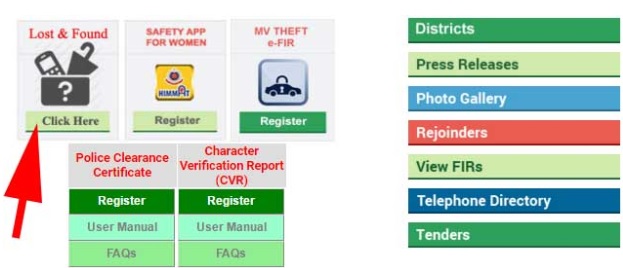
Step 2: Click on ‘Lost & Found’ options- Multiple options will appear at the homepage like helpline no., lost report, Women safety app, Police clearance certificate, Character verification report. For online FIR registration click on ‘Lost & Found’ option, in the middle of the page.

Step 3: Go for registration- After going in the ‘Lost Article Report’, four options will appear – 1. Retrieve 2. Register 3. Search found articles 4. FAQ. Select the second option ‘Register’.

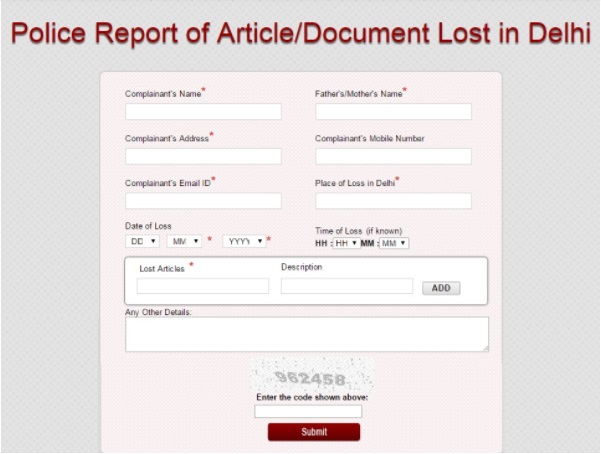
Step 4: Fill the registration form- A new page will open, where you have to fill up the blanks with your personal details as well as your lost article’s details. The following options will be there-

  • Complainant’s Name- Fill the name of the person who wants to lodge the E-FIR.
  • Father’s/Mother’s Name- Fill the complainant’s parents name.
  • Complainant’s Address- Where the complainant is residing (Required full address).
  • Complainant’s Mobile number- Complainant’s working mobile number.
  • Complainant’s email ID– it will be needed because a copy of your e-FIR will be sent to you via email for verification.
  • Place of Loss in Delhi- Fill the particular details about where your article was lost in Delhi.
  • Date of Loss- Fill the date on which you lost your phone.
  • Time of Loss- If you remembered the time of loss then fill it. However, it is not mandatory.
  • Lost Articles- Fill the name of the article you have lost.
  • Description- The basic details of the lost article.
  • ADD- by clicking on ADD the details will be attached to the file.
  • Any Other Details- Any other specific detail you want to highlight then fill it in this blank.
  • Enter captcha code- Fill the Code given after all the above details.

Step 5: Submit the details- Recheck all the details and then click ‘Submit’ button.

Step 6: Receive the hard copy- Now check your email ID, where you will receive a copy of your e-FIR in PDF form. Take the print out of that report.

How to get the phone back after it is recovered by the police

After recovering the stolen property, police submit the property to the court. The object in custody of court is called as “MUDDEMAL” and in order to recover your Phone, you need to file an Application for Return of Property under Section 451 of the CRPC before the Magistrate Court under which the concerned Police Station is reported to. You will have to furnish the required documents like the Bill of the Phone and you will be required to appear before the court for identification and once your identification is over then the Magistrate will pass an order directing the return of the Mobile phone to you and you will have to show the order copy to the Police Station and then that they will return your phone to you.

Necessary measures for mobile phone users

It is always said that “Prevention is better than cure” so, we must ensure certain things if we own a mobile phone in order to reduce the risk or consequences of the stolen phone:

  • Install Tracking Apps– One can easily find plenty of apps which can help to locate your lost mobile phone. These apps like Android Device Manager for Android devices, and for iOS devices, one can install “Find my iPhone” service.
  • Remember your IMEI Number– All mobile phone contains a unique tamper-proof identification number called IMEI (International Mobile Equipment Identity). This IMEI number can be located on the back panel of your mobile phone just below the battery or it is mentioned on your Phone Purchase bill. You can also know the IMEI number by dialing *#06# on your mobile phone.
  • Keep the Bill of your phone at a safe place– It is a general tendency among the people to keep the mobile phone purchase bill/invoice for the sole purpose of claiming warranty but one should keep it safe after the expiration of warranty period also as it helps in proving the ownership of the phone and is required in the process of claiming it after the mobile is recovered by the police.
  • Sync your data online– It is always advised to sync your data on online applications like Gmail, Google Contacts, Google Calendar etc., as it serves many purposes like keeping the data safe, protection from data loss etc,.It is wise to change your password immediately after the theft.

References:

  1. http://pib.nic.in/newsite/PrintRelease.aspx?relid=107332.
  2. https://medium.com/legalnow/lost-or-stolen-mobile-phone-pre-cautionary-legal-steps-you-can-take-in-india-483e5464a428.
  3. https://blog.ipleaders.in/lost-mobile-phone/.
  4. https://jaagruti.org/2013/12/13/reporting-a-crime-all-about-lodging-an-f-i-r-with-the-police/.


LawSikho has created a telegram group for exchanging legal knowledge, referrals and various opportunities. You can click on this link and join:

https://t.me/joinchat/J_0YrBa4IBSHdpuTfQO_sA

Follow us on Instagram and subscribe to our YouTube channel for more amazing legal content.

 
Download Now

SC Judges’ Press Conference – The Tussle within the Judicial System

0
Image Source -

In this article, Suyash Sahai of Faculty of Law, University of Allahabad discussed the recent tussle within the judiciary.

SC Judges’ Press Conference – Black day for Indian Judiciary

All this while we were believing that values like “Trust” and “Integrity” are sacrosanct of this one pious institution known as Supreme Court of India, until friday, i.e 12/01/2018, when four Seniormost Sitting Judges Justice Jasti Chelameswar, Justice Ranjan Gogoi, Justice Madan B Lokur and Justice Kurian Joseph had to take a “rebellion” recourse in an unprecedented event which they described as ‘extraordinary in the history of any nation and in the history of the judiciary’ to unleash something which in their words would be a “serious threat to the democracy” all of which certainly made this day as a “black day for judiciary”. When a person asserts that “I will go till Supreme Court of India for getting Justice” he shows his strong faith towards the Judicial System that the court will give him justice. But when a question arises against the Judicial System by the judges of the court itself, it dissolves the million faith and brings the court in his own witness box.

While talking about the repercussions, I just hope that this unprecedented act of the four Judges should not become a precedent and in future we come across similar narratives from various other High Court and Lower Court Judges, because all these lower courts face much severe hardships in carrying on the justice delivery system. We the people of India are faced with an extraordinary situation where the judiciary is being marginalised from within, not from outside.

SC Judges’ Press Conference – How the revolt came into Picture

All this came into picture when four sitting judges of Supreme Court of India held a press conference on January 12 in the lawns of Justice Chelameswar’s bungalow on Tughlaq Road and made the statement that “ The administration of Country’s highest Court is not in order” and unless the institution was preserved, “Democracy will not survive in this country. It came forward that four judges of Supreme Court were not left with no other option but to address the nation about the serious infirmities and irregularities in the administration of the Supreme Court of India. The Judges have already persuaded the Chief Justice about the irregularity in the system but unfortunately, the effort got failed and then the four judges collectively decided to put forward their concern about one of the important pillar of the Constitution. In the press conference the judges also said that they have tried to persuade the CJI about the issues which are going on for past few months to discuss the remedies and measures of such issues but unfortunately, their efforts failed. The reason of such anguishment from the four judges through the press conference has also same forward because a letter they had sent to the CJI two months ago pointing out mistakes had gone unanswered and the issues involving its administration is serious enough for the four judges to go public.

The four senior-most judges of the Supreme Court have also poured their anguishment to the Chief Justice of India Justice Dipak Misra through a letter which they have released during the press conference and expressed their deep concern on the judicial orders. The letter to the CJI stated that “certain judicial orders passed by this court which has adversely affected the overall functioning of the justice delivery system and the independence of the High Courts besides impacting the administrative functioning of the office of the Honourable Chief Justice of India”.

The letter to CJI has also mentioned the jurisprudence of this country that the Chief Justice is only the first amongst equals — nothing more or nothing less. The concern has come forward basically because of the issue of the allocation of cases to the judges specifically the allocation of Justice Loya’s Case for which they were unhappy and also on being asked repeatedly, the Justice Gogoi told journalists that the press conference was prompted by issues surrounding the death of special CBI Judge B.H. Loya who was hearing the sensitive Sohrabuddin Sheikh encounter case.

What is Justice Loya’s case and how is it related to the current issue?

Justice B.H. Loya who was presiding over the CBI court in the Sohrabuddin Sheikh fake encounter case which also shows the involvement of the present president of BJP, Amit Shah. Justice Loya died of an unusual cardiac arrest in Nagpur in December 2014 when he had gone to attend the wedding of a colleague’s daughter. The Loya’s family member has questioned that Justice Loya had been offered Rs. 100 Crore to give an order in favor of prime accused, BJP president Amit Shah and called the death unnatural, triggering calls from various quarters about an independent inquiry.

Justice Loya’s uncle told reporters that he was under immense pressure and had considered quitting the job. The Loya’s family has also raised doubts over who ordered the postmortem, and the identity of the person who signed off on it. The family claimed there were blood stains on the collar of judge Loya’s shirt when his body was returned.

Special CBI judge Loya, who was hearing the high-profile Sohrabuddin Shaikh encounter case, had allegedly died under mysterious circumstances in 2014 and it was contended by the opposition party that BJP chief Amit Shah, who had been accused in the case, was discharged from the matter after Justice Loya’s death after the case had been transferred to another judge.

In the year 2014, after the mysterious death of Justice B.H. Loya, Bombay Lawyer’s Association filed a PIL before the Bombay High Court and asking the court to set up a commission of inquiry headed by a retired Supreme Court judge.

Now, coming to the question as how Justice Loya’s case is connected to the tussle which is going to the Judiciary, it is because the Two petitions demanding a fair probe into his mysterious death were assigned before a bench that is headed by a judge who is 10th in terms of seniority and thus, it is believed by the four senior judges of Supreme Court that the matter as serious as this matter should be transferred to someone who is more senior.

With the unanswered grievances by the Chief Justice and many more issues about the irregularity in the administration of the court which yet has not clearly come forward to public, the four judges collectively revolted against the administration of the court order and alleged Chief Justice Dipak Misra of selectively assigning cases to judges of his choice without any rational basis.

What are the reactions to this tussle?

KTS Tulsi, Advocate, Supreme Court– “It’s quite shocking. There must have been compelling reasons for the senior-most judges to have adopted this course of action. One could see the pain on their faces while they were speaking.”

Mukul Mudgal retired HC judge– “There must be some serious reason that they were left with no other option but to hold a Press Conference. But what connection Loya has with this? I know nothing about this & I don’t want to make comments about any political matter.”.

Justice R Sodhi, Ex-Delhi HC Judge– “Allocation of work has to be done by CJI. If you disagree, you can refer to a larger bench. It can be corrected. How can u ask for a public opinion.”

Mamta Banerjee, CM, West Bengal-”We are deeply anguished with the developments today about the Supreme Court. What we are getting from the statement of the four senior Hon’ble Judges of Supreme Court about the affairs of the Court makes us really sad as citizens.”

Shashi Tharoor- “Politicians must refrain from commenting on the conduct of the judiciary as it is unconstitutional…but it’s fair to point out that there have been lapses on part of the government also.”

Attorney General, KK Venugopal– “The unprecedented move by the four Supreme Court judges in holding a press conference “could have been avoided” and the judges would now have to act in “statesmanship” to ensure complete harmony.

Rahul Gandhi, President, INC– “Points raised by the Hon judges need to be looked into carefully, even Justice Loya’s death needs to be investigated properly”.

Somnath Chatterjee, former LS speaker– “Unfortunate and dangerous for democracy. It will create more problems than solve. Since the judges have spoken they have done a disservice to the country because if the judiciary is weakened, questions arise in people’s minds, it already has”.

What are the issues raised by the four Judges?

The four senior-most judges of the Supreme Court has brought to the fore certain questions about the judiciary’s relationship with transparency in its functioning. Which are:

  • Why are there no internal safeguards to deal with administrative issues in the functioning of the Supreme Court?
  • How do we trust that other decisions of this collegium have been made on objective grounds?
  • Is the Judiciary picking and choosing when to be transparent?

Mediation between the Chief Justice and four judges of Supreme Court

After the much seriousness of the matter and the crisis which have occurred within the judicial system of Supreme Court, The Bar Council of India (BCI) has formed a seven-member delegation which will attempt to bridge the apparent rift between four senior Supreme Court judges and Chief Justice of India (CJI). A 7-member delegation of the Council will meet the honourable judges of the Supreme Court and aims the matter to be solved at the earliest possible. BCI Chairman, Manan Kumar Mishra, however, has also criticized the attempts by political leaders to intervene in the judiciary’s internal matter and asked them to refrain from doing so any further and also requested the political parties to not politicize the matter.

I just conclude it by saying that, I believe an independent and strong judiciary is the basic feature of any Democracy. “We are faced with an extraordinary situation where the judiciary is being marginalized from within, not from outside.” It is important for this institution to ensure that an impression is not given to the public that the constitution of benches and allocation of matters is being done in a devious manner. Citizens are entitled to expect the free and fair administration of justice.

This was all on the recent SC Judges’ Press Conference. Please comment below and let us know your views on SC Judges’ Press Conference.

Download Now

PRAFUL PREMJI GALA – Manager of IP & Legal Affairs, INVICTUS ONCOLOGY PVT. LTD. with 33 years of experience on his experience with Diploma with NUJS

0

Praful Premji Gala, an Attorney of Pharma and Law, a Graduate in Pharma from U.S. and an LLB of 2008. Currently working as a Manager of IP & Legal Affairs at INVICTUS ONCOLOGY PVT. LTD. He successfully completed the Diploma in Entrepreneurship Administration and Business Laws course from NUJS.

Over here he shares his experience: I was looking for some latest content on business laws in India. I came to know about this course from Dr. Shamnad Basheer  who is a faculty at NUJS. We both are members of SpicyIp blog. I’m thankful to Dr. Shamnad Basheer  for giving me the information about iPleaders. Their course contents are extremely helpful.

So far, the experience was very good. Webinars by various industry experts is an added advantage of this course. Though it is very useful, but it is not accessible all the times. It would be very helpful if the webinars are accessible when required. Moreover, due to my higher age bracket, I’m not used to soft copy study materials. Adequate amounts of hard copies will be of great help after completion of the course. Here the course contents are not only explained theoretically but in a practical manner too. Would definitely refer this course to others as it helps

Course contents are excellent as far as modules of FDI, Investment on Start-up, Rights of Investors, and IP Laws are concerned. I personally think, Patent law needs more details. This course has helped me immensely in contract drafting in my work. I’m able to utilize this knowledge in my current job profile.

Currently I’m also doing Certificate Course on Commercial Contract Law, Drafting and Negotiation from them as well.

I have planning to do few small courses from iPleaders in very near future.

Download Now
logo
FREE & ONLINE 3-Day Bootcamp (LIVE only) on

How Can Experienced Professionals Become Independent Directors

calender
28th, 29th Mar, 2026, 2 - 5pm (IST) &
30th Mar, 2026, 7 - 10pm (IST).
Bootcamp starting in
Days
HRS
MIN
SEC
Abhyuday AgarwalCOO & CO-Founder, LawSikho

Register now

Abhyuday AgarwalCOO & CO-Founder, LawSikho