Download Now
Home Blog Page 1505

The Distinction Between Direct and Circumstantial Evidence

0
Image Source - https://www.shutterstock.com/video/clip-1624411-stock-footage-crime-investigation-police-dividing-line-yellow-tape-bloodstains.html

In this article, Yash Tandon of TNNLS discusses the distinction between Direct evidence and Circumstantial Evidence.

Introduction

Every person who comes across the following words, replies by saying that Direct Evidence is something which is direct in nature and Circumstantial Evidence is something which is indirect in nature. But this is a layman’s language definition and it\’s inappropriate to use such legal terms which has very in-depth significance.

Before going through the intricacies of the aforementioned types of Evidence, let’s look at what is “Evidence” first and then move on step by step.

What is Evidence?

As per Section 3 of The Indian Evidence Act, 1872 evidence means and includes both oral and written evidence. Oral evidence includes all the statements which the court permits or requires to be made before it by witnesses, in relation to matters of fact under inquiry. Documentary evidence includes all documents including electronic records produces for the inspection of court.

The evidence is any matter of fact that a party to the lawsuit offers to prove or disprove on a particular issue in a particular case. It can be said as the system of rules and norms or an arrangement of principles and norms that is utilized to figure out which certainties might be conceded, and to what degree a judge or jury may think about those realities, as verification of a specific issue in a lawsuit.

There are many types of evidence such as-:

  • Eyewitness
  • Participants
  • Prior Statements by the defendants
  • Documents
  • Physical Evidence
  • Scientific Evidence such as fingerprints, DNA etc.

Apart from these, there are two basic forms of evidence, under which the abovementioned kinds of evidence are generally covered. They are-:

  • Direct Evidence, and
  • Circumstantial Evidence( commonly called Indirect Evidence)

Now as we know what exactly is Evidence, let\’s move onto the title of the article i.e. What is Direct and Circumstantial Evidence, and the difference between the two.

What is Direct Evidence?

“Direct Evidence” is evidence that establishes a particular fact without the need to make an inference in order to connect the evidence to the fact. It supports the truth of an assertion (in criminal law, an assertion of guilt or of innocence) directly, i.e., without the need for an intervening inference. It directly proves or disproves the fact.

So Direct Evidence is real, tangible, or clear evidence of a fact, happening, or thing that requires no thinking or consideration to prove its existence. It does not require any type of reasoning or inference to arrive at the conclusion.

Drawback of Direct Evidence

Though Direct evidence is considered to be superior to Circumstantial evidence, one of the main drawbacks of Direct evidence is relying on the evidence completely without any thinking or reasoning to prove its existence. For example in the case of an eyewitness, he/she may lie or may not be able to understand if the event occurs quickly or at the time of high stress to the eyewitness. Also, it can happen that the eyewitness may maliciously testify i.e., intentionally testifies wrongly(though he may get prosecuted for perjury i.e., lying under an oath, that can happen only when the judge or jury orders to counter examine the testification of the witness.

Here comes into the picture the concept of Circumstantial Evidence, which is explained below.

What is Circumstantial Evidence?

Circumstantial Evidence is the evidence that does not point directly to the fact. A reasoning must be made or an inference, that links circumstantial evidence to the desired fact the party is trying to prove.

For instance, in the example explained above, the second part of the said example notifies the circumstantial evidence in its proper sense. In that nobody has seen who did the murder. Now the court or the judge has to circumvent all the issues and frame and connect it to find the desired fact.
In this way, the jury or the judge uses reasoning and logic to grope to the conclusion, unlike in, direct evidence where the judge or the jury relies on the words of the witness. In this type, any evidence has to be evaluated by cross-checking, for the reliability of the source.

Another example would make it crystal clear. Example: B was murdered at 5-pm, in his own house. C saw A coming from the house of B at 5-15pm, with blood shredded knife in his hand. D gave the evidence that A and B seriously quarreled on the day before the occurrence of murder. E, a police officer seized the blood shredded knife from the almirah in the house of A. F, an expert deposed that the blood of the deceased and blood shredded knife of A was one same. These chain of evidence are “circumstantial evidence”.

Nowadays, circumstantial evidence is more often given more importance than direct evidence, because more often in criminal law, direct evidence is misused and justice gets impaired. For instance, fingerprints are circumstantial evidence.

Does direct evidence have more probative value than circumstantial evidence?

The most common form of direct evidence is “eyewitness testimony”, where the witness describes exactly the scenario what happened in the situation. For example – assume a person who is looking out from his door and is seeing a person killing someone else. If he/she testifies this before the court then, it will be the direct evidence because he saw the murder happening in front of his eyes and can identify the murderer.

But suppose the person in the morning found a dead body lying on the road and now if he/she testifies then that testimony would not be direct because he/she does not have any direct proof of who is the murderer and how did it happen?

Under the Indian Evidence Act, “circumstantial evidence” is included under the expression “relevant facts” and it is provided that all “relevant facts” require being proved by some evidence oral or documentary, that is to say, by direct evidence.

Circumstantial evidence, to be relied upon, must not only point to the inference to be drawn by the court, but it must be of such a nature that it can possibly lead to no other inference.

So the value of Direct Evidence is more than Circumstantial Evidence, as in the aforementioned example, there is a direct proof of who killed the individual, unlike in the other situation where a body was seen lying and no one knew who and how did the murder happen. But this is not always true. There are many cases where solely on the basis of circumstantial evidence conviction has happened.

Can someone be convicted on just circumstantial evidence?

On account of Chandmal v Province of Rajasthan[1], the court has held that in circumstances where the case is completely in light of the circumstantial proof the three conditions must be satisfied:

1) The conditions on which we depend for proving must be built up immovably.

2) The conditions must be exact and they should point towards the blame of the individual who is denounced.

3) When every one of the conditions taken in general they should shape a total chain and there must be no escape clause in the chain. It must show that the blamed just could have carried out the wrongdoing and no one else could have done it.

In the instance of Sathya Narayan v State[2] it has been held that in specific cases it is conceivable where no immediate proof or observer is accessible, in such a circumstance the court can grant conviction exclusively on the premise of circumstantial proof if the accompanying five standards are connected:

1) “The conditions from which the finish of blame is to be drawn ought to be completely built up. The conditions must be or ought to and not might be built up.

2) The realities so settled ought to be predictable just with the speculation of the blame of the denounced, in other words, they ought not to be clarified on some other theory aside from that the charged is blameworthy.

3) The conditions ought to be of a decisive sort and propensity

4) They ought to avoid each conceivable theory aside from the one to be demonstrated

5) There must be a chain of confirmation so entire as not to leave any sensible ground for the finish of the charged and should demonstrate that conflicting with the guiltlessness of the blamed, what\’s more, must demonstrate that in all human likelihood the demonstration probably is finished by the accused.\”

In another case of Khem Karan v State of U.P[3], the court stated that-: “If all the circumstances and the evidence point towards the guilt of the accused and there is no possibility of any other alternative hypothesis then in such a situation only the accused can be convicted solely on the basis of circumstantial evidence.”

Aarushi Talwar Case: Whether the Conviction of the parents was based on Circumstantial Evidence?

In Aarushi Talwar Case the court has passed judgment on the premise of the conditional proof yet has neglected to welcome the confirmation. To convict on the premise of circumstantial proof the court must welcome every one of the confirmations of the conditions which point towards the blame of the charged. Every one of the confirmations needs to point towards the blame of the charged. In this case, it was not the situation. The reports of the two CBI groups have the suspect totally unique arrangement of individuals. The principal CBI group speculates the Servants as the prime suspects as they have conceded their essence in the event amid the narco examination and the same has been demonstrated with the assistance of melody broadcast on the news channel however that witness had not been conceded.

In the meantime when the case got exchanged to the new CBI group they suspected the guardians and drew a total distinctive theory that Rajesh murdered Aarushi and Hemraj seeing them in a trading off position and the correct part of the couple in the murder cannot be resolved however it is assumed that Dr.Rajesh executed the two and his better half, Dr Nupur Talwar helped him decimate the evidence. In this manner, the reports obviously recommend that there are two conceivable outcomes and in such a circumstance when the conviction depends on incidental proof the circumstance which supports the blamed must be acknowledged by the court and the charged must be given the advantage of uncertainty.

Be that as it may, here the court has neglected to take after this and has sentenced the Talwar couple on the premise of incidental confirmation without building up the same appropriately. Along these lines, no advantage of uncertainty has been given to the charged, Talwar couple.

One can be convicted of murder or rape solely on the basis of circumstantial evidence. But the reliability on public officials has to be made, and in turn, the work of public officials gets of immense responsibility. The onus on public officials is huge and they had to investigate properly, so that justice is rendered diligently, unlike in the Aarushi Talwar case where the parents were convicted, which led to improper justice.

[1] AIR 1976 SC 917.

[2] 2013 (80) ACC 138 (SC).

[3] AIR 1974 SC 1567 (3JJ).

Download Now

What are the laws related to social boycott in India?

0
social boycott
Image Source - http://www.erewise.com/current-affairs/maharashtra-becomes-first-state-to-enact-law-against-social-boycott_art564ecdd324b62.html

In this article, Raghav Ajmera discusses the laws relating to social boycott in India.

Background

India from many years has been facing a lot of problems lately. Problems like child labor, social boycott, honor killing, discrimination on the basis of caste, race, sex. These problems would always be a curse to our country until certain specific laws are not made regarding the problem and a strict action against the people starting the problem. People from the ancient times believed in the concept of upper class and lower class. At times these were so heavily practiced that the people categorized as ‘untouchables’ were not allowed to enter into the temple, fetch water from the well. India has been famous for its rich culture and heritage. Today we imagine India as a modern country with modern minds, but it is not. From above it just seems like a modern country but when we peep into the reality, it shows us a different face, a face where people have faced problems like discrimination, social boycott, honor killing, etc.

Social Boycott

Social boycott refers to an act of continuously ignoring or avoiding a person by other members of the society. The social boycott is a collective refusal by society to involve a person in the commercial and social relations. The main objective to do social boycott is that the individual gets so uncomfortable that he/she voluntarily leaves the society.

Ostracism is an identical practice, but it is eviler. Ostracism refers to a forcible expulsion of a person from society for any reason. It is often accompanied by the confiscation of his/her property.

Provisions of the Social Boycott Prevention Act

Definition

As per the act, on the off chance that any individual or group tries to prevent or block another individual or group from observing or watching any social or religious custom or use or service, or from part taking in a social, religious or community function, get together, assembly, meeting or parade, the act adds up to social boycott.

The challenging of freedom of people for the sake of jati panchayats, religion, traditions or denying them their preferred privilege adds up to social boycott too.

Freedom in the above circumstances includes the freedom to wed outside one’s caste, visit places of worship, wear clothes of one’s decision and utilization of a particular language. Discrimination on the basis of moral quality, political inclination or sexuality also adds up to the act of social boycott. As does prevent kids from playing in a specific space, or denying access to the cemetery, educational institution or educational institutions with mala fide expectations.

Report to Collector or District Magistrate when you see instances of social boycott

A Collector or District Magistrate/Deputy Commissioner, on getting data of the probability of unlawful assembly for the imposition of social boycott can, by order, deny the assembly.

Why it is necessary to take an action against Social Boycott?

  • In India, since historical times, a legacy of caste system has been framed which is carried forward to this date. Its appearance can be seen this day itself.
  • The carrying out of jati panchayats of Davis in Maharashtra and the notorious khap panchayats of Haryana are cases of the firm enactment of the caste system.
  • These groups, after getting together, convey additional legal judgments, which are brutal in nature yet in addition conflict with the respect of the individual and are on occasion, savage and unforgiving.
  • For instance, the naked parading of ladies in the whole town after applying black paint all over, ostracizing specific people since they did acts which were against the supposed built up to standards of the assembly, whipping and lashing of people and sometimes, the wedding of the rape casualty to the culprit etc.
  • These additional judicial proclamations are still carried out in rural areas of India where caste system and caste hierarchy is very strongly observed.

Impact of the Act

With the introduction of this act, it has made a huge difference in the lives of people or communities suffering from these kinds of problems. The main achievement of this act is:

  • With the dynamic inclusion of the administration and the acquiring of such an act against the evil of social boycott, it would be possible for the individuals of the community to practice their Constitutional Rights more freely and with lawful support now. For instance, individuals would now be able to wed outside their caste, accessibility of public places and wells and temples cannot be denied.
  • Indeed, the administration has gone above and beyond by specifying sexual orientation as one’s personal choice and boycott on those lines will likewise draw in penal provisions under the previously mentioned act.

Disadvantages ahead

Like the coin has two sides heads and tails, everything in life has two sides and we usually describe them as positive or negative or advantage or disadvantage of the choices or problems in life. The reasons why it has disadvantages or challenges ahead is because:

  • In spite of a legitimate backing, there are fears of a comeback among different groups living in the country.
  • For instance, Orthodox elderly individuals of the villages or towns who firmly watch the so-called ‘caste system’ and its set up traditions may oppose the strengthening of the so-called ‘lower castes’ of the towns or villages and this may rise in the wave of honor killings. Additionally, this can lead to increased social turmoil among the rural regions.
  • National Crime Records Bureau (NCRB) information made available in 2014 says that there has been a sharp increment of up to 20% in the number of violations carried out against the Scheduled Castes and Scheduled Tribes in the past three years.
  • The rising awareness of their (SCs and STs) rights and the legal means that are accessible to get their rights implemented and plan to make use of government instruments to secure their interests is one major purpose behind the rising violations which is a sensible end product of the principal point.

What amounts to social boycott

In pursuance of clause (3) of article 348 of the Constitution of India, there is translation in English of the Maharashtra Protection of People form Social Boycott (Prevention, Prohibition, and Redressal) Act, 2016 (Mah. Act No. XLIV of 2017), is hereby published under the authority of the Governor. Section 3 defines the laws related to social boycott in India. Maharashtra, became the first state in India to bring a Social Boycott (Prevention, Prohibition, and Redressal) Act, 2016 making social boycott a crime after it received the Presidential Assent on 13th July 2017. The movement, initiated by late Narendra Dabholkar, gained momentum after he was shot dead.

How to the complaint against social boycott

The complaint has to be made under the Maharashtra Prohibition of Social Boycott Act.

  • Conviction of the offense of social boycott will pull in a jail term of up to three years and/or a fine up to rupees 1 lakh. Abetment by an individual or group will welcome the same punishment as well.
  • It is a cognizable offense and bailable and will be attempted by a Judicial Metropolitan Magistrate or a Judicial Magistrate of the First Class. To guarantee quick justice under the Act, the trial would need to be finished inside a time of six months from the date of recording or filing the charge sheet.

Way ahead

The law enacted in Maharashtra was the first ever law made on social boycott in India. Until now no law has been made in regard to this problem. Law states the provisions for the people who are avoided and ignored socially. The government of Maharashtra has made a step in the correct way. With lawful support for the prevention of social boycott exercises, there will be an increase in people who would now be able to practice their rights in a vastly improved way and will likewise have a chance to lead their life better. Additionally, with these rights as of now being specified in the Constitution, it will prompt better use of Fundamental Rights by different people. The Act is a decent case of strengthening of the general population. Implementation, in any case, remains the key to this Act like each Indian Act.

References

https://www.clearias.com/social-boycott/

http://bombayhighcourt.nic.in/libweb/acts/Stateact/2017acts/2017.44.pdf

Download Now

The applicability of Limitation Act to proceedings under the Insolvency And Bankruptcy Code, 2016

0
Limitation Act to proceedings under the Insolvency
Image Source - http://www.campbellharrison.co.uk/blog/how-pensions-are-affected

In this article, Gauri Nagar discusses the applicability of Limitation Act to proceedings under the Insolvency And Bankruptcy Code, 2016.

All about The Insolvency and Bankruptcy Code

The Insolvency and Bankruptcy Code was enacted in 2016. It was brought about in order to alleviate the burden of huge debts that primarily lay on the shoulders of corporate houses and business. With the introduction of this Code, it is expected to revive the various banks NPA status. It has proved to be of immense importance for the creditors as well as for those who have been able to retrieve their dues or debts. The only question that hovers around is whether this code is applicable on a time-barred debt or not and whether the Limitation Act, 1963 be applicable on the IBC or not.

Whether section 7 of IBC is time barred or not?

In the case of Neelkanth Township and Construction Private Limited v Urban Infrastructure Trustee Limited (judgment of Supreme Court dated 11 August 2017) numerous issues were discussed with respect to the IBC, 2016. One of the most focal point that was discussed before the NCLAT was whether Section 7 of IBC is time barred or not because the claim of debt was with respect to the years 2011, 2012 and 2013. It was also contended by the appellant that the application was filed in 2017 and therefore, the claim was time barred. NCLAT dismissed the appeal of the Corporate Debtor (Appellant). The NCLAT ruled that the Limitation Act will not apply and that a time barred debt can very well be enforced by filing an application for Corporate Insolvency Resolution Process.

The NCLAT, in this particular case, has given a very reasoned decision. The view taken by NCLAT is that there is nothing explicitly given in the Insolvency and Bankruptcy Code that says that the Limitation Act will be applicable to IBC.

IBC is not an Act for recovery of money claim. If there is a debt which includes interest and there is a default of debt and having a continuous course of action, the argument that the claim of money is barred by limitation cannot be accepted.

The objective of Limitation Act is to ensure that there is a time limit for pursuing a legal remedy and the same was said in the case of M/s Bharat Barrel & Drum MFG Co. v Employee State (judgment dated 23 September 1971) It insists on being proactive so that legal action can be taken in time to retrieve the dues. This objective in turn makes the litigant diligent. The whole purpose of the Limitation Act is based on a sound public policy. Section 433 of the Companies Act, 2013 provides for application of the provisions of the Limitation Act to proceedings or appeals before the Tribunal or the Appellate Tribunal. Section 60(6) of the code says that the Limitation Act shall not apply during moratorium.

Now the question that crops up is whether this provision is inconsistent with the Limitation Act or not. After having a close look at the provision, if we say that the limitation Act does not apply to the IBC, then we can find that an equilibrium is created between the code and the Limitation Act by this section. It can be said that there lies an intricate intent of the code to provide further extension to the limitation period. This is so because the creditor cannot take any action during the stand-still period. Therefore, the limitation will still be evaluated in accordance to the Limitation Act but the limitation determined will be extended by the moratorium period.

The importance of other cases cannot be ignored wherein an opposite stance had been taken. It is noteworthy to discuss the case of Sanjay Bagrodia v Sathyam Green Pvt Ltd (judgment dated 25 May, 2017). It was argued that the provisions of Limitation Act cannot be incorporated into code as its incorporation has not been mentioned anywhere in the code. Moreover, NCLT and NCLAT should work only within the confines of the code. Another very important provision of the code is Section 255. The section of IBC provides that the Companies Act, 2013 will get amended only in the manner mentioned in the eleventh schedule of IBC. The eleventh schedule envisages the amendments made to the Companies Act but not Section 433 of the Companies Act in which the provisions of the limitation act are made applicable.

In the case of State Bank of India Columbo v Western Refrigeration Private Limited (judgment dated 26 May, 2017), the Ahmedabad’s NCLT inclination was towards the view that insolvency proceedings cannot be started on a claim that is not recoverable because of it being time barred. Similarly, in the case of Prowess International Private Limited v Action Ispat and Power Private Limited (judgment dated 15 March 2017), the petition was dismissed because the claim was time barred.

The judgment of the Mumbai Bench of the NCLT in the case of Urban Infrastructure Trustee Ltd. v Neelkanth Township and Construction Pvt Ltd (judgment dated 21 April 2017) was challenged before the NCLAT (judgment dated 11 August 2017) wherein it was categorically held that the Limitation Act shall not be applicable to the Code. Moreover, an appeal to the Supreme Court was disposed off  by way of an order (dated 23 August 2017) wherein the Supreme Court failed to answer categorically as to whether provisions of limitation act will apply or not, thereby keeping the question of applicability open. In a recent judgment given by the Mumbai Bench of NCLT in Machhar Polymer Pvt Ltd v Sabre Helmets Pvt Ltd (judgment dated 3 October 2017) it was reiterated that a time barred claim cannot be used as a ground for initiating a cause of action for winding up proceedings. A clear approach can be seen in the case of Black Pearl Hotels Pvt Ltd v Planet M Retail Ltd (judgment dated 17 October 2017) wherein it was observed that in order to apply under IBC, 2016, the right would accrue only on December 1, 2016 i.e the date when the code came into force.

Simply Put

To sum up, it can be said that if provisions of the Limitation Act are not applied on IBC to initiate insolvency proceedings, then, the very purpose of the Code shall get destroyed. It will lead to a chaotic situation wherein numerous petitions would get filed even with respect to time barred debts. The principle of “maximum vigilantibus non dermientibus jura sub veniunt (laws provide help to those who are watchful and not to those who sleep)” would get frustrated. It is possible to draw a tacit implication for the application of the Limitation Act to the IBC. However, since nothing has been explicitly given in the code with regards to this, a staunch stance cannot be taken as the Supreme Court has also left the question of applicability of Limitation Act to IBC open.

Download Now

How to convert Compulsorily Debentures into equity shares

1

In this article, Shubham Prakash discusses, how to convert Compulsorily Debentures into equity shares. What is the procedure to be followed with respect to RoC and the Internal Process?

Introduction

‘Debenture’ is a debt instrument used by the companies for a long period of time in order to borrow money at the fixed rate of interest. Section 2(30) of The Companies Act, 2013 defines debentures “includes debenture stock, bonds or any other instrument of a company evidencing a debt, whether constituting a charge on the assets of the company or not”. Also Rule 18 of the Companies (Share Capital and Debentures) Rules, 2014 and Section 71 of the Companies Act, 2013 talks about debentures. It is like a certificate loan where the company is liable to pay the loan at a fixed rate of interest. The capital raised by the debentures would not become the share capital instead becomes the company’s capital structure. On basis of convertibility there are two types of debentures:

  • Convertible debentures – When a company is issued, these debentures are converted into equity shares at the expiry of a fixed period of time.
  • No – convertible debentures – They are regular debentures which cannot be converted into equity shares because of a higher rate of interest.

Equity share is issued to the general public at large and the main function is to provide finance to the company. The equity shareholder does not have any preferential rights but they have to repay the capital and dividend. They are the real owner of the company and have the voting right when the meetings are conducted. Section 43 (a) of the Companies Act, 2013 talks about equity share capital as:

  • With voting rights; or
  • With differential rights as to dividend, voting or otherwise in accordance with such rules as may be prescribed

What is a convertible debenture?

A convertible debenture is defined as one of the types of loan which is issued by a company that can be converted into a stock. Most of the people get confused between convertible bonds and convertible debentures. But a convertible debenture is unsecured when there is a case of bankruptcy. The debenture of the company gets money from the fixed- income holders. The basic feature of convertible debentures is to calculate the diluted per- share standard. The diluted per- share standard goes up with the increase of share count and it goes down with the decrease in metrics such as earning per share (EPS).

https://lawsikho.com/course/diploma-companies-act-corporate-governance
Click Above

In Compulsorily convertible debenture the cost of the debenture is converted into an equity share within a fixed period of time. It is also known as CCD. CCD is not a combination of pure debt or pure equity. During the issuance of the company, the CCD decides at which rate the ratio of conversion will be there from debentures to equity share capital.

Conversion Of Compulsorily Convertible Debentures Into Equity Shares

Section 71(1) of the Companies Act, 2013 authorizes the company to issue debentures with an option of to convert such debenture into shares, either wholly or partly at the time of redemption, provided that it shall be approved by a special resolution of passed at the general meeting. The issuance of a compulsorily convertible debenture is through a placement offer made by the company privately.

When there is a conversion of CCD into equity shares, there is no debenture redemption reserve is required. The CCD at the time of conversion of equity share can neither issue any trust deed nor appoint any debenture trustee for securing the payment at time of maturity.

As per the Companies (Acceptance of Deposits) Rules, 2014 which does not include clause xi of Rule 2 (1) (c) can raise the amount of issuance of debentures as referred in Schedule III of the Act which also not include the insubstantial assets of the debentures compulsorily convertible into a equity share capital of the company within a period of 10 years. So it is compulsory for the compulsorily convertible debenture into an equity share capital within a period of 10 years otherwise it will be viewed as deposit under the Companies Act, 2013 and the provision of ‘deposit’ will be taken into consideration. With the amendment made in the year 2016, the time period has increased from 5 years to 10 years.

As per the guideline issued by the Reserve Bank of India, the compulsorily convertible debentures are considered as equity shares under a financial statement. However until and unless the compulsorily convertible debentures are not converted into equity share, it would be considered as share capital of the company.

Cases

The Indian Judiciary has discussed the conversion of compulsorily convertible debentures into equity shares in many cases

In Ashima Syntex v. Assistant Commissioner of Income Tax,[1] the court held that fully convertible debentures expenses should not be paid. The convertible debentures should be added to the equity capital of the company on conversion of shares. The reason for not paying the expenses is because convertible debentures issued by the assessee were to be fully converted into equity shares on allotment or after a certain period and this money received by the assessee in the form of application money was never to be repaid to the subscribers thereof. The money becomes the part of the funds of the company in form of equity and company gains an advantage.

In CIT v. Moto Industries Co. Ltd., ILR 1992 Karnataka 345- the court held that “the debentures are issued or subscribed to acknowledge the debt owed by the financial institution from which the loans were obtained and the amounts were utilized”.

In Deputy Commissioner of Income Tax v. Modern Syntex (India) Ltd., (2005) 95 TTJ (JP) 161- the tribunal held that the “expenditure incurred was on ‘issue of debentures in other words for raising of loan’ and the debentures were ‘issued by the company and it is in form of certain indebtedness’. This was irrespective of the fact that these debentures were convertible into equity shares.”

In Ganesh Banzoplast Limited v. Assistant Commissioner of Income Tax,[2] the court held that “debentures, convertible or non- convertible is acknowledged of indebtedness”.

However in Sahara Real Estate Corporations Limited v. SEBI,[3] Supreme Court has scrutinized the hybrid instruments taking into a contrary view that convertible debentures are for the security purpose of the Act. The Court held that “it is clear, that ‘hybrids’ are included within the terms of ‘securities’ not only for the purpose of Companies Act but also, under the SEBI Act”.

The same judgment was applied in the case of Income Tax Appellate Tribunal, Delhi (“ITAT”) in DCIT v. Sahara India Commercial Limited,[4] where ITAT clearly distinguishes between the ‘securities’ on one hand and ‘loans’ on the other hand. It was held that “optional convertible debentures are ‘securities’ and mot ‘loans’ or ‘deposit’ for the purpose of the Income Tax Act, 1961”.

In Zaheer Mauritius v. Director of Income Tax,[5] that while converting the Compulsorily Convertible Debentures (CCDs) into equity shares the petitioner is not exempted from income tax. The entire sale of equity shares and Compulsorily Convertible Debentures (CCDs) needs to be taxed. It was held that “there was sufficient commercial reason for Petitioner to have routed its investment in real estate project through equity and CCDs”.

In Narendra Kumar Maheshwari v. Union of India & Ors.[6], the issue before the court was whether in certain brochures and pamphlets issued by a company are described as “fully secured convertible debentures” or not. The court held that the printed brochures use those words without intending to change anything. But the consent of the company is required for adding “fully secured convertible debentures” in brochures and pamphlets.

Procedure For Conversion Of Compulsorily Debentures Into Equity Share

In order to convert compulsorily convertible debentures into equity shares, the issuer of the company cannot do so because it is the holder of the company who has to send a positive consent to the issuer. If the issuer does not reply for the same, that would not be considered as a consent for the conversion of compulsorily convertible debentures into equity shares.

If the issuer lists the convertible debt instruments by more than fifty lakh rupees, then the issuer has not converted the convertible debt instrument correctly. The holder of such convertible debt instruments will be given the option whether he or she wants to convert the compulsorily convertible debentures into equity shares. Provided that the compulsorily convertible debentures are limited and is determined and disclosed to the investors at the time of issuance. Sometimes it is not compulsory or mandatory to give an option to the holder of the convertible debt instruments for converting the compulsorily convertible debentures into equity shares with an upper limit.

According to the Companies Act, 2013 the option is given to the holder in terms of sub-regulations (2). In general, meetings if one or more shareholders do not enjoy the option to convert the compulsorily convertible debentures into equity shares at a fixed price. Then, the issuer can redeem the price which shall not be less than its face value, within one month from the last date by which option is exercised.

Procedure

  • It is important to hold a board meeting and pass a board resolution.
  • When a general meeting is conducted the member should pass a special resolution. The company cannot make a preferential basis on the issuance of the shares until and unless it is mentioned in the Article of Association and is passed by the members in general meeting.
  • According to Section 62 of the Companies Act, 2013 it is mandatory to prepare an explanatory statement for the special resolution. The statement should contain the important matters
  • It is important to file a special resolution with Registrar of companies (ROC) within 30 days in form of MGT- 14.
  • A letter of an option of the same is sent to the compulsorily convertible debentures holders and one copy is sent to Securities and Exchange Board of India (SEBI). It is the duty of the secretary to verify same consent sent by the debentures holders for the conversion.
  • When the final valuation report is received there is an allotment of shares. The allotment of a share should be completed within 12 months from the date of passing of the special resolution. The price of the share is determined based on the valuation report.
  • As per Form SH-1, it is mandatory to prepare and issue share certificate.
  • The share certificate is issued to holders and the names are entered in the Register of Members.
  • Within 30 days of allotment of Form PAS-3, a return allotment of securities should be filed with the Registrar. The fee should be given according to the Companies (Registration Offices and Fees) Rules, 2014 along with the list of complete holders.
  • The list of paper required in for the return of allotment of PAS-3 is a list of allottees, a copy of the board of resolution, a copy of the special resolution and valuation report.

Hence, compulsorily convertible debentures are converted into equity shares.


LawSikho has created a telegram group for exchanging legal knowledge, referrals and various opportunities. You can click on this link and join:  

https://t.me/joinchat/J_0YrBa4IBSHdpuTfQO_sA

Follow us on Instagram and subscribe to our YouTube channel for more amazing legal content 


References

[1] https://indiankanoon.org/doc/121400/

[2] (2007) 111 TTJ (Mum) 385

[3] (2013) 1 SCC (Civ) 1

[4] 2013 (28) ITR (Trib) 108 (Delhi)

[5] (2014) 270 CTR (Del) 244

[6] https://indiankanoon.org/doc/65796/

Download Now

What to do when a bike or car is seized by the police after an accident?

6
accident

In this article, Akancha discusses what to do when a bike or car is seized by the police after an accident.

One of the grey areas in the field of law is the procedure governing the accident caused by motor vehicles, and this has led to the police and other officers taking undue advantage of the same.

In case of an accident caused by a vehicle, people do not have any idea of what legal steps to be taken and the panic created in their mind lands them in paying a tremendous amount of bribe to the police. The Indian criminal justice system aims at compensatory jurisprudence. It imposes fines on the wrongdoers and gives compensation to the victims. But due to lack of such awareness and to avoid going to courts people settle their matter by paying a huge bribe to the police.

Generally, in a case, the police seizes the vehicle after the accident under Section 120 of the CrPC and prepares a report for the same. According to the damage caused, the police sends it to the magistrate or the court or the motor vehicle officer. If the cost caused is less the police may penalize the driver by way of a fine and after examining necessary documents that proves the ownership of the driver may release the vehicle.

The article describes the detailed legal procedure that a party needs to follow if the vehicle is seized by the police along with the ways to get the vehicle back from the police.

Documents to be submitted after accident

In order to get back the vehicle, it is essential that the person who caused the accident should prove his ownership. The documents that need to be furnished to the police and the Court are-

  • Section 158 of the Motor Vehicle Act, 1988 provides that in case of an accident the following documents need to be produced to the police- Certificate of registration, insurance, driving license and certificate of permit and fitness in case of a transport vehicle.
  • If the accident case goes to the court the following documents under Section 451, the CrPC needs to be submitted to the court to get back the possession of the vehicle-
    • Copy of the registration certificate and permits- A person in whose name the vehicle is registered is entitled to get the possession of the vehicle during the pendency of the trial. In case such vehicle is a transport vehicle the person should show his name on the permits granted.
    • If the Civil Court has not decided upon the ownership, the vehicle is restored to the owner.

Legal procedure to be followed after an accident

The accident caused by motor vehicles can be of three types depending on the amount of damage caused by the accident. The amount of damage caused in the accident ascertains the legal procedure to be followed after the accident. The types of damage caused by the accident are-

1.Accident causing no damage

  1. Minor damage

3.Major injuries likely to cause or result in the death of the victim.

Accident causing no damage

In case no damage is caused by the accident, all guidelines given under Section 134 of the Motor Vehicle Act, 1988 needs to be followed. According to the guidelines, the police hands over the case to the Motor Vehicle Inspector. The Motor Vehicle Inspector examines the vehicle causing accident under Section 136 of the Motor Vehicle Act, 1988 and returns it within 24 hours.

In case the wrongdoer has not provided proper medical aid to victim or did not inform the police and insurer, he will be imprisoned for 3 months or fine of Rs.500 for the first offense or both 6 months or Rs. 1,000 for subsequent offenses or both under Section 134 r/w Section 187 of the Act.

Accident causing minor damage

If the accident occurred due to negligent behavior and causes or is likely to cause any hurt or injury or endanger the life of another, the police lodges an F.I.R against offenses provided under Section 279 and 338 of the IPC. The Motor Vehicle Act, 1988 under Section 190(1) provides punishment of Rs. 250 for first offence and imprisonment of three months or fine up to Rs. 1000 for the 2nd offence in case accident causes any bodily injury or damage to property by a defective motor vehicle.

Accident causing major injuries likely to cause or resulting in death of victim

In case any death or casualty is caused by the rash and negligent driving of the person the police lodges an FIR against offenses provided under Section 304A of the IPC. The person is convicted under the provisions of I.P.C.

Legal Procedure for taking back the vehicle

After filing of the F.I.R by the police, the vehicle is sent to the RTO for inspection who prepares the accident report. The police make a charge-sheet and present a case against the driver. The process by which the vehicle can be obtained after the case is registered is-

Releasing of property by the Magistrate

When the police seize the property and report it to the Magistrate during a trial, the Magistrate may make an order under Section 457(2) CrPC to dispose or deliver the property to the person entitled to the possession of the property on the conditions which the Magistrate thinks fit. The owner of the property needs to establish the claim within 6 months from the issuing of proclamation. If no one proclaims the property the magistrate under Section 458 CrPC passes it to the government and which can be sold by the government. The Magistrate has no power to hold an inquiry but is empowered to commit the case to sessions. He cannot decide the question of a title but only the question of possession. The real owner can assert his right in civil court.

Two conditions must be fulfilled for return of property-

  • The property must be seized by the police.
  • It is not required to be produced before the court.

Releasing property in pendency of trial by the court

In case of an accident when the police seize the property for the purpose of investigation or an inquiry and file a case, the owner or any other person authorized by him can file an application to get back his property during the proceedings under Section 451 of CrPC..

When the trial is pending in the court the owner of the vehicle can file an application annexed with documents like the title of the property for obtaining custody of the same. After filing an application one has to comply with all the directions issued by the court.

The trial court can pass orders for custody or disposal of the property during an inquiry or trial.[2] The term ‘property’ has a wide meaning and includes a motor vehicle. The interim custody of the motor vehicle is given to the person in whose name the motor vehicle is registered with the registering authority unless a superior title is established by another person.[3]

The procedure of disposal of the motor vehicle is discussed below.

  • The vehicle seized by the police cannot be kept for more than 15- 30 days in any case after the court’s order.
  • The court or the police are not required to keep the vehicle in safe custody.
  • If the vehicle is stolen from the strong room of the court, the writ of mandamus is issued directing the State Government to make available necessary funds for returning the property to the party.[4] The owner of the vehicle will not suffer due to any misappropriation.
  • A proper punchnama or document describing the nature of the property in detail has to be prepared before handing over the possession of the property so that it can be used as evidence in court. Such evidence should be recorded promptly to avoid any tampering.
  • No revision application is maintainable against such interlocutory order.
  • No security is required to be deposited for the release of the vehicle after the court’s order.

Releasing the property after the trial is concluded

Section 452(2) CrPC gives power to the court to release the property after the conclusion of the trial without any condition, with or without security to the court’s satisfaction.

Can the dispute be settled outside of court?

The justice system of the country always provides an opportunity to the parties to settle their dispute outside of court. Section 320(2) CrPC provides that injury caused due to rash and negligent driving which can endanger the life or personal safety of a person is a compoundable offence with the permission of the court. In simple words, the person to whom the injury is caused, on his discretion settles the dispute with the wrongdoer on court’s permission. Such compromise is valid only if it is done with the prior permission of the Magistrate. After such settlement, the owner of the vehicle can get his vehicle back.

Legal consequences if a minor causes an accident

In case the minor wants to get back the vehicle, Section 2(30) of the Motor Vehicle Act, 1988 provides that the guardian in whose name the vehicle has been registered or any person who is possessing the vehicle under an agreement is the lawful owner of the vehicle and can apply for getting back the vehicle.

Moreover, minor cannot be sued for causing an accident. The guardian of the minor can be sued for any such act of the minor and the guardian can enter into a compromise with the person who is hurt complying to the provisions of Section 320(2) CrPC..

Conclusion

The Criminal Justice system by the enactment of some provisions in CrPC and Motor Vehicle Act provides some relief in getting back the vehicle in case of seizure by the police. However, it is pertinent to note that such relief is not provided in case the victim is dead by the act of the wrongdoer.[5] It is necessary that the public should be made aware of these steps in the legal procedure so that they don’t end up being fooled by the police or any other person investigating the case.

[1] Tribhovan Nabekchand, (1884) 9 Bom 131, 134

[2] B.H. Shyamu v/s Bhoopalam, 1968 Cr LJ 1243.

[3] Nandiram, AIR 1967 Guj 80.

[4] M. Satyamma v/s Govt. of A.p., 2003 Cr LJ 3350 (AP).

[5] Keshar Singh v.The State of Bihar; (2011) 5 SCC 324

Download Now

RERA – It’s Implementation and Impact on States

0
rera

In this article, Yash Tandon discusses Impact of RERA on state laws.

Introduction

The disputes regarding the real estate are inevitable by nature and the one who gets affected most is the buyer. To curb such difficulties and enhance the solution to such, the Real Estate Act, commonly known as RERA was passed by the Government of India in 2016, and it came into effect in 2017 with all its provisions in proper order. This act intends to solve the problems related to the real estate sector, which in turn will help the buyers to know the intricacies involved in the respective sector and to know their position in the contractual transaction. For long, home purchasers have complained that land exchanges were disproportionate and intensely for the builders and dealers. RERA and the administration’s model code, mean to make a more impartial and reasonable exchange between the dealer and the purchaser of properties, particularly in the essential market. RERA, it is trusted, will make land buy less difficult, by getting better responsibility and straightforwardness, provided that states do not dilute the provisions and the spirit of the act.

What are the provisions of RERA? How Does it ensure that there is no oppression by Builders/Developers?

Some of the important provisions of The Real Estate Act which help the buyers to know their rights and also which reflects the duties of the builders to notify the buyers are as follows:

  • The builder has to inform the allottees about any minor addition or alteration.
  • Consent of 2/3rd allottees about any other addition or alteration.
  • No launch or advertisement before registration with RERA
  • Consent of 2/3rd allottees for transferring majority rights to any 3rd party.
  • The builder has to share with the buyer the information project plan, layout, government approvals, land title status, subcontractors.

How Does RERA Ensures Safety to Buyers?

The Establishment of the Regulatory Authority

The most important aspect of this act is the establishment of a proper regulatory authority which was awaited for quite a long time. The Act sets up Real Estate Regulatory Authority in each state and union domain. Its capacities incorporate insurance of the interests of the partners, collecting information at an assigned storehouse and making a strong grievance redressal framework. Also to prevent time lags, the authority has mandated to disburse the applications within a maximum period of 60 days and the same may be extended only if a reason is recorded for the delay. Further, the Real Estate Appellate Authority which is under Section 2 subclause (f) of the Real Estate Act shall be the appropriate forum for appeals.

Compulsory Registration Clause under Section 3 and 4 of the Act

As indicated in the aforementioned sections of the act, each land venture (where the aggregate region to be produced surpasses 500 sq meters or more than 8 flats is proposed to be created in any stage), must be enrolled with its individual state’s RERA. Existing undertakings where the completion certificate (CC) or occupancy certificate (OC) has not been issued are likewise required to consent to the enlistment necessities under the Act. While applying for enlistment, promoters are required to give the point by point data on the undertaking e.g. arrive status, subtle elements of the promoter, endorsements, timetable of fulfillment, and so forth. Just when enrolment is finished and different endorsements are set up, the undertaking will be advertised.

Also to ensure that violation of the Act is not taken lightly, stiff monetary penalty (up to 10% of the project cost) and imprisonment has been prescribed against violators.

Which projects come under the ambit of the Real Estate Act (RERA)

The following are the list of the various types of projects which come under the ambit of the aforementioned act. They are:

  • Commercial and residential projects including plotted development.
  • Projects measuring more than 500 sq meters or 8 units.
  • Projects without Completion Certificate, before the commencement of the Act.
  • The project is only for the purpose of renovation/repair/re-development which does not involve re-allotment and marketing, advertising, selling or new allotment of any apartments, plot or building in the real estate project, will not come under RERA.
  • Each phase is to be treated as a standalone real estate project requiring fresh registration.

How to make complaints against the builders?

Procedure for Appeal

Section 43(5) of the Act provides that any person aggrieved by any direction or decision or order made by the Authority or by Adjudicating Officer may prefer an appeal before the Tribunal having jurisdiction over the matter.

Any person who has an interest in the project can file an application with the RERA authority. The application can also be filed online, as per the format available. The complainant must provide:

  • “The particulars of the applicant and the respondent.
  • The registration number and address of the project.
  • A concise statement of facts and grounds of the claim.
  • The reliefs and interim reliefs, if any, sought.
  • The Tribunal may entertain an appeal after the expiry of 60 days if it is satisfied that there was sufficient cause for not filing it within that period.

To initiate proceedings before the adjudicating officer for compensation under RERA, the complainant needs to file a similar application. This application must also be made in the prescribed format and must contain particulars similar to those required in the application to the RERA authority.

What matters are entertained by the Real Estate Tribunal

The Tribunal refers to the matters are mentioned in the below list. They are-:

  • If there is a delay by the builder in providing the house to the buyer
  • If there is any sort of misconduct which leads to any hindrance for the buyer to procure the house
  • If there is any sort of discrimination imposed by developers on sale of homes
  • If the builder has not paid the compensation amount within 45 days of the claim
  • If the builder denies the buyers demand of refund or compensation at an interest rate of the SBI’s marginal cost of lending rate (MCLR) plus 2% (effectively around 11%)
  • If the builder has not provided information about status of approvals received and expected date of receipt, modifications in sanctioned plans and specifications approved by the competent authority within 15 days of expiry of each quarter

Where one should go – Ordinary Court or The Real Estate Agents Disciplinary Tribunal?

The doors of consumer courts will always stay open for homebuyers to redress their grievances. “For any dissension in regard of issues secured under RERA and grievances which are pending under the steady gaze of any customer court set up under the Consumer Protection Act, 1986, recorded before the initiation of the RERA Act, the complainant may document an application before the mediating officer of RERA in the wake of looking for consent of the buyer discussion or commission, all things considered, for withdrawal of the objection from such purchaser gathering or commission.”

Does RERA have an overriding effect on state laws on the subject of real estate?

There is no bar to moving toward a purchaser gathering, however since RERA is an extraordinary Act and especially set up to ensure the enthusiasm of homebuyers, a customer should approach the settling officer. Being an uncommon demonstration, RERA now and again overriding affect state laws on land matters.

Featuring that RERA expressly banishes common courts from the engaging debate (suits or procedures) in regard to issues which the Real Estate Regulatory Authority or the Appellate Tribunal is “enabled under the Act”. Further, the Act permits the wronged gathering to pull back (with assent of the discussion) any grievance prior stopped with a shopper gathering and pending at the latest the beginning of the Act and record the same under the arrangements of RERA concerning advance installment by a purchaser, improvement of venture according to authorized arrangement and powerlessness to give ownership according to the terms of understanding.

How many states and union territories have implemented RERA

The main issue of the aforementioned act is its implementation of the states and union territories. In only 16 states RERA has been implemented, and in 7 union territories, it has been successfully implemented. There are still 13 states which yet to get registered under the act. They need to get their projects registered under this scheme.

The following table showcases the list of the states and union territories which are registered under the Act along with their registration of projects.

Serial No. STATES Serial No. UNION TERRITORIES
1. Andhra Pradesh 1. Andaman & Nicobar
2. Assam 2. Chandigarh
3. Bihar 3. Dadra & Nagar Haveli
4. Chhattisgarh 4. Daman & Diu
5. Gujrat 5. Delhi
6. Haryana 6. Lakshadweep
7. Jharkhand 7. Pondicherry
8. Karnataka
9. Madhya Pradesh
10. Maharashtra
11. Odisha
12. Punjab
13. Rajasthan
14. Tamil Nadu
15. Uttarakhand
16. Uttar Pradesh

Out of these just four states – Gujarat, Maharashtra, Madhya Pradesh and Punjab – have established their permanent Real Estate Regulatory Authority, while 19 states/UTs have set up interim authorities experts, an authority with the Housing and Urban Affairs Ministry said.

Just 23 States/UTs have informed the tenets under the Act, while six states have drafted the principles, however, have not yet told. A sum of nine states/UTs, named the Appellate Tribunals under the Real Estate Act, while just seven states have begun the online enlistment under the Act.

Download Now

Laws to help you tackle threat calls

0
threat calls
Image Source - http://www.newsnation.in/world-news/indian-american-doctor-receives-death-threat-from-unknown-caller-article-166544.html

In this article, Sanghamitra Sengupta discusses Laws to help you tackle threat calls.

We live in an age where individuals do not think twice before threatening to kill, maim or hurt the dignity of another simply because of one’s anger or sadistic attitude. It’s worse and more petrifying because you may not have an idea as to who is on the other side of the call, threatening to harm you. It is essential to know that making threat calls to someone is a criminal offense in our country. One need not change their phone number to get rid of such calls and must take the assistance of the law to put an end to the growing menace of threat calls in the country.

What kind of threat calls are mostly received in India?

Bomb Threats

Bomb threat calls are made by individuals interested in creating a pandemonium in the society for motives best known to them. Callers threatening to detonate a bomb give a verbal warning and aim to scare the receiver, prompting them to take quick but unnecessary action. Such phone calls are usually received by the police, airport officials and government offices.

Murder Threat

  • Threat to property
  • Extortion threat (A threat call demanding money which amounts to extortion and noncompliance of which may amount to damage to life and property)

Is one threat call sufficient to seek legal aid?

Yes. You need not wait for someone to threaten you twice or thrice for it to constitute a threat call and then seek legal aid. One call which is threatening in nature and makes you feel unpleasant is enough to allow you to seek help from the law and tackle the situation.

Here are the laws that one can take the assistance of when faced with threat calls:

Receiving threat calls – Reach out to the given numbers

181 – Women Helpline

This helpline number is solely meant for women and is known as the Abhayam helpline. There are female counselors who answer calls made to this helpline. The counselors take down the harasser’s number and forward it to a police constable at the helpline center itself. The police constable tracks down the caller and warns the caller of strict action. If the matter is deemed to be serious, a police complaint may be filed against the harasser as well.

100 – General Helpline Number

Now, this helpline number can be used by men as well as women. If the threatening call requires immediate attention as it has created immense and immediate fear in your mind, you can simply dial 100 which is the general police helpline in the country. Let the police know about the details of the caller and the police will contact the caller and put in efforts to nab him.

Approach the police on receiving a threat call

The police are willing to accept complaints from victims of threat calls. Before you make a complaint to the police, make sure you keep a proof of all the threatening calls. Do not delete the number from your call record. If the threat calls are not continuous but periodic, the victim can lodge a complaint in the ‘general diary’ of the police station having jurisdiction in your local area.

A general diary is very much a valid document and a victim may not worry about its importance with regard to an FIR. A general diary is basically the police station’s record of all wrongs taking place within its jurisdiction and also the action taken by the police. If the threat calls are constant, a victim can lodge an FIR in the police station.

The police officer, on receiving such a complaint, may then either call the harasser and threaten them with severe consequences to stop with the threatening calls. The police may also start an investigation, taking aid from the service provider of the phone number and nab the harasser.

Private police protection

If you are facing an imminent threat to your person and property, you can approach the police for private police protection. Charges need to be paid to the police for availing their protection service in the form of a uniformed security official for hourly shifts. It costs INR 2089 to hire a police sub-inspector for an 8-hour shift and hiring a police guard for an 8-hour shift will cost INR 1139.  

How to lodge a complaint against threat calls

Making threatening calls to someone is a criminal offense in our country, and the Indian Penal Code (IPC) deals with this offense effectively through various sections and prescription of punishment.

  • Section 506 – Criminal Intimidation

Any person charged with this section will face either imprisonment extending up to 2 years or an imposition of fine or both. If the threat over a phone call was of causing grievous hurt, death, destruction to property by fire or committing a scheduled offense under IPC will invite a harsh punishment of imprisonment up to 7 years. The law is gender-neutral, and men can file a complaint against the one harassing them over a phone call as well.

  • Section 354(D) – Stalking

Come 2013, and criminal law amended itself to the changing times and situations of the country. Prior to 2013, understanding of the offense of stalking was limited to physical stalking, but technology has its own ways and means of imposing itself negatively on people. The Criminal Law Amendment, 2013 inserted Section 354 (D) to IPC, making “electronic” stalking offense. This implies that if any person tries to contact a woman, to foster personal communication with her, without her willingness and desire, he commits stalking. A person charged under this section may be imprisoned for a term extending up to three years, and payment of a fine is also imposed.  

  • Section 509 – Act hurting the modesty of a woman

If you are a woman and your harasser has called you and has uttered words which insult your modesty, then you can file a complaint to the police under Section 509 of the IPC, and your harasser will face a punishment of either imprisonment amounting to a year or imposition of fine. Barkha Dutt had filed an FIR to the police on receiving death and rape threats after the JNU incident. The police tracked down the harasser and charged him under this section.

What are the problems a complainant faces while reporting threat call to police and how to tackle them?

  • On approaching the police, the police may refuse to register your FIR by not taking the matter seriously, and this is quite harassing for a victim of threat calls.
  • If the police refuse to register your FIR, reach out to the Superintendent of Police (SP), Deputy Inspector General (DIG) or the Inspector General Police (IGP) with your complaint against the inspector. You can send your complaint to them by registered post as well.
  • Complain to the nearest judicial magistrate who will order the police to register your FIR if deemed necessary.

Laws to deal with hoax bomb threat calls

Currently, callers making hoax bomb threat calls are arrested by the police after they are tracked down with the help of the “phone tracking system.” A case is registered under IPC against such callers. The Bureau of Civil Aviation Security is now considering an award of life imprisonment for callers who make hoax bomb threat calls to the airport by invoking the “Suppression of Unlawful Acts against Safety of Civil Aviation Act.”

  • Section 177 of IPC

A hoax bomb threat caller may be charged under S. 177 of IPC which seeks to penalize individuals who furnish false information on any subject to a public servant, knowing the information is false. The punishment covers an imprisonment term of up to 6 months or fine of INR 1000. The false information must be of such a nature that its truth was necessary for the public servant to obstruct commission of an offense, prevent an offense or arrest an offender.

  • Section 505 of IPC

This section seeks to penalize those who make statements with intent to cause alarm or fear to the public. Hoax bomb threat calls are bound to create a pandemonium in the public as it is a threat to the safety of citizens.

  • Section 507 of IPC

This section seeks to penalize those who commit the offense of criminal intimidation by an anonymous communication. Usually, callers of hoax bomb threats conceal their identity, name, and place of residence which makes this particular section the perfect tool to press charges against such callers. An imprisonment term of two years can be imposed on the caller.

What to do when abusive and threatening calls are made by bank recovery agents?

Every bank has recovery agents who recover amounts of loan, EMI and credit card payments from customers. When debt becomes 90 days due, recovery agent visits are initiated. Due to the extremely high-interest rates prevailing in the market, customers often find it difficult to pay on time and find themselves in trouble. These recovery agents often adopt methods that are threatening in nature. In 2007, a man committed suicide accusing his recovery agent of making threatening calls and being the reason behind his move. Reserve Bank of India (RBI) has issued proper methods to be adopted by these recovery agents which they must not breach. So, if you receive threatening calls from bank recovery agents, there is a legal discourse for you.

  • According to the Banking Codes and Standards Board of India, recovery agents have to collect money by according fair treatment and being persuasive. This implies that if your recovery agent is being abusive, you must not bear with it.
  • If your recovery agent is threatening to disclose details of your bad debt to your neighbour or someone else, you must be aware of your Right to Privacy. A recovery agent cannot threaten to disclose your bad debt to anyone. If he does so, you can file a complaint against him with the bank, and this can result in removal of the agent.
  • You also have a right of choosing the time and place at which a recovery agent can call you. He cannot call you after 7pm, but if your work timings don’t permit you to receive a call during the time window of 7am to 7pm, you may ask the agent to call you after 7pm. You can also ask your agent to not call you when you are at a specific place, such as workplace/office.
  • You can file a complaint against the agent with the bank if his collection practice is unfair and threatening. The bank is then bound to investigate the matter. The recovery agents are accountable to the bank for the recovery practice adopted by them.
  • If you are not satisfied the bank’s action taken towards the recovery agent, you can approach the Banking Ombudsman. Banking Ombudsman scheme was launched by RBI in 2006 to resolve complaints filed by bank customers.  

Are there ways to legally stop, threatening commercial calls?

Yes. Threatening calls may not always be from those who have a motive to threaten you or the usual suspects. Often, in India, due to the easy accessibility available to commercial service providers, threatening calls are made to coerce people into buying goods and services. This proves to be a major irritant and in order to protect people, the Telecom Regulatory Authority of India (TRAI) has made a provision under which customers who are being bothered or threatened by a commercial service provider can permanently or temporarily ban these numbers by simply sending an SMS “START 0” to 1909 or by dialling 1909. If you are being abused by a commercial service provider coercing you to avail his services, use this legal recourse to protect yourselves.

Conclusion

There are several legal ways to tackle the serious problem of threat calls in India, but there are also some methods you can adopt on a personal level such as blocking the number. But, these methods will not prevent a harasser from harassing someone else. Hence, it is advisable that in this age of harassers, you discourage such evil practices by seeking help from the law.

Download Now

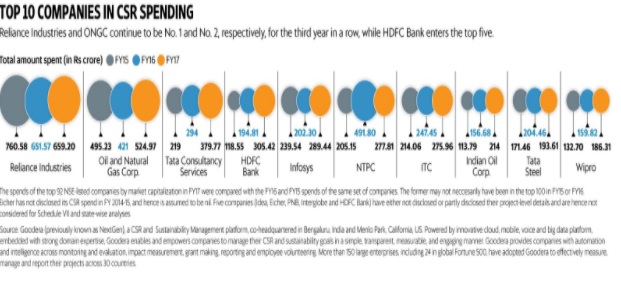
How companies are spending on CSR activities

0
CSR
Image Source - http://www.sustainablebrands.com/news_and_views/new_metrics/mark_mcelroy/last_business_case_csr_even_milton_friedman_could_love_susta

In this article, Raghav Ajmera discusses the companies in India with great CSR budget and where do they spend it. 

Background

Corporate Social Responsibility (CSR), a term broadly used for characterizing the obligations of the Corporate world towards the general public and condition. Despite the fact that the term isn’t new in this Corporate world yet its extension and importance have experienced significant changes from regarding it as a minor philanthropy in the examination with the obligations/obligations of the Corporate towards the external world.

There are numerous huge substances who have been effectively occupied with the CSR exercises however tragically the number is moderately less. Keeping in mind the end goal to urge more entities to participate in the advancement of the general public by means of CSR, the Government of India has really executed the idea of CSR in the new Companies Act 2013, On 27th February 2014, the Government of India has told the guidelines for CSR spending u/s 135 of the New Companies Act 2013 alongside Companies (Corporate Social Responsibility Policy) Rules, 2014 effective from first April 2014.

CSR – Meaning

CSR is Corporate Social Responsibility. CSR strategy works as a self-administrative system whereby a business screens and guarantees its dynamic consistency with the spirit of the law, moral models, and national or global standards. With a few models, a company’s usage of CSR goes past consistency and statutory necessities, which participates in “activities that seem to advance some social great, past the interests of the firm and that which is required by law”.

Importance of CSR

  • In a most recent couple of years, the issue of CSR has turned out to be progressively essential as companies are responding to two noteworthy changes: an expanding open worry over nature issues and the free stream of data over the internet across the globe.Consumers today are more educated and they go past item quality and investigate issues like child work, human rights infringement, and cruelty towards animals involved in making the item.
  • As of late, environmental change and assurance of earth’s condition are progressively involving individuals’ consideration everywhere throughout the world. They lean toward companies whose business rehearses are lawful as well as morally and environmentally right; inferring CSR conscious companies. In this way, companies reputation are progressively being connected to their moral, social and ecological behaviors.
  • Any association seen conflicting with these public sentiments is presently observed as socially irresponsible, and in this way, chances acquiring a bad reputation. Another noteworthy new trend is the expanding on the web network of individuals over the world, giving simple access to exchange data. Gone are the days when subtle elements of company’s’ exercises were limited to a limited set of educated elites and news sections, today even minutest points of interest and slips by can all of a sudden progress toward becoming subjects of hot discussion including tens or even a huge number of individuals in a day.
  • Today, like never before, companies are under the vigilant eyes of their stakeholders and public. Governments, activists, and the media have turned out to be progressively adept at holding companies answerable for the social and natural results of their exercises. Varieties of associations have come up to rank companies on the performance of their corporate social responsibility (CSR).
  • Regardless of their questionable procedures, these rankings draw in considerable publicity in brief time when advertised on the Internet. Therefore, companies are progressively going under pressure for their conduct. Therefore, business no longer implies the limited business-for-benefit of course; it needs to enlarge its frame of reference by considering

Eligibility Criteria:

Company (includes a foreign company with branches or project in India) having:

  • The minimum net worth of rupees 500 Crore.
  • Turnover up to “1000 Crore”
  • having a net profit of at least ‘5 crores’.

during any financial year, are covered under this provision.

Structure of CSR Committee

The Company ought to constitute a Corporate Social Responsibility Committee as takes after:

  • The Committee should comprise of least 3 (three) including 1 (one) Independent Director, however in the event of Private Company or the Company, which isn’t required to select Independent Director on board, or Foreign Company the council can be planned with two.
  • The CSR Policy should be planned as per Schedule VII and the CSR Committee will be in charge of confining the approach, concluding the sum to be spent on CSR, observing and execution of the Scheme.
  • In the event that Company stops to satisfy the qualification criteria for three continuous years, at that point, the organization isn’t required to agree until the point when the organization will meet the qualification criteria indeed.

The CSR Rules gives the way in which CSR board might plan, screen the arrangement and way of comprehension for CSR exercises.

Under the rules, the Government has likewise settled or fixed a threshold of 2% of the ‘Average’ Net Profits of the block of past three years on CSR exercises and if Company neglects to spend such sum, the disclosure is to be made for the same. In any case, an exception has been given to the Companies that don’t fulfill the above limit for three back to back years.

Brief on CSR Activities as endorsed under Schedule VII of CA, 2013

  1. Target to efface the everyday life sections including poverty, malnutrition, and hunger while at the same time improving the way of life and advancing the aspects of better human services and sanitation.
  2. Initiative to promote the diverse portions of training including specialized curriculum and projects to upgrade the vocation skills for all ages like kids, ladies, elderly and directing other work improvement ventures.
  3. Plan to get the consistency regard of various areas of the general public to advance gender equality and other facilities for senior citizens and introducing hostels for ladies and orphans and stepping up with regards to empowering ladies and bringing down imbalances or inequality looked by socially and economically backward groups.
  4. Lift the portion of widely varied flora and fauna to bring the biological adjust and ecological supportability in regard of animal welfare, conservation of natural resources and ago forestry while maintaining the quality of air, water, and soil.
  5. Improvement of Craftsmanship while securing art and culture and measures to reestablish destinations of historical significance and national heritage and promoting the work of art and setting up of open libraries.
  6. Steps to bring worthy to the part of war windows, armed force veterans, and their departments.
  7. Sports projects and instructional meetings to upgrade the level of rural games, nationally recognized games, Paralympic games and Olympics sports.
  8. Favouring to Prime Minister’s National Relief Fund and commitment to other fund set up by the central government to promote socio-economic development and welfare of the Schedule Castes and Schedule Tribes and for supporting backward classes, minorities and women.
  9. To uplift the technology of incubator that comes under academic institutions and which are approved by the Central Government.
  10. Presenting varied ventures for Rural Development.

CSR – Spending

In the three years since Corporate Social Responsibility (CSR) rules were actualized, very little has changed in examples of spending by the best 100 National Stock Exchange (NSE) recorded companies by market capitalization. While education and health insurance keep on attracting a large portion of the monies, Maharashtra still observes the greatest inflow of CSR spends. The main 10 companies still record for half of the aggregate CSR spend.

CSR Rules, which came into effect on 1 April 2014, express that companies with a total assets of Rs500 crore or income of Rs1,000 crore or net profit of Rs5 crore ought to spend 2% of their average profit in the last three years on social advancement related exercises, for example, sanitation, instruction, medicinal services and destitution mitigation, among others, which are recorded in Schedule VII of the Rules.

In the financial year 2017 (FY17), a real spend of Rs 6,810 crore was recorded for the 92 companies whose yearly reports were studied to gather the information by Goodyear (already NextGen), a CSR and sustainability management program. The cut-off date for gathering the information was 18 September. The staying eight had either not discharged their yearly reports or follow an alternate financial year.

At Rs3,307 crore, the share of the best 10 companies was by and by almost half of the total sum spent by the companies reviewed. “The overall CSR spend growth has diminished to 10% this financial from 23% in the past. This is essential because of two reasons: the overall rate of development of companies profits have reduced in this financial year and second, 16% of companies have decreased their overall spend, however, their profits have grown, causing an overall slowdown of CSR spend in the environment.

CSR Spend by companies (2016-17) – Insight

  • 1/3rd of the companies spent more than the recommended CSR spending plan.
  • Almost 1/4th of the companies failed to meet the recommended CSR spending plan.
  • 18% expansion in the recommended CSR spending plan from FY 2014-15 (start of CSR compliance)
  • Public sector companies spent more than the recommended CSR (as a division through and through)
  • 41% expansion in real CSR spent since FY 2014-15 and 8% since last fiscal year.
  • Almost 20% of India’s genuine CSR spent is in Maharashtra and Gujarat states only.
  • Education ventures got just about 33% of total CSR spent.
  • Almost 1/3rd of companies go past consistence and spend more than the prescribed CSR.

Prescribed and Actual CSR Spent

Prescribed CSR 9275 Cr.
Actual Csr 8446 Cr.

(All numbers are in INR Cr.)

Corporate Social Responsibility – Reliance Industries Limited

They add to the prosperity of individuals by presenting economic measures and giving help to establishments and welfare associations. Their exercises are spread crosswise over India and achieve well past their business areas, affecting the lives of minimized groups. Their drives have achieved millions throughout the years and almost 1,50,000 individuals advantage from their proceeding with programs each month.

Corporate Social Responsibility –  NTPC

Core to the company’s philosophy, CSR has been an integral part of NTPC’s business of power generation and lighting up the lives of millions of Indians. Their main CSR objectives are the three main following:

  • To lead the sector in environment protection including effective ash utilization, peripheral development, and energy conservation practices.
  • To lead the sector in the area of resettlement and rehabilitation.
  • To contribute to sustainable power development by discharging corporate social responsibility.

Corporate Social Responsibility – Tata Consultancy

Tata Consultancy Services (TCS) takes after the Tata Group reasoning of building supportable organizations that are established in the group and demonstrate care for the environment. They follow a ‘basket weave’  system, as a component of which social, financial, and ecological issues are tended to both inside TCS and additionally outside.

TCS organization trusts that corporate manageability reaches out to the triple main concern of individuals, planet, and benefit. We have expanded the span of business obligation past prompt advantage to long-term while guaranteeing the maintainability of the association. TCS empowers a situation of more prominent cognizance through a procedure of coordinated effort with workers, providers, clients, and the group on the loose.

Corporate Social Responsibility – Oil and Natural Gas Corporation

As an open segment venture, ONGC has a long and loved custom of honorable activities, organized projects, and practices of Corporate Social Responsibility which have assumed a praiseworthy part in the advancement of a few immature districts of the nation. The vision of supportable development drives both business choices and in addition, our Corporate Social Responsibility works. Our CSR exercises are basically guided by venture based approach in accordance with the rules issued by the Department of Public Enterprises and Ministry of Corporate Affairs of the Government of India.

Corporate Social responsibility – HDFC Bank

At HDFC Bank, they trust that genuine improvement happens when groups find manageable methods for occupation. Under HDFC Bank Parivartan, their CSR activity, we connect with such groups, ingrain certainty, engage them to act naturally dependent and make them accomplices in the development of our country.

They do this through their center estimation of Sustainability, which drives every one of their drives from their Holistic Rural Development Program, to their Zero Investment Innovation in Education Initiative, and their yearly Blood Donation Drive. This approach empowers families to break out of the endless loop of neediness and draws them into a cycle of development, advancement, and strengthening, while all the keeping up the environmental balance. Needless to state, at times these little advances clear path for a monster change.

Corporate Social Responsibility – Infosys

At Infosys, the distribution of wealth is as important as its legal and ethical creation. A strong sense of social responsibility is, therefore, an integral part of their value system.

They are committed to contributing to the society and established the Infosys Foundation in 1996 as a not-for-profit trust to support their social initiatives. The Foundation supports programs and organizations devoted to the cause of the destitute, the rural poor, the mentally challenged, and the economically disadvantaged sections of the society. The Foundation also helps preserve certain cultural forms and dying arts of India.

EXECUTIVE CERTIFICATION IN CORPORATE SOCIAL RESPONSIBILITY (CSR) – CLICK HERE TO KNOW MORE

References

Download Now

Blasphemy Laws In India

0

In this article, Yash Tandon discusses the constitutionality of Blasphemy Laws in India.

What does the word “Secular” mean?

In the constitution of India, the word “secular” was added in the preamble by the 42nd Amendment, which made it crystal clear that India is a secular country and the state will not indulge in the religious matter of the people as all religions are equal to the state.

Section 295 A of Indian Penal Code: Blasphemy Law

With the aforementioned concept of secularism, section 295 A of the Indian Penal Code (IPC), 1860[1] criminalizes insult to any religion. It allows up to three years imprisonment and fines for “whoever, with the deliberate and malicious intention of outraging the religious feelings of any class of citizens of India, by words, either spoken or written, or by signs or by visible representations or otherwise, insults or attempts to insult the religion or the religious beliefs of a class.” But the laws should not be read in their strict sense and should not be applied strictly going by the words. It should be interpreted keeping in mind the relevant facts of the respective cases.

The aforementioned section does not stipulate everything to be penalized and any and every act would tantamount to insult or attempt to insult the religion or the religious beliefs of a class of citizens, it only penalizes malicious acts which are deliberate in nature.

Instances of Blasphemy/ How to Institute a case against someone?

  • Burning a religious document such as the Bible or the Quran is considered blasphemy.
  • Vandalizing a church is a form of blasphemy.
  • Worshipping Satan is blasphemous.
  • Committing suicide is a form of blasphemy.
  • To state that God is unkind, unjust or cruel is blasphemous.

If a person does any of the act mentioned in the aforementioned list then a case of Blasphemy can be instituted against that individual. One can go to District Court.

What Not is Blasphemy: Defence to Blasphemy Law

In Mahendra Singh Dhoni v. Yerraguntla Shyamsundar[2], a case for allegedly harming the religious conclusions of individuals when a picture of Mahendra Singh Dhoni, being depicted as Lord Vishnu was distributed in a magazine with an inscription “Divine force of Big Deals”, the Court said that Section 295A IPC does not stipulate everything to be punished and any and each demonstration would equivalent to affront or endeavor to affront the religion or the religious convictions of a class of subjects. It punishes just those demonstrations of the affront to or those assortments of endeavors to affront the religion or religious conviction of a class of natives which are executed with the ponder and vindictive goal of insulting the religious sentiments of that class of residents. The same reasoning was given by the apex court in The State Of Haryana And Ors vs Ch. Bhajan Lal And Ors[3]

In the aforementioned cases, the courts have interpreted rightly and made it clear the rationale of Section 295 A.

Procedure to file a Blasphemy Case: A Cognizable Offence

  • File an FIR – Make sure that you file an FIR with the police at the police station after the happening of the criminal event with you.
  • Vakalatnama – Once you have filed an FIR, know that the Vakalatnama has to be filed because the lawyer or the advocate will need to represent you on your behalf.
  • Investigation– the process of investigation starts after the cognizance of the case to the court and sometimes even before that if the nature of the offense is serious in nature.
  • Laying of charges – If the crime is heinous then the police will frame the charges in the police diary and then report the same to the court. The court will then decide whether to prosecute based on the witnesses and the statements provided in the court.
  • Enquiry – Inquiry will be conducted by the court to determine the guilt of the offender and if no such guilt is found, then the statements will be recorded under the Section 164 of the CRPC, where the accused will be required to say whether he feels he is guilty or not and he can admit the guilt.
  • Trial- The process of trial starts when the investigation is over and the court now needs to decide upon the facts and the evidence upon whether the accused is guilty of the offense or not.

Constitutional Arguments in Favour of Blasphemy Law

There are many instances in which the debate on the validity of Blasphemy laws vis-a-vis the constitution of India, some of which dates back in the colonial period, have arisen and there are also in the current period which sparks the debate to such issue.

Ramji Lal Modi v. State of Uttar Pradesh

In Ramji Lal Modi v. State of Uttar Pradesh[4], a five-judge bench of the Supreme Court upheld the constitutionality of Section 295 A.

Mr. Ramji Lal was the editor of the magazine called “Gauraksha”. His contention was that under Article 19 1 (a) of the constitution which talks about freedom of speech and expression, and stated that his work is protected under the aforementioned article. Also, it was contended that Section 295A, cast its net much wider, by criminalizing all speech that was intended to outrage religious feelings. But the court held that- “Section 295A only punishes the aggravated form of insult to religion when it is perpetrated with the deliberate and malicious intention of outraging the religious feelings of that class. The “calculated tendency” of this aggravated form of insult is clearly to disrupt the public order and the section, which penalizes such activities, is well within the protection of clause (2) of Art. 19 as being a law imposing reasonable restrictions on the exercise of the right to freedom of speech and expression guaranteed by Art. 19(1)(a).”

Constitutional Arguments Against Blasphemy Law

The Superintendent, Central Prison, Fatehgarh v Ram Manohar Lohia

Unlike the previous judgment which gave the order on the guideline that if there is a slight connection of freedom of speech with public disorder along with Section 295 A then that will be struck down, the present one namely The Superintendent, Central Prison, Fatehgarh v Ram Manohar Lohia[5] laid down the foundation which is now the foundational test in current period that the speech which is prohibited should have a connection to disrupt public order and it should not be just a remote connection.

But unlikely over the years the aforementioned test has not seen much essence over the years, as the Ramji Lal case was a five-judge bench and Ram Manohar Lohia one is also a five-judge bench, so in order to overrule a seven-judge bench is required, but it is a cumbersome process. First, a two-judge bench (before which any petition originally goes) has to be convinced then this two-judge bench would need to refer the question to a five-judge bench which, in turn (if convinced), would have to refer it to a seven-judge bench, which would finally hear the case on merits.

Sri Baragur Ramachandrappa & Ors vs State Of Karnataka & Ors

This case came up in 2007 and it proved that the test laid down in Ram Manohar Lohia case has not seen much essence and the link between Section 295 A and public order has been gradually vanishing, because in this case the Supreme Court maintained a prohibition on a recorded anecdotal retelling of the life of Basaveshwara, taking note of that “no individual has a privilege to encroach on the sentiments of others on the introduce that his entitlement to the right to speak freely stays unhindered and liberated. It can’t be disregarded that India is a nation with huge inconsistencies in dialect, culture, and religion and ridiculous and noxious feedback or obstruction in the confidence of others can’t be acknowledged”.

So the ratio which was laid down in Ram Ji Lal Case was the relation of speech to public order but in this present case it is crystal clear that the speech and expression are related to anti-religious comments and if the speech is anti-religious then it that will be struck down because of Section 295 A.

Comparative Analysis of Other Countries

Below is the list of some countries, where blasphemy law is compared with that of the Indian scenario. They are-:

Pakistan

There is a death penalty for blasphemy in Pakistan. The ones who are prosecuted are usually minorities but it seems that they are also increasingly other Muslims. Persons accused of blasphemy as well as police, lawyers, and judges have been subject to harassment, threats, attacks, and murders when blasphemy is the issue.

Qatar

The penalty for committing blasphemy in Qatar is a jail sentence of up to 7 years.Religious criticism on websites is censored in Qatar.

The United Arab Emirates

The United Arab Emirates discourage blasphemy by controlling what is published and distributed, by using Sharia punishments against Muslims, and by using judge-made penalties against non-Muslims.

United Kingdom

Blasphemy laws in the United Kingdom were specific to blasphemy against Christianity. In 1985, the Law Commission (England and Wales) published a report, Criminal Law: Offences against Religious and Public Worship, that concluded that the common law offenses of blasphemy and blasphemous libel should be abolished without replacement. On 5 March 2008, an amendment was passed to the Criminal Justice and Immigration Act 2008 which abolished the common law offenses of blasphemy and blasphemous libel in England and Wales.

USA

A prosecution for blasphemy in the United States would be a violation of the U.S. Constitution and no blasphemy laws exist at the federal level.

Misuse of Blasphemy Law

There are many instances where the misuse of blasphemy law can be seen, like on August 20, 2013, driving hostile to superstition campaigner Narendra Dabholkar was shot and murdered by two men on a motorbike. The murder came days after the state government swore to represent an against superstition charge, went for making it an offense to abuse or dupe individuals with ‘otherworldly’ customs, charms and cures. This bill was nearly connected with Dabholkar’s work and was contradicted by numerous conservative and Hindu patriot bunches who marked it “hostile to Hindu”[6].

Conclusion

In light of the above judgments and reasoning along its scenario with respect to its constitutionality, the interpretation by the courts of Section 295 A has been in the wrong way and to solve this issue a complete ban or repeal Section 295 A is not the solution.

In the introduction itself, it has been said that India is a secular country and this section of IPC helps to maintain the purity of the secular nature. Though IPC came way earlier than the constitution, but the aforesaid section maintains the essence of secularism by protecting the religious sentiments equally, by criminalizing intentional acts on religious sections. Rather than to shut down this section or repeal it, the misuse of such section should be curb down and that can happen with the proper interpretation of the aforesaid section. The state will only interfere or the judiciary should only interfere when the speech or expression will create public disorder, and not when it has a slight connection or remote one to create public disorder.

References

[1] https://indiankanoon.org/doc/1803184/(last visited Dec 12, 2017).

[2] 1992 AIR 604, 1990 SCR Supl. (3) 259(last visited on Dec 12, 2017).

[3] Mahendra Singh Dhoni v. Yerraguntla Shyamsundar, 2017 SCC OnLine SC 450.

[4] Ramji Lal Modi v. State of Uttar Pradesh:1957 AIR 620, 1957 SCR 860,

https://indiankanoon.org/doc/553290/(last visited on Dec 12,2017).

[5] The Superintendent, Central Prison, Fatehgarh v Ram Manohar Lohia:1960 AIR 633, 1960 SCR (2) 821, https://indiankanoon.org/doc/1386353/(last visited on Dec 12, 2017).

[6]https://end-blasphemy-laws.org/countries/asia-central-southern-and-south-eastern/india/(last visited on Dec 12, 2017).

Download Now

What is Agriculture Income: Its Types and its Taxability

2
agriculture income

In this article, Yash Tandon discusses the taxability of Agriculture Income. Procedure on how to file the ITR for your agricultural income.

What is Agriculture Income?

Agricultural income in India is categorized as a valid source and essentially incorporates income from sources that include farming area, structures on or identified with a rural land and business deliver from a horticultural land. This income is considered for rate purposes while ascertaining the income tax liability of an individual.

Agriculture Income – Income Tax Act, 1961

Section 2 (1A) of the Income Tax Act, 1961[1] details out the conditions wherein sources can be considered to be generating agricultural income. The following are the sources of agricultural income –

  • Revenue generated through rent or lease of a land in India that is used for agricultural purposes, subject to some conditions which are-:
    • The land ought to either be evaluated to arrive income in India or be liable to a nearby rate surveyed and gathered by officers of the Government.
    • In the event that for example the land isn’t liable to neighbourhood rate, at that point the land ought not to be arranged inside the locale of a region or a cantonment board, and which has a populace of more than ten thousand, or it ought not to be arranged:
    • Not being more than 2kms. from the neighbourhood furthest reaches of any region or cantonment board and which has a populace of more than 10,000 yet not surpassing 1,00,000; or
    • Not being more than 6kms. from the neighbourhood furthest reaches of any district or cantonment board and which has a populace of more than 1,00,000 yet not surpassing 10,00,000; or
    • Not being more than 8kms. from the nearby furthest reaches of any region or cantonment board and which has a populace of more than 10,00,000[2].
  • Revenue generated through the commercial sale of produce gained from an agricultural land.
  • Revenue generated through the renting or leasing of buildings in and around the agricultural land subject to the following conditions as follows-:
    • The cultivator or farmer should have occupied the building, either through rent or revenue.
    • The building is used as a residential place, storeroom or outhouse.
    • The agricultural land or the land where the building is located is being assessed for land revenue or subject to a local rate assessed.
https://lawsikho.com/course/diploma-entrepreneurship-administration-business-laws
click above

What are Non- Agriculture Income?

The below-mentioned list draws exception to that revenue or income which is generated by doing agriculture work, but they are “non-agriculture income. They are as follows-:

  • Revenue from the sale of processed products of agricultural nature without actual agricultural activity.
  • Revenue from extremely processed products.
  • Revenue from trees that have been sold as timber.
  • Income from poultry farming.
  • Income from bee hiving.
  • Income from sale of spontaneously grown trees.
  • Income from dairy farming.
  • Purchase of standing crop.
  • Dividend paid by a company out of its agriculture income.

There are certain points which should be kept in mind to evaluate whether the particular agriculture income is valid. These are as follows-:

  • Income should be from an existing piece of land.
  • Income should be from a piece of land that is used for agricultural operations.
  • Income should stem from products achieved after cultivation of the land.
  • Income can be from a land that is not under the assessee’s ownership.

Whether the above mentioned Agriculture Income is Taxable or Not?

Under Section 10(1) of the Income Tax Act, 1961[3], the income earned from agricultural land is exempted from taxes. Before 1970, profit on the sale or transfer of all agricultural land was considered rent or revenue derived from the land. Such profit was, therefore, tax-exempt as agricultural income. An agricultural land does not form part of the definition of a capital asset and hence, there will be no capital gains on the sale of such land.

Any other land not forming part of the above will be a capital asset and sale of the same shall attract tax on capital gains subject to Section 54B, which is explained below.

Section 54B of the Income Tax Act, 1961

Section 54B gives relief to a taxpayer who sells his agricultural land and acquires another agricultural land from the sale proceeds.

Conditions to be fulfilled to guarantee the advantage of this Section:

  • The assessee must be an individual or a HUF(Amount received by a member of the HUF from the income of the HUF, or in case of impartible estate out of the income of family estate [Section 10(2)]. As per section 10(2), the amount received out of family income, or in case of an impartible estate, or the amount received out of the income of family estate by any member of such HUF is exempt from tax).
  • The agrarian land ought to have been utilized for rural purposes. It might be a long haul resource or a fleeting resource.
  • It has probably been utilized either by the assessee or his folks for agrarian purposes in at least two years instantly preceding the date on which the exchange of land occurred.
  • The assessee ought to have bought another land, which is being utilized for agrarian purposes, inside a time of two years from the date of the offer[4].

Whether all Agricultural Land is Exempted from Tax Liability?

No, all agricultural land is not exempted. Agriculture income is included while computation, for the limited purpose of determining the tax rate, in computing the income tax liability if the net agricultural income exceeds Rs 5,000 for, say, Financial Year 2015 and total income, excluding net agricultural income, exceeds applicable basic income exemption of Rs 2,50,000. Currently, the basic income exemption for an individual of age between 60 and 80 years is Rs 3 lakh for Financial Year 2015 and the basic exemption for an individual above 80 years of age is Rs 5 lakh[5].

Whether all the Agriculture Products come under the tax exemption?

Any preparing done on Agricultural create to make it marketable is a piece of agricultural operations and such sum recuperated will be dealt with as agriculture income only. Say for instance threshing of wheat, mustard, and so forth is a piece of agriculture operations and the sum recuperated will be dealt with as farming salary just regardless of preparing happens on the land itself or some other place.

Be that as it may, in specific cases like on account of tea, coffee, sugar stick where a noteworthy preparing (change of exceptional nature of the item) is being done, at that point some piece of the handled deliver (tea, coffee, and sugar) is taxed as non-farming pay and rest is absolved as rural salary.

Whether income earned from export of agricultural produce is exempt from income tax?

The conditions for considering the income as agricultural in nature have to be satisfied if the agricultural produce has to be exempt from income tax.

NOTE- Middlemen dealing in trade of agricultural produce are generally not entitled to exemption due to lack of satisfaction of the conditions.

How to file Agriculture Income Tax? How it is computed?

Although Agriculture income is completely excluded from tax, the Finance Act, 1973, introduced a scheme whereby agriculture income is incorporated with non-horticultural pay on account of non-corporate assessees who are at risk to pay tax at indicated section rates. The procedure for money impose calculation for such surveys is as per the following:

  • Income tax is first ascertained on the net horticultural salary in addition to the assessee’s aggregate pay from non-farming sources.
  • The tax is then ascertained on the fundamental exception section expanded by the assessee’s net agrarian pay.
  • The contrast amongst (a) and (b) is the measure of expense payable by the assessee.

NOTE-The previously mentioned procedure of calculation is, be that as it may, took after just if the assessee’s non-horticultural pay is an abundance of the essential exclusion section.

This video might help you in understanding the procedural intricacies involved in filing agricultural tax.

Conclusion

Clearly, notwithstanding agriculture income being charge absolved, assessees must be careful while managing such pay. They should ensure that their total rural salary with their aggregate pay has to stay away from intrigue instalments and conceivable punishments for camouflage of pay. Assessees should likewise keep up dependable records to furnish the duty specialists with verification of responsibility for land and confirmation of having earned farming pay.

There is sufficient degree of the exhausting wage from exercises which are non-agriculture in nature. Actually, it is outstanding that agriculturists themselves don’t have the assessable wage, considering the way that when it is separated among relatives who are engaged with farming operations, every last one of them would include wage inside as far as possible. In any case, there are a huge number of go-betweens like wholesalers, retailers, merchants, and so forth who procure significant salary from exchanging agrarian deliver and additionally natural products, blooms, and so forth. Such salary or benefits are completely assessable under the present law and, in this manner, if coordinated endeavors are made by the Tax Department to recuperate impose from them, the requirement for broadening the expense base to rope in agriculturists and ranchers, would be eliminated.


LawSikho has created a telegram group for exchanging legal knowledge, referrals and various opportunities. You can click on this link and join:  

https://t.me/joinchat/J_0YrBa4IBSHdpuTfQO_sA

Follow us on Instagram and subscribe to our YouTube channel for more amazing legal content 


References

[1] http://www.incometaxindia.gov.in/pages/acts/income-tax-act.aspx(last visited on Dec 14,2017).

[2] https://taxguru.in/income-tax/income-tax-treatment-taxability-of-agricultural-income.html(last visited on Dec 14,2017).

[3] http://www.incometaxindia.gov.in/pages/acts/income-tax-act.aspx(last visited on Dec 14,2017).

[4] http://www.incometaxindia.gov.in/Tutorials/17.%20Exemption%20under%2054B.pdf(last visited on Dec 14, 2017).

[5] https://economictimes.indiatimes.com/wealth/tax/here-are-nine-incomes-you-need-not-pay-tax-on/articleshow/47538791.cms(last visited on Dec 14,2017).

Download Now
logo
FREE & ONLINE 3-Day Bootcamp (LIVE only) on

How Can Experienced Professionals Become Independent Directors

calender
28th, 29th Mar, 2026, 2 - 5pm (IST) &
30th Mar, 2026, 7 - 10pm (IST).
Bootcamp starting in
Days
HRS
MIN
SEC
Abhyuday AgarwalCOO & CO-Founder, LawSikho

Register now

Abhyuday AgarwalCOO & CO-Founder, LawSikho