
Download Now
Home Blog Page 1510

Calculation of damages in Engineering, Procurement and Construction contracts in India

2
damages

In this article, Priya Agrawal discusses the calculation of damages in Engineering, Procurement and Construction contract in India.

Introduction

Engineering, Procurement and Construction contract, also known as EPC contract is a prominent form of contracting agreement in the construction and infrastructure industries, thermal power project, tunnelling, mining, etc. It is a contract wherein the contractor carries out the detailed engineering design of the project, procures all the necessary equipment and materials, and then constructs to deliver a functioning facility or assets to its clients.

In India, the construction industry has evolved from item rate packages to lumpsum contracts and then to EPC contracts over the years. It has resulted in a visible shift from owner-managed projects to projects in which the time and cost risks have been transferred to the contractor, along with the responsibility of designing, procurement of material and construction.

Obligations of parties to the contract

Section 37 of the Indian Contract Act, 1872 says that “the parties to a contract must either perform or offer to perform, their respective promises, unless such performance is dispensed with or excused under the provisions of this Act, or of any other law.”

Thus, section 37 imposes an obligation on the parties to perform their promises. Sometimes, the parties to a contract specify the time for its performance. Ordinarily, it is expected that either party will perform his obligation within the stipulated time. But, where the time is not mentioned, the parties must perform their promises within a reasonable time. Generally, time schedule in a construction contract is likely to be of the essence because construction is a commercial service.

Consequences of failure to discharge the contract by performance

A contract is not a property. It is only a promise supported by some consideration upon which either the remedy of specific performance or that of damages is available [Sunrise Associates v. Govt. of NCT of Delhi, (2006) 5 SC 603; AIR 2006 SC 1908]. The injured party to the contract may bring an action for damages.

Damages mean compensation in terms of money for the loss suffered by the injured party. The burden lies with the injured party to prove his loss.

In ordinary cases, the extent of liability is what may be foreseen by “the hypothetical reasonable man,” as arising naturally in the usual course of things. Since works and building contracts are undertaken only intending to earn profits, the party committing the breach would be liable for the contractor’s loss in terms of expected profits. The Supreme Court came to this conclusion in “A.T. Brij Paul Singh v. State of Gujarat” [AIR 1984 SC 1703; (1984) 4 SCC 59]. It was not disputed before the Supreme Court that wherein works contract the party entrusting the work commits a breach, the contractor would be entitled to claim damages for loss of profit which he expected from the project.

Computation of damages

The growth of the engineering and construction industry has increased the scope of disputes relating these rights and obligations. The number of arbitration cases in both public and private sectors has increased as almost all construction contracts these days contain an arbitration clause for the settlement of their disputes. The task of understanding one’s rights and obligations has become more challenging as The Arbitration & Conciliation Act, 1996 has brought about significant changes in the field of arbitration and also, the engineering & construction industry involves various other laws such as the Indian Contract Act, the Specific Relief Act, the Interest Act, etc.

The computation of actual damage suffered by a party due to the breach or underperformance of the terms of the contract by the other party is one of the major concerns in the resolution of any dispute or the adjudication process relating to the construction and engineering industry.

Sections 55 and 73 of the Indian Contract Act, 1872 do not lay down the manner and the mode in which the computation of the damages or compensation has to be done.

In M.N. Gangappa v. Atmakur Nagabhushanam Setty & Co. and Anr. [MANU/SC/0019/1972; AIR 1972 SC 696], the Supreme Court held that the method used for computation of damages would depend upon the facts and circumstances of each case. While calculating damages, the court must take into account only the strict legal obligations and not the expectations of one contractor that the other will do something that he has not assumed any legal obligation to do, however reasonable be the expectation.

Formulae for computation of damages

There is nothing in Indian law to show that law prohibits any of the formulae adopted in other countries or the same is inconsistent with the law prevailing in India. As the computation depends on circumstances and methods to compute damages, determination of the quantum thereof should be a matter which would fall for the decision of the court or the arbitrator. Different formulae can be applied in various circumstances and the question as to whether damages should be computed by taking recourse to one formula or the other formula, given the facts and circumstances of a particular case, would eminently fall within the domain of the court or the arbitrator.

In 2006, in the case of McDermott International Inc. v. Burn Standard Co. Ltd. [(2006) 11 SCC 181], the Supreme Court had the opportunity to discuss some of the formulae for computation of damages in detail, which may be used by the parties to calculate the amount of damages. In the case mentioned above, the Supreme Court recognized and dealt with the following formulae-

  1. Hudson formula

This formula was propagated first in Hudson’s Building and Engineering Contracts, and can be stated in the following terms –

In Hudson formula, the head office overhead percentage is taken from the contract.

This formula is adapted for quantification of claims for overhead losses in India. In the case of “A.T Brij Paul Singh v. State of Gujarat “[AIR 1984 SC 1703; (1984) 4 SCC 59], the Hudson formula has been accepted by the Hon’ble Supreme Court for quantification of claims for overhead losses. On the basis of Hudson formula, the Claimants have claimed overhead losses up to 28th January 2002 amounting to Rs. 1,88,15,960/-

The reasonability of the formula given by Hudson cannot be doubted, but as the overhead expenses considerably vary from contractor to contractor, it should be used with caution.

The Hudson formula has received judicial support in many cases. But, it adopts the head office overhead percentage from the contract as the factor for calculating the costs, and this may have little or no relation to the actual head office costs of the contractor. Thus it has been criticized principally.

Emden formula

This formula was propagated first in Emden’s Building Contracts and Practice, and may be stated in the following terms

This formula was laid down in the manual published by the Mechanical Contractors Association of America known as “Change Orders, Overtime, Productivity” commonly known as the Emden Formula.[1]

Under the Emden formula, the head office overhead percentage is arrived at by dividing the total overhead cost and profit of the contractor’s organization as a whole by the total turnover. This formula has the advantage of using the contractors actual head office and profit percentage rather than those contained in the contract. This formula has been widely applied. It has also received judicial support in a number of cases[2] including Norwest Holst Construction Ltd. v. Cooperative Wholesale Society Ltd., decided on 17 February 1998, Beechwood Development Company (Scotland) Ltd. v. Mitchell, decided on 21 February 2001 and Harvey Shoplifters Ltd. v. Adi Ltd. decided on 6 March 2003.

Eichleay formula

The Eichleay formula was evolved in America and derives its name from a case heard by Armed Services Board of Contract Appeals, Eichleay Corp. It is applied in the following manner.
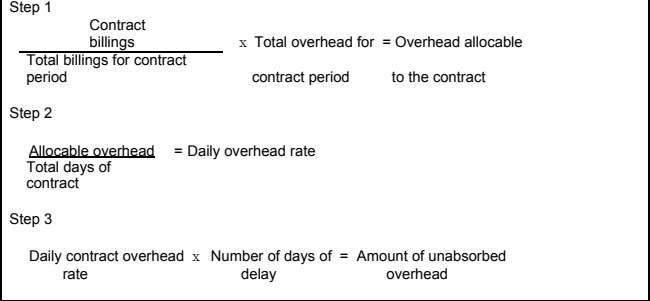
This formula is used where it is not possible to prove loss of opportunity and the claim is based on actual cost. It can be seen from the formula that the total head office overheads during the contract period are first determined by comparing the value of work carried out for the duration of the contract for the project with the value of work performed by the contractor as a whole for the contract period. A share of head office overheads for the contractor is allocated in the same ratio and expressed as a lump sum to the particular contract. The amount of head office overhead assigned to the particular contract is then expressed as a weekly amount by dividing it by the contract period. The period of delay is then multiplied by the weekly amount to give the total sum claimed.

The above are the formulae that were discussed in detail by the Supreme Court in the case of McDermott International Inc. However, the equations presented above are not the only formulae to which the disputing parties can resort to for computation of the damages to which they are entitled. Time and again, the Courts in India, have reiterated that parties are at complete liberty to adopt any generally accepted formula to calculate the amount of damages. The only requirements are that there must be a cogent reason for applying the chosen method, and relevant facts and evidence must corroborate the amount which is claimed as damages. It is, therefore, generally accepted that different formulas can be applied in various circumstances. It shall be the discretion of the Court/the Arbitral tribunal to decide as to which method to be used for computing the damages. While determining the formula to be applied, regard is to be had to the facts and circumstances of a particular case. Thus, if an arbitrator decides a specific method to be used, he is not committing an error to make it a fit case for the interference of a Court. In other words, if an Arbitrator prefers one formula as against another for the computation of damages, the same cannot be challenged in a Court.

Liquidated damages in EPC contracts

Sometimes, the parties to a contract, at the time of making the contract, agree to the amount of compensation payable in the event of the breach of contract. This amount of compensation payable, which has been agreed beforehand, may be either liquidated damages or penalty. If the compensation payable is the genuine pre-estimate of the damages, it is known as liquidated damages. On the other hand, if the compensation is excessive and highly disproportionate to the likely loss or if it is fixed in terrorem with a view to discourage the breach of contract, it is known as the penalty.

Many times in EPC contracts, the parties mention the time of completion of the contract and determine the amount of compensation payable in the event of its non-completion or partial completion at the time of the making of the contract. Those are liquidated damages. For the liquidated damages clause to be enforceable, it is necessary that it must not be by way of penalty.

General principles of the Indian Contract Act

While computing the damages, the general principles set out in the Indian Contract Act,1872 must also be kept in mind. Section 73 of the Act states that when a contract has been broken, the party who suffers by such breach is entitled to receive compensation for any loss or damage caused to him by the party who has broken the contract. But such compensation shall be given only for the loss which arose naturally in the usual course of things, or those which could be contemplated by the parties to be likely to result because of the breach.

Such compensation is not be given for any remote and indirect loss or damage sustained by reason of the breach.

Conclusion

EPC contracts are a form of turnkey contracts wherein all the activities involved in a contract are the responsibility of the contractor. EPC contracts are popular mostly in construction, infrastructure industries which involve high costs. Thus, any breach of such contracts may cause substantial loss to the parties. This makes it imperative for the parties to compute damages meticulously. Courts and arbitral tribunals have recognized various formulae, including but not limited to, Hudson formula, Emden formula, and Eichleay formula for computation of damages in EPC contracts. However, parties can always resort to other methods of computing damages, and it shall be subject to the discretion of the court/arbitral tribunal as to which formula to be applied.

[1] Angerlehner Structural and Civil Engineering Co. and Ors. vs. The Municipal Corporation of Greater Mumbai and Ors. (31.03.2017 – BOMHC) : MANU/MH/0554/2017

[2] http://www.lawweb.in/2015/06/supreme-court-judgment-on-calculation.html

 

Download Now

Dr. (Smt.) Nupur Talwar vs State Of U.P. And Anr (Aarushi Murder Case) – Case analysis

2
Family members under money laundering act

In this article, Akancha of BVP Pune does a case analysis on the infamous Aarushi Murder case, Dr. (Smt.) Nupur Talwar vs State Of U.P. And Anr.

The suspect changes continuously! The police suddenly become of no use! CBI changes its team without giving any reason! The court convicts the parents! The court evicts the parents!

A chain of contradictory and questionable events that took place due to the dereliction in the initial investigation and the dubious methods used for confession, which led to critical gaps in the evidence resulting in the release of the prime suspects and closing of the case with many questions unanswered and breaking down of the entire concept of justice.

Timeline of events

May 16, 2008 – Aarushi Talwar found dead in her bedroom. Hemraj (servant of Talwar’s) is absent from the apartment and suspected to be the murdered by the parents.

May 17, 2008 – Hemraj body found on the Talwar’s terrace with a bloody handprint on the wall.

Postmortem Report

According to the report, both Aarushi and Hemraj were killed between 12 A.M. to 1A.M. Both of them were killed in the same manner and the blunt object that caused U-V curve and was used to kill them could possibly be a golf stick.

Aarushi’s Postmortem Report- She had a blunt injury on the forehead (8 cm*2 cm) and that was made with a “heavy sharp-edged weapon”, a cut on her neck (14 cm*6 cm) and such injury were made with surgical precision.

Hemraj Postmortem report- The blunt injury was made on the back of Hemraj head and the neck injury was same as that of Aarushi.

The object used for both the murders was the same and the victims died in 2 minutes as soon as the object hit them.

Investigation

First stage – U.P. Police Investigation

After seeing the postmortem report the police concluded that the double murders were an insider job and were done with someone who had clinical precision. On May 19, 2008, Vishnu Sharma, the former domestic helper was suspected of killing them due to the rage of getting replaced by Hemraj. But police could find nothing on examining him.

The second stage – Joining of Delhi Police

On 21st May 2008 the Delhi police joined the investigation and suspected Rajesh and Nupur Talwar for murders. Main reasons for such suspicions were-

  • The denial of Aarushi’s parents about hearing any sound even though they were just 7-8 feet away from her room.
  • The offer of Rs 25000 made by Rajesh to find Hemraj was seen as a diversionary tactic,
  • The denial of Rajesh to identify Hemraj body was seen as an attempt to mislead the police.
  • The undue haste shown by the family in cleaning and cremating the body was a matter of suspicion of the police.
  • The request made by Dinesh to remove any sexual assault information from the post-mortem report was objected by the police.

They created an extramarital affair theory between Rajesh Talwar and Anita(Talwar’s friend). Aarushi knew this fact and had confided with Hemraj. According to them Rajesh finding Aarushi and Hemraj in an objectionable position that night could not control his anger and committed the double murder. The extramarital affair of Anita and Rajesh was confirmed by Anmol, a close friend of Aarushi who was told this fact by Aarushi. On May 23, 2008, Rajesh Talwar was arrested as the key suspect.
Being criticised for questioning the character of Aarushi he changed his storyline to Aarushi being the witness of Hemraj murder was killed by her father. However, police had no material or forensic evidence to prove it. This clearly shows that police had invariably failed in investigating the case and formed a storyline which suited them.

Third stage – Investigation by the first C.B.I. team (2008-09)

On 1st June 2008 at the request of Aarushi’s parents, the case was transferred to CBI.
The first CBI suspected Krishna (Driver of Talwar’s), Rajkumar(Ex- servant of Talwar’s), and Vijay(Talwar’s compounder) and arrested Krishna on June 13, 2008. A number of narco tests were taken on them but they were not conclusive as every time a different version of the day was given- With an intention of taking revenge and finding Aarushi’s door open he killed her and since Hemraj was a witness to such murder he killed him on the terrace and destroyed their cell phones and flushed the murder weapon. However, no charge sheet could be filed against them as it was proved that they were not present at the time of the murder and narco tests could not be relied upon by the court as well as the blood-stained ‘khurki’ and pillow cover found from Krishna’s room had the blood of an animal in it.On June 26, 2008, the CBI declared it a ‘blind case’ but bail was denied by the court on the same and new team was appointed for investigation. This again showed a complete failure of the police in the examination of the witnesses.

Fourth stage – Investigation by the New CBI team (2009-10)

In July 2008 due to media pressure on the failure of CBI to investigate a new CBI team was formed to investigate the crime and they alleged that the victims were murdered by Nupur and Rajesh Talwar on the following grounds.

  • No forced entry- The CBI claimed that there was a friendly entry as there was no sign of breaking of any door or window. Since there were only four people in the house and two were killed the onus to prove lied on the parents.
  • Room locked by parents- Since Aarushi’s room was locked by parents and they had the keys. They had to prove if anyone else entered the room and the way of entry.
  • Altering the crime scene- The blood could be found on the floor, pillow, wall and even at the entrance of the bedroom but the toys, pillow on the back of the bed, the book and school bag which should come under the ambit of blood spill were clean which shows that they had been cleaned. Moreover, the bed sheet was laid out smoothly as if the body was kept on the bed sheet after the murder.
    CBI also claimed that the private parts of Aarushi cleaned after her death.
    The two golf clubs were cleaned so much that they were visually distinct from other golf clubs.
  • They supported the love theory formed by the police.

On 9th February 2011, the Ghaziabad special CBI court convicted the parents of murder on the basis of circumstantial evidence and media pressure which was a complete miscarriage of justice. After a lot of waits the Allahabad High Court on October 2, 2017, acquitted them on basis of weak evidence and provided relief to those poor parents.

Questions of law involved

The special court of CBI while conducting the trial under Section 45 of the Indian Evidence act did not admit narco tests of the servants as an admissible evidence. Moreover, the court under Section 8 of the Indian Evidence Act admitted maid’s statement that Nupur Talwar had told her a made up story and the murder was pre planned.

The court under Section 106 and 114 of the evidence act presumed the existence of certain facts against the parents and did not consider any other evidence presented by the accused. The court gave one sided judgment and convicted Talwars U/S 302 r/w Section 34 for murdering her daughter and section 201 r/w Section 34 for tampering with the evidences.

The Allahabad High Court corrected the error made by the trial court in an application of law and highlighted that Section 106 of the Indian Evidence Act did not absolve the prosecution from proving case beyond reasonable doubt under Section 110 of the act. The court pointed out that Section 106 did not intend to shift burden of proof to the accused but could only be used when certain facts were difficult to be proved by the prosecution.

This section could only be applied if CBI would have proved the case beyond reasonable doubts. Moreover, the prosecution (CBI) in this case had failed to establish the case beyond reasonable doubts. Hence the benefit of doubt should be given to the Talwars and they were acquitted.

The question on the justice system

Even though the Talwars presented sufficient evidence before the special CBI court to prove that they were not guilty the court on the basis of circumstantial evidence and media pressure convicted them. The faults made by the police in the investigation procedure which raises question on the justice system are-

  • The police after coming to the house did not show due diligence and did not record the evidence carefully. The crime scene was open to all and people and media were walking everywhere by which most of the evidence either got tampered or destroyed.
  • Despite regular request to use the Touch DNA system they did not use it and could not recognize the handprint near Hemraj body which was one of the main evidence. Moreover, the murder weapon could not be found.
  • The double bedsheet used to separate the terrace had a shoe print in it which was of 8 or 9 number. They failed to recognize the person in the shoe print.
  • The mouth of Hemraj had hairs in it. It was pointed out by the Talwar’s lawyer but the police ignored it.
  • The investigators were unable to determine the person who called Hemraj at 8.27 P.M from the PCO located a kilometre away from Talwar’s apartment.
  • The fingerprints present on the whiskey bottle could not be identified.

Moreover, many facts were left unturned and many questions that arose during the investigation were not answered by the police. Some questions that were left unanswered were-

The unanswered questions

  • If Talwar’s were responsible for their daughter’s murder why would they ask for CBI investigation?
  • If CBI alleged that the evidence was tampered by the Talwars then why didn’t the Talwars remove the bottle and glass of whiskey that had blood and fingerprints on it or why didn’t they clean the same?
  • Why was the CBI team changed when it was about to file a charge sheet and its cause not revealed in public?
  • Why didn’t the old CBI team did not show the report of investigation of the three suspects- Krishna, Vishnu, and Rajkumar?
  • Why was the closure report filed by CBI different from the postmortem report as the closure report stated that the injury caused to Aarushi was on the back of her head while postmortem stated in the front?
  • Even after the regular request of the Talwars why want the touch DNA test performed?
  • Why did CBI ignore its own sound tests which showed that Talwars did not hear any noise due to the air conditioner?

The crucial questions that the police did not pay any heed to as well as the faulty investigation that it took raises an eyebrow on the justice system and is a shame for the country.

Role of Media Trial in the case

Media played both positive and negative role in this case. It cannot be denied that the unblinking glaze of media was one of the major reasons in pointing out the faulty investigation by the police and this led to CBI involvement and high profile investigation in the case else the case would have been closed and put on the dusty shelves of the police station. The Supreme court heavily criticised the role of media and said that media scaled new heights of responsibility which caused irreparable damage to the innocent parents who lost their only child. Due to the continuous faulty theories, formed just to gain TRP lad people to believe that the parents were the killer of their only child even though there was no witness to testify that.

The love angle taken out by media between Aarushi and Hemraj completely destroyed the character of that small girl. Even before the investigation Inspector General of Police, Meerut in a press conference declared the girl as characterless and concluded that the father in sudden and grave provocation killed the daughter. Although the Inspector General was charged with the defamatory statement, this story was spiced up by and the confused nation settled on this baffling story which completely destroyed the image of the innocent girl and her parents.

Various news telecasts authoritatively claimed the love angle theory to be true. In every article, conference and talk show the parents were portrayed as immoral and unfeeling. This led people to believe in this theory to such an extent that they thought that the case was filed just for convicting the parents and not for investigation. All this took away the right of a fair trial from those innocent parents and in turn led to the conviction of the innocents.

Author’s Opinion

Alleging anyone of them involved in this case, in my opinion, would be an injustice to them as the case even after so many years of investigation and trial gives a blurry view of the criminal. The complexity of the case arose due to the continuous failure of the police as well as CBI to record evidence as well as loopholes in the Indian legal system which prevented them from carrying on the investigation.

With the growth of society and increasing complexity of crimes, it is necessary that the technological inventions should be utilized to its fullest. There has always been unanimity on the point that medical and forensic evidence help the court of law to come to logical conclusions. Involving more and more medical experts in the investigation for delivery of justice is the need of the hour. Although the courts have not considered narco analysis as a reliable source its necessity cannot be neglected in the present situation. There is an urgent need to legalize this test by making new and separate laws governing the extent and mode of such analysis.

The case also pointed out an important issue of media trial. The separate investigation carried out by media plays an important role in shaping the case and thus has to be fair and unbiased. However, media needs to maintain a balance between the investigation and privacy rights of an individual. The Supreme Court highly criticized the violation of the right to privacy by media trials in Aarushi’s case. Ergo, the case cleared many loopholes and problems in the legal system that need to be corrected for speedy and fair trial so that injustice is not done to any other person as done in this case.

[1] Pallavi Polanki (2 October 2012). \”Aarushi- Hemraj trial: more holes in prosecution\’s case\”. Firstpost.

[2]https://www.thestar.com/news/world/2013/01/26/aarushi_talwar_murder_a_look_at_one_of_indias_most_notorious_cases.html

[3] \”Talwars were nervous: Cop\”. The Times of India. 31 January 2013.

[4] https://timesofindia.indiatimes.com/city/delhi/Attack-showed-clinical-precision-and-planning/articleshow/3067643.cms?referral=P.M

[5] supra 4

[6] https://timesofindia.indiatimes.com/city/delhi/Aarushi-Talwar-murder-case-Necks-slit-just-before-death/articleshow/15133398.cms?referral=P.M

[7] http://www.rediff.com/news/2008/jun/26aarushi.htm

[8] http://www.firstpost.com/delhi/aarushi-murder-the-curious-case-of-the-missing-golf-club-2-187125.html

[9] http://archive.indianexpress.com/news/noida-double-murder-rajesh-killed- Hemraj-hit-aarushi-unintentionally-says-cbi/1106834/

[10]https://www.thestar.com/news/world/2013/01/26/aarushi_talwar_murder_a_look_at_one_of_indias_most_notorious_cases.html

[11] http://indianexpress.com/article/india/nine-years-on-many-unanswered-questions-in-aarushi-Talwar- Hemraj-murder-case-allahabad-hc-verdict-4886372/

[12]https://poseidon01.ssrn.com/delivery.php?ID=8891271191170830710650980741140991040360090580070260370051231200090200950730880190870181230401040491230080151040260020940881090010080880380130911

Download Now

Tax on gains from selling cryptocurrency in India

4
cryptocurrency
Image Source - https://themerkle.com/what-is-the-cryptocurrency-tax-fairness-act/

In this article, Akancha of BVP Pune discusses tax on gains from selling cryptocurrency in India.

One click! And I just received money from the other corner of the world within minutes. This wish has been turned into reality by the foundation of the concept of cryptocurrency.

The rampant amount of ever-increasing data and the urge to secure and manage such data gave birth to the idea of decentralization. The era of decentralization of communication started with the age of the internet and further by the development of blockchain technology. The essence of this technology is anonymity. Anonymity refers to the elimination of any central authority from controlling the networks. Ergo, it can be governed by an autonomous organization having control over a set of networks. With an encrypted mode of transfer of technology, the presence of decentralized channels helps in providing flexibility to the transactions.

However, even after providing a wide range of facilities and acceptability such technology have not been brought under a proper regulatory regime although it has attracted the interest of policymakers. Regulating these new technologies and providing a proper framework is the need of the hour.

Application of blockchain technology: Cryptocurrency

The inception of bitcoins in 2009 by Satoshi Nakamoto (a pseudonymous individual or group)[1] was one of the first applications of the blockchain technology. Bitcoins are the most prominent cryptocurrency used all around the world. As explained by its inventor(s) bitcoins are “completely decentralized, with no central server or trusted parties, because everything is based on crypto proof instead of trust.”[2] In simple words they are a mode of internationally transferring funds around the globe between two unknown parties in minutes with minimal transferring charges as compared to other money transmitters and without the interference of an intermediary. It can also be used as an investment vehicle.[3] The other cryptocurrencies also have the same working base.

The need for taxing cryptocurrencies: Increasing acceptability

Post demonetization has given a boost to all types of digital transactions, thus raising the usage of cryptographic currencies especially bitcoins. After 18 days of the demonetization move, the price of bitcoin on popular bitcoin exchanges in India zoomed to $1020 from $757, and right now, it’s trading at $1704, per bitcoin.[4] According to industry sources, nearly 300-plus enthusiasts of the cryptocurrency trade daily on Indian bitcoin exchange platforms. Most of these platforms boast of user registrations of more than a lakh.[5] Bitcoin has given a whopping return of 892 per cent over the last one year.[6] HighKart.com became the first e-commerce site in India to exclusively accept bitcoins as a payment method and Castle Bloom, a salon in Chandigarh, became the first physical outlet to start accepting the digital currency.[7] The sale of bitcoins is now surging to a new level in India and the absence of any regulatory regime has disabled even the financial experts to determine its future. It is pertinent to note that due to its continuously changing value and ever-increasing worth, the holder of such currencies gains immensely from it and therefore it becomes necessary to make regulations regarding the same. To escalate the growth of economy taxing the financial market plays an important role. Ergo, it is essential to tax such immense gains for escalating the growth of the economy as well as regulating the income of citizens of the country.

Complications in taxing cryptocurrencies in India

The committee formed in April 2017 to form regulations regarding the validity of bitcoins noted that the very first question which arises while legalizing it and bringing it under the legal ambit is which act will govern the legality of bitcoin?

Since it is still not clear if bitcoin is a property or money it can come under a majority of acts like- The Reserve Bank of India Act, 1934, The Securities Contracts (Regulation) Act, 1956, the Consumer Protection Act or the Information Technology Act[9]

Keeping apart the question of regulation of such currencies the problem arises even when it is taxed. Does scope of I-T act extend to cryptocurrencies for the purpose of taxation?

Are cryptocurrencies taxable in India?

An extensive scrutinization of I-T act shows that cryptocurrencies come under the scope of the definition of income as well as capital assets. Henceforth, it can be taxable both as capital gains tax or business tax.

Sec 2(14) of the I-T act defines capital assets and thus the currencies if made for the purpose of investment, should be treated as a capital asset. Thus, any gains arising on transfer (ie: sale) should be characterized as capital gains.[10] The taxation of capital gains has been divided into two types by the I-T act for the purpose of taxation. They are- Short-term gains and Long-term gains.

Short-term capital gains are the gains that are more than Rs.10 lakhs and are taxed as 30% of the gains while long term-gains are the gains from the investment made for at least 1 year and are taxed as 20% of the total gain.

But the problem with these currencies is even if they come under the ambit of capital gains, due to their continuous changing value it is difficult to determine if they are short-term capital or long-term capital gains like equity shares and stocks.

For instance- If a bitcoin is sold immediately it will be a short-term gain but if an investor invests in bitcoins for at least 1 year, it will change to a long-term gain and will be taxed differently which is a major conflict.

Sec 2(24) of the I-T act defines income and includes every kind of income unless clearly exempted. The expression ‘income’ here includes any gain derived from land, capital or labour or in two or more of these.[11] Examining the current taxonomy of India any gain from income is taxable even if it just holds a money worth and not received in form of real money or currency.[12] E.g.- Exchanging Bitcoins with anything- Indian rupees, foreign currencies etc for buying things will give gains in values of Bitcoin and such gains should be treated as income likely to be taxed.[13]

These contradictions bring me to an opinion that such digital currencies hold an important position in financial transactions and therefore should have a separate section under the I-T act to govern the mechanism of taxation. These confusions arose due to lack of any regulatory mechanism for such currencies and the conflict of its legality itself. But even if the use of digital currency is not legalized the government is planning to form a way to tax the gains obtained from such currencies.[14] Click here to watch a video on taxing of cryptocurrencies.

Present legislation that can govern taxation on cryptocurrencies

There are a number of legislation’s in India which extend its ambit to governing virtual currencies. It is necessary that virtual currencies should be regulated as after its regulation they can be taxed.Virtual currencies can be regulated under any of the following acts in India

  1. Foreign Exchange Management Act, 1999– Since bitcoins are not a national currency it can be governed by the Foreign Exchange Management Act and can be termed as foreign currency. The act gives a very wide definition of currency and includes everything that can be notified by the RBI. Moreover, it can also come under the ambit of securities under this act. Hence bitcoins can be termed as foreign currency or securities and regulated under this act.
  2. Indian Copyright Act, 1957– According to various definitions bitcoins are a set of computer programmes. The copyright act defines computer programme and hence bitcoins can be governed by this act.
  3. Sale of goods act– Virtual currencies can be regarded as intangible goods under the definition of ‘goods’ under the Sale of Goods Act and hence can be regulated by it for the purpose of taxation. It can include sales tax, service tax and income tax for the income generated from the sale.
  4. Information Technology Act, 2000(2005) and Information Technology (Reasonable security practices and procedures and sensitive personal data or information) Rules, 2011– The cryptocurrencies also contain a lot of personal information or any other data about the holder or the user of such currencies which needs to be protected and henceforth such privacy concerns can be governed by the IT act.
  5. Consumer Protection Act, 1986– An average Indian consumer needs to be protected against the frauds of these virtual currencies. Hence the penalties for breach of consumer rights can be used for governing frauds against the consumer and protecting the interests of the consumer.
  6. Securities Contracts (Regulation) Act, 1956– Sec 2(h) of the act defines securities and includes all types of stocks, bonds, debentures and hence bitcoins can come under the purview of this act.

Therefore, there are a plenty of acts that can govern the regulation of bitcoin in India. We just need to wait for the decision of the government and see the regulations which it implements for governing such currencies.

Filing of tax returns

Filing of tax returns is mandatory in India if the income of an individual is more than 2.5 lakhs. Filing of such returns in case of cryptocurrencies is a grey area as it has not been detailed in the act. For the purpose of filing these returns, the virtual currencies have to be treated as income from the business.[15] If the income of such business is less than 2 crore then it is taxable under Sec 44AD of the I-T Act.

In case of longer income tax form the individual needs to file an ITR-4 or ITR-4S. ITR-4 along with balance sheet, profit, and loss statement etc. and in case of short-term income tax, only ITR-4S needs to be filed.[16]

Before you start with filing your taxes you have to ascertain whether you are falling under business category or as capital investor.

There are generally two distinctions that can be made based on the way you trade,  “In general, if you are trading in cryptocurrencies on a casual basis and mostly for investment purposes, your gains/losses will be considered as investments under the capital gains,” he says. “Depending upon your trading cycle, if you are more of an active trader you will be considered under the business category.”

International taxation of cryptocurrency

A majority of developed international financial markets have a proper mechanism for taxing cryptocurrency. Majority of countries have classified and other cryptocurrencies either in the form of money or property in order to bring it under the purview of taxation.

S.no Jurisdiction Classification Taxation Banned Mode of Regulation Regulated
1. U SA Commodity Yes No Internal Revenue Service (IRS) Unclear
2. Canada Commodity Yes No Revenue Agency No
3. China Commodity Yes Yes Not Defined Yes
4. UK Income Yes No Revenue & Customs Brief NO
5. Australia Income Yes No Income Tax Assessment Act 1997 Yes
6. Germany Ordinary intangible assets Yes no German Income Tax Act. No
7. India Not defined No Yes Not defined Not defined

India is still lagging behind in the implementation of regulations regarding taxation of cryptocurrencies. Due to its inability to bring such technology under its legal umbrella the RBI on February 1, 2017, declared that it did not give any legal recognition to such currencies and it’s clarified that any person dealing with such currencies would be doing that on his own risk.[8] According to Ministry of State for Finance “Bitcoins, for illicit and illegal activities in anonymous/pseudonymous systems could subject the users to unintentional breaches of anti-money laundering and combating the financing of terrorism laws.” government on April 2017 took a step towards legalizing these currencies or at least bringing their huge profits under the scope of I-T(Income Tax) act but could not arrive at any conclusion to date. Henceforth cryptocurrencies do not from a legal tender in India.

Conclusion

There has been a lot of ambiguity in determining the legal status of cryptocurrencies in India. In one aspect it is not declared illegal in India while there are no regulations issued by RBI governing such technology moreover this also raises questions on the taxability issues. It is a high time that government should at least determine the legality of such currencies so that a mechanism of taxation can be set and the high amount of gains received from such currencies can be taxed. This will also help in the economic growth of the country as well as regulate the income of citizens.

[1] Satoshi Nakamoto, Bitcoin: A Peer-to-Peer Electronic Cash System, BITCOIN.ORG 3 (2009), https://bitcoin.org/bitcoin.pdf.

[2]Satoshi Nakamoto, Bitcoin Open Source Implementation of P2P Currency, P2P

FOUNDATION (Nov. 20, 2017), http://p2pfoundation.ning.com/forum/topics/bitcoin-opensource.

[3] Kevin V. Tu; Michael W. Meredith, Rethinking Virtual Currency Regulation in the Bitcoin Age, 90 Wash. L. Rev. 271, 348 (2015)

[4] http://www.indiabitcoin.com/made-profits-from-bitcoin-sale-here-are-the-taxes-you-need-to-pay/

[5]https://www.google.co.in/search?sugexp=chrome,mod=8&ix=nh&sourceid=chrome&ie=UTF-8&q=types+of+cryptocurrencies&gws_rd=ssl

[6] http://www.businesstoday.in/money/tax/bitcoin-gains-tax-cryptocurrency-income-from-other-sources-capital-gains-short-term-gains-income-tax-returns/story/263434.html

[7] http://www.mondaq.com/india/x/310426/Financial+Services/Bitcoins+Legal+Or+Illegal+In+India

[8] http://www.businesstoday.in/magazine/money-today/cover-story/investing-in-digital-currency-or-bitcoins-is-full-of-pitfalls-be-careful-while-playing-the-game/story/257828.html

[9] http://www.businesstoday.in/magazine/money-today/cover-story/investing-in-digital-currency-or-bitcoins-is-full-of-pitfalls-be-careful-while-playing-the-game/story/257828.html

[10] http://www.indiabitcoin.com/made-profits-from-bitcoin-sale-here-are-the-taxes-you-need-to-pay/

[11] Bhagwan Das Jain v. Union of India [1981] 128 ITR 315/5 Taxman 7

[12] http://www.arkayandarkay.com/taxation-bitcoin-india/

[13] https://www.quora.com/Is-Bitcoin-income-taxable-in-India#

[14] supra 15

[15] https://factordaily.com/filing-tax-bitcoin-cryptocurrency-in-india/

[16] https://cleartax.in/s/freelance-professional-business-income#presumptive business


Download Now

How to get MUDRA Loan under the Pradhan Mantri Mudra Yojana‎

5
Image Source - https://www.mymoneysage.in/blog/mudra-loan-pradhan-mantri-mudra-yojana/

In this article, Leepakshi Rajpal discusses how to get MUDRA Loan under the Pradhan Mantri Mudra Yojana‎.

Introduction

Pradhan Mantri Yojana is offering support to the businessmen who have a small amount of capital and want to grow in their future. Do you own a small business and want to have a sufficient amount of luxury in life or they may be necessities too. Do you understand that you are really a small businessman and you will not be able to grow in your business without a strong financial backing, then this yojana is for you as it is claimed by the government? The point to be noted here is that the yojana is available in the form of the loan and not in the form of economic aid. Therefore, under this scheme what is required is the funding which will be made by the government but on a condition that it will be a loan and not a free fund to the small businesses.

Pradhan Mantri Mudra Yojana

Pradhan Mantri Mudra Yojana helps small businessmen who have the potential and the ability to grow big but the only thing in which they lack is the financial support, therefore this yojana or scheme helps in creating more and more financial support from the government to these small businessmen. These small businessmen are otherwise, left to the scrutiny of the market and are not included in the economic market of the country and hence, this scheme is introduced to help aid such businessmen of small nature.

MUDRA or Micro Units Development and Refinance Agency Limited is an institution set up by the government of India for development and refinancing activities relating to micro units. MUDRA was announced by the Hon’ble Finance Minister Shri Arun Jaitley in the 2016 budget. Under MUDRA, loans are provided under three schemes namely ‘Shishu’,’Kishor’ and ‘Tarun’ to signify the stage of growth and funding needs of the beneficiary micro unit. This loan can be availed by Micro Units and Entrepreneurs in India. It is a kind of SME loan that is talked about in this article https://blog.ipleaders.in/documents-required-getting-sme-loan-bank/, and it helps the small and medium based enterprises and also businesses to engage and enlarge themselves into something big.

The credit flow in the sector of small businesses and medium enterprises, is not regulated at a predictable level and therefore, when this MUDRA scheme aims to provide the loan to the businessmen, it aims at increasing and enhancing the credit flow in this sector so that not only the businessmen but the sector itself gains importance and an economic push is given forthwith this scheme. So, are you interested in getting a MUDRA Loan or interested in knowing about it in detail? Let us look at it in more detail.

MUDRA Loan

When you know that yours is a small firm or a firm with a low capital, then you must be engaged into thinking what would take you a long way and provide you somewhere near to the life you always wanted. Well, MUDRA may be one of that but before that let us look why this can be the reason for your growth.

One of the biggest loopholes in the SME sector or the small and the medium enterprise sector is the lack of financial support from the formal banking or financial sector. The lack of formal financing hampers the growth of the small businesses and limits them to the range of the few capital requirements because of which they get limited to that scope only and are not able to analyze their growth with the help of the financial support. When they do not imagine themselves big and somewhere they wanted to be, the creativity in them is hampered to the extent of them not imagining themselves as big and successful entrepreneurs of the town and this hampers them from becoming big. This is to remove this bottleneck that the government is providing financial aid to these small businessmen or Entrepreneurs to raise themselves up with not only the financial abilities and capabilities but also the intellectual property.

To remove these impasses from the lack of creativity and hindrance on the economy, the government has taken an initiative in the form of the MUDRA loan that helps these entrepreneurs to take up the loan and think big in their lives without pondering about what could stop them because it is for them that this loan has been designed, and therefore their interests have been kept prior and therefore, there is no point that these companies, business or entrepreneurs still face such hinderance on the point of financial incapability. The MUDRA bank that has been set up is a subsidiary of the SIDBI which means it has been given more priority over the SIDBI bank.

MUDRA is said to have been responsible for the refinancing all the financiers or financial institutions or financial institutions engaged in financing small businesses, societies, trusts, section 8 companies, co-operative societies, small banks, scheduled commercial banks and rural banks which are in the business of lending to micro or small businesses engaged in the manufacturing, trading and services activities.

How to get Mudra Loan

Are you thinking to get a Mudra Loan? The Mudra loan will be available for the following:-

  1. For all the eligible beneficiaries of the MUDRA Loans under the Pradhan Mantri Mudra Yojana
  2. Maximum Limit of cash withdrawn is Rs.25,000 per day in ATM
  3. The maximum amount that can be withdrawn per day is Rs. 25000 in POS
  4. Personalized card in the name of the firm
  5. Presently magstripe card will be issued.
  6. Insurance Coverage Rs.1 Lac as applicable to “RuPay Card”
  7. Transaction Charges are applicable from 1t transaction onwards.

Procedure for getting MUDRA loan

Now that you know, you want to get a MUDRA loan and you also qualify for it, let us get into the procedures involved in getting the loan. To obtain a MUDRA loan the borrower can approach the branch of the bank or the financial institution of the country that provides for the MUDRA loan with the following documents and information. So here is the step by step procedure for getting the MUDRA loan.

Fill in the MUDRA loan application- You have to fill in the application form for being eligible for the loan. Provide your details and make sure you have filled them all with utmost care and responsibility.

  1. Business plan- You must have a business plan and that must be towards growth and innovation both of the business and the economy.
  2. Proof of Identity like PAN, Aadhaar, Driving License, Passport and more.
  3. Residence proof like recent telephone bill, electricity bill or property tax receipt and more
  4. Applicant’s recent photograph which is less than six months old.
  5. Quotation of machinery or other items to be purchased
  6. Name of the supplier or details of the machinery or prices of the machinery
  7. Proof of the Identity and Address of Business like the tax registration, business license and more
  8. Proof of category like SC/OBC/Minority, if applicable

It is important to note that there is no processing fees or collateral requirement for obtaining MUDRA loan.

Various banks and their Mudra Loan processes

SBI Bank SBI bank is the most trusted government bank. As the step of Mudra loan is taken by the government for empowering the small and the medium business sections, the loan will be given at a low rate of interest. Any loan is not more than Rs.50,000, the bank will not charge any processing fee from the person. For a loan that amounts to anything between 50,001 to 10 lakhs, the bank will charge a processing fee of 0.50% of the total amount borrowed.

Under the Scheme, the person will not have to keep anything as a collateral safekeeping. All these things have made the scheme very popular among the business owners who fall in the small amount to the medium sectors.

The Rate of Interest -The rate of interest on the normal business loans depends on many factors. To start with, the bank will charge low rates if the business is operational for a long tenure. If the amount of loan taken is less than the rate of interest charged is also less. If the EMI per month is significantly bigger than the rate of interest will be less. But this is not the case for the credits taken under the Mudra scheme. Here, the rate of interest will remain the same no matter what the amount the candidate is applying for. The rate of interest is not subjected to any change in depending upon the EMI, time duration and so on.

The repayment period- For the normal business loans, the term for repaying the credit amount depends on the EMI and the loan amount. If the EMI is less than the candidate will have to opt for the long-term repayment tenure. For the loans taken under the Mudra scheme, the term for the repayment of the credit card is fixed. The candidate will have to pay up the entire credit and be free from the burdens of credits within a period of 5 years only.

Punjab National Bank – The rate of interest applicable to the MSME units is in the range of the MCLR to MCLR+2.25% interest rate which is subject to change as per the government or the Reserve Bank of India guidelines, issued from time to time.

Andhra Bank- In Andhra bank, there is no collateral required for taking the loan. The rate of interest is applicable as per the extant guidelines. MCLR+1.80% p.a.+TP* which is currently 0.25% is applicable for TVs with repayment period (including gestation period) above 36 months and up to 60 months and 0.50% for TLs with repayment period (including gestation period) of above 60 months.

Bank of Baroda- One of the main features of the Bank of Baroda Mudra loan is that any type of fund based or non-fund based facility and there is no minimum amount and the maximum amount is Rs.10 Lakhs. No collateral security is required to take the loan.

The rate of Interest differs at different levels regarding the loan. It is mentioned below.

Up to Rs.50000/- MCLR+SP (MCLR+SP)+0.50%
Above Rs.50000/- to Rs.2.00 lacs (MCLR+SP)+0.50% (MCLR+SP)+0.70%
Above Rs.2.00 lacs to Rs.10.00 lacs (MCLR+SP)+0.70% (MCLR+SP)+0.85%

There are no processing charges for the same.

Bank of India-  The eligibility criteria includes individual be it women, proprietary concern, partnership firm, private limited company or any other entity is an eligible applicant under the Pradhan Mantri Mudra Yojana loans.

The security that is required is divided into two parts, i.e. the primary security is the hypothecation of all the assets acquired out of the bank finance and personal guarantee of the promoters and the director. No collateral security is required. All eligible activity would be covered under the guarantee cover of the NCGTC under the ‘credit guarantee fund for micro units. The rate of Interest is as prescribed by the bank from time to time linked to MCLR. The processing fees are also according to the extant guidelines of the Bank.

Repayment

When it comes to repaying the loan, the term loan is to be repaid in suitable installments with suitable moratorium period as per cash flow of the business. The limit of the OD and CC limit will be repayable on demand. The renewal and the annual review is done as per the internal guidelines of the Bank.

Loan Under the MUDRA Scheme

Now, that you know the loan is provided to the small and the medium enterprises in the MUDRA scheme or the Pradhan Mantri Yojana, you must be wondering as to what amount of loan will be available to what firm or is the loan provided on the basis of the future of the business or what is the amount that this scheme offers for the business to grow itself.

The answer is mentioned below:-

There are three schemes under this main scheme, and the price range for the different scheme varies from enterprise to enterprise.

  • Under the Shishu scheme, you can get a loan of up to fifty thousand rupees or equal to fifty thousand rupees.
  • Under the Kishor Scheme, you can get a loan of above fifty thousand rupees to five lakh rupees.
  • Under the Tarun scheme, the enterprise can get anywhere ranging from five lakh rupees to ten lakh rupees.

What is the eligibility to get a Mudra loan?

Now that you know what is the amount that is provided through different schemes, you must be wondering about what will make you eligible for the same and how can your business be enrolled in an opportunity like this.

The following are the eligibility criteria for obtaining the MUDRA loan:-

  • An Indian Citizen
  • The citizen has a business plan for a non-farm sector income generating activity such as manufacturing, processing, trading or service sector.
  • Whose credit need is less than Rs10 lakhs.
  • Approach either a bank, MFI, or NBFC for availing of MUDRA loans under the scheme.
  • The lending rates would be as per RBI guidelines.
  • The terms and conditions of the lender would have to be followed for availing the loans under MUDRA.
  • They should know that MUDRA will not fund directly, instead, they would fund through existing NBFCs, financial institutions, Bank, Primary Lending Institutions, etc.
  • The target audience is the proprietary /partnership firms running a small manufacturing unit like shopkeepers, fruits and vegetable sellers, vendors, truck operators, food service units, repair shops, machine operators, small industries, artisans, food processors and others, in rural and urban areas.

Purpose of assistance

The purpose for assistance is for the people who need a term based loan or composite loan to eligible borrowers for acquiring capital assets and working capital or marketing related requirements. The MUDRA loans are provided for income generating small business activity in manufacturing, processing, service sector or trading. The project cost is decided according to the business plan and the investment proposed. MUDRA loan is not for consumption or personal needs but for the business needs.

Tenure of Assistance

The tenure of financial assistance through the MUDRA loan is the based on the economic life of the assets created and also the cash flow which is generated. However, the MUDRA loan refinances assistance will be for a maximum tenor of thirty-six months which will also be aligned to terms of allotment of MUDRA funds by Reserve Bank Of India from time to time.

Banks Providing MUDRA Loan

Top 10 Public Sector Banks providing MUDRA Loan (as per total number of accounts as on October 11, 2015)

  1. UCO Bank – 4,79,476 MUDRA Loan Accounts
  2. State Bank of India – 4,67,062
  3. Canara Bank – 3,35,270
  4. Bank of India – 2,73,784
  5. Syndicate Bank – 2,14,228
  6. Indian Bank – 1,90,129
  7. Punjab National Bank – 1,83,594
  8. Bank of Baroda – 1,20,010
  9. Central Bank of India – 1,11,820
  10. Allahabad Bank – 1,10,044

Top 10 Private Sector Banks providing MUDRA Loan (as per total number of accounts as on October 11, 2015)

  1. HDFC Bank – 5,57,41, MUDRA Loan Accounts
  2. IndusInd Bank – 4,95,954
  3. Axis Bank – 4,36,323
  4. ICICI Bank – 34,311
  5. Ratnakar Bank – 28,408
  6. Yes Bank – 9,627
  7. Karnataka Bank – 4,958
  8. Karur Vysya Bank – 3,222
  9. South Indian Bank – 2,368
  10. Lakshmi Vilas Bank – 1,449

Top 10 Regional Rural Banks providing MUDRA Loan (as per total number of accounts as on October 11, 2015)

  1. Uttar Bihar Gramin Bank – 1,11,509 MUDRA Loan Accounts
  2. Pragathi Krishna Gramin Bank – 70,892
  3. Karnataka Vikas Grameena Bank – 46,549
  4. Kerala Gramin Bank – 44,525
  5. Madhya Bihar Gramin Bank – 34,928
  6. Baroda UP Gramin Bank – 32,743
  7. Baroda Rajasthan Ksethriya Gramin Bank – 29,913
  8. Andhra Pragathi Gramin Bank – 24,834
  9. Pallavan Grama Bank – 22926
  10. Allahabad UP Gramin Bank – 22,618

https://www.indiafilings.com/learn/how-to-get-mudra-loan/ visit this link for more details.

Where to File a Complaint Regarding the MUDRA Loan

A lot of people generally enquire about where to a complaint regarding the MUDRA loan scheme. There can be so many issues one might want to complain about so, this article not only provides you with the details but also with the helpline numbers where you can complain about the MUDRA loan.

  1. 1800 180 1111
  2. 1800 11 0001

Please note that this is a national helpline number and is toll-free. You have to tell them each and every detail about the complaint and it will get resolved.

Conclusion

Now, that you know what is the criterion for applying for MUDRA loan and other details, do know that this is the beginning and you can grow as much as you want with the MUDRA loan. The only thing I found to be conspicuous about is that it says that the small businessmen such as the fruit and the vegetable sellers and common man, they cannot have address of business like the tax registration and other documents, so in such a case how does the MUDRA loan provide for the financial assistance to these people. This is a crucial thought to be pondered upon.

Download Now

Racial discrimination in India – Where can you file a complaint?

0
racial
Image Source - https://bit.ly/2V5NhlJ

In this article, Ruchika Daga discusses what to do if you see racial behaviour in India and where can you complain.

What is Racial discrimination?

Racial discrimination includes discrimination on the basis of ancestry or physical or cultural characteristics associated with a certain race, such as skin colour, hair texture or styles, or certain facial features. Racial separation is a conviction of prevalence of one race over another, which regularly offer ascent to segregation and bias towards individuals in view of their race or ethnicity. Today, in the dynamic culture the expression “prejudice” does not effortlessly fall under a solitary definition. Racial segregation happens when a man is dealt with less positively, or not given the equivalent open doors, as others in a comparative circumstance, as a result of their race, the nation where they were conceived, their ethnic starting point or their skin shading.

Racial Discrimination in India

According to the World Values Survey, the second most racist country is India, where people from other countries are treated differently by some Indian people, based both on skin colour and country of origin. African people are especially affected by racism in India, denied living accommodations and even attacked and killed. In India, prejudice is honed in a few quarters and by a few Indians. This is clear in the way in which we are dealt with when we look for augmentation for our visas, in the issues we look in getting a settlement in the nation, and in the general treatment of survey us with doubt. The bias and generalizations are very obvious. When we look for convenience, most landowners turn out with an insistent ‘no’ without offering any clarification. We are left with minimal decision and manage with what we get. We are looked at a circumstance where we can’t speak with our neighbours And all that is just because of racial discrimination practised in India.

Filing a police complaint

In case you are the victim of a cognizable offence, the first step you would take is to approach the police. A detailed procedure for filing criminal complaints has been laid down in India, as per the Criminal Procedure Code.

  • File an FIR (First Information Report) at the police station, which is a written document prepared by the police on receiving information of the crime.
  • The police have a duty to hear the aggrieved and direct him to the District Magistrate for further action.
  • FIR can be filed if you are the person against whom the crime has been committed or if you know about an offence that has been committed.
  • There are no charges for filing an FIR, it is an essential document that sets the criminal justice in process

Making a complaint with an NGO working against racial discrimination

There are many NGO’s in India which works against racial discrimination and protect the interest of the victims who face racism in India. Anyone who is a victim or a representative of a victim can complain to an NGO against the same. A benefit of making a complaint to an NGO is that it does not charge any fee for resolving the issue of racism which will encourage the poor and needy to make a complaint who usually never file a complaint in a legal procedure as that would cost a lot for them.

There are online complaint forms on the sites of the NGOs which a victim can file and the can give a detail description of the incident without any hesitation as the NGOs maintain secrecy. The online, as well as offline forms for making complaint, contain certain details which are necessary to be filled in for complaining against Racism;

  • Complainant details
  • Victim’s details
  • Incident details
  • Relief details

The advantage of making a complaint to an NGO will save time and money that is wasted in the legal procedure and will resolve the matter speedily and also reduce the pressure on courts.

Different shades of racism in India

Unlike what politicians think racism is not always about the colour factor racism, there are many kinds of racial discrimination practised in India even today like — skin colour, shape of lips, hair, etc. However, it is also true that skin colour became a dominant factor from the 18th century onwards.

In a country as diverse and varied as India, Awareness about all cultures and regions is not possible at all. This ignorance gives rise to racial discrimination, it can have grave consequences. Private Member Bill introduced in Parliament hopes to get rid of some of this ignorance by raising awareness about the culture, history, and traditions of Northeast India. This bill focuses on the compulsory teaching of North-East culture in Educational Institutions’, which was introduced by the Member of Parliament from Arunachal Pradesh, Ninong Ering, This bill is a big step towards overcoming the obstacles of racial discrimination by introducing the study of Northeast culture at the school level.

Types of Racial Discrimination in India

Direct discrimination: This happens when somebody treats you more regrettable than someone else in a comparable circumstance in view of your race.

For illustration – if a letting organization would not let a level to you in view of your race, this would be immediate race separation

Indirect discrimination: This happens when an association has a specific approach or method for working that puts individuals of your racial gathering at a disadvantage.

For illustration – a hairdresser declines to appoint as a stylist that cover their own particular hair. This would put any Muslim ladies or Sikh men who cover their hair off guard while applying for a position as a stylist.

In some cases, indirect race segregation can be allowed if the association or manager can show to demonstrate that there is a justifiable reason purpose behind the separation. This is known as target support.

In case, a Somalian refugee searcher tries to open a ledger however the bank expresses that so as to be qualified you need to be occupant in the UK for a year and have a lasting location. The Somalian man can’t open a ledger. The bank would need to demonstrate that its approach was essential for business reasons, (for example, to avoid misrepresentation) and that there was no viable option.

Harassment: Harassment happens when somebody makes you feel humiliated, annoyed or corrupted.

For illustration – a youthful British Asian man at work continues being known as a bigot name by associates. His associates say it is simply chit-chat, yet the representative is offended and humiliated by it. Provocation can never be legitimized. However if an association or boss can demonstrate that it did all that it could do to prevent individuals who work in it, you won’t have the capacity to make a claim for harassment against it.

Victimisation

This is the point at which you are treated very badly on the grounds that you have complained about the racial discrimination faced under the Equality To act or likewise happen in the case when you are supporting somebody who has made a protest of race-related separation.

For illustration – the young fellow in the case above needs to make a formal protestation about his treatment. His chief debilitates to sack him unless he drops the objection.

Current status of racism law in India

The Home Ministry proposes to include a provision in Section 153(A) of the Indian Penal Code.

  • As of late, Shashi Tharoor, MP, presented the Anti-Discrimination and Equality Bill 2016. The law delivers the need to secure everybody who is liable to all types of out of line separation under a solitary extensive enactment which ought to be nonpartisan and free from inclination. The bill manages direct separation and indirect separation, badgering, isolation, biased brutality, exploitation. The focal government is yet to send the Bill to a parliamentary standing board of trustees for a more extensive open interview and investigation and get ready for its institution.
  • In 2015, the Ministry of Home Affairs had asked the Delhi High Court to present two new sections which will control racial discrimination.

This section was first added in the Code by the Indian Penal Code (Amendment) Act, 1898 with a view to deal with certain other matters relating to breach of public tranquillity which was not covered in the original Indian Penal Code. The jurisdiction of this Section 153(A) is widened so as to make the promotion of disharmony, enmity or feelings of hatred or ill-will between different religious, racial, language or regional groups or castes or communities punishable. The offence on moral turpitude is also covered in this section. The offence is a cognizable offence and the punishment for the same may extend to three years, or with fine, or with both. However, the punishment of the offence committed in a place of worship is enhanced up to five years and fine.

Anti-Discrimination and Equality Bill, 2016

Anti Discrimination and Equality bill is made to ensure equality to every citizen of the country by providing protection against all forms of social discrimination. This Act may be called the Anti-Discrimination and Equality Act, 2016.

Making a complaint under this act

A complaint under this Act can be made by:

  • Any aggrieved person
  • If the aggrieved or distressed person is deceased, his near relative, including any unmarried or cohabiting spouse or partner or any person to whom the deceased had the intention to marry or enter into a romantic or sexual relationship.
  • An organisation which may represent the aggrieved person on his/her consent.
  • Where there exist more than one aggrieved or distressed person having the same interest, any of them acting on behalf of or for the benefit of all of them.

Provided that no complaint shall be entertained unless permitted by the Central Equality Commission or the State Equality Commission, which shall not give its permission unless it has taken reasonable measures to notify, either directly or through a notification in at least two local newspapers, all aggrieved persons or as many of them as is possible to do so And any person making a false complaint against a member of a disadvantaged or minority group under this Act shall be liable to pay exemplary/punitive damages to the person against whom the false complaint was made.

Interim relief for racial behaviour practised in India

If a prima facie (on the face of it) case of the breach of any duty imposed by this Act is made out in the submissions of the plaintiff, the State Equality Commission may order appropriate interim relief in favour of the plaintiff.

Provided that such interim relief should not be of a nature that is likely to cause serious prejudice to the respondent.

  • Interim relief may be granted ex parte (without even listening to the other side of the case) if warranted by the circumstances of the case.
  • Interim relief may include a protection order of the nature specified in sub-section (7) of section 33.

Jurisdiction

  • Any court may grant relief under this act affecting the parties to the proceedings, in addition to any other relief may be sought in such proceedings.
  • Any judgement made under this Act shall be enforceable at any place, even if that place falls outside the jurisdiction of the Commission that made such order.

Jurisdiction of High Court

The High Court has original jurisdiction so as to ultra vires between this Act and any other law in force. Any person who is aggrieved by any judgement of the Central or the State Equality Commission can file an appeal against the order of the High Court within whose jurisdiction the said Commission is located within forty-five days from the date on which the order was served upon to him.

What if a School/university discriminate on racial grounds?

  • You should first file a report to your local police as it is the violation of fundamental rights under article 15 of the Indian constitution Article 15(1) of the Constitution sets out that the State shall not discriminate against any citizen on grounds only of religion, race, caste, sex, place of birth or any of them and the school or university would be liable for the same. Make sure the officer assigns a case number and take down any other relevant info, including the officer’s name.
  • You can file an online complaint to request the Department of Education to investigate any incidents.
  • The police will investigate the matter and then direct the case to the district court as required.

This is not just a frustrating issue to deal with but it’s a very scary one. Racism is a pervasive, troubling issue that we won’t solve with a single complaint or conversation, but there are resources out there, and when it’s time to use them, you want to know where to turn. Discrimination on racial grounds in schools hampers the education of the students and will ultimately hamper the growth of the country.

Restaurants/Cinemas discriminating on racial grounds

People are facing a lot of racism in restaurants, cinemas and many more public places even today.

Globally, most public and private spaces such as bars, cinema halls, and malls keep “rights of admission reserved.” This is apparently done to shun lawbreakers. In India, however, this is also a tool to maintain the class-exclusivity of the premises. People think only standard and well-dressed people should be allowed in their restaurants etc to maintain its standard and class. However, eateries cannot discriminate as long as they are getting paid.

Besides, under Article 15(2) of the Indian constitution prohibits restriction of any citizen on grounds of religion, race, caste, sex or place of birth, from accessing shops, public restaurants, hotels, and places of public entertainment.


Download Now

How to file Racial Discrimination complaints if you are an Indian living abroad

1
racial differences
Image Source - http://joy105.com/index.php/2017/07/13/host-fined-for-racial-discrimination/

In this article, Ruchika Daga discusses how to file Racial Discrimination complaints if you are an Indian living abroad.

Who is an NRI?

A Non Resident Indian (NRI) is an Indian citizen or Foreign National whose origin is Indian but his/her residence is outside India for purposes of employment, carrying on business or training purposes or any as would indicate an intention to stay outside India for a period which is not certain as per India’s Foreign Exchange Management Act 1999 (FEMA). An individual will also be considered as NRI if his/her stay in India is less than 182 days during the preceding financial year.

What is Racial Discrimination?

Racial discrimination is a belief of superiority of one race over another, which often gives rise to discrimination and prejudice towards people based on their race or ethnicity. Today, in the dynamic society the term “racism” does not easily fall under a single definition. Racial discrimination occurs when a person is treated less favourably, or not given the equal opportunities, as others in a similar situation, because of their race, the country where they were born, their ethnic origin or their skin colour.

  • The racially offensive material on the internet, including e-forums, blogs, social networking sites and video sharing sites.
  • The racially offensive comments or images in a newspaper, magazine or other publication such as a leaflet or flyer.
  • The racially offensive speeches at a public rally.
  • The racially abusive comments in a public place, such as a shop, workplace, park, on public transport or at school.
  • The racially abusive comments at sporting events by players, spectators, coaches or officials.

Provisions of Human Rights Treaties

Human right Treaty is an agreement between two or more states made to protect the interest of the community in every state. A person can complain about the human right violation and claim for his/her right in an international arena is the main aim of human rights treaties. There are three major procedures For bringing complaints of violations of the human rights treaties

Committee on the Elimination of Racial Discrimination (CERD)

CERD is the body of experts who monitor the implementation of the. All States parties are under obligation to submit reports to the Committee at regular intervals on how the rights are going to be or are implemented. States must report initially one year after giving assent to the Convention and then every two years. The Committee scrutinizes or examine each and every report and addresses its concerns and give recommendations to the State party in the form of “concluding observations”.

CERD considers various individual petitions alleging the violation of the International Convention on the elimination of all forms of racial discrimination by state parties who have made the necessary declaration under article 14 of the Convention.

Who can file a complaint?

Anyone can file a complaint with a Committee against a State:

  • If he/she is party to the treaty in question providing for the rights which have allegedly been violated.
  • Complaints can also be lodged by third parties on behalf of individuals, provided they have given their written consent. In some cases, a third party may bring a case without any consent of the person whose right has been violated, for example, where a person is in jail and does not have access to the outside world or is a victim of an enforced disappearance. In such cases, the complainant should clearly state why such consent cannot be provided.

Procedure for filing a complaint against racial discrimination

There are different procedures and laws in every country to protect the human rights violation. Racial discrimination on Indians living in abroad is very common in most of the countries but every country has there own way to tackle the issue and have a different process to complain about the same.

How should an Indian living in Australia file a complaint against Racial Discrimination

You may want to deal with the situation yourself by raising it directly with the person or people involved. And If contacting directly does not resolve the situation, or you do not feel comfortable directly contacting, you can make a complaint to the Human Rights Commission. One can also take help of a solicitor, advocate or trade union to make a complaint on one’s behalf.

It is free of cost anything to make a complaint to the Commission. The complaint needs to be lodged in writing. There is a complaint form available that you can fill in and post or fax to the commission or you can lodge a complaint online at the website itself. If you are not able to put your complaint in writing, the commission can help you with that.

Criteria set for a valid complaint is that it must be reasonably arguable that the events you want to complain about are unlawful discrimination and you must provide sufficient details about your allegations which will include what happened, when and where it happened and who was involved in it. A complaint can be made in any language. If you need a translator or interpreter, the Commission can also arrange that for the complainant. Any course of action is likely to be complicated and may involve court action.

The Racial Discrimination Act, 1975 (RDA)

Racial Discrimination Act is a law passed by the Whitlam government in 1975 to make sure everyone in Australia was treated equally and given the equal opportunities – irrespective of their background. This act makes it unlawful to discriminate against a person because of his or her race, colour, national origin or ethnic origin, or immigrant status.

The RDA protects people from racial discrimination in many areas of public life, which includes employment, education, renting or buying a house or unit, and accessing public places. The RDA also makes racial hatred unlawful.

What happens after a complaint has been filed?

When the Human Rights Commission receives a complaint about something that is covered by the Racial Discrimination Act, the President of the Commission can investigate and inquire about the complaint filed and try to solve the problem or violation by conciliation.

The Commission is different from a court as it does not have a right to determine that discrimination has happened or not. The Commission’s role is to hear both sides of the story and help those involved in the issue to resolve the complaint. The staff of the Commission may contact you to get further and detailed information about the complaint filed.

Generally, the Commission will inform the person or organisation the complaint is against (the respondent) about the complaint and give them a copy sheet of the complaint. The Commission may ask the respondent for specific information or a detailed response to your complaint.

Wherever possible, the Commission will invite you to participate or might involve you in the conciliation process. Conciliation is an informal process that allows you and the respondent to talk and discuss the issues and try to find different ways to resolve the complaint.

If the complaint is not resolved by the commision or is discontinued for some other reason, you can file your complaint with the Federal Court of Australia or the Federal Circuit Court.

The offence of racial discrimination is punishable by a term of imprisonment along with fine.

How to prove racial discrimination in the United States

In the United States, racial discrimination is very common in workplaces. It is considered illegal to discriminate in employment practices on the basis of race. Title VII of the Civil Rights Act of 1964 (Title VII) is a statute that outlaws discriminatory practices. If you think you are being discriminated against on the basis of race during recruiting, hiring, or promotion, you can take certain actions to prove your case.

  • Starting by identifying the boundaries of racial discrimination.
  • Then gathering pieces of evidence by determining what to look for, by contacting witnesses, collecting necessary documents.
  • By filing a charge with the Equal Employment Opportunity Commission (EEOC), which can be done in person or by email.
  • And finally going to the court, filing a lawsuit, by offering direct evidence, and by making the case prima facie.

Civil Rights Act, 1957

The Civil Rights Act of 1957 was the first federal civil rights legislation passed by the United States Congress since the Civil Rights Act of 1875. The aim of the Civil Rights Act of 1957 was to show the support of federal government for racial equality following the Supreme Court’s 1954 judgement of Brown. Opposition to the legislation, including the longest one-person filibuster in history, resulted in limited immediate impact, but the Act paved the way for a series of more effective civil rights bills in the 1960s.

How to file a complaint?

Civil rights department enforces civil rights laws in US in different contexts.

Housing Discrimination

People who believe that they have been victims of housing discrimination may file a complaint with the Department of Housing and Urban Development [HUD] or file their own lawsuit in federal or state court. You must file the complaint with HUD within one year of the incident you believe to be housing discrimination. The time period specified under the civil rights laws is two years to file your own lawsuit in federal court.

Credit Discrimination

Individuals who believe that they have been the victims of housing discrimination regarding credit, such as the denial of a mortgage, may file a complaint with HUD. Individual complaints of discrimination in credit that are not housing-related are handled by the agencies who regulate the individual creditor.

Discrimination in Public Accommodation

Individuals who believe that they have been victims of housing discrimination in public accommodations, such as a restaurant or hotel, may contact the Housing and Civil Enforcement Section. You may file your own lawsuit in federal court or state court and may have some rights under other federal laws, state laws, or local ordinance. You should consult with your local or state civil rights enforcement agency.

Discrimination in Religious Land Use

Individuals or entities who believe that they have been victims of discrimination against religious assemblies and institutions may contact the Housing and Civil Enforcement Section. Individuals may also file a lawsuit in federal court.

Racial discrimination in the UK

The Race Relations Act, 1965

The Race Relation Act,1965 was the first law in the United Kingdom to keep a check on racial discrimination. The Act makes discrimination illegal on the “grounds of colour, race, or ethnic or national origins” in public places. It also prompted the formulation of The Race Relations Board (in 1966), to consider complaints under the Act. Between 1965 and 1968, a number of groups (and the Board itself) mounted another organized campaign to extend and strengthen the anti-discrimination provisions.

Race Relations Board

The main purpose of this board was to assess and resolve individual cases of racial discrimination. Committees were set up across England, Wales and Scotland to receive and investigate complaints. The Board only had the power to conciliate in complaints made under sections of the Act relating to discrimination in places of public resort and regarding disposal of tenancies. This report found that most of the complaints made to committees had taken place in public houses and that often resolutions were found when they had satisfactory assurance against any future racial discrimination from the respondent. The Board’s duties continued and expanded in 1968, in accordance with a new Race Relations Act.  

How to file a complaint against racism in Canada

Canadian Human Rights Act, 1977

Canadian Human rights act is an act passed by the parliament of Canada which aims at ensuring giving equal opportunities to the victims of discrimination on the basis of their race, caste, sex, age, disability and religious belief. Human Rights Commission was established under this act.

Complaint to enquire into the claims for discrimination. Before a case can be brought to the Canadian tribunal it has to go through several stages of investigation by the commission. After the completion of the process if the parties are not satisfied they can move to the tribunal to settle the case.

Canadian human rights commision

Any person or group having reasonable grounds for believing that a person is engaging or has engaged in a discriminatory practice may file with the Commission a complaint in a form acceptable to the Commission.

Filing a complaint

Step 1: The complaint should be filed within one year of the act or treatment. Though the Commission does make exceptions.

Step 2: Fee is not required to file a complaint under the commission also one can file the case on behalf of others with their consent.

Step 3: The commission will contact the complainant within twenty days of receiving the complaint. If your complaint is accepted by the commission it will send a notice to the respondent about the same.

Step 4: If there is any kind of query regarding the complaint one may contact the commission at.

Step 5: One has to fill the complaint form for lodging a complaint under the commission in the end of the form one will be asked to give the authority to the Commission to collect your personal information. The Commission will make sure that the information is protected under the Privacy Act.


Download Now

NSDC funding guidelines for NGOs

2
NSDC
Image Source - http://indevjobs.org/career/career-counsel/role-ngo-empowering-governance-2/

In this article, Leepakshi Rajpaal discusses NGOs that are eligible for funding from NSDC and what is the procedure for getting the fund.

Introduction

Ever wondered about opening a Non-Governmental Organisation. You must be wondering where to get the funding from? And which kind of a Ngo will be eligible for funding. This blog will tell you more about it and will also explain the sectors in which the funding is available.

The National Skill Development Corporation is a section 8 company of the Companies Act 2013. It has been set up under the programme initiative of the Prime Minister’s National Council on skill development with the primary mandate of enhancing, supporting and coordinating private sector initiatives for skill development. In the national target to skill 500 million people in India by 2022, NSDC, through fostering and motivating the private sectors to initiate, and aims to meet the 30% of the total target. NSDC is an institution which provides for the funding to the NGO’s and provides guidelines as to who will be eligible for the funding.

The basic question that arises is as to what are the objectives that the NSDC funds or what are the types of NGO’s or businesses that are eligible for funding from the NSDC? Let’s have a look at it and boost our knowledge with it.

NSDC Funding Guidelines

These guidelines are those guidelines which can be helpful before approaching the NSDC. These are in existence so that everyone knows the reason for the funding and based on which the funding will be given. These funding guidelines are aligned with the philosophy that the business plans and viabilities thereof will be different for the ‘for-profit’ entity and ‘not for profit’ entities.

  • NSDC assistance shall be sanctioned to any form of the legal entity including but not limited to Company/Society/Trust as per the process and the applicable laws and guidelines.
  • Such legal entity shall have a positive net worth.
  • In case of a newly incorporated entity, the positive net worth and the financial viability for the implementation of the project aimed at skill development shall be duly evaluated by the Due Diligence Partners and the committees and shall be considered by the board of NSDC on a case to case basis.
  • The project cost/investment requirement for the purpose of this section shall mean the total funds required for implementing the project in the initial three years.

Procedure For Applying for NSDC Funding

  • If you want to apply for NSDC funding, if the applicant proposes to apply as a group of entities, coming together to implement the Proposal under an existing binding agreement in the form of a Consortium Agreement.
  • Such agreement should contain all the roles and responsibilities of all the individual members and their inter-se relationship, particularly with reference to the financial, technical and operating obligations of the individual members for the proposal.
  • Such agreement should also clearly specify  one member as the ‘Lead Member’, who shall be responsible for the execution of the proposal and respective obligations as may be agreed between NSDC and members, who shall issue a power of attorney signed by all the members of the consortium in favour of the Lead member to act for and on behalf of all the members of the consortium.
  • Such agreement should be a minimum for a period of five years or till the proposed project is executed, whichever is later
  • Such agreement should also mention that all the members shall be jointly and severally liable for the execution of the proposal in accordance with the terms and conditions of the agreement as may be executed by NSDC.
  • The lead member of the consortium shall be the single point of contact for NSDC with relation to the project execution, monitoring and any matter connected therewith.
  • A copy of the agreement is required to be submitted along with the proposal, failing which the proposal shall be considered incomplete.
  • Such members of the consortium may also enter into a joint venture agreement to execute the proposal incorporating the above-mentioned terms and in all circumstances, the members forming the joint venture shall remain jointly and severally liable for the execution of the proposal in accordance with the terms and conditions of the agreement(s) as may be executed with NSDC.
  • Such agreement and joint venture shall form an integral part of the transaction documents with NSDC.
  • All the proposals that are submitted to NSDC shall become the property of NSDC, which shall not be liable to be returned to the proposer. NSDC would, however, maintain the confidentiality of the information contained in the proposals. NSDC would be entitled to share the proposals and the information contained therein with its advisors, consultants, lawyers etc. and as may otherwise be required to be disclosed under law.
  • NSDC also has the power to reject any proposal without giving any reason.

NGO’s that are eligible for Funding from NSDC

Automobile Industry or Auto Component Industry

The NSDC provides that the automobile industry or the auto component industry is eligible for funding but the funding will be available for particularly those areas of the automobile where there is a skill gap. Therefore, machinist, welders, operators, painters, drivers, sales, servicing, repair, financial services sales, insurers/values etc. are the parts of this industry where there is a skill gap and there is a dire need of funding, and that the NSDC will fund. The reason for these parts of the industry to be chosen is that the NSDC funds only where there is a skill gap and these fields are in compliance with the requirements of the NSDC for Funding.

Electronics Hardware

The NSDC provides for funding even for the Electronics hardware sector, why because of parts of electronics such as computers, telecoms, and consumer electronics manufacturing and sales, servicing or after sales and other support goods of electronic goods still lag behind in the skill. Therefore, they become eligible for funding from NSDC.

Textiles and Garments

The NSDC provides for funding even for the textile and the garment NGO’s, therefore, power loom operators, apparel manufacturing, fashion designing and the Q and A’s, the knitwear manufacturing and sewing machine operators are the fields that require a better skill involvement and therefore, NSDC can fulfil the gaps by providing for funding.

Leather Goods

The NSDC provides for the funding in the leather industry as well especially in the fields of tanning, cutting, clicking, stitching, lasting, finishing of leather etc.Therefore, for our country to prosper and hone skills in these fields, the NSDC gives an opportunity to these sectors through their funding scheme.

Chemicals and Pharmaceuticals

Medicines and other chemicals are the need of the hour for the betterment of the pharmaceutical industry. Therefore, certain specific fields that require more of skill engagement are the Industrial and chemical manufacturing, process attendant, manufacturing assistant, lab attendant, equipment operator, sales, pharmaceutical operators and sales. Therefore NSDC specifically focusses on providing skills to these sectors.

Gems and Jewellery

One of the most obvious requirements of skills is involved in the gems and the jewellery industry. Therefore NSDC says that the jewellery fabrication, grading, faceting, polishing, cutting etc. are the few fields that require the improvisation of skills and therefore funds them.

Building and Construction

Another upcoming services of the building and construction industry are the ones that require the presence of the skill in its best form, because people prefer luxurious stay and therefore the NSDC focusses on the skill development in the field of crane operators, electricians, welders, masons, plumbers, carpenters, painters etc. who require the skill to be implanted so as to better and efficient outcome of the same.

Food Processing

Food processing is the industry, which is blooming dominantly and therefore, the quality of the food should be up to the mark with the FSSI standards. NSDC for the enhancement in the sector provides funding for the operators/workers, packaging and assembly line workers, skill specific to food grain milling, bakery, dairy products, meat and poultry processing, fish processing, fruit and vegetables and edible oils. So, these fields, in particular, have to be good without an option and for them to be of an upgraded quality, the skill management, and the skill escalation is necessary, therefore NSDC motivates funding in this sector.

Handlooms and Handicrafts

This sector particularly focusses on the manufacturing and weaving of the handlooms and the handicraft products. India has been famous for its handicrafts and handlooms ever since the time immemorial, and therefore, to maintain the piousness of the sector, the NSDC provides for funding for the resident skill artisans, who produce beautifully handcrafted material.

Building Hardware and Construction Material

When we talk about the present generation, what is the most expensive and precious thing that one may possess, it is a home. Today, I personally crave and work for a house that fulfills the need of my family. So, in a case where the youth works to achieve realistically high standards of living, skill is required in building the hardware and construction material, specifically in the cement mining, blending, OHS, process compliance, machine operation, PLC etc, and also the steel mining, process compliance, crane operation, machine operation, and maintenance. Apart from this certain construction material such as manufacturing equipment operation, maintenance, after-sales support, crane or aerial ropeway operation requires skill for which the NSDC extends its funding to.

IT or Software Services

One of the most basic needs of today also include internet and other IT related things, and one of the most important facts related to these services is that not everyone is skilled enough to operate them, therefore in order to produce skill in the people interested, NSDC provides for funding in the field of software engineering, maintenance and application development, end to end solutions, infrastructure management, testing etc.

ITES or BPO Services

One of the most rising industry that the youth is bending towards is the BPO industry, and people are going haywire over it. NSDC funds an NGO if it is an ITES-BPO, KPO in nature and specific legal, medical, STM, analytics and research field because they cannot be performed without skill.

Tourism Hospitality and Travel

When it comes to tourism and travel industry, any NGO or a business dealing with the skill specialization of the front office staff, F&B services and kitchen and housekeeping staff, ticketing and sales department, tour guides of the aforementioned industry is eligible for funding from NSDC.

Transportation and Logistics

Another important sector of the country is the transportation and logistics because anywhere you want to go, you require a transportation and logistics facility and therefore skill involvement in this industry is of utmost importance. Trained truck drivers, warehousing operations such as the loading supervisors, warehouse managers, warehouse supervisors, pilots, aircraft maintenance, air traffic control, instructors, safety, and security staff, are the people who are required to be efficient and strong in their skills, therefore NSDC funds the businesses where the business is of engaging people in a skill-based job.

Organised retail

Organised retail and wholesale is one of the fastest growing industry because of so many reasons of industrialization, globalization, privatization, and westernization. In such a situation our people may not have the skill of shop floor executives, back store operations and merchandising, therefore NSDC looks into this matter and ensures that there is skill involved in these functions as well.

Real estate Services

Real estate services also require skill training and skill management especially in the fields of the front office coordinator and the client management techniques etc. Therefore NSDC funds these businesses which are engaged in the boom of the skill production from the real estate sector.

Media/Entertainment/Broadcasting/Content Creation/Animation

The field of media and entertainment is at its peak right now, like who does not want to go for a movie or a show. The point is that these movies and the entertainment shows cannot be created without the skill that is required in its production and other skill management teams. Therefore, in cases of Cinematographers, Editing, Scriptwriters, Artists, sound designers/ Editors Animation Pre Production, Animators, game designers, game developers, radio jockeys, digital camera photography and videography, they require skill to be efficient and qualified, therefore NSDC promotes the funding of such an industry.

Healthcare services

This sector is one of the most important as far as the requirement of the skill is concerned. This is because no one can treat you and give you medicines just like that without being a doctor. Therefore NSDC provides funding for the doctors, nurses, technician and paramedics which help in the efficient and able functioning of this industry.

Banking, Insurance and Finance Industry

In an industry of the banking, finance, and insurance, where the economy of the country is based, skilled and efficient functioning of the staff is of utmost importance. Therefore, in case of financial intermediaries including the direct selling agents, banking and insurance including the agents, NBFC and mutual funds are the fields where the NSDC grants the funding.

Educational and Skill Development Services

As a very basic point all of these requirements of the above will not be possible without the education at the basic level, therefore all the professionals involved in the skill development practice, i.e. the school teachers, teachers in the higher education, trainers for technical and vocational training especially modular skills training are the ones which are eligible for the funding from the NSDC.

Unorganised Informal Sector and Unorganised Informal Employment

This is another field of utmost importance and the unorganized sector consists of all the unincorporated private enterprises owned by the individuals or households engaged in the sale and production of goods and services operated on the proprietary or partnership basis and with less than ten total workers. Whereas in the unorganized employment, unorganized workers consist of those working in the unorganized enterprises or households, executing regular workers with social benefits, and the workers in the formal sector without any employment or social security benefits provided by the employers.

Infrastructure Sector

It is another sector of primary importance and the skill requirement in this field is of grave nature, therefore NSDC funds the business which require the skilled architect designers, draftsman, supervisor, foreman, surveyor, mason, carpenter, plumber, electrician, bar bender or binder, blacksmith, welder, machine operator, machine driver, painter, glazier, fitter, erection gang, engineer, grinder, radiographer, rigger, gas cutter, storekeeper etc. where the involvement of skill is required.

Other Sources of Funding Available for the Non-Governmental Organisation In India

Apart from the NSDC funding, there are other sources too from which the various NGO’s of our country can get funding. They are mentioned below:-

  • Arghyam Foundation for groundwater and Sanitation Projects in India

This is one of the five organizations that offer to fund to the NGO’s and scholarships in addition to the funding. It provides funding to those who work for the betterment of the groundwater facilities and supports the sustainable water management towards meeting the basic water needs of the citizens, especially those from the vulnerable communities. Its activities are contextualized around the broader issues of the water sector, i.e. the availability water, agricultural requirements, industrial and environmental aspects with a focus on the domestic water. The mission of this funding is to improve the access to clean water and sanitation by fostering partnership and networks of practice that includes individuals, non-governmental organizations, governments, and research and academic organizations.

  • Paul Hamlyn Foundation’s India Open Grants Fund to NGOs Working in India

This organization is a UK based grant-making organization and supports NGOs all over the world with disadvantaged communities, helping them access the basic needs such as health, education, clothing, food and shelter needs. Grants are generally given to NGOs who find it difficult to raise funds from other sources. So, their main area of focus becomes the basic requirements of day to day life including food, clothing, shelter, and education.

  • Asian foundation Grants: Funding Various Issues Across Asia

This organization is a non-profit international development organization committed to improving lives across a dynamic and developing Asia. the foundation educates the women to raise themselves for their rights, safety, and personal health and protects the basic rights of women to counter the human trafficking, fight gender-based violence, increase political participation and strengthen legal systems. It also reduces violence through peace and building efforts in some of the most entrenched conflict zones by conducting empirical surveys.

The foundation’s peace programs support local initiatives in the following areas

  1. Peacebuilding in Asia
  2. Governance in Fragile Conditions
  3. Security and Conflict Mitigation
  4. Aid Policy and Practice in Fragile and Conflict-Affected Areas
  • Narotam Sekhsaria Foundation Grants to NGOs working on Various Issues in India

This organization is committed to supporting worthy initiatives that drive constructive social and individual development. With a focus on the quality of life for those at the edge of the society, the foundation works with philanthropic and charitable organizations, as well as government and private enterprises. the main areas on which it works is health, education, livelihood, art and culture and governance.

  • The Coca-Cola India Foundation Grants For Sustainable Development

This foundation actually works towards achieving the development goal of the sustainable development or the one which is sustainable in nature. The coca cola India foundation through its grants contributes to a strong and resolute India enabling the common man to better his or her life. the foundation is committed to sustainable development and inclusive growth by focussing on issues relating to water, the environment, healthy living and social advance. The foundation seeks to ensure project execution, maintenance, and sustainability through the active involvement and direct participation of the beneficiary community at a grass-roots level. The areas of focus are water sustainability, climate control, environment, healthy living and inclusive social development.

  • The Vijay Amritraj Foundation: Funding Smaller charities of India

This organization works to bring hope and healing to the defenseless and innocent victims of disease, tragedy, and circumstances in India. the foundation works to make a real difference for those who really need it and for the people who are unable to help themselves. The main area of the work is HIV/AIDS and other diseases of such grave nature.

Conclusion

Now that you know, where all the funding is provided by the NSDC or who all are eligible for the internship in NSDC, think and invest in the area where the skill requirement is of the utmost importance and the NSDC will fund you because these 22 sectors that have been mentioned above almost cover everything and opening a business or an NGO in these sectors will not only be helpful for the public but will also help you expand your business and NGO to another level of growth.

Download Now

How to enter into a good law firm

1
how to enter into a good law firm

This article on how to enter into a good law firm is written by Leepakshi Rajpal.

Introduction

Planning to build a strong career once you graduate from a law school? Generally, the first years and the second years are tensed as to what they have to do within the legal field but when they reach the third year or so, they are pretty much enthusiastic about their careers. The point is why wait until the third year or the fourth year to decide what you want to actually do. This article will help in building up the chances of you getting into a law firm.

Types of Law Firms

Small Law firms

These firms are those firms which are also known as the bouquet of law firms because these firms generally pick up one to twelve attorneys and form a circle of advocates who work together. There can be a number of areas upon which they work, therefore versatility is also a paramount need in such firms. Apart from this, they play close attention to each other therefore, they may have a feel of a solo law firm being the group of attorneys at the same time.

Large law firms

Large law firms as the word suggests are the firms that offer a wide variety of legal services in different fields. They are specialized in all the legal services that they provide and may be spread out in the country. Usually, they are also known as the full-service provider firms and engage in providing services in any area of law. Mostly, in commercial transactions and mergers and acquisitions to take an example.

Litigation Firms

These firms are those firms which focus on the litigation work as their main task. They go to the courts, fight cases and win. Therefore these firms do not specifically have large teams or offices. They usually have small offices and litigation as their main purpose. Therefore, those students interested in litigation after their course can indulge in litigation firms during their internship so as to gain handful experience of the same and know the ground realities of the field.

Law firms are also field specific. Firms prefer practicing only in fields in which they are experts. Law firms practicing on the civil or the criminal side are the most commonly found law firm. Apart from these two traditional practices, further field specific law firms focusing on IPRs, Competition law, etc have mushroomed nowadays. These firms are those firms which are known by their practice area. For instance, if a firm is dealing with the issue of IPR, then it will be a law firm practicing IPR only and therefore, these firms have a lot to do with the career of the students. If the students are specifically interested in an area, they are always advised to go to such firms. They help in the advancement of the specialization skills at the practical level.

How to get into law firm

One of the major problems that have been faced by many students of our country is that they do not know what to do within the legal field or how and which firm to apply to. The first years and the second years may be new to the field but by the time you enter into your third year, it is the correct time for a realisation of entering into a law firm based on their field of interest, therefore it is very important to consider the appended points in order to have a good impact on the top law firms and getting selected for the internship or for a job or a pre-placement offer as the case may be.

Know which Kind of firm To Apply In?

The confusion with law students in the legal field is that they apply to many firms at the same time without even realising what firm is based on their interest field and what firm is completely opposite to the interest and therefore, raise their chances of getting rejected in a minute when they do so. Law firms are of significant nature and imbibe in them the very reason for their existence, for example, they might be litigating in nature and also they can be a non -litigating company. For instance, if the firm is a litigating firm, then the next issue that should arise in the minds of the students is that, what is the subject matter of their litigation. Is it the criminal law like the IPC, CrPC or the Indian Evidence Act, or the civil laws such as the Family law or the Civil procedure code.

Know your Interest Field

You must know where the interest field lies and for this to develop, you must know the following things:-

  1. Know your interest
  2. Read a lot of newspapers and case studies to know your field of interest
  3. Pen down the important points of the interested field daily
  4. Learn and be ready to accept new challenges

Build Your CV

Another prominent factor when you apply in a law firm is that how you represent yourself in the curriculum vitae. A Curriculum vitae is the most important factor in a student’s life. Whatever you do in your college days, comes in the Curriculum vitae. Once you are sure about your interest field, get into building your CV and know what is right and wrong for your career. For example if you are interested in research, then go onto writing research paper and participate in the competitions and win and put that in your CV on the other hand if you are interested in arbitration, go for negotiation and arbitration competitions and write research articles related to that, or maybe if you are interested in litigation, indulge yourself in moot courts and trial advocacy competitions that gives your CV an edge over the others.

Indulge in Courses that suit your interest

Another vital aspect of the law is that it is infinite and there is no end to it. Therefore, whether you are in a 3 year LLB course or a 5 year LLB course, one thing that matters is that how much extra you have done. Therefore, the education that we get in the 5 years or the 3 year BA LLB course is the basic education that we get. Therefore, living in the 21st century does not require us to be basic and in pursuance of the degree, we have to indulge in the courses that feed our hunger for knowledge. iPleaders itself provides for the numerous courses that can make you have an edge over the others in obtaining the job that you have been looking for.

Field-specific Mooting and Research Papers

One of the greatest factors for selection of an individual into a top tier law firm is the ability to research and this is evident through the research papers that you write. Research papers represent the quality and quantity of the research you engage in and therefore they provide an edge over the others. Now, the problem that arises is that students are not specifically taught how to write research papers and therefore, they generally fail to realize the importance of it. The basic method of writing research paper is mentioned below:-

  • The first step in writing the research paper is the choosing the topic to research on. This step helps in the formation of the map which will help you build your research paper basis on.
  • The next step is to know the importance of the topic, along with the need and the historical background of the same. Once you know the historical basis of the topic, you also understand the context in which it was used and the importance of it.
  • Then after this, you analyze the historical understanding and importance in accordance with the modern day needs and requirements of the same.
  • The next thing to do is to remember the format of the article and contents of the same, explain them and most importantly analyze them in your own way and style.
  • Remember that the paper should be free from plagiarism and that there needs to be a flow of thoughts along with the words. Therefore, jot down the flow chart before you begin the research paper.
  • Recommendations and solutions to your critics also form the basis of the research paper that you write and therefore it helps to quickly go through the paper without going into detail. It should serve the basis of the topic and analysis of the same.
  • The conclusion should not be lengthy while focussing in brief on all the topics covered including the recommendations and the analysis.
  • The tips and tricks to effective Mooting and writing skills can be learnt from Online courses like this one. These help you write various research papers and improve on your writing style as you grow in the field.

Know what to Indulge in and What not to

When you are applying in a law firm, you really should know the essence of working in a law firm. The application should not be meaningless. For instance, if you are applying in an IPR firm, you should focus on the IPR field and should not apply until and unless you have the required experience for the same. Suppose your CV has research papers written in the field of environmental law, human rights and international human rights, but you have applied in an IPR firm, your chances of getting selected will be nil. Show the recruiter what he wants to see, and not what you have got in your intellectual account.

5 Reasons Why you should join a Law Firm

There are several reasons why one joins a law firm, especially in India but the top 5 reasons of why you should join a law firm are as follows and can be used in the practical world.

(1) To learn a marketable skill that is in demand in the business world and that you can later use to get clients.

(2) To utilize the law firm as an entrepreneurial platform to solve problems encountered by businesses.

(3) To learn how to run a business and sell your services to businesses willing to pay law firm prices for those services.

(4) The law firms pay a lot of money, while you still train yourself so what could be a better option.

(5) As an attorney in a small firm you are responsible for your firm’s success, and your own success. The fewer people there are in a firm, the greater the accountability and the rewards for each person.

What subjects to focus on inside the Law School

Everyone in the law school wonders what to do and what not to, which subjects to chose and which not to, therefore when you are stuck in such a situation, make sure you are able to understand that law is not about mugging up theories and books, it is much more than that. It is about how well do you understand the ground realities of the society and how well you know your capabilities and potential to resolve any problem.

Once, in your law school you should focus on the following points:-

  • Focus on the subjects that interest you since the first year itself – This means that figure out in the first year itself what interests you and what does not. Start focussing on the subjects that interest you and build on that.
  • Focus on the law firm or the company you want to get in and therefore, focus on the areas in which they work the most.
  • Participate in the moots related to those areas and get yourself involved in those subjects which not only interests you but also interests the law firm you want to get it.
  • Write research papers regarding the area of interest and get them published.
  • Read and research from quality portals such as SCC online, Manupatra, Westlaw and LexisNexis.
  • Refer to online blogs such as iPleaders https://blog.ipleaders.in/blog/.
  • Contribute those articles which raise the business for any firm or company and also focus on innovation in those articles.

Business Law Course and It’s Benefits

Law school do not train students on the practical front of the legal profession. This training comes when one gets inside a law firm and is bombarded with real practice of law. Law firms prefer candidates already equipped with a certain amount of practical learning. How to get equipped with the relevant practical skills?

The Indian Contract Act is taught in the first year itself. But what about drafting of contract? Drafting is where we apply all the theoretical knowledge while dealing with practical situation. Course on Contract Drafting will enable you with all the required practical skills which you will need as a beginner to get into a law firm.

https://onlinecourses.nujs.edu/courses/diploma-entrepreneurship-business-laws/, This is the link to the course that I am talking about. If you engage in this, it will give you all the relevant experience that you have been looking for and also will give you an insight into the practical world of today with the practical application of law unlike the normal and regular study of the law. The courses helps in gaining hands-on experience in the practical legal field before you even pass out and therefore, helps you to stand out of the regular crowd that everyone is in.

This was all on how to enter into a good law firm. What are your suggestions on how to enter into a good law firm? Comment below and let us know.

Download Now

Recording the Statement of Rape Victim Under Section 164(5A) of CrPC

2
Marital rape in India

This article is written by Astha Mishra. The article discusses recording the Statement of Rape Victim Under Section 164(5A) of CrPC.

Abstract

Rape is the fourth most common crime against women in India. According to the National Crime Records Bureau 2013 annual report, 24,923 rape cases were reported across India in 2012. Out of these, 24,470 were committed by someone known to the victim (98% of the cases) (Wikipedia, 2017). At least 34,651 cases of rape were reported across India last year statistics released by the country’s National Crime Records Bureau (NCRB) have revealed. The paper makes a core claim with regard to the power of the Magistrate to record the statement of the prosecutrix. Moreover, the Magistrate is duty bound after the Criminal Amendment Act of 2013, to record the statement even when the prosecutrix approaches the Magistrate without being recommended or moved by the Investigation Officer (herein referred IO). The Magistrate is not to exercise his discretion, as granted to him under the general provision of Section 164(5) but is under a statutory obligation to record her statement.

Introduction

Justice Arijit Pasayat stated, “While a murderer destroys the physical frame of the victim, a rapist degrades and defiles the soul of a helpless female.”

On 25th December 2012, at 1:00 p.m., PW-30, Shri Pawan Kumar, Metropolitan Magistrate, went to the hospital to record the dying declaration of the prosecutrix. A two Judge Bench of the Supreme Court issued Guidelines in the form of Mandamus to all the police station in charge in the entire country regarding ‘recording statement of Rape Victim’, making it mandatory for the magistrate to record the statement of the prosecutrix.

The directions are as follows

Upon receipt of information relating to the commission of offence of rape, the Investigating Officer shall make immediate steps to take the victim to any Metropolitan/preferably Judicial Magistrate for the purpose of recording her statement under S. 164(5) of Code of Criminal Procedure 1973.

The Section states

  • The Investigating Officer shall as far as possible take the victim to the nearest Lady Metropolitan/preferably Lady Judicial Magistrate.
  • The Investigating Officer shall record specifically the date and the time at which he learnt about the commission of the offence of rape and the date and time at which he took the victim to the Metropolitan/preferably Lady Judicial Magistrate as a for the statement of the prosecutrix.

Backdrop

The general rule of the Code of Criminal Procedure provided for two procedures whereby the statement of the rape victim could be recorded. Firstly, the statement can be recorded by the Police officer under Section 162, during an investigation and secondly by the Magistrate under Section 164 of the Cr PC. Further, the Magistrate can record the statement of the victim under two situations either when the Investigation Officer moves for the recording of the statement of the victim or when such a victim approaches the Magistrate on her own for recording her statement under Section 164 of the Code. Prior to the Criminal Amendment Act of 2013, these were the two situations whereby the statement of a rape victim could be recorded, either by the police officer or by the Magistrate.

New Amendment Passed

But After the horrendous incident of gang rape which occurred on 16th December 2012, a committee headed by Justice J.S. Verma was set up to make recommendations to curb the menace. The committee stated that apart from legislative reforms there was a need for fast-track procedure and sensitization of police. The commission submitted its recommendations by identifying ‘lack of good governance’ as the central cause of violence against women and which could be improved in one way- by making it mandatory for the Magistrate to record the statement rather than the police officer recording the same and thus making the statement more credible. Though Justice J. S. Verma Committee wanted to make videography of recording statement from the victim, by the Magistrate, mandatory yet the same was made optional in the Criminal Amendment Act, 2013.

The Criminal Amendment Act 2013, among its various sweeping changes, inserted a new provision 5A (a) into the Section 164 of the CrPC, making it mandatory that when an offence of rape is committed and the same is brought to the knowledge of the police officer he is bound to take the victim to the nearest Judicial Magistrate for recording of her statement.

Why is the magistrate made duty bound?

A question may arise as to why a Magistrate is now made duty bound under Section 164(5A) (a) to record statement while the statements could also be recorded by police under Section 162 of the Code. Apparently, Section 145 of the Evidence Act does not distinguish between the statement under Section 162 and statement under Section 164 of the Code and no additional weightage is given to the statements recorded under Section 164 of the Code for the purpose of contradicting a witness. One of the major purposes for which statements are recorded is for contradiction during cross-examination under Section 145 of the Evidence Act. But while a statement recorded under Section 162 of the Code can be used only for contradiction during the trail, a statement recorded under Section 164(5A) (a) apart from being used for contradiction also serves as substantial evidence and is used for corroboration too and thus is of greater evidential value for the court.

The rationale behind the statement recorded by the Magistrate being a substantial evidence is that when during an investigation police records the statements under Section 162 of the Code they cannot administer oath to the person making statement and cannot obtain his signature, but under Section 164 of the Code, a Magistrate recording the statement of a person can administer oath to him and obtain his signature over the statement. The person making and signing a statement before the Magistrate during the course of the investigation will not disown it and will support the case of the prosecution. Certainly, if a person makes and signs a statement then naturally he comes under moral obligation and chances of his turning hostile will be reduced. In our social condition prevailing in our country tampering of prosecution witnesses is a favorite pastime. So, getting statement recorded by the Magistrate is the recognized method to deter prosecution witnesses from changing their versions subsequently. On the other hand, if she does retract, she will be liable to prosecution for making a false statement under oath (perjury).

The Criminal Amendment Act emphasized that the recording of statements and evidence of the victim and other witnesses multiple times ought to be put to an end. As it is one of the primary reasons for the delay of the trial in rape cases. It surely cut short and curtails the protracted trial of rape cases and reduces the duration of the trail and thus offers a speedy remedy by way of a fast-track procedure and makes the procedure less stressful for the prosecutrix.

Common people of India are still apprehensive of police; the working style of the police has been condemned by the Supreme Court in rape cases where they are accused of biases, insensitivity, asking the prosecutrix to give up the case, exerting psychological pressure for effecting an answer, facilitating reconciliation between the attacker and the victim and in certain going to the extent of protecting the perpetrators. All these considerations regarding the difference in the approach of a Magistrate and a Police Officer in addressing a rape case led the legislators to in cooperate the said amendment making it mandatory for the Magistrate to record the statement at the very first instance without exercising his discretion.

Can the prosecutrix approach the magistrate for recording of her statement?

All and sundry cannot approach the Magistrate for the recording of their statement u/s 164 and any witness, unsponsored by the IO/prosecution, cannot seek to get his examination recorded u/s 164 CrPC.

However, the view that all informants cannot approach the Magistrate on their own for recording the statement, which has held primacy for long, seems to be statutorily diluted in cases concerning crime against women. The amended Section 165(5A) of the CrPC casts a duty on the Magistrate to record the statement of the persons against whom the offence is committed as soon as the commission of the offence is brought to the notice of the police and this obligation is not contingent on the IO moving an application to that effect. In this regard, it would be incumbent on the area Magistrate to be cognizant of such situations and pass the necessary orders to ensure examination of the witness promptly in such cases. Although, there is no direct decision on this point yet, however, on a purposive reading, the new amendments can be read to have carved out an exception to the rule of sponsorship of witness as a prerequisite, in cases of women complaining of sexual assault, whose statement can be recorded even without sponsorship by the IO. However, the Magistrate ought to be extremely careful as regards the identity of the witness/complainant before proceeding to record the statement. This ensures that in a case of apathy of the IO to the case, the Magistrate is not to remain a mute spectator and ought to record the statement himself.

Thus a statement under Section 164 may be recorded by a Magistrate not only at the instance of the police but also at the instance of the accused, or the witness or the aggrieved person. It is not necessary at every time that a Magistrate shall record the statement only upon the instance of Police or IO. A statement under Section 164 of the Code has to be recorded either during an investigation or anytime afterward but before the commencement of the inquiry or trial. In the case of Ram Khelawan Singh vs. State of Bihar, it was held that informant’s prayer for recording the statement must be allowed even in a case where the investigation is going on. Further, in the case of Patiram v. State of Maharashtra, it was observed that – “Magistrate recording statement of the witness who was not sponsored by investigating agency is admissible in evidence”.

In cases punishable under section 354, section 354A, section 354B, section 354C, section 354D, subsection (1) or subsection (2) of section 376A, section 376B, section 376C, section 376D, section 376E or section 509 of the Indian Penal Code(45 of 1860) , the magistrate shall record the statement of the person against whom such offence has been committed in the manner prescribed in subsection (5), u/s 164(5A) (a) Cr PC as soon as the commission of the offence is brought to the notice of the police even without the investigating officer moving for it.

Apprehension about the working process of police and the need for magisterial intervention

When the investigating authority falsely accuses someone of the crime -In Rama v. State of Rajasthan the Court has expressed about the duty of the appellate court in a reappraisal of the evidence thus:

It is well settled that in a criminal appeal, a duty is enjoined upon the appellate court to a reappraise the evidence itself and it cannot proceed to dispose of the appeal upon an appraisal of evidence by the trial court alone especially when the appeal has been already admitted and placed for final hearing. Upholding such a procedure would amount to negation of the valuable right of appeal of an accused, which cannot be permitted under law. It is at this stage in rape cases that the statement of the prosecutrix becomes important. Thus the magisterial intervention and reconsideration of the evidence become important, even when the case is in appellate stage. Similar principles have been reiterated in Iqbal Abdul Samiya Malek v. State of Gujarat and Bani Singh v. State of U.P.

In the case of Malkhan Singh vs. State of MP  it was held that:-

“The prosecutrix had all reason to remember their faces as they had committed a heinous offence and put her to shame. She had, therefore, abundant opportunity to notice their features. In fact, on account of her traumatic and tragic experience, the faces of the appellants must have got imprinted in her memory, and there was no chance of her making a mistake about their identity. And hence the statement of the victim of the crime should be of paramount importance and consideration for the court.”

Conclusion

The new Criminal Amendment Act makes a mandatory provision for recording the statement of the prosecutrix under Section 164(5A) of CrPC by the Magistrate. As soon as the crime (as mentioned under the subsection 5(A) in Section 164) is brought to the knowledge of the police officer, he is now made duty bound to take the victim to the nearest Judicial Magistrate for recording her statement. The victim is the informant approaches the court for recording her statement being distressed and aggrieved with the attitude of the investigating agency. Thus a duty is cast over the Magistrate to record her statement.

References

[1] Tahhan, Z. India: More than 34,000 cases of rape reported in 2015. Al Jazeera (1 September 2016).

[2] file:///C:/Users/pc/Documents/Downloads/2017-05-05_1493976928.pdf CRIMINAL APPEAL NOS. 607-608 OF   2017

[3] State of Karnataka v. Shivanna @ Tarkari Shivanna SLP (Cri.) 5073/ 2011.

[4] Herein referred as Cr.P.C.

[5] SPECIAL LEAVE PETITION (CRL.) NO. 5073/2011

[6]  J.S. Verma, L. S. Report of the Committee on Amendments to the Criminal Law. (23 January 2013).

[7] For Rape Victims in India, Police Are Often Part of the Problem. (2013, January 23). The New Yorker. New York: ww.nytimes.com/2013/01/23/world/asia/for-rape-victims-in-india-police-are-often-part-of-the-problem.html.last visited on 3-07-17.

[8] Jogendra Nahak v. State of Orissa , 1 SCC 272 44 45.

[9] Chugh, B. (2016). . Retrieved from http://delhicourts.nic.in/ejournals/ROLEOFAMAGISTRATE-FINAL-BHARATCHUGH.pdf

[10] Kumar Parmar v. State of Rajasthan 12 SCC 406 (2012), 12 SCC 406

[11] Ram Khelawan Singh Vs. State of Bihar, (2) PLJR 269

[12] Patiram v. State of Maharashtra , Cri.L.J. 4718

[13] Rama v. State of Rajasthan, 4 SCC 571 9.

[14] Iqbal Abdul Samiya Malek v. State of Gujarat, 1 SCC 62111.

[15] Bani Singh v. State of U.P. , 4 SCC 720 (1996).

[16] Malkhan Singh vs. State of MP , 5 SCC 746.

[17] Reshma Khan vs The State Of Jharkhand , Cr. Rev. No. 999


Download Now

Legal consequences of filing PIL for publicity

0
pil for publicity

In this article, Sarthak Modi discusses the legal consequences of filing PIL for publicity.

Understanding PIL

  • Public interest litigation (PIL) is litigation for any public interest. Public interest litigation is a litigation which can be filed in any court of law by any public-spirited person for the protection of “public interest.”
  • Public interest litigation is the power given by the courts to the public through judicial activism. However, the petitioner must prove to the satisfaction of the court that the petition is submitted to a public interest and not merely as an unlawful litigation by a busybody.
  • The social and economic rights given in Part IV of the Indian Constitution are not legally enforceable, courts have read it creatively in fundamental rights to enforce their rights. For example, the “right to life” in Article 21 has been extended for the right to live with dignity, right to education, right to work, freedom of torture and imprisonment in prisons, etc.
  • In the Bandhua Mukti Morcha case in 1983, the Supreme Court imposed the burden of proof on the respondent and declared that it would treat any case of forced labor as a case of bound labor unless otherwise proved by the employer. Similarly, in the Asiad workers’ statement, Justice P.N. Bhagwati found anyone to be less than the minimum wage can approach the Supreme Court directly without going through the labor commissioner and army courts.
  • In PIL cases where the petitioner is unable to provide all necessary evidence either because it is voluminous or because the parties are socially or economically weak, the courts have appointed commissions to gather facts and submit to the bench.
  • PIL is not defined in any law. It is the outcome of judicial activism to raise a case in the case of any person, even though it does not affect it personally, but affects the public as a whole.

Publicity Interested Litigation: A serious concern

  • First thing first, PIL should be filed keeping in mind the interest of the public at large. Irresponsible PIL activists across the country began to play an important but not constructive role in the arena of litigation.
  • Many of the PIL activists in the country found PIL as a useful means of harassment as frivolous cases could be filed without the investment of heavy court fees as required in private civil proceedings.
  • The Framers of the Indian Constitution did not include a strict doctrine of divorce but planned a system of checks and balances. Policy preparation and implementation of policies are conventionally regarded as the exclusive domain of the executive and the legislature. Vishaka v State of Rajasthan, which was a PIL about sexual harassment of women in the workplace. The court declared that until the legislature had passed a law in accordance with the Convention on the elimination of all forms of discrimination against women who had signed, the guidelines set out by the court would be enforceable.
  • The flexibility of procedure that is a character of PIL has given rise to another set of problems. It gives the opposite parties the opportunity to determine the exact statement and respond to specific issues.
  • It has also been increasingly felt that PIL is being misused by the people agitating for private grievance in the garb of public interest and seeking publicity rather than espousing the public cause.

Guidelines in reference to the governance, management, and disposal of PILs.

The court has to be satisfied with:

(a) The credentials of the applicant

(b) The prima facie correctness or nature of information given by him.

(c) The information is not vague and indefinite.

The information should show gravity and seriousness involved. Court has to strike balance between two conflicting interests

(i) Nobody should be allowed to indulge in wild and reckless allegations besmirching the character of others.

(ii) Avoidance of public mischief and to avoid mischievous petitions seeking to assail, for oblique motives, justifiable executive actions. In such case, however, the court cannot afford to be liberal.

Remarks of High court on misuse of PIL

  • In Dr. B. Singh vs Union Of India & Ors on 11 March 2004, the Bench said “it is shocking to note that courts are flooded with a large number of so-called PILs, whereas only a minuscule percentage can legitimately be called PILs”.
  • The Bench made it clear that a PIL should be aimed at redressal of genuine public wrong or public injury and not publicity oriented or founded on a personal vendetta. It observed that it should not be allowed to become “publicity interest litigation or private interest litigation or political interest litigation or, the latest trend, praise income litigation.
  • The laudable concept of PIL was for extending the long arm of sympathy to the poor, ignorant and oppressed”, the Bench said and added the “brand name” should not be allowed to be used by imposters and meddlesome interlopers impersonating as public-spirited holy men.
  • It passed the order while dismissing a PIL by Dr. B Singh who questioned the propriety of a person appointed as a Judge. Dr. Singh, who did not have any personal knowledge of the allegations made against the judge by Ram Swarup, had earlier unsuccessfully moved the Punjab and Haryana High Court.
  • Observing that the petitioner had moved the court for publicity and there was no trace of public interest, the Bench said he deserved a fine of Rs. 50,000. It, however, imposed a fine of Rs. 10,000 in the hope that he would mend his ways.

What happens when a frivolous PIL is filed? Can the bench order a probe of professional misconduct against lawyers who especially file PIL for publicity?

A bench can order a probe against a lawyer of professional misconduct and breach of the code of ethics if he is found to file a PIL for publicity. The Bar Council of the state to which the accused lawyer is associated is given the responsibility to look into the matter and act accordingly.

In a case, The Madras High Court directed its Registrar (Administration) to “instruct” media not publish or broadcast names of lawyers while reporting court news since, in the opinion of the court, it would amount to the indirect advertisement of their professional capabilities.

Observing that the lawyer had filed the case to gain publicity, the judges directed the Registrar (Judicial) of the High Court to take up the matter with the Bar Council of Tamil Nadu and Puducherry for initiating necessary action against him for breach of Code of Ethics and Professional Conduct.

What are the issues that cannot be filed under PIL?

The Supreme Court has issued a set of PIL guidelines according to which the following matters will not be allowed as PILs:

  • Landlord-tenant matters.
  • Service matters.
  • Matters pertaining to pension and gratuity.
  • Complaints against Central and State government departments and Local Bodies except those relating to items 1 to 10 mentioned in the list of guidelines.
  • Admission to medical and other educational institutions.
  • Petitions for early hearing of cases pending in High Court or subordinate courts.

Public Interest Litigation and Judicial Activism

  • Public interest litigation or social interest litigation today has great significance and has come to the attention of all concerned. The rule of “Locus Standi” that a person, whose right is infringed alone can file a petition, has been considerably relaxed by the Supreme Court in its recent decisions.
  • The concept of PIL was first implemented in the case People’s Union for Democratic Rights v. Union of India (A.I.R. 1982, SC 1473). The court first permitted Public Interest Litigation or Social Interest Litigation at the instance of ” Public spirited citizens” for the enforcement of constitutional & legal rights of any person or group of persons who because of their socially or economically disadvantaged position are unable to approach standing in civil litigation of that pattern must have liberal reception at the judicial doorsteps.

Any public spirited citizen can move/approach the court to the public cause by filing a petition

  1. In Supreme Court under Art 32 of the Constitution.
  2. In High Court under Art 226 of the Constitution.
  3. In the Court of Magistrate under Sec 133, Cr. P.C

Who can file a PIL?

Any Indian citizen may submit a PIL, but the only condition is that it should not be filed with a private interest but in greater public interest. Sometimes even the court can take notice of a matter if it is of the greater public interest, and appoint an advocate to handle the matter.

What is the procedure for filing the PIL?

  • One must do thorough research before submitting a PIL. When submitting a PIL about several individuals it is important and the best course for the submitter is to consult all relevant interest groups.
  • Once you decide to lay a PIL, gather all the relevant information and documents to restore your case. You can personally argue or appoint an advocate to fight the matter. In any case, it is advisable to consult a lawyer before submitting a PIL. If you intend to personally argue, be better prepared to explain the problem and convince the court in the short time you are given.
  • Once you are ready for the PIL copy and intend to file it in the Supreme Court submit two copies of the petition to the court. A copy of the petition must also be served in advance to each respondent. And this proof of the copy to the respondents must be made in the petition.
  • If you submit a PIL to the Supreme Court, five copies of the petition must be submitted to the court. Respondent is only served with the copy when the notice of the court is issued.

Conclusion

There have been many instances when the case falls under private interest, yet the case was filed as a Public Interest Litigation which is against the very objective of a PIL, where the matter complained about must relate to wider public interest and not merely the interests of a private party. This has often led to a distasteful waste of crucial time and limited resources at the disposal of the judiciary, weakening the urgency and importance of the very concept of PIL itself while making a mockery of the responsive justice system at the same time. There have been many instances when the case falls under private interest, yet the case was filed as a Public Interest Litigation which is against the very objective of a PIL, where the matter complained about must relate to wider public interest and not merely the interests of a private party. Hence there is a dire need to make adequate laws that are strict enough to restrict people from filing malicious PILs.


References

https://www.lawfarm.in/blogs/how-to-file-a-pil-public-interest-litigation-in-india

http://youthforum.co.in/section-26-of-consumer-protection-act-1986/

https://blog.ipleaders.in/how-to-file-a-pil/


Download Now
logo
FREE & ONLINE 3-Day Bootcamp (LIVE only) on

How Can Experienced Professionals Become Independent Directors

calender
28th, 29th Mar, 2026, 2 - 5pm (IST) &
30th Mar, 2026, 7 - 10pm (IST).
Bootcamp starting in
Days
HRS
MIN
SEC
Abhyuday AgarwalCOO & CO-Founder, LawSikho

Register now

Abhyuday AgarwalCOO & CO-Founder, LawSikho