Download Now
Home Blog Page 1511

Public Private Partnership and CSR in India

1
CSR

This article on Public Private Partnership (PPP) and Corporate Social Responsibility (CSR) in India is written by Aman Agarwal.

Introduction

The concept of corporate social responsibility (“CSR”) when emerged, was a utopian one. During the years, this concept has turned from an ideal activity to a mandatory activity. It is not just the responsibility of the government to take care of sustainable development, but it is also the responsibilities of the companies. Companies have the potential to have a great positive effect on sustainable development, with the sort of technical expertise and financial resources they possess.

CSR is no more a benevolent gesture but it has now become an active engagement with the community and the environment. It has now become a part of every business that is very essential and companies have made significant contributions in CSR through contributing in sectors like healthcare, education, infrastructure, water and sanitation livelihoods and rural and urban development.

One of the notable features of growth in CSR activities is the mushrooming of corporate foundations. These Corporate Foundations are usually not-for-profit bodies set up to conduct CSR activities. This structure enables them to partner with other organisations engaged in research and implementation activities. They also work with government departments to seek alignment with social, environmental, or economic development priorities. The government recognises the role of business in inclusive growth through sustainable development efforts.

While companies do carry out CSR work independently, many also work in collaboration with the government in Public Private Partnership (“PPP”) mode. PPP is an effective tool for bringing private sector efficiencies in the creation of economic and social infrastructure assets and for delivery of quality public services. The extent of private sector participation in the creation of infrastructure, especially through PPP, has shown a promising increase in the recent years. The broad sectors encouraged under the PPP framework are Highways, Railways, Ports, Airports, Power and Urban Infrastructure etc.

Corporate Social Responsibility in India

Corporate Social Responsibility in India, has matured from the concept of a philanthropic activity to a must-do-activity. With the exposure of Indian companies abroad and localization of many multinational companies in India, there is a need to strengthen India’s CSR regime. CSR is becoming an important and integral unit of every corporate entity in India and many business entities have made remarkable contributions towards the development of the society through various initiatives in areas such as healthcare, education, rural and urban development, water and sanitation, etc.

The government recognizes the role of business in inclusive growth through sustainable development efforts. The ministry of Corporate Affairs has shown great efforts to put in place a policy on Corporate Social Responsibility to provide the businesses an enabling environment to initiate CSR activities. The government has introduced policies that require the Indian businesses to become more responsible in conducting CSR activities for sustainable development. One of the major policies that were introduced was the National Voluntary Guidelines on Social, Environmental and Economic responsibilities, 2011(NVGs). Amendments to Companies Act were also made through the Companies Act, 2013.

National Voluntary Guidelines on Social, Environmental and Economic responsibilities, 2011(NVGs) – Key Highlights

Principle 8 of the NVGs is of inclusive growth and equitable development, it is addressed by Clause 135 of the Companies Act, 2013. It mandates companies with a certain net worth to spend 2% of their profits on CSR activities. Given the development challenges India faces, companies have a lot of opportunity areas to invest in and address these challenges.

Significant contributions have been made by corporate enterprises for the development of the society. Nevertheless, a substantial number of enterprises in India still need to move up the CSR curve.

Public Private Partnership in India

Public Private Partnerships is an effective tool for bringing private sector efficiencies in creation of economic and social infrastructure assets and for delivery of quality public services. The extent of private sector participation in creation of infrastructure, especially through PPP, has shown a promising increase in the recent years. The broad sectors encouraged under the PPP framework are Highways, Railways, Ports, Airports, Power and Urban Infrastructure etc.

The public sector actors take care of the policy making and target areas according to the societal and environmental needs whereas the private sector actors mainly engage in financing and executing CSR initiatives. Planning and reporting are jointly managed by the public and private sector actors of the partnership.

The development of the Corporate Social Responsibility focused, in its initial phase, in involving corporate management and employees towards identifying and pursuing socially acceptable behaviors compatible with business performance. As a consequence, a variety of CSR strategies and reporting systems have emerged focusing on the social and environmental dimensions of the firm. Nowadays Public and Not for profit sectors are entering in the debate and can contribute to strengthening socially responsible corporate initiatives through different forms of partnership.

In the classical analysis of PPPs public and private sectors have clear and distinct institutional aims. The capacity to deal with issues related to decisions and administrative behaviors in order to achieve the needs of long term economic equilibrium of the single units and the general equilibrium of the economic system, represents the institutional responsibility of the Public Sector and the functional responsibility of the public administrations.

As it concerns to private sector, the CSR concept has an approach that consists in developing and strengthening a culture in accordance to which companies, enterprises, corporations are considered institutions and not only “ systems of economic complex processes activated to produce economic value richness”. Their immediate goal is to increase economic value for a community but their ultimate goal remains, anyway, to contribute not only to the “Wealth of Nations” but to the “Wellbeing of people who live in Nations”.

While general economic, management and policy making theories in the past were based on the clear separation and often on the contraposition between market and state, between corporate objectives and the rationale of public choices, between issues of production and allocation of wealth, between criteria of efficiency and equity, the current theories are integrating and make the two elements more compatible. While it is Public Sector’s main responsibility to take and maintain control over the public interest through the definition and control of public social, environmental and economic development policies, we see an increasing “autonomous social role” of corporations providing forms of pension systems, protecting the environment, contributing at the local community development, etc.

It’s finally to be underlined how the development of different forms of public/private partnership has significantly evolved in the last decades. Whilst the last century has seen a prevailing contraposition between the private and public sector, the globalization and socio-political integration processes have seen a recent increase of forms of public/private partnerships. Partnerships developed both at national/supranational level as well as at regional and local levels.

A case study on Biocon Foundation – Biocon’s CSR arm

Biocon is India’s largest biotech company that aims to reduce therapy costs of chronic diseases like diabetes, cancer and autoimmune diseases by leveraging India’s cost advantage to deliver affordable healthcare solutions to patients, partners and healthcare systems. Today it is a biopharma enterprise, serving partners and customers in over 75 countries.

Biocon Foundation, Biocon’s CSR arm, has interventions in the areas of health, education and infrastructure. The Foundation claims that ‘by establishing primary healthcare centers (PHCs), actively creating awareness about disease prevention, public health and sanitation, infrastructure building and initiating programs in education, we aim to empower under-served communities towards self-help, improved health and in good time, a better standard of living. In 2009, responding to the disaster Karnataka was facing as a result of heavy rains and subsequent flooding, the Foundation built a village to rehabilitate and relocate those who had lost their homes.

The Government of Karnataka initiated a relocation and rehabilitation scheme called Aasare that would be implemented through public-private partnership. Villages located on the banks of the Malaprabha River were relocated to higher grounds. Biocon, along with other companies, was invited to help rebuild villages at new locations. The new village has been built about a kilometer away from the old one, so the community has not needed to relocate a great distance away. Biocon Foundation has built 411 houses, which were allotted in December 2012, with ownership given to the new residents.

The location allotted to Biocon was Mangalgudda, in Bagalkote district. Construction of the new homes began in 2009. The Foundation first built a model sustainable pre-fabricated house made of honeycomb. However, the community rejected it as they felt it compromised their safety. New plans were drawn up for the houses which were designed according to what and how the community wanted. The entire process was carried out in consultation with the villagers.

The case presented, relatively successful as far as today, present some issues relevant to the management of CSR public-private partnership. Public Sector has the primary task of maintaining control of the actual needs of its territorial geographical area. Public Administrations should mobilize their resources in order to create and regularly update a list of needs which would provide the foundation for jointly planning CSR interventions with the private sector where public sector is incapable to provide direct services of answering to social and environmental needs, or where the private sector can provide them more efficiently.

Effective partnership management derives also by the communication private and public sectors can establish. As such the constitution within the public authorities of organizational units dedicated to CSR can contribute private sector having a unique contact point. The few cases known in Italy include CSR units within the Departments of Industry, Production activities and Equal Opportunities. Personnel of such units should be able to map the existing CSR needs in the territory, jointly plan the CSR initiatives with private sector organizations and its association bodies and effectively report to citizens and the public the results achieved.

In spite of the shifting roles and responsibilities of business and governments towards societal problems, a need of increased governance of public/private relationships arises considering the different range of interests of the various actors emerging within a defined geographical area. Specific interests can be firstly converged in a coordinated and integrated way into policies, choices and solutions acceptable for the actors involved and at the same time sustainable on the economic, social and environmental dimensions. The actor responsible for the process of governance is represented, considering its institutional nature, the public administration.

The evaluation of policies resulting by networks of public and private actors is undertaken according to various categories of analysis; among these corporate social responsibility contributes to evaluating the social and environmental effects of policies in the society. The ability of a public administration to act within a governance frame requires the identification of specific objectives dealing with social responsibility and intervention policies deriving by public-private forms of relationships. Relationships which, besides commercial and financial forms of exchange, allow public administrations to regulate, promote, incentivize and control private firms in their characteristic function of producing goods and services. In this context, public administrations are called to effectively interact with the individual private and public actors in order to guarantee that each’s contribution would result in socially responsible policies improving overall welfare conditions within the society.

Conclusion

PPP is advantageous and works well because of what each partner brings to the table. While the government has the capacity to pump in considerable financial resources and provide scale, the private sector, aside from funds also provides expertise in management, delivery and technology, and is responsible for day-to-day management and running of the interventions. Private players are in a better position to do the ground work and can mobilise personnel easily. The government on the other side faces quite a few bureaucratic problems working on the ground and often finds it difficult to manage interventions. When rightly executed, such collaborations make any intervention very effective.

In PPP the community gets positively impacted, the nature and intensity of impact may, however, be different. But, PPP is not always successful as well, there is some scepticism that both partners have for each other. While there will be teething issues as the public and private start working together these can be overcome over time. Both the companies and the governments realize and acknowledge the financial and non-financial resources and capabilities of the other and also the potential of PPPs. They believe that working together in the development sector would achieve the best results and have the greatest impact. Therefore, it is suggested that all models of PPP, especially those delivering a public service, should be created.


Download Now

Why is it so hard for a fresher to get a job?

1
job

This article is written by Ramanuj Mukherjee, Co-Founder & CEO at iPleaders.

One of my professors from NUJS used to say “I don’t want to take any classes for 5th years. They are demigods.”

Then I heard a recruiter tell me that. Fresh graduates? Never. 6 months work experience is fine. 6 months means he got fired or left in disgust. He knows that a job is not a bed of roses. I can work with someone like that.

That’s what happens when people go through 5 years of law school. Or 4 years of engineering school. Only doctors despite many years of education remain sort of humble about their abilities. Somehow MBAs also think that after a year or two of management education, they are now stalwarts of industry, ready to become CEOs. We have arrived, people about to graduate think. I thought so too when I was graduating. It’s the audacity of youth, but very very naive.

We are now armed with our degree ready to change the world. By attending a great law school (or whatever school) and shelling out lakhs and bagging top ranks in class we have got the world at our feet, right? Wrong.

You are just at entry level. India’s terrible education system didn’t prepare you for the work you need to do ahead. Most of you are probably unemployable. The promises made by the admission counselors of the colleges you went to are probably false. Also, most of you have learned to game the system and have scant regards for rules. You have not developed the required work ethics. You are in trouble.

It’s really bad to hear, but it resonates with recruiter after recruiter if you bother to ask them. Most people just don’t hire freshers, not because freshers don’t have experience, but because they don’t have perspective of what they are capable of and how much training they need before they can churn out meaningful work. They overestimate how much salary they should get. They are mainly ignored by majority of recruiters because it is too difficult to train fresh graduates unless you are very big and have in house training facilities.

Yes, we recruiters have to train you because your education system for which you shelled out a bomb doesn’t work.

The expectations of freshers are sky high and seldom match reality. They are seldom able to appreciate an opportunity for what it is. Let the big companies hire them with stellar packages. Most of them will come out of that system soon and will look for opportunities with tempered expectations, and better work habits.

Sad. But that’s how it has been for a while. Nobody says it because it is so difficult and bitter to say it.

If you are a fresher, this is good news for you. It’s very easy to stand out. Your peers are not upto the mark. Just build tremendous work ethics. Do some real work. Spend months at offices learning the ropes, and don’t bother about 15 days and 1 month Internships. Get as much practical experience you can before you graduate. Real work, not just more CV points. And just be aware that you are beginning your career. Find out some extra courses or coaching that can give you a headstart towards practical knowledge. There is a long way to go.

Yes your parents said that life will be easy after board exams. That didn’t happen, did it? They said life will be easy when you get campus placement, or a job. It won’t be. Life is just about to get really tough. No more extension for project deadlines and one night preparation for surviving exams. Now every day will be like the day before exam for a while.

Always keep growing. For those interested in growth, we have an online course co-created by some of the luminaries of the legal industry where you can make growth your priority and many freshers get jobs after doing this course and taking their competence to a very high level. See the success stories.

Download Now

The wait is finally over – Lawtoons has arrived!

0
lawtoons

lawtoons

This article is written by Saumya Raval, 3rd year student, Gujarat National Law University and an intern at Lawtoons.

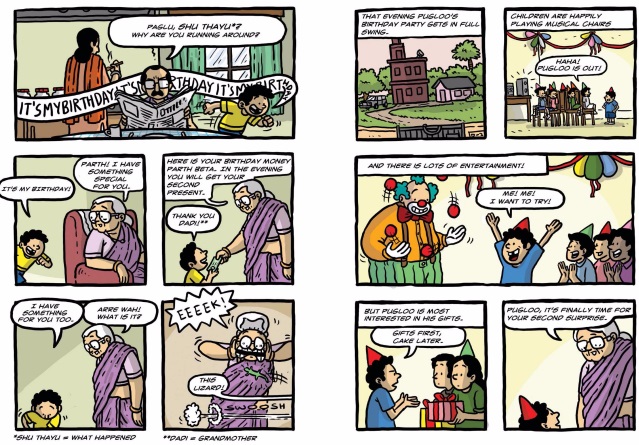
“Ten-year-old Pugloo runs around the house, announcing “It’s my birthday.” At his party later in the day, his grandmother hands him a gift from his late grandfather. He tears open the big package but is disappointed at the sight of a book. The book, on Indian laws and rights, eventually becomes a fun learning tool for the boy. Pugloo is the central character of Lawtoons, a comic book developed by Ahmedabad-based sisters Kanan and Kelly Dhru launched on November 23rd, 2017 at the Oxford Bookstore, Connaught Place, New Delhi.

It is a universally accepted fact that graphics and drawings are one of the oldest forms of story-telling known to human civilisation. Drawings and cartoons reach out and communicate much easily and effectively to children. Lawtoons is striving on the very same idea with a sole motto to empower young minds through the world of cartoons. Cartoons are a medium through which at Lawtoons we want the young minds to perceive and comprehend complex yet fundamental essential laws easily.

After thoroughly examining the present day civic curriculum in majority of the schools, it was observed that often the system is ignorant about the basic legal education and doesn’t provide scope to young minds from understanding laws and their fundamental rights. This unfortunately, results in a society where most people find it difficult to relate to the idea of laws and legal systems.

The useful information about citizenship, democracy, laws and rights that children learn in their schools through the civics curriculum is often not effectively communicated, and passed off as ‘dull and boring’. This often discourages young minds from understanding the laws and rights better. Even upon growing up, a common person is likely to be intimidated by the bulky law books full of legal jargon. This unfortunately, results in a society where most people find it difficult to relate to the idea of laws and legal systems, and feel disconnected.

The Lawtoons team have had the experience in giving presentations on laws and fundamental rights in schools that has made them realize that most people do not understand the nuances of the system and how it works, and law books, through the use of technical words make it all the more difficult to understand even the most basic laws, which affect each and every one of us.

Lawtoons is a solution that is going to bridge the legal system with the general public by making them easily understand how law affects everyone. Through the comic, Lawtoons will make interesting and inspiring cartoons on different laws and rights, which children and grown-ups will really enjoy reading.

  • The team at Lawtoons have partnered with the National Institute of Design, Ahmedabad for the illustrations and design, and have been consulting children’s story-writers and child psychologists for the content of the stories.
  • At the book’s launch, Lawtoons introduced a compendium on Fundamental Rights, focusing on simplifying the understanding of the constitutional aspect of Fundamental Rights.
  • This compendium is prepared with an extensive empirical research study conducted over a period on the target audience itself i.e. Children/students.
  • The compendium on the fundamental rights has been highly applauded by the children, academic community, legal fraternity and any other reader per se belonging to any sector.
  • Lawtoons is designed in such a manner that it fits each and every mindset.
  • We have held workshops in the Municipal Schools as well as in international board school in Ahmedabad in order to understand the sensitivity of the issue of unawareness about law in general in the children.
  • We then offered them the Lawtoons compendium and asked what they preferred to study from – their textbooks or the comic. The answer, as you can guess, was a unanimous vote for Lawtoons!
Lawtoons
http://www.lawtoons.in/comic-book/

We believe that there is an immense potential in the Lawtoons as an initiative towards basic legal education. By bringing together the idea of laws using the form of cartoons, Lawtoons can have tremendous impact by changing the way people, especially the children, perceive the idea of law. Lawtoons is also an educational alternative to the existing world of comics and fictions, which the parents would want their children to read and watch. Inspired by the enthusiasm and excitement around the prototype, the project Lawtoons now aims to create and publish a series of these comics and also launch a mobile application of the cartoons.

The scalability of Lawtoons is unimaginable. A wide range of crucial and sensitive laws which unfortunately have been disseminated not much into public domain can be brought into light through its further editions. Lawtoons plans to inculcate various sensitive and crucial legislation in its further editorials are always are open to ideas from the public at large. In order to spread awareness pertaining to voting process in the elections, a specialised edition is also released earlier which discusses the whole election process, its technicalities and concerned laws in a very fun and comic manner.

Lawtoons’ essentially plans to increase the legal awareness from the schools itself. Lawtoons can also be made part and parcel of the school curriculum. The team have received an applauding response from various lawyers, judges, academicians, Civil Society Organisations (NGOs), practicing advocates, policy makers and most importantly the students themselves. They are very forthcoming in reading Lawtoons and always demand for the next issue when so ever it is released.

Storytelling as a medium, with visuals, is always engaging for children and we thought a fun handbook would have a better reach.

Lawtoons is an initiate of a pre-established policy-research organisation called, founded by Ms. Kanan Dhru, Research Foundation for Governance: in India which is based in Ahmedabad, Gujarat and have been undertaking the task of legislative drafting and policy advising, under the supervision of Ms. Kelly Dhru, over more than a decade. Ms. Kanan is also working on blending the two most isolated streams i.e. Technology and Law through another initiative called LawForMe which is also based on the motto of pubic dissemination of law in general through the means of creative graphics and pictures. Her initiative has awarded her the HiiL Innovating Justice Award – Innovative Idea 2014.

Download Now

Inadequate number of High Court Benches – Major factor delaying justice

1
Muslim Marriage Law Bill, 2017

This article is written by Sanjeev Sirohi, an advocate in Meerut. The article answers how poor people will gain maximum from more High Court benches.

Let me start by wishing my countrymen the very best wishes on this day that is 26th November on which day our Constitution was prepared after years of relentless toil. This alone explains why 26th November is celebrated as “Law Day” and “Constitution Day”. Our Prime Minister Narendra Modi, President Ram Nath Kovind, Chief Justice of India Dipak Misra among others have very rightly expressed their best wishes on this auspicious day!

It was rightly reiterated that the best tribute to our Constitution and its makers is to make justice more accessible to the poor. How better can it be done by setting up more high court benches especially in big states like UP, Rajasthan, Odisha, Madhya Pradesh, Bihar among other states? This has been reiterated even by 230threport of Law Commission which recommended the setting up of more high court benches in states.

But what an unbeatable irony that only one state that is Karnataka has stood to gain by it because after this report was submitted in 2009, it is only in Karnataka that two more high court benches were set up for just 4 and 8 districts at Dharwad and Gulbarga respectively in 2012 even though the number of pending cases in high court is less than 2 lakh in whole of Karnataka whereas in UP which tops the states list among pending cases has more than 10 lakh pending cases and the cases from West UP alone are more than half of the total pending cases that is 5 lakh still we see that there is just one high court bench in Lucknow which is just about 200 km away from Allahabad created way back in 1948 on July 1 and after that not a single bench was created in any part of the state.

What is even worse is that Justice Jaswant Singh Commission headed by Justice Jaswant Singh who is a former Judge of the Supreme Court was appointed by Central Government of former PM late Mrs Indira Gandhi to recommend at which all places high court benches were needed the most. It recommended 3 high court benches for UP at Agra which is in West UP, Nainital and Dehradun which are now both in Uttarakhand but then were in UP but not a single high court bench was allowed to be created in UP and the people of Uttarakhand were compelled to travel thousands of kilometers all the way to Allahabad to get justice for which they had to bear unbearable expenses and waste many days travelling all the way to Allahabad. The net result was they became very agitated in demanding a separate state for themselves and we saw how Centre which refused to set up even a single high court bench there was compelled to set up a high court in Nainital.

Let me be direct in asking: Why when on the recommendations of Justice Jaswant Singh Commission a high court bench was created in Aurangabad in Maharashtra, Jalpaiguri in West Bengal and Madurai in Tamil Nadu then why not a single bench for UP even though 3 benches were recommended for it? Why Centre allowed the people of Uttarakhand to become agitated by not setting up a single high court bench there? Why Centre cared the least also for West UP which alone accounts for more than 57% pending cases as was acknowledged by Justice Jaswant Commission itself due to which it recommended the creation of high court bench here?

Let me also be direct in asking, why inspite of lawyers of West UP striking work every Saturday since May 1981 till now that is more than 36 years to protest West UP not being given a single high court bench here even though Justice Jaswant Singh Commission had recommended creation of 3 benches has Centre failed to create even a single more high court bench here? Why lawyers of West UP went on strike not for one month or two months but for more than 6 months in 2001 and for 3 months in 2014-15 and for one month in 2010 and many times strike even on Wednesdays yet Centre just kept assuring the lawyers of West UP that a high court bench would be set up soon was no bench created here?

Bluntly put, why Andaman and Nicobar islands with just about 3 lakh population has high court bench at Port Blair but West UP with more than 9 crore population which is more than any other state except Bihar, Maharashtra and UP of which it is itself a part has not even a single high court bench? Why many other small states like Manipur, Meghalaya and Tripura having population of just 14 lakh, 18 lakh and 24 lakh has high court since last few years and bench since many decades but West UP with more than 9 crore population has not even a single high court bench? Why for just 88 lakh people of Uttarakhand was a high court itself approved in 2000 when it was given statehood but for more than 9 crore people of West UP not a single high court bench approved even 18 years later in 2018?

Why more than 9 crore people of West UP have been compelled to travel all the way to Allahabad about 700-800 km away to attend court hearings as no high court bench has been created here in any of the 26 districts of West UP who are all unitedly demanding the creation of a high court bench and lawyers of all these districts have even created Central Action Committee to pursue the legitimate demand for a high court bench here since 1981? Why Sampoornanand as CM had recommended a high court bench in Meerut way back in 1955 but even in 2018 no bench has been created here? Why Mayawati as UP CM had recommended the creation of a West UP as a separate state to be named Harit Pradesh way back in 1995 but still not a bench created here?

Is this not a violation of Article 14 of Constitution which talks about equality? Why talk about just West UP alone? Even in Bundelkhand, Western part of Odisha and many other parts in different states we see that people have to suffer all types of inconveniences because their region has no high court bench. Why the 230th report of Law Commission was not implemented in all these needy places?

It is futile to talk about speedy justice as long as more than 9 crore people of West UP are made to travel more than 800-900 km away all the way to Allahabad to get justice! This alone explains why former PM Atal Bihari Vajpayee as Leader of Opposition had himself demanded the creation of a high court bench in West UP in 1986. One can understand that Vajpayee as PM could not create bench here because he didn’t had the majority but what about Narendra Modi who enjoys brute majority not just in Centre but also in UP for which US President Donald Trump had even congratulated him especially? Yogi Adityanath as MP had raised demand for a bench for Gorakhpur which is his constituency in 1998 but 20 years later as UP CM he will celebrate 1 year of his completion in office but he is unable to create a single bench there leave alone West UP.

We see that maximum crime, maximum riots, maximum killings all take place in West UP still there is not even a single high court bench here! When a high court bench can be created in Lucknow in 1948 then why not a single bench in West UP 70 years later in 2018? Is this fair justice? Is this equality that both high court and a single bench are in Eastern UP at Allahabad and Lucknow so close to each other? If Lucknow is capital then so are Bhopal, Dehradun, Bhubaneshwar, Thiruvananthapuram not capitals? Then why no high court or bench in these places?

I fully appreciate the Lok Adalats and other steps like video conferencing to reduce the pending cases but they alone are simply not enough. The government has just no other option but to set up more high court benches in all those places where needed. Former UN Secretary General Ban ki Moon had himself castigated the law and order situation in UP and slammed it as “rape and crime capital” of India yet Centre is not ready to set up more high court benches here!

Maximum MPs, maximum MLAs and maximum elected representatives are all from UP still it has just 1 high court bench whereas states like Maharashtra, Karnataka and Assam have 3 high court benches or more even though the law and order situation there is much better than in UP. Is this equality? Why UP which has more than 22 crore population which is more than the population of many small countries put together as UP CM Yogi Adityananth keeps proudly proclaiming every now and then has just one high court bench and that too so close to Allahabad? Why not a single high court bench for another lawless state like Bihar? Why only few states are accorded 2 or 3 or 4 high court benches and not others?

Are we doing justice with our Constitution by acting in such a partisan manner? Why people of West UP are compelled to travel whole night to Allahabad many times without reservation as it is difficult to get it done in a short time notice? Why can’t more than 26 districts of west UP have its own high court bench so that people don’t have to waste so much of time travelling all the way to Allahabad? Why such a third rated treatment for West UP since last more than 70 years of independence? Why is it ignored that initially from 1866 to 1869 the high court itself was in West UP at Agra before being transferred to Allahabad? Still, why can’t a bench be created in any of the 26 districts of West UP?

I unequivocally hail PM Modi’s many initiatives like awarding the district where the number of pending cases are reduced maximum in a given year but they in itself are just not sufficient to address the burgeoning Frankenstein monster of pending cases unless more high court benches are created in big states like UP especially in West UP. Just recently a 100 year old woman was raped in West UP in Meerut and what is worse is that to seek justice she too has no option but to travel all the way about more than 700 km away to Allahabad as there is not even a single bench of high court here. What sort of justice system is this? Bench so close at Lucknow but no bench in West UP or in Bundelkhand like in Jhansi nor in far-off places like Gorakhpur which CM Yogi represents since many decades!

A serious disease like cancer cannot be treated by just a band aid or strepsil. All other steps to address the huge pending cases are bound to fall flat unless and until more high court benches are created in big states like UP, Bihar, Rajasthan among others. But nothing just nothing is being done on this score and only one state that is Karnataka has stood to gain from the recommendations of 230th report of Law Commission which till 2012 had just one bench at Hubli! Why is Centre not taking any steps in this regard? Why more than 9 crore people of West UP are being rashly denied “cheap and speedy justice” since 1947 till 2017? Why if Supreme Court in near future direct Centre to create more benches will it have the temerity to term it as “judicial activism”? With what face? Why can’t it take emergency steps well in time?

Eminent senior lawyer and revered jurist Harish Salve very rightly points out that if Centre does its job properly then judiciary will never step in. It is inaction on the part of the Centre that compels Supreme Court to step in for which it is then wrongly accused of “judicial activism” as a junior minister in Law in Centre dared to indulge in. Why Nehru can dare to create a bench in Lucknow in 1948 but no PM till now can dare to create even a single bench anywhere else even though Justice Jaswant Commission recommended three more benches?

Why inspite of Allahabad High Court completing more than 150 years and being the biggest court not just in India but in whole of Asia has least high court benches, only one just nearby at Lucknow and not at any other place like Gorakhpur, Jhansi, Meerut or Agra or any other place? Why no step is being taken to correct this historic blunder? Why a firm determination to carry on with what Nehru did way back in 1947-48? Have things not changed since then? There are much more such compelling soul searching questions which demands answers but no one is ready to ever address them. Just ritually organizing “Law Day” or “Constitution day” will serve just no real purpose unless serious steps are taken like setting up more high court benches as recommended very rightly by 230th report of Law Commission. Hope good sense will prevail!

Download Now

How to complaint against illegal hoarding of onions by traders

0
onions

In this article, Ruchika Daga discusses how to complaint against illegal hoarding of onions by traders.

Onion market in India

Onion is one of the most sensitive vegetables that create undulation in the trade as well as political circles.Thus the changes in prices cause all problems for the farmers and consumers. The price hike in case of primary products affects both producers as well as consumers and also leave an impact on to the other sectors, which lead to high inflation in the economy. Thus it is the major concern for the politicians, policymakers, and experts.

Black marketing/illegal hoarding

Economic activities that take place outside channels which are government-sanctioned. Illegal market or black market transactions usually occur “under the table” to let the participants circumvent or avoid government price controls or taxes. The black market is also called a place where highly controlled products or substances such as drugs and firearms are traded illegally. Black markets take a toll on an economy since they are shadow markets where economic activity is not recorded and taxes are not been paid. Coming on to financial context, the biggest black market exists for currencies in nations with strict currency controls. Most consumers may evade or reject the black market because they consider it corrupt or immoral, there may be rare occasions where they enter in such markets when no other choice but to turn to this necessary evil.

Essential Commodities Act, 1955

The Essential Commodities Act is an act established by Parliament of India to ensure that certain commodities or products can be delivered easily, the supply of which if clogged or obstructed due to hoarding or black marketing would affect the normal standard life of the people.

This act gives powers to control production, distribution, supply etc to regulate the prices and making them available at a reasonable and fair price of essential commodities in the market. The items given in the act is reviewed time to time according to the dynamic society.
This act has been implemented by state governments by the delegated power given to them by the central government. The central governments on regular intervals monitor the state governments to check if state governments have implemented the provisions of the act correctly.

Initially, onions were not an essential commodity under essential commodities act 1955. The Cabinet Committee on Economic Affairs (CCEA) in 2014 approved the inclusion of onion under the Essential Commodities Act, 1955.

Penalties

If a person contravenes with the act he shall be punishable by imprisonment which may extend up to seven years but not less than three months and shall also be liable to fine. The court may give a judgment for the imprisonment of fewer than three months in special circumstances. Prevention of Black-marketing under Essential Commodity Act, 1980

In order to protect consumers against unethical trading practices like black marketing and hoarding the Prevention of Black Marketing under Essential Commodity Act,1980 has been implemented by the state governments to protect the society from persons whose activities are detrimental to the maintenance of commodities which are necessary for the society.

Special provisions regarding fines

Anyone who contravenes with section 29 of Code of Criminal Procedure the court has to power to pass a sentence of fine exceeding five thousand rupees.

Protection of action taken under Act

No suit, prosecution or any legal proceeding will lie against any person for anything which is done or intended to be done in of any order made under section 3 in good faith.

No suit or legal proceeding will lie against the Government for any damage occurred or likely to occur by anything which is done or intended to be done in good faith in pursuance of any order made under section 3.

Prevention of Black-marketing under Essential Commodity Act, 1980

In order to protect consumers against unethical trading practices like black marketing and hoarding the Prevention of Black Marketing under Essential Commodity Act,1980 has been implemented by the state governments to protect the society from persons whose activities are detrimental to the maintenance of commodities which are necessary for the society. National Consultation Meeting held with States and UTs in-charge of Consumer Affairs and Food held in 2015, Delhi resolved to take steps to keep prices of essential commodities, especially pulses and onions under control.

Guidelines were given to State Governments to take strict action against illegal marketing & illegal hoarding and effectively enforce the Essential Commodities Act, 1955 and the Prevent Black-marketing and Maintenance of Supplies of Essential Commodities Act, 1980. Regular reviewing meeting on price and availability is being held at the highest level to keep a check on the price scenario and recommend appropriate actions.

Measures are to be taken to improve availability by giving incentives for increasing production through Minimum Export Price (MSP).

New Plan Scheme titled Price Stabilisation Fund (PSF) is being implemented to regulate price volatility of agricultural commodities.

Specific Measures for onions :

Export of onions – Export of onions has been restricted by Minimum Export Price (MEP)

Import of onions – Import duty of onion is allowed on zero duty.

SFAC and NAFED were provided funding support during this year through Price Stabilisation Fund Scheme for the creation of stock during the harvest season. Retail sale of onion was undertaken from the stock held by SFAC and NAFED during the bend season to improve availability and moderate the prices. The stock limits of onion have been extended by one more year that is up to 2nd July 2016 under the Essential Commodities Act.

How can illegal hoarding be regulated?

  1. Black marketing can be prevented by regulating the licenses, permits or the production or manufacturing of any essential commodity under the Essential commodity act, 1955
  2. By bringing under cultivation any wasteland, for starting the growth of food-crops generally or of specific food-crops, and maintaining or increasing the cultivation of food-crops generally, or of specific food crops. 3. By taking controlling measures to regulate the price at which any Essential commodity can be purchased or sold.
  3. By regulating the licenses, permits for the storage, transport, distribution, disposal, possession, or consumption of, any essential commodity.

How and where to complaint against illegal hoarding of onions?

Public Grievances Cell

Violations of Controlling orders issued under the Essential Commodities Act,1955 such as hoarding and illegal-marketing of food products, are cognizable offenses. An Anti-Hoarding Cell also functions in the department to register FIRs or complaints on violation of Control orders under Essential Commodities Act and prosecute such offenders in courts of law. The public can lodge complaints regarding deflection of food products to black-market, hoarding of essential commodities etc. at the central Control Room.

There are two designated nodal agencies in the Central Government handling these types of complaints. These agencies are:-

(i) Department of Administrative Reforms and Public Grievances, Ministry of Personnel, Public Grievances & Pensions

(ii) Directorate of Public Grievances, Cabinet Secretariat

Registration of Grievances online

‘Public Grievance Redress and Monitoring System’ (PGRAMS) is a software which has been operational with every Director of Grievances. This will make the Director of Grievances to immediately place the details of grievances received in a database as well as note or record the fact whether he intends to monitor its progress, identify the division where it is being sent, etc., Also generate the time taken in dealing with the grievance or complaint, enable reviewing of pending grievances in the organisation or across the organisations, generate acknowledgements to complainants, conduct analysis etc. The system should also have the facility of online registration of grievances by the citizens and access to information on the status of his/her grievances.

National consumer helplines (NCH)

The department for consumer affairs by the government of India has established national consumer helplines by the government of India.

The government recognized the needs of the consumers for a telephone helpline to deal with the problems which are arising in their day-to-day dealings.

NHC provides a national toll-free number-1800-11-4000.

To achieve national goals, achieve fair supply and distribution and prevent illegal hoarding of commodities essential to the general public.

Detention under PBMMSEC Act is ordered if anyone violates the orders issued under the Essential commodity act, 1955.

It advises customers as to how to deal with unfair trade practices.

  • Step 1: The consumer is been informed of his rights in a particular consumer problem and where should they approach in the concerned company or the organization.
  • Step 2: If the problem is still not resolved he would be given directions to take the matter with industry level chambers of commerce.
  • Step 3: Last resort, the consumers would be advised to take up their case to consumer courts under the Consumers Protection Act. This helpline is designed to promote out of court settlement of consumer disputes and helps to reduce the burden on consumer courts.

What is INGRAM (consumerhelpline.gov.in)?

This website is launched by the Department of Consumer Affairs to create awareness, advise and redress the grievances of consumers and act as a central registry for lodging consumer complaints. Efforts would be made to address these complaints, all complaints may not be fully or resolved satisfactorily.

This portal is an alternative dispute redressal mechanism. In case, the consumer is not satisfied, he/she can approach the appropriate Consumer Commission. The Department of Consumer Affairs has launched this portal as an integrated Grievance Redress Mechanism (INGRAM) for bringing all Stakeholders such as Consumers, Central and State Government Agencies, Private Companies, Regulators, and call centers etc. onto a single platform. The portal will also help in creating awareness among consumers to protect their rights and inform them of their responsibilities. Registration can be done online by the consumers of their complaints through this portal.

How can one register his/her grievance?

Any distressed consumer can register his/her grievance either by calling the toll free number 1800-11-4000 or by talking to an agent or register himself in the portal, get a user id and password and register his grievance himself by attaching necessary documents if any.

Step 1: A one-time registration is necessary for lodging a complaint. For registration go to the web portal http://gama.gov.in and click on to login link and then signup by giving necessary details required, and verify your email. The User id and password are created.

Step2: By using this user id and password, enter into the portal and fill in the details of complaint attaching necessary documents (if any available).

A user manual is available online in the link: Consumer Manual

Step by step guidance is available in that link with diagrams.

State consumer helplines (SCH)

The central government is giving financial assistance to states for running of consumer helplines at the state level. Center has facilitated fund to 33 states till now. Delhi hosts the website and software to all the states and union territories and they are expected to join the network of the same so as to maintain the uniformity all over the country.

Role of Competition Commission of India in preventing illegal hoarding on onions

Any agreement entered between enterprises or associations of enterprises or persons or associations of persons or between any person and enterprise or practice carried on, or decision taken by, any association of enterprises or association of persons, including cartels, engaged in identical or similar trade of goods or provision of services, which— exemption for joint ventures entered into by competitors, which enhances efficiencies in production, supply, distribution, storage, acquisition or control of goods or provision of services. Those types of agreements having cartelization shall be considered by the CCI to have appreciable adverse effect on competition in India. An inquiry into a violation of the Act can be made upon the receipt of a complaint by the Commission or upon its own motion which is also called suo moto action. If the Commission is convinced that a prima facie case exists, it proceeds to direct the Director-General to commence an investigation. When the director general completes the investigation he submits a report to the Commission which then decided what action to take.

Onion Future Act – How US legal system tackles the problem of Illegal hoarding of Onions

The Onion Futures Act is a United States law which bans onion trading by futures contracts. Onion futures trading began on the Chicago Mercantile Exchange in the mid of 1940s as an attempt to replace the income lost. Onions were the most traded product on the Chicago Mercantile Exchange. In 1955, it accounted for 20% of the trades. In the fall of 1955, Siegel and Kosuga bought enough onions and onion futures so that they controlled 98 percent of the available onions in Chicago. Thousand tons of onions were shipped to Chicago to cover up their purchases. By late 1955, they had stored 14,000,000 kg of onions in Chicago. They soon changed course and convinced onion farmers to begin purchasing their inventory by threatening them that if they did not then they will flood the market with onions. Siegel and Kosuga told the growers that they would hold the rest of their to support the price of onions.

As the growers began buying onions, Siegel and Kosuga made a large number of onion contracts. They also arranged to have their stores of onions reconditioned because they the onions started to spoil. They shipped them outside of Chicago to have them cleaned and then repackaged and re-shipped back to Chicago. The new shipments of onions caused many futures traders to think that there was an excess of onions and further drove down onion prices in Chicago. By the end of the onion season, Siegel and Kosuga flooded the markets with their onions and driven the price of 23 kg of onions down to 10 cents a bag. In August 1955, the same quantity of onions had been priced at $2.75 a bag. So many onions were shipped to Chicago in order to depress prices that there were onion shortages in other parts of the United States.

Siegel and Kosuga earned a lot on the transaction due to their short position on onion futures. At one point, however, 23 kg of onions were selling in Chicago for less than the bags that held them. This drove many onion farmers into bankruptcy. A public outcry ensued among onion farmers who were left with large amounts of worthless inventory. Many of the farmers had to pay to dispose of the large amounts of onions that they had purchased and grown.

Effect of Chicago Mercantile Exchange

After the ban was passed, the Chicago Mercantile Exchange filed a suit in federal court saying that the ban restricted trade unfairly. After a federal judge gave a judgment against them, they declined to appeal to the Supreme Court and the ban stood as it is.

Download Now

International Maritime Organisation & Its Importance

0
International Maritime Organisation

In this article, Leepakshi Rajpal dsicusses IMO (International Maritime Organisation) and its importance.

International Maritime Organisations

Have you ever wondered how the trade in the international waters is done? Or what is it that keeps that trade functioning not leading to any conflict between the countries? Does the creation of the International Maritime Organisation represent another example of the hegemon character of the United Nations? What if in between the way, the oil is leaked? Who is to take jurisdiction over that matter and how is sustainable development being practiced in such a situation? The answer to all this is mentioned in the article.

The United Nations Agency is responsible for developing and adopting measures to improve the safety and security of the international shipping and to prevent pollution from the ships, the International Maritime Organisation has an integral role in meeting the targets set out in the United Nations Sustainable Development Goal, which was held in the United Nations Conference for Sustainable Development.

When it comes to the shipping, it is one of the most essential components of any future programme for future sustainable economic growth. It is through the International Maritime Organisation, the organization’s member states, civil society, and the shipping industry are already working together to ensure a continued and strengthened contribution towards the green economy and the growth in a sustainable manner. The promotion of the sustainable shipping and sustainable maritime development is one of the major priorities of the International Maritime Organisation in the upcoming years.

Much of the energy, efficiency, new technology and innovation, maritime education and training, maritime security, maritime traffic management and the development of the maritime infrastructure, all the planning and the development is done by the International Maritime Organisation, of global standards covering these and other issues depend upon the commitment of the International Maritime Organisation in providing the institutional framework necessary for a green and sustainable global maritime transportation system.

Now, what are the functions and what is the role of the International Maritime Organisation is to be seen in the following paragraphs.

How to Place your Bids for Procurement at the International Maritime Organisation

If you are interested in bidding for such an opportunity, you may please notify the International Maritime Organisation at [email protected] stating your tender reference and contact details.This process will allow them to include you as a bidder on their list and will also help you to get included in the updates and queries process during the tender process.

Career Opportunities at International Maritime Organisation

Who does not want to live a gala life, and travel the world while being on the job? So, the good news is that the International Maritime Organisation offers certain job opportunities that you may be interested in. You need to have an idea of how to apply in the International Maritime Organization and the process is mentioned below:-

Application Process

When applying for a post at IMO, please follow the procedure outlined below:

  1. Navigate to the Vacancy Notice you are interested in and read the criteria specified carefully.
  2. If you meet the criteria outlined, complete a Personal History Form (available in the related documents links on the right side menu). Clearly, indicate the Vacancy Notice number you are applying for. The Personal History Form will need to be signed.
  3. In all cases submit a Cover Letter stating your reasons for applying and a completed Personal History Form.

Now the question arises as to how do you submit your application and the answer to that is, Send your application electronically to [email protected]. Please do not submit your application via multiple routes. Because of the high volume of applications we receive, the International Maritime Organization regrets to inform the participants that only applications short-listed for vacant posts within the Organization will be acknowledged.

So, what are you waiting for, do apply for these posts and get yourself a better job and a good lifestyle with so many benefits and duties along.

The Role and The Functions Performed by the International Maritime Organisation

There are various functions and vital roles that the International Maritime Organisation plays as an organization as well as an International leader in the maritime department. The roles and the functions of the International Maritime Organisation are mentioned below.

Strategic Development and the high-level action plans

This means that the International Maritime Organisation always focusses on the highest possible standards in the maritime department and ensures the safety, security, efficiency and the ability to work in the maritime development. Apart from this it makes sure that the various mishappenings that take place in the sea waters or the international waters such as that of the pirates looting the ships and the ship’s sinking in the sea or the oceans due to the natural as well as the non natural factors, does not happen because any loss of life or property is a loss of a country or a continent in trade that the International Maritime Organisation is supervising or has the jurisdiction over.

In the year 2003, in order for the organization to effectively address those strategic objectives, a high-level action plan was also adopted by the International Maritime Organisation Assembly to identify the actions required to achieve its mission objectives and to provide for the linkage between the Organisation’s strategy and the work of its committees. The International Maritime Organisational Assembly, at its 25th session held in the year 2007 in November, reviewed the plans that the various countries had for trade through the International waters and adopted the Strategic Plan for the Organisation and a high-level action Plan for the Organisation and priorities for the 2008-2009 Biennium.

Safety of Passenger Ships

Safety of passenger ships means that the International Maritime Organisation has the responsibility and the function of ensuring the safety of the ships in the international waters. The safety of the ship does not only mean protecting from factors such as pirates and other things, it also includes other factors which have been mentioned below:-

  • Designing of the ships and the alternative designing and arrangements related to the danger thereto,
  • To mention the safe areas and the essential systems to be maintained while the ship proceeds to the port after a casualty, which will require redundancy of the propulsion and other essential things that the ship needs to carry while on the sail.
  • Onboard safety centers, from where the safety systems can be controlled, operated and monitored.
  • Fixed wire detection and the alarm systems in the ships including requirements for fire detector and manually operated call points to be capable of being remotely and individually identified.
  • Fire prevention, including amendments aimed at enhancing the fire safety of atriums, the means of escape in case of fire and the ventilation systems and
  • The time for orderly evacuation and abandonment, including requirements for the essential systems that must remain operational in case any one main vertical zone is unserviceable due to fire.

Goal-Based New Ship Construction Standards

This means that the International Maritime Organisations also have to set standards for the new ships before the making based on the loopholes in the previous ships and the renovation of the same. IMO also plans to determine the new hull construction standards for the new ships which are currently largely under the responsibility of the classification societies. The standards, once finalized, are intended to ensure that full standards developed by the classifications societies and other recognized organizations conform to the safety goals and the functional requirements established by the International Maritime Organisations. Therefore, it is an important role or a function that is performed by the organization.

Formal Safety Assessment

The safety assessment that the IMO does is according to the safety standards laid down by the same. In 2002, the MSC and the Marine environment Protection committee introduced a new methodology called Formal Safety Assessment, for its rulemaking process to incorporate risk assessment techniques that have been successfully used in several other industries such as the nuclear and the offshore industries.

FSA guidelines were approved by the MSC in 2002 and the guidelines have been routinely amended so as to catch up with the latest trends and the knowledge in the international market on the subject. The above committees are utilizing FSA process in the evaluation of the proposed new measures with a view to achieving a balance between the technical and operational issues, including the human element and between costs and benefits. Since 2002, FSA’s has been used in several cases by MSC. there were several guidelines which were added to them in the year 2006 but at present the MSC having received several new FSC studies submitted by the IMO member governments, agreed, in principle, to establish a group of experts to review these FSA studies for use in future rule-makings.

Human Element

International Maritime Organization also keeps into account the human element and maintains standards for the same and it does ensure that there is a human element in the working of the organization and the people who are engaged in the working of the ship, be it sailing or other operational issues are not faced with issues risking their lives. The International Maritime Organisation in this way maintains high standards of safety and environmental protection for the purpose of significantly reducing the maritime casualties.

Improving Maritime Technology Standards

There are certain standards which the International Maritime Organization as a part of its function have to perform, and improving the technological standards of the maritime. The technical standards of the SOLAS conventions with a view to keeping them updated with the latest marine technologies in the ship design. As such, the MSC routinely adopts numerous codes and guidelines to support matters related to fire safety, life-saving, marine equipment, stability and the carriage of dangerous goods and hazardous cargoes. Most merchant ships today are covered by the 1966 Load Lines Convention to establish international rules with respect to the limits to which ships may be loaded. In 1988, in order to facilitate the adoption of amendments related to the 1966  Load Lines Convention, IMO adopted the 1988 LL protocol, which harmonized the convention’s survey and certification requirement with those contained in SOLAS and MARPOL 73/78. IMO has developed in 1993, the Code on Intact Stability (IS Code) for all types of ships covered by IMO instruments and the MSC is currently revising the IS code to incorporate states of art knowledge, such as dynamic stability and the performance-based criteria. The regulations were made to bring in changes to the new ships and technology in force. The new regulations came into force in January 2009.

Investigation of the Maritime Casualties and Incidents

This means that the International Maritime Organization will have to check and investigate the casualties and the accidents happening in the midwaters or the international waters and also to ensure and facilitate the conduct of the investigations, analysis and reporting the accidents in accordance with the globally recognised best practices, with a view to maintaining an efficient and comprehensive knowledge-based mechanism to support the identification of trends and the International Maritime Organization rulemaking process. With this aim and within the framework of article 94.7 of the United Nations Convention on the Law of the Sea (UNCLOS), and relevant provisions contained in the IMO conventions. They have developed a new code of International Standards and Recommended Practices for a safety investigation into the marine casualty or marine incident (Casualty Investigation Code), which is now under consideration for becoming mandatory under the SOLAS convention.

Piracy and Armed Robbery Against Ships

IMO also prevents attacks of piracy and armed robbery, to combat piracy and armed robbery at sea by adopting measures, including those relating to assistance with capacity-building through training of seafarers, port staff and enforcement personnel in the prevention, reporting and investigation of the incidents; bringing the alleged perpetrators to justice, in accordance with the international law; and by adopting national legislation as well as providing enforcement vessels and the equipment and guarding against fraudulent ship registration.

Charters Governing International Maritime Organisation

This part of the blog talks about the various charters that govern the International Maritime Organisation. The Convention on the International Maritime Organisation was prepared and opened for signature and acceptance by the United Nations Maritime Conference convened by the Secretary-General of the United Nations pursuant to the Economic and Social Council resolution 35(IV). The conference met at Geneva from 19th February to 6th March 1948.

As a result of the entry into force of the amendments adopted by the IMCO assembly by its resolutions A.358 (IX) of 14th November 1975 and A.371 (X) of 9th November 1977.

The charter that ultimately governs the organization is The charter of the United Nations which was signed on the 26th June 1945, in San Francisco, at the conclusion of the United Nations Conference on the International Organisation, and came into force on 244th October 1945. The statute of the International Court of Justice is an integral part of the Charter.

Structure of International Maritime Organisation

The International Maritime Organization consists of an assembly, a council and five main committees, which are as follows:-

  1. The maritime safety committee
  2. The Marine Environment Protection Committee
  3. The legal committee
  4. The technical cooperation committee
  5. The facilitation committee

Apart from the main committees, there are certain subcommittees as well to assist the main five committees as mentioned above.

Assembly

This is the highest governing body of the organization. IT consists of all the member states and it meets once every two years in regular sessions, but may also meet in an extraordinary session if necessary. The assembly is responsible for approving the work programme, voting the budget and determining the financial arrangements of the organization. The assembly also elects the council.

Council

The council is a prestigious institution to be a part of. It is elected by the assembly for the two-year terms beginning after each regular session of the assembly. The council is executive organ of the International Maritime Organisation and is responsible, under the assembly for supervising the work of the organization. Between sessions of the assembly, the council performs all the functions of the assembly, except the function of making the recommendations to the governments on the maritime safety and pollution prevention which is reserved for the assembly by Article 15(j) of the convention.

Maritime Safety Committee (MSC)

The Maritime Safety Committee is the highest technical body of the organization. It consists of all the member states. The functions of the Maritime Safety Committee are to consider any matter within the scope of the organization concerned with the aids to navigation, construction and equipment of vessels, manning form a safety standpoint the rules for the prevention of the collisions, handling of the dangerous cargoes, maritime safety procedures and requirements that directly affect the maritime security.

The Marine Environment Protection Committee (MEPC)

The Marine Environment Protection committee consists of all the member states of the international maritime organization, is empowered to take any decision with respect to the scope of the organization concerned with prevention and control of pollution from ships.In particular, it is concerned with the adoption and amendment of conventions and other regulations and measures to ensure their enforcement.The Marine Environment Protection Committee was established as a subsidiary body of the assembly but later on, in 1985 it was raised to the full constitutional status.

Sub-Committees

There are certain subcommittees that are made in the process. These subcommittees are also open to all the member states. These committees are as follows:-

  • Sub-Committee on Human Element, Training, and Watchkeeping (HTW);
  • Sub-Committee on Implementation of IMO Instruments (III);
  • Sub-Committee on Navigation, Communications and Search and Rescue (NCSR);
  • Sub-Committee on Pollution Prevention and Response (PPR);
  • Sub-Committee on Ship Design and Construction (SDC);
  • Sub-Committee on Ship Systems and Equipment (SSE); and
  • Sub-Committee on Carriage of Cargoes and Containers (CCC).

Legal Committee

The legal committee is always important as far as the efficient working of the organization is concerned. The legal committee is empowered to deal with the legal matters of the organization and helps in deciding the right way even out of the wrong way. The Committee consists of all Member States of IMO. The committee works together for the administration as well as the organization of the International Maritime Organization. The Legal Committee is also empowered to perform any duties within its scope which may be assigned by or under any other international instrument and accepted by the Organization.

Technical Cooperation Committee

The technical cooperation committee is required to consider any matter within the scope of the organization concerned with the implementation of the technical cooperation projects for which the organization acts as the executing or cooperating agency and any other matters related to the organization’s activities in the technical cooperation field. It also consists of all the member states of the international maritime cooperation, and was established in 1969 as a subsidiary body of the council and was institutionalized by means of an amendment to the International Marie Organisation Convention which entered into force in 1984.

Facilitation Committee

The facilitation committee was established as a subsidiary body of the Council in May 1972 and became fully institutionalized in December 2008 as the result of an amendment of the International Maritime organization at their own convention. It consists of all the member states of the organization and deals with International Maritime Organization’s work in eliminating unnecessary formalities and the red tape in international shipping by implementing all the aspects of the convention on facilitation of the International Maritime Traffic 1965 and any matter within the scope of the IMO and international maritime traffic. To be specific the work of this committee has been to ensure the right balance between the maritime security and the facilitation of the international maritime trade.

Secretariat

Who does not want to be a part of the Secretariat of the International Maritime Organisation, and especially when there are career opportunities open in this institution, why cannot we target it. For now, let us know the current number of members of the secretariat. The Secretariat IMO consists of the Secretary-General and some 300 international personnel based at the headquarters of the Organization in London. The Secretary-General of the Organization is Mr. Kitack Lim (Republic of Korea) who was appointed to the position with effect from 1 January 2016, for an initial four-year term.

Conclusion

Now that we know about International Maritime Organisation, let us be careful with the trade practices in the sea and in the international waters. Therefore, be careful and apply in the organization because it is a wonderful opportunity for everyone who feels to serve the world as a family and for everyone who desires to be a part of the prestigious organization.

References

  1. http://www.imo.org/en/About/pages/structure.aspx
  2. http://www.imo.org/en/About/Procurement/Pages/default.aspx
  3. http://www.imo.org/en/About/Careers/vacancies/Pages/Default.aspx
  4. https://unchronicle.un.org/article/role-international-maritime-organization-preventing-pollution-worlds-oceans-ships-and


Download Now

Five Leaders Of Silicon Valley Who Excelled at Contract Negotiation

0
Contract Negotiation

This article is written by Ramanuj Mukherjee, CEO of LawSikho.com and Rounak Chaki, researcher at iPleaders.

You may think that contracts are the domain of lawyers, but one rarely succeed in business without being a good negotiator of contracts or without the ability to understand what is the impact of a simple looking clause on the future of a business. Many creators and innovators have a short life as a business owner when they fall short on this count. Take for example, how the Mcdonald’s brothers were ousted from their own business as someone else hijacked it from under their nose. They even made a movie about it.

In 2016, my team was working on a contract drafting and negotiation course, and we knew it would be popular with lawyers and law students. However, is it a good idea to build a negotiation course for business leaders, CEOs, managers? That is when we first started researching on famous business leaders and the role contract negotiations played in their life. As I spoke to more and more founders, investors and business owners, I was convinced that it is a necessity though it is not immediately obvious to most people. In a short time, we stumbled on a gold mine of case studies.

If you didn’t realise that contract negotiation is an essential skill for a business leader, let us give you 5 shiny and famous examples from the Silicon Valley.

#1 Steve Jobs

File:Steve Jobs WWDC07.jpg - Wikimedia Commons

Steve Jobs was without doubt, the face of technological innovation. His ideas singlehandedly shaped up the gadget industry for the last two decades and made Apple the biggest corporation ever known. His ability to project faith in what may seem to be the most ludicrous ideas at the time, have now become the fables of modern technology.

Steve Jobs was not just as a pioneering inventor but a fierce negotiator. Who can forget the frenzied anti-trust proceedings against Apple in 2010? But before all of that, came the negotiation skills of one Steve Jobs, to make sure that a reluctant HarperCollins was part of the ibookstore bandwagon. This is by no means the most famous negotiation led by Jobs, but a pretty good indication anyway.

Apple’s negotiations with HarperCollins

This incident happened during negotiations between Apple and News Corp owned HarperCollins over a deal to sell their eBooks on Apple’s iTunes store. Apple was on its way to launch the iPad in five days and HarperCollins was holding off from signing the deal. What happened in those five days, is a masterclass in negotiation.

Eddie Cue, Apple’s head of iTunes had been handling the negotiations and five days before the iPad’s launch, HarperCollins sent in its’ opening bid. It was completely different from the contracts that Apple had already negotiated with Penguin, Simon & Schuster, Macmillan and Hachette Book Group – basically all the other big publishers. James Murdoch, then the executive chairman of News Corp (which owned HarperCollins) decided to mail Steve Jobs directly, to back up HC’s position. He mentioned the legitimate concerns that HarperCollins had regarding the deal. He was very specific about the effect holding back their eBooks on Amazon might have and the increase in the pricing structure. He expected Apple to be flexible as HarperCollins did indeed wish to collaborate with all of Apple’s endeavours than stay out.

Jobs on the other hand was not willing to compromise. He sent his reply to Murdoch the very same day. Jobs argued that Amazon’s pricing was not reliable and would instil a wrong belief in people that eBooks are cheap. He reiterated that sales of the iPad in the very first few weeks, would outmatch all the kindles that had ever been sold. HarperCollins’ not agreeing to the deal in time, would mean sitting out of the mainstream eBook revolution. He opened up the conversation to statistics of total Apple users, over 120 million with credit cards on file. Jobs was making sure that Murdoch didn’t forget the sheer vastness of the market that Apple would be opening them up to. In short, it was as if Jobs was saying, “You need us more than we need you!”

Jobs had made it very clear that Apple would not budge. And in his subsequent reply, Murdoch indicated that he might. He proposed a couple of compromises and noted that Apple and News Corp were negotiating on multiple fronts, they could just take a step back, reevaluate and finish the negotiations over the subsequent weeks or months.

Steve Jobs picked up on the compromising tone. Now, armed with the knowledge that HarperCollins might be open to making the necessary changes, he just went for the kill. This is the mail that he sent the following day.

James,

Our proposal does set the upper limit for eBook retail pricing based on the hardcover price of each book. The reason we are doing this is that, with our experience selling a lot of content online, we simply don’t think the eBook market can be successful with pricing higher than $12.99 or $14.99. Heck, Amazon is selling these books at $9.99, and who knows, maybe they are right and we will fail even at $12.99. But we’re willing to try at the prices we’ve proposed. We are not willing to try at higher prices because we are pretty sure we’ll all fail.

As I see it, HC has the following choices:

1. Throw in with Apple and see if we can all make a go of this to create a real mainstream eBooks market at $12.99 and $14.99.

2. Keep going with Amazon at $9.99. You will make a bit more money in the short term, but in the medium term Amazon will tell you they will be paying you 70% of $9.99. They have shareholders too.

3. Hold back your books from Amazon. Without a way for customers to buy your eBooks, they will steal them. This will be the start of piracy and once started there will be no stopping it. Trust me, I’ve seen this happen with my own eyes.

Maybe I’m missing something, but I don’t see any other alternatives. Do you?

Regards,

Steve

Email Sourced from here.

He was almost daring Murdoch to spurn Apple, knowing very well that given the market that the iPad would create for multimedia consumption, they couldn’t afford to. It invariably shows Jobs at the height of his critical and analytical thinking, willing to make the extra time to personally get into the discourse when necessary.

HarperCollins agreed to Apple’s terms and signed the contract the very next day. It was part of Jobs’ presentation about the iBookstore a day later, at the iPad launch event.

Jobs-and-Pubs.jpg

Jobs in his lifetime faced a lot of ugly situations. Be it the unceremonious firing from Apple in 1985 or the myriad of public fallouts from his personal life choices. At the end of it all, he always managed to come out on top. Ousted out of Apple? Built NeXT and sold it for $429 million. Bought Pixar, a relatively unknown hardware manufacturing company at a mere $5 million and turned it into a computer graphics generated animation studio that made him billions. That is how he went forward. By making sure, he always had an alternative prepared and ready to proceed with.

#2 Mark Zuckerberg

2696190509_a13f2e7a47_b.jpg

Mark Zuckerberg can be credited as one of the pall bearers of the social media movement since the fall of AOL. At 33, Zuckerberg is the fifth richest man in the world with total assets valued at $71.5 billion. Most of his business acumen comes from his ability to adapt to suit his needs. A lot can be said about the man, but what matters the most is his incredible sense of timing and judgment regarding innovations and the people behind them. As the Founder and CEO of Facebook, he has shown considerable skills in negotiating for his company and keeping its interests above all.

This particular incident marks his unbelievable negotiating skills. Facebook’s acquisition of Instagram which was negotiated over a long weekend.

Facebook’s acquisition of Instagram

Mark Zuckerberg had been looking to expand. It was necessary to update the site to keep up with the younger audience. As it turned out, Zuckerberg already had the answer. Kevin Systrom the CEO of Instagram.

According to a Times report, Kevin Systrom first caught Zuckerberg’s attention in 2004. He was very impressed by Systrom’s Photobox service, which allowed people to send and receive large photo files. He offered Systrom a job at Facebook but was turned down. Systrom then a college student, wanted to finish his studies.

Systrom then went on to create Instagram with Mike Krieger, which created ripples in the tech wave. In early 2011, Zuckerberg offered to buy them out but Systrom chose to focus on individual expansion. Cut to 2012. Instagram was less than two years old. The company had no revenue and employed only a dozen people, yet it was riding a meteoric high. It had over thirty million users, who were uploading over five million photographs everyday.

Zuckerberg had been patient all those years. Waiting for Systrom to find his way to him. He wanted their business collaboration to come from a place of genuine faith. And as it happened that moment came. In April 2012, Instagram had just finished an impressive round of funding that valued the company at $500 million. Zuckerberg knew he had to act now or risk losing out on a great business. He was sure that bringing in a team of lawyers might make the Instagram CEO turn down any deal.

Zuckerberg invited Systrom over to his house. Over food and wine, he made Systrom a proposal to buy out Instagram. He wanted to make sure that Instagram continued to operate independently, but as a part of the expanding Facebook business. Systrom was initially taken aback, but ended up countering him. Both of them continued negotiating over the next three days at Zuckerberg’s Palo Alto home. Systrom asked for $2 billion but was promptly turned down. Zuckerberg didn’t want to make a business deal, he wanted to make an addition. He wished for people like Systrom and a great innovation like Instagram, to work with him. In the end they scaled down the price to $1 billion in cash and stocks.

The next morning, Zuckerberg walked up to his board and told them of his decision to buy Instagram. Not a choice, but a decision. No one at Facebook outside of COO Sheryl Sandberg even knew about Zuckerberg approaching Systrom to sell them Instagram.

facebook-founder-mark-zuckerberg-poses-with-instagram-co-creator-kevin-systrom.jpg

Systrom went home, talked to his co-founder Mike Krieger and twenty four hours later, the contracts were signed and the deal was finalised. Instagram now belongs to Facebook and Kevin Systrom, CEO of Instagram is a board member of Facebook.

Mark Zuckerberg sees the quality in people that tend to stand out. He makes more of an investment in people than the products they represent. Patience, perseverance and that kind of genuine goodwill is a key factor in any negotiation. Mark Zuckerberg symbolizes them all.

#3 Reid Hoffman and Jeff Weiner (LinkedIn)

jeff and reid.jpg

Reid Hoffman and Jeff Weiner were instrumental in crafting LinkedIn’s niche in the world.

Reid understands that even in a deal which is mutually beneficial, there might be misaligned objectives with regards to some key points. This he mentioned to Ben Casnocha, Silicon Valley based entrepreneur, author, executive, and investor when they were about to negotiate with a publisher for The Start-Up of You. In past negotiations, he had experienced that as long as all the priorities were fulfilled, both parties went their ways happy, only to realize the flaws that lay hidden in a minor point somewhere along the way.

Jeff Weiner’s style of negotiating works on the principle of making sure that both sides benefit from the deal. When Gamson went to Weiner to discuss a deal that had to be made in the earlier days of Weiner’s ascension to CEO, the first and foremost thing Weiner mentioned was, “Put yourself in their shoes and see what works best for them.”

The very idea that a Silicon Valley CEO would stand for the greater goal and make sure both sides are not just well represented but also have their objectives met, is what separates him from the herd. There is a lot to learn from this discussion for anyone who has to negotiate at one point or the other. After all, no matter how professional you are, it is usually the emotions that drag a negotiation. The ego, greed and fear of it all threaten to take over, and that is when genuine faith is welcomed.

Their finest moments as expert negotiators came to fore in 2016.

LinkedIn’s sale to Microsoft

LinkedIn’s shares were down 40% back in 2016. It was no longer able to compete with public tech giants like Facebook, Microsoft and Google. As chairman of the Board, Reid Hoffman was sure that private companies would find it easier to compete. The Board unanimously decided to look for options.

As these are confidential negotiations, some of the names have not been disclosed to public. I have edited this article accordingly for better understanding.

The entire process started with CEO Jeff Weiner meeting Microsoft’s CEO Satya Nadella. According to the filing, a concept of combining both businesses was raised.

Aside from Microsoft, four other parties were interested in LinkedIn. Google, Facebook and Salesforce were named by executives of the respective companies in the media, while the fifth party chose to remain anonymous. For the sake of understanding this negotiation process, we will call them ‘the anonymous company’.

Jeff Weiner took another meeting with Salesforce where he had a discussion similar to the one with Nadella, regarding combining both businesses. Weiner had already started negotiations with Microsoft but continued to meet with other prospective buyers to get what was in the company’s best interest. In the course of time Google too expressed an interest to acquire LinkedIn.

Weiner made a call to Nadella saying, “Linked wasn’t really up for sale but others had expressed interest in acquiring it.” This was his subtle negotiating tactic to make sure that Nadella realised that LinkedIn had leverage in any negotiation for its acquisition. Basically saying, “Make sure your offer is really good because we have other people who are interested too.”

In the meantime, Weiner met with the CEO of Salesforce Marc Benioff to discuss a similar proposition. Reid Hoffman and the Board decided to set up a committee to debate the prospect of an acquisition. Weiner hired Qatalyst Partners, who specialized in handling such deals to serve LinkedIn. As a negotiator it is always important to be backed up by people who are the best in their business. And that is exactly what he did. Qatalyst then turned Weiner to another potential buyer, ‘the anonymous company’, although that venture did not really pan out. Weiner personally met with executives at Google, to understand what they were looking to achieve out of the deal.

Reid Hoffman continued to negotiate within the Board and even floated an acquisitional plan to Mark Zuckerberg, CEO and co-founder of Facebook. Zuckerberg eventually turned him down but Hoffman didn’t give up.

Eventually, after performing their due diligence, Google bowed out while Microsoft and Salesforce came up with their offers. They were offering $160 to $165 per share of LinkedIn’s common stock. According to an interview, by this point Hoffman was already in favour of Microsoft acquiring LinkedIn, but that depended on agreeing over a fixed share price. LinkedIn wanted $200 while Microsoft was offering only $160. Hoffman came to the front of the negotiation himself. He personally met with Bill Gates, Microsoft’s co-founder to over the fine points of the deal and discuss the potential profits.

Weiner negotiated with both the companies to get a better price for their shares. Salesforce came up with a better offer and so did Microsoft. The offers were similarly placed around $170 to $175 per share. As Salesforce’s offer was tied to its stock price, the Board decided to sign an exclusivity deal with Microsoft from this point onwards. Hoffman did not want the added risk that such a deal might bring with it. Salesforce was let out of the discussions and LinkedIn proceeded to negotiations with Microsoft alone.

Weiner and Nadella began to negotiate personally. Most of the changes were agreed upon, except for the cost per share. Microsoft was willing to come up to $182 after a number of conversations that Weiner and Nadella had about “Cost Synergies”. But that was not acceptable so Weiner stood steadfast at a price around $200. The Board decided that $196 would be acceptable, at which point Weiner then negotiated for $196.

Capture.PNG

The next day, Nadella informed Weiner that Microsoft had agreed to all the changes in the agreement. The share price had been fixed at $196.

#4 Heidi Roizen

Roizen.jpg

The ability to take a step back, introspect and re-evaluate your objectives is another skill that sets you apart as an expert negotiator. Case in point, one of the most prestigious venture capitalists in the world, Heidi Roizen.

Heidi Roizen could be considered to be one of the many Stanford educated business magnates that transcend the barriers between technology and business. What sets her apart from the rest is her sheer sense of self in bringing the negotiations and deals to a successful end by reorganizing accordingly.

There is an incident from Roizen’s life that details the kind of flexibility it takes to successfully bring a negotiation to fruition. At the start of her career, Roizen found herself head to head with Steve Jobs. On their very first meeting, she found herself at the receiving end of Jobs’ outrage at being offered only 15% of total profits. Jobs refused to do business with her for anything less than 50 percent and tore up the contracts then and there. As Mark McCormack once said, anger can be an effective negotiating tool, but only as a calculated act, never as a reaction. Maybe Steve Jobs read that. Flustered, she walked out thinking she had just blown the biggest opportunity in her life. But as luck would have it, she had a friend in one of the senior executives that worked with Jobs at the time. He hinted her with how Jobs had promised his developers he would get 50 percent. It was a matter of principle. And so armed with that knowledge, Roizen then completely revamped her proposal, included additional costs and represented Jobs with the updated version, where he finally got the 50 percent he wanted, but at the same initial value. She ended up securing the contract and has since then gone on to be a part of even bigger negotiations and even bigger projects.

Roizen’s ability to shrug off criticism and rise to achieve what she wanted, is one of the key factors to being a good negotiator. Often times, you will face the ardent task of going up to a person who wants things their way. If you need that contract then you must have the flexibility to adapt yourself to suit them. In the process, making sure that you bring your negotiation to a mutually beneficial end.

#5 Robert Allen Iger

BobIgerJun10.jpg

Bob Iger, as he is better known, is a man who likes to operate behind the scenes. As the CEO of ‘The Walt Disney Company’, he has been the one who successfully saw to the acquisition of Pixar, Lucasfilm and Marvel Entertainment into the Disney fold.

Iger is known to be a fearless person, capable of great foresight. He pitched the idea to purchase Pixar to the Board at Walt Disney, on his very second day as CEO. That kind of risk taking initiative, coupled with the sheer audacity to think ahead, of the bigger picture and not get bogged down by the problems that exist in the immediate moment, stand out in good negotiators. He eventually convinced not just his Board, but even Steve Jobs, who at that time, owned Pixar to make leeway for the deal.

Bob Iger has grown in stature, to one of a man who can lead any one out of a sinkhole. He single-handedly turned around Disney’s fortunes after Mark Eisner’s unglorified exit. His free thinking and adaptability combine to give him a calculated risk assessment of all the projects he associates with.

Acquiring Marvel Entertainment has proved to be a masterstroke, with over $12.6 billion generated in revenue under the Marvel Cinematic Universe alone. Iger had a very clear reason to go after Marvel. Disney had primarily attracted female audiences with its host of princess characters. His target was to acquire male audience for all future Disney endeavors.

With all that hullabaloo over Iger’s risky, almost impulsive decisions, he has also shown himself capable of taking the back seat, holding hands throughout the deal and making sure the other party gets what they really want, without alluding to any over the top gestures and instilling genuine faith instead. That is exactly what he did, with George Lucas. He personally undertook all negotiations over a one and a half year period, making sure that George Lucas’ wishes were being complied with.

bob-iger-george-Lucas-disney-legends-600x399.jpg

These abilities are what make him a leader amongst men. If you want to be a business leader, what are the skills you want to develop with respect to negotiating contracts?

These people were/are at the top of their trade. One of the key factors in their success was their ability to negotiate themselves out of tricky spots and into a place which stands to benefit them.

However, business negotiations and contracts are almost a new and alien concept to most of Indian businessmen. Why just business people, even lawyers in India have poor drafting and negotiation skills. In reality, from business owners to managers, a wide range of people deal with outsiders and insiders and end up negotiating deals. It is not possible to have a lawyer at toe all the time to negotiate on your behalf. Getting good at negotiations is something you should consciously work on.

Learning about contract drafting and negotiations do not really require a legal background or previous legal knowledge. Anyone can learn it, get very good at it, and use it to take their career to newer heights. Let be the message you take away from this article. If you want to systematically enhance your contract negotiation skills, please check out this contract negotiation course.

Download Now

Place of Effective Management (POEM Guidelines)

0
income tax notice under section 271

This article is co-authored by Kunal Dey, a Fifth Year, BBA.,LL.B student from School of Law, University of Petroleum and Energy Studies, Dehradun and Sagarika Kapoor, a Fifth Year, BBA.,LL.B student from School of Law, University of Petroleum and Energy Studies, Dehradun.

PLACE OF EFFECTIVE MANAGEMENT (AMENDMENT UNDER SECTION 6(3) OF THE INCOME TAX ACT, 1961)

The Indian taxation system places the incidence of tax based on the residential status of a person. Prior to the amendment of Section 6(3) of the Income Tax Act, 1961 (hereinafter referred to as the ‘Act’) a company was regarded to be as a resident in India in any previous year, it is an Indian company or if during that year, the control and management of its affairs is situated wholly in India. The provisions of Section 6(3) was amended through the Finance Act of 2015,[i] with effect from April 1, 2016 to provide that a company is said to be resident in India in any previous year, if:-

  1. It is an Indian Company
  2. Or, its place of effective management (hereinafter referred to as ‘POEM’) in that year is in India.

The Central Board of Direct Tax (hereinafter referred to as ‘CBDT’), issued guiding principles for the determination of POEM of a company on January 24, 2017.[ii] These provisions have now come into effect from April 1, 2017 and is applicable for the Assessment year (hereinafter referred to as ‘AY’) 2017-18.

The final guidelines take forward the concept laid down in the draft guidelines for POEM determination,[iii] based upon the bifurcation of companies engaged in active business outside India and other companies providing clarifications on the following points:-

  1. Computational aspects for the determination of ‘active business outside India’.
  2. Exclusion of shareholder decisions by the parent company.
  3. Adherence to global group policies on accounting, HR, IT, supply chain and routine banking operations shall not lead to POEM in India.
  4. Broader strategic and policy decisions to be relevant in determining POEM, as against routine operational decisions for oversight of day-to-day business operations.
  5. The Assessing Officer shall initiate POEM determination only after prior approval of the Principal Commissioner/Commissioner. The decision on upholding the determination of POEM needs to be approved by a collegium of three Principal Commissioners/Commissioners.
  6. The POEM guidelines shall not apply to companies having turnover or gross receipts INR 500 million or less in a financial year.[iv]

Analysis Of The Salient Features Of the Guidelines

Determination of ‘Active Business outside India’

A company would be considered as engaged in an active business outside India if the passive income of the company is not more than 50 % of its total income, and

  • less than 50% of its total assets are situated in India; and
  • less than 50% of the total number of employees are situated in India or are resident in India; and
  • The payroll expenses incurred by such employees is less than 50% of its payroll expenditure.

‘Passive income’ of a company is defined to mean the aggregate of

  • Income from transactions where both purchase and sale of goods is from/to its associated enterprises; and
  • Income by way of royalty, dividend, capital gains, interest or rental income.

The final guidelines have clarified that income by way of interest shall not be considered to be as passive income in case of a regulated company engaged in the business of banking or a public financial institution. The income for the above mentioned purpose shall be as computed for tax laws in the country of its incorporation, or in other cases, as per its books of accounts.

Guidance has also been given for the computation of value of assets, the number of employees and payroll expenses. It is significant in this case to note that ‘employee’ shall include persons who perform tasks similar to those performed by employees, though not employed directly by the company.[v]

For the above mentioned test to be fulfilled, the average data of the previous year and two years prior to that shall be considered. If the company has been in existence for a shorter period, the data of such short period shall be considered. The final guidelines also provides that where the accounting year for tax purposes is different from the previous year, then the data of the accounting year that ends during the relevant previous year and two accounting years preceding it shall be considered.[vi]

POEM Guidelines for ‘Active Business outside India’

For a company involved in active business outside India, the POEM will be presumed to be outside India if the majority of the meetings of the company are held outside India. However, if it is established that the Board of Directors are standing aside and not exercising their power of management, and such powers are being exercised by either the holding company or any other person resident in India, then the POEM shall be considered to be in India.

The final guidelines has clarified the disputed position by stating that for the above mentioned purpose, merely because the Board of Directors follow the general and objective principles of the global policy of the group laid down by the parent entity, which may be in the field of payroll functions, accounting, human resource functions, IT infrastructure and network platforms, supply chain functions, routine banking operational procedures, and not being specific to any entity or group of entities per se, would not constitute a case of Board of Directors of the company standing aside.

Guidance for companies not engaged in active business outside India

For companies not involved in active business outside India, a two step process for the determination of POEM has been culminated. First, identifying or ascertaining the person or persons who actually make the key management and commercial decisions for the conduct of the company`s business as a whole. Second, is the determination of the place where these decisions would be taken.

The Location Criteria

The place where management decisions are taken would be more important than the place where such decisions are implemented. For the purpose of determination of POEM, it is the substance which would be conclusive rather than the form.[vii]

Some of the guiding principles which may be taken into account for determining POEM are as follows:-

  • The location where a company`s board regularly meets and makes decisions may be the company`s POEM provided, the board-
  • Retains and exercises its authority to govern the company; and
  • Does, in substance, make the key management and commercial decisions necessary for the conduct of the company`s business as a whole.
  • Mere formal holding of board meetings at a place would by itself not be conclusive for determination of POEM being located at that place where the formal meetings are held then such other place would be relevant for POEM.[viii]
  • Executive Committee: If the company’s board has delegated (De jure or de facto) some or complete authority to an executive committee which consists of members of the senior management, the location where such members are based and the place where such a committee develops and formulates the key strategies and policies for approval of the board, will be regarded as the POEM.[ix]
  • Head Office of the Company: A company`s Head Office is a very important factor for the determination of POEM. The Head Office of a company has been defined as “the place where the company`s senior management and their direct support staff are located or, if they are located at more than one location, the place where are primarily or predominantly located. A company`s Head Office is not necessarily the same as the place where the majority of its employees work or where its board typically meets.[x]

Members of the senior management may operate from different locations on a more or less permanent basis and the members may participate in various meetings via telephone or video conferencing rather than by being physically present at meetings in a particular location. In such situations, the Head Office would normally be the location, if any, where the highest level of management and their direct support staff are located. In cases where the management is decentralised and it is not possible to determine the company`s head office with a reasonable degree of certainty, the location of a company`s head office would not be of much relevance in determining that company`s POEM.

  1. Shareholder’s decisions: Shareholder’s voting rights generally are not a relevant factor in determining the POEM, but in certain cases where the shareholders gain authority of the management of the company and its commercial business, then this will result into effective management exercised by the shareholders.
  2. Secondary factors: If the above mentioned factors do not give a substantial conclusion with respect to place of effective management then the following two factors should be considered;
    • Place where the substantial activities of the company are carried out or
    • The place where the company’s books of accounts are kept.[xi]

Factors that do not essentially determine POEM

The basis for determination of POEM should be the relevant facts in relation to effective management and control of a company, isolated facts should not be considered while deciding the POEM of a company as illustrated below:

  • The fact that a foreign company is completely owned by an Indian company, will not satisfy that the conditions required for establishing POEM have been fulfilled.
  • The fact that there is a permanent establishment of an entity in India will not establish the fact that India is its POEM.[xii]
  • If some of the directors are residents of India, will not be enough to fulfill the condition of POEM.
  • The local management of a foreign company if, is situated in India, will not be enough to establish the POEM. [xiii]

CONCLUSION

The guidelines require a total factual analysis and should not be applied in isolation. There is ambiguity with respect to application of the various provisions of the Income Tax Act for foreign companies which are resident of India under the POEM guidelines. The effectiveness of the regulations will be determined only after the adoption of Controlled Foreign Company Rules and with time as the guidelines are used for analysis of facts and circumstances of each case.

[i] The Finance Act, 2015, May 14, 2015, http://www.cbec.gov.in/resources/htdocs-cbec/finact2015.pdf.

[ii] CBDT Circular No. 06/2017 dated January 24, 2017.

[iii] Draft Guiding Principles for Determination of Place of Effective Management, December 23, 2015, http://www.incometaxindia.gov.in/Documents/POEM-note-for-uploading.pdf.

[iv]Supra note 2.

[v] PwC, CBDT Issues final guidelines for determination of POEM, January 25, 2017, https://www.pwc.in/assets/pdfs/news-alert tax/2017/pwc_news_alert_25_january_2017_cbdt_issues_final_guidelines_for_determination_of_poem.pdf

[vi]Id.

[vii] KPMG, CBDT issues guiding principles for determination of the place of effective management, January 24, 2017, http://www.in.kpmg.com/taxflashnews/KPMG-Flash-News-POEM-Guidelines-3.pdf.

[viii] Id.

[ix] Supra note 5.

[x] Id.

[xi] Id.

[xii]Supra note 7.

[xiii] Supra note 5.

Download Now

Five common pitfalls that managers suffer while negotiating contracts

0
negotiating

This article is written by Ramanuj Mukherjee.

There is hardly any doubt that negotiation skills are an important part of doing business. In today’s hyper-connected and increasingly competitive market, the ability to negotiate effectively is more highly valued than ever before. Lack of good negotiation skills can cripple a company far more quickly than losing key customers. While most negotiating strategies seem like common sense, it’s not uncommon for people to get caught up in the emotion of the moment and ignore their basic instincts. Things such as overt emotion and luck have no place in a successful negotiation.

While creating a course on contract drafting and negotiations, we spoke to many successful managers about their experience of contract negotiations and the big wins and losses. It was quite an enlightening experience. Most of the time managers are left on their own to learn and get good and negotiations, a skill on which a lot depends. It is also quite rare for managers to make a special effort towards learning either legal or technical aspects of contract negotiations although it can significantly increase their competitive advantage.

The onus of negotiations lies primarily on the shoulders of managers. Most of the times, when contract end up in disputes, and negotiations break down, the blame too lands on the managers involved in the immediate task. However, how are they supposed to learn the skills involved and improve their performance?

Here are 5 common pitfalls that managers frequently fall into while negotiating contracts.

#1 Unclear terms

Parties involved tend to get lost in the midst of the negotiation and lose sight of what they set out to achieve owing to half-done preparation work. This makes things unclear at the negotiation table, which then leads to either side going home unhappy at the end of the day. Effective planning is the most important tool at a manager’s disposal on the negotiation table. Often, in a hurry to get things over with, people take the preparation period lightly and find themselves without contingencies during a negotiation. As a contract stands for an agreement between another party and self, over a definite period of time, it is important to make adequate inquiries beforehand. Or as is the case, you might find yourself stuck with someone who doesn’t meet your requirements or is costing you way above other competitors in the market.

Too many clients simply want a price for your services without defining the specifics of their program or their requirements for the project. Unless you have a clearly specified scope which reflects the details and challenges of the project, you and your client shouldn’t begin a negotiation.

What you can do to avoid this pitfall

Preparation is key. As a manager, you have to take up the reins of any and all negotiations and make sure that planning is done accordingly. Firstly ensure that both parties understand exactly what is expected of the other.

a) Review the contract

If you’re going into contract negotiations, you need a working understanding of the document and its language so that you can discuss it knowledgeably and modify it to fit the needs of both parties to the agreement.

b) Define your goals

In order to negotiate effectively, you have to be thoroughly sure of what your company’s goals are and why. As you must know already, a contract negotiation usually has just one or two major goals and the rest are secondary issues.

c) Identify your interests

Successful negotiations focus on both parties’ interests, rather than just on the positions taken. Your interests are all the underlying concerns or needs, factors that will motivate you to take a certain position in a negotiation.

d) Establish your alternatives

Not all negotiations are successful, and you need to plan for this possible outcome. Consider all alternatives and viable choices regardless of any negotiation.

e) Analyze the other party

To be able to maturely handle a negotiation, you have to see through the eyes of the other side. The issues surrounding them can make substantial difference with respect to your negotiations.

#2 Perception is reality

It goes a long way to realise that perception is more powerful than fact. Negotiation is about perceived value. People act upon what they perceive to be true. Contract negotiations are the same way. A party is perceived to have power if they have access to resources that the other requires. In a negotiation, that power keeps shifting, so a good manager must keep the perception of self, above reproach.

It is important to remember that at the end of the day, negotiations are between individuals. No matter who they represent or seek to represent, it all comes down to that one individual sitting across from you. Usually, managers tend to forget that and hence fail to adapt accordingly.

What you can do to avoid this pitfall

You have to have the ability to create perceived value of yourself, your company and your product in the minds of the people, with whom you are negotiating. Point out the value and benefits of doing what you want done. Educating others is a critical negotiating skill. Compare interests and assess leverage accordingly.

  1. Be fully aware of yours as well as your company’s worth.
  2. Be prepared to handle the risks and the liabilities on either side of the contract.
  3. Be ready with proof of quality as well as quantity to match the contract.
  4. Be precise with your terms and never set unrealistic term limits.
  5. Expand the issues in a negotiation

As any executive or manager in a company, you already know the number of third parties that you have to deal with on a regular basis. It becomes imperative to make sure you come from a position of power and have the appropriate leverage. Never let a negotiation narrow down to a single issue. Any negotiation that tapers down to a single issue becomes more of a confrontation than a negotiation. They tend to involve strong emotions and leave no room for concessions. Always leave room for multiple options and choices so as to create the opportune bargaining moments.

#3 Adversarial attitude

As they say, “You don’t get what you deserve; you get what you negotiate.”

Respect is an essential part of business. A major part of negotiations lies in the way people present themselves. It is important that your employees respect you if you want to get the most productivity out of them, and it is just as important that anyone else you are negotiating with respect you too. Clients and vendors alike, should have faith in you, slightly fearful but overall respectful.

The impression you leave after a negotiation can have a lasting impression, which can impact everything from future negotiations to your reputation in your industry. This is a place where a lot of people fall back in. They tend to get into the negotiations without the necessary tact and ultimately fall flat. This can lead to problems throughout the process of negotiation as well as leave room for bad blood later. Things like that don’t make for the most suitable workplace environment.

What you can do to avoid this pitfall

It is far better to be a somewhat intimidating character due to your negotiating skills than it is to be looked at as a pushover at the negotiating table. Instead of being a roadblock in all of your future deals, your ability to negotiate well and fairly will make people want to come back and work with you. However, be ready to adapt according to every individual as that will take you much farther.

a) Confrontational negotiation

Avoid it at all costs. Find common ground with the other party. You have to learn to visualize negotiation as a search for unequivocally acceptable solutions to the problems. Always try to see things from their perspective by figuratively, if not literally, stepping to the same side or sitting in their seat when you negotiate. Any and all confrontation escalates conflicts in the workplace and forces people to seek allies and in the end breaks the workplace into groups. Treat a negotiation as mutual problem solving. Ask, “How can we work together to find a solution to this problem?”

b) Long-term relationship

Look forward to the long term. Bargaining tough is usually a good way to get a good deal, but if you consistently insist on doing so, it may damage the working environment. Whenever people are forced into the corner with respect to unworkable agreements, they spend all of their resources trying to get out of it. Either way, as a manager responsible for your company’s well-being you stand to lose. So, pay attention to building a long term relationship and assign extra value to it. You can never go wrong with making the other party go home thinking they got a better than fair deal. It is what build repeat business.

#4 Unconditional concessions

When the other person asks you to give them something, ask for something in return. For example, ask “If I do this for you, what can you do for me?” Trading concessions is an expected and accepted practice in negotiation. It works for managers, too. People perceive a concession as more valuable when it costs something to get it. Use concessions from the other party to increase the value of what you are giving them.

Sometimes the other party will ask, “Would you be willing to take X?” This is an inquiry without a specific offer. Your response should be, “Are you offering X?” Otherwise, you are committing yourself to accepting something without getting something in return.

What you can do to avoid this pitfall

Negotiate from interests, not positions. A common problem in negotiation is deciding what conditions you will or will not accept before you do any negotiating. When that happens, you dig into your positions and defend them at all costs. An alternative is to identify the real interests and needs behind the positions and look for other ways to satisfy those needs. Listen to learn the other person’s interests and needs. Yes, really listen to what the other person is trying to tell you. Explore why the person wants what they are asking for and what it will do for them if they get it.

  1. Find ways to trade things that are of low value to you, but of high value to the other party. In return, get them to give you what is of low value to them, but highly valued by you.
  2. You need to have a good understanding about the value of your services. It goes down very dramatically after the product or service has been delivered. Always negotiate beforehand and you won’t be disappointed by any performance issues on either side later

#5 Willingness to walk away

General rule of thumb: Whoever is bound by circumstances and needs to the tenth degree and must reach the given agreement has the least leverage and power in the negotiation. If you have to make a deal at all costs, you are not negotiating. You might be groveling, begging or pleading, but you are not negotiating. Many managers, although adept at browbeating an opponent into submission, fail to see the right moment to jump in or pull out of a deal. This leads to undue friction. People unable to work or deliver according to the set terms just act like dead-weight having to be pulled by the rest of the team. Many times, managers in their haste to fulfill a contract term, fail to see the liabilities attached and end up risking themselves and their company in the longer run. Ultimately, the goal of a negotiation is to get the best deal possible for you and your organization. And to do so, you have to be open to walking away from a bad deal.

What you can do

Determine what you will do if you cannot negotiate an agreement, and use that option to evaluate potential deals. If you are not able to reach an agreement that is fair to all parties concerned, walking away from that negotiation might just be the best option.

We understand that contract negotiations are generally tough, take a copious amount of time and are literally responsible of making or breaking a project. You have to keep in mind that usually, everything is negotiable, but bigger companies almost always have the upper hand. So if you are a manager for a bigger company, you will be able to get away with a lot of things. You will find vendors bending over backwards to please you, accommodate your needs just to get your business. On the other hand, if you happen to work in a smaller company or a startup, you will face much worse. Working with big established vendors would usually mean taking in onerous agreements. Regardless, if you wish to do the best for your company, negotiation is the key.

To understand more about the prospects that will be brought on by a better understanding of contract drafting and negotiations, check out our course on the subject.

Download Now

Replying to Patent First Examination Report

1

In this article, Deepshikha Sarkar discusses Replying to Patent First Examination Report (Patent).

How to get your Patent Application Examined?

It is a common notion that a patent application is queued for examination after it is filed at the Indian Patent Office (IPO). Like in the case of Trademarks in, a period of six months to one year from the date of filing the Application is analyzed and if required an Examination Report is generated without any action from the Applicant, but that is not the case in Patents.

Patents have a deferred examination system in India. Filing a patent application does not essentially mean that an Applicant for the patent is requesting the IPO to examine his patent application. The Applicant can refrain from filing a request for examining his application up to 48 months from the date of priority (priority date here is the date of first filing of the invention), of the Indian patent application. Hence Indian Patent Act, 1970 makes it mandatory to file a request for examination.

It is to be noted that a request for examination may be filed by the applicant of the application or by any other interested person in such application providing proper evidence of interest in the particular application to the Patent Office.

After the request for examination, if the report is adverse to the grant of Patent then a communication is made to the Applicant. The Applicant then has to take steps so as to bring his invention into compliance with the Patent Act, 1970 within one year from the date on which the objection is forwarded to him. If the Applicant fails to do so, it will be deemed by the Patent Office that the Application has been abandoned.

How is the examination report prepared?

Examination Report writing methodology is as per GUIDELINES FOR SEARCH AND EXAMINATION OF PATENT APPLICATIONS, 2015 issued by OFFICE OF THE CONTROLLER GENERAL OF PATENTS, DESIGNS AND TRADEMARKS.

Report of examiner

The examiner prepares a report of examination after conducting the examination in electronic module and sends it to the controller. After due for consideration of the report of the examiner by the controller as per the provisions of section 14 of the Act, the examination report along with its covering letter is generated through the module and subsequently sent to the address of service as mentioned on Form-1 in Patents Act 1970.

Approval/Decision of Controller: On approval of the controller, the first examination report (FER) is sent to the address of service of the applicant and intimation to this effect is sent through e-mail.

What are the factors that the Controller considers in the Examination Report?

The Controller considers the report of the examiner ordinarily within one month from the date of the receipt of such report and a gist of objections, if any, is sent to the applicant in the form of a report – First Examination Report (FER) – along with the application and specification, if required.

The FER is sent to the applicant, even when the request for examination has been filed by an interested third party. An intimation regarding the issue of FER is given to such person interested too.

What Are Some Common Objections?

First Examination Report may contain objections relating to:

  1. The invention lacks novelty, inventive step and/or industrial applicability.
  2. The subject matter of the invention is relating to a category, which is “Not an invention” as per Section 3 or Section 4 Patents Act, 1970.
  3. The claims are not written correctly and do not describe the elements of the invention.
  4. The claims are inconsistent with what is described in the specification.
  5. The claims are written poorly and are unclear.
  6. The claims describe more than one invention.
  7. There is Non-fulfillment of any other requirement under the Act.

Why Is The Examination Report Reply Important?

An application may be very well drafted but if the arguments to the office action are weak it could ruin a potential innovation’s protective rights. Our practitioners are technically strong and trained to craft technical arguments based on the laws guided by patent laws around the globe.

Types Of Replies

A template is followed to begin drafting a response that keeps things accurate, fast and efficiently punctual. Things that need to be considered and focused on during an Examination Report Reply drafting can become very technical or just plain simple legal procedure compliance issue.

PROCEDURAL

If the objection is related to a procedure that the Patent Act, 1970 demands then the Applicant has no choice but to comply with taking necessary steps.

For example, when there are several novel subjects matters the unity of invention needs to be identified and because an application may have only one novel subject matter, another application may be filed for each new subject matter.

TECHNICAL

Technical objections can be countered by arguments. A few steps can be followed in case of technical arguments.

  1. It has to be identified whether the arguments in the reply will be based on the original claim set or amendment is required. Further, Amending claims if required keeping in mind cited arts whether it predates the patent application filing date or not.
  2. In case of objections relating to Novelty and obviousness, the technical differentiation with respect to prior art needs to be brought out.
    1. Novelty is a subject of facts and arguments are based on eye to eye analysis and is subjective, so the only thing that can be done is explain own invention in a better manner.
    2. Obviousness arguments are generally based on point of law which involves determining difference between the prior art and present claims. It has to be explained that the prior arts and the differences in combination do not reach to the invention, and the documents cited by the examiner cannot be combined by “a person skilled in art”. Doing a technical study and exploration to a point of scrutiny helps in drafting an appropriate legal response to the examination report.


Download Now
logo
FREE & ONLINE 3-Day Bootcamp (LIVE only) on

How Can Experienced Professionals Become Independent Directors

calender
28th, 29th Mar, 2026, 2 - 5pm (IST) &
30th Mar, 2026, 7 - 10pm (IST).
Bootcamp starting in
Days
HRS
MIN
SEC
Abhyuday AgarwalCOO & CO-Founder, LawSikho

Register now

Abhyuday AgarwalCOO & CO-Founder, LawSikho