Download Now
Home Blog Page 1545

Taxation on CSR initiatives

0
taxation on csr

In this article, Druthi Polisetty pursuing Diploma in Entrepreneurship Administration and Business Laws from NUJS, Kolkata, discusses Taxation on CSR initiatives.

Corporate Social Responsibility or CSR is an initiative that rests on the ideology of give and take. Large corporations expend large amounts of resources from society and environment and this is a way of giving back to the world. It is a way of corporations taking the responsibility for the effects they have on the environment and social well-being.

Corporations have detrimental effects on the environment in the form of oil spills, waste production, pollution to the air, mining, polluting the sea which has resulted in loss and degradation of the local ecosystem. In light of this unfortunate state of events, the Companies Act had brought in the provision for CSR through the 2013th Amendment.

Section 135 deals with CSR of a company. It provides the threshold limit for applicability of the CSR to a Company which is:

  1. Net worth of the company to be Rs 500 crore or more;
  2. Turnover of the company to be Rs 1000 crore or more;
  3. Net profit of the company to be Rs 5 crore or more.

Further as per the CSR Rules, the provisions of CSR are not only applicable to Indian companies, but also applicable to branch and project offices of a foreign company in India. Ministry of Corporate Affairs has notified Section 135 and Schedule VII of the Companies Act as well as the provisions of the Companies (Corporate Social Responsibility Policy) Rules, 2014, CRS Rules, which has come into effect from 1st April 2014. The activities listed under Schedule VII qualify as CSR activities. They relate to activities like eradication of hunger, promotion of education, gender equality, and setting up old age homes, environmental sustainability, slum area development, rural development projects and the like.

The company is supposed to set up a CSR committee which will consist of the Board of Directors. They will decide on the amount to be spent on CSR and prepare the list of activities that they would engage in pursuance to this objective and monitor the same. An annual report of the policy will be prepared and submitted with the Board’s report. The company website is also required to reflect their CSR policy. Penalty provisions for non-compliance have been provided under the Companies Act.

There are some tax implications as well with respect to CSR. Prior to the 2013 Amendment and Finance Act, 2014, there was no provision relating to CSR. Therefore any expenditure that was voluntary in nature would be claimed under either Section 35 (2AA) or 35 AC or under Section 80G of the Income Tax Act, and in most cases, it was claimed under Section 37 of the Income Tax Act.

Through judicial pronouncements, it was allowed that expenditure towards CSR would be allowed as a deduction under Section 37 of the Income Tax Act only if the expenditures were for the purpose of business and for the advancement of the business of the assesse. Later, the rule 4 established that any expenditure towards CSR cannot be considered as an expense in relation to the advancement of business. Therefore there was clarity on the fact that, expenditure towards the purpose of business can be considered as CSR for availing the deduction under Section 37 of the Income Tax Act.

Therefore there was clarity on the fact that, expenditure towards the purpose of business can be considered as CSR for availing the deduction under Section 37 of the Income Tax Act.

However, any deductions claimed under Section 30, 32, 35, 35AC, and 80G is permissible. There is still lot of confusion regarding the treatment of tax on CSR. The Finance Act, 2014 said that any expenditure on CSR related activities will not be treated as business expenditure as it is treated as an application on income and hence the tax deduction will not apply. Only exception is if the expenditure falls under any of the Section 30 to 36 of the Income Tax Act, other than capital expenditure or business expenditure, then it can be deducted as business expense.

There are two views with respect to contributions made to a charitable trust that takes part in activities relating to those listed under Schedule VII on whether it can avail of the deduction under Section 80 G of the Income Tax Act.

  • One view is that if it can be shown that the contributions were made to a charitable trust and it can produce the 80 G certificate, then it can be treated as CSR and a rebate can also be obtained.
  • Another view is that corpus contributions to a trust, society or non-profit will be considered as CSR. The point is that donations under Section 80G are different from corpus contributions as it is essentially a capital contribution. It be treated as contributing a large sum of the money to the capital of the trust rather than an expense of the corporation.

There are some non-binding instruments as well which relate to CSR which can be followed by corporations that do not fall under Companies Act. Non-binding guidelines were issued in 2009 to encourage private corporations to contribute towards CSR initiatives. The Ministry of Corporate Affairs had released CSR Voluntary Guidelines, 2009. The reason for the making of these guidelines was due to the disparity that existed in the society where on one hand there were large corporations making lakhs of rupees while on the other hand there was growing poverty, degradation of the environment, malnutrition, illiteracy and the like. Due to this, the Ministry acknowledged that there was need for corporations to take responsibility and hence the Ministry had passed voluntary guidelines to encourage corporations to take up CSR activities and give back to the society.

The Guidelines are published for the companies that have intended to and initiated Corporate Social Responsibility activities. The intention is that all companies endeavor to adopt working models that complement the recommended guidelines with the main focus on it being fair, transparent, and ensuring to have responsible business practices. It is recommended that the execution of this should be done with using self-assessment CSR governance benchmark and terms of reference of CSR committee. The Guidelines were issued in exercise of the powers under Section 506B of the Companies Ordinance, 1984.

“The systems are expected to reflect following broad indicators:

a) Express commitment of the board and the top management to formulate and implement CSR Policy

b) Ensure that policies, processes and systems exist and support the CSR policy. This is measured by:

(i) Specifying the organizational approach towards CSR

(ii) Incorporating the CSR approach into code of ethics of company CSR Guidelines, 2013 Securities and Exchange Commission of Pakistan

(iii) Defining objectives for carrying out CSR activities

(iv) Setting targets for achievement of CSR objectives

(v) Determining the working model and devising action plan (time, resources, budget)

(vi) Delegating responsibility and management of resources with respect to CSR policy

c) Sensitization and training of the board, senior management and employees for implementation of CSR targets

d) Mechanism for stakeholder engagement prior, during and on conclusion of CSR plans

e) Periodic monitoring and evaluation of CSR activities

f) Disclosure and reporting of CSR achievements

g) Recognizing and documenting the shortfalls/failures

h) Incorporating improvement in future CSR policy/plans.

In 2011, the National Voluntary Guidelines on social environmental and economic responsibilities of business was issued. The applicability of the guidelines are:

“The Guidelines are designed to be used by all businesses irrespective of size, sector or location and therefore touch on the fundamental aspects – the ‘spirit’ – of an enterprise. It is expected that all businesses in India, including multi-national companies that operate in the country, would consciously work towards following the Guidelines. The Guidelines also provide a framework for responsible business action for Indian MNCs planning to invest or already operating in other parts of the world. Businesses are encouraged to move beyond the recommended minimum provisions articulated in the document. For business leaders and managers entrusted with the task of deploying the principles of Responsible Business, it is worthwhile to understand that business boundaries today extend well beyond the traditional walls of a factory or an operating plant and all the way across the value chain. Businesses are therefore encouraged to ensure that not only do they follow the Guidelines for the areas directly within their immediate control or within their sphere of influence, but that they encourage and support their vendors, distributors, partners and other collaborators across their value chains to follow the Guidelines as well.”

Hence from the above it can be seen that India is making lot of efforts with respect to CSR which is much needed to help grow our society wholesomely. There are many loopholes which are being accessed by the corporations which results in the loss of the intent for having such a concept. Corporations sometimes circumvent the provisions in order to escape having to increase their expenses due to CSR and hence try to find loopholes to cut down their taxes as well as their expenses. It needs to be our effort to change this mindset and hope to see the society grow together.

References


Download Now

Advantages of Dematerialization of Shares

0
Dematerialization

In this article, Deepti Reddy pursuing Diploma in Entrepreneurship Administration and Business Laws from NUJS, Kolkata, discusses Advantages of Dematerialization of Shares.

With the evolution of Information Technology, voluminous paper work involved has been eliminated through dematerialization of shares and automation of the process of transactions. It offered paperless trading, whereby share transactions and transfers are processed electronically without involving any share certificate or transfer deed after the share certificate has been converted from physical to electronic form.

Dematerialization is the process of converting physical share into electronic format. An investor who wants to dematerialise his share needs to open DE-MAT account with depositary participant (is a market intermediary through which investors can avail depository services). Investor surrenders his physical shares and get electronic shares in turn to his de-mat account.

Why dematerialization needed?

  • According to the Depositories Act, 1996, an investor has the option to hold shares either in physical or in dematerialised form.
  • Dematerialization of shares is optional and investor can hold shares in physical form. However one have to de-mat the shares if want to buy or sell the same through the Stock Exchanges.
  • Handling of paperwork related to shares in physical format often led to errors an unforeseen mishaps
  • Tracking records and share documents with respect to transfer and upkeep transactions was difficult.
  • The authorities in charge of updating these documents could not keep up with the increasing volume of share papers, which, if left unchecked, could cripple the financial base of the Indian share market and associated business

Depository System

A Depository is an organisation like a Central Bank. A depository is responsible for holding the securities in the electronic form at the request of the shareholder. The securities could be in the form of bonds, government securities and mutual fund units, which are held by a registered Depository Participant (DP).

A Depository Participant (DP) is the agent of the depository providing depository services to traders and investors. They are the intermediaries between depository and investors. They hold securities of the investors and intimate them the status of their holding from time to time.

Types of Depositories

There are two types of depositories registered with SEBI. They are,

  1. National Securities Depository Limited (NSDL)
  2. Central Depository Services (India) Limited (CDSL)

Dematerialization of shares by a company

Any private company wants to transfer its dematerialised shares it may arrange de-mat connectivity from depositors like NSDL or CDSL along with a Register and Transfer agent (RTA) by entering into a tripartite agreement between the company, the depositors and the transfer agent.  Private companies should register with both the central depositories i.e., National Securities Depository Limited (NSDL) and Central Depository Services (India) Limited(CDSL) in the first place. If the registration is successful depositories will be providing companies with an International Securities Identification Number (ISIN) for each of the share when the security is admitted in depository system.

Steps involved in the process of dematerialization of shares by company,

  • Beneficiary Owner (BO) has to open a de-mat account with a Depository participant and obtain an demat account number.
  • Beneficiary owner need to fill in a Demat Request Form (DRF) and submit the same with the physical certificate/s to the depository participants for dematerialization. For every ISIN, a separate DRF has to be used. If the BO has free and lock-in shares of the same ISIN, separate de-mat request has to be set up for free shares and lock-in shares.
  • DP would verify that the DRF has been filled correctly.
  • DP would setup a de-mat request on the CDSL or NSDL system and send the same to the Company and the Registrar and Transfer Agent.
  • Issuer or Registrar and Transfer Agent (RTA) would verify the certificates and confirms the request.
  • Once the request was raised, DP would deface and mutilate the physical certificates, generate a Demat Request Number (DRN) and send an electronic communication to the depository and also sends the DRF and the share certificate to the company.
  • On receiving confirmation, depository will credit an equivalent number of securities in the de-mat account of the BO maintained with the depositories CDSL or NSDL.
  • The depository will electronically download the details of the demat request and communicate the same to the electronic registry maintained by the Registrar of Companies.

De-mat Account and Conversion for individuals

The process of opening De-mat account is similar to opening a bank account.

  • Investor has to choose a DP based on his convenience and the DP’s Charges
  • Before opening the de-mat account, the investor have to execute an agreement on stamp paper to be provided by the DP, which defines the rights and obligations of both, the investor and DP’s.
  • A photocopy of PAN card along with the original for verification by the DP
  • Address proof such as passport, voter ID card, ration card, driving license, bank passport, verified copies of Telephone bills(latest ones not more than two months), electricity bills (latest two months bills) etc.,
  • On opening a de-mat account, a unique BO ID (Beneficial Owner Identification) number is allotted, which should be quoted in all future transactions.
  • A De-mat account can be opened and maintained even with zero balance.

Conversion and Re-materialisation of Shares to De-mat Account,

  • Shares should be registered in the favour of investor before they can be dematerialised.
  • Investor need to lodge the share certificates and a duly executed transfer deed with the company.
  • Investors need to fill Demat Request Form (DRF) in triplicate along with the relevant details such as Dematerialization account number and submit the same along with physical shares to the Depository Participant. The combination of names in the shares must be same as that in the account.
  • Once the request was raised Depository Participant (DP) will send an electronic request through depository to the company for confirmation of dematerialization.
  • After verifying the documents received from the DP, the company will confirm the dematerialization of shares to the depository
  • Once the shares for dematerialization have been submitted it may take 15 to 21 working days to credit in the account.
  • After receiving the confirmation from the depository, the DP updates the account of the investor and shares are allocated in investor de-mat account.
  • If we need the securities in to the physical form all we have to do is to submit Re-materialisation Request Form (RRF) through your DP in the same manner as Dematerialization.
  • The charges for dematerialising differ from one Depository Participant to another.
  • If a shareholder who wants to transfer shares to the demat account of another can transfer by issuing appropriate instructions to the concerned depository participant through Delivery Instruction Slip (DIS) which will be issued by the DP

Advantages of Dematerialization

  • Dematerialization helps to avoid the time consuming and complex process of getting shares transferred in the name of buyers and also aims to shrink inherent problems
  • No Stamp duty for transfer of securities in the Depository system whereas for physical share, the stamp duty of 0.25% of sale value is payable on transfer of shares.
  • Facility for freezing or locking of investor accounts to make it non-operational for specified period
  • Instead of filling for transfer deeds a simple form can be given to the DP.
  • Facility to pledge and hypothecate securities. Banks prefer to lend against shares held in electronic form and offer better terms.
  • DP will have a periodic statement of account holdings and an investor can obtain a statement of holdings as and when required for fee.
  • In case investor losses periodic statements of holdings, he can inform DP and obtain a duplicate statement.

Benefit to Investors

  • Every transaction in investors account need to be authorised by him, which creates total control of the investor over his investment.
  • Reduces the risk of holding shares in physical format so that the risk of losing shares due to theft, fire, flood and earthquake can be eliminated.
  • Reduces the risk of delayed settlement and enhances the profit because of increased participation.
  • Reduces the risk of bad deliveries.
  • Liquidity of securities is high.
  • No need for notary, broker for taking delivery or submitting the share certificate.
  • Investors save stamp duty while transferring shares in de-mat format.
  • Ensures faster payment on sale of shares.
  • Loan interest on de-mat shares are less compared to physical shares.
  • Brokerage payment is less in case of de-mat shares.
  • It provides more acceptability and liquidity of securities.

Benefit to Company,

  • it helps in reducing the cost of new issues due to lower printing and distribution costs.
  • It increases the efficiency of registrars and transfer agents and the secretarial department of the company
  • Provides better communication facilities and timely services with shareholders, investors etc.

Benefit for brokers

  • It provides greater profit due to increase in volume of trading.
  • Eliminates the chances of forgery and bad delivery.
  • Increases the trading efficiency, profitability and confidence in investors.


Download Now

How to structure a sporting club in India?

0
sporting club

In this article, Deepa Chansoliya pursuing Diploma in Entrepreneurship Administration and Business Laws from NUJS, Kolkata, discusses how to structure a sporting club in India.

India doesn’t have any specific legislation regarding sports law or establishment of sporting club. A club basically means an association dedicated to a particular interest or activity. Also, for starting any proprietary concern, registering the same is not compulsory. In a proprietorship firm, the individual and the firm are one and the same person in the eyes of law and for taxation purpose. Thus, it depends on the nature of business structure where it needs to be registered. Following can be taken into regard which structuring a sports club in India:

Choosing kind of Sport

The first thing which needs to be decided is the sport for which the club is to be made. Three factors may be kept in mind for the same: firstly, what are the famous sports in India; secondly, the demand/popularity of which sport is increasing and lastly, what is the sport for which the popularity can be created. One has to decide on the basis of capital, man power and utilities available or capability to arrange them for what sport, the club is to be made.

Location of the club

Once the sport is decided for which the club is to be made, the location needs to be finalized. The same should be done taking care of the fact that it is easily accessible to people and that, the municipality of that particular area will give the permission to do so. While deciding so, it should be kept in mind that what kind of sport club it would be, how many days it will operate and how feasible it would be for the members to come over there.

Kind of club/Business Structure

Once the idea has taken a proper shape, the structure of the business needs to be decided. It becomes important as on the basis of same, the registration would be required accordingly as different business structures requires different kind of registrations.

  • Basically, a club can be of two types: firstly, members club or secondly, proprietary club.

Proprietary Club

  • To show the difference of characteristic between the ‘members’ club’ and ‘proprietary club’ the Supreme Court held that where every member is a shareholder and every shareholder is a member then the same would be called as ‘members’ club’. In the members’ club what is essential that the holding of the property by the agent or trustee must be holding for and on behalf of and not a holding antagonistic to the members of the club.[1] Thus, a proprietary club is one when an individual or a firm or a limited company owns the property while the members are allowed to make use of that property on certain terms.

Members’ Club

  • Further, in a members’ club there is no question of two sides. ‘Members’ and ‘club’ both are same entity.[2] Thus, in a members’ club, the properties of the club vest in the members.
  • The members’ club may be an unincorporated society or may be registered under the Indian Companies Act, or Societies Registration Act. In a proprietary club the owner or the owners, as the case may be, run it for the purposes of gain, while in a members’ club it is not so.[3] The business structure could be a public company, private company, one person company, partnership, limited liability partnership, society etc. governed by the Companies Act, 2013, Partnership Act, 1932 and the Societies Registration Act, 1860. It is pertinent to note that there are different state amendments which are in force for the purpose of Societies Registration Act, 1860[4] and thus, special care needs to be taken while choosing the business structure as a society.
  • The Companies Act, 2013 has introduced the concept of One Person Company. It is basically a private company with one member. Registration as an OPC can be done at a growing stage of the business.
  • As per the Companies Act, 2013, a public company should have at least seven members whereas a private company needs to have at least 2 members.
  • The Registration of a company under Companies Act, 2013 is obtained by filing an application with the Registrar of Companies. The application should be made to the registrar in whose jurisdiction the registered office of the company is situated.[5]
  • A society can be formed by a minimum of seven or more persons. Companies, foreigners can also subscribe to the memorandum of a society, besides Indian nationals. Societies can also be registered or unregistered. However, only registered societies can hold vested properties and/or have a suit filed by or against the society.[6] A copy of the rules and regulations of the society, certified to be a correct copy by not less than three members of the government body has to be filed with the Memorandum of Association with the Registrar of Joint Stock Companies of the State. The proceedings of such a society must conform to the provisions of the Society Registration Act XXI of 1860.

Name of the club and personnel

  • Once it is decided that what type of club it is going to be, the name of club should be decided along with the important designations. It should be a hierarchical structure to enable proper function without any confusion about scope of work to be handled by a concerned person. It is important because it needs to given and mentioned in the forms at the time of registration. Even if it is not getting registered, it should be given due importance as it is what form which people will recognize your business. Also, it shouldn’t be similar or identical to some other business of the same nature to avoid any future litigation.

Logo

  • A logo may also be decided by doing a trademark search for the purpose of getting a logo which can easily help a club in maintaining a unique identity.

Main authorities in India

  • The main authorities for sports in India are: (i) Ministry of Youth Affair and Sports(b) Sports Authority of India(iii) Sports Law and Welfare Association of India (d) National Sports Federation. However, different sports have their own affiliation bodies like BCCI, State Cricket, Indian Hockey Federation etc. Therefore, it needs to be seen that whether the sport for which you have decided to open a club, needs any sanction/license from any of its governing bodies or not. Few other sports governing bodies in India are:
  • Athletics Federation of India
  • Basketball Federation of India
  • Board of Control for Cricket in India
  • Indian Professional Boxing Association
  • National Institute of Sports
  • All India Tennis Association
  • Indian Boxing Federation
  • Badminton Association of India

Coaches

  • Since it’s a sports club, it becomes very important to have experience and right coaches. The same can be as per the contacts available and financial ability. Also, since coach would be a senior member with a lot of experience, few guidelines should be made in order to remove any ambiguity regarding the decision making process that on a particular matter, whose words will have a higher weightage

Club Facilities

  • With due course of time and financial ability, the club facilities can be increased as and when decided by the heads and agreed upon by the members.

Structure of the organization

  • Once all the clearances are done, it needs to be seen that how the club will function. It’s a club where different people are going to meet for a particular objective, the goal of the club and hence, it’s very important to divide the work first and then, the workers according to their eligibility. The structure can vary on the basis of the size of the club and its necessities.

Policies

  • Once the sport club is in existence, various policies on code of conduct, sexual harassment on workplace, registration policies, membership policies, equal opportunity policies among others needs to be implemented. The selection process of the players and employees should also be taken care of.

Legal Compliance

  • The labour laws in the country should also be complied with. A legal consultant can be hired in order to make sure that all legal requirements are being complied with through the course of running of business.

Bye laws/Constitution of the club

  • Further, the club can also make buy laws for itself for better functioning.

Accountability and administrative issues

  • Also, the accountability issues should be taken care of while making policies. There should not be discretionary powers to anyone, the decision making process should be transparent alongwith maintain revenue management irregularities. Further, the administrative issues should also be taken care of.

Conclusion

  • The biggest concern regarding clubs should be complete check and balance system along with a constitution without any vague language. The sports have taken a very reputed place in the world including our society and it is likely that it will become more popular in upcoming time which means that there is going to be a lot of competition in the sports. Therefore, in order to proper functioning of the club, the constitution and bye laws should be unambiguous, there should be a hierarchy in designations and the decision making process should be transparent.

[1] 1970 (XXVI) Sales Tax Cases 241 (Harbour Division-II, Madras v. Young Men‘s Indian Association Madras, and Ors.)

[2] Saturday Club Ltd. vs Asstt. Commr., Service Tax Cell (2005) 1 CALLT 575 HC, 2005 (180) ELT 437 Cal

[3] http://www.advocatekhoj.com/library/legalforms/register/index.php?Fno=club.php

[4] https://www.mca.gov.in/Ministry/actsbills/pdf/Societies_Registration_Act_1860.pdf

[5] Section 7 of the Companies Act, 2013

[6] The Societies Registration Act, 1860 and https://www.indiafilings.com/learn/society-registration-india-2/

Download Now

Laws regulating Sports Broadcasting in India

0
broadcasting

In this article, Binayak Ransingh pursuing M.A, in Business Law from NUJS, Kolkata discusses Laws regulating Sports Broadcasting in India.

The first word that comes to Indian sports is “Cricket” and the next is “Sachin Tendulkar”. Variety of sports are played in India, and among them, Hockey is the National Game of the nation. Some of the other major games having wide viewers are football, badminton, lawn tennis, athletics, etc. The ministry of youth affairs and sports looks after the working of the administration and funding of sports under the National Sports Federation.

The sports law is governed and regulated by different laws such as,

  1. National sports policy
  2. Sports law and welfare association of India
  3. Sports authority of India
  4. The sports broadcasting law in India

National Sports Policy, 1984/2001

The National Sports Policy was formulated to raise the standard of the sports in the nation. It provided inter-alia and the progress made in the implementation is reviewed in every five years to determine necessary steps to be taken in near future. In order to reformulate the National Sports Policy 1984 for better growth in the sports sector, the National Sports Policy 2001 was drafted.

Objectives of National Sports Policy, 2001

  1. To define the roles and areas of responsibilities of various sports agencies involved in the development and promotion of spots in the nation.
  2. To set priorities, and detailing of the procedure to be followed by the federation, to avail sponsorships from government and assistance.
  3. To state the conditions for eligibility which the government will insist upon while releasing grants to sports federation.

Sports law and Welfare Association of India

The association is a non-profit and professional organization that works for the ethical practice of Sports law in India for promotion of sports by bringing together the legal practitioners and sports persons together. It provides consultancy in regulation of sports governing bodies, intellectual property issues in sports, general sports and law issues, online advocating in legal disputes of sports in court on behalf of sports person and sports bodies, etc.

Sports Authority of India

It is the apex body to coordinate various sports activities in India. It also works for strengthening the inputs for excellence and various supportive programs such as physical education awareness program, Academic programs, coaching and scholarship schemes. It operates various scheme at sub- junior, junior and senior level and enhance the skills of sports person across the country.

The sports broadcasting laws in India

The Sports Broadcasting Signals (Mandatory Sharing with Prasar Bharati) Act was passed in 2007. It aims to provide access to the largest number of listeners and viewers, on a free to air basis, of sporting events of national importance through mandatory sharing of sports broadcasting signals with Prasar Bharati and for matters connected therewith or incidental thereto.

Cricket is the most popular sports in India. This gives the opportunity to private broadcaster to play a major role in sports broadcasting segment. The potential of the sports broadcasting and the advertisement of the Indian cricket industry cannot be accurately estimated. Indian cricket matches contributes 70-80% of revenue generated of the entire segment. The ICC organizes events like World Cup, the Champions trophy etc are regulated by ICC through various rules and regulation. The broadcaster seeks acquisition to exclusive sports rights to gain market share. In 2004 Zee acquired the rights to broadcast by bidding at $260 million and $20 million as deposit to BCCI.

The act has received the approval from the president on 19th March 2007 and provision of the same was to bring into operation on the 11th day of 2005. The second chapter deals with the main purpose of the Act i.e. relating to the national important broadcasting of sports signals sharing with the  Prasar Bharati mandatorily.

Section 3 suggests that every owner or holder of content rights and provider of the services should share with Prasar Bharati of the national important sports events. The sharing of live television broadcasting should allow re-transmission of the same on Prasar Bharati terrestrial and direct to home networks. Also the sharing is made without advertisements. Similarly there should be certain condition of sharing the advertisement revenue amongst the owner and the holder of content rights and the Prasar Bharati. The sharing of revenue is 75:25 in relation to television coverage and 50:50 in relation to radio coverage respectively. The central government decides the usage of this revenue specifically on broadcasting other sports events. Under section 4, central government can prescribe the penalties under the act. It can also order for the suspension of the license, permission or even registration or revocation in case of breaching of terms and condition according to section 3. The maximum penalties mentioned under the act is Rs. 1 Crore.

The central government can issue guidelines for taking measures being expedient for mandatory sharing of such broadcasting under the Chapter III of the act. Whatever guideline issued before 2007, were treated as has been made under the provision of the act.

The last chapter of the Act is with miscellaneous provisions under which Central Government guidelines issued for downlinking Television channels on the 11th November 2005 and uplinking from India on 2nd December 2005. Under section 7, Central Government is the rule making authority.

Prasar Bharati Board

It consists of following persons,

  • Chairman
  • One Executive Member
  • One Member (Finance)
  • One Member (Personnel)
  • Six part time members
  • Director-General (Akashvani)
  • Director-General (Doordarshan)
  • One representative of the Union Ministry of Information and Broadcasting, to be nominated by that Ministry
  • Two representatives of the employees of the corporation

Functions and objectives of Prasar Bharati

It mainly organizes and conducts public broadcasting services to inform entertain and educate the public and to ensure a balanced development of broadcasting on radio and television.

Below mentioned are the objectives of the Prasar Bharati,

  1. Upholding the integrity and unity of the country and enshrine the values in the Indian Constitution
  2. Citizens should be informed freely, truthfully, and objectively on all matters of public interest, national or international
  3. Special attention to literacy, education, environment, rural development, agriculture,  science & technology and family welfare
  4. Adequate coverage to languages and diverse culture of various region in the country
  5. Broadcasting programs for youth development and enlightenment
  6. Adequate coverage to sports and games for encouraging spirit of sportsmanship and healthy competition
  7. Special programs for upliftment of women
  8. Broadcasting programs to combat untouchability, inequality, and exploitation. Programs related to upliftment of weaker section of the society
  9. Safeguarding the rights of working classes
  10. Helping rural areas, people from the weaker section and people residing at border
  11. Development of radio and television broadcasting
  12. Ensuring high quality reception
  13. Promotion of national integration by broadcasting in a communication in the languages in India
  14. Taking special steps for children, blind, physically handicapped and aged people

Star India case related to sports broadcasting

The Supreme Court has ordered that broadcaster of important events must delete all commercial, credits and sponsor logos before giving to Prasar Bharati for public interest. Hence Star  India (It  holds the right to broadcast events organized under International Cricket Council (ICC)) must remove all the advertisements from the feed before passing it to Prasar Bharati.

Law for sports broadcasting in India

Sports Broadcasting Signals (Mandatory Sharing with Prasar Bharati) Act 2007

  1. The act is called as Sports Broadcasting Signals (Mandatory Sharing with Prasar Bharati) Act 2007.
  2. It is applicable to all the states and union territories of India.
  3. It has come into force on 11th November, 2005.

Definitions

Broadcaster: Any person who gives the content broadcasting service and has his own broadcasting network service. He manages and operates his own radio or television channel service.

Broadcasting: It means programming and assembling any form of communication content like signals, signs, images, pictures and sounds in the form of electromagnetic waves on specified frequency or electronic form through cable or space. It is continuously streamed in digital data form on the computer networks. It can be accessed to single or multiple users through receivers (receiving devices).

Broadcasting service: Programming, assembling and placing communication content in electronic form on the electromagnetic wave in specified frequency and transmitting it continuously through broadcasting networks.

Broadcasting network service: It provides a network of infrastructure of cables or transmitting devices for carrying content in electronic form in specified frequencies to multiple users. It also includes the operation and management of below mentioned devices,

  • Earth station/teleport/ hub
  • Direct to home broadcasting network
  • Multi-system cable television network
  • Local cable television network
  • Satellite radio broadcasting network
  • Other network service as mentioned by central government

Cable Television Channel Service: Programming, assembling and transmission by cables of any broadcasting television content on specified frequencies.

Cable Television Network: Systems which has closed transmission path and signal generation, control and distribution equipment, design to receive and retransmit television channels or programs for reception by multiple subscriber.

Community Radio Services: Terrestrial radio broadcasting restricted and intended to specific community

Content: Data, sound, text picture and other audio visual representation and has capability to be created processed, stored, retrieved or communicated.

Content Broadcasting Service: Assembling, programming and putting content in electronic form and transmitting or retransmitting the same on electromagnetic wave on specified frequencies. It includes operation and management of following services,

  • Terrestrial television service
  • Terrestrial radios service
  • Satellite television service
  • Satellite radio service
  • Cable television channel service
  • Community radio service
  • Other network service as mentioned by central government

Direct to home broadcasting service: A service of multi channel distribution of programmes direct to subscriber’s premises without any intermediary.

Multi system cable television network: Multi channel downlinking and distribution of television programs by a land based transmission system using wired cable or wireless cable or a combination of both for simultaneous reception either by multiple subscribers directly.

Other definition such as Prasar Bharati, Prescribed, Satellite Television Service, Satellite Radio Service, Service Provider, Specified, Sporting events of National Importance, Terrestrial Television Service, Terrestrial Radio Service.

Chapter 2 (Mandatory sharing of certain sports broadcasting signals)

All the private broadcasting company has to share the content rights without advertisements with the Prasar Bharati for broadcasting in India. The sharing of live television broadcasting should allow re-transmission of the same on Prasar Bharati terrestrial and direct to home networks. Also the sharing is made without advertisements. Similarly there should be certain condition of sharing the advertisement revenue amongst the owner and the holder of content rights and the Prasar Bharati. The sharing of revenue is 75:25 in relation to television coverage and 50:50 in relation to radio coverage respectively. The central government decides the usage of this revenue specifically on broadcasting other sports events. Under section 4, central government can prescribe the penalties under the act. It can also order for the suspension of the license, permission or even registration or revocation in case of breaching of terms and condition according to section 3. The maximum penalties mentioned under the act is Rs. 1 Crore.

Chapter 3 (Power of the central government to issue guidelines)

The central government shall decide all the measures like mandatory sharing with Prasar Bharati. Guidelines issued have the validity under this section.

Chapter 4 (Miscellaneous)

  1. Validation

Central government has given guidelines for downlinking of television on the 11th November 2005 and uplinking from India on 2nd December 2005 for mandatory sharing is valid under this section.

  1. Power of the central government to make rules

Central Government through official gazette makes rules for carrying out the provisions of this act.

  1. Rules and guidelines to be laid before parliament

Every rules and guidelines made and issued before each House of Parliament, while it remains in the session for thirty days in the session.

  1. Saving

The guidelines will remain in force until fresh guidelines are issued under the act.

  1. Repeal and saving

The sports broadcasting signals ordinance is hereby repealed. Any action taken under the said Ordinance shall be deemed to have been done or taken under the corresponding provisions of this Act.

Sports broadcasting contracts in Indian subcontinent

1. Basketball

  • National basketball association: Sony  SIX
  • College basketball: Sony SIX
  • UBA pro basketball league: Ten Sports
  • Liga ACB: Ten Sports

2. Cricket

3. Cue Sports

4. Cycling

  • UCI Road World Championship: Sony Six
  • UCI track cycling world championships: Sony Six

5. Field Hockey

  • Hockey India League: Star sports
  • Hockey World League: Star sports and Hotstar

6. Football

Fifa tournaments

Ligue 1: TEN Sports (English commentary), TV5Monde (French/English commentary) Eredivisie: NEO Sports

7. Golf

  • The open championship: DSport
  • U.S. Open: DSport
  • PGA Championship: Ten Sports
  • PGA Tour: Neo Sports
  • LPGA Tour: DSport
  • European tour: TEN Sports
  • Ryder Cup: TEN Sports
  • Asian tour: TEN Sports
  • Senior PGA Championship: TEN Sports
  • Professional Golf tour of India: TEN Sports

8.Tennis

  • Australian Open: Sony Six
  • French Open: Star Sports
  • Wimbledon: Star Sports
  • U.S. Open: Ten Sports
  • ATP World tour master: Sony Six
  • ATP world tour finals: Sony Six
  • ATP World tour final 500: Sony six
  • Chennai Open:  Sony Six
  • Hopman Cup: Sony Six
  • Fed Cup: NEO Sports
  • Davis Cup: NEO Sports
  • World Tennis Challenge: Sony Six
  • World tennis championship: Sony Six
  • International premier tennis league: Star Sports


Download Now

How to Dissolve a Partnership?

0
partnership

In this article, Debolina Mitra pursuing Diploma in Entrepreneurship Administration and Business Laws from NUJS, Kolkata, discusses ways of dissolving a partnership.

How to Dissolve a Partnership

The dissolution of a partnership firm refers to the termination of all contractual relationships among partners. It implies that the working of a partnership firm is stopped and the assets are realised to pay the various kind of liabilities. However, there is a demarcation between the dissolution of a partnership firm and the dissolution of partnership. Dissolution of partnerships refers to the termination of the partnership relationship of one partner with other partners and the firm whereas the dissolution of partnership means the end of the partnership business. If an existing partner dies, retires or is unable to pay the debt then other partners can purchase the share of the outgoing partner and continue the business under the same name.

However, dissolution of partnership firm is triggered when some predefined conditions as per the Partnership Act of 1932 are met such as:

  1.   Dissolution by Agreement
  2.   Dissolution by Notice
  3.   Dissolution by the Court
  4.   Compulsory Dissolution
  5.   Conditional Dissolution

Dissolution of Partnership

This is triggered on account of the death of a partner, retirement or in case where the partner fails to pay the debt. Section 42 of the Indian Partnership Act 1932 provides for the dissolution of partnership due to certain contingencies and death of a partner is one of them.

Dissolution of Partnership Firm

Dissolution of the firm and its effects and consequences are dealt or legislated in various sections starting from section 39 to 55 incorporated in the chapter VI and partly section 72 incorporated in chapter VIII. There are five types of dissolution under the act as stated above.

Dissolution by Agreement

We find this form of dissolution in section 40 of the Partnership Act of 1932. A partnership can be dissolved at any point of time with the consent of the existing partners irrespective of the fact of whether the partnership was formed at will or for a fixed period of time in accordance with the terms and conditions of the partnership deed or of a separate agreement. As we know that partnership is formed by mutual consent and volition of individuals who are called partners. This type of partition takes into account of the above fact and honours the decision of the partners. It also provides for a disjunctive clause that partnership can be dissolved by complying with the contract that was made between the partners. The second part speaks of a situation that if there was a written contract which provided for the manner and mode of dissolution then by following or adopting the same it can be dissolved. For example if the contract provides that consent of one partner has to be made in writing only then it must be adhered.

Compulsory Dissolution

This is a form which does not leave any room for the partners to decide or resolve. It is like auto dissolution. Section 41 of the act speaks of two situations numbered as 41(A) and 41(B) where this form is applicable. The first situation is when all partners or even one partner is adjudged as insolvent. The second situation is section 41(B) wherein it speaks that in event of the business of the firm becoming unlawful or it would be unlawful for the partners to carry on the business. For example in case of the business of prize chit funds.

However, an exception has been carved out which says that if out of many projects or ventures if one becomes illegal and the other business can be carried out then the firm will not stand automatically dissolved.

Dissolution Due to Certain Contingencies (section 42)

It says that if on the happening of four contingencies numbered as a, b, c and d and qualified by the term of the contract the firm shall stand dissolved. They are as follows:

On the expiry of the term.

For example if a partnership was formed to sell a particular item for one year. On the completion of the one year the firm would be dissolved.

On completion of the undertakings.

For example a firm was formed to provide service to VAT registration. Since the law has been amended and VAT no longer exists therefore the firm shall stand dissolved.

On the death of a partner.

Adjudication of partner as insolvent.

In the case the partner is adjudged as insolvent the firm would be dissolved even though the term has not been expired for the particular venture has not been finished.

Dissolution by Notice

Section 43 of the act provides an opportunity to avail this section to dissolve the firm provided it is formed at will. The law also says that such option to be exercised only in writing and such notice to be given to all other partners or partner. Therefore to come within this provision of law the partnership must be formed at will. Now according to section 7 of the act if there is no mention of a fixed duration or determination the partnership constituted is considered to be formed at will. Thus in such cases a partner by notice in writing intimating the other partners or partner can dissolve the firm.

Dissolution by Court

This provision states seven grounds on which the court can dissolve a firm. Section 44 applies only when one of the partners approaches a court of competent jurisdiction praying for dissolution. The seven grounds are as follows:

  1. Any partner becoming of unsound mind.
  2. A partner becoming incapable of discharging or performing duties as a partner but not as a person.
  3. The nature of the business being such that the conduct of a partner prejudicially affects the carrying on the business in which case the partner suing must not be the person whose conduct is complained.
  4. The partner commits breach of agreement relating to the management and affairs of the firm or the conduct relating to the business is such that the other partners for reasonably for all other practical purpose cannot carry on the business of the firm.
  5. The guilty partner transferred in interest of the firm to a third party or share charged under civil procedure code or allowed his share to be sold for the recovery of land revenue.
  6. The firm business carried on if results in the loss of the business.
  7. Any other ground which appears to the court as just and equitable.

Liabilities for acts of partners done after the dissolution

Any act done by the partners to the third party would hold liability as would have done had the partnership being not dissolved unless public notice is published. However the estate of a partner who dies, or adjudged as insolvent or who retires would not be held liable for the acts done after the date on which he ceases to be a partner.

Mode of settlements of accounts

While settling the accounts of the firm after the dissolution the following rules must be adhered to:

  1. Losses which also includes the deficiency of capital must be paid out profits first then out of capital and lastly by individual partners in proportions in which they were supposed to share their profits had the firm been not dissolved.
  2. The assets of the firm to make up decencies of capital must be used in the following  manner:
  3. First to third parties.
  4. Second to partners for advances made by them.
  5. Third to each partner in proportion that is due to them for capital contribution.
  6. The remaining amount if left would be divided among the partners in proportion to their share profit ratio.

Payment of firm debts and separate debts

If there is any joint debt of the partnership firm then the assets of the firm will be first used to pay the joint debt and if any residual amount remains after the clearance then that amount can be used to pay the debt of the partner. Similarly the separate property of any partner will be used to pay his debt first and if any amount remains then the joint debt of the firm can be paid.

Personal profits earned after dissolution

According to section 16 of the Partnership Act 1932 the provisions of section 16 may be applied to transaction by any partner or the representatives of the deceased partner after the firm is dissolved after the death of a partner before the affairs of the firm has been completely wound up.

Return of premium on premature dissolution

If a partner has entered a partnership by paying premium for a fixed term he would be entitled to receive the payment of the premium if the firm dissolves before the completion of the fixed term unless due to death of a partner. However this clause will not be applicable if the firm is dissolved due to his own misconduct or the partner had entered into an agreement stating that no premium would be paid to him on dissolution.

Dissolution of a partnership firm requires plenty of paperwork and must be conducted in accordance to the procedure mentioned in the Partnership Act of 1932.

References

  1. Partnership. Studymode. 2012. www.studymode.com
  2. The Indian Partnership Act, 1932. https://mponline.gov.in/Quick%20Links/Firms And Society/IPA 1932 English.pdf
  3. Kapil Goel. All about dissolution of firm. Tax Guru. http://taxguru.in/corporate-law/dissolution-partnership-firm.html.


Download Now

Laws Prohibiting Hoarding or Black Marketing in India

0
hoarding

In this article, Bharti Thakur pursuing Diploma in Entrepreneurship Administration and Business Laws from NUJS, Kolkata, discusses Laws Prohibiting Hoarding or Black Marketing in India.

Introduction

The meaning of term “Black Marketing” is an illegal transaction of distribution and production of the goods and services, which are prohibited by law such as – drug trade, prostitution, illegal currency transactions, human trafficking etc. The purpose behind these transactions is generally to evade the tax levied by government of country. These kind of transactions usually done through cash only so that they can hide from the eyes of government. These kind of transactions also leads to money laundering. The people find this way easy to earn more money within less time period.  The “Black Market” can be identified by four kinds of economy –

1. The illegal economy

The meaning of illegal economy means when the people indulged in such activities which are related to production and distribution of the goods and services, prohibited by law to evade the taxes and earn money through simpler way. The purpose behind to prohibit such transaction is to protect the society against wrong but some people for their personal benefit harm the society as a whole.

  1. The unreported economy

These are the activities consists of those transactions which should be reported to the government of country but actually are not so reported. These kind of transactions takes places without the interference of the government of country so this is called as unreported economy. The purpose behind these illegal transactions is also to evade the tax.

  1. The unrecorded economy

This is in regards with the unrecorded income of people. According to the National income and product account (account managed by government of nation to identify the income of whole economy), some amount is to be expected as the income of economy must be recorded in such account every year, but actually are not so recorded because of black marketing through evading tax.

  1. The informal economy

The informal economy includes that part of economy which is not taxed. This is called as informal economy. I t doesn’t cover the benefits and authority as rights provided by the government to the society in some transactions, such as – Property relationships, commercial licensing, labour contracts, financial credit, Social security system etc.

This is what all about the introduction or an idea about the “Black Market” and to prohibit such transactions government made some laws, but before going to this point we will understand the concept of “Hording” and how it is related to “Black Marketing” –

Meaning of “Hoarding”

The term of meaning “Hoarding” is the purchase of large quantity of commodity with the intention to sell it in future when it is understock or not available in the market at a higher price. We can say this as a kind of monopoly over market, when people do not have any option to purchase the same commodity with other buyer due to shortage of the same. This way the concept of hoarding is somehow related to black market as this kind of transactions are also prohibited by law. The same way as black marketing, people indulged in the hoarding business to maximize their profit by the unfair means of business. This commodity is generally a basic goods used in commerce by large number of people. The term hoarding is different from cartelization as in cartelization there are number of suppliers or manufacturer who come together and try to limit the supply of goods for some time so that at the event of shortage of such commodity they all can monopoly over the market and maximize their profits through raising the prices of the goods. On the other hand, in the process of Hoarding, there is individual participant who try to capture the market but the hoardings can easily be converted in to process of cartelization by come to an agreement by number of suppliers or sellers to limit the supply of any particular commodity used by public at large.

This is what the all about the concept of Hoarding and its direct relation with the Black marketing. Further we will discuss below the laws made by the government to prohibit such kind of illegal activities.

The prevention of Black Marketing and maintenance of supplies of Essential Commodities Act, 1980 –

The prevention of black marketing and maintenance of supplies of essential commodities Act, 1980 was enacted on 12th February, 1980 and came into force on 5th October 1979. This Act prohibit the participants to get indulge into black marketing or hoarding transactions by its provisions under which there are provisions for punishment against such persons who commits the same.

This Act empowers the state government or central government or an officer of rank not below the Joint secretary representing centre or state govt. in case has a reason to believe that a person is committing an against provisions of the Act shall make an order for detaining such person.

This Act also gives the similar power of district magistrates and commissioner of police to take any action against such participants.

Section 3 (2) – Any order taken by an officer under this Act shall be brought into the notice of government along with relevant details.

The order shall remain into force for not more than twelve days after making it within which the State govt. shall approve the order.

The State government shall within seven days’ report to central government along with the grounds of order where after detention order under Section 3(2) shall be carried.

Even if the order of detention was carried out outside the territorial jurisdiction of the government making order, it shall not be invalid merely on this ground.

Section 4 –  According to this Section if a person is found to avoid order of detention or is absconding, the Government or officer shall draft a report in writing to Metropolitan Magistrate or Judicial magistrate first Class who shall order against such person under section 82, 83, 84 and 85 of Code of Criminal Procedure which shall apply against the person and his property. Provisions of section 4 are also applicable once the authorities have an apprehension of absconding of person against whom orders of detention have been made.

In case of failure to make an appearance before the court such person shall be imprisonment extending one year and with fine or both. These offences fall within the category of cognizable offences. The detained person should be aware of the grounds of detention and shall be given an opportunity of fair representation.

Section 9 – This Section deals with the appointment of an advisory board consisting of three persons who is, are qualified or had been judge of a High Court, along with one another member who is, or has been Judge of High Court. This is the duty of the State government to refer the detained person before advisory board along with the representation of grounds of detention, where after the advisory board shall look into all aspects of the matter brought in front of it.

The advisory board shall draft a report after giving an opportunity to detained person, which shall be acted upon by the government. The report can either ask the government to revoke the detention orders or shall further continue the detention. The maximum period of detention shall be of six months from the date of detention. The order of detention may be revoked under provisions of section 21 of the General Clauses Act, 1897 only after confirmation from State or Central Government. Person detained may be temporarily released after imposing necessary conditions on release of such person one such condition may be filing of bond along with sureties. In case a person breaches conditions of release his bond shall be forfeited. The Act protects all acts and actions taken in good faith under the provisions of the Act.

Thus the Act is an effort to bring into hold of law person who in order to suffice their greed keep essential commodities out of the reach for other people.

This is all about the laws made by the government of country to prevent the participants from indulging into such kind of illegal activities as black marketing and hoardings, which is harmful for the economy of the nation. These kind of activities only provides the benefit to the participant in monetary terms but except the participants the whole society suffers a lot and also it has an adverse effect on the economy of the country because the money and the tax hide by the participants are actually the public money which can be use fairly by the government for the benefit of society.

This Article also tells about that how the two different concept of black marketing and hoardings are interrelated, illegal and punishable under the above mentioned Act.

There are some transactions such as Monopoly, Cartelization, Black marketing, Hoarding are directly or indirectly interrelated. These offences fall under the category of illegal and cognizable offences. These transactions lead to money laundering, which is the current issue in the country.

Download Now

How to find out the name of the shareholders of a company using the MCA website?

2

In this article, Ashish Marlecha pursuing Diploma in Entrepreneurship Administration and Business Laws from NUJS, Kolkata, discusses how to find out the name of the shareholders of a company using the MCA website.

Ministry of Corporate Affairs (MCA) regulates corporate affairs in India through the Companies Act, 1956, 2013 and other allied Acts, Bills and Rules. MCA also protects investors and offers many important services to stakeholders. http://www.mca.gov.in/ is your gateway to all services, guidance, and other corporate affairs related information.

The Ministry is primarily concerned with administration of the Companies Act 2013, the Companies Act 1956, the Limited Liability Partnership Act, 2008 & other allied Acts and rules & regulations framed there-under mainly for regulating the functioning of the corporate sector in accordance with law.

Besides, it exercises supervision over the three professional bodies, namely, Institute of Chartered Accountants of India(ICAI), Institute of Company Secretaries of India(ICSI) and the Institute of Cost Accountants of India (ICAI) which are constituted under three separate Acts of the Parliament for proper and orderly growth of the professions concerned.

https://lawsikho.com/course/diploma-companies-act-corporate-governance
Click above

The Ministry also has the responsibility of carrying out the functions of the Central Government relating to administration of Partnership Act, 1932, the Companies (Donations to National Funds) Act, 1951 and Societies Registration Act, 1980. Any individual can access the information provided my MCA after logging in the website, and paying the required fees for it. All companies in India have to file their financials and details of shareholders with the Ministry of Corporate Affairs (MCA21). You can access these documents through the website Ministry Of Corporate Affairs. Please follow the below steps to access the shareholders details:

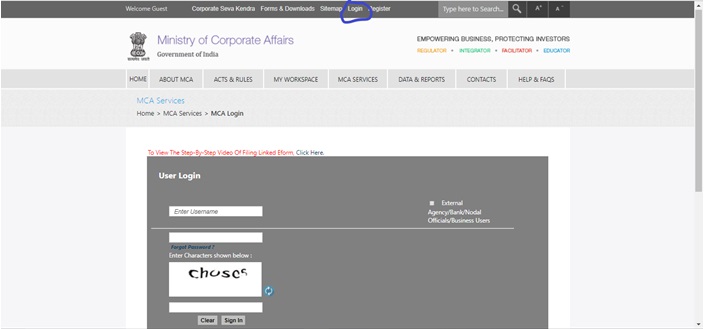
Step 1 – Go to http://www.mca.gov.in/mcafoportal/login.do and register yourself.

mca

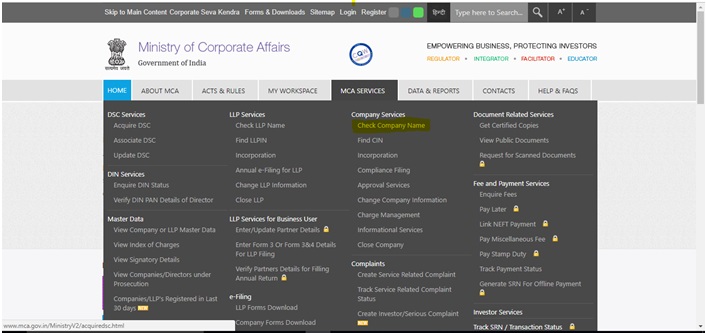
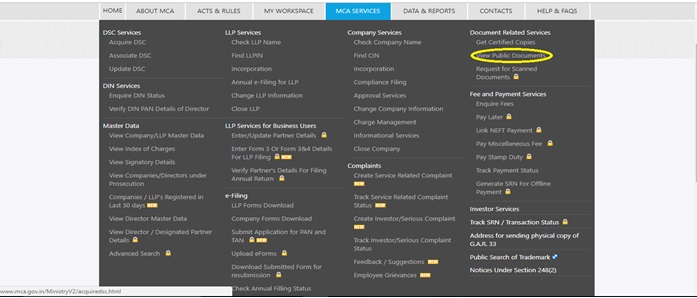
Step – 2 Go to http://www.mca.gov.in/ and click on the MCA Services and then click on check company name.

mca

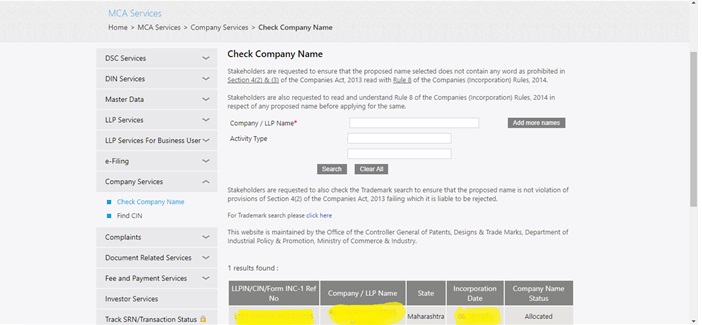
Step – 3 Type the name of the company for which you want to find out the name of the shareholders and click on search and then copy the CIN Number of that particular company.

mca

Step – 4 Then click on MCA services and select view public document.

mca

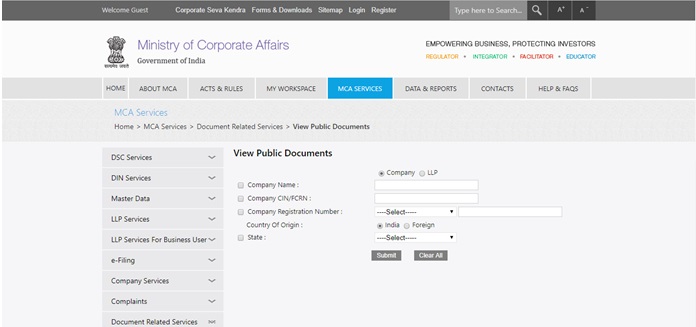
Step -5 Type the copied CIN Number of the company and click on submit. And then select the company you want the details.
mca

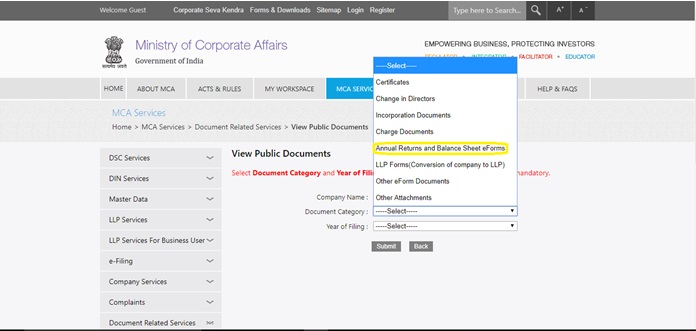
Step – 6 Select the Annual returns and balance sheet eform and then select the year of filing for which you want the details and click submit.
mca
Step – 7 Pay the required fees online and get the required document.

Step – 8 You have to view Form 20B / Form MGT 7 and remember this will be available only for a day.

There is another simple way to view the list of shareholders of the company in the MCA website, which is as follows:

  1. Visit the site : www.mca.gov.in and click on the icon ‘MCA 21’ Login by clicking the login option on right side of the page
  2. Click on the option ‘View Public Documents’ (fourth option from the top) Enter the details of the company (not necessarily all) and click on ‘search’   Select the company from the list and click on : 1. ‘Pay’, if you want to search for one company; or 2. ‘Add to my cart’, if you want to search more than one company.
  3. Click on ‘pay fee’ Select the mode of payment and click on ‘submit’. Click on ‘I accept’. Enter the credit card details and click on ‘Pay’ after paying the fee, a challan will generate (you can keep it for your record) Log in again and click on ‘My Documents’.
  4. The company that you have paid for will appear.   Click on ‘view’ and view the required documents.

This is the following way to access the list of shareholders of the company using Ministry of Corporate Affairs (MCA) website

Source – the photos that are used above is snipped from the MCA website.

Conclusion

It is observed that, the procedure to get the shareholders detail is quite easy and Ministry of Corporate Affairs has done a nice work the make the procedures simple and user-friendly. It is brought to your knowledge that information provided by MCA will be available for one day and they are provided under Right to Information Act since those documents are public document.


LawSikho has created a telegram group for exchanging legal knowledge, referrals and various opportunities. You can click on this link and join:  

https://t.me/joinchat/J_0YrBa4IBSHdpuTfQO_sA

Follow us on Instagram and subscribe to our YouTube channel for more amazing legal content 


Download Now

Private Companies – Restrictions on Transferability of Shares

0
shares

In this article, Arjun Radhakrishnan Nair pursuing M.A, in Business Law from NUJS, Kolkata discusses Restrictions on Transferability of Shares in private companies.

Everyone throughout the course of their day comes into contact with companies in one form or another. Be it through use of a mobile phone which is manufactured by a company, and where the network and services would be provided by another, or through the use of a vehicle which may be manufactured by yet another company. In general a company is a legal entity made up of an association of persons for the purpose of carrying on a commercial or industrial enterprise. In India, the laws relating to Companies are prescribed under the Companies Act, 2013 as well as certain provisions of the Companies Act, 1956.

The two most common types of companies one comes across are private companies and public companies. A major distinction that can elucidate the difference between a private limited company and a public limited company can be found in the manner they deal with the transferability of shares. While in a public limited company, a person is free to transfer shares in their possession subject to the procedure prescribed, a private company is bound to restrict the right to transfer shares within their Articles of Association itself. A Private Company is generally a closed group, wherein the shares are closely held amongst a limited number of persons. While providing the advantages of a corporate set-up to small businesses, a private company is also able to avoid the regulatory hassles that come with being a public company.

Shareholding in Private Companies

A ‘Private Company” has been defined under Section 2(68) the Companies Act, 2013 as a company which has the following characteristics:

  1. a minimum paid capital of 1 lakh rupees,
  2. Restriction on the right to transfer its shares imposed under its Articles of Association,
  3. Limitation as to the maximum number of members which should be no more than two hundred (in cases where the company is not a one person company)
  4. prohibits invitations to the public to subscribe for any of the companies securities.

Having a minimum paid up capital of 1 lakh rupees means that the individuals forming the company must invest at least an amount of Rs. 1 lakh by way of purchase of shares of the company. Section 2(84 of the Companies Act, 2013 defines a share to mean a share in the share capital of the company inclusive of stocks. The nature of a share was further provided under Section 44 of the Companies Act, 2013, which provides that shares are movable property transferable as provided under the Articles of Association. more specifically explained by the Hon’ble Supreme Court in CIT (Central), Calcutta Vs. Standard Vacuum Oil Co, as reported in AIR 1966 SC 1393 wherein it was held that a share is not just a sum of money but is an interest measured by a sum of money and made up of diverse rights contained in the contract evidenced by the articles of association of the Company. Shares are also transferable akin to other movable property and are included in the definition of ‘goods’ under Section 2(7) of the Sale of Goods Act, 1930. The value of shares ascertains the liability of the shareholder in a company and also determines the scope of his control over the affairs of the company and over other shareholders during general meetings.

The mandatory condition of imposing restrictions in the Articles of Association regarding the transfer of shares in Private Limited Company is distinct feature of such companies. Articles of Association prescribe the major regulations to be followed by the company, and are binding on the company as well as the shareholders of the company.The Supreme Court had opined in the V. B. Rangaraj vs. V.B. Gopalakrishnan and Ors, as reported in CDJ 1991 SC 464 that only restrictions imposed under the Articles of Association against transfer of shares may be enforced. Any other restrictions imposed in the absence of the mention of the same in the Articles of Association cannot be enforced to prevent a valid buyer of shares from taking possession of the same. In the said case, the parties had entered into agreements on the basis of which two branches of a family who held equivalent number of shares in the company had agreed that both branches would hold the same number of shares and where any member was desirous to sell his share, the branch to which he belonged would have first option of purchase. When one person from one branch directly sold his shares to the other branch, the members of the first branch approached the court to get the said sale nullified in view of the agreement. But as the said agreement was not made part of the Articles of Association and therefore no such restriction existed in the Articles of Association, the Hon’ble Apex Court opined that the said agreement could not be enforced. A similar decision was also rendered by the Supreme Court much earlier in S.P. Jain vs. Kalinga Tubes Ltd, 1965 AIR (SC) 1535.

While the Companies Act necessitates a restriction on the transfer of the shares in a private company, the Act is silent of the nature of such a restriction. There is no specific restriction provided and the severity of the restriction could greatly differ from company to company. But it has been consistently held by various courts that the said restriction cannot be in the nature of an absolute prohibition.

Restrictions on the transfer of shares

As a private limited company must mandatorily include restrictions on the transfer of shares in its Articles of Association, certain common types of restrictions are imposed by different companies so as to meet the requirements of the definition of a private limited company. The most common type of restriction that is imposed on the companies are by way of Right of Pre-Emption or Right of First Refusal.

Pre-Emption Clause or Right of First Refusal

The High Court of Judicature at Bombay in Bajaj Auto Ltd vs Western Maharashtra Development Corporation Limited, as reported in CDJ2015 BHC 1305, had remarked that a Pre-emption clause also known as a Right of First Refusal clause is a classic restriction on transferability which is one of the most common restriction clauses found in the Articles of Association of Private Companies. The right to pre-emption generally means that where a shareholder wishes to sell some of his shares or all his shares, then, at the first instance, the said shares shall be offered to the other members of the Company, who may purchase the shares at a fair price as decided in terms of the Articles of Association or calculated by the Directors in conjunction with the Auditors of the Company. The right to pre-emption ensures that the other shareholders in a company can acquire the shares if any other shareholder is selling. Such a clause is usually included to ensure that even in cases of conflict, where the shares are all held by a family, even if one member wishes to sell the shares to an outside he will be unable to without offering them to the persons in the family at the first instance. The right of pre-emption is not a specific right to shares of another shareholder is only the right to be offered the said shares in case they are for sale. It is therefore up to the shareholder to whom the said shares are offered to accept the offer and buy the shares. Where the none of the other shareholders are interested in purchase of the shares, the restriction on transfer is lifted and the shares may be transferred to any other person.

Enforcement of Pre-Emption Clause

For the enforcement of a pre-emption clause there must be a procedure to be followed by the Company. After receipt of the application for transfer of shares from the seller, the Company is bound to inform the other members in a time bound manner as to the availability of the said shares. Once the other members are notified, the Company has to ensure that the fair price of the shares are communicated to persons who are interested in purchasing the shares. If none of the other buyers show interest in the purchase of shares available for sale or are unable to purchase the same within the time stipulated then the Board may allow the seller to transfer the shares to any other person subject to any other restrictions as may be contained in the Articles of Association.

Power of a Private Company to Refuse Registration of Transfer

Another restriction on the transfer of shares is provided under Section 58 of the Companies Act, 2013. As per the first clause of the said section:

“If a private company limited by shares refuses, whether in pursuance of any power of the company under its articles or otherwise, to register the transfer of, or the transmission by operation of law of the right to, any securities or interest of a member in the company, it shall within a period of thirty days from the date on which the instrument of transfer, or the intimation of such transmission, as the case may be, was delivered to the company, send notice of the refusal to the transferor and the transferee or to the person giving intimation of such transmission, as the case may be, giving reasons for such refusal.”

The said provision implies that a Private Company can refuse the registration of shares both in pursuance of the powers granted to it for restriction of shares under the Articles of Association or otherwise. For this to Directors of the company on receiving an application for transfer of shares must actively send a notice whereby the refusal Is intimated to the person applying for the transfer and must also give reasons for the refusal of such transfer. Thereafter the person so aggrieved by the said notice may prefer an appeal to the Tribunal against the said notice.

Generally the power of the Companies to refuse to register shares may be due to some of the following specific reasons:

  1. In the case of partly paid-up shares being transferred, the transferee is insolvent or a minor and therefore would be unable to pay the balance
  2. When the transferor is a debtor of the company and the company has a lien on such shares.
  3. If instrument is incomplete, irregular and defective and not properly stamped.

The said provision bestows upon the Directors of the Company a lot of power with regard to the transfer of shares. As the said provision seems to be unrestricted in its scope, the same has undergone rigorous judicial scrutiny. In the case of Bajaj Auto Ltd. Versus N.K. Firodia & Others, 1979 AIR 32, a three member bench of the Hon’ble Supreme Court looked into the scope of such powers bestowed on the Directors under the erstwhile Companies Act. In the said matter, it was held that powers bestowed on the Directors were discretionary and the Directors being in a fiduciary relationship with both the Company and each of the shareholders and must only be used for the ultimate benefit of the Company and the shareholders. The bonafide use of such powers, even when no such powers are provided in the Articles of Association are to be condoned as done in the best interests of the company.  It is pertinent to refer to the decision in Greenhalgh v. Arderne Cinemas Ltd., (1950) 2 All ER 1120 wherein it was held that in cases where such power is used the acts of the Directors would have to be scrutinized as to whether they were the honest opinion of the Directors acting for the company as a whole.

The provision under Section 58 takes into its ambit both cases where the said restriction is granted by the discretionary powers vested in the Directors as well as where there are specific provisions providing such powers to the Directors. In caseswhere such specific powers were granted in the Articles of Association, the decisions of various courts in both India and England has unambiguously held that unless clear and malafide intention on the parts of the Directors are proved, or the powers were used in derogation of the rights of the shareholders and the Articles of Association, the refusal to register shares cannot be set aside.In the case of Berry and Stewart v. Tottenham Hotspur Football and Athletic Co. Ltd., 1936-3 All ER 554 (E), where the articles of association of a company had given the Directors unrestricted power to refuse transfer of shares, the Directors refused to allow transfer of shares to a person on the basis that the person was objectionable to the Directors of the Company and therefore was not fit to be part of the Company. When the same was appealed against, the Courts in view of the specific powers granted under the Articles of Association refused to go into the matter unless gross misconduct or any other act done that was prejudicial to the interests of the company was shown. In such cases the Directors were not even required to provide the reasons for refusal to transfer the said shares. In fact a litany of case laws have held that it not be justified for the Court to interfere with the director’s bona fide exercise of their discretion. This is based on the Court’s belief that it is the directors who know what is in the best interest of the company and thus, it is inadvisable for the Court to substitute their opinion for the Directors without comprehending the workings of the Company and its shareholders.

The abovementioned case of Bajaj Auto Ltd. Versus N.K. Firodia & Others is one such case wherein it was shown that the Directors were acting in a manner that was prejudicial to the interests of the company and was in personal interest of the Directors thereby an abuse of the fiduciary powers of the Directors.

Further it has been held by the Company Law Board in Hemanigiri Finance & Leasing (P.) Ltd v. Tamilnad Mercantile Bank Ltd. 1996 86 CompCas 875 CLB that there is no absolute power vested in the Directors of the Company to refuse to register any share especially when no such provision is provided for in the Articles of Association. Similarly in the case of Harinagar Sugar Mills v. Shyam Sunder reported in 1961 AIR 1969, it was held that in the Company Law Board must decide during the course of the appeal whether the Directors of a Company had acted capriciously, oppressively or in a corrupt manner or without specifying any proper cause for the same.

In view of the same, it must be appreciated that the power to refuse to register shares is a discretionary power that is limited based on the extent of power imparted by the Articles of Association. Various Courts have rightly adjudged that even Company Boards may err in their judgment due to personal or trivial reasons which do not find merit in the Articles of Association, and therefore, the Company Law Board is empowered to look into the circumstances of each case and judging whether the discretionary power has been rightly used. Where the Articles give an absolute right to the Company to refuse, then the Directors may use this power if they feel their actions would best benefit the Company, but where no such power is granted, then the scope of the said power is very limited and the company cannot stop a rightful transfer of shares.

Case Study of Restrictions on Transfer of Shares

A general understanding of the pre-emption clause and the power of the Board to refuse registration of transfer could be gained from the decision of the Company Law Board in Satyanarayana Rathi vs. Annamalayar Textiles (P) Ltd, as reported in 1999 32 CLA 56.

In the said matter the Private Company in its Articles of Association had inserted a clause wherein no member of the company could transfer his shares to any other person who is not a member of the company without offering the same to the other members at a price decided by the Directors of the Company from time to time. If the said shares were not purchased within a specified time as decided by the Board then the person desiring to sell his shares may transfer the same to any other party as he likes. Matters being so, the appellant in the said matter who was supplier of cotton was given shares as security for payment (to the extent of 52%, being the controlling interest) by 3 members of the Company. The members also gave the appellant the share certificates and transfer deeds. Unfortunately due to several factors, the payments for the cotton supplied by the appellant was not made and therefore the appellant made an application to the Board of the Company to have the shares transferred to him. But as there were members within the company who were desirous of purchasing the shares themselves the Board rejected the application as the same was in violation of the pre-emption clause included in the Articles of Association. This stand of the Board was upheld by the Company Law Board, which held that in view of the restriction as provided in the Articles of Association of the Company the Board is bound to deny the request of the appellant to transfer the shares to him.

Firstly this clearly espouses the concept that even where there exists contracts between the members of the company and the appellant to the extent that the appellant may transfer the shares to his name in case where there is a default in payment on the part of the members of the company the same cannot be upheld in view of the Pre-emption clause as contained in the Articles of Association. The Company will be bound by the restriction as imposed under the Articles which are binding on them over and above any other agreements that may be entered into by the members of the company. Therefore where certain other members of the Company has shown willingness in purchasing the shares, unless they decide not to purchase the shares or are unable to do so within a time specified by the Board of the Company, the shares cannot be transferred to the appellant in the matter.

Secondly, where there is a violation of the Articles of Association, the Directors of the Company may refuse to register the shares. In the present case, though the transfer deeds were with the appellant and there was an agreement between him and the members of the Company, the Board of the Company used its discretionary power to hold that the transfer violated the Articles of Association and therefore had to be set aside.

Similar decisions were rendered in Cruickshank Co. Ltd vs. Stridewell Leather Pvt. Ltd, (1996) 86 CompCas  439  CLB, Tarlok Chand Khanna v. Raj Kumar Kapoor, (1983) 54 Com. Cas. 12 (Delhi) among others.

Conclusion

Shares play an important part in the identity of a Company, be it Private or Public. The transferability of shares is what sets Companies apart from other forms of businesses, as it enables the company to cultivate its legal identity. The concept of perpetual succession is based on the transferability of shares which ensures that the legal entity that is the Company survives the change in its shareholders. Therefore, the transferability of shares is an important aspect in any Company.

A private limited company is distinct in that it has to restrict the transfer of shares in its Articles of Association. This goes with the principle behind the creation of private limited companies, which is generally started by families or friends or persons who share similar goals and vision. Therefore in a partnership firm, restrictions in the transferability of shares ensures that control of the company stays within a small group and unwanted influences can be kept out. This is distinct from a public limited company where anyone can buy into the company. While the concept of restriction of transferability of shares ensures that a private company can maintain its identity and its shareholders, it can also result in untenable situations where due to the said restrictions there may be conflict. For the said reasons, it is ensured that said restrictions are not absolute and persons who are not willing to remain in the company may sell their shares and opt out subject to restrictions imposed. The said restrictions can also ensure that sales are not made to any persons who are detrimental to the growth of the company. In view of the above, the restriction of transfer of shares it what gives the private company its character and allows it to maintain the values of its shareholders.


Download Now

A note on National Offshore Wind Policy, 2015

4
offshore wind

In this article, Ambika Kajal pursuing Diploma in Entrepreneurship Administration and Business Laws from NUJS, Kolkata, discusses the National Offshore Wind Policy, 2015.

INTRODUCTION TO THE NATIONAL OFFSHORE WIND ENERGY POLICY

On 9th September 2015, the Cabinet gave its nod in affirmation for the National Offshore Wind Energy Policy, 2015  with the intention to encourage and incentivise the development of offshore wind energy. The Policy was made available to the public for review,  by the Ministry of New and Renewable Energy on October 1, 2015, and has come into force from the date of notification in the Official Gazette.

VISION BEHIND THE NATIONAL OFFSHORE WIND ENERGY POLICY

The policy works towards India’s objective of reaching the goal of saving the climate by switching to renewable energy resources. India has already attained the aim of more than 22 GW of onshore wind energy generation.

In consonance with the mandate and responsibility, the Government plans to give a boost to the offshore wind energy sector by updating the technology and the laws dealing with the set up of offshore wind farms.

‘Renewable energy resources’ are essential elements of the Government’s National Action Plan on Climate Change(NAPCC) announced in the year 2008.

Electricity demands will be met sustainably. Coal and other nonrenewable energy resources have harmful effects on the environment as well as the health of people at large.

OBJECTIVES OF 2015 POLICY:

The Indian Government in its concern to promote Offshore Wind Farm has planned to structure a policy that will enable optimum exploitation of areas or zones which are suitable for offshore wind energy farms and in the best interest of the country and to attain the following purposes:[1]

  • To Explore and Promote setting up of Offshore Wind Farms in the Exclusive Economic Zone (EEZ) of the nation, including the (PPP) Public Private Partnership in ideal coastal regions.
  • To raise financial investment in the Energy Infrastructure which will lead to the deployment of offshore wind farms to harness the wind.
  • To provide incentives to private players of our nation as well as multinational giants of other countries to invest and build farms.Thereby, promoting spatial planning as well as the management of maritime renewable resources.
  • To achieve electricity as well as energy security for our nation.
  • To reduce carbon emissions by switching to offshore wind energy farms for harnessing the wind to generate electricity on a large scale.
  • To advance the indigenization of the Energy Technology.
  • To promote research and development in the Energy Sector by providing aid and assistance to organizations.
  • To create super skilled man force and to generate employment in the wind energy sector.
  • To facilitate the development of Project EPC ( Engineering, Procurement, and Construction ) and Operation & Maintenance with regard to the offshore wind industry.
  • To develop as well as maintain the coastal infrastructure and supply chain to support heavy construction & fabrication work and the Operation & Maintenance activities in the offshore wind energy sector.

IDEAL DEVELOPMENTAL AREAS FOR OFFSHORE WIND FARMS  IN INDIA

Preliminary assessments along the coastline have suggested some prospects of development of offshore wind power. Wind Energy Resource Date collected from the coastline of Rameshwaram, Kanyakumari in Tamil Nadu and Gujarat Coast shows reasonable potential for offshore wind farms. It suggests potential to establish around 1 GW capacity wind farm each along their coastline.

GEOGRAPHICAL COVERAGE

MARITIME ZONES: There are two main marine areas in which structures such as offshore wind farms can be built:

  • Indian territorial waters, up to 12 nautical miles (nm) from the baseline; and
  • Exclusive Economic Zone (EEZ), beyond the 12 nm limit and up to 200 nm, where under the international law ( United National Conference on Law of Seas), India has right to construct structures such as wind farm installations.

ESSENTIAL ELEMENTS OF DEVELOPMENT OF WIND ENERGY FARM

The components of a policy for the development of offshore wind farm will contain:[2]

  1. Preliminary Resource Assessment for estimating the potential quotient and preliminary oceanographic & bathymetric studies for demarcation of blocks for installations.
  2. Environment Impact Assessment and study of proposed Offshore Wind Farms regarding aquatic life etc., studies concerning navigation, undersea mining and related exploitation activities and other users of the sea/marine life.)
  3. Comprehensive studies & surveys – These studies will determine the construction costs for special foundations, special ships for both operation and maintenance requirements.
  4. Sea Bed Lease Arrangement.
  5. Statutory Clearances and NOCs which are required for setting up the farm and are obtained from concerned ministeries of climate change, defence, etc.
  6. Grid Connectivity and Evacuation of Power (both offshore and onshore)
  7. Updated Technology concerning the installations.
  8. Various incentives such as fiscal and financial etc
  9. Security of offshore installations and confidentiality of the data collected during studies as well as surveys of the same.
  10. Financing and Insurance.[3]

offshore wind

NODAL MINISTRY and NODAL AGENCY

The Ministry of New & Renewable Energy (MNRE) has been authorized as the Nodal Ministry for use of offshore areas within the Exclusive Economic Zone (EEZ) of the country and the National Institute of Wind Energy (NIWE) has been authorized as the Nodal Agency for development of offshore wind energy. Government has paved way for development of the offshore wind farms up to the seaward distance of 200 Nautical Miles (within its Exclusive Economic Zone) from the base line.[4]

FUNCTIONS OF THE MINISTRY AND NODAL AGENCY ARE AS FOLLOWS

offshore wind

offshore wind

KEY POINTS OF THE 2015 POLICY :

  1. International Competitive Bidding:
  • National Institute for Wind Energy will assign the blocks to the project developers with the assistance of an open and unbiased international competitive bidding process. It is clearly mentioned in the Policy that due to the reason of national security, the National Institute shall have the permission to refuse participation of entities .
  • NIWE has the right not to provide any explanation mentioning specific details to the concerned entity on being questioned about the cancellation. The basis of selection of project developers through the process, ranges from the tariff, total cost of proposed project, sharing of production benefits, the rate of lease of land, etc.
  1. Facilitator of Clearances and Intermediate Off-taker:
  • A single window clearance agency, the NIWE has been authorized for the facilitation of prerequisite clearances for project developers to start working on their proposed projects. NIWE has also been given the responsibility for intermediate off-take of energy from the offshore wind energy project in order to thereafter sell it to various state utilities and distribution licensees so as to integrate it with the national grid.
  • The notification of blocks by the NIWE depends on clearances from various ministries such as
  1. Defence,
  2. Home, as well as
  3. External Affairs, also
  4. Environment & Forests and
  5. The Department of Space.
  • Then, Developers would have to obtain clearances from various Ministries of State Governments, which will be facilitated by the National Institute.
  • The Policy distinguishes requirements of different approvals and clearances for the clarity of project developers into two stages. A schedule for such clearances shall be issued by MNRE.
  • The wide framework of the power purchase agreement (PPA) to be entered into between National Institute of wind Energy and the developer would be the time frame for the commissioning of the project , period of the agreement, commitment to minimum works program in terms of project capacity, monitoring and inspection by MNRE and/or NIWE and the specific decommissioning program.[5]
  • The allocation as well as the lease will stand renounced if the project developer fails to commence commercial operations by a particular time frame.
  1. Costs regarding the farms:

offshore wind

[6]

  • The Policy has enumerated various challenges to successful deployment of offshore wind power such as proper resource characterization, turbine foundation, installation of turbines, interconnection with utilities and coastal security, etc.
  • Such challenges and issues would elevate or increase the cost of the project for the developers in comparison to other renewable energy and conventional energy generation projects; like that of water or solar projects. It will impact the end costs of the consumer. Thus, It requires larger incentives and better subsidies from the government to become competitive and a viable option to choose for the developers.
  • Further, proper adjustments to the renewable energy certificate apparatus and regulations determining the renewable energy purchase obligations are needed to support and incentivize the development of offshore wind energy in India.
  • The draft of the Policy which was released in 2013, had expressly laid out fiscal incentives like tax holidays and exemption from customs duty and also excise duty, service taxes to attract investments from around the world.
  • The Policy, however, provides a blanket clause, stating that all incentives whether fiscal or financial, will be available to onshore wind energy projects. Also, other exemptions and relaxations and generation based incentives would be available to developers of offshore wind energy projects.
  • Similarly, bundling of power from offshore wind energy farms with conventional power has been provided. This will assist the development and promotion of offshore wind energy throughout the country.
  1. Environmental Aspects Concerning the Farms:
  • Surveys and comprehensive studies have to be undertaken, including (EIA) Environmental Impact Assessment, Environmental audit, etc., before delimiting the blocks of offshore wind energy farms.
  • Surveys can be conducted by only those entities with credible track-record and expertise in the concerned field. NIWE, from time to time, will issue guidelines and release them in public domain, on the undertaking of surveys. The guidelines have to be followed by such entities. Several clearances from the Ministry of Defence have to be obtained as a prerequisite to conducting such surveys and studies.
  • The project developer has to submit a comprehensive decommissioning program and site restoration plan before starting the construction work. The project developer has to submit a security deposit or offer a financial guarantee to ensure proper decommissioning of the wind farm. Programs require clearances from the various ministries like that of Environment, Forests and Climate Change.
  1. Security of the installations:
  • The developer will be accountable for the security of the offshore wind energy project. The Policy has not laid down any rules or regulations to be followed by the project developer for ensuring the security of the installations. Vulnerability assessments will have to be conducted by the project developer it regular intervals. The project developer also has to obtain comprehensive insurance cover for such installations.
  • A nodal agency (Headquarter,Offshore Defence Advisory Group) will give suggestions to MNRE and/or NIWE about planning and critical policy aspects of offshore security and defense within territorial waters of India and the EEZ.
  • The (DGoS) Directorate General of Shipping in consultation with the MNRE shall declare the offshore wind farm as a ‘Restricted Area.’

ADVANTAGES: USHERING GREEN REVOLUTION

Offshore wind speeds tend to be faster than on land. Small increases in wind speed yield large increases in energy production. Faster wind speeds offshore means much more energy can be generated. [7]With the help of this policy , India will be able to harness the offshore winds in the best interest of the nation.

Offshore wind speeds tend to be steadier than on land. A steadier supply of wind means a more reliable source of energy.Many coastal areas have very high electricity needs. India has a large coastline.Building offshore wind farms in these areas can help to meet those energy needs from nearby sources.

Offshore wind farms will create jobs; and they do not emit environmental pollutants or greenhouse gases. The workers will not get affected by any dangerous disease as compared to the workers working in coal set ups and petroleum refineries . Promotion of the offshore wind energy farms will provide the country with a sustainable source of electricity.

CRITICAL ANALYSIS:

The significant challenges which need to be addressed in offshore wind power deployment are:

  • Resource characterization,
  • subsea cabling,
  • the foundation of the turbine,
  • installation of turbines ( logistics, grid interconnection and operation)
  • development of transmission infrastructure and
  • coastal security for the wind farms during construction as well as operation period.

Further, adding large capacities of offshore wind generation to the power system would also require reliable integration to the national grid so that there is no heavy loss of electricity during transmission.

Very high winds, particularly during heavy storms or hurricanes, can damage wind turbine

Effects of offshore wind farms on marine animals as well as birds are not fully understood. Studies are still being undertaken.

Offshore wind farms built within the view of the coastline (up to 26 miles offshore) may be unpopular among local residents, and may have an effect on tourism and also on property valuation.

Deep sea wind farms come with the challenges of assigning no-go areas for commercial shipping. There would be a need to devise new lanes, proper lightning for ships to pass on.Policy is silent about this and there is no notification regarding the same from the Nodal ministry or the agency.

CONCLUSION:

The policy will set an example for other developing nations to work on harnessing renewable resources than the non renewable resources to reach the goal of development. This policy will work towards saving our environment from pollution by promoting offshore wind energy farms. This policy Is a masterpiece of legislation .It will bring fruitful results in the near future. This policy is an evidence that India is ready for green revolution .India is not concerned about development ,instead it is focused on ‘’sustainable development’’.

References

[1]http://mnre.gov.in/file-manager/UserFiles/National-Offshore-Wind-Energy-Policy-Gazzette-notification.pdf (Last visited:30th june,2017)

[2]http://mnre.gov.in/file-manager/UserFiles/National-Offshore-Wind-Energy-Policy-Gazzette-notification.pdf (Last Visited :30th June , 2017)

[3] http://www.governorswindenergycoalition.org/?p=15046 (Last Visited:30th June,2017)

[4] http://www.gktoday.in/blog/national-offshore-wind-power-policy-2015/ (Last Visited: 30th  June , 2017)

[5] www.mondaq.com/india/x/441280/Renewables/National+Offshore+Wind+Energy+Policy+2015(Last Visited :30th june , 2017)

[6]https://www.greentechmedia.com/articles/read/nrg-bluewaters-peter-mandelstam-offshore-wind-is-power-near-the-people(Last Visited :30th June 2017)

[7] www.americangeosciences.org/critical-issues/faq/what-are-advantages-and-disadvantages-offshore-wind-farms ( Last Visited : 30th June , 2017)


Download Now

Is smoking on open roads or other public places legal in India?

16
smoking on

In this article, Sachin Vats of Rajiv Gandhi National University of Law, Punjab discusses the punishment for smoking on roads or other public places.

Is smoking on open roads or other public places legal in India?

Smoking is the habit or action of inhaling and exhaling the smoke of tobacco or a drug. The rate of increase in disease and death due to active smoking is on rise. But, apart from this people who do not smoke are suffering with the ill effects of smoking in passive way. The inhalation of Secondhand Smoke (SHS) or Environmental Tobacco Smoke (ETS) by the persons causes “Passive Smoking” which is equally injurious to health. The rise in air pollution is a major concern for the global world. The world is fighting with the problems like smoking and drug related issues.

Passive Smoking is one of the major motivation behind making of smoke free laws. Why should a person other than the intended active smoker face any problem? The passive smoking also causes dangerous diseases like cancer, permanent disability and even leads to death. So, the people who smoke should think about its consequences on other people. The Constitution of India has provided to the people six fundamental and various other Rights. People always raise their voice if any of their rights get violated. But, do we really care about our fundamental duties that we must do as a citizen of India? The Article 51A Part IV  of the Constitution of India states different fundamental duties incorporated under 42nd Amendment in 1976. The 86th amendment done in 2002 provides 11 fundamental duties to be done by every citizen of India. I am discussing about fundamental duties of our citizen because even after having legislation for different purposes it depends upon us to make it successful.

“Section 4 of the Cigarettes and Other Tobacco Products Act (COTPA) describes about Prohibition of Smoking at Public Places which is applicable from 2nd October, 2008”

“India became a party to the World Health Organisation Framework Convention on Tobacco Control on February 27, 2005.”

What is Public Place

Public Place is defined as any place where public has access. It does not matter that the place is right or not. It includes all the places visited by the public such as auditorium, hospital, railway stations, public offices, courts, educational institutions, libraries, canteens, banks, clubs. It also includes the open spaces such as premise of the hotels and restaurants.

Instructions for the Public Places

The public places must display a sign of “No Smoking” on a board. The size of the board should be 60 cm in length and 30 cm in width. The background of the board must be white in colour and all the other specifications must be followed. The board must display a warning “No Smoking Area- Smoking here is an offence”. The warning should be given in English language and one Indian language according to the respective location. The board must be displayed at the entrance of the public place and other prominent places of the building. If the public place has more than one gate then the board will be displayed on each entrance gate. The public building consisting of different floors will contain the display board on all the floors including at the staircase and lifts.

The name of a designated officer must be notified and displayed on the board to whom the complaint will be made if someone is violating the law by smoking at public place. The keepers of the public place must ensure that no ashtrays, matches, lighters or any other thing which can facilitate smoking are provided at the public place.

Judgment in Murli S. Deora v. Union of India

The harmful and dangerous effects of smoking in public was recognized by the Hon’ble Supreme Court in the year 2001 during the case of Murli S. Deora v. Union of India. The ill effects of passive smoking and absence of any statutory provision regarding this problem was also recognised by the Supreme Court in this case.

The Supreme Court in its decision banned smoking in public places like auditoriums, hospital buildings, public offices, railways, court buildings, libraries, educational institutions, health institutions and other place of public use.

Public Places with separate Smoking Area

There cannot be any smoking place in public places as all the public places have to be smoke-free. But, there are some provisions under which a smoking area can be provided by the owners, proprietors, manager, supervisor or the person in-charge of affairs at places like hotels and restaurants. The hotel must contain more than 30 or rooms and the restaurant should have seating capacity of 30 or more than 30 people. The service of smoking area at any airport can also be provided to the passengers by the manager of the airport but some specific guidelines for that have to be followed.

Guidelines for Smoking Area

The smoking area made at any public place must be used only for the purpose of the smoking. The area cannot be used for providing any other services to the customers. The smoking area cannot be made at any entrance or exit gate of the hotel, restaurant and airport. The area made for smoking must be distinctly marked and a board displaying “Smoking Area” in English and any one Indian language as applicable must be there at the entrance gate.

The area made for the smoking must be fully four-walled and separated from the main building. The entrance gate must have automatically closing doors and the building should have a good airflow system which directs air towards outside and it must not mix with any other buildings nearby. The building should have an exhaust ventilating system and air cleaning system. They should be installed in such a manner that air should not permeate into the non-smoking areas of the building.  

Violation of Section 4 of the COTPA (Cigarettes and Other Tobacco Products Act)

The Public Places without the signage of the board of “No Smoking” is considered as violation under under the Cigarettes and Other Tobacco Products Act. The public place should not provide the people ashtrays, lighters, matches and other things to promote or facilitate smoking activities. If any smoking area is found on the entrance or exit gate of the public place then the designated officer or the supervisor of the place will be held liable for the violation of the COTPA under section 4. If the manager provide any service in the smoking area other than smoking then it will be violation of section 4. The improper air flow system in the smoking room makes the concerned person liable under this Act. If smoking is done at any public place other than the hotel and restaurants consisting more than 30 rooms and seating capacity respectively then then it will be violation under this section. The name of Designated Officer must be displayed at different positions at public places to whom any complaint can be registered.

Punishment Under COTPA

All the offences which are Punishable under COPTA are bailable. The cases are tried in accordance with the Code of Criminal Procedure, 1973. The wrong done under this COTPA is taken as Compoundable and tried according to the provisions of the summary trials.

There is a provision for the Fine of Rs. 200 if anyone is found smoking at public places. The Government has put up an Amendment Bill in the Parliament where it has been raised  upto  Rs. 1000. It has also been decided by the Health Ministry that the minimum age for buying tobacco related products is 21 which was earlier 18 and the same has been incorporated in the amendment bill.

Conclusion

Public smoking was made illegal in the history of world first by a Division Bench of Kerala High Court in 1991. The High Court stated that smoking at public places violates the Article 21 of the Constitution and hence unconstitutional. The first city in India to become smoke free was Chandigarh and the man behind the success of Chandigarh was Hemant Goswami. Other cities such as Shimla also followed the Chandigarh model to become smoke free city.

According to a report published by the medical journal “The Lancet” around 11% death in the world are caused due to smoking. The majority of people are dying out of smoking belong to China, India, Russia and USA. The report of the Global Burden of Disease Survey shows that India has around 11.2% smokers in the world. Smoking is the second largest reason for early death and disability so it is a major point of concern for all the countries across the globe.

The demand of removal of designated smoking zones from hotels, restaurants and airports is also on rise and the recommendation has been accepted by the government. The Indian women rank second in the global list of top countries having women smokers.

References

Health Department Website (Government of India).

Cigarettes and other Tobacco Related Act.

World Health Organisation Website.

Medical Journal- “The Lancet”.

Download Now
logo
FREE & ONLINE 3-Day Bootcamp (LIVE only) on

How Can Experienced Professionals Become Independent Directors

calender
28th, 29th Mar, 2026, 2 - 5pm (IST) &
30th Mar, 2026, 7 - 10pm (IST).
Bootcamp starting in
Days
HRS
MIN
SEC
Abhyuday AgarwalCOO & CO-Founder, LawSikho

Register now

Abhyuday AgarwalCOO & CO-Founder, LawSikho