Download Now
Home Blog Page 1557

What are the terms of engagement that a lawyer should sign with his clients before taking on any high value work?

0
lawyer-client

In this article, Mansi Bathija discusses the terms of engagement that a lawyer should sign with his clients before taking on any high-value work.

In India, the ultimate authority which conducts the professional ethics and duties of advocates registered is the bar council of India. It lays down certain rules and regulations for the conduct of advocates in India such as the duties of an advocate towards his client, opposition, colleagues, court etc.

The legal community in India has played a vital role in shaping the future of the country. There are no standards particularly for law firms or to acknowledge them under the rules created by the Bar Council of India, the all-India administrative body of the profession in charge of setting benchmarks of professional direct and practicing a supervisory part over the Bar Councils in the individual states of India.

Where a law firm is included, it is the individual advocates in a law firm rather than the law firm itself that may give legitimate administrations in India. Advocates determine their power to speak to their clients in court-related matters under the power of lawyer conceded in their name.

Lawyer-client relationship

A “client” is a person who seeks advice from a lawyer and for whose benefit the lawyer renders or consents to render legal administrations.

How is a lawyer-client relationship established?

if a person asks a legal question, and a lawyer answers or says he or she will look into it, a lawyer-client relationship may result. There’s no need to sign an agreement, shake hands, discuss rates or send an engagement letter.

In India, Sections 126 to 129 of the Indian Evidence Act, 1872 manage advantaged that is appended to proficient communication between a legal counsellor and the client. Section 126 and 128 say conditions under which the legal counsellor can give evidence of such expert communication. Section 127 gives that mediators, assistants or workers of the legal consultant are limited likewise. Section 129 says when a legal counsellor can be constrained to unveil the private communication which has occurred amongst him and his client.

Section 126 states that no counsellor, lawyer, pleader or Vakil might whenever be allowed to

Disclosure

  • Any communication made to him by or in the interest of his client or
  • Any exhortation is given by him to his client in the course and with the end goal of his work;

To express the substance or states of any archive with which he has turned out to be familiar in the course and with the end goal of his work.[1]

Ethics rules and conduct

Advocates have the double duty of maintaining the interests of the client boldly while behaving as officers of the court. As needs are, they are relied upon to hold fast to the most noteworthy norms of honesty and respect. An advocate’s lead ought to mirror their special position in the public arena which gets from the honourability of this calling. More or less, on the off chance that you are an advocate your support of the basic man ought to be caring, moral and legitimate.

The rules mentioned in Chapter II, Part IV of the Bar Council of India Rules on standards of professional conduct and etiquette shall be adopted as a guide for all advocates in conducting matters related to law.[2]

Important communications to be made:

  1. Fee agreements: The fees should be agreed prior to taking up a case. This clause could be written or oral. The mode of payment might also be decided before moving forward.
  2. Confidentiality agreement: this is a very vital aspect of any lawyer-client relationship. Any information shared by the client needs to be between his attorney and himself. If violated, the lawyer might have to face consequences.
  3. Correct advice: The lawyer must inform his client about his legal rights and responsibilities.
  4. The lawyer should try to understand the client’s part of the story and not get into the technicalities on the first meeting itself.
  5. Before taking up any high profile case, the lawyer must know the insights of the client or the client’s business.

Doctrine of client confidentiality

A confidentiality clause gives a protected situation to your client and elevates trust. Your client needs to realize that he or she (or “it” in the event that you are working with an association) can completely put stock in you with secret, individual, budgetary or restrictive data. A confidentiality agreement shows to the client that you are a genuine expert, willing to hush up about certain data and not reveal such data to others aside from under certain circumstances the teaching of client confidentiality benefit has turned into a necessary piece of UK common law and is acknowledged around the world. Civil law nations like France and Japan likewise perceive benefit concerning correspondence with lawyers. In India, the advantage of benefit is arranged inside the Indian Evidence Act, 1872 which confines its application to correspondence with lawyers or lawyers.

Privilege and its exceptions:

A “privileged professional communication” is a security granted to a communication between the legal guide and the client. Professional communications and private communications with the legal guides have been agreed security under The Indian Evidence Act, 1872 (“the Act”). On the off chance that the benefit did not exist by any means, everybody would be tossed upon his own legal assets. Denied of all professional help, a man would not dare to counsel any talented individual, or would just set out to tell his guidance a large portion of his case. To guarantee benefit under section 126 of the Act, a communication by a gathering to his pleader must be of a secret sort.

This Section does not shield from disclosure:

  1. any communication made in promotion of any illegal reason;
  2. any reality seen throughout work demonstrating that any wrongdoing or extortion has been submitted since the initiation of the business.

The assurance managed under this Section can’t be profited of against a request to create archives under Section 91 of the Code of Criminal Procedure. The record must be created, and afterwards, under Section 162 of this Act, it will be for the Court, after investigation of the reports, in the event that it esteems fit, to consider and choose any complaint in regards to their generation or suitability.

Vakalatnama

Vakalatnama is a kind of power of attorney which is signed by a client in order to allow the lawyer to represent him legally before the court of law. A vakalatnama is deemed to include all the important terms regarding responsibility, costs, fees etc.

“A verbal contract isn’t worth the paper it is written on”

Very well said by Samuel Goldwyn & it is universally observed that written contracts serve a better purpose than the oral agreements. In India, it is not likely to enter into a written contract regarding all the clauses with your lawyer but as of now emerging people in this profession are taking up this mode of engaging with their clients to avoid chaos later. The main reason why a lawyer should enter into a written agreement with his client is to make sure that there is like-mindedness on both the sides. Most of the times, issues arise between client and lawyer regarding the payment of the fees of lawyer. Hence, to avoid such problems, it is better to have the clauses in a written format.

Reference

[1] http://www.legalserviceindia.com/articles/pc.htm

[2] http://www.barcouncilofindia.org/about/professional-standards/


Download Now

Capital gain tax on family arrangements and settlements.

0
Capital gain tax

In this article, Diksha Chaturvedi of BVPU discusses the Capital gain tax on family arrangements and settlements.

Introduction

There are various forms of Indian businesses and one such is Family owned business. It is the oldest form of business. The ownership and management of this kind of business is in the hands of family members only. The business passes from generation to generation and because of this rights of family members are extinguished. So for this family arrangement is done.

What is Family Arrangements?

Family arrangement is a transaction between the members of family for the future benefit of family members. This arrangement is done by the descending ancestors who try to settle the differences, disputes and conflicts and maintain peace and harmony in the family and to bring goodwill in the family by equally distributing all the assets and properties among family members.

The object of family arrangement is to preserve the goodwill and property of the family by recognising that it is not good to indulge in fights and disputes. Every family has some or the other kind of disputes. Majority of these disputes relates to family’s property. Thus to solve these matters in an amicable manner courts have taken steps towards it.

Ingredients of Family Arrangement:

  • Family:

  • Family has been defined under Income Tax Act, 1961 in explanation 10(5)
    Family in relation to individual means:
  • The spouse and children of the individual
  • The parents, brothers, sisters of the individual or any of them wholly or mentally dependent on them.

However the term ‘family’ has not been defined under any law. But according to the courts it has to be understood in a wider sense. A common tie or relation is enough to consider that person as the member of a particular family. To determine whether a person belongs to the family or not it is not required that there should be an existence of legal/succession right to the family property.

Case law: Krishna Bihari Lal V. Gulabchand, 1971 AIR 1041, SCR 27 (Supreme Court of India)
Under this case it was held that the word ‘family’ has a wider meaning. It cannot be confined to a group of persons who by law has the right of succession. In a matter of family arrangement the word ‘family’ is to be seen in a much wider sense.

  • Property

Family arrangement is done for the rights of a person on a family’s property. The property is either joint or common. Individual and self-acquired property is not taken into consideration until some ancestors claim is shown in that property.

Thus, there must be an ancestral title in the property for Family Arrangement.  

Case Law: Bansari Lal v. CGT, 1998-148 CTR All 533, 229 ITR

(Punjab-Haryana High Court) Under this case the family arrangement was disregarded by the court as it was collusive in nature. The dispute was between the husband on one side and his wife and four sons on the other side. Property of dispute was an individual property. Wife and four sons had only lent money to husband to buy the property. Mere creating an antecedent title, claim or interest of five persons in the individual property of the husband and eventually the family arrangement decree was set aside on the ground of being collusive , obtained with a view to avoid payment of taxes.

  • Disputes

Dispute is prelude to the family arrangement. Existence of the word ‘arrangement’ suggests that there is a dispute or prosperity of a person which can create dispute in family in future. However a pre-existing dispute is always not necessary. It can occur in future because of legal claims. The possibility of bona fide disputes, which may not involve legal claim, will be a valid family arrangement.

Case Law: Shambu Prasad V. Phool Kumar, 1971 AIR 1337, 1971 SCR 181 (Supreme Court of India)
Under this case court said that there must be a dispute whether actual or possible in future.  In this case the property was purchased by the father from his own money thus the adopted son has no claim in the property. In spite of this, Supreme Court held that “ As stated earlier, a dispute, the settlement of which can constitute family arrangement, need not to be one which is actually sustainable in law.”  

  • Arrangements:

The word ‘arrangement’ means to come to an agreement regarding a dispute.  Under the process of arrangement, the parties are not warned by any court of law. The arrangement is not arrived strictly by following law of inheritance. The person with no right to inherit particular property can also get a share in an arrangement.

Case Law: S.K. Sattar S.K. Mohd. V. Gundappa Ambadas, 1996 (Supreme Court Of India)

Under this case ‘family arrangement’ was described as transaction between the members of a family for the future benefit of family members.  It is done to preserve peace and harmony in the family and to avoid any legal dispute.

What is Capital Gain Tax?

Any profit or gain acquired from a capital asset is known as Capital gain. This gain or profit is tax chargeable from the year in which the transfer of capital asset take place. Therefore, Capital gain Tax is a tax charged on the profits made by selling Capital assets.
Capital Gains include:

  • Stock in trade.
  • raw materials
  • Personal effects that are movable. It does not include jewellery, archaeological collections, drawings, paintings, sculptures or any art work held for personal use.
  • Agricultural land.
  • 6.5 percent Gold Bonds, National Defence Gold Bonds and Special Bearer Bonds.
  • Gold Deposit bonds under Gold Deposit Scheme.

Exemptions of Capital Gain Tax


Under Long-term Capital Gains

  • Profit on sale of residential house (Section 54): Must belong from Hindu Undivided Family.
  • Ownership of property for at least 3 years
  • The assessee must have  purchased a new house one year before or two years after the sale of original house. But if he is building a new house then after 3 years of the sale.  
  • If the capital gained is equal to or more than the actual value of the house. But if the value of house is less than capital gain, then tax of 20% is levied on the difference of the value.

Capital gain is invested in long term specified assets of NHAI or Rural Electrification Corporation (Section 54EC)

  • Profit from Long term capital asset.
  • It is compulsory to invest capital gain in assets like bonds of NHAI or REC  (3-year lock-in period or 6 months from the date of sale of asset).
  • The investment made should not be less than the capital gain.
  • New asset must remain in possession for a minimum of 3 years.

Profits from the sale of an asset other than a residential house (Section 54F)

  • Must belong from Hindu Undivided Family.
  • Capital gain must be from a sale of an asset (not a residential house)
  • The assessee must have  purchased a new house one year before or two years after the sale of original house. But if he is building a new house then after 3 years of the sale.  
  • The value of new house cannot be less than the value of asset sold. Only the part in which capital gain is invested will be exempted. Apart from that it will be taxable.

    The amount should be kept in Capital Gains Scheme 1988 account if it is not invested.
  • The assessee should not be having more than one residential house at the time of sale of asset. He cannot buy another house in 2 years or construct one till 3 years.

Under Short-term Capital Gains


Short term capital gain on transfer of agricultural land (Section 54B):

  • The capital gain should be invested in purchase of agricultural land.
  • The purchase has to be made from 2 years of the date of transfer.
  • If the value of capital gain is higher than the value of land, then the difference amount will be taxed but if the gain is less than the value of land,then no tax will be charged.

Taxation Aspect Of Family Arrangements

Transfer under Section 2(47) and Section 45(4) of the Income Tax Act, 1961.
The court has held that, property which comes under the purview of family arrangement cannot be taxed under capital gains. When property is given in a Family Arrangement, then this arrangement cannot be considered as ‘transfer’ for capital gain purposes. Therefore, there is no liability to pay capital gain tax under Section 45 of the Income Tax Act, 1961.

Under the case B.A. Mohota Textile Traders Pvt. Ltd vs. DCIT (Bombay High Court) it was contented that no capital gains would be attracted as there was no transfer. It was working out of family arrangement.

The realignment of interest by way of family arrangements among the family members has not construed a transfer. No liability of capital gain tax should arise in such cases. It is a settled law that validity of family arrangement is not to be judged with reference to whether the parties who raise disputes or claim a right of certain property, had in law any right or not. Commissioner of Income Tax vs. A. L. Ramanathan, 1998 (Madras High Court)

Moreover, ‘transfer’ in section 45 does not include family arrangement. The family arrangement refers to partition which cannot be taxed. Thus, under family arrangement there is settlement of shares, distribution of rights and therefore it cannot be construed as transfer under taxing statutes. If there is no transfer, there is no capital gain and thus, no capital gain tax can be levied on it.

CGT Vs. K.N. Madhusudhan (Karnataka High Court)

  • Case where Tax can be levied on a transfer.
    Capital Gain from Transfer of Securities under Section 45(2A) of Income Tax Act, 1961.
    As per section 45(2A) of the Act, if any person has in the previous year transferred his interest in securities to another person and if there is any gain or profit arising from transfer, then it shall be chargeable to tax as it is the income of the beneficial owner not the income of the depository.

Is Family Arrangement a ‘Transfer’?

Usually the terms ‘Transfer’ and ‘Family Arrangements’ are considered as same but in reality, they differ from each other. The point of difference are:

   Registration:

    • In case of Transfer of Property it is necessary to register your property by law with the Registrar u/s 17 of the Indian Registration Act, 1908. If a document related to the property is not registered then u/s 49 of Indian Registration Act, 1908 the document will not have any bearing on the property and the law does not recognize any rights on the property by the person.
    • But in case of Family Arrangement registration is not necessary. Registration would be necessary only if the terms of the family arrangement are made in writing. There is a difference between a document containing the terms of a family arrangement and a mere memorandum prepared after the family arrangement. In such a case, preparing memorandum will not create any rights in the property. Thus it won’t fall under the purview of section 17 of the Registration Act and is, therefore not compulsorily registrable –Kale v. Dy. Director AIR 1976 SC 807.

      Oral/ Written:

    • In case of Transfer of Property u/s 9 of Transfer of Property Act, 1882 ‘A transfer of property may be made without writing in every case in which a writing is not expressly required by law.’ But to file a suit in court it is advisable to have a written document.
      Family Arrangement can be arrived orally. Its terms may be recorded in writing as a memorandum of what had been agreed upon between the parties. Memorandum is usually prepared to record what had been agreed upon so that there be no confusion in future.

      Stamp duty:

    • In case of Transfer of Property Act, stamp duty is payable. But in case of Family Arrangement, if the arrangement is registered one, then stamp duty is payable (the amount of stamp duty depends on value of the property) and if the arrangement is written in the form of memorandum of family arrangement, no stamp duty is payable.

      Conveyance:

    • A family arrangement is not treated as a conveyance. It is only in the nature of allocation, distribution, re-distribution or recognition of pre-existing rights. In the process, some of the pre-existing rights of one or more members may even be extinguished by their consent. So long as it meets the other requirements of a valid family arrangement, this is also recognised. The matter to be considered is the recognition of a claim or a right and not the transfer of the same even though there could be relinquishment by one or more members or acknowledgement of rights of others by one or more members.

Gift under Section 2(xii) and Section 4(1) of the Gift Tax Act, 1958

In the case of CGT vs. Nagrita Thiram (Madras High Court), the assessee was the owner of a half a share in the building which consisted of ground floor and first floor along with a residential house and a building. There was a dispute between the assessee and her son. When Panchayat Dars intervened, the assessee executed the deed of partition to settle the dispute with her son. As per the deed, one property was completely allotted to the son who was belonging to the assessee. Gift tax was levied on the said property according to the value of the property. The tribunal held that only to resolve the dispute this family arrangement was made which does not constitute gift within the meaning of Sec. 2(xii) and 4(1)(a).  The court upheld the decision by the tribunal on the ground that the family arrangement was a bona fide one. Hence, the transaction did not constitute gift within the meaning of Sec. 2(xii) and 4(1) (a) of the Gift-Tax Act.

Conclusion

Thus, Family arrangement is a settlement done with peace. These arrangements are done to settle the disputes related to property among the family members. As the arrangement made is not a transfer but merely a settlement done to resolve the disputes so taxes are not levied on it. No capital gain tax or a gift tax is levied. Indian courts have consistently held a family arrangement to merely represent the working out of the rights in the common property, between the family participants and, hence, not a taxable transfer. According to me it is the best way to resolve a family dispute in a peaceful manner without going through the legal process. It is helpful in the case of illiterate members or not well off members of a family or who have no means to bear expenditure of legal process/advice

Reference:

Download Now

What legal options do you have if your insurance claim is rejected?

0
claim

In this article, Anu Bhatnagar discusses legal options you have if your insurance claim is rejected.

Not having an insurance policy means taking a gamble and hoping that things will work out for the best

Anonymous

The fundamental aim of insurance providers is to produce you with a sort of protection against a risk. Once you aren’t protected or not insured, you may not be remunerated for your loss.

Insurance Claim – What is it

It is well said legal maxim ‘Ubi Jus Ibi Remedium’ which means in general that where there is right there is a remedy. Legislature or an administrative authority provides an assurance that it will protect for any damages that have occurred during that activity.

On this particular note, for example-

  • If a person is travelling on an overcrowded transport (let’s say Bus) and meets with any misfortune or mishap. Then that person (if insured) may claim or request for an application regarding the compensation to be awarded under the insurance policy.
  • In an ordinary language, an Insurance claim can be understand as whoever has taken the policy under any sort of insurance scheme (Life Insurance, Property, Health, Auto Insurance, Home) then the person(policyholder) may claim for compensation or insurance from Insurance company (Insurer).

Who can claim Insurance Scheme under Insurance policy

  • Insurance claim can be made by policyholder, their legal heirs, and any person who is authorized by any court of law. It must be understood that the third party who is claiming for compensation can only be awarded through the policyholder not directly.
  • No compensation in lieu of accident or mishap, shall be used for any recovery of loan or any mortgage, and if it found that the third party is doing so then, the person to whom the policy is claimed have right to claim.

There are certain obligations which must be made by the policyholder in order to fulfil any mishap or accident when claiming compensation under the insurance policy.

Whenever the person gets into contract, all the legal aspects must be completed with free consent or without any hindrance.

As per the contract act it is advised that all the terms and condition must be read before signing any contract. This process of recognizing all important terms and conditions before proceeding for any contract because the day policyholder claims should not get surprised.

Obligations are the essentials which must be fulfilled by the policyholder before moving for any insurance claim under the insurance policy. Some of them are to be mentioned below:

  • Intimation or Report to me made to the Insurer just after accident or as soon as possible or the way it is mentioned under that insurance scheme. It is suggested that any claim must be followed by a write up, or through a formal application.
  • It is an obligation at the part of the policyholder to fill the claim form with good faith and mention concrete information or potential points regarding an accident, so that it must be well understood by the insurer.
  • Policyholder must cooperate with the Insurer in case when he /she is verifying or investigating any claim made by him. All relevant questions which are related with accident must be answered properly.
  • In the case for insurance claim, it is to be noted that that the policyholder are required to surrender their rights on the property, only when the policyholder must be provided with full compensation.

Rights of the policyholders Related with Insurance Claim

A person creating a claim has bound rights relating to the contract. The IRA has created these rights clearer by provision pointers on Claims Management for the Insurance business below section 3A of insurance Act. The rules, issued in Gregorian calendar month 2012, are aimed toward creating insurers settle claims promptly and during a truthful manner. The rules have created it clear to insurance corporations that an individual creating a claim has the subsequent rights:

  1. To be told concerning the procedures, formalities and time frames for claims settlement as contained within the insurer’s manual on claims handling.
  2. To be given Associate in Nursing acceptable claim form(s) and a listing of specific documents that will be needed once ling a claim and any extra info necessary in handling the claim; If a claim is permissible, the underwriter shall settle it expeditiously;
  3. wherever more investigation is important to work out whether or not the claim is collectable, the underwriter shall apprize the applicant consequently and wherever a service supplier is appointed to research the claim, the applicant ought to be created tuned in to the action being taken;
  4. Upon receipt of the investigation report, the underwriter shall, inside seven (7) days, create a suggestion to pay or decline the claim and supply reasons for declining to pay;
  5. Wherever assessment of a claim has been distributed, a replica of the assessment report shall be free to the applicant upon request;
  6. Wherever the underwriter isn’t to blame for any a part of the claim, the underwriter shall promptly apprize the applicant of this truth and justify the reason(s) why;
  7. If the quantity offered for settlement by the underwriter is respectful from the quantity requested by the applicant, the underwriter shall justify the explanation for the distinction to the claimant;
  8. Each underwriter, upon sick through substitution, shall promptly refund to the insured the surplus earlier paid to them.
  9. A claim that’s according lated by the applicant shall not be declined while not establishing whether or not the reason(s) for the late notification was/were excusable or not.

Reasons for Rejection of an Insurance Claim

You purchase insurance to make sure that you just and your family will keep going any money hardship owing to hospitalisation, prolonged medical treatment or unfortunate end.

What if the insurer rejects your claim? Everything can opt for a toss. You were banking on the insurer to support you/your family however they need with courtesy declined to pay something.

Reasons are mentioned below:

  • Lack in understanding the terms and conditions properly.

For example, if there is insurance policy of providing cap for cataract of, 30,000/- and the policyholder started their treatment at any five star hotel then, this claim can be rejected on the basis of] lack of understanding the terms and conditions properly.

Technical terms under the policy that are difficult to understand at the part of policyholders. Though this reason is not justified.

  • At the time of purchase if the policyholder, intentionally withheld the important information then at the time of claim he/she can’t take excuse of mistake.
  • Negligence at the part of policyholder, when finalizing the insurance policy. For instance, if policyholder gone through all schemes and in the end he/she made accountable an insurer to sign it on his behalf. This mistake can’t be creating right to claim.
  • It has been seen from the customer’s complaint that the Insurance Company prepares fake rejection paper just to manipulate the policyholder. But, in this case this act won’t exclude the right to reject the claim.

In the case of National Insurance Co. Ltd vs Nitin Khandelwal case no.Appeal (civil)  3409 of 2008

Facts of the case were that an appellant (policyholder) sent his vehicle to bring his children from the school. Amid of the journey, after sometime few people stopped the vehicle and did misbehave with the driver. Afterwards, they ran away and left the driver under the sewage. Immediate actions were taken by the policyholder, lodged a FIR and intimate an Insurance Company regarding the misfortune. It was held by the National Commission that in cases like theft of vehicle; Insurer can’t look upon the nature of use of the vehicle and hence shall not reject the insurance claim on that sole basis.

Remedies provided by Law under Rejected claims under Insurance policies

It has seen from most of the cases that instead of taking due diligence or utmost care, rejection of claim still happen.

Few questions are resolved by this article like, options available for policyholder for claiming rejection etc.

Following are the procedure by which the policyholder may seek resolution

  1. Approach IRDA, an Insurance Regulatory and Development Authority
  2. An Approach to Insurance Ombudsmen under Rule 12 of Redress of Public Grievances 1998
  3. Approach to Alternative Dispute Resolution (ADR), under any specific policy
  4. An Approach to Consumer forum or court of law

Firstly look on the model given under Insurance Regulatory and Development Authority

claim

Fig 1 Source: IRDA

IRDA, an Insurance Regulatory and Development Authority (Approach 1)

Before you intensify touch on IRDA, you ought to have:

  1. Approached the grievance redressal cell of the underwriter or the Insurance Company. Provided all the supporting documents and brought acknowledgement of the criticism. You’ll be able to additionally drop e-mail to Grievance Redressal Cell of the insurance firm.
  2. If the underwriter doesn’t respond and resolve the problem to your satisfaction among fifteen days from the date of criticism, you’ll be able to intensify to IRDA.

How does one step up the pertain IRDA?

You can approach the Grievance Redressal Cell of the patron Affairs Department of IRDA in either of following ways that.

  • Call Toll-Free range 155255 or 1800 4254 723
  • Send e-mail to complaints at irda.gov.in
  • Register your criticism through Integrated Grievance Management System (IGMS).
  • Send a letter or fax (040-6678 9768) to IRDA together with your criticism. You’ll be able to notice the criticism kind and address here.

Insurance Ombudsmen under Rule 12 of Redress of Public Grievances 1998 (Approach 2)

Insurance Ombudsman has power under Section 12(1)(b) in the Redressal of Public Grievances Rules, 1998 to act as a counsellor or mediator which are related to any partial or total repudiation of claims by an insurer.

In addition to this, the person in authority shall give in writing about the settlement done between in the policyholder and the insurer.

This is to be noted that the decision made by the Insurance shall be binding and final on both the parties.

Whenever the policyholder wants to approach Insurance Ombudsman, he/she may approach without any layer too. You must approach the Insurance investigator beneath whose jurisdiction the branch or workplace of the underwriter falls. You’ll see the whole list of investigator addresses here.[1]

Consumer forum or a court of law (Approach 3)

This is the ultimate recourse. Once increase to IRDA or approaching Insurance investigator (in choose cases) doesn’t work, you’ll invariably take the fight to client forum or civil courts.

By the way, you’ll approach the courts while not approaching IRDA or investigator. However, this is often seemingly to be a long method and not restricted by timelines as in 1st 2 ways.

So, it’s higher if your grievance gets resolved within the 1st 2 ways.

Reference

[1] Consumer Education Website, Address of Ombudsmen available at http://www.policyholder.gov.in/Addresses_of_Ombudsmen.aspx


Download Now

Legal consequences of murdering someone out of grave and sudden provocation.

1
provocation

In this article, Sachin Vats of Rajiv Gandhi National University of Law discusses the legal consequences of murdering someone out of grave and sudden provocation.

The act of killing a human being by another human being is known as Homicide. When the death of a human being is caused by the negligent, reckless and intentional act of the human being then it will be taken as a criminal homicide and there is provision for the punishment of such act in the law. We have various examples before us where the homicide is not punishable such as death sentence, self-defense, etc.

Blackstone has defined Crime as “an act committed or omitted in violation of a public law either forbidding or commanding it”. Crime is wrong done against the society at large. Any act of crime disturbs the whole equilibrium of the society and not only the individual who suffers the crime but the whole community gets affected.  

What amounts to Murder according to the Indian Laws

The Indian Penal Code,1860 defines the Murder as the culpable homicide committed with a high degree of intention or knowledge described under section 300 of the Code. Culpable Homicide is defined under Section 299 of the IPC as “Whoever causes death by doing an act with an intention of causing death, or with the intention of causing such bodily injury as is likely to cause death, or with the knowledge that he is likely by such act to cause death, commits the offence of culpable homicide”.

There are different conditions given under section 300 of the Indian Penal Code, 1860 where culpable homicide leads to murder.

  • When the death of a human being is caused due to the intentional act of another person to cause death then the accused will be liable for murder under section 300 (1) of the IPC. The Supreme Court in the case of Rawalpenta Venkalu v. State of Hyderabad stated that when the facts and condition clearly show the intentional act of the accused which lead to murder then they will be liable for murder. The facts of the case were as such that the accused persons locked the single room hut from the outside in which the deceased was sleeping. The house was poured with kerosene from outside and then set the hut on fire. The people who came to rescue the deceased were stopped by the accused with the help of lathis. So, the facts and conditions here clearly shows the intention of the accused too cause death which made all liable for murder.
  • The person even after knowing the peculiar medical condition of someone causes such bodily injury to that person which could be fatal for the person suffering from the peculiar medical condition but it may be normal for any ordinary person. Such an act against the person of peculiar medical condition is taken as murder under section 300(2) of the IPC.
  • Section 300(3) of the IPC contains the words “bodily injury sufficient in the ordinary course of nature to cause death” which means that death is the most probable result of such type of injury and any ordinary person could not survive that type of injury. The hon’ble Supreme Court in the case “Virsa Singh v. State of Punjab” decided that “In the absence of any circumstances to show that the injury was caused accidentally or unintentionally, it had to be presumed that the accused had intended to cause the inflicted injury. Whether the injury intended by the accused and actually inflicted by him is sufficient in the ordinary course of nature to cause death or not, is a matter of objective determination which must be determined in each case on the basis of the facts and circumstances”.
  • The person commits an act which so much dangerous that it will cause death or such bodily injury which is likely to cause death and such act is done without any excuse for incurring the risk of causing death.

When Culpable Homicide is not Murder

There are some exceptions to the section 300 of the Indian Penal Code, 1860 which states the situations when the culpable homicide will not be considered as murder. The accused person can claim for such exceptions provided under this section. If the accused is able to satisfy the Court that the reason behind the act done by him which caused Death to a person come under the exceptions of Section 300 of the Indian Penal Code, 1860.

Death caused due to grave and sudden provocation

The death happening due to acts done under the influence of grave and sudden provocation is an exception to the section 300 of the IPC. When the accused is suddenly provoked by any person and that provocation makes the accused to lose his control which ultimately leads to death of the person who provoked or any other person by mistake or accident then the accused will not be liable for murder but only for culpable homicide.

There should be no time gap between the provocation and the retaliatory action caused due to that provocation. The accused cannot take the plea of sudden or grave provocation if the death has been caused due to well managed plan and the main aim behind provocation was to commit murder.

Private Defense of Person and Property

When a person acting bonafidely exceeds his or her lawful limits of right to exercise self defense and that causes death of a person then it will not lead to murder but only culpable homicide. The pre-planned and well-managed plans to commit murder cannot be protected under this provision.

Public Servant acting for the advancement of Public Justice

The action of a public servant working for the advancement of justice causes death of any person during rendering the public service then the public servant will not be liable for murder but only for the culpable homicide.

Death in Sudden Fight

In a serious fight of two parties, causing death of one of the party due to the action taken by the accused party out of anger and sudden provoke. The accused will be liable only for the culpable homicide and not for the murder. Both the parties are held equally liable for the provocation of the fight. The aggrieved cannot take the plea that the provocation was made from the accused party. The important point here to ponder about is the action must be sudden and unpremeditated, the death must have been caused out of anger.

Death by Consent

If a person who is above eighteen years of age gives his consent voluntarily to undertake the risk of life in the hands of others then the death caused according to the wishes of the deceased. The person will be liable only for the culpable homicide and not for the murder. This provision reduces the extent of criminal liability of the person. We can take the example of mercy killing done with euthanasia which is illegal in India.

Nanavati Case: Three Shots that shook the Nation

The famous case of K.M Nanavati v. State of Maharashtra AIR 1962 SC (605) describes the time gap between the provocation and retaliatory action. If the sufficient period of time has elapsed after the provocation then the accused cannot take the plea that the death caused due to sudden anger or provocation.

In this case, a naval officer named K.M. Nanavati was accused of the murder of a businessman named Prem Ahuja who had illicit relations with his wife. The wife revealed about the illicit relationship with the businessman that caused extreme rage and anger to the naval officer. The officer went to the ship and took a semi-automatic revolver to kill the businessman. He went directly to the bedroom of Prem Ahuja and shot him with gun after some hot conversation.

The naval officer then asked for partial exemption from criminal liability on the ground that he acted in such a manner due to sudden provocation. The Court held that a significant amount of time had elapsed between the provocation and the retaliatory action done by the officer. The time elapsed was quite enough to cool down for a reasonable person. Hence, the court held the naval officer liable for the murder of the businessman Prem Ahuja.

This particular case ended the concept of jury system in India. It is considered as one of the most sensational case criminal case which questioned the Indian Jury system.    

Difference between Murder and Culpable Homicide

The Indian Penal Code, 1860 discusses about two types of culpable homicide. The culpable homicide amounts to murder if the death is of grave in nature but it does not amount to murder when the death has been caused under some situations and circumstances. The deaths happened according to the criteria given under Section 300 of the IPC create liability of murder. Section 302 deals with the punishment for murder while section 304 contains the provisions of the punishment for culpable homicide not amounting to murder. Actually, murders are grave type of culpable homicides.

Honour Killings: Murder or Culpable Homicide

The Hon’ble Bench of Supreme Court of India comprising of Justice Markandey Katju and Justice Gyan Sudha Mishra stated that there is nothing honourable in honor killings and the person indulged in these type of crime should be awarded Capital Punishment. Honour killings is considered as the rare of the rarest crime in India. If anyone is not happy with the relationship developed by his or her daughter then one is free to cut off all his relations with her but one cannot take law in his hands to commit such crimes.

The society has seen many cases of honor killings such as Aarushi murder case and others. These crime are considered as very outrageous and uncivilized behaviour which affects the whole society. What people take honor in honor killings has not yet justified and only creates imbalances in the society.  

Download Now

Do You Have These Essential Traits to Get Hired by a Leading Law Firm

0
competition lawyers

This article written by Anubhav Pandey, from RJNUL, describes what a lawyer needs to do to get hired by a leading law firm. 

Download Now

Difference Between TIN, TAN and PAN

0
tin

In this article, Soni Kashyap discusses the difference Between TIN, TAN and PAN.

Comparison between PAN, TAN and TIN

PARAMETER PAN TAN TIN
Issuing Agency Income Tax Department Income Tax Department Commercial Tax Department of respective state
Code type 10 digit alphanumeric code 10 digit alphanumeric code 11 digit numeric code (first 2 digits are the state code)
Code content The first 5 digits are alphabets representing various information, followed by 4 numbers and an alphabet A TAN is composed of 4 alphabets, followed by 5 numbers, with an alphabet as the last digit A TIN is composed of 11 number
Purpose PAN acts as a universal identification code for financial transactions Streamline deduction and collection of tax at source Track VAT related activities in the country
Who should own it Every taxpayer/assessee Every individual/entity who has to deduct or collect tax at source Any dealer or trader who is liable to pay VAT
Laws which account for it Section 139 A of the IT Act of 1961 Section 203A of Income Tax Act of 1961 Different states have different Acts under which TIN is applicable
Fines/Penalties A penalty of Rs 10,000 can be imposed for failure to comply with the rules A penalty of Rs 10,000 can be imposed for failure to comply with the rules Penalties vary from state to state
Form to be used for application Form 49A (Indians), Form 49AA (Foreigners) Form 49B Forms vary from state to state
Documents required to apply Valid ID proof, address proof, photographs (in case of individuals) and proof of age (date of birth) None. In case of online application the signed acknowledgement needs to be submitted Proof of registration, PAN, ID proof of owner, etc. (documents required are likely to vary depending on the state in which an entity applies)
How many can one own? Only one Only one Only one
Cost of applying Rs.107 if the communication address is located inside India and Rs.989 if the address is outside India Rs.55 plus service tax It varies from state to state


India has a well-developed tax structure with a three-tier federal structure, comprising the Union Government, the State Governments and the Urban/Rural Local Bodies. Income tax is the scariest and complex topics to understand for many of us. The calculation of tax and various terms associated with it make it very difficult to grasp. To collect and manage tax collection from various incomes, the income tax department issues various unique identification numbers to collect and manage tax collection, which are beneficial such as Permanent Account Number (PAN), Tax Deduction and Collection Account Number (TAN) and Tax Identification Number (TIN) to entities such as individuals, companies and trusts. TIN, TAN and PAN are such terms that confuse a lot of people as all these terms looks so similar. But all are different from each other. And knowing the differences and meaning of these terms is very important for any Entrepreneur.

In many of the cases, the PAN and TAN identification are must. In respect of filing tax in any financial year all these terms are very important. Let us look into the meanings and differences of TIN, TAN and PAN.

Taxpayer Identification Number (TIN)

TIN or TaxPayer Identification Number is a unique eleven-digit number. It is allotted by the Commercial Tax Department of respective State. It has established as a repository of tax related information by NSDL on the behalf of Income Tax Department. The idea behind designing this is to make tax administration more effective, furnishing of returns convenient, reduce compliance cost and it also brings greater transparency. Through TIN Facilitation Centers (TIN FC) and web-based central system, it connects the nationwide users. It is very essential to mention TIN number on all VAT transaction and corresponding. TIN number is used to identify dealer registration under VAT. The starting two digits of TIN indicate the state code which issued it and other nine digits of TIN number may differ by the state governments.

TIN is applied for selling of goods or products within a state or between two or more states. It is a modern way of collection, processing, monitoring and accounting of direct taxes. It is required for tax documents, such as quarterly or estimated payments and annual filings.

Who Needs TIN Number?

Traders/Dealers/Exporters/Manufacturer are required to register for TIN Number. For a new registration under VAT or Central Sales Tax a new TIN will be allotted as registration number.

By replacing old registration/CST number of Manufacturer/Traders/Exporters/Dealers, a new TIN number has stipulation to them by all the state commercial Tax Department of India. On all Quotations/Orders/Invoices, TIN Number should be mentioned by both Sending Company and Receiving Company. That TIN number can also be considered as CST number when it is needed.  TIN number or VAT registration is very essential for selling goods or products like manufacturers, exporters, shopkeepers, dealers, ecommerce sellers selling goods, etc.

What is the procedure for TIN registration?

TIN can be applied either offline via TIN facilitation centres across the country or through online platform TIN-NSDL which acts on behalf of the Income Tax Department of India.

The documents that are needed to apply for a TIN number are given below:

  1. ID Proof / Address proof / PAN card of an individual with six passport size photographs.
  2. Address proof of that Business premises.
  3. 1st Sale / Purchase Invoice, copy of LR/GR & payment/collection proof with bank  statement is needed.
  4. Surety/Security/Reference.

These may differ slightly from State to State. Once these documents are checked and scrutinized, a unique eleven digit TIN number is produced to the applicant. The Central Sales

Tax number of an applicant can be changed into TIN number on request by the Tax Department.

Functions of TIN are as follows:

  • Receiving and storing of TDS returns in electronic format (e-TDS).
  • Receiving and storing of Tax Payment information (OLTAS).
  • For the e-Return Intermediaries registration.
  • Processing of applications for issuance of Tax Deduction Account Numbers (TAN).
  • Processing of applications for issuance of Permanent Account Number (PAN).
  • Collection and processing of annual Information Return (AIR) from specified persons for  specified transactions on behalf of ITD.
  • The details of taxes paid and TDS deducted for them (based on PAN) on the internet the assesses can see.

Salary, interest, dividend, interest on securities, winning from lottery, horse races, commission and brokerage, rent, fees for professional are few types of  incomes for which TIN Number is applicable

Types of Tax ID Numbers

A TIN is a generic term and which refers to several different kinds of identifying numbers, these are as follows:

  • To an individual, a social security number issued.
  • To Non-U.S citizens who are currently residing, and often working, in the U.S an   Individual Taxpayer Identification Number (ITIN) is issued.
  • To businesses and Non-Profit organizations, an Employer Identification Number (EIN) is issued.
  • The adoption of children from outside of the U.S, an Adoption Taxpayer Identification Number (ATIN) is issued.
  • To identify accountants and firms which involved in preparing tax documents, a Preparer Taxpayer Identification Number is issued.
  • To issue payroll and make tax payments, the small businesses need a TIN as an Employer Identification Number. And for applying an EIN, the IRS is requires to complete a Form SS-4.

Tax Deduction and Collection Account Number (TAN)

Tax Deduction and Collection Account Number or TAN is a unique ten digit alphanumeric number which is allotted to those who are supposed to deduct or collect Tax at source or TDS. Registration of TAN Number is very important for businesses deducting tax at source. Every Assessee liable to deduct TDS which is required to apply for a TAN Number and it is quoted in all TDS Returns, TDS Payments and any other communication regarding TDS with the Income Tax Department.

In all TDS returns and challans while depositing the tax in designated Bank quote of Tax Deduction Account Number (TAN) is mandatory as per the section 203A of the Income Tax Act,1961.

If any of the other reason TDS returns from any of the Individual will not be received or if Tan is not quoted and challans for TDS payments will not be accepted and if they fail to apply for TAN or not using the same in the specified documents then it attracts a penalty of Rs.10,000. Once TAN is obtained, TDS returns must be filed quarterly by the business.

If the values of the properties are above Rs.50 lakh then TDS have to be deducted at the rate of 1% of the property by a property buyer as per the Income Tax Rules and the property buyer does not have to require a TAN to do the same.

Who Need TAN Number

Basically those who are paying a salary or wages or a commission to any individual then that person need a TAN

  • Central/State Government/Local Authority needs TAN Number.
  • Statutory/Autonomous Bodies must have TAN Number.
  • Company needs TAN Number.
  • Branch/Division of a Company requires TAN.
  • Individual/Hindu Undivided Family like Karta needs TAN.
  • Branches of Individual Business
  • Firm/Association of Persons/Trusts also needs TAN Number.

Procedure to Apply for TAN Number

Application for TAN can be made both offline and through online mode. Application fee for applying for TAN is INR 62. Mode of payment can be anyone from the following, Demand Draft/Cheque/Credit Card/Debit Card/Net Banking. A complete application form of TAN can be submitted online at the NSDL website or at the “Tax Information Network Facilitation Center” (TIN-FC). NSDL established these centers and the Central Government appointed an intermediary across India. Where the application for TDS is made online, then the acknowledgment (a PDF file) that generated just after filling up of the form must be forwarded to NSDL.

An acknowledgement (a PDF file) would consist of following elements:

  • That 14-Digit acknowledgement number
  • Application’s status
  • Applicant’s name
  • Personal/Contact Details of an individual (i.e address, Email ID and Phone Number)
  • Details of Payment modes
  • Signature

This acknowledgement duly signed along with the Cheque/Demand Draft shall be sent to NDSL. All the details are verified by the NDLS and then it sent to the Income Tax Department. Once application form is approved, the Department allocates a unique 10 digit TAN Number.

TAN structure is as follows:

ASKA99999G: First four characters are letters, next five are numbers, last character is a letter.

The starting three characters of the TAN represent the city or state where the TAN was issued.

The first character of name of the collector is represented by the fourth character of the TAN Number.

More than one TAN

In case where the applicant has already been allotted a TAN, then he/she cannot apply again as having or using more than one TAN is illegal. Different branches/divisions of a collector may apply for separate TAN for each branch/division.

Cancellation of TAN

In case of duplicate TANs have been allotted then the TAN which have been using regularly should be used from now. The duplicate TANs should be surrendered/submitted for cancellation by using or filling “Form for Changes or Correction in TAN” that an individual can download it from the NSDL website.

Permanent Account Number (PAN)

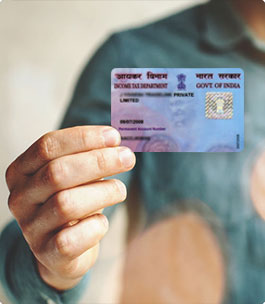
Permanent Account Number or PAN is a unique 10-digit alphanumeric identity number which is allotted to each taxpayer by the Income Tax Department under the supervision of the Central Board of Direct Taxes. It is mandatory for any financial transactions such as receiving taxable salary or professional fees, sale or purchase of assets above specified limits, buy mutual funds and many more and it also serve as an identity proof of an individual. PAN is used to check on financial transaction that could carry a taxable component by the Central Board of Direct Taxes.

It should be used for payment of taxes, assessment, tax demand, tax arrears, etc., and as well as for investment, loans and any other business activities.

For tracking financial transactions, it is used as a universal identification key that might have a taxable component to prevent tax evasion. If a person changes his/her address throughout India then the PAN number will not get affected it will be same as before. PAN Card is mandatory for any financial transaction over the amount of Rs.50,000.

Who must apply for PAN?

  • A person who has a taxable income in India, including foreign nationals, who pays taxes here.
  • In the previous financial year, a person who had total sales, turnover or gross receipt exceeding Rs.5 lakh, needs to apply for PAN.

How to apply for PAN?

A PAN card is issued by the I-T department, but since July 2003, the front-end of the process has been outsourced to UTI Technology Services Ltd and the National Securities Depository Ltd (NSDL). It can be applied either online i.e. through internet or offline.

Process of applying for PAN Card

  • It can be apply for PAN either online i.e. through internet or offline.
  • An online application can be made either through the portal of NSDL or portal of UTITSL.
  • Once the application form for PAN and payment is accepted online, then the applicant is required to send the required documents which must be self-attested through courier/post to NSDL/UTIITSL.
  • Offline PAN Card Application Form 49A for manual submission.
  • Form 49AA is also used for application of New PAN Card but this form can be used by NRIs, entities incorporated outside India and unincorporated entities formed outside India.
  • From 16/01/2014 the charges for applying for PAN online have been increased to Rs.105 (including service tax) for Indian communication address and Rs.971 (including service tax) for foreign communication address. And for the Payment of application fee credit/debit card or net-banking can be used.
  • An applicant should affix two recent color photographs with white background and the (size must be 3.5 cm x 2.5 cm) in the space provided on the form.
  • The applicant must be filled AO code (Area Code, AO Type, Range Code and AO Number)
  • Applicant will get a unique 15 digit number on acceptance of this form. This number can be used for tracking the status of the application.
  • It takes almost a week for getting the Permanent Account Number and round about 15-20 days for getting the physical card. And it is delivered through Post at the given addresses.

Structure of PAN Card

The Income Tax department decoded the PAN number in such way :

For Example: PAN is AFZKA1804A.

The first three characters of the PAN are in alphabetic series which are from AAA TO ZZZ (i.e AFZ)

The fourth character of PAN represents the status of the PAN holder (i.e “K”).

Here “K” represents an Individual

And fifth character of PAN represents the first character of the PAN holder’s last name/surname.

The next four characters in the PAN(i.e 1804) which are in numerical series running from 0001 to 9999.

Last character in the PAN (i.e A) is an alphabetic check digit.”

What does PAN Card contain?

All contain of PAN card are given below:

  • PAN
  • Name
  • Date of Birth
  • Father’s Name
  • Photograph and
  • Signature of PAN holder

Details for Other Taxpayers

  • PAN
  • Name and
  • Date of Incorporation or Formation
  • Decoding the PAN number

Once PAN card is generated, it is valid for the lifetime of the assessee and throughout the India. Even if the change involves address of the assessee or the assessing officer the identity of the PAN does not change. If any changes made in the details which were given at the time of applying for the PAN, like address, then it should be informed to the department by giving the details in the form for Request For New PAN Card Or/ And Changes or Correction in PAN Data.

PAN is mandatory for every individual, whose annual income is taxable, which means:

  • Rs.2.5 lakh or more for individuals below the age of 60 years,
  • More than Rs.3 lakh for  those who are above the age of 60 years(senior citizens)
  • And Rs.5 lakh or more for those who are above the age of 80 years(very senior citizens
  • Any person who is receives income, after deduction of all the taxes at source or who are entitle to pay excise duty and so on, they needs to have a PAN.
  • And for the financial transactions too, one has to furnish PAN or Form No. 60 if PAN is not available.
  • In a recent time, it has been made mandatory by the Central Board of Direct Taxes(CBDT) for all account holders in banks and post offices to provide PAN or Form No. 60.

Conclusion

TIN, TAN and PAN all these terms looks so alike that many of the people get confused. But in reality all the terms are so different from each other. Where the PAN, TAN are issued by Income Tax Department while the TIN is issued by Commercial Tax Department of respective state. PAN, TAN both are a 10-digit alpha numeric identity while TIN is 11 digit numerical code. Only those who are responsible for deducting or collecting tax need to get a TAN. And there are many more differences which were discussed above.

References

https://www.bankbazaar.com/pan-card/pan-tan-difference.html

https://www.quora.com/Taxes-in-India-What-is-the-difference-between-TAN-and-TIN-regarding-income-tax

http://www.differencebetween.info/difference-between-pan-tan-and-tin

https://www.bemoneyaware.com/blog/difference-between-pan-tan-tin/

Download Now

How to Import luxury cars and bike in India?

0
import

In this article, Shitij Oberoi of VIPS discusses how to Import luxury cars and bike in India.

Importing luxury cars and bike in India

We all get drooled when we see a high-end supercar or superbike on road fantasising how would it feel to be behind the wheels of such an expensive vehicle with enormous power under the hood.

Well, a lot of us might be thinking it requires a hefty amount to buy these vehicles in India since past decade has been a huge leap in our automobile sector with the most expensive rides from renowned manufacturers like Ferrari, Ducati, Lamborghini, MV Agusta, Bentley, Rolls Royce have been launched officially in India by the manufacturers themselves either independently or with joint ventures.

For example, the Indian company DSK group and Italian Bike makers Benelli have their JV as DSK-Benelli selling their bikes in India. Demergers have also been observed when a new brand acquired a strong popularity in India like recent Kawasaki and Bajaj demerger which means Kawasaki will no longer take aid from Bajaj for their sales and service network.

Having said that interest of the International Automobile manufacturer towards in India is like they see it as a Potential market and not a full-fledged market where they can roll out their full product line-up because the sales figures won’t suffice for their existence in this market. Iconic brand “Mercedes’s Indian sales figures contributes only 0.6% of the global sales for the company”- as told by Mercedes Sales Executive himself from Mercedes T&T Motors, Rajouri Garden, Delhi.

Very recently General Motors India popularly known as Chevrolet had to wind up from India due to poor sales. That’s’ why many of these mean machines are still not available in India, kudos to our roads and foreign policies which are unfavourable to manufacturers. Moreover, our government insists on manufacturing the automobile locally and discourage assembling it locally via CKD route (completely knocked down) which means bringing a vehicle into parts and assembling it or as a CBU (Completely Built Units) which means a completely built vehicle in one piece. The latter has the maximum import duty and taxes while the former has a little bit of relaxation.

The people who can afford to pay hefty imports and customs duties are no doubt millionaires but they are paying such an amount which is twice or thrice of the price of that vehicle when compared to the local market of the manufacturer.

These very minimal number of millionaires in our country attract luxury car makers to either introduce their car in India or the Buyer chooses the easy way out by IMPORTING the single pieced vehicle.so make sure you are either a uber-cool enthusiast who loves to have collectables or either you are a millionaire who wants to have a bling in his Garage.

Do you really need to Import a Vehicle?

It is always good to consider some alternatives to the car before opting for the import. The car or bike being imported can be full of hassles apart from custom or import duties, like service network, repairs, parts availability which can be a heck for the imported vehicle.

Also, the fuel used for imported sports cars and bikes is not the normal Unleaded petrol. They need the right diet which means that they run on 98 Octane fuel which is not available easily in our country. In Delhi itself, we have only 3-4 fuel station where 98 Octane is available else people have to compromise with normal 93 Octane for their exotic machines which might not allow the vehicle to perform at its full potential and may have the tendency to damage the engine.

So considering the car or bike which is offering the same level of performance or luxury available in India by the manufacturer itself is always a good option rather to go for the Import route because there would be much fewer hassles regarding the car’s parts, servicing and most importantly the warranties of the such an expensive vehicle.

Procedures and Legalities for Importing a Vehicle in India.

So let us understand what are the procedures and legalities and pre-requisites involved which are as follows-

As per the Notification passed by the Ministry Of Commerce And Industry under Foreign Trade  (Development and Regulation) Act, 1992, DGFT has laid following provisions under ITC (HS) for categories of Chapter 87 (which includes EXIM policies and requisites for cars and bikes) which states that.

  1. New imported vehicle means-
    A. Which is not manufactured in India
    B. Which has not been loaned, leased or sold before importation to India
    C. Which has not been registered to any country according to the laws of that country         before importation to India.
  2. The units of the speedometer should be in metric units rather than Imperial unit (KM/h instead of MP/h)
  3. The car should be Right Hand Drive which means the steering and controls should be on the right-hand side of the car.(not applicable for bikes)
  4. Headlamps should suit the “keep left” traffic.
  5. It should be imported from the country of the manufacturer. Incase the manufacturer’s country is an inland country and the vehicle are stored in some other country for purpose of export by the manufacturer like a warehouse then it will be deemed to be exported from manufacturer’s country provided that there are sufficient sources and document with the manufacturer required to track the shipment of the vehicle from exporting country to importing country.
  6. The vehicle should be in conformity with provision and rules of Motor Vehicle Act 1988.
  7. If imported by an importer or dealer,
    A.  (Homologation Process) at the time of importation certificate of compliance with rule 126 of Central Motor Vehicle Rules, 1989 issued by any of the testing agencies. Which means Road Worthiness Certificate issued by any testing agency.
    B. The Importer shall be responsible for all the provisions assigned to the manufacturer as per Rules 122 & 138 of CMVR, 1989.
    C. Give an undertaking in writing that the proof of compliance to the conformity of production as per Rule 126A of CMVR shall be submitted within six months of the imports.  In the case of failure to do so, no further import of new vehicle of that model shall be allowed thereafter.
  8. The import is permitted through the custom ports of Nhava Sheva, Kolkata, Chennai, Delhi Air Cargo, Mumbai Port, ICD-Tughlakabad, Cochin.
  9. The above condition no.1 and 2 of the notification would not apply in below-mentioned circumstances to this category of importers-
    A. For the purpose of Defence Requirements
    B. For for the purpose of R&D by vehicle manufacturers.
    C.NRIs through The Transfer of Residence Scheme if, Individuals coming to India for permanent settlement after two years continuous stay abroad provided the car has been in the possession of the individual for a period of minimum one year abroad.
    D. The Car won as an award in some competition/match/event by Indian Resident.
    E. The Car was owned by the deceased relat
    ive residing abroad and brought back by legal heirs/successors.F. Differently Abled persons.
    G. Any religious/charitable institute/Trust working for a community benefit of a community registered with Government of India subject to clearance under Foreign Contribution (Regulation) Act,1976.
    H. Foreign Embassies, Diplomats, Bureaucrats with the recommendation of the Government of India.
    I. News Reporter of foreign news agency with the approval of Government of India.
    J. Indian company having a foreign participation or branch office of the foreign company in India.
  10. All the categories above mentioned in point no.9 shall be in conformity with one condition that they shall be the right hand driven cars.
  11. All the categories mentioned in point no.9 shall be allowed to import max 1 vehicle except J which are allowed max 3 vehicles.
  12. Category J. in point 9 shall only be allowed to import Special Vehicles.
  13. All the vehicles under point 9 are not for sale for period of 2 years as mentioned to RTO by DGFT
  14. DGFT can grant relaxation under special circumstances for above-mentioned conditions.
  15. Category H of point 9 who are exempted to pay customs duty shall be exempted from requisite 1, 2, 3, 4 & 5, now can be sold non-privileged person through procedures of  Foreign Privileged Persons (Regulation of Customs Privileges) Rules, 1957.

Prohibited Category for Import of Vehicles

  1. Cars with engine capacity of 1000cc-2500cc.
  2. Bikes with engine capacity of  250-800cc.

When Homologation is not required?

Basically, means the certification of the vehicles to be fit to run in our conditions by the testing agency(Emissions, road safety etc). We have testing agencies like ARAI in Pune which certifies the cars with the certificate of roadworthiness. Imported new vehicles of the below-mentioned category is exempted from Homologation (Certification of Homologation process) if they are-

  1. Cars with Petrol the engine capacity of 3000cc or above or Diesel engine with capacity of 2500cc or above, they are not required to go through the homologation process like ARAI neither the importer’s duty would be held liable for provision under CMVR Act for homologation.
  2. Motorcycles with engine capacity of 800cc or above are similarly not required to go under homologation process.
  3. Vehicles with FOB or CIF(cost+insurance+freight) value of $40000 or above.

Though the vehicles exempted in the above-mentioned category still require and certification form any AUTHORIZED TESTING AGENCY OF EU like ECE, NCAP(European Standards of Certification); just before being exported from the origin country.

Now the most awaited part-

How much is the import duty?

According to ITC -HS Codes (Harmonic System Codes) Vehicles are mentioned under the chapter 87 of the HS codes. In this chapter various categories and subcategories are mentioned according to engine type or vehicle type like two wheelers / three wheelers / four wheelers / Special vehicles like broadcasting vans, tractors, cranes etc.

So luxury cars  fall under the category of HS code- 8703 24  Which includes racing cars as well
With cylinder capacity of 3000cc or above

Whereas motorcycle with cylinder engine capacity of 800cc or above are also mentioned in chapter 87 under the head 8711 50 which talks about the import duty rate of motorcycles as-
So the Import duty for the Cars is total of whooping 165% of the CIF value (Cost+freight+Insurance) and for the bike it is a bit less at 116% of the CIF value.
Additionally, registration with the RTO will also apply as applicable by the State Government.

Conclusion

Well by just reading the conditions and complications involved in the Import of the vehicles half of the people seeking to import might have changed their decision to not to import the vehicle since conditions and infrastructure of India is still not favourable to the imported the vehicles. So before importing consider all the option available in that segment of the vehicle. Import a vehicle only if it is must and you are not willing to compromise and there’s no other alternative or option available.
Not only you need to spend more than twice which will be a hole in your pocket, also it will be a serious task to take care of the maintenance.

Download Now

How to prepare for Clat 2018?

1
PREPARE FOR CLAT 2018

In this article, Diksha Chaturvedi discusses How to prepare for Clat 2018.

Common Law Admission Test (commonly called as CLAT) is an all India examination for undergraduate and postgraduate courses conducted by the 17 NLU on a rotational basis. How to prepare for CLAT is a common question which pop-ups in every candidate’s mind. To make it easier for you, here is a detailed strategy mentioned below which will surely help you in cracking CLAT 2018. But let us first know about the qualification it requires to apply for CLAT and the syllabus which it covers.

Education Qualification

For LLB
A candidate should have cleared his 10+2 or obtained an equivalent certificate from a recognized board. One should have scored a minimum of 45 percent marks as aggregate. Candidates who have appeared for 10+2 exam can also apply subject to conditions.

For LLM
For LLM, a candidate should have LL. B/B. L. Degree or an equivalent degree from a recognized University with not less than 55% marks in aggregate.

Exam pattern

FOR LLB:
Total marks: 200
Total number of questions: 200
Duration of the exam: 2 hours

Subject Marks
English including comprehension 40
G.K. (static/current affairs) 50
Elementary Mathematics 20
Logical Reasoning 40
Legal aptitude 50
Total Marks 200


FOR LLM:

Total Marks: 150
Duration: 2 hours

Topics Marks
Long Essay type questions which cover Constitutional Law and Jurisprudence 100 marks (4 ques. for 25 marks each)
MCQ questions which covers all compulsory subjects prescribed by Bar Council of India for UG course. 50 marks (50 ques.)


* There is a negative marking of 0.25 marks for each wrong answer in both the exams.

How to prepare for Clat

Preparation for Undergraduate entrance test

  • English

To study English for CLAT you can divide the course in three parts. Such as:

Vocabulary

  • You should be familiar with the words and their meaning along with their usage.

  • Make a habit to learn new words. Note down all the new words and search their meanings.
  • Whenever you come across a new word it is always good to take a look at the spelling of the words.
  • Revisiting the words you have learned will help you in remembering them till the exam.
  • Check for all the possible meanings of a single word. Very often the first meaning provides an incomplete picture so it is suggested to look upon all the possible meanings.
  • There are questions related to synonyms and antonyms. When you search for a synonym or an antonym of a particular word you learn 2-3 new words at the same time.
  • Take up vocabulary quizzes.

Grammar

  • Bring out your old grammar book and start reading up from chapter 1. Study about the technicalities connected to various topics. Start brushing up on your basic concepts.
  • Many of us go with the trick of ‘what sounds right’ to crack grammar questions. But it is technically wrong. Every time what sounds right is not actually the right answer. So it is better to not go with the ‘intuition’.
  • Best ways to identify problem areas in grammar is to attempt error correction questions. This will help you to find grammatical flaws in the sentence.
  • Look publications within your preferred genre which carry well edited articles. Websites of The Hindu, Huffington Post India, Washington Post and The New York Times for instance, carry articles of a diverse range of topics. Make it a habit to read through articles in such publications. 
  • For an easy and better learning it is advisable to download grammar apps in your phones.
  • Practicing will help you to excel in this area. So take up as many questions, quizzes, you can to improve your grammar.

Reading comprehension

  • CLAT is an exam which has time limitation. RC questions take more time than any other question in this section. It is advisable to divide your time wisely and increase the reading speed. For this you can take a passage and set a timer of 5 minutes. After 5 minutes check how many words you have covered and accordingly keep practicing.
  • Always note important points in the passage rather than copying everything that is said in the passage.
  • General Knowledge

  • Newspaper:
    One must be in a habit to read a newspaper daily ( preferably ‘The Hindu’). You cannot afford to miss reading a newspaper a single day. It must be in your daily routine to at least spend 2 hours on a paper, make notes out of it which will help you in the revision for CLAT.
  • Monthly Magazine:
    Pratiyogita Darpan can be very useful if you pay attention to it on a weekly basis. Read at least one weekly magazine.
  • Annual Magazine:
    Either Manorama or Panorama, will do. Try getting hold of ‘The Hindu- Diary of Events’ which is a neat round-up of all that has happened in the preceding year.
  • Static G.K:
    A basic knowledge of History, Geography and Sciences will suffice. I’d suggest you to try to flip through the pages of Pearson’s book on General Knowledge to stay ahead in the race. I reiterate, does not just mug up. If you do so, nothing will register in your head. Take interest. To generate interest, have frequent discussions with fellow CLAT aspirants. 
  • Mathematics

    The level of math tested in CLAT is elementary 10th  grade Math. More importantly, it comprises of 10% of the CLAT exam. Now, why is bunking Math prep not a good idea? Firstly, it comprises of 20 marks, 20 easy-to-score marks. Math section is the most scoring section for you as it does not require as much number of hours as the rest. Best way to get through this section is to practice from ‘Quantitative Aptitude- R.S Sharma’. Try not to leave a single question from this book.

  • Logical Reasoning:

    Logical Reasoning comprises of:

  • Syllogisms
  • Assumptions/Conclusions/Arguments/Actions
  • Logical sequences
  • Blood Relations
  • Number test
  • Directions
  • Coding-Decoding
  • Ranking
  • Verbal Reasoning
  • Arrangements
  • Calendar
  • To know about the exam pattern, refer to last question papers.
  • Refer to logical reasoning books and solve as many problems as possible
  • Take all the online tests available.
  • Learn easy and adaptable tricks and shortcuts to solve the problems easily.
  • Have a time-management strategy in place so that you are able to attempt each question and not leave out any.

Legal Aptitude

  • This section typically comes from 4 major topics:
    Law of Contract             
    Law of Torts
    Criminal Law
    Indian Constitution


  • Refer to past question papers and solve as many problems as possible
  • Understand the question thoroughly and come to a logical conclusion
  • Try to time yourself when you are attempting this section so that you know exactly how much time is to be spent on each question.

Few other Tips & Strategies

Latest Syllabus and Pattern of CLAT

  • Candidates must be well aware with the latest syllabus and exam pattern of CLAT. For that they can refer to previous year question papers, sample papers or current years sample papers. 

Online Mock tests:

  • There are various online mock tests available which would help the candidates to be well aware of the exam pattern and would help them in practicing for the paper. This will help you to understand the level of difficulty in paper.

Clear your Doubts

  • Clearing all your doubts is very essential for you to score good marks. For that you can consult your faculty members or search online results for the same.

Proper Utilization of time:

  • First of all, you need to prepare a timetable under the guidance of your faculty and have to make a habit to study according to it. Everyday you must devote your time to each subject. Do not leave a single subject in a day. Spend at least 2 hours on each subject along with reading a newspaper on a daily basis.

Prepare Notes:

Preparing notes for current G.K or for any other lengthy topic will help you in saving your time. Moreover it is easy to study from your own notes rather than from books. These notes will immensely help you in the last 30 days of CLAT.

Strong Vocabulary.

  • Vocabulary will help you in English and Legal aptitude. Try to grasp as much new words as you can. Start with learning 10 new words daily and use them in your daily life.
  • PRACTICE!! PRACTICE!! PRACTICE!!Solve as many mock tests as you can.It will improve your overall performance. Time management is all you need to do to solve 200 questions in 2 hours.

Important Books

  • Word Power Made Easy by Norman Lewis
  • English is Easy by Chetananand Singh
  • Butterworths Lexis Nexis
  • Analytical Reasoning by M. K.Pandey
  • Verbal Reasoning by R.S. Aggarwal
  • Objective Arithmetic by R.S. Aggarwal
  • Analytical and Logical Reasoning by R.S. Aggarwal
  • GK Today
  • Manorama Year Book
  • India Year Book
  • Universal’s LLB Entrance Guide

References

  • https://www.gktoday.in/
  • http://www.jagranjosh.com/current-affairs
  • http://www.lawentrance.com/clattestseries/
  • https://www.vocabulary.com/lists/52473


Download Now

What is e-discovery? Why don’t we have e-discovery in India?

0

In this article, Vidushi Pandey of Sri Ramswaroop Memorial University discusses what is e-discovery? Why don’t we have e-discovery in India?

What is e-discovery

“Electronic discovery (also e-discovery) refers to discovery in legal proceedings such as a litigation, government investigations, or freedom of information Act request, where the information sought is in electronic format (often referred to as electronically stored information or ESI).”[1]

  • Electronic information, contrary to manual information, can be stored in a much more efficient and easy manner.
  • E-discovery means, ‘any activity in which electronic data is involved’. It refers to any process in which electronic data is needed, placed, and examined which could be beneficial, and can be considered as evidence in criminal and civil cases.
  • Paper documents consume a lot of human resources, due to the extensive work involved with it. Electronic information is very easy to be found and also to store. Moreover, virtual data is very easy to preserve and store in computers. It is much more convenient, as people don’t necessarily need to be physically present in order to prove necessary things.

When we look at the history of e-discovery, we can find that it was not available, instead, there was the presence of manual discovery, which implies the exchange information with each other (i.e. both or several of the parties involved).  It was the process through which a company or an individual was said to discover which is going to be used as an evidence in the process of litigation or negotiations. The information which is stored in electronic formats is known as Electronically Stored Information (ESI).

There are two types of e-discovery, namely, Civil E-discovery and Criminal e-discovery. They both fulfil different objectives. The way of discovery is totally different in both these cases. Let us discuss this further.

Fields where e-discovery will be useful

Social media

Nowadays social media is playing a significant role in the litigation. Social media is a useful source in e-discovery. For instance, in the process of litigation, the victim party may produce the digital data. Hence the digital data is not that easy to use as evidence. With the initiative of Digital India by our honourable Prime Minister With the progressive initiative taken by our honourable Prime Minister namely ’Digital India’, our Indian judiciary has taken progressive steps as well. So this is the hope for the E-Discovery which can be effectively implemented, and it is desirable that the judiciary considers findings made via E-discovery admissible in court.

Cyber forensics

In India, the Cyber Forensics and Ediscovery evidence are still in the grey areas. We still do not have any Systematic legal framework of e discovery and cyber forensics. India needs to pay special attention to the crucial fields like media forensics, corporate fraud funds, valid sting operations, cyber crime investigation capabilities. India is likely to face challenges in the upcoming future due to the e-courts in India and online dispute resolution.

E-Discovery For Cloud Computing In India

In India, we don’t have a legal framework for Cloud Computing. The national telecom policy 2012 of India tells the importance of legal framework for cloud computing & its regulation. It is related to the legal sector as it involves regulatory issues concern with the litigations. Virtual data rooms for legal compliances in India, and it is based on cloud computing. Data rooms, mergers, legal compliances. This would help in cost benefits and efficiency advantages.

How does e discovery work?

The process of e-discovery is generally followed by legal firms, against the third parties (primarily the opposite parties). The procedures and technologies around e-discovery are quite hectic due to the enormous stock of stored data. Discussing the process of e-discovery and not mentioning electronic discovery reference model (i.e. EDRM) would do injustice to the topic. On the following basis, then diagram given below, explains the process of e-discovery.

e-discovery

Explanation of the above figure

  1. Information Governance– It is the foundation of the ediscovery process. It stores, controls all the policies, procedures and company’s information.
  2. Identification– It identifies the potentially relevant information which includes the parties information, facts related to case, laws etc. But they cannot preserve anything, they have to search firstly what is worth keeping.
  3. Preservation– Now after identifying the relevant information, it is preserved. So that no elimination or alteration can be done with the evidence. In this, a legal team messages or communicate the custodians to save the information.
  4. Collection– In this a legal process is been taken to gather the information. So that no alteration can be made.
  5. Processing – This process sends the information for attorney analysis and review.
  6. Review– It is the most expensive stage which involves the reviewing of the information.
  7. Analysis– It can be witnessed in every step yet it analyses the content , topics information.
  8. Production– It determines that how the information should be produced so that it can help the relevant information to become the potential evidence.
  9. Presentation– It gives the answer to the question that how electronically evidence must be displayed.

What are the advantages of e discovery?

  • E-discovery means producing electronically stored information (ESI) to the authorised authority. E-discovery is a process and its unique procedures and practices can affect any businesses that depend or rely on visibility and can control over ESI. Now, there is a unique speciality when it comes to legal e-discovery, as it aids to the process of litigation, in an immediate as well as prolonged manner.
  • Due to its universal nature, it gives a competitive edge to focus globally and that is the fact that it is universally accepted.  
  • It’s very easy to store and carry. The accuracy of computers is that the date and even the time can be detected and it is beneficial for the several kinds of cases.
  • Exchanging the information in electronic formats and reducing the cost of printing, therefore making it more eco–friendly.
  • It is easy to access to the computer anywhere and at any time. All expenses are transparent and easy to understand.
  • Electronic findings can be eliminated but not completely, as it is possible to recover the deleted information.
  • Litigators today must be in practice to inculcate the habit of collecting, reviewing and storing electronic materials and data at the beginning of the case. The ambit of ESI is vast and cannot be restricted to social media or emails.
  • The paramount concern is that there is a huge shortfall of the litigator’s involvement with the e-discovery. To meet clients e-discovery needs, One has to be quick in adapting the changes occurring in the in the field of technology. E-discovery has its own pros and cons but the chief principle is to take the best out of it.
  • Many of them are appraising the changes made by the technology but on the other hand, many of the attorneys oppose to acquire any of the technology changes. E-discovery has brought new opportunities. There are many profits given by the e-discovery.

e-discovery

Can India Have E-discovery?

Yes, India can have e-discovery. However, before pondering about the future let’s focus on the present challenges. They are:  

  • When we question the existence of e-discovery in India then first and the foremost thing that comes to mind is the free internet access.
  • The another thing which should be kept in the mind and that India is a very divergent type of country. The people here are basically divided into 3 groups and that is, upper class, middle class and lower class. And their perspective on the internet is different and unique.
  • Some are like upper-class people who are fully aware of the internet and they have no problem in accessing to the computer. But at the same time the lower class people don’t know how to access the computer and middle-class people are reluctant to the change in anything new and most of the India is of a middle-class family.
  • According to many surveys and reports, it has been mentioned that India is one of the most prominent emerging usages of the mobile and networks. There is a huge penetration of the internet. Banking has also become nowadays digital.  

Challenges to E discovery in India

  • Firstly, there are no provisions laid down in any of the acts related to internet policies and its privacy.
  • There is a lack of knowledge of technology and literacy rate is also average on the scale.
  • We have no special provisions and acts which deal with the protection of e-discovery, privacy rights and laws in India and there is no laws related to e-discovery till now. Indian national privacy policy is still not there and it is crucial need of it.
  • Recently an interim order is passed by the Apex Court and according to it only Indian laws and Indian firms can provide e-discovery services in India. This is again a major drawback in implementing the e-discovery records.
  • It is going to be hard for the Indians to face the challenges and e-discovery is still taking its shape to form an ideal shape.
  • There are still law firms in India which are not aware of the laws in India.
  • The first challenge appearing on the surface is the clash between the discovery of demands and protection of electronically stored data.
  • The next challenge in e-discovery that whether the information is collected for valid purpose or not.
  • The geographical area plays an important role in establishing an e-discovery system.

What changes will Occur if India has E-discovery?

The changes are in the way as India is the largest emerging hub of network and mobile. So there is a light at the end of the tunnel as e-discovery will bring the changes in each and every field. The issues which can be recently seen are like cyber crime and this will give the opportunities in establishing e-discovery. The changes which can be seen are like e-discovery will be systematized in AI ( artificial intelligence ). Then legal answers would be given by them.

The respective changes can be brought are:-

  •     There is an increased volume of information in all cases.
  •    Expansion of discovery work.
  •    Now every data is stored in the cloud.
  •    The abundance of legal technology and service providers.

Cases relating to e-discovery

In Re EisensteinIt is the famous case because in this the e-discovery ethics have been told. If you rely on your clients to help with investigations, you must carefully look all gift horses in the mouth. If the client comes up with emails by the other side or any other information, you must investigate the Providence, the chain of custody. If it was stolen, especially if it contains attorney-client information, you must disclose this fact immediately. This can get tricky if a crime was committed by your client. You may have to withdraw in the process. But you certainly cannot hide and use the stolen evidence.[3]

Oracle vs. Google This case focuses on the authenticity of electronic document Review. In this Oracle firstly argues about the perpetrating the discovery concealment by Google which was uncivilized. Oracle then blames the Google for keeping the discovery to itself intentionally which was demanded in the trial. Multi-billion dollar copyright infringement case. Probably the biggest jury trial of the year in 2016. Tens of millions of dollars have been spent on legal fees by Oracle. And yet, a major e-discovery blooper was made by Plaintiff’s counsel in the motion for new trial.[6].

Conclusion

  • The scope of legal e-discovery has increased in the recent past years. E-discovery means everything is in the electronic formats. It is the most paramount topic of the present world. To conclude it can be said that e-discovery can bring many opportunities and save time and money. E-discovery is creeping into everywhere.
  • E-discovery involves both: the legal field as well as  IT also. As technology is evolving, e-discovery is marking its importance.
  • For legal solutions, you may go to the website e-discovery Point – e-discovery software. It is a U.S. based e-discovery software which was made to meet the expectations of the clients which provides speed, is easy to access and gives accurate results.
  • Another solution can be Caselogistix It is based on the Robust SQL and database foundation. You just have to install this app or you can call on this No. 1-888-728-7677. It is a kind of production platform presenting a quick , simple, and gives the output in more accurate form.

References

  1. Ed. Handbook of Digital Forensics investigations.Academics.Press P.587
  2. 2016, BL 107979, Mo. No. SC 95331, (4/5/16)
  3. 2016
  4. Cohn vs. Guaranteed Rate, Inc. N.D, CV (N.D. Dec. 8,  2016)
  5. NO. C 1006561 WHA (ND Case Sept. 27,2016)
Download Now

Impact of Panama Leaks on India

0
panama

In this article, Sachin Vats of Rajiv Gandhi National University of Law discusses the impact of Panama leaks on India.

Panama Papers: Impact on India

The whole world was suddenly flooded by the several big names being accused of storing unaccounted wealth in tax havens in various forms after the Panama Paper leaks. The list included the names of the twelve world leaders who are either serving or ex-heads of the States. Some prominent names are Vladimir Putin (the President of Russia), the Prime Minister of Pakistan Nawaz Sharif, the Chinese President Xi Jinping and former PM of Pakistan Benazir Bhutto and others.

The allegation that was made in the Panama Papers leaks that Mossack Fonseca helped the investors in establishing offshore companies in tax havens countries to evade tax in their respective countries. So, all these activities were done in the garb of providing legal consultancy in financial matters.  

What is Panama Paper all about

  • The Panama Papers is an international collaborative project of around 400 journalists from more than 100 media organisations in over 80 countries who worked on an unprecedented leak of 11.5 million files. These files are the records of the database of the Panama-based  world’s fourth biggest offshore law firm named “Mossack Fonseca”.
  • The records were leaked by the German newspaper “Suddeutsche Zeitung” which was obtained from an anonymous source not yet known. The German newspaper shared them with the International Consortium of Investigative Journalism (ICIJ).
  • The International Consortium of Investigative Journalism then shared those papers with a large network of international partners including the Guardian and the British Broadcasting Corporation (BBC).The leaked data ot total size 2.6 terabytes contained 11.5 million documents of Mossack Fonseca firm which helped the investors around the world to evade tax, launder money and others.

What is there in the leaked Panama Papers

  • The data which was leaked mainly comprises of emails, pdf files, photo files and excerpts of an internal Mossack Fonseca database from 1970 to 2016. The information revealed was about, how overseas industry led by major banks, legal firms and asset management companies secretly manages the assets of the world’s rich and famous personalities from politicians, fraudsters, FIFA officials, drug smugglers to celebrities and professional athletes.
  • It provided a clear picture of how Mossack Fonseca routinely accepts investment and money from world’s rich and famous people to engage in business activities that potentially violate laws of many countries, besides helping and abetting tax evasion and money laundering.

What is Mossack Fonseca and its work?

“Mossack Fonseca” is a Panama based law firm which provides services that includes incorporating companies in offshore jurisdictions such as the British Virgin Islands. It provides administrative and wealth management services. It is the world’s fourth largest offshore services provider and acted for more than 300,000 companies. The law firm has strong connection with the United Kingdom as more than half of the companies are registered in British administered tax havens.

  • Mossack Fonseca is specialised in setting up offshore shell companies in tax havens around the world. An overseas address is provided to the company which cannot be traced to the beneficial owner.

The offshore companies do not have any significant assets or operations. They exist on paper only and serve as basis for the other business transactions. They actually provide anonymity and its ultimate ownership is difficult to trace. It helps in evading taxes and launder money.

The using of offshore services is entirely legal. The business people in countries such as Russia and Ukraine typically put their assets offshore to protect themselves from the criminals and keeping hard currencies with them. So, it is done in the legitimate way and with reasonable cause. Many people use offshore for inheritance and estate planning.

The Involvement of the Indians

The Indian Express which was the partner of the International Consortium of Investigative Journalists project on the Panama Paper Leaks has revealed the names of over 500 Indians in its report after the 8 months long investigation of over 36,000 files. The list shows the names of corporate figures like the DLF owner K P Singh and nine of his family members, the Indiabulls Sameer Gehlaut, Vinod Adani who is also a businessman and elder brother of Gautam Adani. The name of the India born Dutch businessman Ratan Chadha who is the founder of the Mexx clothing is also there..

  • The list contains the names from big businessmen to celebrities of Bollywood and politicians. Big names from bollywood are Amitabh Bachchan, Aishwarya Rai Bachchan. Two politicians who figure on the list are Shishir Bajoria from West Bengal and Anurag Kejriwal, the former chief of Delhi unit Loksatta Party.
  • Mohan Lal Lohia, Abdul Rashid and others are also named in the list revealed by the Panama Papers leak. The list also shows the addresses of businessmen in Panchkula, Dehradun, Vadodara and Mandsaur. It also includes cricket franchise deals and linkages of those people who are already under the scrutiny of the Central Bureau Of Investigation and Income Tax department.
  • The allegation against Indians is that they set up their offshore companies long before the rules were changed and their intention was to place foreign exchange in a tax haven. It was only in 2013 that individuals were allowed to set up subsidiaries or invest in joint ventures under the Overseas Direct Investment window.

Violations of Indian Laws Under Panama Papers Leak

There are mainly laws which are being violated in Panama Papers case which have been found under the investigation,

  1. The Incorporation of Companies Overseas.
  2. Acquisition of the majority shares of overseas companies in contravention of FEMA rules.
  3. Violation of RBI’s Liberalised Remittance Scheme.

According to Indian laws, Indians could not incorporate companies outside India because remittances to foreign countries were not allowed before 2004. The Reserve Bank of India in 2004 introduced a scheme called as Liberalised Remittance Scheme which permitted individuals to remit upto $250,000 in phases. The remittances could be for various purposes like medical, gifting, buying shares, etc. But, the Reserve Bank of India allow individuals to specifically set up a company.

  • The people were facing with a lot of confusion on this issue. So, the Reserve Bank of India came up with a notification in the year 2010 that though Liberalised Remittance Scheme allows for buying shares, it specifically prohibits setting up of companies abroad by individuals.
  • The Reserve Bank of India came up with another notice in 2013 in which it allowed resident Indians to invest directly in joint ventures and through the Overseas Direct Investment route. So, the setting up of a company overseas by Indian can be considered legal only if it was done after the year 2013.

The Supreme Court on Panama Leaks

Advocate Manohar Lal Mishra filed a PIL before the Hon’ble Supreme Court to probe independently against all those whose names were revealed in the Panama papers. The allegation was made against 500 Indians including celebrities and industrialists. They parked their funds in offshore accounts and they need to be prosecuted. It was pleaded that the Centre was not inclined to proceed against them and sought Court monitored investigations against them.

A bench headed by Justice Dipak Mishra and comprising of Justice A.M. Khanwilkar and Justice M.M. Shantanagoudar asked Assistant Solicitor General PS Narasimha to seek instruction on whether a separate SIT can be tasked to probed the Panama Papers leaks, besides Multi-Agency Group (MAG) set up by the government to probe into the black money case. The Supreme Court decided that the probe into these cases are not like normal crime incidents as it involved various aspects, like treaties with foreign countries, agreements for disclosures, etc.

Constitution of Multi-Agency Group by the Central Government  

  • The central Government constituted a Special Investigation Team (SIT) on Panam Papers leak. The government has constituted a Multi-Agency Group on 4th April, 2016 for facilitating coordination and speedy investigation in the cases of Indian Person’s allegedly having undisclosed foreign assets and whose names are reportedly included in Panama Papers leak.
  • The MAG consist of the officers of Investigation Division of the Central Board of Direct Taxes (CBDT), Enforcement Directorate (ED), Financial Intelligence Unit (FIU) and Reserve Bank of India (RBI). The convenor of the MAG is one of the member of the investigating team from CBDT.
  • It has been asked to report the progress in such cases on regular basis. The investigation team has been ordered to conduct a time bound enquiry in the Panama Papers leaks. The Government has taken necessary measures for expeditious investigation in such cases including through enhanced international cooperation.
  • The members of the Multi-tasking Agency which is headed by the CBDT have informed the Government that of the 415 Indians out of which 71 are NRIs. 184 have admitted that they incorporated the offshore entities listed against their names. The CBDT has found 70 people as ‘not traceable’.
  • The Income Tax Department has sent over 250 requests to the British Virgin Islands and about 20 to Switzerland. The responses have been received in about 100 of the requests sent.

The Mother of all Leaks

The Panama Papers Leaks is called as the biggest ever leak in the history. It contains data of around 2.6 terabytes which is greater than adding all previous leaks. In 2010, the Wikileaks provide the data of around 1.7 GB about the United States Diplomatic Cables. The ICIJ in 2013 leaked the data about offshore leaks which was 260 GB and about the Swiss leaks in 2015 which was around 3.3 GB of data. The International Consortium of Investigative Journalists in Luxembourg leaks provided the data of around 4 GB in 2014. So, the Panama Papers leak is the biggest leak ever. It is bigger than the leas done by Wikileaks in 2010 and the secret intelligence documents given to journalists by Edward Snowden in 2013.      

Conclusion

We cannot come to the conclusion right now only after seeing the name of the people. The investigation in the case is at preliminary stage. The Washington-based organization International Consortium of Investigative Journalists has clearly displayed on its websites that it should not be assumed that everyone who appears in the Panama Papers is involved in tax avoidance or evasion. There are legitimate reasons to create a company in an offshore jurisdiction and many people declare them to their tax authorities when that is required. So, in view of the above, the further course of actions depend upon the outcome of the investigation.  


Download Now
logo
FREE & ONLINE 3-Day Bootcamp (LIVE only) on

How Can Experienced Professionals Become Independent Directors

calender
28th, 29th Mar, 2026, 2 - 5pm (IST) &
30th Mar, 2026, 7 - 10pm (IST).
Bootcamp starting in
Days
HRS
MIN
SEC
Abhyuday AgarwalCOO & CO-Founder, LawSikho

Register now

Abhyuday AgarwalCOO & CO-Founder, LawSikho