Download Now
Home Blog Page 1558

Offences under the Scheduled Caste And Tribe (Prevention of Atrocities) Act, 1989

0

In this article, Himanshi Khurana of Rayat Bahra Law College Chandigarh discusses, Offences under the Scheduled Caste And Tribe (Prevention of Atrocities) Act, 1989.

Introduction

Being in a country like India where Indian Constitution is above all, where all the citizens are treated equally can anyone imagine that discrimination is practised among the people?

The answer to this imagination is yes! The Scheduled Castes and Scheduled Tribes which are the officially designated group of historically disadvantaged people in India have existed since the 1850s. These communities were considered as the most depressed classes. In early 20th century, various reforms were introduced by Britishers like Morley Minto reform, reforms by Simon commissions in order to increase their position in society. In 1935 Indian Government has introduced “Government of India Act, 1935” under which reservations for the depressed classes were made for the very first time.

Post Indian Independence also provisions were made acts were introduced for the sake of development of such depressed groups.

Constitutional Provision

In order to stop this discrimination or offences that are going on against the people of scheduled caste or tribe the Constitution of India provides with various articles such as;

  • Article 17 of the Constitution which provides for the abolishment of Untouchability.
  • Article 46 of the Indian Constitution makes it a provision for the state to take special care of the educational and economic interests of the weaker section of society specially scheduled castes and scheduled tribes and protect them from all forms of social injustice.
  • Article 330 and 332 of the Constitution provides for the reservation of seats for the Schedule Castes and Schedule Tribes in the House of People and in the Legislative Assemblies and state.
  • Article 14 to Article 18 of the Indian Constitution deals with the fundamental right to Equality and Equality means equality before law, prohibition of discrimination on the basis of caste religion, gender etc. and provides for equal opportunities to all.

The Scheduled Caste And Tribe (Prevention of Atrocities) Act, 1989

Only constitutional provisions are not sufficient for the upliftment of the members of backward classes need is to specify certain offences with its strict punishments and implementing authorities.So for this a separate act called “The Scheduled caste and tribe (Prevention of Atrocities) Act, 1989 was introduced.

Under this act the term ‘atrocities’ has been used as any act of inhumane nature against the members of scheduled caste and scheduled tribes these acts also includes the crimes that are mentioned under Indian Penal Code.

This act specifically deals with certain offences of atrocities against scheduled caste and tribes commission of which is punishable.

Offences Under The Scheduled Caste And Tribe (Prevention of Atrocities) Act. 1989

Offences of atrocities under the Act are listed below:

Whoever, not being a member of Scheduled castes or scheduled tribes:

  1. Forces any person who is scheduled caste and scheduled tribe to eat or to drink any inedible or awful substance.
  2. Commits the act of dumping excreta, waste matters, carcasses or any other bad substance in the premises or neighbourhood of any member of Scheduled caste and tribe with intention to cause injury, insult or annoyance.
  3. Commits any act against any member of Scheduled caste and Schedule tribe which is derogatory to human dignity like the act of forcibly removing clothes or parades him naked or with painted body or face
  4. Wrongfully takes over or cultivates the land which is owned by or allotted to or notified by any competent authority to be allotted to any member of Scheduled castes and tribes
  5. Wrongfully dispossesses or interferes with the enjoyment of any right over the land which is specially given to the members of scheduled castes and tribes.
  6. Compels any member of Scheduled castes and tribes to do a form of “beggar” or bonded labor or any other forced labour
  7. Forces or intimidates any member of Scheduled castes or tribes to caste a vote in favor of some particular person or stop them to caste the vote or to vote in a manner other than provided by law.
  8. Institutes false or malicious suit or any other criminal proceedings against any member of Scheduled caste and tribes.
  9. Gives any wrongful information or malicious information to any public servant which makes that public servant to use its official power against any member of scheduled caste and tribes.
  10. Intentionally insults any member of scheduled caste or tribe to humiliate him/her in public
  11. Assaults or uses any force against any women member of scheduled caste or tribe in order to outrage her modesty
  12. Any person being in a position to dominate the scheduled castes or tribe uses that position to sexually use women which otherwise she would not allow.
  13. Corrupts or fouls the water of any source which is used by the member of scheduled caste or tribe and makes it unfit for their consumption.
  14. Denies or creates obstruction in the use of any customary passage of place which is of public resort to the member of scheduled caste or tribe
  15. Forces a scheduled caste or tribe to leave his house or village or any other place of his residence shall be punishable with an imprisonment which shall not be less than 6 months but not more than 5 years and with fine.

Whoever not being a scheduled caste or scheduled tribe

  1. Gives false or fabricated evidence with the intention of convicting any member of scheduled caste or tribe with any offence which is capital by law for the time being in force shall be punished with the imprisonment for life and fine. If because this false evidence any innocent member of scheduled caste or tribe be convicted, then the person who has given that evidence shall be punished with death.
  2. Gives false or fabricated evidence with the intention of convicting any member of scheduled caste and tribe with any offence which is not capital but punished with the imprisonment of 7 years or upwards, shall be punished with the imprisonment which shall not be less than 6 months but may increase to 7 years or upwards and with fine.
  3. Commits mischief by fire or by any other explosive substance in order to cause damage to the property belonging to any member of scheduled caste and tribe shall be punished with the imprisonment minimum of 6months but can expand to 7 years or more with fine.
  4. Commits mischief by fire or by any other explosive substance to any place or building which is ordinarily the place of worship or a place of human dwelling and such place or property is under the custody of the member of any scheduled caste and tribe shall be punished with the imprisonment for life and fine.
  5. Commits any offence under IPC which is punished with the imprisonment of 10years or more against any person or property because that person is the member of scheduled caste or tribe or that property belongs to the member of scheduled caste or tribe shall be punished with the imprisonment of life and fine.
  6. Being a public servant commits any offence under this section shall be punished with the imprisonment which shall not be less than 1 year but which may extend to the punishment mentioned for that offence.

Amendments to the Act

The act was introduced with the basic objective of delivering justice to the Scheduled caste and tribes and enable them to live in the society with full dignity, security and without any fear of violence or suppression.

But the need was felt by the Central government to amend the act and to introduce certain more offences with speedy justice process to the members of Scheduled caste or tribes further to have more stringent provisions for prevention of Atrocities. this amendment had come into force from 26 January 2016.

List of the new offences

  1. Shaving or cleaning of head or moustache or doing any other act which derogate the dignity of any member of Scheduled caste or tribe.
  2. Garlanding with chappals
  3. Not giving the access of irrigation facility or forest right.
  4. Committing any scheduled caste or tribe women to devadasi
  5. Abusing in caste name
  6. Doing social or economic boycott
  7. Preventing scheduled caste or tribe candidate from contesting elections.
  8. Doing the act of removing garments of any scheduled caste or tribe women.
  9. Forcing any member of scheduled caste or tribe to leave his village or home
  10. Defiling objects sacred to scheduled caste or tribe.
  11. Doing or passing any comments of sexual nature against any member of scheduled caste or tribe.

Present Scenario

Indian Government not only introduced various legislative or constitutional measures but also introduced various other measures for the development of the members of Scheduled caste or tribes or various other backward classes. Some of the reforms are:

  • EDUCATIONAL DEVELOPMENT- Much importance or attention was paid towards the educational development of the members of scheduled caste or tribes. They are provided with free educational facilities, books, uniforms and other basic necessities which helps them in getting education and raising their living standards.
  • ECONOMIC OPPORTUNITIES- Government has paid attention to their economic upliftment also by providing them certain economic benefits also like providing loans on less rate of interest. Giving facilities to the poor farmers in terms of seeds, cultivating machines etc.
  • OTHER PLANS- Different plans for their upliftment has been introduced like Special Component Plan (SCP) for SCs and Special Central Assistance (SCA) for ensuring that proportionate flow of funds for SCs from the other general development sector.

After introducing various reforms in almost every sphere of life the result can be seen from the the data that was released by the Planning Commission according to which between 2004-05 to 2011-12 more than half of the SC ST population are brought above the poverty line. Earlier near about 53.5% of the SC population are living below poverty line but in 2011-12 this number has been reduced to 22% only.

The path of their development is still very long to go contribution not only from government but from other citizens is also required because it was rightly said by Dr. B.R. Ambedkar “ so long as you do not achieve social liberty, whatever freedom is provided by the law is of no avail to you.”


 

Download Now

How much do M&A lawyers earn? For those interested in a career in M&A.

1
M&A lawyers

This article is written by Ramanuj Mukherjee, Co-Founder and CEO of iPleaders.

Career in M&A

Mergers and Acquisitions is an inorganic growth measure for businesses – where two or more companies either enter into a business consolidation (merger) or one of the companies assumes complete control over the other (acquisition). Many great fortunes in history have been created through M&A. For instance, the steel baron and the richest person ever in the world, Andrew Carnegie, created a steel empire through consolidating many smaller steel companies and almost created a monopoly. A similar example will that be of De Beers, which created a diamond monopoly by consolidating the entire diamond production industry. Sometimes, companies are forced to merge or consolidate through M&A, like in the case of Reliance and Idea Cellular, which were forced to merge in face of competition from JIO. Another famous example will be of Microsoft acquiring Linkedin, in order to grow its market share and revenues.

Lawyers play a major role in M&As around the world. From simple acquisitions where there is a slum sale of assets to complex multi party cross border M&As, there are very different scenarios, and lawyers have to navigate a multitude of issues from negotiating with regulatory bodies to making sure each parties interests are taken care of.

Mergers and acquisitions are complex, both in terms of procedure and the amount of legal expertise required. Due to the intricate nature of the deals the terms of the contract have to be drafted with utmost cognizance, negotiated elaborately and concerns of every party addressed (from labour union to the government regulatory bodies) and here’s where lawyers with proficiency in this area come into play.

As opposed to a civil or a criminal lawyer who needs to have the knowledge of only a single stream of law, a Merger and Acquisition Lawyer needs to possess a deep understanding and technical know-how of various fields of law and business. It is not just subjects like takeover code or taxation law, which are no doubt very important – but it involves a lot of work that is not written in any statute book. For instance, you might have to convince the RBI or Competition Commission that the deal is kosher. You may have to conduct due diligence on massive organizations that have entered into zillions of contracts, have thousands of vendors and need to comply with dozens of statutes and regulations every month – and ensure if the acquirer is going to bring on some unforeseen liabilities and risks through the acquisition. It is not unheard of that large corporations have been destroyed by acquiring an entity with tons of liability that were not quantified before acquisition.

As stakes are really high in such transactions, and given the importance of lawyers in these transactions, corporations obviously go for the best in class M&A Lawyers in order to have a successful transaction.

With all the technological advances that the world is going through, the businesses constructed around them are also evolving, thus the terms of a contract relating to M&A need to be detailed with extreme care to avoid future discrepancies and make the merger or the acquisition smooth and hassle free. Since the amount of hard work that is needed to be put in drafting the contracts for these deals is very high, therefore the fee charged too is in correspondence with it.

To give you an idea, when Laxmi Mittal, the steel baron, acquired Arcelor, Europe’s biggest steel company, a team of over 1000 lawyers worked on that deal! Even in smaller deals, it is common for 3-4 lawyers to work in a team given the volume of work. Sometimes law firms with a lot of M&A work set up transaction support practices or special due diligence wings to handle these matters. These teams sometimes run into 30-40 lawyers!

So basically a M&A Lawyer is the choirmaster of the legal orchestra that supervises mergers and acquisitions. He is the all in all and the backbone of the deal parties and their advisors. They serve as the focal point of contact for the rest of the deal team and have primary responsibility for guiding the transaction to a successful closing.

They may be an in-house attorney involved from the client’s side, but usually an M&A specialist practising with an outside law firm is hired to lead the deal. In many respects, an M&A lawyer is a legal jack of all trades. Core competencies include:

  • strategic thinking
  • negotiation
  • multitasking
  • delegation
  • organization
  • complex drafting
  • attention to detail and
  • critically, the ability to work quickly.

An M&A lawyer is involved in virtually every aspect of a transaction, from initial conception to consummation, though they rarely participate in setting purchase price and post-closing integration. The prominent functions of the M&A lawyers include:

  • Preparing the target company for sale.
  • Drafting and negotiating a letter of intent.
  • To structure the transaction.
  • Preparing a due diligence memorandum.
  • Drafting and negotiating the principal transaction agreement.
  • Drafting and negotiating bill of sale.
  • To prepare regulatory filings

In furtherance of my research on how much an M&A lawyer makes in India, I spoke to several lawyers who agreed to reveal the factors which govern how much they make by rendering their services. Various models of pricing are as follows:

  1. a flat fee
  2. Percentage of deal value
  3. Per hour fee (where the hourly rates of lawyers working are fixed)
  4. Hourly fee with a cap

What are the factors that drive the price of lawyers in M&A transactions?

  1. Time spent on drafting legal opinion and negotiations
  2. Value/stake of M&A
  3. Market/Sector to which the companies involved belong
  4. How elaborate is the due diligence process (it could be very different for a restaurant chain like CCD and a software company like Zomato)
  5. Regulatory permissions if any
  6. Minimum advisory fees

Now that is what the firm earns. Apart from large law firms, all of whom have large M&A practices, there are many smaller boutique law firms that do M&A deals, especially with rise of M&A in SME and startup sectors. Their fees are less, especially because deal sizes and stakes involved are smaller.

It is unlikely that M&A deals will be done by a single lawyer as the volume of work is very high. Even the smallest boutiques that handle M&A tend to have at least 5-10 lawyers.

According to a former partner of CAM, who requested anonymity, and is currently heading the practice for a smaller firm, large firms charge at least INR 30 lakhs for an M&A deal, going upto 1 crore or upwards depending on complexity or time spent on a deal. Partners time can be billed @ INR 20,0000 per hour to INR 70,000 per hour in an average depending on their relative demand and reputation at the market. This money goes to the law firm coffers, not to the partner’s pocket directly of course. The partner in turn draws salary and bonus, and profit share if he has any equity in the partnership.

Associates time can be billed to clients @ INR 10,000 – 20,000 per hour, again depending on experience and reputation.

A due diligence, on the simpler side, covering 3 years only can easily cost INR 12-15 lakhs if done from a large law firm if not much more.

Now that’s what the law firms earn. What about the people working in those firms? How much do they get?

M&A lawyers work really hard. When I was working at Trilegal myself as a junior, first year lawyer (usually referred to as A0 associate in such law firms), I would easily spend 12-14 hours a day in the office. I was a part of the M&A team, and there were spells where for months I will go home at 3 am in the morning, get a nap at home and come back to office by 10-11 am. I spent almost every waking hour in the office, pouring over transaction documents. I and my colleagues will sometimes not go home at all and catch a nap for a few hours on the office sofa.  

So if you are going to work so hard, you got to make some good mullah, right? How much do lawyers earn in such firms?

A lawyer who works at Shardul Amarchand Mangaldas, on condition of anonymity, told me that in the first 2-3 years, there’s not much difference in the pay scale in a tier-1 law firm Associate working in litigation and M&A respectively. Also, the 7 big law firms pay mostly more or less identical salaries for the first few years. Depending on the success you build as a junior associate and importance of the matters you work on, salaries begin the diverge. Bonus could be substantially different though, depending on which team had a good year (profits).

The difference of salary amongst various practice areas, such as dispute resolution, banking and M&A crops up after 3 years usually. M&A lawyers tend to get the best though this is not a certainty always. A top notch banking or projects associate or partner could earn as much or more depending on the share they bring in to the firm’s revenue. Of course, M&A lawyers may have a natural advantage there.  A tier-1 law firms a M&A lawyer, at partner level (with around 10 years of work experience), receives average all inclusive annual pay in the range of 90 lakhs and 1.2 crores. There are of course stalwart partners, the shakers and movers of the M&A industry, who could take home 20 times more than that. A partner at a tier 2 firm I know of, takes home 16 times the salary of the entire team under him (which is about a crore rupees per annum).

LIST OF TIER 1 LAW FIRMS IN INDIA WHICH PAY TOP SALARY TO M&A LAWYERS

  • AZB & Partners.
  • Cyril Amarchand Mangaldas
  • Shardul Amarchand Mangaldas
  • Khaitan & Co.
  • J Sagar Associates.
  • Luthra & Luthra Associates
  • Trilegal

Other law firms that pay top salaries to M&A Lawyers

  • S & R Associates
  • Pathak & Associates
  • Economic  Law Practice
  • Desai &  Diwanji
  • Wadia Gandhy

M&A lawyers

The chart above represents the income which the M&A Lawyers receive at the end of a successful transaction based on the M&A advisory quality or the size of the deal in question. This is definitely keeping in mind number from jurisdictions like USA and EU, but Indian market is not very further from this.

Take a look at some of the M&A transactions below, and speculate – how much the lawyers would have earned out of this?

M&A lawyers

The above data is a tabular representation of recent major merger and acquisition deals in India.

Demand is on the rise for lawyers specialising in mergers and acquisitions, as the M&A market remains hot in India and companies aim to create mini in-house law firms to cut cost. Increasing M&A opportunities within and outside India are prompting companies in sectors such as pharmaceuticals, infrastructure and core manufacturing, as well as big conglomerates, to hire top talent to deal with the legal intricacies of deals. In the past six months to a year, there has been a 40-45% increase in demand for M&A lawyers in the country, with the salaries of partners ranging easily from INR 1.5 crore to 3 crore.  With the current market sentiment, the importance of M&A lawyers is going to surge therefore the future earnings of legal experts dealing with M&A is going to increase phenomenally.

Verdict: It is definitely a great time to get into M&A, if you have to skills, grit and work ethics required to be an M&A lawyer. It is a path only for the most ambitious though.

If you are wondering where to start, and how to acquire the basic skillsets and knowledge that will give you a shot at this high flying career orbit – you can consider this M&A law course. Take a look at the course specialization in M&A, Investment Laws and Institutional Finance by clicking this link here


Click here to for free materials!

 

All the best!

Download Now

An analysis on Insolvency and Bankruptcy Board of India (Voluntary Liquidation Regulation 2017)

0
voluntary liquidation

In this article, Priya Venkatesan of Tamil Nadu National Law School does an analysis on Insolvency and Bankruptcy Board of India (Voluntary Liquidation Regulation 2017).

In 2016, the need for creating Insolvency and Bankruptcy Code of India was seen after having numerous laws, dealing with debt recovery and insolvency intermingled with each other. This code, established a board called Insolvency and Bankruptcy Board of India (IBBI). The board under its powers conferred by Section 58, 196 and 208 of the code released Voluntary Liquidation regulation. This Article is a detailed analysis of the same.

Insolvency and Bankruptcy Board of India (Voluntary Liquidation Regulation 2017)

The Insolvency and Bankruptcy Code of India provides for Chapter V which deals with the Voluntary liquidation of a corporate person. The Voluntary Liquidation Regulation, 2017 was formed by the Board (IBBI) by virtue of its power under 59(2) of Insolvency and Bankruptcy Code of India 2016. The Voluntary Liquidation Regulation, 2017 applies in cases where a corporate person intends to liquidate itself.

The regulation lays down the procedure to be followed while liquidating a corporate person and gives authenticity to a liquidation. The regulation has 8 chapters in total and is a very compact yet all-encompassing regulation.

What constitutes a corporate person?

Since the Regulation deals with the voluntary liquidation of a corporate person, it becomes necessary to understand who a corporate person is. Under Insolvency and Bankruptcy Code of India, 2016, the definition of corporate person is given under Section 3 (7). Under the said section, “corporate person” can be:

  • A company as defined in clause (20) of section 2 of the Companies Act, 2013, i.e. A company incorporated under Companies Act, 2013 or any other Companies Act.
  • A limited liability partnership, as defined in clause (n) of sub-section (1) of section 2 of the Limited Liability Partnership Act, 2008, i.e. A partnership registered under Limited Liability Partnership Act, 2008.
  • Any other person incorporated with limited liability under any law for the time being in force.
  • It shall not include any financial service provider.

What is “liquidation”, why would a corporate person liquidate?

Liquidation is dissolving of a company. Many a time, an insolvent company would want to liquidate itself. There can be various reasons why a company wants to liquidate itself. Since these regulations apply to a corporate person willing to liquidate voluntarily, the reasons may differ for each corporate person.

Need for the Regulation

The board (IBBI) has been given powers to form this regulation under IBCI, 2016. The need for these regulations arose to keep in check that all stakeholders, creditors and people who have any interest in the company get their share. Besides this, these regulations make it very easy to liquidate a company, unlike the older times where the company to liquidate had to comply with various laws which would complicate the situation.

Provisions of the Regulation

Commencement of Voluntary Liquidation

To liquidate a corporate person, other than a company these regulations have to be followed.

  • The designated partners or persons responsible for exercising its corporate powers shall make a declaration, along with an affidavit giving assurance that there is no debt or debt can be paid in full form from the proceeds and that the liquidation is not to defraud anyone. A valuation of assets has to be prepared and audited financial statements for previous two years has to be produced.
  • Within 4 weeks of such declaration, a resolution has to be passed special majority of the partners or contributors for furthering such liquidation.

Corporate persons including the company have to do the following:

  • Ratification by creditors- the above-mentioned resolution is to be signed within 7 days by the creditors if any
  • A liquidator has to be appointed who will then take over the process of liquidation.
  • Once this is done, according to regulation 5 “A voluntary liquidation for a corporate person other than a company shall be deemed to have commenced from the date of passing of the resolution”
  • The corporate person is then to cease to carry on its business except that required for effective winding up of business.

Who is a Liquidator?

The Act requires a Liquidator, who will work to liquidate the company in a lawful manner. The regulation lays down the eligibility criteria to appoint such a liquidator. The person should be an insolvency professional independent to the corporate person. Such a professional will not be eligible to be the liquidator if he is representing any of the stakeholders. The regulation has a provision for his remuneration and it also vests a few powers in him.

This is a commendable step by the Board as shifting the responsibility on a person would ensure proper liquidation of the corporate person. There will be some sort of check so that no person is wronged.

Powers of a Liquidator

Chapter 4 of the regulation deals with powers and functions of a liquidator. Though the whole regulation gives various powers and authorities to the liquidator, this chapter specifically lays down various powers he has. When a voluntary liquidation of a corporate person is initiated, the liquidator assumes the most important role, therefore, his responsibility is equivalent to the powers he has. The powers given in this chapter are enlisted below.

  1. The liquidator has the power to report and retain such a report in electronic and paper form.
  2. The liquidator has powers to complete registers and books of account.
  3. The liquidator may appoint professionals for his assistance.
  4. The liquidator can consult the stakeholders in all matters relating to liquidation.
  5. The liquidator can make extortionate credit transactions
  6. The liquidator can make public announcements for things listed in the regulations.

The regulation deals with the claimants and lists out all the claims out of such liquidation. There can be various creditors like operational creditors, financial creditors, by workmen and employee, stakeholders. There can be persons with claims of promissory notes and bills of exchange, the liquidator is to dispose of such claims by checking the authenticity. The liquidator also has the power to ask such claimants for other proof to substantiate the claims.

Claims

Any claimant is to show the proof of claim. The regulation provides regulation for various claimants:

  • Claims by operational creditors
  • Claims by financial creditors
  • Claims by workmen and employees
  • Claims by other stakeholders

The chapter on claims also deals with people who produce promissory notes who are to produce it in front of the liquidator. Any evidence can be called by the liquidator before approving a claim, cost of such proof to be borne by the claimant.

Realisation and distribution of assets

The liquidator, to realise and distribute the assets. The manner of the same is provided in the regulations. Once the assets are realised, they need to be distributed. The Regulation therefore also provides for proceeds of liquidation and distribution of such proceeds.

Such liquidation by the liquidator is to be started post opening of a bank account in the name of the corporate person followed by the words ‘in voluntary liquidation’. The mode method and time limitations for payment of the dues by liquidator have been provided for in the regulation. Ultimately, when everything is wound up, the liquidator is to provide a final report prior to dissolution.

Public announcements

  • The regulation also provides for Public announcement of such a liquidation. The Liquidator is to make an announcement within 5 days from his appointment.
  • It shall call upon stakeholders to submit their claims
  • It shall also mention the last date of such date which would be 30 days from commencement of liquidation
  • It is to be published in the official Gazette, a newspaper- one english and one in regional language, on website of the corporate person and on website of board designated for this purpose.

Requirements

The Regulation provides for a few forms to be filled in its annexures linked here.  

Conclusion

With changing time and increasing amount of corporate persons, the necessity of a regulation which would check dissolution of the same also became necessary. This regulation came as a respite to many who wanted to liquidate corporate persons and had no checklist of what to do. The appointment of a liquidator puts in responsibility in one person so that it is wound up easily. The Regulation ensures there is no blame game and vests powers in one person acting on behalf of a corporate person. Therefore, the regulation is a necessary and good initiation by Insolvency and Bankruptcy Board of India.

Download Now

Laws governing technical education in India

0
technical education

In this article, Dhruv Singhal of RGNUL discusses what is Technical Education and the regulations regarding Technical Education in India.

Technical Education in India

Growth in the field of education in India is boomerang since Independence and as per the current official data, India is the 3rd largest country in terms of students only after China and United States of America respectively.

The credit for enhancing education in India goes not only to the regular educational programme but also to the technical education programme conducted by the various universities and institutions.  

As this term itself suggest technical education is different from the regular education in its form, scope and objectives. As per Indian Laws the primary and basic objective of technical education is to trained personnel in the field of engineering, technology, architecture, management, pharmacy, applied arts and craft etc.

Understanding the term ‘technical education’

As per Section 2(g) of AICTE Act, 1987

Programmes of research and training in engineering technology, architecture, town planning, management, pharmacy, and applied arts and crafts and such other programmes or areas as the central government may in consultation with the council by notification in the official Gazette declare.

As per Section 2(h) of AICTE Act, 1987

An Institution not being a university which offers courses or programmes of technical education, and shall include such other institution as the central government may, in consultation with the council, by notification in the official gazette declare.

Simply put, Technical education can be summarised as

  • So technical education basically is the academic, vocational but practical training and preparation of the students so that these students can be qualified for a particular job for which these students are trained.
  • The objective of technical education is different from that of professional education, which has its major emphasis on theories and principles.
  • In simple language technical education is the training of the students so that they get well versed and be able to apply the regular education principles practically to solve different situations.

History of Technical Education in India

  • The History of technical education in India can be traced to the Vedic period and Indus Valley Civilization. Archaeologist had found various material by which it is  evident that technical education is the part of that society as well.
  • For instance, archaeologist have found various types of fine jewellery, high quality clothes and silk fabrics, swords and knives potters, metal utensils and various types of other artefacts.
  • However the modern technical education in India has been started by the British with the establishment of “Survey School” at Madras (Now Chennai) by the English traders in 1794. This establishment was basically to train the Indian personnel in land survey to assist British Surveyors. Later on the technical education spread to other parts of the country and was transferred from generation to generation.
  • It is worth mentioning here that the modern technical education programme has been started by the British people primarily with the objective to oversee on construction of roads, bridges, buildings, railways, canals, and docks, etc.
  • But the limit and extent of that education is limited to the point where the ulterior motives of the British have been satisfied. The expansion of the technical education has been observed multifold after the Independence of India and with the establishment of All India Council for Technical Education in 1945.
  • After Independence major focus has been gradually shifted from providing regular education to provide regular education with technical education.

Need and Importance of Technical Education India

  • The 21st century is the age of science and technology. The world is so dependent on these technologies that it is inconceivable to improve, develop or even live without these technologies. In this regard, it is important to mention here that to run these technologies efficiently there is a huge demand all over the world for technical specialist.
  • The scope of these techniques is not only limited to science subject but includes management, art and craft, pharmacy, architecture etc and it is expanding. India is not an exception in this regard and for the growth and development, in the long run, it is the pre-requirement that India should produce sufficient technical experts who can run these technologies efficiently.
  • After the formation AICTE in 1945, India took various major initiatives in the field of developing technical education like the establishment of various IIT’s, IIM’s and various other plans and policies.
  • Secondly, in this age of unemployment especially in India, where the population of unwilling unemployed people is very high, technical education provides opportunities to the students for getting jobs.
  • Traditional universities who are still using conventional techniques where students get the degree after passing examination has a limited relevance in today’s scenario. Moreover, this is the main reason that India has high population of unwilling unemployed labour.
  • Though getting a degree is important for the job, but technical ability is the moot part that enables the students to get a particular job. So with the stereo-typed general education without any specialization and professional skill students acquire nothing to contribute to the progress and prosperity of the human society and that is why the scope and importance of technical education is expanding rapidly.

Regulation regarding technical education in India

After independence in 1948, the central government has made various policies and took various initiatives to promote technical education. The formation of All India Council for Technical Education (AICTE) was the 1st initiative taken by the Indian Government in this regard.

Secondly, formation of various IIT’s, IIM’s and various other educational and technical institutions has contributed majorly in the development of technical education in India. But development without regulation may lead to bane instead of boon and for this reason Central Government had formed All India Council for Technical Education 1945 to regulate and at the same time to promote the technical education in India.

All India Council for Technical Education

  • Established in November 1945, AICTE was primarily an advisory body and can only advise the institution, university and central government on the matters relating to technical education.
  • In the year 1987 a major shift had occurred and AICTE has been granted statutory authority and it becomes a statutory body by the act of parliament. Being a statutory body central government has delegated various powers to the body to makes rules, regulate and see the development and progress of the institution regarding technical education.
  • Now AICTE is responsible for the proper planning and coordinated development of the technical education and management education in India. All India Council for Technical Education Act 1987 speaks in verbatim about duties, powers, responsibility and authority of the AICTE. It provides:

“To provide for establishment of an All India Council for Technical Education with a view to the proper planning and co-ordinated development of the technical education system throughout the country, the promotion of qualitative improvement of such education in relation to planned quantitative growth and the regulation and proper maintenance of norms and standards in the technical education system and for matters connected therewith”

Powers and functions performed by AICTE.

To achieve this above mentioned objective Central government has delegated various function and duties that will be performed by the AICTE to ensure proper regulation and proper development of technical institution in India. These powers and functions have been given in chapter 3 and section 10 of the All India Council for Technical Education Act 1987. These powers, functions and duties are:

  • Section 10(1) –It is the duty of the council to regulate and co-ordinate the efforts for integrated development of the technical and management education. For this purpose the council may take following steps:
    • Undertake survey in the field of technical education and collect data for the same.
    • Co-ordinate the development of technical education of the country at all levels.
    • Allocation and disbursement of funds to various technical institutions.
    • Promote innovation and development and put all its efforts for the improvement of the technical education.
    • Formulate schemes for the promotion of technical education for women, handicapped, and weaker section of the society.
    • Establish and promote connecting link between technical education and other relevant studies so that students can develop in all the fronts.
    • Evolve suitable appraisal system for the technical institution who are performing proficiently and set accountability standards for the institutions.
    • Formulate initial and further staff development programme including staff development programme for teachers.
    • Lay down norms and standards for courses, staff qualification, and staff assessment.
    • Fix guidelines for charging tuition and other fees.
    • Grant approval for starting new technical institution and for introduction of new courses and programme.
    • Advice Central Government in respect of the matters related to the technical institution and technical education.
    • Lay down norms for granting autonomy to technical institution.
    • Prevent commercialisation of technical institution and take necessary step for that.
    • Provide guidelines for the admission of students in the technical institution.
    • Inspect any technical institution.
    • Withhold or discontinue grants to the technical institution if it fails to comply with the guidelines issued by the council and can also take any such action which is necessary for the compliance.
    • Take steps to strengthen the existing institution and to make any new institution.
    • Declare any technical institution, which it deems fit eligible for grants.
    • Advice the UGC to declare any technical institution as a deemed university.

These are regulatory functions performed by the council to ensure the proper compliance of rules and regulation made by the council or by the UGC. Section 11 of the above mentioned act empowers the council to inspect any technical institution while ascertaining the financial needs of that particular institution.

Technical Institutions have to adhere to the regulations made by the AICTE in order to be a legally recognised technical institution, otherwise council has been authorised to take appropriate action against the institution.

Guidelines issued by the UGC in 2014 regarding Technical Institution.

The honourable Supreme Court of India has recently pass a judgement by which the role of the AICTE has been subordinated and limited only to give advice in cases where the technical education is affiliated to any University.

Because of this reason in 2014 UGC came with its own guidelines on the technical education who is affiliated to some university. However, the honourable Supreme Court reviewed its decision and held that AICTE can regulate the technical college till 2016 on year to year basis.

The final decision on this matter is yet to come and that is the reason guidelines issued by the UGC are important. The guidelines issued by the UGC are basically to ensure that the current engineering and technical colleges affiliated to various universities do not lower the standard of the technical education provided by them.

These guidelines are:

  • Section 3 of the said guidelines – Universities shall require to follow the norms, standards and guidelines provided by the UGC while providing affiliation and renewal of affiliation to any technical institution.
  • Section 4 of the said guidelines – Universities shall ensure mandatory accreditation of these technical institutions by NAAC and their programme by National Board of Accreditation (NBA) as per the relevant regulations of UGC as amended from time to time.
  • Section 5 of the said guidelines – Every affiliating university shall submit a compliance report concerning the provisions of these Regulations, in respect of all the affiliated technical colleges, to UGC annually. This report shall also be placed on the university’s website.

Technical Education as discussed above is an important part of the university and institutions curriculum because of the above-mentioned reason. As stated above if any university/ institution does not follow these regulations then that institution may be dealt strictly by the AICTE or by the UGC.


Download Now

What legal actions can be taken against a person who is caught filming a movie in a theatre

0
theatre

In this article, Yash Purwiya of KIIT School of Law What legal actions can be taken against a person who is caught filming a movie in a theatre.

Piracy

Without the permission of the copyright holder, reproduction or importing of the entire or any part of copyrighted work, and selling it at a substantially lower price, in the black market is termed as piracy. Mainly, there are 3 types of piracy:

  • Of movies
  • Of music
  • Of software

Camcorder piracy

  • Recording a movie intentionally in a theatre with any type of recording device such as a camcorder, smartphone, voice recorder, or taking photographs of any portion of the video or audio track of the movie, it comes under the camcorder piracy. In other words, imagine you are watching a movie on your computer, suddenly you find that the print of movie is distorting, you feel the movie does not fit on your screen because it is the cam-print movie made by the phone’s camera. The cam print is also known as camcorder piracy.
  • The camcorder piracy is the type of duplicate of movie or audios. Like stealing a VCD or DVD from the shops, stealing a movie of the screen is illegal.
  • The film is recorded using a camcorder while it is played in the public theatres, this print is then uploaded to the internet just after few days or some hours after the actual movie is released, and is sometimes, leaked prior to the release of the movie.
  • This causes a massive loss to the filmmaker. There are pirated forms of movies which rather sold out online or emerged with different online auctions.
  • By this way, the thief profits a huge amount of money.

Is it legal to film a movie in the theatre?

No, it is not legal to filming a movie in a theatre. Most of the movies are registered under the Copyright Act and without the permission of the copyright holder of the movie, no one can copy it and if someone commits such act then the copyright holder has right to take action against him under the Copyright Act, 1957.  

Laws related to online piracy in India

On a regular basis, we use the internet in our life. In India, internet users are daily using torrent sites to access a range of entertainment. Indians form the largest group to download Indian copyright content from torrent sites according to the study. The maximum level of illegal downloading is being accounted in Bangalore, Delhi, and Mumbai.

Under the Copyright (Amendment 2012) Act, 1957 the copyright holder protect their work from bringing pirated.

Section 63 of the Copyright Act, 1957

The offence of infringement mentioned in the copyright act, section 63 which gives that any person intentionally violates the copyright or assist in the violation of the same, will be entitled to punishment under this section.

Offence of infringement of copyright or other rights conferred by this Act. — Any person who knowingly infringes or abets the infringement of—

(a) the copyright in a work, or

(b) any other right conferred by this Act, except the right conferred by section 53A shall be punishable with imprisonment for a term which shall not be less than six months but which may extend to three years and with fine which shall not be less than fifty thousand rupees but which may extend to two lakh rupees.

Provided that where the infringement has not been made for gain in the course of trade or business, the court may, for adequate and special reasons to be mentioned in the judgment, impose a sentence of imprisonment for a term of less than six months or a fine of less than fifty thousand rupees. 

Section 63 A of the Copyright Act, 1957

If any person who has already been convicted of an offence under the previous section (63) and he repeats such offence again, will be entitled to punishment under Section 63-A, which is deals with the repeat offences.

“Enhanced penalty on second and subsequent convictions.—Whoever having already been convicted of an offence under section 63 is again convicted of any such offence shall be punishable for the second and for every subsequent offence, with imprisonment for a term which shall not be less than one year but which may extend to three years and with fine which shall not be less than one lakh rupees but which may extend to two lakhs rupee”.

Section 65 of the Copyright Act, 1957

If any person who intentionally makes any plates with the aim of making duplicate copies of copyright work will be entitled to punishment under section 65 of the Copyright Act.

“Possession of plates for purpose of making infringing copies. Any person who knowingly makes, or has in his possession, any plate for the purpose of making infringing copies of any work in which copyright subsists shall be punishable with imprisonment which may extend to two years and shall also be liable to fine.”

Why is there a need to stop camcorder piracy

  • Because all forms of piracy hurt the entertainment industry, the economy of countries that make movies and in the end, the consumers. After the cam-corded of the movie, it is uploaded to the internet after a few days or some hours after the actual movie release.This cost a massive loss to the industry.
  • There are pirated forms of the movies which rather sold out online or merged with the different online auction. By this way, the thieves save a huge amount of money. Every year in Bollywood and Hollywood a lot of movie releases but the pirated movies defeat them in the race.
  • Pirated movies also hurt our entertainment industry as the makers put a huge amount of money on the cast and the crew, and it doesn’t get it back vice-verse. With the entertainment world, it affects economically too.
  • The movie industry is an economic machine that provides jobs and contributes to the economy of countries that produce movies. The pirated formation are sold as its doesn’t provide a good amount to the producers and the job contributors connected to the movie industry and have invested in it.
  • Piracy must be controlled as it affect us in a dark way, it is stopping the new formation and technologies to come up with a new creation.

What legal action can be taken against a person who is caught filming a movie in a theatre?

Filming a copyrighted movie is an offence under Copyright Act. Most of the projected works covered by copyright if any reproduction of the same of the copyright project without the permission of the owner would be punishable under the copyright act.

The violation of the right of the owner to be credited and copyright infringement are both civil wrongs and criminal charges can also be filed against the person who violates his right. We can take a civil action against the person who is caught filming a movie in a theatre.

The offender may be prosecuted under offence of copyright infringement which is punishable with an imprisonment of 6 months which can be extended to 3 years or a fine not less than 50 thousand which can be extended to 2 lakhs and the person also liable for the offence of piracy under the section 63 and 65 A of the Copyright Act, in which the person would be punishable with an imprisonment of 2 years with fine. And we also take criminal actions against him under the section -378 (theft), 420 (fraud) and 415 (cheating) of Indian Penal Code because the act of the person shows the ingredients that are needed for these sections.

Conclusion

Piracy is a huge problem in the movie industry in India. It hurts the economy of the country that makes movies. Piracy damages the economies everywhere, movies are broadcasted, sold or displayed. Some countries that have already experienced the complete closure of their film industry due to piracy. In a recent time in India, we came across lots of cases related to piracy.

Last year, the movie ‘Dilwale’ was a victim of piracy because it’s pirated version, circulated a day before its release. Online piracy has been one of the main reasons for the decline of this sector.Only the solution to this problem is that people need to understand that piracy is a crime.

People do not want to wait for the tickets to come in their hands, they escape to be standing in lines and waiting for it so, they are happy with pirated formation. Six out of ten movie does not get their actual amount as it is taken as a dangerous venture now.

The state should take proper step by blocking websites that permit downloads of pirated films and another thing is that the DVD versions must be provided within a week or two after the formal release, as a wait of three-four months is a bit long.

The main reason behind piracy is that people are able to buy a pirated DVD at a very lower price and a whole family easily watches the movie at such low cost. The industry must give this kind of entertainment at a reasonable price.


Download Now

How to get a license for starting a shooting range?

0
shooting range

In this article, Priya Venkatesan of Tamil Nadu National Law School discusses How to get permission/license for starting a shooting range.

Shooting is popular, yet a dangerous sport. The nature of the sport makes safety a primary requirement. Shooting at a place other than a range is not only dangerous but also against the law. Specific places with special technical and safety arrangements called shooting ranges are made for this sport. In India, one needs a licence while dealing with firearms. A licence is required to even start a shooting range where these firearms are used. This article deals with how one can obtain such a license.

Types of shooting ranges

Indoor shooting range

An enclosed range with baffles around, indoor shooting ranges have become more common in recent times. Development and lack of open spaces have given way to various shooting ranges in an enclosed area. These ranges have sound absorbing technologies along with padded walls and specific places where one has to shoot. Such ranges have to be well ventilated to prevent people inside the premises from choking due to lead. These ranges are not suitable for long distance shooting. The need for outdoor ranges is hence recognised.

Outdoor shooting range

Such ranges are generally located in a valley or an open area far from the city. Outdoor range requires a lot more area than the indoor range. The safety and technical requirements of outdoor ranges differ from that of indoor ranges. A safety wall is to be constructed behind the target line so that the missed shots and other distorted shots hit that wall. There is always an exposure to led and noise which exposes people to health hazards.

Licence for shooting ranges

Arms Rules, 2016 under Arms Act, 1959 talks about the requirement of such licence for holding a shooting range under rule 38. Arms Rules 2016, replaced Arms rules 1962. In July 2016, the Government, by a notification released the new Arms Rules, 2016. Where in 1962, the rules did not address any requirement for license to hold a shooting range, in 2016, it was made a requirement.

According to rule 38, a license is required to start a shooting range. Application for such a license, demands technical and safety standards, as set by the central government in place. The central government will set the standards by a general or specific notification. As of date, no such notification is out. One exception to this would be indoor ranges up to ten meters used for target practice of air pistols and air rifles.

Requirements for a shooting range owner:

  • Safety and technical standards are to be met.
  • Owner of the range should have financial arrangements. Such financial requirement is to meet any injury or damage claims requiring third party insurance covers or mandatory bank guarantees or bond requirements. The exception to this would be ranges owned and operated by the military, Central Armed Police Forces and State Police Departments. These ranges cover their own risks as per their internal guidelines.
  • The shooting range is to only possess the quantity of arms as allowed in the license or the quantity fixed by the central government.
  • The shooting range is also to have an inventory to be properly maintained. Such inventory is to record ammunitions acquired for the usage by the range and registered members of that range.

Inspection

  • Sports Authority of India, National Rifle Association of India, State Sports Authority and State Rifle Association have ranges affiliated to them. Therefore, these bodies are to inspect the ranges affiliated to them, at regular intervals to ensure strict adherence of safety standards and norms laid down for shooting ranges.
  • The licensing authority is to check the ranges under its jurisdiction at regular intervals to ensure adherence to technical and security conditions applicable to such ranges.

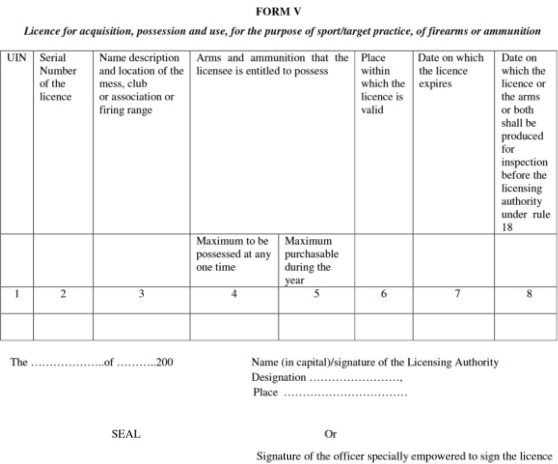
Rule 38 also says that practical training of safe handling of arms and its testing can be done only in a range with a license under form V of the rule. (Attached in the end)

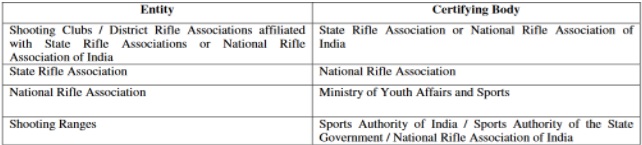
Certifying bodies:

In a notification released in the Gazette of India on 4th August 2014, various certifying bodies of different entities were defined. The table in that notification is attached below.

shooting range

According to this table, the certifying body of a shooting range would be Sports Authority of India, Sports authority of the state government, National Rifle Association of India.

shooting rangeConclusion

A license can be therefore acquired by fulfilling the necessary conditions. The range should be safe and should meet the conditions. In the present day world, licence for a place where shooting can be practiced as a sport has become a necessity. Keeping in mind the legal usage of gun, for recreational and sports purposes, such a licence was introduced in 2016.

Download Now

Removal of director under Companies Act, 2013

0
Company Director
Image Source: https://blog.ipleaders.in/wp-content/uploads/2016/07/Company-Directors-img.jpg

In this article, Ashima Bhargava discusses how to fire a Director of a company.

Definition of a Director

  • According to section 2(34) of the Companies Act, 2013, a director is a person appointed to the board of the company. A Director is a person elected or appointed to the board of directors of the company, who with other directors have the responsibility of determining and implementing the company’s policy.
  • As the agents of the company, a director can bind the company with valid contracts with the third parties. A company is a legal entity and it possesses no physical existence. It generally governed by a director. A director is any person who occupies the position of the director and is appointed by the company to handle its affairs.
  • The directors are not the servants of the company but actually, they are the officers. As long as the person is duly appointed to control over the company’s business and authorised to contract in the name of the company according to the articles of the company, he functions as a director.
  • A company cannot exist if it doesn’t have a director. He is there to see that all the work is being properly managed. He has to ensure that whatever is the company’s strategic objectives and plans which are being set meet the expectations or not.
  • The director has to check the progress of all the employees towards achieving the targets and objectives that are set and he is there to appoint or hire senior managers for certain posts like marketing and finance.

So by all this, we can say that a company cannot function without a director.

Types of Directors

Larger businesses and organisations usually have a clear board structure and they are as follows:

  1. Chairman: He is the person who has the entire hold of the company or an organisation.
  2. Managing Director: He is often appointed by the chairman to look after the board of directors and oversees the working of the business.
  3. Executive Directors: They are the directors who look after some specific departments like finance, marketing, etc.
  4. Non- Executive Directors: They advise the company on introducing new forms of strategy and they also decide the salaries of the Executive Directors.

Duties of a Director

According to section 166 of the Indian Companies Act, 2013, there are several duties that he has to perform:

A director of a company should act in accordance with the articles of the company.

  • Whatever rules and regulations are mentioned in the articles of associations and the memorandum of associations. The director has to abide by all these.

A director should act in good faith and work towards the interests of the company for the benefits of its members, the employees, shareholders and all other.

  • The intention of the director should be honest. He should not do anything which is against the provisions of the company.

A director should exercise his duties with reasonable care and due diligence and independent judgement.

  • A director should see that he is not being negligent in any of his work and his judgement should not be based on the judgements of others. It should be independent.

A director shall not involve himself in a situation where he may have a direct or an indirect interest that conflicts with the interests of the company.

  • He shouldn’t do anything which has a direct contradiction with the company, means he should work in the interests of the company.
https://lawsikho.com/course/diploma-companies-act-corporate-governance
Click Above

A director should not achieve or attempt to achieve any undue advantage either to himself or to his relatives, partners or associates. If he is found guilty of the same, he shall be liable to pay the gain to the company which he has used for his own.

  • A director should not take any disadvantage of anything in the company. He should do everything with an honest intention.

A director of a company cannot assign his work or an assignment to any other person.

  • He cannot assign his work to any other person. He should perform by his own.

A director contravenes with the provisions of this act, he shall be punishable with a fine, not less than one lakh rupees which may extend to five lakh rupees also.

  • If he acts against to whatever is given in the clauses of section 166, he will be punishable with a fine.

Liabilities of a Director

The liabilities of a director of a company can arise in many cases:

Breach of fiduciary duty

When a director does something which is against the interests of the company and towards the benefit of a particular employee, it is held to be a wrongful act of a director on account of fiduciary trust.

Ultra vires

The Directors are required to act within the parameters of the memorandum of associations, articles of associations because these lays down what are restrictions which are imposed upon the directors. If any director does not act in accordance with restrictions and act beyond the aforesaid limits is held to be liable and his act is stated as ultra vires.

Negligence

As long as the directors are acting within the prescribed limits of their powers with reasonable skill and diligence as a man of ordinary prudence would do, it is okay but when they fail to perform their duties with reasonable care and because of them if any loss or damage is caused to the company, the directors shall be held liable.

Mala fide acts

Directors are the trustees for money and property of the company. If they dishonestly make the misuse of the property and money of the company for their own interests and make any secret profit in the performance of their duties, the directors having no other choice will have to compensate the company for whatever loss they have incurred to the company.

How to fire a Director of a company

At the end of the day, we know that the power to remove a director is in the hands of the shareholders. All the directors are responsible to the shareholders. They can remove the director even before his tenure his completed unless they are appointed by the Tribunal for the prevention of oppression and mismanagement or a director appointed proportional representation.

Section 169 of the Indian Companies Act, 2013 states the procedure for the removal of the director. Section 169 of the Companies Act, 2013 states that the shareholders can remove the director by passing an ordinary resolution in a general meeting.

This right cannot be taken away by the MOA, AOA, or any document or any agreement.

  1. According to section 115 of the Companies Act, 2013, a special notice with the intention of removing a director by the specified no. of members of the company has to be passed at least before 14 days before the concerned meeting at which it has to moved excluding the day on which the notice is served and the day of the meeting.(Section 169)
  2. The company shall immediately, after it has received the notice should inform its members by a notice of resolution in the same way it does at the time of a general meeting.
  3. If it is not possible for the company to send notice to all the members, it should publish it in form of an advertisement in a newspaper having an appropriate circulation at least before 7 days of the meeting.
  4. The company should give intimation to the concerned director about his removal by sending the copy of the resolution which is sought to be passed. The director will have the right to be heard on the resolution at the meeting.
  5. The director can submit his statement in writing against his removal from the company and can also ask the company to notify it to the other members. If the representation of a reasonable length and has not been too late also then the company must-
    • Mention in the notice of resolution that the fact of the representation has been received at the annual general meeting.
    • Send a copy of the representation to every member of the meeting if the representation has been received before the notice of the meeting.
  6. If the writing is not able to reach the members of the company because it has been received too late or the company itself made some default in sending it then the representation must be read at the annual general meeting, it is at the discretion of the director. In addition, he can also make oral representation.

Provided that the copy of the representation need not be sent out and the representations need not be read out at the meeting if, on the application either of the company or any other person who claims to be aggrieved, the Tribunal is satisfied that the rights conferred by this sub-section are being abused to secure needless publicity for defamatory matter and the tribunal may order the company’s costs on the application to be paid in whole or in part by the director notwithstanding that he is a party to it.

Conclusion

In the present scenario, we see that there are a lot of companies and for every company, it is necessary to have a director or a board of director so that it is able to function properly. The director has to be very disciplined and has to make use of his powers honestly. A director has the responsibility of the all it’s members so if a director does anything which is in contradiction to the clauses mentioned in Section 166 then he will liable and will be subjected to the removal or being fired. So here I have explained the procedure on how to fire a Director.


LawSikho has created a telegram group for exchanging legal knowledge, referrals and various opportunities. You can click on this link and join:  

https://t.me/joinchat/J_0YrBa4IBSHdpuTfQO_sA

Follow us on Instagram and subscribe to our YouTube channel for more amazing legal content 
Download Now

What permissions are needed to organize a protest rally

1
protest rally

In this article, Priya Venkatesan of Tamil Nadu National Law School talks of the permissions required for organising a protest rally.

“Silence becomes cowardice when occasion demands speaking out the whole truth and acting accordingly.”-M.K. Gandhi

A lot of credit in Indian freedom struggle goes to the number of Dharnas by the freedom fighters. The concept of today’s protest and peaceful rally is taken from the prevalent age old concept in India of Dharna. Modern day India has seen many protest rallies for various issues. Organising a protest rally needs time, energy, money, cause and a drive but is there anything else required to organise a protest rally?

Yes, Compliance with various laws is the most essential of all to organise a legal protest. Since we live in a civilised society, there definitely would be some requirement of compliance with laws to not make the protest rally illegal. This article discusses such laws and permits which are to be complied with in order to organise a protest rally.

Constitutional provision for conducting protest

Do I have a fundamental right to protest?

  • In India, the fundamental rights can be counted as the most important rights as they make up the basic structure of the constitution. The basic structure of the constitution cannot be violated in any case.
  • Article 19 which is one such fundamental right, deals with Protection of certain rights regarding freedom of speech etc. Holding a protest rally, can be protected under Article 19 (1)(a), 19(1)(b) and 19(1)(c).
  • These three articles provide the citizens right to freedom of speech and expression, right to assemble peaceably without arms and right to form associations or unions.
  • The Supreme Court in the case In Re: Ramlila Maidan Incident v. Home Secretary, Union Of India & Ors. stated “Citizens have a fundamental right to assembly and peaceful protest which cannot be taken away by an arbitrary executive or legislative action.”

Reasonable restrictions over these said fundamental rights

  • These fundamental rights are not absolute and come with reasonable restrictions imposed on them. So although my right to protest is a fundamental right, reasonable restrictions in accordance with Article 19 (2), 19 (3) and 19 (4) can be imposed on them.
  • The reasonable restrictions imposed by 19(2) and 19(3) includes restriction made by state law for the sake of maintaining public order. Therefore, the state may impose certain restrictions over protest rally as it deems fit to maintain public order.
  • Besides this, the 1st entry of state list is public order, which further shows that state can make laws to maintain public order. Now, by establishing this, we can see that there are no laws at the Union level per se to be complied with while holding a protest rally. There can be state laws enacted by state to regulate the right to protest.

Other limitations

Further, a limitation was observed by the Supreme Court in the case Railway Board v Niranjan Singh. The limitation stated one’s right to protest/assemble does not extend to someone else’s right to property. The court said:

The fact that the citizens of this country have freedom of speech, freedom to assemble peaceably and freedom to form- associations or unions does not mean that they can exercise those freedoms in whatever place they please. The exercise of those freedoms will come to an end as soon as the ‘right of someone else to hold his property intervenes. Such a limitation is inherent in the exercise of those ‘rights.

If protesting is my fundamental right, then what permissions do I need to hold a rally?

  • Only states have powers to make laws relating to maintenance of public order. The permits which would be required therefore may change from state to state.
  • Generally, a person needs only a Police permit and a No Objection Certificate (NOC) from the Police. The police have powers to not grant permit if it deems the rally to be against public order. That can only be done in accordance with the law.
  • Many states have enacted state laws giving powers to police to curb such assemblies. The provisions of various state legislations like the Delhi Police Act, Bombay Police Act, Mysore Police Act, Madras City Police Act, Madhya Bharat Police Act, Travancore-Cochin Police Act are also being used to prevent the holding of meetings and assemblies. – So the loophole in law is results in curbing our fundamental rights.
  • In Himmat Lal K Shah v Commissioner of Police Ahmedabad, the court held that it was incorrect to give powers to commissioner to give or refuse permission to hold a  public meeting at a place falling within the definition of “a street” without giving reasons for either a refusal or a permission. Such a provision was made under Bombay police Act 1951.

Therefore, unless there is proper reason, police cannot refuse your right to protest. The only requirement maybe a police permit if the respective state demands so.

Things to keep in mind while holding a protest rally

  • The protest may not always remain non-violent. Special care has to be taken to maintain order. What The protest should not be for an illegal cause.
  • Sedition in such a protest may make people inciting such hatred towards the State be liable. Where the constitution only provides for an assembly without arms, the protest may be illegal if has armed men in it.
  • Besides, compliance with such laws as may be prescribed by the state becomes necessary, so if you do not take the police permit when required, the protest may be stopped.
  • When the assembly becomes a mob the state may have to control it by the use of police force. The legality of the protest lies in the fact that the protest should be by unarmed men which should be peaceful. It should comply with state laws and should not be against public order.

Misuse of power given to District Magistrate to issue order in urgent cases of nuisance of apprehended danger

There is another loophole to be aware of while holding a protest rally. Section 144 of CrPC has been misused at many recent protests. Section 144 gives powers to the district magistrate, sub-divisional magistrate or any other executive magistrate to issue order in urgent cases of nuisance of apprehended danger. This usage of 144 in many cases has been held arbitrary and has been seen as a way to stop protest rallies.

Protest and unlawful assembly

A protest is one’s right, but an unlawful assembly is not. One has to understand the difference between the two. Many a time, a protest can turn into unlawful assembly. Unlawful assembly is defined in Indian penal code under Section 141 and is a crime in India.

It happens when 5 or more persons, have a common object of

  1. Showing criminal force to government (centre/state/public servant pursuant of his duty), 
  2. Resist a law,
  3. Commit mischief or offence,
  4. Show criminal force to a person to deprive him of his right, 5. Shor criminal force to compel one to do what he is not bound to do.

It has to be taken care that a protest does not become illegal or is not in pursuance of an offence to prevent it from turning into unlawful assembly.

Protest Rally in case of Industrial Disputes

Industrial Disputes Act, 1947, talks about strikes and lockouts. Both strikes and lockouts can be a way of protesting. The question here would be, is there a procedure to be followed for such strikes? Section 22-25 of Chapter V of the said Act, deals with strikes and lockouts.

Conditions for a strike

  • A person in public utility service to go on strike has to give the employer, the notice of strike, between 6-2 weeks of striking.
  • He cannot go on strike before the expiry of date of strike specified in any such notice as aforesaid.
  • There should also, not be any conciliation proceeding going, on before a conciliation officer and there should be a gap of 7 days if any conciliation proceeding has concluded.
  • Such a notice of strike is to be reported to the appropriate government by the employer.
  • He cannot strike during the pendency of proceedings before labour court, tribunal or national Tribunal and two months after conclusion of such proceeding.
  • He cannot go on strike during the pendency of arbitration proceeding or two months after conclusion of such proceeding
  • He also cannot strike during any period in which a settlement or award is in operation, in respect of any matters covered by the settlement or award.

Illegal Strikes

The Act, further lays down conditions under which a strike becomes illegal. The strike becomes illegal if it is in contravention of any of the above conditions. It can also be illegal if the appropriate government prohibits the continuance of such strike. The Act prohibits any person from knowingly financing an illegal strike.

Jantar Mantar and Ramleela Maidan

There is a growing trend in the capital of the country of holding protests. People after recognising their right to protest, are taking to the streets. People demanding their rights and sitting on dharnas is a common sight in places like Jantar Mantar, India Gate and Ramleela Maidan.

In order to maintain law and order, Delhi police released an advertisement that the permission request to hold such a protest is to be sought from Deputy Commissioner of Delhi. Deputy commissioner then will assign the venue for such protest. In the heart of the country, protests can now be held in Jantar Mantar for protesters upto 5000 people. Protesters anymore in number are to assemble at Ramleela Maidan.

Things to include in the application to obtain a protest rally

  • Name
  • Address
  • Phone Number
  • Date of protest
  • Cause
  • With loudspeaker/ without loudspeaker
  • Number of people taking part
  • Duration
  • Route of procession of place of protest

General checklist for documents which might be required

  • Proof of Identity
  • Proof of residence
  • Photograph
  • Self-undertaking/ Affidavit

Conclusion

Although it can be seen that protesting is a fundamental right, police permission is to be taken in many states which makes the process more regulated one. No one can just randomly go and start a protest rally. The police will not arbitrarily deny the holding of such a protest, but will only help in regulation of public order. The right still remains a fundamental right. Holding a protest is not as difficult and just a simple permit from the DCP in many cases may suffice.

Reference

  1. His Holiness Kesavananda Bharati Sripadagalvaru and Ors. v. State of Kerala and Anr. (1973) 4 SCC 225
  2. 2012 SCC (5) 1
  3. 1969 SCR (3) 548
  4. 1973 SCR (2) 266
Download Now

Laws related to bonded labour in India

1
bonded labour

In this article, Shrey Chakraborty of Symbiosis Law School, Hyderabad discusses Laws related to bonded labour in India.

Various forms of slavery existed in the Indian society before its independence. It was first legislatively abolished by the British Empire in 1843, through Act No.V of 1843 also known as the Indian Slavery Act, 1843. However, this practice has not been completely eradicated from the Indian society till date. One of the most common forms of slavery which is still prevalent in the Indian society is bonded Labour. Even after the independence, there have been several legislations passed in India which abolishes bonded labour. This article would be dealing with the constitutional safeguards available and the laws that abolish this practice. Further, this article would also discuss the possible causes of the continuance of this practice in India. But before dealing with any of that, we must understand what exactly is bonded labour.

What is bonded labour?

Bonded labour has been defined as well as addressed as a prohibited practice in several international conventions as well as a many Indian legislations. It is a system of forced (or partly forced) labour in which a debtor enters (or presumed to have entered) into an agreement with the creditor. Owing to this agreement, following are the end results:

  1. Render services to the creditor (by himself or through a family member) for a specified (or unspecified) period of time with no wages (or nominal wages).
  2. Forfeit the right to move freely.
  3. Forfeit the right to appropriate or sell the product or property at the market value from his (or his family members’) labour or service.

This definition has been provided in the Bonded Labour System (Abolition) Act 1976.

The said agreement of bonded labour results into an undeniable loss of freedom on part of the debtor. However, the scope of ‘loss of freedom’, as used above has not been defined so what would be the yardstick of this ‘loss of freedom’? The National Human Rights Commission has elucidated on the scope in the following manner:

  • Loss of freedom of employment or alternative avenues of employment to sustain a decent livelihood.
  • Loss of freedom to earn the minimum wage as notified by the Government of India.
  • Loss of freedom to move from one part of the country to another.

So speaking in simple words, the system of bonded labour refers to a system wherein a creditor and a debtor enter into an agreement of rendering services of the debtor as a mode of repayment of the said amount. This agreement may lapse with time or may continue for an uncertain period of time.

This is also referred as a debt bondage or for the lack of a better word, debt slavery. It is important to understand that not all the forms of bonded labour are forced but all the forms of bonded labour involve a certain bondage. It is due to this bondage, the very Constitution of India abolishes the practice of bonded labour.

As per Article 23 of the Indian Constitution, traffic in human beings and other forms of forced labour are prohibited. Based on this constitutional provision, the Government of India passed The Bonded Labour System (Abolition) Act, 1976. In this context, the Supreme Court of India deliberated in the following words – “We are, therefore, of the view that when a person provides labour of service to another for remuneration which is less than the minimum wage, the labour or service provided by him clearly falls within the scope and ambit of the words “forced labour” under Article 23.”

As we can observe, the Supreme Court has well interpreted this constitutional provision and expanded the scope of Article 23 in this case.

Constitutional Safeguards

Now that we are aware of what exactly is a system of bonded labour, let us delve further into the constitutional safeguards. In the Constitution of India, there are a few safeguards which address the system at hand.

  1. Article 21 of the Indian Constitution – This is the most important and foremost safeguard against any exploitation of human lives and their liberty. It is part of the Basic Structure of the Constitution and cannot be amended. It secures the right to life and right to live with human dignity to every person in India. So, any practice of bonded labour would be in contravention of this Constitutional provision since bonded labour deprives a person of numerous liberties.
  2. Article 23 of the Indian Constitution – As discussed above, the Constitution of India expressly provides for the abolition of forced labour and prohibits this form of forced labour in the territory of India. This not only prohibits bonded labour but also covers the practice of Begar and other forms of human trafficking in India.
  3. Article 39 of the Constitution – This is covered in Part IV of the Indian Constitution which deals with the Directive Principles of State Policy is albeit not enforceable but are considered irrefutable for the purpose of governance. This constitutional provision directs the State to secure the right to an adequate livelihood. It also directs the state to formulate its policies with an object that no citizen is forced out of economic necessity to enter into avocations which are not suited to them.
  4. Article 42 of the Constitution – This is also a Directive Principle of State Policy which states The State shall make provision for securing just and humane conditions of work…” This means that the state must ensure that every person has a working condition which are just and humane for them. However, since it is part of Part IV, it cannot be enforced.
  5. Article 43 of the Constitution – This directive directs the State to secure i.a. – conditions for work ensuring a decent standard of life.

What are the laws in India?

Apart from the above mentioned constitutional provisions and safeguards, there are also a few legislations which deal with the subject at hand. However, the major law governing the practice of bonded labour is The Bonded Labour System (Abolition) Act 1976. In addition to this, there are a few more legislations in consonance with this major law in India such as Contract Labour (Regulation and Abolition) Act 1970, Minimum Wages Act 1948 and the Inter-State Migrant Workmen (Regulation of Employment and Conditions of Service) Act, 1979 and even the Indian Penal Code 1860.

  • The Indian Penal Code recognizes the offence of unlawful compulsory labour and imposes a punishment of imprisonment for a term extendable to 1 year or with a fine or both.
  • The Minimum Wages Act 1948 sets the minimum wage for certain enumerated occupations and requires that overtime be paid to whoever working beyond the ‘normal working day.’
  • Similarly, the Bonded Labour System (Abolition) Act 1976 prescribes imprisonment for a term upto 3 years as well as a fine upto Rs. 2000/-. This punishment is for whoever compelling a person to render their service under bonded labour and whoever advancing the bonded debt. Every offence under the Act is cognizable and bailable.

What is the consequence of abolition after 1976 under the Act of 1976?

  1. All the bonded labourers are freed and discharged from all the obligations to render their bonded labour.
  2. All of the customs, traditions, contracts, agreements or any instruments by virtue of which a person (or any member of the family) is required to render bonded labour to someone will now be deemed as void.
  3. Every obligation of a bonded labourer to repay any bonded debt shall be deemed to be extinguished.
  4. All the decrees for recovery of bonded labour debt which was not fully satisfied shall be deemed as fully satisfied after the commencement of the Act.
  5. Every property of a bonded labourer which was removed from his possession or forcible taken from him, shall be restored to him.
  6. Every bonded labourer who has been detained in Civil Prison shall be released.
  7. Freed bonded labourers shall not be evicted from their homestead.

Supreme Court Cases

From the above stated constitutional provisions, it would not be incorrect to say that the State is vested with the responsibility of securing every citizen with a decent standard of living and ensuring that the prohibited practices like bonded labour are not practised in India.

Despite these constitutional provisions, can we say that bonded labour does not exist in India? There have been cases in India even after the enactment of the Act which the Apex Court has dealt very deftly.

In the case of Neerja Chaudhury v. State of Madhya Pradesh, the Supreme Court ruled – It is the plainest requirement of Articles 21 and 23 of the Constitution that bonded labourers must be identified and released and on release, they must be suitably rehabilitated… Any failure of action on the part of the State Government[s] in implementing the provisions of [the Bonded Labour System (Abolition) Act] would be the clearest violation of Article 21 and Article 23 of the Constitution.”

As mentioned above, there are a few constitutional provisions that safeguard the system of bonded labour from being practised. In this case, the Apex Court did very well by relating the issue of bonded labour system with the person’s fundamental right enshrined in Article 21 of the Constitution and gave a clear thrust to the State to implement Article 21 and Article 23 of the Constitution.

Also, in the case of People’s Union for Democratic Rights v. Union of India, the Supreme Court of India delivered the judgement stating –  “Where a person provides labour or service to another for remuneration which is less than minimum wage, the labour or service provided by him clearly falls within the scope and ambit of the word `forced labour’…”

As seen, the Court has tried to expand the scope of forced labour and protect the rights of citizens time and again.

Conclusion

There are several factors which are causing the continuance of this system of forced labour. Often, the usurious rate of interest is one of the leading factors which contribute to its continuance. Apart from that, faulty system of adjustment of wages with the amount lent, prevalent ignorance, illiteracy, being socially backward, lack of debtor’s organisation etc. are all factors contributing to the continuance of bonded labour.

“I worked there for three months. Sometimes I did not get any food. I woke up at 4:30 a.m. and slept at 10 p.m. … My employer shouted at me, “You are a poor person. You have to know your position, you are here to work.” I was not allowed to go out of the house. I had not seen my family since I left home. I was not paid any salary.… [My employer] hit me when she was angry. … She laughed when I asked that I wanted to see the doctor.” – Asma, child domestic worker, age sixteen, Medan, Indonesia, December 13, 2004 (Human Rights Watch 2006, 1).

The system of bonded labour is an agreement between two parties; an agreement which in today’s date, stands void in the eyes of law and is also a punishable offence under numerous legislations of India. Due to the gravity of this offence, it has also been addressed in numerous international conventions.

Bonded labour is probably the least known form of slavery in today’s date and yet, ironically, it is most widely performed form of slavery. There have been several initiatives by the National Human Rights Commission to curb this practice. Apart from that, even the Supreme Court has condemned this practice in India and has given it an expansive meaning so that it is not practised in any form whatsoever.

But is this enough? No, we must take steps against any system of forced labour and should voice out if a person is being oppressed due to his status. This is a system which degrades a human to a commodity or an asset. It should not only be prohibited by law but also be seriously punished. Thus, forced labour, whatever form it may be, should not be condemned by anyone.

References

  1. Article 1(a) of the United Nations‘ 1956 Supplementary Convention on the Abolition of Slavery, the Slave Trade and Institutions and Practices Similar to Slavery; Article 2(1) of Forced Labour Convention of 1930; Article 4 of the Universal Declaration of Human Rights.
  2. Section 2 (g) of Bonded Labour System (Abolition) Act 1976.
  3. Know Your Rights, Bonded Labour by National Human Rights Commission, 2010.
  4. People’s Union for Democratic Rights and others v. Union of India; (1982) 3 SCC 235.
  5. Article 39(a) of the Indian Constitution.
  6. Section 374 of Indian Penal Code 1860.
  7. Neerja Chaudhury v. State of Madhya Pradesh; (1984) 3 SCC 243, 255.
  8. People’s Union for Democratic Rights v. Union of India; (1982) 3 SCC 235, 259-260.
Download Now

What is Transaction Support Group practice?

0
Transaction Support

In this article, Anu Bhatnagar throws an insight on Transaction Support Group practices.

As all of us know that a full-time service provider, an Indian Law Firm name Cyril Amarchand Mangaldas is the sole leader which has the corporate and finance as the sole area of practice in the nation. Many young law aspirants or legal professionals want to secure an internship or a permanent job, respectively. 

On the above note, transaction support service is the practice which has recently been introduced by Amarchand Mangaldas in the year 2013. Furthermore, this can be noted that this practice of transaction support is a newly implemented service in India.

Transaction support – What is it?

In an ordinary language, this concept can be understood as strategies or services which are provided by an organisation or a paralegal department, or law firms to their clients who are about to sell their domestic firms to big or other agencies.

Different Organizations, paralegal departments and law firms provide their individual services or strategies. It has been said that it’s not continually regarding commercialism your agency to an enormous firm. Prosper cluster helps you assess and confirm the proper exit path, whether or not employee stock ownership plans (ESOP), merger, acquisition, strategic partnership, or a hybrid.

Below are the basic steps that are generally taken by the companies to ascertain the problem and find out solutions by way of Transaction support:

  • Identify acquisition or disposal opportunities in line together with your strategy.
  • Gather relevant data and tools to underpin your choices.
  • Successfully complete your transactions with support from specialists.
  • To help in identifying opportunities.
  • By providing best analyses of properties.
  • By an analysis or evaluation of market as well as prices.
  • By ensuring the guidance and support for clients transaction.
  • It will increase the market intelligence of the respective company.
  • Enhancement of Research department of both problem solver.

Transaction Support Group Practice – In Indian context

As it mentioned above that the concept of transaction support group practice has been introduced by Amarchand Mangaldas at Mumbai in the year 2013. A value-focused transactional practice aims at providing or an offering better due diligence as well as commoditized advice to their potential clients.

The current status of the transactional support group practice has 30 lawyers in total, which are based at Amarchand’s Mumbai Peninsula Chambers offices in Lower Parel.

In specific, the TSG is believed to be targeting on due diligence of company transactions, proceedings and realty deals, yet as specializing in property conveyance of title.

One of the aims with the TSG is to produce a team to purchasers that has larger specialization on such work that is usually handled by junior associates with solely little sensible expertise.

It is understood that no mounted accomplishment policies or intentional earnings differential are in situ for members of the TSG at the present, though the initiative remains a work-in-progress, on that the firms management can solely take a final decision within the returning months.

Besides requiring similar technology and methods as Indian legal process outsourcing (LPO) corporations, that sell TSG-style services to house and in-house departments, Amarchand’s efforts within the house mirror those of UK-headquartered firm Addleshaws.

Legal outsourcing, conjointly referred to as legal method outsourcing (LPO) refers to the apply of a house or corporation getting legal support services from an outdoor house or legal support services company. It is the demand of legal aid or support by a domestic law firm from outbound legal services.

Addleshaw Goddard’s Transaction Services Team – an Insight

As it is already mentioned in the above paragraph of this article that Cyril Amarchand mangaldas has took efforts and implemented the policies made under UK-headquartered firm Addleshaw’s transaction Service Team (hereinafter i.e. TST).

This is an international business law firm with an exception services at its best. They serve their clients according to their need, with a higher value of strategic advice. They provide the best lawyers who have specialization in the field of research department.

Functions Performed By Addleshaw Goddard’s Transaction Services Team

Launched in 2010, our dealings Services Team (TST) could be a pioneering response to promote pressure for a lot of economical and originative ways in which of resourcing shopper assignments.

TST is primarily a centralized unit of over a hundred and fifty folks, as well as paralegals and managers delivering a lot of for fewer by providing a large vary of routine legal assignments, in either a complete or associate integrated approach aboard AG’s lawyers, and progressively a part of client own internal groups.

The enlargement of this team reflects not simply the operational ability of their approach, however their determination to deliver higher for purchases, improving monetary performance, increasing the standard of work, exploring new technology.

Over recent years, the team have engineered on early successes, broadening the TST’s preparation across our business and more up our aggressiveness by providing purchasers with even bigger certainty and innovation around rating and repair delivery.

Services out there through the Transaction Services Team (TST):

  • Extensive expertise of delivery of huge M&A comes together with due diligence reviews and reorganization support.

  • Project Management together with co-ordinating shoppers, lawyers, overseas advisors and different third parties.
  • Drafting, negotiating and finishing routine contracts among united parameters.
  • Overspill protect in-house groups.
  • Litigation and restrictive document reviews and claims support.
  • Bespoke work with dedicated trained groups.

Services provided via TSG in general

  • Due diligence for legal issues and matters.
  • They provide assistance in matters of negotiable instruments.
  • Documentation, together with drafting and review of share purchase and subscription agreements, shareholders and venture agreements, merger and de-merger schemes, business acquisition documents, and documentation associated with open offers and capital markets connected transactions.
  • Drafting and review of subsidiary documents, as well as technology and belongings licence agreements, services agreements, selling and distributorship agreements, producing agreements, confidentiality agreements, non-compete agreements, trust agreements, and written agreement agreements
  • Assistance in implementation of merger, de-merger and different company restructuring schemes
  • Advisory services in matters including mergers, acquisitions, de-mergers, private equity and the purchase of other assets, alongwith strategic alliances and joint ventures.
  • Advice on various company and different laws as well as, corporations Act, interchange Management Act and Securities and Exchange Board of Asian country connected legislation and Competition laws.

Final Remarks

Unlike Associate LPO, a TSG or TST is meant to be tightly integrated into the present firm and dealing groups, whereas taking advantage of the efficiencies of optimizing technology use and structuring the advancement round the sorts of dealing that do need abundant variation from deal to deal.

Download Now
logo
FREE & ONLINE 3-Day Bootcamp (LIVE only) on

How Can Experienced Professionals Become Independent Directors

calender
28th, 29th Mar, 2026, 2 - 5pm (IST) &
30th Mar, 2026, 7 - 10pm (IST).
Bootcamp starting in
Days
HRS
MIN
SEC
Abhyuday AgarwalCOO & CO-Founder, LawSikho

Register now

Abhyuday AgarwalCOO & CO-Founder, LawSikho