Download Now
Home Blog Page 1637

ESOPs (Employee Stock Option Plans) in India – How Much Do You Know?

1
ESOPs ( Employee stock option plans) in India

Employee Stock Option Plans, popularly known as ESOPs, is a concept introduced in India. It is used by companies as a scheme of selling shares to the employees by which they become a shareholder in the company and thus hold a certain small level in the ownership of the company.

ESOPs are given by the companies to the employees thereby, giving them the following rights:

  • Right to purchase a certain number of shares in the company-at a pre-determined price after a predetermined period.
  • It helps the employer to retain the company and assure a good level of performance in the work.

Download Now

 Goods And Service Tax : Impact On Agricultural Sector

0

 In this blog post, Perin Gandhi, an Advocate in Mumbai and pursuing a Diploma in Entrepreneurship Administration and Business Laws from NUJS, Kolkata, talks about the impact of GST on the Agricultural Sector.

Introduction

Since the passing of the long awaited 122nd Constitutional Amendment bill i.e Goods and Service Tax (GST) bill by both upper house (3rd August 2016) and lower house (8th August 2016), the news has been hitting the tabloids every alternate day. It has been the talk of the town and now that President Mr. Pranab Mukherjee has also given his assent and signed the bill for its implementation with the ratification by more that 50 percent state assemblies, the bill will soon become a binding law from 1st April 2017. With all the indirect taxes being combined under one taxation system, it will hold a lot of benefit for all the sectors only if it is implemented as per the proposed bill. However, India is not the first country to adopt a uniform taxation system. France was the first country to adopt GST as its indirect taxation structure in 1954. Today, it has spread to around 164 countries in the world which levies GST.

What is GST?

GST has been defined in Article 366 of the 122nd Constitutional Amendment Bill, 2014. Good and Service tax is a combined tax levied on sale, production and consumption of goods and services at the national level. GST merges all the indirect taxes at the central and state level and thereby abolishes the cascading effect on tax. India currently has a dual system of taxation of goods and services, in a sense that tax on activity of manufacture and provisions of service is collected by Union Government and that on sale of goods is collected by State Government. After the implementation of Goods and Service tax all the central taxes such as Excise duty, Service etc and State taxes such as Value added tax (VAT), lottery tax, entertainment tax etc will be subsumed under one uniform tax.

For example : Product X is produced in a factory. As soon it is released from the factory, excise duty has to be paid on that product. Further when that product X is sold within the state, Value added tax (VAT) has to be paid on it. This leads to dual taxation on the same product which is known as cascading effect.

This newly introduced taxation system would also take the form of ‘Dual GST’ which would be levied by the respective central and state government. The said dual good and service tax would comprise of 1) Central Gst (CGST), 2) State Gst (SGST) and 3)Integrated Gst (IGST). Presently, goods and services are taxed in the state where it is produced but introduction of GST will change the stage of taxation and after its implementation the goods and services will be taxed in the state where it is consumed.

Earlier in agricultural sector…and After GST…

Agricultural sector has been the root of Indian economy and it contributes to around 16% to the GDP. Over 53 percent of the rural livelihood depends on this sector as their primary means of livelihood. The implementation of goods and service tax in agricultural and food industry will have an impact on all the sections of the society. Food is a large portion of spending and food basket consumes around 40%- 60% of the earning of a common citizen and increase in the price of food items would result as a major burden on the family. Food industry is price sensitive and it has direct impact on the lower income earners and the poor. Food includes items like meat, fish, poultry, grains, cereals, dairy products and milk, fruits, vegetables etc. Earlier many food items were exempted from CENVAT and items like food grains and cereals were taxed at 4 percent under the state Vat. Exemption under the State vat is strictly restricted to the unprocessed food items like meat, eggs, fruits, vegetables etc.

From industry experts to small farmers to common citizen all are quite hopeful to get a fruitful result from this GST regime. Agricultural goods are perishable in nature and thus are often influenced by the amount of time taken in its transportation. The implementation is expected to boost the agricultural market as taxation under a subsumed single rate would make the movement of agricultural commodities hassle free as the products would be able to reach places via trucks in a better way. Interstate trading of a particular product often is subjected to various taxes, permission, license required for different states at every point of their transaction. This had often created hindrance in trading of products across the country for many traders in the past. So implementing GST would be the first step towards liberalizing the marketing of agricultural products and creating a smooth transaction of goods.  Good quality products which are manufactured or produced in one part of the country can easily find a market place in other part of country in the absence of multiple taxation burden. One of the other positive factor that GST would bring in is that it would make the agri- machineries affordable to the small and marginal farmers in India which was beyond their reach due to high excise duty on the machinery. This ease in the transportation of agricultural products will not only save time and avoid wastage in case of perishable goods but will also improve the marketing and virtual market growth. Agricultural products were always subject to diversity in the taxation rates so a single rate of goods and service tax would benefit the national agricultural market and help the farmers and traders to sell their products in any part of the country and receive the best price for their product. GST will also include in its ambit tax related to trading in oilseeds, cereals etc which previously were outside the tax structure and thus will benefit the consumers and processors by eliminating the negative impact of price on the trade of such products. The impact of GST would also depend upon the size of the business. The single rate of GST for certain food items could still lead to double the taxation burden even though they were exempted in the previous taxation system. So a need for clarity on the exemption of food items is required to be listed. The proposed GST rate should provide consistency in tax of processed and unprocessed food items so that processed food comes within the reach of all the consumers. The slab for GST rate of processed food should be different for different income group to make the benefit of such food available for all the consumers. To keep the base of GST broad, to limit the price of consumable food, the rate of GST for unprocessed food items like fresh fruits, meat, egg, vegetables etc should be kept lower. Lower rate will give an alternative to the consumers to buy the unprocessed food and then have it processed themselves in case of higher rate applicable to the already processed food available in the market.

Vijay Setia, a well known Basmati rice producer and a former president of All India Rice Exporters Association had a view that multiple tax system was a route to cheat people. Introduction of GST would welcome more transparency in the system as there would be a common market in the absence of CST and entry tax.

There are also speculations that implementation of goods and service tax would hike the price of agricultural products to between 0.61% to 1.18%. The terms of trade in respect of agricultural sector is also expected to improve post GST. Some experts have analyzed that hike in the price of agricultural products would be beneficial for the retailers but not for the farmers whereas some are of the opinion that price rise would not only benefit the farmers but will contribute to economic growth and open new job opportunities for many in the agricultural as well as non agricultural sector thus bringing down inflation. It is also expected that consumers will be at the receiving end due to rise in price as presently they are benefiting from the low indirect tax while soon they will face higher tax under GST. However, to some extent poor will still remain secured through Public Distribution system even though there would be rise in price of food.  Whether hike in price is a positive impact or a negative impact, only time will tell. Mr. Pritam Shah, MD at Parag Milk Food, expressed his concern “GST is not beneficial for agricultural commodities and allied sector but might benefit the engineering sector. Currently, there is no tax to procure milk from farmers. We only pay 2% central Vat on sale of  milk powder to a company. When GST get implemented, the tax can be 12.5% or 15% or 18%. There will be a straight cost hike in milk and milk product prices.”  India ranks first in milk production covering around 18.5% of the world production. Its annual production for the year 2015-2016 amounted to 160.35 million ton and records an increase every year, and milk being a basic necessity in many households, an increase in the price would not be readily welcomed by the consumers.

On the other side, apart from milk, tea is the most consumed product around the country. The annual consumption of tea in India is around 950-1000 million kg. A Senior Industry Executive was of the view that tea industry should either be fully exempted from GST or the new GST rate should be kept at par with the current tax rate of 5-6 %. Also the concessional tax rates for teas sold through auctions should be kept intact even after the implementation of GST, in the absence of which price of tea will be costlier.

Conclusion

The country is eagerly looking out for the roll-out of GST, as the regime introduces destination based taxation. Goods and Service tax is a good initiative to summarize the taxation and encourage the ease of doing business in the agricultural sector. However,  Indian agriculture and farmers should be given the same freedom just like any other economic agents, unless that is done 50 percent of the country will still be legally discriminated in the GST regime. Therefore, it is imperative that the government makes effort to make law clear so that all the sectors and economy benefits as a whole.

Download Now

The Advantages of Advance Pricing Agreements

0
Feel free to use this image, just link to www.SeniorLiving.Org

In this blog post, Mayank Garg, a student pursuing his BBA LLB (3rd Year) at University of Petroleum and Energy Studies, Dehradun and a Diploma in Entrepreneurship Administration and Business Laws by NUJS, analyses the advantages of advance pricing agreements.


Introduction

With the rapid development of the country’s indirect taxes on trade, consumption, etc., were the most important types of taxes in the beginning of twentieth century. Since then the trend has been an increasing importance of the income taxation. Introduction of the Transfer Pricing Provisions was done in India in year 2001 which provided for the determination of arm’s length price in cases of international transactions between associated enterprises.

The Finance Act, 2012 has inserted sections 92CC and 92CD in the Income-tax Act, 1961 introducing the provisions of Advance Pricing Agreements to bring about uniformity in determination of arm’s length price of the international transactions. Sections 92CC and 92CD came in effect from 1-7-2012. Section 92CC inserted by the Finance Act, 2012 with effect from 1-7-2012 provides that the CBDT may, with the approval of the Central Government, enter into an APA with a person, determining the arm’s length price or specifying the manner in which the arm’s length price is to be determined, in relation to an international transaction to be entered into by that person.

Advance Pricing Agreement

“Advance Pricing Agreement” is an agreement between a taxpayer and a taxing authority on an appropriate transfer pricing methodology for a set of transactions over a fixed period of time in future. The APAs offer better assurance on transfer pricing methods and are conducive in providing certainty and unanimity of approach”.

An APA as referred to by the OECD in its 2010 transfer pricing guidelines is “an arrangement that determines, in advance of controlled transactions, an appropriate set of criteria for the determination of the transfer pricing for those transactions over a fixed period of time”.

The Internal Revenue Service defines an APA as “An APA is an agreement between a taxpayer and the ‘service’ in which the parties set forth, in advance of controlled transactions, the best Transfer Pricing Method within the meaning of section 482 of the Code and the regulations. The agreement specifies the controlled transactions or transfers (covered transactions), TPM, APA term, operational and compliance provisions, appropriate adjustments, critical assumptions regarding future events, required APA records, and annual reporting responsibilities.”

The basic idea of an APA is to increase the efficiency of tax administration by motivating taxpayers to present before the tax authorities all the facts relevant to a proper transfer pricing analysis and to work towards a mutual agreement. APA reduces the burden of compliance by giving taxpayers greater certainty regarding their transfer pricing methods, promoting their issues and by allowing them discussion and resolution in advance before the tax authorities.

Unilateral, Bilateral, or Multilateral

Some countries allow unilateral arrangements where the tax administration and the taxpayer meet and finalize an arrangement. A unilateral APA, however, may affect the tax liability of associated enterprises in other tax jurisdictions. Where unilateral APAs are permitted, the competent authorities of other interested jurisdictions should be given an option to determine whether they are willing and able to consider a bilateral arrangement under the mutual agreement procedure.

In any event, countries shouldn’t embrace any unilateral APA with a taxpayer with a requirement that the payer should waive off access to the mutual agreement procedure if a transfer pricing dispute arises. Also, if another country raises a transfer pricing adjustment with respect to a transaction or issue covered by the unilateral APA, the first country is encouraged to consider the appropriateness of a corresponding adjustment and not to view the unilateral APA as an irreversible settlement. The OECD guidelines provide that because of concerns over double taxation, most countries prefer bilateral or multilateral APAs, and some countries will not grant a unilateral APA to taxpayers in their jurisdiction. The bilateral approach is far more likely to ensure that the arrangements will reduce the risk of double taxation, will be equitable to all tax administrations and taxpayers involved, and will provide greater certainty to the taxpayers concerned.

Unilateral APAs are one-sided tools addressing problems with bilateral implications. Bilateral APAs give larger tax certainty and address the total scope of a dealings and are favored over unilateral APAs, though unilateral APAs are also helpful in certain circumstances, like covering problems or transactions wherever no applicable tax convention exists, they will have restricted utility wherever tax administrations actively review the sort of transactions being lined. As mentioned earlier, it’s best for both, taxpayers and tax administrations to avoid the inclusion of a discharge of access to MAP in audit settlements. Since MAP involves bilateral problems it’s inappropriate to own two parties (the remunerator and tax administration) not embodying a third concerned party (the alternative tax administration) within the final resolution of a problem. 1st of all taxpayers might not understand the potential implications of double taxation and also the indisputable fact that associate adjustment by the opposite tax administration might complicate the problem. Secondly, tax administrations ought to take into account the problems of co-operation and reciprocity similarly, because the indisputable fact that those one-sided settlements will not serve tax administrations well at the end of the day. As for unilateral APAs, if a foreign adjustment is raised against a transaction or issue covered by a unilateral APA, the unilateral APA should be treated as the taxpayer’s filing and, therefore, eligible for MAP and adjustable, as opposed to an irreversible settlement. Wherever possible, an APA ought to be all over on a bilateral or multilateral basis between competent authorities through the mutual agreement procedure of the relevant treaty.

A bilateral APA carries less risk of taxpayers feeling compelled to enter into an APA or to just accept a non-arm’s length agreement, so as to avoid high-priced and prolonged enquiries and possible penalties. A bilateral APA considerably reduces the possibility of any profits either escaping tax altogether or being doubly taxed. Moreover, concluding an APA through the mutual agreement procedure may be the only form that can be adopted by a tax administration which lacks domestic legislation to conclude binding agreement directly with the taxpayer.

Universal trends in Advance Pricing Agreements

United States – In March, 1991 the Internal Revenue Service published Revenue Procedure that authorized APA contracts. A taxpayer is given flexibility to request a pre-filing conference. Detailed documentation requirements are ordered. As a part of the contract, the payer agrees to provide annual reports demonstrating company’s compliance with the APA, particularly highlighting the acceptable application of the chosen Transfer pricing methodology. The payer is liable for suggesting the initial amount that they require their APA to last; the particular beginning date is at the taxpayer’s discretion. The conclusion may be a Memorandum of Understanding between the Governments and also the payer. Once this in agreement, the payer has the instrument mixed up, the APA, and also the final act is the execution of this instrument. Internal Revenue Service can revoke an APA within the event of fraud or actus reus.

To increase quality of the APAs the Internal Revenue Service has planned to create public copies of APAs, however, solely when removing details like the taxpayer’s identity, trade secrets, and confidential industrial or monetary info, the APA procedures are changed to expand the scope of the APA Program’s ambit to incorporate alternative problems that transfer evaluation principle is also relevant, including: attribution of profits to permanent institution underneath an income-tax accord, determination of the quantity of financial gain effectively connected with the conduct by the payer of a trade or business within the United States.

United Kingdom – The UK has formal APA procedures since 1999. The United Kingdom APA method solely comes into play to resolve complicated transfer pricing problems or in alternative, in cases wherever there is important issue in distinguishing the strategy to be utilized in applying the arm’s length principle. APAs could involve transfer valuation strategies covering differing types of connected party transactions or for specific forms of transactions solely, in addition as alternative, intra-group arrangements, together with transfers of tangible or intangible property and also the provision of services.

There are prospects to conclude bilateral or unilateral APAs with preference for a bilateral/multilateral approach. Conjointly there’s ability to roll back application of the APA to earlier years only if the primary emphasis of an APA is to provide certainty for 3 to 5 years.

Canada – Started a formal APA program in July, 1995. There’s a powerful preference for bilateral or multilateral APAs if the foreign jurisdiction conjointly has an APA program. The 2011-12 annual report on the APA program published by the Canada Revenue Agency reports that since the origin of the program, 156 cases have been accepted, 108 completed (85 bilateral, 21 unilateral and 2 multilateral), and 3 are unresolved.

China – Is one amongst the full-fledged countries within the world of transfer pricing. The method of executing APA in China appears almost like that within the United States with a preparation stage, formal application stage, audit and assessment stage, negotiation stage, conclusion stage. Most of the APAs up to now have been unilateral, together with APAs involving multi-jurisdictions among China, 5 bilateral APAs are over, together with 2 with Japan, one with the United States and 2 with Korea.26

Japan – The Japanese National Tax Administration Agency (NTA) actively encourages taxpayers to use for APAs. Along with United States, Japan in all probability has the foremost expertise with APAs.27 The subsequent options characterize the APA regime: anonymous prefiling conferences are possible; typical APAs cowl 3 to 5 years; Rollbacks to past years area unit, in general, feasible; key documents should be submitted in Japanese; profit-based and alternative strategies not laid out in Japan’s transfer pricing regulations are often accepted in bilateral APAs.

To encourage the use of Advance Pricing Agreements, the NTA has also launched international information divisions in Tokyo and Osaka. The number of APA applications submitted to the NTA has been increasing steadily – from 93 in 2007 as compared to 22 in 1997. The NTA also processed 70 applications in 2007 as against 5 in 1997.

Merits of an APA mechanism


  • Obtains certainty for complex, high risk transactions– APA is considered as a strategy to minimize the risk of a transfer pricing adjustment; provide certainty through a negotiation process. An APA can be undertaken by companies that have complex inter-company transactions; high degree of transfer pricing  adjustment risk that may result in penalties or for companies that desire for certainty with regard to their transfer pricing policies.
  • Avoids double taxation – The pricing of goods and services by multi-nationals for transactions among themselves is generally governed by a global pricing policy. The policy typically ensures to provide an arm’s length return to various constituents of the MNE group, based on the functions performed, assets employed and risks assumed by each member of the group. Whenever a revenue authority in a particular jurisdiction challenges and disputes such pricing policy and raises a consequential demand, it leads to double taxation for the Group. The process of APA also seeks to do away with this tax risks.
  • Reduces compliance costs, etc. – Reduces compliance cost and costs associated with audit and appeals over the APA term by eliminating the risk of transfer pricing audit and resolving long drawn and time-consuming litigations.
  • Reduces the burden of record keeping – Reduces the burden of record keeping, as taxpayer knows in advance the required documents to be maintained to substantiate the agreed terms and conditions of the agreement.
  • Competent authority guides in negotiating – Competent authority analyst with knowledge of negotiating with the other country guides in the case from the outset and allows one competent authority to act as a counterbalance for another.


CONCLUSION

Transfer pricing is inherent in the way the world economy is structured, with sourcing and consuming destinations being completely different, with varied organizations operating in multiple countries and most significantly as a result of varied tax and alternative laws in numerous nations. Conjointly nations ought to attain a fine balance between loss of revenues with the sort of outflow of tax and creating for their country an attractive investment destination by giving flexibility to transfer pricing.

When the transfer pricing rules were introduced in 2001, this subject was completely unknown. The heavy documentation needs and tight penalties prescribed by the rules were reasons for concern for any taxpayer having international transactions significantly as there was no basis of knowing how the law would be enforced.

At present, Indian transfer rating rules don’t have a particular provision for handling the transfer pricing of intangibles. Sub-section (2) of section 92 is an omnibus provision handling intra-group arrangements for services, price allocations, price contributions, etc.

Also, the 5 prescribed transfer pricing methods are usually not found adequate to deal with the transfer pricing problems associated with intangibles. Consequently, in line with international observations and OECD principles, steerage ought to be issued to acknowledge certain methodologies/approaches for evaluating the arm’s length character of transactions involving intangibles.

Time has come to have a relook into the provisions and settle these controversies in order that there is a lot of certainty and fairness in the manner in which the law will be applied.

Moreover, the introduction of measures like Advance Pricing Agreements (APAs) and safe harbor benchmarks certainly have helped us in orientating our transfer pricing rules to OECD guidelines and alternative international best practices, including a forceful reduction in the penalties. It would go a long way in enhancing India’s name as an attractive foreign direct investment destination – a goal which successive governments wanted to achieve.

Since the objective of an APA is to deliver certainty, for each of the taxpayer and the tax authorities, an APA scheme is a welcome amendment which will introduce larger certainty in the transfer pricing regime in India that has seen an increasing volume of disputes and litigations in recent times.

The variance in tax rates across different countries prompts several corporations that operate in one country to shift their profits to low-tax locations. This leads to tax revenue loss to countries with high tax regimes. Transfer pricing legislation is employed as a tool to curb tax avoidance by manipulating costs charged on intra-group cross-border transactions in such a way to maximize the taxable profits in low tax jurisdictions and to minimize such profits in high tax countries. The author after doing a close analysis of TP provisions opines that, though the TP provisions are complete in several respects and are generally in line with international practices prescribing methodologies, documentation needs and penalties, yet they fail to produce the taxpayer for the ability of getting APA and don’t specifically address to things like intangibles, e-com, international trading derivatives and so on, that need special attention. The author suggests that as transfer pricing is a necessary tax provision, to urge our share of revenue from international transactions, it ought to be administered with sensitivity as to not kill the goose that lays the golden eggs.

Download Now

Illegal Detention

0

In this blogpost, Krishna Sharma, a student at Law center- 2, Faculty of Law, University of Delhi, describes and analyses Illegal Detention.

Introduction

One of the most dangerous cocktails in democracy is when those who are meant to enforce the law take the law into their own hands. Every week in India, several citizens – usually the poor and those from the weaker section of the society-  are victims of custodial violation. Custodial Violation includes unlawful detention, illegal arrests, custodial deaths, and torture. According to Hindustan Times report, “1000 unlawful detention cases in India every year, UP and Delhi lead”. Illegal detention is the unjustifiable imprisonment or the unlawful deprivation of liberty by the way of “arrest” for a wrongful cause or suspicion and continued restriction of freedom by such person in custody.                                                                                                                                 The most disturbing aspect of custodial violence is that it strikes at the very root of the rule of law in a democracy and shatters the faith of the citizens in the criminal justice system. Let’s, now understand the term “arrest” and its process.

Arrest

The term “arrest” is a very common term that we pick up a lot in our life. Normally, we see when a person, who does or has done something against the law, gets arrested. Generally, the term “arrest” in its ordinary sense, means the apprehension or restraint or the deprivation of one’s personal liberty. Let’s understand this term in Indian law, Criminal procedure Code, 1973 in its chapter V (section 41 to 60) deals with arrest of a person. Ironically, Code has not defined the term “arrest”. Every deprivation of liberty or physical restraint is not considered arrest. Only the deprivation of liberty by legal authority or at least by apparent legal authority, in a professionally competent and adept manner amounts to arrest. Thus, we can say arrest means ‘apprehension of a person by legal authority resulting in deprivation of his liberty’.

An arrest consists of taking into custody of another person under authority empowered by law for the purpose of holding or detaining him to answer a criminal charge and preventing the commission of a criminal offence. However, a person against whom no accusation of crime has been made may be arrested /detained under a statute for certain purposes like removal in safe custody from one place to another, for example – removal of a minor girl from a brothel. One thing to be noted that ‘custody’ and ‘arrest’ does not have the same meaning. The taking of a person into judicial custody is followed after the arrest of the person by a Magistrate on appearance or surrender. In every arrest, there is custody but not vice versa. Thus, merely taking into custody a person which an authority is empowered to arrest may not necessarily amount to an arrest.

This code propose two types of arrests:

  1. arrest made in pursuance of a warrant issued by a magistrate
  2. arrest made without such a warrant but made in accidence with some legal provision permitting such arrest.

Who Can Arrest?                                                                                              

An arrest can be made by a police officer, magistrate or any private person. You or me can also arrest a person but that can be made only in accordance with some legal provision permitting such arrest. The code exempts the members of armed forces from being arrested for anything done by them in a discharge of their official duties except after obtaining the consent of the government (Sec. 45).      

Any private individual may arrest a person only when the person is a proclaimed offender and the person commits a non-bailable offence and cognizable offences in his presence (sec. 43). Any magistrate (whether executive or judicial) may arrest a person without a warrant (sec. 44). Under section 41, arrest by a police officer can be made without a warrant only in cognizable offences (sec.2(c)) and with a warrant in non cognizable offences (sec 2 (l)). Cognizable offences are of more serious nature as compared to non cognizable offences i.e. Murder, kidnapping, theft, etc.  

How Is An Arrest Made?                                                                                    

Sec. 46 describes the mode in which arrests are to be made (whether with or without a warrant). In making an arrest the police officer or any other person making the same actually touches or confines the body of the person to be arrested unless there is a submission to custody by words or action.  When the police arrests a person in execution of a warrant of arrest obtained from a magistrate, the person so arrested shall not be handcuffed unless the police have obtained orders from the magistrate in this regard.  

The person making an arrest may use ‘all means’ necessary to make an arrest if a person to be arrested resists or attempts to evade the arrest. A police officer may, for the purpose of arresting without warrant any person who is authorized to arrest, pursue such person into any place in India (sec 48). Arrested persons shall not be subjected to unnecessary restraint and physical inconvenience unless it’s necessary to do so to prevent his escape (sec. 49).

Rights Of Arrested Persons

Arrest of a person is made in order to ensure his presence at the trial in connection with any offences to which he is directly or indirectly connected or to prevent the commission of a criminal offence. In law, there is a principle of “presumption of innocence till he has proven guilty” it requires a person arrested to be treated with humanity, dignity and respect until his guilt is proven. In a free society like ours, the law is quite careful toward one’s “personal liberty” and doesn’t permit the detention of any person without legal sanction. Even article 21 of our constitution provides: “No person shall be deprived of his life or personal liberty except according to procedure established by law”. The procedure contemplated by this article must be ‘right, just and fair’ and not arbitrary, fanciful or oppressive. The arrest should not only be legal but justified also, Even the Constitution of India also recognize the rights of arrested person under the ‘Fundamental Rights ‘and here I will inform you about those rights:       

  • Right to be informed of the grounds of arrest under sec. 50 of crpc and article 22 of Indian Constitution, it’s a fundamental right to be informed. It is the duty of the police officer to inform you and also tell you whether the offence is bailable or non-bailable. Normally, bailable offences are those where bailable can be granted and it is right of the person to be granted bail. Non-bailable offences are where bail can’t be granted generally and it is upon the discretion of the court.
  • In non-cognizable cases, arrest is made with a warrant and the people going to be arrested have a right to see the warrant under Sec. 75 of crpc. Warrant of arrest should fulfill certain requirements such as it should be in writing, signed by the presiding officer, should have a seal of court, name and address of the accused, and offence under which arrest is made. If any of these is missing, warrant is illegal.
  • Under sec. 41 , police have the power to arrest a person without a warrant as the prompt and immediate arrest is needed, no time to approach magistrate and obtain a warrant for example in case where serious crime is has been perpetrated by a dangerous person or where chances of that person absconding unless immediately arrested. Section 41 got amended in 2008/2010 because of misuse of a power conferred by this section to police and amendments targeted the power conferred to police officer must be exercised after reasonable care. Some clauses were put in this section such as police officer must act reasonably that such arrest is necessary. Not in all cases is arrest necessary. Notice of appearance before a police officer can be made if a reasonable complaint has been made, credible information has been received, suspicion exists of cognizable offence, and if concerned person continues to comply with such notice and appears ( sec 41A).
  • The police officer must be wearing a clear, visible and clear identification of his name which facilitates easy identification. A memo of arrest must be prepared at the time of arrest – (i) attested by least one witness, it can be family member or member of the locality where an arrest is made (ii) counter signed by arrested person.
  • Right of arrested person to meet an advocate of his choice during interrogation under sec. 41D and sec. 303 crpc.
  • An arrested person has the right to inform a family member, relative or friend of his arrest U/ sec 50 of crpc.
  • An arrested person has the right not to be detained for more than 24hrs, without being presented before a magistrate, to prevent unlawful and illegal arrests. This right is fundamental right under article 22 of Indian constitution and supported under section 57 and 76 of crpc.
  • Arrested persons have the right to be medically examined (Sec 54,55A). The person who is arrested should be given the right to have his body examined by the medical officer when he is produced before a magistrate or at any time under custody, with a view to enabling him to establish that the offence with which he is charged was not committed by him or that he was subjected to the physical torture.  With the insertion of 55A, “it shall be the duty of a person having custody of an accused to take reasonable care of the health and safety of the accused”, and it attempts to take care of “custodial violence” (torture, rape, death in police custody/lock-up) to some extent.
  • An arrested person has right to remain silent under Sec. 20(3) of Indian constitution so that police can’t extract self – incriminating statement from a person without a will or without his consent.

These rights consist of guidelines which were issued by the Supreme Court in D.K Basu Case; later these guidelines were converted into amendments. These were the ‘Eleven Commandments which police need to follow to make an arrest lawful.

Special Protection To Females

  • The general rule is that females are not be arrested without the presence of a lady constable. Further, no female can be arrested after sunset, but there are exceptions in some cases, where crime is very serious and arrest is important then an arrest can be made with special orders and it depends on facts and circumstances of each case. Separate lock ups should be provided for them.
  • The salutary principle that the medical examination of a female should be made by female medical practitioner has been embodied in sec 53(2).

In case of State of Maharashtra Vs Christian Community Welfare Council of India [(2003) 8 SCC 546]

In this case, SC departing from long tradition of not arresting women at night and not arresting women in the absence of a female constable, the Supreme Court held that “We do agree with the object behind the direction issued by the High Court, we think a strict compliance with said direction, in given circumstances, would cause practical difficulties to investing agencies and might even room for evading the process of law by unscrupulous accused. While it is important to protect the female sought to be arrested by the police from police misdeeds but it may not possible and practical to have the presence of lady constable. It is issued by the arresting authority that while arresting a female person , all efforts should be made to keep a lady constable present but in circumstances where that arresting officers are reasonably satisfied that such presence of a lady constable is not available or possible and or the delay is arresting caused by securing the presence of a lady constable would impede the course of investigation, such arresting officer for reasons to be recorded either before the arrest or immediately after the arrest be permitted to arrest a female person for lawful reasons at any time of the day or night depending on the circumstances of the case even without the presence of a lady constable”.

  • Identification of Person – With new section inserted by the 2005 amendment , sec.54-A says that where a person is arrested on a charge of committing of offence and his identification by any other person or persons is considered necessary for the purpose of investing of such offence, the court having the jurisdiction , may on the request  of the officer in charge of a police station , direct the person so arrested to subject himself to identification  by any person or persons in such manner as the court may deem fit”

Sec 54-A empowers the court to direct specifically the holding of the identification of the arrested person at the request of the prosecution.

  • Arrest to be made strictly according to the code (Sec 60A) – “No arrest shall be made except in accordance with the provision of this code or any other law for the time being in force providing the arrest”.

Misuse Of Power                                                                                

Although, there have been many safeguards provided by the Code and Constitution of India as mentioned above, the fact remains that the power of arrest is being wrongly and illegally used in a large number of cases all over the country. The power is often utilized to extort monies and other valuable property, or for instances that the enemy of the person is arrested. Even in civil disputes, this power is being restored to a basis of a false allegation against the party to a civil dispute at the instances of the opponent.

The vast discretion given by Crpc to arrest a person even in case of a bailable offence (not only where the bailable offence is cognizable but also where it is non – cognizable) and further power to make preventive arrest (e.g. under section 151 of the crpc and several city police enactments), clothes the police with extraordinary power which can be easily abused. Neither there is any in- house mechanism in the police department to check such misuse or abuse nor does the complaint of such abuse and misuse to higher police officers bear fruit except in some exceptional cases.

Difference Between Detention And Arrest

It is very important for us to understand the difference between these two words. Even though there is a slight difference, it makes an important change. Detentions are shorter in duration and scope than arrest, and require a low burden of proof. If a police officer has a reasonable suspicion that a crime has or is about to occur, and reasonably believe that a person may have information about this, the police officer can detain them for a short period of time to investigate the matter. During this investigation, he can conduct a “pat down” for weapons, seek information to determine exactly what is, has or will happen. The time frame can vary a bit due to each set of circumstances, but 20 minutes or so has been ruled to be a reasonable timeframe for detaining someone.

If police officers have a probable cause to believe a specific person has committed a crime, he can arrest that person. At that point, he can conduct a complete search for the person for weapons, evidence, and contraband as well as their vehicle if he is or has been near it recently. He can hold that person in jail for 24 hours or until he gets a warrant issued for the charges.

What If A Person Is Unlawfully Detained?                                       

If a person is unlawfully detained by the police, the Constitution allows redressal by the  filing of a habeas corpus petition under Article 32 or 226. Habeas Corpus (in Latin literally ‘[we command that] you shall have the body’] is one of the oldest writ remedies, recognized by courts for centuries. Traditionally, its sole purpose is to have any person under arrest brought to court. Now, if the person has been unlawfully detained, the court can order his release.

Case Laws

In law, there are always precedents that have to be followed. As, in the case of  “Custodial Violence” we have landmark judgments that have been given by Supreme Court of India which sets some rules in favour of arrested person and putting some bars on powers of police officers with regard to arrest/unlawful detention and  also prevents the misuse of this powers.

RUDAL SAH VS. STATE OF BIHAR [(1983) 4 SCC 141]                                                                                              in 1968, Rudul Sah was acquitted of a murder charge by a criminal court in Muzaffarpur, Bihar yet he languished in jail for fourteen years after that. In 1982, he filed a habeas corpus in the Supreme Court seeking his release from unlawful custody. He was finally released after he filed a writ but before the date of the Supreme Court hearing. In this case, the apex court observed that there was the bridge of fundamental right of petitioner of Article 21-Right to life and liberty and awarded compensation to Sah.

BHIM SINGH VS STATE OF JAMMU AND KASHMIR (1985)                                                       In this case, Bhim Singh, a member of the legislative Assembly of Jammu and Kashmir, was unlawfully arrested to prevent him from attending the assembly session. His wife filed a petition before Supreme Court seeking his release. Though Bhim Singh was released before the hearing, the court observed that in such cases of illegal detention, the illegality could not be ‘washed away or wished away’ merely by freeing the person and ordered the state to pay Bhim Singh monetary compensation of 50,000 rupees.

JOGINDER KUMAR VS STATE OF U.P [(1994) 4 SCC 260] In this case the Apex Court ruled that an arrested person being held in custody is entitled, if he so requests, to have one friend, relative or other persons interested in his welfare, told that he has been arrested and where he is being detained. The police officer shall inform the arrested person when he is brought to the police station of this right. An entry shall be requested to be made in the diary as to who was informed of the arrest. The magistrate is obliged to satisfy himself that these requirements have been complied with.

  1. K BASU VS STATE OF WEST BENGAL [AIR 1997 SC 610] This case is  the landmark in which steps were taken to prevent “Custodial torture”. This matter was brought before the court by Dr. D.K Basu, Executive Chairman of the Legal Aid Services, and an NGO of West Bengal through a PIL. He addressed a letter to the Chief justice drawing his attention to certain news items published in the newspapers regarding deaths in the police lock – ups and custody. This letter was treated as the writ petition by the Supreme Court. In this case, the Supreme Court took a serious note of custodial violence and death in police lock-up. To check the abuse of police power, transparency of public action and accountability are two possible safeguards.                                                                                                                    The apex court laid down guidelines (as the preventive measure) to be followed in all cases of arrest or detention till legislative measures are taken. Some are the recent amendment made to the code codifies some of the Supreme Court guidelines regarding arrest of a person laid down in D. K Basu case. i.e. like amendments to sec. 41 like 41 A (Notice of appearance), 41B (Procedure of arrest and duties of officer making arrest), 41C (control room at district), 41D (Right to arrested person to meet an advocate of his choice during interrogation) section 50A (obligation of person making arrest to inform about the arrest, etc., to nominated person), Right to arrested person to get medically examined, etc. Even Court directed that these directions should be widely circulated as the Court mentioned: “Creating awareness about the rights of arrestee would be a step in the right direction to combat the evil of custodial crime and bring in transparency and accountability”.       

                                                                                                                                                   STATE OF HARYANA VS DINESH KUMAR [(2008) 3 SCC 222]                                                 In this case, the issue was what constituted the  arrest and custody in relation to criminal proceedings. In other words, whether the manner in which respondent had appointed appeared before the magistrate and was released without being taken into formal custody that could amount the arrest. The respondent without surrendering to the police had appeared before the magistrate with his lawyer and was immediately granted bail. The high Court held that since the accused had neither surrendered nor had been taken into custody, could not be said that he had actually been arrested. The Supreme Court disagreed with the High Court. It held that even in such circumstances, the appearance of the accused before the magistrate amounts to arrest. It held that a person can be in custody not merely when the police arrest him, produces him before a magistrate and gets a remand to judicial or other custody. He can be stated to be in judicial custody when he surrenders before the Court and submits to its directions.                                                                                   Supreme Court said that high court had erred in coming to a finding that the accused had never been arrested since he had voluntarily appeared before the magistrate and had been granted bail immediately.

ARNESH KUMAR VS STATE OF BIHAR [(2014) 8 SCC 273]                                                          In this case, the apex Court emphasized the need for caution in exercising the drastic power of arrest by the police and also by the Magistrate while authorizing detention of the accused. It would be prudent and wise for a police officer that no arrest is made without a reasonable satisfaction reached after some investigation as to the genuineness of the allegation. In short, the police officers should not arrest the accused unnecessarily and magistrate does not authorize detention casually and mechanically.

Conclusion            

Up to now we tried to understand the term “Detention” and “Arrest” and their differences, the procedure of arrest, rights of the arrested person and remedies for the person who is unlawfully detained and related case laws to the topics. Above mentioned each case has its own significance. By going through Law Commission report, we can read with data on how a power of arrest is being misused because of unawareness of people about their right. We somehow console ourselves that these protectors of law and order must be doing right but we have hundreds of cases where we witnessed of this power being misused.

This report shows high percentages of arrests and detention are made even in bailable offences and non-cognizable offences, bails are not granted to those where getting bail is one’s right and someone is detained even after it is proved that suspicion on him was wrong. In increasing the percentage of a number of under trial prisoners in jails, we can deal with the plight of this topic separately. Illegal detention and arrest, has a diminishing and demoralizing effect on a person. He is outraged, alienated and becomes hostile. But there needs to be a balance between security of the state on one hand, and individual freedom on other. There needs to be some checks on this power and more awareness need to be created among the peoples about their rights, so that balance system can be formed.

References:

1) Books by R. V khelkar on Criminal Procedure                                                                                                2) Some Case reference from Book “10 judgments that changed India” by Zia Mody  from the chapter on “Custodial violence”                                                                                                                   3) Case Material of Crpc (2nd semester , University of Delhi)                                                                                                                                                                                   

****************************************

Download Now

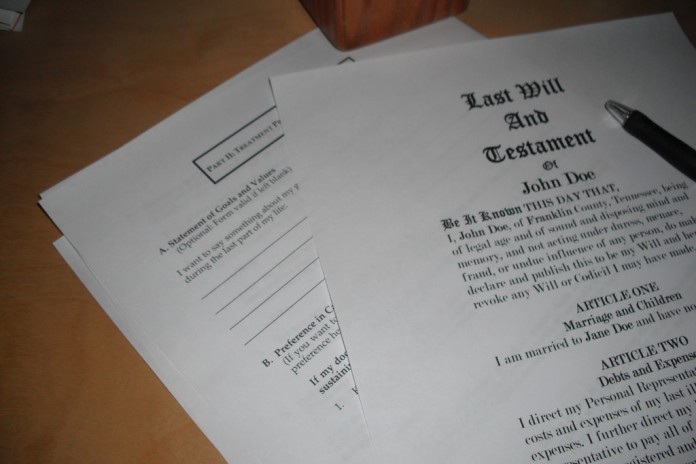
How And When To Make A Last Will And Testament?

0

In this blog post, Mitali Shahane, a TYBLS student studying at Pravin Gandhi College Of Law, Mumbai describes the process of making a last will and testament.

Introduction

Every person has a desire that after he dies his family will not face any problems.  Be it monetary or any family dispute, he just wants his family to stay happy. In order to achieve this, his wish to put the division of all the property he possesses should be put in black and white. The only way possible for him to resolve this is through a written Will. One finds the law governing Will in the form of Indian Succession Act, 1925 which is applicable to Hindus, Buddhist, Parsees, Jain, Christians and Sikhs. The law is not applicable to the Muslim community. Our common understanding describes Will to be as a wish or desire of a person who bequeaths his/her property (both immoveable and moveable) as set in the legal document after his death.

Whenever, a person dies without leaving a will that person is said to die intestate and the testamentary law finds no application in such case. The intestate provisions under Hindu Succession Act, 1956 are applied to Hindu, Jain, Sikh and Buddhist, Christians, and Parsees, while the Jews are governed by Indian Succession Act, 1925. Generally, the practice is to approach a legal adviser who would be able to highlight on every impediment associated with the drafting of the Will. The person who desires to make his Will is termed as the Testator if he is a male and Testatrix in case of a female. The person who benefits from the will is called a Beneficiary (Note: the executor and the beneficiary can be the same person unless stated.)  

The Statutory Definition

The statutory definition of “Will” is under the Indian Succession Act, 1925 (the said act), which reads as “the legal declaration of the intention of a testator with respect to his property which he desires to be carried into effect after his death.”[1]

When Can A Person Decide To Make A Will?

Every state has very strict requirements as to who can make a Last Will and Testament. Most states require that you be at least 18 years of age, although some states make an exception if you’re serving in the military. Some states also have a lower age limit; for example, Louisiana’s minimum age is 16 and Georgia’s minimum age is 14.[2].

Section 59 of the said act specifies that the person who makes a will should be of sound mind and should not be a minor.

Persons Capable Of Making The Will (Section 59)

Every person:

  1. Of sound mind
  2. Not a minor
  3. A married woman suffers from no disability.
  4. A person who is DEAF, DUMB or BLIND can also make a will if capable of understanding or knowing as to what by it.
  5. A person who is insane can make a will during the period where there is no attack of insanity.

However, Section 60[3] carves out an exception to the general rule and a father is allowed to make a will even if he (father) is a minor. The purpose of will is also in that case limited to the extent of appointing a guardian for his minor child.

In short, the testator’s age, disease and mental weakness are all important considerations while considering the testamentary capacity of the Testator.

What is required for the validity of a will is that the testator should have been able to comprehend the nature and effect of the disposition at the time of making the will. The testamentary capacity has to be judged not by an absolute standard but as relative to a particular testamentary act.

Mere ability to sign or ability to maintain ordinary conversation does not necessarily constitute a sound mind and disposing mind. The apex Court held that the testatrix was of sound mind (although she was 70 years of age and although physically incapable of signing her name) and upheld the will made by the widowed lady.

As a general rule, a minor is debarred from making a will.

What Has The Youth To Say About The “Ideal Age’?

A detailed survey conducted by the Times of India found the general opinion to be between age group of 30 and 40. The report also stated that in order to avoid rivalry between siblings the Parents prefer to make will at an early age. [4]

Common Clauses Under A Will[5]

a) Name, age, address, religion b) Revocation of earlier Will
c) List of relatives d) Appointment of executor
e) Discharge of obligations f) Legacies and bequests to persons
g) Residual estate h) Testimonium
i) Execution j) Witness
k) Safe custody

Though no form is prescribed following clauses are commonly found in a Will. [6]

Terms Associated With A Will

Now, let us focus on the various terms associated with the Will.

Codicil: A testamentary disposition subsequent to a will, and by which the will is altered, explained, added to, subtracted from, or confirmed by way of republication, but in no case totally revoked.[7]

Executor: A person appointed by a testator to carry out the directions and requests in his will, and to dispose of the property according to his testamentary provisions after his decease.[8]

Probate: The court process by which a Will is proved to be valid or invalid. The legal process wherein the estate of the decedent is administered.[9]

Letters of Administration: Letters of Administration is a certificate granted by the competent court to an administrator where there exists a Will authorizing him to administer the estate of the deceased in accordance with the Will. If the Will does not name any executor, an application can be filed in the court for grant of Letter of Administration for the property.[10]

A formal document issued by a court of probate appointing a manager of the assets and liabilities of the estate of the deceased in certain situations.[11]

Attestation of Will: The act of attending the execution of a document and bearing witness to its authenticity, by signing one’s name to it to affirm that it is genuine. The certification by a custodian of records that a copy of an original document is a true copy which is demonstrated by his or her signature on a certificate.[12]

What Are The Key Characteristics Of A Will?

Firstly, it is of paramount importance that the testator’s intention is met. The testator’s intention should be inconsonance with the law applicable during the period. The disposition of property is carried out in accordance with the law and it is upon the testator to decide the manner in which his property is to be bequeathed. It is also upon the testator who should be appointed and how many would become Executor(s)/Executrix of the Will. The testator can revoke his/her will at any point of his/her lifetime and hence, if the testator executes a subsequent Will, his previously executed Will automatically stands cancelled. It is of utmost importance to note that a Will can be altered or additions can be made by executing a codicil (Section 62 for making alteration or additions and also to revoke the same by a codicil)[13].

The Will is to be executed only after the Testator’s death.

A will can be rejected if it is obtained with undue influence, coercion or fraud. Section 61 declares a will invalid if obtained in any of the following manner.

The Testator/Testatrix can bequeath property/properties where they have absolute ownership. The ownership can be in immoveable property like a flat, ancestral land, etc. and moveable property in the form of investment made in stocks, mutual funds, holding dematerialized account, money in the saving bank accounts, etc. It is also upon the Testator/Testatrix to bequeath the jewellery or silverware/ utensils as well.

If the testator was a part of a Hindu Undivided Family (HUF), it is of utmost importance that he mentions in the Will, provided it has been dissolved by a Partition Deed.

The Testator can even transfer the property in the form of trust, a religious institution or for any educational purpose, if in case he does not want to bequeath the same to his/her natural heirs or he/she are bereft of any natural heirs. However, a reason for this requires to be mentioned in the Will. Also he needs to state the names of the trustees in the Will.

Registration Of A Will

As per Registration is concerned, under Section 17 of the Registration Act, 1908, a Will is not a registrable document. Section 18(e) of the Registration Act, provides for the registration subsequent to the testator’s wish whether to register the Will. Stamp duty is also not payable.

If the testator decides to register his will, he needs to make an application to the registrar/sub-registrar of assurances (pertaining to the taluka or district), the registration provides evidence that the proper parties had appeared before the registering officer and the latter had attested the same after ascertaining their identity. Once a Will is registered, it is placed in the safe custody of the Registrar and cannot be tampered with, destroyed, mutilated or stolen. However, non-registration of a Will does not lead to any inference against its genuineness. Registration grants protection and secrecy to a Will. It doesn’t have to be executed before a notary public.[14] It can be released only on the production of the Death Certificate of the Testator.

Pros And Cons Of Registering A Will[15]

It is not necessary to register a will. However if the registration of a Will is done the following benefits can arise:

  1.    In that event, a copy of the will shall remain with the office of the registry.
  2.    In case there is tampering of the original will, it can be compared with the will maintained in the office of the registry.
  3.    In the event the original will is destroyed a certified copy can be obtained from the registry office.
  4.    If a will is made regarding leasehold property before a probate is obtained it will be convenient to strike out a name or carry out a mutation.
  5.    For reason of some illness if the testator is unable to go to the registry office the registrar can come to the residence of the testator and the registration can be done in the residence of the testator.

Be that as it may, there are certain disadvantages of registering a will.

  1.    Normally it is very easy to make amendments in a will but once a will is registered it becomes well-nigh impossible to make changes to the will.
  2.    A will once registered is amenable to registration each time it is subject to changes.

Although these difficulties do persist, if the testator feels that it is of his best interest to register the will, he can go ahead with it.[16]

Types Of Wills Under The Indian Succession Act, 1925

  1. PRIVILEGED WILL: Under Chapter VI, Section 65 of the said act describes a Privileged Will

“65. Privileged wills. -Any soldier being employed in an expedition or engaged in actual warfare, 1*[or an airman so employed or engaged,] or any mariner being at sea, may, if he has completed the  age of eighteen years, dispose of his property by a will made in the manner provided in section 66. Such wills are called privileged wills.”

Section 66 provides the manner in which a Privileged will wherein the Testator can dispose of his property and the execution of the same, in the manner set therein.

A Privileged Will can be revoked by the Execution of unprivileged will. (Section 72 of the said act).

  1. CONTIGENT OR CONDITIONAL WILL: Conditional will is one which depends upon the occurrence or non occurrence of some uncertain event. It takes effect or may be defeated on the happening of the condition stipulated. If the happening of an event stated in a will is the reason for making the will, it is unconditional. But if the testator intends to dispose of his/her property in case the event happens, the will is conditional. A conditional will can be an attested will, a holographic will or a nuncupative will. [17]

In Rajeshwar v. Sukhdeo[18] dealt with the operation of the Will wherein it was postponed till the death of the Testator’s wife’s death. However if it is ambiguous whether the testator intended to make a Will conditional, the language of the documents as well as the circumstances are to be taken into consideration.

  1.    JOINT WILL: Two or more persons can make a joint Will. If the joint Will is joint and is intended to take effect after the death of both, it will not be admitted to probate during the life time of either and are revocable at any time by either during the joint lives or after the death of the survivor.

A joint will is a single testamentary instrument recording the wishes of two persons. For example, a husband and wife disposing common property. In relation to each signatory’s property, the will become effective on his/or her death. Each party can revoke the will during his/her lifetime. A joint will is merely an administrative convenience. A joint will makes separate distribution of property by each executor and will be treated as such on admission to probate. A joint Will prevents the second person from changing his/her mind after executing the will.[19]

  1.    MUTUAL WILL: Mutual wills are wills made by two people, often spouses, in which each gives his/her estate to the other, or agree upon the distribution of their assets. If there is a contract in which each makes the will in the consideration for the other person making the will, the agreed upon dispositions of property are binding and a later change will invalidate the will. Mutual wills may contain an obligation not to revoke a will and thereby breach the agreement which is entered into at the time the mutual wills were made. Where one party has died the other will be obliged not to revoke his or her will subsequently. Where the surviving party attempts to do so a constructive trust will be imposed to remedy the injustice which might arise from breach of the original agreement. The most common situation is where husband and wife to make wills leaving their property to the other, if the other survives, and in default to a beneficiary, but it is not essential that the surviving testator should receive property under the will of the first testator to die. If the spouse dies without having altered or revoked his will he has performed his part of the bargain and this creates an obligation on the part of the surviving spouse to uphold the agreement.[20]

Difference Of A Joint Will And A Mutual Will

A joint will is different from mutual will. Mutual Wills means that there are any two or more wills which are mutually binding. In mutual will, following the first death, the survivor is constrained to dispose of his/her property by the agreement made with the deceased.

  1.    HOLOGRAPHIC WILL: A holographic will is one that is entirely written, dated, and signed in the handwriting of the testator (person making the will), rather than typewritten or printed. In some states, holographic wills are not required to be signed by witnesses in order to be valid to pass property. Courts have been lenient in trying to figure out some holographic wills when questions arise, but judges will not rewrite a holographic will to make it valid. A holographic will is probably the most risky do-it-yourself estate plan because of the lack of guidelines involved.[21]
  2.     SHAM WILL: Since the intention of the testator is regarded as one of the essential condition of a valid Will, if a document is deliberately executed with all due formalities purporting to be a Will, but if it can be shown that the instrument was executed for some collateral object without any intention of the testator to make it operative, the Will is regarded as a Sham Will. It is considered as invalid in the eye of law.[22]
  3.    DUPLICATE WILL: When a testator makes a Will in duplicate, for the sake of safety, one to be kept by him and the other to be deposited in the safe custody with a bank or executor or trustee it is referred to as a Duplicate Will. If the testator destroys or damages the Will that is with him, it is considered a revocation of both Wills.[23]
  4.    CONCURRENT WILLS: In the event the testator disposes of some of his properties in one country by one Will and the other properties in another country by a separate will these are regarded as Concurrent Wills. In such cases both the Wills are regarded as valid irrespective of the ‘last Will’ theory.[24]

Revocability

Section 62 states that an unprivileged Will can be revoked or altered.

Will may be revoked or altered. A will is liable to be revoked or altered by the maker of it at any time when he is competent to dispose of his property by will.

Alteration To A Will

A will can be altered under Section 62 of the said act.

Will may be revoked or altered. A will is liable to be revoked or altered by the maker of it at any time when he is competent to dispose of his property by will.

Section 71 “Effect of obliteration[25], interlineation or alteration in unprivileged will. No obliteration, interlineation or other alteration made in any unprivileged  will after the execution thereof shall have any effect, except so far as the words  or meaning of the will have been  thereby   rendered  illegible or undiscernible,  unless  such alteration has  been  executed  in  like  manner  as  hereinbefore  is required for the execution of the will:

Provided that the will, as so altered, shall be deemed to be duly executed if the signature of the testator and the subscription of the witnesses is made in the margin or on some other part of the will opposite or near to such alteration, or at the foot or end of or opposite to a memorandum referring to such alteration, and written at the end or some other part of the will.”

Wording Of A Wll

under Chapter VI (Construction of Will, Section 74 of the said Act deals with the wording of a will.

“Section 74. Wording of will. It is not necessary that any technical words or terms of art be used in a will, but only that the wording be such that the intentions of the testator can be known therefrom.”

Construction And Interpretation Of Will

Sections 97, 98, 99, 100 and 101 deals with the construction and interpretation of the words used in a Will.

The general rule which is adopted by the Courts is to go by the manifest intention of the testator. This principle is found in a judgement delivered by the apex court in Nathu v. Debi Singh.[26]

The Will should be construed by a court placing itself on the armchair of the testator. The endeavour of the court should be to give effect to his intention. The intention of the testator can be culled out not only upon reading the will in its entirety, but also the background facts and circumstances of the case. (Shyamal Kanti Guha & Ors. v. Meena Bose) [27]

In Navneet Lal v. Gokul & Ors[28]

“The SC held that the court should consider the surrounding circumstances, the position of the testator, his family relationships, and the probability that he would use words in a particular sense. However it also held that these factors are merely an aid in ascertaining the intention of the testator. The Court cannot speculate what the testator might have intended to write. The Court can only interpret in accordance with the express or implied intention of the testator expressed in the Will. It cannot recreate or make a Will for the testator.”

“8. From the earlier decisions of this Court the following principles, inter alia, are well established:

(1) In construing a document whether in English or in vernacular the fundamental rule is to ascertain the intention from the words used; the surrounding circumstances are to be considered; but that is only for the purpose of finding out the intended meaning of the words which have actually been employed. {Ram Gopal v. Nand Lal [1950 SCR 766]}

(2) In construing the language of the will the court is entitled to put itself into the testator’s armchair [Venkata Narasimha v. Parthasarathy (1913) 41 Ind App 51 at p. 72] and is bound to bear in mind also other matters than merely the words used. It must consider the surrounding circumstances, the position of the testator, his family relationship, the probability that he would use words in a particular sense…. But all this is solely as an aid to arriving at a right construction of the will, and to ascertain the meaning of its language when used by that particular testator in that document. [Venkata Narasimha’s case (supra) and Gnanambal Ammal v. T. Raju Ayyar (1950 SCR 949, 955)]

(3) The true intention of the testator has to be gathered not by attaching importance to isolated expressions but by reading the will as a whole with all its provisions and ignoring none of them as redundant or contradictory [Raj Bajrang Bahadur Singh v. Thakurain Bakhtraj Kuer (1953 SCR 232, 240]

(4) The court must accept, if possible, such construction as would give to every expression some effect rather than that which would render any of the expressions inoperative. The court will look at the circumstances under which the testator makes his will, such as the state of his property, of his family and the like. Where apparently conflicting dispositions can be reconciled by giving full effect to every word used in a document, such a construction should be accepted instead of a construction which would have the effect of cutting down the clear meaning of the words used by the testator. Further, where one of the two reasonable constructions would lead to intestacy that should be discarded in favour of a construction which does not create any such hiatus. [Pearey Lal v. Rameshwar Das (1963 Supp. 2 SCR 834, 839, 842].

(5) It is one of the cardinal principles of construction of wills that to the extent that it is legally possible effect should be given to every disposition contained in the will unless the law prevents effect being given to it. Of course, if there are two repugnant provisions conferring successive interests, if the first interest created is valid the subsequent interest cannot take effect but a Court of construction will proceed to the farthest extent to avoid repugnancy, so that effect could be given as far as possible to every testamentary intention contained in the will. {Ramachandra Shenoy v. Mrs. Hilda Brite [(1964) 2 SCR 722, 735]}

Execution Of A Will

Once the will is drafted and accepted by its Testator, its needs to be executed. The act of execution is witnessed by two witnesses who sign the legal document. It is preferred that a competent person/persons should be made a witness to the signing of the will by the Testator. For example a doctor or an advocate, for the doctor can testify the mental condition and stability of the Testator/Testatrix and the advocate with the legal impediments. It is crucial that the Testator/Testatrix appoints an executor/executrix whom they can trust. It is not a mandate to appoint executors to a Will, but the task of execution gets simplified.

A Testator can appoint two or three executors, but one needs to ensure that the executor is not of the same age or older to the Testator. When I assisted my sir in the drafting of the will, he advised the client who was an 80 year old man to keep his daughter along with his wife as the executors of his will.  

Pertaining to the execution of privileged Will, one finds Section 65 and Section 66 of the said act. .

Section 63 relates to the provision for the execution of an unprivileged will.

“S.63 of the Indian Succession Act deals with the execution of unprivileged wills. It lays down that the testator shall sign or shall affix his mark to the will or it shall be signed by some other person in his presence and by his direction. It further lays that the will shall be attested by two or more witnesses, each of whom has seen the testator signing or affixing his mark to the will or has seen some other person sign the will, in the presence and on the direction of the testator and each of the witnesses shall sign the will in the presence and on the direction of the testator. Section 68 of the Evidence Act mandates examination of one attesting witness in proof of a will, whether registered or not.” Lalitaben Jayantilal Popat v. Pragnaben Jamnadas Kataria & Ors. [2009 (1) Scale 328]”

“When the execution of a will asserted by one party is denied by the other party, then the burden is on the party who relies on the will to prove its execution. But when the execution of the will is not denied then no burden is cast on the party who relies on a will to prove its execution.” Balathandayutham and Another v. Ezilarasan [(2010) 5 SCC 770]

“Since section 63 of the Succession Act requires a will to be attested, it cannot be used as evidence until, as required by section 63 of the Evidence Act, one attesting witness at least has .been called for the purpose of proving its execution, if there be an attesting witness alive     and subject     to the process of the court and capable of giving evidence.

Unlike other documents, the will speaks from the death of the testator and therefore the maker of the will is never available for deposing as to the circumstances in which the will came to be executed.”

Cases in which the execution of the will is surrounded by suspicious circumstances stand on a different footing. A shaky signature, a feeble mind, an unfair and unjust disposition of property, the propounder himself taking a leading part in the making of the will under which he receives a substantial benefit and such other circumstances raise suspicion about the execution of the will. That suspicion cannot be removed by the mere assertion of the propounder that the will bears the signature of the testator or that the testator was in a sound and disposing state of mind and memory at the time when the will was made, or that those like the wife and children of the testator who would normally receive their due share in his estate were disinherited because the testator might have had his own reasons for excluding them. The presence of suspicious circumstances makes the initial onus heavier and therefore, in cases where the circumstances attendant upon the execution of the will excite the suspicion of the court, the propounder must remove all legitimate suspicions before the document can be accepted as the last will of the testator.

Leela Rajagopal & Ors.  Vs.  Kamala Menon Cocharan & Ors.Civil Appeal No. 9282 of 2010, 9286 of 2010, 7004 of 2012, decided on September 8, 2014.

“10. A Will may have certain features and may have been executed in certain circumstances which may appear to be somewhat unnatural. Such unusual features appearing in a Will or the unnatural circumstances surrounding its execution will definitely justify a close scrutiny before the same can be accepted. It is the overall assessment of the Court on the basis of such scrutiny; the cumulative effect of the unusual features and circumstances which would weigh with the Court in the determination required to be made by it. The judicial verdict, in the last resort, will be on the basis of a consideration of all the unusual features and suspicious circumstances put together and not on the impact of any single feature that may be found in a Will or a singular circumstance that may appear from the process leading to its execution or registration. This, is the essence of the repeated pronouncements made by this Court on the subject including the decisions referred to and relied upon before us.”

Role Of An Executor

An executor in India has numerous responsibilities, and these include, but are not limited to:

  • Your funeral arrangements and paying for your funeral from your assets;
  • Registering your death and informing all concerned;
  • Filing probate, proving his identity, and establishing his authenticity;
  • Paying your debts;
  • Caring for your property until it is sold or given to your beneficiaries;
  • Dealing with any legal procedures;
  • Locating your beneficiaries;
  • Distributing the assets of your estate to your beneficiaries;
  • Record keeping of all transactions;
  • Submitting receipts to the court; and
  • Taking legal and financial responsibility for the administration of your estate.[29]

Given the complexity involved, it’s a good idea to discuss the responsibilities of being an executor before you actually go ahead and appoint someone in your Indian will. It’s an incredibly important job and can also be complicated to handle. You would also want to familiarize your executor with the contents of your will as well as offer instructions on locating and dealing with your assets, and also discuss funeral arrangements.

Normally a spouse or trusted family member would be chosen as an executor.

You should keep in mind over time that circumstances change, and your chosen executor may no longer be able to handle an executor’s duties due to death, illness or other changing circumstances. To deal with this, you should also consider appointing alternate executors (possibly more than one) in your Indian will.

An executor receives compensation for the work they do administering your estate. The amount received is normally based on the size of your estate and its complexity.

If you don’t have someone you feel comfortable with acting as an executor, you can also choose a legal professional or a company that specializes in this. Again, the same considerations about choosing an executor carefully apply.[30]

Obtaining A Probate

To Whom Can A Probate Be Granted?

Under Section 222 of the said act clear specifies that the Probate is granted to the person who has been appointed as the executor of the will.

Section 223 states to whom a provision cannot be granted.

Issue of Probate is contained in Section 213 of the said act.

“The prohibition under section 213 of ISA 1925 is regarding establishing any right under the Will without Probate, and that section cannot be understood as one by which the vesting of a right as per the provisions of the Will is postponed until the obtaining of Probate or LOA.

The Will takes effect on the death of the testator and what S.213 says that is that the right as an Executor or as Legatee can be established in any Court only if Probate or LOA is obtained.

The requirement of obtaining Probate or LOA becomes relevant at the time when the establishment of right as Executor or Legatee is sought to be made on the basis of a Will in a Court of Justice.” [31]

To obtain a probate of a will, one will have to file a probate petition in a court of competent jurisdiction. It takes about 8-10 months to obtain a probate if the petition is not contested by any person. At the time of filing the petition, court fees will have to be paid.

It is to be noted that as per section 222 of the Act, a probate shall only be granted to an executor of a will. Section 226 of the Act specifically provides that on the demise of an executor, representation would survive to the surviving executor or executors as the case may be.

Thus, on reading sections 222 with 226 of the Act it is clear that probate petitions are essentially at the instance of the executors named in the will and can survive till the executors survive. The moment the sole executor or all the executors die, the question of the proceeding being kept alive does not arise at all as there would be no occasion in such a case to grant any probate. Such a proceeding would die a natural death due to non-survival of any executor.[32]

Section 227 says that after the probate of a Will is granted then it becomes effective from the death of the testator and shall render valid all intermediate acts of the executor as such. Therefore, according to Section 227, the moment the probate is granted it will relate back from the date of death of the testator and all property will be vested in the person in whose favour the probate was granted.

Why One Should Make A Will?

The times are changing and it becomes inevitable in such situation to evolve in every aspect. The necessity arises only because money and property brings strain in blood relations. Thus, it has become crucial that one makes a will. I recently got an opportunity to make a last will and testament wherein bad relations developed between the client and his elder son, but despite that, out of love and affection, he decided to give a share in his immoveable property. Thus, the task of distribution of property is made easy once a Will has been formulated.

Conclusion

Thus, it is unavoidable to escape from making a will. Keeping in mind the changing times and plethora of problems which may arise, making a last will and testament has become fundamental in one’s lifetime.

[1] Section 2(h) of Indian Succession Act, 1925.

[2] https://www.livingtrustnetwork.com/estate-planning-center/last-will-and-testament/faqs-about-a-last-will-and-testament.html

[3] 60. Testamentary guardian. -A father, whatever his age may be, may by will appoint a guardian or guardians for his child during minority.

[4] http://timesofindia.indiatimes.com/bombay-times/Whats-the-right-age-to-make-a-will/articleshow/1510772.cms

[5] https://www.bcasonline.org/Referencer2015-16/Other%20Laws/succession_and_wills.html

[7] Black Law’s Dictionary.

[8] Ibid

[9] http://legal-dictionary.thefreedictionary.com/probate

[10] http://www.legalserviceindia.com/articles/will_hindu.htm

[11] Ibid 7.

[12] Ibid 7.

[13] 62. Will may be revoked or altered. -A will is liable to be revoked or altered by the maker of it at any time when he is competent to dispose of his property by will. Of the Indian Succession Act, 1925.  

[14] http://www.livemint.com/Money/x7Yh40v1N3m7qToh1uvCkP/It-is-not-necessary-to-register-a-Will-for-it-to-be-valid.html

[15] http://www.legallyindia.com/Wills-Probate/how-to-make-a-will-and-why

[16] Ibid 15

[17] http://definitions.uslegal.com/c/conditional-will/

[18] LAWS(PVC)-1947-3-77

[19] Ibid 13

[20] Ibid 13

[21] Ibid 13

[22] http://lawquestinternational.com/types-wills

[23] Ibid 17

[24] Ibid 17

[25] Meaning of Obliteration (Black Law’s dictionary): Erasure or blotting out of written words. Obliteration is not limited to effacing the letters of a will or scratching thein out or blotting them so completely that they cannot be read. A line drawn through the writing is obliteration, though it may leave it as legible as it was before. See Glass v. Scott, 14 Colo. App. 377, 00 Pac. 180; Evans’ Appeal, 5S Pa. 244; Townshend v. Iloward, SG Me. 285, 29 Atl. 1077; State v. Kuippa, 29 Tex. 29S.

[26] AIR 1966 Punj 226

[27] [(2008) 8 SCC 115]

[28](1976) 1 SCC 630

[29] http://www.wills.in/executor/

[30] Ibid

[31] Cherichi versus Ittianam – AIR 2001 Ker 184.

[32] http://www.livemint.com/Money/9P7tDm1CNFz0LDVdmPEIwK/Its-advisable-to-obtain-probate-if-said-will-is-contested.html


Download Now

What all Indians should know about SARFAESI Act, 2002

1
IPOs

This article on The Securitisation and Reconstruction of Financial Assets and Enforcement of Security Interest Act, 2002 (also known as the SARFAESI Act) is written by Vidit Mehra from Symbiosis Law School.

SARFAESI Act

Download Now

Job Opportunity-Legal Officer-Murugappa Group

0

Murugappa Group Job Opportunity.Murugappa group is hiring for ‘Legal Officer’ at Nelore Tirupati.Detals are as follows:

job at a glance

  • Designation-Legal Officer
  • Qualification-LLB
  • Salary-2 lakh to 4 lakh p.a
  • Experience-1 to 6 years
  • Location-Nelore Tirupati
  • Keyskills-legal,litigation,arbitration,collections
  • Company name-Murugappa group
  • Company website-www.murugappagroup.com

company profile

Cholamandalam Investment and Finance Company Limited was incorporated in 1978 as the financial services arm of the Murugappa Group. Chola commenced business as an equipment financing company and has today emerged as a comprehensive financial services provider offering vehicle finance, home loans, home equity loans, SME loans, investment advisory services, stock broking and a variety of other financial services to customers.
For the past 20 years, Chola has created value for its customers by supporting them in becoming entrepreneurs in the field of commercial transportation. Chola has financed over 750,000 customers, and increasing by over 15,000 new customers every month. Chola enjoys a valued and stable relationship with manufacturers and dealers, one of the key reasons, why it is a leader in the commercial vehicle segment

How to apply?

Candidates can send their cv’s on [email protected]

Download Now

Job Opportunity-Senior Legal Manager-Allanasons Pvt Ltd

0

Allanasons Pvt Ltd job opportunity.Allanasons Pvt Ltd is hiring for ‘Senior Legal Manager’ at Mumbai.Details are as follows:

job at a glance

  • Designation-Senior Legal Manager
  • Qualification-LLB/LLM
  • Salary- 15,00,000 – 18,00,000 P.A
  • Experience-9 to 14 years
  • Location-Mumbai
  • Keyskills-non litigation,legal,drafting,MOUS
  • Company name-Allanasons Pvt Ltd
  • Company website-www.allanasons.com

company profile

Allanasons, a leading exporter of processed agro based products, envisages ambitious growth plans with an aim to double its exports in the next 5 years. To facilitate this growth the Company requires following professionals.
Download Now

Job Opportunity-Legal and Compliance- Angel Broking Private Limited

0

Angel Broking Private Limited job opportunity.Angel Broking Private Limited is hiring for ‘Legal and Compliance’ at Ahmedabad.Details are as follows:

Job at a glance

  • Designation-Legal and Compliance
  • Qualification-LLB/LLM
  • Salary- 4,00,000 – 6,00,000 P.A
  • Experience-4 to 7 years
  • Location-Ahmedabad
  • Keyskills-litigation,legal compliance,arbitration,corporate governance
  • Company name-Angel Broking Private Limited
  • Company website-www.angelbroking.com

company profile

Angel Broking’s tryst with excellence in customer relations began more than 20 years ago. Today, we have emerged as a premium Indian stock-broking and wealth management house,
How to apply?
Candidates can send their cv’s on [email protected]
Angel Broking Private Limited Careers
Download Now

Job Opportunity-Senior Executive Legal-ibibo Group Pvt Ltd

0

ibibo Group Pvt Ltd job opportunity.ibibo Group Pvt Ltd is hiring for ‘Senior Executive Legal’ at Gurgaon.Details are as follows:

job at a glance

  • Designation-Senior Executive Legal
  • Qualification-LLB
  • Experience-1 to 3 years
  • Salary-Negotiable
  • Location-Gurgaon
  • Keyskills-trademark,copyright,legal,ipr,drafting
  • Company name-ibibo Group Pvt Ltd
  • Company website-www.ibibo.com

company profile

ibibo Group is India’s leading online travel group that owns properties such as Goibibo.com (Leading B2C Online travel aggregator); redBus.in (No 1 online bus ticketing platform) and travelboutique (51% stake in the leading B2B online travel platform). ibibo Group organically developed and launched Goibibo.com, (horizontal B2C online travel aggregator) in 2010 that enables consumers to buy air tickets, hotels and bus tickets via both mobile and desktop. Goibibo has become a leading mobile and online travel platform in India driven by its promise of the fastest platform in India be it for bookings, after sales, payments and refunds. The combined travel assets of ibiboGroup make the company the largest in terms of volume of transactions
How to apply?
Interested candidates can send their cv’s on [email protected]
Image result for goibibo

Download Now
logo
FREE & ONLINE 3-Day Bootcamp (LIVE only) on

How Can Experienced Professionals Become Independent Directors

calender
28th, 29th Mar, 2026, 2 - 5pm (IST) &
30th Mar, 2026, 7 - 10pm (IST).
Bootcamp starting in
Days
HRS
MIN
SEC
Abhyuday AgarwalCOO & CO-Founder, LawSikho

Register now

Abhyuday AgarwalCOO & CO-Founder, LawSikho