Download Now
Home Blog Page 1702

What Is Distribution Waterfall?

0

In this blog post, Amala Halder, a student of Department of Law, Calcutta University, Kolkata, who is currently pursuing a Diploma in Entrepreneurship Administration and Business Laws from NUJS, Kolkata, writes about the concept of distribution waterfall and explains the American and European model of the same.

amala

Introduction

A distribution waterfall may precisely be imagined as a waterfall of money in several buckets. The allocation methods are different for the different buckets. It is usually used to allocate proceeds from fund’s realized investments and cash inflows among its private equity fund sponsors and investors in the fund.

Distribution waterfall is also used to describe the method by which capital is distributed to a fund’s investors as underlying investments are sold. It specifies, for example, that an investor will receive his or her initial investment, plus a preferred return, before the general partners participate in the profits. Such an arrangement can increase the investor’s confidence in the equity fund and its potential profitability for them.

Here, we shall discuss distribution waterfall of private equity funds. Distribution waterfall forms the center of the economic relationship between a private equity fund sponsor and its investors. There are certain conventions that are adhered to. However, it is one of the most heavily negotiated terms of any private equity fund.

Usually, there are two main types of distribution waterfalls. They are as follows:

  • American waterfall
  • European waterfall

A close look at the working of both the methods would help us get a better understanding.

waterfall-money-catch-falling-sky-67302473 

American waterfall

This is also called a deal-by-deal waterfall. A deal-by-deal waterfall involves the following steps:-

  1. One hundred percent of the cash inflows from a realized investment is paid to the fund’s investors until they have received an amount equal to their capital used in the realized investment, plus an amount equal to the unreturned invested capital in all previously realized investments, plus an amount equal to the unrealized investments, and the fees and expenses allotted to these investments.
  2. Then comes step two. Here, any cash flows from a realized investment more than the amount paid in step 1 is paid to the fund’s investors until they have received an amount same as the preferred return on the amount in step 1, usually expressed as a percentage (eight percent compounded annually).
  3. Any cash flows from the realized investment more than the amount paid in the above steps is paid to sponsor until it has received an amount equal to 20 percent of the amount paid to the investors in the steps mentioned before.
  4. In the final step, any cash flow from a realized investment more than the amount paid in steps 1,2 and three is split between the fund sponsor (20 percent) and the investors(80 percent).

This method incentives professionals and attracts talent to the fund sponsor.


 European waterfall

This method is also called the whole fund waterfall. The steps involved in this method are as follows:-

  1. One hundred percent of the cash inflows from a realized investment is paid to the fund’s investors until they have received an amount equal to the total drawn down commitments.
  2. In the next step, any cash flows from a realized investment more than the amount paid in step 1 is paid to the fund’s investors until they have received an amount equal to the preferred return on the total drawn down commitments, typically expressed as a percentage thereon (eight percent compounded annually).
  3. Next, any cash inflows from a realized investment more than the amount paid in steps 1 and 2 are paid to the fund sponsor until it has received an amount equal to 20 percent of the amount paid to the investors in step 2 and step 3.
  4. In the last step, any cash inflows from a realized investment more than the amount paid in steps 1, 2, and 3 are split between the fund sponsor(20 percent) and the investors (80 percent).

Institutional investors usually prefer this method. The reason is that the return of contributed capital earlier in the life of the fund is advantageous from a time value of money perspective.

It is not that advantageous from the perspective of the fund sponsor though as there is a delay in receiving carried interest and it a disadvantage if seen from the time value perspective.

2

Conclusion

The applicability of the methods depends on various factors. The preference changes with these factors.

Firstly, it depends on the incentive structure one wants to adopt. Secondly, the operational capabilities form a major role, the American waterfall has operational complexities that are usually dealt with by the fund administrator. Thirdly, the place or location influences the distribution waterfall to be obtained. Often when local norms are not followed, it is to be negotiated and bringing in a new format against the conventional norm becomes difficult.

 Thus, we understand that there are several factors that influence the decision of choosing the mechanism to adhere to. However, it is interesting to note that most competent fund administrators usually do not have any problem handling both European and American waterfall.


Download Now

Information Memorandum And It’s Importance

1

In this blog post, Ashutosh Singh, a student of Department of Law, University Of Calcutta, who is currently pursuing a Diploma in Entrepreneurship Administration and Business Laws from NUJS, Kolkata, writes about the importance of an Information Memorandum in any company seeking investment.

IMG_20160812_205016_1471015332191

Introduction

The term Information Memorandum has been defined under the Companies Act of 2013 in Section 31(2). It includes within its ambit

  • All material facts relating to new charges being created,
  • Charges in the financial position of the company as have occurred between the first offer of securities or the previous offer of securities or the succeeding offer of securities, and
  • Such other changes as may be prescribed,

which the company has to file with the Registrar within the prescribed time before the issue of a second or subsequent offer of securities under the shelf prospectus.

Now, a mere reading of this Section fails to provide the crux of what an information memorandum stands for and what purpose does it seeks to achieve. In layman’s terms, it is something which represents a resume of the company or corporate entity which is seeking investment from the prospective investors, be it the angel investors or the private equity investors or the venture capitalists.

1

Purpose

The purpose behind the existence of an information memorandum is to raise investment capital in case of start-ups and bring in fresh investment in case of established companies. The information memorandum provides to the prospective investor, a holistic view of the affairs of the company or any other corporate entity which seeks investments. It is more of what may also be called a vision–mission document of the company as to what are its immediate and future goals and what benefits would the investor acquire if he considers investing in the company. This has been referred to by different names all around the globe, for example, in the case of capitalist countries of the west, it is called an information memorandum but elsewhere, it is referred to as an investment business teaser.

The other matter of concern while referring to an information memorandum is that the difference between it and a business plan. Now, speaking from the point of view of the purpose it seeks to achieve, there can be no broad distinction between them. The only underlying quality which the memorandum seeks to convey is that it puts before the investor the revenue model of the company or the entity, taking into consideration the fixed and the variable costs involved in the business so that it becomes simpler for the investor to assert the validity of their claim based on his prudence.

Moreover, when an information memorandum is being constructed by a Start-up or a company which has been recently floated, then the entire scheme of things involved in the subject has to be more comprehensive and should be aimed at dismissing all the doubts of the investor which arise as to the feasibility of the business.

Important clauses or contents to be present

AAEAAQAAAAAAAAMcAAAAJDIyOGUyNTIyLWExOTEtNGNmOC1iNWRkLTQyMzhhOWNlM2FhNw

Now let us discuss what an information memorandum should consist of or what the essential clauses have to be present in a standard information memorandum, keeping in mind the global view. So typically it must contain –

  • An introduction to the company or the corporate entity i.e. what is the name of the company? What sort of business does it undertake? Whether it is a fresh company or has been in existence for quite some time? Whether it is part of a group of companies or not etc. Thus, all these questions must be dealt with in the introduction clause.
  • Next, we have a clause relating to the profile of the promoters of the company and those of the key shareholders along with these respective inputs being supplied in the day to day activities of the company.
  • Next, the profile of the management of the company is to be brought into light i.e. if any person has been appointed as director for the sole purpose of management. Moreover, in case of directors of a company, their past experiences and completed projects also become a subject matter of the memorandum. This can be explained by an example; suppose an IT professional starts his company then the work he had done with the IT firms prior to the starting of this company also must form a part of his details. This is solely for the purpose of instilling more confidence in the investor that his money is being passed into safe hands and return on investment is assured.
  • Now, we arrive at a clause which is somewhat tricky and varies from a case to case basis. This is the commercial aspect of the investment. Every investor seeks to make a profit on investment, if not then at least to break even, so no loss is suffered. So startup’s they must incorporate this principle of commercial viability into their products and ideas to lure investors. Again, in the case of companies seeking to provide technology-based solutions, the memorandum must be so structured as to provide the entire idea of the product in simple generic terms.
  • Another important clause which has to be present in the information memorandum is a statement of accounts of the company along with a copy of annual returns of the previous three years filed with the MCA and with Income Tax. If these records are not present, then the copies of whatever documents it has relating to compliance must be attached. This is not all, along with these statements of returns the project turnover of the company in the future is also to be attached.

Now having discussed the important clauses to be inserted in the information memorandum, it must be mentioned that while seeking investment from foreign investors, certain things must be kept in mind while providing estimates as to the investment sought or the project cost. The valuation must be expressed regarding the currency of the respective foreign investor. It is also of tantamount importance that the memorandum is drafted in simple language, legal and technical jargons are to be avoided.

It must be kept in mind that no specific law makes the presence of an information memorandum a compulsion in undertaking any investment and it can be practiced by both the private and public companies. But when a listed company undertakes such a memorandum, it has to inform the Stock Exchange 24 hours before such undertaking, and it must also comply with SEBI (Securities and Exchange Board of India) Guidelines, 2015. This is primarily for the reason that with a foreign investor entering the picture, the prices of the shares of the company will fluctuate to a great extent on the Stock Exchange, and vested interests may be involved in taking advantage of such a situation.

An information memorandum may include some element of confidential information, be it relating to the product specifications or to the idea behind the product. This may require the investor to sigh a Non-Disclosure Agreement (NDA) before the memorandum is presented. Now, there may be circumstances when investment is only required for a particular project, it is then titled Project Information Memorandum.

An information memorandum is different from a prospectus which is regulated by the Companies Act 2013 and the ICDR regulations. An information memorandum unlike a prospectus is a commercial document.

document-formatting-information-memorandum-4

Conclusion

Thus, it can be concluded that what an information memorandum does is that it lays down for a prospective investor, in simple words, why he may invest in a particular company by providing the necessary details of the company. The memorandum is to be made in accordance with Rule 10 of the Companies (Prospectus And Allotment of Securities) Rules 2014. The memorandum shall be prepared in Form PAS-2 and filed along with fees as provided in the Companies (Registration Offices and Fees) Rules 2014 within 1 month prior to the issue of second or subsequent offer of securities under the shelf prospectus.

An information memorandum greatly varies in its content with the subject matter of the business of the company.


Download Now

The Concept Of TDS And Statutory Obligations Under It

0

In this blog post, Shruti Sharma, a Legal Associate at BetterPlace Safety Solutions Pvt. Ltd. who is currently pursuing a  Diploma in Entrepreneurship Administration and Business Laws from NUJS, Kolkata, discusses the concept of TDS and the statutory obligations under the same.

Capture1

What is TDS?

TDS stands for Tax Deducted at Source. It is deducted as per the Income Tax Act, 1961 for a particular accounting year. Moreover, it is the duty of payers to deduct tax before hand and then submit to our government.

 TDS

Objectives of TDS


  1. To avoid burden to pay tax:

The concept of TDS has enabled salaried people to pay tax as an installment every month at the time they earn which makes them pay tax on a regular basis without imposing the burden of paying tax in a lump sum.


2. Smooth functioning of government:

It helps the government get funds for whole year as they also require funds for smooth functioning.


3. Collection of taxes from assesses:

TDS helps to collect taxes when the income is paid to various assesses like contractors, professionals, etc.

Who shall deduct TDS?

If the payment comes under the purview of TDS provisions of Income Tax Act, then every person who comes under the purview has to pay TDS. An exception to the rule above is in the case of payments made under Sec.194 A, 194 C, 194 H, 194 I, 194 J. At the time of payment whether in cash, cheque or credit to the payee’s account; TDS must be deducted.


Deductor and Deductee

The person who deducts tax is called deductor and the person from whom the tax is deducted called as a deductee.


Advantages of TDS

TDS has various advantages. TDS is beneficial for both the taxpayer as well as the government.

  1. Tax evasion:

TDS prevents tax evasion as it is based on the concept of “pay as and when you earn”.


2. Tax collection:

TDS widens the tax collection base.


3. Easy and effortless:

TDS deduction is the easiest tax deduction as it is automatically collected and gets deposited to the government.


Applicability of TDS

TDS is applicable on the following:

  1. Salary of an individual
  2. Income from interests on savings
  3. Securities and deemed dividends
  4. Fixed and Recurring accounts
  5. Income from horse racing and insurance commissions
  6. Lottery or game-related prize money
  7. NSS deposits


Minimum salary on which TDS to be deducted

Any person whose salary falls under the taxation slab is subject to TDS which means an individual earning less than Rs.2.5 lakhs is not required to pay TDS.


Steps for paying TDS

23-tax-paper (1)

As per section 194-IA, every person (even individuals) making a payment for consideration of immovable property, not including agricultural land will withhold tax @1% of the transaction amount.

As per notification no.39/2013 dated 31 May 2013, the following things have been made clear:

  1. Depositing of withholding tax.
  2. Issuance of certificates for such tax.
  3. Filing a return of withholding tax.

The following procedure is followed:

The amount deducted under section 194 IA shall be deposited with the Central Government within seven days from the end of the month in which the amount was deducted. For example, if the amount is deducted on 15th June, then it shall be credited to the Central Government by 7th July. TDS payment made u/s 194-IA is to be necessarily accompanied by a challan-cum-statement in Form No.26QB.

The amount shall be deposited electronically within the time specified above with the RBI or the SBI or any other authorized bank. Deductor is liable to furnish the certificate of the tax deducted at source in Form No. 16B to the deductee within 15 days from the due date of furnishing Form No. 26 QB. TDS deductor shall provide a certificate under Form 16B which is to be generated online from the web portal.


Concept of TDS

Salaries payable by an employer are chargeable to tax in the hands of the employee and are subject to deduction of tax at source under section 192 of the Income Tax Act.

The obligation of the employer to deduct tax at source is mandatory and cannot be negotiated. But in cases where there is any failure on the part of the employer to deduct tax at source, the employee cannot escape liability to tax; he would be chargeable to tax entire income from salaries.

The fact that the employer could be proceeded against and be subject to penalty or prosecution would not absolve the employee of his liability to pay tax on the income which should have been subjected to deduction of tax by the employer. In every case, the tax deducted by the employer should be added to the employee’s income and the gross amount should be taken as the taxable income of the employee.


No deduction to be made in certain cases

Section 197 A provides that no deduction of tax at source is to be made from:

  • interest on securities
  • dividends
  • payments in respect of deposits under NSS, etc. if the following conditions are satisfied:
  1. The recipient of such income is an individual and resident in India.
  2. Such person furnishes a declaration in writing in duplicate, in the prescribed form and verified in a prescribed manner, to the payer of such income to the effect that the tax on his estimated total income of the previous year in which such income is to be included in computing his total income will be nil.

Sub-section 197 A(1A) has been inserted with effect from June 1, 1992. This sub-section provides that in a case of interest other than interest on securities, a declaration referred to above can be furnished by any person (other than a company or a firm).

The payer of the income above will deliver to chief commissioner of Income Tax one copy of the declaration (received from the recipient of income) on or before the 7th day of the month next following the month in which the declaration is furnished. If he fails to do so, he will be liable to a penalty of an amount which shall not be less than one hundred rupees but which may extend to two hundred rupees for every day during which the default continues.


E-TDS Return

e-Return

E-TDS Return is prepared in the Form Nos. 24Q, 26Q OR 27Q in electronic media as per prescribed data structure either in a floppy or a CD-ROM. FORM No. 27 A should accompany the floppy, or CD-ROM prepared should be signed and verified in a prescribed manner.

As per section 206 of the Income Tax Act, corporate and government deductors are compulsory required to file their TDS return through electronic media. However, for other deductors filing of e-TDS return is optional and e-TDS should be filed under Section 206 of Income Tax Act by a scheme dated 26 August 2003 for electronic filing of TDS return vide CBDT Circular No. 8 dated 19.09.2003. The CBDT has appointed the Director General of Income Tax (Systems) as e-filing Administrator for the purpose of electronic filing of returns of TDS Scheme, 2003.

CBDT has also appointed National Securities Depository Limited (NSDL) as an e-TDS Intermediary. E-TDS return can be filed at any of the TIN-FC opened by the e-TDS Intermediary for this purpose. The due date for filing quarterly TDS return both through electronic and conventional forms remains the same.

E-Filing of quarterly statement of TDS is mandatory for the deductors where:

  • The deductor is an office of the Government.
  • The deductor is the principal officer of a company.
  • The deductor is a person required to get his accounts audited under section 44AB in the immediately preceding financial year; or
  • The number of deductees recorded in a quarterly statement for any quarter of the financial year are twenty or more;

Other than the above, any other deductor may also opt to furnish the statement electronically.


Download Now

Impact Of Creation Of NCLT On Corporate Litigation

0

In this blog post, Saurabh Kumar, Manager of the Legal and Regulatory Division of Bharti Airtel Limited, Jaipur, who is currently pursuing a Diploma in Entrepreneurship Administration and Business Laws from NUJS, Kolkata, writes about the impact of creation of the National Company Law Tribunal on corporate litigation practice.

WP_20160716_13_20_25_Pro

Introduction

In line with the emphasis of Government of India on ease of doing business, various legal reforms have been carried out and to provide a single judicial forum to adjudicate all disputes concerning the affairs of Indian Companies, the Ministry of Corporate Affairs had issued a notification[1] on 01st June 2016, in the exercise of their powers u/s 408 & 410 of the Companies Act 2013, which paves the way for constitution of National Company Law Tribunal (from now on referred as NCLT) and National Company Law Appellate Tribunal (from now on referred as NCLAT). Initially, the provision for the creation of NCLT was introduced by the Companies (Second Amendment) Act 2002 through recommendations of the Eradi Committee. The Eradi Committee was formed to examine existing law relating to winding up proceedings of companies in order to re-model it in line with the latest developments and innovations in corporate law and governance and to suggest reforms in the procedure followed at various stages in the insolvency proceedings of the companies to avoid unnecessary delays in tune with the international practice in this field[2]. The provision introduced in 2002 remained in abeyance before release of the notification dated 01st June 2016.

The NCLT will have 11 benches initially, with a principal bench at New Delhi with one more in New Delhi, and one each at Ahmedabad, Allahabad, Bengaluru, Chandigarh, Chennai, Guwahati, Hyderabad, Kolkata, and Mumbai. The NCLT will comprise of a President and, Judicial and Technical members. Similarly, the NCLAT will comprise of a chairperson and not more than 11 judicial and technical members. The jurisdiction of every bench has been notified to cover all the States of India.

The establishment of the NCLT consolidates the corporate jurisdiction of following authorities:

  1. Company Law Board
  2. Board for Industrial and Financial Reconstruction
  • The Appellate Authority for Industrial and Financial Reconstruction
  1. Jurisdiction and powers related to winding up, restructuring and other provisions vested in High Court.

NCLT

Impact of creation of NCLT[3]

The formation of NCLT and NCLAT as a single forum to deal with matters of company law is a welcome move for various stakeholders. The impact of creation of NCLT & NCLAT can be summarized as follows:

  1. Single forum:

 Before coming into force of the present notification, the matters of Company Law were dealt by Company Law Board, Board of Industrial and Financial Reconstruction and its appellate authority, High Courts, thus there was multiplicity of proceedings and forums to adjudicate issues related to companies. The constitution of NCLT & NCLAT will replace the existing Company Law Board and Board of Industrial and Financial Reconstruction and its appellate authority and will also subsume the company jurisdiction of High Court. The tribunals will act as the single forum for adjudication of company law matters and will provide holistic solutions to issues being faced by companies. The tribunals will eliminate any scope of overlapping or conflicting judgment’s and will also minimize delays in resolution of disputes. The intent of the creation of NCLT & NCLAT is to consolidate powers and jurisdiction vested in the Central Government, Company Law Board, and High Court earlier, and assigns them to a single authority for speedier & simplified dispute adjudication process.


  1. Class action claims:

A class action suit refers to a lawsuit that allows a large number of people with a common interest in a matter to sue or to be sued as a group. The class action suit came into the spotlight in 2009 when Satyam scam broke out and at that time no provision existed for filing a class action claim. In the year 2013 with the amendment to Companies Act, a provision was introduced as Section 245 of Indian Companies Act 2013 which provided for the filing of class action claims, but the provision was in abeyance until issue of the notification dated 01 June 2016. Thus, now if more than a hundred shareholders find that the affairs of the company are not being managed in its best interests, they may approach NCLT for alleged misconduct on the part of directors or auditors of the company. The present provision will curtail the arbitrary decisions of the management and interest of the small number of shareholders will not be affected.

  1. Accessibility:

The notification stipulates setup of eleven benches of National Company Law Tribunal spread across India to cover all the regions. The significant increase in some benches will surely aid easy accessibility for the company law related matters. Previously, the Central Law Board was managing litigations with only five benches which proved insufficient in catering to the needs of increasing litigations involving company law matters. Before the release of notification, in certain matters, High Court also had jurisdiction to entertain some specific company law matters, which will now be taken care of by the NCLT. The appeals arising out of an order passed by NCLT will be filed with NCLAT.


  1. Speedier remedy:

In comparison to the lengthy procedure being followed by Company Law Board and High Court for adjudication of company law matters, the NCLT and NCLAT have been empowered to regulate its own procedures for disposal of cases within a time line of 3 months and exceptional extension of 90 days based on the reasons to be recorded in writing by the President/Chairman of the NCLT/NCLAT respectively. A mandate has been assigned to the NCLT/NCLAT for speedy disposal of cases within the prescribed timelines.


  1. Phased introduction:

In view of the limited provision being made effective, the NCLT has jurisdiction to (i) entertain any claims of oppression and mismanagement of the company, (ii) adjudicate proceedings and cases filed before the Company Law Board under the Companies Act 1956 which now stands transferred to NCLT, (iii) exercise powers under Sections  241, 242(except subsections 1(b) and 2(c) & (g)), 243, 244, 245 and 434(1)(a) & (b) and (2) of the Companies Act 2013. With the enactment of NCLT, the Company Law Board stands dissolved and all the pending matters will be transferred to NCLT. Presently, the matters related to (i) compromises, arrangements and amalgamations; (ii) revival and rehabilitation of sick companies; and (iii) winding up of companies, is not covered in the scope of NCLT and the same may be transferred to NCLT at later stages. The appeals from the order of NCLT shall be filed with NCLAT and any further appeal against the order of NCLAT shall be filed with Supreme Court of India. Currently, for matters about the winding up of companies and sick companies, parties would have to continue to approach the concerned High Courts, the BIFR or its appellate authority.

 c11a5b8e-de70-40d7-99fa-539609c163e9-1-1465203134573

Conclusion

The notification dated 01st June 2016 will transform the way company matters were dealt with till now, a speedier resolution of the litigations is expected and at the same time, it will reduce the burden of High Courts. Specialized forums are a boon for legal reforms and will benefit companies. Presently, the scope of the NCLT would remain limited to adjudicating the litigations that would have otherwise been filed with the CLB, and eventual effect would subsume the company jurisdiction of High Court.

Footnotes:

[1] Gazette Extraordinary dated 01 June 2016 – S.O. 1932(E) and S.O. 1933(E)

[2] Article published on mondaq.com titled NCLT replaces CLB from June 2016

[3] Article published on mondaq.com titled Constitution of NCLT & NCLAT – A new era of Company Law Litigation in India


Download Now

How Is Arm’s Length Price Compliance Demonstrated?

0

In this blog post, Tresa Ajay, a student of National University of Advanced Legal Studies, Kochi, who is currently pursuing a Diploma in Entrepreneurship Administration and Business Laws from NUJS, Kolkata, discusses how arm’s length price compliance is demonstrated.

IMG-20150913-WA0009

According to the Companies Act, 2013, an arm’s length transaction is defined as one conducted as though the transaction took place between two unrelated persons even though they are related so that no conflict of interest arises. Simply put, it is a transaction entered into as if entered with an unrelated party and so there is no interest. So, contracts with no interest cover the meaning of arm’s length transactions.

The Companies Act, 2013 specifies that any transaction entered into by related parties shall be treated as if they were made with unrelated parties. So in these instances, if a transaction takes place between unrelated parties, there should be no interest there.

ArmsLength673

Section 188 of the Companies Act states that a transaction will qualify as a related party transaction (RPT) if a company enters into any prescribed transaction with a related party. It must also be determined that the transaction is in the company’s ordinary course of business and is entered at an arm’s length. If otherwise, then the approval of the board of directors and shareholders is required. Section 188 of Companies Act 2013 is about Related Party Transactions applicable to both private and public limited companies. The Act only mentions arm’s length transaction and not pricing. We need to look into provisions of the Income Tax Act i.e. the domestic transfer pricing and international transfer pricing requirements to understand pricing requirements.

Section 92F of the Income Tax Act, 1961 mentions arm’s length price to be the price proposed or applied in a transaction between unrelated persons in uncontrolled conditions. Unrelated persons are defined in Section 92A of the same Act i.e. persons that are not associated or deemed to be of an associated enterprise. Uncontrolled conditions would be those that are not controlled or molded to achieve a predetermined result.

Section 92 is only applicable to residents whose income can be taxed under the Sections 5 and 9 of the Income Tax Act, 1961. Section 9 deals with income that is accrued from India and Section 5 deals with non-residents liable to pay tax on income that is received or believed to be received by him in India that arises during the previous year.


What are the main elements required to constitute arm’s length price?

To sum it up, firstly, the price needs to be applied, or there must be some proposition that it will be applied in the transaction. Secondly, the transaction must take place between two unrelated persons and thirdly it must take place under uncontrolled conditions.

Let us take an example to make it clearer. Suppose a bank in its normal course of business provides interest at 9% to its customers on a fixed deposit for two years but provides an interest of 9.25% to its employees. This might come off as a violation of the arm’s length principle.

Transfer pricing

TransferPricing

As mentioned earlier, arm’s length price compliance comes into play in transfer pricing as well. So what is transfer pricing? This is a process by which Multi-National Corporations structure their business strategy in such a manner that they have subsidiary companies in tax havens to maximize profits. Such MNC’s declare fewer profits and adjust their international transactions to evade tax. This gives rise to the issue of transfer pricing. The provisions with regard to this were made very recently in India. Although Section 92 mentioned, it there were no rules which could help resolve the issue. The Finance Act, 2001 inserted Sections 92A to 92F with regard to this.

Again, let us take an example. A subsidiary company which manufactures goods is a resident in country A where the tax rate is 30%. It transfers these goods to its parent company in country B to trade where the tax rate is 20%. The company will then supply goods at a rate lower than the market price to increase profits. But the subsidiary company in country A will have lower profits and thus will be taxed less whereas in country B even though it generates high profits it will be taxed less due to the low tax rate.  In short, the parent company sells the products manufactured at an inflated price to the subsidiary company to show less generation of profits and reduce tax imposition. The law however, requires you to sell the products at arm’s length price.

Section 92 states that any income, expenses, allowances or interest that arises from an international transaction needs to be computed at arm’s length. Also, any allowance for the expense or interest that arises should also be determined at arm’s length. This Section shall not apply to non-residents as their income cannot be taxed under Sections 5 and 9 of Income Tax Act, 1961 as mentioned earlier.

Also if two or more associated enterprises enter into an international transaction for any benefit, service or facility provided, apportioned or contributed by an enterprise then it shall be determined on an arm’s length basis. Thus not only income but any expense or cost is to be determined by arm’s length price. Associated enterprises which participate directly or indirectly or through intermediaries in the control or management of capital.

Sections 92, 92A to 92F will be applied only to international transactions where either or both are non-resident companies. They shall also be associated enterprises if in the previous year an enterprise or person holds, directly or indirectly, shares not less than 26% voting in that enterprise or if an enterprise loans another not less than 26% of the book value of the total assets of that enterprise or if not less than 10% of the total borrowings is guaranteed.

The RBI has also come out with guidelines that specify instances when arm’s length principle needs to be applied. It had mandated that share valuation by an Indian company to a foreign company must be by any internationally accepted method but on an arm’s length basis. This impacts how the valuer has to apply professional judgment and look it on a case by case basis and maybe look at methods as well. This will help Indian companies comply with transfer pricing regulations as well, as it emphasizes on arm’s length compliance.

Thus, according to the guidelines, various shares such as equity shares, preference shares or even debentures that are convertible of an unlisted company approved by FEMA regulations must be valued at a price not lower than the internationally accepted standard on an arm’s length basis for unlisted companies and SEBI (ICDR) Regulations for listed companies. In instances where a non-resident exists from investments in an Indian company, of equity instruments, the price must be arrived at according to internationally accepted standards determined on an arm’s length basis. The same shall be applicable for non-residents when they acquire shares from residents or when they are issued shares under the FDI policy

Methods for computing arm’s length price

ar131281490367831

There are various methods that are used to compute arm’s length price. Comparable Uncontrolled Price Method (CUP) where the price is adjusted so that there are no differences between the international transaction and the comparable uncontrolled transactions. This is used in case it is for a product or service i.e. to compare prices charged for property transferred or a service that is provided. The price at which the service or property obtained by an associated enterprise is resold to an unrelated one is identified and adjusted is called Resale Price Method. The Cost Plus Method is applied in cases where there are semi-finished goods which are sold between related parties or joint facility agreements etc. The Profit Split Method is mainly used in international transactions which deal with unique intangibles or in international transactions that are multiple in nature and so cannot be evaluated separately to determine arm’s length as they are interrelated. Transactional Net Margin Method first computes the net profit margin that was realized by an associated enterprise about certain factors like sales; costs incurred, assets utilized from an international transaction. Then the net profit margin of uncontrolled transactions is compared with the same earned by an associate enterprise to arrive at the arm’s length price.

According to Section 92C(1) of the Income Tax Act, the arm’s length price will be determined using the most appropriate method. The same method cannot be used if the enterprise is involved in various transactions with associated enterprises. This will be determined the case is specifically looking at the facts and circumstances of every situation.

In Serdia Pharmaceuticals (India) (P.) Ltd. V. CIT [2011] 44 SOT 391 (Mum), it was held that there is no priority of methods or order that needs to follow by the assessed as no method can be claimed to be more reliable than the other.

There is no single Indian Bare Act that defines Arm’s length price compliance in totality or explains how this compliance is demonstrated. There are various Acts though such as the Companies Act, 2013, the Income Tax Act, 1961 and the AS 18 that make a mention of it. It is together with these legislations, various circulars, and notifications from the concerned statutory bodies such as the RBI or SEBI along with customary practice that one can grasp what the principle states and how its compliance is demonstrated.


Download Now

Independent Director And Its Responsibilities

0
Liabilities Of Directors

In this blog post, Ankit Sahoo, an Associate with Hammurabi and Solomon, Delhi, who is currently pursuing a Diploma in Entrepreneurship Administration and Business Laws from NUJS, Kolkata, writes about the roles and responsibilities of Independent Directors.

Ankit-Sahoo

In India, the importance of the Independent Directors (from now on referred to as “ID’s”) was realized after the introduction of corporate governance. The Companies Act, 1956 did not have any direct provisions concerning ID’s, plus there was no mandate to appoint ID’s on the Board. However, Clause 49 of the Listing Agreement compulsorily requires all listed companies to appoint independent directors to the Board. With all the discrepancies and growing importance of corporate governance, the Companies Act, 2013 (hereinafter referred as “The Act, 2013”) vide Section 149 made it a statutory mandate for listed companies to appoint ID’s on the Board.

The need for ID’s stimulated due to the need for a robust framework for corporate governance in the functioning of a company. The Act, 2013 makes the role of ID’s different from that of the executive directors. An ID is vested with multiple roles and responsibilities for good corporate governance in a company. The main purpose of introducing the idea of ID’s in the Act, 2013 is to improve corporate credibility, governance standards and risk management of the company. The ID’s by taking unbiased decisions and checking the judgments of the management bring accountability and credibility to the board’s process.


Who is an Independent Director? How is he appointed?

how-does-the-listening-agreement-define-and-independent-director

“Independent director” means a person other than an executive officer or employee of the company or any other individual having a relationship which, in the opinion of the issuer’s board of directors would interfere with the exercise of independent judgment in carrying out the responsibilities of a director.[1]

According to Clause 49 of the Listing Agreement, an ID is a non-executive director or director other than a managing director or whole-time director, who apart from receiving director’s remuneration, doesn’t have any material pecuniary relationship or transactions with the company, its promoters, its directors, its senior management or its holding company, its subsidiaries or associates which might affect its independence.[2]

The appointed ID should not be related to the promoters or any person occupying management position in the board level or the immediate level below. In addition to it, he shouldn’t be an executive of the company or a partner or an executive in a statutory audit firm or internal audit firm of the company in the immediately three preceding financial years. He also has to declare to the board that he is not a material supplier, service provider or customer or a lessor or lessee of the company and also where there is a change that may affect his independence. According to the Act, 2013, the selection of an ID shall be made from a Data Bank maintained by anybody, institute or association, as may be notified by the Central Government, containing names, addresses and qualifications of persons who are eligible and willing to act as IDs. It further provides that the appointed ID shall be then approved at a shareholders’ meeting wherein the board shall present an explanatory statement for approving the ID and a declaration that the ID has fulfilled all the conditions laid down under the Act, 2013.[3]

The tenure of an ID must not exceed beyond two consecutive periods of five years and the period can be extended beyond the second tenure only by passing a special resolution by the Board.[4] But Section 149(11) further mandates that the reappointment or extension of the term of the ID beyond the two consecutive term of five years can only be done after a cooling period of three years.


Roles and Responsibilities of an Independent Director

Person with lots of responsibilities.

The roles of an ID are deliberated to be of great implication. Schedule IV of the Act, 2013 provides a code which lays down the roles and responsibilities of an ID.

An ID plays a vital role in analyzing the Board’s deliberations, especially on issues of strategy, performance, risk management, resources, key appointments and standards of conduct. There are various other roles that an ID plays, like bringing an objective view in the evaluation of the performance of the board, scrutinizing the performance of management in meeting agreed goals and objectives and monitor the reporting of performance, safeguarding the interests of all the stakeholders particularly the minority shareholders, balancing the conflicting interest of the stakeholders, determining the appropriate level of remuneration of executive directors, key managerial personnel and senior management and finally moderating or arbitrating in the interest of the company as a whole, in situations of conflict between the management and shareholders’ interest.[5]

The code also provides the responsibilities that the ID is obligated to fulfill. The ID is placed with a special responsibility to ensure that all the decisions arrived at are in the best interest of the company and shareholders. Apart from this, ID’s are vested with various other responsibilities like undertaking appropriate induction and regularly updating and refreshing skills, knowledge and familiarity with the company; seeking appropriate clarification and amplification of information and take and follow appropriate professional advice; striving to attend all Board meetings and Board committees of which he is member; participating constructively and actively in committees in which they are chairpersons or members; striving to attend general meetings of the company; keeping themselves well informed about the company and the external environment in which the company operates; paying sufficient attention and ensuring that adequate deliberations are held before approving related party transactions; ascertaining and ensuring that the company has an adequate and functional vigil mechanism and subsequently ensure that the interest of the persons using such mechanism is not prejudicially affected; reporting concerns about unethical behavior, actual or suspected fraud or violation of company’s code of conduct; assisting in protecting the legitimate interests of the company, its shareholders and employees while acting within his authority; and finally not disclosing the confidential information including commercial secrets, technologies, advertising and sales promotion plans, unpublished price sensitive information unless such disclosure is approved by the Board or is required by law.[6]

The demand for vigil mechanism has enormously increased after various corporate scandals in India, and this is the sole reason why the Act, 2013 has set such high standards. The Act, 2013 also increased the ID’s participation in the Board’s decision-making process to enhance the monitoring of the management and to protect the interest of the shareholders.

The Act, 2013 also mandates the ID’s to meet at least once annually and conduct a meeting without the presence of non-independent directors and other Board members. The ID’s in such meetings are required to evaluate the performance of the company’s chairperson, non-independent directors and the Board as a whole.[7] Similarly, the Act, 2013 provides the Board with the mandate to convene a similar meeting without the presence of ID’s to evaluate its performance and whether to continue their term. These provisions act as a check and ensure that the powers of the ID’s are utilized in a proper and rational manner.[8]


Conclusion

c35950ed4bc0aadb7ae2520c3ba2

The introduction of ID has been a welcome step towards effective corporate governance in India. The Act, 2013 has conferred upon the ID’s a great deal of empowerment to ensure that the management and affairs of the company are carried out fairly and smoothly, but at the same time, greater accountability is bestowed upon them.

However, it is essential to point out that, the effective selection and functioning of the ID’s is not the only criteria for good governance. Every director whether independent or non-independent, executive or non-executive has a distinct role in the working of a company. Only when the Board as a whole functions effectively and efficiently, it results in good corporate governance and benefits the minority as well as majority shareholders.

Footnotes:

[1] NASDAQ Rule 4200 a (15)

[2]Clause 49(I)(A)(iii) of the Listing Agreement

[3] Section 149 and 150 of the Act, 2013

[4] Section 149 (10) of the Act, 2013

[5] Schedule IV(II) of the Act, 2013

[6] Schedule IV(III) of the Act, 2013

[7] Schedule IV code VII of the Act, 2013

[8] Schedule IV code VIII of the Act, 2013


Download Now

Business Structuring Ideas For Starting A Private University In India Keeping In Mind That There Is An Investor Who Wants To Exit

0

In this blog post, Khushboo Tatia, a practising Advocate and Solicitor and Proprietor at KTP Legal, Mumbai, a student, pursuing  a Diploma in Entrepreneurship Administration and Business Laws from NUJS, Kolkata, provides business structuring ideas to individuals who want to start a private university in India, and have Investors who may want to leave the business. 

Khushboo Tatia


Introduction

In the current era of the emerging and fast growing Indian economy, private players, both domestic and international, are evaluating investment prospects in the country into various avenues. There has been ever-increasing demand for skilled personnel by Business Corporations as well as has opened new windows of opportunities for entrepreneurs and fresh business start-ups. This ongoing process of expansion and diversification of capital into the country has simultaneously led to the emergence of expansion in the education sector. iisc_759

The government on the other hand too strives to facilitate the infrastructure for providing education even in the most remotely possible location and hence has invited self-financed private universities by granting them the status of Deemed University, subject to the norms as laid down. However, even though gates have been opened to private players in the Indian education sector, the Government yet strives to avoid commercialization of this sector by restricting the eligibility to only not-for-profit organisations such as societies and trusts. However, an ‘operate and manage’ model is now legally acceptable which enables a for-profit model in India.


Who Can Establish A Private University In India

Universities in India are governed by the Universities Grant Commission Act, 1956 and various Rules and Regulations formed under it. According to Regulation 2.1. of the said Regulations, a Private University can be duly established by a Sponsoring Body, which may be either;iit-r_660_082913010353_091113100258

  • a Society registered under the Societies Registration Act 1860 or any other corresponding law for the time being in force in a State, or
  • a Public Trust, or
  • a Company registered under Section 25 of the Companies Act, 1956 (i.e. Section 8 of Companies Act 2013)

Further, Private Universities can only be established under a specific State Act and is entitled to operate within the jurisdiction of that concerned state. The establishment of private universities is further governed by UGC (Establishment and Maintenance of a Private University) Regulations, 2003.

While most of the states grant permission or issue NOC only to non-profit entities imparting or intending to impart primary or secondary education in India, the state of Haryana permits even a company (which may either be for-profit or non-profit) incorporated under the Companies Act to establish and maintain schools.


Business Structure Of A Private University 

The fact that only a not-for-profit organisations can enter and establish itself into the Indian education industry has restricted investments directly into such institutions. However, looking at the immense opportunities of a substantial ROI, investors (both domestic and international) have now been allowed to invest into companies that provide education and construction services to such educational institutions. This would entitle them returns through two routes;

  • Firstly, through periodic management fee by entering into a service agreement between the Sponsoring Body and a company (in which interested investors may invest).
  • Secondly, through the dividends declared or interest paid by such companies (who provide services to Sponsoring Body) depending upon the nature of the investment (equity or debt).


Relevant Applicable Tax Laws

Educational institutions set up as not-for-profit organizations are eligible for certain tax exemptions, as provided under the Income Tax Act, 1961 (ITA), subject to satisfaction of certain conditions, such as:private-trust-taxation

  • The educational institution will have to qualify as a trust set up for a charitable purpose; education is covered within the definition of ‘charitable purpose’ as defined in Section 2(15) of the ITA;
  • The educational institute will also have to fulfil certain other conditions in respect of utilisation of income (i.e., income derived from property held under charitable trust must be used predominantly for charitable purposes), etc., as prescribed under Sections 11 and 12 of the ITA;
  • The educational institution should be registered under section 12AA for availing such tax exemptions.

Alternatively, if any university or another educational institution existing solely for educational purposes obtains registration as prescribed under Section 10(23F), it could claim income tax exemption from income earned by it.


Investing In A Private University In India

The government now allows a 100% FDI in the education sector. An example of the benefit of this scheme can be seen in the medical sector where various multinational hospital chains having branches across the world have been allowed to set up medical colleges anywhere in India.


Exit Option For An Investor

In order to ensure a timely exit of investment whereby balancing fairness for both, the company as well as the investor,Limited-Liability-Partnership-Bill-2015it is essential to pre-define various exit strategies before executing the Investors’ Agreement, as deemed fit by both parties.

Such strategies would depend n upon the nature of the investment, general business environment and the business model of such company. Various options which are generally adopted are:

  • The company may repay the investor by utilising its retained earnings of over the years.
  • Private buy-out of the debts/equity of the investor either by the management themselves or through a third-party investor.
  • Mergers or Acquisition is another alternative to raise capital and exit the project, where a part or the entire company (which provides services to the Sponsoring Body) shall be available for sale.


[divider]

REFERENCES

Download Now

When Should Businesses File Advance Tax Returns And Consequences Of Non-Filing?

0

In this blog post, Khushboo Tatia, a practising Advocate and Solicitor and Proprietor at KTP Legal, Mumbai, a student, pursuing a Diploma in Entrepreneurship Administration and Business Laws from NUJS, Kolkata, describes when businesses should file their advance tax returns and lists the consequences of non-filing of returns. 

Khushboo Tatia


History of Taxation in India

In India, the system of direct taxation as it is known today has been in force in one form or another since ancient times. Manu, the ancient sage, and law-giver stated that the king could levy taxes. The sage advised that taxes should be related to the income and expenditure of the subject. He, however, cautioned the king against excessive taxation and stated that both extremes should be avoided namely complete absence of taxes and exorbitant taxation. According to him, the king should arrange the collection of taxes in such a manner that the subjects did not feel the pinch of paying taxes.


What is Advance Tax?

Advance Tax is one of the modes of payment of tax and is payable by the assessee in advance in the financial year in which the concerned income is earned.


Why should one pay Advance Tax?1429284077-7592

The purpose of collection of taxes in advance is to keep a periodic and systematic flow of liquid funds into the country’s treasury which in turn can be distributed amongst its citizens thereby creating a continuous movement in the cash market. This not only helps the government to prepare for its budget but also track its performance as compared with that of last year and take necessary measures on a timely basis.

On the other hand, from the point of view of a tax payer, it is fairly easier for one to pay taxes in smaller terms, on an instalment basis, rather than paying the liability at 100% at one go.


The Income Tax Act, 1961 (relevant sections)

Sections 207-219 of Income Tax Act 1961 deals with Payment of Advance Tax. Sec 207 states as follows:

“(1) Tax shall be payable in advance during any financial year, in accordance with the provisions of sections 208 to 219 (both inclusive), in respect of the total income of the assessee which would be chargeable to tax for the assessment year immediately following that financial year, such income being hereafter in this Chapter referred to as “current income”.

(2) The provisions of sub-section (1) shall not apply to an individual resident in India, who–

(a) does not have any income chargeable under the head “Profits and gains of business or profession”; and

(b) is of the age of sixty years or more at any time during the previous year.”


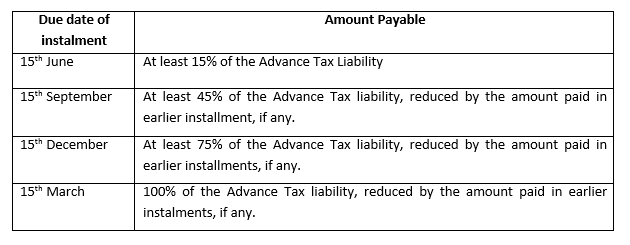
The schedule for payment of Advance Tax is as follows:

22 However, in the case of an advance tax, the assessee is not required to file any returns with the Income Tax department. An assessee simply pays the taxes during the year based on its self-assessment, which during the filing of its annual Income Tax returns are assessed and realized thereon.


Who should and shouldn’t pay Advance Tax?

Advance tax is payable by all assessees i.e. individuals, businesses, HUF, LLP, etc. unless specifically exempted under Sec. 207(2). Advance tax is payable in every case where the amount of tax liability of the assessee is Ten Thousand Rupees (₹ 10,000/-) or more.

Further, as per the amendments in the year 2012, all senior citizens not having any income from business or profession were exempted from payment of any advance taxes.

However, if an assessee opts for Presumptive scheme under 44AD and 44AE, the assessee is liable to pay the whole amount of his advance tax in one installment on or before 15th March.


Penalty for Non-payment/Deferment of Payment1453062570-4966

Sections 215, 234B and 234C, deal with short/non-payment or deferment of payment of tax by an assessee.

In case the tax so paid is less than 75% of the assessed tax, the assesse shall be liable to pay simple interest @ 15% p.a. from 1st April of the following financial year until the date of regular assessment, of the amount by which the advance tax so paid falls short of the assessed tax. If the assessee defers the payment of tax or the tax so paid is less than 90% of the assessed tax, the assessee shall be liable to pay simple interest @ 1% per month from 1st April of the following financial year until the date of regular assessment. Further, if an assessee fails to pay the tax in accordance with the table above, the assessee shall be liable to pay simple interest @ 1% per month for a period of 3 months on the amount falling short.


Concept: Tax Deduction at Sources (TDS) / Tax Collection at Source (TCS)

Also, there is a concept of TDS & TCS similar to an advance tax, where taxes are deducted during the execution of every transaction and submitted with the government on a periodic basis.

In the case of TDS/TCS, the assessee deducting such taxes are required to file periodic returns with the department, contravention to which interest and penalties shall be levied.


[divider]

Bibliography


Download Now

10 Must Have Clauses In An LLP Agreement That Are Not Prescribed By Default Under The LLP Act

1
limited liability partnership

In this blog post, Ribin Verghese, a student, pursuing his second year LLB at KIIT School of Law, KIIT University and a Diploma in Entrepreneurship Administration and Business Laws from NUJS, Kolkata, and Amritha Priya, pursuing a Diploma in Advanced Contract Drafting, Negotiation and Dispute Resolution from Lawsikho.com. lists the clauses that are needed in an LLP Agreement which may not be prescribed by default under the LLP Act. 

Introduction

Limited Liability Partnership Agreement means any written agreement between the partners of the Limited Liability Partnership or between the Limited Liability Partnership and its Partner which determines the mutual rights and duties of the partners and their rights and duties in relation to that Limited Liability Partnership.

Salient Features of Limited Liability Partnership

  1. LLP is a body corporate and a separate legal entity, it has perpetual succession. It can be sued and shall sue others in its own name, which is unlike partnership and like a company. Section 3 of LLP Act. 
  2. LLP must be registered unlike partnership. The rights and duties of partners of LLP is decided based on the LLP agreement between the parties, whereas the same is observed in AOA of company (wherein all the by-rules of company is mentioned).
  3. The liability of the partners in LLP is limited to the extent of their contribution and not to their personal asset. The contribution can either be intangible or tangible or both. In LLP one partner shall not be liable for the other partners misdeeds. 
  4. In partnership there is a ceiling on the number of partners (ie 20 members) in case of LLP there is no ceiling like in case of company. Section 6 of LLP Act.
  5. Accounts of the LLP have to be published or audited with the registrar of Companies (ROC). A statement of accounts and solvency shall be filed by every LLP with the Registrar every year.

In M Govinda & Co V Commissioner of IT Andhra Pradesh, the Supreme Court held that where partners have agreed to share the profits in certain proportions, the presumption is that the losses are also to be shared in the like proportions. Where in a partnership the profits are shared in certain proportion, the fair inference is that losses are to be shared in the same proportion in the absence of a contract to the contrary; the onus of proving that they are not liable for the loss lies on persons who are so assertive. This provision is similar to section 13(b) of the Act of Indian partnership act. 

This is one of the key differences because in LLP as agreement is made mandatory the profit and share ratio is pre decided.

Difference between LLP and Partnership 

  1. LLP is a separate legal entity unlike partnership. Therefore, LLP can sue others without involving the partners, but in case of partnership partners are party to a litigation.
  2. In LLP the partners have limited liability but in case of Partnership the partners have unlimited liability. Section 8 of LLP Act.
  3. The partnership would dissolve on the death or retirement of a partner, but in the case of LLP it does not because it is a separate legal entity. 
  4. The partnership may be formed orally or through deed, the Partnership Act does not mandate registration of agreement. But in case of LLP it is mandatory the partners must have an agreement and shall be registered with the Registrar Of Companies.
  5. There is ceiling/ limit on the number of partners a partnership can have (ie 20 members). But in case of LLP there is no ceiling/ limit for admission of partners. Section 6 of LLP Act.

Difference between LLP and Company

  1. In the case of LLP an agreement must be drafted between the partners which would decide the rights and duties. Whereas in the case of company AOA which determines the bylaws of the company.
  2. In LLP there is no mandatory requirement for a number of meetings either periodically or annually. Whereas in the case of a company it is mandatory that the directors and shareholders meet periodically or annually. 
  3. The partners can take part in day to day activities of the business, there is no separation between management and ownership. But in case of the company there is separation between management and ownership, this is because only directors are allowed and members are not allowed to take part in decision making. 
  4. In LLP there is no restriction on borrowing power unless the agreement specifies so. But in the case of company section 180(1)(c) specifies the restriction.
  5. Audit is mandatory in a company. But that’s not the case in LLP, only if the turnover exceeds 40 lakhs and capital contribution exceeds 25 lakhs audit is mandatory.

General Clauses in the LLP Agreement

The following items will be included as part of the General Clauses in an LLP Agreement:

  1. Name and Location of the Business.
  2. Nature of the business.
  3. Capital contributed by each partner.
  4. Duties, power and obligation of partners.
  5. The method of distribution of profit and loss of the business.
  6. Provision of admitting new members.
  7. Method of valuation of goodwill.
  8. Procedures to be followed for the expulsion of a partner.
  9. Procedures for the dissolution of the firm and settlement of accounts.
  10. Arbitration in case of disputes among partners.

Some of the Clauses that needs to be included in an LLP Agreement are:

Clause regarding Non-Competition: A clause can be added to the agreement which restricts partners to start invest or mentor any entity which includes partnership firms, LLPs and Company. This is to avoid conflict of interest among the partners and for the best interest of the LLP.

Clauses regarding protection of business secret: Every Billion dollar company was started in a small scale. For a business to flourish, the business should have a Unique Selling point which can be a different product, a change in service or an innovation to an existing problem. The partners are bound to protect the business and its assets, and the clause can be used to protect the LLP from external threats. For example, KFC Recipe was held a secret from its investors by its creator Col Sanders and was passed on to the Company which purchased the brand.IndemnificationClauses

Clauses related to induction of next generation to the LLP: There have been a lot of problems in firms where the next generation of the partners joins the firm without the right qualification or ability to run a business. A Clause can be added to the agreement which restricts the successor to join the firm without the right qualification. The Successor will have all rights on the LLP, and he can decide to transfer the business to another person or appoint a person to run a business. Unless the partnership is transferred to another party, the person will have all rights on the partnership. He is entitled to a profit and other benefits enjoyed by his predecessor.

Clauses regarding stand on legal issues: This is an essential clause in an LLP Agreement. This will avoid unnecessary conflict in the day to day management of the film. This clause describes the manner in which the company should sue or face trial in any legal matters. It can also fix a partner who will deal with the legal issues faced by the firm.

Clause describing when an LLP can be converted into a company: This clause is beneficial for the LLP as it avoids ambiguity regarding when to take the LLP into the next position. The clause can be framed in such a way that the LLP can be converted on the basis of time or on the basis of the financial target. For example-

  • An LLP can be converted to a company after it completes a pre-fixed time period in the industry. For instance, a Film producing LLP can be converted to a company after five years from the date of inception.
  • Another manner to convert the LLP into a company is when it achieves a financial target in a financial year. The clause can be written to convert the LLP when it reaches a decided amount of revenue in a year. For instance, an LLP can be converted into a company when it earns more than 5 Cr revenue in a financial year.

Clause regarding ESOP to the employees once the LLP is converted into a listed company: The LLP can add a clause that decides stock options to its founding employees as a goodwill gesture for being a part of the company from the inception. This gives a clear path of the long-term goal of the LLP to the various stakeholders of the firm. It also ensures higher employee morale. It also avoids confusion for future investors of the company.Limited-Liability-Partnership-Bill-2015

Clause which describes the Bank, Auditor, and other service providers: This is another important clause which leaves no room for ambiguity regarding the preferred banker or auditor or tax consultant to the firm. All the transactions should be through the particular current Account held in the Bank and it applies to the function of Auditor and Tax Consultant. A sub-clause can also be added which requires a unanimous vote of the partners to change the bank or other service providers to the LLP.

Clauses which describes the obligation of a retiring member: Clauses can be added which restricts a member from doing or acting anything on behalf of the firm which can jeopardize the smooth functioning of the firm. The clause of confidentiality should also be read with this clause and thereby protecting the interest of other members of the firm. It can prescribe legal measures to prevent an outgoing member from disclosing or acting upon something which directly cause loss or decline in growth of the business.

Clauses which restricts personal interest in the firm: A clause can be added to restrict any member from using company resources for personal gains without the permission of other members. It can also restrict decisions that are based on personal connection or which benefits the immediate family members of the partner. For example, the firm can restrict the partner from ordering and procuring raw material at a higher rate from a relative who is in the business of selling the raw materials. The members can, however, ratify deals which bring financial gains to the firms even if the third-party is related to one of its members.

Clauses regarding alternative dispute resolution (ADR): A clause can be added to the agreement which clearly specifies the alternative dispute resolution when the arbitration fails. This removes the ambiguity related to the dispute resolutions. This lays down a clear path on what is to be done when a dispute arises amongst the party. The dispute can be resolved by means of mediation or negotiation. This is only applicable once the arbitration fails. This ensures fair and fast justice to the members of an LLP.

Clauses that are Important in an LLP Agreement 

Recitals: In any contract/ agreement the Recital is important. It always started with the word ‘WHEREAS’. This clause sets out the background or the purpose of the contract.

Definition Clause: It is very important for one to understand how a specific term has to be interpreted in a contract. This is important because the general meaning of the term would be different from what the drafter intended to (to avoid ambiguity).

For example: “Contribution” generally means a gift or payment; but contribution in LLP ‘means the amount brought in by each partner during the inception of this partnership agreement’.

Capital Contribution Clause: this means the capital contributed by each partner while entering into the business. The contribution can be intangible or tangible. This clause is important in order to determine the extent of liability of each partner in event of dissolution or creditors repayment of loans. 

For example: ‘The initial contribution of  ABC LLP shall be 5,00,000 which shall be contributed by the partners in the following proportions: 

  1. FIRST PARTY 25% ie, Rupees 1,25,000
  2. SECOND PARTY 25% ie, Rupees 1,25,000
  3. THIRD PARTY 25% ie, Rupees 1,25,000
  4. FOURTH PARTY 25% ie, Rupees 1,25,000 

Any further contributions if required by the LLP shall be brought by the Partners in such ratio as may be decided with the consent of all the present partners from time to time. The Partners shall be entitled to profits in the ratio of 25% each or in proportion of their capital contribution as existing in a particular Financial Year. The voting rights of partners shall be in ratio of their respective contributions in the LLP’.

Profit-Sharing Ratio: this clause specifically states the percentage of profit and loss to be shared by whom in the event of profit and loss. 

For example: ‘The profit-sharing ratio of the partners of ABC LLP will be in proportion to his contribution made to the ABC LLP. This ratio is subject to change only with the approval of the partners’. This approval shall be through voting. 

Admission of New Partners: a new partner can be admitted only with the permission of existing partners. This can happen with 75% approval.

For example: ‘No person or body corporate may be introduced as a new partner without the consent of all the existing partners. Consequently to the admission of a new partner, the LLP agreement shall be suitably modified with the consent of all the partners. The partners of the LLP may terminate or expel any partner from the LLP by passing 75% majority vote’.

Retirement of Partners: this is essential to understand the terms as to how a partner shall be retired. As LLP agreement shall only be responsible to govern such clauses. Normally the partner intending to retire must give a prior notice, preferably 30 days prior notice. 

Rights and Duties of Partners: The rights and duties of partners are set in the LLP agreement. Right to inspect books of account; right to have equal share over the profit, title of the business; right to represent and obtain loan; right to carry business in name of the LLP; duty to account benefit obtained form such LLP; duty to indemnify other partners; duty to render true and full information about his accounts; duty not to assign, lease, mortgage the LLP without the consent of other partners etc. This list is not exhaustive, the parties can negotiate them before entering into the agreement. They can also appoint one or how every partner to carry on specific business activity and they are known as designated partners. 

Indemnity Clause: as we know in LLP the liability of a partner is limited and not unlimited as in the case of a partnership. Thus, it is important to have indemnity clauses in an LLP where all partners indemnify each other to the extent of their liability. They shall also indemnify the LLP if he has acted in capacity he was not authorised to or the person dealing with him has sufficient knowledge about his capacity.  

Meetings: In LLP meetings are not mandatory or made statutory. But if the partners decide to meet, this can be included into the agreement. This clause shall include how many times should the partners meet; can there be proxy if so then how; the notice for meetings; requisition of meetings; place and manner; quorum for meetings; etc. 

Designated Partners: this is decided by all the partners collectively by voting. The number of partners to be designated shall also be decided. They shall be responsible for the day to day functions of such partnership. They shall be authorised to act on behalf of other partners. So, drafting a clause mentioning their duties, admission, powers, removal become important in a LLP.

Borrowing Power: this is an essential clause, normally the designated partner shall have the right to represent other partners and obtain funds from any financial institution, banks, lenders, body corporate etc. Normally every LLP fixes a Cap on the borrowing capacity, if there is requirement beyond it then the designating partner shall obtain permission from the other partners. Such borrowing shall be maintained by the designating partner. 

Auditors: As it is made mandatory by the government that for every establishment there must be an auditor and a lawyer. For such establishments it is important there must be an auditor, however it shall be audited when the LLP has turnover more than 40 lakhs and capital contribution more than 25 lakhs. The designated partner shall with permission from other partners appoint an auditor. 

Conclusion

However, these clauses are not exhaustive, there can be many clauses like winding up, finance, non-compete, accounts etc. These are few important clauses that should be kept in mind while drafting a LLP agreement. Also LLP is feasible for small and medium firms or establishments because the registration is simpler; and the safety/ secured when compared with the Partnership Act.


LawSikho has created a telegram group for exchanging legal knowledge, referrals and various opportunities. You can click on this link and join:

Follow us on Instagram and subscribe to our YouTube channel for more amazing legal content.

Download Now

How Should Double Taxation Avoidance Agreements Impact Your Decision To Do Business In A Specific Country?

0

In this blog post, Pritishree Dash, a student, pursuing her fourth year LLB at National University of Advanced Legal Studies, Kochi and a Diploma in Entrepreneurship Administration and Business Laws from NUJS, Kolkata, discusses how a double taxation avoidance agreement impacts a company’s decision to do business in a specific country. 


pritishreedash 

Double Taxation and Double Taxation Agreements

Fiscal jurisdiction is a heavily guarded jurisdiction of any sovereign because it helps serve state functions. As a consequence, even in times of ongoing economic globalisation and frequent movement of goods, services, and capital, double taxation is still one of the major obstacles to the development of inter-country economic relations. The Fiscal Committee of OECD in the Model Double Taxation Convention on Income and Capital, 1977, defines ‘the phenomenon of international juridical double taxation’ as ‘the imposition of comparable taxes in two or more states on the same taxpayer in respect of the same subject matter and for identical periods’.private-trust-taxation

Because of globalisation and increased growth in international trade and commerce, residents of countries are concentrating on doing business not only in their own countries but also extending their sphere of business to other countries where they see a scope for benefit. Now, in such situation of globalisation one of the major impacts that are seen is the effect of one country’s domestic taxation policy on the economy of another. This has led to assessing and amending one country’s tax policies time and again according to the change in the other countries.

Double taxation occurs when an individual is required to pay two or more taxes on the same income, asset, or financial transaction in different countries more than once. The double liability is often mitigated by tax agreements, known as treaties, between countries. A Double Taxation Agreement is, therefore, a contract signed by two countries (referred to as the contracting states) to avoid or alleviate (minimise) double territorial taxation of the same income by the two countries. Double tax agreements are also known as ‘double tax treaty’ or a ‘double tax convention.’


Types

There are various types of tax treaties of which the most common are treaties for the avoidance of double taxation of income and capital. Bilateral agreements are entered between two countries. However, there are also multilateral agreements which are entered between more than two countries. There are two kinds of DTAA. Comprehensive Agreements are meant to address all source of income whereas Limited Agreements scope to cover only in income from operation of aircrafts & ships, estates, inheritance & gifts. 1429284077-7592There are two basic rules attached to DTAAs that enable the country of residence as well as the country having the source of income to impose tax, namely,

  • Source rule: The source rule holds that income is to be taxed in the country in which it originates irrespective of whether the income accrues to a resident or a non-resident.

  • Residence rule: The residence rule stipulates that the power to tax should rest with the country in which the taxpayer resides.

Now, if both rules apply simultaneously to a business entity, it suffers tax at both ends, the cost of operating on an international scale would become astronomic and deter the very objective of globalization. This is the reason that double taxation avoidance agreements (DTAA) become very significant.

 

Tax Reliefs Under DTAA

Tax reliefs under DTAA can be granted in the following ways:

  • Exemption Method: One method of avoiding double taxation is for the residence country to exclude foreign income from its tax. The country of source achieves exclusive right to tax such incomes. This method is known as a complete exemption and is sometimes followed in respect of profits which can be attributed to foreign permanent establishments or income from immovable property. Indian tax treaties with Denmark, Norway, and Sweden embody with respect to certain incomes.
  • Credit Method: This method reflects the underlying concept that the resident remains liable in the country of residence on its global income, however as far the quantum of tax liabilities is concerned, credit for tax paid in the source country is given by the residence country against its domestic tax as if the foreign tax were paid to the country of residence itself.
  • Tax Sparing: One of the aims of the Indian Double Taxation Avoidance Agreements is to stimulate foreign investment flows in India from foreign developed countries. One way to achieve this aim is to let the investor preserve benefits of tax incentives available in India to himself for such investments. This is done through “Tax Sparing”.

DTAA and Business Income

What item can be determined as business income? The answer can be decided by determining whether the activity giving rise to the income is properly characterised as a business. image_611C7F2EWhen there is no definition of business in income tax law, the term ‘business’ will have its ordinary meaning. In broad terms, a business is a commercial or industrial activity of an independent nature undertaken for profit. Here, business is deemed to include both trade and professional activity. Taxes generally can be attributed to employment. Sometimes, businesses can be synonymous with employment for tax purposes. Definition of business income is essential for a sound tax system, for instance, to identify a category of income for which special deductions apply. The receipts and outgoing system and the balance sheet system are the two models which determine the taxable income out arising from business activity.


In theory, all costs incurred to derive business income should be recognised for the purpose of determining net income. Statutes often prevent deductions for personal expenses. Other deduction denial expenses include capital expenses and certain expenses which are restricted from being deducted due to policy-motivated reasons, e.g., fines or bribes.

For business income, tax treaties start with the permanent establishment concept. This refers to a relatively enduring presence in a country either through location or personnel. This term’s definition can be customised according to the domestic law. The term “permanent establishment” includes especially a place of management; a branch; an office; a factory; a workshop, and a mine, an oil or gas well, a quarry or any other place of extraction of natural resources. A building site or construction or installation project constitutes a permanent establishment only if it lasts more than twelve months.

Businesses should be aimed at countries which have lucid taxing treaties. tax--621x414Taxpayers looking to invest in another country will be encouraged to do so when they have confidence in the tax system of that country. By providing a clear, transparent, non-discriminatory and predictable tax environment, developing countries may facilitate and encourage foreign investment. The underlying legal and economic infrastructure should effectively support such investment along with the tax treaties. Countries with a good infrastructure for investment, e.g., political and economic stability, robust regulatory framework, suitable workforce, and reliable and effective administration, should be aimed at while investing in a specific country and not just the tax treaties that it has entered into.[1]

Foreign investors welcome the certainty and stability that tax treaties provide. Tax treaties may resolve particular problem issues that have arisen between the two countries. The existence of a treaty is a good impetus to facilitate and encourage cross-border investment flows and economic activity between the two countries.

Tax treaties can facilitate cross-border trade and investment by limiting source taxation that might otherwise act as a deterrent to that trade or investment and which might be something that the resident country is not able to mitigate.

Discriminatory tax rules can be a significant deterrent to foreign investment. Tax treaties aim to remove these obstacles to cross-border activities by addressing some common forms of tax discrimination.

India taxes income from a business connection in the country. However, most treaties provided for taxing business profits only when they are earned from a permanent establishment or a fixed base in India.


[divider]

 References:

Tax Law Design and Drafting, Volume 2, Victor Thuronyi.

http://www.un.org/esa/ffd/tax/2013TMTTAN/Paper1N_Pickering.pdf

https://www.oecd.org/ctp/treaties/2014-model-tax-convention-articles.pdf

http://www.businesstoday.in/moneytoday/investment/how-treaties-with-foreign-countries-can-help-nris-save-tax/story/194401.html

http://www.slideshare.net/nishidh41/double-taxation-avoidance-agreement-dtaa-16507859

http://www.lawctopus.com/academike/tax-treaty-overrides-a-global-perspective/#_edn1

http://taxguru.in/income-tax/understanding-double-tax-avoidance-agreement-dtaa-latest-case-laws.html

Download Now
logo
FREE & ONLINE 3-Day Bootcamp (LIVE only) on

How Can Experienced Professionals Become Independent Directors

calender
28th, 29th Mar, 2026, 2 - 5pm (IST) &
30th Mar, 2026, 7 - 10pm (IST).
Bootcamp starting in
Days
HRS
MIN
SEC
Abhyuday AgarwalCOO & CO-Founder, LawSikho

Register now

Abhyuday AgarwalCOO & CO-Founder, LawSikho