Download Now
Home Blog Page 1703

Wealth Tax System In India

0

In this blog post, Ranjeet Yadav, an Ex-Commissioner of Railway Safety with the Indian Railways and a student pursuing a Diploma in Entrepreneurship Administration and Business Laws from NUJS, Kolkata, analyses the Wealth Tax Act and its subsequent dissolution. 

Scan0003


Introduction

The tax levied by the government on a person’s personal net wealth is known as the wealth tax. Introduced in India in the late 1950s with the aim to reduce financial inequalities amongst the people of the country, it was in the form of a direct tax. Wealth tax was essentially aimed at taxing the ‘Super rich taxpayers’ who accumulated wealth both by inheritance or/and on their own, and therefore, were expected to make a larger contribution.

The wealth tax in India, a type of direct tax  was to be filed separately by an individual, a Hindu Undivided Family (HUF ) or a company on its net wealth as per the provisions contained in ‘ The Wealth Tax Act , 1957 ‘ read with amendments thereof along with the year wise  ‘Finance Act’.


Present Status

The wealth tax was proposed to be abolished in the Union budget presented to the Parliament by the Finance Minister on 28th, February 2015. It was envisaged that from the next financial year, i.e., 2015-16 onward, there would be no levying of wealth tax. For the net wealth held as on March 31st, 2016, by an assessee, there would be no requirement to pay any wealth tax and of filing wealth tax returns during the assessment year 2016-17 for the financial year 2015-16. Accordingly, the application of ‘The Wealth Tax Act, 1957’ stands discontinued from the 1st of April 2016.private-trust-taxation

The wealth tax has been replaced with an additional surcharge of 2 per cent on the super-rich with a taxable income of over one crore annually. The company that earns Rs 10 crores or higher in a financial year is also grouped in the super rich category.

The decision to abolish the wealth tax was taken considering the low value of its collection, but the high cost involved to collect it. For the financial year 2013-14, total wealth tax collection was only Rs 1008 crores. There had not been any significant growth over the past years; it was only Rs 788.67 crores during 2011-12 and Rs 844.12 crores during 2012-13. The Finance Minister in his budget speech stated that ‘should a tax which leads to high cost of collection and a low yield be continued or should it be replaced with a low-cost and higher yield mechanism’. He further said that though abolishing wealth tax would result in a loss of about Rs 1000 crores in taxes, but the additional surcharge would bring in about Rs 9000 crores.


Pre-2015-16 Scenario

An individual, HUF, or a company had to pay one percent as a wealth tax on the net wealth of value over Rs 30 lakhs. For the purpose of the valuation of assets, which included immovable assets, vehicles, jewellery, bullion, yachts, boats, aircraft and others, their values as of the 31st of March were taken, subject to certain exemptions of such productive assets which included mutual funds, fixed deposits, exchange traded gold funds and saving bank accounts. A self-occupied residential house or a plot of land that is not bigger than 500 square meters was also exempt from wealth tax.


Governing Act for Wealth Tax in India: The Wealth Tax Act, 1957

It is an Act of the Parliament of India which provided for levying of wealth tax on an individual, Hindu Undivided Family (HUF) or company in possession of certain value of net wealth on the corresponding valuation date, i.e., last date of the previous year. The Act applies to the whole of India including the state of Jammu and Kashmir and the Union Territories.

The Wealth Tax Act, 1957 governed the taxation processes associated with the net wealth of an individual, HUF, or a company possessed on the valuation date. It came into force on April 1st, 1957. This Act required liable Assessees to file their wealth tax return online in Form BB. The due date for filing returns of the wealth tax was same as that applicable to an assessee under the Income Tax Act.

The valuation date was considered the day of 31 March immediately preceding the Assessment Year. The net wealth that an assessee possessed on the valuation date determined the tax subject to the residential status of the assessee, the value of assets, and the exact amount of wealth at the end of the date.

hand holding coins and build coin graph

The wealth tax was calculated at the rate of 1 per cent of the amount of net wealth that exceeded Rs 30 lakh on the valuation date. The net wealth of an assessee included the value of specified unproductive assets on the valuation date after subtracting the debts the assessee owed to the said assets. Wealth tax did not attract any Education Cess or Surcharge.

Wealth tax was not applicable to Trusts, Partnership firms, Association of persons, a company registered under Section 25 of the Company Act 1956, Cooperative Societies, Social Clubs, Political parties, Mutual funds, etc.

The residential status of an individual was one of the key parameters to ascertain wealth tax liability. Resident Indians were liable to pay wealth tax on their global assets. However, nonresidents Indians and foreigners were liable to pay wealth tax on their assets in India only. If a nonresident Indian returns to India, his assets would not be exempt from wealth tax. Assets acquired by NRIs within one year of their return were exempt.

Assets which were covered under wealth tax are—

  • Real estate,
  • House property: while one residential home was exempt, more than one own house would attract wealth tax. However, wealth tax was not applicable to a property if it was used for business or rented for 300 days or more in a year.
  • Vehicles: wealth tax was levied on the market price of a car, except when used in a car hiring business,
  • Boats, yachts, aircraft’s,
  • Gold, silver, platinum ornaments,
  • Cash in hand above Rs 50000.293643_thumb

Assets which were kept out of the purview of the wealth tax are—

  • Investment securities viz, shares, bonds, units of mutual funds, units of gold deposit schemes,
  • Houses/ plots of area below 500 square meters,
  • Houses as place of business or profession,
  • Residential properties rented out for 300 days or more in a year,
  • Vehicles for hire,
  • Stock-in-trade business assets.

Calculation of wealth tax: Wealth tax was calculated on the market value of all the assets owned, irrespective of whether they yielded any return or not. Wealth tax was based on the valuation of the assets as on March 31st and would, therefore, apply to every asset acquired even at the end of the financial year. However, assets sold during the year would not come under the purview of wealth tax. Some Double Taxation Avoidance Agreements in the country provided relief to taxpayers from paying wealth tax if they had already paid in any other country.

Filing of wealth tax returns: E- filing of wealth tax return was made mandatory, the effective financial year 2014-15. The form would be filled and submitted online using a digital signature. This, however, would not be compulsory to those who were not liable to be audited. Such persons could file a return on his wealth tax through traditional methods, i.e., through paperwork.




Download Now

Role Of A Designated Partner In An LLP

0

In this blog post, Sakshi Pawar, a student, pursuing her third year LLB at Gujrat National LawUniversity and a Diploma in Entrepreneurship Administration and Business Laws from NUJS, Kolkata, discusses the role of a designated partner in an LLP.

AAEAAQAAAAAAAAU3AAAAJDAzYmNjMWUwLWFiZmItNDhhOS1iYjQ1LWFkOWU1ZmZkMzhlZA

The Limited Liability Partnership Act came into India after the formation of two committees called the J.J. Irani and Naresh Chandra – II which recommended the formation of the LLP Act to the Ministry of Corporate Affairs. The LLP Act was enacted in January 2009 and the primary reason for the coming up of the Limited Liability Partnership is the fact that in normal partnerships (the Partnership Act is not applicable to the LLP Act) the personal liability of all partners is unlimited, which makes this a deterrent for entrepreneurs. However, LLPs allow for the partners to have limited liability to the extent of their shares in the firm. It is a mix of a company and a general partnership, to the extent that the partners have a liability they would have in a company but not the same level of rigidness or compliance. It manages to do this by making the LLP the body corporate formed and incorporated under the Act as a legal entity separate from that of the partner. It is also unlike a Limited Liability Corporation where there is at least one partner known as the ‘general partner’ who takes care of both the management of the firm and has unlimited personal liability. In the LLP, there is absolutely no personal liability beyond the shares vested in any of the partners, therefore, it is different from all the aforementioned business vehicles.designated_partner

The management of the LLP is done by both managing partners and designated partners, they need not be the same, as the managing partner is present to ensure legal compliance. The Designated Partner just has to ensure that the documents that need to be filled for the LLP Act have been filled. This has been given under Section 8 of the Act, also under Section 10 of the Act penalties for not complying with these laws have been given, and the designated partner will have to bear the consequences. Only for the view of legal compliance may the designated partners be considered the managing partners. These designated partners need not indulge in the day to day activities of the firm. They are almost like the Board of Directors of a company.a433L

There are certain requisites before someone becomes a designated partner, and these are provided under Section 7 of the LLP Act. Section 7 of the LLP Act which states that there must be two or more designated partners out of which at least one should be residing in India. For the purpose of the section residing in India will constitute one hundred and eighty-two days in the immediately preceding one year. The designated partner will be decided by the partnership deed itself. If in case any of the body corporates are partners to the LLP then any person nominated by them would constitute as a designated partner. The act will decide for how long a person shall be a designated partner (termination and designation are therefore both done by the deed itself). If the deed mandates that all the partners be designated partners at some point or another then that will have to be the position for that firm. The designated partner has to give prior consent through a form before getting the post.

Rule 9(1) of the Limited Liability Partnership Rules, gives conditions supplementing Section 7 of the LLP Act. The person shall not be allowed to be a designated partner if he/she has been adjudged insolvent in the preceding 5 years; suspended payment to his creditors in the preceding 5 years made (or made a composition with them); convicted by a Court for any offence involving moral turpitude and sentenced in respect thereof to imprisonment for not less than six months or convicted by a Court for an offence involving section 30 of the Act (liability in case of a fraud). The Central government has the power to remove any disqualification incurred by a person generally through the Act or specifically by someone in relation to a specific LLP.

A Designated Partner is provided with an Identification Number – ‘DPIN’ from the Central Government. The provisions of Sections 266A to 266G (both inclusive) of the Companies Act apply mutatis mutandis for the said purposes. In brief, these sections stipulate that:download

  • Section 266A – Application for allotment of Director Identification Number; (applies to Designated Partner Identification Number)
  • Section 266B – Allotment of Director Identification Number;
  • Section 266C – prohibition to obtain more than one Director Identification Number;
  • Section 266D – Obligation of Director to intimate Director Identification Number to concerned company or companies;
  • Section 266E – Obligation of company to inform Director Identification Number to Registrar;
  • Section 266F – Obligation to indicate Director Identification number in such return, information or particulars;
  • Section 266G – Penalty for contravention of provisions of Section 266A or Section 266C or Section 266D or Section 266E.


The DPIN as per Rule 2(iv) is allotted by the Central Government to any individual or nominee of a body corporate. The procedure for obtaining DPIN is given in Chapter III of the Rules such as making an electronic application under Form 7, and this can be done on the website of the Ministry of Corporate Affairs. This DPIN is allotted for the lifetime of the applicant and shall not be given to any other person in the meantime. Within thirty days of the appointment of the Designated Partner, relevant documents must be submitted to the Registrar. Rule 9 and 10 deal with the procedure that needs to be followed in the event of there being a change in the particulars of the designated partner.

If there arises a vacancy in the post section, 9 of the Act applies and a newly designated partner must come within 30 days since the vacancy arose.

Section 8 is the section that elaborates on the role or liability of a designated partner and states that they will be responsible for the filing of any document, return, statement or report according to the provisions of the act and be punished in case such sections are not complied with. The punishment is given under section 10 of the Act.

[divider]

Note: This is an example of a format taken from Our Professional Group, an Internet-based research group, accessible at http://ourprofessionalteam.com/index.php. The author does not claim it to be an original writing but has simply included it to illustrate a designated partners clause in an agreement.

THIS Agreement of LLP made at ………… this……………….. Day of …………………. 20…………

BETWEEN

  1. ………………. S/o ……………….. R/o………………………. residing at ………………..which expression shall unless it is repugnant to the subject or context thereof, include their legal heirs, successors, nominees and permitted assignees and hereinafter called the FIRST PARTY, and
  2. ………………. S/o ……………….. R/o………………………. residing at ………………..which expression shall unless it is repugnant to the subject or context thereof, include their legal heirs, successors, nominees and permitted assignees and hereinafter called the SECOND PARTY, and

THAT THEY BOTH SHALL BECOME Partners who shall be Designated Partners on incorporation of the LLP to carry on the partnership business as a Limited Liability Partnership (LLP) registered under the provisions of Limited Liability Partnership Act, 2008 (LLP Act) with a view to shall the profits/losses on the following terms

DEFINITIONS

In this agreement unless the context otherwise requires:-

“Accounting year” means the financial year as defined in the Limited Liability Partnership Act, 2008.

“Act” or “LLP Act” means the Limited Liability Partnership Act, 2008

“Business” includes every trade, profession service, and occupation.

“Designated Partner” means any partner designated as such.

“LLP” means the limited liability partnership formed pursuant to this LLP Agreement.

“LLP Agreement” means this Agreement or any supplement thereof determining the mutual right, duties and obligations of the partner in relation to each other and in relation to LLP.

“Partner” means any person who becomes a partner in the LLP accordance with this LLP Agreement

  1. Name: Limited Liability Partnership shall be carried on in the name and style of M/s. …………… LLP and hereinafter called as …X….. LLP.
  2. Business: The Partnership business shall be __________________until and unless changed as per the mutual decision of all the partners of the LLP at the time of the decision
  3. Place of Office: The partnership business shall be carried on at the under mentioned address, which shall also be its registered office.__________________________. The business shall also be carried from such other places as may be mutually decided by the partners from time to time.
  4. Duration: The Partnership shall commence from the date of registration of the firm, and shall continue to operate in accordance with the provisions of LLP Act, 2008 and rules framed thereunder, until termination of this agreement with the mutual consent of all the partners.
  5. Contribution: The Contribution of the LLP shall be Rs……… (Rupees ……….. only) which shall be contributed by the partners in the following proportions.     First Party …..% i.e. Rs .……. (Rupees ………….. only)      Second Party ……% i.e. Rs ……… (Rupees ……….. only) The further Contribution if any required by the LLP shall be brought by the partners in their profit sharing ratio.
  6. Number of Designated Partners: The maximum number of designated partners appointed for the LLP shall be as mutually agreed between the partners initially at the time of incorporation of LLP or as decided by the designated partners of the LLP from time to time unanimously.
  7. Sleeping Partners: All the partners other than those appointed as the designated partners of the LLP shall be sleeping partners, and they shall not interfere with the day to day conduct of the business of the LLP.
  8. Common Seal: LLP shall have a common seal to be affixed on documents as defined by partners under the signature of any of the Designated Partners.
  9. Immovable Properties: The immovable properties purchased by the LLP shall be clear, marketable and free from all encumbrances.
  10. Audit: The Statement of Accounts and Solvency of LLP made each year shall be audited by a qualified Chartered Accountant in practice in accordance with the rules prescribed under section 34(3) of the LLP Act, 2008, namely, rule 24 of the LLP Rules & Forms, 2008. It shall be the responsibility of the Designated Partners of the LLP to comply with Rule 24 of the rules.
  11. Remuneration to Partners: No partners shall be entitled to any remuneration for taking part in the conduct of the LLP’s business.
  12. Drawings: Each partner may draw out of the partnership funds as drawings from the credit balance of his income account. Such withdrawals shall be duly accounted for in the yearly settlement of accounts and divisions of profits of the partnership at the end of each financial year.
  13. Interest on Capital or Loan : Interest at the rate of _____ % per annum on the capital contributed or loan given or credited as given by each of the partners and standing to his credit as on the first day of each calendar month for the previous month out of the gross profits of the partnership business shall be credited to the respective accounts, and such interest shall be cumulative such that any deficiency in one financial year shall be made up out of the gross profits of any succeeding financial year or years.
  14. Business transaction of a partner with LLP: A partner may lend money to and transact other business with the LLP, and on that behalf, the Partner shall have the same rights and obligations with respect to the loans or other business transactions as a person who is not a Partner.
  15. Profits: The net profits of the LLP shall be divided in the following proportions:

To the said —————                  ____%

To the said —————                  ____%

  1. Losses: The losses of the LLP including loss of capital, if any, shall be borne and paid by the partners in the following proportions:

To the said —————                  ____%

To the said —————                  ____%

  1. Bankers: The bankers of the partnership shall be———– Bank,——— branch and/or such other bank or banks as the partners may from time to time unanimously agreed upon.
  2. Accounting year: The accounting year of the LLP shall be from 1st April of the year to 31st March of the subsequent year. The first accounting year shall be from the date of commencement of this LLP till 31st March of the subsequent year.
  3. Place of keeping books of accounts: The books of accounts of the firm shall be kept at the registered office of the LLP.
  4. Division of Annual profits of LLP: As soon as the Annual Statements of Accounts and Solvency shall have been signed by the Partners and the same duly audited and the auditor rendering his report thereon, the net profits, if any of the LLP business, shall be divided between the partners in the proportion specified in and in accordance with the provisions of this Agreement.
  5. Term of validity of deed: Duration of this Agreement shall be ______ years beginning from the date first above mentioned, subject to the condition that this deed may be extended further by mutual consent in writing of the Parties hereto upon such terms and conditions or with such modifications as may be mutually agreed upon between them.
  6. Arbitration: In the event of any dispute or differences arising between the parties hereto either touching or concerning the construction, meaning or effect of this Deed or the respective rights and liabilities of the parties hereto, or their enforcement thereunder, it shall be first settled amicably through discussions between the parties and if not resolved then otherwise referred to the arbitration of a Sole Arbitrator if agreed upon, failing which to the Sole Arbitrator as appointed by the Court in accordance with the provisions of the   Arbitration and Conciliation, Act 1996.  The arbitration proceedings shall be conducted at New Delhi in the English language.
  7. Auditors: The Auditors of the firm shall be __________ having their office at _________. The auditors shall be responsible for all the accounts/taxation related tasks of the firm including but not limited to income tax, VAT, preparation of balance sheet/assets and liabilities/profit and loss of the LLP, etc.
  8.  The legal advisors of the firm shall be ______________
  9. Severability: This deed constitutes the entire understanding/agreement between the parties taking precedence over and superseding any prior or contemporaneous oral or written understanding. Unless otherwise provided herein, this deed cannot be modified, amended, rescinded or waived, in whole or part except by a written instrument signed by all the parties to this deed. The invalidity or unenforceability of any terms or provisions of this deed shall not affect the validity or enforceability of the remaining terms and provisions of this deed, which shall remain in full force and effect.

Admission of New Partner

  1. The new partner may not be introduced with the consent of all the existing partners. Such incoming partner shall give his prior consent to act as Partner of the LLP.
  2. The Contribution of the partner may be tangible, intangible, Moveable or immovable property and the incoming partner shall bring minimum contribution of Rs………
  3. Person whose business interests are in conflict to that of the firm shall not be admitted as the Partner.
  4. The Profit sharing ratio of the incoming partner will be in proportion to his contribution towards the capital of LLP.

Rights of Partner

  1. All the partners hereto shall have the rights, title, and interest in all the assets and properties in the firm in the proportion of their Contribution.
  2. Every partner has a right to have access to and to inspect the books of accounts of the LLP.
  3. Each of the parties hereto shall be entitled to carry on their own, separate and independent business as hitherto they might be doing, or they may hereafter do as they deem fit and proper, and other partners and the LLP shall have no objection thereto provided that the said partner has intimated the said fact to the LLP before the start of the independent business. Provided the business is not in competition to the existing business being carried on by the LLP.
  4. On the retirement of a partner, the retiring partner shall be entitled to full payment in respect of all his rights, title and interest in the partner as herein provided.
  5. Upon the death of any of the partners herein anyone of his or her heirs will be admitted as a partner of the LLP in place of such deceased partner.
  6. On the death of any partner, if his or her heir legal heirs opt not to become the partner, the surviving partners shall have the option to purchase the contribution of the deceased partner in the firm.

Duties of Partners

  1. Each Partner shall be just and faithful to the other partners in all transactions relating to the LLP.
  2. Each partner shall render true accounts and full information of all things affecting the Limited Liability Partnership to any partner or his legal representatives.
  3. Every partner shall account to the Limited Liability Partnership for any benefit derived by him without the consent of the LLP of any transaction concerning the limited liability partnership.
  4. Every partner shall indemnify the Limited Liability Partnership and the other existing partner for any loss caused to it by his fraud in the conduct of the business of the Limited Liability Partnership.
  5. In case any of the Partners of the LLP desires to transfer or assign his interest or shares in the LLP he can transfer the same with the consent of all the Partners.
  6. No Partner shall without the written consent of other Partners:-
  • Engage or except for gross misconduct, dismiss any employee of the partnership.
  • Commit to buy any immovable property for the LLP.
  • Submit a dispute relating to the business of LLP business to arbitration.
  • Assign, mortgage or charge his or her share” in the partnership or any asset or property thereof or make any other person a partner therein.
  • Engage directly or indirectly in any business competing with that of the Limited Liability Partnership Withdraw a suit filed on behalf of LLP.
  • Admit liability in a suit or proceedings against LLP.
  • Share business secrets of the LLP with outsiders.
  • Remit in whole or part debt due to LLP.
  • Go and remain out of the station in connection with the business of LLP more than ____ days at a time.
  • Open a banking account on behalf of LLP in his name.
  • Draw and sign any unauthorised cheque on behalf of LLP in excess of Rs_____________ on its banking account.
  • Give any unauthorized security or promise for the payment of money on account on behalf of the LLP except in the ordinary course of business.
  • Draw or accept or endorse or unauthorise any bill of exchange or promissory note on LLP’s account.
  • Lease, sell, pledge or do other disposition of any of the LLP’s property otherwise than in the ordinary course of business.
  • Do any act or omission rendering the LLP liable to be wound up by the Tribunal.
  • Derive any profits from any transactions of the LLP or from the use of its name, resources or assets or business connection by carrying on a business of the nature as competes with that of the LLP.

Duties of Designated Partner

  1. Devote their whole time and attention to the said partnership business diligently and faithfully by employing themselves in it, and carry on the business for the greatest advantage of the partnership.
  2. The Designated Partners shall be responsible for the doing of all acts, matters and things as are required to be done by the LLP in respect of compliance with the provisions of this Act including the filing of any document, return, statement and the like report pursuant to the provisions of Limited Liability Partnership Act, 2008.44.  Protect the property and assets of the LLP.
  3. Upon every reasonable request, inform the other partners of all letters, writings and other things which shall come to their hands or knowledge concerning the business of the LLP.
  4. Punctually pat their separate debts to the LLP.
  5. The Designated Partners shall be responsible for the doing of all such other acts arising out of this agreement.

Cessation of Existing Partners

  1. A partner may cease to be a partner of the LLP by giving notice in writing of not less than ______ days to the other partners of his intention to resign as a partner.
  2. Majority of Partners can expel any partner in the situation where the partner has been found guilty of carrying of activity/business of LLP with a fraudulent purpose or has been found to engage in a business which competes with the business of LLP.

IN WITNESS WHEREOF THIS DEED IS SIGNED BY THE PARTIES HERETO THE DAY, MONTH AND YEAR FIRST ABOVE WRITTEN.

Party of the First Part —————————–

Party of the Second Part —————————–

Witness 1: 

Witness 2:


Download Now

How To Obtain A Director Identification Number In India?

1

In this blog post, Neha Ratakonda, a student, pursuing a Diploma in Entrepreneurship Administration and Business Laws from NUJS, Kolkata, describes the procedure to obtain a Director Identification Number or DIN in India. 


Director Identification Number (DIN)

 A Director Identification Number (DIN) is a unique Identification Number allotted to an individual who is an existing Director of a company or intends to be appointed as a Director of a company. The main purpose of introducing DIN was to maintain a database of the Directors of the incorporated companies and to make available the complete information regarding the Directors. din-application-300x180In case there is a change of particulars, the Directors have to intimate the Central Government about the same, hence keeping the database updated. One of the main reasons for introducing DIN is the phenomena of Companies raising capital from the public, to subsequently vanish and the Directors becoming untraceable.

A DIN is mandatory for all Directors as well as for designated partners in a Limited Liability Partnership. DIN is also a mandatory requirement for filing most eForms with respect to the Company/Limited Liability Partnership on the MCA (Ministry of Corporate Affairs) website. A DIN contains all the particulars of the Director like Full name, Father’s name, Date of birth, Pan Card, Passport, Email address, Current and Permanent Address, photograph, etc. DIN is individual specific and not Company Specific; hence only one DIN is required per individual irrespective of the number of companies he heads as Director. A DIN not only identifies a Director but also contains information regarding his participation in the companies, past and present.


Procedure to Obtain DIN

Documents required for the application of DIN:55

  • Pan Card Copy
  • Proof of Identity
  • Address Proof (Passport, Voter Id, Aadhar, Drivers License or any bill)
  • Passport Size Photograph

The application is available on the Ministry of Corporate Affairs website (www.mca.gov.in):

  • Application for allotment of Director Identification Number (Form DIN 1)
  • Information of change in particulars of Director to be given to the Central Government (Form DIN 4)
  • They also have an instruction kit available

The form is to be Downloaded and printed. The particulars of the director are to be filled in, and the required documents are to be attached. The director has to sign it and submit an affidavit along with the application.

It is to be verified and digitally signed by a full-time practising—

  • Chartered accountant or
  • Cost accountant or
  • Company Secretary

You have to be a Registered user to submit the application. The submission can be done after payment of the prescribed fees (which is also online)


Statutory Provisions under Companies Act, 2013 and The Companies (Appointment and Qualification of Directors) Rules, 2014


Sec 152 (3) states that a DIN is mandatory for every Director.

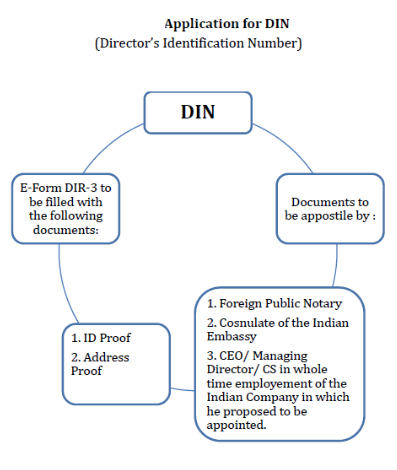
Sec 153 and Rule 9—Procedure for application for allotment of DIN: Every individual has to make an application to receive a DIN, and that application should be made electronically in form DIR-3 to the Central Government with the fees prescribed and in the manner prescribed in the rules. Fees are prescribed under The Companies (Registration of Offices and Fees)Rules, 2014 and the website of MCA is the portal that supports the application for DIN by the eForm DIR-3. (Details of the procedure for application have been discussed above)

Sec 154 and Rule 10—Procedure for allotment of DIN: Once the form for DIN is submitted on the portal of MCA and the prescribed payment is made, a unique application number will be generated for you. The Central Government shall process the application by approving or rejecting the application and has to communicate the same to the applicant within a period of one month from the receipt of application. Such communication may be sent by post or electronically or by any other mode.

If there is any defect in the application, then Central Government will intimate the defect by posting on the website and also by sending an email. Once intimated, the Central Government would assume resubmission within 15 days with the rectification of the defect or by completing the incomplete form. The Central Government rejects the application when it is found that the defect has been rectified partially, or the information given is still found to be defective. The Central Government can also invalidate an application where it is found that no change has been made, or defects weren’t removed within the given time. In such cases, a fresh application is to be filed, and fees will not be refunded or adjusted. 1453062570-4966

Sec 155 and Rule 11—Cancellation/Surrender/Deactivation of DIN: No individual is allowed to hold more than one DIN at any given time. If he is in possession of multiple DINs, he can only keep one and will have to surrender the others.The application for cancellation or deactivation can be made to any competent authority which includes the Central Government or MCA, the Regional Director (North), Noida or any Officer authorized by him for the same purpose. Cases, when DIN is cancelled/, deactivated –

  • Duplication (then one has to be cancelled, and data from both will be merged with the retained DIN)
  • Obtained a DIN by wrongful or fraudulent manner. (If obtained a DIN on strength of a document not legally valid or on furnishing of any incomplete document or suppressed any material information which was supposed to be entered and on the basis of which DIN could be rejected. Also in cases where it was obtained where the wrong certification was given by giving false information or misrepresentation)
  • Death of the individual
  • The concerned individual has been declared as a lunatic or of Unsound mind by a competent court.
  • The concerned individual was Adjudicated as insolvent.
  • The concerned individual obtained the DIN but did not use it, can surrender it with an application made in Form DIR-5. In such a case, the Central Government will deactivate the DIN only after verification of e-records that such DIN has never been used for any purpose.

Rule 12—Intimation of changes in particulars of Director: Every director in the event of any change in his particulars, as stated in Form DIR-3, should intimate such changes to the Central Government within a period of 30 days of such changes in Form DIR-6. The procedure is the same as in the submitting of Form DIR-3. The DIN Cell established by Central Government will intimate the ROC. It is also the Duty of the Director to intimate the changes in his particulars to the company or companies in which he is a director within fifteen days of such change.


General Provisions Regarding DIN

Rule 2(d) provides the definition of the Director Identification Number (DIN) and also further provides that DIN includes the Designated Partnership Identification Number (DPIN) issued under section 7 of The Limited Liability Partnership Act, 2008.

Sec 156: Every existing director has to intimate his DIN to the company or all companies where he is a director within one month of the receipt of DIN from the Central Government.director-identification-number-din

Sec 157 (1): It is the duty of the company to intimate the DIN of all its directors to the ROC or other authorized officers within 15 days of receiving it from the Directors. If the company fails to do so before the expiry of the 270 days from the date of which it should have been furnished with an additional fee, the company and the defaulting officers shall be punishable with a fine of Rs. 25,000 but which may extend to Rs. 1,00,000.

Sec 158: Every person or company is to mention the DIN in the information that is required to be furnished under this act with the Company/ROC/Central Government, where the Director is referenced, where the director has signed and in all tasks undertaken by the Director.

 Sec 159: If any individual contravenes the provisions of Sections 152, 155 or 156, he will be punishable with imprisonment up to a period of 6 months or fine of Rs.50,000 plus Rs.500 per day of default.

Download Now

The Interrelationship Between Human Rights And Intellectual Property Rights

0

In this blog post, Punyasloka Mukhopadhyay, a student, pursuing his second year LLB at KIIT School of Law, KIIT University and a Diploma in Entrepreneurship Administration and Business Laws from NUJS, Kolkata, compares and contrasts the interrelationship between human rights and intellectual property rights. 

unnamed


Introduction

Human Rights law and Intellectual Property Rights (IPR) law are entirely two different areas of law. Since their beginning, they grew isolated from each other. Neither of them infringed on each other’s domains. But recently, it has been observed that both the areas of law are interrelated with each other. One view is that both Human Rights Law and IPR law are in fundamental conflict with each other. According to this view, IPR law infringes on the different areas of Human Rights law, especially when economic, social and cultural rights are concerned. Another view is that both IPR Law and Human Rights law can co-exist with one another.human-rights1-750x422

No reference to human rights was seen in the fundamental treaties of IPR law, such as the Paris Convention or the TRIPS Agreement. The fundamental document of Human Rights law – the 1948 Universal Declaration of Human Rights – protects authors’ “moral and material interests” in their “scientific, literary or artistic production[s]”[i]. This could be seen as an indirect reference to IPR law. When the economic, social and political rights come into view, we can see the inter-connection between Human Rights and Intellectual Property Rights. This is where the conflict between the two areas of law arises. Here, the emphasis is to be given on two points – the neglected rights of the indigenous communities and the social implication of the TRIPS Agreement.IPR-Lobbying1-400x230

The indigenous communities claim that their governments should recognize their claim over their traditional knowledge matter, relating to agriculture, biodiversity, etc. According to the IPR regime, traditional knowledge is considered a part of the public domain, since it does not meet the established criteria for protection or private ownership. Since this traditional knowledge is un-owned, many private enterprises use this knowledge for further inventions, and protect their inventions through patents, copyrights, etc. and the indigenous communities are deprived of their legitimate share. Thus, the existing flaw in the IPR regime leads to the exploitation of the indigenous communities by outsiders, which leads to the violation of human rights of the indigenous communities. In this respect, IPR law infringes on the domain of Human Rights law. The governments should enact legislations, such that the indigenous communities can seek damages for unauthorized uses of their traditional knowledge. The governments can also protect traditional knowledge by denying patents, copyrights, etc. for those objects, which have been derived from traditional knowledge.


TRIPS Agreement

Another point of controversy is the TRIPS Agreement, maxresdefaultwhich advocated high minimum standards of Intellectual Property Rights protection for all World Trade Organisation (WTO) members. Non-compliance with the terms of the agreement can result in trade sanctions. This treaty has negative implications for the underdeveloped countries, whose previous commitment to Intellectual Property Rights protection was almost close to zero. Transfer of technology to the developing countries will be adversely affected, due to high minimum standards of protection for new inventions and technologies. Furthermore, it will affect the economic, social and cultural aspects of human rights. For example, due to high minimum standards of protection for patented pharmaceuticals, there will be too many restrictions on the access to these pharmaceuticals, which would adversely affect one’s right to health. Thus, the practical application of the treaty will be difficult, unless it is viewed from a human rights perspective.


Resolution of the Conflict

For resolving the conflict between Human Rights and IPR, the precise rights which are being undermined should be identified. The Human Rights bodies should develop specific interpretations of the ambiguous rights (mainly economic, social and cultural rights) so that they can comply with the terms of the TRIPS Agreement. Secondly, if the TRIPS Agreement is viewed from a Human Rights perspective, then the consumers of Intellectual Property products will be on an equal footing with the owners of Intellectual Property products. The agreement views the consumers of these products inferior to the owners of these products. But if a Human Rights dimension is added to the agreement, then the consumers will also become holders of these internationally guaranteed rights. Thirdly, instead of advocating minimum standards for IPR protection, the governments should impose maximum standards for IPR protections. This would act as a limit for the increasing standards of IPR protection. Lastly, the international forums on IPR, such as the World Intellectual Property Organisation (WIPO), the World Trade Organisation (WTO), etc., while making new laws on IPR, should analyze the laws with a Human Rights perspective. It is only in such circumstances that the Human Rights Law and IPR law will be able to co-exist with one another properly.


[divider]

References:

[i] Universal Declaration of Human Rights, Article 27.

Download Now

How To Start A Bookstore In India

0

In this blog post, Mithun Pillai, a Management Trainee at a Textile Company in Mumbai and a student pursuing his  Diploma in Entrepreneurship Administration and Business Laws from NUJS, Kolkata, describes the procedure required to start a bookstore in India with examples. 

360_indian_bookstore_0122


Introduction

Although the above illustrated ‘Spectrum of Evil’ is made in harmless jest, one cannot deny that there is a grain of truth in the illustration. The emergence of electronic commerce (or online commerce) has had many a Mom-and-Pop bookstores dread facing the seemingly inevitable predicament—how to stay relevant in a business which incentivises convenience; convenience of making a commercial transaction happen within the comfort of one’s home without having to trouble the posterior with movement as such. 22This convenience although supremely attainable with a few mouse clicks comes with a trade-off for some souls. For such souls buying a book is a very hands-on process (if you pardon the pun). They need to hold it in their hands, caress the spine, and gently run their fingers through pages as if to see if they respond with the same warmth or more. Then there is the much-romanticized smell of books. All five human senses are involved in confirming the coupling. This esoteric bond that they seek can never be attained over radio waves or indeed fibre optics. Thus, explaining the continued existence of brick-and-mortar book shops in the face of sales onslaught by e-Commerce giants like Amazon and Flipkart.

It is many an Indian booklover’s dream to open a bookstore in India which is quite understandable and entirely worthy of a respectable pat on their back. But that love is not nearly enough because what they have to understand is that at the end of the day running a bookstore is exactly what it sounds like, i.e., running a business.

Decide the Market                                         

For the rupee-strapped individual, an online bookstore is a very attractive and feasible option. The limited capital can be conscientiously spent on acquiring books which could be stocked in their house itself. A website can be set-up if the person has the technical know-how; alternately a paid one can be easily arranged for a small amount of money. Online/Social marketing is the next logical step. Channels for payment could be online (via Payment Gateway) or Cash-on-Delivery. For Logistics/Dispatch tie-up with a courier service shouldn’t be too taxing on one’s capital. As discussed before, the online bookstore lacks the intimacy which bookstores can provide so I would like to circumvent this option and try to focus entirely on physical stores with bookshelves and chairs and coffee, etc.download

The very first thing to decide shall be the market. We have seen shops selling old, used books. These sell for their budget value, vintage charm or any reason deemed fit by the buyer. Oldies can be sourced either by placing ads online (like a forum/Facebook) or newspaper/magazines. The important thing is that word gets around locally that people could do away with their old books. Second-hand school/college textbooks/guides will always be in great demand. The fringe markets also hold a lot of potential. The key here would be research. For example, Bandra West in Mumbai is home to a sizable number of Christian populace. ‘PAULINE BOOK AND MEDIA CENTER’ in Bandra is one of a kind bookstore which sells books, magazines having Catholic content. Information gathering about niche markets can provide an insight into the demand for niche books.

Market research as discussed above is integral to guarantee footfalls in the shop, but it’s not exclusive. ‘PAULINE’ bookstore may have the most exhaustive content catering to Christians but if it’s not easily accessible due to distance/geography that directly corresponds to fewer footfalls. The key word here is location. This makes much more sense when we realize most of the retail chain bookstores are set up in malls. Malls guarantee sizeable crowds which proportionately convert to more footfalls. Having said that, it must be mentioned that acquiring floor space in malls, especially in cities can be very expensive. Also, retail bookstores are set up for mass consumption. It is an unsaid motto that books purchased in such stores are mostly impulse buys as opposed to independent single bookstores which cater to niche crowds.


Capital

Any business requires capital upfront. However, the amount would decide if one plans to conduct business in lean mode (being conservative with money) or aggressive mode (cash burn).

hand holding coins and build coin graph

As mentioned above, if money is scarce conducting business online seems very feasible. Sources to acquire capital are varied and many: first and foremost yourself, family, friends and then investors. The current tech scene in our country has made investors in the form of angel/super angel investors, Private Equity companies, and foreign institutional investors very accessible. If you can pitch your idea convincingly, you might get lucky. The idea has to be structured, and informative for their and your benefit. In business jargon, such a blueprint is called a B-plan.


B-plan ( or Business plan) is a formal plan which sketches your market research, capital requirement, execution plans and financial projection for some future terms (quarterly/semi/annually). Investors typically sit through multiple pitches and thus expect a gist of the plan to make it easier and quicker. All B-plans have an executive summary section contained within just a couple of pages which outlines everything that’s detailed in the plan. It is typically arranged as the first section to be read by the investors and as such should be succinct and reduced to perfection. This is the pitch but only in text form. If the investors are not impressed by the summary, they may even be disinclined to go through the rest of it.


Incorporation of the Bookstore

After the financing/capital photo3has been taken care, it is time to incorporate the bookstore. Incorporation means making your business a legal entity. Almost all the retail chain bookstores are limited liability companies (and private if I’m not wrong) while the Mom-and-Pop independent ones are proprietorships. This is all very well as when you are a single store the financial returns are comparatively smaller, and so is the liability. While the retail ones deal in a much higher degree of finance and business complexity; this, in turn, increases the liability. Thus, generally speaking, all the revenue that independent stores make becomes their income directly, and so does the losses. They are personally responsible for the liabilities, and their personal belongings (including property/real estate) could come under the legal scanner to resolve the debt incurred. While for the retail ones, every employee draws a salary from the revenue but during a loss, they are protected by virtue of being a limited liability legal entity. Only the corporate assets (but not the personal assets of employees) will be at stake to resolve the debt.


Procurement of Books

The ideal way to go about procuring books would be to purchase them wholesale. Although for niche-targeting bookstores that would be very difficult. Finding good wholesaler/publishers is an important part of market research. In the initial stages of business, one might have to spend money to stock their bookshelves. Once the business proves to be sustainable, they could be persuaded to get the stock on credit. In all probability, they are well-tuned to the current taste and mood of the book-devouring intelligentsia. And as such it’s not a bad idea to pay heed to their suggestions regarding the quality and content that is to be shelved in one’s bookstore. Niche bookstores have to be more proactive in finding the right sources and further to develop and maintain a relationship with them.


Advertising and Other Inter-related Activities

This brings us to the final piece of the jigsaw puzzle which is advertising and other inter-related activities. Apart from the usual billboards, newspaper ads would be to build an online presence on social networks and further the word-of-mouth factor which goes a long way in building a relationship with the customers. So is the practice of ‘hand-selling’ which is to help the customers make a purchase based on their recommendation/suggestion which they trust. To do this one needs to be up-to-date in the going-ons of the book and publishing industry. This helps to give the customer a personal touch which the e-commerce companies can’t hope to do. The activities I mentioned are social gatherings around a certain theme like author readings and signings which in turn helps with the publicity itself.

Download Now

Protection Of Minority Shareholders Under The Companies Act, 2013

0

In this blog post, Harsh Moorjani, a student pursuing his final year LLB at Government Law College, Mumbai and a Diploma in Entrepreneurship Administration and Business Laws from NUJS, Kolkata, describes the laws laid down for the protection of the rights of the minority shareholders under the Companies Act, 2013.

unnamed


Introduction

“Of all tyrannies a country can suffer the worst is the tyranny of the majority” [1], Companies Act, 2013 (Hereinafter referred as the “the New Act”) changed the entire gamut of Modern Company Law and to some extent filled the various lacunas that plagued the Companies Act, 1956(From now on referred as the “Old Act”)

The author of this article shall discuss the history of majority rule in body corporate along with the statutory provisos laid down by the New Act in contrast to the Old Act to protect the interests of minority shareholders and shall give conclusive analysis for the same.

https://lawsikho.com/course/diploma-entrepreneurship-administration-business-laws
click above

 Rule of Majority

The process of decision-making is an integral part of a corporate bodies functioning,scales_sml1 the said process is frustrated when there is a conflict of opinion between the majority and minority shareholders whereby, the majority shareholders take decisions, not in the interests of the company but to cater to their whims and fancies gravely prejudicing the rights of minority shareholders.

The Rule of Majority found its firm roots in the landmark common law judgment Foss v. Hardbottle[2], where the court held that the “Courts will not intervene in the internal administration of a company at the instance of a shareholder and will not interfere with the management of a company by its directors so long as they are acting within the powers conferred on them under the Articles of the company. Nothing related to an internal dispute between shareholders is to be made the subject of an action by a shareholder. [3]

The same principle was reiterated by a plethora of Indian judgments like Rajahmundry Electric Supply Corporation v. A. Nageshwara Rao [4]or Bagree Cereals v. Hanuman Prasad Bagri [5]thereby, reaffirming the principle that if a simple majority can ratify a wrong, the court will not intervene.


Provisions of the New Act in contrast with the Old Act protecting the minority shareholders interests

“A Proper Balance of the Rights of Majority and Minority Shareholders Is Essential for the Smooth Functioning of the Company” [6], and that’s exactly what the legislature intended to do with Companies Act, 2013.

Neither the Old nor the New Act lay down a statutory definition to the term minority shareholders, one finds a legal definition of the term in the classic Black’s Law Dictionary where it defines the term as “an Equity holder with less than 50% ownership of the firm’s equity capital and having no vote in the control of the firm.”Voting-hands

 Apart from the exceptions to Foss v. Hardbottle that are ultra vires acts, fraud on minority acts requiring a special majority, wrongdoers in control and individual membership rights, the New Act protects the rights of Minority Shareholders under the head Prevention of Oppression and Mismanagement embodied in S.241-S.246 under Chapter XVI of the New Act.

By S.241, the oppressed minority shareholders are empowered to move the tribunal against the company and its statutory appointee’s, an application stating the same can be made to the Company Law Board. The requisite number of members who must sign the application is laid down in S.244, where the company is with share capital than by at least 100 members of the company or 1/10th of the total number of its members, whichever is less. If the company is without share capital, then the application mentioned above has to be signed by 1/5th of the total number of its members.[7]

However, departing from the Old Act the tribunal rather than Central Government has the discretion to allow any member or members to sue if in its opinion circumstances exist which make it just and equitable, making it a speedy actionable remedy.

Certain pre-requisites laid down by the S.241 need to be satisfied before an oppressed shareholder makes an application. The grounds for the application must either pertain to the affairs of the company being conducted in an oppressive manner which is prejudicial or oppressive to the interests of the company or when there a material change has taken place in the management or control of the company which shall affect the members or class of members.

Lord Cooper explained the term Oppression as the conduct complained of should at the lowest involve a visible departure from the standards of fair dealing, and a violation of the conditions of fair play on which every shareholder who entrusts his money to the company is entitled to rely.[8]Minority_Shareholders

Although the legislation aims to protect the minority shareholders interest, in a fit case if the court is satisfied with the acts of oppression and mismanagement, relief can even be granted if the application is made by a majority rendered ineffective by the wrongful acts of a minority group.[9]

While the powers granted to the competent authority under the Old Act were constrained to some extent, under the New Act the tribunal has been given wider powers by S.242 placing it in a better position to protect the interests of the minor.

The New Act introduces a novel concept of Class Action suit which owes its conception to the Satyam scandal that broke out in 2009. The essential provisions to enforce the rights of minority shareholders and investors were missing in the Old Act.

Under S.245 of the New Act, the provision above has been introduced thereby providing great impetus to minority shareholders, investors and depositors as well. By virtue of this   provision a suit may be filed against a company or its directors, auditor or expert advisor , in the case of a company with share capital by not less than 100 members or not less than 10% of the total number of its members or by any member or members singly or jointly holding less than 10% of the issued share capital of the company. In the case of a company without share capital, a suit may be filed by not less than 1/5th of the total number its members. Similar provisos are laid down for the protection of depositors. By the said provisos the legislation intends to protect the interests of the minority shareholders.

The New Act also infuses minority shareholding protective measures during mergers and amalgamations. Such measures have been introduced in S.235 and S.236 of the New Act by which transfer of shares or class of shares by a transferor to a transferee company requires the approval of shareholders with a nine-tenth shareholding in value if any dissenting shareholder then the transferee company has to serve a notice to the same.download

Under S.236 of the New Act, minority shareholders have the option to make an offer to the majority shareholders to purchase the minority equity shareholding of the company at a price as fixed below. The acquirer, person or group of persons shall offer to the minority  shareholders of the company for buying the equity shares held by such shareholders at a price determined by valuation by a registered valuer.

In an event where the acquirer or person acting in concert thereon or a group of persons become the registered holder of ninety percent or more of the issued share capital of a company by amalgamation, share exchange and so on then they shall notify the company of their intention to buy the remaining equity shares.

Under the 2013 Act, minority shareholders are also involved in corporate decision-making whereby, in listed companies “small” shareholders that are having a nominal shareholding of shares not more than Rs 20,000 have the right to appoint a director. [10]


Conclusion

On a careful examination of the provisions above, it is apparent that the legislators have tried to protect the interests of the minority shareholders at every stage by filling the cavities/lacunas of the Old Act. Like any legislation, the effective implementation of the provisions above plays a key role in executing the intention of the legislator thereby enabling the protection of minority shareholders interests.


LawSikho has created a telegram group for exchanging legal knowledge, referrals and various opportunities. You can click on this link and join:  

https://t.me/joinchat/J_0YrBa4IBSHdpuTfQO_sA

Follow us on Instagram and subscribe to our YouTube channel for more amazing legal content 


References:

[1] Quote by Mr. William Inge

[2] (1843) 67 ER 189

[3] Mac Dougall v. Gardiner, (1875) 1 Ch. D 13.

[4] 1955 SCR (2)1066

[5] 2001 105 CompCas 465 Cal

[6] Palmer, Company Law, 492 (20th ed., 1959)

[7] Company Law by Avtar Singh

[8] Scottish Coop Wholesale Society v Meyer

[9] Baltic Real Estate Ltd (No 1)

[10] S.151 of the Companies Act, 2013 

Download Now

Stamp Duty On Issuance And Transfer Of Shares

3

In this blog post, Devyani Pokhriyal, a recent Law Graduate and a student pursuing her Diploma in Entrepreneurship Administration and Business Laws from NUJS, Kolkata, describes the need for stamp duty on issuance and transfer of shares.

CYMERA_20160804_120521


Stamp Duty in India

Stamp duty is a tax collected by the government on the transfer of property. Tax is a means of earning revenue by the government for the welfare of the society as a whole, so the Indian Stamp Act was enacted to secure the revenue of the government by collecting stamp duty. The Indian Constitution has empowered the State Government to amend the stamp act for its application by their jurisdiction. Under Section 3 of Indian Stamp Act, 1899 it is stated that any transfer of instrument is bound to the payment of stamp duty. private-trust-taxationPayment of stamp duty provides any transfer of instrument a legal recognition and also provides an evidentiary value on the court. It has to be paid by the transferor and in the case of exchange of properties; both parties have to bear stamp duty equally. Duty is paid on or before the date of execution of the instrument in a written form. The payment of duty can be made either through DD or pay order within two months. The jurisdictional sub-registrar should certify it. A stamp paper once used cannot be used again. It is payable before the execution of the document or on the day of execution of the document or on the next working day of executing such a document. Failure to pay stamp duty leads to a penalty which may vary from 2% to 200% per month and also the instrument is not admitted as evidence by the courts.


Stamp Duty on Issuance of Shares

Section 3(a) of Indian Stamp Act states that every instrument mentioned in the Schedule I of Indian Stamp Act which, has not been previously executed by any person, is executed in India; shall be chargeable with a stamp duty of the amount indicated in Schedule I. Payment of stamp duty on issue of shares is in accordance with the provisions of the Stamp Duty Act in respective states as the subject falls under the state list. The stamp duty on the issuance of shares is levied upon the value of shares, and where shares are issued in dematerialized form, the duty shall be levied on the amount of securities issued.[1]


Stamp Duty Paid on Transfer of Shares

On specified transactions and documents stamp duty is paid to the government for the completion of the transfer of ownership of the property. Under the Stamp Act, the central government levies stamp duty on specific transactions of instruments like bills of exchange, cheques, promissory notes, transfer of shares. Under Constitution of India, charging stamp duty is a matter of State list, so the rate of stamp duty on the instruments varies from state to state. If any state does not have any specified stamp duty, then the amount set by central government would be levied.[2] JudicalStampThe stamp duty shall be paid during the time of transactions of the instrument. The stamp duty shall be levied at the time of execution of the instruments.[3]It is necessary to pay stamp at the time of execution of the instrument; as the company will not be able to register the shares unless a proper instrument of transfer duly stamped and executed by or on behalf of the transferor and the transferee has been delivered to the company.[4] The term duly executed[5] means the instrument has to be signed by the transferor and transferee on prescribed form with date of presentation, the other requirements such as particulars of the transferee, attestation by witnesses, date of execution and payment of stamp duty must.

The transferor has the legal duty and liability to affix the stamps and cancel the same. But in the day-to-day practice it is the transferee who affixes and cancels the stamps. In the matter of Jainnarain Ram Lundia vs. Surajmull Sagarmull[6], the court observed, ‘With regards to stamp duty, it is not disputed that there was no previous talk between the parties on this point, though ordinarily and as a matter of law, in the case of transfer of shares, it is the vendor by whom the stamp duty is payable.’ Section 29 of the Indian Stamp Act provides that it is the liability of the transferor to pay stamp duty on an instrument of transfer. In the absence of an agreement to the contrary, the expenses of providing the proper stamp shall be borne, in the case of transfer of shares of an incorporated company or another body corporate, the stamp duty to be paid by the persons executing the document.[7] stamp-duty (1)In Union of India vs. Kulu ValleyTransport Ltd.[8] it was the seller of the shares who was responsible for the payment of the stamp duty. Before the signing the instrument chargeable with stamp duty, stamps must be affixed[9] and whoever affixes the stamps has to cancel it so the same cannot be used again.[10]The Adhesive stamps should be canceled by drawing lines across or in some other way, so that can’t be used again. However, the value of stamp should be visible. If the share transfer deed bear stamps, but it doesn’t cancel, hence transfer can’t be recorded by such transfer deed. Cancellation of Stamp by Company is illegal. If once a company transfers shares by mistake even if the instrument was not duly stamped, it can’t then apply for rectification of members.

https://lawsikho.com/course/diploma-entrepreneurship-administration-business-laws
Click Above

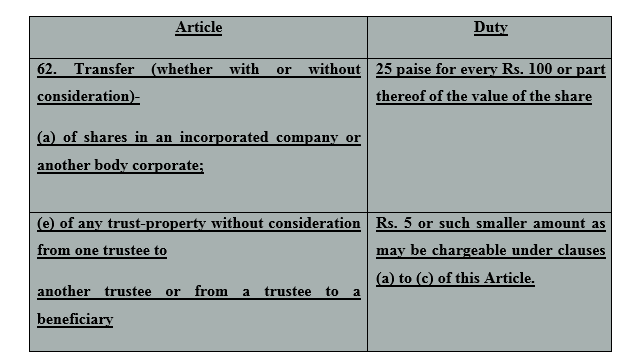
Calculation of stamp duty depends on the rate provided in the stamp act. Stamp Duty is levied at the rate of 0.25% of consideration, i.e., the amount to be paid is 25 paise for a share transfer of Rs. 100. If required, the total amount of stamp duty will be rounded off to the next or upper five paise.[11]

33
There is no stamp duty on transfer of shares or debentures in a depository scheme. Section 21 of the Indian Stamp Act states that where an instrument is chargeable ad valorem duty in respect of any stock, such duty has to calculate the value of such stock to the average of the value of such stock of such an instrument. When a bank holds shares as security and gets them transferred in its name, a special concessional stamp duty is payable.[12]stamp-duty

In the case of shares that are issued without being stamped or under stamped, the instrument which is under stamped becomes inadmissible as evidence before any authority and the document is charged with the full payment of the stamp duty as per the provision given in the act. The managing director or secretary or another principal officer of the company shall be punishable with fine which may extend to five hundred rupees.[13]Though in the case of under stamping of stamp duty on shares, collector acts as an adjudicator under Section 31 of the Indian Stamp Act, he charges for under stamping and averts invalid instruments.

Under the Indian Stamp Act, stamp duty is payable in the respect of share transfer, when a company or an issuer is liable to pay at the time of issuing securities and when shares are transferred by the person holding the title of ownership of the transferee. According to Section 8A of the Indian Stamp Act, 1899,  any securities issued by the means of electronic transfer need not be stamped provided that the company or issuer of the security have paid the duty on the total amount of the security issued by it. In an electronic transfer of shares, depositories act on behalf of the issuer or company for issuance of shares to the prospective buyers. The main contention of Section 8A was to prevent the issuer of the shares from evading the payment of the stamp duty on the issuance of the shares. Also, transfer in cases of registered ownership of shares from the person to depositories or from depositories to a beneficial owner shall not be liable to any stamp duty.[14]


LawSikho has created a telegram group for exchanging legal knowledge, referrals and various opportunities. You can click on this link and join:  

https://t.me/joinchat/J_0YrBa4IBSHdpuTfQO_sA

Follow us on Instagram and subscribe to our YouTube channel for more amazing legal content 


References:

[1] Stamp Duty on share Certificate – Abhishek Bansal, 30th Nov 2012. http://www.mondaq.com/india/x/202892/Shareholders/Stamp+Duty+On+Share+Certificates
[2] Schedule VII, Entry 91 of Constitution of India.
[3] Section 17 of Indian Stamp Act 1899.
[4] Section 56 of the Companies Act 2013.
[5] Section 2(12) of Indian Stamp Act 1899.
[6] 1949 MLJ p. 476
[7] Section 29 of Indian Stamp Act1899.
[8] (1958) 28 Comp. cas. 29).
[9] Section 17 of the Indian Stamp Act 1899.
[10] Section 12 of Indian Stamp Act 1899.
[11] Article 62, Schedule 1 of the Indian Stamp Act 1899.
[12] Stamp duty on transfer of shares- G.S Rao. http://flame.org.in/KnowledgeCenter/Stampdutyontransferofshares.aspx
[13] Section 62 of Indian Stamp Act 1899.
[14] Section 8A(c) of Indian Stamp Act, 1899.

Download Now

Difference Between Listing Agreement And Listing Regulation (2015)

1

In this blog post, Devyani Pokhriyal, a recent Law Graduate and a student pursuing her Diploma in Entrepreneurship Administration and Business Laws from NUJS, Kolkata, provides the difference between Listing Agreements and Listing Regulations. 

CYMERA_20160804_120521


Listing Agreement

Listing Agreement is the basic document which is executed between companies and the Stock Exchange when companies are listed on the stock exchange. The main purposes of the listing agreement are to ensure that companies are following good corporate governance. The Stock Exchange on behalf of the Security Exchange Board of India ensures that companies follow good corporate governance. The Listing Agreement comprises of 54 clauses stating corporate governance, which listed companies have to follow, failing which companies have to face disciplinary actions, suspension, and delisting of securities. The companies also have to make certain disclosures and act by the clauses of the agreement.

Listing Regulations, 2015

On 2nd September 2015, the Security and Exchange Board of India (SEBI) notified about the Security and Exchange Board of India (Listing Obligations and Disclosure Requirements) Regulations, 2015. (Listing Regulations 2015). The listing regulations will apply to the companies recognized on the stock exchange. Section 2(52) of the Companies Act provides for the listed companies and any companies which have listed its securities under-recognized stock exchange and hence the listing regulations would be applied to them. The primary objective of bringing this regulation into force was first to align the Listing agreement with the Companies Act, 2013.download

Secondly, to make a single regulation for requirements under different securities listing agreements. The regulation 23(4) and 31A was to be made into immediate effect, about passing the of ordinary resolution instead of a special resolution in case of all material related party transaction subject to related parties from abstaining from voting on such resolution, in line with the provisions of the Companies Act, 2013. And the reclassification of promoters as public shareholders under various circumstances. The Regulation has been converted to a consolidated form, to make all the listed agreements a single structured document for easy referencing. The Listing Regulations have been sub-divided into two parts viz.,(a) substantive provisions incorporated in the main body of Regulations; (b) procedural requirements in the form of Schedules to the Regulations.[1]

Basic features of the regulations are as follows:

  • Chapter II of the Regulation provides for the guiding principles governing disclosure and obligations of listed companies. The chapter provides for the principles for the listed entities for periodic disclosure and corporate governance followed by the companies.
  • Chapter III of the Regulations provides for a common obligation for listed companies, in the matter of compliance, the appointment of a compliance officer, filing on the electronic platform, etc.
  • Chapter IV to IX provides for the obligations applicable to specific securities incorporated in different chapters.
  • Chapter X to XI provides for the responsibilities to compliance given to stock exchanges to regulate, monitor and take action for compliance measures.


Differences Between Listing Regulation and Listing Agreement

Changes made within the listing agreement:

  • Change for the separate period of the transmission of securities: The listing agreement provides for the transfer or transmission of securities and issue of the certificate within 15 days from the date of such receipt of a request for transfer[2]. While the listing regulation provides for the transfer and issue of the certificate within 15 days from the date of such receipt of request for transfer provided that the listed entity shall ensure that the transmission requested is processed for the securities held in the dematerialised mode and physical mode within 7 days and 21 days respectively, after receipt of the specified documents.[3]news6276
  • Change made regarding the requirement of sending notice to other stock exchange for the close transfer of books: In the listing agreements, while closing the transfer of books, the companies have to send notice to the concerned stock exchange as well as other stock exchanges in an advance of 7 working days[4]. While in the new regulation notice is to be given to the concerned stock exchange in an advance of 7 working days[5].
  • Extension of period for the disclosure to stock exchange: In the listing agreement, the disclosure regarding all the dividends or cash bonuses recommended or declared or the decisions to pass any dividends or interest paid and date on which dividends shall be paid/dispatched, the decision on buyback of securities[6] is to be made within 15 minutes of the Board Meeting. While the listing regulation provides for the disclosure to be made within 30 minutes of the board meeting regarding all the dividends or cash bonuses recommended or declared or the decisions to pass any dividends or interest paid and date on which dividends shall be paid/dispatched, the decision on buyback of securities.[7]
  • In the listing agreement, there is a provision of promptly notifying the stock exchange of short particulars on any increase of capital whether by the issue of bonus shares through capitalization, or by the way of right shares to be offered to the shareholders or debenture holder, or in any other way. Short particulars of the reissue or shares or securities held in reserve for future issue or the creation in any form or manner of new shares or securities or any rights, privileges or benefits to subscribing to, short particulars of any alterations of capital, including calls[8]. While the listing regulation provides for at least 30 minutes of the closure of board meeting for, promptly notifying stock exchange of short particulars of any increase of capital whether by issue of bonus shares through capitalization, or by the way of right shares to be offered to the shareholders or debenture holder, or in any other way. Short particulars of the reissue or shares or securities held in reserve for a future issue or the creation in any form or manner of new shares or securities or any rights, privileges or benefits to subscribing to, short particulars of any alterations of capital, including calls.[9]zeejudge
  • It has been mentioned in the listing agreement of prior intimidation of at least seven days in which the final result shall be considered[10]. In the listing regulations, a five-day prior notice is to be given when the financial result is to be considered by the stock exchange about the board meeting.[11]
  • The listing agreement provides for the provision ensuring that the RTA and/or the In-house Share Transfer facility, as the case may be, produces a certificate from a PCS within 1 month of the end of each half of the financial year, certifying that all certificates have been issued within 15 days of the date of lodgment for transfer, sub-division, consolidation, renewal, exchange or endorsement of calls/allotment monies, and a copy of the same shall be made available to the SE within 24 hours of the receipt of the certificate by the Company[12]. While the listing regulation provides for ensuring that the share transfer agent and/or the in-house share transfer facility, as the case may be, produces a certificate from a practicing company secretary within 1 month of the end of each half of the financial year, certifying that all certificates have been issued within 30 days of the date of lodgments for transfer, sub-division, consolidation, renewal, exchange or endorsement of calls/allotment monies and ensures that certificate is filed with the SE simultaneously.[13]
  • Provision wherein MD or the WTD appointed to provide compliance in the listing agreement has been given, whereas in the listing regulation, the CEO, and the CFO have  to provide a compliance certificate to the board of directors.
  • New provisions have been added in the listing regulations which were not there in the listing agreement, regarding the preservation of documents. Two types of documents have to be maintained; one document is to be permanently preserved while the second record is to be reserved for the period of not less than eight years after the completion of the particular transaction.


Conclusion

The main motive for the introduction of the listing regulation was to streamline all the regulations for all the securities so that it becomes convenient for the companies to follow one set of regulations rather than following two sets of regulation and also to avoid any confusion, which occurs on the overlapping of two sets of regulations. Also, with the introduction of a new set of regulation, the disclosure process to the SEBI has been improved, as more and more companies are under the strict surveillance of the regulatory mechanism and hence the process of compliance with The Securities and Exchange Board of India (SEBI) regulations by the companies have improved. With the introduction of the listing regulations, the contractual obligations have been converted to a legal requirement, which gives the regulations a legal recognition.


[divider]

References:

[1] http://www.sebi.gov.in/cms/sebi_data/attachdocs/1441284401427.pdf

[2] Section3(c) of the listing agreement.

[3] Section 40(3) of the Listing Regulation 2015.

[4] Section 16 of listing agreements

[5] Section 42(2)(3)(5) of listing regulations.

[6] Section 20 (a) &(c) of the listing agreement

[7]Schedule III, Part A, Para A (4)(a)&(c)

[8] Section 30 listing agreement

[9] Schedule III, Part A, Para A (7)

[10] Section 41(III)(a)

[11] Section 29(1)(a) & proviso to 29(2)

[12] Section 47(c) of the listing agreements

[13] Section 40(9)&(10) of the listing regulation.

Download Now

How To Find Out Who Is Authorized To Take Particular Decisions In A Company

0

In this blog post, Ashok K. K. Vasudevan, the Managing Director at Festo Global Production Centre, India and a student pursuing a Diploma in Entrepreneurship Administration and Business Laws from NUJS, Kolkata, describes the people authorised to take decisions in a company. 


Picture1


Registrar of Companies (ROC) (1)

Before we embark on determining ways of finding out who is authorized to make particular decisions in a company, it is mandatory to understand what the Registrar of Company means and does. Under Section 609 of the Companies notaryAct which covers the various States and Union Territories,  the appointment of the Registrar of Companies (ROC) is accomplished, which is vested with the primary duty of registering companies and Limited Liability Partnerships (LLPs) that are floated in the respective States and Union Territories. The ROC ensures that such companies floated, comply with the statutory requirements under the Act.  The Registrar of Companies functions as a registry of records relating to the companies registered with them.  These records are available for inspection by the public on payment of the prescribed fee.  The Registrar of Companies falls under the administrative ambit of the Central Government.  The Central Government exercises administrative control over these ROCs through the respective Regional Directors.

 Thus, the Registrar of Companies (ROC) will stand to be a good source for information related to listed/unlisted companies registered with ROC.


Memorandum of Association (MOA) and Articles of Association (AOA) (2)

 All companies have their Memorandum of Association (MOA) and Articles of Association (AOA) which are registered with the ROC at the time of registration of companies.

Memorandum of Association (MOA)

The Memorandum of Association (MOA) is the ultimate public document which contains all information which is required for the company to declare at the time of incorporation.  To emphasize the importance of MOA, it can also be said that a company cannot be incorporated without its memorandum and is a requirement for the company to register its MOA with the ROC at the time of the registration of the company. The MOA contains the objects, powers, and scope of a company, beyond which the company is not allowed to work.  In other words, the MOA limits the range of the activities of the company.memorandum-articles-prospectus-1-638

The Memorandum is also known as the charter of the company, and there are six essential conditions to framing a Memorandum.  These are:

  • Name Clause: There are limitations as to what the name of the company should be and should conform to the prescribed norms and also should not too closely resemble the name of any other company.
  • Situation Clause: The name of the state in which the registered office of the company is located needs to be specified.
  • Object Clause: The main and auxiliary objects of the company need to be specified in the Memorandum.
  • Liability Clause: All details regarding the liabilities of the members of the company need to be included in the Memorandum.
  • Capital Clause: The total capital of the company needs to be included in the Memorandum.
  • Subscription Clause: Details of the subscribers, their relevant shares and such information related to the subscription need to be included.

Articles of Association (AOA)

The Articles of Association (AOA) is a secondary document which defines the rules and regulations as defined by the company for its administration and day-to-day management.articles-of-association-1-638  Additionally, the articles contain the rights, responsibilities, powers and duties of members and directors of the company.  The AOA also includes the information on the accounts and audits of the company.

Every company should have its articles. However, a public company limited by shares can adopt Table A in place of the Articles of Association.  This comprises all the necessary information regarding the internal affairs, and the management of the company. It is prepared for the persons inside the company, i.e., members, employees, directors, etc. and the governance of the company is done according to the rules prescribed in it.  The companies can frame its articles of association as per their requirements and choices.


Key Differences Between Memorandum of Association (MOA) and Articles of Association (AOA)

The major differences between a Memorandum of Association and Articles of Association can be elaborated as follows:

  1. The MOA is a document which contains all the conditions that are necessary for the registration of the company. The AOA is a document which contains all the rules and regulations about the administration of the company.
  2. The MOA is defined in Section 2 (28) while the AOA is defined in Section 2 (2) of the Indian Companies Act of 1956. In the Companies Act 2013, the MOA and AOA are defined in Section 2 (56) and Section 2 (5) respectively.
  3. The MOA is a subsidiary to the Companies Act, whereas Articles of Association is a subsidiary to both MOA as well as to the Companies Act.Memorandum-Vs-Articles
  4. In the event of any contradiction between the MOA and AOA about any clause, the MOA will prevail over the AOA.
  5. The MOA contains information about the powers and objects of the company. The AOA contains information about the rules and regulations of the company.
  6. MOA contains the six clauses, namely (i) Name Clause (ii)  Situation Clause  (iii) Object Clause  (iv)  Liability Clause  (v)  Capital Clause and (vi)  Subscription Clause, whereas the AOA is framed as per the discretion of the company.
  7. MOA is obligatory to be registered with the ROC at the time of registration of the company. The AOA is not required to be filed with the Registrar, but the company can file it on a voluntary basis.


Conclusion

 Coming back to the main topic as to how one can find out as to who are authorized to take particular decisions in a company,  we can always refer to the Registrar of Companies (ROC) to obtain information of the Memorandum of Association (MOA) and Articles of Association (AOA) of any related company by paying the relevant prescribed fee.  These two documents help in the proper management and functioning of the company in its entire period of existence.

Additionally, the Annual General Meeting (AGM) held by a company every year gives insights into any Ordinary Business of the company (Section 102(2)), Special Business of the company (Section 102(b)) and is duly signed by the Board of Directors, who govern the affairs of the company.

[divider]

References

  1. http://www.mca.gov.in/MinistryV2/contact.html (1)
  2. http://keydifferences.com/difference-between-memorandum-of-association-and-articles-of-association.html(2)
Download Now

Proccedure to Dissolve a Private Trust

1

In this blog post, Ranjeet Yadav, an Ex-Commissioner of Railway Safety with the Indian Railways and a student pursuing a Diploma in Entrepreneurship Administration and Business Laws from NUJS, Kolkata, describes the procedure to dissolve a private trust. Scan0003

Private Trusts are usually created for the benefits of identified persons, who could be one or more ascertainable individuals.

A Private Trust can be dissolved as per the present laws under the following circumstances: –

  • By the consent of all the beneficiaries: The beneficiaries sign the documents of the release of the said trust by relinquishing their rights.
  • By the settlor:  The settlor, that is, the person who had initially transferred property and created a trust provided there were powers of revocation reserved by him as per the trust deed. The settlor may exercise the power of revocation and revoke such trust by way of registered deed of revocation.dissolve-family-trust-800x800
  • The passage of time: The period of time for which a trust is to operate is usually expressly prescribed in the trust instrument. A settlor can state that the trust shall last until the beneficiary reaches a particular age. When this period expires, the trust gets dissolved.
  • Due to particular events: The beneficiaries may end the trust as a result of particular events occurring, e.g., the subsequent failure or satisfaction of the purposes of the trust or cessation of particular circumstances for which the trust was created to provide.
  • Due to avoidance of transactions: It may be set aside under the provisions relating to the avoidance of transactions at an undervalue or to dispositions in fraud of creditors on the ground that the disposition was induced by fraud, duress, undue influence or mistake.
  • Exercise of power of advancement: The trustees exercising a power of advancement or a power of appointment to terminate the trust either in whole or part.
  • fulfillment of purpose: When the purpose is completely fulfilled, e.g., a settlor can stipulate that the trust shall last until the marriage of the beneficiary. In such case, the trust will get dissolved once the marriage gets solemnised.
  • Destruction of the trust-property: When the fulfilment of its purpose becomes impossible by the destruction of the trust-property or otherwise.
  • Unlawful purpose: When its purpose becomes unlawful. As per Section 4 of the Indian Trust Act, 1882, the purpose of the trust is unlawful if it is:notary
    • a) Forbidden by law,
    • b) Is of such a nature that, if permitted, it would defeat the provisions of any law,
    • c) Is fraudulent,
    • d) Involves or implies injury to the person or property of another,
    • e) The court regards it as immoral or opposed to public policy. Thus, if the purpose of a trust becomes unlawful, according to provisions of Section 4 the trust gets extinguished.
  • Dissolution of trust: Where the trust is for the payment of the debts of the author of the trust and has not been communicated to the creditors at the pleasure of the author of the trust, the author can dissolve the trust, e.g., A conveys some property to B in trust to sell the same and pay out of the proceeds the claims of A’s creditors. If no communication has been made to the creditors, A may revoke the trust.


On the dissolution of the trust under one or more of the aforesaid circumstances, the ‘Trust Dissolution Deed’  should be made and be registered.

Download Now
logo
FREE & ONLINE 3-Day Bootcamp (LIVE only) on

How Can Experienced Professionals Become Independent Directors

calender
28th, 29th Mar, 2026, 2 - 5pm (IST) &
30th Mar, 2026, 7 - 10pm (IST).
Bootcamp starting in
Days
HRS
MIN
SEC
Abhyuday AgarwalCOO & CO-Founder, LawSikho

Register now

Abhyuday AgarwalCOO & CO-Founder, LawSikho