Download Now
Home Blog Page 1771

Enforceability Of Non-Solicitation Clauses In Contracts

0
Confidentiality or Non-Disclosure Agreements

contract-408216_1280

This article is written by Nimisha Srivastava, a student of  GNLU.

What is a non-solicitation clause?

Non-solicitation clauses are restrictive covenants in contracts. The companies assert that such restrictions are necessary to protect their proprietary rights and their confidential information. In today’s business situation of high rivalry and quick switching employees, numerous employers resort to restrictive covenants to ensure themselves against the competition.  A non-solicitation clause is meant to put a restriction on an employee of a company, to prevent him from soliciting the employees or customers of a company, during and post-termination of employment.

Are the non-solicitation clauses legally enforceable in India?

The enforceability of non-solicitation clauses in India is very subjective. Indian courts have consistently refused to enforce post-termination non-compete clauses in employment contracts. These clauses imply a “restraint of trade” that is clearly barred by Section 27 of the Indian Contract Act, 1872. They are also seen as being against public policy because of their potential to deprive an individual of his or her fundamental right to earn a livelihood. The general trend in judiciary is that, the clauses operating during employment are valid and those operating post employment are invalid. The enforceability of the said clause depends on the facts and circumstances of each case.

Judicial pronouncements

A Delhi High Court judgment in Wipro Ltd vs Beckman International[1] said that a non-solicitation clause is not void. The facts of the case were that the respondent was hired by petitioner as sole and exclusive distributor of its products. The agreement they agreed upon contained a non-solicitation clause to be operative for two years after the termination of agreement.  They had worked together for nearly 17 years. Respondent in lieu of launching their direct operations in India published an advertisement which sought applications from prospective employees and specifically mentioned that persons having experience in handling petitioner’s products or similar ones. Petitioner considered this advertisement as a breach of the non-solicitation clause.

In this particular case, the Delhi High Court held that non-solicitation clause is a reasonable restriction and is not hit by Section 27 of the Indian Contract Act, 1872. The court drew a distinction on enforceability of non-solicitation clause based on the relationship between parties. While construing a restrictive or negative covenant and for determining whether such covenant is in restraint of trade, business or profession or not, the courts take a stricter view in employer-employee contracts than in other contracts, such as partnership contracts, collaboration contracts, franchise contracts, agency/distributorship contracts, commercial contracts. The reason being that in the latter kind of contracts, the parties are expected to have dealt with each other on more or less an equal footing. Non- solicitation clause will put a bar on the contracting parties from inducing each other employees but the restriction does not put a bar on employees to join the respondent company. The restriction is put on the petitioner and the respondent and, therefore, has to be viewed more liberally than a restriction in an employer-employee contract. In this case no injunction was granted in favour of petitioner for their employees who have joined the respondent’s company in response to their solicitation.

In American Express Bank Ltd. v. Priya Puri,[2] the Bank asked for an injunction to limit the ex-worker from utilizing or revealing any data and competitive innovations identifying with the business and operations of the Bank and to solicit and induce any of the clients of the Bank. The Delhi High Court noticed that such a directive will encourage the plaintiff to make a circumstance, for example, “once a customer of American Express, always a customer of American Express “. The court further noticed that freedom of changing employment for improving service conditions is a vital and important right of an employee which cannot be restricted or curtailed on the ground that the employee has employer’s data and confidential information of customers which is capable of ascertainment on behalf of defendant or anyone else, by an independent canvass at a small expense and in a very limited period of time.

https://lawsikho.com/course/diploma-advanced-contract-drafting-negotiation-dispute-resolution
click above

The Delhi High Court[3], allowed an injunction against the plaintiff prohibiting him from soliciting respondent’s customers and suppliers. However the court rejected the plaintiff’s claim to enforce confidentiality obligations on the manager. According to Court, a marketing manager could not be deemed to possess confidential information and that his written declaration to that effect in his employment agreement was meaningless.

In this case, the employee agreed that for two years following the termination of his employment, he would be bound him to maintain confidentially, and preventing him from competing and soliciting respondent’s customers, suppliers and employees. Expressly embodied in the employment agreement was an acknowledgement by the manager that he was dealing with confidential material of respondent, including know-how, technology trade secrets, methods and processes, market sales and lists of customers.

In V.F.S. Global Services Ltd. vs. Mr. Suprit Roy[4], however, relief for breach of non-solicitation obligations was rejected on the basis of vagueness of the relief claimed. In another case before Madras High Court[5], it was held that merely approaching customers of a previous employer does not amount to solicitation until orders are placed by such customers based on such approach. The Madras High Court laid down the standard to establish non-solicitation:

Solicitation is essentially a question of fact. The appellant should prove that the respondent approached their erstwhile customers and only on account of such solicitation, customers placed orders with the respondent. Mere production of quotation would not serve the purpose. It is not as if the appellant is without any remedy. In case the Court ultimately holds that the appellant has got a case on merits, they can be compensated by awarding damages. The supplies made by the respondent to the erstwhile customers of the appellant would be borne out by records. There would be no difficulty to the appellant to prove that inspite of entering into a non-disclosure agreement, respondent have solicited customers and pursuant to such solicitation they have actually supplied castings. When there is such an alternative remedy, question of issuing a prohibitory injunction does not arise.”

The Secan Invescast judgment states that such clauses may be valid if reasonable restrictions such as distance, time limit (reasonable time frame), protection and non-usage of trade secrets and goodwill are imposed on former employees.

In a recent 2014 judgment by Calcutta High Court, Embee Software Pvt. Ltd. v. Samir Kumar Shaw[6], the court held that ‘acts of soliciting committed by former employees takes such active form that it induces the customers of the former employer to break their contract with the former employer and enter into a contract with the former employee, or prevents other persons from entering into contracts with the former employer’ cannot be permitted.

Implications for investors

Investors, especially foreign investors need to be aware of  Section 27 of Contract Act and the judicial trend that follows. This will help them in structuring employment contracts and relationships with Indian management. The restrictive covenants for confidentiality, non-solicitation, non-competition will be valid and enforceable during the term of employment. The same is not the case for post-employment time period. Courts generally favour the employee regardless the provisions are reasonable in scope and duration. Non-solicitation obligations post-termination of employment may be enforced in limited circumstances, based upon the facts of each individual case.


LawSikho has created a telegram group for exchanging legal knowledge, referrals and various opportunities. You can click on this link and join:  

https://t.me/joinchat/J_0YrBa4IBSHdpuTfQO_sA

Follow us on Instagram and subscribe to our YouTube channel for more amazing legal content 
 
 
References:

[1] 2006 (3) Arblr 118 Delhi

[2]  (2006) Iiillj 540 Del.

[3] Desiccant Rotors International Pvt Ltd V. Bappaditya Sarkar & Anr. Manu/De/1215/2009

[4] 2008 (2) Bomcr 446

[5] M/S. Fl Smidth Pvt. Ltd. Vs. M/S. Secan Invescast (India) Pvt. Ltd. MANU/TN/0103/2013

[6] Air2012cal141

Download Now

Whether Abortion Is Legal In India

0

images (6)

In this blogpost, Rajnandini Mahajan, Student, RGNUL, Punjab analysis the Medical Termination of  Pregnancy Act, 1971

‘Abortion’ in generic sense of the term is used to mean deliberate termination of pregnancy. It is achieved by destructing the foetus or embryo. Abortion has always been a sensitive subject worldwide with valid reasons coming from both its supporters and opponents. As far as India is concerned, the abortion within 20 weeks of conception is legal. The provisions regarding abortion are elucidated in the Medical Termination of Pregnancy Act, 1971 (the MTP Act).  The important provisions of the Act are discussed herein.

Medical Termination of Pregnancy Act, 1971

Medical Termination of Pregnancy Act, 1971 (MTP Act) was enacted in 1971 after worldwide liberalisation of abortion laws started taking place. The act is largely based on the recommendations given by Shantilal Shah Committee in 1966. The important provisions of the Act are discussed herein.

DURATION

According to the Act, pregnancy can be terminated within 12 weeks of the term of pregnancy if a registered medical practitioner is of the opinion that at least one of the grounds for abortion as mentioned in Section 3 are satisfied. Pregnancy can also be terminated after 12 weeks but before 20 weeks if 2 registered medical practitioners are of the opinion that the grounds are satisfied. The opinion should have been formed in ‘good faith’.

GROUNDS

Section 3 of the MTP Act provides grounds for medical termination of pregnancy. There are total 6 grounds mentioned. These grounds include risk to life or grave mental and physical injury to the mother if the pregnancy continues, risk of physical/mental deformities or disabilities to the child if allowed to be born, pregnancy due to rape, risk to the health of woman because of the environment around her and failure of device/method used to limit the number of children by the married couple.

The explanation to Section 3 indicates that there is a presumption of grave injury to mental health in case of pregnancy due to rape. Mental anguish in the case of failure of contraceptive methods used by a married couple is also presumed to have caused grave injury to the mental health of the woman. The section explicitly mentions ‘married couples’ and thus, pregnancy caused due to the failure of contraceptive methods during pre-marital sex by an unmarried couple is not covered by it. The section does not explain many terms such as ‘reasonably foreseeable environment’, ‘mental injury’ etc. This leaves the onus of interpreting these clauses on the medical practitioner. Further, these terms are very subjective and will depend on the facts of each case.

PROCEDURE

The act prescribes the qualifications that a medical practitioner should hold and the facilities a hospital should possess in order to conduct an abortion legally. According to the Act, the medical practitioner should:

  • Have recognized medical qualification as defined in cl. (h) of Sec.2 of the Indian Medical Council Act, 1956
  • Have his name registered in the state medical register
  • Have experience in gynaecology or obstetrics as may be prescribed by the rules made under the act.

The doctors who possess these qualifications automatically become eligible to perform abortions.  Further a doctor cannot refuse to do abortions on religious grounds.

The Act also prescribes for the medical facilities where pregnancy can be legally terminated. It could take place only at a place which is approved by the government for this purpose or is a government hospital. Government approval for the same is sanctioned only to the places where

  • termination of pregnancy is done in safe and hygienic conditions
  • An operation table and instruments for performing abdominal, gynaecological surgery, anaesthetic equipment, resuscitation equipment and sterilization equipment
    long with drugs and parental fluids for emergency use is present.

Exceptions are made in the case of emergencies where termination of pregnancy is necessary to save the life of the mother. In such cases, the requirements of opinions of 2 medical practitioners, the time limit of 20 weeks and place of operation do not apply.

CONSENT

Section 3(4) clarifies that for termination of pregnancy, consent of the woman is essential. If the woman is lunatic or a minor, then the consent of guardians is required in writing. Consent of the husband or partner of the woman is not necessary for her to proceed with termination of pregnancy. In Dr. Nisha Malviya and Anr. Vs. State of M.P[1] where the court held, the rapists, guilty for forcefully causing abortion of a woman they had raped without her consent. Thus, mental anguish arising out of rape can be the reason for medical termination of pregnancy but rape per say is not. The consent of the woman is essential even in the case of rape. The irrelevancy of consent of husband in abortion is a debatable issue. The right of the father on the child is derogated by this provision.

Problems relating to Abortion in India

While some of the problems are due to loopholes in the law, many others are societal. Firstly, the Act does not define important terms like ‘abortion’, termination of pregnancy’, grave mental injury’, etc. This leaves the decision on the interpretation of the medical practitioner.  Further, unwanted pregnancy is not a ground. Thus, many unmarried females resort to unauthorised abortion clinics to remain unknown. Apart from being unsafe, this often leads to a woman losing her ability to conceive. Many women due to unawareness or ignorance use herbs given by quacks or village midwives to perform abortions which lead to incomplete abortions and excessive bleeding.  Even many government hospitals are unhygienic and unfit for abortion.[2]

Apart from this, the duration of 12-20 weeks is not enough to detect many abnormalities which start showing up only after 18 weeks. This lacuna in the act was highlighted in Niketa Mehta’s case[3] where Bombay High Court did not allow abortion of 24 weeks old foetus which had a heart defect. In order to address these problems, the government has drafted Medical Termination of Pregnancy (Amendment) Bill, 2014. This bill seeks to raise the window to 24 weeks in certain situations. It also envisages addressing the problem of shortage of trained midwives and inaccessibility of government health care facilities in rural areas by allowing Unanai, Ayurvedic and Siddha practitioners to carry out abortions but only through medical means and not surgical means. It has been many years since the passing of the MTP Act, and the medical technology has developed leaps and bounds. The attitude of society has also changed with time. Thus, change in the law to accommodate technological advancements & societal growth is the need of the hour.

[1] 2000 CriLJ 671

[2] http://www.firstpost.com/living/shamed-and-scarred-stories-of-legal-abortions-in-india-1179659.html

[3] Dr. Nikhil D. Datar v. Union of India & Ors., SLP (C) 5334 of 2009

Download Now

Unequal Wages To Women And The Law In India

2

download (1)

In this blogpost, Saumya Agarwal, Student, Amity Law School, Delhi writes about the reasons for women being underpaid and the laws and cases relating to it. 

INTRODUCTION

Jennifer Lawrence recently started a debated when she said that women are not paid equal to their male counterparts. Recently, when some of the emails from Sony were leaked it said that she was paid less than her male co-stars in a movie. She said that she blamed herself for “not being a good negotiator.” She also said that she didn’t want to be labeled as “difficult” or “spoilt”. Further, she also pointed out that it’s not about the substandard pay to the women, it’s about women not wanting to be paid more. However, men are taught to walk into a room and demand to be heard. Men expect women especially in negotiations to be likable by being sweet, apologetic, and agreeable. The moment we stray, we’re labeled aggressive, pushy, unlikable.

AMERICAN LAW

Women may have gotten the Equal Pay Act in 1963, making it illegal to pay men and women differently for the same type of work, but today, women are still paid, on average, only 78 cents for every dollar a man earns. For women of color, that pay gap is even wider. In 2009, President Obama signed the Lilly Ledbetter Fair Pay Act, intended to restore and improve on equal pay law.

INDIAN LAW

Similar laws in India are Equal pay for equal work which is a Directive Principles of State Policy under the Constitution. According to Article 39 (d), the state shall, in particular, direct the policy towards securing that there is equal pay for equal work for both men and women.

Under Section 4 of the Equal Remuneration Act, 1976 which says that it is the duty of the employer is to pay equal remuneration to men and women workers for same work or work of similar nature.

Section 5 of the Act specifically makes positive discrimination against women as it says that no employer while making recruitment for the same work or work of a similar nature make any discrimination against women.

The penalty for the discrimination is given in Section 10 (2) which says that if any employer

(a) makes any recruitment in contravention of the provisions of his Act, or

(b) makes any payment or remuneration at unequal rates to men and women worker, for the same work or work of a similar nature, or

(c) makes any discrimination between men and women workers in contravention of the provisions of this Act,

he shall be punishable with fine which shall not be less than ten thousand rupees but which may extend to twenty thousand rupees or with imprisonment for a term which shall be not less than three months but which may extend to one year or with both for the first offence, and with imprisonment which may extend to two years for the second and subsequent offences.

CASES

The most important case for equal pay for equal work is Randhir Singh vs. Union of India in which the Supreme Court held that the principle of “equal pay for equal work” though not a fundamental right, it is certainly a constitutional goal and, therefore, capable of enforcement through constitutional remedies under article 32 of the constitution.

In the case of Grih Kalyan Kendra vs. Union of India, the Supreme Court said that “Equal pay for equal work is not expressly declared by the Constitution as a fundamental right but in view of the directive principle of state policy as contained in Article 39(d) of the Constitution “equal pay for equal work” has assumed the status of Fundamental Rights in service jurisprudence having regard to the constitution mandate of equality in Article 14 and 16 of the constitution.”

CURRENT SITUATION

Women face discrimination in all facets of life. Discrimination in the workplace is nothing new. Discrimination against women is unfair. They face inequality even before they are hired,.

Women employees earn 27% less than men in India. According to a report of 2015, on an average, men earn Rs. 259.80 per hour whereas their female colleagues earn just Rs. 190.50.[1] The report also stated that the pay gap wasn’t uniform across the sectors. In the IT sector, women earn around 34% less while the difference is only 19% in the finance sector.

Society has a tendency to associate managerial jobs with men because they consider it to be associated with ‘male’ traits such as assertiveness and confidence. Stereotypically masculine characteristics are associated with some particular jobs and women being soft and kind towards others. However, this stereotype is an impediment to the growth of women. This greatly affects the women who actually want to achieve big in her life. These women are named to be “ambitious”. Is wanting more being ambitious? Why are men who want more not named ambitious? This stereotype explains why women are so scarcely present in some leadership team. The above stereotype also scarce some women who hesitate to apply for senior roles which require stereotypically male characteristics.

Women are asked their age and the time they plan to get married by the interviews while hiring them. Are men asked the same? Why should women be subjected to such discrimination? Is it only a woman’s responsibility to start a family? Why are women only being blamed for starting the family? Just because a woman goes on a maternity relief, that doesn’t mean that she cannot be an asset for the company anymore? The answer to all the above questions is no. It is both the gender’s responsibility to eliminate the discrimination against women. More programs like He for She should be started. Unless both the genders do not work towards achieving the goal of eliminating the discrimination, nothing can be done.

CONCLUSION

To eliminate the discrimination against women, what the company should look at while hiring an employee is the qualifications of the employees, how productive can the employee be for the company, overlooking the gender. If a woman is as qualified a man, then she should be paid as much as the man. If the woman has the same job as the man, then she should be paid the same.

If women are as qualified as men then why should they not be given the same wage as their male counterparts? It not only lowers the self-esteem and morale of the women, but it also affects their productivity. If they are going to be treated as second citizens then how will they find the confidence of working in a company?

SAME JOB, SAME WORK SAME PAY

[1]http://articles.economictimes.indiatimes.com/2015-01-20/news/58268083_1_education-sector-women-employees-rs-150

Download Now

Analysis Of The Haryana Panchayati Raj (Amendment) Bill, 2015

0

download (14)

In this blogpost, Harsha Jeswani, Student, National Law Institute University, Bhopal writes about the Haryana Panchayati Raj (Amendment) Bill, 2015, its key features and why do we need such an amendment.

INTRODUCTION

Recently, the Haryana Government introduced a new law with respect to the Panchayat elections. The Government tabled the Haryana Panchayati Raj (Amendment) Bill, 2015 during the monsoon session of the Assembly which provides for minimum educational qualifications for contesting the Panchayat elections. The bill was accompanied by a huge uproar in the Assembly with the Congress government walking out of the Assembly.With this Haryana became the second state after Rajasthan to fix the educational qualifications for contesting the Panchayati Raj elections. After debating it for over an hour, amid a walkout by the Congress while main opposition INLD also raised concern on some points concerning the amendment.

With this Haryana became the second state after Rajasthan to fix the educational qualifications for contesting the Panchayati Raj elections. After debating it for over an hour, amid a walkout by the Congress while main opposition INLD also raised concern on some points concerning the amendment.

KEY FEATURES OF THE BILL

One of the salient features of the bill is the educational amendment brought about for holding Panchayati Raj elections. The bill provides that a general category candidate has to be at least Class X passed and a Scheduled Caste candidate has to be at least Class VIII passéd to contest panchayat elections in Haryana. However, in the case of a woman candidate belonging to SC category contesting election for the post of Panch, the minimum qualification shall be Vth pass. Further, the Bill makes it a mandatory requirement for all the candidates to have functional toilets at their residence which is an extension of the Swachh Bharat Abhiyan.

Before the introduction of the Bill, the persons who were convicted by courts were disqualified from contesting elections. However, there were cases when such persons went scot free due to improper investigation or absence of formalities such as the absence of sanction of prosecution or lack of sufficient evidence. The new bill, however, brings with it the provision of disqualifying the persons who have been convicted of criminal offenses punishable by not less than 10 years of imprisonment until they are acquitted by the court.

NEED FOR SUCH AMENDMENT

The Haryana Government explained that the need for introducing such amendment was to improve the quality of leadership. Fixing an educational qualification will enable the experienced people to contest elections which help in better decision making. The Haryana Chief Minister stated that the qualifications regarding education criteria were necessary because it is not possible for an illiterate Sarpanch to properly appropriate the budget amount worth lakhs of rupees.

The government had also defended itself by referring to the data of the election commission which provides that of the 6075 outgoing sarpanches in the state, 15.8 percent are illiterate, and 35 percent below matriculate. A total of 28.8 percent have completed matric; 10.9 percent have completed Class 12, and 7 percent are graduates. Only 1.9 percent are post graduate and above.[1] This law thus makes around 50 percent of the incumbent sarpanches and 70 percent of the panches ineligible to contest the elections again.

Despite such a historic attempt, the Bill became an object of political motives. The opposition contended that the bill seeks to promote the interests of BJP Government and hence must be withdrawn.  However, the Haryana Government refused to drop minimum educational qualification criteria for contesting panchayat elections in the state. The analysts and observers of the Panchayati Raj system filed PIL in Supreme Court challenging the constitutional validity of the bill on ground of being discriminatory and arbitrary. They contended that before such law is enacted, there is a need for other reforms.  The Government first needs to ensure something as important as education and sanitation before prescribing the educational requirements.

A bench comprising Justices J. Chelameswar and Abhay Manohar Sapre rejected the plea of the petitioners challenging the Haryana Panchayati Raj (Amendment) Act, 2015. They uphold the new law of Haryana mandating minimum educational qualification as a prerequisite for the candidates contesting panchayat elections.  Attorney General Mukul Rohatgi, who appeared for the Haryana government, submitted that after applying the amended provisions, 9.6 million people will be eligible to contest the elections to various panchayats in the state. The Supreme Court held the new law to be constitutionally valid stating that it is only education which enables an individual to distinguish between right and wrong, good and bad and, therefore, imposing specific educational qualification cannot be said to be arbitrary and discriminatory. The Apex Court observed the minimum qualification as a positive move in bringing political reforms.

CONCLUSION

I believe that this amendment will increase the accountability of elected representatives. Khattar as the bill aims to create a responsible government. Looking at the poor functioning of the gram panchayats, panchayat samitis and zila parishads owing to the illiterate representatives, there is a need for prescribing minimum educational qualification. This is a great decision taken by the Haryana government which will bring more experience to the ground level. In my opinion, this should be extended even to members of legislative assembly (MLAs) and members of Parliament (MPs). It is a good precedent and will improve the overall leadership in the country.

[1]http://timesofindia.indiatimes.com/india/Haryana-govt-refuses-to-drop-educational-qualification-criteria-in-panchayat-polls/articleshow/49055948.cms

Download Now

Importance Of A Gift Deed

0

gift-964381_960_720

In this blogpost, Haridya Iyengar, Student, Jindal Global Law School, Haryana writes about what is a gift deed and the important points to be considered while drafting a gift deed.

This paper seeks to explain the procedures involved while giving a gift deed and the importance of a gift deed.

What is a Gift Deed?

According to Section 122 of the Transfer of Property Act, “Gift is the transfer of certain existing movable or immovable property made voluntarily and without consideration, by one person called the donor, to another person called the donee, and accepted by or on behalf of the donee.
Acceptance when to be made – Such acceptance must be made during the lifetime of the donor and while he is still capable of giving. If the donee dies before acceptance, the gift is void.”

Acceptance

Acceptance of the gift is a legal requirement, and this acceptance must happen before the death of the donee. It can be implied acceptance, for instance; the donee starts collecting rent from the property. Once a valid gift has been accepted it cannot be cancelled unless it is a conditional gift.

A conditional gift is when certain conditions need to be fulfilled before acceptance. On acceptance, the donee gains absolute right in the property depending on the rights set in the gift deed.

Acceptance in Case of Minor

While anyone who owns the property is supposed to be able to gift it, there is one exception. Minor are legally not eligible to form a contract. Therefore, they are not allowed to transfer the property. This means a gift deed where the minor is the donor is illegal and void.

However, a minor can be a donee. A legal guardian can accept the gift on the minor’s behalf. When the minor is of legal age, he will be given the option of either accepting the gift or returning it. Guardians act like the managers of the gifted property.

Conditional Gift Deeds

A conditional gift is where the gift deed turns invalid if a certain condition which, had to be fulfilled was not. Conditions have to be made before or at the time of making the gift; it cannot be added later. A condition has to be uncertain or something that is not in the control of the donor. However, a conditional gift where the donor has complete control over the condition is void. Furthermore, a condition cannot be immoral or illegal.

For instance, If Arjun gifts Rs.20, 000 to Bheem and sets a condition stating that, Arjun can take back Rs.5000 at his pleasure, it is void as to the Rs.5000 which continues to belong to Arjun.

Gift Deed in the case of Undue Influence or Fraud

Undue influence is when the donee uses his position of power or authority over the donor to acquire the gift. In such cases the burden of proving that there was no undue influence is on the donee. If undue influence is proven then, the gift deed becomes voidable. This means the gift deed can be declared void as per the discretion of the donor. The deed is valid as long as it is not declared void.

Fraud is when the gift deed is forged through lies and deceit. For instance, if A deceitfully gifts a property belonging to B, to C it is considered fraud. In such cases, the gift deed is declared void or invalid.

Points to Remember while Drafting a Gift Deed

  • There should be a complete absence of monetary compensation while giving a gift. When there is money or something of equal value given in return for receiving a gift it becomes an exchange.
  • A gift must be given by the donor to the donee without undue influence, fraud or coercion. It should be given through the sheer will of the donor.
  • A gift has to be existing movable or immovable property. It cannot be something that will be transferred to the donor in the future.
  • A gift can be absolute or limited. An absolute gift is the complete transfer of the property to the donee. He can do whatever he wants to with the property. However, limited rights only create a life interest. The property will go back to the heirs of the donor after the death of the donee. So, the donee only has the right to enjoy the property he may not sell it or destroy it.
  • The donor must not simply execute the gift deed but must have the intention to gift the property. The deed must be executed voluntarily and with the intention to transfer the property.
Download Now

What Are Mergers And Acquisitions Transactions And How They Are Taxed

0

company-484129_960_720

This article is written by Nikita Hora, a final year student at O.P Jindal Global Law School. She is also Working as Reporter and Communication Manager at LiveLaw and an Assistant Editor for iPleaders Blog. 

INTRODUCTION

The paper explains in depth about how the Indian companies and the law treat Merger and Acquisition transactions in India. The first part of the paper explains in detail what is Merger and Acquisition and what are the main things that should be kept in mind by the corporation before undergoing M&A transaction. The second part of the paper explains in detail about the regulatory framework in India for the M&A transaction. The third part of the paper mentions about the key point how the M&A transactions are taxed and get tax exemption in India under the Income Tax Act. Last part of the paper mentions about the current scenario, as was discussed in Union Budget of 2015.

WHAT IS MERGER AND ACQUISITION?
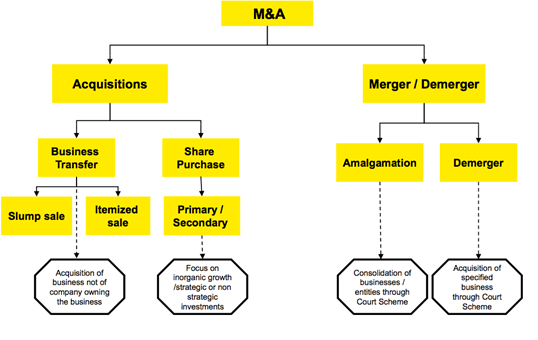
MandA

Mergers and Acquisitions is a collective term for a variety of different business transactions in which, for example, companies merge or change ownership. M&A is a   great way to achieve strategic goals in a short amount of time and with relatively secure and stable result. They lend themselves to realize a big and rewarding time gain (“economies of scale”). Also the reduction of the available time and the acceleration of competitive interactions persuade the companies to act faster proactively and respond to largely unpredictable events.

The strategic objectives could be gaining the market shares, the internationalization and globalization of the company, opening new opportunities for growth, the creation of sustainable competitive advantages or fundamental change in transformation of the company, it activities and focus.

There are phases of the acquisition process which might differ from project to project. The following is the generalized form and sequential order of the M&A.

M&A pose a number of risks in each step of the processes mentioned in the above table. Numerous studies assume a failure rate of up to 75% for M&A transactions.

Mistakes made at the earlier stage usually cannot be fixed at the later stage. For example, if the strategic consideration is incorrect and as a result the paid purchases price is too high, even the most successful integration efforts cannot save the transaction anymore. An acquisition that entails entering into new business units poses special risk for the buyers.

Mergers and their processes are useful if they help to minimize the risk and do not create additional risks. Acquisitions  in the  related areas are generally proved to be less risky as  compared to acquisitions in the new business. Experience shows that the failure rate is greater, when the endeavor is further removed from the known business and existing knowledge.

As for risk minimization, one can pass risk to the negotiating partner through purchasing price. Whether this succeeds depends upon the extent to which both negotiating sides assess the risks in the same way and what bargaining power the negotiating parties have in their hand.

The question why there is such high failure rate can only be answered on a case by cases basis. In general, the following reasons play a role in this:

  1. Inadequate strategic analysis of the acquisition target
  2. Unrealistic assessment of the acquisition target
  3. Over optimistic assessment of market potential
  4. Over optimistic assessment of the synergy potential
  5. Overcharged purchase price with correspondingly low return on the capital employed.
  6. Unmet result expectation / Return on investment
  7. Lack of integration of the acquired company after the acquisition
  8. Mismanagement
  9. Excessive period of negotiations
  10. Breach of any terms and condition in the agreement.

     REGULATORY FRAMEWORK GOVERNING M&A IN INDIA

Parties to a merger or an acquisition may have their own ideas as to how the transaction is to be structured or carried out, or the rights and obligations that each party will understand. However, in order for the transaction to be enforced or upheld in a court of law, thereby giving each party the assurance that the transaction itself would not be rendered immaterial, certain law need to be adhered to.

In M&A transactions importance of consensus cannot be understated. Mostly in all the cases consensus are arrived orally but it is imperative that such consensus be captured in the document in the form of the agreement. The two primary reasons for the documentation of a consensus are:-

  • Promise made by either party is often vague and must be reduced to specific rights and obligations in order to avoid ambiguity
  • In the event that the parties to merger or the acquisition become involved in a dispute the parties are required to refer the dispute to adjudication

The consensus is subject to a number of laws. Certain laws restrict or prohibit the operation of certain parts of the consensus. Further, even if the consensus is not prohibited or restricted, timely information must be provided to relevant regulatory authorities. In some cases, the consensus cannot be implemented without the sanction of a regulatory authority.

+++++++++++++++++++

The basic of a merger or an acquisition is the transfer of assets and /or liabilities from one entity to another. The transfer of assets and liabilities could take place number of ways.

  1. By the transfer of assets and liabilities from the target to the acquirer.
  2. By the transfer of the entity owning the assets and liabilities in its entirety in part, to the acquire
  3. By the merger of the target entity into the acquiring entity.

In the case of merger and acquisition, the deal is usually implemented by the sale and purchase of the shares, business or the assets of the target or the issue of the shares of the target company in favour of the acquirer. A consensus relating to that transfer of share, business or assets is usually encapsulated in a contract. Therefore, corporation must begin with the Indian Contract Act, 1872 as it lays the cornerstone for the basis of contract enforceability in India and what contracts are valid and what are not.

The transfer or issue of share, subject to the Indian Companies Act, 1965 and Companies Act, 2013 which also contain specific provisions for the merger or amalgamation of companies. There are vast majority of mergers and acquisitions taking place by the transfer or issue of share of companies, hence the importance of Companies Act and its provisions relating to the transfer and issue of share cannot be understated. It is paramount to ensure that the procedure required for a proper transfer or issue of share is met.

There are rare occasions, where an acquisition takes place by the transfer of assets and liabilities owned by the company and not by the transfer or issue of shares of a company, Section 293 of the Companies Act places number of restriction is the sale, lease or disposal of the “whole, or substantially the whole, of the undertaking of the company, or where the company owns more than one undertaking, of the whole, or substantially the whole of any such undertaking” without the consent of the shareholders of the company. In other words, in order to effect the transfer of the whole or substantially the whole of the assets and liabilities of a company, the shareholders of the company must, by a simple majority, consent to the transfer. A question arises as to what is included in term “substantial”. The test to be applied is whether the business of the company may be effectively carried out after the transfer of assets have taken place. This means that even though the assets transferred may not be the whole of the assets of the company, nor substantially the whole, if the business of the company is reduced to a shell after the transfer, the consent of the shareholder would be required.

The shares of a public company are freely transferable under Indian company law subject to certain circumstances which have been set out in the Companies Act. Ordinarily, the broad of a public company cannot refuse the registration of transfer of shares. Conversely, an unlisted, private company may reject registration of transfer of shares. However the transferability of shares in the case of unlisted companies is even more restricted as there is no formal mechanism for the trading of a share, as opposed to a public listed company, the shares of which may be traded on stock exchange.

There are two types of share capital under Indian law- equity (equivalent to common stock) and preference (equivalent to preferred stock). The primary difference between the two types of shares under Indian law is voting power that is attached to each. Preference shareholder, under normal circumstances, cannot participate in shareholder meetings, nor can they vote on shareholder resolutions. Equity shares are equal in terms of voting rights and right to dividend. However, equity shares with differential right is  also permitted for private companies. Therefore, for the purpose of the acquisition of the company, the transfer or issue of equity shares is the norm.

If the cases where the target company has been granted a concession by a state government for the construction of highway, subject to the condition that the original shareholder (the promoter) shall retain control (51% of the equity share capital) of the target company. In the course of discussion, it is found that the investment requirement of the company exceeds 49% of the equity share capital, based on the valuation of the target. In such cases, the investor may consider purchasing upto 49% of the equity share capital and the reminder of the investment to be used to subscribe to preference shares, or any other form of security instrument that the company is able to issue.

Companies Act and Contract Act are applicable in every instance of a merger or an acquisition of shares of Target Company, however there may be situations when other legislatures also come into play. In certain cases which may have an adverse effect on competition, a specific merger or an acquisition may trigger the provisions of the Competition Act, 2002 along with its subordinate legislation. In cases of M&A of the listed companies, the Securities and Exchange Broad of India (Substantial Acquisition of Shares and takeover) Regulation 2011 would also be triggered. A cross-border acquisition would attract the provisions of the extant Policy on Foreign Direct investment or the Overseas Direct Investment guidelines.

India has plethora of laws, a number of which are restricted in their application to certain industry sectors. In certain cases, M&A of a target company operating within one of these industries would be subject to the sector-specific laws. For example a concession granted by the Government of India in favour of a generation company is likely to have a minimum requirement as to the percentage of shareholding that the promoters of the company may continue to retain.

HOW ARE M&A TAXED IN INDIA?

Amalgamation means a business combination, attracting the special treatment in the various fiscal statutes. In simple terms, amalgamation is creation of the entity which either took in its fold the existing business of other entities or the creation of a new entity by pooling the businesses of various entities.

Section 2 (1B) of the Income Tax Act contains the definition of amalgamation. At the same time there is no definition of merger in the said Act. The definition in the IT act focuses attention on certain areas. First, the term amalgamation used in the IT Act refers only to amalgamation in relation to the companies and not in reference to any other amalgamation between other forms of legal entities like partnership or sole proprietorship. Second, there are two types of combination (a) merger of one or more company with another company. This is also known as absorptions. (b) merger of two or more companies to form a new company.

At the same time there are certain transactions that are excluded from the definition of amalgamation. They are: one, acquisition of property of once company pursuant to the purchase to such property in simpler words where the property of the company which merges is sold to the other company and the merger is a result of a transaction of sale; second, a distribution of property to another company due to winding up of the transferor company.

There are certain transfers due to vesting which are contemplated as following:-

  1. All the property and liabilities of the transferor companies before the amalgamation becoming the property of the transferee company.
  2. Shareholders holding less than three fourths in value of the shares in the transferor company becoming shareholders of the transferee company by virtue of amalgamation other than those already held by the transferor company in the transferee company either by itself or through its nominees.

Lastly the emphasis of the word “before amalgamation” used with regard to the transfer of assets and liabilities.

The most important aspect in the definition of amalgamation is the vesting of all property and liabilities of the transferor company to be transferred to the transferee company by the virtue of amalgamation. Similarly, the IT Act also contemplates atleast 75% of the shareholders of the transferor company becoming shareholders of the transferee company after amalgamation. All the concepts have been borrowed from the UK and the logic is not far to seek. An amalgamation presupposes the pooling of resources meaning thereby, the pooling of all assets and liabilities and continuation of the business without any interruptions. It is on the basis that particular clauses have been drafted so that all the assets and liabilities continue to exist in the hands of the transferee. If certain assets of the transferor company are excluded and not transferred to the transferee company, there cannot be effective pooling resources.

MERGER CONSIDERED AS AMALGAMATION UNDER INCOME TAX ACT

There are three conditions when merger is qualified as an amalgamation under the Income Tax Act. First, all the properties of the amalgamating company immediately before the amalgamation should become the property of the amalgamated company by virtue of amalgamation.

Second, all the liabilities of the amalgamating company immediately before the amalgamation should become the property of the amalgamated company by the virtue of amalgamation.

Third, shareholders holding not less than three fourths (in value) of the shares in the amalgamating company (other than shares already held by the amalgamated company or by its nominee) should become shareholders of the amalgamated company by virtue of amalgamation.

HOW TO CIRCUMVENT THE DEFINITION IN SECTION 2 (1B) OF INCOME TAX ACT?

Before an amalgamation scheme is proposed, the corporation needs to identify whether the definition is completely satisfied. There may be instances where the transferor company may be of the view that not all assets need to be transferred to the transferee company, probably, due to the fact that there is no synergy with respect to those assets.

If a merger proposal is mooted between these two companies, then strictly there may not be any synergy between the sugar business of the transferor and the chemicals business of the transferee. At the same time, if the definition has to be satisfied, then the only alternative is to merge both the companies as they exists at present, as the definition stipulates that all the assets and liabilities of the transferor company should becomes assets and liabilities of the transferee company. The various alternatives, going by the precedents available are ;

  1. merge both the companies and then later demerge for sugar business. Example is Voltas Allwyn merge and demerge.
  2. demerge first the sugar business by spinning off to a separate company and only later merge both the companies. Example Sarabhai Group.

          TAX CONCESSIONS UNDER SECTION 2 (1B) OF INCOME TAX ACT

The following tax concessions are available if an amalgamation satisfies the conditions of Section 2(1B) and the amalgamated company is an Indian company:

  1. Non-chargeability of capital gain on the transfer of a capital asset including shares held by a shareholder at the time of amalgamation (Section 47(vi) and (vii)).
  1. Eligibility of amalgamated company for the deduction in respect of any asset representing expenditure of a capital nature on scientific research (Section 35(5)).
  1. Eligibility of amalgamated company for the deduction in respect of acquisitions of patent or copyrights (Section 35A(6)).
  1. Similar deduction in respect of expenditure of know-how as provided in Section 35AB(3).
  1. Amortization of expenditure for obtaining telecom licenses fees. (Section 35ABB(6)).
  2. Amortization of certain preliminary expenses (Section 35D(5) r/w Rule 6AB).
  1. Amortization of expenditure on amalgamation (Section 35DD).
  1. Amortization of expenditure on prospecting etc. for certain minerals (Section 35E(7) r/w Rule 6AB).
  1. Writing off bad debts (Section 36(1)(vii)).
  1. Deduction in respect of any expenditure for the purposes of promoting family planning(Section 36(1)(ix)).
  1. Computation of written down value of the transferred fixed assets in the case of amalgamated company (Explanation 2(b) to Section 43(6)).
  1. Continuance of deduction available (Section 80-IA and Section 80-IB).
  1. Benefit of carry forward and set off of accumulated losses and unabsorbed depreciation (Section 72A)

The Act therefore seeks to extend tax neutral treatment to transactions of mergers and demergers that is however subject to fulfillment of prescribed conditions under the Act.

TAX BENEFITS IN THE CASE OF AMALGAMATION BY WAY OF ABSORPTION

Under the Income Tax Act, the concept of Transferor Company losing its identity in the case of amalgamation by the way of absorption has a great significance. In this case, the corporate personality of the transferor company ceases to exist immediately upon completion of amalgamation. This results in the loss of benefit by carry forward of loss, as under the provision of the IT Act, only the person – the legal entity which has sustained the loss is directly attached to the assesse and not to the business nor the undertaking. Thus, if a sick company merges with a healthy company the loss will not automatically flow to the healthy company. The healthy company can avail the benefits of the losses of the sick company only by obtaining the government approval under Section 72A of the IT Act.

The losses of the sick company become the capital loss and the benefits of right to carry forward is lost to the sick company when its merges with a healthy company. as a legal entity ceases to exist consequent to the amalgamation.

When the sick company merges with the healthy company then the losses suffered by the sick is considered as capital loss in the financial sheet, therefore, sick company gets the right to carry forward its loss. The reason why sick company can do this is because after amalgamation legal entity of the sick company ceases to exist.


       CAPITAL GAINS AND AMALGAMATION

Under the provision of Income Tax Act, a capital gain will arise when a capital asset is “transferred”. The word “transfer” is defined under the IT Act in Section 2(47). The word transfer means the sale, exchange, or relinquishment of the assets or the extinguishment of any rights therein or the compulsory acquisition under any law.

Shri N.A Plakhivala in his book The Law and Practice of Income tax Act rules out the incidence of capital gain in the following way. When company A amalgamates with and merges into company B and the shareholder of company A are allotted shares in company B in their own right and not as nominees of company A question arises as to whether those shareholder are liable to tax under the head of Capital Gain. It is clear that such amalgamation does not involve any exchange either within the legal meaning of the term. Whereas the allotment of shares by company B to the shareholder of company A does not involve a transfer of property by either of the two parties to the other. There is no transfer of assets by the shareholder of company A to company B: the transfer of assets of company A cannot be regarded as a transfer by its shareholders. Nor is there any transfer by company B when it allots its share capital to the shareholder of company A. The allotment of shares by the company cannot be regarded as a transfer of property by that company.

The merger does not even involve ‘relinquishment of the assets’ because relinquishment postulates the continued existence of the asset over which the right of its holder are relinquished or surrendered, whereas upon amalgamation the shares in the company cease to exist.

It is important to determine whether this constitutes a transfer under Section 2(47) of the ITA, which would be liable to capital gains tax. According to judicial precedents in this regard, including decisions of the Supreme Court till recently, this transaction did not result in a “transfer” as envisaged by  Section  2(47).

In the case of Commissioner of Income Tax v. Mrs. Grace Collis and Another, the SC has held that “extinguishment of any rights in any capital asset” under the definition of “transfer” would include the extinguishment of the right of a holder of shares in an amalgamating company, which would be distinct from and independent of the transfer of the capital asset itself. Hence, the rights of shareholder of the amalgamating company in the capital asset, i.e. the shares, stands extinguished upon the amalgamation of the amalgamating company with the amalgamated company and this constitutes a transfer under Section 2(47) of the ITA.

It is clear that there is no capital gain incidence either in the hand of the shareholder of either the transferor or the transferee company; and also companies inter se.

SPECIFIC EXEMPTIONS WITH RESPECT TO AMALGAMATION

Section 47 of the Income Tax Act provides following transactions will be not regarded as transfer. The following three clauses give specific exemptions with respect to transaction involving amalgamation.

“ Nothing contained in Section 45 shall apply to the following transactions”

(vi) any transfer, in a scheme of amalgamation, of a capital asset by the amalgamating company to the amalgamated company if the amalgamated company is an Indian company;]

[(via) any transfer, in a scheme of amalgamation, of a capital asset being a share or shares held in an Indian company, by the amalgamating foreign company to the amalgamated foreign company, if—

(a) at least twenty-five per cent of the shareholders of the amalgamating foreign company continue to remain shareholders of the amalgamated foreign company, and

(b) such transfer does not attract tax on capital gains in the country, in which the amalgamating company is incorporated;]

There are wide repercussions in the context of global merger due to above exemptions. As evident from the clause, there could be cases where a capital gain incidence may arise on a foreign company holding share in an Indian company. The situation can be avoided and minimized by the following methods :

(a) By taking advantage of the relevant provision of Double Taxation Avoidance Agreement (DTAA) if any entered between the foreign country and India. Under Section 90 of the Income Tax Act, India may enter into DTAA with other countries. These DTAA apply to taxable entities which are’ residents’ in one country but have their source of income in different country thereby sitting out an equitable basis for the distribution of the right to tax different types of income between the country where source of income is located and the country of residence. Therefore the taxation rates applicable to a residence of a state which is party to such tax treaty are relaxed in the event income generated by company in the other contracting State and the assesse is not doubly taxed for the same income generated in one of the contracting states.

(b) By not directly holding the shares in the Indian Company, but instead through another investment company situated in any other foreign country where there will be lesser incidence of capital gain tax.

(c) By setting up transnational subsidiaries in typical tax haven countries like Mauritius where there is capital gain tax on the sale of movable property of a resident irrespective of the size of the property.

UNION BUDGET 2015: TAX PROPOSAL ON M&A TRANSACTIONS

With the focus of the new government moving towards improving the business environment and towards economic growth & development, there will be change in the taxation of M&A landscape as well.

The government has started the work with the retrospective amendment on indirect transfers; there is still lack of clarity on what is ‘substantial’. In that context, only “transfer of a controlling interest” in a foreign entity deriving its value substantially from assets located in India should attract tax in India. A threshold limit of transfer of more than 50% beneficial interest in the capital of a foreign entity and/or transfer of more than 50% voting power of a foreign entity could be prescribed to define “transfer of a controlling interest.”

Further, there could be other exemptions provided in context of taxation of indirect transfers i.e. no Indian tax should be imposed where say for example the shares of the foreign company are listed and traded on a stock exchange outside India or if there are intra-group transfers (where the ultimate control is not transferred outside the group) or the transactions are otherwise not ‘transfer’ as per law (for example – gift) or transactions which do not result in any transfer per se (for example primary infusion in company for acquisition of shares) or shares received by shareholders of a foreign company (having indirect stake in India) under a swap pursuant to foreign companies amalgamation / demerger. To encourage more foreign investments in India, it could be considered to exempt P-Note holders from the applicability of indirect transfer provisions.

Even the government has announced for no tax should be levied on repatriation of funds by the offshore company to its investors on account of dividend distribution, buy back, redemption, capital reduction or liquidation by the offshore company, to the extent the repatriation amount relates to the amount realized by the offshore company on sale of Indian assets on which taxes have been duly discharged, or on which no taxes or lower taxes are due on account of tax provisions or treaty benefits available, as may be applicable.

Recently government has announced that the investor of the offshore company should not be taxed on repatriation of funds such as dividend distribution, buy back, redemption, capital reduction or liquidation but the key point is tax will not be levied to the extent where the repatriation amount by the offshore company is on the sale of Indian assets where tax is duly discharged or there is tax provision or treaty benefits available to the offshore company.

Considering that acquisition through amalgamation is increasing, the benefit of carry forward of losses, pursuant to amalgamation, should be extended to all companies irrespective of the line of business.

Transactions such as transfer of shares in a foreign company by a resident or domestic company pursuant to amalgamation or demerger abroad should be exempted from capital gains tax, provided that such amalgamation or demerger is exempt from tax under the domestic tax laws of the foreign country in which such amalgamation or demerger takes place.

Some other amendments that are required include providing exemption from taxation to transactions such as receipt of shares by amalgamated company or resulting company pursuant to amalgamation or demerger, receipt of shares by Trust on settlement, genuine business/commercial transactions, issue of shares, etc.


 

Download Now

Analysis Of The Armed Force Special Power Act In North Eastern Region

0

images (5)

In this blogpost, Priyanka Kansara, Student, National Law University, Jodhpur writes about the Armed Forces Special Power Act, and analyses the problems faced which arise while dealing with it in practical situations, and how the Armed Forces Personnel misuse the powers given to them by this Act.

The Constitutionality of the Armed Force (Special Power) Act

The borderline between Law and politics in the area of civil liberties and human rights is so narrow that the influence of one on the other cannot be ignored. The interference with any aspect of an individual’s life requires the strongest justification.

The intention behind enacting, the Armed Force Special Power Act, 1958 (hereinafter referred as the Act 1958) was basically to put a control on the Quit India Movement; but the recent developments or rather the loopholes give the Governor, of those states or Union Territories, the power to declare those areas as disturbed areas, and empower the armed force to take actions so as to ‘maintain law and order’ in those

The Act confers certain special powers upon the members of the armed force in disturbed areas state of[1] [Arunachal Pradesh, Assam, Manipur, Meghalaya, Mizoram, Nagaland and Tripura]. The Act aims to suppress the disorder and to restore and maintain the public order in the disturbed areas. The word ‘Disturbed Area[2]’ was though not significantly defined. It vests powers on the Central Government for the same.[3] In the case of Indrajit Barua vs. State of Assam,[4], Hon’ble Delhi High Court stated that the lack of precision in the definition of a ‘disturbed area’ was not an issue because the Government and people of India understand the meaning of it. But in the case of Menaka Gandhi vs. Union of India[5], it was also held that the restriction imposed on the Fundamental Rights should be just, fair and reasonable. A person may be deprived of his life or personal liberty in accordance with fair, just and reasonable procedure established by valid law.

The Act provides sweeping powers to soldiers, including the power to shoot, to kill in certain situations, and to arrest people without warrants. The law has facilitated grave human rights violations, including extra-judicial executions, enforced disappearances, rapes and tortures and other ill-treatments. Section 3 of the Act empowers the Central Government to declare, suomoto, any area in North East area as disturbed and call upon armed forces to ‘aid’ civil administration in order to maintain law and order in the state. On 7th April 2015, the 12 districts of Arunachal Pradesh had been declared as ‘disturbed areas’; similarly, on June 2015, the Union Home Ministry had declared whole of the Nagaland as a disturbed area for a further period of one year, which means that the Armed forces will get power to search, raid, arrest without a warrant and will allow them to use force by the army personnel even to the extent of causing death, against one who puts law and order in disturbed area, in peril. These are not the only incidents wherein the Government had declared some areas as ‘disturbed areas’; in 1955, Naga inhabited areas of Assam were declared ‘disturbed area’ under the Assam Disturbed Areas Act, 1955. In 1958, the Armed Force (Special Power) Act took up the position to regulate the ‘disturbed areas’ of Assam.

The abuse of power enshrined under this Law by the Army Personnel can be misused in rampant fake encounters, molestation of women, and illegal detention of the civilians in the name of maintenance of law and order in the area.

The Constitutionality of the Act was challenged in the case of Naga People’ Movement of Human Rights vs. Union of India[6], wherein the Supreme Court of India upheld the Constitutionality of the Act but laid down certain measures so as to prevent the unlawful encroachment of the Civilians’ Fundamental Rights, such as, a suomoto declaration can be made by the Central government. However, it is desirable that the state government should be consulted by the central government before making such a declaration. The Act of 1958, does not confer arbitrary powers to declare an area as a ‘disturbed area, it was stated by the SC that the declaration has to be for a limited duration and there needn’t be any periodical review of the declaration; it was also stated that the authorised officer should use minimal force necessary for effective action; and the authorised officer should strictly follow the ‘Dos and Donts’ issued by the army.

The AFSPA and various Committees’ Report

The Committee on Amendments to Criminal Law (popularly referred to as the Justice Verma Committee), 2013 stated that the AFSPA legitimised impunity for sexual violence, and recommended an immediate review of the continuance of the Act 1958 in internal areas of conflict. Currently, the Armed Force (Special Power) Act in conflict areas needs to be reviewed; it requires a sanction by the Central Government for initiating proceedings against Armed Force Personnel[7]. The Committee had recommended that the requirement of the prior sanction of the Central Government for initiating proceedings against Army Personnel should be specifically excluded in case of charges against sexual offences.

As per the Committee’s recommendations 2013, an amendment to the Code of Criminal Procedure, which removed the need for prior sanction for prosecuting Government officials for certain crimes involving violence against women, including rape, sexual assault, sexual harassment, voyeurism and stalking, was introduced in the Criminal Amendment Act 2013, the Act should also be amended on the same tune with respect to the Armed forces Personnel.

Furthermore, Justice Jeevan Reddy Committee (2005) made an alarming statement on the unfettered powers vested in the Act; it was mentioned that “the law had become ‘a symbol’ of oppression, an object of hate and an instrument of discrimination and high-handedness”. The Committee came with certain recommendations such as, the Act 1958 should be repealed and certain provisions should be added to the Unlawful Activities (Prevention) Act, 1967; the Act 1967 should be modified in order to have a clarified specification on the powers of the Armed Force Personnel in those areas; and grievances cells should be set up in each district where the Armed forces are deployed.[8]

A welcome step

The positive step towards the abolition of the ‘draconian law’ came when the State Government of Tripura, decided to withdraw the law, which had ruled with the sweeping powers and judicial immunity to security forces in conflict-hit areas for 18 years.[9]

What we learnt from Tripura is, to review whether we really need this Legal Provision for the maintenance of law and order, though the situations in those areas are quite delicate, this can be resolved by other ways so as the Fundamental Rights of the Civilians can be protected and the Rule of Law can be maintained.

What we need to do

Unlawful detention is the one of the biggest hurdles in the Human Rights in the matters of AFSPA; it was also stated in the case of Horendi Gogoi vs. Union of India[10] by Hon’ble Guahati High Court, it was held that in the case of arrest of any person, Army authority is duty bound to hand over the arrested person, to the officer-in-charge of the nearest police station with least possible delay[11].

The legal implementation of the Act is necessary, as the restrictive and protective measures are provided under the Act only, such as, a due warning should be given before taking any action i.e. firing, or using force against any person/s, and the arrest can be made only if there are some reasonable suspicion that the person had committed some cognizable offence.

The inhuman behaviour of Army Personnel is not just because of this Act, sometimes the overburdened situation and the training also becomes a reason for those grievous incidents.  We need to have a Humanitarian Forced Power, which is trained in the fundamental principles of criminal jurisprudence, in line with the already established and celebrated Constitutional provisions relating to the Criminal Jurisprudence, simplification of judicial procedures and practices, uncomplicated and inexpensive justice system. Hon’ble Gauhati High Court in Luithukla vs. Rishang Keishing[12] while addressing the same issue stated: “the Armed Force could work in harmony when they deployed in disturbed areas”. And this can only be done by sensitization of the armed personnel towards the humanity and civil liberty. Sensitization of Army Force Personnel is the need of hour so as to maintain the humanity over the ghastly impact of this law.

[1] Subs by Act.69 of 1986.

[2] The Armed Force Special Power Act 1958, s. 2 (b).

[3] id., s. 4.

[4] AIR 1983 Delhi 513.

[5] AIR 1978 SC 597.

[6] (1998) 2 SCC 109.

[7] Supra Note 2, s. 6, the AFSPA, 1958.

[8] All you wanted to know about AFSPA, PRS Legislative Research, November 16, 2011, http://www.prsindia.org/media/articles-by-prs-team/all-you-wanted-to-know-about-the-afspa-2051/ (accessed on Deccember 9, 2015).

[9]AFSPA withdrawn from Tripura after18 years, FirstPost (May 28, 2015), http://www.firstpost.com/india/afspa-withdrawn-tripura-18-years-2266620.html (accessed on December 9, 2015).

[10] (1991) Gau CR 308.

[11] Supra Note 2, s. 5, the AFSPA 1958.

[12] (1988) 2 Gau LR 159.

Download Now

Whether The Author Is Entitled To Claim Copyright Over The Title Of His Work

0

download

In this blogpost, Harsha Jeswani, Student, National Law Institute University, Bhopal writes about whether an author can claim copyright on the title of his work and also analysis the case Krishika Lulla v. Shyam Vithalrao Devkatta

INTRODUCTION

Last year, the Supreme Court rendered a landmark judgment holding that no copyright subsists in respect of a literary work. The judgment was given by a bench comprising justices M.B. Lokur and SA Bobde. They heard an appeal of Krishika Lulla and others against the decision of the Bombay High Court, which had refused to quash a complaint filed under Section 63 of the Copyright Act, read with Sections 406 and 420 of  the  Indian  Penal  Code, 1860.

Before discussing the case, let us first understand the concept of Copyright in India. Copyright is a statutory right which is recognized and protected by copyright under The Copyright Act of 1957. It is a form of intellectual property which gives protection to the unique expression of one’s. It is a negative right as it enables the owner to prevent others from copying and using his ideas without his consent. At the same time, it gives the author an exclusive right for the commercial exploitation of his work.

The (Indian) Copyright Act, 1957 protects following works-

  • artistic work including a painting, a sculpture, a drawing (including a diagram, map, chart or plan), an engraving, a photograph, a work of architecture or artistic craftsmanship, dramatic work,
  • literary work (including computer programmes, tables, compilations and computer databases),
  • musical work (including music as well as graphical notation),
  • sound recording, and
  • cinematograph film

The Copyright is always granted on all Original literary, artistic, musical or dramatic, cinematograph and sound recording works. Original here means that the work must not be copied from anywhere.

Copyright protection begins as soon as the work is created. In India, the registration of copyright is optional as it serves as mere evidence of the fact. Copyright is granted till the lifetime of the author or artist and sixty years following the death of the author.

Now the issue that came before the Supreme Court in the case of Krishika Lulla v. Shyam Vithalrao Devkatta decided on 15 October 2015 was whether the author can claim copyright over the title of a work.

The brief facts of the case were-

The respondent had written a story with the title “Desi Boys.” On 25.11.2008, he got the synopsis of the story registered with the Film Writers Association. His friend told him that the son of a director required a comedy film story. He emailed the synopsis of the story to his friend on 14.10.2009. The respondent did not receive any reply. After some time, the respondent saw the promos of a film titled “Desi Boys” which was actually spelled as “Desi Boyz.”  The film was released throughout India with title “Desi Boyz” on 25.11.2011.  The Respondent claimed that using the title “Desi Boyz” in the film amounts to a clear violation of the copyright.

The question before the court was whether the respondent has copyright in the title “Desi Boys” which he has given to the synopsis of a story.

The Court noted that copyright in India is a statutory right provided under The Copyright Act, 1957. Before coming to the conclusion, it is important to understand whether the title can be a subject of copyright. Title by itself is in the nature of a name of a work and is incomplete by itself, without the work.

The court referred to Section 13 of the Copyrights Act, 1957 which provides that copyright is granted for original literary work. The term title is not to be included in the definition of “work”. Also, the two terms “Desi” and “Boys” are so commonly used terms that there cannot be anything original. It is obvious, therefore, that the title “Desi Boys”, assuming it to be work, has nothing original in it in the sense that its origin cannot be attributed to the respondent. In fact, these two terms cannot be regarded as literary work.  The mere use of common words, such as those used here, cannot qualify for being described as ‘literary’.

In the instant matter, the title of a film was on the basis of the title of mere synopsis of a story. The title of the film cannot, therefore, be regarded as a literary work, and so it doesn’t constitute any copyright in it according to Section 13 of Copyrights Act, 1957. Thus, no criminal complaint is maintainable under this act for infringement of Copyright.

It was also observed by the Apex Court that no copyright subsists in the title of a literary work and, therefore, the complaint of the plaintiff is unsustainable, and he is not entitled to any relief as the title is not a subject of copyright. This does not signify that a title cannot be protected from being copied as held in Dicks v Yates that where “there might be copyright in a title as for instance a whole page of title or something of that kind requiring invention.”

Thus, it was laid down by the Hon’ble Court that in the present case, the title “Desi Boys” does not constitute any title and so no question of its infringement arises. The prosecution based on allegations of infringement of copyright in such a title is unsustainable.

Download Now

Eve-teasing: Is It Really A Crime?

0

women rights

In this blogpost, Saumya Agarwal, Student, Amity Law School, Delhi defines what is a crime, tortious act and eve-teasing. She further analysis the laws on eve teasing.

Recently, I was researching about various violent crimes like sexual harassment, stalking, molestation, eve-teasing, etc. that are committed against women in India and the relevant provisions in the IPC for them. I found the relevant sections for the various offences. But I couldn’t find a particular section which was dealing with ‘eve-teasing’. After a good amount of research, I found that eve-teasing is not defined as a crime under IPC.

What is a crime?

Marriam-Webster’s dictionary says that ‘crime’ is an illegal act for which someone can be punished by the government. So that means if a particular wrongful act is not defined by the government as an illegal act then that’s not a crime? It is merely a tortious act. Eve teasing is one such act. It has not been defined in the Indian Penal Code. So the Government of India means to say that it is not a crime?

What is a tortious act?

According to Salmond, it is a civil wrong for which the remedy is a Common Law action for unliquidated damages and which is not exclusively the breach of a contract or the breach of a trust or other merely equitable obligation.

The three essential elements of a tortious act are:

  • The act should be a civil wrong.
  • The civil wrong should be other than a mere breach of contract or breach of trust.
  • This wrong should be remedied by an action for unliquidated damages.

All the elements of a tortious act are fulfilled to define eve-teasing as a tortious act and not a crime.

What is eve-teasing?

Eve-teasing is a euphemism used throughout South Asian continent for public sexual harassment or molestation of the female sex by the men. Eve-teasing is not an English origin word; it is a Hindi-English term. Eve-teasing is an attitude, a mindset, a set of behaviors that is construed as an insult and an act of humiliation of female sex. It is the harassment of women by strangers in public places, streets and public transport. It includes both verbal assaults-making passes or unwelcome sexual jokes and non-verbal assaults such as showing obscene gestures, winking, whistling and staring and physical assaults such as pinching, fondling and rubbing against women in public places. It is expected out of women to ignore such incidents every day. Even if they want to complain about it, the police shoo’s them away!

The biggest problem that the police face is, under what section should they book them?

Whether eve teasing has been recognized as a liability or not, it is long due that the eve-teasing should be recognized as a separate offence under an independent head in the Indian Penal Code.

Current laws dealing with eve-teasing

The cases of eve-teasing are dealt under Section 294 and 509 of the IPC.

Section 294 says that if any person does an obscene act or sings, recites or utters any obscene song, ballads or words in a public place and such act causes annoyance to others then that person shall be imprisoned for a term with either description which may extend to three months or with fine or both.

Section 509 says that if a person with the intent to insult the modesty of a woman utters any word, makes any sound or gesture, or exhibits any object, intending that such word or sound or such gesture or object intrudes the privacy of the woman shall be punished with simple imprisonment which may extend to one year or with fine or both.

As there is no particular section for eve-teasing, the policemen are confused as to under what section should they charge them for the offence. So a clearer picture is needed to be drawn for the issue.

According to the Justice Verma Committee proposal, Section 509 should be repealed. The Committee suggested the use of words, acts or gestures that create an unwelcome threat of a sexual nature should be termed as sexual assault and be punished for year imprisonment or fine or both. Presently, use of words or gestures to “insult a woman’s modesty” is punishable with 1 year of imprisonment or fine or both.

Current Situation

The current situation of Indian women is known to the world. All kinds of violence are committed against women in India. Eve-teasing is a bigger issue than rape as it is faced by every woman once in a lifetime but is not being addressed at all.

Rape is being addressed by the lawmakers vehemently, but there is nothing about eve-teasing in the IPC. Rape is a grave offence which is addressed by the lawmakers, but it is an extended form of violence against the women. If something is being addressed at a smaller level only, then there will be less number of cases of rape too.

While researching for the topic, I searched for the statistics of eve-teasing, but I could not find it anywhere. The reasons could be people don’t take the issue seriously or women ignore the issue, or the police do not take cognizance of the issue. We as a society are failing if we cannot protect our women and children.

Conclusion

Eve-teasing should be dealt with as soon as possible. It should be treated as an independent crime and not mingled with other sections. More stringent laws are needed against eve-teasing and not only a law is needed against eve-teasing, but a better enforcement mechanism is needed. Police should deal with the issue more effectively. If the law-makers make a law dealing with it, then there will be a great decline in the number of cases of eve-teasing in the country. Eve-teasing may sound a harmless crime but if not nibbed in the bud can result in grave offences like rape and murder of the victim.

Download Now

Analyzing Freedom Of Speech And Expression Through Offence And Harm Principle

0

hammer-620009_960_720

In this blogpost, Haridya Iyengar, Student, Jindal Global Law School, Haryana writes about whether there should be a limitation on freedom of speech and expression on the basis of harm and offence principle

This paper explores the topic of freedom of speech and expression. It will seek to look at the different limitation principles on freedom of speech and expression.

The freedom of speech and expression is a right without which other rights are hard to acquire and defend. The right to freedom of expression has its root all the way back in the 17th-century struggle of European legislators for freedom of speech. However, there is a continuing struggle in the world for the freedom of expression often going to the extent of limiting government powers.

If liberty of expression was not valued there would have been no problem, freedom of expression would have simply been curtailed for other values. Free speech only becomes an issue when it is highly valued because only then do the limitations placed on it become controversial. The state obligation to uphold freedom of expression is absolute and immediate under the present international convention. However, just like other forms of liberty complete freedom of speech and expression can be a problem if there are no limitations placed on it. Since, there would be no prohibition on libellous statements concerning child pornography, advertising content and releasing state secrets. Most limitation have dealt with an expression or sentiments contrary to religious, political or other beliefs. The complexity and importance of freedom of expression have led to many extensive case laws before the national courts and international supervisory mechanism.

Harm Principle and Free Speech and Expression

No society has existed where speech has been limited to some extent. According to Haworth, a right to freedom of speech is not something we have, not something we own like our arms and legs, it is something that is granted[1]. The problem, however, is deciding where to place the restriction.

According to John Stuart Mill, fullest liberty of expression is required to push our arguments to their logical limit. Such liberty must exist within every subject matter so that we have absolute freedom and sentiment on all subjects. However, Mill does place one limitation or rule referred to as the Harm principle which states that, “the only purpose for which power can be rightfully exercised over any member of a civilised community, against his will, is to prevent harm to others.” There is a great number of debates on the meaning ‘harm’. According to Mill, Harm is something that would injure the rights of other people. This must be differentiated from an offence which is hurting the sentiments of others. He further argues that free speech must not be limited because of offences since what may hurt one person’s feelings might not hurt another’s and so offences are not universal.

If we accept the harm principle, we have to ask ourselves what type of speech causes harm. Mill uses a hypothetical about a corn dealer to answer this question. Assume there is a corn dealer who does not sell corn to the poor. It is acceptable to claim that the corn dealer starves the poor people if expressed on a medium such as a blog. However, it is not acceptable to express the same view in front of an angry mob gathering in front of the corn dealer’s house. This is because the latter expression will directly cause harm to the corn dealer. So for the harm principle to actually apply one must be directly harmed by the expression. So, if we base our defence on the harm principle, there are going to be very few sanctions imposed on written and spoken words. Sanctions will only be imposed when we can show direct harm to the rights of individuals.

Offence Principle and Free Speech and Expression

Joel Feinberg argues that the harm principle does not reach far enough in limiting free speech. He suggests that in some instances we also need an offence principle which can act as a guide to public censure. He suggests that there are some statements that must be banned because they are very offensive. However, offending someone is less serious than harming someone so; the penalties imposed must also be less severe. Such a principle is hard to bring into application because many people take offence as a result of bigotry and unjustified prejudices. Furthermore, there are some instances where people can be deeply offended by statements many find amusing.

To prevent penalties being imposed on less serious offences, Feinberg suggests that, a variety of factors need to be taken into consideration before limiting speech with the offence principle. These factors include the social value and duration of the speech, the motives of the speaker, number of people offended, the intensity of the offence and the interest of the community at large.

Paternalistic limitation of Free Speech

This principle suggests that agents performing the action which might offend or harm others do not have a full grasp of the consequences caused and hence can be prevented from engaging in that act. This enters the realm of argument where the state knows better than the individual what is in his best interest.

While most arguments agree that paternalistic limitation is required, they disagree about the degree of the limitation imposed. For instance, Mill believes that paternalistic intervention must be imposed only when there is harm done directly to the rights of individuals.

Democracy and Free Speech

This principle argues that freedom of expression should be compromised in favour of other principles such as equal respect for all citizens. Stanley Fish suggests that the task we face is not to arrive at a hard and fast rule that govern all speech rather, we have to find a workable compromise. This principle reminds us that we are not dealing with free speech in isolation but, are comparing free speech with some other good such as right to security or equality. So while deciding whether or not to limit free speech we must determine whether the other right has a higher value than speech.

Conclusion

While some argue that the harm principle supported by the offence principle is enough of a limitation for free speech, others argue that speech can be limited for the sake of other liberal values. It is up to the reader to decide which limitation on speech is an appealing possibility.

[1] Haworth, A., 1998. Free Speech, London: Routledge

Download Now
logo
FREE & ONLINE 3-Day Bootcamp (LIVE only) on

How Can Experienced Professionals Become Independent Directors

calender
28th, 29th Mar, 2026, 2 - 5pm (IST) &
30th Mar, 2026, 7 - 10pm (IST).
Bootcamp starting in
Days
HRS
MIN
SEC
Abhyuday AgarwalCOO & CO-Founder, LawSikho

Register now

Abhyuday AgarwalCOO & CO-Founder, LawSikho