Download Now
Home Blog Page 1803

Six Eternal Rules of doing well in a moot court competition

0
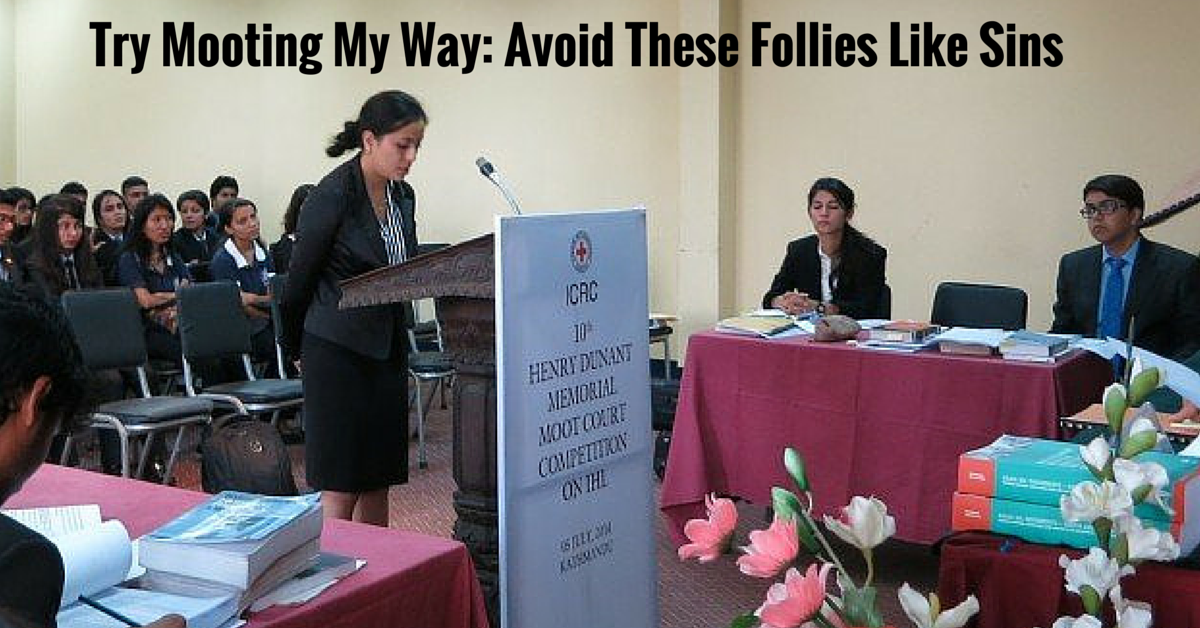
Try Mooting My Way: Avoid These Follies Like Sins

This was originally published in A First Taste of Law. Now we are republishing the best posts from the blog, which we have now shut down, to this blog. Hope you enjoy it!

Try Mooting My Way: Avoid These Follies Like Sins

The first moot I ever went for was one in Kochi. We were a team of 2nd years, had no clue about how to handle bad judges, and succumbed to that great weakness. Wherever you are mooting, India or some other country – you must be strategically prepared for bad judges. Its easy to spot them – ones that never read the problem until 5 minutes before the court, someone who is a stud at the local bar but has not clue about international law, doesn’t seem to understand English or is visibly suffering from a hangover.

Anyway, I am writing this post to share some conclusions I reached about mooting since I participated in my 2nd moot, this time as a part of my university team – Willem C. Vis East in Hong Kong. While we did not do too well in the moot (only thing we can mention as success is that we got an honorable mention for our Respondent memo with 9 other teams. Also, we were the only Indian team to have received anything from that moot at all), it was an extraordinary learning experience as far as mooting follies are concerned. All the points below generally apply to mooting anywhere but are gospel truth as far as Vis moots are concerned. I am so sure because these points arose not only from my personal experience but were reiterated by coaches, arbitrators, and winners again and again as I tried to figure out what is all the fuss about mooting.

First lesson, you don’t only need good/competent people on your team, you need a team with which you can work. In the mooting systems where you don’t get to choose your teammates but they are more or less decided due to ranks in internal selections, this can be a huge issue. Look out. I have asked around a bit, and it seems a lot of people can’t achieve their potential because of this one reason.

The second lesson, you must figure out what the moot asks of you. Much of it depends on who are the judges. Are the judges in the moot predominantly academicians, professors, veteran lawyers, and judges, or young Turks with some mooting experience? Does the moot brief the judges on what are the parameters on which speakers are to be judged? Obviously it will difficult to find out the details of the current year, and you must rely on the information you have of the previous years events to develop an idea about the event in which you are going to participate.

Vis east was completely about presentation skills. Legal knowledge is more or less presumed. In fact, George Varghese, the researcher in out team who have extensive debating experience thought that the moot is more or less like a policy debate, albeit judged by lawyers and the subject matter of debate being legal.

Details will vary greatly from moot to moot, but primarily, you can appeal in the different way to different sort of judges. If he’s a practicing lawyer or arbitrator, he will have different criteria on his mind when he listens to your arguments. He will pay a lot more details to your presentation skills and formal expressions. If there’s a professor on the board, she might be looking for something else. She might be happier if you draw support from a theory that she admires. Some, you can apprehend and prepare for, and some of this will have to be done on feet.

The third lesson, play the public interest card. Works in moots like magic. I have never done it, but seen people do it. No matter whether it is arbitration or WTO panel moot, everyone loves a mooter who is able to establish that the public interest is on her side. While public interest may be difficult to side with in a real case if hands of the judge are tied by law, but in a moot, there is no such constraint that prevent judges from giving the court to you.

The fourth lesson, prepare a speech and time it. You must know how much time you are going to spend on which argument. This does not matter much if competition you are facing is not strong. But when it is, time management is a crucial skill that is going to make a lot of difference. I would never again go to a moot without preparing a speech, and having every argument timed to seconds.

The fifth lesson, you must be able to show a structure in your arguments, that also helps the judges in following what you are saying. In a real case, this may not be so important, but in a moot court you are definitely going to pick up some points for it.

The last point, one must know how to answer questions. Questions must be answered precisely without circumlocution or distraction. Everyone hates to be handled. Don’t tiptoe around the question, even if you succeed to do so without an objection from the bench, the judge will hate you for it. Or worse, he will think that you are so thick you didn’t even get the question.

Download Now

Show Me The Money: Financing In The Real Estate Sector

1

 unnamed (1)

 Bhanudey Kanwar, Hariani & Co., Advocates and Solicitors

Many of us have at some point in time pointing at new buildings said or heard someone say “this area (in a city or town) has changed so much from what it used to be”. How are such buildings being built? Who is building such buildings? Where are they getting the money to build such buildings?

A quick tour in any city or town in the country and  the number of buildings already completed/ under construction is evidence enough that the real estate sector in India is one of the fastest growing markets in India attributable to a growing economy, large population, rising income and rapid urbanization. The sector has been able to attract a lot of investors allowing real estate developers to expand rapidly. According to the Department of Industrial Policy and Promotion (DIPP) which is responsible for the overall industrial policy and facilitator of foreign direct investment (FDI) in India, the construction sector of India, including housing, townships, built-up infrastructure, commercial and industrial projects, has attracted an estimated US$ 22,000 million FDI from 2000 to 2013.

THE GROWING PHENOMENON- CAPITAL INTENSIVE SECTOR   

The real estate sector is the second largest employer after agriculture and is slated to grow at 30 (thirty) % over the next decade. With the growing demands for housing, commercial, hospitality and retail spaces the Indian real estate sector is expected to touch US$180 billion by 2020 and foreign direct investment is expected to increase to US$25 billion in the next 10 years, from the present US$ 4 billion. According to a recent report by the McKinsey Global Institute (MGI), India will require more than US$ 1.5 trillion to upgrade urban infrastructure and compete with the highly growing urbanization in next 25 years.

It goes without saying that the real estate is highly capital intensive sector and most companies engaged in the sector constantly require funds for various purposes such as expansion, retiring expensive debts or for making business expenses.  As a result companies engaged in real estate sector constantly look for various mechanisms to feed the ever rising demand and raise capital for its growing business.

STAGES AT WHICH FUNDING MAY BE NECESSARY- VARIOUS STAGES

So have you often wondered what the stages are and when does the funding happen? Since real estate is a capital intensive industry, funding and financing are required by developers at various stages of development of the project. Although the end result is to raise capital, the mode and manner of raising the same varies from one stage to another. Typically funds may be raised by developers during one or more of the following stages:

  • Land acquisition stage
  • Approval stage
  • Post-approval stage
  • Completion stage

NOT SO LONG AGO and CORPORATIZATION OF THE REAL ESTATE SECTOR

The real estate sector in the good old days was usually financed by bank borrowings and/or self accumulated wealth of the builders or borrowings from such other sundry creditors as the builder could woo. And in those days the sector was fairly unorganized, fragmented and mostly characterized by small players with local presence.  However, with the growing interest in the public to invest in the sector saw the need for more transparency and accountability and for the lack of a better word “corporatization” of the real estate sector.  Inter-alia the advent of reputed builders and international property consultants strengthened and led to a professional corporate image. The move by government to open up the real estate sector to FDI also led to the growth of the sector.  In India, the prevailing popular sentiment and good will towards investment in the real estate to be a safe option was also one of the driving factors for such corporatization.  As a result, today several ancillary industries including professional advisors are dependent on the simple build and sell outlook of the past.

BEHIND THE SCENES

With the growing awareness and need for transparency the real estate sector and the stakeholders are relying heavily on the expertise of their advisors viz. legal and financial. Today’s real estate financing transactions are structured to be tax efficient for the stakeholders. Although the financial advisors are engaged from the proposal stage, the lawyers are engaged by the developers and the investors at the time of drawing up the definitive and binding documents for the transaction in line with the applicable laws.  Sometimes the proposals/term sheet are finalized and at the stage of drafting the definitive agreements , the proposals may not be legally workable therefore forcing the parties to go back to the drawing board and resulting in delay.  It is always advisable to engage the lawyers from the moment “go” when structuring parties are negotiating the proposals/ term sheets etc are made so that the lawyers can ensure that the legal perspective is provided to the proposals/term sheet.  It is not only important to have commercially sound financing transaction (including the proposals/terms sheets for the same) but also legally sound ones. As the case with all lawyers goes, depending upon whether one is representing the developers or the investor the role of the lawyer is to protect his client’s best interest.

TYPICAL DOCUMENTS

Depending upon the understanding between the Parties, the following binding documents may be executed by the stake holders:

  • Term Sheet/MOU: which inter-alia records the basic/ prima facie intention of the parties to enter into a financing transaction and the manner in which such transaction shall be carried out
  • Share purchase or subscription agreement: which inter-alia records the purchase of shares (equity or preference from existing shareholders or subscription to fresh shares issued by a real estate development company
  • Shareholders’ Agreement: which inter-alia records the mutual rights and obligations of the Parties who are shareholders of the real estate development company
  • Debenture Subscription Agreement : which inter-alia records the subscription to the debentures and the rights of the debenture holders vis.-a-vis. the Company
  • Loan Agreement : which simply records the terms and conditions on which the facility of loan is available to the real estate development company
  • Ancillary security documents: in the case the dentures are secured or the loan is a secured loan the Parties shall enter into such documents to facilitate that the loan/ debenture (as the case may be) is adequately secured and lay down the mechanism for enforcing the security in the event of a default.

It is at the time of drafting and finalizing the definitive agreements that the real negotiations take place between the various stake holders, their lawyers and if need be their respective financial advisors.

FUND RAISING GALORE

There is no fixed standard for the raising finances in the real estate sector, there are several options (including with respect to the documentation thereof) depending upon the commercials of the developers and the nature and stage of funding.  Funds can be raised in various forms and different instruments are available to builders and developers for raising such funds. The nature of the instrument and the form in which such funds are raised depends, among other things, on the quantum of funds sought to be raised, the purpose of such funding, the nature of the Investor and on such other commercial factors as builders and developers may deem necessary.

However, the primary instruments used for raising funds are equity shares, preference shares and/or debentures. These instruments are issued with different rights, terms and conditions (viz., voting, convertibility and redemption) as the case may be, and are issued to either domestic or foreign entities by way of private placement, preferential allotment, rights issue, etc. Sometimes some of the bigger builders and developers may raise huge funds by issuing shares to public at large by way of an initial public offering (IPO) and incase  the company is already listed on the stock exchange by way of a second round of public offering .

Recently, SEBI has notified regulations governing a novel and relatively new vehicle for investment in real estate especially in India in respect of Real Estate Investment Trusts, popularly known as REITs. REITs as an investment vehicle will invest in rent yielding completed real estate properties. Owing to certain tax hurdles and amendment in laws relating to foreign investment REITs are yet to take off. However, for the corporate real estate practice area drafting the documents and advising for setting it up is something to look forward to.

REGULATIONS, PROCEDURE AND REGULATORY COMPLIANCES

The fundamental law applicable to real estate companies intending to raise funds is the Companies Act, 2013 and the rules, circulars and notifications made there under whether it is by issue of instruments or by raising a loan. When any instruments are issued to any foreign entity then apart from the provisions of Companies Act 2013 and the rules, circulars and notifications made there under, the relevant provisions of the foreign exchange regulations and guidelines and circulars issued by the Reserve Bank of India from time to time, are also required to be complied. Thus, depending upon nature of instrument and the type of investor different regulations, procedure and regulatory compliances are required to be complied.

After tackling with the compliance issue under the Companies Act, 2013 and other applicable law, in case the investors are foreigners the provision under the Foreign Exchange Management Act, 1999 and the regulations made thereunder including the provisions of the extant FDI Policy need to be complied with.

A five part lecture series on Real Estate Laws including on the relevant laws and factors that must be considered in a real estate corporatized transaction is being offered by Hariani & Co., Advocates and Solicitors. The lecture series, organized with the support of iPleaders and Government Law College, Mumbai, will be held at the Indian Merchants’ Chamber, Mumbai, from the 3rd to the 7th of August 2015. With 25 years of expertise and knowledge on real estate laws, the lectures promise to give an insider view and provide valuable and practical information to anyone who is a part of or interested in joining the legal profession.

For more details on the lecture series, click here.

Download Now

Nagpur Traffic A Major Concern For Visual Impaired Pedestrians

0

This article is written by Turab Chimthanawala,  a student of Nagpur University.

Visual  impairment is a handicap and for such people in order to lead a ‘normal and independent’ life, there is a need to bring in suitable modification in their physical environment. Sadly the road traffic in Nagpur is very thoughtless about pedestrians and thus walking along the Nagpur roads is an uphill task for less sighted persons. The bright white stick in our hand is invisible to most drivers. Although there are footpaths along most big roads, they are mostly occupied by hawkers or are full of drains and potholes. When and how do we walk? I feel despite the continuous mobility training that we undergo, crossing the Nagpur roads independently and safely seems to be far from reality for all visually impaired persons. In my recent visits to Chennai and Delhi, the traffic would stop immediately on seeing my stick (even police cars) thus enabling me to cross on my own even on congested roads but in Nagpur drivers seem to enjoy knocking people down. Another concern is the presence of stray animals such as dogs, cows, buffaloes on most roads. These are a nuisance not only to us but also to fully sighted people. Moreover instead of taking up ambitious Metro projects, time, money and efforts should be directed towards constructing sub-ways or pedestrian bridges. It is sad that ‘red light’ is often ignored by most drivers. I feel that the road traffic strongly follows the principle ‘Laws are meant to be broken’.  I am sure that this nuisance can to a considerable extent be reduced if the police do their assigned duty. Unfortunately police are hardly present at congested places. I can say this for sure because I reside near Itwari Railway station and there is constant traffic congestion on Itwari bridge and there is nobody to regulate traffic. Also police if present at traffic signals mainly sit in their cabinets. There are also no sensors which produce sound when our stick touches the road. There is also no road marking or facility to make signals green like in foreign countries. I just pray and hope that the ‘Modi wave’ which has brought in some top notched educational institutions and industries in Nagpur also tries to regulate road traffic which would not only benefit visually handicapped persons but would be a great relief to full-sighted people.

Download Now

How To Recover Seized Property During Pendency of Trial

1

This article is written  by Rimjhim Vaishnavi,  a student of NUSRL.

Introduction

It is a general process by police that during any investigation or enquiry they seize any property which they think is evidence and will be helpful in the process of trial, that property includes those from the crime has been conducted or for which the an offence has been committed. The property also includes the money which has been stolen and has recovered. The main question which arises in a prudent person’s mind is that, what next? How to get back the property? If a person waits for the trial to be over it might take one year, five years or ten years, so no one can wait for so long. Hence, the basic rule relating to the disposal of property which generally people are aware is that, one can only get back its property after the trial has concluded. However, under the Code of Criminal Procedure, 1973 there is a provision which allows a person to get back the possession of the property temporarily, which was seized.

 Provision relating to the disposal of property under Code of Criminal Procedure

The Code of Criminal Procedure has given power to the courts relating to the disposal of properties which are in dispute, which is dealt under Sec.451, Sec.452, Sec.456, Sec.458, and Sec. 459. These provisions give the court power to dispose property after the trial has been concluded as the court thinks fit either by destruction, confiscation or by delivery to the person claiming it. The court also has the power to sell the goods which are perishable if the possessor of such property is unknown.  Also in property with regards to which the owner is unknown and the possessor of the property is unable to show that it legally acquire it then it is also disposed by the State Government. All these orders are passed by the Magistrate and according the order the police works. The provision prohibits the police to dispose the property of its own. Infact in the case of search and seizure the police requires the police permission.

These provisions are known by many people, but the thing which remains unknown is that CrPC also has provisions relating to disposal of property for which the inquiry or trial is pending or is still under process. Which benefits the owner or the possessor of the property to use its property or to have its possession during the trial is going on. Hence, the main zest of all these provisions is to decrease the inconvenience of the person during trial.

https://lawsikho.com/course/certificate-criminal-litigation-trial-advocacy

Provisions  relating to the disposal of property while the trial is pending under Sec. 451 of CrPC

Sec.451 particularly deals with the power of court regarding the disposal of those goods and properties for which the trial is pending. Sec.451 states that, when any property is presented before a Criminal Court during its inquiry or trial, before the trial is completed the court has the power to make and pass any order which it thinks fit for the custody and disposal of the property. In case the property is subject to decay then the court after keeping required evidence can sell it or dispose it.

  • Meaning of property

Under this section, the meaning of property includes all the types of property and documents which has been produced before the court and which is under the custody of court. It also includes the property which has been used to commit an offence or regarding which an offence has been committed. In the case of Sunderbai Ambalal Desai v. State of Gujarat[1], where the apex court stated that the order regarding the custody of goods during the trial of the court is applicable to all the categories of property.

  • How to apply for the custody or possession

A person can either file an application by himself before the court or can authorise someone to file an application on behalf of you to the court for the custody of the property. After filing an application one has to comply with all the directions which have been issued by the court. Apart from the application one has to provide as annexure the document of the title of the property, it also applies to those properties which have been seized by the police during the time of investigation and enquiry, but they can be released only in exceptional situations.

Sec.451 of the CrPC deals with recovery of property stolen, received or is being used as evidence in a case during the enquiry or for which the trial is pending or the trial has not been conclude. Any person can under this sec. acquire the custody and possession of the property through the provision of Superdari, which is based on the surety bond.

Meaning of Superdari/Sapurdari

Superdari or Sapurdari means disposal of property which is related to the offence, to the person entitled of it on surety bond provided that the person will have to produce that property whenever the court required. The provision of Superdari states that the property is handed to the person by the court from whose custody it was taken, unless there are any contrary claims. The order regarding Superdari has to be passed by the magistrate only after that the police can further proceed. Superdari basically means to hand the custody of a property to someone till the trial is being processed. It is a temporary process. Sapurdari was used to recover money in the case of Balbir Singh v. Commissioner of Income-tax[2]

With every power there are some restrictions, same goes with it one gets the possession of property with is subjected to certain terms and conditions, which has been established by the court.

  • Surety Bond under Superdari

The first thing which one has to do apart from complying with other directions of court is to provide a surety bond. Surety bond is a type of undertaking by the possessor of the property, which is produced before the court. On accepting the undertaking, one ensures the whole liability of the property on temporary basis according to which the court pass an order granting the custody or the possession of the property. The surety bond has to be made on non-judicial stamp paper of Rs. 100.

After the order of Superdari is passed, one has to collect dash copy of the order and present it before the police so that one gets the custody of the property.

Conclusion

Criminal Procedure Code provides some relaxation to the people from the hectic process of trial in relation of retaining the possession of property through Sections 451 and 452, but both these sections does not apply to cases where the during the trial, accused has died[3] . The provision also states that the accused should not be handed the property seized until the case is finally disposed. Apart from the disposing power the court also has the power to retain the property given under Superdari, if the court feels that the possessor is not taking proper care is which required for the property or if he/she is misusing the property, hence this is the one of the reason why the property disposed under Sec.451 is temporary. After acquiring the custody of the property one is mandated to comply with other directions of the court which includes presenting the property in the court whenever it is required for the trial.


LawSikho has created a telegram group for exchanging legal knowledge, referrals and various opportunities. You can click on this link and join:  

https://t.me/joinchat/J_0YrBa4IBSHdpuTfQO_sA

Follow us on Instagram and subscribe to our YouTube channel for more amazing legal content 
 
References:

[1] (2000) SCC 143

[2] (1984), 146 ITR 266 ,P.H.

[3] Keshar Singh v. State of Bihar; (2011) 5 SCC 324

Download Now

The Art Of Drafting Real Estate Documents

0

document-428331_1280

This article is written by Dilnaz Bapasola, Hariani & Co., Advocates and Solicitors

Drafting transactional documents is crucial to any deal. No matter what area of expertise you may be involved in, the skill of “drafting” is an essential tool. The basis for rights in property and the mode in which they are crystallized is through various transactional documents. In real estate deals, a transactional document forms “the title” to the property and hence must be carefully drafted and correctly executed. These documents including ancillary documentation/s embody the parties’ rights and interest in the property and hence are of great importance.

The method or system of drafting a deed is termed as “conveyancing”, which involves the synthesis of (i) law, (ii) effect, (iii) facts and (iv) language. There is no preset format for such transactional documents. Drafting, therefore requires a correct conception of law connected with the document, a complete grasp of the facts and a good control over the language of the deed.

So the next question would be “Where do I start”? You may have heard of the new age adage ‘Don’t believe everything you read on the internet’. Well, the same applies to precedents. If you need a starting point, you may take the guidance of precedents which are available from a reliable and recommended source such as commentary penned by a prominent author and not from the first link that pops up on your Google search. One should bear in mind that even a reliable precedent cannot be adopted verbatim and modifications should be made depending on the transaction. Also, most students are under the misconception that if you’ve drafted a document once, you’ve drafted them all. Pulling out a precedent from a commentary or the internet and relying solely on the same is perhaps the most common mistake a newly graduated lawyer can make, one which can have some serious repercussions.

TOP 10 KEY POINTS ONE NEEDS TO KEEP IN MIND WHILST DRAFTING A LEGAL DOCUMENT

 There is no fixed format for a deed however every document or contract has a similar basic skeleton comprising of the following:

  • Name of the Deed/Document:

A deed should start with its name, if possible. For example, “Deed of Conveyance” or “Leave and License Agreement”. This is merely for convenience. It should be noted that the nomenclature does not finally decide whether the document is, in fact, as described by the name and the same would depend on the entire contents of the document.

  • Date and Place:

The insertion of the date of execution plays an important role from various aspects such as limitation, priority, registration. The place of execution gains importance in the event a dispute arises, with regards to the jurisdiction of the Court.

  • Parties:

There are ordinarily at least two parties to a document, depending upon the nature of the transaction. It is common practice to mention the name, capacity in which one is executing the document, age, place of residence etc. for purposes of correct identification. It is important to note that a document is only binding upon the parties thereto and thus and therefore it is common practice to have the definition given to a particular party to mean and include “his heirs, executors and assigns” in case of individuals and “successors and assigns” in the case of a corporate body. The nomenclature of the parties varies in case of individual, corporate, trust, partnership firm etc.

  • Recitals:

This is synonymous with the preamble to a document and sets forth a brief history of the facts and circumstances that have led to the execution of the document. They usually consist of two types; (i) narrative recitals that trace the title of the property and (ii) introductory recitals that state the object of executing the document.

  • Testatum:

Recitals are usually followed by the provisions relating to the transfer which usually begin with the words “Now This Deed Witnesseth and It Is Hereby Agreed By and Between The Parties As Follows:-“. This is known as a testatum. Words that are commonly used include “doth”, “Witnesseth” which may seem a bit archaic but there is absolutely nothing wrong with keeping it old-school!

  • Operative part:

Arguably the heart and soul of your document, the operative part consists of words or expressions of the nature of transfer intended to be made. It also includes (i) clauses relating to consideration, (ii) a full description of the property etc. (iii) an “all estate clause” which transfers all appurtenances to the property intended to be transferred, (iv) a Habendum clause which defines the estate the purchaser takes such as absolute owner or otherwise; (v) clauses regarding any exceptions or reservations such as right of way etc., (vi) terms and conditions, (vii) covenants including for title, possession, further assurances etc.

  • Schedule:

Often, to ensure that a document flows correctly and is not interrupted by lengthy descriptions and details, certain portions are referred to in a Schedule, usually appearing at the end of the document. It may include a complete description of the property to be conveyed, or rights to be transferred.

  • Testimonium:

A deed generally ends with a Testimonium clause which is usually worded as “In Witness whereof the parties hereto have put their hands/signatures on the day and year first hereinabove written”.

  • Signature clause or execution:

Every document is required to be properly executed by the parties thereto. In certain cases, failure to properly execute a document could render the document invalid. The correct method of execution depends upon the nature of the document, the nature of the parties and the relevant laws relating to attestation by witness thereof, if applicable.

  • Receipt clause:

This is inserted in the event any money is paid before or on execution of the document. It is not usually required if receipt has been acknowledged in the operative part, however, it is often inserted out of abundant caution.

These are briefly some of the points to keep in mind but each document varies from another and tailoring of the same is necessarily required in order to meet the specification of the parties, mitigate future legal liability as well protect the rights of the parties thereto.

CONVENYANCING VIS A VIS JUGEMENTS AND DECISIONS

So, if you think that mastering the language implies that you have generated a good draft, unfortunately, you are mistaken. Every transaction is also governed by various judgments and decisions of the various authorities, tribunals and courts which would give an in depth interpretation of the provisions of statutes, the correct method of compliance with and application of the same with respect to the transaction. Thus, it is essential that these judgments and orders be considered in order to correctly draft your transactional documents.

There are also various practical exercises and due diligence, the results of which would affect the drafting of transactional documents and have an important bearing on the transaction as a whole. From time to time legislations also go through amendments which would affect the commercial interests of the parties and the construction of the transaction document.  For example, by virtue of recent amendment in April 2015 to the Maharashtra Stamp Act, 1958 the stamp duty leviable in case of gift of agricultural property / residential flat to certain restricted relations i.e. husband, wife, son, daughter, grandson, grand-daughter, wife of deceased son is Rs.200/- instead of 2% of market value as was earlier required. In any other case, the stamp duty shall be 5% of the market value of the property. Thus, the amendment makes certain transfers by way of gift deed far more commercially attractive and viable as opposed to transfer by other modes. Thus, even a minor amendment can have a huge impact on the determination of the optimum transactional document to be adopted.

Lack of knowledge or understanding of the legal effects of non compliance with the various laws, statutes, rules, regulations, notifications, judgments etc. as well as failure to correctly incorporate the same in the transactional document could result in serious penalties and may even render the transactional document void! Hence a practical and in depth understanding of the various legal factors involved in drafting or conveyancing is indispensable for any professional in the legal field.

A five-part lecture series on Real Estate Laws including on the relevant laws and factors that must be considered when drafting various types of transactional documents is being offered by Hariani & Co., Advocates and Solicitors from 3rd to 7th August 2015 at the Indian Merchants’ Chamber, Mumbai. With 25 years of expertise and knowledge on real estate laws, the lectures promise to give an insider view and provide valuable and practical information to anyone who is a part of or interested in joining the legal profession.

unnamed (1)

For details and registration, click here.

Download Now

How To Convert A Public company Into A Private Company

1

architecture-22039_1280

This article is written by Ria Dalwani, a student of Symbiosis Law School, Pune.

We’re the largest company in terms of revenue to go from public to private. In another week or two we’ll be the world’s largest startup.” – Michael Dell (Founder and CEO, Dell Inc)

A public company is a company which has seven or more members and can invite public to subscribe to its shares. A subsidiary company of a public company is deemed to be a public company. A private company is a company which limits its number of members to 200 and cannot invite public to subscribe to its shares.

The Companies Act, 2013 provides for conversion from one type of a company to another. A public company registered under the Companies Act, can convert to a private company by altering the Memorandum of Association and Articles of Association of the company[1]. It is well established that a company can convert from a private company to a public company to raise capital, expand, develop markets amongst other reasons. Importantly, a company can also convert from a public company to a private company.

Some of you might be thinking – ‘Why would a company want to go from being a public company to a private company?’ The reasons to convert vary and are significant. A public company enjoys the inflow of public investment, capital and funds. The public can make a company rich but at the same time the public expects returns for their investment, more like the ‘give and take’ school of thought. When a company fails to earn for their shareholders, the real problems begin to simmer. In 2013, Blackberry, the smart phone manufacturer that once enjoyed a monopoly in global markets attempted to go private after the company’s stock prices plunged in the markets.

Conversion is a giant leap for a company. Majority of the shareholders of a public company are short-term retail investors and there is an increasing pressure gradient on the management to only take actions that will increase stock prices. Michael Dell took Dell from a Public Company to a Private Company to liberate himself from Wall Street investors, now the only investor he has to seek advise from is “himself”.  On being asked if functioning as a private company is fun, Michael said, We get to be bold and lead without fear of the guidance. When you have a public company, there’s a lot of things that occur as people are thinking about the next quarterly earnings statement. There’s a 90-day shot clock. We’re expanding and investing like never before, because we’re not afraid. It’s just a whole lot more fun to be thinking more about the medium and long term, and less about the short term.[2]

Further, public companies are subject to several regulatory and compliance requirements. Converting to a private company increases flexibility, reduces compliance and reporting requirements. Compliance activities churn substantial expenses for a public company and cannot be done away with.

At the outset, the modus operandi adopted to convert from a public company is exhaustive due to the widespread arms of a public company.  A public company is accountable to their shareholders, creditors, investors, employees and customers amongst other stakeholders. The interests of the company’s stakeholders should be taken into consideration before proceeding with a conversion.

A company requires approval of the Tribunal to convert from a public company to a private company (Presently, these powers have been delegated to the Registrar of Companies).

Legal compliance has always been a tedious task for entrepreneurs- now that we have simplified the red tape for you, understanding procedure never got easier!

 Step 1- Call for a Board Meeting to approve the conversion

(a) Notice

7 Days’ Notice
A Notice must be sent to the directors of the company to convene the Board Meeting. This notice must be sent not less than seven days prior to the date of the meeting. The notice should be given in writing to each director at his registered address by hand delivery, post or electronic means. The agenda of the board meeting should be attached to the notice.

Provision for Shorter Notice
The Board Meeting to convert to a private company can be convened at a shorter notice to “transact urgent business”. However, to transact urgent business at a shorter notice, at least one independent director has to be present in the meeting.  In the event that an independent director is absent, the decisions taken at the meeting will be circulated amongst all the directors but can only be finalized upon ratification of at least one independent director, if any.

(b) Pass Resolutions at the Board Meeting

It is imperative to note that the quorum for a Board Meeting is one-third of the total strength of the directors or two directors, whichever is higher[3]. Participation of directors by videoconference and audiovisual means is permissible.

At the Board Meeting, the resolution approving conversion from a public company to a private company has to be passed.

Secondly, a resolution to call an extraordinary general meeting must be passed. An extraordinary general meeting is imperative to get the approval of the members of the company before proceeding with the conversion.

Step 2 – Extraordinary General Meeting

 (a) The Board has to call for an extraordinary general meeting of the company.

Firstly, The Board must decide and fix a date, time and place to hold the Extraordinary General Meeting.
Secondly, The Board must approve the notice , agenda and explanatory statement that needs to be sent in accordance with the below mentioned specifications-

Notice to convene the Extraordinary General Meeting
21 Days’ Notice
The Board has to call for an extraordinary general meeting of the company[4]. This notice must be sent not less than twenty-one days prior to the date of the meeting[5]. The notice should be given in writing or through electronic mode to every member of the company, the auditor or auditors of the company and every director of the company at their registered address by hand delivery, post or electronic means.

The Notice calling the extraordinary general meeting must specifically mention the intention to pass a special resolution.
The notice has to include the date, time and place of the meeting.

An explanatory statement[6] specifying the business to be transacted at the meeting has to be annexed to the notice. The explanatory statement specifies the nature of concern and interest, financial or otherwise, of the director, manager, key managerial personnel and their relatives. Further, the statement encompasses any information, which will allow members to understand the meaning, scope and implications of conversion from a public company to a private company. It is advised to seek assistance of a Company Secretary while drafting the notice calling for an extraordinary general meeting.

Provision for Shorter Notice
The extraordinary general meeting can be called at shorter notice if the consent of not less than ninety-five percent members eligible to vote at the meeting is given in writing or through electronic mode.

Thirdly, the board must authorize a Director or Company Secretary to sign and send the approved notice of the extraordinary general meeting to all the concerned parties.

(b) Pass Special Resolutions at the Extraordinary General Meeting

The quorum for a public company is five members personally present if the number of members as on the date of meeting is not more than one thousand; fifteen members personally present if the number of members as on the date of meeting is more than one thousand but up to five thousand and thirty members personally present if the number of members as on the date of the meeting exceeds five thousand.  However if the Articles of Association provide for any other quorum, then the quorum requirements mentioned in the Articles of Association will prevail.

To pass a special resolution[7], the votes cast in favor of the resolution should be three times the number of votes cast against the resolution.

At the extraordinary general meeting, a special resolution approving the alterations to the Memorandum of Association and Articles of Association needs to be passed[8].

To constitute a valid extraordinary general meeting-

  • A proper notice must be served in the prescribed manner.
  • A quorum must be present and it must be properly constituted.
  • A proper authority must duly convene the meeting.
  • A chairman must preside.
  • It must be properly conducted.
  • Minutes of the proceedings must be kept.
https://lawsikho.com/course/diploma-companies-act-corporate-governance
Click above

Step 3- File form MGT-14 (Filing of Resolutions and agreements with the Registrar)

The company has to intimate the Registrar of Companies within thirty days of passing the resolution to convert from a public company to a private company.  Resolutions are filed with the Registrar in Form MGT-14 along with the prescribed fees as prescribed in the Companies (Registration offices and fees) Rules, 2014.  The resolution, notice calling the extraordinary general meeting and the explanatory statement should be filed with the Registrar[9].

Form MGT-14 is available on the website of the Ministry of Corporate Affairs. The instruction kit provided with the form is helpful and self-explanatory. The form can be filled in English or Hindi.  The form has to be certified and digitally signed by a whole time practicing Chartered Account or Company Secretary or Cost Accountant.

The following documents have to be attached with the form:

  • Copy of the resolution(s)
  • Copy of the explanatory statement
  • Altered Memorandum of Association
  • Altered Articles of Association
  • Copy of the agreement
  • Any other optional documents

The altered Articles of Association will have to contain all the details, which the Articles of Association of any Private Company would contain. It is crucial to note that the copy of each resolution that has the effect of altering the articles of association must be annexed to the copy of the amended Articles of Association.

Remember, No alteration to the Memorandum of Association and Articles of Association can be given legal effect if it is not in compliance with the provisions laid down in Section 13 and Section 14 of the Companies Act, 2013 respectively.  The alterations must be made in every copy of the Memorandum of Association and Articles of Association[10].

Step 4- File form INC-27 (Conversion of public company into private company or private company into public company)

 Pursuant to Section 14 of the Companies Act, 2013, any alteration to the articles of association has to be intimated to the Registrar vide Form INC-27 to enable the conversion.  Further, Rule 33 of the Companies (Incorporation) Rules, 2014 provides that Form INC-27 has to be filed in order to give effect to the conversion of a public company into a private company. The form has to be filed with the Registrar of companies, along with the application fees as prescribed in the Companies (Fee for filings with the Registrar of Companies) Rules, 2014.

 Form INC-27 is available on the website of the Ministry of Corporate Affairs.  The instruction kit given with the form is helpful and serves as a guidance note to fill the requisite details. The form can be filled in Hindi and English language.

The following documents have to be submitted along with the form-

  • Minutes of the members’ meeting
  • Altered articles of association
  • Order of competent authority (Central Government)

This order must be filed in Form INC-27 within fifteen days of receipt of the order from the Central Government

  • Any other optional documents

Step 5- The Registrar of Companies will issue a fresh certificate of incorporation

After all the application forms have been submitted, the Registrar will verify the documents and register them.  The Registrar will close the earlier registration of the company and thereafter issue a fresh certification of incorporation[11].

The new registration will not affect the debts, liabilities, obligations or contracts entered into by the company before the conversion took place. They will still be enforceable, in the same manner as they were before the conversion[12].

Step 6- Addition of the word “Private” to the name of the company

Upon conversion the company will have to add the word “Private” to the name of the company. Approval of the Central Government is not necessary when the only change in the name of the company, is the addition of the word “Private” as a result of conversion of the company from one class to another[13].

The life of a company is a journey- there’s a rise, a fall and if you’re lucky like Apple Inc., a rise again! There is a stereotype approach that when a company converts from a Public Company to a Private Company it is an indication that the company is not prospering. A company can convert if it believes that the conversion will benefit the company in the long term, strategically and objectively.


LawSikho has created a telegram group for exchanging legal knowledge, referrals and various opportunities. You can click on this link and join:  

https://t.me/joinchat/J_0YrBa4IBSHdpuTfQO_sA

Follow us on Instagram and subscribe to our YouTube channel for more amazing legal content 
 
 
References:

[1] Section 18 of The Companies Act, 2013

[2]http://www.cnbc.com/2014/09/23/michael-dell-on-the-state-of-pcs-and-going-private.html

[3] Section 173 (1) of the Companies Act, 2013

[4] Section 100 (1) of the Companies Act, 2013

[5] Section 101 of the Companies Act, 2013

[6] Section 102 of the Companies Act, 2013

[7] Section 114 (2) of the Companies Act, 2013

[8] Section 14 of the Companies Act, 2013

[9] Section 117 of the Companies Act, 2013

[10] Section 15 (1) of the Companies Act, 2013

[11] Section 18 (2) of the Companies Act, 2013

[12] Section 18 (3) of the Companies Act, 2013

[13] Section 13 (2) of the Companies Act, 2013

Download Now

Power Of International Courts To Intervene In Nationality Matters With Special Reference To  Rottmann  Case

0

This article is written by Priyal Anand.

“Nationality” is defined as “status of the natural person who is attached to a state by the tie of allegiance”, ( Harvard Draft Conventions on Nationality, ICJ Reports (1955) Pg. 23). “Nationality” has long been considered an internal matter of states wherein a state determines its policies with regards to grant of nationality and revocation of the same ( Article 1, Convention on Certain Questions Relating to the Conflict Nationality Laws 1930 ).

However, the European Court of Justice much recently adjudicating upon the Rottmann Case (Janko Rottmann v. Freistaat Bayern OJ 2010 C 113/4) has transgressed the long standing principles of court’s non-intervention. The court went on to opine on questions presented in the case.

1. If EU law preclude the legal consequence of the loss of Union citizenship  resulting from the fact that a revocation, lawful as such under national law, of a naturalization as a national of a Member State acquired by intentional deception has the effect, in combination with the national law on nationality of another Member State because of the non-revival of the original nationality – that statelessness supervenes?

2. If Question 1 is answered in the affirmative:

Must the Member State which has naturalized the citizen of the Union and now wishes to revoke the naturalization obtained by deception, having due regard to EU law, refrain altogether or temporarily from revoking the naturalization if or as long as revocation would have the legal consequence of loss of Union citizenship described in Question 1, or is the other Member State of former nationality obliged, having due regard to EU law, to interpret and apply, or even adjust, its national law so that that legal consequence does not supervene?

This has been looked at from various perspectives as a challenge to member states sovereignty on nationality law and various other perspectives. The article seeks to critically analyze the opinion of the court with regards to power of international or regional courts to address nationality matters.

 NATIONALITY PRINCIPLE AND ITS IMPORTANCE 

“Nationality” is defined as “status of the natural person who is attached to a state   by the tie of allegiance”(Harvard Draft Conventions on Nationality, ICJ Reports (1955) Pg. 23).  This allegiance in legal sense creates a bond between the national i.e. the person and the state. Nationality creates a base or ground for rights and liabilities of states towards their nationals. A classic example of nationality acting as important ground in international instruments is recognized as a ground to invoke active and passive jurisdiction of states on internationally wrongful acts,(  James Crawford, Brownlie’s principles of public international law, Oxford university Press (8th Ed) 508). ..International humanitarian law recognizes states at its subjects, thus, in various cases the states take up the cause of their nationals in international forums. A similar link can be found in recent case of Enrica Lexie (M.V. Enrica Lexie v. Dronamma) , wherein though India exercised its territorial jurisdiction. One cannot negate the presence of passive jurisdiction of India owing to death of Indian Nationals in the incident. Another example of the same can be found in , ILC articles on diplomatic protection, wherein a state who‟s national has suffered injury due to an internationally wrongful act can exercise diplomatic protection.

Secondly, international customary law casts duties on states with relation to war and neutrality, on acts or omissions of nationals which states may punish or prevent according the terms which are now majorly codified or as part of customary law , ( Supra Note 5).

Thirdly, nationality plays an important role in matters aliens where aliens are affected by acts of states in which they are present. Fourthly, nationality furthers the jurisdiction of states and acts as regular basis of jurisdiction of States.( Ibid)

NATIONALITY AS INTERNAL STATE MATTER 

“Nationality” has long been considered an internal matter of states wherein a state determines its policies with regards to grant of nationality and revocation of the same. { Article 1, Convention on Certain Questions Relating to the Conflict Nationality Laws (1930)} .The permanent court also supported this principle in following words, “The question whether matter is or not solely within the jurisdiction of state is essentially relative question; it depends upon the development of international relations. Thus, in present state of international law, questions of nationality are in opinion of this court, in principle within this reserved domain.” (Nationality decree in tunis and morocco case, (1923) PCIJ  Ser B No. 4, 24).

ILC‟s special rapporteur Manley Hudson draws a similar conclusion stating, “In principle, question of nationality falls within the domestic jurisdiction of the state”. It is pertinent to note that, there is no coherent definition of nationality in international law. (  Cambridge University Press – Malcolm N. Shaw – International Law, 5th Edition Pg. 728) .The International Court of Justice sought explain nationality in terms of state practice as, “a legal bond having as its basis a social fact of attachment, a genuine connection of existence existence of reciprocal rights and duties.” ( Supra Note 10).

However, it is difficult to totally exclude international law from nationality laws in states at highlighted in Article 1 of Hauge Convention on Conflict of Nationality Laws, “it is for each state to determine under its own law who are its nationals. This law shall be recognised by other states in so far as it is consistent with international conventions, international custom and the principles of law generally recognised with regard to nationality.”

ACQUIRING THE NATIONALITY 

Nationality generally has been acquired through ius sanguinis i.e. by birth from a national more recently “Naturalization” has evolved as a mechanism for gaining nationality. Naturalization is explained by Weis, “Naturalization is in narrower sense may be defined as the grant of nationality to an alien by a formal act, on an application made for the specific purpose by the alien… it is generally recognized as a mode of acquiring nationality. The conditions to be complied with for the grant of naturalization vary from country to country, but residence for a certain period of time would seem to be a fairly universal requisite.” ( Weis, Public international law, (2nd ed., 1979) 96,99)

Hudson explains it as, “naturalization must be based on an explicit voluntary act of the individual or of a person acting on his behalf.”

Thus, naturalization is taken as grant of nationality by a state upon fulfillment of certain conditions prescribed in State Laws.

THE ROTTMANN  CONFLICT IN INTERNATIONAL NATIONALITY PRINCIPLE 

The Rottmann case presented set of curious questions before the European Court, which sat to decide upon the suspended nationality of Mr. Rottmann. The idea seems to conflict with the established principles of international law, however one must also understand European Union functions as a closed group states. Thus, dispute resolution mechanism of EU may play an important role in intervention of European Court in certain matter which traditionally has been under the domain of National Law.

FACTS OF ROTTMANN CASE 

The European Court came across a rather distinct set of facts in the Rottmann case. Dr. Janko Rottmann was born in Graz (Austria) as a national of Austria Rottmann born and brought up in Austria was a journalist under investigation for serious fraud in his country of origin. He later shifted to Munich, Germany in 1995. The Austrian agencies carried on the proceeding and in 1997 issued a national warrant against Mr. Rottmann. He then applied for German citizenship through the process of Naturalization wherein an omission was made about regarding the proceeding and warrant issued against Mr. Rottmann. Thus, in February 1999 Mr. Rottmann was granted German nationality through the process of Naturalization.

Consequently, Austrian laws on nationality provided for loss or termination of nationality in case an Austrian national accepts nationality of other state. Later in August 1999, Austrian authorities notified German authorities in Munich on fraud proceedings against Mr. Rottmann .

Subsequently, after hearing the applicant the Freistaat Bayern withdrew the German naturalization by decision of 4 July 2000 with retroactive effect, on the grounds that the applicant had obtained German nationality by deception. The Bayerischer Verwaltungsgerichtshof confirmed the said order on 25 October 2005 even though it implied that Rottmann would become stateless. Rottmann further appealed to the German Bundesverwaltungsgerichtshof, which decided to refer the following questions to the Court of Justice for a preliminary ruling on following issues.

1. If EU law preclude the legal consequence of the loss of Union citizenship resulting from the fact that a revocation, lawful as such under national law, of a naturalization as a national of a Member State acquired by intentional deception has the effect, in combination with the national law on nationality of another Member State because of the non-revival of the original nationality – that statelessness supervenes?

2. If Question 1 is answered in the affirmative:

Must the Member State which has naturalized the citizen of the Union and now wishes to revoke the naturalization obtained by deception, having due regard to EU law, refrain altogether or temporarily from revoking the naturalization if or as long as revocation would have the legal consequence of loss of Union citizenship described in Question 1, or is the other Member State of former nationality obliged, having due regard to EU law, to interpret and apply, or even adjust, its national law so that that legal consequence does not supervene?

THE DECISION OF COURT

The acquisition and loss of nationality come within the competence of each Member State, the Court specified that the situation of a citizen of the Union becoming stateless as a result of withdrawal of his nationality nevertheless comes within the ambit of European Union law. The reason for the same being, loss if Union citizenship is a direct consequence of loss of Member State Nationality, such loss citizenship of the Union conferred by Article 20 of the the EU leads to suspension of fundamental status of member state nationals.

Consequently, the European Court of Justice granted upon itself the power of judicial review of state action, on the touchstone of Union Law. Under this review, the court checked upon the principles of proportionality and public interest.

In Rottmann case, the court reviewed withdrawal of nationalisation granted through naturalisation and reasoned that such was within the purview of public interest as the states in EU have a relationship of solidarity and good faith amongst them. These formed the bedrock of the bond of nationality granting inter-state Nationals various Rights and Duties.

The prong of proportionality, was left upon the national courts to decide in the light of consequences on the person as well as on family of the person who‟s nationality has been suspended. Thus, the court left the second issue unanswered for most part.

ANALYSIS

Traditionally nationality has been considered as a matter of state sovereignty and an internal matter of state to regulate upon. Though European Union has recognized the concept of Union citizenship, the approach of such recognition has been tailored to fit the nationality principle granting supremacy of individual states. It is in this sense; the Maastricht Treaty was drafted to recognize union citizens with reference to member state nationality. The states further clarified in the said convention that nationality regulations are in exclusive domain of member states.(Declaration (No 2) on nationality of a Member State, annexed to the Treaty on European Union [1992] OJ C191/98.).

However, it has been recognized that union law has influence over state laws in European Union. Even prior to union citizenship historic decisions of courts suggests that, that the Member States must respect unconditionally nationality measures adopted by other Member States.(Case C-369/90 Micheletti [1992] ECR I-4239 ),This duty has provided for a customary practice amongst European states. Thus, a change in one states practice on nationality regulations has a considerable effect on other member states practice. Indeed, Member States of the union have historically shown considerable flexibility in nationality laws governing inter-union acquisition. The most famous case in point is the restriction of Irish nationality rules in 2004 after the flexible Irish nationality laws had come under pressure in circumstances that gave rise to the Zhu en Chen case,{ Case C-200/02 Zhu and Chen [2004] ECR I-9925, Bernard Ryan, „The Celtic Cubs: The Controversy over Birthright Citizenship in Ireland‟ (2004) 6 Eur. J. Migration & L. 173-193}.

The court quite expressly in Micheletti case, laid down that state laws must have due regard for the union laws especially on acquisition and loss of nationality.{Case C-369/90 Micheletti [1992] ECR I-4239, para 10}.  The same dicta was later reiterated in cases of Mesbah{ Case C-179/98 Mesbah [1999] ECR I-7955, para 29} ,Kaur{Case C-192/99 Kaur [2001] ECR I-1237, para 19}  and Zhu and Chen { Case C-200/02 Zhu and Chen [2004] ECR I-9925, para 37}  However, the court never clarified “having due regards for union law” until the Rottmann Case, wherein the courts at first sought to determine if union law was applicable or not.

The Court for the very first time directly assessed Member State nationality rules in the light of Union law. However, the court first took on the herculean task of justifying is jurisdiction by carrying out this validity assessment by pointing at the intrinsic link between Member State nationality and Union citizenship. The court noted since, loss of nationality of member state would inter alia lead to loss of union citizenship the court was correct to determine and sit upon and adjudicate on the nationality rules of the member state.

Consequently, one will have to note that such reasoning will fall “due to the consequences it creates” within the framework of Union law. This reasoning supports the conclusion that European Court of Justice will have jurisdiction in all cases wherein Union Citizenship is in question leaving aside the only exception in cases where loss of citizenship is attributed to gain of citizenship of other EU member nationality which will not cause any change in person‟s union citizenship.

Another fallacy pointed out by Devies, is leaving an important question unanswered that if the Court‟s reasoning would be confined to cases of loss of nationality or should be held equally applicable in cases of acquisition of nationality, or the refusal thereof. (See the discussion in Gareth T. Davies, „The entirely conventional supremacy of Union citizenship and rights‟ (2010) EUDO Citizenship Forum <http://eudo-citizenship.eu/citizenship-forum/254-has-the-european-court-of- justice-challenged-member-state-sovereignty-in-nationality-law?start=2>) i.e. to say ,when a non EU national acquires EU citizenship by virtue of grant on nationality in one on the member states. Going by the reasoning in present rationale adopted by the court such cases shall also come within the jurisdiction of the court.

Widening of scope of union law in Rottmann finds some support in the future prospect of EU completely uniting and forming a bloc, it is in this sense, the court demonstrating the social change and future policy can validly justify its decision but the validity of present act keeping in view the future prospects is another question.

Another criticism that Rottmann judgment faces is, that by acknowledging that the withdrawal of nationality in case of deception is consistent with international law, the court took a very hasty view and “went in the (…) direction of fetishising the few exceptions from the main rule of international law on statelessness” and, thus, “failed to follow the Micheletti tradition of dismissing the rules of international law dangerous for the success of the European integration project.” Hence, the court should also ensure that the European Union Court follows principles which “are in line with the ideas of liberty and common sense, if not the rule of law”  SEE  D. KOCHENOV, Two Sovereign States vs. a Human Being: ECJ as a Guardian of Arbitrariness in Citizenship Matters, April 20, 2014, available at http://eudo-citizenship.eu/citizenship-forum/254-has-the- european-court-of-justice-challenged-member-state-sovereignty-in-nationality-law?start=3.

One will have to understand that, the character of EU citizenship is the result of interplay between “different levels and different spheres in which individuals claim citizenship rights, carry out citizenship duties and act out citizenship practices.

SEE (J. SHAW, Citizenship: contrasting dynamics at the interface of integration and constitutionalism, EUI working papers, RSCAS 2010/60, 3; S. BESSON / A. UTZINGER, Towards European Citizenship, The Journal of Social Philosophy, 2008, 185 at 196)

Hence, the approach of court of justice in hand picking the law in interest of European community in certain cases goes against the very principles of Rule of Law. This approach allows the judges to impose their view on “common sense” or “logic” or “morality” over the existing positive (national and international) law established by democratic governments through legitimate decision-making processes. The above criticism is highlighted in the opinion of AG that EU along with the member states is subject to international law.

SEE (Rottmann AG Opinion, para. 29)

The final criticism is, the court completely lost the sight of Human Rights involved in the matter, the conflict between two states leading Mr. Rottmann stateless has not been addressed in this case. The court thus, ventured into questions of sovereignty and forgot the rights based approach which forms the core of EU. Kochenov summarizes this view as,

the perspective of an ordinary human being caught between two omnipotent sovereign states able to destroy lives entirely without even noticing, is completely missing from the judgement.

CONCLUSION 

Nationality is defined as the legal bond between the state and its national, this legal bound finds its genesis in social fact of attachment with the state conferring upon the state and national reciprocal rights and duties. The European Union functions with dual nationality i.e to say a person gaining Member state nationality ipso facto gets Union Nationality. In the Rottmann case, Mr. Rottmann was stripped of his German Nationality owing to certain omissions in his naturalization documentation. This, matter was addressed by the European Court granting itself judicial review of Member state action on the grounds that, loss of German nationality consequently, lead to loss of Union Citizenship and Hence, the court exercised power of judicial review in the matter. The Court has been severely criticized on transgression into state sovereignty as nationality is an exclusive domain of state. Further, the reasoning used by the court in present matter grants the court wide powers to intervene in any member state nationality matters leaving aside the only exception in cases where loss of nationality is followed by gain of nationality in other member state of EU. The judgement is also criticised for its hand picking approach towards international law in sense that judges hand pick laws beneficial to EU and negate applicability of other laws. Finally the judgement lacks human rights approach which must form the core of international law rather than abstract sovereignty principles.

 REFERENCES 

CONVENTIONS REFERRED

1. Harvard Draft Conventions on Nationality, ICJ Reports (1955)
2. Convention on Certain Questions Relating to the Conflict Nationality Laws (1930)
3. Declaration (No 2) on nationality of a Member State, annexed to the Treaty
on European Union [1992] OJ C191/98.

BOOKS REFERRED 

4. Joost Pauwelyn; Conflict of norms in public international law, CSICL [2003] 5.  Ed. Sir Robert Jennings and Aurthur Watts; Oppenhim‟s International Law, OUP  [2008] 6. I.A. Sheare, Stark‟s International Law, OUP [1994] 7. James Crawford, Brownlie‟s principles of public international law, Oxford
University Press (8th Ed)
8. Malcolm N. Shaw, International Law, 5th Edition Cambridge University Press.
9. Weis, Public international law, (2nd ed., 1979) 96

CASES REFERRED 

10. Janko Rottmann v. Freistaat Bayern OJ 2010 C 113/4
11. M.V. Enrica Lexie v.Dronamma
12. Nationality decree in tunis and morocco case, (1923) PCIJ Ser B No. 4, 24
13. Case C-369/90 Micheletti [1992] ECR I-4239
14. Case C-179/98 Mesbah [1999] ECR I-7955
15. Case C-192/99 Kaur [2001] ECR I-1237
16 . Case C-200/02 Zhu and Chen [2004] ECR I-9925
17. Rottmann AG Opinion

ARTICLES REFERRED 

18. Gareth T. Davies, „The Entirely Conventional Supremacy Of Union Citizenship  Right (2002) Eudo Citizenship Forum.
19. D. Kochenov, Two Sovereign States Vs. A Human Being: Ecj As A
Guardian of Arbitrariness In Citizenship Matters.
20. J. Shaw, Citizenship: Contrasting Dynamics At The Interface Of Integration And  Constitutionalism, Eui Working Papers, Rscas 2010/60.
21. S. Besson / A. Utzinger, Towards European Citizenship, The Journal Of  Social Philosophy, 2008, 185.
22. Bernard Ryan, „The Celtic Cubs: The Controversy Over Birthright Citizenship In Ireland” (2004) 6 Eur. J. Migration & L. 173.


Download Now

Laws On Liquidated Damages And Penalty In India

3
Liquidated damages

This article is written by Rimjhim Vaishnavi, a student of NUSRL, Ranchi.

Damages under Indian Contract Act

As per the black’s law dictionary damages means any monetary claim by, or ordered to be paid to a person as a compensation for any loss or injury incurred by them. In Indian Contract Act, damages are referred in terms of breach of contract, when a party fails to perform the terms of the contract to which he is obligated, then that party has to provide compensation to the other party who has incurred the loss. The main purpose of compensation is to restore the position of the injured or aggrieved party to the economic position it would have been if the contract was not breached. Damages are further divided into general damages and special damages.

General damages deal with those which have aroused naturally in the usual course of breach. Special damages refer to damages incurred under unusual circumstances and  cannot be recovered unless special circumstances are brought to the knowledge of the other party.

Meaning of liquidated damages?

As per black law dictionary liquidated damages means, “an amount contractually stipulated as a reasonable estimation of actual damages to be recovered by one party if the other party breaches the contract”.  In layman’s language, before entering into a contract the party stipulates a sum of money which has to be paid by the one who has breached the contract to the other party who has been aggrieved and this sum of money has been termed as liquidated damages.

 Provisions related to liquidated damages in India

In India, liquidated damages are dealt under Indian Contract Act, 1872 within section 73 and section 74. Sec. 73 states that  “when a contract has been broken, the aggrieved party is entitled to get compensation or any loss or damages which has been inflicted to him/her naturally during the usual course of breach of contract or about which the parties to the contract has prior knowledge when they entered the contract .”

Sec 74 states “When a contract has been broken,  and if a sum is named in the contract as the amount to be paid for such breach, or if the contract contains any other stipulation by way of penalty, the party complaining of the breach is entitled, whether or not actual damage or loss is proved to have been caused thereby, to receive from the party who has broken the contract reasonable compensation not exceeding the amount so named or, as the case may be, the penalty stipulated for”.

When the provision is read it implies that in Indian laws there is no distinguish between the liquidated damages and the penalty, as has been done in U.K. and USA. The word penalty was introduced in Indian Contract Act by way of amendment in 1899.

https://lawsikho.com/course/diploma-entrepreneurship-administration-business-laws

Provision under English Law

Earlier the provisions which were followed while differentiating the penalty and liquidated damages was based on the differentiation established by British law which stated that the aggrieved party will not be entitled to of any excess of actual loss, if the sum was not a genuine pre-determined or pre-estimated and therefore it would amount to penalty. Under the common law, method used to stipulate an liquidated damages was through a genuine pre-estimate of damages by mutual agreement. Also under English law, the aggrieved part can claim damages without any actual damage or when the damage is less than the stipulated amount.

Also under the English law, to a breach of contract is the amount of damage is determined by a court as a penalty then it is irrecoverable whereas if it has been determined as liquidated damages it can be recovered.

Difference between penalty and liquidated damages

Penalty is something which is used in a contract to secure the performance of the contract whose main purpose is to ensure the payment of money which is specified to terrorise the offending party. Also where the loss which has to be recovered is greater than the pre-estimated loss then it amounts to penalty. Whereas liquidated damages are compensatory in nature at the same time are pre-estimated damages. The purpose liquidated damages is to promote certainty especially in commercial field.

Liquidated damages are based on the genuine pre-estimate of the loss, whereas penalty is based on the doctrine of reasonable compensation.

Also Sec.73 lays down the principles for damages pertaining to difference between the cost and price of the goods and services at the time of the contract and the time when the contract was breached.

It is court’s duty to determine whether the case in hand involves liquidated damages or penalty, by determining the facts of the case. Apart from it the court has to look into

  • Nature of transaction,
  • Right sand other obligation arising from the contract and the transaction
  • And relative situation of the parties.

Case laws related to liquidated damages

 Initially in the case of Fateh Chand v. Bal Kishan Das[1], it mainly eliminated the refinement under English Law in relation to the difference between the payment of liquidated damages and stipulation of penalty.  The S.C in this case stated that the aggrieved party is entitled to a reasonable compensation which should not exceed the sum of penalty or the pre-determined amount which have to be paid after the breach of contract. The court also stated that the application of these provisions is not confined to the cases where the aggrieved party approaches the court only for relief. In this case, the Court interpreted Sec.74 as a legal liability in the case of breach of contract, whether either through pre-determined agreement compensation is paid or through penalty. The main purpose of fixing a pre-determined amount and its benefits were discussed by the court:

  • Method of pre-determining the loss at the time of entering a contract facilitates the recovery of damages
  • At the same time reduces the calculation error.
  • It decreases the expense and inconvenience while proving the actual loss and damage.
  • It reduces the risk of under-compensation and in cases where the results of the breach of contract are ascertain, in it to an extend avoids the problem in assessment.

 In this case Court while discussing the scope of Sec.74 stated that it deals with damages which are divided into two classes of cases:

  1. First where there is pre-determination of amount which has to be paid in cases of breach of contract
  2. And second, where the contract may contain any further stipulation in form of penalty.

In the case of Oil & Natural Gas Commission v. saw Pipes Ltd[2], where the S.C. held that in case of damage sec.73 and sec.74 has to be read together and liquidated damages can be granted in those cases where it is difficult to prove the actual loss or damages which have been incurred provided that it should be reasonable compensation. In the course of deciding compensation in such cases the terms and conditions should be taken into consideration.

Sudhir Gensets Ltd. v. Indian Oil Corporation[3], the court kept in view holdings in the case of Oil and Natural Gas Commission v. Saw Pipes Ltd and summarised it:

  • Firstly, where the actual loss and damages cannot be shown in those cases the terms of the contract has to be considered.
  • 74 and Sec. 73 has to be dealt together and per the terms stipulate pre-determined damages which are not unreasonable and is not amounting to penalty, then as per Sec. 73 the party should pay such compensation.

In the case of BSNL v. Reliance[4], where there was a dispute was relating to the Caller Line Identification device, and as was recovered that the calls of CLI has been manipulated which invoked method of computing charges and hence resulted in BSNL, levying a charge of Rs. 9.89 cr. on Reliance. The same maxim that is the use of pre-determination or pre-estimation genuine loss as the best indicator of reasonable compensation which was used in the case of Fateh Chand, the court made observation in relation to Sec.74 that the damages to be provided should be based on the concept of reasonable compensation apart from it court also stated that it is of no importance in characterising the damage as penalty or as a requisite.

In this case the court also stated that the “liquidated damages serve the purpose of avoiding litigation which is very useful and promotes certainty in commercial cases”.

The judgement in the case of Kailash Nath Associates v. DDA[5],  new perspective of Sec.74 was discussed,where the Court declared that under Sec.74, in case of breach of contract the party will be entitled to damages in form of reasonable compensation which must not exceed the sum which has been pre-determined in the contract. The question which was determined in this case was whether forfeiture is barred under Sec.74, where as in the common law penalty rule is basically not applied in the case of forfeiture. Before the amendment of 1899 all Indian cases follow the common law perspective, but the amendment broadened the purview of Sec.74. The amendment inserted the  clause “any other stipulation by way of penalty” in Sec.74, which was first addressed in the case of Fateh Chand v. Bal Kishan Das. In the present case of Kailash Nath, the apex court held that Sec.74 does not extend to the jurisdiction of granting relief in cases of penalty when the provision of the section does not apply in terms. Where in earlier cases the court stated that Sec.74 extends to those cases where there are unavoidable circumstances.

Conclusion

Hence, liquidated damages are easy to impose when compared with penalty. Also penalty can be imposed on limited events like delay in completion of the work or when there is delay in supply. Also in Indian Contract Act, there is no specific differentiation in relation to liquidated damages and penalty. Apart from it there are still questions in relation to Sec.74 which has to be clarified.


LawSikho has created a telegram group for exchanging legal knowledge, referrals and various opportunities. You can click on this link and join:  

https://t.me/joinchat/J_0YrBa4IBSHdpuTfQO_sA

Follow us on Instagram and subscribe to our YouTube channel for more amazing legal content 


References

  1. Adjudication of claim for damages under Sec.73, 74 and 75 of Indian Contract Act http://www.manupatra.co.in/newsline/articles/Upload/30C28D5D-262B-4A4A-AE17-C4D86F92BCE0.pdf
  2. http://indiacorplaw.blogspot.in/2010/12/supreme-court-in-bsnl-v-reliance.html.

[1] AIR 1963 SC 1405

[2] (2003) 5 SCC 705

[3] 1973 AIR (SC) 1098

[4] (2011) 1SCC 394

[5] (2015) 4 SCC 136

Download Now

Real Estate Litigation 101: Steps Involved in Real Estate Litigation

1

By- Rishabh Vora and Sukhada Wagle, Hariani & Co.

The practice of litigation is the reason most students are attracted to the idea of becoming lawyers. The judicial system in India does suffer from certain inherent defects as a result of which litigation tends to get fairly protracted. However, litigation is the only recourse available to assert one’s rights in law. Therefore, as exciting as the idea of arguing a case before the Hon’ble High Court or the Supreme Court for that matter is, it is necessary to first understand the fundamental components of initiating proceedings to enforce a remedy available and successfully seeking a relief in respect thereof.

During the course of investigation of title and transfer of flats, disputes arise. These disputes are mainly on account of claims by third parties or denial of rights of a party by the other. One is left with no other option but to enforce one’s remedies and this is the starting point for litigation.

So let’s take a look at some of the aspects of law that one needs to know whilst initiating/defending litigation:

  • Cause of Action – Foundation of a legal proceeding

A precursor to initiating any proceeding is the cause of action. It is the sine qua non to the filing of a maintainable suit. The term “cause of action” has not been defined in the Code of Civil Procedure, 1908. It can be described as “a bundle of essential facts which is necessary for the Plaintiff to prove before it can succeed.” What happens if the plaint does not disclose a cause of action? Whether a particular set of facts constitute a cause of action is subject to the adjudication by the Court and failure to disclose a cause of action renders the plaint liable to be rejected, may be at even a preliminary stage by an application under Order 7 Rule 11 of the Code of Civil Procedure, 1908.

The classic definition of the expression as quoted in Cooke vs. Gill reads as follows: “Cause of action means every fact which it would be necessary for the Plaintiff to prove, if traverse, in order to support his right to the judgment of the court”.

The purpose behind the requirement that the plaint should indicate when the cause of action arose is to help the Court not only in ascertaining whether or not the suit is barred by limitation but also in adjudicating whether the plaintiff is entitled to any relief as sought for. For example in a suit for possession against the tenant on the ground of non-payment of rent, the period for which the tenant has been in default must be stated.

  • Remedy – Enforcement of rights and seeking appropriate relief

Every cause of action or rather the contravention of any right of an individual entitles him/ her to a remedy to enforce that right and thereby seek an appropriate relief,giving life to the age old maximubi jus ibiremedium.As a result of comprehensive laws and progressive statutes enacted by the Government over the past few years, an individual is armed with more than just one remedy to enforce a right. However, as a lawyer, it is necessary to ascertain which remedy is the most effective and beneficial.

  • Jurisdiction – to hear, determine, adjudicate and exercise judicial power

Even more vital than knowing which remedy is effective, is being absolutely sure that a proceeding sought to be instituted to seek any relief is maintainable.This leads us to the question of jurisdiction.

Jurisdiction may be defined to be the power or authority of a Court to hear and determine a cause, to adjudicate and exercise any judicial power in relation to it. Thus jurisdiction of a Court means the extent of authority of a Court to administer justice prescribed with reference to the subject matter, pecuniary value and local limits.

Although the civil court is considered to be the general forum for enforcement of rights, in many of the statutes, the jurisdiction of civil court is barred. There are quite a few legislations which are self-contained codes and which themselves provide for the redressal machinery.

For deciding the jurisdiction of a Civil Court, the averments in the plaint are material and the jurisdiction should normally be decided on the basis of a case put forward by the Plaintiff in its plaint and not by the Defendant in its written statement.  However, this does not imply that the Plaintiff cannot bydrafting the plaint in a certain manner invest jurisdiction in a Court which does not possess it.

  • Territorial or local jurisdiction – r/w Leave under Clause XII of the Letters Patent:

Every Court has its own local or territorial limits beyond which it cannot exercise its jurisdiction.  For example, the High Court has jurisdiction over the territory of a State within which it is situated and not beyond it.  Therefore, a Court would normally not have jurisdiction to try a suit for immovable property situated beyond its local limits.

What happens if the immoveable property being the subject matter of the dispute is in Mumbai, the contract for purchase of the same was entered into in Mumbai, the Plaintiff/ Purchaser resides in Mumbai but the Defendant / Vendor resides in Gujarat? If you’re thinking that since there’s a whole lot of stuff happening in Bombay, the jurisdiction ought to be Bombay, you’re half right. However, though the Defendant resides in Gujarat a material part of the cause of action has arisen within the jurisdiction of the Hon’ble Bombay High Court and therefore, it would be necessary to obtain leave of the Hon’ble Bombay High Court under clause XII of the Letters Patent prior to filing of any proceedings in Bombay High Court.

  • Pecuniary jurisdiction 

The Civil Procedure Code, 1908 provides that a Court has jurisdiction only over those suits the amount of value of the subject matter of which does not exceed the pecuniary limits of its jurisdiction.  At the same time, some Courts viz. the High Court, have unlimited pecuniary jurisdiction.

  • Jurisdiction as to subject matter 

Different Court have been empowered to decide different types of suits and at the same time are precluded from entertaining certain other suits. For example – Section 41 of the Presidency Small Causes Courts Act, 1882 provide the Small Causes Court with exclusive jurisdiction to try and entertain all proceedings related to a landlord-tenant / licensor-licensee relationships.  A natural corollary to the aforesaid provision is that other Civil Courts are precluded from entertaining any proceedings connected to landlord-tenant / licensor-licensee relationships.

The various aspects of the dispute such as claim value, location of the property and reliefs sought for determine the jurisdiction of the forum. Thus, apart from the substance of the dispute, it is very necessary to approach an appropriate forum for seeking remedies and enforcement of rights. Any mistake in this would not only deprive one of its remedy, but also would be a futile exercise causing wastage of time and money.

  • Limitation –Equity aids the vigilant, not those who slumber on their rights 

Whether the proceeding is filed within the period of limitation is crucial to determine the maintainability of a suit. Filing the proceeding without any delay ensures the party to seek appropriate interim reliefs if any. There are provisions for delay being condoned under specific circumstances, delay and laches in filing of the certain proceedingsobstruct the chances of achieving the desired relief.

  • Averments and Prayers/ reliefs that you are seeking 

Averments made in the suit play a vital role in determining whether the Plaintiff is entitled to any reliefs. In certain suits certain averments are necessary to be pleaded such as in Summary Suit you are required to write that “ The Suit is under Order XXXVII of the Code of Civil Procedure 1908”. As also in a suit for specific performance of an agreement the Plaintiff must state that he was and is ready and willing to perform his part of the agreement.

The Plaintiff must state specifically the reliefs claimed by the Plaintiff either simply or in the alternative.  The reliefs sought by the Plaintiff from the Hon’ble Court are embodied in the plaint, in the form of prayers.  The importance of clear drafting of the prayers cannot be overstated. It is not only the foundation of the Plaint but also a crystallization of the reliefs sought by the Plaintiff and consequently the purpose of instituting the proceedings in the first place.  However it is well settled that where a question arises as to whether the Plaintiff has asked for a particular relief in his plaint, the plaint must be read as a whole and substance of the matter and not the form thereof should be considered.

There are various statutes which govern the rights of parties and their remedies. Apart from the disputes between private parties, in many cases, there is interference by the government authorities. Some of the statutes have been enacted in the nineteenth century and are still in force. Whilst dealing with the real estate law one has to also rely on the huge bank of judicial pronouncements.

A five part lecture series on “Real Estate Laws” is being offered by Hariani & Co. Advocates & Solicitors, to be held in the first week of August at the Indian Merchants’ Chamber, Mumbai, as part of its Silver Jubilee Celebrations. The lecture series, supported by iPleaders and Government Law College, Mumbai will provide a snapshot on the relevant aspects that must be kept in mind during litigation. With its vast experience in the litigation involving real estate disputes, the lectures offered by Hariani & Co. bestow an insight of the various aspects of litigation.

Real Estate Litigation 101 : Lecture Series Banner

To register for the lecture series click here.

Download Now

Are you reporting sexual harassment compliance under the Companies Act?

2

how to find consulting client

Recently, the Ministry of Women and Child has initiated the process to make mandatory disclosure related to composition of Internal Complaints Committees (ICCs) which deals with sexual harassment in companies under the provisions of Companies Act, 2013.

Maneka Gandhi, Union Minister, Women and Child Department in a recent event stated her displeasure regarding the fact that the ministry is receiving multiple complaints of sexual harassment from all over the country and that the companies have failed to implement the provisions of Sexual Harassment of Women at Workplace (Prevention, Prohibition and Redressal) Act, 2013.

The penalty provision under the Sexual Harassment of Women at Workplace Act is a paltry amount of INR 50,000 which can be peanuts if imposed on the company. This seems to be an insignificant amount to act as a deterrent for the companies.

In order to ensure that the private companies are constituting ICCs in their organisations, the Ministry of Women and Child has asked the Ministry of Corporate Affairs (MCA) to notify appropriate rules under section 134 of the Companies Act, 2013 which will require companies to disclose the composition of ICC committees in the Director’s Report, which has significant penalties and consequences.

Interestingly the above compliance requirement is not something new; similar compliance requirement was always present under the Companies Act, 2013. This notification will only make the compliance requirement clearer and more detailed.

This compliance requirement would not be something surprising or out of the blue for the students of the Executive Certification in Sexual Harassment Prevention and Workplace Diversity or for the clients of our students who have been made aware of the existing provision which requires companies to declare compliance with the sexual harassment law under the provisions of Companies Act. Let’s understand what the existing provisions lay down.

What is already present under the law?

Under the Companies Act, directors are supposed to furnish a “Responsibility Statement” as part of the Board’s Report (on an annual basis).  As per Section 134(5) (f), the Directors have to declare that they have devised proper systems to ensure compliance with the provisions of all the applicable laws and such systems were adequate and operating effectively.

Can directors declare this in their statement if their company is non-compliant with anti-sexual harassment?

Can directors declare that the systems are adequate and operating effectively if the compliance is just paper-based?

If only form filings and reporting is made but effective information and training to employees and complaints committees is not given, can the systems be adequate and operating effectively?

What are the new provisions?

Rather than a general statement that the company is complying with all applicable laws (which includes the Sexual Harassment Law), companies would now require companies to specifically state the composition of the members of ICC in the Board Report.

What are the penalties for non-compliance with the above provision?

Here comes the bomb – penalty for violation of this responsibility is INR 50,000 to twenty-five lakhs. Every officer in default will be punishable with imprisonment up to 3 years. Scary, isn’t it?

This is not enough. Section 164 of the Act states that a person punished for an offence exceeding 6 months’ imprisonment cannot be appointed as a director for a period of five years. This means that if by chance, a director is sentenced to imprisonment for more than 6 months for such a violation, he or she cannot be appointed as a director again for 5 years. This is not required to be kept confidential either. Imagine the impact on his or her career.

This is also a point of caution for all directors, including independent directors. Many companies have appointed lawyers, sexual harassment law consultant on their board, who will need to note this.

With increasing compliance requirements under the sexual harassment law, there has been an increase in need for compliance professionals who are well aware about the new law. Companies are finding it difficult to find well trained consultants who can help them with 100% compliance of the new law or can be on the panel of ICCs.

Want to build a career as an independent professional or consultant in helping companies comply with sexual harassment laws and ensure a harmonious and diverse workplace? Take a look at India’s only executive certification on Sexual Harassment Prevention and Workplace Diversity, started by National University of Juridical Sciences (NUJS), one of the top 3 law universities in India.

Are you compliant with the new sexual harassment law? If you have not complied with the law and looking for an effective, accessible and super-fast way to comply with law, you can take up this course and help your company implement a better policy. 

Download Now
logo
FREE & ONLINE 3-Day Bootcamp (LIVE only) on

How Can Experienced Professionals Become Independent Directors

calender
28th, 29th Mar, 2026, 2 - 5pm (IST) &
30th Mar, 2026, 7 - 10pm (IST).
Bootcamp starting in
Days
HRS
MIN
SEC
Abhyuday AgarwalCOO & CO-Founder, LawSikho

Register now

Abhyuday AgarwalCOO & CO-Founder, LawSikho