Download Now
Home Blog Page 1824

How to draft an agreement? – A primer

1

document-428336_1280

Understanding the implications of an agreement is critical for any business operations. There are various features and parameters in an agreement which makes it a viable and tenable document  to avoid lengthy and cumbersome court battles later on in the event of a breach. This module is designed to equip the takers of this course to make such a decision. This module will impart the skills both for drafting simple agreements as well to interpret the likely legal effect of various provisions mentioned in an agreement drafted by the other party.

Objectives of drafting an agreement

An agreement can be verbal or in written form. However, most of the business understandings are always noted down in black and white in the form of an agreement. This helps in minimizing the possibilities of disagreement on what exactly the parties’ intention was at the time of entering into the business relationship. From this perspective, the objectives of drafting an agreement are:

  • to precisely reflect the “meeting of the minds” in a way that will be understood exactly in the same meaning as was intended to be communicated by all readers and stake-holders
  • To  create legally enforceable rights and obligations
  • To act as a roadmap for business relationships

Information required before drafting an agreement

Though each agreement is unique in itself, it is necessary to gather certain information from the proposed parties to the agreement in order to appropriately document the understanding between them. Some of such queries are enumerated below. Answer to these queries would help in meeting the documentation objective.

  • What does the drafter hope to achieve?
  • Who are the parties to the agreement?
  • What is the subject matter and nature of the agreement?
  • From when will the agreement take effect?
  • What does the other party reasonably hope to have included in the agreement?
  • What are the issues and concerns of the parties to the agreement?

Legal issues to be ensured

There are certain contractual legal concepts which need to  be kept in mind while drafting or reviewing any agreement. These concepts, although already covered in the Indian Contract Act, 1872, are presented here in a capsule.

  • Offer and acceptance: one of the parties to the agreement makes an offer to do or not to do certain  thing and the other party accepts the offer for a valid agreement to exist. There cannot be an agreement without an offer and its acceptance by the other party.
  • Consideration: for a binding and enforceable agreement it is necessary that for the services or goods to be supplied by a party to the agreement, the other party shall compensate the first party.
  • Capacity to contract: the parties to the agreement must have the legal capacity to bind each other to the terms of the agreement. This means a minor, a lunatic or an insolvent cannot enter into an agreement. For a legal entity to be bound by an agreement, it shall be executed by someone who is authorized to execute it.
  • Certainty of subject matter and terms: the subject matter of negotiation and the terms and conditions governing that subject matter should have certainty.

Main provisions of an agreement

Like any other document an agreement has various parts. Each of these parts must be there in an agreement to impart and ensure surety  to the understanding that the parties propose to document through an agreement.

  • Title: this signifies the nature of the agreement between the parties.
  • Date of execution and effective date: the date of execution is one on which parties agree to execute or sign the agreement. The effective date is the day from which the terms and conditions of the agreement are mutually applicable vis-à-vis the parties to the agreement start complying with them . Date of execution and effective date may or may not be the same in an agreement. An agreement which has a different effective date from the date on which it has been executed will specifically indicate the effective date.
  • Parties: Names and address of the parties. This helps in clearly identifying who is binding itself with the provisions of the agreement.
  • Recitals: This provides a background to the agreement i.e. under what circumstances the parties decided to come together to enter into the agreement. Recitals usually start with the term ‘WHEREAS’.
  • Consideration: this clause specifically identifies the goods or services offered and the amount to be paid for the same, the mode of payment and time of making payment.
  • Definitions: Any agreement will be using capitalized words whose meaning need to be clearly defined.
  • Body of the agreement: these clauses capture the details of the goods or services to be provided being the subject matter of the agreement.
  • Boilerplate clauses: irrespective of the nature of the agreement, each agreement should have some standard clauses in order to make the understanding of the parties complete. The content of these clauses may vary from agreement to agreement and require customization depending on what exactly the parties’ expectations are from each other. E.g. Dispute resolution, arbitration, governing law, entire agreement clause, etc.  For example, in a boilerplate arbitration clause, venue of arbitration, number of arbitrators, and procedural rules of arbitration can vary depending on the circumstances of the parties.
  • Schedules: Certain details of the agreement can be put in a schedule and they continue to remain binding on the parties. For example, in a service level agreement (known as an SLA), the various parameters for measurement of the service quality and the standard at which the service must be maintained is specified in a separate schedule.
  • Signatures: The agreement shall be signed by the parties or authorized representative of the parties to the agreement.

Other issues – Besides the provisions stated above, there are certain statutory provisions which need to be complied with while entering into an agreement. These are:

  • Attestation/ Witnesses: Certain agreements must be attested by two witnesses under Indian law. For example, a sale deed which transfers immovable property.
  • Notarization: In India, notarization of an agreement refers to attestation by an officer called a Notary Public.
  • Stamping: All agreements need to be made on a stamp paper. Stamp Duty applicable on different types of agreement vary from state to state.
  • Registration: Although registration of the agreements is not mandatory under the law, it is advisable to register the agreement to give it legal validity and enforceability in a court of law.
  • Foreign agreements – Apostille. An agreement executed in a country other than India needs to be legalized by a process known as apostille where the agreement is attested and verified by the Indian Embassy/consulate in that country.

How do smart businessmen or good commercial lawyers approach drafting?

  • Understand the type and the commercial intent of the transaction – e.g. whether it is a licensing agreement (where some intellectual property is licensed) or simply a marketing agreement, whether an agreement is a joint venture agreement or a private equity investment agreement.
  • Locate a template which resembles the transaction as closely as possible – If you are doing an investment document which has a foreign investor, try and get a precedent (template of another transaction) which had a foreign investor. Don’t use a template which has a domestic investor. If you have a strategic investor who is interested in integrating a start-up with his own company, do not use a template for a financial investor who is simply interested in making a financial return.
  • If possible, speak to the client about various commercial possibilities that could arise
  • Check any changes in law (substantive and procedural) from time to time – e.g. guidelines and procedure for valuation of shares may change, which may alter the way you arrive at the price for subscription to the shares of a company.


Download Now

The Ultimate Beginner’s Guide to Mergers and Acquisitions

1


‘M&A’ is the hot buzzword in corporate law – it is supposed to be the ‘bread and butter’ of corporate law firms. Law firms want to work on the most big-ticket M&A deals. As a young associate, you want to have the opportunity to get cracking on such transactions. When you are interning in a corporate law firm or learning corporate law, M&As is what you want to master immediately – it sounds ‘cool’. Other things can take a back seat, but when you’re thinking of corporate law, M&A cannot. So let’s identify how you can really make your M&A capabilities as a deal lawyer shoot up phenomenally.

Merger myths

There is very little practical literature available on M&As for a young lawyer. If you refer to a corporate law textbook written by an Indian author, Section 394 (new Section 232 of the Companies Act, 2013) is what takes prominence. Many law students think that the world of M&As begins and ends with this provision – don’t fall into that trap. Section 394 deals with Court-approved mergers and is relevant for merely 5–10 percent of M&A transactions. These are transactions between companies within the same corporate group (i.e. where there is common control by a parent), so approvals from shareholders, minimizes risk of objections from lenders and also the court are easy to obtain. There are books on economic theory behind mergers abound, but that little on how to add value to clients as a commercial lawyer. American textbooks explain how forward and reverse mergers work – but this concept is popular in American law (where mergers are contractual and not court-approved) – you will never hear these terms being used in Indian law firms.

Most M&A transactions are not Section 394/232 transactions and do not depend on court approval. You are likely to have come across the ‘Takeover Code’ during your research, while reading a business newspaper or in internship, which is more relevant. Once again, unlike what most young lawyers who spend a lot of time reading up or working on Takeover Code, the world of M&A does not stop here either, as the Takeover Code only deals with acquisitions of listed companies.

Corporate lawyer’s role in M&As

What is a corporate lawyer’s work on M&As? The business teams will be extensively involved in creating initial elements of the deal and deciding what percentage is to be acquired, in consultation with professionals –investment bankers, accountants and law firm partners. For a young lawyer, the work is focused on execution of the structure – this can get incredibly difficult if a transaction has multiple legs. Largely, the work is focused around preparation of transaction documents (various contracts which define the commercial relationship between the parties), announcements under the Takeover Code, filing approval applications with regulators.

Further, due to the complexity of the transaction, a lot of these actions will require coordination with an internal team of the client – so there will be significant exchange of written communication. This is not SMS or email communication and several individuals from different organizations who are working on the transaction will read what you write (it can also potentially be used against you if you provide insufficient or incomplete advice) – so you have to be careful to communicate accurately.

How simple tasks become complex in M&A transactions

I will give you a simple example which can enable you to appreciate the nature of work. Imagine 100 tasks have to be divided amongst 5 people. Imagine going through 20 legislations and 5 contracts to identify who has to do which task and by what time. It will be a lot of hard work, and doing it effectively will require you to be very meticulous. The tasks required to be done while working on an M&A transaction (and a lot of other work in a corporate law firm)are of this kind, such as preparation of step charts, requisition lists, etc. will require these skills. Contrary to popular perception, this is not low-level work and can be quite difficult. All this is vetted by the partner or the senior associate. You mess up even one entry, and there can be severe consequences for clients, which is why mistakes in the document will make clients pull up and lambaste the law firm for its carelessness. Your senior will give you a good hearing for it. Hence, one has to be very careful while working on them. This is what associates in top corporate law firms spend time learning in their initial months, before being given advanced tasks.

What you can learn beforehand

Getting the big picture is very important so that you can work on the small parts. For example, an investment transaction can be a strategic investment or a financial investment. A strategic investment involves a high degree of management control, as compared to a financial investment where very limited rights are taken to ensure that the investment is protected. A joint venture will involve some level of joint control (imagine having two captains to a ship). A buyout on the other hand involves substantial acquisition of shares of the seller. In this chapter, we will provide some idea of what this ‘big picture’ is and how a lawyer’s role is determined by it.

Secondly, since most transactions involve many steps (and each step involves preparing a complex document / application or an approval form), so one needs to be really good with organizing things and presenting facts. There is a lot of communication involved with the parties so information needs to be presented accurately and in a simple manner which is not easy. Since missing out points can be problematic, making tables, step charts  in a way that clients can understand, without vomiting legal provisions verbatim into your work, and explaining things in light of the client’s facts where possible becomes important. Accurate graphical presentation can require creative thinking – imagine representing 100 pages of information through a one-page summary. Those who do not understand the big picture usually end up thinking that this is clerical work.

We already looked at how step charts work in an earlier email. Let’s work a little on the big picture in this email.

The big picture on acquisitions and how it affects a corporate lawyer’s work

There are many ways to undertake an acquisition.

  • Share acquisition – This involves acquisition of shares of the investee – it can be achieved through purchase shares from existing shareholders, through a share purchase agreement or by issuance of fresh shares, through a share subscription agreement, or a combination of both. In any case, entering into a separate shareholders agreement is essential to define the working of the company post the acquisition. After the transaction, articles of association of the investee company will also be required to be amended.
  • Business transfer (slump sale) – This route involves acquisition of an entire line of business (including all the assets, liabilities and employees of that vertical), and is achieved through a business transfer agreement.
  • Asset sale – This involves acquisition of specific assets only. This is achieved through an asset purchase agreement.

For example, due diligence on a business acquisition or purchase of specific assets will be different from a share acquisition. In a share sale, you will focus on ownership-related issues behind the shares and encumbrances (e.g. pledges) created on the shares. Who owns the shares? Is there any dispute to the title? In an asset sale, you will look at issues related to the specific assets are being acquired, and not the shares, since you will not acquire shares. A pledge with respect to the shares will not be relevant. As long as the seller owns the assets, there is no problem. (You may do a quick check to ensure that there is no restriction under the pledge agreement on selling the assets).

How does this impact your work? This means that you will actively look for a clause in documents pertaining to the company (which you conduct the due diligence upon) depending on the nature of the transaction.

Getting into the details of your role as a corporate lawyer

Research on the transaction structure

You will need to do some research work to understand how the transaction is structured and how money will be paid into India. If a foreigner is involved, foreign exchange regulations become important. Knowing how to use the RBI website to obtain different regulations and latest notifications is extremely important. You should be able to dig out the latest Master Circular on the subject and identify any subsequent notifications that have updated it (access this video explaining tricks on how you can get the most out of the RBI website, including finding master circulars).

Preparation of the due diligence checklist

M&A work is often misunderstood to be exclusively related to Companies Act and securities law – note that the ‘corporate’ section constitutes only one part of the due diligence report. You will also need to extensively go through labour, intellectual property, environment and any sectoral laws that apply to the business activity conducted by the company that is being acquired (e.g. insurance companies will require additional registrations under IRDA Act). Knowing how to identify relevant legislations is an important skills – associates at the firm prepare a customized checklist (from the nearest available template) requesting the company to forward relevant documents for the transaction being undertaken (you can access a sample checklist here). Note that for acquisition of listed companies, only publicly available information (need not necessarily be on Google) is taken (due to restrictions on insider trading), while for private companies you can request non-publicly available information as well.

Let’s move to the research aspects now.

#1 –Corporate and securities law issues

When you go through the corporate history of the company (through minutes of the shareholders meetings and board meetings), you will be identifying whether necessary shareholder or board approvals were taken, at least for major transactions.

Apart from corporate law issues involved in due diligence of the company’s past transactions, the transaction you are working on may also require shareholder or board level approvals. Refer to section 180, 185-186 of the Companies Act to see if a shareholder level approval is required – typically it is required for a major debt transaction, capital issuance, sale of business, a related party transaction or conflict of interest situation. Don’t worry if you can’t understand many of these terms for now – the purpose here is to explain what kind of work M&A lawyers do.

The investor wants to leverage and benefit from the acquisition, and would not want the investee company’s business to suffer because of the acquisition. You will be reviewing different kinds of key contracts of the investee company and identify if any of them require prior approval in the event of an ownership / control change over the investee, or report any red flags or other reasons that could trigger a termination by the other party due to the transaction. Some due diligence tools will help you through your corporate section:

  • Ministry of Corporate Affairs website to find out all filings made by the company with the ROC (Registrar of Companies). The Ministry charges INR 50 per company whose filings you are looking for.
  • You must know how to read the annual report of the company, as that contains a lot of information. You may also have to read some financial information.
  • Listed companies file information with the stock exchange more frequently – knowing how to search the stock exchange website to obtain filings is crucial. Sometimes you will have to also research filings by other companies for similar transactions, to understand how disclosures are made to the exchange.

There may be departures from what you learn in theory – while Companies Act textbooks mention the doctrine of indoor management and constructive notice, at a practical level parties ensure that they have a copy of necessary resolutions or specific confirmations, so that there is minimal risk of dispute and litigation can be avoided.

As a corporate lawyer, you will make observations about any discrepancies or irregularities that you find out about in your due diligence report, and ‘action points’ to rectify the discrepancies.

#2 – Labour laws and employment issues

In an acquisition, labourand employment issues become important. You will look at necessary registrations and licences under Factories Act and other labour laws, to ensure they have been obtained and are currently valid. How will your review impact the report? Very simple – you will create an ‘observation’ in the report where you think they have expired, and suggest renewal as an ‘action point’. See the sample DD report to understand how.

  • You will need to ensure that the acquisition does not amount to retrenchment under Industrial Disputes Act – retrenchment is not a convenient proposition under Indian labour laws.You will need to ensure that transfer of employees should happen in a way that it does not amount to a retrenchment
  • Contracts of top executives will need to be scrutinized to identify if any severance payments are payable (especially in case the acquirer plans to fire them).
  • Ensure that employee benefits(such as Provident Funds balance, etc.) can be as seamlessly transferred as possible.

#3 – Foreign exchange laws

If the acquirer is a foreigner, you will have to refer to the Foreign Exchange Management Act (FEMA) and its regulations. Most young lawyers initially struggle to identify which situations trigger the FEMA regulations – at one point of time even Indian banks such as ICICI and HDFC qualified as foreigners!

Pull out the latest consolidated foreign direct investment policy circular on the Directorate of Industrial Policy and Promotion (click to visit DIPP website). Many associates make the mistake of not checking the circular for consistency with the FEMA itself (sometimes discrepancies do creep in). Don’t just go blindly by the circular, and try to identify that they are consistent.

While going through the policy, be careful to make a note of all the relevant conditions in the policy, ranging from pricing, calculation of foreign investment and other conditions. For example, investment in real estate has a number of restrictions. In addition, go through sectoral regulations to see if the regulator permits foreign investment and on what terms. For example, if the investment is into an airline, look for regulations by Directorate General of Civil Aviation (DGCA).

#4 – Tax laws

Tax aspects typically involve stamp duty considerations, capital gains tax and indirect tax (sales tax and VAT) implications. Corporate lawyers largely spend their time on stamp duty, and transactions are often structured in a way that minimizes the impact of stamp duty. Impact of other taxes is often looked at by tax teams in corporate law firms, tax law firms or accountancy firms.

From an M&A perspective, stamp duty is applicable on the business transfer agreement, agreement to purchase assets, or on the share purchase / shareholders agreements and issuance of shares. Stamp duty costs can be quite significant – for example, in a 100 crore investment, a 3 percent stamp duty amounts to INR 3 crores. (The complete list of stamp duty on different transactions is specified in the relevant state Stamp Act – you can refer to the textbook by Krishnamurthy, which is a useful compendium of all the state acts.)

Capital gains tax–Purchase of shares or business assets attracts capital gains tax implications (capital gains is part of income tax). You may have to look at international tax treaties if a foreigner is involved – for example, in the event of sale of shares of an Indian company by one foreigner to another acquirer.

You will have to look at the capital gains tax provisions under Indian laws and identify if any exemption is available under a double tax avoidance treaty with India (see the list of treaties here). In case of asset purchases or business transfers, the impact of indirect tax laws is important. Look at the relevant State VAT Act to see if the transaction qualifies for an exemption from VAT.

  1. Contractual work in relation to the transaction

Drafting the contract is a key aspect. You don’t start from scratch typically – you are likely to use the nearest available template to prepare the first draft (unless the other side has prepared the first draft) and then customize it. Fresh associates may not be given the work of preparing a first draft immediately. Usually, the work involves substantive changes and some proof-reading and sanity checks.

You may have to make changes to some of the clauses based on discussions with the clients. Typically, clauses on representations and warranties, indemnity, conditions precedent, the issues on which investors want veto rights are hotly negotiated.

Here’s the catch – if you don’t know exactly how different clauses work or why they are written in a particular way, you are likely to find it difficult to modify clauses based on discussions with clients. You may also find yourself unable to provide suggestions on the mechanisms that should be specified in the contract for exercise of exit rights, such as a put option or a buy-back clause. For example, in which circumstance does an exit right trigger? In what manner should the shares be purchased by the company in the event of an exit?

Knowing contract law is one thing but real value can only be added if you can help clients on this, or get this done for your seniors without much need for supervision. If you don’t understand this right now, don’t worry – the point is to recognize how real-world work for which clients pay lawyers is.

Next, sanity checks and proof-reading is extremely important. For example, the definitions clause should not contain any definitions which have not been used in the contract (and which are a baggage from the template which you have chosen). There is massive amount of interlinking to different clauses within the agreement itself, so you need to ensure cross-referencing is correct. Numbering errors can make it difficult to understand the meaning of the document and also reflect poorly on the amount of care undertaken by the lawyer to do his work.

How do you go about preparing for this? A 6-point cheat sheet to build skills superfast and impress (don’t forget to print this out)

You may not have understood the concepts explained above, and may want to learn in more detail about others. We will get to that later. Most people do not realize the fact that the skills required to prepare for working in a corporate law firm are limited and can be acquired if you plan it out beforehand. You can be law-firm ready very quickly, irrespective of where you start from, if you learn systematically.

How do you develop these skills superfast? I have recently started taking a keen interest in mixed martial arts – when I asked my personal coach (and 3 other experts) on how to develop an intuitive ability while fighting, they advised me to visualize situations in my mind and try to imagine how I would tackle them. This method has direct application to corporate law as well, and can make you learn things very fast.

I’ll summarize the steps here. Whenever you read an M&A transaction, try to make a note of the following:

  1. Who is the acquirer? What is being acquired (assets, business line or shares)? Describe the investee company. What could be the possible business rationale behind the transaction?
  2. Create a list of issues that can arise in the transaction according to you. Use other news reports, blogs and stories to identify this.
  3. Identify what kinds of regulatory approvals will be required. Try to find out the sources of law (i.e. the regulations and notifications) which deal with those issues. Read and try to understand them.

Example: Consider that a US-based e-commerce store wants to incorporate an Indian subsidiary but continues to process payments from its offshore payment gateway – if this is the fact situation, you must be able to find out about the Uber controversy. Discussion at a general level is not enough – as a lawyer you must be able to trace RBI’s power to the source legislation and explain specifically how it flows from the Payment and Settlements Systems Act and its regulations (not the RBI Act).

  1. Are there instances of prior transactions that faced similar regulatory or contractual issues? How is this transaction different?
  2. Is there a recent ruling of a regulator on any of the issues? Try to read the whole judgment / order and understand it in light of the facts, and don’t just read the ratio alone. If necessary, prepare a diagram.
  3. Can you think of alternative ways in which the transaction can be undertaken to achieve the same commercial effect? [This is advanced stuff, but you’ll start getting this after some practice with the above 5 steps. It is more time-consuming and will require more ‘expert’ input, so be willing to discuss with seniors with far more experience.]

This should give you enough areas to talk about in interviews and engage the recruiter in a meaningful discussion, even if it is a senior partner.

If you want additional power-tools and participate in learning from experts, you can try out the diploma course. You can also write to [email protected] or call Pallavi (+91) 95826 30056.

 

Download Now

How I recovered INR 70,000 from online fraudsters who sold me a fake Rolex

26

Image 1


The bait

I love watches – and who wouldn’t like to own a beauty like this? I was completely stunned when I saw an ad offering Rolex watches at 70,000 to 1.5 lakh rupees (Rolex normally cost upwards of four lakh rupees MRP as of 2014) on swisswatchcompany.in. You can’t get a Rolex for Rs. 5000 – 10,000 rupees, and all Rolexes available at this price are replicas, but when you are getting something around the 70k – 150k price range, it is plausible that there’s a genuine deal out there to grab. Even official dealers of luxury watches offer discounts ranging between 20 to 40 percent quite often.

I decided to give these guys a call and probe to see if there is any genuine deal in there. They told me a fabulous story – these are pre-2011 models, purchased from US retailers and sold online because they cannot be sold in physical stores. The watch manufacturers impose minimum price conditions on retailers, and require them to sell only the latest models. Old stock therefore needs to be cleared out, which is why the discount.

I was myself suspicious of this deal (some of the classic models never go out of vogue), but I still decided to give it a shot, because of an option to return the watch if I didn’t like it after receiving it. The company was offering a 100 percent original guarantee and a 30-day exchange policy / or refund guarantee (images below). They also had a real landline number and an address displayed on their website.

This seemed to be interesting and safe enough – I decided to try it out. I also planned out how I would handle the situation if the watch turned out to be a fake.

The order

Unfortunately, credit limit on my own card was exhausted, so I purchased through my father’s credit card.

The watch arrived on time, and it was quite beautiful. It looked really good, but as per the suggestion of my colleague, I took it to a couple of retailers and one watch service center, all of whom said it was a replica within a split-second’s glance. I was shocked, because it did not look like any of the 5000 – 10,000 rupee copies. I went through all the tests provided on the internet to determine whether it was a fake and realized they were not helpful enough – the watch passed all tests I could use in the comfort of my home. The 3D hologram, and a warranty card in international languages and English looked really genuine. I didn’t believe it was a fake initially, until I reconfirmed it with an internationally renowned watch expert, who had almost single-handedly built the Christie’s auction business for watches – he had verified the authenticity of a countless number of vintage and pre-owned watches. I researched some more and found articles about how high quality Swiss fakes were being manufactured these days. I was one of the people to have landed up with such a fake Rolex.

Image 3

Image 4

Image 2


I had to act fast if I didn’t want to waste my money. I called the company immediately, demanding a refund. The representative spoke politely, and assured they would mail their ‘US parent company’, and that they would get the watch collected through a delivery boy. It sounded comforting initially, but after a few days I realized that these were empty assurances. The seller had no system to collect the watch and the Indian arm never forwarded me an answer from the US parent. In fact, I was never copied on any email to the ‘US’ parent either, and it was very likely that no Swiss parent existed with respect to this company. I realized after repeated follow-ups and notice of legal action that they had a standard formula for any customer grievance – listen to it for the first time when the customer calls, give an assurance and then stop reverting on calls. They would never take any action. They made sure they gave names of the executives on the phone line (whether they were real or not I am not aware), so that customers did not suspect any deception. This was a smart process to buy time, but someone had to eventually figure out. The only question was whether someone would have the willingness and ability to pursue the matter against them persistently after they figured what this was. After a month, I realized this was hi-tech internet fraud, coming alive in India.

Step 1: Cardholder Dispute Form and a setback

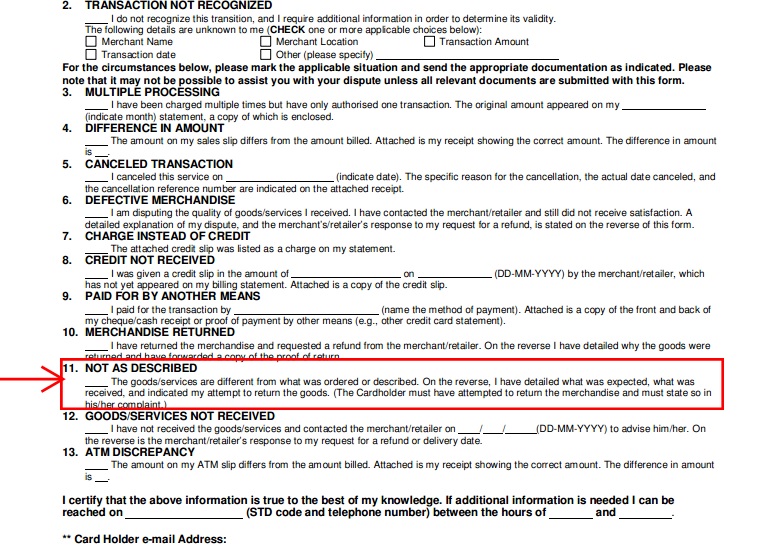
I decided to proceed further. The simplest thing would have to use the ‘cardholder dispute form’ and claim a chargeback. All credit card companies and banks allow customers to raise a dispute and reverse a transaction under certain conditions. Banks don’t have to face losses on chargebacks as they have insurance. Indian payment gateways also include terms which pass risk on to the seller if a customer initiates a refund request through a bank on grounds of the product being different from what was promised – for example see Clause 8 of the CC Avenue payment gateway agreement here). I had used the chargeback procedure earlier when my HDFC credit card was hacked, so I reassured myself in light of my past experience that this would be a quick and effective procedure.

Image 5 - Dispute Form


When I was going to submit the form, I realized my father was not interested in taking legal action. He was concerned that the amount will get blocked until the matter is resolved and he will have to answer a barrage of calls from the credit card company. He was also not willing to participate in any legal proceedings that will take any of his time.

This made my work more difficult as I needed to find out alternate mechanisms and also pursue the matter in my own name, which would be procedurally more intricate (as the watch had been purchased in his name and through his credit card).

I was in a fix. INR 70,000 is not a huge sum. Should I just cut losses here instead of investing more money and time? As a startup founder working overtime, is it worth my time to chase these fraudsters until they cough up the money?

My co-founder at iPleaders, Ramanuj Mukherjee, had an irrefutable argument. Our startup iPleaders builds practical law courses for entrepreneurs, managers and other businessmen. We also write for common people on how they can use law to protect their interests on our blog frequently. Apart from the moral responsibility of not allowing fraudsters to thrive in India, if we went through the whole process and documented every step – it will make a great case study from which others can learn. We even considered that we can use this as a case study on product liability for e-commerce businesses in India in our course on cyber law.

https://lawsikho.com/course/certificate-criminal-litigation-trial-advocacy

We decided to go on a full scale legal attack on swisswatchcompany.in.

Step 2: A Massive Legal Avalanche

As I mentioned, the other methods would be longer and not as convenient, but I would have to proceed with them. Here are the reliefs I was looking for:

Refund – Getting my money back was really my first concern. I had names of customer support staff and persons who claimed to be ‘sales managers’, the bill, saved copies of the refund policies on their website (these turned out to be handy as they took their website down), telephonic conversations and addresses. However, I did not know whether the names given by the people who had interacted with me were genuine. I also did not have information about the identity of the real owners behind the business.

I could have approached a consumer court, but what use would it be if I couldn’t identify who these people were? What if these people gave me only fraudulent identity? Consumer proceedings would also take their own time, and I needed to think of other ways to simultaneously exert pressure, apart from merely initiating legal proceedings. These would largely going to function as threats / business risks/ personal risks for the owners and were going to expedite the return of my money.

Image 6 - Return Policy

Image 7 - Authenticity Pledge Image 8 - Buyers Protection

Booster dose 1 – Shutting down their website and payment gateway – If these people were interested in conducting business and were not merely fly-by-night operators, they wouldn’t want their website to be shut down. Also the domain should be quite valuable. I thought of what I could do to shut down their operations (even if temporarily):

  • I could approach the Reserve Bank of India because they were using an offshore payment gateway although they were selling an Indian product in India representing it to be an Indian business operating from Bangalore. There was no 2-step verification as mandated by RBI which all Indian businesses have to follow. This is a credit card security issue and is against payment-gateway regulations (see the report on RBI’s statement vis-à-vis Uber here). Violating these laws can lead to criminal charges against the directors of the business.
  • I could approach the .in registry, requiring them to take down the site. As a top level domain name registry, they qualified as ‘intermediaries’ (broadly, an intermediary is anyone whose service is required to access content on a website. Since this was the TLD registry, it played an important role in enabling access to the website). Under the Information Technology Act and its rules, intermediaries are required to take down any content that violates a law or infringes IP rights of third parties (see the guidelines here) within 36 hours of being intimated.
  • I could have also informed the .in registry to take action against the registrant for violating the terms and conditions of the registry itself, as they prohibit ‘wilfully providing false information’ (they falsely claimed that their watches were genuine and prepared creative stories to make inquiring customers genuinely believe this), ‘using the domain name for an unlawful purpose’ (sales based on false claims of genuineness were fraudulent and amounted to cheating under Indian law) and ‘violating third-party rights’ (fake watches violated the intellectual property of the original manufacturer, which in this case was Rolex and the commercial rights of their authorized distributors in India).

Booster dose 2 – Criminal remedies against them for fraud

I am not a vindictive person and wasn’t really interested in the seller being behind bars, as long as my money was returned. Although the evidence I had (invoices, email communications, recorded phone calls, refund policies and guarantee on the website, Whois search records) was enough to shut them down, but if they were fly-by-night operators they could have gone underground with my money (and that of several other customers). The address of the entity and the names of the persons involved (as available from the website and the Whois search) were not verified either, so I would not be able to trace them out.

(The company had itself briefly taken its website down at a later point and put in an automated voice response stating that they were down ‘for maintenance purposes’, which somewhat indicated their indication to go underground.)

I needed a strategy to trace their identity if they were fly-by-night operators and tried to escape – therefore, the final leg would have been to nab them through the police.

I decided to approach the cyber-cell, since this was an internet- related crime and ordinary police would not be equipped to investigate it.

Preparing my FIR

In most FIRs (especially for fraud cases), facts that establish criminal intention are not properly explained, which makes it easy for the police to defer investigation or make excuses for not lodging the FIR, on the ground that it looks like an ordinary civil or consumer dispute and no offence is disclosed. If your FIR does not disclose an ‘offence’, it will be difficult to get the police to investigate.

Let me explain through an example – would you file a fraud case against a shop owner if a product he sold to you stopped working? If there was a breach of contract or non-payment, would you file a case for enforcement (and damages) or for fraud?

In a fraud case, it is important to establish that the other party intended to defraud from the very beginning, then a fraud case is made out. I had to clearly indicate in the FIR that there was a fraudulent intention from the very beginning of the transaction on part of the other side and provide supporting facts.

Secondly, I had to provide details of all the invoices, warranties and documentation. Thirdly, the names of the real people behind the business and the address were not clear – so I provided the phone number, the credit card statement (which indicated the merchant name) and the address, to facilitate identification of the real owners and their addresses by the police. Identification was possible through the merchant name and the telephone number.

Knockout blow – The Power of Many and the Internet

I asked a lawyer friend to help with actual filing of documents. Having regard to how slowly law enforcement agencies may respond sometimes, she knew it would give my case a boost and make police act faster if they received similar complaints from others – before filing the FIR, she wrote about the company on an online forum and received emails from 5 angry customers.

We realized that this was industrial scale fraud – her comment led to responses from many prior customers, who supplied any information they had about this company. We gained more ammunition with every day – this would be difficult for any law enforcement agency to ignore. The seller even tried to plant positive feedback from ghost customers, but it was already too late.

I was about to file the FIR, when I received a call from them, informing me about the refund. However, I was not sure of whether they would actually refund the money in light of their past behaviour, which was mostly evasive. Their website down was still down and calls were unanswered because they were ‘undergoing maintenance’. I felt they had a last minute back-out strategy too – they called me stating the account number was incorrect and their transfer failed. One more trick to buy time, or it could have just been another clerical error. I sent a couple of stern email follow-ups. Finally, the money was back in my account, in full.

While my objective of getting a refund was met, I had discovered a never-ending fraud. Their website came back up (without so many warranties of genuineness and money-back claims). While I can’t realistically help all those who have been defrauded personally, at the moment I am talking to national watch distributors of luxury watches (such as Ethos watches) to establish ways to detect and prevent sale of fake watches and use law enforcement mechanisms effectively. I also decided to prepare this case study which can be used by any lay person.

What actions can you take if you face an online fraud?

Use the cardholder dispute form: If you face an online fraud, the first thing you should look at is getting your money back. The simplest way to do this is through raising a cardholder dispute with your bank if you bought the product using a debit or credit card (unfortunately I could not use this strategy). All banks have a chargeback or a cardholder dispute form which allows you to dispute credit card transactions under certain conditions – say, if the wrong product is subscribed, if you have been overcharged, etc. If your dispute is successful, the bank itself refunds you the money.

Get the website taken down: The next thing you should focus on is getting the website down. The fastest way is to identify intermediaries. Intermediaries are all the entities who are involved in the chain that connects you with the website – internet service providers, domain name registries, domain name registrars, social media sites, etc. Identify about two intermediaries which have the broadest reach so that you can shut down the site with limited attempts. For example, if I send a takedown notice to Hathway (a cable internet service provider) requesting it to block access to a website, only users who use Hathway’s services will be unable to access it, but those who use Reliance or Airtel internet can still access it. How can I remove the site from access completely? In this case, approaching the .in registry directly may be a better idea.

Approach other regulators to apply pressure

If it is in respect of an online or financial transaction, looking at RBI regulations (e.g. the regulations applicable to payment gateways) is a good idea.  Similarly, public search function on the Ministry of Corporate Affairs website to find out ownership and address details of a business (if the business is a company or a partnership). These regulators also have powers to impose penalty or start a criminal prosecution if they are intimated of a violation. One should ideally approach them along with claims of others who have faced similar problems – that helps in gathering credibility and in highlighting the urgency of the problem.

Prepare a consumer complaint and FIR

An effective FIR can work magic. You can also provide a copy of the FIR and the FIR no. to add more weight to your claims above.

To ensure your FIR is effective, certain steps must be followed:

  • Describe facts in sufficient detail. Write the story coherently and provide clear indication of the other side’s conduct, which clearly establishes to any reader that there was a fraudulent intention from the beginning.
  • Provide all the evidence you can collect to the police (emails, invoices, telephonic communication, screenshots of website claims, terms and conditions) to establish that your complaint is genuine and that there is sufficient evidence to back your accusations.
  • Give enough clues to the police to enable them to investigate and trace out the offender– give them all details you can, especially the address, telephone number, records of a ‘Whois’ search, merchant name.
  • If you can, try to find others who have faced a similar issue with the same seller. It adds an incredible level of genuineness and authenticity to your claim.

You can also consider filing a consumer complaint. The amount you claim should be higher than what you paid for the product – your costs will typically include reasonable monetary compensation for the time lost in getting the product you wanted, follow-up and legal costs.

Drafting pointers for your complaint

It is not essential to engage a lawyer, but it is important that you get the facts right and employ basic writing skills.

The main facts for many of the actions above will be common – but in each case the focus will be on a different aspect. For example, in the consumer complaint the focus will be on what was the difference between the product that was promised and the product that was delivered. In the FIR, you will also focus on the fact that this deviation was already pre-planned by the seller, to establish a fraudulent intention. If you are reporting a matter to the RBI, you may state whether the website, for example, had a two-step credit card verification mechanism in place.

What should you preserve in case of an online or e-commerce fraud?

  • Invoices – Keep the invoice, your delivery address and courier delivery-slip. This will contain both the ‘From’ address and the ‘To’ address. Many people throw away the courier slip – it is a key document that establishes jurisdiction of a nearby court. It is impractical if you have to travel to far-flung jurisdictions to fight your case, so this will help you in filing the case at the nearest appropriate court. It also contains the Sender’s address and can be very important to identify the seller as well.
  • Seller’s identity and address – Try to obtain information about the origin or identity of the seller from different sources. You can perform a ‘Whois’ search – if it is an Indian company or LLP, you can search its public documents (to find out registered office and shareholders / partners) on the Ministry of Corporate Affairs website here. You will have to pay INR 50 per company to obtain these.
  • Credit card statement – Your credit card statement reflecting the transaction will give you information about the ‘merchant name’ of the seller – if nothing else, this can be used to locate the seller’s bank account and trace their identity.
  • Any documents or claims about the quality of the product – Save screenshots of the website or any email communication assuring you about the product’s quality at the earliest stage possible, so that you can use them even if they are taken down or modified later on.
  • Records of written and oral communication – Record all telephonic communication and preserve an email trail of all communication. Recording phone conversations is not difficult – there are plenty of apps available for call recording. Just ensure they record both sides’ voice loud and clear. If you use an Android phone, try Automatic Call Recorder.

Does this increase your confidence in handling internet-based consumer fraud? You can write to me at [email protected] if you have any questions.

(Abhyudaya Agarwal is a founder of iPleaders. a legal education startup which helps universities and industry-bodies to launch online courses, such as this course, which focusses on essential legal and strategic skillsets for entrepreneurs. Special thanks to Esha Shekhar, the Delhi-based litigator referred to above. She was extremely helpful in planning and executing the legal strategy and also mobilized opinion of other defrauded customers by writing online, due to which this exercise picked up momentum and concluded favourably much faster.)


LawSikho has created a telegram group for exchanging legal knowledge, referrals and various opportunities. You can click on this link and join: 

https://t.me/joinchat/J_0YrBa4IBSHdpuTfQO_sA

Follow us on Instagram and subscribe to our YouTube channel for more amazing legal content 

 
Download Now

Lessons from Redbus and what to watch out for in a termsheet

1

Redbus_logo

Should you negotiate termsheets and investment documentation? What can the consequences be like if you fail to negotiate? Let’s see what happened in the case study of Redbus (if you have know about the issue before, we suggest you read this to understand precisely how business logic and legal terms apply to a funding transaction).

At the time of exit to the Indian arm of the Ibibo group, Redbus had an enterprise valuation of around Rs. 600 crores (USD 125 million). Do you know what was the shareholding of its two founders Phanindra Sama and Charan Padmaraju? Less than 15 percent. The amount of shares controlled by the founders of Redbus, and consequently the valuation individual shareholders received for their ownership of the company was extremely low in comparison to the amount of funding Redbus had raised.

Do you know why?

A startup’s valuation in subsequent rounds does not always increase – often it may decrease. This is exactly what happened in the case of Redbus. What happens when the valuation decreases and the startup raises new investment? In the case of Redbus, the investors who funded the company in its first round had inserted a special clause to prevent their shareholding from being diluted, in the event the company’s valuation was lower in subsequent rounds. This clause is known as a ‘ratchet’. Essentially, if the company’s valuation in a subsequent funding round reduces, the old investor is given additional shares to bring his percentage levels on par.

Ratchets are of two kinds – full ratchet and weighted average ratchet. A full-ratchet protection entitles the previous investor to get additional sh       ares to maintain his previous percentage of shareholding, in case the valuation in a subsequent round is lower. Every investor wants a full-ratchet, as far as possible. A weighted average ratchet on the other hand limits the number of additional shares issued to the proportion of his investment amount in comparison to the fresh investment. So, if a subsequent investor is investing six times the amount invested by the initial investor, the amount of anti-dilution shares issued to the previous investor will be reduced by a sixth – that is, the previous investor will not be restored to his original shareholding levels. This method can substantially reduce the additional number of shares issued to a new investor – and prevent dilution of founder stake.

Entrepreneurs who are aware of the consequences may not be able to negotiate and eliminate the ratchet, but are able to significantly water it down to a weighted average ratchet. 

The full-ratchet clause can be extremely disadvantageous for any startup (The Redbus founders had raised about 8 million in three rounds of funding, without ever hiring a lawyer for negotiating those investments.) Knowing about the implications of key clauses in term sheets and shareholder agreements can significantly   impact the way you negotiate and raise investment.

Do you understand the impact of negotiate liquidation preference, founder lock-ins, non-competes, tag-along, exit rights, conversion, affirmative voting rights, ratchets and anti-dilution clauses in termsheets and shareholders agreements? Can you negotiate these clauses?

It’s not just about raising investment, there can be many other commercial risks in the business which you can address by understanding business law related issues and contracts better.

You may be smart and there may be many advisors, fellow-entrepreneurs and self-proclaimed ‘experts’ who will be willing to help you – but nothing is comparable to yours having a hang of things.

Would you like to learn how to negotiate investment agreements? Did you know that there is a systematic way in which you can learn how to negotiate investment agreements? The subject is elaborate and is comprehensively dealt with in the diploma course in Entrepreneurship Administration and Business Laws with the help of explanations, videos, negotiation pointers and case studies.

Those who have studied the course have also learnt have learnt how to structure partnerships, companies, joint ventures, non-profit businesses, get business licences and registrations, negotiate termsheets and investment contracts, raise foreign loans, obtain trademark and patent registrations, enter into franchising and licensing agreements, information technology compliance requirements and IT contracts, import-export transactions, effective dispute resolution and money recovery strategies, company policies, employment agreements and labour law compliance requirements. With practical examples, checklists, case studies, flowcharts, mind-maps and webinars with senior lawyers, investors and experienced businessmen.

To see what all we are teaching in the NUJS diploma course, you may check out the demo version for free here.

You may also wish to someone who has already taken the course, for that you may drop an email to [email protected] or call on 09582630056.

Download Now

Is Vishaka-compliance equal to Sexual Harassment of Women at Workplace Act, 2013 compliance?

0

Is Vishaka-compliance equal to Sexual Harassment of Women at Workplace (Prevention, Prohibition and Redressal) Act, 2013  compliance?

Is Vishaka compliance legally sufficient under the 2013 Act?

 sexual harassment clubs

In 1997, the Supreme Court of India had laid down guidelines for organizations to prevent sexual harassment at the workplace in the ‘Vishaka’ case – while majority organizations did not implement the guidelines (including various government organizations), several forward-looking companies, subsidiaries of multinational corporations and select public sector undertakings complied.

Naturally, when the 2013 Act was notified, it was an opportunity for them to congratulate themselves – it seemed that their efforts had been validated, and others would now have to take efforts to create better workplaces. However, these organizations did not have to do anything more under the new Act (as they were already Vishaka compliant). Or did they?

The first response to any discussion about sexual harassment prevention law compliance is – if the entity is compliant with Vishaka, what is the need to worry? If there is already an anti-sexual harassment policy or a grievance officer in place, is anything else required? Can’t the Chartered Accountant, Company Secretary or the compliance officer manage the rest?

Well, the story begins here – 2013 Act introduces a sea change in the law, and all entities have much more work to do to comply. This responsibility of organizational compliance is naturally entrusted on HR managers, training departments, compliance officers, accountants, secretaries and in-house lawyers.

Interestingly, sexual harassment prevention law compliance requires legal, adjudicative, training, inter-personal and compliance skills, which makes the job relatively more complex a working professional, without specific training and guidance (or additional tools).

Why are these skillsets necessary? What are the additional responsibilities of an organization under the 2013 Act? We thought of not being too general or vague, and listed down the differences between the Viskaka guidelines and the Sexual Harassment Prevention Act, 2013. That will help you evaluate whether additional efforts need to be taken to comply with the new law.

Area

Vishaka v. State of Rajasthan


(JT 1997 (7) SC 384)


Sexual Harassment of Women at Workplace (Prevention, Prohibition and Redressal) Act, 2013


What kinds of organizations are covered?


The guidelines expressly cover only government, public sector and private enterprises.


There is no clarity on whether employees working in NGOs, sports complex, stadiums are covered, where there may be no strict employee-employer relationship.

The Act expressly covers almost all types of organizations, including NGOs, hospitals, sports institute, complex or stadiums.
 

In what occupational positions and roles are women protected?

The Vishaka definition of employee covers any working woman, whether she is drawing a salary or an honorarium or working voluntarily. It was not clear whether trainees and interns were covered. Definition of ’employee’ under the 2013 Act is wider in scope and expressly specifies that temporary or contract employees, interns and trainees are protected and have the right to approach a complaints committee. Similarly, contract labour and unorganized sector employees are also covered.
What is the scope of workplace The Vishaka judgment did not elaborate on what constitutes ‘workplace’, except for a general statement that government, public and private enterprises are all covered. ‘Workplace’ is defined in detail under the 2013 Act – any place visited by the employee in course of employment (including transportation provided by the employer) is also included within its definition. The expanded concept of workplace makes application of the rules tricky in situations where employees collaborate on off-site work, use shared transport or travel out of station.


Obligations of employers Apart from establishment of a grievance redressal mechanism, organizations did not have significant obligations. Employee training and sensitization obligations were extremely preliminary. The Act lays down multiple obligations on organizations must comply with and violation of any of them has serious consequences.

It also includes the responsibility to sensitize employees, create complaints committees which are in compliance with the law, train members of complaints committees, put up notices and file annual reports.


Grievance mechanisms


Organizations had significant flexibility on how they could create mechanisms to address sexual harassment – they could create any grievance mechanism such as an ombudsperson or a committee as per their needs, without complying with any technical requirements. For grievance redressal, a complaints committee must be constituted as per the Act, which must necessarily have an external member with appropriate skills and requisite number of women members.
Inquiry process  

The guidelines did not lay down detailed inquiry process, and merely stated that it must be time-bound.  Employers had freedom to determine broad timelines on their own.


The Act prescribes detailed guidelines for conducting the inquiry process – there is an overall timeline for completion of inquiry in 90 days and time limits for each stage of the filing and the investigation.
Remedies for harassment ‘Appropriate disciplinary action’ was the prescribed punishment against a perpetrator found guilty of sexual harassment. Compensation was not specifically provided for. Several remedies are provided under the 2013 Act. Disciplinary action, withholding of promotions and salary increases, awarding of compensation is expressly permitted. Complaints committees may provide interim relief such as transfer of the complainant or accused pending their decision on a complaint.
Powers of committees Complaints Committees were not granted any special powers under the law (apart from disciplinary action). For the purpose of enforcing attendance of accused and witnesses and collection of documentary evidence, Complaints Committees have the powers of a Civil Court. They can also provide the option of settlement to parties based if certain conditions are fulfilled. This is a technical obligation and difficult to implement without guidance or a tool.


Appeal There was no process of filing an appeal from the decision of the Complaints Committee. One can file an appeal as per Service Rules or to the Authority Appointed under the Industrial Employment (Standing Orders) Act – it is in the committee’s and organization’s interest to ensure that their orders stand basic legal scrutiny at least.
Settlement Mechanism There is no settlement mechanism under the guideline. The Act allows settlement of the complaint through conciliation facilitated by the Complaints Committee.
Consequences of non-compliance No specific punishment or penalty was mentioned under Vishaka guidelines for non-compliance. The Act imposes a punishment of fine up to INR 50,000 for non-compliance with the law. For any subsequent conviction, the employer may have to pay double the fine amount and also be liable for cancellation of business license.

To sum it up, obligations under the new law are quite extensive – additional training, tools and skillsets are required to enable organizations to implement the new law.

What are the costs of non-compliance? Well, INR 50,000 fine, which gets doubled in case of repeated non-compliance, and risks of shutting down of the business. Moreover, reputational risks are very serious (recall the Tehelka fiasco case study).  Risks from employee litigation can be serious – in 2011, Novasoft Technologies had to pay INR 1.7 crores to a senior-level employee who was sexually harassed. On 18th September, 2014, Union Minister Maneka Gandhi stated that legal action will be taken against non-compliant organizations.

The overall consequences of non-compliance are probably not worth the risk, if we told you that compliance need not be that difficult.

Click here to find out how organizations can effectively sensitize all employees through  this course.

Increasing regulation of workplace environment is opening up new career opportunities for professionals (lawyers, company secretaries, chartered accountants) or those working in HR, training, compliance and legal teams, whose help is required not only to comply with sexual harassment laws but also in creating conducive workplace environments which are gender-neutral and free from discrimination and harassment.  There is significant scope to build an independent employment and HR advisory practice for consultants. Click here to find out how the National University of Juridical Sciences, Kolkata, a top law university in India is collaborating with industry experts to help professionals in developing essential workplace-diversity related skillsets.

Download Now

7 must-know practical differences between partnerships and companies you need to know about

0

Man_in_biz_suit_in_front_of_office_windows

Often, businessmen struggle with the question of whether to structure their business as a partnership or a company. We have compiled a short and crisp table to explain the practical differences between the two business vehicles under Indian law.

S. No. Issue Partnership Company
1. Tax liability of the business A partnership firm has to pay taxes only on its profits. Distribution of profits to partners is tax free. A company must pay tax on its profits and a separate tax on dividend distribution, which reduces tax efficiency of the company.
2. Liability of promoters Personal assets of promoters (i.e. the partners) can be attached to pay off the liabilities of the partnership firm. One partner is capable of binding the others through his actions, which increases business risk. Personal assets of promoters are not impacted by the liabilities of the company (unless a promoter provides a personal guarantee for the company’s obligations). A director can at best bind the company, but not other directors, shareholders or investors through his actions, so other parties are relatively safer.
3. Incentive creation mechanisms for employees It is extremely difficult to give equity to employees in a partnership. Sharing profits / losses of the firm makes the employee a partner and capable of binding the firm and other founding partners through his actions, which may not be a desirable outcome for either partners or employees. Therefore, cash-based incentives based on increase in revenue are common in partnership firms. Equity is not shared. Due to the existence of concept of shares, it is easy to give a definite amount of shares to employee without handing over effective control. This incentivizes employees to work hard and benefit subsequently from an increase in the valuation of the company, as they can sell their shares and make a windfall gain. This is especially true of companies in the information technology sector, whose market value has increased hundreds of times in a short span of a few years (e.g. Google, Infosys).
4. Ease of raising capital and foreign investment for expansion Since ownership rights and management rights are not separated, capital-raising from professional investors is not possible as they may not be interested in becoming ‘partners’ of the business.

Foreigners cannot invest in partnership firms in India. This is a huge disadvantage for businesses which want to raise investment and scale up rapidly.

Since ownership rights and management rights are separated, financial investors, venture capitalists and private equity investors are comfortable investing in companies.

Further, majority of the sectors in India are open to foreign investment without regulatory approval. Foreigners can invest in companies as per the Consolidated FDI Policy. Select sectors such as telecom, aviation, banking and insurance require regulatory approval.

5. Foreign loans Foreign loans can be obtained at almost one-fourth the cost of Indian loans – which provides a cheap way to access large amounts of money. However, a business structured as a partnership is not legally entitled to obtain foreign loans. A company is legally entitled to obtain foreign loans in software, hotels and hospitality business and in the manufacturing sector without obtaining regulatory approval.
6. Compliance requirements Compliance requirements for partnerships are minimal and they can carry on business without filing reports. Apart from tax-related filings, they are not required to submit financial statements to regulators. Compliance and filing requirements for companies are quite high. Companies need to file annual report and financial statements, make periodic filings of resolutions in case of certain events and file forms with the Registrar of Companies in case they obtain a secured loan.
7. Related-party transactions Transactions between the partnership firm and the partners individually are not regulated under law. Partners can specify mechanisms to prevent misuse of authority or conflict of interest situations between the firm and the partner. However, the firm needs to be registered if a partner wishes to make a claim of fraud or other wrongdoing against another partner or the firm. Transactions between directors and the company or between two companies controlled by the same director can be undertaken after observing certain formalities, such as disclosure of the director’s interest or obtaining a board / shareholder resolution, depending on the nature of the transaction.

In short, structuring a business as a partnership is tax efficient and relatively more flexible, but it is a more risky option business risks (due to risk of personal liability) and there are several constraints on expansion of the business due to the difficulty of raising capital from large investors and inability to access cheap foreign loans.

However, in case you want to initially start your business as a partnership, you may subsequently convert it into a company to raise investment. Bear in mind that a risk relating back to the time when the business was a partnership can arise even after conversion.

Is there any other aspect which you would like us to compare? You can send your answer to [email protected]

To know more about other business structures and detailed registration process of each structures,  you can enroll the diploma course in Entrepreneurship Administration and Business Laws, offered by NUJS, Kolkata, a premier national law school 

Download Now

Questionnaire and checklist for decoding business transactions

0

Flickr_-_paul_bica_-_evening

Instructions

You must have gone through our earlier post on business structuring. This is an introductory checklist to help you get started with skills necessary to understand a transaction related to business structuring, investment, joint venture or M&A transaction.
Try to find answers to these questions when you are working on a transaction (irrespective of what work you are doing on it), and over time you’ll find your ability to grasp the details increase drastically.

Hint: Go through any communication between the parties and the ‘shareholders’ or ‘joint venture’ agreement. If you are drafting the agreement, make sure you ask this question.

You can try to answer these questions even with respect to a transaction you read about in a business newspaper or journal – but you may not have the information to all the questions. Nevertheless, it will help you in finding out points of inquiry. You can take a print out and write bullet points with a pen and paper in the blank spaces provided.

This is not an exhaustive checklist, and as you start improving your skills there will be many aspects you will want to have on your fingertips, but this is a great way to get started.

Questions

  • What is the overall purpose of the transaction? What is the business activity sought to be conducted? Is it part of a broader transaction? (Hint: These objectives have to be extremely detailed in the objects clause of the ‘Articles of Association’ or a trust deed).
  • Are the parties to the transactions individuals or corporate entities? What is there nationality / place of incorporation
  • If one of them is a foreigner, do RBI guidelines or FDI regulations impact the transaction? Is foreign investment permitted in the sector?
  • Are there limits on the way in which money is to be repatriated to foreigners?
  • Are there sectoral regulations or a legislation imposing conditions on the conduct of such business activity in India?
  • Tax perspective – do you know how tax laws will impact various legs of the transaction? For example, think how income tax will apply to the revenues of the entity. How will the profit distribution or gains made by the parties involved be taxed? Are there other tax nuances (such as a transaction between related parties)?
  • How operations will be governed – who will be in charge of decision-making?
  • For which decisions is the approval of the other side necessary?

(Hint: Don’t try to memorize each item, but try to go through all the items and mentally classify them into broad categories)

  • How parties will take out revenues? Will dividends be distributed and upon what condition?
  • On what basis are the parties entering into the transaction? What representations have they made to one another?

(Hint: Unlike a transaction where you purchase a product off-the-market, an outsider cannot start or invest in a business on a ‘take-it-as-it-is’ basis – apart from its own fact-finding through a due diligence, it will also need to rely on certain representations of the parties. This is the ‘representations and warranties’ clause – you’ll have to take note of which representations are made.)

  • Which preconditions need to be satisfied before the obligations of the parties kick in? (Hint: Look at the conditions precedent clause. You will be frequently communicating with one side to ensure these are satisfied and preparing a ‘CP satisfaction’ list on the basis of this.)
  • What happens if the representations turn out to be untrue? What if a representation made to a foreigner is untrue? (Hint: you’ll have to research on the validity of indemnities to foreigners)
  • What are the mutual rights of parties with respect to inspection of accounts?

In case of a joint venture

  • What is the division of responsibilities between the parties and their (capital) contribution to the joint venture?
  • How will a deadlock in business decision-making be resolved?
  • How will disputes be resolved? If a dispute cannot be resolved, what options does a party have? How will its stake be valued? Is the method of dispute resolution or exit sufficiently clear for both parties or is it loosely drafted?
  • Who will own intellectual property rights to any new IP that is created by the venture?
  • Are there any milestones for the business? What if the business fails to achieve profitability or meet time-based milestones?

Download Now

Corporate lawyer’s guidebook for business structuring skills

0

abstract-21613_640


This article is written by Abhyudaya Agarwal, Co-founder, iPleaders.

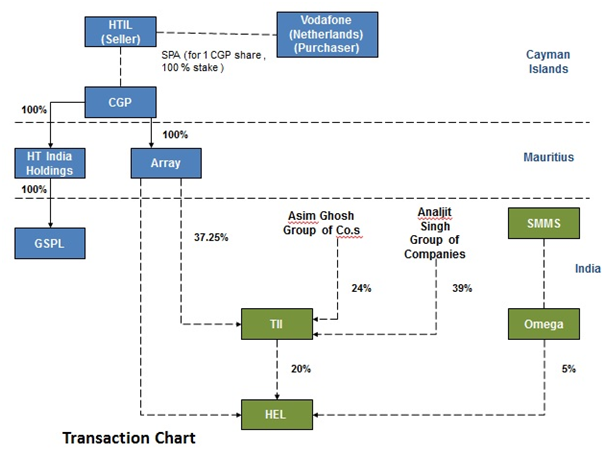
Advising on business structures is a crucial aspect of any corporate lawyer or in-house lawyer’s work. Once you start working in a law firm, many young lawyers are immediately given transactional work pertaining to fancy corporate structures. This kind of immersion is good, but quite daunting as associates are under pressure to deliver outcomes in very short deadlines. Just to give you a taste of things, I will share the simplest diagram for the Vodafone transaction that I could come up with (this is much simpler than the Supreme Court’s version as well), which looks like this:

businessstructure

This looks dazzlingly complex at first sight, but don’t get scared – you’ll start grasping these things easily once you understand some basic commercial principles. It is important to get a realistic view of things. For now, imagine this transaction being captured in 5 – 6 documents, the largest of which runs well over 100 pages. Imagine what would happen if you were asked to tweak just a couple of definitions / mechanisms in the transaction.  You will also have to ensure that the change is correctly reflected across multiple contracts. This is not as simple as using the Ctrl + F button and replacing the terms. Using Google doesn’t give you the answer either, because you have to intelligently understand the different aspects of the transaction and how they are captured into the document. This is not like reading a huge case or academic article for your law school assignment – you need to be very precise and every nuance properly. Access to your network of seniors is relatively limited and you can only get broad guidance, but you have to eventually do the work by yourself. Once again, I am sharing this to give you a realistic view of things, not to scare you. If you figure this out, you will be able to understand, dissect and customize transactions like no one else and add tremendous value as a corporate lawyer.

We are going to figure out ways in which you can ease this struggle and beat initial law firm blues. We’ll start with how corporate lawyers use business structuring skills to add value to clients. Before you begin reading, beware the beginner’s pitfall – don’t skip sections just because you are familiar with the keywords. Just because these do not have specific section numbers or are not analysing a legal provision, it does not mean this is business or management advice. It is time to break the myth – this is hardcore corporate lawyer’s work. Now, let’s see 4 ways in which a corporate lawyer uses business structuring skills to add value to clients.

#1 – Advice on the structure to adopt

Depending on the nature of the client and the business sought to be started, you will have to select a structure for the client, and often advise the client on which structure is preferable, over other alternatives that he or she may be evaluating. For example, consider venture capital funds, banks, real estate companies, product / service businesses, non-profit organizations, branch offices, subsidiaries or joint ventures – they cannot use the same business vehicle. As a commercial lawyer, your inputs and familiarity with issues help greatly in inspiring a client’s confidence when you communicate with a client.

Lawyers are used to reading the statute and case law but are typically not comfortable with this approach (which is more open-ended), so some prior training helps in this regard.

Want to try out a sample? Read this post to understand the differences between an LLP and a private limited company.

For example, which is an optimal structure for a venture capital fund? What are RBI regulations for opening branch offices for foreigners? Are approvals required? Which is the ideal vehicle for a captive outsourcing subsidiary?

At this level, many businesses also require advice (in the form of a memorandum, etc.) on how tax laws will apply to their operations, and they will use that choice to determine an appropriate business structure. Based on your advice, even the manner in which profits are distributed may be suitably adapted so that the impact of tax laws is not too onerous.

(Don’t worry if some of this sounds like Greek or Latin to you – this is how it starts anyway. The challenge is in learning how to tackle these questions beforehand so that you are not stumped in a law firm.)

#2 – Kickstarting operations and incorporation-related work

Your next task is to help the business with certain preliminary issues, such as applying for an initial set of licenses and registrations required to kickstart operations – these will include Shops and Establishment licence, factories act registration for manufacturing units, labour and tax (income tax, VAT, Central Sales Tax and service tax, as applicable) registrations, intellectual property registrations (if necessary) and sectoral registrations. Many law firms engage local counsels or consultants for this work.

However, the corporate lawyer’s input will be important on which registrations are necessary, having regard to the nature of the business. Often, clients may require a step-chart explaining the different steps to be taken in advance. A format of step chart is shown below (you can zoom the image for a clearer view of the format).

checklist

Image:Step chart for incorporation and setting up a new business for a domestic venture (we assumed that the proposed directors have a director’s identification number and a digital signature already. Details about the incorporation process are available in the diploma course)

#3 – Advising on how the contract is drafted, drafting the contract and negotiation

As part of the incorporation work, you will have to draft an incorporation document, which could take the shape of an LLP agreement, a shareholders agreement (followed up with an articles of association), joint venture agreement, a trust deed, a memorandum defining the relationship as an ‘association of persons’, etc.

Value addition is important at this stage – top law firms easily charge a few lakhs for business incorporation and commencement, while standard off-the-shelf services like eLagaan or Vakilsearch will incorporate your business in INR 10,000 only. What is the reason for this difference and why will a client be willing to pay such a heavy amount for incorporation?

The answer lies in the level of service expected from a corporate law firm, which will be of an entirely different nature – a client will expect a highly customized incorporation document which is tightly worded and reflects the commercial intent very precisely. A lawyer will have to bear very specific directives in mind while filing the document. The documents are far more detailed than a simple partnership agreement that you will obtain from the internet.

You can’t simply pick up a template and replace the name of the parties – you will miss out on key issues arising out of the contract, and most seniors and clients will rubbish your work if you attempt that. The second trick is in being able to identify all the major risk, without being fussy – many clients feel that lawyers spend too much billable hours of nit-picking.

As a commercial lawyer your role is to identify gaps and risks that could potentially arise in course of the business relationship, ask ‘what if’ questions and address them in the document. For example, “What if a party’s representation is not true? What if the business fails to meet milestones?” You will find a lot of these questions in the checklist. You may even help your clients identify issues for negotiation.

#4 – Relevance of business structuring expertise in investments and business acquisitions

Structuring expertise helps significantly in investment and acquisition transactions, especially during due diligence. For example, at the time of conducting due diligence for an investor or an acquirer, a corporate lawyer will typically require copies of all incorporation and business- registrations from the investee company.

Similarly, consider there is a regulatory update from RBI specifying that a certain document (e.g. a valuation certificate) is needed if a party contributes capital in kind to a joint venture. If you know about this, you will be careful to insert a clause which requires necessary certificates as ‘conditions precedent’ to the transaction.

They are also helpful in niche practice areas. For example, imagine you are working in the funds practice of a corporate law firm and a foreign private equity investor who wants to set up an India-focussed fund approaches you for advice.

While you cannot know everything beforehand, it is important to identify broad heads of issues that you must inquire into so that you can build your skillsets accordingly.

How should you go about building your skillsets?

We can either impart knowledge – but that is going to be very limited to specific facts, or teach you skills, which can really empower you to perform well in your career. We believe teaching skills is more important than transferring knowledge, which can be acquired through the right tools.

When you are working (or even interning) in a law firm or a company, try to ask these questions each time you work on a specific transaction (even if you are given work on a limited aspect of the transaction). Follow this process even if the specific task you have been allocated is as simple as proof-reading or preparing a table. Don’t hesitate to ask your seniors questions – they will be happy to help an eager learner. You don’t need to pester your seniors continuously, but schedule a time for discussing your doubts. Occasionally raising them during a lunch or tea break will be useful. It will encourage seniors to give you good work if they see you grasping issues. After working on 3–5 such transactions, take a look at your notes. You’ll immediately begin to identify trends. Subsequently, you will start noticing these aspects in any transaction at a quick glance, with as little as 10 percent of the effort.

If you do this, don’t forget to demonstrate that you possess this skill in an interview and show how you worked to systematically build this skillset. Recruiters are likely to be impressed as few people work so consciously and diligently.

To know more about other business structures and detailed registration process of each structures, which have been discussed in the diploma course in Entrepreneurship Administration and Business Laws, offered by NUJS, Kolkata including:

  1. One person company
  2. Partnership
  3. Limited liability partnerships (LLP)
  4. Sole proprietorship
  5. Non-profits

Send us an email at  startup (at) ipleaders (dot) in or call on +91-9582630056 to inquire about the diploma course.

Download Now

Online Romance Scammers- Legal Recourse for a victim

5

Romance-Scams

This article is written by Puneet Bhasin, a Mumbai based cyber lawyer.

The deviant criminal mind and online impostor in the online dating arena can be summed up in two words the ‘Romance Scammer.’ The images that Romance Scammers prefer to use on fake dating site profiles are that of professional models and are not a true reflection of themselves.[1] There are times when the email ids exchanged over these dating and matrimonial portals give rise to email spamming. In addition, there are occasionally photographs and other personal data exchanged over such emails chats or conversations.

Masquerading online as attractive people these fraudsters attempt to allure their potential victims into providing them with financial support. This may be in the form of medical expenses, airplane tickets, educational expenses or any other means of advance fee fraud[2].  It is a kind of organized crime. The crime can only truly be combated through the use of online education or public awareness. There are several anti-scam agencies and individuals providing online educational support with combating these deviant criminals.

  • As there are lakhs of educated youth registered on these matrimonial sites, CID sleuths have suggested some steps to identify such con artists[3]:Always verify the profile details of the individual before becoming close to that person. Employment verification can be easily done by calling up the concerned company or by paying a personal visit.

    Don’t give money to people with whom you become friends through online profiles even if they emotionally blackmail you.

    Do not indulge in online chatting, dating or get emotionally involved with people without verifying the truthfulness of their claims.

    None of the victims bothered to verify the genuineness of the profiles of the accused and police believe that the not so easily available ‘suitable’ partner is the reason behind it.

Thus, we see that every age group and demographic is at risk. Indian dating and matrimonial websites do not accept responsibility or liability for any error or omission in any information on the site. A big reason for this is Cyber Personation, which is made very easy with the advent of online portals for relationships. People can write anything on their virtual profiles without any scrutiny.

There are many cases where people realize that they are the victims of this cyber crime after they are already married to such fraudsters, when it turns out that the online matrimonial profiles of their spouse had completely fake details.

However, there is legal recourse for victims of such cheating.


Provisions in Cyber Laws:

Section 66-D of the Information Technology Act, 2000 provides for punishment for cheating by personation by using a computer resource. This legal provision reads as under:

“Whoever, by means for any communication device or computer resource cheats by personating, shall be punished with imprisonment of either description for a term which may extend to three years and shall also be liable to fine which may extend to one lakh rupees.”

This provision envisages that if a person assumes the character or appearance which is not what he really is or passes oneself off as someone he really is not, especially with fraudulent intent, then the victim can file a complaint before the Adjudicating Officer under this provision. The victim can be awarded a fine of upto 1 lakh Rupees.

The Rules under the Information Technology Act provides that the Adjudicating Officer is required to hear and decide an application in 4 months, and the whole matter has to be decided in 6 months.

The online dating and matrimonial portals can also be held liable under the Information Technology Act as there are certain liabilities associated with “Intermediaries” under the Information Technology Act.

The Online Service Providers being “Intermediaries” can be held liable under Section 79 (3) (a) of the Information Technology Act, 2000 if:

“The intermediary has conspired or abetted or aided or induced, whether by threats or promise or otherwise in the commission of the unlawful act.”

The matrimonial websites do promise suitable matches and keep emailing the same to the registered users, and also at times charge for specialized services of match making whereby they are presumed to have verified the credentials of the parties, thereby making them liable under the Information Technology Act, 2000.

Also, along with action under the Information Technology Act, it is advisable to simultaneously file an FIR under Section 415, 416, 417, 419 and 420 of the Indian Penal Code. All these sections deal with cheating and cheating by personation.

If you are a victim of such a cyber crime, then there is legal recourse available under the Information Technology Act against the fraudster and the Intermediary. You can directly file a complaint before the Adjudicating Officer, Ministry of Information Technology, Information Technology Act, 2000.[4]


[1]http://criminalnationnews.blogspot.in/2013/03/fake-dating-sites-profiles.html

[2] Ibid.

[3]http://timesofindia.indiatimes.com/city/hyderabad/Matrimonial-sites-become-a-new-crime-spot-for-con-men/articleshow/14162858.cms

[4]http://www.lawyersclubindia.com/articles/Fake-profiles-on-matrimonial-and-dating-websites-cyber-law-has-an-answer–6332.asp#.VCKgUvmSyRg

Download Now

Offering a loyalty plan? Learn how Apple steered clear of the Competition Commission

1

Businesses have used different ways to ensure customer loyalty – supermarkets started with loyalty cards (which entitle customers to a discount on subsequent purchases), credit card companies started offering free points on every purchase and recently, Freecharge sells free coupons of equivalent value on every mobile recharge, Standard Chartered Bank and ICICI Bank started offering a cash-back option on the purchase of Samsung smartphones.

Loyalty programs can be extremely novel – however, businesses creating loyalty programs in India need to ensure that they are not in violation of India’s competition law.

How is competition law relevant for startups and SMEs?

Apart from the possibility of using competition law against their ‘larger competitors’, startups may also have to be careful about not committing competition law violations themselves. Competition law becomes relevant, especially for startups which have scaling up fast (e.g. Flipkart), for a very simple reason – many startups are now emerging in newer market segments, which are often unpopulated by the established industry giants. These startups gain market share very quickly in a new market, which can bring their business practices under the radar of competition authorities. Such business practices usually relate to marketing or selling arrangements – startups often enter into several co-branding arrangements, loyalty programs and other ‘bundling’ arrangements with other businesses (these ‘other businesses’ are very often well-established players) to market their products, which can fall under the competition authority’s radar.

The risks of a competition law violation in India can be significant – businesses may have to pay up to 10 percent of their average turnover or a penalty of up to thrice their profit. The Competition Commission (called the CCI) has also become very proactive in the recent past with the enforcement of the Competition Act.

Let’s see what happened to Apple’s distribution strategy when it had launched the iPhone in India. Of course, Apple was a well-established phone manufacturer internationally (and not a startup), but the commission’s attitude towards certain business arrangements will be relevant for startups.

Telecom and loyalty programs

Selling smartphones such as iPhone and Blackberry which are locked to a particular service provider under a contract has been an established distribution strategy in the UK and US. This strategy has tangible benefits for a customer – for example, a locked iPhone 5, which would otherwise cost USD 600 in the US, is available for USD 200 – 300. Apple initially started selling iPhones in India on a similar model – it entered into arrangements with Vodafone, Airtel and subsequently with Aircel to sell locked iPhones (locked iPhone 4 and 5 are still being bundled with Aircel’s services). The CCI, which started an investigation into this strategy, recently issued its decision, to which we will refer shortly.

What were the benefits of this strategy for Apple? Did telecom service providers benefit?

Primarily, there were two benefits of selling locked phones:

  1. For Vodafone and Airtel (and later on Aircel), the lock-in ensures that a customer who has purchased a locked iPhone uses their service (and does not migrate to another company) for the duration of the contract, e.g. a 2 year period.
  2. For Apple, it reduced marketing and establishing costs – it did not have to open its own retail stores across India and could piggyback its marketing campaign for the iPhones through Vodafone and Airtel’s campaigns.

Does this strategy unfairly affect competition? Does it harm consumer interest?

Did Apple’s strategy unfairly restrict a consumer’s ability to migrate to another service provider? For example, is a customer who uses the iPhone on a Vodafone connection prevented from migrating to Airtel? Would it prejudice Airtel? Does it unfairly prejudice Apple’s competitors in the smartphone market, such as HTC, Sony or Samsung? These are the issues the Competition Commission was asked to decide in case of the iPhone.

Why Apple was saved

Apple’s selling arrangements were given the green signal, for the following reasons:

#1 – iPhone had an insignificant market share in the smartphone market

The iPhone had a very small market share (less than 6 percent in the smartphone market) – typically, a business is required to have at least a 50 per cent market share in the concerned market segment in order to come under a competition authority’s radar. However, depending on the specific arrangement, this may not be the only factor that the commission will scrutinize.

#2 – Customers had some level of freedom to choose the service provider for their iPhone.

Apple had entered into arrangements with multiple operators which had a nation-wide market share, i.e. Vodafone, Airtel and later Aircel – it did not, for example, offer iPhones only through only one of the service providers. Therefore, a purchaser of iPhone anywhere in India had some level of choice while choosing the service provider.

#3 – Customers could also subsequently migrate to other cellphone carriers by paying a small fee to unlock the smartphone which did not create a barrier for migration

We are not sure that it would have arrived at the same conclusion if another company sold locked phones. For example, if Samsung locked all of its premium smartphones to a particular service provider – imagine a situation where the premium Galaxy smartphones such as Galaxy Grand, Note 2, S3 and S4 had 70 percent market share in the higher-end of the smartphone market and all of them were locked to Vodafone, the Commission could have arrived at a different conclusion.

#4 – Consumers could buy iPhones through other means as well, apart from buying locked iPhones

As per the arrangements with Vodafone and Airtel, Apple had the freedom to sell the iPhone through other channels, apart from selling locked iPhones through Vodafone and Airtel. Vodafone and Airtel were required to provide services to customers who purchased unlocked through other channels (although these channels were relatively few at that time). Therefore, a customer using, say, unlocked iPhones which were imported from US would be able to use Vodafone or Airtel’s services on such phones and would not be required to purchase the iPhone through the 2-year contract.

How to build a CCI-proof customer loyalty program in India

Loyalty programs are a great way of retaining customers and ensuring that they keep coming back to you. Here are three simple checks you can observe to reduce the risk of your loyalty program coming under Competition Commission’s scanner:

#1 – What is your market share? Do you have a dominant position in the market in which you operate? For most markets, when a single brand has a market share greater than 50 percent, it leads to a finding of dominance. If you are not dominant, there are lesser chances of yours being held liable for violation of competition laws. However, market share is found out only after investigation by the commission and risk of inquiry still exists, even if the business is ultimately not held liable. Further, the commission has freedom to identify the appropriate market in which you operate – if you are a niche operator or a boutique firm, the commission may identify a smaller market and consider you to be the dominant operator in that market.

#2 – Is the customer free to choose your competitor’s products, or are you excluding the competitor itself from competing in the market?

You are free to offer a cheaper product you can give any discount you wish. However, are you selling your products below cost price? Are you using other methods to eliminate competition? For example, Intel offered attractive rebates to computer manufacturers if they bought all of their processors from it – the European Competition Commission imposed a fine of 1 billion euros for this practice, since it had the effect of completely excluding AMD’s products in the market.

#3 – If you are bundling your products / services with those of other entities (e.g. through co-branding arrangements), how difficult is it for customers to migrate to other?

If you are bundling your products with those of another business (let’s call it a bundling partner) which operates in another market segment (for example, in case of iPhone, we are referring to Airtel and Vodafone as the service providers with which Apple bundled the iPhone), you need to understand how easy or difficult it is for the customer to migrate to competitors of your bundling partner. Are there significant financial or other barriers that would prevent the customer from migrating to alternatives?

This is an excerpt from  diploma course in Entrepreneurship Administration and Business Laws, which has been launched with the objective of simplifying business law for entrepreneurs, managers, decision-makers, working professionals and lawyers. The diploma course is offered in collaboration with NUJS, Kolkata, one of the premier national law universities in India. The course has over 900 students from 12 countries currently. Admissions for the 6th batch of the course will start in November 2014. Click here for more details.


Download Now
logo
FREE & ONLINE 3-Day Bootcamp (LIVE only) on

How Can Experienced Professionals Become Independent Directors

calender
28th, 29th Mar, 2026, 2 - 5pm (IST) &
30th Mar, 2026, 7 - 10pm (IST).
Bootcamp starting in
Days
HRS
MIN
SEC
Abhyuday AgarwalCOO & CO-Founder, LawSikho

Register now

Abhyuday AgarwalCOO & CO-Founder, LawSikho