
Download Now
Home Blog Page 230

Jus Cogens

0

This article is written by Damini M. 

This article has been published by Sneha Mahawar.​​ 

Introduction 

The best organization that can address the interests of all states, and all peoples, is the United Nations, whose membership comprises practically all the States in the world. States can advance human progress by utilizing this all-encompassing, essential tool by acting in the best interests of through identifying shared interests and pursuing them jointly with their citizenry. The United Nations was established as a body to safeguard humanity. Following the end of two world wars, governments began to share an interest in building and preserving a peaceful world that all states and people might enjoy. Respect for the sovereignty and equality of all nations served to highlight this interest. Jus cogens, a concept of international law that safeguards the most significant values and interests of the community, is based on the recognition of the shared interests of states. The latin term “jus cogens” (sometimes known as “ius cogens”) literally translates to “compelling law”, they are peremptory norms and no derogation is allowed for such acts even if they are allowed in any treaty. It is based on the Roman legal principle that because of the basic principles they uphold, some legal requirements cannot be disregarded. This article focuses on the issue of peremptory norms (jus cogens), formulated in the 1969 Vienna Convention on the Law of Treaties, and their effectiveness. It thus examines the nature of jus cogens and its enforcement in international law and the powers and limitations of the Security Council with respect to jus cogens. 

What is jus cogens

Jus cogens, often known as “compelling law,” is an absolute attribute that attaches to a rule and is binding on all states. This means that no deviations from the rules will be permitted, not even for reciprocity-related reasons. By describing how it can act as a check on one of the most powerful institutions in the world the United Nations Security Council this dissertation aims to show the genuine importance of jus cogens. Jus cogens were adopted into the Vienna Convention on the Law of Treaties (VCLT) provisions, which helped to clarify the application and application of the customary concept. According to the VCLT, any rule or conduct that conflicts with a rule of jus cogens is void ab initio Due to the fact that no international actor may take any action that might be considered to have violated jus cogens, this provides jus cogens with some real force. Even while there is no complete list of jus cogens norms, there are a number of standards that have been unmistakably recognised by society as possessing this highest status. Both the proscription on the use of aggressive force and the freedom of individuals to self-determination are crucial values recognised as jus cogens and safeguarded by the UN Charter. Given that there is no agreement among nations as to what constitutes a human right, human rights norms are more complicated. Exploring jus cogens and its conditions is a fascinating theoretical exercise, but until the principle is used in exercise, it might not be very useful. The Security Council has taken decisions that have resulted in outcomes that are inconsistent with jus cogens numerous times since its founding. This should render the action invalid, but that hasn’t always been the case. Jus cogens has greater authority and could provide a more effective check on the Council because any act that conflicts with it is void from the beginning. In instances of incorrect decisions, this gives the Courts and Member States additional authority.

What is the effectiveness of jus cogens

Finding a strong legal foundation for some substantive norms becomes more difficult when they are recognised as jus cogens, not Art. 53 of the VCLT. One may look for such a legal foundation in a treaty, custom, or general principles of law in the framework of theory on the sources of international law. Jus cogens are universal standards that the entire international community of states accepts and recognises, therefore specific standards, including regional and bilateral ones (even if they forbid any derogations), shouldn’t be regarded as the foundation for peremptory standards. Determining when these standards progressively become accepted as part of customary law and become general norms or if they conform to broad treaty provisions is a challenge. In this scenario, certain rules will just serve as the foundation (approval and recognition) of jus cogens. But by themselves, they won’t provide a strong enough foundation. Finding the legal foundation for peremptory rules in treaty norms with a general scope appears more logical. Even in this situation, one must use caution. In other words, treaty standards should be included in more than simply a standard multilateral Jus Cogens in Contemporary International Law treaties.

If one follows the traditional definition of custom, it would be necessary to demonstrate, in the context of jus cogens, that there is widespread, continuous, uninterrupted, and long-standing practise of states, from which a particular rule of conduct emerges, along with a conviction that such a rule is binding and of a peremptory character (double opinio iuris).  Showing a general, continuous, long-lasting practice, on the other hand, might be incredibly challenging, if not impossible. The ICJ’s decision in the Nicaraguan case from 1986, which allows a practice that is not completely consistent as the basis of custom, is not especially helpful.  It’s possible that there is no such thing as practice, defined as an active attitude toward subjects of international law. 

On the other hand, there might only be instances where crucial conventions have been broken. When peremptory norms are treated as traditionally understood norms of customary law, the question of whether it is acceptable to have a persistent objector at the stage of norm formation (in the case under analysis, both during the process of forming the norm and during the process of recognising its peremptory character, if these two processes occur at different times) arises. If one adheres to the traditional meaning of custom, it is debatable whether or not a persistent objector should be excluded from an institution. An argument to prevent its identification as a customary norm or peremptory norm can always be used to claim that a peremptory standard does not yet exist. Acceptance of the objection, however, is not a viable choice in light of Art. 53 of the VCLT (as well as the works of the International Law Commission). This would imply that the development of a peremptory norm cannot be prevented by the objection of a single state or a small group of states.

One critique can be related to the possibility of judicial imperialism (judicial arbitrariness), which is the scenario in which a court or courts impose on states what ought to be regarded as the peremptory norm (what is jus cogens in the opinion of a court). On the other hand, one can contend that jus cogens can spread and be accepted through court-to-court discussion, which will help it become more firmly established and gain genuine legitimacy. Furthermore, it can be argued that peremptory rules cannot be derived from conventional international law sources. Accepting the notion that there is a new (or rather ancient) source of international law—the international legal conscience (a type of natural law)—which is applicable to the international community at large and can be referred to as modern natural law—seems to be the only viable option. 

Peremptory standards (and the responsibilities that flow from them) are typically thought of as being applicable to all subjects of international law or all states.But occasionally, a judgment is made that transcends this comprehension. For instance, the IACHR held that jus cogens, by its definition and development, is not limited to treaty law but has expanded to encompass general international law, including all legal acts, and has an influence on the fundamental principles of the international legal order. This was stated in its advisory opinion on the legal status and rights of undocumented migrants from September 17, 2003. In particular, the idea of equality and non-discrimination permeates all state actions and is a peremptory standard “inasmuch as it applies to all States, whether or not they are parties to a particular international treaty, and gives rise to effects with regard to third parties, including individuals. The decisions of international criminal courts make this increased effectiveness of jus cogens even more apparent. One of the effects of jus cogens at the individual level is a responsibility on the part of a state to look into, prosecute, punish, and extradite anyone accused of violating jus cogens norms (in this case, extraditing A. Furundzija), as the ICTY held in the case A. Furundzija of 10 December 1998.

What are the issues faced in the enforcement of jus cogens

The most significant factor from the perspective of jus cogens application is to the procedural possibilities for its enforcement. Only treaties were used to address these difficulties (arts. 65 and 66 VCLT). According to VCLT Article 65.3 if a challenge has been made to a claim intended to invalidate a treaty, the parties may turn to the peaceful procedures of resolving disputes set forth in Article 33 of the UN Charter. However, Art. 66(a) of the VCLT stipulates that the following procedure should be followed if the parties have not reached an agreement within 12 months of the date the objection was raised:

Unless the parties mutually agree to arbitrate the problem, any party to a disagreement about the implementation or interpretation of Articles 53 or 64 may, by writing application, refer the matter to the International Court of Justice for a ruling.

On the other hand, there is a fundamental difference between the existence and binding force of obligations arising under international law and the existence of a court or tribunal with jurisdiction to resolve disputes about compliance with those obligations, as emphasised by the ICJ in the Case concerning the application of the Convention on the prevention and punishment of the crime of genocide of 26 February 2007. The absence of a court or tribunal of this kind does not imply that the responsibilities do not exist. They continue to be valid and have legal effects. States have responsibilities under international law, including international humanitarian law, and they are nonetheless liable for any actions that violate that law and can be linked to them.

The aforementioned assertion is crucial for international law under the current procedural context (lack of general and obligatory jurisdiction with regard to jus cogens), and consequently, for the fulfilment of jus cogens-based responsibilities and accountability for its infringement.

The question of whether immunity is regarded as a component of substantive or procedural law is of utmost significance in the context of the link between jus cogens and jurisdictional immunity. In terms of substance, it would be challenging to establish that a state’s or its officials’ immunity (either criminal or civil) should take precedence in the event of a violation of a peremptory rule. Contrary to those who seek the highest level of jus cogens effectiveness, this understanding of the connection is false. The immunity defence largely includes a procedural component, which should be discussed in light of the potential for pursuing a claim for a jus cogens breach.

In a case involving Germany and Italy, the International Court of Justice correctly stated: “Assuming for this purpose that the provisions of the law of armed conflict prohibiting the killing of civilians in occupied territory, the deportation of civilian residents to slave labour, and the deportation of prisoners of war to slave labour are provisions of jus cogens, there is no conflict between those provisions and the provisions on State immunity.” The two sets of regulations cover various topics. State immunity laws are procedural in nature and are limited to assessing whether or not one State’s courts may have jurisdiction over another State.

They have no bearing on the issue of whether the behaviour that gave rise to the proceedings was legal or not.

The principle outlined in Article 41 of the International Law Commission’s Articles on State Responsibility cannot be violated because, for the same reason, recognising the immunity of a foreign State in accordance with customary international law does not equate to recognising as legal a situation caused by the violation of a jus cogens rule or providing aid and assistance in maintaining that situation.

The question of whether immunity should be unlimited or limited is obviously a very different one given the significance of the value that the peremptory rule protects and the general acceptance of that standard.

Are the criterion under jus cogens sufficient

Regarding the function of the basic criterion in the determination of jus cogens standards, scholars disagree. One aspect of the doctrine consistently makes the case that jus cogens cannot be distinguished without the prohibition of derogation. On the other hand, there is a perception that this standard is categorically insufficient and even misleading in the practice of international law (as well as among some professors). This position is reflected in the ILC’s activity as well as in the viewpoints held by some international organisations. The Commission has rejected the notion that a treaty provision “possesses the character of jus cogens solely because the parties have indicated that no derogation from that provision is to be authorised” in its commentary to Art. 50 of the draught VCLT. Any treaty may include this clause with regard to any topic for any reason that the parties may deem appropriate. The treaty is not nullified merely because the clause is broken. 

The specific characteristics of the subject matter that the prohibition protects are crucial. The Commission adopted a similar stance in its guidelines on reservations to treaties and interpretative declarations (2010), where it made a distinction between reservations that violated a jus cogens rule and reservations that were made in response to provisions relating to the non derogation of rights (guidelines 3.1.9 and 3.1.10). In doing so, it cited a number of sources, including General Comment No. 24 (1994) of the UN Human Rights Committee on the subject of reservations made upon ratification or accession to the Covenant or the optional protocols if such a relationship was rejected. Additionally, the school of international law occasionally asserts that the ban against derogation is an effect of jus cogens rather than a standard for identifying it.

This strategy assumes that the international legal system has two types of rules that forbid derogations: jus cogens and jus dispositivum. Jus dispositivum also falls into two categories: those that forbid deviation and those that authorise it. There is a great deal of confusion as a result, which could even be dangerous for protected entities (especially individuals), as it leads to a relativization of the minimum set of norms that are regarded as non-derogable, even in circumstances that are particularly dangerous for the operation of a state, such as in times of war. Whatever the assessment of the relationship between the prohibition of derogation and jus cogens, the situation discussed above (i.e., jus cogens only pertains to those norms which are non-derogable and which, at the same time, protect fundamental values of a universal nature) further strengthens the case for the perception of a close relationship between the formal and sociological criterion, and by extension, also a criterion of special content for such norms. 

What are the powers and limitations of the Security Council’s with respect to jus cogens

The issue of enforcement is one of the main barriers to applying jus cogens to the Security Council. In Certain Expenses, when this topic was covered, Judge Morelli found that the Council had de facto “absolute legality” because no court system had been formed to hold it accountable.  The majority concluded that the presence of a judicial body was not necessary for the existence or application of jus cogens to the Security Council.

The enforcement issue

Given that the Security Council only started to become seriously active during the Cold War, it is not unexpected that the issue of enforcement against the Council has not been thoroughly investigated. The UN Charter was written with a series of clauses that, when taken together, would place some restrictions on the Council’s use of its authority.  The Council’s ability to make judgments is constrained by Articles 24, 25, and 39. However, because of their ambiguity, particularly Article 39, these rules have become ineffectual. Instead of states being utilised by the Security Council to advance international goals of peace and security, members now use the Security Council as a weapon to further their own national interests. It is reasonable to assume that the UN’s founders would not have expected the Security Council to use its authority in this manner. Enforcing jus cogens compliance is more crucial than ever because Security Council resolutions are no legal enforceability (under Articles 25 and 103) States might be required to carry out illegal Council instructions if there is no way to enforce the law.   This result is obviously unsatisfactory.

Determinations of invalidity and non-binding nature

It is commonly accepted that the ICJ’s judicial examination of the Security Council’s decisions would include a determination of a resolution’s legality. The review would serve as an impartial, substantive evaluation of the viability of a resolution, with a focus on court examination of any jus cogens norm violations. This raises the issue of how violations of jus cogens principles are void ab initio and how the ICJ is unable to render any decisions that are legally enforceable on the Security Council. The Court lacks the authority to declare a resolution unlawful since they lack the authority to render any conclusive legal judgments regarding actions that are ultra vires (outside the purview of the Security Council’s founding document).

Conclusion 

Jus cogens is a very significant principle of international law that, when applied properly, ensures the safeguarding of the most crucial values in the community of nations that make up the international system. Giving this idea genuine weight requires creating a standard by which to judge norms. Accepting jus cogens as a tool to defend the important principles and beliefs of the international community opens the door to a standard that can declare any international legal standard peremptory, provided it satisfies all the necessary criteria. This prevents the principle from having an overly narrow scope or becoming imprisoned in positive law. The Security Council can only be held to the rule of law if there is some sort of external accountability in place. It is not rational and has not been successful to rely on certain political aspects of the Security Council itself to serve as valid checks and balances. Important doubts are raised about the ICJ’s jurisdiction and the ability of states to decide whether something is legal on their own. Jus cogens clearly has legal significance. It is strong in principle and has a great deal of potential to be strong in practice. International law is, of course, such that what is described in theory may not necessarily be what happens in practice. Despite the effects of globalisation, states continue to act in their own national interests and occasionally deviate from accepted legal standards. This is not to suggest, however, that international law and thought cannot have any importance. Practice cannot progress without such influential work. Before it can be applied, the rule of law must be established.


Students of Lawsikho courses regularly produce writing assignments and work on practical exercises as a part of their coursework and develop themselves in real-life practical skills.

LawSikho has created a telegram group for exchanging legal knowledge, referrals, and various opportunities. You can click on this link and join:

https://t.me/lawyerscommunity

Follow us on Instagram and subscribe to our YouTube channel for more amazing legal content.

Download Now

The Sri Lankan crisis and sovereign domestic debt

0

This article is written by Lenita Thomas Kutty pursuing a Diploma in Intellectual Property, Media and Entertainment Laws from Lawsikho. This article discusses an analysis of the recent Sri Lankan crisis vis-à-vis sovereign domestic debt and what the Sri Lankan Government could do to restore the economy. 

This article has been published by Sneha Mahawar.​​ 

Introduction

In a country, financial matters are the backbone of its existence. A country with a good financial plan will always have a good GDP and grow economically and globally. For this reason, a balanced budget is necessary, when the accounting statement of the country is not balanced, it leads to several national and vital obstacles. Besides having a balanced budget, a county could have a budget deficit or a budget surplus. A budget deficit occurs when the expenses of the nation exceed the income of the nation. Inversely, a budget surplus is a situation where the income of the nation exceeds the expenses of the nation. The concerning situation is when the country faces a budget deficit, which means the country has to meet its expenses by either acquiring internal or external borrowing. Normally, countries do this by taking loans from domestic financial institutions inside the nation so that the money flow of the nation will be increased, and this has caused more money to be circulated. One major issue in the case of a budget deficit is that when the country faces a deficit, they might sometimes decide to print more money for an easier solution, but this can cause inflation and, in the long run, it can lead to recession.

The article talks about the issue of domestic debt and the most recent situation faced by Sri Lanka in 2022. It also contains a financial analysis of the Sri Lankan Government’s handling of the economic crisis that occurred in 2019. The article further goes into the issues faced by the Sri Lankan Government in the reconstruction of the economic crisis and the methods available for reconstruction. The article also explains the concerns that all the countries face due to the rise in national debt and why each of the nations should avoid it.

The concept of sovereign domestic debt

Domestic debt, or as it is commonly known, “internal debt,” occurs when a country’s budget deficits are met by a financial institution from within the country. Normally, a country uses these forms of money to create money flow and avoid domestic inflation.

Taking a look at India, the finances of the country are managed by the finance minister, who has a refined budget prepared annually for application and, in effect, a defined expected financial estimate along with it. When any government, be it a country or a nation, spends more on goods and services or transfer payments than it receives in tax revenue, it can be said that the government runs on a budget deficit. When a country is unable to meet its debt obligations, it has the possibility of acquiring funds for the financial year to use in order to meet its standard financial budget. Basically, nations or countries get funds in three main ways either from financial sources, from domestic or foreign institutions, or/and banking partners; or,  as a last resort, from the World Bank.  The most common recent model of misuse of domestic debt can be inferred from Sri Lanka’s economic crisis and the fall of governance in this island state.

The Sri Lankan financial crisis

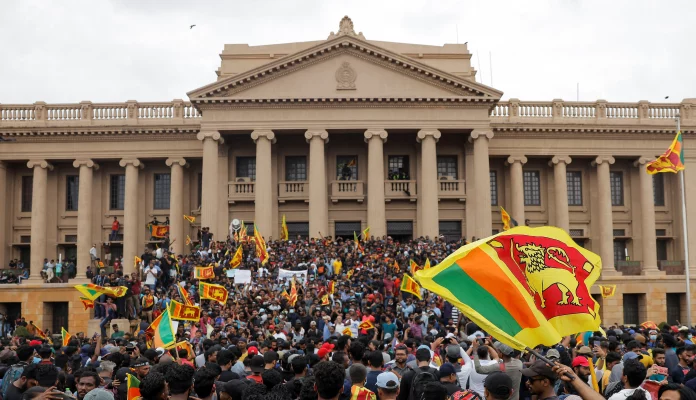
Financial analysis of Sri Lanka’s present situation reveals that the country is currently facing its worst and first sovereign default since its independence in 1948. The World Bank’s statistics on debt analysis have clearly shown that from 2012 to 2018, Sri Lanka had been going through an economic struggle and faced a slower debt recovery rate. But the year 2019 marked major changes in the economy. The 2019 Easter bombing was a major strike on the country. With multiple civic changes and bad governing decisions along with the stopping of the entire tourism sector which paid for a huge part of Sri Lanka for foreign exchange the country kind of crippled after the effect of the pandemic, which resulted in hyperinflation and fuel shortage. The stab to the heart of the citizen was the fact that the island is mostly dependent on resources like gas and petrol for their energy consumption, which had a chain of excessive reactions when shortages occurred. The massive hardship forced the population to protest, and they even burned out the Prime Minister’s house and stormed the Presidential residence.

President Mahinda Rajapaksa’s economic plan backfired in reality. He planned to stabilise the country without any help from the World Bank or International Monetary Fund and used some foreign lenders including China and Japan to be used on some ostentatious infrastructure projects. The island state owns more than $ 51bn in debt to foreign lenders and in that about $ 6.5 bn to China alone.

The former President of Sri Lanka, Sri Gotabaya Rajapaksha, had resigned and fled the country, and the country’s Prime Minister, Mr. Wickremesinghe, was appointed the new President. In June 2022, he said that the economy had collapsed, thus leaving it unable to pay for essentials and that the county would be unable to pay any debt for the year.

Sri Lanka’s sovereign domestic debt

The actual main domestic debt situation that engulfed Sri Lanka was a result of a series of parallel civic policies from 2009, coupled with the effect of the pandemic, with administrative monogamy on the economic situation having a negative impact on the island’s financial stability. The nation had a nationwide policy introduced to shift to “all organic” or “biological” farming, which though executed successfully, had a chain of negative reactions like lesser yields that eventually led to lesser imports and so affected the foreign exchange reserve. As a result, the island state faced severe inflation and a shortage of supplies, basic commodities, and even medicine. The domestic debt and lesser foreign exchange inflamed the crisis, resulting in the country not even being able to export necessities like petrol and essential items.

Political issues in the reconstruction of Sri Lanka’s sovereign domestic debt

For the actual reconstruction of the sovereign in Sri Lanka, the first and foremost thing is that there should be an established government, which should be able to turn things around. The current political situation in Sri Lanka is complex. The fleeing of the leader whose political family had been a key personal in the island states for almost two decades has left a political void, but the political party still holds a majority. The likely situation is that an all-party coalition government will try to lead Sri Lanka and conduct the election for an interim government. Several countries and organisations have come forward to help Sri Lanka in times of several crises.

Global assistance to Sri Lanka

India alone has assisted with $3.8 billion in goods and currency. On September 10, 2022, USAID Administrator Samantha Power announced an additional $20 million in new funding from USAID’s Bureau for Humanitarian Assistance for the complex emergency in Sri Lanka, including $13 million for the UN World Food Programme (WFP) and $7 million for the UN Children’s Fund (UNICEF) (USAID, 2022). The most crucial priority obligation of the next government is to negotiate terms with the IMF to finalise economic reforms and to address the common basic necessity for the citizens.

The bigger concerns

The circumstances that followed the crisis have become a wake-up call to several countries, specifically the developing countries, to carefully plan their domestic and financial matters and ensure a strong and supported system is maintained thereafter. There is no actual guarantee when the IMF lends money for infrastructure development, that it will yield results or that the concerned matter will be resolved completely, it depends wholly on the county’s mechanism and working patterns and the working efficiency and governmental sanction. But countries usually negotiate with the IMF for a suitable situation to tackle the current economic norms.

Conclusion

We believe that some major lessons may be drawn from China’s development and debt management experiences. Of course, Sri Lanka cannot simply copy China’s institutions. However, as it strives to manage its foreign debt and enhance investment in important economic activities that might create jobs, improve people’s income and livelihoods, and push growth, Sri Lanka could adopt several fundamental principles and practices. The privatised and risk-averse banking system in Sri Lanka has failed to offer financing for production and infrastructure. When combined with a free trade environment, the country has faced continuous merchandise trade deficits and, as a result, currency depreciation.

China, on the other hand, has built a strong, specialised state-owned banking sector that has given patient, long-term loans for infrastructure and manufacturing. While embracing markets to boost competitiveness, China has maintained planning and policy stability. Local manufacturing has resulted in significant exports, with revenue from which China has become one of the world’s greatest creditors.

State-owned development banking: 

Sri Lanka’s lack of a state-owned development bank is an impediment to development, and it is arguably the main difference that sets it apart from China and the Asian Tiger economies.

Decentralising government investment:

Sri Lanka might learn from China’s administrative decentralisation in order to target the correct balance of regional investments that address local needs. Local government is frequently more in touch with reality and better qualified to assess the trustworthiness of regional infrastructure expenditures.

References


Students of Lawsikho courses regularly produce writing assignments and work on practical exercises as a part of their coursework and develop themselves in real-life practical skills.

LawSikho has created a telegram group for exchanging legal knowledge, referrals, and various opportunities. You can click on this link and join:

https://t.me/lawyerscommunity

Follow us on Instagram and subscribe to our YouTube channel for more amazing legal content.
Download Now

Section 354 IPC punishment

0
Mischief

This article is written by Hariharan Y, studying in Christ (Deemed to be University), Bangalore. This article deals with the punishment aspect of Section 354 of the Indian Penal Code, 1860. The aspects dealt with in this article are an overview of Section 354, punishment provisions, state amendments, and the relevant case laws concerning the same. This section primarily deals with outraging the modesty of a woman. Crime being a subject in the concurrent list has led to States making amendments to the Section with respect to the number of years of punishment, the type of offence etc.

It has been published by Rachit Garg.

Table of Contents

Introduction 

Crimes against women are a social evil in our society. Every day we hear some news about a crime against a woman. Such a crime can be rape, assault, grievous hurt, acid attacks, outraging her modesty by using criminal force, etc. Hence, the Indian Penal Code of 1860 provides provisions for special offences against women and Section 354 is one such provision. 

Section 354 of the IPC, deals with outraging the modesty of a woman. The word ‘modesty’ is not defined under the IPC. It is defined by the Merriam-Webster Dictionary as propriety in dress, conduct, or speech. It can also be seen as womanly propriety of behaviour and scrupulous chastity in thought, speech, and expression. Thus, modesty can be attributed to a woman and her propriety in her behaviour. The offence relates to outraging the modesty of a woman. The Supreme Court has in Vishaka v. State of Rajasthan (1997) held that an offence relating to the modesty of a woman cannot be considered trivial. In Raja Pandurang v. State of Maharashtra (2004), the Court held that the modesty of a woman is essentially her sex and the virtue that can be attributed to a woman due to her sex. Therefore, Section 354 deals with the usage of criminal force assault in order to outrage the modesty of a woman. The legislative intent to enact this section is for the protection of women. There is no provision for outraging the modesty of a man under this section. The courts have, however, had to strike a fine balance to convict a person under this Section. Recently, in K. Rattiah @Ratnaji v. The State of Andhra Pradesh (2022), the Telangana High Court held that if the woman whose hand is held does not perceive it to mean an invasion of her privacy, this Section will not be attracted.

Section 354 punishes one who assaults or uses criminal force on a woman with the intention to outrage her modesty. This article would concentrate on the punishment aspect of Section 354 and the need to enhance such punishment for it to be in sync with the current realities of society. 

What does Section 354 IPC say

Section 354 states that whoever assaults or makes the use of criminal force on any woman with the intention to outrage her modesty or knowing it to be likely outraging her modesty shall be liable for punishment under this section. The punishment is imprisonment of either description, which shall be a minimum of one year and may extend up to five years. Additionally, the fine shall also be levied. Hence, the punishment can be simple or rigorous imprisonment, depending on the discretion of the judge. Additionally, a fine shall be levied along with such imprisonment, which means that the offence is non-compoundable. 

Essential ingredients of Section 354

The person assaulted must be a woman

The person against whom criminal force has been used has to be a woman. However, a woman who outrages the modesty of another woman shall also be punishable under this section.

Illustration: ‘A’, a man, assaulted and outraged the modesty of ‘B’, a woman. Here, A shall be punished under this section if he satisfies other ingredients.

Illustration: ‘A’, a woman, assaulted and outraged the modesty of ‘B’, a man. Here, A shall not be liable to be punished under this section since B is a man. However, A may be tried under other relevant sections of the IPC.

Illustration: ‘A’, a woman, assaulted and outraged the modesty of ‘B’, a woman. Here, A shall be punished under this Section if she satisfies other ingredients.

The accused must have made use of criminal force on her

The use of criminal force is a must under this Section. Criminal force is defined under Section 350 as intentionally using force against another person without such other person’s consent that leads to the commission of any offence or knowing that an injury, annoyance, or fear would be caused to the other person. 

Criminal force must have been used to outrage her modesty

The test for outraging modesty was established in the case of State of Punjab v. Major Singh (1996). Intention and knowledge are the two main elements of this section. Though they are difficult to prove in a court of law, they can be derived from the facts of the case. The test, therefore, is whether the person using criminal force on a woman has the intention and knowledge that it will result in outraging the modesty of such a woman.   

Hence, to constitute an offence under Section 354, an intention to outrage her modesty must be present. It is not enough that criminal force has been used against her. It must be proved beyond a reasonable doubt that the person had the intention to outrage the modesty of the woman. 

In Ram Das v. State of W.B. (1954), two people engaged in a heated argument, due to which a man gave a push to a woman. The fight started since he was alleged to have looked at her ‘with lustful eyes. However, no evidence of the gesture was submitted. The Court acquitted him since there was no cogent evidence of his intention to outrage the modesty of the woman.

In SP Malik v. State of Orissa (1981), it was held that merely touching the belly of a female in a public bus without proving culpable intention of outraging the modesty will not qualify as an offence under this section.

Punishment for Section 354 IPC 

There has been a lot of debate and criticism about the punishment prescribed under this Section. Earlier, the maximum punishment was two years imprisonment and a fine. Later, the Criminal Law (Amendment) Act of 2013 increased the punishment to five years of imprisonment, subject to a minimum of one year. A fine shall also be levied.  However, there are certain differences in the punishment accorded under state laws where the states have modified the punishment or enhanced the level of punishment.

Criminal Law (Amendment) Act, 2013

The criminal laws in the country were amended in the wake of the Nirbhaya case, which shook the entire country. The government constituted the Justice J.S. Verma Committee in order to revisit the laws and make the relevant amendments. Under this Act, the punishment was enhanced to a minimum term of one year which may extend up to five years and also liable for a fine. Such enhancements were made after a heinous gang rape incident. However, the country must not wait for another incident of this nature to happen to further enhance the punishment. Though the Section was amended, we still see that there are a significant number of rape cases in the country. Unless and until the legislature makes the punishment more stringent, the cases will only surmount. The National Bureau of Statistics establishes that cruelty by the woman’s husband and relatives constituted around three per cent of crimes against women

Recommendations of the Committee

Punishment for rape

The committee recommended that the punishment for rape be life imprisonment or rigorous imprisonment for at least seven years. But, causing the death of the woman or resulting in a permanent vegetative state would attract a minimum of twenty years of imprisonment. The same shall also apply to gang rape.

Recognised punishment for other sexual offences

The Committee has prescribed punishments for other sexual offences. For voyeurism (up to seven years of imprisonment), stalking or repeated contact with a person (up to three years), acid attacks (up to seven years), and trafficking (seven to ten years)sentences were prescribed.

Mandatory registration of marriage

One important recommendation is that all marriages in India have to be registered in the presence of a competent magistrate. This is to ensure a dowry free-marriage.

Other recommendations

  • A separate bill of rights for women to ensure better protection, sexual autonomy etc. 
  • Review of the Armed Forces Special Protection Act for the inclusion of women in the armed forces. 
  • Consideration of non-penetrative forms of sexual contact as sexual assault. 

Amendments by the state governments

The Indian Penal Code, 1860, was drafted pre-independence keeping in mind the prevailing situations at that time. Hence, the legislators at that point in time felt that awarding two years of imprisonment would be appropriate. However, times have changed rapidly. The crime statistics, as mentioned above, only show an upward trend. There is a need to revisit criminal laws in order to ensure that they are in sync with the current situation of society. 

Andhra Pradesh

Andhra Pradesh was the only state to amend and enhance the punishment under this Section. Through the Indian Penal Code (Andhra Pradesh) Amendment Act, 1991  (Act No. 6 of 1991), the punishment was enhanced from two years to a minimum of five years, which may extend up to seven years and is also liable to fine.

Madhya Pradesh

Madhya Pradesh, through The Madhya Pradesh Govansh Vadh Pratishedh Adhiniyam, 2004 (Act No. 14 of 2004) amended Section 354 and inserted a new section, namely Section 354A, under which the punishment prescribed is imprisonment of not less than one year, which may extend up to ten years with a fine.

Orissa 

Under the First Schedule of the Code of Criminal Procedure, 1973, the word ‘bailable’ was replaced with ‘non-bailable’ which means that the offence is ‘non-bailable’ in the state of Orissa.

Chhattisgarh

The state of Chhattisgarh added a proviso to the Section stating that in case such outraging of modesty is done by a teacher, guardian, relative, or a person who is in a position of trust, then the punishment shall be a minimum of two years, which may extend up to seven years with a fine.

Other states in India must also take steps in amending the provision to enhance the punishment currently prescribed. This would enable to deter crimes against women to a great extent.

Type of Punishment under Section 354

The punishment under Section 354 says it shall be imprisonment of either description, not less than one year and up to five years, and shall be liable for a fine. Here, imprisonment of either description means that the imprisonment can either be simple imprisonment or rigorous imprisonment.

The Indian Penal Code provides for two kinds of imprisonment, namely, simple imprisonment and rigorous imprisonment. Simple imprisonment, as the name suggests, means the prisoner will not be given hard labour and other rigorous tasks. The treatment given to him by the police officers will not be very harsh in nature. Rigorous imprisonment on the other hand is the allocation of physical tasks and other kinds of labour on a daily basis to the prisoner. Such imprisonments are generally given for serious offences, whereas simple imprisonment is given for casual and petty offences.

It is important to note here that under Section 354, the judge has the discretion to award any kind of imprisonment since it says ‘imprisonment of either description’. 

Further, the punishment under this section says the person shall be imprisoned and also be liable to pay a fine. The use of the word ‘and’ here means that along with imprisonment, the person shall also be liable to pay a fine. Hence, it is a non-compoundable offence. This means that imprisonment is mandatory, and the convict cannot get away by just paying a fine.

The amount of the fine is also not mentioned under this section, which gives discretion to the judge to impose any fine that he deems fit under this section.

Procedure under the Code of Criminal Procedure, 1973

An offence under Section 354 of the IPC shall be a cognizable and a non-bailable offence that is triable by a magistrate of any class. 

Cognizable

A cognizable offence is one where a police officer, under the First Schedule of the Code of Criminal Procedure, 1973, or any other legislation in effect, an arrest without a warrant and can start an investigation without the permission of the magistrate. Usually, offences, where the punishment is more than three years, are considered as cognizable offences. An FIR needs to be registered for a cognizable offence.

Non-Bailable

A non-bailable offence is one where bail cannot be demanded as a right. The court has the discretion to grant bail if it is satisfied.

Triable by any Court

The offence of outraging the modesty of a woman can be tried by any court of law within the territory of India as per the Code of Criminal Procedure, 1973.

Model charge under Section 354

The Model charge that is framed against the accused will be as follows 

I _______ (name of the Presiding officer) do hereby charge you ______ (name of the accused in the case) as follows

That you are on or about the _______ day of ______ at _______ (place) within P.S _____ District. ______ assaulted (or used criminal force) to ______ (name of victim) intending to outrage (or knowing it to be likely that he will outrage) the modesty of the said ______ (victim), and thereby committed an offence punishable under Section 354 of the Indian Penal Code, 1860 and within the cognizance of this Court. 

And I do hereby direct that you be tried by this Court on the said charge.

Burden of proof

Like every criminal offence under the IPC, mens rea is essential under this Section. The accused must have the intention to outrage or the knowledge that his act will outrage the modesty of the woman. The burden of proof rests on the public prosecutor to prove that the accused had the intention to outrage modesty. 

Illustration: ‘A’ had while climbing the stairs, pushed another woman, and she fell down. She filed a case, stating it outraged her modesty. Here, the burden of proof lies with the prosecution to prove that he had the guilty intent to use criminal force or assault to outrage her modesty.

Difference in punishment under Section 350 and punishment under Section 354  

Section 350 deals with criminal force. It states that whoever has intentionally used any force on a person without consent for the commission of an offence or the intention and knowledge that such force will cause commission of an offence is said to use criminal force against the other. The punishment for Section 350 is given under Section 352.

Section 352 states that whoever has assaulted or used criminal force otherwise than by grave and sudden provocation shall be punishable with imprisonment of either description which shall extend up to three months along with a fine up to five hundred rupees or both.

The difference of punishment under Section 350 and Section 354

ParticularsSection 350Section 354
Term of ImprisonmentUp to three months of either descriptionNot less than one year but shall extend up to five years
Amount of fineUp to five hundred rupeesLiable to fine
Nature of OffenceCompoundableNon-Compoundable

Interplay between Section 354 and Section 376 

Section 354 deals with outraging the modesty of a woman, while Section 376 deals with punishment for rape. The Courts have in various cases dealing with the interplay between Section 354 and Section 376. The line of difference between both is not a big one. The courts have, based on the different circumstances of the case, decided whether it is an offence of outraging modesty or rape; or both.

The major difference between Sections 354 and 376 is the gravity of the offence and the amount of punishment. While the maximum punishment that can be given under Section 354 is five years, under Section 376, the punishment is a minimum of ten years, may extend up to life imprisonment, and shall also be liable for a fine. We can infer from this that the gravity of the offence under Section 376 is more serious and heinous than that under Section 354.

In Ram Asrey v. State of UP (2017), the accused was brought before the court because he was trying to molest a female who then hit him and fled away. It was held that there was no intention to have sexual intercourse with her, and hence he was convicted under Section 354 instead of Section 376.

Need for enhancement of punishment

Judicial opinion in favour of stringent punishment

State of Madhya Pradesh v. Bablu (2004)

The High Court of Madhya Pradesh in the instant case reduced the sentence of the accused since he was a first offender. The Supreme Court, however, held that such a reduction would encourage the accused to repeat the crime which would be detrimental to the morals of society.

Ippili Trinadha Rao v State of A.P (1983)

The Court held in this case that probation of an offender who is accused of an offence under Section 354 can be made only in exceptional circumstances. The benefits of the Probation of Offenders Act were not extended to the accused and corporal punishment was instead awarded to him. The same principles were applied in the case of Harish Chandra v. State of Maharashtra (1996), where the benefit of probation was not extended to the accused.

Increase in the number of crimes against women

With the rise of crimes against women in India, the current punishment under Section 354 is grossly inadequate. There are various international conventions for the protection of women. Further, the courts have consistently called for enhanced protection of women. The statistics are scary. As per a BBC Report, over six million crimes have been recorded against women in 2021. There has been an increase of 100 per cent increase in molestation cases against women since 1991 and it has been showing an upward trend every year except for a few years where it showed a downward trend. These offences include rape, kidnapping, murder, extortion, hate crimes, and acid attacks to name a few. Hence, to ensure that the criminals are given appropriate punishment, it is critical that stricter and harsh punishment needs to be in place in order to deter crimes.

Landmark case laws 

Rupan Deol Bajaj v. Kanwar Pal Singh Gill (1995)

Facts of the case

This case is famously called the ‘butt-slapping’ case and was one of the most controversial cases. The brief factual matrix of the case was that Mrs. Rupal Deo Bajaj is an Indian Administrative Service (IAS) officer belonging to the Punjab cadre. When the case was filed, she was working in the position of Special Secretary (Finance). The accused is to have allegedly slapped her on her butt during an interaction.She filed a complaint alleging offences under Sections 341, 342, 352, 354 and 509 of the IPC by the Director General of Police (Punjab) during a dinner party. An FIR was registered with the Chandigarh Police Station.

Mr. Bajaj, also an IAS officer, registered another complaint with the Chief Judicial Magistrate, alleging a lack of investigation and no arrest being made. The case was then transferred back to the judicial magistrate to complete the pending investigation. Mr Gill filed a petition under Section 482 of CrPC for quashing the FIR. The High Court of Punjab and Haryana quashed the FIR because the grounds alleged in it did not constitute an FIR, the accusations were unusual, and there was an unreasonable delay in filing the FIR. Aggrieved by this, Mrs. Bajaj petitions the Supreme Court.

Issues

The major issues in this case were whether the accusations mentioned in the FIR constituted offences under the IPC and whether the High Court was justified in quashing the FIR.

Judgement

The Court, relying on the decision given in State of Punjab v. Major Singh (1966), held that the act of slapping a woman on the posterior qualified as outraging her modesty under Section 354. Mr. Gill had the ‘culpable intention’ of slapping her buttocks, which is one of the ingredients under this section. However, in this case, Mr. Gill was acquitted since the offences under Sections 341, 342, and 352 were not made out against him. However, the Supreme Court held that the High Court was not justified in interfering in the case and directed the Chief Judicial Magistrate to continue the investigation concerning offences given under Sections 354 and 509.

Post judgement

The Chief Judicial Magistrate conducted the trial, and the accused was held guilty. Mr Gill was sentenced to three months imprisonment and a fine of Rupees five hundred under Section 354 and two months imprisonment and a fine of Rupees two hundred under Section 409. Appealing against such a conviction, the Sessions Court affirmed the conviction but directed the accused to be released on probation but the fine amount was increased to Rupees fifty thousand. 

Aggrieved by the decision of the Sessions Court, Mr. Gill appealed in the Punjab and Haryana High Court increasing the fine amount to rupees two lakh and twenty-five thousand as litigation costs. The matter finally reached the Supreme Court, where the appeal was dismissed for being devoid of merit. 

State of Punjab v. Major Singh (1966)

Facts of the case

The case dealt with whether causing an injury to an infant would qualify as an offence under Section 354. The brief factual matrix of the case is that the baby was sleeping in the room when Major Singh entered the room, turned the lights off, committed an obscene act, and caused injury to the private parts of the baby. He is said to have escaped when his mother entered the room and switched on the light.

Issues

The major issue that was dealt with in this case was whether the accused is liable for an offence under Section 354.

Judgement

The Court held that a woman, regardless of her age, has modesty, which can be an outrage. Such modesty is available to her from birth. Consideration of a woman’s reaction to the offence is secondary. The ingredients necessary to satisfy an offence under this section are the usage of criminal force with intention and knowledge, both of which have been satisfied in this case. The accused was punished with an imprisonment of two years with a fine of Rupees one thousand, the default of which will be met with six months of rigorous imprisonment. 

Girdhar Gopal v. State (1952)

Facts

The petitioner, Giridhar Gopal was convicted of offences under Sections 342 and 354 of IPC. He was awarded six months and one year of rigorous imprisonment for the offences which were to run concurrently. The Sessions judge rejected the appeal against conviction. Hence, the petitioner approached the High Court of Madhya Pradesh. The main contention of the petitioner is that the provisions of Section 354 violate Articles 14 and 15 of the Constitution as being discriminatory against a man. 

Issue

The issue dealt with in this case was whether Section 354 violates Articles 14 and 15 as it does not provide for outraging the modesty of a man. 

Judgement

The Court held that the act of outraging modesty can be done either by a man or a woman. Even a woman who outrages the modesty of another woman would be punishable under this Section. It operates equally on a man or a woman. The issue of whether a man’s modesty was outraged was not made out by the petitioner. Further, Article 14 is not violated since it forbids class legislation but permits classification. The legislative intent seems to be the protection of the dignity and modesty of a woman.

The contention that the section is violative of Article 15(1) also fails since the Article prohibits discrimination on the basis of race, religion, sex, caste, and place of birth only. Therefore, if such discrimination is not only based on the above grounds but also on additional grounds such as decency, decorum, public morals, etc., it would be valid. Further, these acts are also criminalised in other jurisdictions. Every civilised country will seek to protect the modesty of a woman from being outraged. The revision petition was dismissed. 

Chaitu Lal v. State of Uttarkhand (2019)

Facts

The accused was convicted under Sections 354, 511, and 376 of the IPC. He was sentenced to a rigorous imprisonment of one year for Section 354 and further two years for conviction under Sections 511 and 376 along with a fine of rupees two hundred. The facts leading to the case are that the accused attempted to molest his aunt, who was the complainant in this case. The trial court convicted him and awarded a punishment of one year of rigorous imprisonment under Section 354.

Issue

The relevant issue before the Supreme Court was whether there was enough evidence to convict him for outraging the modesty of a woman.

Judgement

The Court placing reliance on judgements where it is held that there must be a culpable intention and usage of criminal force to satisfy the ingredients under Section 354 held that he was guilty beyond reasonable doubt since he had outraged her modesty. The appeal against conviction was hence dismissed. The punishment given by the trial court was valid and he will have to first undergo one year of imprisonment under Section 354 following which he will undergo two years of imprisonment under Section 511 and Section 376.

Conclusion

Section 354 is an important provision in the IPC for the protection of women. More stringent punishment needs to be prescribed to ensure that there is deterrence and a reduction in crime. Currently, the maximum term of punishment prescribed under this Section is five years. However, this seems to be grossly inadequate considering the rising number of crimes against women in our society. However, only stringent punishment will not suffice. The government must take sufficient efforts to ensure that crimes against women are reduced in society.

Frequently Asked Questions (FAQs) 

When was Section 354 incorporated into the IPC? Were there any changes to it and if yes, why?

Section 354 was incorporated when the IPC came into force, i.e., 1860. The punishment prescribed until 2013 was a maximum of two years of imprisonment. However, there was a need to increase the punishment to deter the increasing crimes against women. The Criminal Law (Amendment) Act, 2013, was enacted, which enhanced the punishment to a maximum of ten years imprisonment. 

What is the difference between Section 352 and Section 354?

While Section 352 deals with criminal force, Section 354 specifically deals with assault or criminal force used against a woman that outrages her modesty.

How is outraging modesty different from rape?

Outraging the modesty of a woman has lesser gravity as compared to the offence of rape and therefore the punishment prescribed is comparatively lesser.

Is protection available to a man under this section?

No, only outraging the modesty of a woman is punishable. However, a woman who outrages modesty of another woman is also punishable under this Section.

References 


Students of Lawsikho courses regularly produce writing assignments and work on practical exercises as a part of their coursework and develop themselves in real-life practical skills.

LawSikho has created a telegram group for exchanging legal knowledge, referrals, and various opportunities. You can click on this link and join:

https://t.me/lawyerscommunity

Follow us on Instagram and subscribe to our YouTube channel for more amazing legal content.

Download Now

Facets of copyright in a film

0

This article is written by Sukeerti Samalei Mishra pursuing a Certificate Course in Introduction to Legal Drafting: Contracts, Petitions, Opinions & Articles from Lawsikho. 

This article has been published by Sneha Mahawar.​​ 

Introduction

A film can be defined as an amalgamated product consisting of the professional expertise of various artists focused on bringing life to a work of fiction. It is a complex copyright work since it consists of the labour of a number of individuals. It can be compared to a puzzle, for it requires the perfect arrangement of all its elements to form a beautiful end product. The storyline and dialogue of a film, the actors that portray the characters, the kind of costumes and make-up used, the choice of a particular location, the music to hit the right feelings, etc., are of vital importance to ensure an amusing experience through the film. There are numerous creatives involved in the making of a film, such as a writer, directors, cinematographers, actors, music composers, editors, make-up artists, and dubbing artists, to name a few. A film is quite incomplete without any of these contributors. 

A copyright is a kind of intellectual property right that gives an exclusive right to the owner of an intellectual property. When one’s mental faculties are used to create a product, such a product is called intellectual property. Copyright is a work of legal fiction that provides various rights to the creators of a work. Copyright could exist in books, poems, prose, films, computer programs, databases, songs, maps, advertisements, etc. Having copyright protection gives the owner the right to reproduce their creation or authorise any other person to do the same. Such protection ensures that one’s creation is not duplicated and exploited by others without the authorisation of the owner. Works that can be given copyright protection include literary works, dramatic works, musical works, artistic works, cinematograph films and sound recordings.

Understanding cinematograph films

This paper aims to discuss the facets of copyright in cinematograph films. Section 2(f) of the Copyright Act, 1957 defines a “cinematograph film” as any visual recording work including an accompanying sound recording and shall be construed to include any such work like video films produced by analogous methods to cinematography. The definition of cinematograph film has undergone some amendments in order to bring more clarity to the definition. Before the 1994 Amendment to the Copyright Act of 1957, the provision simply said that cinematograph film includes the soundtrack and cinematograph meant any work that is produced via any process that is analogous to the process of producing a cinematograph film. The legislative intent in making amendments to the definition was to emphasise the need for originality in a visual recording to become a cinematograph film in which copyright can subsist. Copyright cannot subsist in just any visual recording like in the case of CCTV footage, but there has to be some degree of originality in it for there to be any scope of copyright protection. Justice Krishna Iyer‘s footnote in Supreme Court‘s decision in the Indian Performing Right Society v Eastern India Motion Picture Association (1977) gives a beautiful explanation of Cinematograph Films:

“A cinematograph film is a felicitous blend, a beautiful totality…  Cinema is more than long strips of celluloid, more than miracles in photography, more than song, dance and dialogue and, indeed, more than dramatic story, exciting plot, gripping situations and marvellous acting. But it is that ensemble which is the finished product of orchestrated performance by each of the several participants, although the components may, sometimes, in themselves be elegant entities.”  

Thus a cinematograph film is more than a compilation of videos and photographs. It is the brainchild of different artists who have come together to create a work of art. It is a reflection of their artistic abilities. As discussed earlier, the marking of a film involves the arduous efforts of various contributors. If so many people contribute to the making of a film, who then owns the copyright in a film? And more importantly, do writers and directors who are the driving force in the creation of a film hold any copyright in it? 

Why have copyright

It is essential to understand the significance of holding a copyright. To understand better who can own it, it is essential to know why to own it. Holding copyright to a work vest the owner with various benefits to utilise and exploit the work to their advantage. Apart from the obvious advantage of protection, having a copyright gives the owner of the work the right to reproduce, perform, distribute, publicise as well as translate the work. Simply speaking it gives a monopolistic right to the owner for their distinctive creation. Let’s take the example of the book “The Alchemist” by Paulo Coelho. It was first published in 1988 and written in Portuguese. The book became so widely famous that now it has been translated into more than 80 languages. There have also been theatrical adaptations and CD booklets of it. Moreover, a movie adaptation of the book is also being produced. It is to be emphasised that none of these conversions could have happened without the consent of the author Paulo Cohelo because he holds copyright in his work. If a person were to copy the story in the book and distribute it as their own creation, then they could easily be sued for copyright infringement by the author. Having a copyright also provides other moral rights such as paternity rights and integrity rights as discussed under Sections 57(1)(a) and 57(1)(b) of the Copyright Act, 1957. Thus, moral rights are mentioned under Section 57 of the Copyright Act, 1957 which was incorporated in accordance with Article 6bis of the Berne Convention, 1886. Moral rights encompass all the natural rights that a person has in their creation which reflect the personality of the creator. Paternity right is the right of the author to have authorship or ownership of the work whereas integrity right is the right of the author to prevent any person from distorting, mutilating, modifying or changing the work in any manner. The author can also claim damages in relation to such changes. This right essentially helps to preserve the integrity of the work. An author is entitled to moral rights as long as the copyright subsists which is generally for the lifetime of the author plus additional 60 years after the death of the author. 

Meaning of author in Copyright Act, 1957

To understand who holds copyright in a cinematograph film it is important to understand the concept of an author under Section 17(b) of the Copyright Act, 1957. According to this provision, in the absence of any contrary agreement, the person at whose instance a cinematograph film is made for valuable consideration is the author of the work. From this definition, it can be understood that a producer of a cinematograph film has copyright in it since it is at the instance of the producer that a cinematograph film is made for valuable consideration. Section 2(uu) of the Copyright Act, 1957 defines a producer. It emphasises the requirement of taking the initiative and responsibility of a person to be called a film producer. In Ramesh Sippy v. Shaan Ranjeet Uttamsingh & Ors. (2013), S.J. Kathawalla, J. reiterated the necessity of taking the initiative and responsibility. The court also said that in deciding who is the author of a film it is to be seen who has taken responsibility for making arrangements, particularly in a financial sense. From this, it can be understood how important the financial contributions and arrangements by a person are for the question of determination of who the author is. Giving the title of an “author” to a producer/ production company whose contribution to making a film is absolutely in monetary terms and not in creative terms has unfortunately become a statutory norm.

But what about the various people associated with making a cinematograph film who contribute in a creative capacity and not in a financial capacity?  Do they hold any copyright? It is not only the money spent that creates a film, but it is in fact the creativity applied that materialises itself into a work of art.

Facets of copyright in cinematograph films

Understanding a director’s rights

Copyright subsists in a film as a whole which means that different creators do not have an independent copyright in a film but it is the producer in whom copyright to the film as a whole subsists. However, sometimes copyright subsists independently in some underlying works of a film such as the novel or biography on which the film is based, music, choreography, screenplay, etc. But it does not subsist on some of the important contributions that help in shaping and forming the film such as direction, cinematography, editing, etc. Many people believe that it is the director who must have the copyright. It is important to refer to the “Auteur Theory” at this juncture. This theory was propounded by Alfred Hitchcock, one of the most influential figures in the history of filmmaking. He said that a director is the true author of a film, for the film is a reflection of the director’s personality and ideas. According to him, a movie directed by a certain director has visual queues and recurring themes that inform the audience who the director is. For example, if one watches a film directed by Anurag Kashyap, the audience can easily identify who the director is because there is a persistent style and theme in his films that make them distinguishable. Likewise, films made by Sanjay Leela Bhansali, Quentin Tarantino, and Karan Johar have elements of their personal style that give the audience an idea about who the director is. But “Auteur Theory”, however pivotal in starting dialogues relating to the authorship of a director in cinema, is still a theory. To understand the copyright in a cinematograph film, which is essentially a legal fiction we have to go by precedents. One of the first cases dealing with the copyright of a director in a film was in the case of Sartaj Singh Pannu v Gurbani Media (2015) wherein it was said that it would be a matter of evidence to decide whether a work of a director in a particular film can be stated to be a work of artistic craftsmanship. In Kabir Chowdhry v. Sapna Bhavnani & Ors (2021). the question was whether any contribution made by a person in a film vests them with the copyright to the film. The court observed that in the context of a cinematograph film:

(i) the author is the first owner of the copyright;

(ii) the author means the producer (and no one else); and

(iii) the producer is he or she who has taken the initiative and responsibility for making the work.

The court emphasised points of “financial investment” and “risk of suffering losses” by the producers and said that even though the director is involved in every stage of making the film, it is the producer who is the author. The Court also referred to the auteur’s vision of work and said that in addition to it the person must have taken the initiative in conceptualising the work to bring it into existence and there must be an element of risk in the nature of his responsibility, for such person to become a co-producer.

In a very recent case of  S.J Suryah (a.k.a. S. Justin Selvaraj) v. S.S. Chakravarty & Anr. (2021) the question was whether giving credits to a person as a writer or director of a film entitles him to claim original ownership of the script, screenplay or dialogues in the absence of a written contract. The appellant/plaintiff, in this case, was unable to prima facie prove his claim of copyright. The court said that the mere giving of credits by the producer would not entitle the director/writer to claim copyright. In the absence of any document showing that the appellant/plaintiff had retained his rights, the court relied on statutory provisions to reject the prayer of interim injunction against the producer. However, it is to be noted that a director does not merely direct or command the different creatives involved in the making of a film. Still, it is his/her utmost responsibility to harmonise the working of all these individuals to create an impactful work of art. A director is not merely an agent of the producer who acts as per his/her directions. On the contrary, the director holds creative autonomy and is responsible for conceptualising and creating the by engaging various creatives.

Understanding a writer’s rights

One of the most ignored contributors to a film is the writer. The story of a film is the manifestation of the imaginary world of a writer. He/she adds life to this imaginary world by creating characters and telling a story through these characters. The story of the writer is the entire foundation of a film. Unfortunately, when it comes to films, writers are not given enough recognition and credit for their work. Films are often popularised by the names of their directors and producers but hardly ever by the names of their writers. As discussed earlier, under Section 17 of the Copyright Act, 1957 if a work is created during the course of employment then the employer is the author unless there is a contract to the contrary. This means that even a writer is not the author of a cinematograph film under Section 17. Rights in scripts are often assigned to the producer. Copyright does not subsist in ideas but in the material that is produced through the ideas. If a writer has channelised their ideas to create a book, biography, novel, etc., then copyright subsists in such materials. In Donoghue v. Allied Newspaper (1937), it was said the person who originates a brilliant idea is not the owner of the copyright unless he has also created a work using such an idea. Copyright subsists the moment the idea is materialised, and it is not mandatory to register it. However, it is advisable to copyright one’s work since the certificate of registration of copyright acts as a prima facie proof in case of conflict or infringement of copyright. Generally, during script clearance, these rights of the writer are assigned to the producer of a film either wholly or partly and generally are subject to limitations either for the whole part of the copyright or any term thereof. If the script is incorporated into a film, the producer becomes the first owner of copyright in such underlying work unless there is a contract to the contrary between the author of such work and the producer of the film as could be gathered from Salim Khan v. Sumeet Prakash Mehra (2013). Such a rule undermines the contributions of a writer. 

Before the Copyright Amendment Act, 2012 the law relating to royalties favoured the producer. It was said that any underlying work (musical and literary work) incorporated in a cinematograph film or sound recording was deemed to be created under a “Contract of Service” under Section 17 and thus the copyright in such material was transferred to the producer or employer. This meant that even if the producers made huge profits using the underlying works of the writer, the writer was merely entitled to the initial assignment fee and had no share in the profits subsequently earned. Giving excessive importance to contractual agreements and undervaluing a writer’s contributions resulted in disproportionate bargaining power in the hands of the producers when compared to that of the writer. However the Copyright Amendment Act, 2012 was a paradigm shift for the rights of writers. The amendment to Sections 18 and 19 of the Act created provisions for the right of the writer to receive royalties. The proviso to Section 18 now mandates the equitable sharing of royalties in the case the underlying work (literary and/or musical work) is utilised for any non-cinema use. This means that if a film script is licensed to be used for a Netflix show, then the screenwriter has the legal right to receive royalties. Further, this right cannot be waived or assigned through a contract. As per Section 19(9) of the Copyright Act, 1957 if the author assigns the copyright to a third party this would not affect the writer’s right to receive royalties. Let’s say Dharma Productions assign their copyright in “Kabhi Khushi Kabhi Gum” to a different production house. Then this will not cease the right of the writer of the film to receive royalties. It is pertinent to note that these amendments have prospective effects as established in the case of Salim Khan v. Sumeet Prakash Mehra. However, even after the amendment, screenwriters are still restricted by one-sided contracts and are devoid of enjoying the true fruits of their labour. Even today, what screenwriters get are not proper royalties but a small percentage of the profit made through secondary exploitation of the film after it has run in cinema halls.

In the case of Thiagarajan Kumararaja v. Capital Film Works (2017), the appellant was the screenwriter and director of the film “Aaranyakaandam”. The appellant had not assigned their copyright in the script and on the producer’s attempt to dub and remake the film, the suit was filed. With regards to remaking, it was held that since remaking would essentially require making certain changes to the script which was not assigned to the producer, it was beyond the producer’s right to do so. With regards to dubbing, the court allowed it, expressing that sound recording is a part of the film and the producer has exclusive rights over it. Precedents like this have ensured some rights to the writers; however, writers and directors are still not equal stakeholders in the Indian film industry.

As discussed earlier, the creator of a work has moral rights in his/her creation. Enforcing one’s moral rights is a way through which a writer or director can ensure that their work is not misused. 

The landmark case of Amarnath Sehgal v. Union of India (2005) established the way in which moral rights should be interpreted. The plaintiff was a well-known sculptor who was commissioned to create a mural for the Government of India to be displayed in the Vidhan Sabha. Subsequently, the Government of India removed the mural and stored the mural in a store room without any notice to or authorisation from the plaintiff. The mural was also slightly damaged due to negligence and mishandling. The Government argued that since the work was commissioned and due consideration was paid, they had the sole authority to determine the way the work was to be used. The court rejected the argument and said that an author of a work does not lose moral rights to the work enshrined under Section 57 of the Copyright Act,1957 even after the sale. The destruction and mutilation of the mural were prejudicial to the author itself regardless of who the owner is. Thus such an act was held to be an infringement of the author’s rights. This judgment thus protected the soul of artistic expression. 

Mannu Bhandari vs Kala Vikas Pictures Pvt. Ltd. (1986). established that remedies of injunction and damages can be claimed on the basis of moral rights under Section 57 of the Act even after the assignment of rights by the artist. Thus, in the context of writers and directors, Section 57 must be interpreted taking into account the recent developments, thus striving to make the film industry equitable for everyone.  

Conclusion

Intellectual property rights were themselves created to protect the intellectual labour of a person. The very rationale of basing an intellectual property right such as copyright on the financial aspect goes against the principles of granting intellectual property rights. From the above discussion, it is amply clear that the vesting of copyright tilts more towards the producer of a film. The role of the producer is no doubt very important but we cannot turn a blind eye to the relentless contributions of other creative contributors by granting the copyright to a producer. Paying for the creation of a thing and investing oneself in actually creating a thing are two different aspects. Since IPR strives to protect intellectual labour, the latter should be paid more heed in deciding who has the copyright.

The creators of underlying works as well as the director are considered secondary while determining the question of copyright. The ambit of “author” could be expanded to give due recognition to these creators. What could be done is providing joint authorship to other important creatives involved in the making of a film. Under the UK Copyright Act,1988 a principal director is also the joint author/ joint owner of the copyright. Even though the laws in India are greatly inspired by the laws of the UK, we have failed to imbibe such an equitable principle in our system. Furthermore, it is settled that the producer has higher bargaining power when compared to other creators like the writer or the director. But what we often miss to consider is that different creatives also have different bargaining powers based on their stature. For example, a renowned writer has a higher bargaining power than a budding writer, so it is probable that the former has more rights in his underlying work than the latter. When we are ensuring that different creatives have protection in their work, we must also ensure that the nature and scope of such protection must not depend upon their individual bargaining power. Thus, this calls for uniform laws to be incorporated into the Copyright Act, 1957. The courts must limit the rights of producers in cinematograph films. Even though the 2012 amendment was promising to ensure the rights of creators, it is still not effective in ensuring the same. This also calls for necessary amendments to be made to the Copyright Act, 1957.

References


Students of Lawsikho courses regularly produce writing assignments and work on practical exercises as a part of their coursework and develop themselves in real-life practical skills.

LawSikho has created a telegram group for exchanging legal knowledge, referrals, and various opportunities. You can click on this link and join:

https://t.me/lawyerscommunity

Follow us on Instagram and subscribe to our YouTube channel for more amazing legal content.

Download Now

Key income tax amendments

0

This article is written by Tarini Kalra, a student of BBA LL.B. from Fairfield Institute of Management and Technology, GGSIPU. The present article provides exhaustive details about the major amendments and recent developments to income tax applicable for the annual year 2022-23. 

This article has been published by Sneha Mahawar.​​

Introduction

India’s yearly budget is known as the Union Budget or the Annual Financial Statement. The Union Budget is addressed in Article 112 as estimates of expenditures included in the yearly financial statement. The Minister of Finance presents the Union Budget Bill. The Union Budget, 2022 was proposed on  1st February 2022 and approved on 29th March 2022. The key features of Union Budget, 2022 focused on growth and all-inclusive welfare, promoting technology-enabled development, energy, transition and climate action, a virtuous cycle starting from private investment and crowded in by public capital investment. The Union Budget, 2022 prioritised four fields such as PM GatiShakti, inclusive development, productivity enhancement and investment, sunrise opportunities, energy transition and climate action and investments of finances. The new income tax amendments are applicable for the financial year 1st April 2022 to 31st March 2023. 

Major changes in income tax effective from 1st April 2022

The major changes in income tax effective from 1st April 2022 are mentioned as under: 

New provision for ITR updating

A new provision is included that enables taxpayers to file a revised return in their income tax returns that contain errors or inaccuracies. Within two years, taxpayers are permitted to file amended returns for the purpose of fixing mistakes. According to the newly incorporated provisions in the Income Tax Act, 1961, one can revise returns for FY 2019-20 or subsequent assessment years.

Virtual digital assets taxation scheme

A virtual asset is a digital instrument for a means of exchange that can be digitally traded, transferred, or used as payment or investment. In the Finance Bill, 2022, the government announced a 30% tax along with 1% of TDS on virtual digital assets if there is any commercial exchange. Section 2(47A) was inserted defining virtual digital assets. The section defines a virtual digital asset as any data, code, number, or token produced using cryptographic techniques that can be transferred, stored, exchanged or traded electronically, acts as a store of value or a unit of account, and can be used in financial transactions or investments not limited to investment schemes, and can be exchanged for value with or without payment. It includes non-fungible assets and excludes digital currency issued by the central bank of India or foreign. 

Non-fungible assets

The non-fungible assets (NFT) are similar to digital currency as they are made by the blockchain method. The distinction between these assets is that non-fungible assets have unique identification numbers and metadata that distinguish them from each other as well. NFTs are non-replaceable because of the unique identification number and different values of amount. One acquires “bragging rights” in the form of ownership when one buys an NFT.

Co-operative societies AMT and reduction of surcharge rates 

A group of people who get together voluntarily with the goal of cooperating and promoting their economic interests is known as a cooperative society. A “cooperative society” is a society that has been registered in accordance with the Cooperative Societies Act, 1912 or any other declared law that is currently in effect in any State for the registration of cooperative societies, according to Section 2(19) of the Income Tax Act, 1961. In order to give cooperatives an equal playing field with businesses, the central government reduced the alternative minimum tax rate and surcharge for cooperatives in the Union Budget 2022–23. Cooperative societies are currently obligated to pay an Alternate Minimum Tax of 18.5% as per the provision of Section 115JC of the Income Tax Act, 1961. Companies, however, pay 15% at the same rate. For cooperative societies having a total turnover of more than Rs 1 crore and up to Rs 10 crores, the surcharge has been decreased from 12% to 7%.

Penalty for claiming surcharge and cess as expenditure in preceding years

In the case of Commissioner of Income Tax v. K. Srinivasan (1971), the contention to levy surcharge and additional surcharge in the proportion to the total income along with income tax was raised. The Hon’ble Supreme Court observed that “surcharge is to charge in addition or to subject to an additional or extra charge and proceeds of the surcharge are exclusively assigned to the Union.”

It was established that surcharge and cess are identical to tax in the Finance Bill on the basis of decisions from several courts and hence not permissible. In circumstances where the deduction has been claimed and allowed, it was urged that the tax authorities must be given the right to recognise it as a mistake and to amend the orders. For this purpose, a 4-year limitation term commencing March 31, 2022 was proposed. For the purposes of levying a penalty, the taxpayers’ claim may be considered under-reporting of income. It also protects the taxpayer from penalties when the taxpayer suo moto seeks such re-computation and pays the tax.

NPS deduction to the state government employees

NPS stands for National Pension Scheme. The National Pension System (NPS) is a voluntary defined contribution retirement savings programme created to provide subscribers with an adequate retirement income by methodical saving during their work life. Earlier, NPS was available for the central government and now employees of the state government may claim expenses under Section 80CCD(2) with an overall ceiling of Rs. 1.5 lakhs under Section 80CCE of the Income Tax Act, 1961. For employees of state governments, the maximum tax deduction allowed by NPS has increased from 10% to 14% of their basic salary and dearness allowance. 

Persons with disabilities are eligible for tax relief

Section 80DD is inserted and it outlines tax deductions to the taxpayer’s disabled family members, whereas Section 80U provides deductions to the individual taxpayer with a disability. Section 80DD applies if a taxpayer pays a set amount as an insurance premium to care for a dependent disabled person. The deduction limitations under Section 80DD are the same as those under Section 80U. A dependant refers to the assessee’s siblings, parents, spouse, children, or a member of a Hindu Undivided Family. NRIs are not eligible to claim a deduction under Section 80DD of the Income Tax Act, 1961. Where the disability is more than 40% and less than 80% the deduction of Rs 75,000 is allowed and where the disability is more than 80% the deduction of Rs 1,25,000 is allowed. The following disabilities are covered under Section 80DD of the Income Tax Act, 1961:

  1. Hearing impairment,
  2. Mental retardation,
  3. Mental illness,
  4. Autism,
  5. Cerebral palsy, 
  6. Blindness,
  7. Low vision, 
  8. Leprosy-cured, 
  9. Locomotor disability.

Extension of start-ups tax incentive period 

The period of incorporation for eligible start-ups was extended by one year until March 31, 2023, with the goal of providing tax breaks to more entrepreneurs in the country. Eligible start-ups created before March 31, 2022, received a tax break for 3 consecutive years out of 10 years after incorporation.

Tax relief on Covid-19 treatment expenses 

The Finance Bill has stated that income tax would not be levied on any sum received by a taxpayer for medical treatment from an employer or any other person for Covid-19 treatment for fiscal years 2019-20 and subsequent years. 

Ex-gratia payments obtained by family members of a person from the employer of such person or another person on the death of the person on account of Covid-19 during FY 2019-20 and later years are exempted to the taxpayers. It was also stated that the exemption would be granted without regard to the amount received from the employer and would be restricted to Rs 10 lakh in aggregate for the amount received from any other people within 12 months from the date of death. 

Section 17(2) was amended and a new sub-clause in the proviso was added stating that any amount paid by the employer in relation to any expense incurred by the employee in relation to his medical treatment or the treatment of any member of his family in respect of any illness related to Covid-19 shall not be forming part of “perquisite” subject to such conditions as may be notified by the Central Government.

Additionally, it was suggested that the proviso of Section 56(2)(x) be modified and two new clauses were added to ensure that:

  1. Any sum of money received by an individual from any person as expenditure incurred by him on his medical treatment or the treatment of any family member in respect of any illness related to Covid-19 as may be notified by the Central Government in this regard shall not be the income of the individual.
  2. Any amount received by a member of a deceased person’s family from the deceased person’s employer without restriction, or from another person or persons to the extent that sum of money does not exceed ten lakh rupees, where the deceased person’s cause of death was an illness related to Covid-19 and the payment is received within twelve months of the date of the deceased person’s death, or subject to any additional conditions that may be notified by the Central Government shall not be the income of such person.

For the purpose of the abovementioned sections, the definition of “family” with respect to a person should be the same as that provided under Section 10(5) in Explanation 1

Surcharge on LTCG

Currently, the sale of listed equities or mutual funds carries a 15% surcharge on the long-term capital gain described in Section 112 of the Income Tax Act, 1961.

Crypto Tax

Section 115BBH was introduced, which imposes a 30% tax with a relevant surcharge and a 4% cess on gains obtained by trading cryptocurrencies on or after April 1, 2022, regardless of the type of revenue. This rate is the same as the highest income tax bracket in India excluding surcharge and cess. Private investors, business traders, and anybody else who moves crypto assets in a particular financial year are subjected to the tax rate.

Crypto received as gifts will be taxable

A cryptocurrency trader or investor can give cryptocurrency away through cryptocurrency exchange gift cards, crypto paper wallets, crypto tokens, etc. In Budget 2022, the finance minister amended Section 56 to include “virtual digital asset” under the definition of property, which includes movable assets. In the following circumstances, crypto will be exempt from being taxed:

  1. Cryptocurrencies acquired through marriage, inheritance, a will, or in contemplation of death will not be taxed.  
  2. Gift of a virtual digital asset worth up to Rs. 50,000,
  3. Gift of virtual digital asset worth more than Rs. 50,000 received from a relative.

However, a gift of a virtual digital asset from a non-relative that exceeds Rs. 50,000 will be taxed on the receiver.

Crypto losses cannot be set off against crypto gains or other assets

Losses incurred from the transfer of cryptocurrency assets cannot be carried over or offset against any other income. However, it may be assumed that a gain from the transfer of cryptocurrency assets can offset a loss from such a transfer in the same financial year.

Key amendments effective from 1st July 2022 

The key amendments in income tax notified by the Central Board of Direct Tax (CBDT) effective from 1st July 2022 are mentioned as under: 

TDS on cryptocurrency 

Section 194S imposes a 1% TDS deduction on the transfer of cryptocurrency and other virtual digital assets. TDS will be levied on transfers of virtual digital assets worth more than Rs. 10,000, including cryptocurrencies and non-fungible tokens (NFTs). According to the guidelines of the Central Board of Direct Taxes (CBDT), the person making the payment to the seller, the buyer, the exchange, or the broker bears the burden of TDS. This meant that the TDS had to be deducted from the selling price and that the selling price was reduced as a result.

Double fee for PAN-Aadhaar linking

The Finance Act, 2017 introduced Section 139AA. It mandates specifying the Aadhaar number in the application form for permanent account number (PAN) allotment and in the income tax return on or after July 1, 2017. In the case of Binoy Visman v. Union Of India (2017) the constitutional validity of Section 139AA was upheld. The Hon’ble Supreme Court stated that:

  1. The Parliament was competent to enact Section 139AA of the Income Tax Act, 1961,
  2. There was a lack of contradiction between the provisions of the Aadhaar Act and Section 139AA of the Income Tax Act, 1961 because they function in separate domains when construed coherently.
  3. Section 139AA is not discriminatory nor violates the provisions of equality established under Article 14 of the Constitution.
  4. Section 139AA  does not violate Article 19(1)(g) of the Constitution since it requires the inclusion of an Aadhaar enrollment number in income tax returns or the notification of an Aadhaar enrollment number to the authorised authorities. Furthermore, Section 139AA(2) suggested that it would only apply eventually.

The deadline for linking Aadhaar-PAN was on 30th June 2022. According to CBDT regulations, anyone who links their PAN to their Aadhaar after March 31st March 2022 but before 30th June 2022 shall pay Rs. 500 late fees. However, if a person fails to link their PAN with their Aadhaar by 30th June 2022, they would be fined Rs. 1,000 for linking PAN-Aadhaar from July 1, 2022.

Introduction of Income Tax provision for doctors and influencers

Section 194R is inserted in the Income Tax Act, 1961. It proposes a 10 % TDS on benefits received through sales promotion on doctors and social media influencers. However, the TDS will be levied only when the cost of the benefit exceeds Rs. 20,000 in a single financial year. It exempts an individual or a member of a Hindu Undivided Family (HUF), whose total sales, gross receipts or turnover does not exceed one crore rupees in case of business or fifty lakh rupees in case of the profession, during the financial year immediately preceding the financial year.

Comparison between the amendments in FY 2020-21 and FY 2021-22 

Below is the comparison between the key income tax amendments in FY 2020-21 and FY 2021-22 from the budget perspective:

S.No.Grounds for differenceFY 2020-21FY 2021-22
 Objective of the budgetThe Union Budget, 2021 prioritised health and well-being, physical and financial capital, and infrastructure, inclusive development for aspirational India, reinvigorating human capital, innovation and R&D, and minimal government with maximum governance.The Union Budget, 2022 focused on growth and all-inclusive welfare, promoting technology-enabled development, energy, transition and climate action, a virtuous cycle starting from private investment and crowded in by public capital investment and prioritised four fields such as PM GatiShakti, inclusive development, productivity enhancement and investment, sunrise opportunities, energy transition and climate action and investments of finances.
Litigation management The Union Budget, 2021 recommended shortening the time restriction for reopening assessments from 6 years to 3 years. In significant tax evasion matters where there is evidence of concealing income of 50 lakh or more in a year, the assessment can be re-opened for up to ten years with the authorization of the Principal Chief Commissioner, the highest level of the Income Tax Department. A Dispute Resolution Committee was established to provide efficiency, openness, and accountability for individuals with taxable income of up to 50 lakh and disputed income of up to 10 lakh.The Union Budget, 2022 focused on litigation management by avoiding repetitive appeals by the Department as a lot of time and resources are consumed in the filing of appeals which involve identical issues. It was proposed that if a question of law in the case of an assessee is similar to a question of law pending an appeal before the High Court or the Supreme Court, the department postpone filing a further appeal in the case of this assessee until such question of law is decided by the High Court or the Supreme Court, reducing repeated litigation between taxpayers and the department.
Tax incentive to IFSCThe Union Budget, 2021 provided for tax incentives for capital gains for aircraft leasing firms, tax exemption for aircraft lease payments given to foreign lessors, tax incentives for relocating foreign funds in the IFSC, and fiscal incentives for foreign banks’ investment divisions situated in the IFSC were proposed under Tax incentives to IFSCThe Union Budget of 2022 stated that subject to certain conditions, a non-resident from offshore derivative instruments or over-the-counter derivatives issued by an offshore banking unit, income from royalties and interest on ship lease payments and income received from portfolio management services in IFSC shall be tax-exempt.
Incentive for startupsThe Union Budget, 2021  proposed extending both the capital gains exemption for investments in start-ups and the eligibility for claiming tax incentives for start-ups by one more year, till 31st March 2022.The Union Budget, 2022 proposed that startups established before 31.3.2022 receive a tax incentive for three consecutive years out of ten years from incorporation and that the period of incorporation of the eligible start-up is extended by one year, that is, up to 31.03.2023, for the purpose of providing such tax incentive.
Change in the tax rate for domestic companiesWhen the total turnover or gross receipt of a domestic company during the previous year 2018-19 does not exceed Rs. 400 crore, the normal tax rate for the AY 2021-22 was 25% When the total turnover or gross receipt of a domestic company during the previous year 2019-20 does not exceed Rs. 400 crores then no tax rate for AY 2021-22 was applicable.When the total turnover or gross receipt of a domestic company during the previous year 2018-19 does not exceed Rs. 400 crores, then no tax rate for AY 2022-223 is applicable. When the total turnover or gross receipt of a domestic company  during the previous year 2019-20 does not exceed Rs. 400 crores the normal tax rate for the AY 2022-23 is 25%

Conclusion

On 1st February of every year, the Union Budget is announced by the Finance Minister. Every year, improvements are made to the Union Budget to ensure efficient resource distribution, lower unemployment and poverty rates, and eradicate wealth and income disparities. Thus, the main objective of the Union Budget is to promote social justice and equality while promoting robust and balanced economic growth in our nation. The Central Board of Direct Tax (CBDT) is part of the Ministry of Finance and the Department of Revenue, and it provides vital insights for direct tax policy and planning in India. It is also responsible for direct tax law administration through the Income Tax Department. It revises income tax amendments through periodic notifications and circulars.

Frequently Asked Questions (FAQs)

When will RBI launch digital currency?

The Reserve Bank of India stated in a press release dated 7th October 2022 that it will shortly begin experimental launches of the Digital Rupee (e) for specified use cases. Accordingly, on 1st November 2022, the first trial in the Digital Rupee – Wholesale segment (e-W) will begin.

Can any surcharge or cess on income and profits be allowed as business expenditure?

No, surcharge or cess on income and profits cannot be allowed as business expenditure. 

References


Students of Lawsikho courses regularly produce writing assignments and work on practical exercises as a part of their coursework and develop themselves in real-life practical skills.

LawSikho has created a telegram group for exchanging legal knowledge, referrals, and various opportunities. You can click on this link and join:

https://t.me/lawyerscommunity

Follow us on Instagram and subscribe to our YouTube channel for more amazing legal content.

Download Now

AI and Indian Criminal Justice System

0

This article is written by Gagandeep Singh Narula pursuing a Diploma in Advanced Contract Drafting, Negotiation, and Dispute resolution from Lawsikho

This article has been published by Sneha Mahawar.​​

Introduction 

The judicial system in India is not reformed due to the pendency of cases, shortage of judges and officers, long hearing dates along with lengthy court procedures. All these issues lead to delaying justice, which is equivalent to the denial of justice. To restore the effectiveness of the judicial and law enforcement systems, Artificial Intelligence (AI) needs to be incorporated into the justice administration system. The words of the former Hon’ble Chief Justice of India S.A. Bobde, “we have a possibility of developing Artificial Intelligence for the court system. Only to ensure that the undue delay in justice is prevented” points out the need for AI for ensuring speedy justice. AI, when clubbed with the concept of e-courts, is likely to fulfill the purpose of integrating Information and Communication Technologies (ICT) in courts. The article presents the real-world applications of AI in the legal sector and various measures taken by the State Governments to amend the traditional legal system. Furthermore, it makes readers aware of the positive and negative aspects of AI in the context of the judicial system followed by various judgments, thus stating the positive need to incorporate AI in the legal system.    

What is Artificial Intelligence

The term Artificial Intelligence, as devised by John McCarthy, who is known as the father of AI, described it as “the science and engineering of making intelligent machines”. Theoretically, AI deals with the computation and processing of tedious tasks with the help of machines and without the need for direct human intervention. AI programs imitate human intelligence behaviours via planning, problem-solving, and knowledge representation. The programs capture user preferences based on their photos, habits, patterns, and perceptions. The applications of AI are found in many aspects of our lives, starting from agriculture to industry, education, finance, communication, healthcare, etc. In addition to this, AI can be a permanent part of the criminal justice ecosystem that can reform investigation and crime predictions. The next section explores the burning areas in which AI can be applied in real-world scenarios, thus improving the criminal justice system in India. 

Application of Artificial Intelligence in the legal industry

The key areas in which artificial intelligence is being used, or can find application in the near future, are discussed below. 

Use of AI by law enforcement agencies

AI can help improve the efficiency of law enforcement agencies in many ways. This includes the introduction of biometric details such as the face, speech, blood group, and fingerprint details of various suspects to ease the investigation process and tracking of criminals. AI-based technology can be effectively used to guide investigation officers on investigation procedures. It reduces the possibility of procedural errors by officials. Further, an AI-enabled digital database containing details of offences, modus operandi, and similar offences committed at different places can also be created. The application of AI has already found a strong footing in this area, as indicated examples such as the AI-based face recognition system named ABHED (AI-Based Human Efface Detection) developed by Staqu technologies with the help of Punjab and Rajasthan Police; AI-powered equipment introduced by Odisha police to analyze crime data; TRINETRA, an AI-based face recognition app launched by Uttar Pradesh police; E-Pragati database launched by Andhra Pradesh Govt; and AI center set up by Delhi Police to handle crimes, in association with IIT Delhi

Further, with the help of forensic analysis, an AI-powered system can be used to identify the minute biological materials present at the crime scene. The materials include blood, urine, saliva, hair, semen, fingerprints, etc. It is made possible by using AI with cognitive data analytics, identification, and similarity pattern extraction features. AI programming, along with big data, can help in the identification of crime spots by interacting with space and time-related information. Likewise, an outbreak of theft in one area may help predict similar activities in surrounding areas. The evidence collected at the crime spot can provide a clue regarding the prior use of the same weapon with the help of an AI-enabled database. AI algorithms can help in discovering pattern signatures in gunshot analysis. It is used to detect bullet waves to determine available guns and estimate the possibility of legal authorities in the investigation.

AI can also help jail authorities to maintain a vigil on criminal activities going inside or near the jail premises. With the help of AI-based surveillance systems and drone technology inside jail premises, unlawful activities can be monitored easily and efficiently. For instance, UP Govt in association with Staqu technologies has launched an AI-based video analytics platform called JARVIS to scan information from CCTV footage across prisons.

Use of AI by the judicial system

In India, the doctrine of stare decisis plays an important role in making judicial decisions. It requires adherence to decisions of higher courts as a point of reference for reaching decisions. An AI-based database having a copy of decisions would make this tedious task easier. AI-based technology can be used to record the statements made before the court without any manual errors. It allows transparency in conducting trials. Manual execution of process involving issuing of summons/notices, presence of witnesses, next date of hearing, etc. leads to undue delay in timing. An AI-based system can be used to reduce latencies and ease the trial process. The use of AI can summarize or make the contents of legal documents precise so enabling judges to grant these interim orders quickly. 

While dealing with criminal cases, a judge has to take various decisions like granting bail to the accused, etc. With the help of AI-powered machines, these decisions are made simpler, which can aid judges in determining the outcome of cases. For example, the Public Safety Assessment (PSA) by the Arnold Foundation is one of the AI-based tools used in USA courts.

An AI-based translation software named SUVAS (Supreme Court Vidhik Anuvaad Software) has been launched by the Apex Court to translate English judicial documents into nine vernacular languages. It will help laymen understand the court’s legal documents and proceedings. The Supreme Court, in association with the National Informatics Centre, has also launched an official multilingual mobile app to provide real-time access to the status of court proceedings, circulars, reports, and other law-related information to litigants, advocates, and citizens. The app is available on IOS in English, Hindi, and six other regional languages. Another example is the SUPACE (Supreme Court Portal for Assistance in Courts Efficiency) portal of the Supreme Court which helps analyse large amounts of data pertaining to case filings, making it easier for judges to differentiate the important facts and issues in a new case. 

Use of AI by law firms and legal professionals 

AI is useful for advocates in producing discovery responses, responsive pleadings, and other documents just by uploading the complaint or discovery request with jurisdictional requirements. LegalMation is an AI-based platform that helps advocates and professionals in speeding up the process of litigation. AI-trained machine learning algorithms are used to perform the classification and clustering of different types of documents by detecting the hidden similarities among them.

AI can also help with analysing contracts and reviewing documents. A well-known firm named Cyril Amarchand Mangaldas, in association with Kira Systems introduced AI-based machine learning software that enables the identification and analysis of risky provisions/clauses in agreements by searching through extensive volumes of online databases.

Artificial Intelligene : a gift or a curse to the legal sector

Whether AI is a blessing or a curse is a never-ending debate. The primary idea for employing AI in the legal sector and daily life is to simplify and uncomplicate tasks. It is plausible that AI will soon replace tedious jobs and manpower used for solving these repetitive tasks. AI will enable lawyers and law firms to be more precise and focused in the legal system. The use of AI can save time and helps increase efficiency, thereby resulting in faster delivery of justice. It can lead to increased productivity and higher outputs, enabling lawyers and law firms to get more work done in shorter periods of time. It can also automate monotonous tasks, such as drafting standard-form contracts, proofreading, etc.  

That being said, the use of AI in the legal industry is limited as machines lack originality, creativity and innovative skills. AI certainly lacks the capability to deliver reasoned judgments on hitherto unexplored legal issues, as it is no match for a human brain’s logic and reason. The use of technology always comes with the associated risk of a data breach. Legal information is extremely sensitive and client-attorney confidentiality cannot be put at stake for the sake of efficiency. Lastly, increased use of AI is also likely to raise unemployment levels in the legal industry.                  

Conclusion 

There is no doubt that AI is becoming part and parcel of our lives. There have already been remarkable advancements in the field of healthcare, finance, security, and transportation by employing Machine learning and AI algorithms. It leads to innovative decision-making and reduces the pendency in courts of law. In addition to this, AI plays a major role in the legal field by assisting lawyers and judges in ensuring fair and transparent investigations. It does not mean that AI and modern technology can replace lawyers and judges as it does not have emotional intelligence. Before AI is readily applied in the Indian legal system, it is imperative to address concerns related to a possible violation of the right to privacy guaranteed by the Indian Constitution. To apply AI, a large chunk of data needs to be fed into the system and at present, there is no legal framework for the collection and protection of data that can be fed into the system for legal and judicial use. Further, on the practical front, legal officers and lawyers will have to be adequately trained before integrating AI into the judicial system. Any legal database will require frequent updates in order to incorporate the latest judicial trends and case laws. Hence, the application of AI to the legal system must be done through evidence and a research-based approach rather than hit and trial method.

References 


Students of Lawsikho courses regularly produce writing assignments and work on practical exercises as a part of their coursework and develop themselves in real-life practical skills.

LawSikho has created a telegram group for exchanging legal knowledge, referrals, and various opportunities. You can click on this link and join:

https://t.me/lawyerscommunity

Follow us on Instagram and subscribe to our YouTube channel for more amazing legal content.

Download Now

Section 437 CrPC

0
bail

This article is written by Anvita Bhardwaj, a student pursuing B.A. LL.B. from Symbiosis Law School, NOIDA. This article analyses Section 437 of the Code of Criminal Procedure (1908), which lays down the provisions for bail in non-bailable offences. 

it has been published by Rachit Garg.

Introduction

The Indian Penal Code, 1860 makes a distinction between bailable and non-bailable offences. Suppose someone known to you has been apprehended by the police and taken into custody for a non-bailable offence. In such a case, you can look to Section 437 of the Code of Criminal Procedure (1973), which enlists the provisions of bail in cases of non-bailable offences. Let us first try to understand what non-bailable offences are.

In bailable offences [Section 2(a) of CrPC], bail is a matter of right for the accused, whereas, in non-bailable offences, it is a matter of discretion. The judge has to think carefully about all the factors and decide if the bail should be granted to the accused while keeping a balance between the accused’s freedom and the safety of society. Let’s start with a few examples of non-bailable offences for a better understanding. Murder, rape, culpable homicide, etc., can all be classified as non-bailable offences. These offences disrupt the smooth operation of an average person’s life. Not to mention the negative impacts such offences have on social harmony. Due to these factors, these offences have been classified as non-bailable.

Non-bailable offences are classified due to the gravity of the offence, the impact they have on the lives of ordinary people, and the overall impact they have on society. In this article, we will analyse Section 437 of the CrPC, which provides for bail for non-bailable offences. 

Legislative intent behind Section 437 CrPC 

If the crime falls under the category of a non-bailable offence, the question of whether bail can be granted arises for consideration. In this regard, it is necessary to study Section 437 of the CrPC. The court may release an accused individual on bail under Section 437 of the Criminal Procedure Code. It’s interesting to consider how the Constitution of India‘s definition of the right to liberty balances with legal norms when it comes to the commission of non-bailable offences.

When someone is suspected of committing a crime, the goal of the arrest is to make sure that the individual does not flee from the legal system before he is found guilty or tamper with the prosecution’s evidence. A person is entitled to their liberty even if they are accused of a non-bailable offence, and the right of an accused person should not be treated by a court in a superficial manner, as has been maintained while discussing the question of the grant of bail in non-bailable offences. 

In fact, the CrPC says that the accused should be given bail if the court has good reason to think that more investigation is needed to prove the accused’s guilt. The courts have also said that a request for bail should not be processed mechanically because the right to freedom is a fundamental human right.

Bail in non-bailable offences: clause by clause analysis of Section 437 CrPC

Section 437 subsection (1) 

Any person accused of or suspected of committing a non-bailable offence who is detained without a warrant by a police officer in charge of a police station or who appears in court apart from the High Court or Court of Session may be released on bail. 

However, he may not be released on bail: 

  1. If there are reasonable grounds to believe that he has committed an offence bearing the death penalty or life imprisonment; or
  2. If the offence is cognizable but the person has previously been convicted of an offence bearing the death penalty or life imprisonment or imprisonment for seven years or they have been convicted for a non-bailable/cognizable offence on two or more occasions. 

It is pertinent to note the caveat that the court may order a person mentioned in subsubsection (1) or subsubsection (2) to be released on bail if they are under the age of sixteen, a woman, or are ill or infirm.

Furthermore, the court may order the release of a person mentioned in sub-subsection 2 on bail if it determines that doing so is just and proper under any other set of special circumstances.

It is also provided that if an accused person is otherwise eligible for release on bail and provides an undertaking that he will follow any instructions the court may issue, the mere possibility that witnesses may need to identify him or her during the course of the investigation shall not be grounds for refusing the grant of bail.

Section 437 subsection (2) 

Subject to the provisions of Section 446A and pending such inquiry, the accused shall be released on bail, or at the discretion of such an officer or court, on the execution by him of the terms of his release if it appears to such an officer or court at any stage of the investigation, inquiry, or trial, as the case may be, that there are not sufficient grounds for believing that the accused has committed a non-bailable offence but that there are sufficient grounds for further inquiry into his guilt.

Section 437 subsection (3) 

When a person accused or suspected of committing a crime punishable by imprisonment for seven years or more, a crime under Chapter VI, Chapter XVI, or Chapter XVII of the Indian Penal Code, or of abetting in the commission of a crime, conspiring to commit a crime, or attempting to commit a crime, is released on bail under subsection (1), the court may impose any condition that the court considers necessary.

  • It is necessary to ensure that the person will appear in accordance with the terms of the bond made under this Chapter, or 
  • that the person will not commit an offence that is comparable to the one of which he is accused or of which he is suspected, or
  • any other condition necessary for maintaining the interests of justice.

Section 437 subsection (4) 

If an officer or a court releases a person on bail in accordance with subsection (1) or subsection (2), they must document their reasoning—including any special circumstances—in writing.

Section 437 subsection (5) 

If a court has granted someone bail under subsections (1) or (2) of Section 1, it can order that person to be arrested and taken into custody if it deems it appropriate. 

Section 437 subsection (6)

If, in any case, triable by a magistrate, the trial of a person accused of any non-bailable offence is not completed within sixty days of the first date set for taking evidence in the case, such person shall, if he is in custody for the entirety of the said period, be released on bail to the satisfaction of the magistrate unless the magistrate otherwise directs, and the reasons for that direction must be recorded in writing.

Section 437 subsection (7) 

If at any time following the conclusion of a person’s trial for a non-bailable offence and before judgement is rendered, the court is of the opinion that there are reasonable grounds for believing that the accused is not guilty, it shall release the accused, if the person is in custody, upon the execution of a bond without sureties by that person for the appearance to hear judgement delivered. 

Factors considered while granting bail in non-bailable offences

In the event of a non-bailable offence, the court has the option to grant bail; hence, an accused individual is not necessarily entitled to be released on bail upon the filing of sureties and a bond. The decision to release them is up to the judge and police officer. When figuring out how far this discretion goes, the following things must be taken into account:

  • The seriousness of the crime, for instance, if the offence is severe and is punishable by death or life in prison, the likelihood of obtaining bail is lower;
  • The nature of the accusation or if it is serious, credible, or light;
  • The severity of the penalty, the length of the sentence, and the possibility of the death penalty.
  • The credibility of evidence, whether it is trustworthy or not;
  • Risk of accused escaping or running away if released; 
  • Prolonged trials, that go beyond what is necessary;
  • Giving the petitioner the chance to prepare his defence;
  • Health, age, and sex of the accused; for example, a person who is under the age of 16, a woman, ill, or infirm may be released;
  • The nature and seriousness of the circumstances surrounding the offence;
  • Position and social status of the accused in relation to the witnesses, especially if the accused will have the power to control witnesses after release;
  • The interest of society and potential for further criminal activity after release.

Authorities empowered to grant bail under Section 437 CrPC

The provisions of Section 437 empower the court and the officer-in-charge of the police station who arrested or detained a person without a warrant who was charged with or suspected of committing a non-bailable offence the authority to decide whether to grant bail. 

Although this Section addresses a court’s and a police officer in charge of a police station’s authority or discretion to grant bail in non-bailable offences, it also establishes certain limitations on a police officer’s authority to grant bail, as well as certain rights of an accused person to obtain bail when he is being tried by a magistrate.

Section 437 of the Criminal Procedure Code says that the trial court and the magistrate have the power to grant or deny bail to anyone who has been charged with or is suspected of committing a crime for which there is no way to get out on bond.

Under Section 437 subsection (1), only one class of police officials, namely the officer-in-charge of the police station, is given the authority to release on bail a person accused of a non-bailable offence. Given the danger and stakes involved, the option to grant bail must be used very carefully because it is permissive rather than mandatory. A station officer should be confident that using his authority will not jeopardise the prosecution’s ability to prove the accused is guilty before acting. The officer-in-charge must keep the bail bonds until they are released, either by the accused appearing in court or by an order from a competent court, and must note the reasons or exceptional grounds for releasing the accused in the case diary.

The legislature has divided non-bailable offences into two categories for the purpose of determining bail: (1) those that are punishable by death or life imprisonment; and (2) those that are not. If a station officer has reasonable reasons to suspect that a person has committed an offence for which the penalty is death or life imprisonment, the offender cannot be released on bond. A police officer is not permitted to consider the accused’s age, sex, illness, or disability while deciding whether to issue bail. Only a court may take these issues into consideration. Only where there are no good reasons to suspect that the accused has committed a non-bailable offence or when the non-bailable offence is not punishable by death or life imprisonment may the officer-in-charge of the police station grant bail.

Power of High Court or Sessions Court under Section 439 CrPC

A High Court or Court of Sessions may order the following in accordance with Section 439(1) of the Code of Criminal Procedure: 

(a) That any person accused of an offence and in custody be released on bail; 

(b) That any condition imposed by a magistrate when releasing any person on bail be set aside or modified if the offence is of the nature specified in subsection (3) of Section 437.

However, the High Court or Court of Sessions must notify the public prosecutor of the application for bail before granting it to a person who is accused of a crime that can only be tried by the Court of Sessions or, even if not, carries a life sentence. This is correct unless the High Court or the Court of Sessions determines that it is impractical to do so for reasons that must be recorded in writing.

Under Section 439(2) of the Code of Criminal Procedure, a High Court or Court of Sessions can order that a person who was released on bail under Chapter XXXIII (which is about bail) be arrested and sent to jail. Even though the High Court has broad authority to grant bail, there are a number of factors that must be taken into account in cases of non-bailable offences.

Cancellation of bail: Section 437(5) CrPC

The cancellation of bail and placement of the accused back in custody is clearly outlined in the Code of Criminal Procedure. According to Section 437(5), a court that has released a person on bail in accordance with subsubsections (1) or (2) of Section 437(1) may, if it deems it appropriate, order that the person be arrested and committed to custody. In a similar manner, Section 439 grants the High Court and the Court of Sessions the authority to revoke bail. Section 439(2) of the Code of Criminal Procedure makes it clear that the accused can be taken back into custody if their bail is revoked.

The power of cancellation of bail may be resorted to in the following situations: 

  1. On the merits of a case, primarily on the grounds that the order granting bail was perverse, or given without adequate consideration or in violation of any substantive or procedural law; and 
  2. On the grounds of misuse of liberty after the grant of bail or other supervening circumstances.

A court other than the High Court or a Sessions Court may cancel bail in accordance with Section 437(5). Meaning that it gives the magistrate court the authority to cancel. It specifies that a court other than the High Court or Sessions Court may order the arrest and commitment of a person released on bail to custody if it deems it necessary to do so. This Section has been construed by the courts to mean that any court that has granted a defendant bail has the authority to order their arrest and commit them to custody if the situation warrants it after their release on bail. However, once granted, bail should not be revoked mechanically without taking into account whether any new developments have made it impossible for the accused to be fairly tried while still being accessible due to the grant of bail.

Relevant case laws regarding Section 437 CrPC

The following are some of the relevant case laws regarding Section 437 CrPC: 

Bail and personal liberty 

Kalyan Chandra Sarkar v. Rajesh Ranjan (2005)

In this case, the Apex Court held that denial of bail in cases of non-bailable offences is not a violation of the fundamental rights of the accused under Article 21 of the Constitution of India

The Court stated, under the criminal laws of India, a person accused of offences that are not subject to bail is likely to be held in custody while the case is pending unless he is released on bail as per the requirement of the law. Since such detention is permitted by law, it cannot be argued that it violates Article 21 of the Constitution. However, even for those charged with crimes for which bail is not permitted it may be granted if the court determines that the prosecution has not proven its case beyond a reasonable doubt and/or if the court determines that, despite the existence of a prima facie case, the accused must be released on bail in certain circumstances.

Siddharam Satlingappa Mhetre v. State of Maharashtra (2010) 

In this case, the Supreme Court put a lot of emphasis on Article 21 and said that personal freedom is a very important fundamental right that should only be limited when it is necessary based on the facts and circumstances of the case.

Interpretation of Section 437 

Gurcharan Singh and Ors. v. State (Delhi Administration) (1977)

The Supreme Court, in this case, adopted the stance that if it believes it necessary to act in accordance with the provision under Section 437 of the CrPC, it will utilise its judicial discretion in other non-bailable cases in favour of providing bail, subject to subsection (3) of that section. The Court will not refuse to grant bail to an accused who is not charged with an offence carrying the death penalty or life imprisonment unless special circumstances are brought to the Court’s attention that may thwart a thorough investigation and a fair trial. It is also to be noted that when an accused person is brought before a magistrate’s court and is accused of a crime that carries a death sentence or a life sentence, he or she typically has no choice but to reject bail, subject, however, to the first proviso of Section 437(1) of the Code of Criminal Procedure and in a case where the magistrate entertains a reasonable belief based on the evidence that the accused has not actually committed the crime. However, this will be a special circumstance because there will be some evidence at the time of the initial arrest for the accusation or for a strong suspicion that the person had committed the offence.

Prahlad Singh Bhati v. N.C.T., Delhi and Another (2001)

The Supreme Court determined in this case that the fact that the legislature substituted “reasonable grounds for believing” for “the evidence” when deciding whether to grant bail must also be kept in mind. As a result, the court deciding on the grant of bail can only determine whether there is a solid case against the accused and whether the prosecution will be able to present prima facie evidence to support the charge. At this point, it is not anticipated that the evidence will prove the accused’s guilt beyond a reasonable doubt.

Shakuntala Devi v. the State of Uttar Pradesh (2002)

The Allahabad High Court in this case explained that the legislative intent behind the word “may” used in Section 437 CrPC confers a discretionary power on the court and should not be construed as mandatory. 

Factors to be taken into consideration while granting bail 

State of Kerala v. Raneef (2011)

In this case, the Hon’ble Supreme Court has held that the delay in the trial’s conclusion should undoubtedly be taken into account by the court when assessing bail applications.

Sanjay Chandra v. CBI (2011)

The Apex Court, in this case, held that when deciding whether to grant bail, community sentiments should not be taken into account. The court held that judges should not act arbitrarily or according to the whims of society. 

Some pointers to keep in mind while filing for bail under Section 437 CrPC

The application for a grant of bail under Section 437 can be viewed here. Following are some pointers to keep in mind while filing for bail under Section 437 CrPC:

  • The court of the concerned magistrate, also known as the “Ilaka Magistrate”, receives the bail application under Section 437 of the CrPC first.
  • The bail application is made according to Section 437 of the CrPC after the police have taken the accused into custody.
  • If the bail application is being made while the accused is not in front of the court, the bail application required by Section 437 of the CrPC may be filed on behalf of the accused by any close relative or “Parokar”.
  • The attorney who is filing the bail application must also sign it, either directly or through a power of attorney or through his memo of attendance.
  • When the accused is in custody, there is no court fee due on the bail application.
  • In the bail application, the contents of the FIR, the accused’s name, and his father’s name should be given so that jail officials can identify the right person when the court gives a release order.

Conclusion 

For the grant of bail in the case of a non-bailable offence, an application laying out the grounds for bail must be filed. After the hearing, the court issues an order if it determines bail should be granted. A bail bond must be submitted in order to be granted bail for a bailable or non-bailable offence. The surety submits the bail bond. The surety is the person who agrees to be in charge of turning the accused in as needed to appear in court or before the investigative agency. Also, that bail is the rule and jail is the exception (unless otherwise provided) must be duly followed while applying judicial discretion.

Frequently asked questions (FAQs) 

What is Section 437 of the CrPC?

Section 437 of the CrPC establishes the authority of a Court of Magistrate to issue bail in circumstances of non-bailable offences. The Section’s broad wording gives the magistrate plenty of leeway to grant or deny bail in the circumstances involving non-bailable offences. It begins by explicitly saying that a person who has been arrested without a warrant and is brought before a magistrate may be granted bail. However, the Magistrate’s ability to grant bail is restricted in two situations: first, if there are reasonable grounds to believe that the person has committed a crime that carries a death penalty or life imprisonment, and second if the crime is cognizable and the person accused has previously been convicted of a crime that carries a death penalty or life imprisonment or a sentence of at least seven years in prison. Even in these two situations, the magistrate has some discretion to grant bail if the accused is younger than sixteen years of age, a woman, or is ill or infirm.

What is the difference between Section 437 and Section 439 of CrPC? 

These are two vital sections of the CrPC that deal with bail for an accused person who has been arrested.

When someone is charged with a crime that is not subject to bail, Section 437 of the CrPC provides for the prospect of bail. Depending on the facts and circumstances of the case and the accused’s role in it, he may be released on bail when he appears or is arrested and brought before a court other than a High Court or Court of Sessions.

According to Section 439 of the CrPC, the High Court or Court of Sessions has explicit authority to put restrictions on bail when it grants it pursuant to Section 437 of the Criminal Code or to waive or alter such conditions.

References

  1. R V Kelkar’s Criminal Procedure, EBC publication 8th Edition.
  2. https://districts.ecourts.gov.in/sites/default/files/6-Bail%20Anticipatory%20Bails%20-%20Sri%20M%20Sreenu.pdf 
  3. https://www.iilsindia.com/study-material/320679_1601207180.pdf
  4. https://www.writinglaw.com/bail-under-crpc/#in-non-bailable-offence  
  5. https://indiankanoon.org/doc/848468/ 
  6. https://indiankanoon.org/doc/1290514/ 

Students of Lawsikho courses regularly produce writing assignments and work on practical exercises as a part of their coursework and develop themselves in real-life practical skills.

LawSikho has created a telegram group for exchanging legal knowledge, referrals, and various opportunities. You can click on this link and join:

https://t.me/lawyerscommunity

Follow us on Instagram and subscribe to our YouTube channel for more amazing legal content.

Download Now

The hierarchical structure of Singapore Courts

0

This article is written by Sagar Narendrakumar Surana pursuing a Diploma in US Corporate Law and Paralegal Studies from Lawsikho. 

This article has been published by Sneha Mahawar.​​

Introduction 

The President appoints the Chief Justice, who is a high-ranking member of the Judiciary. The Judiciary is responsible for the Supreme Court and subordinate courts. The Supreme Court is composed of the Court of Appeal and High Court and oversees civil and criminal matters. Subordinate Courts include District Courts, Magistrates Courts, Juvenile Courts, Coroners’ Court, and Small Claims Tribunals. The Chief District Judge is accountable for each subordinate court. When bringing a lawsuit or responding to one, it is imperative to go to the appropriate court. 

Structure of the courts 

The Singapore Judiciary is made up of the following courts:

Supreme CourtHears civil cases and criminal cases. Consists of the:
●     Court of Appeal
●     High Court
○     General Division
○     Appellate Division
○     Singapore International Commercial Court
State Courts Hears civil cases and criminal cases
Consists of the:
●     District Courts
●     Magistrates’ Courts
●     Coroners’ Courts
●     Small Claims Tribunals
●     Community Disputes Resolution Tribunals
●     Employment Claims Tribunals

The Supreme Court is a part of Singapore’s legal system that ensures everyone’s access to justice. It may handle both civil and criminal matters.

Types of courts in the Supreme Court

The Supreme Court is made up of the following courts:

●     Court of Appeal.

●     High Court.

○     Appellate Division of the High Court.

○     General Division of the High Court.

■     Singapore International Commercial Court (SICC).

Jurisdiction: what the courts can hear

The courts within the Supreme Court deal with the following types of cases:

Court of Appeal● Appeals from criminal cases where the General Division had initial criminal jurisdiction.
● Civil appeals that fall within certain legal categories and appeals filed pursuant to statutory law are heard by the Court of Appeal. The Sixth Schedule to the Supreme Court Judicature Act outlines the types of civil appeals that must be filed in that court.
Appellate Division of the High Court● The Sixth Schedule to the Supreme Court of Judicature Act lists the types of civil appeals that are to be addressed by the Supreme Court.
● The Appellate Division has jurisdiction over all civil appeals and procedures established by statute or other written legislation.
● It cannot hear appeals from criminal cases and does not have criminal authority.
General Division of the High CourtThe General Division hears both criminal and civil matters, including those involving: all criminal offences committed in Singapore, including:
● Those carrying the death penalty or a jail sentence exceeding 10 years.
● Disputes in the civil arena when the amount in dispute is more than $250,000.
Disputes that must be submitted to the General Division include:
● Legal issues with the Admiralty.
● Processes connected to the insolvency of a company.
● Bankruptcy filings.
● Application to work as an advocate or solicitor.
Topics include appeals and other issues such as:
● Appeals from State Courts (District Courts and Magistrates’ Courts) in criminal and civil matters.
● Tribunal appeals.
● Decisions of state criminal courts that are subject to review.
● Cases covered by the listings of specialists.
Singapore International Commercial Court (SICC)International commercial disputes, such as:
● Claims of a global and commercial character in line with the provisions of Section 18D(1) of the Supreme Court of Judicature Act.
● Arbitration cases involving foreign businesses that fall within the purview of Section 18D(2) of the Supreme Court Judicature Act.
The Special Immigration & Criminal Court (SICC) is an alternative court where cases may either be filed or moved from the General Division.

Functions and framework of State Courts

The State Courts are one branch of Singapore’s judicial system that enforces the law and guarantees everyone’s access to justice. It may hear cases in both criminal and civil domains.

Each year, the State Courts in Singapore hear over 98% of all criminal cases and 90% of all civil cases.

Different Kinds of State Courts

The State Courts are made up of the following courts and tribunals:

● District Courts.

● Magistrates’ Courts.

● Coroners’ Courts.

● Small Claims Tribunals.

● Community Disputes Resolution Tribunals.

● Employment Claims Tribunals.

Jurisdiction: what the different kinds of State Courts can hear

Cases falling within the jurisdiction of the following State Courts courts and tribunals:

 Criminal casesCivil cases
District CourtsCrimes where the maximum sentence allowed by law is less than 10 years in jail or when the maximum penalty is a fine only.In the civil arena, claims between $60,000 and $250,000. (Or up to $500,000 for claims for bodily injury from industrial accidents or road traffic incidents.)
Magistrates’ CourtsInfractions where the maximum penalty for conviction is less than five years in jail or if the only penalty imposed is a fine.The value of the claim does not exceed $60,000.
Coroners’ CourtsInvestigations into deaths of unknown or suspicious causes are handled by the Coroner’s Courts.Not applicable.
Small Claims TribunalsNot applicable.Any disagreement including the following that does not include a claim worth more than $20,000 (or $30,000 with written approval from both parties)
● A binding agreement to exchange goods or services.
● Unfair dealings in the hire-purchase context.
● A wrong committed against another person’s property.
● A lease agreement for residential property with a term of no more than 2 years
● Representations covered by certain laws.
Community Disputes Resolution TribunalsNot applicable.Claims not to exceed $20,000 for conflicts between neighbours over unlawful intrusions into the use or enjoyment of a home.
Employment Claims TribunalsNot applicable.Disputes between employers and workers over wage or wrongful termination with claims not exceeding $20,000 in value (or $30,000 for tripartite-mediated disputes).

Specialized District Courts and Magistrates’ Courts

There are specialized District Courts and Magistrates’ Courts as well as regular ones.

There’s the Protection from Harassment Court, the Traffic Court, the Night Court, and the Criminal Mentions Court.

Dispute Resolution Channels for businesses

It is wise to factor in the time and money needed to prepare for and navigate the legal system before making any hasty decisions about whether to go to court. These days, arbitration and mediation have replaced most court cases involving commercial disagreements.

Mediation

To facilitate peaceful conflict resolution, the Singapore Mediation Centre (SMC) chooses and educates a group of impartial mediators. Mediators are respected members of the legal or other professional communities who, with the aid of counsel for both sides, facilitate settlement talks between the disputing parties. The mediator’s role is to facilitate the parties’ decision-making process rather than to substitute his own judgement for that of the parties. It has been stated that the SMC has resulted in considerable cost and time savings since 90% of resolved cases are settled within one working day. Starting at 900 SGD per party each day, the mediator’s cost is negotiable. When discussions have stalled, the SMC will perform an impartial review (the unbiased judgement of a seasoned professional in the field).

●  The Ministry of Manpower’s Labour Relations Division facilitates the peaceful resolution of labour disputes via mediation between employers and workers.

●  When a customer has a problem with a company, they may go to the Mediation Centre of the Consumers Association of Singapore (CASE).

●  The Alternative Dispute Resolution programme was established by the Singapore Subordinate Courts so that anyone involved in an online business transaction may settle their differences without having to go to court physically. Consumer and contractual disputes, as well as intellectual property rights violations, may arise between companies (B2B), customers (C2C), or both (B2C, C2B).

●  To help customers settle issues with financial institutions in a cost-effective, easily accessible, unbiased, and independent manner, the industry has established the Financial Industry Disputes Resolution Centre (FIDREC).

●  Real estate and building disputes may be settled via mediation services provided by the Singapore Institute of Surveyors and Valuers (SISV).

●  With the use of online mediation, impartial assessment, e-settlement, and the Singapore Domain Name Dispute Resolution Service, DisputeManager.com is a website that facilitates the resolution of legal issues (SDRP). Cases may be filed and parties can schedule online meetings through video or text chat.

Arbitration

Arbitration, in contrast to mediation, may have binding legal consequences. It is very much like going to court, except that it is not held in a courtroom and is closed to the public. There will be no agreement between the parties and the arbitrator; the arbitrator will decide the case on his own. In Singapore, arbitration proceedings are handled by the Singapore International Arbitration Centre (SIAC). Almost any civil case may be settled by the SIAC; however, criminal and family law cases are beyond their scope. Awards made in arbitration proceedings are recognised and enforced in over 120 jurisdictions worldwide according to the New York Convention. Administration costs, arbitrator fees, and attorney fees are all part of the arbitration cost, with the total amount due varying with the value of the case and the arbitrators’ level of experience. When it comes to resolving disputes, parties may either use the SIAC’s panel of over 190 legal and industrial experts, or they can choose their own.

●    When it comes to maritime issues, the Singapore Chamber of Maritime Arbitration (SCMA) provides a credible and efficient arbitration service.

●    The parties might use the mediation phase of the Law Society Mediation/Arbitration Scheme to try to reach a cost settlement. 

Resolving Disputes through the court system

When a business disagreement arises, it is often tried in the Civil Courts. Depending on the size and kind of your claim, you may file it with the High Court, District Court, Magistrates’ Court, or Small Claims Tribunal. The Copyright Tribunal and the Labour Court are two examples of specialised Courts.

Copyright tribunal

The Copyright Tribunal mediates conflicts between content creators and those who exploit their work without permission.

Labour court

If a dispute between an employer and an employee cannot be settled via other channels, it might be brought before the Labour Court.

Conclusion

In conclusion, the following are some useful facts to remember about Singapore’s Court Procedures:

● The claimant is referred to as the “Plaintiff.”

● The Defendant is the person or entity who is the subject of the claim or service.

● Suits are filed in the proper Courts depending on the kind and value of the claim.

● The Defendant may negotiate an out-of-court settlement with the Plaintiff or the Plaintiff’s attorney if he chooses not to contest the claim.

● If neither party settles, the court will schedule a hearing to consider the evidence presented by both parties.

● There is still time for an amicable resolution to be reached.

● Once a decision has been taken, it must be followed.

● The Court may issue a warrant of seizure and sale if the parties fail to comply. In this way, the party with the valid claim may take the assets and sell them to pay off his debt.

● An appeal to the High Court may be filed if you disagree with the Court’s decision.

Reference


Students of Lawsikho courses regularly produce writing assignments and work on practical exercises as a part of their coursework and develop themselves in real-life practical skills.

LawSikho has created a telegram group for exchanging legal knowledge, referrals, and various opportunities. You can click on this link and join:

https://t.me/lawyerscommunity

Follow us on Instagram and subscribe to our YouTube channel for more amazing legal content.

Download Now

Section 302 IPC punishment

0
Section 120A

This article is written by Upasana Sarkar, a student at Jogesh Chandra Chaudhuri Law College. This article aims to provide an understanding of Section 302 of the Indian Penal Code, 1860. It provides a detailed analysis of punishment awarded under Section 302 IPC. 

This article has been published by Sneha Mahawar.

Table of Contents

Introduction 

The Indian Penal Code, 1860, states that a person committing murder should be given severe punishment. Murder is an evil act. No one has the right to take another person’s life. For this serious crime, the murderer should be punished with life imprisonment or the death penalty. Killing someone is a terrible thing that a person does. Section 302 of the Indian Penal Code deals with the punishment for murder. It prescribes the punishments that are awarded to the offenders for specific crimes that they commit. The main point of consideration for the Court is the intention and motive of the accused in murder cases. 

What does Section 302 IPC say

Section 302 of the Indian Penal Code talks about the punishment of the offender who is guilty of committing murder. The accused will be tried under this section. At the final stage of the proceeding, if the accused is proven guilty of the crime, he is given punishment as prescribed in Section 302. This Section states that whoever has committed murder shall be punished with either imprisonment for life or the death penalty along with a fine, depending upon the seriousness of the crime. The intention and motive of the accused are important factors in murder cases. 

Essential ingredients of murder

The essential elements of murder are as follows:

Intention

The intention of causing death should be there.

Illustration: ‘A’ dealt a severe knife blow on the stomach of ‘B’ with the intention of causing death. Therefore, ‘B’ died and the murder is committed by ‘A’.

Cause of death

The act must be done with the knowledge that the act may or is likely to cause the death of another.

Illustration: ‘X’ pushed ‘Y’ from the roof of a tall building, where ‘X’ had the knowledge that the act was likely to cause the death of ‘Y’. Hence, ‘Y’ died and the murder was committed by ‘X’.

Bodily injury

The intention must be to cause such bodily injury as is likely to cause death.

Illustration: ‘P’ knew that ‘Q’ was already injured as he fell from his bike. ‘P’ hit ‘Q’s head with a rod with the intention of causing bodily injury that was likely to cause death. As a result, ‘Q’ died, and the murder was committed by ‘P’.

Scope of Section 302

The Indian Penal Code provides punishment for murder under Section 302. Section 302 states that whoever commits murder is punished with:

  • Death, or
  • Life imprisonment, and
  • The offender will be liable to pay a fine.

 The offence is non-bailable, cognizable, and triable by the Court of Sessions.

Punishment for Section 302 IPC 

The punishment for Section 302 of the Indian Penal Code, 1860 has been given below:

Death Penalty

A death sentence or capital punishment is awarded when a person is guilty of committing the murder of another person. It is a legal procedure whereby a person is put to death by the state as a punishment for a dreadful crime like murder. The main motive behind giving such a serious punishment is to ensure that the person doesn’t repeat the offence again. In India, the death penalty is given in the “rarest of the rare” cases. Nevertheless, there are certain hideous crimes for which there is no other alternative than capital punishment. The death penalty is one of the oldest forms of punishment, where the offender is executed under due process of law.

In Mithu v. State of Punjab (1983), the Supreme Court struck down Section 303 of the Indian Penal Code, which provided for a compulsory death penalty for offenders serving life imprisonment. The petitioner challenged Section 303 of the IPC. It was held by the Court that Section 303 violates equality guaranteed under Article 14 of the Indian Constitution as well as the rights that are conferred under Article 21. This case also talked about the Law Commission report and Statutes on the mandatory death penalty. India voted against a United Nations General Assembly resolution to banish the death penalty in December 2007. India again upheld its decision by voting against the resolution of the UN General Assembly draft to end capital punishment globally in November, 2012. India only supported the death penalty for crimes involving waging war against the nation or offences relating to terrorism. The Law Commission of India submitted that report to the government on August 31st, 2015. 

In Raju Jagdish Paswan v. The State of Maharashtra (2019), the doctor testified that there was evidence of vaginal as well as anal intercourse. The cause of death was stated to be drowning, and the Supreme Court stated that life imprisonment is a rule and the death penalty is an exception.

Life imprisonment

An imprisonment is a form of punishment that is awarded to anyone who commits an offence. The offender is sent to jail, where he has to serve his term of imprisonment. The Indian Penal Code under Section 53 mentions three types of imprisonment, including simple imprisonment, rigorous imprisonment, and solitary confinement. Life imprisonment means the offender has to spend the rest of his life in prison. Life imprisonment is awarded to a person who committed some serious kind of offence like murder. Life imprisonment also has a marked effect on the minds of the offenders, though it is not as grave as capital punishment.

In Bhagirath v. Delhi Administration (1985), the Delhi High Court stated that for the purposes of compensation, conversion, and tolerance of sentences shall be construed from the provisions of the Code of Criminal Procedure. Though the accused was sentenced to life imprisonment, he had undergone a period of detention in jail totalling 14 years. 

Fine

The Indian Penal Code under Section 302 states that a person committing murder is liable to pay a fine along with a death sentence or life imprisonment. The amount of the fine that the offender needs to pay depends on the discretion of the court. The amount to be paid totally depends on the seriousness of the crime. A fine is also used as a punishment for minor crimes like fraud, gambling, embezzlement, etc. Therefore, the court decides the amount of the fine depending on the magnitude of the offence committed.

Punishment of a minor in a murder case

“Minor” means a person who is below the age of 18 years. Minors are not awarded death sentences or life imprisonment without carefully evaluating the seriousness of the crime. Since children are the future of every generation, the court must inspect the situation properly before imposing any punishment. The court must try to find out under what circumstances the minor committed the murder. A minor is given punishment based on the principle of the law of evidence. They are awarded punishment based on the Juvenile Justice (Care and Protection of Children) Act, 2000, as they are below the age of 18 years. 

The Juvenile Justice (Care and Protection of Children) Act, 2015, replaced the Act of 2000. According to the amendment, persons between the ages of 16 and 18 years can be punished for committing heinous crimes like rape and murder. This was amended, keeping in mind the Nirbhaya rape case. One of the accused in the Delhi rape case was awarded only three years’ imprisonment because he was 17 years old when he committed the crime. After that, a lot of controversies arose, which led to the amendment of the Act.

In Sri Puneet v. State of Karnataka (2019), the accused was charged under Sections 366A and 376 of the IPC and under Section 6 (envisages the death penalty) of the Prevention of Children from Sexual Offences Act, 2012. The accused had abducted a girl and had sexual intercourse with her during that period. It was held that all the provisions of the Juvenile Justice Act, 2015, are applicable to the facts and circumstances of the case. 

Punishment to co-accused in a murder case

The person or persons who are accused of the same crime are called co-accused and shall be awarded the same punishment. According to Section 30 of the Indian Evidence Act, 1872, the accused’s statement cannot be used against the co-accused. The confession of the accused must be supported by proper evidence since it will affect both of them. The accused and co-accused should be awarded similar punishments to avoid inequality and injustice.

In the case of Kamal Kishore v. State (Delhi Administration), 1972, the Delhi High Court held that the statement of the accused that leads to discovery, or the informatory statement amounting to a confession of the co-accused, cannot be used against the accused. 

Difference between punishments under Section 302 IPC and Section 304 IPC 

Section 302 deals with punishment for murder, whereas Section 304 deals with punishment for culpable homicide not amounting to murder. Section 302 of the IPC states that whoever commits murder shall be punished with death or imprisonment for life, along with a fine. On the other hand, Section 304 of the IPC states that whoever commits culpable homicide not amounting to murder shall be punished with imprisonment for life or imprisonment for a term of ten years along with a fine. If the act is done with the knowledge that it is likely to cause death or bodily injury as is likely to cause death without intention to cause death, it shall be punished with imprisonment for a term that may extend to ten years, with a fine, or with both. 

Tabular representation of the difference between Section 302 and Section 304 of the IPC

        Section 302          Section 304
Punishment for murder has been defined under Section 302 of the Indian Penal Code.Punishment for culpable homicide not amounting to murder has been defined under Section 304 of the Indian Penal Code.
Under Section 302, punishment for murder includes the death penalty or life imprisonment with a fine.Under Section 304, punishment includes imprisonment for life or imprisonment for a term of ten years and fine or rigorous imprisonment depending on the gravity of the offence.
All murders fall under the category of culpable homicide.Culpable homicide is a broader concept. All culpable homicides are not considered murders.
Murder falls under the culpable homicide of 1st degree.Culpable homicide consists of offences of the 1st,  2nd and 3rd degrees, where the 2nd and 3rd degrees are culpable homicides not amounting to murder.
The offences committed under Section 302 include both intention and knowledge.The offences under Section 304 may include both intention and knowledge or only knowledge without any intention.

Alternation of conviction under Section 302

In Hardyal and Prem v. State of Rajasthan, 1991, the conclusion of guilt could not be established beyond a reasonable doubt from the facts and circumstances during the prosecution. So the conviction under Section 302 read with Section 34 and under Section 392 had to be quashed.

In Anil Phukan v. State of Assam, 1993, it was held that conviction can be based on the testimony of a single eyewitness provided his testimony is found reliable and supported by evidence. The appellant was entitled to the benefit of doubt and granted him that benefit. The conviction for the offence under Section 302 of the IPC was quashed and he was thereby acquitted.

Alternation of conviction under Section 304

In Asu v. State of Rajasthan, 2000, the accused inflicted a fatal injury on the head of the deceased, which caused his death, without intending to kill him. He was prosecuted under Section 304, and he was sentenced to the period already undergone, which was three years, four months, and twenty-seven days. While the other accused, who inflicted a sword injury, was convicted under Section 324 IPC was maintained but it was reduced from one year to the period already undergone which was nine months.

In Dev Singh v. State of Punjab, 2000, the accused was almost eighty years old at the time of the occurrence and was completely bedridden. In that situation, the court thought it appropriate to reduce the sentence. So the sentence was reduced to uphold justice.

Exception to Section 300 of the IPC where culpable homicide is not considered murder

Section 300 of the IPC deals with the essential elements wherein culpable homicide amounts to murder. This Section also states some circumstances where if murder is committed, it is reduced to culpable homicide not amounting to murder, which is punishable under Section 304 of the IPC instead of Section 302.

The following are the exceptions:

  1. Grave and sudden provocation,
  2. Right of private defence,
  3. Exercising legal power for public justice, 
  4. Without premeditation in a sudden fight, and 
  5. Own consent 

Grave and sudden provocation

Culpable homicide is not considered murder if the offender is under grave and sudden provocation, which results in the death of the person who provoked it or if his act causes the death of any other person by mistake or accident. 

This exception is subject to the following proviso:

  • That the provocation is not sought or voluntarily provoked by the offender to use it as an excuse for killing or inflicting harm on any person.
  • That the provocation is given not for any lawful purposes or by a public servant in the lawful exercise of the power that is given to him.
  • That the provocation was not given by anything done while lawfully exercising the right of private defence.

Illustration: ‘P’ intentionally provoked ‘Q’ so that he could use it as an excuse to kill him by saying such things that aggravated ‘Q’. This is murder since ‘P’ knowingly provoked him.

Right of private defence 

Culpable homicide is not considered murder when the person has good faith while exercising his right of private defence of property or persons and exceeds the power given by law, which results in the death of the person against whom he is exercising his right without any intention of doing more harm than is required for the purpose of his private defence.

Illustration: ‘X’ attempts to horsewhip ‘Y’ in a manner that will not cause grievous hurt to him. ‘Y’ took out a knife while ‘X’ was continuing the assault. ‘Y’ believing in good faith that he cannot save him in any other way from being horsewhipped, stabs ‘X’, which resulted in his death. This was not a murder but only a culpable homicide not amounting to murder.

In Lachhmi Koeri v. State of Bihar, 1959,  a case under Sections 380 and 457 of the Indian Penal Code was registered against unknown persons. The investigating officer in this case suspected the appellant and prayed to issue a warrant. When the deceased found the appellant, he took out his chhura and gave a blow on the victim’s arm, who had fallen down in a Nala by the side of the road. But after that, the accused gave several blows continuously, and then he fled away. The victim died shortly afterwards. The Supreme Court held that the accused initially used his right of private defence but afterwards intended to cause more harm than was necessary for his defence. Therefore, the accused did not come under this exception and was held guilty of murder under Section 302 IPC.

Exercising legal power for public justice

Culpable homicide is not considered murder if the offender, in exercising his lawful power as a public servant, takes action for the betterment of public justice and exceeds his power as given by law, which results in the death of a person. As he was discharging his duty as a public servant and, in good faith, believed it to be lawful without intentionally or willingly killing that person.

Illustration: ‘M’, a police inspector, caught ‘N’, a dangerous robber. While taking him to court, ‘N’ tried to flee. When it was impossible to catch him otherwise, the police inspector tries his best to shoot him in the leg but unfortunately hit him in his gut and as a result, ‘N’ dies. ‘M’ is not liable for his murder.

In Dakhi Singh v. State, 1955, the officer exceeded his legal power while arresting the thief. He shot the suspected thief, who died on the spot. Though the officer exceeded his power, he did so for the advancement of public justice and without any ill will. The Allahabad High Court held that the offence committed by him falls under culpable homicide, not amounting to murder, which is punishable under Section 304 and not under Section 302 of the IPC.

Without premeditation in a sudden fight

Culpable homicide is not considered murder when death is caused as a result of a sudden fight in the heat of passion. It should have been unintended by the parties who were involved in that fight. In this case, it does not matter which party started the quarrel or fight. It is immaterial which party offered the provocation. For this exception to work, the death caused needs to be the result of:

  • Sudden fight,
  • Heat of passion without any pre-planning,
  • Offenders take no unfair advantage,
  • Offenders are not acting in an unusual or cruel manner, and
  • Fight between the accused and the person who is killed.

Illustration: ‘C’ was arguing with ‘D’ for a long time. ‘D’ said something that aggravated ‘C’ more, and in the heat of the moment, ‘C’ suddenly hit him with a stick on his head that was near him. This resulted in the death of ‘D’. This is not a murder but a culpable homicide not amounting to murder. 

In Amirthalingam Nadar v. State of Tamil Nadu, 1976, the appellant gave a fatal blow to the victim in a sudden fight that arose out of a sudden quarrel between the appellant and the deceased. The court held that the appellant neither took undue advantage nor acted in an unusual manner. So the conviction was altered from Section 302 to Section 304 of the IPC.

Own consent

Culpable homicide is not considered murder when the person gives consent to cause his or her death. Then it will not result in murder but in culpable homicide, not amounting to murder. But the age of the person should be above eighteen years, and the consent of the deceased should be free and voluntary.

Illustration: ‘K’ was suffering from cancer. His pain was unbearable. So he asked ‘L’ to give him a high dose of sleeping pills to die peacefully in his sleep. This was not a murder since ‘K’ voluntarily asked ‘L’ without any instigation. This is culpable homicide not amounting to murder.

Procedure of a murder trial in India

There are various phases of the trial, which are as follows:

Complaint filed to the police or the Magistrate 

According to Section 154 of the CrPC, the information given must be reduced to writing by the police. The writing must be read over to the complainant. The complaint can also be filed before the Magistrate and he can proceed to record the statement of the complainant and the witness as per Section 200 of the CrPC. The Magistrate may dismiss the complaint under Section 203 of the CrPC if he finds no sufficient ground and he may issue a warrant under Section 204 of the CrPC if there is sufficient ground to proceed.

Investigation 

The police officer records the statement of witnesses, interrogates the accused and collects evidence in the investigation phase.

Arresting the accused

The police can arrest the accused without a warrant as murder is a cognizable offence and the accused must be produced before the Magistrate within 24 hours of arrest.

Charge sheet 

The police prepare a charge sheet against the accused after a thorough investigation. It includes a complete investigation of the police authorities, the charges against the accused and the lists of facts and statements of the witnesses as per Section 161 of the CrPC, a copy of the First Information Report (FIR), the seizure lists and other documentary evidence. If required, a supplementary charge sheet may be filed later by the police too. 

Cognizance of offence by Magistrate 

According to Section 190 of the CrPC, the Magistrate may take cognizance of any offence when:

  • he receives a complaint of facts that constitutes such offence;
  • he receives a police report of such facts;
  • he receives such information from any other person other than the police, or upon his own knowledge, that such offence has been committed.

Initiation of a trial 

In the case of a murder, where the offender pleads not guilty, the court calls upon the prosecution to fix a date for examining the witnesses. Those witnesses can also be cross-examined with the permission of the court. After an examination of all the evidence presented by the prosecution, the court calls upon the accused for his defence. It is the duty of the court to examine and question the accused in order to let the accused explain any circumstantial evidence appearing in the evidence presented by the prosecution against him. After hearing from both parties, if the judge is satisfied that there is no evidence that implies that the accused has committed the crime, then the judge passes an order of acquittal as given in Section 232 of the CrPC. On the other hand, if, after hearing the evidence, the accused is not acquitted, he is allowed to present his defence or any other evidence that is in his favour. After hearing the conclusion, it goes to the final argument stage. 

Final argument

The judge decides the case after the prosecution and the accused have presented their final arguments. On the basis of the argument, the judge gives his decree on whether to acquit or convict the accused. Each of the parties has to submit a memorandum to the court along with the arguments in support of the case and a copy of it to the opposite party before the party concludes his final oral arguments under Section 314 of the CrPC.

Decree or judgement

In the final stage of the proceeding, the judge gives his decree. He either acquits or convicts the accused after hearing the arguments of both parties. It is referred to as a judgement given by the court.

Procedure for appealing a murder conviction 

After hearing the court’s decision, if the accused is not satisfied with the judgement he may make an appeal. The time allotted for giving the notice of appeal differs from state to state. Then the appellant will have to take the time to lodge the record. Appellants have a specific time period to lodge the record, which cannot be extended for a certain period of time. One important factor is how much time is taken by the appellant to make the appeal and fill out other paperwork. In the event that the appeals court sends the case back to the trial court, it takes much more time. This process takes, on average, twenty months to complete. In rare cases, the appeal is completed within weeks. 

After a court has convicted and sentenced the accused, the defendant can file an appeal if he is not satisfied with the judgement. With respect to the judgement imposed, either party can file an appeal after a guilty verdict in a criminal case.

It depends on the appellant to show that the trial court made a legal error that affected its judgement of the case. The appellant should prepare a written document or a brief to demonstrate the legal argument, in which he states the reasons why the verdict should be reversed. He can also cite the judgements of previous court cases to support his claim. He should prove that his statement is significant by submitting a brief supporting his claim.

The court of appeals does not hear further evidence or testimony. They give their judgement without receiving any additional evidence, on the basis of the written record of the case in the lower court, the briefs submitted by the parties, and the final oral argument.

In Arun Kumar v. State of U.P., 1989, the Allahabad High Court stated that proof of motive in the absence of proof of the essential elements of the offence would not be used for convicting the accused. The appellants were acquitted by the Sessions Judge of offences punishable under Section 201, Section 302 Section 366, and Section 376 of the Indian Penal Code, 1860.

Things required to be considered when charging under Section 302

When a person is charged under Section 302 CrPC, it means he has committed a grave offence. People facing criminal charges face serious punishments and consequences, such as imprisonment, having a criminal record, losing family bonds, losing future employment opportunities, and many other things. 

Criminal cases are such where the advice of legal professionals is needed to protect rights and secure the best possible results of the case. Therefore, any person charged with murder should keep in mind certain essential things, which are as follows: 

  • Nature of charges filed against him;
  • Defences which are available;
  • Arguments that can be prepared.

A criminal defence attorney keeps all the points in mind while framing the arguments he will use during the trial. 

When an offender is arrested, he gets certain rights as a citizen of India, which are stated in the Constitution of India. The following are to be remembered:

  1. Under Section 50 of the CrPC, a person has the right to inform his or her family members, relatives or friends.
  2. According to Article 22(2) of the Constitution of India, read with Section 57 and Section 167(1) of the CrPC, the accused cannot be detained for more than 24 hours without being presented before a Magistrate.
  3. According to Section 54 of the CrPC, the detained person has the right to be medically examined.
  4. According to Article 20(3) of the Constitution of India, the person does not have to confess anything to the police against his will. He has the right to be silent.
  5. According to Article 22 of the Constitution of India, he has a right to have a lawyer present when questioned. If he could not afford a lawyer, then a lawyer will be appointed by the government.
  6. He has the right to know all the charges that are framed against him as per Section 50 of the CrPC and Article 22(2) of the Constitution of India.

Landmark case laws related to Section 302, IPC 

Jagmohan Singh v. State of U.P., 1972

Facts of the case:

In this case, some six or seven years before the present offence, there was an ill-feeling between the appellant and his cousin. The deceased was charged with murder but was eventually acquitted by the Allahabad High Court.

Judgement of the Court:

This case was decided in 1973, before the enactment of the Criminal Procedure Code, 1973. The five-judge panel of the Supreme Court upheld the constitutional validity of the death penalty, and the appellant was sentenced to death under Section 302 of the Indian Penal Code, 1860. The Judges stated that capital punishment was not violative of Articles 14,19 and 21 of the Indian Constitution of 1950 when the defendant argued that capital punishment was unconstitutional. The defendants argued that the judges were given too much authority with no limitations. The petitioner argued that it violated the accused’s Right to Equality, Right to Freedom of Expression and Right to Life. 

The Supreme Court stated that it was not violative of Article 21 of the Constitution as long as the death penalty is awarded as per the procedure established by law. Since the death penalty was not unreasonable, it did not contravene Article 19, and the Court also has the right to impose the death penalty where crimes are of a hideous nature, so it was also not violative of Article 14. It was observed that the judges, on the basis of the facts, nature of the offence, and circumstances, exercised discretion on whether to award a death sentence or life imprisonment based on what was brought to light during the trial.

Bachan Singh v. State of Punjab, 1980

Facts of the case:

In this case, Bachan Singh was tried and convicted for the murders he had committed. He was sentenced to death under Section 302 of the Indian Penal Code by the Sessions Judge. The question regarding the constitutional validity of the death penalty for murder under Section 302 was raised in this case.

Issues involved in the case:

In this case, a five-bench judge of the Supreme Court upheld the constitutional validity of the death penalty as an alternative punishment for murder under Section 302 IPC as not unreasonable and, hence, not violative of Articles 14, 19, and 21 of the Constitution. The doctrine of the rarest of rare cases was established in this case. The Supreme Court observed that it was essential to take into consideration not only the circumstances of the case but also the circumstances of the offender. Similar situations in different cases should be taken into account at the time of trial. The judgement is to be given only after referring to all those similar cases. 

Judgement of the Court:

The Ratio Decidendi of the Bacchan Singh case is that life imprisonment was to be considered the rule and the death penalty the exception. The death sentence has to be based on the action of the offender rather than the offence committed. This means that the death penalty can only be awarded in the “rarest of the rare” cases. Justice Bhagwati, in his dissenting statement, observed that the death penalty is not only unconstitutional but also violative of Articles 14 and 21. Under Section 302 of the IPC, the Court is not vested with unfettered discretion in choosing between life imprisonment and the death penalty.

Conclusion 

The Indian Penal Code gives a detailed provision of punishment for murder under Section 302. A person who is charged with the offence of murder shall be punished after taking all the circumstances and facts of the case into account. So the main difficulty faced by the court is whether to award life imprisonment or a death sentence. Murder is a non-bailable, non-compoundable, and cognizable offence, so bail applications are not accepted in most situations. Therefore, it is the legal obligation of the courts to examine the facts and circumstances of the case comprehensively. 

Frequently asked questions (FAQs) 

What is the time limit for bail when charged under Section 302?

The accused can file a bail application when charged under Section 302. But if the facts and circumstances are going against him, then bail may not be granted. Since a crime committed under Section 302 is of a grievous nature, it is not at all easy for the accused to get bail. If the bail application is rejected, he can file a review petition before the judge to review the application. Section 437 of the CrPC deals with bail in the case of non-bailable offences. Section 439 of the CrPC gives special powers to the Sessions Court or High Court regarding bail. The murder accused needs to apply for bail under either of these provisions.

The period of investigation and filing charge sheet needs to be within 90 days if the offence is punishable by death. If the charge sheet is not filed within 90 days, the murder accused has the right to be freed on bail under Section 167(2) of CrPC.

What should one do if a bail application is rejected by the court under Section 302 IPC?

Murder is, in most cases, a non-bailable offence. So there may be occasions where the bail application gets rejected. In that situation, one has the option of filing a review petition before the judge to review the order of dismissal of the bail application. Later, the person can challenge the order before the High Court or file a second bail application.

What is the punishment under Section 302 for surrendering after killing?

Section 302 of the Indian Penal Code states that a person committing murder shall be punished with a death sentence or imprisonment for life and shall also be liable to pay a fine. It is a non-bailable and non-compoundable offence, i.e., the matter cannot be settled outside the court. If the offender surrenders before the court or other concerned authority with appropriate reasons for committing the murder, then the court may or may not be a bit lenient while awarding the punishment.

References 


Students of Lawsikho courses regularly produce writing assignments and work on practical exercises as a part of their coursework and develop themselves in real-life practical skills.

LawSikho has created a telegram group for exchanging legal knowledge, referrals, and various opportunities. You can click on this link and join:

https://t.me/lawyerscommunity

Follow us on Instagram and subscribe to our YouTube channel for more amazing legal content.

Download Now

Voluntary Arbitration

0

This article is written by Upasana Sarkar, a student of Jogesh Chandra Chaudhuri Law College. This article aims to provide an understanding of the concept of voluntary arbitration. This article also deals with various cases on the subject.

This article has been published by Sneha Mahawar.

Introduction 

Arbitration is a system by which disputes are resolved. It is an alternative dispute resolution form by which disputes are resolved outside the courts. Arbitration is a procedure in which a dispute is submitted to one or more persons who act as arbitrator or arbitrators and solve the dispute by giving a decision. The decision will be legally binding on both parties who submitted their disputes by agreement. It will be enforceable in a court of law. This is a process by which a dispute is resolved through a private dispute resolution procedure. The arbitrator hears the facts and arguments of both parties and then gives his judgement on that particular matter. The method of arbitration is less formal and less expensive than a courtroom hearing or trial. So parties have often agreed to resolve their disputes through this procedure. 

Arbitration mainly arises due to the presence of an arbitration clause in a contract where the parties have decided to resolve their disputes through the process of arbitration if any dispute arises out of the contract. Arbitration is most often used to solve commercial disputes. 

What is a voluntary arbitration 

An important objective of industrial law is to resolve industrial disputes peacefully and expeditiously. Arbitration can either be mandatory or voluntary. In order to achieve this objective, it is necessary that there must be speedy disposal of disputes and effective means for their resolution. In India, the decision or judgement given by the arbitrators is binding and can be overturned by the courts only as per the Arbitration Act. In the case of mandatory arbitration, also known as forced arbitration, one must go through arbitration. On the other hand, in cases of voluntary arbitration, the parties decide to resolve their disputes through the process of arbitration.

Voluntary arbitration is a process of settling disputes by submitting the issue to an independent and neutral third party for a final and binding decision, which is mainly said to be an ‘award’ or ‘decision’. Arbitration in some form has an important place in most of the government systems of labour dispute settlement and is also at times used voluntarily by disputing parties for settling their disputes. The terms of collective agreements may be provided to deal explicitly with rights disputes originating out of the agreement, as is common in the United States and Canada, or to deal with interest disputes that are occurring elsewhere.

Voluntary arbitration, though an easier method of settling disputes, was still not encouraged in India before 1956. After several criticisms of the conciliation and adjudication system, it led to the introduction of Section 10A relating to voluntary arbitration by the Industrial Disputes (Amendment) Act, 1956. This amendment, to some extent, gave binding force to voluntary arbitration. 

Voluntary arbitration takes place when two parties voluntarily or mutually agree to submit their issue to a third party. It is normally done by parties entering into a formal, written agreement. This is a binding adversarial dispute resolution process where the disrupting parties decide to choose one or more arbitrators to hear their disputes and give a final decision on that matter. 

In the industrial sector, collective bargaining has been adopted as an important method of regulating labour-management relations. One of the alternative methods of collective bargaining is voluntary arbitration. When negotiation fails, arbitration may prove to be a satisfactory and easier method of settling industrial disputes.

Voluntary arbitration is of great significance, especially in the industrial sector, because it is

  1. assumed to take into consideration the realities of the situation;
  2. expected to meet the desire of the parties;
  3. voluntary whim of both parties;
  4. expected to dissolve the dispute in private with mutual trust; and
  5. expected to dissolve the dispute between themselves without compromising their position.

Features of voluntary arbitration 

Section 10A(1) of the Industrial Disputes Act, 1947, permits the parties to make a reference to the voluntary arbitrator. Nevertheless, before a reference may be made to the arbitrator, four conditions must be met :

  1. Industrial disputes must exist or be apprehended;
  2. The agreement made by the parties must be in writing;
  3. Under Section 10A, the reference must be made before a dispute has been referred to a labour court, tribunal or national tribunal;
  4. The name of the arbitrator or arbitrators must be specified.

Some essentials of voluntary arbitration are as follows:

  • Submission of the dispute to the arbitrator must be voluntary. 
  • Investigation and examination of witnesses. 
  • The decision is not necessarily binding on the parties. 
  • Disputes arising out of agreements between the parties.

Voluntary arbitration takes mainly two forms: 

  1. Pre-dispute arbitration: There must be a contract between the parties before the dispute arises through an arbitration clause.
  2. Post-dispute arbitration: There may not be an arbitration clause beforehand, but the parties may enter into an agreement after the dispute arises to resolve the dispute through arbitration.

When is voluntary arbitration needed 

In almost every country, rights disputes are adjudicated by a court or tribunal, with few exceptions. Where an arbitration system is established by collective agreements, it most often acts more like adjudication than arbitration.

Voluntary arbitration is mainly used on an ad hoc basis, with the appointment of individual arbitrators or by way of arbitration boards set up to deal with specific disputes. When arbitration boards are established, they generally include representatives of both workers and employers. Both in the case of individuals and boards, the question arises of how to figure out appropriate arbitrators for a specific dispute that has arisen. Arbitration tribunals, courts, or other bodies may be established by the government.

The majority of the legislation for dispute settlement systems makes provision for the voluntary submission of disputes to be legally binding arbitration, which is the most commonly used form of arbitration. There are various ways of encouraging and promoting voluntary arbitration, including:

  • granting it a statutory basis;
  • making arbitration decisions or awards legally binding on the disrupting parties;
  • offering machinery and facilities for arbitration; 
  • providing that a conciliator should attempt to convince the parties to submit the dispute to arbitration if conciliation is unsuccessful; or 
  • empowering the conciliator to arbitrate a dispute with the consent of both parties. 

Where provisions are made by legislation for voluntary arbitration, it usually requires the disputing parties to submit their agreement to arbitration. This may take place at any stage of the dispute after the competent authority becomes aware of it, or, as is usually provided if conciliation is unsuccessful. In some cases, this may simply be left to the parties to decide as part of the content of their collective agreements.

In many countries, the legislation requires the conciliator or another authority to submit the dispute to an arbitration procedure, yet the parties retain the right to reject the award or decision within a specified period after it is issued, thereby imparting a voluntary character to the award or decision. 

The legislation that establishes voluntary arbitration procedures may provide for the submission of disputes to the arbitration body by: 

  • the request of both parties; or
  • the conciliation body with the consent of or at the request of both parties; or
  • the conciliation body or other authority, considering the right of the parties to reject the award or decision after it is issued.

Provisions of law dealing with voluntary arbitration 

Section 10A of the Industrial Disputes Act, 1947, gives parties the choice of entering into an agreement for voluntarily resolving their disputes through arbitration before it has been referred by the government to the Labour Court or Industrial Tribunals. The Section mentions that there can be an odd number of arbitrators, and in the case of an even number of arbitrators, an umpire should be appointed, as is mentioned in the agreement. The agreement to arbitrate has to be sent to the appropriate government, which shall ensure its publication within a period of one month of receiving it in the Official Gazette. The arbitration agreement must be in such form as may be prescribed, and it must be signed by the parties to the contract.

The government shall make sure that those who are not parties to the agreement but are involved with or affected by the dispute get an opportunity to put forward their case before the arbitral tribunal, and a notification to that effect has to be issued. The arbitrators have to investigate, examine, and submit a report to the appropriate government. Where a notification has been issued to the concerned parties, the government can prohibit the continuation of ongoing strikes and lockouts. The section also clearly excludes the application of the Arbitration Act of 1940, as it has been replaced by the Arbitration and Conciliation Act, 1996.

An important question faced during the process of interpreting was whether Section 10A, i.e., arbitration, was statutory in nature or not. It is necessary to understand whether a decision or judgement given by the arbitrator could be challenged in a higher court or not. As the implementation of the Arbitration Act, which usually provided for the method and requirement for setting aside the decision of the arbitrator, had been excluded, the only remedy was to go to the high courts or the Supreme Court via Article 226 and Article 136, respectively.

Difference between voluntary and mandatory arbitration 

Arbitration takes place in case of a dispute over a contract or other legal matter. Arbitration is the method of settling disputes by having a neutral party review and help settle the dispute. The process of arbitration helps keep disputes from going to court and may be either mandatory or voluntary.

In mandatory arbitration, the disputing parties are required to go to a neutral party for review and help settle the dispute. If the contract itself is valid and includes an arbitration clause, the parties must abide by the clause. The arbitration may also be ordered by the court as a measure to prevent a situation from going to trial, and the parties must abide by it or face possible sanctions. This often happens in the workplace, where workers are made to sign a binding mandatory arbitration clause as a requirement for getting a job or are ordered to do so afterwards with the risk of being fired on the spot.

In voluntary arbitration, the parties involved agreed on their own to refer their matter to an outside party, like an arbitration attorney, to help settle their disputes. There is no law that states that arbitration is required for settling a dispute, yet deciding to use arbitration can save money, time, and sometimes even goodwill. These are mostly important in business relationships. If the matter is personal, like in the case of a divorce proceeding, voluntary arbitration can be equally valuable.

The main difference between the two is that in voluntary arbitration the parties involved mutually give their consent to submit to the third party for covering and settling down the conflicts by their own wish; on the other hand, in mandatory arbitration, which is also known as compulsory or forced arbitration, the parties involved are ordered or instructed to move to the third party for settling down the disputes as a compulsion to resolve their matter.

Voluntary arbitration and labour policy 

Voluntary arbitration is a very useful and convenient way for settling industrial disputes. Labour policy is of great importance, especially in a planned economy like India. It is a very useful method of settling disputes that is supplementary to collective bargaining. This method gives both parties the opportunity to discuss their issues in confidence with the arbitrator. Voluntary arbitration provides a chance to get the dispute settled by a person they prefer. It is very helpful for the weaker section of society in maintaining industrial peace and harmony. Therefore, voluntary arbitration is a more convenient method of dispute settlement than adjudication in the long run.

The Standing Labour Committee at the 17th session restated its recommendations relating to voluntary arbitration and also suggested a few measures for securing increased recourse to voluntary arbitration, which will help in amending the difficulties faced while working in the system:

  1. Voluntary arbitration in its present state does not bind workers of a trade union who enters into an agreement with the employer. Amendment of the relevant Act should be made so that the decisions become binding on all the employees, irrespective of whether they belong to the union or not. While amending the Act, the recent judgements of the Supreme Court should be taken into consideration while framing the proposed legislation.
  2. The Industrial Disputes Act, 1947, places certain restraints on the parties while referring a dispute to a Tribunal. These should also be applicable to the parties if they take recourse to voluntary arbitration.
  3. A list of persons should be prepared by the central and state governments who would accept the responsibility of acting as arbitrators after consulting the employers and workers of the organisation. The persons acting as arbitrators of the parties should be such as would induce confidence in them. It would be open to the parties to select an arbitrator. The parties can select an arbitrator from the list or even from outside.
  4. An important question is whether those persons who would act as arbitrators be paid or not need further discussion.
  5. For the success of voluntary arbitration, recognition of trade unions by employers is needed. The Committee acknowledges the need to intensify efforts to assure a better working of the voluntary arrangements regarding the recognition of unions.

Voluntary arbitration in relation to its jurisdiction

The jurisdiction of the arbitrators is derived from the agreement of the parties under Section 10A when an arbitrator is appointed by the parties. He acts beyond his jurisdiction when he decides matters not referred to him by the parties. 

In Raza Textile Labour Union v. Maharaja Shri Umaid Mills Ltd. (1958), the court quashed the decisions in three matters.  This was because the award given in those three matters was not covered by the 167 disputes that were referred to him. Therefore, the court said that he had acted beyond his jurisdiction.

In Vaikuntam Estate v. Arbitrator, 1967, the arbitrator exceeded the terms of reference. So the Madras High Court quashed the interim award of the arbitrator as he acted beyond his jurisdiction.

Under Section 10A, an arbitrator ceases to have jurisdiction after the expiration of the time period that was mentioned in the agreement. The court also stated that if the parties themselves do not raise any objections against the expiration of the time limit of the arbitrator that was mentioned in the agreement then they cannot, later on, challenge the decision of the arbitrator under Article 226 of the Constitution.

Government intervention in voluntary arbitration 

The government has no role to play in the choice of dispute settlement systems under the Industrial Disputes Act. Though it is true, a receipt for a copy of a valid arbitration agreement is sent to the government. The government then regulates the process of settlement of the industrial dispute by voluntary arbitration in the following ways:

  • The arbitration agreement is published;
  • The notification under Section 10A(3A) is issued;
  • During arbitration proceedings the continuance of strikes and lockouts is prohibited;
  • Arbitration award is published;
  • Arbitration award is operated;
  • Arbitration award is enforced.

Issuance of notification by the government

The appropriate government is empowered under Section 10A(3A), where :

  1. an industrial dispute has been referred to arbitration; and
  2. it is convinced that the person making the reference represents the majority of each party 

to issue a notification within a term of one month with a view to providing a chance to persons who are not parties to the arbitration agreement but are interested in the dispute to put forward their case to the arbitrator or arbitrators.

On whom voluntary arbitration awards are binding

Under Section 10A, the award or decision of the arbitrators is binding on the parties to the arbitrations unlike the awards of industrial tribunals. But under Section 10A(3A), when a notification has been issued, the arbitration award shall not only be binding on all parties to the industrial dispute but also on:

  1. all other parties summoned to present themselves in the proceedings as parties to the dispute unless the arbitrator is himself of the opinion that they were summoned without proper reason;
  2. where a party is an employer, or his heirs, successors or assigns in the matter of the establishment to which the dispute relates referred to in the above point;
  3. all persons who were employed in the establishment or part of the establishment or a party is composed of workmen referred to in the above points and also on persons who were present on the date of dispute and all those persons who afterwards become employed in that establishment.

Power of the High Court over voluntary arbitration 

The award of the arbitrators can be challenged in court by filing a writ petition under Article 226 of the Indian Constitution. Under Article 227, the High Court has the power of superintendence over all the lower courts and tribunals within its jurisdiction. The main question was whether a high court can interfere with an award of the arbitrator under Article 227. The Supreme Court gave a negative answer and placed Article 227 on par with Article 136. The Supreme Court stated that the High Courts were not competent to have powers of superintendence over the voluntary arbitrators under Section 10A because arbitrators are not tribunals. 

Judicial pronouncements 

  1. In the case of Engineering Mazdoor Sabha v. Hind Cycles Ltd. (1963), the Supreme Court of India observed that an arbitral tribunal set up under Section 10A, arbitration was statutory. It was held that the decision given by an arbitrator was a quasi-judicial decision and open to judicial review by the Supreme Court under Article 136. In the future, it will be asserted that it is open to the writ jurisdiction of high courts under Article 226 and stated that the arbitrations are different in nature from those adjudicated upon by private arbitrators. 
  2. In the case of Rohtas Industries Ltd. v. Rohtas Industries Staff Union (1976), the Apex Court further expanded the meaning of Section 10A. The court explicitly observed that since this section had the power to bind even the parties who are not directly involved in the agreement, it was amenable to the jurisdiction of the High Courts under Article 227, as these tribunals formed an extension of the sovereign justice system.
  3. In the case of Gujarat Steel Tubes Ltd. v. Gujarat Steel Tubes Mazdoor Sabha (1980), the court held that the amendment of 1964 to the Industrial Disputes Act extended the application of article 136 to an award of an arbitrator under Section 10A. 

The Supreme Court, through its several judgements, has opined that while the arbitration legislation might not be applicable to the arbitration under the Act, there are some significant provisions that have to be adhered to and are indispensable. The arbitral tribunal, while awarding, cannot exceed the strict boundaries of reference, and doing so would render the award illegal and not binding. The reward also has to be in accordance with the existing laws of the legislature and the Supreme Court, and any award to the contrary would also be invalid. 

The information about the arbitration agreement has to be published for the benefit of all the workers, and failure to do so would be fatal to the award. The Bombay High Court also held that the remedies under Section 10 and Section 10A are alternatives to one another. Hence, where an agreement of arbitration has been entered into by the parties, the government cannot refer the same to any of the authorities mentioned in Section 10 of the Act.

Conclusion 

Voluntary arbitration is a growing global trend as it encourages class-action arbitration as a quicker, cheaper, and faster means of resolving disputes. It also allows the workers in industrial disputes to slightly balance the scales of bargaining power in their favour, which are mainly biased towards the employer because of their dominant economic position. Similarly, it will be helpful to conduct multiple and expensive disputes at the same time when both parties mutually agree to do so. It will also be helpful for improving the arbitral infrastructure and literature in India. Voluntary arbitration requires less time to settle disputes. Time is an important factor, and a delay in the resolution of disputes may be detrimental to the interests of the parties. This is why voluntary arbitration is a wise choice. This makes it especially important for the parties to have a non-adversarial mode of dispute resolution.

Voluntary arbitration is very helpful in maintaining proper relations in the industrial sector. Voluntary arbitration can only succeed in a suitable environment if collective bargaining is encouraged. It is necessary to amend the Trade Union Act to acknowledge trade unions. The trade unions must change their attitude towards voluntary arbitration. A clause is needed to be inserted in the collective bargaining agreement so that in the event of any difference between parties over the interpretation of any terms of the agreement, the dispute should be settled by voluntary arbitration. Voluntary arbitration, as a dispute settlement mechanism, has been functioning for decades in resolving disputes. The court has time and again given several views and decisions in several areas. Voluntary arbitration has succeeded in resolving various issues.

An important aspect behind the choice of voluntary arbitration is that it allows the parties to the dispute to decide the procedure and the people adjudicating it, therefore making it more likely to be acceptable. Confidentiality of proceedings is another aspect that most industries would like to consider in order to prevent any public defamation of their image. Voluntary arbitration is open to judicial review by the superior judiciary. In spite of these clear benefits, voluntary arbitration has not been used as extensively as would have been expected.

Frequently Asked Questions (FAQs) 

How does one challenge a decision of an arbitrator in voluntary arbitration?

Voluntary arbitration is a non-judicial process. It is, therefore, not necessarily, binding on the parties. An arbitration award can be challenged in an Art. III Court. The standard for challenging an arbitration award differs between voluntary and mandatory arbitration.

What is the review of voluntary arbitration awards?

The disputing parties may challenge an arbitration award when the arbitrator exceeds her authority or is based on a contractual defence to the validity of the arbitration agreement. The court will not interfere with an arbitrator’s award based upon an error in the application of law or determination of a fact. The disputing parties must file a legal suit attacking the validity of the arbitration agreement or the authority of the arbitrator. In short, the fact that the arbitrator reached an erroneous conclusion or erroneous finding of fact is not grounds for setting aside the award. In cases where there is an error of law, it may render the award void if it requires the parties to commit a crime or otherwise violates a positive mandate of law. Therefore, judicial review of the arbitration award may rectify fraudulent or arbitrary actions by an arbitrator.

What are the advantages of voluntary arbitration?

Voluntary arbitration, unlike a trial in court, leads to a private resolution of disputes. As it is done privately, the information brought up in the matter is kept between the parties only. The resolution can be kept confidential between the parties. This could be very helpful for well-known public figures, businessmen, and clients of big firms, as all the details, evidence, statements, and arguments will be kept undisclosed and completely confidential.

References 


Students of Lawsikho courses regularly produce writing assignments and work on practical exercises as a part of their coursework and develop themselves in real-life practical skills.

LawSikho has created a telegram group for exchanging legal knowledge, referrals, and various opportunities. You can click on this link and join:

https://t.me/lawyerscommunity

Follow us on Instagram and subscribe to our YouTube channel for more amazing legal content.

Download Now
logo
FREE & ONLINE 3-Day Bootcamp (LIVE only) on

How Can Experienced Professionals Become Independent Directors

calender
28th, 29th Mar, 2026, 2 - 5pm (IST) &
30th Mar, 2026, 7 - 10pm (IST).
Bootcamp starting in
Days
HRS
MIN
SEC
Abhyuday AgarwalCOO & CO-Founder, LawSikho

Register now

Abhyuday AgarwalCOO & CO-Founder, LawSikho