Download Now
Home Blog Page 262

Online trademark registration

0

This article is written by Monesh Mehndiratta, a law student at Graphic Era Hill University, Dehradun. This article first explains the meaning and object of trademarks and goes on to explain the need for trademark laws in the country. It explains the basic principles of trademark registration and provides the procedure to register a trademark online.

This article has been published by Sneha Mahawar.

Introduction  

Whenever someone thinks of starting his/her startup or forming a company, the first and foremost task is to think of a unique name and symbol, which is a mark of identity for the company and is registered at a later stage with the authorities. The unique name and symbol of the company help consumers recognize its products easily. What if there are two companies with the same names and symbols? One sells shoes and the other a food product. This will create a situation of confusion for the consumers and cause a heavy loss for the seller. Thus, it is necessary to have a definite symbol that marks the origin of the goods from a particular company. This symbol is different for every company and serves as the identity of the company. Such a symbol is called a trademark. 

Every company is required to have its own unique trademark, and the company must register it. The article, after dealing with the meaning and object of trademarks, provides the procedure for registering trademarks online in India. It also provides the list of necessary documents and grounds of opposition for a trademark. Let us first understand the meaning and object of a trademark and why we need to register it.

What is a trademark 

A unique visual representation of goods of a particular company or venture that indicates their trade origin is called a trademark. For example, the trademark ‘Bajaj’ distinguishes the products of Bajaj Electrical Ltd. from the products of Whirlpool Corporation, whose trademark is ‘Whirlpool’. It is a kind of intellectual property and, therefore, has to be protected. Section 2(1)(m) of the Trade Marks Act, 1999 defines the word ‘mark’, which includes a device, brand, heading, label, ticket, name, signature, etc., while Section 2(1)(zb) defines the word ‘trademark’. 

The following are the ingredients of a trademark:

  • A trademark includes a mark which may be a device, brand, heading of a brand, name, signature, word, letter, numeral, any kind of shape, etc. 
  • It must have the ability to be represented graphically. 
  • It should not be similar to any other existing trademark. 
  • It can include the shape of the products of the company, their combination or packaging. 
  • It must be used for the goods of a particular company, and there must be a connection between the goods and the people having the right and permission to use the mark. 

In cases where there is similarity and misrepresentation of trademarks, one has to test whether such misrepresentation causes or is likely to cause a situation of confusion for consumers. This may vary from case to case, and if it causes any confusion, then the application for the trademark can be opposed. 

Functions of a trademark 

The most important function of a trademark is that it works as an identification mark for the goods and their origin. The other functions are:

  • It helps in guaranteeing the quality of the goods. For example, the quality of mobile phones sold by Apple will be different from those of Samsung. 
  • It can be useful in advertising the product as the symbol can be easily remembered by the viewers and will attract the consumers.
  • It helps in creating an image of the product in the minds of the public. For example, the letter ‘M’ helps in creating the image of tasty food sold by McDonalds and consumers can recognize its products and restaurants in the country. 
  • Since every trademark is unique to its company, it reduces the chances of confusion and fraud. 
  • It represents the goodwill of the product and its company.

Need and objective of trademark laws

A trademark aims to avoid confusion in the minds of the public and prevent instances of fraud, which is possible if there are similar trademarks. Before the enactment of any law related to trademarks, common law marks were used, but these could not be registered as there was no law governing such registration. One could easily copy the trademark of another. Once the mark was copied, the owner had no remedy, and the proceedings were time-consuming. To prevent this, the Trade and Merchandise Marks Act of 1958 was passed. But with the advancement of time and technology, the Act was replaced by the Act of 1999. 

The object of the law is to provide rights and remedies to the owner of the trademark and to prevent the infringement of such trademarks. It lays down the procedure to register a trademark, the method of transfer of rights, and grounds for opposition. It also provides a list of all such marks that can be registered as trademarks. 

Essentials of a trademark

Trademark registration is a necessary part of securing one’s brand name and logo. Following are the essentials of a trademark:

  • A trademark, in order to get registered, must be unique and distinctive. 
  • An invented word is preferred over other general words as a trademark. 
  • In the case of a word, it must be such that it can be easily pronounced and spelled. For example, Honda, Apple, Sony, Ford, etc. 
  • If it is a device mark, it should be described by a single word. 
  • It must be spelled and written correctly. 
  • It should suggest the quality of goods or services. 
  • It must be short and precise. 
  • It must be attractive. 
  • It must adhere to all the requirements of registration. 
  • It should not fall into the category of marks that can not be registered as a trademark. 

Importance of trademark registration

It is necessary to register a trademark so that you can easily enjoy the benefits it provides to the owner. The importance of trademark registration can be understood as:

  • It provides a unique brand name and symbol to the product which differentiates it from thousands of products existing in the domestic as well as international market. 
  • It acts as an asset for the company and helps in the growth of the business as people recognise the products by their brand name or symbol. 
  • A registered trademark gives the ownership of the brand name and logo of the product to the owner who has exclusive rights to use or assign it as per his wishes. 
  •  It is one of the easiest tools to communicate with customers. An appealing, precise, and clear logo or trademark attracts customers to itself. 
  • A registered trademark makes it easy for consumers to search for the product and enhances its sale.
  • Once a trademark is registered, it remains forever but has to be renewed every 10 years.  
  • It helps eliminate unfair and unnecessary competition from the market and reduces the chances of unlawful claims of logos and brand names.

What can be registered as a trademark 

According to the Act, some types of marks that can be registered are: 

Service marks 

It is defined under Section 2(1)(z) of the Act and includes registration of marks for any business in banking, transport, education, finance, chit funds, real estate, repair, lodging, entertainment, etc. 

Collective marks 

It is defined under Section 2(1)(g) of the Act. It means a trademark that is registered for goods and services by an association of persons. 

Well-known trademarks 

It is defined under Section 2(1)(zg) of the Act. A mark is considered well-known for registration if it is famous and well known by the public. 

According to the Act, the following things can be registered as trademarks:

Name 

The name of a product, brand, or business can be registered and trademarked. Even the abbreviations of a venture can be registered. 

Logo or symbol 

Every company or business has its own logo and symbol. This symbol is distinct and unique from all other existing companies, and serves as the identity of the company, so it can be registered as a trademark. 

Tagline 

In order to promote its products and services, a company creates an attractive tagline. This tagline can also be registered as a trademark so that no one else can copy the same tagline. 

Other marks 

Certain other marks that can be registered are colour marks, sound marks, and scent marks. 

Principles of trademark registration 

There are certain principles for the registration of trademarks. These are:

  • No applicant can claim exclusive proprietary rights over any word or symbol. The rights and benefits given to the owner of a trademark have some restrictions which help other traders to use the marks in a bona fide manner. 
  • Surnames, any kind of descriptive word or names of geographical areas, cannot be registered prima facie. (Section 9)
  • A trademark will not be registered if it tends to mislead the public. A deceptively similar trademark will not be registered. (Section 11)
  • It is not mandatory for a trademark to indicate only one origin. There can be instances where there can be two similar marks. These can be registered subject to various limitations and conditions. (Section 12)
  • According to Section 47 of the Act, a trademark can be removed from the register if it is not used. 
  • Since a trademark is a kind of intellectual property, it can be transferred and assigned to any other person like any other property. (Section 40 to Section 45)
  • If a trademark is used by any person but is not registered, his/her rights over the mark will be protected and cannot be infringed by those who have tried to register the same trademark. (Section 34)
  • According to the Act, the mark must be published, so if anyone wants to file any opposition, he/she can do so. (Section 20 and Section 21)

Online trademark registration process

In order to register a trademark online in the country, the following steps have to be followed:

Search the brand name

New companies or ventures have to search for a unique, short, and catchy name in order to get it registered as a trademark. They can also invent any new word on their own, but it must be correctly spelt and pronounced. 

Preparation of application to be filed for a trademark 

An application has to be prepared, which is filed online along with the necessary documents. The documents required to apply are:

  • Name of applicant and his/her address proof.
  • Registration proof of the business. 
  • Identity proof in the case of sole proprietors and address proof in the case of a company. 
  • Soft copy of mark. 
  • Proof of claim of the mark that has been proposed. 
  • A signed power of attorney by the applicant. 

Filing the application 

Applications can be filed online through the website after gathering all the required documents. After an application is filed, a receipt of acknowledgement is generated online on the government website, and the company is eligible to use the symbol of trademark (™) on the side of the brand name until the trademark is registered.   

Fees 

The fees for online registration are much lower than for offline registration. The fees depend on the online consultancies that help in registering the trademark. It may vary from person to person and company to company depending on the nature of the business. 

Examination of applications 

All the applications are examined and verified by the registrar. He makes sure that there is no similarity with the existing or pending trademarks. 

Publication of a trademark

The registrar will publish the mark in the Indian Trademark Journal for opposition by the public. Anyone can file an opposition within 3 months (90 days) from the date of publication. In the case of opposition, the registrar will provide a copy of the opposition to the applicant and he will be required to submit a counter statement within 2 months. If the statement is filed, further proceedings and hearings will take place, but if he does not submit the required statement, the application will be rejected.  

Issuance of a trademark certificate

If there is no opposition, the registrar will proceed to issue the trademark certificate. The status of an application can be checked online through the allotment number, which is provided in the confirmation of the application. Registration of a trademark takes some time since all the intricacies have to be met, so a person can check the status of an application within 18-24 months.

Registration 

Once the registrar issues the trademark registration certificate, it is clear proof that your trademark has been registered. The registration of a trademark is valid for 10 years in India and can be renewed as soon as the period expires. After the registration is complete, the symbol ® can be used by the company in its brand name. 

Steps to register/ sign up for a trademark

You can easily apply for the registration of a trademark by filing the application online on the website ipindiaonline.gov.in. If you are a new user, you can follow these steps:

Step-1 

Visit the above mentioned website. A dialogue box will appear. 
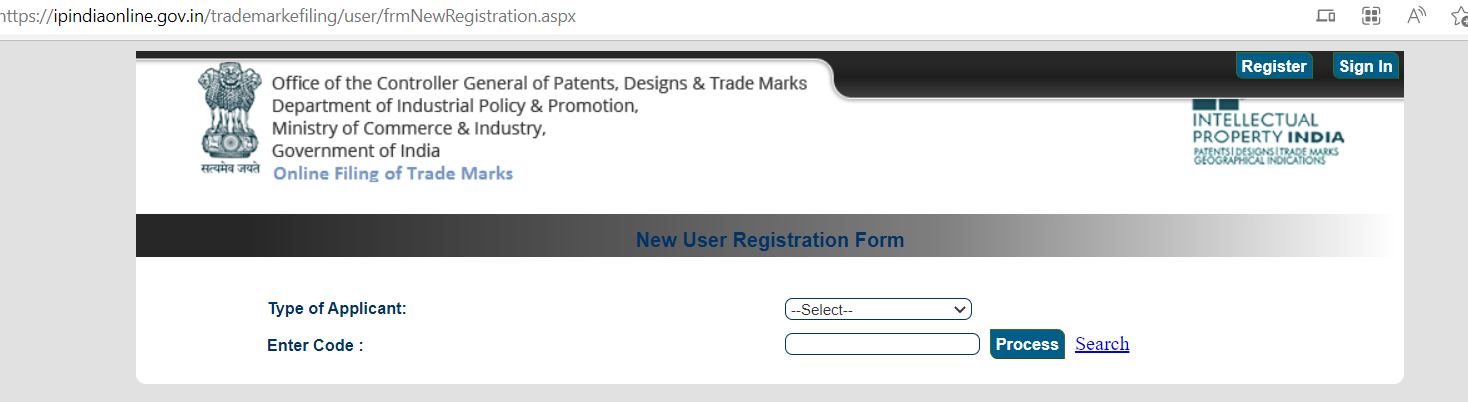
Select the applicant as proprietor, agent, or attorney. If you have a code, enter it or else search for it. 

Step-2

In case you do not have any code, you can click on search and then write the name of the proprietor and click on ‘submit’. 

Step-3

Click on the ‘Add new’ option.

Step-4

Another dialogue box will appear which will ask for certain information. 
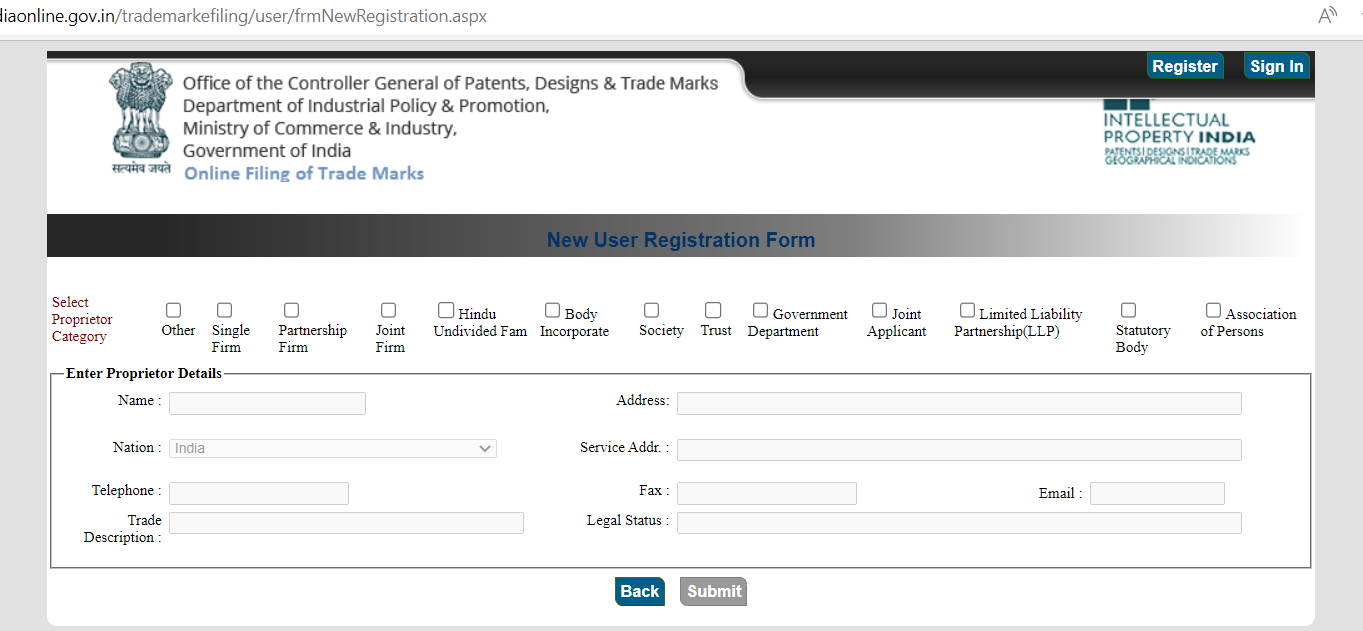
Fill in the details like name, address, nation, phone number, trade description, service address, email, legal status, etc. and click on ‘Submit’.

Step-5
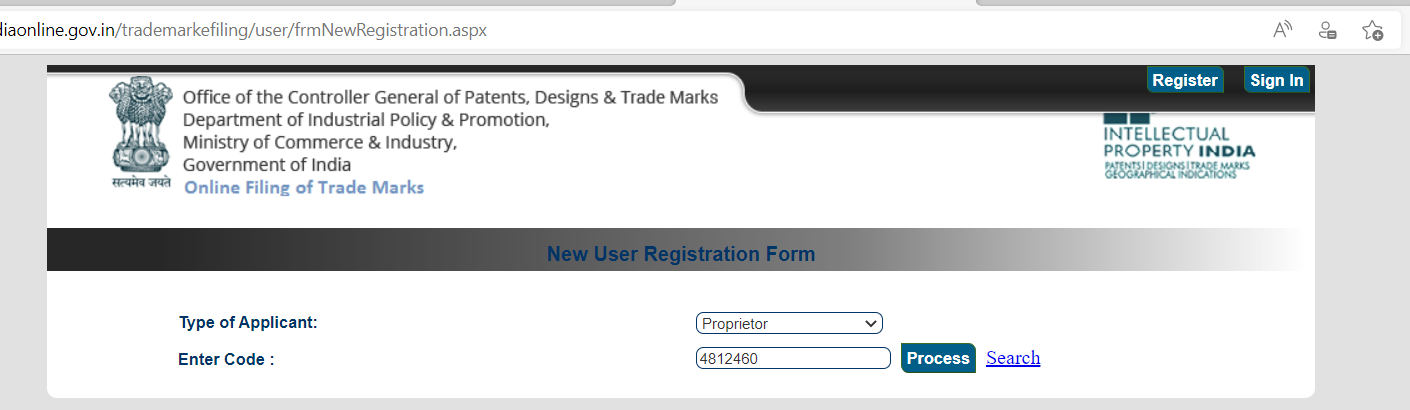
As soon as you submit the details, the portal will give you a code to proceed with the application. This code will help you access your application further. 

Step-6

After you proceed with the code, the portal will ask for a digital signature and user details. Click on the ‘Register’ option after filling in all the required information. Your application will be registered, and then you have to submit the required documents and fee to get your application processed. In this way, you can easily register for a trademark. 

Marks that cannot be registered 

Sections 9 and 11 of the Act provide that a mark will not be registered as a trademark if:

  • It tends to deceive and mislead the public. 
  • A trademark that hurts the religious feelings of the people.
  • A mark which is prohibited under the Emblems and Names (Prevention of Improper Use) Act, 1950.
  • A mark in the form of the shape of goods which is purely functional and gives substantial value to the goods.  

Difference between registered and unregistered trademarks

Point of difference Registered trademarkUnregistered trademark
Meaning It is a trademark which has been registered as per the provisions of Trade Marks Act, 1999.A trademark which is not registered under any law is called an unregistered trademark. 
Act It is governed by the Trademarks Act, 1999. It is governed by the common law of the country.
Duration of trademarkOnce the trademark is registered, it is protected for 10 years and can be renewed. No such duration because it is not registered. 
Burden of proof If the legality of a trademark is challenged, the burden of proof lies on the party challenging it. The burden of proof lies on the owner of the trademark to prove its legality. 
Validity of trademarkIf the trademark is registered, it is the conclusive proof that it is valid. Owner has to prove the validity of the trade mark. 
Symbol A registered trademark can use the symbol ® if it is registered or ™ if the application has been made for registering a trade mark.Unregistered trademarks may  use ™ but not ® . 
ProtectionRegistering a trademark provides legal protection. No protection to unregistered trademarks. 

Advantages of registering a trademark

Legal protection

 The registration of a trademark provides legal protection to the owner of the unique name, symbol, brand, or any picture of the company. If the trademark is copied or used by someone else, then the owner can file a suit against the person or ask for compensation. It also reduces the chances of illegal and unlawful claims in the market.

Rights to the owner 

According to Section 28 of the Act, the owner of a registered trademark has various rights. These are:

  • Exclusive rights to use the trademark and no one else can infringe on this right. 
  • Right to seek remedy in case of infringement of trademark.
  • In case of identical trademarks, the owners do have any right against the mark or other owner having a resembling trademark but have equal rights individually for their own trademark. 
  • A trademark can be assigned to anyone by the owner according to Section 37 of the Act. 
  • If the owner wants to make any changes to the trade mark he can do so by giving an application to the registrar.

Difference in the goods of other companies  

A registered trademark is known to everybody and can be easily recognised by consumers and buyers. This helps them distinguish the product with registered trademarks from other products in the market and further helps in the growth of the business. 

Asset for the company

A trademark serves the purpose of being an asset to the company. Since it is a kind of intellectual property, it can be sold, contracted, or given as a franchise. It also helps the business or company in gaining popularity for its product by advertisement or brand name.  

Builds trust and promotes the product

If the trademark is registered, it is presumed that the company is not a sham or cloak. Thus, it helps in building trust in the market as a result of which the product is promoted. It also acts as a catalyst to attract consumers. 

Global recognition 

Since a trademark is registered for 10 years, it gives an opportunity to expand the business or product in international markets globally. It can be enforced against other similar trademarks and thus eliminate unfair competition from the market. 

Cost-effective 

The process of trademark registration is cheap in India. So the owners can invest their money in building the brand name and promoting the products in the market. One can easily register a trademark and take the benefits arising from it. 

Conclusion 

A trademark is a form of intellectual property and so has to be protected. It is a unique and distinct name or symbol possessed by every company. It helps in the smooth running of businesses as it prevents unnecessary confusion in the minds of the public. In order to take advantage of the trademark, it has to be registered as per the Act of 1999. The article provides the procedure to register a trademark online, which can be done with the help of any online consultancy. This will save time and money for the applicant as the cost of registering the trademark online is much cheaper than registering it manually. With the advancement of technology, everything has moved to an online mode. Thus, it is necessary to safeguard the owners and proprietors from problems that arise because of the e-filing of applications and the registration of trademarks, if any. 

Frequently Asked Questions (FAQs)

Who can file an application for the registration of a trademark?

Any individual, sole proprietor, company, or LLP can apply for the registration of a trademark. They can also apply through their agents and legal representatives. 

What are registered and unregistered trademarks?

Registered trademarks are trademarks that are registered under the Act and provide rights to the owner to use the mark exclusively for the goods or services of his/her company for which it has been registered. These trademarks are recognised, and no one can copy them or use them illegally. Unregistered trademarks are not registered, and there is no legal protection or recognition. 

What are the grounds for refusal for the application for registration of a trademark?

There are 2 types of grounds for refusal. These are:

  • Absolute grounds 
  • Relative grounds 

Absolute grounds – Section 9 talks about such grounds. These are:

  • Trademarks lacking any distinctive character. 
  • Marks indicating quality or any other description of goods or services. 
  • Marks that have become customary or common. 

Relative grounds – Section 11 provides such grounds. These are:

  • Marks that are identical and similar to any existing trademark, along with similarity in goods and services. 
  • Marks that are similar and identical to the existing trademark but the goods or services are different. 

References 


Students of Lawsikho courses regularly produce writing assignments and work on practical exercises as a part of their coursework and develop themselves in real-life practical skills.

LawSikho has created a telegram group for exchanging legal knowledge, referrals, and various opportunities. You can click on this link and join:

https://t.me/lawyerscommunity

Follow us on Instagram and subscribe to our YouTube channel for more amazing legal content.

Download Now

Section 107 CrPC

0

This article is written by Shiwangi Singh, a law student at Banasthali University. This article gives detailed information on various aspects of Section 107 CrPC which gives power to the executive wing of the government to pass orders. Being preventive in nature, it regulates public tranquillity and prohibits a person from committing any wrongful act.

It has been published by Rachit Garg.

Introduction

The Code of Criminal Procedure was enacted in 1973 and came into force on April 1, 1974. The criminal procedure gives a detailed structure for conducting trials in a criminal case. It deals with the procedure for registering a complaint, conducting a trial, passing an order, and filing an appeal against any order.

The main objective of this code is to give a fair chance to the accused person to conduct a fair trial according to the principle of natural justice. This code’s detailed structure regulates the various procedures of arresting an accused or investigating any criminal case. It lay downs the procedure to hold a trial for any criminal offence committed in a court of law.

This code contains 484 sections under 37 chapters. The criminal procedure code applies to India and regulates criminal law in India. It is a body of law that determines the procedure for deciding whether a person is guilty or innocent and collects evidence regarding that.

Section 107 of CrPC authorises a Magistrate, in case of emergency when breach of peace is imminent, to order the accused person to agree to a bond which asks him to maintain peace for the prescribed period of time as the Judge thinks would fit.

Section 107 CrPC

Chapter VIII of the Criminal Procedure Code contains Section 107, which talks about the security for keeping the peace and for good behaviour. The main aim of the provisions mentioned in this section is to prevent any kind of wrong act or breach of peace from occurring. This chapter is preventive in nature and scope. It is mainly focused on a person who is a danger to the public because of a certain offence they are likely to cause. The Executive Magistrate holds a strong power of jurisdiction by getting a person to agree to execute a bond of peace.

The gist of this chapter is the prevention of crimes and disturbances that might breach public peace, these provisions are not for the acts that are done openly but regarding an act that has the potential to cause danger to the peace of society. The provisions are essentially in the interest of the general public and follow clauses (2), (3), (4), and (5) of Article 19 of the Constitution of India. Section 107 gives the power to the Executive Magistrate to order a bond with the person before an offence is committed. The accused person is taken to detention only if he fails to execute and abide by the bond that is ordered by the magistrate.

In the essence of chapter VIII of the code, here security refers to furnishing guarantee to the satisfaction of the court, which is exactly the purpose of Section 107, where the court orders that a certain conduct is mandatory to be maintained for a certain period by a certain person concerning a certain thing.

Provisions of Section 107 CrPC

  • Section 107(1) – When an Executive Magistrate gets information from a trustable source about a person who is suspected to breach the peace of the public, disturbing public tranquility, causing danger to public harmony, or committing any sort of wrongful act, then on sufficient ground and evidence, the magistrate can call upon that person and then he would be asked the reasons of why he should not be compelled to agree with the bond (with or without surety) for maintaining peace for a required period of time of not more than a year, but for a time period said by the magistrate as he thinks would fit for the current prevailing situation in his jurisdiction.
    • Here surety means that the accused would be appointed with a person of his choice who would take his legal responsibility in case he fails to execute the bond. For example – if a person fails to pay a fine then the person who was appointed as his surety will have to pay the amount in his place.
  • Section 107(2) – The proceedings for such person can be taken before any Executive Magistrate who has jurisdiction over the place where the breach of peace or disturbance is likely to occur or the person who is accused of committing a wrongful act of causing the breach of peace, disturbing public tranquility falls under his jurisdiction.

This section mainly gives the executive wing the power to apprehend a person if he is likely to disturb the peace and public tranquility but not for more than a year.

Objective of Section 107 CrPC

  • The nature of the proceedings under section 107 is preventive justice. Whenever an offence is committed by a person which is substantive and has actually taken place then that person is prosecuted legally by obeying suitable laws and orders, in this case, Section 107 is not applied as the offence has already been committed and now there’s nothing to prevent.
  • Before taking any action against the accused person, the magistrate shall be satisfied that there are appropriate and important reasons for taking action against that person before he breaches the peace and the magistrate shall record reasons for his satisfaction.
  • A person can be taken under action if he is likely to – 
  • Commit a breach of the peace;
  • Disturb public tranquility;
  • Has the potential to commit a wrongful act that might disturb public peace.
  • The powers under this section are specifically vested in the hands of the Executive Magistrate, who is a part of the executive wing of the government and not the judiciary.
  • Two things are necessary for a judge to look into before he issues a warrant against the accused person – 
  • The information must be laid before a magistrate.
  • The magistrate shall be satisfied with the reasons and should get an ample amount of evidence and then proceed with the case. The source of information can be anyone, it is not necessary that it should have come from the police but the source shall be reliable and trustworthy for the judge.
  • A bond is asked to be executed by the accused person for “keeping peace”. The Magistrate has no power to ask for the execution of a bond for maintaining good behaviour, if the judge does that he is contravening this section.

Jurisdiction of the Executive Magistrate under Section 107 CrPC

An Executive Magistrate has the authority to take up a case under section 107, only if – 

  • The accused person or the place where the disturbance is likely to happen falls under his jurisdiction.
  • A person who ordinarily resides within jurisdiction can be called upon by the Executive Magistrate under Section 107 even if the accused person is temporarily absent. Even a temporary residence is enough.
  • Two opposing parties of hostile groups cannot be proceeded against and bound over in one and the same proceeding under Section 107. Such an order will spoil the gist of law and would be eventually quashed by the judge.
  • If a person is on trial under Sections 107-116 of CrPC, and his proceeding is still pending then a second set of proceedings cannot be initiated against him. In Rajendra Singh v. State of UP 1993, the Allahabad court quashed the second set of proceedings holding that successive proceedings during the pendency of earlier ones would only amount to harassment.

Nature of information received by the Magistrate

  • The information must be clear and definite, closely associated with the person against whom the process is issued, and should disclose tangible facts and details, that could also convince the accused person on what grounds he has been brought before the court.
  • There must be satisfactory evidence that the person has done something or taken some steps that indicate an intention to break the peace or that he is likely to disturb the public tranquility.
  • To pass an order under section 107, the past acts of the person will not hold great relevance, there shall be evidence regarding a breach of peace that might occur in near future.

Power of Police Department in cases regarding Section 107 CrPC

  • Section 107 does not vest any power in the hands of the Police to arrest.
  • The Police department has no power to arrest the accused or register an FIR under section 107 and 145 of CrPC. Registering cases under the said sections will be considered unsustainable and illegal.

Circumstances under which a Magistrate can drop the proceedings

  • A Magistrate has the power to drop the proceeding initiated under this section at any stage, even if an order is passed under section 111 or before an inquiry under section 116.
  • If the magistrate receives fresh materials implying that there is no possibility of peace getting breached.
  • If the material on record discloses that though there was a danger of breach of the peace at one time but subsequently, the threat has disappeared then the court can drop the proceedings and discharge the person proceeded against.
  • He can also drop the proceedings if the evidence presented was found in old records and not regarding the present circumstances.
  • If the inquiry conducted against that person gives no correct evidence against the person then the person called to execute the bond will be considered illegal.
  • If the reports of the police make no substantial proof regarding the breach that might happen, would also lead to the drop of the proceeding against that person.
  • If an order is passed without inquiry and recording evidence, the allegations would be considered not valid.
  • A person cannot be compelled to execute the bond without proper inquiry and recording of evidence, one cannot be asked to carry out the bond without giving him a chance to prove why he is not liable to execute the bond. If it happens it would be against the principles of natural justice and fairness.

The Magistrate must supply the copies of incriminating material relied upon by him to the person against whom proceedings are initiated.

Relevant Case Laws

  1. In Madhu Limaye and Anr. v. SDM Monghyr and Ors. 1971, the Supreme Court explained the terms public tranquility and public order so that there exists no ground for confusion; the court held that public tranquility and public order partially overlap each other. While a person playing loud music might disturb public tranquility but not public order.
  2. In M.V Santosh v. State of Kerala, 2014, the court held that “the breach of peace must be imminent to justify action under Section 107. The information about past conduct or wrongful acts of the past must not be remote or isolated, must be relatable to the present apprehension in the sense that it must have some relevance to the apprehension of likelihood of breach of peace or disturbance of public tranquility”.

Section 107 of CrPC gives the power to the executive wing of the government to regulate and keep a check on public peace. However, no one can be illegally called upon to execute the bond without any substantial evidence for keeping the peace. The Police also have no power to detain a person under this section but can only inquire with their team to collect and record the evidence that could be presented before the Executive Magistrate.

Conclusion

Section 107 defines the circumstances under which a person maybe called upon to furnish security to keep the peace. There are several situations that occur where we can’t arrest someone but can make someone follow the law and order in an alternate way. This alternate way is provided by Section 107 of CrPC. The proceedings under Section 107 are not penal in nature and are only preventive.

Frequently Asked Questions

  1. Which magistrate has the power to give judgments on cases under  Section 107 of CrPC?

The Executive Magistrate has the power to give judgments on cases under Section 107 of CrPC.

  1. The maximum period for which security for keeping peace can be asked for?

It could be asked for one year. The period of one year starts from the date on which the magistrate takes into awareness and starts the proceeding under section 107. The inquiry under this section shall be completed within six months from the date of commencement.

References


Students of Lawsikho courses regularly produce writing assignments and work on practical exercises as a part of their coursework and develop themselves in real-life practical skills.

LawSikho has created a telegram group for exchanging legal knowledge, referrals, and various opportunities. You can click on this link and join:

https://t.me/lawyerscommunity

Follow us on Instagram and subscribe to our YouTube channel for more amazing legal content.

Download Now

Criminal Law (Amendment) Act, 2013

0

This article is written by Pragya Agrahari of Amity Law School, Lucknow. This article provides a detailed analysis of the changes made by the Criminal Law (Amendment) Act, 2013 in various statutes, the reasons behind the amendment and its criticism. 

It has been published by Rachit Garg.

Table of Contents

Introduction

On the cold night of December 16, 2012, a 23-year-old medical student was brutally gang-raped in a moving bus and was thrown in an unconscious state in the middle of the road. This incident shook the whole nation and led to widespread rage and protests from all over the country. It prompted the government to rethink the efficiency of the current legal safeguards provided for the protection of women. In order to review the laws related to sexual offences and to give recommendations for improving the current regime, the government instituted the Committee headed by Justice J.S. Verma. The Committee laid the foundation of the Criminal Law (Amendment) Act, 2013, which received the assent of the President on 2nd April, 2013. This Act amends four laws, namely, the Indian Penal Code 1860, the Code of Criminal Procedure 1973, the Evidence Act 1860, and the Protection of Children from Sexual Offences Act, 2012.

Reason behind the Criminal Law (Amendment) Act, 2013 

Nirbhaya Case [Mukesh and Anr v. State (NCT of Delhi) and Ors]  

Facts of the case

This case is famously known as the Nirbhaya case. On 16 December 2012, a 23-year-old woman, a medical student, was gang raped by six men on the bus. She had boarded with a male friend on the way home. The six men included a driver and a juvenile. Firstly, the men started abusing them, passing obscene remarks, and then they assaulted her male friend and dragged her to the back of the bus to commit rape. She was brutally beaten and raped, and the perpetrators inserted a rod into her body and then, both of them were thrown naked in the middle of the highway. On 29th December 2012, the woman, named Nirbhaya, succumbed to her injuries in a hospital in Singapore due to multiple organ failure, internal bleeding, and cardiac arrest. The Hon’ble Justice Dipak Misra has described this story as “from a different world where humanity has been treated with irreverence.”

Charges framed on the accused

The following charges were framed against the perpetrators:

  1. Section 120-B IPC: Punishment for criminal conspiracy 
  2. Section 365, 366 IPC: Kidnapping or abducting 
  3. Section 307: Attempt to murder 
  4. Section 376 (2)(g) before the amendment, and Section 377 IPC: gang rape, unnatural offences
  5. Section 395, 396 IPC: Punishment for dacoity, dacoity with murder    
  6. Section 302 IPC: Punishment for murder   
  7. Section 201 IPC: Causing disappearance of evidence of an offence or giving false information  
  8. Section 412 IPC: Dishonestly receiving property stolen in the commission of dacoity 

Judgement

The Court, in its judgement, convicted four of the six accused of the said charges. The convicts were sentenced to the death penalty. The proceedings were abated against the accused, Ram Singh, who committed suicide during the trial. The juvenile involved in the case was tried separately under the Juvenile Justice Board and was convicted and sent to a reformation home for three years. The Supreme Court upheld the death sentence confirmed by the High Court as the aggravating factors in the case outweighed the mitigating factors. Moreover, all the appeals of the accused were dismissed by the court. The Court held this case in the category of “the rare of the rarest,” a doctrine established in the case of Bacchan v. State of Punjab (1980), keeping in view the gravity and heinousness of the way in which the crime was committed.  

Justice Verma Committee

After this incident, the government instituted the Committee headed by Justice J.S. Verma to look into the needed amendments in the criminal law to make laws providing for the protection of women more stringent and to add various aspects that were required considering the rise in the number of cases of crimes committed against women. It was constituted on 23rd December 2012 and committed to submitting the Committee Report in 30 days, in view of the urgency and promptness that the Nirbhaya case demands. The basic purpose of this Committee was to recommend amendments in the criminal law to provide speedy trials in cases, especially crimes against women.  

Key recommendations of the Justice Verma Committee

  1. It opined on life imprisonment for the offence of rape and rejected the death penalty as a punishment for rape in the view that it fails to have a deterrent effect on society.
  2. It is recommended to expand the scope of criminal law to include sexual assault on men and homosexual, transgender or transsexual rape.
  3. It also advocates for the removal of the Section from the law which legalises “marital rape”.    
  4. The offence of “sexual assault” should include all forms of non-consensual or non-penetrative sexual activity.
  5. The Committee also recommends the Sexual Harassment of Women at Workplace (Prevention, Prohibition and Redressal) Act, 2013 which was a Bill pending before the parliament at that time.
  6. It opined to make the offence of “acid attack” a separate offence, which was earlier punishable under the offence of “grievous hurt”.
  7. It has also recommended some reformation in the medical examination of the rape victim as it recommends discontinuation of the two-finger test. 
  8. It also suggested the setting up of a Rape Crisis Cell to provide legal assistance to rape victims. 
  9. The police are duty bound to register rape complaints and to report any rape case that comes to their knowledge. If they fail to perform their duty, they must be held liable for punishment according to the provisions of the Act.
  10. The Committee also recommends conducting literacy programmes for the children to impart sex education to them.   
  11. It also suggested some electoral reforms under the Representation of the People Act, 1951, and opined that candidates should be disqualified if one is facing criminal charges for sexual offences.

Key changes made after the Criminal Law (Amendment) Act, 2013

Indian Penal Code, 1860    

The various provisions added or amended in the Indian Penal Code after the Criminal Amendment 2013 are-

Acid attack

These provisions were added to the Code as a consequence of the case of Laxmi v. Union of India (2015), in which a sixteen-year-old girl was attacked with acid. After this incident, the need for stringent provisions to counter the said offence was realised.

  1. Under Section 100, a ground was added in the general exception of the “right to private defence”, that is, an act of throwing acid or an attempt to throw acid. It means a person can now use the right to private defence in the case of an acid attack.
  2. New provisions, namely, Section 326A and Section 326B, were inserted. Section 326A makes the offence of “acid attack” punishable by a minimum of 10 years imprisonment extending to life imprisonment and a fine, whereas 326B makes the attempt to throw acid an offence punishable by a minimum of 5 years extending to 7 years imprisonment and a fine. 

Sexual offences

This Amendment inserted four other sexual offences in view of the rising statistics of sexual harassment cases in the country. These are-

  1. Sexual Harassment (Section 354A)  

This Section includes acts like making physical contact, demanding sexual favours, and showing pornography to a woman by a man. For these offences, a man can be punished with rigorous imprisonment, which may extend to 3 years. It also covers the offence of making sexually-coloured remarks to a woman, for which there is imprisonment which may extend to one year. 

  1. Assault or criminal force with intent to disrobe women (Section 354B) 

This Section makes an act of assaulting or threatening a woman using criminal force to disrobe her or forcing her to be naked punishable by a minimum imprisonment of 3 years, which may extend to 7 years, and a fine. 

  1. Voyeurism (Section 354C) 

The word “voyeurism” literally means “an act of gaining pleasure from watching others naked or engaged in sexual activity.” This Section makes any such acts committed by a man, punishable by a minimum of 1-year imprisonment, which may extend to 3 years, and a fine. It can also include the act of watching or taking photos of a woman when they are engaged in private activity. If a man is convicted of the same offence more than once, he shall be punishable with a minimum of 3 years of imprisonment, which may extend to 7 years.  

  1. Stalking (Section 354D)      

This Section includes the act of following or attempting to make contact with a woman who has already shown disinterest in a man or monitoring her use of the internet, email or other electronic communication means. This conduct by any man will be punishable by imprisonment which may extend to 3 years, and for repeated offenders, the punishment will be imprisonment which may extend to 5 years and a fine.  

There are some exceptions to this offence; that is, these acts will not amount to “stalking” if the man proves his act for the following reasons-

  1. If the man was entrusted with preventing or detecting the crime by the State,
  2. If the man has done such acts under any law or while complying with any condition under any law,
  3. If it was reasonable and justified.

Rape

This Criminal Law (Amendment) Act, 2013 widens the ambit of the offence of “rape” so as to provide harsher punishments for the more grievous acts. It also enlarged the provision to cover certain non-penetrative acts like oral sex and inserting any object or any other part of the body into a woman’s body as an offence under the definition of “rape” under Section 375. Although under Section 376, the punishment for the offence of “rape” has not been enhanced, after the Criminal Law Amendment Act 2018, it was later increased to a minimum of 10 years imprisonment, which may extend to life imprisonment. However, this Amendment of 2013 has added provisions and enhanced punishment for more grievous forms of rape like-  

SectionOffencePunishment
Section 376ACausing death or resulting in a persistent vegetative state of the womanRigorous imprisonment for a minimum of 20 years which may extend to life imprisonment till the remainder of the person’s life or death sentence.
Section 376BSexual intercourse by the husband during separationImprisonment for a minimum of 2 years which may extend to 7 years and a fine.
Section 376CSexual intercourse by a person in authority (fiduciary relationship, public servant, jail authorities, institutions for women and children, or hospital authorities)Rigorous imprisonment for a minimum of 5 years which may extend to 10 years and a fine.  
Section 376DGang rapeRigorous imprisonment for a minimum of 20 years, which may extend to life imprisonment till the remainder of a person’s life.
Section 376ERepeat offendersLife imprisonment till the remainder of a person’s life or death sentence.

Provisions for the authorities

Section 166A and Section 166B were inserted after the amendment to make the authorities, like public servants or hospital authorities, liable if they failed to discharge their duties against the victims of the crime. 

  1. Section 166A holds any public servant liable if they failed to obey the directions of law or to conduct an investigation wherever it necessitates or especially if failed to register an FIR in cases of sexual offences under Section 154 of the Code of Criminal Procedure. Any such public servant would be liable for the punishment of imprisonment for a minimum of six months which may extend to 2 years and a fine.   
  2. Section 166B similarly, holds the hospital management or staff liable if they failed to provide proper treatment free of cost, including first aid, to the victim of the cases of sexual offences, as provided under Section 357C of the Code of Criminal Procedure. It was irrelevant whether the hospital was a private or public hospital. Any such contravention would be punished with imprisonment, which may extend to 1 year or a fine or both.  

Code of Criminal Procedure, 1973

The Criminal Law Amendment Act 2013 has made changes to the Code of Criminal Procedure, 1973 so as to provide a congenial atmosphere for women while conducting investigations,  trials, and examinations and to adapt new provisions inserted in the Indian Penal Code in the First Schedule of the Code of Criminal Procedure. Some key changes made in the Code are as follows-

Relief measures for the victims of sexual offences

  1. Section 154, Section 161, and Section 164: Section 154 and Section 161 were amended to include the provision which requires the recording of the statements of the victim to be done by only a female police officer. In addition, Section 154 also provides that if the victim is mentally or physically disabled, then for the comfortability of the victim, the recording of statements should be done at their residence or any other convenient place in the presence of an interpreter or special educator, and that the recording should be videotaped. Section 164 also added the provision for the assistance of an interpreter or special educator and videography of the statements. Moreover, it also held the statements under Section 164 to be considered as statements in lieu of examination-in-chief that can be cross-examined at the time of trial.  
  2. Section 273: It was amended to include the provision which requires the court to take appropriate measures so that women under the age of 16 years and victims of rape or sexual offences should not be confronted by the accused while assuring the right of cross-examination to the accused.
  3. Section 357C: It added the provision which requires hospitals, whether public or private, to provide treatment, free of cost, to the victims of sexual offences and to inform about the case to the police authorities immediately.   

Measures taken to make the provisions more stringent

  1. Section 197: This Section requires sanction from the government to prosecute judges, magistrates, or public servants  who are accused of any offences which they have committed in the discharge of their official duty. This Amendment adds ‘explanation’ in this Section stating that in cases of sexual offences, no previous sanction is required to be taken from the respective governments for the prosecution of public servants, magistrates and judges. 
  2. Section 309: Clause(1) was amended for this Section to include the provision which requires that all the proceedings related to inquiry or trial should be completed within a period of 2 months from the date of the charge sheet, in the cases of sexual offences. 

Indian Evidence Act, 1872

The important provisions which were added or substituted in the Act after the Amendment are as follows-

Exclusion of previous sexual experiences in evidence

Section 53A was added in the Act which declares that during prosecution for sexual offences, the character of the person or the previous sexual experiences of the victim is irrelevant as the evidence for the consent or quality of the consent of the victim. 

Presumption of the absence of consent  

Section 114A was added in the Act, which states that it was sufficient for the victim of the sexual offences to state before the court in her evidence that she had not consented to the sexual intercourse so as to presume the absence of consent in the case.  

Nature of the questions asked in cross-examination

Section 146 of the Act was amended to include the provision which states that no questions can be asked from the victims of sexual offences during cross-examination which are immoral in nature or which are related to previous sexual experiences of the victim so as to prove the consent or test the quality of the consent by the victim. 

Provision for the dumb witnesses

Under Section 119, the witnesses who are unable to communicate verbally can give their statements in other ways, by writing, by signs, etc., which shall be deemed as oral evidence, and such witnesses should provide the assistance of an interpreter or special educator, and such statements shall be videotaped.    

Protection of Children from Sexual Offences Act, 2012

Section 42 of this Act was amended in order to declare that if the offence was committed under the POCSO Act and the same offence is also punishable under provisions related to sexual offences in the Indian Penal Code, the offender shall be given the punishment under this Act or the Indian Penal Code, which provides graver punishment for such an offence.   

Points of difference between the recommendations of the Committee and the changes made under the Criminal Law (Amendment) Act, 2013

  1. The Committee does not recommend the punishment of a “death sentence” for the culprits of sexual offences like rape, gang rape, etc., as in their view, it has failed to have a deterrent effect on society. Whereas the Act provided the punishment of “death sentence” in serious forms of rape like causing the death of the victim or causing the victim to fall into a vegetative state and for repeat offenders.
  2. The Committee recommended the criminalisation of “marital rape”, that is, sexual intercourse by the husband with the wife without her consent. But the Criminal Law Amendment Act of 2013 does not criminalise it.
  3. The Criminal Law (Amendment) Act, 2013 rejects the proposal of the Committee which prescribes that candidates facing charges for sexual offences should be barred from contesting elections.
  4. The Committee has also recommended that the senior officials of the police and army should be held liable for the sexual offences committed by their juniors, which was also rejected by the Criminal Law (Amendment) Act, 2013.
  5. The Committee advised making provisions for sexual assaults committed against males, transgenders or homosexuals, but it was not included in the Amendment Act.

Criticisms of the Amendment

Not a gender-neutral law

In view of the recent cases of sexual assaults committed against males, transgenders or homosexuals, the Committee calls for the inclusion of the provisions which would provide relief to such victims. But this recommendation was rejected. The criminal law was criticised for being women-centric only. It left out such crimes committed against communities other than women. The current law sees only men as culprits and only women as victims, but the current scenario was different. According to one report released by the Ministry of Justice in the UK, of 473,000 adults being victims of sexual offences on average per year, around 404,000 are females and 72,000 are males. Despite these trends, this Amendment fails to provide gender-neutrality in the provisions of the respective laws.  

Non-inclusion of provisions for marital rape

This Amendment was also criticised for not criminalizing “marital rape”, even after the recommendation from the Committee to do so. Section 375 carries an exception which states that sexual intercourse by a husband with his wife, not below 15 years of age, is not rape. The consequence of this provision is that it saves any man who forces his wife into sexual intercourse without her consent from liability. Therefore, many jurists call for striking down this exception, and this Amendment fails to do so. 

In his verdict on the question of marital rape, Justice Shakdhar (Delhi High Court) argues that “the fact that the rapist is the husband of the victim does not make the act of sexual assault any less injurious, degrading or dehumanising. Irrespective of who the perpetrator is, forced sex mars the woman-victim physically, psychologically, and emotionally.”  

Non-debarment of politicians charged with sexual offences  

The recommendation provided by the Committee includes the provision to debar candidates accused of sexual offences from contesting elections under the Representation of People Act, 1951, but the Criminal Law (Amendment) Act, 2013 does not provide such provisions. The recent data from the affidavits of the candidates contesting elections in the states of Uttarakhand, Punjab and Goa shows various candidates charged with serious offences. In Punjab, two were accused of rape cases and five were accused of outraging the modesty of women. In Uttarakhand, one was accused of rape and four were accused of outraging the modesty of a woman. Similarly, in the state of Goa, one was declared a rape case and five were found to have outraged the modesty of women. Despite these facts, the Amendment Act overlooked the impact of such trends on society as a whole.   

Other amendments to Criminal Law   

Criminal Law (Amendment) Act, 2018

This Amendment further makes the laws stricter in their nature and adds some more provisions in the criminal laws which were needed in view of the recent cases. Some provisions added to the Indian Penal Code are as follows-

Section 376AB
Rape of a girl under the age of 12 years Rigorous imprisonment for a minimum of 20 years which may extend to life imprisonment till the remainder of a person’s life or death sentence. 
Section 376DAGang rape of a girl under the age of 16 years Life imprisonment till the remainder of a person’s life and a fine.
Section 376DBGang rape of a girl under the age of 12 years  Life imprisonment till the remainder of a person’s life and a fine or death sentence.

In addition to that, the most important change brought about by this Amendment was increasing the punishment for the culprits of the offence of rape from a minimum of 7 years imprisonment to a minimum of 10 years imprisonment, which may be extended to life imprisonment and a fine under Section 376.

Conclusion

Once, an Indian philosopher, Swami Vivekananda, stated that “the best thermometer of the progress of a nation is its treatment of its women.” It means the country that provides protection to women from such heinous crimes and creates a congenial environment for women to realise their dreams and aspirations would be considered the most progressive one. It is evident from the fact that developed countries like Spain, Singapore, Norway, and Canada have comparatively much lower rates of crimes against women. On the contrary, India stands as the ninth most dangerous country for women in the world, according to the World Population Review 2022. It reflects the need for some more reformations in the current regime.

The Criminal Amendment Act, 2013, no doubt, emerged as a revolutionary amendment when it came to the protection of women, as it provides various safeguards to women in cases of acid attacks, and sexual offences. But it is not sufficient to put the rising cases of crimes against women to a halt. It needs more amendments to adapt to the gravity and seriousness of the rising rates of crimes committed against women, for example, sexual offences committed by the use of electronic devices. India needs to further revise its various statutes and institutions so as to incorporate these changes and to provide harsher punishments for the offenders and enabling conditions for the victims. Only then can the dream of a better India for women be realised.

Frequently Asked Questions

Which statutes were amended under the Criminal Law (Amendment) Act, 2013?

The Criminal Law (Amendment) Act, 2013 amends four laws, namely-

  1. The Indian Penal Code 1860 
  2. The Code of Criminal Procedure 1973
  3. The Evidence Act 1860
  4. The Protection of Children from Sexual Offences Act, 2012

In the backdrop of which incident was the Criminal Law (Amendment) Act, 2013 enacted? 

The Criminal Law (Amendment) Act, 2013 was enacted in the backdrop of the Nirbhaya Gangrape case, which took place on the night of 16th December 2012 in Delhi.

Who headed the Committee which was formed to look into the needed amendments in the criminal law after the Nirbhaya case?

The Committee headed by Justice J.S. Verma was constituted on 23rd December 2012 to recommend the amendments needed in the criminal law.

What are the provisions added to the Indian Penal Code, 1860 after the Criminal Law Amendment Act 2013?

The major provisions added in the Indian Penal Code, 180 after the Criminal law Amendment Act 2013 were:

  1. Provisions for acid attack- Section 326A and Section 326B,
  2. Provisions for new sexual offences- Section 354A, Section 354B, Section 354C and Section 354D,
  3. Amendments in sections relating to rape- Section 376A, Section 376B, Section 376C, Section 376D, and Section 376E.

What are the major criticisms of the Criminal Law Amendment Act 2013?

The major criticisms of the Criminal Law Amendment Act 2013 are-

  1. Not a gender-neutral law
  2. Non-inclusion of provisions for marital rape
  3. Non-debarment of politicians charged with sexual offences

References 

  1. https://articles.manupatra.com/article-details/Analysis-of-the-Criminal-Amendment-Act-2013 
  2. https://www.iitk.ac.in/wc/data/TheCriminalLaw.pdf 
  3. https://getlegalindia.com/nirbhaya-act/ 
  4. https://prsindia.org/policy/report-summaries/justice-verma-committee-report-summary?search-box=Criminal+amendment+act+2013 
  5. https://vidhiparivartan.co.in/wp-content/uploads/2021/06/Paper-4.pdf 

Students of Lawsikho courses regularly produce writing assignments and work on practical exercises as a part of their coursework and develop themselves in real-life practical skills.

LawSikho has created a telegram group for exchanging legal knowledge, referrals, and various opportunities. You can click on this link and join:

https://t.me/lawyerscommunity

Follow us on Instagram and subscribe to our YouTube channel for more amazing legal content.

Download Now

Section 377 IPC

0
Section 120A

This article has been written by Anindita Deb, a student from Symbiosis Law School, NOIDA. The article aims to exhaustively discuss the provisions under Section 377 of the Indian Penal Code, 1860 which was partially decriminalised in 2018 by the Supreme Court. It also discusses the history of Pride in India and the protests and landmark judgments that upheld the liberty of the LGBTQIA community.

This article has been published by Sneha Mahawar.

Table of Contents

Introduction 

“We should indeed keep calm in the face of difference, and live our lives in a state of inclusion and wonder at the diversity of humanity.”

-George Takei 

The concept of human rights rests on the fundamental idea that all human beings are equal. In an era where revolutions for equality are ongoing all over the globe, penalising one’s sexual choices is an instance of gross injustice. Until 2018, India was also one of those counted countries where homosexuality was criminalised and people of the LGBT (Lesbians, Gays, Bisexuals, Transgenders) community were tortured and abused. Thanks to the landmark judgment delivered by the constitutional bench consisting of remarkable judges like D.Y. Chandrachud, Dipak Mishra, and Indu Malhotra, all consensual sex between adults, including homosexual relations, was decriminalised on September 7, 2018. 

This article will discuss in detail the history of homosexuality in India, the provisions of Section 377 of the Indian Penal Code, 1860, and how they are violative of the fundamental rights of citizens. Further, the landmark judgments that have led to the decriminalisation of the section have also been analysed to give the readers an in-depth understanding of the timeline of the LGBT rights revolution in India. 

Historical proof of homosexuality in India  

Contrary to popular belief, historians and mythology experts believe that homosexuality was part of the ancient Indian culture and that the decriminalisation of Section 377 has taken India back to its cultural roots, to a time when love was accepted and celebrated in all its forms. There is a plethora of historical evidence\ regarding the existence of homosexuality in India in ancient times, ranging from Hindu Scriptures to Muslim literature, and who can forget the graphic evidence on magnificent ancient structures like the temples of Khajuraho! Let’s take you through some of the examples, shall we?

Recognition of homosexual unions in the Vedic system 

In his book “Tritiya-Prakriti: People of the Third Sex,” the author Amara Das Wilhelm reports the summary of years of in-depth study of Sanskrit texts from mediaeval and ancient India, which prove that homosexuals and the ‘third gender’ were not only present in Indian society at the time but were also widely accepted.

Lesbians were referred to as “Swarinis” in the book, which quotes from the “Purushayita” Chapter of the renowned ancient Hindu literature- the Kama Sutra. These women frequently got wedded to other women and had children. Additionally, they were easily accepted by both the ‘third gender’ community and mainstream society. The book also made reference to gay men, also known as “Klibas,” who, while they might also be referred to as impotent men, mostly represented men who were impotent with women because of their ‘homosexual tendencies.’

Proof of homosexuality in the Hindu scriptures 

Gender fluidity for humans and yakshas is a recognized idea in ancient India. Queerness can also be seen in ancient epics and scriptures, as well as prose, poetry, art, and architecture in the middle ages. 

Proof in Ramayana 

According to Valmiki’s Ramayana, as Lord Hanuman returned from Lanka after visiting Goddess Sita, he witnessed rakshasa women kissing and caressing each other. Now, there are so many people who firmly believe that Ramayana is not fiction and it is part of India’s rich culture.

Krittivasa Ramayana depicts a King born of two women 

According to the text, King Dilip had two wives and died without leaving an heir. Following this, Lord Shiva appeared in the queens’ dreams and told them that if they made love to each other, they would be blessed with a child. The widowed queens obeyed, and one of them became pregnant, giving birth to King Bhagiratha. He is a well-known king who is credited with bringing the Ganga from heaven to earth.

An intriguing trans story in the Mahabharata 

The story of Shikhandini, famously known as Shikandi, who was responsible for Bhishma’s death, is told in the Mahabharata. She was born as King Drupad’s daughter but raised as a man. She used the assistance of a yaksha to transform into a man later in her life in order to enter Kurukshetra and defeat Bhishma. 

The story behind the birth of Lord Ayappa 

One must be aware of who Lord Ayappa is after the famous Sabarimala case, but did you know how he was born? It is believed that Lord Ayappa was born out of a union between Lord Shiva and Lord Vishnu. 

In the Matsya Purana, Lord Vishnu transforms into a beautiful woman named ‘Mohini.’ He intended to trick the demons into drinking all of the ‘Amrit’ (holy water). Lord Shiva was also infatuated with Mohini after seeing her, and their union resulted in the birth of Lord Ayappa.

Proof in Muslim literature 

Babur, the founder of the Mughal empire, also seemed to have a sexual attraction towards the same sex. In his memoir, Baburnama, Babur expresses his feelings for a boy named Baburi in Kabul. 

Certain Sufi poems contain homoerotic or same-sex references. A Sufi Saint, Shah Hussain expresses his love for a Hindu boy named Madho Lal through his literature. In the end, Shah Hussain and Madho Lal were buried together in Lahore. In several texts, their ashes represent divine love that lasted beyond their lives.

Visual and graphic proofs in Khajuraho 

It’s impossible to discuss homosexuality in ancient India without mentioning one of its most constructive and visible proofs. The carvings in Madhya Pradesh’s Khajuraho temple are renowned for their observable homosexual imagery. The temple is widely assumed to be built around the 12th century.

The sculptures embedded in the Khajuraho temple appear to depict sexual fluidity between men and women. There have even been all-female orgies.

While the sculptures depict ‘accepted’ sexual relationships between male and female entities, they are best known for demonstrating the existence of intimacy between members of the same sex.

Sections 377 IPC 

As has been stated, Section 377 of the Indian Penal Code contains provisions relating to unnatural offences. It was considered one of the most ‘draconian’ provisions in the Indian legal system back in the time when sexual intercourse between individuals of the same sex was also considered a criminal activity. 

According to Section 377, whoever voluntarily engages in carnal intercourse against the order of nature with any man, woman, or animal shall be punished with life imprisonment or imprisonment of either description for a term not exceeding ten years, and shall also be charged with a fine. It is important to note that the term “against the order of nature” has not been defined in any source of law. Hence, deciding on the sexual choices of people was a clear violation of the fundamental rights of people belonging to the LGBTQIA+ community. Furthermore, even though same-sex relationships have been decriminalised, crimes like bestiality (sexual intercourse with animals) and child abuse are still punishable under this Section. 

Nature of Section 377 IPC

Section 377 is considered a serious offence, hence, it is cognizable and non-bailable in nature. It can be tried in the court of a magistrate of first class. 

Constitutional validity of Section 377 IPC

The Constitution of India guarantees its citizens fundamental rights that are an essential feature of every democracy across the globe. India being one of the fastest developing democracies, enforcement of laws in the country that restricted the sexual choices of people, which are purely personal in nature, and an indispensable part of one’s autonomy over their body and freedom of expression, was a serious infringement on the fundamental rights of Indian citizens. Penalising sexual intercourse between individuals belonging to the same sex was a prima facie infringement of the rights enshrined in Articles 14, 15, 19, and 21 of the Indian Constitution. 

Section 377 not only denied equality in the eyes of law and freedom of expression to the queer community, but also subjected them to discrimination within society. Additionally, the right of a person to his or her body, enshrined under Article 21, was also clearly infringed upon. As a result, a catena of judgments have been passed regarding the constitutionality of Section 377, resulting from a plethora of petitions filed in high courts across the country. The four landmark judgments which have dealt with the constitutionality of this law have been discussed in detail later in this article. 

History of Pride Movement in India 

The onset of the LGBTQ struggle in India can be traced back to the early 1990s. Even after India gained its independence, the LGBTQ people were struggling for their entitlement to the same rights as heterosexual couples. The cruel impact of the law left behind by the British was gaining its roots and was subjecting the queer community to human rights violations. 

If one follows the movement’s history, the first known protest for gay rights took place on August 11, 1992, 45 years post India’s independence. The AIDS Bhedbhav Virodhi Andolan (ABVA), a known organisation at the time, planned the protest in front of Delhi police headquarters by blocking its entrance to protest the arrest of men from Connaught Place’s Central Park on suspicion of homosexuality. The protest did not lead to anything. 

In 1991, the ABVA also released a report titled “less than gay”, which was a citizen’s profiling of the discrimination faced by the LGBT community in India. 

In 1994, a medical team arrived at Tihar Jail to investigate a greater incidence of sodomy reported from the quarters. ABVA activists wanted to give contraceptives to prisoners, but Kiran Bedi, the then-Inspector General of Prisons, refused. Bedi contended that it would amount to an implicit admission that homosexual relationships were common in Tihar, and that the availability of contraception would encourage the practice. Tihar decided to combat the ‘menace of homosexuality,’ as Bedi put it, by mandating HIV testing and segregating those who tested positive.

ABVA filed a PIL in the Delhi High Court in 1994, challenging the constitutional validity of Section 377—one of the first legal protests against the government’s repression of the LGBTQ community. The PIL gave India its first-ever gay rights advocate, Siddhartha Gautam, who was the co-founder of the ABVA. However, following Gautam’s untimely death, ABVA failed to follow through on the petition, and the case stood dismissed in 2001. 

The first Pride Parade of India : an act of freedom and rebellion 

The city of Kolkata hosted India’s first Gay Pride Parade in 1999. Calcutta Rainbow Pride, with only 15 participants, sent a long overdue message to the entire country, i.e., being queer and being proud. The same year, CALERI (Campaign for Lesbian Rights), a Delhi-based organisation, released a manifesto titled ‘Lesbian Emergence,’ which pursued to initiate a conversation surrounding queer women’s lives, who, CALERI claimed, were much more invisible as compared to queer men.

Police bust in Lucknow 

Things came to a head on July 7, 2001. Lucknow police officers, eager to enforce Section 377, raided a park and arrested several men on suspicion of homosexuality. One of them was a healthcare worker for the Bharosa Trust, and the police immediately raided the Bharosa offices, seizing documents and arresting nine more people. A number of contraceptives, lubricants, instructional videos, and sex toys were confiscated by the police.

The Court denied bail to the nine arrested, stating that “the accused’s work is like a curse on society.” It took the Lawyers’ Collective a month to determine that Bharosa was not involved in a sex racket and to release the arrested members.

After the Lucknow incident, an NGO named Naz Foundation petitioned the Delhi High Court in 2001 to decriminalise Section 377 declaring it to be unconstitutional, and thus began the long battle of cross-litigation on Section 377 and freedom of the LGBTQ community. 

Landmark judgments that lead to decriminalisation of Section 377 IPC

There have been numerous petitions and PILs filed in courts across the country for the decriminalisation of Section 377 of the IPC. However, four landmark judgments are most essential to be read whilst one is trying to understand the history of litigation around the law criminalising homosexuality.

Naz Foundation v. Government of NCT of Delhi (2009) 

The case of Naz Foundation v. Government of NCT of Delhi is a landmark decision in Indian legal history; the case was heard by a bench of two Delhi High Court justices. This is the renowned decision that ruled that consensual sexual intercourse between homosexual individuals is not a crime and that criminalising it violates citizens’ fundamental rights guaranteed by the Indian Constitution. This decision overturned a long-standing law that criminalised consensual homosexual activities.

Facts of the case 

This case began with the filing of a writ petition in the Delhi High Court by Naz Foundation, a Non-Governmental Organisation (NGO) that works closely with HIV/AIDS patients. They claimed that Section 377 of the IPC was unconstitutional and hence prayed that the Court decriminalise the same on grounds of being violative of human rights. Section 377’s verbatim consists of the term “unnatural offence,” which broadly disregards all types of sexuality except heterosexuality. The Naz Foundation argued in Court that this Section violates the fundamental rights guaranteed to Indian citizens under Articles 14, 15, 19, and 21 of the Indian Constitution. They also stated that as a result of this provision of the law, they were unable to carry out their responsibilities and assist people suffering from HIV/AIDS because the law makes homosexuality a punishable offence. 

The Delhi High Court rejected the Naz Foundation’s plea in 2003, stating that they lacked locus standi (the capacity to bring a motion). The NGO then went to the Supreme Court and filed an appeal. The Supreme Court stated that they had the right to file a motion as a PIL (Public Interest Litigation), and then directed the High Court to scrutinise this case. 

Issues involved 

The issue involved in this case was whether Section 377 was subject to decriminalisation on the grounds that it is violative of Articles 14, 15, 19, and 21 of the Indian Constitution.

Judgement delivered by the Court 

The Delhi High Court issued a ground-breaking judgement with a very liberal approach. The Court also noted that this law infringed upon the privacy of two consenting adults, which is an essential part of the right to life under Article 21. The Honourable Delhi High Court also ruled that categorising people based on sex violates another basic fundamental right, namely Article 14 of the Constitution, which provides that everyone, simply by virtue of being human, have the same human rights and equal access to them.

The Court also struck down portions of Section 377 of the IPC, but not the entire Section. The Court found that a portion of this Section violated fundamental rights enshrined in Articles 14, 15, 19, and 21 and that non-consensual non-vaginal intercourse is still illegal, and bestiality is still a crime. The Court further declared that this decision will remain in effect until Parliament amends it. 

Following this landmark decision, numerous curative petitions were filed. Many organisations and social classes argued in the petitions that the right to privacy does not grant the right to commit any crime. Many of them also argued that decriminalising Section 377 of the IPC would be a disaster for the institution of marriage, swaying young minds toward homosexuality and impeding society’s growth. Hence came the case of SK Koushal v. Naz Foundation (2013), ending the short-lived freedom of homosexuals and bringing back the horror they had been struggling to end for decades. 

Suresh Kumar Koushal & Anr. v. Naz Foundation & Ors. (2013) 

Even though the Naz Foundation case was a historic and libertarian move by the Delhi High Court, in a society like India where people find it difficult to adjust to unforeseen changes that apparently go against their ‘culture and beliefs’, it was no surprise that the judgement received widespread criticism across the country, and this led to a petition to overturn the judgement in the case of S K Koushal v. Naz Foundation.

Facts of the case 

The Naz Foundation decision was appealed to the Supreme Court, attracting a large number of interveners. The appellant, Suresh Kumar Koushal, was one such intervener. Other interveners in support of the appellant included organisations and individuals who stated an interest in preserving Indian society’s moral, cultural, and religious values. They claimed that Section 377 harmed the LGBT community, particularly homosexual men. 

The appellants also contended that courts, by definition, should not undertake the task of legislating, which should be left to Parliament. The High Court was uncertain whether it was severing the law or reading it down, and there is a constitutional presumption in favour of the law as long as it is on the statute book. The question of whether a law is moral or immoral should be decided by Parliament.

Decision given by the Supreme Court 

The Court determined that Section 377 does not raise the risk of arbitrary enforcement against specific groups on its face, reasoning that the law only criminalises sexual acts ‘against the order of nature,’ not acts in the ordinary course. It went on to say that the High Court ignored the fact that only a small percentage of the country’s LGBTQIAs have faced charges and prosecution under Section 377, and that “this cannot be made a sound basis” for declaring the law unconstitutional.

Concerning whether the law violates fundamental rights guaranteed by the Constitution, such as the right to privacy, dignity, and freedom of expression, the Court held that “the mere fact that the section is misused by police officers and others is not a reflection of the section’s vires.”  Without conducting any additional analysis, the Court concluded that Section 377 “does not suffer from the vice of unconstitutionality.”  As a result, it overturned the Delhi High Court’s decision.

National Legal Services Authority v. Union of India (2014) 

Transgenders play a vital role in Indian history and culture. Still, sadly enough, people of this community face discrimination every day simply for being who they are. The life of a transgender person was very difficult in India, until the day of April 15th, 2014. On this day, the bench of Justices K. S. Radhakrishnan and A. K. Sikri delivered a landmark decision in the case of National Legal Services Authority v. Union of India, popularly referred to as the NALSA judgment. This judgment highlighted India as a country that asserts the importance of gender equality, as it declared transgender people who do not fall into the male or female categories to be in the ‘third gender’ category. It was observed that the basic rights conferred under the Indian Constitution would be equally applicable to all or any, including transgender people, and granted them the right of gender identity, which originally only included male or female, but now also includes the right to choose their sex in the third gender category. For many years, transgender people have faced torture, shame, discrimination, hatred, abuse, and violence because they were not classified as male or female. This decision finally put an end to the transgender community’s long-standing grievances. 

Facts of the case 

The gross injustice and human rights violations suffered by India’s transgender community prompted the filing of a petition. The laws governing marriage, adoption, inheritance, succession, taxation, and welfare were all stated to be governed by whether you were male or female. Surprisingly, this gender determination has always been done at birth. Because of the lack of legal protections for people of the third gender, they had also faced discrimination in a variety of settings. Thus, the case came before the Court after the National Legal Services Authority filed a Public Interest Litigation, which was followed by other petitioners. 

Several interveners joined the petitioners. They claimed that under Indian law, only binary genders of male and female were recognised, and that the lack of legal measures to meet the needs of the represented groups violated several constitutional rights, including the right to a dignified life, equality before the law, non-discrimination, and freedom of expression. People treat them with contempt and exploit them. Hence, it was about time that the law intervened to safeguard the rights and liberties of the transgender community. Laxmi Narayan Tripathy, who confirmed his ‘Hijra’ status, also participated in pleadings before the Court on behalf of fellow transgenders and stated difficulties and challenges he faced in his own life which called for recognizing their gender as a ‘third gender.’ Tripathy contended that denying them as a third gender deprives them of their legal right to choose and exercise their sexual orientation. It violates their rights guaranteed by Articles 14 and 21 of the Constitution. The movie Laxmii released in 2020, with Akshay Kumar in the lead, was based on her life. 

The defendants, on the other hand, defended by asserting that the state government had formed an ‘Expert Committee on Transgender Issues’ and that the petitioner’s insight would be sought as part of the process. Different states and Union Territories have also claimed to have taken significant steps to improve the transgender community’s status in society. 

Issues to be determined 

The following issues could be drawn out from the petition by the Bench:

  1. Whether a person born as a male with a predominantly female orientation (or vice versa) has the right to be recognised as a female according to his choice, especially if such a person decides to change his/her sex after undergoing the operational procedure.
  2. Is it a matter of right for transgender people, who are neither males nor females, to be identified and classified as ‘third gender’?

Judgement of the case 

The Court also decided that Hijras and eunuchs should be considered ‘third genders.’ The ‘right to decide their self-identified gender’ was maintained for the transgender community, and the State is required to protect their gender identity by providing it legal recognition under ‘third gender.’ The Court also issued various orders and directions to the centre and state governments, including the establishment of separate HIV Zero-Surveillance Centres, the provision of separate public toilets and appropriate medical care in hospitals for transgender people, the development of various social welfare awareness schemes to improve the conditions of the transgender community, raising public awareness about atrocities committed against them, and restoring public trust in their community.

Navtej Singh Johar v. Union of India (2018) 

After the groundbreaking judgement in the NALSA case, a bunch of eminent personalities stepped up and filed a petition before a five-judge bench of the Supreme Court to overturn the judgement delivered in S K Koushal v. Naz Foundation. The petitioners were dancer Navtej Singh Johar, journalist Sunil Mehra, chef Ritu Dalmia, hoteliers Aman Nath and Keshav Suri, and businesswoman Ayesha Kapur. Admittedly, it was time that India did away with an outdated law that was, in the very first place, an outrageous violation of the fundamental rights of its citizens. Hence, the case of Navtej Singh Johar v. Union of India was the holy grail that finally gave individuals of the LGBT community the basic rights and freedoms they deserved as human beings. 

Facts of the case 

The central issue that this case revolved around, like all other cases before it, was the constitutionality of Section 377. Navtej Singh Johar, a dancer who identified as a member of the LGBT community, filed a writ petition in the Supreme Court in 2016 seeking recognition of the right to sexuality, the right to sexual autonomy, and the right to choose a sexual partner as part of the right to life guaranteed by Article 21 of the Indian Constitution. He also asked for a declaration that Section 377 was unconstitutional. The petitioner also claimed that Section 377 violated Article 14 of the Constitution (Right to Equality Before the Law) because it was too broad, failing to define “carnal intercourse against the order of nature.” There was no intelligible differentia or reasonable classification between natural and unnatural consensual sex. Among other things, the petitioner contended the following:

  • Section 377 violated Article 15 of the Constitution since it discriminated against lesbians, gays, and others from the community for their choice relating to the sex of their partner.
  • Section 377 was a blatant violation of Article 19 as it restricted people to express their sexual identity through speech or choice of a romantic partner.
  • The criminal provision also violated the privacy of LGBT individuals, forcing them to live in fear of humiliation and exclusion from society. 

Certain non-governmental organisations, religious bodies, and other representative bodies also filed applications to intervene in the case. The Union of India asserted that it left the question of constitutionality of Section 377 to the ‘wisdom of the Court.’ Some argued against the petitioner, claiming that the right to privacy was not unrestricted, that such acts were only but an insult and abuse to the ‘constitutional concept of dignity,’ that such acts would lead to the prevalence of HIV/AIDS in society, and that declaring Section 377 unconstitutional would be harmful to the institution of marriage and may violate Article 25 of the Constitution, which provides for freedom of conscience and propagation of religion. 

Judgement delivered by the Court 

While reviewing the decision in Suresh Kumar Koushal, the Supreme Court noted that it relied on a small minority’s reasoning to deny the LGBT community’s fundamental rights, and it made no distinction between consensual and non-consensual sexual practices between adults. In this regard, the Court stated that “a distinction must be made between consensual relationships of adults in private, whether heterosexual or homosexual in nature.” Furthermore, consensual adult relationships could not be classified along with sodomy, bestiality, and non-consensual relationships. 

Moreover, the Court examined Section 377’s constitutionality in light of the principles enunciated in Articles 14, 15, 19, and 21. The Court relied on the NALSA decision, which granted transgender people equal legal protection, to establish yet again that sexual orientation and gender identity were an integral part of a person’s personality, and the KS Puttaswamy decision, which recognised the interrelationship between privacy and autonomy and that the right to sexual orientation was an intrinsic part of the right to privacy, to conclude that “it is imperative to widen the scope of the right to sexual privacy to protect the right to sexual orientation.” In addition, the Court cited its decisions in Shafin Jahan v. Asokan K.M. and Shakti Vahini v. Union of India (2018) to grant that an adult’s right to ‘choose a life partner of his/her choice’ is an indispensable component of individual liberty.

Regarding the interaction of morality and constitutionality, the Court stated that a qualitative assumption of public or societal morality that discriminates against LGBT people and subjects them to prosecution solely on the basis of an intrinsic attribute runs counter to the concept of Constitutional morality and cannot form the basis of a legitimate State interest, and that any restriction on the right to privacy must adhere to the requirements of legality, the existence of a legitimate state interest, and reasonability.

The Court determined that sexual orientation was natural, innate, and unchangeable. It was held that an LGBT person’s decision to engage in intimate sexual relations with people of the same sex is an expression of their autonomy and self-determination. Furthermore, despite being a sexual minority, the LGBT community has an undeniable right to equal protection under Part III of the Constitution.

The five-judge bench unanimously declared Section 377 unconstitutional and read down Section 377 to the extent that it criminalised consensual sexual conduct between adults in private, whether of the same sex or not. The Court did, however, clarify that consent must be free, voluntary, and free of duress or coercion.  

arbitration

LGBT rights in India : the current status 

The LGBT community rejoiced with a big sigh of relief after the 2018 judgement in the Navtej Singh Johar case, and rightly so- their over a decade long battle had finally paid off. But do they still enjoy the same rights as heterosexual couples? The law relating to LGBT rights in India till this time needs to be evolved to a great extent in order to accommodate the people of the community and give them equal protection under the law. The most basic right which is pending to date to be granted to the LGBT community is the right to marry, a PIL for which is currently ongoing in the Delhi High Court. 

In order to further ensure protection and equal rights for transgender individuals, the Transgender Persons (Protection of Rights) Act was enacted in the year 2019. It aims to recognise transgender people’s identities and prohibit discrimination in areas such as education, employment, healthcare, holding or disposing of property, holding public or private office, and access to and use of public services and benefits. However, the law has faced a lot of opposition from activists since the law is bad on various grounds, such as that it criminalises begging by transgenders and forces any transgender under the age of 18 to live with their natal family. It is also objected that the Act primarily acknowledges only Hijras and transwomen, there is little to no reference or emphasis on the gendegenderqueerns men, or even intersex individuals. 

The road ahead : a long way to go 

The decriminalisation of Section 377 was a much much-called-for by the Indian judiciary, but it is a sad reality that more people were against this decision than in support. The LGBT community might have equal protection in the eyes of the law, but in reality, these individuals face discrimination in workplaces and educational institutions to such an extent that it has become a part of their daily lives. What’s even sadder, is that the younger generation, which is expected to be more inclusive than the past generations, has been intolerant towards them as well. Recently, a class 10th student from Delhi, Arvey Malhotra, committed suicide because he faced bullying by his batchmates. His mother, who was a teacher in the same school, has been fighting for justice for over 4 months now. This is just one of the many stories, and there are numerous other instances of forced sex conversion therapy, abuse against lesbians and gays in the family, and many other such crimes which the LGBT community is victim to. 

There is also a need for an anti-discrimination law on paper which punishes those who treat LGBTQ+ individuals with prejudice. This will ensure that they are protected under Article 15 and do not have to struggle for equal opportunities in the workplace. 

The right to marry has been ruled to be an essential right under Article 21 of the Indian Constitution, yet this right has not been granted to same-sex couples to this day. For the same reasons, surrogacy and adoption laws are also not inclusive of same-sex couples as the laws define a ‘couple’ referring to a man and woman in a relationship, married or otherwise, respectively. The argument that it waves the definition of marriage is ex-facie arbitrary and baseless, Indian legal system has seen a history of amendments introduced to make the laws more inclusive and foolproof. Amending the definition of marriage to include same-sex couples is surely not a very big ask.  

Last but not least, we, as citizens, must practice more appropriate behaviour towards individuals of the LGBT community so that they feel more safe and have a sense of belonging within our society. Asking them their preferred pronouns and referring to them by the same is a good way to start. 

Conclusion 

The Navtej Singh Johar case and the NALSA judgement were only stepping stones towards the development and protection of the fundamental rights of the LGBT community of India, we still have a very long way to go. To treat these people like they are not normal is a crime in itself, nobody deserves to feel that way, especially not based solely on their sexual choices. India is progressing continuously in various sectors, and we are being recognised for our innovations and our technology. Why not be recognised for our inclusivity? We all studied in school that “unity in diversity” is India’s most distinguishing feature as a democracy. It’s time that we follow it in reality. Our history, our culture, our monuments, all have accepted same-sex relationships, then why can’t we people do the same? We are the youth of the country, and I say, it’s time to work on a better society, for one and for all. It is essential to ensure that our future generations do not have to fight for basic human rights, and to be treated with dignity. 

Frequently Asked Questions (FAQs) 

Which offence is defined in Section 377 of the Indian Penal Code, 1860?

Section 377 of the IPC defines unnatural offences against the order of nature and provides punishment for the same, which is imprisonment for life or 10 years plus fine. 

When was Section 377 decriminalised?

The Supreme Court of India decriminalised Section 377 to the extent that it criminalised consensual sexual intercourse between individuals of the same-sex in the landmark judgment of Navtej Singh Johar v. Union of India in the year 2018. 

Are same-sex marriages legal in India?   

No, same-sex marriages are not legally recognised in India, yet. Individuals of the same sex are free to marry, however, they will not be able to avail any benefits as a married couple as these marriages are not registered. 

What is bestiality and why is it still criminalised by Section 377?

Bestiality refers to sexual intercourse with animals. It is an unnatural offence against the order of nature since animals cannot communicate consent and this act stands to be punished under Section 377. 

Does Section 377 cover child sexual abuse?

Section 377 of the IPC partly covers child sexual abuse. Since the Section criminalises non-consensual unnatural sexual intercourse, and consent is not taken into consideration in cases of sexual abuse of minors, a person committing the same on a child below 18 years will be punished as per the provisions of this law. 

References 


Students of Lawsikho courses regularly produce writing assignments and work on practical exercises as a part of their coursework and develop themselves in real-life practical skills.

LawSikho has created a telegram group for exchanging legal knowledge, referrals, and various opportunities. You can click on this link and join:

https://t.me/lawyerscommunity

Follow us on Instagram and subscribe to our YouTube channel for more amazing legal content.

Download Now

Protection of trade secrets and confidential information in India and global trends

0

This article is written by  Neha Chaudhary pursuing a Diploma in intellectual property rights, media, and entertainment law and Certificate Course in US IP and Paralegal Studies. This article has been edited by Ojuswi (Associate, Lawsikho). 

This article has been published by Sneha Mahawar.

You can’t protect your trade secrets if you don’t mark them a secret- Legalism 

Introduction  

Oftentimes one comes across food recipes, which seemingly use common ingredients. Yet, the Chef would term the recipe to be a secret recipe. What is the reason behind keeping it secret when the ingredients are very common? The proportions of ingredients used and the process of making that particular dish make it unique and different from others and when it is used for business, it becomes a Trade Secret that gives the business an edge over the competitors in the market. The owner enjoys the benefits of exclusive rights over the trade secret as long as it can be kept secret. 

The article throws some light on the essentials of Confidential Information and Trade Secret for a successful business and how it falls under the protection of the IP regime. It focuses on the scope of Trade Secrets and Confidential Information in India and other countries. It discusses the need to enact a specific law in India for protecting this intellectual property right. 

arbitration

Trade secret and confidential information 

What is confidential information

Confidential Information is the information disclosed by one party to the other party in the course of business and it shall not be disclosed to the public. The concept of Confidential Information is based upon the doctrine of law of confidence and equitable principle i.e, the person who has received the information must not use it for unfair advantage to the detriment of the person who provided the information without their consent. 

What is a trade secret 

Trade Secret, the name itself defines the secret of any trade or business that is known to a limited group of persons and has a commercial value. According to WIPO (World Intellectual Property Organisation), Trade Secrets are intellectual property right(s) on confidential information which may be sold or licensed. Trade Secrets do not require registration, unlike other Intellectual Property Rights. 

Essentials of a trade secret

  • It should have commercial value as it is a secret 
  • It should not be widely known except to a limited group of persons related to the business
  • To keep the information secret, the owner has taken reasonable steps.

It includes formulas, recipes, processes, software codes, customer lists, supply channels, financial information, etc. Some famous examples of trade secrets are Nestle Maggi Masala, KFC’s chicken, Listerine MouthWash, Hershey’s Milk Chocolate, Google Algorithm, Coca-Cola, and many more on the list. 

A trade secret is a kind of Confidential Information. All trade secrets are Confidential Information, but not all confidential information is trade secrets. Confidential Information is the information that has valuable and sensitive secrets attached to it and the person who receives it, owes the duty neither to disclose it nor to use it for a purpose other than that for which the disclosure has been made. For example, Company Profits and Revenues, Clients, customer lists, employee records, etc.

Trade Secret is confidential information that has a commercial value attached to it and reasonable steps have been taken to keep it a secret for as long as possible. For example, any technical information, software, data, formulas, recipes, etc. 

India – protection of trade secrets and confidential information

How the concept of trade secret evolved in India

After the liberalisation in 1991, India became a member of the World Trade Organisation (WTO) and subsequently, the Agreement on Trade-Related Aspects of Intellectual Property Rights (TRIPS) was also signed by India in 1994. As per TRIPS Agreement, it was mandatory for all the member states to protect the Trade Secrets/undisclosed information in accordance with Article 39 of the TRIPS Agreement. 

No specific law was enacted for the protection of Trade Secrets and Confidential Information in India and it is still not there. It is based on equity and common law.  

With the advancement, the Indian Government initiated specific laws to protect Trade Secrets and introduced the Draft of National Innovation Act 2008. The Bill outlined all the regimes in the protection of Trade Secrets, but the Bill was never ratified to become an Act and the step in the protection remained unfollowed. 

How Trade Secret law is governed

The protection of Trade Secret and Confidential Information is governed by : 

Common law

  • Section 27 of the Contract Act is the specific law that bound the parties not to disclose information contrary to the terms of the contract between the parties i.e. Non-Disclosure Agreements.
  • Copyright Law also protects the trade secrets involved in business data. Further, the Personal Data Protection Bill, 2019 introduced a specialised regulatory approach for the Protection and Privacy of Data of Personal and Non-personal Data in any form (digital or non-digital).
  • Section 72 of Information Technology, 2000 imposes a penalty for breach of confidentiality and privacy. 
  • Section 405-409 of the Indian Penal Code,1860 deals with the cases when there is a Criminal Breach of trust. 

Law of confidence and fiduciary relationship

When one party discloses information to another party in a trustee-beneficiary relationship, the recipient abides by the duty of confidence and trust, when a non-disclosure agreement is not signed between the parties.

Judicial Precedents 

In India, Judicial opinions and precedents are the sources for the protection of Trade secrets and Confidential Information as there is no specific legislation for it. Following are the cases related which reflect the application of the judicial mind:

In  Dr. Sudipta Banerjee Vs. L.S. Davar & Company & Ors. FMAT 735 of 2021, an injunction order against the former employees of a law firm was passed by the Calcutta High Court for disclosing trade secrets and confidential information gathered in the course of their employment. 

Court further opined that freedom of contract and trade must be balanced if we re-look at Section 27 of the Indian Contract Act. If the employee shares such information and communication, it would be unethical and would be a breach of the confidentiality clause in the service contract causing prejudice to the law firm. 

M/s Lifecell International Private Limited  v. Vinay Katrela O.A. Nos. 599 and 600 of 2018. In the present case, the Madras High Court opined that in Franchisee Agreement or any other agreement, there cannot be an absolute restraint post termination of the employment. The Court further held that the restriction can only be in relation to Trade Secrets which are developed and suitable to the prospects of the company and hence, cannot be divulged. 

In Burlington Home Shopping Pvt. Ltd. v. Rajnish Chibber 61 (1995) DLT 6, the defendant was a former employee of the company(the plaintiff) who utilised the plaintiff’s contacts database in a similar business started by him after leaving the company. The Court held that the contacts database was developed through skill and labour by the plaintiff, hence protected under the law relating to Trade Secrets and Confidential Information.

In Saltman Engineering Company Limited v. Campbell Engineering Company Limited  (1948) 65 RPC 203 or “Saltman Engineering Case”,  Saltman challenged the Act of Campbell when he started using the drawings for its own purpose. Campbell argued that in the absence of a contract, he is not bound to treat drawings as Confidential. Lord Greene observed that “it would not matter the least bit whether there was a contract or whether there was not a contract”. What mattered was that Campbell was aware that the drawings belonged to Saltman and it was confidential as the defendants had got them for a limited period. Hence, a Breach of Confidence on the part of the defendant was held in this case. 

In John Richard Brady & Ors v Chemical Process Equipment P Ltd & Anr (AIR 1987 Delhi 372), principles of confidentiality were discussed for the first time in this case. The Court held that “the law on this subject does not depend on any implied contract. It depends on the broad principles of equity that who has received information in confidence shall not take unfair advantage of it”.  

insolvency

Confidential information and trade secret law in global trends 

US

In the US, Trade Secrets are protected by specific law- The Uniform Trade Secrets Act (USTA) which is a state law enacted by the Uniform Law Commission in 1979. It is also protected by federal law i.e. The Defend Trade Secrets Act(DTSA) of 2016. The US has the strongest law for the protection of Trade Secrets in case of any misappropriation of Trade Secrets. As per Roger M Milgrim, Milgrim on Trade Secrets, the following factors are to be considered to determine whether the information is a Trade Secret:

  • the extent to which the information is known outside of his organisation;
  •  the extent to which it is known by employees and others involved in his organisation;  
  •  the extent of measures taken by him to shield the secrecy of the information; 
  •  the value of the information to his organisation and his competitors; 
  •  the amount of money or efforts expended by the organisation in developing the information; 
  •  the ease or difficulty in acquiring or copying the information, from others;

In the case where the act of theft or misappropriation of a Trade Secret has been done with the intent that it will benefit any foreign government, foreign instrumentality, or foreign agent, will be a Criminal Offence as per Economic Espionage Act, 1996

UK 

Trade Secrets are protected by Trade Secrets (Enforcement, etc) Regulations, 2018 and these regulations considerably overlap the common law regime for Confidential Information as Trade Secret is a subset of Confidential Information. 

Any Confidential Information can be protected under the UK Common Law if it passes the 3 stages test:

  1. “Quality of Confidence” must be there in the information.
  2. Circumstances must be such that the information gives rise to the Quality of Confidence.
  3. There must be the use of information in an unauthorised manner or detrimental to the owner of the information. 

Remedies for the unlawful use of Confidential Information and Trade Secret can be provided through Damages, Injunction, Account of Profits or Compensation, and publicity orders. 

China 

China has a framework of different laws for the protection of Confidential Information and Trade Secrets. These laws include:

  • the Anti-Unfair Competition Law which was revised in 2019 
  • Civil Code (effective from 2021); Civil Procedure Law (revised in 2017)
  • Labour Law which was revised in 2018 
  • Criminal Law which was revised in 2015
  • Provisions of Supreme People’s Court 

As per Anti-Unfair Competition Law: trade secrets mean any technical information, operational information, or commercial information, which is not known to the public and has commercial value, and for which its infringer adopted measures to ensure its confidentiality.

In case of any transfer or licensing of trade secrets by a party who is not the trade secrets, the owner will be punishable with confiscation of illegal gains, an injunction, and a fine of up to 5 million RMB.

Australia 

Australia does not have a specific law for the protection of Confidential Information and Trade secrets. It is governed by various statutes which protect against the disclosure of Confidential Information which are as follows: 

  • The Freedom of Information Act, 1982 
  • The Privacy Act, 1988
  • The Corporations Act, 2001 

There is no specific definition of Trade Secrets under Australian Law, it is considered merely a form of Confidential Information. It is guided by Article 39(2) of the TRIPS Agreement which states “undisclosed information”.

Protection can be attained through contractual obligation and equitable action for breach of Confidence. 

Japan 

In Japan, trade secrets are protected by The Unfair Competition Prevention Act (UCPA) through civil and criminal measures. After 1995, when Japan joined TRIPS, the provisions of USPA were ratified accordingly. 

Trade secrets are defined as technical or business information that is: 

  • kept secret through Secrecy Management
  • having usefulness useful for business activities 
  •  in non-public domain i.e. not publicly known

It is not required that the trade secret owner should take reasonable measures to protect its trade secret. 

UAE 

The UAE is also the signatory of the TRIPS Agreement. Though there is no statutory definition of “trade secrets”, it is protected by various federal laws through Civil & Criminal liabilities. 

  • Patent Law – Article 39 to 42 
  • Penal Code – Article 379
  • UAE Companies Law- Article 369
  • Civil Code. 

Dubai International Finance Centre (DIFC) in the UAE passed the IP Law in 2019 to protect Intellectual Rights and Trade Secrets. It is a Free Zone and has its own Courts and it can issue judgments on Intellectual Property Rights outside the free zones also. 

It can be concluded through the above discussion that India needs a specific law for the protection of Confidential Information and Trade Secrets as it is a rising economy in the World. Innovation, Research & Development in any business requires a strict regime to attain success and contribute to the economy. Specific Statutory law in India will provide security to the trade secret owner by penalising civil and criminal liabilities which arise due to misappropriation and unauthorised use of Confidential Information and Trade Secrets. 

Conclusion

Every organisation, business, and Company should follow Secrecy Management, Employee Employer Contracts, Non-Disclosure Agreements, and every reasonable step to guard the secret of any trade. 

Globally, Countries like the US, and Japan have taken a step forward in the protection of Trade secrets and Confidential Information which keeps them ahead of other countries in successful businesses. 

References

https://www.mondaq.com/trade-secrets/1106532/protection-of-trade-secrets-in-the-uae


Students of Lawsikho courses regularly produce writing assignments and work on practical exercises as a part of their coursework and develop themselves in real-life practical skills.

LawSikho has created a telegram group for exchanging legal knowledge, referrals, and various opportunities. You can click on this link and join:

https://t.me/lawyerscommunity

Follow us on Instagram and subscribe to our YouTube channel for more amazing legal content.

Download Now

Criminal justice system in India

0

This article is written by Monesh Mehndiratta, a law student at Graphic Era Hill University, Dehradun. The article explains the criminal justice system and its types. It further talks about reforms made in the Indian criminal justice system.

It has been published by Rachit Garg.

Introduction 

The system that deals with agencies of government that are responsible for enforcing the law in the country, maintaining peace and harmony and treating criminal conduct is known as the criminal justice system. The aim of the criminal justice system is to ensure that every person who suffers an injury or loss at the hand of others is allowed to present his case and seek justice. 

Objectives of a criminal justice system

The various objectives of the criminal justice system are:

  • To punish the wrongdoers.
  • Prevent the further occurrence of crime in society. 
  • Regulate the behaviour and conduct of people, especially criminals. 
  • Provide relief to the victim. 
  • Treatment of offenders and their rehabilitation. 
  • To create deterrence in the minds of people at large not to indulge in any criminal activity. 

Need and evolution of criminal justice systems

According to Hobbes, man is selfish by nature and can go to any extent for pleasure. As said by Bentham, a person avoids pain and demands to seek pleasure. He is usually moved by his instincts and, in earlier times, there were no regulations and limits to control his conduct. With the increasing population and communities, his interests collided with others’ and led to a situation of conflict. Thus, in order to regulate the conduct of a man, a system was needed that could monitor his actions. The development of the criminal justice system is the same as the development of man. 

The first stage was when there was no control over his actions and he acted as per his needs and demands. If needed, he could hurt anyone and fulfil his wishes. Then came the second stage, where the territory expanded and the concept of ‘state’ emerged. At this stage, a ruler ruled the kingdom and other people acted on his behalf. This stage, however, could not handle the conflict of interests, and so the king gave strict punishments based on the theory of eye for an eye and body for a body. This stage was full of revenge and hatred. When the king still could not regulate the actions of man and there was chaos in society, a need for a proper system was felt. With the advancement of time and development in society, the monarchy was replaced by the aristocracy, which was further replaced by democracy, and the government was thought to have a system to control the rate of crime in each state; hence, the criminal justice system emerged. 

Types of criminal justice systems

There are two major types of criminal justice systems in the world. These are:

  • Adversarial system
  • Inquisitorial system 
  1. Adversarial system 

This system is followed in common law countries that were once colonies of a particular country. In this system, there is a prosecution advocate and a defence advocate who argue before the court, and the case is decided on the basis of principles of evidence law and procedural laws. The judge decides the case on the basis of arguments between the two counsels and evidence shown in court. This system presumes the accused to be innocent until proven guilty beyond a reasonable doubt. 

India follows this system because it was once a colony of the British empire and hence called a common law country. The prosecutor represents the state, as it is presumed that a crime has been committed against the state at large, and so, it is the obligation of the state to provide justice. In this system, both parties are given rights to a fair trial and hearing, and so justice is delayed. 

  1. Inquisitorial system 

This system is followed in civil law countries. In this system, the judge can himself investigate the matter and decide the case on the basis of investigation and inquiry. The counsel from each side is present, but unlike in the adversarial system, there is no cross-examination of witnesses. The decision and its accuracy depend on the prudence and skills of the judge. 

This trial procedure is much faster in this system, and it is not costly. It is less formal, and the determination of justice does not depend on the advocate but on the ability of each particular judge. 

Comparisons between the adversarial and inquisitorial system 

Basis of comparison Adversarial system Inquisitorial system 
Aim The aim is to extract the truth by way of arguments between the two counsels from each side on the basis of evidence and witnesses. The aim is to extract the truth by way of investigation and inquiry by the judge. 
Precedents These are binding and important in a case. Precedents do not have much importance in this system.
Investigation It is the duty of the police to investigate the matter and find evidence related to it while the judge delivers justice on the basis of the facts and evidence of each case. Investigation in this system is done by the judge himself, or he may delegate this duty to government officials. 
Trial There are 2 parties i.e., state and accused. The state is represented by a public prosecutor and the accused by a defence advocate. During the trial, witnesses are examined, cross-examined and then re-examined. There is no cross-examination and re-examination; witnesses can only be interrogated. 
Evidence The law related to evidence is more stringent and there is a clear distinction between admissible and inadmissible evidence. Hearsay evidence is an exception to the rules of evidence and is inadmissible. The law related to evidence is liberal and there is no rule of hearsay. 
Role of victim A victim cannot be said to be a party to a case as the state takes cognizance of the case. The victim himself files the case and is the party to it, unlike the adversarial system where the state takes cognizance of the case. 
Courts In this system, there is a clear hierarchy of courts and they have the power to adjudicate cases.There are special courts to deal with each matter differently, like administrative courts for administrative matters; constitutional matters are dealt with in different courts, etc. 
Presumption of innocence An accused is presumed to be innocent until proven guilty, and the prosecution has to prove this beyond a reasonable doubt. There is no such presumption. 

Overview of the criminal justice system in India

The aim of the criminal justice system is to punish the criminal and prevent further crimes in future so that people could live peacefully. Criminal law in India consists of the Indian Penal Code, 1860 which defines the various offences along with their punishment and the Criminal Procedure Code, 1973 which gives the procedure of the trial. The evidence is further governed by the Evidence Act, 1872

The adversarial form of the criminal justice system presumes the accused as innocent until proven guilty beyond a reasonable doubt. It gives the accused a fair chance to present his case to meet the ends of natural justice. The principles of Hinduism and other religions in India value human life and adhere to the principle of providing an equal opportunity to every person to present his side of the story. Thus, the Indian criminal justice system follows an adversarial system and depends on the maxim “let 100 culprits be acquitted and freed, but one innocent person should never be convicted”.

History reveals that every king in India had his own way of regulating crime in his kingdom. Mauryas believed in rigorous punishment and the aim was to create fear in the minds of people, which would stop them from committing further crimes, while Manu recognized various offences like theft and robbery as property-related offences and assault and murder as injuries to the body. This is where the classification started. There was a group of learned counsels in the Gupta dynasty which helped the king settle disputes among people and decide punishment for the wrongdoers. This system fulfilled the purpose of the judiciary, and thus, it can be said that the concept of the judiciary emerged long ago in the country. However, there was no codification of the punishment of offences. Nor did they have any procedure for the trial.

With the advancement of time and technology, offences were codified and the trial procedure was laid down. This made the administration of justice easy and reliable. The present criminal justice system in India was established by the British East India Company during the pre-independence era. However, after independence, it has seen many changes and modifications. Various committees were set up from time to time to recommend changes in the system and suggest measures to control the rate of crime in the country. 

Trial procedure

There are 4 different types of trial procedure, but in the Indian criminal justice system it is laid down in the Criminal Procedure Code, 1973 (CrPC). After the offence is committed and an FIR is lodged in the police station, the steps involved in the trial are as follows:

  1. Charges are framed against the accused. 
  2. The prosecution gives the evidence and witnesses.  
  3. The accused is given a chance to present his case and the statement of the accused is recorded. 
  4. The defence lawyer from the side of the accused gives the evidence.
  5. Both the lawyers, i.e., the prosecution and the defence have a final argument. 
  6. The last stage, after closing and final arguments, is the judgement in which the accused is either acquitted or convicted. 

The criminal law in India has seven fundamentals which serve as the principles of modern criminal law. These are:

  • A guilty mind and a guilty act together constitute a crime. It is based on the maxim “actus non facit reum nisi mens sit rea”. 
  • A mistake of fact is a defence in crime but not a mistake of law. (ignorantia facit excusat, ignorantia juris non excusat)
  • The law does not permit ex post facto laws, which means that no one can be punished for an offence that is no longer recognized as the offence. 
  • Everyone shall be presumed innocent until proven guilty beyond a reasonable doubt. 
  • An accomplice is treated the same as the accused and given equal punishment under the criminal law. 
  • The rights of the accused before, during, and after trial are protected. He has various rights like the right to a fair trial, the right to bail, the right to free legal aid and protection against self-incrimination and double jeopardy, which can never be infringed upon by the authorities under the criminal justice system in India. 

Components of criminal justice

There are four pillars, or components, of the criminal justice system that are explained in detail below. These are:

  • Police 
  • Prison 
  • Prosecution 
  • Courts  

Police 

A state has the duty to ensure the safety of its citizens and maintain peace and harmony in society. This duty is fulfilled by the police force in the country internally, and the armed forces protect the state from external threats. The police are one of the important functionaries of the criminal justice system and have the duty to maintain law and order in society. It protects the citizens from violence, oppression, and disorder. 

The word police has been derived from the Greek word “politeia” which means “state” or “administration”. The police force has been in existence in one form or the other, even in ancient India. Even Manu emphasised the importance of the police force in the state. The modern police have far more functions than just protecting the citizens. They have to rescue lives, regulate traffic, prevent juvenile delinquency, protect the interests of the weaker sections and investigate crimes.

After the revolt of 1857, the British government in the pre-independent era realised the importance of a strong police system and set up the Police Commission in 1860. As a result of their recommendations, the Indian Police Act, 1861 was enacted. Later, Lord Curzon, in 1902, set up another Commission to suggest reforms to the Act. The Act has 3 characteristics:

  • The police force is maintained and controlled by the states of the Indian Union. 
  • It is horizontally stratified into cadres.
  • There is a vertical division of armed and unarmed branches in the police force in each state.

The various functions of the police include:

  • Patrolling and surveillance
  • Making arrests 
  • Lodging FIRs 
  • Releasing the accused on bail
  • Investigation 
  • Interrogation   

Need for reform 

The modern police force has many shortcomings that need to be corrected to ensure proper administration of the criminal justice system in India. The reasons for reforming the police system are:

  • There have been many instances of custodial rapes and deaths. There is a need to make the police force transparent and accountable for their work. 
  • The political parties and leaders have started using the police force for their benefit. 
  • There is a lack of staff and female police officers because of which they are unable to fulfil their duties. 
  • The police system in India is lacking in terms of infrastructure and weapons. They must be provided with modern technology for speedy investigation and interrogation.   
  • There is a trust deficit among the people regarding the police because of corruption and a lack of seriousness. 

All these criticisms make us feel that there is a need for reforming the police system in the country. 

Reforms

In order to reform the police, various committees have been set up from time to time that have recommended certain measures and suggestions. These are:

  1. National Police Commission (NPC)

It was set up in 1977 and has given recommendations like:

  •  There must be a judicial enquiry in cases of custodial death or rapes. 
  • Police must be made more sensitive towards marginalised sections of society. 
  • It recommended replacing the Police Act of 1861 with a new Act. 
  1. Malimath Committee
  • It recommended that there is a need to have a separate police force for maintaining law and order. 
  • A national security commission and a state security commission should be established at the central and state level respectively. 
  • It recommended extending the period of police custody from 30 days to 90 days in the case of serious offences. 
  1. Guidelines by the Supreme Court

The Hon’ble Supreme Court in the case of Pratap Singh v. Union of India (2006) has given guidelines suggesting reforms in the police system. These are:

  • A state security commission must be established in each state to keep a check on the work of the police and observe that there is no influence. 
  • Appointment of DGP must be done on a transparent merit-based process. 
  • The tenure of police officials must be at least 2 years. 
  • There should be a separation between the functions of law and order and investigation. 
  • Set up a Police Establishment Board for matters related to promotions, transfers etc. 
  • Police complaints authorities must be established in each district. 
  • The National Security Commission set up at the central level will be responsible for selecting a panel to select the candidates and officers in the police force. 

Prison

A prison is a place where offenders are kept if they are punished with a sentence of some years or imprisonment for life. The prisoners live in an isolated place and their movement is restricted. The prison system in India is based on the British model of prison. Prisons have been in existence in India from the earliest times. The object was to deter the offenders from repeating the crime. However, the condition of the prison has deteriorated. Prisoners are treated badly and subjected to inhumane treatment. Thus, the Prison Enquiry Committee was set up in 1836, which recommended the abolition of the practice of prisoners working on roads. 

The second Jail Enquiry Committee in 1862 emphasised the unsanitary conditions of the prisons, leading to the deaths of several prisoners due to illness and unhealthy environments. It stressed the need for proper food and clothing for prisoners and their medical treatment. The third committee also suggested certain recommendations, and as a result of these recommendations, the Prison Act, 1894, was enacted. 

Need for reform 

The Prisons Act of 1894 tried to bring uniformity to the workings of prisons in the country. It laid down that the provinces must have their own rules to regulate the administration of prisons. The Act classified the prisoners, and the conditions for every prisoner were different. It also abolished the punishment of whipping. Despite these changes, there was no improvement in prison conditions. The Indian Jail Reforms Committee in 1919-20 suggested measures to reform the prisons. It suggested fixing the capacity of each jail. After independence, the Constitution of India placed “jail” along with “police and law and order” in the State list under the Seventh Schedule. Unfortunately, no priority was given to the administration of prisons. 

The Hon’ble Supreme Court in the case of Rama Murthy v. State of Karnataka (1997), identified specific problems and issues faced by prisons and prisoners in India. These issues made the government realise that there was a need to reform jails and prisons in the country. The issues are as follows:

  • Overcrowdedness in the jail
  • Delay in trial
  • Inhuman and ill-treatment of prisoners
  • Neglected health and hygiene
  • Deficiency in communication
  • Streamlined jail visits 
  • Need to manage open air prisons

Reforms 

Various committees have been set up by the government from time to time to report on the conditions of prisons in the country and suggest measures to improve the deteriorating conditions. 

  1. All India Jail Reforms Committee (1980)
  • Also called the Mulla Committee, it was headed by Justice A.N. Mulla.
  • It suggested making adequate arrangements for food, clothing, sanitation etc in prisons. 
  • It emphasised the recruitment of proper and trained staff for the administration of jails and, for this purpose, a correctional service should be established. 
  • There is a need to focus on rehabilitation and probation laws. 
  • It recommended allowing the media to visit jails. 
  • It said that the government must provide funds and resources for prison reform. 
  1. A committee headed by Krishnan Iyer (1988)
  • It recommended the appointment of women staff in the police for handling women and child offenders. 
  • It is believed that women could be employed in non-combatant roles that require patience and endurance. 
  1. Prison rules

State governments have made guidelines and prison rules for the smooth administration of prisons. These are:

  • A register containing the details of every prisoner must be maintained in every jail. 
  • No person will be kept in prison without a valid commitment order. 
  • Prisoners will be classified based on age, sex, criminal record, etc. and will be kept in separate institutions. For example, juveniles will not be kept in jail but sent to juvenile homes, undertrial prisoners must be separated etc. 
  • Food, water, clothing, and medical treatment should be given to each prisoner. 
  • Women in prison must have prenatal and postnatal care and treatment. 
  • Prisoners must be allowed to meet their friends and family at regular intervals.
  • There must be periodic inspections of jails.
  1. Judicial pronouncements 
  • It was held in S.P. Anand v. State of Madhya Pradesh (2007) that prisoners have basic rights to a healthy life even though their right to liberty and free movement is restricted. 
  • In the case of State of Gujarat v. High Court of Gujarat (1988), it was held that reasonable wages must be paid to prisoners in jail for the work or labour they have done. 
  • Hon’ble Supreme Court in the case of R.D. Upadhyay v. State of Andhra Pradesh (2006) observed that the death of women or their suicide during their prison term is a serious concern and jail authorities must prevent such instances by improving the conditions and health care facilities. 
  • It was held in Hussainara Khatoon v. Home Secretary, State of Bihar (1979) that keeping the undertrials in jail for a longer period than their punishment is a clear violation of their fundamental rights guaranteed under Article 21 of the Constitution. It is said that the State cannot avoid its duty of “speedy trial”.
  • The practice of handcuffing is inhuman, unreasonable, and harsh, and thus, an accused person must not be handcuffed in the first instance. The police authorities must take the approval of the judge before handcuffing the accused as stated in the case of Prem Shankar Shukla v. Delhi Administration (1980). 

Prosecution 

A crime is always committed against society at large and not against a particular person. There is a victim who suffers at the hands of a criminal, but it creates fear in the minds of people at large and thus, the state takes cognizance of the case. Moreover, it is the duty of the state to maintain law and order in society, and so whenever a crime leads to disturbance in the law and order, the state becomes the party and is represented by a public prosecutor.

A public prosecutor is defined under Section 2(u) of the Criminal Procedure Code, 1973 and is considered an agent of the state representing the interests of common people in the criminal justice system. The procedure for the appointment of public prosecutors is given under Section 24 of the CrPC and states that they are appointed by the state government in district courts and by the central government in high courts. The following are the functions of a public prosecutor:

  • They have a duty to maintain the file of the case.
  • They appear in court and argue on behalf of the victim representing the state. 
  • They ensure that aggravated punishment is given to the accused. 
  • They should not use any unfair means or defend the accused. 
  • They have to record the evidence and cross-examine the witnesses. 

Courts 

The criminal justice system in India has a long and glorious history. It has fulfilled its purpose of delivering justice to the victim with the help of laws and fair trials in courts. Courts have played a major role in the administration of criminal justice in the country and have made the justice system strong through various pronouncements and judgements. The foregoing criminal justice system reveals that the role of the court as the pillar of the criminal justice system is of much importance. 

The purpose of a criminal trial is to provide fair and impartial justice to the victim. In order to achieve this purpose, there is a clear hierarchy of criminal courts in the country. It consists of the Supreme Court as the apex court; the High Court in every state; the Sessions courts in each district; and the Courts of Judicial Magistrate. The courts have delivered landmark judgements from time to time to enhance the criminal justice system and overcome the lacunas. In the case of Lalita Kumari v. State of Uttarpradesh (2014), the Court made it mandatory for the police officers to lodge the FIR, while in the case of Shyara Bano v. Union of India (2017), the Court has declared that the practice of triple talaq is unconstitutional and punishable. Similarly, in the case of Vishaka and others v. State of Rajasthan (1997), the Court has given guidlines for sexual harassment at workplace as a result of which an amendment was done to criminal laws in 2013. In this way, courts are working to develop the criminal justice system as per the needs of society. 

Need for reforms in the criminal justice system in India 

Pendency of cases 

There are many pending cases in the court which result in delayed justice. According to a maxim, “justice delayed is justice denied”. The reports for 2022 reveal that almost 4.7 crore cases are pending in the courts. Thus, there is a need to reform the laws and the criminal justice system must be made more concerned with speedy trial and justice. 

Undertrial prisoners

Prisons in the country are filled with undertrial prisoners, leading to the problem of overcrowded jails. Reports from 2020 reveal that 70% of the population in prison consists of under-trial prisoners. This is also an infringement of their fundamental right to life under Article 21 of the Constitution. 

Lack of judges 

The courts in India suffer from a shortage of judges, which puts pressure on the judiciary as there is an increase in the number of cases pending in the courts. According to the statistics and reports, there are 19 judges for approximately 10 lakh people in the country, revealing a huge shortage. 

Ineffectiveness of the justice system 

Due to corruption and political influence on the judiciary, the criminal justice system has become ineffective. This leads to a situation where an accused easily escapes from their liability and an innocent person has to spend their life in prison.

Issues within the police force

It is the duty of the police to investigate the matter and find evidence to extract the truth. However, at times, the officers misuse their powers to harass and torture the citizens. Thus, there is a need to reform the criminal justice system in the country. 

Reforms

The above issues and loopholes in the criminal justice system in India reveal that it is the need of the hour to reform the criminal justice system in the country. As a consequence of this, the Malimath Committee gave its recommendations in 2004. 

Recommendations of the Malimath Committee

The committee made various recommendations on criminal law and the criminal justice system. Some of its recommendations are as follows: 

  • It suggested changing the adversarial form of the criminal justice system to an inquisitorial system for speedy trials and to deal with the issue of pending cases. 
  • It recommended the right to silence for the accused against self-harming statements under Article 20(3) of the Constitution. 
  • It is felt that the presumption of innocence of an accused puts an extraordinary and unreasonable burden on the prosecution to prove the charges, which leads to a delay in justice. 
  • The committee made recommendations for compensation to the victim. 
  • It also made suggestions to reform the police system in the country and make it accountable and transparent. 
  • It stressed the appointment of public prosecutors through competitive exams. 
  • It suggested that every higher court must have judges specialising in criminal law. 
  • It recommended to re-classify the offences as socio-economic offences, correctional code etc. 
  • A Presidential Commission must be established in order to inspect the criminal justice system at regular intervals. 

Conclusion

The criminal justice system is a system that controls the functioning of institutions like the police, prisons, courts, etc., that work towards granting justice to the victim. It is the duty of the state to maintain peace and harmony in society, and this can only be achieved with the proper implementation of laws and the effective criminal justice system of a country. The criminal laws in India were majorly enacted by the British East India Company, but after a lot of amendments were made to the laws. 

With the advancement of time and technology, new crimes like organised crimes, white collar crimes, cyber crimes, etc. are increasing, and the government feels the need to reform the justice system to deal with such offences. As a result of this, various committees set up by the government gave various suggestions and recommendations. But still, the condition has not improved. Courts are still suffering from pressure due to the pendency of cases, which is a result of the shortage of judges. It is perceived by the public that the police force is under the influence of politicians, and corruption has made them ineffective in fulfilling their duties. Instances of custodial rapes and deaths are increasing day by day. This creates fear in the minds of the public. Prisons witness a situation of overcrowding and prisoners suffer from inhuman and degrading treatment. The recommendations of various committees are on paper but not implemented properly. There is a need to solve all the issues and fill the gaps in the criminal justice system in India in order to provide fair justice. 

Frequently asked questions (FAQs)

What are the advantages of a criminal justice system?

The advantages of the criminal justice system in a country are:

  • It helps in maintaining law and order.
  • There is uniformity in the laws and procedures related to criminal matters throughout the country. 
  • It protects the accused from torture and harassment by the public and gives him various rights like the right to a fair trial, the right to free legal aid, the right against self incrimination etc. 
  • The impartial judiciary in the justice system helps in the impartial delivery of justice. 

What are the disadvantages of an adversarial system?

  • It leads to the delay of justice due to stringent and complex processes.
  • The process of trial in this system is time-consuming and costly.
  • Many offenders escape liability and punishment due to various rights given to them. 
  • The presumption of innocence until proven guilty puts an unreasonable burden on the prosecution.  
  • Judges have to rely on the evidence and investigation of the police, which may be tampered with and influenced. 

What reforms have been undertaken by the government to make the criminal justice system in India more effective?

  • Various recommendations from various committees have been accepted by the government, like trial through video-conferencing and amendments have been made to the laws. Most of the laws that were of no use and created hindrances in the administration of justice have been repealed. 
  • Lok Adalats, fast track courts and special courts have been established for speedy justice. 
  • Parliament enacted the Legal Service Authority Act, 1987 to provide free legal aid to poor and illiterate people. 
  • The scheme of “Modernisation of police forces” has been implemented by the government to make the police more sensitive and sincere towards their obligations and duties. 

References 


Students of Lawsikho courses regularly produce writing assignments and work on practical exercises as a part of their coursework and develop themselves in real-life practical skills.

LawSikho has created a telegram group for exchanging legal knowledge, referrals, and various opportunities. You can click on this link and join:

https://t.me/lawyerscommunity

Follow us on Instagram and subscribe to our YouTube channel for more amazing legal content.
 

Download Now

Basic structure of Indian Constitution

0

This article is written by Kishita Gupta, a graduate of the Unitedworld School of Law, Karnavati University, Gandhinagar. This article deals with the doctrine of basic structure which is recognised by the Indian judiciary as a part of the Indian Constitution. 

It has been published by Rachit Garg.

Introduction 

Did you know that the makers of the Indian Constitution gave Parliament the power to amend the Constitution as per the needs and demands of “We the People”? Did you also know that Article 368, which gives Parliament the power to amend the Constitution, can also be amended? However, there exists a shield to protect the misuse of this power by Parliament, and that shield is commonly known as the “Doctrine of Basic Structure”. It restricts Parliament’s ability to amend the law so that it cannot use its constitutional jurisdiction to change the “basic structure of the basic law of the land.” 

Therefore, another set of questions arise: Are Parliament’s amending powers not subject to any restrictions? If the answer is not “yes,” for whatever reason—for example, because the Constitution’s framers did not intend for such a restriction to exist, in which case they would have included it in the Constitution. Then the next question is: how far can Parliament change the fundamental law of the land? Is there any chance that Parliament’s ability to alter laws under the guise of “constituent authority” will be abused if there is no restriction on this power? These questions and the scope of the article are addressed further through judicial rulings and understanding of the Doctrine of Basic Structure. 

Doctrine of Basic Structure

The first step toward constitutional law wisdom is realising that the Constitution founded a self-governing republic. The Constitution is a natural law. As said by Edmund Burke (the Father of Conservatism), “A Constitution is an ever developing thing and is continuously ongoing as it embodies the spirit of the nation. The impact of the past enriches it now and makes the future richer than the present.”

Article 368 falls under Part XX of the Constitution. It provides for three kinds of amendments, i.e., amendment by simple majority; amendment by a special majority; and amendment by special majority along with ratification by the States. The Constitution must be amended on a regular basis based on the dynamic nature of society. A stagnant constitution puts a significant barrier in the way of the country’s advancement. A provision for amending the Constitution has been made in order to address any challenges “We the People” may face in the future as the Constitution functions, since time is not static; it is always changing, just as the political, economic, and social circumstances of the people do.

If there were no provision for the Constitution’s revision, citizens would have turned to extra-constitutional means, such as war, to alter it. Our Constitution’s authors were so concerned with preserving India’s integrity that they provided us with a system through which, if a citizen had a claim against the government (whether it be Central or State), even if it were only for 100 rupees, they would issue a decree against the government; this decree would then be charged to the Consolidated Fund of India and would be due and payable without any right of appeal on the part of any State Legislature or Parliament.

The judiciary, as well as Parliament, has not provided an exhaustive or exclusive definition of the fundamental structure. The doctrine of basic structure has been defined by the judiciary using a case-by-case approach.

The Constitution’s framers had a feeling of India’s integrity and honour before 73 years, but today Parliament is doing everything it can to avoid falling under the jurisdiction of the court, which serves as the Constitution’s custodian. This concept, as it was defined in Kesavananda Bharati v. State of Kerala and Another (1973), aims to address a legal issue that occurs in written constitutions as a result of the interaction between the sections that protect fundamental rights and those that give Parliament the authority to change the Constitution.

In Minerva Mills judgement (1980), the judiciary had very loosely defined the basic framework by stating that Parliament has the authority to amend the Constitution, which was made with the utmost care by the founding fathers, whenever societal needs call for it. But it is to be remembered that the Constitution is a cultural heritage and its integrity and identity should not fall under the purview of questions. 

Essential features of basic structure of Indian Constitution

Through a variety of cases over these years, the judiciary has expanded the meaning of what is included in the basic structure. Let’s have a look at some of these essential features below:

  1. In Kesavananda Bharati’s case, the following essentials were accepted as ‘basic structure’: 
  • The supremacy of the Constitution, republican and democratic forms of government, the secular nature of the Constitution, the division of powers between the legislative, executive, and judicial branches, and the federal nature of the Constitution are all part of the basic structure, according to Chief Justice Sikri.
  • The directive to create a welfare state found in the Directive Principles of State Policy as well as the unity and integrity of the country are two additional basic features that Shelat, J., and Grover, J., added to this list.
  • The sovereignty of India, the democratic nature of the polity, the nation’s unity, the core elements of the individual freedoms secured to its citizens, and the mandate to create a welfare state are among the basic characteristics that Hegde, J., and Mukherjea, J., separately and more succinctly listed.
  • According to Jaganmohan Reddy, J., the Preamble of the Constitution and the constitutional provisions into which they were translated, such as sovereign democratic republic, parliamentary democracy, and three organs of the state contained aspects of the basic features.
  1. In Indira Gandhi v. Raj Narain (1975) case, according to Justice K.K. Thomas, the ability for judicial review is a crucial component. Justice Y.V. Chandrachud also stated four fundamental principles that he believed could not be changed. These include:
  • The sovereign democratic republic status, 
  • Equality of status and opportunity for all people, 
  • Secularism and freedom of conscience and religion,
  • The rule of law (It was also held in an implied manner as a feature of the basic structure in the Golak Nath case (1967) by Justice Mudholkar.)
  1. In Minerva Mills judgement, the judges with the concurring opinion from the majority ruled that ‘limiting the amending power’ itself is a basic feature of the Constitution.
  2. According to the judgement in the Central Coal Fields case (1980), effective access to justice is a fundamental component of the basic structure.
  3. In Kihoto Hollohon v. Zachillhu (1992) case, the Court hinted toward democracy along with a fair electoral process as being a feature of the basic structure.
  4. Further in S. R. Bommai v. Union of India (1994), democracy and federalism, along with secularism were recognised as essential features of the basic structure.
  5. In M. Nagaraj v. Union of India (2006), the Court acknowledged the doctrine of equality as an essential feature of the basic structure.

Let us now discuss some of these essential features in detail:

Supremacy of law

According to the idea of constitutional supremacy, all state institutions, including the parliament and state legislatures, are bound by the Constitution as the highest law of the realm. They are required to act within the restrictions imposed by the Constitution. The Constitution is what gives them life and authority, so everything they do must be in accordance with it.

The basic structure of the Indian Constitution is federal, and it is distinguished by the traditional features of a federal system, including the supremacy of the Constitution, the division of powers between the Union and State governments, the existence of an independent judiciary, and a strict process for amending the Constitution. It creates a dual polity where the Union and the States have distinct spheres of authority that they can exert in the domains that are entrusted to them. There is an independent judicial system that can be used in the areas that have been delegated to it to decide disputes between the Union and the States. Only by using a distinctive parliamentary procedure and having a majority of the States ratify it, an amendment is made in the respective spheres of the Union and the States.

It was determined in K.T. Plantation Ltd. v. State of Karnataka (2011) that there is numerous legislation that, despite depriving a person of his property, is protected by Article 30(1-A), Articles 31-A, 31-B, and 31-C, and are therefore unchallengeable under Article 19 or Article 14. Aside from the ground of legislative competence, the grounds for challenging the deletion of Article 19(1)(f) include Article 14, the fundamental structure, and the rule of law. In other words, Article 14 simpliciter as a ground of challenge is accessible for statutes not covered by Articles 31-A, 31-B, or 31-C. A challenge under Article 14 wouldn’t be maintainable for statutes covered by Articles 31-A, 31-B, and 31-C unless it was viewed as a component of the fundamental framework of the Constitution.

The Constitution is a fundamental law. The Constitution gave rise to the governmental bodies, and it is within its bounds that they exercise their authority and carry out their duties. Both the State Legislature and the Union Parliament are not sovereign. Any law, whether from the Union or a state, is evaluated for legality in light of the Constitution’s definition of each jurisdiction. If any constitutional provision is determined to have been violated by a statute, the judiciary has the authority to declare the law unconstitutional.

Republican and democratic forms of government

In the years before its independence, India was divided up into numerous princely states. The Constitution is what made India into a republic. The qualifiers ‘sovereign’ and ‘democratic’ define ‘republic’ in the phrase “sovereign democratic republic.” Both the terms ‘democratic’ and ‘sovereign’ are equally important. If weight must be ascribed between ‘sovereign’ and ‘democratic,’ then ‘sovereign’ is deeper and more complex than ‘democratic.’  Sovereignty is therefore both a characteristic and a source of democracy.

The term ‘republic’ then needed to be defined as ‘democratic,’ therefore democratic should simply come before the republic. Because of this, the words “sovereign democratic republic” were arranged in that particular order. In order to provide justice, liberty, equality, and fraternity to all of its citizens, a sovereign democratic republic must include all citizens without exception. The phrase ‘to secure’ expresses security and confidence. Justice is necessary for liberty to exist, and liberty is necessary for justice to exist. Equality would be guaranteed by justice and liberty. Additionally, justice and liberty would present themselves as equality through their interaction. If justice, liberty, and equality didn’t exist, “fraternity” would only exist in people’s imaginations or in their idealised visions.

The four words, which are arranged in that manner, represent a philosophical journey through thought and ideology as well as a clear explanation of how the Constitution will operate. The most important of the four ideas is ‘justice.’

The Indian Constitution guarantees “rule of law” governance and calls for the country to be governed by its three main pillars: the legislature, the executive, and the judiciary. Therefore, upholding the “rule of law” is a must under our constitutional structure and is crucial to the survival of any democracy.

Secularism 

As a core principle for state policy and conduct, secularism is a fundamental element of the Constitution. A cornerstone of an egalitarian and progressive society that our Constitution seeks to construct is secularism in the positive sense. In a society that is multireligious and socially divided, it is the only basis for a consistent and long-lasting national identity. It is an effective method for resolving disputes and promoting harmony and peace. It guarantees full civil liberties, constitutional rights, and equal opportunities while giving followers of all religions a sense of security.

Secularism and socialism were added to the Preamble of the Constitution by the Constitution (Forty-second Amendment) Act in recognition of the fact that political democracy would not endure in a democracy unless all segments of society were given the means and opportunities to engage in it, regardless of caste, religion, or sex. India’s Constitution upholds a secular State. There is no recognised religion by the State. Its provisions, which fully permit everyone to profess, practise, and propagate the religion of their choice, are permeated with secularism. In addition to ensuring a person’s freedom of religion and conscience, the Constitution also provides freedom for those who do not practise any religion and scrupulously prohibits the state from engaging in any form of religious discrimination.

Federal character of the Constitution

The Indian Constitution is a tool for achieving a goal; it is not merely a political philosophy of democracy but rather a system of social justice. The federalism of India is distinct except that it is designed to meet the particular requirements of the nation. A fundamental aspect of the Indian Constitution is federalism, which establishes the Union of India as eternal and unconquerable. Both the Center and the States are cooperating and coordinating organisations with their own independence, and they should each execute their own authority with respect, understanding, and mutual adjustment.

In the strictest sense, the Indian Constitution is not viewed as federal or unitary. It’s frequently described as having a quasi-federal structure. India’s unity as a single country is emphasised often in the Constitution. India is a sovereign, socialist, secular, and democratic republic that is referred to as a union of states. The right of the states to draft their own constitutions and the inclusion of dual citizenship have both been considered to be requirements of federalism that the Indian Constitution does not meet making it quasi-federal.

Natural Law and basic structure of Indian Constitution

This segment of the article attempts to prove that there is a relationship between the two disparate theories of natural law and the basic structure of the Indian constitution. Thus, the foundation of natural law is the idea that there is a greater law that is permanent and therefore above the whims of the sovereign. Natural law is frequently used to explain the complete body of rights, making it the ultimate superset of rights. The concept of human rights emerged from natural law. All people were born with a distinctive identity that was distinct from their state. Grotius presented a non-theistic explanation of natural law after that. As a result, we may conclude that human rights are a part of the larger natural law system.

Part III of the Indian Constitution affirmatively transcribes human rights. Only a few human rights, though, were protected as Fundamental Rights. A quick comparison of the Universal Declaration of Human Rights (UDHR) and Part III of the Indian Constitution reveals that the rights to life and liberty under Article 3 of the UDHR have been transformed into Article 21 of the Indian Constitution, the right to a fair trial under Article 10 of the UDHR has become Article 22 of Part III, the right to property under Article 17 of the UDHR, which was formerly Article 31 of the Constitution, has been changed to become a constitutional right under Article 300, and the right to freedom of expression under Article 19 of the UDHR has been adopted as Article 19 in the Constitution of India. Thus, it is also shown that fundamental rights are a subset of more general human rights, which form the second link in the rights chain.

Now we turn to the question of whether the basic structure, which is a subset of fundamental rights, also includes additional natural law notions that fall outside the purview of fundamental rights. The answer to this has already been discussed above under the heading “Essential features of the basic structure”. We can infer that the basic structure was the result of the judiciary’s search for a more effective provision in the     Constitution to prevent an all-powerful executive.

As a result, we conclude that while many fundamental rights were fundamentally safeguarded, Part III as a whole never received such protection. As stated in Minerva, the Constitution’s identity is found in the equilibrium between Parts III and IV. The fundamental structure includes much more than just fundamental rights; it also includes the fundamental principles of natural law in the form of democratic institutions, the rule of law, and other similar concepts.

Scope of amending the basic structure of Indian Constitution

Without a doubt, fundamental rights are crucial and the foundation of civilisation. However, when the socioeconomic landscape shifts, society also does. The boundaries of these rights might need to be constantly redefined. Even the core of their ideas could change drastically. Generally, most constitutions include an amending power to allow for required changes to legal relationships and to bring them into compliance with social realities. A very good example of a flexible Constitution with an easy method for enacting any changes in law, including constitutional law, is the British Constitution. Broad amending authority and a simple amendment process do not devalue or call for the abolition of fundamental rights; rather, they provide a way of preserving them through required adjustments that are in keeping with shifting social realities. Fundamental rights are stable because of both political and societal backing, not because there is no legal authority to revoke them.

The power and process for amending the Constitution are outlined in Article 368 of the Constitution. There is no higher law that can be used to verify its legitimacy because it is a constituent power sui generis. As the fundamental standard, the Constitution is a valid starting point. The Constitution will be altered in conformity with the terms of the amending Bill if the prescribed procedure is followed while passing the Bill. Constitutional amendments must receive a special majority in order to be approved. A majority of the members present and voting in each House, as well as a majority of at least two-thirds of the members present and voting, are required to adopt an amendment bill in accordance with article 368. Before a bill can be brought to the President for assent if it pertains to state issues as specified in the proviso, it must be approved by the legislatures of at least half the states.

For a lot of years, Indian legal experts have been debating whether there are any express or implicit restrictions on Parliament’s ability to change basic rights beyond the need to follow the established method. This issue initially came up in the Shankari Prasad case of 1951, in which the constitutionality of the First Amendment was contested. Fundamental rights underwent several alterations as a result of this revision. The amendment in question is subject to a test under Article 13(2) and is unlawful because it breaches fundamental rights, according to the argument behind the challenge. The Supreme Court ruled unanimously in favour of the amendment’s legitimacy, concluding that Article 13 does not apply to constitutional amendments because the phrase ‘law’ included therein refers to common law rather than constituent law. It can be helpful to keep in mind that the Constituent Assembly was changed into the Provisional Parliament with the same membership, which approved the first amendment.

In the second instance, Sajjan Singh v. State of Punjab (1963), this issue came up. In this case, the 1964’s Seventeenth Amendment was contested on identical grounds. This time, the Court determined by a vote of 3 to 2 that the amending power granted by Article 368 is a broad power that includes the ability to take away the fundamental rights protected by Part III and cannot be regulated by Article 13. In the well-known Golak Nath case, where the Supreme Court disagreed with precedent, this issue was raised once more. By a vote of six to five, it was concluded that the term ‘law’ in Article 13(2) included Constitutional Law, which in turn limited and constrained the modifying power granted by Article 368. It prohibited Parliament from amending any of Part III’s clauses in a way that would eliminate or curtail the rights guaranteed therein. 

The recent Kesavananda case, which was determined by the Court in April 1973, has brought the entire debate to a head. The legitimacy of the Twenty-fourth, Twenty-fifth, and Twenty-ninth amendments, in this case, was contested primarily on the grounds that Parliament lacked the authority to enact amendments that curtailed or eliminated fundamental rights. Article 13 and Article 368 both undergo changes as a result of the 24th amendment. This makes it clear that constitutional amendments are not included in the definition of ‘law’ in Article 13(2). It makes it very clear that Article 368 provides the authority and the process for changing any provision of the Constitution by way of addition, modification, or repeal. Additionally, it makes the President’s approval of an amending Bill, which has been lawfully enacted by both Houses, when it is given to him for this reason, mandatory. The petitioners further argued that even if Parliament had the authority to amend fundamental rights, there were inherent and implied restrictions on that authority that prevented it from altering the Constitution’s fundamental design or core principles. In response to the first query, the Court determined that because Article 368 gave Parliament the authority to change basic rights and because Article 13’s definition of ‘law’ did not encompass constituent law, the amending power could not be restrained. The 24th Amendment was thus preserved by the Supreme Court. There were discrepancies about the scope of the amending authority and the associated limitations on this power. Although there was disagreement among the judges over the definition and content of the so-called basic structure, the ratio of 7:6 judges believed that the Constitution’s basic structure could not be changed under the amending power.

The entire Constitution is the basic law. Since there is no unbiased test to determine which portion is more basic than the other, it is difficult to make this distinction. There are therefore subjective preferences and choices in determining what makes up this so-called basic structure, as there are no objective criteria to differentiate between them. It is not possible to claim that essential features are necessarily eternal and unchangeable, even if it were possible to distinguish between essential and non-essential features.

Kesavananda Bharati case

On April 24, 1973, the landmark decision in the “Essential Features Case” was handed down. In the official law reports, the verdict filled more than 700 densely printed pages. Despite its length, Kesavananda is not regarded as a case that specifically addresses the issues raised by the parties; rather, it takes on the duty of extensively describing the constitutional jurisprudence surrounding amendments in the Indian legal system. The thirteen-judge Constitutional Bench responded with eleven judgements, only two of which were written jointly by Shelat J. and Mukerjea J. (first) and Hegde J. and Grover J. (second).

What is interesting to know about this case is that out of the 13 judges, 6 ruled in favour of the petitioners while the other 6 ruled against them, leaving the 13th judge, Justice Khanna, with a neutral position. He decided on a mid-away between the two conflicting opinions of the rest of the judges. The most interesting part is that the opinion of Justice Khanna, to which none of the other 12 judges fully agreed, has actually become the law of the land. He held that the power of amending is limited and that Parliament is not enabled to alter the basic structure of the Constitution. The substantive portion of Article 31-C, which repealed the fundamental rights, was constitutional since it did not change the Constitution’s fundamental framework, which is its basic structure. Whereas, the remaining part of the article which ousted the judicial jurisdiction was held to be invalid. Lastly, on the issue of amending power under Article 368, he held that parliament does not enjoy unlimited power in this situation either. 

Twenty-fourth Amendment issue

In order to determine whether the Twenty-fourth Amendment is constitutional, Kesavananda’s concept was immediately used. The arguments against a limitless amending power were founded on the concern that, if given, the Fundamental Rights and other important aspects of the Constitution may be in jeopardy. According to Seervai (the author), this argument was refuted in the same way it always has by stating that, despite the fact that actual abuse of power would be upheld, “the dread of abuse of power was not a justification against its existence.”

In Kesavananda, the government argued that even though it had unlimited authority to change the Constitution following the twenty-fourth Amendment and could eliminate human freedoms under Article 31-C, the legislature would not exercise the authority. The Bench itself expressed concern about this viewpoint because, if the argument of dread were to be followed to its logical conclusion, many other significant parts of the Constitution would also have to be deemed unamendable. Looking back, it appears that the Court reached the logical conclusion of the debate but ultimately favoured Privy Council’s position over the poet’s reflections. The Twenty-fourth Amendment as a whole was upheld as legal. However, there was a condition that applied to the use of the amending power under the revised Article 368: Parliament could only change fundamental rights subject to the general constraint of the Constitution’s “basic structure” not being amendable. Additionally, it was believed that the Golak Nath decision’s overturning restored the pre-Golak Nath status quo, rendering the Twenty-fourth Amendment superfluous. In this way, Kesavananda had accomplished for the government what the state had hoped to do through the 24th Amendment.

Twenty-fifth Amendment

The following was upheld regarding the twenty-fifth Amendment, subject to some qualifications:

  1. The courts could not address the issue of the sufficiency of the ‘amount’ payable for property acquired or requisitioned, notwithstanding the fact that ‘amount’ was not the same idea as ‘compensation.’ However, the ‘amount’ must, have some reasonable relation to the original worth of the subject property and cannot be illusory or arbitrary.
  2. The Amendment had brought things back to how they were before the Supreme Court’s Golak Nath ruling when it was decided that Article 19(1) (f) and Article 31(2) were mutually exclusive, hence Article 19(1) (f) was not applied to a statute that was passed under Article 31(2).
  3. The first part of Article 31-C, which sought to shield laws from liability for violating Articles 14, 19, and 31, was upheld because it defined a specific category of legislation intended to secure the obligation under Articles 39(b) and (c). As a result, no amendment authority delegation was necessary.
  4. Article 31-C’s second clause was declared unlawful. This decision was made with the intention that while a law passed to implement Articles 39(b) and (c) would not have been subject to a challenge under Articles 14, 19, and 31, the courts still had the authority to determine whether the contested law actually accomplished the goals set forth in those Articles or whether this privilege was being abused for a different reason. If the second portion of Article 31-C had remained in effect, this would not have been possible. The Court overturned it and declared that no legislature can, by its own proclamation, establish a statute immune to legal challenges.

Twenty-ninth Amendment

The petitioners’ primary defence of the Twenty-ninth Amendment’s legality focused only on the connection between Articles 31A and 31B. It was argued that Article 31B was closely related to Article 31A and that only laws that fell under Article 31A could be listed in the Ninth Schedule in accordance with Article 31B. 

The State of Bihar v. Maharajadhiraja Sir Kameshwar Singh of Darbhanga (1952), Visweshwar Rao v. The State of Madhya Pradesh (1952), and N.B. Jeejeebhoy v. Assistant Collector, Thana Prant, Thana (1964) were among the cases that the Court considered had already resolved the same concerns raised in the present case. It was determined in each of these situations that Article 31B stood alone from Article 31A. It was difficult to reopen a case that had been closed for so long. However, the question of whether the Acts incorporated into the Ninth Schedule by the Twenty-ninth Amendment or any of their provisions nullified any fundamental tenets of the constitutional framework or stripped the Constitution of its distinctive character remained open for the Court to resolve. A Constitution Bench was given the authority to rule on the Twenty-sixth Amendment‘s constitutionality and determine if it is consistent with Kesavananda’s ruling.

Significance of the case

Kesavananda’s ruling was most significant in the following ways:

  1. In the earlier judgements, the judiciary opined that there are several other provisions of the Constitution that are equally significant, if not more, then in the same manner as the fundamental rights. However, Golak Nath had restricted such comprehension to solely fundamental rights. Kesavananda identified some more elements as constituting the “basic structure” of the Constitution, which cannot be altered by a constitutional amendment.
  2. All of the fundamental rights were rendered non-amendable by Golak Nath, which many people, including the government, viewed as an overly rigorous formulation. In this regard, Kesavananda introduced some flexibility and asserted that not all FR’s en bloc are a part of the Constitution’s fundamental design. Only those FRs that are considered to be a component of the ‘basic structure’ are non-amendable.

The IR Coelho’s judgement 

The Supreme Court’s judgement in the case of  IR Coelho v. Union of India (2007) is very significant. The case was decided by a nine-judge bench and resulted from a constitution bench’s 1999 order of reference.

Facts of the case

The Supreme Court overturned the Gudalur Janmam Estates (Abolition and Conversion into Ryotwari) Act, 1969, in Balmadies Plantations Ltd. & Anr. v. State of Tamil Nadu (1972) because it was determined to fall outside the protections afforded to agrarian reforms under Article 31-A of the Constitution. The Constitution (Thirty-fourth Amendment) Act allowed the insertion of the Janmam Act into the Ninth Schedule, which was challenged. 

The Constitution bench noted in its referral order that, in accordance with Waman Rao & Ors. v. Union of India & Ors (1981), amendments to the Constitution made on or after 24.4.1973 (the date of the Kesavananda Bharati judgement), inserting various laws in the Ninth Schedule, were subject to challenge on the grounds that such amendments are outside of Parliament’s constituent power because they weaken the basic structure of the Constitution.

Issue of the case

The issue, in this case, was how much judicial scrutiny should be applied to a constitutional amendment that, as a result of Article 31-B, places a statute in the Ninth Schedule and how much immunity, if any, such an amendment, and implicitly the law it immunises, should have.

In simple words, the issue was, whether a law or regulation that violates one or more of the fundamental rights guaranteed by Articles 14, 19, or 31 can be included in the Ninth Schedule, or whether only a constitutional amendment that amends the ninth schedule and endangers or undermines the foundation of the Constitution can be declared void.

Judgement of the case

Absolute immunity is not available

In the IR Coelho case, the Court declared that Kesavananda Bharati had not decided whether or not Article 31-B is legal, but it continued, “Be that as it may, we will regard Article 31-B as lawful. We are not debating the constitutionality of the First Amendment’s insertion of Article 31-B into the Constitution.” This is so because the constitutionality of Article 31-B was not raised as a question to be resolved in the referral order to establish a nine-judge bench. 

In any case, the Court determined that the ability to give absolute immunity at whim is incompatible with the basic structure theory, and as a result, the laws included in the Ninth Schedule would no longer have absolute immunity as of 24.4.1973 (the date of the Kesavananda Bharati verdict). According to the IR Coelho court, laws introduced into the Ninth Schedule after 24.4.1973 were unable to avoid judicial review based on the rights outlined in Part III of the Constitution, and as a result, they are “consequently susceptible to the review of fundamental rights as they stand in Part III.” 

The Court has also stated that the elements of the fundamental structure that cross over with fundamental rights will serve as a higher bar for the validity tests of such laws. Since some of the fundamental rights are part of the Constitution’s basic structure, the Court stated that any law receiving Ninth Schedule protection deserves to be put to the test using these principles. Any law that violates a fundamental right’s core or an essential feature will be declared void. Each situation requires an examination of the scope of the abrogation and the limit of the abridgement.

What constitutes the basic structure? 

The most recent turning point in the legal definition of the Constitution’s basic structure is the IR Coelho case. The five-judge bench judgement in the M. Nagaraj case, which was rendered a few months earlier, has been expanded upon by the IR Coelho court. The Court had taken into consideration the conflict between the necessity to interpret the Constitution textually based on the original meaning on the one hand, and the ambiguous nature of the constitutional text that allows for the interpretation of diverse values in the Constitution on the other. The Court in Nagaraj stated that the fundamental framework need not be contained in the language of the Constitution.

The Nagaraj Court reaffirmed that the secularism, federalism, socialism, and reasonableness elements that provide the Constitution’s coherence were part of the constitutional law even if they were not explicitly stated in the text of the Constitution. The IR Coelho Court elaborates on this issue by pointing out that the basic structure may include both textual provisions and such underlying principles. The Court defined the contrast between the ‘essence of the rights test’ and the ‘rights test,’ which in this context corresponds to the difference between the fundamental principle supporting an express right and the express right stated in the constitutional text.

The Kesavananda Bharati case, according to the IR Coelho Court, could not be interpreted to mean that fundamental rights are not a part of the basic structure. The Court could then continue to develop its theme as a result of this. The IR Coelho Court wisely relies on Nagaraj to support its conclusion that people’s fundamental rights are not gifts from the government but rather their own. Part III only just confirms their core existence and grants people protection through it. Therefore, every fundamental right in part III has “foundational value,” as per the Court.

The Court then identified Article 32 as part of the basic structure. It cited Minerva Mills and then reiterated that Articles 14, 19, and 21,  which were identified by the Court as the ‘golden triangle’ are also a part of the basic structure of the Constitution.

The ‘rights test’ and ‘essence of rights’

In IR Coelho, the Court needed to define and differentiate between the “rights test” and the “essence of rights” in order to understand these in the context of part III rights and those that participate in the quality of the basic structure. While laws may be added to the Ninth Schedule, in the Court’s opinion, once Article 32 is implemented, these laws must pass the full test of fundamental rights. Part III may be entirely excluded at will from the Ninth Schedule with no restrictions on how often it will be reviewed.  Because of this, every change to the Ninth Schedule affects Article 32, which is an element of the basic structure and is therefore subject to Part III’s analysis of the fundamental rights as they currently exist.

The Court has held in this case that the constitutional validity of the legislation under the Ninth Schedule could be adjudged by applying the direct impact and effect test, i.e., the rights test. The rights test requires that, though not a form of law, its effect would be the determinative factor. It is the court that is to decide if this interference is justified and if it does or does not amount to a violation of the basic structure. The Court has ruled that the direct impact and effect test, often known as the rights test, can be used to determine whether or not the ninth schedule provisions are constitutional. This test stipulates that the impact of a law, not its form, should be the deciding element. The Court will determine whether or not this interference is appropriate and whether it constitutes a violation of the fundamental framework.

This position then serves to transfer the decision of whether a law is necessary from Parliament to the courts. Additionally, it gives the courts the freedom to address the admissibility of such instances using both the rights test and the rights test’s core components. In either scenario, it would be up to the courts to decide how the infringement affected things. In the end, this might be the decisive factor in the verdict.

The Ninety-Ninth Constitutional Amendment and the doctrine of basic structure

The National Judicial Appointment Commission Act (hereinafter referred to as the NJAC Act) and the Ninety-Ninth Constitutional Amendment were proposed as a constitutional body to replace the current system of judicial appointments, whereby the three senior-most judges of the Supreme Court (the Collegium) decide upon the appointments to the Supreme Court with the Executive acting in a nominally consultative capacity.

The constitutionality of the Ninety-Ninth Amendment was challenged in the Supreme Court Advocates-on-Record Assn. v. Union of India (2015). The issue in the case was whether the impugned amendment was void on grounds that it altered or damaged the basic structure.

The petitioners argued that the Constitution’s basic feature of the judiciary’s supremacy in judicial appointments and the Executive’s absence from those processes is essential to the judiciary’s independence and its separation from the Executive. 

The respondents contend that the judiciary’s independence is not affected by its preeminence in the appointment of judges. The independence of the judiciary is not compromised even when executive appointments are made. Alternately, in the revised system, the judiciary’s supremacy and independence are both preserved. Without changing the basic structure of the Constitution, the amendment supports accountability and transparency while also contributing to necessary reform.

The Court rejected the arguments and ruled, 4:1, that the new system violates the Constitution’s basic structure, which requires that the judiciary be given priority in the selection of justices. Such predominance has been abolished in the current plan. The contested modification cannot, therefore, be upheld. The proposed core provisions of the 99th Amendment, Articles 124A, B, and C, have been criticised for undermining the separation of powers, the independence of the judiciary, and the rule of law.

Conclusion

It can be concluded that the basic structure of the Constitution has changed over time since it was first established in the 1970s, with more and more rights being incorporated into it with each passing year. Thus, the underlying basic structure that is visible today is the result of years of court supervision of fundamental rights and the associated constitutional framework. The doctrine of basic structure’s restriction on the dynamic nature of societal concerns is wise and well-advised. It cannot be used to contest regular legislation. Otherwise, Pandora’s box would be unsealed. It would undermine the structure of the Constitution. In fact, it might not be incorrect to state that applying the basic structure theory to determine whether ordinary legislation is constitutional would equate to undermining and destroying the Constitution’s basic structure.

Frequently Asked Questions (FAQs)

Is equality a part of the basic structure doctrine?

The case of M. Nagaraj v Union of India (2006) recognised that ‘formal equality’ is not a part of the basic structure but ‘proportional equality’ is.

What is the significance of the doctrine of basic structure in the Constitution of India?

The doctrine of basic structure is very significant to the Constitution of India as it protects the Constitution from the misuse by the Parliament of its power to make amendments to the Constitution. Due to this doctrine, Parliament cannot amend the Constitution as per their whims and fancies. 

Which case dealt with the doctrine of basic structure in depth for the first time in India?

The case of Kesavananda Bharati Sripadagalvaru & Ors. v. State of Kerala & Anr. (Writ Petition (Civil) 135 of 1970) is a landmark judgement that for the first time dealt with the Doctrine of Basic Structure and ruled that the basic structure of the Constitution is unamendable.

References

  1. The Basic Structure of the Indian Constitution | ConstitutionNet 
  2. H.M. Seervai, Constitutional Law of India 3113 (2006).
  3. From Brooding Omnipresence to Concrete Textual Provisions: IR Coelho Judgment and Basic Structure Doctrine 49 JILI (2007) 240
  4. Basic Structure of the Indian Constitution: Doctrine of Constitutionally Controlled Governance : [From Kesavananda Bharati to I.R. Coelho] 49 JILI (2007) 365
  5. Today’s Promise, Tomorrow’s Constitution: ‘Basic Structure’, Constitutional Transformations and the Future of Political Progress in India (2008) 1 NUJS L Rev 417

Students of Lawsikho courses regularly produce writing assignments and work on practical exercises as a part of their coursework and develop themselves in real-life practical skills.

LawSikho has created a telegram group for exchanging legal knowledge, referrals, and various opportunities. You can click on this link and join:

https://t.me/lawyerscommunity

Follow us on Instagram and subscribe to our YouTube channel for more amazing legal content.

Download Now

National Investigation Agency (NIA)

0

This article is written by Pragya Agrahari, a law student at Amity Law School, Lucknow. This article provides a detailed analysis of the National Investigation Agency, its formation, objectives, and various important cases associated with it.

This article has been published by Sneha Mahawar.

Table of Contents

Introduction

The National Investigation Agency (NIA) is the central agency formed to investigate all the offences which tend to affect the sovereignty, security, and integrity of the nation; friendly relations with foreign nations; and offences under the legislation which was established to implement international treaties, agreements, and conventions, etc. of the United Nations, its agencies, and other international organisations. These offences include terror attacks and their connection with other offences like smuggling of drugs, illegal arms, fake currencies, and infiltration from the borders. As Indian borders are already vulnerable to these kinds of organised crimes, they pose a severe threat to Indian security and sovereignty, which needs to be checked upon.

The NIA has its headquarters in New Delhi and its 15 branches in Hyderabad, Mumbai, Kolkata, Chennai, Kochi, Lucknow, Guwahati, Jammu, Raipur, Chandigarh, Ranchi, Bengaluru, Patna, and Imphal. In addition, it also has certain specialised cells dealing with specific offences.

History of the National Investigation Agency

The National Investigation Agency was constituted in the wake of the 26/11 Mumbai terror attack in November 2008. This attack was carried out by 10 gunmen who belonged to the terrorist group, Lashkar-e-Taiba, at various locations in Mumbai like hospitals, hotels, Chhatrapati Shivaji railway station, theatres, etc. More than 150 people were killed and hundreds of people were injured, including various police officers. It took four days to kill 9 of the 10 terrorists. One of the terrorists, Ajmal Kasab, was captured by the forces and hung to death in 2012. This incident raised serious questions about the security of the country as it was revealed after the incident that there were many loopholes in the security management which led the terrorists to enter the country without facing any obstacles.

This terror attack acted as a watershed moment in the Indian government’s preparedness against terrorism. Hence, the then ruling party, the United Progressive Alliance, decided to establish the National Investigation Agency. The National Investigation Agency Bill, 2008 was introduced in December 2008 by then Home Minister P. Chidambaram. After that, it got the President’s assent and came into existence on December 31st, 2008. As a counter-terrorism body, the National Investigation Agency has investigated more than 2050 cases since its inception, and it has a conviction rate of 91.3%.

The rationale behind formation of the National Investigation Agency

The aim was to develop a national police force to investigate a selected class of criminal offences that constitute a direct threat to national safety.  

The various reasons appended in the National Investigation Agency Bill, 2008 for its introduction are as follows-

  1. For a very long time, India has been the victim of cross-border terrorism and several attacks have happened in the past few years.
  2. These terrorist activities have linkages with international connections and were also associated with other crimes like smuggling of arms and drugs, circulation of fake currencies or infiltration through the borders. 
  3. Hence, it was realised the need for some central agency to investigate such crimes, which were a clear threat to national security. 
  4. Its establishment was also recommended by the Second Administrative Reforms Commission of India in its report titled ‘Combating Terrorism‘.

National Investigation Agency Act, 2008

Salient features of the National Investigation Agency Act, 2008

  1. It provides for the establishment of the National Investigation Agency to act as a national anti-terrorism body.
  2. The powers of NIA officers were the same as those provided to the police officers in investigating any offence.
  3. It creates a schedule of acts under which offences are to be investigated by the National Investigation Agency.
  4. It has created provisions for the designation of ‘Special Courts’ by the Central Government and the state government, specifying their powers and jurisdiction for the trial of cases.
  5. It also has a dedicated provision under Section 17 for the ‘protection of witnesses’ keeping in mind the dangers that the witness might face.
  6. It contains the procedure of how trials and investigations should take place in various cases.

Constitution of the National Investigation Agency

The National Investigation Agency is constituted by an Act called ‘National Investigation Agency Act, 2008’. This law extends to the whole of India and also applies to Indian citizens living outside the country and to the people boarded on ships and aircraft registered in India. This legislation calls for the constitution of the National Investigation Agency by the Central Government. The powers of the agency are kept restricted to the offences under the Acts specified in the Schedule of this Act. The agency has the power to search, seize, arrest, and prosecute the accused and others involved in these offences.   

Structure of the National Investigation Agency

The National Investigation Agency is supervised by the Central Government and headed by the Director-General, appointed by the Central Government. The Director-General has the same powers as the Director-General of Police has with respect to the police force in a state. The state government extends all its assistance and cooperation to the National Investigation Agency during the investigation. After investigation, cases were put before the Special Courts constituted under NIA Act. 

Jurisdiction of the National Investigation Agency

National Investigation Agency has concurrent jurisdiction, which enables this central agency to probe into any case in any part of the country. It can probe into any offences which affects the sovereignty, security and integrity of the country, threaten friendly relations of the country with other nations or any other offences provided in the Acts which were enacted to implement various international treaties and agreements. The Agency is empowered to probe into any such incidents like bomb blasts, hijacks of aircraft and ships, and other terrorist activities. The Amendment Act of 2019 has further enhanced the jurisdiction of the Agency to probe into various other offences like human trafficking, counterfeiting notes, cyber-terrorism, etc.  

Provision of special courts

Section 11 of the Act empowers the Central Government to designate one or more Courts of Session as Special Courts, by issuing notification in the Official Gazette, to carry out a trial of certain offences provided in the Schedule. The Central Government should consult with the Chief Justice of the High Court before designating the court. To clarify doubts in case of more than one special court in an area, it delegates the senior-most judge to distribute the cases before them. Similarly, Section 22 of the Act empowers the State Government to designate the Court of Sessions as a Special Court. These special courts will have all the powers of the sessions court as provided under the Code of Criminal Procedure, 1973.

The appeal from the judgement of this Special Court shall lie to the High Court and this appeal shall be heard by a bench of two judges and should be disposed of within 3 months from the date of appeal.  Moreover, the Supreme Court and High Court are empowered to transfer any pending case before one special court to another special court for a speedy trial of the case.

When can the National Investigation Agency investigate

  • Upon receiving information through an FIR related to any scheduled offence, the officer-in-charge of the police station shall forward the report to the state government.
  • The state government then immediately forwards the report to the Central Government.
  • The Central Government will determine whether the offence is a scheduled offence or not within 15 days by considering its gravity and relevant factors.
  • After determination, the Central Government shall direct the National Investigation Agency to investigate the said offence.  
  • The Central Government can also take a suo motu case and direct the National Investigation Agency to investigate.
  • After the transfer of the case to the National Investigation Agency, the officer-in-charge of the police station shall not continue the investigation of the transferred case.  
  • The National Investigation Agency may be directed to take up the case if the Central Government is of the opinion that the scheduled offence has been committed outside India.
  • The National Investigation Agency can also transfer the investigation of the case to the State Government with approval of the Central Government.     

Offences under the National Investigation Agency Act

The various offences on which the Agency can investigate were provided in the various Acts given in the Schedule of the National Investigation Agency Act.

The Acts provided in the Schedule are-

  1. The Atomic Energy Act, 1962
  2. The Explosives Substances Act, 1908
  3. The Unlawful Activities (Prevention) Act, 1967
  4. The Anti-Hijacking Act, 2016
  5. The Suppression of Unlawful Acts against Safety of Civil Aviation Act, 1982
  6. The SAARC Convention (Suppression of Terrorism) Act, 1993
  7. The Suppression of Unlawful Acts Against Safety of Maritime Navigation and Fixed Platforms on Continental Shelf Act, 2002
  8. The Weapons of Mass Destruction and their Delivery Systems (Prohibition of Unlawful Activities) Act, 2005
  9. Some offences under the Indian Penal Code 1860, the Arms Act 1959 and the Information Technology Act 2000.      

Amendments in the National Investigation Agency Act

National Investigation Agency (Amendment) Act, 2019

This Act was amended in 2019 with the aim of including more offences in the Schedule of the Act and with the objective of making the investigation and prosecution carried out by the agency faster and more efficient. It was passed in the Lok Sabha with a majority of 278 votes in favour.

Some key changes after the amendment are as follows: 

  1. It widens the scope of the law as it allows the National Investigation Agency to probe into cases of human trafficking, offences related to counterfeit notes, smuggling of illegal arms, cyber-terrorism and offences under the Explosives Substances Act, 1908. 
  2. It allowed the Centre to designate sessions courts as Special courts for the trial of scheduled offences after consultation with the Chief Justice of High Court. 
  3. It allowed the state governments to designate Sessions courts as Special courts.
  4. It empowered the agency to investigate and prosecute offences related to the Schedule committed outside India in line with the international treaties and conventions and the laws of the other countries.  

Important cases of the National Investigation Agency

Brutal killing of a tailor in Udaipur, 2022

The brutal killing of a tailor by two assailants armed with sharp weapons, took place in Udaipur, after which the assailants also circulated the video of the incident on social media to create panic and terror among the masses of the country. The Central Government directed the National Investigation Agency to take up the case as in their opinion it came under the ambit of  Scheduled Offences provided under the National Investigation Agency Act, keeping in mind its gravity and ramifications on national security. NIA was investigating the role of ‘local self-radicalised groups’ to find more linkages about the two prime accused in the incident. 

Attack on a convoy of CRPF personnel at Lethpora, J & K, 2019

On February 14, 2019, a convoy of CRPF personnel was attacked by an explosive-laden vehicle with a suicide bomber on the National Highway at Lethpora in the Pulwama district of J&K. The incident’s responsibility was claimed by Jaish-e-Mohammed (JeM) terrorists.  In this incident, 40 CRPF personnel attained martyrdom and a number of them were grievously injured. The case has been registered under Section 3 of the Explosive Substance Act and sections 16,18, and 20 of the Unlawful Activities (Prevention) Act, 1967.

Uri Attack, 2016 

A group of terrorists attacked the Infantry Brigade Headquarters at Uri, J&K in the early morning of September 18, 2016, which resulted in the killing of 17 army personnel and injuries to 19 others. After a six-hour-long battle, all the terrorists were eliminated.  The case was registered under sections 15, 16 and 18 of the Unlawful Activities (Prevention) Act 1967.   

Ambush on CRPF Team (Tahakwada incident), 2014

In this Maoist ambush that happened in Sukma, Chhattisgarh, a joint team of 43 personnel from the CRPF and police personnel were attacked by over 100 Maoists. 15 force personnel and one civilian were killed, while three were injured. After the attack, the Maoists looted the arms of security forces and left the spot. The NIA has filed a charge-sheet against 11 people in the NIA court and probed the role of insiders behind the attack. After an investigation, the NIA found the Pakistan-based terrorist group, Lashkar-e-Taiba to be behind the attack. 

Italian Marine Case, 2013

The National Investigation Agency registered a murder case against two Italian Marines, who were aboard the Italian ship ‘Enrica Lexie’ in the Arabian Sea and fired on two Indian fishermen, Jelastin and Pinku, off the Indian Coast.

Darbha Valley Attack Case, 2013

The Maoists attacked the convoy of ‘Parivartan Yatra’ of the Congress Party in Jeerum Ghati. The attack resulted in at least 27 deaths, including 10 police personnel, former state minister Mahendra Karma and the Chhattisgarh Congress chief, Nand Kumar Patel. Later, the Congress leader, Vidya Charan Shukla, also succumbed to injuries.  Various weapons were looted from the police personnel during the attack.

Bomb blast at Maha Bodhi Temple, Bihar, 2013

Nine serial bomb blasts were caused at the Maha Bodhi Temple Complex in Bodh Gaya. After an investigation by the National Investigation Agency, five were sentenced by the Court in 2018. 

Issues with the National Investigation Agency

Debate on the constitutionality of NIA 

It was said that the areas of policing and public order lie within the subjects of States and not the Centre. Therefore, the NIA is encroaching on the powers provided to the state. In the case of Pragyasingh Chandrapal Singh Thakur v. State of Maharashtra (2013), it was held by the court that the NIA Act falls within the ambit of Union List viz. (i) Entry1: Defence of India, (ii) Entry 10: Foreign affairs, (iii)Entry 8: CBI and investigation, and (iv) Entry 14: Treaties and agreements with foreign countries. “The NIA can be considered as a Central Bureau of Investigation that Parliament is exclusively entitled to create.” 

Suo-moto cognisance by the Central Government 

Various issues have been raised against the power of the Central Government to take suo-moto cognisance as the centre can direct for investigation of any case which might fall under the state government’s sphere. Moreover, if the central government decides to get the case investigated by the National Investigation Agency, the state government will have no say in that case.

Issues of federalism

It was contended that the centre enjoys more power under the said Act because of which there is potential for the centre to politically interfere in the functions of states even in routine law and order situations.

Unlawful Activities Prevention Act and the National Investigation Agency

UAPA authorises the government to arrest citizens even on mere apprehension of the commission of a crime under Scheduled offences. Moreover, it grants vast discretionary powers to the Centre, like the power to designate individuals as ‘terrorists’ which can be misused against political opponents.

A tool to counter ‘dissent’

There is a lack of independence in the agency’s functioning and in its way of conducting investigations fairly. There are chances of these officers acting like a ‘pawn’ in the hands of the government, which can be used to counter dissent from the people and opposition. 

Conclusion

The establishment of the National Investigation Agency seems to be a revolutionary step taken against terrorism and other types of organised crime in India. Its ultimate objective is only to strengthen India’s security system by checking offences having the potential to threaten India’s security. It turns out to be promising for regaining the faith of people in India’s security system, which deteriorated in the 2008 Mumbai Terrorist attack.   

Moreover, concerning its issues related to federalism, one thing is clear that the National Investigation Agency cannot work properly without cooperation from the respective states. Therefore, a new approach needs to be adopted to make the whole process inclusive of the States.       

Frequently Asked Questions

What is the main function of the National Investigation Agency?

The National Investigation Agency is a central counter-terrorism body that investigates and prosecutes offences that threaten the country’s national security. 

How is NIA different from CBI?

CBI stands for the Central Bureau of Investigation. CBI is the central body responsible for a criminal investigation in the country whereas NIA mainly focuses on counter-terrorism activities and conducts investigations in the cases related to it. 

Can NIA take suo motu cognisance of terror-related cases taking place in the country?

Yes, NIA can take suo motu cognisance of terror-related cases in any part of the country, as provided under Section 6 of the NIA Act.

Can the State Government investigate offences provided under the Schedule of NIA Act?

Yes, the State Government can investigate offences provided under the Schedule of the NIA Act. As per Section 10 of the NIA Act, the powers given to NIA to investigate and prosecute Scheduled offences do not affect the investigations conducted by the State Government.

What were the changes brought by the National Investigation Agency (Amendment) Act, 2019?

The major changes after the Amendment Act of 2019 are as follows:

  1. Broadening its scope by the addition of more offences to the Schedule,
  2. Empowerment of the Central and State Governments to designate Sessions Courts as Special Courts,
  3. Expansion of its jurisdiction to investigate offences committed outside India.   

References


Students of Lawsikho courses regularly produce writing assignments and work on practical exercises as a part of their coursework and develop themselves in real-life practical skills.

LawSikho has created a telegram group for exchanging legal knowledge, referrals, and various opportunities. You can click on this link and join:

https://t.me/lawyerscommunity

Follow us on Instagram and subscribe to our YouTube channel for more amazing legal content.

Download Now

Trademark trolls : how to define and defy

0

This article is written by  Tanisha Das studying at Kiit school of law pursuing a Diploma in intellectual property rights, media, and entertainment law. This article has been edited by Ojuswi (Associate, Lawsikho). 

This article has been published by Sneha Mahawar.

Introduction 

Trolling is generally associated with someone who maintains online anonymity and effects with the sole purpose of causing trouble. This phenomenon has now extended to the trademark regime through Trademark Trolling. A trademark troll is a person/entity who opportunistically pre-empts and registers sought-after trademarks in anticipation that organizations or individuals may register these marks a few years down the line and that would eventually lead to financial gain for these trolls.

Trademark trolling very commonly comes with the slightest or no intention to lawfully use the mark. Once these marks are registered it serves as a method for exploiting brands through frivolous infringement proceedings or entering into negotiations for obtaining licenses. Since no law dictates them upfront ‘illegal’, it is extremely difficult to combat this menace. Trolls take the aid of these loopholes to extort the rightful owners. This article shall discuss instances of trademark trolling and its defences under the Indian regime.

Perspectives for trademark trolling 

Although trademark trolls are similar to their counterparts like patent and copyright trolls, they may come up in a variety of contexts. For example, the trademark troll may register a mark belonging to another company in another country, and then to seek licensing fees or to gain wrongfully the troll may file a lawsuit against the established company. This has happened in the case of French vintner Castel Freres SAS, owner of the CASTEL trademark. In this case, a Chinese company obtained a trademark for the transliteration of CASTEL and successfully blocked Freres Sas’s use of CASTEL in China even though Castel developed the CASTEL mark several decades earlier. It is imperative to note here that China strictly follows the first-to-file trademark registration rule and inevitably permits and legalizes trolling to an extent. To elaborate, the first entity to register the trademark is the rightful owner, despite long-term usage by another. The pitfall of this rule has even made big organizations like Apple Inc., pay hefty compensation to retrieve the right to use the iPad trademark in the Chinese Territory.  

In another context, a trademark troll may register a pop culture word or phrase and then send a ‘cease’ notice to individuals and companies using the “mark” on the internet. The troll may then demand royalties, threaten with litigation, and/or put in place a licensing agreement for use of the “mark”. In that scenario, unless the infringer wishes to challenge the lawsuit, paying heed to the troll would be the best recourse. Trademark trolling is difficult to control in file requirement jurisdictions as the registrants are not obliged to show the actual usage of the mark. On the contrary, use requirement jurisdictions like the USA have some checks and balances to create quality control over trademark registrations. These include a prohibition on naked licensing and irregular assignments, showing actual use of the mark by a person as a prerequisite for registrations. Additionally, they have effective use of cancellation proceedings at the USPTO that constrain marks that have no prolonged use. 

Countermeasures to trademark trolling in India

Attempts at trademark trolling have happened in India as well, recent ones being associated with Sony’s PS-5 wherein, an Indian individual registered the mark ‘PS-5’ within a few months of the launch announcement by the Company. With the due course, however, the individual withdrew the application which proves deliberate malice on his part. The Indian judicial discourse is filled with insights and the case of H&M; Hennes & Mauritz Ab & Anr v. HM Megabrands Pvt. Ltd. & Ors was one of the first instances of trademark trolling in India. The court issued an injunction against the use of ‘HM Megabrands’ and condemned the defendants for indulging in a clear case of trademark trolling.

It is imperative to understand how individuals can register trademarks when similar/identical marks exist. Indian trademark law also allows for registration of the trademarks on a proposed to-be-used basis. If two or more identical marks have been filed for future use, the trademark with an earlier application date is given priority. This gives leverage to the trolls as demonstrating prior usage is not a mandate under Indian trademark law.      

A question that may arise in the minds of the readers and must certainly be addressed is as follows – what recourse does the Indian law provide in case of trademark trolling? There may not be any law that directly curbs trademark trolling however, the Indian statute recognizes Prior user rights as opposed to prior registration. Prior user rights are a subset of the first-to-use rule whereby the first user of the mark is the owner and thus, shall enjoy exclusive and superior rights on the Trademark. Section 34 of the Trademark Act, 1999 says that nothing shall violate the rights of the individual who is the actual owner of a similar or identical actual to the trademark that has been registered by the proprietor. 

The Fundamental requisites of this provision are (i) the trademarks in contention must belong to the same class of goods or services as per the NICE classification, (ii) the mark must be used constantly and continuously throughout India without any interruption, and lastly, (iii) such mark should be in use before the date of registration or before use of the latter mark. 

To put forth an illustration – ‘A’ has been using its mark continuously since 2008. ‘B’ registers a similar/identical mark in the same class as ‘A’ in the year 2015. Considering that ‘A’ has been a prior user of the mark and the registration of ‘B’s mark took place later, ‘A’s rights are protected under Section 34 of the Trademarks Act, 1999. In continuation of the same illustration, if, during the application, ‘B’ claimed that their usage of the mark dates before 2008, then ‘A’ would not possess any protected rights under the said section.

The first-to-use principle has been strengthened in India through various case ratios. A landmark case in this context is M/S Superflo Pvt Ltd. v. M/S Sandhyamani Associates wherein the court acknowledged the plaintiff’s prior user right. The court believed that delay and latches are not solid grounds for subserving prior user rights. Courts have time and again given precedence to prior users which is evident through cases such as Century Traders v. Rohan Lal Duggar Co. and Milmet Oftho Industries v. Allergan Inc.

Cybersquatting : trademark trolling in contemporary times 

In the new age economy, to gain quick popularity it is pertinent for the companies to have an easily traceable name, logo, and even a web address. This requires registration of a particular domain name and website under the domain name system (DNS). Generally, the domain name of a company represents its intellectual property in the form of a trademark, words, and phrases associated with the company whether trademarked or not. Domain names are allocated on a ‘first come first serve’ basis. This benefits people who are not real owners and use domain names of well-known trademarks to gain wrongfully. However, in recent times domain names have been considered more than just a mere internet address and hence demand equal protection like any other intellectual property. This was the rationale of the court in the case of Marks and Spencer v. One in a million. As numerous commercial enterprises trade and make them visible through domain names and thus, it has also come under the radar of conflicting controversies like domain name piracy and cyber-squatting.

In cybersquatting domain names of previously established entities are reserved by the squatters with the sole intent of benefiting from their goodwill. The squatters may also register the domain name of a famous entity and later on sell the same in exchange for huge royalties. Yahoo! Inc v. Akash Arora was an instance where Indian courts dealt with cyber-squatting. In the case the plaintiff registered as the owner of “Yahoo.com” and with the help of the courts he was able to issue a restraining order to the defendant who was selling services with the domain name “Yahooindia.com”. Similarly, in Acqua Minerals Ltd. v. Pramod Borse and Another, the Court thought that the burden of proof of legitimate use of the domain name lies with the trolls. If they are unable to prove their valid usage, it would be inferred that their mark was to invariably profit off from the name and goodwill of the entity.

Conclusion 

Through the above discussion, it is clear that trademark trolling is not very far from being called a menace in India. With the inevitable growth of businesses around us, it is equally necessary for redressal systems to be set up for entities that are crippled by it. Presently, an aggrieved party has only one option to redeem their rights that is, through the courts. To combat trolls effectively a quorum must be set up that would resolve disputes promptly. Steps such as hiking the registration fees have been brought into force through amendment of the Trademark Rules 1999, to curb frivolous trademark registrations. Having said that, India also largely hinges on the common law remedy of “passing off” and the trans-border reputation principle which makes it even difficult to maliciously register well-known trademarks; even if registered it will be heavily opposed. All of these legalities are in favour of the original owners and against the squatters. But there is still room for certain tweaks to be made to our legal system to achieve a robust IP regime that can enhance international commercial expansion in India. The only caveat that businesses need to adhere to is due diligence and farsighted business planning.  

References 


Students of Lawsikho courses regularly produce writing assignments and work on practical exercises as a part of their coursework and develop themselves in real-life practical skills.

LawSikho has created a telegram group for exchanging legal knowledge, referrals, and various opportunities. You can click on this link and join:

https://t.me/lawyerscommunity

Follow us on Instagram and subscribe to our YouTube channel for more amazing legal content.

Download Now

Memorandum of Agreement (MoA)

0
MoA

This article is written by Ms. Sushree Surekha Choudhury, a law student at KIIT School of Law, Bhubaneswar. The article talks about every aspect of a Memorandum of Agreement which is widely used in the corporate world. The article provides practical knowledge on the topic with the help of a sample agreement and tips for drafting. 

It has been published by Rachit Garg.

Introduction 

Let us go backward in time, some odd 20 – 30 years. Why, you ask? Have you ever made pacts with your friends or cousins? Did you have one of those pacts where you kept your brother’s secret safe from spilling to your parents and he did the same for you in return? Did you and your friends ever make an ‘Avengers Fans Forever’ club and make a pact to always be loyal? Those pacts were important, no? What would you do if someone broke that pact? That would be a religious violation, wrong to the very core of being, no? What if I say that we as grown-ups still do this, make pacts, expect adherence, and non-adherence is treated as bad? The only difference is that it is now on graver subjects, requiring legal help and regulatory compliance. You read it correctly. And before you assume, no, this is not belittling your childhood pacts. Dare I do that? They were equally grave and important, for sure. So much so that the idea continues. 

One such ‘grown-ups pact’ is known as a ‘Memorandum of Agreement’ in the corporate language. A Memorandum of Agreement helps secure a business relationship between two individuals or corporations on a mutually agreed and mutually beneficial basis. In this article we will learn more about this ‘grown-ups pact’ and I shall stop calling it that from now on!

What is a Memorandum of Agreement 

A Memorandum of Agreement (MoA) is a legal agreement entered into between two parties who intend to come together as business partners for a specific business purpose. It could be in pursuance of a common objective or for the fulfillment of a project together. For this purpose, an MoA is signed between the parties. An MoA specifies the terms and conditions for undertaking a specific project or reaching a desired business goal. The goal or project to be undertaken and ways of achieving it are also specified in an MoA. An MoA is entered into between parties to establish a legal relationship and understanding between the parties. It specifies the terms of working together. It may or may not be followed by a more comprehensive contract between the parties, as they will. An MoA specifies the reason for a joint agreement between the parties; it explains the business synergy. It also maintains transparency for both parties as well as the respective companies’ stakeholders. It is a form of purpose statement and talks about the expected outcome of the agreement between the parties. 

Elements of Memorandum of Agreement (MoA)

Generally, an MoA contains the following information:

  • Purpose of entering into an MoA
  • Description of parties
  • Duties of each contracting party 
  • Nature of work to be executed 
  • Time limits
  • Ways and manners of funding 
  • Duration of validity of an MoA
  • Termination and breaches
  • Signature of parties

While discussing a sample MoA in this article, we will understand the components of an MoA and its essential elements in detail.

Is a Memorandum of Agreement legally binding? 

What makes an MoA significant and useful is its nature of being legally binding. An MoA is legally binding. This makes it easier for the parties to maintain clarity and provides security in the joint venture undertaken. That said, since it is a legally binding agreement, it should be valid under the Indian Contract Act of 1872. Thus, an MoA must possess the following elements:

  • An MoA must be signed by both parties. 
  • An MoA must be entered into with the free consent of both parties.
  • An MoA must be in writing.
  • Parties must be clear on the terms and conditions of the agreement.
  • An MoA must be entered into for a specific purpose that involves acts/omissions by both parties.
  • An MoA must be made legally to fulfill a legal purpose. 
  • Obligations in the agreement must be lawful. 
  • An MoA must be entered into with good faith and bona fide intentions.
  • Parties must be legally competent to enter into the agreement by having attained the age of majority. No party should be an undischarged insolvent or convicted of an offense involving moral turpitude. Parties must possess sound minds. The parties must not be disqualified or barred by any law from entering into the agreement. 

Reading a Memorandum of Agreement 

Here are some tips that will help in reading and understanding an MoA better:

  • First, if you have hired your lawyer correctly, they will always draft your MoA in the easiest, clearest, and most concise manner. Your job here is to read the agreement, word by word, and take enough time to fully understand each clause. Never sign before understanding.
  • Do not be afraid of legal jargon. Try to comprehend, or seek help from someone who knows better.
  • Even though you might have hired a legal professional to do the job, if you are someone who deals with legal agreements frequently, the best thing to know is the basics. Know the terms used regularly in the agreements you come across often.
  • If you are unclear or doubtful about anything or any part of the agreement, always seek clarification. Ask your lawyer, ask the lawyer of the other party, or ask the other party directly.
  • Before giving your consent to an agreement by signing it, ensure that you are capable of fulfilling and abiding by the set terms and conditions. If you are a business person, ensure it suits your requirements and earns you what you wish for (which is usually profits).
  • Before giving your consent, conduct a meeting with others in your organization/corporation entrusted with the duties of fulfilling these obligations. 
  • Before signing the agreement, ensure that your rights are well protected by it.

Nature of Memorandum of Agreement (MoA) 

An MoA is a legally binding document establishing a relationship between its parties in the fulfillment of a common objective or for a particular work project. It is ideal to use an MoA in the following legal situations:

  • When two organizations or corporations join hands to complete a project together (joint ventures), an MoA helps to establish a legally binding relationship. It is entered into in furtherance of an objective other than the supply of goods or services. 
  • To establish a legal relationship for affiliation. These affiliations might be due to business synergies or on a mutually beneficial basis. An affiliation involves sharing of labour force, equipment, finances, connections, etc.
  • An MoA can also be entered only for the purpose of sharing. For instance, one organisation can agree to share its machinery in exchange for the factory establishment of the other party. This could be for a particular project on a short-term or long-term basis.
  • An MoA can also be entered into with a future promise which is contingent on the happening or not happening of an event. 

Where is it ideal to use a Memorandum of Agreement

A Memorandum of Agreement can be used in different instances as per the will of its makers and it would be valid everywhere. This is because an MoA is like a conditional clause agreement with necessary specifications, and one such agreement can always be used to ensure security and clarity. A Memorandum of Understanding can be used while leasing assets like equipment, tools, machinery, etc. It can be used in small everyday transactions with businesses or corporations in the supply chain. It is ideal to use an MoA to secure a legal relationship in the following forms of business agreements:

  • Service contracts,
  • Joint Ventures,
  • Business partnership,
  • Contracts of employment.

Let us learn about each one in detail. 

Service contracts

A service contract is entered into between a business and its clients to provide services. A service contract can be made in the form of an MoA. An MoA will secure the terms and conditions of the service in writing. For instance, if you are the compliance manager of an interior design company, you could secure the work undertaken by the company’s sales team with the help of an MoA. This MoA shall specify terms and work as a legally binding agreement for providing services to the client. This ensures security for both the service provider and the client. The client gets security in terms of completion of work and the service provider gets security in payment requirements. A typical MoA for service providers should consist of the following clauses and information:

  • Name, address, contact details, and other details of the client
  • Name, address, contact details, and other details of the service provider
  • Services to be provided 
  • Payments to be made in exchange for service
  • Terms and conditions of work
  • Time and date of completion of work
  • Indemnification clause
  • Force Majeure clause 
  • Representative and warranties clause
  • Dispute resolution clause 
  • Confidentiality clause
  • It must be signed by the parties.

Joint Ventures

A joint venture agreement has been of significance and importance for a long time in the corporate world. Be it BMW Brilliance (JV agreement between BMW and Brilliance Auto Group), or Vistara (JV agreement between Indian corporate giant Tata Sons and Singapore Airlines), the form of joint venture agreements have been proved to be beneficial to corporations. These JV agreements can be secured using a Memorandum of Agreement. A joint venture is a combined business venture between two companies that come together in the pursuance of a common objective. Companies that form a JV agreement combine their businesses, resources, and tangible and intangible assets in fulfilment of the desired objective. Parties share the profits at a decided ratio while working on the common goal. A JV agreement can be contractual or by the creation of a new entity. It is mostly the contractual JVs that are appropriated using an MoA. This agreement must contain the following clauses and information:

  • Name, address, contact details, and legal details of both the business parties
  • Nature of the joint venture undertaken and the manner of its undertaking
  • A purpose statement or clause (objective clause)
  • Terms and conditions of the venture
  • Duties and responsibilities of both parties
  • Profit sharing ratio and manner of sharing
  • Compliance with accounting and meeting standards
  • Voting, quorum, and resolutions
  • Confidentiality clause
  • Time limits
  • Non-Compete clause
  • Termination and breaches
  • Force Majeure clause
  • Indemnification
  • Representations and warranties clause
  • Dispute resolution clause.

Business Partnership

Possessing similar features to a joint venture, a business partnership is a formal agreement between two businesspeople or an agreement for bringing together their business synergies. They then work together with a predetermined profit-sharing model. It is advisable to have this agreement in writing; hence, an MoA is recommended. Most of the time, business partnerships have witnessed differences and fallouts. In such a situation, if the agreement is made verbally and not put in writing, it causes further conflicts. An MoA plays a crucial role in mitigating the risk of litigation and also avoiding conflicts. This agreement shall specify the following details:

  • Information about parties and their businesses (name, address, affiliation, etc.)
  • Roles and responsibilities of both parties
  • Profit sharing model
  • Funding contributions
  • Business model
  • Contingent events, if any
  • Time specifications
  • Confidentiality clause
  • Termination and breaches
  • Force Majeure clause
  • Terms and conditions of the partnership 
  • Legal compliance
  • Dispute resolution clause 

Contracts of employment

A contract of employment or an employment contract is a legal agreement between an employee and the employing corporation (employer). It specifies the terms and conditions of  employment, establishes a legal relationship between the employer and employee, and also acts as proof of employment. Both the employee and the employer are bound by the terms and conditions specified in the agreement, and this provides transparency and a sense of security. The employee must adhere to employment terms and conditions while working, and the employer must fulfil his duties towards the employee, like specifying salaries, maintaining the provident fund, etc. An employment contract mitigates the risk of arbitrariness in an organisation. It shall contain the following clauses:

  • Description of the employee
  • Description of the organisation
  • Designation and salaries, etc., of the employee to be specified
  • Terms of employment 
  • Type of employment: full-time, part-time, contractual, project-based, internship, traineeship, etc.
  • Duties and responsibilities of the employee toward the corporation
  • Duties and responsibilities of the organization toward the employee
  • Exclusivity clauseemployer
  • Confidentiality clause
  • Non-Compete clause
  • Legal compliance: adherence to employment laws.

Acquihire transactions

As the name suggests, an acquihire is a form of acquisition that is ultimately done for the purpose of hiring. It is a relatively new concept in the world of mergers and acquisitions where the acquirer company neither merges nor acquires the entire business of another company (target company). Instead, the acquirer company only acquires the employees of the target company. This could be for a particular project on a temporary basis or entirely for the purpose of employment. Since it is not entirely an acquisition, the acquirer company can skip the legal implications and regulatory compliance. But that does not render it risk-free. An acquihire possesses the potential risk of spat or misunderstanding at any point of transaction. Since it skips the regulatory compliances, it becomes even riskier in case of conflicts. In this situation, the acquihire transaction can be facilitated with the help of the Memorandum of Agreement. This will make the transaction legally binding. It will create a clear and transparent legal relationship involving consent, in writing. An MoA for an acquihire transaction shall contain the following information and clauses:

  • Description of the employee
  • Description of the acquiring organisation
  • Designation and salaries, etc., of the employee to be specified
  • Terms of the acquihire transaction
  • The time period of acquisition or employment
  • Type of acquihire: temporary/permanent/project-based
  • Duties and responsibilities of the employee toward the corporation
  • Duties and responsibilities of the organisation toward the employee
  • Confidentiality clause
  • Non-Compete clause
  • Necessary legal implications. 

Major sections of a standard Memorandum of Agreement (MoA)

An MoA typically contains the following components in it:

1. Purpose and Scope

This portion helps determine the intention of the parties. It specifies the reason for entering into the MoA and its expected outcomes. The purpose statement also includes information such as the description of the parties, financial obligations of the parties, the relationship established between the parties, and the important dates of the MoA.

2. Background

This portion gives a brief overview of the parties, their corporations, and the business ties they are entering into. It also describes any previously applicable or ongoing agreements between the parties, if there are any. 

3. Responsibilities under this MoA

This is an important portion of an MoA as it specifies all the duties and responsibilities of both parties under the agreement. It is advised to keep this portion, especially concise and transparent, in an agreement as it enhances clarity and also helps avoid conflicts.

4. Funding

Funding is to be determined and written in the MoA. Funding includes the financial obligations that each party promises to assume in furtherance of the common objective.

5. Effective Date and Signature

The written MoA is required to be signed by both parties to give it validity and legal recognition. An MoA must also specifically mention the date from which it shall be effective, the duration for which it shall be in force, and the estimated/expected date of completion for the joint agreement.

Drafting a Memorandum of Agreement

As a law student or a lawyer, drafting is essential. A well-drafted document can be game-changing and life-altering for many. As the article focuses on the importance of an MoA in business transactions, it is crucial to know the proper way of drafting it. This portion of the article is to provide insights and better understanding to law students or lawyers wanting to draft a Memorandum of Agreement. Mentioned below is a stepwise guide to drafting an MoA effectively:

Knowing the parties:

For drafting an MoA, a lawyer has to first meet and understand the parties properly. It is essential to understand the needs and expectations of each party in detail. The same is incorporated into the Memorandum of Agreement. 

Drafting and review:

A rough draft has to be prepared after gaining a fair understanding of the parties’ requirements. The lawyer must run the draft through the parties and seek changes. All terms and conditions specified in the contract have to be explained to the parties. The lawyer should ensure legal compliance and regulatory compliance. The agreement must not contain anything that is legally disqualified. This stage involves all necessary negotiations. 

Final draft: 

After reviewing and confirmation by both parties and related stakeholders, a final draft is prepared that is legally compliant. This is sent to both parties for finalisation. 

Signing the agreement:

After every compliance is recognized and the parties have completely understood the terms and conditions, it is now signed by the parties. This is the final stage, and the agreement is now binding on the parties to it.

Sample Memorandum of Agreement

Here is a sample of the Memorandum of Agreement for a complete understanding of the readers. 

Memorandum of Agreement

Between (Party A) and (Party B)

  1. PURPOSE

(i.) This Memorandum of Agreement, hereinafter called “Memorandum” dated _________ shall act as a legally binding agreement between Mr. ABC / ABC company, hereinafter called Party A, and Ms. XYZ / ZYZ corporation ltd., hereinafter called Party B.

(ii.) Party A is _____ by profession, residing at ______, having registered office at ______.

(iii.) Party B is _____ by profession, residing at ______, having registered office at ______.

(iv.) For reference in this Memorandum, Party A and Party B shall be called “Parties” collectively. 

The Parties have come together in association to be called “Partners” by this Memorandum and shall work in good faith towards one another in furtherance of the common objective. While doing so, the parties shall abide by the following clauses:

  1. OBJECTIVE / GOAL
[Mention the purpose (business intent) for entering into the MoA.]

The parties have collaborated through this memorandum to undertake the following objective:

______.

  1. COLLABORATION

Specify the areas in which the parties shall contribute together / the work to be undertaken together.  

The parties shall contribute to the common desired goal of ____ in the following manner:

Party A:

  1. ____
  2. ____
  3. ____

Party B:

  1. ____
  2. ____
  3. ____
  4. DUTIES AND RESPONSIBILITIES 

Party A shall fulfill the following duties and responsibilities towards the common objective:

  1. _____
  2. _____
  3. _____
  4. _____
  5. _____

Party B shall fulfill the following duties and responsibilities towards the common objective:

  1. _____
  2. _____
  3. _____
  4. _____
  5. _____

V. ASSETS

The parties agree to contribute the following tangible and intangible assets, workforce, and machinery toward the common objective:

Party A:

  1. _____
  2. _____
  3. _____
  4. _____

Party B: 

  1. _____
  2. _____
  3. _____
  4. _____

VI. FUNDING AND RESOURCE ALLOCATION

The parties shall contribute to the business venture in the following manner to the following amounts (in figures or in percentage):

Party A: ______

Party B: ______

VII. PROFIT-SHARING MODEL

The parties shall receive a divided allocated share of profits (in percentage) for each financial year / project-based profits:

Party A: ______

Party B: ______

VIII. FORCE MAJEURE

In the event of the happening of an event beyond the control of parties (eg. COVID-19 pandemic), the parties shall be exempted from liability and take responsibility to the extent and manner as:

Consequences of the occurrence of a force majeure event:

Managing risk:

Compensating damage (manner or percentage):

Payments:

Termination period (sunset clause):

IX. AMENDMENTS

(i.) The Memorandum shall be in effect from the date of signing it, i.e., ______. 

(ii.) The Memorandum shall be valid for a period of _____ / till ______.

(iii.) Termination before the specified date shall not be invalidated or be a ground for litigation if the termination is for grounds specified in the Memorandum.

(iv.) Amendments shall be allowed to be made to this Memorandum only on written and signed consent of both parties. 

(v.) The Memorandum can be renewed beyond the period specified, for reasons to be stated in writing. This shall be done after the due signature of both parties’ consent. 

(vi.) The amendments shall be binding on both parties as much as the Memorandum. The Memorandum and its amendments shall be applicable to every individual in both parties’ organizations just as they are applicable to the parties. 

X. ENTIRE AGREEMENT

(i.) This Memorandum shall be treated as the final understanding to both parties.

(ii.) The Memorandum shall be legally binding and enforceable.

(iii.) The Memorandum shall supersede any previous agreements or contracts, written or verbal. 

XI. TERMINATION 

(i.) The Memorandum shall be liable to be terminated on account of breach of any clause herein mentioned in this agreement. 

(ii.) Additionally, the Memorandum shall be terminated on the following grounds: 

  1. _____
  2. _____
  3. _____
  4. _____
  5. _____

XII. DISPUTE RESOLUTION

(i.) In the event of arising any dispute between the parties, the parties shall make the first endeavour to resolve disputes amicably through one-on-one discussions. 

(ii.) If parties fail to resolve the issue, they shall seek help from negotiation/mediation/any other form of alternate dispute resolution with help of a legal expert. 

(iii.) Parties under this clause do not in any way waive their right to seek legal enforceability in any court of law. 

This Memorandum shall be effective as signed and sealed from this day of _____, 20__ and shall be binding on both parties.

Party A (Name)

__________________ (signature and seal with date)

Party B (Name)

__________________ (signature and seal with date) Place:

Interrelation between Memorandum of Agreement, Memorandum of Understanding, and a contract

A Memorandum of Agreement is similar to a Memorandum of Understanding in some terms and to a contract in others. The three documents can be frequently used interchangeably, with variations as per the needs of the situation. A Memorandum of Agreement is similar to a Memorandum of Understanding and a Contractcontract in the following manner:

  • MoA, MoU, and contracts all determine legal relationships between two parties. 
  • An MoU is a simple form of document that is undertaken by parties to ensure that both parties agree to the same manner, terms, and objectives. It ensures clarity. An MoU is not legally binding and enforceable. However, an MoU can be made legally enforceable with the intention and consent of the parties.
  • An MoA is a comparatively more comprehensive document than an MoU as it details the terms and conditions. It specifies the roles, responsibilities, and duties of the parties to the agreement. It creates a comprehensive legal relationship between the parties. An MoA is legally binding and can be legally enforced in situations of breaches or disagreements.
  • A contract usually follows or replaces an MoA. It is a detailed legal agreement mentioning all the bits and pieces of the joint business arrangement and its legal implications. A contract is legally binding and legally enforceable. 
  • An MoA adheres to the Indian contract laws because of its nature of legal enforceability. A contract also abides by the requirements and essentials of the Indian Contract Act of 1872.  
  • An MoA and MoU differ from a contract in a manner that an MoA and MoU do not involve elements like offer, acceptance, and consideration. An MoA and MoU are entered into with mutual consent and understanding for a shared business venture. 
  • An MoA and MoU must be in writing. A contract, on the other hand, could be written or verbal, expressed or implied. 
  • An MoU is usually a general statement of common goals. It does not involve any sharing or allocation of funds and resources. An MoA usually involves fund allocations. A contract involves considerations and payments. 

Conclusion

A Memorandum of Agreement is a legally binding document establishing a legal relationship between the parties to it. It is essential in ways that it secures conditional agreement between parties, provides transparency and security, and protects against misuse and fraud. It defines the specific obligations of parties to it and also provides clarity on monetary requirements. A properly drafted MoA can save your day more than you can think of, and a carelessly drafted MoA can prove to be more harmful than imaginable. One must choose wisely, the attorney, the words of agreement, and the promises in the form of obligations. 

Frequently Asked Questions (FAQs)

What is the difference between a Memorandum of Agreement and a Memorandum of Understanding?

The most basic difference between a Memorandum of Agreement and a Memorandum of Understanding is their nature of being legally binding. A Memorandum of Agreement is a legally binding document, but a Memorandum of Understanding is not legally binding. 

Can a Memorandum of Understanding be enforced in court of law?

Generally, the Memorandum of Understanding is not a legally binding document. However, it can be made so with the consent and intention of the parties. The parties must be competent to contract under the Indian Contract Act of 1872, and the Memorandum of Understanding must fulfill the essentials of a valid contract under the Indian Contract Act of 1872.

What is a Memorandum of Agreement and a Memorandum of Understanding otherwise known as?

The Memorandum of Agreement is also known as a conditional agreement, and a Memorandum of Understanding is known as a common-clauses agreement. 

How long can a Memorandum of Agreement be valid?

A Memorandum of Agreement shall be valid as long as the parties intend to and specify in the agreement. It can also be extended beyond the written time period with the consent and signature of both parties. 

Can a party stop being a party to the Memorandum of Agreement?

A party or both parties to an MoA can terminate the MoA if and when it satisfies the established grounds for termination of the agreement, or on reaching the end of the business venture goal. An MoA naturally comes to an end on the specified last date of its being in effect.

What are the benefits of having a Memorandum of Agreement?

Some benefits of having an MoA drafted are :

  • It enhances transparency and leaves no room for uncertainty.
  • It helps understand the aims and objectives of both parties better.
  • It provides legal security for future transactions. 
  • If a party wishes to terminate the mutual agreement, it is easy to do so because of the existence of an MoA. 

References


Students of Lawsikho courses regularly produce writing assignments and work on practical exercises as a part of their coursework and develop themselves in real-life practical skills.

LawSikho has created a telegram group for exchanging legal knowledge, referrals, and various opportunities. You can click on this link and join:

https://t.me/lawyerscommunity

Follow us on Instagram and subscribe to our YouTube channel for more amazing legal content.

Download Now
logo
FREE & ONLINE 3-Day Bootcamp (LIVE only) on

How Can Experienced Professionals Become Independent Directors

calender
28th, 29th Mar, 2026, 2 - 5pm (IST) &
30th Mar, 2026, 7 - 10pm (IST).
Bootcamp starting in
Days
HRS
MIN
SEC
Abhyuday AgarwalCOO & CO-Founder, LawSikho

Register now

Abhyuday AgarwalCOO & CO-Founder, LawSikho