Download Now
Home Blog Page 4

UGC NET Admit Card Released 

0
UGC NET admit card

Quick guide to download UGC NET admit card with step-by-step process, credential recovery options, verification checklist, and exam day document requirements. This article is written by Urvi Shah, Senior Associate at LawSikho.

Candidates can expect the UGC NET admit card to be issued nearly a week to ten days before the scheduled examination, subject-wise. Before the release of the admit card, the National Testing Agency (NTA) provides the City Intimation Slip, allowing examinees to plan their examination-related arrangements in advance. 

When Does NTA Release the UGC NET Admit Card?

NTA follows a predictable pattern for admit card releases. The hall tickets typically become available on the official portal four to seven days before your scheduled exam date. Before the admit card, NTA releases the city intimation slip about one to two weeks earlier, which tells you the exam city and shift but not the exact center address.

For the December session, expect the city intimation slip in the second week of December and the admit cards in the third to fourth week of December. The exact dates are announced through official NTA notifications, so checking the website regularly from early December is essential. 

Step by Step Process to Download Your UGC NET Admit Card

Downloading your admit card is a quick process if you have your credentials ready and know exactly where to go. NTA provides two methods for downloading: the primary method using your application number and password, and an alternative method using your name and date of birth for candidates who have forgotten their login details.

Primary Download Method Using Application Number and Password

This is the standard download process that the candidates use. You need your application number, which was sent to your registered email and mobile after successful form submission, and the password you created during registration.

Start by visiting the official NTA UGC NET website at ugcnet.nta.ac.in. On the NTA UGC NET homepage, look for the “Candidate Activity” section or a prominently displayed link that says “Download Admit Card for UGC NET December 2025” or similar text. 

Enter your application number in the first field, your password in the second field, and the security captcha displayed on the screen. Click “Sign In” to access your candidate dashboard.

Once logged in, your admit card will either display directly or you will see an option to download it. Click the download button to save the PDF to your device. 

Open the file immediately to verify it downloaded completely without corruption. Print at least two copies on clean A4 paper, keeping one as backup. The entire process takes under five minutes if the server is not congested.

If you have forgotten your application number, click the “Forgot Application Number” link on the login page. Enter your name, registered email, and mobile number to retrieve it. 

For forgotten passwords, use the “Forgot Password” link and verify your identity through OTP sent to your registered email or mobile. Once verified, create a new password and proceed with the download.

How to Download the City Intimation Slip?

The city intimation slip is released before the admit card and provides preliminary information about your exam location. While it does not contain the complete exam center address, it helps you plan your logistics in advance.

The city intimation slip becomes available on the NTA UGC NET portal approximately one to two weeks before the admit card release. To download it, visit the same official website and look for a link labeled “Candidate Activity”, and then click on download “Advance City Intimation” link using your application number and password, similar to the admit card download process.

Once you access the city slip, note down the city name allocated to you. This information allows you to start researching accommodation options if you need to travel, check transport connectivity to that city, and make preliminary travel bookings. The city allocation is based on your preference selections during form filling and the availability of exam centers.

Verifying Your Admit Card Details and Handling Errors

Downloading the admit card is only half the job. The other half is systematically verifying every detail printed on it and knowing how to handle discrepancies if you find any. Catching errors early gives you time to get them corrected before exam day.

Essential Details to Check Immediately After Download

Open your downloaded admit card and verify the following details against your application form and identity documents. Start with your name: check the spelling letter by letter and ensure it matches your photo ID proof. Even small differences like missing middle names or different spellings can create problems during identity verification at the center.

Verify your date of birth, category (General, OBC-NCL, SC, ST, EWS), and PwD status if applicable. These details affect your qualifying cutoff and JRF eligibility, so errors here have consequences beyond just the exam day. 

Check your photograph clarity and signature visibility. If the photo appears blurry or the signature is not clearly printed, try reprinting with better settings. If the issue exists in the PDF itself, report it to NTA.

Confirm your subject code matches the subject you intended to appear for. UGC NET has 85 subjects, and appearing for the wrong paper wastes your entire attempt. 

Check your exam date, shift timing (Shift 1: 9 AM to 12 PM or Shift 2: 3 PM to 6 PM), and reporting time. 

Finally, note your exam center name and complete address. Search for this location on Google Maps immediately to understand where it is and how long your commute will take.

How to Report and Resolve Discrepancies in the Admit Card?

If you discover any error in your admit card details, act immediately rather than hoping it will resolve itself. NTA has a process for handling discrepancies, but it requires time to investigate and correct, which is why early detection matters.

Contact NTA through their helpline numbers 011-40759000, which operate from 10:00 AM to 5:30 PM on working days. You can also email your complaint to [email protected] with your application number, clear description of the error, and supporting documents. 

For name errors, attach a scan of your ID proof showing the correct spelling. For category errors, attach your category certificate.

NTA typically takes a few working days to process correction requests. If your exam date is approaching and the correction cannot be completed in time, NTA may advise you to appear with the current admit card while the correction is processed in their backend. 

They make a note in their records about the pending issue. However, this is decided case by case, and significant errors like completely wrong names may create complications. The safest approach is always early detection and reporting.

Documents Required for UGC NET Exam Day

Your admit card is the primary document, but it is not sufficient on its own for exam center entry. NTA mandates additional documents for identity verification and knowing the entry rules prevents unpleasant surprises when you reach the venue.

What to Carry Along with Your Admit Card

Prepare a document checklist the day before your exam and gather everything in one folder or pouch. The mandatory items include two to three printed copies of your admit card on A4 paper, your original photo ID proof and two passport size photographs identical to the one on your admit card.

For photo ID, NTA accepts Aadhaar Card, PAN Card, Passport, Voter ID, Driving License, and Ration Card with photograph. The ID must be original and valid. Photocopies, expired IDs, and digital copies on mobile phones are not accepted. 

Choose an ID where your photograph is recent and resembles your current appearance, and where the name matches your admit card as closely as possible.

If you belong to SC, ST, or OBC-NCL category, carry your category certificate even though it is primarily verified during result processing. PwD candidates must carry their disability certificate issued by a competent medical authority. Keep all documents protected from rain or damage in a waterproof folder.

Reporting Time, Entry Rules, and Prohibited Items

The admit card specifies your reporting time, which is typically 7:30 AM to 8:00 AM for Shift 1 and 1:30 PM to 2:00 PM for Shift 2. Plan to reach at least 15-30 minutes before this time to account for security checks and finding your exam room. However, you should check your specific admit card as these times may vary slightly based on the center and any special instructions from NTA.

The gate closing time is strictly enforced: 8:30 AM for Shift 1 and 2:30 PM for Shift 2. No entry is permitted after gate closure regardless of your reason for delay.

At the entry point, security personnel conduct frisking and check your admit card and ID proof. You then proceed to the registration desk for identity verification and biometric capture (fingerprint and photograph). 

These biometric records are matched against your registration data to prevent impersonation. Cooperate with all verification procedures to avoid delays.

The list of prohibited items is extensive. Electronic devices including mobile phones, smartwatches, Bluetooth earphones, and calculators are banned even in switched-off mode. 

Bags, wallets, books, notebooks, and food items (except for medical necessity with documentation) cannot be carried inside. 

Most centers do not provide storage facilities, so leave prohibited items at home or in your vehicle. The only items allowed inside are your admit card, ID proof, photographs, and a transparent water bottle.

Conclusion

Getting your UGC NET admit card right comes down to three things: downloading early, verifying thoroughly, and preparing completely. Download your admit card as soon as NTA releases it, ideally within the first two days when server traffic is manageable. Do not wait until the last day when technical issues can leave you stranded without your hall ticket.

Verify every detail on your admit card the moment you download it. Check your name, photograph, subject code, and exam center information. If anything looks wrong, contact NTA immediately through their helpline at 011-40759000 or email at [email protected]. Early reporting gives you the best chance of resolution before your exam date.

Finally, prepare your exam day documents in advance. Keep your admit card printouts, original ID proof, and photographs ready in a dedicated folder. Know your exam center location and plan your travel with sufficient buffer time. 

With your admit card sorted and documents ready, you can focus your remaining energy on what actually matters: your final revision and exam day performance. 

You can read here for a detailed step by step guide on UGC NET Admit Card.

Download Now

How to Become a US CPA

0
How to become a CPA

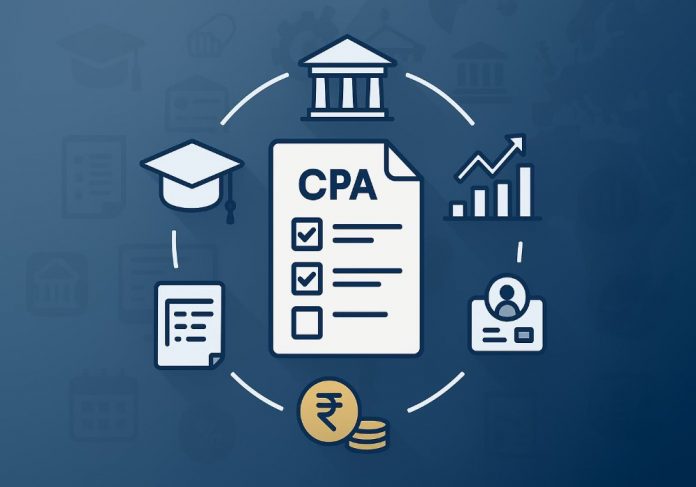
How to become a US CPA: Learn eligibility, exam syllabus, application process, costs, and career opportunities for Indian professionals. This article is written by Medha Vinod, Senior Associate at LawSikho.

The US CPA certification has become one of the most sought-after credentials for Indian accounting professionals looking to build global careers. If you’re wondering how to become a Certified Public Accountant from India, the process involves three essential components: meeting education requirements, passing a four-part examination, and gaining relevant work experience. Whether you’re a commerce graduate exploring international credentials, a CA aspirant considering alternatives, or a qualified Chartered Accountant seeking global recognition, the CPA pathway is accessible from India. This guide walks you through each step clearly, from assessing your eligibility to earning your license and launching your career.

Introduction to US CPA

The Certified Public Accountant designation is awarded by the American Institute of Certified Public Accountants (AICPA) and represents the gold standard for accounting professionals in the United States. CPAs are licensed professionals authorized to perform audits, sign tax returns, and provide attestation services. The credential is recognized in over 130 countries and has become increasingly valuable in India as multinational corporations expand their operations.

Unlike the Indian CA, which is regulated by ICAI, the US CPA operates under a state-based licensing system where each of the 55 US jurisdictions sets its own requirements. This means you choose which state to apply through, and the requirements vary accordingly. The good news for Indian candidates is that since 2020, you can take all CPA exam sections at Prometric centers across eight major Indian cities, eliminating the need for expensive international travel.

Can Indians Give the US CPA Exam?

Yes, Indian citizens can absolutely take the US CPA exam and obtain licensure. The exam and licensing process is the same for international candidates as it is for US citizens, with a few additional considerations around credential evaluation and state selection. Thousands of Indian professionals successfully earn their CPA licenses every year while living and working in India.

The key requirement is meeting the education standards set by your chosen state board of accountancy. Indian qualifications like B.Com, M.Com, CA, CS, and CMA are accepted, though they must be evaluated by an approved credential assessment agency to determine US credit equivalency. States like Guam, Montana, etc have established international-friendly policies that accommodate candidates without US Social Security Numbers.

Indians from commerce backgrounds are particularly well-positioned for CPA success. Your foundational knowledge in accounting, taxation, and business law provides a strong base for the CPA exam content. Many CA aspirants and qualified CAs pursue CPA to add international credentials to their profile, and the overlap in fundamental concepts makes the transition manageable.

CPA Exam Eligibility

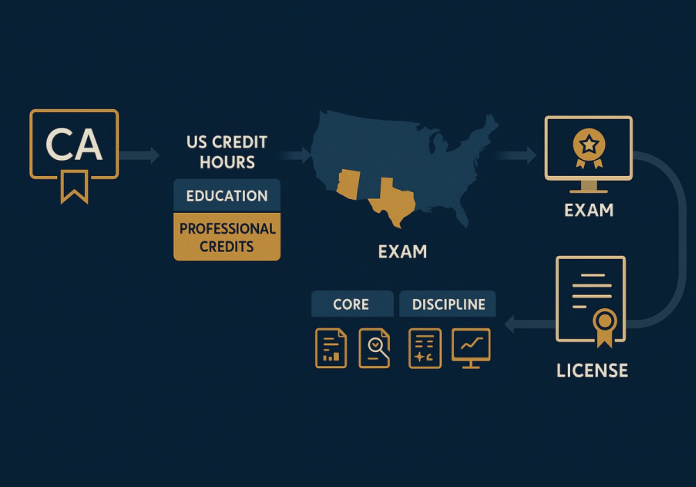
CPA eligibility operates on a credit-based system rather than specific degree requirements. Most states require 120 credit hours to sit for the exam and 150 credit hours for full licensure. The challenge for Indian candidates is understanding how their qualifications translate to this US credit system and identifying which states align with their academic profile.

Indian commerce degrees convert to US credits based on years of study, with one academic year typically equaling 30 credit hours. A three-year B.Com translates to approximately 90 credits, while adding an M.Com brings you to around 150 credits. Professional qualifications like CA add additional credits, typically 30 to 60 hours, depending on the evaluation agency’s assessment. This means a B.Com plus CA combination often meets or exceeds the 150-credit threshold.

The credential evaluation process is mandatory for all international candidates. You’ll submit your transcripts and certificates to agencies like NASBA International Evaluation Services (NIES) or World Education Services (WES), which translate your Indian qualifications into US-equivalent terms. This evaluation typically costs $150 to $200 and takes four to eight weeks to complete. For detailed eligibility pathways based on Indian qualifications, you can refer to the comprehensive guide on CPA Exam Eligibility for Indian B.Com Graduates published on SkillArbitrage.

How do Indian Qualifications Convert to US Credits for CPA Exam?

The 120-credit threshold gets you into the exam room, while 150 credits are needed for your actual license. Understanding this distinction is crucial for planning your CPA journey. A standard three-year Indian B.Com provides roughly 90 credits, leaving you 30 credits short of exam eligibility. However, completing an M.Com or MBA adds approximately 60 credits, bringing your total to 150 and meeting full licensure requirements.

For CA-qualified professionals, the picture is more favorable. Your CA credential typically adds 30 to 60 credits when evaluated, meaning a B.Com plus CA combination often reaches 120 to 150 credits. CS and CMA India qualifications similarly contribute additional credits. The exact count depends on your evaluation agency and the specific state board’s policies, so getting your credentials evaluated early provides clarity on where you stand.

The evaluation process requires official transcripts sent directly from your Indian universities to the evaluation agency. You’ll also need degree certificates and detailed mark sheets. For CA, CS, or CMA credentials, certificates from the respective institutes (ICAI, ICSI, ICMAI) are required. Budget two to three months for the complete evaluation process, including time for your institutions to send documents and the agency to complete their assessment.

Choosing the Right US State for Your CPA Journey

State selection significantly impacts your CPA journey because requirements vary considerably across jurisdictions. For Indian candidates without a US Social Security Number, this narrows your options to international-friendly states that waive the SSN requirement. Making the wrong choice can mean delays, additional costs, or even the inability to complete licensure.

Guam is a popular choice for Indian candidates. This US territory accepts 120 credits for exam eligibility, has no SSN or residency requirements, and participates in NASBA’s experience verification service for candidates whose work experience wasn’t supervised by a US CPA. 

When selecting your state, consider these factors: Do you have 120 or 150 credits? Can you get your experience verified by a US-licensed CPA, or do you need a state that accepts alternative verification? Are there any specific accounting or business credit requirements you might not meet? Answering these questions honestly points you toward the right state for your situation.

Application Process for CPA Exam

The CPA exam underwent major restructuring in January 2024 with CPA Evolution, replacing the traditional four-section format with a Core plus Discipline model. Understanding this new structure and navigating the application process efficiently sets you up for a smooth journey from application to exam day.

CPA Exam: Core Sections and Discipline Choices

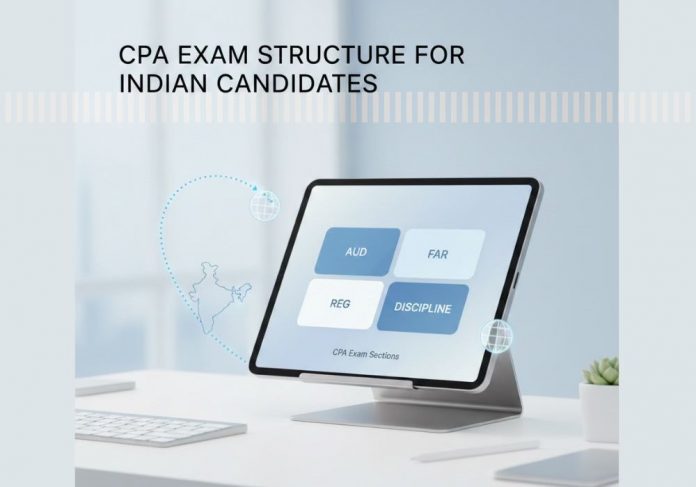
Under the current structure, all candidates must pass three Core sections: Auditing and Attestation (AUD), Financial Accounting and Reporting (FAR), and Taxation and Regulation (REG). These tests are fundamental knowledge every CPA needs regardless of career specialization. Each Core section is four hours long with a 50-50 split between multiple-choice questions and task-based simulations.

The fourth section is a Discipline of your choice from three options. Business Analysis and Reporting (BAR) suits those pursuing financial reporting and analysis careers. Information Systems and Controls (ISC) aligns with IT audit and cybersecurity roles. Tax Compliance and Planning (TCP) extends your REG knowledge and fits tax practice aspirations. Current pass rate data shows TCP with the highest success rate at 75-78%, followed by ISC at around 68%, and BAR at 34-41%.

Your discipline choice should reflect your career goals rather than just pass rates. If you’re targeting Big 4 tax practice or corporate tax roles, TCP makes sense. For those interested in technology-focused positions or IT audit, ISC provides relevant specialization. BAR aligns with CFO-track positions and financial analysis roles in corporate settings.

Application Process and Scheduling at Indian Prometric Centers

The application process begins after your credential evaluation is complete. Create an account on NASBA CPA Central and submit your application to your chosen state board. 

Your NTS is valid for six to nine months, depending on your state. Within this window, you must schedule and complete your exam sections through Prometric. India has eight testing centers: Ahmedabad, Bangalore, Calcutta, Chennai, Hyderabad, Mumbai, New Delhi, and Trivandrum. Schedule your preferred date early, especially at popular locations like Mumbai and Bangalore that fill up faster.

The typical timeline from starting your application to sitting for your first exam section is three to four months. This includes credential evaluation (6-8 weeks), state board application review (2-4 weeks), and scheduling lead time. International candidates pay an additional testing surcharge of approximately $120 per section, bringing the total per-section cost to around $510.

Preparing for the US CPA Exam

Successful CPA preparation requires structured study using quality review materials, realistic time investment, and strategic planning around your work and personal commitments. The total study time needed varies by section based on content volume and complexity, and understanding these differences helps you allocate your preparation time effectively.

FAR (Financial Accounting and Reporting) demands a study time of approximately 120 to 150 hours due to its extensive content covering US GAAP, governmental accounting, nonprofit accounting, and financial statement preparation. Most candidates find FAR the most challenging simply because of the sheer volume of material to master. REG (Taxation and Regulation) requires around 80 to 110 hours, with the learning curve focused on understanding the US federal tax code from scratch since Indian candidates have no prior exposure to these concepts.

AUD (Auditing and Attestation) typically needs 110 to 140 hours, and candidates with audit experience or CA backgrounds often find this section more intuitive due to conceptual overlaps with Indian auditing standards. For the Discipline sections, TCP and ISC do not need as much as BAR. Working professionals studying 15 to 20 hours weekly should budget five to six weeks per section, with FAR potentially requiring seven to eight weeks.

US CPA Exam Syllabus

Each CPA exam section covers specific competency areas defined in the AICPA’s Exam Blueprints, and understanding the topic-wise breakdown helps you prioritize your preparation effectively. The syllabus was restructured under CPA Evolution 2024, with some topics shifting between sections and a new emphasis on technology and data analytics throughout.

  • AUD (Auditing and Attestation) tests your knowledge across four major areas. Indian candidates familiar with Indian Standards on Auditing will find conceptual similarities, though US-specific standards like PCAOB requirements need focused learning.
  • FAR (Financial Accounting and Reporting) covers the broadest content range. FAR’s challenge lies in memorizing specific US GAAP treatments that differ from Indian Accounting Standards.
  • REG (Taxation and Regulation) is divided into two main areas. Federal taxation and business law. For Indian candidates, the entire federal taxation portion requires fresh learning since US tax concepts differ fundamentally from Indian taxation.
  • Discipline sections dive deeper into specialized areas. Your discipline choice should align not just with pass rates but with the content you’re most interested in mastering for your career.

Review Course Selection for Indian Candidates

A comprehensive CPA review course is the most critical investment in your preparation journey. These courses provide structured video lectures, extensive question banks, simulated exams, and study planning tools that self-study simply cannot replicate. The market offers several reputable options with different strengths, price points, and learning approaches suited to various candidate profiles.

Becker remains the market leader with the most comprehensive content library, typically priced at $2,400 to $3,500 (₹2,00,000 to ₹2,94,000). It offers structured learning paths, extensive practice questions, and strong brand recognition among employers. 

Surgent uses adaptive learning technology that customizes your study path based on performance, priced at $1,500 to $2,200 (₹1,26,000 to ₹1,85,000), potentially reducing total study time by focusing on weak areas.

Indian coaching institutes offer localized alternatives, bundling international review materials with Indian support. Miles Education, Simandhar Education, and Zell Education provide programs ranging from ₹1,00,000 to ₹2,00,000 that include live classes scheduled for Indian time zones, application assistance, and peer study communities. These can be particularly valuable if you prefer structured classroom-style learning or need guidance navigating the registration process. 

SkillArbitrage offers the CPA Prep & Global Finance Career Acceleration Program. It is a structured 6-month online certification course designed to help learners prepare for the U.S. CPA (Certified Public Accountant) exam and build a global finance career, with an expected commitment of about 8–10 hours per week. The program also includes mentoring on freelancing, networking, client proposals, and job‐readiness skills, and on successful completion, students receive a certificate co-branded by NSDC and Skill India. It features live online classes, practical assignments, instructor feedback, and support through an LMS, with a waitlist for enrollment.

Before committing, take advantage of free trials offered by most providers to assess which teaching style and platform interface works best for your learning preferences. For detailed comparisons of CPA courses and their features, refer to the CPA Course Guide on SkillArbitrage.

Completing Experience Requirements and Earning Your License

Passing all four exam sections is a major milestone, but licensure requires meeting experience requirements as well. Most states require one to two years of relevant accounting experience verified by a licensed CPA. Understanding these requirements and planning for them ensures you can obtain your license after passing your exams.

Experience Verification and License Application Process

The experience requirement typically involves 2,000 hours of work in accounting, auditing, taxation, or related areas. This experience must be verified, traditionally by a supervising US-licensed CPA. For Indian candidates working in India, this creates a challenge since most supervisors hold CA credentials rather than CPA licenses.

States like Guam and Montana address this through NASBA’s experience verification service, which provides alternative pathways for international candidates. Through this service, your experience can be verified even without direct US CPA supervision, though the process involves additional documentation and fees. Some states also accept verification from non-CPA supervisors in specified circumstances.

After meeting all requirements, you submit your license application to your state board with applicable fees. The board reviews your documentation, and upon approval, you receive your CPA license. Ongoing requirements include completing 40 hours of Continuing Professional Education (CPE) annually and paying license renewal fees to maintain active status.

Steps in Brief

For Indian professionals seeking CPA licensure, here’s the complete journey summarized:

For B.Com Graduates:

  • Get your credentials evaluated through NIES or WES (90 credits from 3-year B.Com)
  • Complete additional coursework or postgraduate studies to reach 120 credits for exam eligibility
  • Select an international-friendly state (Guam, Montana, or Washington recommended)
  • Apply through NASBA CPA Central and receive your NTS
  • Prepare using a quality review course (budget 300-400 total study hours)
  • Pass all four exam sections within the 30-month rolling window
  • Accumulate 1-2 years of relevant experience and get it verified
  • Apply for licensure and complete ethics requirements if applicable
  • Maintain license through annual CPE and renewal

For CA Qualified Professionals:

  • Get your B.Com plus CA credentials evaluated (typically 120-150 credits total)
  • Select your state based on experience verification options
  • Apply and receive your NTS
  • Leverage your CA foundation while learning US-specific content
  • Pass all four exam sections
  • Verify your Indian work experience through NASBA’s verification service or eligible state processes
  • Apply for licensure upon meeting all requirements
  • Continue CPE obligations annually

Career Opportunities After CPA

The CPA credential opens significant career opportunities in India’s growing economy. Big 4 firms (Deloitte, PwC, EY, KPMG) actively recruit CPAs for audit, tax, and advisory roles across their Indian offices. Beyond the Big 4, multinational corporations like Amazon, Accenture, JP Morgan, and Fortune 500 companies with Indian operations hire CPAs for finance leadership, internal audit, and compliance positions.

Location impacts salary significantly. Mumbai, Bangalore, and Delhi NCR offer the highest compensation, reflecting the concentration of employers and cost of living. The CPA also provides global mobility; if international opportunities arise, your credential transfers across borders far more easily than India-specific qualifications.

Conclusion

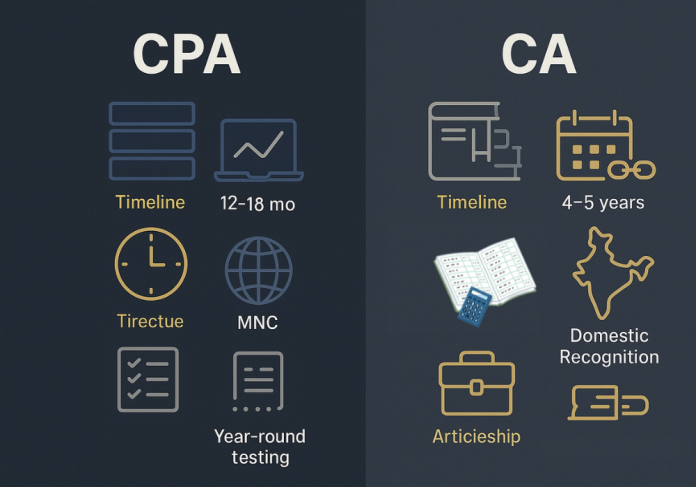
Becoming a US CPA from India follows a clear path: assess your eligibility through credential evaluation, select an international-friendly state, pass four rigorous exam sections, and fulfill experience requirements for licensure. The journey typically takes 12 to 24 months and requires an investment of ₹3 to ₹5 lakhs, including exam fees, review courses, and application costs.

The returns justify this investment through enhanced career opportunities, significant salary premiums, and global professional recognition. Whether you’re a B.Com graduate building international credentials or a CA adding global mobility to your profile, the CPA pathway is proven and achievable. Thousands of Indian professionals complete this journey successfully every year, and with proper planning and commitment, you can too. Your first step is getting your credentials evaluated to understand exactly where you stand and which states align with your profile.

For detailed information on become a CPA, visit here.

Download Now

NTA UGC NET Exam: ICT

0
ICT UGC NET

Quick revision guide for UGC NET Paper 1 ICT covering essential abbreviations, SWAYAM, digital initiatives, e-governance models, and exam strategies for high-scoring preparation. This article is written by Neeli Neelay Shah, Senior Legal Content Writer at LawSikho.

If you’re in the final stretch of your UGC NET preparation and need to consolidate your ICT knowledge quickly, this guide is designed exactly for you. Unit 8 on Information and Communication Technology typically contributes 5-6 questions worth 10-12 marks in UGC NET Paper 1, and with focused revision, you can secure most of these marks without spending disproportionate time. This quick revision guide cuts through the noise and delivers exactly what you need to know: essential abbreviations, high-scoring digital initiatives, e-governance fundamentals, and proven exam strategies that work.

Abbreviations and Terminology under ICT: UGC NET Quick Revision

Abbreviations are the building blocks of ICT questions in UGC NET. You’ll encounter at least 1-2 direct questions asking what specific terms stand for, and many other questions assume you already know these basics. Instead of memorizing an exhaustive list, focus on the high-frequency terms that appear repeatedly across exam cycles.

Computer Hardware and Software Abbreviations (CPU, RAM, ROM, OS, BIOS, GUI)

Hardware abbreviations describe the physical components that make up a computer system. The CPU, or Central Processing Unit, functions as the computer’s brain, executing all instructions and processing data. Think of it as the command center where all decisions get made. Within the CPU, the ALU (Arithmetic and Logical Unit) handles calculations, while the Control Unit manages data flow between components.

Memory terms come up frequently in matching questions. RAM (Random Access Memory) is your computer’s short-term memory; it’s volatile, meaning data disappears when power goes off. ROM (Read Only Memory) is permanent storage containing startup instructions. The key distinction examiners test is volatile versus non-volatile: RAM loses data without power, ROM retains it.

Software abbreviations are equally important for your preparation. OS stands for Operating System, the foundational software that manages everything on your computer. BIOS (Basic Input Output System) is the firmware that wakes up your hardware during startup. GUI (Graphical User Interface) is what lets you interact with computers through icons and windows rather than typing commands. Remember these as a connected chain: BIOS starts the computer, OS manages it, and GUI makes it user-friendly.

Networking and Internet Terms for UGC NET (LAN, WAN, HTTP, FTP, TCP/IP, DNS)

Network types are tested through comparison questions, so understanding their scope matters. LAN (Local Area Network) connects computers within a limited area like your home or office building. WAN (Wide Area Network) spans vast distances, connecting computers across cities or countries. The Internet itself is the largest WAN. MAN (Metropolitan Area Network) sits between these two, covering a city or town. A simple way to remember: LAN is your local neighborhood, MAN is your city, WAN is the world.

Protocol abbreviations describe how data moves across networks. HTTP (HyperText Transfer Protocol) governs how web browsers talk to websites; HTTPS adds encryption for security. FTP (File Transfer Protocol) handles file transfers between computers. TCP/IP (Transmission Control Protocol/Internet Protocol) is the fundamental language of the Internet, enabling all devices to communicate. DNS (Domain Name System) translates website names like google.com into numerical IP addresses that computers understand.

VPN (Virtual Private Network) creates secure, encrypted tunnels over public networks, which is why companies use them for remote work security. ISP (Internet Service Provider) is the company that gives you Internet access. URL (Uniform Resource Locator) is simply the address you type to reach a website. These terms appear in questions about Internet infrastructure and how users connect to online resources.

File Formats and Communication Protocols (SMTP, POP3, IMAP, MP3, PDF)

File format abbreviations describe how digital content is stored. PDF (Portable Document Format) preserves document formatting across different systems. MP3 (MPEG Audio Layer 3) revolutionized music by compressing audio files. MP4 handles video content. JPEG uses lossy compression for photographs, while PNG supports transparency and lossless compression. Questions may ask you to match file extensions with their full forms or identify which format suits specific purposes.

Email protocols determine how your messages travel and get retrieved. SMTP (Simple Mail Transfer Protocol) handles outgoing mail; when you hit send, SMTP takes over. For incoming mail, you have two options: POP3 (Post Office Protocol) downloads emails to your device and usually removes them from the server, while IMAP (Internet Message Access Protocol) keeps emails on the server and syncs across all your devices. The practical distinction: POP3 is for single-device users, IMAP is for people checking email on multiple devices.

HTML (HyperText Markup Language) is the coding language for creating web pages. CSS (Cascading Style Sheets) adds styling to HTML. XML (Extensible Markup Language) structures data for storage and transport. These web technologies form the foundation of how Internet content gets created and displayed. Understanding their basic functions helps answer questions about web development and digital content creation.

UGC NET ICT: Digital Initiatives in Higher Education

This section is your highest-scoring opportunity within ICT. Analysis of previous year papers shows that Digital Initiatives contribute a major chunk of all ICT questions. Mastering SWAYAM, its ecosystem, and related platforms can secure you 2-3 questions in every exam. Focus your revision energy here for maximum returns.

SWAYAM and the MOOCs: National Coordinators You Must Remember

SWAYAM stands for Study Webs of Active-Learning for Young Aspiring Minds. It’s India’s homegrown MOOCs (Massive Open Online Courses) platform developed by the Ministry of Education with AICTE and Microsoft. The platform provides free access to quality education from Class 9 through postgraduate levels. Remember the three principles SWAYAM addresses: access, equity, and quality in education.

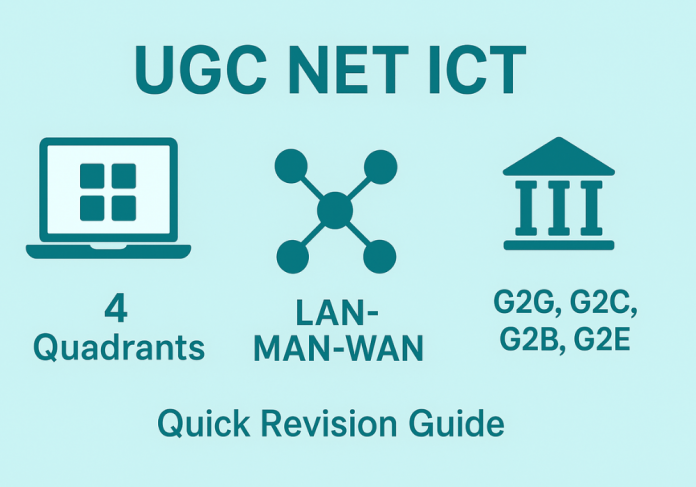
The platform operates through four quadrants that create a complete learning experience. First comes video tutorials, typically 20 hours of content per course with lectures capped at 30 minutes each. Second is downloadable e-content for reading. Third is self-assessment through quizzes interspersed throughout the course. Fourth is discussion forums for clearing doubts. Questions often test whether you can identify these four quadrants or match them with their functions.

Seven national coordinators manage SWAYAM courses at different educational levels. NPTEL (IIT Madras) handles engineering courses. UGC coordinates postgraduate non-engineering content. CEC manages undergraduate programs. NCERT covers Classes 9-12 for school students. NIOS handles out-of-school learners at school level. IGNOU serves out-of-college students. IIM Bangalore coordinates management courses. A matching question might pair these coordinators with their respective domains, so memorize which coordinator handles which level.

SWAYAM Prabha and Educational DTH Channels

SWAYAM Prabha complements the online platform by delivering education through television for areas with limited Internet access. It consists of 40 DTH (Direct to Home) channels broadcasting educational content round the clock using the GSAT-15 satellite. New content airs for 4 hours daily and repeats 5 more times, letting students watch at convenient times.

The channels are uplinked from BISAG (Bhaskaracharya Institute for Space Applications and Geo-informatics) in Gandhinagar, and INFLIBNET maintains the web portal. Content comes from premier institutions including NPTEL, IITs, UGC, CEC, IGNOU, NCERT, and NIOS. The IIT-PAL channels specifically help Class 11-12 students prepare for JEE through courses in Mathematics, Physics, Chemistry, and Biology.

The key facts to remember: 40 channels, GSAT-15 satellite, BISAG Gandhinagar for uplinking, INFLIBNET for web portal. Questions typically ask about the number of channels, the satellite used, or the organization managing specific aspects. This initiative targets students in remote areas where Internet connectivity remains a challenge.

Digital Libraries and Research Platforms (NDL, e-Shodh Sindhu, INFLIBNET)

The National Digital Library of India (NDL) is a virtual repository providing single-window search access to learning resources. Developed by IIT Kharagpur under NMEICT, it hosts over 125 million digital resources covering all education levels from school to research. Think of it as a massive online library where you can access textbooks, articles, videos, and simulations through one search interface.

e-Shodh Sindhu was created by merging three previous consortia: UGC-INFONET Digital Library Consortium, N-LIST, and INDEST-AICTE Consortium. This unified platform provides access to over 15,000 international electronic journals and e-books for higher educational institutions. Researchers at eligible institutions can access premium content from major publishers without individual subscriptions.

INFLIBNET (Information and Library Network Centre) is an autonomous inter-university centre of UGC that coordinates library networking activities. It manages several key initiatives including the SWAYAM Prabha portal, Shodhganga (completed thesis repository), and e-Shodh Sindhu. N-LIST (National Library and Information Services Infrastructure for Scholarly Content) extends e-resource access to affiliated colleges, providing 6,500+ e-journals and 1.99 + lakhs e-books to institutions that might otherwise lack such resources.

Key Initiatives to Remember (NAD, VIDWAN, e-PG Pathshala, Virtual Labs)

NAD (National Academic Depository) stores academic awards digitally, including degrees, diplomas, certificates, and mark sheets. It enables paperless verification of credentials by employers and institutions. Part of the Digital India initiative, NAD eliminates the hassles of maintaining and producing physical certificates. When questions ask about digital certificate storage or verification, NAD is your answer.

VIDWAN is the expert database containing profiles of scientists, researchers, and faculty working in Indian academic and R&D organizations. Maintained by INFLIBNET, it helps identify peer reviewers, potential collaborators, and experts for various purposes. Think of it as LinkedIn for Indian researchers, but officially maintained and verified.

e-PG Pathshala provides high-quality e-content for postgraduate education across 70 subjects in arts, humanities, and social sciences. It contains over 23,000 modules including text, audio, video, and self-assessment materials. Virtual Labs offers remote access to laboratory experiments, with 205+ labs comprising 1,515 experiments across engineering and science disciplines. Both initiatives address resource gaps in institutions lacking physical infrastructure.

Teacher Training Platforms (ARPIT, DIKSHA, GIAN)

ARPIT (Annual Refresher Programme in Teaching) delivers online professional development for higher education faculty through the SWAYAM platform. It offers 40-hour refresher courses across disciplines, enabling teachers to earn credits for career advancement. This addresses the massive scale of faculty development needs in Indian higher education through online delivery.

DIKSHA (Digital Infrastructure for Knowledge Sharing) is the national platform for school education, providing curriculum-linked learning resources for teachers, students, and parents. While primarily targeting school education, it represents the broader digital education ecosystem and appears in questions comparing educational platforms by their target audiences.

GIAN (Global Initiative of Academic Networks) brings international faculty to Indian institutions for short-term courses. It taps global academic talent to enhance Indian higher education through knowledge exchange and exposure to international practices. Questions may ask you to identify which initiative involves foreign faculty engagement.

e-Governance Models and Applications: UGC NET ICT Quick Revision 

E-Governance applies ICT to government functions, transforming how citizens, businesses, and government entities interact. This sub-topic has gained importance in recent exams, with questions focusing on the four interaction models and specific government digital platforms. Understanding the framework helps you categorize any initiative correctly.

Understanding the Four e-Governance Models (G2G, G2C, G2B, G2E)

E-Governance operates through four models based on who interacts with whom. G2G (Government to Government) covers digital interactions between government departments. This includes electronic file management, digital signatures, and inter-departmental communication. The e-Office project exemplifies G2G by enabling paperless file movement across government departments.

G2C (Government to Citizen) initiatives include services directly to citizens through digital platforms. Examples include DigiLocker for document storage, Passport Seva for passport applications, Common Service Centres for rural service delivery, and various online certificate services. This model aims to make government services accessible, transparent, and convenient for citizens.

G2B (Government to Business) streamlines interactions between government and businesses. The GST portal handles tax compliance, GeM (Government e-Marketplace) manages public procurement, and MCA21 facilitates company registration. These platforms reduce compliance burden and improve ease of doing business. G2E (Government to Employee) covers internal operations like payroll management, provident fund systems through EPFO, and employee HR services.

Government to Citizen Initiatives (DigiLocker, Passport Seva, PAN Services)

DigiLocker provides citizens with cloud storage for official documents and certificates. It enables paperless verification through authentic digital documents issued directly by government agencies. Over 5 billion documents have been made available through this platform. When employers or institutions need to verify your credentials, DigiLocker eliminates the need for physical document submission.

Passport Seva transformed passport issuance into a citizen-friendly online system. You can apply online, schedule appointments, track application status, and receive updates digitally. The system significantly reduced processing time and eliminated multiple visits to passport offices. It’s a prime example of how G2C initiatives improve citizen convenience.

PAN (Permanent Account Number) services are delivered through NSDL and UTI Infrastructure Technology Services. Citizens can apply for new PAN cards, make corrections, and verify details online. This digitization streamlined tax administration and reduced paperwork. These three initiatives, DigiLocker, Passport Seva, and PAN services, frequently appear as examples of G2C governance in exam questions.

Digital India and Important Government Platforms

Digital India, launched in 2015, is the umbrella programme driving India’s digital transformation. It’s built on nine pillars covering infrastructure, governance, and empowerment. The infrastructure pillars include Broadband Highways, Universal Mobile Connectivity, and Public Internet Access Programme. Governance pillars cover e-Governance reforms, e-Kranti (electronic service delivery), and Information for All.

BharatNet (formerly National Optical Fibre Network) connects gram panchayats with optical fiber for rural broadband. It’s the world’s largest rural connectivity project, enabling digital services to reach the last mile. Aadhaar, managed by UIDAI, provides a 12-digit unique identification number that enables authentication and eKYC for accessing government services. With over 1.3 billion enrollments, it’s the world’s largest biometric ID system.

GeM (Government e-Marketplace) is the online platform for government procurement, providing transparency and efficiency in public purchases. It eliminates human interface in procurement and enables cashless, paperless transactions. Questions may ask you to identify GeM’s purpose or classify it under the correct e-governance model (G2B).

Cybersecurity Basics for UGC NET (Malware, Phishing, Firewalls)

Cybersecurity questions have increased in recent UGC NET exams, with the June 2025 exam including a question on malware characteristics. Malware (malicious software) encompasses viruses that replicate by inserting into programs, worms that spread without user action, trojans disguised as legitimate software, and ransomware that encrypts data for extortion. Know the basic distinction between these types.

Phishing is a social engineering attack where criminals impersonate trustworthy entities to steal sensitive information through fake emails or websites. Logic bombs are malicious code that activates when specific conditions are met. These threat types represent the human and technical dimensions of cyber attacks that you should be able to identify.

Firewalls act as barriers between trusted internal networks and untrusted external networks, monitoring and controlling traffic based on security rules. Encryption converts data into coded form readable only with the correct key; HTTPS uses encryption to secure web communications. Antivirus software detects and removes malware. Understanding these basic defense mechanisms helps answer security-related questions.

UGC NET ICT Quick Revision: Exam Strategy and Question Patterns

Knowing what to study is only half the battle; knowing how questions appear helps you prepare strategically. This section distills patterns from previous year papers and provides actionable strategies for maximizing your ICT score with limited revision time.

High-Frequency Topics

Digital Initiatives dominate ICT questions. Within this, SWAYAM appears most consistently, with questions testing the four quadrants, seven national coordinators, and free versus paid aspects. NDL, e-Shodh Sindhu, and INFLIBNET follow in frequency. Prioritize these topics if you’re short on time.

Abbreviation questions, Network types (LAN, MAN, WAN) and protocols (HTTP, FTP, SMTP) appear most often. E-Governance questions have increased recently, particularly about the four models and their examples. Cybersecurity concepts, while newer, appeared in June 2025 and likely signal continued emphasis.

The safest strategy allocates your ICT revision time proportionally: spend 40% on digital initiatives, 25% on abbreviations, 20% on e-governance, and 15% on Internet concepts. This mirrors actual question distribution and ensures you’re prepared for the most likely questions.

Common Question Types in ICT Section

Direct factual questions test whether you know what abbreviations stand for or which organization launched specific initiatives. These are straightforward if you’ve memorized the essential terms. Examples include “SWAYAM stands for” or “Which platform has 40 DTH educational channels?”

Matching questions present two columns for pairing. A typical format lists digital initiatives in one column (SWAYAM, NAD, NDL) and their purposes in another (MOOCs platform, academic depository, digital library). Practice these by creating your own matching exercises from the initiatives covered in this guide.

Statement-based questions present two statements for evaluation, asking whether both are true, both false, or one of each. Common traps include partially correct statements. For example: “Statement I: SWAYAM courses are completely free. Statement II: NPTEL is coordinated by IIT Bombay.” (Both are false: SWAYAM certification costs money, NPTEL is IIT Madras.) Read statements carefully for subtle inaccuracies.

Last-Minute Revision for ICT

In your final days, focus on rapid recall rather than learning new material. Create a one-page summary containing the 40-50 essential abbreviations, the 15 key digital initiatives with one distinguishing fact each, and the four e-governance models with two examples each. Review this sheet multiple times daily.

Use the SWAYAM memory chain: four quadrants (Video, e-Content, Self-assessment, Discussion) and seven coordinators (NPTEL-Engineering, UGC-PG, CEC-UG, NCERT-School, NIOS-Out-of-school, IGNOU-Out-of-college, IIMB-Management). For SWAYAM Prabha, remember: 40 channels, GSAT-15, BISAG, INFLIBNET.

Practice 10-15 previous year ICT questions in the last three days. This builds pattern recognition and confidence. Most ICT questions test recognition, not analysis, so systematic memorization combined with question practice yields excellent results. Time yourself to ensure you can answer quickly during the actual exam.

Conclusion

The ICT section offers one of the best scoring opportunities in UGC NET Paper 1 for candidates willing to invest focused effort. With 5-6 questions worth 10-12 marks and content that rewards memorization over complex analysis, you can realistically aim for full marks in this unit. Prioritize digital initiatives (especially SWAYAM and its ecosystem), master the essential 40-50 abbreviations, understand the four e-governance models, and practice previous year questions to recognize common patterns. The strategies in this guide, combined with consistent revision in your final preparation days, will position you to maximize your ICT score when you walk into the exam hall.

To dive deep into the ICT preparation for UGC NET exam, follow this link: https://lawsikho.com/blog/ict-ugc-net/

Other Related Readings: Data Interpretation UGC NET- https://lawsikho.com/blog/data-interpretation-ugc-net/: , Research Aptitude for UGC NET Paper 1: Essential Concepts Simplified (Unit 2): https://lawsikho.com/blog/ugc-net-research-methodology/, Teaching Aptitude for UGC NET Paper 1: Essential Guide for Unit 1 Preparation: https://lawsikho.com/blog/teaching-aptitude-ugc-net-paper-1/

Download Now

Logical Reasoning for UGC NET

0
Logical reasoning for UGC NET

Quick shortcuts for UGC NET Logical Reasoning: SPEED method for Venn diagrams, PAUSAA formula for Pramanas, and essential tricks to score 8-12 marks in Paper 1. Start practicing today. This article is written by Urvi Shah, Senior Associate at LawSikho.

There’s a moment in every UGC NET Paper I where candidates split into two groups: those who freeze when they see “Arthapatti” and “Anupalabddhi,” and those who smile because they know these are free marks.

Last year, one aspirant spent three weeks trying to “understand” Indian Logic by reading dense philosophy textbooks. 

She walked into the exam confused and skipped every Pramana question. 

Her batchmate? Memorized one simple trick: “PAUSAA” and practiced 20 questions, and scored full marks on the same section in under 10 minutes.

Same syllabus. Completely different outcomes.

Here’s what nobody tells you about Logical Reasoning in Paper I: it’s not designed to test whether you’re naturally smart or philosophically inclined. It’s testing whether you know the patterns. 

Can you spot the difference between deductive and inductive reasoning in 30 seconds? Can you identify which Hetvabhasa makes an argument invalid? Can you classify proposition types without overthinking?

The students who score well aren’t necessarily the brightest; they’re the ones who stopped trying to “deeply understand” everything and started learning strategic shortcuts instead.

This guide hands you the exact techniques that turn a confusing 8 to 12 mark section into one of your safest scoring zones. No theoretical lectures. No unnecessary jargon. Just proven methods, memory tricks, and speed techniques that work when you’re racing against the clock and every mark matters.

Let’s get started.

Syllabus of Logical Reasoning: UGC NET Paper I

Western Logic Topics at a Glance

The Western Logic portion of Unit VI covers four interconnected areas that form the backbone of formal reasoning. 

First, you need to understand the structure of arguments, which includes argument forms, categorical propositions, mood and figure, formal and informal fallacies, uses of language, connotations and denotations, and the classical square of opposition. 

Second, you must be able to evaluate and distinguish between deductive and inductive reasoning.

Third, the syllabus includes analogies, which test your ability to identify relationships between pairs of concepts. 

Fourth, and perhaps most practically useful, you need to master Venn diagrams for establishing the validity of arguments. 

If you have prepared for any competitive exam before, you likely have some familiarity with these topics. The key difference in UGC NET is the depth of theoretical understanding expected alongside practical problem solving ability.

Indian Logic Topics You Cannot Skip

The revised UGC NET syllabus introduced three topics from the Nyaya school of Indian philosophy that many aspirants find intimidating. 

These include Indian Logic and means of knowledge, the six types of Pramanas (Pratyaksha, Anumana, Upamana, Shabda, Arthapatti, and Anupalabdhi), and the structure of Anumana, including Vyapti and Hetvabhasas.

Do not let the Sanskrit terminology scare you. These concepts are fundamentally about how we acquire valid knowledge and reason correctly. 

The Pramanas are simply different sources of knowledge (perception, inference, comparison, testimony, implication, and non apprehension). Hetvabhasas are fallacies of inference. Once you strip away the unfamiliar terms, you will find logical concepts that parallel Western reasoning in many ways.

How Many Questions Come from Unit VI: Logical Reasoning?

Logical Reasoning typically contributes 4 to 6 questions per exam session in UGC NET Paper I. However, it is not a uniform pattern followed by NTA. The question distribution keeps changing. 

With each question worth 2 marks, you are looking at 8 to 12 marks from this single unit. 

That represents roughly 10 percent of your entire Paper I score, making it a significant contributor to your overall performance.

What makes this unit particularly valuable is its predictability. Unlike theory heavy units, where questions can come from unexpected corners, Logical Reasoning questions follow recognizable patterns. 

Venn diagrams, syllogisms, Pramanas, and deductive versus inductive reasoning appear consistently across exam sessions. This predictability means that focused preparation yields reliable results.

How is Logical Reasoning Different from Mathematical Reasoning in UGC NET?

Many aspirants confuse Logical Reasoning (Unit VI) with Mathematical Reasoning and Aptitude (Unit V), but they test fundamentally different skills. 

Mathematical Reasoning focuses on numbers: series, percentages, ratios, coding and decoding, time and distance, profit and loss. It tests your quantitative aptitude and calculation speed.

Logical Reasoning, in contrast, deals with the structure of arguments and the validity of conclusions.

It asks questions like: “Does this conclusion follow from these premises?” or “Which Pramana is being used in this scenario?”

While Mathematical Reasoning requires calculation, Logical Reasoning requires analysis of logical relationships. Both are important, but they require different preparation approaches.

Essential Shortcuts for Western Logic Questions: Concepts You Must Master

Categorical Propositions: The AEIO Quick Reference

Every syllogism in UGC NET uses combinations of four proposition types, labeled A, E, I, and O. 

  • Type A is “All S are P” (universal affirmative). 
  • Type E is “No S are P” (universal negative). 
  • Type I is “Some S are P” (particular affirmative). 
  • Type O is “Some S are not P” (particular negative). 

Memorize these four types because they appear in nearly every syllogism question.

Here is a memory trick that works: A and I come from the Latin “AffIrmo” (I affirm), so they are affirmative. E and O come from “nEgO” (I deny), so they are negative. 

Additionally, A and E are universal (about all members), while I and O are particular (about some members). 

With this framework, you can instantly identify any proposition type and predict how it will behave in logical relationships.

Deductive vs Inductive: Spotting the Difference in Seconds

Deductive reasoning moves from general principles to specific conclusions with certainty. If the premises are true and the form is valid, the conclusion must be true. “All lawyers are graduates. Rahul is a lawyer. Therefore, Rahul is a graduate.” 

This is deductive because the conclusion follows necessarily.

Inductive reasoning moves from specific observations to general conclusions with probability. “Every swan I have seen is white. Therefore, all swans are probably white.” 

This is inductive because even if all observed swans are white, the conclusion could be false (black swans exist in Australia).

The shortcut: if the conclusion claims certainty based on premises, it is deductive. If it claims probability based on observations, it is inductive.

Venn Diagrams: Meaning and Use

Venn diagrams are diagrams that use overlapping circles to represent categorical propositions and their relationships. 

Each circle represents a category, and overlapping regions show where categories intersect. For testing syllogisms, you use three circles representing the major term, minor term, and middle term of the argument.

The power of Venn diagrams lies in their ability to make abstract logical relationships visible. 

Instead of mentally juggling premises and conclusions, you diagram the premises and then visually check whether the conclusion is already represented.

If diagramming the premises automatically shows the conclusion, the argument is valid. If not, it is invalid. This visual approach is faster and more reliable than trying to apply validity rules from memory.

Solving Venn Diagrams in Under 2 Minutes

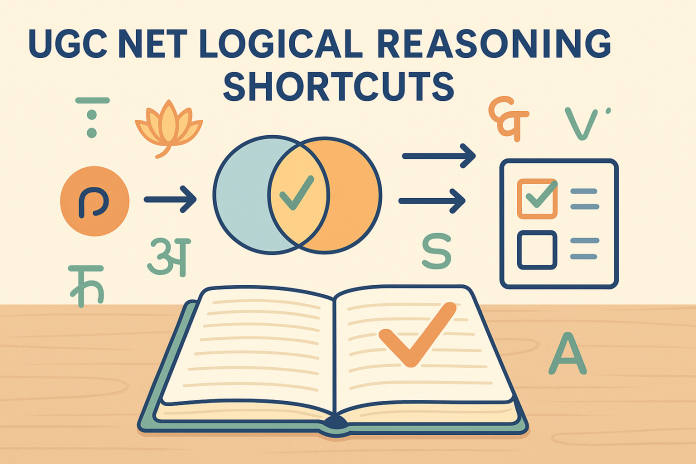
Use the SPEED method for maximum efficiency. 

  • S: State the premises in standard A, E, I, O form. 
  • P: Plot three overlapping circles labeled with your terms. 
  • E: Eliminate empty regions by shading (do universal premises first). 
  • E: Evaluate whether the conclusion appears in your diagram. 
  • D: Decide validity based on whether the conclusion is already represented.

The critical rule is to shade before marking. 

Universal premises (A and E) require shading certain regions as empty. 

Particular premises (I and O) require placing an X to show that at least one member exists. 

Always complete all shading before placing any X marks, because shading eliminates regions where X cannot go. 

With practice, you can complete this entire process in 60 to 90 seconds.

The Square of Opposition: 4 Rules That Always Work

The Square of Opposition shows logical relationships between the four proposition types when they share the same subject and predicate. Instead of memorizing the diagram, memorize these four rules that solve any question instantly.

Rule 1: Contradictories (A-O and E-I pairs) always have opposite truth values. If A is true, O must be false, and vice versa. 

Rule 2: Contraries (A-E pair) cannot both be true, but both can be false. 

Rule 3: Subcontraries (I-O pair) cannot both be false, but both can be true.

Rule 4: Subalternation means truth flows downward: if A is true, I must be true; if E is true, O must be true. 

Apply the relevant rule and you have your answer.

Syllogisms: Understanding Mood, Figure and Valid Forms

A syllogism’s mood is determined by the types of its three propositions (like AAA or EIO). Its figure is determined by the position of the middle term in the premises. 

There are 256 possible combinations of mood and figure, but only 24 are valid. You do not need to memorize all 24; focus on the most common ones.

The most frequently tested valid forms include Barbara (AAA in Figure 1), Celarent (EAE in Figure 1), Darii (AII in Figure 1), and Cesare (EAE in Figure 2). 

The vowels in these medieval names tell you the proposition types. 

Barbara has three As, meaning all three propositions are “All S are P” type. Rather than memorizing names, focus on using Venn diagrams to test validity, which works for any form.

Recognizing Fallacies Without Memorizing Definitions

Formal fallacies occur when the logical structure is flawed, regardless of content. 

The most common is “undistributed middle,” where the middle term does not refer to all members of its class in at least one premise. “All cats are animals. All dogs are animals. Therefore, all cats are dogs.” 

This fails because “animals” is never fully distributed.

Informal fallacies are content based errors.

Instead of memorizing definitions, look for patterns: attacks on the person rather than the argument (Ad Hominem), misrepresenting someone’s position (Straw Man), emotional manipulation instead of logic (Appeal to Emotion), circular reasoning where conclusion assumes premises (Begging the Question), and introducing irrelevant topics (Red Herring). 

Spotting these patterns is faster than recalling formal definitions.

Analogy Questions: The Fastest Pattern Recognition Method

Analogy questions give you a pair of related terms and ask you to find a parallel relationship. 

The fastest approach is the “bridge sentence” method: create a simple sentence connecting the given pair, then apply that exact sentence to each option. “Doctor: Hospital” becomes “A doctor works in a hospital.” 

Test each option with this sentence structure.

Common relationship types include synonyms, antonyms, part to whole, cause to effect, tool to function, and worker to workplace. 

Before looking at options, identify which relationship type applies to the given pair. This prevents you from being distracted by options that seem vaguely related but do not match the exact relationship.

Indian Logic Made Simple: Pramanas and Anumana

The Truth About Indian Logic Difficulty

The difficulty of Indian Logic is 90 percent vocabulary and 10 percent concept. 

Terms like Pratyaksha, Anumana, Vyapti, and Hetvabhasas sound foreign and complex. 

But Pratyaksha simply means perception, Anumana means inference, Vyapti means invariable connection, and Hetvabhasas means fallacies. Once you translate the Sanskrit, you realize these are concepts you already understand.

The other barrier is assuming this section requires philosophy expertise. 

It does not. UGC NET tests specific, well defined concepts from the Nyaya school, not deep philosophical understanding. 

You need to know the six Pramanas with definitions and examples, the structure of Indian inference, and the five types of fallacies. This is a bounded, learnable body of knowledge that you can master in a few days.

The Six Pramanas with Easy Memory Tricks

The six Pramanas are sources of valid knowledge recognized in Indian philosophy. 

Use the mnemonic “PAUSAA” to remember them: Pratyaksha (Perception through senses), Anumana (Inference from observation), Upamana (Comparison to something known), Shabda (Verbal testimony from reliable sources), Arthapatti (Implication to explain contradictions), and Anupalabdhi (Non apprehension or knowledge through absence).

PramanaMeaningQuick Example
PratyakshaDirect perceptionSeeing fire directly
AnumanaInferenceInferring fire from smoke
UpamanaComparisonLearning what a gavaya is by comparing to a cow
ShabdaTestimonyAccepting textbook knowledge as true
ArthapattiImplicationHe is alive but never eats by day, so he must eat at night
AnupalabdhiNon apprehensionKnowing there is no book on the table by not seeing one

Remember that different philosophical schools accept different numbers of Pramanas. Charvaka accepts only Pratyaksha. Nyaya accepts four. Vedanta accepts all six. UGC NET may test this distinction.

Understanding Anumana, Vyapti, and Hetvabhasas

Breaking Down the Five Part Indian Syllogism

Indian inference (Anumana) uses a five part structure called Pancha Avayava, which is more elaborate than the three part Western syllogism. 

The five parts are: Pratijna (thesis or proposition to prove), Hetu (reason or middle term), Udaharana (example illustrating the rule), Upanaya (application to the case), and Nigamana (conclusion).

For example: “This hill has fire (Pratijna) because it has smoke (Hetu). Whatever has smoke has fire, like a kitchen (Udaharana). This hill has smoke (Upanaya). Therefore, this hill has fire (Nigamana).” 

The key terms are Paksha (the subject, like “hill”), Sadhya (what is to be proved, like “has fire”), and Hetu (the reason, like “smoke”). These three terms are analogous to minor term, major term, and middle term in Western logic.

Vyapti in Plain Language with Examples

Vyapti is the invariable connection between the reason (Hetu) and what is to be proved (Sadhya). It is the universal rule that makes inference possible. 

“Wherever there is smoke, there is fire” is a Vyapti. Without this invariable connection, we could not infer fire from smoke.

Vyapti comes in two types. 

  • Sama Vyapti (equal concomitance) exists when both terms have equal extension: “All nameables are knowables” and “All knowables are nameables.” 
  • Visama Vyapti (unequal concomitance) exists when one term has wider extension: smoke always implies fire, but fire does not always imply smoke (red hot iron has fire without smoke). 

Understanding Vyapti helps you evaluate whether an inference is valid.

The 5 Hetvabhasas: Quick Identification Guide

Hetvabhasas are fallacies that make inference invalid. There are five types, each representing a different way the reason (Hetu) fails to support the conclusion.

HetvabhasaMeaningThe Problem
SavyabhicharaIrregularReason found where Sadhya is absent
ViruddhaContradictoryReason proves the opposite
AsiddhaUnprovedReason itself is not established
SatpratipakshaCounterbalancedEqually strong counter reason exists
BadhitaContradictedConclusion contradicted by perception

For exam purposes, focus on recognizing which type of failure is present in a given inference. If the reason is found in cases where the conclusion does not hold, it is Savyabhichara. If the reason actually proves the opposite, it is Viruddha. If the reason itself is doubtful, it is Asiddha.

How to Prepare Logical Reasoning in UGC NET Paper I Efficiently?

High Yield Topics to Focus On

If time is limited, prioritize topics based on their frequency in previous exams. 

Venn diagrams appear in almost every session and should be your top priority. Master the SPEED method and practice until you can solve any syllogism in under 2 minutes.

Second priority is the six Pramanas, as Indian Logic questions are easy marks for those who prepare and are often skipped by competitors.

Third, focus on the square of opposition and categorical propositions, as these form the foundation for many questions.

Fourth, understand deductive versus inductive reasoning well enough to classify any argument instantly. 

Analogies and specific fallacy types are lower priority but should not be ignored entirely. 

This prioritization ensures you capture the most available marks with limited preparation time.

Week by Week Preparation Timeline

If you have two weeks for Logical Reasoning, here is an efficient schedule.

 In Week 1, spend days 1 to 3 on categorical propositions, square of opposition, and argument structure. Spend days 4 to 5 on Venn diagrams with intensive practice. Spend days 6 to 7 on deductive and inductive reasoning plus analogies.

In Week 2, spend days 1 to 3 on Indian Logic: all six Pramanas, Anumana structure, Vyapti, and Hetvabhasas. Spend days 4 to 5 on previous year questions, identifying all Logical Reasoning questions and solving them under timed conditions. 

Spend days 6 to 7 on mock tests and revision of shortcuts.

Practice Strategy for Time Pressed Aspirants

The most efficient practice approach is targeted problem solving, not passive reading. After learning each concept, immediately solve 10 to 15 questions on that specific topic. 

Use previous year papers as your primary source since UGC NET questions follow predictable patterns.

Time yourself from the beginning. 

If you are taking 3 to 4 minutes per Venn diagram, you need more practice. Track your accuracy by topic to identify weak areas. Focus additional practice on topics where your accuracy is below 80 percent.

Essential Resources: Books, Videos, and Practice Tools

For a comprehensive reference, Trueman’s UGC NET Paper I guide covers both Western and Indian Logic with practice questions. For Indian Logic specifically, the NCERT Philosophy textbooks for Class 11 and 12 explain Pramanas in an accessible language and are available free at ncert.nic.in

Do not invest in multiple books; one good resource plus previous year papers is sufficient.

YouTube offers free video explanations from JRF qualified educators. Search for “UGC NET Logical Reasoning” or “UGC NET Pramanas” to find topic specific lectures. 

The official NTA website provides sample papers that simulate actual exam conditions.

Final Week Revision Checklist

In the last seven days before the exam, shift from learning to consolidating.

Create (or review) a one page summary containing: the four proposition types (AEIO), the four square of opposition rules, the SPEED framework for Venn diagrams, the PAUSAA mnemonic for Pramanas, and the five Hetvabhasas with one word meanings.

Take at least two full length Paper I mock tests under timed conditions. After each mock, analyze your Logical Reasoning performance specifically. 

Review any questions you got wrong and understand why. In the final 48 hours, limit yourself to reviewing your summary sheet and solving a few easy problems to maintain confidence. Avoid learning new concepts in the last two days.

Conclusion

Logical Reasoning in UGC NET Paper I rewards preparation more than natural talent. The shortcuts we have covered, including AEIO for propositions, SPEED for Venn diagrams, and PAUSAA for Pramanas, give you systematic approaches that work across question types. 

The key is consistent practice: solve questions daily, time yourself, and analyze your mistakes.

Remember that this unit contributes 8 to 12 marks to your Paper I score, and with proper preparation, you can aim for full marks. Unlike theory heavy units, where answers can be debated, Logical Reasoning has objectively correct answers. 

Master the methods, practice regularly, and this unit becomes one of your most reliable scoring areas.

For a deeper dive into each topic with more examples and detailed explanations, explore this comprehensive guide on UGC NET Paper I Logical Reasoning.

Download Now

Best Books for UGC NET Law

0
Best books for UGC NET Law

Discover the best books for UGC NET Law Paper 2 with our quick guide. Top picks for IFAS, Arihant guides, subject-wise recommendations, and budget-smart buying strategies. This article is written by Urvi Shah, Senior Associate at LawSikho.

Open any UGC NET Law preparation group, and you’ll see the same question asked a hundred different ways: “Which books should I buy?” 

The answers? Overwhelming. Someone recommends 15 textbooks. Another person swears by just previous year questions.

 A third suggests expensive coaching material. And there you are, more confused than when you started.

Here’s what most book recommendation lists won’t tell you: buying more books doesn’t equal better preparation. In fact, the opposite is often true. 

The most successful NET qualifiers typically use 4 to 6 well chosen books that they read thoroughly, rather than 20 half finished ones gathering dust.

This guide cuts through the confusion. No lengthy analysis of 30 different publishers. 

Just straight answers to the questions that actually matter: Which specific books should you buy this week? How much will they cost? And how do you use them effectively to clear Paper II?

Whether you have a ₹1,500 budget or ₹5,000 to spend, whether you’re starting preparation today or revising in your final month, you’ll find exactly what you need to know, no fluff, no filler, just actionable book recommendations that work.

Let’s get started.

Essential Books Every UGC NET Law Aspirant Needs

The Two Categories of Books You Must Have

Standard Law Textbooks for Conceptual Foundation

Think of standard law textbooks as your foundation builders. These are the books authored by legal scholars like M.P. Jain, K.D. Gaur, and Avtar Singh that you probably encountered during your law degree. 

They explain the “why” behind legal principles, help you understand how different concepts connect, and prepare you for those tricky MCQs that test application rather than mere recall.

Here is the catch though: standard textbooks were written for law students, not competitive exam aspirants. They contain way more detail than UGC NET requires, they do not have MCQ practice sections, and they certainly do not tell you which topics appear most frequently in the exam. 

So use them strategically for high weightage subjects, but do not try to read them cover to cover.

UGC NET Specific Guides for Exam Oriented Preparation

NET specific guides from publishers like IFAS Publications and Arihant are built specifically for exam success. They condense the 10 unit syllabus into digestible content, provide thousands of MCQs for practice, and include previous year questions with explanations. 

These books train your brain to think in MCQ format, which is a skill that standard textbooks simply cannot teach you.

Top 5 Must Buy Books for Paper II

Your core book collection should include these five resources that together cover both depth and breadth. 

  • First, get IFAS Publications’ UGC NET Law Paper II PYQ book (₹400 to 500), which contains 12 plus years of previous questions sorted unit wise. 
  • Second, pick up Arihant’s NTA UGC NET Law Study Guide (₹550 to 775) for comprehensive theory and 4000 MCQs. 
  • Third, add M.P. Jain’s or V.N. Shukla’s Constitutional Law book for the highest weightage unit.
  • Fourth, include K.D. Gaur’s Indian Penal Code textbook for Criminal Law, which is another heavily tested area. 
  • Fifth, keep Avtar Singh’s Contract Law book handy for Commercial Law concepts. 

This five book combination gives you everything you need: PYQ practice, exam focused content, and conceptual depth for the three most important units. You can add more books later if time permits, but these five will carry you through.

Subject Wise Book Recommendations for Key Units

Books for High Weightage Units (Constitutional Law, Jurisprudence, Criminal Law)

Constitutional and Administrative Law (Unit II) carries the maximum weightage, so invest in a solid textbook here. V.N. Shukla’s “Constitution of India” offers exam friendly coverage without being overwhelming, while M.P. Jain’s book provides more depth if you have time. 

For Administrative Law specifically, I.P. Massey’s textbook covers principles of natural justice and judicial review comprehensively. Pay special attention to landmark judgments and constitutional amendments, as these appear frequently in MCQs.

Jurisprudence (Unit I) tests your understanding of legal philosophy and different schools of thought. Dr. B.N. Mani Tripathi’s “Jurisprudence: Legal Theory” explains complex concepts in accessible language. 

For Criminal Law (Unit IV), K.D. Gaur’s IPC textbook remains the standard choice, but remember to also study the new Bharatiya Nyaya Sanhita provisions since the law has changed. Your NET guide should cover BNS basics, but check the Ministry of Home Affairs website for the official text.

Books for Medium Weightage Units (Torts, Commercial Law, Family Law)

For Torts and Consumer Protection (Unit V), R.K. Bangia’s “Law of Torts” provides concise coverage of negligence, nuisance, defamation, and strict liability principles. 

The Consumer Protection Act, 2019 provisions are best studied through your NET guide combined with bare act reading. Do not invest in a separate heavy textbook for this unit unless you are particularly weak in tort concepts.

Commercial Law (Unit VI) covers Contract Act, Sale of Goods, Company Law, Partnership, and Negotiable Instruments. Avtar Singh’s books are the gold standard here, but for UGC NET purposes, your Arihant guide plus bare act familiarity should suffice. 

Family Law (Unit VII) is best covered through Paras Diwan’s “Modern Hindu Law” if you need a textbook, though most aspirants find NET guide coverage adequate for this unit.

Common Mistakes Law Aspirants Make When Selecting Books

Buying Too Many Books Without a Reading Plan

The moment you decide to prepare for UGC NET, resist the urge to order every recommended book you find online. Collecting 15 books feels productive but actually sabotages your preparation. 

Each unfinished book adds to your stress, and you end up knowing a little about everything instead of knowing enough about the important topics. 

Stick to 5 to 7 books maximum and commit to reading them thoroughly rather than superficially skimming through a dozen sources.

Ignoring the Previous Year Question Collections

Some aspirants treat PYQ books as “last minute revision material” and focus entirely on theory during their main preparation phase. This is a costly mistake. 

Previous year questions reveal exactly how NTA frames questions, which topics they love testing, and what level of detail they expect. 

A good PYQ book should be your first purchase, not your last. Start solving previous papers from day one, even before you finish reading theory.

Using Only Standard Textbooks for MCQ Preparation

Your LLM textbooks taught you to analyze, argue, and write essays. UGC NET Paper II asks you to pick one correct answer from four options in under two minutes. These are fundamentally different skills. 

Standard textbooks do not train you for speed, elimination techniques, or the specific question patterns that appear in NET. You absolutely need MCQ focused practice through NET guides, even if your conceptual understanding from standard books is strong.

Following Senior’s Recommendations Blindly Without Considering Your Learning Style

What worked for your senior who cleared NET in 2022 might not work for you in 2025. The exam pattern evolves, new books get published, and most importantly, everyone learns differently. 

Some aspirants prefer comprehensive guides while others work better with PYQs plus selective reading. Take recommendations as starting points, but evaluate each book against your own preparation style, timeline, and budget before buying.

Previous Year Question Paper Books: Which One to Choose?

Quick Comparison of Top Previous Year Question Books

IFAS Publications’ UGC NET Law Paper II book leads the market with papers from 2013 to 2025 (June), unit wise sorting, and detailed explanations for every question. At around ₹400 to 500, it offers the best value for PYQ practice. 

Arihant’s Solved Papers book covers 2012 to 2024 with 5 additional practice sets, priced slightly lower. 

How to Use PYQ Books Effectively?

Do not just solve questions and check answers. For each wrong answer, go back to your textbook or guide and understand why you made the mistake. 

Track which units give you trouble and allocate extra revision time there. In the final month, shift to solving full papers under timed conditions. 

Aim to complete at least 8 to 10 full papers before your exam date. This builds both speed and confidence that theory reading alone cannot provide.

Budget Smart Book Selection Strategy

Essential vs Optional Books for Different Budgets

If you have under ₹1,500 to spend, prioritize two purchases: IFAS PYQ book (₹400 to 500) and Arihant Study Guide (₹550 to 600). These two books together cover previous questions, theory, and MCQ practice for all 10 units. 

Add V.N. Shukla’s Constitutional Law (₹400 to 500) if you can stretch slightly. With a ₹2,500 plus budget, add K.D. Gaur for Criminal Law and Avtar Singh for Contract Law

Skip individual textbooks for lower weightage units like Comparative Public Law and IPR; your NET guide handles these adequately.

Free and Online Resources to Supplement Your Books

The NTA UGC NET official website publishes the complete syllabus, exam pattern, and notifications. 

India Code portal offers free access to all bare acts including the Constitution, which is invaluable for statutory subjects. 

For Constitutional Law updates and landmark judgments, the Supreme Court website provides free access. YouTube has decent free lectures on most Paper II units, though quality varies. Use these free resources to supplement, not replace, your core book collection.

Conclusion

Here is your action plan: buy the IFAS PYQ book and Arihant Study Guide this week. These two resources give you 80% of what you need for Paper II  preparation. 

If your budget allows, add V.N. Shukla’s Constitutional Law as your third purchase since Unit 2 carries the highest weightage. 

Start by solving one unit’s PYQs to understand the exam pattern, then read the corresponding theory from your guide, and repeat this cycle for all 10 units. 

Do not wait for the “perfect” book collection before starting. The best time to begin was yesterday; the second best time is today.

If you want to read a detailed guide on the best books for UGC NET Paper II, then you can read it here. 

Download Now

Section-wise Study Plan for CPA Exam

0
CPA Exam

Compare CPA vs CA for Indian professionals. Understand key differences in difficulty, duration, cost in INR, and career opportunities to make the right choice. This article is written by Medha Vinod, Senior Associate at LawSikho.

Planning your CPA exam preparation without knowing exactly how many hours each section demands is like starting a road trip without checking the distance. For Indian professionals juggling demanding jobs, family responsibilities, and the challenge of learning US accounting standards, accurate study hour estimates aren’t just helpful; they’re essential for success. This guide cuts through generic American advice to give you realistic, India-specific study hour recommendations for all six CPA exam sections, plus practical timelines that actually work around your schedule.

CPA Exam Structure: Core and Discipline Sections

The CPA exam changed significantly in January 2024, moving from four fixed sections to a flexible model that gives you some control over your exam path. Understanding this structure is your first step toward accurate study planning, because your section choices directly impact how many total hours you’ll need.

Core Sections: FAR, AUD, REG

Every CPA candidate must pass three Core sections regardless of career goals or specialization. 

Financial Accounting and Reporting (FAR) tests your mastery of US GAAP, financial statement preparation, and accounting for various entity types, including governments and nonprofits. This section carries the heaviest content load and consistently shows the lowest pass rates, hovering around 40-43% in recent quarters.

Auditing and Attestation (AUD) examines the complete audit process, from client acceptance through final reporting. Unlike FAR’s calculation-heavy content, AUD emphasizes professional judgment and conceptual understanding. You’ll need to know when different audit opinions apply, how to assess risk, and what evidence supports various conclusions. Pass rates for AUD typically fall in the 46-48% range.

Taxation and Regulation (REG) covers US federal taxation and business law fundamentals. For Indian candidates, this section presents unique challenges because US tax concepts differ substantially from Indian taxation. However, REG also shows the highest Core section pass rates at 60-64%, suggesting that focused preparation pays off despite the new material.

Discipline Sections: BAR, ISC, TCP

Your fourth section is a choice among three Disciplines, each building on knowledge from a related Core section. 

Business Analysis and Reporting (BAR) extends FAR concepts into advanced technical accounting, managerial accounting, and deeper governmental reporting. This Discipline demands the most study hours and shows the lowest pass rates among the three options.

Information Systems and Controls (ISC) builds on AUD foundations, focusing on IT audit, data management, and System and Organization Controls engagements. If you’re comfortable with technology concepts or interested in IT audit careers, ISC offers a solid path. Pass rates are typically around 68%.

Tax Compliance and Planning (TCP) extends REG into advanced tax planning for individuals and entities. This Discipline consistently shows the highest pass rates of any CPA section, often exceeding 75%. The strong connection to REG content means candidates who recently passed REG often find TCP manageable with efficient preparation.

Total CPA Study Hours and What Influences Your Timeline

Before diving into section-specific numbers, let’s establish the total picture. How many hours should you realistically budget for earning your CPA credential as an Indian professional?

Standard Hour Recommendations and Indian Adjustments

Major review providers like Becker recommend 320-420 total hours across all four sections. The AICPA doesn’t publish official guidelines, but industry consensus based on successful candidate data suggests 300-500 hours depending on background and study efficiency. These recommendations assume candidates studied US accounting principles in college and work standard schedules with predictable free time.

Indian candidates should expect to land in the middle-to-upper range of these estimates. You’re learning US GAAP from scratch rather than reviewing familiar material, which adds time to FAR preparation. US taxation in REG is entirely new, regardless of your Indian tax expertise. Factor in the reality of longer Indian workdays and family obligations, and you’re looking at 350-500 total hours for most Indian professionals.

The good news is that your rigorous Indian education provides advantages too. If you’re CA-qualified, your accounting foundations are exceptionally strong. Even B.Com and M.Com graduates have solid theoretical grounding that helps with understanding complex concepts quickly.

How Your Background Affects Study Time Requirements

Your existing qualifications significantly influence how you should allocate study hours. Chartered Accountants typically need 300-380 total hours because their deep accounting knowledge reduces FAR and AUD preparation time. However, CAs shouldn’t underestimate REG; US taxation requires full attention regardless of Indian tax expertise.

B.Com and M.Com graduates without professional certifications should budget 380-450 hours. Your academic foundation helps, but you’ll need more time building practical understanding of concepts that working professionals learn through job experience. Fresh graduates might need even more, potentially 400-500 hours, but benefit from sharp study skills and recent academic exposure.

Working professionals in accounting or finance roles fall somewhere in between. Your practical experience accelerates certain topics, while your limited weekly study hours extend your timeline. Budget 350-420 hours and plan for an 18-month completion window to maintain sustainable weekly commitments.

Section-Wise Study Hour Requirements for CPA Exam

Now let’s break down exactly how many hours each section demands. These estimates come from analyzing review provider data, pass rate correlations, and feedback from Indian candidates who’ve successfully completed the exam.

Core Sections: FAR, AUD, and REG Hour Breakdown

FAR requires the largest time investment at 100-150 hours for most Indian candidates. The section covers vast content including financial reporting frameworks, complex transactions like leases and revenue recognition, and specialized areas like governmental and nonprofit accounting. Indian candidates typically need the upper range because US GAAP differs meaningfully from Indian GAAP and Ind AS in several areas. Plan to spend roughly 40% of your FAR time on financial reporting concepts, 35% on balance sheet accounts, and 25% on select transactions.

AUD demands 80-120 hours with time weighted toward understanding audit procedures and professional judgment. Many Indian candidates assume audit work experience will reduce AUD study time, but the exam tests theoretical knowledge that may differ from daily practice. The section’s conceptual nature means you can’t simply memorize procedures; you must understand the reasoning behind audit decisions. Allocate significant practice time to simulations, which often present complex scenarios requiring judgment calls.

REG requires 80-110 hours with emphasis on federal taxation concepts. Despite being entirely new material for Indian candidates, REG shows strong pass rates because the content, while unfamiliar, follows logical structures that diligent study can master. Individual and entity taxation comprise roughly 70% of the content, so prioritize these areas. Business law concepts, while important, carry less weight and can be covered more efficiently.

Discipline Sections: BAR, ISC, and TCP

BAR demands 100-150 hours, matching FAR as the most time-intensive section. The advanced technical content builds substantially on FAR, covering consolidations, derivatives, and governmental accounting at deeper levels. Managerial accounting concepts, including cost accounting and budgeting add breadth beyond pure financial reporting. If you struggled with FAR, expect BAR to require similar or greater effort.

ISC requires 80-100 hours for most candidates, though those without IT backgrounds should plan for the higher end. Content covers information systems, data management, security concepts, and SOC engagement requirements. The section rewards conceptual understanding over technical expertise; you don’t need programming skills, but you must grasp how controls function in technology environments.

TCP typically requires 80-100 hours with potential for less if you take it shortly after passing REG. The direct content connection means recent REG knowledge transfers efficiently to TCP preparation. Tax-focused professionals or those who performed well on REG can sometimes prepare adequately in 70-80 hours. This efficiency, combined with consistently high pass rates, makes TCP the most time-efficient Discipline choice for many candidates.

Selecting the Right Discipline Based on Study Efficiency

If minimizing total study hours is your priority, TCP offers the clearest advantage. The section’s high pass rates and direct connection to REG content create genuine study efficiencies. Candidates who take TCP within two to three months of passing REG often report needing significantly less preparation time than those who delay.

However, don’t choose your Discipline based solely on study hours. Your selection affects your professional positioning and the knowledge you carry throughout your career. If your goals involve financial reporting leadership, BAR’s advanced content serves you despite requiring more hours. If IT audit interests you, ISC’s technology focus builds relevant expertise regardless of slightly longer preparation.

For most Indian candidates without strong preferences, TCP represents the pragmatic choice. The study hour savings are real, pass rates are highest, and tax knowledge remains professionally valuable in most accounting career paths.

CPA Exam Study Hours for Indian Candidates: Creating Your Study Timeline as a Working Professional

Study hours only become meaningful when translated into a realistic timeline. The following frameworks account for Indian professional realities, helping you choose a path that matches your actual life circumstances.

Three Timeline Options: 12, 18, or 24 Months

The 12-month aggressive timeline works for candidates who can commit 20-25 hours weekly and maintain intensity throughout an entire year. This path typically involves studying before work, during lunch, after dinner, and most of both weekend days. It’s achievable but demanding, best suited for candidates with employer support, flexible work arrangements, or particularly strong motivation.

The 18-month balanced timeline suits most Indian working professionals. At 15-18 hours weekly, you’re studying roughly two hours on weekdays plus substantial weekend sessions. This pace is demanding but sustainable, allowing for occasional missed sessions without derailing your overall plan. The 18-month window also provides buffer for potential retakes while staying comfortably within the 30-month completion requirement.

The 24-month conservative timeline fits candidates with exceptionally demanding careers, significant family obligations, or preferences for thorough preparation. At 10-12 hours weekly, progress feels slow, but consistency compounds over time. The risk with longer timelines is maintaining motivation; two years is a significant commitment, and life circumstances can change substantially.

Weekly Hour Commitments for Each Path

Your timeline choice determines your weekly commitment, which in turn shapes your daily routine. The 12-month path requires finding 20-25 hours every single week for a full year. That’s roughly three hours daily plus eight to ten weekend hours, leaving little flexibility for unexpected work demands or personal obligations.

The 18-month path’s 15-18 weekly hours typically translates to two hours on weekday evenings plus six to eight hours across the weekend. This structure leaves some breathing room; missing one evening session doesn’t create crisis-level gaps. Most successful Indian candidates follow some version of this approach.

The 24-month path’s 10-12 weekly hours can be achieved through concentrated weekend studying alone, making it viable for professionals whose weekday schedules are genuinely unpredictable. However, this pace requires exceptional consistency; missing even one weekend creates gaps that take weeks to recover.

Fitting Study Hours Around Indian Work Schedules

Indian professionals face scheduling challenges that American study guides don’t address. Workdays regularly extend beyond standard hours, commutes in metros like Mumbai, Delhi, and Bangalore consume significant time, and family and social obligations carry different weight than in Western cultures.

Two primary study structures work within these constraints. The weekday evening model dedicates two hours nightly after dinner, typically 8-10 PM, supplemented by weekend sessions. This approach requires protecting evening time from work spillover and social demands but offers consistent daily progress. The weekend intensive model concentrates eight to ten hours across Saturday and Sunday, minimizing weekday study pressure but requiring dedicated weekend commitment.

Most successful candidates use hybrid approaches, studying when possible on weekdays while protecting substantial weekend blocks for intensive work. The key is matching your structure to your actual life rather than forcing yourself into patterns that don’t fit. A sustainable 15-hour week outperforms an unsustainable 25-hour week that leads to burnout.

Practical Tips to Maximize Your Study Hours

How efficiently you study matters as much as how many hours you log. Smart techniques can reduce total hours needed while improving retention and exam performance.

High-Impact Study Techniques That Save Time

Start each topic with practice questions before watching lectures or reading content. This test-first approach, supported by learning science research, immediately reveals what you don’t know. When you then review material, your attention naturally focuses on filling specific gaps rather than treating everything equally.

Prioritize active learning over passive consumption. Watching video lectures feels productive but builds limited exam-ready knowledge unless paired with immediate practice. For every hour of content consumption, spend at least an equal time answering questions and working simulations. Many successful candidates follow a ratio of 40% content review to 60% practice.

Practice simulations from early in your preparation, not just during final review weeks. Simulations test applied knowledge in realistic scenarios and carry significant exam weight. Candidates who neglect simulation practice often pass multiple-choice sections while struggling with task-based simulations, leading to failed attempts despite strong content knowledge.

Common Mistakes That Waste Study Hours

Over-reliance on video lectures is the most common time-waster. Lectures provide foundation but cannot substitute for practice. Candidates who watch every lecture multiple times while minimizing practice questions typically need more total hours than those who balance content and practice effectively.

Perfectionism in low-weight topics drains hours that should go elsewhere. Not all content carries equal exam weight, and the AICPA blueprints specify topic weightings clearly. Spending ten hours mastering a 5% topic while rushing through a 25% topic is poor time allocation regardless of how many total hours you invest.

Ignoring progress data leads to wasted effort. Quality review courses provide analytics showing your performance by topic area. Candidates who study without tracking progress often over-review material they’ve already mastered while under-preparing genuinely weak areas. Check your metrics regularly and adjust focus accordingly.

Conclusion

Earning your CPA credential requires substantial time investment, but the path becomes manageable with realistic planning. Most Indian candidates need 350-500 total hours spread across 12-24 months depending on background and weekly availability. FAR demands the most attention at 100-150 hours, while TCP offers the most efficient Discipline path at 80-100 hours with pass rates exceeding 75%.

Choose your timeline based on honest assessment of available weekly hours rather than aspirational commitments you cannot sustain. The 18-month balanced path works for most working professionals, providing sustainable weekly loads while maintaining momentum toward completion. Whatever timeline you select, consistency matters more than intensity; regular study sessions compound into exam readiness more reliably than sporadic marathon efforts.

Your CPA journey starts with understanding exactly what lies ahead. You now have the study hour estimates and timeline frameworks needed to build a concrete plan. The next step is mapping your specific situation to these frameworks and committing to a start date. Thousands of Indian professionals have earned this credential while managing demanding careers and personal responsibilities. With clear planning and sustained effort, you’ll join them.If you want a more comprehensive study plan, please check this.

Download Now

CPA exam vs CA exam

0
CPA Exam vs CA Exam

Compare CPA vs CA for Indian professionals. Understand key differences in difficulty, duration, cost in INR, and career opportunities to make the right choice. This article is written by Rohit Arora, Senior Associate at LawSikho.

If you’re a commerce graduate or working professional in India weighing your options between the US CPA and Indian CA credentials, you’re facing one of the most important career decisions in accounting. 

Both qualifications command respect and open doors to rewarding careers, but they serve fundamentally different purposes. 

CPA positions you for international roles and MNC opportunities with a 12-18 month commitment, while CA provides comprehensive Indian practice rights through a 4-5 year journey. 

This guide cuts through the noise to help you make a quick, informed decision based on your specific career goals, timeline, and circumstances.

How Do the CPA and CA Exam Structures and Timelines Compare?

The most striking difference between CPA and CA isn’t difficulty or cost; it’s how long each credential takes to earn. 

CPA’s streamlined four-exam format allows completion in just over a year, while CA’s three-tier progression with mandatory practical training extends across half a decade. 

Understanding these structural differences reveals why each credential suits different life stages and career situations.

When you compare a focused four-section exam against a 20+ paper journey spanning Foundation to Final, the time investment equation becomes clear. CPA assumes you already have accounting education and tests specific competencies efficiently. 

CA builds your knowledge from scratch, layer by layer, while simultaneously training you through real-world articleship experience. Neither approach is superior; they simply serve different purposes for different candidates.

CPA Exam Structure Under CPA Evolution

The CPA exam underwent a significant transformation in January 2024 with the launch of CPA Evolution, creating a more specialised testing model. You now take three mandatory core sections covering Auditing and Attestation (AUD), Financial Accounting and Reporting (FAR), and Regulation (REG), plus one discipline section of your choice. 

The discipline options include Business Analysis and Reporting (BAR), Information Systems and Controls (ISC), and Tax Compliance and Planning (TCP), allowing you to align your exam with career interests.

Each CPA section runs four hours and uses a computer-based format combining multiple-choice questions with Task-Based Simulations that test practical application. According to AICPA’s official guidelines, you need a scaled score of 75 out of 99 to pass each section. Indian candidates typically complete all four sections within 12-18 months, though motivated individuals with strong backgrounds can finish in 9-12 months. 

The 30-month passing window starting from your first passed section provides flexibility to handle work commitments or unexpected delays without losing credit for sections already cleared.

What makes CPA particularly accessible for Indian professionals is the year-round testing availability at Prometric centers in major cities including Mumbai, Delhi, Bangalore, Hyderabad, Chennai, and Kolkata. Unlike fixed exam windows, you can schedule when your preparation is complete, maintaining momentum rather than waiting months between attempts. This flexibility is why so many working professionals choose CPA; you control your timeline rather than adapting to rigid exam schedules.

CA’s Three-Level Journey with Articleship

The Chartered Accountancy course follows a fundamentally different philosophy, building comprehensive expertise through three progressive levels. 

Foundation covers basic accounting, business law, quantitative aptitude, and economics. Intermediate expands into advanced accounting, taxation, auditing, and financial management across two groups with six papers total. Final tests mastery across complex topics, including advanced financial reporting, strategic management, and specialised areas, through another six papers in two groups.

The total paper count across all CA levels exceeds 20, but what truly distinguishes CA from other credentials is the mandatory 3-year articleship. This practical training period, completed under a practising Chartered Accountant, runs parallel to your Final exam preparation. You cannot qualify as a CA without completing articleship, regardless of how quickly you pass exams. ICAI structures this requirement to ensure newly qualified CAs possess both theoretical knowledge and hands-on experience in auditing, taxation, and compliance work.

Most CA candidates require 4-5 years to complete the entire journey, and this assumes reasonably smooth exam progress. With pass rates hovering between 10% and 20% at advanced levels, many candidates need additional attempts that extend their timeline to 6-7 years. ICAI conducts exams three times annually in January, May, and September, gradually transitioning from paper-based to computer-based formats. The structured progression ensures thorough preparation but demands patience and persistence that CPA’s focused approach doesn’t require.

Which Exam Is More Difficult — CPA or CA?

Ask any Indian accounting professional which exam is harder, and you’ll get passionate opinions on both sides. The honest answer is that they’re difficult in different ways. 

CA has statistically lower pass rates and requires much longer commitment, making it harder to complete. CPA demands mastery of unfamiliar US-centric content with no room for weakness in any area. Your background, preparation quality, and how you define “difficult” ultimately determine which credential feels more challenging.

Pass rates provide objective data points, but they don’t capture the full picture. CA’s low percentages reflect candidates attempting multiple subjective papers simultaneously, while CPA’s higher rates reflect focused preparation for individual computer-graded sections. Understanding what these numbers actually represent helps you set realistic expectations for whichever path you choose.

CPA Section-Wise Pass Rates

CPA pass rates in 2024 varied significantly across sections, revealing clear patterns about where candidates struggle and succeed. FAR (Financial Accounting and Reporting) consistently presents the biggest challenge, with pass rates around 40%, dropping to just 36.80% in Q4 2024. The massive syllabus covering governmental accounting, not-for-profit entities, and complex consolidation topics alongside standard financial reporting makes FAR the section that fails the most candidates.

AUD (Auditing and Attestation) performs slightly better at approximately 46%, while REG (Regulation) shows surprisingly strong performance at around 63% despite covering US federal tax law that’s entirely unfamiliar to Indian candidates. 

The discipline sections show dramatic variation: TCP leads at 75-82% because candidates with tax backgrounds self-select into this option, BAR struggles at 33-40%, and ISC falls in the middle at 56-58%.

The 75/99 pass requirement deserves attention because it’s more demanding than it appears. The scaled score uses Item Response Theory weighting, meaning you can’t compensate for weakness in one content area with strength in another. You need consistent competence across all tested topics, not just high average performance. 

This is why quality review courses emphasise comprehensive coverage rather than focusing only on high-weight areas; gaps in preparation can fail you even if your overall knowledge seems adequate.

CA Pass Rates Across Foundation, Intermediate & Final

CA pass rates paint a picture of extraordinary selectivity that filters out most aspirants. November 2024 CA Final results showed a both-groups pass rate of just 13.44%, meaning roughly 86 out of every 100 candidates attempting both Final groups together did not succeed. Individual group pass rates were somewhat higher at 16.8% for Group 1 and 21.36% for Group 2, reflecting that many candidates focus on one group at a time for better results.

Intermediate presents even starker numbers when attempting both groups simultaneously. September 2024 results showed a combined pass rate of just 5.66%, though single-group pass rates reached 14.67% for Group 1 and 21.51% for Group 2. Foundation pass rates hover around 20%, meaning even the entry level fails 4 out of 5 candidates. These numbers explain why completing CA in the minimum timeframe is genuinely an achievement that most aspirants don’t accomplish.

However, context matters when interpreting these statistics. 

CA allows unlimited attempts without strict time pressure, unlike CPA’s 30-month window. Well-prepared candidates from reputable coaching institutes report significantly higher personal success rates than the aggregate numbers suggest. The low percentages partly reflect underprepared candidates, those attempting too many papers simultaneously, and the cumulative challenge of building knowledge across multiple levels. For serious, well-prepared candidates, the path is demanding but far from impossible.

Complete Cost Comparison in Indian Rupees

Money matters when planning professional credentials, and the cost profiles of CPA and CA differ substantially in both total investment and payment timing. CPA concentrates significant expenses into 12-18 months, requiring either savings or financing arrangements upfront. CA spreads lower total costs across 4-5 years, making annual outlay more manageable for families funding a student’s education gradually.

Understanding the complete cost picture prevents the common mistake of underestimating CPA expenses or forgetting to account for CA coaching costs. Many candidates start their journeys without full financial clarity and face difficult decisions when funds run short before completion. Budget honestly before committing to either path.

CPA Total Investment: ₹3.5-7 Lakhs

The CPA journey for Indian candidates involves multiple cost components that add up quickly. Before you can sit for any exam, your educational credentials must be evaluated by agencies like NIES (NASBA International Evaluation Services) or WES (World Education Services) to confirm you meet the 150 credit hour requirement. This evaluation costs ₹15,000-25,000 depending on processing speed and agency choice, with additional expenses for document courier charges and transcript requests from Indian universities adding ₹5,000-10,000.

State board application fees vary by jurisdiction but typically add ₹12,000-16,000 to your costs. The exam fees themselves are where expenses accumulate significantly. Each section costs approximately ₹33,000 in base exam fees, plus international testing fees of roughly ₹43,000 per section for the privilege of testing at Indian Prometric centers rather than travelling to the US. For all four sections, assuming first-attempt passes, you’re looking at approximately ₹3,00,000-3,25,000 in exam-related costs alone.

Review course investment significantly impacts your pass probability and shouldn’t be minimised. Quality programs from providers like Becker, Wiley, Surgent, or Gleim through Indian coaching partners range from ₹1,00,000 to ₹2,50,000, depending on features and support levels. Becker reports that their prepared students achieve pass rates 64% higher than average, which translates to meaningful savings by reducing expensive retake fees. Total CPA investment typically falls between ₹3.5 lakhs and ₹7 lakhs, depending on review course selection and whether retakes are needed.

CA Total Investment: ₹3-4 Lakhs

CA costs spread across the 4-5 year journey rather than concentrating in a short window, making the credential more accessible for families without large upfront savings. ICAI’s statutory fees for the complete journey are remarkably affordable compared to other professional qualifications. Foundation registration costs ₹9,000, Intermediate registration for both groups is ₹18,000, and Final registration adds ₹22,000. Exam form fees, training registrations, and mandatory courses bring total ICAI fees to approximately ₹85,000-1,10,000 across all levels, assuming you pass each level without multiple retakes.

Private coaching constitutes the bulk of CA expenses and is technically optional, though most successful candidates invest in quality instruction. Foundation coaching typically costs ₹40,000-60,000, Intermediate coaching for both groups ranges from ₹70,000-1,20,000, and Final coaching commands ₹80,000-1,50,000. Premium institutes in metros charge at the higher end, while online options and institutes in tier-2 cities offer more affordable alternatives. Study materials, test series, mock exams, and reference books add ₹20,000-40,000 across all levels.

The 3-year articleship provides stipends that partially offset living costs during practical training. ICAI mandates minimum monthly stipends ranging from ₹3,000-6,000 depending on city size and year of training, though many reputable firms pay ₹15,000-25,000 or more. Total CA investment typically ranges from ₹3-4 lakhs, making it nominally more affordable than CPA. However, the opportunity cost calculation changes for working professionals: someone earning ₹8 LPA who leaves their job for articleship forgoes roughly ₹24 lakhs in salary over three years while receiving perhaps ₹5-7 lakhs in stipends, representing a high hidden cost that direct comparisons miss.

What Career and Salary Opportunities Do CPA and CA Offer in India?

Both credentials lead to successful, well-compensated careers in accounting and finance, but the nature of opportunities differs based on each credential’s recognition and the skills it certifies. CPA holders find the strongest demand in organisations with US business exposure, while CAs have the broadest options within India’s domestic market. Understanding where each credential carries the most weight helps you align your choice with realistic career expectations.

The question isn’t which credential pays more in some absolute sense; it’s which credential opens doors to the specific career path you want. 

A CPA targeting Indian statutory audit faces limitations, just as a CA targeting US GAAP advisory roles faces limitations. Match the credential to your genuine career aspirations rather than chasing abstract prestige.

CPA Career Paths and Earning Potential in India

CPAs in India find strong demand in specific market segments where US accounting expertise is essential. Big 4 firms actively recruit CPAs for US GAAP advisory practices, SOX compliance testing, international tax work involving US-India transactions, and roles serving American clients. Entry packages for CPAs at Big 4 firms typically range from ₹12 lakhs to ₹20 lakhs annually, positioning CPA holders significantly above general accounting hires from the start.

Global Capability Centers (GCCs) operated by American corporations represent another major employment category. Technology giants, financial services firms, and manufacturing companies with significant US operations employ thousands of finance professionals in Indian cities. Companies like Amazon, Google, Microsoft, Goldman Sachs, and JP Morgan specifically value CPA credentials for roles involving US financial reporting, internal audit with SOX focus, and business controllership functions. Mid-career CPAs with 5-8 years of experience earn ₹18 lakhs to ₹28 lakhs, while senior professionals with 10+ years command ₹28 lakhs to ₹40 lakhs or more in Director and VP Finance positions.

The important limitation to understand is that CPA doesn’t grant signing authority for statutory audits in India; that right belongs exclusively to Chartered Accountants under Indian law. CPA is highly valued for corporate employment in MNCs and advisory roles, but it’s not valid for Indian public practice. If your aspirations include signing audit reports, appearing before Indian tax authorities, or independent practice in India, a CPA alone won’t get you there.

CA Career Paths and Earning Potential in India

Chartered Accountants enjoy the widest career options within India among all accounting credentials. The CA qualification grants exclusive rights that no other credential provides: authority to sign statutory audit reports, certify various regulatory filings, appear before income tax appellate authorities, and conduct attestation engagements. These exclusive rights make CAs indispensable across India’s business ecosystem regardless of economic cycles or market trends.

ICAI’s 60th Campus Placement Drive in 2024 reported an average fresher package of ₹12.49 lakhs per annum, with the highest domestic offer reaching ₹26.7 lakhs. These campus figures represent the top tier of CA fresher hiring; many qualified CAs secure positions through direct applications or networking at different salary levels, typically ₹4.5 lakhs to ₹7 lakhs initially for off-campus placements. The variance reflects firm size, city, and role type rather than candidate quality alone.

CA career paths include public practice (establishing your own firm with audit signing authority), Big 4 audit and tax practices, corporate finance roles across industries, and CFO tracks at companies of all sizes. Mid-career CAs with 5-10 years earn ₹15 lakhs to ₹30 lakhs depending on role and industry. Senior CAs in leadership positions command ₹30 lakhs to ₹50 lakhs, with Big 4 partners and corporate CFOs potentially exceeding ₹1 crore. The ceiling for CA earnings is exceptionally high for those who reach senior partnership or corporate leadership, though reaching these levels requires 15-20+ years of progressive career building.

How Should You Decide Between CPA and CA?

After comparing structures, difficulty, costs, and career outcomes, the decision ultimately comes down to your specific circumstances and professional goals. Neither credential is universally better; each serves different purposes for different people at different career stages. Honest self-assessment about your timeline, career aspirations, and practical constraints leads to the right choice.

The framework below helps you match your situation to the appropriate credential. Consider where you are today, where you genuinely want to be in 5-10 years, and what path makes practical sense given your current life circumstances. Getting this decision right saves years of effort and significant financial investment.

Choose CPA If These Factors Apply to You

CPA makes strategic sense if you already hold a degree meeting the 150 credit hour requirement, such as B.Com combined with M.Com, B.Com with MBA, or an existing CA qualification. These educational backgrounds typically fulfil CPA eligibility without requiring additional coursework, allowing you to start exam preparation immediately after credential evaluation.

The credential suits professionals targeting MNC finance roles, US-facing positions at Big 4 advisory practices, or Global Capability Center careers. If your goal involves working with US clients, specialising in US GAAP or IFRS, or eventually relocating to the United States, CPA provides direct value that CA alone doesn’t offer. 

Working professionals who need flexible study schedules find CPA’s self-paced approach practical; you can earn the credential in 12-18 months while maintaining full employment without the career interruption that CA’s articleship would require.

For existing CAs, adding CPA creates a powerful dual credential commanding premium compensation across employer types. Your CA foundation accelerates CPA preparation, and the combined qualification opens doors that neither credential alone provides. Many CAs complete CPA in 9-12 months rather than the typical 12-18 months, making the additional investment of time and money highly efficient.

Choose CA If These Factors Apply to You

CA makes strategic sense if you’re starting early in your educational journey, whether after 12th standard or during undergraduate studies, with 4-5 years available before you need full professional employment. This timing allows you to complete CA before peers finish postgraduate degrees, entering the job market with India’s most respected accounting credential.

The path suits those committed to careers primarily within India’s domestic market. If you aspire to independent practice with your own CA firm, statutory audit signing authority, representation before tax authorities, or deep expertise in Indian taxation and company law, CA is essential because no other credential provides these exclusive rights. CFO tracks at major Indian companies and Big 4 audit partnership tracks also typically expect CA qualification.

The lower overall cost makes CA accessible to students from varied financial backgrounds, with expenses spreading across years rather than concentrating upfront. CA also creates excellent pathways to add international credentials later; many CAs add CPA, ACCA, or CMA after qualifying once they’ve established themselves professionally and can invest in credential expansion.

Conclusion

Both CPA and CA are valuable credentials that lead to successful accounting careers, but they serve fundamentally different purposes. CPA offers international recognition, faster completion in 12-18 months, and premium value in MNC finance roles, Big 4 advisory practices, and US-facing positions. 

CA provides the broadest career options within India, including exclusive practice rights, statutory audit signing authority, and pathways to CFO roles and Big 4 partnership tracks, though it requires a 4-5 year commitment, including mandatory articleship. Your choice should align with your career goals, available timeline, and where you genuinely envision building your professional life. 

For many ambitious professionals, pursuing CA first and adding CPA later offers the best of both worlds, creating a dual credential that commands respect across all employer types, though this path requires the longest total time investment.

For a detailed comparison between the CPA and CA exams, read my article here.

Download Now

How Much Does the CPA Exam Cost for Indian Candidates

0
CPA Exam Cost

The CPA exam involves several mandatory and optional expenses paid at different stages of the journey. This guide explains what you pay for, when those payments arise, and how to plan your CPA investment without surprises. This article is written by Rohit Arora, Senior Associate at LawSikho.

If you are considering the US CPA certification, the first question on your mind is probably about the investment required. 

Here is the straightforward answer: Indian candidates typically spend between ₹2.8 lakhs and ₹5.5 lakhs to complete their CPA journey, depending on their choices regarding review courses, state selection, and whether they pass all sections on the first attempt. 

This range might seem wide, but once you understand where the money goes and when you need to pay it, budgeting becomes much more manageable. 

This guide breaks down every cost category, explains the recent fee changes that have increased expenses for Indian candidates, and provides practical strategies to optimize your spending without compromising your preparation.

Total CPA Investment for Indian Candidates

Understanding your total investment upfront helps you plan realistically and avoid surprises midway through your CPA journey. 

The costs are spread across multiple organizations and payment points over 12 to 24 months, which means you do not need the entire amount on day one. However, knowing the complete picture allows you to assess affordability, explore financing options, and make informed decisions about where to invest more or save.

The Three Investment Levels: Budget, Standard, and Premium

Not every CPA candidate spends the same amount, and your total investment depends largely on the choices you make. The budget path costs between ₹2,80,000 and ₹3,50,000 and suits disciplined self-studiers who choose affordable review courses like Surgent or Gleim, select low-fee states, and pass all sections without retakes. This path requires strong self-motivation and carries higher risk if you need additional support.

The standard path, ranging from ₹3,50,000 to ₹4,50,000, represents what most Indian candidates actually spend. This includes a quality review course like Becker through an Indian partner, standard evaluation and application fees, and a realistic buffer for one possible retake. Working professionals who want solid preparation without cutting corners typically fall into this category.

The premium path costs ₹4,50,000 to ₹5,50,000 and includes top-tier coaching with personal mentorship, live classes, placement support, and comfortable buffers for any contingencies. Candidates whose employers sponsor their CPA or those who want maximum support often choose this route. The extra investment provides more structure and resources, though it does not guarantee faster completion.

Complete Cost Summary Table with Fees

The following breakdown shows where your money goes across the CPA journey. These figures reflect current costs, including the recent NASBA fee increase for international candidates testing in India.

Cost CategoryAmount Range (INR)
Credential Evaluation (WES/NIES)₹15,000 – ₹25,000
State Board Application Fee₹5,000 – ₹18,000
Exam Fees (4 sections at ₹45,900 each)₹1,83,600
Registration/NTS Fees₹25,000 – ₹50,000
CPA Review Course₹60,000 – ₹1,80,000
Document and Courier Costs₹8,000 – ₹15,000
Ethics Exam and Licensing₹35,000 – ₹55,000
Total Investment Range₹2,80,000 – ₹5,50,000

The exam fees represent the highest fixed cost that every candidate pays. Your flexibility lies primarily in reviewing course selection and avoiding retakes. Exchange rate fluctuations (currently around ₹90 per USD) can also affect your final rupee outflow by 5% to 10%.

Breaking Down the Four Major Cost Categories for CPA Exam

Your CPA investment flows into four distinct buckets: getting your credentials evaluated, paying exam and application fees, investing in preparation materials, and covering post-exam licensing costs. Understanding each category helps you see exactly where your money goes and identify areas where you have choices versus fixed costs that every candidate must pay.

Credential Evaluation: ₹15,000 to ₹25,000

Before any US state board considers your CPA application, they need verification that your Indian education meets its requirements. This verification, called credential evaluation, converts your Indian degrees into US credit hour equivalents. 

Agencies like NIES (NASBA International Evaluation Services) and WES (World Education Services) perform these evaluations for fees ranging from $160 to $275.

NIES, operated by NASBA itself, charges $225 to $275 (approximately ₹20,000 to ₹25,000) and is accepted by over 50 state boards. Some states require NIES specifically, so check your target state’s requirements before choosing. 

WES offers slightly lower pricing at $160 to $225 (approximately ₹15,000 to ₹20,000) and processes faster, typically within 7 to 10 business days after receiving documents.

The evaluation determines your total credit hours, accounting credits, and business credits. Most Indian B.Com graduates receive 90 credit hours, while M.Com or MBA holders get additional credits. This report remains valid for five years, so you complete this step only once unless you change states or wait too long to apply.

Exam Application and Section Fees: ₹2,00,000 to ₹2,40,000

This category represents your largest expense and includes state board application fees, registration fees, and the actual exam section fees. The exam fees alone account for ₹1,83,600 (four sections at $510 each for Indian candidates), making this a largely fixed cost that every candidate pays.

State application fees range from ₹5,000 to ₹18,000 depending on your chosen jurisdiction. Registration fees, charged when you receive your Notice to Schedule (NTS), add another ₹25,000 to ₹50,000 across all four sections. These fees vary by state, with some charging flat rates and others charging per section.

The total exam-related costs typically fall between ₹2,00,000 and ₹2,40,000 when you add application, registration, and section fees together. You pay these fees in instalments as you progress through the exam process, not all at once, which helps with cash flow management.

Review Course and Study Materials: ₹60,000 to ₹1,80,000

A CPA review course is not technically mandatory, but attempting the exam without structured preparation is risky given the 50% average pass rates. Your review course investment can range from ₹60,000 for budget options like Surgent to ₹1,80,000 for premium Becker packages through Indian partners like Simandhar Education.

Budget courses (₹60,000 to ₹90,000) provide solid study materials and question banks but offer less personalised support. Mid-range options (₹1,00,000 to ₹1,40,000) like Gleim through Concorde Academics add more features and local faculty support. Premium packages (₹1,40,000 to ₹1,80,000) include Becker’s industry-leading materials plus live classes, mentorship, and placement assistance.

Your choice should match your learning style and support needs. Strong self-studiers can succeed with budget courses, while candidates who benefit from structure and accountability often find the premium investment worthwhile. Many institutes offer EMI options, converting the lump sum into manageable monthly payments.

Licensing and Post-Exam Costs: ₹25,000 to ₹50,000

After passing all four exam sections, you still have expenses before receiving your CPA license. Most states require the AICPA Professional Ethics exam, costing $250 to $320 (approximately ₹22,500 to ₹28,800). This self-study course covers professional ethics standards that CPAs must follow.

State licensing fees range from ₹5,000 to ₹45,000, depending on your jurisdiction. Some states also require background checks (₹2,000 to ₹4,000) or additional documentation verification. These costs come at the end of your journey, typically 12 to 18 months after you start, by which time you have already invested most of your budget.

Once licensed, you face ongoing maintenance costs, including CPE (Continuing Professional Education) requirements and license renewal fees. Budget approximately ₹15,000 to ₹30,000 annually for these recurring expenses. While not part of your initial certification cost, knowing about them helps you plan for long-term professional maintenance.

The Recent Fee Changes Indian Candidates Must Know

If you have researched CPA costs before and are now seeing different numbers, you are not imagining things. NASBA implemented a significant fee increase in mid-2025 that specifically affects international candidates, including those testing in India. Understanding this change is crucial for accurate budgeting since many online resources still quote outdated figures.

NASBA’s June 2025 Fee Hike: $390 to $510 Per Section

In June 2025, NASBA increased the exam fee for candidates testing at international locations, including India’s eight Prometric centres. The fee per section jumped from $390 to $510, representing a 31% increase. This $120 per-section hike translates to ₹10,800 extra per exam at current exchange rates.

The increase affects all six exam sections equally: the three Core sections (FAR, AUD, REG) and the three Discipline options (BAR, ISC, TCP). 

For the complete four-section exam, your total exam fees increased from $1,560 to $2,040, an additional $480 (approximately ₹43,200) compared to 2024 rates.

This fee structure applies specifically to international testing locations. US domestic candidates pay lower fees at around $344 per section. The international premium covers additional administration costs for operating exam centres outside the United States. Unfortunately, there is no way to avoid this fee unless you travel to the US to take your exams, which would likely cost more in travel expenses.

How This Affects Your Total Budget in Indian Rupees

The fee hike pushed the total CPA investment for Indian candidates approximately ₹45,000 to ₹50,000 higher than the 2024 levels. If you budgeted based on older articles or advice from candidates who tested in 2024, your calculations need updating. The exam fees alone now total ₹1,83,600 instead of the previous ₹1,40,400.

This increase makes first-attempt success even more financially important. Each retake now costs ₹45,900 instead of the previous ₹35,100, raising the penalty for failed sections by nearly ₹11,000 each. Candidates who need multiple retakes will feel this fee hike most acutely.

The silver lining is that review course prices in India have remained relatively stable, and some coaching institutes have responded to the fee hike by offering additional discounts or support to offset the increased exam costs. Shop around for current promotions before committing to a review course.

Creating Your CPA Payment Timeline

One of the biggest misconceptions about CPA costs is that you need the entire amount upfront. In reality, your payments are spread across 12 to 24 months, aligning with different stages of your journey. Understanding this timeline helps you plan savings, manage your monthly cash flow, and avoid financial stress during your exam preparation.

Month-by-Month Payment Schedule for Working Professionals

Your CPA journey begins with credential evaluation and application, requiring approximately ₹30,000 to ₹45,000 in the first two months. This covers the evaluation agency fee, transcript and document costs, courier charges, and state board application fee. Having this amount saved before starting ensures a smooth beginning.

Months two through four typically involve your review course investment. If paying in full, budget ₹60,000 to ₹1,80,000 during this period. 

However, EMI options can convert this to ₹10,000 to ₹20,000 monthly payments spread over 6 to 12 months, significantly easing the cash flow burden for working professionals.

From months four through eighteen, you pay exam fees as you schedule each section. At ₹45,900 per section, you might pay this amount every two to three months, depending on your testing pace. 

This natural spreading means you never need to pay ₹1,83,600 all at once. Your final payments (ethics exam and licensing) come after passing all sections, typically in months fifteen through twenty.

EMI and Financing Options Available in India

Most Indian CPA coaching institutes recognise that paying ₹1,50,000 or more upfront is challenging for many candidates. Simandhar Education, Miles Education, and other major providers offer EMI options through partnerships with banks and NBFCs. These plans typically span 6 to 12 months with zero or low interest rates.

A ₹1,50,000 review course on 12-month EMI becomes approximately ₹12,500 per month, which many working professionals can accommodate within their regular budgets. Some institutes also offer deferred payment plans where you pay a portion upfront and the remainder after passing certain exam sections.

Credit cards with EMI conversion features offer another financing avenue, though interest rates are typically higher than institution-sponsored plans. If you choose this route, calculate the total interest cost and compare it against waiting to save the full amount. For most candidates, the faster start enabled by financing outweighs the interest costs given the career benefits of earlier certification.

Five Strategies to Reduce Your CPA Costs

While you cannot eliminate CPA costs entirely, smart decisions at various points can reduce your total investment by ₹50,000 to ₹1,00,000. These strategies do not compromise your preparation quality but rather optimise your spending across areas where you have genuine choices.

Choosing the Right State Board for Lower Fees

Your state choice affects fees at multiple points: application, registration, licensing, and ongoing renewals. States like Colorado, Washington, and Montana offer reasonable fees while remaining accessible to international candidates without residency requirements. Colorado’s application fee of around ₹12,600 compares favorably to some states charging ₹18,000 or more.

Beyond application fees, consider registration fees (varying from ₹3,600 to ₹16,500 per section) and licensing costs (₹5,000 to ₹45,000). A state that appears cheaper on one fee might cost more overall. Run the complete numbers for your top two or three state choices before deciding.

Importantly, choose your state before applying for credential evaluation. Switching states after starting costs money through new evaluations and applications. Research thoroughly upfront, and if uncertain, NIES offers an “Undecided Jurisdiction” advisory service to help identify states where you would be eligible.

Review Course Discounts and Bundle Offers

CPA coaching institutes in India regularly offer discounts during festive seasons (Diwali, New Year), result announcement periods, and special promotional events. These discounts typically range from 10% to 30%, potentially saving ₹15,000 to ₹50,000 on your review course. Following your target institute on social media helps you catch these opportunities.

Many institutes also offer bundle discounts when you combine CPA with other certifications (like CMA) or when multiple colleagues enroll together. Group discounts of 10% to 15% are common. 

If you have friends or colleagues also considering CPA, coordinating your enrollment can benefit everyone.

Some coaching providers include evaluation assistance, application support, and even exam scheduling help in their packages. While these services add to the package price, they can save you time, stress, and potentially costly mistakes during the complex application process.

Passing All Sections on the First Attempt

The single most impactful cost-saving strategy is passing every exam section on your first attempt. Each retake costs ₹45,900 in exam fees alone, plus potential registration fees and the time cost of additional preparation. Two retakes add nearly ₹1,00,000 to your total investment.

Investing more in quality preparation often produces net savings. 

The ₹50,000 to ₹80,000 premium for a better review course pays for itself if it helps you avoid just two retakes. Give yourself adequate study time, use practice exams to gauge readiness, and do not schedule your exam until you are consistently scoring 75% or higher on mock tests.

Beyond financial savings, first-attempt success accelerates your certification timeline and career benefits. Every month spent on retakes is a month you could have been earning the salary premium that CPAs command in the Indian job market.

Leveraging Employer Sponsorship Programs

Many employers in India, particularly Big 4 firms and multinational corporations, offer CPA sponsorship or reimbursement as part of professional development programs. Deloitte, PwC, EY, and KPMG actively encourage employees to pursue CPA, with coverage ranging from partial to full reimbursement upon passing.

If your employer does not have a formal program, consider proposing one. Prepare a brief business case showing how your CPA certification benefits the organisation through improved client service capability, compliance expertise, or US GAAP knowledge. Many managers have discretionary budgets for employee development.

Even partial sponsorship makes a significant difference. 

If your employer covers just the review course (₹1,50,000), your out-of-pocket expense drops to ₹1,50,000 to ₹2,50,000, dramatically improving affordability. Ask your HR department about available professional certification benefits before assuming you must pay everything yourself.

Timing Your Payments to Manage Cash Flow

Strategic payment timing can ease cash flow without reducing total costs. Pay for your evaluation and application during months when you have fewer other expenses. Schedule exams after bonus periods or during months with lower personal financial commitments.

Exchange rate timing can also create small savings. If you have flexibility, paying when the rupee is stronger against the dollar saves money on each transaction. While you cannot perfectly predict currency movements, avoiding payments during periods of known rupee weakness helps.

Build a dedicated CPA fund through systematic monthly savings. 

Setting aside ₹15,000 to ₹25,000 monthly for 12 to 18 months before and during your CPA journey accumulates the necessary amount without straining your regular finances. Treating CPA expenses as a planned investment rather than ad-hoc payments reduces financial stress throughout the process.

Conclusion

The CPA certification requires a significant financial investment, typically ₹2.8 lakhs to ₹5.5 lakhs for Indian candidates, but this cost delivers exceptional returns over a multi-decade career. CPAs in India command substantial salary premiums, with experienced professionals at Big 4 firms and multinational corporations earning ₹12 to ₹25 lakhs annually. The global recognition of the credential opens doors to international opportunities that multiply your earning potential further.

Smart planning transforms this investment from a financial burden into a manageable project. 

Spread your payments across the 12 to 24-month journey, utilise EMI options for the review course, explore employer sponsorship possibilities, and prioritise first-attempt success to avoid costly retakes. The candidates who struggle financially are typically those who start without understanding the complete cost picture or who underinvest in preparation and face multiple retakes.

Before beginning your CPA journey, create a detailed personal budget using the figures in this guide. Identify your payment timeline, assess your financing options, and set up a dedicated savings plan. 

With proper preparation, the CPA investment becomes an achievable goal for most working professionals. Take that first step by researching your target state’s requirements and getting your credentials evaluated. Your future CPA-self will thank you for the careful planning.

If you want to know more about the CPA exam cost, then do read my full article on CPA Exam Cost in India: Complete Fee Breakdown in Indian Rupees.

Download Now

CPA Exam Requirements: Eligibility and State Selection

0
CPA Exam

Learn CPA exam requirements for Indian candidates: eligibility criteria, state selection without SSN, credential evaluation process, exam structure, costs in INR, and realistic timelines. This article is written by Rohit Arora, Senior Associate at LawSikho.

If you are an Indian accounting professional eyeing the US CPA credential, you have probably encountered a maze of information about eligibility requirements, state boards, credit hours, and evaluation processes. 

The complexity is real, but so is the opportunity. Thousands of Indian professionals successfully earn their CPA licenses each year, and with the right roadmap, you can join them. 

This guide cuts through the confusion to give you a practical, step-by-step understanding of what it takes to qualify for the CPA exam from India, which decisions matter most, and how to begin your application process with confidence.

CPA Exam Eligibility Criteria for Indian Qualifications

Understanding whether you qualify for the CPA exam is the foundation of your entire journey. Unlike Indian professional exams where eligibility is straightforward, the US CPA system evaluates candidates through a credit-based framework that requires Indian qualifications to be translated into American educational terms. Getting clarity on this upfront saves you from investing in a path you cannot complete and helps you identify any gaps you need to address before applying.

Credit Hour Requirements and Indian Degree Equivalence

The US measures higher education in semester credit hours, a unit that does not directly correspond to Indian degree structures. Most state boards require 120 credit hours to sit for the CPA exam and 150 credit hours for full licensure. For Indian candidates, this means your degrees must be evaluated by authorized agencies that convert your academic records into US credit equivalents based on course content, duration, and institutional accreditation.

A standard three-year Bachelor of Commerce from an Indian university typically converts to around 90 US semester credit hours. This falls short of both the 120-credit exam threshold and the 150-credit license requirement. If you hold a B.Com plus a two-year M.Com, your combined credentials generally reach approximately 150 credits, meeting full licensure requirements in most states. Professional qualifications add additional value: Chartered Accountancy typically adds 30 to 60 credits depending on the evaluating agency and state board, while CS and CMA qualifications receive varying recognition. The practical implication is clear: B.Com-only holders need additional education, while B.Com plus M.Com or B.Com plus CA holders usually meet requirements directly.

What Work Experience is Required for CPA Licensure?

Passing all four CPA exam sections does not automatically make you a licensed CPA. Every US state requires candidates to complete supervised work experience, typically one to two years of full-time accounting work equivalent to approximately 2,000 hours. This experience must be verified by a licensed CPA, which creates a specific challenge for Indian candidates whose supervisors may not hold US CPA licenses.

The solution lies in strategic career positioning. Working for Big 4 accounting firms in India provides access to US-licensed CPAs who can verify your experience. Employment with multinational corporations that have US operations often offers similar opportunities. Some candidates fulfill this requirement through remote work arrangements with US-based firms or after relocating internationally. 

State requirements vary, with some accepting only public accounting experience while others recognize industry, government, or academic work. Research your target state’s specific requirements before assuming your current role will qualify.

Selecting the Right US State for Indian Candidates

Your choice of US state board is not a minor administrative decision; it fundamentally shapes your CPA journey. The CPA license is issued at the state level, and each of the 55 US jurisdictions sets its own rules for education, experience, and examination. For Indian candidates, the critical filter is whether a state accepts applications from international candidates who do not possess a Social Security Number. Choosing wisely here prevents application rejections and wasted fees.

Five States That Accept Candidates Without SSN

Five US states have become go-to destinations for Indian CPA candidates because they process international applications without requiring a Social Security Number: Washington, Montana, Alaska, Guam, and Pennsylvania. Each participates in the international administration of the CPA exam through NASBA, allowing Indian candidates to apply, get evaluated, and take exams at Prometric centers within India.

Washington stands out as the most popular choice, combining clear requirements with efficient processing and strong recognition. The state requires 150 semester hours with specific accounting and business credits, plus one year of experience for licensure. Montana offers a streamlined alternative with comparable requirements and potentially faster turnaround times. 

Alaska and Guam provide options for candidates whose credit profiles may not align perfectly with Washington or Montana specifications. Pennsylvania rounds out the options, though its requirements tend to be more complex for international applicants. Application fees range from approximately $90 to $245 across these states, with processing times varying from four to twelve weeks depending on application volume and completeness.

How Should Indian Candidates Choose a CPA State Based on Their Qualifications and Career Goals?

Rather than defaulting to the most popular state, match your selection to your specific situation. If you hold a B.Com plus M.Com with a clean 150-credit evaluation, Washington’s straightforward process makes it an excellent choice. CA holders often find Montana accommodating because it tends to recognize professional qualifications favorably when calculating credit equivalencies.

Consider factors beyond immediate eligibility. If you plan to eventually practice in a specific US state, research reciprocity agreements that would allow your license to transfer. Some states have more favorable mobility provisions than others. 

Processing times matter if you are working against deadlines, whether professional goals or the expiration of study materials. Fee differences, while not dramatic, add up when combined with evaluation costs and exam fees. Finally, some candidates report that certain state boards respond more helpfully to inquiries from international applicants, a soft factor that can reduce frustration during a complex process.

How Does the CPA Credential Evaluation and Application Process Work for Indian Applicants?

Before any US state board will consider your application, your Indian educational credentials must undergo formal evaluation by an approved agency. This mandatory step translates your degrees, transcripts, and professional qualifications into terms American regulators understand. The evaluation determines your US credit hour equivalent and verifies that you meet the accounting and business course requirements of your chosen state. Skipping this step or selecting an unapproved agency means starting over, so getting it right the first time matters.

NIES vs WES: Choosing Your Evaluation Agency

Two evaluation agencies dominate the landscape for Indian CPA candidates: NASBA International Evaluation Services and World Education Services. Both are widely accepted, but they differ in process, fees, and specific advantages.

NIES operates as NASBA’s own evaluation service, designed specifically for CPA candidates. This direct connection to the CPA licensing system means evaluations align precisely with what state boards need. Fees typically run $200 to $300, depending on service level, with standard processing taking six to eight weeks. NIES requires official transcripts sent directly from your Indian institutions in sealed envelopes, plus degree certificates and mark sheets. WES offers a more general credential evaluation that can serve multiple purposes beyond CPA licensing, such as immigration applications or graduate school admissions. Fees are comparable at $200 to $350, with similar processing times. WES requires transcripts to be verified through their designated verification partner in India. For CA holders, WES needs ICAI verification before including the qualification in your evaluation. Both agencies are accepted by the major no-SSN states, so your choice may come down to whether you want a CPA-specific evaluation or a multi-purpose credential report.

From Application to Notice to Schedule (NTS)

Once your evaluation report arrives showing your US credit equivalency, the formal application process begins. You will apply to your chosen state board, typically through the NASBA candidate portal, submitting your evaluation report, application forms, and fees. State boards take four to eight weeks to verify your credentials and confirm eligibility.

Upon approval, you receive an Authorization to Test confirming you can sit for specific exam sections. After paying examination fees through NASBA, you receive your Notice to Schedule, the document that unlocks appointment booking at Prometric testing centers. Your NTS has a validity period, typically six to nine months, depending on your state, and expired documents mean forfeited fees. This creates important planning pressure: only apply for exam sections you can realistically prepare for within your NTS window. Paying for all four sections upfront may seem efficient, but if you cannot prepare in time, you lose those fees and must reapply.

CPA Exam Structure and Testing in India

The CPA exam itself underwent major changes in January 2024 with the launch of CPA Evolution, restructuring from four traditional sections to a Core plus Discipline model. Understanding this new format is essential for planning your preparation and selecting materials. 

Equally important for Indian candidates is knowing that you can complete the entire examination within India at Prometric testing centers, eliminating the international travel that previous generations of candidates required.

Core Sections and Discipline Selection Under CPA Evolution

Under CPA Evolution, every candidate must pass three Core sections that test foundational knowledge all CPAs need: Financial Accounting and Reporting, Auditing and Attestation, and Taxation and Regulation. Each section is four hours long and includes multiple-choice questions and task-based simulations. 

Beyond these mandatory sections, you choose one of three Discipline sections that allow specialization: 

  • Business Analysis and Reporting, 
  • Information Systems and Controls, or 
  • Tax Compliance and Planning.

Your discipline choice should reflect both your career direction and strategic exam planning. According to AICPA pass rate data, TCP consistently records the highest pass rates at 72% to 82%, largely because candidates choosing tax specialization typically have strong REG foundations and active tax experience.

BAR has recorded the lowest pass rates at 34% to 41%, building on FAR content that many candidates find challenging. ISC falls in between at 56% to 59%, appealing to candidates with technology backgrounds. 

If you struggled with FAR, choosing BAR compounds that challenge. If you excelled in REG and work in taxation, TCP leverages your strengths. Choose strategically rather than randomly.

Prometric Centers in India and Scheduling

Indian candidates can take all CPA exam sections at Prometric testing centers in eight cities: Ahmedabad, Bangalore, Calcutta, Chennai, Hyderabad, Mumbai, New Delhi, and Trivandrum. This domestic availability, which became permanent in 2020, eliminates the significant costs and logistics of international travel that earlier candidates faced.

Core sections now follow continuous testing, meaning you can schedule FAR, AUD, and REG appointments throughout the year whenever slots are available. 

This flexibility allows you to pace preparation according to your schedule rather than racing to meet testing window deadlines. Discipline sections operate differently, available only during the first month of each calendar quarter with scores released approximately one to two months later. Missing a discipline window means waiting until the next quarter, so plan your discipline timing carefully. Popular morning and weekend slots fill quickly; booking four to six weeks ahead ensures better availability. Rescheduling is free if done more than 30 days before your appointment, with fees applying for closer changes.

Cost Investment and Timeline Expectations

Money and time are the two resources every working professional guards carefully. Understanding exactly what the CPA journey costs and how long it realistically takes helps you plan appropriately, set expectations with family and employers, and avoid the frustration of underestimating the commitment involved.

Complete Cost Breakdown in Indian Rupees

The total CPA investment for Indian candidates typically falls between ₹3,00,000 and ₹4,50,000 when accounting for all components from credential evaluation through licensing. Credential evaluation from NIES or WES costs ₹15,000 to ₹25,000 including document handling and verification fees. State board application and registration fees add ₹7,500 to ₹20,000, depending on your chosen state.

Examination fees represent the largest single component. Each section costs $390 in base fees, but Indian candidates testing at domestic Prometric centers pay an additional international administration fee of approximately $120 per section, bringing the total to roughly $510 per section. Across all four sections, examination fees alone total approximately ₹1,70,000 to ₹2,00,000 at current exchange rates. Review courses from established providers range from ₹80,000 to ₹1,50,000, with Indian coaching partners sometimes offering bundled pricing with support services. Finally, licensing fees after passing all sections add ₹10,000 to ₹25,000. Budget for potential retakes as well; failing a section means paying examination fees again for that section.

What Is a Realistic CPA Timeline for Working Professionals in India?

Most Indian CPA candidates are working professionals who cannot study full-time. Setting realistic timeline expectations prevents the discouragement that comes from missing arbitrary deadlines. The complete journey from starting document gathering to holding your license typically takes eighteen to twenty-four months for working professionals.

The pre-exam phase consumes three to six months: two to four weeks gathering official documents from Indian institutions, six to eight weeks for credential evaluation processing, and another four to eight weeks for state board application approval. Only after this phase can you schedule your first exam. The examination phase typically spans twelve to eighteen months for all four sections when studying fifteen to twenty hours weekly alongside full-time work. At this pace, each section requires eight to twelve weeks of preparation. The 30-month credit retention window provides a buffer, but maintaining steady progress prevents the stress of approaching deadlines with sections still remaining. Some highly motivated candidates compress this timeline, but assuming eighteen to twenty-four months total sets you up for sustainable progress rather than burnout.

Conclusion

The CPA exam requirements for Indian candidates, while complex, follow a logical structure once you understand the credit-based system, state selection criteria, and application workflow. 

Your B.Com, M.Com, CA, or other Indian qualifications can meet eligibility requirements through proper evaluation and strategic state selection. The investment of ₹3,00,000 to ₹4,50,000 and eighteen to twenty-four months of committed effort opens doors to a globally recognized credential that commands premium salaries and career opportunities.

If this guide has confirmed your eligibility, your next concrete step is to begin credential evaluation. Contact NIES or WES, request official transcripts from your institutions, and set the process in motion. Every successful Indian CPA started exactly where you are now: with questions, some uncertainty, and a decision to move forward anyway. The requirements are clear, the pathway is proven, and the destination is worth the journey.

For a detailed guide on the CPA exam requirements, read my article here.

Download Now

CPA Exam Pattern: Sections and Questions Types

0
CPA Exam pattern

Understand the CPA exam structure, sections, question types, and scoring for Indian candidates. Learn about core vs discipline sections, pass rates, and testing logistics in India. This article is written by Medha Vinod, Senior Associate at LawSikho.

The CPA exam follows a straightforward structure once you understand its core components. You’ll complete four sections total: three mandatory core sections covering audit, financial accounting, and taxation, plus one discipline section of your choice. Each section is four hours long and combines multiple-choice questions with practical simulations. This guide breaks down the exam structure, question formats, and key considerations to help Indian candidates approach the CPA exam strategically.

CPA Exam Structure Explained: The Core + Discipline Model

The CPA exam operates on a “Core + Discipline” framework that took effect in January 2024 under what AICPA and NASBA call CPA Evolution. This structure replaced the previous four-section model (which included AUD, BEC, FAR, and REG) with a more flexible system. Now, every candidate completes three identical core sections testing essential accounting knowledge, then selects one discipline section that aligns with their career specialization. The total remains four exams, but you now have a meaningful choice in your fourth section.

This model benefits Indian candidates because you can tailor part of your certification to your professional goals. Someone pursuing Big 4 audit work might choose differently from someone building a career in tax advisory or IT audit. Understanding this structure upfront helps you plan not just your study approach, but your entire CPA journey.

Three Core Sections (AUD, FAR, REG) Every Candidate Must Pass

The three core sections form the foundation of CPA competence and are non-negotiable for all candidates worldwide. Auditing and Attestation (AUD) tests your understanding of audit processes, professional responsibilities, and reporting requirements under US auditing standards. Financial Accounting and Reporting (FAR) covers US GAAP extensively, including financial statement preparation, governmental accounting, and IFRS comparisons. Taxation and Regulation (REG) addresses US federal taxation for individuals and entities, business law fundamentals, and ethical responsibilities.

Each core section runs four hours and combines multiple-choice questions with task-based simulations. The question counts differ: AUD has 78 MCQs, FAR has 50, and REG has 72. These variations affect your time management strategy, which we’ll address later. As of 2025, all three core sections offer continuous testing, meaning you can schedule them any day a Prometric center operates rather than waiting for specific testing windows.

For Indian professionals, these sections present both familiar and unfamiliar territory. If you hold a CA qualification, audit and accounting concepts will have parallels, though the standards differ significantly. US federal taxation will likely be entirely new, requiring dedicated study time regardless of your Indian tax experience.

Choosing One Discipline Section (BAR, ISC, or TCP)

Your discipline choice is where strategy enters the equation. You’ll select one of three options: Business Analysis and Reporting (BAR), Information Systems and Controls (ISC), or Tax Compliance and Planning (TCP). Each discipline extends one of the core sections into advanced territory. BAR builds on FAR with complex accounting topics and financial analysis. ISC extends AUD into IT audit, cybersecurity, and system controls. TCP deepens REG content with advanced tax compliance and planning.

The discipline you select should reflect your career aspirations rather than perceived difficulty. AICPA guidance explicitly recommends choosing based on your education, work experience, and professional interests. Pass rates vary significantly across disciplines (from 41% for BAR to 78% for TCP), but a higher pass rate doesn’t mean a section will be easier for you personally.

Unlike core sections, disciplines are offered only during specific quarterly windows in 2025. You’ll need to align your preparation timeline with these windows, which fall primarily in January, April, July, and October, with an additional June window added for 2025.

Question Types and Exam Format

Every CPA exam section, whether core or discipline, uses the same two question formats: multiple choice questions (MCQs) and task-based simulations (TBSs). This standardized approach allows consistent competency assessment across all sections. Gone are the written communication tasks that existed in the old BEC section; as of 2024, the exam tests your knowledge entirely through objective question types.

The exam delivers questions in five testlets per section. You’ll complete two MCQ testlets first, take a 15-minute break that doesn’t count against your time, then work through three TBS testlets. Once you submit a testlet, you cannot return to it, so manage your time within each testlet carefully.

Multiple Choice Questions and Task-Based Simulations

MCQs test your ability to recall information, understand concepts, and apply knowledge to specific scenarios. Each question presents four answer choices, and you select the single best response. There’s no negative marking, so answering every question, even with an educated guess, is always better than leaving blanks. MCQs contribute 50% of your total score in most sections (60% in ISC).

The CPA exam uses adaptive testing for MCQs. Your first MCQ testlet contains medium-difficulty questions. Based on your performance, the exam algorithm adjusts your second testlet to either medium or higher difficulty. Receiving a harder second testlet actually signals that you performed well initially, and the scoring accounts for this difficulty adjustment.

Task-based simulations test the practical application of accounting knowledge through realistic work scenarios. You’ll analyze documents, complete calculations using a SpreadJS spreadsheet tool, research authoritative literature, and make professional judgments. TBSs contribute 50% of your score in most sections (40% in ISC). These simulations require more than content knowledge; familiarity with the exam interface and practice with simulation formats is essential.

MCQ and TBS Counts by Section

Question counts vary substantially across sections, directly impacting how much time you can spend per question. Here’s the complete breakdown from the 2025 AICPA Blueprint:

SectionTypeMCQsTBSsMCQ WeightTBS Weight
AUDCore78750%50%
FARCore50750%50%
REGCore72850%50%
BARDiscipline50750%50%
ISCDiscipline82660%40%
TCPDiscipline68750%50%

Notice the range: FAR and BAR have only 50 MCQs, giving you roughly 1.8 minutes per question, while ISC has 82 MCQs, limiting you to about 1.3 minutes each. REG stands out with 8 TBSs, the highest simulation count. ISC is unique with its 60/40 weighting toward MCQs and only 6 simulations.

These numbers should inform your preparation. Sections with fewer MCQs (FAR, BAR) demand stronger conceptual understanding since each question carries more weight. Sections with more MCQs (AUD, ISC) require faster pacing and broad content coverage.

Scoring, Pass Rates, and Time Allocation for CPA Exam

Understanding how the CPA exam is scored helps you set realistic expectations and interpret your results correctly. The scoring system differs from percentage-based grading you may be familiar with from Indian examinations. Your preparation strategy should also account for current pass rates and build in deliberate time management frameworks.

The 75 Pass Mark and Scaled Scoring System

To pass any CPA exam section, you need a minimum scaled score of 75 on a 0-99 scale. This 75 is not a percentage; it’s a scaled score derived from your raw performance adjusted for question difficulty and the specific mix of items you received. You might answer 68% of questions correctly and pass, or answer 72% correctly and fail, depending on which questions you got right.

The AICPA’s scoring process weights your MCQ and TBS performance according to the section’s allocation (typically 50/50), adjusts for question difficulty, and scales to the final score. Harder questions contribute more to your score than easier ones, which is why the adaptive testing that gives you harder MCQs in Testlet 2 can work in your favor.

If you fail a section, you’ll receive a Candidate Performance Report showing how you performed across content areas. This diagnostic information helps you focus retake preparation on your weakest topics.

Current Pass Rates and Section Difficulty

Pass rates provide useful benchmarks, though they reflect aggregate candidate performance rather than inherent section difficulty. Based on Q3 2025 data, here’s how sections compare:

Core Sections:

  • REG leads with approximately 64% pass rate
  • AUD follows at roughly 48%
  • FAR has the lowest core pass rate at approximately 43%

Discipline Sections:

  • TCP has the highest pass rate of any section at approximately 78%
  • ISC sits around 68%
  • BAR has the lowest overall pass rate at approximately 43%

For Indian candidates, these numbers offer context but shouldn’t dictate your choices. FAR’s low pass rate reflects its extensive US GAAP content, but a CA holder with strong accounting fundamentals might find it manageable. TCP’s high pass rate partly results from candidates choosing it after strong REG performance, creating a self-selected group already comfortable with tax content.

The key takeaway: prepare thoroughly for any section you attempt. Even TCP with its 75% pass rate, means one in four candidates fail.

Time Management Across Question Types

You have 240 minutes (four hours) per section, but effective time allocation varies based on question counts. A practical framework: spend roughly 45-50% of your time on MCQs, take your 15-minute break, then allocate the remaining time to TBSs.

For MCQs, your per-question time depends on the section. For TBSs, budget 15-25 minutes per simulation depending on complexity. Some simulations involving straightforward calculations take 12-15 minutes; others requiring extensive analysis need 25+ minutes. Complete easier simulations quickly to bank time for complex ones.

If you’re running short on time, answer every remaining MCQ (no penalty for guessing) and attempt all TBSs even partially. TBSs offer partial credit, so entering some correct data earns points even if you can’t complete everything.

CPA Exam: Discipline Selection for Indian Career Paths

Your discipline selection is the most strategic decision in your CPA journey. Unlike core sections where everyone covers the same ground, your discipline choice signals your specialization to employers and shapes the knowledge you’ll carry into your career. For Indian professionals, this choice should factor in local market demand, your existing qualifications, and whether you plan to work primarily in India, the US, or cross-border roles.

BAR for Financial Analysis Roles

Business Analysis and Reporting suits candidates pursuing careers in corporate financial reporting, Big 4 audit practice, equity research, or investment banking. The section covers advanced accounting topics, including complex revenue recognition, business combinations, derivatives, hedge accounting, and financial statement analysis using data analytics. It also includes state and local government accounting.

BAR’s 41% pass rate, the lowest among all sections, reflects the advanced technical content. Candidates who excelled at FAR and genuinely enjoy complex accounting problems tend to perform best here. If you’re a CA holder moving into audit or financial reporting roles in MNCs, BAR provides credentials directly relevant to US GAAP compliance work.

The career payoff: BAR-qualified CPAs are valued in Big 4 assurance practices, corporate accounting departments of US-based multinationals operating in India, and financial advisory roles involving US market transactions.

ISC for IT Audit and Systems Careers

Information Systems and Controls targets candidates interested in IT audit, technology risk advisory, cybersecurity consulting, or SOC (System and Organization Controls) attestation work. Content areas include IT governance, data management, security and privacy controls, and SOC engagement frameworks. This discipline has the unique 60/40 MCQ/TBS weighting and the highest MCQ count at 82 questions.

ISC’s 56% pass rate reflects a candidate pool often self-selected for technology comfort. You don’t need to be a software engineer, but familiarity with IT concepts helps significantly. Indian professionals working in IT audit roles or interested in the rapidly growing technology risk practices at Big 4 firms will find ISC directly applicable.

The career opportunity: As digital transformation accelerates across Indian businesses and global capability centers expand, ISC-qualified CPAs are increasingly sought for technology consulting, IT internal audit, and cybersecurity assurance roles.

TCP for Tax Specialization

Tax Compliance and Planning is the natural extension for candidates building tax careers. The section covers advanced individual and entity tax compliance, tax planning strategies, estate and gift taxation, and personal financial planning. Content closely aligns with REG, making it accessible for candidates who performed well on that core section.

TCP’s 75% pass rate, the highest of any CPA section, results from several factors: candidates typically complete REG first (building foundational tax knowledge), many TCP candidates already work in tax roles, and the structured nature of tax rules suits candidates who prefer definitive answers over judgment-based questions.

For Indian CPAs interested in US-India cross-border tax practice, transfer pricing, or serving NRI clients, TCP provides essential specialized knowledge. The career applications include Big 4 tax practices, international tax departments of MNCs, and private wealth advisory serving clients with US tax obligations.

CPA Exam Testing Logistics for Indian Candidates

Taking the CPA exam from India has become substantially easier since NASBA opened permanent testing at Indian Prometric centers. You no longer need to travel internationally to sit for the exam, though Indian testing involves additional fees and specific scheduling considerations. Understanding these logistics helps you build a realistic timeline for completing your CPA.

Prometric Centers and Scheduling in India

Eight Prometric testing centers across India offer the CPA exam: Ahmedabad, Bangalore, Chennai, Hyderabad, Kolkata, Mumbai, New Delhi, and Trivandrum. This geographic distribution means most candidates can find a center within a reasonable distance, though seat availability varies. Mumbai, Bangalore, and Delhi centers tend to fill faster due to higher candidate concentrations.

To test in India, you must pay an International Administration Fee through your NASBA CPA Candidate Account portal after receiving your Notice to Schedule (NTS). This fee is separate from standard exam section fees and must be processed before Indian testing locations appear in the Prometric scheduling system. Plan to complete this step at least a week before attempting to book your exam date.

Schedule your exam 30-45 days in advance to secure your preferred date and location. You can check seat availability using Prometric’s online tool before paying fees. Testing centers operate on standard hours and are closed on Sundays and Indian public holidays.

Continuous Testing vs Quarterly Windows

Starting in 2025, the three core sections (AUD, FAR, REG) offer continuous testing. This means you can schedule these exams any day a Prometric center is open, giving you maximum flexibility. You’re not restricted to specific quarterly windows, and score release is faster, typically within 1-2 weeks of testing.

Discipline sections (BAR, ISC, TCP) operate differently. These are offered only during specific testing windows: January, April, June, July, and October in 2025. Missing a window means waiting several weeks for the next opportunity. Score release for disciplines takes 4-8 weeks after each window closes.

For Indian working professionals, this distinction matters for planning. You can complete core sections at your own pace throughout the year, but you must align your discipline preparation with the quarterly windows. Many candidates complete all three core sections first, then target a specific discipline window for their final exam.

The extended 30-month completion window (up from 18 months in most jurisdictions) benefits Indian professionals balancing exam preparation with demanding jobs. Once you pass your first section, you have 30 months to pass the remaining three before that first credit expires.

Conclusion

The CPA exam’s Core + Discipline structure offers Indian candidates a clear pathway to US CPA certification. You’ll complete three core sections testing foundational knowledge in audit, accounting, and taxation, plus one discipline of your choice that aligns with your career goals. Each section runs four hours, combining multiple-choice questions with task-based simulations, and requires a scaled score of 75 to pass.

Your preparation approach should account for the varying question counts across sections (50-82 MCQs, 6-8 TBSs), the different pass rates (43% for FAR to 75% for TCP), and the testing logistics specific to Indian candidates. With eight Prometric centers across India, continuous testing for core sections, and a 30-month completion window, the exam has never been more accessible. Choose your discipline strategically based on career goals rather than pass rates, build time management skills through practice, and approach each section with thorough preparation.

Download Now
logo
FREE & ONLINE 3-Day Bootcamp (LIVE only) on

How Can Experienced Professionals Become Independent Directors

calender
28th, 29th Mar, 2026, 2 - 5pm (IST) &
30th Mar, 2026, 7 - 10pm (IST).
Bootcamp starting in
Days
HRS
MIN
SEC
Abhyuday AgarwalCOO & CO-Founder, LawSikho

Register now

Abhyuday AgarwalCOO & CO-Founder, LawSikho