Download Now
Home Blog Page 511

Procedure to amend a memorandum of understanding

0
Image source: https://rb.gy/iin8g1

This article is written by Amit Darshan, pursuing a Certificate Course in Introduction to Legal Drafting: Contracts, Petitions, Opinions & Articles from LawSikho.com.

Introduction 

A memorandum of understanding (MOU) is an agreement drafted as a formal document between two or more parties. MOU’s are generally not legally enforceable and the parties entering an MOU tend to avoid all sorts of legal consequences. 

 An MOU acts as a starting point for negotiations, thereby defining the scope and the purpose of the communication between the parties. In other words, it showcases the intention of the parties to enter into a legal agreement. MOU’s generally form as an initial phase in international treaty negotiations and could also be a part of a merger acquisition between two businesses as an example.

Purpose of a memorandum of understanding

One of the initial questions which might arise would be why two parties would put an effort in drafting an MOU, if it is not an enforceable document. One of the examples to understand when a party would be legally required to enter/create an MOU would be in the case of a housing authority when they would need to negotiate with their tenants. 

The main purpose of entering an MOU is because it has a lot of potential power as it requires the parties to come to some sort of mutual agreement, and in order to do that, they have to take stock of their needs and wants and put them on paper. In such situations, an MOU is an appealing option because it’s simple and direct, without the complexities and combative standard terms and conditions of contract law. Parties can themselves mutually draft an MOU agreement without needing legal expertise.

An MOU would list the mutually accepted expectations of the parties once the initial negotiation is being done by them, on reaching a mutual consensus of each other’s expectations an MOU would be created. Parties would generally enter into an MOU, prior to entering into a legal agreement/contract as they usually would desire to avoid any legal consequences. Hence an MOU is preferred at the initial phase.

Steps involved in an MOU

  • Planning,
  • Drafting,
  • Negotiating,
  • Time Period,
  • Restrictions.

Contents of an MOU 


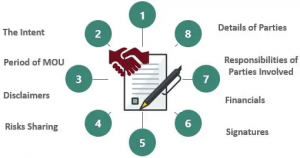
An MOU is a documented expression showcasing the intent of the parties. Hence, the purpose of MoU is not limited and can be adopted for any scenario in case the parties do not desire to enter a formal contract. Listed below are vital/crucial clauses that form an MOU:

  1. Proposal: A proposal would mean, one of the parties putting forward their intention of entering into an MOU, it mainly consists of important attributes such as listing purpose, obligations, and intention of the party to enter an MOU with the other one. 
  2. Acceptance of the proposal: Acceptance of terms and conditions mentioned by the other party.
  3. The intention of legal binding: The parties may outline in the MoU that certain clauses are binding and enforceable in nature. Where an agreement is explicitly stated as MoU, it does not override the binding effect; it depends upon the intention of the parties and the drafting of clauses. The same was laid down by Supreme Court in Kollipara Sriramulu v. T. Aswathanarayana and Ors, that “a mere reference to a future formal contract will not prevent a binding bargain between the parties. The fact that the parties refer to the preparedness of an agreement by which the terms agreed upon are to be put in a more formal shape does not prevent the existence of a binding contract.”  
  4. Consideration: The parties generally do not have considerations involved in MoU unless it has the binding effect of an agreement therefore, formal means of dispute resolution like arbitration should be avoided.

Crucial elements information of a memorandum Of understanding

  1. Date: MOU execution date  
  2. Name the parties in the agreement: Parties entering the agreement. The names of the persons with authority to enter into the agreement, also as authorised persons delegated by the parties to sign the acceptance of the understanding. 
  3. Description of a common objective for entering the MOU: The description would state the framework for the specifications of the MOU. Developing specific goals and objectives that provide the basis for evaluating the effectiveness of an MOU.
  4. The expertise of each party: This description would include the scope of responsibility or operational goals for each party. 
  5. Description of the clientele: This is implemented only for MOU’s which involve services to or for referral clientele. One of the easiest ways to highlight this is to write in general terms at the beginning of the MOU. In this, eligibility requirements/determinations could also be included.
  6. Description of the communication process: Regular or timely meetings between agency directors or parties, case conferences between workers, paper flow, correspondence, reports, service orders, and/or the naming of persons involved in the communication process.
  7. Reporting/recordkeeping mechanism: This can be handled in general terms in the instrument itself, but the provider should be fully aware of any reporting /recordkeeping needs.
  8. Provide for confidentiality assurance: Confidentiality assurance can be viewed as an essential practice for the protection of clients’ rights when any information is gathered and shared between agencies, and therefore should be included in the MOU instrument.
  9. Description of publicity procedures: It is advisable to assure that publicity involving both parties be coordinated or cleared. One way to do this is to limit the use of agency names by the respective parties.
  10. Confidentiality: Data protection of the vital information being shared by the parties with each other in an MOU.
  11. Dispute resolution: As such MoU is not a standard contract, thus not enforceable unless the parties expressly state it. A formal dispute resolution clause is generally not found in an MoU, therefore parties either resort to mutual negotiations or refer to the higher authorities of the organization.
  12. Amendment: For example; the memorandum of understanding may be amended on the initiative of either party by submitting a proposed amendment in writing to the other party and agreement of that party to the amendment.

Advantages of an MOU 

  1. A formal document laying out the roles and responsibilities of all the parties involved.
  2. Better than verbal commitments.
  3. Provide a good reference point in case of disputes.
  4. Lays out of the intent of all the parties towards a common goal.
  5. Convenient and easier to frame than a legally binding contract.
  6. Is friendlier and less threatening than a formal legally binding contract.
  7. Makes it possible to avoid obligations under international law when countries are signing the MOUs.

Disadvantages of  MOU

  1. Can just be a broad statement.
  2. Does not deal with the practicalities of day-to-day working.
  3. If actions and timescales are not attached then won’t provide a framework for the achievement of outputs.

Conditions for alteration and termination

An MOU’s terms and conditions can be altered on the mutual agreement upon both parties. Parties can also agree upon a notice period by which a party can terminate the MOU by serving notice as per the provisions under the notice period.

Conclusion

MOUs are widely used and considered to be an important starting point in bilateral and business relationships. Formally written roles, responsibilities, and risks provide clarity on how different situations will be approached during the course of the agreement.

Some MOUs prove to be just as good as legal contracts, because parties stick to them at all times for the larger mutual benefit, while others flounder because parties do not adhere to them due to diminished viability (in which case it is mutually dissolved) or due to selfish interests of the parties involved.

References


Students of LawSikho courses regularly produce writing assignments and work on practical exercises as a part of their coursework and develop themselves in real-life practical skills.

LawSikho has created a telegram group for exchanging legal knowledge, referrals, and various opportunities. You can click on this link and join:

Follow us on Instagram and subscribe to our YouTube channel for more amazing legal content.

Download Now

Post-trial stage in Criminal Law

0
criminal law
Image source: https://rb.gy/5btnyi

The article is written by Nikhil Thakur, a student of Manav Rachna University. The author through this article has attempted to explain and brief about the post-trial stage in criminal law. 

Introduction

Under criminal law, chiefly 3 key stages are the Pre-trial, Trial, and Post-trial stages. The post-trial stage is stipulated as the 3rd stage in criminal law, woefully, the same has not been explicitly mentioned under the Code of Criminal Procedure, 1973 (CrPC). But to give a simple definition of post-trial it means a stage where the trial has been concluded and the judge has articulated the judgment/ verdict. According to Merriam Webster “post-trial” means happenings that take place after the conclusion of the trial stage.

Under the purview of the post-trial stage, there are 3 main categories such as:

  1. Appeal (Section 372 to 394)
  2. Revision application (Section 397)
  3. Execution of the judgment

Appeal

The appeal in its literal meaning has not been stipulated under the CrPC, 1973. According to Merriam Webster “appeal” refers to a stage of proceedings where the matter has been brought before the higher jurisdiction. Or it can also be defined as a stage where the aggrieved party inquires the higher court to reverse the decision of the lower court.

After the verdict has been pronounced by the lower court and the same has been entered in the records, the aggrieved party may file a “notice of appeal” before the appellate court and may request the appellate court for transcription or other records of the lower court to be submitted. Along with this, the appealing party shall provide suitable reasoning for overturning the verdict administered by the lower court.

Once an appeal has been made at that stage “no new evidence” shall be conceded except the lawful contentions.

Predominantly, there are two categories in appeal:

  • Appeal on behalf of the victim or;
  • Appeal on behalf of the accused.

Appeal on behalf of the victim

Complying with Section 372 of the CrPC, 1973 which states that “no appeal shall take place against any judgment or order except the procedure as stipulated in the 1973 Act or any other law for the time being”. The said Section stipulates that the distressed do not have the vested right to appeal till the time the appellate believes that the lower court has executed/ conducted all the proceedings honestly without any violation or infringement.

Fortunately, the victim has the right to appeal against the judgment/ verdict of the lower court if the same has:

  1. Acquitted the accused;
  2. Convicted the accused for lower offence or;
  3. Accused has been imposed lesser/ inadequate compensation.

Appeal on behalf of the accused

  1. In compliance with Section 374(1) of the CrPC, 1973 if the High Court has convicted the accused, then as a matter of right the convicted may file an appeal before the Supreme Court of India under the extraordinary original criminal jurisdiction.
  2. According to Section 374(2) of the CrPC, 1973 if the accused has been sentenced by the session judge or additional session judge or any other court who is competent to pass a sentence of 7 years or more shall have the right to file an appeal before the High Court.
  3. Following Section 374(3) of the CrPC, 1973 any person who is accused of an offence and has been convicted by the metropolitan magistrate or assistant session judge or magistrate of the first class or second class shall have the right to appeal before the court of session.
  4. Moreover, under Section 379 of the CrPC, 1973 if the High Court has reversed the decision of the trial court and has convicted the accused to death or life imprisonment or imprisonment for more than 10 years the accused shall as a matter of right file an appeal before the Hon’ble Supreme Court of India.
  5. Lastly, following Section 380 of the CrPC, 1973 in case there are more than one accused and all of them were convicted before the lower court but eventually, an appealable order has been passed concerning any one of the accused then all such accused who were convicted shall as a matter of right file an appeal before the higher jurisdiction.

When no appeal can be made

There are few cases where no appeal can be filed and the provisions dealing with them are as follows:

When accused plead guilty as per Section 375 of the CrPC, 1973

If the accused has been convicted on pleading guilty in such a situation no appeal can be made if: 

  • The conviction was made by the High Court or;
  • Made by the Session Court or metropolitan magistrate or magistrate of the first class or the second class.

When the nature of the case is petty as according to Section 376 of the CrPC, 1973

Section 376 enumerates few more grounds when no appeal shall be made which are as follow:

  • When the High Court has convicted the accused of imprisonment of not more than 6 months and a fine not exceeding 1,000 rupees or both.
  • When the Session Court or the Metropolitan Magistrate has passed the imprisonment for not more than 3 months and fine not exceeding 200 rupees or both.
  • When the magistrate of the first-class has passed the sentence of fine of not more than 100 rupees.
  • When the case was being tried summarily, the magistrate pronounced a sentence for a fine of not more than 200 rupees.

When the judgment has been finalized as per Section 265G of the CrPC, 1973

If the Hon’ble court has pronounced the verdict, it shall be final and against which no appeal shall be made in any court whatsoever. But, an appeal can be made to the higher jurisdiction via Special Leave Petition (SLP) under Article 136 or through writ appeal under Articles 226 and 32 of the Indian Constitution.

new legal draft

Revision application

Similar to appeal, revision application has not been articulated under the CRPC, 1973. But, it can be defined as a re-examination of the case. 

Following Section 397 of the CRPC, 1973 the Session judge or the High Court may call for and look at the records of any proceeding before any inferior criminal court to satisfy itself as to:

  1. Correctness, 
  2. Legality, 
  3. Proprietary of any finding, 
  4. Sentence or order, and
  5. As to irregularities of any inferior court. 

The Court after calling on the records believes that if the accused is in confinement then he/ she shall be released on a bail bond and the court may suspend the sentence so passed by the lower jurisdiction.

The prime objective behind revision is to anticipate and dodge any miscarriage of equity/ justice committed by the inferior court. The Code of Criminal Procedure empowers the Session Court as well as the High Court to call for and look at the records of any procedure present before the lower criminal court as per Section 399 and 401.

The Supreme Court of India under the Alamgir v. State of Bihar (1959), observed that while determining the enhancement of punishment under revision application the court who is augmenting the punishment shall provide reasonable ground for such an alteration. The reason can be:

  • That the lower court imposed inadequate punishment on the accused or the punishment imposed was very less for the offence the accused has committed; or
  • That the lower court has failed to acknowledge the crucial facts and circumstances of the case and without considering them has pronounced the punishment.

Further, a revision application is basically filed when the subordinate court has pronounced the verdict and it goes against the aggrieved party and there is no provision as to appeal, in such a situation the aggrieved may file a revision application before the higher jurisdiction. 

Like in appeal, the aggrieved as a matter of right may file an appeal before higher jurisdiction while in revision the aggrieved has no statutory right, and acceptance of revision application is the discretionary power of the higher court. But there are a few exceptions when this discretionary power cannot be enjoyed by the court.

  1. Following Section 397(2) of the CrPC, 1973 the court cannot enjoy its discretionary power in case the interlocutory order, an interim order was passed in an appeal, trial, etc.
  2. According to Section 397(3), if the same application was made under Section 397(1) before the High Court and the Session Judge then no further application shall be entertained.

Execution of sentence

Execution of sentence is the final play which generally comes after the verdict. Under the CRPC, 1973 the provisions specifically dealing with execution are enshrined under Section 413 to 424.

Chiefly, there are three categories under the execution of sentence namely:

Death sentence (Section 413 – 416)

Execution of order passed under Section 368

  • According to Section 366 of the CrPC, 1973 the session court is not capable enough to execute a sentence of death without the confirmation of the High Court, and till the time High Court does not give the approval the accused shall remain in jail.
  • Hence, following Section 413, upon receiving the orders from the High Court the session court shall execute the same via issuance of a warrant.

Execution by High Court

In compliance with Section 414, once the sentence of death has been issued by the High Court whether in appeal or in revision the same shall be forwarded to session court who shall execute the same through the issuance of a warrant.

Postponement of the execution if appeal made to the Supreme Court

If the accused file an appeal under Article 134 of the Indian Constitution before the Supreme Court of India against the death sentence passed by the High Court or the accused sentenced makes an application before the High Court concerning the grant of certificate under Article 132, in these circumstances the High Court shall postpone the said execution until:

  1. The period which was allowed  for the appeal has expired; or
  2. Such appeal has been disposed of by the Supreme Court.

The High Court is of the opinion that the accused may file an SLP under Article 136 before the Supreme Court, it shall postpone the said execution for such period which is suitable for the accused to file a petition.

Postponement due to pregnancy

Following Section 416, if a woman who has been sentenced to death by the High Court was pregnant in such a case the High Court shall commute/ lower the death sentence to life imprisonment.

Imprisonment (Section 417- 420)

  • According to Section 417(1), the State Government shall prescribe the place where the accused who is sentenced for imprisonment be kept or confined.
  • Further, in compliance with Section 417(2) if the accused who is liable to be imprisoned under the CRPC, 1973 but is confined in a civil jail shall be migrated to a criminal jail.

Execution of sentence

  • According to Section 418, the accused who has been sentenced to imprisonment, the court which has pronounced such sentence shall issue a warrant to the jail authority where the convicted shall be confined. There is no need for a warrant if the convicted is already in jail.
  • In case the court has pronounced the sentence of imprisonment, but the accused was not present at the court, the court shall issue an arrest warrant.
  • According to Section 419, the warrant issued by the court concerning the sentence of imprisonment shall be submitted before the officer in charge of the jail. Further, following Section 420, the warrant shall be submitted before the jailor, where the prisoner has to be confined.

Levy of fine (Section 421- 424)

Warrant for levy of fine

When the court has sentenced the accused to a fine, the court may take appropriate actions to realize the fine in compliance with Section 421(1).

  • Issue a warrant concerning levy of fine.
  • Sale of any belonging to the offender.
  • Issue a warrant to the district collector for the said purpose.

Exceptions to levy of fine

  • If due to default in payment of fine, the offender has been imprisoned; or
  • If the court has ordered the payment of compensation out of the fine as per Section 357.

As per Section 421(2), the state government may provide the procedure/ method in which the warrant issued to be executed or following Section 421(3), where the district collector was issued a warrant concerning the realization of fine, the collector may execute the same in accordance with the law concerning recovery of arrears of land revenue. Most importantly, the warrant so issued shall not be executed via arrest of the offender as the case may be. 

Effect of warrant (Section 422) 

A warrant issued by the court as per Section 421(1)(a) shall be executed:

  1. Within the locale jurisdiction of that court, or
  2. May extend outside its jurisdiction, if authorized the sale of any belonging to the offender.

When the warrant was issued to the district magistrate, the execution shall be extendable up to the local jurisdiction of the property so found.

References


LawSikho has created a telegram group for exchanging legal knowledge, referrals, and various opportunities. You can click on this link and join:

Follow us on Instagram and subscribe to our YouTube channel for more amazing legal content.

Download Now

Freedom of speech and national security : a case study of the verdict of the European court of law

0
Image source - https://nyti.ms/3tz9plw

The article is written by Nikhil Thakur from Manav Rachna University. The author has attempted to explain the issue of freedom of speech with national security. Along with this, the author has included the European court of law’s verdict as a reference.

Introduction

Every person irrespective of his race, caste, sex has the right to freedom of speech and expression. Freedom of speech and expression incorporates freedom to hold conclusions and to get and confer information and ideas without obstruction by the public authority or the state.

Classically, the government legitimises intemperate abridgement of the right to speech and expression on the grounds of national security and terrorism, such a mishandling is encouraged by the troublesome relationship and pressure between national security and human rights protection. 

The key role that can be played in addressing and resolving this tension can be the judiciary. There are a plethora of instances around the globe where the judiciary has played a pro-active role by rejecting the justification as to curtailment of freedom of speech and expression at the time of emergency and in the interest of national security.

Meaning

National security

The concept of national security is pivotal to every nation which refers to the situation where the government ensures that the states and their citizens are protected and safe and assures these via political, economic, diplomatic and military mightiness.

Above all these, the states have a wider obligation concerning the protection of the fundamental rights of citizens, guaranteeing appropriate working of the democracy and establishing an atmosphere of amity and synchronization.

“National security is all about the free will of the government to take opposite decisions and to guarantee a country’s sovereignty and territorial integrity.

According to Collins dictionary, national security is defined as the ability of the government to protect itself from the threat of violence and so on.

Freedom of speech and expression

According to the Convention for the Protection of Human Rights and Fundamental Freedom (the European Convention on Human Rights), freedom of expression is a right in itself along with this it is a component of other rights like the freedom of assembly.

The phrase freedom of speech and expression is explicitly mentioned under Article 19(1)(a) of the Indian Constitution and is one of the fundamental rights guaranteed to its citizens. 

Freedom of speech and expression signifies the right of the citizens to verbalise their views, opinions, beliefs and thoughts by way of words through mouth, writing, printing and any other format. Article 19(1)(a) confers following of the rights:

  1. Freedom of press;
  2. Freedom of silence;
  3. Right to propagate one’s view; and
  4. Right against tapping of electronic communication and many more.

But, these rights are not absolute because they are subjected to few restrictions as according to Article 19(2), the right to freedom of speech and expression can be curtailed on the grounds of:

  1. Sovereignty
  2. Integrity
  3. Morality and decency
  4. Friendly relation with the foreign state
  5. Incitement to an offence
  6. Content of the court
  7. Public order 
  8. Security of the state

Indian judiciary’s perspective of national security

In the interest of the security of the nation, the freedom of speech and expression can be curtailed if the government believes that such a speech and expression may:

  1. Wage war against the government,
  2. Exaggerate external aggression etc.

Following the State of Bihar v. Shailabala Devi (1952), the hon’ble court observed that the gestures, graphical representation having a high probability of causing the problem in the state can be restricted and are covered within the purview of Article 19(2) of the Indian Constitution.

In Sanskar Marathe v. The State of Maharashtra and Anr (2015), the court specifically held that only those expressions that influence or instigate hatred against the government or may cause public disorder are punishable within the meaning of Section 124A of the Indian Penal Code, 1860.

European Court of Law

In Hadjianastassiou v. Greece (1992), there was an officer who revealed classified information. The information disclosed by him were concerning weapons and their technical knowledge has the capability of effecting significant harm to national security. The Hon’ble court held that the conviction of such a person shall be an intrusion with the officer’s freedom of speech and expression.

Following Article 10 of the Convention for the Protection of Human Rights and Fundamental Freedom, it says that the freedom ensured carries certain rights and responsibilities that are subjected to formalities, conditions, restrictions and are necessary for a democratic society, or in the interest of national security, territorial integrity and so on. Article 10 says that the rights conferred are not absolute and hence in the interest of national security, territorial integrity can be restricted.

Article 10 of the Convention allows the domestic authorities to intervene with the exercise of freedom of expression when a three-part test condition is fulfilled:

  1. When the interference by domestic authority is prescribed by the law (Gaweda v. Poland (2002) and The Sunday Times v. The United Kingdom (1979)).
  2. When the interference by domestic authority is aimed at protecting and ensuring; national security, territorial integrity, public safety, prevention of disorder or crime, protection of health, reputation, morals, right of others, secret information (Observer and Guardian v. The United Kingdom (1991)).
  3. When interference by domestic authority is necessary for the democratic society (Dlugolecki v. Poland (2009) and Tolstoy Miloslavsky v. The United Kingdom (1995)).

The essential part of Article 10 of the Convention is to secure freedom of expression for everyone. In this manner, the court through the above-mentioned exception built up rules for a strict interpretation of the possible restrictions so that they cannot be misused.

The grounds as mentioned under Article 10 of the Convention concerning the restriction of freedom of speech and expression are exhaustive. Thus, domestic authorities cannot use any other mechanism falling outside the list to restrict freedom of expression. For illustration: an injunction against a newspaper company can be held as legitimate in the interest of national security if the same is distributing or publishing classified data/ information. However, the court of law must guarantee that the interest that is to be protected shall be genuine and not merely a dubious possibility. Once the court is satisfied that the interest was genuine, then it shall decide whether it was necessary for a democratic society or not.

In Observer and Guardian v. The United Kingdom 1991 the hon’ble court observed that the phrase as mentioned under Article 10 of the Convention shall imply the presence of “pressing social need” and the 1st one to assess the pressing social need is the national authorities.

Moreover, in Mukong v. Cameroon (2015), it was observed that merely in the name of national security and safeguarding the state, the author cannot be subjected to arrest and detention because it is violative of freedom of expression and Article 7 of the European Convention on Human Rights. Further, it was said that in the name of national security and safeguarding the state under difficult situations cannot be executed by restricting the right to freedom of expression and democratic tenets. 

Besides this, there are few more cases where the freedom of expression and national security was discussed like in Okcuoglu v. Turkey (1999) and Vereniging Weekblad Bluf! v. Netherlands (1995).

Observer and Guardian v. the United Kingdom 1991

The above-mentioned case is a landmark case where national security as the ground was taken to restrict the freedom of expression.

Facts

  • During the year 1986, two newspaper organizations planned to publish the extracts from a book Spycatcher which was written by Peter Wright, a retired intelligence agent.
  • When the newspaper organization announced that they were going to extract the information from the book and get it published, the book Spycatcher was yet to be published.
  • The book contained a description of alleged unlawful activities committed by the British intelligence service and its agents.
  • The book clearly mentioned all the unlawful activities committed by the intelligence like bugging the entire diplomatic conference that took place in London during the span of 1950s-1960s, the 1979 Zimbabwe independence negotiation was bugged, the entire diplomats from Germany, France, Greece and Indonesia were bugged, even the suit of Mr Khruschchev’s was bugged when he visited Britain in the 1950s, the Soviet Consulates were also bugged, Even Britain in order to have check on left-wing political group in the country relocated its resources for the same cause and so on.

Arguments

  • The attorney general requested the hon’ble court to issue a permanent injunction against the newspaper organization from publishing the extracts from the book Spycatcher.
  • The Hon’ble court allowed the injunction but temporary, to prevent the newspaper organizations from publishing the extracts during the proceedings of the case.
  • The newspaper organization contended that the book already got printed in the US and the copies of the same were distributed in the United Kingdom. Despite this fact, the court maintained the temporary injunction.
  • The British government contended that at the time the temporary injunction was imposed on the newspaper organization, the classified information available to Peter Wright was confidential.
  • Further, the government contended that if this information had been released then the British Intelligence along with its agents would have suffered huge damage because such information aided the alien country to identify the British agents. Not only this, the friendly relationship among British and allied countries would have been hampered, the trust that all had upon British intelligence would have been broken.
  • Moreover, the British government said that it was necessary to stop such a publication because it would invite other former agents to disclose confidential information.

Court’s observation

The court observed that the temporary injunction granted was justified till the time the book Spycatcher was not published but now it cannot be justified. Furthermore, the court held that after the publication of the book in the United States of America, the information available in the book lost its confidentiality and hence the interest of maintaining the information confidential and away from the public no longer existed. Therefore, the hon’ble court dismissed the injunction imposed upon the Observer and the Guardian.

Judge Pettiti gave a dissenting opinion and said that the temporary injunction even if imposed before the publication of the book in the USA could not be justified. Further, judge Pettiti said that it is a violation of the freedom to receive information as depriving the public of the information concerning the functioning of the state is a violation of the fundamental democratic rights of its citizens.

Analysis

The judgment in the immediate case accommodates 2 key significant principles such as:

  1. That if the information is present under the public domain, the right to freedom of expression cannot be restricted, obstructed or eliminated in the name of national security.
  2. The state is barred from unconditionally defining all information as confidential in the name of national security because such an act restricts the people to have an access to said information and hence is a violation of freedom to receive information.

Conclusion

The right to freedom of speech and expression is a basic fundamental right available to every person. Solely in the name of national security and territorial integrity, the freedom of expression shall not be restricted, withdrawn or taken away. A proper justification shall be provided by the state that why they are restricting these rights and is it important to restrict the same. 

The landmark judgment in Observer and Guardian v. The United Kingdom clarified that, if the information is publicly known then the same cannot be used arbitrarily by the state to restrict the right to freedom of expression and further, the state cannot designate every information under the head confidentiality. Hence, the state shall ensure a balance between the right to freedom of expression and national security.

References


LawSikho has created a telegram group for exchanging legal knowledge, referrals, and various opportunities. You can click on this link and join:

https://t.me/joinchat/J_0YrBa4IBSHdpuTfQO_sA

Follow us on Instagram and subscribe to our YouTube channel for more amazing legal content.

Download Now

The new Chinese patent law was finally announced after 12 years : analyse 

0
Image Source: https://rb.gy/m8ij42

This article is written by Triveni Singal, who is pursuing a Diploma in Intellectual Property, Media and Entertainment Laws from LawSikho.

Introduction

Better late than never, the fourth amendment to the Chinese Patent Law was passed by the Standing Committee of the Thirteenth National People’s Congress on October 17, 2020, 12 years after the third amendment took place in 2008. The amendments to the law will be effective from June 1, 2021. China has conquered new levels of development, and technology over the last decade and it was high time that their patent laws were molded to strengthen IP protection further, cater to the new market needs, and encourage investors and designers in China. This article analyses some of the major amendments to the Chinese patent law. 

CNIPA administered patent open license system (Articles 50-52)

From among the several different kinds of licensing that can take place concerning intellectual property, open licenses are one. Here, some conditions are set forth by the IP holder regarding the original work that grants permission for anyone to utilize that work as long as they follow the conditions of the license. In other words, these licenses permit any third party to use the work of the IP holder without any cost and can also allow modifications with minimal restrictions. Open licensing has been very prominent in the field of copyrights. 

The Chinese amendment has created a system for a patent open license to promote the practice and utilization of granted patents. Any patentee can provide a patent license to a third party to use the said patent by filing a written declaration with the CNIPA (China National Intellectual Property Administration). The declaration must state the payment methods and standards for patent license fees. The declaration is then published by the CNIPA for the execution of the open license. Further, if the subject matter of the open license is a patent for utility model/design, then an evaluation report of the patent has to be furnished along with the declaration. Such an open license cannot be granted exclusively to any one entity.

After the publication of the declaration, any third party willing to utilize the open license may obtain it by filing a written notification to the patentee and furnishing the license fees as per the conditions set out. During the execution period of the open license, the annuity fee payable to CNIPA shall be reduced or exempted. 

The patentee also has the option of withdrawing his open license declaration by filing a written request to the same effect, which is subsequently announced by the CNIPA. However, such a withdrawal does not affect the validity of any open license in force. 

Any dispute regarding the open license shall be resolved through negotiation between the parties. If the negotiation fails or a party is not willing to negotiate, then a request can be forwarded to CNIPA for mediating or instituting legal proceedings in the court for dispute resolution. 

How beneficial is the patent open license system?

There is currently no patent office in the world with such a system in force and so only time will tell whether this proves to be beneficial or not. 

  • However, certain possible benefits could accrue from this system, such as the pooling of open licenses to facilitate an online exchange which will eliminate costly bilateral licensing transactions and replace it with a more accessible market-based trading platform. 
  • Supplemented by the blockchain and China’s national digital currency (DCEP), such exchanges could be enhanced profusely, which would lead to rapid broadcast and dissemination of new technology and lower barriers to access technologies for small firms and start-ups.
  • Additionally, there would be better transactional visibility, transparency, and traceability concerning IP valuation and reporting because online transaction recording combined with the inherent immutability of the blockchain ledger obviates problems of fraud, the need for auditing, and manual bookkeeping (which is error and fraud-prone). 
  • In turn, more accurate and timely reporting of IP value paints a truer picture of a company’s worth in Initial Public Offering (IPO), annual, or other reports
  • Currently, patents are valued using cost-based/income-based methods or using any other indicators like citations. But with the open license system an actual market pricing data would be provided eliminating the guesswork inherent in these traditional valuation methods.
  • Lastly, the failed initiative of the Intellectual Property Exchange International, Inc. (IPXI) to standardise and commoditise patent licenses to facilitate their trading on an open market with a standard, the non-exclusive contract called a Unit License Right could get a fresh face and beginning owing to this system. 

Patent linkage system for pharmaceutical patents (Article 76)

Article 76 provides for an early resolution process for disputes concerning drug patents. According to it, in case of dispute (between an applicant for a drug marketing authorisation and a patentee of a patent right concerning the drug) during the process of marketing review and approval, either of them can institute legal proceedings in the court seeking a judicial determination as to whether the technical solution related to the drug falls within the patent protection scope. Such a decision must be reached within the prescribed time frame based on which the NMPA (National Medical Products Administration) then may/may not suspend the approval for marketing of the drug. Furthermore, the parties can also request CNIPA for an administrative adjudication on the matter. 

The amendment also mandates NMPA and CNIPA to collaborate and jointly declare specific measures for the patent linkage and the dispute resolutions relating to such patents. Thus, statutory recognition has been given to the patent linkage system in China via this amendment, which also aims to resolve potential patent disputes before relevant drugs are marketed. Detailed rules regarding the same are still awaited. 

Increasing patent infringement damages to further deter patent infringement (Article 71)

  1. The punitive damages, almost five times higher, have been introduced for serious circumstances involving willful infringement. 
  2. Statutory damages have been increased up to five times
  3. The burden of producing evidence related to damages arising due to infringement can be shifted to the accused infringer.. Thus, the court can order the infringer to furnish their books of accounts and other materials to accurately calculate the damages. In the event the infringer refuses to furnish such evidence or submits fake evidence, then the court can evaluate the compensation amount based on the claims and evidence offered by the patentee. For calculating the damages, either the patentee’s actual losses or the benefits accrued by the infringer can be used first. 

These amendments clearly show China’s intent at strengthening the protection granted to patents for the interests of legitimate patent owners. 

Extension in patent term (Article 42)

The Fourth Amendment has provided a system to extend the patent term as compensation for unreasonable delay in patent prosecution process at the patent office or the time taken for the marketing approval and review of new drugs at the NMPA, where the former corresponds to the Patent Term Adjustment (PTA) system followed by the US Patent Office and the latter corresponds with the Patent Term Extension (PTE) system of the US. It is believed that this change was made in line with the China‐US phase 1 trade agreement called the “Economic and Trade Agreement Between the United States of America and the People’s Republic of China: Phase One.”

Where a patent was granted after four years from the filing date of the application and after three years from the date of the substantive examination request, CNIPA shall, at the request of the patentee, provide compensation for the term of the patent due to the unreasonable delay in the examination stage of the invention patent. In the case of drug patents, the CNIPA can grant an extension of a maximum of 5 years, and the total remaining patent term after a new drug is approved to be marketed cannot exceed 14 years. This amendment balances the interests of generic companies as well as innovative drug companies very well. 

Amendments relating to design patents (Articles 2, 29, and 42) 

The definition of designs has been amended and broadened to include partial design in the ambit of protection (Article 2). In other words, it is now possible to protect the design of a portion of the product also as opposed to the previous law wherein protection could only be granted to a complete product. 

This move will specifically strengthen the design protection relating to graphic user interface (GUI), as now applicants won’t have to protect the product (that is the display screen panel) but instead the GUI design can be protected itself wholly or partly. 

Beijing Qihu Tech. Co. and Qizhi Software Co. v Beijing Jiangmin New Sci, Tech. Co. This was China’s first GUI design infringement case and it also brought into light the problem with GUI design protection. At that time, partial claiming of designs was not permitted and so both the GUI and the hardware were included as subject matter for a patent. Since Jiangmin only produced software and not the underlying hardware, the Beijing IP Court held that Jiangmin’s software did not infringe the plaintiffs’ design patent both because the subject matter of the design patent included a computer, and because the software was neither an identical nor a similar product.

Further, the amendment has provided for domestic priority claims to be made within 6 months from the date on which the applicant first applied in China (Article 29). Article 42 as amended extends the term of the design patent to 15 years. This amendment is believed to be an attempt by China to join the Hague Agreement. 

Other notable amendments made by China in their patent law 

  1. Employers are being encouraged to establish methods for rewarding inventors and designers for service inventions so that they can reasonably share the revenue generated using the inventions (Article 6 and 15)
  2. Promotion of utilisation of patents by mandating CNIPA to improve the patent information public system service and dissemination of patent information (Article 21 and 48)
  3. CNIPA has been empowered to handle patent infringement disputes which have a nationwide impact as a step towards improving patent administrative enforcement (Article 70)
  4. An additional requirement of “good faith” has been inserted to be furnished with the patent application and enforcement (Article 20)
  5. A new exception has been added wherein the novelty of the invention would not be destroyed, that is, in case the invention was made public for the public interest, due to a national emergency/other extraordinary circumstance (Article 24

Conclusion 

By introducing greater protection, improved administration, improvement in patent-related public services, promotion of the use of patents, mechanisms to reduce abuse in its fourth amendment, China has definitely strengthened its patent law many folds which will eventually boost its economy. Some of the changes even exceed the patent law of most other jurisdictions in the world. With new avenues such as open licensing, there is a greater possibility of dissemination of technology across the country. 

It is also particularly interesting to note that the amendments have been released around the same time as China’s latest five-year plan, which emphasises technological independence and supplement earlier announcements to achieve leadership in key technologies, notably 5G, the Internet of Things, biotech, AI, etc. However, the actual effects of these will only be known in the coming years.

References 


Students of LawSikho courses regularly produce writing assignments and work on practical exercises as a part of their coursework and develop themselves in real-life practical skills.

LawSikho has created a telegram group for exchanging legal knowledge, referrals, and various opportunities. You can click on this link and join:

Follow us on Instagram and subscribe to our YouTube channel for more amazing legal content.

Download Now

Constitution exploitation and juridical concern : an evaluation

0
Constitution

The article is written by Nikhil Thakur from Manav Rachna University. In this article, the author has attempted to explain in detail the Constitutional exploitation and juridical concern attached to it.

Introduction

The Constitution of India has acknowledged a democratic welfare state on the principles of equity, liberty and justice in favour of those people who had been traditionally subjugated and deprived of their rights. These above-mentioned principles could not have become a reality if they were not enshrined within the purview of Part III (fundamental rights) of the Indian Constitution.

The Indian Constitution following Articles 23 and 24, symbolizes its determination to safeguard humans and its citizens from any sort of exploitation. In the above-mentioned Articles, every individual irrespective of his sex, race, age, caste and so on are guaranteed the right against exploitation and ensured the dignity of the individual. 

Meaning

Exploitation

The phrase exploitation has been borrowed from the French word “exploitation”. Exploitation refers to depriving a person of his/her rights by the method of fraud, misrepresentation, force etc. if any person is denied of his/her share, compensation, remuneration and so on for the work executed or performed shall amount to exploitation. According to Merriam-Webster, exploitation refers to an act of exploiting.

Basically, exploitation refers to an act of taking unfair advantage of a person on the grounds of his/her inferior status. Thus, in exploitation certain classes of people are treated unfairly for the benefit of others. Here, the inferiors are treated not as a human rather as an object.

Exploitation has been prevalent in all societies around the world since time immemorial. In the ancient period, the practice of slavery, devadasi, forced labour and so on were prevalent.

Human trafficking

According to United Nations Office on Drugs and Crime, human trafficking means and include transportation, recruitment, harbouring of people with the help of force, fraud and deception, with the prime objective of exploitation. Anyone can be a victim of human trafficking, generally, women and children are mostly trafficked.

Human trafficking refers to an act of transferring and transporting people to get benefits from their services or body, generally in form of sexual exploitation. It is one of the major problems around the globe where humans are exploited.

Ingredients of human trafficking are:

  1. Buying and selling of living /conscious human beings,
  2. Prostitution, sexual exploitation in women and children,
  3. Devadasis, and
  4. Slavery.

Bonded labour/ Forced labour

According to the Forced Labour Convention, 1930 forced labour means an involuntary act or work performed under the threat of penalty. In this, the inferior labourers are subjected to cruel and unending exploitation by the superior. 

According to Merriam-Webster, forced labour refers to performing physical hard work under pressure or force. Bonded Labor or Forced labour can be said as another form of slavery because slavery is uncivilized while bonded labour is a civilized form of slavery.

Begar

Begar is another form of exploitation among humans. Basically, it means forcing someone to work without any money, remuneration etc. According to Merriam-Webster, begar is nothing but forced labour.

Ingredients of begar:

  1. Forced labour for which remuneration is not given; or
  2. Forced labour for which remuneration is allowed but is insufficient.

Government’s initiative to curb exploitation

The Indian legislature has enacted a plethora of legislation in order to control the practice of exploitation such as:

  1. The Indian Penal Code, 1860
  2. The Equal Remuneration Act, 1976
  3. The Minimum Wages Act, 1948
  4. The Protection of Children from Sexual Offence Act, 2012
  5. The Juvenile Justice Act, 2015
  6. The Bonded Labour (Abolition) Act, 1976
  7. The Immoral Traffic (Prevention) Act, 1956
  8. The Child Labour (Prohibition and Regulation) Act, 1986

These above-mentioned laws specifically contain provisions as to the protection of victims against the practice of exploitation. Despite having so many laws concerning the protection of individuals from exploitation still, there are a plethora of cases of exploitation in our society. Hence, it is the judiciary that has taken corrective steps and measures in tackling the menace of exploitation in India.

The prohibition of trafficking of human beings and forced labour

Article 23 of the Indian Constitution, explicitly deals with the prohibition of traffic in human beings and forced labour. Article 23 prohibits:

  1. Human trafficking,
  2. Begar/ Forced labour, and
  3. Other similar types of offences.

The right not to be exploited is available to both the citizens as well as non-citizens. Article 23 ensures protection to an individual from the state as well as the private individuals.

Following the case of the State of Gujarat v. Hon’ble High Court of Gujarat (1998), the Hon’ble Supreme Court of India observed that Articles 23 and 24 of the Indian Constitution are the only Articles that come under the purview of “right against exploitation”. Further, the court stated that human trafficking is explicitly prohibited while forced labour is not absolutely prohibited, indeed, it is subjected to only one exception that is compulsory services.

As per Article 23(2), the state is empowered or permitted to impose compulsory services on an individual or group of individuals in the interest of the public. Here, the state is not bound to pay any form of salary, wage and remuneration. Further, while imposing the compulsory services, the state shall not discriminate merely on the grounds of:

  1. Religion,
  2. Race,
  3. Caste,
  4. Class,
  5. Or any of them.

To ensure constitutional protections against human trafficking in India, the government following Article 35 of the Indian Constitution has enacted the Suppression of Immoral Traffic in Women and Girl Act, 1956.

In Chandra v. State of Rajasthan (1959), the sarpanch of the village asked every villager to send at least one member from their house to render free services to build the village tank. The matter went to the Rajasthan High Court, and it was held that the order of the sarpanch was against Article 23(1) of the Indian Constitution.

In Suraj Narayan v. State of Madhya Pradesh (1960), the Hon’ble Court observed that non-payment of salary to the worker on the account of unsatisfactory work shall amount to a violation of Article 23 and shall also amount to practice of begar.

An interesting Manipur custom comes to notice in the Ruiweinao Khaosan Tangkhul v. Ruiweinao Sumirei Shailei Khulla Kpa (1961), in this case, there was a custom in Manipur that each of the householders in the village had to provide free services to the headman of that village for one day. But, the appellant refused to give such free services on the ground that it is a violation of Article 23 of the Indian Constitution and amounts to begar. Finally, it was decided that the said Manipur custom is against and violative of Article 23(1) of the Indian Constitution.

A landmark judgment concerning the exploitation was observed in the case of People’s Union for Democratic Rights v. Union of India (1982), in the said case, workers were not given minimum wages for the work performed and in response the workers challenged the same in Supreme Court on the grounds of violation of Article 23 of the Indian Constitution.

The Supreme Court held that Article 23 is a general prohibition, total in its effect and pervasive in its range. Further, the court said that if there is any worker who is working under pressure or force irrespective of the fact he is paid or not shall also amount to forced labour and is prohibited. And any person who is working below the minimum wage shall be considered as working under some kind of pressure or compulsion.

Based on the judgment pronounced in People’s Union for Democratic Rights v. Union of India, 1982, the Hon’ble Court in Sanjit Roy v. the State of Rajasthan (1983), held the Rajasthan Famine Relief Works Employees Act, 1964 as invalid because the said act exempted the application of  Minimum Wages Act, 1948.

Another landmark case was Bandhua Mukti Morcha v. Union of India (1984), the Supreme Court said that the Bonded Labour (Abolition) Act, 1976 recognizes forced labour as bonded labour, and the said Act aims to prohibit forced labour. Further, the court said that if anyone is working under force or pressure, it shall be presumed that such person is working in consideration of advance or economic conditions.

Moreover, the Hon’ble Supreme Court directed the central and state government to ensure proper implementation of the Mines Act, 1952, Maternity Benefit Act, 1961, Abolition of Bonded Labour Act, 1976 etc. 

In 2011, in the case of State of U.P v. Madhav Prasad Sharma (2011), the court was of the opinion that denial of salary on the grounds of no work shall not amount to begar within the purview of Article 23 of the Indian Constitution.

Prohibition of employment of children in factories

Article 24 of the Indian Constitution explicitly forbids the employment of minors below the age of 14 years in factories, mines and any other hazardous activities. The said provision is made in the interest of children’s health and compliance with Article 39(e) and (f) of the Indian Constitution.

An important Act concerning the prohibition of employment of the child in factories is the Child Labour (Prohibition and Regulation) Act, 1986 which is renamed as the Child Labour and Adolescent Labour (Prohibition and Regulation) Act, 1986

The Commission for the Protection of Child Rights Act, 2005 recommended the establishment of the National Commission for the Protection of Child Rights (NCPCR), the State Commission for the Protection of Child Rights (SCPCR) and the Children’s Court for speedy disposal of the cases.

In M.C Mehta v. The State of Tamil Nadu (1996), in response to the widespread menace of child labour, the Supreme Court observed that no child below the age of 14 years shall be employed in the match industry in Sivakasi. Further, the court emphasised the education of children and the establishment of the child labour rehabilitation welfare fund.

On the 10th of October, 2006, the Indian Government banned the employment of children below the age of 14 as home servants and in business (factory, shop, dhaba, restaurant, etc.). Anyone who violates these shall be penalised under the Child Labour and Adolescent Labour (Prohibition and Regulation) Act, 1986.

International legal framework

There are a plethora of Conventions, Declarations and International Treaties around the globe that seek to prevent exploitation and ensure dignity to humankind.

  1. Paris Congress 1906,
  2. The International Agreement for the Suppression of White Slave Traffic, 1904,
  3. International Convention for the Suppression of the White Slave Traffic, 1910,
  4. International Conventions for the Suppression of the Traffic in Women and Children, 1921,
  5. The International Convention for the Suppression of the Traffic in Women of Full Age, 1933,
  6. Universal Declaration of Human Rights (UDHR), 1948,
  7. The United Nation Convention Against Transnational Organized Crime, 2000,
  8. Protocol to Prevent, Suppress, and Punish Trafficking in Persons Especially Women and Children, 2000,
  9. SAARC Convention on Preventing and Combating Trafficking in Women and Children for Prostitution, 2002,
  10. Slavery Convention, 1926

Conclusion

Articles 23 and 24 of the Indian Constitution ensure or guarantee the right against exploitation. These Articles explicitly prohibits the practice of exploitation, human trafficking, begar, forced labour and child labour. Since time immemorial, India has been popular for its unequal society and exploitation of the weaker section by those in power. The existence of these practises despite having so many legislations, is a blot on a civilised society. Therefore, concrete actions along with awareness among the public at large are important.

Despite all the odds, the Indian Judiciary has played an important role in ensuring and safeguarding the rights of the victims, bonded labourers and child labourers. In ensuring these rights, Public Interest Litigation has been a remedy to all vulnerable persons.

References


Students of Lawsikho courses regularly produce writing assignments and work on practical exercises as a part of their coursework and develop themselves in real-life practical skills.

LawSikho has created a telegram group for exchanging legal knowledge, referrals, and various opportunities. You can click on this link and join:

Follow us on Instagram and subscribe to our YouTube channel for more amazing legal content.

Download Now

An analysis of the Franklin Templeton mutual fund case

0
SEBI: Franklin Templeton mutual fund case
Image source-https://rb.gy/bmaydb

This article is written by Ronika Tater, from the University of Petroleum and Energy Studies, School of Law. In this article, she discusses the inspection of six debt schemes of the Franklin Templeton Mutual Fund case and various other SEBI provisions in relation to the said case.

Introduction

On 23 April 2020, Franklin Templeton Mutual Fund declared voluntarily winding up its six debt mutual fund schemes in India stating redemption pressures and lack of liquidity in the bond market due to the COVID-19 and also to protect the investors’ value. Consequently, on 28th August 2021, the Supreme Court-appointed liquidator SBI Funds Management Pvt Ltd (”SBI MF”) to distribute a portion of Rs 2918.50 crore received from the sale of assets and coupons to its unitholders across all six schemes. Moreover, this action is limited to the below-mentioned funds in India, and all the other funds such as equity, debt, and a hybrid will be unaffected by the decision.

  • Franklin India Low Duration Fund;
  • Franklin India Credit Risk Fund;
  • Franklin India Short term Income Plan;
  • Franklin India Ultra Short Bond Fund/Ultra Short Fund;
  • Franklin India Income Opportunities Fund; and
  • Franklin India Dynamic Accrual Fund.

Meaning of the term mutual funds

There are different types of investment avenues available to the investors, one of them being Mutual Funds. Mutual Fund is formed in the form of a trust comprising sponsor, trustees, assets management company (“AMC”), and a custodian. It is regulated by SEBI (Mutual Fund) Regulations, 1996. A trust is established to raise money through the sale of units. It plays an active role in accumulating wealth and generating income for investors thereby acting as a source for corporates to raise money. The mutual fund industry in India started with the introduction of the Unit Trust of India (UTI) in 1963. Private sector mutual funds were established in 1993, where Franklin Templeton was the first establishment.

Structure of a mutual fund

  • It consists of one or more sponsors who are like a promoter of a company.
  • The trustees of the mutual fund hold its property for the benefit of the unit-holders. It holds the power of superintendency and provides direction to AMC. It also monitors the performance and compliance as per Security and Exchange Board of India (SEBI) Regulations.
  • The AMC authorised by SEBI managed the funds by exposing investments in different types of securities. It consists of a registrar and a transfer agent.
  • The custodian registered with SEBI holds the securities of various schemes of the funds.

Advantages and disadvantages of Mutual Funds

The following are some of the advantages of mutual funds:

  • Investors can render services from experienced and skilled professionals with proficiency in analysing the performance of companies and thereby selecting suitable investments to achieve the aim of the scheme.
  • As mutual funds invest in different segments of the market-leading to a reduction of risk.
  • Mutual funds save time by reducing paperwork and provide a convenient administration by avoiding various problems such as delayed payments or bad deliveries.
  • It has the potential to provide a higher return on investments over the medium to long term.
  • It has relatively lower costs than investing in the capital markets.
  • It provides transparency on the value of the investment made by schemes, the proportion invested in each asset, and information of the fund manager strategy on the scheme.

The following are some of the disadvantages of mutual funds:

  • Diversification of the portfolios may lead to a loss of focus on the securities in different segments.
  • In order to obtain a high return through liquidation of the portfolio, it may lead to large payments on commission and brokerage.
  • Sometimes the fund managers are unaccountable for poor results.
  • Poor planning of investment returns by not researching properly on income, profits, and government policies.
  • Failure to identify the risk involved in the mutual funds as compared to the risk of the market.

Key provisions under SEBI (Mutual Fund) Regulations, 1996

SEBI (Mutual Funds) Regulations,1996, (“Mutual Funds Regulations”) was established with the objective to improve the performance of the mutual fund industry thereby provisioning better service to all categories of the investors and offering a diverse range of innovative products with regard to the interest of the investors. Some of the key provisions as below-mentioned:

  • Schemes launched by the AMC need to be approved by the Board of Trustees and filed with SEBI.
  • The offer documents should properly disclose the related information of all the schemes in order to make informed decisions by the investors.
  • The listing of close-ended schemes should be mandatorily disclosed and listed on a recognised stock exchange.
  • Units of a close-ended scheme can be opened for sale or redemption at a fixed interval and the minimum and maximum amount of same or redemption should be periodicity disclosed in the offer document.
  • Units of a close-ended scheme can be converted into an open-ended scheme with the consent of the majority of the unitholders and properly disclosed in the offer document.
  • Units of a close-ended scheme can be rolled over by passing a resolution of a majority of the shareholders.
  • If the minimum subscription is not satisfied, the AMC shall refund the money back to the investors.
  • A close-ended scheme should be wound up on redemption date or with the consent of the majority of the unitholders passing a resolution for winding up of the scheme as per the directions of the SEBI in order to protect the investors.
  • It is also allowed to invest in foreign debt securities with fully convertible currencies.
  • It is also allowed to invest in government securities and also in both gold and gold-related instruments subject to certain investment restrictions as per SEBI (Mutual Funds) (Amendment) Regulation, 2006.

Analysis of the SEBI – Franklin Templeton mutual fund case

Franklin Templeton Mutual Fund case discusses the compliance of an AMC of a mutual fund with regards to the SEBI (Mutual Funds) Regulations,1996, (Mutual Funds Regulations) leading to the winding up of the six schemes. It also states the internal systems, compliance, risk management practices, inside trading, and method of categorization of schemes by the AMC.

Background of the case

Franklin Templeton Mutual Fund (“FT-MF”) is a mutual fund registered under SEBI. Franklin Templeton Asset Management (India) Pvt. Ltd (“FT-AMC/Noticee”) is the AMC of FT-MF. On 23 April 2020, Franklin Templeton Trustees Services Pvt. Ltd. (“trustees”) declared voluntary winding up of its six schemes in India under the provisions of Regulation 39(2) of the Mutual Funds Regulations. Subsequently, SEBI initiated an inspection to check with regard to FT-MT compliance with the provisions as per the SEBI Act. 

Issues involved

  1. Whether there were any violations by noticee under Section 11(1), 11(4), and 11B of the SEBI Act?
  2. Whether the noticee should be suspended from issuing any new scheme for a specified period?
  3. Whether the noticee should refund the investment management and advisory fees of the debt schemes inspected? 
  4. Whether the noticee should be liable for monetary penalty as prescribed by the SEBI regulations?

Arguments from both parties

Considering the report, SEBI issued a Show Cause Notice (“SCN”) noting the following allegations:

  • The debt scheme was inspected as a Credit Risk Fund scheme, however, it was depicted as a duration based scheme.
  • The noticee failed to disclose its strategy of investing in high yield securities.
  • The notice incorrectly calculated Macaulay duration, leading to long-duration securities in short duration thereby running multiple schemes under the same guard.
  • The terms and conditions of the investment were unclear to both the issuer and investor.
  • The noticee failed to follow the Principles of Fair Valuations thereby failing to reflect the true value of the securities.
  • The noticee failed to disclose the change in terms of investment to valuation agencies and credit rating agencies.
  • The noticee failed to follow proper due diligence and made investments similar to giving loans to issuers.
  • The noticee without the consent of the Board reduced the role of the Business Risk Management Committee thereby not ensuring the independence of the risk management function.
  • The noticee failed to provide any guidance to manage various risks and had not maintained any documentation for investment decisions.
  • The noticee failed to follow the appropriate policy of pro-rata allotment of partial buy-back to all the schemes. However, it allotted a partial buyback on a non-pro-rata basis thereby benefiting investors of one scheme over the other.
  • Lastly, the noticee failed to maintain high standards of integrity, due diligence, proper case, and exercised unprofessional judgment thereby violating the Code of Conduct as mentioned under the Fifth Schedule to the Mutual Funds Regulations.

Further, the noticee rejected all the allegations mentioned under the SCN and stated as follows:

  • Considering the pandemic there is no need to invoke special provisions of the SEBI Act. It also stated that Section 11(1), 11(4), and 11B of the SEBI Act does not have the power to direct an AMC to refund investment management and advisory fees to the investors.
  • The notice does not depict any wrongful gains made or losses averted or any unjust enrichment by the noticee. Thus the noticee acted lawfully and under the provision of the SEBI Act.
  • The noticee stated that any direction against the launching of new schemes will be against the principles of common law Wednesbury principle and the principle of proportionality as mentioned under the Administrative law and may involve penal action by the government or regulatory authorities.
  • The noticee while declining the imposition of the monetary penalty referred to the case of PG Electroplast Ltd. and Ors. v. SEBI, (2019), where the Hon’ble Securities Appellate Tribunal (“SAT”) set aside an order against the adjudicating officer for imposing a monetary penalty. The SAT, while considering the facts and circumstances of the case, stated that even if the parties had not acted with proper due diligence and proper care, the authorities may refuse to impose a penalty if it is a minimal breach of the provisions of the SEBI Act. Hence, in the particular instance, considering the circumstances of the noticee, it is the discretion of the authorities to refuse monetary penalty. 

Order

  • It was held that the noticee as an AMC has violated the provisions under Mutual Funds Regulations. The noticee derived income out of wrongful conduct from the investor is liable to pay a monetary penalty of Rs 5 Crore within 45 days from the date of this Order.
  • The noticee is liable to pay the investment management and advisory fees against the six debt schemes inspected from April 1, 2018, to April 23, 2020, as mentioned in the Order. 
  • Due to the mismanagement on the part of the noticee, it had caused hardship and loss to the investors. Hence, it is reasonable and justified to levy interest on the wrongful gain made by the noticee at the rate of 12% simple interest per annum from April 24, 2020, till the date of this Order.
  • The noticee is prohibited from launching any new debt schemes for two years from the effective date of this Order and the prohibition will start as soon as the six debt schemes inspected for winding up cease to exist as per Regulation 42 of the Mutual Funds Regulations.
  • Furthermore, various irregularities have been noted while running the six debt schemes against the interest of the unitholders. These irregularities consist of failure to exercise due diligence, carry out the proper valuation of securities and ensure a speedy risk management framework. Hence, a proceeding against the employees of FT-AMC should also be considered as they may be liable for these irregularities arising during the course of business of the noticee.

Conclusion

The Franklin case is eye-opening for the investors who trusted that debt funds are safer than traditional debt instruments such as Fixed Deposits or Recurring Deposits. On the other hand, AMCs should also be conscious before stating their products in the market in the name of high returns or comparing it to the traditional instruments.

References


Students of Lawsikho courses regularly produce writing assignments and work on practical exercises as a part of their coursework and develop themselves in real-life practical skills.

LawSikho has created a telegram group for exchanging legal knowledge, referrals, and various opportunities. You can click on this link and join:

Follow us on Instagram and subscribe to our YouTube channel for more amazing legal content.

Download Now

The evidentiary standard for interim relief in competition law mattes

0
Image source: https://blog.ipleaders.in/indian-economy-competition-law-overview-major-judicial-pronouncements/

This article has been written by Vartika Shakya pursuing the Certificate Course in Competition Law, Practice And Enforcement from LawSikho.

Introduction

The objective of Competition law is to both promote healthy competition for accelerating growth through innovation and economic efficiency and  to regulate and investigate all anti-competitive practices, thus increasing consumer welfare with the aim for companies to provide better products at reasonable prices. The Competition Act has provided us with different ways by which this objective can be achieved, the most prominent being, to avoid decreased competition which may happen when companies undertake and carry out unfair trade practices. One such method is the provision of interim relief given under the Section 33 of the Competition Act, which is used by the Competition Commission of India. Despite being a great tool within the CCI’s power, the use of interim measures have been very limited with just four orders passed in the past. However, the CCI with its renewed interest has used this measure and passed a recent order for the same. This article will analyze the new interest of imposing interim measures and the presence of evidentiary standards for the same in the digital market with the help of this recent order passed by the CCI.

Meaning of Interim Relief in Competition law

In simple terms, interim relief refers to a short term assistance which is provided till the time the final decision is taken. It is filed by the aggrieved party in order to get interim protection before the final decision. The provision under Section 33 of the Competition Act, 2002, basically states that if the commission is satisfied that any act is anti-competitive in nature or is related to abuse of dominant position which could have a considerable adverse effect on the market and if such an act is continued to be committed or is about to happen then CCI can temporarily restrain such party from continuing that act until the inquiry is completed against them. However, due to its wide scope this power is used only when it’s necessary. This is why, it has been observed that interim relief under Section 33 has been granted in very few cases, as again it has only been applied wherever it was really required. The Supreme Court in CCI vs SAIL laid down various conditions in order to grant interim relief:

  • A prima facie case should exist;
  • Order of restraint should be passed as without it the parties will suffer an irreparable; injury or the market shall be adversely affected by the unfair activities.

Since the SAIL Judgment, market dynamics have undergone several changes, one of them being digitalization. The recent order of MMT-GO passed by the CCI is an example of where the CCI has used its power to grant Interim Relief in the digital market. This case is known to be quite instrumental, as it showed a new approach adopted by the CCI in handling the online platforms that function in multi-sided markets, this issue was never as such taken up before, and several competition regulators from different jurisdictions have been struggling with the same. 

Case study of MMT-Go Order

The brief facts of this case are that MakeMyTrip India Pvt. Ltd. (“MMT”) and Go-Ibibo (
“GO” and collectively referred to as “MMT-GO” are an online travel agency providing services like hotel reservations. Fab Hotels, Treebo and OYO are Indian budget hotel chains that operate on franchising. MMT and Go-Ibibo decided to delist Treebo and Fab Hotels pursuant to an exclusive agreement with OYO. In February 2020, the CCI passed an investigation order against MMT-GO and OYO after Treebo filed information alleging absolute exclusion by virtue of an exclusive listing agreement between MMT-GO and OYO.

Herein, CCI granted interim relief to these two hotels Treebo and Fab hotel against the Make my trip India Pvt. ltd and Go-Ibibo and directed them to re-list these hotels on their website. There are two reasons why this interim order has been considered noteworthy- the conflation between the parties and aggregator and the evidentiary standard for interim relief.

The complainants alleged that MMT-GO and OYO rooms had entered into an exclusive agreement due to which the complainants had been delisted from the website leading to a loss of revenue and investors. A prima facie opinion was formed by CCI that MMT-GO is dominant in the market for the booking of hotels in India and OYO also has an influential market power, therefore, investigation was directed to determine if there has been an exclusive agreement between them. Later, after one year the complainants filed an application requesting re-listing which led to this Interim Order.

Evidentiary standards and Interim Relief

It is obvious that with new developments in technology and globalization, the credibility of both direct and circumstantial evidence has changed, mainly, because with time, most important processes have been digitized including transactions. It has been seen that in Competition law cases all over the world, for detection of cartels, the reliance has been taken on both direct and circumstantial evidence and not just solely on circumstantial evidence. In the European Union, the only way, parallel conduct qualifies as circumstantial evidence in order to prove the cartelization is- if there is no other explanation available for the same. As far as the US is concerned, the corroboration of circumstantial evidence with direct evidence is a must.

Further, In India, initially, the CCI was of the belief that cartelization couldn’t be proved without the availability of direct evidence. However, later, after a few cases like In re: Sugar Mills, In Re: Alleged cartelization by steel producers, CCI changed its opinion and also relied on circumstantial evidence purely, in the case of non availability of direct evidence. The CCI observed that just the presence of circumstantial evidence was also enough to indicate the harm to competition in the market, despite the presence of direct evidence and the cognizance of the same could be taken. Therefore, in order to prove the anti-competitiveness of an act, the presence of evidentiary standards matters, be it direct or circumstantial. 

Interim Order in MMT-Go Case

In the MMT-Go Case, the interim order was backed by a valid reasoning i.e., getting delisted from the website leading to loss of investors, revenue and resulting in an exclusive agreement. The CCI was also of the opinion that not re-listing the aggregators and delaying the investigation would lead to the end of their business, thereby leading to a loss of competitors in the market.

By opting for this order, the CCI shifted the burden of proof on MMT-Go and expected them to prove the reasoning of delisting. The CCI also assessed the cost incurred for adding hotel franchisees and the explanation regarding the promotional budget constraints. As per the evidentiary standards, the CCI took notice of the fact that the complainants are dependent for their business on that platform and multiple reports were cited for the same which also highlighted the exclusionary conduct and were considered for the urgent action taken by CCI.

The main goal of being a platform is to provide operation of a service with multiple choices to consumers. Herein, it was also seen that MMT-Go together is also an amalgamation of effective marketing. Further, in order to prove their actions, the evidence is required to show the same. However, the investigation was still not completed. Still it can be seen that in order to grant an interim order, the reliance was taken on the evidence that showed the possibility of causing harm to the market by the time the investigation was complete. Further, having limited choices will harm consumers as it will be a difficult and a mentally grueling process for them in picking a product to end the task. This process also acts as a game-changer in competition analysis.

Analyzing the approach of CCI

The approach of CCI in saving the industry in such hard times is commendable. This interim order has also marked the emergence of a new approach between ex-ante and ex-post regulation where remedies are issued as a pre-emptive measure, pending investigation. However, there is a need to work on the evidentiary standards in order to grant interim reliefs in digital sectors as not every intermediary can be considered on the lines of gatekeepers, even when the denial of market access is happening.

The main reason for granting interim orders has been to maintain status quo and prevent the market or industry from the potential harm. However, as stated above, the presence of evidentiary standards matters in such conducts like in the above given case, factors like drop in revenue, losing investors etc. Furthermore, the reduction in the number of choices making the websites pro-competitive, fueling competition between different aggregators also matters. Moreover, it should always be noticed that it just isn’t the fact that the aggrieved party is seeking a relief of interim measure as they are under harm, interim order is not passed for this very reason. The CCI always looks at the broader picture as to how such an act will affect the market as well as the aggrieved party.

Conclusion

This order has created a huge impact as this was the first time that the CCI used an interim measure in the digital market. The commission paid attention to the importance of regular interventions in the digital markets. Many competition authorities of Brazil, France etc. have taken several measures and imposed interim measures against the tech players. European countries have played a major role in the enforcement of competition laws, especially in digital markets and have also introduced the interim measures that have been used by CCI now. With the growing technology and such dynamic markets, the need to enhance these interim measures should be considered by CCI. Several alternatives to figure out the harm on competition in markets and a check on intermediaries or enterprises acting as gatekeepers that can control the entire platform for the benefit of their products is also required. There is a need to address all these issues and find solutions for the same in the digital sector, which the CCI has been trying to do. However, it needs more efforts and renewed tools for the same. Further, as seen in the MMT-Go case, the degree of satisfaction is much more in interim relief cases as compared to passing an investigation order. Therefore, the presence of evidentiary standards matters a lot as that is what helps in determining whether the market is under harm or not based on the acts of various enterprises. 

References

  1. http://cci.gov.in/sites/default/files/Interim_Order_14-of-2019and01-of-2020.pdf”>http://cci.gov.in/sites/default/files/Interim_Order_14-of-2019and01-of-2020.pdf 
  2. https://www.mondaq.com/india/antitrust-eu-competition-/1050880/indian-competition-authority-issues-interim-order-digital-players-to-watch-out 
  3. https://www.concurrences.com/IMG/pdf/alec_j._burnside_adam_kidane_-_interim_measures__an_overview_of_eu_and_national_case_law.pdf?42067/88ef3e2932cc547cc56d9630b273aca4582c3a7a 
  4. https://www.cci.gov.in/sites/default/files/092008_0.pdf.

Students of Lawsikho courses regularly produce writing assignments and work on practical exercises as a part of their coursework and develop themselves in real-life practical skills.

LawSikho has created a telegram group for exchanging legal knowledge, referrals, and various opportunities. You can click on this link and join:
Follow us on Instagram and subscribe to our YouTube channel for more amazing legal content.


Download Now

Battered Women Syndrome : A need for defence in India

0
Image source - https://bit.ly/3qpfn5y

This article is written by Gourvika, a 3rd-year BA-LLB student at the National University of Study and Research in Law, Ranchi. 

Introduction

The Battered Women Syndrome is a term that refers to the pattern of behavioural and psychological symptoms which are found in women who have suffered and are living in an abusive relationship. It is considered a psychological theory explains that why a battered woman is compelled to endure all the violence and later on it compelled her to kill her batterer. In India, there is no statutory recognition of the Battered Women Syndrome, but there is a certain instance where Indian Court has lowered the punishment for women suffering from violence. So the Indian Judiciary and Legislature should take and adopt proper measures to include Battered Women Syndrome as a defence under the Indian Penal Code, 1860. So this paper provides a brief overview of the legal recognition of Battered Women Syndrome under International Law and tries to find the need to include the Battered Women Syndrome under the Right to private defence and grave and sudden provocation in Indian law and it also provides the recommendation for the changes in the law to include Battered Women Syndrome as a defence under Indian Law.

Battered Women Syndrome

In the 1970s, Battered Women Syndrome was coined by Lenore E. Walker to explain and understand the psychological state of women who suffers from intimate partner violence It refers to the reactions that may be psychological and behavioural as displayed by women who are subjected to severe, long term domestic abuse, verbal harassment, the threat of punishment, sexual and physical abuse. The continuous emotional, sexual and physical abuse results in feelings of shame, loss of self-esteem and isolation as they experience such an abusive environment for a considerable amount of time and eventually they became unable to leave the batterer. The battered women eventually start becoming passive and helpless while facing repeated abuse and their lack of financial assistance, lack of outside and family help, lack of legal assistance make them likely to stay in their abusive relationships. 

Elements of Battered Women Syndrome

Cyclical violence theory

The Cyclical theory forms a time gap between the batterer’s threats of death, bodily harm and the act of the defendant. It appears in three distinct stages, the first is the “tension-building phase” which erupts due to psychological or physical abuse and gradual escalation of tension. The second stage includes the battering becomes intensified and explodes into an uncontrollable violent rage. In the third stage, the batterer began to become remorseful for his action with the promise that battering will stop but every time the cycle starts again with an increase in degree and frequency of violence. The third stage of the cycle makes the women remain with the batterer. Thus the cycle of abuse develops a fear of bodily harm on the woman and by perceiving that next time when the attack occurs she won’t be able to defend herself she finally defends because it is her only opportunity.

Learned helplessness theory

The Learned Helplessness theory describes that “a state of paralysis gets induced upon the woman by continuous battering which makes her feel perpetually trapped in the relationship” it was co-opted by Dr Lenon Walker from Martin Seligman psychological studies for explaining the behaviour of battered women. When a woman faces continuous abuses despite her attempts to prevent it then she loses all her hopes to escape as thinking that no such possibility exists. It creates a feeling in her that the batterer is all-powerful and it restricts the reaction available to the woman and soon the range of responses to the battering becomes unpredictable as it becomes violent. The responses of women eventually incline towards ensuring her survival and not towards escaping the abuse. This learned helplessness makes her unable to free herself from the abusive control of her partner.

Battered Women Syndrome used as a legal defence

In most of the cases, the battered women killing their husbands hinged on determining that, whether the action of the defendant in that situation was reasonable or not. When Battered Women Syndrome entered the criminal justice system as a legal defence then it started giving testimonies that supported the existence of psychological trauma suffered by battered defendants as a reasonable man test may fail to consider the dimension of battered women behaviour. The self-defence of sudden provocation does not gauge the possibility that a woman could also lose her control and kill her batterer in fear and using the defences was not a scenario.

Use of Battered Women Syndrome in international law

There is the presence of some of the International cases where Battered Women Syndrome testimony was admitted as evidence. It began through expert testimony which was used as a justification for the claims of self-defence. In the case of State v Leidholm, the court held that “expert testimony was admissible and the court should consider the prior history of abuse suffered by the accused in determining the guilt of the accused”. In the case, R v Chhay the defendant killed her husband with a meat cleaver and it was revealed that the defendant has suffered from long years of abuse from her husband. The court observed that there can be a loss of self-control in the case lengthy period of abuse even if there has been an absence of a specific triggering incident. 

In the R v Ahluwalia case, the appellant suffered abuse and violence from her husband for 10 years. But after one violent evening, she went to her husband’s bedroom and set it on fire and later on her husband died from the injuries. In court, the appellant pleaded the defence of provocation and pleaded manslaughter as she did not intend to kill him, but her intention was just to inflict pain. The Court of Appeal accepted the ground of diminished responsibility and ordered a retrial where the appellant’s plea of manslaughter was accepted and the court recognized the long term abuse suffered by the accused and held that evidence that pertains to the mental state of the accused could be taken into account to determine that whether the defence of provocation would apply or not.  So this case succeeded in reframing the construction of sudden provocation due to the loss of self-control and it even recognized delayed response by battered women and it recognized the Battered Women Syndrome testimony in English Courts.

Battered Women Syndrome under Indian law

In India domestic violence is a social evil and under the framework of the Indian Penal Code, there have been two kinds of exceptions available as a defence for murder. The first kind is general exceptions that are laid down in Section 76 to 106 and the second states about the set of specific statutory exceptions which are provided for Section 300 that defines murder. But it is seen that there is no explicit statutory recognition of Battered Women Syndrome under Indian law. Under the Indian Penal Code, none of the exceptions is seen to be prima facie applicable in the case that includes battered offenders. This paper argues about the need to apply Battered Women Syndrome and the requirement of amendment under the existing statutory framework to place the actions of battered women under the grave and sudden provocation and right of private defence.

The right to private defence

The application of Battered Women Syndrome assumes its importance to claim the general exception of private defence in the Indian Penal Code, 1860 which comes under Section 96 to 106. Section 100 lays down certain conditions under which “the right of private defence of the body can extend to causing death” but the circumstances under which a woman may kill her batters is difficult to determine from the application of the above section. It is due to the reason because the right to private defence only extends as long as there is a reasonable apprehension for the act to exist. In Yogendra Morarji v. the State of Gujarat, it was held that self-defence could be used when there was no reasonable or safe mode of escape by a retreat for the person who was confronted with an impending peril to his life or grave bodily harm was present except by inflicting death on the assailant. The right of private defence extends only as long as the reasonable apprehension of danger persists. To avail, this right the battered woman has to fulfil the conditions that a reasonable apprehension of death or grievous hurt is present and there is a presence of proportionality of the response.

The concept of reasonable apprehension of danger would require the battered woman to consider that the batterer would immediately hurt her but this requirement failed to consider the state of danger that a woman finds in herself. In the case of women who have suffered from fear of renewed violence, then the women attack their batterer either when they are in a vulnerable state or when there is a lull in the violence as in the case of R. v. Thornton the women were facing abuse and violence from her husband who told her that he would kill her while she slept. Later The convict eventually stabbed her husband”. In this case, the battered woman was psychologically paralysed and it is important to realize that the apprehension in such a situation is so severe that it may end up not satisfying the legal test of reasonable apprehension as battered women had the fear she could get attacked any time from her husband even though not immediately. The apprehension of the women is reasonable in this case because the danger of violence is present as long as the batterer is around the battered woman. 

The second ingredient of private defence is based upon the “proportionality of a response” which fails to reveal the psychological state of the battered women. A woman who has experienced continuous battering develops a feeling of powerlessness. So it is important to take into account the mental state of the offender while considering the proportionality of the act. As the use of the weapon by a battered woman is necessitated her physical and mental incapacity to inflict only ‘proportionate’ damage on a batter. In an Indian case, Malliga v. State by Inspector of Police the woman was threatened by a knife by her husband that he would kill her and afterwards when he went to sleep, the woman was vexed in her life thinking about the incident throughout the night and ultimately she decided to put an end to her husband live by dropping heavy stones on his head and body”. So it can be seen that when there is a severe fear of harm then the woman could lose the capacity to function as a psychologically integrated individual. So in India, there is a need to expand the notion of private defence beyond the immediate physical threat and to include the private defence in case of battered women as they do not kill their batterer in immediate physical self-defence but they kill them to protect their own psychological self.

Grave and sudden provocation

The first exception under Section 300 of the Indian Penal Code, lays down the condition for the application of the right to defence of grave and sudden provocation as “Culpable Homicide is not considered as murder if the offender is deprived of Self Control due to the grave and sudden provocation”. This defence is available to the woman only when she has been deprived of the power of self-control due to the grave and sudden provocation. It states that loss of control which caused the accused to kill must be the reason which resulted in sudden provocation and if sufficient time passes between the murder and provocation then the exception cannot be taken into account. So the requirement to prove the grave and sudden provocation make it difficult and unfair for the battered women because provocation works differently in them as in most of the battered women cases it is the long term harm and torture which was inflicted on them. The reason is the feeling of isolation and torture due to which the woman has lost control and not the immediate loss of control. The gradual and the slow nature of provocation is the reason for their loss of control so there is a need to include the “sustained provocation” as a valid exception in Indian Statutory law.

In India, it is still not legally recognized but there are cases that recognize and reduces the sentence of women who are charged with violent crimes and these cases explain the theory of sustained provocation as an exception. In the case of Suyambukkani v State of Tamil Nadu, the facts state that the woman was unable to bear the cruelty of her husband and she jumped into the well along with her children, the children died but the women survived and the charges which were put on her was of murder and attempt to suicide. In this case, the trial court found her guilty but the High Court of Madras ruled that her act would fall within the exception of sustained provocation and her compelling circumstances will be taken into the consideration due to which she was compelled to commit such an act and the court further reduced her sentence.

In the Case of Manju Lakra v State of Assam, where the facts were that the accused was subjected to persistent domestic violence from her husband and on one occasion where she failed to bear the violence, she snatched the piece of wood from her husband and hit him with the wood due to which he succumbed to his injuries, she was then charged for murder. The Guwahati High Court observed that the provocation was used by the battered woman as a defence to kill her partner and then instead of murder she was convicted for culpable homicide not amounting to murder as the act committed by her was due to sustained provocation. The above case is considered as one of the first cases to recognize the Nallantangal syndrome in Indian Courts.

Conclusion

Under Indian jurisprudence, the Battered Women Syndrome has not seen much progress beyond the Nallathangal syndrome. Thus there is a need to make further progress in other jurisdictions related to Battered Women Syndrome. The foremost necessity for the Indian law in the matter of Battered Women Syndrome is to recognize the psychological aspect of battered women. While deciding the matter and the nature of the case of the battered woman the law should do it by protecting her human dignity. The law should also take into account the social, cultural, political and economic circumstances of the battered women and keeping the focus on violence and protecting the rights of the battered women will contribute to challenging the traditional stereotype that women experience in India and it will help in removing the gender bias under Indian Penal Code and it will eventually empower the voice of women that have been systematically excluded in India. 


Students of Lawsikho courses regularly produce writing assignments and work on practical exercises as a part of their coursework and develop themselves in real-life practical skills.

LawSikho has created a telegram group for exchanging legal knowledge, referrals, and various opportunities. You can click on this link and join:

Follow us on Instagram and subscribe to our YouTube channel for more amazing legal content.

Download Now

Laws relating to the dark web in India

0
data theft

This article is written by Surbhi Jindal, a law student at Dr B.R. Ambedkar National Law University, Sonipat, Haryana. The article attempts to discuss the legal aspects relating to the dark web in India.   

Introduction

Imagine that on one fine day, you find yourself in an urgent need of money. You are ready to do anything to gain that money, even if it is much more complicated. You ask for help from your friend. Your friend knows that you are an expert in data hacking. He doesn’t lend you the money but suggests you use the dark web. He explains how he can earn money by doing what he knows on the dark web. 

You are convinced of the idea of earning money this way, but on your part, you want to know what exactly the dark web is? You are even desirous to know whether accessing the dark web is legal in India and what are the laws regulating the dark web? Of course, you want to save yourself from future problematic hassles and at the same time earn money. 

Now, you are surfing on the net, finding answers to various questions that are popping in your mind. Don’t you think you require help to make an informed decision? Don’t worry; I am here to help you out. This article attempts to answer the legal aspect relating to the dark web in India. When using the dark web is illegal, what are the ways to regulate the use in India? But before you move forward, there are some exciting stats made available on tech Jury’s blog. We will discuss them in the next part of the article.

What is the dark web?

The dark web is a small part of the deep web. Both are different from the surface web. Let us understand this by an example. 

You see an iceberg floating on the ocean. The above portion that you can see above the water is called the surface web. The surface web is easily accessible to all on the internet. These are the websites or search engines that are open to all. Examples of Surface web include Google, Yahoo, Bing, etc. The surface web is almost 4% of the whole internet.

When you dive into the water, you will see the portion just below the water and above the deepest iceberg, i.e., in the middle of that whole iceberg. The middle part is known as the deep web. Deep webs are not easily accessible on the search engines since Google does not index these sites. It would be best to browse explicitly and have a unique username/id and password to access that particular website. Examples of deep web include Manupatra, LexisNexis, bank details, etc. 

At the bottom of the iceberg exists the dark web with which our article is mainly concerned with. The dark web is that part of internet search that is not easily accessible through the traditional searches like Google, Bing, Yahoo, etc. While you use the dark web, a high degree of anonymity is provided. It is accessible through platforms such as The Onion Ring (TOR) and 12P, generally operated by public organizations.  

In TOR, the data is encrypted like the layers in an onion. This encryption keeps the privacy of the users safe. The dark web is a part of the deep web where both illegal and legal activities are conducted. Due to the high degree of anonymity and inability to trace the person’s IP address, it remains the central place for the criminals to promote their illegal activities such as drug trafficking, dealing in the trade of pistols, guns, firearms, etc. 

What do the statistics say on the usage of the dark web in India?

  • India has the biggest marketplace of dark web users as compared to Australia and South America. India makes up 26% of all the country’s users using the dark web. 
  • According to ZDNet, a hacking group known as ShinyHunters tried to sell the data of 73 million users on the dark web. It breached the security of around ten organizations, including online dating app Zoosk, Printing service Chatbooks, South Korean fashion platform Social Share, etc. 
  • According to a Cybersecurity firm Cyble, around half a million zoom accounts were hacked in April 2020 and were sold at less than one rupee each.  
  • Arxiv found out that around 70.6% of users were male who used the dark web as compared to only 29.4% of females using the dark web. 
  • According to the Arxiv, If we take the category-wise statistics, we can summarise it as below from the table.  

Category Group 

Percentage of users using the dark web 

18-25 

35.9% 

26-35 

34.8%

36-45

16.8% 

46-55

8.8%

56-65

3.1%

Above 65’s 

0.6% 

  • While the dark web is certainly not that bad to surf on, there is still a danger, and it isn’t a safe place. Some sites are legitimate, and users can benefit from them. But let us understand the legality of accessing the dark web in India in detail.

Legality of accessing the dark web in India

Yes, accessing the dark web is legal in India. There is nothing that can stop you from using it. Above we understood about the dark web and its functioning. After that, we understood how accessing the dark web is considered to be legal in India. 

Often there is a misconception that the dark web can be used only for criminal activities. That is true, but partially. The dark web has many advantages as well. People use the dark web to read books, gain information, have private chats that they do not want other people to have access to, and even for legitimate purposes by the activists, journalists, and other government agencies to trace the crime. 

But the question arises: if illegal activities like drug trafficking, child pornography takes place, then why isn’t this banned, and why is it considered legal in India to access the website?

Reasons behind the legal status of the dark web in India

Accessing the dark web is legal in India. The Indian government does not recognize it as an illegal activity, because it is just another part of the internet that you are surfing, through TOR, Freenet, etc. However, this doesn’t mean you are free to do whatever you want. You should undoubtedly maintain a few limits while using the dark web.

One should remember if you decide to jump into the world of the dark web, be sure that one wrong click can put your life at stake. Most of the shadiest crimes occur on the dark web, and there exists an excellent line of difference between what is legal and what is illegal while you use the dark web.

Has the dark web aided the law and its enforcement agencies?

Also, our Indian Constitution gives us the Right to access the Internet under Article 21. The court essentially included that this right is the basic infrastructure of freedom of speech and expression. Due to this, we cannot stop a person from accessing the website since it would result in the deprivation of their Freedom of speech and expression. 

Since we know that accessing the dark web is legal in India, it poses specific challenges for law enforcement agencies. Apart from this, India does not have stringent laws to govern cyberspace in India. With a lot of loopholes prevailing in the laws of our country, the dark web brings in specific unique challenges. We have only six sections in the Information Technology Act, 2000, relating to cybercrimes in India. 

People have a habit of clicking on the links that they come across while surfing on the internet. But the dark web isn’t a thing to be used carelessly. One single click can land you in jail. An article by the Indian Express explains how five students from Mumbai were caught while they were dealing in the purchase of drugs through the medium of the dark web. These five students had procured 1,400 LSD dots priced at 70 lakhs. 

A US friend, a dark web syndicate member, had placed an order with a cartel from a western European country on their behalf. He gave the address of Mumbai, where the LSD dots were delivered. These five students were arrested after the parcels were delivered because, according to Mumbai DCP (Anti Narcotics Cell) Shivdeep Lande, making an arrest is a difficult task due to the complex structure of the dark web version. Also, features of anonymity are offered to a great extent, making it difficult to trace the criminals. 

The dark web originated in the mid-1990s by the United States Naval Research laboratory employees to protect US intelligence communications. Though developed with a bonafide intention, it, in the latter part, became a place for criminals to shoot their ill-minded activities. 

When is the dark web considered to be illegal in India?

Indeed, till now, you’ve got it that the dark web is not illegal, but it is also not an entirely legal entity. Various activities can land you in jail, like child pornography, buying guns, pistols, rifles, drugs, etc. 

I would illustrate this with a simple analogy. First of all, understand, the dark web is not illegal. Still, you can land up in jail. It is the activity or the intent of a person that is taken into account while using the dark web. It only decides whether you will land up in some legal hassles or you are free to use it without facing any problematic issues. 

Now, the analogy goes like this. If you keep a licensed gun with you at your home, that’s not illegal. But if you, with the same weapon, shoot someone, that is illegal. You will be charged under either Section 307 or Section 324 of the Indian Penal Code, 1860.  

Similarly, the legality of the dark web depends upon its use by you. If you do illegal things, you commit unlawful activity. And no law in India will protect you from the sins that you committed. For instance, you indulge yourselves in promoting or watching child pornography. Are you thinking of saving yourself from this? But sorry, you are not going to be saved. This is a crime in India, hence in this sense, over here, the dark web is illegal. 

You aren’t even allowed to facilitate the trade of drugs, guns, pistols, etc., because this is illegal. You need to understand that there exists a fine line of difference between ‘legal’ and ‘illegal’ while using the dark web. Sometimes, people cross the limit of revolving around legal activities. They even do not notice how and what a blunder they have committed. So, one needs to be very careful while using the dark web in any part of the world. 

Therefore, after concluding what is legal and illegal while using the dark web, let’s have some legal knowledge and look at the sections to know what section you will be charged for committing various illicit activities. 

What is considered to be illegal while using the dark web? 

  • Child pornography is a serious crime punishable under Section 67(B) of the Information Technology Act, 2000 and Section 14 and 15 of POCSO Act, 2012. These are the sections that exclusively deal with the crimes of pornography related to children.
  • Apart from this, the Indian Penal Code, 1860 describes the provisions for offences committed against minor girls. Section 366(A) deals with inducing, forcing, and seducing a minor girl for illicit intercourse shall be liable for imprisonment of 10 years and may also be liable to pay a fine. 
  • Section 372 and 373 of the Indian Penal Code deals with the buying and selling of girls for prostitution. We have seen such kinds of illegal activities taking place. They directly or indirectly come under the ambit of human trafficking. Human trafficking is illegal. 
  • A lot of illegal activities related to child pornography are committed on the dark web. If you are traced promoting such actions, then you considerably land yourself in trouble. Apart from child pornography, buying guns and drugs, promoting illicit material is illegal. 
  • Under Section 24 of the Narcotics Drugs and Psychotropic Substances Act, 1985, whosoever engages in dealing with narcotic drugs outside India is liable to be punished under this Act. Now, suppose a person engages in external dealing in drugs on the dark web, then that would certainly be punishable even if the dark web is not illegal but the activity that you commit is illegal. Refer back to the case where five students were arrested while indulging in buying LSD dots drugs.

Way ahead to curb illegal activities on the dark web

We cannot deny the fact that India lacks stringent laws. Also, while some of them exist, the problem remains in the enforcement. A comprehensive legislative policy needs to be adopted. Because this is the only way to keep track of illegal activities, while it is not certainly easy to control the activities of citizens, India can control the access to the dark web by its citizens.

India has yet to go through rigorous hard work to control the activities of people. Presently, India does not have any law specifically dedicated to maintaining the use of VPNs. Here is what other countries have done. 

  • Countries like Iraq, Turkmenistan, and Belarus have entirely banned the use of VPN services. 
  • UAE, Russia, and China have restricted access to VPN services. In the UAE, only banks and similar organizations have access but it is highly bound to be used in personal capacity. In China and Russia, the services can be used only for those approved by the government. 

Similarly, it is suggested that India should implement such a system where these freely available VPNs are banned. CyberBlogIndia, in its blog, indicates that the government should create an authority under Chapter-VI of the Information Technology Act, 2000 where the government may create a mandatory charge for VPN registration.

In an article by Indian Express, we got to know the opinions of two cyber law experts:

  • Karnika Seth, a Supreme Court Advocate and a cyber law expert believes it becomes difficult to prove a particular charge due to the availability of self-destructive mailboxes and proxy servers that help people in creating fake IDs. Since the real identities of people are not disclosed, it becomes difficult to trace them. Hence, there is a need to amend the Information Technology Act, 2000, and the Indian Evidence Act, 1872.
  • However, cyber law expert Vicky Shah believes that instead of running behind the need for newer laws, we need to have specialized police trained who know the changing cyber trends. 
  • This recommendation remains at the core-heart of every problem, i.e., raising awareness of the dark web. We should try to equip more trained officers who can mainly work in unclear web evidence and activity.

Conclusion 

Here we come to the end of this article. Now we can safely conclude that accessing the dark web is not at all illegal in India. But if you conduct illegal activities through the medium of the dark web, then that is certainly illegal. 

India needs strong cyber laws and provisions in the Indian Penal Code, 1860. Apart from this, an exclusive legislation is demanded to curb the menace of increasing crimes that pose threat to Indian democracy.

I hope that now you have certainly got knowledge relating to access to the dark web in India. Now you probably won’t go and access the dark web if you want to live an easy life without any problematic hassles from the world of the dark web. 

References


LawSikho has created a telegram group for exchanging legal knowledge, referrals, and various opportunities. You can click on this link and join:
Follow us on Instagram and subscribe to our YouTube channel for more amazing legal content.

Download Now

The concept of further investigation in light of the landmark judgements

0

This article has been written by Anubhuti Singh pursuing the Certificate Course in Introduction to Legal Drafting: Contracts, Petitions, Opinions & Articles from LawSikho.

Introduction

The concept of ‘Further Investigation’ and supplementary report is dealt with under Section 173 (8) Criminal Procedure Code, 1973 (hereinafter referred to as CrPC, 1973). The earlier Code of Criminal Procedure, 1898 (hereinafter referred to as CrPC, 1898) did not contain the provision regarding the concept of ‘Further Investigation’ within its ambit. It was in  1969 that for the first time the Law Commission of India in its 41st Report recommended adding the provision relating to ‘Further Investigation’ under CrPC within its ambit.

CrPC, 1898 had no scope to deal with a situation wherein the police officer had submitted the police report to the magistrate who has taken the cognizance, thereafter upon the police report under Section 190 (1) (b) of the said code and later some other relevant facts or evidence were discovered in relation to the same offense. 

A fair trial is a dimension of the Right to life and personal liberty under Article 21 of The Constitution of India and therefore without conducting a comprehensive investigation there cannot be a fair trial which will lead to a sheer violation of the fundamental rights of the accused. And thus it was the need of the hour to include a provision relating to the concept of ‘Further Investigation’ in the CrPC, 1973.

What is ‘Further Investigation’?

The name itself is suggestive of the fact that it is the procedure which is followed after the investigation has already been conducted by the Police Officer and the police report has been submitted regarding the same to the magistrate and thereafter magistrate has taken the cognizance under Section 190 (1) (b) of the CrPC, 1973. The Honourable Supreme Court has held that the word ‘Further Investigation’ within the meaning of a provision of Section 173(8) CrPC is additional; more; or supplemental. Therefore, from here we can elucidate that the word ‘Further Investigation’ is the continuation of the earlier investigation and not a fresh investigation or reinvestigation to be started ab initio wiping out the earlier investigation altogether. The rationality behind the further investigation is to arrive at the truth and do real and substantial justice. In other words, the mere fact that there may be further delay in concluding the trial should not stand in the way of ‘Further Investigation’ if that would help the court in arriving at the truth and do real and substantial, and effective justice.

Provision relating to ‘Further Investigation’ under CrPC, 1973 

Section 173 (8) CrPC talks about the provision relating to ‘Further Investigation’, it says that – Nothing in this section shall be deemed to preclude ‘Further Investigation’ in respect of an offence after a report under sub- section (2) has been forwarded to the magistrate and, where upon such investigation, the officer in charge of the police station obtains further evidence, oral or documentary, he shall forward to the magistrate a further report or reports regarding such evidence in the form prescribed; and the provisions of sub- sections (2) to (6) shall, as far as may be, apply in relation to such report or reports as they apply in relation to a report forwarded under sub- section (2).

The word ‘Nothing’ in the abovementioned provision creates a saving clause and the implication is that even if a police report is filed under Section 173 (2) it will not prevent any further investigation in the case. Also, further investigation can be done only after the original police report has been filed under Section 173 (2). Upon ‘Further Investigation’, if a Police Officer finds more evidence then he will submit to the Magistrate a further report which will be called a supplementary report or supplementary charge sheet.

Whether the police officer is required to take permission from the Magistrate to conduct a ‘Further Investigation’?

As per the language of Section 173(8) CrPC, 1973, it is implicit that the Police Officer can suo motu conduct ‘Further Investigation’ and in cognizable cases otherwise also under Section 156(1) he can further carry on the Investigation and in non-cognizable cases, once the order of Section 155(2) has been passed by the Magistrate, he can conduct further investigation. Though in non-cognizable cases, normally a police Officer obtains permission for further investigation from a Magistrate which technically is not required. In cognizable cases, permission is not required but as a matter of prudence, wisdom, or propriety the police officer obtains permission from the magistrate.

Section 173 (8) is not clear on the point as to whether the power to conduct further investigation is limited only to the police officer or whether the magistrate also can suo motu order the further investigation?

Under Section 173 (8) CrPC, the power of the magistrate to order further investigation is also implicit and even the Magistrate can order ‘Further Investigation’ under Section 173 (8). Further, if a Court or any magistrate interprets the section in such a manner that Section does not talk about ‘Magistrate power’s to order ‘Further Investigation’’ then also in the case of Sakiri Vasu vs. State of UP magistrate under Section 156(3) would per se have the power to order ‘Further Investigation’ as its ancillary power in cognizable cases whereas in case of non-cognizable offense under Section 155 (2) CrPC.

In the cases of Tara Singh vs State, Randhir Singh Rana vs State (Delhi Administration)the court held that police officer need not take any permission from magistrate and he can suo motu continue ‘Further Investigation’, but as a matter of prudence or propriety, he can obtain permission from the magistrate. However, on the other hand in the case of Vinay Tyagi vs Irshad Ali the court held that since it has been a long practice to take the permission of the magistrate for conducting ‘Further Investigation’ and hence permission is a must. This case does not lay down good law and therefore it must not be followed.

Can the magistrate order ‘Further Investigation’ before taking cognizance?

In the case of Bhagwant Singh vs Commissioner of Police the court held that before taking cognizance a magistrate can order ‘Further Investigation’. He has power under Section 156 (3), Section 155 (2) or even under Section 173 (8) CrPC to do so. However, in the case of Reeta Nag vs the State of West Bengal the court held that the magistrate cannot order ‘Further Investigation’ before taking cognizance.

Later Honorable Supreme Court in the judgment of Vinay Tyagi vs Irshad Ali and Amrutbhai Shambhubhai Patel vs Sumanbhai Kantibhai Patel said that Bhagwant Singh judgment will prevail on this point and Reeta Nag judgment was per in curium.

Can the magistrate order ‘Further Investigation’ after taking cognizance?

In the course of an investigation, there is no question of ‘Further Investigation’ because no police report has been filed. ‘Further Investigation’ can only be done after the police report has been filed. 

Under Section 190 (1) (b) magistrate can take cognizance of the police report and ‘Further Investigation’ can only be ordered after the police report has been filed to the magistrate. In complaint and information cases magistrate takes cognizance under Section 190 (1) (a) and (c) respectively but the police report is not filed in both the cases and hence magistrate cannot order ‘Further Investigation’ in such cases.

In the case of Kishan Lal vs Dharmendra Bafna the court held that a magistrate can order ‘Further Investigation’ even after taking cognizance. But the exact opposite was held in the case of Amrutbhai Shambhubhai Patel vs Sumanbhai Kantibhai Patel that after taking cognizance, an order of ‘Further Investigation’ cannot be passed by the magistrate.

The above two judgments came in conflict with each other and neither of them prevail because both were two-judge bench decisions so the matter was referred to the three-judge bench in the case of – Vinubhai Haribhai Malviya vs State of Gujarat. It was held that a fair trial is a dimension of the right to life and personal liberty under Article 21 and thus investigating officer should collect all the evidence to find the real truth and to serve the ends of justice, and therefore even after filing the police report if there is a chance of collection of more evidence then the investigating officer shall continue with the investigation to collect those evidence and if he does not do so then the magistrate has the power to order such ‘Further Investigation’ in the interest of justice. The court held that Article 21 is omnipresent and CrPC shall be interpreted in light of Article 21. 

The other issue that was raised in the above-mentioned case was that –

  1. Whether the magistrate can order ‘Further Investigation’ after taking cognizance?
  2. If the magistrate can order ‘Further Investigation’ after taking cognizance then under which provision he will order ‘Further Investigation’ i.e, under Section 156 (3), 173 (8) or will the magistrate use its ancillary power? 

The court held that under Section 173 (8) read with Section 2 (h) or magistrate exercising its ancillary power can order ‘Further Investigation’ after taking cognizance. But the issue crept in the moment court made a sweeping remark that under Section 156 (3) also, the magistrate can order the ‘Further Investigation’ after taking cognizance because until now the law on the point was that Section 156 (3) is a pre-cognizance order and once the court has taken cognizance it cannot revert back to 156(3) as per the decision laid down under Devrapalli Lakshmi Narayana Reddy vs V. Narayana Reddy and others. 

This case related to a complaint case where the issue was that in a complaint case, once cognizance is taken under Section 190 (1) (a) an investigation can be ordered under Section 202 (1), then what was the need of Section 156 (3)? The court, in this case, held that Section 156 (3) is a pre-cognizance order and 202 (1) is post-cognizance order. The purpose of Section 156 (3) is basically to initiate the investigation and the lodging of FIR and Section 202 (1) is to assist the court so that court decides whether it will order the issue of process or dismiss the complaint. Section 156 (3) order cannot be passed after taking the cognizance.

Now the problem was, how can Vinubhai judgment overruled Devarapalli judgment when both of them were three-judge bench decisions. And Vinubhai ‘s judgment was also criticized on the point that if an investigation can be ordered under section 156 (3) after cognizance is taken then it makes Section 202 (1) redundant.

Conclusion

In Vinubhai judgment it has not been clarified whether the judgment will be limited to only police report cases or it will apply also to complaint or information cases. In the latter case i.e in the complaint or information cases, the problem that will arise is, that if there is no original police report then how can there be an order of ‘Further Investigation’ and even if without police report an order of ‘Further Investigation’ was passed then what will happen when supplementary report on such order an is filed. Will it result in the magistrate taking the second cognizance in that same case i.e, the first cognizance on complaint or information case and second cognizance on the police report? That would be improper and absurd.

In light of the above anomalies and the apparent conflict between the Vinubhai and Devrapalli judgment it is hereby suggested that the Vinubhai judgment be limited to only police report cases and Devrapalli judgment be limited only to complaint cases. However, a judgment by a larger bench of the Honorable Supreme Court is required on this point.

References


Students of Lawsikho courses regularly produce writing assignments and work on practical exercises as a part of their coursework and develop themselves in real-life practical skills.

LawSikho has created a telegram group for exchanging legal knowledge, referrals, and various opportunities. You can click on this link and join:

Follow us on Instagram and subscribe to our YouTube channel for more amazing legal content.


Download Now
logo
FREE & ONLINE 3-Day Bootcamp (LIVE only) on

How Can Experienced Professionals Become Independent Directors

calender
28th, 29th Mar, 2026, 2 - 5pm (IST) &
30th Mar, 2026, 7 - 10pm (IST).
Bootcamp starting in
Days
HRS
MIN
SEC
Abhyuday AgarwalCOO & CO-Founder, LawSikho

Register now

Abhyuday AgarwalCOO & CO-Founder, LawSikho