Download Now
Home Blog Page 575

Courts confirm $1.4 billion Cairn Arbitration Award against India : everything you need to know

0

This article has been written by Akshay Shivshankar pursuing a Certificate Course in Arbitration: Strategy, Procedure and Drafting from LawSikho.

Introduction

Cairn India has been in the headlines for over a decade. In this post, we’ll look at why Cairn India Ltd is in the news and why the business went to the Permanent Court of Arbitration. We’ll also talk about how and why the Indian government failed to handle this matter, as well as the Vodafone case. This article seeks to explain everything concerning the cairn India Ltd. issue. Also, the government of India.

Cairn India is the country’s largest crude oil and gas explorer. The company discovered the largest onshore oil field in Rajasthan in 2004 and is currently working in Rajasthan, Andhra Pradesh, and Gujarat. Cairn India Limited was successfully listed on the BSE (Bombay Stock Exchange) in 2007, allowing Indian investors to participate in the company’s success. Cairn Energy sold its stake in Cairn India over the next decade, primarily to PETRONAS in 2009 and Vedanta in 2011.

The issue pertaining to the matter was over retrospective taxation which led the business to the international arbitration after certain efforts failed by the company in India. The issue of retrospective taxation first came to public attention when the Ministry of Finance’s Department of Revenue pursued what they called a “test case” against Vodafone, seeking Indirect tax transfers of shares in a non-Indian corporation. In January 2012, the Supreme Court of India unanimously ruled in favor of Vodafone, confirming that such transfers were not permissible under Indian law.arbitration

What is the dispute?

On March 16, 2012, less than two months after the Supreme Court unanimously rejected the Income Tax Department’s attempts to broaden the tax net in the Vodafone case, the Ministry of Finance introduced the Retrospective Amendment in the Finance Bill 2012. It stated, among other things, that shares in a non-Indian company are always deemed to be located in India if their value is derived substantially from underlying Indian assets. To effectively overturn the Supreme Court’s decision in Vodafone, the Finance Act of 2012 stated that the retrospective amendment would be deemed to have taken effect on the date of its enactment. 

Cairn Energy was preparing to sell its final stake in CIL in January 2014, eight years after the pre-IPO group reorganization. The Indian Income Tax Department then decided to conduct a retrospective tax investigation into the company. 

As a result, Cairn was informed by the India Income Tax Department (IITD) that it was not permitted to sell its remaining 10% stake in Cairn India Limited (CIL, which has since merged with Vedanta Limited). Following that, the IITD sold the majority of its holdings and received both the proceeds and dividend payments. The IITD claimed in the notification that it had discovered unassessed taxable income as a result of intra-Group share transfers carried out in 2006 in preparation for the IPO. The notification made reference to retrospective Indian tax legislation enacted in 2012, which the IITD was attempting to apply to the 2006 transactions.

Some key points which help to understand the concept:

  1. Retrospective taxation: Looking back on something that happened in the past is what the term retrospective means. A tax is anything you pay to the government that is in addition to the base price of a good or service. As a result, the term retrospective tax refers to the payment of taxes on goods and services purchased in the past or income earned in the past. This could occur as a result of laws being amended or new taxation rules being implemented in an Economy. 
  2. Vivad se Vishwas Bill, 2020: The Union Cabinet recently approved an amendment to the ‘Direct Tax Vivad se Vishwas Bill, 2020,’ broadening its scope to include litigation pending before various Debt Recovery Tribunals (DRTs).
  • The amendment also applies to certain search and seizure cases in which the recovery is up to 5 crores.
  • • As a result, the Bill in its current form allows taxpayers to settle cases before the Commissioner (Appeals), Income Tax Appellate Tribunals (ITATs), Debt Recovery Tribunals (DRTs), High Courts, and the Supreme Court. 
  • The Direct Tax Vivad se Vishwas Bill, 2020 is similar to the ‘Sabka Vishwas Scheme,’ which was implemented in 2019 to reduce indirect tax litigation. It resulted in the resolution of over 1,89,000 cases.
  • The Bill’s goal is to provide a simple and expeditious mechanism for resolving pending tax disputes involving direct taxes (Income Tax and Corporate Tax).
  • The Bill’s goal is to provide a simple and expeditious mechanism for resolving pending tax disputes involving direct taxes (Income Tax and Corporate Tax).

Cairn India’s effort to settle the dispute

If the government agrees to enforce the award, Cairn Energy has offered to invest the entire award money in India, including the $1.4 billion principal and $500 million in interest. The government, on the other hand, is unlikely to accept the proposal, arguing that it would imply accepting the verdict, which it has appealed.

There is no way the proposal will be accepted by the government. The government has filed a formal appeal. Any solution must adhere to the legal framework. The government has asked them to participate in the Vivad Se Vishwas (VSV) scheme and settle the dispute by paying 50% of the disputed principal tax amount and receiving a waiver of interest and penalty. According to a government official, this would have resulted in an immediate refund of $300 million.

In fact, the government is still willing to settle the dispute by allowing the oil company to use the VSV direct tax dispute resolution scheme, which officially closed on March 31. The payment period ends on April 30.

India’s stand over the dispute

Cairn was awarded a victory over the Income Tax Department by the Permanent Court of Arbitration in The Hague. The Indian government, on the other hand, made no indication that it would comply with the decision. As a result, the case will be heard in Singapore, where the Indian government has also filed an appeal in the Vodafone case.

The company has also sought assistance from other countries. Cairn’s claim to the arbitration award has since been recognized by courts in five countries, including the United Kingdom and the United States. Nonetheless, the Indian government maintains its stance in the case. The government filed an appeal in The Hague in March against the arbitration decision in favor of Cairn Energy. The appeal was based on India’s sovereign right to tax an entity as well as the UK oil major’s tax evasion. Based on the appeal, the government has requested a stay of enforcement of Cairn’s award in a lower Dutch court, and it is also prepared to contest enforcement in at least eight other countries, including the United Kingdom, Canada, the United States, and France, are involved.

Vodafone dispute

The government is also embroiled in a similar dispute with Vodafone. This tax case dates back more than a decade when the country’s tax department issued a notice to Vodafone regarding capital gains tax, which it was required to withhold when it purchased Hutch’s India business in 2007.

Vodafone also claimed that the transaction was exempt from taxation in India. While the Supreme Court ruled against taxing Vodafone in 2012, a retrospective tax clause amended later that year overturned the top court’s decision. The Permanent Court of Arbitration at The Hague’s Singapore Seat ruled in 2020 against India’s retrospective tax demand of Rs 22,100 crore for capital gains and withholding tax levied on the telco in connection with a 2007 transaction. It stated that the demand was “in violation of the guarantee of fair and equitable treatment” that the company was entitled to for its investments in the country, and ordered the government to reimburse Vodafone for legal representation and assistance costs, as well as fees paid by the company to the arbitration court, in the amount of 4.3 million pounds.

Conclusion

According to the order, the government was ordered to compensate Cairn “for the total harm suffered,” as well as interest and arbitration costs. While there is no provision in the order for challenging or appealing the award, the government stated that it would study it and “will consider all options and make a decision on the next course of action, including legal remedies before appropriate fora.” According to sources familiar with the situation, Cairn can use the arbitration award to file a lawsuit in countries such as the United Kingdom. Cairn was the only company that the government took legal action against in order to recoup back taxes. During the arbitration, the government sold Cairn’s nearly 5% stake in Vedanta Ltd., seized dividends totaling 1,140 crores due to it from those shareholdings, and offset the demand with a tax refund of 1,590 crore. Aside from Cairn Energy, the government imposed a similar tax demand on Cairn India, the company’s former subsidiary (which is now part of Vedanta Ltd.). In a separate arbitration proceeding, Cairn India has also challenged the demand. The government took no such action in the case of Vodafone.

References

  1. https://www.business-standard.com/article/companies/arbitration-case-cairn-energy-offers-to-invest-1-2-bn-if-india-relents-121041200028_1.html.
  2. https://www.cairnenergy.com/media/2827/cairn-india-arbitration-background-international-december-2020.pdf.
  3. https://www.internationaltaxreview.com/article/b1qxgfbk6tw80m/india-decides-to-fight-cairn-arbitration-decision.
  4. https://jusmundi.com/en/document/decision/en-cairn-energy-plc-and-cairn-uk-holdings-limited-v-the-republic-of-india-final-award-wednesday-23rd-december-2020.
  5. https://www.natlawreview.com/article/cairn-v-india-investment-treaty-arbitration
  6. https://www.italaw.com/cases/5709.

Students of Lawsikho courses regularly produce writing assignments and work on practical exercises as a part of their coursework and develop themselves in real-life practical skills.

LawSikho has created a telegram group for exchanging legal knowledge, referrals, and various opportunities. You can click on this link and join:

Follow us on Instagram and subscribe to our YouTube channel for more amazing legal content.

Download Now

Here’s how you would draft a Staffing Agreement for Fratelli Wines Pvt. Ltd.

0

This article has been written by Samridhi Jain pursuing a Diploma in Advanced Contract Drafting, Negotiation, and Dispute Resolution from LawSikho.

Introduction

Let’s understand what a Staffing Agreement is. It is an agreement where an agency or a service provider is appointed by a company to bring in staff to work under that company for a temporary period. For example, an agency called Uplers employs their offshore remote teams to work for companies like Elite, the UK’s largest distributor of telecommunication products and services. Understanding the key clauses of a Staffing Services Agreement becomes crucial for every lawyer. Let’s take the example of a staffing services agreement between Fratelli Wines Pvt. Ltd, a winery that is, as they call it “Cultivating a landmark wine region from India, on the world map.” I shall refer to them as Company or Fratelli Wines and a hypothetical agency called Manpower Ltd whom I shall refer to as Agency throughout this article.

What is Fratelli Wines Pvt. Ltd and why do they need a staffing agreement?

Fratelli Wines Pvt. Ltd is India’s largest privately held wine estate and one of the country’s leading wine producers. Fratelli, which means “brothers” in Italian, is the result of a collaboration between three families and a Tuscan winemaker with over 50 vintages of experience. The plan has always been to have an estate vineyard that allows them to make high-quality wines from Indian terroir.

The 40,000 square-foot winery is a first for any Indian wine company, and it is outfitted with cutting-edge plant and technology. It has a capacity of over 2 million litres and is outfitted with multi-capacity tanks imported from Velo, Italy – a first for any Asian winery. Fratelli wines would require a Staffing Services Agreement as they would need many people in their widespread vineyards to produce great quality wines from the Indian terroir. Whether you’re a recruiter or a firm, you’ll deal with a variety of clients that use your services to find and manage temporary workers. To legally establish a commercial relationship, an agreement or contract is necessary. These can be simple, but it’s important to keep an eye out for situations that put your money at peril.

Important clauses for a Staffing Agreement between Fratelli Wines Pvt. Ltd. and Manpower Ltd.

A Preamble clause must clearly define what the agreement is and the date when it’s being entered into. A Parties clause must specify the details of the Company and the Agency like the work they do, addresses, their registration details like CIN number and their representatives. The above 2 clauses are integral to every agreement and must be clearly called out. The Recitals clause is what sets out the brief description of the Parties and also establishes the ‘why’ of the engagement briefly. For example, the Staffing Agreement between the Company and Agency will have recitals like:

  1. The Company is India’s largest privately held wine estate and one of the country’s leading wine producers.
  2. The Agency is a staffing and recruiting firm that specializes in delivering temporary labor to businesses in the wine industry.
  3. The Parties wish to engage in this agreement in order to use the Agencies’ temporary staff in vineyards to produce great quality wines from the Indian terroir.

Clauses

1. Definitions and interpretation 

This clause sets out the important terms used throughout the agreement to make it easier by putting all defined terms under one head and defining the interpretation to be considered for the agreement. For example, in this Staffing Agreement, the defined words could include a Winery, Vintage Period, Base Rate, Services, Assigned Employees, etc. 

2. Purpose

This clause sets out the reason for entering into the agreement and why the Parties wish to engage in the agreement. For example, this Staffing Agreement between the Company and the Agent is being entered into because the Agency is engaged in the business of providing staffing, recruitment services to the wine industry. The Company now wishes to engage the Agent’s services in the manner provided in this Agreement.

3. Scope of services

This clause sets out the work involved and the scope which means the extent of work to be performed. For example, the scope of services in this Staffing Agreement could include:

  • The Agent will offer the Company 50 contractual labor for its winery.
  • The Agent is responsible for screening, interviewing, and hiring the applicants.
  • The Agent must guarantee that all candidates are subjected to a thorough criminal or background check.
  • The Agent shall ensure that all statutory compliances are acquired in a timely manner for the purposes of this Agreement, including labor compliances, state compliances, and any other legal obligations under Indian law.
  • The Agent undertakes to take all reasonable effort to guarantee that the Client receives outstanding service quality and will provide the best prospects to the Client.
  • In the event that an Assigned Employee fails to report to work, make reasonable attempts to provide a similarly qualified replacement.

4. Nature of relationships

This clause describes the nature and extent to which both the Parties shall engage. For example, it can be drafted as:

The Parties’ relationship will be that of independent contractors. Nothing in this Agreement shall be understood to establish a relationship between the parties as Employer and Employee. According to the provisions of the Agreement, the Parties will have a principal-to-principal relationship.

5. Obligations of both Parties

This clause generally includes the list of activities to be performed by each Party under the Agreement. For example, in a Staffing Agreement between an Agent and a Company, these would be the obligations:

a. The Agency

  • Recruit, screen, interview, and assign its personnel (“Assigned Employees”) to perform the type of work described on Schedule “A” attached hereto under Company’s supervision at the locations specified on Schedule “A”; 
  • Pay Assigned Employees’ salary and, if applicable, supply them with any benefits offered by the Agent. Pay, withhold, and transfer payroll taxes; offer unemployment insurance, general liability insurance, registry bond, and workers’ compensation benefits; and manage Assigned Employees’ unemployment and workers’ compensation claims.
  • Make reasonable efforts to provide a similarly qualified replacement in case an Assigned Employee does not report to work; 
  • Require Assigned Employees to sign agreements as set out on Schedule “B” attached hereto, admitting that they are not eligible to any of the Company’s benefits, including holidays, vacations, disability benefits, insurance, pensions, or retirement plans; and
  • Before starting their assignments with the Company, require Assigned Employees to execute confidentiality agreements as outlined on Schedule “C” attached hereto.
  • The Agent will ensure that the shortlisted candidates have the required years of experience, knowledge, and educational qualifications.
  • The Agent will ensure that potential applicants are aware of the nature of their work, the skill set required, the location of the manufacturing plant, and any other relevant information.
  • Any and all obligations and tasks as an employer imposed by any applicable laws or regulations, including but not limited to the requirements of all statutory provisions and their compliance with relevant enactments, such as the Fair Labor Standards Act, Minimum Wage Act, Payment of Wages Act, Contract Labor Act, Minimum Wages Act, Payment of Wages Act, Industrial Disputes Act, Gratuity Act (Regulations and Abolition) shall be performed by the Agent.

b. The Company

  • The Company must provide a detailed job description, including the number of workers and remuneration, in accordance with the requirements.
  • The Company is responsible for providing a safe working environment for contractual workers in various production facilities.
  • The Company must decide on the final list of applicants in accordance with its needs and standards within 5 working days of receiving the list from the Agent.
  • The Company is responsible for ensuring that all labor compliances are achieved in accordance with the applicable legislation.
  • If the contractual workers are unable to perform their obligations as per the terms of the Agreement, or if the contractual workers fail to comply with the Agreement’s obligations, the Company must notify the Agent, and the Agent must provide a replacement within 15 days of receiving such notice.
  • Supervise assigned employees and be accountable for the company’s business operations, products, services, and intellectual property.
  • Provide a safe work environment for Assigned Employees, as well as proper information, training, and safety equipment regarding any substances or situations to which they may be exposed on the job.
  • Not modify Assigned Employees’ job responsibilities without prior written agreement from the Company.
  • Exclude Assigned Employees from the Agent’s benefit programs, policies, and practices, and make no compensation or benefit promises to Assigned Employees.
  • Without the Company’s express prior written approval or as strictly required by the job description provided to the Company, do not entrust Assigned Employees with unattended premises, cash, checks, keys, credit cards, merchandise, confidential or trade secret information, negotiable instruments, or other valuables.
  1. Terms of payment

This clause specifies the details on the calculation of fees, how and when the remuneration will happen, taxes, and payment schedules. Remember that sometimes certain details will be included as Schedules. For example, it can be drafted as follows:

Professional Fees will be paid by the Company as outlined in Schedule 1 of the Agreement. Once a month, the Company will pay all Assigned Employees their total payment for reported hours. The Agent will generate an invoice along with other dues at the end of each month.

Schedule D of this Agreement specifies the method for calculating the Professional Fee. Schedule E of this Agreement specifies the Payment Schedule.

The professional fee indicated in this Agreement is exclusive of any applicable taxes and will be paid to the Agent after TDS is deducted, if applicable.

  1. Confidentiality

This clause is drafted to ensure that the Parties adhere to the confidentiality guidelines and also usually has an attached Confidentiality Agreement as a Schedule that both the Parties have to sign. For example, a sample confidentiality clause would include the following:

Both parties may get proprietary or sensitive information about the other party, its connected firms, or their clientele. Both parties agree to keep such information confidential and not to disclose it to third parties or use it for any purpose other than completing their obligations under this Agreement or as required by law. As a result of Assigned Employees’ access to secret information, no knowledge, ownership, or use of such information will be attributed to the Agent.

  1. No Solicitation of Employees

This clause addresses the aspect of post-agreement terms where influence shall not be used to obtain something from the other party. For example, a sample clause could be as follows:

Consultant shall not, on his own behalf or on behalf of any other person or entity, directly or indirectly, solicit or encourage any person who is then an employee, contractor, or consultant of the Company to terminate their relationship with the Company for the purpose of forming another business during the term of the Agreement and for a period of 24 months following termination (for whatever reason).

  1. Boilerplate clauses:

Force Majeure, Release, Notices, Severability, Assignment, Modifications, Set off, Waiver, Entire Agreement, Term, Termination, Post-Termination Obligations, Consequences of Termination, Indemnity, Limitation of Liability, Counterparts, Governing Law and Jurisdiction and Dispute Resolution. These terms are typically always included in contracts, and they must be written expressly to meet the demands of the client, rather than being copied and pasted.

You can attach annexures or schedules for a description of services, professional fee calculations, confidentiality statement, or any additional provisions that you may deem fit or necessary for an agreement. For example, in the current agreement 3 schedules can be drafted:

  1. A description of services to be undertaken by the Agency
  2. A table clearly specifying the professional fee calculations and criteria for the same
  3. A confidentiality statement or contract sheet requesting for agreeing to the provisions of confidentiality and signing the same to bind the Parties.

Conclusion 

A good Staffing Agreement is characterized by the following things:

  • A clear cut scope of services.
  • Setting out the term correctly.
  • Clearly specifying the causes of termination and its consequences.
  • A properly set out confidentiality clause to ensure the safeguarding of information.
  • A clear description of the Company’s and Agencies’ responsibilities and obligations.
  • Setting out the terms of payment, calculations clearly to avoid confusion and agreeing to them in the same sense during negotiations.
  • Leaves no ambiguity of understanding between the Parties.
  • Leaves no scope for misinterpretation of the work to be done.
  • Leaves no scope for the hesitation of communication between the Parties.
  • Leaves no scope for not carrying out the obligations on time.

References

  1. https://www.assetstaffing.com/upload/products/1262058988.pdf.
  2. https://primus-staffing.com/docs/Primus-Sample-Recruiting-Agreement.pdf.
  3. https://www.foxhire.com/blog/3-things-to-watch-out-for-in-contract-staffing-agreements/.
  4. https://www.lawinsider.com/contracts/2tFdenfCsD7.
  5. https://www.sec.gov/Archives/edgar/data/15615/000119312510015833/dex102.htm.
  6. https://fratelliwines.in/.
  7. https://www.sec.gov/Archives/edgar/data/1562151/000156215119000011/consultancyagreementbetwee.htm.
  8. https://www.fwc.gov.au/document/agreement/AE426637.
  9. https://www.fwc.gov.au/document/agreement/AE503320.

Students of Lawsikho courses regularly produce writing assignments and work on practical exercises as a part of their coursework and develop themselves in real-life practical skills.

LawSikho has created a telegram group for exchanging legal knowledge, referrals, and various opportunities. You can click on this link and join:

Follow us on Instagram and subscribe to our YouTube channel for more amazing legal content.

Download Now

A digital social contract for social media – need of the hour

0

This article has been written by Manasi Sheth pursuing a Diploma in Advanced Contract Drafting, Negotiation, and Dispute Resolution from LawSikho.

Introduction

“The Social Order is a sacred right which is the basis of all other rights. Nevertheless, this right does not come from nature, and therefore must be founded on conventions.”  -Jean-Jacques Rousseau, The Social Contract.

The Social Contract has been well-defined overages in many different ways. In the simplest of terms, it could be described as an implied agreement between people and the society they live in. On the basis of this agreement, people give up certain of their rights and freedom in exchange for rules, common practices, and public services.

India is going through a time of significant change. Economic, urbanization, and technological growth: while these changes bring new opportunities into the society, too many changes at the same time can be quite unsettling for the people. The last decade has seen a global rise in populist politics fuelled by insecurity in many countries. Many blame it on globalization and nationalism, and though sure they may be a part of the explanation, we could also argue that they are most certainly secondary issues. I think the fundamental explanation truly lies in the pressures on our social contracts – the balance between the rights and obligations of citizens. Many people are angry and confused because they think they are not benefitting from the new developments and that such developments could come at the risk of them being left behind.

As we move towards a digitalized era, digital technology is being used to address societal issues at large as it affects society. As a social contract is all about the contract of the people with the society, it may be safe to say it is time to establish a social contract in the digital format as well. So, through this article, let us delve a little further into why it is high time that we should start developing digital social contracts for social media.

Developing a digital social contract

The digital version of a social contract is basically how people react and relate to each other in the digital world. Social media has become the way people communicate with each other. Remember a time when people used to actually call each other personally to wish them a happy birthday or to congratulate them on something but these days you just send a message through either WhatsApp or maybe Facebook messenger or Instagram DM. 

The digital age is basically based on how you connect with people on social media. If you’re not connected to people through social media, you might as well not exist. How you present yourself on social media matters. A society grows further when the people living in it contribute towards it. Just like how businesses operate through social media when we as people contribute to it when we buy stuff via digital methods. Digital Media also changed the way businesses operate in today’s time. It does not have to be restricted to an office room. It has re-organized the way businesses operate and how they don’t have to follow the old norms. For instance, Let’s say you want to open a store but don’t have enough resources to maybe rent a space, or maybe pay utility bills? Easy, so you can open a store on social media sites without too much investment, and voila! You are an entrepreneur.

Transparency in social media

Social media is one of the easiest ways in which brands or companies can improve on their transparency, as it is commonly known once you present yourself on social media you can never hide or disappear. So, if a company or brand is just starting out one of the easiest ways it can make its presence known is by making itself prominently visible on social media. Social media marketing channels have become the best platform for such connection where the perfect audience is targeted for the same. People connect with people rather than brands hence, the brands have started teaming up with influencers. People connect with their influencers and influencers promote the brands they have teamed up with and that is just how they start turning into people’s brands. Well, that’s transparency for you but how authentic is it? Well, that just depends on how much people trust people. Too confusing? Let’s make it easier to understand. Remember the posts by influencers we see on social media promoting certain brands? When we see our favorite influencers promoting certain brands we indirectly start trusting the brand too not knowing that they are just paid to promote it. Disclaimers that state, “This is a paid post” would help us take one step closer to transparency.

Data privacy on social media

Well, privacy on social media is a myth. Not sure how? Let’s take Google search for example, how many of us actually read the Terms & Conditions before clicking on the Accept tab? Not most of us for sure. As it happens the search is not free of cost as it advertises it is a money-making app where we are not directly paying any money for the search engine but we basically give up our privacy data, the Google algorithm makes us predictable, and hence those creepy advertisements selling the products/services that creep up while using different apps for which we were searching a while ago.

After Facebook’s latest privacy data fiasco, more governments are now thinking about regulations to protect data and digital regulations. Many technology choices and social media business models have an impact on our society, like big data on privacy or using artificial intelligence on jobs. Technology has become the main highlight in our world like the agricultural sector is about using technology to grow crops, the healthcare industry is about using technology to make people live longer and healthier, and the financial industry is about using technology to reduce the gap between social and economic differences. Technology is viewed as a way to the betterment of society.

Competition on social media

Well, since the reach through social media has such a great scope obviously there will be a high level of competition, brands will be as simple as open shop digitally which well speaks well in numbers because it can cut quite a few high costs. Interesting right? Have a startup idea? Open a shop on social media, market it there, sell it there. Even being an influencer has become a business on social media. But unfortunately, since it is easy setting up a business online. There is a high scale of competition too and then it really makes survival the fittest. On one hand, if your product/service is good and you have fewer funds it is a nice way to start up but on the other hand even well-known brands/services set up business on the internet and can easily sustain competition and drive out their competitors.

Social media regulations

At a press conference, Electronics and IT Minister Ravi Shankar Prasad said the basic essence of ‘The Information Technology (Guidelines for Intermediaries and Digital Media Ethics Code) Rules, 2021’ is a “soft-touch oversight” mechanism to deal with issues such as the persistent spread of fake news, abuse of these platforms to share morphed images of women and contents related to revenge porn or to settle corporate rivalries.

New Regulations have been developed by the Government to curb the misuse of social media but it would also require the likes of Facebook, Twitter to take quicker actions on their parts. However good the new regulations are, they might also be viewed by people as undermining principles of open and accessible internet and also violate people’s right to privacy and free speech. 

“Social media is welcome to do business in India…they have got good business and have also empowered ordinary Indians. But it is very important that crores of social media users be given a proper forum for the resolution of their grievances in a time-bound manner against the abuse and misuse of social media,” Mr. Prasad said.

In the light of recent events, we can see that the Indian Government was at loggerheads with WhatsApp over data intrusion. Where the government wanted the social media app owners to keep a trace of people’s one-to-one private conversations, the Facebook-owned app refused to do so as it undermines the private nature of the platform.

Conclusion

To conclude, in my opinion, I do feel the need to insert that though the government is trying at their level best efforts, what we do need is a digital social contract rather than these stringent changes in the regulations because as simple as it to say that, people do not like it when their privacy is infringed at this level though it is only trying to curb disinformation, fake businesses, etc A sensible digitized social contract could be the answer to this. It could help rebalance the power held between the internet industry, the government, and the people. For that to happen it would be required to consist of the three essential elements which are 

  1. Transparency: Like the bill introduced in the Senate called the ‘Honest Ads Act’ in the United States imposes requirements such as clear disclaimers, demarcating ads related to politics, full disclosure regarding who makes the payments for the advertisements. A bill that promotes such a level of transparency could go a long way in protecting the consumers of such ads.
  2. Privacy: Has long been considered a fundamental right in society but not many countries are able to provide it to their citizens. The internet companies need to collect private personalized data for efficient service and effectively compete with giant competitors like China but there also needs to be a balance between what data can likely be shared and what not. Otherwise, the digital thieves might keep on making fake favorable promises on intending to follow through with them.
  3. Competition: Companies like Google, Facebook, WhatsApp, Instagram dominate the social media market. Facebook actually owns both WhatsApp and Instagram, so it might be safe to say that both Google and Facebook dominate that particular market. Both these giants enter into deals on a regular basis where they share information, data, and details with each other and often drive their competitors off of the game. 

References

  1. https://www.bbvaopenmind.com/en/articles/a-new-social-contract-for-the-digital-age/.
  2. https://medium.com/@stephen.leatherdale/social-media-and-the-social-contract-cab722ed5021.
  3. https://www.gartner.com/smarterwithgartner/why-we-need-a-digital-social-contract/.
  4. https://www.hindustantimes.com/analysis/why-india-needs-a-new-social-contract/story-DiAttglA4Zy0T2OyWqImDM.html.
  5. https://hbr.org/2019/03/a-new-digital-social-contract-is-coming-for-silicon-valley.
  6. https://www.thehindu.com/news/national/govt-announces-new-social-media-rules/article33931290.ece.

Students of Lawsikho courses regularly produce writing assignments and work on practical exercises as a part of their coursework and develop themselves in real-life practical skills.

LawSikho has created a telegram group for exchanging legal knowledge, referrals, and various opportunities. You can click on this link and join:

Follow us on Instagram and subscribe to our YouTube channel for more amazing legal content.

Download Now

How to transfer my registration as an advocate from one state to another

0
Advocates
Image Source: https://rb.gy/fh5hju

This article is written by Gursimran Kaur Bakshi, a student at the National University of Study and Research in Law, Ranchi. The author of this article has explained the step-by-step procedure for the transfer of the State Bar Council enrolment registration of an advocate from one State Bar Council to another. 

Introduction 

Transfer of registration of the Bar Council enrolment prima facie seems to be a lengthy process. However, in reality, it is not. An advocate who wishes to transfer his enrolment from one State Bar Council to another must know two things. First, the main legislation which governs this is the Advocates Act, 1961 (‘1961 Act’). Secondly, that certain rules are accompanied by this legislation. 

Before understanding how the transfer of enrollment registration takes place, there are certain basics that need to be known beforehand. First, there is a difference between the two terms which are ‘lawyer’ and ‘advocate’. Most people and even those who have studied law often use these two interchangeably. As per law, these are two different terms. 

A lawyer is someone who is a fresh law graduate. Whereas, an advocate is someone who is enrolled with one of the State Bar Councils and is empowered to exercise the statutory right to practice in different courts and tribunals across India. This is not just a statutory right because the right to practice a profession is recognised as a fundamental right under Article 19(1)(g) of the Constitution of India

This article will briefly discuss the various nuances of the Advocates Act, 1961 and then it will proceed to discuss the procedure of how an advocate can apply to the Bar Council of India (‘BCI’) for the transfer of his enrolment registration. 

About the Advocates Act of 1961

The Advocates Act traces its legislative competence under Entry 77 and 78 of the Union List. The Act, in pith and substance, deals with the qualification, enrolment, legal education, right to practice in courts, enrolment by a State Bar Council, and discipline of advocates. The Advocates Act, 1961, defines an advocate as someone whose name appears on the State Bar Council’s role. 

Under the 1961 Act, there are two statutory bodies that are responsible for regulating the rights, functions, and obligations of legal practitioners. To govern the different aspects of the legal practitioners including legal education in India, the Bar Council is formed under the Advocates Act. There are two types of Bar Councils, namely, the BCI at the central level and the State Bar Councils present in different states across India.  The list of State Bar Councils is mentioned here.

Application for registration of enrolment 

  • Under the 1961 Act, every State Bar Council has a duty to register advocates on a roll under Section 6(a). A roll is nothing but a register in which the information of lawyers who are willing to register as advocates are entered. Once the registration is done, the advocate can exercise the right to practice in Courts. 
  • An application for the registration as an advocate is to be made to the specific State Bar Councils within whose jurisdiction the person wants to practice as per Section 25. A bare reading of the provision makes it clear that a person’s right to practice as an advocate has nothing to do with his place of domicile. It means that irrespective of where the person permanently resides, he can exercise his right to practice in any courts throughout India. 

Transfer of registration of enrolment 

It should be noted that Section 27 read with BCI Rules under Chapter II prevents the person from making registration for his enrolment in more than one state. Simultaneous registration is prohibited and due action will be taken against a person who attempts to do it. However, a voluntary transfer of registration can be an exception to this rule. The BCI is empowered to deal with the transfer applications under the 1961 Act. 

Conditions for the transfer of registration 

Section 18 permits a person who has been enrolled in a State Bar Council to transfer his registration to another State Bar Council by applying through an application for the same. The application has to be filled in accordance with the prescribed form by the BCI.

The application can only be made if there are no disciplinary proceedings against the person and that the transfer is for bona fide reasons. In this case also, if the BCI refuses to entertain a transfer application, the person will be given a fair chance of hearing. 

Procedure for transfer of registration

  • Section 18 read with Rule I, Chapter III of the BCI rules lays down the procedure for the transfer of registration. 
  • The person who wants to make an application for transfer must refer to ‘Form C’ present in the BCI rules. The person is required to submit this form to the BCI. 
  • The form should be accompanied by a certified copy of the entry in the state roll, a certificate by the State Bar Council declaring that the person’s certificate of enrolment has not been recalled and that the person is entitled to practice on the date of his application, a declaration that there are no ongoing disciplinary proceedings against him, and that there is no objection on this transfer.
  • Once all this is received, on receipt of the application, the Secretary of BCI is required to verify the declarations made by the person above. 
  • The person is supposed to transmit entire records of his enrolment together with his original application for enrolment. An authentic copy of his original enrolment application must be retained with the original State Bar Council where the application was first made. 
  • The disposal of the application shall either be dealt with by a committee constituted for this purpose or by the BCI itself. If the committee is hearing the transfer case and it refuses to accept the transfer application, the decision will be referred to the BCI for final orders. 

Order of BCI on the transfer of application 

  • The order of the BCI should be declared in a format as specified under ‘Form D’ and the person should be duly informed of the decision of the Council. 
  • Under Form D, two subforms, Form D-1 and D-2 are to be used for endorsement. 
  • On receipt of the decision of the BCI for the transfer, the person must produce the original certificate of his enrolment for endorsement under Form D-1 to the State Bar Council where his name appears on roll. 
  • The State Bar Council after receiving the endorsement and making important entries on the roll will transmit the enrolment certificate to the State Bar Council to which the transfer application is made and an order for the transfer has been declared by BCI. 
  • The new State Bar Council which has received the receipt of transfer may use Form D-2 for making a further endorsement. 
  • Once these formalities are completed, the transfer will be deemed to be successful under Section 18. A copy of the notice of transfer shall be put on the notice board of the transferor and transferee Bar Councils. 
  • Lastly, the BCI will have to transmit the original records received by the transferor State Bar Council to the transferee Bar Council. 

Conclusion 

Transfer of registration application is not technical, provided that the person is aware of the law that regulates it along with the procedure. There could be a number of reasons why a person would want to transfer his application. The reasons could either be personal or professional. Whatever may be the reasons, the 1961 Act allows the person to easily transfer his application. However, it should be noted that no person should engage in dual registration as it is not considered the right practice. 

References 


Students of Lawsikho courses regularly produce writing assignments and work on practical exercises as a part of their coursework and develop themselves in real-life practical skills.

LawSikho has created a telegram group for exchanging legal knowledge, referrals, and various opportunities. You can click on this link and join:

Follow us on Instagram and subscribe to our YouTube channel for more amazing legal content.

Download Now

Analysing IBM’s passport advantage agreement 

0
Image source: https://rb.gy/4wxak5

This article has been written by Shreya Patil, pursuing a Diploma in Advanced Contract Drafting, Negotiation, and Dispute Resolution from LawSikho.com.

Introduction

The fact as to International Business Machines (IBM) being one of the biggest software publishers is not obscure. Acquisitions of multiple software publishers to create a diversified product portfolio is one of the biggest successes of IBM Company. But why is IBM licensing software and related services so hard to understand? Since each software has its specific licensing metrics and methodologies, to measure its consumption, the IBM licensing, despite creating a complex structure of licenses, proves to be much more accessible and affordable. 

For a newbie, software licensing might be an overwhelming concept to understand, and hence starting your relationship as a software vendor to purchase an IBM license might uncomplicate the understanding process. The availability of licensing models and which type of agreement you would want to enter into and what you should do to obtain such a type of license are some of the crucial questions we might have to deal with to comprehend. These might come as basic questions if you are already an IBM customer. Regardless, keeping track of all the changes that are happening all the time can get hectic. If you seek to understand how the software licensing of diversified software publishers works and how the IBM passport advantage of software licenses shall benefit your company, this article is for you! 

Importance of software licenses for your company

Since the major task of integrating software licenses for the end-users (people who use the software) is executed by IBM, it is important to understand why your business needs a software license. The licenses for software not only protect the software companies but even the end-users. It is possible for not only small businesses but large businesses to use unlicensed software unknowingly which is not only illegal but can cost you time and money affecting efficiency and productivity. 

The terms and conditions usually described as “Software License Agreement” include rules and restrictions on using software developed by software companies to which the end-users must adhere to. Hence the usage of the software is often licensed and not sold. These terms are often based on the term of the license, the number of computers you may install it on, and will the use be permitted for educational or commercial purposes. Besides, restriction-based terms such as selling, transferring and reverse engineering of the software are included in these agreements. 

The fact that using unlicensed software is illegal is often neglected by individuals and companies and is termed software piracy. If your company uses such unlicensed software, it shall come as no surprise when the rightful copyright owners take legal action against you and make you liable to pay the damages. 

Researchers suggest that there are nearly one in three chances of encountering cybersecurity threats whenever we install unlicensed software. Not just individuals but organisations, as well as businesses, encounter cyber hacks that use unlicensed software. Technology has not only become a boon but also a bane since criminal-minded cyber hackers pre-install embed malware in the software to gain unauthorised access to your information. Are we going to compromise our privacy and data for easing jobs by operating unauthorised software? The right licensed software shall prove to save money and increase efficiency. 

Management of software licenses, regardless of how big your organization is, can be a messy task. The costs exhausted for software maintenance, security audit costs, and potential fines are enough to make anyone wary of the software. Hence, having strong software license management capability is a must for any sized organisation. But wouldn’t it be great if someone is easing out this management capability process and saving us a great deal of money? This is the reason IBM found its passport advantage. 

Purpose and benefits of acquiring passport advantage for your business

Passport advantage is a comprehensive program that uses a common set of agreements, processes, and tools where customers of IBM can acquire the following: 

  1. Software licenses 
  2. Software subscription and support 
  3. IBM cloud services offerings 
  4. Selected support for some open source and other non-IBM warranted code.

These licenses and services can be obtained by using a common set of processes and tools. With passport advantage, one can not only secure themselves from any cyber threats but also download new versions of the software which are offered through either IBM business partners or IBM itself. 

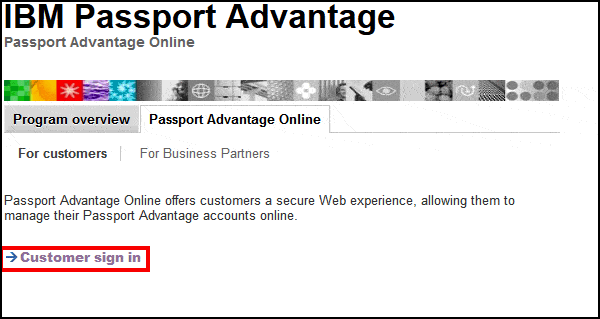
Passport advantage offers to acquire IBM software licenses including token and monthly licenses, renew software subscriptions and support and fixed-term licenses, buy and renew technical support for some selected open-source and other non-warranted applications, subscribe to IBM cloud service offerings, acquire IBM appliances and appliance services. These licenses offered by passport advantage are governed by international passport advantage agreement and the licenses offered by passport advantage express are governed by passport advantage express agreements.

 Types of IBM’s passport advantage agreement 

There are two types of passport advantage and their respective agreements which govern these types: 

International passport advantage agreement 

With access to IBM passport advantage, one can get access to more opportunities and options since they are built for larger enterprises and entities that have multiple sites. The larger entities can benefit themselves from better prices since the purchases of software are generally volume. These bulk volume prices are referred to as “Relationship Suggested Volume” (RSVP) which drastically improves the prices for individual transactions which also include purchases of products from other selected software vendors. This passport advantage is governed by an international passport advantage agreement.

Passport advantage express agreement

With access to IBM passport advantage, one benefits if you have a smaller entity and a single site business owner. Regardless of your category, there shall be the same eligible products that can be accessed by both IBM’s customers. However, such acquisitions of the software are generally transactions based as such the purchases are not volume. This passport advantage is governed by the passport advantage express agreement.

Acquiring an IBM international passport advantage agreement : (IPAA)

To obtain an international passport advantage agreement, the requirement of submitting an international passport advantage agreement “enrolment form” which can either be done online or through an authorised IBM Business Partner is a mandatory requirement. How be it, it is pertinent to understand that this initial step of online enrolment is not similar for all the countries which cost performance of few additional steps to qualify the requirements.  

Getting an “IPAA” is no cakewalk and largely depends on the IBM’s listings of region or country as mentioned above but it also requires signatures, either one, two, or absolutely none. After successfully enrolling into the IPAA, we can order IBM licenses through their business partners, sales office, or via passport advantage. It is important to know that the passport advantage can only be availed by the existing customers as it is a better option for larger IBM purchases. The benefit of this passport advantage is that instead of multiple bills and invoices for every additional software purchase you make; it gives you an “Anniversary Date”. This offer saves a lot of your money and also provides discounts for clients that spend more on IBM. These offers are called “Relationship Suggested Volume price” in the passport advantage agreement and “Suggested Volume Pricing (SVP) discounts in passport advantage express agreements with applicable points. the more the purchases from passport advantage, the more the discounts. 


Acquiring passport advantage express agreement

Unlike the international passport advantage agreement, there is no need to enroll, to obtain a passport advantage express agreement. This type of passport advantage generally benefits the smaller enterprises and companies as the services are transactional-based offerings. The eligible products under this agreement shall be the same as the former one. 

Since, we now have a clear picture of the application of both, the passport advantage agreement and the passport advantage express agreement, let’s discuss the comprehensive clauses included in these agreements and their minor changes. 


Analysis of international passport advantage agreement

The international passport advantage agreement is structured with 5 detailed and comprehensive clauses which govern the relationship between client company, IBM and the software company referred to as “IBM Originating company” where the details regarding the eligible products, service descriptions, quotes, and proof of entitlement are attached as annexures and transaction documents at the end of the agreement. IBM coordinates as a conciliator between the client company and IBM originating company which helps both the parties to coordinate the administration of this agreement. The client company must own 50% or more than 50% of its legal entities in order to enter into this agreement. The client must comply with all the terms of the agreement. The clauses comprehended in this document are as follows: 


General clause

Acceptance of terms 

This agreement specifically comes into effect when there has been an initial order from the client originating company under this agreement which remains in effect until and unless the client company or the IBM originating company terminates it. An eligible product is often subject to this agreement when IBM accepts the client’s order. The acceptance is shown in four ways. 

  1. IBM originating company sends an invoice or a proof of entitlement with an authorized level of use. Proof of entitlement is a document sent by IBM to all the customers who purchase their software in order to confirm that they are eligible for products. 
  2. Making the program or cloud service available 
  3. Shipping any appliance 
  4. Providing the support, service, or solution. 


Changes in terms

Since the software licenses orders come with the option of renewability, IBM reserves the right to modify them by providing three months’ written notice to the client. However, they are not activated only as of the effective date. It is a mandate to provide all changes in writing which are signed by both parties. 

Payment and taxes

It is generally possible for a client to move across borders and use the eligible products authorised to them, however, despite that, the client must adhere to the changed border taxes, customs, or fees. All the applicable charges in the event of excess of authorizations and any late payment fees should be paid within 30 days of the invoice date which are specified by IBM. In this clause, there are few important terms which the client must agree to and those are: 

  1. Payment of taxes to the appropriate government is required by law. 
  2. Furnishing of a tax certificate evidencing the payment to IBM
  3. Payment to IBM only the net proceeds after tax
  4. Fully cooperate with IBM in seeking waiver or reduction of such taxes which promptly complete and file all the relevant documents.

IBM business partners and resellers

The business partners and resellers under this agreement mean the Individuals or companies from whom the software has been acquired from IBM. They claim to be independent of the partners and the resellers. The prices of the software which are displayed as eligible products under passport advantage are decided unilaterally with the terms. IBM claims to have no responsibility for the actions of business partners and resellers.

Liability and indemnity 

IBM claims to have no liability for the claims and damages which exceed the amounts paid by the client regardless of the basis of the claim. Does this clause compromise the infringement of the client? No! the IBM claims to defend the client when there has been a third-party claim against the client on infringement on patent or copyright and settle all the client’s claims and amounts provided that the client notifies such claims, supplies the information ordered by the IBM, and allows it to control and co-operate the defence and settlement, including mitigation efforts. 

Governing law and geographic scope

Under this, it is particularly mentioned that the United Nations Convention on Contracts for the International Sale of Goods does not apply to transactions under this Agreement and that the client is responsible for the use of its EPs. It is also stated that both parties must comply with the laws of the country where the transaction is taking place. The rights and obligations of each party under this agreement shall be valid only in the county where the transaction shall be executed. If the client uses the eligible product or any of the parts of EP, outside the given address of the client, IBM shall not serve as the exporter or an importer. 

Termination of agreement

It is important to know the termination rights of the client’s company, otherwise, what is an agreement without mutual rights, isn’t it? The client under this agreement may terminate the Agreement with one month’s notice period. In the event of any renewal of IBM software subscription and support, cloud services, prior to the notice of termination, IBM may either continue to provide such services, or allow the use of a program for the current term or even provide the client a refund.  

The termination of this agreement may also take place If the client company or its enterprises did not place any order for consecutively 24 months or do not have any software subscription, support, or any selected support in effect. The IBM originating company may have the right to terminate this Agreement on three months’ notice to the client company.  


Eligible products

Eligible products are the software programs or other services authorized by IBM under their ambit for licensing. There are few discretionary rights provided for IBM under this clause. Such as it can add or withdraw EPs at any time regardless of them being Fixed-term license, Monthly License (ML), IBM software subscription and support, or selected support, or a cloud service or an appliance service in its entirety, on 12 months’ written notice to all then-current clients by the published announcement, letter, or e-mail. This clause also states that the client may not be able to increase the level of its use beyond the provided authorisations already acquired without IBM’s written consent. But IBM may continue to provide that offering until the end or provide a refund if there has been a renewal prior to the notice of such withdrawal.  

Renewal

The terms of the Licensing under this agreement are divided into four difference duration parts as following: 

  1. Fixed-term license 
  2. Token license 
  3. IBM software subscription and support 
  4. Selected support or appliance services 

These all terms are renewed automatically at the provided current charges unless a written notice of termination prior to the expiration is provided by the client. 

Relationship Suggested Volume Price (RSVP) Level and Suggested Volume Pricing (SVP)

When the aggregating points of all the eligible products are ordered during the term of the Client licenses or any subscriptions, an RSVP level is determined. There are specific points for the initial order of eligible products. However, if the client desires to attain a high RSVP level, the client may place additional eligible products. In the same way, an SVP is also calculated for each order. If the SVP for particular orders is determined to be higher than the RSVP points, then the SVP level shall be deemed to be applied for that order. Since the initial term continues for 12 months, the client’s RSVP is also reset after 12 months based on the eligible products acquired by all the enterprises or sites during the prior term.  

Compliance verification

In order to ensure that the client doesn’t exceed its authorized use and remain in compliance with the terms of the agreement, the client must retain and provide written records, system tool outputs, and other sufficient information to audit by IBM in order to verify if the usage of all the eligible products is according to the agreement including the licensing and qualification terms. 

However, such verifications shall be executed without causing any disruptions to the client’s business in the premises during business hours. If needed, IBM appoints independent auditors to execute the verification with proper confidentiality agreements in places to which the client must agree. Such an agreement is titled to be “IBM Agreement for the Exchange of Confidential Information” but if the client and auditors agree to some different form of confidentiality agreement then it should be in writing and prior 60 days of the request for the verification information. If there proves to be excessive use of the eligible products by the clients from what is authorised or any additional charges or liabilities are determined then the client must pay promptly in form of invoices to IBM. 

Programs in a virtualization environment (sub-capacity licensing terms)

When an eligible product software can be licensed for less than the full capacity of your server or group of servers, it is known as sub-capacity licensing. For a client to be eligible for obtaining this sub-capacity licensing, they must have acquired sufficient licenses including IBM software subscription and support, if applicable, to cover that increase. In case the client fails to operate this program as per the requirements provided, IBM may declare the client’s enterprise or any portion of it ineligible for sub-capacity licensing. In order to prevent this, the client must acquire sufficient additional licenses and IBM software subscription and support entitlements. 

Client’s reporting responsibilities

In order to access the sub-capacity licensing of eligible products, the client agrees to install and configure the most current versions of IBM’s license metric tools within 90 days of the client’s eligible product installation of sub-capacity category and also it is updated. However, there are few exceptions to this and they are: 

  1. when ILMT does not yet provide support for the eligible virtualization environment or eligible sub-capacity product, 
  2. if client’s enterprise has fewer than 1,000 employees and contractors, client is not a service provider (an entity that provides information technology services for end-user customers, either directly or through a reseller), and client has not contracted with a service provider to manage client’s environment in which EPs are deployed, and the total physical capacity of client’s enterprise servers measured on a full capacity basis, but licensed under sub-capacity licensing terms, is less than 1,000 PVUs, or 
  3. when client’s servers are licensed to full capacity. 

Warranties

It is specified under this clause that the warranties under this agreement only apply in the country of acquisition meaning where the program is licensed. However, the warranty for such an IBM program is stated under the license agreement. IBM provides warranties for IBM software subscription and support, selected support, cloud services, and appliance service, provided that they are used with care and skills and the warranties end when the support or service ends. If the warrantied software does not function as required during the period the client company may opt to make the IBM make the software component work or replace it with another which is functionally equivalent and return the previous to the party from it acquired for the refund. 

It is important to understand under this clause that IBM says it does not warrant any uninterrupted or error-free operation of the product but provides correct measures and prevents defects from any third-party authorization to access the eligible product. But if there has been any misuse, modification, or damage, which isn’t caused by IBM and which the client has failed to comply with the instructions provided by IBM then the applicable warranties may not be provided. 

IBM not only provides eligible products but also provides non-IBM eligible products but they are generally without warranties and all sorts of applicable licenses are provided directly by the Third parties under their own agreement to which IBM does not warrant. 

Programs and IBM software subscription and support

All the software programs which are acquired by the clients’ company are subject to IBM’s International Program License Agreement (IPLA) which also includes license information documents. 

A program under the IBM license may include the following: 

  1. machine-readable instructions and data,
  2. components, 
  3. audio-visual content, 
  4. related license materials, 
  5. license use documents and keys. 

Apart from few programs, client companies are allowed to use and install programs in available national languages up to the level of authorization. In the event the client companies desire to acquire additional authorizations to use programs, they must acquire the program code. Since the programs and IBM software subscription and support are subject to IBM’s program license agreement, this clause is further having additional sub-clauses namely: 

  1. Money-back guarantee:

The money-back guarantee under IPLA only applies to first timer’s client licenses which are for initial fixed terms. These terms are however subject to renewals but the client may obtain a refund only if the client returns the programs within 30 days of such initial term. These refunds are however not applicable to appliances and cloud services. 

2. The conflict between this agreement and the international passport license agreement (IPLA): 

In the event of a conflict between the terms of this agreement and IPLA, the terms of passport advantage are agreed to have prevailed. https://www.ibm.com/software/sla- This is the official link where IPLA and its LI’s are available. 

3. IBM trade-ups and competitive trade-ups

If a client company desires to replace any IBM programs or qualifying non-IBM programs, it could also be done for a reduced charge. However, the client should terminate the use of the Client’s programs with replaced programs. 

4. Monthly licenses

Monthly licenses are referred to as ML programs and are provided to client companies on a monthly license charge. The term of this license begins on the date the order is accepted by IBM until the client company pays a “commitment term charge”. The client may even terminate this license before the end date by giving a 30days written notice to IBM to receive a refund for the remaining prepaid term. 

5. Fixed-term licenses

The term which commences on the date of the client’s order acceptance by IBM till its one anniversary provided that there is no termination prior to such anniversary is known as a fixed-term license. In such a license, the client company may terminate the fixed term license before its end date by providing 30 days written notice to IBM to receive a refund for the remaining term. 

6. Token licenses

Eligible products which are assigned a token value are token license eligible products. These are the most flexible way of licensing since the same token may be used for other programs or defined products. Regardless of the assigned token value, there is no predefined quantity. The tokens are consumed when the eligible product checks the licenses from the license server using the same policy as the floating license. Token licenses allow the client companies to reuse the same licenses for different products. The products of token licenses contain a disabling device that prevents the products from being used after the fixed term thereby mandating which the client agrees not to tamper with disabling devices and take precautions for any loss of the data. 

7. CEO (Complete Enterprise Option) Product Categories

The eligible products under these licenses are offered on an initial user basis, meaning, the user is subject to initial user quantity. In case the client company desires to acquire the licenses even for its enterprises, they have to opt for the complete product category. In order to opt for this category, the client must meet the minimum initial quantity order but no necessity of acquiring all the licenses for all the users is provided. The opting of components and the installs of CEO product category however can only be made by the users for whom the licenses have been obtained. 

8. IBM software subscription and support

With each IBM program license, a software subscription and support are provided. This support commences on the date of the IBM program acquisition and remains till the end of the last day of the corresponding month of the year. While this subscription and support are in effect, IBM provides assistance for defects, corrections, restrictions, bypasses, and any new versions, releases, or updates. However, if the client refuses to avail of these benefits or they are allowed to lapse, the client may not be able to access such support. Such support can also be not made available to the client if they have not fully paid for the IBM software subscription. A report that verifies the current IBM program must be provided to IBM if the client desires to renew the software at a lesser quantity with other compliance verification information. 

 9. Selected support:

The selected support is available for non-IBM programs as well as for Programs licensed under the IBM license agreement for non-warranted programs. Together these are called selected programs. The IBM software subscription and support section as discussed above applies to selected support provided that:

  1. Assistance to a client for developing applications based on their subscription level. 
  2. IBM software support lifecycle is not applicable, 
  3. No new versions, releases, and updates are provided by the IBM
  4. IBM does not provide licenses for the selected programs. 
10. Appliances

An appliance is also an eligible product holding program components, machine components referred to as (MCs) and any applicable machine code components which are offered as a combination that is also designed for a particular function. Machine code components are governed by a separate IBM machine code license; however, the acceptance of this agreement will also include the acceptance of the IBM code license agreement. 

Machine code components are computer instructions, fixes, replacements, and related materials, such as data and passwords relied on, provided by, used with, or generated by a machine component, that permit the operation of the machine component’s processors, storage, or other functionality as stated in its specifications. The terms which apply to the programs also apply to the program components of the appliances. However, the client company is not permitted to use such appliance components independently of the appliance of which the component is a part. 

The IBM warranty terms regardless of the component appliance being used, new, previously installed, or not, do apply. Since there are always the possibilities of damage of the appliance while shipment, the whole risk is borne by the IBM including insurance provided the client reports such damage to IBM within 10 business days of the delivery with procedure claimed by the IBM. Except for the United States, the titles of machine components are directly transferred to the client upon the payment of all amounts. However, the title for transfer is reserved with the IBM until it receives all the due amounts and receives all the removed parts which then becomes the property of the IBM.

If there is an appliance to which the machine component needs the installation and IBM seeks to be responsible then the client must allow the IBM with a 30 days calendar installation from the date of shipment with additional charges. When the client is responsible for any such installation then they must adhere to the instructions provided with it. 

11. IBM appliance services

Appliance services for appliances are provided by IBM which consists of machine maintenance and IBM software subscription and support as a single offering. These services can be availed for a year starting from the warrantied start date as specified in the transaction documents. Any parts which need to be removed, exchanged, or need upgrades must be within 30 calendar days whereas any replacement is within the purview of warranty or maintenance status of the replaced part and they solely belong to IBM. While the client desires to replace or return any appliance, few measures such as securely erasing the data, ensuring that it is free of any legal restrictions preventing the return must be taken by the client. 

Despite the appliance services, return and warrantied policy of the components of appliances, the installed appliances should be properly maintained by the client and without any unaltered identification labels. These appliance services however do not cover alterations, accessories, supply items, consumables (such as batteries), structural parts (such as frames and covers), or failures caused by a product for which IBM is not responsible.

12. Cloud services

Cloud services as opposed to previous clauses are not programs but require the client to download the software to use a cloud service as mentioned in the transaction documents. They are also categorised as eligible products country-wise and are made available via a network. 

The access, usage, and account credentials of the cloud services are the responsibility of the client and can only be accessed to the extent of the authorisations. There is a mandatory provision of misusing these services for any unlawful, obscene, offensive, or fraudulent content or activity which advocates and violates third-party rights. In case of violation of this provision, the usage of these services shall be deemed to be suspended until resolved or terminated permanently. 

Each cloud service is described as a transaction document and is subject to maintenance and technical support if applicable under the transaction document. Not limited to this but the schedule of such maintenance will also be notified. A cloud service subscription commences on the date of notification of the IBM to the client in reference to its access and ends on the date specified on the transaction document. Such subscription is subject to increase or decrease at the end of the subscription period when renewing.  

Characteristics of passport advantage express agreement in comparison to international passport advantage agreement: 

It is pertinent to understand that since international passport advantage agreements are usually opted by larger entities, having many enterprises, in different countries. With the expansion of businesses, they also welcome legal hurdles making the entities agree with additional legalities for the purpose of smooth functioning of the software usages. Since, passport advantage express agreements are generally built for smaller, single-site enterprises where the relationship between Business partners and the clients is transaction-based unlike the formerly discussed where the relationship between both the parties is Relationship-based and thereby the clauses are tailored in the same way under this agreement. Despite all clauses remaining almost the same, there are few terms that are more varied when considering a single enterprise than the international passport advantage agreement. They are the following: 

Suggested Retail Pricing (SRP) – Price at which the manufacturer recommends selling its products by retailers. They are often referred to as “Manufacturer’s Suggested retail price.

S&S renewal dates are aligned to the initial purchase date, not a single annual anniversary date – Renewal dates are based upon the transaction dates where the IBM software subscription and support begin on the date of the acquisition of the software and end the commencing on the corresponding month of the following year.

Single Site management only – One agreement for single-site management and not one agreement for multiple-site management.

No point aggregation – since there is a single-level enterprise, there are no points and no aggregation to establish a relationship-based transaction. Hence the clauses and terms based on the above points are similar to the international passport advantage agreement but have certain other criteria for the passport advantage express agreement. 

Conclusion

Often the biggest challenge an enterprise can witness is which IBM passport advantage is the right for them considering the management of the IBM licensing. Regardless of which passport advantage organisations and their enterprises choose, the main labour is to maintain it and recollect passwords of each site provided your organisation has multiple site owners since resetting the site passwords is not an easy task. 

Passport advantage can be considered as your one-stop shop when there is a need of purchasing new licenses for your business. Not only software licensing but other services as software maintenance, cloud offerings, offered by IBM, could prove as a boon to the business if rightly used. If your business owns a passport advantage express and in the scope of expansion having multiple sites, the option to avail for International Passport advantage always remains with added opportunities and benefits. The question is not which type of passport is advantageous, but how it benefits your enterprise and how much security it can provide in the age of cyber hacks. 

References


Students of LawSikho courses regularly produce writing assignments and work on practical exercises as a part of their coursework and develop themselves in real-life practical skills.

LawSikho has created a telegram group for exchanging legal knowledge, referrals, and various opportunities. You can click on this link and join:

Follow us on Instagram and subscribe to our YouTube channel for more amazing legal content.

Download Now

An analysis of anti-monopoly laws

0
competition law

This article is written by Anurag Singh from ILS Law College, Pune. This is a comprehensive article that critically analyses anti-monopoly laws. 

Introduction

India got its independence in 1947, however, the Indian economic system was suffering at the time, most importantly the two major contributors to the revenue of the country were, agriculture and industrial sector, service sectors were nowhere to be seen. Therefore, the government felt the need to be liberal in its approach towards the service and the industrial sector for them to grow exponentially. However, this approach from the government served them no good as the industrialists were quick to spot the loophole and exploit it, by indulging in unfair, restrictive, and monopolistic trade practices. As a result, the government had to formulate the Monopolies and Restrictive Trade Practices Act, 1969 (MRTP Act) for the regulation of such activities, however, it was later repealed, and the Competition Act, 2002 came into force in 2009 for regulating restrictive and monopolistic trade practices.          

Anti-monopoly laws : a lookout in the existing structure

The MRTP Act, 1969 was outdated because the main focus of the Act was to curb monopolies and not promote competition in India. Importantly, the Act aimed to protect the consumer from exploitation. However, the Act in place just lost its essence and made it more difficult for industrialists rather than making it easier for the customers. Therefore the government set up the Raghavan Committee to suggest a suitable legislative framework and that is how the Competition Act, 2002 was formulated.

Interestingly, the Act was passed in 2002 and was assented by the President in 2003, however, the Act did not come into force until 2009. This was because the government wanted this Act to not have any major deficiencies like the earlier one. Therefore, even though the Competition Act had been passed, all the proceedings for seven years were still functioning under the old MRTP Act. Once the Competition Act was amended in 2007 the government was confident to repeal the old Act and bring in the new one. 

Competition Commission of India (CCI)

Competition Commission of India is the regulator of competition under the Competition Act, 2002 in the Indian market. This commission comprises members and a chairperson. There cannot be less than 2 and more than 6 members and all of them are appointed by a selection committee by the Centre. The goal for the formation of the commission was to accomplish the objectives of the Act, moreover, imposing fines and granting relief in certain cases. After approaching the CCI, if the parties feel the right sentence has not been pronounced, the appellate body is the Competition Appellate Tribunal (COMPAT).  

The objective and the scope

The main objectives of the Competition Act are herein laid down below:

  • The Act prevents activities that have an adverse effect on competition. 
  • To protect the interest of the consumer. 
  • To promote and sustain competition in the Indian market. 
  • To ensure freedom of trade to all the participants in the market.

In order to study the scope of the Competition Act, three main sections had to be looked at; those are Sections 3, 4, and 5 of the Competition Act, 2002. Let’s briefly discuss what is in those sections. 

Prohibition of Anticompetitive agreement (Section 3)  

The agreement has been defined in Section 2(b) of the Act, agreement for the Act means any arrangement, understanding, or action, it does not have to necessarily be formal or in writing. Moreover, it does not necessarily have to be intended to be enforceable by law. However, in the case of DG (S&D) v M/S Puja Enterprises & Ors.,2012, it was held that the scope of ‘agreement’ under the section is not exhaustive rather it is a wide one. CCI also discussed ‘preponderance of probabilities’, which means that in some cases parties give their assent by a nod or a wink that has not been covered under the ambit of agreement in the Act.

There are two types of agreements that the parties can enter into:

Horizontal agreement

Horizontal agreements are agreements in which the enterprises engaging in the same activity (competitors) enter into an agreement. For example, if Samsung agrees with Nokia then that is a Horizontal agreement. However, these agreements don’t need to be entered by two companies. If the producers, wholesalers, and retailers dealing with a similar product enter into an agreement, that will also fall within the ambit of horizontal agreement.  

These types of agreements are always on the radar of the CCI because in such an agreement the Commission can suo moto cognizance if they find the agreement having an adverse effect on competition, the CCI does not hold back in imposing heavy penalties on the organization part of such agreements. For example, in 2012 the CCI imposed a hefty penalty of 6200 cr on 11 leading cement companies for price cartelization.   

Vertical agreement   

Vertical agreements are the exact opposite, these agreements are between two entities at a different level of the manufacturing and distribution process (Non-competitor). For example, Tata Motor enters an agreement with CEAT Tyres for the supply of tires for their cars, then it is a vertical agreement. Therefore, it will not be out of place to state here that these agreements are formed between the companies within the supply chain of the industry.     

Importantly, these agreements are more liberal than the horizontal ones because there can be an agreement between the retailer and the distributor to help the business scale. For example, Dominos, Raymond, etc. ask their distributors to only sell the products that they produce but if these agreements have an adverse effect on competition then CCI can hold them liable as well. However, in these cases, the liability lies on the complainant to prove the same. 

Now that we have understood what is agreement and what are the kinds of agreements in the Act, let’s understand what an Anti-Competitive agreement is.

Anti-Competitive agreements are those agreements that have an appreciable adverse effect on competition (AAEC). The formation of a cartel is an example of such an agreement. In simple words, a cartel is an association of producers or manufacturers with the sole aim of restricting competition and maintaining the prices high. Determining factors for AAEC are:

  • Creation of a barrier for a new entrant.
  • Driving existing competition in the market.
  • Foreclosure of competition by hindering entry.
  • Benefits to the customer in the long run.
  • Improvement in production or distribution of goods/services.
  • Promotion of technical, scientific, and economic development by the means of production or distribution of goods/ services.   

Whenever any organization enters into a contract these indicators are looked into carefully for maintaining a healthy and competitive environment to do business, at the same time looking after the needs of the customers. However, in the case of Competition Commission of India v. Co-Ordination Committee of Artists and Technicians of W. B. Film and Television, 2017, the Supreme Court held that, if an agreement falls into any of the categories for horizontal agreements under Section 3(3) of the Act, it is per se treated as adversely affecting competition and would be void. There is no requirement of proof as to whether it has caused an appreciable adverse effect on competition (AAEC).  

Abuse of dominant position 

A dominant position can be said to be a position of strength in the industry, in a way that they can influence the consumer to use their products/services instead of their competitors. Interestingly, in the Indian market, it is not wrong to hold a dominant position, however, its abuse is prohibited.

Under this, the enterprises cannot enter into any agreement which demonstrates clear abuse of its dominant position. For example, Conditional sale or purchase and predatory pricing.

Illustration: If A has a dominant position in its industry then if A asks B (a distributor) to buy a new product X if they want their Y product (Which is the best seller), or if A decides to sell its product lower than its cost of production so that its competitors can no longer sustain in the market. These two instances are clear cases of abuse of the dominant position.  

But the scope of this section is not limited to the competitors. In the case of Competition Commission of India v. M/s Fast Way Transmission Pvt. Ltd, 2018 the Supreme Court held that the inclusion of the words “in any manner” in Section 4(2)(c) of the Act indicates that it is broad and accordingly, Section 4(2)(c) cannot be limited to usage by competitors but also includes other aggrieved non-competing parties. Once a dominant position is established, it is irrelevant for Section 4(2)(c) to assess whether the broadcaster is competing with the channel operator. Section 4(2)(c) would be applicable if the broadcaster is denied market access due to unlawful termination of the agreement between the broadcaster and the dominant entity.      

Factors that determine the dominant position of an enterprise in an industry:

  • Market capitalization.
  • Economic advantages over the competitors.
  • Dependence of consumer.
  • Vertical integration.
  • Market Structure and size. 

The case of the T-series was a classic example in this regard, it is a known fact that T-series has a crystalline dominant position in the music industry, therefore abusing its power T-series asked all the radio stations to only play their songs. However, HT media, a competitor, complained about the same and CCI asked T-series to stop this monopolistic behavior.   

Combinations 

The acquisition, amalgamation, or merger between two or more enterprises is known as a combination under the Act. There is a very strong reason to regulate such activities by the enterprises because combinations in some cases create a monopoly in an industry which makes it very tough for the other competitors to enter the market. For example, if A and B have a market capitalization of 40% and 35% respectively and they both decide to merge then a monopoly will be created in that industry as the two biggest players have merged.

There are three types of combinations: 

  1. Horizontal Combination (occurs when two enterprises in the same industry combine).
  2. Vertical Combination (Occurs when one enterprise combines with another enterprise that makes raw material for their industry).
  3. Conglomerate Combination (occurs when two enterprises of the different industries combine).

In order to combine with other companies above the threshold, a proposal should be made to CCI via an application and after examining this combination the CCI will announce its result within 150 days an extension of 30 days can be requested. In case of no response or approval, the companies can effectively combine and if the proposal is not approved then the parties are not satisfied with the decision then they can appeal to the COMPAT, and the final appeal lies with the Supreme Court.  

The threshold for Combination: 


Asset


Turnover

Enterprise-level

India

> INR 2000 CR

OR

>INR 6000 CR


Worldwide 

> USD 1 Bn with at least  INR 1000 CR in India


>USD 3 Bn with at least INR 3000 CR in India

Group level

India

> INR 8000 CR

OR

> INR 24000 CR


Worldwide

> USD 4 Bn with at least INR 1000 CR in India     


> USD 12 Bn with at least INR 3000 CR in India

The achievements associated with the anti-monopoly laws

  • Increased competition in the Indian market.
  • Removes barriers for trade in the market.
  • The formation of CCI has provided a forum for complaints and disputes regarding the competition.
  • Prohibits the formation of Anti-competitive agreements. 
  • Companies can no longer abuse their dominant position in the market.
  • Regulating the operations, mergers, amalgamations, and acquisitions of the enterprises, so that big companies do not form a monopoly in the market.
  • Abolition of formation of cartels and inducing predatory pricing.
  • One-stop solution for all the problems concerning the competition in India.  
  • Increased India’s ranking in the ease of doing business index. 

Need for amendments 

  • The Competition Act, 2002 is not aligned with the antitrust laws of other top countries. Therefore, India should take cues from them and implement them in the Indian market.  
  • All the businesses around the world are changing, earlier there was only physical business but now with the whole internet revolution globally as well as in India, there is a need for laws regulating the business online. 
  • Moreover, there should be a specific provision for regulating the use of big data in e-commerce.
  • Provisions should regulate the use of customer’s data, where and how it is being used.   
  • Amendments with regards to the holding of ‘dominant position’ in the market, because holding a dominant position is not seen as a problem but the abuse of the position is a problem. 
  • These competition regulation bodies are present in metropolitan cities and there is no trace of their existence in rural areas. To resolve this, the government in the Amendment of 2020 asked the National Company Law Tribunal (NCLT) and the National Company Law Appellate Tribunal (NCLAT) to handle competition cases as well. However, the government should set up regulatory bodies specifically operating in the competition cases across the countries for more effective results.

Conclusion 

The Competition Act, 2002 is a revolutionary Act because after the enactment of this Act businesses got the right to compete in the Indian market. This legislation by the centre promotes fair competition and regulates all the anti-competitive actions by firms and enterprises. This Act curbs three major issues in the Indian market, anti-competitive agreements, abuse of dominant positions, and regulation on the combination. Though this legislation is revolutionary, there are still some amendments that need to be enacted for the better functioning of the Act and so that this Act is at par with international practices.

References 


LawSikho has created a telegram group for exchanging legal knowledge, referrals, and various opportunities. You can click on this link and join:

Follow us on Instagram and subscribe to our YouTube channel for more amazing legal content.

Download Now

How would you draft an artist agreement

0

This article has been written by Prakash Kasbe, pursuing a Diploma in Advanced Contract Drafting, Negotiation, and Dispute Resolution from LawSikho.com.

Introduction

The Indian entertainment industry is the largest in the world in terms of the production of large numbers of films, songs, and other entertainment shows, content thereby generating high profits for the makers. This industry strives on the creative content, stories, and expertise of people in the areas of films, movies, songs, music, and related content. This industry employs various artists and people across the country and the world. Many global corporate houses have entered the industry and they are producing various projects. This industry requires various artists, musicians, singers, actors, and performers, etc., to create the content and there comes into play the role of artist agreements. The artist agreement governs the relation of artist and producer or maker and defines the other terms of employment, obligations, nature, and scope of the project, etc.

What is an artist agreement? 

An artist agreement or contract is an agreement between two parties, one acting as a producer/maker and the other as an artist who provides his/her services and/or engages for a particular project as film or music composition, singing, or dubbing, etc. The agreement is like any other contract which commences from an offer and its acceptance by the party for a lawful consideration and lawful object. It is a form of employment contract or service contract. This agreement defines the role of an artist in a project and his obligations and duties. As the work of an artist entails originality, therefore, it requires to be protected from any kind of infringement or breach and clear terms of professional conduct.

Why is it necessary to enter into the agreement by the artist?

The Indian Contract Act, 1872 describes the oral contract as a valid contract but in practical situations, it becomes very difficult to prove it in the courts. Therefore, it becomes necessary to have a well-drafted contract/agreement that defines all the material details between the parties. The written contract/agreement gives more certainty, clarity and avoids ambiguity in understanding the terms of the contract. The written contract/agreement stipulates the duties and obligations, and such agreement works as a manual between the parties. 

This agreement requires a letter of agreement that specifies the terms and conditions, business correspondence details, contact information, project information, dates available for the project, etc. So, the artist who wishes to enter into the agreement should understand and have the knowledge of the agreement/contract, and then only he/she should execute/sign the same to act further. 

Let’s see an illustration: ‘A’ is a singer, and he was contacted by ABC Ltd to sing in a music album. ‘A’ should clearly understand the terms of the agreement, his role, and duties, and other aspects. After execution of the agreement, he cannot deviate from the terms of agreement otherwise he may be held liable for the breach of the terms of the agreement. 

Important clauses in the artist agreement

The artist agreement is a unique agreement that has its features, below are some important clauses in the agreement for general understanding: 

1. Parties

This clause defines the parties to the agreement, one would be the producer and the other would be the artist. This helps in identifying the details of the two parties to the agreement. A sample clause is reproduced here: 

“This Artist Agreement (“Agreement”) is made on ______ [Date]this Day of ____ [Month], 2021 at _____[mention place] BY AND BETWEEN ____________[Name of the Producer], a company incorporated under the provisions of the Indian Companies Act ______, having CIN : ________________, PAN : _________ and having its registered office at _______________ represented by its director/authorized signatory Mr/Ms ______________, Age _______, Occupation ____________, address __________________, authorized by a resolution dated __________________ ( hereinafter referred to as “Producer” and unless repugnant to the meaning and context thereof shall mean and include  its representatives, assignees and employees)AND Mr/Ms ________________ [Name]son/daughter of __________, Age: _________, PAN: __________, residing at _______________ (hereinafter referred to as “Artist” and unless repugnant to the meaning and context thereof shall mean and include his representatives)”.

2. Project

This clause is the main clause that records the reason as the artist is invited to work or provide his expertise. It may be acting, singing, dancing, composing music, directing, choreographing, designing the sets, directing, etc. It differs from the expertise of an artist to artist. A sample clause is reproduced here:

“The Producer is producing and/or making and interested inter alia in the production, creation, and making of  Music Albums, Songs, Web-Series, Television Serials, Motion Pictures/ Cinematograph Films and has started producing Music Albums, Songs, Web-Series, Television Serials, Motion Pictures/ Cinematograph Film titled as “__________”. (Hereinafter referred to as the “Project/ said Project”).” This could be modified as per the requirements of the respective project.

3. Payment/compensation 

This clause defines the payment terms offered and agreed to be paid to the artist in lieu of his work and/or services. This can be varied as per the stages of work/services and mutually decided by the parties.

4. Service/work by an artist/engagement

This clause refers to the role, work, and/or service provided by the artist to the producer/maker for the project. This defines the scope of work and committed liability to perform for the project. 

5. Terms and conditions

This clause refers to the terms and conditions of the agreement and as agreed by the respective parties to it.  Sample terms and conditions are reproduced below:

  • The Producer employs the Artist to act, play and perform in the project and take part in the Project as agreed in this Agreement.
  •  The Artist accepts the offer and agrees to perform, act as per directions of the Producer and shall devote his best of abilities and time to perform in the engagement.
  • The Artist shall provide his services to the Producer in respect of the Project as agreed in the Schedule ___ appended to this Agreement.

*These terms and conditions can be modified as per project requirements and are reproduced only to demonstrate the nature of such terms and conditions.

6. Term/duration

This clause can be divided as per the project specifications and the role of the artist and as per the requirement of the producer/maker.

A. Pre-engagement term

This clause refers to the obligations of the artist before his engagement to the project. It can include research, training, and other aspects as required by the producer/maker.

B. Engagement term

As the name suggests, this clause refers to the obligations of an actor during his engagement for the project.

C. Post-engagement term

This clause refers to the obligations of the artist after the terms get over. There may require additional work, retakes, re-recordings, dubbing, and voice-over for the project. The actor should make himself available for these activities.

7. Rights of the parties

This clause is required to secure the rights of the parties, so they may not be infringed in any way during the project. The respective party’s rights can be secured by way of copyrights and other Intellectual Property provisions and by incorporating specific stipulations in the agreement. 

8. Artists obligations 

This clause puts the obligations of the artist towards the project and defines his work and its other related aspects. The artist can be held liable for non-performance and breaches, therefore, it’s very important to negotiate and finalize such obligations before entering into the agreement. Generally, the obligations stipulate to perform the services in a professional manner and as agreed in the agreement.

9. Royalty

This clause enables the parties to claim royalty, if any, involved in the project. This is the most crucial and negotiated clause in this type of agreement as there are huge profits involved in the entertainment business and no one wants to leave it at the mercy of the other party. So, every artist tries to negotiate it and seek royalties from the project. Hence, it is advisable to have a consensus between the parties for royalties.

10. Acceptance

This clause sets out the acceptance of the parties to the terms of the agreement, arrangements of the projects. The parties must agree on the stipulations and obligations and any variation to the terms of the agreement may lead to the consequences. 

11. Online agreements

In this era, online agreements have become a new normal. The producer and artist are required to enter into agreements with various online platforms of the entertainment industry in respect of the project for the promotion, interviews, publicity, and endorsements etc. This clause defines such obligations of the parties to the agreement and the artist should be careful while they associate with some third party in such agreements.

12. Insurance

As per the prevailing entertainment and media industry practice, the producer or maker is required to obtain insurance in respect of his project, ensure the personnel involved in the project etc. This clause specifies such an obligation of the producer/maker.

13. Representations and warranties

This clause defines the representations and warranties as provided by the parties to the agreement. Below are some sample representations and warranties for the general understanding and for illustrative purposes:

  1.  The parties have full legal right and authority to enter into this agreement and perform all obligations.
  2. The parties do not suffer from any legal disabilities and infirmities which would in any way affect their performance, at any point in time, in respect of this agreement.
  3. The parties confirm that there are no pending cases before any court of law or before any quasi-judicial bodies not limited to any project, trade association, _____ distributors association, or any government authorities that may in any manner restrict or impair or create any impediments in respect of his/her rendering services for the said project.
  4. The producer shall make payments to the artist in connection with his services/engagement for the project.
  5. The producer shall make the project within stipulated time and in the manner as envisaged under this agreement.

14. Amendment

This clause defines the ways by which the agreement can be amended/altered and the reasons for such amendment. There may be situations where the parties need to amend the agreement such as availability of the artist, rescheduling of the project, etc.

15. Cancellation/termination

This clause refers to the events in which the parties to the agreement can seek cancellation. This clause outlines the situations in which the agreement may be terminated or canceled and the post-cancellation obligations of the parties. Since high stakes are involved in such agreements, this clause needs to be drafted in a way to has a smooth exit for both parties. The parties should consider the events of termination and cancellation and resources available to them in such an event to avoid any ambiguity.

Sample draft of artist agreement

Below is the sample draft of the artist agreement for the general understanding.

Artist Agreement

This Artist Agreement (“Agreement”) is made on ______ this Day of ____, 2021 (“Effective Date”) at ___________ ().

BY AND BETWEEN

ABC LIMITED, a company incorporated under the provisions of the Indian Companies Act ______, having CIN : ________________, PAN : _________ and having its registered office at _______________ represented by its director/authorized signatory Mr/Ms ______________, Age _______, Occupation ____________, address __________________, authorized by a resolution dated __________________ ( hereinafter referred to as “Producer” and unless repugnant to the meaning and context thereof shall mean and include  its representatives, assignees and employees) 

AND

Mr/Ms ________________ son/daughter of __________, Age: _________, PAN: __________, residing at _______________ (hereinafter referred to as “Artist” and unless repugnant to the meaning and context thereof shall mean and include his representatives)

The Producer and the Artist hereinafter, wherever the context requires, shall be individually referred to as the “Party” and jointly as the “Parties”.

Whereas:

  • The producer is engaged inter alia in the business of production, creation, and the making of music albums, songs, web series, television serials, motion pictures/ cinematograph films and is desirous of producing music albums, songs, web series, television serials, motion pictures/ cinematograph film availing the services of the artist for their project.
  • The artist is an artist of repute, and is also desirous of rendering his/her performance and/or services/engagement in the said project to be produced by the producer on the terms and conditions, mutually agreed between the parties and recorded hereinbelow.

Now, therefore, it is hereby agreed between the parties to as follows

1. Definitions

  1. “Agreement” shall mean this artist services agreement and any and all schedules attached and/or incorporated in it by reference and shall include any modifications of this agreement as may be mutually agreed in writing by the parties.
  2. “Film” or “the said film” shall mean the whole or any part of a full-length colour cinematograph film to be produced by the producer as the first owner for which the artist is required to render services, based on the story and script to be written by and to be directed by a director mutually acceptable to the parties hereto. The film is yet to be titled and shall include soundtrack and any recording or recordings however made of a sequence of visual images and sound which is capable of being used as a means of  showing that sequence as a moving film as may be used for presentation through any media or method whatsoever including cinema, theatrical, non-theatrical, television transmissions, satellite transmissions or diffusion media or video or by any gauge or size of film or via internet or contrivance or through appliances and technologies presently existing and available or that may be invented in future.
  3. “Song” shall mean the whole or any part of a full-length song to be produced by the producer as the first owner for which the artist is required to render services, based on the lyrics and music by the musician and to be directed by a music director mutually acceptable to the parties hereto it and shall include recording of soundtrack and any recording or recordings however made and sound which is capable of being used as a means of showing that sequence as a visual song as may be used for presentation through any media or method whatsoever including cinema, theatrical, non-theatrical, television transmissions, satellite transmissions or diffusion media or video or by any gauge or size of film or via internet or contrivance or through appliances and technologies presently existing and available or that may be invented in future.
  4. “Intellectual Property” includes patents, trademarks, service marks, trade names, designs, copyrights, rights of privacy and publicity and other forms of intellectual or industrial property, know-how, inventions, formulae, confidential or secret processes, trade secrets, any other rights and/or assets including protected rights and any licenses and permissions in connection therewith, in each and any part of the world and whether or not registered or registrable and for the full period thereof, and all extensions and renewals thereof, and all applications for registration in connection with the foregoing.
  5. “Rights” or “the said rights” includes all  the work and  also all  the rights, title, interest, ownership in relation to and/or associated  with the said film and the film properties, including but not limited to the negatives, script, exploitation rights, Exploitation of Rights, Intellectual Property Rights (whether known or not known or invented  or not invented) and all the present and future audio-visual formats (digital/analogue or otherwise) of the sound recording, dialogue, musical Motion Film rights, synchronization, theatrical rights, non- theatrical rights, music rights, musical rights, distribution rights, animated rights, all television Motion Film and other television rights (including cable television channel rights, cable television rights, channel rights, CCTV rights, Cable TV rights, Direct to Home rights (DTH), pay television rights, subscription television rights, free television rights, pay channel rights), broadcasting rights, webcasting rights together with or without radio, episodes, broadband rights, performance rights, internet, interactive rights, mobile phone rights, video-on-demand rights, public performances royalties rights, air borne rights, hotel rights, commercial establishment rights, internet rights, merchandising rights, gaming rights, rental rights, publishing rights, surface transport rights, satellite rights, satellite television rights, satellite broadcasting rights, terrestrial rights, high seas rights, dubbing and subtitling rights, theatrical video rights, videogram rights, Doordarshan/ Prasar Bharati rights, cable television rights, ship rights, videogram sale rights, underlying rights, videogram rental rights, video copyrights publishing rights, digital rights, audio rights, video rights, VCD and DVD rights, Laser disc, blue ray DVD, home video rights, home video distribution rights, home video exhibition rights, VHS rights, airline rights, film and television formats, scripts, titles, finished products and/or ancillary rights, new  media rights,  all rights under the laws relating to Intellectual Property Rights and  also rights in dramatic work, musical works, sound recording, video recording and any and all allied incidental  and  ancillary rights, in and to the said film and the film properties and also all rights to subsequent production, prequels, sequels, remakes, sequence, in perpetuity and also includes all rights, title, interest, ownership of whatsoever nature in respect of the said film and the film properties and also any and all other rights, title, interest, ownership etc. not specifically mentioned herein and also trade names, trademarks, trademark registrations, trademark applications, service marks, service mark registrations, service mark applications, copyrights, copyright registrations, copyright applications, registered patents and patent applications, trade secrets, proprietary manufacturing or production information, technical data and know-how, inventions, specifications. It shall also include all the rights, benefits, and privileges directly and/or indirectly attached to the said film and no rights are excluded. The aforesaid rights shall be for the entire world including India.
  6. “Services” mean and include (i) shooting, (ii) dubbing, (iii) photo session, (iv)training/workshops required for shooting, (v) dubbing, (vi) singing, (vii) recording and/or photo sessions or for performing additional services required for publicity and promotional activities or any other services.
  7. “Engagement”: ‘Engagements’ means the acts, deeds, and performances of the Artist by himself and/or jointly with others within India and throughout the world for a specific project/projects, during the engagements schedule, save and except those accruing to the artist by virtue of clause _____, which ABC Limited alone may exploit commercially to generate revenue and includes the artist’s performances as:
  1. an actor/performer in cinematograph films, feature films and television films and other audio-visual works howsoever described;
  2.  a singer or voice recording artist;
  3. a dancer;
  4.  a cornmentatorora compare of living or recorded shows that may be performed or broadcast, telecast terrestrially or otherwise howsoever;
  5.  a live stage performer; 
  6. a model for still and video photography; 
  7. a part of any programme organised by ABC Limited for the benefit of ‘tourists and fans or fan clubs of the artist and/or their members;
  8. responding to telephone calls during promotion programmes,
  9. endorser of any brand of any product or service, permitting the use of the artist’s trademark, ideogram, logogram, monogram, and name as a user, promoter of such brand or service, or otherwise howsoever save and except brands, products or engagements which the artist in his reasonable opinion finds derogatory, offensive, unethical or otherwise objectionable; 
  10. facilitating autograph on photographs, articles, writings, voice recording for use in telephone answering machines and generally for merchandising products and engagements;
  11. facilitating and promoting, at the reasonable discretion of the producer all or any article, set-vice, product not offensive to public morality or decency whether or not merchandised by the producer which, in the opinion of ABC Ltd will generate revenue for ABC Ltd save and except any such article, service or product which the Artist may reasonably consider objectionable;
  12.  attending interviews, talk shows arranged or produced by the producer;
  13. a promoter of art forms, cultures, tourism, and travel to such destinations and in such manner as ABC Ltd may require the Artist to do;
  14. attending public functions including fashion shows, sales of articles and things merchandised by Producer, sports events, cultural events, etc.

(xv) promoting at the instance of Producer other Artists by oral or written means;

 (xvi) a part of commercial advertisements which may be exploited in any media;

(xvii) attending press conferences arranged by Producer and other non-commercial appearances which may include radio and television broadcasts.

  1. ‘Engagement Schedule’ means a schedule during which the Artist will fulfil his obligations under these presents, which schedule shall contain dates, times, and locations for publicity and includes the recording, shooting, pre-production period, and post-production periods.
  2. ‘Guaranteed Payment’ means the non-refundable sum of Rs________________ (Rupees _______________only), which Producer shall pay to the artist as the entire consideration for the assignment contemplated in Clause __________ below.
  3. ‘Guaranteed Period’ means the period of _________ working days exclusive of bank and public holidays in any given calendar year during which the artist shall be available for engagements.
  4. ‘Pre-engagement Period’ shall mean such period as ABC Ltd may allocate in the Engagements Schedule for the purposes of preparing to fulfil his obligations under the agreement such as auditions, tests, rehearsals.
  5. ‘Post-engagement Period’ shall mean such period as ABC Ltd may allocate in the Engagements Schedule for the purposes of completion of the activity arising out of the engagements of the Artist.

[YOU CAN ADD MORE DEFINITIONS IF REQUIRED]

2. The Project

Producer is producing and/or making and interested in the production, creation, and making of  Music Albums, Songs, Web-Series, Television Serials, Motion Pictures/ Cinematograph Films and has started producing Music Albums, Songs, Web-Series, Television Serials, Motion Pictures/ Cinematograph Film titled as “__________”. (Hereinafter referred to as the “Project/ said Project”). (This can be modified as per requirement).

3. Payment/compensation 

3.1 As compensation in full for the Artist’s performance Services in respect of the said Project pursuant to this Agreement, provided the Artist is not in default and has performed all the material Services required hereunder, the Producer shall pay to the Artist a total sum of Rs.____________/- (Rupees___________ only) (“the compensation”) for the Artist’s Services in respect of the said Project. The compensation shall be payable to the Artist as set out below:

 (a) Rs.___________/- (Rupees__________ only) on execution/ signing of this Agreement; 

(b) Rs.________________/- (Rupees__________ only) payable in equal instalments ten days prior to commencement of each schedule agreed between the parties.   

(c) Rs._____________/- (Rupees ____________ only) prior to commencement of the _____of the said Project; and

(d) Rs.___________/- (Rupees __________ only) prior to first release of the said Project in any part of the world.

The Artist will pay his/her personal taxes. Payments by the Producer shall be subject to income tax deductible at source. The Service tax, if any, shall be borne and paid by Producer.

3.2 The said Project shall not be released in any part of the world without first paying to the Artist the compensation due in respect of the said Project as aforesaid. The Artist shall have no direct and/or indirect rights in the said Project save and except to claim his/her balance compensation.

3.3 All traveling and accommodation expenses, fares, and cost of living for outdoor location shall be incurred by producer.

3.4 All payments to the artist hereunder shall be deemed to be equitable and inclusive compensation for all the services rendered by the artist in connection with the said project and to be paid by way of a complete buy out of all rights granted to producer hereunder and no further sums shall be payable to the artist by producer by reason of the exploitation of the said projects and all results and proceeds of the artist’s services hereunder in any and all media throughout the world pursuant to any collective bargaining agreement, if any, or otherwise,  by way of residuals, repeat fees, pension contributions, or any other monies whatsoever.

4. Term

This agreement shall start from the effective date and shall continue thereafter until the completion and release of the said Project or _________ days whichever is earlier.

5. Service/work by an artist/engagement and artists obligations 

  1. Producer hereby employs the artist to act, play, perform and take part in the said Project of producer at the places and such locations as the producer may from time to time decide on the terms and conditions set out herein.
  2. The artist shall make himself available as per the engagement schedule appended hereto or any addendum thereto for the services/engagement,
  3. The artist shall regularly and punctually attend at the studio and/or other office/s or such place as required by the producer for rehearsals, recordings of the said project and in other purposes in connection therewith and observe and submit to all rules and regulations of the ABC Ltd in force from time to time in this behalf.
  4. The artist shall devote all his time as per engagement/service/schedule and work solely for producer during the subsistence of this agreement and shall on no account render his services or engage in other activities free or on payment.
  5. The artist shall whenever required speak, act, sing, dance and play on instruments as the case may be and to perform to the best of his ability and skills and also to allow producer to record his voice with recording instruments and do all other acts, deeds and this  in respect of the project.
  6. The artist shall make his services available as may be required by Producer for the completion of the project and exploitation thereof.
  7. The artist shall strictly keep all information confidential that is conveyed to him/her in the course of their negotiations and discussions, artistic content, music, compositions, lyrics, songs, themes, and treatment of the said project save and except for approved promotion of the said project. The artist shall endeavour that the same shall also be kept confidential by the representatives of the artist.
  8. The artist shall accept all suggestions of the Director and producer of the said project in all matters pertaining to the artist’s work in the said project.
  9. The artist shall cooperate with producer to complete the production of the said project in the best possible manner and as per the practice of the industry.

6. The producer’s rights

  1. Producer alone as the first owner shall be solely, absolutely and exclusively entitled to own the rights and the Intellectual Property Rights of the said project without any limitation, restriction or exclusion.
  2. Producer’s acquisition hereunder shall also include all rights generally included in the field of literary and musical endeavour as the “moral rights” of the author in and/or to any musical and/ or literary proceeds of the Artist’s Services. 
  3. Producer shall also have the right, in respect to such product, to add to, to subtract from, change, arrange, revise, adapt, rearrange, translate into any and all languages, change the sequence, and the description thereof, change the title of the same, record and photograph the same with or without sound (including spoken words, dialogue and music synchronously recorded), use said title or any of its components in connection with the said Project wholly or partially independent thereof, to vend, copy and publish the same as Producer may desire, and the Artist hereby assigns to Producer all of the foregoing without any reservations, conditions or limitations and no right of any kind, nature or description is reserved by the Artist.
  4. Producer shall have the right to add to, to subtract from, rearrange, edit and change the Artist’s work hereunder. 
  5. The Producer shall always have the sole, exclusive, permanent and perpetual right to use and/or display the Artist’s name, voice, and likeness for advertising, merchandising, publicizing, and exploiting the said Project, including without limitation souvenir programmes, commercial tie-ups, paperback editions of the literary property directly relating to and on any sound recording. The right and license granted to Producer herein shall extend throughout the world including India.
  6. Producer shall be solely and without recourse to the Artist, be entitled to exploit the said Project, and parts thereof, and producer solely shall be entitled for all revenues, receipts, income, and realizations from such exploitations. Apart from the compensation paid to the artist herein. The artist waives all rights to any exploitable revenues derived from the said project, which shall be solely to the account of the producer.
  7. The producer shall have the perpetual and universal right to photograph and re-photograph the artist (still and moving) and to record and re-record, double and dub the Artist’s voice and performances, by any present or future methods or means and to use and authorize others to use artist’s name, voice and likeness for and in connection with the said project, the soundtrack (including a soundtrack album), trailers, and documentary and all advertising, merchandising, commercial tie-ups, publicity and other means of exploitation of any and all rights pertaining to the said project and any element thereof.
  8. The producer shall own all results and proceeds of the artist’s services hereunder, including the copyrights thereof, and as such, the producer shall have the right as the first owner (among all other rights of ownership) 

(i) to include such results and proceeds in the  said project and in  advertising and  publicity relating to  the  said  project;

(ii) to reproduce such results and proceeds by any present or future means,

(iii) to combine such results and proceeds with  photographs  and recordings made by others for use in the said project; 

(iv) to exhibit  and perform such results and proceeds in theaters, on the radio and television, and in or by any other present or future media, for-profit and otherwise, and for commercial or non-commercial purposes and purposes of trade; and

 (v) to license and assign its rights to any other person or producer.

Without in any way limiting the foregoing, the results and proceeds of artist’s services hereunder include any and all material, words, writings, ideas, melody, and lyrics composed, submitted or interpolated by the artist in connection with the preparation or production of the said project. All the aforesaid material, the copyright therein, and all renewals, extensions, or reversions of copyright now or hereafter provided, shall automatically become the property of the producer, who shall be deemed the author thereof.

  1. The artist’s services are extraordinary, unique, and not replaceable and there is no adequate remedy at law for a breach of this agreement by the artist. In the event of any breach, the producer shall be, without prejudice to all its other rights, entitled to equitable relief by way of injunction or otherwise.
  2. The producer shall have the right to assign the said project and/or rights in the said project at any stage but without affecting the artist’s right under this agreement.

7. Acceptance

The parties hereby accept the terms of this agreement and further assures that the parties shall diligently work on the project in the manner and spirit of this agreement.

8. Online agreements

The artist hereby agrees and consents to enter into various online agreements, contracts with OTT platforms, media houses, websites etc., in respect of the promotion, interviews, publicity, endorsements, etc., of the project.

9. Insurance

Producer may at its own cost use best efforts to secure life, health, accident or other necessary insurance ensuring the producer’s benefit, subject to deductions and exclusions contained therein, covering the artist and the artist shall not have any right, title or interest in or to such insurance whatsoever. Representations and warranties

10. Representations and warranties by the artist

The artist hereby represents and warrants that:-

  1.  He/she has the full legal right and authority to enter into this agreement and perform all obligations hereunder.
  2. He/she does not suffer from any legal disabilities and infirmities which would in any way affect his/her performance hereunder, at any point of time.
  3. The artist confirms that there are no pending cases before any court of law or before any quasi-judicial bodies not limited to any project, trade association, _____ distributors association or any government authorities that may in any manner restrict or impair or create any impediments in respect of his/her rendering services for the said  project.
  4. The artist shall not exploit for his/her personal profit or gain any of the characters, story, script, screenplay, musical score, lyrics, dialogues, footage or special effects (and/or any adaptations thereof) that are created for the said project or the artist had rendered creative services in respect of the story, script, screenplay, musical score, lyrics, dialogues, footage, special effects or adaptations.

B. Representations and warranties by producer

Producer hereby represents and warrants that:-

  1. Producer has full legal right and authority to enter into this Agreement and perform all obligations hereunder.
  2. Producer shall make payments to the artist in connection with his services/engagement for the project.
  3. Producer shall make the project within stipulated time and in the manner as envisaged under this agreement.

11. Amendment

No change, modification, or termination of any of the terms, provisions, or conditions of this agreement shall be effective unless made in writing and signed or initiated by both parties to this agreement.

12. Force Majeure 

If,  by reason of fire, earthquake, tsunami, labour dispute or strike, an act of God or public enemy, pandemic, epidemic, any municipal ordinance, any state or central law, governmental order or regulation, artist’s incapacity or any other cause beyond the control of the producer, whereby the producer is materially prevented from or materially hampered in the production of the said project, or if, by reasons of any of the aforesaid contingencies, the preparation, commencement or completion of the said project is materially hampered, materially interrupted or materially interfered with then the producer may postpone the commencement or suspend the operation of this agreement with respect to the rendition of services by the artist and with respect to the running of time hereunder will continue till such Force Majeure conditions shall continue.

13. Cancellation/termination

  1. The parties may terminate/cancel this agreement by giving 15 days prior notice to the other party on material breach caused by the respective party on account of deviation of the terms of this agreement.
  2. Effects of termination

As a result of the exercise of a right of termination pursuant hereof shall have the following result:-

  1. The producer shall not be obliged to pay the artist any further compensation.
  2. The producer shall not be deemed to have waived any other rights possessed by the producer, or alter producer’s right or any of the artist’s agreements or warranties in connection with the rendition of the artist’s services prior to termination provided that all amounts due to the artist hereunder as on date of termination have been paid.

14. Indemnity

(i) The artist agrees to defend, hold and indemnify and hereby indemnifies producer, its successors, licensees, assigns, and agents from all third-party claims, liabilities, damages, costs arising directly and/or indirectly from any breach caused by the artist of any warranty made by him/her herein.

(ii) The producer shall defend, hold, indemnify, and hereby indemnifies the artist his/her heirs, executors, and assigns harmless from all third-party claims, litigation, liabilities, damages, costs arising from any breach by the producer of any warranty or agreement made by it hereunder or arising from any use of the rights granted and/or materials supplied and/or services rendered by the artist hereunder.

15. Dispute resolution

Any difference, dispute or claim arising out of and/or relating to interpretation, meaning and/or material breach in respect of this agreement, it shall be referred to the sole Arbitrator Mr_______________ (Retired High Court, Judge, Bombay High Court, Mumbai) for adjudication by way of Arbitration proceedings under the provisions of Arbitration Act, 1996 or any amendments thereof or the law relating to the Arbitration for the time being in force. The seat of the arbitration shall be at __________ and the venue for the arbitration shall be mutually decided by the Parties. The language of the Arbitration shall be English.

16. Notices

All notices given pursuant to this agreement shall be in writing and shall be delivered to the addresses/email addresses of the parties mentioned hereinabove.

 17. Entire agreement

This agreement constitutes the entire agreement between the signatories and shall supersede all negotiations, preliminary agreements, and all prior and contemporaneous discussions and understandings of the signatories in connection with the subject matter hereof.

18. Assignment

This agreement is non-assignable at the end of the artist.

19. Binding nature 

This agreement will be binding upon producer and all its agents, employees, nominees, successors, and permitted assigns and upon the artist in person.

20. Severability

If any of the terms or provision of this agreement, or the application of term or provision, is held invalid by a court of competent jurisdiction, the remainder of this agreement and the application of such term or provision to persons, or circumstances other than those with respect to which it is held invalid shall not be affected.

21. Governing law and jurisdiction

  • This agreement shall be governed and construed in accordance with the laws of India. 
  • In relation to any legal action or proceedings before, during or after arbitration Proceedings contemplated herein, the Parties irrevocably submit to the exclusive jurisdiction of the Courts in ___________ alone and waive any objection to such proceedings on the ground of venue or on the grounds that the proceedings have been brought in an inconvenient forum.

IN WITNESS WHEREOF, the parties hereto have executed this Agreement as of the day and year first herein above written.

SIGNED, SEALED, AND DELIVERED     

By the within named 

ABC LIMITED,                        

Represented by its Authorised Director         

Mr _______________________________    

In the presence of ………                  

 1.

2.

SIGNED AND DELIVERED                  

By the within named “ARTIST”                      

Mr __________________________             

 In the presence of ………                 

1.

2.

Conclusion

The artist agreement is required to be drafted with utmost clarity and precision in terms of negotiations between the parties. This agreement enables the parties to exercise their respective rights and binds them to fulfil agreed obligations. In this agreement, one has to be very careful at the clauses or terms like engagement, services, schedule, payment terms, royalty, and termination or cancellation. These aspects play a crucial role in governing the relations of the artist and the producer. In the light of the above discussion, one can understand the concept of artist agreement and how it can be drafted.

Key takeaways

  • The artist agreement is between two parties who agree to work on specific projects and it governs their relations inter se.
  • It is necessary to have a written agreement with definitive terms to avoid any disputes in the future between the parties.
  • One should check the timelines, schedules, annexures, payment terms and modes of payments, etc. to avoid the ambiguity in future.
  • This agreement defines the obligations, commitments, and responsibilities, and hence, utmost precautions should be taken by the respective parties.

References


Students of LawSikho courses regularly produce writing assignments and work on practical exercises as a part of their coursework and develop themselves in real-life practical skills.

LawSikho has created a telegram group for exchanging legal knowledge, referrals, and various opportunities. You can click on this link and join:

Follow us on Instagram and subscribe to our YouTube channel for more amazing legal content.

Download Now

Laws prohibiting investments in controversial weapons : an overview

0
International law

The article is written by Harmanpreet Kaur from Amity University, Kolkata. The article will provide an emphasis on the laws that have prohibited investments in any kind of controversial weapons.

Introduction 

In 2021, the world has become a dangerous place, and the United Nations Charter’s legal constraint on the use of force on the various nation-states enacted after World War I has come under severe scrutiny. The conflicts among the nation-states have been on the rise since 2010 and these conflicts have had a great impact on the lives of human beings, thereby resulting in the loss of their lives and some of them have also been displaced. The conflicts among the nation-states are on the increase with passing time, that is, from the issue of the East China Sea between China and Japan in 2011 to the conflict between Israel and Palestine regarding Jerusalem in 2021 has resulted in the disturbance in the world order and peace. Where there are new conflicts among the nation-states, some of them have still not been resolved. These conflicts sometimes even lead to the use of controversial weapons or weapons which are a threat to human existence. The use of weapons has been completely barred from the global domain, as it infringes the fundamental concepts of international law, that is, peace and national security.

The world has been witnessing the development and use of weapons since the 20th century, which have created a severe, indiscriminate, and disproportionate effect on the lives of human beings. The various human rights organizations and other subsequent organizations have protested against the use of weapons and have proposed various schemes to the authorities for banning them. The problem is that even if the international organizations and law enforcement authorities have made laws to ban the weapons, there are companies and financial institutions that make and sell the weapons thereby disturbing the peace and security of the global world.

The article will provide an insight into the laws that govern investments in controversial weapons and will talk about various organizations that play a very important role in prohibiting the investment of the companies in any kind of production, selling, and use of weapons.

Controversial weapons

The sovereign nation-states in the world have been accorded the right to use armed forces to protect their national security and peace as per the United Nations Charter. Sometimes, the nation-states use weapons against the other nation-states in conflict, which causes disproportionate harm to the civilians and combatants of the nation-states even after the conflict has been resolved. However, there is no officially accepted definition of the term controversial weapons in any of the legal statutes. The characteristics that the weapons retain, to categorize them as controversial weapons are:

  • If the weapon does not distinguish between the military and civilian targets, that is, it is indiscriminate in nature.
  • If the weapons have a humanitarian effect on the lives of human beings and are considered to be harmful and lethal.
  • If the production and use of the weapons have been prohibited by the international conventions and treaties.

Controversial weapons are weapons that have been recognized as weapons. have been restricted, and banned by various international conventions, protocols, and treaties. The various kinds of controversial weapons that cause mass destruction include cluster munitions, anti-personnel mines, chemical, biological and nuclear weapons. The other kinds of weapons that are considered controversial are depleted uranium and incendiary weapons.

Investments in controversial weapons – good choice or a detriment 

The use of weapons has been prohibited by the nation-states by various treaties and conventions. The investment in the production and manufacturing of weapons is a serious crime, even though no conventions are governing the practice of the same. Money laundering can be referred to in such a situation. It is referred to as a criminal act in which an individual or a group carries out illegal activities intending to generate profit for themselves. These illegal activities can include the investments made in the production of controversial weapons, arms trade, smuggling, and trafficking. To curb money laundering, the Financial Action Task Force (FATF) was established by the G-7 summit in Paris to develop a coordinated international response. Thus, the force should take steps against the groups investing in the controversial weapons so that international peace and national security are maintained among the nation-states.

The International Committee of the Red Cross is a statutory body that plays a very important role in promoting and developing laws for regulating the use of weapons. Society has taken steps against the illegal use of weapons and has even restricted the transfer, selling, and purchase of any kind of controversial weapons. Society should also take steps against the companies involved in investing in controversial weapons or any kind of employment to abide by the rules of international humanitarian law, that is, international peace and security. 

The legislation governing investment in controversial weapons

There is no official legislation that prohibits investing in various controversial weapons. However, there are several international conventions, protocols, and treaties that have prohibited the development, production, acquisition, transfer, and use in the armed conflict of any kinds of weapons that would cause unnecessary harm and injury to the nation-states involved in the dispute.

International legislation

The Geneva Protocol, 1925

The Geneva Protocol was adopted by the government in 1925 with the actual motive to outlaw the use of poisonous gas, or any kind of analogous liquids, materials, devices, and bacteriological methods of warfare. The treaty was adopted because of the large-scale mass destruction that shattered the world in pieces after World War I. The treaty in its ambit also included the prohibition of biological weapons and chemical weapons in international armed conflicts and disputes. It is a protocol that governs and supervises the international trade of arms and ammunition in the case of any warfare.

Treaty on the Non-Proliferation of Nuclear Weapons, 1970

The Treaty on the Non-Proliferation of Nuclear Weapons (NPT) was signed and ratified in 1970. The multilateral treaty is a landmark international treaty that was introduced with the main objective to prevent the spread of nuclear weapons, technology and to promote cooperation among the nation-states and ensure peace and national security in world affairs. It is regarded as the cornerstone of the global nuclear non-proliferation regime and acts as an essential foundation for the pursuit of nuclear disarmament. The treaty is based on the three pillars, that is, non-proliferation of nuclear weapons, nuclear disarmament, and the peaceful use of nuclear energy.

The Convention on Cluster Munitions, 2008

The Convention on Cluster Munitions is an international Convention that was adopted in 2008. It is a humanitarian imperative-driven legal instrument that was implemented and introduced to prohibit the use, production, transfer, and stockpiling of controversial weapons and cluster weapons. The Convention has established a framework for cooperation and acts as an endorsement to ensure that adequate assistance is being provided to the survivors and communities. The nation-states that are parties to the Convention have to abide by the rules and regulations of the legislation and ensure prohibition on the use, transfer, production, and stockpiling of any cluster munitions and weapons and necessarily prohibit any kind of investments in the production of controversial weapons.

The United Nations Convention on Certain Conventional Weapons, 1980

The Convention on Prohibitions or Restrictions on the Use of Certain Conventional Weapons was adopted in 1980 and concluded in Geneva. It is sometimes also referred to as the Convention on Certain Conventional Weapons. The Convention was adopted to restrict and prohibit the use of certain conventional weapons that are considered to be exclusively injurious to the health of human beings. Protocol III and Protocol IV of the Convention specifically prohibit the use of incendiary weapons and laser weapons that cause permanent damage to civilians. The Convention applies to the two general customary laws imbibed in the international humanitarian law to the specific weapons, that is,

  • Prohibiting the use of weapons that are indiscriminate in nature and are outlawed.
  • Prohibiting the nation-states to use weapons that inflict unnecessary pain, suffering, and damage.

The Anti Personnel Mine Ban, 1997

The Anti Personnel Mine Ban is the Convention that was adopted in 1997. It is a Convention that forms a part of international humanitarian law and is introduced as a response to the widespread suffering and damage caused by the anti-personnel mines. The anti-personnel mines are designed to be used against humans and are also referred to as blast mines or fragmentation mines. The Convention has prohibited the parties to the treaty to prohibit the use, production, and stockpiling of any of the anti-personnel mines.

National legislation

The nation-states of Belgium, Italy, Ireland, Luxembourg, Spain, Netherlands, and Liechtenstein have adopted measures and enacted legislation in their respective jurisdictions to prohibit the companies from investing in any kind of controversial weapons. The nation-states have passed laws on the subject of controversial weapons and have enacted legislation with a different scope, that is, 

  • The nation-states have focused on any kind of controversial weapons, anti-personnel mines, cluster mines, and chemical, biological and nuclear weapons.
  • The countries have prohibited and made it illegal for the companies to finance the controversial weapons.
  • The countries have prohibited the companies from financing the production of prohibited war equipment and weapons.
  • The different types of prohibited investments include financial assistance of any sort, acquisition for the institution’s account of financial instruments issued by a controversial weapons producer, and investments of public money.
  • The nation-states have specifically allowed index fund investments as well as the financing of clearly specified initiatives carried out by a company, until and unless the money is not utilized for banned or prohibited activities.

The laws that have been made by the nation-states can also be applied in the extra-territorial jurisdiction. The rules would apply to all citizens of the country, including residents and non-residents, as well as corporations and enterprises established in and outside the country, whose acts might pose a threat to the nation-states and disturb the peace and national security, thereby violating the basic principles of international law.

Global instances showing investment by some countries

Some countries invest in the production and development of controversial weapons and act as prime investors and suppliers of the weapons to other nations. Some of the instances are:

  • Airbus Group of Netherlands is involved in the manufacturing and selling of commercial aircraft, civil and military helicopters, missiles, and military aircraft. It is the seventh-largest producer of weapons in the world and has accounted for 15 percent of the sales to various nation-states. It has been a contractor for the french nuclear programs and supplies about 50 percent of the nuclear weapons to France. In 2020, the group entered into an agreement with the French government for the manufacturing of submarine-launched missiles namely, M51.3 and ASN4G. The group has also been involved in the production and exporting of nuclear arms and weapons to Saudi Arabia, and was profited with the total revenue of 70.5 billion for the production of these weapons.
  • Boeing is the world‘s largest aerospace company located in the United States of America. The company is involved in the production of commercial and military aircraft, missiles, bombs, and other electronic and military systems. The company has accounted for 29 percent of the sales of controversial weapons in 2018. The company has produced air-launched nuclear activity bombs that will soon be replaced by the United States nuclear weapons that would be deployed in the European countries. The company acted as a prime supplier of autonomous weapons, military services, and other missiles to Saudi Arabia when the country conflicted with Yemen. Some of the unmanned aerial vehicles like 65 ScanEagle and helicopters have been supplied to Afghanistan. It has profited with net revenue of 76.6 billion.
  • General Dynamic in the United States is involved in providing business to the aviation industry. It is involved in the manufacturing of combat vehicles, weapons systems, and munitions. It is the supplier of the aircraft missile named Trident II for the United States and the United Kingdom. It has profited 3.5 billion.
  • Lockheed Martin in the United States is engaged in aeronautics, space systems, electronic systems, and information systems. The company has been strategically involved in the production, maintenance, and manufacturing of nuclear weapons for the United States and the United Kingdom. The company is also a part of the joint venture, that is, AWE-ML, which manages the United Kingdom’s Atomic Weapons Establishment. The company is also involved in the development of increasingly autonomous weapon systems and is involved in the exporting of various weapons to Saudi Arabia and other nations involved in the Yemen conflict.
  • Rheinmetall in Germany is an integrated technology group and is engaged in the products for the defence and automobile industry. According to the reports by SIPRI, the company stands 22nd as the largest arm producing and military services. The company has been involved in the production and manufacturing of guns and weapons. It has exported arms to Saudi Arabia and has provided guns to the UAE.

Possible outcomes 

There are various ways in which financial institutions can address the controversial weapons in their financing and investment processes. The actions that can be taken by the financial institutions and banks to address the issue of controversial weapons are:

  • The applicable legislation and regulations should be evaluated by the banks in the different jurisdictions, in which the companies are engaged in the manufacturing of controversial weapons.
  • Financial institutions should develop an appropriate policy to address all the business transactions associated with the production of controversial weapons.
  • The policy should be transparently implemented by the financial institutions. They should ask the companies to end their financial involvement in any of these kinds of investments engaged in the manufacturing of controversial weapons.
  • The present laws are not rigid and new conventions should be enacted that would strictly prohibit the companies from strictly investing in the development of controversial weapons.
  • The banks should apply the scheme of screening throughout the entire investment to exclude financing to the other relevant arms and controversial weapons.

Conclusion 

The United Nations has taken steps to combat the nation-states from using any kind of harmful and indiscriminate weapons and controversial weapons to maintain peace and security across the globe. The banks should develop adequate policies and other methodical approaches and other institutional changes to combat the groups and the countries to invest in the making of any controversial weapon. The United Nations should conduct meetings with the other international organizations on the subject of controversial weapons and thereby make laws for the increasing problem of investments in controversial weapons. The weapons would pose a challenge and threat to the basic principles of international law like maintenance of peace and security including the protection of fundamental human rights and the dignity and worth of every person.

References 


LawSikho has created a telegram group for exchanging legal knowledge, referrals, and various opportunities. You can click on this link and join:

Follow us on Instagram and subscribe to our YouTube channel for more amazing legal content.

Download Now

Visiting the future of China’s personal data protection laws

0
Image Source: https://rb.gy/c8fun6

The article is written by Nikhil Thakur, a student of Manav Rachna University. In this article, the author has attempted to provide a glimpse of the future of China’s personal data protection laws.

Introduction

In 2020, the Chinese government proposed a draft People’s Republic of China Personal Information Protection Law which is under consultation for its approval. It is believed that once the draft is approved and given assent it would be the first-ever overarching data protection legislation in the People’s Republic of China. The new draft, if enacted, shall ensure binding compliance obligations and suggest practices and require the organisations and institutions to comply with the new provision.

The said draft is not the first of its kind; rather many legislative efforts have been taken and enacted for establishing stronger data protection in the People’s Republic of China. The Chinese step to draft new legislation concerning the data protection law is a response to its erstwhile ineffective, ambiguous and uncertain legislation. Moreover, there was no legislation that had the capability of covering relevant national, local and sector-specific regulations within its ambit.

Definitions

Personal data

In the People’s Republic of China, not a single pervasive or extensive definition of personal data has been defined or stipulated. The Chinese focus tilting towards data protection has allowed the concept of personal data to get a place in numerous of the legislation, regulations, etc that has provided a blueprint of the entire data protection in China.

In the People’s Republic of China, the phrase personal data is called personal information and defined in Article 4 of the draft People’s Republic of China Personal Information Protection Law, 2020 (PIPL, 2020), which refers to all the categories of information including confidential information gathered or collected via electronic means or devices that aids in identifying the personal information of the person. The handling of personal information includes collecting, storing, using, processing, publishing, etc.

Sensitive personal data

Similar to personal information, there is not a common overarching, certain and pervasive definition of sensitive personal data in the People’s Republic of China.

The Personal Information Security Specification (PIS Specification) is a pervasive and highly accepted standard in the People’s Republic of China. The said standard provides a demarcation between personal information and sensitive personal information. 

The Personal Information Security Specification (PIS Specification) defines sensitive personal information as information if revealed or manipulated shall have an adverse effect on the person whose data was gathered or collected. According to Personal Information Security Specification (PIS Specification), sensitive personal data shall include personal identification number, mobile number, biometric scan and related information, bank account number, immovable or movable property information, credit card information, location tracking, personal health information and many more.

A similar definition is framed in the draft Personal Information Protection Law, 2020 (PIPL, 2020) under Article 29, which defines sensitive personal information as information that if disclosed or utilised illegally and unreasonably may cause discrimination against the person whose data was collected. Not only this, such an act would lead to gross harm to his/her individual status, security, race, ethnicity, religion, biometrics and so on.

National Data Protection Authority

In the People’s Republic of China, there is no national data protection authority that deals with data protection and privacy-related matters. Though there is no single national data protection authority in the People’s Republic of China, the Cyberspace Administration of China (CAC) considers itself as the national data protection authority. Besides this, various other authorities claim themselves as national authorities:

  1. National People’s Congress Standing Committee,
  2. Ministry of Public Security of China,
  3. Ministry of Industry and Information Technology of China,
  4. State Administration for Market Regulation of China,
  5. Ministry of Science and Technology of China .

There are a few sector-specific regulators that monitor and execute the data protection conundrum within their institutional ambits like the People’s Bank of China (PBoC) and the Insurance Regulatory Commission of the People’s Republic of China (CBIRC).

The draft Personal Information Protection Law (PIPL), 2020 aims at establishing a fresh data protection authority in the People’s Republic of China by joining hands with the Cyberspace Administration of China (CAC) along with other important institutions and local people’s government.

Registration

In the People’s Republic of China, there are no legal conditions or provisions that allow the data users to register themselves with the data protection authority. But there are a few instances where the registration is necessary, in cases of cross-border data transfer, sharing human genetic resources data, etc.

If the draft Personal Information Protection Law (PIPL), 2020 is implemented, it will establish a registration requirement for the organisation or institution that:

  1. Are outside the territorial jurisdiction of the People’s Republic of China and
  2. Have achieved the data processing volume threshold or limit.

Data protection officer

In the People’s Republic of China, there are no legislations or provisions that require any organisation or an institution to appoint a data protection officer.

Besides this, the Personal Information Security Specification (PIS Specification) has laid down a few provisions where the organisation or an institution needs to appoint a data protection officer along with the data protection department:

  1. If the organisation is in the business of data processing and has employed more than 200 employees.
  2. If the organisation has processed or is estimated to have processed the personal information of more than 1 lakh people.
  3. If the organisation has processed sensitive personal data of more than 1 lakh people.

Gathering and processing

Consent

Collecting, gathering, processing, transferring and using the data or information of the subject shall not be executed without his/her due permission. In cases of gathering and processing sensitive personal data and cross-border data transfer, the explicit consent of the subject shall be taken or is necessary. 

The draft Personal Information Protection Law (PIPL), 2020, has provided for a limitation where the personal information of a person can be accessed without his/her condition:

  1. When the person has entered into a contract or an agreement,
  2. For fulfilling a legal obligation,
  3. In the interest of public health and safety,
  4. In the interest of maintaining peace and tranquillity,
  5. When required by the law.

The said draft has further included the formalities that need to be fulfilled while taking consent of the person, the draft has introduced a provision of separate consent that shall be taken by the subject, in case, the information is sensitive personal information, biometric information, cross-border information transfer, etc.

Notice

Besides taking the consent of the subject, the in-charge or the data controller while gathering the information shall make the subject aware of the privacy policy and the method that would be adopted for collecting, gathering, revealing his/her personal information. The information that shall be disclosed by the data controller to the subject shall include:

  1. The data controller shall reveal his/her registered name, address, principal office or headquarter, contact number and email address.
  2. The data controller shall reveal all the personal information gathered. If the information collected is sensitive personal information, the controller shall mark or record the consent mandatorily.
  3. The data controller shall disclose the information concerning the retention period and the process utilised for collecting such personal information.
  4. The data controller shall clearly tell the subject about how and where the data collected would be used.
  5. The data controller shall reveal all the information concerning the data transfer to a third party and the type of data transferred.
  6. The controller shall aware the subject of the repercussion of providing and not providing personal information and many more.
  7. An explicit consent shall be taken from the legal guardian if the data controller intends to collect the personal information of the subject who is below the age of 14 years.

Transfer

If a data controller intended to disclose or transfer the personal information of the subject to a third party, shall follow the following provisions or steps accordingly:

  1. The data controller shall be aware of the subject of the purpose of such sharing of the personal information to a third party. Further, the controller before transferring or sharing the information shall take the consent of the subject.
  2. The data controller shall implement a personal information impact assessment and protect the information from leaking.
  3. The data controller shall keep a record of the data or information shared with a third party.
  4. The data controller before transferring the information to a third party shall make sure that such information is not barred by any legislation from being transferred.

Cross-border transfer

In case the information or data is disclosed or transferred to a third party that is outside the territorial jurisdiction of the People’s Republic of China, additional rules shall be implemented. A new trend in the People’s Republic of China has emerged that encourages data localisation and hence a few measles have been adopted to prohibit the transferring of information outside the territorial jurisdiction of the People’s Republic of China.

There is not a complete ban or prohibition on transferring information outside the People’s Republic of China, rather there are a few limitations or conditions that must be fulfilled before transferring the personal information or data cross-border:

  1. The data controller shall inform the subject about the data being transferred cross-border and before such transferring the controller shall take the consent of the subject.
  2. As a rule, the data controller must keep a copy of information transferred within the People’s Republic of China.
  3. Lastly, the controller shall perform a security assessment procedure.

The new draft Personal Information Protection Law (PIPL), 2020, has introduced new obligations that shall be fulfilled concerning cross-border information transfer:

  1. The consent of the subject is essential before transferring the information,
  2. The personal information impact assessment shall be conducted effectively,
  3. To conduct security impact assessment as approved by the Cyberspace Administration of China.

The said draft has further enumerated the organisations that are eligible to transfer the information or data cross-border:

  1. The organisation that has been designated as CIIOs (Critical information infrastructure operators)
  2. National authorities and 
  3. Data controllers that have achieved the threshold volume limit.

Enforcement

The enforcement and the type of penalty to be imposed depends upon the type of data protection breached.  In the People’s Republic of China, the civil, criminal and administrative sanctions incorporate warning, rectification orders, fines, seizure of illicit income, compensation, licences cancellation, imprisonment and many others.

The draft Personal Information Protection Law (PIPL), 2020, has been proposed to augment the administrative power of enforcement. Further, it has augmented the fine for data protection breach that is almost 5% of the organisation’s previous year turnover. For instance, if an organisation has breached the data protection law, and its previous year turnover was 1 Crore then 5% of that 1 Crore which is 5 lakhs shall be imposed as a fine.

Conclusion

The People’s Republic of China has been looking to safeguard and protect its citizen’s data from being manipulated and hence it has adopted a plethora of steps to tighten the rules and regulations concerning data protection law. A stronger data framework would determine how the country’s next-generation would look like. Hence, if the People’s Republic of China successfully surpasses this hurdle, it may enter into a direct geopolitical conflict with the United States of America.

In 2020, the People’s Republic of China published a draft of the Personal Information Protection Law which is an overarching law concerning data protection. The issue with the new draft and the erstwhile data protection law is whether these would be applied against the nation’s biggest data processor, the government itself. 

References


LawSikho has created a telegram group for exchanging legal knowledge, referrals and various opportunities. You can click on this link and join:

Follow us on Instagram and subscribe to our YouTube channel for more amazing legal content.

Download Now

Supreme Court guidelines for trial in dowry death cases

0
Supreme court of India

This article has been written by Saurav Narayan, pursuing a Certificate Course in Advanced Criminal Litigation & Trial Advocacy from LawSikho.

Introduction

In this article, I will be discussing the meaning of dowry, legal provisions related to dowry death,  dowry death statistics, pathway of dowry death and last but not least the guideline for trial in dowry death case which given by the Apex Court in the recent landmark judgment of Satbir Singh & Another Versus State Of Haryana, 2021.

Meaning of dowry

The term “dowry” has been defined in Section 2 of the Dowry Prohibition Act, 1961. The definition of “dowry” provided by this section is: “any property or valuable security to be given directly or indirectly by one party to a marriage to the other party to marriage at or before or any time after the marriage in connection with the marriage of the said parties”.

According to Merriam Webster Dictionary, dowry means “the money, goods, or estate that a woman brings to her husband in marriage”.

Let us quickly look at the statute part of dowry death.

Legal provision related to dowry death

At the outset, it is pertinent to analyse the law on dowry death. Section 304B IPC, which defines, and provides the punishment for dowry demand, lets us quickly see the essentiality of dowry death.

Essential element of dowry death

  • A woman’s death is caused by burns, bodily injury, or something else other than normal circumstances.
  •  It should take place within seven years after the marriage.
  •  It should also be established that she was subjected to cruelty or harassment by her husband or any of his relatives shortly before her death.
  • Such harassment or cruelty should pertain to dowry demands.
  • This clause makes the offence punishable by imprisonment for a period of not less than seven years, but up to life.

Another such provision that deals with dowry death is Section 113-B of the Evidence Act. It states—

113-B. Presumption as to dowry death.— When the question is whether a person caused the dowry death of a woman and it is established that such woman was exposed to cruelty or harassment by such person soon before her death for, or in connection with, any dowry demand, the Court would presume that such person caused the dowry death.

On this note let us look at the dowry death -statistics briefly.

Dowry death – statistics

In India, 20 women die every day as a result of dowry harassment – either as a result of being murdered or being forced to commit suicide. Why does the dowry system continue to be a threat? Why do we base a woman’s worth on how much gold she brings in as dowry? These are the kinds of questions that need to be asked over and over again.

According to GLOBAL STUDY ON HOMICIDE: The gender-related killing of women and girls issued by UNITED NATIONS OFFICE ON DRUGS AND CRIME states that in the year 2018 dowry deaths account for 40 to 50 per cent of all female homicides in India annually, with a consistent trend from 1999 to 2016.

According to the most recent data from the National Crime Records Bureau, 7115 cases were reported under Section 304B of the IPC alone in 2019.

Evolution of dowry death 

Section 304-B of the Indian Penal Code is one of several legislative actions adopted by Parliament to address a long-standing societal problem. The vexing nature of dowry harassment, in which married women are subjected to abuse as a result of the husband’s and his family’s covetous demands, has not gone ignored. As a first step toward eradicating this social evil, Parliament passed the Dowry Prohibition Act of 1961. Furthermore, because the measures were deemed insufficient, the Criminal Law (Second Amendment) Act, 1983 (Act 46 of 1983) was passed, which included the addition of Chapter XXA to the IPC, which contains Section 498A.

Despite the regulations, however, dowry harassment continued to be a problem. In addition, there was a growing trend of young brides dying in questionable circumstances as a result of dowry demands. The Law Commission took up the issue of a strict law to prevent dowry deaths suo motu in its 91st Law Commission Report, because of the nature and modus operandi of the crime, the Law Commission acknowledged that the IPC, as it existed at the time, was insufficient to address the issue of dowry deaths. The Parliament introduced revisions to the Dowry Prohibition Act, as well as the IPC, by adopting the Dowry Prohibition (Amendment) Act, 1986, in response to the Law Commission Report and the ongoing concerns linked to dowry-related offences (Act 43 of 1986). Section 304-B, IPC, was explicitly introduced in the IPC as a result of this amendment, as a stringent provision to curb the menace of dowry death in India.

 Shrimati Margaret Alva, who presented the Amendment Bill before Rajya Sabha observed “You have never really heard of a   girl being burnt while cooking in her mother’s house or her husband’s house. It is always in the mother-in-law’s house that she catches fire and is burnt in the kitchen.   Therefore, getting evidence immediately becomes a   great big problem. Therefore, we have brought in a couple   of   amendments   which   give certain   presumptions where   the   burden of proof shifts to the husband and to his people to show that   it  was  not  a  dowry death   or   that   it   was   not   deliberately done.”

Fact of the case 

In July of 1994, a woman married a man. As fate would have it, she died the next year after suffering from burn injuries, purportedly after setting herself on fire in response to her husband and in-laws’ cruelty and dowry demand. The appellants were found guilty by the trial court in December 1997 for violating Sections 304B and 306 of the Indian Penal Code and were sentenced to seven years in jail for the offence punishable under Section 304-B, and five years in prison for the offence punishable under Section 306, IPC.

The Punjab and Haryana High Court, in November 2008, confirmed the trial court’s decision and dismissed the appellants’ appeal.

Issue before the Court 

Whether the trial court and the High Court were correct in convicting the accused of violating Indian Penal Code Sections 304B and 306?

Appellant’s Contention 

According to learned counsel presenting on behalf of the appellants, the potential of an accidental fire has not been ruled out in this case. Furthermore, and perhaps most importantly, the prosecution failed to establish that a dowry demand existed. Finally, the prosecution has failed to show that the demand, if there was one, was made shortly before the victim’s death.

Respondent’s Contention

The respondent State’s learned counsel argued that the appellants had failed to present any evidence that would justify this Court interfering with the concurrent conclusions of the lower courts. According to the counsel, the deceased victim’s strange death occurred within about a year of their marriage. Furthermore, the witnesses have stated the exact instances of dowry demand with consistency.

Case Analysis 

  • The phrase “soon before,” which appears in Section 304B, IPC, is the first point of disagreement in the interpretation of the Section. In most circumstances, because it is a criminal statute, it must be read carefully. In cases where strict interpretation leads to absurdity or goes against the spirit of the law, courts may, in appropriate cases, rely on the true meaning of the words in their regular context to resolve disputes.
  • Given the gravity of the law, a strict interpretation would jeopardise the very objective for which it was enacted. As a result, it’s safe to believe that when lawmakers said “soon before,” they didn’t mean “exactly before.” Rather, they chose to leave the decision to the courts.
  • The term “cruelty” or “harassment” is defined differently depending on the situation. Cruelty has a broad definition, as it can be physical, verbal, or even emotional in character. This is far from a comprehensive list. As a result, this Court is unable to prescribe any strict criterion for determining what the phrase “soon before” means.
  • Establishing a “proximate and living link” between the cruelty and the victim’s death is crucial to the aforementioned determination. When the prosecution proves that “shortly before her death such woman was exposed to cruelty or harassment by such person for, or in connection with, any demand for dowry,” Section 113B of the Evidence Act creates a presumption of causation against the accused.
  • The second point of contention with Section 304B of the IPC is that, unlike prior legislation, it does not apply a categorical method to categorising death as homicidal, suicide, or accidental. The lack of classification is due to the fact that death that occurs “other than under normal circumstances” can be violent, suicide, or accidental in some cases. Section 304­B of the IPC, on the other hand, aims to deal with circumstances where murders or suicides are portrayed as accidents.

Judgement 

  • The trial court and the High Court concluded that the aforementioned witnesses’ statements were corroborative and consistent after a comprehensive review. They found the witnesses to be credible and based on their testimony, they came to the conclusion that the death was brutalised just before her death because she did not provide enough dowry. The findings of the trial court and the High Court are totally consistent with the Top Court.
  • Coming to the issue –  It appears that the prosecution was successful in establishing that the dead died of burn injuries within a year of her marriage. It has also been shown that she was harassed and treated cruelly just before her death as a result of dowry demands. Because the components of Section 304B of the IPC have been met, the presumption under Section 113B of the Evidence Act works against the appellants, who are presumed to have caused the offence stated under Section 304B of the IPC. The defendants, in this case, failed to present any evidence that the death was unrelated to them or occurred by an accident. According to the trial court and the High Court, in this case, the deceased committed suicide. The Supreme Court, on the other hand, regarded the conclusion of the lower courts to be based on assumptions, because there is no evidence on record to support the same. The presumption under Section 113A of the Evidence Act is of little value to the prosecution because there was insufficient evidence to demonstrate the fact of suicide beyond a reasonable doubt. The prosecution has not shown sufficient evidence to establish the requisite factor of the deceased’s suicide. In this case, the prosecution has been unable to establish that the death was caused by suicide. As a result, the Supreme Court intervened in the appellants’ convictions under Section 306 of the IPC by the lower courts.

Supreme Court guidelines for trial in dowry death cases

  • Section 304B of the Indian Penal Code (IPC) must be interpreted considering the legislative objective to address the societal evils of bride burning and dowry demand.
  • The prosecution must first prove the existence of the elements that make up an offence under Section 304-B of the IPC. Once these conditions are met, the rebuttable presumption of causation established by Section 113B of the Evidence Act works against the accused.
  • The wording “soon before” in Section 304B of the IPC cannot be interpreted to indicate “immediately before.” The prosecution must show that there is a “proximate and live link” between the dowry death and the husband’s or relatives’ abuse or harassment for dowry demand.
  • Section 304-B, IPC does not take a pigeonhole approach in categorizing death as homicidal or suicidal or accidental. The reason for such non-categorization is since death occurring “otherwise than under normal circumstances” can, in cases, be homicidal or suicidal or accidental.
  • Because of the fragile nature of Section 304-B of the IPC in conjunction with Section 113B of the Evidence Act, judges, the prosecution, and the defence should exercise caution during the trial.
  • The fact that trial courts usually record the statement under Section 313, CrPC in a very casual and superficial manner, without expressly asking the accused as to his defence, is cause for significant worry. It is important to emphasise that an accused’s examination under Section 313 of the Criminal Procedure Code cannot be viewed as a simple procedural formality because it is based on the fundamental principle of fairness. This clause reflects the important natural justice principle of “audi alteram partem,” which allows the accused to explain the incriminatory evidence presented against him. As a result, the court is required to question the accused fairly, carefully, and cautiously.
  • The Court must provide the accused with incriminating circumstances and ask for his response. The accused’s lawyer is also obligated to prepare his case with care from the start of the trial, taking into account the nuances of Section 304-B of the IPC and Section 113B of the Evidence Act.
  • “If, after taking the prosecution’s evidence, examining the accused, and hearing the prosecution and the defence on the point, the Judge considers that there is no evidence that the accused committed the offence, the Judge shall record an order of acquittal,” says Section 232 of the Criminal Procedure Code. The trial courts must exercise this authority as a best-efforts responsibility.
  • Once the trial court determines that the accused is not eligible for acquittal under Section 232 of the CrPC, it must schedule hearings specifically for ‘defence evidence,’ allowing the accused to present his defence under Section 233 of the CrPC, which is also a valuable right granted to the accused.
  • Other crucial factors, such as the right to a speedy trial, must be balanced by trial courts.
  • When sentencing and inflicting appropriate punishment, the presiding Judge should follow the Supreme Court’s guidelines.
  • Despite the fact that the threat of dowry death is growing by the day, family members of the spouse are occasionally drawn into the fray, even if they played no active role in the crime and live-in other parts of the country. In those situations, the Court must proceed with caution.

Conclusion 

In my opinion, trial courts should not take a pigeon-hole approach to Section 304B in categorising death as homicidal or suicidal or accidental. While tightening the procedure to be adopted by trial courts in deciding dowry death cases, including confronting the accused with evidence, the court should take care to ensure that its endeavour to close the chink in Section 304B did not result in unnecessary harassment to the husband’s relatives, who ordinarily did not reside with the couple in question.

References


Students of Lawsikho courses regularly produce writing assignments and work on practical exercises as a part of their coursework and develop themselves in real-life practical skills.

LawSikho has created a telegram group for exchanging legal knowledge, referrals, and various opportunities. You can click on this link and join:

Follow us on Instagram and subscribe to our YouTube channel for more amazing legal content.

Download Now
logo
FREE & ONLINE 3-Day Bootcamp (LIVE only) on

How Can Experienced Professionals Become Independent Directors

calender
28th, 29th Mar, 2026, 2 - 5pm (IST) &
30th Mar, 2026, 7 - 10pm (IST).
Bootcamp starting in
Days
HRS
MIN
SEC
Abhyuday AgarwalCOO & CO-Founder, LawSikho

Register now

Abhyuday AgarwalCOO & CO-Founder, LawSikho