Download Now
Home Blog Page 7

Paper 1 syllabus for UGC NET Exam: Unit-Wise Topics and Preparation Tips 

0
UGC NET

UGC NET Paper 1 syllabus: Unit-wise topics, marks distribution, exam pattern, and preparation tips for candidates. Start preparing now! This article is written by Neeli Neelay Shah, Senior Legal Content Writer at LawSikho.

If you are preparing for UGC NET Law, chances are you have already started diving deep into Jurisprudence, Constitutional Law, and other Paper 2 subjects. But here is something many candidates overlook: Paper 1 is equally important, and failing to clear its minimum cutoff means automatic disqualification regardless of how well you perform in Paper 2. This quick guide breaks down the complete Paper 1 syllabus, exam pattern, unit-wise priorities, and smart preparation tips for aspiring candidates. 

UGC NET Paper 1 Exam Pattern

Before jumping into the syllabus, let us first understand how Paper 1 is structured. Knowing the exam pattern helps you plan your preparation and manage time effectively during the actual examination.

Overview of UGC NET Paper 1 Format

The National Testing Agency (NTA) conducts UGC NET twice annually, and Paper 1 follows a standardized format across all 85 subjects including Law.

Question Format (MCQs)

Paper 1 consists entirely of Multiple Choice Questions. Each question presents four options, and you need to select the single correct answer. The questions are objective in nature, testing both conceptual understanding and application. Unlike subjective papers where partial marks are possible, MCQs require precision since there is no scope for partially correct answers.

Number of Questions and Marks Distribution

The paper contains 50 MCQs, with each question carrying 2 marks. This brings the total to 100 marks. These 50 questions are distributed across 10 units covering topics like Teaching Aptitude, Research Methodology, Logical Reasoning, and Data Interpretation. While the exact number of questions from each unit varies slightly between sessions, you can generally expect 4 to 6 questions per unit.

Time Allocation (3 Hours)

UGC NET is conducted as a single session of 3 hours (180 minutes) covering both Paper 1 and Paper 2 without any break. You will answer 50 questions in Paper 1 and 100 questions in Paper 2, totaling 150 questions. Since there is no fixed time division between papers, you have flexibility in managing your time. However, spending too long on Paper 1 can eat into your Paper 2 time, so strategic allocation is crucial.

Marking Scheme and Qualifying Criteria

Understanding the marking scheme helps you develop the right exam strategy. Here is what you need to know about scoring and qualification requirements.

No Negative Marking Policy

This is excellent news for candidates. There is absolutely no negative marking in UGC NET. Every correct answer earns you 2 marks, while wrong answers and unattempted questions both carry zero marks. This means you should never leave any question unanswered. Even if you are unsure, make an educated guess based on elimination. Intelligent guessing cannot hurt your score but might add valuable marks.

Minimum Percentage Requirements

According to UGC regulations, you must secure minimum qualifying marks in Paper 1 independently to be considered for qualification. General category candidates need at least 40% marks (40 out of 100). Reserved category candidates including SC, ST, OBC-NCL, and PwD need minimum 35% marks (35 out of 100). Failing to meet these thresholds results in disqualification even if your Paper 2 score is exceptional.

Qualifying Cutoff Trends

Beyond the minimum qualifying marks, your final selection depends on overall cutoff percentages determined after each examination based on candidate performance. For JRF qualification, you need to be in the top 6% nationally. For Assistant Professor eligibility, you need to be above the minimum threshold. Historical cutoff trends show that strong Paper 1 performance often provides the competitive edge needed for JRF selection, since Paper 2 scores among serious candidates tend to cluster together.

UGC NET Paper 1 Syllabus 2025 

The official UGC NET syllabus divides Paper 1 into 10 units. Rather than treating all units equally, strategic preparation requires prioritizing based on weightage and scoring potential. Let me break down the units by priority level.

High-Priority Units: Teaching Aptitude, Research Aptitude, Logical Reasoning, and ICT

These units are your scoring powerhouses. Focus most of your energy here.

Teaching Aptitude (Unit 1) covers how teaching works: its nature, objectives, and methods. You’ll study three levels of teaching: memory level, understanding level, and reflective level. Key high-scoring topics include types of evaluation (formative vs summative, norm-referenced vs criterion-referenced), learner characteristics (how adults vs adolescents learn), and teaching methods. 

Research Aptitude (Unit 2) is where students with project/dissertation experience shine. This unit tests your understanding of research types (fundamental, applied, action research), research methods (qualitative vs quantitative), hypothesis formulation, sampling techniques (random sampling, stratified sampling, etc.), and research ethics (plagiarism, citation styles like APA). Your academic research background gives you an edge; just brush up on statistical concepts.

Logical Reasoning (Unit 6) and Mathematical Reasoning (Unit 5) are practice-driven units. Logical reasoning includes syllogisms, analogies, Venn diagrams, and argument analysis. Mathematical reasoning covers number series, percentages, ratios, and data sufficiency. The good news? Past year questions from the last 2 years cover about 80% of recurring patterns. Consistent practice makes these units highly scorable.

Information and Communication Technology (Unit 8) tests computer basics, internet technologies, digital initiatives (Digital India, e-governance), and ICT in business/education. Stay current with recent tech developments. Focus on memory types (RAM, ROM), number systems (binary conversion), networking devices (routers, switches), and software classifications.

Medium-Priority Units: Reading Comprehension, Communication and DI 

These units need balanced preparation; not as heavy as high-priority, but still significant.

Reading Comprehension (Unit 3) gives you passages followed by questions on understanding, inference, and vocabulary. Pro tip: Read questions first, then scan the passage for answers rather than reading every word.

Communication (Unit 4) covers verbal and non-verbal communication, communication barriers, and effective business communication. Key scoring topics include cross-cultural communication (high-context vs low-context cultures), body language, mass media’s role, and organizational communication. 

Data Interpretation (Unit 7) presents tables, graphs, and charts for analysis. You’ll calculate percentages, growth rates, and trends. Use approximation techniques; you don’t always need exact calculations when answer options are spread apart. Practice with past 5 years’ questions to master 80% of pattern types.

Lower-Priority Units: People, Development and Environment and Higher Education System

Don’t skip these, but spend less time here. Smart, focused preparation is enough.

People, Development, and Environment (Unit 9) focuses on sustainable development, environmental policies, and climate issues. Master the UN Sustainable Development Goals (SDGs with 2030 targets), major climate protocols (Paris Agreement, Kyoto Protocol, Montreal Protocol), and types of pollution. About 75% of questions come from these core topics.

Higher Education System (Unit 10) covers India’s education structure, UGC regulations, NAAC accreditation, and the National Education Policy (NEP) 2020. This is mostly factual; memorize key commissions, regulatory bodies, and their chronology. Read the official NEP 2020 document and recent UGC circulars for accuracy.

Want to know unit-wise syllabus in more detail? You can click here to access my article- UGC NET Paper 1: Syllabus, Unit-Wise Topics, Exam Pattern, and Preparation Tips

UGC NET Paper 1: Unit-Wise Marks Distribution

Understanding how marks are distributed helps you allocate preparation time efficiently. Here is a practical breakdown based on previous year analysis.

Expected Question Distribution

Number of Questions Per Unit

While NTA does not publish fixed question counts per unit, analysis of previous papers reveals consistent patterns. Based on recent cycles (June/December 2024–2025), Teaching Aptitude and Research Aptitude typically contribute 5-6 questions each. Logical Reasoning, Mathematical Reasoning (including Data Interpretation elements), and ICT often see 5–7 questions combined, reflecting higher emphasis in shifts. Reading Comprehension usually features one passage with 5 questions. Communication, Environment, and Higher Education contribute 4-5 questions each, with minor variations by shift.

Marks Allocation  

Based on typical distribution, high-priority units (Teaching, Research, Reasoning including Math/DI) carry approximately 30-40 marks. Medium-priority units (Comprehension, Communication, DI, ICT) carry approximately 35-40 marks. Lower-priority units (Environment, Higher Education) carry approximately 15-20 marks. Your preparation intensity should roughly mirror this distribution, prioritizing units with 10-12% weightage like Reasoning and ICT for maximum impact.

High-Scoring vs Time-Consuming Topics

Not all topics offer equal returns on your preparation investment. Understanding this distinction helps you prepare smartly.

Which Topics Offer Maximum Return on Investment

Teaching Aptitude and Research Aptitude are high-return topics because they test conceptual understanding that, once mastered, applies consistently across questions (e.g., evaluation types, research steps). Your masters’ background gives you existing knowledge in research methodology. 

Reading Comprehension is naturally scoring if you have good reading skills since it does not require prior preparation, only practice. Logical and Mathematical Reasoning reward pattern recognition developed through practice, with 75-80% of PYQs repeating in series, percentages, and syllogisms.

Topics to Avoid Spending Excessive Time On

Mathematical calculations beyond basic arithmetic rarely appear, so do not spend weeks mastering advanced mathematics- focus on quick approximations. 

ICT and Higher Education topics change frequently (e.g., new e-gov initiatives, NEP updates), making extensive memorization inefficient; prioritize current developments like Digital India over historical details. Environmental science technical details beyond policy frameworks (e.g., SDGs, protocols) are rarely tested deeply. Prioritize breadth over depth in lower-weightage units, using PYQs for 80% coverage.

Essential Preparation Tips for UGC NET Paper 1

With limited time available alongside Paper 2 preparation, smart strategies matter more than hours spent studying. Here are actionable tips for efficient preparation.

Time Allocation Strategy Across Units

Dedicate approximately 30 to 40 percent of your Paper 1 preparation time to high-priority units. Spend 2 to 3 days each on Teaching Aptitude and Research Aptitude for concept clarity. Regularly practice Logical and Mathematical Reasoning. For medium-priority units, 2 days each is sufficient for concept understanding followed by practice. Lower-priority units need approximately 1 to 2 days each, focusing on key facts and current developments. Reserve the final week before the exam exclusively for revision and mock tests.

Effective Study Techniques

Start by solving 2 to 3 previous year papers to understand the actual exam pattern and difficulty level. This diagnostic helps you identify which units need more attention. Create concise notes for each unit covering key concepts, definitions, and formulas. Use flashcards for factual topics like Higher Education regulations and environmental policies.

Practice is non-negotiable for Reasoning and Data Interpretation. Solve at least 20 to 30 questions from each topic type to develop pattern recognition. Attempt full-length mock tests under timed conditions to build exam stamina. Analyze your mistakes after each mock to identify recurring error patterns.

For Reading Comprehension, practice with diverse passages covering social sciences, humanities, and current affairs. Develop the habit of reading questions first to know what information to extract from passages.

Recommended Books and Resources

Trueman’s UGC NET Paper 1 provides comprehensive coverage of all 10 units with practice questions. Arihant’s UGC NET Paper 1 Guide offers extensive practice sets and model papers. For Logical Reasoning specifically, RS Aggarwal’s books provide graduated difficulty levels.

Online resources complement books effectively. The NTA official website provides authentic syllabus documents and sometimes releases mock tests. YouTube channels focusing on UGC NET preparation offer free video lectures covering each unit. Previous year papers with solutions are available on various educational platforms and should be your primary practice resource.

Conclusion

Paper 1 is not secondary to your Law preparation. It is the qualifying gateway that determines whether your Paper 2 performance even counts. The good news is that with focused preparation of 2 to 3 hours daily over 6 to 8 weeks, alongside your Paper 2 studies, you can comfortably score above 60 marks in Paper 1. Prioritize high-weightage units, practice reasoning questions consistently, stay updated on current affairs for ICT and Environment units, and attempt multiple mock tests before the exam. Your masters’ training already gives you advantages in Research Aptitude and analytical thinking. Build on those strengths, address the gaps strategically, and walk into the examination hall confident about both papers.

We have covered all about UGC NET EXAM Paper 1 in detail on our LawSikho blog: UGC NET Exam: Paper 1 syllabus. Please visit.


Download Now

UGC NET Syllabus: Paper 1 and Paper 2

0
UGC NET

From Research Methodology to Teaching Aptitude, to specific syllabus for UGC NET Paper 2, this guide covers it all. The article is written by Urvi Shah, Senior Associate at LawSikho.

Two papers. 150 questions. Three hours. Topics range from teaching aptitude to deep subject expertise. If you’ve just downloaded the PDF from the NTA website, you may feel overwhelmed.

Here’s the good news: the UGC NET syllabus isn’t as intimidating as it looks. You don’t need to master every tiny detail; you need to know which topics actually matter, which units carry the most weight, and how to prioritize your preparation time.

This quick reference guide does exactly that. Whether you’re preparing for Law, Commerce, or any other subject, we’ll break down the essential units, high yield topics, and strategic focus areas for both Paper 1 and Paper 2. No fluff, no unnecessary details, just the practical roadmap you need to prepare efficiently and clear the exam with confidence.

Let’s turn that overwhelming syllabus into a manageable preparation plan.

Understanding the UGC NET Exam Structure

Before diving into syllabus specifics, you need clarity on how the UGC NET examination is structured. 

The exam consists of two papers conducted together in a single three hour session with no break in between. Both papers are computer based tests featuring objective type multiple choice questions, making time management crucial for success.

Paper I: Common for All Candidates

Paper I is the universal component that every UGC NET aspirant must clear, regardless of their chosen subject. This paper evaluates your general aptitude for teaching and research careers in higher education. 

It covers ten distinct units, including teaching aptitude, research aptitude, comprehension, logical reasoning, communication skills, mathematical reasoning and aptitude, data interpretation, information and communication technology, people, development and environment and awareness of India’s higher education system. 

The questions test analytical thinking, comprehension abilities, and the foundational skills every aspiring professor needs.

What makes Paper I interesting is its broad scope that doesn’t require specialized subject knowledge. Whether you’re appearing for Law, Commerce, English, or Computer Science, you’ll face the same Paper 1 questions as everyone else. 

This creates both an opportunity and a challenge; the opportunity lies in systematic preparation yielding consistent scores, while the challenge is covering diverse topics from logical reasoning to environmental awareness within limited preparation time.

Paper II: Subject Specific Component

Paper II is where your specialized knowledge takes center stage. This paper tests in depth understanding of your chosen subject from the 85 subjects offered by NTA. 

Unlike Paper I’s general nature, Paper II questions demand thorough conceptual clarity and the ability to apply theoretical knowledge to analytical problems. The questions range from basic factual recall to complex application based scenarios.

Your Paper II subject should ideally align with your postgraduate qualification. If you completed your Master’s in Law, you’d typically choose Law (Subject Code 58), while Commerce postgraduates would select Commerce (Subject Code 08). 

This alignment ensures you already possess foundational knowledge and can focus on exam specific preparation rather than learning subjects from scratch. The Paper II syllabus varies significantly across subjects, so downloading your specific subject’s official PDF is essential.

Marking Scheme

Understanding the marking scheme helps you strategize your attempt pattern during the examination. The good news is that UGC NET has a candidate friendly scoring system that rewards attempts without penalizing incorrect answers.

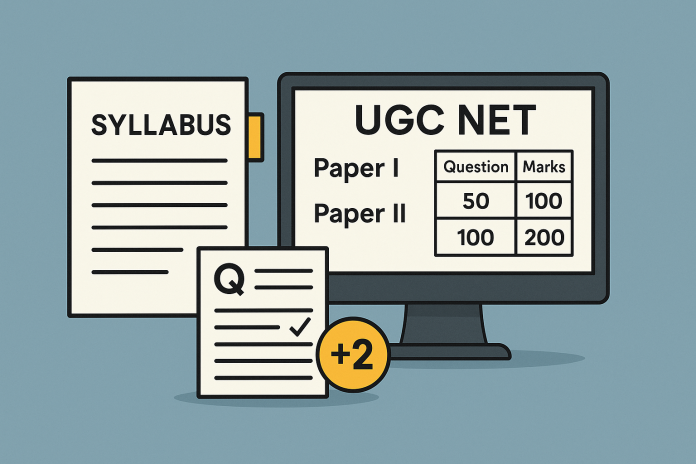
Paper I: 50 Questions for 100 Marks

Paper I comprises 50 multiple choice questions, with each correct answer earning 2 marks, totaling 100 marks. According to the official pattern, five questions are typically drawn from each of the ten units, meaning no unit can be safely ignored. 

The absence of negative marking means you should attempt every single question, even educated guesses have a 25% chance of being correct without any downside risk.

Paper II: 100 Questions for 200 Marks

Paper II contains 100 questions worth 200 marks total, with each correct answer again earning II marks. This paper carries double the weightage of Paper I, emphasizing the importance of strong subject preparation. 

Like Paper I, there’s no negative marking, so attempting all questions is the smart strategy. Most candidates find Paper II more manageable since it tests knowledge they’ve already acquired during their postgraduate studies.

UGC NET Paper 1 Syllabus:10 Essential Units

Paper 1 covers ten comprehensive units designed to assess your readiness for an academic career. Rather than memorizing everything, smart preparation focuses on understanding core concepts and practicing previous year questions to identify patterns.

Unit Wise Topics Overview

The ten Paper 1 units are Teaching Aptitude, Research Aptitude, Comprehension, Communication, Mathematical Reasoning and Aptitude, Logical Reasoning, Data Interpretation, Information and Communication Technology (ICT), People, Development and Environment, and Higher Education System.

Teaching Aptitude covers teaching methods, learner characteristics, evaluation systems, and modern pedagogical approaches including online learning platforms like SWAYAM and MOOCs. 

Research Aptitude tests your understanding of research types, methodology, ethics, thesis writing, and ICT applications in research.

The remaining units cover diverse areas essential for educators. 

Logical Reasoning includes both Western logic (syllogisms, Venn diagrams, argument analysis) and Indian logic traditions (Pramanas, Anumana). 

Mathematical Reasoning tests number series, percentages, profit loss, and basic arithmetic. Data Interpretation involves analyzing charts, graphs, and tables. ICT covers digital literacy and government initiatives in education. 

People, Development and Environment addresses sustainable development, pollution, and international environmental agreements. The 

Higher Education System covers India’s educational evolution from ancient universities to NEP 2020 and current UGC policies.

High Yield Topics for Quick Preparation

If you’re short on time, prioritize based on question frequency from previous examinations. 

Teaching Aptitude and Research Aptitude together typically contribute 18 to 22 questions, that is nearly 40% of Paper 1. 

Focus on teaching methods (teacher centered vs learner centered), evaluation types (formative vs summative), research methodology steps, and research ethics, including plagiarism and data integrity. 

These topics appear consistently and the concepts are straightforward once understood.

Logical Reasoning and Data Interpretation are scoring sections for candidates who practice regularly. Unlike theory heavy units, these require skill development through problem solving. 

Dedicate focused practice sessions to Venn diagrams, syllogisms, number series, and chart analysis. 

ICT questions often test knowledge of government digital initiatives. Familiarize yourself with SWAYAM, National Digital Library, e PG Pathshala, and basic internet terminology. 

Higher Education System questions increasingly focus on NEP 2020 provisions and UGC regulations, making these contemporary topics high yield for recent examinations.

Where to Access Subject Wise Syllabus of Paper 1 Syllabus PDF

The official Paper 1 syllabus PDF is available for free download from the NTA UGC NET website

Navigate to the syllabus section, look for “General Paper on Teaching and Research Aptitude,” and download either the English or Hindi version based on your preference. 

The document is approximately 3 to 4 pages and provides the complete unit wise breakdown with all topics and subtopics you need to cover. Always download from official sources to ensure you’re preparing from the most current and accurate syllabus.

UGC NET Paper 2 Syllabus

Paper 2 is where your subject expertise determines your success. 

With 100 questions worth 200 marks, thorough preparation in your chosen discipline is non negotiable. 

Let’s examine the syllabus structure for two of the most popular professional subjects—Law and Commerce.

Paper 2 Syllabus for UGC NET LAW

The UGC NET Law syllabus (Subject Code 58) is designed for candidates holding an LL.M. or equivalent qualification seeking Assistant Professor positions or Junior Research Fellowship in law schools. 

The syllabus comprises ten comprehensive units covering the entire spectrum of legal studies from jurisprudential foundations to contemporary areas like cyber law and intellectual property rights.

UGC NET LAW Major Subjects to Focus On

Constitutional and Administrative Law (Unit 2) is arguably the most important unit for Law aspirants. 

This unit covers the Preamble, Fundamental Rights and Duties, Directive Principles of State Policy, Union and State executive structures, legislative powers distribution, the judiciary’s role, and emergency provisions. Administrative law topics include principles of natural justice and judicial review of administrative actions. 

Given India’s constitutional framework’s centrality to legal practice and academics, questions from this unit appear frequently and carry significant weightage.

Jurisprudence (Unit 1) forms the theoretical foundation that every law teacher must master. Topics include nature and sources of law, various schools of jurisprudence (Natural Law, Positivism, Historical, Sociological, and Realist schools), the relationship between law and morality, concepts of rights, duties, and legal personality, property and ownership concepts, and liability principles. 

Contemporary themes like law and development, global justice, and post modernist legal thought also feature in this unit. Strong jurisprudential understanding helps you approach other substantive law units with better analytical clarity.

Law of Crimes (Unit 4) covers criminal law principles that form core teaching content in every law school. You need a thorough understanding of general principles of criminal liability including actus reus and mens rea, stages of crime, inchoate offences (abetment, conspiracy, attempt), general exceptions, and specific offences against persons, property, women, children, and the state. 

Theories of punishment, such as retributive, deterrent, preventive, and reformative, are conceptually important topics frequently tested in examinations.

Intellectual Property Rights and Information Technology Law (Unit 9) represents contemporary legal practice’s cutting edge. 

This unit covers copyright law, patent law, trademark law, geographical indications, biodiversity and traditional knowledge protection, and the provisions of the IT Act on digital signatures, electronic governance, and cybercrimes. 

Given IPR and technology laws growing importance in legal practice and the increasing number of specialized courses in law schools, this unit has gained prominence in recent examinations. Candidates with additional preparation in these emerging areas often find a competitive advantage.

Paper 2 Syllabus for UGC NET Commerce

The UGC NET Commerce syllabus (Subject Code 08) caters to candidates with postgraduate qualifications in Commerce, Business Administration, or related disciplines. 

The syllabus covers ten units spanning accounting, finance, marketing, human resources, and business law, essentially the complete business studies curriculum taught in commerce departments.

UGC NET Commerce Major Subjects to Focus On

Accounting and Auditing form a substantial portion of the Commerce syllabus and demand strong technical preparation. 

Topics include basic accounting principles, partnership accounts, corporate accounting (issue, forfeiture, and reissue of shares), holding company accounts, cost and management accounting techniques, financial statement analysis, human resources accounting, Indian Accounting Standards and IFRS convergence, and auditing principles, including recent trends in audit practices. This unit tests both conceptual understanding and computational abilities, making practice with numerical problems essential.

Business Finance and Banking covers financial decision making and India’s financial system. Business Finance topics include sources of finance, cost of capital calculations, time value of money, capital structure theories, capital budgeting decisions, working capital management, and risk return analysis. 

International finance, covering monetary systems, foreign exchange markets, and financial instruments, adds a global perspective. 

Banking topics cover the Indian financial system, commercial banking operations, Reserve Bank of India regulations, financial markets, non banking financial institutions, and digitalization in banking, including UPI and fintech developments.

Business Management and Human Resource Management address organizational and people management dimensions. 

Management topics cover principles and functions of management, organization structure and design, authority and responsibility relationships, motivation theories, leadership styles, corporate governance, and business ethics. 

HRM topics include human resource planning, recruitment and selection, training and development, compensation management, performance appraisal systems, including 360 degree feedback, collective bargaining, and workers’ participation in management. Understanding organizational behavior concepts like personality, perception, and organizational culture strengthens your preparation.

Legal Aspects of Business and Taxation complete the Commerce syllabus with regulatory and compliance dimensions. Legal topics cover the Indian Contract Act 1872, special contracts (bailment, pledge, indemnity, guarantee, agency), Sale of Goods Act 1930, Negotiable Instruments Act 1881, Companies Act 2013 provisions, Limited Liability Partnership Act, Competition Act 2002, Information Technology Act 2000, RTI Act 2005, and intellectual property rights fundamentals. Taxation topics cover income tax provisions, international taxation basics, corporate tax planning strategies, and the GST framework. 

These topics connect theoretical business knowledge with practical regulatory compliance.

How to Access Subject Wise Syllabus PDF?

Downloading your official syllabus PDF is the essential first step for focused preparation. Visit the official NTA UGC NET syllabus page, where you’ll find the complete list of 85 subjects organized by subject code. 

Locate your chosen subject (Law is Code 58, Commerce is Code 08) and click the download link for either the English or Hindi version. 

The PDFs are free and contain unit wise topic breakdowns that serve as your preparation roadmap. Here’s the syllabus of law that is linked here for your reference. 

Save multiple copies of your syllabus PDF, one clean copy for reference and another for annotation during preparation. 

As you study, mark completed topics, highlight frequently tested areas based on previous year analysis, and note areas needing revision. 

Many successful candidates print the syllabus and use it as a checklist, ticking off topics as they complete them. This systematic approach ensures comprehensive coverage without missing any unit while giving you visual progress indicators that maintain motivation during extended preparation periods.

You can refer to this guide to understand how to prepare for the UGC NET Exam.

Conclusion

The UGC NET examination tests both your general aptitude for academic careers through Paper 1 and your specialized subject expertise through Paper 2. Success requires balanced preparation across both components; neglecting either paper risks failing to meet minimum qualifying standards, regardless of how well you perform in the other. 

Paper 1’s ten units demand breadth of preparation with special focus on highy ield areas like Teaching Aptitude, Research Aptitude, and Logical Reasoning. Paper 2 requires depth in your chosen subject, whether that’s mastering Constitutional Law and Jurisprudence for Law aspirants or Accounting and Business Finance for Commerce candidates.

Your preparation journey starts with downloading the official syllabus from the NTA website, creating a realistic study schedule, and consistently working through topics while practicing previous year questions. You can also enroll for the UGC NET/JRF mock test series of Lawsikho. 

The absence of negative marking is your friend; attempt every question. Thousands of candidates qualify each cycle, and with strategic preparation using this quick reference guide, you can be among them. 

Start today, stay focused, and approach the examination with confidence built on thorough preparation.

We have covered unit wise breakdown and syllabus in depth on our LawSikho blog, you visit this link to know more.

Download Now

Eligibility Criteria for UGC NET Exam

0
ugc net

UGC NET Eligibility 2025-2026: Quick guide on educational qualifications, age limits, exemptions & common mistakes for JRF and Assistant Professor aspirants. This article is written by Urvi Shah, Senior Associate at LawSikho.

Stop right there. Before you download that UGC NET syllabus, before you invest in expensive coaching classes, before you spend the next six months buried in textbooks, answer this one question: Are you even eligible to sit for the exam?

Every year, thousands of aspiring academics get their applications rejected. Not because they lack talent, but because they missed one tiny eligibility detail. Maybe they assumed their LLB qualified them for UGC NET Law (it doesn’t). Or they calculated their age wrong and crossed the JRF cutoff.

The worst part? You won’t discover these mistakes until after you’ve prepared for months.

But here’s the good news: UGC NET eligibility isn’t rocket science. Whether you’re a Master’s graduate eyeing JRF, a working professional shifting to academia, or a final year student getting a head start, this guide has you covered.

In a few minutes, you’ll know who can apply, who gets age relaxations, and the critical mistakes that lead to disqualification. No jargon. Just clarity.

Ready? Let’s make sure you’re eligible before you waste a single hour.

Who is Eligible to Apply for UGC NET?

Educational Qualification Requirements

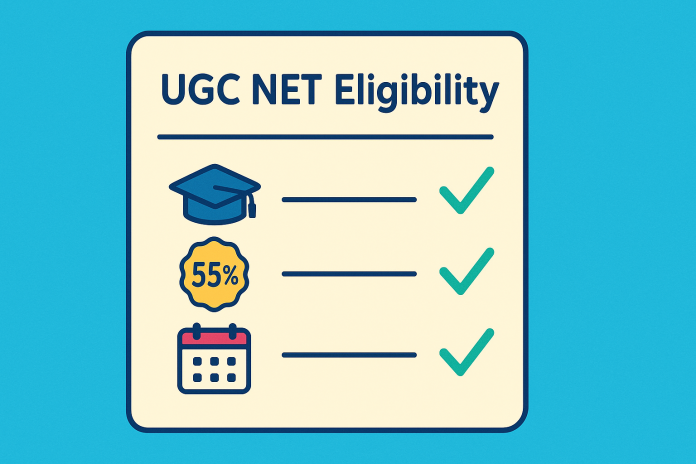
The fundamental eligibility requirement for UGC NET is a Master’s degree from a UGC recognised university with a minimum percentage of marks. Candidates belonging to the General and Economically Weaker Section (EWS) categories must have secured at least 55% marks in their post graduation, this figure is applied strictly without any rounding off.

For reserved category candidates including OBC (Non Creamy Layer), SC, ST, Persons with Disability (PwD), and Third Gender, the minimum requirement is relaxed to 50% marks.

The Master’s degree must be in a subject covered under the UGC NET subject list, which spans 85 disciplines including law, commerce, humanities, social sciences, and computer applications. 

For law aspirants specifically, an LLM degree is mandatory; an LLB alone, regardless of whether it is a 3 year or 5 year programme, does not qualify you to appear for UGC NET Law (Subject Code 58). 

Candidates are advised to appear in the subject of their post graduation only, though those whose exact post graduation subject is not listed may appear in a closely related subject after careful consideration of the syllabus overlap.

Can Final Year Students Apply?

Yes, candidates who are in the final year of their Master’s programme or whose results are awaited can apply for UGC NET on a provisional basis and they will only be considered eligible for JRF award or Assistant Professor eligibility after they pass their Master’s degree with the required percentage (55% for General/EWS, 50% for reserved categories). 

This provision allows you to appear for the examination while completing your degree, saving valuable time in your academic career progression. However, there is a critical condition attached to this provisional eligibility.

If you qualify for UGC NET while your degree is pending, you must complete your Master’s examination with the required percentage within two years from the date of NET result declaration. 

For those qualifying under the ‘PhD Admission Only’ category, this window is even shorter, just one year. Failure to meet these deadlines results in automatic disqualification, and your NET certificate becomes invalid. This means you would need to appear for the examination again after completing your degree, having lost both time and the earlier qualification.

What is the Age Limit for UGC NET?

JRF Age Limit and Relaxations

The age limit for UGC NET applies specifically to candidates seeking Junior Research Fellowship; you must not exceed 30 years of age as on the first day of the month in which the examination concludes. 

For UGC NET June 2025, this reference date would be 1st June 2025. The age is calculated based on your date of birth as recorded in your Class 10 certificate, which serves as the standard reference document for all government examinations in India.

Recognising diverse circumstances, the UGC provides age relaxations for various categories. SC, ST, OBC NCL, PwD, Third Gender, and women candidates of all categories receive a relaxation of 5 years, extending their eligibility to 35 years.

LLM degree holders get an additional 3 years’ relaxation, acknowledging the longer educational pathway in law. 

Candidates with research experience in their post graduation subject can claim relaxation equal to the research period (maximum 5 years), while armed forces personnel receive up to 5 years based on service length. 

One crucial rule to remember is that the total relaxation from all grounds combined cannot exceed 5 years; you cannot simply add multiple relaxations together.

Armed Forces Services

Candidates who have served in the armed forces are entitled to age relaxation of up to 5 years, subject to the length of their service in the armed forces up to the first day of the month in which the UGC NET examination is conducted. 

Assistant Professor: No Age Barrier

Unlike JRF, there is absolutely no upper age limit for candidates appearing for UGC NET solely for Assistant Professor eligibility. 

Whether you are 25, 45, or 60 years old, you can appear for the examination and, upon qualifying, become eligible for appointment as an Assistant Professor in universities and colleges across India. 

This provision makes UGC NET particularly attractive for working professionals who decide to transition into academia later in their careers, career changers exploring teaching opportunities, and candidates who may have crossed the JRF age limit but still aspire to teach.

PhD Admission Through UGC NET

There is no upper age limit for candidates applying for UGC NET for admission to PhD programs.

Can Age Relaxations Be Combined?

The most important rule that candidates must understand is that the total age relaxation from all grounds combined shall not exceed 5 years under any circumstances. 

This means even if you belong to multiple categories eligible for relaxation, the maximum relaxation you can claim is still capped at 5 years.

Key Exemptions and Special Cases

When is UGC NET Not Required for Assistant Professor?

Not everyone needs to clear UGC NET to become an Assistant Professor. The UGC Regulations provide specific exemptions that you should be aware of. First, candidates who hold a PhD degree awarded in accordance with UGC (Minimum Standards and Procedure for Award of Ph.D. Degree) Regulations, 2009, are exempted from the NET/SET/SLET requirement for Assistant Professor recruitment. 

This exemption recognises that rigorous doctoral training under these standards adequately prepares candidates for academic positions.

Second, candidates who have cleared the State Eligibility Test (SET) before 1st June 2002 can apply for Assistant Professor positions anywhere in India without NET. 

However, those who have cleared the SET after this date can only apply within the state where they qualified. For national mobility, they would need UGC NET. 

Third, candidates who passed the UGC/CSIR JRF examination prior to 1989 are also exempted. It is important to note that these exemptions apply only to Assistant Professor eligibility; none of them grant exemption from NET for claiming Junior Research Fellowship benefits.

Distance Education and Foreign Degree Holders

Candidates who have completed their Master’s degree through distance education mode are eligible for UGC NET, provided the degree is from a university recognised by UGC and the distance programme itself is approved. 

Universities like IGNOU and various state open universities offer valid programmes that qualify candidates for NET. The degree certificate should clearly indicate the university’s UGC recognition status.

For candidates with foreign degrees, the pathway involves an additional step. You must obtain an equivalence certificate from the Association of Indian Universities (AIU), New Delhi, confirming that your foreign qualification is equivalent to an Indian Master’s degree. 

This process typically takes 10 to 30 days and should be initiated well before the NET application deadline. Without AIU equivalence, foreign degree holders cannot establish their eligibility for UGC NET. For law degrees from foreign universities, additional recognition from the Bar Council of India may be required.

Post Graduate Diploma Holders

Candidates with a postgraduate diploma or certificate course are generally not eligible for UGC NET unless their qualification has been officially recognized as equivalent to a postgraduate degree by the Association of Indian Universities (AIU).

If your diploma appears on this list, you are eligible to apply for UGC NET. If it is not listed, you cannot appear for the examination.

You can verify your equivalency by going to the AIU official website. The AIU maintains an official list of diplomas and certificates that have been granted equivalence status.

Common Eligibility Mistakes to Avoid

Many candidates face rejection or disqualification not due to lack of merit but because of avoidable eligibility errors. The most frequent mistake involves OBC certificates, using a State OBC certificate when the community does not appear in the Central OBC NCL list published by NCBC at www.ncbc.nic.in.

UGC NET recognises only the Central list, and candidates from state listed OBC communities must apply under the General category with a 55% marks requirement. Many candidates round off their percentage, such as converting 54.6% to 55%, but UGC NET requires a percentage without rounding off. 

Another common error is name or date of birth mismatches across documents. If your name appears as “Rahul Sharma” in your Class 10 certificate but “Rahul Kumar Sharma” in your Master’s degree, this discrepancy can create problems during verification. 

Similarly, expired category certificates, particularly OBC NCL and EWS certificates which typically have one year validity, lead to rejection of reservation claims. Candidates also frequently select the wrong subject during application, and since NTA does not allow offline corrections after the correction window closes, this results in either appearing in an unfamiliar subject or skipping the examination cycle entirely.

Candidates with diplomas or certificates often make the mistake of not checking AIU equivalence, assuming their diploma is equivalent to a Master’s degree without verification. Always check the AIU equivalence list on www.aiu.ac.in before applying. 

Finally, candidates on provisional eligibility often fail to track the two year (or one year for PhD category) deadline for completing their Master’s degree with required marks. Missing this deadline invalidates the entire NET qualification. 

The solution is simple: verify every detail before applying, ensure all documents are current and consistent, and maintain a calendar reminder for critical deadlines.

Conclusion

UGC NET eligibility criteria are straightforward once you understand the key parameters: a Master’s degree with 55% marks (50% for reserved categories), age limit of 30 years only for JRF (with relaxations available), and subject selection aligned with your post graduation. 

Final year students can apply provisionally, distance education degrees are valid, and several categories of candidates are exempted from NET for Assistant Professor positions. The examination itself does not verify your eligibility during application this responsibility rests entirely with you, and any misrepresentation discovered later leads to disqualification and potential legal consequences.

Before you begin your UGC NET preparation journey, take time to verify your eligibility against the official NTA Information Bulletin, gather all required documents, and ensure your category certificates are valid and from the correct issuing authority. 

With eligibility confirmed, you can focus entirely on preparation, confident that your efforts will translate into a valid qualification that opens doors to a fulfilling academic career in India’s universities and colleges.

Want to learn more about eligibility criteria, exam pattern, and syllabus, please visit this link.

Download Now

UGC NET Exam Pattern: Syllabus, Pattern and Marking Scheme

0
UGC NET

Complete UGC NET exam pattern guide covering Paper I & II structure, Law & Commerce syllabus, marking scheme, and qualifying criteria for JRF eligibility. This article is written by Neeli Neelay Shah, Senior Legal Content Writer at LawSikho.

If you’re planning to build a career in academia or research, chances are you’ve already heard about the UGC NET examination. Conducted by the National Testing Agency (NTA), this national-level test is your ticket to becoming an Assistant Professor in universities and colleges across India or qualifying for the prestigious Junior Research Fellowship (JRF). The December 2025 session is right around the corner, scheduled from 31 December 2025 to 7 January 2026, and if you’re serious about cracking it, understanding the exam pattern inside out is absolutely non-negotiable. Trust me, knowing the structure of what you’re up against makes all the difference between scattered preparation and focused, strategic studying.

What is the UGC NET Exam Pattern?

Let’s start with the basics. The UGC NET examination follows a standardized pattern that has remained largely consistent since 2019. The exam consists of two papers: Paper I and Paper II, both conducted in a single session. Paper I is common for everyone regardless of subject, while Paper II tests your expertise in your chosen discipline from a list of 85 available subjects.

The entire examination carries 300 marks with 150 multiple-choice questions that you need to complete within 180 minutes. That’s 3 hours of continuous testing without any breaks. Paper I contributes 100 marks through 50 questions, while Paper II carries the heavier weightage of 200 marks through 100 questions. This structure means Paper II is twice as important in terms of marks, which should influence how you allocate your preparation time.

What makes UGC NET particularly interesting is that it serves multiple purposes simultaneously. Clear the exam with a good score, and you’re eligible for Assistant Professor positions. Score even higher and fall within the top percentage, and you qualify for JRF; a fellowship that provides financial support of ₹37,000-42,000 per month for pursuing research. The same examination, different outcomes based on your performance.

The examination is conducted in Computer-Based Test (CBT) mode at designated centres across India. You’ll be answering questions on a computer screen, selecting options with mouse clicks, and navigating through questions using an intuitive interface. If you’ve taken any competitive exam in recent years, the format will feel familiar. If not, don’t worry; we’ll cover the CBT specifics in our succeeding article. So stay tuned!

Key Features of UGC NET December 2025 Exam

Before diving into the detailed breakdown, let’s understand the key features that define the UGC NET examination. These are the fundamental aspects that every aspirant must be aware of, as they directly impact your preparation strategy and exam-day approach.

Two Papers in Single Session

Here’s something that catches many first-time aspirants off guard; both Paper I and Paper II are conducted together in a single continuous session of 3 hours. There’s no break in between, no separate time slots, and no opportunity to step out and refresh yourself midway. You sit down, the clock starts, and for the next 180 minutes, you’re navigating through 150 questions across both papers.

This format has significant implications for your preparation. You need to build mental stamina to maintain focus for three straight hours. Many candidates start strong but find their concentration wavering towards the end, especially during the more demanding Paper II questions. Practicing full-length mock tests under timed conditions is essential to condition yourself for this marathon.

The typical strategy most successful candidates follow is to spend approximately 50-60 minutes on Paper I and reserve 120-130 minutes for Paper II. Since Paper II carries double the marks and tests deeper subject knowledge, it deserves the lion’s share of your time. However, this allocation isn’t rigid; you can freely move between papers during the examination, which brings us to an important point about flexibility in the CBT format.

Computer-Based Test Mode

Gone are the days of OMR sheets and bubble filling. The UGC NET examination is conducted entirely in online mode through Computer-Based Test (CBT) format. You’ll be seated at an individual computer terminal at your designated examination centre, with the question paper displayed on your screen.

The CBT interface is designed to be user-friendly. Each question appears on screen with four options, and you simply click on your chosen answer to record your response. A question palette on the right side shows all question numbers colour-coded by status; green for answered, red for not answered, purple for marked for review, and grey for not visited. You can click on any question number to jump directly to that question.

One feature that proves incredibly useful is the “Mark for Review” option. If you encounter a question you’re unsure about or want to reconsider later, you can flag it and move on. This prevents you from getting stuck on difficult questions while easier marks slip away. After completing your first pass, you can return to marked questions with your remaining time.

For subjects involving calculations like Commerce, Economics, or Management, an on-screen calculator is available within the interface. Physical calculators are not permitted inside the examination hall. If your subject requires numerical work, I’d strongly recommend practicing with on-screen calculators during preparation; they feel different from physical ones, and exam day isn’t the time for surprises.

No Negative Marking

This is perhaps the most candidate-friendly aspect of UGC NET, and if you’re not leveraging it fully, you’re leaving marks on the table. There is absolutely no negative marking in the examination. For every correct answer, you get 2 marks. For every wrong answer? Zero marks; no deduction whatsoever.

Think about what this means strategically. In examinations with negative marking, random guessing is risky; you might lose marks for wrong attempts. In UGC NET, there’s no such penalty. If you’ve eliminated two options and are torn between the remaining two, guess! You have a 50% chance of gaining 2 marks and zero chance of losing anything.

This policy should fundamentally shape your exam approach. Never leave any question unattempted. Even if you have no clue about a question, make an educated guess based on elimination. With four options, random guessing gives you a 25% chance of being correct. That’s not nothing; over 10 completely random guesses, you’d statistically expect to get 2-3 correct, earning 4-6 marks for free.

Of course, intelligent guessing is far better than random guessing. Look for obviously wrong options, consider the logical consistency of answers, and use your general knowledge to eliminate choices. But the bottom line is clear: attempt every single question before the time runs out.

UGC NET Paper I Exam Pattern

Paper I is where your journey through the examination begins. This general aptitude paper is common to all candidates, regardless of whether you’re appearing for Law, Commerce, English, History, or any of the other 85 subjects. Its purpose is to evaluate whether you possess the fundamental skills and awareness necessary for a career in teaching and research.

Many candidates make the mistake of underestimating Paper I, focusing almost exclusively on their subject-specific Paper II. This is a strategic error. Paper I carries 100 marks: a third of the total and the questions here are often more scoring than Paper II because they test aptitude rather than deep subject knowledge. A strong Paper I performance can compensate for weaknesses in Paper II, while a poor Paper I can sink an otherwise good attempt.

The paper tests a diverse range of skills: your understanding of teaching methodologies, research processes, logical reasoning capabilities, mathematical aptitude, comprehension skills, and awareness about higher education systems in India. It’s designed to assess whether you have the well-rounded intellectual foundation that academic careers demand.

Paper I Structure and Syllabus

Total Questions and Marks in Paper I

Paper I consists of 50 multiple-choice questions, each carrying 2 marks, for a total of 100 marks. All questions are compulsory; there’s no choice or optional sections. The questions come from 10 distinct units, and while there’s no formal sectional division during the exam, understanding the unit-wise structure helps in systematic preparation.

The time you should ideally spend on Paper I is around 50-60 minutes, giving you roughly 1 minute per question. This might seem tight, but Paper I questions are generally less complex than Paper II questions. Many can be answered in 30-40 seconds if you know your concepts well, leaving buffer time for trickier questions.

One thing to note: there’s no separate timing for Paper I and Paper II. The 3-hour clock runs for both papers combined. This means you have complete flexibility in how you allocate time. Some candidates prefer completing Paper I first before moving to Paper II. Others jump straight to Paper II while they’re freshest and tackle Paper I later. Find what works for you through mock test practice.

UGC NET Paper I Major Units

The Paper I syllabus is divided into 10 comprehensive units, each designed to test a specific aspect of your aptitude for academic careers. Let me walk you through each one so you know exactly what to expect.

Unit 1 is Teaching Aptitude, covering concepts of teaching, objectives, levels of teaching (memory, understanding, and reflective), characteristics of effective teaching, and factors affecting teaching. You’ll encounter questions about teaching methods, learner characteristics, and the teaching-learning process. This unit is relatively straightforward if you study systematically.

Unit 2 focuses on Research Aptitude, testing your understanding of research meaning, types, characteristics, and methods. Questions cover research ethics, thesis writing, steps in research, and application of ICT in research. Concepts like hypothesis formulation, sampling techniques, and research design frequently appear. If you’re aiming for JRF, pay special attention here: research aptitude is your bread and butter.

Units 3 and 4 cover Comprehension and Communication respectively. The comprehension section presents passages followed by questions testing your reading and inference abilities. Communication covers verbal and non-verbal communication, effective communication principles, barriers to communication, and mass media. These units reward good English skills and general awareness.

Units 5, 6, and 7 deal with Mathematical Reasoning, Logical Reasoning, and Data Interpretation. These are the analytical backbone of Paper I. You’ll face questions on number series, letter series, coding-decoding, analogies, Venn diagrams, syllogisms, and arguments. Mathematical aptitude questions cover basic arithmetic: percentages, ratios, time and distance, profit and loss. Data interpretation requires analysing tables, charts, and graphs.

Unit 8 covers Information and Communication Technology (ICT), testing your knowledge of computers, internet, email, and digital initiatives in education. Unit 9 focuses on People, Development and Environment, covering environmental issues, pollution, and sustainable development. Unit 10 addresses the Higher Education System in India, including governance, policies, UGC, NAAC, and other regulatory bodies.

Paper I Unit-Wise Marks Distribution

Number of Questions from Each Unit

The distribution across Paper I is remarkably uniform. Each of the 10 units typically contributes 5-6 questions worth 10 marks. This means every unit carries equal official weightage, and neglecting any unit means potentially losing marks; a significant chunk when cut-offs can be tight.

High-Weightage Units to Prioritise

While marks distribution is uniform, the practical difficulty and scoring potential vary significantly across units. Let me share some insights that can help you prioritize during preparation and execution.

Teaching Aptitude and Research Aptitude are considered the most scoring units. The questions here are largely factual: definitions, characteristics, types, methods. If you’ve studied these topics systematically, you can answer most questions in under 30 seconds. These should be your confidence boosters, the sections where you aim for near-perfect scores.

On the other end, Data Interpretation and Mathematical Reasoning can be time-consuming. Even if you know the concepts, calculations take time. A data interpretation question might require reading a complex table, understanding what’s being asked, performing multiple calculations, and selecting the correct option. This could take 2-3 minutes for a single question.

My recommended strategy: Attempt Teaching Aptitude and Research Aptitude first. These are typically faster and more scoring. Then tackle Comprehension (which requires reading time), and finally approach Mathematical Reasoning, Logical Reasoning, and Data Interpretation. This sequence ensures you’ve secured easier marks before spending time on challenging sections.

UGC NET Law Paper II Exam Pattern

Now let’s move to the heart of the examination: Paper II. This is where your subject expertise is tested, and it carries double the weightage of Paper I. I’ll cover two popular subjects in detail: Law and Commerce. If you’re appearing for a different subject, the structural elements (questions, marks, format) remain the same; only the syllabus content differs.

UGC NET Exam Pattern for Law

UGC NET Law (Subject Code: 58) is designed for candidates who have completed their LLM and aspire to teach law in universities and colleges or pursue research in legal studies. It’s one of the more competitive papers, with thousands of law postgraduates appearing each session.

Total Questions and Marks in Law Paper II

Paper II for Law consists of 100 multiple-choice questions, each carrying 2 marks, totalling 200 marks. All questions are compulsory: there’s no optional section or choice between questions. The absence of negative marking applies here too, so attempt everything.

The questions in Law Paper II test multiple dimensions of your legal knowledge. You’ll encounter questions that are purely definitional (asking about the meaning of legal terms or concepts), questions testing your knowledge of statutory provisions (specific sections of laws), questions about landmark judgments (case names, holdings, and principles established), and analytical questions requiring application of legal principles to factual scenarios.

UGC NET Law Syllabus

The UGC NET Law syllabus is divided into 10 comprehensive units covering the major branches of law. Let me break these down so you know exactly what territory you’re covering.

Unit 1 is Jurisprudence, the philosophical foundation of law. This includes nature and sources of law, schools of jurisprudence (Natural Law, Positivism, Sociological School, Realist School), concepts of rights and duties, legal personality, property, ownership, possession, and liability. Questions from jurisprudence test your understanding of why law exists and how legal concepts are structured.

Unit 2 covers Constitutional Law and Administrative Law. This is a heavyweight unit covering the Preamble, fundamental rights and duties, directive principles, union and state executives, legislature, judiciary, emergency provisions, and administrative law concepts like delegated legislation, administrative tribunals, and judicial review of administrative action. Given the breadth of Indian constitutional law, this unit demands serious preparation time.

Unit 3 deals with Public International Law: definition, nature, sources, recognition of states, nationality, extradition, asylum, United Nations and its organs, WTO, international humanitarian law, and settlement of international disputes. While this might seem distant from domestic practice, it’s essential for academic careers and frequently tested.

Unit 4 is Law of Crimes, covering general principles of criminal liability (actus reus, mens rea), stages of crime, inchoate offenses, general exceptions, and specific offenses against person, property, state, women, and children. 

Units 5-10 cover Law of Torts and Consumer Protection, Law of Contracts and Commercial Law (including Sale of Goods, Partnership, Negotiable Instruments, and Company Law), Family Law (Hindu and Muslim personal laws), Labour and Industrial Law, Environmental Law, Human Rights and Intellectual Property Rights. Each unit represents a distinct branch of law with its own statutes, principles, and jurisprudence.

High Weightage Topics in UGC NET Law Paper II

Based on analysis of previous year question papers, certain areas consistently carry higher weightage. If you’re pressed for time (and who isn’t?)prioritising these topics makes strategic sense.

Constitutional Law is unquestionably the most important unit, typically accounting for 20-25% of the paper. Within this, fundamental rights and judicial review are frequently tested. Recent Supreme Court judgments on constitutional matters appear regularly so stay updated with landmark decisions.

Jurisprudence is the second-highest weightage area at 15-20%. The schools of jurisprudence (especially Austin’s command theory, Kelsen’s pure theory, natural law theories, and sociological jurisprudence) are evergreen topics. Concepts of rights, duties, legal personality, and liability appear consistently.

In addition to this, you must focus on Law of Crimes as well with prime focus on criminal liability. 

Commercial Law (Contracts, Sale of Goods, Company Law) and Family Law are medium-weightage areas. Environmental Law and IPR have grown in importance given contemporary relevance. Labour Law questions test knowledge of major legislations like Industrial Disputes Act, Factories Act, and recent labor code consolidations.

For success in UGC NET Law, you can adopt a three-pronged approach: master the high-weightage topics thoroughly, ensure decent coverage of all units to avoid zero scores in any area, and stay updated with recent amendments and landmark judgments.

UGC NET Exam Pattern for Commerce

UGC NET Commerce (Subject Code: 08) is among the most popular papers, attracting commerce and management postgraduates seeking academic careers. The competition is fierce, but so are the opportunities; commerce faculty is in demand across thousands of colleges.

Total Questions and Marks in Commerce Paper II

Like all Paper II subjects, Commerce consists of 100 multiple-choice questions worth 200 marks. However, what distinguishes Commerce from many other subjects is the significant presence of numerical questions. While papers like History or Political Science are entirely theoretical, Commerce blends conceptual questions with calculation-based problems.

UGC NET Commerce Syllabus

The Commerce syllabus spans 10 units covering the breadth of business and management education. Here’s what each unit encompasses.

Unit 1 covers Business Environment and International Business. This includes the economic environment (economic systems, monetary and fiscal policies), political environment, legal environment (FEMA, Consumer Protection), socio-cultural factors, CSR, globalization, and modes of international business entry. Questions test your understanding of how businesses operate within broader environmental contexts.

Unit 2 is Accounting and Auditing, arguably the core of commerce education. This covers financial accounting (preparation of financial statements, accounting standards), corporate accounting (amalgamation, liquidation, holding company accounts), cost accounting (various costing methods, standard costing, variance analysis), and auditing (auditing standards, types of audit, internal control). Expect both conceptual and numerical questions from this unit.

Unit 3 deals with Business Economics, both micro and macro perspectives. Demand analysis, production and cost, market structures, national income, monetary policy, fiscal policy, and international trade concepts appear here. While primarily theoretical, some numerical questions on elasticity, national income calculation, or monetary multiplier may appear.

Unit 4 covers Business Finance, including sources of finance, capital structure theories, cost of capital, capital budgeting techniques, dividend policies, and working capital management. This is another calculation-heavy unit; expect questions requiring NPV, IRR, payback period, or ratio calculations.

Unit 5 is Business Statistics, covering measures of central tendency, dispersion, correlation, regression, probability, and time series analysis. This is purely numerical—you need to know formulas and how to apply them quickly.

Units 6-10 cover Marketing Management (marketing mix, consumer behaviour, product life cycle, pricing, distribution, promotion, digital marketing), Human Resource Management (recruitment, selection, training, performance appraisal, compensation), Organizational Behaviour and Theory (motivation theories, leadership, organizational culture, change management), Business Law and Corporate Governance (Company Law, Contract Act, Consumer Protection, corporate governance principles), and Income Tax and GST (tax provisions, computation, and recent amendments).

High Weightage Topics in UGC NET Commerce Paper II

From previous year analysis, Accounting and Auditing (Unit 2) consistently tops the chart with 11-15 questions. Master financial statements, ratio analysis, cost sheets, and variance analysis: expect 4-6 numericals every time. Quick calculation speed is the game-changer here.

Business Finance (Unit 4) brings 10-12 questions, almost all formula-driven. Cost of capital, NPV/IRR, capital structure, and dividend decisions appear regularly; solve at least 50 problems per topic to stay safe.

Marketing Management (Unit 8) also gives 10-12 questions and remains largely conceptual. Focus on 4Ps, consumer behaviour models, STP framework, and digital marketing trends for easy, accurate scoring.

HRM and Organizational Behaviour (Unit 6) together contribute 10-12 questions. Motivation theories (Maslow, Herzberg), leadership styles, performance appraisal, and group dynamics repeat almost every year: pure theory, high returns.

Business Statistics & Research Methods (Unit 5) carries 8-10 questions. Probability, correlation, hypothesis testing, and sampling need zero calculation mistakes; daily practice of formulas is compulsory.

Legal Aspects of Business (Unit 10) holds 10-12 questions with rising focus on corporate governance. Stay updated on Companies Act, GST, Contract Act, and Competition Act; section-based and amendment questions are increasing.

Income Tax (Unit 9) delivers 8-10 questions mixing slabs, deductions, and basic planning. Never skip this unit; short preparation yields solid marks.

UGC NET Marking Scheme and Qualifying Criteria

Understanding how marks are calculated and what scores you need is fundamental to setting realistic targets and measuring your preparation progress. Let’s break down the marking scheme and qualifying criteria in detail.

Marks for Correct and Wrong Answers

The marking scheme is refreshingly simple. For every correct answer in both Paper I and Paper II, you receive 2 marks. This applies uniformly across all 150 questions; there’s no differential marking based on difficulty or paper.

For wrong answers, you receive zero marks. Not negative marks, just zero. This is worth emphasizing because many competitive examinations penalize wrong answers with negative marking (typically -0.5 or -0.25 for each wrong attempt). UGC NET doesn’t do this, which fundamentally changes optimal exam strategy.

Marks for Unattempted Questions

Unattempted questions carry zero marks; the same as incorrect answers. From a scoring perspective, leaving a question blank is identical to getting it wrong. There’s absolutely no advantage to leaving questions unanswered, and there’s potential upside to attempting everything.

One exception where questions might be left unanswered legitimately: if you’ve already decided on an answer but haven’t confirmed it (perhaps you’re reconsidering). In such cases, ensure you confirm your answer before moving on. The CBT interface saves responses automatically once confirmed.

There’s also a provision for ambiguous or incorrect questions. If NTA determines during the answer key challenge process that a question had errors or multiple correct answers, candidates who attempted that question and chose one of the correct options receive 2 marks. If a question is dropped entirely, all candidates receive 2 marks regardless of their response.

Qualifying Percentage

Now comes the crucial question: what score do you need to qualify? There are two thresholds to understand: minimum qualifying marks and actual cut-off marks.

The minimum qualifying percentage is 40% aggregate for General/Unreserved category candidates. This translates to 120 marks out of 300 (combining Paper I and Paper II). For reserved category candidates (OBC Non-Creamy Layer, SC, ST, PwD, Transgender), the minimum is 35%, which equals 105 marks out of 300.

However and this is important: simply scoring 120 marks (or 105 for reserved categories) doesn’t guarantee you’ll qualify as Assistant Professor or receive JRF. These are minimum thresholds, below which you’re automatically disqualified regardless of other factors. 

In practice, actual cut-offs are significantly higher than minimum qualifying marks. For popular subjects like Commerce, English, or Political Science, General category cut-offs for Assistant Professor eligibility often range from 150-180 marks. JRF cut-offs are even higher; typically 200-240 marks for General category in competitive subjects.

The cut-off varies by subject (less competitive subjects have lower cut-offs), category (reserved categories have lower cut-offs than General), and eligibility type (JRF cut-offs are higher than Assistant Professor cut-offs). Only about 6% of candidates who appear in both papers ultimately qualify for UGC NET, so competition is genuine.

Conclusion

The UGC NET examination follows a clear, well-defined pattern that rewards systematic preparation and strategic execution. With 150 questions across two papers to be completed in 3 hours for 300 marks, understanding this structure is your first step toward cracking the examination. Paper I tests your general aptitude through 10 units worth 100 marks, while Paper II assesses your subject expertise through 100 questions worth 200 marks.

The absence of negative marking is a significant advantage that you should fully exploit; attempt every question, use intelligent guessing, and never leave anything unanswered. For Law aspirants, focus on Constitutional Law and Jurisprudence as high-weightage areas while ensuring coverage of all 10 units including the new criminal law framework. Commerce candidates should balance theoretical understanding with computational practice, particularly in Accounting, Finance, and Statistics.

Remember that minimum qualifying marks (40% for General, 35% for reserved) are just entry thresholds; actual cut-offs are considerably higher. Set your targets at 180+ marks to have a realistic shot at qualification, especially for competitive subjects. Paper I should not be neglected; it’s often more scoring than Paper II and can compensate for subject-specific weaknesses.

For more in-depth information on UGC NET Exam Pattern, please visit our LawSikho Blog by clicking on this link.

Download Now

Career Prospects and Salary for Enrolled Agent

0
Enrolled Agent

Explore career opportunities and salary after passing the Enrolled Agent exam. Learn about EA jobs, US and India salaries, and how to maximize your earning potential. This article is written by Rohit Arora, Senior Associate at LawSikho.

Passing the Enrolled Agent exam is a significant achievement that opens up a world of career possibilities in taxation. 

Whether you are based in the United States or India, this federally recognized credential positions you as a tax expert with the authority to represent taxpayers before the IRS. 

From working in Big 4 accounting firms and mid-sized tax practices to joining corporate tax departments, government agencies, or U.S. tax outsourcing companies, the scope is far broader than many realize. The rise of remote work has further expanded these possibilities, enabling EAs across the globe to build thriving careers serving U.S. clients from anywhere.

This article offers a comprehensive look at the career opportunities available to newly credentialed EAs, the salaries you can expect at different experience levels, and the factors that influence earning potential. 

Whether your goal is to climb the corporate ladder, specialize in high-value tax niches, or eventually start your own practice, understanding the landscape will help you make informed decisions about how to shape your EA career.

Let us explore what career paths await you and what kind of salary you can expect after earning your EA designation.

Career Paths You Can Pursue After Earning the Enrolled Agent Credential

Tax Preparation and Advisory Roles

Tax preparation forms the backbone of most EA careers, and the work is far more varied than many people realize. As an Enrolled Agent, you can prepare individual tax returns ranging from simple W-2 filings to complex returns involving investments, rental income, and self-employment. Your credentials signal to clients that you have the expertise to handle situations that would challenge uncredentialed preparers.

Beyond preparation, EAs provide valuable advisory services that help clients make smarter financial decisions throughout the year. Tax planning involves analyzing income, deductions, and financial goals to minimize tax liability legally. You might advise clients on retirement contributions, business structure choices, or timing strategies for income recognition. This advisory work often commands higher fees than basic preparation and builds stronger client relationships.

The real differentiator for EAs is representation authority. When clients face IRS audits, collections, or disputes, you can stand in their corner and advocate on their behalf. This unlimited representation right before the Internal Revenue Service sets you apart from tax preparers without credentials. Many EAs build specialized practices around IRS representation, helping clients resolve back taxes, negotiate payment plans, or appeal unfavorable decisions.

Careers in Accounting and Tax Firms

Accounting firms of all sizes hire Enrolled Agents for their tax practices. 

The Big 4 firms, including Deloitte, PwC, EY, and KPMG, employ EAs alongside CPAs to handle tax compliance and planning for diverse clients. Working at a large firm offers structured training, exposure to complex engagements, and career advancement opportunities within established organizations.

Mid-sized and boutique tax firms provide excellent alternatives to the Big 4 environment. These firms often specialize in particular client types or tax niches, allowing you to develop deep expertise quickly. 

The work-life balance tends to be better than at larger firms, and you may have more autonomy over your client relationships. Many EAs find that mid-sized firms offer the ideal combination of challenging work and sustainable schedules.

Small local practices offer yet another path, often with the greatest flexibility and client interaction. You might work directly with business owners and individuals, handling everything from bookkeeping to complex tax planning. While salaries at small firms may start lower, the experience you gain is comprehensive. Many EAs use small firm experience as preparation for eventually launching their own practices.

Corporate Tax Positions

Large corporations maintain in-house tax departments rather than outsourcing all their tax work to external firms. As an EA in a corporate tax role, you help ensure the company meets its federal and state tax obligations accurately and on time. You might prepare quarterly estimates, manage compliance calendars, or support strategic tax planning initiatives.

Corporate positions offer several advantages over public accounting roles. The work tends to be more predictable, with busy periods around quarterly and annual filings rather than the intense seasonal crunch of tax season. Benefits packages at large companies often exceed what smaller firms provide. If you have an interest in a particular industry like healthcare, technology, or manufacturing, corporate roles let you combine tax expertise with sector knowledge.

The career path in corporate tax can lead to senior positions like Tax Manager or Director of Tax. These leadership roles involve overseeing teams, managing external firm relationships, and contributing to strategic business decisions. For EAs who prefer stability and work-life balance over the variety of public accounting, corporate tax departments offer compelling long-term career options.

Freelance and Remote Opportunities

The growth of remote work has created exciting opportunities for Enrolled Agents who value flexibility. Platforms like Upwork, Fiverr, and specialized tax marketplaces connect EAs with clients seeking virtual tax services. You can build a freelance practice serving clients across the country without geographic limitations.

Freelancing allows you to control your schedule, choose your clients, and set your own rates. Hourly rates for freelance EAs typically range from $25 to $100 depending on the services provided and your experience level. As you build a reputation and accumulate positive reviews, you can increase your rates and become more selective about projects.

For professionals in India, remote work opens doors to serving US clients directly. Many American tax firms and outsourcing companies hire EAs to handle preparation and compliance work remotely. Companies like QX Global, SurePrep, and Initor actively recruit Indian EAs for US tax engagements. This model lets you earn competitive compensation while working from cities like Bangalore, Hyderabad, or Mumbai.

Enrolled Agent Salary: What to Expect in the US and India

EA Salary in the United States by Experience Level

Entry-level Enrolled Agents in the United States typically earn between $45,000 and $55,000 annually. This starting range reflects your credentials and potential, even before you have accumulated significant professional experience. According to Gleim, the average EA salary is approximately $70,891, with earnings increasing substantially as you gain experience.

Mid-career EAs with three to seven years of experience commonly earn between $65,000 and $85,000. At this stage, your practical skills and client relationships translate into meaningful compensation growth. Senior EAs with a decade or more of experience often exceed $100,000 annually, particularly in high-cost markets or specialized roles.

Location significantly impacts earning potential. States like Washington, New York, and California offer the highest average salaries, often exceeding $75,000 for mid-career professionals. However, cost of living differences mean that a lower salary in a less expensive area might provide equal or better purchasing power. Industry matters too, with financial services, healthcare, and technology companies typically paying premium rates for tax expertise.

EA Salary in India for Freshers and Experienced Professionals

Fresh Enrolled Agents entering the Indian job market can expect starting monthly salary to be INR 1 lakh. Big 4 firms and established US tax outsourcing companies tend to offer the higher end of this range.

Mid-career EAs with three to five years of experience can earn as close to INR 2 lakhs per month.

Your practical experience handling US tax matters makes you valuable to employers who need professionals capable of working independently on complex assignments. 

Senior EAs with more than five years of experience can command INR 18 lakhs to INR 25 lakhs or higher, especially in leadership roles at Big 4 firms.

Metropolitan areas offer the strongest job markets for EAs in India. Bangalore and Hyderabad have emerged as primary hubs for US tax work, hosting substantial operations from major firms. Mumbai, Pune, and Delhi NCR also provide excellent opportunities. The concentration of employers in these cities creates competitive markets where EAs can negotiate attractive compensation packages.

Key Factors Influencing EA Salary

Several factors beyond experience level influence what you can earn as an Enrolled Agent. Employer type matters significantly, with Big 4 firms and large corporations generally paying more than small practices. Specialization in high-demand areas like international taxation or IRS representation commands premium compensation.

Additional qualifications boost your earning potential substantially. Professionals holding both EA and CPA credentials earn 25 to 40 percent more than those with EA alone. In India, combining EA with CA or ACCA credentials creates similar salary advantages. Investing in complementary certifications pays dividends throughout your career.

Geographic location and market demand also play important roles. Areas with strong concentrations of tax work tend to offer higher salaries due to competition for qualified professionals. Staying current with tax law changes and developing expertise in emerging areas positions you for opportunities that less proactive professionals miss.

EA vs CPA: Comparing Career Prospects and Salary

Salary Differences Between EA and CPA

When comparing raw salary figures, CPAs generally earn more than Enrolled Agents at all career stages. According to Becker, the average CPA salary ranges from $60,000 to over $150,000, while EA salaries typically fall between $50,000 and $100,000. This difference reflects the broader scope of services CPAs provide beyond taxation.

However, the comparison is not straightforward. CPAs invest significantly more time and money to earn their credential, including completing 150 semester hours of education and passing a four-part exam covering accounting, auditing, and taxation. When you factor in opportunity costs and student debt, the return on investment for EA certification often looks more attractive.

Top-earning EAs who develop specialized expertise or build successful practices can match or exceed average CPA salaries. The EA path to high earnings typically involves niche specialization or entrepreneurship rather than climbing corporate ladders. If you are certain about a tax-focused career, the EA credential does not limit your income ceiling.

Which Credential Is Right for Your Career Goals?

If you want to focus exclusively on taxation, the EA credential provides everything you need. Your training concentrates entirely on tax matters, making you specialized from day one. The federal nature of the EA means you can practice anywhere in the United States without additional state licensing requirements.

CPAs enjoy a broader career scope because their credentials cover auditing, financial accounting, and business advisory, alongside taxation. If you want to keep options open for non-tax accounting work or aspire to CFO or senior finance leadership roles, the CPA provides more flexibility. Many organizations require CPA credentials for certain positions regardless of tax expertise.

The practical difference in getting credentialed is substantial. Becoming an EA typically takes three to six months with total costs between $1,500 and $3,000. The CPA path requires years of additional education, a more extensive exam, and significantly higher costs. For professionals who want to start working in tax quickly, the EA offers a faster path to meaningful work and income. 

How to Maximize Your Career Potential as an Enrolled Agent

Skills and Certifications That Boost Earning Potential

Mastering professional tax software makes you immediately more valuable to employers. Programs like Drake Tax, Lacerte, and ProSeries are industry standards, and demonstrating proficiency helps you stand out from other candidates. Beyond basic preparation, understanding workflow management and analytical features positions you for advancement.

International tax knowledge commands premium compensation as cross-border transactions become more common. Understanding FATCA, FBAR requirements, and international reporting obligations differentiates you from the larger pool of domestic-focused EAs. Clients with foreign accounts and multinational operations need advisors with this specialized expertise.

Complementary certifications amplify your earning potential significantly. Pursuing CPA credentials alongside your EA creates a powerful combination for serving diverse client needs. The Certified Management Accountant designation positions you for corporate finance leadership roles. Specialized credentials in estate planning or international taxation establish expertise that commands premium fees.

Building Your Career as an EA

Developing a niche specialization creates differentiation that supports higher fees and more interesting work. Generalist EAs compete primarily on price, while specialists compete on expertise. Potential niches include specific industries, particular tax situations like cryptocurrency, or specialized services like IRS representation.

Professional networking accelerates career growth. Joining the National Association of Enrolled Agents connects you with other tax professionals and provides continuing education opportunities. Building relationships through professional associations leads to referrals, job opportunities, and mentorship that isolated professionals miss.

Continuous learning beyond required continuing education keeps your skills current and opens new opportunities. Tax law changes frequently, and staying ahead of developments positions you to serve clients better than competitors who only meet minimum requirements. Your investment in professional development is an investment in your long-term earning potential and career satisfaction.

Conclusion

The Enrolled Agent credential opens doors to diverse career paths and competitive compensation in both the United States and India. Whether you choose employment with established firms, corporate tax departments, or entrepreneurship through freelance work, your EA designation provides a solid foundation for professional success.

Salary potential grows substantially with experience, specialization, and strategic career choices. Entry-level earnings provide a reasonable starting point, while mid-career and senior EAs can achieve compensation that rivals other financial professionals. Your decisions about niche development, additional certifications, and employer selection significantly influence your trajectory.

The professionals who achieve the highest success combine technical tax expertise with business development skills and continuous learning. Your EA credential is a beginning, not an ending. With intentional career planning and ongoing professional development, you can build a rewarding career that meets both your financial goals and your desire for meaningful work. 

If you are interested in an in-depth guide on Enrolled Agent Career Opportunities and Salaries, you can refer to my detailed article by clicking in the link

Download Now

Enrolled Agent Exam Pass Rates and Difficulty: What Indian Candidates Must Know

0
Enrolled Agent Exam

Understand the Enrolled Agent Exam pass rates for Indian candidates: Part 1 at 58%, Part 2 at 71%, Part 3 at 70%. Learn challenges, common mistakes, and preparation tips. This article is written by Medha Vinod, Senior Associate at LawSikho.

The Enrolled Agent exam opens doors to US tax practice for Indian professionals looking to build international careers. But here is something most candidates do not realize until they start preparing: pass rates swing dramatically between parts, from just 58% to 71%. Understanding what makes this exam challenging and which mistakes trip up candidates can save you thousands of rupees in retake fees and months of additional preparation time. Let us break down what you actually need to know before you begin your EA journey.

Current EA Exam Pass Rates: The Numbers Every Candidate Should Know

2024-2025 Pass Rate Statistics

The latest data might surprise you. 

  1. Part 1, covering Individuals, has just a 58% pass rate, making it the toughest section statistically. 
  2. Part 2 on Businesses comes in at 71% and 
  3. Part 3 on Representation, Practices, and Procedures sits at 70%

Overall, about 66% of candidates pass across all parts.

Now, compare these numbers to other professional certifications. The CPA exam averages 45-50%, and the CMA exam ranges between 35-50%. So yes, the EA exam is more accessible than these alternatives. But that 58% for Part 1 should give you pause. This is not an exam you can walk into without serious preparation.

Why Pass Rates Vary Between Parts

Here is what catches most candidates off guard: Part 1 has the lowest pass rate, even though individual taxation feels more familiar than business or procedural topics. The problem is that the exam goes deep. We are talking about complex scenarios involving alternative minimum tax, passive activity losses, and retirement distribution rules that go far beyond filing your own returns or preparing basic tax documents.

There is also a selection effect at play. Nearly double the number of candidates attempt Part 1 compared to Parts 2 and 3. Many of these are first-time test takers who underestimate what they are getting into. By the time candidates reach later parts, they have figured out how to study effectively and proved they can handle the EA exam format.

The content itself varies in complexity, too. Part 1 covers a broad range of individual tax situations. Part 2 demands mastery of multiple business entity types with plenty of calculations. Part 3 focuses on memorizing Circular 230 rules and IRS procedures. Each part requires a different approach.

What Makes Each EA Exam Part Challenging?

Part 1 Challenges (Individuals)

Part 1 tests individual taxation at a depth that surprises almost everyone. You will face questions on Alternative Minimum Tax calculations that require computing both regular and AMT liability in parallel. Passive activity loss limitations with material participation tests will show up repeatedly. Retirement plan distribution penalties and required minimum distribution rules demand precise knowledge. And basis determination for inherited and gifted property trips up even experienced tax preparers.

If you are coming from an Indian tax background, you face additional hurdles. US individual tax concepts differ substantially from what you learned while preparing Indian returns. The retirement system with 401(k) plans, traditional IRAs, and Roth IRAs has nothing equivalent in India. Estate and gift tax provisions work completely differently. You will need to build this foundational knowledge from scratch, which takes more time than American candidates typically need.

Plan for 70-100 hours of study time for Part 1. Focus heavily on Form 1040 flow, income recognition rules, and how various deductions and credits interact with each other.

Part 2 Challenges (Businesses)

Part 2 throws the most complex content at you. You need to master taxation for sole proprietorships, partnerships, C corporations, S corporations, LLCs, estates, and trusts. Each entity type follows different rules for formation, operations, distributions, and liquidation. Keeping all these straight during a timed exam is harder than it sounds.

The topics that cause the most trouble include partnership basis calculations, where you track contributions, distributions, allocated income, and debt changes. S corporation distribution rules involving the accumulated adjustments account confuse many candidates. Section 199A qualified business income deductions require understanding multiple limitations that interact in complicated ways.

Despite all this complexity, Part 2 shows a 71% pass rate. Why? Because candidates who reach this part have usually passed at least one section already and have refined how they prepare. Budget 80-100 hours for Part 2, with heavy emphasis on entity comparison and basis tracking calculations.

Part 3 Challenges (Representation)

Part 3 feels different from the earlier sections because it tests procedural knowledge and ethics rules rather than tax computation. You will need to memorize Circular 230 provisions covering due diligence requirements, conflicts of interest, fee structures, advertising restrictions, and return preparation standards. Collection procedures, appeal deadlines, and power of attorney requirements also feature prominently.

The 70% pass rate suggests that many candidates find memorization more manageable than complex calculations. But do not fall into the trap of dismissing Part 3 as easy. Candidates who assume they can breeze through procedural content without dedicated study time often get caught off guard.

One advantage of taking Part 3 last is that representation scenarios often involve individual or business tax issues. If you understand the underlying tax law from Parts 1 and 2, the procedural questions make more sense. Plan for 60-80 hours of study time.

Common Mistakes That Lead to EA Exam Failure

Preparation Mistakes to Avoid

The biggest mistake candidates make is underestimating Part 1. You file your own returns. Maybe you have prepared individual returns professionally. So how hard can it be? This thinking leads to insufficient study time and surface-level preparation that completely misses the complex scenarios involving AMT, passive losses, and retirement distributions that actually appear on the exam.

Using outdated study materials is another costly error. Tax law changes every year, and the EA exam tests on provisions current through December 31 of the prior year. If your materials are from a previous testing window, you are learning rules that no longer apply while missing new provisions that will definitely show up.

Skipping practice exams hurts you in ways you might not expect. Yes, they test your knowledge. But they also build time management skills and help you recognize how questions are structured. Candidates who skip practice exams often struggle with pacing on exam day and misread questions because the format feels unfamiliar.

Finally, many candidates simply do not put in enough hours. The EA exam requires 210-280 total study hours across all three parts. If you are trying to squeeze preparation into a few weeks based on assumptions about difficulty, you are setting yourself up to fail.

Exam Day Mistakes

You have 100 questions and 3.5 hours. That works out to about 1.5 to 2 minutes per question. Spending ten minutes stuck on a tough question early in the exam leaves you rushing through questions you could have answered correctly. Flag the hard ones and move on.

Here is something that surprises many candidates: there is no penalty for wrong answers. A random guess gives you a 25% chance of being right. A blank answer gives you zero chance. Answer every single question, even if you are completely unsure. Leaving responses blank is throwing away potential points.

Administrative errors can end your exam before it starts. If the name on your Prometric registration does not exactly match your passport, you will not be allowed to test. Your exam fee is gone. Check this well before exam day, and arrive 30-45 minutes early to handle check-in without stress.

Mistakes Indian Candidates Commonly Make

One pattern we see repeatedly is Indian candidates assuming that US tax works similarly to Indian tax. It does not. The income recognition rules differ. Deduction timing principles differ. Entity classification frameworks differ. Approach US tax law as entirely new material rather than trying to adapt what you already know.

Many candidates also underestimate how important IRS Publication 17 and other official publications are. Language from these documents appears verbatim in exam questions. If you only use your review course materials without consulting primary IRS sources, you will miss concepts that the exam specifically tests.

The structural differences between US and Indian taxation run deep. The US system operates on a calendar year for individuals with completely different filing requirements, deduction categories, and credit structures. Understanding these differences from the start prevents confusion during both preparation and the exam itself.

Key Preparation Tips for First-Time Success

Study Strategy Essentials

Your total preparation time should fall between 210-280 hours. Break this down as 70-100 hours for Part 1, 80-100 hours for Part 2, and 60-80 hours for Part 3. If you can dedicate 10-15 hours weekly, you can complete everything in 6-9 months while maintaining your job and personal life.

Think carefully about which part to tackle first. If you primarily prepare individual returns, starting with Part 1 makes sense since the content feels more familiar. If your background is in business accounting, Part 2 might be a better starting point. Taking Part 3 last allows your knowledge from earlier parts to inform the procedural content.

Practice exams are non-negotiable. Complete 5-8 full practice exams per part under real testing conditions. Work through 1,000-1,500 practice questions per part to expose yourself to the variety of scenarios you will face and develop pattern recognition for common question types.

Resources and Investment

The major review course providers each have their strengths. Gleim offers extensive question banks. Surgent uses adaptive learning technology that adjusts to your performance. Becker provides a structured curriculum from a recognized name in accounting education. PassKey offers cost-effective self-study materials. Courses range from approximately ₹25,000 to ₹50,000, depending on what you choose.

Do not overlook free IRS resources. Sample exam questions, Publication 17 for individual taxation, Publication 535 for business expenses, and Circular 230 for practice standards are all available at no cost. The language in these documents shows up directly in exam questions, so they should supplement whatever review course you use.

For total investment, expect approximately ₹1,50,000. This includes exam fees of roughly ₹66,000 for all three parts at current exchange rates, review course costs of ₹35,000-50,000, and incidental expenses for study materials and testing center visits.

Conclusion

The EA exam is challenging, but the 66% overall pass rate proves that success is absolutely achievable with the right approach. Part 1’s 58% rate deserves your attention even though individual taxation seems like familiar territory. Each part presents distinct challenges, from AMT calculations to partnership basis tracking to Circular 230 memorization, and each requires a targeted study approach.

What separates candidates who pass from those who need retakes comes down to preparation and execution. Put in the 210-280 hours of study time. Use current materials. Take practice exams seriously. Manage your time on exam day and answer every question. Avoid the common mistakes that derail so many attempts. Indian professionals who approach the EA exam with realistic expectations and systematic preparation can pass all three parts on the first try and unlock rewarding careers in US tax practice.

If you want more in-depth details on Enrolled Agent exam pass rates, difficulty, and common mistakes, click here


Meta Description: EA exam pass rates 2024-2025 for Indian candidates: Part 1 at 58%, Part 2 at 71%, Part 3 at 70%. Learn challenges, common mistakes, and preparation tips.

URL Slug: enrolled-agent-exam-pass-rates-difficulty-indian-candidates

Backlink Checklist:

  1. ☑ Prometric.com (testing information)
  2. ☑ Circular 230 (IRS.gov)
  3. ☑ IRS Publication 17
  4. ☑ IRS Enrolled Agents page

Download Now

Best Books and Courses to Crack the Enrolled Agent Exam

0
Enrolled Agent Exam

Preparing for the enrolled agent exam? Compare top study materials, courses, and budget options to boost your chances of passing on the first attempt. This article is written by Rohit Arora, Senior Associate at LawSikho.

The Enrolled Agent credential represents the highest credential awarded by the IRS, granting unlimited rights to represent taxpayers before the Internal Revenue Service. For Indian legal and finance professionals looking to break into US tax practice, the EA exam offers an accessible pathway that doesn’t require a US degree or CPA qualification. However, your choice of study materials can make the difference between passing on your first attempt and struggling through multiple retakes.

Selecting the right preparation resources isn’t just about finding popular courses — it’s about matching materials to your learning style, budget, and available study time. With exam fees at $267 per part and the three-part exam requiring substantial preparation, investing wisely in study materials upfront saves both money and frustration. This guide breaks down the top EA prep courses, free IRS resources, and budget-specific recommendations to help you make an informed decision.

If you’re new to the certification process, you may first want to understand the IRS Enrolled Agent Exam structure and how each part is designed by clicking the link.

How to select the best enrolled agent study materials for your exam strategy

Key Factors — Learning Style, Budget, and Updated Content

Before comparing specific courses, you need to understand what makes EA study materials effective for your situation. The three critical factors are learning style compatibility, budget constraints, and content currency — and getting any of these wrong can derail your preparation.

Learning style determines which course format will actually help you retain information. If you’re a visual learner who absorbs concepts through video explanations, courses like Becker with extensive lecture content make sense. If you learn by doing and prefer practice-heavy approaches, Gleim’s massive question bank of 3,500+ MCQs might serve you better. Auditory learners benefit from courses with audio lectures they can listen to during commutes. There’s no universally “best” course — only the best course for how you personally learn.

Budget considerations are particularly significant for Indian candidates. When a course priced at $600 translates to approximately ₹50,000, the investment decision becomes substantial. You need to weigh whether premium features justify the cost or whether a combination of budget materials and free resources can achieve the same result. The good news is that effective preparation is possible across multiple budget tiers, from free IRS resources to comprehensive premium packages.

Content currency is non-negotiable. The EA exam tests current tax law, and the IRS updates exam content annually. The 2025-2026 testing cycle runs from May 1, 2025 to February 28, 2026, and any materials you use must reflect current IRS regulations. Outdated study guides covering old tax provisions will actively hurt your preparation. Always verify that your chosen course is updated for the current testing year before purchasing.

Before selecting study materials, ensure you meet the Enrolled Agent Exam Eligibility requirements so you can plan your preparation timeline effectively.

Top enrolled agent prep courses compared: pricing, features, and who they suit

Course-by-course breakdown with pricing, features, and best-fit recommendations

The EA prep market has several established players, each with distinct strengths. Here’s what you need to know about the top five options.

Gleim EA Review stands as the industry leader in question volume, offering over 3,500 practice questions across all three exam parts. Their SmartAdapt technology identifies your weak areas and adjusts your study plan accordingly. Pricing ranges from $379 for the Test Bank only to $598 for the Premium package with unlimited access until you pass. Gleim works best for self-disciplined learners who want extensive practice and don’t mind text-heavy content. The “Access Until You Pass” guarantee provides security for those who might need extra time. For Indian candidates, their platform works seamlessly internationally with no geographic restrictions.

Surgent EA Review differentiates itself through adaptive learning technology called A.S.A.P. (Adaptive Study and Practice). The system claims to reduce study time by up to 40% by focusing only on topics you haven’t mastered. Their ReadySCORE feature predicts your actual exam performance, telling you when you’re ready to sit. Pricing runs from $599 for Essentials to $999 for Ultimate. Surgent suits busy professionals who need efficient, targeted preparation and value technology-driven study paths. The question bank is smaller at around 1,800+ questions, but the adaptive approach compensates by eliminating redundant practice.

Becker EA Review brings premium video production quality that rivals their well-known CPA review course. If you learn best through structured video lectures with expert instructors, Becker delivers. Their Newt AI tutor provides on-demand explanations. However, Becker comes with a significant limitation — access expires after 12 months, unlike competitors offering unlimited access. Pricing is $599 for Essentials and $799 for Pro. Becker fits visual and auditory learners who will complete their preparation within a year and prefer polished, lecture-style instruction.

Fast Forward Academy offers something unique — a peer community where candidates can interact, ask questions, and share experiences. Their FastFocus adaptive technology tracks your progress, and the course includes over 3,000 practice questions. Pricing ranges from $199 for books only to $699 for the complete bundle. FFA works well for learners who benefit from community interaction and want a balance of features at a mid-range price point. Their mobile app allows studying on the go, useful for candidates with busy schedules.

PassKey/HOCK International takes a traditional textbook approach that appeals to self-study purists. The PassKey EA Review books are Amazon bestsellers, offering comprehensive coverage at approximately $40-60 per part. HOCK International provides an online subscription option at $29.95-44.95 monthly. The complete PassKey set with workbooks costs around $300 total — significantly cheaper than comprehensive courses. This option suits disciplined self-studiers comfortable learning from textbooks, particularly those on tight budgets who can supplement with free IRS resources.

Free IRS Resources Every EA Candidate Should Use

Official Sample Questions, Publications, and Provider Free Trials

Regardless of which paid course you choose, free IRS resources should form part of your preparation strategy. These official materials come directly from the source and cost nothing.

The IRS provides official sample questions for all three exam parts. While limited in quantity (approximately 60 questions total), these samples show you exactly how the IRS formats questions and what difficulty level to expect. Working through these should be mandatory before your exam, regardless of other materials you’re using.

IRS Publication 17 covers federal income tax for individuals and serves as essential reading for Part 1 preparation. At over 300 pages, it’s comprehensive and authoritative. Circular 230 governs practice before the IRS and is heavily tested in Part 3 — reading the actual document gives you direct exposure to testable content. The Prometric Candidate Information Bulletin explains exam procedures, scoring, and logistics.

Don’t overlook free trials from paid providers. Gleim, Surgent, and Becker all offer trial access that lets you experience their platforms before committing money. Use these trials strategically — test each interface, sample their question explanations, and assess which teaching style resonates with you. A few hours spent on free trials can prevent an expensive mismatch between your learning needs and your chosen course.

For budget-conscious candidates, combining free IRS resources with affordable PassKey textbooks creates a viable preparation path. This approach requires more self-discipline since you won’t have adaptive technology guiding your study, but it’s proven effective for motivated learners willing to create their own study schedules.

Budget & part-wise recommendations

Budget Tier Recommendations and Part-Specific Course Selection

Your budget largely determines your options, so here are practical recommendations across three tiers relevant to Indian candidates.

Under ₹25,000 (Budget Tier): Combine free IRS resources with PassKey textbooks and workbooks. Total investment approximately ₹20,000-25,000. This requires strong self-discipline and structured self-study. Supplement with YouTube explanations for difficult concepts. Suitable for those with accounting backgrounds who need review rather than learning from scratch.

₹25,000-50,000 (Mid-Range Tier): Fast Forward Academy’s online course or Surgent’s Essentials package fit this range. You get adaptive technology, practice questions, and structured study paths without premium pricing. This tier offers the best value balance — meaningful technological assistance without maximum cost.

Above ₹50,000 (Premium Tier): Gleim Premium or Becker Pro provide comprehensive preparation with all features unlocked. Gleim’s unlimited access makes it safer for those who might need extended preparation time. Choose this tier if budget isn’t the primary constraint and you want every available advantage.

Different exam parts have different difficulty profiles, and some courses handle specific parts better than others. Part 1 (Individuals) covers individual taxation with a pass rate around 61%. Gleim’s extensive question bank provides thorough coverage here. Part 2 (Businesses) tests business taxation with approximately 60% pass rate — Surgent’s adaptive approach helps master the complex entity taxation topics efficiently. Part 3 (Representation, Practices & Procedures) has the highest pass rate at 85% and relies heavily on Circular 230 knowledge. Even budget materials handle Part 3 adequately since the content is more procedural than computational.

If purchasing courses separately by part, consider mixing providers — perhaps Gleim for Part 1’s breadth, Surgent for Part 2’s efficiency, and budget materials for Part 3. This targeted approach optimizes both cost and effectiveness.

Final recommendations for indian candidates

Platform accessibility, currency considerations, and action plan

Indian candidates face specific considerations that affect course selection. Platform accessibility matters — ensure your chosen provider offers full functionality for international users. Gleim and Surgent both work seamlessly from India with no restrictions. Some providers’ live sessions may occur at inconvenient IST times, making on-demand content more practical.

Currency impact is real. A $600 course costs approximately ₹50,000 at current exchange rates. However, context matters — successful EAs working remotely for US firms from India earn ₹6-25 lakhs annually. The study material investment, even at premium levels, represents a small fraction of first-year earnings. Don’t let short-term budget concerns lead to under-preparation that causes exam failure and retake costs.

My specific recommendations for Indian candidates: Gleim Premium for those who can afford it and want comprehensive preparation with unlimited access security. Surgent Essentials for those seeking efficient, technology-driven preparation at moderate cost. PassKey + Free IRS Resources for disciplined self-studiers on tight budgets who have some accounting background.

Your action plan should be straightforward. First, assess your learning style honestly. Second, determine your realistic budget in rupees. Third, use free trials from your shortlisted providers. Fourth, make your purchase decision and commit to a study schedule. The EA exam is achievable for Indian candidates — thousands have passed and built successful careers in US tax practice. Your study material choice is important, but consistent daily preparation matters more than which specific course you select.

Conclusion

Choosing EA exam study materials comes down to matching your learning style with appropriate resources within your budget constraints. Premium courses like Gleim and Surgent offer technological advantages and comprehensive content, while budget options like PassKey combined with free IRS resources can work for disciplined self-studiers. No single course guarantees success — your consistent effort does.

Start by taking the free trials, honestly assess how you learn best, and make a decision that fits your financial situation. The EA credential opens doors to US tax practice and remote work opportunities that can transform your career. The study material investment, whether ₹25,000 or ₹75,000, pays dividends across years of higher earning potential. Choose wisely, study consistently, and you’ll join the ranks of successful Enrolled Agents representing clients before the IRS.

For a complete overview of the Enrolled Agent exam and the best study materials for 2025–2026, you can refer to our detailed guide here.

Download Now

Enrolled Agent Exam: Complete Guide for Indian Professionals

0
Enrolled Agent Exam

Enrolled Agent Exam guide for Indian professionals. Learn eligibility, 3-part structure, registration process, preparation strategy & career opportunities. This article is written by Medha Vinod, Senior Associate at LawSikho.

The Enrolled Agent credential has emerged as one of the most practical pathways for Indian accounting professionals to enter the American tax industry. Unlike the CPA license, which demands 150 credit hours and US-based work experience, the EA route removes virtually all traditional barriers. You can sit for this examination regardless of your educational background, and testing happens right here in India through Prometric facilities in Bangalore, Hyderabad, and New Delhi.

If you’re a commerce graduate, CA dropout, or accounting professional looking to break into the US tax market without relocating, the Enrolled Agent (EA) credential is your most accessible gateway. This IRS-administered certification lets you represent US taxpayers before the Internal Revenue Service from anywhere in the world, including from your home in India. Unlike the CPA, which requires 150 credit hours and US work experience, the EA has no educational prerequisites and can be taken entirely from Indian cities through Prometric testing centers.

The opportunity is substantial and growing rapidly. As of September 2024, there are over 2,683 active Enrolled Agents in India, representing a nearly 19% jump in just one year. This expansion reflects rising demand from US tax preparation and advisory firms that are increasingly outsourcing to qualified Indian professionals. This guide covers everything you need to know, including eligibility, exam structure, registration from India, and preparation strategy.

Understanding the Special Enrollment Examination

What the IRS Tests and Why It Matters

The IRS administers what they call the Special Enrollment Examination, commonly known as the SEE. This entirely computerised test measures your understanding of the US tax code, IRS operational procedures, and the ethical standards governing tax representation. You will face three distinct parts, each containing 100 multiple-choice questions covering different practice areas. The examination draws its content from the Internal Revenue Code, official IRS forms and publications, and Treasury Department Circular 230 regulations updated through December 31st of the prior year.

The examination’s defining characteristic is its accessibility. No degree is mandatory, no accounting coursework is required, and no previous tax work matters for eligibility purposes. Anyone can pursue enrolled agent status simply by proving their tax knowledge through testing. This stands in stark contrast to credentials like the CPA, which impose strict educational and experience requirements that effectively exclude most international candidates. Your professional standing as an EA comes entirely from passing the rigorous IRS examination, not from your academic history or where you completed your education.

How Testing Administration Works

While the IRS develops all examination questions and determines passing standards, Prometric handles the actual test delivery worldwide. This global testing company operates centres across America and internationally, including three convenient Indian locations. Your testing experience at the Bangalore centre mirrors exactly what someone in Manhattan encounters: identical content, same difficulty level, and uniform time limits. This standardisation means your credential carries the same weight regardless of where you earned it.

The testing window runs from May 1st through February of the following year, giving you a generous 10-month span for scheduling. March and April serve as blackout months while the IRS incorporates current tax law changes into examination content. This annual update cycle ensures that successful candidates demonstrate knowledge of current tax provisions rather than outdated rules that no longer apply.

Enrolled Agent Exam: Eligibility Requirements for Indian Candidates

Minimal Prerequisites That Open Doors

Compared to other professional certifications in the accounting and tax space, the EA examination has remarkably few prerequisites. You need to be 18 years or older and possess a Preparer Tax Identification Number from the IRS before registration. These two requirements essentially cover everything needed for examination eligibility, making this credential accessible to a remarkably wide range of candidates.

Notice what remains absent from the requirements list: citizenship status, residency location, educational credentials, or professional experience. Your MCom, BCom, CA training, CS qualification, or MBA certainly provides a helpful foundation in accounting and tax concepts. However, none of these qualifications affects your eligibility to sit for the examination. People with engineering degrees, science backgrounds, or liberal arts education have all successfully earned the EA credential. The IRS cares only about whether you can demonstrate sufficient knowledge of US tax law through examination performance.

Obtaining Your PTIN from India

The Preparer Tax Identification Number serves as your professional identifier with the IRS and must be obtained before you can register for any examination part. The application process is straightforward and entirely online. Visit the IRS website, complete the application form with your passport details and Indian address, pay approximately $18.75 (around ₹1,600), and receive your PTIN within minutes. The entire online process typically takes about 15 minutes for most applicants.

Paper applications using Form W-12 remain available for those who prefer traditional methods, but processing takes 4-6 weeks compared to the instant online approval. Your PTIN requires annual renewal to remain active, so factor this ongoing maintenance into your professional planning. The IRS conducts more thorough suitability reviews only after you pass all three examination parts and apply for formal enrollment. They check tax compliance history and run criminal background investigations at that stage, but these reviews do not impact your ability to take the examination initially.

Structure of the Three Examination Parts

Part 1: Individual Taxation

Part 1 focuses entirely on individual tax matters and serves as the starting point for most candidates. The content covers Form 1040 preparation, filing status determination, various income types and their treatment, itemized and standard deductions, tax credits, and capital gains calculations. Most people find this section the most intuitive because individual taxation concepts relate to personal financial situations that feel familiar even across different tax systems.

The examination tests six distinct domains within individual taxation. The Preliminary Work domain covers filing status rules and dependency determinations. Income and Assets represents the largest domain, testing your knowledge of wages, interest, dividends, rental income, and retirement account distributions. Deductions and Credits also carry weight, covering everything from mortgage interest to education credits. The remaining domains address tax calculations, taxpayer advising strategies, and specialised returns, including estate and gift taxation.

Part 2: Business Taxation

Part 2 shifts focus to business entities and their tax treatment, and most candidates consider this the most challenging section. The content covers corporations, partnerships, S corporations, limited liability companies, payroll taxes, and business-specific credits and deductions. American business entity structures differ substantially from Indian company formations, which explains why this part typically demands more preparation hours than the others.

The Business Entities domain carries weight and tests your understanding of how different entity types are formed, operated, and taxed. You must grasp the distinctions between C corporations paying entity-level tax, S corporations with pass-through treatment, partnerships allocating income to partners, and sole proprietorships reported on Schedule C. The Business Income and Deductions domain represents the heaviest tested area covering depreciation rules, expensing, accounting method choices, and the complex rules governing asset dispositions and like-kind exchanges.

Part 3: Representation, Practices, and Procedures

Part 3 is purely procedural and tests IRS-specific protocols along with the ethical responsibilities governing tax representation. The content draws heavily from Treasury Department Circular 230, which establishes conduct standards for all practitioners authorised to represent taxpayers before the IRS. This part consistently shows the highest pass rates because it builds upon concepts from Parts 1 and 2, and candidates reaching this stage have already developed effective study habits.

The Practices and Procedures domain tests your knowledge of who may practice before the IRS, continuing education requirements, and sanctionable acts that can result in censure or disbarment. The Representation domain addresses Power of Attorney procedures using Form 2848, building taxpayer cases with proper documentation, and understanding how to use legal authorities like Treasury Regulations and Revenue Rulings. Additional domains cover audit procedures, appeals processes, collection matters including levies and liens, and accuracy-related penalties.

Enrolled Agent Exam: Registration Process and Testing Logistics

Step-by-Step Registration from India

Registration happens entirely online through Prometric after you have secured your active PTIN. Begin by navigating to Prometric’s website and locating the IRS Special Enrollment Examination section. Establish your account using information that matches your passport precisely, as any discrepancies will cause problems on test day. Select your desired examination part, preferred testing location among the three Indian centres, and choose from available date and time slots. Complete payment using an international credit card that supports foreign currency transactions.

Each examination part costs $267, which translates to approximately ₹22,000 to ₹23,000 depending on exchange rates. The complete three-part examination, therefore, requires roughly ₹67,000 to ₹68,000 in testing fees alone. Rescheduling policies are strict and carry financial consequences: changes made 30 or more days ahead incur no fee, rescheduling with 5 to 29 days’ notice costs $35, and changes within 5 days or missed appointments forfeit the entire examination fee.

What to Expect on EA Test Day

On examination day, arrive at your chosen Prometric centre at least 30 minutes before your scheduled time. Bring your original passport, which serves as mandatory identification for non-US citizens taking IRS examinations. You cannot bring personal belongings, mobile phones, study materials, or any other items into the testing area. The centre provides secure storage for your belongings during the examination.

You will have 3.5 hours to complete 100 questions, and the on-screen interface includes a basic calculator for necessary computations. Of the 100 questions presented, only 85 count toward your score. The remaining 15 are experimental questions the IRS uses to evaluate potential future content, but you cannot identify which questions are experimental. This means you must approach every question with equal seriousness and effort.

Enrolled Agent Exam: Preparation Strategy and Study Resources

Building an Effective Study Plan for EA Exam

Successful candidates typically invest 200 to 300 hours of study time across all three parts, spread over 4 to 8 months of preparation. Your commerce or accounting foundation accelerates this timeline because you already understand fundamental concepts like income recognition, deduction principles, and entity structures. You are essentially learning how American tax law applies these familiar principles rather than starting from scratch with entirely new concepts.

The recommended approach is to tackle one part at a time rather than studying all three simultaneously. Most candidates begin with Part 1 since individual taxation feels most intuitive and builds confidence for the more challenging material ahead. After passing Part 1, consider taking Part 3 next because its procedural content reinforces individual tax concepts while introducing professional practice standards. Save Part 2 for last when you have established strong study routines and carry the momentum of two passing scores.

Recommended Study Materials for EA Exam

Begin your preparation with official IRS publications, which are freely available and come directly from the source. Publication 17 provides comprehensive coverage of individual taxation topics tested in Part 1, while Circular 230 is essential reading for Part 3’s ethics and procedures content. These free resources establish your foundation in authentic IRS terminology and approaches.

Commercial review courses from providers like Gleim, Surgent, or Fast Forward Academy add structured learning paths, extensive practice question banks, and mock examinations designed specifically for EA preparation. Gleim offers particularly comprehensive coverage with detailed explanations for every practice question. Surgent uses adaptive learning technology that focuses your study time on areas needing improvement. Regardless of which course you choose, practice questions relentlessly until you consistently score 70% to 75% accuracy before scheduling your actual examination.

Career Opportunities After Earning Your Credential

Remote Work with US Tax Firms

The EA credential unlocks substantial remote work possibilities with American tax firms seeking qualified professionals in favourable time zones. Indian EAs can work during US business hours, which conveniently overlap with Indian evening hours, serving American clients without any relocation requirement. This arrangement benefits both parties: US firms access skilled professionals at competitive rates while Indian EAs earn substantially more than comparable domestic positions would offer.

Unlimited Representation Authority

Unlike uncredentialed tax preparers who can only represent clients whose returns they personally prepared, enrolled agents possess unlimited representation rights before the IRS. This means you can represent any taxpayer regarding any tax matter before any IRS office, and you can do this from anywhere in the world. This authority extends to audits, appeals, collection matters, and any other interaction with federal tax authorities.

This representation authority positions you for advancement into specialised practice areas like IRS audit defence, tax controversy resolution, and international tax planning for US expatriates. Some Indian EAs transition into advisory roles, helping American companies establish operations in India or assisting Indian businesses with US tax compliance requirements. The credential serves as a foundation for building a practice that can evolve in multiple directions as your expertise and client base develop.

Conclusion

The Enrolled Agent examination offers Indian accounting and commerce professionals a straightforward, accessible entry point into the profitable US tax market. Without degree mandates, with testing available in three Indian cities, and offering a three-year completion timeframe, this credential eliminates conventional barriers that typically block international professionals from entering American tax practice. Your commerce education provides strong groundwork, and now the path forward involves mastering American tax law and proving that knowledge through examination.

Your total investment of approximately ₹1.2 lakh covering PTIN fees, examination costs, enrollment charges, and study resources positions you for a career with substantial earning potential and professional independence. Begin by securing your PTIN, then develop a realistic study timeline targeting one examination part at a time. The 60% to 70% pass rates across all three parts demonstrate that this credential is definitely attainable with committed, focused preparation.

For more in-depth insights please visit our blog on Enrolled Agent Exam-Complete Guide.

Download Now

Enrolled Agent Exam: 5 Study Plan Mistakes That Delay Your Success

0
Enrolled Agent Exam

Preparing for the enrolled agent exam? Discover the top study plan errors that slow down your progress and follow these tactics to clear all parts efficiently. This article is written by Medha Vinod, Senior Associate at LawSikho.

If you are a commerce graduate or accounting professional aiming to become an Enrolled Agent, you have probably already researched study hours, review courses, and exam patterns. But here is something most guides do not tell you: many EA candidates fail not because they lack effort or intelligence, but because they make avoidable study planning mistakes that derail their progress.

The Enrolled Agent exam is absolutely passable with the right approach. Pass rates range from 58% to 71% depending on the part, and thousands of Indian professionals have earned this credential while working full-time jobs. However, poor planning decisions like treating all three parts equally, starting with the wrong section, or setting unsustainable daily targets can turn a 6-month journey into a frustrating 2-year struggle. In this guide, I will walk you through the five most common study plan mistakes and show you exactly how to avoid them.

Enrolled Agent Exam: Mistake #1 –  Treating All Three EA Exam Parts Equally

One of the biggest errors candidates make is assuming that since all three parts have 100 questions and 3.5 hours of testing time, they must require equal preparation. This assumption leads to evenly splitting study hours across parts, which almost guarantees you will underprepare for the most challenging section and potentially overprepare for the easiest one.

The reality is that the three parts of the Special Enrollment Examination differ dramatically in complexity, content breadth, and historical pass rates. Ignoring these differences when creating your study plan is like training equally for a sprint and a marathon. You need to allocate your time strategically based on what each part actually demands.

Why Part 2 of the EA Exam Demands Nearly 50% of Your Total Study Time

Part 2 (Businesses) and Part 3 (Representation, Practices, and Procedures) have a pass rate of approximately 70%-71%.

Leading EA review providers have quantified this difference through candidate data. Gleim recommends 125 hours for Part 2 compared to 85 hours for Part 1 and just 55 hours for Part 3. That means Part 2 alone requires nearly 47% of your total 265-hour preparation time. If you split your time equally at roughly 88 hours per part, you will likely be underprepared for Part 2 and waste time overprepping for Part 3.

The Fix: When building your study plan, allocate your hours proportionally. A reasonable distribution is 30-35% for Part 1, 45-50% for Part 2, and 15-20% for Part 3. This matches the actual difficulty and ensures you are not caught off guard by business taxation complexity.

Mistake #2: Starting with the Wrong Part of the EA Exam

Since you can take the three EA exam parts in any order, many candidates default to starting with Part 1 simply because it is numbered first. Others jump straight to Part 2, thinking they should tackle the hardest section while motivation is high. Both approaches can backfire depending on your background and goals.

The sequence you choose affects your momentum, confidence, and ability to leverage overlapping content between parts. A poor sequencing decision can leave you demoralized after an early failure or struggling with Part 2 when you are already fatigued from months of studying.

Enrolled Agent Exam: The Strategic Sequencing That Builds Momentum and Confidence

The most recommended sequence for most candidates is Part 1, then Part 3, then Part 2. Surgent and other providers suggest this order because Part 1 (Individuals) relates directly to personal tax return preparation that most candidates find intuitive. After passing Part 1, tackling Part 3 next makes sense because it has the highest pass rate and builds confidence before you face the most challenging section. Saving Part 2 for last gives you maximum preparation time for business taxation while riding the momentum of two passed exams.

There is also a practical knowledge benefit to this sequence. Part 3 covers IRS representation and Circular 230 ethics, which builds on concepts you encounter while studying Parts 1 and 2. Taking Part 3 last (or second) means you have a broader context for representation scenarios.

The Fix: Unless you have extensive business taxation experience, follow the Part 1 to Part 3 to Part 2 sequence. If you are completely new to US taxation and want an early confidence boost, you could even start with Part 3, given its high pass rate, then proceed to Part 1 and finally Part 2.

Enrolled Agent Exam: Mistake #3 – Setting Unrealistic Daily Study Targets

Motivated candidates often create aggressive study plans requiring 3-4 hours of daily study, believing this will help them pass faster. While enthusiasm is valuable, unrealistic targets typically lead to missed sessions, guilt, declining motivation, and eventually burnout. A plan you cannot sustain is worse than a slower plan you actually follow.

The EA exam journey spans months, not weeks. Whether you are targeting a 4-month sprint or a 10-month steady approach, consistency matters far more than intensity. Research on learning consistently shows that distributed practice, meaning regular study over time, beats massed practice or cramming for long-term retention.

Sustainable EA Exam Study Hours for Working Professionals

For working professionals balancing jobs, families, and other commitments, sustainable study targets typically range from 8-15 hours per week. This translates to roughly 1-2 hours on weekday evenings plus longer weekend sessions. Becker recommends planning for 70-90 hours for Part 1, 80-100 hours for Part 2, and 60-80 hours for Part 3, totaling 210-270 hours across all three parts.

At 10 hours per week, completing 250 hours of preparation takes approximately 25 weeks or about 6 months. At 15 hours per week, you could finish in 4 months. Both timelines are achievable without burning out, provided you protect your study time and treat it as non-negotiable.

The Fix: Be honest about your weekly capacity. Calculate how many hours you can genuinely commit to without sacrificing sleep, health, or key relationships. Then build your timeline around that number rather than forcing an arbitrary deadline that requires unsustainable effort.

Mistake #4: Skipping Practice Questions and Jumping to Exams

Some candidates spend weeks reading textbooks and watching video lectures, feel confident about the material, and schedule their exam without adequate practice question exposure. This approach ignores a fundamental truth about the EA exam: knowing the content and being able to answer exam-style questions under time pressure are two different skills.

The EA exam consists entirely of multiple-choice questions in three formats: direct questions, incomplete sentences, and “all of the following except” style questions. Without practicing these formats extensively, you may understand concepts but struggle to apply them quickly when facing 100 questions in 3.5 hours.

The 60-30-10 Study Phase Framework That Actually Works

Effective EA preparation follows a phased approach: spend roughly 60% of your time on initial learning (reading materials, watching lectures, taking notes), 30% on practice questions and application, and 10% on final review and full-length practice exams. This framework ensures you build knowledge first, test and refine that knowledge second, and consolidate everything before exam day.

For Part 2 with its recommended 125 hours, this means approximately 75 hours of learning, 38 hours of practice questions, and 12 hours of final review. During the practice phase, aim to complete at least 500-700 questions per part. Quality EA review courses include 1,500 or more practice questions per section, giving you ample material to work with.

The Fix: Do not schedule your exam until you have completed substantial practice questions and are consistently scoring 75% or higher on practice tests under timed conditions. If your review course offers performance tracking, use it to identify weak areas and focus additional practice there before booking your exam date.

Enrolled Agent Exam: Mistake #5 – Ignoring the Credit Carryover Deadline

Once you pass any part of the EA exam, your credit for that section is valid for three years from the passing date. Many candidates view this as generous and assume they have plenty of time. But the clock starts ticking immediately after your first passed part, and three years passes faster than expected when you are balancing work, life events, and study fatigue.

The danger is particularly acute if you pass Part 1 quickly, take an extended break, and then struggle with Part 2. If Part 2 requires multiple attempts spread over many months, you may find your Part 1 credit approaching expiration before you have completed all three sections.

Planning Your Timeline Around the 3-Year Expiration Window

The IRS carryover policy is straightforward but unforgiving. If you passed Part 1 on June 15, 2025, you must pass Parts 2 and 3 by June 15, 2028. Miss that deadline and you lose credit for Part 1, meaning you must retake it along with any other incomplete parts. This also means paying the $267 exam fee again for each retake.

The practical solution is to plan your entire three-part journey before you take your first exam. If you know Part 2 will be challenging and may require a retake, build buffer time into your schedule. Most candidates should aim to complete all three parts within 12-18 months rather than stretching preparation across the full three-year window.

The Fix: Create a master timeline showing target exam dates for all three parts before you schedule Part 1. Work backward from a completion goal that gives you at least 12-18 months of buffer before your first credit expires. If life circumstances delay your progress, adjust your plan immediately rather than hoping you will catch up later.

Conclusion

The EA exam is challenging but entirely achievable with strategic planning. By avoiding these five common mistakes, you position yourself to pass all three parts efficiently without wasting time, money, or motivation. Allocate your study hours based on actual part difficulty rather than splitting them equally. Choose a sequencing strategy that builds momentum and saves the hardest section for when you are most experienced. Set sustainable daily targets you can maintain for months. Invest heavily in practice questions before scheduling your exam. And always plan with the credit carryover deadline in mind.

Your path to becoming an Enrolled Agent does not need to be a multi-year struggle. With the right study plan, most working professionals can earn this credential within 6-12 months and unlock valuable career opportunities in US taxation.If you want the full, detailed version of this guide, you can read the complete article here.

Download Now

Supreme Court Judicial Clerkship Exam: Eligibility, Syllabus and How to Crack It

0
Supreme Court Judicial Clerkship exam

Supreme Court Judicial Clerkship Exam: Complete guide on eligibility, exam pattern, Part II preparation & career benefits. Learn how to crack this prestigious exam. This article is written by Urvi Shah, Senior Associate at LawSikho.

Most law graduates spend years dreaming of practicing in the Supreme Court.

What if I tell you that your first job after law school meant working alongside Supreme Court judges?

That’s exactly what 90 fresh graduates achieve every year through the Supreme Court Judicial Clerkship, a one-year position paying ₹80,000 monthly that transforms recent law graduates into highly sought-after legal professionals.

The Supreme Court Judicial Clerkship offers something no law firm or practice area can match: a front row seat to constitutional law being shaped in real time. 

Former clerks move on to top tier litigation practices, prestigious judicial positions, and global LLM programs with unmatched credentials.

Yet thousands of qualified candidates fail the selection exam every year.

The reason isn’t a lack of legal knowledge. It’s a fundamental misunderstanding of what the exam actually tests.

Most candidates treat this like any other competitive exam: memorizing provisions, cramming case laws, racing through MCQs. 

That’s exactly the opposite of what the exam demands.

The clerkship isn’t looking for students who’ve memorized the most case laws. 

It’s looking for graduates who can think, analyze, and write like judicial officers. 

The 90 who succeed every year understand something their competitors don’t: cracking this exam isn’t about how much law you know. It’s about demonstrating you can apply it the way a judge would.

This guide shows you exactly how to prepare strategically, from eligibility requirements and exam structure to the analytical writing approach that actually determines selection.

Are you ready? Let us begin.

Supreme Court Judicial Clerkship: Eligibility Criteria

Educational Qualification Requirements

You must possess a Bachelor’s Degree in Law from any institution recognized by the Bar Council of India for enrolment as an Advocate. 

This includes both the traditional three year LLB program and the five-year integrated law course, such as BA LLB, BBA LLB, or B.Com LLB from National Law Universities and other recognized institutions.

Final year students are also eligible to apply. If you’re currently in the fifth year of a five-year integrated course or the third year of a three-year LLB program, you can submit your application. However, you must furnish proof of degree completion before the July joining date.

Age Limit and Citizenship Requirements

You must be at least 20 years old and not more than 32 years as on the date of application. There’s no restriction on the number of attempts, meaning you can reapply in subsequent recruitment cycles until you reach the maximum age limit.

Only Indian citizens can apply. Practicing advocates and candidates engaged elsewhere on an honorarium or payment basis are ineligible. Additionally, candidates involved in any criminal case, whether convicted or with a pending trial, are disqualified.

Supreme Court Judicial Clerkship Exam Syllabus

Part I – Multiple Choice Questions (100 Marks)

Part I consists of 100 objective questions conducted online over 2.5 hours. Each incorrect answer carries a negative marking of 0.25 marks. Candidates must secure a minimum of 40% or the specified cut-off to qualify; those failing to meet this threshold have their Part II papers automatically rejected. The syllabus includes the following:

Reading Comprehension and English Language

This section presents passages followed by objective questions testing your ability to understand, interpret, and analyze written content. Questions assess vocabulary, grammar, synonyms, antonyms, sentence correction, and comprehension of legal and general passages. Strong reading comprehension skills are essential as law clerks spend considerable time reading lengthy judgments and pleadings.

Constitution of India

Constitutional law forms the backbone of Supreme Court practice. Focus on the Preamble, Fundamental Rights under Part III (especially Article 21 jurisprudence), Directive Principles under Part IV, Parliamentary procedures, Judiciary provisions (Articles 124-147), constitutional amendment processes under Article 368, and the basic structure doctrine from Kesavananda Bharati. Study federal structure provisions, center-state relations, and emergency provisions under Part XVIII.

You should refer to the official notification on www.sci.gov.in for any updates to the syllabus.

Criminal Law (IPC/BNS and CrPC/BNSS)

The syllabus now includes both old and new criminal codes, effective from 2024. Cover general exceptions, offenses against the human body (murder, culpable homicide, hurt, kidnapping), property offenses (theft, extortion, robbery, cheating), and offenses against public tranquility. For procedure, study arrest provisions, bail procedures, stages of criminal trial, and appellate provisions. Understanding the hierarchy of criminal courts and their powers is essential.

Civil Law (CPC, Contract Act, Evidence)

Contract Act topics include essentials of valid contracts (offer, acceptance, consideration, capacity, free consent), void and voidable agreements, performance and discharge, breach and remedies. CPC covers jurisdiction (territorial, pecuniary, subject-matter), institution of suits, interim orders, decree execution, and appeals. The Evidence Act focuses on the relevancy of facts, documentary and oral evidence, the burden of proof, and the examination of witnesses.

Recent Developments in Law

This segment covers significant judgments, legislative changes, and legal developments from the preceding year. Follow legal news portals like LiveLaw, Bar and Bench, and the Supreme Court website for recent Constitutional Bench decisions and landmark rulings. Focus on understanding legal principles established rather than just memorizing case names.

Here is a list of judgments available on the Supreme Court website.

Based on recent patterns, the question distribution includes approximately 18 questions from Constitutional Law, 21 from Criminal Law (IPC and CrPC combined), 32 from Civil Law (CPC, Contract, and Evidence), 15 from English Comprehension, and 15 from Recent Developments in Law.

Part II – Subjective Written Examination (300 Marks)

Part II carries 300 marks (three times Part I’s weightage), making it the most crucial component. Despite this, most candidates underprepare for this section, focusing disproportionately on MCQs. 

The examination lasts 3.5 hours, including 30 minutes of reading time, and questions appear on screen while answers are written on paper.

This section comprises three components:

Brief Preparation (150 marks)

Candidates receive a case file and must prepare a 750-word synopsis covering parties, material facts, procedural history, legal issues, lower court reasoning, and grounds of appeal.

Draft Research Memo (75 marks)

A factual dispute with relevant statutes and precedents is provided, requiring a 500-750 word reasoned memo. Evaluation focuses on the effective use of legal sources, precise language, and logical reasoning connecting law to facts.

Analytical Question (75 marks)

Candidates write one 350-500-word analytical essay from typically five topic choices on contemporary legal issues, constitutional questions, or policy debates.

Candidates need 50% minimum marks in Part II to qualify for interviews. Combined scores from both parts determine interview eligibility.

Part III – Interview Stage

Qualified candidates (typically three times the vacancies) are called for interviews assessing overall aptitude, legal knowledge, communication skills, and role suitability. 

Interviews cover academic background, internship experiences, fundamental constitutional principles, recent landmark judgments, and hypothetical legal scenarios.

Preparation Strategy for Part I MCQ

Constitutional Law Preparation

With approximately 18 questions, Constitutional Law demands intensive focus. Master Fundamental Rights interpretation through landmark judgments like Kesavananda Bharati, Maneka Gandhi, and Puttaswamy. 

Thoroughly understand Articles 14 (Equality), 19 (Freedoms), 21 (Life and Liberty), and 32 (Constitutional Remedies), including their judicial interpretations.

Cover Parliamentary procedures (Articles 79-122), Judiciary provisions (Articles 124-147), Emergency provisions (Articles 352-360), and Amendment procedure (Article 368). Create tables linking Articles with key judicial interpretations for quick recall during examinations.

Criminal Law Strategy

For IPC, master distinctions between murder (Section 300) and culpable homicide (Section 299), general exceptions (Sections 76-106), and property offenses including theft, extortion, robbery, and dacoity. IPC questions typically present fact situations requiring the identification of applicable offenses.

CrPC preparation should cover arrest procedures (Sections 41-60), bail provisions (Sections 436-450), trial stages, and appellate provisions. Understand differences between bailable and non-bailable offenses, anticipatory bail procedures, and the complete process from FIR to judgment.

Civil Law Focus Areas

CPC preparation includes jurisdiction, suits and pleadings, interim orders (Order 39), execution of decrees, and appeals. For Contract Law, focus on essentials of valid contracts (section 10), void and voidable contracts, breach and remedies, and specific performance.

Evidence Law requires understanding relevance (sections 5-55), admissions and confessions, examination of witnesses, and burden of proof principles.

Recent Developments Coverage

This section covers significant judgments and legal updates from the past 12-18 months. Follow legal news and the Supreme Court website for recent Constitutional Bench decisions and landmark rulings. Maintain categorized notes by subject area for efficient revision.

Here is a list of judgments that is available on the Supreme Court website.

Preparation Strategy for Part II Subjective Paper

Since Part II constitutes 75% of written examination marks, excellence here dramatically improves overall scores.

Mastering Brief Preparation (150 Marks)

You’ll receive a case file (typically a Special Leave Petition, Civil Appeal, or Writ Petition) and must prepare a structured synopsis covering parties and positions, material facts in chronological order, procedural history, legal issues, lower court reasoning, and grounds of challenge.

Develop a consistent format with clear headings for each component. Begin with a header identifying the case, followed by sections for Facts, Issues, Lower Court Decision, and Grounds of Appeal. Practice by downloading sample papers from the Supreme Court website and preparing briefs within the 750-word limit under timed conditions.

Maintain strict word economy; each sentence should convey essential information. State facts objectively without advocacy. Avoid unnecessary background information, don’t copy verbatim from case files, and strictly adhere to the 750-word limit.

Research Memo Mastery (75 Marks)

A research memo requires objective legal analysis examining how relevant statutes and precedents apply to a given dispute. Unlike advocacy documents, memos present balanced analysis identifying strengths and weaknesses of different positions. Structure your memo with a clear issue statement, brief facts, applicable law, systematic analysis, and conclusions.

Reference specific statutory sections rather than general statements—write “Section 10 of the Indian Contract Act requires…” rather than “Contract law provides…” When citing precedents, briefly state the holding and explain its relevance to your facts. 

Distinguish unfavorable precedents by identifying factual or legal differences. The evaluation rewards precise language, logical reasoning, and effective connection of law to facts.

Analytical Question Writing (75 Marks)

Choose topics allowing you to demonstrate depth of legal knowledge, cite relevant provisions, and present balanced arguments. Structure essays with clear thesis statements, body paragraphs presenting different perspectives with supporting legal reasoning, and conclusions synthesizing your analysis.

Present multiple perspectives fairly before stating your position. Acknowledge counterarguments and explain why certain positions prove more persuasive. Support conclusions with legal reasoning rather than personal opinions or emotional appeals.

You can read an article on the preparation guide, which will help you plan an effective study schedule.

Interview Preparation Strategy

Prepare thoroughly on Fundamental Rights interpretation, federalism, separation of powers, and judicial review. Understand recent Constitutional Bench decisions and their implications. Be ready to discuss Article 21 jurisprudence, privacy rights after Puttaswamy, free speech boundaries, and affirmative action principles.

Focus on significant judgments from the past 12-18 months across constitutional, criminal, and civil law areas. Understand not just holdings but reasoning: why did the Court decide as it did?

Stay updated on major legal developments: new legislation, pending bills, law reform proposals, and significant High Court decisions. Be prepared to discuss your internships in detail, explaining what work you did, what you learned, and how it prepared you for clerkship responsibilities.

Conclusion

The Supreme Court Judicial Clerkship Exam offers an unparalleled gateway to India’s most prestigious legal opportunity. With strategic preparation covering both the qualifying MCQ section and the decisive subjective examination, combined with thorough interview preparation, you can significantly improve your selection chances.

Remember that Part II, though often overlooked, carries 75% of your written examination weightage and truly determines success. Master brief preparation, research memo drafting, and analytical essay writing alongside your MCQ preparation. Begin your preparation today, and take the first step toward working alongside India’s highest judicial minds.

Download Now
logo
FREE & ONLINE 3-Day Bootcamp (LIVE only) on

How Can Experienced Professionals Become Independent Directors

calender
28th, 29th Mar, 2026, 2 - 5pm (IST) &
30th Mar, 2026, 7 - 10pm (IST).
Bootcamp starting in
Days
HRS
MIN
SEC
Abhyuday AgarwalCOO & CO-Founder, LawSikho

Register now

Abhyuday AgarwalCOO & CO-Founder, LawSikho