Download Now
Home Blog Page 6

UGC NET Paper 1:Important Units 

0
UGC NET

Master UGC NET Paper 1 with this quick guide to high-weightage topics. Learn which units score maximum marks and prepare smartly for the upcoming exam. This article is written by Neeli Neelay Shah, Senior Legal Content Writer on LawSikho.

You have 10 units to cover, 50 questions to answer, and roughly 60 minutes to prove your teaching and research aptitude. The math is simple but the challenge is real: spreading yourself thin across all topics guarantees average performance at best. The smarter approach? Identify which topics consistently appear in exams, master those first, and allocate your remaining time strategically. This guide cuts through the clutter and gives you exactly what you need: the high-weightage topics that will maximize your UCG NET Paper 1 score with focused, efficient preparation.

Understanding UGC NET Paper 1 Structure and Why Weightage Matters

Quick Overview of UGC NET Paper 1 Exam Pattern

UGC NET Paper 1 tests general teaching and research aptitude through 50 objective questions worth 100 marks. The questions span 10 units: Teaching Aptitude, Research Aptitude, Reading Comprehension, Communication, Mathematical Reasoning, Logical Reasoning, Data Interpretation, ICT, People and Environment, and Higher Education System. 

The exam runs in Computer Based Test mode as part of a combined 3-hour session with Paper 2. Most successful candidates recommend allocating 50-60 minutes for Paper 1, leaving the remaining time for the subject-specific Paper 2. The absence of negative marking is your friend here: attempt every question, even if you need to make educated guesses on unfamiliar topics.

How to Choose Topics for Higher Scores in UGC NET Paper 1 

Here is the reality that changes everything: while each unit officially carries equal weightage, not all units are equally predictable or equally easy to prepare. Some topics repeat year after year with minor variations. Others draw from such vast pools that comprehensive preparation becomes impractical. Recognising this distinction lets you invest your preparation time where it yields maximum returns.

Think about it practically. If Teaching Aptitude questions consistently test levels of teaching and evaluation methods, mastering these specific concepts virtually guarantees 5-6 marks. Compare this to Environment, where questions might come from any corner of a massive syllabus covering pollution, climate change, SDGs, and international agreements. Both units offer 10 marks, but one rewards focused preparation far more reliably than the other.

High-Weightage Topics Across All 10 Units of UGC NET Paper 1

Teaching Aptitude: Focus on Levels of Teaching and Evaluation Methods

Teaching Aptitude rewards candidates who understand core pedagogical concepts rather than those who memorize textbook definitions. The three levels of teaching, memory level, understanding level, and reflective level, appear in some form almost every session. Memory level involves rote learning and recall, understanding level emphasizes comprehension and application, and reflective level requires critical thinking. Questions typically present classroom scenarios and ask you to identify which level applies.

Evaluation methods form another consistently tested area. Know the difference between formative assessment (ongoing feedback during learning) and summative assessment (final evaluation after learning). Continuous Comprehensive Evaluation, criterion-referenced testing, and Bloom’s Taxonomy of educational objectives also appear regularly. If you understand how different assessment approaches serve different purposes, these questions become straightforward.

Learner characteristics and teaching methods round out the high-priority topics. Understand how visual, auditory, and kinesthetic learners differ, and recognize when teacher-centred approaches (lectures, demonstrations) work better versus learner-centred methods (discussions, projects, collaborative learning). These concepts connect logically, so understanding the framework helps you answer various question formats.

Research Aptitude: Master Sampling, Hypothesis, and Research Types

Research Aptitude intimidates candidates without research backgrounds, but the testing pattern is actually quite predictable. Four categories dominate: research types, sampling techniques, hypothesis formulation, and research ethics. Master these, and you cover the vast majority of questions from this unit.

Research types include fundamental (theoretical, no immediate application), applied (solving practical problems), action (practitioners improving their own practice), and experimental (manipulating variables to establish causation). Questions ask you to identify which type suits given scenarios or to distinguish characteristics between types. Sampling questions test whether you know probability methods (random, stratified, cluster) versus non-probability methods (convenience, purposive, snowball). The key is understanding when each method is appropriate.

Hypothesis and ethics questions have increased in recent years. Know that null hypothesis assumes no relationship while alternative hypothesis predicts a specific relationship. Research ethics covers informed consent, avoiding plagiarism, proper citation, and intellectual property rights. These topics reflect growing academic emphasis on research integrity, making them likely candidates for future exams.

Logical Reasoning and Data Interpretation: Your Scoring Powerhouses

If you want reliable marks in UGC NET Paper 1, invest heavily in Logical Reasoning and Data Interpretation. Unlike factual units where questions can come from anywhere, these skill-based units follow predictable patterns that improve dramatically with practice. Candidates who dedicate 2-3 weeks to systematic practice often report scoring 16-20 marks combined from these two units alone.

For Logical Reasoning, prioritize syllogisms (drawing conclusions from premises), Venn diagrams (representing set relationships), and coding-decoding (identifying letter/number transformation patterns). Blood relations and direction sense problems also appear but less frequently. The trick is learning systematic solving methods rather than relying on intuition. Once you internalize the rules for syllogism validity or the approach for Venn diagram representation, these questions become almost mechanical.

Data Interpretation tests your ability to extract information from graphs, charts, and tables. Practice with bar graphs, pie charts, line graphs, and data tables until you can quickly identify relevant data points and perform accurate calculations. Speed matters here since DI questions naturally take longer than factual recall questions. Daily practice with 10-15 DI problems builds the speed and accuracy you need.

Mathematical Reasoning is one of the most rewarding units in UGC NET Paper 1 because the questions are purely skill-based and follow highly predictable patterns. Despite sounding intimidating, the level remains basic arithmetic that any graduate can master with practice: number/letter series, percentages, profit-loss, ratios, averages, time-speed-distance, and simple coding-decoding. In recent cycles (2024-2025), the number of questions has increased to 6-8 per shift, often including application-based twists like successive percentage changes or cumulative calculations.

ICT and Higher Education: NEP 2020 and Digital Initiatives

ICT questions have a wonderful characteristic: the pool of testable content is relatively finite. Most questions test abbreviations (HTTP, HTML, URL, LAN, WAN, TCP/IP), basic internet concepts, or government digital education initiatives. Create a comprehensive abbreviation list, review it regularly, and you secure easy marks. This is pure memorization with high payoff.

Digital education platforms deserve special attention. SWAYAM (Study Webs of Active Learning for Young Aspiring Minds), NPTEL (National Programme on Technology Enhanced Learning), DIKSHA, and e-PG Pathshala appear regularly. Know their full forms, purposes, and which organizations run them. Questions may also cover e-learning concepts, MOOCs, and virtual classroom technologies.

Higher Education questions increasingly focus on NEP 2020 provisions. The Four-Year Undergraduate Programme with multiple entry-exit options, Academic Bank of Credits enabling credit transfer, and National Research Foundation for boosting research are frequently tested. Regulatory bodies (UGC, AICTE, NAAC, NCTE) and their functions also appear consistently. Know each body’s establishment, parent ministry, and key responsibilities.

Environment and Communication: Quick-Win Topics

Environment and Communication sit in a middle ground: neither as predictable as Logical Reasoning nor as vast as Higher Education’s full scope. The strategy here is targeting high-frequency topics rather than attempting comprehensive coverage.

For the Environment, focus on Sustainable Development Goals (know the 17 SDGs, especially education and environment-related ones), major environmental agreements (Paris Agreement, Montreal Protocol, Kyoto Protocol), pollution types and their effects, and climate change basics (greenhouse gases, global warming mechanisms). Questions on international environmental summits and biodiversity conventions also appear. Skip trying to memorize every environmental fact; instead, build a solid understanding of these recurring themes.

Communication questions test types of communication (verbal, non-verbal, written), barriers to effective communication (physical, psychological, linguistic, cultural), and classroom communication dynamics. Mass media’s role in education and society also appears. These concepts are intuitive for most candidates, making this unit relatively easy to prepare. One focused study session covering communication models and barrier types typically provides sufficient foundation.

Smart Preparation Tips for UGC NET Paper 1

The 60-30-10 Time Allocation Rule

Structure your Paper 1 preparation using the 60-30-10 rule based on scoring potential. Dedicate 60% of your time to high-return units: Teaching Aptitude, Research Aptitude, Logical Reasoning, ICT, and Mathematical Reasoning. These five units offer predictable question patterns where preparation directly correlates with performance. Within this allocation, emphasize practice-heavy units like Logical Reasoning and Mathematical Reasoning.

Allocate 30% of your time to medium-priority units: Data Interpretation and Communication. DI requires consistent practice rather than extensive reading, so incorporate daily problem-solving into your schedule. Communication concepts can be covered efficiently through focused theoretical study combined with previous year question analysis.

Reserve just 10% for lower-priority units: Environment, Higher Education (beyond NEP 2020), and Comprehension. For Environment and Higher Education, focus exclusively on high-frequency topics identified earlier. Reading Comprehension tests skills that develop through regular reading practice rather than topical preparation, so excessive time investment yields diminishing returns.

Exam Day Time Management Tips

Walk into the exam with a clear time allocation plan. With approximately 60 minutes for 50 questions, you have slightly over a minute per question on average. However, not all questions deserve equal time. Factual questions from Teaching Aptitude, Research Aptitude, ICT, and Higher Education often take 30-45 seconds if you have prepared well. Bank this saved time for calculation-heavy Logical Reasoning, Mathematical Reasoning, and Data Interpretation questions.

Attempt questions strategically. Start with your strongest theoretical units to build confidence and secure quick marks. Move to Logical Reasoning and Mathematical Reasoning while mentally fresh. Tackle Data Interpretation next, allocating adequate time for graph analysis and calculations. Save Reading Comprehension for last since passage reading takes fixed time regardless of preparation. Most importantly, never leave questions unattempted. With no negative marking, even random guessing gives you a 25% chance of gaining 2 marks.

What Are the Best Resources for UGC NET Paper 1 Preparation?

Recommended Books 

For comprehensive preparation, several well-regarded books cover the Paper 1 syllabus effectively. Trueman’s UGC NET Paper 1 by M. Gagan delivers thorough syllabus coverage along with questions from previous years. KVS Madaan’s guide stands out for its clear explanations of Teaching Aptitude and Research Aptitude topics. Arihant’s UGC NET Paper 1 excels in providing quality practice questions and mock tests. When it comes to Logical Reasoning and Mathematical Aptitude, R.S. Aggarwal’s books continue to be trusted resources for building solid conceptual foundations.

Online Resources and Official Materials

The NTA UGC NET official website serves as your most reliable source for accurate examination information. Make sure to download the official Information Bulletin for each examination cycle to confirm syllabus details, exam format, and any updates. The website also provides notifications, admit cards, and result announcements. Consulting official sources helps you avoid confusion caused by outdated or incorrect information found elsewhere.

Previous Year Papers: Where to Find and How to Use

You can access previous year papers through multiple platforms, including the NTA’s official website and specialized preparation platforms like Testbook and JRFAdda. Focus on downloading papers from 2018 onwards, as these reflect the current examination pattern since NTA assumed responsibility for conducting the exam. Practice solving these papers under timed conditions, carefully review your errors, and note which topics appear frequently. This systematic analysis helps you understand question patterns and prioritize topics during your final revision.

Free YouTube Channels and Online Lectures

Numerous YouTube channels provide free preparation material for UGC NET Paper 1. Choose channels that offer structured, unit-wise content rather than scattered topic coverage. High-quality channels explain concepts using practical examples and work through previous year questions. While online content serves as a valuable supplement, it should not replace systematic book-based study. Video lectures prove especially useful for grasping Logical Reasoning techniques and learning Mathematical shortcuts.

Common Mistakes That Cost Marks in UGC NET Paper 1

Preparation Mistakes to Avoid

The biggest preparation mistake is treating UGC NET Paper 1 as secondary to Paper 2. Another costly mistake is spreading preparation evenly across all units without considering scoring potential. Spending equal time on Logical Reasoning (highly predictable) and Environment (vast and unpredictable) wastes valuable preparation hours. Similarly, many candidates skip mock tests, feeling confident after reading concepts. This confidence crumbles during the actual exam when time pressure reveals gaps in speed and accuracy. Complete at least 10 full-length UGC NET Paper 1 mock tests before exam day.

Exam Day Mistakes to Avoid 

Poor time management tops the list of exam hall mistakes. Without a planned approach, candidates often spend excessive time on difficult questions early in the paper, leaving insufficient time for easier questions later. If a question consumes more than 90 seconds without progress, mark it for review and move forward. Return only after completing other sections.

Leaving questions unattempted is inexcusable given the no-negative-marking policy. Every blank answer is a guaranteed zero, while even random guessing offers potential marks. Before submitting, verify that all 50 questions show an answer. Similarly, avoid excessive second-guessing. If you have prepared well, your first instinct is usually correct. Changing answers repeatedly wastes time and often converts correct responses to incorrect ones.

Conclusion

UGC NET Paper 1 success does not require mastering every topic in the syllabus. It requires strategic focus on high-weightage areas that consistently appear in examinations. Teaching Aptitude, Research Aptitude, Mathematical and Logical Reasoning, and ICT offer the most predictable returns on your preparation investment. Data Interpretation and Mathematical Reasoning reward dedicated practice. Environment and Higher Education demand targeted preparation on frequently tested topics rather than exhaustive coverage.

Start your preparation today with Teaching Aptitude and Research Aptitude, the conceptual foundations of UGC NET Paper 1. Build systematic solving skills for Logical Reasoning through daily practice. Memorize ICT abbreviations and NEP 2020 provisions. Complete mock tests under timed conditions to develop exam-day readiness. With this focused approach, scoring well becomes achievable, and UGC NET Paper 1 transforms from an obstacle into a scoring opportunity that strengthens your overall NET qualification prospects.

Click here, if you want to know more on this topic. 

Download Now

UGC NET Commerce Paper 2: Unit-wise weightage analysis

0
UGC NET

Master UGC NET Commerce Paper 2 with unit-wise weightage analysis, high-scoring topics, PYQ trends, and smart preparation tips. This article is written by Neeli Neelay Shah, Senior Legal Content Writer at LawSikho.

Cracking UGC NET Commerce requires more than just reading textbooks. It demands knowing exactly where to focus your energy. Paper 2 is the subject-specific battleground where your commerce knowledge gets tested across 100 questions worth 200 marks. The smart approach? Understand which units carry maximum questions, identify patterns from previous papers, and build a preparation strategy that maximises your score within a limited time. With December 2024 JRF cut-offs touching 210 marks for General category, every mark counts. This guide cuts through the noise and gives you precisely the strategic insights you need to qualify.

Structure of UGC NET Commerce Paper 2

Paper 2 forms the core of your UGC NET Commerce examination. While Paper 1 tests general teaching aptitude common to all subjects, Paper 2 dives deep into commerce concepts you studied during your postgraduation. Think of it as the paper that truly differentiates commerce candidates from one another. Your subject expertise, conceptual clarity, and ability to apply knowledge under time pressure all get evaluated here.

The NTA designs this paper to evaluate whether you possess the subject expertise needed for university-level teaching. Questions span from basic accounting entries to complex financial management theories, from marketing strategies to taxation computations. Your performance here significantly influences whether you secure JRF or just Assistant Professor eligibility. Given that UGC NET Paper 2 carries twice the marks of Paper 1, a strong showing here can compensate for an average Paper 1 performance, though the reverse rarely works.

Exam Pattern and Marking Scheme

UGC NET Commerce Paper 2 contains 100 objective-type questions, each worth 2 marks, totalling 200 marks. You get exactly 2 hours to complete this paper, which translates to roughly 72 seconds per question. The good news? There’s absolutely no negative marking, so leaving questions unattempted is strategically unwise. Even educated guesses have a 25% chance of being correct, which over 100 questions adds up to potential bonus marks.

The passing threshold requires 40% marks (80 out of 200) for General category candidates and 35% (70 marks) for reserved categories. However, merely passing isn’t enough for JRF. December 2024 data shows JRF cut-offs touched 210 marks combined (Paper 1 plus Paper 2), meaning you need substantial Paper 2 scores to compete effectively. For Assistant Professor eligibility alone, the threshold was 186 marks. These numbers should inform your target score during preparation, as aiming just for passing marks leaves no margin for error.

The examination is conducted in Computer-Based Test (CBT) mode across designated centres. Both Paper 1 and Paper 2 happen in a single 3-hour session without any break. You’ll navigate between questions on screen, mark answers, flag questions for review, and submit your responses electronically. Familiarity with this interface through online mock tests prevents unnecessary exam-day anxiety.

Overview of 10 Units Covered in UGC NET Commerce Paper 2

The UGC NET Paper 2 Commerce syllabus divides into 10 distinct units covering the complete spectrum of commerce education. Unit 1 handles Business Environment and International Business, setting the context for how businesses operate globally. It covers economic policies, political factors affecting business, globalisation drivers, and international trade theories. This unit provides the macro perspective within which all other commerce functions operate.

Unit 2, Accounting and Auditing, is the heavyweight covering financial statements, cost accounting, management accounting, and audit procedures. This single unit can contribute up to 15% of your entire UGC NET Commerce Paper 2 score, making it impossible to ignore regardless of your comfort level with numbers. The coverage extends from basic journal entries to complex consolidation accounting and from vouching techniques to forensic auditing concepts.

Units 3-5 cover Business Economics, Business Finance, and Business Statistics respectively. These are numerically intensive and reward candidates comfortable with calculations. Economics covers demand-supply analysis, market structures, and national income concepts. Finance delves into capital budgeting, capital structure theories, and working capital management. Statistics encompasses descriptive measures, probability distributions, and hypothesis testing alongside research methodology fundamentals.

Units 6-8 focus on Business Management, Banking, and Marketing Management, testing organisational and strategic concepts. Management covers classical and modern theories, leadership, motivation, and HR functions. Banking addresses the Indian financial system, RBI functions, and monetary policy. Marketing spans the entire marketing mix, consumer behaviour theories, and contemporary digital marketing concepts.

Finally, Units 9 and 10 address Legal Aspects of Business and Income Tax, covering regulatory frameworks affecting commerce. Legal aspects include Contract Act, Companies Act, Consumer Protection Act, and intellectual property laws. Taxation covers income computation, deductions, and tax planning strategies. Both units require understanding of current provisions and recent amendments.

UGC NET Commerce Paper 2 Weightage Analysis

Not all units are created equal in UGC NET Commerce Paper 2. Some consistently deliver 12-15 questions while others barely cross 6. Understanding this distribution is your competitive advantage because it directly informs how you should allocate study time. Let’s examine what previous papers reveal about unit-wise importance.

Analysis of five years of papers reveals that roughly 40-45% of questions come from just three units: Accounting and Auditing, Business Finance, and Business Statistics. Another 30-35% comes from Management, Marketing, and Taxation. The remaining 20-25% distributes across Business Environment, Economics, Banking, and Legal Aspects. This distribution should directly mirror your time allocation during preparation.

High-Weightage Units in UGC NET Commerce Paper 2

These units form the backbone of your Paper 2 score. Mastering them thoroughly can secure 80-100 marks, providing a solid foundation upon which you build with contributions from other units. Allocate approximately 50% of your total preparation time to these high-weightage areas.

Unit 2 (Accounting & Auditing): 12-15 Questions

Accounting and Auditing stands as the undisputed champion of UGC NET Commerce Paper 2. Every single paper from recent years has featured 12-15 questions from this unit alone. That’s potentially 30 marks from mastering one area. The coverage includes financial accounting (partnership accounts, company accounts, holding company consolidation), cost accounting (marginal costing, standard costing, budgetary control), management accounting (ratio analysis, fund flow,cash flow), and auditing procedures.

Focus your preparation on ratio analysis, cash flow statements, and audit planning. These topics appear with clockwork regularity. Numerical problems typically involve straightforward calculations, so accuracy matters more than speed. Master the basics thoroughly rather than chasing advanced concepts that rarely appear.

Within auditing, understand the distinction between internal and statutory audit, know auditor responsibilities under the Companies Act 2013, and learn the steps in audit planning and execution. Recent trends in auditing like forensic auditing and environmental auditing occasionally appear, but core auditing concepts dominate the question pool. Prepare crisp notes on audit evidence, vouching, verification of assets, and audit report contents.

Unit 4 (Business Finance): 6-8 Questions

Business Finance consistently delivers 6-8 questions, making it the second-highest contributor. Capital budgeting techniques (NPV, IRR, Payback Period, Profitability Index), cost of capital calculations, and working capital management dominate this unit’s question pool. The questions blend theory with numerical application, requiring you to both understand concepts and compute accurately.

The scoring strategy here involves mastering standard formulas and understanding when to apply which technique. Questions often present scenarios requiring you to calculate project viability or optimal capital structure. Practice numerical problems extensively because these offer definitive answers without interpretive ambiguity. Capital structure theories including Modigliani-Miller propositions, trade-off theory, and pecking order theory feature in theoretical questions.

Dividend policy (Walter model, Gordon model, MM dividend irrelevance) and leverage analysis (operating, financial, combined) are additional focus areas. Working capital questions may ask you to calculate operating cycle, cash conversion cycle, or optimal inventory/receivables levels. The key is recognising which formula applies to the given scenario and executing calculations accurately within time constraints.

Unit 5 (Statistics & Research): 6-7 Questions

Statistics and Research Methods surprises many candidates with its significant weightage. Expect 6-7 questions covering descriptive statistics, probability distributions, hypothesis testing, and research methodology. The good news is that questions rarely demand complex calculations. The focus is on conceptual understanding and appropriate technique selection.

Your focus should be on understanding concepts like correlation, regression, sampling methods, and research design types. Questions often test whether you can identify the appropriate statistical technique for a given research scenario. Conceptual clarity trumps computational ability in this unit. Know when to use chi-square versus t-test versus ANOVA, understand the difference between Type I and Type II errors, and grasp the logic behind hypothesis testing steps.

Research methodology questions cover the entire research process from problem identification to report writing. Understand different research designs (exploratory, descriptive, experimental), sampling techniques (probability versus non-probability methods), data collection instruments, and reliability/validity concepts. Questions may present research scenarios asking you to identify appropriate methodology or critique a given research approach.

Unit 10 (Income Tax): 8-10 Questions

Taxation has gained prominence in recent papers, contributing 8-10 questions regularly. Topics include income computation under different heads (salary, house property, business, capital gains, other sources), deductions under Chapter VI-A, and basic tax planning concepts. Questions mix conceptual understanding with simple numerical computations.

Stay updated with recent Finance Act amendments because examiners incorporate current provisions. However, don’t go overboard with complex tax planning strategies. NET questions test fundamental understanding rather than professional-level tax expertise. Focus on residential status determination, income classification under correct heads, standard deductions, and deductions under Section 80C to 80U under the Income Tax Act, 1961.

Corporate tax provisions including MAT (Minimum Alternative Tax), dividend taxation changes, and presumptive taxation schemes for small businesses occasionally appear. Tax planning versus tax avoidance versus tax evasion distinctions are conceptual favourites. Simple computation questions may ask you to calculate taxable income or tax liability for straightforward cases.

Medium-Weightage Units in UGC NET Commerce Paper 2

These units contribute steadily to UGC NET Paper 2 without dominating it. Solid preparation here ensures you don’t lose easy marks while not over-investing time that could benefit high-weightage areas more. Allocate approximately 30% of your preparation time to these units.

Units 1, 6, 8: Expected Question Count

Business Environment (Unit 1), Business Management and HRM (Unit 6), and Marketing Management (Unit 8) each contribute approximately 8-10 questions. These units are predominantly theoretical, testing your understanding of concepts, theories, and frameworks rather than computational ability. Quick recall and application of theoretical knowledge determine your score here.

Management theories (Maslow, Herzberg, Fayol’s principles, McGregor’s Theory X and Y), marketing mix elements, and international business concepts form the question bank here. Prepare crisp definitions and learn to match theorists with their contributions. These units reward candidates who can quickly recall and apply conceptual knowledge without deep analytical processing.

For Business Environment, focus on globalisation drivers, WTO provisions, FDI policies, and CSR regulations. Business ethics questions on ethical frameworks and corporate governance occasionally appear. International trade theories (absolute advantage, comparative advantage, factor endowment) require conceptual clarity rather than mathematical application.

HRM topics include HR planning, recruitment and selection methods, training approaches, performance appraisal techniques, and compensation management. Industrial relations concepts like collective bargaining, trade unions, and dispute resolution mechanisms also feature. Contemporary HR topics like HR analytics and competency mapping reflect evolving syllabus priorities.

Marketing covers the entire consumer journey from need recognition to post-purchase behaviour. STP (Segmentation, Targeting, Positioning), product life cycle stages, branding strategies, and pricing methods are recurring themes. Digital marketing concepts including SEO, social media marketing, and content marketing have entered recent papers, reflecting industry evolution.

Lower-Weightage Units: Strategic Approach

These units contribute fewer questions but cannot be completely ignored. The strategy is efficient coverage of essential concepts without deep diving into peripheral topics. Allocate approximately 20% of your preparation time here, focusing on frequently tested areas.

Units 3, 7, 9: Minimal Time Investment

Business Economics (Unit 3), Banking (Unit 7), and Legal Aspects (Unit 9) typically contribute 6-8 questions each. While you cannot ignore them entirely, investing disproportionate time here offers diminishing returns. A strategic approach covers essential concepts without encyclopedic depth.

For Economics, understand demand-supply analysis, elasticity concepts, and market structures (perfect competition, monopoly, monopolistic competition, oligopoly). Production and cost theory basics, along with simple national income concepts, complete the essential coverage. Skip advanced macroeconomic models unless you have surplus preparation time.

Banking requires knowledge of RBI functions (monetary policy tools, banker to government, banker’s bank), commercial bank operations, and the structure of the Indian financial system. Understand CRR, SLR, repo rate, and reverse repo rate conceptually. NBFC regulations, financial inclusion initiatives (Jan Dhan, UPI), and Basel norms basics occasionally appear. Current developments in digital banking and fintech may feature in contemporary questions.

Legal Aspects need familiarity with essentials of contract (offer, acceptance, consideration, capacity, free consent), basics of company law (types of companies, incorporation, winding up), and Consumer Protection 2019 provisions. Intellectual property rights (patents, copyrights, trademarks) require definitional clarity. Competition Act 2002 provisions on anti-competitive practices and Information Technology Act 2000 basics complete the essential coverage. Cover these in the final phase of your preparation when core units are secure.

UGC NET Commerce Paper 2: Previous Year Question Analysis

Analysing previous papers transforms your preparation from guesswork to precision targeting. When you know that certain topics appear year after year, you can prioritise accordingly. The UGC NET Commerce Paper 2 shows predictable patterns that work in your favour once identified.

Beyond topic identification, PYQ analysis reveals question framing patterns. Understanding how concepts get tested (direct recall, application scenarios, matching, assertion-reason) helps you prepare appropriate response strategies. This metacognitive awareness improves both accuracy and speed during the actual examination.

Most Repeated Topics in UGC NET Commerce Paper 2 (Last 5 Years)

Ratio analysis appears in virtually every UGC NET Commerce Paper 2, making it arguably the single most important topic across the entire syllabus. Similarly, cost-volume-profit analysis, capital budgeting calculations, and working capital formulas are perennial favourites from the numerical side. Management theories (especially motivation theories by Maslow, Herzberg, and McClelland) feature consistently, as do marketing concepts like STP and product life cycle.

From Accounting, expect questions on depreciation methods, partnership dissolution, holding company accounts, and financial statement analysis. Cash flow statement preparation using indirect method and ratio interpretation questions recur across papers. Cost accounting questions on marginal costing (contribution, P/V ratio, BEP) and standard costing (variance analysis) appear reliably.

Auditing questions frequently cover internal control systems, auditor responsibilities, types of audit opinions, and audit evidence. The distinction between vouching and verification, along with audit procedures for specific assets (inventory, debtors, fixed assets), forms a stable question pool.

Taxation questions on residential status determination, income computation under salary and house property heads, and deductions under Section 80C appear reliably across papers. Capital gains computation and business income basics complete the recurring taxation themes.

From Finance, time value of money applications, capital budgeting technique comparisons, and cost of capital calculations dominate. Dividend policy models (Walter, Gordon) and capital structure theories (Net Income, Net Operating Income, MM) feature regularly in theoretical questions.

Question Pattern Trends in UGC NET Commerce Paper 2

Recent papers show a shift toward application-based questions. Rather than asking “Define working capital,” expect scenarios requiring you to calculate working capital requirements or identify working capital management strategies. This trend rewards candidates who understand concepts deeply enough to apply them in unfamiliar contexts.

Matching questions (match Column A with Column B) have increased, particularly in Management and Marketing units. These questions test breadth of knowledge, requiring you to correctly pair multiple theorists with theories or concepts with definitions simultaneously. Partial knowledge gets penalised when even one mismatch causes confusion.

Assertion-reason questions test logical understanding of cause-effect relationships. You must evaluate whether both assertion and reason are true and whether the reason correctly explains the assertion. These questions require deeper conceptual understanding beyond surface-level memorisation.

Multiple correct option questions have appeared in recent papers, requiring comprehensive knowledge as partial understanding gets penalised. When a question asks “Which of the following are characteristics of oligopoly?” and lists five options, you must identify all correct characteristics to score. Guessing becomes riskier with such formats.

Case-based questions presenting business scenarios before asking multiple questions are another emerging pattern. A paragraph describing a company’s financial situation may be followed by 3-4 questions on ratio analysis, financing decisions, or strategic recommendations. These integrated questions test holistic understanding rather than isolated concept recall.

How to Prepare for UGC NET Commerce Paper 2

Effective preparation combines the right strategy with consistent execution. Now that you understand weightage and patterns, translate this knowledge into a structured study plan. The goal isn’t covering everything equally but covering everything strategically. Smart work matters more than hard work when the syllabus is vast and time is limited.

Your preparation approach should mirror examination reality. Spend more time on high-weightage units, practise numerical problems regularly, and keep theory revision efficient. Mock tests become essential in the final phase for building speed and accuracy under timed conditions. The candidates who qualify aren’t always those who studied most but those who studied smartest.

Creating an Effective Study Plan

Start by honestly assessing your current knowledge levels across units. Your postgraduation background means you already have foundational knowledge in most areas. Identify which units need building from scratch versus which need revision and practice. This assessment prevents wasting time re-learning what you already know while ensuring weak areas receive adequate attention.

Divide your available preparation time into phases. The first phase (approximately 60% of time) focuses on concept building and comprehensive coverage. The second phase (approximately 25% of time) involves revision, practice, and weak area strengthening. The final phase (approximately 15% of time) is dedicated to mock tests, previous year papers, and exam simulation. This phased approach ensures you’re not still learning new concepts in the week before your exam.

Time Allocation Across Units

Allocate your preparation time proportionally to unit weightage. Units 2, 4, and 5 (Accounting, Finance, Statistics) together deserve approximately 45-50% of your total study time. These numerical units require practice beyond just reading, so factor in problem-solving sessions. You cannot master ratio analysis or capital budgeting by reading about them; you must work through problems repeatedly until techniques become automatic.

Units 6, 8, and 10 (Management, Marketing, Taxation) should receive about 25-30% of your time. These blend theory with application, requiring both conceptual understanding and the ability to apply frameworks to scenarios. Make concise notes on theories and frameworks for quick revision closer to examination.

The remaining 20-25% covers Units 1, 3, 7, and 9 (Business Environment, Economics, Banking, Legal Aspects). This distribution ensures comprehensive coverage while respecting examination realities. Adjust based on your existing strengths and weaknesses. If your postgraduation specialised in Finance, you might reduce Finance preparation time and reallocate to weaker areas like Legal Aspects.

For a 3-month preparation timeline, spend Month 1 on Accounting, Auditing, and Finance (high-weightage numerical units). Month 2 covers Statistics, Management, Marketing, and Taxation. Month 3 addresses remaining units in Weeks 1-2 while Weeks 3-4 focus on revision, PYQs, and mock tests. This sequence ensures your strongest areas are prepared first, building confidence and momentum.

Best Books and Resources for UGC NET Commerce Paper 2

Selecting appropriate study materials significantly impacts preparation efficiency. The ideal resources provide syllabus-aligned content with sufficient depth for NET-level questions without overwhelming detail. Balance comprehensive textbooks for concept building with exam-focused guides for practice and revision.

Recommended Study Material by Unit

For Accounting and Finance, I.M. Pandey’s Financial Management and S.N. Maheshwari’s Advanced Accountancy provides solid foundations. These aren’t light reads, but they build the conceptual depth NET questions demand. For Auditing, B.N. Tandon’s Auditing Principles and Practice covers all essential procedures and standards. Supplement with Trueman’s UGC NET Commerce for exam-specific practice and question pattern familiarity.

For Management and Marketing, standard MBA textbooks like Robbins’ Organizational Behaviour and Kotler’s Marketing Management offer comprehensive coverage. However, these may be excessive for NET purposes. Consider exam-focused alternatives like Arihant or Upkar guides that distill essential concepts without overwhelming detail. The goal is understanding frameworks well enough to apply them, not achieving textbook mastery.

Taxation preparation benefits from Vinod Singhania’s Direct Taxes, updated annually with Finance Act amendments. For Legal Aspects, M.C. Kuchhal’s Business Law covers all relevant statutes accessible for commerce students without legal background. Economics can be covered through H.L. Ahuja’s texts or equivalent undergraduate-level resources focusing on microeconomic fundamentals.

Previous year papers are non-negotiable resources regardless of which textbooks you choose. Access them through the official website of NTA or purchase compiled PYQ books from publishers like IFAS or Arihant. Solve at least five years’ papers completely, analysing your mistakes and identifying weak areas. Treat each paper as a diagnostic tool, not just practice.

Mock tests from Testbook or similar platforms help simulate exam conditions. Take full-length tests (Paper 1 plus Paper 2) in single sittings to build stamina for the 3-hour examination. Analyse mock test performance to identify time management issues, question types causing difficulty, and knowledge gaps requiring attention. The goal is entering the actual examination with confidence born from repeated simulated success.

Conclusion

UGC NET Commerce Paper 2 rewards strategic preparation over exhaustive studying. Focus your energy on Accounting, Finance, and Statistics where question density is highest. These three units alone can deliver 80-100 marks if prepared thoroughly. Understand patterns from previous papers rather than memorising random facts, as recurring concepts form predictable question pools you can target.

Create a time-bound study plan respecting unit weightages, allocating more time to high-weightage areas while ensuring comprehensive coverage. Validate your preparation through regular mock tests and previous year paper practice. The candidates who qualify aren’t necessarily those who studied every detail but those who studied strategically, focusing effort where returns are maximum.

The path to qualifying UGC NET Commerce is clear: master high-weightage units thoroughly, cover medium-weightage units adequately, and don’t ignore lower-weightage areas completely. With consistent effort directed strategically, clearing Paper 2 becomes achievable regardless of your starting point. The syllabus is vast, but examination patterns make it manageable. Start today, stay disciplined, and let the weightage data guide your preparation journey toward success.

For more detailed information on Commerce Paper 2 of UGC NET, visit here.

Download Now

UGC NET Paper 1 Teaching Aptitude: Essential Guide for Unit 1 Preparation

0
UGC NET paper 1

Quick guide to UGC NET Paper 1 Teaching Aptitude Unit 1 covering levels of teaching, SWAYAM, MOOCs, CBCS, and evaluation systems for effective exam preparation. This article is written by Urvi Shah, Senior Associate at LawSikho.

Picture this: You’re three weeks away from UGC NET, and someone asks, “Have you started Paper 1?” 

Your stomach drops. Teaching Aptitude? SWAYAM? CBCS? It all sounds like alphabet soup when you’re used to thinking in sections and legal precedents.

Here’s the thing: most law students treat Paper 1 like that distant relative you ignore at family gatherings. 

We obsess over our subject papers, then panic when exam day approaches.

But here’s what changed my perspective: Teaching Aptitude is actually your secret weapon. 

While everyone’s sweating over specialized subjects, you can lock in 10 solid marks from Unit 1 alone, without months of preparation.

The beauty? It’s logical, structured, and intuitive. You’re not memorizing random facts; you’re understanding how teaching works. 

Three levels of teaching? Digital platforms NTA loves? These are basically free marks.

So whether you’re burning midnight oil, stealing study hours during lunch breaks, or just realized Paper 1 exists, this guide is for you. 

We’re cutting through academic jargon and giving you exactly what appears in exams.

Ready? Let’s decode together.

What is Teaching Aptitude?

Teaching Aptitude tests your natural ability and understanding of what makes teaching effective. 

It evaluates whether you grasp how teachers should communicate, how learners differ from each other, and how modern education systems work. 

The National Testing Agency includes this section because anyone aspiring to become an Assistant Professor must understand pedagogical fundamentals before entering a classroom.

Syllabus for Teaching Aptitude Unit 1

The Teaching Aptitude unit covers six major topics as per the official NTA UGC NET syllabus on the website

These include the concept and objectives of teaching, levels of teaching (Memory, Understanding, and Reflective), learner characteristics, and factors affecting teaching. You will also study methods of teaching in higher education institutions, teaching support systems, and evaluation systems including CBCS and Computer Based Testing.

Each topic further branches into multiple sub topics that require conceptual clarity rather than rote memorization. 

Questions from digital learning platforms like SWAYAM, SWAYAM Prabha, and MOOCs have increased in recent years, so do not skip that.

Understanding the Concept and Levels of Teaching in UGC NET

What is Teaching and Its Objectives?

Teaching is fundamentally a process where a knowledgeable person helps a less experienced individual acquire knowledge, skills, and values. 

It goes beyond simply lecturing. Effective teaching involves understanding your audience, selecting appropriate methods, and ensuring that learning actually happens. The relationship between teacher and learner is dynamic and requires constant adaptation.

The objectives of teaching span cognitive, affective, and psychomotor domains. Teachers aim to develop critical thinking, problem solving abilities, and independent reasoning in students. 

Beyond intellectual growth, teaching also focuses on character building, instilling values, and preparing learners for professional and personal challenges they will face in life.

Basic Requirements and Characteristics of Effective Teaching

Effective teaching demands a blend of subject expertise, communication clarity, and genuine interest in student development. 

A teacher must know the subject thoroughly, but equally important is the ability to explain complex ideas in an accessible language. Patience, adaptability, and willingness to use different approaches for different learners form the foundation of good teaching practice.

The characteristics that define effective teaching include being organized, goal oriented, and responsive to student needs. 

Good teachers plan their lessons, present content logically, and continuously check whether students are following along. 

They create environments where questions are welcomed and mistakes become learning opportunities rather than sources of embarrassment.

Essential Qualities of a Good Teacher

Beyond technical competence, good teachers possess empathy, enthusiasm, and fairness. 

They genuinely care about student success and invest effort in understanding individual challenges. 

A sense of humor helps, as does the ability to maintain discipline without being authoritarian. The best educators inspire curiosity and model the love of learning they hope to cultivate in their students.

Three Levels of Teaching: Memory, Understanding, and Reflective

Memory Level of Teaching (Herbart’s Model)

Johann Friedrich Herbart proposed the Memory Level of Teaching, which represents the most basic form of teaching focused entirely on memorization. 

At this level, students receive facts and are expected to store and reproduce them without necessarily understanding their significance. The teacher dominates the process while students remain passive recipients of information.

This level relies on repetition and drill methods. Assessment typically involves recall based questions where students must reproduce exactly what was taught. While often criticized as “thoughtless teaching,” the memory level serves a purpose in building foundational knowledge before deeper learning can occur. Learning alphabet, multiplication tables, or legal section numbers initially happens at this level.

Understanding Level of Teaching (Morrison’s Model)

H.C. Morrison developed the Understanding Level of Teaching, which moves beyond mere recall to genuine comprehension. 

Students at this level can explain concepts in their own words, see relationships between ideas, and apply knowledge to familiar situations. The focus shifts from “what” to “how” and “why” something works.

Morrison’s approach involves exploration, presentation, assimilation, organization, and recitation. 

Teachers provide multiple examples and encourage students to draw connections. Assessment at this level includes explanation based questions and application problems. 

For law students, understanding why a legal principle evolved and how it applies to different scenarios represents this level of learning.

Reflective Level of Teaching (Hunt’s Model)

Hunt’s Reflective Level represents the pinnacle of teaching where students engage in critical analysis, original thinking, and problem solving. 

The teacher becomes a facilitator rather than an authority figure, and the classroom transforms into a space for inquiry and debate. Students question established knowledge and develop independent perspectives.

This level builds upon both memory and understanding, requiring students to already possess factual knowledge and comprehension before engaging in reflection. 

Assessment involves research projects, analytical essays, and open ended problems. 

Moot court arguments, legal research papers, and case analysis exemplify reflective level activities in legal education.

Learner Characteristics and Factors Affecting Teaching

Adolescent vs Adult Learner Characteristics

Adolescent learners are developing abstract thinking abilities and beginning to form independent opinions. 

They are curious but easily distracted, requiring engaging teaching methods to maintain attention. Peer influence significantly affects their behavior, and they respond well to structured yet interactive learning environments that respect their emerging autonomy.

Adult learners bring prior experiences and established learning preferences to education. They prefer knowing the practical relevance of what they study and favor self directed learning approaches. 

Unlike adolescents, adults often have competing responsibilities like work and family, making them more focused but also requiring flexible learning arrangements that accommodate their schedules.

Social and Emotional Characteristics of Learners

Adolescents experience emotional fluctuations and are highly sensitive to social acceptance. 

They may hesitate to ask questions for fear of appearing ignorant before their peers. 

Creating a supportive classroom atmosphere where participation is encouraged without judgment is essential for adolescent education. Recognition and positive reinforcement work better than criticism.

Adults possess greater emotional stability and can handle constructive feedback professionally. They value being treated as equals and prefer collaborative discussions over authoritative instruction. 

Social learning through group projects and case study discussions resonates well with adult learners who appreciate diverse perspectives from peers with different professional backgrounds.

Key Factors That Influence Effective Teaching

Teacher Related Factors

A teacher’s subject knowledge, communication skills, and teaching experience directly impact learning outcomes. 

Teachers who continuously update their knowledge, embrace new pedagogical methods, and adapt to changing student needs create more effective learning environments. Professional development and staying current with technological tools have become essential.

Personality factors like enthusiasm, patience, and approachability also matter significantly. Teachers who establish rapport with students, show genuine interest in their progress, and maintain appropriate boundaries create trust. 

Physical and mental well being affects teaching performance, as does job satisfaction and institutional support available to educators.

Learner Related Factors

Students bring varying levels of prior knowledge, intelligence, motivation, and learning styles to the classroom. 

Some grasp concepts quickly while others need repeated explanations. 

Socioeconomic backgrounds influence access to resources, study environments, and family support for education. Effective teachers recognize these differences and adapt accordingly.

Health conditions, personal challenges, and peer influences affect student performance beyond their control. A student facing family difficulties may struggle despite having the ability to excel. 

Understanding these factors helps teachers provide appropriate support and maintain realistic expectations while still encouraging students to reach their potential.

Support Material and Instructional Facilities

Quality textbooks, laboratory equipment, library resources, and technology infrastructure shape what teachers can accomplish. 

Well equipped institutions enable diverse teaching methods including practical demonstrations, digital content, and interactive activities. Inadequate facilities limit educational outcomes regardless of teacher competence or student motivation.

Learning Environment and Institutional Policies

Physical factors like classroom size, lighting, ventilation, and seating arrangements affect concentration and participation. 

Beyond physical aspects, the psychological atmosphere characterized by mutual respect, academic freedom, and open communication determines learning effectiveness. Supportive environments encourage questions and risk taking in learning.

Institutional policies provide the essential framework for academic governance and directly influence the quality of teaching and learning in higher education. These policies encompass various dimensions that collectively shape the educational environment and ensure institutional effectiveness.

Curriculum design, examination patterns, workload policies, and administrative support influence teaching quality at the institutional level. 

Teaching Methods and Digital Learning Platforms

Teacher Centred vs Learner Centred Approaches

Teacher centred methods position the instructor as the primary knowledge source who controls content, pace, and direction of learning. 

Lectures, demonstrations, and direct instruction exemplify this approach where students listen, observe, and absorb information. This method efficiently covers large syllabi but may limit student engagement and critical thinking development.

Learner centred approaches shift focus to students who actively participate in constructing their knowledge. 

The teacher facilitates rather than dictates. Group discussions, case studies, project work, and problem based learning characterize this style. Students develop deeper understanding and practical skills, though these methods require more time and smaller class sizes.

Offline vs Online Teaching Methods

Offline methods involve face to face interaction in physical classrooms where teachers and students share the same space. Immediate feedback, non verbal communication, and direct supervision are advantages. 

Traditional lectures, seminars, laboratory sessions, and workshops fall under offline teaching. These methods build interpersonal skills and allow spontaneous interaction.

Online methods leverage digital technologies to deliver education remotely. Video lectures, webinars, discussion forums, and virtual laboratories enable learning regardless of location. Flexibility in timing and pace suits working professionals and those in remote areas. 

However, online learning requires self discipline and reliable internet connectivity to be effective.

SWAYAM’s 4 Quadrant Approach

SWAYAM courses follow a 4 Quadrant Approach comprising video lectures, e content (readings and presentations), self assessment through quizzes, and discussion forums for interaction. 

This comprehensive design ensures online courses match the effectiveness of traditional classroom teaching. Universities can transfer up to 40% of total credits for SWAYAM course completions.

SWAYAM Prabha and Its Educational Channels

SWAYAM Prabha consists of 40 DTH channels covering diverse disciplines from arts and sciences to professional courses. 

The channels are uplinked from BISAG (Bhaskaracharya Institute for Space Applications and Geo Informatics) in Gandhinagar. Content is provided by premier institutions including IITs, UGC, CEC, IGNOU, NCERT and NIOS. The INFLIBNET Centre maintains the web portal.

Each SWAYAM Prabha channel broadcasts fresh content for at least 4 hours daily, which is repeated 5 more times during the day. 

MOOCs and Their Role Explained

MOOCs (Massive Open Online Courses) are online courses designed for unlimited participation and open access via the internet. 

They offer course materials similar to traditional education, including video lectures, readings, problem sets, and interactive forums. Popular MOOC platforms include Coursera, edX, Udacity, and the Indian platform SWAYAM, which hosts courses from institutions worldwide.

MOOCs have democratized education by making courses from prestigious universities accessible to anyone with internet connectivity. 

They provide opportunities for lifelong learning, professional development, and skill upgradation without geographical or financial barriers. In India, the integration of MOOCs into formal education through credit transfer mechanisms has enhanced their relevance for university students seeking flexible learning options.

Evaluation Systems in Higher Education

What is Evaluation?

Evaluation is the systematic process of gathering evidence about student learning, interpreting it against standards, and making judgments about achievement.

It serves multiple purposes including providing feedback, certifying competence, and improving teaching methods. Effective evaluation is valid (measures what it intends), reliable (produces consistent results), and practical (feasible to implement).

Types of Evaluation

Formative, Summative, and Diagnostic Evaluation

Formative evaluation occurs during learning to provide ongoing feedback for improvement. Summative evaluation happens at the end to certify achievement. Diagnostic evaluation precedes instruction to identify students’ existing knowledge and learning gaps. 

Together, these types create a comprehensive assessment framework that supports learning at every stage.

Criterion Referenced vs Norm Referenced Evaluation

Criterion referenced evaluation measures student performance against fixed standards without comparing students to each other. Anyone meeting the predetermined criteria passes, regardless of how others perform. 

This approach focuses on whether specific learning objectives have been achieved and is commonly used for certification examinations.

Norm referenced evaluation ranks students relative to a reference group. Competitive examinations like UGC NET use this approach where qualifying depends on your standing compared to other candidates. 

Understanding this distinction helps you approach different examinations with appropriate strategies since the preparation mindset differs between these evaluation types.

What is the Choice Based Credit System (CBCS)?

The Choice Based Credit System introduced by UGC allows students to select courses from core, elective, and skill based options according to their interests. 

Courses carry credit values based on instructional hours, and performance is measured through a 10 point grading scale. This system provides flexibility in designing personalized academic pathways.

CBCS facilitates student mobility as credits earned at one institution transfer to another following the same system. 

The grading approach reduces pressure from marginal marks differences by grouping similar performances into grade bands. International compatibility of the credit system also benefits students seeking opportunities abroad.

Computer Based Testing

Computer Based Testing (CBT) refers to examinations conducted on computers where candidates read questions on screen and select or type their answers. 

The NTA conducts UGC NET and other major examinations in CBT mode, ensuring uniformity, security, and efficiency in examination administration.

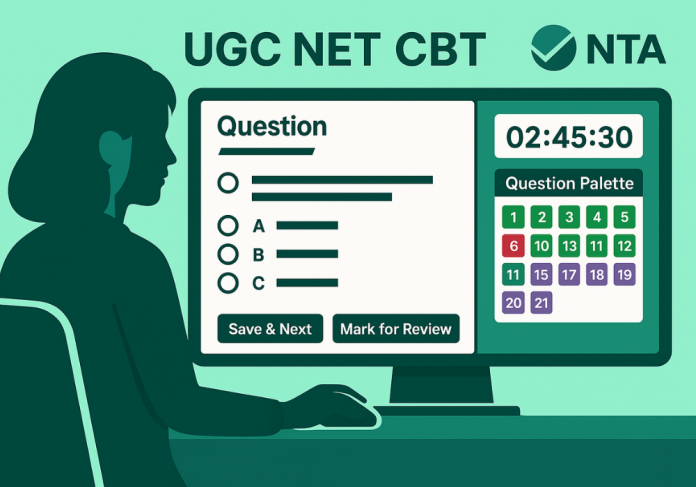
CBT in UGC NET provides features like on screen calculator, a question navigation panel, marking questions for review, and a time tracking display. This eliminates risks associated with paper based tests like illegible handwriting or lost answer sheets.

Modern Innovations in Evaluation Systems

Contemporary innovations include online proctored examinations, AI powered plagiarism detection, portfolio assessments, and peer evaluation mechanisms. 

Open book examinations and competency based assessments are gaining acceptance as they emphasize application over memorization. Continuous assessment models are replacing high stakes terminal examinations in many progressive institutions.

Conclusion

Teaching Aptitude offers a straightforward path to scoring marks in UGC NET Paper 1 if you focus on understanding concepts rather than memorizing facts. 

The three levels of teaching (Herbart’s Memory, Morrison’s Understanding, Hunt’s Reflective), digital platforms (SWAYAM, SWAYAM Prabha, MOOCs), and evaluation systems (CBCS, CBT) form the core areas from which most questions appear.

Your preparation strategy should prioritize these high yield topics while maintaining basic familiarity with learner characteristics and factors affecting teaching. Solve previous year questions to understand the pattern, and remember that conceptual clarity beats rote learning every time. 

You can also refer to this guide for covering the entire syllabus of both units of UGC NET. And, for more detailed information on Teaching Aptitude for UGC NET visit here.

With focused effort on the areas covered in this guide, you can confidently approach Unit 1 and secure those valuable marks that contribute to your overall success.

Download Now

UGC NET Law Paper 2 Syllabus: Quick Reference Guide

0
UGC NET LAW

UGC NET Law Paper 2 Syllabus: Quick guide covering exam pattern, unit-wise syllabus overview, high-priority topics, best books, and preparation tips for Law. This article is written by Urvi Shah, Senior Associate at LawSikho.

Preparing for the UGC NET Law examination requires a clear understanding of how the assessment is structured and what the National Testing Agency (NTA) expects from candidates. Among the two papers, Paper 2 plays a decisive role, as it directly evaluates your command over core legal subjects and significantly influences your overall score and ranking.

Paper 2 carries 200 marks out of the total 300, making it the most critical component for candidates aspiring to qualify for the Assistant Professor position or secure the Junior Research Fellowship (JRF). The paper comprises 100 objective-type questions, distributed across 10 comprehensive units that cover the breadth of legal education. Each question carries 2 marks, and importantly, there is no negative marking, enabling candidates to maximise their score through strategic attempts.

Whether you are a final-year LL.M. student, a recent graduate, or a legal professional seeking to transition into academia or research, a thorough understanding of the Paper 2 syllabus is essential. It not only helps streamline your preparation but also provides a structured path to navigate the vast subject matter effectively.

This guide simplifies the entire framework, transforming what may initially appear to be an extensive syllabus into a practical and achievable study roadmap.

Let us begin.

UGC NET Law Paper 2 Exam Pattern and Structure

Before diving into the syllabus, let’s quickly understand how the examination is structured. Knowing the pattern helps you strategize your preparation and manage time effectively during the actual exam.

Exam Structure and Duration

The UGC NET Law examination follows a computer based test (CBT) format comprising two papers conducted in a single 3 hour session without any break. 

Paper 1 tests General Aptitude with 50 questions worth 100 marks, while Paper 2 focuses entirely on Law with 100 questions worth 200 marks. Both papers are available in English and Hindi medium.

The subject code for UGC NET Law is 58. Since there’s no interval between papers, you’ll need to maintain focus and energy throughout the 180 minute examination window. Time management becomes crucial when you’re tackling 150 questions in one sitting.

Minimum Qualifying Marks for Different Categories

To qualify, General/Unreserved/EWS category candidates need at least 40% aggregate marks (120 out of 300) across both papers. Reserved category candidates, including OBC NCL, SC, ST, PwD, and Transgender need 35% (105 out of 300).

Why No Negative Marking Works in Your Favor?

The absence of negative marking in UGC NET Law is a significant strategic advantage that many candidates fail to utilize. 

Since there’s no penalty for wrong answers, you should never leave any question unanswered. Even educated guesses can potentially add to your score, making time management and attempting all 150 questions essential for maximizing your marks.

UGC NET Law Paper 2: Syllabus Overview

The Paper 2 syllabus is divided into 10 comprehensive units, each covering distinct areas of law. While all units carry roughly equal weightage, understanding their scope helps you plan your preparation timeline efficiently.

Core Legal Subjects

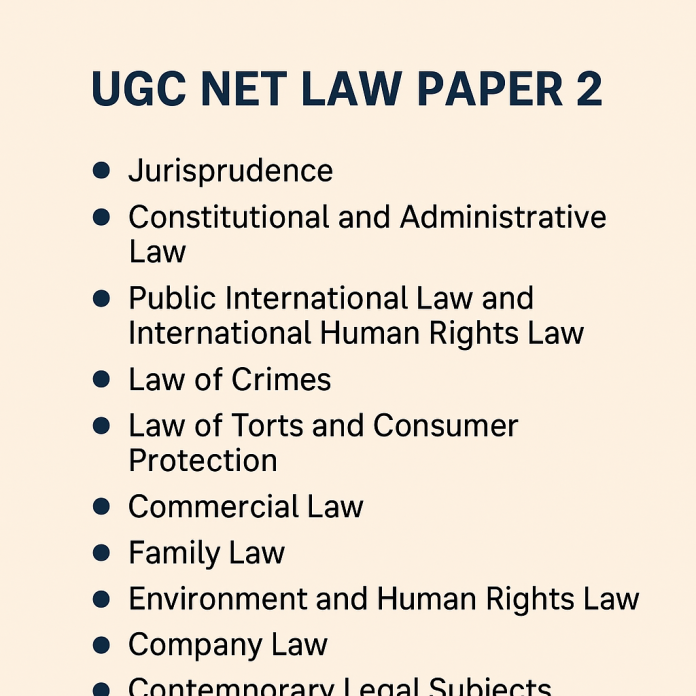
Unit I: Jurisprudence 

It covers nature and sources of law, schools of jurisprudence (Natural Law, Positivism, Realism, Sociological), concepts of rights and duties (Hohfeldian analysis), legal personality, liability theories, and contemporary topics like law and global justice.

Unit II: Constitutional and Administrative Law

It is often the highest weightage unit, which includes the Preamble, Fundamental Rights and Duties, DPSP, Union and State executive/legislature structures, distribution of powers, judiciary and emergency provisions, Election Commission, and administrative law principles, including natural justice and judicial review.

Unit III: Public International Law and IHL 

It examines sources of international law, state and government recognition, nationality and refugees, extradition and asylum, UN organs, dispute settlement mechanisms, WTO basics, and International Humanitarian Law conventions and protocols.

Unit IV: Law of Crimes 

It covers general principles (actus reus, mens rea, constructive liability), inchoate crimes (abetment, conspiracy, attempt), general exceptions, offences against human body/state/property, women and children protection laws, drug trafficking, and punishment theories including victim compensation. Note: Study both IPC and the new Bharatiya Nyaya Sanhita (BNS) 2023.

Unit V: Law of Torts and Consumer Protection 

It addresses tortious liability principles, general defenses, specific torts (negligence, nuisance, trespass, defamation), remoteness of damages, strict and absolute liability, state liability, Consumer Protection Act provisions, Motor Vehicles Act (no fault liability), and Competition Act basics.

Specialized Legal Areas

Unit VI: Commercial Law 

It encompasses contract essentials including e-contracts, breach and frustration, quasi-contracts, specific contracts (bailment, pledge, indemnity, guarantee, agency), Sale of Goods Act, Partnership and LLP, Negotiable Instruments Act (especially Section 138), and Company Law fundamentals covering incorporation, shares, debentures, directors, and CSR.

Unit VII: Family Law 

It requires understanding across multiple personal laws, sources and schools, marriage and dissolution under Hindu/Muslim/Christian/Parsi laws, matrimonial remedies and divorce theories, live-in relationships, foreign decree recognition, maintenance/dower/stridhan, adoption and guardianship, succession and inheritance, wills/gifts/wakf, and the Uniform Civil Code debate.

Unit VIII: Environment and Human Rights Law 

It examines environmental pollution concepts, international environmental law and UN conferences, constitutional and legal frameworks (Articles 48A, 51A(g), Environment Protection Act 1986), Environmental Impact Assessment (EIA) and hazardous waste control, National Green Tribunal, human rights development, universalism vs cultural relativism, International Bill of Rights, group rights (women, children, persons with disabilities, minorities), and human rights commissions (NHRC, NCM, NCW, NCSC, NCST, NCBC).

Unit IX: IPR and Information Technology Law 

It covers IP concepts and theories, international conventions (Paris, Berne, TRIPS), copyright and neighboring rights, patent law (patentability, grant procedure), trademark law and passing off, geographical indications, biodiversity and traditional knowledge protection, IT Act provisions (digital signatures, e-governance, electronic records), and cyber crimes.

Unit X: Comparative Public Law 

It studies comparative methodology, government forms (presidential vs parliamentary, unitary vs federal), federalism models across the USA/Canada/India, rule of law (formal and substantive), separation of powers in different jurisdictions, judicial independence and activism, constitutional review systems, amendment procedures, Ombudsman institutions, and right to information laws.

High Priority Topics and Preparation Tips

Not all units are created equal when it comes to examination frequency. Strategic preparation means focusing your energy where it matters most while ensuring complete syllabus coverage.

Which Units to Focus on First?

Based on the previous year’s question paper analysis, Constitutional and Administrative Law consistently yields the highest number of questions and Jurisprudence, Law of Crimes, and Family Law are important areas.

Start your preparation with these high weightage units before moving to others. 

Within Constitutional Law, focus on fundamental rights interpretation, basic structure doctrine, and administrative law principles. 

For Jurisprudence, master the schools of jurisprudence and Hohfeldian analysis of rights. Criminal Law questions frequently test general principles, stages of crime, and general exceptions. Ensure you’re comfortable with both IPC provisions and corresponding BNS changes, given the recent criminal law reforms.

Quick Study Tips for Working Professionals

If you’re balancing job responsibilities with UGC NET preparation, efficiency is everything. 

Dedicate at least 2 to 3 focused hours daily rather than sporadic longer sessions.

Use commute time for audio lectures or flashcard revision. Create unit wise summary notes during weekends that you can quickly revise during weekdays.

Prioritize previous year question papers over exhaustive textbook reading. 

Understanding question patterns helps you identify high yield topics within each unit. Aim to complete at least 20 to 25 mock tests before the examination, analyzing each one to identify weak areas. 

Many working professionals successfully clear UGC NET by following a 6 month structured plan with consistent daily effort rather than last minute cramming.

Where to Download UGC NET Law Syllabus?

Having the official syllabus document is essential for ensuring your preparation covers all required topics. Always refer to the authoritative NTA sources rather than relying solely on third party materials.

Official NTA Syllabus PDF Links (English and Hindi)

You can download the official UGC NET Law Syllabus PDF from the NTA official website or the UGC NET Online Portal. The syllabus is available in both English and Hindi mediums, and the current version applicable from June 2019 onwards remains valid. Save these PDFs on your device for offline reference and cross check your study materials against official topics to ensure complete coverage.

Best Books and Resources for UGC NET Law Paper 2

Choosing the right study materials can make or break your preparation. Here are proven resources that align with examination requirements.

Top Recommended Books

For comprehensive UGC NET preparation, “UGC NET Law Guide” by Rukmesh and “The Ultimate Guide to UGC NET (Law)” by Bhavna Sharma (updated for new criminal laws) cover all units systematically. 

For subject specific depth, refer to M.P. Jain for Constitutional Law, K.D. Gaur for Criminal Law, Paras Diwan for Family Law, and N.V. Paranjape for Jurisprudence. 

Keep Bare Acts handy many questions directly quote statutory provisions, making familiarity with exact legal language crucial for scoring.

How Many Mock Tests Should You Attempt?

Target at least 30-40 full length mock tests before the examination, with sectional tests in earlier stages and complete simulations during the final 8 weeks. Quality matters alongside quantity use tests from reputed coaching institutes that reflect NTA patterns accurately. 

After each test, thoroughly analyze mistakes by categorizing them unit wise, maintaining an error log that guides your revision priorities and helps convert weaknesses into strengths.

Conclusion

UGC NET Law Paper 2 tests your comprehensive legal knowledge across 10 diverse units, but strategic preparation makes this challenge manageable. Focus on high weightage units like Constitutional Law, Jurisprudence, Criminal Law, and Family Law while ensuring you don’t completely neglect other areas.

Success in UGC NET requires consistency over intensity. Whether you’re a full time aspirant or a working professional, create a realistic study schedule, leverage quality resources, practice extensively through mock tests, and stay updated on recent legal developments, including the new criminal laws. 

With disciplined preparation and the right approach, qualifying for UGC NET and beginning your journey in legal academia is absolutely within reach.

For more details on UGC NET Law Paper 2, visit this link.

Download Now

US CPA Exam: Eligibility for Indian Chartered Accountants

0
CPA Exam

Indian CAs are eligible for the US CPA exam with significant advantages. Learn credit requirements, best states for CA holders, and essential steps to begin your CPA journey. This article is written by Rohit Arora, Senior Associate at LawSikho.

Indian Chartered Accountants often wonder whether their prestigious qualification opens the door to the US CPA certification. 

The good news is that CAs are not only eligible to take the CPA exam but also have a significant advantage over other candidates due to their rigorous training in accounting, auditing, and financial reporting. 

This guide breaks down the essential eligibility requirements, credit calculations, and practical steps for CA holders looking to add the US CPA credential to their professional profile.

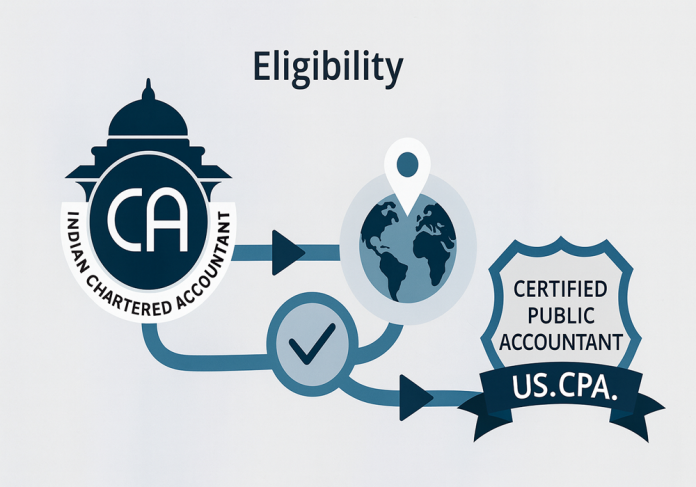
Are Indian CAs Eligible for the US CPA Exam?

The short answer and key conditions

Yes, Indian Chartered Accountants can absolutely take the US CPA exam. The American Institute of Certified Public Accountants (AICPA) allows international candidates to pursue this credential, and your CA qualification positions you favorably for meeting the requirements.

However, eligibility comes with conditions. You need to satisfy educational credit requirements, pass a four-part examination, and complete relevant work experience. The specifics vary depending on which US state you choose to apply through, which is why state selection becomes an important strategic decision for Indian candidates.

The fundamental requirement is demonstrating that your education equals what US state boards expect from CPA candidates. Your combination of undergraduate degree and CA qualification typically meets these expectations, though you will need official credential evaluation to confirm this.

Why CAs have an advantage in CPA eligibility?

Your CA journey has prepared you remarkably well for the CPA exam. 

Think about what you have already accomplished: multiple levels of rigorous examinations, three years of hands-on articleship training, and deep study in financial reporting, auditing, taxation, and corporate law. This preparation overlaps significantly with what the CPA exam tests.

When US state boards review applications from Indian CAs, they see candidates with professional training that rivals or exceeds many domestic applicants. 

Your CA Final examinations covered advanced topics that align closely with CPA content areas. The analytical skills you developed while navigating complex accounting standards translate directly to CPA exam questions.

Beyond exam preparation, your articleship experience demonstrates practical competency. You have audited real companies, prepared actual tax filings, and advised genuine clients. This hands-on training is precisely what the CPA experience requirement seeks to verify. Many states recognize that CA articleship provides exactly this kind of qualifying experience.

Understanding Credit Requirements for CA Holders

How your B.Com and CA translate to US credits?

The US education system measures academic achievement in semester credit hours. One year of full-time university study equals approximately 30 credits. To sit for the CPA exam, you typically need 120 credits. To obtain your license after passing, you need 150 credits.

Your three-year B.Com degree translates to roughly 90 semester credits under standard evaluation. This creates an apparent gap, but your CA qualification fills it. The CA is generally recognized as equivalent to 30 to 60 additional credits, depending on which state and evaluation agency assesses your credentials.

Here is how the math typically works for Indian CAs:

Your B.Com provides approximately 90 credits. Your CA qualification adds 30 to 60 credits. Together, you have somewhere between 120 and 150 total credits.

If your B.Com came from a NAAC A-grade accredited university and you earned first division marks, some evaluators treat it as equivalent to a four-year US degree, granting you 120 credits for the undergraduate degree alone. In this scenario, your CA qualification pushes you comfortably past the 150-credit threshold.

Meeting the 150 Credit Requirement for Licensing

If your initial evaluation falls short of 150 credits, you have options. The most straightforward path is adding a postgraduate qualification. An M.Com or MBA adds approximately 60 credits, which would give you roughly 180 total credits and eliminate any eligibility concerns.

Alternatively, you can take additional coursework through US-based programs or online bridge courses offered by various providers. Some candidates complete these additional credits after passing the CPA exam but before applying for their license.

The important point is this: falling slightly short of 150 credits should not discourage you from starting the CPA journey. Many states allow you to sit for the exam with 120 credits and complete the remaining credits before licensure. You can begin studying and taking exam sections while simultaneously addressing any credit shortfall.

Choosing the Right US State for Your CPA Application

Top States That Welcome Indian CA Candidates

The United States has 55 jurisdictions that grant CPA licenses, each with its own requirements. Some states are significantly more accommodating for international candidates than others. For Indian CAs, certain states have emerged as preferred choices due to their flexible policies.

Guam consistently ranks as the most popular option for Indian candidates. This US territory does not require a Social Security Number, has no residency requirements, accepts 120 credits for exam eligibility, and participates in NASBA’sexperience verification service. If you are unsure where to apply, Guam is a safe and practical starting point.

Montana offers similar flexibility with no SSN requirement and acceptance of international credentials. The state has historically been friendly toward CA holders and participates in NASBA’s experience verification program, which helps candidates whose work experience was supervised by non-CPA professionals.

Illinois appeals to candidates seeking a more traditionally recognized state. It does not require an SSN and offers some flexibility in experience verification. Virginia stands out for allowing non-CPA supervisors to verify work experience, which benefits candidates working in India under CA supervision.

Colorado and New Hampshire round out the list of CA-friendly states. Both accept international certifications and have streamlined their processes for foreign credential evaluation in recent years.

What to Consider Before Selecting Your State

Your state selection should account for several practical factors beyond basic eligibility. Think through these questions before committing to an application:

Do you have a US Social Security Number? If not, eliminate states that require one. Guam, Montana, Illinois, and Virginia are among those that do not require an SSN.

Where was your work experience gained, and who supervised it? If you worked under a CA rather than a US CPA, you need a state that accepts alternative verification methods. States participating in NASBA’s experience verification service can help bridge this gap.

Which credential evaluation agencies does the state accept? Some states exclusively require NIES evaluations, while others accept WES or multiple agencies. Confirm this before paying for an evaluation.

Do you plan to eventually practice in a specific US state? CPA licenses can often transfer between states through reciprocity agreements. However, starting with a flexible state makes your initial application easier, and you can transfer later if needed.

What is the Credential Evaluation Process for Indian CAs?

WES vs NIES: Which one should you choose?

Before any US state board will consider your application, you need official evaluation of your Indian credentials. Two agencies dominate this space: World Education Services (WES) and NASBA International Evaluation Services (NIES).

NIES operates under NASBA, the same organization that coordinates CPA examination services. This direct connection means many state boards prefer or exclusively accept NIES evaluations. If you have not yet decided which state to target, NIES offers an “Undecided Jurisdiction Evaluation” that assesses your credentials against multiple states’ requirements.

WES is a well-established independent evaluation agency with extensive experience assessing Indian qualifications. They offer a CPA-specific evaluation package, but not all states accept WES reports. Before choosing WES, verify that your target state accepts their evaluations.

For most Indian CAs, NIES is the safer choice. It provides maximum flexibility across states and eliminates the risk of having to repeat the evaluation process if you change your target jurisdiction.

Documents you need to prepare for credit evaluation

Gathering proper documentation is essential for smooth evaluation. You will need materials from two sources: your university and the Institute of Chartered Accountants of India.

From your university, obtain official transcripts or mark sheets for your B.Com degree. These must be on official letterhead with the registrar’s signature and institutional seal. You also need your degree certificate or provisional certificate. If you completed an M.Com, MBA, or other postgraduate qualification, include those transcripts and certificates as well.

From ICAI, you need your membership certificate confirming CA qualification, mark sheets for all examination levels (Foundation, Intermediate, and Final), and your articleship completion certificate documenting your practical training.

Any documents not in English require certified word-for-word translations submitted alongside the originals. Plan ahead when requesting these documents, as universities and professional bodies sometimes take weeks to process requests.

The evaluation process itself typically takes three to four weeks after all documents are received. Express services are available for additional fees if you need faster processing. Budget approximately ₹20,000 to ₹35,000 for the complete evaluation, including document delivery.

What Should Indian CAs Do Next to Begin Their CPA Journey?

Quick action plan for ca holders

Starting your CPA journey requires methodical preparation, but the path is straightforward once you understand the steps. Here is your action plan:

Step 1: Assess Your Credits Calculate your approximate credit hours based on your qualifications. B.Com typically equals 90 credits; CA adds 30 to 60 credits; any postgraduate degree adds another 60 credits. If your total approaches or exceeds 150, you are well-positioned to proceed.

Step 2: Choose Your Target State Based on your SSN status, work experience verification needs, and personal preferences, select a state. If uncertain, Guam is the most flexible starting point for Indian candidates. Review the state board’s specific requirements on the NASBA website.

Step 3: Request Your Documents Contact your university registrar and ICAI to request official transcripts, degree certificates, membership certificates, and examination mark sheets. Start this process early, as document procurement often takes longer than expected.

Step 4: Submit for Credential Evaluation Apply to NIES or WES (depending on your state’s requirements) and submit all documentation. Track your evaluation status and respond promptly to any requests for additional information.

Step 5: Begin Exam Preparation While awaiting evaluation results, start studying for the CPA exam. Your CA knowledge gives you a head start on the FAR and AUD sections. Invest in a quality review course that fits your learning style and budget.

Step 6: Apply to Your State Board Once your evaluation confirms eligibility, submit your application to the state board. Upon approval, you will receive your Notice to Schedule (NTS), allowing you to book exam appointments at Prometric testing centers in India.

Step 7: Pass the Exam and Complete Licensing Requirements Take and pass all four CPA exam sections within the 30-month rolling window. Complete any remaining credit requirements and experience verification. Apply for your license once all requirements are satisfied.

Conclusion

Indian Chartered Accountants stand in an excellent position to pursue US CPA certification. Your rigorous training in accounting, auditing, and financial reporting has already prepared you for much of what the CPA exam tests. 

The credit requirements, while initially confusing, are manageable for most CA holders, especially those with postgraduate qualifications or degrees from NAAC A-grade universities.

The most important step is getting started. Request your official documents from your university and ICAI today. Submit for credential evaluation through NIES or WES. Choose a CA-friendly state like Guam, Montana, or Illinois for your application. Within 12 to 18 months of focused effort, you can join the growing community of professionals who hold both the CA and CPA credentials, opening doors to global opportunities that neither qualification alone could provide.

For a detailed guide on how to CA’s eligibility into CPA, read my detailed guide here.

Download Now

UGC NET Exam: Is It Online or Offline?

0
UGC NET Exam

Is UGC NET online or offline? Learn about CBT mode, exam interface, navigation tips, and preparation strategies for the computer-based test format. This article is written by Neeli Neelay Shah, Senior Legal Content Writer at LawSikho.

If you are planning to appear for UGC NET Exam, you probably have one burning question on your mind: is the exam conducted online or offline? The short answer is that UGC NET is an online examination conducted in Computer Based Test (CBT) mode. This guide will quickly walk you through everything you need to know about the CBT format, from what you will see on screen to how to prepare specifically for this digital exam mode.

Current Exam Mode Confirmed by NTA

The National Testing Agency (NTA) has confirmed that UGC NET 2025 will be conducted in Computer Based Test (CBT) mode only. Whether you are appearing for the June 2025 session or the December 2025 session, you will be taking the exam on a computer at a designated test centre. This has been the standard format since December 2018 when NTA took over the conduct of UGC NET from CBSE.

Now, you might have heard about UGC NET being conducted in offline OMR mode in June 2024. That was a one-time exception due to administrative reasons, and it created quite a bit of confusion among aspirants. However, NTA has made it clear that CBT mode has been restored for all sessions from December 2024 onwards. So if you are preparing for UGC NET 2025, you should focus entirely on the computer-based format and not worry about OMR sheets.

Understanding Computer Based Test (CBT) Format used in UGC NET

CBT stands for Computer Based Test, which simply means you will answer questions on a computer screen instead of marking bubbles on an OMR sheet. You sit at an individual computer terminal at the test centre, read questions displayed on the monitor, and select your answers by clicking on options using a mouse. Everything from viewing questions to submitting your final answers happens digitally.

The beauty of CBT mode is that it gives you flexibility that paper-based exams cannot offer. You can easily navigate between questions, change your answers as many times as you want before final submission, and mark questions for review if you want to come back to them later. The interface also shows you exactly how many questions you have attempted and how much time is remaining at any given moment.

CBT Exam Format: 150 Questions in 3 Hours

The UGC NET CBT exam consists of 150 multiple choice questions that you need to complete in a single 3-hour session without any break. Paper 1 has 50 questions worth 100 marks covering Teaching Aptitude, Research Aptitude, Logical Reasoning, and other general topics. Paper 2 has 100 questions worth 200 marks on your chosen subject.

Both papers appear in the same session, and you can switch between them at any time during the exam. There is no negative marking, so you are not penalised for wrong answers. Each correct answer gives you 2 marks, and the total marks are 300.

UGC NET 2025 CBT Interface: What You Will See on Screen

Understanding the CBT Screen Layout

When you log in to the CBT system, your screen will be divided into distinct sections. The main area on the left displays the current question along with four answer options (A, B, C, D). You simply click on the option you want to select. If the question or options are lengthy, you can scroll down to read everything.

On the right side of the screen, you will see the Question Palette, which shows numbered boxes for all 150 questions. At the top right corner, there is a countdown timer that displays your remaining time. Navigation buttons appear at the bottom of the screen. Your name, photograph, and subject are displayed at the top to confirm you are logged into the correct session.

Question Palette and Colour Codes Explained

The Question Palette is your best friend during the exam because it gives you a bird’s eye view of your progress. Each question number is displayed in a small box, and the colour of the box tells you the status of that question.

Green means you have answered and saved the question. Red or white means you have not answered it yet. Purple indicates questions you have marked for review, meaning you want to come back to them later. Some interfaces show a combination colour for questions that are both answered and marked for review. By glancing at the palette, you can instantly see how many questions are done, how many are pending, and how many need another look.

Important Buttons You Must Know

Save and Next

This is the button you will use most often. After selecting an answer, click “Save and Next” to save your response and move to the next question. Always remember to click this button before moving on, otherwise your selected answer might not be recorded.

Mark for Review and Next

Use this button when you are unsure about a question and want to revisit it later. It saves your current answer (if you have selected one) and flags the question with a special colour in the palette. You can easily find all marked questions later and give them another attempt.

Clear Response

If you want to remove your selected answer and leave the question unanswered, use the “Clear Response” button. This is useful when you initially pick an option but then decide you would rather not answer that question at all.

Submit Button

The Submit button ends your exam. Click it only when you are completely done and have reviewed all your answers. The system will ask for confirmation before final submission because once you submit, you cannot go back to make changes.

Moving Between Paper 1 and Paper 2

You will see tabs or sections for Paper 1 and Paper 2 in the interface. You can switch between them at any point during the exam. Paper 1 contains Questions 1 to 50, and Paper 2 contains Questions 51 to 150. Most candidates prefer finishing Paper 1 first before moving to Paper 2, but the choice is yours.

UGC NET Exam Day: What Happens at the Test Centre

Reporting Time and Entry Process

You need to reach the test centre at least two hours before your exam starts. For the morning shift (9:00 AM to 12:00 PM), reach by 7:00 AM. For the afternoon shift (3:00 PM to 6:00 PM), reach by 1:00 PM. The gates close 30 minutes before the exam begins, and latecomers are not allowed entry under any circumstances.

Carry your printed admit card and a valid photo ID such as Aadhaar, PAN card, Passport, or Voter ID. Also bring a passport-size photograph matching the one you uploaded during registration. You will not be allowed to enter without these documents.

Biometric Verification and Seat Allocation

At the centre, you will go through biometric verification where your fingerprint and photograph are captured and matched with your registration data. This confirms your identity and prevents impersonation. After verification, you will be directed to your assigned computer terminal. The seat number is mentioned on your admit card, and you must sit only at your designated terminal.

CBT Login and Starting Your Exam

Once you are seated, the invigilator will give you your login credentials. Enter your roll number and password carefully. After logging in, a screen will display your personal details and photograph for verification. Check that everything is correct before proceeding.

You will then see a set of instructions on screen. Read them carefully as they explain the exam pattern, navigation, and rules. The exam will not start until the scheduled time, and all candidates begin simultaneously when the countdown timer activates.

Using Rough Sheets During CBT Exam

Even though the exam is on computer, you will need rough paper for calculations, especially for Mathematical Reasoning and Data Interpretation questions in Paper 1. The centre provides rough sheets and a pen. Do all your rough work only on these sheets.

Important: You must return all rough sheets to the invigilator before leaving. Taking them outside is not allowed and can be treated as unfair means.

How to Prepare for UGC NET CBT Mode

Practice With NTA Official Mock Tests

NTA provides free mock tests on the official website ugcnet.nta.ac.in that simulate the exact CBT interface you will face on exam day. These mock tests are available for Paper 1 and various Paper 2 subjects. Attempting them is the single best way to get comfortable with the digital format before your actual exam.

Do not just attempt the mock test casually. Set aside three uninterrupted hours and treat it like the real exam. This will help you understand the interface, get familiar with navigation, and identify any challenges you might face with the CBT format.

CBT-Specific Preparation Tips

Improve Screen Reading Speed

Reading from a computer screen is different from reading printed text. Many candidates find their reading speed drops when they switch to screens. During your preparation, make it a habit to read study materials, previous year questions, and practice sets on a computer or tablet. This will train your eyes and brain to process information efficiently on digital displays.

Get Comfortable With Mouse Navigation

The CBT interface is entirely mouse-based. Practice clicking precisely on radio buttons and navigating quickly using the question palette. If you are not used to using a mouse for extended periods, your hand might get tired during the 3-hour exam. Regular practice will build your stamina and clicking accuracy.

Practice Under 3-Hour Timed Conditions

Attempting 150 questions in 180 minutes means you have just over one minute per question on average. This requires sustained concentration and efficient time management. Practice full-length mock tests in one sitting without breaks to build your mental endurance and develop a realistic sense of pacing.

Time Management Tips

Divide your time strategically between the two papers. A good approach is to spend about 50 to 60 minutes on Paper 1 (50 questions) and around 2 hours on Paper 2 (100 questions). During your first pass, attempt all questions you can answer quickly and mark difficult ones for review. Use the last 15 to 20 minutes to revisit marked questions and attempt any remaining ones.

The question palette is your time management dashboard. Keep glancing at it to track your progress. If you see too many red boxes with limited time left, you know you need to speed up. Since there is no negative marking, do not leave any question unanswered. Make educated guesses for questions you are unsure about rather than leaving them blank.

Common Problems During CBT Exam and Solutions

What If the Computer Stops Working?

Do not panic if your computer freezes, the screen goes blank, or the mouse stops responding. Raise your hand immediately and alert the invigilator. Do not try to fix the problem yourself or press random keys. Technical staff at every centre are trained to handle such situations quickly.

Your responses are automatically saved to the server at regular intervals, so even if there is a system failure, your already-submitted answers remain safe. If the issue cannot be resolved on your terminal, you may be shifted to a backup computer with your progress intact. You will also receive compensation time for any minutes lost due to technical problems.

Login Issues and Technical Glitches

If you face problems logging in or if the system does not accept your credentials, inform the invigilator immediately. Do not keep trying incorrect passwords as this might lock your account. The invigilator will verify your identity through your admit card and coordinate with the control room to reset your login or resolve the issue. Such problems are usually fixed within a few minutes.

Conclusion

UGC NET 2025 is conducted in online CBT mode, and understanding how the digital interface works is just as important as knowing your subject. The good news is that CBT mode actually offers several advantages: you can change answers freely, mark questions for review, and track your progress visually through the question palette. By practicing with NTA’s official mock tests and following the tips in this guide, you will walk into the exam centre feeling confident about navigating the CBT system. Focus on your preparation, familiarise yourself with the interface, and give your best on exam day.

For detailed information, visit this link.

Download Now

Understanding CPA Exam Sections: AUD, FAR, REG

0
CPA Exam

Quick guide to CPA exam sections for Indian professionals. Understand the Core + Discipline model, choose the right discipline, and plan your exam strategy effectively. This article is written by Medha Vinod, Senior Associate at LawSikho.

The US CPA exam looks completely different today than it did just two years ago. In January 2024, AICPA and NASBA launched what they call CPA Evolution, replacing the traditional four-section exam with a new Core + Discipline model that gives you more control over your path to licensure. If you’re an Indian professional researching CPA certification, you’ve probably encountered conflicting information from outdated sources still describing the old format. This guide cuts through the confusion and gives you a clear, actionable understanding of how the current exam works, what each section tests, and how to make smart decisions about your exam strategy without getting lost in excessive detail.

The New CPA Exam Structure at a Glance

The modern CPA exam requires you to pass four sections total, but with an important twist: three sections are mandatory for everyone, while the fourth is your choice from three options. This structure recognizes that while all CPAs need certain foundational skills, the profession has diversified enough that specialization matters. Understanding this basic framework is your first step toward planning an effective exam strategy.

Three Core Sections Every Candidate Must Pass

Every CPA candidate worldwide takes the same three Core sections. These aren’t optional, and you cannot substitute one for another. Think of them as the non-negotiable foundation that proves you understand the essentials of accounting, auditing, and taxation that every licensed CPA must know.

AUD (Auditing and Attestation) tests your ability to conduct audit engagements, assess risks, gather evidence, and report findings according to US professional standards. The section covers everything from planning an audit to forming conclusions and writing reports. If you’ve worked in audit roles or completed CA articleship, some concepts will feel familiar, though the specific standards and frameworks are distinctly American. AUD contains 78 multiple-choice questions and 7 task-based simulations, all completed within four hours.

FAR (Financial Accounting and Reporting) covers financial statement preparation and analysis under US GAAP. This section has a reputation as the most challenging because it spans financial reporting for businesses, not-for-profit entities, and includes various complex accounting treatments. With only 50 multiple-choice questions but substantial task-based simulations, FAR tests depth rather than breadth. Pass rates typically hover around 40-43%, the lowest of any section.

REG (Taxation and Regulation) focuses on US federal taxation for individuals and business entities, plus business law and professional ethics related to tax practice. For Indian candidates, this section requires learning an entirely new tax system from scratch since nothing from Indian tax law transfers directly. The section includes 72 multiple-choice questions and 8 simulations. Despite the learning curve, REG actually has strong pass rates around 60-64%, suggesting that structured study approaches work well here.

One Discipline Section of Your Choice

After mastering the Core sections, you select one Discipline that aligns with your interests or career goals. Each Discipline builds on concepts from a related Core section, allowing you to demonstrate deeper expertise in a specialized area. Your choice here is consequential for your study journey but not for your career options after licensure.

BAR (Business Analysis and Reporting) extends FAR’s financial reporting foundation into advanced accounting, financial analysis, and government accounting. Topics include business combinations, consolidated statements, derivatives, performance measurement, and state and local government accounting under GASB standards. This Discipline suits candidates interested in corporate finance, FP&A, or advisory roles. BAR has the lowest Discipline pass rate at 37-41%, reflecting its substantial technical content.

ISC (Information Systems and Controls) builds on AUD’s assurance concepts with a technology focus. The section covers IT audit, data management, cybersecurity controls, and SOC engagements. ISC has a unique format with 82 multiple-choice questions (the most of any section) and only 6 simulations, weighted 60% MCQ and 40% TBS. This Discipline appeals to candidates targeting IT audit, technology risk, or data governance careers. Pass rates fall in the middle range at 75-80%.

TCP (Tax Compliance and Planning) deepens REG’s tax foundation into complex compliance scenarios, entity tax planning, and personal financial planning. If you enjoyed REG and want to specialize in taxation, TCP is the natural extension. This Discipline consistently achieves the highest pass rates of any section at 72-78%, partly because candidates arrive with fresh REG knowledge and partly because the content scope is more focused than BAR’s diverse requirements.

What Each CPA Section Tests and Why It Matters

Understanding what each section actually tests helps you allocate study time appropriately and set realistic expectations. The sections differ not just in content but in how they test you, with varying emphasis on knowledge recall versus application and analysis.

Breaking Down the Core Sections

The three Core sections share a common four-hour format but differ significantly in content volume, question types, and the skills they emphasize. Knowing these differences helps you prepare effectively for each section’s unique demands.

AUD’s testing approach emphasizes professional judgment more than the other sections. According to the AICPA’s CPA Exam Blueprints, AUD is the only section that tests “Evaluation” as a skill level, meaning you’ll face questions requiring you to draw conclusions and make professional judgments rather than simply apply rules. Content areas include ethics and professional responsibilities (15-25%), risk assessment and audit planning (25-35%), evidence gathering procedures (30-40%), and conclusions and reporting (10-20%). Indian CAs often find the conceptual framework familiar since audit methodology shares common principles globally, but specific US standards like PCAOB requirements for public companies and AICPA standards for non-issuers require dedicated study.

FAR demands the largest time investment because it covers the broadest technical content. The section tests financial reporting frameworks for multiple entity types under FASB standards, SEC regulations, and AICPA guidance. Content divides roughly into financial reporting (30-40%), balance sheet accounts (30-40%), and select transactions (25-35%). What makes FAR challenging for Indian candidates is learning US GAAP’s specific requirements, which differ from Indian Accounting Standards in areas like lease accounting, revenue recognition timing, and development cost treatment. Most successful candidates dedicate 150-200 study hours to FAR alone, approaching it as largely new material regardless of their background.

REG requires fresh learning but rewards systematic study. The section covers federal tax procedures and ethics (10-20%), business law (15-25%), property transaction taxation (5-15%), individual taxation (22-32%), and entity taxation (23-33%). For Indian professionals, nothing from Indian tax law or commercial law transfers directly; the Internal Revenue Code, IRS procedures, and US business structures like S corporations and LLCs are entirely new concepts. However, this equal starting point means everyone learns together, and candidates who methodically master each concept tend to perform well. The relatively high pass rate suggests REG rewards effort more predictably than sections requiring judgment or interpretation.

Understanding the Discipline Sections

Your Discipline choice should reflect a genuine interest since you’ll spend significant time studying specialized content. Each Discipline connects to a Core section, creating natural study progressions if you plan your exam sequence strategically.

BAR suits analytical and corporate-focused career paths. The section tests business analysis skills, including financial statement interpretation, budgeting, forecasting, and performance metrics. Technical accounting topics cover advanced areas that moved from the old FAR section: business combinations, consolidated financial statements, derivatives and hedging, stock compensation, and government accounting. If you’re targeting roles in FP&A, corporate treasury, management accounting, or financial advisory, BAR’s content directly supports these functions. The lower pass rate reflects content complexity rather than poor exam design, so candidates genuinely interested in these areas shouldn’t be deterred.

ISC opens doors to technology-focused accounting careers. Content spans information systems and data management (35-45%), security, confidentiality, and privacy (35-45%), and SOC engagement considerations (15-25%). The section prepares you for IT audit roles, technology risk advisory, cybersecurity assurance, and data governance positions. Big 4 firms in India have substantial GCC operations handling IT audit and technology assurance for global clients, creating significant opportunities for CPAs with ISC expertise. The section’s unique 60/40 MCQ/TBS weighting means strong performance on multiple-choice questions matters more here than in other sections.

TCP offers the clearest path for tax-focused careers. Building directly on REG, the section covers individual tax compliance and planning (30-40%), entity tax compliance (30-40%), entity tax planning (10-20%), and property transactions (10-20%). Topics include complex individual tax situations, consolidated corporate returns, international tax provisions, and personal financial planning. The consistently high pass rate reflects focused content that builds naturally from REG knowledge. If you see yourself in tax advisory, compliance, or wealth management roles, TCP provides directly relevant specialized knowledge.

Choosing Your CPA Discipline: A Decision Framework for Indian Candidates

Your Discipline choice affects your study experience significantly, but doesn’t permanently define your career. Understanding how to make this decision helps you choose confidently rather than defaulting to what seems easiest or most popular.

Match Your Discipline to Your Career Goals

The most important factor in choosing your Discipline is alignment with your genuine interests and intended career direction. Consider where you want to be professionally in five to ten years, then work backward to identify which specialized knowledge supports that path.

Choose BAR if corporate finance excites you. This Discipline prepares you for roles requiring financial analysis, performance measurement, and complex accounting judgment. Career paths include FP&A analyst or manager positions, corporate treasury roles, management accounting leadership, and financial advisory consulting. If you enjoyed financial reporting topics and want to analyze and interpret financial data rather than just prepare it, BAR extends those interests. The lower pass rate shouldn’t discourage genuinely interested candidates; it simply means allocating appropriate study time.

Choose ISC if technology and systems interest you. This Discipline targets the intersection of accounting and information technology. Career opportunities include IT audit roles at Big 4 and mid-tier firms, technology risk advisory positions, SOC engagement specialists, internal audit with a technology focus, and data governance roles. India’s Big 4 GCCs handle substantial IT audit and technology assurance work for global clients, making ISC expertise particularly valuable for candidates seeking these opportunities. If you’re drawn to understanding how systems work, evaluating controls in technology environments, or cybersecurity assurance, ISC fits naturally.

Choose TCP if taxation genuinely interests you. This is the straightforward choice for aspiring tax professionals. Career paths include tax analyst and manager roles in public accounting, corporate tax department positions, personal financial planning and wealth management, and international tax compliance for US-India matters. The high pass rate is a bonus, but genuine interest matters more than statistics. TCP knowledge directly supports tax advisory careers and provides a natural specialization for candidates who enjoyed REG’s content.

Strategic Tips for Indian Professionals

Beyond career alignment, several practical considerations help Indian candidates optimize their Discipline decision and overall exam strategy.

Your educational background influences your comfort zone, but shouldn’t limit your choice. Indian CAs often have stronger foundations in audit and financial reporting, potentially making AUD and FAR more comfortable and suggesting BAR or ISC as natural Discipline extensions. B.Com graduates without CA may find all sections require similar effort, freeing them to choose purely based on interest. CMA holders might appreciate BAR’s management accounting elements. However, all candidates can succeed in any Discipline with proper preparation; background just affects your starting point, not your ceiling.

Your Discipline choice doesn’t restrict your licensed practice. This point deserves emphasis because many candidates worry about locking themselves into narrow career paths. Once licensed, your CPA credential looks identical regardless of which Discipline you passed. Your license won’t indicate whether you took BAR, ISC, or TCP. You’ll have full rights to practice in any area, sign audit reports, prepare any type of tax return, and advise on any accounting matter. The Discipline simply represents a path through licensure, not a permanent professional constraint.

Pairing Disciplines with Core sections maximizes efficiency. Each Discipline builds on a related Core section: BAR extends FAR, ISC extends AUD, and TCP extends REG. Taking your chosen Discipline shortly after passing the related Core section leverages fresh knowledge and reduces redundant study. The FAR-BAR path keeps financial reporting concepts active. The AUD-ISC path maintains assurance and controls knowledge. The REG-TCP path reinforces tax concepts while they’re fresh. Planning your exam sequence around these pairings creates natural momentum.

Practical Exam Planning: Order, Timeline, and Costs

Strategy matters beyond just studying hard. How you sequence your exams, manage your timeline, and budget your costs all influence your path to licensure. Practical planning helps Indian candidates navigate logistical challenges specific to testing from India.

Recommended Exam Order for Indian Candidates

No single exam sequence works for everyone, but understanding common approaches helps you choose what fits your situation. The right order depends on your background, available study time, and psychological preferences.

The traditional approach starts with FAR. Many candidates tackle FAR first because it builds foundational accounting knowledge supporting other sections, particularly BAR. Getting the lowest-pass-rate section done early, when motivation peaks, means the hardest technical challenge is behind you. If you pass FAR first, you’ve proven you can handle the exam’s most demanding content, building confidence for subsequent sections. This approach works well for candidates who prefer attacking the biggest challenge head-on.

The alternative approach starts with your strongest subject. Beginning with whichever section aligns with your recent experience or education maximizes your chance of an early pass. If you’ve worked extensively in audit, AUD might be your entry point. If you recently completed tax coursework, REG while that knowledge remains fresh makes sense. An early pass validates your study approach, creates momentum, and reduces anxiety about the process. This approach suits candidates who benefit from building confidence before tackling unfamiliar material.

Core-Discipline pairing strategies optimize knowledge retention. Once you’ve passed a Core section, consider immediately tackling the related Discipline while concepts remain fresh. FAR followed by BAR keeps complex accounting treatments active in memory. AUD, followed by ISC, maintains controls and assurance knowledge. REG followed by TCP reinforces tax concepts through their natural extension. Whichever Core section you start with, planning to follow it with the related Discipline (if that’s your chosen specialization) creates an efficient learning progression.

Timeline and Cost Considerations

Understanding the timeline constraints and cost structure helps you plan realistically and avoid expensive surprises. Indian candidates face specific logistical considerations worth addressing upfront.

The 30-month testing window gives you meaningful flexibility. Most states following NASBA’s recommendation allow 30 months from passing your first section to complete all four sections. This rolling window means each passed section starts its own clock, with credits expiring if you don’t finish within the timeframe. For working professionals in India, balancing jobs and study, 30 months provides breathing room to pace yourself appropriately. However, don’t let the extended window become an excuse for procrastination; maintaining study momentum matters for retention and motivation.

Per-section costs for Indian candidates testing in India run approximately ₹47,000-55,000. This includes NASBA examination fees (around $262 base plus international surcharge bringing totals to approximately $390-510 per section), state application and registration fees ($50-100 per section), and the international testing location surcharge. Across all four sections, exam fees alone typically total ₹1,80,000-2,20,000. Adding review course costs (₹80,000-1,80,000 depending on provider), credential evaluation fees (₹15,000-30,000), and miscellaneous expenses, the complete investment often reaches ₹3,50,000-5,00,000. Many Indian coaching providers offer EMI options, spreading this investment over 12-24 months.

Prometric India centers offer convenient testing access. You can take the CPA exam at Prometric testing centers in major Indian cities, including Hyderabad, Mumbai, Bangalore, Delhi, Chennai, Ahmedabad, and Kolkata. Core sections (AUD, FAR, REG) are available year-round with continuous testing, allowing flexible scheduling. Discipline sections (BAR, ISC, TCP) have more limited quarterly testing windows, requiring advance planning. Schedule your exam appointments early, especially for Discipline sections during popular testing periods, to secure your preferred dates and times.

Conclusion

The CPA exam’s Core + Discipline structure rewards strategic thinking alongside diligent study. You now understand that success requires passing three mandatory Core sections that establish your foundational competency, plus one Discipline that demonstrates specialized expertise in your chosen area. For Indian professionals, the practical implications are clear: select a Discipline aligning with genuine career interests, sequence your exams to leverage knowledge connections between related sections, and budget realistically for the investment required.

Your next step is getting your credentials evaluated to confirm eligibility with your chosen state board. Most Indian qualifications, including CA, CMA, B.Com with appropriate postgraduate work, and CS, can meet state requirements with proper evaluation and any necessary bridge courses. Once eligibility is confirmed, select a review course that fits your learning style, create a realistic study timeline accounting for your work commitments, and begin systematically preparing for your first section. The investment of time, effort, and money is substantial, but the career opportunities that CPA licensure creates make it worthwhile for motivated Indian professionals ready to build global credentials.

To get detailed information on CPA Exam Sections, please visit here.

Download Now

Can you Become a US CPA Without CA qualification-CPA Exam Eligibility Explained

0
CPA Exam

Learn how to pursue US CPA exam without CA qualification. Explore M.Com, MBA, CS, and CMA India pathways, state selection tips, and step-by-step action plan for Indian professionals. This article is written by Medha Vinod, Senior Associate at LawSikho.

Can you become a US CPA without being a Chartered Accountant? Absolutely, yes. This is one of the most persistent myths in the Indian finance community, and it is time to put it to rest. If you hold an M.Com, MBA in Finance, Company Secretary qualification, or CMA India credential, you have a legitimate pathway to the prestigious US CPA certification. This article will help you quickly assess your eligibility and understand exactly what steps you need to take. We will cover how the credit system works, explore three proven pathways, help you choose the right US state, and give you a clear action plan to begin your CPA journey.

CPA Exam Eligibility for non-CA professionals: Understanding the CPA Eligibility

Before diving into specific pathways, you need to understand how US state boards evaluate your eligibility. The system is different from India, but once you grasp the basics, everything else becomes much clearer.

The Credit Hour System That Determines Your Eligibility

US CPA eligibility revolves around credit hours, not specific degrees. Think of credit hours as a universal currency that measures your educational achievement. One year of full-time university study in the US equals approximately 30 credit hours. To sit for the CPA exam, you need 120 credit hours. To obtain your license after passing, you need 150 credit hours.

These credit hours must include a certain number in accounting subjects (typically 24 credits) and business subjects (typically 24 credits). The remaining credits can come from general education. This is why your specific degree matters less than the total credits and subject distribution it provides. A well-structured M.Com or MBA can meet these requirements just as effectively as a CA qualification.

How Do Different Indian Qualifications Convert to US Credits?

Your Indian qualifications convert to US credits through a formal evaluation process. Here is a quick reference for common Indian credentials:

A three-year B.Com degree equals approximately 90 credit hours. This falls short of the 120 needed for exam eligibility, which is why B.Com alone is not sufficient. However, when you add a postgraduate degree or professional qualification, you quickly reach the threshold.

A two-year M.Com adds 60 credits, bringing your B.Com plus M.Com total to 150 credits. This meets the licensing requirement, not just the exam eligibility. Similarly, a two-year MBA adds 60 credits, giving you the same 150 credit total. Professional qualifications like CS from ICSI and CMA from ICMAI are typically evaluated at 60 credits each.

Three Proven Pathways to CPA Without CA Qualification

Now that you understand the credit system, let us look at the three main pathways available to you. Each has its own advantages, and the best choice depends on your current qualification and career goals.

Pathway 1: The Postgraduate Route Using M.Com or MBA

This is the most straightforward pathway for many Indian professionals. If you have completed B.Com followed by M.Com or MBA, you likely already have 150 credit hours, meeting the full licensing requirement.

The M.Com route is particularly strong because it typically includes heavy coursework in financial accounting, cost accounting, auditing, and taxation. These subjects directly align with CPA exam content areas. Your preparation for the exam becomes more focused on US GAAP specifics rather than learning foundational concepts from scratch.

The MBA Finance route works equally well, though you should check your transcript for accounting course credits. Some MBA programs are lighter on accounting and heavier on corporate finance or strategy. If your MBA has fewer than 24 credits in pure accounting subjects, some states may require supplementary coursework. This is easily identified through a pre-evaluation before you formally apply.

Distance MBA or M.Com degrees from UGC recognized universities are generally accepted. The key is that your institution must have proper accreditation. Degrees from well-known universities like IGNOU, Symbiosis, or state university distance programs are typically evaluated without issues.

Pathway 2: The Professional Qualification Route Using CS or CMA India

If you pursued Company Secretary or Cost and Management Accountancy instead of CA, you have not closed the door to CPA. These qualifications contribute substantial credit hours toward your eligibility.

The CS qualification from ICSI is typically evaluated at 60 credit hours. Combined with your B.Com, this gives you 150 credits. The curriculum covers corporate law, governance, and compliance extensively, with some overlap in areas like business law that appear on the CPA exam. However, CS is lighter on financial accounting than CPA requires, so you may need to supplement with additional accounting coursework depending on your chosen state’s requirements.

CMA India from ICMAI also provides approximately 60 credit hours. The cost accounting and management accounting foundation from CMA India translates well to CPA exam preparation. Many CMA India holders find the Financial Accounting and Reporting section of the CPA exam requires the most additional study, while other sections feel more familiar.

Both CS and CMA India holders should consider states with flexible credential evaluation policies. Alaska, Montana, and Guam have track records of accepting these professional qualifications when combined with undergraduate degrees.

Pathway 3: The Bridge Course Route for Credit Shortfalls

What if you only have a B.Com and no postgraduate degree or professional qualification? You are not out of options. Bridge courses exist specifically to fill the credit gap and make you CPA eligible.

Bridge courses are educational programs that provide US-recognized credit hours in accounting and business subjects. Most programs offer 30 to 60 credits, depending on the structure. A typical one-year bridge course providing 40 credits would take your B.Com total from 90 to 130 credits, making you exam eligible with room to spare.

Several reputable providers serve Indian candidates. Simandhar Education offers a bridge course providing 40 credits at approximately INR 35,000. Miles Education provides similar programs through partnerships with accredited universities. These courses can be completed online while you work, typically taking six to twelve months.

The bridge course route requires more investment than other pathways, but it opens the CPA door for professionals who choose not to pursue postgraduate studies. Many B.Com holders in their late twenties or thirties find this more practical than going back for a full M.Com degree.

Selecting the Right US State Board for Your Qualification

The US has 55 jurisdictions that grant CPA licenses, and each has slightly different requirements. Choosing the right state can make the difference between a smooth application and a frustrating rejection.

States That Welcome Indian Candidates Without an SSN

Most Indian candidates do not have a US Social Security Number, which some states require. Fortunately, several states have eliminated this requirement for examination purposes, making them accessible to international candidates.

Some of the popular states among Indian CPA aspirants are Guam, Alaska, Montana, Washington, etc. Guam is particularly favored due to its straightforward application process and acceptance of diverse international credentials. The territory actively welcomes international candidates and participates in NASBA’s experience verification service, which helps with the work experience requirement.

Alaska and Montana are known for their flexible approach to credential evaluation. They assess candidates holistically rather than rigidly requiring specific degree types. Washington and Colorado also accept Indian qualifications, though Colorado sometimes requires additional coursework in ethics.

Matching Your Qualifications to the Best State

Your specific qualification influences which state suits you best. Here is a quick matching guide:

M.Com holders with 150 credits have the widest choice. Most CPA friendly states will accept your credentials. Focus on states with convenient experience verification processes, since that will be your next challenge after passing the exam.

MBA Finance holders should verify their accounting credit count before selecting a state. If you have adequate accounting coursework, you have flexibility similar to M.Com holders. If your MBA was light on accounting, prioritize states like Guam and Alaska that take a more holistic view of your overall education.

CS and CMA India holders should focus on states with proven acceptance of these credentials. Alaska, Montana, and Guam are your best bets. Getting a pre-evaluation from NASBA International Evaluation Services before committing to a state application is highly recommended.

What Should Be Your Action Plan to Begin the CPA Journey?

Understanding eligibility is important, but action is what gets you to the finish line. Here is your practical roadmap from where you are now to sitting for your first CPA exam section.

Step-by-Step Process from Evaluation to Exam Registration

Step 1: Calculate your credits. Based on what you learned above, estimate your total credit hours. B.Com gives you 90, postgraduate degrees add 60, and professional qualifications add 60. If you are at or above 120, you can proceed. If not, plan for bridge courses.

Step 2: Collect your documents. You will need official transcripts from all universities attended, degree certificates, and professional qualification certificates if applicable. Contact your university’s examination section to request an official transcript dispatch. This process can take four to eight weeks with Indian universities, so start early.

Step 3: Choose your state. Based on your qualification profile and the guidance above, select a state board. If unsure, Guam is a safe choice for most Indian candidates with diverse qualifications.

Step 4: Apply for credential evaluation. Submit your application to NASBA International Evaluation Services. Pay the evaluation fee (approximately $250) and ensure your institutions send official documents directly to NIES. The evaluation takes six to eight weeks after all documents arrive.

Step 5: Review your evaluation report. Your report will show total credits, accounting credits, and business credits. If you meet your chosen state’s requirements, proceed. If there are gaps, address them through supplementary coursework or bridge courses.

Step 6: Apply to sit for the exam. Once your evaluation is accepted, apply through your state board. After approval, you will receive a Notice to Schedule that allows you to book your exam at a Prometric center.

Step 7: Begin exam preparation. Enroll in a CPA review course and create your study plan. Most candidates take nine to twelve months to pass all four sections while working full-time.

Common Pitfalls to Avoid and How to Stay on Track

Many candidates stumble on avoidable mistakes. Here are the most common pitfalls and how to prevent them.

Choosing the wrong state. Research thoroughly before applying. Switching states mid-process wastes time and money. If your qualification is non-traditional, get a pre-evaluation before committing.

Document delays. Indian universities are often slow with official transcript dispatch. Start this process immediately, even before you have finalized your state selection. Having documents ready prevents bottlenecks.

Underestimating study time. The CPA exam is challenging. Plan for 300 to 400 hours of study across all four sections. Trying to rush through with minimal preparation leads to failed attempts and extended timelines.

Ignoring experience requirements. Passing the exam is not enough for licensure. You need verified work experience. Start thinking about this early. If you work at a company without US CPAs, consider states that participate in NASBA’s experience verification service or accept alternative verifiers.

Going it alone without guidance. The CPA process has many moving parts. Working with a reputable coaching institute or advisor familiar with Indian candidate challenges can save you significant time and frustration. Their expertise in state selection, documentation, and exam preparation is worth the investment.

Conclusion

The path to a US CPA is open to you regardless of whether you pursued CA. Your M.Com, MBA Finance, CS, or CMA India qualification provides a legitimate foundation for CPA eligibility. Even B.Com graduates can qualify through bridge courses designed specifically to fill credit gaps. The key is understanding how your credentials translate to US credit hours, selecting the right state board for your profile, and following a systematic process from evaluation to examination. Start by calculating your credits today, and take your first step toward joining the growing community of Indian professionals who proudly hold the US CPA credential.

If you want to read more in-depth information on this, please click here.

Download Now

US CPA Exam Eligibility for B.Com Graduates in India

0
CPA Exam

Clear roadmap to US CPA eligibility for Indian B.Com graduates. Understand credit requirements, eligibility pathways, best states, and application steps to start your CPA journey. This article is written by Medha Vinod, Senior Associate at LawSikho.

You have a B.Com degree, and you are wondering if the US CPA is within your reach. The short answer is yes, it absolutely is. Despite what you may have heard about complex credit requirements and confusing state board rules, thousands of Indian B.Com graduates successfully qualify for and pass the CPA exam every year. This roadmap will show you exactly how the eligibility system works and what steps you need to take to begin your CPA journey.

Understanding CPA Credit Requirements for Indian Graduates

The CPA eligibility system runs on credits, not degrees. Once you understand how credits work, everything else falls into place. Let us break down this system in simple terms.

How the US Credit System Works

In the United States, education is measured in semester credit hours rather than years of study. Think of credits as a universal currency that measures how much education you have completed. The standard conversion is straightforward: one year of university education equals 30 credits.

This means your 3-year B.Com degree translates to 90 credits (3 years multiplied by 30 credits per year). A 2-year M.Com adds another 60 credits. The math is simple once you know the formula.

Now here is the crucial part. To sit for the CPA exam, most US states require 120 credits. To actually get your CPA license after passing the exam, you need 150 credits. These are two different milestones, and understanding this distinction helps you plan your pathway efficiently.

With 90 credits from your B.Com, you are 30 credits short of exam eligibility. That gap is smaller than most people assume, and there are multiple ways to bridge it.

Bridging the Credit Gap

The 30-credit gap between your B.Com and exam eligibility can be filled through several routes. If you pursue an M.Com, you gain 60 credits, which takes you straight to 150 credits and covers both exam eligibility and license requirements in one go. If you have completed CA, CS, or CMA alongside your B.Com, these professional qualifications contribute additional credits that may push you past the 120 threshold.

There is also a lesser-known advantage for high performers. If you graduated with first division from a NAAC A or A+ accredited university, certain US states award 30 bonus credits. This recognition effectively treats your 3-year degree as equivalent to a 4-year US degree, making you eligible with your B.Com alone.

For those who do not have postgraduate degrees or professional qualifications, bridge courses offer a targeted solution. These are short academic programs specifically designed to provide the exact credits you need without requiring years of additional study.

Here is a quick comparison of your options:

PathwayCredits AddedTime Required Best For
M.Com 60 credits2 yearsThose wanting a full master’s degree
CA/CS/CMA30 – 60 creditsVariesThose already pursuing these qualifications
NAAC A+ First Division 30 creditsNone (already earned) High performers from top universities
Bridge Courses30 – 60 credits3 – 6 monthsFastest route to eligibility

CPA Exam: Eligibility Pathways for B.Com Holders

Now that you understand credits, let us look at the specific pathways available to you as a B.Com graduate. Your situation determines which pathway makes the most sense.

Direct Eligibility Options

The most common pathway is B.Com plus M.Com. With this combination, you have 150 credits total, which exceeds both the exam requirement (120) and license requirement (150). You can apply to virtually any state without worrying about credit shortfalls. The M.Com curriculum also overlaps with CPA exam content, which helps your preparation.

If you are pursuing or have completed CA, CS, or CMA, you likely have enough credits when combined with your B.Com. The National Association of State Boards of Accountancy (NASBA) evaluates these professional qualifications and assigns credit values based on their coursework and examination requirements. CA typically receives the most credits, often 30 to 60, depending on the state.

For graduates from premier institutions, the NAAC A+ first division route offers the fastest path. If your university held NAAC A or A+ accreditation when you graduated and you achieved first division, certain states will recognize your B.Com as meeting the 120-credit requirement. This pathway requires careful verification because not all states accept this provision.

Using Bridge Courses to Meet Requirements

Bridge courses are purpose-built programs that help international candidates meet CPA credit requirements. Unlike a full master’s degree that takes two years, bridge courses can be completed in three to six months. They focus exclusively on subjects that count toward your accounting and business credit needs.

These courses are offered through partnerships between Indian CPA coaching institutes and accredited US universities. When you complete the coursework, you receive academic credits from the partner university that US state boards recognize for CPA eligibility purposes.

The cost of bridge courses typically ranges from INR 50,000 to INR 1,50,000, depending on the provider and the number of credits needed. While this is an additional expense, it is significantly less than pursuing a full postgraduate degree, and it gets you to exam eligibility much faster.

Bridge courses work best for candidates who want to start the CPA exam quickly without committing to lengthy additional education. If you are already working and cannot take two years off for an M.Com, bridge courses let you qualify while continuing your career.

Choosing the Right US State for Your CPA Application

Here is something that surprises many Indian candidates: you do not apply to a central CPA authority. Instead, you apply to a specific US state board, and each state has its own rules. Choosing the right state can make your journey significantly smoother.

Why State Selection Matters

The 55 US jurisdictions (50 states plus territories like Guam) each set their own eligibility criteria. Some states require 150 credits just to sit for the exam, while others let you begin with 120 credits. Some states demand a Social Security Number, which most Indian candidates do not have. Others have strict residency requirements.

For international candidates, state selection is not about where you want to live or work. It is about finding a state whose requirements align with your current qualifications. You can always transfer your license to another state later through reciprocity agreements.

The states that work best for Indian candidates share common characteristics: they accept 120 credits for exam eligibility, do not require SSN, have flexible experience verification options, and participate in international exam administration.

Best States for Indian B.Com Graduates

Guam tops the list for international candidates. This US territory does not require an SSN, accepts 120 credits for exam eligibility, and allows experience verification through NASBA’s verification service. You do not need to be a US resident, and the application process is straightforward. Most Indian CPA candidates choose Guam for good reason.

Washington offers similar advantages with flexible experience verification and no residency requirements. The state has recently streamlined its application processing, reducing wait times for international candidates.

Montana works well for candidates who cannot find a US CPA to supervise and verify their work experience. The state participates in NASBA’s experience verification program, which provides alternative pathways for experience documentation.

When selecting your state, ask yourself these questions: Do I have 120 or 150 credits? Do I have an SSN? Can I get my work experience verified by a US CPA? Your answers will point you toward the right state. If you have 120 credits, no SSN, and work in India without US CPA supervision, Guam or Montana are your best options.

Next Steps to Start Your US CPA Journey

You understand the credit system, you know your pathway options, and you have an idea of which state suits your profile. Now let us translate that knowledge into action.

Getting Your Credentials Evaluated

Before you can apply to any state board, you need an official credential evaluation. This is a mandatory step for all international candidates. The evaluation translates your Indian qualifications into US-equivalent terms and determines your official credit count.

Two agencies dominate this space: NASBA International Evaluation Services (NIES) and World Education Services (WES). NIES is specifically designed for CPA candidates and is accepted by all state boards, making it the safer choice if you are uncertain. The evaluation costs approximately INR 18,000 to INR 25,000 and takes four to eight weeks.

For your evaluation, you will need official transcripts sent directly from your university in sealed envelopes, degree certificates, and mark sheets. If you have professional qualifications like a CA, include those certificates as well. Start gathering these documents early because obtaining sealed transcripts from Indian universities can take several weeks.

Application Process Overview

Once your evaluation is complete and you know your credit count, the application process follows a clear sequence. First, you submit your application to your chosen state board along with your evaluation report and application fees. Application fees typically range from INR 8,000 to INR 16,000.

After the state board approves your application, you receive a Notice to Schedule (NTS). This document authorizes you to register for exam sections at Prometric testing centers, including centers in eight Indian cities: Ahmedabad, Bangalore, Kolkata, Chennai, Hyderabad, Mumbai, New Delhi, and Trivandrum.

From starting your evaluation to sitting for your first exam section, expect the process to take three to four months. The timeline includes evaluation processing (4-8 weeks), application review (2-4 weeks), and scheduling your preferred exam date.

Regarding costs, budget approximately INR 3.5 to 5 lakhs for the complete journey. This includes evaluation fees, application fees, exam fees for all four sections, international testing surcharges, and a review course. If you need bridge courses, add another INR 50,000 to INR 1,50,000. The investment pays off quickly, with CPA professionals in India earning INR 6 to 9 lakhs at the entry level and significantly more with experience.

Conclusion

The CPA credential is absolutely achievable for Indian B.Com graduates. Your degree provides 90 credits as a foundation, and multiple pathways exist to reach the 120 credits needed for exam eligibility. Whether you add an M.Com, leverage professional qualifications, benefit from the NAAC A+ first division provision, or complete bridge courses, you have options that fit your circumstances.

State selection matters more than most candidates realize. Choose a state like Guam, Washington, or Montana that accommodates international candidates without unnecessary barriers. Avoid states requiring SSN or 150 credits for exam eligibility unless you specifically need licensure there.

Start with credential evaluation. This single step gives you clarity about your exact credit count and confirms which pathways are viable for your situation. With that information in hand, you can make informed decisions about additional qualifications, state selection, and timeline planning.

Your B.Com degree is not a limitation. It is the starting point of a journey that can take you to one of the most respected credentials in global accounting. The roadmap is clear. The first step is yours to take.

For more detailed information, check this

Download Now

Prepare for UGC NET Exam in 30 Days: Your Guide for December 2025

0
UGC NET exam December 2025

Practical 30-day guide to prepare for UGC NET December 2025 exam. Week by week action plan, Paper I and II strategies, mock test schedule, and exam day tips for time pressed aspirants. This article is written by Urvi Shah, Senior Associate at LawSikho.

Let’s cut to the chase, you have 30 days until UGC NET December 2025, and you’re wondering if that’s enough time to qualify. The answer? Yes, but only if you work smart, not just hard.

Here’s what most aspirants get wrong: they try to “complete the syllabus” and end up with shallow knowledge of everything. The better approach? Focus on high scoring topics, practice relentlessly, and use the absence of negative marking to your advantage.

This isn’t generic advice. This is your week by week roadmap to make those 30 days count. Whether you’re working full time or juggling your LLM, this guide shows you exactly what to study, when to study it, and how to maximize every single day before the exam (December 31, 2025, to January 7, 2026).

Ready? Let’s get started.

Smart Approach to Prepare for the UGC NET Exam

Quality Over Quantity

Here is the mindset shift that separates successful last minute aspirants from those who struggle: stop thinking about “completing the syllabus” and start thinking about “scoring qualifying marks.” 

The UGC NET syllabus is vast, covering 10 units in Paper I and your entire subject in Paper II. Attempting to master everything in 30 days is not just difficult, it is counterproductive. You will end up with shallow knowledge across all topics rather than solid command over scoring areas.

The smarter approach is selective depth. Identify the topics that appear most frequently in previous years, understand them thoroughly, and practice enough questions to score reliably on exam day. 

For the remaining topics, aim for basic familiarity so you can attempt questions without being completely lost. This 70-30 strategy, where 70% of your effort goes to high yield topics and 30% to coverage, is far more effective than spreading yourself thin.

Another crucial advantage working in your favor is the absence of negative marking. Every question you attempt has zero downside risk, which means you should never leave a question unanswered. 

Even an educated guess gives you a 25% chance of getting 2 marks. In a time constrained preparation, this feature allows you to be strategic about what you study while still attempting everything on exam day.

Your 4 Week Action Plan for December 2025

Week 1: Build Your Foundation (Days 1-7)

Your first week is about establishing a strong base across both papers while building momentum for the weeks ahead. Start by downloading the official syllabus from the NTA UGC NET portal for both Paper I and your chosen Paper II subject. Spend your first morning creating a personal priority list: which topics do you already know from your postgraduate studies, which are completely new, and which fall somewhere in between?

Days 1 to 3 should focus on Paper I’s most scoring units: Teaching Aptitude and Research Aptitude. These two units together contribute 20 marks and are heavily factual, meaning if you memorize the key concepts, definitions, and classifications, you can score reliably. 

Parallel to this, begin your Paper II preparation with the two or three units that form your subject’s foundation. For most subjects, there are core areas that other topics build upon; identify and start with these.

Days 4 to 7 expand your coverage while introducing practice. Add Logical Reasoning and Data Interpretation to your Paper I preparation, as these require regular practice rather than just reading. 

For Paper II, continue adding units daily. By the end of Week 1, you should have touched at least 6 Paper I units and 6 Paper II units at a foundational level. More importantly, start solving 15 to 20 practice questions daily from Day 4 onwards. Early practice reveals gaps and builds confidence.

Week 2: Expand and Practice (Days 8-14)

Week 2 is about completing your coverage and taking your first reality check through a mock test. Days 8 to 10 focus on finishing the remaining Paper I units: Communication, Reading Comprehension, ICT, Environment, and Higher Education System. 

These units can be covered relatively quickly as they involve either current affairs integration or skill based questions rather than deep theoretical content.

For Paper II, complete your remaining syllabus coverage by Day 10. This does not mean you need to have mastered everything, just that you have studied each unit at least once and have basic familiarity with its core concepts. 

Identify the 3 to 4 units in your subject that carry maximum weightage based on previous year question analysis. These become your priority areas for deeper revision in Week 3.

Day 11 is critical: take your first full length mock test. Find a 3 hour window, simulate exam conditions, and attempt all 150 questions without interruption. Do not check answers during the test. 

After completing, analyze your performance unit by unit. Which Paper I units need more work? Which Paper II topics caused the most wrong answers? Create a “gap list” that guides your Week 3 priorities. Days 12 to 14 continue with practice and targeted revision based on your mock analysis.

Week 3: Mock Tests and Gap Filling (Days 15-21)

Week 3 shifts from learning to intensive practice and consolidation. This is where many aspirants make or break their preparation. Your focus is twofold: address the weak areas identified in your Day 11 mock and build exam stamina through additional mock tests.

Days 15 to 17 are dedicated to gap filling. If your mock revealed weak Paper I units, allocate specific time blocks to strengthen them. If certain Paper II topics consistently caused errors, revisit those concepts with fresh resources like video explanations or different study notes. 

Do not just re-read what you have already read; try a different approach to concepts that are not sticking.

Days 18 to 21 constitute your mock test intensive phase. Take another full length mock on Day 18 and Day 20, with Days 19 and 21 reserved for analysis and targeted practice. By the end of Week 3, you should have completed at least 3 full length mocks. 

Track your scores across these tests, but more importantly, track whether you are making the same types of mistakes repeatedly. If a particular error pattern persists, that area needs urgent attention in Week 4.

Week 4: Revision and Exam Readiness (Days 22-30)

The final week is exclusively about revision, confidence building, and exam logistics. No new learning should happen in Week 4 unless you discover a high weightage topic you somehow missed entirely. Your brain needs time to consolidate what you have learned, and cramming new information now will only create confusion.

Days 22 to 25 involve rapid revision cycles. Review your condensed notes for all Paper I units, spending approximately 2 hours covering everything. For Paper II, dedicate 3 to 4 hours revisiting your priority units and one hour for quick coverage of remaining topics. Create last minute revision cards if you have not already: small cards with key facts, formulas, and frequently tested concepts that you can review anywhere.

Days 26 to 28 include your final mock tests under exact exam conditions. Take these at 9 AM or 3 PM based on your expected shift. Sit for the full 3 hours without breaks. These are dress rehearsals, not learning opportunities. 

After each mock, focus your analysis on confidence rather than score anxiety. Are you comfortable with the time pressure? Can you maintain focus for 3 hours? Are you attempting all questions?

Days 29 and 30 are about mental preparation and logistics. Light revision only, no more than 2 hours on Day 29. 

Download and print your admit card, verify your exam center location and travel time, prepare everything you need for exam day. 

On Day 30, stop studying by afternoon. Relax, sleep early, and trust your preparation.

Paper I and Paper II of UGC NET Exam: Balancing Both in Limited Time

Paper I Quick Wins: Prioritizing the 10 Units

Paper I tests teaching and research aptitude through 50 questions worth 100 marks. All 10 units officially carry equal weightage with 5 questions each, but your preparation effort should not be equal. Some units offer better returns on time invested than others.

High priority units for quick preparation are Teaching Aptitude and Research Aptitude. These units are factual and predictable. The same concepts about types of teaching, levels of teaching, research methods, sampling techniques, and hypothesis characteristics appear repeatedly. 

Memorize the definitions and classifications, and you can reliably score 15 to 20 marks from these two units alone. Add Logical Reasoning and Data Interpretation as practice based high priority units, where daily question practice yields significant improvement.

Medium priority units include Communication and Reading Comprehension. Communication overlaps significantly with Teaching Aptitude, so covering one helps with the other. 

Reading Comprehension does not require subject knowledge; it tests your ability to understand passages quickly. Practice 2 to 3 passages daily to build speed rather than studying comprehension “theory.”

Quick coverage units are Information and Communication Technology, Environment, Higher Education System, and Mathematical Reasoning. These can be covered in 2 to 3 focused sessions. 

For Information and Communication Technology and Higher Education, focus on current developments like NEP 2020 provisions, SWAYAM and MOOC platforms, and recent UGC regulations. 

For Environment, understand sustainable development, pollution types, and India’s environmental commitments. Mathematical Reasoning questions are limited and often basic, so a brief review of number series and basic quantitative concepts suffices.

Paper II Smart Strategy: Focus on High Weightage Areas

Paper II carries 200 marks through 100 questions, making it twice as important as Paper I. In limited time, your approach must be strategically weighted rather than uniformly comprehensive. 

The 60-40 rule works well here: dedicate 60% of your Paper II time to the 4 to 5 highest weightage units and 40% to covering the remaining syllabus for breadth.

Start by analyzing previous year questions for your subject. Which units consistently have the most questions? Which topics repeat frequently? Most subjects have identifiable core areas. 

For Law, this typically means Constitutional Law, Jurisprudence, and Criminal Law. For Commerce, Accounting, Management, and Business Economics dominate. For English, Literary Criticism and major literature periods carry significant weightage. Identify these cores for your subject.

For your priority units, aim for thorough understanding, not just familiarity. You should be able to answer questions that test application and analysis, not just recall. For remaining units, basic concept coverage is sufficient. 

Read summaries, understand key terms, and review important facts. The goal is ensuring you can attempt questions from any unit without being completely stumped, even if you are not certain of every answer.

Essential Preparation Tips for Time Pressed Aspirants

Daily Study Routine That Actually Works

The effectiveness of your 30 days depends heavily on how you structure each day. Whether you are a full time aspirant or a working professional, having a predictable daily routine helps your brain settle into study mode faster and reduces decision fatigue about what to study when.

For full time aspirants, an 8 hour day works well when structured properly. Dedicate your morning hours (when mental energy is highest) to challenging topics: complex Paper II concepts, Logical Reasoning practice, or any content you find difficult. Afternoons are ideal for practice questions and mock test sections. 

Evenings suit revision and note making. Include at least 3 breaks of 15 to 20 minutes each, and stop studying by 9 PM to allow your brain to process the day’s learning.

Working professionals need a modified approach. Early morning study from 5:30 to 7:30 AM captures your freshest cognitive hours for new learning. Use lunch breaks for 30 to 45 minutes of quick revision using flashcards or notes on your phone. Post work sessions from 8 to 10:30 PM focus on practice and consolidation. Weekends become crucial: plan for 6 to 8 hours on both Saturday and Sunday to catch up and take full mock tests.

Whatever your schedule, maintain consistency. Studying 6 hours daily for 30 days beats studying 10 hours some days and 2 hours others. Your brain benefits from predictable patterns, and consistent effort builds compound progress.

Mock Test Strategy for Maximum Impact

Mock tests are not just assessment tools; they are preparation tools. Each mock you take teaches you about exam timing, question patterns, your personal error tendencies, and how to maintain focus for 3 continuous hours. Waiting until the last week to take mocks wastes this learning opportunity.

Your mock schedule should include at least 5 full length tests across the month: one around Day 11, two in Week 3 (Days 18 and 20), and two in Week 4 (Days 26 and 28). Additionally, take topic wise mini tests throughout the month to check your understanding of specific areas before attempting full papers.

How you analyze mocks matters more than how many you take. After each mock, categorize your wrong answers. Did you not know the concept (knowledge gap)? Did you know it but made a careless error (attention issue)? Did you run out of time (speed issue)? Did you guess wrong (acceptable in no negative marking format)? 

Each category requires different solutions. Knowledge gaps need targeted study. Attention issues need slower, more careful reading. Speed issues need more practice under time pressure.

Revision Techniques for Rapid Recall

In a 30 day preparation, you will learn and forget and relearn constantly. Strategic revision minimizes forgetting and maximizes retention for exam day. The key is revisiting material at strategic intervals rather than just reviewing everything at the end.

Use the Day 1, Day 3, Day 7 revision approach. When you study a topic on Day 1, schedule brief revisions on Day 3 (two days later) and Day 7 (a week later). This spaced repetition leverages how memory actually works: information reviewed just before you would forget it gets consolidated more strongly. 

In practice, this means your study calendar should include both new learning and scheduled reviews.

Create condensed revision materials as you go, not at the end. For each Paper I unit, create a one page summary with key concepts, definitions, and examples. For Paper II units, summarize the core points that frequently appear in questions. 

These condensed notes become your primary revision tool in Week 4. When you are revising from a 10 page summary rather than a 100 page textbook, quick revision cycles become possible.

Exam Day and Final Week Strategies

The Last 7 Days: What to Focus On

The final week requires a different approach than the preceding three weeks. Your primary goals shift from learning to consolidation, confidence building, and practical preparation. Trying to learn new topics in the last 7 days typically creates more anxiety than value.

Days 24 to 27 should involve revision of your condensed notes and high frequency topics. Cover all Paper I units in one revision session (approximately 2 hours), then spend 2 to 3 hours on Paper II priority units. 

Take your final mock tests on Day 26 and Day 28. After these mocks, focus on identifying any last remaining weak spots but do not panic about gaps. At this point, reinforcing what you know is more valuable than anxiously trying to fill every gap.

Day 29 involves light revision only, no more than 2 to 3 hours total. Review your quick revision cards, glance through your one page summaries, and mentally walk through your understanding of major topics. 

Handle all logistics: confirm your admit card is downloaded and printed, check the exam center address, plan your travel route and timing, and prepare your bag with admit card, ID proof, water bottle, and any other permitted items.

Day 30, ideally the day before your exam, should be your lightest day. Brief morning revision of perhaps an hour, then stop completely. Your brain needs rest to perform optimally. 

Avoid discussions with other aspirants about what they have studied, as this often creates unnecessary anxiety. Eat well, stay hydrated, avoid heavy meals, and go to bed early. Aim for 7 to 8 hours of sleep.

Exam Day: Mindset and Time Management

Your exam day performance depends significantly on your mental state and time management strategy. Arrive at the center at least an hour before the reporting time to avoid last minute stress. Use the waiting time for light mental review of key concepts rather than frantic cramming.

Once the exam begins, you have 180 minutes for 150 questions, which averages to just over a minute per question. However, not all questions take equal time. 

Reading Comprehension passages take longer initially but their questions are quick once you understand the passage. Logical Reasoning and Data Interpretation require calculation time. Factual questions in Teaching Aptitude or your Paper II subject can be answered in 30 seconds if you know the concept.

A recommended approach is to attempt all questions in order on your first pass, marking difficult ones for review. Do not spend more than 90 seconds on any single question in the first pass. After completing all 150 questions, use remaining time to review marked questions and verify your answers on questions you were unsure about. 

Since there is no negative marking, ensure every question has an answer selected before time ends, even if some are educated guesses.

Maintain steady energy throughout the 3 hours. Take mental micro breaks if you feel focus slipping: close your eyes for 10 seconds, take a deep breath, then continue. 

Stay hydrated if water is permitted. Do not get stuck on difficult questions; move on and return later. Your goal is maximizing total marks, not perfecting individual answers.

Conclusion

Preparing for UGC NET in 30 days is challenging but entirely achievable with the right strategy. The key is accepting that limited time requires smart preparation, not comprehensive preparation. 

Focus 70% of your effort on high weightage topics, practice consistently through mock tests, and use strategic revision to retain what you learn.

Follow the 4 week structure: build foundations in Week 1, expand and take your first mock in Week 2, intensify practice and fill gaps in Week 3, and consolidate through revision in Week 4. Balance Paper I and Paper II using the priority frameworks outlined, and maintain consistent daily routines rather than irregular intense sessions.

Remember that UGC NET has no negative marking, so attempt every question regardless of certainty level. Your 30 day journey ends with an exam that opens doors to Assistant Professor positions, Junior Research Fellowships, and PhD admissions in universities across India. 

Trust your preparation, stay calm on exam day, and give it your best attempt. Many candidates have qualified with exactly this timeline, and with disciplined execution of this plan, you can too.

For more detailed guide on preparing for UGC NET Exam in 30 days, visit this LawSikho Blog: 30 Days Study Plan for UGC NET December 2025

Download Now
logo
FREE & ONLINE 3-Day Bootcamp (LIVE only) on

How Can Experienced Professionals Become Independent Directors

calender
28th, 29th Mar, 2026, 2 - 5pm (IST) &
30th Mar, 2026, 7 - 10pm (IST).
Bootcamp starting in
Days
HRS
MIN
SEC
Abhyuday AgarwalCOO & CO-Founder, LawSikho

Register now

Abhyuday AgarwalCOO & CO-Founder, LawSikho