Download Now
Home Blog Page 12

Ocular Evidence vs Medical Evidence

0
Ocular Evidence vs Medical Evidence
Image Source - https://shorturl.at/xun4l

Hello readers! My name is Kruti Brahmbhatt. This article explains the difference between two crucial forms of evidence: ocular evidence and medical evidence. We shall also discuss the governing provisions, points of comparison, integration of this evidence, etc. This article will be a complete guide for you.

Introduction 

Despite the mismatch between medical evidence and ocular evidence, the Supreme Court didn’t set aside the murder conviction. Surprising and strange, right? Not really. 

We are talking about the case of Sri Halesh vs. the State of Karnataka (2024), in which Justice Abhay S. Oka and Justice Pankaj Mithal dealt with an unlawful assembly case.

Let us understand them in depth to understand the reasons behind the court’s decision. What is ocular evidence? Ocular evidence is oral evidence; it is a direct presentation of what a witness has seen, felt, heard, smelled, or tasted. When the witness presents oral evidence in front of the court based on experience and observation, it is ocular evidence.

Moving ahead now, as the name suggests, medical evidence is the opinion of a medical expert. It is more corroborative evidence. 

Both play an essential role in criminal cases, but often, they conflict or complement each other. This article explains the vital legal role and complexities of these forms of evidence.

Let us begin with understanding the governing provisions of evidence.  

Governing provisions of ocular evidence and medical evidence

The real game begins regarding the admissibility of ocular and medical evidence, governed by the Bharatiya Sakshya Abhiniyam (BSA), 2023. 

The ocular evidence is given under Sections 54 and 55 of the BSA, while medical evidence is admissible under Sections 39 and 40 of the BSA. 

Ocular evidence 

The admissibility of ocular evidence means that all the facts of the case may be proved by oral evidence. There is only one exception: the contents of documents; they do not require any oral evidence. 

Take an example for a better understanding of the admissibility of the ocular evidence: Imagine Xen met a car accident with Yena, where Pavan, Queen and Ryan were witnesses to this accident. Now, Pavan, Queen and Ryan shall give statements about what they saw, including the speed of the vehicles, traffic around, the signals, and the behaviour and state of the drivers. 

This information, known as the ocular evidence, is vital to determine the parties’ liability. 

Medical evidence 

While ocular evidence is directly admissible, medical evidence becomes admissible as expert opinion. The court may take expert opinions whenever the court needs to form an opinion in matters relating to foreign law, science, art, or anything requiring special knowledge. 

But remember, it is just an opinion; the court is not bound to decide the case based on their opinion. 

Generally, medical evidence includes X-rays, Biopsies, blood tests, and MRI scans. Etc. 

Since we now understand the legal basis of the evidence, it’s time to apply it to practical scenarios. 

Understanding the role and limitations of ocular evidence in courtrooms 

Imagine Naresh was a shopkeeper living in a small town in Gujarat. One day, while Naresh was opening his shop in the morning, two people (Vivek and Sanjeev) argued nearby. In no time, it turned into physical violence and chaos. The street was fully crowded, and a person named Vivek got a head injury, causing instant death. 

At this point, several witnesses were present. Everyone was shocked, and by that time, the police had arrived. 

Here comes the police’s role in collecting statements from witnesses (which shall be the ocular evidence in court). 

  • A newspaper seller boy said that he saw both of them fighting and arguing with each other. 
  • One fruit-selling lady named Deepa saw Vivek pushing Sanjeev while Sanjeev had an iron rod in his hand. 
  • Naresh also stated that he saw both of them fighting aggressively, but couldn’t see how Vivek got the head injury. 

The police recorded the statements, collected the CCTV footage of Naresh’s shop, and photographed the crime scene. They also recorded the search and seizure on the crime scene (as per Section 105 of Bharatiya Nagarik Suraksha Sanhita, 2023). Further, the police investigated the crime scene, forming the chain of events. 

Now comes the most crucial part: the Trial. The prosecution’s case was based entirely on ocular evidence from the crime scene. However, minor changes were made in the testimonies of the witnesses because a few months had passed. Their testimonies still pointed towards Sanjeev’s guilt. 

This leads us to the discussions of limitations and challenges of ocular evidence. Ocular evidence is highly reliable, but only if they have clear vision, good memory and are unbiased. The significant limitations of ocular evidence are: 

  • Each present witness has a different perspective towards the event. There is a high chance that the witnesses may assume certain events. For example, Deepa, looking at the iron rod in Sanjeev’s head, believes that he would have caused Vivek’s head injury. 
  • Even bad lighting, distance and some obstruction may affect the witness’s observations. 
  • Another major limitation is the memory problem. Since the trial was conducted months after the incident, a few witnesses might have forgotten the event or, under the stress of giving testimony, misspeaking about a few significant incidents. 
  • The witnesses are often biased towards one party or even pressured to give the wrong testimony.  

However, in the case of Pruthviraj Jayantibhai Vanol vs. Dinesh Dayabhai Vala & Others (2021), the Supreme Court said that the courts should maintain a balance while evaluating eyewitness testimony. Ocular evidence is the best evidence unless there are reasons to doubt it. 

The court also said that it may be disbelieved only when there is a gross contradiction between ocular and medical evidence, and medical evidence is strong enough to make ocular testimony improbable. 

Now, coming back to the crime scene, all the eyewitnesses are confirming the fight and violence, but are they enough to prove anyone guilty? 

Undoubtedly not. Here, we understand the medical evidence at the crime scene. 

Understanding the role and limitations of medical evidence in courtrooms 

After Vivek’s death, his body was taken to the hospital for a post-mortem examination. It was time to collect medical evidence. The autopsy report found that Vivek had a severe head injury that caused his death. The report had all the necessary details like: 

  • Nature of the injury
  • Angle or area impacted 
  • The probable weapon used such as an iron rod
  • Time of death, etc. 

In the trial stage, the doctor’s opinion was taken as an expert opinion (medical evidence) based on the autopsy report. The Doctor explained the post-mortem results, consistent with the ocular evidence in this case. 

Despite of high reliability of medical evidence, they are not without limitations. The significant limitations of medical evidence are: 

  • Many times, experts differ in their interpretations. The same report findings can be interpreted in various ways, leading to a conflict of opinions. 
  • The medical evidence is complex and highly technical, making it difficult for the courts to understand it without an expert opinion. This can be a time-consuming process, delaying justice. 
  • If mistakes are made in collecting or preserving medical evidence, questions are raised about its credibility. For example, police may mislabel it, or contamination of samples may lead to unreliable results. 
  • The most important limitation is that most of the reports rely on technological tools and equipment, which can be highly inaccurate and lead the courts to incorrect conclusions. 

However, in the Indian legal system, medical opinion is advisory. A similar case was held in the case of Darbara Singh vs. the State of Punjab (2012), wherein the Supreme Court said that the courts shall give importance to ocular evidence over the opinion of medical experts. The Supreme Court in the case of Dayal Singh vs. State of Uttaranchal (2012) explained the role of expert opinion and said that the primary purpose of expert opinion is to aid the court in making the final decision. 

Now that we have understood the roles of both evidence, we know that the court in Vivek’s injury would corroborate the medical evidence with the ocular evidence and give a fair and just verdict.    

Let us compare ocular and medical evidence 

You might have an idea about Ocular and Medical evidence. Then, it is natural to question who holds much weight in court. When, why, and by whom must these forms of evidence be presented before the court? 

Let me simplify it for you. We’ll compare both and try to understand which is stronger and in which instances they are used. 

AspectsOcular EvidenceMedical Evidence
Definition Ocular evidence is the statements of witnesses who have experienced the incident through their senses. Medical evidence is the medical reports and opinions of the medical professional. 
Source of evidenceGiven by any person present at the scene or who has experienced it. Given by Doctors, medical or forensic experts. 
Nature of evidenceOcular evidence is based on personal experience and observation, which makes it subjective. Medical evidence is based on scientific analysis, which is objective. 
Weightage in courtsOcular evidence is a strong kind of evidence; a court shall decide based on such a witness. Medical evidence needs to be corroborated and must establish a chain of events. 
Role in criminal casesOcular evidence shall help the court to convict the victim. Medical evidence just provides scientific validation to specific injuries and discovers the cause of death and other medical facts. 
ChallengesOcular evidence can be influenced by memory, bias, and perception and may sometimes be inconsistent. Expert interpretation is needed to understand medical evidence; it cannot be conclusive evidence. 
Examples An eyewitness to murder or robbery. Autopsy reports or toxicology reports. 

How are ocular and medical evidence used in real-world cases 

Do ocular evidence and medical evidence reach the same conclusion? Well, not absolutely, but both play a crucial role in understanding the situation and the facts. The decision becomes difficult when they contradict each other. 

Although ocular evidence has a more excellent evidentiary value, medical evidence may make it improbable. In the evidence evaluation process, when medical evidence disproves all the possibilities of ocular evidence, then the ocular evidence may not be relied upon. 

In cases where the conviction is based on the sole testimony of the witness, which is discredited by the medical evidence, then such ocular evidence is not trustworthy. 

The same was discussed in the case of Ram Narain Singh vs. the State of Punjab (1975). The Supreme Court held that the entire case shall be discredited if the prosecution’s evidence is entirely inconsistent with the medical evidence or any ballistic expert. Such a significant inconsistency is enough to prove the fundamental defect in the case. 

However, in many cases, even if the medical evidence does not match the ocular evidence, the courts depend on the ocular evidence to make the final decision. The court is not liable to give weight to the doctor’s opinion. 

The court often adopted a harmonious integration of the evidence. A similar was observed in the case of the State of Haryana vs. Bhagirath and others (1999), where the Supreme Court held that where there is a contradiction between medical evidence and ocular evidence, the ocular evidence prevails. 

Further, in the recent case of Kallu @Brijesh Sharma vs. State of Madhya Pradesh (2022), the Madhya Pradesh High Court said that ocular evidence should be disbelieved only when medical evidence rules out all possibilities of actual ocular evidence. The court also highlighted that a thorough examination of both types of evidence should be ensured for a fair trial. 

With this, you must have a fair understanding of ocular and medical evidence. Now, we shall explore how technology is used in evidence collection. 

Role of technology in evidence collection

Now that we have discussed and understood much about ocular and medical evidence, let us discuss evidence collection. In ocular evidence, the witnesses present testify, but things get complex when it comes to medical evidence. 

Here, technology has brought advancement, especially in the forensic domain. Using technology, the agencies can increase their efficiency and accuracy. The following are the branches of forensics used in the collection of evidence: 

Biometrics and DNA analysis 

When someone talks about DNA analysis, we usually understand it as a blood sample analysis, but it even includes facial scanning and recognition, fingerprint analysis, DNA profiling, etc. This process helps the investigating authority reach conclusive evidence. There are hardly any chances of incorrectness, and it allows the courts to convict the criminal. 

The courts rely on and admit such evidence, which is why the investigation authorities widely use it.

Monitoring and surveillance

We often see CCTV footage and videos of criminals where the crime scene is recorded or they are found hiding or running away. For example, we saw Saif’s criminal entering the building and running away after committing the crime. The CCTV camera’s footage helped gather strong evidence, leaving no room for doubt. 

CCTV cameras and drones are usually widely used for constant monitoring and surveillance. Drones are used to monitor crowds and search vast areas.

How is the collected evidence corroborated?

Do you remember the Shafeeq murder case? A young man from Kerala was killed in a planned attack. 

An interesting point here is the role of evidence. Many eyewitnesses were present at the scene; however, their testimony had minor inconsistencies, which raised serious doubts in the case. 

At this point, CCTV footage was used to confirm the crime scene and the role of the accused. The camera captured each detail and minor movement, giving visuals to movements before and after the crime. This cleared which weapon was used and who was present at the crime scene, showing the complete sequence of events. 

Now, how would you confirm that the accused’s act caused the death? Here comes the role of DNA analysis, the wounds on his body, the bloodstains found on the clothes and the mobile location confirming the accused’s presence at the crime scene. 

By combining technology with ocular and medical evidence, the court can be sure that the accused is the real criminal. We have discussed criminal cases and both forms of evidence a lot now, but remember, evidence is not just about it. 

Discussing ocular and medical evidence in civil cases

So far, we can understand the role of ocular and medical evidence in criminal cases, but are they just meant for criminal cases? 

No, ocular and medical evidence are equally crucial in civil cases. Both kinds of evidence are essential in determining the parties’ liability and damages. 

Let’s understand it one by one. 

Regarding ocular evidence in civil cases, the witnesses help prove the negligence, fault and chain of events. Now that property disputes are common, let me explain using a property matter example. 

In a claim of ownership or possession between two families, ocular witnesses such as neighbours, nearby residents, or friends can testify about the possession and the extended time. This testimony becomes crucial in proving adverse possession claims. 

Also, ocular evidence is used to verify the document and the parties to the contract or agreements. 

Similarly, medical evidence is used in civil cases to prove personal injury, medical negligence, insurance disputes, and disability claims. The medical report or expert opinion can establish the extent of damage, injury, or harm. 

Imagine a person who wants to claim injury and damage. Here, the eyewitness can only discuss the incident, but the medical expert and report can prove the intensity of the injuries. 

Moving ahead, now, we shall discuss the challenges arising while admitting evidence. 

Challenges in admitting evidence 

Everything sounds good so far. However, admitting evidence presents many challenges, such as legal and ethical issues, the burden of proof, and the challenge of expert opinions in court. 

  • Memory, stress, and suggestive questions influence the reliability of eyewitnesses, and the courts need to evaluate their credibility. Eyewitnesses’ biases and prejudices need to be identified and addressed. This is a significant challenge because imagine a witness incorrectly identifying a suspect. Such witnesses might misguide the court. 
  • While discussing the challenges of medical evidence, it is important to ensure that medical reports are of a legal standard. There is a high chance that the medical reports may be challenged if they are not obtained following proper legal standards and protocols or are not documented well. 
  • It is also important to get the patients’ consent before conducting their examinations or tests. Giving unbiased opinions is against ethical considerations, and it risks patient privacy and medical ethics. Put yourself in a Doctor’s position and ask yourself: Will you be able to provide an impartial opinion on a patient’s health when you know it might harm the patient’s case? 
  • The burden of proof in both forms of evidence is on the party presenting the evidence. For example, the prosecution needs to prove the defendant’s guilt “beyond a reasonable doubt” in a criminal case, whereas, in a civil case, a personal injury must be proved by a “preponderance of probability” by the plaintiff. 

Looking at these challenges, you might be thinking about or expecting changes in evidence law. Here is a quick idea about the future directions of evidence law. 

What developments can one expect in evidence law?  

We must genuinely admit that more developments and improvements in evidence law are needed for an efficient and fair justice system.

As we have discussed the limitations of ocular evidence, we need more straightforward guidelines to overcome perception errors, memory issues, and biases. While admitting evidence, the witness’s ability to observe and recall crime scenes needs to be assessed. The guidelines may prescribe collecting evidence and presenting testimonies; these guidelines should be formed to reduce the risk of false testimonies. 

Also, in medical evidence, 3d imaging and advanced DNA sequencing provide more accurate details. As the world heads towards artificial intelligence, the courts might develop or use the technology to analyse large volumes of data and reports. The most needed balance in medical evidence is maintaining a balance between the required evidence and the individual’s privacy. 

However, each improvement and development can achieve its desired success only when well implemented. The courts must ensure that each piece of evidence is collected following due procedure and with proper consent. 

Conclusion 

Thank you, readers, for learning the difference between ocular and medical evidence with me. Both seem contradictory and conflicting, but indeed, the interplay and combination of both help the courts reach their true convictions. Medical evidence provides ample information and evidence when ocular evidence is lacking. However, it has its challenges and problems to solve. 

Finally, the interplay between both fills gaps and leads to more just and equitable outcomes. While ocular evidence has more emotions, medical evidence provides scientific precision and helps the court gain an overall understanding. 

Frequently asked questions (FAQS) 

What is the primary difference between ocular and medical evidence in Indian law?

Ocular evidence is the eyewitness who was present at the crime scene. The witness must testify based on information from any of their senses. At the same time, medical evidence is the expert opinion and reports of medical experts. 

Can ocular evidence be solely relied upon in criminal trials? 

Reliance on ocular evidence in criminal trials is subject to many factors. The court generally disbelieves medical evidence when it rules out the chances of ocular evidence being true. Ocular evidence needs to be consistent and prove the accused’s guilt. 

How does medical evidence impact the outcome of a case in the Indian legal system? 

It corroborates the ocular evidence, providing objective and scientific backing to the facts. It can prove or disprove someone’s guilt in the case. 

What are the legal consequences if medical evidence is found to be unreliable? 

Unreliable medical evidence shall result in the acquittal of the accused. The court shall ensure that medical evidence is appropriately certified and reliable. The court gives precedence to the most reliable form of evidence. 

How do courts handle conflicting ocular and medical evidence?

In various cases, the Supreme Court has repeatedly stated that ocular evidence cannot be disbelieved only because it conflicts with medical evidence. However, it can be disbelieved whenever medical evidence completely rules out the chances of ocular evidence being true. 

What are the recent trends in the use of technology to enhance ocular and medical evidence in India? 

Recent trends are towards using artificial intelligence, which analyses images of the eye and provides faster and more accurate results. This technology shall enhance the accuracy of ocular evidence and help track CCTV and GPS. 

References 

Download Now

Love with a clause: Prenuptial agreements in India

0
Prenuptial agreements
Image Source - https://shorturl.at/ElQch

This article is written by Arya Senapati. It deals with the legal status of prenuptial agreements in India. It focuses on how prenuptial agreements are treated differently under different personal laws. It also covers the benefits, format, and essential conditions for a valid prenuptial agreement. 

Table of Contents

Introduction

Did you hear about the suicide case due to alimony? Recently, the entire nation was shocked by the act of suicide of a young IT professional named Atul Shubash, who was pushed to the noose by the harassment meted out to him by the judiciary, legal system, and his wife. 

The case was concerning his divorce from his wife, who demanded an unreasonable amount of dowry, and this unreasonable demand was also sanctioned by the judge. Throughout the proceedings, Atul kept stating that it was not within his capabilities to fulfil these demands, but to no avail. Ultimately, it ended up in his death, and the incident has raised much public discourse on divorce laws and maintenance. 

This brings us to the topic of prenuptial agreements, what they mean, why they are required and whether it is legal in India. Many people who participated in these discussions raised the question of what could have been avoided if there had been a prenuptial agreement in place. This question comes into existence because, unlike many Western countries, prenuptial agreements are not legal in India. 

What is a prenuptial agreement?

Everyone who has ever watched American TV shows like Two and A Half Men or Dynasty would have surely come across the term “prenup” and wondered what it is. A prenup is short for a prenuptial agreement. Nuptial ties mean the ties of marriage, and their prenuptial agreement means a written contract between two people who are yet to be married, outlining terms and conditions which would apply in case the marriage breaks down or ends up in divorce. 

Usually, a prenuptial agreement is in the form of a written contract with various clauses.  What do these clauses talk about? They largely deal with how the assets and liabilities of the spouses would be dealt with in case of a divorce. It lists down individual assets and liabilities of each of the spouses and mentions in detail the property rights of each of the spouses during the marriage and after the marriage ends. 

Now, what are premarital agreements, antenuptial agreements, or prenuptial contracts? Don’t be confused if you come across these terms because they all mean the same thing: prenuptial agreement. Different nations have different terminologies for them, but they all entail the same thing. 

One simple way to understand prenups is that they are like a “just in case” plan for your marriage’s future, which helps you avoid future financial problems.

What is the need for a prenuptial agreement?

As opposed to what the American TV shows and movies have made us believe, prenuptial agreements are not just for the rich, they are for everyone who needs to keep their assets and liabilities in check and separate from the institution of marriage. Let’s take a look at the various important reasons why one would want a prenuptial agreement: 

Children from a prior marriage

Many couples have children from a prior marriage. In this situation, before entering a new marriage, the couple can draft an agreement mentioning the properties belonging to them, which would pass on to their children as inheritance. Why is this necessary? This allows them to protect the rights of their children and provide them with enough inheritance while saving resources to provide for each other when necessary. 

Demarcate financial entitlements

Many couples from humble backgrounds are increasingly using prenuptial agreements to outline their financial rights and responsibilities in the marriage to avoid conflicts related to finances, assets, and liabilities. 

For example, prenuptial agreements can list out: 

  • How the couple can individually manage a joint bank account would be how each of them contributes to the house rent, utility bills, and credit card bills.

This clear division of responsibilities and rights helps maintain a smooth marriage by making both partners equally accountable for their part. 

Avoid lengthy divorces

Most judicial systems have processes in place which make it extremely difficult to get a divorce due to the length of the proceedings. So how can prenuptial agreements help in avoiding lengthy divorces? 

By specifying how the property is going to be divided and by mentioning pointers related to alimony, the prenuptial agreements lessen the length of proceedings, as there is not much left for the courts to decide and deliberate upon. This allows for speedier resolution of cases. 

For instance, imagine a couple, Maya and Raj, who decide to get married. They draft a prenup agreement mentioning how their assets would be distributed if they end up getting a divorce. After years, when the marriage ends in an unfortunate manner, the prenup agreement helps them avoid a long legal battle, as the terms were already outlined in a prenup. 

Debt protection

Finally and most importantly, couples enter into a prenuptial agreement to ensure that they are protected from each other’s debts. How so? Under many jurisdictions, a wife can be held liable for a husband’s debts and vice versa. 

Therefore, by having a prenuptial agreement that limits the wife’s liability to her debts only or vice versa, the spouses are protected from having to carry the burden of each other’s debts even after the breakdown of the marriage. This helps them maintain their finances and responsibilities in a careful manner. 

You can imagine a situation where a couple, Ronnie and Reah, enter into a prenuptial agreement mentioning the debt protection clause that each of them would only be liable for their own liabilities and debts. Their marriage sadly comes to an end, and when the ASC Bank, from which Ronnie took a loan, approaches Reah for recovery, she denies it as per the prenuptial agreement.

How are prenups viewed internationally?

Now that we have understood the importance and benefits of prenuptial agreements, let’s go through the global perspective on prenuptial agreements across jurisdictions.

When it comes to the United States, all fifty states of the United States consider prenuptial agreements as valid, but their interpretations can vary from one state to another. On a general note, prenuptial agreements in the United States must be entered into voluntarily, and the parties must comply with a full disclosure of their assets. The Uniform Premarital Agreement Act was adopted by many states to create a standard legal framework related to prenups in the United States. 

In England and Wales, prenuptial agreements were initially seen to be against public polic,y but the decision in the case of Radmacher vs. Granatino (2010) changed the law and stated that prenuptial agreements can be enforced if they are voluntarily entered into with an understanding of the consequences of the terms in the agreement. The only situation where they are unenforceable is when they have terms unfair to one party. This decision has contributed to a larger acceptance of prenuptial agreements in English society. The change in societal perspective must be compared with that of Indian society, which is slowly making a move towards changes in social institutions like marriage. 

When it comes to Canada, prenuptial agreements are treated as marriage contracts and are dealt with by their provincial laws. For example, in the jurisdiction of Ontario, they have the Family Law Act, which talks about the legality of agreements that couples can enter into outside the statutory regulations of property to define their own terms related to property in marriage contracts. The common factor with the previous two jurisdictions is the necessity for consensual agreement and full disclosure of assets by the parties. 

Legal framework in India

After having analysed the details of prenuptial agreements and the global perspective on them, we come down to the most important question, i.e. what is the state of prenuptial agreements in India? In the Indian legal context, the attitude towards prenuptial agreements is truly ambiguous. 

On one side, we have an agreement resembling a prenuptial agreement in Muslim marriage called Nikahnam, which is considered valid. And guess what? It is one of the most essential features of Muslim marriage, but on the other hand, prenuptial agreements related to other religions are considered invalid and void. Thus, the Indian position cannot be clubbed into one.  

As Indian society progresses towards newer ideas and narratives, spouses have started facing newer forms of social issues that have not been properly dealt with by the current legal system. Issues like marital rape, maintenance, child custody etc. are commonly emerging in the institution of marriage in India. 

The past generation was all about accepting the possibility of divorce, but the major concern for the current generation is the financial and emotional turmoil that one goes through due to divorce. These issues have also led to a prolonged period for getting divorce decrees, which dissuades a lot of couples from initiating divorce proceedings. 

Currently, couples who file for divorce must be mentally prepared for a range of issues, for instance: 

  • deliberation on a division of personal and joint assets, 
  • custody of children, 
  • maintenance and alimony. 

These issues largely concern couples because they lead to an immense loss of time and money.

What is the solution to this? The first and foremost thing that needs to be changed is the societal attitude towards divorce.

Even though no one wants to foresee a negative circumstance while entering a marital bond, one must not be dismissive of the possibility of a divorce and take appropriate measures to reduce the load when it comes to that. Pre-negotiated terms could make it extremely easy for spouses to get a divorce without going through the hassle of court proceedings. 

As the Indian legal system and society become increasingly accepting of divorces, it is also important to move towards legalising prenuptial agreements for people of all religions to ensure a smoother dissolution of marriage. 

Legal status of prenuptial agreements in India

Having understood the general attitude of the Indian legal system towards prenuptial agreements, we shall now move towards the understanding of the legal status of prenuptial agreements in India. 

Generally, there are no legal provisions that regulate the existence and validity of prenuptial agreements in India, but in the legislative domain, Section 40 of the Divorce Act, 1869, applies to the breakdown of Christian marriages. 

This law specifically states that the district courts must look into the existence of prenuptial agreements and must consider the terms of the agreements while passing a divorce decree or while reaching a settlement. The next question we come across is, what about Hindus? 

For people belonging to Hinduism, marriage is seen as a religious bond, and therefore, the acceptance of prenuptial agreements is far-fetched as compared to Muslim and Christian marriages. A Hindu marriage is not treated as a contract but rather as a sacrament. As compared to India, where marriage is viewed as a sacrament due to religious leanings and is often termed as an unbreakable bond for seven lives, in most Western countries, there exists a very liberal attitude towards marriage. In India, divorce is seen as taboo, and there exist multiple social obstacles towards divorce. 

This happens largely because of religious teachings and social morality. Even after enduring multiple forms of cruelty and emotional torture, people are forced to stay in the ties of marriage because divorce is looked down upon. 

However, things are slowly changing in urban settings as more awareness is being created and newer ideas emerge in societies due to globalisation. No matter how trivial it sounds, it cannot be denied that western media, for example, movies, TV shows, and books entering the Indian market have spearheaded this change beautifully by ensuring that attitudes of people towards marriage slowly transform. 

This makes it evident that in Western countries, considering marriages are viewed liberally and divorce is not taboo, prenups have become more or less a necessity for many. There is an increasing adoption of prenuptial agreements in countries like the United States of America, Australia, European Nations, and Canada. 

So why are prenuptial agreements not legal in India yet? Let’s find out more ahead.

Situation where there is a prenuptial agreement between a Hindu couple. 

In such a situation, the agreement would be governed by the Indian Contract Act, 1872, owing to the contractual nature of the agreement, but since any agreement that is against public policy is void under the provisions of the Indian Contract Act, the prenuptial agreement will also be considered void.

What we can deduce from this analogy is that the main obstacle towards acceptance of prenuptial agreements in Hindu marriages is the public policy or morality that runs through Indian society at large. This observation was also laid down in the case of Krishna Aiyar vs. Balammal (1910), wherein the Madras High Court clearly stated that any agreement governing the terms of marriage and its dissolution would be considered void due to it being opposed to public policy at large. 

The Indian courts show a tendency towards considering prenuptial agreements as a method that promotes separation between partners rather than viewing them as a tool to shorten divorce proceedings.  

Coming to the details of the legal status of prenuptial agreements in Muslim marriage, the best example to study this would be the case of Abdul Moin vs. Mst. Rafia Bano (2014), wherein the Delhi District Court clearly stated that prenuptial agreements are valid in Muslim marriages. The primary reason behind this was the fact that Muslim law views marriage as a civil contract. However, we need to note that the validity of prenuptial agreements in Muslim marriages is subject to multiple conditions. 

First and foremost, the prenuptial agreement can only contain those terms and conditions that are allowed under Islamic laws. Secondly, the consent of both parties is equally important to make the agreement binding. One of the most popular examples of prenuptial agreements in Muslim marriage is the agreement made to pay the Mahr Mu’ajjal or Mu’akhkhar by the wife after she goes through a separation or after the death of her husband.

Overall, it is safe for us to conclude that even though the legal status varies from one personal law to the other, the undercurrent of public policy and morality hinders the societal acceptance, popularity and adoption of prenuptial agreements in India. What could be done to solve this issue is to raise awareness regarding the pros and cons of prenuptial agreements, or through the constitution of a committee to examine the preparedness of Indian society to accept prenuptial agreements. 

Once this is done, legislators can conduct surveys across constituencies and develop a model prenuptial agreement or something resembling them to protect the rights and liabilities of partners in a marriage. 

We need to note that Indian society has become more accepting of changes in the institution of marriage through the introduction of live-in relationships and modern divorce laws, but one must try to understand what has led to the denial of Indian society towards prenuptial agreements. 

Observations

As compared to India, where marriage is viewed as a sacrament due to religious leanings and is often termed as an unbreakable bond for seven lives, in most Western countries, there exists a very liberal attitude towards marriage. In India, divorce is seen as taboo, and there exist multiple social obstacles towards divorce. 

This happens largely because of religious teachings and social morality. Even after enduring multiple forms of cruelty and emotional torture, people are forced to stay in the ties of marriage because divorce is looked down upon. 

However, things are slowly changing in urban settings as more awareness is being created and newer ideas emerge in societies due to globalisation. No matter how trivial it sounds, it cannot be denied that Western media, for example, movies, TV shows, and books entering the Indian market have spearheaded this change beautifully by ensuring that attitudes of people towards marriage slowly transform. 

This makes it evident that in Western countries, considering marriages are viewed liberally and divorce is not taboo, prenups have become more or less a necessity for many. There is an increasing adoption of prenuptial agreements in countries like the United States of America, Australia, European Nations, and Canada. 

What are the cultural and social perspectives of prenup agreements?

In a country like ours, the acceptance of prenuptial agreements would unarguably depend on the attitude of society and the mindset of the general public to a very large extent. Our cultural values are intrinsically linked with religious teachings and morals. I believe it is very important to note that in India, marriage is seen as a sacrosanct institution, and that is the biggest obstacle towards the legalisation of prenuptial agreements in India. 

Ancient perspectives on marriages vis-a-vis prenups

In India, there is an archaic outlook towards the institution of marriage. It is easy for us to observe one thing that social change is easily accepted in other spheres, but the biggest resistance that social change faces is when it attempts to enter the space of marriage in India. The most grave concern that society has is that the introduction of contractual aspects like prenuptial agreements can eventually change the nature of Hindu marriage from a sacrament to a contract, just like Muslim or Christian marriages, which go against the very tenets of Hinduism. 

Myths about prenuptial agreements in India

I believe the third obstacle that the introduction of prenuptial agreements may face in India is the idea of people who believe that documents like prenuptial agreements can lead couples to foresee the possibility of ending their marriage before even beginning it. 

Dissolution of marriages in India is still seen as an exception and not the norm. The introduction of prenuptial agreements can make it a norm, which is the biggest concern of the general public.  

Another argument against prenuptial agreements that I wish to highlight for you is that marriage will lose its significance in Indian society with the introduction of easy escape routes like prenuptial agreements. This argument is substantiated by the idea that with the existence of a method which contains pre-negotiated terms for dissolving a marriage, the process becomes extremely easy and many couples will eventually choose to take the route even when they meet with the slightest hurdles in their relationship, therefore diluting the essence of marriage as a social institution in India.   

In my understanding, all the above arguments can be contested by studying the evolution that the institution of marriage has taken in India. Starting from how the roles of women have changed within the folds of marriage, to the abolition of dowry, child marriage, Sati-pratha, widow remarriage prohibitions and introduction of live-in marriages, the institution of marriage has undergone multiple changes in India. 

The arguments are based on a century-old understanding of marriage, but compared to today’s reflection of marriage, the past idea almost pales in comparison. Therefore, the introduction of a new reform like a prenuptial agreement should be accepted with few reservations necessary to maintain the sanctity. 

Evolution of the judiciary’s perspective

Going forward, you should note that the Indian judiciary’s outlook towards Hindu marriage is slowly evolving. For instance, Hindu marriage was solely viewed as a sacrament earlier, but currently, with cases like Muthuswami Mudaliar & Anr. vs. Masilamani & Ors. (1909), the courts have started viewing Hindu marriage as both a sacrament and a contract of a civil nature. 

Similarly, in Christian laws, which are treated as sacramental contracts, prenuptial agreements can be taken into consideration by the courts. We must understand that marriage is not devoid of contractual aspects under most, if not all, personal laws in India.

Therefore, it is safe for us to state that contractual elements can be introduced into the sphere of marriage without diluting the sacramental factor of marriage. The introduction of prenuptial agreements would therefore not affect the sanctity of marriage to a great extent. 

I would like to point out that Indian society needs to accept the fact that social perspectives have changed a lot, and married couples face newer challenges now as compared to what they faced years ago. Keeping that in mind, prenuptial agreements must be viewed as a risk mitigation tool rather than being treated as marriage-breaking agreements. 

Concerns over misuse

Another ground of resistance that prenuptial agreements may face in India is due to the perceived idea that some women enter marriage with a view to acquiring the wealth of their partner. Society is prone to believe that a woman may negotiate the terms of the contract in such a way that the man feels to be in a vulnerable position. There could be an element of fraud wherein the woman introduces clauses demanding huge amounts of alimony in the prenuptial agreement, thus putting the man at a disadvantaged position. 

While the above argument may stand true in certain cases, in the larger scheme of things, we need to recognise that India is a patriarchal society where men still have more bargaining power over women, and usually, the woman is in a vulnerable position. Rather than harming a man, prenuptial agreements can balance the rights of a man and woman before marriage, thus increasing the safety and security both partners feel within the institution of marriage. 

We must go back to the basic principles of contract law to counter this particular agreement. Contract law clearly states that any law created on the ground of fraud or undue influence, or misrepresentation, can be declared void. Therefore, it does away with the concern of the presence of fraud in the folds of marriage through prenuptial agreements. Such prenuptial agreements can be terminated once enough evidence to prove fraud or deceit is presented in front of the court by the party who has been defrauded. 

The society must have trust and faith in the merits of the judiciary to apply prenuptial agreements in a strict manner, protecting the rights of both parties without fail. For instance, if there exists a no alimony clause in the prenuptial agreement and the court observes that the wife is incapable of maintaining herself, the courts can go beyond the agreement and provide for maintenance. 

Prenuptial agreements in Hindu marriage

Now that we have covered the most important fundamentals of prenuptial agreements and their status in India, let’s get into the perspectives of the Indian judiciary on prenuptial agreements to understand the subject in a better way. 

First and foremost, let’s cover case laws related to prenuptial agreements in Hindu personal law. 

Invalid Hindu prenuptial agreement 

In the case of Sheonarain vs. Paigi and Anr. (1885), the Allahabad High Court dealt with a matter wherein the husband was the plaintiff and the wife was the defendant. The husband had entered into an agreement prior to marriage where the terms stated that he would reside at the house belonging to his mother-in-law, along with his wife. After following the terms for a short time, the husband left the home and refused to come back. He also started cohabiting with another Muslim woman who was his mistress. 

After some time passed, the husband filed a suit for restitution of conjugal rights. In that particular suit, the Allahabad High Court ordered the wife to resume residing with her husband after her husband was restored to his caste. One of the contentions taken by the wife in this case was that there existed an agreement before the marriage which the husband contravened. The High Court stated that such agreements are absurd and hold no value in the eyes of the law, and therefore, it has no effect whatsoever. 

In the case of Tekait Mon Mohini Jemadai vs. Basanta Kumar Singh (1901), the husband’s parents and he agreed before marriage when the husband was a minor. The agreement stated that the man would reside with his mother-in-law post-marriage and would follow all the instructions set by the mother-in-law. The husband followed the agreement for 15 years, after which certain disturbances made him leave the house, and then he asked his wife to come stay with him. 

The case was dealt with by the Calcutta High Court, which stated that agreements entered into prior to marriage are against public policy and therefore are void under Hindu law. The court stated that premarital agreements promote separation between partners and, therefore, prenuptial agreements are invalid in India. 

In the case of Sribataha Barik vs. Musamat Padma (1968), the Orissa High Court dealt with a revision petition against an order which was passed by a sub-divisional magistrate ordering the husband to pay the wife a sum of Rs. 40 as maintenance for her and her child. In this particular case, there was an agreement before marriage wherein the husband had agreed to stay at his in-laws’ place after the marriage.

After following the agreement for a few years, the husband left the in-laws’ place but continued to stay in the same village with his mother. He also requested his wife to come and stay with him. The court stated that prenuptial agreements are void primarily because of public policy reasons. The court stated that Hindu marriages are considered sacraments and therefore there exists no space for contractual elements within the marriage. 

Valid Hindu prenuptial agreements

In the case of Pran Mohan Das vs. Hari Mohan Das (1924), a man agreed to marry a woman when the woman’s father promised him that he would gift a house to his daughter. Post the marriage, the father, who is the plaintiff in this case, transferred possession of the house through an unregistered gift deed to his daughter. The married couple resided in the house for multiple years and then sold the property to someone else. The plaintiff’s father filed a suit to recover possession of the house. 

As compared to the previous cases where pre-nuptial agreements were considered void, in this case, the Calcutta High Court considered the pre-nuptial contract as valid and applied the principle of part performance of contract. The principle says that if one party has performed their end of the agreement, the other party is bound by the terms of the contract. 

Based on this particular principle, the court prevented the father from recovering possession of the property. The primary reason that the court considered this agreement valid was that it was not like a marriage brokerage contract and was not opposed to public policy. 

In the case of Bai Appibai vs. Khimji Cooverji (1934), the Bombay High Court had a neutral point of view towards prenuptial agreements. In this case, the husband had abandoned his wife. There also existed a prenuptial agreement before marriage regarding separate maintenance and residence if she maintained her chastity. The court stated that the previously decided principle that prenuptial agreements are invalid primarily because of public policy reasons will not stand true when the husband abandons the wife. 

The court noted the fact that the Hindu law places the husband in a position where he is treated as a god or a deity by the wife. This proposition should not allow a husband to abandon his wife, deny the marriage or ignore her needs and demands. 

The court therefore held the premarital agreement as valid and ordered that the wife must be granted the promised relief of separate maintenance and residence. Therefore, this case added a condition to the previous ruling that prenuptial agreements would be considered by the court when the husband abandons the wife. 

Similarly, in the case of Commissioner of Income Tax vs. Mansukhrai More (1988), the Calcutta High Court stated that whenever a prenuptial agreement has terms which are governed by the Transfer of Property Act,1882 the court shall treat it as valid and it would not be treated as invalid due to public policy reasons. It would be justified for the courts to consider such prenuptial agreements and apply them in cases where the dissolution of marriage is concerned. 

Now that we have covered the various judicial interpretations of prenuptial agreements under Hindu law, let’s do the same for Muslim marriages next. 

Prenuptial agreements in Muslim marriage

We have already covered the perception of Muslim law towards prenuptial agreements, but now let’s understand the judicial perception of prenuptial agreements in Muslim marriages through decided cases. 

Invalid Muslim prenuptial agreements

In the case of Bai Fatma vs. Alimahomed Aiyeb (1912), a Muslim couple had filed for separation in front of the Bombay High Court. There existed a prenuptial agreement between the couple, which stated that the husband would pay a certain sum of money to the wife as maintenance in case they undergo a divorce or separation. The wife demanded that particular sum, but the court stated that the prenuptial agreement was void. 

Why? Because the court relied on a foreign judgment and English laws, and came to the conclusion that prenuptial agreements are opposed to public policy. Surprisingly, current English laws consider prenuptial agreements as valid and not opposed to public policy, as they promote personal autonomy amongst spouses. 

In the case of Khatun Bibi vs. Rajjab (1926), the Allahabad High Court was dealing with a suit for restitution of conjugal rights filed by the husband. The respondent’s wife stated that there existed a prenuptial agreement between the spouses before marriage wherein the husband had agreed to stay at his in-laws’ place and would not stay anywhere else without seeking permission from his wife and his mother-in-law. The agreement also stated that in case the man breaches these conditions, the mother-in-law is free to arrange for the wife’s remarriage. 

The Allahabad High Court stated that such prenuptial agreements are invalid because they bind the liberty of the man, and that is against public policy. Also, as we have observed earlier, under Muslim law, only those prenuptial agreements are valid that follow the terms of Muslim law. The forceful act of making a man stay at his in-laws’ place is against Muslim law and therefore invalid. 

In the case of Ahmad Kasim Molla vs. Khatun Bibi (1931), the husband had entered into a prenuptial agreement with his wife where he promised that if he ever does some cruel treatment towards his wife, his wife is free to leave him and he would have to pay a certain amount for her sustenance along with a monthly house rent for her residence. 

After a few days of their marriage, the man started cruelly treating his wife, and the woman eventually left him. The man sent a talaknama (a notice for divorce under Muslim marriages) to her, but she did not receive it. The Calcutta High Court stated that the communication of talaknama is not necessary for divorce to take effect, but it is necessary for the calculation of the iddat period, as the period starts only when the notice of divorce comes to the knowledge of the wife. 

On the topic of kabinnama or prenuptial agreement, the court said that since no particular period is mentioned for paying the sustenance allowance, the prenuptial agreement is invalid. The wife can only avail of maintenance for the iddat period and not beyond that.  This judgment was highly criticised for being bad in law. 

Valid Muslim prenuptial agreements

Now let’s see some judgments related to Muslim marriage where prenuptial agreements are treated as valid. 

In the case of Saifuddin Sekh vs. Soneka Bibi (1954),  a woman agrees to marry a man on the simple ground that he signs a prenuptial agreement or a kabinnama. The prenuptial agreement simply stated that the man would not bring his two previous wives to stay with him without the permission of his to-be wife. He signed the agreement, and they got married, but later on, the husband violated the terms of the agreement, and the wife filed for divorce based on the agreement. 

The Gauhati High Court considered this agreement valid as it did not go against public policy. How? Because the terms of the agreement did not stop the man from enjoying conjugal relationships with his previous wives. The terms simply prevented him from residing with them without the consent of his present wife. The agreement, therefore, was enforced, and divorce was granted to the wife. 

In the case of Razia Begum vs. Sahebzadi Anwar Begum (1958), there existed a prenuptial agreement wherein the husband had promised his wife, i.e. the plaintiff of this case, to pay a certain monthly expenditure to her for her needs, which were termed as “kharch-e-pandan”. The husband abided by the terms and paid the amount for a certain time, but eventually stopped making the payments. The wife filed for divorce due to a breach of the prenuptial agreement. 

The Supreme Court of India treated the prenuptial agreement as valid, as it did not go against public policy. It simply had terms where a wife was demanding economic claims from her husband for her own needs, which is not unreasonable. The husband also admitted to the claims after the suit was filed, and therefore, there was no matter of divorce.

In the case of Mohd Khan vs. Shahmali (1971), there existed a prenuptial agreement where the husband had agreed to stay in the house of his wife’s father as a khana damad and if he decided to leave then he would have to pay a certain sum of money which was spent for the marriage ceremony by the wife’s father. The agreement also stated that non-fulfilment of these terms would, by default, result in a divorce.

The man ran away from his father-in-law’s house and was away for four years. During these years, he did not fulfil any marital obligations. The main question of law that arose in front of the Jammu and Kashmir High Court was whether the prenuptial agreement is enforceable or is it against public policy. The High Court stated that the custom of khana damad is a common practice in the Kashmir region, and it was largely voluntary. The khana damad also gets a lot of privileges during his stay. Considering all these factors, it is not at all against public policy, and the prenuptial agreement is valid. 

Tabular comparison of prenuptial agreements in major religions 

CategoryHinduMuslimChristian
ValidityInvalidPartly ValidPartly Valid
ConditionsConsidered valid only under the condition that the clause is regarding a transfer of property. Valid only if it does not go against the essential regulations of a valid Muslim marriage or any Muslim law. It can only be considered by the courts during divorce proceedings. Has no binding effect. 

Model draft prenuptial agreement for India

Now that we have discussed the various judicial interpretations of prenuptial agreements in India, the next step for us is to discuss what an ideal prenuptial agreement in India would look like. All prenuptial agreements across the globe have certain essential clauses on them, and therefore, these clauses will also teach you what the essentials of a prenuptial agreement are across the globe. Let’s understand the various categories of clauses of a prenuptial agreement:

Asset clauses

What is the primary purpose of prenuptial agreements, as discussed earlier? It is drafted and entered into primarily to protect the assets and liabilities of spouses. Therefore, the first and foremost clause in every prenuptial agreement must be related to asset and liability distribution. 

What are the assets that we are talking about? The simple answer is that most married couples individually and jointly hold various assets, which form a physical part of their household and their life. These assets can include land, jewellery, money in joint bank accounts, houses, cars, etc. What are the liabilities? Liabilities for spouses include their individual and joint loans, EMI payments and other sorts of personal or any type of debt that they may owe to anyone. 

Where does this idea of the consolidation of property come from? This idea emerges primarily from the religious understanding of marriage, which focuses on joint enjoyment of each other’s property and being liable for each other, too. Therefore, to avoid any issues related to these properties and liabilities post-dissolution of marriage, it is important to have a prenuptial agreement. 

An asset distribution clause describes which partner shall receive how much portion of the jointly owned property after divorce, and to what extent one partner will be liable for the other partner’s debts (if at all, the person decides to take certain liabilities). 

Let’s understand by an illustration: Mr Anik decides to marry Ms Jyoti. Mr. Anik owns a bungalow in Bangalore, and he wishes to keep it separate from his marital or shared assets. Mr. Anik has to mention his intention in the prenuptial agreement. Contrastingly, Mr. Anik cannot use any resources derived from the joint marital property to enhance or improve the value of the bungalow in Bangalore. 

Till here, we have covered how properties and assets acquired before marriage would be dealt with under a prenuptial agreement, but what about properties acquired after marriage? The prenuptial agreement can mention in what manner those assets would be divided in case the spouse receives assets in the form of gifts or inheritance from others during the continuance of the marriage. The clause can mention in what manner these non-marital properties can be converted into marital property, either with the consent of both parties or through any other process. 

These are the general considerations that will apply to all kinds of prenuptial agreements, but in case prenuptial agreements are treated as legal in India, what can be a unique clause that an Indian woman can incorporate in the agreement? One such clause that every Indian woman must incorporate in a prenuptial agreement is about her stridhan. Stridhan is essential to all the jewellery, properties and assets gifted personally to the bride for her needs. Clauses can be included mentioning her sole ownership over the properties and how they shall devolve in case of her death. 

Another asset-related clause that every prenuptial agreement must have is a clause that mandates each spouse to disclose any personal income or financial gains and losses to the other spouse without trying to hide anything from each other. This maintains a transparent communication between both parties, which is not only essential for a healthy marriage but also important in case the marriage dissolves. 

Custody or children clauses

After dealing with assets, the next thing that every prenuptial agreement must concern itself with is children and various aspects related to upbringing, maintenance, inheritance and custody of the children in case the marriage dissolves. When does this clause become the most important one? In situations where one of the spouses or both has children from their previous marriages that they are responsible for them. 

Many such parents get concerned about securing the rights of their children from previous marriages over their assets before entering into a new marriage. These parents can secure the inheritance of their children by specifying the same in the clauses of a prenuptial agreement. What can the clause state? The clause can simply mention that in case the parent dies during the continuance of the divorce proceedings, the child will not be deprived of their right over his/ her shares in the property. 

One would assume that spouses can mention clauses related to custody, visitation and maintenance of the child in a prenuptial agreement in case the marriage dissolves, but in most cases that is not possible. 

You may ask why? The simple answer is that the custody and maintenance of a child is governed by the court keeping in mind the best interest of the child and considering there is no standardised test to determine which parent is more fit for the custody and it varies from a case to case basis, it is almost impossible to determine the samebeforeo marriage in a prenuptial agreement.

Also, we need to understand that all parents care about the mental health and wellness of their children. By imposing certain restrictive clauses on the prenuptial agreement, the child’s mental well-being is put at risk. It is universally true that all parents love and feel attached to their children, and therefore, if a prenuptial agreement mentions which parent gets custody of the child, the other parent may start feeling less attached to the child and eventually may start neglecting the child based on his/ her whims and fancies. 

Now, coming to the topic of child support, it would never be ideal to place a cap on child support expenses between two partners because it is never possible to accurately determine the expenses of a child before marriage. 

Spousal obligation and entitlement-based clauses

In a country like India, where people marry to seek lifelong companionship, support, and to raise a child, do you know why most marriages fail? Due to a misunderstanding, a lack of communication and non-fulfilment of expectations of one spouse from the other. As we all know, clarity and communication are the building blocks of a successful marriage.

Keeping the above proposition in mind, it is important to clear out the expectations between spouses before marriage. Prenuptial agreements can mention the specific rights and duties of each of the spouses towards each other and each other’s families. These prescriptions prevent one of the spouses from feeling tied down or bound by the other in case of misunderstandings.

Each of the partners has an understanding of what the other expects from him/ her. In such a situation, it becomes easy for them to fulfil each other’s expectations seamlessly and provide for each other without any misunderstandings or fights. 

You may have the question in mind that there can be many such clauses; how is it feasible to incorporate them into a prenuptial agreement? Well, that is very true and is a fair concern, and therefore, it is advised to have certain important clauses in place regarding contentious topics to be able to draft a perfect prenuptial agreement, which is useful to both parties. 

One such important clause can be regarding payment of compensation in case one of the spouses commits physical or mental cruelty and/ or domestic violence on the other. This is a very important safeguard to prevent such criminal acts within the folds of marriage. Especially in a country like India, where domestic violence is on the rise, it is important to have such a clause in place. 

The amount of compensation can be fixed or made proportionate to a percentage of the income of the spouse during the commission of the act. Along with the fixed quantum, a minimum amount of compensation can also be fixed to protect the rights of the partner. 

Another situation that I think couples can mention in their prenuptial agreements is clauses that mention circumstances under which they can remove themselves from each other’s vicinity. Spouses can write down specific circumstances as reasonable excuses, which, if the other partner does, they can remove themselves from each other’s company or residence or cohabitation. 

Medical costs and visitations are very essential to couples, especially in India. Prenuptial agreements can mention the medical responsibilities of a spouse towards the other in terms of care, attendance and expenditures. Insurance coverage and monthly or annual medical coverage can also be determined in prenuptial agreements to prevent any sort of differences between spouses during medical emergencies. 

Another prominent clause that is seen in most prenuptial agreements is lifestyle-related clauses. What are these clauses, and what kind of people use them primarily? These clauses are largely used by celebrities and famous people who have a particular kind of lifestyle to maintain due to their work or personal life. 

By mentioning these specific lifestyle needs in a prenuptial agreement, couples can clear out what they can expect from each other so that their lives don’t clash with each other unnecessarily. 

So these are the essential clauses when it comes to drafting or entering into a prenuptial agreement that spouses must keep in mind. If you want to go through a model draft of a prenuptial agreement, click here

Comparing prenuptial agreements with other legal instruments in India

Many of you at this point may be thinking that even though prenuptial agreements are not legal in India, aren’t there any other legal instruments that resemble prenuptial agreements, and what do they do? Well, here’s a comparison of various kinds of legal instruments with prenuptial agreements. 

Marriage contracts vs prenuptial agreements

Marriage contracts sound very similar to prenuptial agreements, but in essence, both these instruments are very different from each other. One may ask how. 

Marriage contracts are agreements governing the rights and liabilities of parties related to finances, properties, alimony and more. 

While prenuptial agreements deal primarily with asset and liability distribution and are entered into prior to marriage, marriage contracts focus on decision-making, rights and duties and responsibilities of both spouses in a marriage setting and can be entered into prior to marriage or after entering into a marriage or after its dissolution. 

As we have already covered, prenuptial agreements emerged from a globalised world linked to capitalistic concerns, but marriage contracts emerged from customs and culture as well as traditions. For instance, while the Hindu law is against any kind of marriage contract, you will still find customary practices in certain rural or tribal communities. On the contrary, marriage contracts are very common in the Muslim religion. 

The kabinnama document that has been mentioned above for quite some time is an excellent example of marriage contracts in the Muslim religion, wherein emotional elements related to family and responsibilities get a higher preference as compared to financial distributions and responsibilities. 

Wills and trusts related to marriage.

After reading the heading, the first question that might come to your mind is how wills and trusts relate to marriage when they specifically deal with property. However, wills and trusts are primarily used as legal instruments for estate planning and for deciding how the assets of a person are divided after death. A prenuptial agreement, on the other hand, deals with financial distribution after divorce. 

There are apparent differences between these legal instruments, but they still have certain commonalities in terms of their substance. One common feature we have described above is clauses related to children and their rights over property. Through a will or trust document, parents can secure the inheritance and claims of their child without any hassle or stress. 

For example, Anton and Hannah decided to get married. In case of a prenuptial agreement, Anton can mention that his son from his previous marriage will get his Bungalow in Arizona as an inheritance, and that property will not be included in the marital fund in case of a divorce between Anton and Hannah. This agreement resembles clauses in wills and trusts that deal with the passing of property. 

Children from previous marriages are at risk of being deprived of their claims to property shares, but wills and trusts can secure those rights without any trouble. 

We see that in many divorce proceedings in India, where a will is a contested document, complementing the prenup in foreign countries, where they are contested to determine the rights of a child over their parents’ property. Well-drafted legal instruments of any kind can be utilised to protect rights and responsibilities in a marriage effectively. 

Divorce settlements

Out of all the existing valid legal documents related to marriages in India, the ones that most closely resemble prenuptial agreements are divorce settlements. The primary difference between these two documents is that prenups are entered into before marriage, envisaging a situation of divorce, but divorce settlements are entered into after the breakdown of marriage, involving certain terms. Divorce settlements are negotiations made on the distribution of marital assets and funds, custody of a child, maintenance and alimony for the wife as well as the child. 

It won’t be wrong for us to say that a divorce settlement is a postnuptial agreement, as it holds all the essential clauses of a prenuptial agreement but is entered into after marriage. As we make this comparison, it is also important for us to note that prenuptial agreements are not set in stone. 

Prenuptial agreements can be contested in courts and especially in a country like India, where courts focus more on equitable distribution of property between the spouses and the best interest of the child, a prenuptial agreement will indefinitely fail to hold up to the standards of Indian judiciary and Indian culture unless they adapt well to the specificities of Indian society and norms. 

Conclusion

In this article, we covered the various essential aspects of prenuptial agreements, their purpose, their origin, the benefits of entering into one and all essential clauses related to a prenuptial agreement. While Indian society is slowly and steadily becoming more accepting of foreign ideas and principles, the changes in the realm of marriage take more time than other social institutions. 

Indian society is gradually becoming more progressive towards the idea of the dissolution of marriage and divorces in general, and with that growing change, prenuptial agreements are essential. It is only normal to expect a greater acceptance of prenuptial agreements, especially after Indian society has become more receptive towards the idea of divorce. While it is a great tool to protect the rights of spouses, it also raises several concerns related to India. 

The Indian society and social fabric are very unique and have their own sets of challenges. Prenuptial agreements must be drafted keeping those particular circumstances in mind to be effective in Indian marriages. More awareness and social education related to divorce laws can be spread across both rural and urban areas in India to make the society ready to accept newer changes like prenuptial agreements.

As we have already studied, Muslim laws and certain customary laws have some sort of prenuptial agreements; Hindu law is not very receptive to them, but the way Hindu marriages are perceived by courts is slowly changing from just a sacrament to a contract, along with a sacrament. Therefore, there is hope that we will see a day when prenuptial agreements are more accepted by people to protect their rights and duties effectively without any hassle or stress. 

Frequently Asked Questions (FAQS)

What are the main legal requirements of a prenuptial agreement in India?

Prenuptial agreements are not legal and valid in India, especially for Hindu marriages, but in the case of Muslim marriages, prenuptial agreements like kabinnama are considered valid. The only prerequisite for a valid Muslim prenuptial agreement, like a kabinnama, is that it must abide by the Muslim law and must not impose conditions that contravene it. 

Can a prenuptial agreement be contested in India?

Prenuptial agreements are not valid in India, but generally, they are contested across India on various grounds like fraud, deceit, illegality, etc. In Christian marriages in India, prenuptial agreements can be considered and contested, too. For Muslim marriages, they can be contested because they are against Islamic law. For Hindu marriages, they can be contested for being against public policy. 

Is the prenuptial agreement enforceable in India after marriage?

They are enforceable for Muslim marriages if they are not against Muslim law. They can be considered by the court for Christian marriages, but they are not enforceable when it comes to Hindu marriages in India, as they are against public policy and morality. 

How does a prenuptial agreement protect assets and inheritance?

Prenuptial agreements can determine which funds will be considered marital funds and which will be considered separate funds. They can also be used to protect the inheritance rights of children from previous marriages. 

Are prenuptial agreements only for the wealthy?

While it emerged as a tool for the wealthy to protect their assets, it eventually became accessible to all kinds of people to clear out responsibilities, rights and duties in a matrimonial setup without any hassle or stress. 

References

Download Now

Constitutional Bench and Its Impact on the Indian Judicial System

0
Constitutional Bench
Image Source - https://shorturl.at/ulysq

This article, written by Jaanvi Jolly, explores the fascinating topic of the “Constitutional bench and its impact on the Judicial system.” It will take you on a journey with many amazing facts, introduce you to concepts like ‘master of roster,’ and engagingly present some landmark case laws. It also explores how technology is used to make the judiciary more efficient.

Table of Contents

Introduction

Have you ever seen the cover page of our Indian Constitution? It’s so majestic that it fills your chest with pride. I don’t think the cover’s mere beauty makes us proud; it’s what the document represents.

If you think about it, the Constitution seems to be the only constant in all these years! The Supreme Court has played a vital role in this. 

Imagine the Apex Court as a vast and intricate web of legal decisions, weaving together each strand of each decision to form the fabric of justice. At the heart of this web lies the constitutional bench. But why does the constitutional bench matter so much?

Consider it a group of the most learned and experienced judges who get together to decide questions relating to the scope of fundamental rights and interpretation of the Constitution, among other things. These constitutional benches have a minimum of five judges and are set up not for ordinary cases but when some constitutional provision is in question. 

Now, you can understand that judgments passed by a constitutional bench do not merely interpret the law. Instead, they define the law for the future. We witnessed this in the case of Kesavananda Bharati Sripadagalvaru vs. the State of Kerala and Anr (1973) with the development of the ‘fundamental structure doctrine. With this brief introduction, we will begin by understanding the workings of the constitutional bench.

Constitution’s custodians: Understanding the constitutional bench

I will list some cases that every person, irrespective of their link to the legal world, would be aware of. Let us try to find the commonality in these landmark cases! 

What do you think is common among all of these?

These were all constitutional bench decisions.

You would probably say, “We get that these were constitutional bench decisions.” But what exactly does that mean?

I will give you a hint to the answer by first telling you how many judges sat down and decided each case, as mentioned earlier!

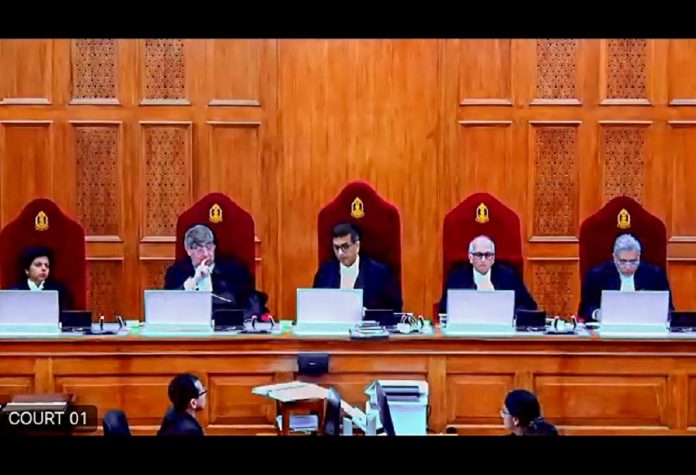
The Ayodhya Ram Mandir case, the Same-Sex Marriage Case, the Triple Talaq Case, the Decriminalisation of Homosexuality Case, and the Sabarimala Case were all decided by a 5-judge bench. However, the Right to privacy case was decided by a 9-judge bench.

Now, what is one essential indicator of a constitutional bench?

Yes! It always has a minimum of 5 judges. 

But what about the maximum? 

The Constitution does not answer the question, but the largest bench we have had so far was in the Kesavananda Bharati case, where we had a 13-judge bench! 

Did you know, in one of the episodes of the show ‘Kaun Banega Crorepati’ hosted by our beloved Amitabh Bachchan, one of the contestants was asked the question: How many judges did the largest constitutional bench in India so far have? This was probably a question for 50 lakhs or even 1 crore. 

Can you believe it? Keep reading for many more amazing facts that might help you if you ever go on the show!

Now, let’s finally move to understanding the constitutional Bench deeply.

Constitutional provisions dealing with the constitutional Benches

Article 145(3) of the Indian Constitution states that “any case involving a substantial question of law as to the interpretation of the Constitution” must be presided over by a bench of a minimum of five judges. This bench is called the constitutional bench. The constitutional benches are temporary and are created to decide a specific case.

Now that we know the source of setting up a constitutional bench, the next question arises: Why are these constituted? What specific issues do these benches deal with?

Circumstances when a constitutional bench may be constituted

Broadly, the issues that the constitutional benches decide can be divided into four categories:

  • A constitutional bench can be formed if a case involves a substantial question of law related to the interpretation of the Constitution.
  • A constitutional bench can be formed if the President of India seeks the opinion of the Honorable Supreme Court on a question of law or fact under Article 143 of the Constitution. For Example, see In Re: The Berubari Union and the Exchange of Conclaves (1960).
  • If a two-judge bench and, later, a three-judge bench deliver conflicting judgments on the same legal issue, a constitutional bench can finally be set up to decide the matter and declare the law.
  • Suppose a three-judge bench delivers a judgment on an issue that has been decided differently by a previous three-judge bench decision. In that case, the constitutional bench can be set up to put the matter at rest and declare the law.

I always wondered who decides which cases would be decided by which judge. Who decides who all judges would be sitting on a constitutional bench? You would have thought about these, so let’s find the answer together!

Before we proceed to the answer, we need to understand what we mean by “master of the roster.”

Master of the roster

The term master of the roster is used in various common law jurisdictions and refers to the Chief Justice’s power to set up the benches and allocate cases. 

When the Honorable Supreme Court was established in 1950, it only had 7+1 judges. All eight judges sat together to decide every case. However, with the passage of time, the number of judges has been increasing. Presently, it stands at 33+1 judges. With increased strength, allocating cases and creating benches has become important. 

Let’s have a quick look at the periodic increase in the number of judges at the Supreme Court:

  • 1950: 8 Judges
  • 1956: 11 Judges
  • 1960: 14 Judges
  • 1978: 18 Judges
  • 1986: 26 Judges
  • 2009: 31 Judges
  • 2019: 34 Judges

The Chief Justice of India directs the registrar to prepare the roster per his orders. The Chief Justice can also amend the allocation of judicial tasks. 

Did you know, in 2018, the judge’s roster was made public? Now, if you visit the Supreme Court website, you will find the option of the Judges Roster Tab, where you can see the subject matters assigned to the judges. This has indeed increased transparency.

Now, we understand that the Chief Justice of India holds an eminent position and undertakes various essential duties. One of those duties, or powers, is setting up a constitutional bench. He sets up the benches and also assigns them cases.

Vital statistics about constitutional benches

Number of judgments that constitutional benches have delivered

What are the number of decisions that the constitutional benches of the Supreme Court have delivered since its inception in 1950?

It’s 2558 cases from 1950 to 31st December 2024!

Number of constitutional bench judgments that were delivered in 2024

12 decisions were delivered by the constitutional benches in the year 2024. Some of these are listed below:

Decade of  the maximum number of constitutional bench decisions

From 1960 to 1969, around 1145 decisions were given by the constitutional benches. Interestingly, Honorable Justice K.N. Wanchoo is the judge who was a part of the maximum number of constitutional benches with 686 judgments. He had a long tenure from 11 August 1958 to 24 February 1968.

Key Functions of the Constitutional Bench 

Final interpreter of constitutional provisions

The constitutional bench of the Supreme Court of India plays a pivotal role in interpreting the Constitution. It addresses substantial questions of law, resolves conflicts in constitutional interpretations, and protects fundamental rights. Would ‘life’ under Article 21 include the right to livelihood? The Apex Court will give you an answer. Would the wearing of a hijab by Muslim women be considered a practice protected under Article 25? The Apex Court would provide us with an answer!

Let’s discuss some instances where the Supreme Court discharged the function of interpreting the Constitution.

Interpretation of Article 21

The best way to understand this function is to read Article 21 of the Indian Constitution. Let’s read the very brief article:

“No person shall be deprived of his life or personal liberty except according to procedure established by law.”

However, the various constitutional benches have expanded this simple provision to give us many rights over the years. “Life” has been interpreted broadly to include a meaningful and complete life instead of a mere animal existence. 

 Some of the rights granted via expansive interpretation are:

Interpretation of Articles 25 and 26

One of the most creative developments in the ‘right to freedom of religion’ has been the development of the ‘essential religious practice’ doctrine. It was developed to answer the question: What spiritual practices are protected under Article 25? 

Legal protection is granted only to practices deemed “essential” to a religion—the practices that form the foundation of that religion. Recently, we saw a discussion on essential religious practices in the Sabarimala case. The question arose as to whether the exclusion of women aged between 10 and 50 from the Sabarimala temple is an important religious practice. The answer given by the constitutional bench was negative.

As per the constitutional bench, a practice would only be considered essential if the nature of religion would change without it. The parts that do not affect the ‘core’ were considered mere embellishments.

Final arbitrator of conflicts between constitutional provisions and laws

In India, more than 200 laws exist on every subject. This reflects the proactive role that the legislature plays in curating laws according to the needs of the time. However, sometimes a conflict arises between constitutional values and the express statute or where no statutory provision exists. Let us explore how the constitutional benches dealt with such situations!

Case on irretrievable breakdown of marriage

One such situation arose in the case of Shilpa Sailesh vs. Varun Sreenivasan (2023), in which the married couple had been living separately for a long time, and their marital tie was dead beyond repair. However, while one party wanted to opt for a divorce by mutual consent, the other did not. 

In Indian law, the grounds for irretrievable breakdown of marriage are not yet available to couples to separate. A divorce decree can be passed if statutory requirements are fulfilled or parties mutually consent.

This is where this case becomes essential! 

Here, the constitutional bench had to create a workable solution between Article 142 of the Indian Constitution, which is based on the principle of doing justice in every matter, and the provisions of the Hindu Marriage Act 1955 and Special Marriage Act 1954

In this case, the Honorable Supreme Court held that the marriage is broken if the court is fully satisfied. Beyond salvation, despite one of the spouses refusing to consent to a mutual divorce, the court can exercise its extraordinary powers under Article 142 of the Constitution to do complete justice to the parties and pass a divorce decree.

Case on the right of maintenance to Muslim women

The landmark case of Mohd. Ahmed Khan vs. Shah Bano Begum (1985) was one of the initial cases in which the personal law systems gave way to constitutional values. In this case, the issue was related to the application of Section 125 of the Code of Criminal Procedure 1973, which dealt with the maintenance grant to the Muslim community.

Personal law advocates contended that, in Muslim law, the husband must provide for the maintenance of the divorced wife only during the iddat period and not a day longer. According to them, this position holds good irrespective of the wife’s post-divorce financial situation. 

The Apex Court rejected this contention, stating that the right conferred by Section 125 CrPC can be claimed irrespective of the parties’ law. It would override the restrictions present under Muslim personal law.

Final addressor of issues of national importance

In a territorially large and culturally diverse country like India, questions related to law, public policy, division of power, culture, religion, etc., arise every other day! When these arise, all the parties concerned look to the Supreme Court for a just, fair, and equitable decision. 

These decisions are often of national importance and, therefore, fall within the jurisdiction of the Apex Court. In these cases, the constitutional bench sits and authoritatively decides these issues. Let’s discuss some examples where the constitutional bench agreed on questions of national importance.

Demonetisation case

No one could forget the evening of 8th November 2016, when our Prime Minister addressed the nation to declare that the existing 500 and 1000 currency notes would no longer be used! This decision was taken under Section 26 of the Reserve Bank of India Act, 1934, which allows the union government to declare specific currency notes no longer legal.

The scheme’s constitutionality and implementation were challenged before a constitutional bench in the case of Vivek Narayan Sharma vs. Union of India (2023). Some of the questions before the constitutional bench were:

  • Was the demonetization policy in line with the provisions of the Reserve Bank of India Act 1934?
  • Did the limit on cash withdrawal violate the right to equality and livelihood?
  • Did the unreasonable manner of implementation violate the right to equality and livelihood?

The constitutional bench held that the policy was valid and constitutional. It had a reasonable nexus with the objective of eradicating black money. This case indicates that no one can ever guess what question the constitutional benches may be called upon to discuss!

Control of civil servants in Delhi case

I am sure you know about the special status Delhi’s national capital enjoys under our Constitution. While it is a union territory effectively under the control of the Union via the Lieutenant Governor, it also has its own elected government. So, if different parties are in power at the union level and in Delhi, a power struggle is bound to happen! 

In such situations, the Supreme Court must resolve the conflicts. One such conflict recently arose in the case of the Government of NCT of Delhi vs. Union of India (2023). In this case, the constitutional bench of the Supreme Court answered a fundamental question: Who will have control over the national capital Delhi’s civil servants and their day-to-day administration?

As stated above, Delhi has a dual power structure. It has been given some special powers under Article 239AA as the national capital. One provision of this article discusses the division of legislative powers in Delhi. 

Using the same provision, the constitutional bench authoritatively held that the Delhi Government and the legislative assembly will have the power to make laws on ‘all the subjects in the state list’ under the Seventh Schedule of the Constitution except public order, land, and police. Since the subject of ‘state public services’ does not fall within the excepted subjects, the Delhi government will have the power to control it. 

Final decision maker on matters involving fundamental rights

Cases on the right to life

The majority of constitutional bench decisions have indeed been to interpret and expand the fundamental rights of the citizens. The most expansive development has been in the case of Article 21, protecting our right to live. Let’s look at some landmark cases related to Article 21.

  1. Olga Tellis and Ors vs. Bombay Municipal Corporation and Ors (1985): The story of this case began in 1981 when the Bombay Municipal Corporation started an eviction drive against pavement and slum dwellers. Before the Supreme Court, the argument was raised for these pavement and slum dwellers that their eviction would deprive them of their right to livelihood. 

Agreeing with this argument, the Honorable Supreme Court held that evicting pavement dwellers using force without giving them a chance to explain would violate their right to livelihood. The court further held that the easiest way to deprive a person of his right to life is to deprive him of his means of livelihood. 

They live on the footpath because they have “small jobs to nurse in the city and they have nowhere else to live”. They live on filthy footpaths due to helplessness and not to offend, insult, or annoy anyone.

  1. Maneka Gandhi vs. Union of India (1978): This case was linked to the ‘right to go abroad’ as a fundamental right by its inclusion in the term “personal liberty” under Article 21. This right can only be restricted according to the procedure established by law. The petitioner in this case was granted a passport on 1 June 1976, as per the Passport Act 1967.

However, on 4 July 1977, she received a letter from the passport office that her passport needed to be impounded in the public interest. She was not given any reasons for the order on public interest grounds.

The Honorable Supreme Court held that the Passport Act 1967 does not provide a procedure for impounding a passport. Even if a procedure could be said to have been prescribed, it was unreasonable and arbitrary as it did not allow the holder to be heard against the order of impounding. Therefore, the provision dealing with the impounding of passports was held to be unconstitutional and violative of Articles 14, 19, and 21.

  1. Sunil Batra Etc vs. Delhi Administration and Ors. Etc (1978): The petitioner in this case was a convict serving a life sentence who was placed in solitary confinement in prison. He challenged this order of solitary confinement before the Supreme Court.

The Honorable Supreme Court made a fascinating observation that just because a person is convicted and put behind bars, he is not ipso facto deprived of all of his fundamental rights. He is guaranteed the rights under Article 21, according to which he shall not be deprived of his life or personal liberty, except as per procedure established by law.

It was further stated that a person’s liberty inside the prison is already significantly curtailed. If his freedom to move around and talk to other convicts is also prohibited, that would violate Article 21 unless a back-up established procedure. 

Cases on the right to equality

A bouquet of articles forms a part of the right to equality in our Constitution. Articles 14, 1,5, and 16 deal with different aspects of the equality principle. The question of reservations has been the subject of innumerable constitutional bench decisions. Some of these we will be discussing below:

  1. The State of Punjab vs. Davinder Singh (2024): In the sphere of reservations, we have had a recent case of The State of Punjab vs. Davinder Singh (2023). In this case, the constitutional bench dealt with sub-classification within the Scheduled Castes and Tribes.

The Apex Court declared that unequal cannot be treated equally. Sub-classification can be made if substantial differences exist between different groups within the SCs and STs. This would mean that if certain castes within the SCs are more backward than the others, a fixed number of seats can be allocated for them within the reserved seats. This would provide them with guaranteed representation and the opportunity to progress.

  1. Indra Sawhney, Etc. Etc. vs. Union of India and Others, Etc. Etc. (1993): This is by far the most important case on the subject of reservation policy in India. The case arose against the implementation of the Mandal Commission report, which provided 27% reservation in educational institutes and government employment to the Other Backward Classes (OBCs). The constitutional bench clarified numerous points of law in this case:
  • Article 16(4) is not an exception to the rule of equality; it’s a facet of it.
  • The State can classify the backward classes into backward and more backward if substantial differences exist between them.
  • The creamy layer principle was also considered constitutional and essential to benefit the most deserving classes.
  • It also declared a significant limit upon reservation policies by restricting it to a maximum of 50%.
  1. Vineeta Sharma vs. Rakesh Sharma (2020): Even on the principle of equality between genders, we have seen a proactive approach by the Supreme Court. The 2005 Hindu Succession (Amendment) Act 2005 has made the females coparceners in their families since birth. The Apex Court, in this case, answered two questions:
  • Does the daughter’s father claiming rights as a co-parcener need to be alive on the date of the Amendment to avail of the benefit?

The Apex Court held that the rights as a coparcener arise at birth and under being born 4 degrees from the last male holder. Father being alive or not on the date of the Amendment would be of no consequence.

  • From which date can the daughters claim these rights? The right as a co-parcener is conferred by birth. However, these rights can only be claimed from the date of the Amendment.

Importance of constitutional bench decisions for different functionaries

For judicial officers

We all know that the judgements of the constitutional benches are binding on all the courts in the country, but has this been provided in the Constitution? Yes, let’s read Article 141 of the Indian Constitution:

“The law declared by the Supreme Court shall be binding on all courts within the territory of India.”

  • Judicial officers nationwide are bound to know and apply the law as laid down by the constitutional benches. For instance, if specific directions about the preconditions before summons are issued to the accused under Section 227 of Bhartiya Nagrik Suraksha Sanhita, 2023, are laid down, or particular directions about default bail are laid down, all the courts of India are duty-bound to follow the dicta of the Apex Court.
  • Knowledge about all the recent constitutional bench decisions would help judges resolve conflicting interpretations of the law and bring uniformity in decision-making.
  • The constitutional bench decisions also guide judicial activism, for example, in the case of Vishakha & Ors vs. State Of Rajasthan and Ors (1997), which dealt with the prevention of workplace harassment. They guide and motivate judges to intervene in important matters where fundamental rights are at stake.

For legal birds

People like you and me, who are either in law school or are budding lawyers, must constantly be updated about all the decisions by the constitutional benches. Knowledge about these landmark cases is essential for an enriching law school journey and for setting up a successful legal practice. 

  • Since the constitutional bench decisions have a precedential value, lawyers can rely on these to further arguments in their cases.
  • Various landmark constitutional bench decisions, such as the right to privacy or MC Mehta cases (Oleum gas leak case, Taj Trapezium case, etc.), have expanded the right to life under Article 21 to mean more than your animal existence. These decisions can be used to defend civil liberties, free speech, etc.
  • Lawyers who grasp the various constitutional bench decisions are more successful in challenging unconstitutional government policies, legislations, or executive actions. For example, the Association for Democratic Reforms & Anr vs. Union of India & Ors. (2024) (also known as the Electoral Bonds case) that struck down anonymous political funding can act as a strong precedent for cases dealing with transparency in election funding.
  • A lawyer who is up to date about all the constitutional bench decisions and directions dealing with bail, the death penalty, etc., can better represent his client in the court of justice.

For policy framers

In India, we have a separation of powers, where the Parliament makes policies. The Honorable Supreme Court adjudicates any disputes that arise in the execution of such policies. However, despite this divide, policymakers can learn from constitutional bench decisions.

  • Constitutional bench decisions are critical in limiting legislature and executive powers. This helps policymakers draft policies within the constitutional framework. This was evident in the case of Kesavananda Bharati, where the Supreme Court discussed the power of the Parliament to amend the Constitution.
  • The Honorable Supreme Court also impacts the social welfare policies framed by the government. For instance, in the Indra Sawhney case (also known as the Mandal Commission case), a 50% limit was set upon reservation. Now, every reservation policy made by the state or the union would have to follow this limitation.
  • The Supreme Court has recently proved to be the torchbearer regarding environmental jurisprudence. Various judgements passed by the Apex Court help policymakers formulate pollution control policies and climate action plans. 
  • The constitutional bench decisions are also crucial for restricting governance. For example, in the Aadhaar judgement, the Honorable Supreme Court upheld using Aadhaar for welfare schemes but restricted its use in public sector transactions. 

For the citizens

As we have seen in numerous cases, constitutional bench judgments often concern matters directly affecting citizens’ rights, freedoms, and daily lives. 

  • The Supreme Court must protect citizens’ fundamental rights through its judgment. We saw this, for example, in the case of the right to privacy, where unauthorised data collection and misuse of citizens’ data were prohibited.
  • Constitutional bench decisions are often monumental in bringing justice to the marginalised groups. We saw this in the case of transgender people and LGBTQ groups. The judgements can grant representation to these groups and ensure equal participation in nation-building without any discrimination.
  • The constitutional bench decisions are also crucial in protecting citizens from government overreach. For instance, in the landmark case of Kesavananda Bharati, the Honorable Supreme Court established a restriction on the powers of the government to amend the Constitution by developing the doctrine of the basic structure in the Kesavananda Bharati case. So, the government in power cannot amend the Constitution to take away fundamental rights like the right to life, etc.
  • The Honorable Supreme Court has played a proactive role in expanding and protecting women’s rights in our country. For example, in the cases of Vishakha & Ors vs. State of Rajasthan and Ors (1997), which dealt with workplace harassment, and the Shayara Bano case, which dealt with the discriminatory practice of triple talaq, the court established a new phase of women’s rights.

Turning points in justice: Landmark cases that shaped the law

This part will discuss some of the watershed constitutional bench judgments in our legal history.

Kesavananda Bharati Case

Are you even a law student if you don’t know about the Kesavananda Bharati case?

This, by far, had the largest constitutional bench, a 13-judge bench. Well, that is not shocking. Since the importance of the question involved in the case was so great that we had already had two conflicting judgments upon the same question, we finally needed the final declaration!

That declaration came in 1973 and has remained the most critical constitutional bench case in Indian history. But what exactly required a 13-bench decision? 

The primary question involved was: Can the Parliament amend any part of the Constitution, including the fundamental rights contained in Part III?

In answer to this question, the Honorable Supreme Court developed a fascinating “basic structure doctrine.” The Apex Court stated that Parliament can amend the Constitution, including the chapter on fundamental rights. However, it cannot amend the basic structure. 

But what exactly does the basic structure include?

This question has not been exhaustively answered. However, through many judgements, many features like democracy, secularism, and the rule of law have been held to be part of the basic structure and beyond the reach of the Amendment.

What made the Kesavananda Bharati case a landmark?

The importance of the judgement lies in the various principles that it sets. Let’s have a look at these: 

  • It set limits on the Parliament’s powers to amend the Constitution. Although it stated that the Parliament can amend any part of the Constitution, it carved out an exception in the form of the basic structure.
  • It strengthened the principles of democracy and judicial review and declared that the judiciary keeps Parliament in check and protects the Constitution. Further, the judiciary retained the power to decide what matters would be considered part of the basic structure.

Did you know that the courts in Bangladesh and Kenya also cited this judgment? Yes, that’s true! 

S.R. Bommai Case 

The case discussed above brought in the doctrine of the basic structure. In this case, one feature of the basic structure was dealt with, which was federalism. 

Federalism is the division of power between the centre and the states, which allows both powers to function independently in their spheres.

The question before the court in the case was: Can the Union government arbitrarily dismiss a state government under the powers of Article 356 of the Constitution on the grounds of a breakdown of constitutional machinery?

Secondly, whether the decision to proclaim the president’s rule under Article 356 is subject to judicial review?

A constitutional bench decided on nine judges. The constitutional bench declared that the President’s rule under Article 356 is subject to judicial review to check whether it was proclaimed with mala fide intentions. The Honorable Supreme Court also held that the President’s rule cannot arbitrarily dismiss an unfavourable state government without proof of a genuine breakdown of constitutional machinery.

What made the S.R. Bommai case a landmark?

The importance of this constitutional bench decision lies in the principles that were established by it:

  • It strengthened the principle of federalism by prohibiting the misuse of Article 356 by the union government to dismiss unable state governments for political motives.
  • Further, it also stated that the declaration of the President’s rule is an exceptional situation and must not be overused unwarrantedly. After this decision, the misuse significantly reduced granting stability to the state governments.
  • The principle of judicial review further strengthens the checks and balances feature provided in the Constitution. This feature stops any misuse of power by any branch of the government.

With this, we can indubitably say that this case was a vital constitutional bench decision that strengthened the principles of federalism, democracy, and judicial review in India, which are necessary to uphold the constitutional ethos.

Aadhaar case 

Did you know that before 2009, nothing called Aadhaar existed in India? Yes, you heard it right! 

Let’s understand why the popular identification document stood challenged before the constitutional bench!

So, in 2017, in the famous K.S. Puttaswamy Case, or as it is famously known, the right to privacy case, the right to privacy was declared a part of Article 21 and made a fundamental right. But Aadhaar captures a lot of information, including fingerprints, biometric information, our address, etc. The question arises: how do we balance the right to privacy, which is a fundamental right, and the mandatory requirement of Aadhaar even for delivering private services?

This balance was achieved by the constitutional bench in another case in 2018. The primary question before the constitutional bench in this case was whether the mandatory requirement of Aadhaar would violate the right to privacy. 

The constitutional bench held that while the Aadhaar policy is constitutional, it must have some restrictions regarding its usage. It cannot be made mandatory for all services. The government can use Aadhaar to provide citizens with the benefits of welfare schemes. However, it cannot be used for compulsory private services like mobile phones, SIM cards, bank accounts, etc.

Just to put things in perspective, can you imagine a country that was riddled with poverty, with a largely uneducated population and existent exploitative public relations, talking about the fundamental right of privacy? Makes you think how far we have come as a nation. Doesn’t it? 

What made the Aadhar case a landmark?

The Aadhaar judgement is monumental in upholding the right to privacy of citizens while balancing the use of Aadhaar. Let’s understand why this case was so important:

  • It strengthens the right to privacy as a fundamental right by restricting the use of Aadhaar to particular services.
  • It protected citizens from being forced to produce an Aadhaar card when accessing services like banking, telecom, school, admissions, etc.
  • It also prevented the possibility of data misuse.

Therefore, we can say that the constitutional bench reached a golden mean by guaranteeing the right to privacy and moving towards the digitization of identity along with welfare governance.

Triple talaq case

Did you know that before this judgement, once a man pronounced ‘Talaq Talaq Talaq’, his marriage with his wife ended, then and there? 

He did not even have to see this to her face. He could also do this via phone, text, or email!

Yes, this right was only available to Muslim men and not Muslim women. 

Discuss how this landmark constitutional bench decision marked a step toward women’s rights in India. In this case, the primary question was about the triple talaq practice’s validity and constitutionality.

The Honorable Supreme Court held that triple talaq is not an essential practice of Islam. Neither does it have a Quranic sanction. Therefore, what is morally ugly cannot be accepted as legally valid. Interestingly, this judgment was followed by legislation that made the pronouncement of triple talaq an offence punishable with up to 3 years imprisonment.

Let’s now discuss why the triple talaq case is a landmark.

  • It strengthened the constitutional value of equality. It protected Muslim women from arbitrary divorces.
  • It also strengthens the idea that the law must be fair and just for everyone, regardless of religion.

Therefore, this case was seen as a historical judgment favoring further reform in personal laws and the end of discriminatory practices to ensure equality.

Decriminalisation of Homosexuality case

Did you know that LGBTQ+ identity is not new in the 21st century? Our Indian historical texts reference individuals known as ‘kinnars’, etc. Surely, the group’s ambit has significantly widened in the modern day. 

Homosexuality was not always considered a crime; instead, it was after the British blunder in India that this was made a crime under the Indian Penal Code, 1860. The constitutional bench in the year 2018 delivered a historic judgment in the case of Navtej Singh Johar, which decriminalised homosexuality in India. This ruling had the impact of granting similar rights and equal dignity to the LGBTQ group. This judgment can be considered by far one of the most revolutionary judgments by our Honorable Supreme Court.

The key question before the constitutional bench was whether Section 377 of the Indian Penal Code, 1860, is violative of the fundamental rights of LGBTQ people. 

By a unanimous judgement, homosexuality was decriminalised. It recognised the right of people to choose who they love and how they express their identity. it broke the binary of male and female and welcomed the LGBTQ group with wide arms of acceptance.

What made the Navtej Singh Johar case a landmark?

This case was indeed monumental in the lives of the LGBTQ community in India. Let’s understand what principal changes it brought in:

  • It primarily recognised homosexuality and declared Section 377 of the Indian Penal Code, 1860, to be partially unconstitutional. 
  • It accepted the right to sexual orientation as a fundamental right.
  • On the social level, it marked a revolutionary change in the acceptance of the LQBTQ community in India.

This judgment started discussions on public platforms about LGBTQ group rights in India. It removed the taboo attached to discussion and helped people come out of the closet and claim their rights.

After discussing the revolutions that the constitutional bench has successfully ignited, let’s discuss the problems faced by the constitutional benches.

Decoding the dilemmas: Challenges faced by the constitutional bench

In this segment, we will analyze some hurdles the constitutional bench faces.

Dreadful backlogs and delayed justice

Did you know that 82922 cases are currently pending before the Apex Court, and 28554 are less than one year old?

Out of these: 

  • 1151 cases are pending before a 3-judge bench;
  • 259 are pending before a  5-judge bench;
  • 35 before a 7-judge bench; and
  • 69 are pending before a  9-judge bench

Another vital statistic is that 5261 cases were instituted last month, while 4470 cases were disposed of simultaneously. 

To check the statistics, you can check the National Judicial Data Grid.

Now that we know that a constitutional bench has a minimum of five judges, these five judges are committed to deciding cases about the constitutional bench, which keeps them from deciding cases in a single bench or division benches. 

Therefore, where two division benches and one single-judge bench could have been constituted, only a constitutional bench with the same number of people is formed. This slows the speed of the cases’ disposal and increases pendency.

Complex questions that make finding an answer a real task

You must have seen that a case originates in the Trial Court, then through appeal moves to the District Court, the High Court, and finally the Supreme Court. A question might arise in your mind that the same bare acts are provided in all the courts, and majorly, the same arguments are available to the judges at every level, then how do we see such divergent opinions?

We must understand that the questions that reach the Apex Court are often very complex; they do not have a straightforward correct answer.

For instance, the case of In Re: Article 370 of the Constitution (2023) dealt with abrogating the special status given to the state of Jammu and Kashmir under Article 370 of the Constitution. The question of the propriety of the order and its consequences was not a simple one to decide.

Do you know that each judge of the Honorable Supreme Court has 4 law clerks cum researchers to help them in culling out relevant precedents or law points? Further, both sides present astonishing material to substantiate their arguments during the hearing. This indicates how complex and layered the process of finding an answer to that question is. 

This is one reason the hearings before the constitutional benches take so long, and the judges require additional time to deliberate on the judgment.

Problem of subjectivity

Did you know that out of the 13 judges on the bench in the Kesavananda Bharati case, the verdict was split? Seven judges consented to the judgement, and six dissented! This is a clear example of how differing legal reasoning can be followed by different individuals. Even in the recent case where the policy of demonetization was challenged, four judges consented to the decision, and one dissented.

Therefore, in larger benches like those in constitutional benches of 5 judges, only the consent of 3 judges is required to declare the law. Very rarely, for instance, in the case of Navtej Singh Johar, where homosexuality was decriminalised, we received a unanimous verdict.

Need for a permanent constitutional bench 

Various Chief Justices have highlighted the need for a permanent constitutional bench, but no such bench has yet been established. There are numerous benefits of having a permanent constitutional bench; some of these have been discussed below:

  • Constitutional matters of grave importance would be decided quickly, as we will have a dedicated permanent constitutional bench to decide upon them.
  • If we had a permanent constitutional bench, we would also be able to achieve uniformity and consistency in interpretations. Since different benches may interpret the constitutional provision differently, a permanent constitutional bench would help us avoid uncertainty.
  • We have a huge backlog of cases in the Supreme Court. Therefore, having a dedicated constitutional bench would let the other judges take over the regular benches and lead to faster case disposal.
  • Further, a dedicated constitutional bench will also create greater specialisation and expertise in dealing with particular matters.

The Indian Supreme Court is one of the world’s most respected and looked-upon judiciaries. Nevertheless, it has its share of hurdles, some of which have been discussed in this section. 

In the next section, we will discuss the differences between the constitutional and regular bench.

Constitutional Bench vs. Ordinary Bench

One might ask what is so special about the Honorable Supreme Court in reference to the Constitution. Doesn’t it hear normal civil and criminal cases, too? 

Well, yes, it does, but these are often heard by single-judge or division benches. However, constitutional benches always decide cases involving questions related to the Constitution.

This is because special causes require an extraordinary remedy!

In this segment, we will distinguish between a constitutional bench and a regular bench. The differences have been provided in tabular form for easy comparison!

FeaturesConstitutional benchRegular bench
DefinitionA constitutional bench consists of five or more judges to decide important matters of interpretation of the Constitution.A regular bench may consist of a single judge, a division bench, or a three-judge bench to hear regular matters.
ProvisionArticle 145(3) of the Indian Constitution deals with the setting up of a constitutional benchThese do not have a constitutional provision and are made as per the Supreme Court rules
Number of judgesA minimum of five judges, but can extend up to 7, 9, 11 or 13 judges or more.These usually consist of a single judge, a division bench or three judges.
Subject matter heardThe constitutional bench is set up to hear matters of interpretation of the Constitution.The regular benches hear civil cases, criminal cases, writ petitions, etc.
Binding DecisionsSince the bench is bigger, these are binding on all the smaller benches and can only be modified by a bigger bench.The decisions are binding on the lower courts and benches of lower strength, but they can be overruled by benches of higher strength.
FrequencyThere is no permanent constitutional bench as of now. These are constituted by the Chief Justice as and when required.These benches sit regularly to decide matters.
CasesA 13-judge bench decided the Kesavananda Bharati Case (1973).Voter-verifiable paper Audit trails (VVPATs) for voter verification were considered necessary in the case of Subramanian Swamy vs. Union of India, Ministry of Law & Ors. (2016) was decided by a single judge bench.

Building on the importance of the constitutional bench decisions, we will analyze the landmark judgments’ effects.

Ripple effects of landmark judgements

The constitutional bench decisions pronounced by our country’s top five or seven judges are bound to have a tremendous social impact. They are not only guided by the social will, but it also guides the social will, as was evident in the Sabarimala case and the Navtej Singh Johar case. 

Let’s explore how far-reaching the impacts of these landmark judgments have been on the Indian legal landscape!

Sets precedents and removes any future ambiguity

Just like a lighthouse guides ships, and constellations guide sailors, the constitutional bench decision guides judicial courts all over India.

All the courts in India are bound to follow the decisions of the Honorable Supreme Court when deciding cases. This fosters a feeling of unanimity among all the courts.

For example, if the Honorable Supreme Court has held that only the Supreme Court can grant divorce on the grounds of irretrievable breakdown of marriage. This decision is binding on a court in Delhi and a court in Karnataka. You would get the same decision irrespective of where the case has been filed.

Evolution of society by revolutionary ideas

The judgements of the Supreme Court often reflect the changes that have occurred in society. For instance, the Sabarimala case, wherein the women were granted the right to enter a temple, that was earlier beyond their reach, reflects the sentiment of gender equality, which is prevalent in our society.

On the other hand, the case of Navtej Singh Johar stamped legitimacy upon LGBTQ relationships, bringing a new wave of acceptance for these groups in Indian society. Further, the right to privacy was made a fundamental right under Article 21. 

I’m sure the makers of the Indian Constitution would also be astonished to see how the Indian Supreme Court has revolutionised the concept of fundamental rights in line with the current wave of ideas.

Maintain the separation of power and check government overreach

The most important tool that the Indian Supreme Court has is the power of judicial review. Using this tool, the constitutional bench has the power to strike down any law made by the Parliament that does not align with the constitutional ideals and declare it unconstitutional. 

One instance, where the Honorable Supreme Court has done this is in the case of Shreya Singhal vs. U.O.I (2015), where Section 66A of the Information Technology Act, 2000 which criminalised sending of offensive messages was declared to be unconstitutional as it violated the fundamental right of freedom of speech.

The constitutional bench decisions also ensure that the federal balance is maintained in the country, as we saw in the case of S.R. Bommai, where the Honorable Supreme Court cautioned against the union government’s misuse of powers under Article 356 to disable unfavourable state governments.

Apart from checking the constitutionality of legislation, the constitutional benches also have the power to review executive actions. One example was the case of Vivek Narayan Sharma vs. Union of India (2023) (also known as the demonetisation case), which has been discussed above. The Honorable Supreme Court had to decide whether the procedure carried out to implement the policy was legal.

Another example that comes to my mind is the Supreme Court Advocates on Record Association vs. Union of India (2015) (also known as the NJAC case), which dealt with the issue of judicial appointments. The legislature introduced the National Judicial Appointment Commission to make appointments to the Apex Court and the High Courts, which included:

  1. The Chief Justice India;
  2. Two senior most judges of the Supreme Court;
  3. Union minister of law and justice;
  4. Two eminent jurists.

The NJAC was considered unconstitutional as it was seen to be against the independence of the judiciary.

After reading all of these examples, I am sure that you are clear about the impact that constitutional bench decisions have on maintaining the doctrine of separation of power and the independence of the judiciary. 

The international influence of Indian decisions

The Indian Supreme Court is one of the world’s most respected judicial systems. It has delivered landmark judgments on important issues in constitutional law, human rights, privacy, and gender justice. These revolutionary decisions have inspired tradition and governments all around the world.

As we discussed above, the landmark case of Keshavananda Bharati was cited by the Bangladesh Court along with the Kenyan Court. We can see the impact that the Indian Supreme Court is having on the international level. So, Constitutional decisions are creating ripples of revolution not just in India but also abroad.

The landmark case of Navtej Singh Johar that decriminalised homosexuality removed the taboo around LGBTQ relationships and inspired movements globally by these groups to demand rights from their governments.

We are all aware of the legal luminary and exceptional environmentalist M.C. Mehta. Yes, this is the same MC Mehta, whose name you have seen innumerable Supreme Court judgements dealing with environmental issues. He was the petitioner in the cases in which the Supreme Court developed the principle of ‘polluter pays’ and the ‘precautionary principle’, which were created in the case of M.C. Mehta vs. Kamal Nath and Ors (1996). These principles have had a global impact on environmental litigation.

Next, we will proceed to discuss the various trends regarding the constitutional benches.

Wind of change: Analysing the recent trends

If the wind of change has been impacting all spheres of society, how can the Supreme Court of our country remain unaffected? In this segment, we will discuss the recent trends operating in the Supreme Court.

Increasing reliance on constitutional benches in key legal matters

Did you know that in just the first half of 2023, the constitutional bench had convened 55 times and delivered 13 judgments? Reflecting the proactive approach adopted by these constitutional benches.

The first question is, what does this trend point towards?

This is indicative of a shift in the judiciary’s focus on issues of constitutional interpretation, public interest, institutional reform, and national importance. 

Whether setting up a constitutional bench the only solution? 

Well, most of the issues brought before the court have been decided by benches of smaller strength. So, to overrule or modify those decisions, we need a constitutional bench to authoritatively declare the law. 

Another aspect is that these issues would have wide-ranging ramifications. For instance, the challenge against the sedition law or the question related to reservations. These are all issues that affect the country at large and require thorough consideration by the constitutional benches.

Also, the Honorable Supreme Court has taken suo motu cognizance of various important issues that have been happening in the country. For example, the R.G. Hospital Rape Case (2024) or the Manipur Violence Case (2023). These sensitive topics require the setting up of a constitutional bench.

Well, on the one hand, there are some positive effects of this trend, which include important cases being resolved faster and clarity on important constitutional law topics. However, on the other hand, this increases the burden on the judiciary in respect of non-constitutional bench cases. 

So, what is the solution? One answer could be to increase the strength of the High Courts and the Supreme Court to deal with the backlog.

Discussion on setting up a permanent constitutional bench

In 2023, the Honorable CJI Dr. D.Y. Chandrachud announced that the Supreme Court might soon have constitutional benches as a permanent feature. This aimed to resolve critical constitutional matters in a focused and speedy way. However, till now, we have not seen any final decision on the issue.

Dealing with a diverse range of subjects

In recent years, we have seen constitutional bench decisions that are not particularly limited to interpreting the Constitution but also delve into various allied fields. For instance, in 2018, we had the electro-bond scheme case. We also had a landmark judgement dealing with the extent of legislative immunity provided to the members of the Parliament.

Very recently, we had a case dealing with the regulation of industrial alcohol and answering the question of whether the centre or the states will have the power to regulate it.

We have also had judgments dealing with the issue of appointments in the public sector, in which the Honorable Supreme Court held that recruitment rules cannot be modified after the appointment process has commenced.

They also pronounced a landmark decision dealing with the arbitration agreement and the impact of its non-stamping. This reflects the broad ambit of constitutional bench decisions.

Setting in of technological revolution in the Apex  Court 

Laptops and iPads replacing paper files: Digital case management 

Have you seen any recent constitutional bench proceedings? Did you notice each of the judges had a computer before them? Not just the judges but even the advocates have iPads etc in their hands, and papers are rarely seen!

Advocates often ask the judges to refer to a particular page number of the pleadings they have submitted, and the judges can easily scroll down to the required page number! This will save paper and thereby trees and time, making it convenient to refer to documents.

Video calling the Supreme Court 

One positive aspect of the lockdown phase was the introduction of virtual court hearings. You must have attended or at least would have seen advocates joining court proceedings virtually at not just the Supreme Court but even at district courts from different parts of the country. 

Our Supreme Court uses CISCO Webex to conduct virtual hearings, allowing advocates to join and participate virtually.

Live streaming the courtroom hearings 

Yes, you heard it right! Now, you can watch the constitutional bench hearings from the comfort of your house. I remember watching the hearing on the same-sex marriage case while I was sitting in my college classroom! It was so interesting and enlightening. 

This development happened due to the case of Swapnil Tripathi vs. Supreme Court of India (2018). In this case, a petition was filed to seek a declaration that Supreme Court cases of constitutional importance must be live-streamed to make them accessible to the public. The Apex Court accepted this plea by stating that this right flows from the right of access to justice.

You can also watch the hearings on YouTube! This has had a very positive impact on improving public access to judicial hearings.

Enter AI into the Supreme Court

Did you know our Supreme Court has its own Chat GPT? It’s called “SUPACE.” This tool can be used by judges, advocates, and legal researchers to find case analysis and for research purposes. 

Exploring e-filing of cases

The Apex Court and the High Courts have introduced e-filing portals. These portals enable parties or their advocates to file their cases, petitions, etc., online without coming to the court.

Gone are the days when advocates lined up before the filing counter to file their cases. Now, they can do it right from their offices.

Need for some reforms to enhance efficiency

Setting up more benches

Due to the immense pendency prevalent in the Honorable Supreme Court, there have been suggestions to set up regional benches of the Supreme Court to deal with the pendency. Since we only have one Supreme Court in Delhi, the burden to decide the cases falls upon only 34 judges. More regional branches would divide the burden and speed up the decision-making process.

Set strict timelines

There must be a policy setting strict timelines for decisions in cases. We all know that often, the parties who initially filed the case do not live to hear the judgment. Therefore, we need some time-bound restrictions on how many hearings a case would take and when the judgment would be delivered.

Promote Alternate Dispute Resolution

Alternate dispute resolution is the new ‘IN’ thing. It benefits the parties by allowing them to reach a speedy decision outside the court. It also ultimately helps reduce the burden on the courts in India. Although cases of constitutional importance would still have to be heard by the constitutional benches, matters of a civil nature can be resolved via alternate dispute resolution.

Better case management:

There must be a year-wise case management system so that the cases that have been pending for the longest time can be heard and disposed of as early as possible. It must be remembered that justice delayed is justice denied.

Judicial performance review

There must be a system of judicial performance review to check how many cases a judge effectively disposed of in a fixed period. Judges are duty-bound to protect the interests of the parties in the case, and one of the interests of the parties is to get speedy justice.

Permanent constitutional bench

A separate constitutional bench is often established for every constitutional matter. However, if we set up a permanent constitutional bench that would hear only those specific matters, this would streamline the process. This would also leave all the other judges with more time to decide other matters.

Fast-tracking important cases

Some cases of immense national importance must be heard and decided on priority.

Conclusion 

In this article, an attempt was made to not just tell you about what a constitutional bench is, but what the importance of the constitutional bench decisions are in our society. We can view the decisions of the constitutional benches like the Sun. Just like the sun gives its light and makes everything clear, these constitutional bench decisions also make the words of our Constitution clear. They bring out the ethos of our Constitution, framed almost 76 years ago, and keep it alive by interpreting it as per the needs of society.

Many cases were discussed in the article to explore the function of the constitutional benches and highlight how their decisions are essential for lawyers, students, policymakers, etc. The various challenges faced by the Apex Court, including a dreading backlog of cases, were also discussed, with some potential reforms. At last, we conclude the article by discussing the new trends adopted by the constitutional bench, the most striking one being the adoption of technology in its workings.

Frequently Asked Questions(FAQs) 

What is the role of the constitutional bench in the Supreme Court?

The primary role of a constitutional bench in the Supreme Court is to decide matters of constitutional importance, such as the interpretation of constitutional provisions.

How many judges are required to form a constitutional bench?

A minimum of five judges are required to form a constitutional bench. No maximum limit is given.

What types of cases are heard by the constitutional bench?

The constitutional benches decide cases involving the interpretation of constitutional provisions.

How do constitutional bench decisions impact government policies?

The decisions delivered by the constitutional bench of national and societal importance often serve as a precursor to future legislation. For example, in the triple talaq case, the Supreme Court judgment was followed by legislation.

Can constitutional bench decisions be challenged?

The constitutional bench decisions can only be challenged before a bench of a higher strength. For example, if you want to challenge a five-judge bench decision, it can only be heard by a seven-judge bench.

How does the constitutional bench influence the interpretation of fundamental rights?

No, the Honorable Supreme Court, especially the constitutional benches, are considered guardians of fundamental rights. The constitutional benches design all matters that impact citizens’ fundamental rights.

Can High Courts constitute a constitutional bench?

No, only the Supreme Court has the authority to form a constitutional bench and is required to constitute a bench of 5 judges. However, High Courts can form larger benches, such as Full Benches (three or more judges) or Division Benches (two judges) for important decisions.

References 

Download Now

Most inspirational female lawyers in India

1

This article was written by Jyotika Saroha. The article talks about some of the most inspirational female lawyers in India. It extensively deals with the achievements and contributions of these outstanding female lawyers to society, who contribute to upholding justice and equality in society. 

This article is published by Anshi Mudgal.

Introduction

The fact that women have been the victims of male male-dominated society for a very long wherein they were not allowed to go outside without the permission of their male members. They were not even permitted to go outside for work or for any jobs that are being done by the males. The women never got an equal representation in any sector, be it social, economic or political. Now, in this article, we are discussing the most inspirational female lawyers of India. In the legal system as well, women do not get equal representation to their male counterparts. It is also affected by the male-dominated mindset, which portrays that women are not sufficient to single-handedly manage the work affairs of any profession. It is necessary to keep in mind that out of the 788 judges in the High Courts, 107 are women, which is very less and that is not even 20% of the total strength. It is a shocking fact that 60% of female advocates leave litigation during their 40s, which is known to be the peak years of their careers. 

During the women’s day function at the Supreme Court of India in March 2023, the then Chief Justice of India DY Chandrachud called the legal profession in India to be still an ‘old boys club’. He further opined that there is a need for female advocates and judges to take an active part in the legal profession. If we look into the women’s participation in the statutory body, namely the Bar Council of India, there are no female representatives in it, as pointed out by Justice BV Nagarathna, while she was speaking at the convocation of National Law University, Delhi. 

The article tells about some famous female lawyers who have immensely contributed towards the welfare of common people, by providing them with access to justice. 

Cornelia Sorabji

Cornelia Sorabji, the first Indian advocate of India, was born in Bombay on 15th November, 1866. She completed her studies in the United Kingdom, after which she came back to India. She did not get permission to practise in any Indian courts. However, in 1922, she became the first Indian woman to start practising as an advocate. In 1924, the legal profession experienced a good participation of women. Cornelia Sorabji started appearing before the Calcutta High Court, but due to a patriarchal mindset and limited freedom to speak up, she retired in 1929. After retiring, she went back to London and spent her life there. 

She has played a greater role in protecting and promoting women’s rights. She was not only a popular legal face in India, but she had a great impression in other countries as well. She inspired a lot of women at that time who then started joining the profession.

Education

Cornelia Sorabji was not only the first female to become an advocate, but she was also the first lady who graduate from Bombay University, Poona. To pursue her law degree, she went to England and took admission in Oxford University in 1894. Later, she continued to pursue her education at Lincoln’s Inn, a renowned law firm in England. 

Contributions

  • Protection of Women’s Rights

Cornelia Sorabji has played a magnificent role in protecting and promoting the rights of women.

  1. She represented the pardanashin women, wherein estates were being administered by the courts.
  2. She also stressed that the Indian administration to appoint her as a woman legal advisor to the courts of Bengal, Bihar and Orissa. 
  3. She was associated with the National Council for Women of the Bengal branch in India. 
  4. She made various contributions to uplift the status of women and to protect them from harassment and violence. 
  • Protection of Child rights: She strongly rejected the idea of child marriages, which existed during the colonial period.  

So, it was the journey of Cornelia Sorabji in her legal profession from which we can infer that she is a true inspiration for many females who want to make a significant remark in the legal profession. 

Now let’s discuss some more female lawyers in the legal profession who have contributed immensely to society.

Image Source – https://www.law.ox.ac.uk/content/alumna-cornelia-sorabji-1866-1954

Menaka Guruswamy

Menaka Guruswamy, a famous legal personality in India and an advocate practising before the Supreme Court, is famous for her active participation in the judgment that struck down Section 377 of the IPC, 1860. She stood up for the rights of the LGBTQ community. She has played a significant role in the upliftment of poor people who are living in the lower strata of society. 

After pursuing her education in foreign, she returned to India and started practising before the Supreme Court. She took part in landmark judgments, including striking down Section 377 of the Indian Penal Code, 1860 (hereinafter referred to as the IPC), the 2G Spectrum scam, etc.

She practices in diverse laws however, constitutional law remains her primary area of interest. She had also been a consultant to the United Nations, where she was one of the members to contribute in the drafting of Nepal’s Constitution.

Education

Menaka Guruswamy completed her B.A. LL.B (Hons) from one of the top law schools of India, i.e. the National Law School of India University, Bengaluru, in the year of 1997. After that, she completed her LL.M. from Harvard University. She has also practised as an associate in some law firms in New York. Later, for her academics, she went to Oxford University to pursue her Doctor of Philosophy. When she came back to India, she started working under the guidance of Ashok Desai, the former Attorney General of India, to start her career in advocacy.

Now let’s talk about the contributions made by Menaka Guruswamy.

Contributions

  • Human rights activist: 
  1. She has been actively involved in dealing with cases with respect to human rights, as well as gender rights at the international level.
  2. She has been an advisor to the United Nations Children’s Fund (UNICEF) and the United Nations Development Programme
  • Publications: 
  1. Menaka Guruswamy also writes for various news columns,  including The Indian Express, Live Mint, etc. and appears for interviews on different legal topics.
  2. She has books on different topics and books, and  “Founding Moments in Constitutionalism” was her first book.

Awards

  • She has been a part of the 100 most influential Global Thinkers by the Foreign Policy Magazine, 2019
  • She was also honoured with the Thomas Jefferson Foundation Medal in Law in 2023, for her remarkable work towards the protection of the rights of the LGBTQ+ community.

Let’s have a look at the famous cases dealt with by Menaka Guruswamy.

Important cases

Navtej Singh Johar vs. Union of India Ministry of Law And Justice (2018)

The first and landmark case that brought Menaka to the forefront of news headlines was wherein the Supreme Court struck down Section 377 of the IPC. Menaka Guruswamy, in this case, put forward the issues of discrimination and inhumane treatment done to the LGBTQ+ community. Before the court, she contended that homosexuality, bisexuality, etc., is the choice of an individual, neither is it a mental disorder nor is it a physical disorder. The most important contention was made concerning increasing the scope of Article 21 of the Indian Constitution to include sexual orientation under the ambit of the right to privacy.

The court held that Section 377 is a discriminatory provision and is in violation of Articles 14 and 15 of the Indian Constitution. It is also in violation of Article 21, which talks about the right to life and dignity. The five-judge bench of this case held Section 377 of the IPC as not in consonance with the constitutional provisions. By holding Section 377 as unconstitutional, the court stated that this judgment will now give citizens their fundamental rights no matter what their gender is.  

Extra Judicial Execution Victim Families Association & Anr. vs. Union of India & Anr. (2016)

In this case, where 1528 extrajudicial killings were carried out by security men in Manipur, the Supreme Court of India appointed Menaka Guruswamy as the amicus curiae. She advised the bench to make a Special team for the investigation to look into the matter of the killings of persons by the armed forces. 

Sunil Bharti Mittal vs. Central Bureau of Investigation (2015)

This case is popularly known as the 2G spectrum scam, wherein Menaka Guruswamy played an important role as she represented one of the parties before the court. So what happened was, that some politicians of the Congress government were involved in allegedly granting illegal 2G spectrum licences. Menaka Guruswamy contended that there should be a transparent investigation process and that officials need to be accountable for their actions.

The former Telecom Minister, A. Raja and the famous politician Kanimozhi Karunanidhi were the main individuals alleged to be involved in this case. It was stated that A. Raja sold the 2G spectrum licences at a very low rate, which subsequently led to financial losses of around 1760 billion rupees to the government. The Supreme Court, while dealing with this scam in 2012, rejected all the 2G spectrum licences given at low rates. The Apex Court held it unconstitutional and arbitrary. 

Image Source- https://www.lawctopus.com/menaka-guruswamy-internship/

Pinky Anand

Pinky Anand is a famous legal personality and a Senior lawyer practising before the Supreme Court, High Courts and tribunals. She practices constitutional law, criminal law, family law and matters of environmental law. She is highly skilled in working on different aspects of law and has earned a reputation not only at the national level but at the international level as well. She was also appointed as the Additional Solicitor General of India in the year 2014. She had also been an Advocate General in Uttarakhand and Goa. 

She actively participates in activities with respect to the legal field and she also works for various social-related causes. She was appointed as a committee member of the National Human Rights Commission. She was appointed as a delegate to represent India at the International Chamber of Commerce on Arbitration. Let’s know more about Pinky Anand, her education, contributions and important cases dealt with her.

Education

Pinky Anand is a graduate of Lady Shri Ram College for Women. She has taken her degree in law from the Faculty of Law, Delhi University. After completing her law, she pursued her LL.M. from Harvard University in 1980.

Awards

Pinky Anand has been awarded with various prestigious awards. She has been awarded for her remarkable works in law by the House of Lords, the House of Commons, the Federation of Indian Chambers of Commerce & Industry (FICCI), the Lions Club, Bharat Nirman etc. 

Important cases

S. Khushboo vs. Kanniammal & Anr (2010)

In this case, S. Khushboo, a South Indian actress, was alleged to be involved in the offence of defamation under Sections 499 (now Section 356 of the Bharatiya Nyay Sanhita, 2023) and 500 of the IPC (now Section 356(2) of Bharatiya Nyay Sanhita, 2023). So, what happened was that she was found accused of offences committed under Sections 4 and 6 of the Indecent Representation of Women (Prohibition) Act, 1986. Around 23 complaints were lodged against her by the respondent, namely, Kanniammal. He thought that Khushboo had made wrong comments on having sexual intercourse before marriage, which is not as per the contemporary community standards.

Pinky Anand was the advocate who represented S. Khushboo before the Supreme Court of India. She stated that the comments made by the appellant were reasonable and came within the protection of Article 19(1)(a) of the Indian Constitution, which is freedom of speech and expression. She further stated that the persons who made the complaint were not the ones who are referred to as being “aggrieved” as per Section 199(1)(b) of the Code of Criminal Procedure, 1973, and they could make any private complaints against the appellant. 

The court stated that the appellant did not make any wrong comments which are held to be as obscene. The statements made by the appellant were just personal opinions on the recent increase in incidents of people having sex before getting married. The intention of the appellant was not to cause harm to the reputation of the respondents, and there was no element of mens rea present here. 

Pinky Anand has done a commendable job in the legal field by fearlessly putting forward issues of great importance concerning public interest and welfare.

Image Source – https://jgu.edu.in/cias/advisory-board/Ms.-Pinky-Anand.php

Indira Jaisingh

Indira Jaisingh is one of the senior female lawyers in India. She was born on 3rd June 1940 in Mumbai. She was the Additional Solicitor General in the year 2009 and she was the first female lawyer to achieve such height in their career. Not only this, she was also the first Senior advocate designated by the Bombay High Court amongst women lawyers. She worked tremendously towards the protection of the rights of women and poor sections of society, the protection of human rights, etc.

Education

Indira Jaisingh completed her schooling in Mumbai and Bengaluru, and from Bangalore University she pursued her degree in law. She pursued her Master of Laws from the Bombay University. 

Contributions

  • Founder of the Lawyers Collective organisation: 
  1. Indira Jaisingh and her husband are the founders of the Lawyers Collective Organisation, which they founded in the 1980s.
  2. Their organisation focuses on raising the fund for the poor sections of society, who are unable to pay the costs of litigation.
  • Human rights activist: 
  1. She is a human rights activist and has been actively involved in the protection of human rights since the start of her career in law.
  2. The Bhopal Gas Tragedy, 1984: She strongly supported the victims of the tragedy to provide them with compensation for the suffering caused to them and their families.
  • Women empowerment: 
  1. She is one of the famous personalities who has been known for her remarkable work done for the protection and promotion of women’s rights.
  2. She has also been a member of the United Nations Committee on the Elimination of Discrimination against Women

Awards

  • Indira Jaisingh was named one of the 50 great leaders featured in Fortune Magazine in 2018.
  • She has been honoured with India’s most prestigious awards i.e. Padma Shri award in 2005, for her hard work and contribution towards the betterment of the public.
  • She is an awardee of the Rotary Manav Seva award to promote her efforts in fighting the menace of corruption.

Important cases

Union Carbide Corporation vs. Union Of India Etc (1989)

This is also known as the Bhopal gas tragedy, which is considered to be the devastating tragedy that occurred in Bhopal, Madhya Pradesh, in 1984. In this case, the gas methyl isocyanate leaked from a Union Carbide pesticide plant, which resulted in a large loss of human lives and the environment as well. Around 3000 people were killed, and many of them sustained severe injuries.

The government strongly acted upon and put various restrictions on factories to work within the norms and policies. Various laws and regulations were also made for the protection of the environment. Indira Jaisingh was one of the advocates who supported the victims in providing urgent compensation for the losses they had suffered.

Indira Jaisingh vs. Supreme Court of India Through Secretary General And Ors. (2017)

In this case, Indira Jaisingh filed a public interest litigation (PIL) while challenging the procedure of designation of senior advocates that existed earlier. She called it arbitrary as it violates Articles 14, 15 and 21 of the Indian Constitution. She called the earlier procedure discriminatory, non-transparent and unfair. She highlighted the fact that there is a very short duration of interviews in the designation process, which shows that there is no credibility in the said process. The Supreme Court, in its judgment, gave new guidelines for the designation process of senior advocates. 

Now here we have read about the exceptional contributions of Indira Jaisingh, next, we will be dealing with another senior and a famous lawyer in India namely, Kamini Jaiswal.

Image Source – https://www.livelaw.in/news-updates/caa-is-the-official-legislative-heralding-of-hindu-rashtra-senior-advocate-indira-jaising-151174

Kamini Jaiswal

Kamini Jaiswal is a senior advocate practising in the Supreme Court of India and a famous legal personality in the fields of environment law and human rights. She was involved in cases like the Red Fort attack case, the Akshardham blast case and the Attack on Parliament. 

Contributions

  • She actively participates in delivering lectures on different contemporary issues, particularly focusing on human rights.
  • She is also appointed as a member of the Committee on Judicial Accountability, a group of advocates working together to improve judicial accountability.

Important cases

Kamini Jaiswal vs. Union of India (2017)

In this case, Kamini Jaiswal and Commission for Judicial Accountability and Reforms (CJAR) filed writ petitions concerning the issues of bribes accepted by judges and their misconduct in the judicial system of India. The petitions were filed when the matter of a High Court Judge who took bribes from some middlemen came up. An FIR was filed against him by the Central Bureau of Investigation (CBI). The primary issue was raised about transparency and accountability in the judicial system. She strongly talked about the issues of nepotism, corruption and arbitrariness in the Indian legal system.

It could be stated that through her unwavering commitment towards protecting the rights of the poor and promoting constitutional principles, she has a strong repute in the legal profession.

Image Source – https://www.livelaw.in/top-stories/post-retirement-benefits-for-judges-most-dangerous-part-of-judicial-system-kamini-jaiswal-250737

Karuna Nundy

Karuna Nundy was born on 28th April 1976, and her father is a renowned doctor, namely Dr. Samiran Nundy, who is also the president of AIIMS Rishikesh. She is a famous lawyer practising in the Supreme Court of India and has recently been given the Senior Advocate designation in 2024. She takes cases related to constitutional law, civil law, arbitration cases, IPR cases, etc. She is also a mediator at the Mediation Centre of the Supreme Court. 

Education

Karuna Nundy did her B.A. (Hons.) in Economics from the renowned St. Stephen’s College, Delhi University. She pursued her degree in law from Cambridge University. Later, she went to Columbia University, New York, to pursue her LL.M. She is also a qualified attorney to practise law in New York. She mainly deals in arbitration disputes.

Contributions

  • Recommendations on Criminal Law Amendment Bill, 2013:
  1. Karuna Nundy has been asked by the J.S. Verma Committee to suggest reforms in the Criminal Law Amendment Bill, 2013f after the Nirbhaya rape case happened.
  2. She contributed and suggested stricter provisions to this anti-rape bill, which was later incorporated into the Indian Penal Code, 1860. 
  • Member of arbitration associations:
  1. Karuna Nundy has served as a member of the New York State Bar Association on Alternative Dispute Resolution.
  2. She is also a member of the London Court of International Arbitration. 
  • International lawyer:  Karuna Nundy has also worked as a United Nations lawyer wherein she has assisted the Secretary-General in giving consultations on various conflicts that took place worldwide. 

Awards

You might have heard about the 100 most influential people magazine cover, yes you heard it right. In 2022, Karuna Nundy was named ‘100 Most Influential People’ by Time Magazine for her exceptional work as a woman lawyer in protecting and promoting the rights of people. 

Important cases

Farhan vs. State & Anr. (2022)

In this case, various petitions have been filed before the High Court of Delhi with respect to exception 2 laid down on Marital rape under Section 375 of the IPC, 1860. Karuna Nundy represented the RTI Foundation and All India Democratic Women’s Association. The issue that came up before the Supreme Court was whether a man would be guilty of raping his wife who was of 15 years. Karuna Nundy, in her contention, opposed the exception laid down under Section 375 of IPC (Now Section 63 of BNS, 2023) by stating it as unconstitutional.

She also contended that the exception given under Section 375 of the IPC, 1860 violates Article 14 of the Indian Constitution. She said that it protects men from forcing their wives to have sexual intercourse. She put forward the atrocities faced by the women of lower strata who are forced to have sex without their consent. The Delhi High Court gave a split verdict wherein Justice Rajiv Shakdher supported the removal of the exception given in Section 375 of the IPC and Justice C. Hari Shankar opposed it.

Image Source- https://time.com/collection/100-most-influential-people-2022/6177682/karuna-nundy/

Vrinda Grover

Vrinda Grover is also one of the female advocates of India who is known for her exceptional work towards the protection and promotion of human rights. She primarily takes up cases that deal with sexual and physical violence against women and children. 

Education

She has completed her B.A. in history from the Delhi University, St. Stephens College. After completing her graduation she pursued her law from Campus Law Centre, Delhi University. Later, she went to New York University to pursue her Masters in Law.

Contributions 

Human rights activist: 

  1. As stated above, Vrinda Grover is a human rights activist who has worked a lot to uplift the lower sections of society.
  2. She also works with the United Nations Human Rights agencies, such as South Asians for Human Rights (SAHR)

Awards

  • Like other popular female legal personalities, she has been named as one of the 100 Most influential people in Times magazine, 2013. 
  • She was honoured with the Hakim Khan Sur Award by the Maharana of Mewar Charitable Foundation in 2015.  

Important cases

Zulfikar Nasir & Ors. vs. State of Uttar Pradesh & Ors. (2018)

In this case, riots took place in the small area of Meerut, namely, Hashimpura, which consists of 36% of the Muslim population. This case is also known as the Hashimpura custodial killings, wherein around 45 Muslim men were killed in the encounter by Uttar Pradesh policemen. After some days, the dead bodies of those Muslim men were found in the Ganga Nahar (canal). The primary investigation was done by the Crime Branch of the State of Uttar Pradesh, and charge sheets were filed. The learned Sessions Judge, Ghaziabad, also sent a summon to 23 accused persons, however, it was not successful, as later bail was granted to a few of them. 

The family of the victims moved a transfer petition before the High Court of Delhi in 2007. Vrinda Grover appeared on behalf of the National Human Rights Commission (NHRC). She put forward the issue of tampering with the evidence when the investigation was going on. She stressed the fact that the killings of a minority community happened due to the feeling of animosity against them. The Delhi High Court in this case sentenced 16 police officials to life imprisonment. The court also dismissed the bail orders given by the Trial Court.

Image Source – https://www.livelaw.in/news-updates/un-human-rights-council-advocate-vrinda-grover-member-ukraine-commission-of-inquiry-232150

Meenakshi Lekhi

Meenakshi Lekhi, a famous advocate and politician, was born on 30th April, 1967. She has also served as a Minister of State for External Affairs and Minister of State for Culture. She primarily deals in cases related to family law, which consists of disputes of marriage and domestic abuse. She is one of the main spokespersons for the Bharatiya Janata Party and a Member of Parliament from the New Delhi Constituency. Let’s have a look at her educational background, the contributions she made and the cases dealt with by her.

Education

She did her B.Sc. (Hons.) from Hindu College first and then started her career in law by pursuing her LL.B. from Campus Law Centre, University of Delhi in 1990. 

Contributions

  • Women’s rights:
  1. She was actively involved as a member of the drafting committee of the legislature for women’s reservation bills, including the Muslim Women (Protection Of Rights On Marriage) Act, 2019 and the Sexual Harassment Of Women At Workplace (Prevention, Prohibition and Redressal) Act, 2013.
  2. She is also involved in the works of the National Commission for Women. 

Awards

  • She was awarded for her remarkable contribution to public service by the Old Students Association in 2022. 
  • She was awarded the best debut woman parliamentarian by Lokmat, 2017.

Important cases

Nitisha vs. Union Of India (2021)

In this case, the issues concerning the matter of permanent commissioning of women in the Indian Armed Forces came up before the Supreme Court. Meenakshi Lekhi represented the petitioner herein and stated that the criteria for men and women should be equal so that discrimination against women must be prohibited. She criticised the criteria prevalent, which did not give women an opportunity to hold posts of command. She further said that the army had submitted the wrong information to the court. The factors like motherhood and physical strength, as per the army rules, stop women from holding such posts in the army, as it violates their right to equality.

The Apex Court observed that the regulations of the Indian army for not allowing permanent commission to women were a discriminatory rule. The court also held that this policy promotes discrimination against women and should be banned so that the principles of equality and justice can be achieved.

Meenakshi Lekhi has time and again put forward issues related to public policy, human rights, political ideologies and various other issues. Next, we will be dealing with one of the fearless personalities in the legal field, namely, Flavia Agnes.

Image Source – https://www.indianbarassociation.org/ms-meenakshi-lekhi/

Flavia Agnes

Flavia Agnes, a senior advocate and a writer was born in Mumbai, Maharashtra in 1947 and was brought up in Mangalore, Karnataka. She has been continuously involved in working for women empowerment. She represents them in matters involving matrimonial proceedings, divorce etc. She writes on subjects related to domestic violence, the rights of women and their struggle. 

Education

She did her B.A. in 1980 in the subject of Sociology. After completing her B.A. she pursued her LL.B. in 1988. She then started practising before the Bombay High Court as an advocate. She pursued her LL.M. from the University of Mumbai in 1992. She also has a degree in MPhil from the renowned law school of India namely, National Law School of India University, Bangalore (NLSIU).

Contributions

  • She has been an advisor to the Ministry of Women and Child Development in the state of Maharashtra.
  • She is also the co-founder of Majlis Legal Centre, an organisation that provides legal representation to women in cases involving matrimony, divorce, etc., with the help of female lawyers. 

Awards

  • She was awarded the Dr. Asghar Ali Engineer Lifetime Achievement Award. 
  • She was also awarded the Bharatiya Manavata Vikas Puruskar for her contributions in protecting and promoting women’s rights.

Important cases

Mrs. Mary Roy Etc. Etc vs. State Of Kerala & Ors. (1986)

In this landmark case, the petitioner Mary Roy, a Syrian Christian widow, was denied her share of her father’s property by her brothers. Flavia Agnes stood for women’s rights who were denied a share in their father’s property. She stated that there should be some strict legal measures for providing equal rights to women as those of sons on their father’s property.

The Supreme Court in its decision stated that the petitioner woman should get an equal share in her father’s property. The court held that no personal laws are above the Constitution and Articles 14 and 15 must be kept in mind while dealing with such cases. The court held certain discriminatory provisions of the Travancore Christian Succession Act, 1916 as unconstitutional.

Image Source – https://www.indiatoday.in/magazine/supplement/story/20170904-women-rights-lawyer-flavia-agnes-indian-penal-code-1031375-2017-08-25

Rebecca John

Rebecca John is a senior advocate practising in the Supreme Court particularly dealing with cases related to criminal law. She has dealt with various high-profile criminal cases including the Noida double murder case and the Harshad Mehta Scam.

Education

Rebecca John earned her degree in LL.B. degree in 1988 from the Faculty of Law, University of Delhi. She got herself enrolled with the Bar Council of Delhi. 

Contributions

  • Legal awareness: 
  1. She regularly participates in spreading legal awareness amongst every section of society. 
  2. She also gives lectures on the different aspects of criminal law. 
  • Protection of women’s rights:
  1. She has also been a member of the Internal Complaints Committee of the Delhi High Court to look into the matters of sexual harassment against women.

Important cases

Dr. (Smt.) Nupur Talwar vs. State Of U.P. & Anr. (2017)

In this case, Rebecca John was the advocate for the parents of Aarushi Talwar, a 13-year-old girl who was murdered at her home in Noida in 2008. This case is also known as the Noida double murder case. She stressed the fact that there is no evidence against her parents, which shows that they are the real culprits. She put before the court that there had been a miscarriage of justice as the evidence had been highly tampered with. 

She stated that the case has been handled in an irresponsible manner which resulted in concocted stories and false accusations. This case was covered by the media on a large scale and also led to protests by the public. This is still an unsolved case.

Sidhartha Vashisht @ Manu Sharma vs. State (NCT Of Delhi) (2010)

In this case, Rebecca John represented the deceased victim, namely, Jessica Lal. It is also known as Jessica Lal’s murder case, wherein Jessica Lal was shot in her head by Manu Sharma at a Bar. Rebecca John stated that the accused should get a serious punishment. Manu Sharma, the accused in this case, was acquitted by the Trial Court of Delhi. Later, the High Court of Delhi took cognizance of the matter and, with the help of Rebecca John, Manu Sharma was convicted. 

Harshad S. Mehta vs. Union Of India And Another (1992)

Rebecca John was also involved in the case of stockbroker Harshad Mehta, wherein she contested this case during her early career days in 1992. Due to this scam, India’s economy saw a large loss as Harshad Mehta manipulated 100 billion rupees in 1992 by using fake bank receipts from small banks. With the help of these fake bank receipts, he made a profit of 4000 crore rupees. Rebecca John held a press conference wherein she told the media about this case and also explained the court’s view. As per the court, it was stated that no evidence is available against Mr. Mehta about the allegations of bribery.

Image Source – https://www.barandbench.com/columns/inside-legal-minds-senior-advocate-rebecca-john

Geeta Luthra

Geeta Luthra is a Senior Advocate practising before the Hon’ble Supreme Court of India for the last few decades. She primarily deals in cases concerning matrimonial disputes, gender rights, constitutional law, criminal law, money laundering and arbitration, among others. 

Education

She did her B.A. in political science from Lady Shri Ram College in the year 1977. After completing her B.A., she did her LL.B. from the Faculty of Law, University of Delhi. She started practising law in 1980, before the Supreme Court and various other High Courts. She pursued her Master’s in Law and M.Phil from the University of, United Kingdom, in the field of international relations, 

Contributions

  • Legal awareness: Apart from being an advocate, Geeta Luthra is also involved in various other activities, such as conducting seminars, being a guest speaker at conferences and giving lectures on different contemporary legal issues.  

Awards

In 2018, Geetha Luthra was awarded the Woman of the Year by the Indian Merchants Chamber of Commerce & Industry Ladies Wing. 

Important cases

Sunil Bharti Mittal vs. Central Bureau of Investigation (2015)

This case is also known as the 2G spectrum scam, where Geeta Luthra was actively involved and represented some of the accused. The allegations were made about the granting of  2G spectrum licences at very low rates. It resulted in several debates and political controversies against the Congress government in 2007. Geeta Luthra contended that the evidence shown against her parties was being tampered with. She also stated that her clients were accused of a false case and the investigation was not done fairly. The Supreme Court cancelled all the appeals put before it concerning the licences and held that they were unconstitutional.

Smt. Sarla Mudgal, President, Kalyani & Ors. vs. Union of India & Ors. (1995)

In this case, the issue related to bigamy and problems between personal laws on marriage were dealt with. The primary question before the court was can a Hindu male could remarry once he converted to Islam before giving divorce to his first wife. Geeta Luthra stressed the fact that women were treated in a bad way in the name of these old, aged religious practices. 

The Supreme Court held that a Hindu male will be held liable for bigamy according to Section 494 of the IPC (now Section 82 of the Bharatiya Nyay Sanhita, 2023). The Apex Court also held that the husband cannot remarry without dissolving his first marriage just because he converted to Islam.

Joseph Shine vs. Union Of India (2017)

In this case, a public interest litigation was filed regarding the constitutional validity of Section 497 of the IPC, which talks about adultery. Geeta Luthra put this before the court and asked for equal responsibility of partners who are accused of the conduct of adultery. She also stated that the principles of equality and personal liberty are important for an individual.

She sheds light upon the modern concept prevailing in society with regard to relationships and challenges the ingredients of Section 497 of the IPC. The Supreme Court held that Section 497 is unconstitutional as it is not a gender-neutral provision. The reason is that if adultery is committed, the husband would only be held liable.

Image Source – https://icaindia.co.in/ica-member-details/ms-geeta-luthra

Deepika Singh Rajawat

Deepika Singh Rajawat, one of the present Additional Solicitor General of India was born on 1st January, 1980. She has numerous contributions in the legal field. She is a human rights activist and represented various downtrodden sections of society to uphold social and economic justice in society. Her efforts are recognised at a national, as well as international level for providing justice to the poor and marginalised sections of society.

Education

She has taken her degree in law from a University in Jammu.

Contributions

  • Women’s rights: 
  1. Deepika Singh Rajawat is widely known for her outstanding work for women’s rights and safety.
  2. She took up various cases which involved sexual harassment, domestic violence, cruelty, etc. 
  3. She has always been very active in raising awareness concerning gender-based violence.
  • Human rights:
  1. Apart from being involved in women’s rights activism, she is highly involved in protecting human rights as well.
  2. She works for various organisations such as Child Rights and You (CRY), and she is also the Chairperson of an NGO, Voice for Rights.

Important cases

Mohd. Akhtar vs. The State of Jammu And Kashmir (2018)

In this case, Deepika Singh Rajawat has represented the victim of the Kathua rape case, a minor girl who was raped and then murdered. She continued her support to the victim’s family to provide them with justice for their daughter. Aishwariya was severely criticised when she took up this case. After facing backlash, she was termed as an anti-Hindu and received death threats too. She stated that she will continue to fight for justice.

Deepika Singh Rajawat takes a proactive part in protecting human rights and promoting constitutional values. 

Image Source – https://www.livelaw.in/news-updates/jammu-kashmir-high-court-refuses-to-stay-investigation-against-advocate-deepika-singh-rajawat-166453

Aishwariya Bhati

Aishwariya Bhati, is a young female advocate who has recently been designated as a Senior advocate by the Supreme Court. She has also cleared the advocate-on-record in the Supreme Court. She belongs to an Army background, therefore, she also wanted to become a pilot in the Indian Air Force. She then came into litigation and is now a practising advocate in the Supreme Court. She was also appointed as India’s 4th youngest Additional Solicitor General. 

Education

Aishwariya Bhati completed her schooling from Jodhpur, in 1992 and pursued B.Sc. from K.N College, Jodhpur in 1995. She pursued her LL.B. from the Faculty of Law of the same college, in 1998.

Contributions

  • Women’s and children’s rights
  1. She is famous for her exceptional works in the area of women’s rights, child rights and protecting poorer sections of society.
  1. She is also actively involved in the anti-tobacco litigation and strongly opposes the consumption of tobacco.
  • Representatives at various organisations
  1. Being a prominent and famous young advocate, she has represented India at various programs at national as well as international levels.
  2. She has been appointed as Honorary Secretary by the Supreme Court Bar Association of India.
  3. She was also appointed as a panel lawyer of the Supreme Court Legal Service Committee.
  4. She participates in various television debates and conferences as a speaker on legal contemporary issues.

Important cases

Shayara Bano vs. Union Of India And Ors. Ministry of Women and Child Development of India (2017)

In this case, the practice of triple talaq under Muslim personal law was challenged by Aishwariya Bhati. The issues related to gender justice and the protection of women’s rights were discussed. The main issue was whether a Muslim man could give divorce to his wife by merely saying “talaq-e-bidat” thrice.

The Supreme Court held this practice to be discriminatory as it violates Articles 14, 15 and 21 of the Indian Constitution. With a 3:2 majority, the court held this practice of triple talaq as unconstitutional and arbitrary. The Supreme Court directed the legislature to frame legislation on this particular topic. Therefore, the Parliament framed the Muslim Women (Protection of Rights on Marriage) Act, 2019, which came into existence on 31st July, 2019. 

Health For Millions Trust vs. Union of India (2018)

In this case, Aishwariya Bhati criticised the use of tobacco at a large scale and filed a public interest litigation (PIL) on the said issue. She put before the court that there should be large warnings on the tobacco packets. She also took part in organising campaigns for starting anti-tobacco measures. She also works with various NGOs to promote anti-tobacco measures. 

X vs. The Principal Secretary Health and Family Welfare Department, Government of NCT Delhi & Anr (2022)

In this case, the issue about the interpretation of provisions of the Medical Termination of Pregnancy Act, 1971 came before the court. So, what happened was, a 25-year-old girl got pregnant from her non-marital relationship. She does not want to be the mother of the child and asked to terminate her pregnancy. She stated that her boyfriend had refused to accept her and they would not get married now. Due to the fear of social stigma, she preferred a writ petition before the Delhi High Court to terminate her pregnancy. The petition was set aside by the Delhi High Court. She filed an appeal before the Supreme Court against the order of the High Court. 

Ms. Aishwariya Bhati, Additional Solicitor General, in this case, assisted the Apex Court in interpreting Section 3(2) of the Medical Termination of Pregnancy Act, 1971. She stated that the language of the bare Act should be interpreted in its real sense to determine its object.

It was contended that Section 3(2) of the Medical Termination of Pregnancy Act, 1971 applies to girls who were in relationships for a long time but not married yet. The Supreme Court, therefore, allowed for the termination of the 24 weeks of pregnancy. The court said that unmarried females also possess the same reproductive rights as married women. The court held that the right to make decisions about her reproductive autonomy also comes under the scope of Article 21 of the Indian Constitution. 

Image Source – https://www.barandbench.com/news/asg-aishwarya-bhati-member-commonwealth-military-justice-body

Conclusion

It could be said that to achieve the goals of equality between men and women, efforts shall be made to increase women’s participation in every field, including the legal field. The patriarchal era used to restrict women from taking part or saying anything; however, that era has gone. Now women actively participate not only in decision-making but also in leading those decisions. Every year, the number of female advocates and judges is reluctant to pursue their careers in the legal field. 

Programmes, including the South Asian Women Foundation India Legal Fellowship Programme and the Indian Litigation Fellowship Programme, provide support for the fruitful participation of females in the legal field. The organisations, including the Centre for Women and the Law of the National Law School of India University, Bengaluru, in collaboration with social activists, started various legal literacy campaigns for women to make them aware of their rights.

Frequently Asked Questions (FAQs)

Who are some of the most popular female lawyers in the world?

They include Charlotte E. Ray, Anita Hill, Janet Rano and Gloria Allred are some of the popular legal faces around the world. 

Name some support networks available for female lawyers.

Organisations like All India Federation of Women Lawyers (AIFWL), South Asian Women in Law (SAWIL), Womankind Worldwide, and Women Lawyers’ Committee are some of the support networks for women in the legal field.

References

https://www.livelaw.in/breaking-sc-dismisses-kamini-jaiswals-petition-in-medical-bribery-case-terms-allegations-as-contemptuous-but-desisting-from-initiating-contempt/

Download Now

Performance of contract

0
Tender of performance
Image source - https://bit.ly/34MTEcy

This article, written by Shivangi Tiwari and updated by Sudhakar Singh, discusses contract performance in detail. It also includes the international perspective and the role of technology in contract performance.

Table of Contents

Introduction

When you are talking about the concept of performance of contract law, you should ask yourself a question: What does ‘performance’ mean? It means the discharge of duties by the parties provided under the contract terms. For example, Aman and Surya agreed that Aman would deliver a bundle of pens to Mumbai. Aman delivered a pen to the house of Surya. Can you say that Aman has discharged his duties?

The Indian Contract Act, 1872 [hereinafter termed as ICA, 1872], provides a legal provision for the performance of a contract. The basic principle of the performance of the contract is a principle of ‘pacta sunt servanda,’ i.e., the agreement must be kept. If you perform your contractual obligations, then it builds relationships and makes business easier for you.

Failure to perform a contract may lead to legal disputes between you and other parties. However, you can get remedies from the court for breach of contract, such as damages, specific performance, restitution, termination of contract, etc. To learn more about remedies for breach of contract, click here. Before you understand the performance of the contract in detail, you should understand the meaning and types of performance of the contract.

Meaning of performance of contract

To better understand the concept of performance in a contract, you should understand how a contract is formed. An offer is the first step toward any contract. When a promisee accepts an offer, it becomes an agreement. When an agreement is enforceable by law, it becomes a contract. 

The term “offer” has been defined under Section 2(a) of the ICA, 1872. An offer is an expression of willingness made by a person to do or abstain from doing any act or omission to obtain the assent of the person to whom such an offer of act or abstinence is made.

The term ‘performance’ in its literal sense means the performance of a task or action. In its legal sense, “performance” means fulfilling or completing their obligations towards the other party under the contract they entered into.

According to the Black’s Law Dictionary, ‘performance’ means “The fulfillment or accomplishment of a promise, contract, or other obligation according to its terms”.

For example, you and I entered into a contract. The terms of the contract state that you have to deliver a book to me when I pay five hundred rupees. If I pay five hundred rupees and you provide a book to me, we can say that the contract has been performed.

Types of performance of contract

Section 37 of the ICA talks about performance. According to the Section, there are two types of performance which are:

Actual performance

The actual performance of the contract means the actual discharge of the liability or obligation that a person has undertaken to perform, and there remains no other task that he is obliged to discharge under the promise. He is said to have made the actual performance of the promise.

Attempted performance

At times when the performance becomes due. The promisor cannot discharge his obligation or perform his duty because the promisee prevents him from doing so. This situation, where the promisor intended to perform his obligation or discharge his duty but is prevented from doing so by an intervening disability, is known as the attempted performance of a promise. Attempted performance is also known as tender of performance. A tender can be of two types:

Tender of goods and services

The contract to deliver goods and services is deemed completed when the goods are tendered for acceptance as per the contract. If the goods and services so tendered are not accepted, the offeror must take them back, and he is discharged from liability.

Tender of money

The debtor tenders the money to be paid to the creditor, but the debtor refuses to accept the money. The debtor is not discharged from the ability to pay back the money. Therefore, a money tender can never result in the discharge of debt.

The contracts are of various types. Therefore, their performance depends upon the nature of the contract. 

Place and time for performance of contract

Under contract law, the expression ‘Time is the essence of contract’  has a special meaning. Sometimes, a contract includes the time and place for its performance; therefore, we must understand the applicability of time and place for performance. Sections 46 to 50 of ICA, 1872, deal with the condition regarding time and place for the performance of a contract. Let us understand this concept in more depth. 

Section 46 of the Indian Contract Act, 1872

Section 46 of ICA concerns the timing of contract performance, especially when the parties have specified no time. Where no time has been mentioned, the contract will be performed within a reasonable time. For example, if you are a seller and agreed to deliver goods but the date was not specified, then delivery of goods should be within a reasonable time as per market norms.

The expression ‘reasonable time’ is a flexible term and depends upon various factors that can help to determine reasonable time, such as:

  • Nature of contract
  • Customary practices and industry standards
  • The importance of contract
  • Intention of the parties

In Smt. Nakubai Valu Dhokane vs. Shri Bhagwansingh Prakash Chandra [2008], the Bombay High Court held that when no time has been mentioned for the performance of a contract, then performance should be offered within a reasonable time. Three years, as specified under Article 54 of the Limitation Act,1963, is a reasonable time.

You may wonder what happens when the time of performance of a contract is mentioned in the contract. Section 47 of ICA, 1872, explains this question well.

Section 47 of the Indian Contract Act, 1872

It is pretty simple to understand that if time and place are specified for the performance of a contract and no overt act from the promisee is necessary, then the contract should be performed during the usual business hours of such day as stated under Section 47 of ICA, 1872.

For example, you ordered a refrigerator from Amazon and made a payment. It was said that the fridge would be delivered tomorrow between 9 AM and 6 PM. Now, the refrigerator should be delivered during business hours, and if it is not offered during business hours, it will be considered that the contract has not been performed.

You might have observed that sometimes the contract between the parties is made to contain the contract’s time, day, and place of performance. In such a situation, what should be done by the parties for the performance of a contract? The answer to this question is given under Section 48 of ICA, 1872.

Section 48 of the Indian Contract Act, 1872

Section 48 of ICA, 1872, contains the condition that the promisee must apply for the performance if the contract’s day, time, and place of performance have been specified. The promisor is obliged to perform a contract during the working hours of business at a specified time and day.

Let’s say there is a contract between parties, and neither the place for performance is mentioned in the agreement, nor has the promisee applied for the contract’s performance. Such situations are dealt with under Section 49 of ICA, 1872.

Section 49 of the Indian Contract Act, 1872

Section 49 of ICA, 1872, deals with a situation when no place for performance has been specified. If there is a contract and no place for performance has been defined in the contract. Then, in such situations, the promisor must appoint a reasonable place to perform the contract. Now, a question arises: What is a sensible place?

For example, Peter promises to deliver 5 television sets to John on a fixed day and time. However, the contract does not mention an address. It is Peter’s responsibility to ask John to appoint a reasonable place where he can safely accept the delivery of the goods. 

The most practical and relevant location should be chosen for the performance if a promisor has multiple business locations.

Under common law, there is a rule that a debtor should find his creditor and pay him there. In Jose Paul vs. Jose (2002), the Kerala High Court held that Section 49 of ICA, 1872, imposes a duty on a promisor to ask the promisee to fix a reasonable place for the performance of a contract.

In another case, L.N. Gupta vs. Tara Mani (1984), a promissory note was executed at Bangalore and included that the note would be payable at Bangalore or any place in India. The payee lives in Delhi; therefore, he demanded payment in New Delhi. Delhi High Court held that, under Section 49, the debtor has to find his creditor and pay him there.

Let’s take a situation where Raman and Akash have contracted to deliver goods. They decided on a time for the performance of the contract. Now, Raman wants extra time to perform the contract. The question arises whether Raman can change the time for the performance of the contract. This answer to the abovementioned question is under Section 50 of ICA, 1872.

Section 50 of the Indian Contract Act, 1872

A contract can also exist in which the promisor agrees to perform the promise in the manner, at the place, and at the time prescribed by the promisee.

Under Section 50 of ICA, 1872, the promisee can prescribe a different method or time for performing a contract. 

For example, John’s son is in the hospital, and he needs money for his son’s operation. Peter owes money to John and agrees to repay him in cash or cheque at any place or time John decides. In this case, John has the liberty to ask for the performance of the promise in any manner and at any place or time suited to him.

Time for Performance

Generally, parties are expected to perform their obligations at a specified time. But if one fails to do so, the question arises: What is the effect of such failure upon the contract? Section 55 contains the answer to the abovementioned question.

Specified time

The provisions of Section 55 apply when the parties have specified the time for the performance of any obligation under the contract. It is not always required that parties specify time in a contract. They may use some other expression to bind themselves to the completion by words such as ‘as soon as possible’ or ‘within a reasonable time’ or with an undertaking to perform the contract in the shortest period.

You may ask whether performance is required at the end of the given period or before the end.

Time is the essence of a contract

The phrase ‘time is the essence of a contract’ can sometimes be misleading because it raises the question of whether time is essential for a particular term or the whole. For example, in a contract for the sale of goods, the time is specified for delivery and payment. Here, time may be of the essence for delivery but not payment.

Generally, time is considered to be the essence of the contract in the following three cases:

  • Where the parties have expressly agreed to treat it as of the essence of the contract.
  • Where the delay in performance causes an injury.
  • The nature and necessity of the contract require it to be so construed, for example, when a party asks for an extension of time for performance.

The parties’ intentions can be gathered either from the express terms of the contract or from the terms implied into the contract.

In the case of Sachidananda Patnaik and Anr. vs. G.P. and Co. (1964), both parties had an agreement for the sale of land. The Petitioner paid some money in advance, but the Defendant had a defective title over the property, so he did not perform his obligation of the contract. The petitioner filed a suit for the recovery of money given in advance. The Orissa High Court said that the intention of the parties can be ascertained from:

  • The express words used in the contract
  • The nature of the property that forms the subject matter of the contract;
  • The nature of the contract itself, and
  • The surrounding circumstances

The court also pointed out that the parties’ intention is either a question of fact or a mixed question of law and fact.

The contract becomes voidable

When a party fails to perform his obligations under the contract at the specified time, the time being of the essence of the contract, the contract becomes voidable at the other party’s option, which gives the other party an option to treat the contract as an end.

If time is of the essence and one party fails to perform at the specified time, the other party has a right to avoid the contract. But in the State of Maharashtra & Anr. vs. Digambar Balwant Kulkarni (1979), the contract of work provided that time is the essence of the contract, and the contract continues to be in force till the completion of the work or its cancellation. Apex Court held that the right to cancel the contract would accrue to the other party only when the compensation exceeded the security deposit amount or the contractor abandoned the work. Till then, the contract remained in force.

When time is not of essence

Time is not of the essence where the contract includes a clause of damages for delayed completion, or for an extension of time in certain circumstances. If these conditions are fulfilled then time is not of essence even if express provision has been made making time of the essence.

In M/S. Arosan Enterprises Ltd. vs. Union of India & Anr (1999), the Supreme Court held that if there is an inordinate delay on both sides in the performance of a contract, then it may be inferred that the contract has been abandoned. However, no such notice has been given. Though time is not of the essence, the promisee cannot be expected to wait indefinitely, and the promisor must perform his promise within a reasonable time.

To understand a contract’s performance well, we must realize the reciprocal promise and its legal position in the performance of the contract.

Performance of reciprocal promises

Section 51 to 54 ICA, 1872, deal with reciprocal promises’ performance.

Section 2(f) of the ICA defines reciprocal promises. It says that such promises that form the consideration or part of consideration for each other are called reciprocal promises.

For example, you went to the shop to purchase a biscuit. You asked for a biscuit, and you paid for it. Here, the performance of a contract is dependent on the performance of the contract by another party.

Section 51 of the Indian Contract Act, 1872

Section 51 of ICA, 1872, deals with reciprocal promises, where one party’s promise is to be performed simultaneously with the other party’s promise. If one party is denied the performance of its obligations, then another party is not bound to perform its duties.

For example, if you order something on Amazon in cash on delivery, the delivery boy is not obliged to give you the goods if you don’t pay the amount at delivery time. Here, the performance of one party is dependent on the other party.

In M/s Shanti Builders vs. Ciba Industrial Workers’ Co-Op (2012), the Bombay High Court held that in case of reciprocal promises, if the promise of one party is dependent on the obligation of the other party, then the other party cannot force him to perform his promise unless he performs his obligation.

Readiness and willingness

Willingness is a mental process to do an act, whereas readiness implies the proximity of such willingness and its ultimate physical expression. Readiness includes something that converts will into action. Whether a party to a contract is ready and willing to perform his obligation is a question of fact.

In National Insurance Company Ltd vs. Seema Malhotra And Ors (2001), the Supreme Court held that a contract of insurance contains reciprocal promises. When the insured gives a cheque to the insurer to pay a premium or part of the premium, it is a performance of a reciprocal promise. The drawer of the cheque promises the insurer that the cheque will make the amount available in cash. Hence, if the bank dishonors the cheque, the insurer need not perform his part of the promise.

The Section does not give any extraordinary remedy to a party who performed his part without insisting on the performance of the reciprocal promise.

One fine day, Aman wants to buy Ayush’s car from Ayush, and they make a contract. Here, Ayush will not sell his car unless he receives money, which means that Ayush’s promise depends on Aman’s performance. Such a situation is well explained under Section 52 of ICA, 1872.

Section 52 of the Indian Contract Act, 1872

Section 52 of ICA deals with dependent promises, where one promise is dependent upon the performance of the other promise. The parties may also agree to perform the promises in a particular order. The order may be expressly fixed in the contract, or it will be determined as per the nature of the contract. Once the contract expressly fixes the order of performance of the reciprocal promises, then the contract must be performed in such order.

For example, Ram promises Shyam a fixed price for building his house. Ram must build the house before Shyam pays for it.

Tender of performance

The offeror should offer the performance of an obligation under the contract to the offeree. The offer is called the “tender of performance”. It is the discretion of the promisee to accept the offer. If the promisee chooses not to accept the offer, then neither the offeror could be held liable for the non-performance of the terms of the contract nor he loses his rights under the contract terms. Therefore, it is a settled principle that non-acceptance of the tender of performance would result in the exclusion of the promisor from further performance of the terms of the contract, and he is also entitled to sue the other party for not performing the terms of the contract.

Section 37 to Section 39 specifically deal with the performance of the contract by the parties thereto. According to Section 37 of the ICA, 1872, the parties to a contract are under the obligation to either perform or offer to perform the promises that have been agreed upon under the contract. Section 2(b) of the ICA defines the meaning of promise as a proposal made by the offeror that the offeree has accepted. Thus, each party is legally obliged to perform his obligation, which has been agreed upon under the contract terms. Unless the contract terms expressly exempt or dispense the performance of obligation upon the person.

Section 38 of the Contract Act makes it clear that a tender of performance is tantamount to performance. Every tender of performance must fulfill a specific essential condition:

  • Section 38(1): The offer should be unconditional;
  • Section 38(2): The offer must be made at a proper time and place to allow the party to have a reasonable time for ascertaining that the person who is making the offer to him is competent to enter into a contract;
  • Section 38(3): If the offer to the offeree is such as to deliver some goods addressed to the offeree then the offeror must provide reasonable time to the offeree in which he can ascertain that the goods offered to him is the same by which the offeror is bound under the terms of the contract.

Obligation of parties to perform

The obligations in a contract are those duties the parties to the agreement have to abide by. In a contract, the parties usually exchange something of value in the eyes of the law. The thing that is decided to trade can be a product, services, money, etc. The sale of a product or automobile is an example of a contractual obligation.

In Geo-Group Communications Inc. vs. Iol Broadband Ltd (2009), the parties to the contract signed an agreement, and they acted entirely on the agreements’ terms so much that there arose no further need for the documents to be executed. The agreement was described as one of the preliminary and tentative drafts for discussion and deliberation only. When the contract was challenged in a court of law, the court held that the agreement was valid and entitled the claimant to relief.

Submission of tender tantamounts to a proposal

When a tender is submitted in response to an invitation, it is considered a proposal to contract and not an acceptance. In M/S Great Eastern Energy vs. M/S Jain Irrigation Systems Ltd (2010), the tender specified a validity period of four months. The court held that no acceptance could be made after the expiry of the tender period. The forfeiture of the security deposit amount by acceptance of the tender after the expiry of its validity period and failure of performance by the tenderer was not improper.

Clause for renewal

The clause for renewal is the provision by which the contract terms initially agreed upon are renewed or recommenced.

In Hardesh Ores Pvt. Ltd vs. M/S. Hede And Company, (2007), the contract terms contained a renewal clause. The party that has the authority by the terms of the contract to renew the same exercised it. However, the other party refused to accept the new terms caused by renewal. The Supreme Court held that in such a case, the best course of action for the party who is empowered by the terms of the contract to renew the terms of the agreement is to get the renewal declared and enforced by a court of law or to get the declaration of renewal of contract by the court.

Tender of performance should be unconditional

Section 38(1) states that for a tender to be valid, it must be unconditional, which means that it should not be accompanied by any clause, provision, or condition precedent or subsequent. In Haji Abdul Rehman Haji Mahomed vs. Manjibhai Khatao And Co. (1926), the Bombay High Court explained the situations in which the tender became conditional.

For example, A promises B to pay a certain amount if B supplies certain goods to him. It is a conditional tender, and therefore, it is invalid. Similarly, in a case where A sent a single cheque for two items, only one of which was due at the time, while the other was payable after some time. Being one and indivisible, the cheque could be accepted as a whole or not at all. It was held that the promisee was within his right while rejecting the cheque.

You need to understand the importance of time and place in the tender of performance.

Tender of performance must be made at a proper time and place

Section 38(2) of the Act mandates that the tender of performance should necessarily be made at a time and place and under such circumstances to afford the person to whom the offer is made a reasonable opportunity to ascertain that the offeror is able and bound to do whatever he has promised under the terms of contract to do.

In Startup vs. Macdonald (1843) 6 Mann & G 593, the Defendant purchased ten tons of linseed oil to be delivered to the Plaintiff within the last fourteen days of March. The Plaintiff tendered the Defendant at night on the fourteenth day. The Defendant, however, citing the tender’s lateness, rejected the tender’s acceptance. The court, in this case, held that the Defendant should be held liable for the breach of the terms of the contract and the contention made by him that the late acceptance of the tender could not be entertained because, although the acceptance was made lately still the acceptance was still made before midnight.

In Afovos Shipping Co. vs. R Pagnan (1980) 2 Lloyd’s Rep 469, the Plaintiff and Defendant entered into a contract. The contract’s term provided that the payment, which formed the consideration, should arrive on the 14th day of the month. However, the Defendant repudiated the agreement before the 14th day of the month. The court held that the Defendant should have delayed the repudiation of the contract until the 14th of the month.

In Vidya Vati vs. Devi Das (1977), the debtor was obligated to pay back his loan to recover the vacant possession of his premises, and his tender was also rejected. However, the court held that the debtor was not released from the obligation to pay before he recovered the possession.

Before moving further into the topic, let us understand the performance of contingent contracts.

Performance of contingent contract

The term ‘contingent contract ‘ has been defined under Section 31 of ICA, 1872. It says contingent contracts are contracts in which performance depends on the occurrence or non-occurrence of certain events. If agreed-upon events happen, then the contract is enforceable, and if agreed-upon events do not occur, then the contract is not enforceable. For example, Ram promises Shyam to pay Rs.10,000 if Shyam’s house gets burnt in 10 days. Then, it is a contingent contract.

Contingent contracts are conditional contracts, and conditions are uncertain. A contract containing an absolute condition cannot be said to be a contingent contract. 

For example, if a contract to pay a sum of money on the expiry of time or the death of any person exists, it cannot be said to be a contingent contract, as these events are inevitable. If the conditions in a contract are uncertain, only then can the contract be called a genuinely contingent contract. To learn more about ‘contingent contracts,’ click here.

Contingency should be condition precedent

For better understanding, the contract’s collateral conditions should be fulfilled first. In other words, the conditions should be satisfied first, and only then can the performance of the contract be demanded.

For example, if a person is required to deposit a guarantee in a bank to accept the offer, then the non-fulfillment of such conditions would mean that the contract between the parties is not complete.

Contingency depends upon the will of a person

Sometimes, conditions in a contract depend upon the will of a party. There may be a contract where performance relies on a marriage of promisee, and such a contract is also contingent. The marriage is exclusively under the control of the promisee.

In Collector of Customs, Bombay vs. Rakesh Press, New Delhi (1997), the Supreme Court observed that a contract requiring goods to be inspected before dispatch would be valid.

When performance depends on the happening of an event

Section 32 of ICA defines the conditions when the performance of a contract depends on the happening of an uncertain future event. The Section lays out two basic principles:

  • If there is a contract that depends on the happening of uncertain future events, then such a contract cannot be enforced unless such an event happens.
  • If the happening of such events becomes impossible, then the contract becomes void.

For example, if Radha survives Mohan’s death, Radha contracts with Shyam to buy Shyam’s house. This contract cannot be enforced until Mohan dies in Radha’s lifetime.

In Nandkishore Lalbhai Mehta vs. New Era Fabrics P. Ltd. & Ors. (2015), there was a contract between the seller and New Era Fabrics (P) Ltd. concerning a land sale. The condition under the agreement was that the contract could only be performed if there was the consent of labour unions and the approval of appropriate government authority. None of these conditions were fulfilled. The court held that the contract could not be enforced against the seller.

When performance depends upon the non-happening of an events

Section 33 of ICA, 1872 deals with the condition when the performance of a contingent contract depends on the non-happening of uncertain future events. It says that the contingent contract cannot be enforced until and unless the happening of events becomes impossible. In such conditions, parties have to wait till the event becomes impossible. Only when it is clear that an event cannot happen, only then can the performance of the contract be done.

In Frost vs. Knight (1872) L.R. 7 Ex. 111, the Defendant promised the Plaintiff to marry when his father died. While the Defendant’s father was alive, he married another woman. The court held that the Plaintiff is entitled to sue the Defendant for breach of contract as it becomes impossible for the Defendant to marry the Plaintiff.

By whom must contracts be performed

Section 40 of the ICA contains provisions regarding the performance of the contract. The Section provides that if by the contract terms, the parties’ intention to the contract was such that any promise contained in it must essentially be performed by the promisor himself and no other person on his behalf can perform his promise. In all the different contracts, the terms of which do not indicate any similar intention then in the absence of the promisor for the performance of the promise, any other competent person can perform the pledge on his behalf.

For example, A and B entered an agreement, and A promised B to pay Rs.1000. The money could be paid to B personally or by any other person authorised by A on his behalf. If, in the above case, A dies without authorising the person who can make the payment on his behalf, then his representative will be bound to make the payment on his behalf, or they can appoint any other person to do so.

Effect of accepting performance by the third party

Section 41 of the Contract Act contains provisions regarding the effect of acceptance of the performance of a promise by a third party. The Section provides that where the promisee agrees to the performance of a promise made to him by the offeror by the third party, he cannot, at a later point in time, enforce the contract against the promisor who initially promised to perform the promise.

Suppose the terms of the contract indicate that from the very beginning of entering into the contract, the parties to the agreement intended specific performance of the promise by the promisor himself. The promisor himself should perform the pledge, and neither promise can be enforced against the legal representative nor the legal representatives enforce the promise. This situation can usually be seen in cases involving the promisor’s skills.

Generally, the rule under Section 37 is that the promises of the deceased promisor will bind his representatives. Therefore, the general principle of contract law is that unless a contrary intention appears in the contract terms. The representatives of a deceased promisor are bound by the promise of the deceased, and the promises of the deceased are enforceable against his representatives.

In the case of Kapur Chand Godha vs. Mir Nawab Himayatalikhan Azamjah (1962), the court declared that English and Indian law differ substantially on the point of the contract’s performance by the deceased promisor’s representatives. In the British law system, the rule is that the third party or the representatives of the deceased promisor could discharge his obligations only when it is evident from the promise that it was the parties’ intention. In contrast, the formation of the pledge binds their representatives in case any of the promisors dies. 

The position of Indian law concerning the performance of the promise by the representatives of the deceased is contrary to the English law. You can infer the same from the words of Section 41 of the ICA, which leave no ray of doubt that in cases where the appellants expressly declare the intention of the performance of their promise from the third party, they can not afterward enforce the promise against the promisor.

Joint promises

Section 42 of the ICA discusses joint promises. When two or more promisors agree to perform the pledge terms together, they are said to have made a joint promise, and the people who jointly decided to conduct the pledge are called the joint promisors. 

The Section provides that the promisors are jointly liable to fulfil the promise until the terms of the contract provide otherwise.

Performance of joint promises

According to English law, in a case where one of the several joint promisors dies. The surviving joint promisor would be bound by the rights and liabilities of the deceased joint promisors unless a single joint promisor remains alive. The legal representatives of the promisor will not acquire any rights or liabilities. This rule is sometimes considered to put the creditor at a loss as he has no security of the solvency of the creditors. This lacuna of the English rule is filled by Section 42 of the ICA.

Have you ever wondered what happens if a contract has more than two parties? What will be their obligation to perform the contract? Therefore, you need to understand the concept of joint liabilities.

Devolution of joint liabilities

You might have noticed that, in some contracts, there are more than two parties. The devolution of joint liabilities is beneficial in such a contract. It guides us on how each party’s liability is distributed in a contract with more than two parties. You will find that this concept is closely related to the contract’s performance and helps decide how parties will perform their obligations under the contract.

When two or more persons enter into a joint promise, unless a contrary intention appears by the contract, all promisors during their joint lives and after the death of any of them or their representatives will be bound jointly along with the surviving promisor or promisors. After the death of all the promisors, the representatives of all the promisors will be bound by the promise jointly entered into by the deceased promisors. Section 42 of the ICA deals with the same concept.

This Section provides security to the promisee by assuring him that the promisors would be bound by their promise during their joint life. After the death of either of the promisors, their representatives will be bound by the promise made by the deceased promisor.

In Gannmani Anasuya & Ors vs. Parvatini Amarendra Chowdhary & Ors (2007), the Supreme Court held that Section 42 shifts the burden of the fulfillment of the promise on the representatives of the deceased promisors. However, the promisor’s liability is subject to the express or implied prescription of Section 42.

Joint and several liability

Section 43 of the ICA contains the essential facets of the joint promises. According to the Section, when two or more persons jointly make a promise, the promisee can compel any joint promisor to perform the promise. To learn more about joint and several liability, click here.

Each promisor may compel contribution

Section 43 provides that each of the promisors in a joint promise may compel the other promisors to contribute equally with him in the performance of the promise unless a contrary intention appears from the terms of the contract.

Sharing of loss by default in contribution

Furthermore, Section 43 provides that if any two or more joint promisors default in contributing to the promise, then the remaining promisors must bear the burden of loss and should make good the loss suffered by the other party by contributing in equal shares.

The explanation attached to the Section provides that nothing contained under Section 43 of the ICA shall prevent the surety, from recovering the money that he has paid on behalf of the principal nor the Section empower the principal from recovering anything from the surety on account of the surety’s payment made on behalf of the principal.

Rules under Section 43 of the Indian Contract Act, 1872

Section 43 lays down the following three rules:

Rule 1

In a joint promise agreement, the promisee has the discretion to specifically require only one of the joint promisors to pay the amount jointly promised by the promisors.

Rule 2

Where a specific joint promisor agrees to pay the whole amount, then, he may compel the other joint promisors to pay the amount to him.

Rule 3

Where one of the joint promisors defaults in contributing to pay the stipulated amount due to his inability to make payment, the remaining joint promisors must bear the cost in equal shares.

Release of one joint promisor

Section 44 of the Contract Act grants the right to release to the creditor under which he may release either of the joint promisors from liability. The Section provides where the creditor has released either joint promisors from the liability. The other joint promisors are not discharged from their liabilities and are still bound to fulfill their promise to the person. However, the release of the promisor from his liability towards the promisee does not result in his release from his liability towards the other joint promisors.

Section 44 of the ICA, 1872 marks a departure from the common law principle in which the release of one of the promisors from liability amounts to the release of the other promisors from their liability towards the promisee. Unless the promisee expressly provides for the preservation of rights against them.

Devolution of joint rights

Section 45 of ICA, 1872, deals with the rights of joint promisees. It says that when there are two or more promisees in the contract, all the promisees should act together to enforce the agreement. If some specific clauses or conditions prevent the performance of the contract by one or more promisees, then such conditions shall prevail over the general rule of Section 45. It means that each promisee of a contract is entitled to a joint right, and no promisee can enforce the contract independently.

It emphasised that each promisee must collaborate to enforce the performance of the contract. If one of the promisees dies, the surviving promisee should retain the right to claim the performance of the contract. For example, if a promise is made to Meena, Riya, and Jiya jointly, and Riya dies, then the right to claim the performance would remain with Meena and Jiya.

However, if all the joint promisees die, their legal representatives will inherit the right to claim the performance of the contract. To learn about joint rights in detail, click here.

In Shanti Devi vs. Bhojpur Rohtas Gramin Bank (2007), a husband and wife opened a savings account. Later on, due to bad relations between husband and wife, the condition of either survivor was withdrawn by the husband. After some time, the husband died, and as a result, the bank restricted the wife from operating the account without a succession certificate. The court held that banks should adopt a consumer-friendly approach. There is no illegality if the legal heir consented to their mother to withdraw the amount.

Impossibility of performance and frustration of contract 

You can call any contract a frustrated contract when the performance of the contract becomes impossible due to unforeseen circumstances. Under this concept, the contract becomes inoperative due to its impossibility of being performed. Section 56 of ICA, 1872, deals with the situation when a contract is impossible to perform. It contains three paragraphs.

  • While dealing with the first paragraph of Section 56, it can be understood that an agreement to do an impossible act is void.
  • The second paragraph provides that if due to some reasons or event which the promisor could not prevent, then the contract to do an impossible act becomes unenforceable if the act becomes impossible. 
  • The third paragraph imposes liability upon a promisor to compensate the promisee for non-performance of the promise, where the promisor knows that the act promised by the promisor is impossible or unlawful.

There are two kinds of impossibility of contract:

Initial impossibility

Section 56 states that an agreement to do an impossible act is void. For example, an agreement to discover treasure by magic is void as it is impossible to perform.

Subsequent impossibility

Sometimes, the performance of a contract is possible when the parties make it. Subsequently, due to some events, its performance becomes impossible or unlawful. In either case, the contract becomes void. For example, a contract is made to import goods, but later on, the import of such goods is forbidden by a Government order, or when a singer contracts to sing and becomes too ill to do so, the contract, in each case, becomes void.

In Taylor & Anor vs. Caldwell & Anor (1863), a contract was made between Plaintiff and Defendant, to use the music concert hall on specific dates by Plaintiff. But on the opening day of the Plaintiff’s concert, the hall was destroyed by fire without the fault of either party. The court held that the contract was not absolute and its performance depended upon the hall’s existence. The performance of the contract becomes impossible due to an external event. Thus, the contract was discharged. To learn more about the frustration of the contract in detail, click here

Difference between Section 32 and 56 of the Indian Contract Act, 1872

Basis of difference Section 32 Section 56
Type of events This Section deals with uncertain future events. This Section deals with impossible or unlawful events.
Timing It depends on such an event which may happen or may not happen. It happens when a contract is made between the parties and performance of such a contract is not possible due to unforeseen events.
Performance of contract Enforceable if the event occurs.  It deals with a contract which is impossible  from its beginning or later on the contract becomes frustrated.
Examples Lets say, you made a contract with Ram that you will pay Rs.500 to him, if ships arrive at port on time. This is a contingent contract. Raman made a contract with a restaurant owner that he will sing in a restaurant on a specific date. Before the performance of the contract, Raman dies. Now, the contract becomes impossible to perform.

Landmark judgements on the performance of contract

Satyabrata Ghose vs. Mugneeram Bungar & Co., And Another (1954)

Facts of the case

In this case, Mugneeram Bangur and Co. sold land to Satyabrata Ghose in Calcutta. The agreement involved Mugneeram Bungar and Co. developing the surrounding area into residential colonies and implanting other facilities such as roads, sewerage, parks, etc. Meanwhile, World War II broke out, and the government of India requisitioned part of the land for military use. 

Satyabrata Ghose demanded either land development or the refund of his advance payment. Mugneeram Bangur and Co. argued that land development became impossible due to an unforeseen government act, and the contract became frustrated. Therefore, they are liable for neither the development of land nor the refund of payment.

Issue of the case

Whether the requisition of land by the government made the contract impossible to perform, therefore the contract is frustrated under Section 56 of ICA, 1872.

Judgment

The Supreme Court held that the doctrine of frustration can be applied when subsequent changes in circumstances make the performance of the contract impossible. The court also held that the contract did not mention a specified time limit, and the demand was only short-term. Thus, there wasn’t any unspecific slowdown. Therefore, the contract is not frustrated, as the land requisition does not make the contract impossible; it only causes a delay in the performance.

Sushila Devi And Anr vs Hari Singh And Ors (1971)

Facts of the case

In this case, in January 1947, the Petitioner and Respondent entered into a lease contract in Tehsil Gujranwala. In between, the partition of India happened, and Tehsil Gujranwala became part of Pakistan. Due to these conditions, the agreement was not enforced. Respondent asked for the performance of the contract. Petitioner argued that the contract could no longer be implemented due to unforeseen events.

Issues of the case

  • Whether the contract between Petitioner and Respondent is frustrated due to the impossibility of contract performance.

Judgment of the case

The Supreme Court held that the doctrine of frustration is applicable in the given circumstances whereby parties are discharged from their obligations. The parties could not contemplate and control the partition of India. The court emphasised that the impossibility of performance is not a mere inconvenience but a fundamental change like the contract.

Role of technology in the performance of contract

We live in a modern world, and technology significantly impacts our daily lives. You must understand how technology is helpful in contract performance. With the help of technology, you can sign a contract from a distance, decide how the contract should be performed, and change other terms and conditions.

You might have heard about new inventions like electronic and digital signatures. These inventions have increased efficiency, accessibility, and security in contract making. You should understand the impact of technology in brief.

Electronic signature

You can call an electronic signature a mark made by parties to agree with the terms of a contract. Electronic signature is legally accepted in India under the Information Technology Act, 2000 [hereinafter referred to as IT Act, 2000]. Using an electronic signature allows you to make a contract without a physical meeting, saving time and resources. Under Section 5 of the IT Act, 2000, it is provided that you can make an electronic signature, and it is legally acceptable in the courts. 

In The State of Maharashtra vs. Dr. Praful B. Desai (2003), the Supreme Court clearly stated that digital signatures and electronic evidence are admissible in court under Section 65 of the IT Act, 2000. 

In Trimex International Fze Ltd. Dubai vs. Vedanta Aluminium Limited, India (2010), the Delhi High Court said digital signatures are equally valid as handwritten ones. This case has emphasised the importance of digital signatures in contracts.

For example, you have made a contract with a company in the USA, by using an electronic signature. This contract instantly becomes valid and parties are bound to perform your obligations.

Digital Contracts

When a contract is created, signed, and stored in electronic form using any special platform or software, you can call it a digital or smart contract. In digital contracts, you do not need paperwork or storage costs. Smart contract allows you to update terms and conditions and track the contract’s performance.

For example, you have made a smart contract with Surya to deliver goods. A smart contract releases payment once the goods are delivered and verified.

Let’s take another example: In insurance contracts, sometimes payment is released once you upload the required documents and they are verified.

Remote performance and monitoring

Technology allows you to monitor contract performance remotely. For example, you made a contract with Aman to deliver goods. Now, you can use a tracking device to know whether the goods are delivered. You can also use technology for video conferencing and collaboration, enabling you to deal with other people so that contracts are performed seamlessly.

International perspective on the performance of contract

As you know, there is rapid growth in global business and multinational agreements. So, you need to understand the performance of the contract from an international perspective. Let’s discuss how the contract is performed in the international platform in brief;

International principles related to the performance of contract

United Nations Conventions on Contracts for the International Sale of Goods [CISG]

This is a widely accepted convention that provides rules for contract performance. When you make a contract for the sale of goods with a person from a different country, you must follow the rules provided under CISG. Under this principle, parties are under obligation to do their duty in good faith, including delivery of goods and payment.

For example, you contracted with a German seller to sell goods under CISG. Now, both of you are obliged to follow the rules of CISG for delivery, quality, and payment.

UNIDROIT Principles of International Commercial Contracts

[hereinafter referred to as the UNIDROIT principles]- The UNIDROIT principles govern international commercial contracts. These principles help you draft, interpret, and perform contracts when the contract’s law is unclear. It is also helpful to the parties when parties want neutral rules.

You must understand that the UNIDROIT principles are not legally binding to the parties unless they choose to follow them. These principles are used for international contracts but can also be used in domestic contracts. Under these principles, parties can decide the terms of the contract within the limits of law and public policy. 

For example, a US company and an Indian company made a contract that included a penalty for late delivery. The UNIDROIT principles protect the parties’ right to decide the contract terms.

Challenges in international contract performance

If you observe the performance of a contract from an international perspective, you will find that there are various challenges which parties in international agreements face, such as the following;

Different legal system

As you know, every country has its laws, which means the contract law of one country is different from another. This difference in law can create difficult situations for interpreting and performing contracts.

For example, you made a contract with Robert, an American citizen. The contract between you and Robert may be valid under Indian law but invalid under American law.

Currency fluctuation

Whenever an international contract is made, payment is mainly affected by the currency exchange rate. For example, you made a contract with an American citizen. Payment under the contract is to be made in dollars. If the local currency depreciates, you will pay extra costs.

Cultural differences

If you are making an international contract, there is an excellent chance that it will be affected by cultural differences. Differences in business practices and customs often affect the meaning and performance of contracts.

For example, Aman[Indian citizen] and Robert[American citizen] have made an oral contract. Oral contracts may be valid in India, but they are not valid under American law.

Modern trends in the performance of contract

We live in a modern world, and society is changing daily. Contemporary trends in contract law show us how the legal system is changing due to changes in society and technology. If you observe this trend, you will find that modern trends try to remove difficulty in business transactions, adapt technological advancements, and focus more on the fairness and flexibility of contractual relationships. Some modern trends are as follows;

Digitalisation and technology in the contract

We have already discussed how contracts are made in the modern world using technology. Electronic signatures and digital contracts are examples of digitalisation and technology in contract law. 

For example, when you buy a subscription to any streaming platform, you enter into an online agreement. This online agreement for purchasing software services is an example of an electronic contract.

Protection of consumers

In recent years, various legislation has been enacted to protect the interests of consumers. If you are a consumer and have entered into any contract, these legislations defend your interests by ensuring transparency and fairness.

For example, a law in European countries makes providing refunds for online purchases mandatory.

Data privacy and security clause

You might have noticed that many businesses are data-driven. Because of these businesses, modern contracts include terms that protect data privacy.

For example, if you are using Instagram or WhatsApp and you read the terms and conditions of these apps. Then, you might have observed that there is always a clause that tells you about how your data will be collected, stored, and used.

Dispute resolution trend

In the modern world, almost every contract has a clause that states how a dispute will be resolved. If you notice, the parties often choose Alternative Dispute Resolution mechanisms, standard in international agreements.

Conclusion

We expect the other party to fulfill its obligations whenever we make a contract. Performance of contract is the ultimate goal of any agreement, and parties must understand that remedies are available to protect their interests in case of violation of their rights. The primary goal of any contract is to fulfill the expectations of both parties. If you violate any terms of the contract or have not fulfilled your contractual duties, you can be held liable for breach of the contract.

The ICA (Indian Contract Act, 1872) imposes a duty on the parties to perform their duties specified in the contract. Proper contract execution enhances business stability and builds trust between the parties. On the other hand, non-performance of the contract usually leads to legal disputes and often ends with compensation or specific performance of the contract. There are circumstances when breach or performance of the agreement are unavoidable; in such cases, the ICA protects the parties’ interests.

The parties need to understand the profound implications of non-performance of the contract. Parties can avoid breaches by understanding the potential risk and remedies against non-performance.

Frequently Asked Questions (FAQs)

Whether a third party performs the obligations of a contract?

Generally, third parties can perform an obligation of a contract. But if the contract says that a third party cannot perform it or the nature of the contract is a personal service, then it cannot be performed by a third party.

What do you mean by partial performance?

When one party to a contract fulfills only one portion of his obligation, this is called partial performance. It is acceptable if both parties to the contract agree to such performance.

What do you mean by condition precedent and condition subsequent in the performance of the contract?

Condition precedent:

When a condition must be fulfilled before the contract is performed, it is a condition precedent. For example, Aman made a contract to build a house for Suyash. Suyash agreed to supply the goods to Aman. Here, the contract to make a house for Suyash cannot be performed unless goods are provided to Aman. Therefore, it is a condition precedent.

Condition subsequent

When a contract contains any condition that can terminate the duty of performance, it is a condition subsequent. For example, Manish took some money from Vikash as a loan. In the loan agreement, there is a clause that says that Manish has to pay the loan immediately if he declares bankruptcy. 

The condition of bankruptcy triggers Vikash’s right to get his money back. This condition is subsequent.

References 

  • Contract & Specific Relief by Avtar Singh, 13th edition 
    • The ICA by R.K. Bangia, 15th Edition 

Download Now

Writs under the Indian Constitution

0
Writs under the Indian Constitution
Image Source - https://shorturl.at/KEgrQ

Sudhakar Singh wrote this article. It broadly discusses the types of writs and the scope of the writ jurisdiction of the Supreme Court and High Courts under the Indian Constitution.

Table of Contents

Introduction

Suppose there is your property, but to protect that property, you are not allowed to build a fence around it; you are not allowed to do any construction around it, nor are you allowed to evict a trespasser. In these circumstances, can you properly enjoy your property? 

We`ve been provided with different rights, like the right to education, dignity, and life. But like the example, rights have no meaning until they are adequately protected. To put it simply, whenever we buy any jewellery, the first thing we think about is its safekeeping. For the protection of our fundamental rights and their safeguard, we have some Constitutional Remedies.

Part III of the constitution discusses fundamental rights, extending from Article 12 to Article 35. This means that Article 32 is a fundamental right in itself. The Indian Constitution gives only two kinds of writs: Article 32 and Article 226. Under Article 32, the Supreme Court has the power to issue writs on the violation of fundamental rights; under Article 226, the High Court has the power to issue writs. 

Writs provide a direct and easy remedy if your right has been violated. In the Indian Constitution, five kinds of writs are given: Habeas Corpus, Mandamus, Prohibition, Certiorari, and Quo Warranto. These writs provide you with a solution for different problems.

Before you understand the scope of the writ jurisdiction of the Supreme Court and High Courts in India, you should understand the meaning of the ‘writ’.

Meaning of writ

A writ is an order of the court that requires a person or government employees to do or not to do a specific work. However, you can use writ to protect the rights and get a remedy against violating your fundamental rights. The term ‘writ’ has been explained under various dictionaries, such as;

According to Black’s Law Dictionary, ‘a writ’ can be defined as a writing; an instrument in writing, as a deed, bond, contract, etc.

According to Merriam-Webster Dictionary, “a writ is an order or mandatory process in writing issued in the name of the sovereign or of a court or judicial officer commanding the person to whom it is directed to perform or refrain from performing an act specified therein.

Object of writs

You must have heard that everything has its purpose. Go through Article 32 and Article 226 of the Indian Constitution. You will find that these articles give enormous power to the Supreme Court and High Courts to take action against authorities who are responsible for the infringement of the fundamental rights of citizens. As you move further in the article, you will find that the writs are used for mainly three purposes, which are;

Protection of fundamental rights

If your fundamental rights have been violated, you can use writs as an instrument to preserve and protect your rights. By using writs, you can get immediate relief by exercising the writ jurisdiction of the Supreme Court and High Courts.

Judicial review

You can use writs to investigate the government’s and its employees’ actions. It is essential to ensure that the government acts within the scope of the law.

Protection of public interest

You all know that the municipal corporation must clean the river. If it fails, you can file a writ of mandamus to have the river cleaned. Cleaning rivers protects the more significant public interest, so you can use writs to protect such interests.

As you understand the meaning of writs, now it’s time for you to look back at the historical development of writs.

Historical background of writs

Writs, a form of judicial remedy, were introduced into the British judicial system during the reign of King Henry VII (1485-1509). The scope of writs was expanded only with later development. The courts under the British Crown could issue Habeas Corpus, Certiorari, Mandamus, Prohibition, and Quo Warranto to protect the rights of the British subjects in India.

As we discuss how writs are introduced in the Indian Constitution, you must understand the role of the Government of India Act, 1935, and the Constituent Assembly.

Situation after the Government of India Act, 1935

The Government of India Act of 1935 brought a significant change in the Indian legal system. Under this Act, the Federal and Provincial Courts were created, but there were no provisions for the delivery of writs to protect civil liberties. This shows us that the executive and legislative authorities were not supervised.

That means, before the middle of the twentieth century, Indian leaders and makers of the Constitution did not give importance to the strong judiciary. They were not concerned with protecting the civil liberties of citizens of India, like minorities or Indigenous people, wherever the theory of a strong judiciary has been incorporated in the drafting of the Constitution containing provisions for remedying violation of rights in the form of writs as in the case of the Indian Constitution.

Constituent Assembly debates

The role of debates in the Constituent Assembly of India is noteworthy regarding including writs in the Constitution of India. The assembly’s deliberation also witnessed a wide discussion on writ jurisdiction, particularly Article 32. The framers of the Constitution were keenly conscious of providing a process through which they could directly approach the higher courts if they violated their fundamental rights.

The debates of the Constituent Assembly reveal that the rights under the Constitution are not only given on paper, but you can use such rights to enforce your fundamental rights and other legal rights. The debates are essential to show that the writs protect your interest against such actions of the state that are violating the law. The provision of Article 226 proves that the assembly had intended that justice should not be centralised and that the Supreme Court and the High Courts can issue writs. Members like K.M. Munshi and Alladi Krishnaswami Ayyar emphasised the easy access to writs for citizens. Some views of the members of the Constituent Assembly on writs are laid down as follows:

Dr. B.R. Ambedkar 

During the Constituent Assembly debates, Dr. Ambedkar was much more insistent on the importance of Article 32. If you read the parliamentary debates, you will find that Dr. Ambedkar gave more importance to Article 32 than Article 21 of the Constitution. Article 32 allows you to move to the Supreme Court if your fundamental rights have been violated.

K.M. Munshi 

Another member of the Constituent Assembly, K.M. Munshi, pointed out that the exercise of writ jurisdiction would check citizen rights violations and protect citizens from the arbitrary action of the state through judicial scrutiny. He also prescribed that the power to issue a writ of Habeas Corpus restrain the unlawful detention of persons and protect personal freedom. He stressed the lack of sufficient measures to enable the citizen to seek redress instantly when his or her fundamental rights have been violated. 

Alladi Krishnaswami Ayyar

Yet another member of the Constituent Assembly was Alladi Krishnaswami Ayyar, who also expressed the same. He said that writ jurisdiction would be an effective remedy against any executive wrongdoing. It also gives the judicial discretion in any case when it may be thought that the rights of the citizens are liable to infringement. He also insisted that the right should be conferred on the Supreme Court and High Courts to issue previsions to ensure the citizens of both tiers of the legal frameworks.

Now that you have understood the meaning, concept, and historical background of writs in India, you should understand the concept of writ as a fundamental right in detail.

Writ as a fundamental right 

As you know, a writ is essential to protect the fundamental rights given under the Indian Constitution. A necessary legal aid enables you to seek remedies wherever your rights are violated. Remember that Article 32 is a fundamental right because it gives you the right to get a constitutional relief.

For example, Yash has been arrested by the police for more than 15 days. When Yash asked for the grounds for his arrest, the police did not tell him. Here, Yash’s right to life and personal liberty has been violated. Yash or his family can file a writ of Habeas Corpus before the Supreme Court.

As you know, governments can misuse their power in democracies. Therefore, the writ is essential because it prohibits the state’s action and prevents the abuse of power. The courts use the writs to protect the rights of everyone and reject the idea that the rich use the legal system to escape from crimes. 

For example, you applied for a passport and uploaded all required documents, but the authority refused to issue the passport without any reason. Here, authorities abuse their power; therefore, you can file a writ of Mandamus before superior courts.

To maintain the applicability of writs, the authorities have to avoid violating the law, which gives them extra responsibility. They enable individuals to assert state or official decisions that are unlawful, unconstitutional, violative of their rights against unjust imprisonment, being held for ransom, and violation of privacy, among others. As a result, the writ mechanism improves the democratic value system of the country since it provides everyone in the society an equal chance to seek his or her rights in the country.  

In Fertilizer Corporation Kamgar Union (Regd) Sindri and Others vs. Union of India and Others (1980), the Apex Court held that the jurisdiction conferred by Article 32 is an integral part of the Constitution’s basic structure because fundamental rights would have no meaning if no effective remedy was provided for their enforcement. 

In Prem Chand Garg vs. Excise Commissioner, U.P., Allahabad (1962), Justice Gajendragadkar observed that it is a fundamental right of the petitioner to move to the Supreme Court. The Supreme Court can be appropriately described as the cornerstone of the democracy created by the Constitution.

Essentials to invoke a writ 

Your right to file a writ petition is one of the best given under a Constitution, but  before you file a writ petition, you must satisfy the following conditions, such as:

Violation of the fundamental rights

If you file a writ petition, you must prove that any government authority or individual has violated your fundamental right.

The arbitrary action of the state or authority

You can file a writ when the action of the state is arbitrary. For example, Neeraj applied to the municipal corporation to issue his birth certificate. The authorities refused to issue his birth certificate without any reason. Now, Neeraj can file a writ of Mandamus against the municipal corporation.

No adequate alternative remedy

If your rights have been violated and you have no alternative remedy, then most of the time, superior courts refuse to issue writs. If there is a violation of principles of natural justice or a pure question of law, then courts can issue a writ even if they have no alternative remedy.

No delay in filing a petition

For example, Manshi’s fundamental right has been violated, and she filed a writ of mandamus after 4 years. This delay in filing a writ petition is not acceptable.

Locus standi to file a writ petition

It is important to note that you cannot claim the rights of another person unless the law permits you to do so. You will find the same principle in the theory of civil rights, which says that the rights and remedies live together. This means only you can claim your right, and no other person can do it.

For example, Abhishek is a businessman, and there is a pending case against Abhishek before the labour tribunal. Only Abhishek has a locus standi to file a writ of prohibition to prohibit the labour tribunal from deciding the case.

When issuing a writ petition under Article 32, the Supreme Court has an unrestricted stand on locus standi. Locus standi has been enlarged to a great extent, and the Supreme Court of India has blown the idea of ‘who may approach the court’ with a writ petition to set aside an executive order.  

In M.S. Jayaraj vs. Commissioner of Excise, Kerala, and others (2000), the Supreme Court addressed the merits of the case and the question of whether an order made by the Excise Commissioner is legal or not, regardless of whether the person who challenged the order had the locus-standi to do so. The Supreme Court held that if the order violates the law, the court should not stop the motion only on locus-standi.

Prerogative writs

Prerogative writs are special remedies the superior courts provide to ensure that individuals or government departments perform their functions by the law, particularly to act. These writs originated from royal prerogatives, which are supposed to be sovereign powers first conferred on the English king or queen but now given to courts.

Prerogative writs initially existed to balance power between the government and citizens and protect them from arbitrary state action. However, they have become important in modern legal systems to deliver justice, establish accountability, and safeguard citizens’ rights. Some essential prerogative writs include Habeas Corpus, Prohibition, Certiorari, Quo Warranto, and Mandatus. 

These writs worked as a mechanism for implementing justice, law, and order and enabled any powers delegated to public officials to be exercised by the legal provisions. They act as essential watchdogs in guarding against any improper conduct by public personnel and monitoring the proper functioning of public institutions. 

The fundamental rights are enforced through the issuance of writs by constitutional courts, i.e., the Supreme Court and High Courts. Therefore, you need to understand the enforcement of fundamental rights in brief.

Fundamental rights and their enforcement

People often say “I will see you in court” in case of any dispute. This means people in society believe that they will get justice in the court. Under Article 13, special power of judicial review is given to the Supreme Court and High Courts to protect your rights. It is provided under Article 13 that if any law is violating your fundamental rights, then such law is not enforceable. It gives power to the courts to declare any law unconstitutional if it violates your fundamental rights.

It explains that fundamental rights can be efficiently enforced through judicial review. The High Courts and the Supreme Court of India have the power to review any action of the Legislature and Executive.

In Bhushan Power & Steel Ltd. vs. Rajesh Verma & Ors (2014), the Supreme Court held that a writ petition is not maintainable if fundamental rights are not violated.

Since you have already understood the basic concept of writs, it would be easy to understand the types of writs in detail.

Types of Writs Under the Indian Constitution

Under the Indian Constitution, mainly 5 types of writs can be issued. They are:

  • Habeas Corpus 
  • Mandamus 
  • Certiorari 
  • Prohibition 
  • Quo Warranto 
Writ  Meaning  Purpose  Authorities against whom particular writ can be issued 
Habeas Corpus  It means ‘you shall have the body’.  It ensures protection from unlawful detention. Through this writ, the court orders a person or authority to bring the detainee into the court Law enforcement agencies, Prison authorities, Public authorities, Private individuals
Mandamus  It means ‘We command’.  It directs a public authority to perform its duty imposed under the law.  Statutory bodies, Government officials, Public authorities
Prohibition  It restrains lower courts or tribunals from acting beyond their jurisdiction.  It ensures that the lower courts act within their jurisdiction. Jurisdiction can be either subject matter or territorial.  Lower courts, Tribunals, Quasi-judicial bodies, Public authorities
Certiorari  It means ‘to be informed of’.  Through this writ, the Higher Court reviews and corrects the errors in the decisions of lower courts or tribunals. Lower courts, Tribunals, Quasi-judicial bodies, Public authorities
Quo Warranto  It means ‘By what authority’.   It challenges the position of someone holding a public office.  A public servant who occupies public office without legal authority

Let us understand each writ in detail and the landmark judgments relating to the respective writs.

Habeas Corpus 

Habeas Corpus is one of the most essential writs, not only in India but also all around the world. Therefore, you need to understand the meaning of the term ‘Habeas Corpus’. It means ‘having the body’. It means that the courts can demand the body be brought before it. You can say that a writ is one of the most efficient remedies for getting freedom for a person.

When you file the writ of habeas corpus, the courts make an order to ascertain whether the ascertainment of the person is by the law or not. If the court believes that the reason for detention of any person is not legally valid, then the court can issue a writ. It was held in the case of Ichhu Devi Choraria vs Union of India & Ors (1980), that even a postcard or a letter is sufficient enough for the courts to issue the writ of Habeas Corpus.

In Kanu Sanyal vs. District Magistrate, Darjeeling & Ors. (1974), the Supreme Court held that, while hearing a Habeas Corpus petition, there might be times that the Court may look into the validity of an order of detention even though the detained person has not been produced before the Court.

In Dr. Ram Manohar Lohia vs. State of Bihar and Others (1966), it was held that the detainee should have knowledge of the grounds for his detention and be permitted to challenge them. If the power of detention has not been used according to the law, it violates your right under Article 22 of the Indian Constitution.

The objective of this writ is to protect a person from unlawful detention. If the court finds that the grounds of detention are reasonable, this writ cannot be issued. Where the person has been detained due to an order from the court, it is not unlawful detention; hence, this writ cannot be issued.  

While dealing with the petition of writ of Habeas Corpus, the court generally takes a liberal approach. When a writ of Habeas Corpus is filed, it is neither framed properly nor the appropriate relief has been sought. It is expected from the court to look into those issues and decide the petition on merits and not on the technicalities of the petition.

Eligibility to file a writ of Habeas Corpus

It is believed that life and personal liberty are the most precious things one can ever have. If your life and personal liberty are threatened, you can approach the Supreme Court and High Courts to protect your rights. The writ of Habeas Corpus is mainly filed by

  • A person who is detained, or
  • A family member or relatives of a person arrested, or
  • A legal representative of a person arrested

Grounds for invoking the writ of Habeas Corpus

The writ of Habeas Corpus can be based on several grounds, mainly:

  • Violation of fundamental rights
  • Detention without legal justification
  • Unreasonable delay in proceedings 
  • Detention exceeding the period authorised by law 
  • Detention due to mistaken identity 
  • Detention by an unauthorised person 
  • Detention without proper legal procedures

Rules regarding the writ of Habeas Corpus

There are specific rules regarding the petition of writ of habeas corpus: 

  • The person must be detained unlawfully.
  • Family members of the detained person usually file the habeas corpus petition, but the petition is maintainable even if strangers file it in the public interest.
  • No particular format is used in filing a writ of habeas corpus; both a formal and informal form of Habeas corpus application are acceptable in a court of law. In Sunil Batra vs. Delhi Administration (1979), the Hon’ble Apex Court accepted letters made by strangers, treated such a letter as an application for a writ of habeas corpus, and issued a writ of habeas corpus. 
  • It is to be noted that a person cannot file a petition for a writ of Habeas Corpus again and again before different judges of the same court. Suppose an application is rejected on one cause of action. In that case, subsequent applications on the exact cause of action cannot be filed in another court, as the doctrine of res judicata applies. 

Important cases

ADM Jabalpur vs. S.S. Shukla Etc.(1976) 
Facts of the case 

In this case, on 25 June 1975, there were declarations of Emergency under Article 352 of the constitution based on an internal emergency. During this time, various political leaders, journalists, and citizens were detained under the Maintenance of Internal Security Act, 1971 (MISA). The government also suspended the right to life and personal liberty under Article 21.

Various writs of Habeas Corpus were filed before several high courts, including the Allahabad, Bombay, and Delhi High Courts. The High Courts favoured the petitioners and said the government cannot detain persons unlawfully. The government was not happy with the decisions of the High Courts and filed an appeal before the Supreme Court. The case was finally referred to a five-judge Constitution Bench.

Issues
  • Whether the right to file a writ of Habeas Corpus suspended during an emergency?
  • Do the citizens have any legal remedy when they are detained unlawfully by the government?
Judgement of the case 

The five-judge Constitutional Bench of the Supreme Court decided the case with a 4:1 majority and passed the judgment on April 28, 1976. The majority agreed that during the emergency, the government could suspend the enforcement of fundamental rights by issuing presidential orders.

Justice H.R. Khanna had given a minority decision. He said that even in an emergency, the government cannot take the life of another person. He also said that the state cannot take your life even if no protection is given under Article 21 of the Constitution.

AK Gopalan vs. State of Madras (1950) 
Facts of the case 

In this case, AK Gopalan was detained by the government in 1947. He filed a writ of Habeas Corpus and challenged the order made under the Preventive Detention Act, 1950. He said that he had been detained since 1947, and the state government had made another order to detain him, which violated his fundamental rights given under Articles 19 and 21 of the Constitution.

He also claimed that he was never the reason for his arrest, violating his fundamental rights under Article 22.

Issue in the case

Whether the detention of Gopalan was lawful under section 3 of the Preventive Detention Act,1950.

Judgement of the case

The court supported the validity of the Preventive Detention Act and rejected the argument for reading Article 21 and Article 19. The court held that “personal liberty” within the perimeter of Article 21 is a limited right. Therefore, as long as the duly prescribed legal procedures have conducted the detention, it could not be considered unconstitutional. 

Justice Kania, for the majority, defined the words ‘procedure established by law’ in Article 21 as any procedure made by valid legislation by the parliament. The court also held that the court cannot examine the reasonability of the procedure. This interpretation means there was no legal provision for the detention; thus, the court cannot intervene.

Justice Fazl Ali gave a minority decision and said that Article 19 and Article 21 should be read together. According to him, liberty is universal and strongly connected to other rights. He also said that the ‘law’ does not mean any unfair law passed by the legislature.

Mandamus

Before moving ahead with the topic, we must discuss the meaning of Mandamus. It means ‘we command’. You must know that the writ of Mandamus is an order issued by the superior courts to the inferior courts regarding what to do or what not to do. This order can also be made against an inferior tribunal, board or administrative authority. For instance, when a tribunal fails to decide any question it is under a duty to determine, it can be compelled to do so using a writ of mandamus. 

The Supreme Court of India is the top court; therefore, it can also issue the writ of Mandamus to the High Court. The High Court also has the power to issue writs under Article 226. Thus, a High Court can grant this writ under Article 226 to the inferior courts, i.e., Trial Courts. 

Mandamus is issued when a legal right is conferred on authority and where the petitioner is legally entitled to compel the performance of the lawful duty. Thus, the performance of duty should be compulsion, not that one can choose just to do it or not to do it. The concept of a right duty situation has been eliminated as a requirement to issue a Mandamus. The courts now recognize promissory estoppel and legitimate expectations as causes of action to issue the Mandamus. 

It is challenging to prescribe actual rules and regulations regarding when the writ of Mandamus will be issued and when it will not. In other words, the court’s discretion also depends on the local laws of the land, whether they are fundamental or regular law. 

Usually, the court does not intervene in the power vested with statutory authorities. In the first instance, the court assists the statutory authorities to perform their functions, and the court would not exercise its writ jurisdiction. An individual’s legal right is based on any written instrument, law, or contract. To enforce a public law remedy against the legislative or executive act of the state, the state’s action must have a public nature. Therefore, the court will not exercise its writ jurisdiction where no ingredient of public law is involved. 

Modern trends also indicate judicial self-restraint regarding administrative activities. It is hard to give an exhaustive list of actions that fall under the public law remedy or private law field. Therefore, each case has to be decided based on its facts and circumstances.

The extent of the Mandamus is well defined by the kind of duty intended to be performed and not by the official through whom it is to be performed. However, the courts always have the discretion not to grant the remedy where it is undesirable.

The Supreme Court upheld that the dearness allowance cannot be claimed as a right by any employee, and the government has no obligation to grant it. Regarding the dearness allowance, it is for the government to decide whether to pay it or not. Thus, a Mandate cannot be issued to compel the government to exercise its discretionary power.

Eligibility to file a writ of Mandamus 

Earlier, the person whose rights had been infringed had a legal right to file the writ of Mandamus. This position has changed over the years, especially after the Supreme Court of India took a broad view and the concept of ‘Public Interest Litigation’ came into being. Any person in India can file a writ of Mandamus in the public interest to compel the negligent authority to perform its duties.

In Municipal Council, Ratlam vs. Shri Vardhichand & Ors. (1980), it was stated that the Ratlam municipality must take away human stool and any nuisance to the public. Thus, the writ of Mandamus can be issued to compel the municipality to perform its duties. 

Therefore, an application for Mandamus may be made by the directly affected persons and those who wish the other party to do its legal duty in the public interest.

Authorities subjected under Writ of Mandamus 

 A Writ of Mandamus can be invoked against: 

Public authorities

Officers employed by the government and other related organisations have been unable to perform their duties. 

Government bodies

Organisations that do not perform any positive duty are provided under any acting legislation.  

Lower courts

Courts that have taken extra time to handle a case within their jurisdictions. 

Municipal corporations or bodies

Any municipal corporation or any other statutory authority that fails in its duties which it is supposed to perform. 

However, there are conditions subject to the writ of Mandamus. Now, let’s note the exceptions to the writ of Mandamus briefly.

Exceptions to the writ of Mandamus 

Originally, writs could be issued only when the circumstances described under Article 32 of the Indian Constitution apply. The court of law cannot issue a writ of Mandamus under certain circumstances. Some of the grounds are as follows; 

  • Private individuals 
  • The President or Governor of a State
  • A person acting in a judicial capacity 
  • Legislative bodies exercise their functions 
  • Officials who have discretion in the performance of their duties
  • To enforce a contractual obligation
  • Any departmental action that lacks statutory enforcement 

This writ is usually issued to compel the authorities to implement the proper implementation of legal provisions and avoid authorities’ negligence. The court issues writs on specific grounds. It is essential to understand the grounds for issuing a writ of Mandamus. 

Grounds for issuing a writ of Mandamus

You need to understand that you have to fulfil specific grounds, such as;

Existence of a legal right

You must have a legal right that has been violated. The basic principle of the writ is to protect the rights of the citizens; if no right is violated, then the writ of Mandamus cannot be issued.

Violation of right

A writ of Mandamus can only be issued when the petitioner’s rights are violated. The fact that the petitioner has the right is insufficient ground for issuing the writs. The petitioner has to present a cause of action before the court.

Request made to the authority

The petitioner must request the authority to do its duty. A writ can only be issued when the authority fails to fulfil its legal duty. A Writ of Mandamus compels the authority to do the act required by law or the post it holds.

Lack of adequate alternative remedy

The petitioner must prove that no other adequate remedy is available to him. If no other form of relief is available from the court, then the court does not issue the writ of Mandamus. 

Urgency and lack of time

The writ of Mandamus can also be issued if circumstances require urgent action, which, if delayed, may prejudice the petitioner.  

In Vijay Mehta vs. State of Rajasthan (1980), a writ petition was filed before the High Court to issue a direction to the state to constitute a commission to investigate climate change and floods in the state. The court said that it could not issue a writ of Mandamus to appoint a commission because no law makes it compulsory for the legislature to appoint a commission.

In State of Andhra Pradesh & Anr vs. T. Gopalakrishna Murthi & Ors (1976), the Supreme Court held that a writ of Mandamus cannot be issued to enforce the guidelines related to the salary of high court employees. The state government is not legally bound to implement such policies. The government’s consent, which is required under Article 229(2), is compulsory.

Similarly, in Ajit Singh vs. State of Punjab & Anr (1967), the Supreme Court held that Article 16(4) of the constitution does not obligate the government to make reservations. Therefore, Mandamus cannot be issued to compel the government to make reservations under Article 16(4). 

In L.I.C. of India & Anr vs. Consumer Education & Research Centre & Ors. Etc. (1995), the Supreme Court held that, even though citizens’ rights are contractual, they can be judicially reviewed on the grounds of reasonableness, natural justice, and equality. In contractual relations, public authorities should act pretty. If they are not fair, then a petition under Article 226 can be filed because it means a violation of Article 14 of the Indian Constitution.

However, it is essential to note that the judiciary’s role in disputes involving contracts is minimal, even if one of the parties is the state. In Tata Cellular vs. Union of India (1994), the Supreme Court held that, where the issue is one of the government’s policies, the Court cannot interfere with the government’s right to call or not call for tenders. Mandamus cannot be issued when state action is unlawful, unfair, or unreasonable on one ground or the other.

Conditions when issuance of Mandamus is not allowed

The courts can refuse to issue Mandamus in the following cases: 

  • Where the petitioner has no right. 
  • The duty has already been performed by the authority against which such a writ is to be issued.

Important case laws

Rita Mishra and Ors. Etc. vs. Director, Primary Education, Bihar (1988) 
Facts of the case 

In this case, Rita Mishra was a teacher in Bihar, and the Director of Primary Education cancelled her appointment. 

Unhappy with the respondent’s decision, she filed a petition before the High Court to issue a writ of Mandamus. She requested the court for her reappointment in service. According to her, she was fired without a proper inquiry, which goes against both her rights under Article 311 and the principles of natural justice. Article 311 allows the person to defend themselves and prevent dismissal without a proper enquiry. The Division Bench of the High Court dismissed the petition and said that the writ of mandamus cannot be claimed as a matter of right. Dissatisfied with this decision, the matter was appealed to the Apex Court.

Issues of the case 
  • Whether a writ of Mandamus could be issued to employees who want reappointment under government service claiming that they were unlawfully dismissed.
Judgement of the case 

In its judgement, the Supreme Court of India dismissed the appeal. The court said that you cannot apply for a writ of Mandamus as a matter of your right because it is a discretionary remedy.

The court also held that petitioners can file an appeal before appropriate administrative tribunals or seek relief through a civil court. The court again emphasised that the Mandamus is used to compel the authorities to act in compliance with the law but cannot control the action to direct it or reverse an executive discretion. 

Binny limited & Anr vs. Sadasivan & Ors.  (2005) 
Facts of the case 

In this case, Sadasivan and others were employees of Binny Limited, a textile manufacturing company. Due to various industrial actions, the company dismissed Sadasivan and some of his colleagues.

The employees filed a writ petition under Article 226 to get a writ of Mandamus for their reinstatement in their employment. They contended that since Binny Ltd. was a private company that carried out certain public functions, it could be subjected to Article 226 writ jurisdiction. The employees said that because the company was of a public utility character and supplied employment to many people, its actions were subject to judicial review.

However, the company said it was a private entity mainly focused on the business and did not perform any public function. Therefore, a writ of Mandamus cannot be issued against it. However, employees can go before labour courts or other industrial disputes resolving authorities.  

Issues of the case 
  • Can the employees issue a writ of Mandamus against a private company?
Judgement of the case 

The Supreme Court held that Binny Ltd. was a private company, and a writ of Mandamus could not be issued against it because it was not performing any public duty. The writs under Article 226 are granted against the state or authority acting for the state to perform a public duty.

You need to understand that a writ of mandamus can be issued against a private individual only when that individual is performing a public duty, and this was not the case with Binny Ltd.

Certiorari

As you know, every writ has its meaning and purpose. Before we move ahead, we should understand the meaning of the term ‘certiorari. It means ‘to be informed’. If you notice, you will find that the writ of Certiorari is different from other writs. The superior court can issue this writ whenever there is a conflict of jurisdiction by inferior courts. For example, there is a criminal case in a consumer court, and the consumer court decides the matter. Now, a writ of certiorari can be issued against the consumer court because it has decided matters outside its jurisdiction.

It can also be issued when there is a clear violation of the provisions of natural justice or the court proceeded illegally. When a superior court finds that there has been a violation of natural justice or a fundamental error in the procedure, then the order of the inferior court can be quashed. 

For example, Ayush filed a writ application against Manish in the District Court. The district court decided the matter, and Manish applied to the High Court.

Eligibility to file a writ of certiorari

The writ of certiorari is mainly filed by parties directly affected by the decisions of lower courts or tribunals. In cases of writ of Certiorari, PIL is not allowed. A person not directly affected by the decisions of tribunals or lower courts has no right to file a writ of Certiorari. Public authorities can file a petition for a writ of Certiorari when they are directly affected by the lower court’s decision. 

It also means that you can use this writ only against the judicial bodies or those that perform any judicial function. You cannot file this writ against the central, state, or local governments because their function is administrative and not judicial.

Grounds for filing a writ of certiorari

Before you file the writ of Certiorari, you must know the grounds on which the writ of certiorari can be issued, such as:

Lack of jurisdiction

Mostly writ of certiorari is issued when the lower authority has decided the subject matter and that the lower authority has no jurisdiction. In such a case, you can file a writ of certiorari before superior courts. For example, if a civil court decides the criminal case, then a writ of certiorari can be issued to nullify the civil court’s decision.

Wrongful interpretation

If you find that an order made by an inferior court is based on a wrong interpretation of the law or facts that cause grave injustice, then a writ of certiorari can be issued by the superior court.  For example, if a tax tribunal misinterprets the law and imposes an extra penalty, you can file a writ of certiorari before a superior court.

Violation of principles of natural justice

If an inferior court decides the matter without following the principles of natural justice, you can file a writ of certiorari before the superior court. For example, you are a teacher in school, and the school management has dismissed you without allowing you to defend yourself. Then, you can file a writ of certiorari before the superior court.

Excess of jurisdiction

When a lower court has taken an action outside its jurisdiction in the subject matter.

Apparent error on the face of record

If you find an apparent legal mistake in the lower court’s decision or the lower court’s decision is against the established principles of law. You can file a writ of certiorari before the superior court.

Important case laws

Nagendra Nath Bora and others vs. Commissioner of Hills Division and Appeals, Assam and OT (1958) 
Facts of the case 

In this case, Nagendra Nath Bora filed a matter in the Assam Hills Division. The Excise Commissioner of Hills and Division had decided the matter, and an appeal was made before the Commissioner of Hills and Division.

The Commissioner of Hills and Division has decided the case in favor of Nagendra Nath Bora. Dissatisfied with the Commissioner’s decision, other respondents approached the Assam High Court to get a writ of Certiorari and quash the commissioner’s order. The High Court issued a writ of Certiorari against the Commissioner of Hills and Division’s decision. Nagendra Nath Bora filed an appeal before the Apex Court.

Judgement of the case 

The Supreme Court held that the writ of Certiorari is issued when a lower court or tribunal oversteps its jurisdiction, makes an error of law, or breaches the principles of natural justice. The Commissioner of Hills Division of Assam’s decisions were right and had proper legal authority. The court stated that the commissioner did not commit any legal mistake. Thus, the writ of Certiorari cannot be issued.

Central Council for Research in Ayurvedic Sciences & Anr. vs. Bikartan Das & Ors.  (2023) 
Facts of the Case

In this case, the disciplinary authority punished Bikartan Das for misconduct, carelessness, and violation of duty. After some time, Bikartan Das filed an appeal before the tribunal. The tribunal said the punishment was harsher than the crime and rejected the disciplinary authority’s decision.

After that, the Central Council for Research in Ayurvedic Sciences (CCRAS) approached the High Court for a writ of Certiorari to nullify the Tribunal’s order. The High Court decided the case in favour of CCRAS. Dissatisfied with this decision, Bikartan Das filed an appeal before the Supreme Court.

Judgement of the case 

The Supreme Court held that the tribunal had erred when it re-examined the factual findings of the disciplinary authority. The court pointed out that tribunals had the authority to review the disciplinary measures. Still, their intervention should be restricted to examining whether the legal formalities were complied with and not to exercising discretion. 

Quo Warranto

The superior courts use the writ of Quo Warranto against a private person who occupies a public position over legal authority. The term ‘Quo Warranto’ means ‘by what warrant,’ and it is an efficient remedy ensuring public offices are occupied lawfully.

For example, Aman occupies the office of Sub-inspector, although he was not legally appointed in the position of Sub-inspector. Therefore, you can file a writ of Quo Warranto to challenge the ground on which Aman holds the office of sub-inspector.

Eligibility to file a writ of Quo Warranto

As you know, public office is created for the public’s welfare. This means that if you are appointed to a public office, you must be eligible for such office. A writ of Quo Warranto is issued to check the validity of the appointment of any person in public office. 

For a writ of Quo Warranto, it is not required that the person should be personally aggrieved. Any member of the public with a reasonable belief that another person is unlawfully occupying a public office can institute a Quo Warranto proceeding. It protects the sanctity of public offices and also restricts the unlawful possession of public offices. 

The writ of Quo Warranto can be invoked against: 

  • A person who gets public office illegally. 
  • Such individuals continue in public office even after their term of appointment. For example, you have been appointed as the Attorney General of India. After completing your term, you retire but do not leave your office even after retirement. In such a case, the Apex Court can issue a writ of Quo Warranto against you.

A Writ of Quo Warranto can be issued to challenge the appointment of a person who is against the statutes or constitution. A writ of Quo Warranto can be filed before the court to compel a person to appear for his document of proper appointment. Suppose any person holds office exceeding his/her term or such person ceases to be eligible for office, or eligibility criteria have been changed. In that case, a writ of Quo Warranto can be issued to remove such an individual.

Grounds for issuing the writ of Quo Warranto

The writ of Quo Warranto is issued by the court when a person occupies a public office unlawfully. There are specific grounds for issuing the writ of Quo Warranto: 

The office must be public

The office in question must be public under any statute or Constitution. A writ of Quo Warranto cannot be issued if the office is private. If any person held office lawfully earlier and, after his dismissal from office, continued to hold such office, a writ of Quo Warranto can be filed. 

Substantive nature of the office

The office must perform some public duties. The duties must be such that they affect the public at large. 

Violation of eligibility criteria

Quo Warranto’s writ can be issued when an individual holding office does not meet the eligibility criteria, such as age and qualifications. 

Possession of office

The person against whom a writ of Quo Warranto is sought must be in actual possession of an office.

In Purshottam Lal Sharma vs. State of Rajasthan and Ors (1979), since the Chief Minister of Rajasthan was not a house member, Quo Warranto proceedings were initiated against him. Rajasthan High Court dismissed the petition by saying that the petition of Quo Warranto can be issued when the Chief Minister occupies the office without any legal authority or if he violated any constitutional provision. The court also held that seeking a writ against the election of the Chief Minister is not a proper remedy. The election committee is the appropriate forum to decide the matter.

Prohibition

The other writ we know is the writ of Prohibition. This writ provides extraordinary relief that a superior court exercises to prevent an inferior court or tribunal from making a decision, as inferior courts lack jurisdiction.  

If the court or tribunal lacks jurisdiction but still decides the case, the judgment will have no effect because an act must be supported by law for it to be effective. 

For example, if the District Court hears an appeal against the High Court’s judgement, it is prohibited because the District Court has no power to hear an appeal against the High Court’s order. Thus, a writ of Prohibition can be issued in the district court. 

Eligibility to file a writ of prohibition

A writ of Prohibition is filed by a person aggrieved with the proceedings of a lower court or any other tribunal exercising a jurisdiction it does not possess. The petitioner must prove that the actions of a lower court or tribunal are not legally valid. To file a writ of Prohibition, an individual must show that he/she has a legal interest in the matter. 

Government authorities affected by the act of a lower authority can apply for a writ of Prohibition. If any regulatory body has reason to believe that the tribunal is affecting its functions, then the writ of Prohibition can be filed against lower authorities.

When judges or legal authorities believe that a lower court or tribunal has acted beyond its jurisdiction, they take action based on their knowledge and initiate the proceedings of a writ of Prohibition.

Conditions to Issue Writ of Prohibition

The courts issue a writ of Prohibition when the petition satisfies certain conditions. The writ can be issued only when: 

  • An inferior court or tribunal exceeded its jurisdiction.
  • The inferior courts or tribunals are acting against the law.
  • The matter must be pending before the court.

You need to understand the difference between writ of prohibition and certiorari in brief.

Difference between Writ of Prohibition and Certiorari

Basis of differences Prohibition  Certiorari 
Nature  A writ of Prohibition is a preventive order prohibiting lower courts or tribunals from acting beyond their jurisdiction. Certiorari is a corrective writ granted by a superior court to an inferior court or tribunal to ascertain whether a decision made is within its authority. 
Stage of issuance  It is issued when a matter is pending before the court. It is issued when the lower court decides a matter.
Function  Its primary function is to prevent lower courts from acting outside their jurisdiction. If a decision is made outside the jurisdiction of the court, then it reverses the decision. 

As you know, the writ is a vital tool to protect fundamental rights. The Supreme Court or High Courts have their writ jurisdiction to provide relief to a citizen. Now you need to understand the writ jurisdiction of the Supreme Court and High Courts in detail.

Power of the Supreme Court and High Courts to issue writs

You know that every person is born with some rights, such as the right to life, shelter, education, etc., and the power to protect these rights is given to the Supreme Court and High Courts. If government action violates your fundamental rights, you can approach the Supreme Court under Article 32. If you approach the Supreme Court and your application gets rejected by the court, then you can not file the same application in other courts.

For example, Akash was arrested by police without any reason. At age 32, he has the right to file a writ petition to the Supreme Court because his fundamental right has been violated.

Writ jurisdiction of the Supreme Court 

You might have noticed that the Supreme Court has an inherent power, one of our Constitution’s special features. Article 32 tells you that the Supreme Court protects your rights as individuals. It allows you to get justice from the courts when public authorities or other persons violate your rights.

You might have noticed that, in most cases, the Apex Court sends the petitioner to the High Court because the Apex Court is overburdened. It makes sure that you get relief easily.

Article 32 of the Indian Constitution

Once you go through Article 32(1), you will find that this provision confers a right on you and says that you can get relief from the Supreme Court if your fundamental right has been violated. It does not mean that a writ will create any legal right; it only says that you can use writs to protect your fundamental right, which already exists.

Article 32(2) gives the court the power in the broadest sense. It is not limited to the power to issue the high prerogative writs. Still, it is much more extensive and comprises the power to make orders or give such directions and issue such writs necessary to enforce the particular fundamental right. There is no specific provision in the Constitution that provides the procedure to be followed by the court under Article 32(2).

Under Article 32(3), you will find that it provides excellent power to Parliament. Parliament can empower any authority to issue the writs as the Supreme Court issues them under Article 32(2). Parliament can authorize any other Court with the power to issue writs within their jurisdiction as the Supreme Court issues it under Article 32(2).

Article 32(4) provides that the right provided under Article 32 should not be suspended other than on the grounds provided under the Constitution. 

The availability of another remedy under Article 32 does not bar the Supreme Court from entertaining a petition to enforce a fundamental right. After the court is prima facie convinced that a petitioner’s basic right has been violated, the court must provide relief to the petitioner. The petitioner is not required to prove that he has no proper relief or legal remedy available to him and did not get adequate compensation.

Writ jurisdiction of High Courts 

Once you go through Article 226 of the constitution, you will find that under Article 226, High Courts have the power to issue writs. This power of the High Court is essential for the smooth functioning of the judiciary in the state. Under Article 226, you can approach the High Court if your legal or fundamental right has been violated.

Article 226 of the Indian Constitution 

It is provided under Article 226(1) that you can get relief from the High Courts if your legal right or fundamental right has been violated. You can also approach the high court for any other purpose that requires a judicial decision. If you compare Article 226 with Article 32, you will find that Article 226 is wider than Article 32.

Although Article 32 restricts the Supreme Court’s writ jurisdiction to enforce fundamental rights, Article 226 empowers high courts to deal with the infringement of citizens’ essential and other legal rights. This makes the High Court’s writ jurisdiction even broader than the Supreme Court’s.

The territorial jurisdiction has been provided under Article 226(2). You can file a writ petition in the High Court if your right has been violated within the territory of such High Court. You need to understand that High Courts can issue writs even if the authority is located outside the jurisdiction of the High Court.

According to Article 226(3), if you have any other remedy given under any other statute, your petition under Article 226 is not entertained. For example, Arun has filed a writ petition in the high court for violation of his consumer rights. Arun has rights under the Consumer Protection Act 2019. Thus, his petition is not maintainable under Article 226. This provision says you cannot go directly to the High Court without a proper and adequate remedy.

However, if your fundamental rights have been violated, High Courts can accept the writ petition even if you have an alternative remedy.

Under Article 226(4), you will find that the power of High Courts under Article 226 does not affect the power of the Supreme Court under Article 32. You know that the High Courts have the power to issue writs, but still, you can file an appeal directly to the Supreme Court.

Since both constitutional courts can issue writs under the Indian constitution, it is also necessary to clearly understand the scope of their writ jurisdiction.

At this point, you need to understand the comparative study of the writ jurisdiction of both constitutional courts.

Comparative analysis of writ jurisdiction of the Supreme Court and High Courts 

Articles 32 and 226 of the Indian constitution allow you to approach the constitutional courts and get relief against violating your fundamental rights. However, you will find differences in the scope, jurisdiction, and application of both the Articles.

Basis of differences  Article 32 Article 226
Scope of remedies  You can approach the Supreme Court only when your fundamental rights have been violated. You can approach High Courts if you violate your fundamental and legal rights.
Jurisdiction  Under Article 32, the Supreme Court has original jurisdiction to issue writs. If the apex court issues writs, they apply to Indian territory.  Article 226 provides you with the territorial jurisdiction of High Courts. Each High Court can issue writs only for their respective territories.
Nature of power The right to file a writ petition under Article 32 is a fundamental right in itself, which guarantees it as a remedy in case of a violation of basic rights. Filing a writ petition under Article 226 is the discretionary power of High Courts.
Applicability of alternative remedies It is an extraordinary remedy, and if your fundamental rights are violated, it does not follow any other legal procedures. If you have any alternative remedy, then high courts do not issue writs under Article 226.

Under the Indian Constitution, different kinds of writs protect fundamental rights. Therefore, it is essential to understand the importance of writs in India.

Significance of writs in India

As you have already understood, the writs have several functions in India, such as protecting your fundamental rights, providing you with justice, and ensuring that all branches of the government take responsibility for their actions. You should know other importance of writs in India, such as;

Protection against arbitrary action of the state

You might have noticed that courts use writs to check the actions of the executive and legislative branches of government. This ensures that people’s rights are not violated by the state’s actions.

Access to justice

Writs allow you to get justice and relief if your rights have been violated. It is not only issued to protect your interest but also to serve social justice. Using Public Interest Litigation (PIL), you can approach the courts and file a petition against violation of environmental laws, human rights, anti-corruption laws, and rights of a particular class of people.

Broad scope and flexibility

As you know, Article 32 and Article 226 protect your fundamental and legal rights, providing you with better protection. By using writs, courts neutralise the tendency of government officials and other institutions to misuse their powers.

Empowering judiciary

When you look at the importance of writs, you will find that the Indian judiciary has also issued various writs on prisoner rights, the environment, and the right to work. Using writs, the judiciary protects your interests and prevents the state from exercising its power unlawfully.

You might have noticed that the Supreme Court and High Courts both have writ jurisdiction to protect fundamental rights. Therefore, you need to understand the concept of concurrent jurisdiction of the Supreme Court and High Courts in detail.

Concurrent writ jurisdiction of the Supreme Court and High Courts 

You should know that the concurrent constitution allows you to get relief either from the High Court or the Supreme Court.

You can find the best examples of concurrent jurisdiction in Article 32 and Article 226 of the Indian Constitution. You can approach the Supreme Court under Article 32 to enforce your fundamental rights. You can also call it the “heart and soul” of the Constitution. Whereas, if you look at Article 226, you will find that High Courts protect fundamental and legal rights. For this reason, the high courts have broader jurisdiction in the matters of the writs because you can also approach the High Courts for other rights.

You have to understand that these two provisions are essential so that you can go to the Supreme Court or the High Court if your rights get violated. However, you will find that both courts’ nature and scope of remedies are entirely different. The main reason behind these dual provisions is to protect fundamental rights at all costs. The concurrent jurisdiction prevents the centralization of judicial power at the Supreme Court.

In Romesh Thappar vs. The State of Madras (1950), the Supreme Court said that if your fundamental rights have been violated, you can directly approach the Supreme Court under Article 32 and are not required to go to the High Court first.

For this reason, the court said that if your fundamental rights are violated, the Supreme Court must take action under Article 32. Whereas Article 226 gives you a statutory remedy. Article 32 is your basic right, meaning it is your right to get a remedy. For this reason, we call Article 32 a ‘guardian and protector’ of fundamental rights.

You might have found the same stance of courts till 1987. Finally, the two-judge bench of the Supreme Court in Kanubhai Brahmbhatt vs. State of Gujarat (1987) said that if you are applying for the violation of your fundamental rights, then you should first approach the High Court. You should not come directly to the Supreme Court. The reason behind this decision was that various cases are pending before the Supreme Court, and it will cause delays in getting relief. 

Because the two-judge bench gave the decision, you cannot say it is binding in case of an important constitutional question, especially when discussing the relationship between Articles 32 and 226.

The concurrent jurisdiction of the Supreme Court and High Courts makes it easier to conduct judicial review and protect fundamental rights at all judicial levels. Now, you must understand how to file a writ petition in India.

Filing of writ petitions

We have already discussed how you can file a writ petition, but there are specific grounds on which you can not file a writ petition. You need to know such grounds to understand the writ process better.

Filing a writ petition is essential for you to get relief from the court when your rights have been violated. You can file a writ petition in the Supreme Court under Article 32 or in High Courts under Article 226 of the constitution. You can file a writ petition by following the steps given below;

Nature of writ petition

Before filing a writ petition, you have to identify the nature of the petition. After you identify the nature, you can proceed to file the petition. For example, Anand has been arrested by a police officer. Now, Anand has to understand the nature of the petition, and only then can he file a writ petition.

As we have already discussed, there are five kinds of writs under the Indian Constitution: Habeas Corpus, Mandamus, Prohibition, Certiorari, and Quo Warranto. You can differentiate these writs based on their function.

Finding the jurisdiction of the court

After you identify the nature of the petition, you must determine which court has jurisdiction to issue writs in your matter. For example, Anjali’s right to vote has been violated; now, she has to find out which court has jurisdiction to provide her relief.

You need to find out the court’s jurisdiction because Article 32 only protects your fundamental rights. But Article 226 protects your fundamental rights and your other legal rights.

Cause of action

As you file a writ petition, you must know the action that violates your rights. It helps you to present your argument in a better way. When you file a writ petition, you must tell the exact cause of action to the courts.

Drafting of petition

Before you file your writ petition, you should ensure the petition follows the required format. Your petition must include:

  • Title
  • Affidavit
  • Facts of the case
  • Legal grounds
  • Relief asked by the petitioner

Relevant documentation

When you file your writ petition, you should also present all those documents based on which you are asking for relief. You should present all such documents that violate your rights. It may include a copy of government orders or orders of the authorities. You must be careful while delivering the documents; each document should have a proper name and number. It helps the courts to identify the documents easily during the hearing in the court.

Filing of petition before the proper court

When your petition is written and you attach relevant documents, you must go to the proper court to file your writ petition. You lodge your petition at the court registry, and then the registry will examine it to find the procedural mistakes in your petition. After the examination, the registry will give a number to the petition and a date on which the court will hear your matter.

Service of notice to the respondent

The court will notify the respondents once your petition is accepted at the registry office. This notice contains all information about the writ petition and calls the respondent to come to court on the hearing date. If you file a petition against various authorities, then you must give notice to all of them.

Hearing before the court

Once you file a writ petition, you or your lawyer have to present before the court, and you have to explain what the respondents did wrong to you and how they violated your rights. When the court hears your argument, it will give the respondents to defend themselves.

Interim relief by the court to the petitioner

You must understand that when you file a writ petition, you can ask for interim relief from the court. If the court finds it legal, it can grant you interim relief before the final decision of the case. For example, Aman is detained unlawfully and asks for interim relief from the court. If the court finds it necessary to provide justice to Aman, it can order his immediate release.

Final judgement

When the court hears the argument and evidence of both parties, it makes the final decision. Once you prove that your right has been violated, the court may decide the petition in your favour or reject it. You must understand that the court’s decision is final.

Appeal

If your rights have been violated and you are unhappy with the High Court’s decision, you can appeal before the Supreme Court.

We have already discussed how you can file a writ petition, but there are specific grounds on which you can not file a writ petition. You need to know such grounds to understand the writ process better.

Inapplicability of writs  

As you know, writ petitions can be issued for various purposes, especially when your fundamental rights are violated. But there are certain situations when you cannot file a writ petition before the court. A writ petition is not maintainable if any of the following grounds are present in your case: 

Non-violation of fundamental rights

You have already learned that a writ petition is not maintainable if your rights are not violated. In the case of Bhushan Power & Steel Ltd vs. Rajesh Verma & Ors (2014), the Supreme Court clearly said that you cannot file a writ petition if your fundamental right has not been violated.

If there is an alternate remedy available under any statute

Under Article 226, you have already learned that a writ is not issued if you have any alternative remedy available. In the case of Bhaskar Lal Sharma & Anr vs Monica And Ors (2014), the court said that if you have any relief under any specific law, you cannot file a writ petition under the Indian Constitution.

Respondent is a private party or engaged in non-public function

You can file a writ petition only against public authorities, government employees, or any government representative. If any person is performing any public function and comes under Article 12, then a writ petition can be filed against him. However, you need to understand that you cannot file a writ petition against a purely private person or someone not performing a public function. If a private person violates your rights, you can get relief through civil or criminal courts.

Matters of national security and public order

Generally, you cannot file a writ petition if a case concerns national security. Courts allow a government broad discretion if a matter is related to national security. However, courts may grant you writ petitions if your fundamental right is violated. Courts may give more importance to a government’s order if the matter genuinely concerns national security.  

Matter related to disputed questions of facts.

Typically, writ petitions are not maintainable when they involve disputed facts and an examination of evidence. In such cases, it is preferred that such issues be dealt with in the trial courts.

You must understand the consequences of a brief delay in filing the petition.

Consequences of delay in filing writ petition 

If you file a writ petition, you should do it on time. If your fundamental rights have been violated, you must file a writ petition within a reasonable time. If you don’t explain the reason for the delay in filing a writ petition, the court can refuse your writ petition. You won’t find any prescribed period for filing a writ petition, but it is expected that you will file a petition within a reasonable time. 

You should know that the principle of laches prevents you from getting relief if you file a writ petition after a long period of rights violation. The reason behind such a rule is that a delay in filing a writ petition may cause other parties to obtain some rights, and courts should not interfere with such rights without having a reasonable explanation.

In the case of S.S. Moghe & Ors vs. Union of India & Ors (1981), the Supreme Court said you should be proactive in enforcing your fundamental rights. You should file a petition within a reasonable time when your rights get violated. However, if there has been an unexplained delay on your part, the court has discretion to not grant relief to you.

If there is a continuous violation of rights or the petitioner provides a valid explanation of the delay, such as illness, lack of knowledge, or some unavoidable circumstances, the court may allow a delay in filing a writ petition. In public interest litigation or matters affecting the public, the court is generally lenient, even with long delays, only if it serves the public good. 

Position of Article 32 during the emergency period 

Article 32 is the key provision for protecting fundamental rights, as it allows the individual to directly approach the Apex Court to enforce his fundamental rights. In India, the proclamation of emergency under Article 352 affects fundamental rights drastically. The impact of emergencies on basic rights can be studied under two subheads:

  • Position before 1978
  • Position after 1978

Let’s discuss each point in detail.

Position before 1978

If you look before 1978, you will find that if the government declares an emergency under Article 352, it suspends all the fundamental rights [except Article 19] under Article 359. Under Article 359, your basic rights are not suspended, but their enforcement is suspended. This also means you cannot go to court to get relief from the court.

For example, the President declares an emergency under Article 352. The President can declare that you cannot go to court to enforce your fundamental right. Although your rights are intact in such a situation, you cannot go to court. If you look back to the emergency of 1962, you will find that the President had ordered the suspension of enforcement of Articles 14, 21, and 22 in the case of Mohd. Yakub, Etc. vs. State of Jammu and Kashmir (1968), the Supreme Court said you should read Articles 13(2) and 359 together. You cannot say that the order of the President under Article 359 is a ‘law’ under Article 13. Therefore, you cannot challenge the order made under Article 359 by saying that it violates fundamental rights.

In the case of Makhan Singh vs. State of Punjab [And connected appeals] (1964), the Supreme Court said that if your rights were violated during the emergency and once the emergency ended, you could not sue the government for damages by saying that your rights had been violated during the emergency.

In another case of Jaichand Lall Sethia vs. State of West Bengal & Ors (1967), the Supreme Court said that you can challenge the order of the President made under Article 359. However, if you are challenging the order of the President, then you should take such ground, which is not covered under Article 358.

In ADM Jabalpur vs. S Shukla (1975), the Supreme Court said you could not file any writ petition before the Apex Court or High Court. Justice Khanna noted that an order under Article 359 could suspend the enforcement of your fundamental rights, but it cannot suspend your legal rights. Your legal rights should remain outside the purview of Article 359(1).

If you go through the decision of the ADM Jabalpur case, you will say that Article 21 was a liability and not an asset in an emergency. Before 1978 (before the Maneka Gandhi case), Article 21 did not protect you against the state’s action. Article 21 became a classic example of a fundamental right working against the very individual for whose protection it was incorporated in the Constitution.

Position after 1978

The decision in the ADM Shukla case significantly changed the emergency provisions in the Indian Constitution, which was enacted in 1978 through the 44th Amendment.

It has been made clear that Article 19 is not suspended in case the proclamation of emergency has been issued on the grounds of armed rebellion. However, Article 19 is automatically suspended as soon as an emergency is proclaimed on the grounds of war or external aggression. Under Article 358(1), a proviso has been added that says that when the emergency is in operation only in a part of India, any executive action can be taken about the area where the proclamation is not in operation.

During an emergency, you cannot challenge the validity of any law because it violates your rights under Article 19. However, if the law has been enacted before the emergency period, then you can challenge the law on such grounds. You can also say that if a law violates your fundamental rights of Article 19 before an emergency, then the government cannot enforce such law during the emergency period.

Before 1978, the executive branch had a lot of power. For this reason, Article 359 was amended through the 44th Amendment. The 44th Amendment allows you to move to the court to enforce your fundamental rights. With this amendment, it was provided that the enforcement of your fundamental rights could not be suspended. The order under Article 359 cannot suspend your fundamental rights given under Articles 20 and 21. It also means that your right to life and personal liberty is protected in all situations.

You must understand that your rights under Article 21 cannot be suspended, even during an emergency. You can move to the Supreme Court or High Court to enforce your fundamental rights under Article 20 and Article 21.

Protecting fundamental rights has allowed more people in court to get justice by using PIL. Therefore, you need to understand the interrelation of writs and PIL in brief.

Writs and Public Interest Litigation

You might have noticed that the term ‘PIL’ is used often in courts. PIL is a legal action that protects the public’s interest in society. If a matter affects the public interest, you can file a writ petition to decide such a question. Anyone can file a PIL, even if he is not directly affected by it or has no personal interest in it. You can say that the PIL is a creative invention of judges to protect the interest of people within the Constitution. PIL is used as a weapon to provide remedy to weaker sections of society. 

PILs are filed mainly before the Supreme Court under Article 32 and High Courts under Article 226. Generally, they are filed to address issues related to environmental degradation, social justice, or human rights violations.

In S.P. Gupta vs. President of India & Ors  (1982),  Bhagwati J. said that any individual can file a writ petition through PIL on behalf of such a person whose rights have been violated. Anyone can file a PIL if there is a breach of public duty or a violation of the constitution of India.

In the case of Balco Employees Union (Regd.) vs. Union of India & Ors. (2001), the Supreme Court said that PIL is maintainable if there is a violation of Article 21 or when the rights of weaker sections of society are affected. A PIL can also be filed when someone cannot approach the court due to unavoidable circumstances.

Difference between Public Interest Litigation and writ petition

The public has two different ways to get relief from the judiciary: writ and PIL. But note that these two terms are different on different grounds.

Basis of differences  Writ Petition  PIL 
Definition and purpose  If a person’s fundamental rights or other legal rights are violated, the person can approach the court and get relief through a writ petition.  PIL is filed when individuals, social groups, or even the judiciary think a matter is of more enormous public interest and requires immediate action.
Jurisdiction  Writ petitions can only be filed under Articles 32 and 226 to protect fundamental rights.  A PIL can be filed if the matter is related to the general public interest, and it is not required that the fundamental right of an individual must be violated.  
Locus standi It can be filed only by the aggrieved person whose rights have been violated.  Any individual or organization can file a PIL to protect the interests of someone who cannot approach the court.
Relief sought  In writ petitions, relief given to the individual protects the individual’s rights. Sometimes, relief given under PIL causes a significant change in society and the government.

Remember, PILs and writs are affected by the principle of res judicata. Therefore, we must explore the doctrine of res judicata.

Applicability of res judicata on writs

You might have read the concept of res judicata under Section 11 of the Civil Procedure Code,1908. ‘Res Judicata’ comprises two words: ‘Res’ means ‘things or matter’ and ‘judicata’ means ‘already decided’. In other words, once a court has decided a matter on merits, parties of a case cannot file another case on the exact cause of action in any other court. 

In India, the concept of res judicata comes from ‘Brihaspati Smriti’. “Brihaspati Smriti” is known as ‘Prang-Nyaya,’ which means ‘previous judgement. ’ If the court has decided the matter, then you cannot come before the court to file another case on the exact cause of action. For example, Vinay filed a suit against Yuvraj for the recovery of rent. The Court decided the matter in favor of Vinay. Neither Yuvraj nor Vinay can file a suit to recover the suit again. 

Remember that if a competent court decides the previous judgement binds the first case only then parties. If you file a writ petition under Article 226, and the High Court dismisses the petition, then you cannot file another petition before the Supreme Court under Article 32.

Do you ever think about what happens if you first go to the High Court and then to the Supreme Court? The answer to the abovementioned question was given in the case of  Arati Ray Choudhury vs. Union of India & Ors. (1974).  The Supreme Court said that if you first move to the High Court and then to the Supreme Court, then res judicata applies to the decision of the High Court. Remember that the court must decide the matter on its merits. If a petition is dismissed on technical grounds, then the rule of res judicata does not apply, and you can approach the Supreme Court under Article 32.

Have you ever wondered what happens if you first file a writ petition to the Supreme Court and then the High Court? This question was decided in the case of Kirit Kumar Chaman Lal Kundaliya vs. State of Gujarat & Ors  (1981). In this case, the Supreme Court said that if you file a writ petition to the Supreme Court and the application is rejected, then the rule of res judicata applies, and you cannot go to the High Court under Article 226. The court also held that if the High Court rejects a petition on merits, the same petition can be filed before the Supreme Court, and the principle of res judicata is not applicable in such a case.. 

Keep in mind that the principle of res judicata does not apply to a writ of habeas corpus. Habeas Corpus protects your liberty; therefore, if you are detained, the court entertains every new petition. The writ of Habeas Corpus is entertained even if the court has dismissed the previous petition on merits.

Writ jurisdiction and contempt proceedings 

We have two articles under the Indian Constitution that give the Supreme Court (Article 129) and High Courts (Article 215) the power to punish for contempt. The term ‘contempt’ is defined under Section 2 of the Contempt of Court Act, 1971. It says that contempt of court means civil contempt or criminal contempt. In other words, any act done or published in writing that defames the courts or judge or interferes with the process of justice is contempt of court.

If a person or authority fails to comply with an order issued under the writ jurisdiction, such disobedience can lead to a civil contempt proceeding. The court can take contempt action to ensure compliance with its writ orders. 

As we know, a writ is used to protect a person’s fundamental or legal rights. If a court passes any order using its writ power and any reason does not enforce it, it can start a criminal contempt case against such a person. For example, the High Court has ordered a municipal corporation to maintain cleanliness in the city; if the municipal corporation ignores the order of the High Court, then contempt proceedings can be issued against the municipal corporation.

Let’s explore the concept of judicial activism and how it expanded the scope of writs in India.

Judicial activism and writs 

Judicial activism can also be defined as the active participation and intervention of the judiciary in the interpretation and application of laws. Sometimes, this kind of activity goes beyond standard constitutional provisions.

You must know that when there is an issue related to your fundamental rights or there is an action that affects the public interest in India, then writs are used by the judiciary to solve such an issue. In most cases, judicial activism is used to handle situations like corruption, environmental pollution, and violation of human rights. But you all know, legislatures typically handle these issues and the executives, but the judiciary can take action even in these cases.

The case of Maneka Gandhi vs. Union of India (1978) is the best example of judicial activism. In this case, the court moved beyond the narrow interpretation of the Constitution and expanded the scope of Article 21. The court protected a person’s fundamental human rights by saying that Articles 14, 19, and 21 are interconnected and should be read together.

Before Vishakha and others vs. State of Rajasthan & Ors. (1997), you won’t find any law related to the sexual harassment of women in the workplace. In 1997, the issue arose, and the Supreme Court gave guidelines, which are also known as ‘Vishaka Guidelines’. It protects women from sexual harassment in the workplace. Under these guidelines, it was made mandatory for organisations to set up committees that deal with cases of harassment. The Apex court issued the writ of Mandamus to issue these guidelines, which tells us how judicial activism plays a vital role in society.

Remember that the judiciary has expanded the scope of Article 21 by including the right to a clean environment as a fundamental right. All such court decisions are essential to protecting environmental rights in India.

In the case of Olga Tellis and Ors vs. Bombay Municipal Corporation and Ors. Etc (1985), the Supreme Court said that people were taken out of their houses without shelter, which violated their right to livelihood. The court issued a writ of Mandamus and ordered the authorities to protect the fundamental rights of the persons living in the slum area. In this case, the judiciary used writs to protect vulnerable groups and applied and restored the meaning of fundamental rights.

In recent years, the scope of fundamental rights has increased significantly. This development is one of the most critical impacts of judicial activism in India. Keep in mind that sometimes the court uses writs against existing laws to protect an individual’s rights.

We live in the modern world, where we depend heavily on the internet and technology. It affects our privacy and security. In the case of Justice K. S. Puttaswamy (Retd.) and Anr. vs. Union of India and Ors. (2018), the Supreme Court said that privacy is a fundamental right of citizens under Article 21. In this case, the court accepted the changing nature of the rights in the modern world. The active participation of the judiciary has expanded the scope of personal liberty in the Indian Constitution. 

The judiciary declared the right to education a part of the right to life, which resulted in the 86th Constitutional Amendment. This amendment provides free and compulsory education to children aged 6-14 as a fundamental right.

As time has passed, writs and judicial activism have become essential features of the Indian legal system. Judicial activism not only protects fundamental rights but also helps to resolve social, political, and environmental problems.

Writ jurisdiction on the global stage

You need to understand that the concept of writs is used worldwide to protect the rights of individuals and ensure that the government is held responsible for its actions. Although the framework and terminology may be different, the concept of writs is the same worldwide.

United Kingdom (UK)

If you try to find the origin of the writs, you will find that they originated from common law principles and is not given in any written constitution. It evolved from the judicial decisions of the courts and statutory law. Earlier, the power to issue writs was only given to the Crown or Queen. The crown used this remedy to provide justice to the country’s citizens, and it was used in governmental matters. It means the Crown used writs to limit government employees’ actions, duties, and duties. Later, it was expanded and made available for various purposes in getting justice.

When they were first invented, there were six prerogative writs: Procedendo, Habeas Corpus, Certiorari, Prohibition, Mandamus, and Quo-warranto. The writ of Procedendo existed for the shortest period and is no longer used. It was used to direct subordinate courts to perform certain functions or not to perform certain functions. 

At present, the power to issue writs in the United Kingdom lies with the superior courts, i.e., the Chancery Division of Courts, which fall under the High Courts of the United Kingdom. In England, many acts were also enacted, which changed the scope of writ jurisdiction in the UK.

United States of America (USA)

If you look into the history of the writ jurisdiction in the US, you will find that it is derived from the common law principles and the Constitution of the US, especially the writ of Habeas Corpus. Remember that, in the US Constitution, special provision has been given to the writ of Habeas Corpus under Article 1 Section 9 Clause 2 of the US Constitution. This provision is also known as the Suspension Clause. The courts can issue writs of Mandamus, Prohibition, Certiorari, and Quo Warranto to provide justice to the people.

Keep in mind that in addition to these writs, the courts in the US can also use the power of judicial review to protect an individual’s rights. This power of judicial review was established in the case of Marbury vs. Madison, 1803.

Let us understand the importance of writ jurisdiction in the modern world.

Modern day relevance

The writs under the Indian Constitution are pretty crucial in this modern era to protect your fundamental rights. You know that the scope of writ jurisdiction in India is increasing daily. The courts interpret the law in such a way that protects your rights and meets the needs of society. You can also understand its importance by going through the following points;

Preventing corruption and misuse of power

Generally, writs are used to protect fundamental rights, but you can also use the writs to prevent corruption in society. It helps you to hold the accountability of public employees. For example, there is the acquisition of land by the government for railway projects. In such cases, public officials can misuse their power and cause illegal acquisition. You can challenge such an acquisition by filing a writ petition.

Helpful in environmental cases

You must have gone through the ‘Ganga Pollution case’. This is one of the best examples to understand how you can use writs for the welfare of society and in environmental matters. You can use writ to challenge any such actions of the government which are harmful to the environment.

Helpful in solving digital age challenges

In the modern world, you are heavily reliant on internet access, and our privacy is the most significant security concern for all of us in the modern day. Justice K. S. Puttaswamy (Retd.) and Anr. vs. Union of India and Ors. (2018) is an example of using writs to protect your privacy in this digital era. You can use writs to defend your right to privacy. Sometimes, technology is used arbitrarily, violating your right to privacy.

Now, you need to understand the future of writ jurisdiction in India.

Future of writ jurisdiction in India

As you already know, the writ jurisdiction is one of the most essential concepts in the Indian Constitution because it protects your fundamental rights. As India evolves socially, technologically, and economically, the scope and use of writ jurisdiction will expand. What would be the possible future of writ jurisdiction in India?

Addressing new human rights issues

Every person has certain fundamental rights. With the increasing number of migrants and refugees, the writ of Habeas Corpus and Quo Warranto will be valid to protect their rights. It will also be helpful in cases related to the environment.

Expansion of High Court jurisdiction

We have already discussed that the High Courts have the power to issue writs to protect fundamental rights and for ‘any other purposes’. Now, this expression has excellent potential to expand the scope of the writ jurisdiction of High Courts. The writs will likely be used to remove mistakes in administrative functions and other public interest matters.

Effect of International law

As the interdependence of countries is increasing day by day, you will find that the writ jurisdictions may expand to resolve international disputes and violations of international law. You may also find that the countries use the writ jurisdiction to enforce the treaties and conventions, especially related to trade, climate change, and human rights.

Resolving the centre-state dispute

There are many instances where the centre and state have encroached on others’ power. The writ of Prohibition and Certiorari may resolve the dispute between them.

Use of technology in writ jurisdiction

After COVID-19, you might have observed that sometimes technology is used in the court process. Once the technology is adopted in the court process extensively, access to the writ petition will be easier for the rural and marginalized section of society. You will also find that various AI tools will be used to make the court process easier, and it will also reduce delay.

Conclusion  

You have already learned that the Supreme Court and High Court have the constitutional power to issue writs under Article 32 and Article 226 of the Constitution, respectively. These writs are orders the courts give to a public authority or individual to do or not do an act.

Under the Indian Constitution, there are five types of writs, i.e., Habeas Corpus, Mandamus, Certiorari, Quo Warranto, and Prohibition. These writs are practical and powerful enough to protect your rights and to compel the authorities to do their duties. The writ of Mandamus can be issued in all those situations where any authority has a duty to perform. Courts use other writs when a person is illegally detained [a writ of Habeas Corpus is issued] or where a lower court acted outside its jurisdiction [a writ of Certiorari is issued].

These writs have expanded the scope of judicial review in Indian courts. However, it is essential to adopt a more easy method of filing a writ petition. Courts should allow a virtual hearing of writ cases. There is a good chance of expanding the scope of writs, such as in cases of the right to internet access.

Frequently Asked Questions (FAQs)

What types of writs are mentioned in the Indian Constitution? 

Writs are judicial orders issued by the Supreme Court and the High Courts that command public authorities or individuals to do or not to do something. Under the Indian Constitution, there are five kinds of writs: 

  • Habeas Corpus 
  • Mandamus 
  • Prohibition 
  • Certiorari 
  • Quo warranto 

Which provision of the Indian Constitution has a broader scope in issuing writs? 

Article 32 and Article 226, both provisions of the constitution, deal with the issuance of writs. When it comes to issuing writs, Article 226 is wider than Article 32. This is so because Article 32 can be invoked only in cases of violation of fundamental rights. In contrast, Article 226 can be invoked for the enforcement of fundamental rights as well as for any other legal rights.

What happens if anyone files a fake writ petition?

If anyone files a fake and frivolous writ petition, the court will dismiss it and impose a penalty for wasting the court’s time.

Can you file a writ petition in matters related to tax?

Yes, you can file a writ of Certiorari if tax authorities have made an improper or unauthorised order.

Is it possible to file a writ of Habeas Corpus during an emergency?

Yes, you can file a writ of Habeas Corpus during an emergency. Under the 44th Amendment of the Indian Constitution, it is provided that the enforceability of Articles 20 and 21 cannot be suspended during an emergency. Therefore, you can approach the court and get a writ of Habeas Corpus to protect your fundamental rights under Articles 20 and 21. 

Whether an appeal is allowed against the issuance of writs? 

Yes, when a High Court issues the writ, it is appealable before the Supreme Court.

Can you file a writ petition in cases of election disputes?

Yes, you can file a writ of Quo Warranto to challenge the eligibility of a person who gets elected to public office.

Does the principle of res judicata apply in the case where any former writ petition is dismissed? 

If a former writ petition was dismissed on merits, then res judicata does apply. However, suppose the petition was rejected on technical grounds, such as 

  • misjoinder of parties, failure to provide security 
  • absence of jurisdiction 

on the ground of laches. In that case, the principle of res judicata is not applicable in such cases.

References

  • Indian Constitutional Law by M.P Jain, 8th edition.
  • Constitutional Law of India by JN Pandey, 58th edition.

Law of Writs by PS Narayana, 8th edition.

Download Now

Malicious Prosecution under Law of Tort

0
Malicious Prosecution
Image Source - https://shorturl.at/rEVnJ

This article is written by Ritesh Kumar and further updated by Syed Owais Khadri. The article discusses malicious prosecution under the law of torts. It attempts to understand the meaning, essential elements, and legal provisions relating to the concept and also looks into a few cases.

This article has been published by Anshi Mudgal.

Introduction

The usage and misuse of any law are like two sides of the same coin. Although the legislators try their best not to leave any scope for misuse of any law, there are often minute loopholes that are exploited. One such example of misuse of the law that is employed to harm someone is malicious prosecution. 

Malicious prosecution happens when someone starts legal proceedings, often criminal, against someone else with bad intentions instead of valid reasons. If you’ve been wrongly targeted by such baseless actions, the law offers you protection through civil remedies. You can seek compensation from the person who initiated the malicious case. It’s a way to ensure justice and make up for the trouble caused by unfounded legal accusations.

In this article, we are going to discuss the meaning, essentials, case laws and other aspects relating to malicious prosecution as a civil wrong.

Meaning of malicious prosecution

Before indulging in a discussion relating to malicious prosecution as a tort, we must understand the meaning of the term.

Black’s Law Dictionary defines malicious prosecution as “a legal proceeding that is initiated without probable cause and with harmful intent.” In simpler terms, malicious prosecution is when someone files a case just to cause trouble or harm to another person, rather than pursuing justice.

In the case of West Bengal State Electricity Board vs. Dilip Kumar Ray (2006), the Supreme Court discussed the concept and explained what malicious prosecution means. It is when someone starts a legal case against another person, not because they have a valid reason, but with a dishonest or unfair motive. In other words, it is using the legal system to harm or trouble someone, even though there’s no good reason to justify the case.

In simple words, malicious prosecution can be defined as starting any criminal legal/judicial proceeding against any individual with ill or evil intentions and without any just reason or cause for such a proceeding.

The difference between abuse of power and malicious prosecution

There are other aspects relating to misuse of legal procedure, power, etc, which sound somewhat similar to malicious prosecution. As the meaning of malicious prosecution has been discussed, it is also significant to understand the differences between each of the kinds of misuse of legal procedures and powers. Let us look into the differences between abuse of power, process and malicious prosecution.

Malicious prosecution is one of the kinds of methods of abuse of legal proceedings. However, abuse of power and malicious prosecution are different things. Likewise, abuse of process and malicious prosecution are also different concepts.

It is important to understand the differences between these legal concepts so we can choose the right remedy for the situation. Even though some of these concepts might seem similar at first glance, they each have unique meanings and applications. Let’s take a closer look in the next section to break down these differences and make them easier to understand.

Malicious prosecution and abuse of process

Abuse of process and malicious prosecution are concepts that fall under the heading of misuse of legal procedures or processes. Both concepts mostly look similar, but there is a slight difference between the two. Rather, malicious prosecution can be considered as a part of abuse of existing legal processes or procedures. The main difference between the nature and timing of misuse of legal process and the intention of the person misusing it. In case of malicious prosecution, misuse takes place at the very beginning with the start of a criminal judicial proceeding without any justified reason or cause. On the other hand, abuse of process means the misuse of legal procedures to gain unfair or illegitimate goals.

For example

Imagine person X accuses person Y of theft, and as a result, criminal proceedings are initiated against Y. If Y is found not guilty or acquitted, he has the right to file a claim for malicious prosecution against X. However, for Y to succeed in their claim, they need to prove a few things. It is not enough for Y to simply be acquitted, he should be able to show that the proceedings were initiated unfairly and maliciously. Plus, Y must fulfil other essentials, which we will discuss in detail later in this article, for his claim to be successful and for them to be awarded any damages.

On the other hand, abuse of process misuse of a lawful process to attain a wrongful end. It is the use of a legal proceeding or any legal procedure to attain a goal that may be unlawful. For example, filing a false case against an individual to pressurise such an individual to do something as per the wishes of the person filing the case. Or the presentation of fake witnesses to win a legal proceeding.

The difference between abuse of process and malicious prosecution was also emphasised in the case of West Bengal State Electricity Board vs. Dilip Kumar Ray (2006). The Supreme Court in this case said that the difference between the two is that malicious prosecution means wrongfully starting a judicial proceeding (issuing of process maliciously), and abuse of process is the usage of legal procedures for any purpose other than the original purpose of such process as intended by the law. Simply put, abuse of process is the improper use of a judicial proceeding started normally.

The difference between abuse of process and malicious prosecution is clear. Let us now move on to differentiate malicious prosecution from abuse of power.

Malicious prosecution and abuse of power

Abuse of power and abuse of process are similar but not the same. Abuse of process happens when someone misuses the legal system, like starting a malicious prosecution. On the other hand, abuse of power is when someone misuses the authority or power they have in their role, but it does not have to do with the legal system. So, abuse of process is about misusing the courts and abuse of power is about misusing official power or authority. 

Let’s say A is a police officer, and B is a vegetable vendor. If A threatens B with arrest and arrests him just because B refuses to give A a bribe, that’s an abuse of power. A is misusing his authority to punish someone for not complying with a personal demand.

On the other hand, if A were to file a false criminal case against B and start a legal proceeding, claiming B committed a crime just because B did not give A the bribe, that would be malicious prosecution. In this case, A is misusing the legal system to harm B, even though there is no real cause for the charge.

The main difference between the two is that malicious prosecution is limited to one particular act or a proceeding, while abuse of power includes wider scope and various acts of misconduct or unlawful use of lawful authority.

Now that we’ve discussed the meaning of the concept and the differences with the other concepts that are similar to malicious prosecution, let us now completely stick to the concept of malicious prosecution. Let us begin with the essential elements to seek remedy in cases of malicious prosecution.

Essential elements of malicious prosecution

If someone has been wrongly taken to court through malicious prosecution, they can seek damages from the person who filed the case. However, to get those damages, they need to prove that the prosecution was done with bad intentions and without a solid reason. The person has to show certain essential points in court, with the main one being that the legal action was malicious and lacked any reasonable basis.

The following are the essential elements that the plaintiff is required to prove in a suit for damages for malicious prosecution. 

  • Prosecution by the defendant.
  • Absence of reasonable and probable cause.
  • The defendant acted maliciously.
  • Termination of proceedings in favour of the plaintiff.
  • The plaintiff suffered damage as a result of the prosecution.

The essential elements to claim damages or compensation in a suit for malicious prosecution have also been explained by the Hon’ble High Court of Guwahati in the case of Manik Das vs. Dilip Biswas (2013) [A.I.R. 2013 Gau. 1]. The Court in this case stated the essentials to be fulfilled in a suit for malicious prosecution as follows.

  • To claim damages for malicious prosecution, the plaintiff needs to show that they were wrongly accused and taken to court by the defendant, but the case against them didn’t succeed. In other words, the plaintiff must prove that they were found not guilty or acquitted in the end.
  • The plaintiff should show that there was no valid or reasonable reason for the criminal case against them. In other words, the plaintiff should prove that the prosecution was without any valid cause, and the legal action was unjustified from the start.
  • The plaintiff should show that the criminal case was started with bad intentions, meaning the person who filed it had a malicious purpose. The plaintiff also needs to prove that the proceedings caused harm or damage to them, whether it’s emotional distress, damage to reputation, or any other negative impact.

Therefore, let us understand the five essentials to be established while claiming damages for malicious prosecution one by one. The essentials have been discussed as follows.

Prosecution by the defendant

The first essential element that the plaintiff is required to prove in a suit for damages for malicious prosecution is that he (the plaintiff) was prosecuted by the defendant. The word “prosecution” carries a wider sense than a trial and includes criminal proceedings by way of appeal, or revision.

In the case of Musa Yakum vs. Manilal (1904) [7 Bom. L.R. 20], the Hon’ble High Court of Bombay clarified an important point regarding malicious prosecution. The court ruled that just because a court ordered the prosecution, it doesn’t automatically justify the prosecution, especially if the decision was influenced by false evidence provided by the defendant.

In the case of Khagendra Nath vs. Jacob Chandra (1976) [1976 Assam L.R. 379], the Assam High Court explained that just bringing a case to an executive authority doesn’t count as prosecution. So, if you simply present an issue to a government official or authority, it doesn’t automatically mean that malicious prosecution has happened. The court made it clear that in such cases, you can’t file a claim for malicious prosecution.

It is important to remember that the concept of malicious prosecution is not just limited to judicial proceedings in courts. The term “prosecution” is wide and can also apply to actions by other authorities like the police, tribunals, quasi-judicial bodies, or even departmental boards. So, it is necessary to know whether bringing a case before these authorities, without a valid reason and with bad intentions, can be considered malicious prosecution as well.

Let us understand and find out the answer to the said question. Let us begin with understanding if prosecution by a police officer can be considered as malicious prosecution.

Prosecution by a police officer

The question of whether a proceeding before a police officer can be regarded as malicious prosecution has been discussed in a few judicial decisions wherein the courts have ruled the question in the negative. For example, the Calcutta High Court, in the case of Nagendra Nath Ray vs. Basanta Das Bairagya (1929) [I.L.R. (1929) 47 Cal. 25], observed that mere proceedings before a police officer cannot be considered as prosecution.

Prosecution before quasi-judicial authority

The function rendered by quasi-judicial authorities is also similar to that of the courts since they include judicial proceedings and the pronouncement of a decision. However, there is no law to prescribe whether a prosecution before a quasi-judicial authority amounts to malicious prosecution or not. The issue has been discussed in various cases from time to time, and the judiciary has attempted to lay down clarity around the same.

The Hon’ble High Court of Punjab and Haryana in the case of Kapoor Chand Rikhi Ram Mahajan vs. Hakim Jagdish Chand Siripat Rai And Anr (1973) held that malicious prosecution before the Board of Ayurvedic and Unani system of medicines made the respondent entitled to compensation.

In another case, D.N. Bandopadhyaya vs. Union of India (Uoi) and Ors. (1975), the Hon’ble High Court of Rajasthan held that a departmental enquiry by a disciplinary committee cannot be considered as prosecution. The court had held that an authority discharging quasi-judicial function could not be regarded as a judicial authority and hence it cannot be called a prosecution.

However, the former decision appears to be more logical than the latter since the proceedings before quasi-judicial authority are similar to a few judicial functions and baseless proceedings with malicious intent before any such authority may impose equal harm as it may do in case of prosecution before a judicial authority.

Absence of reasonable and probable cause

One of the most important things to prove in a malicious prosecution case is that there was no valid or reasonable reason for the prosecution to happen in the first place. So, if someone is seeking compensation for malicious prosecution, they need to show that the person who brought the case against them had no real grounds to do so. The court will look at all the facts to decide whether there was a valid reason for the prosecution or if it was done without any cause.

The necessity to prove that there was no valid or reasonable cause for the prosecution has been highlighted in several judgments. In the case of Antarajami Sharma vs. Padma Bewa and Ors. (2007), the Orissa High Court made it clear that it was up to the plaintiff to prove that the prosecution was baseless and lacked any justified reason. In simple terms, the person claiming malicious prosecution should show that there was no legitimate cause behind the case.

Furthermore, if a man prefers an indictment containing several charges, wherein for some there is, and for others there is no probable cause, he is still guilty of malicious prosecution.

The defendant acted maliciously.

In a suit for damages for malicious prosecution, another essential element that the plaintiff is required to prove is that the defendant acted maliciously in prosecuting him and not with a mere intention of carrying the law into effect. Malice need not be a feeling of enmity, spite, ill will or spirit of vengeance, but it can be any improper purpose that motivates the prosecutor, such as to gain a private collateral advantage.

The Hon’ble Supreme Court, in the case of Bank of India vs.  Lakshmi Das (2000), reiterated the position concerning a proceeding claiming damages for malicious prosecution. The Court reiterated that the absence of a probable and reasonable cause is obligatory to be proved. The proceedings complained of by the plaintiff must be initiated in a malicious spirit that is from an indirect and improper motive and not in furtherance of justice. If the defendant fails to prove the absence of honest confidence in the accusation and hence the presence of reasonable and probable cause while instituting the proceeding in question, then malicious intent can be assumed on the defendant’s part.

It is not necessary for the defendant to be acting maliciously right from the moment the prosecution was launched. If the prosecutor is innocent in the beginning but becomes malicious subsequently, an action for malicious prosecution can still lie. The continuation of proceedings by the defendants even after becoming aware of the innocence of the plaintiff at any stage of the proceedings amounts to malicious prosecution.

Termination of proceedings in favour of the plaintiff

In a suit for damages for malicious prosecution, it is essential to show that the proceedings which are in question as malicious were terminated in favour of the plaintiff. Termination in favour of the plaintiff does not mean judicial determination of his innocence but the absence of judicial determination of his guilt. Malice need not be a feeling of enmity, spite, ill will or spirit of vengeance, but it can be any improper purpose that motivates the prosecutor, such as to gain a private collateral advantage. In simple words, the acquittal of the plaintiff by the court in the proceedings in question is essential to prove malicious prosecution.

From this essential of acquittal, one of the important points that can be inferred is that no action for malicious prosecution can be brought when the trial is still pending. It is one of the aspects of the rule of law that no individual should be allowed to accuse a pending suit/trial as unjust.

The plaintiff suffered damage as a result of the prosecution

The last and one of the most important elements of malicious prosecution is that the plaintiff should show some harm caused because of the prosecution. In simpler terms, the person claiming malicious prosecution needs to prove that the defendant’s actions caused damages. These damages can fall into three main categories, which are explained below.

  • Damage to reputation
  • Damage to a person
  • Property damage.

Burden of proof

The burden of proof in the cases of malicious prosecution lies upon the plaintiff (i.e., the aggrieved party against whom malicious proceedings have been instituted) to establish all five essentials of malicious prosecution and hence to prove that the legal proceedings against him were initiated without any reasonable cause and with malicious intent.

Malicious civil proceedings

The court, in the case of Darbhangi Thakur vs. Mahabir Prasad (1917), held that no action can be instituted against any person in case of civil proceedings, unlike in cases of criminal proceedings, even though the essentials of malicious intent and absence of reasonable or probable cause are established.

This position was, however later reversed in the case of Genu Ganapati vs.  Bhalchand Jivraj and Anr. (1981), wherein the court held that malicious abuse of civil proceedings can be established if the following essentials are satisfied.

  • Ill/bad intentions should be proved.
  • The plaintiff must show and prove two main points. First, that the defendant acted without any reasonable or justified cause, and second, that the legal proceedings against the plaintiff have either ended in their favour or have been dismissed or dropped altogether.
  • The plaintiff should also show that the civil proceedings disturbed his freedom or property, or negatively impacted or can harm their reputation.

Remedies against malicious prosecution

Malicious prosecution may cause irreparable damage to an individual’s reputation and life in general. That’s why it’s crucial to have remedies available for those who are wrongfully targeted. The following two are the remedies that could be availed against malicious prosecution.

  • A suit for damages under Section 35 can be filed by the aggrieved party claiming compensation for damage to reputation or malicious prosecution in civil proceedings. Legal costs may also be recovered.
  • A writ can be filed under Article 32 or Article 226 of the Constitution claiming relief against any malicious criminal proceedings.

Defences against a claim of malicious prosecution

The individuals being accused of malicious prosecution also have certain defences that can be employed against accusations of them initiating a legal proceeding with malicious intent. One of the most common defences to claim malicious prosecution is to establish that the prosecution wasn’t done with malice or without any reasonable grounds.

Presence of reasonable grounds

One of the most common and valid defences in the cases of malicious prosecution is that the prosecution was not on unreasonable or unjustified grounds. The defendant can claim the defence of the presence of valid and reasonable grounds for starting a prosecution against the plaintiff. The defendant should prove that the prosecution of the plaintiff was because of the belief that there were justified reasons for starting such prosecution. 

Presence of good faith

Another way the defendant can defend against a malicious prosecution claim is by proving that he acted in good faith. This means the defendant should show that he did not have bad intentions when he started the legal proceedings. He should prove that he had valid reasons for the case and that it was not about causing harm to the plaintiff or falsely accusing him. The defendant should show that he was not trying to misuse the legal system maliciously.

Legal provisions relating to malicious prosecution under the law of tort

Since malicious prosecution is generally discussed and dealt with as a concept of tort, there is no legal provision that expressly penalises it. Two provisions of the Civil Procedure Code, 1908, namely Section 19 and Section 35, can be invoked to claim relief against malicious proceedings. Similarly, the tort of defamation may also be invoked to claim relief in the cases of malicious prosecution since it involves the communication of false information about an individual to another individual.

Section 19 of the Civil Procedure Code, 1908 allows a person to file a suit for compensation if he/she has suffered harm due to a wrongful act done to him/her or his/her movable property. So, if someone feels he/she has been wronged, whether personally or to their property, then he/she can take legal action to claim damages or compensation under this section.

Section 35 of the Civil Procedure Code, 1908 addresses the costs of litigation. If someone is maliciously prosecuted, the person who is wrongfully accused (the defendant in the malicious prosecution case) can recover the costs of defending themselves. This includes not only the costs involved in fighting the prosecution but also any costs incurred in claiming damages for the malicious prosecution. In simple terms, if someone initiates legal proceedings with malice, they can be asked to pay for the costs of defending against those proceedings.

The importance of legal provisions regarding any concept is clearly understood by the interpretation or application of those provisions in real-life instances or cases, which is done by the judiciary. As we’ve looked into the legal provisions that can be used in cases of malicious prosecution, let us now go ahead and discuss a few important case laws/judicial decisions relating to the concept of malicious prosecution.

Case laws relating to malicious prosecution under the law of tort

The role of the judiciary becomes immensely important and relevant in cases relating to malicious prosecution since there is no express framework laid down about the concept. Some of the significant judicial decisions relating to malicious prosecution are discussed as follows.

West Bengal State Electricity Board vs. Dilip Kumar Ray (2006)

In the case of West Bengal State Electricity Board vs. Dilip Kumar Ray (2006), the Supreme Court made some important points about what malicious prosecution means. This case is important because the court gave a detailed explanation of the definition of malicious prosecution and related issues. It was an appeal against a decision made by the Calcutta High Court, and the Supreme Court’s judgment helped clarify how cases of malicious prosecution should be understood and dealt with in the legal system..

Let us look into the brief facts, issues and judgment of the case below.

Facts

  • The case started when disciplinary proceedings were launched against the defendant. After this, an FIR was registered against him, and interestingly, the FIR was based on the same reasons that led to the disciplinary action in the first place. 
  • The Trial Court found that the allegations against the defendant were completely baseless. Because of this, the court ordered the appellant to pay Rs. 1 lakh in compensation to the defendant. The amount was split into two parts, i.e., Rs. 50,000 for the harm done to the defendant’s reputation and Rs. 50,000 for the harassment they went through due to the false prosecution. 
  • The High Court agreed with the Trial Court’s decision but decided to reduce the compensation amount to Rs. 50,000. The appellant then took the case to the Supreme Court, challenging the High Court’s decision.

Issues

  • Whether the defendant entitled to compensation from the appellant for malicious prosecution?

Judgement

The Supreme Court overturned the High Court’s decision. The Court felt that the High Court did not fully understand the case and its facts. It pointed out that there was confusion in how the High Court viewed the case. Because of this, the Supreme Court found the conclusions made by the High Court to be contradictory and not relevant to the matter at hand.

The Apex Court noted various definitions and interpretations of the term “malicious prosecution”. It noted the following two elements as the essentials of malicious prosecution.

  • Lack of probable cause for the institution of prosecution.
  • The prosecution in question must have ended in the defendant’s favour.

The Supreme Court also pointed out the difference between malicious prosecution and abuse of process, which we discussed earlier under the heading of “malicious prosecution and abuse of process.”

Bolandanda Pemmayya and Anr. vs. Ayaradara Kushalappa (1965)

In the case of Bolandanda Pemmayya and Anr. vs. Ayaradara Kushalappa (1965), the appellants filed an appeal before the Hon’ble Karnataka High Court, challenging a district judge’s order. The district judge had directed the appellants to pay compensation to the respondent for malicious prosecution. The court in this case dealt with the question of whether a proceeding before any police authority would qualify as prosecution. 

Let us briefly look at the facts, issues and judgment of the case 

Facts

The case began when the appellant went to the police station and filed a complaint against the respondent, accusing him of theft. The police, after looking into the matter thoroughly, found that the allegations were completely false. They dismissed the complaint, saying there was no truth to the theft accusation.

After the police cleared the respondent of the theft accusation, the respondent decided to take legal action and filed a suit for damages, claiming malicious prosecution. Initially, the Munsiff Court dismissed the suit, but the respondent didn’t give up. The case was then taken to the District Judge, who ruled in favour of the respondent and awarded him Rs. 200 as compensation for the malicious prosecution caused by the appellant.

This decision was appealed before the High Court in the present case.

Issues

  • Whether filing a complaint before the police and an investigation by them can be regarded as prosecution?

Judgement

The Hon’ble High Court ruled that simply filing a complaint with the police cannot be automatically considered as malicious prosecution if it does not lead to judicial proceedings. The Court said that, for a case to qualify as malicious prosecution, there has to be an actual legal process or court case as the continuance of the complaint. As no judicial proceedings were started in this case, the court held that just filing a complaint with the police could not be considered malicious prosecution.

Kapoor Chand vs. Jagadish Chand (1973)

In the case of Kapoor Chand Rikhi Ram Mahajan vs Hakim Jagdish Chand Siripat Rai And Anr (1973), the Hon’ble Punjab and Haryana High Court were dealing with an appeal filed against the judgment given by a District Judge (hereinafter the Appellate Court). The main question before the High Court in this case was to decide whether a proceeding before a quasi-judicial body can be considered a prosecution. The Appellate Court answered the said question in the affirmative. 

Let us briefly look into the facts, issues and judgment of this case as per the High Court of Punjab and Haryana.

Facts

The appellant in the instant case had filed a complaint against the respondent, who was an ayurvedic medicine practitioner, before the Board of Ayurvedic and Unani Medicine, Punjab, alleging that the respondent was pretending to be an ayurvedic medicine practitioner with fake certificates and was illiterate. The Registrar of the Board ruled in favour of the appellant and cancelled the licence of the respondent. 

Furthermore, the appellant published and spread the information about the cancellation of the respondent’s licence amongst the general public. The respondent filed an appeal against the said decision of the Registrar, before the Board, wherein he succeeded and was held as a qualified person to be a medical practitioner.

The respondent then filed a suit against the appellant for malicious prosecution and defamation and claimed damages for loss of reputation and practice. The suit was dismissed by the Trial Court. The respondent, as a result, filed an appeal against the dismissal of the suit and succeeded in the appeal wherein the Appellate Court held that the respondent was entitled to damages and directed the appellants to pay him the same.

The appellants then filed an instant appeal before the Hon’ble High Court of Punjab and Haryana against the decision of the appellate court.

Issues

  • Whether a proceeding before a quasi-judicial body, the Board of Ayurvedic and Unani Medicine in the instant case, can be regarded as a prosecution?

Judgement

The Punjab and Haryana High Court agreed with the decision of the District Judge, which was in favor of the respondent. The court held that the respondent deserved compensation because he had suffered harm due to the malicious actions of the appellant. It said that the term “prosecution” does not just mean criminal cases in a court of law, but it has a broader meaning. According to the court, prosecution includes any legal action or proceeding that negatively impacts the reputation of the person accused.

Conclusion

To sum up our discussion, malicious prosecution under tort law serves as a crucial remedy to protect individuals from baseless legal proceedings initiated without valid or reasonable grounds and by malicious intent. This concept ensures that those who misuse legal processes to harm others can be held accountable, offering justice and compensation to the victims of such wrongful actions.

It allows individuals to seek compensation for the harm caused by malicious prosecution. To claim damages, the plaintiff must prove that the legal proceedings against them were baseless and driven by malice. Ultimately, it’s up to the court to determine, based on the specific facts and circumstances, whether the case was indeed filed with malicious intent or not.

Frequently Asked Questions (FAQs)

What is malicious prosecution?

Malicious prosecution refers to starting legal or judicial proceedings against someone without a valid reason and with bad intentions. It’s about using the legal system unfairly to target or harm someone, rather than for any legitimate purpose.

What are the two most essential elements of malicious prosecution?

Although there are five essentials of malicious prosecution, the most important elements to prove are unjustified/unreasonable cause and malicious intentions.

Can damages be claimed from law-enforcement agencies for malicious prosecution?

Yes, damages can be claimed from law enforcement agencies as well for malicious prosecution if the essentials of it are satisfied.

Who has the burden of proof to prove malicious prosecution?

The burden of proof rests on the plaintiff to prove that he was prosecuted maliciously without any justified cause and with ill intentions.

References 

http://student.manupatra.com/Academic/Abk/Law-of-Torts/chapter23.htm#:~:text=Law%20of%20Torts%20%2D%20Chapter%2023&text=Define%20malicious%20prosecution.,bankruptcy%20without%20a%20reasonable%20cause.

Download Now

Bailable and non-bailable offences

10

This article has been written by Anubhav Pandey and Gautam Chaudhary and further updated by Pruthvi Ramakanta Hegde. In this article, the author covers the difference between bailable and non-bailable offences with relevant examples. Further, the article covers the list of bailable and non-bailable offences under the Bharatiya Nyaya Sanhita (2023). The article covers different judicial approaches to the grant of bail to an accused.

This article has been published by Anshi Mudgal.

Download Now

Prevention of Cruelty to Animals Act, 1960

0
Image source: https://bit.ly/3gGEvzT

Arkadyuti Sarkar wrote this article, which Subhangee Biswas updated. It covers the provisions under the Prevention of Cruelty to Animals Act, 1960, about the functions of the Animal Welfare Board and the implications of animal experiments. It concludes by discussing a few landmark cases. 

Introduction

Like humans, animals can understand physical and mental pain and their degree. The Earth is a shared space, and it is essential that the other living creatures also live and survive like human beings. However, animals are considered property, which is reflected in inadequate punishment not provided in animal cruelty cases. We can witness an evident increase of such incidents, including extreme instances in which an animal is burnt alive for fun or to post on social media. This has led to the formulation of legislation to protect the lives of animals from these atrocities. 

This article will discuss The Prevention of Cruelty Act, 1960 (hereinafter referred to as “the Act”). It was enacted to punish the persons indulging in cruelty against animals, to establish an animal welfare board, to identify the acts amounting to cruelty against animals, etc. The Act contains the fundamental laws relating to animal cruelty in the Indian scenario. We will be covering the key provisions of this Act along with its importance and implications. 

Prevention of Cruelty to Animals Act, 1960 

The Act was enacted in 1960 and is credited to Shrimati Rukmini Arundale, a well-known humanitarian. In 1954, she introduced the Bill corresponding to the Act of 1960 as a replacement for the then Prevention of Cruelty to Animals Act, 1890. 

She discussed how the Act would be more comprehensive and would cover more types of cruelties than the previous Act. Consequently, the Act of 1960 was formulated and came into force. 

One worthy difference is that the Act of 1960 provided protection and necessary penalties for animals abused under the guise of research and experiment. The Act purports to prevent animal cruelty incidents and provide laws that can punish the culprits.

Scope and purpose of the Prevention of Cruelty to Animals Act

To understand the purpose of any Act, we need to refer to its Preamble. The Preamble of this Act states,  

to prevent the infliction of unnecessary pain or suffering on animals and for that purpose to amend the law relating to the prevention of cruelty to animals.

The Act aims to protect animals from unnecessary pain and suffering by providing a standard of care and treatment, prescribing punishments for cruelty against animals, and promoting animal welfare. The main objective is to stop the unnecessary cruelty inflicted upon animals. 

We can list the scope and purpose of the Act in the following manner:

  • It defines animals and different forms of animals like domestic and captive,
  • It lays down provisions related to the establishment, constitution, powers, and functions of an Animal Welfare Board.
  • It discusses different forms of cruelty, their exceptions, and the prescribed punishment for the same.
  • It also lays down provisions allowing for killing a suffering animal against whom any cruelty has been committed to relieve it from further suffering.
  • It states guidelines related to the experimentation on animals for scientific purposes.
  • It also lists provisions related to the exhibition of performing animals and offences committed against them.
  • Lastly, this Act provides for a limitation period of 3 months beyond which no prosecution shall lie for any offences under this Act. 

Important Provisions of the Prevention of Cruelty to Animals Act

Definitions 

Animal

Though we all know what an animal is, we need to understand what the Act says about the definition of an animal. 

According to Section 2(a) of this Act, an animal means any living creature except a human being. This definition is complete and all-inclusive. The term “animals”, does not solely refer to mammals but also includes birds, reptiles, etc.

Illustrations include tigers, deer, cheetahs, dogs, cats, buffaloes, snakes, lizards, alligators, crocodiles, and elephants.

Captive Animal

According to Section 2(c) of this Act, any animal except a domestic animal, which is under captivity or confinement, temporarily or permanently, or is subjected to any appliance or machine that prevents its escape from such captivity or imprisonment, or which is pinioned or has a maimed appearance.

To sum up, this provision has the following essentials for deeming an animal as a captive animal:

  • The animal should not be a domestic animal;
  • The captivity or confinement is either temporary or permanent;
  • The animal has been subjected to any form of appliance or contrivance to prevent it from escaping from captivity or confinement; or
  • Such an animal has been pinned down by someone or something or deliberately injured to prevent its escape from captivity or confinement.

Domestic animal

Section 2(d) of this Act lays down certain conditions for considering an animal as a domestic animal:

  • Any tamed or sufficiently tamed animal, 
  • With the object to serve some valuable purpose of man.

It also includes animals that have partly or wholly become tamed, although there is or has not been any intention of it to be tamed.

The Act distinguishes a captive animal and a domestic animal. Captive animals do not include domestic animals; they are just held captive. On the other hand, a domestic animal is an animal that is tamed to a certain extent.

Owner

According to Section 2(f) of the Act, an “owner” concerning an animal includes the following people:

  • The owner of the animal,
  • Any person who has the possession or custody of the animal for the time being. In this regard, whether the actual owner has consented to such a person having custody of the animal is immaterial. 

Phooka or doom dev

According to Section 2(g) of the Act, “phooka” or “doom dev” means any process by which air or any other substance is introduced into the female organ of a milch animal. The process is used to draw off any milk secretion from the animal.

Duty of the person in charge of animals

Section 3 of the Act states that a person in charge or in possession of the care of any animal must take all reasonable steps to ensure the animal’s well-being and prevent, upon the animal, any form of infliction of “unnecessary pain or suffering”.

The Section assigns the duty to look after an animal’s well-being to the person responsible for the animal.

Animal Welfare Board of India 

One of the salient facets of the Act is the provision of the Animal Welfare Board of India. It was established under Section 4 of the Act in 1962. The Animal Welfare Board is a statutory advisory body on animal welfare laws. The Board promotes animal welfare in the country. Over the years, the Board has remained a leading authority in the animal welfare movement. 

The Board ensures compliance with animal welfare laws and provides grants to Animal Welfare Organizations to promote animal welfare activities. Additionally, the Board advises the Indian Government in matters related to animal welfare.

Sections 4 to 10 of this Act lay down the provisions relating to the animal welfare board’s constitution, funding, and functioning. Let us deal with each section one by one.

Constitution of the Board

First and foremost, the board’s constitution is mentioned. Section 4 mentions establishing an animal welfare board by the Central Government, purporting to provide for animal welfare and extend protection against animals from unnecessary pain or suffering. 

The Board is to be considered a corporate body having unending succession along with a common seal with the power:

  • Of acquiring, holding and disposing of property; and 
  • Of suing and being sued by its name.

As for the number and kind of members, the Board consists of 28 members, of which 6 are Members of Parliament. Among the 6 members of Parliament, 2 members are to be from Rajya Sabha, and 4 members are to be from Lok Sabha. 

Section 5 of this Act provides the list of the following persons who are to constitute the animal welfare board:

  1. The Inspector-General of Forests to the Government of India, ex officio;
  2. The Animal Husbandry Officer to the Government of India, ex-officio;
  3. Two persons, the appointment of whose is to be made by the Central Government to represent the Union Ministers that deal with home affairs and education;
  4. One person, appointed by the Union Government as a representative of the Indian Board for Wild Life;
  5. Three persons, whose appointment is to be made by the Union Government if it believes that such persons are presently or in the past been actively engaged in animal welfare or are well-known humanitarians;
  6. One person, appointed as a representative of any association of veterinary practitioners, if the Central Government opines that such association needs representation on the Board and the association itself has to elect the person in the manner prescribed;
  7. Two persons who would represent the practitioners of modern and ancient systems of medicine, who are to be nominated by the Central Government;
  8. One person as a representative of each of 2 municipal corporations, if the Central Government opines that such corporations need representation on the Board and the corporations themselves are to elect the person in the manner prescribed;
  9. One person who is to represent each of such three animal welfare organisations, if the Central Government opines that such organisations need representation on the Board on the Board and the organisations themselves are to elect the person in the manner prescribed;
  10. One person, who is to be appointed as a representative of each of such 3 societies dealing with the prevention of cruelty to animals, on the opinion of the Central Government that such societies should be represented on the Board and the person is to be chosen in the manner prescribed;
  11. Three persons who are to be nominated by the Central Government;
  12. Six Parliamentary members, out of which four are from the Lok Sabha and two from the Rajya Sabha;

Sub-section (2) to Section 5 states that the persons mentioned above can appoint another person to attend the board meetings as their representative on their behalf;

Sub-section (3) to Section 5 empowers the Union Government to nominate one of the board members to be its Chairman and another to be its Vice-chairman.

Reconstitution of the Board

Section 5A was introduced by the Amendment of 1982. It provides for the reconstitution of the Board. This provision was inserted so that the Chairman and the other members of the Board can continue their office till the exact date and that their respective terms of office also end on the same date. 

To this effect, Sub-section (1) to Section 5A has vested powers in the Central Government to reconstitute the Board by publishing a notification in the Official Gazette after the Amendment of 1982 comes into force.

Sub-section (2) states that the Board is to be reconstituted every three years from the date of the first reconstruction conducted as per Sub-section (1) to Section 5A.

Sub-section (3) provides that the reconstituted Board is to include those members who were the members of the Board just preceding the reconstitution date. However, the term of office for these members would only be for the unexpired portion of the term, the period for which they would have continued in their office if the reconstitution had not occurred. The vacancies that might arise due to the discontinuation of membership of the Board should be filled up as if they are casual vacancies for the rest of the term of the reconstituted Board.

The proviso to Section 5A states that sub-section (3) of Section 5A does not apply to persons who discontinue being Board members due to the change in Sub-section (1) of Section 5 after the Amendment of 1982.

Term of Office and service conditions of the Board members

Generally, the term of office of the Board members is 3 years. The different terms of office are provided in detail in Section 6, which states:

  1. A Board member holds the office for 3 years from the date when the Board was reconstituted;
  2. The reconstituted Chairman and Board members shall hold office until the term for which the Board was reconstituted expires.
  3. The term of office of an ex-officio member shall continue until he holds the office by his membership;
  4. The term of office of elected representatives, appointed under clause (c), clause (e), clause (f), clause (g), clause (h) or clause (i) of Section 5, shall continue as long as they continue as the members of the body which elected him;
  5. In case a member is chosen, elected, or nominated for filling the vacant position of a board member, then such membership shall last in conformity with the tenure for whose position the member has been so chosen, elected or nominated;
  6. The Central Government possesses the authority to remove any member from office. For such removal, two things need to be observed:
    1. The reasons for such removal are to be recorded in writing, and,
    2. The member removed should be allowed to show cause against such proposed removal. 

The vacancy created due to such removal shall be treated as casual.

  1. The Board members shall receive allowances, as the Board may provide with prior approval of the Central Government;
  2. Any activity or proceeding by the Board shall remain unquestioned merely because of any vacancy in or constitutional defect of the Board. 
  3. The ex-officio members of the Board are responsible for discharging all the Board’s powers and functions during the interim period between the expiry of the reconstitution term under Section 5A and the further reconstitution under the same Section.

Board Secretary and other employees

According to Section 7 of this Act, the Central Government shall appoint one of its officers as the Board Secretary.

Sub-section (2) to Section 7 states that the Board has the authority to appoint the necessary number of officers or employees to exercise its powers or discharge its functions. This power is subject to the rules enacted by the Central Government. Moreover, with the prior approval of the Central Government, the Board may ascertain the terms and conditions of service of the Board employees and officials.

Funds of the Board

The funding of the Board mainly comes from the Government and donations. According to Section 8 of this Act, the Board’s fund shall consist of the following:

  1. Governmental grants allocated to it time and again;
  2. Contributions, donations, gifts, subscriptions, etc., made to the Board by any individual or local authority.

Functions of the Board

Having dealt with who constitutes the Board and for how long, it is pertinent to know what functions the Board has to perform. Section 9 enlists the functions of the Board, which are mentioned below:

  1. The board supervises the laws relating to the prevention of cruelty against animals and advises the Government on necessary amendments to such law;
  2. The board advises the Central Government on the enactment of rules under this Act, emphasising the prevention of unnecessary pain or suffering to animals in general, especially during their transportation from one place to another or during their use as performing animals or during their captivity or confinement;
  3. The board advises the Government, any local authority or any other person regarding the improvements in the vehicles’ design for reducing the burden on draught animals;
  4. The board ensures that all the essential steps are taken to improve the conditions of the animals. This can be done by encouraging or providing for the construction of shades, water troughs, etc and by providing veterinary treatment for the animals;
  5. The board advises the government, any local authority, or any individual in:
    1. Designing slaughterhouses, or
    2. Maintenance of slaughterhouses, or
    3. In connection with animal slaughtering,

For the elimination of unwanted physical or mental pain or suffering in the pre-slaughter stages as far as practicable for ensuring the animals are executed in as humane manner as possible;

  1. The board ensures the adoption of all necessary measures for ensuring that unwanted animals are killed, either instantly or after being made numb to any such connected pain or suffering by the local authorities;
  2. The board encourages that the following are formed or established by extending financial or any other assistance:
  1. Pinjrapoles,
  2. Rescue homes,
  3. Animal shelters,
  4. Sanctuaries, etc.,

where animals and birds may find shelter during their old age or when they require protection;

  1. The board cooperates with or coordinates the work of associations or bodies that are established purporting to prevent unnecessary pain or suffering to animals and birds or for their protection;
  2. The board also extends financial assistance to locally functional animal welfare organisations or encourages the formation of animal welfare organisations in any local area whose work shall be guided and supervised by the Board; 
  3. The board advises the Government on medical care and attention that may be provided in animal hospitals, along with providing financial and other assistance to animal hospitals;
  4. The board also takes part in imparting education concerning the humane treatment of animals, leading to the formation of public opinion against the infliction of unnecessary pain or suffering to animals, and also to the promotion of animal welfare through lectures, books, posters, cinematographic exhibitions, etc.;
  5. Lastly, the board advises the Government on any matters relating to animal welfare or preventing the cause of unnecessary pain or suffering upon animals.

Regulatory powers of the Board

According to Section 10, the Board may enact essential rules and regulations for administering its affairs and carrying out its functions, subject to prior approval of the Central Government.

Cruelty to animals in general

Acts to be considered cruel

The Act penalises animal cruelty. But what acts constitute animal cruelty is defined in the Act, in Sub-section (1) to Section 11. It enlists the following acts which, when committed by a person against an animal, are considered as cruelty:

  1. Beating, kicking, running over, driving over, loading over, torturing or otherwise treating any animal in a way that causes unnecessary pain or suffering to it or causes or being the owner permits such treatment;
  2. Employing any animal in work or labour, the animal being unfit for such employment by any disease, infirmity, wound, sore or other cause, or, being the owner lets any such unfit animal be so employed; or
  3. Causing willful and unreasonable administration of any drug or substance, injurious to any domestic or captive animal or willfully and unreasonably inflicting or attempting to inflict an intake of any such drug or substance by any domestic or captive animal; or
  4. Conveying or carrying any animal in a manner or position that causes the animal to suffer from unnecessary pain or suffering; or
  5. Caging or confining any animal or other receptacle having insufficient height, length and breadth, which restricts the animal from having a reasonable opportunity to move;
  6. Keeping any animal chained or tethered using an unreasonably short or heavy chain for an unreasonable period; or
  7. Being the owner, negligently exercising or causing such reasonable negligence to any dog habitually chained up or keeping the dog in close confinement; or
  8. Being the owner of any captive animal, failing to provide adequate food, drink or shelter to the animal; or
  9. Abandoning any animal in situations leading to the sufferance of pain because of starvation or thirst, without any reason; or
  10. Being the owner, deliberately permitting any animal to go at large in any street while the animal is affected with a contaminating or infectious disease or, without reasonable excuse, permits any diseased or disabled animals to die in any street; or
  11. Offering for sale or possessing any animal that is suffering pain due to: 
    1. Mutilation, 
    2. Starvation, 
    3. Thirst, 
    4. Overcrowding, or, 
    5. Other ill-treatment, or,
  12. Without any need, mutilating any animal or killing any animal by unnecessary cruelty; or,
  13. With the sole object of providing entertainment:
    1. Confining or causing confinement of any animal in a manner, thereby making it an object of prey for any other animal, or,
    2. Inciting any animal to fight or bait other animal, or,
  14. In this clause, three things are covered, namely:
    1. Organising, keeping, using or acting in the management of any place which is to be used for animal fighting or for baiting any animal, or, 
    2. Permitting or offering such place for such purpose, or,  
    3. Receiving money for the admission of some other person to any place which is reserved for the purposes mentioned above, or,
  15. Promoting or participating in any shooting match or competition where captive animals are released for such an event;

Two types of punishment are given for animal cruelty: one for a first offence and another for a subsequent offence. 

If any person commits any of the above-mentioned acts, he shall be punishable, in case of a first offence, with a fine, the minimum amount of which is Rs. 10 and the maximum amount is Rs. 50. 

In the case of a second or subsequent offence committed within 3 years of the previous offence, with a fine, the minimum amount of which is Rs. 25 and the maximum amount is Rs. 100, or with imprisonment for a term which may extend to 3 months, or with both.

Subsection (2) provides an additional clause penalising the owner if he fails to exercise reasonable care and supervision to prevent cruelty offences. 

The proviso to this Subsection states that if an owner is convicted of permitting cruelty because he failed to undertake reasonable care and protection, he shall be liable to imprisonment and fine.

Sub-section (3) mentions those acts that are outside the scope of cruelty:

  1. The dehorning of cattle or castration or branding or nose-roping of any animal if done in a prescribed manner, or
  2. Destroying stray dogs in lethal chambers or by other prescribed methods; or
  3. Exterminating or destroying any animal under the legal authority of any existing law; or
  4. Any matter under Chapter IV (Experimentation on Animals); or
  5. The commission of or abstaining from any activity in the course of destroying or preparing to destroy any animal for food for human consumption, unless such destruction or preparation caused the infliction of unnecessary pain or suffering to the animal.

Punishment for practising phooka or doom dev

The definition of phooka or doom dev has already been defined in Section 2(g) of the Act. This operation forms a type of animal cruelty and hence is penalised under the Act as amended in 1982 under Section 12. The Section states that a person would be liable under this Section in cases of:

  1. Operating phooka or doom dev upon any cow or any such milch animal, or,
  2. Performing any other operation, which includes injecting any substance, the effect of which would improve lactation, resulting in injury to the animal health, or, 
  3. Permitting such operation to be performed upon such animal, the animal being in such person’s possession or under his control,

The punishment is a fine of Rs. 1000 or imprisonment for 2 years. The animal subjected to the operation must also be surrendered to the government. 

Killing of the suffering animals

Section 13 of this Act states the provisions related to killing an animal to relieve it from further suffering.

Sub-section (1) states that in a case where the animal owner is convicted of an offence under Section 11 and the court is satisfied that letting such an animal survive shall inflict more pain and suffering on it, then the Court shall lawfully direct the killing of such an animal and also assign a person for its execution. 

The person so assigned shall then carry out the execution as early as possible or cause such execution of the animal in his presence, taking care that the animal does not face any unreasonable suffering. 

The proviso mentions that such an order of execution shall only be made if the owner assents on this behalf or upon the evidence of a veterinary officer in the area.

Sub-section (2) provides that when any magistrate, commissioner of police or district superintendent of police has reason enough to believe that an offence under Section 11 has been committed, he may direct the immediate destruction of such an animal if he thinks that keeping the animal alive would be cruel.

Sub-section (3) says that any police officer of higher rank than that of a constable or any person authorised in this regard by the State Government who finds any diseased animal, or any severely injured animal, or an animal in such a physical state that he opines that it is not possible to remove such animal without cruelty may, in the absence of the owner or his refusal to consent in the animal’s destruction, shall then summon and consult the veterinary officer in charge of the area in which such animal is found. 

Suppose the veterinary officer certifies that the animal has a mortal or severe injury or is in such a physical condition that it would be cruel to keep it alive. In that case, the police officer or the authorised person, after obtaining a magisterial order, may destroy the injured animal or cause its destruction in the prescribed manner.

Sub-section (4) makes the magisterial order for the destruction of an animal non-appealable.

Experimenting on animals

Exception of certain acts

Though experimenting on animals is prohibited if it inflicts cruelty upon them, science and the advancement of mankind require certain experimentation to be done for the benefit of humans. For the same reason, the Act provides exceptional cases where experimentation is allowed. According to Section 14 of this Act, the provisions of this Act shall not impinge on the experimentation and operation of animals for the following purposes:

  1. Advancement through the discovery of physiological knowledge, or
  2. Knowledge which will help diminish the fatality rate, or
  3. Knowledge that would alleviate the suffering, or
  4. Knowledge would combat any disease in humans, animals, or plants.

Committee and Sub-committees for controlling and supervising experiments on animals

The Act punishes animal cruelty but allows certain kinds of experiments on animals for broader social interests. However, unregulated cruelty to animals under the name of experiments cannot occur. To ensure this, the Act provides for forming committees and subcommittees that would undertake the role of supervisors. 

According to Section 15

  1. The Central Government may, on the advice of the Board, constitute a Committee if it considers it essential for controlling and supervising animal experiments at any time. The constitution is to be notified in the Official Gazette. 

Moreover, the Central Government could decide on the number of officials and non-officials appointed in the Committee.

  1. The Central Government has the authority to nominate one of the Committee members as its Chairman.
  2. The Committee has the power to regulate its procedure for performing its duties.
  3. The Committee’s funds shall include Government grants provided to it time and again, along with the following made to it by any person-
    1. Contributions,
    2. Donations,
    3. Subscriptions,
    4. Bequests,
    5. Gifts.

Formation of sub-committees

The Act, in its Section 15A, provides for the constitution of sub-committees. Sub-section (1) states that the Committee formed under Sub-section (1) to Section 15 may, in turn, constitute several sub-committees as it deems fit for: 

  1. The exercise of powers, or, 
  2. For discharging the duties of the Committee, or, 
  3. To inquire into any matter referred to them by the Committee, or, 
  4. To report and advise the Committee on any matter that the Committee refers to them. 

Sub-section (2) mentions that the sub-committee shall consist solely of the Committee members.

Staff of the Committee

Section 16 gives power to the Committee to do the following, subject to the control of the Central Government:

  1. To appoint such a necessary number of officers and employees for exercising its powers and performing its duties, and
  2. To decide the remuneration, terms and conditions of the service of such employed officers and employees.

Duties and powers of the Committee

Similar to the Board, the Committee also has specific duties to perform. The primary duty of the Committee, as provided under Sub-section (1) to Section 17, is to take all the necessary measures to ensure that no animal is subjected to unnecessary pain or suffering:

  1. Before performing any experiment on them,
  2. During the performance of any experiment on them, and
  3. After the performance of any experiment on them.

For this purpose, the Committee may make any necessary rules by notifying in the Indian Gazette, which, in its opinion, would be fit for the conduct of such experiments. 

Sub-section (1A) mentions the matters regarding which the rules may be made. The issues are as follows:

  1. The registration of institutions and persons who carry on experiments on animals, 
  2. The reports and other related information forwarded by such institutions and persons who carry on such experiments on animals to the Committee.

Sub-section (2) lists down the objects to secure which the Committee-made rules are to be designed:

  1. Where the experiments are carried out in an institution, the responsibility of the experiment rests in the hands of the “person in charge of the institution”, and where the experiment is carried out outside of any institution by some individuals, such individuals possess the full responsibility of the experiments performed,
  2. The experiments are to be conducted with due care and humanity. Experiments that involve operations are to be performed using anaesthetics of adequate power to prevent the animal from feeling pain,
  3. If, in the course of experiments while being under the influence of anaesthetics, the animal is injured to such an extent that their recovery would include suffering, then such an animal is to be executed while being under the medication of anaesthetics,
  4. Experiments on animals are to be avoided to the greatest possible extent. Alternatives of books, models, and films are to be adopted if they are enough for the teaching purposes, 
  5. Experiments on larger animals are to be avoided whenever possible. If the same results can be achieved by experimenting on small laboratory animals, then the same must be undertaken, 
  6. As much as it is viable, experiments are not to be conducted just for the sake of acquiring some manual skill,
  7. The animals that are the subject for the execution of the experiments are to be correctly taken care of both before and after the conduct of the experiments,
  8. Suitable records are to be maintained regarding the experiments conducted on animals.

Sub-section (3) states that the Committee is to be guided by the central government’s directions for making rules. The provision authorises the central government to provide such directions, which must be consistent with the committee’s objectives.

Sub-section (4) provides that the Committee-made rules are binding on every individual who performs experiments outside an institution and on persons in charge of such institutions where experiments are performed.

Other powers

Some residuary powers are included in the Act, which we will cover briefly. 

Section 18 provides for the power of entry and inspection. It states that the Committee has the power to allow any officer or any other person to inspect any institution or place where animal experiments are conducted and submit a report on it. 

The authorisation has to be given in writing. The purpose of such an inspection is to ensure that the rules made by the Committee are followed. 

The officer or person so authorised by the Committee has the power to:

  1. Enter and inspect any institution or place where experiments on animals are conducted at a reasonable time, and,
  2. Require any person to produce any record kept therein regarding such experiments.

Section 19 empowers the Committee to prohibit experiments on animals in certain situations. The section provides that if an officer or other such person, after undertaking such inspection as mentioned in Section 18 or otherwise, submits the report to the Committee and the Committee is then satisfied that the person or institution where the experiments on animals are being conducted are not complying with the rules made under Section 17, then the Committee may:

  1. Restrain the person or institution from conducting the experiments on animals either for some time or for perpetuity, or, 
  2. It may allow conducting experiments after imposing certain special conditions as it deems fit.

However, before making an order that affects either of the above-mentioned conditions, the Committee has to give the person or institution a chance to be heard regarding the matter. 

Penalties about the Committee

Section 20 enumerates the acts which would lead to penalties. The acts mentioned are:

  1. Contravening any order made by the Committee under Section 19, or,
  2. Committing a breach of any condition the Committee has imposed under Section 19.

If any person commits the above-mentioned acts, then the person shall be liable to be punished with a fine, the maximum amount of which would be Rs. 200. Where the contravention or breach has taken place in any institution, the person in charge of the institution would be deemed to be guilty of the offence. 

Using animals for performance

Exhibition and training

According to Section 21, the exhibit refers 

to exhibit at any entertainment to which the public makes admission through purchasing of tickets and training means to train any animal for the purpose of such exhibition”.

In simple terms, exhibiting means displaying animals at any place of entertainment where public entry is through a ticket system. Training means training an animal for exhibition.

Accordingly, the terms exhibitor and trainer have corresponding meanings.

Restriction on exhibiting performing animals

According to Section 22, an animal can not be exhibited or trained by any person if-

  1. That person is unregistered according to the provisions of this chapter;
  2. The animal has been barred from being included in any performance by the Central Government through a notification in the Official Gazette.

Procedure of registration of those persons who want to exhibitor

The Act allows animals to be used for exhibition purposes. Still, the person who trains or exhibits the animals must be registered as an exhibitor under the Act.

Section 23 provides for the procedure of registration to be an exhibitor.

Subsection (1) of Section 23 states that any person who wishes to exhibit or train any performing animal shall make an application. The application must be made in the prescribed form to the prescribed authority and pay the prescribed fees. The exception is any person not entitled to be registered by a court order.

Sub-section (2) states that the following particulars are to be included in the application:

  1. The details concerning the animal,
  2. The general nature of the performances in which the animals are to be exhibited or for which they are to be trained.

This information will be entered into the register maintained by the appropriate authority.

Sub-section (3) states that every person whose name is mentioned in the register will be given a certificate of registration by the prescribed authority. The certificate will be in the prescribed form and contain all the details mentioned in the register.

Subsection (4) allows the register to be available for inspection at all reasonable times. With the payment of the prescribed fee, any person can obtain copies of the register or make extracts from it.

Subsection (5) allows the alteration of the particulars entered into the register. It states that a person whose name is entered in the register has the entitlement to make an application to alter the particulars related to him. When such a change has to be made, the previous certificate will be cancelled, and a new certificate will be issued.

Judicial power to prohibit or restrict the exhibition or training of any animal

Exhibitions or training, though allowed under the Act, cannot be unregulated. For the same reason, it is ensured that the person exhibiting or training is a registered exhibitor. Similarly, the judiciary intervenes if cruelty is meted out to an animal during exhibition or training. 

According to Sub-section (1) to Section 24, where any magistrate is satisfied, based on a written complaint made to it by a police officer or an authorised officer by the prescribed authority referred to in Section 23, that during the training or exhibition, any performing animal has undergone unnecessary pain or suffering and should be prohibited or allowed only subject to conditions, the court may issue an order against the defendant, prohibiting the training or exhibition.

Sub-section (2) says that any court making an order under this section is to immediately send a copy of the order to the prescribed authority by which the defendant is registered and shall cause the details of the order to be supported by the certificate held by the defendant. The defendant shall produce the same on being required by the court for endorsement purposes, and the prescribed authority shall input the particulars of the order in that register.

Power of entering premises

According to Sub-section (1) to Section 25, any person authorised in writing by the prescribed authority and any police officer, not below the rank of sub-inspector, may-

  1. Enter and inspect any premises where any performing animals are being trained or exhibited or have been kept for such purpose, and any such animals found in there, at all reasonable times; and
  2. Require any person whom the prescribed authority or the police officer has reason enough to believe is a trainer or exhibitor to produce his registration certificate.

Sub-section (2) states that no person or police officer shall be entitled to go on or behind the backstage during the public performance of the performing animals.

Offences about performing animals

According to Section 26, if a person does any of the below-mentioned acts, then he would be liable for committing an offence under the provisions of this chapter:

  1. Exhibiting or training any unregistered animal for performance; or
  2. When the person himself is registered under this Act, but he exhibits or trains any performing animal, in respect of which he is unregistered; or
  3. Exhibiting or training a performing animal, or any animal which is barred from being used for this purpose as notified under clause (ii) of Section 22; or
  4. Causing obstruction or willful delay to any person or police officer referred under Section 25 from exercising of power for entering and inspecting, or
  5. Hiding any animal to avoid inspection; or
  6. Failing to provide his registration certificate without reasonable cause, the person being registered under this Act; or
  7. Applying for registration under this Act while not possessing the entitlement for such registration.

The person, if found guilty of any of these offences, shall be liable to pay a fine of an amount, the maximum of which would be Rs 500 or with imprisonment, the maximum term of which would be 3 months or both.

Exemptions

According to Section 27, the following are the exemptions to this Chapter-

  1. Training of animals for bonafide military or police purposes or exhibition of animals trained for such purpose;
  2. Any animals kept for educational or scientific exhibition in any zoological garden, association, or scientific society.

Other provisions

Killing for religious purposes

According to Section 28, the provisions of this act shall be inapplicable on the killing of any animal for any religious community.

For example, Goat slaughter during Kali Puja shall be out of the purview of this application.

Power of court to deprive person convicted of ownership of an animal

Section 29 is divided into six clauses:

Sub-section (1) gives authority to the court to order the forfeiture of the victim animal against which the offence was committed to the government in case the animal’s owner is found guilty of committing any offence under this Act. The forfeiture of the animal and any other suitable order regarding the disposal of the animal may be made by the court in addition to the usual punishment. 

Sub-section (2) states that such an order as mentioned in the previous subsection would not be passed unless it is proved that the owner is previously convicted, that the character of the owner is terrible or that the animal would be exposed to more cruelty if it were left with the owner.

Sub-section (3) authorises the court to order that the owner, being previously convicted under the Act, shall, perpetually or for a specified period, be forbidden from having the custody of any kind of animal or any mentioned species of animal as specified. 

Three conditions need to be met to make such an order as mentioned under subsection (3). The same are provided in sub-section (4) and are as follows:

  1. There must be evidence of the previous conviction or regarding the owner’s character or the treatment of the animal, the animal being the one concerning the cruelty sentence.
  2. The complaint of conviction of cruelty mentions that the complainant has requested the grant of the order, as mentioned earlier, against the animal owner, i.e., the accused,
  3. The offence of conviction was committed in an area in which the law in force necessitated enforcing a licence to keep such an animal in respect of which the conviction happened.

Sub-section (5) denies the convicted person against whom an order under sub-section (3) has been made the right to have custody of an animal against the order. If such order is contravened, the convicted shall be punishable with a fine, which might extend to Rs. 100 or imprisonment, the maximum term of which might extend to three months, or with both.

Sub-section (6) provides the power of modification or rescindment of any order to the court, either by itself or on an application being made to it.

Presumption of guilt in some instances

According to Section 30, if any person is charged with the offence of committing a zoocide of a cow or goat or their progeny, in contravention to Section 11(1)(1), and it is evident that at the time of commission, he had the skin of such animal, then he shall be presumed guilty of killing the animal cruelly until and unless the contrary is proven.

Other powers

Power of search and seizure

Section 32 is divided into two parts.

Sub-section (1) states that a police officer, who is not less than the rank of a sub-inspector, or any other authorised person, the State Government has made the authorisation, has reason to believe that:

  1. An offence under Section 11(1)(1) regarding an animal mentioned under Section 30:
    1. Is being committed, or, 
    2. Is about to be committed, or, 
    3. Has been committed in any place, or,
  2. Any person who has in his possession the animal’s skin with the head attached,

Then, the police officer or the authorised person can enter and search such a place in which he has reason enough to believe that the skin is to be found. Moreover, he can seize such skin or any article which is used or is intended to be used for the commission of the offence.

Sub-section (2) provides that such officer or authorised person has reason to believe that phooka or doom dev or any such operation as mentioned in Section 12:

  1. Has just been performed, or,
  2. Is being performed, or,
  3. Performed, 

On any animal within the jurisdiction of the officer or authorised person, then that officer or person may enter the place in which he has enough reason to believe that the animal is and may seize that animal and produce it to examine, which is to be done by the veterinarian officer in charge of the area of seizure of the animal.

Issue of search warrants

Section 33 mentions search warrants. It authorises the following persons to issue search warrants:

  1. First class magistrate, or, 
  2. Second class magistrate, or, 
  3. Presidency magistrate, or, 
  4. Sub-divisional magistrate, or,
  5. Commissioner of police, or,
  6. District superintendent of police,

The Section mentions that the authorities mentioned above, upon receiving written information and after making such appropriate necessary inquiry, have reason to believe that an offence under the Act of 1960:

  1. Is being committed, or,
  2. Is about to be committed, or,
  3. Has been committed in any place,

Then, such authority may either enter and search the premises themselves or issue a warrant authorising any police officer not below the rank of a sub-inspector, as mentioned in Section 32, to enter and search the premises.

Sub-section (2) applies to searches conducted under this Act and all the provisions of the Code of Criminal Procedure, 1898, related to searching.

Power of seizure for examination

Section 34 mentions the general power of seizure for examination. It authorises a police officer above the rank of constable or any other State Government authorised person, having reason to believe that an offence under this Act:

  1. Has been committed, or,
  2. Is being committed, or,
  3. Committed in respect of any animal,

He may take the animal in custody and present it for examination by the nearest magistrate or the prescribed veterinary officer if he thinks the circumstances justify it. Such authorised police officers or persons may also require the person in charge to accompany them to the place of examination while seizing the animal.

Treatment and care for the animals

Sub-section (1) to Section 35 of this Act authorises the State Government to appoint infirmaries to treat and care for the victim animals under this Act and may authorise the detention of any animal to be produced before a magistrate.

Sub-section (2) authorises the magistrate before the prosecution of an offence against the Act has been lodged to direct that the concerned animal be treated and taken care of by an infirmary until it recovers or to send it to a pinjrapole

Additionally, suppose the veterinary officer in charge of the area where the animal was traced or another authorised veterinary officer certifies that the injury cannot be cured or removed without cruelty. In that case, the animal is to be destroyed.

Sub-section (3) states that the animal which is sent to the infirmary for care and treatment is not to be released unless the magistrate directs for sending it to a pinjrapole or for its destruction, except when a discharge certificate is issued by the veterinary officer in charge of the area in which the infirmary is located or other such authorised veterinary officer.

Sub-section (4) requires the owner to pay the transportation cost incurred while sending the animal to an infirmary or pinjrapole, along with its maintenance and treatment in such an infirmary, as per the scale of rates prescribed by the district magistrate or by the Commissioner of Police in case of the presidency-towns.

The proviso mentions that the Magistrate is to make an order waiving the payment of the charge for the animal’s treatment in case the animal’s owner is penurious.

Sub-section (5) provides that such an amount to be paid by an animal owner may be recovered in a resembling manner as an arrear of land revenue.

Sub-section (6) states that if the animal owner does not cooperate in removing the animal within the specified time as prescribed by the Magistrate, then the Magistrate may direct for such selling, and the sale proceeds are to be applied to recover the abovementioned costs.

Lastly, sub-section (7) mentions that if any surplus is acquired from the sales proceeds, it shall be paid to the owner on an application he made within 2 months from the sale date.

Limiting prosecutions

According to Section 36, no prosecution can be instituted for an offence committed under this act after three months have passed from the offence’s date.

Landmark cases

After discussing the Act in detail, we will also discuss a few important judgments to enhance our understanding of it. 

Animal Welfare of India vs. A. Nagaraja and ors (2014)

Background

In May 2014, the Supreme Court, in Animal Welfare of India vs. A. Nagaraja and Ors (2014), banned bulls in Jallikattu events in Tamil Nadu. 

This is one of the landmark cases of animal cruelty. But before we get into the case details, we need to know what Jallikattu is and why it is considered cruelty against animals. 

Jallikattu is a bull-taming sport held during the Pongal festival in Tamil Nadu. The native breeds of bulls are released into crowds and the participants attempt to grab the large hump on the back of the bull and they try to hang on to it while the bull attempts to escape. 

The Tamil Nadu government contended that this sport is a part of their culture and promotes the breeding of the native bulls, ensuring their survival. The primary legislation in this case is the Prevention of Cruelty to Animals Act, 1960.

Facts

One of the issues, in this case, was the challenge by the division bench of Madras High Court to the validity of the Tamil Nadu Registration of the Jallikattu Act, 2009 and a few writ petitions that were filed challenging the validity of the Ministry of Environment and Forests dated July 11, 2011. Another is the challenge to the judgement of the Bombay High Court via the Ministry of Environment and Forests Notification.

The fight against Jallikattu started in 2006 when a plea arising from concerns about cruelty was presented to the Madras High Court. At first, the single bench judge of the Madras High Court banned the Jallikattu practice. Then, a subsequent appeal was made to the Division Bench, where this judgment was reversed, and Jallikattu was allowed with certain conditions.

The Animal Welfare Board of India contended that the practices of Jallikattu, Bull or Bullock-cart races, violated the provisions of the Act of 1960, in particular Sections 3, 11(1)(a), 11(1)(m) and 22 of the Act. The Animal Welfare Board also issued a notification prohibiting bulls from the category of “performing animals” as defined under Sections 21 and 22 of the Act. 

It also contended that the Ministry of Environment and Forests notification, dated July 11, 2011, justified banning the exhibition and training of bulls as performing animals. It also contended that the Tamil Nadu Registration of the Jallikattu Act, 2009, was contrary to the Act of 1960. 

Further, it was contended that the bulls are forced to participate in such activities and are subjected to “considerable pain and suffering,” which violated not only the provisions of the Act of 1960 but also Articles 51A(g) and 21 of the Indian Constitution. Submitting the same, they requested to ban the exhibition and training of bulls as performing animals.

The organisers of Jallikattu and Bullock-cart races had contended that such practices are part of their tradition. This custom is executed with extreme care and protection so that the bullocks are not subjected to injury or pain. 

It was also mentioned that such events produce revenue for the state while providing enjoyment to the participants. The district collector, police officials, and other such authorities remain present to see if any legislation is prohibited. 

The State of Tamil Nadu also stated that care is taken to ensure that the bulls are not subjected to cruelty and that the bulls used in such activities are specifically identified, trained, and nourished. The sports events and the bulls’ owners spend considerable money on their training, maintenance, and upkeep. The State mentioned that a complete ban on such activities would be against the public interest.

However, the Jallikattu practice continued without regard to the mentioned conditions. On the other hand, the Division Bench of the Bombay High Court affirmed the Ministry of Environment and Forests notification dated July 11, 2011 and the corrigendum by the Government of Maharashtra. 

Subsequently, on March 12, 2012, it banned all activities related to Bullock-cart races, games, exhibitions, training, and similar activities. 

Issues

Two issues that were framed were:

  1. Was there a violation of the Act of 1960 and the provisions of the Constitution of India by the Jallikattu-related events?
  2. Whether the Act of 1960 contradict the Tamil Nadu Regulation of the Jallikattu Act?

Judgement

The Supreme Court affirmed the contentions of the Animal Welfare Board. It held that the practice of Jallikattu, Bullock-cart races and other similar activities are violative of Sections 3, 11(1)(a) and 11(1)(m)(ii) of the Act of 1960. 

It also upheld the Central Government’s notification dated July 11, 2011, prohibiting the use of bulls in these activities.

The Court also highlighted that the rights of bulls under Sections 3 and 11 of the Act of 1960 and Articles 51A(g) and 51A(h) cannot be infringed with exceptions as to Sections 11(3) and 28 of the Act of 1960.

Kennel Club of India vs. Union of India (2013)

The Kennel Club of India vs. The Union of India (2013) concerns dog mutilation. It highlighted that dog owners cannot be accused of mutilating dogs in an unnecessarily cruel manner. For that, the Madras High Court also gave the example of police personnel allowing ear cropping or tail docking for police department dogs.

Facts

The Kennel Club of India (KCI) is a registered society under the Tamil Nadu Societies Registration Act, 1975. It is also recognised by the Federation of Cyrologique International (FCI), the most popular and supreme body dealing with dog breeds internationally. This body maintains the breed standards and decreases all recognised dog breeds. KCI has clubs throughout India, which are also registered as societies. 

These clubs are affiliated with KCI, which is affiliated with FCI. These clubs conduct dog shows with KCI’s approval. KCI has stated that, on average, about 120 dog shows are held every year throughout India.

The Veterinary Council of India (VCI) sent a notice on November 11, 2011 to KCI stating that the Animal Welfare Board of India has informed them that puppies belonging to certain breeds are subjected to avoidable and unnecessary cruel cosmetic surgeries by practising veterinary surgeons on the request of the owners which is against the prevailing law. It was further added in the notice that the puppies go through immense pain, suffering and discomfort due to such cruel procedures. 

The notice also mentions that these procedures lead to mutilation and amount to cruelty, as per the Act of 1960, and thus, is a punishable offence. The VCI was advised to inform the veterinarians to stop the procedures with immediate effect. If they fail to comply with it, then strict action against those practitioners would be taken by the Board to stop the procedures.

KCI filed the present petition asking to quash the November 11, 2011, notice.

The Animal Board filed a counter affidavit stating that ear cropping and tail docking amount to cruelty under Section 11 of the Act. Further, it stated that these practices have been banned by medical associations worldwide.

Judgement

The meaning of mutilation is not defined under the Act of 1960. Hence, the High Court of Madras considered the meaning of “mutilate” and “mutilation” from sources like Oxford Advanced Learner’s Dictionary, New Lexicon Webster’s Dictionary and Advanced Law Lexican of P. Ramanathan Iyer. 

The word “mutilation” has been used in Section 11(1)(l), which states,

mutilates any animal or kills any animal (including stray dogs) by using the method of strychnine injections in the heart or any other unnecessarily cruel manner;

The Madras High Court also considered the exceptions under Section 11(3) and reading those in the light of the submissions made by the petitioner, it clarified that unless the Central Government issues any direction as per its rule-making power under Section 38, ear cropping and tail docking cannot be prevented terming as cruelty.

Gauri Maulekhi vs. Union of India (2010)

Facts

The case of Gauri Maulekhi vs. Union of India (2010) concerns the illegal export of cattle and buffaloes from India to Nepal for the Gadhimai festival. This festival, celebrated every five years, is a tradition in which several animals, such as buffaloes, rats, goats, pigs, birds, etc., are sacrificed. 

This animal sacrifice in the Gadhimai festival is considered to be one of the world’s largest. To perform it, huge numbers of animals are exported from India to Nepal.

Judgement 

In 2014, before the Gadhimai festival, the Supreme Court, vide an order dated October 17, 2014, directed the Central Government of India to ensure that no cattle or buffaloes are transported illegally to Nepal. Such power is conferred to the Central Government of India under Section 5 of the Foreign Trade (Development and Regulation) Act, 1992

The Supreme Court also highlighted Section 11(3)(e) of the Act and opined that unnecessary pain and suffering cannot be inflicted on animals to satisfy human desire. The Supreme Court also stated that sacrificing animals can not be regarded as a means to appease the Gods. 

The Court ordered that the Central Government prevent any illicit export of cows or buffaloes to Nepal.

People for Ethical Treatment of Animals vs. Union of India (2004)

The Bollywood film industry frequently incorporates animals into their plots. Before the development of special effects, and presently, when these effects failed to yield the desired results, the filmmakers tended to use real animals for the movie.

In this case, the Bombay High Court ruled that a “No Objection Certificate” from the Animal Welfare Board of India is necessary if a movie intends to use animals in its plot..

Facts

Using the authority granted by the Act of 1960, the Central Government created the Performing Animals (Registration) Rules 2001. The petitioner contended that using animals in commercial advertisements and cinematograph films violated the provisions under the Rules.

The petitioner had requested two reliefs in their petition:

  1. Issue of appropriate writs or directions instructing the Union of India to enforce the Rules of 2001, and
  2. Issue of appropriate writs or directions that would instruct the Censor Board of India to obtain a “No Objection Certificate” from the Animal Welfare Board of India, which would certify that the film has been made complying with the Rules of 2001 before such film is released for the public.

Judgement

The Bombay High Court, considering the various provisions of the Rules of 2001 and to ensure compliance with the Act of 1960, formulated specific directions:

  1. In those cases where an animal has been used in the shooting of a film, the Central Board of Film Certification, at the time of providing the certificate for public exhibition to the applicant, shall require the applicant to produce a certificate from the Animal Welfare Board of India which certifies that the provisions of the Rules of 2001 have been complied with. 

When the applicant submits the application for certification of a film to be publicly exhibited, it shall be accompanied by a certificate from the Animal Welfare Board before the film is certified for public exhibition.

  1. The Animal Welfare Board of India shall process the applications for the grant of a certificate certifying compliance with the Rules of 2001 expeditiously within two weeks of the submission of the application containing all necessary particulars and information.
  2. In an affidavit, the Board said that, in accepting certification applications, it would require that each producer must provide a declaration stating that no animal cruelty occurred during the production of a film made in India and that all requirements outlined in Rules 2001 have been met. 

N.R. Nair and ors vs. Union of India and ors (2001)

The case of N.R. Nair and ors vs. Union of India and ors (2001) excluded certain animals from being exhibited or trained as performing animals.

Facts

The appeal was filed as a special leave of absence from the Kerala High Court’s ruling on the legality of Section 22 of the Act and the notification issued under the same section prohibiting the training or exhibition of specific animals, including tigers, panthers, lions, bears, and monkeys.

The Indian Circus Federation later challenged the notification in the Delhi High Court after it was released on March 2, 1991. A later corrigendum that also excluded dogs was issued. 

On August 21, 1997, a High Court Division Bench ordered the government to give the notification another look. A committee was established, and a thorough report was turned in. However, a notice under Section 22 forbade the training and display of tigers, panthers, lions, bears, and monkeys was issued on October 14, 1998.

The Kerala High Court heard a challenge to this notification. In a June 6, 2000, ruling, the Kerala High Court affirmed the notification’s legality. It declared that judicial review could not be used to assess the government’s decision’s correctness, particularly when it was established that no pertinent or irrelevant facts had been overlooked. Consequently, the Supreme Court received appeals.

Judgement 

The Supreme Court held that circus animals are typically trained. The government is in charge of determining whether the training and display of the animals in those circuses cause them unnecessary pain or suffering, taking into account the available evidence as well as other considerations.

The most critical factor is the animal’s well-being. Only when the government is convinced that an animal is subjected to unnecessary pain or suffering during training or exhibition does it issue a notification under Section 22(ii). The issuance of such a notification is contingent upon the presence of pain and suffering. 

Last but not least, the Supreme Court maintained the High Court’s ruling that the courts cannot use judicial review to determine whether the government’s decision to issue the notification was correct. The Supreme Court acknowledged that the government did not act carelessly or disregard pertinent information.

The Supreme Court decided that the notification was within the Act’s purview after considering that a committee was established, that the committee reviewed all relevant evidence and that the High Court also examined the documents demonstrating the animals’ training methods. 

Amendments and recent developments on animal cruelty 

Prevention of Cruelty to Animals (Amendment) Bill 2022

The draft of the Prevention of Cruelty to Animals Act (Amendment) Bill, 2022, which would amend the 1960 Act, was made public by a notice by the Ministry of Fisheries, Animal Husbandry, and Dairying, along with the Department of Animal Husbandry and Dairying, on November 21, 2022.

Proposed Amendments to the Act

The Bill of 2022 amended specific provisions and added particular clauses. The changes suggested were as follows:

  1. Section 11 was amended to increase the severity of the punishment. The unaltered section stipulated that a first offence would result in a fine of at least Rs. 10 and a maximum of Rs. 50, while a second or subsequent offence within three years would result in a fine of at least Rs. 25 and a maximum of Rs. 100 or imprisonment for up to three months, or both. 

The amended section stipulated that a first offence would carry a minimum fine of Rs. 1000 and a maximum fine of Rs. 5000, while a second or subsequent offence committed within three years of the first offence would carry a minimum fine of Rs. 3000 and a maximum fine of Rs. 10,000, imprisonment for a term extendable to three years, or both.

  1. Under Section 20, the quantum of punishment has been increased from a fine of Rs. 200 to Rs. 5000.

Ongoing debate on the Bill

Governments worldwide have enforced stricter laws to reduce instances of animal abuse. Due to certain issues with the 1960 Act in India, the Bill of 2022 was suggested.

Serious offences like extreme cruelty and animal killing only carry a fine and imprisonment, even though the Bill has increased the sentences and added new crimes. This allows the criminals to pay a fine and get away with it.  

Another argument is that the Bill disproportionately impacts groups like snake charmers and animal entertainers. Additionally, the Bill ignores more significant problems like animal extinction brought on by climate change and environmental harm.

Even though the Bill has been crucial in advancing animal protection, more extensive regulations are required to address more general concerns about animal abuse. 

Conclusion

The discussed Act was the first law addressing animal abuse and protecting animals. It offered a starting point for advancing animal welfare and safeguarding animals against mistreatment and disregard. By establishing stringent guidelines to guarantee that no animal is subjected to cruelty, the Act took a significant step in protecting animal life.

The Act establishes the Animal Welfare Board, which ensures that all necessary steps are taken to ensure the safety and protection of animals. This includes ensuring that animals are trained and displayed safely and legally and supporting animal welfare organisations to advance animal welfare.

The Parliament passed the Wildlife Protection Act, a more specialised law about preserving wild animals within the borders, in 1972. 

Frequently Asked Questions (FAQs)

Does the Act of 1960 apply to street animals?

Yes, as the Preamble uses the term “animals”, it is inferred that the Act applies to all animals, including stray or street animals. Any act of cruelty towards street animals is punishable under the Act.

Can animals be used in circuses as per the Act?

Yes, animals can be involved in circus activities provided that they are not subjected to cruelty. The Animal Welfare Board of India has approved such exhibition and training under Section 9, and the Central Government has not expressly excluded such animals from being exhibited or trained via Gazette notification under Section 22.

Are there any exemptions to the Act?

The Act exempts the following:

  1. Experiments on animals for advancement by discovery of physiological knowledge or any knowledge that would be useful in saving or extending life period or reducing suffering or fighting any disease,
  2. Training and exhibiting of animals for bona fide military or police purposes,
  3. Animals are kept in zoological gardens, the principal object being an exhibition of animals for educational or scientific purposes,
  4. Killing of animals for religious purposes.

References 

Download Now

Right to equality: Articles 14 to 18 of the  Constitution

0
Fundamental Rights
Image source - http://bit.ly/2lx20EZ

Shruti Goel wrote this article, and further updated by Mohd Atif Zakir. This article briefly overviews the fundamental right — “right to equality”. It gives a detailed explanation of Articles 14 to 18 of the Constitution of India and discusses the prominent cases decided regarding the right to equality.

Table of Contents

Introduction

Equal treatment by the State and the authorities has always been a question of law in any democratic country. India is one of the countries where residents have faced discrimination in respect of their caste, religion, colour, and place of birth before independence. When India became an independent nation, the forefathers of the Constitution stressed the concept of civil liberties in the form of equality so that such discrimination could be avoided to uplift the backward classes of this nation. 

The Constitution’s makers drafted the fundamental rights to protect the civil liberties and freedom of everyone in this country. Some of the fundamental rights are guaranteed only to the citizens of this country, and a few have been granted to both citizens and non-citizens. The right to equality has been guaranteed to everyone in this country, whether he has citizenship of India or not.

Part III of the Indian Constitution guarantees certain fundamental rights to all the citizens of India, irrespective of their caste, race, birthplace, religion and gender. Such rights are called fundamental and enforceable before India’s highest court. These are deemed an essential part of the Constitution as they protect the rights and liberties of the citizens of this country against any misuse or intrusion by the government with the power delegated to it in a democracy. These rights try to achieve the goals set out in the Preamble: justice, equality, liberty, fraternity, and dignity.

As we have understood, the introduction concerns the concept of equality that the State must maintain. Let’s examine the meaning of equality comprehensively.

To know more about the Right to Equality Article 16, 17, and 18 under the Indian Constitution in brief, please refer to the video below:

Meaning of right to equality

“As long as poverty, injustice and gross inequality persist in the world, none of us can truly rest” – Nelson Mandela.

Democracy can only thrive when individuals are treated equally and without discrimination. Thus, the framers of the Constitution felt that incorporating such a provision would remove the hurdles of existing social and economic inequalities and enable the country’s diverse communities to enjoy the rights and liberties guaranteed under the Constitution. 

It was believed that removing inequalities based on religion, social norms, and long-aged traditional practices that have been followed in various regions of India, such as untouchability, casteism, race discrimination, etc., was essential. It is also considered one of the fundamental human rights under various world constitutions, international treaties, and conventions.

The drafting personnel of the Constitution of India especially stated that it is necessary to develop a nation where all citizens can enjoy equality, which should not be denied under any circumstances. That is why every citizen in this country was granted equality.

The right to equality means the absence of legal discrimination only on the grounds of caste, race, religion, sex, and place of birth and ensures equal rights for all citizens. It means every citizen of this country would not have to face discrimination for having the social and economic status they belong to. Equality must be maintained by ignoring all the grounds mentioned in the nation’s Constitution.

It is also considered a fundamental of the Indian Constitution, which guarantees it to every citizen of India by the architects of the Supreme Law. The sole purpose of this right was to ensure that no person should remain deprived of the social opportunities and various privileges given to other people because of belonging to a particular caste, race, religion, colour, or place of birth.

The right to equality has both positive and negative characteristics. Every person should be given equal treatment without facing any sort of discrimination. However, it is also required that only individuals who fall under similar circumstances be treated equally, and the unequal should be treated unequally.

Under the Indian Constitution, the right to equality is primarily found under the provisions that are stated below:

Branches of right to equality Constitutional Provisions Historical contexts
Equality before law. Article 14 This concept of equality is borrowed from English law, U.K. It talks about providing equal treatment to everyone before the law.
Prohibition of discrimination on the ground of religion, caste, race, sex and place of birth. Article 15 This was derived from the U.S. Constitution and was added to stop discrimination based on the grounds mentioned under Article 15.
Equality of opportunity in matters of public employment. Article 16 This concept was also adopted from the U.S.A. and the U.K. It was enshrined to maintain equality among citizens against any discrimination by the State while employing them.
Abolition of untouchability. Article 17 This principle evolved in India’s social and historical context. It prohibits untouchability. Everything accessible to the general public shall not be restricted to any particular class of people.
Abolition of titles. Article 18 The U.S.A. and the French Revolution influenced the prohibition of titles. This article aims to prevent every citizen from using titles as prefixes or suffixes along with their names. It is stated to ensure social equality in a democratic nation.

Under the right to equality, Article 14 provides a general applicability of the said right, and Article 15, Article 16, Article 17, and Article 18 depict a specific application of it, which means there are particular grounds on which they are applicable. By the overview stated above, the meaning of the right to equality is clear now. Further, let’s move on to find the significance of the right to equality.

Significance of the right to equality

The right to equality is a fundamental right granted to every citizen of this nation. Its purpose is to ensure fair and equal treatment for all people. Further, it explicitly prevents unfair or discriminatory acts against citizens on several grounds mentioned under the land’s supreme law. The right to equality was drafted to maintain equality when the state provides employment and opportunities to the people.

This significant fundamental right has been asserted to extract unfair treatment, exploitation and discrimination on the grounds of religion, race, caste, gender, place of birth or any of them. This fundamental right is given to ensure the representation of deprived sections of the society which have been excluded and faced untouchable treatment by others.

Before Independence, there was a lack of equal treatment and fairness among people in India, and such unequal treatment has been practised for ages. Considering discriminatory practices, the farmers of the Constitution drafted the right to equality as a fundamental right to ensure fair and equal treatment for all without prejudice or discrimination. Now, let’s find out what Article 14 of the Indian Constitution states about equality before the law.

Article 14: Equality before the law

“The State shall not deny to any person equality before the law or the equal protection of the laws within the territory of India.”

Article 14 resolves to achieve “equality of status” among all the people in India. This pertains to the state’s duty to ensure that every person enjoys the right to equality without any discrimination. Equality before the law is a negative concept, while equal protection of laws is a positive concept. Both safeguard citizens against any state discrimination.

It aims to establish the “Rule of law” in India. The term Rule of law has an extensive interpretation, as many prominent scholars give. A.V. Dicey is one of them who wrote a well-articulated book, “Law of Constitution”. Dicey defined the Rule of Law as a superior branch of law. Dicey stated that the rule of law is the fundamental concept that applies entirely to every person, whether he is a Prime Minister, an ordinary man or a general staff member who works to manage government affairs. The law shall be applicable equally in both circumstances, and any specific treatment to anyone would go against the rule of law.

Equal treatment and protection shall be guaranteed to both citizens and non-citizens. Regardless of nationality, all residents shall have the right to equality and equal protection under the law.

Before understanding the provisions of Article 14, we need to understand what the Constitution means by the term “Person” itself with respect to its applicability. We will discuss the persons availing themselves of the right to equality in India.

Person as under Article 14 of the Constitution

In India, fundamental rights are available to all people, including citizens and non-citizens. Let’s understand the meaning of ‘person’ under Article 14 of the Constitution.

Single person as a class under Article 14

The right to equality is firmly available to even a single person when it is a matter of protecting him against discrimination.. The principle of single-person laws was laid down in the case of Chiranjit Lal Chowdhuri vs. Union of India and Others (1950). In this case, the Government of India passed an ordinance that later successively became the Sholapur Spinning and Weaving Company (Emergency Provisions) Act, 1950. Because of mismanagement and neglecting conduct by the company, a mill was shut down. The company’s action led to the scarcity of essential commodities in the country, apart from unemployment and unrest.

The petitioner contended that the Act violated Article 14 because a single company was subjected to disabilities.

The Supreme Court dismissed the petition and held that a law could be constitutional even though it relates to a single individual if, because of some exceptional circumstances or reasons applicable to him and not applicable to others, that single individual can be treated as a class by himself.

We have understood how a single person can be treated as a class while protecting his fundamental rights against the State. Now, we have a term, juristic person, to discuss. We are moving on to elaborate on it further.

Juristic person as person under Article 14

Under Article 14, equality applies to all persons, natural and juristic. A natural person is a living personality with an existence and capacity to think and holds a significant personality. A juristic or legal person is defined as an artificial incorporation of personalities that acts as a person who enjoys such rights as a natural person, and it is considered the same in the eyes of the law.

In Shiromani Gurdwara Parbandhak Committee vs. Som Nath Dass and Others (2000), the Apec Court determined that a Juristic person is an entity that exists as a person under the law. This person includes Artificial persons that are not born naturally but created by humans.

Therefore, the right to equality provisions shall also apply to Artificial and Juridical persons, and the State is obliged to maintain the right to equality for such persons.

The state cannot create any classification in the absence of any differences. However, the state previously did this, but the Judiciary invoked it.

Under Article 14, two significant concepts regarding the right to equality describe the equal in a distinctive context. Let’s discuss these under the upcoming headings.

Equality before the law

Equality before the law has been derived from English common law. Dr. Dennings talks about the equal parameters that need to be created among equals and further states that like should be treated alike. The right to sue other parties and to be sued by others will always be the same, irrespective of any social and economic status.

This phrase implies the absence of any special privileges to any person. No person is entitled to get any special treatment in any form by the law. Everyone is equally guaranteed the same rights and imposed with the same obligations.

In other words, it implies no discrimination before the law on inappropriate grounds like rank, office, etc. This simplifies that there will be no special treatment of any office bearer or person holding any specific position.

It means that every individual is subject to the jurisdiction of ordinary courts, irrespective of their rank or position. The case trial will take place in the ordinary court, where every common man goes to get justice. There shall be no Special Courts for those holding any significant position. After equality of laws, one more critical principle is equal protection of laws. Let’s understand it now.

Equal protection of the laws

The meaning of the term “equal protection of the law” directly relates to a positive concept, unlike the term “equality before the law.” It simply says that all individuals who belong to similar points of situations shall be treated alike and also be given similar rights. On the other hand, individuals who are not alike can be treated differently concerning their rights and liabilities. For example, people from the backwards and scheduled classes are entitled to distinctive protection of the laws.

The principle of equal protection of laws is taken from the 14th Amendment of the US Constitution. It indicates that individuals need to be treated equally without discrimination. Additionally, there should not be any unfair partiality among those on an equal scale. Hence, those who are equal and those who are unequal should not be considered in the same class.

In the case of Srinivasa Theatre and Ors. Etc. Etc. vs. Government of Tamil Nadu and Ors. Etc. Etc. 1992), the court ruled that the concepts of equality before law and equal protection of law differ, although they may have some similarities. The court emphasised that the term “law” in the first expression (equality before law) is used in a general meaning. Still, it has a specific interpretation in the second term (equal protection of law).

Further, it was stated that equality before the law comes under a dynamic concept with various aspects. The central facet of it implies that there is no space for any privileged treatment to any person, and no person is considered above the law. The other aspect states that the State is duty bound to build a society equal in terms of social status as it has been denoted by the Preamble and Part IV of the constitution. A tabular distinction is defined below to know the different aspects of equality before the law and equal protection of the law.

Distinction between equality before law and equal protection of law

Basis of Differences Equality before law Equal protection of law
Historical This principle is taken from English law, which talks about equality before the law, meaning that no one shall be treated above the law.  This concept is adopted from the Constitution of the United States of America.
Implementation, Impact and Particular Context. It is a negative concept because it does not give special treatment to anyone who works as a favour. Unlike equality before the law, it is a positive concept because it provides equal treatment for those who come under similar circumstances and unequal treatment for those who are not equal.
Definition It states that the law equally applies to everyone, irrespective of their social and economic status. It says that the State can treat the weaker and deprived sections differently from others by providing reservations.
Philosophical Equal treatment of laws to all the sections of society, that is, all individuals shall be adjudicated by ordinary courts irrespective of any special courts. The same protection and applicability of laws shall be given to those who are alike and similar.
Legal applicability The State must ensure equality among people before treating the law. The state has a responsibility to protect the rights of the individuals.

Exceptions to the right to equality

There are several exceptions to the right to equality that are given under the Constitution of India, which are discussed below:

  • In Article 361, the President and Governor are both given certain immunities against civil and criminal matters. During their tenure, the president and governor are not accountable and answerable for anything they do in exercising their powers as per the granted capacity.
  • Article 361(A) of the Constitution provides immunity regarding civil or criminal proceedings in any court to the persons who publish any report about Parliament or State’s Legislative proceedings in any significantly authentic manner. 
  • Article 105 of the Constitution states that members of Parliament have also been granted some privileges regarding speech and expression in Parliamentary proceedings. This immunity safeguards them from any court proceeding.
  • Article 194 grants the same privileges to the members of the State Legislative Assembly as is provided to members of Parliament to protect them against any civil or criminal liability.
  • Immunity for diplomats: Foreign diplomats and sovereigns are also entitled to immunity from civil and criminal proceedings in India as per Article 31 of the Vienna Convention on Diplomatic Relations, 1961 (VCDR). Further, the individuals who hold any diplomatic position at the United Nations Organization (UNO) are also the exceptions for any kind of criminal and civil proceedings within the region of India.
  • Article 31C was added by the 25th Amendment of the Constitution in 1971. This article also contains exceptions regarding equality before the law. This implies that if the State enacts laws to implement certain Directive Principles of State Policies (DPSP) enshrined under Part IV, it will not be challenged because it is inconsistent with Article 14 of the Constitution. It also states that the provisions of such laws enacted by the State shall not be enforced unless it has received the assent of the President.
  • Reasonable Classification under Article 14 can also be an exception to the right to equality. However, it does not permit all kinds of legislative classification made by the State; instead, it only permits classification based on some reasonable grounds. It implies that the State cannot divide people in class. However, it is allowed in exceptional circumstances where the classification object is reasonable. 

In the case of Javed & Ors vs. State of Haryana & Ors (2003), the Apex Court emphasised that Article 14 of the Constitution prohibits class discrimination, allowing for reasonable classification. Further, the court laid down two conditions for checking reasonable classification, which must be followed. These conditions are stated below:

  • The reasonable classification must come under the ambit of “intelligible differentia” which means the cause of distinguishing certain people from others should be the same.
  • The “intelligible differentia” must have any rationale to achieve the object sought in the legislative enactment or act. That means there should be a connection between the object and the classification made for seeking that object to get achieved.

Therefore, the State can make a reasonable classification to legislate a law favouring public interest. After finding the exceptions to the right to equality, let’s delve into the relevancy of the concepts rule of law, supremacy of law, equality before and predominance of legal spirit about the right to equality.

Rule of law

The principle behind Article 14, “equality before the law,” is mainly based on the Rule of law. It states that all individuals, governments, and other institutions should obey and be governed by law and not by any arbitrary action by an individual or group of individuals.

Regardless of a person’s rank or position, he should follow the ordinary jurisdiction and courts, and no special court proceeding will commence. The Constitution further states that the government’s decisions should be adopted while considering the legal and moral principles drafted in it. 

In the case of India, the Indian Constitution is the supreme law of the land. The theory given by Dicey has three central pillars, which are defined below:

Supremacy of law

One of Dicey’s first pillars states that there should be no arbitrary power and that no one should be punished except for breaching any law at that time. The person proved to be guilty by the appropriate authorities of the country before an ordinary court punishes him according to the procedure established by law. That means no one should be held liable without following the prescribed legal procedure within the written procedure of law.

Under such circumstances, the law should be considered supreme if a conflict develops between an ordinary person and a ranked officer. Ultimately, a well-codified substantive procedure needs to be followed when dealing with any kind of discrepancies.

Equality before law

All individuals, irrespective of their rank or position (poor or rich, official or non-official, etc.), should be subjected to the ordinary law of the land, which ordinary courts administer. It seeks to ensure that the law is administered and enforced just and fairly. It is also embedded in the Preamble and Article 7 of the Universal Declaration of Human Rights. It implies that ‘law gives equal justice to all’.

Predominance of legal spirit

Dicey believed an enforcing authority should enforce the above two principles effectively. According to him, such enforcing authority should be vested in courts. Now, let’s explore the principles of the right to equality.

Underlying principle behind the right to equality

The underlying principle is not “same treatment to all,” but equal treatment for similar people and distinctive treatment for unequal people because not all humans are identical in every aspect.

Reasonable classifications between people are needed to remove inequalities so that State policies can be formulated to benefit them. The state must reduce inequalities by implementing specific socio-economic policies in favour of those who, according to the State, need such benefits for their upliftment.

However, it should be noted that all people should be treated equally, and no classification should be based on any individual’s social status or physical appearance. To secure the objectives set out in Article 14, it is essential to ensure that equal people should be treated equally and unequal people should be treated differently. A reasonable classification is necessary to complete the aspects of these essentials. Now, moving on to discuss the elements of reasonable classification and further there is a test for making such classification that is also stated ahead.

Reasonable classification

For effective law implementation, legislation must group individuals according to their equal and unequal aspects. Such classification is necessary because not every law applies universally to all persons, the reason being the differences in social, cultural, and economic conditions. 

The varying needs of different individuals require different approaches to the law. For public welfare, property, persons, and occupations require appropriate legislation to ensure that other needs are dealt with differently. The general treatment of unequal conditions might lead to inequalities in society. Thus, such special classification by the legislature on reasonable grounds becomes necessary to reduce societal disparities. 

There are many instances of such special laws applying only to a particular class or classes of people, like the Delhi Special Police Establishment Act, 1946 (which applies particularly to the police) and the Minimum Wages Act, 1948 (which applies to the minimum wage system of certain employments). Thus, Article 14 permits reasonable classification but prohibits class legislation.

Test of valid classification

The classification must be just and reasonable and about the need and purpose of the law in respect of which classification is made. An arbitrary or unreasonable classification will not be justified.

The object of classification should be lawful. In the case of Dr. Subramanian Swamy vs. Director, CBI & Anr (2014). It was observed that ”if the object itself is discriminatory, then the explanation that classification is reasonable having a rational relation to the object sought to be achieved is immaterial.”

When certain classes of individuals are excluded from the ambit of a particular law, there must be a reasonable basis for such exclusion. For example, if the government does not include a specific class while making policies and laws, the exclusion must be just and supported with specified reasons.

In the doctrine of reasonable classification, a test was formulated to ensure that the classification is valid and not arbitrary or against the right to equality. The following two conditions should be fulfilled for a valid classification:

  • Intelligible differentia means a difference that is apparent and capable of being understood. Classification distinguishing persons or things that are grouped from others left out of the group should be based on intelligent reason. Such classification must be based on a just objective to be achieved.
  • The differentia must be rationally related to the statute’s object. In other words, it is the relationship between classification and the desired result.

After the reasonable classifications, we move on to understand the applicability of Article 14, which explains the application of this article and some of the principles laid down by the judiciary through several decided cases.

Application of Article 14

Certain vital principles have been laid down in some landmark judgments further to explain the concept of Article 14 and legislative classification. Some of these are mentioned below:

Classification without a difference 

This highlighted principle was laid down in the case of Minor P. Rajendran vs. State of Madras & Ors (1968). There was a provision relating to district-wise seat distribution in the State Medical colleges according to the proportion of the district’s population to the state’s total population.

The court struck down the provision and held that any admission scheme should be devised to select the best available talent for admission as it is discriminatory to choose a less talented candidate against a talented candidate just on a population basis. The district-wise seat distribution didn’t meet the objective sought to be achieved.

Special courts and procedural inequalities 

It was laid down in the case of Maganlal Chhagganlal (P) Ltd vs. Municipal Corporation of Greater Bombay & Ors. (1974). The validity of specific provisions of the amended Mumbai Municipal Corporation Act, 1888 and the Bombay Government Premises (Eviction) Act, 1955, was questioned as certain powers were conferred by the said Acts to the authorities to proceed with special eviction proceedings against the unauthorised occupants of the governmental and corporation premises.

Further, the Supreme Court held that when the statute authorises the executive to make a classification, some guidelines should be provided by such statute, whether in the form of a preamble, objectives or other analogous provisions. When the Act provides sufficient guidance, it is an adequate indication for authorities to proceed under the special procedure according to the purpose of the Act and not according to the method of the ordinary civil court. Thus, the Act cannot be struck down only because it provides for special procedures.

Again, in this case, the Apex Court determined the need for reasonable classification in the context of Article 14, which prohibits unreasonable classification. Further, the court differentiated between the statute, which drives classification, and the other one, which empowers the executive to make and execute such guidelines.

In the first scenario, the statute will be null and void if it is unqualified to meet the reasonable classification criteria. On the other hand, if the executive is authorised under any statute to make any classification but cannot meet such classification as mentioned under such statute, only the action would be invalid, not the entire statute.

Procedural fairness 

This principle was discussed at length for the first time in Maneka Gandhi vs. Union of India (1978). Maneka Gandhi was issued a passport under the Passport Act of 1967. The regional passport officer, New Delhi issued a letter addressed to Maneka Gandhi, in which she was asked to surrender her passport under Section 10(3)(c) of the Act in the public interest within seven days from receiving the letter. 

After that, Mrs. Gandhi wrote a letter to the Regional Passport Officer, New Delhi, in which she sought a return copy highlighting the reasons for such an order. However, the Ministry of External Affairs refused to produce any such reason in the general public’s interest.

Subsequently, a writ petition was filed before the Supreme Court under Article 32 of the Constitution, stating that it infringes the right to equality before the law and equal protection in the ambit of equal treatment by the State. Further, the Apex Court held that Article 14 requires the observance of principles of natural justice and the requirement of reasoned decisions. 

The court also emphasised that every citizen has a right to fair and equal treatment by the State. The state can not act arbitrarily because arbitrary actions are enemies of the right to equality. Therefore, the State has to provide the grounds for an action against any citizen of this country.

Administrative discretion 

When classification is left to the executive in a statute, specific guidelines or policies should be provided for exercising such discretion. If no guidelines are given, an Act will be held violative of Article 14, and the court will strike it down. The legislation doesn’t need to lay down such guidance; it can be inferred from its preamble, objectives, and other analogous provisions.

Basis of classification

Classification can be based on geographical or territorial grounds, historical considerations, the nature and position of a person, the nature of the business, reference of time, the object of the law, etc., provided that the classification has a nexus with the object of the legislation. The case Law regarding this is P. Rajendran vs. State of Madras (1968), in which it was emphasised that classification and allocation of seats to the students based on district zone is discriminatory and against the principle of Article 14 of the Constitution.

The State has no such objectives regarding providing reservations in educational institutions. Furthermore, the distribution of seats based on the district population is also discriminatory and is not within the state’s ambit. Lastly, the court denied upholding such discriminatory seat allocations to students willing to admit in medical performance.

Widening the scope of equality

According to the judgement of E.V. Chinnaiah vs. State of Andhra Pradesh and Ors (2004), the validity of the Andhra Pradesh Scheduled Castes (Rationalisation of Reservations) Act, 2000, was challenged. The Act aimed to sub-categorise the scheduled castes to provide reservations. The appellant contended that the impugned Act is ultra vires and against the fundamentals of the Constitution. 

The Apex Court emphasised that reasonable State action is required to meet the demands of Article 14. The State must make policies and laws that try to diminish inequalities and make equal opportunities available to those who are equal and different for those who are unequal.

Hence, the court found that the impugned act is ultra vires and declared it unconstitutional. This Act did not aim to provide any provision for the reservation but to redistribute the existing provision enacted for the reservation.

In August 2024, this judgment was overruled in the State of Punjab vs. Davinder Singh (2024). While deciding the matter, the Apex Court emphasised that reservation must be granted to the citizen after following the basis of some significant data which examines the social and educational aspects for figuring out the backwardness of people. The court reiterated that Article 14 talks about the guarantee of equal protection before the law and prohibits discriminating based on caste because it violates the principle laid down under the ambit of the right to equality.

However, the court further held that the subclassification of the creamy layer from Scheduled Caste and Scheduled Tribe must ensure that those genuinely in need can benefit from such a provision.

In the case of E.P. Royappa vs. State of Tamil Nadu & Anr (1973), the Apex Court gave the modern approach to the right to equality. The court stated that the right to equality under Article 14 provides a guarantee against arbitrary actions of the State.

Further, the court included that the right to equality is against the arbitrary treatment of the State and added that Article 14( right to equality) and arbitrariness are enemies of each other. Therefore, it is essential to protect the laws and regulations from the arbitrary actions of the State.

The judiciary has set examples in India by delivering many prominent judgments regarding the right to equality. We will discuss these landmark decisions now.

Landmark judgments about Article 14

State of West Bengal vs. Anwar Ali Sarkarhabib Mohamed & Ors. (1952)

This landmark case pertains to the constitutionality of the West Bengal Special Court Act, 1950, which was challenged on the ground of arbitrary powers granted to the State Government to form a special provision under Section 5 for speedy trial in certain offences. The petitioner contended that there is no objective to classify the distinguished offences stated in the Act.

The Apex Court further declared this classification arbitrary, giving the government certain arbitrary powers to classify offences that lack justified reasonability. The Act also did not have any specific guidelines to determine the classification. This case became one of the significant cases determining the concept laid down in Article 14 of the Constitution of India.

Shri Ram Krishna Dalmia vs. Shri Justice S. R. Tendolkar & Ors. (1958)

This famous case provided us with the well-known doctrine of classification, which the Apex Court derived for the first time in this judgment. The constitutionality of the Commissions of Inquiry Act, 1952, was challenged before the Apex Court by filing a writ petition under Article 32 of the Constitution of India. The government made differential classification by enforcing this Act.

The court argued that this Act empowers the government to interfere in the affairs of Individuals and companies under the purview of public importance, which goes beyond the government’s domain. It was argued that it violates the principles of Article 14 of the Constitution of India.

Further, the Apex Court demonstrated its reasoning over equality before the law by upholding this act’s validity and laying down the principles for reasonable classification.

The first principle provides that the State can make a subjective reasonable classification (otherwise prohibited under Article 14) to uplift any backward class if the classification is done regarding rationally desired goals. The second one concerns making classification based on intelligible differentia, which means the object sought to be achieved by the legislation shall not differ from the classification made. Therefore, reasonable discrimination is not prohibited. 

Vishaka & Ors vs. State of Rajasthan & Ors (1997)

In this landmark case, the issue of gender equality regarding working women was pointed out before the Apex Court. Suppose women become victims of sexual harassment due to their gender at the workplace. In that case, it shall violate their fundamental right, the ” right to equality” and the “right to live with dignity” guaranteed under Articles 14 and 21 of the Indian Consitution, respectively. The Apex Court further stated that there is no specific legislation which is in force now for dealing with cases of sexual harassment. Still, such issues must be considered under the fundamental rights just to enforce them.

Further, the Apex Court asked the government to pass legislation safeguarding women in the workplace. The court determined that sexual harassment in the workplace amounts to an infringement of the fundamental rights protected under Articles 14, 15, 19(1)(g), and 21 of the Constitution. 

The court further emphasised sexual harassment as unwelcome: “Sexually determined behaviour includes any inappropriate physical, verbal, or nonverbal behaviour of a sexual nature, as well as offers and demands for sexual favours, obscene comments, and the presentation of pornography.” In addition, the Apex Court also determined that inappropriate laws with other legal deficiencies helped increment such severe acts.

It was further emphasised by the court that “the right to work with dignity and getting a safeguard from being sexually harassed are essentially required human and fundamental rights that are universally considered under the ambit of gender equality.” Hence, the court found out that it must look into the utmost matter and has an obligation too, which is directed by Article 32 to ensure that every citizen’s fundamental rights are protected in every possible way.

After that, the court stated that it is altogether discriminatory when a woman has a strange fear if she goes against her employer to file a complaint for attacking her modesty. She would probably lose her job security due to the objections raised against sexual harassment.

The Apex Court established the “Vishaka Guidelines” to prevent sexual harassment in the workplace and protect women’s right to equality in the workplace, which is directly related to Article 14 of the Constitution. The rules laid down by the Apex Court later became the base for the Sexual Harassment of Women at Workplace (Prevention, Prohibition and Redressal) Act, 2013.

Indian Young Lawyers Association vs. State of Kerala (2018)

This landmark case, also known as the Sabarimala temple case, significantly impacted the protection of the right to equality enshrined under Article 14 of the Constitution. The central issue in this case was whether not allowing women into a temple to worship is discriminatory or a violation of the right to equality guaranteed under Articles 14, 15, and 17 of the Constitution.

In addition, Justice D.Y. Chandrachud said that denying the external freedom for offering worship to women in this democratic country highlighted that women are considered highly subordinate to men in our society where we all live together. Additionally, Justice Chandrachud also expressed the concern that the discriminatory practice is firmly based on the biological characteristics of a person, even if it has no religious connection seeking women not to maintain the “vrutham”, causes excessive discrimination with gender equality in a democratic country like India.

In his observation, Justice Mishra opined that any regulations that violate Articles 14 and 15 and cause harm to the dignity and integrity of women shall be repealed and disposed of. Ahead, it was also stated that women have been part of “classes and sections” and that reform demanded an act of law. He also invalidated Rule 3(b) of the Kerala Hindu Places of Public Worship (Authorisation of Entry) Act, 1965. He declared that only allowing men to offer worship is not an essential religious ritual or practice, and no sacred scripture testifies.

The Apex Court observed all the contentions and struck down the ancient practice of prohibiting women, during their menstrual cycle, from entering the premises of the Sabarimala temple. Lastly, the court observed that these restrictions are against the spirit of equality enshrined under Article 14 of the Constitution.

National Legal Service Authority vs. Union of India (2014)

In this case, the National Legal Service Authority (NALSA) pointed out a need for the rights of those who remained deprived of gender recognition (as male or female). Throughout this case, it was argued that these people receive inhuman treatment in society. They do not have any recognition by the State or laws that can provide them with fundamental human rights for living a dignified life.

After determining all the contentions and facts that were presented before the court, the court made a clear distinction between biological sex and psychological sex as well by stating that the former is what we get since birth, while the latter is what we identify ourselves to be, and both might be uniquely different. The court also added that psychological assumption has a dominant effect over biological ones. Further, the court stated that “transgender is an umbrella term used for persons whose gender identity, gender expression or behaviour are incompatible to their biological sex.

The Apex Court considered the interpretation of the right to equality under Article 14 gender-neutral. The court accepted them as persons of the third gender and emphasised that they should be granted all the rights conferred on males and females.

Navtej Singh Johar vs. Union of India Ministry of Law And Justice (2018)

This case discussed the legality of consensual intercourse between same sex persons. It was an offence codified under Section 377  of the Indian Penal Code, 1860 (decriminalised under the BNS, 2023). The validity of this specific Section was challenged on the ground of violating the concept of equal treatment as defined under Article 14 of the Constitution.

This issue was raised for the first time in the case of Naz Foundation vs. Govt. In NCT of Delhi and Others (2009), the constitutionality of Section 377 of the IPC was challenged before the High Court of Delhi. The High Court struck down this Section because it violated the right to personal liberty and to live with dignity and privacy. It was observed to have also violated the provision of equal protection ensured by Article 14 of the Constitution.

The decision was challenged before the Apex Court later. The Apex Court overruled the judgement in the Suresh Kumar Koushal & Anr vs. Naz Foundation & Ors (2013) by the High Court of Delhi. It reinstated Section 377 by stating that the Parliament can declare a section unconstitutional. 

Another petition was filed in the case of Navtej Singh Johar vs. Union of India (2018) to challenge the constitutional validity of Section 377 of IPC on the apprehension of consensual sex happening between two adults of the same sex in a private space. The Apex Court, after observing and analysing the previous judgements, struck down Section 377 of the IPC, stating it as unconstitutional to the extent of criminalising consensual sex between adults.

Further, the court relied upon the earlier decided case NALSA vs. Union of India (2014) and Justice K.S. Puttaswamy (Retd) vs. Union of India (2018) to restate that gender identity and sexual orientation are natural to the personality of a person. Suppose the lesbian, gay, bisexual and transgender would be denied their right to privacy and right to choose a sexual partner. In that case, it will violate a person’s dignity under Article 21 of the Constitution. Justice Indu Malhotra stated that sexuality acknowledged that homosexuality is a variation of sexuality. 

Further, it was opined that denying the fundamental rights to transgenders would amount to a violation of Articles 14 and 15 of the Constitution. The state must ensure that the human rights of the community of LGBT community are protected without having the majoritarian consent of the government. Hence, the judiciary must ensure sacred constitutional morality over social ethics.

Shayara Bano vs. Union of India and Ors. (2017)

This case is prominently known as the ‘triple talaq’ case. Triple talaq is a kind of instantaneous talaq pronounced by a husband to his wife, and here, the wife’s consent is immaterial. When a husband pronounces this triple talaq to his wife loudly, the marriage is dissolved. 

The petitioner Shayara Bano challenged this practice of triple talaq before the Apex Court, arguing that it violates the right to equality guaranteed under Article 14 of the Constitution. 

Ms. Bano argued that such acts are against a person’s right to equality, equal treatment, and dignity. She also contended that these actions have not provided any safeguard under the right to freedom of religion, which is provided under Articles 25 to 28 of the Constitution. So, this freedom has contradictory effects towards other subjective interpretations like morality, public health, and other reasonable grounds.

In this judgement, it was held that triple talaq (talaq-e-biddat) has arbitrary characteristics, it is against the principles of the Constitution and has contradictory concepts on the principles of human rights and freedoms. However, CJI Khehar and Justice Nazeer disagreed with it. They stated that triple talaq is a form of divorce protected under the right to religion, and the Parliament is obliged to enact laws to govern such practices.

A few years later, Parliament successfully passed legislation named the Muslim Women (Protection of Rights on Marriage) Act, 2019, which criminalised triple talaq (talaq-e-biddat) and made it a punishable offence that would be conferred with three years in imprisonment. However, the Jamiat Ulama-I-Hind, Samastha Kerala Jamiatul Ulema, and many Muslim councils challenged this newly enforced Act before the Apex Court. The further hearing is still not scheduled to be commenced by the court.

Harsh Mander & Anr. vs. Union of India & Ors. (2018)

In the present case, various Sections of the Bombay Prevention of Begging Act 1959 were challenged before the Supreme Court on the grounds of violation of the right to equality under Article 14 of the Constitution. The Act, enforced by the State Government, criminalises begging within the State of Maharashtra and was also extended to the National Capital Territory of Delhi in 1960. It was contended that the right to shelter and basic needs is guaranteed under the Constitution. 

The court widely stated that people who do not have shelter to reside in and no access to basic amenities to make their daily livelihood convenient are forced to beg across the streets of the city. Criminalising begging will deprive them of their fundamental rights, including the right to life and dignity and even the right to equality among other sections of society.

Further, the court emphasised that the state must protect the rights of such individuals by providing them necessities such as shelter and food to safeguard their right to life guaranteed under Article 21 of the Constitution. The court struck down the provisions that criminalise several forms of begging within the State territory. The Apex Court further argued that it violates the fundamental rights secured under Articles 14, 19, and 21 of the Constitution.

Subsequently, the court said that begging can not be declared a criminal activity because most poor people have to meet their basic needs by begging outside on the roads. Criminalising begging wouldn’t deprive such people of their basic needs.

Joseph Shine vs. Union of India (2018)

In this case, the constitutionality of Section 497 of the IPC (decriminalised under the BNS) with Section 198(2) of CrPC (not provided under BNSS), which talks about adultery and recognised it as an offence, was challenged before the Apex Court by filing a writ petition under Article 32 on the ground of the violation of Articles 14, 15 and 21. It was not the first time that adultery was challenged before the Apex Court. Many other cases have been filed earlier to challenge adultery.

It was challenged for the first time in Yusuf Abdul Aziz vs. State of Bombay Andhusseinbhoy Laljee (1954), where the court upheld the validity of Sections 497 and 198(2) of CrPC, which criminalised adultery. 

After that, the case of Smt. Sowmithri Vishnu vs. Union of India & Anr. (1985) was filed, where the same provisions were challenged on the grounds of discrimination. The court again upheld the constitutionality of the offence of adultery by stating that it is a safeguard to protect the sanctity of the relation of marriage between husband and wife. 

In V. Revathi vs. Union of India & Ors (1988), one more time, the Apex Court upheld the validity of Sections 497 and 198(2) of CrPC. The court emphasised that Section 497 protects both husband and wife from filing complaints against each other. It punishes the other person who tries to diminish the sacred relation of marriage by committing such an adulterous act. Thus, it is not discrimination against her but reverse discrimination in her favour.

In the present case of Joseph Shine, it was contended that only a husband has a right to file a case under Section 497 of the IPC. On the other hand, a wife does not have the same remedy. This partiality indicates a violation of a fundamental right: the right to equality and equal protection, which is specifically mentioned under Article 14. This right is gender neutral.

Now, it is absurd to see that if a husband can prosecute her wife for adultery, then why is a wife not entitled to claim the same thing against her husband? The court stated that the wife cannot be the husband’s property. Instead, a wife also has the right to equality and to live with dignity, just like a husband. The court put adultery out of the scope of Article 15(3), which empowered the State to legislate special laws in favour of women. Instead, the court stated that it violates Articles 14, 15 and 21 of the Constitution.

Thereafter, the court decriminalised adultery and declared section 497 as unconstitutional. After this judgement, adultery is no more a criminal offence but still a civil wrong. A civil wrong is committed against an individual’s personal life, while a criminal act is committed against society. Now, Adultery is not a penalised offence but is merely a ground for divorce.

We have covered Article 14 regarding the right to equality for every individual against the grounds mentioned under supreme law. Now, we have another aspect of equality under Article 15. Let’s delve into it now.

Article 15: Prohibition of discrimination on grounds of religion, race, caste, sex or place of birth

This Article deals with the prohibition of discrimination based on religion, caste, race, sex or place of birth. The explanation of each clause is discussed below:

Article 15(1) of the Constitution

This provision generally explains that the State should treat everyone equally, without discrimination based on religion, caste, sex, colour, or place of birth.

The protection under Article 15(1) is available against the State only. Any citizen can be protected under this provision when he is subjected to discrimination about any rights, liabilities or privileges conferred to it by the Constitution. Now, let’s look at some prominent cases concerning Article 15.

In the well-known case of Nain Sukh Das And Another vs. The State of U.P. and Others (1953), three residents of Etah explicitly claimed that they were exclusively denied the right to exercise their right to vote and to contest the election to the Municipal Board. It was claimed that it was a violation of Articles 14 and 15(1) of the Constitution. They also claimed that the elected representatives had been elected by the election held on communal lines based on separate electoral votes, which is against the provisions of Article 15(1).

Further, the petitioner sought to prevent the elected representatives from attending official meetings and acting as elected members. The court held that such laws, allowing the election to take place as separate voters for people belonging to distinct religions, are against the principle of Article 15(1) of the Constitution. 

The court also emphasised that the right which petitioners have claimed, asking the municipal board to stop the elected member (who is not rightly elected) from attending any board proceedings, does not come under the ambit of Article 32. The court further stated that even if such a right exists, it is not a fundamental right as written in Part III of the Constitution. Hence, no petition can be filed under Article 32.

Additionally, the Apex Court stated that the impartial infringement of Article 15(1) and Article 14 is discriminatory and unacceptable. However, the petitioner did not ask for any relief in his favour against the infringement of these stated rights by filing the petition under Article 32 of the Constitution, even though he had the opportunity to do so. Thus, the court finally held that they were not entitled to receive any relief under Article 32 of the Constitution, and further, the petition was dismissed.

Afterwards, in the decided judgement of D.P. Joshi vs. The State of Madhya Bharat and Another (1955), a medical student raised a petition against the excessive fee demanded by the non-residents of the State who wanted to take admission in a medical college aided by the state of Madhya Bharat that takes care of that medical institution. It was further argued that such discriminatory treatment by the state exclusively violates the principle of Article 15(1) and Article 14.

After listening to the arguments presented by the petitioner, the Apex Court determined the interpretation of the term place of birth and place of residence in a distinctive manner. The court made a precise classification between both the terms, having different meanings and said that place of birth and place of residence are not equivalent in consideration. Ahead of this, the court also emphasised that the States are entitled to make distinctions for persons on the grounds of place of residence. The court further held that the residents of the State are reasonably allowed to get the exemption from paying any higher fee. 

Although non-residents of the States are essentially required to pay an additional fee to be admitted to a medical college, the presented petition was dismissed by expressing that no infringement of the petitioner’s fundamental rights was made.

In the case of Dr. Pradeep Jain Etc. vs. Union of India and Ors. Etc (1984), the Apex Court determined that reservation in PG medical courses shall not be given based on domicile records and residency status of staying for several years in a State. If the state wants to give preferential treatment to its domicile students, it can do so, but the limit of 50% should not be exceeded in any circumstances. 

The court also stated that the classification is done by the State based on place of birth but not based on residence. The same reasoning was laid down by previous judgements where the court specifically interpreted the 50% limitation in the admission process. In Article 15, Clause 1 gives an overview of discrimination on several grounds. Afterwards, clause 2 of the same Article is a provision which gives an idea about the discrimination when it comes to accessing the public places in this nation. Let’s discuss this highlighted provision in detail.

Article 15(2) of the Constitution

This clause of the abovementioned Article discusses the discriminatory practices and restrictions when accessing this country’s public places. It further states that no citizen of this country shall be forced to bear any discrimination and refused access to the places and public spots on the grounds of their religion, race, caste, sex, place of birth or any of them that are listed below:

  1. Article 15(2)(a) explains that every citizen shall have access to shops, public restaurants, hotels, and places of public entertainment that are wholly or partially maintained and funded by the State. Thus, there shall not be any kind of discrimination against any citizen who wants to access the places established by the State specifically for public use.
  2. Article 15(2)(b) simply states that the State must ensure that no discriminatory treatment is being given to any citizen while using wells, water tanks, bathing ghats, roads, and places of public resorts that are maintained wholly or partly by State funds or dedicated for the use of the general public.

The word ‘shop’ is stated in a general sense, and it includes every place where goods are sold or services are rendered. Further, It is to be noted that Article 15(2)(b) of the Constitution states that a cause of action arises only when such facilities are maintained wholly or partly by State funds or dedicated to the use of the general public.

This stated guarantee is rewarded to every citizen when such discrimination occurs only on the grounds mentioned above. The enacted law will get its valid consideration if the discrimination is not done on the mentioned grounds under the stated clause of the discussed article.

In the famous decided case of Indian Young Lawyers Associations vs. State of Kerala (2018), the issue prominently revolved around the restricted entry imposed for women during the age of menstruation (between 10-50 years) into the very famous Sabarimala Temple. The significant contentions were presented, which highlighted the violation of Article 15(2), which states that no citizen shall be forced to bear any discrimination solely based on their religion, race, caste, sex, or place of birth of the citizen. The primary argument was thoroughly based on the exclusive discrimination that has been done on the factor of sexual identity. If women are not allowed to enter the temple, it violates the principle highlighted under Article 15(2).

After all the contentions and claims, the Apex Court heard the serious matter. It emphasised that making such restriction on entry for women because of their menstrual cycle is not a considered customary and religious practice that needs to be followed. It does not have any evidential reasons to consider it one of the essential practices that have been followed for ages.

The court found this restriction against the constitutional principle of the right to equality enshrined under Article 15. Further, the court declared any restricted norms for women to enter the temple premises unconstitutional. Therefore, after this judgement, women of every age shall be allowed to enter the Sabarimala Temple without discrimination.

We must know about the discrimination that should not be done against any citizen while treating them equally. Some exceptions are also given under Article 15. Let’s find them.

Article 15(3) of the Constitution

This clause is an exception to clauses 1 and 2, which briefly states that the State has the power to enact such provisions that benefit the welfare of women and children in this country. No particular restrictions specified in this article stop the State from enforcing such provisions for the betterment of women and children.

Parliament is entitled by the supreme law to make special provisions. Therefore, this Article is an exception to the general principle laid down against discrimination. In the case of V. Revathi vs. Union of India (1988), the Apex Court emphasised that the term “for” used under clause 3 empowered the State to make special provisions in favour of women and children to uplift their status in society.

Regarding this Article, the firm intention of the Constitution’s architects was mainly to protect the interests of children and women because these sections were considered comparatively weaker compared to other sections of society, and there was an adequate need behind drafting such provisions for their upliftment in society.

In Rajesh Kumar Gupta and Ors vs. State of U.P. and Ors (2005), a writ petition was filed to challenge the reservation quota and appointment procedure that took place for appointing primary school teachers based on BTC (Basic Teacher Certificate) in the state of Uttar Pradesh. Before the concerned High Court, it was contended that the 50% reservation provided to women to appoint them as primary school teachers was against the constitutional principles.

Afterwards, it was firmly argued that this impugned quota is arbitrary. By providing 50% reservation for women to fill the vacant seats of school teachers, it went beyond the principle under Article 15(1) of the Indian Constitution.

The Apex Court further emphasised that the State is empowered under Article 15(3) to legislate special provisions for uplifting women and children. However, this is allowed despite the restriction mentioned under Article 15(1). Hence, it is an exception to Article 15(1), and these special allowances are given to the State to uplift the weaker sections of society to ensure fair treatment.

In its ruling, the court observed that the reservation is given in exceptional circumstances about the betterment of women among other sections of society, which is mainly provided under Article 15(3) of the Constitution. In its findings, the court also stated that this 50% cap should not be customised in any circumstances.

After providing these findings, the court conclusively upheld the reservation given to women up to 50%. Hence, the petition was dismissed because the parties misconceived their remedy under Articles 15 and 32 of the Constitution.

After clause 3, there is another exception to clauses 1 and 2 that empowers the State to make provisions to favour any socially and educationally backward class. We are going to discuss it hereunder.

Article 15(4) of the Constitution

This clause is the second exception to clauses 1 and 2 of Article 15, which states that nothing in Article 15 or Article 29 (2) shall prevent the State from making any special provision for the advancement of any socially and educationally backward classes of citizens or the Scheduled Castes and the Scheduled Tribes.

The above-highlighted clause was enacted by the First Constitutional Amendment Act, 1951, in the consequences of the judgment of the Apex Court in the State of Madras vs. Srimathi Champakam Dorairajan (1951). In this case, the Apex Court presented a few considerations preventing the State from making any special provision for socially and educationally backward classes. The court also emphasised the lack of legislative provision to enact laws favouring such backward classes.

Thus, after this judgment, the State enacted an Amendment as a new clause. Subsequently, Clause 4 was added, which benefits this country’s socially and educationally backward citizens by improving their representation.

For the application of this provision following two issues should be taken into consideration first:

Determination of backward classes

The definition of “backward classes” is not in the Indian Constitution. However, Article 340 empowers the President to constitute a commission to investigate the matters and conditions of socially and economically backward classes.

It has been held again by the Supreme Court in the case of A. Periakaruppan Chettiar vs. State of Tamil Nadu & Ors (1971) which the court held that caste cannot be the only criterion in the determination of the class. Caste can be considered one factor determining a class for knowing the social and economic backwardness but not as a dominant factor.

Poverty cannot be the primary factor in determining social and economic backwardness. However, all other factors should also be considered when selecting such a class.

Quantum of reservation of such classes

In the case of M. R. Balaji and Others vs. State of Mysore (1962), it was held that the 68% reservation provided by the impugned order of the State for socially and economically backward classes was inconsistent with Article 15(4) because this Article only enables the State to make special provisions, not the exclusive provisions in the context of reservation. 

Further, it was contended that it is against the national interest if competent and talented students are excluded from admission to higher education only because of the reservations provided by the State. The court emphasised that exceeding the legitimate limit over reservation goes against the principle of Article 15(4), which only allows providing reasonable reservations that cannot exceed 50%. 

Hence, the Apex Court held the impugned order unconstitutional and violated fundamental rights guaranteed in Part III of the Constitution.

The Apex Court, in the case of A. Periakaruppan Chettiar vs. State of Tamil Nadu (1971), held that any classification of socially and educationally backward classes solely based on caste violates Article 15(4). The court also held that reserving such backward classes is to reform their societal conditions.

In the State of Kerala & Anr vs. N. M. Thomas & Ors (1975), an exemption was given to Scheduled Tribes from passing a departmental test for several years for their promotion in services. However, in a particular year, the reservation was fixed to 68%  for scheduled Tribes.

After that, the court upheld the exception, stating that Article 15(4) is not an exception to Article 15(1). Instead, Article 15(4) directs the State to enforce societal equality. Therefore, the State could make adequate reservations for the upliftment of its citizens.

In Indra Sawhney Etc. Etc. vs. Union of India and Ors, Etc. Etc. 1993), it was held that total reservation should not exceed the cap of 50% except for extraordinary circumstances. Moreover, such a quota will not include those socially and economically backward classes selected on merit and will be adjusted towards the open category. This case also pertains to Article 14, as discussed above.

The stated limit only applies to reservations, not concessions, exemptions, or relaxation. Now, we will move on to one more exception, which signifies the need to advance our deprived section of society, which we will discuss in the next subhead.

Article 15(5) of the Constitution

This clause is the third exception to clauses (1) and (2) of Article 15, which mainly says that nothing in Article 15(5) or Article 19(1)(g) shall prevent the State from enacting any special provision for the advancement of any socially and educationally backward classes of citizens, the Scheduled Castes, or the Scheduled Tribes.

Special provisions were set about their admission to educational institutions, including private educational institutions that can be aided or unaided by the State. However, the unaided minority educational institutions referred to in Article 30 (1) shall be excluded from the ambit of this clause.

It was added by the Constitution (Ninety-Third Amendment) Act, 2005, which says that special provisions can be made after this amendment only in a lawful manner and not by executive action. The Central Educational Institutions (Reservation in Admission) Act, 2006, was introduced after this Amendment, which grants 15% reservation to the Scheduled Class, 7.5% to the Scheduled Tribe, and 27 % to the Other Backward Class in the educational institutions run by the Central Government.

The Right of Children to Free and Compulsory Education Act, 2009, was enforced to empower the 93rd Amendment Act, which became a reason to add Clause 5 under Article 15. This Act bound all educational institutions to reserve 25% of seats for children from weaker and deprived sections to give them school admission. However, this provision shall not be implemented in private, unaided minority schools.

This Amendment was added in the consequence of the case of P.A. Inamdar & Ors vs. State of Maharashtra & Ors (2005). In this case, the Apex Court stated that the different states are not entitled to enforce the reservation policies on the private unaided colleges of minority and non-minority, including professional colleges. 

The validity of the 93rd Amendment Act was challenged in Ashok Kumar Thakur vs. Union of India and Ors (2008). A petition was filed challenging the validity of the Act and of the Amendment, stating that such a provision is violative of Article 15(4). However, the court held that such a provision and Act do not invalidate Article 15(4) of the Constitution. 

Further, the court held it is done to demonstrate exceptional reasons to favour the socially and educationally backward classes so that these classes can also uplift their conditions. Therefore, the court upheld the validity of the stated Act and emphasised that the Act is constitutionally valid. The court recommended that a review of the reservation should take place after a period of every 10 years.

With these expressed exceptions, clause 6 was enacted later to give the state power to make provisions in favour of economically weaker sections. Further, an explanation is given about clause 6 of Article 15.

Article 15(6) of the Constitution

This clause explains that nothing in this Article or Article 19(1)(g) or Article 29(2) shall prevent the State from enacting any special provisions for the advancement of any economically weaker sections of citizens other than the classes specified in clause (4) and (5) in so far as such special provisions relate to their admission to educational institutions including aided or unaided private institutions other than the minority educational institutions referred in Article 30(1)

Such special reservation provisions would be in addition to the existing reservations, and it shall not exceed the limit of 10% of the aggregate seats in each category. The broad meaning of the term “economically weaker sections” shall be notified by the State from time to time based on family income and other indicators of economic disadvantage.

This stated clause is the new exception added to the original Article 15 that explains the special provisions for the upliftment of society’s Economically Weaker Section (EWS). The 103rd Constitutional Amendment Act, 2019, enacted this new clause. Post-enactment, the constitutionality of this Act was also challenged before the Apex Court on the grounds of violating the reservation clause, which claims that reservation can not be granted only based on economic condition. 

In the renowned judgment of Janhit Abhiyan vs. Union of India (2022), the Apex Court’s five-judge bench heard the matter and further held that the 103rd Constitutional Act does not violate any provisions relating to the fundamental principles of the Constitution.

Justice Maheshwari, Justice Trivedi, and Justice Pardiwala wrote the judgment with the majority opinion. Conversely, Justice Bhat determined a dissenting opinion on his and Chief Justice U.U. Lalit’s behalf. We now understand the different approaches to maintaining the right to equality concerning citizens and noncitizens. There is another concept concerning equality in employment that we will discuss now.

Article 16: Equality of opportunity in matters of public employment

This Article states that the States must maintain equality in employment and appointment to State-run offices in this country. While providing jobs and appointments, the State can not discriminate merely on the grounds of race, sex, caste, colour, religion, descent, place of birth and residence or any of them to any office under the ambit of the State. The State is strictly prohibited from making any discriminatory provision for its citizens.

This Article empowers Parliament to make laws to describe a class or classes of employment and appointments to any office under the union government or any other authority.

The State is firmly allowed to make any provision for providing reservations in appointments to the government services for the backward class of citizens. Such courses can be determined by the State, which is not represented and receiving the benefits in services provided by the state.

When the State demonstrated that any class of citizens is deprived of benefits and the services provided by the State, the State can make laws for providing reservations in promotions of services after determining the consequential seniority of the employees who come under the Schedule Castes and the Schedule Tribes.

The State can consider the vacant seats as a separate class that needs to be filled within one year according to the provisions of Clauses 4 and 4(A), to be filled in any succeeding years. Such vacant seats will not be clubbed with the other new vacancies of that year to determine the limit of 50% in reservation on the total number of vacancies of a particular year.

Further, it states an exception clarifying that this article will not interfere with the operation of any law that requires an office to handle the affairs of any religious or denominational institution or that any member of the institution’s governing body must be a follower of a specific religion or denomination. 

It allows the State to set provisions for providing reservation in admission to central government-aided educational institutions and private educational institutions (except for minority institutions) and appointment to government services or to any government post in favour of the economically weaker sections (EWS) of citizens, except the classes mentioned under Article 16(4) of the Constitution. 

This stated reservation was granted due to the existing reservation, and it shall not exceed 10%. This clause was added after the Constitution (One Hundred and Third Amendment) Act, 2019.

Article 16(1) of the Constitution

Article 16(1) discusses equality in providing opportunities by the state while giving employment and appointment to any services and offices maintained by the state to all the citizens of this country. This clause obliges the state to ensure that every citizen is treated equally when providing opportunities for employment and appointment in any official authority within the state.

However, no equality provision guarantees equality between separate and independent classes of services. The state can lay down the specific conditions and standards for a particular post. However, the state must ensure that no arbitrary procedure is used and that the grounds for any specific selection are reasonable.

This clause regarding the appointment guarantee also provides the basis for terminating or removing a person from his services. 

Article 16 is an aspect of the right to equality enshrined under Article 14 of the Constitution. This provision allows the state to make a reasonable classification for providing employment and appointment opportunities for the benefit of backward classes so that these classes can also acquire the upliftment that the other classes already have.

Moreover, the next clause of this article discusses the prohibition on the State regarding appointment. Let’s delve into the grounds mentioned to protect citizens against discrimination by the State.

Article 16(2) of the Constitution

This clause of Article 16 prohibits discrimination in respect of any appointment under the State on various grounds that are listed below:

  • Religion of a person.
  • Race of a person
  • The caste of a person
  • Sex of a person
  • Descent of a person
  • Place of birth of a person
  • Residence of a person

One essential point is that it is available only against public employment. On the other hand, private bodies can employ on grounds prohibited by this provision.

Through B. Venkataramana vs. State of Tamil Nadu & Anr (1951), the government released a notification stating the new rules and regulations regarding appointment policies in state services that would be implemented solely based on caste identity, such as Hindus, Muslims, and Christians. As a result of this notification, a writ petition was filed under Article 32 before the Supreme Court of this nation.

The petitioner made a contention in his petition, which states that this government order was made in contradiction with Article 16, which especially guarantees that no discrimination based on caste can be made by the State while making appointments to the services offered by the State. In addition, after observing the contention, it was held that the communal government order was against the fundamental right enshrined under Article 16 of the Constitution. Hence, the Apex Court held the stated government order as unconstitutional.

Clause 2 provides the grounds that the State cannot discriminate against its citizens, while clause 3 gives an overview of the State’s power to give preferential treatment. Let’s get an overview of clause 3.

Article 16(3) of the Constitution

This clause provides that Parliament is empowered to make such laws giving preferential treatment in employment to the residents of a state, union territory or any local or other authorities within that particular state or territorial region. 

This stated clause simplifies the process of considering people officially residing in a certain state or union territory first when providing employment. It aims to promote the state’s local employment policies.

For example, the Parliament introduced the Public Employment (Requirement as to Residence) Act, 1957. This Act requires essential conditions, such as living in a state to attain public employment (several states, including Andhra Pradesh, Himachal Pradesh, Manipur, and Tripura). However, these provisions are not in operation in these states, excluding Andhra Pradesh and Telangana.

The state also has the power to ensure the representation of backward classes in public appointments. This concept and the respective case laws are discussed further under clause 4 of this article.

Article 16(4) of the Constitution

This clause states that reservations in appointments for any backward classes can be provided to those the state thinks are not adequately represented within the state services compared to other courses. However, Parliament can only exercise this power to enact provisions for reservation in promotion or posts for the deprived classes.

Article 16(4) extends Article 16(1) and (2) because it empowers the State to make provisions for the reservation of appointments or posts in favour of backward classes.

The Constitution does not provide a definition for the backward class, and it depends on the State to determine whether a particular class is backward or not by compiling data on living standards and educational aspects. Before considering a class as backward, the State has a duty to set some reasonable criteria. Moreover, if the determination is based on irrelevant considerations, then it can be challenged before the court.

The Apex Court, in the case of M.R. Balaji vs. State of Mysore (1962), held that the backwardness of any particular community cannot be determined based on caste only. Certain factors, such as poverty and place of living, can also be considered to determine the backwardness of a particular class. If the State adopts such uncertain measures to assess backwardness, it will also go against the principle of Article 15(1) and Article 16(2).

In the case of T. Devadasan vs. Union of India & Anr. (In 1963, the court struck down the carry-forward rule, favouring the vacancies of backward classes. The Apex court, when providing a reference to the judgment of Mthe .R. Balaji case, stated that the reserved vacancies in one year will rise by more than 65%, which is beyond the 50% reservation limit. In addition, the court said this rise occurred due to the carry-forward rule, which is unconstitutional as per the ambit of Article 14. The court held that the 50% reservation rule only applies to the backward class mentioned under Article 14. This rule would not apply to any exceptional circumstances to relieve the retroactive class.

Indra Sawhney vs. Union of India and Ors. (1993)

One of the landmark cases of the Indian judiciary is also known as the Mandal Commission case. This prominent judgment significantly determined the scope of reservation in promotion to socially and economically backward people in the ambit of Article 16(4). The Apex Court further opined that the 27% reservation quota recommended by the Mandal Commission for the other backward classes was valid.

This provision simply functions as a promoter, and people of backward classes are not entitled to ask for special treatment. The Constitution does not define the term “backward class” anywhere; thus, citizens can challenge its meaning before the court. In this case, the definition of backward class and the power to establish classes for the objectives of this clause constituted some of the issues raised.

Further, the court emphasised that the reservation under Article 16(4) was to be implemented in initial appointments. It cannot be extended to promotions. The Apex Court also asked the government to amend Article 16 to uplift the Scheduled Caste and Scheduled Tribe by providing them with specific reservations in promotions. 

The court also stated that reservations under Article 16(4) should not exceed 50% as combined classes. Further, the court justified that this reservation concept would benefit the deprived classes and uplift them to achieve social justice.

It was recognised that social and educational measures should be considered in addition to economic facets when determining backwardness. Further, the court proposed constituting the National Commission for Backward Classes to recognise and classify these groups and emphasised the requirement of frequent updates to ensure that the reservation is provided to eligible persons.

The court also stated that the “creamy layer” of other backward classes should be excluded from reservation benefits because the reservation was drafted for the underprivileged and backward, as well as for those who have experienced discrimination in society and have been deprived of advancement. The Apex Court, in this judgment, finally held that reservation should be applicable only in appointments, not in promotions.

Creamy layer and sub-classification of backward classes

The term “Creamy layer” refers to the people from a specific backward class who have advanced socially, educationally and economically by taking the benefits of reservation provided under the Constitution. Such creamy layers are not entitled to bring the benefits of reservation because they have achieved the ultimate goal of being advanced compared to other classes. 

Thus, the creamy layer is the sub-classification of people belonging to a specific backward class that does not require reservations to be provided. Till now, the sub-classification of the creamy layer was only applicable to the Other Backward Class (OBC).

In the recent judgement of the State of Punjab vs. Davinder Singh (2024), the Apex Court dealt with the issue of excluding the creamy layer from providing reservations to Scheduled Castes and Scheduled Tribes. The seven-judge bench, with a majority of 6:1, emphasised that the creamy layer principle should also apply to the Scheduled Caste and Scheduled Tribe. 

Further, the court stated that the purpose of reservation was to uplift these backward classes in terms of education, societal status, and economic condition so that people belonging to these backward classes could raise themselves in order to attain equality. Now, the people who are advanced and succeed in their advancement do not need any reservation benefits. 

The court also differentiated between a man who got a sweeping job through reservation and the one who acquired higher education and reached some designated post. The upcoming generations of sweepers still need reservations, but it is unnecessary to provide reservations to the ones who have become educationally and economically advanced.

Based on the stated reasoning and issues, the Apex Court allowed the sub-classification of the creamy layer in Scheduled Caste and Scheduled Tribe. Further, the Court instructed the Parliament to make such policies and criteria for the sub-classification.

The Apex Court also overruled the judgement of E.V. Chinnaiah vs. State of Andhra Pradesh (2004), which stated that the sub-classification of Schedules Class and Scheduled Tribe is not permissible as it violates the constitutional principles. The court clarified that it was necessary to reconsider the judgement in that case by the current scenario.

Article 16(4) provides provisions with respect to appointment in public employment, but later, reservation in appointment was also given by amending Article 16. A new clause was added, which is stated in the name of clause 4(A). Let’s explore what amendments have been made.

Article 16(4A) of the Constitution

Before the enactment of this provision, reservation was awarded in appointment only but not in promotion. But after adding clause (4A), the Parliament was empowered to provide reservation in promotion for the class of Scheduled Caste and Scheduled Tribes. This clause was added after enforcing the Constitution (77th Amendment) Act, 1995.

This Act was enacted due to Indra Sawhney vs. Union of India and Ors. (1993), commonly known as the Mandal Commission case, to make the judgement applicable to Scheduled Castes and Tribes.

It provides reservations regarding promotions in favour of Scheduled Castes and Scheduled Tribes. It is considered an enabling provision that does not provide a fundamental right, and the state should also try to strike a balance between Article 14 and Article 16(1).

This clause was amended by the 85th Amendment Act, 2002, of the Constitution of India. The phrase “in situations of promotion to any class” was replaced with “in matters of promotion, with consequential seniority, to any class”. Consequential seniority simply means that a Scheduled Caste or Scheduled Tribe candidate would be prioritised in promotion to the next post over the general category candidate already senior to the SC candidate. 

In matters of promotion, the general category candidate would not regain his seniority. Thus, the concept of consequential seniority was introduced to benefit the Scheduled Caste and Scheduled Tribe so that they could advance in opportunities and careers.

After clause 4(A), one more subclause was added to favour Scheduled Castes and Scheduled Tribes in providing reservations. Now, let’s go through it.

Article 16(4B) of the Constitution

The Eighty-First Constitutional Amendment Act, 2000, added this clause to this Article. It was introduced to uplift the authority of the State to make special recruitment provisions that provide reservations to the Scheduled Castes and Scheduled Tribes. This clause empowers the State to consider the vacant reserved seats that need to be filled in one year; however, they remain vacant in that year as a separate class of unfilled seats that can be filled in the succeeding year or years.

This process of forwarding the vacant seats reserved for the SEBC category to the next succeeding year or years is called the “Carry Forward rule.” This rule aimed to fill vacant seats that could not be filled due to the unavailability of requisite candidates from socially and educationally backward classes.

This clause introduced an exception to the 50% limit on reservation provision to fill the backlog of vacancies. This simply means that the state can expand the reservation scope by 50% just to fill the vacancies in appointments. This clause aimed to use its power in exceptional circumstances.

M. Nagaraj & Others vs. Union of India & Others (2006)

In this well-known case decided by the Indian judiciary, the impugned validity of Articles 16(4A) and 16(4B), which provides reservation for consequential seniority, was challenged on the grounds that they violate the basic structure of the supreme law, like the right to equality that is guaranteed under Article 14. It was also contended that these provisions under Article 16 were added while the Parliament of India used arbitrary power.

However, there was a scenario where the court upheld the validity of Article 16(4A) and Article 16(4B) and protected these provisions under the Parliament’s amending authority. In regard to providing reservations in promotion, the court also added that it is necessary for the State to compile quantifiable data to determine the backwardness and representation of Scheduled Castes and Scheduled Tribes in India.

In the conclusive part, the court held that the State must ensure that the objectives behind these reservation policies are achieving their respective goals. The state must also note that the rights of other candidates who belong to unreserved categories should not be infringed.

We have understood several aspects of equality in matters of public employment, appointments, and promotions. We also have provisions regarding appointments to posts in religious institutions.

Article 16(5) of the Constitution

This provision provides that the appointments related to posts in religious institutions may be restricted to persons of that particular religion and will not be considered a violation of Article 16(1). Such conditions can be implemented for a person to be appointed in religious institutions that must belong to the religion in which he wants to be appointed.

Article 16(6) of the Constitution

This stated clause was presented to add after the 103rd Constitutional Amendment Act, 2019, that was passed by the Parliament in 2019. It made such an entitlement where the State will have the power to make several provisions for providing reservations in appointments to the government posts for those who belong to the society’s economically weaker sections (EWS). However, such reservations are not subject to the limit of 50% and are in addition to the existing reservation system.

The enactment act was later challenged in Janhit Abhiyan vs. Union of India (2022) on the grounds that it violated the fundamental principles of the Indian Constitution. However, the constitutionality was upheld by a majority decision of 3:2, stating that the amendment was done in accordance with the Constitution.

In an additional context, Justice Maheshwari stated that reservation should be given with respect to the betterment of social and educational backwardness instead of just being provided on the basis of affirmative actions and measures. 

It was also ruled that the 10% cap on existing reservations for economically weaker sections, in addition to the 50% limit established in the Indra Sawhney judgement, is constitutionally valid. The judges also stated that the 50% limit for providing is not inelastic but can be exceeded in some exceptional scenarios.

We studied that Articles 14, 15, and 16 provide an overview of our rights concerning equality against any social discrimination based on biological identity, physical appearance, geographical origin, or a particular class. We have Article 17, which states that such discrimination deprives a specific class of people of access to public places as it is available to the general public.

Article 17: Abolition of Untouchability

This Article states “Untouchability” is abolished, and its practice in any form is forbidden. Making enforcement of any disability arising out of “Untouchability” shall be an offence that would be punishable per the enacted law.’

The word “Untouchability” expressly refers to the social limitations imposed on certain classes due to being born in a specific caste. Therefore, it doesn’t cover things like a few people being excluded from religious services or subjected to a social boycott.

Under Article 35 of the Constitution, Parliament can make laws prohibiting such acts of untouchability.

Exercising the powers and duties conferred in Article 17 and Article 35, Parliament occasionally made legislation, which is discussed below.

The Untouchability (Offences) Act, 1955, which was later renamed the Protection of Civil Rights Act, 1955, in 1976, banned untouchability and laid down punishment for denying religious, occupational, and educational rights to others. It was implemented for India as a whole. After the implementation of this Act by Article 17, untouchability is strictly prohibited in India.

In 1965, the Indian government formed a committee, led by Shri L. Elayaperumal, to address untouchability and the economic and educational development of Scheduled Castes, ensure the applicability of the Acts, address issues related to untouchability, and recommend what amendments to the present Act are necessary. 

After that, the established committee was tasked with preparing a report that included some essential changes, such as renaming the Act the Protection of Civil Rights Act. Civil rights are demonstrated as the rights given to a person due to the abolition of untouchability under Article 17.

Under Indian laws, no one can use any titles after or before his name. This is prohibited to maintain social equality among all people. The Article next in the queue is about the abolition of titles in India. Let’s go through it.

Article 18: Abolition of Titles

This enshrined Article says that no one in India can receive or use any prefix before his name as a title except the permitted criteria set under Part III of the Constitution of India. The Article talks explicitly about the abolition of titles. Some of the essential demonstrations are provided below:

As per the prohibition set out under Article 18, no title, not being a military or academic distinction, shall be conferred by the State. Also, no citizen of India shall accept any title from any foreign state.

No person who is not a citizen of India shall, while he holds any office of profit or trust under the State, accept without the consent of the President any title from any foreign State. No person holding any office of profit or trust under the State shall, without the permission of the President, accept any present, emolument, or office of any kind from or under any foreign State.’

In Balaji Raghavan S.P. Anand vs. Union of India (1995), the Constitutional validity of four awards introduced by the Government of India, namely Bharat Ratna, Padma Vibhushan, Padma Bhushan, and Padma Shri, was challenged before the court. 

The Supreme Court upheld the Constitutional validity of these awards, stating that they are granted for exceptional services and don’t violate the provisions of Article 18 as they do not come under the ambit of titles. Further, it was held that they could not be added as a prefix or suffix to the names of the awardees.

In the judgement of Indira Jaising vs. Supreme Court of India, Through Secretary General and Ors. (2017), the prefix term before their name used by Supreme Court advocates as ‘senior advocate’ was challenged on the ground of being violative towards the principle of abolition of title under Article 18 of the Constitution. It was contended that such designations are against the prohibition of title. 

However, the Apex Court upheld such a designation by stating that it is not used as a title but represents the nobility of the legal profession. Hence, it was declared that it does not go against the prohibition of using titles.

At this stage, we have covered all the primary aspects of the fundamental rights—the right to equality. It is quite clear that the right to equality is a wider term that has a comprehensive explanation regarding protecting the citizens or non-citizens of this country. The state is essentially required to provide equality to all individuals in order to achieve the principles enshrined under the preamble of the Constitution. 

Now, moving on to the conclusive part of this articulation concerning equality.

Conclusion

The pivotal right to equality is a fundamental feature of the Indian Constitution. It plays a vital role in achieving social and economic justice in our society, where the upliftment of certain classes is considered necessary for our country to flourish. It emphasises the fundamental unity of individuals by providing equal opportunities and treatment to all. All other privileges and liberties follow from the right to equality. It gives every individual in the country all the elements essential for developing his personality.

In a democratic country like India, civil liberties are essential to be protected by the state in order to find harmonious aspects in our society. India was ruled by colonial laws and regulations, and only the upper class of people used to benefit from the reformation policies. People belonging to the lower class of the poorer background were discriminated against, and they did not have any liberties. 

Additionally, if strong enforcement of basic human and fundamental rights, including the right to equality, is done, then only a nation can reach the peak of social and educational development. 

Frequently Asked Questions (FAQs)

Who can enjoy equality under Articles 14 to 18 in India?

The constitutional guarantee under Article 14 guarantees the right to equality to all persons within the territory of India. However, as per Articles 15 to 16, it is conferred to all citizens irrespective of any geographical differences. The right to equality, stated under Articles 17 to 18, is guaranteed to everyone, irrespective of nationality.

Why do we need fundamental rights?

All the fundamental rights enshrined under Part III of the Constitution of India provide civil liberties to lead to a balanced and harmonious living standard. There is essential freedom in the form of equality required, which the citizens or residents can enjoy in a particular country to be developed. The right to equality is one of the rights conferred to every person which the State can’t deny. If all people are not considered equal, how can a society become liberal and advanced? That is why we need to be treated equally.

What body is considered the protector of fundamental rights?

The Supreme Court and the High Court in every State are empowered to protect the fundamental rights of every person. If the state infringes on a person’s fundamental rights, a person can file a writ petition in the High Court under Article 226 and the Supreme Court under Article 32. Thus, these rights are enforceable when they are violated.

Whether the fundamental rights under Articles 14 to 18 be suspended?

Fundamental rights are not absolute rights. Because they can be suspended on the grounds of a National Emergency in India, Article 359 of the Constitution states that all the fundamental rights conferred by Part III shall remain suspended while a state is in an emergency. Although the Apex Court upheld the enforcement of Articles 20 and 21 of the Constitution even in the emergency period, the state cannot deny it.

Why is the right to equality guaranteed to even non-citizens of India?

The sole purpose of granting equality and equal protection to non-citizens was to ensure fair treatment and maintain the significance of justice in the nation. Many principles have been considered in granting the right to equality to non-citizens, such as the Universal Declaration of Human Rights, legal consistency in the judicial system, and International commitments towards other countries to apply equal laws to every person.

References

  • M.P. Jain, Indian Constitutional Law, Wadhwa and Company, Nagpur, Fifth Edition 2008.
  • M. Bakshi, The Constitution of India, Universal Law Publishing Co., 2014.
  • Dr J.N. Pandey, Constitutional Law of India, Central Law Agency, Allahabad, 37th edition, 2001.

Download Now
logo
FREE & ONLINE 3-Day Bootcamp (LIVE only) on

How Can Experienced Professionals Become Independent Directors

calender
28th, 29th Mar, 2026, 2 - 5pm (IST) &
30th Mar, 2026, 7 - 10pm (IST).
Bootcamp starting in
Days
HRS
MIN
SEC
Abhyuday AgarwalCOO & CO-Founder, LawSikho

Register now

Abhyuday AgarwalCOO & CO-Founder, LawSikho