Download Now
Home Blog Page 1436

Atal Bihari Vajpayee’s legislative reforms that changed India forever

0
Atal Bihari Vajpayee
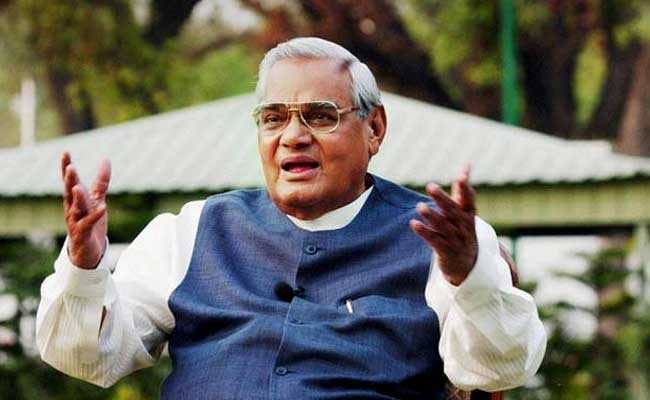
Image Source - https://www.ndtv.com/india-news/atal-bihari-vajpayee-health-updates-former-prime-minister-critical-1901050

In this article, Hardeep Singh of Campus Law Centre discusses Legislative Reforms introduced by Atal Bihari Vajpayee during his tenures as the Indian Prime Minister.

“Empowering the individual means empowering the nation, and empowerment is best served through rapid economic growth with rapid social change”.

These lines by Bharat Ratna, Late Atal Bihari Vajpayee clearly reflect the ideology and the nature of reforms brought in by him for development of the country. He did not only improved the economy of India by introducing economic reforms but also introduced social reforms for the upliftment of marginalised sections of the society. His focus was to unlock India’s economic potential and ensuring India’s presence in the global competitive market. He was one of the finest Statesmen of the country and the first non-congress Prime Minister who completed a full five years tenure as the Prime Minister.

Reforms in the Energy Sector

The Indian Power Sector was under monopoly of the State in the early 1990s. The stepping stone for all power sector reforms were laid down by the Vajpayee government by introducing the Electricity Act, 2003 which consolidated the laws relating to generation, transmission, distribution and use of electricity. The Act was aimed at creating a market based regime in the power sector in India by promoting competition. It served the purpose of protecting the interest of consumers and supplying electricity to the whole nation.

With the enforcement of this Act, the Single Buyer model was changed to a Multi Buyer model. Opening up of power sector to private companies provided a tremendous potential for investment in generation, transmission and distribution of electricity resulting in improvement of infrastructure which led to strengthening of the Indian Power Sector.

Creating a market based regime led to an environment where the monopolies enjoyed by the State Electricity Board (SEB’s) for buying/selling power ceased to exist, further leading to a market determined tariff structure.

Introduction of Value Added Tax

Value Added Tax (VAT) was introduced during his tenure as the Prime Minister and came into force a little after his tenure as was agreed by the States. It was an indirect tax which replaced the general sales tax and was comparatively lower than the rate of sales tax. It has been a major source of revenue for all Indian States and Union Territories.

It helped the traders due to its uniform tax rates and also provided for self assessment, which reduced the need for a taxpayer to frequently visit a Tax Department Officer.

The law brought in the concept of Input Tax Credit, which put an halt to the practice of imposing tax over tax, which in return reduced the prices of the goods that the consumers had to pay. It also benefited the government as the traders were conducting self assessments which led to saving of resources, and the revenue department focused more on collection of tax rather than the administrative processes.

Not only did he introduce VAT but also made the first move towards the landmark tax reform of GST. A report was given by a task force constituted by the Vajpayee government suggesting that Central and State levies should be merged into one as Goods and Services Tax (GST).

Reforms in Public Sector Undertaking: Privatisation Policy

During his tenure, he aimed at further enforcing the privatisation policies introduced in 1991. He was an advocate for private businesses in the country and worked towards reducing the government’s involvement in various industries. The government sold its share in 32 companies controlled by the State. The first public company that was fully disinvested in the tenure of Atal Bihari Vajpayee was Lagan Jute Machinery Company Limited (LJMC).

Two Public Sector service providers were privatised in 2000-2001. International long distance business, which was the monopoly of public sector, was opened, de-regularized and unrestricted entry of competitors was permitted in 2002-2003. Further, he formed a separate disinvestment ministry. The most important disinvestments made by the newly established ministry were Bharat Aluminium Company (BALCO), Hindustan Zinc, Indian Petrochemicals Corporation Ltd. and Videsh Sanchaar Nigam Limited (VSNL).

Reforms in Economic Policies

Introduction of Fiscal Responsibility and Budget Management Act, 2003

Around the year 2000, one of the major macroeconomic problems that the country was facing was high fiscal deficit. This problem led to inflation, reduced consumption and raise in unemployment. To curb this problem, the Vajpayee Government introduced a major economic reform, i.e. the enactment of Fiscal Responsibility and Budget Management Act, 2003. The aim of this Act was to institutionalize financial discipline, reduce India’s fiscal deficit, improve macroeconomic management and remove the revenue deficit of the country.

Some of the objectives of FRBM Act are as follows:

  1. To bring in a transparent fiscal management systems in the country.
  2. To have an equitable and manageable distribution of India’s debt.
  3. To give flexibility to the Reserve Bank of India for managing inflation in India.

Due to the introduction of this Act during the Vajpayee government tenure, public sector savings surged from 0.8% of GDP in the year 2000 to 2.3% in the year 2005.

The aim to enact such a law was to keep the fiscal deficit under 3 percent. Even though the successive governments were unable to bring the fiscal deficit down to 3 percent due to international crisis, this Act still brought more responsibility and accountability on part of the government.

Introduction of Prevention of Money Laundering Act, 2002

The Prevention of Money Laundering Act was brought in by the Vajpayee government as well in the year 2002. The Act incorporated the Political Declaration adopted by the Special Session of the UN General Assembly, 1999 in the Indian legal system. The main objectives of this Act are as follows:

  1. To prevent and control money laundering in India
  2. To confiscate and seize the property obtained from the laundered money
  3. To deal with any issue connected with money laundering in India

The purpose for introducing the Act was to set out certain procedures, law and regulations to stop the practice of generating income through illegal actions. For this purpose, a Financial Intelligence Unit was set up by the government responsible for receiving, processing and analyzing information relating to suspected financial transactions.

Infrastructure Reforms

The Vajpayee government launched two projects to improve the infrastructure in India. These projects were Pradhan Mantri Gram Sadak Yojana which was launched in the year 2000 and National Highway Development Project which was initiated in the year 2001. These two projects played an important role in boosting the real estate sector, increased business and commerce and improved rural economy which further led to improvement in the GDP of the nation.

National Highway Development Project

The purpose of this project was to build a Golden Quadrilateral i.e., a network of highways connecting major industrial and agricultural centers of India. It was the largest highway project in India and the first phase of the project consisted of 5,846 km of four/six lane express highways which was completed in 2012.

Pradhan Mantri Gram Sadak Yojana

The purpose of this scheme was to build all weather roads which will connect to all the unconnected villages. 82% of the villages have been already connected by December 2017 and remaining work is in progress and is on track for completion by March 2019.

By introducing new economic reforms, he took India to new heights. Under his tenure, India was able to maintain a GDP rate of 8%, inflation level came down to 4% and foreign exchange reserves increased.

Reforms in Telecom Sector

Vajpayee government, with the introduction of new telecom policy, brought a revolution in the Indian telecom sector. The policy replaced fixed license fees for telecom firms with a revenue sharing arrangement. With this, he paved the way for structural reforms in this sector, which led to an unprecedented growth of mobile subscribers and introduction of competition, followed by the amendment in Telecom Regulatory Authority of India Act, 1999. After the new telecom policy was implemented in 1999, it allowed mobile service company to provide services on revenue share basis instead of fixed fees that the mobile service providers had to pay for providing mobile services.

An Overview of Telecom Regulatory Authority of India (Amendment) Act, 2000  

Before the amendment, TRAI exercised both regulatory and dispute resolution functions. However, the amendment Act established the Telecom Dispute Settlement Appellate Tribunal to deal with the dispute resolution. The amendment act classified TRAI’s functions into four main categories:

  1. Make recommendations on various issues relating to telecom sector.
  2. Give it general administrative and regulatory powers,
  3. Give it the power to fix tariffs and rates for telecom services,
  4. Any other functions entrusted by the Central Government.

IT Sector Reforms

He gave great emphasis on the importance of technology in preparing India for the millennium. From 1999 to 2004, he made various attempts to change and facilitate the rise of Indian Information Technology sector. The IT industry in 1999-2000 was unsteady at around $6 billion which is now an industry of more than $150 billion.

Another important reform brought by him was setting up of Special Economic Zones (SEZs). SEZs were intended to provide a comprehensive infrastructure at one place for export production, such as procurement of duty free equipment, raw material, components, etc. This resulted in improving the competitiveness of Indian IT exports.

Conclusion

Late Sh. Atal Bihari Vajpayee bridged the two cliffs of thought i.e., the right wing and the left wing. It was his conciliatory approach that during his second term as the Prime Minister, he ordered nuclear tests in May 1998, which was considered as a strategic masterstroke to blunt Pakistan’s nuclear ambitions. However, we have also witnessed his soft spoken strength when he did not stop his peace talks with Pakistan to resolve the issue of Kashmir. The same conciliatory approach and bold nature of Atal Bihari Vajpayee can be witnessed when he called a special session of Parliament in the middle of the India-China War in 1962.

Download Now

Amity University Madhya Pradesh (AUMP) organises its 2nd edition of National Moot Court Competition 2018

0
Consumer Protection and Motor Vehicles Act

Amity University Madhya Pradesh is organising its second edition of National Moot Court Competition 2018. The moot will be held on 7th and 8th September, 2018 at Gwalior.  The teams can register themselves by sending the filled registration form and demand draft to the organisers on or before 20th August 2018. The entry fee is INR 3000/-.

The area of law of moot problem is ‘Terrorism’. Dr. Sandeep Kulshreshtha of Amity University, Madhya Pradesh has framed the moot problem.

The organising committee consists of Ms. Anu Bhatnagar (Head Student coordinator), Ms. Nomita Mishra (Head Student coordinator), Harshit Sharma (Student Coordinator), Raj Kishor, Rohit Bansal, Shivangi Jain, Nidhi Maheshwari, Sajal Gupta, Sujal Gupta, Arpita Ghodke, Supriti Bhargava, Netraa Singh, Sarthak Pathroliya, Bhumi Sharma.

The prize for winners are prizes worth 5000/- INR will be given to winners of event by way of gift coupon, Winner – 2500/- INR, Runner-up- 1500/- INR, Second Runner-up- 1000/- INR, cash coupon worth Rs. 200/- INR each to all participants of event.

Every year the university organizes one Intra and one National and International Level (Amity Dubai) Moot Court Competition. Last year’s moot court competition was a huge success and teams from all over the country had participated. Their participation and co-operation raised the level of competition.

The winner for the 1st edition of the Moot Court competition was Christ University (Bangalore) and the Runner-up was UPES Dehradun.

Some of the teams, which participated in the 1st edition of the competition, were Amity Lucknow, UPES Dehradun, Christ College, Amity Jaipur, and Amity Dubai.

For further details please contact:

Dr. Sandeep Kulshrestha, Phone: 8964882928, Email: [email protected]

Anu Bhatnagar, Head Moot Court Committee, Phone:  9753434331; Email: [email protected]


Download Now

7 Most Common Contracts Lawyers Have To Draft

0

common contractWhat are the common contracts a lawyer must draft?

We all know that drafting is quintessential aspect of every lawyer’s skill sets. They must learn how to draft petitions, applications, notices, etc. But contract drafting is often attributed to the skills of lawyers at law firms or in-house counsels.

All lawyers must learn how to draft contracts, early in their career. It not only helps in increasing your clientele, it helps you supplement your income as well as lead to better prospects. Read this article, to know why young advocates must learn how to draft contracts.

So while you learn and earn, many times you will get all sorts of clients with different requirements. You may need to advise on employment issues, or, tenancy issues, etc. In order to do that, you must be familiar with the contracts of different nature. To be able to interpret contracts is only one aspect, you must be able to create one as well.

There are several kinds of contracts depending upon your area of expertise like commercial contracts, general contracts, intellectual property contracts, technology contracts, e-commerce contracts, etc. These require specialised knowledge of contract drafting which can be inculcated by doing a contract drafting course.

The common contracts a lawyer may need to draft are as follows:

  • Confidentiality and Non-Disclosure Agreement/ Non-Circumvention

NDAs are generally signed when two companies, individuals, or other entities (such as partnerships, societies, etc.) are considering doing business. The idea is that they  need to understand the processes used in each other’s business for the purpose of evaluating the potential business relationship. But so that one doesn’t use the information so shared for the detriment of the other party.

NDAs can be mutual as well as for single party use. For instance, and employee may be asked to sign an NDA with his employer. In fact, some employment agreements will include a clause restricting employees’ use and dissemination of company-owned confidential information. Sometimes, there are confidentiality agreements signed whenever there is settlement of legal dispute between the parties.

You can refer a sample NDA here.

  • Memorandum of Understanding

A memorandum of understanding (MoU) is a type of agreement between two (bilateral) or more (multilateral) parties. It expresses a convergence of will between the parties, indicating an intended common line of action. It is often used in cases where parties either do not imply a legal commitment or in situations where the parties cannot create a legally enforceable agreement. It becomes binding only when the essentials of contract is added to it, like offer, acceptance, consideration, intention, etc.

You can download a sample of MoU from here.

  • Leave and License Agreement

One of the most common agreements is the leave and license agreement. It is an instrument/agreement wherein the licensor allows the licensee to temporarily occupy and use one portion of an immovable property for carrying on his business for residential purposes.

The licensor grants the leave and license to the licensee for a minimum period of 11 months and for this, in lieu of license fee/rent money. This agreement has to be mandatorily registered before the sub-registrar of assurances at the place of jurisdiction where the property is located.

Generally, in case of letting out spaces for rent for residential or business purpose, owners enter into such an agreement with the prospective party. In most cities, for short term period such agreements are entered into and renewed as needed.

You can refer to the sample of the agreement here.

  • Lease Deed

The legal definition of a lease is provided for under Section 105 of the Transfer of Property Act. A lease is a transfer of a right to enjoy a property made for a certain time in exchange for an amount of money or a service or any other thing of value to be given periodically such as price paid or promised or of money, a share of crop, service or any other thing of value to be rendered periodically or on specific occasion to the Lessor by the Lessee who accepts the transfer on such terms.

Lease gives the lessee right of possession for a longer duration for a lump sum payment or monthly rental fees. For instance X leases a property from Y, in lieu of a specific consideration. Then X becomes the lessee and Y is the lessor. They are both bound by the rights and obligations laid out in the lease deed.

You can learn how to draft a lease deed by reading more about it. You can refer the sample agreement here.

  • Partnership Agreement

In case of an enterprise for profit between two or more people, a partnership agreement may be entered into. The agreement defines the nature of the business, the capital contributed by each party, the rights and obligations of parties, the share of profit/loss of each party, etc.

In a partnership, the partners are liable jointly and severally for all profit/loss, unlike in any other setup. For instance, if the debt incurred is more than the resources at the business, then as per the terms of the agreement, partners will be personally liable for the same. Their personal properties can be attached by the courts for the repayment of such debts.

The registration of a partnership deed in India is not mandatory, unless the firm is being registered.

You can refer to the sample here.

  • Employment Agreement

An employment contract or is signed between an employer/ company and an employee. The employment agreement contains specific provisions like joining date, office location,etc., to the terms and conditions of the employment, like compensation, holidays, working hours, etc. The rights and obligations of the employee are also laid down in form of terms and conditions to which the employee is legally bound upon signing the agreement.

For instance, if an employee’s work invents a product during his tenure with the company, then the company may own it, provided it is clearly mentioned in the employment agreement.

You may refer to the sample agreement here.

  • Contract of Sale

Section 4(1)  of the Sale of Goods Act, defines the contract of the sale as  follows-

“A contract of the sale of goods is a contract whereby the seller transfers or agrees to transfer the property in goods to a buyer for a price.”

The contract of sale specifies the nature of the transaction, description of goods, mode of delivery of goods, mode of payments, rights and obligations, warranties by the parties, termination, etc.  For instance, A has entered into contract of sale with B, for the sale of 10,000 units of books in lieu of payment through NEFT mode of payment. Now as per the terms of the agreement, the payment cannot be made by cash or cheque, or it can be ascertained to be a breach of contract.

To know more about the essential clauses in a contract of sale and its sample, you can refer to this article here.

The clients for the common contracts are both easy to come by to the lawyers and good for their practice. The benefits of contract drafting for lawyers is immense. It can help supplement their incomes to increase their clientele and knowledge of law. There is a necessity for the lawyers to learn contract drafting. They can work with law firms, or in-house legal departments to learn the same or they can do contract drafting course. The idea is to learn to draft the contracts at the early stages of their practice to gain the maximum out of it.

Good luck

Download Now

The interplay between Payment of Wages Act, Delhi Shops and Establishment Act and Factories Act

0
compensation definition
Image Source - https://bit.ly/2qgWbOe

In this article, Naba Khan of Aligarh Muslim University discusses the interplay between the Payment Of Wages Act, Delhi Shops And Establishments Act And Factories Act.

Introduction

The Industrial Laws deal with the labour and employment in India. These laws deal with the issues in the complex relations between the workers, employers and government, determining the employment period, time and conditions for payment, conditions of the workers, etc.

The Indian labour law divides the industries into two broad categories as factories and the shops and commercial establishments.

The Factories Act, 1948

All the factories that employ 10 or more workmen or were working on any day of the preceding twelve months, and carry out manufacturing activities with the aid of power are dealt by the provisions of the Factories Act. Adding to it, in the case where the factories employ 20 or more workers, or were working on any day of the preceding 12 months, and in any part of which a manufacturing process is being carried on without the aid of power, are also governed with the provisions of the Factories Act.

The Act is enforced by the State Government through their Factory Inspectorates’.

It emphasizes the welfare, health and safety of workers. The said Act also provides specific safeguards against use and handling of hazardous substance by occupiers of factories and laying down of emergency standards and measures.

Shops and Commercial Establishments

‘Shops and Commercial Establishments Act’ regulate the shops and establishments in their respective state as it is a state statute. This Act generally provides for opening and closing hour, leave, weekly off, time and mode of payment of wages, issuance of appointment letter etc. As all the States have their own Shops and Establishments Act, herein we have dealt with the Delhi Shops and Establishments Act.

The Delhi Shops And Establishments Act, to the whole of Union Territory of Delhi including the Municipal Areas, Notified Areas and Cantonment limits of Delhi, Shahadra, Civil Lines, Mehrauli, Red Fort and Delhi Cantonment but Government may, by notification in the Official Gazette, as per Section 1(4).

Payment of Wages Act

It applies to the payment of wages of the workmen in any factory or in any railway administration or workmen employed in an industry or any other establishment as specified in of Section 1(4) of the Act.

Interplay

Time and Payment of Wages

Section 19 of the Delhi Shops and Establishments Act and Section 5 of The Payment of Wages Act enumerate laws related to the time and condition for the payment of wages.

Section 19 lays down that the employer shall pay the wages of the employee before the expiry of 7th working day of the wage period such wage period shall not be more than a month. On the same note Section 5 of the PWA lays down that employer shall pay the wages of the workers employed in an industry or factory before the 7th working day and before the expiry of 10th working day in case such establishment employees more than a thousand workers.

Payment of wages for leaves and holidays

As per Section 79 of The Factories Act Workers are given the leaves with wages, an adult at the rate of one day for every 20 days of work and a child one day for every 15 days of work, provided that they have worked for at least for 240 days in a calendar year. In calculating leave under The Factories Act fraction of leave of half a day or more shall be treated as one full day’s leave and fraction of less than half a day shall be omitted.

Further, the worker shall be entitled to wages at a rate equal to the daily average of his total full time earnings for the day on which he actually worked during the months immediately preceding his leave, excluding the overtime and bonus but including the dearness allowance. Where worker has not worked on any day in the preceding month of the leave, he will be paid at the rate which is equivalent to daily average of his total full time earning of the days he worked.

However, in case of a worker working in a shop or any establishment, according to Section 23 of the Delhi Shops and Establishments Act, every employee shall be paid for the period of his leave at a rate equivalent to the daily average of his wages for the days on which he actually worked during the preceding three months, exclusive of any earnings in respect of overtime but inclusive of dearness allowance.

Deductions from Wages

Section 7 to Section 13 of The Payment of Wages Act talks about:

List of deductions for which rules are provided in the act

I. For imposing fines on the employees.
II. For deducting wages for absence from duty
III. For deducting wages for payments to cooperative societies and insurance schemes
IV. For deducting wages for damage or loss
V. Fo deducting wages for house accommodation and services rendered
VI. For deducting wages for recovery of loans
VII. For deducting for recovery of advances

Adding to it, under the Delhi Shops and Establishments Act, the deductions mentioned in the list above (under The Payment of Wages Act) have been added including some further provisions related to the deduction:

  • Deductions of income-tax payable by the employed person;
  • Deductions required to be made by order of a Court or other competent authority;
  • Deductions for subscription to, and for repayment of advances from, any provident fund to which the Provident Fund Act, 1952 applies or any recognized provident fund as defined in section 2(38) of Income Tax Act, 1961 or any provident fund approved in this behalf by the Government during the continuance of such approval;
  • Deductions for payment to co-operative societies or to a scheme of insurance approved by the Government.

The Delhi Shops and Establishments Act, 1954 and The Factories Act, 1948

Restriction on double employment

Section 19 of the Delhi Shops and Establishments Act and Section 60 of the Payment of Wages Act deals with the same aspect for the restrictions on double employment of the employees:

“No person shall work about the business of an establishment or two or more establishments or an establishment and a factory in excess of the period during which he may be lawfully employed.”

Spread over

Section 11 of the Delhi Shops and Establishments Act lays about spread over. Any adult person shall not spread over for more than ten and a half hours in any commercial establishment or for more than twelve hours in any shop.

According to Section 56 of the Factories Act, the periods of work of an adult worker in a factory shall be so arranged that inclusive of his intervals for rest, they shall not spread over more than ten and a half hours in any day.

Employment of young person-hours of work

Section 13 of the Delhi Shops and Establishments Act, provides that no young person shall be allowed to work in any establishment for more than six hours a day.

According to Section 71 of the Factories Act, no child shall be employed or permitted to work, in any factory for more than four and a half hours in a day and during the night.

Prohibition of employment of children

Section 12 of the Delhi Shops and Establishments Act and Section 67 the Factories Act states that no child shall be required or allowed to work whether as an employee or otherwise in any establishment.

However, the definition of the Factories Act “child” means a person who has not completed his fifteenth year of age while the term “child” under the Delhi Shops and Establishments Act, means a person who has not completed his twelfth year of age;

Working hours for adults

Section 8 of the Delhi Shops and Commercial Establishment Act and Section 54 of the Factory Act states the same working hour of adults:

“No adult shall be employed or allowed to work about the business of an establishment for more than nine hours on any day or 48 hours in any week and the occupier shall fix the daily periods of work accordingly.”

Further, in the case of Section 15 of the Delhi Shops and Commercial Establishment Act, opening and closing hours of shops and commercial establishment states that:

“No shop or commercial establishment on any day, be opened earlier than such hour or closed later than such hour, as may be fixed by the Government by general or special order made in that behalf.”

Conclusion

The Factories Act and The Shops and Establishments Act both the Acts deal with the regulation of conditions of service of workers engaged. While the Factories Act is applicable to establishments wherein a manufacturing activity is carried out the Shops and Commercial Establishments Act is applicable to establishments which do not fall under the definition of factory, mine or plantations. The Factories Act is a central Act whereas the Shops and Commercial Establishments Act is a state Act and therefore, there are separate Shops Act for separate states.

However, the provisions of The Payment of Wages Act are duly applied to the contract labour employed by any factory or establishment in addition to the provisions of the other two respective Acts, provided that the employment in which they are engaged is otherwise covered by the Payment of Wages Act.

Download Now

How Minimum Wage is determined under the Minimum Wages Act of Delhi

0
labour law
Image Source - https://bit.ly/33eruaj

In this article, Prashant Sharma of IIMT & School of Law, G.G.S.I.P.U  discusses how minimum wages is determined under the Minimum Wages Act, 1948 in Delhi based establishments.

Introduction

The government stipulates the lowest wage to be paid to any employee keeping in mind the basic necessities, except for certain kinds of employment where less than a thousand people are employed in the entire state. Depending on the nature of the occupation, minimum wages may be determined by the State Government, in which case it will vary from state to state or by the Central Government. This is specified under the Minimum Wages Act.

The Minimum Wage Act, 1948 was passed with an objective to secure the welfare and the interest of the workers who are employed in certain establishments in order to be protected in the today’s competitive market. This Act helps the workers to prevent them from getting exploited by the employers or the management.  

To put it into the legal perspective, minimum wages includes:

  1. A basic rate of wages + a special allowance; or
  2. A basic rate of wages with or without the cost of living allowance and the cash value of the concessions; or
  3. An all-inclusive rate allowing for the basic rate, the cost of living allowance and the cash value of the concessions, if any.

As per Article 43 the Directive Principles of State Policy, the State shall endeavor to secure, by suitable legislation or economic organisation or in any other way, to all workers agricultural, industrial or otherwise, work, a living wage, conditions of work ensuring a decent standard of life and full enjoyment of leisure and social and cultural opportunities and, in particular, the State shall endeavour to promote cottage industries on an individual or co-operative basis in rural areas.

Criteria to fix Minimum Wages

In the year 1948, the Tripartite Committee on Fair Wages was appointed by the Central Advisory Council. The said committee had laid down a certain criterion for minimum wages. Such criterion provides 5 elements which have to be considered while fixing the minimum wages. These are as follows:

  1. 3 consumption units per earner;
  2. Minimum food requirement of 2700 calories per average adult;
  3. Cloth requirement of 72 yards per annum per family;
  4. House rent corresponding to the minimum area provided under the Government’s Industrial Housing Scheme;
  5. Fuel, lighting and other miscellaneous items of expenditure to constitute 20% of the total minimum wage.

Adding to it, the Appropriate Government have the power to fix the minimum rates of wages. It can fix the minimum rates of wages either: (see here)

  • by the hour; or
  • by the day; or
  • by the month or
  • by such large wage period as may be prescribed.

Section 3 and Section 5 of the Act talks about fixation of minimum wages and procedure of fixing the minimum wages respectively. As minimum wages includes many elements as mentioned above, it also includes industrial dearness allowances, for all the industrial employees which were covered under the Act.

How to find Minimum Wages

To know about the minimum wage of any worker in an establishment of a concerned State, kindly go to the official website of Labour Government. For instance the current minimum wage rate for the Union Territory of Delhi can be reached here.

Delhi Labour Department Notification

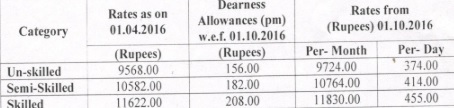
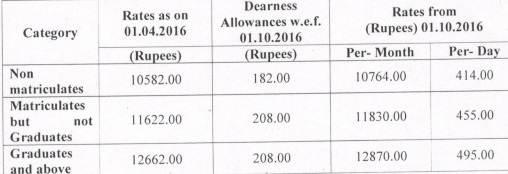
The Labour Department in 2016, have issued the revised minimum rate of wages for Delhi for the class of workmen/employees. To know about the minimum wage of any worker in an establishment of a concerned State, kindly go to the official website of Labour Government. For instance the current minimum wage rate for the Union Territory of Delhi can be reached here.

  • In order to calculate the daily wage, monthly gross salary is divided by 30, as the weekly offs are taken as the pay leaves. (The salary is to be divided by 30, irrespective of the actual number of days in a month).
  • However, in case of daily wages, the weekly offs are not counted as paid leaves and therefore, are paid only for 26 days.

Therefore, we can calculate it as follows:

Salary per month (Gross)/ 30 days in a month x No. of days present

Example: Rs.11,830/26 = Rs.455/- are the daily wages which can be multiplied by number of days he was working to find out his/her actual minimum wage he will get in hand.

Dearness Allowances

The Dearness Allowance (DA) is a cost of living adjustment allowance paid to Government employees, Public sector employees (PSE) and pensioners. It is payable to monthly, daily and piece rate earners. The respective State Governments issue the Cost Of Living Index number every six months for each and every scheduled employment.

The following formula is being used by the Central Government to calculate the dearness allowance for the Central Government Employees, after implementing the recommendations of the 7th Pay Commission, from July 1st 2016 onwards.

The formula is:

Dearness Allowance% = (Average of AICPIN for the past 12 months – 261.4) * 100 / 261.4
(see here)

AICPIN stands for the All India Consumer Price Index. Dearness allowance is calculated from the AICPIN value, once the AICPI(IW) for a particular month is published by the Government. AICPIN are issued by the Ministry of Labour and Employment, which are revised periodically. The site can be accessed here.

The dearness allowances are revised by the government twice a year. It was increased by the Central Government from 5% to 7% when was revised in January 2018 (see notification here).

Revised Rates of Variable Dearness Allowance by The Central Government

The minimum rates of wages include the basic rates and Variable Dearness Allowance. The revised rates of Variable Dearness Allowance on the basis of the average Consumer Price Index for Industrial Workers, for the workers employed in various jobs w.e.f. 01.04.2018 were specified in a notification by the Chief Labour Commission dated 4th April 2018 can be accessed as follows:

  • Industrial workers in agriculture (see here, page 1)
  • Industrial workers in mines (see here, page 2)
  • Industrial workers of construction and maintenance of roads or building operations (see here, page 3)
  • Industrial workers of stone mines (see here, page 4)
  • Industrial workers who are employed for Sweeping and Cleaning excluding the activities prohibited under the Employment of Manual Scavengers and Construction of Dry Latrines Prohibition Act 1993 (see here, page 6)
  • Industrial workers for watchman and ward (with or without arms) (see here, page 7)

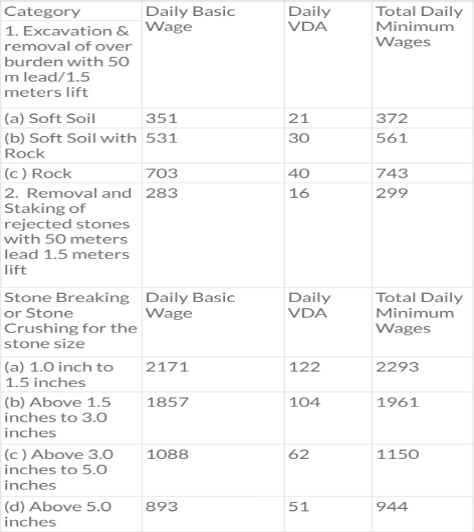
Revised Minimum Wage in Delhi, Gujarat, Chattisgarh, Tripura, West Bengal

The image shows a part of the table.

Image Source: https://clc.gov.in/clc/node/572.

The daily Basic Wage + Daily VDA = Total Minimum Wages

Maintenance of Register and Records

Every employer in an establishment shall maintain such registers and records giving such particulars of the wages paid to employees employed by him, the receipts given by them. (see here)

In cases of maternity relief

The maternity leave is awarded full pay on completion of at least 80 days in an establishment in the 12 months prior to her expected date of delivery. The maternity benefit is awarded at the rate of the average daily wage for the period of a worker’s actual absence from work. Apart from 12 weeks of salary, a female worker is entitled to a medical bonus of 3,500 Indian rupees.

However, the government has amended the Act in 2017, after which the duration of maternity leave has been increased from 12 to 26 weeks which can be availed prior to 8 weeks from the date of expected delivery (earlier it was 6 weeks prior). From third child onwards, maternity leave of 12 weeks will be available instead of 26 weeks, that could be availed 6 weeks prior.

In cases of worker who took leaves

Suppose, A is a person who is a semi-skilled worker in an XYZ Industry. He had worked for 20 days in a month and had taken 6 days leave. So, his minimum wages for a month should be:

Total Minimum Wage for one month – Minimum Wage for 6 days i.e.,

Rs. 10,764 – (Rs. 414 x 6)= Rs.8,280/-

(as per the 2016 Delhi Government notification)

Amendments in Delhi

The recent amendments in the Minimum Wage Act, 1948 were been made by the Delhi Assembly. The Minimum Wages (Delhi) Amendment Act, 2017,which is officially notified on May 4, 2018, has certainly proved to be beneficial for the employees (as under Section 2(i) of the Minimum Wage Act, 1948) against the acts of the employers when he provides wages less than minimum wages.

According to Section 22 of the amended Act, the punishment for an employer providing wages less than minimum wages is increased from 6 months to three years and/or the fine is increased from Rs. 500/- to up to 50,000/-.

Further, in the case of other States, an employer can be liable under Section 22 of the Minimum Wages Act, 1948. To know about the minimum wages for the other States, kindly refer to the recent amendments that have been made for the respective States.

Conclusion

Recently, the High Court of Delhi had quashed the Delhi Labour Department Notification of 2017 for revised minimum wage for all the industrial establishments situated at Delhi. One of the Judge. The High Court observed that the formation of the Minimum wage advisory committee under Section 5 and 9 of the Minimum Wage Act, 1948 is ultra virus. Further, the Court declared the act of revising the minimum wage was a “hurried action” taken by the Government of Delhi and the committee was not constituted a per the Act which is violative of Article 14 of the Constitution of India.

The consequence of this action was that from now on, the wages of the workers from unskilled to skilled ones shall be given as per the 2016 Labour Department notification which is quite low in comparison. Once again, the poor have to face the dramatic and drastic effect.

Download Now

RBI Requirements relating to Risk Management in Banks

0
International commercial arbitration

This article is written by Amit Garg of National University of Study and Research in Law, Ranchi. The author through this article brings out the requirements laid down by the RBI to deal with risks.

A bank is a place that accepts deposit and grants loan. A bank charges interest on the loans lent and pays interest on the deposits received. The difference in the interest received and interest paid is the source of income for the bank. Each country has large number of banks that conduct the function of accepting and lending money. But, a country has only one central bank that governs the functioning of all the banks situated within the country and regulate their business. In India, all the banks are regulated by the Reserve Bank of India (RBI). There are large number of activities performed by the RBI in order to regulate the economy of a country and the banks.

Some of the major activities performed by the Reserve Bank of India are as follows:

  • Issue of Bank Notes.
  • Banker to the Government.
  • Custodian of Cash Reserves of Commercial Banks.
  • Custodian of Foreign Exchange Reserves.
  • Lender to the Last Resort.
  • Central Clearance and Account Settlement.
  • Controller of Credit.

Types of Risks

The risks that the bank faces can be broadly classified as:

  1. Credit risk
  2. Market risk
  3. Interest rate risk
  4. Liquidity risk
  5. Operational risk

In order to deal with these risks that the banks have been surrounded by, the Reserve Bank of India provides for some guidelines that needs to be followed by the banks. These guidelines help in better dealing with the risk concerned and will help in the progress of the economy. Each risk has been discussed below.

Credit Risk

Lending money to any other individual involves risk as to the return of the amount lent. The risk so associated with lending of money is known as credit risk. Credit risk, in simple words can be explained as unwillingness of a person to pay the amount borrowed from the bank which exposes the bank to a risk of loss. In addition to the risk involved in lending money, banks are exposed to the risk of the interest amount, forex and country risks. A significant magnitude of credit risk is inherent in investment banking. Investment banking is when the banks decide to invest a particular sum of money for a particular purpose.

Market Risk

Market risk arises from adverse changes in various market variables like currencies, interest rate instruments, equities, commodity price, etc. These factors play a vital role in functioning of the economy and effects the economy at both the level, i.e., macro and micro. The changes in these variables is very volatile, therefore, RBI needs to step up to maintain soundness of the banks.

There are two types of market risk:

  1. Foreign Exchange Risk – It is that risk where bank may suffer losses as a result of adverse exchange rate movements in a small period of time.
  2. Equity Price Risk – It is a financial risk which arises from holding equity in particular investment.

Interest Rate Risk

Interest Rate Risk arises when there is potential impact on the Net Interest Margin by unexpected changes in the interest rates. It can be expressed in two ways:

  • Its impact on the earnings of the bank.
  • Its impact on the economic value of the bank’s assets, liabilities and Off-Balance Sheet positions.

Liquidity Risk

A bank faces liquidity risk when it does not have enough cash in hand to meet its daily requirements. This may arise due the bank lending all the money they have as loans. It also arises when the bank funds long term assets from short term liabilities. Various ratios adopted by banks to evaluate the liquidity of the banks are (1) Loans to Total Assets, (2) Loans to Core Deposits, (3) Purchased Funds to Total Assets, and (4) Large Liabilities (minus) Temporary Investments to Earning Assets (minus) Temporary Investments.

Operational Risk

Basel Committee defines operational risk as the “risk of change in value caused by the fact that actual losses, incurred for inadequate or failed internal processes, people and systems or from external events (including legal risk), differ from the expected losses”. These risks are not willingly incurred and nor are they revenue driven.

Guidelines by the RBI

The activities that the commercial banks undertake which includes financial intermediation, has a lot of risk factor which may be financial or non-financial directly affecting the normal functioning of a bank. The factors affecting the functioning of the banks are credit, interest rate, foreign exchange rate, liquidity, etc. In order to reduce the risk raised by these factors and ensure proper functioning of the banks, Reserve Bank of India attaches considerable importance to improve the ability to identify and tackle such risks. RBI has laid down guidelines that the commercial banks must follow in order to avoid the danger of loss caused by various risks as mentioned above. The guidelines as provided by the RBI for Risk Management are discussed below.

Credit Risk Management

The management of credit risk is of foremost importance and the banks must lay special emphasis on its management. The banks must articulate the management of credit risk in their Loan Policy. The guidelines in order to deal with the credit risk are:

  • Measurement of risk through credit rating/scoring. Banks must have a comprehensive credit scoring system that shall take into consideration diverse risk factors and result in a single point indicator of credit worthiness.
  • Quantifying the risk through estimating expected losses, i.e., the amount of loss a bank shall endure in a specific time period.
  • Risk pricing on a specific basis. Banks must evolve a scientific system to price the risk where the person with weak financial position is priced higher than the person with good financial position.
  • Controlling the risk through effective Loan Review Mechanism (LRM). Loan Review Mechanism evaluates the quality of loan book and brings about qualitative improvements in credit administration. The main objectives of LRM are:
    1. to identify the loans that possess credit weakness and to take corrective action.
    2. provide information related to the adequacy of loan loss provision.
    3. to isolate the potential problem areas.
    4. to assess the adequacy of and adherence to, loan policies and procedures, and to monitor compliance with relevant laws and regulations.
    5. to provide top management with information on credit administration, including credit sanction process, risk evaluation and post-sanction follow-up.
  • A Credit Policy Committee must be formed in order to analyse and control the risk.
  • Bank must develop a suitable framework in order to report and evaluate the quality of credit decision taken by the functional groups.
  • In case of investing an amount for a particular purpose, the banks must subject such approval to same degree of credit analysis as to that of loans.
  • Portfolio Management is a technique that enables us to gauge asset quality. It is very helpful in determining the non- performing loans and much efficient than the older system of checking the same through balance sheet.

Inter-Bank Exposure

Each bank is exposed to a certain degree of risk and in order to maintain a check on each bank, a centralized overview of the aggregate exposure on other banks must be evaluated as this shall help in proper estimation of the current economic conditions and thus a better planning towards the risk that a particular bank may face. The exposure limit can be set up for each of the banks based upon an assessment that shall take into consideration financial performance, operating efficiency, management quality, past experience, etc.

Cash Reserve Requirements

In order to maintain liquidity with the banks and to prevent them from running out of cash or liquidity risk, the Reserve Bank of India has laid down certain requirements that the banks must fulfill to remain afloat. These requirements are:

  • Cash Reserve Ratio – Cash Reserve Ratio is certain amount of total deposit that the banks are asked to park them with the RBI. These deposits with the RBI carry no interest. This a measure by which banks will not have to look for other sources in times of cash crunch and they and utilize their own savings.
  • Statutory Liquid Ratio – Statutory Liquid Ratio is that requirement for the commercial banks where they have to keep a certain percentage of the total deposits with themselves in form of cash, gold reserves, government securities, etc. which is not available to general public for the purpose of loan.

Prudential Limits

There are certain prudential limits that the banks must place in order to avoid liquidity crisis. Some of the limits are:

  • Cap on inter-bank borrowings, especially call borrowings
  • Purchased funds vis-à-vis liquid assets
  • Core deposits vis-à-vis Core Assets i.e. Cash Reserve Ratio, Liquidity Reserve Ratio and Loans
  • Duration of liabilities and investment portfolio
  • Maximum Cumulative Outflows. Banks should fix cumulative mismatches across all time bands
  • Commitment Ratio tracks the total commitments given to corporates/banks and other financial institutions to limit the off-balance sheet exposure
  • Swapped Funds Ratio, i.e. extent of Indian Rupees raised out of foreign currency sources.

Fund Transfer Pricing

Fund Transfer Mechanism is a process designed to assess the financial impact of different sources of funds that will be helpful in evaluating profitability. It analyses the cost of various funds available in the market and helps in ascertaining of profits which shall help in reducing risk of unfavourable returns or even losses. FTP works by assigning various assets and liabilities to the functional units. As each unit attracts a source of fund, this helps in evaluating the cost of each source of fund and the return each funding source shall provide.

Operational Risk Management

Operational Risk can sometimes become handy. In order to escape from the risk associated with the operations of the bank, the banks must regularly conduct internal control (segregation of duties, clear management reporting lines and adequate operating procedures) and internal audit. The banks can utilize contingent processing capabilities to reduce the impact of operational risk. The banks must regularly develop policies and procedures that help in combating operational risk and the policies should address product review process, involving business, risk management and internal control functions.

Capital Adequacy

In order to maintain long term soundness of the banks, the banks must evaluate their capital adequacy based on the economic risk that surrounds the bank. While considering the economic risk, the banks must take account of both the qualitative and quantitative factors. They must take care of internal as well as future capital needs apart from established minimum capital requirements.

Conclusion

There are a lot of risks that the banks come across throughout the period of their functioning. In order to effectively come over these risks and to maintain sound functioning, the banks must follow the guidelines provided by the RBI. These guidelines are not binding on the banks but if they follow the guidelines, they will definitely gain positive results as the economic environment is uncertain and dynamic. The RBI in order to cope with the dynamic environment keeps on releasing notifications that provides for new guidelines to tackle the risks posed by the changing environment.

Download Now

List of Punishments under the Companies Act, 2013

1
Punishments under the Companies Act

This article is written by Amit Garg of National University of Study and Research in Law, Ranchi. The author through this article brings out the punishments as specified in the Companies Act, 2013.

The Companies Act, 2013 was incorporated by the Parliament of India, which repeals the earlier act (The Companies Act, 1956), came into effect to regulate the incorporation and functioning of a company, its directors and its dissolution. The Act came into Official Gazette on 12 September 2013.

Punishments under the Companies Act

The Companies Act of 2013 lays down various punishments be it on the directors, employees or even on the company itself in case of any activities that are in contravention with the rules of the Act. Some of the provisions that specifies punishments under the Act are mentioned below.

Section 4(5)

Section 4(5)(ii) of the Act says that “Where after reservation of name under clause (i), it is found that name was applied by furnishing wrong or incorrect information, then,— (a) if the company has not been incorporated, the reserved name shall be cancelled and the person making application under sub-section (4) shall be liable to a penalty which may extend to one lakh rupees; (b) if the company has been incorporated, the Registrar may, after giving the company an opportunity of being heard— (i) either direct the company to change its name within a period of three months, after passing an ordinary resolution; (ii) take action for striking off the name of the company from the register of companies; or (iii) make a petition for winding up of the company.”

Section 15

Section 15(2) of the Act says that “If a company makes any default in complying with the provisions of sub-section (1), the company and every officer who is in default shall be liable to a penalty of one thousand rupees for every copy of the memorandum or articles issued without such alteration.”

Section 16

Section 16(3) of the Act says that “If a company makes default in complying with any direction given under sub-section (1), the company shall be punishable with fine of one thousand rupees for every day during which the default 33 continues and every officer who is in default shall be punishable with fine which shall not be less than five thousand rupees but which may extend to one lakh rupees.”

Section 17

Section 17(2) of the Act says that “If a company makes any default in complying with the provisions of this section, the company and every officer of the company who is in default shall be liable for each default, to a penalty of one thousand rupees for each day during which such default continues or one lakh rupees, whichever is less.”

Section 26

Section 26(9) of the Act says that “If a prospectus is issued in contravention of the provisions of this section, the company shall be punishable with fine which shall not be less than fifty thousand rupees but which may extend to three lakh rupees and every person who is knowingly a party to the issue of such prospectus shall be punishable with imprisonment for a term which may extend to three years or with fine which shall not be less than fifty thousand rupees but which may extend to three lakh rupees, or with both.”

Section 36

Section 36 of the Act says that “Any person who, either knowingly or recklessly makes any statement, promise or forecast which is false, deceptive or misleading, or deliberately conceals any material facts, to induce another person to enter into, or to offer to enter into,— (a) any agreement for, or with a view to, acquiring, disposing of, subscribing for, or underwriting securities; or (b) any agreement, the purpose or the pretended purpose of which is to secure a profit to any of the parties from the yield of securities or by reference to fluctuations in the value of securities; or (c) any agreement for, or with a view to obtaining credit facilities from any bank or financial institution, shall be liable for action under section 447.”

Section 38

Section 38 of the Act says that “(1) Any person who— (a) makes or abets making of an application in a fictitious name to a company for acquiring, or subscribing for, its securities; or (b) makes or abets making of multiple applications to a company in different names or in different combinations of his name or surname for acquiring or subscribing for its securities; or (c) otherwise induces directly or indirectly a company to allot, or register any transfer of, securities to him, or to any other person in a fictitious name, shall be liable for action under section 447. (2) The provisions of sub-section (1) shall be prominently reproduced in every prospectus issued by a company and in every form of application for securities. (3) Where a person has been convicted under this section, the Court may also order disgorgement of gain, if any, made by, and seizure and disposal of the securities in possession of, such person. (4) The amount received through disgorgement or disposal of securities under subsection shall be credited to the Investor Education and Protection Fund.”

Section 39

Section 39(5) of the Act says that “In case of any default under sub-section (3) or sub-section (4), the company and its officer who is in default shall be liable to a penalty, for each default, of one thousand rupees for each day during which such default continues or one lakh rupees, whichever is less.”

Section 40

Section 40(5) of the Act says that “If a default is made in complying with the provisions of this section, the company shall be punishable with a fine which shall not be less than five lakh rupees but which may extend to fifty lakh rupees and every officer of the company who is in default shall be punishable with imprisonment for a term which may extend to one year or with fine which shall not be less than fifty thousand rupees but which may extend to three lakh rupees, or with both.”

Section 42

Section 42(10) of the Act says that “If a company makes an offer or accepts monies in contravention of this section, the company, its promoters and directors shall be liable for a penalty which may extend to the amount involved in the offer or invitation or two crore rupees, whichever is higher, and the company shall also refund all monies to subscribers within a period of thirty days of the order imposing the penalty.”

Section 53

Section 53 of the Act says that “(1) Except as provided in section 54, a company shall not issue shares at a discount. (2) Any share issued by a company at a discounted price shall be void. (3) Where a company contravenes the provisions of this section, the company shall be punishable with fine which shall not be less than one lakh rupees but which may extend to five lakh rupees and every officer who is in default shall be punishable with imprisonment for a term which may extend to six months or with fine which shall not be less than one lakh rupees but which may extend to five lakh rupees, or with both.”

Section 56

Section 56(6) of the Act says that “Where any default is made in complying with the provisions of sub-sections (1) to (5), the company shall be punishable with fine which shall not be less than twenty-five thousand rupees but which may extend to five lakh rupees and every officer of the company who is in default shall be punishable with fine which shall not be less than ten thousand rupees but which may extend to one lakh rupees.”

Section 57

Section 57 of the Act says that “If any person deceitfully personates as an owner of any security or interest in a company, or of any share warrant or coupon issued in pursuance of this Act, and thereby obtains or attempts to obtain any such security or interest or any such share warrant or coupon, or receives or attempts to receive any money due to any such owner, he shall be punishable with imprisonment for a term which shall not be less than one year but which may extend to three years and with fine which shall not be less than one lakh rupees but which may extend to five lakh rupees.”

Section 59

Section 59(5) of the Act says that “If any default is made in complying with the order of the Tribunal under this section, the company shall be punishable with fine which shall not be less than one lakh rupees but which may extend to five 50 lakh rupees and every officer of the company who is in default shall be punishable with imprisonment for a term which may extend to one year or with fine which shall not be less than one lakh rupees but which may extend to three lakh rupees, or with both.”

Section 60

Section 60(2) of the Act says that “If any default is made in complying with the requirements of sub-section (1), the company shall be liable to pay a penalty of ten thousand rupees and every officer of the company who is in default shall be liable to pay a penalty of five thousand rupees, for each default.”

Section 64

Section 64(2) of the Act says that “If a company and any officer of the company who is in default contravenes the provisions of subsection (1), it or he shall be punishable with fine which may extend to one thousand rupees for each day during which such default continues, or five lakh rupees, whichever is less.”

Section 67

Section 67(5) of the Act says that “ If a company contravenes the provisions of this section, it shall be punishable with fine which shall not be less than one lakh rupees but which may extend to twenty-five lakh rupees and every officer of the company who is in default shall be punishable with imprisonment for a term which may extend to three years and with fine which shall not be less than one lakh rupees but which may extend to twenty-five lakh rupees.”

Section 68

Section 68(11) of the Act says that “If a company makes any default in complying with the provisions of this section or any regulation made by the Securities and Exchange Board, for the purposes of clause (f) of sub-section (2), the company shall be punishable with fine which shall not be less than one lakh rupees but which may extend to three lakh rupees and every officer of the company who is in default shall be punishable with imprisonment for a term which may extend to three years or with fine which shall not be less than one lakh rupees but which may extend to three lakh rupees, or with both.”

Section 74

Section 74(3) of the Act says that “If a company fails to repay the deposit or part thereof or any interest thereon within the time specified in sub-section (1) or such further time as may be allowed by the Tribunal under sub-section (2), the company shall, in addition to the payment of the amount of deposit or part thereof and the interest due, be punishable with fine which shall not be less than one crore rupees but which may extend to ten crore rupees and every officer of the company who is in default shall be punishable with imprisonment which may extend to seven years or with fine which shall not be less than twenty-five lakh rupees but which may extend to two crore rupees, or with both.”

Section 75

Section 75 of the Act says that “(1) Where a company fails to repay the deposit or part thereof or any interest thereon referred to in section 74 within the time specified in sub-section (1) of that section or such further time as may be allowed by the Tribunal under sub-section (2) of that section, and it is proved that the deposits had been accepted with intent to defraud the depositors or for any fraudulent purpose, every officer of the company who was responsible for the acceptance of such deposit shall, without prejudice to the provisions contained in subsection (3) of that section and liability under section 447, be personally responsible, without any limitation of liability, for all or any of the losses or damages that may have been incurred by the depositors. (2) Any suit, proceedings or other action may be taken by any person, group of persons or any association of persons who had incurred any loss as a result of the failure of the company to repay the deposits or part thereof or any interest thereon.”

Section 86

Section 86 of the Act says that “If any company contravenes any provision of this Chapter, the company shall be punishable with fine which shall not be less than one lakh rupees but which may extend to ten lakh rupees and every officer of the company who is in default shall be punishable with imprisonment for a term which may extend to six months or with fine which shall not be less than twenty-five thousand rupees but which may extend to one lakh rupees, or with both.”

Section 88

Section 88(5) of the Act says that “If a company does not maintain a register of members or debenture-holders or other security holders or fails to maintain them in accordance with the provisions of sub-section (1) or sub-section (2), the company and every officer of the company who is in default shall be punishable with fine which shall not be less than fifty thousand rupees but which may extend to three lakh rupees and where the failure is a continuing one, with a further fine which may extend to one thousand rupees for every day, after the first during which the failure continues.”

Section 91

Section 91(2) of the Act says that “If the register of members or of debenture-holders or of other security holders is closed without giving the notice as provided in sub-section (1), or after giving shorter notice than that so provided, or for a continuous or an aggregate period in excess of the limits specified in that sub-section, the company and every officer of the company who is in default shall be liable to a penalty of five thousand rupees for every day subject to a maximum of one lakh rupees during which the register is kept closed.”

Section 92

Section 92(5) of the Act says that “If a company fails to file its annual return under sub-section (4), before the expiry of the period specified under section 403 with additional fees, the company shall be punishable with fine which shall not be less than fifty thousand rupees but which may extend to five lakhs rupees and every officer of the company who is in default shall be punishable with imprisonment for a term which may extend to six months or with fine which shall not be less than fifty thousand rupees but which may extend to five lakh rupees, or with both.”

Section 94

Section 94(4) of the Act says that “If any inspection or the making of any extract or copy required under this section is refused, the company and every officer of the company who is in default shall be liable, for each such default, to a penalty of one thousand rupees for every day subject to a maximum of one lakh rupees during which the refusal or default continues.”

Section 99

Section 99 of the Act says that “If any default is made in holding a meeting of the company in accordance with section 96 or section 97 or section 98 or in complying with any directions of the Tribunal, the company and every officer of the company who is in default shall be punishable with fine which may extend to one lakh rupees and in the case of a continuing default, with a further fine which may extend to five thousand rupees for every day during which such default continues.”

Section 102

Section 102(5) of the Act says that “If any default is made in complying with the provisions of this section, every promoter, director, manager or other key managerial personnel who is in default shall be punishable with fine which may extend to fifty thousand rupees or five times the amount of benefit accruing to the promoter, director, manager or other key managerial personnel or any of his relatives, whichever is more.”

Section 105

Section 105(3) of the Act says that “If default is made in complying with sub-section (2), every officer of the company who is in default shall be punishable with fine which may extend to five thousand rupees.”

Section 111

Section 111(5) of the Act says that “If any default is made in complying with the provisions of this section, the company and every officer of the company who is in default shall be liable to a penalty of twenty-five thousand rupees.”

Section 118

Section 118(12) of the Act says that “If a person is found guilty of tampering with the minutes of the proceedings of meeting, he shall be punishable with imprisonment for a term which may extend to two years and with fine which shall not be less than twenty-five thousand rupees but which may extend to one lakh rupees.”

Section 119

Section 119(3) of the Act says that “If any inspection under sub-section (1) is refused, or if any copy required under sub-section (2) is not furnished within the time specified therein, the company shall be liable to a penalty of twenty-five thousand rupees and every officer of the company who is in default shall be liable to a penalty of five thousand rupees for each such refusal or default, as the case may be.”

Section 121

Section 121(3) of the Act says that “If the company fails to file the report under sub-section (2) before the expiry of the period specified under section 403 with additional fees, the company shall be punishable with fine which shall not be less than one lakh rupees but which may extend to five lakh rupees and every officer of the company who is in default shall be punishable with fine which shall not be less than twenty-five thousand rupees but which may extend to one lakh rupees.”

Section 127

Section 127 of the Act says that “Where a dividend has been declared by a company but has not been paid or the warrant in respect thereof has not been posted within thirty days from the date of declaration to any shareholder entitled to the payment of the dividend, every director of the company shall, if he is knowingly a party to the default, be punishable with imprisonment which may extend to two years and with fine which shall not be less than one thousand rupees for every day during which such default continues and the company shall be liable to pay simple interest at the rate of eighteen per cent. per annum during the period for which such default continues.”

Section 128

Section 128(6) of the Act says that “If the managing director, the whole-time director in charge of finance, the Chief Financial Officer or any other person of a company charged by the Board with the duty of complying with the provisions of this section, contravenes such provisions, such managing director, whole-time director in charge of finance, Chief Financial officer or such other person of the company shall be punishable with imprisonment for a term which may extend to one year or with fine which shall not be less than fifty thousand rupees but which may extend to five lakh rupees or with both.”

Section 129

Section 129(7) of the Act says that “If a company contravenes the provisions of this section, the managing director, the whole-time director in charge of finance, the Chief Financial Officer or any other person charged by the Board with the duty of complying with the requirements of this section and in the absence of any of the officers mentioned above, all the directors shall be punishable with imprisonment for a term which may extend to one year or with fine which shall not be less than fifty thousand rupees but which may extend to five lakh rupees, or with both.”

Section 134

Section 134(8) of the Act says that “If a company contravenes the provisions of this section, the company shall be punishable with fine which shall not be less than fifty thousand rupees but which may extend to twenty-five lakh rupees and every officer of the company who is in default shall be punishable with imprisonment for a term which may extend to three years or with fine which shall not be less than fifty thousand rupees but which may extend to five lakh rupees, or with both.”

Section 136

Section 136(3) of the Act says that “If any default is made in complying with the provisions of this section, the company shall be liable to a penalty of twenty-five thousand rupees and every officer of the company who is in default shall be liable to a penalty of five thousand rupees.”

Section 137

Section 137(3) of the Act says that “If a company fails to file the copy of the financial statements under sub-section (1) or sub-section (2), as the case may be, before the expiry of the period specified in section 403, the company shall be punishable with fine of one thousand rupees for every day during which the failure continues but which shall not be more than ten lakh rupees, and the managing director and the Chief Financial Officer of the company, if any, and, in the absence of the managing director and the Chief Financial Officer, any other director who is charged by the Board with the responsibility of complying with the provisions of this section, and, in the absence of any such director, all the directors of the company, shall be punishable with imprisonment for a term which may extend to six months or with fine which shall not be less than one lakh rupees but which may extend to five lakh rupees, or with both.”

Section 147

Section 147 of the Act says that “(1) If any of the provisions of sections 139 to 146 (both inclusive) is contravened, the company shall be punishable with fine which shall not be less than twenty-five thousand rupees but which may extend to five lakh rupees and every officer of the company who is in default shall be punishable with imprisonment for a term which may extend to one year or with fine which shall not be less than ten thousand rupees but which may extend to one lakh rupees, or with both. (2) If an auditor of a company contravenes any of the provisions of section 139, section 143, section 144 or section 145, the auditor shall be punishable with fine which shall not be less than twenty-five thousand rupees but which may extend to five lakh rupees: Provided that if an auditor has contravened such provisions knowingly or wilfully with the intention to deceive the company or its shareholders or creditors or tax authorities, he shall be punishable with imprisonment for a term which may extend to one year and with fine which shall not be less than one lakh rupees but which may extend to twenty-five lakh rupees. (3) Where an auditor has been convicted under sub-section (2), he shall be liable to— (i) refund the remuneration received by him to the company; and (ii) pay for damages to the company, statutory bodies or authorities or to any other persons for loss arising out of incorrect or misleading statements of particulars made in his audit report. (4) The Central Government shall, by notification, specify any statutory body or authority or an officer for ensuring prompt payment of damages to the company or the persons under clause (ii) of subsection (3) and such body, authority or officer shall after payment of damages to such company or persons file a report with the Central Government in respect of making such damages in such manner as may be specified in the said notification. (5) Where, in case of audit of a company being conducted by an audit firm, it is proved that the partner or partners of the audit firm has or have acted in a fraudulent manner or abetted or colluded in any fraud by, or in relation to or by, the company or its directors or officers, the liability, whether civil or criminal as provided in this Act or in any other law for the time being in force, for such act shall be of the partner or partners concerned of the audit firm and of the firm jointly and severally.”

Section 157

Section 157(2) of the Act says that “If a company fails to furnish Director Identification Number under sub-section (1), before the expiry of the period specified under section 403 with additional fee, the company shall be punishable with fine which shall not be less than twenty-five thousand rupees but which may extend to one lakh rupees and every officer of the company who is in default shall be punishable with fine which shall not be less than twenty-five thousand rupees but which may extend to one lakh rupees.”

Section 159

Section 159 of the Act says that “If any individual or director of a company, contravenes any of the provisions of section 152, section 155 and section 156, such individual or director of the company shall be punishable with imprisonment for a term which may extend to six months or with fine which may extend to fifty thousand rupees and where the contravention is a continuing one, with a further fine which may extend to five hundred rupees for every day after the first during which the contravention continues.”

Section 172

Section 172 of the Act says that “If a company contravenes any of the provisions of this Chapter and for which no specific punishment is provided therein, the company and every officer of the company who is in default shall be punishable with fine which shall not be less than fifty thousand rupees but which may extend to five lakh rupees.”

Section 173

Section 173(4) of the Act says that “Every officer of the company whose duty is to give notice under this section and who fails to do so shall be liable to a penalty of twenty-five thousand rupees.”

Section 178

Section 178(8) of the Act says that “In case of any contravention of the provisions of section 177 and this section, the company shall be punishable with fine which shall not be less than one lakh rupees but which may extend to five lakh rupees and every officer of the company who is in default shall be punishable with imprisonment for a term which may extend to one year or with fine which shall not be less than twenty-five thousand rupees but which may extend to one lakh rupees”

Section 182

Section 182(4) of the Act says that “If a company makes any contribution in contravention of the provisions of this section, the company shall be punishable with fine which may extend to five times the amount so contributed and every officer of the company who is in default shall be punishable with imprisonment for a term which may extend to six months and with fine which may extend to five times the amount so contributed.”

Section 185

Section 185(2) of the Act says that “If any loan is advanced or a guarantee or security is given or provided in contravention of the provisions of sub-section (1), the company shall be punishable with fine which shall not be less than five lakh rupees but which may extend to twenty-five lakh rupees, and the director or the other person to whom any loan is advanced or guarantee or security is given or provided in connection with any loan taken by him or the other person, shall be punishable with imprisonment which may extend to six months or with fine which shall not be less than five lakh rupees but which may extend to twenty-five lakh rupees, or with both.”

Section 186

Section 186(13) of the Act says that “If a company contravenes the provisions of this section, the company shall be punishable with fine which shall not be less than twenty-five thousand rupees but which may extend to five lakh rupees and every officer of the company who is in default shall be punishable with imprisonment for a term which may extend to two years and with fine which shall not be less than twenty-five thousand rupees but which may extend to one lakh rupees.”

Section 187

Section 187(4) of the Act says that “If a company contravenes the provisions of this section, the company shall be punishable with fine which shall not be less than twenty-five thousand rupees but which may extend to twenty-five lakh rupees and every officer of the company who is in default shall be punishable with imprisonment for a term which may extend to six months or with fine which shall not be less than twenty-five thousand rupees but which may extend to one lakh rupees, or with both.”

Section 188

Section 188(5) of the Act says that “Any director or any other employee of a company, who had entered into or authorised the contract or arrangement in violation of the provisions of this section shall,— (i) in case of listed company, be punishable with imprisonment for a term which may extend to one year or with fine which shall not be less than twenty-five thousand rupees but which may extend to five lakh rupees, or with both; and (ii) in case of any other company, be punishable with fine which shall not be less than twenty-five thousand rupees but which may extend to five lakh rupees.”

Section 189

Section 189(6) of the Act says that “Every director who fails to comply with the provisions of this section and the rules made thereunder shall be liable to a penalty of twenty-five thousand rupees.”

Section 190

Section 190(3) of the Act says that “If any default is made in complying with the provisions of sub-section (1) or sub-section (2), the company shall be liable to a penalty of twenty-five thousand rupees and every officer of the company who is in default shall be liable to a penalty of five thousand rupees for each default.”

Section 194

Section 194(2) of the Act says that “If a director or any key managerial personnel of the company contravenes the provisions of subsection (1), such director or key managerial personnel shall be punishable with imprisonment for a term which may extend to two years or with fine which shall not be less than one lakh rupees but which may extend to five lakh rupees, or with both.”

Section 194(3) of the Act says that “Where a director or other key managerial personnel acquires any securities in contravention of sub-section (1), he shall, subject to the provisions contained in sub-section (2), be liable to surrender the same to the company and the company shall not register the securities so acquired in his name in the register, and if they are in dematerialised form, it shall inform the depository not to record such acquisition and such securities, in both the cases, shall continue to remain in the names of the transferors.”

Section 195

Section 195(2) of the Act says that “If any person contravenes the provisions of this section, he shall be punishable with imprisonment for a term which may extend to five years or with fine which shall not be less than five lakh rupees but which may extend to twenty-five crore rupees or three times the amount of profits made out of insider trading, whichever is higher, or with both.”

Section 203

Section 203(5) of the Act says that “If a company contravenes the provisions of this section, the company shall be punishable with fine which shall not be less than one lakh rupees but which may extend to five lakh rupees and every director and key managerial personnel of the company who is in default shall be punishable with fine which may 128 extend to fifty thousand rupees and where the contravention is a continuing one, with a further fine which may extend to one thousand rupees for every day after the first during which the contravention continues.”

Section 204

Section 204(4) of the Act says that “If a company or any officer of the company or the company secretary in practice, contravenes the provisions of this section, the company, every officer of the company or the company secretary in practice, who is in default, shall be punishable with fine which shall not be less than one lakh rupees but which may extend to five lakh rupees.”

Section 206

Section 206(7) of the Act says that “If a company fails to furnish any information or explanation or produce any document required under this section, the company and every officer of the company, who is in default shall be punishable with a fine which may extend to one lakh rupees and in the case of a continuing failure, with an additional fine which may extend to five hundred rupees for every day after the first during which the failure continues.”

Section 207

Section 207(4) of the Act says that “(i) If any director or officer of the company disobeys the direction issued by the Registrar or the inspector under this section, the director or the officer shall be punishable with imprisonment which may extend to one year and with fine which shall not be less than twenty-five thousand rupees but which may extend to one lakh rupees. (ii) If a director or an officer of the company has been convicted of an offence under this section, the director or the officer shall, on and from the date on which he is so convicted, be deemed to have vacated his office as such and on such vacation of office, shall be disqualified from holding an office in any company.”

Section 229

Section 229 of the Act says that “Where a person who is required to provide an explanation or make a statement during the course of inspection, inquiry or investigation, or an officer or other employee of a company or other body corporate which is also under investigation,— (a) destroys, mutilates or falsifies, or conceals or tampers or unauthorisedly removes, or is a party to the destruction, mutilation or falsification or concealment or tampering or unauthorised removal of, documents relating to the property, assets or affairs of the company or the body corporate; (b) makes, or is a party to the making of, a false entry in any document concerning the company or body corporate; or (c) provides an explanation which is false or which he knows to be false, he shall be punishable for fraud in the manner as provided in section 447.”

Section 243

Section 243(2) of the Act says that “Any person who knowingly acts as a managing director or other director or manager of a company in contravention of clause (b) of sub-section (1), and every other director of the company who is knowingly a party to such contravention, shall be punishable with imprisonment for a term which may extend to six months or with fine which may extend to five lakh rupees, or with both.”

Section 267

Section 267 of the Act says that “Whoever violates the provisions of this Chapter or any scheme, or any order, of the Tribunal or the Appellate Tribunal or makes a false statement or gives false evidence before the Tribunal or the Appellate Tribunal or attempts to tamper with the records of reference or appeal filed under this Act, he shall be punishable with imprisonment for a term which may extend to seven years and with fine which may extend to ten lakh rupees.”

Section 301

Section 301 of the Act says that “At any time either before or after passing a winding up order, if the Tribunal is satisfied that a contributory or a person having property, accounts or papers of the company in his possession is about to leave India or otherwise to abscond, or is about to remove or conceal any of his property, for the purpose of evading payment of calls or of avoiding examination respecting the affairs of the company, the Tribunal may cause— (a) the contributory to be detained until such time as the Tribunal may order; and (b) his books and papers and movable property to be seized and safely kept until such time as the Tribunal may order.”

Section 331

Section 331(1) of the Act says that “Where a company is being wound up and anything made, taken or done after the commencement of this Act is invalid under section 328 as a fraudulent preference of a person interested in property mortgaged or charged to secure the company‘s debt, then, without prejudice to any rights or liabilities arising, apart from this provision, the person preferred shall be subject to the same liabilities, and shall have the same rights, as if he had undertaken to be personally liable as a surety for the debt, to the extent of the mortgage or charge on the property or the value of his interest, whichever is less.”

Section 337

Section 337 of the Act says that “If any person, being at the time of the commission of the alleged offence an officer of a company which is subsequently ordered to be wound up by the Tribunal or which subsequently passes a resolution for voluntary winding up,— (a) has, by false pretences or by means of any other fraud, induced any person to give credit to the company; (b) with intent to defraud creditors of the company or any other person, has made or caused to be made any gift or transfer of, or charge on, or has caused or connived at the levying of any execution against, the property of the company; or (c) with intent to defraud creditors of the company, has concealed or removed any part of the property of the company since the date of any unsatisfied judgment or order for payment of money obtained against the company or within two months before that date,

he shall be punishable with imprisonment for a term which shall not be less than one year but which may extend to three years and with fine which shall not be less than one lakh rupees but which may extend to three lakh rupees.”

Section 338

Section 338(1) of the Act says that “Where a company is being wound up, if it is shown that proper books of account were not kept by the company throughout the period of two years immediately preceding the commencement of the winding up, or the period between the incorporation of the company and the commencement of the winding up, whichever is shorter, every officer of the company who is in default shall, unless he shows that he acted honestly and that in the circumstances in which the business of the company was carried on, the default was excusable, be punishable with imprisonment for a term which shall not be less than one year but which may extend to three years and with fine which shall not be less than one lakh rupees but which may extend to three lakh rupees.”

Section 339

Section 339(1) of the Act says that “If in the course of the winding up of a company, it appears that any business of the company has been carried on with intent to defraud creditors of the company or any other persons or for any fraudulent purpose, the Tribunal, on the application of the Official Liquidator, or the Company Liquidator or any creditor or contributory of the company, may, if it thinks it proper so to do, declare that any person, who is or has been a director, manager, or officer of the company or any persons who were knowingly parties to the carrying on of the business in the manner aforesaid shall be personally responsible, without any limitation of liability, for all or any of the debts or other liabilities of the company as the Tribunal may direct.”

Section 392

Section 392 of the Act says that “Without prejudice to the provisions of section 391, if a foreign company contravenes the provisions of this Chapter, the foreign company shall be punishable with fine which shall not be less than one lakh rupees but which may extend to three lakh rupees and in the case of a continuing offence, with an additional fine which may extend to fifty thousand rupees for every day after the first during which the contravention continues and every officer of the foreign company who is in default shall be punishable with imprisonment for a term which may extend to six months or with fine which shall not be less than twenty-five thousand rupees but which may extend to five lakh rupees, or with both.”

Section 405

Section 405(4) of the Act says that “If any company fails to comply with an order made under sub-section (1) or subsection (3), or knowingly furnishes any information or statistics which is incorrect or incomplete in any material respect, the company shall be punishable with fine which may extend to twenty-five thousand rupees and every officer of the company who is in default, shall be punishable with imprisonment for a term which may extend to six months or with fine which shall not be less than twenty-five thousand rupees but which may extend to three lakh rupees, or with both.”

Section 447

Section 447 of the Act says that “Without prejudice to any liability including repayment of any debt under this Act or any other law for the time being in force, any person who is found to be guilty of fraud, shall be punishable with imprisonment for a term which shall not be less than six months but which may 222 extend to ten years and shall also be liable to fine which shall not be less than the amount involved in the fraud, but which may extend to three times the amount involved in the fraud: Provided that where the fraud in question involves public interest, the term of imprisonment shall not be less than three years.”

Section 448

Section 448 of the Act says that “Save as otherwise provided in this Act, if in any return, report, certificate, financial statement, prospectus, statement or other document required by, or for, the purposes of any of the provisions of this Act or the rules made thereunder, any person makes a statement,— (a) which is false in any material particulars, knowing it to be false; or (b) which omits any material fact, knowing it to be material, he shall be liable under section 447.”

Section 449

Section 449 of the Act says that “Save as otherwise provided in this Act, if any person intentionally gives false evidence- (a) upon any examination on oath or solemn affirmation, authorised under this Act; or (b) in any affidavit, deposition or solemn affirmation, in or about the winding up of any company under this Act, or otherwise in or about any matter arising under this Act, he shall be punishable with imprisonment for a term which shall not be less than three years but which may extend to seven years and with fine which may extend to ten lakh rupees.”

Section 450

Section 450 of the Act says that “If a company or any officer of a company or any other person contravenes any of the provisions of this Act or the rules made thereunder, or any condition, limitation or restriction subject to which any approval, sanction, consent, confirmation, recognition, direction or exemption in relation to any matter has been accorded, given or granted, and for which no penalty or punishment is provided elsewhere in this Act, the company and every officer of the company who is in default or such other person shall be punishable with fine which may extend to ten thousand rupees, and where the contravention is continuing one, with a further fine which may extend to one thousand rupees for every day after the first during which the contravention continues.”

Section 451

Section 451 of the Act says that “If a company or an officer of a company commits an offence punishable either with fine or with imprisonment and where the same offence is committed for the second or subsequent occasions within a period of three years, then, that company and every officer thereof who is in default shall be punishable with twice the amount of fine for such offence in addition to any imprisonment provided for that offence.”

Section 452

Section 452 of the Act says that “(1) If any officer or employee of a company— (a) wrongfully obtains possession of any property, including cash of the company; or 223 (b) having any such property including cash in his possession, wrongfully withholds it or knowingly applies it for the purposes other than those expressed or directed in the articles and authorised by this Act, he shall, on the complaint of the company or of any member or creditor or contributory thereof, be punishable with fine which shall not be less than one lakh rupees but which may extend to five lakh rupees. (2) The Court trying an offence under sub-section (1) may also order such officer or employee to deliver up or refund, within a time to be fixed by it, any such property or cash wrongfully obtained or wrongfully withheld or knowingly misapplied, the benefits that have been derived from such property or cash or in default, to undergo imprisonment for a term which may extend to two years.”

Section 453

Section 453 of the Act says that “If any person or persons trade or carry on business under any name or title, of which the word ―Limited‖ or the words ―Private Limited or any contraction or imitation thereof is or are the last word or words, that person or each of those persons shall, unless duly incorporated with limited liability, or unless duly incorporated as a private company with limited liability, as the case may be, punishable with fine which shall not be less than five hundred rupees but may extend to two thousand rupees for every day for which that name or title has been used.”

Section 454

Section 454(8) of the Act says that “(i) Where company does not pay the penalty imposed by the adjudicating officer or the Regional Director within a period of ninety days from the date of the receipt of the copy of the order, the company shall be punishable with fine which shall not be less than twenty-five thousand rupees but which may extend to five lakh rupees. (ii) Where an officer of a company who is in default does not pay the penalty within a period of ninety days from the date of the receipt of the copy of the order, such officer shall be punishable with imprisonment which may extend to six months or with fine which shall not be less than twenty-five thousand rupees but which may extend to one lakh rupees, or with both.”

Section 464

Section 464(3) of the Act says that “Every member of an association or partnership carrying on business in contravention of subsection (1) shall be punishable with fine which may extend to one lakh rupees and shall also be personally liable for all liabilities incurred in such business.”


Download Now

Seventh Schedule of the Indian Constitution

0
office of profit
Image Source - https://bit.ly/2StaRFc

This article is written by Ranojoy Middya of Lloyd Law College. The article discusses the 7th Schedule of the Indian Constitution.

Whenever we talk about the constitution of a federal nation, the major characteristics comes into our mind is the distribution of power between the Union and the State. But as far as the Indian Constitution is the concern, it is a bit divergent in nature because the concept of federalism our constitution follows conceivably ensues from the peculiar needs of our countrymen which subsequently framed a sui generis kind of federalism in India. In the context of dissemination of legislative powers, the framer of our constitution did maintain a similarity along with the pattern laid down by the Government of India Act, 1935 which allowed the predominance to be given to the union parliament over the state legislature or assemblies. The legislative powers revolve around the scheme of distribution of powers between the union and state legislature which is provided in the three lists under the 7th schedule of the constitution which entails.

Here is the detailed information about those lists under the constitution.

Union List (List I) (Parliament Legislation)

This list contains 97 items and comprises of the subjects which are of national importance and admit of uniform laws for the whole of the country. And the legislative powers to legislate these matters are solely vested in the union parliament. The integral subjects which falls within the ambit of Union List are: Defense, Foreign Affairs, Currency and Coinage, War and Peace, Atomic Energy, National Resources, Railways, Post and Telegraph, Citizenship, Navigation and Shipping, Foreign Trade, Inter-State Trade and Commerce, Banking, Insurance, National Highways, Census, Election, Institutions of higher education and others.

SEVENTH SCHEDULE

(Article 246)

List I—Union List

(Parliament Legislation)

  1. Defense of India and every part thereof including preparation for defense and all such acts as may be conducive in times of war to its prosecution and after its termination to effective demobilization.
  2. Naval, military and air forces; any other armed forces of the Union.

2A. Deployment of any armed force of the Union or any other force subject to the control of the Union or any contingent or unit thereof in any State in aid of the civil power; powers, jurisdiction, privileges, and liabilities of the members of such forces while on such deployment.

  1. Delimitation of cantonment areas, local self-government in such areas, the constitution and powers within such areas of cantonment authorities and the regulation of house accommodation (including the control of rents) in such areas.
  2. Naval, military and air force works.
  3. Arms, firearms, ammunition, and explosives.
  4. Atomic energy and mineral resources necessary for its production.
  5. Industries declared by Parliament by law to be necessary for the purpose of defense or for the prosecution of the war.
  6. Central Bureau of Intelligence and Investigation.
  7. Preventive detention for reasons connected with Defence, Foreign Affairs, or the security of India; persons subjected to such detention.
  8. Foreign affairs; all matters which bring the Union into relation with any foreign country.
  9. Diplomatic, consular and trade representation.
  10. United Nations Organisation.
  11. Participation in international conferences, associations and other bodies and implementing of decisions made thereat.
  12. Entering into treaties and agreements with foreign countries and implementing of treaties, agreements, and conventions with foreign countries.
  13. War and peace.
  14. Foreign jurisdiction.
  15. Citizenship, naturalization, and aliens.
  16. Extradition.
  17. Admission into, and emigration and expulsion from, India; passports and visas.
  18. Pilgrimages to places outside India.
  19. Piracies and crimes committed on the high seas or in the air; offenses against the law of nations committed on land or the high seas or in the air.
  20. Railways.
  21. Highways declared by or under law made by Parliament to be national highways.
  22. Shipping and navigation on inland waterways, declared by Parliament by law to be national waterways, as regards mechanically propelled vessels; the rule of the road on such waterways.
  23. Maritime shipping and navigation, including shipping and navigation on tidal waters; provision of education and training for the mercantile marine and regulation of such education and training provided by States and other agencies.
  24. Lighthouses, including lightships, beacons and other provision for the safety of shipping and aircraft.
  25. Ports declared by or under law made by Parliament or existing law to be major ports, including their delimitation, and the constitution and powers of port authorities therein.
  26. Port quarantine, including hospitals connected therewith; seamen’s and marine hospitals.
  27. Airways; aircraft and air navigation; provision of aerodromes; regulation and organization of air traffic and of aerodromes; provision for aeronautical education and training and regulation of such education and training provided by States and other agencies.
  28. Carriage of passengers and goods by railway, sea or air, or by national waterways in mechanically propelled vessels.
  29. Posts and telegraphs; telephones, wireless, broadcasting and other like forms of communication.
  30. Property of the Union and the revenue therefrom, but as regards property situated in a State subject to legislation by the State, save in so far as Parliament by law otherwise provides.
  31. Courts of wards for the estates of Rulers of Indian States.
  32. The public debt of the Union.
  33. Currency, coinage and legal tender; foreign exchange.
  34. Foreign loans.
  35. Reserve Bank of India.
  36. Post Office Savings Bank.
  37. Lotteries organized by the Government of India or the Government of a State.
  38. Trade and commerce with foreign countries; import and export across customs frontiers; definition of customs frontiers.
  39. Inter-State trade and commerce.
  40. Incorporation, regulation and winding up of trading corporations, including banking, insurance, and financial corporations, but not including co-operative societies.
  41. Incorporation, regulation and winding up of corporations, whether trading or not, with objects not confined to one State, but not including universities.
  42. Banking.
  43. Bills of exchange, cheques, promissory notes and other like instruments.
  44. Insurance.
  45. Stock exchanges and futures markets.
  46. Patents, inventions, and designs; copyright; trade-marks and merchandise marks.
  47. Establishment of standards of weight and measure.
  48. Establishment of standards of quality for goods to be exported out of India or transported from one State to another.
  49. Industries, the control of which by the Union is declared by Parliament by law to be expedient in the public interest.
  50. Regulation and development of oilfields and mineral oil resources; petroleum and petroleum products; other liquids and substances declared by Parliament by law to be dangerously inflammable.
  51. Regulation of mines and mineral development to the extent to which such regulation and development under the control of the Union are declared by Parliament by law to be expedient in the public interest.
  52. Regulation of labor and safety in mines and oilfields.
  53. Regulation and development of inter-State rivers and river valleys to the extent to which such regulation and development under the control of the Union are declared by Parliament by law to be expedient in the public interest.
  54. Fishing and fisheries beyond territorial waters.
  55. Manufacture, supply, and distribution of salt by Union agencies; regulation and control of the manufacture, supply and distribution of salt by other agencies.
  56. Cultivation, manufacture, and sale for export, of opium.
  57. Sanctioning of cinematograph films for exhibition.
  58. Industrial disputes concerning Union employees.
  59. The institutions known at the commencement of this Constitution as the National Library, the Indian Museum, the Imperial War Museum, the Victoria Memorial and the Indian War Memorial, and any other like institution financed by the Government of India wholly or in part and declared by Parliament by law to be an institution of national importance.
  60. The institutions are known at the commencement of this Constitution as the Banaras Hindu University, the Aligarh Muslim University, and the Delhi University; the University established in pursuance of article 371E; any other institution declared by Parliament by law to be an institution of national importance.
  61. Institutions for scientific or technical education financed by the Government of India wholly or in part and declared by Parliament by law to be institutions of national importance.
  62. Union agencies and institutions for—

(a) professional, vocational or technical training, including the training of police officers; or

(b) the promotion of special studies or research; or

(c) scientific or technical assistance in the investigation or detection of crime.

  1. Coordination and determination of standards in institutions for higher education or research and scientific and technical institutions.
  2. Ancient and historical monuments and records, and archaeological sites and remains, [declared by or under law made by Parliament] to be of national importance.
  3. The Survey of India, the Geological, Botanical, Zoological and Anthropological Surveys of India; Meteorological organizations.
  4. Census.
  5. Union Public Service; All-India Services; Union Public Service Commission.
  6. Union pensions, that is to say, pensions payable by the Government of India or out of the Consolidated Fund of India.
  7. Elections to Parliament, to the Legislatures of States and to the offices of President and Vice-President; the Election Commission.
  8. Salaries and allowances of members of Parliament, the Chairman and Deputy Chairman of the Council of States and the Speaker and Deputy Speaker of the House of the People.
  9. Powers, privileges, and immunities of each House of Parliament and of the members and the Committees of each House; enforcement of attendance of persons for giving evidence or producing documents before committees of Parliament or commissions appointed by Parliament.
  10. Emoluments, allowances, privileges, and rights in respect of leave of absence, of the President and Governors; salaries and allowances of the Ministers for the Union; the salaries, allowances, and rights in respect of leave of absence and other conditions of service of the Comptroller and Auditor-General.
  11. Audit of the accounts of the Union and of the States.
  12. Constitution, organization, jurisdiction, and powers of the Supreme Court (including contempt of such Court), and the fees taken therein; persons entitled to practice before the Supreme Court.
  13. Constitution and organization 1[(including vacations)] of the High Courts except for provisions as to officers and servants of High Courts; persons entitled to practice before the High Courts.
  14. Extension of the jurisdiction of a High Court to, and exclusion of the jurisdiction of a High Court from, any Union territory.
  15. Extension of the powers and jurisdiction of members of a police force belonging to any State to any area outside that State, but not so as to enable the police of one State to exercise powers and jurisdiction in any area outside that State without the consent of the Government of the State in which such area is situated; extension of the powers and jurisdiction of members of a police force belonging to any State to railway areas outside that State.
  16. Inter-State migration; inter-State quarantine.
  17. Taxes on income other than agricultural income.
  18. Duties of customs including export duties.
  19. Duties of excise on tobacco and other goods manufactured or produced in India except—

(a) alcoholic liquors for human consumption;

(b) opium, Indian hemp and other narcotic drugs and narcotics,

but including medicinal and toilet preparations containing alcohol or any

a substance included in sub-paragraph (b) of this entry.

  1. Corporation tax.
  2. Taxes on the capital value of the assets, exclusive of agricultural land, of individuals and companies; taxes on the capital of companies.
  3. Estate duty in respect of property other than agricultural land.
  4. Duties in respect of succession to property other than agricultural land.
  5. Terminal taxes on goods or passengers, carried by railway, sea or air; taxes on railway fares and freights.
  6. Taxes other than stamp duties on transactions in stock exchanges and futures markets.
  7. Rates of stamp duty in respect of bills of exchange, cheques, promissory notes, bills of lading, letters of credit, policies of insurance, transfer of shares, debentures, proxies, and receipts.
  8. Taxes on the sale or purchase of newspapers and on advertisements published therein.

92A. Taxes on the sale or purchase of goods other than newspapers, where such sale or purchase takes place in the course of inter-State trade or commerce.

92B. Taxes on the consignments of goods (whether the consignment is to the person making it or to any other person), where such consignment takes place in the course of inter-State trade or commerce.

92C. Taxes on services.

  1. Offenses against laws with respect to any of the matters in this List.
  2. Inquiries, surveys, and statistics for the purpose of any of the matters in this List.
  3. Jurisdiction and powers of all courts, except the Supreme Court, with respect to any of the matters in this List; admiralty jurisdiction.
  4. Fees in respect of any of the matters in this List, but not including fees taken in any court.
  5. Any other matter not enumerated in List II or List III including any tax not mentioned in either of those Lists.

State List (List II)(State Legislation)

This list contains 66 items and speaks about the subject matters those are related to local or state interest hence it directly falls within the legislative competence of state legislature. The major ones of the State List are: state court fees, prisons, local government, public order, police, public health and sanitation, hospitals and dispensaries, pilgrimages within India, intoxicating liquors, relief of disabled and unemployable, libraries, communications, agriculture, animal husbandry, water supply, irrigation and canals, fisheries, road passenger tax and goods tax, capitation tax and others.

SEVENTH SCHEDULE

https://lawsikho.com/course/diploma-entrepreneurship-administration-business-laws
click above

(Article 246)

List II—State List

(State Legislation)

  1. Public order (but not including [the use of any naval, military or air force or any other armed force of the Union or of any other force subject to the control of the Union or of any contingent or unit thereof] in aid of the civil power).
  2. Police (including railway and village police) subject to the provisions of entry 2A of List I.
  3. Officers and servants of the High Court; procedure in rent and revenue courts; fees taken in all courts except the Supreme Court.
  4. Prisons, reformatories, Borstal institutions and other institutions of a like nature, and persons detained therein; arrangements with other States for the use of prisons and other institutions.
  5. Local government, that is to say, the constitution and powers of municipal corporations, improvement trusts, districts boards, mining settlement authorities and other local authorities for the purpose of local self-government or village administration.
  6. Public health and sanitation; hospitals and dispensaries.
  7. Pilgrimages, other than pilgrimages to places outside India.
  8. Intoxicating liquors, that is to say, the production, manufacture, possession, transport, purchase, and sale of intoxicating liquors.
  9. Relief for the disabled and unemployable.
  10. Burials and burial grounds; cremations and cremation grounds.
  11. Libraries, museums, and other similar institutions controlled or financed by the State; ancient and historical monuments and records other than those declared by or under law made by Parliament] to be of national importance.
  12. Communications, that is to say, roads, bridges, ferries, and other means of communication not specified in List I; municipal tramways; ropeways; inland waterways and traffic thereon subject to the provisions of List I and List III with regard to such waterways; vehicles other than mechanically propelled vehicles.
  13. Agriculture, including agricultural education and research, protection against pests and prevention of plant diseases.
  14. Preservation, protection, and improvement of stock and prevention of animal diseases; veterinary training and practice.
  15. Pounds and the prevention of cattle trespass.
  16. Water, that is to say, water supplies, irrigation and canals, drainage and embankments, water storage and water power subject to the provisions of entry 56 of List I.
  17. Land, that is to say, rights in or over land, land tenures including the relation of landlord and tenant, and the collection of rents; transfer and alienation of agricultural land; land improvement and agricultural loans; colonization.
  18. Fisheries.
  19. Courts of wards subject to the provisions of entry 34 of List I; encumbered and attached estates.
  20. Regulation of mines and mineral development subject to the provisions of List I with respect to regulation and development under the control of the Union.
  21. Industries subject to the provisions of 2[entries 7 and 52] of List I.
  22. Gas and gas-works.
  23. Trade and commerce within the State subject to the provisions of entry 33 of List III.
  24. Production, supply, and distribution of goods subject to the provisions of entry 33 of List III.
  25. Markets and fairs.
  26. Money-lending and money-lenders; relief of agricultural indebtedness.
  27. Inns and innkeepers.
  28. Incorporation, regulation and winding up of corporations, other than those specified in List I, and universities; unincorporated trading, literary, scientific, religious and other societies and associations; co-operative societies.
  29. Theatres and dramatic performances; cinemas subject to the provisions of entry 60 of List I; sports, entertainments, and amusements.
  30. Betting and gambling.
  31. Works, lands, and buildings vested in or in the possession of the State.
  32. Elections to the Legislature of the State subject to the provisions of any law made by Parliament.
  33. Salaries and allowances of members of the Legislature of the State, of the Speaker and Deputy Speaker of the Legislative Assembly and, if there is a Legislative Council, of the Chairman and Deputy Chairman thereof.
  34. Powers, privileges and immunities of the Legislative Assembly and of the members and the committees thereof, and, if there is a Legislative Council, of that Council and of the members and the committees thereof; enforcement of attendance of persons for giving evidence or producing documents before committees of the Legislature of the State.
  35. Salaries and allowances of Ministers for the State.
  36. State public services; State Public Service Commission.
  37. State pensions, that is to say, pensions payable by the State or out of the Consolidated Fund of the State.
  38. The public debt of the State.
  39. Treasure trove.
  40. Land revenue, including the assessment and collection of revenue, the maintenance of land records, survey for revenue purposes and records of rights, and alienation of revenues.
  41. Taxes on agricultural income.
  42. Duties in respect of succession to agricultural land.
  43. Estate duty in respect of agricultural land.
  44. Taxes on lands and buildings.
  45. Taxes on mineral rights subject to any limitations imposed by Parliament by law relating to mineral development.
  46. Duties of excise on the following goods manufactured or produced in the State and countervailing duties at the same or lower rates on similar goods manufactured or produced elsewhere in India:—

(a) alcoholic liquors for human consumption;

(b) opium, Indian hemp and other narcotic drugs and narcotics; but not including medicinal and toilet preparations containing alcohol or any substance included in sub-paragraph (b) of this entry.

  1. Taxes on the entry of goods into a local area for consumption, use or sale therein.
  2. Taxes on the consumption or sale of electricity.
  3. Taxes on the sale or purchase of goods other than newspapers, subject to the provisions of entry 92A of List I.
  4. Taxes on advertisements other than advertisements published in the newspapers and advertisements broadcast by radio or television.
  5. Taxes on goods and passengers carried by road or on inland waterways.
  6. Taxes on vehicles, whether mechanically propelled or not, suitable for use on roads, including tramcars subject to the provisions of entry 35 of List III.
  7. Taxes on animals and boats.
  8. Tolls.
  9. Taxes on professions, trades, callings, and employment.
  10. Capitation taxes.
  11. Taxes on luxuries, including taxes on entertainments, amusements, betting, and gambling.
  12. Rates of stamp duty in respect of documents other than those specified in the provisions of List I with regard to rates of stamp duty.
  13. Offenses against laws with respect to any of the matters in this List.
  14. Jurisdiction and powers of all courts, except the Supreme Court, with respect to any of the matters in this List.
  15. Fees in respect of any of the matters in this List, but not including fees taken in any court.

Concurrent List (List III) (Parliament & State Legislation)

This list is the most distinctive feature of Indian Constitution as it cannot be found in any other federal constitutions. Among the 47 items enumerated in the list, all can be legislated by both union parliament and the state legislature as both of them possess the concurrent power of legislation. This particular list mostly serves as a device to loosen the excessive rigidity of the two-fold distribution. It is mostly reckoned as the twilight zone of the constitution as it allows the legislative power to vary from state legislature to parliament based on the importance of the matters. Like in case of not so important matters, state legislature takes the charge and in case of important ones, Parliament does the same. Also in terms of amplification of laws passed by union parliament state legislatures do have the rights to introduce supplementary laws for the same. Few of the major listed  subjects are as follows; criminal law, criminal procedure, preventive detention for reasons concerned with the security of state, marriage and divorce, transfer of property other than agricultural land, contract, actionable wrongs, bankruptcy and insolvency, trust and trustees, administration of justice, evidence and oaths, civil procedure, contempt of court, lunacy, prevention of cruelty to animals, forests, protection of wild animals and birds, population control and family planning, trade unions, education, labour welfare, inland shipping and navigation, foodstuffs, price control, stamp duties, and others. Initially, the strength of the said list revolves around 52 but following the 42nd Constitutional Amendment, five more entries were inserted.

SEVENTH SCHEDULE

(Article 246)

List III—Concurrent List

(Parliament & State Legislation)

  1. Criminal law, including all matters included in the Indian Penal Code at the commencement of this Constitution but excluding offences against laws with respect to any of the matters specified in List I or List II and excluding the use of naval, military or air forces or any other armed forces of the Union in aid of the civil power.
  2. Criminal procedure, including all matters included in the Code of Criminal Procedure at the commencement of this Constitution.
  3. Preventive detention for reasons connected with the security of a State, the maintenance of public order, or the maintenance of supplies and services essential to the community; persons subjected to such detention.
  4. Removal from one State to another State of prisoners, accused persons and persons subjected to preventive detention for reasons specified in entry 3 of this List.
  5. Marriage and divorce; infants and minors; adoption; wills, intestacy, and succession; joint family and partition; all matters in respect of which parties in judicial proceedings were immediately before the commencement of this Constitution subject to their personal law.
  6. Transfer of property other than agricultural land; registration of deeds and documents.
  7. Contracts, including partnership, agency, contracts of carriage, and other special forms of contracts, but not including contracts relating to agricultural land.
  8. Actionable wrongs.
  9. Bankruptcy and insolvency.
  10. Trust and Trustees.
  11. Administrators-general and official trustees.

11A. Administration of Justice; constitution and organization of all courts, except the Supreme Court and the High Courts.

  1. Evidence and oaths; recognition of laws, public acts and records, and judicial proceedings.
  2. Civil procedure, including all matters included in the Code of Civil Procedure at the commencement of this Constitution, limitation, and arbitration.
  3. Contempt of court, but not including contempt of the Supreme Court.
  4. Vagrancy; nomadic and migratory tribes.
  5. Lunacy and mental deficiency, including places for the reception or treatment of lunatics and mentally deficient.
  6. Prevention of cruelty to animals.

17A. Forests.

17B. Protection of wild animals and birds.

  1. Adulteration of foodstuffs and other goods.
  2. Drugs and poisons, subject to the provisions of entry 59 of List I with respect to opium.
  3. Economic and social planning.

20A. Population control and family planning.

  1. Commercial and industrial monopolies, combines and trusts.
  2. Trade unions; industrial and labour disputes.
  3. Social security and social insurance; employment and unemployment.
  4. The welfare of labor including conditions of work, provident funds, employers’ liability, workmen’s compensation, invalidity and old age pensions and maternity benefits.
  5. Education, including technical education, medical education, and universities, subject to the provisions of entries 63, 64, 65 and 66 of List I; vocational and technical training of labor.
  6. Legal, medical and other professions.
  7. Relief and rehabilitation of persons displaced from their original place of residence by reason of the setting up of the Dominions of India and Pakistan.
  8. Charities and charitable institutions, charitable and religious endowments and religious institutions.
  9. Prevention of the extension from one State to another of infectious or contagious diseases or pests affecting men, animals or plants.
  10. Vital statistics including registration of births and deaths.
  11. Ports other than those declared by or under law made by Parliament or existing law to be major ports.
  12. Shipping and navigation on inland waterways as regards mechanically propelled vessels, and the rule of the road on such waterways, and the carriage of passengers and goods on inland waterways subject to the provisions of List I with respect to national waterways.
  13. Trade and commerce in, and the production, supply, and distribution of,—

(a) the products of any industry where the control of such industry by the Union is declared by Parliament by law to be expedient in the public interest, and imported goods of the same kind as such products;

(b) foodstuffs, including edible oilseeds and oils;

(c) cattle fodder, including oil cakes and other concentrates;

(d) raw cotton, whether ginned or unginned and cottonseed; and

(e) raw jute.

33A. Weights and measures except for the establishment of standards.

  1. Price control.
  2. Mechanically propelled vehicles including the principles on which taxes on such vehicles are to be levied.
  3. Factories.
  4. Boilers.
  5. Electricity.
  6. Newspapers, books, and printing presses.
  7. Archaeological sites and remains other than those [declared by or under law made by Parliament] to be of national importance.
  8. Custody, management, and disposal of property (including agricultural land) declared by law to be evacuee property.
  9. Acquisition and requisitioning of property.
  10. Recovery in a State of claims in respect of taxes and other public demands, including arrears of land-revenue and sums recoverable as such arrears, arising outside that State.
  11. Stamp duties other than duties or fees collected by means of judicial stamps, but not including rates of stamp duty.
  12. Inquiries and statistics for the purposes of any of the matters specified in List II or List III.
  13. Jurisdiction and powers of all courts, except the Supreme Court, with respect to any of the matters in this List.
  14. Fees in respect of any of the matters in this List, but not including fees taken in any court.

Case laws on 7th Schedule of Indian Constitution

“In view of our finding that the impugned enactment is perfectly within the legislative competence of the State Legislature and is fully covered by Entry 8 read with Entry 6 of List II, it is not necessary for us to deal with the arguments based upon Clause (3) of Article 246 of the Constitution except to say the following: once the impugned enactment is within the four corners of Entry 8 read with Entry 6, no Central law whether made with reference to an entry in List I or with reference to an entry in List III can affect the validity of such State enactment. The argument of the occupied field is totally out of place in such a context. If a particular matter is within the exclusive competence of the State Legislature, i.e., in List II that represents the prohibited field for the Union. Similarly, if any matter is within the exclusive competence of the Union, it becomes a prohibited field for the States. The concept of occupied field is really relevant in the case of laws made with reference to entries in List III. In other words, whenever a piece of legislation is said to be beyond the legislative competence of a State Legislature, what one must do is to find out, by applying the rule of pith and substance, whether that legislation falls within any of the entries in List II. If it does, no further question arises; the attack on the ground of legislative competence shall fail. It cannot be that even in such a case, Article 246(3) can be employed to invalidate the legislation on the ground of legislative incompetence of State Legislature. If, on the other hand, the State legislation in question is relatable to an entry in List III applying the rule of pith and substance, then also the legislation would be valid, subject to a Parliamentary enactment inconsistent with it, a situation dealt with by Article 254. Any incidental trenching, as already pointed out, does not amount to encroaching upon the field reserved for Parliament, though as pointed out by T.L. Venkatarama Iyer, J. in A.S. Krishna v. State of Madras : 1957 SCR 399, the extent of trenching beyond the competence of the legislating body may be an element in determining whether the legislation is colourable. No such question arises here.”

“It is thus clear that the cable operator, respondent 1 is the exhibitor in this case and also the provider of the entertainment to the customer. Hence, he alone can be asked to pay the tax on the entertainment that has resulted from this exhibition. This provision, therefore, does not cross the bounds of Entry 62 of List II of the Seventh Schedule to the Constitution and is intra vires. Providing a cable link up to the viewers’ end is the only role of sub-cable operator. It is, therefore, inconceivable that despite putting forth the ready entertainment in the form of a signal on the cable line, the cable operator cannot be said to be providing the entertainment within the meaning of Entry 62 of List II of the Seventh Schedule of the Constitution. So long as the State Act remains within the ambit of Entry 62 of List II and is not offending the provisions of Article 286 of the Constitution or the laws made thereunder, the State Act’s validity is beyond question. Thus, respondent 1 who is engaged in receiving and providing TV signals to individual cable operators is liable to pay tax under Clause (ii) of Sub-section (4-a) of Section 4-A of the Act.”

“The question is to be considered in the light of the above criterion. Thus considered, it will resolve itself into the issue: Are the provisions of Sections 489A to 489D of the Penal Code, under which the petitioner was convicted, a law relating to a matter to which the legislative power of the State or the Union extends?

These four Sections were added to the Penal Code under the caption, “Of Currency Notes and Bank Notes”, by Currency Notes Forgery Act, 1899, in order to make better provisions for the protection of Currency and Bank Notes against forgery. It is not disputed; as was done before the High Court in the application under Section 491(1), Criminal Procedure Code, that this bunch of Sections is a law by itself. “Currency, coinage and legal tender” are matters, which are expressly included in Entry No. 36 of the Union List in the Seventh Schedule of the Constitution. Entry No. 93 of the Union List in the same Schedule specifically confers on the Parliament the power to legislate with regard to “offenses against laws with respect to any of the matters in the Union List”. Read together, these entries put it beyond doubt that Currency Notes and Bank Notes, to which the offenses under Sections 489A to 489D relate, are matters which are exclusively within the legislative competence of the Union Legislature. It follows therefrom that the offenses for which the petitioner has been convicted, are offenses relating to a matter to which the executive power of the Union extends, and the “appropriate Government” competent to remit the sentence of the petitioner, would be the Central Government and not the State Government.” This Court went on to observe that the Indian Penal Code is a compilation of penal laws, providing for offences relating to a variety of matters, preferable to the various entries in the different lists of the 7th Schedule to the Constitution and that many of the offences in the Penal Code related to matters which are specifically covered by entries in the Union list. Since the offenses in question pertained to subject matter in the Union list, this Court concluded that the Central Government was the appropriate Government competent to remit the sentence of the appellant. The decision in G.V. Ramanaiah thus clearly lays down that it is the offense, the sentence in respect of which is sought to be commuted or remitted, which determines the question as to which Government is the appropriate Government.

“Our Answer to Question posed in Para 52.4. Is:-

Question 52.4. Whether the Union or the State has primacy over the subject- matter enlisted in List III of the 7th Schedule to the Constitution of India for the exercise of the power of remission?

Answer: In respect of matters in List III of the 7th Schedule to the Constitution, ordinarily the executive power of the State alone must extend. To this general principle, there are two exceptions as stated in Proviso to Articles 73(1) of the Constitution. In the absence of any express provision in the Constitution itself or in any law made by Parliament, it is the executive power of the State which alone must extend.”

Residuary power of Parliament

The framers of the constitution made the division of matters into three parts as described above. Matters those of national importance have been framed in Union List, those of purely State or local significance must be dealt by the State List, and the matters that are of common interest to the States and the Union were placed in the very Concurrent List. By this way, the framers did ensure the uniformity in legislation with due regard to the country’s diversity. Both Parliament and State legislature possess the exclusive powers to legislate on items in Union as well as State list respectively. However, sensing the occurrence of a situation in which the legislation might be required on matters which are not present in any of the three Lists, the Founding Fathers came up with the residuary provisions in Article 248 of the Constitution and Entry 97 of the Union List according to which the residuary powers had been vested in Parliament.

Section 248 Residuary powers of legislation

(1) Parliament has exclusive power to make any law with respect to any matter not enumerated in the Concurrent List or State List

(2) Such power shall include the power of making any law imposing a tax not mentioned in either of those Lists.

Entry 97 of Union List

Any other matter not enumerated in List II or List III including any tax not mentioned in either of those Lists.

Hence in consonance with these both, Article 248 and Entry 97 of the Union list of Constitution of India, the legislation of residuary powers had been bestowed to the Union. In case no entry in any of the three lists covers a piece of legislation, it must be regarded as a matter not enumerated in any of the three lists and as a result of such it would be belonging exclusively to the Parliament under Entry 97, list I by virtue of Art. 248. In actual the exact scope and extent of Article 248 are acknowledged with that of entry 97, list I.

But there have been restrictions within the scope of residuary powers. This is because the three list including Union, State, and Concurrent almost cover every possible subject under the Sun. hence the onus lies on the Court to decide whether a subject matter falls under the residuary power or not. The rationality of introducing the residuary power is to enable the Parliament to register on any subjects whether be it the subjects which have escaped the scrutiny of the house, and those which are not at all recognizable at present. Therefore, the framers of the constitution clearly intended that recourse under the residuary powers would be the last resort.

Case Brief on the Residuary power of Indian Constitution

“(ii) While there is a whole part devoted to the amendment of the Constitution there is no specific mention of the amendment of the Constitution in Art. 248 or in any entry of List 1. It would in the circumstances ‘be more appropriate to read the power in Art. 368 than in Art. 248 read with item 97 of List I. [826 H-827 A] The original intention of the Constitution makers was to give residuary power to the States. The mere fact that during the passage of the Constitution by the Constituent Assembly residuary power was finally vested in the Union would not, therefore, mean that it includes the power to amend the Constitution. Moreover, residuary power cannot be used to change the fundamental law of the Constitution because all legislation is under Art. 245 “subject to the provisions of this Constitution”. [827 B, H] Mere accident of similarity of the procedure provided in Art. 368 to that provided for ordinary legislation cannot obliterate the basic difference ‘between constitutional law and ordinary law. It is the quality and nature of what is done under Art. 368 and not its similarity to other procedure that should be stressed. What emerges after the procedure in Art. 368 has been followed is not ordinary law but the fundamental law. [829 D; 830 C-D].”

“…Before exclusive legislative competence can be claimed for Parliament by resort to the residuary power, the legislative incompetence of the State legislature must be clearly established. Entry 97 itself is specific that a matter can be brought under that entry only if it is not enumerated in List II or List III and in the case of a tax if it is not mentioned in either of those Lists. In a Federal Constitution like ours where there is a division of legislative subjects but the residuary power is vested in Parliament, such residuary power cannot be so expansively interpreted as to whittle down the power of the State Legislature. That might affect and jeopardize the very federal principle. The federal nature of the Constitution demands that an interpretation which would allow the exercise of legislative power by Parliament pursuant to the residuary powers vested in it to trench upon State legislation and which would thereby destroy or belittle State autonomy must be rejected . . .”

“Now coming to the main point whether the whole field is covered by Entry 54 and that the levy of service tax is incompetent, it is important to note the language of Entry 97, List I and Article 248 except for the word “other” in Entry 97. This is because when one reads Entry 97 of List I with Article 246(1) it confers exclusive power first, to make laws in respect of matters specified in Entries 1 to 96 in List I and, secondly, it confers the residuary power of making laws by Entry 97. Article 248 does not provide for any express powers of Parliament but only for its residuary power. Article 248 adds nothing to the power conferred by Article 246(1) read with Entry 97, List I. In the context of an exhaustive enumeration of subjects of legislation what does the conferment of residuary power mean? Entry 97, List I which confers residuary powers on Parliament provides “any other matter not enumerated in List II and List III including any tax not mentioned in either of those lists”. The word “other” is important. It means “any subject of legislation other than the subject mentioned in Entries 1-96”. Lastly, we must keep in mind a clear distinction between the subject and measure of tax.”

“The expression “any matter not enumerated in the Concurrent List or State List” in Article 248 must mean, in the context of Clause (1) of Article 246, which gives Parliament exclusive power in respect of matters in List I. any matter other than those enumerated in any of the three Lists. Obviously, the residuary power given to Parliament in Article 248 cannot include power which is exclusively given to Parliament on matters in List I already conferred under Clause (1) of Article 246, so that an attempt to distinguish the words “any matter” in Article 248 and “any other matter” in entry 97 in Lift I is a distinction without difference. There had to be the difference in language in the two provisions in the context of the content of entry 97 as that entry speaks about matters other than those enumerated before in List I and those enumerated in the other Lists. Notwithstanding the fact that the residuary power has been vested in the Central Legislature under Article 248 and its consequence translated in entry 97 in List I, there can be no gainsaying that the idea was to assign such residuary power over matters which at the time of framing the three Lists could not be thought of or contemplated. This is clear from the fact, as pointed out by counsel, that the Lists contain as many as 209 matters which are couched in careful and elaborate words with inclusive and excluding language in the case of some, which has made the Constitution, to use the words of Gwyer, C.J., in In re the C.P. & Berar Act No. XIV of 1938, [1939] F.C.R. 18, at 38 “unique among federal Constitutions in the length and detail of its legislative Lists”. In the layout of such elaborate worded matters in the Lists and in the context of Article 246(1), the residuary power contained in Article 248 and entry 97, List I must be construed as a meaning power in respect of matters not enumerated in any of the three Lists. Such a residuary power cannot, therefore, be ordinarily claimed in respect of a matter already dealt with under an Article or an entry in any one of the three Lists. anything not included in List II or List III.”


Download Now

How can parents claim maintenance under the Indian Laws

1
can a parent claim maintenance from a child
Image Source - https://cutt.ly/mkYkTGO

In this article, Hardeep Singh of 3rd year, Campus Law Centre discusses How can parents claim maintenance from their child.

Introduction

A person to live a dignified life, requires basic amenities like food, clothing, shelter and other necessary requirements. It is the moral duty of a man to provide the above mentioned amenities to his wife, parents and children in form of maintenance. Maintenance is the process of maintaining or preserving someone. Prior to 1973, there was no provision for maintenance of parents under the Code of Criminal Procedure. However, the provision for maintenance was introduced in for the first time in Section 125 of the Code of Criminal Procedure in 1973.

Section 125 of the Criminal Procedure Code, 1973 was enacted to provide an effective remedy for the neglected persons to seek maintenance. However in 2007, the Maintenance and Welfare of Parents and Senior Citizens Act was passed which provides provisions for maintenance to support elderly parents and senior citizens. Parents can claim maintenance either under Section 125 of Code of Criminal Procedure, 1973 or under Maintenance and Welfare of Parents and Senior Citizens Act, 2007. However, they cannot claim maintenance under both the acts.  

Maintenance under the Maintenance and Welfare of Parents and Senior Citizens Act, 2007

The Maintenance and Welfare of Parents and Senior Citizens Act, 2007 seeks to make a legal obligation for children and legal heirs to provide maintenance to senior citizens. It even permits state governments to establish old age homes in every district. The Maintenance and Welfare of Parents and Senior Citizens Act, 2007 act authorizes State governments to set up maintenance tribunals and appellate tribunals to decide the matters related to maintenance of the elderly. The act gives a right to the senior citizens and parents to apply to a maintenance tribunal seeking a monthly allowance from their children or legal heirs.

What is Maintenance?

Maintenance is defined in Section 2(b) of the Maintenance and Welfare of Parents and Senior Citizens Act, 2007 as “maintenance includes provision for food, clothing, residence and medical attendance and treatment.”

Who can claim Maintenance under the Act?

Under Maintenance and Welfare of Parents and Senior Citizens Act, 2007 the maintenance can be claimed by parents, grand parents and senior citizens.

  • Parents

For the purpose of this act Parents include: father or mother whether biological, adoptive or step father or step mother. However it is pertinent to mention here that it is not the requirement of the Act that the parents should be senior citizens.

  • Grand Parents

Grandparents includes both maternal and paternal grandparents.

Conditions to claim Maintenance

The condition prior to claiming maintenance by the above mentioned people under this Act is that the persons must be unable to maintain themselves from their own earnings.

Who is liable to pay Maintenance?

Adult Children in case of Parents and adult grandchildren in case of grandparents, both male and female, are responsible/liable to pay maintenance to parents and grandparents.

If in case the parents or senior citizens don’t have any children or grandchildren, they can claim maintenance from their relatives. The conditions under which parents and senior citizens can claim maintenance from relatives are as follows:

  1. The relative must be a major.
  2. The relative should have sufficient means to provide maintenance.
  3. The relative should either be possessing the property of the senior citizens or they will inherit the property after the death of senior citizen.
  4. In case there are more than one relative, who are likely to inherit the property of the senior citizen, then maintenance must be paid by relatives in proportion to their inheritance of the property.

How to apply for Maintenance

  1. An application can be made under Section 4 of the Act, by a senior citizen or parent to the tribunal constituted for resolving maintenance claims by giving details of the person from whom maintenance is demanded.
  2. Maintenance proceedings may be initiated against the specified child/relative in any district where such citizen lives.
  3. If any person is incapable to make an application, then any other person or registered voluntary organization authorized by him/her can make the application.
  4. The tribunal will then issue a notice to the children/relatives, conducts hearings and pronounce a maintenance order.
  5. In case there is a failure in making the payment of maintenance as ordered by the tribunal without sufficient reason for three months after its due date, the senior citizen or parents, as the case may be, can approach the tribunal again.
  6. In case of such delay the children/relatives are punishable with fine or imprisonment upto one month which may extend till the payment is made.
  7. The act provides that no party to a proceeding before the Maintenance Tribunal will be represented by a lawyer. However, parents or senior citizens can avail the services of the State Government appointed Maintenance officer to represent the parties during the proceedings before the Maintenance Tribunal.

Maintenance and Welfare of Parents and Senior Citizens (Amendment) Bill, 2018

The government brought the Maintenance and Welfare of Parents and Senior Citizens (Amendment) Bill, 2018 by which the government has tried to expand the ambit of social security for the elderly people by:

  1. Making distant relatives responsible for their maintenance,
  2. Increasing the amount of fine payable and the period for imprisonment for abandoning parents. Now the imprisonment would be upto six months with a fine upto Rs. 10,000 or both.
  3. The most important change brought in by the government is removing the financial cap of Rs. 10,000 for the maintenance of parents. However, it is felt that while removing this cap is adequate for the rural areas or small towns but it is inadequate in bigger/metropolitan cities.
  4. The definition of “children” has been expanded under the amendment bill to include daughter-in-law and son-in-law. This means that, so far, a daughter, son, grandson or granddaughter was responsible for the care of parents and senior citizens. But from now on, even the daughter-in-law and son-in-law, a minor through its guardian or a relative of a childless elderly would be held responsible for their care.

Maintenance under Section 125 of Code of Criminal Procedure

Section 125(1)(d) of the Code of Criminal Procedure discusses about the maintenance for parents to be provided by children. The section states that “If any person having sufficient means neglects or refuses to maintain his father or mother, unable to maintain himself or herself, a magistrate of the first class may, upon proof of such neglect or refusal, order such person to make a monthly allowance for the maintenance of his wife or such child, father or mother, at such monthly rate not exceeding five hundred rupees in the whole, as such Magistrate thinks fit, and to pay the same to such person as the Magistrate may from time to time direct”.

Who is liable to pay maintenance

Section 125 of Cr.P.C states that both mother and father, whether natural or adoptive, can claim maintenance from any of their children. Under Section 125 even daughters are liable to pay maintenance to her mother and father. In case of step mother, she can claim maintenance only if she is a widow and doesn’t have any natural-born sons or daughters. Married daughters are also liable to pay maintenance to parents if they are solely dependant on her.

Conditions required for claiming maintenance

  1. Father or mother must be unable to maintain himself or herself: By giving a plain meaning to the language used in section 125(1)(d), it seems that there are only two circumstances under which parents can claim maintenance, which are as follows:
  • The parents must be unable to maintain themself
  • The person against whom an order under Section 125 of Cr.P.C is passed by the court must have sufficient means/resources to maintain his/her parents and yet neglects or refuses to maintain them.

The provision in section 125 is one of general application. The provision provides the statutory recognition of the obligation that a son who has sufficient means is bound to maintain a father or mother who is unable to maintain himself or herself. The above mentioned provision is incorporated under Code of Criminal Procedure for the first time recognising the right of infirm parents who are unable to maintain themselves to be maintained by their son or daughter who is possessed of sufficient means as also providing a remedy to enforce that right.

  1. Daughter is liable to pay maintenance to parents: There can be no doubt that it is the moral obligation of a son or a daughter to maintain his or her parents. The parents will be entitled to claim maintenance against their daughter provided the above mentioned conditions are fulfilled. However, before passing an order in favour of parents against their married daughter, the court must be satisfied that the daughter has sufficient means of her own which should be independent from that of her husbands.
  2. Adoptive mother can claim maintenance: The Bombay High Court in Baban Alias Madhav Dagadu Dange v. Parvatibai Dagadu Dange observed that according to the definitions given in the General Clauses Act, the expression “father” includes both natural as well as adoptive father. It is true that the General Clauses Act has not defined the expression “mother”. But that does not means that the expression should be taken in its restrictive sense. Now if expression “father” and “son” is to be given wider interpretation, there is no valid reason why the expression “mother” should not be given similar wider interpretation so as to include an “adoptive mother” as well.
  3. Step-mother can claim maintenance: The Hon’ble Supreme Court in Kirtikant D. Vadodaria v. State of Gujarat and Ors. held that “a childless step-mother may claim maintenance from her step-son provided she is a widow or her husband, if living, is also incapable of supporting and maintaining her”. However the Karnataka High Court in Ulleppa v. Gangabai added its view to the judgement pronounced by Supreme Court in Kirtikant D. Vadodaria v. State of Gujarat. The court observed that if it is proved that step mother has other modes of maintaining herself she may not be able to get maintenance from her step sons.

Difference between Section 125 of Code of Criminal Procedure and The maintenance and Welfare of Parents and Senior Citizens Act, 2007

There is a considerable difference between the two acts. Some of these differences are discussed below in the table:

Maintenance under Section 125 of Code of Criminal Procedure Maintenance under Maintenance and Welfare of Parents and Senior Citizens Act, 2007
There is no provision for maintenance of senior citizen who is without child. Under Maintenance and Welfare of Parents and Senior Citizens Act,  a childless senior citizen can claim maintenance.
In Cr.P.C, only the Magistrate has the power to decide the case. In the Maintenance and Welfare of Parents and Senior Citizens Act, 2007 the power is given to the maintenance tribunal to decide the case.
Under Cr.P.C, proceedings are time consuming. Under the Welfare of Parents and Senior Citizens Act, 2007 there is a specified time limit of 90 days under which the proceedings should be concluded.
In the maintenance proceedings under Cr.P.C, an advocate can represent his/her client in proceedings before the magistrate. In the maintenance proceedings under Maintenance and Welfare of Parents and Senior Citizens Act, 2007 participation of an advocate is barred.
Cr.P.C provides a restrictive definition of parents. The Maintenance and Welfare of Parents and Senior Citizens Act, 2007 act provides for a broad definition.  

Obligation of children to maintain their parents under Personal Laws

Hindu Adoption and Maintenance Act, 1956

The Hindu Adoption and Maintenance Act, 1956 is the first personal law statute in India, which imposes an obligation on the children to maintain their parents. The obligation to maintain parents is not confined to sons only, even the daughters have an equal obligation/duty to maintain their parents. It is to be kept in mind that parents who are financially unable to maintain themselves from any source, only they are entitled to seek maintenance under this act.

According to Section 20 of Hindu Adoption and Maintenance Act, 1956 it is the obligation of children to maintain there aged infirm parents (children here includes legitimate as well as illegitimate). The term ‘children’ under Hindu Adoption and Maintenance Act, 1956 does not include grandson and granddaughter. The liability to maintain parents is personal and is not dependent on the possession of property (as is the case of proceedings under Maintenance and Welfare of Parents and Senior Citizens Act) and this obligation ceases with the death of the person liable to maintain.

Muslim Law

Under the Islamic principles, if the children have a right to be maintained by their parents, they also have a corresponding duty to provide maintenance to their parents. Rules of Muslim Law, relating to maintenance of parents are stated as under:

  1. The children are bound to maintain their parents only if they are financially sound and the parents are poor. In other words, only those parents who are in need are entitled to get maintenance from their children.
  2. Both the son and daughter have equal duty to maintain their parents.Their responsibility to maintain the parents is joint and equal. But if one child is poor and the other is in easy circumstances, then the liability to maintain parents lies on the child who is in easy circumstances.
  3. However a son, though poor and in strained circumstances, is bound to maintain his mother, only if she is poor. In other case if a son is poor but is earning something for its livelihood, he is bound to support his poor father who earns nothing.
  4. If the child is in a position that he/she can only support one of its parents, always the mother gets priority over father.
  5. If in case the children are unable to support their parents separately, they may be compelled to take their parents with them and to live together.
  6. Under muslim law, son is not bound to maintain his step mother.

Christian and Parsi Law

The Christians and Parsis have no personal laws providing for maintenance for the parents. Parents who seeks maintenance from their children have to apply under provisions of the Code of Criminal Procedure or Maintenance and Welfare of Parents and Senior Citizens Act.

Comparative Analysis of Different Laws under which Parents can claim Maintenance

Basis Maintenance and Welfare of Parents and Senior Citizens Act Section 125 of Code of Criminal Procedure Hindu Adoption and Maintenance Act, 1956 Muslim Law
Who Can Claim 1. Parents,

2. Grandparents, 3. Senior Citizens

(childless senior citizens can also claim)

Only Parents Only Parents Only Parents
Who is liable to pay 1. Adult Children, in case of parents

2. Adult Grandchildren, in case of Grandparents

3. Relatives, in case parents or senior citizens don’t have any children or grandchildren.

Both son and daughter are liable to pay maintenance. Married daughters are also liable to pay only if she has sufficient means of her own i.e., independent from that of her husband. Both son and daughter (both legitimate and illegitimate)are liable to pay maintenance. Both son and daughter are equally liable to pay maintenance.
Definition of Parents, Grandparents, and Relatives 1. Parents include father and mother (biological and adoptive), stepfather and stepmother.

2. Grandparents includes both maternal and paternal grandparents.

3. Relative here means he/she should either be possessing the property of the senior citizens or they will inherit the property after their death.  

Parents include father and mother (biological and adoptive), stepfather and stepmother. Parents include father, mother, stepfather and stepmother (it included a childless stepmother) Parents include only father and mother.
Conditions for claiming Maintenance 1. The person must be unable to maintain himself

2. The person who is liable to pay must be financially sound.

1. The parents must be unable to maintain themself and the children who are liable to pay must be financially sound.

2. In case of step mother she should be widow at the time of claiming maintenance.

1. The parents must be unable to maintain themself and the children who are liable to pay must be financially sound.

2. However a son, though poor is bound to maintain his mother, only if she is poor.

3. In case the children are unable to support their parents separately they can be compelled to live together with their parents.

Hiring Legal Representation The person filing the case have to represent the case himself. An advocate can represent his/her client in proceedings. An advocate can represent his/her client in proceedings.

Court Procedure one needs to follow

Procedure for claiming maintenance under Maintenance and Welfare of Parents and Senior Citizens Act, 2007

Section 6 of the Maintenance and Welfare of Parents and Senior Citizens Act, 2007 provides for the procedure for claiming maintenance. The procedure is as follows:

  1. An application under Section 5 can be filed against any children or relative in any district where he/she resides or last resided.
  2. On receipt of the application under Section 5, the Tribunal shall issue a process for procuring the presence of children or relative against whom the application is filed.
  3. For securing the attendance of children or relative the Tribunal shall have the power (same as that of a Judicial Magistrate of first class as provided under the Code of Criminal Procedure, 1973)
  4. All evidence that are produced in such proceedings shall be taken in the presence of the children or relative against whom an order for payment of maintenance is proposed to be made, and shall be recorded in the manner prescribed for summons cases.
  5. However if the Tribunal is satisfied that the children or relative against whom an order for payment of maintenance is proposed to be made is willfully avoiding service, or willfully neglecting to attend the Tribunal, the Tribunal may proceed to hear and determine the case ex parte.
  6. Where the children or relative is residing out of India, the summons shall be served by the Tribunal through such authority, as the Central Government may by notification in the official Gazette, specify in this behalf.
  7. The Tribunal before hearing an application under section 5 may, refer the same to a Conciliation Officer and such Conciliation Officer shall submit his findings within one month and if amicable settlement has been arrived at, the Tribunal shall pass an order to that effect.

Procedure for claiming maintenance under Section 125 of Code of Criminal Procedure

  1. An application for maintenance may be filed against any person, liable to pay the same, in any district where the parents resides or where the child resides.
  2. Maintenance cases under Section 125 can only be heard by a Judicial Magistrate of First Class.
  3. After producing and securtinising the evidence, the judicial magistrate of First Class may pass an order for maintenance.
  4. Maintenance is either payable from the date of order of payment or from the date of the application made for maintenance, depending on court’s judgement.
  5. Once a maintenance order is passed, a copy of the same must be supplied to the claimant free of cost.
  6. The person who is ordered to pay maintenance must obey the court order. However, failure to do so without sufficient reason, the court can issue a warrant against such person for collecting the amount due or can attach any immovable property or salary of such person.

Conclusion

The elderly, as a distinctive group of the world population, are entitled to a comfortable and secure environment with their needs addressed. In the recent times, with the introduction of Maintenance and Welfare of Parents and Senior Citizens Act, 2007, the concept of maintenance for elderly has been given a wide scope as it not only includes parents but even grandparents and childless parents as well. According to me, filing an application under the above mentioned Act for claiming maintenance is the best option available as compared to filing an application under Cr.P.C or the personal laws.

Download Now

How to File a Civil Suit in India

6
civil case
Image Source - https://www.wsj.com/articles/SB10001424127887323854904578261551780617048

In this article, Hardeep Singh of 3rd year, Campus Law Centre discusses the Procedure for filing a civil case in India.

Introduction

Civil cases involve a conflict between people or institutions, generally over money. A civil suit begins when a legal person claims that he has been harmed by the actions of another person or business and asks the court for relief by filing a “complaint”. Most of the civil suits are guided by the well settled principles of the Code of Civil Procedure.

Stages of a Civil Case

Generally, there are six main stages involved in a civil lawsuit. These stages are listed below:

  • Pre Filing: The pre filing stage is when the dispute arises and the parties make demands, try to negotiate the matter between them without taking a legal recourse. However, if they fail to reach a resolution then the parties prepare for the possibility of a court action.
  • Initial Pleading: At this stage, one party files papers/documents i.e., a complaint to start the court action, and the other party files their response to such complaint i.e., a motion or an answer.
  • Discovery: At this stage, both the parties exchange documents and responses filed by them in court and learn about the strengths and weaknesses of the other side’s case.
  • Pre- Trial: At this stage, both the parties start preparing for trial, they get their evidence and witnesses in order. Even at this stage they might engage in some out of court settlement conference, after such an attempt the parties may file motions with the court to resolve the case or to limit the issues for trial.  
  • Trial: At this stage, the case is actually heard by the judge or a jury (which may last for a couple of hours or a couple of months, depending on the complexity of the case), witnesses are examined, evidence is presented, and the case is eventually decided and a judgement is pronounced.
  • Post Trial: At this stage, one or both of the parties might file an appeal challenging the judgement passed.

However not every civil case follows these stages. Some cases like summary suits, have unique procedures that are set out in the Code of Civil Procedure.

Procedure for Filing a Civil case in India

There is a detailed process laid down in Code of Civil Procedure, for filing a civil case. However, if the process is not followed, then the “registry” has a right to dismiss the suit. “Registry here means an office which every court have which provides the information about any court matter and court forms”.

The procedure for filing a civil suit is as follows:

Filing of Suit/Plaint

The first step to initiate a suit is to file a plaint. A plaint is a written complaint or allegation. The party who files it is known as “plaintiff” and the party against whom it is filed is known as “Defendant”.

A Plaint contains:

  • Name of the Court
  • Name and Addresses of the parties between whom the dispute arose
  • Subject (a brief statement telling about the sections and orders under which the jurisdiction of the court is evoked)
  • Main Content or submissions made by plaintiff
  • Verification from plaintiff stating that the contents of the plaint are true and correct.

Vakalatnama

Vakalatnama is a written document, by which the parties to the suit authorises an Advocate to represent them before the Hon’ble Court. However, if the party is personally representing its own case, then they need not file a Vakalatnama.

Some of the General Terms and Conditions that a Vakalatnama may contain:

  • That the client will not hold the Advocate responsible for any decision  
  • That the client has to bear all the cost and expenses incurred during the proceedings
  • That the advocate will have a right to retain the documents, unless complete fees is paid
  • That the client is free to disengage the Advocate already appointed, at any stage of the Proceeding
  • That the advocate shall have all the rights, to take decisions on his own during the hearing in the court of Law, in the best interest of his client.

Filing of Plaint

Next step is filing of the plaint before Chief Ministerial Officer (Sherestedar) at the filing counter, along with appropriate court fee and process fee(For different types of documents, a person has to pay different amount of Court fees.)

Court Fees

Court fees is a nominal percentage of the total value of the claim or the value of the suit. The requisite amount of Court fees and stamp duty is different for every suit, and the same is mentioned in the “Court Fees Stamp Act”.

Some of them are as follows:

  • In case of plaint/written statement – Rs. 10 if the value of the suit exceed Rs. 5,000/- upto 10,000/-
  • In case of plaint filed in a suit for possession – Rs. 5
  • On a copy of a Decree or order – 50 paise

Court fees as per value of the Suit

  • If the value of the suit exceeds Rs. 1,50,000-1,55,000 – Rs. 1700/-
  • If the value of the suit exceeds Rs. 3,00,000-3,05,000 – Rs. 2450/-
  • If the value of the suit exceeds Rs. 4,00,000-4,05,000 – Rs. 2950/-

How proceedings are conducted

Hearing

If on the first day of hearing, the court thinks that there is merit in the case, it will issue a notice to the opposite party, calling upon him to submit their arguments on a date fixed by the court.

After the notice is issued the plaintiff is required to do the following:

  • File requisite amount of procedure-fee in the court.
  • File 2 copies of plaint for each defendant in the court
  • Of the 2 copies filed for each defendant, one copy shall be sent by Speed post/Courier/Regd. A.D. and the other copy shall be sent by Ordinary Post.
  • Such filing should be done within a period of seven days from the date of order/notice.

Written Statement by Defendant

  • Once the notice has been issued to the defendant, he is required to appear on the date mentioned in the notice. However, before appearing on the date, the defendant is required to file his “written statement” i.e., his defence against the allegation raised by the plaintiff.
  • The written statement should be filed within 30 days from the date of service of notice, or within such time as given by the court.
  • The maximum period that can be extended for filing of Written Statement is 90 days, after seeking permission of the court.
  • The written statement should specifically deny the allegations, which according to defendant is wrong and false. Any allegation, not specifically denied, is deemed to be admitted.
  • The written statement should also contain a verification from the Defendant, stating that, the content of the Written Statement are true and correct.

Replication by Plaintiff

The next step for plaintiff, once the Written Statement is filed by the Defendant, is to file a replication. Replication is a reply against the written statement, filed by the Plaintiff. The defences made by the Defendant in written statement is to be specifically denied by the Plaintiff in Replication. Anything which is not denied is deemed to be accepted.

Once the Replication is filed, the pleadings are stated to be complete.

Filing of Other Documents

After pleadings are completed and both the parties have filed their submissions, both the parties are given an opportunity to produce and file documents that are substantial to their claims. The procedure for filing other documents are as follows:

  • There may be a situation where documents filed by one party is admitted by the opposite party.
  • There can be another situation where the documents filed are denied by the opposite party. In that case it can be admitted by the witness produced by the party whose documents are denied.
  • Once the documents are admitted, it shall be taken on record and all the details of suit shall be inscribed on the document as per Order 13 Rule 49 of Code of Civil Procedure.
  • It is mandatory that any document which is filed by the parties must be “original” and a copy of such document shall be provided to the opposite party.
  • Any document which is not filed or produced cannot be relied on during final arguments.

Framing of Issues

  • The next stage in a civil proceeding is Framing of Issues. Issues are framed by the court on the basis of which arguments and examination of witnesses takes place.
  • Issues are framed, keeping in view the disputes in the suit, and the parties are not allowed to go outside the purview of ‘Issues”.
  • Issues framed may be of Fact or of Law.
  • At the time of passing final order, the court will deal with each issue separately, and will pass judgements on each issue.

List of Witness/Cross Examination

  • All the witnesses that the parties wish to produce, and examined, have to be presented before the court within 15 days from the date on which issues are framed or within such other period as the court may fix.
  • Both the parties to the suit have to file a list of witnesses.
  • The parties may either call the witnesses by themselves, or the court can ask the same by sending summons to witnesses.
  • In case summons are issued by the court, then the party who asked for such presence of a witness, has to deposit money with the court for their expenses. This money deposited is known as “Diet Money”.
  • On the date of hearing, the witnesses produced before the court will be examined by both the parties and once the cross examination is over at this stage the court will fix a date for final hearing.

Final Hearing

  • On the day of final hearing, the arguments takes place which should be strictly confined to the issues framed.
  • After hearing the final arguments of both the parties, the court shall pass a “final order”, either on the day of final hearing itself or on some other day fixed by the Court.
  • However, before the final arguments, the parties to the suit can amend their pleadings with the permission of the court.

Appeal, Reference and Review

When an order is passed against a party, such party can further initiate the proceedings by way of:

  • Appeal
  • Reference, or
  • Review

However, there are certain technicalities in filing an appeal, these are stated as follows:

  • In case the value of the suit does not exceed Rs. 10,000, an appeal can only be filed on the question of law
  • In case a decree is passed against the Defendant as “Ex-Parte” no appeal is allowed

Procedure for Appeal

  1. The appeal has to be filed in the prescribed form, signed by the appellant, along with a certified copy of the order
  2. If the appeal filed is against a decree for payment of money, the court may order the petitioner to deposit the disputed amount
  3. Any issue which was not taken up by the appellant, in lower court, cannot be subsequently taken up in the appeal filed. The appeal lies only against those points which have been decided by the lower court; whether they were correct or not.

SAMPLE OF A CIVIL SUIT FILED UNDER SECTION 138 OF THE NEGOTIABLE INSTRUMENTS ACT


IN THE COURT OF JUDICIAL MAGISTRATE 1ST CLASS, PATIALA.

Shashi Bansal aged about ___ years, son of Sh.Satpal Bansal, resident of House No.611, Sector 4, Panchkula (Haryana), through his Special Power of Attorney Rupesh Garg (Adhaar Card No. 8139 5914 2649) son of Raj Kumar Garg, resident of Flat No.17-D, City Centre Apartments, Patiala (Punjab). …Complainant

Versus

  1. M/s. Allychem Laboratories E-68-69, Focal Point, Dera Bassi District Mohali – 140507 through its Directors
  2. Ranjan Jain, Authorized Signatory, M/s. Allychem Laboratories, E-68-69, Focal Point, Dera Bassi District Mohali – 140507.
  3. jagmohan Arora, Director, M/s. Allychem Laboratories, E-68-69, Focal Point, Dera Bassi District Mohali – 140507.
  4. Ajay Kumar Chauhan, Director M/s. Allychem Laboratories, E-68-69, Focal Point, Dera Bassi District Mohali – 140507.
  5. Khushal Pal Singh, Director, M/s. Allychem Laboratories, E-68-69, Focal Point, Dera Bassi District Mohali – 140507. …Accused Complaint under section 138 of Negotiable Instrument Act read with section 420 IPC.

Sir,

It is respectfully submitted as under:-

  1. That the present complaint is being filed by the complainant through his Special Power of attorney namely Rupesh Garg son of Raj Kumar Garg, resident of Flat No.17-D, City Centre Apartments, Patiala (Punjab), who is even otherwise, well conversant with the facts of the present case. The power of attorney was duly attested by Sh. Y.P. Mahajan, Notary Public on dated 29.12.2017.
  2. That the complainant has retired from Food Corporation of India and was personally known to the accused/directors i.e. Jagmohan Arora, Ajay Kumar Chauhan, Khushal Pal Singh and also known to authorized signatory Ranjan Jain. All the accused all had visiting relations with the complainant and as such, the accused gained mutual and good faith of the complainant.
  3. That the accused borrowed Rs.15,00,000/- from the complainant i.e. Rs.10,00,000/- through cheque on dated 3.4.2012 and Rs.5,00,000/- in cash, for the purpose of their business needs as the accused are perpetuating their business under the name and style of M/s. Allychem Laboratories and all the accused gave assurance to return the said amount. The complainant having mutual faith believed the accused to be true.
  4. That the complainant many a times approached and requested the accused for return of above said amount, but the accused have been dillydallying the matter on one pretext or other.
  5. That thereafter, the complainant again approached and requested the accused to return the money but the accused firstly put off the matter and then in discharge of their legally enforceable liability/ debt, the accused issued three cheques from their company’s account duly signed by authorized signatory as well as directors in favour of the complainant towards return of above said amount. The accused issued three cheques i.e. cheque No.049926 dated 18.11.2017 for Rs.5,00,000/-, cheque No.049927 dated 18.11.2017 for Rs.5,00,000/- both drawn at Union Bank of India, Branch Main Branch, Chandigarh from their account No.309301010040712 in favour of the complainant and cheque No.032296 dated 18.11.2017 for Rs.5,00,000/- drawn at Punjab National Bank, Branch Sector 22 D, Chandigarh from their account No.0095008700568839 in favour of the complainant. The accused assured the complainant that whenever the cheque would be presented for encashment there would be sufficient funds in their account and the complainant received the cheque by believing the accused to be true. The said cheques were issued by the accused No.1 which was signed by its authorized signatories and directors. Further, the accused being Directors of the Company are responsible for day to day business and affairs of 4 the Company and the issuance of said cheques in discharge of their legally enforceable liability/debt is well within the knowledge of Directors of Company, who have been arrayed as addressees in this notice.
  6. That out of above said cheques, as per the assurance of the accused, the complainant presented the cheque bearing No.049926 dated 18.11.2017 for encashment /clearance and the same were sent to the banker of the accused, but the said cheque was returned un-cashed to the complainant with a memo dated 20.11.2017 indicating, “Funds Insufficient” of the person issuing the said cheque and as such the said cheque was returned uncashed to the complainant.
  7. That then the complainant got served a legal notice on 04.12.2017 upon the accused through his counsel under section 138 Negotiable Instrument Act bringing to their knowledge about the dishonour of the cheque on account of the reason mentioned above and requested the accused to make the payment of cheque amount within a period of 15 days from the date of receipt of legal notice. Notice was sent to the accused through registered post, but neither the accused responded to the legal notice nor made the payment of cheque amount till date, hence this complaint. 5
  8. That the accused issued the cheques with malafide intention and knowingly that the cheques would be dishonoured due to above said reason and as such, the aforesaid cheques was not honoured and as such the accused have played fraud with the complainant, which falls wi*thin the four corner of section 138 Of Negotiable Instrument Act read with section 420 IPC.
  9. That after borrowing the amount the accused deliberately took much time for return of payment and later on the accused deliberately put off the matter with ulterior motive but the accused cannot escape from their liability and the issuance of cheques is conclusive proof of liability towards all the accused.
  10. That the above said cheque was presented and dishonoured at Patiala within the jurisdiction of this Hon’ble Court, hence this Hon’ble Court has got jurisdiction to try and decide the present complaint and to take cognizance of the offence committed by the accused.

It is therefore, prayed that the action be initiated against the accused under section 138 of the Negotiable Instrument Act and the accused be summoned and tried and be punished in accordance with law for the offence committed by him.

It is further prayed that in addition to the prescribed punishment under section 138 of Negotiable Instrument Act, the accused may be fined double the amount of the cheque in question by this Hon’ble Court. Submitted by; Dated: …

Complainant Through Counsel:

List of witnesses:-

  1. Complainant.
  2. Official of the bankers of the complainant alongwith relevant record.
  3. Official of the banker of the accused alongwith relevant record.
  4. Any other witness if required would be examined.

List of documents attached with the complaint.

  1. Photocopy Power of Attorney
  2. Original cheque
  3. Original Bank Memo
  4. Office Copy of Legal Notice
  5. Original Postal Receipts
  6. Bank Statement.
  7. List of Directors as per website.

SAMPLE VAKALATNAMA


VAKALATNAMA

IN THE HON’BLE COURT OF:

NATIONAL CONSUMER DISPUTES REDRESSAL COMMISSION, NEW DELHI


CIVIL JURISDICTION

(1)     ORIGINAL CONSUMER COMPLAINT NO.         OF 20

(U/s 21 (a) (i) of the Consumer Protection Act, 1986)


(2)               FIRST APPEAL NO.                                     OF 20

(U/s 19 of the Consumer Protection Act, 1986)


(3)               REVISION PETITION NO.                                 OF 20

(U/s 21 (b) of the Consumer Protection Act, 1986)


(4)      TRANSFER PETITION/APPLICATION  NO.        OF 20

(U/s 22 B of the Consumer Protection Act, 1986)


_____________________________________ NO.     OF 20


IN THE MATTER OF :


___________________________________________…Complainant (s) Petitioner (s)

Appellant (s)

Revisionist (s)

VERSUS


_________________________________________…Respondent (s)

Defendant (s)

Caveator (s)


I/We ____________________________________________________________

______________________________________ Complainant (s)/ Petitioner (s) / Appellant (s) / Respondent (s) / Caveator (s) in the above Original Consumer Complaint/Revision/First Appeal/ Transfer Petition etc. do hereby appoint and retain Mr……………………., Advocate, National Consumer Disputes Redressal Commission, New Delhi, as my/our counsel to plead and argue on my/our behalf. He is fully authorized to sign every relevant document and file any application (s). He will inspect the court files and records and will obtain certified copies of orders and documents.  He will continue to be my/our counsel in every further proceedings of Review, Revision, Appeal etc.  I/We undertake to pay the full fee of my/our counsel along with full misc. expenses charges before first argument of the above case before National Consumer Disputes Redressal Commission, New Delhi.   If the entire settled fee is not paid as and when demanded, then the counsel is not bound to appear in the court and attend any work on my/our behalf. If the matter is decided or any order is passed against me/us then the counsel will not be responsible and answerable for the same in any manner.   Also, he is fully authorized to engage any other counsel along with him or in his place.  I/we also agree to pay such new counsel engaged by my/our counsel.  The counsel will be entitled to receive and retain any cost awarded to me/us as his extra cost of appearances apart from his fee. He will not be responsible to pay any cost awarded against me/us.   Every act done by the counsel in good faith will be binding on me/us.

Dated this ____________ day of____________, 20


____________________________

Signature of Complainant (s)/

Appellant (s)/Revisionist (s)/

Respondent (s)/Caveator (s)


______________________

ADVOCATE


MEMO OF APPEARANCE

To

The Registrar

National Consumer Disputes

Redressal Commission,

New Delhi

Sir,

Kindly enter my appearance on behalf of the Complainant (s)/ Petitioner (s) / Appellant (s) / Respondent (s) / Caveator (s) etc in the above mentioned matter.

Yours faithfully,

New Delhi

Filed on:

VAKALATNAMA

IN THE HON’BLE HIGH COURT OF ………………..


_____________________________________ NO.     OF 20


IN THE MATTER OF :


___________________________________________… Petitioner (s)

Appellant (s)

Revisionist (s)

VERSUS


_________________________________________…Respondent (s)

Defendant (s)

Caveator (s)


I/We ____________________________________________________________

______________________________________ Petitioner (s) / Appellant (s) / Respondent (s) / Caveator (s) in the above Writ Petition/ Revision/First Appeal/ Second Appeal,                       etc. do hereby appoint and retain Mr. …………………………., Advocate, as my/our counsel to plead and argue on my/our behalf. He is fully authorized to sign every relevant document and file any application (s). He will inspect the court files and records and will obtain certified copies of orders and documents.  He will continue to be my/our counsel in every further proceedings of Review, Revision, Appeal etc.  I/We undertake to pay the full fee of my/our counsel along with full misc. expenses charges before first argument of the above case. If the entire settled fee is not paid as and when demanded, then the counsel is not bound to appear in the court and attend any work on my/our behalf. If the matter is decided or any order is passed against me/us then the counsel will not be responsible and answerable for the same in any manner.   Also, he is fully authorized to engage any other counsel along with him or in his place.  I/we also agree to pay such new counsel engaged by my/our counsel.  The counsel will be entitled to receive and retain any cost awarded to me/us as his extra cost of appearances apart from his fee. He will not be responsible to pay any cost awarded against me/us.   Every act done by the counsel in good faith will be binding on me/us.

Dated this ____________ day of____________, 20


____________________________

Signature of Petitioner(s)/

Appellant (s)/Revisionist (s)/

Respondent (s)/Caveator (s)


______________________


ADVOCATE

a

OFFICE: L-1 South Extension

MEMO OF APPEARANCE

To

The Registrar

Hon’ble Punjab & Haryana High Court

at Chandigarh

Sir,

Kindly enter my appearance on behalf of the Petitioner (s) / Appellant (s) / Respondent (s) / Caveator (s) etc in the above mentioned matter.

Yours faithfully,

Chandigarh

Filed on:

ADVOCATE


Download Now
logo
FREE & ONLINE 3-Day Bootcamp (LIVE only) on

How Can Experienced Professionals Become Independent Directors

calender
28th, 29th Mar, 2026, 2 - 5pm (IST) &
30th Mar, 2026, 7 - 10pm (IST).
Bootcamp starting in
Days
HRS
MIN
SEC
Abhyuday AgarwalCOO & CO-Founder, LawSikho

Register now

Abhyuday AgarwalCOO & CO-Founder, LawSikho