Download Now
Home Blog Page 1437

Important clauses in a contract of sale

2
contract of sale

In this article, Palak Goel discusses the important clauses in a contract of sale.

Introduction

The contract of the sale of goods is governed by The Sale of Goods Act, 1930. The Act extends to the whole of India except the state of Jammu & Kashmir. Till 1930, all the transactions related to the sale of goods was regulated by The Indian Contract Act, 1872. In 1930, Sections 76-123 were replaced by the Act of 1930. A contract for the sale of goods has certain unusual features such as transfer of ownership of the goods, delivery of goods, rights and duties of the buyer and seller, remedies for breach of contract, conditions and warranties implied under a contract for the sale of goods, etc. These unusualities are subjected to the provisions of the Sale of Goods Act, 1930.

The Act deals with the subject-matter of movable property. This Act does not deal with the sale of immovable property. The transaction relating to immovable properties, e.g., the sale, lease, gifts, etc., are governed by a separate Act known as the Transfer of Property Act, 1882.

What is Contract of Sale: meaning & concept

Contract of the sale is an agreement between the buyer and the seller intending to exchange property. Section 4(1) defines the contract of the sale as – a contract of the sale of goods is a contract whereby the seller transfers or agrees to transfer the property in goods to a buyer for a price.

In other words, the essentials to constitute a contract of the sale are as follows:

Two parties

There must be 2 distinct parties i.e. a buyer and a seller, to effect a contract of the sale and they must be competent to contract. ‘Buyer’ as defined under Section 2(1) means a person who buys or agrees to buy goods. ‘Seller’ has been defined under Section 13 which states that a person who sells or agrees to sell goods.

Goods

There must be some goods, the property which is or is to be transferred from the seller to the buyer. The subject-matter as to the goods under the Contract of Sale must be movable property. This Act does not concern the immovable property as its subject-matter.

Price

The most important essential for the enforceability of the Contract of Sale of goods is the price. The price can be termed equivalent to the consideration. In the absence of such price or consideration, the transfer cannot be termed as a sale. The transfer by way of the sale must be in exchange for a price. The payment of the price can be made in two modes:

  1. Paid fully in cash; or
  2. Paid partly and rest promised to be paid partly in future.

The price can be determined through an instrument of agreement between the parties before the conveyance (transfer) of the property.

Transfer of general property

There are two types of property on the basis of its nature, i.e., general property and special property. The subject-matter of the contract of Sale of Goods deals with the special property. For the enforceability of such a contract, there must be a transfer of special property from the seller to the buyer. For e.g., if A owns certain goods he has general property in the goods. If he pledges them with B, B has a special property in the goods.

Essential elements of a valid contract

All essential elements of a valid contract must be present in the contract of the sale, i.e.,

  • An offer,
  • An acceptance,
  • An intention to create a legal relationship, and
  • A consideration

Formalities of the contract of sale of goods

Except where specifically mentioned by the law, there is no prescribed form required to draft a contract of the sale of goods. The agreement between the parties, i.e., the buyer and the seller may be implied or may be expressed acknowledged by the conduct of the parties. Section 5 of the Sale of Goods Act, 1930 describes as to how the contract of the sale of goods can be framed. Therefore, the contract of the sale of goods can be made-

  1. By an offer from the buyer to buy and seller to sell goods for a fixed consideration mentioned in the agreement. Such an offer of buying or selling must have an acceptance of the opposite party. The delivery of the goods can be executed in the following manner:
  • immediate delivery of the goods; or
  • immediate payment of the price or both; or
  • by delivery or payment in instalments; or
  • the delivery or payment or both to be postponed.

2. Subject to the provisions of any law for the time being in force, a contract of the sale may be made in writing or by word of mouth, or partly in writing and partly by word of mouth or may be implied by the conduct of the parties.

In nutshell, a contract of the sale may be made in any of the following modes:

  1. There may be an immediate delivery of the goods; or
  2. There may be an immediate payment of a price, but it may be agreed that the delivery is to be made at some future date; or
  3. There may be an immediate delivery of the goods and an immediate payment of the price; or
  4. It may be agreed that the delivery or the payment or both are to be made in instalments; or
  5. It may be agreed that the delivery or the payment or both are to be made at some future date.

Important clauses in a contract of sale of goods

There are some important clauses that are pre-requisite conditions to constitute an agreement for the contract of the sale of goods. These are as follows:

Title of documents

Title to a document differentiates it from the other documents. It makes it more specific as to what and which subject-matter it deals with. It gives an identity to a document. Title the document as ‘Contract for the Sales of Goods’. Titling the document proves as to whom the document belongs to and who owns it or has the right to take control over it.

Name the parties to the contract

The name of the buyer and seller must be mentioned in the contract. Besides to this, the addresses of the parties must be mentioned therein to have the accountability and transparency for future contingencies. For example, “This contract of the sale of goods made and entered into (date) between (name of the seller) located at (address of the seller) and (name of the buyer) located at (address of the buyer).

Include the recitals

We generally came across the ‘Whereas’ clauses in almost every contract. These are known as ‘recitals’. The whereas clauses are added to define the party’s purpose for entering into the contract. Recitals act as elementary statements for the effective enforceability of the written agreement or deed. They customarily appear at the beginning, and acts similar to the preamble, i.e., setting out the aims and objectives. They set out the party’s intention; what the contract is for, who the parties are and so on. Recitals are the clauses states after the words “whereas” introducing the main conditions and compliances to be fulfilled for the enforceability of the contract.

Describe the goods

The Sale of Goods Act,1930 only deals with the movable property. The goods must be described clearly and definite. It must be defined as in quality and quantity both. Goods are defined under the Section 2(7) of the said Act. Thus, to call an element to be goods, it must have the following essentials:

  1. it must be a movable property;
  2. it includes stock, shares, growing crops, grass, things attached to or forming part of the land;
  3. Such a good must be agreed to be severed before the sale or under the contract of sale;
  4. It does not include actionable claims and money.

State the time of delivery

There must be certain specific attributes as to the time and date of the delivery of the goods in the contract of the sale of goods. Such a clause in the contract must be provided with a deadline as to change in the delivery date or change of address.

For example, Seller shall deliver the goods to the buyer by (date) at location (address of delivery). Buyer shall have the right to change the delivery date by providing written notice within 10 days in advance.

Insert Warranties and Conditions

Section 12 of The Sale of Goods Act,1930 defines condition and warranty. A stipulation in a contract of the sale with reference to goods may be a condition or a warranty. A condition is an arrangement which is essential to achieve the main purpose of the contract. The breach of a condition must give the right to abandon the contract which results in claiming the damages.

Contrarily, a warranty is an arrangement which is corroborative to the main purpose of the contract. The breach of such a warranty must give rise to a claim for damages but such warranty can not take away the right from the parties to reject and deny the acceptance of the goods. Warranties and Conditions can either be expressed or implied.

Explain Buyer’s Obligations

The obligations of the buyer must be specified in the contract of the sale of goods as to the payment, mode of payment, and provisions as to when goods are received. The provisions as to the mode of payment can be:

  • The buyer can pay in full upon receipt.
  • The buyer can pay in instalments.
  • The buyer can pay half upon receipt and the rest within 30 days of receiving the goods.

Sometimes disputes may arise related to the receiving of the goods. The contract of the sale of goods must specify that what qualifies as the ‘receipt’ of the delivery of goods.

Include Boilerplate Provisions

The provisions or the clauses customarily added at the end of a contract are known as boilerplates. They are also known as miscellaneous provisions. These provisions play a vital role because they affect the legal rights under the contract as well as all other clauses.

These boilerplate provisions include:

  • Rules on how the agreement will be interpreted
  • Law governing the subject-matter of the contract
  • The consequences of the invalid provisions in the contract
  • Whether third parties are deemed to be third party beneficiaries of the agreement
  • It includes notice provisions, merger provisions, severability clause, waiver provision, and so on.

Add an arbitration clause

Arbitration is outside court dispute resolving resolution. In the case of differences in opinion or disputes, one must have an arbitration clause intacted to its contract of sale of goods as a solution to resolve the future contingencies. Arbitration is cheaper and requires less red-tapism. The arbitration clause might read “All disputes arising under this Contract shall be settled by binding arbitration in the state of (name of state) or another location agreeable to both parties. An Arbitration award may be confirmed in a court of competent jurisdiction”.

Finalizing of the agreement

Finalization of the agreement results in the enforceability of the clauses of the agreement. Once an agreement is final, it becomes a contract. It binds the buyer and seller. An agreement is finalized when signed by the parties to the contract. An agreement is finalized by signing the authorized signatures of both the parties. For this purpose, an agreement must have lines on either side of the last page of the document for the official and dated signature of the parties.

Conclusion

  • The agreement of the sale of goods must undergo certain stages and procedure to become a valid contract.
  • Before entering into the contract or finalizing the contract, the parties must check the credibility of the document and finalize it then.
  • There is no strict format as to the drafting of the contract of sale, it can be moulded as per the needs and requirements of the parties.
  • But there are certain clauses mentioned in this article which lays down paramount structure for the important clauses of the contract of sale of goods.
  • There is no legal framework as to the contents of a contract of sale of goods but the mentioning of certain clauses makes the contract stronger.
 

SAMPLE SALES AGREEMENT

This Sales Agreement (this “Agreement”) is entered into as of the ____ day of _______________, 20___, by and between __________________________, an individual located at ______________________  (“Seller”) and ______________, an individual located at ____________________ (“Buyer”). Each Seller and Buyer may be referred to in this Agreement individually as a “Party” and collectively as the “Parties.”

WHEREAS, Seller owns certain Goods, as defined below, and Seller desires to sell such Goods under the terms and conditions set forth in this Agreement; and

WHEREAS, Buyer desires to purchase the Goods offered for sale by Seller under the terms and conditions set forth in this Agreement.

NOW THEREFORE, in consideration of the mutual promises and for other good and valuable consideration exchanged by the Parties as set forth in this Agreement, the Parties, intending to be legally bound, hereby mutually agrees as follows:

  1. Sale of Goods. Seller agrees to sell, transport and deliver to Buyer, and Buyer agrees to purchase the following items in the following quantities and at the prices (the “Goods”):
Description of Goods Quantity Price

The Goods _____________________________________________________________________.

  1. Purchase Price. Buyer will pay to Seller for the Goods and for all obligations specified in this Agreement, if any, as the full and complete purchase price, the sum of INR ______.

Unless otherwise stated, Seller shall be responsible for all taxes in connection with the purchase of Goods in this Agreement.

  1. Payment.Seller shall invoice Buyer upon the shipment of the Goods. Unless otherwise stated, payment for the Goods is due within ____ days of the date of Seller’s invoice, which date will not be before the date of Seller’s delivery of the Goods.
  1. Delivery. Seller shall ship the Goods to Buyer on or before __________ at the following address: ________________________. Seller will pay for any shipping costs.
  2. Risk of Loss. Title to and risk of loss of the Goods shall pass to Buyer [upon shipment of the Goods in accordance with this Agreement.
  3. Right of Inspection. Buyer shall be allowed to examine the Goods once received and shall do so within ___ days after the receipt of the Goods. In the event that Buyer discovers any damages, shortages or other nonconformance of the Goods, Buyer shall notify Seller within __ days after receipt of the Goods, specifying the basis for its claim. Failure to notify Seller by such date shall constitute an acceptance of delivery of the Goods as is. In the event the Goods are non-conforming, Buyer may at its option:

– return the Goods for a replacement, at Seller’s expense

– return the Goods at Seller’s expense for a credit of the full purchase price on future transactions with Seller

– return the Goods at Seller’s expense for a full refund of the purchase price

The above shall be the sole remedy of Buyer and only obligation of Seller with respect to any non-conforming Goods.

  1. Warranties. Buyer acknowledges that it has not relied on, and Seller has not made, any representations or warranties with respect to the quality or condition of the Goods, and it is purchasing the Goods on an “as is” basis. Seller expressly disclaims all warranties, whether express or implied, including any implied warranty of merchantability or fitness.
  2. Security Interest. Buyer hereby grants to Seller a security interest in the Goods, until Buyer has paid Seller in full for the Goods. Buyer shall sign and deliver to Seller any document needed to perfect the security interest in the Goods that Seller reasonably requests.
  1. Seller Representations and Warranties. Seller warrants that the goods are free, and at the time of delivery will be free, from any security interest or other lien or encumbrance. Seller warrants that there are no outstanding titles or claims of title hostile to the rights of Seller in the Goods.
  2. Force Majeure. Seller shall not be responsible for any claims or damages resulting from any delays in performance or for non-performance due to unforeseen circumstances or causes beyond Seller’s reasonable control.
  3. Limitation of Liability. Seller will not be liable for any indirect, special, consequential, or punitive damages (including lost profits) arising out of or relating to this Agreement or the transactions it contemplates (whether for breach of contract, tort, negligence, or other form of action) and irrespective of whether Seller has been advised of the possibility of any such damage. In no event will Seller’s liability exceed the price paid by Buyer to Seller for the Goods giving rise to the claim or cause of action.
  4. Assignment. Neither Party may not assign any of its rights under this Agreement or delegate any performance under this Agreement, except with the prior written consent of the other Party. Any purported assignment of rights or delegation of performance in violation of this section is void.
  5. Amendments. No amendment to this Agreement will be effective unless it is in writing and signed by both Parties.
  6. Governing Law. The terms of this Agreement shall be governed by and construed in accordance with the laws of  _______________, not including its conflicts of law provisions.
  7. Disputes. Any dispute arising from this Agreement shall be resolved in the courts of __________.
  8. Entire Agreement. This Agreement contains the entire understanding between the Parties and supersedes and cancels all prior agreements of the Parties, whether oral or written, with respect to such subject matter.
  9. Notices. Any notice or other communication given or made to any Party under this Agreement shall be in writing and delivered by hand, sent by overnight courier service or sent by certified or registered mail, return receipt requested, to the address stated above or to another address as that Party may subsequently designate by notice and shall be deemed given on the date of delivery.
  10. Waiver. No Party shall be deemed to have waived any provision of this Agreement or the exercise of any rights held under this Agreement unless such waiver is made expressly and in writing. Waiver by any Party of a breach or violation of any provision of this Agreement shall not constitute a waiver of any other subsequent breach or violation.
  11. Miscellaneous. This Agreement shall be binding upon and inure to the benefit of the Parties and their respective heirs, successors and assigns. The provisions of this Agreement are severable. If any provision is held to be invalid or unenforceable, it shall not affect the validity or enforceability of any other provision. The section headings herein are for reference purposes only and shall not otherwise affect the meaning, construction or interpretation of any provision of this Agreement. This Agreement may be executed in one or more counterparts, each of which shall be deemed an original and all of which together, shall constitute one and the same document.

You, the buyer, may cancel this transaction at any time prior to midnight of the third business day after the date of this transaction. See the attached cancellation form for an explanation of this right.

IN WITNESS WHEREOF, the Parties have executed this agreement as of the date first written above.

_______________________________ _______________________________
Buyer Signature Buyer Full Name
_______________________________ _______________________________
Buyer Representative Name Buyer Representative Title
_______________________________ _______________________________
Seller Signature Seller Full Name
_______________________________ _______________________________
Seller Representative Name Seller Representative Title
Download Now

Powers Vested With The District Magistrate Under Section 144 of CrPC

0
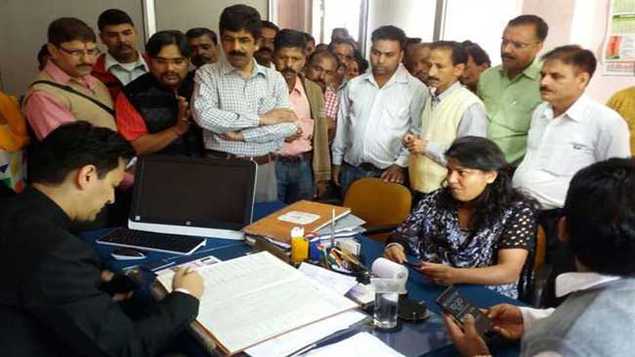
Image Source - http://www.khabarnonstop.com/2016/08/04/nagar-nigam-checking-by-dm/

In this article, Alankrita Singh of NUSRL discusses the Powers Vested With The District Magistrate Under Section 144 of CrPC.

In order to deal with emergent situations, wide powers have been bestowed on an executive magistrate under Section 144 of CrPC. It bestows an omnibus power on magistrates to issue an order in cases of nuisance or apprehended danger provided the cases are urgent. There is a range of situations in which a magistrate may resort this power in the interest of the public as provided under Section 144(1):

  • In cases where a speedy remedy is desirable.
  • In cases of immediate prevention.

Also, the magistrate is supposed to issue the order in writing setting forth the material facts of the case and the order is to serve in a manner as provided by Section 134 of Criminal Procedure Code.

The scope of Section 144 of Criminal Procedure Code

According to this law, the order or the action taken under this section is anticipatory in nature i.e. certain actions are restricted even before they actually occur. Whenever as per the opinion of the magistrate ‘there is sufficient ground for proceeding under this section’, the law is applicable.

The order may direct:

  • Any person to withhold from doing a certain act, or
  • If a certain property is in his possession or under his management, then he can make an order with respect to it.  

The ground for making an order is that if such an offence in the opinion of the magistrate is likely to prevent, or tends to prevent,

  • Obstruction,
  • Annoyance,
  • injury to any person lawfully employed, or
  • a danger to human life, health or safety, or
  • a disturbance of the public peace (tranquillity), or
  • a riot, or
  • an affray.

Hence, this section provides for making an order which is either prohibitory or mandatory.

In the case of Radhe Das v Jairam Mahto where the disturbance was over a piece of property, the magistrate had ordered under Sec 144 of CrPC restricting the respondents from entering the property. During the judicial proceedings, respondents also claimed prohibition of petitioners which was subsequently granted by the magistrate. The respondents in response to this claimed that their right over the property was being violated by the order. It was held by the court that private rights must be given away for the greater benefit of the society at large and the action should be for the prevention of public peace and tranquillity.

Before the application of this section, there are certain principles which must be kept in mind which have been explained in the case of Manzur Hasan v Muhammad Zaman:

  • The power should be used only for the purpose of maintaining public peace and tranquillity.
  • Private rights may temporarily be annulled and interest of the public is given priority.
  • Under Sec 144, rights of civil nature or disputes regarding title of properties are not open for decision in a proceeding.
  • The consideration should be for a large section and not that such restriction is affecting only a minor section of the community.

The principles have been approved in the case of Shaik Piru Bux v Kalandi Pati.

Though extraordinary powers are bestowed by this section as it enables to suspend the lawful rights of a person if such a suspension of the right will be in the interest of public peace and safety. But, Magistrate should ensure that the right is not diminished as a citizen has the right to express his grievances either in public or in private and ask for remedy or reform.

Also, an order under Section 144 cannot be of permanent or semi-permanent nature. As held in the case of Acharya Jagdishwaranand Avadhuta v Police Commissioner. The Anand Margis were prohibited from performing Tandava on the streets or carry skulls in processions by an order of the commissioner under Section 144 of the code. In this case, the first order lasted for two months and then after every two months, the commissioner reissued the order which was challenged. It was held by the Supreme Court that reissuing of order again and again was an abusive use of power.

The rationale for the Application of Section 144

Under this section, orders are acceptable only when it is likely to prevent:

  • Annoyance

It can be of two types namely physical or mental annoyance. In physical annoyance, a certain amount of propinquity should be there between the object but in mental annoyance, no question of propinquity arises. Under this section even if an order deals with nuisance, there must be a danger to life and health involved or breach of peace. This section should not be used to deal with abusive articles and defamatory statements which are not likely to lead to a breach of peace.

  • Injury to Human Life

A magistrate must ensure that the order is likely to prevent the risk of injury to human life or safety and he cannot make an order for the protection of property. The act must be satisfied on the ground that if not prevented right now, then it would turn into an offence in the near future.

  • Disturbance of Public Tranquility

The act prohibited under this Section must not be enough to say that by stretching it would have possibilities to establish a connection of cause and effect between the public tranquillity and the act prohibited. The connection should have reasonability and should not be just hypothetical or distant.

  • The order should be in the interest of public tranquillity and not for the advantage of one party.

Although the section does confer power on the magistrate and if there is an imminent danger to public peace then interference even with private rights maybe justifiable but the section cannot be used in favour of one party, i.e., one party should not be given material advantage over the other party.

Constitutional Validity of this Section

The provisions laid down in this section are not in excess of the limits as provided in the Constitution for restricting the freedoms guaranteed under Article 19(1) (a), (b), (c) and (d). The restrictions are reasonable and there is an availability of sufficient safeguards to the person affected by an order under section 144 of CrPC. If properly applied, the section is not unconstitutional. It was stated in the case of Madhu Limaye v S.D.M. Monghyr that the fact that it may be subdued is no ground for holding it as violative of the constitution.

The five points which were enumerated by the Supreme Court which justified the constitutional validity of the section is as follows:

  • In case the magistrate passes an ex-parte order, then a notice must be served to the person against whom the order is being passed unless it is the case of an extremely critical situation.
  • The persons against whom such order is passed have a right to challenge the same which shows that there is no arbitrariness.
  • The principles of natural justice are also in accord of this section, i.e., an opportunity of hearing is provided to the person and also he can show cause the order.
  • The fact that the injured party can challenge the order ensures that the action of the magistrate is more reasonable and is of convincing nature.
  • The High Court has the power to look into the matter under Sec 435 of the Code read with Sec 439 of the Code which brings up the condition that the order under Sec 144 is non-appealable. Therefore, the liability of the magistrate is ensured as the High Court can either quash the order or for the material facts of the Magistrate.

Hence, it is held that preventive action under Section 144 is justified.

Duration of The Order

The examination of Section 144 makes it clear that a total of 60 days has to be calculated from the day on which prohibitory order was passed at the time of initiation of the proceeding.

This time period of 2 months can be extended to a maximum of 6 months from the date of expiry of initial order by the state government. Though the power bestowed with the state government is executive in nature but if in case the court finds the decision arbitrary or sees it as an unfair exercise of power, then the revision of the order can be made by the Magistrate.

Conclusion

The most important thing is that before passing an order, a magistrate must be satisfied with the ground of proceeding which should be sufficient under this section and an immediate prevention and speedy remedy must be desirable. The second element is that the magistrate must consider the fact that the direction which he gives is likely to prevent or tends to prevent annoyance, obstructions or injury to any person lawfully employed. It should be decided as a matter of fact by the magistrate that whether it will lead to the breach of peace or disturbance of public tranquillity.

The order should contain the following contents:

  • The order should be in writing.
  • Order must be specific and definite in terms.
  • Material facts must be stated in the order.
  • Prohibition must be clearly stated.

However, at this juncture there appears to be a need to balance the granting of plenary powers by the legislation to deal with the emergent situations and that the personal liberty should be protected and other freedoms must be granted to the citizens especially the rights under Article 21 of the Constitution of India.

Download Now

5 Mistakes Made While Preparing a Due Diligence Report

0
golden parachute
Image Source - https://www.shutterstock.com/video/clip-7982173-stock-footage-business-teamwork-people-and-technology-concept-business-team-with-laptop-computer-papers-and.html

This article is written by Snigdha Pandey, Marketing Executive at iPleaders.

During my internship, my mentor had given me a fat bunch of documents and asked me to prepare a report on my findings. This was my brief: ‘Find what potential risks and drawbacks are there in the agreements for us, and prepare a due diligence report’. As a clueless litigation lawyer who had joined the internship to learn the nuances of corporate law, I literally did not know what to do.

Instead of asking my mentor what to do, I went and googled due diligence report. Of course the results were ambiguous and did not lay down exactly what to do. There were no associate counsels around for guidance. So eventually I started reading the agreements. It made no sense to me. By this time I had wasted considerable time, hence I swallowed my stupidity, and went to see my mentor and explained the situation.

He was patient enough to not yell at me, and rather explained to me what exactly was the purpose of this exercise. That’s when I learnt what a due diligence report was. It turns out I was only to make a part of it, the easier part and not the complex financial aspects. Phew!

So my first question was – What is a due diligence report?

In case of a merger or an acquisition, there is a transference of obligations and rights to the buyer from the seller. In order to minimize the potential risks and liabilities, investigation of material facts is conducted of the seller’s company. The report of such an investigation is called a  due diligence report.

The report includes a study of collections, review, and appraisal of business information, financial information, legal information and identification of the state of affairs, liabilities and exposures of the firm being acquired or undergoing the merger, otherwise also known as the target entity, etc. You can read more about the action points of a due diligence report here.

This report is crucial to the buyer, for they need to go into the deal on the basis of this report. Any risks or threats which are not part of the due diligence report, may affect the valuation of the company and change the outcome of the deal. Therefore, it is of utmost importance to investigate all the possible factors which may pose an issue in the future, with a fine tooth-comb.

There can be checklist prepared to reduce mistakes in the process, but there is no foolproof method to ensure the accuracy. There is always room to err and improve. But how does one avoid the mistakes? You may gain relevant experience through hands-on work or gain specialised practical knowledge through mergers and acquisitions course. The idea is to gain knowledge and experience enough to provide the best possible outcome.

What kind of due diligence mistakes can cost the buyer?

According to this article, in a deal back in the 90’s, BMW had acquired Rover to diversify in order to boost sales. But in their due diligence process, there was an oversight on the financial aspects, sales and accounts. There were also cultural clash which resulted in a 790 million pound loss.

Then there was the Quaker-Snapple deal, where Quaker wanted to replicate the success of their Gatorade deal, but instead suffered $1.4 billion loss due to an oversight in intellectual property and competitive analysis!

There may be an oversight of financial projections and expected sale, inaccurate financial statements, poor assessment of product or technologies involved, etc. There may be multiple factors which if missed can cost the buyers millions or even billions of loss.

What are the common mistakes made while preparing a due diligence report?

As mentioned earlier, there maybe a variety of mistakes or oversights of essential factors during the due diligence process which may have catastrophic results for the buyer. Some of the common mistakes are:

Poor buyer communication

During the course of the due diligence process, if there is a finding which affects the deal directly, like the lease on the manufacturing unit’s machinery expiring, then it has to be reflected in the due diligence report and timely reported to the buyer. This can possibly affect the structure of entire deal and its valuation. But delayed on inadequate communication can result in potential loss for the buyer or the entire deal falling apart. There should be clear and transparent communication processes to ensure such a situation can be avoided.

Inadequate internal coordination

The risk evaluation involves multiple departments like sales, accounts, legal, etc. Any relevant information like an unfavourable order in an ongoing litigation, or inaccuracies in the financial documents, etc. has to be communicated to the due diligence team. If the internal coordination is absent or lacking, then the due diligence report will have gaps and inaccuracies. This can be avoided by involving a coordinator who can communicate the developments from the departments to the due diligence team.

Losing sight of the goal

The due diligence report is a thorough affair, and sometimes, it may delve into aspects which are not necessary to the transaction at hand. For instance, if there is asset acquisition, then there is no point dwelling on the liabilities of the seller. It does not serve a purpose to the transaction at hand. Although it is easy to get lost with the abundant data at hand, one must not lose sight of the task at hand. If it is not pertinent, do not dwell on it.

Checklist dilemma

The due diligence report is usually dependant on a checklist of items that needs to be investigated into like financial reports, ongoing litigations, IP portfolio licenses, etc. The problem persists if only the checklist is followed or even if it is not followed. Ideally, the checklist items should be investigated first, and then other intangible factors like, the longevity of the technology in question, whether the two companies are culturally compatible and a good fit or not, etc. Many initially promising franchise mergers fall apart post-deal because of cultural integration issues      

Seller disclosing all the information

The seller however forthcoming, is not likely to be relied to disclose all the discrepancies and inadequacies of his company. It is the responsibility of the buyer to conduct the investigation of all the relevant aspects. The most common mistake is to rely on third party due diligence reports. The buyer must conduct such report independently or go with the list of verified vendors with the banks and other financial institutions. The idea is to ensure that the due diligence report must reveal the true scenario of the company being acquired.

The due diligence report is the centre of the deal. It is the basis of the valuation and the deal in itself. Therefore, it is essential for the parties conducting the due diligence report to ensure that they have necessary knowledge and experience.

How can you learn how to do it

It is very important for young transactional lawyers and law students trying to get into good law firms in transactional roles to learn about due diligence since it gives a huge advantage. We have been running a course on M&A, Investment Law and Institutional Finance where we teach the due diligence process in details, along with hands on practice of doing due diligence on fictitious companies. You even get training in preparing information requisition questionnaire, reviewing documents, retrieving MCA and other financial documents, understanding those documents, even choosing the right kind of presentation style in your DD report – we teach it all. Visit this link and try out the sample material to know what kind of advantage a course like this can give you.

Download Now

The Night I Spent at Howrah Railway Station

0
never give up on life
Image Source - http://pantograph-punch.com/post/Western-Line

This article is written by Ratul Rudra, Sales Head at LawSikho

It was April 1998.

It was almost midnight but the Howrah station area was busy and I had no place to spend the night. I was left with Rs.20-25 in my pocket so I could not afford a decent fish-and-rice dinner. I had no place to go for the night.

I settled for the Howrah station. That’s where I would have to sleep.

It was not that I had no friends or relatives in Kolkata but this was a stage when I was running away from all known entity in my world.

The reason: recently I had tasted failure in business. Every single well wisher or acquaintance, experienced or less experienced in life, had told me that it will be irresponsible and stupid of me to waste both time and money by starting a business. After all, no one in my family ever dared do such a thing in known history!

I was also advised that being from a lower-middle class family I should have done a job which would have made my parents happy.  I was reminded time and again that my father had retired just a year before. I should have been able to lift the burden of running the family from my father’s shoulders. Everyone was shocked at my decision to start a business when I already had a decent job with a secure salary at an MNC in Bhilai.

I was approaching thirty and I had a lost world with no money in my hand. I had settled some dues by selling almost all of my personal belongings but still I owed a few loans from my close schoolmates who liberally said I could return their money at a stage in life when I could earn.

That was magnanimous of them.

I didn’t know where to look for a job and how to earn. At least not in Bhilai anymore. I had a lost face within the community of computer trainers in Bhilai, and that was the only line of work I knew.

There was one more lady in my life who helped me at this stage and she was a silent spectator of all the incidents in my life. She shelved out all her savings from her piggy bank and handed over Rs.3,200/- to me saying that I go to Calcutta and to look for new opportunities by putting up at my maternal uncle’s house in Calcutta. She was my mother.

When I reached my uncle’s place in Kolkata, there was another surprise waiting for me. After having a bath and lunch, my uncles sat down for a chat with me. I was welcomed but for two weeks only. They were very clear in telling me since I was the son of their elder-sister perhaps they were unable to turn me down but that was all they could do. So, I had two weeks and the money given by my mother. I had no second option at this stage. I had to get a job and find out a place to stay in Calcutta – all in two weeks.

We were not having the kind of communication facilities like internet on the go or even a mobile phone was only a thing of imagination in my world. So, I stayed back at the uncle’s place for the rest of the day and started planning my next 15 days; with each of the day’s details like which are the places I will look for jobs, where will I visit on which day, whom are the friends and relatives I would meet to seek help, how will I search for a place to stay, how shall I prepare for the interviews and all such other activities. I had every movement planned with time and money.

The days and nights were passing and I was relentlessly pursuing my search for a job and a place to stay. The first half of the day was spent in job searching from the newspapers, visiting offices and asking if they had any vacancy, visiting placement consultants and submitting resumes, walk-in interviews and hoping that the next day might bring in some good news. Meanwhile, in the evenings, I used to meet my relatives and childhood friends in Kolkata trying to tell them about my situation and ask for help. No, I never asked for money from any of them. But the days were passing with nothing in hand. Then there was a day when almost all the money was spent and my mind was unable to think any further. I didn’t know what step to take next.

I didn’t return back to my uncle’s place that night. It was 12th April’ 98. I boarded a bus and it reached Howrah station. I loitered around the station area with almost all kinds of weird thoughts in my mind. I could no more draw the energy to walk around the station complex. It was around 4 am in the morning. I sat on the floor as the chairs were all occupied by the passengers. Though I was very tired out of the drudgery I never felt like sleeping.

I don’t know how much time had passed like this.

Finally, at the daybreak, I gathered myself and reached up to the tea vendor, bought some tea and moved outside the station compound.

I saw the newspapers being unloaded and the newspaper vendors swarming the outside area of the station.

I bought The Telegraph.

As I was reading through the pages, a thought suddenly came into my mind. The previous night I had forgotten to enquire at my uncle’s neighbour’s place whether there was any phone call for me.

Since my uncles didn’t have a telephone, I had sought permission from their neighbour to put their telephone number on my resume. So, I went up to the PCO and called them. The neighbour told me that there was a call from NIIT’s Howrah Centre and they had left a message for me that I should meet the Director of the Centre, the next day.

I was excited and a bit worried as to what lay ahead.

I went to meet the director as early as possible. It was not all that far from the Howrah station!

After waiting in the reception for some time, the director met me in his chamber. We exchanged a few formal talks and then came the big moment when he offered me the job.

He congratulated me and asked me from when I could join. This is the moment I was waiting for the past two weeks, suddenly I was dumbstruck. I gathered myself and replied – “From tomorrow, Sir”.

He was happy too and asked me to wait in the reception and collect the offer letter before I leave.

On April 14th 1998, I joined the NIIT Howrah Centre as the Head of Centre and the rest was history in the business records of the NIIT’s Suburban Network in Eastern India. Within the next six month’s NIIT Howrah recorded profits for the first time in their operation of 5 years. It ranked 3rd in Eastern India in terms of sales in the category of NIIT’s Suburban Network Centres.

I may humbly say I had a role to play in that. After I got the opportunity, I was relentless in pursuit of business.

That incident is a very distant memory today. I am now Head of Sales at LawSikho, having done many jobs in between during the intervening 20 years.

I still clearly remember that night at Howrah Station, and it gives me strength.

No matter how bleak your situation is, do not give up. You will find your way out of the darkness if you continue to strive. That is the rule of the universe.

Sometimes, the break comes a little late. Keep working for it.

And if you are having a good time, still, please keep working because just like bad times don’t last, neither do good times forever. Stay prepared, stay strong, do not lose your bearings when things are great.

Download Now

My Struggles as A First Generation Lawyer in India

2
first generation lawyer

This article is written by Mohona Thakur, Marketing Manager at iPleaders.

Just the other day, I was reading this article titled ‘How I Blew My Interview With Amarchand Mangaldas’ and I was amazed not only by how much I could connect with the author, but also at the ease with which the article conveyed mistakes that twenty-two year olds make right before they join the not-so-cushioned real world after finishing college.

Everyone has a story. And here is mine.

I’d like to take you back seven years down the line to the interview that eventually led to my admission at ILS Law College, Pune. Tell me something. How many times have you lied through your teeth at an interview where you were asked “Why law?” I have. Multiple times, especially at interviews, just like the one at ILS.

Ms. Smita Bhattacharya was the professor that took this interview and I had my answer rehearsed in order to sound as convincing as possible. I still remember having said, “Everyone I see around me, even in my family, is either an engineer, MBA or a doctor. I want to be different. Hence, law.” She smiled at me and replied saying, “When you graduate out of law school, you’ll realise that there is no dearth of lawyers in this world.”

I wasn’t entirely lying about why I pursued law. I have always wanted to be different, different than everyone around me; and as an excited eighteen year old, I was under the impression that being different is in fact a privilege. Only if I had any idea about the inherent nepotism in the industry I was about to enter.

However, the sad truth behind why I did want to take up law comes with a lot of baggage. A baggage I plan on shortening into a couple of paragraphs, as I tell you my story. I believe my story would be incomplete without this.

My family was settled in the middle east for as long as I can remember. I was taught at a CBSE affiliated school in Abu Dhabi, UAE till the seventh grade. However, mid-term in October 2004 my family had to shift back to India. What I realised was that the level of education in Abu Dhabi (although it was a CBSE affiliated school) was way lower than what was being taught at CBSE schools in India, especially in subjects like Maths and Science. And Sanskrit? What was that? Was that even a language?

Naturally, in spite of multiple tuitions, the gap in understanding remained and I could never score in these subjects. This is when I took the opportunity to strengthen the subjects that I was ahead at – English and the Social Sciences. I dropped Sanskrit and Hindi at the first opportunity I got and chose French as my second language at school. As a result, I had a command over social sciences like no other in my batch and unlike many, I never mugged up chapters; I understood them like they were stories. Taking up humanities as my stream in 11th was an obvious choice for me.

What future does a kid from the humanities background have in India? Forget parents, the schools distinguish the students and segregate them into science, commerce and humanities streams on the basis of the percentage of marks they score in their 10th Board exams. If you’ve managed to score a 90% plus, you are a perfect choice to take up science and attempt the IIT-JEE and medical entrances. If you’ve scored lower than 80%, you deserve to study humanities because you’re good for nothing and humanities is “easy”. We Indians and the education system in India decide the careers of our kids and students on the basis of board exam marks.

I struggled through law school, and the struggle was a lot more real after law school, but that’s a story for another time. Today it is about the struggles that clueless, aspiring first generation lawyers face in law school. I’m going to break it down into pointers for ease of understanding:

Not Having Adequate Information

With the presumption that law being a professional course would ensure not only stability, but will also be financially rewarding, I prepared myself for five years of law school. This was why I wanted to be a lawyer; it wasn’t just a choice I made in order to be different, it was a conscious choice I made presuming I could pursue humanities, and law would allow me to  have a stable career with sufficient income.

This was my first struggle as a first generation lawyer: not having adequate information, or in other words, a reality check. Back when I was making the choice of pursuing law as a career, there weren’t websites such as Lawctopus or blogs such as iPleaders that could enhance my ability to make a decision that was well thought through.

Negligible Guidance

When I entered law school, from my very first month I knew I had to up my game as I was naturally competing with batchmates who came from families neck deep into law, and when not neck deep into law, most of them had a relative or a distant cousin who always turned out to be a lawyer. In plain simple words, there was always a reference.

What about me? I had absolutely no lawyer in the family, dead or alive.

As a typical eighteen year old with values as imbibed in every kid since their childhood, I decided that hard work was the answer to this. I mean aren’t we all taught this for as long as we can remember: work hard and everything else shall follow.

While most of my batchmates decided to not intern and take it easy, I scheduled an internship with a lawyer at the Delhi High Court and interned with him twice in my first year. The idea was to learn as much as possible, and as quickly as possible to be able to have equal if not more knowledge than them. I participated in the only moot that first years were allowed to participate in – Novice – and while I did stammer the first minute in the very first round, I had a brilliant journey and beat over 100 participants to reach spot number 2. This was equivalent to an assurance to me: You’re on the right track, keep going, hard work does pay off.

This very assurance was my second struggle as an aspiring first generation lawyer: negligible guidance. Most seniors in law school would ask you not to intern if you were in the first couple of years into law school. In fact, I have heard multiple seniors ask juniors not to intern in the first or second year of law school because they wouldn’t learn anything as the law subjects only began from the third year onward. However, if you do tell them that you’ve already interned twice by the end of your first year, they wouldn’t say it was useless, they would in fact say that it was a good decision to have begun interning early. The exact opposite. Do you believe them? If not them, who do you go to? With no real guidance, you begin relying on the immediate results that every activity you are doing is producing, or your instincts, which may or may not be the best thing to do.

Lack of Networking Knowledge or Skills

With no real insights from home for obvious reasons and with majority seniors advising to intern with law firms that paid the big bucks and expected you to work weekends, or to intern with lawyers and learn the nitty-gritties of litigation to fend for yourself a few years down the line, I chose neither. To be honest, most of the well-known law firms wouldn’t take second year interns. In addition, most applications went unanswered as they were directly sent to HRs at law firms without any references. This is when I decided to take my chance and intern in-house, only to fall in love with the work-life balance I saw there. The teams would come in early by 9pm and wrap up work by 5pm on most days and have a life to look forward to. Although the pay scale possibly wasn’t as good as a law firm, it was enough to be self-sufficient.

I would ideally call this the point where I faced my third struggle and one that continued to haunt me even after I graduated law school: lack of networking knowledge or skills. I used to detest people who used their network to reach places – I always thought of it as a privilege that I never had. What was worse was that I didn’t know how to network. I knew how to make friends, but how on earth do you build networks? I had grown up to see two very hard working parents land jobs on their own merit, no references, and I was brought up to want to be self-made. As a law student with zero connections, it is a pertinent question to ask to yourself – How do I land an internship with law firms? What is the plan of action? What happens when cold-calling doesn’t work? Today, if you google, you’ll find courses on how to land an internship with law firms. Back then this wasn’t an option, so we learnt from our experiences and even more so from our mistakes.

Most of my nearest circle of friends were trying to make it on their own but at the end when things didn’t seem to work out, they would pull in a reference with someone their father knew. In my case, that was not a solid option since my father had built a career in the middle east and not India.

No Adequate Knowledge about the Functioning of the Legal Industry

Law firms looked like they were unachievable. As though I was an ant at the bottom of the pyramid and I had to climb a steep hill without any clue as to how to. Most seniors I asked for help could refer me to advocates (which I had ruled out in the first year after I realised that most advocates get paid about 10,000 Rs. as a freshers salary) or had contacts to find me an internship in-house. I took the latter option and continued to intern in-house and believe it or not enjoyed not only the work but also the work culture immensely. Over the internships, I did acquire a very different set of skills about which I have written in this article. I do not regret the choices I made, I only wish I knew what law firms had to offer.

When I made the call to want to pursue a career as an in-house lawyer, I was under the impression that I had enough working knowledge of how companies function and what may be expected out of the legal teams. And to be absolutely honest, I still believe that is something I do know. Where I possibly faltered was not having adequate knowledge about the functioning of the legal industry as a whole: what I would call the fourth struggle. By the time I realised that companies do not always have a vacancy, contrary to the mass campus placements with companies that I was used to seeing over the years at ILS, it was too late. In fact, while I was giving interviews with a couple of companies was I informed of their policy of not hiring freshers right out of law school. You don’t find company policies on google, you do not even find these companies openly advertising on job portals. And trust me, I tried all portals right from Naukri.com to MonsterJobs to LinkedIn to iimjobs. Desperate times called for desperate measures.

Imagine, if I had known enough lawyers, made not one but many contacts during law school who would vouch for me, and not absolutely relied on hard-work paying off, as is taught to us, I probably would have landed the dream in-house job that I wanted. I had no reason not to. I had a resume that was focused – good grades, won moots, convened events, even worked part-time for Lawctopus, had in-house media and FMCG internships, had a post graduate diploma in media laws, publications. Isn’t this everything that is asked of us at law school? Aren’t these attributes of a strong resume?

What exactly went wrong?

When I look back, I feel that it wasn’t one particular thing that I could point at. I presumed that law would give me a stable lifestyle after five years of hard work, I believed that the world was sane enough to look through the pool of people and pick the meritorious one over the one with contacts, I believed that law was a financially rewarding career – after all we invest half a decade worth of our lives. Most of all I believed I could be different and survive, pas de guidance.

With the advent of technology and the boom in the blogging industry, today the law students are far more equipped with resources that give them more than adequate information about law firms, interviews with insights from lawyers working in the industry available on SuperLawyer, online courses  and career development programmes that give you the one chance to not only network with lawyers but also acquire practical skills at the same time, blogs that are run that give you enough information about pay packages for lawyers, and even legal recruiting agencies like Vahura that look into your profile and look for opportunities suited to your profile.

It took me a while to write this article to be honest. It takes courage to admit the mistakes that you have made and even more courage to revisit them to figure out what you may have done right. I do know that this will stay on the internet for a long while, but what I do genuinely hope for is that no one, whether a first generation lawyer or not, has to go through similar struggles while in law school, or even after, and fail.  

The struggle is real, and you’re not alone.

Download Now

Compensation payable under the Industrial Disputes Act, 1947 to employees when an undertaking is transferred

9
Golden Handcuff
Image Source - https://www.glassdoor.co.in/Photos/Virtual-Employee-Office-Photos-IMG935304.htm

In this article, Prachetha Nidhi Verma of IIMT & School of Law, G.G.S.I.P.U  discusses Compensation payable under the Industrial Disputes Act, 1947 to employees when an undertaking is transferred.

Introduction

Law has put in some obligations on the employer which are envisaged under the provisions of The Industrial Disputes Act, 1947 (hereinafter referred as ID Act) in order to prevent such disruption among the employees. The ID Act is applicable to all the industries as defined in Bangalore water supply case (see it’s analysis here).

Workman under the Industrial Disputes Act, 1947

In order to have the rights that will be explained below, one needs to be a workman as defined under section 2(s) of the ID Act, 1947. A Workman has been defined as a person who is employed in an industry to which the provisions of the ID Act are applicable. Such worker is employed for any skilled or unskilled, technical, operational, manual, clerical or any supervisory work for wages, irrespective of the fact that the terms and conditions of his service of the employment are implied or expressed.
It excludes workers, who are-

  1. Employed in Army/AirForce/Police/Navy.
  2. Employed mainly in managerial, supervisory or administrative capacity, having wages of more than Rs 6500 per exercise or per month.

Whether an employee is a workman under the Industrial Disputes Act, 1947?

The next important question before us is whether an employee is a workman as defined under the ID Act. Primarily the provisions of Industrial Disputes Act, 1947 deals with the conflicts and resolution between the employer and the workmen. In order to answer this question, the Hon’ble Supreme Court of India has laid down a dominant nature test in the famous BANGALORE WATER SUPPLY case. According to the dominant nature test, one has to determine the status of the employee through the main nature of his/her work. That means if an employee’s main work is clerical but he also works in supervisory capacity which is incidental to the main work done by him, then the work of such an employee cannot be said to be of supervisory nature since his main work is only clerical.

Therefore, the employees, whose main work is not supervisory or managerial, fall within the category of the workman as defined in the Industrial Disputes Act, 1947. All the other employees not covered under this Act will be governed by their respective employment contracts.

Notice and compensation payable to employees

According to section 9A of the ID Act, 1947, it is mandatory for the employer to issue a notice to his employees in case of the change in conditions of service of such employees with respect to the following matters (Fourth Schedule):

S.No. Conditions of Service, change in which, requires a notice by the employer
1. Wages ( wage-period and mode of payment to be included.)
2. Contribution that has to be paid or that is payable by the employer in the pension or provident fund under any law in force.
3. Allowances including compensatory allowance.
4. Working hours and intervals for rest.
5. Paid leaves + holidays
6. Starting alteration or end of shift working (otherwise than as mentioned in standing orders of the industry)
7. Grade based classification
8. Withdrawal or any change in customary privilege or concession
9. Alteration of existing rules of discipline through addition or omission
10. Improvement, standardisation of plant or method/technique of working which will or is likely to lead to retrenchment of workers.
11. Any increase or decrease in the number of workers employed(other than casual) in any shift, department, occupation, process (other than on which the employer has no control).

In the above-mentioned cases, the employer is bound by the law to:

  1. Give a notice to the worker who is likely to be affected by such changes,
  2. The notice should contain all the details of the changes proposed to be made,
  3. No such changes as proposed should be implemented within 21 days of serving the above-mentioned notice.

Right to compensation and notice in case of a change in the management of the Industry

Every employee has a right to get compensation in case of a transfer of ownership of industrial unit i.e. a change in the employer as per section 25FF of the ID Act, 1947.

It is not necessary that your employer will get changed in all the cases of Merger and Acquisitions. For instance, when one company acquires the shares of another company and workers continue working for the latter on the same terms, there is no change of the employer. But in cases wherein the whole company and its management are acquired, the employer changes.

Therefore, in cases where the employer has changed because of the reason of the transfer of ownership of the management of an industrial unit or an undertaking (eg: by Merger or by Acquisition), the previous employer is liable to give:

  • Notice – 1-month notice in writing stating the reasons for a change in the management;
    Compensation – An amount equal to the 15 days of wages for every completed year of continuous service or any part of service in excess of 6 months,

to every employee who has been in continuous service of 1 year in that undertaking before such transfer.

For example:

  1. If you have worked for 6 years and 7 months for Rs.1000 per day wage, and your employer gets changed, you will be given Rs.15,000 (15 x 1000) for every completed year. Now you have completed 6 years and 7 months, which will be counted as 7 years since any month exceeding 6 months is counted as a fully completed year of service. Therefore, you will be given Rs.1,05,000(Rs.15,000 x 7).
  2. If you have worked for 7 years and 4 months for Rs.100 a day, and your employer gets changed, you will be given Rs.1500 (15 x 100) for every completed year of service. Since you have completed only 4 months, which is less than 6 months, therefore this period of time will not be counted as a full year of continuous service, and you will be only entitled to compensation for 7 years which will be Rs.10,500 (1500 x 7).
  3. If you have worked for wages which are of variable nature i.e. which keeps on changing daily. Then for calculating your 15 days of wages, an average is to be taken.

Cases in which the employer is not liable to give any notice or compensation

Your employer will not be liable to give you any compensation or notice, when:

  1. No interruption in your service has occurred due to such transfer;
  2. Equally or more favourable terms and conditions of the employment are applicable to you (transferred employees) in comparison to the ones that were applicable to you before the transfer of undertaking.
  3. Your new employer has become legally liable to pay you (transferred workers) compensation in the event of retrenchment, in a manner similar to the one in which the old employer was liable. Also, such period of transfer will be counted in the period of continuous service.

Right to resign

It is your constitutional right that no one can force you to work in the conditions and on terms which you as an employee do not consent to. This will not only a be a form of slavery but it will severely deteriorate your performance thereby affecting the performance of the industry.

Therefore, you as an employee has an option to resign from the work and get compensation as mentioned above under section 25FF of the Industrial Disputes Act, 1947 even if the terms and conditions of service under new employer are more favourable to you than the ones you were getting before.

Consent of an employee is mandatory

It was observed by the Hon’ble Supreme Court of India, in the case of Sunil Kr. Ghosh v. K. Ram Chandran (2009), that where there is a transfer of ownership in the management of the industrial unit, it is mandatory for the employer to take the consent of the workmen before transferring their services to a new employer. The workers cannot be forced to work for the new employer or in a new industry, even if the terms of the new employment are no less favourable than the earlier ones. In such cases, workers would be entitled to avail the option of retirement or termination and the employer will be obliged to pay retrenchment or retirement benefits according to the provisions of the act.

Therefore, it is your choice to either go and work for the new employer or resign and take the benefits of compensation as explained above. No one can force you to work for the new employer.

Conclusion

It can now be understood that the strategies of Merger and Acquisitions can prove to be personally and professionally disruptive for the employees and can often lead to confusion, miscommunication and a feeling of negativity among the employees and towards the employer. This can lead to a failure of the industrial unit itself. It can also result in a decline in the profits that were expected out of an M&A. To maximise the chances of success, it is important to analyse the needs, requirements and problems of the employees. An employer should always inform his workers and ask for their consent before restructuring them to a new industry, in order to prevent any disputes after such transfer since the employees are the building blocks of any industry.

Download Now

How to file a copyright infringement complaint on YouTube

2
Copyright Youtube
Image Source - https://www.youtube.com/watch?v=rUlFX6aBIaA

This article is written by Diksha Mahla of Raffles University, Neemrana, Alwar, Rajasthan. The article discusses How to file a copyright infringement complaint on YouTube.

Introduction

Around 1 million website links were removed recently by Google which infringed the copyrights (including music, movies, software). If you create something new and interesting then you don’t want anyone else to get profit from that idea and this has resulted in the emergence of copyrights. Copyright is provided for the protection of the owner’s creation, but copyright extremism is showing opposite results because extreme copyright rules are diminishing creative ideas and artistic lives.

DMCA (Digital Millennium Copyright Act)

Since 1998, several search engines have removed links that infringes the right of the copyright holder at his/her request, however, they can be held liable for such infringement if the search engine refuses to do the same. 97% of the DMCA takedown requests are compiled up and with an average turnaround time of 10 hours counted from the submission of a valid takedown notice to the removal of the offended link. Nearly, 550,000 takedown requests were targeted by the Redmond (out of a total of about 1.24 million) which is further followed by the British Recorded Music Industry) and NBC/Universal with about 150,000 takedown requests each.

DMCA Takedown

It is basically known as the right to process a takedown notice against the owner of an illegal online material or content. It is well established and accepted internet standards which are followed by the internet service providers.  

Copyright

Copyright is a term which is well known to everyone. Be it any TV show, novel, advertisement or any video posted on youtube it will be written as either @AllRightsReserved and @CopyRightsReserved. It is basically a right which is given by the law to the owners of the original work. For Example: musical, literary, dramatic, artistic works and it also includes sound recording and cinematograph films. Classes of work which are subjected to copyrights are given in chapter III of Indian Copyright Act, 1957. Copyright act only protects the originality of the idea and its presentation in tangible form instead of protecting idea as a whole.

Copyright didn’t evolve suddenly, rather it came after various protests by authors, when they felt personally insulted and with the introduction of printing press in England in the late 15th century. Later on, it took the form of Indian Copyrights Act, 1957 and new amendments have been made like The Copyright Rules, 2013 by the Ministry of Human Resources and Development on 14th March 2013. In the words of Walter Savage Landor, “No property is so entirely, purely and religiously a man’s own as what comes to him immediately from God, without intervention or participation”.

Digital rights with special reference to rights of other countries

After observing a wide use of internet, it became prone to piracy and very easy to copy digital contents and selling them illegally. A new concept has emerged in early the 1990s namely: Digital Rights Management (DRM), however, it was not used because of its complications for an average person. The rights given to the copyright owner on digital media are “Digital Rights” and these are protected by Digital Rights Management which works like a software which includes a wide range of technologies. It works against duplication and illegal distribution of digital media that are protected by copyright law. DRM works in a number of ways like digital signature, digital certificate, encryption, etc., in areas of music, films, television, computer games, etc. It includes two technical measures i.e. technical protection measures and rights management information. Former permits copyright owner to control access to their works whereas latter manages materials to customers. WIPO Copyright Treaty, 1996 has backed the laws on Digital Rights Management. However, India has adopted DRM via the copyright (amendment) bill, 2010.

The Doctrine of “Fair Use”

The doctrine of “Fair Use” is covered under section 107 of the Copyright Act,1976. It is not always wrong to use a copyrighted content. A person can reuse copyrighted content without the owner’s permission for the purpose of comment, research, criticisms, news reporting, scholarship, and teaching. The aim of Copyright Act is to maintain a balance between owner’s right on their original work and interest of the society while competing with free flows of ideas. In the words of a legal scholar named Jason Cohen, “The fair use doctrine helps to prevent the copyright owner’s exclusive rights from interfering with the purpose of the Act i.e., promotion of learning”. There is not any specific test to consider fair use and copyright infringement because it varies from case to case. Mere substituting of the original work will not be considered as fair use.

What constitutes Fair Use

  1. Purpose for use of copyright work: Court will look out for “transformative work”. If the whole of the original work is copied it will not be considered as fair use, some transformations are needed in the original. Courts prefer non-profit organizational purposes over commercial use while determining fair use.
  2. Nature of the copyrighted work used: Fair use is more favorable to factual work than fictional work.
  3. Amount of copyrighted work used: Use of small bits of work will more likely to be fair use but it will also be subjected to an exception which says that borrowing small part of work which is “heart” of the work will not be considered as fair use.
  4. Effects when copyrighted work is used: If the use of some part of work is affecting the profit-making capacity of the original work, it will less likely to be a fair use.

Digital rights in Europe

Freedom of speech and expression is an important element of democracy and same is supported by information technology. European digital rights (EDRi) is taking care of the digital rights of people. It is an association of civil and human rights associations from across Europe. As more and more people starts using the online platform, the rights are more likely to be violated. European Digital Right (EDRi) key priorities for the future are privacy, surveillance, copyright reform and net neutrality.

Digital rights in Canada

Canada learns Digital Rights from Digital Millennium Copyright Act (DMCA). Canada is more favorable to European Digital Rights rather than the laws of the United States regarding Digital Rights. It supports the idea of maintaining a balance between owner’s rights and consumer’s needs. Canada is more homogenous than the USA and it is federal in nature when it comes to laws related to the impact of Digital Rights Management. Canadian government uses agencies such as Industry Canada, Heritage Canada, and Strategies to enhance and shape the area of copyright. In Canada, accesscopyright addresses are for printed works and Socan addresses are for musical work.

The concept of Content ID with special reference to Youtube

How will you come to know that your video has been uploaded by someone else without your permission? There is a way which tells you that the particular content is protected by copyright, it is known as Content ID.

Youtube’s Content ID

A person who uploads a video and the content of that video is similar to someone’s copyright protected content then in that case the video uploaded by that person will be struck down. It is basically a special protection given to content owners so that they can easily manage their copyrighted materials. It is done through a digital fingerprinting system. Before uploading on youtube, your video will be compared with all registered audio and video files with Content ID.

Youtube has certain criteria under which a person can get a Content ID. A person must own some exclusive rights of original material which is uploaded frequently by youtube user community. The content user must be able to provide shreds of evidence for claiming originality of particular content.

Steps for using Content ID:

  1. You must set your content owner.
  2. You must deliver your content to youtube.
  3. Content ID will look out for matches by scanning each new upload.
  4. You must monitor and manage your content.

Procedure for claiming Copyright infringement on YouTube

Registration of copyrighted content is not mandatory, it will be automatically in existence as soon as an original work is created, therefore, no formality like registration is needed to be done to acquire copyright. Registration of copyright is helpful in court when any dispute arises regarding ownership of copyright. Entire YouTube channel cannot be reported for Copyright infringement, particular content can be reported.  

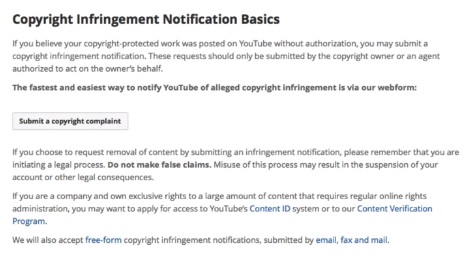
It is a very common problem that many times people tend to re-upload your original video without your permission. But, YouTube allows you to complain about copyright infringement. You can file a complaint by copyright takedown notice. But, remember that as soon as you file a complaint, you are initiating a legal process. How to submit the complaint?

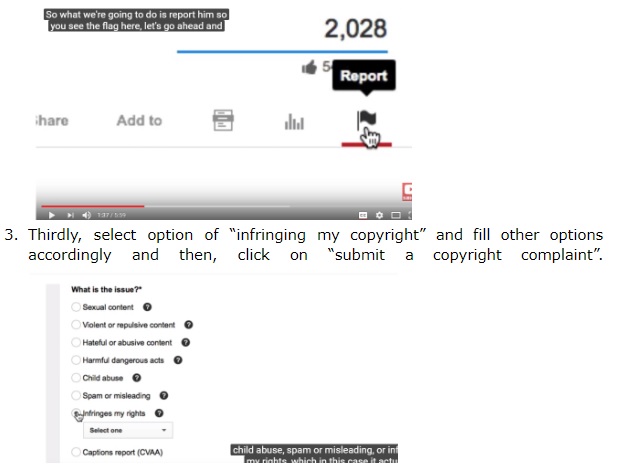
  1. Firstly, you need to login to your YouTube account.
  2. Secondly, you need to open the video against which you want to report and click on the report option given below.

4. Finally, you need to fill the form that appears on your page.

Copyright strike out on YouTube

Well everybody is given a warning when they commit any mistake so, is the case with YouTube. When owner’s copyrighted-content is copied by someone then, before submitting copyright infringement complaint, the owner can give that person a few weeks to take down the copyrighted-content. If he/she does not comply by the same, the owner can submit a copyright complaint to YouTube. The complaint will cause a strike out on their account. YouTube will notify three strikeouts and after the third strike, YouTube will blacklist the copied content.

How to remove “Copyright Strike”

YouTube Copyright Strike would be removed after 6 months but nobody wants to be blacklisted by the YouTube for a long time period. To handle this situation YouTube has added a new feature to remove Strikeout, but it is altogether a different method. If the owner is convinced and he is ready to retract the video then there is a way to come out of Strikeout. Content creators can submit retraction:

  1. First, you need to click on avatar icon at upper-right corner and then scroll down to creator studio.
  2. Then, go to the left-hand side, click video manager and select the video you want to be retracted.
  3. Then, click on submit a retraction.
  4. It will reinstate the video.

Time limit of Copyright

Copyright is with the owner for 60 years after the owner’s lifetime. After 60 years that would be added in the public domain which will remove the content from the purview of Intellectual Property Laws. Once added in public domain, the content can be used by anyone without permission. Most of the countries follow TRIPs (Trade Related Intellectual Property Rights)  which has the time period of 60 years past death.

Whether or not attribution absolve a Copyright violation

YouTube takes copyright very seriously. Copyright is a moral right which must be protected from infringement. Just by giving credit to the owner irrespective of motive, the wrongdoer cannot be escaped from liability. If anyone uses the content of any other person without permission, that will constitute an offense. Proper permission received from the owner may help to escape from strike down. But, mere attribution will not absolve a Copyright violation if permission is not taken.

How to legally use Copyrighted music, games, movies

  1. Determine the Copyright owner- it is very easy to determine copyright owner of movies, TV shows but it is very difficult in the case of music.
  2. Check for terms and conditions for use- if it is mentioned in terms and conditions about monetizing a video then, it will be legal to use copyrighted content.
  3. Try to find Copyright owner’s contact information via a website, email or by filling a specific form provided to contact the owner.
  4. If permission is granted then ask the owner to either post permission on their website so that YouTube can go and search the permission or ask him to send you proper permission documentation via email.

Conclusion

Copyright is considered as a moral right given to the owner because it is his original idea and work but at the same time, fair use is also reasonable because creativity would be hindered if extremism of copyrights would be in practice. Getting an idea from someone’s original work is not wrong. There should be specific grounds to determine fair use because in the future it is going to be very difficult to handle so much content. Fair use allowance is reasonable because further development is based on the already existing material.

Download Now

Step by Step Blue Print for Getting A Job in A Big Law Firm in India

2
law firm
Click on the image to access right now
This article is written by Ramanuj Mukherjee, CEO, iPleaders. When I visit a law school, I usually get asked a particular question. Last weekend I visited National Law University, Orissa to judge a startup pitching competition, as a part of their Google Startup Weekend program. I was expecting more questions about entrepreneurship, but the question I inevitably got several times was this: ‘Sir, I am in 2nd year. If I have to get into a law firm like Trilegal, AZB or SAM what should I do? Sure, it is a law school after all. The dream job is, of course, to work in biglaw. Where else do they pay college graduates 1.5 lakh per month! It’s the pinnacle of success, the law school dream come true. I realised while I answered this question a lot of time orally, I am yet to write a specific article about what all things you should do in law school to maximize your chances of making it. I have written quite a bit about how different aspects of how to get into a law firm. For example, a beginners guide to law firm interview, how to tell if you are ready to work at a law firm, how to prepare for law firm interviews, even what not to do in a law firm interview, what are the areas to focus on in order to be an attractive hire for law firms, important skills to cultivate, why it is so important to find your passion in law school and pursue it, how I quit a law firm job to chase my dream and a lot of other stuff like that. It is now high time I write one simple guide on what are the steps you can follow to drastically improve your chance of getting a job at a tier 1 law firm. This article is primarily based on my experience on guiding hundreds of students who have gotten into tier-one and tier-two law firms in last 7 years.

Who are the big law firms?

Before we dive into anything else, let me tell you which are these big law firms. AZB & Partners Shardul Amarchand Mangaldas Cyril Amarchand Mangaldas Khaitan & Co JSA Luthra & Luthra Law Offices Trilegal There used to be 6 of them, but then Amarchand Mangaldas split and increased the number to 7. These law firms offer great work opportunities, good training in initial years, fantastic brand name and a starting salary upwards of 1.5 lakhs per month as of 2018. Remember that there are some other law firms that pay as much or even more. However, those firms hire far fewer than these behemoths. Those firms are: P&A Law Offices S&R Associates Talwar Thakore and Associates There are a few firms that come really close to the Big 7 in terms of fresher salaries, and are a little easier to get through. If you prepare for the Big 7, and prepare well, then even if you miss Big 7, your chance of landing into one of these will be very high. I hesitate to call them tier 2 because they are almost into tier 1 in terms of fresher salaries and learning opportunities. Here are they: Desai & Diwanji Nisith Desai Associates Wadia Ghandy Majmudar & Co. Platinum Partners Bharucha & Partners Tatva Legal Argus Partners Finsec Law Advisors If I missed any law firm which pays as much or more, do let me know. I will be happy to update the list.

How is it different for top tier NLU students and others

There are some NLUs, the top 5-6 of them to be precise, which have a very huge advantage when it comes to getting a job at a big law firm. It does not mean that others do not, or cannot get a job at big law firms. However, for these NLUs it is just a little more easier. I know it because I was at NLU. I didn’t intern in a law firm in my 4th year. In fact, I never had to do an internship after I finished my 3rd year. I was doing my own work instead, having started iPleaders as a legal risk management consultancy, and then BarHacker later on. I wonder if I did that in a tier 2 or tier 3 law school, whether I would still have 3-4 options to join big law firms. I got that opportunity because I studied at NUJS and I was towards the top of my class. What is this advantage exactly? Basically, big law firms visit a few law school campuses every summer, for an event called Day 0 interviews, where they pick up the top talent from these particular law schools. To my knowledge, these are the law schools with Day 0 campus placement events that actually get attended by Big 7 law firms:
  1. NLSIU Bangalore
  2. NUJS Kolkata
  3. NALSAR Hyderabad
  4. NLU Jodhpur
  5. NLIU Bhopal
  6. GNLU Gandhinagar
  7. NLU Delhi
Note that sometimes colleges like Jindal Global Law School, Symbiosis Pune, or Nirma University, GLC Mumbai, etc. have been known to manage to get a few top law firms to visit their campus and recruit. Statistically, the numbers are however, insignificant and such recruitment may not take place every year. It is not that all students in the to NLUs have a great shot at landing a job at a Big 7 law firm through campus placement. Usually only top 10-15% of the class have a real shot. Rest get rejected at CV shortlisting stage. Top 10 rankers usually get multiple offers. For the rest of the batch in even these top law schools, which is a large majority, as well as those from other law schools, the only way to make into these big law firms is through internships. If they can impress the firm during the internship, they may be given a chance to appear in an interview for PPO. If they are liked in that interview, they are picked up for a job. For most law students, campus placement is not an option if you are looking at getting into a top law firm. Your real shot is through a PPO unless you are within the top 10-20% of your batch at a top NLU. If you are a top ranker in one of these law schools, it is not like that you do not need to prepare. You still need to prepare, not only to land the job, but even to sustain in the job. The number of people from top law schools who join top law firms, and then quit on their own or are eventually fired are way too high. It is not something nobody likes to talk about, but if you make some discrete inquiries, you will understand how common this phenomenon is. Also, in every law school 5th year batch, there are some academically bright students who somehow missed the bus and didn’t make into a top law firm despite wanting to do so. Later on, of course, they claim to have never wanted to join a law firm in the first place. So be careful, if you do not prepare,or don’t take timely action, you may not just walk into an interview and crack it just because of your academic records. You can skip a large part of the work where others will slog at internship after internship, knowing that these are their only chance of landing a job, you have this additional avenue of campus placement. Nonetheless, everybody needs to prepare, and while a handful of law students have a bit of advantage, others have a clear shot too, provided they are ready to put in the required work.

What are your advantages and disadvantages

You need to quickly figure out what are your advantages and disadvantages. Once you know this, you can work on turning around your disadvantages, and playing according to your strengths. However, doing this assessment dispassionately and honestly is critical. If you lie to yourself about your disadvantages, or overestimate your advantages, or even underestimate your chances and give up prematurely – none of that is of any help. You need to keep in mind while doing this exercise that you can overcome every disadvantage. provided that you can recognize them, have the courage to acknowledge, and admit them. Then you can work on them so that you rise above the hoi polloi. The pursuit of getting into the top law firms is not easy. It requires a long term strategy and steady execution of that strategy. Most people do not have the discipline to execute it. It is not about how much talent you have, but how much you develop yourself and how gritty you are in the face of setbacks. Here are the usual advantages you need:

#1

Perfect English – ability to speak, write and communicate

If you don’t have good knowledge of English, it is very bad news. You need excellent English to be even considered for a top law firm job. Once Prof. NL Mitra, former VC of NLS Bangalore and founder VC of NLU Jodhpur, who also worked as a partner in Fox and Mandal, a corporate law firm, told me that law firms hire NLU students primarily for their language skills. Their ability to write skillfully, interpret law and judgments written in complex language easily and write complicated language at times which may be necessary in the profession at times. I didn’t join NUJS with great English skills to be honest. I had studied in vernacular medium schools till I joined law school. I could not speak English at all, and my vocabulary at first was quite weak. It took me a lot of time to read and understand English. Before NUJS entrance test in 2005, I spent a lot of time improving my English. I spent hours and hours in deliberate practice, learning new words, sentence structures, reading English books all the time, watching English movies and repeating the dialogue to myself, even mugging up a dictionary – I worked very hard over my English. I still had to work a lot through my law school on my speaking and writing skills. You may have to do it too. But by the time I was appearing for law firm interviews, or even going to law firms for internships in my 3rd year, I had started to think in English, dream in English, spoke exclusively in English (I decided to not speak in Hindi or Bengali at all in college, no matter how much people made fun of my strange accent and choice of words) and wrote good English, very fast. It was, therefore, not a barrier at all. If you think English may be a problem for you, begin to work on it. If you do not have any problem with the language as such, still make an effort to weed out common mistakes from your English writing. Way too many students get rejected at the level of CV selection and interview due to wrong English. If you want a job in a law firm, you must be able to speak and write impeccable English, otherwise you try to make a career in litigation which is much less demanding in this front.

#2

Proximity to law firms, courts, arbitration institutes etc.

When I visited NLU Orissa, I saw the High Court of Orissa in Cuttack on my way. I asked the student accompanying me if they regularly go to the court and apprentice under lawyers. The answer was in the negative. I was shocked. Proximity to a HC, law firms, tribunals, other institutes where you can learn any kind of legal work is the biggest advantage you can have as a law student. If you manage to regularly go to such a place for a few hours every day, you will absorb tremendous knowledge, develop a fabulous professional network and face value, and understanding of the legal system that is hard to come by. Such experience is invaluable. You will be selected over your peers who do not have such experience any day, and you will outperform others easily if you go to a law firm for internships in your senior years with that kind of experience and insights. Students in NLU Orissa told me that their curriculum is too hectic to regularly go to the court. There must be some issue there, but I can say that I would have moved heaven and hell to avail that opportunity if I was in their place. It can make all the difference. Even a student from a local college, without knowing anything else, takes advantage of ths proximity, they can get a job at a big law firm by the time they graduate.  They can start by attending court over the years, gather knowledge and insights about dispute resolution system, begin to intern at small law firms in bigger cities eventually and then gradually progress to big law firms with the right recommendations. Students of GLC Mumbai, CLC Delhi, Rizvi Law College Mumbai etc frequently make it into big law firms, thanks to the fact that they often end up interning round the year after their classes are over. This gives them a huge advantage in terms of getting jobs compared to even NLUs. They do not really need campus placement because their good students intern with law firms already and if they are impressive, they get PPOs. For a law firm to notice you, and value you, you need to intern for a long time. You need to become a known face in the office. That does not happen easily with an one month long internship. The worst are of course two weeks internship. Even if you manage to get only one month internship, see if your partner will let you extend the internship. Then see if they will be happy to call you back for your next internship break. Keep working with the same people over a period of time, that increases your chances of landing a PPO there. Note that you will get extensions of internship, or a call back to do another internship only if they find your work good and they want you around. Otherwise they will politely say we want to give an opportunity to others also, and reject your application for another repeat internship or even extension. Colleges that are located in cities like Delhi, Bangalore, Hyderabad, Chennai, Kolkata or Mumbai, there students have the option to do rolling internships. They would better stick to a law firm for 6 months at least, even if they have to go to the firm at 5 pm in the evening after class and stay back till 10 or 11 pm. Trust me, that hard work will take you much further than applying to hundred places, topping in your class, winning hundred moots and debates, or such common things people do.

3# Practical Knowledge and skills

So what can you do so that law firms like you so much that they want you to stick around although there are thousands of new applicants every month? That has to be how amazing you are at the work that you do. And your long term commitment and loyalty towards the firm. The 2nd one is probably easier to demonstrate when you get the opportunity. But how do you ensure the first? To be honest, law schools do not prepare you for this part at all. However, this is the most critical thing once you land an internship. To excel in a law firm internship, you need the following knowledge and skills:
  1. Research skill – associates will ask you to look for case laws, points of law, interpretations and so on, while they do the research themselves also. When they see you have found something relevant that they haven’t, they will be impressed and give you more work. If you do a shabby job, they make a mental note to never give you work again.
  2. Understanding of contract drafting – so that you can assist associates by providing important value additions and suggestions when they ask you to proofread the contracts they draft.
  3. Diligence and patience – when you are asked to proof read, if you do a great job at it, associates notice that and give you more work. No work is too small. When you do it very well, you will be entrusted with more work and next level work.
  4. If you are in the disputes team, your legal drafting skills can get you brownie points as you will be able to give very good first drafts to the lawyers and reduce their work.
  5. If you are in a transactions team, then your knowledge of due diligence can make a world of difference. Such knowledge and skills are not expected from you, but if you have it, and do a good job at it (due diligence is easy work intellectually, laborious in terms of volume), you will set yourself up for a definite PPO unless you do a blunder somewhere else.
Think of internship like a test driving. The firm gets to test drive you. Are they going to be impressed? There are some law students who think they will go to an internship and learn. That is just stupid expectation. Nobody in a law firm has time to teach an intern unless they know that intern is going to stick around for 1 year maybe. Internship is not a place to learn, it is a stage on which you perform. So prepare before you go.

How do you prepare?

If you are going for an internship with the transactions team, do this M&A, Investment Law and Institutional Finance course. If you are going to work with an in-house legal team, litigation team in a law firm or going to work in a law firm but not very sure about which team yet, then go for this business laws course. If you are interested in practicing in the area of technology law, go for this cyber law course. If your interest is in IP laws, or media and entertainment focused practice, opt for this Intellectual Property and media law course. If you want to impress people with your knowledge about arbitration, this is the course on arbitration law. If you feel that your company law knowledge has to be fortified, this short term company laws course is the solution. If your area of choice is tax law, and you are going to work with the tax team (unusual but very wise choice), you better learn the practical stuff around corporate tax from this course.

PPO during internships v. campus placement

Getting a PPO is a more sure shot way to get a job in a big law firm. Aim for it even if you are in a top 3 law school. Campus placement has some inherent disadvantages. If you get a job from campus placement, you don’t know which team you will end up in, which partner you will work under, if you will fit into the culture of the firm, if you are going to like the people you will spend most of the hours of the day with. Campus placement is how you land up in the wrong job and regret. You can avoid that totally by landing a job through internship converted into PPO. If you don’t get that, then by all means try to get a job through campus placement. Let’s say you want to work in corporate tax. Or M&A specifically. Maybe competition law. You can intern in those teams and get a PPO from your team. Then you can ensure you will work with that team only. If you are selected through campus placement, nobody can say which team you will be allocated to. And you have no say in that. Asking for a day may result in you not getting that job in the first place. Getting a job is one thing, keeping the job and excelling in it is the real deal. PPOs have a huge advantage when it comes to that, because you know a team, have good rapport, there is mutual appreciation before you are hired. The likelihood of success is much higher here. However, keep in mind that getting hired through PPO is going to be tougher and more work.

What is the right time to start working on getting a job?

The timing is very important. Remember that as far as top law firms are concerned, it is very difficult to get a job towards the end of your final year. In fact, it is next to impossible because the seats are filled up much earlier. So if you wake up too late, your chances of getting a job in a top law firm in that year in miniscule. You have to get a PPO towards the end of your fourth year, or right at the beginning of your fifth year if you are in a 5 year law course. If you are in a 3 year law course, then you have to land a PPO by the end of your 2nd year or beginning of 3rd year, not at the end of your 3rd year. This is where most law students make a huge mistake. They delay the beginning of their preparation. If you have to get the PPO at the end of your 4th year, when should you begin preparing? Of course, your best internships where you land a job at a top law firm has to be in your 4th year. In the 4th year, if you are in an average law school, you will get opportunity to intern 2 or 3 times. Ideally, these internships should be based on callback internships. This means that you have done really good internships in your 3rd year, and then you got called back in your 4th year based on stellar performance in 3rd year. If you have to do well in 3rd year, you have to land good corporate law internships in top law firms. For that you need to have a good CV, ideally one with good internships in tier 2 or tier 3 firms, with experience of doing good corporate law work. Else you need someone who is impressed by your work and will recommend you to a good law firm.   Someone who doesn’t start preparing by 2nd year of law school on corporate law subjects may find it hard in 3rd year to land desirable internships. They will land those in their 4th year. And by then it may be too late. If you look at the people who get through the top law firm jobs, you will find that most of them had done good corporate law internships in their 3rd year, which was the foundation on which they managed to get their PPO. In reality, however, you are not taught commercial law subjects such as company law in your second year. Usually subjects like CrPC, CPC, IPC, Evidence Act gets covered in your 2nd year. Unfortunately, these subjects have next to no impact on what you are trying to do. Mostly, big law firms, and even tier 2 law firms, do not want to take 2nd or 3rd year law students at all because they have no knowledge and no skills to help the associates. You need to overcome that by learning the relevant skills and knowledge on your own initiative. Also, you need to demonstrate that knowledge by writing articles and blog posts on commercial law that you can showcase on your CV. This would help you to score early internships where your batchmates will not even be considered. The right time to start working in my opinion is as soon as possible. If you can start by doing online law courses like these in first year, that will equip you to research, write, and even get recommended to good internships. That’s the starting point. If you didn’t start in your first year, then the next best time is as soon as you can. 2nd year is not at all a bad time to start either. However, 3rd year onward, you are late and losing opportunities if you delay preparation. It is never too late to take the right course of action, just that you start behind in the race. You can always overcome that with a few years of hard work. Just remember that people who start early have a huge advantage.

What do you need to do before you start playing the game?

Make a list of things you need to do from now till you get a job. Out of that what will you do over the next one year? Write than down. Then decide what all, out of that, you will do in the next one month. Then decide what you will do today.   This is a very effective way to plan your activities. Even the first step will be an eye opener. Just write down all the things you will need to do from now on to get a job in a big law firm. What would you learn? What courses will you do? What should be on your CV? Where all will you intern? What sort of mentors will you seek out? Who should recommend you? How will you impress them and network with them so that they will want to help you? How many articles will you write? What will be your area of focus, that one law subject that you know really, really well?  Give yourself 2-3 hours to make that entire list. Before starting to take actions, make that list. You can add things to that list later. As you do things, check them off. Also, I will strongly recommend that you must get into a program from LawSikho.com – ideally a 1 year long diploma program. Doing it is difficult, but doing it all on your own, without a coach, without any guidance and motivation is ten times more difficult. Once you are part of a systematic training program, you learn things faster, identify the problem areas quickly and address them with help of experts, and move forward. It gives you a huge advantage.

What are the soft skills you need to develop?

Getting a law firm job is not all about hard skills or legal skills. You need to sharpen your soft skills first. This will help you not only to get a job at a top law firm, but literally any job at all. What are these skills?

1#

Research

Number one is research. Build a habit of researching people and organizations of interest. Find out things about them. Stalk them on social media. Find out what are they excited about. Find out if you have something in common with them. Find out if they are organizing an event where you can help or contribute. What are the values they swear by? What are the cases they are really proud of winning? Where do they blog? What advice do they give to young lawyers? Have they given any lectures that have youtube videos you can watch? There is a lot you can find out about people and organizations It’s not only legal research that is important for a lawyer. This kind of research is going to come handy even after you get the job and begin to work as a lawyer.

2#

Networking and relationship building

Number two is networking and relationship building. Build rapport with people. Impress the relevant people. This is the beginning of creating your professional network. You will need their help. Why will they help you if they do not like you? Do not pester them. Be agreeable and charming. Be helpful. Be original and interesting. They will notice you and like you. But before doing all that, figure out who are the people. I advice our students to identify 30 people who they would like to impress over the next one year. You need to select people carefully. Let’s say you want a job in tax team of JSA or a similar big firm. If I was in your place, I will not only try to impress tax lawyers from JSA but all the other firms. I would also add some independent tax law practitioners and boutique tax law firm partners to my list. Maybe even some important young authors on tax laws. Thereafter, throughout the year, I will share important updates with them that they will find useful and insightful. I will attend the events they attend, and if possible try to present a paper there. I may even volunteer to help the organizers of such an event, which would likely give me access and privileges. Most people do not go to such lengths to build their professional network. However, building the professional network is a critical aspect of succeeding as a lawyer. If you find this hard, how are you going to find clients for your practice? When and if you make a partner in a law firm one day, you will be expected to bring in work for the firm. Are you going to be able to do that? That will be determined by your networking skills. Hence, it is critical to learn to network while you are in law school. Not only will this help you to get the job of your dreams, but it will build a habit that will go a long way in making you a successful lawyer.

#3

Communicate effectively

Number three: communicate effectively. You must learn how to communicate for results. Way too many law students communicate in a very lousy manner. If you are able to communicate well, it immediately sets you apart. Initially, most probably you will communicate with people over email and social media. A little bit on the phone eventually. Later, you will begin to meet people. You will be working with others in a law firm environment, which happens to be quite a high pressure environment. You need to learn to communicate in all of these different environments. One key communication skill, the mother of them all, is to develop your listening skill. Listen intently, with 100% focus, as if nothing else exists in the world. By giving anyone your 100% attention, you honour them and they will begin to like you. Apart from that, you will begin to understand what they actually want apart from what they are saying. Non-verbal cues, and what people leave unsaid is often as important to understand as what is actually said.

#4

Persuasion

Are you persuasive? If yes, then you know the importance of subtle persuasion as opposed to overt logical appeal. Being persuasive is a huge asset for a lawyer. Not only will it help you to get a job, it will also help you to get noticed as an up and coming lawyer. The first step to persuading someone else is to be open to persuasion. You have to be open yourself, for the other person to open up so that persuasion can take place.

#5

Clarity

Does your communication has clarity? Are you able to communicate clearly, succinctly, with precision? Do people get what you say at one go or do they seem confused? Do they have to ask you more questions? Learn to communicate clearly. But that will only happen when you yourself seek clarity. Make sure you are clear about everything, and do not allow obfuscation or vagueness in your own understanding of things. Lack of clarity is enemy of success. Kill it every day by getting 100% clarity wherever you notice any vagueness.

#6

Collaboration

Can you collaborate with a team? If someone delegates work to you, how reliable are you? Can a lawyer or a client count on your words? How do you receive feedback? Do you learn from criticism or take it badly? Does negative comments crush your confidence or do they motivate you to perform better? Are you straight and empathetic towards your team members and boss? Do you have their back? Do you look after their interests? Are you loyal? All these things determine if you will succeed in a team, therefore, how well you will do in a law firm. If you do everything else perfectly but fail in this count, that is not going to be enough. I was a bad team player when I graduated. I did get a job from campus placement, but I had a real tough time when I began to work because I didn’t know how to collaborate with people. I was extremely competitive, and had no sense of how to collaborate, which I had to learn once I became an entrepreneur, through one tough lesson after another. Learn to collaborate while you are in law school, or you will be in trouble sooner or later.

#7

Sociability

Lawyers need to be sociable to succeed. You maybe be very successful in networking, because it is methodical hard work, but still lack sociability. The test is simple. Imagine an important foreign client is in town. Your boss had to take him out to a dinner. On the way, he falls sick. Can he trust you to take his place, that the important client will appreciate your presence, and enjoy the evening? Yes, you need that kind of charm to work successfully in a big law firm, so start working on it.

#8

Ability to learn and adapt quickly

This is one of the biggest and most essential skills for a junior lawyer. You rarely get a say as to what should be your practice area or which team you work for. In some firms you are even circulated around in different teams. As an intern, you have no choice over which lawyer or which team gives you work. You might get bankruptcy related work, or M&A and then banking and finance on the next day. Then in the 2nd week you may be totally caught up doing some work for the competition law partner. You need to be flexible. You need to adapt. You need to be able to learn any area of law very quickly.

#9

Follow up

This is an underrated but very valuable skill. As an intern and as a junior lawyer, follow up skill can save your life and make your career. I know people who got an internship after 17 follow ups. Are you ready to do that? 99% will give up after 3rd or 4th follow up. Whether you regularly get work during an internship, whether you have a good and engaged professional network or a petty one, many things depend on your follow up skill.

What are the hard skills that will help you to get and retain a biglaw job?

Legal Research

This is the most basic of all legal skills that a competent young law student or a lawyer will be expected to have. You need to be able to look up all the relevant provisions of law, find judgments that back your legal position or even goes against it, source the correct templates, find important regulations and notifications. Most of the work you will get as an intern will be related to legal research. Your performance with respect to such research is critical. It is not only about finding the right and complete information, what also matters is how fast you find and how accurate it is. If you are not used to doing legal research, you will find it hard to even make sense of things let alone finding all the relevant laws. Source of information is also critical for lawyers. As lawyers, we cannot just take any article or news on its face value. We can use such sources for basic understanding or initial information, but ultimately we need to find the answers through authoritative, binding sources such as statutes and decisions by High Court and Supreme Courts. Legal research requires you to be able to articulate a legal issue, understand the underlying questions, place it in a legal context and then look for the right sources. To find the correct answer quickly, you need to know where to look. This comes from practice. Let’s say I ask you to tell me what are the laws in India that deal with banking fraud. Or this complex situation: a bank is trying a recover a defaulted loan by selling off some land that was provided as security while taking the loan. A buyer approaches them to buy the land at half the price, and such price will cover the dues to the bank. Can the bank sell it off to this buyer? Or do they necessarily have to follow some other process. Try to find the answer and justify the same with authoritative sources. If you can do it, you know how to do legal research at a law firm. Then, you should sharpen it by frequently doing such research and writing a lot of articles. If you cannot do such research, sign up for a diploma course on lawsikho.com. It is not going to be very hard to get a PPO without excelling at legal research.

Due Diligence

In the first couple of years, law firm associates spend most of their time by doing due diligence for various transactions. When you manage to bag a job, they will throw you into a due diligence or two as soon as such projects are available. However, when you are a law student, just interning at the law firm, you are not expected to contribute much to such a project. However, overworked junior lawyers are always looking for help. They are going to be more than happy if you can help them out. It is going to earn you allies within a law firm. Also, people will be darn impressed. Learn the due diligence process. Learn every step of it. It is going to make a world of difference to your prospects of landing a PPO. Do not be hasty, though. Have patience and wait for the right moment to show off these amazing skills.

Drafting

Nobody in big law firms expect a first year lawyer to be able to draft contracts particularly well (it is quite different at smaller law firms though)! Interns, definitely not. Nobody is going to ask you to draft a contract while you are interning. Still, we recommend you learn to draft contracts while you are in law school. Why is that? Because you will certainly be asked to proofread and format contracts already drafted by lawyers as an intern. If you do a great job at proof reading, plus while turning over the contract can suggest a clause or two of your own, or point out any problem that may arise while negotiating it, then you will impress the lawyer so much that they will keep an eye out for you. This is what I ask my students to aim for.

Negotiation

It is not something you will get to do anytime soon even if you get through a law firm. Junior associates wait for years before they are allowed to negotiate, that’s how the law firm hierarchy works. Contrary to that, you get to do all such work much earlier in a smaller law firm. You should learn negotiation anyway, but don’t expect to get to do it in an internship at all. Still, knowing the process and how it is done means that you will be able to understand the work that is happening better, and be able to put in a suggestion or two somewhere than dazzle your seniors. In any case, you will be able to do your regular research much better in any case.

Critical Legal Thinking

This is the ace up your sleeves. This is what lawyers value the most about themselves and also in people they want to hire. If critical legal thinking shows through your research, memos you draft, suggestions you give – that’s it. You will be earmarked and scooped up by any law firm. It is rare commodity. Develop it. For this, read legal blogs like this, and write and publish yourself too.

What should you learn to stand out head and shoulders above other aspirants?

Law is a profession of the experts. This is one profession where more knowledge you have, more valued you will be. What sort of knowledge should you have? I cannot, obviously, give an exhaustive list. No such list exists. I can however indicate the kind of knowledge you should attempt to acquire. Let’s say your target is general corporate, M&A or Venture Capital or Private Equity teams, which are the largest teams that frequently take in a lot of interns. Following knowledge will be of immense help:
  • Why do M&A transactions take place? What are the usual commercial motives behind them?
  • How are M&A transactions structured? What about the tax aspects?
  • How to read a balance sheet
  • Important clauses in a Shareholders’ Agreement, Asset Purchase Agreement, Share Purchase Agreement, Business Transfer Agreements, LLP Agreements, AoA, MoA, JV Agreements, Acquihire Agreements
  • What are the various stages in an M&A transaction
  • Concepts such as slump sale, leveraged acquisitions, convertible notes, VC and private equity investments, angel investments, hostile transactions, PIPE transactions etc.
  • Regulations such as Takeover Code, Listing Obligations and Disclosure Requirements, FEMA regulations, FDI policy  
  • What role does lawyers, bankers and other professionals play in the whole process?
  • Role of courts in mergers and demergers
  • Employment issues, regulatory and tax issues, promoter earnouts, laying off workforce after M&A, ESOP transitions, competition law aspects
  • Delisting, SPVs, Tax havens, credit facilities, term loan agreements
  • How to create security documentation, charges, enforce security for default etc.
I could go on and on. But basically, there is a lot to learn. The more you know, the more you will shine during your internship. It is not possible to know a lot of different areas of law so well when you are in law school. But you can certainly have that kind of knowledge about at least one area. Once you have managed to have such deep and wide practical knowledge about one large practice area of a law firm, you will benefit from learning one more smaller area of law at least – such as Insolvency and Bankruptcy Code, companies act, competition law or arbitration. The large area would take at least 1 year. Shorter areas could be done in 3 months.

Learn to draft important transactional contracts

Whatever you may learn, make sure that you learn to draft the most common and important contracts in that area. For M&A that is Shareholders’ Agreement and Share Purchase Agreement. For banking that will be a loan agreement. For IP practice area that would be copyright or trademark assignment agreement, or license agreement. Figure out what it is for you area of interest and learn it.

Learn to explore regulatory websites

Whatever you may do, you must be able to quickly pull out regulatory notifications, updates, policies. This is where a majority of law students get stuck. You better learn how to navigate RBI, SEBI and MCA websites.

How can courses help you in preparation?

Most distance, online or classroom courses will not help you with this quest. You need a course prepared by industry insiders –  people who have done this sort of work and knows really what goes on. It is also difficult to learn by simply reading. You need to do exercises. Look for courses that will provide you regular assignments, and then provide you feedback on how to improve. Let’s say you are trying to get good with M&A and investment laws. Great. Chose a course where they will teach you how to do due diligence, bot only by providing study material, but also by letting you do hands on due diligence on a mock transaction. What does such an exercise look like? Here is an exercise we give to our students: Imagine Google is acquiring PayTM. Now prepare an information requisition list. We have already taught you how to prepare an information requisition list, and even given a sample/ template to work on. You have no idea how much you can learn from such an exercise. Preparing such a list is actually a part of a real transactions that all junior M&A lawyers have to do. Interns are asked to help with the same. What if you knew exactly how to do these things? That is what you need to work on.

How to land the important internships?

After you learn all these, what is next? To show off your stellar skills, you have to get an internship first. It is very hard to get an internship in a big law firm simply by sending applications to them. If you just send across a mail with your CV attached and hope to land an internship, you have one in 5000 or even less chance. An HR manager from a top law firm told me that they get 70-80,000 applications for every month during summer vacations and 20-30,000 for the other months. They do not even bother to open more than 200 or 300. They need 30 interns every month. Many of the slots are filled through recommendations from partners, associates and valued clients. Some come through college placement cells. So how do you get a break? Of course, the easiest and the most sureshot way is to get recommended for an internship by a partner or a senior level associate. Otherwise, your chance is next to nil.

How to get recommended?

How can you get recommended by a law firm partner, or a successful, sufficiently senior associate in the firm? The answer is not your father being friends with them, or your uncle being an IAS officer, although those things help. The answer is that you have to impress them with your knowledge and skills. They should want to help you. How can you do that even before getting an internship? Write amazing articles that they will read. Add them on LinkedIn. Find out ways to impress them. Invite them to events, and if needed create an event just to invite them. There are hundreds of ways to impress, but my favourite way is to write articles. It always worked, for myself and for every young law student I ever helped. Also, see if there are any dynamic teachers in your law college with deep links in law firms. They may have former students who are doing well in big law firms. They may be willing to put in a good word for you if you are worth it. Hence, first put in effort into being worthy, and demonstrate the same. As your teachers, batchmates, immediate circle and eventually the larger legal world become aware of what you are upto, doors will open. For our students, who do well in the class, we always introduce them to good law firms. Most law firms are very happy to take on our students for internships because they know we are the only organization to teach the kind of stuff we teach.

How to ensure that your CV gets picked up at the first glance?

Even if you get recommended, you still need to make a great CV and apt application. Make sure that both are crisp, to the point, and very impressive. They need to be coherent, without any mistakes and tell a story that fits the requirements of the firm. If there are mistakes in your CV or application, especially language errors, you will probably be ignored despite the recommendation. So be very careful.

CV and cover letters are marketing documents

Firstly, remember that both CV and covering letter are nothing but marketing documents. Do you have any idea about how advertising industry chisels everything that the you are going to see, say, in a print advertisement? They even test which words or phrases are getting more attention. They thoroughly think through and then test what kind of language is more likely to make the reader take intended action. You should have the same approach to writing your CV. When you are writing your CV, you are a copywriter too.

No one has time to read your CV, but they may look at it

Please remember that no one is going to “read” your CV or cover letter. They are just going to look at it. That’s your chance – you have to make an impression at the first glance. If the first glance suggests that there is something interesting or promising about you, then the person will skim through the CV. This is why you must write in a manner that is suitable for skimming. Bullet points are often better than long sentences. You need to plan the sections in the CV in a way that makes it very easy for the potential employer (more likely a person just sorting the CV) to find the relevant information. This is why, the right sort of formatting is very important. Also, try to keep your CV within 2 pages. 1 Page is not bad either. Here is a bunch of CV and cover letters provided by the career services department of the Harvard University, and I think these are pretty good models to follow.

What are the main sections in your CV?

You will have two main sections in your CV – Experience and Education. Which one comes first will be determined by which one is stronger. For students usually education will come first. Please provide your percentage, rank in the class, whether you are in top 10% or top 20% – because that information is relevant unless you are applying for the job of a manual labourer. If you don’t tell me anything about your academic performance, people will assume the worst – that you are probably a slacker in academics. Provide the percentage, class rank etc unless they are terrible and not worth mentioning at all. Also, even if you are a student, you must obtain some work experience to write in the CV. It is ok if you have done unpaid community work, or even played an important organizing role in your college fest, or worked at the Legal Aid Clinic: all of that counts as valuable experience. For Big Law firms, try to show some internship experience in corporate law. If you have already interned at another big law firm, it is easier for them to say yes. If you haven’t but worked at 2-3 tier 2 law firms, it is still worth giving you a shot. If you have none of the two, you need to have something else in your CV which is highly redeeming. Example: a few published articles on various areas of corporate law with impressive titles. Many students make the mistake of including articles that they have written on irrelevant subjects. That does not help. If I am applying to an IP law firm I need to include IP law articles that looks interesting. If I am applying to a big law firm and hoping to work in corporate team I will mention articles about commercial laws – maybe competition law, M&A, banking or insolvency. What if you have published a book on a legal subject? While I was at NUJS, I had at least 4 senior who could claim that. Imagine what an impact that has when someone sees your CV. These people, of course, had something else on mind – getting scholarships for higher studies.

Do not write anything irrelevant

You must not write about irrelevant experience in your CV or cover letter. If you are applying to a big law firm for an internship, do not write about all the street plays you have directed. Don’t even write about your internships with NGOs unless those are the only internships you have done so far. Do not make yourself out to be an entrepreneur or journalist even if you have done a lot of important work on those areas when you are applying to an unrelated field. Keep your CV and cover letter strictly limited to the role you want. Basically, write about other law firm internships, accomplishment in relevant papers in college, articles that show you are interested in corporate commercial laws. Never, even by mistake, include the other stuff you may have done and may be proud of. International law firms, I have heard, prefer more well rounded, complete personalities – people with diverse interests. That’s not how it works with Indian law firms. Be very careful about this.

Is that a strong verb?

When you are writing your CV, strong action verbs are preferable to passive verbs. Don’t write “Received an award for creative writing” – it is way better to write “Published in literary magazines regularly and my contribution was recognized by ABC literary society by XYZ award” or even “initiated a reading group and managed it for the following two years”. Here are 50 very good words to use:
  1. Represented
  2. Controlled
  3. Coordinated
  4. Executed
  5. Headed
  6. Operated
  7. Orchestrated
  8. Organized
  9. Drafted
  10. Oversaw
  11. Planned
  12. Produced
  13. Programmed
  14. Created
  15. Designed
  16. Developed
  17. Devised
  18. Founded
  19. Engineered
  20. Established
  21. Formalized
  22. Formed
  23. Formulated
  24. Implemented
  25. Incorporated
  26. Initiated
  27. Instituted
  28. Introduced
  29. Launched
  30. Pioneered
  31. Spearheaded
  32. Authored
  33. Briefed
  34. Campaigned
  35. Co-authored
  36. Composed
  37. Conveyed
  38. Convinced
  39. Corresponded
  40. Counseled
  41. Critiqued
  42. Defined
  43. Documented
  44. Edited
  45. Illustrated
  46. Lobbied
  47. Persuaded
  48. Promoted
  49. Publicized
  50. Reviewed

Customize

Stop emailing the same template to every possible recruiter. Find out what is most likely to get you a great response. Find out who is responsible for selecting interns. Find out what they like and dislike. Follow them on social media. Then customize your application based on all the detective work you have done. People who opens internship mails know all the templates, and they hate them. What kind of people can’t even draft a email on their own? We know you have been mass mailing that same email to hundreds of places. That does not make us think very highly of you. If you are applying to a corporate law firm, do not write about your accomplishments as a researcher for a public policy institute or your short-lived career as a stand up comedian. Write about one or two best achievements that will want me to open your CV and type a response saying “confirmed”.

Your CV will be used during your Interview

Never lose sight of the fact that the interviewers are highly likely to have your cover letter and CV in front of them, if you are ever called for an interview. Some of them will give you an opportunity to resubmit a fresh CV, and some will not.   They will ask you questions about what you write in the CV. See this as an opportunity to drive the conversations during the future interview towards the things that you want to talk about. Do not write about things you are not confident about or would not want to discuss with the interviewer.

How to outperform every other intern so that you get picked for PPO interview

It basically starts with the knowledge and skills you have acquired before you even showed up for the internship. If your preparation is done right, you have already won the battle even before you set foot in the law firm. For example, if you are joining the corporate team and you know all the stuff about M&A, banking law and investment law, FDI etc as described in the section above, then you are ready to conquer. Amazing, isn’t it? However, even if you are well prepared, you still need to execute well. And you better not be arrogant about all the knowledge you have, and your superiority over other interns etc. That will be downright unproductive and harmful. You are just a young aspirant, looking for a break, hoping that the right opportunities come your way. Eager to work, eager to excel, eager to give 100%. That’d be the right attitude. Do not allow any small voice at the back of your head tell you that you don’t really like it when you are interning at a big law firm. Even if people shout at you, be polite. Accept your mistakes, be eager to learn. Be ready to put in ten times more work than anyone else. Let nothing distract you. That’s the key. Make sure every instruction is heard. Carry notebook and pen with you when someone calls you to give any work. Note down everything they say. Once you get the work, repeat what you understood to ensure you got the task right. One major screw up that happens is when you get the task wrong. Make sure that does not happen. Be quick, but not too quick. Take time to formulate your answers, your research, your efforts. Double check. Law firm is a conservative culture, where it is appreciated if you check ten times, but make no mistakes. Do exactly that. Do not hurry unless you are asked to hurry. If you are asked to hurry, still double check before turning in any work. And please, please proofread everything you mail. Do not make any grammatical mistakes. Often, the game is to not make any bad errors during your internship, and waiting for the opportunities to show off your amazing knowledge and skills. However, do not make egregious mistakes, or you may be written off right away. This is not what work environments should be, but that is how big law firms usually are as far a interns are concerned. Getting work can be a challenge. Only those blue eyed boys tend to get the important work. Most interns are limited to petty work. However, when you are interning, make sure you underestimate no work, and do everything as if it is the only work you are ever going to get to show how diligent, good and awesome you are. However, it may be a good idea to keep reminding the associates in a friendly way that you would love to get some work, and that you are free. Work around some tables and let people know that you are available and free. When you join for an internship, have the courtesy to go meet the partner in charge of your team, introduce yourself, shake hands, smile and make sure that the partner knows about your presence in the office. One amazing trick is to email the busiest associates in the morning that you are available and free to do any work they may have. If all interns begin to do this though, it will stop working. But it is especially effective where associates and interns sit in segregated places. You can also say hi to associates hanging out on the balcony for a smoke, or near the water cooler. You may land some work if you say hi to them, smile and generally look clueless but friendly. After you get work, you better know how to do it. Once some associates begin to give you work, make sure you stay longer than they do, do everything for them that you can, never leave office without asking them, and be highly dedicated to their work. Ensure that these associates that you dedicate yourself to, are a little senior in the hierarchy – first year associates would not be able to get you the PPO. You need to catch the eye of the senior people. It is not a bad idea to ask the associates after a first week or so: I want to get a PPO here. What would be the right thing to do? Can you advise me on what should I do for that? You are recommended to ask that to the partner also, after a week or so. Tell him or her you really like the place and will like to continue to come back for future internships. What can you do to get a PPO here one day? If you are well prepared with skills and knowledge, and built the right kind of CV already, and do all these things right in an internship, I do not see why you will not bag that interview for a PPO. After that, it is all about how you perform in the interview.

How to crack PPO interviews

Interestingly, PPO interviews are easier to crack. That is because you have already been working there for some time. You will definitely be asked about the work you did for the firm. The interviewer will check your conceptual understanding and level of contribution. So make sure you are prepared for that. Make sure you understand what transactions took place, what were the legal issues, what were the uncertainties involved, any tricky situations, sticking points, legal maneuvers, case laws, relevant sections – you better be able to answer any questions whatsoever related to the work you have done at that firm. You may also be asked questions about your CV. Make sure that you are ready to answer any question that may be asked about the various kind of work you claimed to have done in other internships. For example, if you have written that you assisted in drafting a technology transfer agreement, be prepared to explain the facts around the agreement, what were the tricky issues, what were the important clauses, why you drafted a certain clause one way rather than in another way etc. They may even ask you hypothetical questions to test your conceptual understanding. Here is the thing. PPO interviews are usually do not go too much into the technical side. The assumption is that you have done well enough in the internship, so your technical side is probably up to the mark. However, they are going to see if you are a good fit in the firm – the so called HR part of the interview. Make sure that you demonstrate that you are flexible. You are ready to work in any city. You are open to relocate anywhere. Your only concern is to start your career at a good firm, under a good boss and you liked what you saw during the internship. Show loyalty. Be honest and transparent. It goes a long way. Before giving an interview, ask young associates for their advice. Who is going to interview you? What sort of questions does he ask? Read about the person online. Do detective work on him. Stalk him on social media. Do all that. Then ask at least 3 different people to do mock interviews with you. If you can get a lawyer to do it for you, great. Otherwise ask a co-intern or even your college friends. This is a very important step. Do not forget to do mock interviews beforehand. If you wish, book a mock interview cum training session with me. I charge INR 4000 for an one hour session. You can book a session here.

How to crack telephonic interviews for PPO

Let’s say you did a great job with your internship. The firm is interested in hiring you. However, the partner who does interviews is not around. Or that the interview could not be arranged immediately. Or simply that the firm doesn’t have a vacancy and will consider you later. In those situations, you will find yourself giving a telephonic interview later on. A Telephonic interview is not all that different from a normal face to face interview, so do not panic. Prepare in the same way that you will prepare for a normal interview. However, make sure that you are in great network zone. Make sure that you have good battery backup. If possible, even ensure that you have a spare phone handy during interview. Yes, you must be extra carefully and over prepared.
how to get law firm job
Click on the image to access the free material from https://lawsikho.com right now
That is, anyway, the key to winning this race. Before you get a job in big law, and even afterwards when you work there. We have a corporate law internship preparation course called Ace Your Internship where we guide you through these steps. Do check it out.
Download Now

All you need to know about Impact Investing

0
Impact Investing
Image Source - https://www.wtzupcity.com/kochi/features/why-not-try-this-5-most-efficient-tips-to-keep-your-surroundings-clean-

This article is written by Diksha Mahla, of Raffles University, Neemrana, Alwar, Rajasthan. The article talks about Impact Investing and top organizations working in the area of Impact Investing in India.

Impact Investing

In the words of Elizabeth Burgess, ‘Businesses that fail have no social impact because if they can’t sustain themselves financially, there is no product or service to deliver’.

‘Impact Investing’ is the combination of two terms ‘impact’ and ‘investing’ and to understand impact investing we need to understand investment first. Basically, investment is the purchase of an asset or item which may not be used today but saved for future income. When this investment is made in companies and organizations with the intention and commitment of creating social and environmental impact along with financial return then this investment is known as Impact Investing. It has emerged as an alternative investment practice to deal with the world’s biggest social and environmental challenges. It came up with an idea to indulge investors in the activities which can create financial, social and environmental development. To decide the area of Impact Investing, one should first identify the audience which means a group of people who are going to be affected and then the impacts of that investment must be analyzed.

Social Responsibility

Man is a social animal who cannot survive without the society. But it is a bitter truth that no one is concerned about the condition of society. There should be a balance between profit-making activities and society benefitting activities. It is a moral duty of everyone to protect society. The International Organization for Standardization (ISO) strongly emphasizes that society and environment need to be taken into consideration along with financial return. It is the responsibility of the companies to protect the society and it is known as Corporate Social Responsibility (CSR).

The need of Impact Investing

Three important things everyone should know about impact investing

  1. Impact Investing is not Philanthropy or charity but, it is derived from the failure of philanthropy to address various social and environmental problems. Philanthropists have failed to provide healthier, better, safer, and less polluted life to the poor because there is less connectivity between rich donor and problems of poor. Impact Investing emerged with an idea to allow the ZASa flow of money in the hands of local entrepreneurs who better understand the problems of society such as poor healthcare, poor food supply, water supply, education and many more.
  2. Impact Investing aims to create additional impact as the core business of the targeted company. Every socially inclined investment is not impacting investment. For example- buying stock in public solar energy plant may not lead to the production of green energy. Additional money needs to flow in the business to create a social impact. Impact investment helps to create a social and environmental impact which will contribute towards fulfilling the dream of a better society.
  3. Impact Investing is, after all, an investment only so, expecting financial return is obvious. Required financial return is an important element to promote Impact Investing. Impact investors are looking forward to a profitable business which will give them money in return because they are not investing in charity. This not only creates social impact but also helps to get a high amount of financial return.

Bodies Making Impact Investing

Both individual and institutional investors are attracted towards Impact Investing but the bulk of Impact Investing is made by institutional investors. Some of the impact investors are:

  1. Insurance companies
  2. Pension funds
  3. NGOs
  4. Individual Investors
  5. Fund Managers
  6. Family Offices
  7. Private Foundations
  8. Religious Institutions
  9. Development finance institutions

Characteristics of Impact Investing

The Global Impact Investing Network has given four characteristics of Impact Investing:

  1. The intention of an investor: Investor activities can be carried out both in developed and developing markets. The intention is an essential element of Impact Investing because, without the intention of improving social and environmental conditions, the impact cannot be created. Every investor has an intention in his mind to deal with a particular social and environmental challenge for example- one is interested in investing in the field of education, healthcare, housing, sanitation, etc., which is not accessible to poor and rural population and other might be interested in impacts of climate change and environmental degradation and so on.
  2. An expectation of the returns: Financial returns from Impact Investing are the major attraction of investors. While investing in any area, there lies an expectation of financial returns on capital and, at a minimum, a return of capital.
  3. The range of asset classes and return expectations: The target of impact investors is from below market (or concessionary) to the risk-adjusted market rate. The instruments in which investment is made clearly shows their intention which is driven by economies of investment. This depends entirely on the interest of the investor because some are inclined towards investment in early-stage social enterprises whereas others are more inclined towards investing in the expansion of already proven business models.
  4. Impact measurement: Measurement and report of progress and performance of social and environmental impact from an investment is the hallmark of Impact Investing. An approach towards impact measurement will show investors’ intention, goals, and capacities. Components included are:
  • Setting performance metrics/targets related to these objectives using standardized metrics wherever possible,
  • Monitoring and managing the performance of investees against these targets,
  • Reporting on social and environmental performance to relevant stakeholders, and
  • Establishing and stating social and environmental objectives to relevant stakeholders

The Future of Impact Investing

Since the emergence of Impact Investing, it is growing day by day because investors have adopted it in a positive way. The need for Impact Investing is realized by the investors who help those small business entrepreneurs to work in the field of societal development. As we all know the gap between rich and poor is increasing day by day. Impact Investing is a link which joins the investment to the problem of society. One of the major problems of the society is that natural resources are exploited by the people but Impact Investing is promoting sustainable use of the natural resources which is a very important need of the society. In short, we can say that Impact Investing has a very bright future.

GIIN (Global Impact Investing Network)

It is a non-profit organization which is working to increase the effectiveness of Impact Investing. It helps in the acceleration of the impact investing industry. It provides a data report of 209 impact investors around the world through conducting Annual Impact Investor Survey.

  1. There was a progress in key indicators of industrial growth in a survey conducted in 2016.
  2. In aggregate, around 205 investors invested USD 22.1 billion in 2016 and they planned to increase capital investment by 17% to USD 25.9 billion in 2017.
  3. Currently, 208 impact investors manage USD 114 billion on Impact Investing.
  4. Impact investors measure their performance using qualitative information.
  5. Investors observed return more than their expectations both financial and impact.

Progress and challenges-source: GIIN

Professionals with relevant skill sets

An indicator of industry progress/challenge % noting some or significant progress % noting more significant progress
1.  90%                      29%
2. setucts and performance                     89%                      40%
3. High-quality investment opportunities                     86%                      42%
4. The sophistication of impact measurement practice                     86%                      38%
5. Innovative deal/fund structures to accommodate investors                     84%                      33%
6. The common understanding of definition and segmentation of impact investing market                     82%                      47%
7. Appropriate capital across the risk/return spectrum                     73%                      52%
8. Government support for the market                     60%                      36%
9. Suitable exit options                     60%                      47%

Number of investments and amount of capital invested in 2016 and planned for 2017- source: GIIN

Capital invested (USD millions)        No. of investments
2016 reported 2017 planned 2016 reported 2017 planned
Mean 111               128                 41                 47
Median 12                 20                   7                   8
Sum 22,142           25,905             7,951             9,557
% growth (projected)              17%              20%

Types of Impact Investing

The focus of Impact Investing varies from investor to investor because they will have their own conception of social good they are aiming for. There might be some investors who are more interested in developing an educational system, healthcare access, climate change and many more. There can also be ideas to care for developed and developing economies or some may be interested in developing a particular class or community of a nation.

  1. Place: Investments which are made in the companies or projects located at a particular place to help out the people of that locality. For example- investing in the set-up of a small scale industry which will create job opportunities for nearby population. Investments which are made in the companies or projects located at a particular place to help out the people of that locality. For example- investing in the set-up of a small scale industry which will create job opportunities for nearby population.
  2. Process: Investments which are made to promote better processing technique in a particular manufacturing process is said to be an investment on the basis of process. For example- investment to provide better cultivation techniques to the farmers.
  3. Planet: Environmental degradation is the major issue of the present world. So, an investment which is made to preserve climate and natural habitat or more efficient techniques promoted to reduce the effluents of carbon dioxide in the air are said to be an investment made for the benefit of the environment.
  4. Product: An investment which is made to have better social impacts, for example- investing in free and compulsory primary education for the children because children are the future and they must get a proper education which will have a strong social impact.
  5. Paradigms: Investment aiming towards a change in the whole system is the investment on the basis of paradigms, for example- an investment made to alter the system of childhood nutrition.

Advantages of Impact Investing

  1. Impact Investing is in practice for decades till now but initially, it was limited to small and middle market private funds and below-market-rate (or concessionary) returns but now it is has widened to include the issues at a larger scale.
  2. Easy and efficient funding for non-profit organizations.
  3. To promote Impact Investing and also to employ the same rigor underwritings same as applicable for any non-Impact Investing.
  4. Social and environmental challenges are dealt with ease through investing to carry out a positive social impact.
  5. Identify new job opportunities for the people.
  6. It can have an edge in negotiating PE (private equities) deals in which non-impact counterpart lacks.
  7. It can offer to lock in a company’s long-term mission and also to amplify its spread.
  8. Microfinance loans are helping small business owners to expand their business and more often women are beneficiaries of such loans.

“In the words of John Rogers, When I sit across the table from a founder and tell them that I am going to be held accountable for the social impact of the investment, a light goes on. That’s a real competitive advantage.”

Myths about Impact Investing

  1. Impact investing means lower returns: it is a misconception in the mind of the people that they need to sacrifice profit for Impact Investing. There might be many situations when one makes concessions when it comes to returns. The  GIIN and Cambridge Associates released a report in 2015 “The Impact Investing Benchmark” which reveals that the impact investors were getting returns more than their expectations. In 2016, GIIN, JP Morgan, and the Impact Investing Programme released report annual impact investor survey in which it was revealed that 99% of the impact investors got results better than their expectations. Impact investing companies are becoming the iconic brand with the time because of their financial performance and social impact.
  2. Only rich have access to Impact Investing: it is true that many high net worth investors have taken the step in the area of Impact Investing but now Impact Investing has a wide scope which is creating on-ramps for various range of income levels. Example- Calvert Foundation which is offering different investment options starting from $20 so that more investment could be made by individuals.
  3. Impact Investing market is limited to only “do-gooders”: there is a broadening in the tent of Impact Investing market which means that in last few years world-class investors such as Bill Gates, Vinod Khosla, BlackRock have jumped in this game.
  4. Social enterprises are backed by small investments: this is not true that there is an only small investment in impact market. There is a gradual increase in the investment level as the time passes. The GIIN releases report every year which shows an increase in the investment level.

Top Impact Investing organizations working in India

India is one of the most attractive places for impact investors because in India there are many social problems which are still prevalent and need to be taken into consideration. Impact Investing is showing rising altitudes every year. In 2015 there was a turning point in Impact Investing when investment touched $1-billion mark and in 2016 the investment totalled $1.1 billion in India. Some of the top impact investors are:

  1. Aavishkaar: It was founded in 2001 with the fund of 5,000 USD and now it has a fund of 500 million USD. It focuses on catalyzing India’s underserved regions through entrepreneurs by providing them with capital which helps in building sustainable enterprises. It covers almost every sector like healthcare, education, agriculture, dairy, water and sanitation, technological assistance, micro-finance and financial inclusions. Aavishkaar has the aim to back 300 startups across many emerging economies with a low-income population. It includes portfolio companies like Milk Mantra, Ulinks Organics, Zameen, Mera Doctor, Raya Dairy, Vaatsalya Healthcare, Mela Artisans and Waterlife.
  2. Omidyar Network: It was started by Pierre Omidyar, Founder of eBay. It invests in both for-profit and not-for-profit organizations. It focuses on key areas of education, citizen’s engagement and property rights, consumer internet and mobile. Its portfolio companies include Bangalore-based enterprise Vistaar, Mumbai-based foundation Dasra, and Akshara Foundation.
  3. Unitus Impact: It is a venture capital firm investing in businesses that improve the livelihood of the poor in Asia’s growing economies. It focuses on addressing market inefficiencies by improving the supply chains to carry out better opportunities for poor and to provide essential goods and services to the consumers. Its portfolio companies are Ruma, Mya, Kinara, Micro-benefits, and Mobivi.
  4. Acumen Fund: It was incorporated in 2001 with an idea to raise charitable donations that allow it to make long-term debt or equity investments in companies which are in their early-stage and providing easy access to agricultural requirements and markets, healthcare services, housing, safe drinking water, quality education, clean energy to low-income consumers. Its portfolio enterprises are Labournet, Asian Health Alliance, Avani Bio Energy and EduBridge.
  5. Khosla Impact Fund: It was founded by Vinod Khosla, Founder of Sun Microsystems. This funding body helps those investors who are passionate about solving socio-economic challenges by introducing new ideas and trying to apply science and technology to the problem-solving process. It primarily focused on helping for-profit organizations which are working for the welfare of the bottom half of the world’s economic pyramid such as farmers, small businesses as well as low-income labourers.

Conclusion

Impact Investing aims to provide easy and required amount of investment to the entrepreneurs and the businesses whose aim is to deal with emerging social and environmental challenges. Impact Investing is connecting investors with their wealth and their wealth to the present social and environmental issues. Sustainable development is an essential requirement in the present day world because by observing the conditions of the environment and depleting natural resources, it is clear that the coming generation will be falling short of natural resources. Impact Investing is a good idea to promote sustainable techniques. It is also creating new opportunities for the people. A large population of India is facing the problem of poor sanitation, healthcare issues, access to education and so on. Impact Investing helps companies and organizations in solving socio-economic issues by providing financial assistance to the entrepreneurs who are passionate and enthusiastic about dealing with social and environmental challenges. All possible ways must be adopted to create awareness among the people about the idea of Impact Investing.

Download Now

Prior Notice Requirement Under Section 34(5) of the Arbitration and Conciliation Act, 1996

0

In this article, Mishika Bajpai discusses the Prior Notice Requirement Under Section 34(5) of the Arbitration and Conciliation Act, 1996.

The most recent debate that reverberated in the halls of the Apex Court was on the issue whether Section 34(5) of the Arbitration and Conciliation Act, 1996, inserted by Amending Act 3 of 2016 (w.e.f. 23rd October 2015), is mandatory or directory?

Before divulging the ratio straightaway, it is rather crucial to understand the scheme of the act along-with the intention of the legislature and the purport of the language, in order to perceive how the court reached its decision.

The Arbitration and Conciliation Act, 1996 consolidates and amends the law relating to arbitration, and, as such, is a complete code.[1] Under the 1996 Act, an arbitral proceeding commences under Section 21, in respect of a particular dispute for which a request for reference to arbitration is received by the respondent[2]. The arbitral proceedings terminate[3] by the delivery of a final arbitral award. The award shall then be final and binding on the parties and such persons claiming under them[4]. The enforcement of an award[5], as per both the pre-and post-amendment regime, is in accordance with the provisions of the Code of Civil Procedure, 1908, and as such is deemed to be decree enforceable under it.[6]

The Arbitration and Conciliation (Amendment) Bill, 2015 was introduced in the light of India’s poor position in contract enforcement in the World Bank Doing Business Report wherein it ranked 178 out of 189 countries in enforcing contracts. The reason being, slow process of dispute resolution through arbitration and further pigeonholing by court interferences. The introduction entailed several debates over a possible legislation which was urgently required to diminish the snowballing pendency. The heart of the amendment was to ensure quick enforcement of contracts, easy recovery of monetary claims, and encouraging investment and economic activity. [7]

The Law Commission of India submitted its 246th Report on “Amendments to the Arbitration and Conciliation Act, 1996” in August 2014 and recommended various amendments in the Act. The Report outlined the issue of delay plaguing the arbitration process, including challenges to arbitral awards under Section 34 of the Act which remain pending for years, and then proposed amendments to facilitate expeditious disposal of these cases. For instance, the Commission proposed the addition of sections 34 (5) and 48 (4) which would require that an application under those sections shall be disposed of expeditiously and in any event within a period of one year from the date of service of notice. The Amendment Act of 2015 was, thus, enacted to provide for speedy disposal of cases relating to arbitration with least court intervention[8] and it is in this background that the addition of Section 34(5) was recommended.

Statutory regime of challenging a domestic award

The remedy against an award under Section 34 emphasizes that the recourse “may be made only by an application for setting aside such award in accordance with sub-section (2) and sub-section (3)”. While sub-section (2) enumerates the grounds under which an arbitral award can be set aside by the Court, sub-section (3) sets out the time period within which an arbitral award can be challenged under the Act. Under this, the challenge to an arbitral award may not be made after a period of 90 days from the receipt of the award, with the Court having the power to condone a delay of 30 more days, i.e. if sufficient cause is made out.

Another provision adjunct to the exercise of ‘making of an application’ under Section 34 is the newly introduced Section 34(5)[9] which reads as under –

“An application under this section shall be filed by a party only after issuing a prior notice to the other party and such application shall be accompanied by an affidavit by the applicant endorsing compliance with the said requirement.” (emphasis supplied)

Lastly, Section 34(6) states that an “application under this section shall be disposed of expeditiously, and in any event, within a period of one year from the date on which the notice referred to in sub-section (5) is served upon the other party”. Reading Sections 34(5) and (6), it seems as if they form part of a composite scheme, the object of which is that an application under Section 34 be disposed of expeditiously within one year.

Upon a perusal of the above provision and for the reasons mentioned below[10], it would appear as if service of a prior notice of an application under Section 34 is crucial to the ‘making of an application’ –

  1. Not only is such notice to be given but also the application itself has to be accompanied by an affidavit of the applicant endorsing the compliance of said requirement. [11]
  2. The wording used in Section 34(5) of the Act clearly shows that the intent of the legislature was that no application under Section 34 of the Act can be filed until and unless the same has been served on the other party. [12]
  3. The use of the words ‘only after’ clearly demonstrates the mandatory nature of this requirement of issuance of prior notice to the other party. [13]
  4. Any doubt in this regard is completely obliterated by second part of the sub-section which provides that the application ‘shall’ be accompanied by an affidavit by the applicant endorsing compliance with the said requirement. [14]
  5. This requirement of the service of prior notice therefore, cannot be said to be a mere formality or directory in nature.[15]

A similar reading of the provision was given by the Patna High Court[16], Guahati High Court[17], Uttarakhand High Court[18], and Himachal Pradesh High Court[19], while holding it to be mandatory. Thus, it came to be understood that the use of the words ‘shall’ and ‘only’ rendered the provision to be mandatory.

The requirement of a prior notice became all the more necessary due to the insertion of Section 36(2) and 36(3) which provide that along-with filing of the application, the objector should also file an application for stay of the operation of the award; the purpose being to ensure that the opposite party is adequately represented when the court is considering the issue of stay. [20]

However, whether a statute is mandatory or directory depends upon the intent of the Legislature and not upon the language in which the intent is clothed. [21] The meaning and intention of the Legislature must govern, and these are to be ascertained, not only from the phraseology of the provision, but also by considering its nature, its design, and the consequences which would follow from construing it the one way or the other.[22] “Where the consequence of failure to comply with any requirement of a provision is provided by the statute itself, the consequence has to be determined with reference to the nature of the provision, the purpose of enactment and the effect of non-compliance thereof. In its absence the consequence has to be determined with reference to the effect of the non-compliance of the provision of the legislature. Mere use of the word ‘shall’ need not be given that connotation in each and every case that the provision would be invariably interpreted to be mandatory or directory.”[23] One of the well-accepted tests for determining whether a provision is directory or mandatory is to see whether the enactment provides for the consequence flowing from non-compliance with the requirement prescribed.[24]

Instantly, another perusal of Section 34(5) will show that there has been no consequence provided against its infraction, rendering it to be merely directory and not mandatory. While the section provides that an application shall be made only after making due compliance of issuing prior notice, it is not followed by a penal provision which acts as a consequence for its non-compliance. It is only a procedural provision which has been introduced to reduce delay in deciding applications under Section 34. The construction ultimately depends upon the provision itself, keeping in view the intendment of the enactment and the mischief it seeks to avoid. In the present case the only consequence of not providing prior notice would be an extension of the timeline in which the challenge against an award has to be disposed of. It is true that the legislature made a conscious decision to specifically add Section 34(5) but that by itself would not scuttle the remedy provided to a party seeking justice against an award before a court of law; that is certainly not the mischief that the provision seeks to avoid.

The same Amendment Act brought in a new Section 29A which provided that in case an award is made beyond the stipulated or extended period contained in the Section, the consequence of the same would result in the termination of the mandate of the Arbitrator. This is to be contrasted with Section 34(5), the non-compliance of which leads to no consequence.

The Bombay High Court, while dealing with the aforementioned query, noted that the provision is directory, largely because no consequence has been provided for breach of the time limit specified.[25] Furthermore, it observed, that there existed no consequence under section 34(6). Therefore, if the Court is not able to dispose of the arbitration petition under section 34 within one year from the date of service of notice, the only consequence would be that the timeline would get extended. It was further observed that the legislative intent of inserting those provisions is the speedy disposal of the proceedings and not to penalise the petitioner for non-compliance of the procedure which, in effect, is directory.[26] This view was followed by the Calcutta High Court as well.[27]

The Hon’ble Supreme Court in the case of The State of Bihar & Ors. vs. Bihar Rajya Bhumi Vikas Bank Samiti, Civil Appeal No. 7314 of 2018 on 30.07.2018 stated that it was the view propounded by the High Courts of Bombay and Calcutta that represented the correct state of the law.[28] The Court noted that the object of Section 34(5) and (6) is, as has been stated by the Law Commission, the requirement that an application under Section 34 be disposed of expeditiously within a period of one year from the date of service of notice.[29] It found it imperative to note that the provision was procedural, the object behind which is to dispose of applications under Section 34 expeditiously. It was however observed that the aforenoted by itself would not be sufficient to construe Section 34(5) as mandatory, keeping in view the fact that if the time limit of one year is not adhered to under Section 34(6), no consequence thereof is provided. “To construe such a provision as being mandatory would defeat the advancement of justice as it would provide the consequence of dismissing an application filed without adhering to the requirements of Section 34(5), thereby scuttling the process of justice by burying the element of fairness.” The Court thus, concluded by holding that Section 34(5) is a directory provision and not mandatory.

[1] Fuerst Day Lawson Ltd. v. Jindal Exports Ltd., (2011) 8 SCC 333 at 371

[2] Section 21, Arbitration and Conciliation Act, 1996 (unless the parties otherwise agree)

[3] Section 32, Arbitration and Conciliation Act, 1996 (or by any other the circumstances mentioned in Section 32(2))

[4] Section 35, Arbitration and Conciliation Act, 1996

[5] Section 36, Arbitration and Conciliation Act, 1996

[6] BCCI v Kochi Cricket Pvt. Ltd., (2018) 6 SCC 287

[7] Parliamentary Debate available at http://164.100.47.193/debatestext/16/VI/1612f.pdf @pg. 215, 216, 221, 222

[8] Statement of Objects and Reasons, Arbitration and Conciliation Act, 1996

[9]  Section 34(5), set out below, was added to the Act by the Arbitration and Conciliation (Amendment) Act, 2015, which was enacted on 31.12.2015 and deemed to come into force on 23.10.2015

[10] Machine Tool (India) Ltd v. Splendor Buildwell Pvt. Ltd. & Anr., 2018 SCC Online Del 9551

[11] Ibid

[12] Ibid

[13] Ibid

[14] Ibid

[15] Ibid

[16] Bihar Rajya Bhumi Vikas Bank Samiti v. The State of Bihar, L.P.A. No. 1841/2016

[17] Union of India and Ors. vs. Durga Krishna Store Pvt. Ltd., Arb. A. 1/2018

[18] National Highways Authority of India vs. Ashish Panwar and Ors. 2017AIR2018Utr12

[19] Madhav Hytech Engineers Pvt. Ltd. vs. The Executive Engineers and Ors., 2017 OMP (M) No. 48 of 2016

[20] Law relating to Arbitration and Conciliation, P.C Markanda, 9thEdn., 2016

[21] Govindlal Chhaganlal Patel v. Agricultural Produce Market Committee, (1975) 2 SCC 482

[22] Ibid

[23] Lakshmanasami Gounder v. CIT, (1992) 1 SCC 91. Also See, Kailash v. Nanhku, (2005) 4 SCC 480

[24] Administrator, Municipal Committee Charkhi Dadri v. Ramji Lal Bagla, (1995) 5 SCC 272

[25] Global Aviation Services Private Limited v. Airport Authorities of India, Commercial Arbitration Petition No. 434 of 2017; See also Maharashtra State Road Development Corporation Ltd. v. Simplex Gayatri Consortium and Ors., Commercial Arbitration Petition No. 453 of 2017

[26] Ibid

[27] Srei Infrastructure Finance Limited v. Candor Gurgaon Two Developers and Projects Pvt. Ltd., A.P. No. 346 of 2018

[28] The State of Bihar & Ors. vs. Bihar Rajya Bhumi Vikas Bank Samiti, Civil Appeal No. 7314 of 2018, para 27

[29] Ibid, para 24

Download Now
logo
FREE & ONLINE 3-Day Bootcamp (LIVE only) on

How Can Experienced Professionals Become Independent Directors

calender
28th, 29th Mar, 2026, 2 - 5pm (IST) &
30th Mar, 2026, 7 - 10pm (IST).
Bootcamp starting in
Days
HRS
MIN
SEC
Abhyuday AgarwalCOO & CO-Founder, LawSikho

Register now

Abhyuday AgarwalCOO & CO-Founder, LawSikho