Download Now
Home Blog Page 1439

Issues in implementation of free legal aid schemes – Critical Analysis of Article 39A of the Constitution of India

2
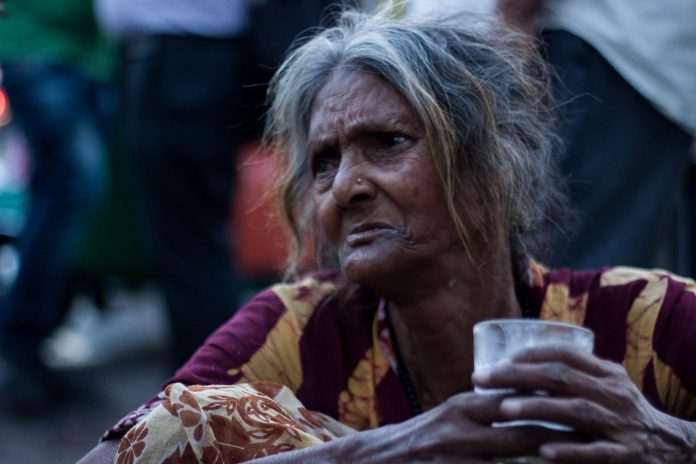
Picture Courtesy - Suchitra Yadav

In this article, Suchitra Yadav discusses the failures in proper implementation of free legal aid schemes.

The Concept of Legal Aid

Free Legal aid (Article 39A of the Constitution) is providing assistance to the people who are unable to afford legal representation and access to the court system. It guarantees to provide equal access to the justice system to persons who are not in financial sound condition, by providing legal and professional assistance free of cost or at lower fees.

From April 2017 to March 2018, total no. of 8,22,856 and since inception 16,711,477 eligible persons including women, children, persons in custody, persons belonging to SC/ST and backward categories have been benefited through various free legal services authorities, viz. (State legal services authority) SLSAs/ (District legal services authority) DLSAs/ (Taluk legal service committees) TLSs/ Legal Aid Clinics/ Village Legal Care and Support Centres.

In the words of Justice P.N. Bhagwati, “Legal Aid means providing an arrangement in the society so that the mission of administration of justice becomes easily accessible and is not out of reach of those who have to resort to it for enforcement… the poor and illiterate should be able to approach the courts, and their ignorance and poverty should not be an impediment in the way of their obtaining justice from the courts. Legal aid should be available to the poor and illiterate, who don’t have access to courts. One need not be a litigant to seek aid by means of legal aid.”

Establishment of Legal Services Authorities

In the year 1987, the Legal Services Authorities Act was enacted by the parliament to establish a nationwide uniform network for providing free legal services to the weaker section of the society on the basis of equal opportunity. Under this Act, The National Legal Services Authority (NALSA) has been constituted to monitor and evaluate the implementation of legal aid programmes by laying down policies and principles for making the legal services available. Following are the authorities constituted under this act: –

Authority Constitution                                           Functions
National Legal Services Authority (NALSA) By the Central Government
  • Coordinate and monitor functioning of State Authorities, District Authorities, Supreme Court Legal Service Committee, High Court Legal Service Committees, Taluk Legal Service Committees & voluntary social service institutions and other legal services organisations. And give general directions for implementation of legal services programmes.
  • Do all things necessary for ensuring commitment of fundamental duties of citizens.
  • Spread legal literacy and awareness amongst people for their rights.
  • Utilise funds at its disposal & make appropriate allocation of funds to State & District Authorities.
  • Encourage settlement of disputes by Lok Adalats, negotiation, arbitration and conciliation.
  • For making legal services available under this Act

(a) Lay down policies & principles

(b) Frame effective & economical schemes

  • Organise legal aid camps especially in rural areas, slums or labour colonies(educate about rights).
  • Development programmes for clinical legal education (taken up by Bar Council of India).
  • Promote, guide & supervise establishment and working of legal services clinics in universities, law colleges & other institutions.
  • Provide grants-in-aid to various institutions for implementation.
  • Undertake & promote research in this field.
State Legal Services Authority By the State Government
  • Duty to give effect to policies & direction of Central Authority(general function).
  • Give legal service to person who satisfy criteria under act.
  • Conduct Lok Adalats (also LA for HC cases)
  • Undertake preventive legal aid programmes
  • Perform functions fixed by regulations.
District Legal Service Authority By State Government for every District in State
  • Duty to perform functions of State Authority in the District as delegated to it from time to time by State Authority(general function).
  • Coordinate activities of Taluk Legal Services. Committee with other Legal Services Committees in the District.
  • Organise Lok Adalats within District.
  • Perform functions fixed by regulations.
Supreme Court Legal Service Committee By Central Authority
  • In the discharge of its functions under this act, the Central Authority shall, wherever appropriate, act in coordinating with other governmental and non-governmental agencies, universities and others engaged in the work of promoting the cause of legal services to the poor.
High Court Legal Service Committee By State Authority of each High Court
  • To administer and implement the Legal Services programme,
  • To receive and scrutinize applications for legal services and to decide all questions as to the grant of or withdrawal of legal services,
  • To maintain a panel of advocates and senior advocates in the High Court for providing legal advice,
  • To decide all matters relating to payment of honorarium, costs, charges and expenses of legal services to the advocates and to senior advocates of the High Court,
  • To prepare and submit returns, reports and statistical information in regard to the legal services programme to the State Authority.
Taluk Legal Service Committee By State Authority for each taluk/ mandal/ group of taluks or mandals
  • Coordinate activities of legal services in Taluk
  • Organise Lok Adalats within the Taluk
  • Perform such other functions as District Authority may assign to it.

Providing Legal Services includes

  • Providing services of lawyers in a legal proceeding;
  • Payment of court fee, process fees and all other charges payable or incurred in connection with any legal proceedings;
  • Obtaining and supply of certified copies of orders and other documents in legal proceedings;
  • Preparation of appeal, the paper book including printing and translation of documents in legal proceedings.

Procedural Intricacies

Any person in need of free legal aid can approach the concerned authority or committee in three ways that are as follow:

  1. By sending an application which could be in written form or it can be made orally as well to the officer or the para legal volunteer of the concerned legal services authority.
  2. By filling up the forms prepared by the authorities briefly stating the reason to seek legal aid.
  3. A person can also apply online by filling up the Legal Aid Application form available online at NALSA’s website by going on the ‘Online Application’ link on the home page, and uploading of required documents. SLSAs/ DSLAs/ SCLSC/ HCLSCs/ TLSCs have forms available on their respective websites.

Legal aid is provided to the entitled persons through the legal service authorities from NALSA to Taluka levels. Applications received by NALSA are forwarded to the concerned authority. Once the application is submitted with the proper authority, it would be pursued by the legal service institutions and action would be taken upon the same. Information regarding the next step is sent to the parties concerned. The action taken on the application would vary from providing counselling or advice to the parties, and providing a lawyer to represent them in the court if required.

Persons eligible for getting free legal aid

i) Women and children;

ii) Members of SC/ST

iii) Industrial workmen

iv) Victims of a mass disaster, violence, flood, drought, earthquake, industrial disaster.

v) Disabled persons.

vi) Persons in custody

vii) Persons whose annual income does not exceed Rs. 1 lakh (in the Supreme Court Legal Services Committee the limit is Rs. 1,25,000/-).

viii) Victims of Human trafficking and begar.

Lok Adalats

Lok Adalats are one of the Alternative Dispute Resolution Mechanism. It is a forum where the disputes/cases pending in the court of law or at the pre-litigation stage are settled/compromised amicably. The Lok Adalat has been given statutory status under the Legal Services Authorities Act, 1987. Under this Act, an award made by a Lok Adalat is deemed to be a decree of a civil court and is final and binding on all parties and no appeal lies against thereto before any court.

Challenges to Legal Aid

The first conception of legal aid comes as a measure to effectively control the Indian populace by restoring their faith in the justice system. The free legal aid has proven to be ineffective in India.

Quality of free legal aid services

There is a perception that the free service is incompatible with the quality of service, and there are not enough lawyers under the authorities who deliver free legal aid services and they are least interested in providing legal assistance because of financial constraints. Reportedly, there are lawyers who don’t faithfully represent their clients. These lawyers hold many of their innocent client’s cases for ransom by using delay tactics and compel them to pay additional amount of money to them, even though they are supposed to receive their fee from the free legal aid committee. One of the reasons contributing to situations like these is that the lawyers are not getting a fair remuneration, not even to meet the incidental expenses.

Free legal services are made available to more than half of the population irrespective of their financial conditions, which a developing country like us should be proud of. But most of the citizens are not aware of under which provisions free legal aid is available to the them. One of the major steps required in making the free legal aid accessible to everyone is “the law making its reach to the people, not the people making its reach to the law”. Another major obstacle is the delivery of the free legal aid in India which is far too inefficient. More lawyers must be encouraged and campaigns should be launched to inform citizens about the existence of free legal aid. Free legal aid can only be achieved when the people are aware of their basic legal rights. When the people are not aware of their legal rights, they are exploited and ultimately deprived of the rights and benefits provided to them by the law.

Sensitisation

The Government has constituted many committees, introduced many schemes, have made qualitative policies which can yield great results and have taken remarkable steps. However, it is lagging behind in making its reach to the grass-root level because the government is not capable in spreading awareness amongst the people about the benefits accruing through this act. The Government needs to embark on a campaign to inform and educate the people of their right to free legal aid and employ more efficient processes to improve free legal aid delivery system. There is a need to suggest the government to pay more attention to the delivery of free legal aid services through the justice systems. The State generally fails to organize legal awareness camps, which should be at priority list of government. The government must organise these camps at regular intervals and an inspecting authority must also be appointed to oversee the working of the State authorities in this regard. In order to make free legal aid services effective, “legal dispensaries” or clinics inspired by the model of free medical aid in medical colleges, were set up. Here, poor person can come for free consultation and advice.

Poor condition of the lower courts

The provisions of this act seek to dispense justice in an informal and casual manner but it has over a period of time failed to do so as the matters are heard and disposed off in a “hurriedly” manner as the judges working in the subordinate courts are also under pressure to dispose more and more cases to reach the targets set for them by the High Courts. In my opinion, the quality of justice must not be compromised with in order to achieve the targets of the number of cases to be disposed-off. The lawyers should be given professional training on the laws concerned with the free legal aid and the procedures followed in the courts.

The Law Schools play an important role in advancement of awareness amongst people about the concept of free legal aid but this aspect has been largely ignored in the academic discourse. More subjects focusing on social issues must be inculcated in the course syllabus of law schools.

The Hon’ble Supreme Court of India has taken steps to encourage the Pro-Bono Legal Services. In 2017, the Ministry of law has launched a “Pro-Bono Legal Service” which is a web-based platform, through which the interested lawyers can register themselves to volunteer for pro-bono services for the people out of reach of the court. Many lawyers from time-to-time, have made attempts to provide people with free services at their personal levels, however,  they failed to do so due to lack of institutional support, and its success was short-lived.

Legal Awareness Programmes

Legal literacy is the basis for the survival of the constitutional democracy in any country and can bring a radical change in the society. The judicial system in India works on the presumption that all the citizens are aware of their rights and can approach the concerned institution. Educating individuals regarding issues affecting their lives regulated by the law, is legal education. Legal awareness can empower a person to demand justice and effective remedies at all levels. Each and every person should be made aware of the basic law of the country. Basic level of legal education should be made compulsory in the school. Awareness of the legal know-how helps the citizens to exercise their rights and duties and comply with the law.

Law schools actively through their registered college societies outreach to the people in the slums and provide them legal aid by giving them access a lawyer free of cost. Students, also through street play in the slums create legal awareness which is a quite different and much more attractive way to make them legally literate. This concept of teaching is relatively new, hence, the quality of the young minds is enhanced and is just not limited to the theory of the law, but balanced with the practical knowledge as well. Legal camps/clinics are emerging as an important part of the legal education and are highly promoted by the colleges and the authorities by giving them chance to work with them. The authorities must realize and recognize the needs of every area where the legal awareness camps are organized and should mainly focus to make a reach to the people at the ground level and keeping a track of the matters till they are disposed-off. Legal literacy material should also be properly and timely distributed to the participants. And such material should be in the simplest form with the least amount of legal jargon to make it easier to understand.

Statutory Recognition of Legal Aid

By virtue of article 39A of the Indian Constitution, the States are directed to provide free legal aid to the weaker and poorer sections of the society. Articles 14 and 22(1) of the Constitution also make it obligatory for the State to ensure equality before the law and a legal system which promotes justice on the basis of equal opportunity to all. Even in the procedural law of our country, the provisions of legal aid have been laid down under section 304 of Cr.P.C which states that if the accused does not have sufficient means to engage a lawyer, the court must provide one for the defense of the accused at the expense of the State. The right to speedy trial and free legal aid have been recognised as being part of the Right to Life and Personal Liberty under Article 21 of the Indian Constitution.

Contribution of Judiciary to Free Legal Aid

The judiciary has played an active role in providing free legal aid to the needy and the weaker section of the society. The constitution has given the power to judiciary to protect and safeguard the rights of people.

The attention of Hon’ble Supreme court of India was brought towards this issue, when a petition was filed in the year 1979 before the bench headed by Justice P.N.Bhagwati regarding the conditions of the prisoners detained in the Bihar jail, whose suits were pending in the court. This petition was filed collectively by the prisoners of the Bihar jail in the name of Hussainara Khatoon, under the case title Hussainara Khatoon Vs State of Bihar. The prisoners had already undergone the punishment much more than they would have got if there was no delay in their conviction. The court with immediate effect released these persons and held that the State can not be permitted to deny the constitutional right of the speedy trial on the ground that the State doesn’t have adequate resources and apparatus. Thus, in this case, the court pointed out that Article 39A was an inalienable element of reasonable, fair and just procedure and right to free legal services were implicit in the Article 21 of the Indian Constitution.

In Sk Das vs Union Territory of Arunachal Pradesh, Justice P.N. Bhagwati emphasized creating legal awareness to the poor as they don’t know their rights and particularly their free legal aid rights.

Justice Krishna Iyer rightly said that “if a prisoner is sentenced to imprisonment and is virtually unable to exercise his constitutional and statutory right of appeal including special leave petition for providing legal assistance to the Supreme Court for want of legal assistance, there is an implied duty of the court under Article 142 read with Articles 21 and 39-A of the Constitution, the power to assign counsel for such imprisoned individual for doing complete justice”

In Khatri & Ors. State of Bihar & Ors., it was held that the Magistrate or the Sessions Judge before whom an accused appears must be held to be under an obligation to inform the accused that if he is unable to engage the services of a lawyer on account of poverty or indigence, he is entitled to obtain free legal services at the cost of the State.

By the Act of 1987, an attempt is made to reduce the workload of the courts by setting up of Lok Adalats as an alternative dispute resolution system and which was welcomed by the Indian Judiciary. Judgements as mentioned above bring out that not only giving legal aid is an essential ingredient of the judicial system but also highlighted the role of judges in ensuring that this right will be available to the needy.

In Near Future

Strengthening the Pro Bono Culture and making the Legal professionals in India more accessible and feasible to public will help in making a positive impact on the legal aid system in India. The existing legal framework should be enriched with better facilities, trained lawyers, adoption of alternative ways to make people legally literate and focusing more on the areas which are least introduced to the free legal aid services. For the sustainable growth of the Legal Aid Services, the legal professionals with a positive attitude should be given exposure to the diversification of the laws and the extraordinary situations.
Download Now

Child Sexual Abuse Laws in India – The POCSO Act

0

In this article, Manish of CLC discusses the POCSO Act.

What is Child Abuse?

Child Abuse can be the result of any form of abuse such as mental, physical, neglect, emotional, and sexual abuse. It occurs everywhere at different level of society, in educational institutions, workplaces, homes, neighbourhoods, and even at the places meant for child protection. Indian population is majorly covered by young generation and children are the future of the nation. India being a developing nation, must focus on the sensitive issue of Child Sexual Abuse (CSA). CSA is one of the most critical issues that is to be dealt with seriousness.

Safety and securities don’t just happen, they are the result of collective consensus and public investment. We owe our children, the most vulnerable citizens in our society, a life free of violence and fear”.-Nelson Mandela 

The Children of our country are the most vulnerable citizens of our country towards child abuse. Silence towards it is a failure on our side. In 2007, the survey conducted by the Ministry of Women and Child development in which 12,500 children participated across 13 states showed that 53% said that they had been subjected to one or more forms of sexual abuse.

Causes of Child Sexual Abuse (CSA)

  • Taboo about discussing sex and sexuality is an important factor that leads to lack of awareness in the society about sexual offences against children.
  • Sometimes abusers suffer from mental disturbances and think of themselves as a child too, which result in the heinous crime of CSA.
  • Lack of protection for isolated children and children with some disabilities are vulnerable to CSA.
  • Enticing poor children in a trap of money or fake promises, but take their advantage.
  • Indian society has Trust factor between the offender and victim because many reports/survey suggests that majority of times the offender is known to the child.

POCSO Act

The Protection of Children from Sexual Offences Act, 32 of 2012.

An Act to protect from offences of sexual assault, sexual harassment and pornography and provides for the establishment of special courts for trial of such offences and for matters connected therewith or incidental thereto.” To curb the abomination of child sexual abuse, Parliament of India enacted ‘The Protection of Children from Sexual Offences Act (POCSO Act), 32 of 2012 with the competent legislative authority under the article 15(3) of the constitution of India. Article 15(3) constitution of India states that “nothing in this article shall prevent from making any special provision for women and children”. On 11th December 1992, Government of India also acceded to the Convention on the Rights of Child, adopted by the General Assembly of the United Nation, which prescribed a set of standards followed by all State parties in securing the best interests of the child.

The Need of POCSO Act

Provisions which addresses the critical issue of CSA in India before and after the enactment of the POCSO Act.

Before The POCSO Act, 2012

Provision of Indian Penal Code, 1860, covered the offences committed against children.

  • Section292 and 293 deals with the obscenity but fails to deal with ‘Online Obscenity’.In Ranjit D. Udeshi vs State Of Maharashtra[1], the Supreme Court held that pornography is obscenity in more aggravated form.
  • Section 372: Selling of minor children for purpose of prostitution
  • Section 376 (2) (f): punishment of rape, when a woman who is being raped is under 12 year of age, is imprisonment for a term not less than 10 years and may extend to life.
  • Section 377:  Unnatural Offence-this section is gender neutral and whenever a victim of sexual child abuse is a boy, this section is applicable.
  • Section 67B(20) of Information Technology(IT) Act, 2000 took care of online abuse of a child and even transmitting or publishing any sexually exploitative content of the child is punishable.

Why The POCSO Act, 2012

There were certain provisions relating to sexual offences committed against children but sections of the Indian penal code, 1860 were generalized in nature; no specific laws in India were not able to address sexual offences against children effectively.

  1. Provisions of Indian penal code, 1860 were not gender neutral, for eg: Section 376 is only concerned with the female, the male child was left out.
  2. Failure to curb the crime of child sexual abuse and less efficacy of the previous provision. The need for the POCSO Act was reflected by different surveys conducted by the government of India. In 2007, the survey conducted by the Ministry of Women and Child development in which 12,500 children participated across 13 states, showed that 53% of the children said that they have been subjected to one or more forms of sexual abuse.
  3. Increase in the number of child abuse cases: A total of 33,098 cases of CSA were reported in the nation during the year 2011 when compared to 26,694 reported in 2010 which increased by 24%.[2]
  4. When the abuser is a family member itself, the question of child safety and protection remains unanswered. The first study on CSA in India was conducted by Recovery and Healing from Incest, an Indian non-government organization (NGO) in 1998. The majority (76%) of the participants reported being abused during childhood or adolescence.[3]
  5. Despite provisions in the Information and Technology Act, 2000 that deals with child pornography were not enough to stop online child abuse.

Gender and Profile of victim & offender under POCSO Act

Any Child can be a victim of sexual offence or pornography etc. irrespective of gender. ‘Child’ means any person below the age of eighteen years [section 2(d)].

  • Under the POCSO Act victim’s gender is immaterial. According to the World Health Organization, one out of every 4 girls and one out of every 7 boys are victims of sexual abuse.
  • The national survey conducted by the Ministry of Women & Children Development in 2007 shows that 57% of children who said that they have experienced one or more form of sexual abuse, were boys.
  • The offender can be male, female or transgender irrespective of their age. When an offence under this act is committed by a child, such child shall be dealt with under the provision of the Juvenile Justice (Care and Protection of Children) Act, 2000 ( Section 34).

For example, A child of age 14 can be offender under this act but the only difference is that the Juvenile Justice Act 2015 would be applicable. Whereas the offender above the age of 18, Indian penal code and the Criminal Procedure Code,1973 would be applicable.

The key provision of the POCSO Act

Offences and punishment under POCSO Act, 32 of 2012

The preamble of the act undoubtedly states that this Act was enacted to protect children from sexual assault, sexual harassment, pornography etc. These are the following sections of the POCSO Act, 2012 which defines the offences and punishments covered under it.

Chapter II Sexual offences against children

Penetrative Sexual Assault and Punishment

  • Section 3 defines penetrative sexual assault,

When a person penetrates any object or part of his body, to an extent, into vagina, mouth, urethra or anus of a child or makes the child do so with him or any other person. Also when he manipulates any part of the body of the child so as to cause penetration or apply his mouth and makes the child do so with such person or any other person.

  • Section 4 the prescribed punishment is imprisonment for either description for a term which shall not be less than seven years but which may extend to imprisonment for life, and shall also liable to fine.

Sexual Assault and punishment Therefore

  • Section 7 defines sexual assault,

Whoever, with sexual intent, touches the vagina, penis, anus or breast of the child or makes the child touch the vagina, penis, anus or breast of such person or any other person, or does any other act with sexual intent which involves physical contact without penetration is said to commit sexual assault.

  • Section 8 Whoever commits sexual assault shall be punished with the imprisonment of either description for a term which shall not less than three years but which may extend to five years, and shall also be liable to fine.

Sexual Harassment and punishment Therefore

  • Section 11 defines sexual harassment,

A person is said to commit sexual harassment upon a child when such a person with sexual intent-

  1. Any person utters or makes any sound, or makes any gesture or exhibits any object or part of the body with the intention that such word or sound shall be heard, or such gesture or object or part of the body shall be seen by the child; or
  2. Makes a child do such things mentioned hereinafter;
  3. Entices or Showing a child anything which may relate to pornography or pornographic purposes, watching or contacts child either directly or digitally, threatens to use a real or fabricated depiction through electronic, film, or digital or any other mode, of any body part of the child

Explanation: Any question that involves “sexual intent” shall be a question of fact.

  • Section 12 prescribes the punishment of imprisonment for a term, which may extend to three years and shall also be liable to fine

The aggravated form of sexual offences

This act recognizes the aggravated form of the penetrative sexual assault and sexual assault when these are committed by the police officer, public servant, armed personnel, or member of security forces etc. One can say that this act is quite more serious when the protector is the perpetrator.

  • Section 5 – aggravated penetrative sexual assault and its punishment under Section 6 is minimum of 10 years of imprisonment which may extend to a term of life, and shall also liable for fine.
  • Section 9 – aggravated sexual assault and its punishment under section 10 is a minimum of 5 years imprisonment which may extend to 7 years, and shall also liable for fine.

Using the child for pornographic purpose

  • Section 13, using a child in any media, for the purpose of sexual gratification, which includes-Representation of sexual organs of a child. Engaging a child in real or simulated sexual acts. Indecent or obscene representation of child shall be guilty of using a child for pornographic purposes.

The explanation provided with section 13 states that the expression “use of child” shall include involving a child through any medium like print, electronic, computer or any other technology for preparation, production, offering, transmitting, publishing, facilitation and distribution of the pornographic material.

  • Section 14 recognises different levels of punishment for the different level of actus rea. Generally, life imprisonment which may extend to 5 years is provided in Sub Section (1), if a person using a child for pornography commits an offence under section 3 of the Act, by directly participating in the pornographic act, the prescribed punishment is life imprisonment and shall also be liable for fine.
  • When a person stores, for commercial purposes any pornographic material which is sexual exploitive of a child, shall be punished with imprisonment for 3 years or with fine or both.

Mandatory reporting of cases

Where to complaint any offence relating to child sexual abuse?

  • Section 19 (1) makes it mandatory for any person, who has apprehension that an offence under this Act is likely to be committed or has knowledge that such offence has been committed, to report it either to the Special Juvenile Police Unit or to the Local Police.
  • Section 20 requires a mandatory reporting, when any person encounters with any material or object with are sexually exploitative of the child.

Special provision for recording the statement of the victim (Section 24)

  • Place of recording of the statement will be of child’s choice and comfort.
  • The police officer while recording statement must not be in uniform and also make sure that at no point of time child come in contact in any way with the offender.
  • No child shall be detained in the night for any reason.

Special courts, their powers & procedure for recording of evidence

  • For the purpose of the speedy trial, the State Government must establish a court of session to be a special court (section 28).
  • While trying an offence under this Act, a Special Court can also try an offence, with which the accused may, under the Code of Criminal Procedure, 1973, be charged at the same time.
  • The burden of proof lies on accused (section 29).
  • Special public prosecutor to be appointed by the state government, the person appointed must be in practice for at least 7 years.
  • The court presumes all the type of culpable mental state of the accused [section 30(1)]. POCSO Act ensures punishment for all offenders irrespective of gender or age.
  • The court can take cognizance of any offence, without the accused being committed to it for trial, upon receiving a complaint of facts which discloses such offence [Section 33(1)].
  • The court may permit frequent breaks for the child during a trial.
  • The court shall not call the child repeatedly to testify.

Protection of child victim

  • On the reasonable grounds Special Juvenile Police Unit or Local Police, after recorded in writing, such child shall be provided with care and protection homes within 24 hours of the report [Section 29(5)]
  • The court shall create a child-friendly atmosphere by allowing a family, member, a guardian, a friend, or a relative in whom the child has trust.

Note: In case a child is abused or likely to abuse by a family member, then he/she must be taken out of the custody of his/her family (Rule 4 of POCSO Rules).

Recent development in the POCSO Act

The Criminal Law Amendment (CLA) Act, 2013

After receiving the President’s assent on 2nd April 2013, the CLA Act amended the Section 42 and inserted a new Section 42A in the POCSO Act. Section 42A provides that the provisions of POCSO Act shall be in addition to and not in derogation with the provisions of any other law, and in case of inconsistency, the provisions of the POCSO Act shall have an overriding effect to the extent of the inconsistency.

The Criminal Law (Amendment) Ordinance, No. 2 of 2018

An Ordinance further to amend the Indian Penal Code, 1860; Indian Evidence Act, 1872; The Code of Criminal Procedure, 1973; and the POCSO Act, 2012 was introduced by the President. It amends Section 42 of the POCSO Act by inserting the Section 376DA, 376DB of Indian Penal Code, 1860

  • Section 376DA – Where woman under 16 years of age is raped by one or more persons, then each (acting in furtherance of common intention) of them shall be imprisoned for the remainder of that person’s natural life, and with fine.
  • Section 367DB. Where woman under 12 years of age is raped by one or more persons, then each (acting in furtherance of common intention) of them shall be punished with life imprisonment, and fine, or with death.

Note: Such fine shall be paid to the victim and must be adequate to meet the medical expenses and rehabilitation of the victim.

Alakh Alok Srivastava vs Union Of India 1 May 2018

A three-judge bench headed by Chief Justice of India Deepak Mishra, Justice D. Y. Chandrachud and Justice A.M. Khanwilkar issued directions for the speedy disposal of cases under POCSO Act. The Public Interest Litigation filed by advocate Alakh Alok Srivastava drew the attention of the Supreme Court towards non-compliance by the States with mandates of the POCSO Act. The Hon’ble supreme court issued the following guidelines to the States as follows:

  1. The High Courts shall ensure that cases registered under the POCSO Act are tried and disposed of by the Special Courts.
  2. No unnecessary adjournments should be allowed and the trial must be completed in a time-bound manner or within a specific time frame provided under the Act.
  3. To be established Special Courts, if the same has not been done already.
  4. The Chief Justices of the High Courts were ordered constitute a Committee of three Judges to regulate and monitor the progress of the trials under the POCSO Act. If three Judges are not available, the Chief Justices of the respective High Courts shall constitute a one Judge Committee.
  5. The Director General of Police or the officer of equivalent rank shall constitute a Special Task Force which shall ensure that the investigation is done properly and witnesses are produced on the dates fixed before the trial courts.
  6. Adequate steps to be taken to ensure the child-friendly atmosphere in the Special Courts.

POCSO Cell- Monitoring The Implementation of Act

Section 44 of POCSO Act assigns the National Commission for Protection of Child Rights and the State commission for The Protection of Child Rights additional work of monitoring the implementation of the provision of this Act.

Main Tasks of POSCO Cell and Activities

  • Drafting of modules for Police, CWC, Health departments, non-governmental organisation etc. to assist child at trial and pre-trial stages under Section 39 of the POCSO Act.
  • Preparation of Guidelines with Lawyers Collective and UNICEF:Guidelines for Police,
    • Guidelines for Special Courts,
    • Guidelines for Special Prosecutors,
    • Guidelines for Child Welfare Committees (CWC), and
    • Guidelines for Health Professionals.
  • Preparation of IEC (Information, Education, Communication) material;
  • Review of IEC (Information, Education, Communication) material for preventing child sexual abuse prepared by State/UT and NGOs initiated to identify best practices and to disseminate same among other States/UTs.
  • Initiating the campaign to create awareness through radio, television or media at regular intervals among the general public, children, and parents to prevent sexual abuse To monitor the appointment of Special Public Prosecutor by the State Governments.
  • To monitor the designation of special courts by the State Governments.
  • To collect information and data and make the report about the number, details of offences reported under POCSO.
  • Addressed several cases of child abuse and recommended compensation for victims.
  • Prepare a report on the factors responsible for the cause of child sexual abuse in India.

POCSO E-Box Scheme

One of the important factors that lead towards the vulnerability is the relationship of the victim with the offender. In most of the cases, the offender is known to the victim which makes a child more vulnerable and suppress from reporting the heinous crime of child sexual abuse.

  • Sexual abuse scars the psyche of the affected child for the entire life. In search of a child-friendly system of filing a complaint about child abuse, the National Commission for Protection of Child Rights (NCPCR)  came with the POCSO E-Box scheme.
  • A major initiative by NCPCR to help children to report such crimes directly to the commission. It is an easy and direct medium which allow children to file a complaint in case of sexual assault under the POCSO Act, 2012.
  • Under this scheme, NCPCR has also launched POCSO E-Box Mobile Application.

How to file a complaint using POCSO E-Box Scheme

  1. Go to the homepage of National Commission for Protection of Child Rights website
  2. Press a button named “POCSO E-Box”.Complaint Monitoring System - Open in New Window
  3. After pressing the button, it will navigate you to a page with the window having a short animation movie telling “Our children NCPCR is your friend. If someone gives you a bad touch, show you bad pictures and you are not able to tell your parents Or anyone else than Tell us! We will help you”. Then press the button “PRESS HERE”.
  4. There will be a page asking for picture options. The user has to select at least one picture from the option, fill the form and click on the submit button to register the complaint.
  5. After this, an acknowledgement that the complaint has been registered along with the complaint number will be displayed.

Note: Complainant can also send the complaint by post through messenger or any other means to the following address;

National Commission for Protection of Child Rights (NCPCR)

5th floor, Chandralok Building

36, Janpath, New Delhi-110001 India or,

Visit www.ncpcr.gov.in

In Emergency please contact- Police: 100, Childline: 1098

POCSO Workshops

These Workshops were conducted by NCPCR on salient features of the POCSO Act/ POCSO E-Box scheme. One in Durg and Raipur, Chhattisgarh and another in Jaipur and Udaipur, Rajasthan with an aim to acquaint the general public the provisions of POCSO Act and preventive steps. Mostly these workshops were attended by Teachers and Students together.

The Main objective of the Workshops

  • To encourage the participants to express themselves and self-realization.
  • To acquaint the participants with the salient features of the POCSO Act.
  • To enhance the people about the POCSO E-Box Scheme.
  • To create awareness on child sexual abuse.
  • How to file a complaint or report the abuse to the authority.

Observations

  • The participants felt that this was a great initiative to learn and acquaint with the provisions of the POCSO Act.
  • People were willing to participate and create awareness among their society to safeguard children.
  • These kinds of workshops open up areas for positive discussion of sexuality which is a Taboo in India.

Journey So Far POCSO Act

In an Information provided by the Press Information Bureau, Government of India on 08-February-2018 states that 1,04976 cases registered under POCSO Act during the year 2014-16. The table below provides factual data about the number of case and status of cases during the year 2014-16

Category Case registered Cases convicted Person arrested Person chargesheeted Person convicted
2014 34,449 2,275 41,732 36,653 2,686
2015 34,505 3,809 41,090 37,683 4,567
2016 36,022 3,226 42,196 37,872 3,859

What should we conclude from the above table? No doubt there is an increase in the number of reporting CSA cases but we want simultaneously to curb the CSA. POCSO Act definitely helping to reduce the number of child abuse cases.

We need to introspect on effectiveness of POCSO Act: Justice Lokur, it has been six years since the enactment of the POCSO Act, Justice Lokur said despite there being more number of cases of child abuse than murder, “we spend more time discussing murders” and wondered “is murder of an adult more important than child sexual abuse“.. He also emphasised upon the need for bringing changes in evidence law, methods of investigation and strengthening of the forensics department of the government to keep pace with the changes in the nature of child sexual abuse crimes.

POCSO Act no doubts a good legislation and certainly a welcoming step to stop child sexual abuse but there must be few changes for its better implementation. For example, Section 27(2) requires that a female child to be examined by the female doctor but the issue arises when the female doctor is not available.

References

Download Now

How Long Would Legal Industry Ignore the Importance of Data

0
data protection and competition laws

This article is written by Ananya Banerjee, Founder of Unico Legale, a start-up advisory & corporate transactional firm.

“Do you know a good lawyer?”

“Yes. Mr X works on all our matters.”

“Okay. I will contact him, then.”

Gone are the days when lawyers used to get work just like this. While recommendations still play a vital role in legal industry, it is not enough, and often, it is not necessary. With the advent of tech entrepreneurs, the new generation is keen on doing their research online. And again, with the rapid transformation in technology sector, most lawyers become unsuitable for most of the new age start-ups due to their lack of knowledge and specialisation in technology. Hence, the HiPPO model still obtained by most law firms in India is changing rapidly.

What is HiPPO?

The process in which the Highest Paid Person (the Managing Partner, i.e.) takes all the decisions. In a non-digital world, it would have been easy. But now, competition in legal industry is so high, law firms need to take care of a thousand things. And yes, no matter how well connected your partners are, you have to go think beyond that. And to be true, while most of the law firms still operate in this structure, a few of them are developing with time. Then there is legal technology, legal education and so on. These subsectors operate just like Edtech/tech sectors and their use of data is as vital as any other tech company. But let us, for the sake of knowledge, concentrate on law firms. With the most basic google search, one could find 247 law firms in Mumbai and 221 law firms in Bangalore. How do you stand apart, then?

Why this Sudden Shift?

Although, traditionally, a law firm is different from other businesses, and there is a level of integrity and faith attached to legal profession that is beyond just quality and professional ethics, at the end of the day, a law firm is also a form of business and one must sustain and develop it with time to ensure it survives the changing economy. Law firms are barred from direct marketing, and to be true, direct marketing wouldn’t do much good to law firms either. Hence, it is ideal to see a law firm as a private establishment that needs special care.

Industrial Revolution

Digital Transformation is believed to bring the next industrial revolution and while lawyers are needed at every step of the way, to understand the changes and draft the documents, as well as to fight the disputes, it is also necessary to add these changes to our profession to make things easier and simpler. Ask the lawyers what GDPR is, and what to say about Private Data Protection Bill, we all know. Ask us about what kind of data would be required for business development. We would think twice. But, we do not run like other businesses and at all times, we need to understand the basics to keep ourselves profitable.

Lawyers and Business Development

A 21st century (more like 2018) managing partner needs to keep in mind the following things:

Client retention, marketing, brand management (yes, your law firm is also a brand), infrastructure development and employee satisfaction. You cannot ignore one aspect and expect to continue working smoothly. Not getting into any tech talk, client retention, marketing and brand management could improve significantly using the data that you are generating. Infrastructure development requires a little bit help from technology sector. But, you are already spending so much on making your servers secure. Why not do the same with the way your employees work?

I am not talking about making everything automated, like there are a few international law firms which exist only virtually through machine learning and deep learning, artificial intelligence and brand value. I am talking about getting some help from technology to generate better and faster results, ensure less errors and make more time to tend to client relations, and although we tend to ignore this one aspect – to increase employee satisfaction, which goes a long way in brand management, more client retention and all in all, to make a happier and more vibrant place of work.  

Why it is Important to Utilise Data?

We have all seen how laws are changing and evolving around data, in recent times. While you have a view on what is missing in these laws, or what could have been better, think about why these laws are being made – one reason – because data is valuable for businesses and businesses across the world are collecting it through several means and the authorities now wish to regulate the same to reduce unauthorised use of the same. When it is so valuable, so useful, it must be valuable for legal industry as well. Yes, it is. And use of data in legal industry is much more widespread, which, in itself, becomes a topic for discussion. So, I shall not venture into it right now.

Time to be Data Aware

Law firms – let’s not waste data anymore. International law firms are already utilising it. In India, digital transformation is spreading as fast as a wildfire. Let’s not be the only industry that could not open its arms to the full potential of data and analytics to solve business problems or to build a better functioning business.

About the Author

Ananya Banerjee, Founder of Unico Legale, a start-up advisory & corporate transactional firm, is the organiser of Know Your Business Better – A nationwide drive to make Indian Entrepreneurs (including lawyers) more Data Aware, to help them win at Digital Transformation.

Download Now

Preamble to the Constitution of India

1
preamble constitution India
Image Source - https://scroll.in/article/862935/the-bjp-is-wrong-merely-removing-the-word-secular-from-the-constitution-wont-make-it-any-less-so

The Preamble of the Indian Constitution

In this article, Palak Goel from Uttaranchal University discusses the Preamble to the Constitution of India.

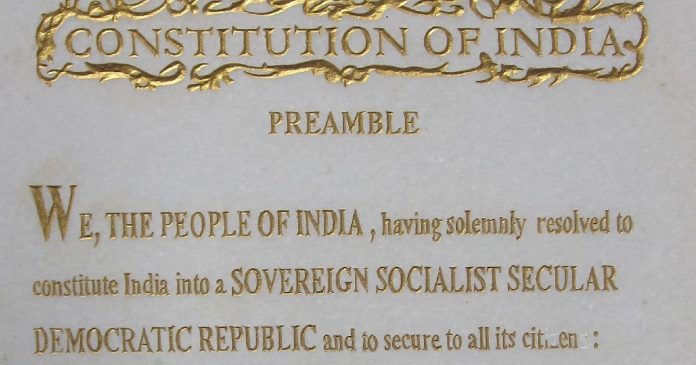
The opening lines of the Preamble of the Indian Constitution are

WE, THE PEOPLE OF INDIA, having solemnly resolved to constitute India into a SOVEREIGN SOCIALIST SECULAR DEMOCRATIC REPUBLIC and to secure to all its citizens:

JUSTICE, social, economic and political;

LIBERTY of thought, expression, belief, faith and worship;

EQUALITY of status and of opportunity;

and to promote among them all

FRATERNITY assuring the dignity of the individual and the unity and integrity of the Nation;

IN OUR CONSTITUENT ASSEMBLY this twenty-sixth day of November, 1949, do HEREBY, ADOPT, ENACT AND GIVE TO OURSELVES THIS CONSTITUTION”.

The Constitution of India is fundamental law of land. It is a socio, economic, and political instrument with a revolutionary domain. Every Constitution in the world outshines with a Preamble and so, the Indian Constitution also commences with a Preamble, which reflects the ideals, aspirations, expectations and objectivity of the people of India. The Preamble contains the aim and objectives of the Indian Republic and enshrines the whole philosophy and legislative intent of the Indian Constitution in a nutshell. No reading of any Constitution can be complete without reading Preamble. It acts as a theme around which a legislation revolves.

Preamble gives the idea about the following :

  • The source of the Constitution;
  • Nature of Indian State;
  • A statement of its objectives; and
  • The date of its adoption

The legislative intent of the Preamble of the Constitution is based on the “open-minded perseverance” drafted and moved by Pandit Nehru and adopted by the Constituent Assembly on 26 November, 1949.

Thus, on analyzing the key aspects of the Preamble, it can be divided into three parts by reference to it qualitative characteristics. The Preamble is

https://lawsikho.com/course/certificate-criminal-litigation-trial-advocacy
click above
  1. DECLARATORY, as to the enactment of the Preamble to the Constitution, i.e., the people of India in their Constituent Assembly adopted, enacted and gave to themselves this Constitution.
  2. REVOLUTIONARY, in the sense of the legislative intent of the preamble, i.e., whereby the people of India solemnly resolved to constitute India into a SOVEREIGN SOCIALIST SECULAR DEMOCRATIC REPUBLIC and to secure to all its citizens.
  3. INFORMATIVE, as to the source of the Preamble to the Constitution, i.e, “WE, THE PEOPLE OF INDIA”.

15 Facts You Didn’t Know About The Preamble

  1. Prem Behari Narain Raizada has written in a flowing italic style with beautiful calligraphy the original Constitution of India.
  2. In the Library of the Parliament of India, in special helium-filled cases, are kept the original copies of the Indian Constitution which are written in Hindi and English.
  3. The Indian Constitution is the longest written constitution of any sovereign country in the world with 25 parts containing 448 articles and 12 schedules.
  4. The first Constituent Assembly met on December 09,1946 and took precisely 2 years, 11 months and 18 days for the final drafting of the Indian Constitution.
  5. As the result of the debate and discussion for the finalization over 2000 amendments were made in it.
  6. The handwritten Constitution which was signed on 24th January,1950 came into force on 26th January i.e. two days later from being signed. It was signed by 284 members of the Constituent Assembly which included 15 women as well.
  7. The final drafting of the Constitution completed on 26th November, 1949. But it came into force after two months on 26th January, 1950 which is known as REPUBLIC DAY.
  8. Our constitution makers have adopted various provisions from various other constitutions while drafting our Constitution.
  9. The ideology of the Directive Principles of State Policy (DPSP) was adopted from Ireland.
  10. The French Revolution laid down the principles of Liberty, Equality and Fraternity in our Preamble, which is also called as the French motto.
  11. The Preamble of the Constitution of the United States of America also starts with “We the people” which persuaded the Preamble of Constitution.
  12. The legislative intent behind the concept of Fundamental Rights which are recognized by our Constitution has been adopted from the American Constitution. It recognizes nine fundamental rights secured to all its citizens.
  13. In the beginning, the Right to Property was also one of the Fundamental Right enumerated under Article 31 of the Constitution which stated that “No person shall be deprived of his property save by authority of law”. However, it was deleted by the 44th Amendment, 1978.
  14. The Indian Constitution is one of the world’s best Constitution as it has been amended 94 times from 62 years of its enforcement. By latest, our Constitution has undergone a total of more than 100 amendments.
  15. The renowned painter Beohar Rammanohar Sinha of Jabalpur designed and decorated the page of the Preamble along with the other pages of the Constitution of India.

The Preamble is an ornamental part of the Constitution and is couched in lofty and stirring language. These words like justice, liberty, equality and fraternity evoke in our mind, the memories of the great struggles the nation had to go through in order to secure them. These words tell us why we in India fought the protracted freedom struggle in which thousands of our people died. With noble ideas like justice, fraternity, equality and liberty enshrined in the Preamble, we can build India of our dreams. The Preamble is an embodiment of the principles in the objective resolution adopted by the Constituent Assembly in 1947”. – A.T. Philips and K.H. Shivaji Rao

The Preamble provides the legislative intent of India to be a welfare State

The terminology of the Preamble enshrines the fundamental values and guiding principles which forms a base for the Constitution of India. It provides the legislative intent of India to be a welfare State. The Preamble serves as a pathfinder for the Constitution and judges interpret the ideology of the provisions of the Constitution in its light. Constitution of India stands like a tree to which Preamble is the root, stem and source. Keywords of Preamble are as follows which expand the horizon of the Constitution of India.

  • Sovereign

In Synthetics & Chemicals Ltd. v. State of Uttar Pradesh [1], Hon’ble Supreme Court observed that the word “sovereign” means that State has the power to legislate on any subject in conformity with constitutional limitations. It means supreme or independence. There are two kinds of sovereignty, viz, internally and externally sovereign. Being internally sovereign refers to having a free government which is directly elected by the people which make laws that govern the people. Externally sovereign means free from the control of any foreign power or compliances. All the people are free in their limit to do their work in their own opinion. A country can not have its own Constitution if it is not sovereign.

  • Socialist

The word “socialist” was added to the Preamble by the 42nd Amendment, 1976 during the Emergency. The socialist character of the Indian Constitution is emphasized in the Preamble, which spells out the aspiration of the people to secure to all its citizens social, economic and political justice. It implies social and economic equality. Having the standards of being socially equal means the absence of inequity on the grounds of caste, creed, sex, colour, religion or language. It means everyone has equal status and has equal access to the opportunities. Economic stability means that equal distribution of wealth which leads to a decent standard of living for all.

  • Secular

The word “secular” was added to the Preamble by the 42nd Amendment, 1976 during the Emergency. The Constitution of India stands for a secular State, i.e., The State has no official religion. The concept of Secularism expands its horizons to give full opportunity to profess, practice and propagate the religion of their choice. The Constitution along with providing the guarantee to person’s freedom of choice of his religion and conscience also ensures freedom who has no religion and restrains the State from making any discrimination on grounds of religion.

Most important components of secularism are as under :

  • Equality is incorporated in Article 14;
  • Prohibition against discrimination on the ground of religion, caste, etc., is incorporated in Article 15 and Article 16;
  • Freedom of speech and expression and all other important freedoms of all the citizens are conferred under Article 19 and Article 21;
  • Right to practice religion is conferred under Article 25 to 28;
  • Fundamental duty of the State to enact uniform civil laws treating all the citizens as equal is imposed by Article 44;
  • Sentiment of the majority of the people towards the cow and against its slaughter was incorporated in Article 48

In S.R. Bommai v. Union of India [2], Hon’ble Supreme Court held that Secularism is the basic feature of the Constitution.

The concept of secularism to put it, in a nutshell, is that the “State” will have no religion observed in Bal Patil v. Union of India [3].

It was held in M.P. Gopalakrishnan Nair v. State of Kerala [4] that being a secular State does not mean having an atheist society.

  • Democratic

The word democratic is derived from the Greek word ‘demos’ which means ‘people’ and ‘kratos’ which means ‘authority’. The opening lines of the Preamble “We, the people of India” and the concluding lines “give to ourselves this Constitution” portrays the democratic spirit involved in the Constitution. The people of India elect their governments at all levels, i.e., Union, State and local by a system of “one man one vote”.

  • Republic

The word republic is derived from res publica, which means public property or commonwealth. A republic means a form of government in which the head of the state is an elected person and not a hereditary monarch like the king or the queen in Great Britain. Being republic means the vesting of the political sovereignty in the people and election of the head of the state is done by the people of the nation for a fixed term. In the broad sense, the word republic refers to a government in which no one holds the public power as a proprietary right.

Four Objectives of Indian State

The objectivity of the Preamble can be derived from the four keywords mentioned therein, i.e., JUSTICE, LIBERTY, EQUALITY and FRATERNITY. In P.A. Inamdar v. State of Maharashtra [5], it was observed that if Indian polity has to be educated and educated with excellence, it is a well-settled principle of the golden goals set out in the Preamble of the Constitution, i.e., JUSTICE, LIBERTY, EQUALITY, and FRATERNITY.

  • Justice

The term “justice” signifies three distinct types of justice, viz, social, political and economic which is guaranteed through Fundamental Rights and Directive Principles of State Policy enshrined under Part III and Part IV respectively of The Constitution of India, 1949.

Social Justice means the abolition of discrimination on the basis of sex, colour, creed, race or religion. It means the abolition of untouchability. It also includes improvement in the condition of backward classes, i.e., Scheduled Caste, Scheduled Tribes and Other Backward Classes.

Economic Justice herein mentioned refers to the elimination of glaring inequalities of wealth, income and property. A combination of social justice and economic justice is what known as ‘distributive justice’.

Political Justice implies that all citizens should have equal political rights, equal access to all political offices and equal voice in the government.

  • Equality

A right without the sanction from the authority has no meaning. Such a right can not be enjoyed by of the members of the community. The legislative intent of the makers of the Constitution was to ensure equality of status and opportunity for all and to provide a basis for ultimately establishing an egalitarian society. Equality of status and opportunity as enshrined in the Preamble is secured to all firstly, by abolition of all kinds of distinctions and biases by the State between citizens on the grounds of religion, race, caste, sex and secondly, by equal access to open public places, by abolishing untouchability and titles, by securing equality for opportunity in the employment sector or appointment to any office under the State.

  • Liberty

Liberty is the most cherished possession of a man. The Preamble of the Constitution professes to secure the liberty of thought, expression, belief, faith and worship. These freedoms are guaranteed through Fundamental Rights enshrined in Part III of The Constitution of India, 1949. Liberty is the power of doing what is allowed by law. The constitutional law of the country has fully guaranteed liberty through its mechanisms, judiciary and established rules of justiciability. Liberty does not mean ‘license’ to do what one likes and has to be enjoyed within the limitations mentioned in the Constitution itself. In short, the liberty conceived by the Preamble is not absolute.

  • Fraternity

The expression “unity and integrity of the Nation” has been substituted by 42nd Amendment,1976 to the Preamble of the Constitution. Fraternity means the sense of brotherhood. It is a feeling that all people are children of the same soil, the same motherland. Brotherhood is a particular kind of relationship irrespective of gender and generation. In a country like India, it is necessary to prioritize the expression of the unity and integrity that can be preserved only by a spirit of brotherhood. India has one citizenship and every citizen should feel that he is Indian first irrespective of another basis.

The Preamble: A part of the Constitution or not

The debated topic as to Preamble whether part of Constitution or not was decided in two leading cases:

Berubari Case [6]

  • Berubari Case on the Constitution of India on the implementation of the Indo-Pak agreement relating to Berubari union and exchange of enclaves came up for consideration by a bench consisting of eight judges.
  • The Court held that Preamble to the Constitution is “a key to open the mind of the framers of the Constitution” but it is not a part of the Constitution.

Kesavananda Bharati case [7]

This case has created a history. A bench of 13 judges had assembled and sat in its original jurisdiction hearing the writ petition. It was held in this case that:

  1. The Preamble is the part of the Constitution
  2. The Preamble acts as a guiding lamp to interpret the legislative intent of statutes as well as interpretation of the Constitution of India.

The basic understanding of the Preamble is incomplete without the reference of Mandal Commission case [8] which was decided by nine judges bench. It was observed that the objectivity of securing to its citizen justice, equality, liberty and fraternity displays administration by the public of the highest order in Constitution of India.

Can Preamble be amended?

The Constitution of India can be amended without disturbing the basic structure of the Constitution. As it has been held in Kesavananda Bharati case that the Preamble is the part of the Constitution, it means that the Preamble of the Constitution can be amended.

Though till date, it has been amended only once during the period of Emergency in 1976. This amendment is popularly known as The Constitution (Forty-second) Amendment Act, 1976 commonly known as the 42nd Amendment, 1976. This amendment resulted in an addition of certain principles to enhance the objectivity and ideology of the Preamble, viz,

  1. Socialist;
  2. Secular; and
  3. Fraternity.

In brief, yes, the Preamble to the Constitution of India can be amended.

Conclusion

  • The Preamble is an integral part of the Constitution of India. It reflects the legislative intent of the makers of the Constitution.
  • It assists in broadening the horizons of the provisions of the Constitution.
  • It is not a conventional addition but an addition with the utmost value and importance of polity which India as a social welfare state strives to establish.
  • The Preamble is a law of paramount nature of our country.
  • It highlights the values, guiding principles and objectivity on which the Indian Constitution is based.

References

[1]  (1990) 1 SCC 109

[2] (1994) 3 SCC 1

[3]  (2005) 6 SCC 690

[4] AIR 2005 SC 3053

[5] (2005) 6 SCC 537

[6] In Re: Berubari Union (1) (1960) 3 SCR 250

[7] Kesavananda Bharati v. State of Kerala, (1973) 4 SCC 225

[8]  Indra Sawhney v. Union of India, AIR 1993 SC 477

Download Now

Laws relating to Third Gender in India

0
laws for third gender in India
Image Source - https://www.indiatoday.in/india/story/supreme-court-right-to-privacy-judgment-bats-for-homosexuality-1031185-2017-08-24

In this article, Akash Kori discusses the laws relating to third gender in India. 

Introduction

Transgender is normally defined for people whose gender identification, gender expression or conduct does not conform to their organic sex. Transgender may also takes in men and women who do not now perceive with their intercourse assigned at beginning, which encompass hijras/eunuchs who, on this writ petition, describe themselves as “Third gender” and that they do no longer identify as either male or lady. Hijras aren\’t guys by a distinctive feature of anatomy look and psychologically, they\’re additionally now not ladies, even though they\’re like women without a lady duplicate organ and no menstruation.

In step with one estimate, India has about million transgender humans. In India, a common term used to describe transgender people, transsexuals, pass-dressers, eunuchs, and transvestites is “Hijra”. Campaigners say they live on the fringes of society, regularly in poverty, ostracised due to their gender identity. Maximum make a residing through singing and dancing or by means of begging and prostitution. Due to the fact that hijras do no longer have reproduction capacities as either guys or ladies, they are neither men nor girls and claim to be an institutional “Third Gender”.

Transgender

Transgender is an umbrella time period for people whose gender identity, gender expression or conduct does no longer conform to that generally related to the intercourse to which they had been assigned at beginning. Gender identity refers to someone’s inner experience of being male, woman or something else; gender expression refers back to the manner a person communicates gender identification to others through behaviour, apparel, hairstyles, voice or frame characteristics. “Trans” is every so often used as shorthand for “transgender”, at the same time as transgender is usually a great term to apply; now not all people whose appearance or behaviour is gender-nonconforming, will pick out as a transgender man or woman. The approaches that transgender human beings are talked about in famous culture, academia, and technology are constantly converting, specifically as people’s consciousness, understanding, and openness to transgender people and their studies grow.

Transgenders, in our society, encompass all races, ethnicity, non secular and social instructions, yet, they’ve never enjoyed a first rate lifestyles, due to “what they’re” and “how they’re”. They’re subjected to confusions and pain, on account of the inflexible, compelled conformity to sexual dimorphism during the recorded records. They may be dealing with disparities related to societal stigma, discrimination, and denial of their civil and human rights. Discrimination in opposition to them have been related to high fees of substance abuse and suicides, and they are dealing with rampant discrimination inside the areas of own family existence, social life, housing, education, health and so on

Section 377 of the IPC found a place inside the Indian Penal Code, 1860, prior to the enactment of Criminal Tribes Act that criminalized all penile-non-vaginal sexual acts between men and women, which include anal sex and oral intercourse, at a time while transgender humans had been also usually associated with the prescribed sexual walkthrough. Reference may be made to the judgment of the Allahabad High Court docket in Queen Empress v. Khairati (1884) ILR 6 ALL 204, wherein a transgender character become arrested and prosecuted under Section 377 on the suspicion that he changed into a ‘habitual sodomite’ and become later acquitted on appeal. This judicial regulation plays in comparison to the historical instances in India in which transgender community had got a robust ancient presence in our united states in the Hindu mythology and different non secular texts. Hijras also played a prominent role in the royal courts of the Islamic international, particularly in the Ottoman empires and the Mughal rule in medieval India.

But, the humble conditions of the transgender communities were redressed via a step taken by using the national prison services authority, constituted under the Legal Services Authority Act, 1997, to offer free legal offerings to the weaker and other marginalized sections of the society, has come forward to advocate their reason.

Constitutional Rights of LGBT Community

As in step with the Constitution, maximum of the protections under the Fundamental Rights chapter is available to all humans with a few rights being restrained to only citizens. Beyond this categorization, the Constitution makes no further distinction amongst rights holders. The Preamble of our Indian Constitution mandates Justice – social, monetary, and political equality of status.

The Constitution provides for the fundamental right to equality and tolerates no discrimination on the grounds of sex, caste, creed or religion. The Constitution additionally guarantees political rights and other benefits to each citizen. However, the third community (transgenders) is still ostracized. The Constitution affirms equality in all spheres however the moot question is whether or not it’s far being implemented.

Most of the contraptions by means of which the Indian state defines civil personhood, sexual (gender) identity is a vital and unavoidable class. Identification on the idea of sex within male and woman is a vital aspect of civil identity as required through the Indian country. The Indian nation’s coverage of spotting only sexes and refusing to recognize hijras as ladies, or as a third intercourse (if a hijra desires it), has deprived them at a stroke of numerous rights that Indian residents take as a right. Those rights consist of the right to vote, the right to own property, the right to marry, the proper to claim a proper identity via a passport and a ration card, a driver’s license, the right to education, employment, fitness so on. Such deprivation secludes hijras from the very material of Indian civil society.

Article 14 provides equality before law. Article 15 speaks about the prohibition of discrimination on the ground of faith, race, caste, sex or region of birth. Article 21 guarantees right to privacy and personal dignity to all the citizens. Article 23 prohibits trafficking in human beings as beggars and other comparable kinds of pressured hard work and any contravention of those provisions will be an offense punishable according to with law.

Sociological Questions Relating To ‘Third Gender’

  • Why are some people transgender?

There’s no single explanation for why a few people are transgender. The variety of transgender expression and reports argues against any easy or unitary rationalization. Many experts believe that biological factors which include genetic influences and prenatal hormone levels, early studies, and reviews later in adolescence or maturity may also all contribute to the improvement of transgender identities.

  • How does someone know that they are transgender?

Transgender human beings revel in their transgender identification in a diffusion of ways and can turn out to be privy to their transgender identification at any age. Some can trace their transgender identities and emotions returned to their earliest reminiscences. They will have indistinct emotions of “no longer becoming in” with humans in their assigned sex or specific needs to be something apart from their assigned intercourse. Others become privy to their transgender identities or begin to explore and revel in gender-non conforming attitudes and behaviours during youth or tons later in life. A few include their transgender emotions, at the same time as others struggle with emotions of shame or confusion. Folks who transition later in existence may have struggled to healthy in competently as their assigned sex most effective to later face dissatisfaction with their lives. Some transgender humans, transsexuals, specifically, experience extreme dissatisfaction with their sex assigned at birth, bodily sex characteristics, or the gender position associated with that sex. These people often are trying to find gender-maintaining remedies.

  • Is being transgender an intellectual disease?

A psychological country is taken into consideration an intellectual disease only if it reasons great distress or incapacity. Many transgender human beings do now not experience their gender as distressing or disabling, which implies that figuring out as transgender does no longer represent a mental sickness. For those individuals, the good sized hassle is finding low priced resources, inclusive of counselling, hormone therapy, medical processes and the social help essential to freely express their gender identity and reduce discrimination. Many other barriers may additionally lead to distress, together with a loss of attractiveness within society, direct or indirect stories with discrimination, or assault. These experiences might also lead many transgender human beings to go through with anxiety, despair or associated issues at higher fees than non transgender men and women.

  • What are a few classes or forms of transgender humans?

The time period transsexual refers to human beings whose gender identity isn’t the same as their assigned intercourse. Regularly, transsexual humans adjust or wish to regulate their bodies through hormones, surgery, and another method to make their bodies as congruent as possible with their gender identities. This technique of transition thru clinical intervention is regularly referred to as sex or gender reassignment, however greater recently is likewise called gender confirmation. Folks that were assigned girl, however, identify and live as male and regulate or wish to regulate their bodies through scientific intervention to extra closely resemble their gender identity are known as transsexual guys or transmen (also known as lady-to-male or FTM). Conversely, individuals who had been assigned male, however, discover and live as a woman and modify or wish to alter their our bodies through scientific intervention to greater closely resemble their gender identity are referred to as transsexual women or trans women (additionally called male-to-woman or MTF). A few those who transition from one gender to every other option to be referred to as a person or a girl, rather than as transgender.

Folks that go-dress put on garb this is traditionally or stereotypically worn by way of another gender of their subculture. They vary in how completely they go-get dressed, from one article of apparel to fully go-dressing. People who pass-get dressed are usually comfortable with their assigned sex and do not want to trade it. Move-dressing is a form of gender expression and isn’t always tied to erotic interest. Move-dressing is not indicative of sexual orientation. The diploma of societal recognition for move-dressing varies for women and men. In a few cultures, one gender may be given greater range than any other for carrying apparel associated with a different gender.

The term drag queens generally refer to guys who get dressed as ladies for the motive of wonderful others at bars, clubs, or different events. The time period drag kings refer to women who dress as guys for the purpose of pleasing others at bars, clubs, or other occasions.

Genderqueer is a term that a few humans use who identify their gender as falling outside the binary constructs of “male” and “woman.” They will define their gender as falling somewhere on a continuum among male and woman, or they may outline it as fully extraordinary from these phrases. They will additionally request that pronouns be used to consult them which are neither masculine nor feminine, which include “zie” in place of “he” or “she,” or “hir” rather than “his” or “her.” a few gender queer people do no longer perceive as transgender.

Different categories of transgender human beings consist of androgynous, multi gendered, gender nonconforming, third gender, and two-spirit human beings. Genuine definitions of these phrases vary from individual to character and might alternate through the years, however often consist of a sense of blending or alternating genders. A few folks who use these phrases to explain themselves see conventional, binary standards of gender as restrictive.

  • What is the relationship between gender identity and sexual orientation?

Gender identity and sexual orientation are not the identical. Sexual orientation refers to an individual’s enduring physical, romantic, and/or emotional appeal to any other man or woman, whereas gender identity refers to one’s inner experience of being male, female, or something else. Transgender human beings can be instant, lesbian, gay, bisexual, or asexual, simply as non transgender people can be. A few current researches have shown that a trade or a brand new exploration period in associate attraction may additionally occur at some stage in the manner of transition. But, transgender humans typically continue to be as connected to loved ones after transition as they have been earlier than transition. Transgender human beings commonly label their sexual orientation using their gender as a reference. For example, a transgender girl, or a person who’s assigned male at start and transitions to a girl, who’s attracted to different women could be recognized as a lesbian or gay woman. Likewise, a transgender man or someone who’s assigned lady at start and transitions to male, who’s attracted to different guys, would be recognized as a homosexual guy.

Homosexuality: Right Of The LGBT

The transgender ruling was not about Section 377 and the court took pains to clarify that. But Section 377 remains the elephant in that room that cannot be wished away. Sex is part of the package.

A Fresh Look At Homosexuality

The legitimate role of the scientific and psychiatric classificatory structures on homosexuality is that it’s far an ordinary variant in the psychosexual improvement. This is a nice approach inside the expertise of homosexuality. Inside the past, it changed into related to sin and crime and hence those people with homosexual orientation were ostracized in society. With this new technique, they may have a healthful area in society.

While welcoming and agreeing with a high-quality belief of homosexuality, its miles tough to simply accept the position that homosexuality is a regular psychosexual improvement. An everyday version can’t be considered absolutely ordinary. It is, in truth, an aberration inside the psychosexual development, resulting from genetic and psychosocial elements for which the person isn’t always accountable. There are research findings, which endorse that there are structural variations inside the brains of humans with homosexual orientation.

Homosexuality isn’t always everyday statistically and biologically. Statistically, it isn’t always regular because of its bureaucracy a minority and skewed inside the normal distribution. Each biological function has a physiological goal and purpose. The sexual hobby has desires. One is procreation to guard the continuation of the species. The second one is the experience of pride, which in truth, is to facilitate the sexual pastime and to reinforce the bond between husband and wife. Homosexuality negates one of the desires of sexual interest procreation.

Homosexuality has, therefore, to be considered as an aberration in the psychosexual improvement as a result of genetic and psychosocial factors. People with gay orientation aren’t responsible for this aberration. It is not a sin to be discriminated towards. It is not a criminal offense to be punished. It is not a psychiatric ailment desiring treatment despite the fact that people with a homosexual orientation can regularly expand anxiety and melancholy needing treatment, if they’re ostracized in society. Because homosexuality is neither a sin nor a criminal offense, the freedom of these with a gay orientation to stay a satisfied existence must now not be interfered with.

While society accepts homosexuality undoubtedly, those with a homosexual orientation should also receive their psychosexual repute gracefully and get on with existence. As a possible response to society’s prejudice and discrimination, there seems to be an inclination for them to aggressively declare normality in their sexual orientation. In addition, they seem to say too much on private freedom and rights. Personal freedom and rights are usually confined to some extent, so long as we stay in a social organization. There are distinct components of homosexual behaviour which could come into the struggle with social expectations, religious ideals, and thoughts of morality. People with gay orientation ought to recollect all these and must be organized for compromises.

Law And Justice

The Supreme Court rulings on Section 377 (Naz Foundation vs. Government of NCT of Delhi and Others & Suresh Kumar Koushal and another vs. NAZ Foundation and Others) and transgender right document confusion of notion inside the judiciary. The conflicting judgments of the courtroom on homosexuality seen at the side of its enlightened ruling on transgender rights probable displays a sluggish evolution of liberal notion within higher Indian judiciary.

The needs of the 21st century and the enlightened vision of the Indian Constitution, with its attention justice, liberty, equality, and fraternity assuring the distinction of the person, mandate a creative citing of the regulation. The judges who reinstated Section 377 opted not to heed the call of justice and renew the guideline of the law with regards to the brand new question that was provided. Alternatively, the judges of the Delhi high court on Section 377 and those of the Supreme Court on transgender status took up the undertaking and rethought the regulation and cited them in response to the call of justice.

Reversal On Gay Rights In India

The Cops use the law in question to threaten and blackmail gays, lesbians and transgender humans. Violation of the law is punishable by means of a fine and imprisonment.

The British colonial authorities enacted Section 377 of the Indian Penal Code, primarily based on Victorian morality, to criminalize non-procreative intercourse. The Naz Foundation, a nongovernmental enterprise operating inside the field of human immunodeficiency virus/obtained immunodeficiency syndrome (HIV/Aids) and sexual health, challenged the Constitutional validity of Section 377 as it violated the rights to privacy, to dignity and fitness, to equality and non-discrimination and to freedom of expression. It additionally argued that the law avoided public fitness efforts at lowering the threat of transmission of HIV/Aids as the concern of prosecution averted people from discussing their sexuality and lifestyles fashion. The Delhi High Court on 2nd July 2009, in a landmark judgment, held Section 377 to be violative of Articles 21, 14 and 15 of the charter, as it criminalized consensual sexual acts between adults in non-public.

India’s Supreme Court recently issued a ruling towards human rights by reinstating a law that bans homosexual intercourse. The court restored Section 377 of the Indian Penal Code, a 19th century law, barring “carnal intercourse against the order of nature”.  The judgment has brought on incredible dismay among liberal and innovative human beings and among activists and advocacy groups, which use judicial intervention to redress grievances in opposition to minorities of all shades in India. It has also been criticized for prison and human rights views.

Ancient facts record the presence of homosexuality from time immemorial, even in our way of life. The universality of equal-sex expression coexists with versions in its meaning and exercise of the way of life. remedy and psychiatry, for the reason that 1970’s, deserted pathologizing same-intercourse orientation, conduct, and LGBT lifestyle picks. The new understanding changed into primarily based on research that documented an excessive incidence of identical-intercourse emotions and conducts in males and females, its incidence across cultures and among almost all non-human primate species. Investigations the usage of psychological assessments couldn’t differentiate heterosexual from gay orientation. Studies additionally demonstrated that human beings with gay orientation did now not have any objective mental disorder or impairments in judgment, balance and vocational abilities. Psychiatric, psychoanalytic, scientific and mental fitness professionals now remember homosexuality as an ordinary version of human sexuality. It cautioned that an awful lot of the distress faced by humans with identical-sex orientation is because of problems they face residing in our predominantly heterosexual global.

Gay-affirmative psychotherapies had been evolved, which help human beings deal with the awareness of being same-intercourse orientated and with social stigmatization. There is no proof for the effectiveness of sexual conversion remedies. Such treatments also increase moral questions. In truth, there is evidence that such attempts may also cause greater harm than properly, inclusive of inducing melancholy and sexual dysfunction. However, faith-primarily based corporations and counsellors pursue such tries at conversion using yardsticks, which do not meet clinical requirements. Clinicians must hold the dictum “first do no damage” in thoughts. Physicians ought to offer medical provider with compassion and respect for human dignity for everybody no matter their sexual orientation.

The landmark judgment of the Delhi excessive court, which declared that Section 377 of the Indian Penal Code violates fundamental rights guaranteed by way of the Constitution, became consistent with worldwide, human rights and secular and criminal trends. But, the anti-gay attitudes of many religious and community leaders replicate the life of widespread prejudice in India. Prejudice towards different life is part of many cultures, incorporated into maximum religions, and is a supply of warfare in Indian society.

Decriminalisation of Homosexuality 

Human sexuality is complex. The attractiveness of the distinction among choice, behaviour and identification acknowledges the multidimensional nature of sexuality. The reality that those dimensions won’t continually be congruent in people suggests complexity of the problems. Bisexuality, each sequential and concurrent, and discordance between organic sex and gender role and identification upload to the issues. Remedy and psychiatry appoint terms like homosexuality, heterosexuality, bisexuality and trans-sexuality to encompass all related troubles, at the same time as cutting-edge social utilization argues for lesbian, homosexual, bisexual and transgender (LGBT), which focuses on identities.

The superiority of homosexuality is difficult to estimate for many reasons, such as the related stigma and social repression, the unrepresentative samples surveyed and the failure to distinguish choice, conduct and identity. The figures range between age businesses, areas and cultures.

The argument that homosexuality is a stable phenomenon is primarily based at the consistency of equal-intercourse sights, the failure of attempts to change and the shortage of achievement with treatments to regulate orientation. There’s a growing realisation that homosexuality isn’t a unmarried phenomenon and that there can be multiple phenomena inside the construct of homosexuality. Anti-homosexual attitudes, once taken into consideration the norm, have modified over time in many social and institutional settings in the west. But, heterosexism, which idealises heterosexuality, considers it the norm, denigrates and stigmatises all non-heterosexual forms of behaviour, identity, relationships and communities, is likewise not unusual.

Gay-affirmative psychotherapies have been developed, which help humans cope with the attention of being same-intercourse orientated and with social stigmatization. There is no proof for the effectiveness of sexual conversion treatment plans. Such remedies also boost moral questions. In fact, there may be proof that such tries might also reason more damage than desirable, consisting of inducing depression and sexual dysfunction. But, religion-primarily based corporations and counsellors pursue such attempts at conversion using yardsticks, which do now not meet clinical standards. Clinicians need to preserve the dictum “first do no damage” in mind. Physicians must provide clinical carrier with compassion and respect for human dignity for all of us no matter their sexual orientation.

The landmark judgement of the Delhi High Court, which declared that Section 377 of the Indian Penal Code violates essential rights guaranteed by way of the Constitution, turned into in keeping with international, human rights and secular and legal developments. However, the anti-homosexual attitudes of many spiritual and community leaders reflect the life of tremendous prejudice in India. Prejudice in opposition to extraordinary existence is part of many cultures, included into maximum religions, and is a source of conflict in Indian society.

Conclusion

The issue is not whether the court ousted L, G and B from the LGBT umbrella. The issue is that whether L or G or B or T, Section 377 has no business in a country that wants to be considered a liberal democracy in the 21st century. The government has to come to terms with that or hope that the Supreme Court does it for them by taking up the curative petition soon. Until then it will keep tripping up at home and abroad over the elephant in the room.

Download Now

6 Essential Provisions in An Acquisition Agreement

0
acquisition agreement

The first time I was asked to draft an acquisition agreement, I was given a bit of a background of the deal, the important points, and asked to simply draft it! I was nerve-wrecked thinking what to draft. At that point, I didn’t even know what are boilerplate clauses. I had not even asked too many questions in order to not appear incompetent. That was my first mistake.

You should always ask questions when you don’t understand the brief or instructions to gain clarity about what is needed. How could you provide for something, if you don’t know what is being sought?

I did not know how the draft should look or what all should it contain. So I googled templates in similar deals. That was my second mistake. I should have asked my mentor for reference contracts in similar dealings. Because they already had the data I needed. It would have been time efficient.

You should ask for help when needed rather than sitting on your own and coming up with disastrous results. In a team, everyone need help one time or the other. It is okay to not know, however with deadlines looming over your head you must avoid wasting time on avoidable things. Thankfully, my mentor was smart and experienced so he shared the reference documents on his own while I tried creating a fresh template from scratch!

I rushed once I got the reference documents. I added the specific provisions, made necessary changes and went to discuss it with my mentor. This was my third mistake. I should not have rushed with drafting, even with deadlines, and had created a mess.

I had not grasped the requirements, for I did not ask the questions. My drafting reflected the same. It was all sorts of wrongs and full of mistakes. My mentor said it would be easier for him to draft it himself than to revise my work. It was that bad!

The point is drafting is usually taught by training and learnt by practise. Most law schools don’t focus as much as they should, on the development of drafting skills. The students are usually left to figure it out for themselves, or if they require guidance and feedback, they can do contract drafting course to master the skill with support from lawyers in the industry.

The point is, a skill as essential as contract drafting should be taught much in advance and to all law students. It is a crucial skill set for the legal professionals. They need to advise on contracts, initiate dispute resolutions based on such contracts, and more. Hence, it is important to know what to put in a contract. Read this article titled 5 Things To Keep In Mind While Drafting Your Very First Contract’, to know what to keep in mind while drafting your first contract.

However, different agreements have different requirements. For instance, an agreement with a financial institution will differ from an acquisition agreement. Therefore, necessary changes are to be provided accordingly.

I did not know much about merger or acquisitions. So it seemed like the perfect place to start the research on. There are mergers and acquisitions courses which detail out the subject more, and hour long webcasts on YouTube that give you insights on successful M&A lawyers. You can learn about what goes on in an acquisition agreement. What are the essentials? What clauses must be incorporated in an acquisition agreement?

Here is a list I made summing up the essentials of an acquisition agreement:

# Description of the Deal

The structure of the acquisition, the payment mechanism and the item being acquired or purchased has to be specified. The assets and liabilities have to be identified. The nature of the acquisition, i.e., whether there is asset purchase, merger, or stock purchase have to be determined.

Then there is the consideration aspect, i.e., the amount or form of consideration. Whether there is an outright purchase through cash, securities, assets like properties, equipments, intellectual property, etc. or a combination of all or some of these. Then there is frequency or interval of payments and determining the time and amount of the same.

Whether the funds are being held by the buyer or a third party is also determined. The mechanism of such holding, how will it be triggered, i.e., on a specific date or on the occurence of a particular incident, etc. are also specified.

# Representations and Warranties

The acquirer undertakes a risk by the acquisition. Even the aquiree undertakes a risk of non-payment. Therefore, it is prudent by both parties to determine the nature of risks and conditions thereof, by providing assurances and warranties. If there are ongoing litigations, compliances to be made, inventory, tax issues, employee related issues, etc., full disclosures are to be made. The date of representations made is important. Usually the seller makes the representations, but in certain cases the buyers may also make some.

These representations are made by the parties to mitigate the risk in the event something is found out to be false or undisclosed. There is an allocation of risk whereby the parties are liable if their representation is false or warranty is breached. This serves as a basis for indemnifying the party who has suffered due to breach.

Generally, the representation and warranties are with respect to the authority or clear title of entering into the deal and making the assurances to the other party. The assurance is that there is no violation or conflicts in the present dealing. If there are necessary permissions to be sought prior to entering such an acquisition, then the parties are assuring each other such measures are duly taken. For instance, if the approval of the board of directors is essential prior to the deal, then the agreement will reflect that such measures were taken. In case they were not, then the acquirer will be duly indemnified for such breach.

# Covenants

Pre-closing and post-closing covenants or promises are made by the parties to facilitate the transactions. In the pre-closing covenant the parties promise to inform the buyer about necessary consents acquired form internal and external regulatory bodies.  The requirements and restrictions are clearly laid out. The seller is restricted to say, negotiate deals with other parties or give information to potential buyers, etc. The buyer may be given additional time to meet a higher bid.

Post-closing covenants are usually about non-competition or non-solicitation of employees, confidentiality, employees or tax related matters, etc. For instance, the agreement may impose a condition that the seller will not start a competing business in a specific location or within a specified time.

# Conditions

The conditions prior to the deal must be closed is essential before the obligations are created. The closing conditions are straightforward and based on the representations and warranties and the pre & post closing covenants.

Whether the necessary regulatory compliances have been met with? Whether the consents have been duly obtained? Were there are any pending legal requirements or ongoing litigations? Was the compliance of the pre/post covenants done suitably? Are there any additional agreements to be entered into? Were the key personnels retained or not?

The conditions are established in order to determine the obligations of each party arising out of the covenants or representations and warranties. This is essential in order to give basis to indemnification process. The prerequisites have to be met with at first.

# Indemnification

The acquisition agreement must also provide for the risks and what happens in case of a breach of covenants, non-disclosure of pertinent facts, inaccurate representations or warranties, fraudulent acts, etc.

If the parties were made aware of the breach of covenants prior to the closing of the agreement, then no indemnification is required for said breach. But in case the breach of covenant was not disclosed, then the buyer retains right to be indemnified for the loss.

The parties may agree upon setting pecuniary or conditional limitations on indemnification of losses. For instance, the parties may agree upon a ceiling of INR 100 crores for the indemnification. The parties may remove such ceiling amounts for instances of fraud, disclosed litigation, title to assets, etc.

The parties may agree upon the mechanism of indemnification, i.e., through deductions, set-off, or actuals against the security of the seller. There may be provisions included for the buyer to be indemnified, post closing of the deal. There may be guarantors brought into picture or, security given by seller, or, funds set aside to be held by buyer or a third party in case of potential breach of covenants.

# Termination

The terms of the contract must also include when the parties can terminate the agreement and under what circumstances. The agreement can be terminated by mutual consent of parties or by either party, in case of a contractual breach. The agreement can also be terminated on a particular date as agreed upon by the parties.

The conditions for termination may also be specified like failure to obtain necessary consents and approvals, or in case of a lawsuit or permanent injunction or, in case the board of authority withdraws its approval, etc.

The termination clause allows the parties to exit the agreement with minimum hassles. The party has to prove that the conditions of the agreement were not met with in accordance to the agreement. Thereafter, they can exit the deal after fulfilling the necessary prerequisites, if any.

Apart from these provisions, there are the boilerplate clauses which give structure to the agreement. The aforementioned provisions are critical to all kinds of acquisition deals.

The idea is to learn more about the nuances involved in order to practise them more efficiently. You can learn more by doing a merger and acquisition course or getting trained over the years with a law firm. Do keep learning and improving yourself.

Good Luck!


Download Now

Why India performed badly in Global Competitive Index

0
https://lawsikho.com/course/diploma-entrepreneurship-administration-business-laws
Image Source - https://iessonferrerdgh1e07.blogspot.com/2014/01/india-la-situacion-actual.html

In this article, Hardeep Singh discusses the reasons why India performed badly in Global Competitive Index.

Introduction

The Global Competitiveness Index has been measuring the factors that drive long-term growth and prosperity for over four decades which in return helps the policymakers of different countries in identifying the global and domestic challenges to be addressed. This index is widely used among different countries to measure their competitiveness with rest of the world. The Global Competitiveness Index evaluates the competitiveness of economies of 137 countries and according to the World Economic Forum it provides unique insight into the drivers/indicators of productivity of different countries. The index comprises of both the macroeconomic and micro economic/micro-business aspects of competitiveness.

Meaning of Global Competitive Index

  • The Global Competitive Index is a compilation yearly report published by the World Economic Forum.
  • The report evaluates the ability of the countries to provide a high level of prosperity to their citizens. This, however, depends on the productivity of a country to use the resources available to it.
  • The Global Competitive Index measures various indicators which includes set of policies, institutions, and factors that collectively determine the level of productivity of an economy.
  • The Global Competitive Index consists of 114 indicators which when combined together show the productivity and long-term prosperity of a country. These indicators are divided into group of 12 Pillars that are given below:-
Basic Requirement Sub-index Efficiency Enhancers Sub-index Innovation and Sophistication Factors Subindex
PILLAR 1. Institutions PILLAR 2. Infrastructure PILLAR 3. Macro-Economic Environment

PILLAR 4. Health and Primary Education

PILLAR 5. Higher Education and Training PILLAR 6. Goods Market Efficiency PILLAR 7. Labor Market

PILLAR 8. Financial Market Development

PILLAR 9. Technological Readiness

PILLAR 10. Market Size

PILLAR 11. Business Sophistication PILLAR 12. Innovation
These Pillars play’s a key role in Factor Driven Economies These Pillars Play’s a key role in efficiency driven economies These Pillars play’s a key role in Innovation Driven Economies

The GCI includes statistical data from internationally recognized organizations i.e., International Monetary Fund (IMF), The World Bank, UNESCO, World Health Organization, etc.  

The Foundation of Competitiveness

The prosperity of any country is determined by the productivity of an economy, which is measured by the value of goods and services produced per unit by the nation’s human capital and natural resources. Productivity supports high wages, a strong currency, and a high standard of living. Competitiveness is then measured by productivity.

Many countries like India can enhance their prosperity if they improve their productivity. Improving productivity will lead to a rise in the value of goods produced which in return will improve the local income. Analysing the drivers of productivity across countries is one of the oldest vocations of economic research.

Initially the methodology for assessing the competitiveness was concentrated on the role of capital accumulation in economic growth. There has been a series of improvements in the methodology over the years. In recent times the focus has shifted to empirical research, enabled by new sets of data covering a wide range of indicators. Important indicators of productivity drivers include the role of institutions, openness to trade and investment, geographic location, and the quality of the business environment.

New Framework of Global Competitive Index

The Global Competitive Report is been recognized as a tool for bench-marking a country’s strengths and weaknesses. The current framework introduces significant changes. The description of the changes introduced are as follows:-

  • Changes in Weights

The discontinuation of stages of development has significantly altered the weighting scheme used to compute the overall GCI score. In the current 2017 methodology, all the 12 pillars are equally weighted, each contributing 8.3%. In the past, the weighting scheme varied by pillar and country, from 5 to 15 percent. The variations of weight depends on the following factors:

  • The sub-index to which the pillar belongs: and
  • The country’s stage of development.

Changes within pillars

The four types of changes are as follows:

  • Reorganization within pillars:- In some pillars, a number of concepts were regrouped, while in some pillars the concepts were split into several categories. For instance, the health and primary education came under one pillar before. Under the current methodology, it has been broken into two:
  1. The health component is a pillar of its own; and
  2. Primary education is now part of an enlarged Pillar named Education and Skills.
  • Change in concept definition:- In several pillars, the scope of certain concepts has been either expanded or reduced.
  • Change in concept measurement:- A majority of the concepts have been retained in the new method, however, the way in which they are assessed has changed. For Example: The Health pillar now comprises of a single indicator, namely health adjusted life expectancy, which has replaced 8 health related indicators.
  • Introduction/Deletion of indicators:- The new methodology has led to introduction of new concepts, however, other concepts have been dropped, notably to avoid conceptual overlaps. This has led to new indicators being added to different pillars. For Example: The institutions pillar now includes two new concepts, namely:
  1. Checks and Balances
  2. Social Capital

These concepts help in assessing new indicators and existing ones that were moved to these concepts.

Each and every change in the current methodology has an impact (positive or negative) on how a country performs in concept, pillar, or the overall GCI.

India’s Performance in Global Competitive Index                                                                                   

PILLARS Rank (2017-18) Score (1-7)
GLOBAL COMPETITIVE INDEX 40 4.6
INSTITUTIONS 39 4.4
INFRASTRUCTURE 66 4.2
MACROECONOMIC ENVIRONMENT 80 4.5
HEALTH AND PRIMARY EDUCATION 91 5.5
HIGHER EDUCATION AND TRAINING 75 4.3
GOODS MARKET EFFICIENCY 56 4.5
LABOUR MARKET EFFICIENCY 75 4.1
FINANCIAL MARKET DEVELOPMENT 42 4.4
TECHNOLOGICAL READINESS 107 3.1
MARKET SIZE 3 6.4
BUSINESS SOPHISTICATION 39 4.5
INNOVATION 29 4.1

Global Challenges

According to 2017 Global Competitive Report, after a decade from the global financial crisis, the likelihood for a sustained economic recovery remains at risk as there is a widespread failure on part of the global leaders and policy-makers to bring reforms necessary to hold up the competitiveness and enhance productivity of the countries.

Some of the major challenges faced by Global Economies are as follows:-

  • Structural and Measurement Challenges

In 2007-2008, the global financial crisis came and interrupted the sustained economic growth and which led to the advanced economies facing prolonged slowdown in growth rate. It is pertinent to mention here that the developed and developing economies have also experienced a slowdown in productivity, despite significant technological progress. In order to put growth back on a sustainable path, what is required is reforms which will help in improving human resources, increasing capital and introducing new technologies.

  • Innovation Challenges

The emerging technologies have potential to be a source of growth, however the key challenge is how to unlock the potential in a way that society at large benefits from it. Technology can be further used to reshape the national and global distribution of income, provide improvised opportunities and structural transformations. However the effects of advancement in technologies are unknown but job losses are expected as technology will transform manufacturing and services sector in the near future.

  • Disruptive Inequalities

The technological advancement has in a way polarized the labor market, as one can see a clear drop in the number of mid-skilled jobs and increase in both low and high skilled jobs. In many advanced economies, income inequality has increased.

Fall in India’s Rank in Global Competitiveness Index and its reasons

India has been ranked the 40th most competitive economy on the Global Competitiveness Index 2017-2018 compiled by World Economic Forum. In 2016-2017 report, India was ranked 39th in the Global Competitiveness Index. India slipped down 1 rank, however, its score has improved across most of the competitive pillars.  The pillars in which India’s performance has improved are given in the table below:

S. No. Pillars Global Competitive Report 2016-2017 Global Competitive Report 2017-2018
1. Infrastructure 68th 66th
2. Higher Education and Training 81st 75th
3. Technological Readiness 110th 107th

According to the World Economic Forum Executive Opinion Survey, 2017 some of the major reasons for India’s fall in GCI ranking are as follows:

  • Corruption is considered as the most problematic factor for doing business in India.
  • Access to financing, followed by tax regulations.
  • Educational Inadequacy in the workforce/ laborers.
  • India’s disconnect between its innovative strength (India is ranked at 29th position in 2017-2018 reports) and its technological readiness(India is ranked at 107th position in 2017-2018 reports).
  • India’s poor ranking in Health and Primary Education Pillar which is the second worst ranking to the Technological Readiness. (India is ranked at 91st position in 2017-2018 reports).

Disconnect between Innovative Strength and its Technological Readiness

The report of 2017-2018 gives some useful information about the growth trends of the Indian economy. In a recent study on which countries are generating the most patents, three of Indian cities ranked in the top 100. Due to such improvement in innovation in India, “the World Economic Forum has ranked India at 29th on the innovation pillar for competitiveness”. However, the improvement comes with some limitations. According to the reports, it can be seen that India is doing well in the field of innovation but is leaving a large section of the society behind as they are not technologically equipped. As it can be seen from the reports that innovation is not at par with the technological readiness of the individuals and the firms in India. ‘Technological readiness’ is relatively low as compared to innovation. If in the long run there still remains such a disconnect between the technological innovation and technological readiness it will only lead to an unequal society.

Poor Ranking in Health and Primary Education Pillar

In case of Health and Primary Education Pillar, India is ranked at 91st position which is the second worst rank compared to technological readiness. It can clearly be seen from the report how poor health and education of a country can affect its competitiveness. If such a trend of poor public investment in health and primary education goes on for a long period of time, it might lead to an unequal and unproductive society.

Corruption, Access to Financing, and Tax Regulations

The most concerning insight of the WEF Executive Opinion Survey reveals that the private sector in India still considers corruption to be the most problematic factor for doing business in India. The issue of corruption is followed by lack of access to financing and tax regulations for setting up a business in India. However, the issue of lack of access to financing will gradually decrease once the problem of non-performing assets (NPA’s) with the banks will be rectified. Although the issue of tax regulations will decrease with time, as the Indian economy will adjust to the newly implemented GST. However, the problem of corruption will remain the major concern for the Government in India.

Reason for India’s Poor Performance under Pillar 1 (Institutions) of the Global Competitiveness Index

One of the Institutions in India which has affected its GCI is the judicial system. The judiciary in India holds an important place in governance of the State. The judicial branch is independent from the other two branches of the Government with the power to interpret the constitution. An independent and impartial judiciary is the essence of a democracy. However, with the passage of time our judicial system has become ponderous, slow and to an extent inefficient. Thus our judicial system also needs some major reforms.

Why Reforms are needed?

  • Delay in Justice:Article 21 of the Constitution of India guarantees speedy trial and any delay in speedy disposal of criminal trial  will infringe the right to life and personal liberty guaranteed under Article 21 of the Constitution of India. The debate on judicial arrears at various forums has given a number of ideas on how the judiciary can set its own house in order.
  • In almost every court in India be it District Courts, High Courts and even the Supreme Court of India, there is huge pendency of cases and the present strength of the judges are not sufficient to cope with the ever increasing burden/pendency of cases.
  • The procedure of Court proceedings is very complex, costly and dilatory putting the poor at a distance from justice.
Number of Judges in India Population of India Judges to Population Ratio

Subordinate Judiciary –  16,438

High Courts               –  621

Supreme Court          –   29

Total             17,088 Judges

Total Population of India is 1.3 Billion People

Ratio is 18 Judges per 10 Lakh people

How to achieve an efficient Judicial System?

  1. Practical and effective reforms in consonance with the basic features of the Constitution propounded by Hon’ble Supreme Court in Keshvananda Bharti  case.
  2. Holding the Indian judiciary accountable for their work.
  3. Speedy and Fair Trial by increasing the number of judges and the infrastructure required to accommodate them and systematic running of the Courts.
  4. As access to justice is costly, the poor class is unable to approach the judiciary. Reduction in costs of litigation, encouraging the pro-bono culture and improving the free legal aid services provided by the Government can help improve the judicial system in India.

Reason for India’s poor performance Pillar 2 (Infrastructure) of the Global Competitiveness Index

India has an enormous infrastructure gap, but it can be bridged by cooperation between the pubic and private sectors. According to a World Economic Forum Survey, there is not enough open and continuous dialogue. The top major constraints in infrastructure development as per the World Economic Forum is given in the table below:

S.No. Areas of Constraints Percentage of Constraints
1. Corruption 90%
2. Access to Financing 70%
3. Access to qualified Staff 30%
4. Political and Regulatory Restriction 70%
5. Macroeconomic Instability 70%

Political and regulatory restrictions have many facets. It includes opposition on investment in infrastructure sector, changes to assets-specific regulations. In India refusal to give payments or delay in giving payments by the government will lead to breach of contractual agreements which in turn will have a bad influence on future investment decisions. One of the other constraint includes, access to financing and waiting for a long period of time to get returns from the investment. This affects financiers and investors who are looking for a long term and steady returns.

Conclusion

Even though with all these limitations/barriers in the improvement of the ranking in Global Competitiveness Index, India remains the most competitive country in South Asia. Even World Economic Forum said that India’s score is its highest ever according to the current methodology. The World Economic Forum has also appreciated India’s efforts in information and communications technology sector. However, according to World Economic Forum one cannot compare the recent report of 2017-18 with the previous report of 2016-17 as the methodology for computing ranks has changed.

Download Now

Policy Measures adopted by Uttarakhand for becoming a Swachh State

0
Image Source - http://www.haridwarcarrentals.com/nainital-tour-package.html

In this article, Amit Garg of NUSRL Ranchi discusses Policy Measures adopted by Uttarakhand for becoming a Swachh State.

Achievements of Uttarakhand

Uttarakhand is a state that strived really hard in order to achieve the targets of Swachh Bharat Abhiyan. In fulfilling the targets, Uttarakhand was able to gain some achievements. Some of the achievements of Uttarakhand under the Swachh Bharat Abhiyan are:

  • By fulfilling all the targets for the year 2015-16, Uttarakhand bagged the title of first Swachh state in India.
  • In the year 2017, Uttarakhand was declared Open Defecation Free and its becomes the fourth state overall to receive this certificate.
  • Applauding the efforts of the state government, the central government has asked other states to learn from the policies and implementation of these policies from Uttarakhand Government.

The Uttarakhand state fulfilling all the targets and being able to achieve various merits in the field of spreading cleanliness across the state has become a source of motivation for all other states in India to spread to message of swachhta as the Prime Minister of India, Shri Narendra Modi dreams of.

Uttarakhand, previously called as Uttaranchal, is a beautiful state in the northern part of India. Uttarakhand is home to a large number of Hindu temples and large number of pilgrims visit this “Land of Gods”, as it is often called as, to pay homage to these centres. Uttarakhand is the 27th State in the Republic of India which was carved out from the state of Uttar Pradesh on November 9, 2000. Uttarakhand is a hilly region as it is surrounded by a large number of mountains and has the second highest mountain of India, i.e., Nanda Devi. Dehradun, the capital city of Uttarakhand, is one of the 13 districts that this state is divided into. Uttarakhand borders China and Nepal in the north and the Indian states of Uttar Pradesh, Haryana and Himachal Pradesh in the south. The High Court of Uttarakhand is situated in the city of Nainital. Uttarakhand is home to around 10,086,292 civilians of India (as per census 2011) majority of which speak Hindi and these people live in an area of about 53,483 square kilometres of which almost 85 percent of the land is covered by mountains.

In the year 2016, Uttarakhand became the first state across India to fulfill all the targets set under the Swachh Bharat Abhiyan. The deadline set for the fulfilment of the targets was 15 August 2016 but the state completed them well before the stipulated time and so they were provided with an ‘encouragement amount’ by the Central Government. The targets set under Swachh Bharat Abhiyan were as follows:

Annual Targets under Swachh Bharat Abhiyan

Sr No. Components 2015-16 2016-17 2017-18
a) Individual Household Toilets 25,00,000 35,00,000 35,00,000
b) Community and Public Toilets 1,00,000 2,04,000 2,04,000
c) Solid Waste Management

1)  Achievement of 100% collection and transportation

1,000 1,500 1,500
2)  Achievement of 100% processing and disposal 100 1,000 1,000

Policies of Uttarakhand Government

The dream that our political leaders like Mahatma Gandhi, Narendra Modi, etc. saw of India being a clean country could have been a distant dream had the states not put in some policy measures to give an effect to the dream. A well established and strict functioning of policies are an essence so that a policy can be successful. Uttarakhand is a state that is seen as a role model for other states for the purpose of achieving cleanliness in the surroundings and remove the menace of dirt that has been a part of India since its inception. To achieve what Uttarakhand has done requires us to study the policies that the Government of Uttarakhand has implemented. Policies that the Government of Uttarakhand implemented to achieve a clean state are:

  • Controller Communication Accounts – In the year 2016, Controller Communications Accounts (CCA) through its staffs and officers conducted a two-fold drive wherein all the cities covered under the drive shall be cleaned. The places that were really focused on by the CCA are all telephone exchange, guest house, and canteens. The first drive began of October 2 and the next drive on November 1, 2016. Each drive was done for a period of 15 days. The drive was conducted under the directions of Manoj Sinha who happens to be minister of state for communication (Independent Charge). Such drives are held regularly so that the state may remain clean.
  • CM Trivendra Singh Rawat – In 2017, Chief Minister of Uttarakhand, Trivendra Singh Rawat along with his colleague Madan Kaushik conducted cleanliness drives across the banks of river Ganga in the city of Haridwar. Other members of his cabinet including Satpal Maharaj, Harak Singh Rawat, Prakash Pant and Subodh Uniyal conducted the drive in other parts of the state. This drive was aimed at spreading message among the individuals to maintain cleanliness and hygiene in their surroundings.

Policy for harnessing renewable energy sources in Uttarakhand with private sector/community participation

The Government of Uttarakhand passed a policy measure named “Policy for harnessing renewable energy sources in Uttarakhand with private sector/community participation”.

The objectives of this policy are:

  • To create conditions that are conducive for participation of both the private sectors and the community in projects for renewable energy across the state.
  • To harness the environment friendly renewable resources and enhance their contribution to the socioeconomic development of the State.
  • To meet and supplement minimum rural energy needs through sustainable renewable projects.
  • To provide decentralized energy supply to agriculture, industry, commercial and household sector.
  • To improve the quality of grid power through such projects, as a consequence of tail-end generation and feeding.
  • To enhance the use of energy sources that assist in mitigating environmental pollution.

The measures that the state aims at adopting to achieve the above-mentioned objectives are:

  • Power generation through Hydro projects.
  • Co-generation in industries such as Sugar, Paper, Fertilizer and Chemical etc.
  • Power generation from Biomass / Agricultural residue.
  • Power generation from urban, municipal and industrial waste.
  • Power generation from solar energy.
  • Power generation from wind energy.
  • Power generation from geothermal energy.
  • Energy conservation in domestic, agriculture, industrial, commercial and transport sectors through induction of administrative/statutory/legislative/ technical solutions and imposing stringent conditions for all categories of consumers.

This policy was very effective in combating the pollution level within the state be it water, air, or noise pollution. This policy was every essential for preserving the scarce resources of non-renewable energy as this measure helped in reduction in their usages and thus in a way promoting sustainable development. This policy was an important step in moving towards sustainable development along with the promoting cleanliness in the surrounding as this policy has effectively combated pollution levels in the state of Uttarakhand.

Namami Gange Programme

The government of Uttarakhand following in with the national programme of abatement of pollution and the rejuvenation of the Ganga implemented the initiative Namami Gange Programme that aims at cleaning the river Ganga in all the cities that it flows through across India. For the fulfillment of the initiative, the state has taken several measures to clean the Ganga. After the Uttarakhand High Court gave Ganga the status of “first living entity of India” which gave Ganga all the rights that a living person possess, there has been greater emphasis laid upon cleaning and rejuvenating Ganga. Seeing the initiative put in by the center and state government in Uttarakhand, Belgium has offered its technical expertise in the state’s river cleaning programme.

Guidelines on Solid Waste Management

On responding to a PIL filed by Sai Nath Seva Mandal, the Uttarakhand High Court has issued certain guidelines on solid waste management. In its ruling, a bench comprising Justice Rajiv Sharma and Justice Sudhanshu Dhulia observed that the zenith of civilization depends upon the cleanliness that the city has. It is the fundamental duty of every citizen to maintain cleanliness in the environment. It is a mandatory statutory obligation upon the authorities to dispose of the waste in a proper way. Some of the many guidelines issued by the High Court are:

  • All the streets, public premises such as parks etc. shall be surface cleaned on daily basis, including on Sundays and Public holidays by Municipal Corporations, Nagar Panchayats, Municipal Councils and Panchayati Raj Institutions.
  • All the workers deployed for cleaning the streets and removal of garbage including bio-degradable medical waste should be provided with necessary equipments including uniforms, shoes, gloves and other implements etc. for winters and summers separately and also proper uniforms which have reflectors and be provided with ID cards also.
  • All the District Magistrates in the State of Uttarakhand, in coordination with the Secretary, Urban Development, are directed to ensure identification and allocation of suitable land, as per Clause 11(f) of the Rules of 2016, for setting up of solid waste processing and disposal facilities.
  • The Secretary Panchayats/Rural Development of the State of Uttarakhand is directed to prepare a State Policy and Solid Waste Management Strategy for the entire State in consultation with stakeholders within a period of three months from today.

This PIL has laid down the guidelines that will guide the authorities in proper waste management and thereby lead to the state remaining clean and hygienic.

Anti Littering and Anti Spitting Bill, 2017

In order to prevent the citizens from spitting and littering in the environment, the Trivendra Government has passed the Anti Littering and Anti Spitting Bill, 2017 which imposes a hefty fine of Rs 5,000 or a jail term of 6 months on people those who are found to be involved in spitting or littering at office premises or other public places.

Open Defecation Free State

People in our country are badly habituated towards defecating in the open environment. This has not only degraded the environment but it has also created unclean and unhygienic environment for people to live in. With the aim of eliminating this, the government strived hard to make the state an open defecation free state. With the onset of Swachh Bharat Abhiyan in 2014, around 5,84,000 individual toilets have been built across 13 districts and 7,500 villages and due to this effort of the government, in July 2017, Uttarakhand was declared an Open Defecation Free State.

Conclusion

Uttarakhand is one of the cleanest state in India and this has been possible only because of the policies implemented by the state government of Uttarakhand. Some of the policies implemented by the state government has been discussed in detail. These policies have been implemented strictly and therefore Uttarakhand was declared the first Swachh State of India in 2016 and in 2017, it was declared Open Defecation Free State. Keeping in view the progress made by Uttarakhand, other states must take in consideration the implementation made by the state and strive hard to maintain cleanliness in the environment.

Download Now

5 Things I Wish Law School Had Taught Me

1
law school

Being a first generation lawyer, I had a lot more to catch up at law school, than the lawyers who had a legal family background. From the courses to take, to the classes, assignments, presentations, moot courts and everything in between; I winged it on my own.

I still remember when filling out the form, my father asked me why am I not ticking the box for BBA.LLB instead of B.A.LLB. I told him that, “I do not wish to work for a corporate entity or a law firm, I want to be a litigation lawyer and all the famous litigation lawyers did just that.” So, from the moment I started, I was a clueless idiot. I ended up working for a company longer than I did litigation, and my choice of course then had no effect whatsoever. The point is – ignorance may be blissful, but naivety can cost us in the long run. Guess which one I ended up being?

I have had to struggle a lot for two reasons- one was lack of knowledge, the other was having an ego big enough to not seek timely help.

I was one of those people who, in the initial years wanted to get by on their own merit and no reference whatsoever. So things went slower for me than many other people around me. What I clearly missed was that a reference is a mere validation that this person is qualified and can be trusted. It is you who give the interview and whose resume is reviewed. So you basically do the work, and the other person vouches for you. But, pride comes before the fall, and did I have a great fall or what!

Lack of knowledge is no sin. We all learn with time. The problem is that we all do not know everything, so when someone is giving advice or help where you have no idea, take it!

Later, I had to choose optional papers, and this time I listened to my seniors and went for media law. Let’s just say that small act helped me build my career. But as a law student I could not have fathomed the impact it had, back then.

Then about the courses and assignments, I was pretty much on point. You have to study smart to get the good grades. I somewhat had a clear idea and plan of action.

But then I faltered again at internships. My applications went without adequate response or my cover letter was unimpressive. Sometimes the presentation of the resume was lacking. Even the past internships and papers didn’t show cohesiveness. I faced a lot of rejections based on my shoddy cover letter or inadequate resume. This is where a reference would have probably helped. But well, I did not ask for help in time. So I cannot blame anyone else for that.

By the time I had graduated, I had superficial knowledge of a lot of subjects like property laws, intellectual property laws, media laws, family laws, criminal laws, cyber laws, labour laws, etc., having studied them for one or two semesters each. But what I lacked tremendously were the essential skill sets like contract drafting, negotiation, dispute resolution, strategizing, etc. Internships and moot courts had helped me develop some drafting skills, research skills, etc., but in the grand scheme of things, they seemed inadequate.

Looking back I wish law school had taught me some of the following things in order to prepare me for the real-life challenges in the legal industry.

# Teaching drafting skills

Law schools teach drafting to students, towards their final years. I remember giving the examination for drafting and passing them. While preparing for the test I had memorised a few templates. I did not know the significance of what I was doing and why. I attended lectures as diligently as I could, I had interned as well.

But if you have not been taught from day one how to draft an application, petition, etc. or even a contract, skills that are the most desirable in real world, then isn’t the system lacking in some manner?

These days there are contract drafting courses which teach the conceptual and practical aspects of drafting contracts to students. To be honest, without these the law students would be left to fend for themselves, and struggle like many others including me.

But these basics skills ought to be taught as part of the curriculum from the first year itself. For what is a lawyer without their drafting skills.

# Teaching subjects practically

As I have mentioned earlier, that I had superficial knowledge of a lot of law subjects. I had studied 65+ papers in law school! There were some subjects like media laws and cyber laws, and criminal laws which I had more interest in than others. So I studied and researched a little in depth about them. But all these subjects were taught theoretically, so I did not know much about the practical applications they had.

The examinations or assignments were more research based and did not involve a lot of practical application. That is unless one was interning or doing moot courts in their own time in these areas. I knew the sections and the concepts were within my grasp too. But without being taught how to apply them by doing application based examinations and assignments, I was on my own to figure it out.

The point remains that law schools should teach the practical aspects compulsorily and not as an option. One should be studying how law is applied instead of just memorising the concept or sections.

# How to ace at your internships

Ever seen a headless chicken? I felt like one during my internships. I was running around courtrooms, from court to court, from court to conferences, etc. Then there were days, I was just reading and making notes. Initially the work I was doing made no sense at all. It was not related to subjects I was being taught in law school at that point. So I had to research a lot.

Then by the time I reached my final years, I was in some form able to understand what’s going on at least. But my skill sets were not up to par. This is a problem most interns face. They do not know what to do or how to do something. I wish I had learned how to apply for or plan my internships in order to get the best available jobs for me. Good grades, publications, moot court experiences surely help. But, even they are not a guarantee for getting the internships you want. You may learn how to ace internships and get a PPO here.

Internships are crucial to enable students to get the practical training that the institutions does not provide. But without guidance about what and how of the internships, aren’t the students left in the dark to find their way out?

# How to build your resume and crack the interviews

I must have sent countless applications for both internships and jobs. Some of them panned out, mostly they did not. For a very long time, I did not know what was wrong with my applications. Then I showed my application to a senior in college who had secured the best internships and job. She told me my resume was bulky with unnecessary information and the cover letter was way too long!

The recruitment cells in most colleges help students by teaching them how to work on their resume and applications, putting them in touch for internships, etc. But should there be not a proper mechanism in place to teach all students how to apply for internships, jobs, prepare for interviews?

Then there were interviews. I prepared myself for interviews well. Once I had an interview with Hindustan Unilever Ltd. (HUL) within a short notice. I read everything about my resume, the company, brushed up on the FMCG related laws, etc. But when I ended up there, after a couple of rounds I went back to my office. Then as soon as I reached my office, I got the call that they wanted me back right away. Now no one told me about such situations. I had to either leave my office yet again and look unprofessional or reschedule with HUL and look uninterested. I picked the wrong option and missed the job.

There should be resume building and interview training classes or seminars in law schools for students to be really prepared for the job at hand. We lack that as a part of our legal training, which can sometimes cost us an opportunity.

# Making us job ready

So while we learn a lot of things at law schools from debating, mooting, law subject and more, we are not job ready.

The law school teaches the theoretical aspects of various subjects, but never tells us what the legal market wants from the law students. There are seniors and alumni, even     professors who may suggest or inform what may be expected, but should not this be a part of the curriculum or legal training?

The market has job positions for banking sector, media and entertainment industry, general corporate lawyers, mergers and acquisitions lawyers, insurance lawyers etc. Why is that our legal training does not focus on subjects which are definitely useful in the real-world? Why do we have to get trained on the job instead of the three/five long years of law school? Why are we not more prepared in law school itself, where we go to learn laws anyway?

Our present legal education system has some gaps which we need to fill to get the desired results from such institutions. Do we really need a five-year law school plan with little to no practical teaching or skills development? Why should students be left to find internships during their vacations rather than such training being part of the regular curriculum? There are online diploma courses trying to bridge the gaps between the theoretical and practical learning of the law students, why can’t law schools try to do that themselves? The idea is to make the aspiring lawyers as industry ready as possible. Will we see the revamp of our education system any time soon? No one knows for sure. What we can do in the meantime is to find our interests and build our way towards that goal.

Download Now

Comparative study of Compliance requirements for Director: Company vs LLP

1
AIBE: Companies Act
Image Source: https://bit.ly/2m0On0R

In this article, Varun Sharma does a comparative study of the Compliance requirements for Directors.

A Limited Liability Partnership (or LLP) is a form of business structure in which the liabilities of each partner is limited to their agreed contribution in the LLP. This allows the partners to run the business based on an agreement while giving them protection from the unnecessary financial exposure. A Company, on the other hand, is a company that is incorporated under the Companies Act, 2013.

It is mandatory for an LLP as well as a Company to adhere to the compliance requirements prescribed by the law (LLP Act of 2008 and Companies Act of 2013). While some of these requirements are left to the will of the Partners or Directors, others have been made compulsory by the law, not following which can result in heavy penalties. In this article, we’ll discuss about the various compliances that are mandatory for an LLP to file without fail and compare them vis-a-vis to the compliance requirements of a Private Limited Company.

1. Compliance of Obtaining Digital Signature Certificate

A Digital Signature Certificate or DSC is the digital equivalent of the physical or paper certificate to serve as proof of the identity of an individual for a particular purpose. It is presented digitally to prove one’s identity or sign on the documents digitally.
Before registering an LLP, a designated Partner is required to apply for DSC from a certifying authority (CA). It is required for signing the e-Forms that are required for the registration of the LLP. There are two types of DSC that are issued by the CAs, the Class 2 DSC and the Class 3 DSC. Either can be obtained for signing the e-Forms for the registration. The fee for acquiring a digital certificate vary according to different CAs.
In case of a company, no DSC is required for filing the RUN (Reservation of Name) form. The only requirement is the creation of an account with the MCA portal. But since e-Forms are required to be signed at the time of incorporating a company, it will also require to obtain DSC from CA.

The cost involved in obtaining a DSC varies according to the different CAs.

2. Compliance of Obtaining the Designated Partner Identification Number

Designated Partner Identification Number or DPIN has to be acquired by the Designated Partner or all those persons who want to be, and/or will be, Designated Partner in the LLP.

A DPIN is allotted by the Central government to all those persons who are intending to be a Designated Partners in a new or existing LLP. A fee of INR 100 is required to be paid for obtaining a DPIN.

On the other hand, a Company doesn’t appoint Designated Partners. Hence, a Director Identification Number, or DIN, is required to be obtained in case of a Company. A DIN, since it is person specific, is required to be obtained only once in the lifetime. If a Director wants to join another business as a Director, he need not obtain a new DIN number. A flat fee of INR 500 is charged for filing the DIN application.

If a person has both, a DPIN and a DIN, his DIN will only be required and his DPIN will automatically stand cancelled.

3. LLP Incorporation Compliance

After obtaining the DSC, DPIN and reserving the LLP name with the Registrar of Company (RoC), the Designated Partners of the LLP will be required to get their business registered with the RoC. All the details such as total number of Designated Partners, each partner’s contribution, Total contribution etc. have to be filled correctly while registering the LLP. The fee for registration of LLP depends on the total contribution of the LLP. It is as follows:

TABLE 1

Serial No. Capital Contribution Fees Payable
1. Less  than 1 lakh (<1,00,000) INR 500
2. Between 1 lakh and 5 lakh (1,00,000-5,00,000) INR 2,000
3. Between 5 lakh and 10 lakh (5,00,000-10,00,000) INR 4,000
4. 10 lakh and above (10,00,000 <) INR 5,000

A Company, on the other hand, requires a Certificate of Incorporation for incorporating its business. An application for the same is required by filing the SPICe forms online. The fee required for registration of a company depends upon its nominal Share Capital. The fees payable by the Small Company and Other Private Companies (OPCs) are INR 2,000 for those companies whose nominal Share Capital does not exceed INR 10,00,000. This increases as the nominal Share Capital of the company increases.
For companies other than Small Company and OPCs, the fees payable where nominal Share Capital does not exceed INR 1,00,000 is INR 5,000. It also increases with the increase in the nominal Share Capital.

4. Compliance with Registering the LLP Agreement

As per the Section 2(O) of the LLP Act 2008, an LLP agreement is defined as any written agreement between the partners of the limited liability partnership or between the limited liability partnership and its partners which determines the mutual rights and duties of the partners and their rights and duties in relation to that limited liability partnership.As per Section 23 of the Act, it is mandatory to register the LLP agreement within 30 days of incorporation of the LLP. The Schedule I of the LLP Act provides for mutual rights and liabilities that will be applicable to all the LLPs in the absence of an agreement.
If one has to exclude some or all of the provisions mentioned in Schedule I of the act, then it is absolutely necessary for the Designated Partners of that LLP to get the agreement registered with the RoC. They will need to specifically exclude those provisions that they do not want applying to their LLP. The fees payable for registering the LLP agreement depends on the amount of capital contributed by the partners. Below are the details of fees payable for registering an LLP:-

TABLE 2

Serial No. Capital Contribution Fees Payable
1. Less  than 1 lakh (<1,00,000) INR 50
2. Between 1 lakh and 5 lakh (1,00,000-5,00,000) INR 100
3. Between 5 lakh and 10 lakh (5,00,000-10,00,000) INR 150
4. 10 lakh and above (10,00,000 <) INR 200

A Private Limited Company does not require registration of any agreement as it is governed by the provisions of the Articles of Associations and Memorandum of Association, which it is required to get registered while obtaining the Certificate of Incorporation as the per the Companies Act, 2013.

5. Compliance of Filing Statement of Account and Solvency

Statement of Account and Solvency or Form-8 is a declaration by all the designated Partners of an LLP that they have sufficient solvency to pay off all of their debts that will become due in the normal course of business. Form 8 has two part

  • Part A- Statement of Solvency
  • Part B- Statement of Accounts, Income and Expenditure Statement.

This form has to be filed by the LLP on annual basis. It must be filed within 30 days from the end of 6 months of a financial year with the Registrar of Companies (RoC). This also required digital signatures of two Designated Partners and also needs to be certified by a CA/CS/Cost Accountant. The fee prescribed for filing Form-8 is the same as that required for registering the LLP agreement. (Table 2).

Private Limited Company is not required to file Statement of Account and Solvency. It is required to annually file the statement of Profit and Loss, Balance Sheet and Annual returns with the Registrar of Companies along with the Auditor’s Report. The fee prescribed for a company to file documents with RoC u/s 385 of Companies Act is INR 6,000 for each document registered.

6. Compliance of Filing Annual Returns

An LLP is required to file Annual Returns or Form-11 with the Registrar of Companies (RoC). This is to be filed annually by the LLP just like in the case of Form-8. Form-11 contains information such as total number of Partners, contributions received by each partner as well as the summary of all the Partners, among other information. This is required to be filed within 60 days from the closure of the financial year.
The fees prescribed for filing of Form-11 is same as that of the Form-8. It can be checked by referring to Table-2 in the article. It is to be noted that an LLP is required to file Form-8 and Form-11 even when there has been no business in the LLP. The Form-11 required to be filed before winding-up the business of the LLP. An LLP is not allowed to close without filing its Annual Returns.

As mentioned above, although a private limited company is not required to file Form-11 in its annual return, it still has to file Profit and Loss, Balance Sheet and Annual returns with the RoC.

7. Compliance of Filing the Income Tax Returns

Income Tax Return is mandatory to be filed by every LLP annually. It contains all the information regarding the earning of the LLP from all sources, tax liabilities it has, taxes that have been paid for the financial year and any rebates that it receives from the government. It is mandatory for these LLPs to close their financial year on 31st March every year.

The Income Tax to be filed by an LLP has been divided into two categories:

1. LLPs whose turnover is less than INR 60 lakh

Those LLPs whose annual turnover does not exceed INR 60 lakh are required to file their Income Tax by 31st of July every year. They are not required to get their accounts audited by Chartered Accountants.

2. LLPs whose turnover is in excess of INR 60 lakh

Those LLPs whose annual turnover is in excess of INR 60 lakh are required to file their Income Tax by 30th of September every year or on the dates notified by the Income Tax Department for that year. They are required to get their books audited under the Income Tax Act.

The Income Tax rate for LLPs in India is a flat 30% for all LLPs. A surcharge of 10% is applicable on LLPs whose income exceeds INR 1 crore. Apart from this, a 2% of the Income Tax and Surcharge is levied as Education Cess and 1% of the Income Tax and Surcharge is levied as Higher and Secondary Education Tax on the LLPs.

For a Company also, the filing of annual Income Tax is mandatory. The main difference is the bracket to which the company belongs. Income tax levied on various companies is shown below:

TABLE 3

Serial No. Gross Turnover of the Company Tax Bracket (%)
1. Less than INR 250 Crore 25%
2. More than INR 250 Crore 30%

Apart from this, a surcharge of 7% is levied on Companies whose taxable income exceeds INR 1 Crore and 12% on Companies whose taxable income exceeds INR 10 Crore. Health and Education Cess of 4% is levied on the Income and Surcharge.

Apart from these compliances, a Company, under the Companies Act 2013, has to follow other compliances as well. Other Compliances that a Company has to follow are:

  • Conduct Board Meeting 30 days after Incorporation
  • Appoint Auditors in the first Board Meeting
  • Have a Registered Office
  • Have a Name Board outside its Office
  • Have PAN (Permanent Account Number) and TAN (Temporary Account Number)
  • Maintain Statutory Registers u/s 85

Conclusion

These are some of the compliances that a company has to follow. An LLP, in comparison to a Company, has way fewer compliance requirements and ever lesser where the direct involvement of a Director or Designated Partner is concerned. The cost involved in following these compliances are clearly more for a company.

Download Now
logo
FREE & ONLINE 3-Day Bootcamp (LIVE only) on

How Can Experienced Professionals Become Independent Directors

calender
28th, 29th Mar, 2026, 2 - 5pm (IST) &
30th Mar, 2026, 7 - 10pm (IST).
Bootcamp starting in
Days
HRS
MIN
SEC
Abhyuday AgarwalCOO & CO-Founder, LawSikho

Register now

Abhyuday AgarwalCOO & CO-Founder, LawSikho