Download Now
Home Blog Page 1491

All you need to know about Summary Suit

1
Hindu Women's right in ancestral property

In this article, Nawlendu Bhushan of Campus Law Centre discusses summary suits, when and why they can be filed.

Introduction

Summary suit or summary procedure is given in order XXXVII of the Code of Civil Procedure, 1908. Summary procedure is a legal procedure used for enforcing a right that takes effect faster and more efficiently than ordinary methods. [1] Its object is to summarise the procedure of suits in case the defendant is not having any defence.

A summary suit can be instituted in High Courts, City Civil Courts, Courts of Small Causes and any other court notified by the High Court. High Courts can restrict, enlarge or vary the categories of suits to be brought under this order. [2]

Classes of suits where summary procedure is applied

Summary suits can be instituted in case of certain specified documents such as a bill of exchange, hundies, and promissory notes. Summary procedure is applicable to recover a debt or liquidated demand in money arising on a written contract, an enactment or on a guarantee.[3]

What is a bill of exchange?

A bill of exchange is a written unconditional order by one party (the drawer) to another (the drawee) to pay a certain sum either immediately or on a fixed date for payment of goods and/or services received. [4] If the sum is to be paid immediately it is called a sight bill. Term bill is the bill of exchange where the sum is to be paid on a fixed date.

Hundies

A Hundi is an unconditional order in writing made by a person directing another to pay a certain sum of money to a person named in the order. It is a financial instrument evolved on the Indian sub-continent and used for trade and credit purposes.[5]

Promissory notes

https://lawsikho.com/course/certificate-criminal-litigation-trial-advocacy
click above

A promissory note contains an unconditional promise to pay a certain sum to the order of a specifically named person or to bearer—that is, to any individual presenting the note. A promissory note can be either payable on demand or at a specific time. [6]

Liquidated demand in money

Liquidated demand is a demand for a fixed sum e.g. a debt of Rs. 50. It is distinguished from a claim of unliquidated damages, which is a subject of the discretionary assessment by the court. [7]

Institution of summary suits

In order to institute a suit under summary procedure, the nature of suit must be among the following classes:-

Suits upon bill of exchange, hundies and promissory notes

Suits for recovering a debt or liquidated demand in money, with or without interest, arising:-

  1. On a written contract, or
  2. On an enactment (the recoverable sum should be fixed in money or it should be in the nature of a debt other than a penalty), Or
  3. On a guarantee (here the claim should be in respect of a debt or liquidated demand only)

A summary suit is instituted by presenting a plaint in an appropriate civil court.

Contents of plaint for summary procedure

Apart from facts about the cause of action, the plaint must contain a specific affirmation that the suit is filed under this order. It should also contain that no such relief has been claimed which does not fall under the ambit of rule XXXVII of the CPC. In the title of the suit, following inscription must be there under the number of the suit:-

“(Under Order XXXVII of the Code of Civil Procedure, 1908)”  [8]

Procedures after institution of Summary suit

Under summary procedures, the defendant has to get the leave to defend from the court. A burden is placed upon the defendant to disclose the facts sufficient to entitle him to defend in the application for leave to defend.

Detailed procedures

  • After institution of a summary suit, the defendant is required to be served with a copy of the plaint and summons in the prescribed form.  
  • Within 10 days of service of summons, the defendant has to enter an appearance.
  • If the defendant enters an appearance, the plaintiff shall serve on the defendant a summons for judgment.
  • Within 10 days of service of such summons, the defendant has to apply for leave to defend the suit.
  • Leave to defend may be granted to him unconditionally or upon such terms as may appear to the Court or Judge to be just.
  • If the defendant has not applied for leave to defend, or if such an application has been made and refused, the plaintiff becomes entitled to the judgment forthwith.
  • If the conditions on which leave was granted are not complied with by the defendant then also the plaintiff becomes entitled to judgment forthwith.
  • Sub-rule (7) of Order 37 provides that save as provided by that order the procedure in summary suits shall be the same as the procedure in suits instituted in an ordinary manner. [9]

Can a summary suit be tried after the institution of an ordinary suit on the same cause of action?

According to section 10 of the CPC, a court cannot proceed with the trial of a suit in which the matter in issue is also directly and substantially in issue in a previously instituted suit between the same parties. It is called the principle of res sub-judice.The provision contained in the section is mandatory and no discretion is left with the court.[10]

However, the word trial, in this case, has not been used in its widest sense. The concept of res sub-judice is not applicable to subsequently instituted summary suits.

The Court or the Judge dealing with the summary suit can proceed up to the stage of hearing the summons for judgment. Judgment can also be passed in favor of the plaintiff if:-

(a) The defendant has not applied for leave to defend or if such application has been made and refused, or,

(b) The defendant who is permitted to defend fails to comply with the conditions on which leave to defend is granted. [11]

When a leave to defend is granted

The following principles are applicable in the matter of grant or refusal of leave to defend in summary suits:

(a) If the defendant satisfies the court that he has a substantial defence, the defendant is entitled to an unconditional leave of appeal.

(b) If the defendant raises triable issues indicating that he has a fair or reasonable defence, although not a positively good defence, the defendant is ordinarily entitled to unconditional leave to defend.

(c) Even if the defendant raises triable issues, if a doubt is left with trial judge about the defendant’s good faith, conditional leave to defend is granted.

(d) If the defendant raises a defence which is plausible but improbable, the trial judge may grant conditional leave to defend with conditions as to time or mode of trial, as well as payment into court, or furnishing security.

(e) If the defendant has no substantial defence and raises no genuine triable issue, then no leave to defend is granted.

(f) Where part of the amount claimed by the plaintiff is admitted by the defendant to be due from him, leave to defend shall not be granted unless the amount so admitted to be due is deposited by the defendant in Court.[12]

Decree in summary suits

The plaintiff is entitled to a decree of a sum not exceeding the sum mentioned in plaint, together with interest and cost in following conditions:-

  1. If the defendant does not enter an appearance (ex parte decree)
  2. If the defendant has not applied for leave to defend
  3. If the defendant has applied for leave to defend but it is refused
  4. If the leave to defend is granted then the suit proceeds as an ordinary suit and decree is granted as per the CPC.[13]

Setting aside decree in summary suits

In the CPC, rule 13 of order IX deals with setting aside the ex parte decree. The defendant has to satisfy the court that the summons was not duly served or he was prevented by any sufficient cause from appearing in the hearing.

Rule 7 of Order 37 says that except as provided in the order, the procedure in suits under Order 37 shall be the same as the procedure in suits instituted in an ordinary manner. Rule 4 of Order 37 specifically provides for setting aside the decree, therefore, provisions of Rule 13 of Order 9 will not apply to a suit filed under Order 37.

Under rule 4 of order XXXVII, the court has the power to set aside the ex parte decree passed in summary suit. The court is empowered to stay the execution of such a decree. Under this rule, an application is made either because the defendant did not appear in response to summons and limitation expired, or having appeared, did not apply for leave to defend the suit in the prescribed period. To set aside ex parte decree, the defendant has not only to show special circumstances which prevented him from appearing but also facts which would entitle him to leave to defend.[14]

Difference between sufficient cause and special circumstances

For setting aside ex parte decree in an ordinary suit, the defendant has to satisfy the court with sufficient cause for his non-appearance. In summary suits, the ex parte decree may be set aside if the defendant shows special circumstances.

The reasons offered by the defendant to explain the special circumstances should be such that he had no possibility of appearing before the Court on a relevant day. For instance, there was a strike and all the buses were withdrawn and there was no other mode of transport. This may constitute “special circumstances”. But if he were to plead that he missed the bus he wanted to board and consequently he could not appear before the Court. It may constitute a ‘sufficient cause’, but not a ‘special circumstance’.

Thus a ‘special circumstance’ would take with it a ’cause’ or ‘reason’, which prevents a person in such a way that it is almost impossible for him to attend the Court or to perform certain acts which he is required to do. Thus the ‘reason’ or ’cause’ found in “special circumstances” is more strict or more stringent than in “sufficient cause”. What would constitute ‘special circumstances’, would depend upon the facts of each case. Special circumstances (for the purpose of setting aside the ex parte decree) may constitute a ‘sufficient cause’, but not vice versa. [15]

How summary suits are different from ordinary suits

The table given below demonstrates the difference between a summary suit and an ordinary suit:-

  Summary suits Ordinary suits
Matter Only for suits related to bill of exchange, hundies, promissory notes and contracts, enactments, guarantees of specified nature. For any matter of civil nature.
Applicability of res sub-judice Not applicable if a summary suit can be filed on the matter directly and substantially in issue in a previous ordinary suit. Applicable. One cannot file another suit on the matter directly and substantially in issue in a previous suit.
The right of the defendant to defend The defendant will get a chance to defend only if leave to defend is granted. The defendant has a right to defend the averments made in the suit.
Ease of getting decree In case of non-appearance of the defendant or refusal of leave to defend, the plaintiff is entitled to decree forthwith. Multiple summonses are served to the defendant when ex parte decree is passed.
Setting aside ex parte decree More strict and stringent. Special circumstances for non-appearance has to be shown. Sufficient cause for non-appearance needs to be shown.

Why summary suits

The summary procedure prevents unreasonable obstructions by the defendant who has no defence. It assists expeditious disposal of cases. Unless the defendant is able to demonstrate that he has a substantial defence in his case, the plaintiff is entitled to a judgment forthwith. In the event of ex parte decree in summary suit, the defendant is required to show more strict and stringent causes. This ensures that ex parte decree is not set aside in an ordinary manner.

The summary procedure is generally resorted to in a class of cases where speedy decisions are desirable in the interest of commercial transactions. Summary suits are easier to establish for the plaintiff and tougher for the defendant to defend than ordinary suits. By and large, the summary procedure ensures that the defendant does not prolong the litigation and prevent the plaintiff from obtaining a decree by raising untenable and frivolous defences. [16]


LawSikho has created a telegram group for exchanging legal knowledge, referrals and various opportunities. You can click on this link and join:

https://t.me/joinchat/J_0YrBa4IBSHdpuTfQO_sA

Follow us on Instagram and subscribe to our YouTube channel for more amazing legal content.
 

References

[1] https://legal-dictionary.thefreedictionary.com/Summary+Process (Date of visit this site is 02/02/18 and time is 14:33 PM IST)

[2] Rule 1(1), Order XXXVII, Code of Civil Procedure, 1908

[3] Rule 1(2), Order XXXVII, Code of Civil Procedure, 1908

[4] http://www.businessdictionary.com/definition/bill-of-exchange-BOE.html (Date of visit this site is 02/02/18 and time is 15:06 PM IST)

[5] https://www.rbi.org.in/scripts/ms_hundies.aspx (Date of visit this site is 02/02/18 and time is 15:18 PM IST)

[6] https://legal-dictionary.thefreedictionary.com/promissory+note (Date of visit this site is 02/02/18 and time is 15:38 PM IST)

[7]http://www.oxfordreference.com/view/10.1093/oi/authority.20110803100108393 (Date of visit this site is 02/02/18 and time is 15:48 PM IST)

[8] Rule 2(1), Order XXXVII, Code of Civil Procedure, 1908

[9]Rule 3 & Rule 7, Order XXXVII, Code of Civil Procedure, 1908

[10]Manohar Lal Chopra v. Rai Bahadur Rao Raja Seth Hiralal AIR 1962 SC 527

[11]Indian Bank v. Maharashtra State Co-operative, https://indiankanoon.org/doc/106987380/(Date of visit this site is 02/02/18 and time is 18:00 PM IST)

[12]IDBI Trusteeship Services Ltd. Vs. Hubtown Ltd, http://www.livelaw.in/supreme-court-elucidates-principles-governing-grant-leave-defend-summary-suit/

[13]Rule 3(6) & Rule 7, Order XXXVII, Code of Civil Procedure, 1908

[14]Ibid, Indian Bank v. Maharashtra State Co-operative

[15]Karumili Bharathi v. Prichikala Venkatchalam, https://indiankanoon.org/doc/1838515/ (Date of visit this site is 06/02/18 and time is 17:14 PM IST)

[16]http://lexquest.in/understanding-summary-suit/ (Date of visit this site is 02/02/18 and time is 18:10 PM IST)

 

Download Now

Arbitration, Mediation and Conciliation in India

0
arbitration, mediation and conciliation
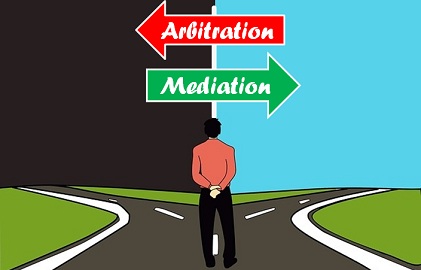
Image Source - https://keydifferences.com/difference-between-mediation-and-arbitration.html

In this article, Sheetal Sharma of KIIT law school discusses Arbitration, Mediation and Conciliation in India. How effective are they?

“The richest love is that which submits to the arbitration in time” -Lawrence Durrell-

Introduction

Arbitration, mediation and conciliation are the main Alternative Dispute Resolution Mechanism which is generally adopted by the people to resolve their disputes in an informal manner. They try to reach a solution by settlement or negotiation with the assistance of a third neutral party and have turned out to be an effective alternative to the litigation process.

What is alternative dispute resolution?

When the method of resolution of the dispute chosen by the parties is other than the arbitration, in the form of mediation, negotiation, conciliation, Lok Adalat, online arbitration, then it is Alternative Dispute Resolution (herein referred to as ADR). ADR opens the way in the field of business and tends to solve the matter more efficiently and effectively. It is basically a dispute settlement through negotiations. In the arbitration, a dispute is decided by imposing an award, but ADR is more likely to find a solution to the dispute by negotiating between both the parties. The purpose of ADR is more than merely giving a remedy to the parties. It aims to ensure that the contract operates properly.

Arbitration as an effective mechanism for dispute resolution

Arbitration is a form of dispute resolution method in which the parties avoid the court proceedings and instead decide to resolve their dispute through appointing a third person, who is known as an arbitrator. An arbitrator is appointed in labour disputes, business and consumer disputes and family law matters.

an arbitration is the reference of dispute or difference between not less than two parties, for determination after hearing both sides in a judicial manner by a person or persons other than a court of competent jurisdiction.”[1]

History of arbitration in India

Arbitration was practised in India from the ancient times through Puga, Sreni, Kula and Panchayat. These were the bodies who decided and resolved the disputes in the alternative of courts. After that many acts were passed to give arbitration a uniform meaning and to give it a statutory recognition. The recent act of arbitration was ‘The Arbitration and Conciliation Act, 1996’ which was amended in the year 2015, due to certain drawbacks in the said act.

The prospects of the arbitration or the reason due to which it is more preferable

  • Expertise in technical matters: an arbitrator can easily deal with technical matters which is scientific in nature because arbitrators are appointed on the basis of their knowledge and skill in the particular field. So they can resolve the dispute more efficiently and effectively.
  • The process of arbitration works more quickly and is more cost-effective than the courts.
  • There is the convenience of the parties in arbitration as they are free to decide the venue and time of the proceedings.
  • Privacy and confidentiality of the parties are maintained as there is no unnecessary publicity of the dispute.
  • Arbitration is more flexible as compared to courts as they do not have to follow strict rules and regulations as that of court because of the rules set by the parties only.

Due to these advantages of the arbitration, parties prefer it over litigation. It gives party full authority to decide their own arbitrator, and in case of international arbitration, the venue, place or the country in which the arbitration proceedings will be held is also decided by the parties.

However, there are also certain challenges where the arbitration lacks or defaults in providing proper arbitral awards and claims. Everything with some advantages also has loopholes along with it.

Arbitration system faces some challenges which are briefly discussed

  • If the parties, by agreement decide the arbitral award and decision to be final, then they waive their rights to access the courts.
  • Sometimes the arbitrator acts biased, due to which the very essence of arbitration is lost.
  • There is not always the case where the cost of the arbitration is cheaper. It can vary in complexities and may lead to a higher cost than the litigation. It can be seen in multiple parties, multiple arbitrators and complicated legal disputes.
  • It is very difficult to appeal arbitral rulings. Sometimes a party can face unfair result and finds the difficulty in appealing to the courts.

Moreover, arbitration is preferable in the matters of commercial dispute and there is increased development in the arbitration law adopted in our country to make it more effective and reliable. No matter what is said, it will always be regarded as the usual method for resolving an international commercial dispute.

Conciliation as an ADR mechanism

Conciliation is a type of ADR where the settlement is made out of court. There is no involvement of the court in the whole arbitral proceedings. The dispute is settled by a neutral third party, who is the conciliator. The conciliation process is voluntary as it is on the mutual discretion of the parties to choose conciliation as a method of resolving their dispute with the assistance of the conciliator, also the proposal is not binding upon the parties. They are free to follow or not follow the proposal given by the conciliator. It presides over litigation because the parties do not have to go through the technical procedures and formalities of litigation, instead, conciliation allows parties for a friendly search to reach an amicable solution.

The adoption of conciliation process in India

The adoption of conciliation process was first recommended by the Law Commission of India in 77th and 131st report and in the conference of chief ministers and chief justices in their resolution of 1993. Whereas, the Himachal Pradesh High Court evolved pre-trial, in-trial and post-trial conciliation project in the subordinate court in Himachal Pradesh in the year 1984. The Calcutta resolution which was adopted in 1994, also stated the recommendation of conciliation courts to be constituted in the other states.

With the adoption of conciliation rules, 1980 by the UNCITRAL, the Parliament of India also find it expedient and enacted Arbitration and Conciliation Act, 1996 which gave statutory recognition to conciliation. With this, the post-litigation conciliation was recognised as ADR with the incorporation of section 89 of Code of Civil Procedure, 1908[2] providing an option for reference of sub judice matters to conciliation with the consent of the parties.

Issues in post-litigation conciliation

The main issue in post-litigation conciliation is the preference of judiciary towards mediation over conciliation. Since mediation and conciliation are almost the same, the publicity of mediation and its recognition as a mode of court-annexed mediation has been preferable than conciliation. Due to this, it is not utilized to its full potential. Under section 89 of the CPC, the courts can refer any dispute for judicial determination to any of the ADR mechanism namely, arbitration, conciliation, mediation etc. Among them, mediation and Lok Adalats are mostly used, which lacks chance for conciliation to grow potentially at the post-litigation stage.

Mediation in the dispute resolution mechanism

Mediation has grown as the most advanced form of ADR mechanism. It is one of the methods for handling human relationships in a positive manner, mainly for the good of the people involved and for the betterment of the community.[3]

Mediation encourages a search for the solution by the parties themselves, involved in the dispute. The basic motive of mediation is to provide opportunities to parties to negotiate and come to a final solution catering the needs of both sides. It is an assisted negotiation and an informal process in which parties are aided by a third impartial person, who is the mediator, possessing specialized skills, requisite training and sufficient experience necessary to assist the disputed parties for reaching a negotiated settlement.

Role of the mediator

The role of the mediator is only to assist the parties. He does not have to decide who is right or wrong and also does not have authority to impose a settlement on the parties. Instead, it provides a forum for principled negotiations. Parties come to recognise their true rights and needs, instead of reiteration of their rights and they also come to realise that solution can be reached by satisfying each other’s needs.

It is often said that mediation is the best way of imparting justice through self-mediation of the parties. Mediator empowers the parties to communicate and decide the outcome on their own by providing various options suitable as per the dispute and has to think of alternative solutions favouring a mix of benefits to both parties.

In brief, Mediation is all about facilitating or assisting negotiation between the parties. Mediation works between the parties because it gives chance to the parties to come to a settlement where both parties do not have to compromise their rights instead leads to a better solution.

Growth of mediation centres in India and Its impact on ADR mechanism

In India, mediation as a mode of ADR mechanism has been accepted in its fundamental and generic form. It has been widely utilized in Delhi, which has indeed been one of the pioneers in institutionalizing mediation. In India, mediation got legislative recognition for the first time in 1947, through Industrial Disputes Act,1947. The enactment of section 89 of CPC was focused by the judiciary to popularize and propagate mediation as an ADR mechanism.

In furtherance of this, the judiciary also prepared a “National Plan for Mediated Settlement of Dispute” for developing training of mediators, development of mediation manuals, setting up of mediation centres in court complexes and spreading awareness about mediation against litigants so as to popularize mediation.[4]

Also, various mediation centres have been established in Delhi for resolution of disputes in pending cases. The growth of mediation centres in Delhi can be seen through the institutional as well as ad-hoc private mediation in Delhi which is always available and open for the parties to take recourse to mediation for settlement of their disputes outside the court-annexed mediation centres before they invoke the jurisdiction of courts.

There are various institutions available in Delhi offering professional mediation services at the pre-litigation as well as the post-litigation stage. The Indian Legislature also enacted The Legal Services Authority Act, 1987 by constituting National Legal Service Authority as a central authority vesting with various duties like encouraging for the settlement of disputes by way of negotiation, arbitration and conciliation, etc.

Court-annexed mediation

When the cases are solved with the help of court accredited mediators, that is often referred to as court-annexed mediation. The mediation services are viewed as part and parcel of the same judicial system, instead of a separate court-referred mediation, where court refer the cases to private mediators so that no one would feel that the case is separated from the court system. ADR services under the control and guidance of judicial system would ensure smooth functioning, authenticity and acceptance from the public. It would ensure the mediation in coordination with the courts and not be viewed as competition to the courts.

How mediation is helpful for the courts?

With the cooperation of mediation services, courts can easily refer the cases to mediators and deal with the cases which are more important for public matter without wasting time on small petty cases, which can ensure in reducing the loads and pending of cases at a manageable level. And also, the mediators will have a positive feeling from the support of the judges and make the process more expeditious and harmonized. It would lead to faster settlements and public confidence and would ensure a feeling that the mediation is working hand in hand with the same system.

This is not as easy as we think because the general public is not always willing to accept the new change about which they are not properly aware of. It is a new idea which is introduced in India and we cannot in any circumstance expect from the public to adapt to the new change quickly. Here arises the problem for court annexed-mediation.

Obstacles in the implementation of this mechanism

  • the unavailability of sufficient funds to introduce this machinery in the country.
  • Second, in a country like India, where we have an established judicial system the court is seen as the place to go when disputes arise and cannot be viewed as a mechanism where it can be sorted out by the parties themselves.[5]

Thus, the public at large refuses to accept where the court is not directly involved. They only accept when they see that it has the stamp of approval of the court because then they do not have any fear as they are already accustomed to the court system.

Why you should choose mediation?

Mediation is confidential, non-binding and parties get to choose an alternative provided by the mediator. The mediator guides for reaching an amicable solution for both the parties. No strict procedures are followed by the parties which makes the whole proceedings more informal and comfortable.

Why is ADR preferred more than litigation?

ADR has gained a rapid popularity over the years. The business disputes are resolved more by the arbitration process than the litigation. The reason for acceptance of arbitration over litigation is due to many reasons.

  1. Arbitration is more cost-effective. The cost of the process involved in the dispute is much less than the cost involved in the litigation.
  2. The process is more informal as compared to the litigation process. There are no lengthy procedures as that is present in the court.
  3. ADR process is flexible. The parties can withdraw their case anytime they want which, is not possible in the court process.
  4. The dispute is resolved more quickly with the assistance of a third person, who advises the parties according to their needs and suitability. This is not same in the case of the court process. The judges do not give judgment according to the suitability of the parties.
  5. The resolution of the dispute is made faster. On the other hand, filing cases in the court take years and years to resolve one case.
  6. In ADR, an approach is made to balance the interest of both the parties. Whereas, in the litigation, the other party loses the case.
  7. Discussions of the proceedings in ADR is confidential and no public record is to be maintained. The discussions in the court involve knowledge of the public.
  8. The venue and schedule are according to the convenience of the parties as they have the power to choose the arbitrator, the place of the proceedings etc.

How arbitration, mediation and conciliation are different from each other?

Mediation and conciliation both are an informal process. Whereas, arbitration is more formal as compared to them. In mediation, the mediator generally sets out alternatives for the parties to reach out an agreement. The main advantage of the mediation is that the settlement is made by the parties themselves rather than a third party. It is not legally binding on the parties.

Arbitration is a process where the parties submit their case to a neutral third party who on the basis of discussion determine the dispute and comes to a solution.

Dispute resolution through conciliation involves the assistance of a neutral third party who plays an advisory role in reaching an agreement. The process adopted by all the three are different but, the main purpose is to resolve the dispute in a way where the interest of the parties is balanced.

Conclusion

Arbitration, mediation and conciliation are considered as the main alternative dispute resolution mechanism to litigation. Business people prefer these mechanisms more convenient because it does not require a lot of lengthy procedures like courts. Here, dispute resolution is more informal as compared to litigation in courts. Over the recent years, they have turned out to be more effective than the litigation process. Access to justice is there without the involvement of the court. Parties are more comfortable as they can freely express their own views, needs and interest.


LawSikho has created a telegram group for exchanging legal knowledge, referrals and various opportunities. You can click on this link and join:

https://t.me/joinchat/J_0YrBa4IBSHdpuTfQO_sA

Follow us on Instagram and subscribe to our YouTube channel for more amazing legal content.

References

[1] Halsbury’s Laws of England para 501 (vol.2, 4th edition).

[2] Inserted by the Code of Civil Procedure (amendment) Act, 1999.

[3] DK Sampath, Mediation 8 (NLSUI, 1991).

[4] Justice K.G. Balakrishnan, former Chief Justice of India (Law Day address to the Nation on November 25, 2008).

[5] Sriram Panchu, Mediation Practice and Law, The path to successful dispute resolution, 255.

[6] https://www.tpsgc-pwgsc.gc.ca/gcc-bdm/differences-eng.html


Download Now

Dr. Ruma Basu Gomes: Behavioural Scientist, NLP Practitioner and MBTI and Firo-B Practitioner, Chairperson, and ISTD share her experience on Executive Certification in Sexual Harassment Prevention & Workplace Diversity

0

Currently, I am working as a Corporate Trainer, Psychotherapy counsellor, at Consultivo. I work on understanding the human behaviour and inspire them to attend excellence. I have successfully completed the course on Executive Certification in Sexual Harassment Prevention & Workplace Diversity from NUJS. My experience was good with iPleaders while doing this course.

Though grasping of the study materials of the online courses solely depends on the quality of the learner, but for this kind of courses, if a student is from a law background, then it will be much easier and beneficial for them. I have found the study materials are absolutely perfect, and as per industry standard. I did this course purposefully as it will give me a specific amount of knowledge in my area of practice.

A very well designed course, all the modules are well explained, and webinars were extremely helpful. The only request I can put forward to iPleaders is to add a standard format of yearly reporting, even if there are no incidents recorded. I know how to prepare a yearly report, if there are incidents recorded; however, I want to get an idea of a proforma that can be used in cases of zero incidents. Overall, this course helped me to gain a decent amount of knowledge. I’ll always appreciate the backend team for their helpful and quick responses.

Currently, I am undoubtedly implementing the practical knowledge in my area of practice that I have learnt from this course. I have already referred this course to two employees of ACC Cements, and they have enrolled this course in front of me. I believe that being a chairperson of a committee. I have definitely done a justice to myself by doing this course.

Download Now

Enforceability of a Memorandum of Understanding (MoU)

2
stand form contract
Image Source - https://bit.ly/2P9Edq2

In this article Vedant Shadangi of KIIT School of law, Bhubaneswar discusses MOU and it’s enforceability in India.

Introduction

Before entering into a formal agreement there comes an agreement called Memorandum of Understanding. Memorandum of Understanding which establishes a relation of promise, although it does not establish any legal obligations upon the parties it is of such nature that it establishes a relationship between parties who will ultimately through MoU are likely to get into a formal agreement or in other words a Contract with each other in near future.

Which law gives force to a MoU – Enforceability of MoUs In India

Memorandum of Understanding is merely an agreement or promise between two or more parties. Although it does not has any legal bindings but it is stated that, as it’s a simple agreement only but it has a legal value and can be used as a tool for establishing a contract.

A Memorandum of Understanding can be established as an effective base for stating out the objectives. In India, MoUs are governed under Indian Contract Act 1872.

Also, enforceability of MoUs are considered and enforced under Specific Relief Act and it is here only when the Doctrine of estoppel comes into play for enforcement of MoU. But it will only come under specific relief act if a Memorandum of Understanding entered by the parties fulfills the conditions prescribed by Indian Contract Act 1872.

When a MoU does not fulfill the conditions of a contract under Indian Contract Act 1872 then, in that case, the Court may hold the Memorandum of Understanding as invalid.

Then in such cases, the party seeking for enforceability of a contract can approach to the court based on the principle of promissory estoppels and equity.

The concept of principle of promissory estoppel and equity was justified by the Hon’ble Supreme Court in its landmark decision in Motilal Padampat Sugar Mills Co. Ltd. v. State of Uttar Pradesh[1] wherein it gave a statement that the doctrine of promissory estoppel is a principle evolved by equity to avoid injustice and so whereby a promise has been made by a person knowing that it would be acted upon by the person to whom it is made, and in fact it is so acted upon, and it is inequitable to allow the party making the promise to go back upon it.

How far it is relevant and how it is enforced

MOU is generally the first stage of agreement for the formation of a formal contract.

Although MOUs are not legally binding but are considered as a serious document by the law.

To enforce it, the agreement must contain binding and non-binding terms in order to be enforceable and if the agreement is to be a non-binding then, it has to be specified clearly as a non-binding agreement.

Each understanding and terms represents mutually accepted expectations between parties. And so an MOU signifies that a legal contract is about to be made in future.

Legal position of disputes in MoU

The Indian Contract Act, 1872 is the principal legislation governing MoUs under the Indian laws[2].

It is stated that the characteristic of a contract is the intention of the parties to enter into a binding agreement or obligation, which results in the formation of a contract.

Therefore, clauses mentioned in a MoU which are making provision for an enforcement standard in case of breach by either party will confirm that the parties had an intention to enter into a binding agreement and so a MoU containing preliminary terms is non-binding unless a binding understanding between the parties can be decided from the context.

Through a dispute resolution clause the breach if any can be settled out, and for this, the basic requirement is that the parties must settle the dispute in good faith and if the dispute is not solved within 14 days period then it will be solved through the other provision i.e. other than dispute resolution clause.

Is it advisable to register MoU

To enforce a MoU one should register it by mentioning certain statements and documents. There are certain points which are to be included.

  1. To safeguard the interest, one has to put certain clauses which are enforceable.
  2. And along with it necessary other things like the consequences, the time period etc. must be mentioned there.
  3. Another way is by putting termination clauses in the MoU and register it.
  4. If there is a monetary exchange then it should be registered so to safeguard the interest of parties.

Key features and contents

The major key features and contents of MoUs are:

  1. It describes who are the parties to the agreement.
  2. Describes the projects on which the parties are agreeing upon.
  3. The scope of the documents, which is thereby made during the agreement.
  4. Sets out the roles and responsibilities of the parties.
  5. Although they are not legally binding but are enforceable under Indian laws.
  6. Can involve any exchange of money or any valuable consideration.
  7. Contains indemnification clause.
  8. Joint undertaking and responsibilities.
  9. The termination clause is also there for the parties.
  10. Dispute resolution clause.

Various judgment which justifies the understanding more precisely

In the landmark judgment of Structural Waterproofing & Ors. v. Mr. Amit Gupta[3] the Delhi High Court held that in the absence of proof of coercion or misrepresentation, the Memorandum of Understanding which is otherwise valid should be applied and parties should be bound by the terms and conditions of the MoU.

Also in Jai Beverages Pvt. Ltd. v. State of Jammu and Kashmir and Ors.[4], the ascertainment of enforceability has been stated by Supreme Court that, if the conditions to the MoU are if otherwise acted upon by the parties to the MoU and they get the benefits arising out of MoU then it is enforceable.

In Millenia Realtors Private Limited v. SJR Infrastructure(Pvt.)Limited it was stated that MoUs are not to be interpreted as contingent contracts, and are capable of enforcement.

International MoU – Its enforceability

International MoU is made in the form of a treaty and is registered under the United Nations treaty collection, these MoU should be registered to avoid secret diplomacy and also are sometimes kept confidential.

The title of MoU does not mention the document as a binding or non-binding document. To determine the status, it is like in the case of a national MoU, the international MoU is also determined by the intent of the parties and the wordings and languages used here are of great importance and the legal position of the signatories is very much relevant in making the document enforceable or binding and these are guarded and protected by the International Court of Justice.

The International Court of Justice in the case of Qatar v. Bahrain on 1st July 1994 has stated the legality of the document, the International Court of Justice has provided certain standards for the legality of MoU.

International MoU between countries

International MoU is also not legally binding but the language used there must show the intention of the parties to perform and to work together. As stated above all MoU must not be formally but only those should be formally made and registered which include the exchange of some monetary value.

Mainly MoU is signed between different countries for exchanging resources, technical products, researching plans or for student exchange program etc.

Various MoU signed between countries

India has signed many MoU with different countries, for example, a MoU was signed between;

  1. Ministry of Earth Sciences, India and National Oceanic and Atmospheric Administration (NOAA), the USA on 16th April 2008. Under this, the objectives were to allow cooperation for exchange of scientific resources personnel and technical knowledge which will support the development of Earth observation and Earth science of both countries.
  2. Ministry of Earth Science, India and Met office of the United Kingdom on 28th August 2008 entered into an agreement with the objective to allow and support the development of meteorological services for both the countries by exchanging valuable knowledge and techniques[6].
  3. Ministry of Earth Sciences, India and Belmont Forum countries entered into a MoU for a joint collaborative international research on Earth science.

Putting things simply

The content and intention of the parties entering into MoU must be done with due care and attention during the drafting of language, titles, and clauses of the Memorandum of Understanding, failing in this can lead it to a loss for the parties.

References

[1]https://indiankanoon.org/doc/871220/

[2]http://www.advocatekhoj.com/library/bareacts/indiancontract/index.php?Title=Indian%20Contract%20Act,%201872

[3]https://indiankanoon.org/doc/828749/

[4]https://indiankanoon.org/doc/347950/

[5]https://indiankanoon.org/doc/493299/

[6]http://www.moes.gov.in/content/list-mous-agreements-signed-various-countries

Download Now

Commercial Disparagement Laws in India

0
Family members under money laundering act

In this article, Tanya Nayak of Kiit School of Law discusses Commercial Disparagement Laws in India.

Introduction

Commercial disparagement and comparative advertisement are an important subject matter for manufacturers of goods. The main reason arises from the fact that a consumer’s choice is flexible to be influenced by comparative advertisements towards a brand’s goodwill. It is noted that such comparative advertisements leave a negative impression over the market which results in monetary damage to the manufacturers. In India, there is no specific legislation covering the subject matter of commercial disparagement.

Meaning of commercial disparagement

  1. Commercial disparagement is a civil wrong, it carries tortious liability. The tort of commercial disparagement is also known as business disparagement, it takes place when a negative statement is made against an individual’s title to his property for business or his property with the intention to discourage others from dealing with the person or his business house.
  2. Statements made on the subject matter of dishonesty, unethical practices, and incompetency are capable of commercial disparagement. Mainly the objective of business disparagement is unfair competition between businesses, but it can be brought against a customer.
  3. There is a thin line of difference between commercial disparagement and defamation, though they appear to be very similar. Firstly, defamation is a tort wherein an untrue statement is made against anyone which is published and causes injury to the name and reputation of the person against whom such statement is made. Whereas, commercial disparagement is exclusive for business houses, unlike defamation only business house can file a claim for commercial disparagement. Secondly, the claim for commercial disparagement is to protect the financial interest of a business house and the claim for defamation is to protect reputation in general sense.

INGREDIENTS FOR COMMERCIAL DISPARAGEMENT

For a successful claim regarding business disparagement, one must stand firm with respect to the following ingredients:

  1. The statement so made against a business house is false and does not reflect any reality.
  2. The statement is made with an intention to cause financial loss or damage.
  3. There is an actual loss taking place due to the statement made.
  4. The competitor has made the statement with the knowledge that it will cause damage to the business house or has made the statement negligently.

Case study: P&G v. Hindustan Unilever

  • Parties to the case were FMCG majors Procter and Gamble (P&G) and Hindustan Unilever Limited(HUL), the product of P&G is Head and shoulder which was sold in sachets and product of HUL is clinic plus shampoo which was sold in bottles.
  • The conflict arose because of their respective TV commercials with respect their products. Both the brands compared their products to one another in their TV commercials.
  • In HUL’s TV commercial it compared clinic plus shampoo with head and shoulders shampoo, saying-’’ mazbooti de leading anti-dandruff shampoo se behtar’’ and teen rupaye wale anti-dandruff shampoo se baal jyada tootte hain’’.
  • Upon this statement, P&G instituted a suit claiming injunction against HUL’s TV commercial.
  • The Court directed HUL to suspend airing of its alleged TV commercial an ad interim order. Disappointed by court’s direction, HUL approached the advertisement standard council of India for relief, which rejected its complaint. Subsequently, two cross suits were instituted, one by HUL and other by P&G. The court directed all three suits to be decided together.
  • The suits alleged five TV commercials publishing controversial statements like “ek rupaye wala shampoo dandruff nahi nikalta, ek, do, teen washes mein bhi“, “zyada dandruff hataye” or “anti-dandruff shampoo can damage your hair“, claiming to be disparaging in nature by respective plaintiffs.
  • P&G contended that the presented by HUL was not maintainable as ASCI had rejected HUL’s complaint after it was directed to suspend its impugned TVC.
  • The aspect of maintainability of the suit was looked into by a single judge bench at length. It was held that the power to decide whether an advertisement is of disparaging nature or not is vested with the civil courts and not ASCI, as it was not a dispute resolution body to compel removal of advertisements, grant interim relief or award damages like civil courts.
  • ASCI powers are only restricted to formulating certain rules for governing comparative advertisements, such as the Code of Self-Regulation in Advertising. At best it could recommend removal of any advertisement in adverse cases or forward the matter to an authorized officer under the Cable Television Network Act who can prohibit the advertisement from being broadcasted.
  • Thus, the court rejected P&G’s contention on maintainability due to the difference in reliefs granted by ASCI and civil courts, and the common law recourse to be taken under Section 9 of Civil Procedure Code in absence of a codified law on disparagement.
  • Then the court dealt with the main issue in the matter, i.e., disparagement of goods of the plaintiffs in each suit. Both parties had contended disparagement against each other, whereas in defense, stated that their commercials were informative in nature, to educate the public.
  • HUL relied on the argument that its TVCs were truthful based on laboratory test results displayed in its TVCs. P&G alleged that the said test results are false in nature. It was further contended by HUL that comparison of head and shoulder to clinic plus is similar to comparing apples to mangoes.
  • The court after listening to both the parties, based its decision on Marico Ltd. v. Adani Wilmar Ltd.[1] case, which was headed by the same Bench as in this case.
  • The court concluded that disparagement is a similar face of defamation law. It also held that puffing in the comparative advertisement is permitted subject to certain conditions as held in cases that were referred in the Marico’s case.
  • The case of De Beers Abrasive v. International General Electric Co.[2], was referred and the judgment emphasized on false advertising causing injury to a rival’s trade, to uphold that a trader can puff up or declare his own goods to be the best; he can also puff up to claim that his goods are better than his rival’s, but such puffing should not denigrate, discredit or disgrace the products of his rival[3].
  • The court looked into the following factors as laid down in Pepsico. for determining disparagement:
  1. The intention and message should be conveyed through the storyline.
  2. The effect of the advertisement should be either promote the trader’s product or it has to disparage other competitor’s product.
  3. The manner of advertising that whether the comparison made is truthful or falsely disparaging rival’s product. Truthful disparagement is permitted whereas, untruthful disparagement is not.
  • The Court observed that commercial disparagement comes under the purview of defamation law, therefore reputation is not only restricted to human beings but also to products. It becomes a matter of right to protection of reputation.
  • It reasoned that only when the words or statements are authoritative and reliable in nature or published by a non-trade rival, other than as mere puffing or sales talk, then the opinion of an ordinary man/consumer can be altered.
  • The court also to stated that ordinary public does not go for the word by word articulation of the advertisement whereas, the public expects some degree of exaggeration in advertisements and it has to be tested whether a reasonable man is taking such words of the advertisement seriously, or not. Only then could a statement be called authoritative or reliable.
  • The court further observed that claims made in the comparative advertisements are considered to be less effective on the ordinary consumer than in a situation where the same information was offered in the news. So, HUL’s reliance on its laboratory test results was held to be not authoritative or reliable in nature and couldn’t potentially alter an ordinary consumers opinion.
  • The court held that the impugned statements made in the alleged TV commercials were not disparaging in nature as they fell within the permissible boundaries of puffing up in the comparative advertisement. Such advertisements, in the opinion of the court, should be encouraged “in the interest of vigorous competition and public enlightenment”. Thus, the court rejected the contentions of the plaintiffs in each suit.
  • The ad interim injunction order against HUL was vacated. The court disposed of the matter before trial stage basing the judgment upon its own experience and understanding of human nature towards advertisements.
  • At present, the matter is lying on appeal before the Division Bench of the High Court filed by P&G as well as HUL.

Reckitt & Colman of India Pvt V. Ramachandran and Anr[5]

This case presented 5 guidelines which are considered to be the law regarding disparagement in India. The fundamental objective behind comparative advertisement is that a commercial or advertisement of one business house can praise its own product and even compare its qualities to other products but it cannot demean the reputation of another product.

Summary of those principles are

  1. A business house can praise its own product by using various fancy statements, even if they are untrue.
  2. He can also say that his goods are better than his competitors’, even though such statement is untrue.
  3. With an intention to show that one’s product is the best in the world and even better than other products in the market, he can even compare its product with that of products of other business houses.
  4. He , however, cannot, while saying that his goods are better than his competitors’ say that his competitors’ goods are bad. If he says so, he defames his competitors and their goods, which is not permissible.

Commercial disparagement and puffing

  • Commercial disparagement is a wider concept, to which puffing a new approach. Puffing is an exaggeration of something generally, the word ‘’puffing’’ is attached to products and business houses.
  • When a salesperson exaggerates about its product or when an advertisement highlights too much about its product regarding the quality, discount or sale those actions amount to puffing.
  • In puffing, there are mostly the opinions presented and not promises which are legally binding. The impact of puffing is such that a normal consumer will not believe it. Puffing is superlative claims with regards to their products and goods.
  • The Madras high court, in the case of Colgate Palmolive v. Anchor, has distinguished between subjective and objective claim and said that all puffing is an actionable wrong.
  • Now the question before the court was that whether the statement used by Anchor i.e (the anchor is the ‘’only and ‘’first’’ toothpaste to offer all round dental protection) is amounting to puffing or disparagement to Colgate? The Court said that this statement was not a puff, in fact, it was a misleading objective claim.
  • Further, the court stated that any puff will amount to unfair trade practices under the consumer protection Act and be allowing business houses to puff about their respective products is not in accordance with public interest.
  • Hence, it was observed by the court that all puffing was illegal.
  • There is a conflict between the decisions delivered by Delhi high court and Madras high court with regards to puffery of products.

Legal consequences of disparagement and exceptions to it

Legal consequences of disparagement is a civil suit. Person suffering from disparagement can claim for injunction or damages.

Exception

  1. Truth becomes an absolute defence for commercial disparagement.
  2. The statement so made was an opinion and therefore will not amount to any action.
  3. The defendant has a conditional or absolute privilege.

Conclusion

The position of law with regards to commercial disparagement in India is absolutely in a very underdeveloped state. As the business world is in a great progress, in accordance to that we are in a greater need for specific laws and legislation.

References

[1] 2013 (199) DLT 663

[2] (1975) FSR 323

[3] Pepsi Co., Inc. v. Hindustan Coca-Cola Ltd.

[4] (2009) 156 DLT 330

[5] 1999 PTC (19) 741.


Download Now

The Impact of the Privacy Judgement on Law regarding Homosexuality in India (Section 377)

0
laws for third gender in India
Image Source - https://www.indiatoday.in/india/story/supreme-court-right-to-privacy-judgment-bats-for-homosexuality-1031185-2017-08-24

In this article, Prathiksha Ravi, a law graduate from Institute of Law, Nirma University, talks about the impact of the landmark ‘Right to Privacy judgement on the laws of homosexuality in India.

Introduction

“If the right to privacy means anything, it is the right of the individual, married or single, to be free from unwarranted governmental intrusion.” – William J. Brennan[1]

Privacy is the ability to seclude oneself and their information by expressing to others in a selective manner. The concept of privacy differs from country to country but share a common theme. Most countries protect against the invasion of privacy by Governments, corporations or other individuals.

In India, the right to privacy as a fundamental right has been debated numerous times culminating into a landmark judgement which granted the right to privacy as a right protected by the Constitution as a ‘fundamental right’.

In light of this recent judgement, there stems a ray of hope for those fighting to legalize homosexuality in India by declaring Section 377 of the Indian Penal Code as ‘unconstitutional’. What happens between two individuals of the same sex inside their own private sphere must be protected from invasion by the government and its officials. The right to privacy judgement is one step towards attaining the above goal.

The Privacy Judgement – Justice K.S. Puttaswamy v. Union of India

Facts of the case

A three-judge bench of the Supreme Court brought forth the following debate of whether the Aadhar Card scheme of the government violates the right to privacy. Two major prior cases were observed – M.P Sharma v. Satish Chandra and Kharak Singh v. State of Uttar Pradesh. These cases contained that the Indian Constitution does not specifically protect the right to privacy. Further judgements like Gobind v. State of Madhya Pradesh and others which held that right to privacy is enshrined as a fundamental right in the Constitution could not be held as ‘good law’ due to it being decided by smaller benches. Thus, the debate on the ground of not being able to reach a conclusion was sent to a nine-judge Constitutional bench headed by the then Chief Justice of India, Justice J.S. Khehar.

Issues

The nine-judge bench of the Supreme Court deliberated on the following issues –

  1. Whether privacy is a constitutionally protected value?
  2. Whether the right to privacy has the character of an independent fundamental right or does it come under the purview of right to life and personal liberty?
  3. What are the doctrinal foundations to the right to privacy?
  4. What is encompassed within the purview of Privacy?
  5. What is the nature of the regulatory power of the State?

The jurisprudence of the below two cases was examined

M.P Sharma v. Satish Chandra

The challenge, in this case, was that searches conducted by the government were violative of fundamental rights of the petitioners namely Article 19(1)(f) and Article 20(3) of the Constitution of India. The Court took into its motion only the contention of the violation of Article 20(3) and held that guarantee against self-incrimination is not offended by a search and seizure.

Kharak Singh v. State of Uttar Pradesh

The court, in this case, held that freedom governed under Article 19(1)(d) of the Constitution is not infringed by a watch being kept over the movements of the suspect. They pointed out that:

“The right of privacy is not a guaranteed right under our Constitution and therefore the attempt to ascertain the movements of an individual which is merely a manner in which privacy is invaded is not an infringement of a fundamental right guaranteed by Part III.” [2]

Dissenting judge, Justice Subbarao held that, even if the right to privacy is not considered as a fundamental right within Part III of the Constitution, it is an essential ingredient of personal liberty.

Judgement

The nine-judge bench concluded that Right to Privacy is a fundamental right enshrined in Article 21 of the Indian Constitution. It over-ruled the before cases of M.P Sharma v. Satish Chandra and Kharak Singh v State of Uttar Pradesh.

The following points were highlighted in the judgement:

  1. In the case of M.P Sharma v. Satish Chandra, the judgement states that right to privacy is not an independent right under the fundamental rights given in the Constitution but the judgement also does not specify whether it can be treated as a right under Article 19 or Article 21, thus overruling the judgement to that extent.
  2. In Kharak Singh v. State of Uttar Pradesh, the second part of the judgement which states that ‘right to privacy’ is not guaranteed under the fundamental rights is overruled.
  3. Privacy is a constitutionally protected right under Article 21 which talks about the right to life and personal liberty.
  4. The right to privacy includes in its core the preservation of personal intimacies such as
      • Sanctity of family life
      • Marriage
      • Procreation
      • Home
      • Sexual Orientation
      • The Right to privacy is the right to be left alone.
      • The invasion of privacy must be justified on the basis of a law which is fair, just and reasonable.
      • The fundamental right to privacy has its limitations which will be identified on a case to case basis.[3]

Laws regarding Homosexuality in India

Homosexuality is considered as a taboo in Indian Society which results in the isolation and subjugation of those who have different preferences when it comes to choosing a partner for life. The criminalization of homosexuality in India is due to Section 377 of the Indian Penal Code, 1860.

Section 377 states that:

Unnatural offences — Whoever voluntarily has carnal intercourse against the order of nature with any man, woman or animal, shall be punished with imprisonment for life, or with imprisonment of either description for a term which may extend to ten years, and shall also be liable to fine.

Section 377 is a product of a law made during the British era which criminalizes same-sex conduct even of consenting adults.

Naz Foundation v. Government of NCT Delhi and Others.

Naz Foundation, an NGO which works for HIV/AIDS sufferers brought a claim in public interest stating that Section 377 of the Indian Penal Code, 1860 was unconstitutional as it violated fundamental rights such as Article 14,15,19 and 21. The petition stated that Section 377 was being used to criminalize consensual sex between two consenting adults in the name of it being ‘unnatural’. The government of NCT claimed that the law should be kept valid as ‘homosexuality does not follow societal values’.

The Judgement clearly stated that Section 377 of the Indian Penal Code was unconstitutional only when it violated Articles 14,15 and 21.

This judgement was challenged by various parties. The judgement was overturned by the Supreme Court of India in the following case.

Suresh Kumar Kaushal v. Naz Foundation

The landmark judgement given by the Delhi High Court in the Naz Foundation case was questioned as to whether Section 377 actually violates Article 14,15 and 21 of the Indian Constitution. The Supreme Court held that:

Section 377 does not criminalize a particular people or identity or orientation. It merely identifies certain acts which if committed would constitute an offence. Such a prohibition regulates sexual conduct regardless of gender identity and orientation”.[4]

As of the today, Homosexuality is criminalized under Section 377 of the Indian Penal Code, 1860.

Impact of the Privacy judgement on Homosexuality in India

If Privacy is to be construed as a protected constitutional value it would redefine in significant ways our concept of liberty and entitlements that flow out of its protection” [5]

One of the points mentioned by Naz Foundation was that Section 377 of Indian Penal Code, 1860 was that it violated the right to privacy and right to dignity under Article 21 of the Indian Constitution. The concept of the right to privacy due to the prevalence of M.P Sharma v. Satish Chandra and Kharak Singh v. State of Uttar Pradesh was not a ‘fundamental right’ enshrined under Article 21 of the Indian Constitution. This changed after the judgement in the case of Justice K.S. Puttaswamy v. Union of India, where the Right to Privacy is now considered as a fundamental right overruling the previous cases.

Three out of the five judgements in the case declaring privacy as a fundamental right also talked about its impact on Section 377 of the Indian Penal Code, 1860.

The following excerpts highlight the same

Sexual orientation, an essential attribute of Privacy should be protected as a fundamental right under Article 14,15 and 21.

Justice Chandrachud held that – “Sexual orientation is an essential attribute of privacy. Discrimination against an individual on the basis of sexual orientation is deeply offensive to the dignity and self-worth of the individual. Equality demands that the sexual orientation of each individual in society must be protected on an even platform. The right to privacy and the protection of sexual orientation lies at the core of the fundamental rights guaranteed by Articles 14, 15 and 21 of the Constitution”[6]

Right to Privacy is applicable to the LGBTQ community and the Supreme Court erred in saying that the law cannot be changed in favour of a minuscule portion of the society.

As per Justice Sanjay Kaul, while agreeing with Justice Chandrachud held that

right of privacy cannot be denied, even if there is a minuscule fraction of the population which is affected.”[7]

Will the Courts now re-examine Section 377 in light of this judgement?

In light of this landmark judgement, there lies a ray of hope for those fighting against decriminalisation of Section 377. The Supreme Court in the ‘Right to Privacy’ judgement held that the case of Suresh Kumar Kaushal v. Naz Foundation, which held that right to privacy does not fall under the purview of a fundamental right enshrined in our Constitution now stood invalidated.

Arguments for the decriminalisation of Section 377:

  • Section 377 criminalises activities which take place between two consenting adults within the privacy of their home. Right to Privacy is now an integral part of Article 21 of the Constitution which ensures right to life and liberty
  • Section 377, though made to widen the definition of ‘rape’ as an offence to include acts that do not fall under the purview of the rape definition, in present-day acts as a pass to allow persecution of the LGBTQ Community which is a violation of fundamental rights which guarantees non-discrimination based on sexual orientation.
  • The Delhi High Court in its judgement decriminalising Section 377 held that:

The concept of privacy allows the formation of relationships without the fear of outside intrusion. This comes under right to dignity and right to privacy under Article 21 of the Constitution.” [8]

  • The argument in Suresh Kumar Kaushal v. Naz foundation was that only minuscule portion of the population of India come under the LGBTQ community, thereby there was no reason to change the law made by the legislature. This was dismissed by Justice Sanjay Kaul in the ‘Right to Privacy’ case and he stated that the right to privacy cannot be denied even if it affects only a minute fraction of people in the country.

Conclusion

The Right to privacy is the right to protect oneself from government intrusion. It has been declared as an integral part of the fundamental rights of our country mainly under Article 21 of the Constitution which talks about “life and personal liberty” by the recent landmark judgement of Justice K.S Puttaswamy v. Union of India.

This judgement has now paved the path to decriminalize Section 377 of the Indian Penal Code, 1860 which prohibits homosexual relations amongst other things. The Naz Foundation judgement by the Delhi High Court was overturned by the Supreme Court by stating the point that ‘right to privacy’ is not a fundamental right. The case can be brought forth again thanks to the present ruling by a nine-judge bench that ‘Right to Privacy’ as a part of the fundamental right under Article 21 of the Constitution.

References

[1] William Joseph Brennan, Jr. was an Associate Justice of the Supreme Court of the United States from 1956 to 1990

[2]Justice Kaul in Justice K.S. Puttaswamy v. Union of India [Writ Petition (Civil) no 494 OF 2012]

[3]p.351, Kharak Singh v. State of Uttar Pradesh 1963 AIR 1295

[4] Suresh Kumar Koushal & Anr vs Naz Foundation & Ors on 11 December 2013

[5] Justice D.Y Chandrachud in Justice K.S. Puttaswamy v. Union of India [Writ Petition (Civil) no 494 OF 2012]

[6] The Indian Express, ‘Right to privacy case is a fundamental right: Two judgments that Supreme Court overruled’ http://indianexpress.com/article/india/right-to-privacy-judgment-a-fundamental-right-here-are-the-two-judgments-supreme-court-overruled-4811117/ [Date of Visit: 04/02/2017 Time of Visit: 11:30 am]

[7] Justice Kaul in Justice K.S. Puttaswamy v. Union of India [Writ Petition (Civil) no 494 OF 2012]

[8] The Wire, ‘Right to Privacy a Fundamental Right, Says Supreme Court in Unanimous Verdict’,

https://thewire.in/170303/supreme-court-aadhaar-right-to-privacy/  [Date of Visit: 07/02/2018 Time of Visit: 10:45 am]


Download Now

How to do court marriage in India

13
Court marriage
Image Source - https://bit.ly/2XEa9Jt

In this article, B M Biplab, of School of Law, KIIT, discusses the procedures for a court marriage and the documents that are necessary for the court marriage.

What is a court marriage?

Court marriages, unlike ordinary Indian weddings, are the marriages solemnized under/in accordance with the Special Marriage Act, 1954 (hereinafter ‘the act’). The marriage can take place or be solemnized in the court itself in the presence of a Marriage Officer and three witnesses. These marriages do not have to include the elaborate customary or ritualistic steps of the personal laws of the parties to the marriage. Merely marrying in the presence of marriage officer in accordance with the act is sufficient for a valid marriage.

Who can marry through court marriage?

Any two persons (of different genders) belonging to the same religion or different religions can marry through a court marriage.

What are the conditions relating to solemnization of court marriages?

Chapter II, Section 4 of the act provides the following conditions for solemnization of a court marriage:

  • No pre-existing marriage – The parties must not have spouses living.
  • Valid Consent – The parties must not be incapable of giving valid consent by reason of unsoundness of mind.
  • Age-The male has completed the age of 21 years and the female the age of 18 years.
  • Prohibited degrees of relationships -The parties are not within the degrees of prohibited relationships. Provided that where a custom governing at least one of the parties permits of a marriage between them such marriage may be solemnized irrespective of the relation falling within the degrees of prohibited relationships.

Note: Degrees of prohibited relationships are mentioned in Part I and II of the first schedule.

The following are the procedures for a court marriage

The procedure for a court marriage, covered under Chapter II titled “solemnization of special marriages”, can be broken down into the following broad steps:

Step 1 – Notice of the intended marriage

Step 2 – Publication

Step 3 – Objection to Marriage

Step 4 – Declaration by parties and witnesses

Step 5 – Place and form of solemnization

Step 6 – Certificate of Marriage

The steps are elaborated below along with the documents required to be furnished during each of the steps. For the sake of convenience, the documents prescribed are in reference to Delhi.

Step 1 – Notice of the intended marriage

In the first step of the procedure for a court marriage, a notice has to be given to the marriage officer under section 5 of the act. It mandates that the parties to the marriage shall give notice of the intended marriage in writing and in the form prescribed in Second Schedule to the Marriage Officer. The Marriage Officer must have jurisdiction in the district where at least one of the parties must have resided for a minimum of 30 days prior to the giving of the notice.

Documents required

  1. Application form (notice in the form specified) duly filled and signed by the bride and the groom.
  2. Receipt of fees paid with respect to the application form in the District Court.
  3. Documentary evidence of the date of birth of both the parties (Matriculation Certificate/Passport/Birth Certificate).
  4. Documentary evidence regarding stay in Delhi of one of the parties for more than 30 days (ration card or report from the concerned Station House Officer).
  5. Separate affidavits from bride and groom giving:
  • Date of birth
  • Present marital status: unmarried/widower/ divorcee.
  • Affirmation that the parties are not related to each other within the degree of prohibited relationship defined in the Special Marriage Act.
  1. Passport size photographs of both parties (2 copies each) duly attested by a Gazetted Officer.
  2. Copy of divorce decree/order in case of a divorcee and death certificate of spouse in case of widow/widower.

Documents required in case of foreign national 

When a court marriage is to be solemnized between an Indian and a foreign national the following documents will be required to be submitted along with the other Documents mentioned above:

  • A copy of passport and visa
  • One of the parties should produce documentary evidence regarding stay in India for 30 or more days (proof of residence or report from the concerned SHO)
  • A certificate of NOC or marital status certificate from the concerned embassy.

If you want to read more about laws related getting married abroad Click Here

The format of the notice is as follows:

Notice of intended marriage 

To,

Marriage officer for the _____________ District.

We hereby give you notice that a marriage under special marriage act, 1954, is intended to be solemnized between us within three calendar months from the date hereof. 

AB unmarried

Widower

Divorcee 

CD unmarried

Widower

Divorcee 

Witness our hands this ___________________ day of ___________________ 20__.

(S.d.) A.B.

(S.d.) C.D.


Step 2 – Publication

The Marriage Officer shall publish the notice by affixing it to some conspicuous place in his office. The Marriage Officer shall keep all the true copies of the notices in the Marriage Notice Book.

If the parties are not permanently residing in the area within the jurisdiction of the Marriage Officer, then the Officer shall send a copy of the notice to the Marriage Officer of the place where the parties permanently reside so that the copy of the notice can be affixed to some conspicuous place in his office.

Step 3 – Objection to marriage

Any person, under section 7, can raise an objection against the marriage before the Marriage Officer on the grounds that the marriage would violate any conditions specified in section 4 of the act. The objection must be raised within 30 days of the publication of the notice by the Marriage Officer. The nature of the objection is to be recorded by the Marriage Officer in the Marriage Notice Book.

https://lawsikho.com/course/certificate-criminal-litigation-trial-advocacyClick Here

The Marriage Officer, under section 8, on receiving an objection would enquire into it within 30 days and solemnize the marriage if the objection doesn’t impede the solemnization of the marriage. If the objection stands then the marriage officer shall not solemnize the marriage; this can be appealed before the District Court by the parties.

Step 4 – Declaration by the parties and witnesses

Before the solemnization of the marriage, the parties to the marriage and three witnesses are to sign a declaration in the form specified in the Third Schedule, in the presence of the Marriage Officer and which is to be countersigned by the Marriage Officer.

Documents Required

  1. One passport size photograph of each of the three witnesses.
  2. Any document for identification of the witnesses by the Marriage Officer (Driving License, PAN Card etc.)

The format of the declaration form is as follows:

Deceleration to be made by the bridegroom

I, A.B., hereby declare as follows:―

  1. I am at the present time unmarried (or a widower or a divorcee, as the case may be).
  2. I have completed ….. years of age.
  3. I am not related to C.D. (the bride) within the degrees of prohibited relationship.
  4. I am aware that, if any statement in this declaration is false, and if in making such statement I either know or believe it to be false or do not believe it to be true, I am liable to imprisonment and also to fine.

(Sd.) A.B. (the Bridegroom).

Deceleration to be made by bride

I, C.D., hereby declare as follows:―

  1. I am at the present time unmarried (or a widow or a divorcee, as the case may be).
  2. I have completed …. years of age.
  3. I am not related to A.B. (the Bridegroom) within the degrees of prohibited relationship.
  4. I am aware that, if any statement in this declaration is false, and if in making such statement I either know or believe it to be false or do not believe it to be true, I am liable to imprisonment and also to fine.

(Sd.) C.D. (the Bride)

Signed in our presence by the above-named A.B. and C.D. So far as we are aware there is no lawful impediment to the marriage.

(Sd.) G.H.

(Sd.) I.J.

(Sd.) K.L.

(three Witnesses)

Countersigned E.F.,

Marriage Officer

 Dated the ________day of________ 20__.

Step 5 – Place and form of Solemnization

The court marriage, under section 12 can be solemnized at the office of the Marriage Officer, or at such other place within a reasonable distance.

The marriage shall be binding only when each party in the presence of the Marriage Officer and the three witnesses says to the other party in any language understood by the parties “I, (A), take thee (B), to be my lawful wife (or husband)”. The parties may choose to solemnise their marriage in any form.

Step 6 – Certificate of Marriage

The marriage officer enters a certificate in the form specified in Schedule IV of the act in the marriage certificate book. If signed by both parties and three witnesses, such a certificate is conclusive evidence of the court marriage.

The certificate of marriage is as follows:

Certificate of marriage

I, E.F., hereby certify that on the………………………………………………………………….day of

………………………………………………20………….., A.B. and C.D appeared before me and

that each of them, in my presence and in the presence of three witnesses who have signed hereunder, made the declarations required by section 11 and that a marriage under this Act was solemnized between them in my presence.

(Sd.) E.F.,

Marriage Officer for

(Sd.) A.B.,

Bridegroom

(Sd.) C.D.,

Bride.

(Sd.) G.H.

(Sd.) I.J.

(Sd.) K.L.

Three Witnesses

 Dated the_____ day of ____ 20__

What are the complexities one faces in a court marriage?

The process of a court marriage is relatively simpler than the ordinary marriages which include customary rituals, elaborate religious steps and months of planning. The few complexities that one faces in a court marriage are as follows:

  • The dates are dependent on the Marriage Officer as to what date he allots the same for appearance and solemnization of the court marriage. In the case of an emergency, the marriage cannot be done earlier than the allotted date (30 days after the notice is published only when no objection is raised by anyone).
  • A well-founded objection can stall the marriage for a long period and the decision depends on the determination of the Marriage Officer. If the Marriage Officer upholds the objection the parties have to appeal to the District Court for the same.
  • The whole process has to be done manually in most places by going to the office of the marriage officer, as working online portals are not present everywhere.
  • One has to be residing in a place for a minimum of 30 days for being eligible to give notice to the marriage officer of that area or district. So generally one can only apply for marriage where he/she resides and not some destination that he/she had planned to marry in.
  • The documents required, the fees to be paid and the persons appointed as Marriage Officers differ from place to place. It is generally as per the rules framed by the respective States.
  • If the marriage is not conducted within 3 months from the date of giving the notice then the notice lapses and a fresh notice is to be given to the Marriage Officer.
  • The legal complexities that one faces while marrying through a court marriage is that, in case one of the parties are either Hindu, Buddhist, Sikh or Jaina and belong to a Hindu undivided family then such marriage would result in his/her severance from such family. The succession would be governed by the Caste Disabilities Removal Act, 1850.

Court marriage cost

The process of court marriage cost also varies from state to state and one has to individually look into the fees of the respective place where the marriage is to be solemnised. E.g. The total cost in SDM Court Saket in Delhi will be around ₹ 1000/-.

How long the entire process of court marriage takes to be completed?

The entire process, starting from giving notice, takes maximum up to 60 days. Provided that no objection comes up within 30 days from the date of publication of the notice.

If any objection comes up then the maximum inquiry period allotted for the Marriage Officer is 30 days. After the Marriage Officer upholds the objection the appeal can be raised in the District Court within 30 days from the date of the decision by the Marriage Officer.

Is the marriage process uniform for every religion?

Yes, the process of court marriage is same and uniform for every religion. The act is a secular act hence all religions are given similar treatment by the Act.

Advantages of court marriage

The court marriage has the following advantages:

  • It is less expensive and a simpler process.
  • The parties to the marriage get the option of solemnising the marriage in any way they want. E.g. two Hindus can solemnise their marriage through a Christian Style wedding if they choose to.
  • The married couple doesn’t have to reapply to the marriage officer for registration of the marriage. It is part of the process of court marriage.
  • The marriage certificate received at the conclusion of the court marriage is conclusive proof of the marriage between the parties and there is no necessity to prove it otherwise by evidence.


LawSikho has created a telegram group for exchanging legal knowledge, referrals and various opportunities. You can click on this link and join:

https://t.me/joinchat/J_0YrBa4IBSHdpuTfQO_sA

Follow us on Instagram and subscribe to our YouTube channel for more amazing legal content 

 
Download Now

A Guide to Understanding Legal Review of Residential Projects

0
RERA bar the original jurisdiction of NCDRC
Image Source - http://www.gaming-asylum.com/forums/index.php?/topic/32490-s2-real-estate-couple-of-houses/

This article is written by Ankur Kumar and team Get Me Roof. The article is a simple guide to understand legal review of residential projects.

Why legal review is important?

Legal review is an important phase of property research when you are buying a home. Helps you in assessing the soundness of a property from a legal standpoint. Common cases of statutory violation in real estate include construction on a disputed land, not getting required clearances from civic bodies before starting construction, deviation in construction plan etc. This guide will help you understand multiple aspects of legal review of properties, the process, and outcome.

A property which doesn’t have a clear title can lead to financial loss later if resale is hit or renting it out becomes difficult. In addition, fear of eviction, bulldozing is probable if required permissions are not granted to a project by the civic officials.

How legal review can be done?

Approach an experienced property lawyer in your city. You can search online for contact details of notable lawyers who are willing to offer their service. Most lawyers charge anywhere between Rs 5,000 to Rs 30,000 for such service.

Get ‘Tax CD’ from your builder. Tax CD is nothing but a collection of all property documents the builder has related to the project. These documents are required for legal examination.

If property documents are in regional language, it is best to hire a lawyer who is well versed in the regional language to avoid any gap in understanding the documents.

List of common property documents/details which the builder must provide:

  1. RERA registration number and RERA project URL(this helps in going through the state RERA website for checking details about the project).
  2. Registration(Title) document of the land(in builder’s name).
  3. Land conversion certificate (if the land was converted from agricultural to residential).
  4. Project plan and plan approval letter.
  5. Fire NOC (if it’s a high rise apartment).
  6. Environmental and Pollution Board clearance.
  7. Encumbrance Certificate.
  8. Commencement Certificate.
  9. Property insurance document.
  10. Completion Certificate/Occupancy Certificate (for completed projects).
  11. Property tax receipts.

-Lawyers usually ask for at least a week’s time to evaluate and revert if they are reviewing a project for the first time.

Outcome of legal review

Fix up a follow-up meeting with the lawyer to understand the merit in the project’s paperwork. Ask for any gaps and any follow-ups you should do with the builder for any of the documents.

If at this stage, you are informed about any missing document by your lawyer, it is best to ask the builder about the same and ask for time frame within which the builder will get back.

If a builder is not able to give convincing answers for lack of a paperwork or if your lawyer advises against investing in the project because of missing documents or unclear title, pick another project of the same builder or another builder and a project.

Repeat the process of getting a legal examination done for the new project.

If the outcome of the review is positive, the lawyer can also help you in getting sale agreement reviewed and vetted before you sign it. Especially in resale agreements, it is important to have a clear MoU set between the Seller and the Buyer. The lawyer can help you draft the same and can cover you from corner scenarios such as penalty clauses when an agreement is cancelled by any party, TDS deductions in sale amount etc.

Once sale agreement is executed, you are good to apply for home loans and close your property registration process. For under construction projects, registration can happen only once possession is granted.

Examples of dubious paperwork or infrastructure development in a project

RERA registration is not completed and informed to be pending to prospective buyers.

Title of land on which construction is done is not clear as it is not completely bought from existing owners and is disputed.

Construction site violates National Green Tribunal(NGT) norm of keeping sufficient distance from primary, secondary and tertiary drains(also called rajkaluves in states like Karnataka).

Constructed floor count is different than pre-construction approved count.

The discrepancy in approvals in Fire NOC obtained pre-construction and post-construction.

Floor Area Ratio (FAR) limit is not strictly followed.

Sewage Treatment Plant(STP) rules are not followed. Apartments with specific flat count size and above are mandated to set up an STP for handling sewage waste.

Environmental and Pollution board clearance is not met. This can happen for apartments which are built in industrial hubs without necessary approvals and face sound pollution menace above safe residential limits.

Completion Certificate is not obtained after building construction is completed to certify authorized and safe construction.

Occupancy Certificate is not obtained after apartment becomes ready to move in with all fire, water, sewage, electricity equipment being checked.

Property tax is unpaid for a significant amount of time leading to arrears which residents have to bear when they move in.

Corpus fund collected under ‘Clubhouse Charges’ by the builder is not transparently transferred to the Resident Welfare Association (RWA) formed once builder decides to pass on maintenance ownership to the society.

Construction and Sell Agreement drafted by the Builder has loopholes which can legally protect a builder if there is a default in quality of amenities constructed and overall construction quality.

Land on which construction is done is a leased one while the builder communicates it to be freehold one.

The project doesn’t have approvals from a Public Sector Bank(PSU for a home loan). Only has private banks or other Non-Banking Financial Companies(NBFCs) ready to give a loan. Project having the tie-up with PSU banks is always safer as PSU banks do more stringent paperwork checks(though not a guarantee for the genuineness of a property title and other clearances).

Conclusion

While a real estate investment has so many ownership and legal aspects to be evaluated before you decide to invest, it is also imperative to understand that it is very difficult to find projects which have all clearances and paperwork in right shape and state. This is partially due to bureaucratic delays in getting approvals and partially due to negligence by the builders. If it is former, it also drains a builder who is unable to sell units because of missing paperwork. If it is latter, it is frustrating for buyers who have paid the token amount or have already taken up loans but have to run after the builder to get an update on paperwork.

In conclusion, it is important to only shortlist properties which have necessary clearances and required approvals during your property research. An incorrect move can make your investment a bad one – leaving you desperate for recovering losses in future.

Download Now

Workshop in Kolkata on How to Get Your Dream Job

0

Venue

iPleaders

C/O Technopreneurs Surrogate Ventures

Techno India University Campus

EM – 4/1 , Second Floor, Sector – V, Salt Lake Kolkata

West Bengal – 700091

Kolkata

Date

9th February

Time

5 – 8 pm

Fees

INR 1000  

Abhyuday Agarwal, COO and Co-Founder of iPleaders will lead the session. Abhyuday cracked all the top Indian law firm interviews that he sat for on Day 0 in his college recruitment drive – Amarchand Mangaldas (as it was then), Luthra and Trilegal.  He took up his first job at Trilegal, and quit in 10 months to work full-time to make educational products that make strategic corporate law skills and insights available for businessmen and professionals, so that they can progress in their career.

There is a huge demand for lawyers in the country, yet young lawyers are fighting it out to get the most coveted jobs.  How can you be the person whom recruiters cannot ignore? How can you get the most high-paying jobs in the country?

Questions that will be addressed in the workshop are:

  • What are the myths that prevent young lawyers from applying for and securing their dream jobs?
  • How can you overcome obstacles such as not being from the best national law school, not being a topper, not having friends and relatives in the legal fraternity and still get your dream job?
  • How can you build your own network?  
  • How can you build a CV that recruiters shortlist for interviews? How long will that take?
  • What are the most common interview mistakes?
  • What criteria do interviewers use to make a hiring decision?    
  • How should you prepare for your dream job?
  • Which tasks can you perform to drastically improve your employability?

To register click here.

Download Now

Can arbitration solve competition law disputes?

0
separation

In this article, Rajvansh Singh discusses whether arbitration can solve competition law disputes or not.

Today, arbitration is considered to be one of the most popular means of dispute resolution. By adding a midnight clause private parties waive their right to approach national courts. The private nature of arbitration often raises a question that whether issues, which involves public interest, is capable of being settled by arbitration.

Competition law came into picture to promote fair trade practice and safeguard consumer welfare. Basically, the main concern of any competition law is to promote fair trade practices, which leads to competitive market, which further results in cheap and quality goods, technology development, and results in high living standards of people. Now, both the laws are opposite to each other, competition law involves public interest whereas arbitration law works on party autonomy. Now a question arises whether competition law disputes can be resolved by means of arbitration.

Whether competition law disputes can be resolved by means of arbitration?

Arbitrability refers to whether arbitral tribunal is empowered to rule on a dispute. If the dispute per se is not arbitrable then the award can be set aside. Such an award can be challenged under section 34 and section 48 of Arbitration Act, 1996.

To know the arbitrability of a dispute following points are peculiar –

1) Whether the dispute can be resolved by private body like arbitral tribunal or is exclusively reserved for courts?

2) Whether the dispute is covered by an arbitration clause?

3) Whether in case of dispute parties opt for arbitration. 2nd and 3rd point does not create problem but when it comes to the 1st point it is full of ambiguity and is a matter of debate.

Antitrust issues can be resolved by arbitration

Traditionally, courts were of the opinion that disputes under competition law cannot be resolved by arbitration. The reason being arbitration is a private and consensual method of dispute resolution on the other hand competition law deals with issues, which involves public interest and can only be resolved by courts.

This hostility changed, when the Supreme Court of United States in the landmark case of Mitsubishi Motors Corp v. Soler Chrysler Plymouth[1] held that the antitrust issues could be resolved by means of arbitration. Later, European Court of Justice in the landmark case of Eco Swiss China Time Ltd. v. Benetton international NV[2] held that arbitral tribunal are empowered to hear disputes related to competition law. Most of countries have law, which are arbitration friendly, but Indian courts are yet to decide on the issue.

The Arbitration Act, 1996 does not list any class of dispute as non-arbitrable. Nevertheless, section 2(3) of the act talk about that the act would not affect any other law by virtue of which certain disputes may not be submitted to arbitration. Generally, rights in personam can be submitted to arbitration whereas rights in rem can only be adjudicated by courts[3].

For eg. A criminal case, which is an example of right in rem, can only be heard by courts and not by arbitration. In Kingfisher Airlines Limited v. Prithvi Malhotra Instructor [4] Supreme Court placed a restriction on arbitrability. It held that dispute which involves rights in personam is not arbitrable if it is reserved for public forum as a matter of public policy.

Further, in Natraj Studios Pvt. Ltd. v. Navrang Studios[5], Supreme Court held that arbitral tribunal is not empowered to hear dispute for which special tribunal is made. Thus, from the following cases, it can be concluded that to determine whether a particular issue can be arbitrated two question need to answered. First, whether the subject matter is right in rem or right in personam? If the answer to the first question is right in personam then the Second question arises, whether the claim arising under right in personam is reserved by legislature for some special public forum as a matter public policy.

Section 19 (1) of the Competition Act – Filing a complaint with the CCI

  • Section 19 (1) of the competition act empowers any person, consumer and association to file a complaint with the CCI, when the act of a party is in contravention of competition act and involves public interest.
  • On the other hand, section 53 provides remedies only to an aggrieved party and all the claims made under this will only deal with individual party. Hence, claims made under competition law can be both rights in rem as well as rights in personam.
  • Section 19 is associated with right in rem, as a result, there is no scope of arbitration. Whereas Section 53 is associated with right in personam and can be submitted to arbitration but the second question needs to be answered here.
  • Section 18 of the competition act empowers CCI to eliminate anti-competitive practices.
  • Further, section 61 of the competition act declares that civil courts cannot entertain any dispute related to competition act. Thus, it can be concluded that claims (rights in personam) under competition law cannot be submitted to arbitration as CCI has statutory power to hear cases pertaining to competition law.

Union of India v. Competition Commission of India

Union of India v. Competition Commission of India[6] is an important judgement, which needs to be discussed here to know the opinion of court on the issue i.e whether disputes covered under competition law can be arbitrated?

In this case parties entered into an agreement (arbitration clause was present) with Ministry of Railways for operating container trains over rail networks. Parties filed complain before CCI as Railways started to misuse its dominant position through various acts such as not allowing to use the infrastructure.

Railway challenged the jurisdiction of CCI and contended that the dispute should be submitted to arbitration because of the arbitration clause. However, Delhi High Court held that legitimate jurisdiction lies with CCI and the matter cannot be submitted to arbitration.

Simply Put

Thus, it can be concluded that disputes arising under competition cannot be submitted to arbitration. Only CCI has the statutory power to hear case related to competition law.

Today, most of the companies want to settle their dispute by using arbitration instead of litigation because arbitration is the most effective means to resolve disputes. Judicial authorities have given many landmark judgements, which make India an arbitration-friendly nation.

Although disputes regarding competition cannot be submitted to arbitration and can only be heard by CCI, now the time has come to make India a little more arbitration-friendly. My suggestion in this regard is, in case of dispute, parties can go for arbitration and then CCI can give a second look to the arbitral award. If the award is in contravention to the competition law against public policy, CCI can annul the award.

[1] Mitsubishi Motors Corp v. Soler Chrysler Plymouth, 473 U.S. 614 (1985).

[2] Eco Swiss China Time Ltd. v. Benetton Int’l N.V., 1999 E.C.R. I- 3055.

[3] Booz Allen and Hamilton Inc. v. SBI Home Finance Ltd., (2011) 5 S.C.C. 532 ( India).

[4] Kingfisher Airlines Limited v. Prithvi Malhotra Instructor, 2013(7) Bom C.R. 738 (India).

[5] Natraj Studios Pvt. Ltd. v. Navrang Studios, A.I.R. 1981 S.C. 537 (India).

[6] Union of India v. Competition Commission of India, A.I.R. 2012 Del 66 (India).

Download Now
logo
FREE & ONLINE 3-Day Bootcamp (LIVE only) on

How Can Experienced Professionals Become Independent Directors

calender
28th, 29th Mar, 2026, 2 - 5pm (IST) &
30th Mar, 2026, 7 - 10pm (IST).
Bootcamp starting in
Days
HRS
MIN
SEC
Abhyuday AgarwalCOO & CO-Founder, LawSikho

Register now

Abhyuday AgarwalCOO & CO-Founder, LawSikho