Download Now
Home Blog Page 1550

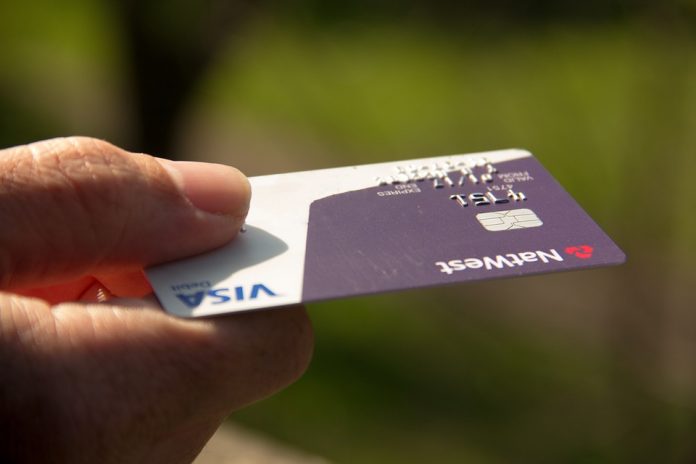
How can I recover my money back if someone else misused my Debit Card details?

1
debit card

In this article, Jagriti Bharti of Amity Law School, Lucknow discusses How can I recover my money back if someone else misused my Debit Card details.

Introduction

To make life easier technology was developed and it indeed fulfilled the purpose. It covers different aspects of our day to day life without which it would have been nearly impossible to survive. Nowadays, part and parcel of our life is dependant on technology and banking system has not remained untouched from this.

Earlier, banking transactions was only limited to transactions which were physical in nature i.e. through card, ATM, POS, direct withdrawal of cash from bank etc. But gradual development in technology of banking system made it more electronic in nature; resulting in transaction not only limited to face to face transactions but also online transactions i.e. transactions occurring over internet.

Kinds of Electronic Banking Transaction

Broadly, the electronic banking transactions can be divided into two categories:

  1. Remote/online payment transactions (payments that do not require physical payment instruments to be presented at the time of the transactions). E.g. internet banking, mobile banking, Prepaid Payment Instrument (PPI), Card Not Present (CNP) transactions.
  2. Face to Face/Payment Proximity Transaction (payments that require physical payment instruments to be presented at the time of the transactions). E.g. card or mobile phone to be presented at the time of the transactions, ATM, POS etc.

Debit Card Frauds

Regardless of the facilities provided for safe banking transactions, frauds do occur while using electronic banking system. One of them is transaction through Debit Cards. It is a payment card that deducts money directly from the consumer’s bank account on the account of purchase made by the consumer. It has dual function:

  • Withdrawing money from the bank account.
  • Paying for the purchases made by the consumer.

Debit card works using details provided on the card (which is directly linked to consumer’s bank account details) and PIN. Misusing debit card details leads to frauds. Debit card frauds occurs when a fraudster get access to any person’s card details as well as PIN and make unauthorised transactions from that person’s account leading to loss of his hard earned money. A debit card can be misused in three ways namely:

  • By making unauthorised cash withdrawal from a consumer’s bank account.
  • By online transfer of cash from consumer’s bank account to fraudster’s bank account.
  • By making online purchases through consumer’s debit card.

Now the question arises, how can a person who has become victim of debit card frauds get back his money ? What are  those legal procedures which needs to be followed by the victim in order to get back his money? 

Before proceeding to the legal procedures, let’s focus on some points which should be taken immediate care of  when someone misuses a person’s debit card details:

  • First of all contact your bank and get your debit card blocked.
  • If the card has been misused for online transactions just after you made some online transactions through your device then run a good anti virus scanner through your device in order to eradicate any further chances of your card details getting accessed by the fraudsters.
  • Change the PIN and other security details of your card.

RBI guidelines on Unauthorised Electronic Banking Transactions

Now, moving further to the legal procedures which needs to be adopted by the victim in case of Debit Card frauds in order to get his money back, RBI has prescribed certain guidelines via its Circular DBR.No.Leg.BC.78/09.07.005/2017-18 dated July 6, 2017 titled “Customer Protection – Limiting Liability of Customers in Unauthorised Electronic Banking Transactions.” The Circular suggests the extent to which the customer has chances to get his money back from the bank which he has lost due to unauthorised transaction. The sooner a customer report about unauthorised transaction to the bank the more chances he has to get his money back.

Liability of a customer in case of an unauthorised transaction

 As per the circular, there can be two kinds of liabilities of a customer:

  • Zero Liability of a Customer

A customer’s entitlement to zero liability shall arise where the unauthorised transaction occurs in the following events:

  1. Contributory fraud/ negligence/ deficiency on the part of the bank (irrespective of whether or not the transaction is reported by the customer).
  2. Third party breach where the deficiency lies neither with the bank nor with the customer but lies elsewhere in the system, and the customer notifies the bank within three working days of receiving the communication from the bank regarding the unauthorised transaction.
  • Limited Liability of a Customer

A customer shall be liable for the loss occurring due to unauthorised transactions in the following cases:

  1. In cases where the loss is due to negligence by a customer, such as where he has shared the payment credentials, the customer will bear the entire loss until he reports the unauthorised transaction to the bank. Any loss occurring after the reporting of the unauthorised transaction shall be borne by the bank.
  2. In cases where the responsibility for the unauthorised electronic banking transaction lies neither with the bank nor with the customer, but lies elsewhere in the system and when there is a delay (of four to seven working days after receiving the communication from the bank) on the part of the customer in notifying the bank of such a transaction, the per transaction liability of the customer shall be limited to the transaction value or the amount mentioned in Table 1, whichever is lower.

TABLE 1: MAXIMUM LIABILITY OF A CUSTOMER


Sr.no.


Type of account

Maximum liability (in Rs.)
1. BSBD accounts 5,000
2. ●       All other SB accounts

●       Prepaid Payment instruments and gift cards

●       Current/cash credit/overdraft accounts of MSMEs

●       Current/cash credit/overdraft account of individuals with average balance (during 365 days preceding the incidence of fraud) limit up to Rs.25 lakhs

●       Credit card with limit up to Rs.5 lakhs


10,000

3. ●       All other current/cash credit/overdrafts account

●       Credit card with limit above Rs.5 lakh

25,000


If the delay is beyond 7 working days, the customer’s liability shall be determined as per Bank’s Board approved policy. Overall liability of a customer in third party breaches, where deficiency lies neither with the bank nor with the customer but lies elsewhere in the system is summarized in the Table 2.

TABLE 2: SUMMARY OF CUSTOMER’S LIABILITY

Time taken to report the fraudulent transaction from the date of receiving the communication from the bank  

Customer’s liability (in Rs.)

Within 3 working days Zero liability
Within 4 to 7 working days The transaction value or the amount mentioned in Table 1 whichever is lower
Beyond 7 working days As per Bank’s Board approved policy


Duties of Bank in case of reporting of unauthorised transactions by customers

The Circular further states the duties of the bank towards its customers on reporting of unauthorised transactions by customers to the banks:

  • It is the duty of the bank to ask their customers to register themselves mandatorily for SMS alerts and email alerts for electronic banking transactions and it should enable the customers to instantly respond by “Reply” to the SMS or email alerts.
  • The customer must be advised to notify the bank about any unauthorised transactions from their bank account at the earliest to reduce the risk of loss occurring through the transaction.
  • For reporting unauthorised transactions or loss of cards, banks should provide their customers with 24*7 access through multiple channels (like via website, email, SMS, phone banking, toll free helpline etc).
  • The fraud reporting system should ensure that immediate reply should be sent to the customer acknowledging their complaint alongwith registered complaint number.
  • Banks must record the time and date of customer’s message in order to determine the extent of customer’s liability.
  • Banks should take immediate actions on the receipt of report of unauthorized transaction by the customer to prevent further unauthorised transactions in the account.

How to get money back if the account has been hacked and debit card details have been misused?

If your money has been lost due to online purchase of any goods from your debit card which is not done by you but someone else, you will definitely want your money back. This situation can arise when your system gets hacked and fraudsters get access to your card details and PIN.

Whenever a transaction is made from a customer’s account, it is the the duty of the bank to provide the details of the transaction to the customer through SMS or email alerts. So, when the fraudster will make transaction from your account then also you will get alert. This SMS or email provides you the basic transaction details which is done from your account. Watch out the name of the gateway which is used in the transaction while purchasing the goods by fraudster. Suppose it is eBay then contact to eBay customer care and alert them that the transaction has not been done by you. They may ask you to prove your identity.

Once they get convinced that the transaction was fraudulent, the will block the transaction and you will get your money back. But this needs to be done as soon as possible because once the goods get delivered nothing can be done by the company to refund your amount. Normally it takes 24 hours to deliver the goods to the prescribed address.

Conclusion

Whether you have lost your money due to fraudulent:

  • Cash withdrawal
  • Online transfer of cash
  • Online transaction to purchase goods
  • Hacking of card details

Only your promptness in registering complain can give you your money back.

References

Download Now

What kind of Raids can a Restaurant or Eatery expect?

0
raids

In this article, Jagriti Bharti of Amity Law School, Lucknow discusses the kinds of Raids a Restaurant or Eatery can expect.

With the globalisation of the whole country, India’s food trade system has also been globalised. It has initiated a transnational system for food production. India is passing through a strategic development phase when it comes to food and beverages. Indian food industry not only with its own home brands but also with the foreign brands is being taken to great heights of development. Indian food and beverage market are growing steadily having a fairly sophisticated market with enough restaurants in big cities of India like Delhi, Mumbai, Bengaluru, Chennai etc. Food franchise like KFC, Pizza Hut, McDonald’s, Starbucks Coffee, Dunkin’ Donuts, Domino’s Pizza, Subway, Costa Coffee, Burger King is among some of the famous foreign food franchise who has tightened their position in Indian food industry through their outlets in various cities of the country.

Active and fast pace lifestyle of the people has given a path to the development of the restaurant and eateries across the country. Thought they fulfil the purpose of serving hungry Indians who are willing to pay them their price, there are lots of eateries and restaurants who are not up to the mark in sanitation, hygiene and food quality. Their compromise in quality and hygiene can have a disastrous effect on the health of the consumers of their food. Several laws are made for these restaurants and eateries for maintenance of hygiene level and food quality but least of them is followed leading the government to take a step forward towards securing the safety of the public. And this step is the “surprise checks” (also known as “raids”) and audits of the hotels, restaurants, eateries to check their level of hygiene and food quality and ensure their public health.

“Week long raids in the Secunderabad Cantonment has exposed the unpalatable underbelly of the restaurant industry operating in the city. The exercise has now prompted a sea change in the Cantonment hotels management policy. The sanitation wing of the Cantonment board seized 6 installations including a sweetshop and a bakery. Officials found that all the kitchens had employees living in them and the kitchen repleted with the toilet. The surprise check was conducted after receiving complaints and will be continued until the food outlets will comply with hygiene norms[1].”

Above stated incident was just an example of a “raid.” There are much more which have been either conducted or yet to be conducted wherever the restaurant staff and administration lay back from their duty. The safety and quality of the food served in the restaurants and eateries are governed under FSSAI (The Food Safety and Standards Authority of India) Act. It operates under the Health ministry and is required to regulate and monitor the manufacture, processing, distribution, sale, and import of food as to ensure the safety of food. The FSSAI has become really active after the “Maggi issue”. They are conducting a lot of surprise audits and raids frequently in various hotels and restaurants to keep the restaurants and food businesses of their toes and deliver what is expected “quality”.

The provisions of FSSAI Act under which raids can be conducted of restaurants and eateries are:

  1. Running Food Business Without License and Registration

As per Section 31 of the Food Safety and Standards Act, 2006, no person can commence or carry food business without a license. Whosoever carries food business without obtaining required licence will be liable to imprisonment for a term which may extend to 6 months and also a fine which may extend to five lakh rupees (Section 63).

Running food business (including restaurants and eateries) without a proper licence is illegal and this may attract raids from the food authority in order to find out whether the specific food business is legal or illegal. Restaurants will be required to show licence of their business whose inability to produce will attract the said punishment. [Getting FSSAI license for the restaurants].

NOTE: For a restaurant to sell liquor on its premises, it needs to get licensed from the State Excise Commissioner without which selling liquor is illegal. That restaurant can be raided and can even order for its closure.

  1. Selling food, not of nature, substance or quality demanded

Raid can be conducted in any restaurant or eatery if they sell food to the purchaser which is,

  • Not in compliance with the provision of the FSSAI Act or,
  • Regulations made under this Act or,
  • Nature or substance or quality demanded by the purchaser’

And the concerned person will be liable to a penalty not exceeding five lakh rupees[2]. Noncompliance of this Section by any person who, if, covered under Section 31 (2) will be liable to a penalty not exceeding 25,000 rupees.

Case: This case is of Delhi’s eateries serving low-quality food. It was informed to the Delhi High Court by the FSSAI that various food samples collected from three different popular eateries in the capital have been found unsafe for consumption. They were:

  • KFC at Scindia House in Connaught Place: Sample collected was ‘Rizo Rice’ which contained artificial colour.
  • Sagar Ratna restaurant in Guru Teg Bahadur Nagar: Rice sample collected for testing was found to be unsafe.
  • Bikanerwala restaurant at ITL Tower in Netaji Subhash Place: Samples of fruit and vegetable chutney was found to be contaminated with artificial colours.
  1. Selling food that contains external or inappropriate matter

Section 54 of the FSSAI Act states that any person who sells, stores, distributes or imports food which contains inappropriate or extraneous matter shall be liable to a penalty which may extend to one lakh rupees. Raids can be conducted by the concerned authority if complaint registered against any eateries or restaurant regarding this matter.

Case: There was a case of Mother Diary in which media agencies reported that he detergent and frozen fat was found by the Kolkata based Central Laboratory during re-tests of milk samples collected by the district Food and Drug Administration.

  1. Keeping the kitchen dirty and unhygienic

Any restaurant owner who keeps the manufacturing area of food or process any article of food in an unhygienic or unsanitary condition will be liable to a penalty which may extend to one lakh rupees (Section 56) and this noncompliance of the owner can also raids to be conducted.

Case: The authorities warned Central Province Club of Nagpur of cancellation of their food licence due to faults like an extremely unhygienic kitchen, no pest control, unclean water tank etc. found during an inspection by the Food safety officer and which was not permissible under the FSSAI Act. [FSSAI guidelines to be followed by all the restaurants].

  1. Accidents including consumer’s injury or death

According to Section 59, if any restaurant owner found guilty of selling any food item which caused either death or injury to the consumer then he will be liable a penalty of rupees five lakh in case of death and rupees 3 lakh in case of injury occurred to the consumer. If this has happened in any restaurant then the owner of the concerned restaurant may face the wrath of the food safety officials during raids.

There are also some other laws under which raids can be conducted in the restaurant and eateries

  1. Income Tax Act, 1961

Section 14 of the Income Tax Act provides 5 heads of income i.e. Salaries, income from house property, profits and gains of business and profession, capital gains and income from other sources. If a person’s income falls in any of these heads, he will be liable to pay income tax as per the provisions of this Act. Owning and operating a restaurant, hotel, eatery or other food business is a kind of business and hence the restaurant owner has to pay the income tax on the income he has earned in the previous year from his business under the head “Profits and gains from business and profession” evading which will make him liable to face penal consequences.

Despite the laws made under the Act, people tend to evade payment of tax by not disclosing their income and assets. But the government had a smart solution to this. It launched “Income Declaration Scheme” in 2016 in order to combat the problem of tax evasion. Under this scheme every person has to declare their income and wealth to the government till 30 September 2016 failing which he will face search and seizures from the Income Tax officials.

Case: The Income Tax department has left no stone unturned in a bid to make “IDS” a success. It conducted around 100 raids in eateries in Ahmedabad, New Delhi and Kolkata. In Mumbai alone, around 50 restaurants and eateries were raided and were asked to declare their income under Income Declaration Scheme. Small businesses and roadside eateries also had to face raids from the IT officers.[3]

  1. Prevention of Food Adulteration Act, 1954

Under Section 7 of the Act, no restaurant can sell food which is,

  • Adulterated[4]
  • Misbranded
  • In noncompliance of the conditions mentioned in the license for selling that food
  • For the time being prohibited by the Food (Health) Authority in the interest of public health.
  • In contravention of the Act or the rules made under this.

Violation of Section 7 may lead the restaurant owner to face search and seizure conducted by the Food inspector under Section 10 of the Act. A food inspector may enter the places of manufacture and storage of food items of a restaurant or eatery under question and conduct raid. He may collect food samples and send it to food analyst for analysis.

CONCLUSION

Owning a business like a restaurant or an eatery needs a bundle of licences from different Acts of State as well as Central and has to abide by the provisions and rules mentioned therein, violation or noncompliance of which can really trouble their business through penalties and raids conducted by the food authorities who can even pass an order of its closure. So, before starting a food business, one needs to be very alert and careful about the laws related to it.

[1]http://www.thehindu.com/news/cities/Hyderabad/Unpalatable-underbelly-of-restaurant-industry/article16084834.ece [19 July, 2017 at 12:15 PM]

[2] Section 50 of FSSAI Act, 2006

[3]http://economictimes.indiatimes.com/news/economy/policy/income-tax-department-raids-roadside-eateries-small-businesses-to-make-declaration-scheme-a-success/articleshow/54454245.cms [19 July, 05:25 PM]

[4] Section 2 (ia) of Prevention of Food Adulteration Act, 1954

Download Now

What kind of laws should the state of Andhra Pradesh make to become a Blockchain capital of the World?

0
blockchain

In this article, Himanshi Srivastava of Amity Law School, Lucknow discusses kinds of laws that the state of Andhra Pradesh should make to become a Blockchain capital of the World.

What is Blockchain Technology?

Blockchain Technology is a System Ledger which provides a security to transactions, agreements, and contracts etc. which need to be verified and stored. However, uniquely, instead of being kept in one place just like the a lot of ancient ledger book, the info is shared across a network of computers. This network will comprehend simply a few of users, or lots of and thousands of individuals. The ledger becomes an extended list of transactions that have taken place since the start of the network, obtaining larger over time.

How is it Used?

Blockchain runs on specialised computer software that operates behind the scenes, mechanically distributing data to the information as new transactions are created. Most individual users will not see a blockchain performing and this fast nature suggests that there’s very little to no window of your time for somebody to change a transaction before it’s recorded on to the ledger.

Why it is Secure?

A blockchain information consists of blocks and transactions. Blocks contain batches of transactions that are “hashed” and encoded. every block contains the hash of the block before it, that links the two and forms the chain. This method validates every block, all the approach back to the first, and is integral to the database’s security.

When a transaction takes place, its details are encrypted and a singular multiple-character dealing number is generated. Rather than alternative users within the blockchain having the ability to check the precise details of the transaction, this number is recorded within the ledger as a placeholder. All the users of the network are ready to see that the transaction has taken place however solely the parties concerned within the dealing will access and look at its details.

Why it is meant for development?

As an emerging technology, blockchain enthusiasts are hopeful it may be successive huge development disruptor. In providing a clear, instant and indisputable record of transactions, its potential to get rid of corruption and supply transparency and responsibility is one space of intrigue. However, there are still several queries around a way to apply the technology.

In What Sector will it be useful?

Blockchain might even be used for land tenure and property rights. Traditionally, governments keep records of who owns an exact piece of land or property, and therefore the owner might or might not have a bit of paper to prove it. However, government records may be lost or manipulated, or the govt might have issued a deed to some other person for a similar piece of land therefore two individuals might claim possession for the same plot. The blockchain, however, might operate as a neutral broker to work out who owns what; the chain might prove that parties are concerned and what they agreed to as the original contract would have been verified by a blockchain info, and hold on firmly on the ledger.

Blockchain as an idea of Decentralisation?

By design, the blockchain may be a decentralized technology. Anything that happens on it could be a function of the network as a whole. Some vital implications stem from this. By making a replacement way to verify transactions aspects of ancient commerce might become extra. Securities market trades become virtually coinciding on the blockchain, for example: or it might create kinds of record keeping, sort of a land register, totally public. And decentralization is already a reality.

A global network of computers uses blockchain technology to collectively manage the information that records Bitcoin transactions. That is, Bitcoin is managed by its network, and not any one central authority. Decentralization means that the network operates on a user-to-user (or peer-to-peer) basis. The types of mass collaboration this makes attainable are simply beginning to be investigated.

Who can use Blockchain Technology?

The blockchain probably cuts out the middleman for these kinds of transactions. Personal computing became accessible to the overall public with the invention of the Graphical User Interface (GUI), which took the shape of a “desktop”. Similarly, the foremost common graphical user interface devised for the blockchain are the supposed “wallet” applications, which individuals use to shop for things with Bitcoin, and store it together with different cryptocurrencies.

Transactions online are closely connected to the processes of identity verification. it is simple to imagine that wallet apps can rework within the returning years to incorporate different kinds of identity management.

Andhra Pradesh: Among few states to implement the Blockchain Technology in India.

Hyderabad, the capital of Telangana and de jure capital of Andhra Pradesh, are integrating blockchain technology into its government affairs. The 2 Indian states are following help from blockchain startups as they assess the technology for information security. Many alternative state governments among the country, like Karnataka, Gujarat, and Maharashtra, have additionally started exploring the appliance of blockchain technology for governance. State IT minister of Karnataka, Priyank Kharge, says Indian officers are presently evaluating international markets to visualize however the technology are often used in the general public and personal sectors:

“We have asked these startups to return back to United States with how blockchain is getting used outside the country and what policies are in place there.”

What legal Issues the State can Face?

With huge restrictive implications, blockchain applications have already raised several legal queries as they provide new capabilities to engage activities in ways that don’t match showing neatness into existing legal frameworks.

Here are simply a number of ways in which blockchain and its numerous apps are changing the legal landscape:

Cryptocurrencies as legal tender

Bitcoin, the world’s most recognizable digital currency, uses encryption techniques as to manage the generation of units of currency and verify the transfer of funds, operational severally of a financial organisation. It implies that this money has not passed through a bank or alternative financial institution, nor has it been screened by any bureau.

If you’ve got a significant transaction that’s normally needed to be reportable, it simply isn’t. This ends up in important challenges, principally regarding government regulators and current laws.

Money laundering and other illegal monetary transactions

Bitcoin’s blockchain has remained resilient to attack, and it supports a sturdy payment system. however, this doesn’t mean the people using this technology are always noble citizens.

Blockchain actions are automatic and fall outside of human legal proceeding, which means bonus funds might be anonymously spread mechanically into various accounts.

In 2013, regulative bodies answerable for preventing money crimes have introduced new rules to bring Bitcoin within the scope of its enforcement. Later that year, some twenty two Bitcoin firms and investors were unceremoniously subpoenaing by the New York Department of financial Services (NYDFS) culminating in federal agents move down the trade route (a dark market for the most part powered by Bitcoin).

Recently, lawmakers in West Virginia deemed it a law-breaking to use Bitcoin or other cryptocurrencies for concealment, with an update to the state’s anti-money laundering (AML) statutes. The law specifically created a definition for cryptocurrency that is recognized as a ‘monetary instrument’ in the state.

Regulating decentralized applications

In some cases, block chains are used to produce tokens that aren’t designed to be cash at all. for instance, programmable block chains like Ethereum let users create decentralized applications that have their own tokens.

“Distributed” and “decentralized” refer to the peer-to-peer aspect of the blockchain network;  there’s not one central information of the blocks. every node on the network will have a duplicate of the total ledger.  

Privacy laws

Blockchain, like every kind of ledger book, becomes the official record for trailing the history and validity of transactions and other data. That record is visible to all, even though individual components of the transactions are encrypted and not publicly visible. Here, the division of public and personal on a blockchain are particularly interesting.

For example, your passport or different identity data might be securely encrypted, but the proof of the validation could be used publicly on a blockchain to prove that you simply are you for functions of that dealings, without revealing the underlying private data.

But blockchains could raise challenges where financial establishments are forced to comply with bound privacy laws.

Legal ramifications of Blockchain records

In part, to its stringent encryption techniques, blockchains will have more legal bearing in court. A bill in Vermont passed that would make records verified through blockchain technology admissible as evidence in court.

Laws like this produce a sort of legal backing for blockchain-based information.

In Nevada, a bill has deemed smart contracts and blockchain signatures acceptable records beneath state law.

As blockchain ledgers and systems become a lot of common, their attainable use in cases as proof and discovery becomes more possible.This means lawyers will need to know such records exist as well how to handle that evidence as well as what specific information to request.

Smart contracts

Because blockchains will process transactions, not merely store information regarding transactions, they will functiona platform on that code will be executed and apps are often run. this can be mentioned as “smart contracts.” they need a logic designed into them that triggers an action if a predecessor event happens, while not requiring an extra intervention.

As such, simple contracts – and their reduction in transactional friction – are showing nice potential within the short term.

Property ownership

In several developing countries, wealth is made through ownership. sadly, one in every of the foremost difficult aspects is determining who owns an explicit piece of land. And disputes typically occur once corrupt governments or people take advantage of the under-educated.

Having a public blockchain ledger would allow for everyone to bear in mind of who owns that parcel of land, and it might build the exchange of ownership a lot of easier and a lot of equitable . This efficient proof of ownership would create a higher base for authentication and governments may fairly tax people and businesses.

Multi-signature transactions

Blockchain technology can accomplish official document by exploiting multi-signature transactions, that involve depositing funds to a virtual currency address to initiate a gaggle action between 3 parties, where 2 getting parties and a third-party ‘escrow’. Finishing or refunding the group action desires two of the three parties to sign the group action.

Laws control written agreement agents who assume physical management over assets don’t seem to be designed to accommodate this sort of group action. for example, Calif. defines written agreement using language like ‘delivers’ and ‘to be held’. Such laws could also be discrepant with transactions wherever nothing is physically delivered to or heldin written agreement.

Storage and data transfer

Other data could also be transferred or hold on via blockchain. for example, a blockchains redistributed verification may give for secure digital signatures. Identity data might be stored and verified via a blockchain ledger, and ensuing verified identities (remaining pseudonymous) may scale back fraud on peer-rating sites or give trust ratings for peer-to-peer marketplaces or disposal services.

Yet, such identity verifications raise privacy issues, together with whether or not a right to privacy would exist in such applications. Further, making huge data repositories raises knowledge breach issues. though cryptologic ledgers are wide seen as secure, if in person recognizable knowledge from elsewhere were exposed and related to blockchain knowledge, or if blockchain knowledge were aggregative and analysed, transactions might be tracked and compared even with a onymous ledger.

Conclusion

As this technology continues generating new possibilities for the approach we interact and exchange info, it brings forth difficult and complicated legal issues and pushes the boundaries of existing laws.

Blockchain technology is a subject of law – one thing that our laws will need to adapt to, even as they adapted to the web, new medical technology, or social media. Do these legal and regulatory challenges mean we shouldn’t be exploring the potential of Blockchain? not at all. The technology is already showing tremendous potential to require our business into the longer term. These are simply a number of the initial problems we must always be exploring in parallel to our exploration of the technology. Once, Blockchain becomes totally developed, we tend to won’t be able to merely plug into it and begin giving product. we are going to initial ought to explore all of the legal and regulatory implications of doing, This, as always, to make sure that we tend to shield our customers and ourselves against any potential mishaps.

So, it’s not a matter of not evolving with the days. It’s solely a matter of making certain that our evolution is completed with foresight, insight and a transparent plan of protection. regardless of the future of Blockchain holds for the State, we should conjointly make sure that we tend to shield our most worthy asset: our citizens.

References:

Download Now

Laws regulating production of Wine in India

2
wines

In this article, Ashwini Gehlot discusses the laws regulating the production of Wine in India.

Among BRICS nations, India has the least per capita consumption of wine: around 19 ml, against 8.1 liters in Russia, 2.26 liters in Brazil, 7.0 liters in South Africa, and 0.9 liters in China.

Indian Wine Industry

India is not customarily a wine drinking nation. Because of prior time of restriction in India and higher price as compared to spirits like brandy and whisky made in the country, the production and consumption of wine in India are negligible when compared with various other countries. The setting up of Champagne Indage’s plant in 1984 in the province of Maharashtra denoted the production of wine on an organized scale in India. commercial wine manufacturing is coming into existence in  the1980s in India.

The accompanying elements have added to India’s low wine consumption-

  • Poor transport facilities
  • Poor storage
  • Stringent and backward government rules with various tax collection across different states
  • Unfavorable standards for domestic marketing of wines aside from in a few States
  • Lack of promotional activities for wine utilization in the nation

The Indian wine industry has been constantly evolving over the past 10 years. Wine is step by step turning into a part of urban Indian way of life. Since India joined the WTO, import taxes in the nation have been astoundingly lessened, accordingly empowering foreign exporters to exploit India’s huge consumer market. The wine market is bit by bit opening up as quantitative limitations are being lifted, import duties are being brought down and domestic regulations are being untangled.

The accompanying components are adding to the higher consumption of wine in India-

  • Rising incomes of Indian populace
  • Growth in the foreign tourist
  • Exposure to new culture
  • Changing demography
  • Loosening of Government policies and regulations

Types Of Wines Available In India

There are fundamentally three sorts of wine available in India-

  1. Premium Wines (Still wines): In this class, the Indian market is isolated principally into two noteworthy classifications – White and Red wines;
  2. Sparkling Wines: This wine is for the most part considered to fall into the White wine classification by numerous consumers;
  3. Fortified wines: This is not yet made or viewed as quality wines.

All the wines which are available in the above-mentioned categories are further divided into 3 categories-

  • Domestic Indian Wine: This is the wine, which is manufactured from Indian grapes and packaged in India by the domestic wineries. ·
  • Foreign Bulk Wine Bottled in India: A couple of huge domestic producers import bulk wine and pack it in India.
  • Foreign Wine Bottled in birthplace: approximately 200 and above are currently available in this category and they are transported in by Importers, Domestic players, and Foreign players.

Production Of Wine In India

“India has 123, 000 acres of vineyards, of which only 1% are utilized for wine manufacturing. India‘s first winery was set up amid the 1980s and by 2000 there were only 6 working wineries. Manufacturing consequently expanded rapidly, cresting at approximately 13.0 million liters (1.4 million cases) in 2010, preceding dropping in 2011 and 2012.” 

The below mentioned 3 wine companies are presently manufacturing/producing wines in India-

  • Chateau Indage Limited, Pune
  • Sula Vineyards, Nasik
  • Grover Vineyards Limited, Bangalore

There are no official production statistics, but state excise information with industry estimates give a genuinely dependable sign of recent manufacture/production levels.  Excise data of Sangli (Maharashtra) shows that production was 641,000 liters (71,200 cases) in the financial year 2010/11 and 233,000 liters (25,900 cases) in the financial year 2011/12. Excise data from Karnataka shows that the state manufactured 2.9 million liters (322,200 cases) during Indian fiscal year (April/March) 2010/2011 and 3.2 million liters (355,500 cases) during financial year 2011/12. According to Industry sources, the approximately total wine manufacturing is 11.5 million liters from 2,000 hectares of grapes in 2012.

Consumption Of Wine In India

The domestic wine utilization touched more than 10 million liters in 2007 and may go up to 15 million liters for the present year, from a negligible 1 million liters in 2001.

About 80% of the demand for wine comes from these major cities as mentioned below with their consumption pattern, namely – Mumbai (39%), New Delhi (23%), Kolkata, Goa  (9%), Chennai, Bangalore (9%) and Pune and the rest of India has just 20% consumption.  The total wine consumption in India is around 400,000 cases a year of which 85% are table wines and the remaining are the costly assortments. Out of the 400,000 cases, around 50,000 cases are foreign from different sources. Today, the utilization/consumption per head is about 0.0030 liter for each annum.

Duty Regime

Customs Duty / Excise Duty

  • The excise duty on wine has been expanded from 100% to the most extreme reasonable rate of 150%.
  • India rejected extra excise duty on imported alcohol, beer and wine following an objection by the European Union and the US in the World Trade Organization. So the customs duty has been waived on wine.
  • The instruction/education cess applicable on the imports of wine has been rejected in 2007.

Local Taxes

  • The Central Government has endorsed a most extreme state excise of 25% for wine in different states.
  • In Kerala, the rate of Import expense for imported wine is Rs. 2 for every mass liter. · Maharashtra has expelled excise duty on wine.
  • Haryana has lessened the excise duty for wine to Rs.20.50 liter from Rs.32.25 liter per proof liter. Furthermore, it has decreased the export duty to half for the domestic business.

Value Added Tax (VAT)

  • Delhi – 20%, Maharashtra – 20%, Chandigarh – 4%, Haryana – 20%, Tamil Nadu – 53%, Karnataka – No VAT, Kerala – 12.5%

Foreign Direct Investment Policy

  • The approach for distillation of liquor has been reported vide Press Note 4 (2006) as per this report, FDI up to 100% is allowed under the automatic route for brewing and distillation of liquor subject to licensing by the suitable authority.

Key Wine Importers

The most famous imported wine marks in India are from France, and French wines represent half of the aggregate imports in value terms. Italian wines are the second most noteworthy imported, trailed by Australia. 72,000 wine cases are transported in basically by Sansula, ITDC, E and J Gallo, Brindco and other private businesses. The number of wine merchants in India is developing at the rate of 30% with the list of importers expanding each year.

The following are the key wine importers in India

  • Brindco Sales Ltd. (Delhi)
  • Sonarys Co-Brands Pvt. Ltd. (Mumbai)
  • International Global Tax (Delhi)
  • Mohan Brothers RR (Delhi)
  • Fairmacs Shipstores Pvt. Ltd. (Chennai)
  • RR International (Delhi and Mumbai)
  • Kiara Wines (Mumbai)
  • Star X wines (Delhi)

Localisation of the Wine Industry

The following are the major wine producing regions in the country:

  1. Sangli Region (Maharashtra)
  2. Nashik Region (Maharashtra)
  • The majority of the Indian wineries are situated in these two areas including the largest Sula Vineyards and Chateau Indage. There are 54 wineries in the country. Out of them, 52 wineries are in Maharashtra, incorporating 8 in Sangli, 28 wineries in Nasik, 9 in Pune, 2 in Buldhana, 3 in Solapur and 1 in Usmanabad. The Maharashtra Industrial Development Corporation has set up 2 Wine Parks in the State: Palus, close Sangli (53.70 Hectares) and Vinchur, close Nasik (151.36 Hectares).
  1. Bangalore Region (Karnataka)- The third biggest wine maker of India, Grover Vineyards has its winery placed in this area.
  2. Himachal Region (Himachal Pradesh)- Chateau Indage has planted Cabernet, merlot, and sauvignon blanc grape assortments in Kullu and Manali where it is wanting to get into manufacturing in three years.

Major Indian Wine Companies

Most of the wineries in India are situated in Nashik in  Maharashtra. Currently, India has around 60 wineries with an expected venture of about USD 60 million. The accompanying three wine companies are the real wine manufacturing/producing companies in India:

  • Chateau Indage Limited, Pune
  • Grover Vineyards Limited, Bangalore
  • Sula Vineyards, Mumbai

The following are the other top Indian wine companies

  • ND Wines
  • Renaissance Wines
  • Sankalp Wines
  • Vinicola
  • Flamingo Wines
  • Mandala Valley
  • Vintage Wines

Other Wineries

  • Indo Grape Winery
  • Girana Valley Vineyard
  • Sahyadri Hills Vineyards and much more.

Licenses

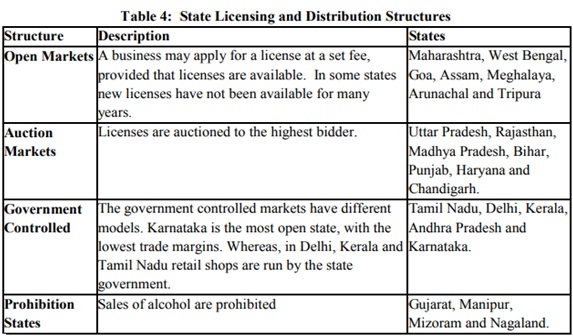
Licensing procedure differ state by state; a few states disallow the sale of liquor, some prohibit the sale of liquor beverages and others have state-run restraining infrastructures that control the distribution of liquor. In general, distributors, importers, restaurants retailers and hotels must have a license to deal with liquor beverages. In a few states, licenses are further described to take into consideration things like room service sales of liquor. Licenses are ordinarily subject to yearly renewal fees. State permitting and distribution structures are depicted in the Table.

wine

Brand/Label Registration

Distributors and importers are required to register or in some cases label the brand with the state excise department for showcasing the brand/label in the state. The state excise office charges a fixed registration expense, and the registration must be renewed each year. In a few states, importers are too required to mention the MRP(Maximum Retail Price) for the wine at the time of registration.

The state excise office, at the time of registration, gives guidelines and rules on specific labeling prerequisites for sale. State specific labeling guidelines may include:

  • Available to be purchased in the state of xxxxxxx as it were’.
  • Liquor Consumption is Injurious to Health’ in English
  • Maximum Retail Price (MRP) Rs. xxx.xx only.

Transport Permits

Subsequent to accepting an order from a licensed purchaser/buyer, the licensed merchant/distributor applies for a transport license from the excise office. License and permits are normally issued after payment of sales charge (VAT), state excise tax, and other pertinent taxes.

The Food And Drug Administration (FDA) – Procedure For Obtaining A License To Operate.

“According to the new Food Safety Standards Act, wine goes under the food category. As there are worries over quality, we are intending to make licenses compulsory for wineries and wine retailers (shops),”

ANNEXURE A

General requirements for License to Operate (LTO)

  1. Authenticated Accomplished Application for Authorization Form (Annex A-1)
  2. Evidence of Registration
  3. In the event of Single Proprietorship, legitimate Certificate of Business Name Registration with the Department of Trade and Industry.
  4. On the off chance that Corporation or Partnership, legitimate Registration with Securities and Exchange Commission (SEC) and Articles of Incorporation or Partnership.
  5. In case of Cooperative, legitimate Certificate from Cooperative Development Authorities and by laws
  6. Verification of Occupancy – Office
  7. Substantial authenticated Contract of Lease/Certificate of Occupancy/Sub-Lease.
  8. Transfer Certificate of Title (TCT) if claimed and authenticated Certificate of Occupancy (if possessed by one of the incorporators).
  9. Clearance from the Building/Condominium Administration permitting the utilization of the unit for business purposes – as fundamental.
  10. Verification of Occupancy – Warehouse or Stockroom
  11. Substantial authenticated Contract of Lease/Certificate of Occupancy/Sub-Lease.
  12. Transfer Certificate of Title (TCT) if claimed and authenticated Certificate of Occupancy (if possessed by one of the incorporators).
  13. Substantial legally approved Warehousing Agreement (Third Party Logistics)
  14. Confirmation of Occupancy – Manufacturer Photocopy of Notarized substantial Contract of Lease of the building/space possessed (if space/bldg. is not claimed).
  15. Photocopy of Notarized Fixed Asset and Operating Capital or Financial Statement, if material.
  16. Area Site/Plan (Indicate location, size, sort of building, immediate environment).
  17. Floor Plan/Lay out with measurement.
  18. Conditional list of food items to be distributed or produced recognized in light of its arrangement (domestic or imported) and classification (Annex L) (Low/medium/high hazard).
  19. A copy of Proposed Label (for the local producer)/test label of the item to be imported or a computerized picture of the document in an FDA-affirmed document type.

ANNEXURE B

Requirements for the Renewal of LTO

 Regular Renewal:

  1. It should be done on or before the issuance date of the license.
  2. Submit most recent Financial Statement appropriately signed by a CPA or most recent BIR.

Automatic Renewal:

  1. The application is filed before the termination date of the permit/license;
  2. The endorsed renewal fee is paid after filing of the application; and
  3. A sworn statement demonstrating no change or variety at all in the establishment is attached to the application.

ANNEXURE D

Classification Of Processed Food Products

 A. Low-risk Category –

Food that is probably not going to contain pathogenic microorganisms and won’t typically bolster their development because of food characteristics or type. Wine is included in this category of food products.

ANNEXURE E

Initial/ Regular Renewal For Low-risk Category:

  1. Totally filled up Assessment Slip
  2. Application Letter with Product List for Locally produced items
  3. A duplicate of substantial FDA License to Operate
  4. Totally filled up Product List
  5. One sample in business presentation OR an advanced/digital picture of the item and its packaging no less than 1024 x 768 pixels in estimate, and in an FDA-affirmed file type
  6. For locally manufactured items/products-One real loose label connected in the documents OR a digital picture of the item and its bundling no less than 1024 x 768 pixels in measure, and in an FDA-affirmed file type
  7. For imported items/products-
  8. One genuine loose label attached in the reports/documents with a sticker showing the complete name and address of the Importer OR a digital image of the item and its packaging no less than 1024 x 768 pixels in size, and in an FDA-endorsed document sort.
  9. Authenticated Affidavit of Undertaking with item list for imported items.

References

  1. indialawoffices.com. (n.d.). Indian Wine Industry. [online] Available at: http://www.indialawoffices.com/ilo_pdf/industry-reports/wineindustry.pdf [Accessed 19 Jul. 2017].
  2. Sood, D. (2012). Wine Market Update 2012. [online] Available at: https://gain.fas.usda.gov/Recent%20GAIN%20Publications/Wine%20Market%20Update%202012_New%20Delhi_India_12-14-2012.pdf [Accessed 19 Jul. 2017].
  3. Chandra, A. (2014). Investment required in wine. [online] Business-standard.com. Available at: http://www.business-standard.com/article/beyond-business/investment-required-in-wine-114072501471_1.html [Accessed 19 Jul. 2017].
  4. indianwineacademy.com. (n.d.). COMPREHENSIVE STUDY OF THE INDIAN WINE MARKET. [online] Available at: http://www.indianwineacademy.com/comprehensive_study_iwm_reference_section.pdf [Accessed 19 Jul. 2017].
  5. Pawar, T. (n.d.). Soon, licence system for wine makers – Times of India. [online] The Times of India. Available at: http://timesofindia.indiatimes.com/city/nashik/Soon-licence-system-for-wine-makers/articleshow/13787969.cms [Accessed 19 Jul. 2017].
  6. fda.gov.ph. (n.d.). Requirements for License to Operate (LTO) – OPENING/ INITIAL. [online] Available at: http://www.fda.gov.ph/attachments/article/71149/Annex%20to%20Food%20AO%20-%20Annex%20A%20to%20H.pdf [Accessed 19 Jul. 2017].


Download Now

What are the legal requirements to set up a public or private Cloud Computing service business in India?

0
cloud computing

In this article, Karan Singh of JGLS discusses the legal requirements to set up a public or private cloud computing service business in India.

Introduction

Cloud Computing is the computing as a service over the internet. It is also referred as “the Cloud” in simple language. It is the delivery of on-demand computing resources- everything from applications to data centers over the internet on a pay for use basis. Cloud computing has elastic resources where user can scale up or down quickly and easily to meet demand. It gives metered service so you pay for what you use.[1]

Mostly, everyone uses cloud computing these days. If use you an online service to send emails, edit documents, watch movies, or TV, listen to music, play games or store pictures or other files, then you are likely to use cloud computing. From small startups to MNCs, from government organisation to NGOs all are taking advantage of this technology for all sorts of reasons.

What can you do with the cloud:

  • Create new apps and services
  • Store, backup and recover data
  • Host websites and blogs
  • Stream audio and video
  • Deliver software on demand
  • Analyse data for patterns and make predictions.[2]

Public cloud computing service

Public clouds are owned and operated by a 3rd party cloud service provider, which deliver their computing resources like servers and storage over the internet. Microsoft Azure is an example of a public cloud. Cloud provider manages and own all the hardware, software, and other supporting infrastructure. You just have the access these services and you can manage your account using a web browser.

Private Cloud Computing service

A private cloud is a service exclusively by a single business or organisation. A private cloud can be physically located on the company’s on site datacenter. Some companies also pay 3rd party service providers to host their private cloud. A private cloud is one in which the services and infrastructure are maintained on a private network.

Benefit of cloud computing

Cloud computing is a new technology to enhance the traditional way business to modern way business. But why is cloud computing so popular? Here are some common reasons why companies are opting cloud computing.

Cost

Cloud computing eliminates the expenses of buying hardware and software and setting up. Expenses for pen drive, hard drives to store can be saved as cloud computing does not need any hardware for storing files.

Speed

Cloud Computing is a service which is given on demand. So even vast amounts of computing resources can be supplied in minutes. This fast speed gives businesses a lot of flexibility and taking the pressure off capacity planning.

Global Scale

The benefit of cloud computing services includes the ability to scale elastically. This means that the service can be adjusted according to the user and the location. For example: more or less computing power, storage, when it’s needed and from the right geographic location.

Productivity

Data, when stored in the offices, can create problem which requires a lot of racking and stacking or may be difficulty in hardware setup, software patching and other time consuming chores. Cloud Consuming removes the need for many of these tasks, so that the teams can spend time on achieving more important goals.

Performance

Cloud Computing works for the users and upgradation is regularly done by the companies. The database is regularly upgraded to the latest generation of fast and efficient computing hardware. This offers several benefits over a single corporate database, including reduced network and greater economies of scale.[3]

Disadvantages of Cloud Computing

Service is unavailable when the internet goes down: This can be a problem in emergency. Whe cloud computing only works when internet is there and will go down if internet goes down. Many service providers of cloud based technology are very reliable and can promise an exceptionally high percentage uptime But problems can occur if you are solely relied on the internet to access your files and the internet connection in your workplace or home suddenly malfunctions.

Shifting from one provider to another: This can be a huge problem and confusing. If you wish to change your provider then you have to transfer your files over to a different provider, that process may prove much more complicated than expected.

Reduced Customer control: Customer are bond by the service provider. Customers are at a risk of getting interference from the service provider. Many cloud computing service providers do not provide their details of infrastructures, which may be frustrating to customers that prefer to handle administration needs on their own.

Main Legal issues to be kept in mind while setting up a cloud computing service in India are

Copyright: Copyright can be a main legal issue when cloud computing service is set up in India. It is said that the copyright issues in the cloud is difficult to understand as the IPR laws vary from country to country. This makes the application of Copyright law difficult since the question of jurisdiction creates confusion in the cloud computing environment. Copyright infringement content can be uploaded on the cloud in thousands ways. To solve this problem, it should be ensured that every party involved is well aware of the rules or laws and rights of the country in which the data is stored.

Jurisdiction: The jurisdiction can be a legal issue as cloud computing works globally. The influence of cloud computing globally to conduct operations through computers has led to number of legislative issues. This can be over government or jurisdiction. The owner or customer is unaware of the location of the data which can be problematic as the location can tell the law of that country. But if we do not know the location then which law will be applied is unknown.[4]

Data Portability: Data portability is that your data can be ported anywhere in the world.  It can be loosely described as the free flow of people’s personal information across the internet. Privacy is just a word in cloud computing. For example, anyone can import your social network connections, ability to reuse any information in hospitals, or any cafe.

Indemnity: The service provider does not have any responsibility for service interruptions or for any damages caused to the data. Customers can not look up to the cloud for any sort of indemnification. No measures are given for risk mitigation.

Status of Cloud Computing in India

In India there is no legislature or rule which exclusively deals with cloud computing or the legal issues that is mentioned above. And rules for cloud computing is difficult as it is globally same for everyone. Hence, the laws related to cloud computing is very limited in its applicability. But we can not say that there is no law exists in India for cloud computing. In India, there is a provision under Information Technology act, 2000. This Act deals with the issue of privacy in cloud computing from a distance.

Information Technology provides for the protection of privacy under section 72.  Section 72 of the Act states the Penalty for breach of confidentiality and privacy. If any person who, in pursuance of any of the powers conferred under this Act, rules or regulations has secured access to any electronic record, book, register, correspondence, information, document or other material without the consent of the person concerned discloses such electronic record, book, register, correspondence, information, document or other material to any other person shall be punished with imprisonment for a term which may extend to two years, or with fine which may extend to one lakh rupees, or with both.[5]

So, if anyone wants to set up a cloud computing service then he/she has to keep in mind that breach of privacy can be a problem for you. You have to be very carefull for the privacy of the customer.

Section 80 of the Information Technology act, 2000 deals with the search and seizure of computer data on connected systems if there is reasonable justification to do so. Cyber law aim is to ensure that privacy is maintained and respected in the cloud. Measurements should be taken by the companies to maintain and safeguard all that is stored in the cloud. And if the service provider fails to provide the service and maintain the privacy then there should be legal action against them.[6]

Conclusion

As of now, to set up cloud computing there is not much legal requirement. The service provider has to take care of the privacy of the customer and privacy should be the main issue of the cloud computing. Cloud industry is growing rapidly and competition is also increasing day by day. Cloud computing won’t succeed if the service provider do not create trust in the customers. We can not trust a service provider if he is likely to disclose or information and data. And without any legal support in India, user’s data is not safe at all. Government should make some rules and regulation for cloud computing in India this will help the companies and MNC’s to secure their data.[7]

India needs more regulations and not only just in privacy. According to Information Technology Act, which only deals with privacy secures the privacy part of cloud computing but what about other parts like jurisdiction, Data portability, Copyright issues.

References

[1] https://www.ibm.com/cloud-computing/learn-more/what-is-cloud-computing/

[2] https://azure.microsoft.com/en-in/overview/what-is-cloud-computing/

[3] https://azure.microsoft.com/en-in/overview/what-is-cloud-computing/

[4] http://www.indialawjournal.org/archives/volume7/issue-1/article3.html

[5] Section 72 of Information Technology Act, 2000

[6]http://www.mondaq.com/india/x/279070/Data+Protection+Privacy/Privacy+Issues+In+Cloud+Computing+With+Reference+To+India

[7]http://citeseerx.ist.psu.edu/viewdoc/download;jsessionid=891442B07F58C4D2B4827B9F09C6DD05?doi=10.1.1.403.2221&rep=rep1&type=pdf

Download Now

Taxation Of Public Charitable Trust

1

In this article, Aklovya Panwar of Institute of Law Nirma University discusses Taxation Of Public Charitable Trust.

Introduction

In this modern time, we constantly heard of the term called “Philanthropy”. It is the act of helping others by way of private or voluntarily giving. The term has first entered the English language in the 17th century.[1] Philanthropy serves many social purposes which include religious morality, humanitarianism, charity, etc. India also has a vast history in the concept of Philanthropy. Rig Veda directs to some of the collective social responsibilities in the form of charity as an obligation. It also guides about the conscience of a Human being.[2]Nowadays, there are organisations who are doing these voluntary services like NGOs, Vos, etc. These organizations amalgamate funds for these services. The Government has various taxation laws for these organization to keep a check on them so that they do not misuse that fund for self-purpose. So, the author will highlight certain ingredients of the taxation of these Public Charitable organizations that how these organisations fits in the present tax structure?When they have to pay tax?When they are exempted from the taxation? etc.

What is Charity?

The French word “charité” which was derived from the Latin word “Caritas” give birth to the English word “charity” which naturally means preciousness, dearness and high price. It a voluntary help to the needy.It includes helping in the form of monetary terms or through services. [3]

What is a charitable organisation?

The organization which has an objective of charitable purpose and provides voluntarily help.They are non-profit based organization.It includes Trusts, foundations, unincorporated associations and in some jurisdictions specific types of companies.[4]

The main aim of the Charitable organization is to help the public at large.The policies of these organizations are parallel to general public policies.they raise funds by the way of campaigning and other fund-raising programs.They generally function as a welfare organization.

Charitable purposes

Section 2(15) of the Income Tax Act,1961 defines “Charitable Purpose” which is somehow different from the normal assumption of the meaning of Charitable Purpose.

“It includes relief of the poor,education,medical relief,preservation of environment (including watersheds, forests and wildlife) ,preservation of monuments or places or objects of artistic or historic interest even if it is of the nature of trade, commerce or business[added by the Finance (No.2) Act, 2009] and the advancement of any other object of general public utility.”[5]

According to this section, the above-mentioned points are the charitable purposes. If the organization, directly or indirectly, render any step which is of the nature of trade, commerce or business then it will not be considered under the work of the public charitable organization.They have to pay tax if any act of the nature of trade, commerce or business has been done.This provision was added by the Finance Act, 2008.[6]

But Finance Act, 2010 provided some liberty by allowing the limit up to rupees 10 lac.This means that first provision will not be applied to a person if a number of the receipts from the activities is ten lakh rupees or less in the previous year.The commercial purpose of the trust should not exceed rupees 10 lakhs, if it does the trust ceases to be a charitable trust.[7]

Exemption and application of tax

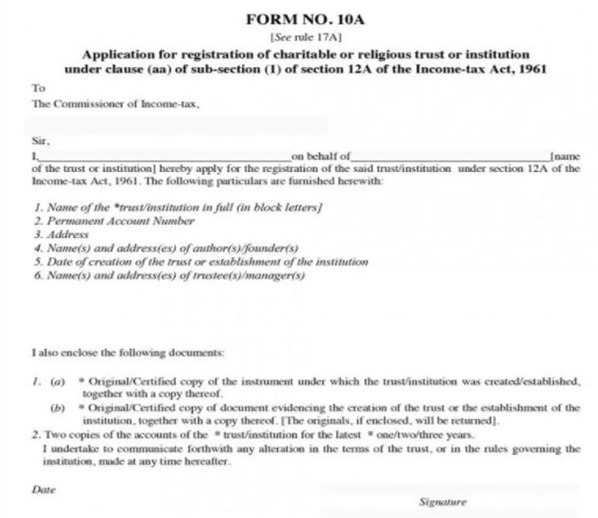
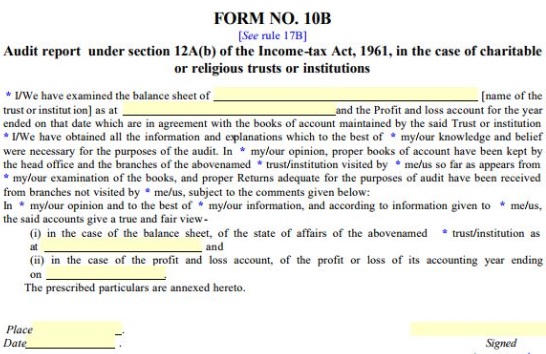
Section 11 of the Income-tax Act provides the aspects in which the property under a trust can be exempted from the tax.The property will be exempted if the trust has a registration with Commissioner of Income Tax by the application Form 10A under section 12AA, which includes the bona fide work for the religious and charitable purpose.Even before claiming the exemptions under section 11 & 12, the exemptions from the tax can be met if the Books are audited by the form 10B and if income exceeds Rs. 1,80,000 which includes corpus donations[U/S 12A(b)].[8]

There is a standard deduction of 15 percent of “such income” derived from property held under trust wholly for charitable purposes. The expression ‘such income’ only means income accruing or arising in favor of the trust – CIT v. P. Krishna Warriar (1964) 53 ITR 176 (SC).[9]

The exemption can be granted if 85 percent of income must be applied towards the approved objects of the Trust, but the corpus donations should be excluded from it.

Before moving further we must know what is “corpus donation” and what is its impact.Corpus donation is the Income generated from voluntary contributions from the donors where they give a particular direction that they shall form part of the corpus of the trust or institution, are generally referred to as “corpus donations”.Section 11(1)(d) of the Act exempt such donations.[10]

Image below shows the Form No. 10A

public charitable trust


Image below shows the Form No. 10B

public charitable trust

It has to be noted that the words “applied to charitable purposes” includes – Purchase of capital assets – Revenue expenses – Donations to religious/charitable trust registered under section 12AA or section 10(23C)  – Repayment of loans taken for purchase of capital assets – Depreciation on capital assets.[11]

In Director of Income-tax (Exemption) vs. Daulat Ram Education Society (2005) 278 ITR 260 (Del) the court held that if the trust has specified some purposes but they haven’t explained the plan of spending on such purposes the Assessing Officer cannot deny the claim of exemption u/s. 11(2).

What conditions are required to be fulfilled by a charitable or religious trust seeking exemption under Section 11?[12]

  1. The property held under trust or institution has to file a return of income if in some way they have contributed the taxable income during the year without giving effect to Sections 11 and 12.
  2. There must be a separate account for the business if the trust is involved in some whether it is incidental or not.
  3. As soon as the trust accumulate Capital gains, it must invest them into another capital asset in order to remain and apply for charitable purposes.There is no period of holding of the asset for availing such exemption by re-investment.Capital gains can be any during the year (whether short or long term).
  4. Section 11(5) decides the mode of investment and depositing of money.The Income Tax Act provides a list of modes and forms permitted for the investments of the Charitable Trust. This section includes a subclause wherein it is mentioned that “any other form or mode of Investment or Deposit as may be prescribed”. Rule 17C specifies such prescribed other modes of investments.The funds of the trust should be invested or deposited in any one or more of modes or forms mentioned in section 11(5).To remain exempt from the tax u/s 11, this rule must be followed
  5. The trust should not be created for the benefit of any particular religious community or caste.

NOTE: “a “previous year” is the financial year in question, and the year that follows is the “assessment year”. For example, for the financial year April 2010 to March 2011, the “previous year” is 2010-11, and the “assessment year” is 2011-12. Tax returns are filed in the assessment year, as per tax provisions relevant to the assessment year, for the income earned in the previous year”[13]

Cases in which exemption will be forfeited

  1. If any trust has both charitable and noncharitable activities and is falling under the proviso of section 2(15) where it is rendering any activity in the nature of trade, commerce, and business, in this case, whole trust will lose exemption u/s 11 & 12 and will be taxed as an unregistered trust in that specific year u/s 13(8) of the act.The tax will equal to the amount of fund collaborated more than the threshold limit.[14]
  2. If the trust exceeds the monetary limits will fall under the proviso to section 2(15) and the exemption u/s 11 will end. Thus, the proviso puts the stay on the controversies that may emerge from the speculation that profits and gains being incidental to the main object or not. [15]
  3. If the amount invested by the trust is less than 85 Percent and out of the scope of section 11(5) r/w section 13(1) (d) [the funds of the trust should be invested or deposited in any one or more of mode or form described in this section], then it will be out of the scope of exemption.[16]
  4. If the funds invested by the trust were before March 1, 1983[other than section 11(5)], in such case they will forfeit exemption. But after that section 11(5) will continue to remain so invested or deposited after November 30, 1983.[17]

Notifications

In this regard, Central Board of Direct Taxes (CBDT) has issued an explanatory circular vide no. 11/2008, dt. 19-12-2008, F.No. 134/34/2008- TPL.

On 27-05-2016,CBDT by circular No-21/2016 has notified that if the public charitable trust,with reference to the proviso of section 2(15) crosses the threshold limit in a specific year then they will have to pay tax in that year.The cancellation of registration is not mandatory as per section 13(8),other requirements have to be met for the cancellation of registration.It has been advised to the field officers to not cancel registration of the trust only on the basis of the proviso to section 2(15) because the introduction of new chapter XII –EB will make the trust liable to tax accreted income by getting hit by section 115TD(3).[18]Cancellation will take place according to the section 12AA (3) and 12AA (4) after examining the applicability of these provisions.

Cases to understand the scenario

Trustees of Dr. Sheths Charitable Trusts v/s Seventh Income Tax Officer (1982) 2 ITD 649 (Mum-Trib), and also clarified by Circular No 72, dated 06-01-1972.

The case held that as per Section 11(1A), the income generated from capital gain is recognized as income derived from property held under trust, as such the provision of accumulation of income applied to capital gains too.As soon as the trust accumulate Capital gains arising u/s. 11(1A), they must invest them into another capital asset in order to remain and apply for charitable purposes.There is no period of holding of the asset for availing such exemption by re-investment.Capital gains can be any during the year (whether short or long term)

Whether entire exemption will be forfeited in case of violation of section 11(5)?

Section 11(5) decides the mode of investment and depositing of money.The Income Tax Act provides a list of modes and forms permitted for the investments of the Charitable Trust.

Whereas Section 13(1)(d) provides the case where the income is invested other than the modes or forms described in Section 11(5) and the sections 11 or 12 will not apply.

But there are various views whether the entire exemption will be forfeited or not in the case of violation of section 11(5).

Gurudayal Berila Charitable Trust v/s ITO, Fifth (1990) 34 ITD 489 (Mum)

ISSUE: Whether the entire exemption has to be forfeited or to the extent of violation committed. The court held that to the extent violated be brought to tax.

Director of IT (Exemptions) v/s sheth Mafatlal Gagalbhai Foundation Trust (2001) 249 ITR 533 (Bom.), it was held that tax will be levied at a maximum marginal rate only to the portion of violation u/s. 13(1) (d).

Director of IT (Exemptions) v/s Sheth Mafatlal Gagalbhai Foundation Trust (2002) 253 ITR 593 (Del), there was a violation of section 11(5) as different mode was used. As soon as the assessee came to know it, he had withdrawn the investment. The decision falls in the favor of assessee and exemption remains with the trust.

Asst. CIT v/s Sri Ramchandra Educational & Health Trust (2010)128 TTJ 408, the investment made was in contravention of section 11(5).It was held that under the circumstances, as the reasons were beyond the control of the assessee as they try to recover the amount but couldn’t able to thus forfeiture will not raise.

References

[1]Rajkumar S. Adukia, HANDBOOK ON LAWS GOVERNING FORMATION AND ADMINISTRATION OF CHARITABLE ORGANISATIONS IN INDIA, 3-6 (2017),http://www.caaa.in/image/hb-charitable_org.pdf.

[2] Id.

[3] Id.

[4] Id.

[5] Id.

[6]TAXATION OF CHARITABLE TRUSTS, 2-6 (2017), http://vipca.net/wp-content/uploads/2015/07/Taxation-of-Charitable-Trusts.pdf (last visited Jul 12, 2017).

[7] Id.

[8] Id.

[9]TAXATION OF CHARITABLE TRUST AND AOP / BOI, 9-13 (2017), https://www.wirc-icai.org/material/TAXATION_CT_AOP_18062016_BirlaFInal.pdf (last visited Jul 12, 2017).

[10]INCOME TAX DEPARTMENT,Assessment of Charitable Trusts and Institutions 47-49 (2017).

[11] Supra 6.

[12] Supra 10.

[13]  Supra 6.

[14] Supra 9.

[15] Supra 6.

[16] Supra 6.

[17] Supra 9.

[18] Supra 9.

Download Now

Board meetings for Private Limited Companies – Comparative study between UK, Ireland and Indian law

0
covering provisions relating to board meetings for private limited companies

In this article, Komal Shah does a comparative study between UK, Ireland and Indian laws on Board meetings for Private Limited Companies. 

As someone who has shifted across continents and back, I have been asked quite a few times about the differences in work experiences in India and abroad. So I picked up an area which is probably one of the most common areas company secretaries can come across, in their work lives, and decided to draw up a comparison.

Below I have taken a few aspects covering provisions relating to board meetings for private limited companies which might give an idea into the legislative intents / prevalent practices in India, Republic of Ireland (Ireland) and the UK.

Number of provisions

India

The Companies Act, 2013 has a whole Chapter XII dedicated to meetings of the board and its powers. Then there are the Companies (Meetings of the Board and its Powers) Rules 2014. Both of these do not deal with the minutes for the board meetings and so these are dealt with in Section 118 under Chapter VII of the Companies Act 2013 and Rule 25 of the Companies (Management and Administration) Rule 2014.

Besides these, in Table F to Schedule I which provides the model Articles of Association for a company limited by shares, articles 67 to 76 deal with the ‘proceedings of the Board’. If you digress from some of these and have your own provisions in the Articles, you have that much more to look into while ‘convening and conducting’ a board meeting.

In addition to the above, there is a Secretarial Standard I which needs to be adhered to, as required under Section 118 of the Companies Act 2013.

There are exemptions available to section 8 (non profit) companies and private companies which are small, start ups, IFSC private companies or dormant companies, but these are specific to relevant sections.

Ireland

Section 160 of the Companies Act 2014 deals with the meetings of the board of directors. Section 166 deals with the minutes of the proceedings of the directors. Other than these, there seem to be no other sections or rules specifically dedicated to the meetings of the board of directors of private companies. The Companies Act 2014 does go on to provide for general meetings of different types of companies though, such as public limited companies and designated activity companies and for specific situations such as mergers or winding up.

United Kingdom

There are no direct sections in the Companies Act 2006 dealing with the meetings of the board of directors. The only relevant sections are sections 248 and 249 which relate to the minutes of the directors’ meetings. Also, the articles 7-16 of the Companies (Model Articles) Regulations 2008 deal with the board of directors’ meetings. However, companies can have their own Articles of Association registered, which can have different provisions than the model articles.

Food for thought: So it seems a lot more needs to be looked into, if you are holding a private limited board meeting in India, than in Ireland or UK, assuming that none of the entities are regulated.

Frequency

India

Per section 173 of the Companies Act 2013, the first meeting of the board of directors should be held within 30 days of incorporation (60 days for a specified IFSC private company). Thereafter, at least 4 board meetings should be held in every year with a gap of not more than 120 days between two meetings. For section 8 (non profit) companies, one person companies, small companies, dormant companies and a start up private company, this rule is relaxed to holding one board meeting in each half of the year.

Ireland

Section 160(1) of the Companies Act, 2014 just says that the directors of a company may meet together for the dispatch of business, adjourn and otherwise regulate their meetings as they think fit. That’s it. No minimum number of meetings.

United Kingdom

No specific section in the Companies Act 2006 is dedicated exclusively to the meetings of the board of directors and therefore, there is no minimum number of meetings to be held. Article 8 of the model articles for a private company in fact, provides that the decision taken by the directors can be a unanimous decision, where all eligible directors indicate to each other, by any means, that they share a common view on the matter. This means that the entire business of the private limited company may be conducted without holding any meeting of the board at all, (no, not even accounts approval meeting), simply by all directors agreeing in writing, to a decision.

Food for thought: What could be the logic behind specifying the number of board meetings that need to be held in India, while the other two countries seem to leave it to the board’s judgment? Is there an anxiety that decisions may be taken outside of the corporate governance framework, without all directors’ inputs and that there may not be a mechanism to record dissent, if any, other than board meeting minutes? Possibly.

Mode of participation

India

According to Section 173(2) of the Companies Act 2013, the mode of participation can be in person or through video conferencing or any other audio visual means which are capable of recording proceedings. Telephone meetings or, to my mind, even Skype meetings are therefore not permitted. Further, video conferencing or other audio visual means cannot be used for approval of annual financial statements, board’s report, prospectus, amalgamation, merger, demerger, acquisition or takeover.

Ireland

Section 161 of the Companies Act 2014 permits the meeting of directors to be held by telephone, video or other electronic communication where each of the directors are able to speak to each of the others and be heard by each of the others. It also goes on to provide how the location of the meeting will be decided in case the directors are at different places.

United Kingdom

The participation conditions specified by Article 10 (1) of the model articles per the Companies (Model Articles) Regulations 2008 are (i) that the meeting should have been called and taken place in accordance with the articles and (ii) each of the directors should be able to communicate to the others any information or opinions they have on any particular item of business of the meeting. Article 10 (2) then states that in determining participation, it is irrelevant where any director is or how they communicate with each other.

Food for thought: The UK seems to be the most non specific here. The focus is entirely on the fact that each of the directors should be able to communicate the information or opinions to the others; the mode is irrelevant. So when challenged, there should be some kind of evidence that this communication was a) possible and b) done.

Also to note that only India imposes the need to have recordings of video conferencing or other audio visual means. The other two countries leave it to the practices set by each company.

Business to be conducted and decisions

India

Section 179(3) provides a list of powers which can only be exercised by the board through a resolution passed at a meeting i.e. there cannot be a circular resolution for these decisions. This list includes issue of securities, making calls for unpaid monies, authorizing buyback, approving financial statements, diversifying the business, approve amalgamation, merger, reconstruction or acquisition. There are also other specific businesses covered by different sections, which require a resolution of the board at its meeting, such as approval of related party transactions (Section 188).

Further, the Companies (Meetings of the Board and its powers) Amendment Rules, 2015 provide that making political contributions, appointment or removal of key managerial personnel and appointment of internal and secretarial auditors must also be carried out by resolutions at a board meeting.

The Secretarial Standard I also provides an illustrative list of items which should not be approved by a resolution by circulation.

There are no specific sections in the Companies Act 2013 which states how the decisions of the board shall be taken except that unanimous consent of the board is mandated for certain matters. However, regulation 68 of Table F of Schedule I states that the questions arising at the meeting of the board shall be decided by a majority of votes and in case of equality of votes, the chairperson (appreciate the gender neutrality here!) shall have a casting vote.

Ireland

There are no sections which specify matters which must be decided at a board meeting. Section 160(2) of the Companies Act 2014 states that questions arising at a meeting of the board shall be decided by a majority of votes and when there is an equality of votes, the chairperson shall have a casting vote.

United Kingdom

Again, no sections mandating matters which must be decided at a board meeting. As already discussed, articles 7 and 8 of the model articles provide that the decisions taken by the board can either be a majority decision at a meeting or a unanimous decision.

Food for thought: Though there are no specific regulations in Ireland or UK, from experience, I am aware that the companies do maintain ‘terms of reference’ for the board and committees, where matters which are of significant importance to the company’s business are reserved for the board. But this is entirely left to the board to decide and not mandated by legislation.

Record / Minutes

India

According to Section 118 of the Companies Act 2013 requires the minutes of the proceedings of the board of directors meetings to be prepared and signed and also kept in the books maintained for the purpose within a period of 30 days. The minute book must also be serially numbered.

Further, the Companies (Management and Administration) Rules 2014 specify that the minute books for members, board, committees and creditors must be maintained in distinct books. Each page of the minute book must be initialed or signed and last page must be dated and signed by chairman of that particular meeting or next board meeting.

Ireland

According to Section 166 of the Companies Act 2013 the company shall cause the minutes of appointments of officers made by its directors, names of directors present at each directors’ meeting and all resolutions and proceedings of directors’ meeting to be entered in the minute book kept for the purpose.

United Kingdom

 According to Section 248 of the Companies Act 2006, every company must cause the minutes of all proceedings of its meetings of directors to be recorded and the records must be kept for a period of 10 years from the date of the meeting.

All three countries penalize the non maintenance of minutes. In addition, India penalizes the tampering of minutes.

Food for thought: There are dedicated sections for maintenance of minutes in the companies acts of all three countries, which probably goes to show the importance of the minutes. The minutes assume all the more importance as admissible evidence of discussions and decisions where the entities are regulated.

So, to conclude…

On one hand, while the Indian attitude of micro managing things (specifying which pages should be initialed, which ones should be signed!) seems to be at play and there is a case for making the requirements less detailed, one has to note that this detailing might be coming from the misuse of non specific legislation in the past.

But given that the law today is this specific, there is also a case for setting up the system really meticulously and monitoring it periodically for compliance with the Indian law, or else something or the other is likely to turn out against the specification.

References

http://ebook.mca.gov.in/default.aspx

http://www.irishstatutebook.ie/eli/2014/act/38/enacted/en/html

http://www.legislation.gov.uk/ukpga/2006/46/contents

Download Now

GST and its impact on Education sector

0
education

In this article, Aklovya Panwar of Institute of Law Nirma University discusses the impact of GST on the education sector.

Introduction

Whenever there is a discussion over the growth and development of a nation, the first thing taken into consideration is the strength of the education sector of that nation. The literacy of the nation plays a major role in the stability of a nation. It is the foremost sector of an economy on which the future of that particular economy is based. Similarly, the government of India has also made it a fundamental right after passing the most ambitious act in the parliament in 2009 i.e., Right of Children to Free and Compulsory Education Act. Thus, it is a duty of the country to provide quality education at an inexpensive rate. Following this duty, the GST Council tried to put the education sector away from the GST regime similar as other services are exempted.

The education related services which has been exempted from the levy of taxes, in the new GST regime are the service provided by any educational organisation to its students, faculty and staff, which will include their “transportation, catering, mid-day meals scheme sponsored by the government, services related to admission or conduct of examination, cleaning, housekeeping, security of the educational institution up to higher secondary”. The notification says that services provided by pre-schools or higher secondary educational institutes, private or government, shall remain tax-free.

Services provided by the Indian Institutes of Management, as per the guidelines of the Central Government, to their students, by way of the following educational programs, except Executive Development Programme-

“Two-year full-time residential Post Graduate Programmes in Management for the Post Graduate Diploma in Management, to which admissions are made on the basis of Common Admission Test (CAT), conducted by Indian Institute of Management; Fellow program in Management; Five-year integrated program in Management”.

It also includes the services provided by “the National Skill Development Corporation set up by the Government of India; a Sector Skill Council approved by the National Skill Development Corporation;an assessment agency approved by the Sector Skill Council or the National Skill Development Corporation; a training partner approved by the National Skill Development Corporation or the Sector Skill Council in relation to –

  • (a) the National Skill Development Programme implemented by the National Skill Development Corporation; or
  • (b) a vocational skill development course under the National Skill Certification and Monetary Reward Scheme; or
  • (c) any other Scheme implemented by the National Skill Development Corporation”.

Post GST Tax status of educational services

At the display, a Service charge is not forced on instructive administrations that are in the ‘Negative List’. The ‘Negative List’ comprises of Educational administrations that are ‘a part’ of the educational programs stipulated to secure a degree or a qualification perceived by the Law, part degree courses directed by schools, colleges or organizations to accomplish a qualification endorsed by Law. It also includes the Vocational training for expertise development.However, in 2016 government has eliminated education from the negative list still some of the parts treated the same way as before. In any case, coaching or training related services that sustain instructive necessities have been ordered independently from the educational category. As services relating to the educational exercises led by training and coaching foundations don’t prompt getting legitimately perceived qualifications, these would not be conceded tax relief.

Analyzing the concern areas

1. Higher Education and private institutions at stake

It is plainly apparent that fundamental education or the K-12 education segment will pick up from the GST strategy as it is authoritatively barred from the tax regime in the present situation. In any case, the condition connected in this manner can’t be disregarded. As indicated by the GST exemption classification for educational and training services, there is clear say of exclusion of GST just for administrations taking into account pre-school till higher secondary education.As universities and other advanced education organisations have not been specified in the exception list, we can expect that the taxes imposed on the administration’s rendered by them would be at 18%. Higher education in the private sector will turn out to be more expensive. Now,Competition for confirmations in government schools/universities/institutions will increase. There will be a 3 to 5% of the duty climb on the cost of services that will in the long run influence the ordinary citizens.

This is a matter of great concern because every individual is not able to get government college and as an alternative they have private institutions .Now,private institutions financial expenditure has raised due to the new tax regime.This a very heavy burden for the middle class families who are trying educate their children leaving no stones unturned.They are taking loans from bank, from families etc. and are in debt already.

Because in the event that we take cases of other nation like GREECE for example, forced a 23% Value added tax (VAT) on private educational foundations in 2015.”“It looked like a double win that would simultaneously please creditors and demonstrate the government’s commitment to helping the underprivileged. Obviously, it did not one or the other“, The Economist gave an account on October 30, 2015.Within months, reasonably priced private schools were compelled to close down. The individuals who endured as an outcome were the people belonging to the rich as well as middle and lower-salary groups.Private schools situated in working class areas charged reasonable educational cost expenses and pulled in working class parents who were  keen their children receive a decent education. The VAT likewise stressed an effectively overheated state education framework.

2.What about the training programs?

Before getting into the impact of GST over the coaching institute, first which has to be focused is the report of Asian Development Bank (ADB) of 2012 which says that around 83% of Children from High School consume their time in school, extra-curricular activities, and tuitions at the coaching centers. The ADB study, ‘Shadow Education: Private Supplementary Tutoring and Its Implications for Policy Makers in Asia,’ estimated the sector to be growing at over 15 per cent each year after excluding the small coaching centers.

This shows that the coaching centres are at the mainstream for children’s education and everyone from rich to lower middle-class families are approaching for these non-conventional ways of training and studying.Now,GST has raised the tax to 18% from 14% over these coaching centres. This will act as a burden for every child who pass out from 12th standard and though of coaching for IITs and other competitive examinations.

As said by R K Mishra, director, Institute of Public Enterprises (IPE) that non-regular courses of shorter length, preparing programs for working individuals are altogether taxed at 18%, which will influence organisations and furthermore course students. Takers for short-term, mid-career and non-conventional courses will increase immensely later on, because of career prerequisites and this will be a weight on them. Similarly, Y Lakshman Kumar, dean and director, Hyderabad Business School, GITAM University showed his concerns and said that the exception will push for most extreme proficiency with a more prominent scope. Nonetheless, coaching and training institute organisations are in enormous number conferring different skills to students and professionals. In this way, the legislature ought to contemplate over exempting or diminishing expense on these courses, and take after strict controls measures to crack down on substandard or unscrupulous institutes.

3.Cost of input supplies and events organised

Another area of worry for the education and training division is the taxability of educational occasions organized out by a foreign based entity in India.Accordingly, these foreign entities organize educational training events in India which are attended by individuals, participants from business entities and overseas participants as well and would become liable to GST. While these exclusions would support the instruction part, however, these training foundations would at present persevere through the GST load on certain information supplies, for example, leasing, media transmission, occasion related use, buy of products and so forth. These provisions would still be an info impose taken a toll for training foundations. This area looks forward to a GST exclusion in regard of the all expenditures brought about with the goal. that the input tax cost does not raise the key cost of the education resources..

Conclusion

The Government did not have any desire to radicalize the whole framework in the principal period of imposing GST and needed to have ‘a smooth arrival’. In any case, there may be plans for adjustments or changes in the offing. We can trust that given the significance of instruction in our general public, the Government will actualize proper measures to make education and training at all levels the minimum troubled scenario.As of now, the Indian government spends about four percent of its GDP on education, of which 50 percent is allocated to primary education, including educational institutions for higher education, private players as well as coaching institutions under the lower tax slabs, which will help improve the quality of education in the country, as well as ensure proximity and, hence, access.Moreover, seamless credit on input tax should be implemented across the supply chain, in order to bring down the total cost of education upon India’s journey into the GST era.

References

  • http://www.business-standard.com/article/economy-policy/gst-will-raise-private-education-cost-by-3-even-at-lowest-tax-slab-of-5-117033000848_1.html
  • http://www.business-standard.com/article/economy-policy/gst-to-make-higher-education-costlier-in-private-institutions-here-s-how-117040500242_1.html
  • http://www.gstcounsellor.com/PDF/507923.pdf
  • https://yourstory.com › 2017 › 05
  • http://economictimes.indiatimes.com/articleshow/59047429.cms?utm_source=contentofinterest&utm_medium=text&utm_campaign=cppst
  • http://mhrd.gov.in/sites/upload_files/mhrd/files/statistics/ESG2016_0.pdf


Download Now

Impact of GST on Cars and Two Wheelers

0
cars

In this article, Aklovya Panwar discusses the impact of GST on the sale and purchase of cars and two wheelers.

Introduction to GST

On July 1, 2017, the historical tax regime of India has passed after 27 years of effort. This date plays the most important role for Indian economy as we are shifting from a continuously followed rigid system of indirect taxation to one tax system i.e., Goods and services tax (GST).

The main efforts for GST has been started in the year 2006 when the UPA government announced the introduction of GST upto 2010 but the new tax regime remained a dream. Then in 2011, the 115th constitutional amendment bill was presented in the Lok sabha for the imposition of GST but the bill was passed in 2014 in Lok sabha as the 122nd constitution bill.After the wait of 2 years, the bill got assent from  the Rajya sabha aswell and has been passed in 2016.[1]

cars

The GST regime is based on the principle of Consumption and destination principle. It applies to all supplies of goods / services (as against manufacture, sale or provision of service) made for a consideration except –

  1. Exempted goods / services from the mutual list of CGST and SGST
  2. Goods / services which are out of the scope of GST
  3. Exchanges which are below from the already set threshold limits under GST. [2]

In this GST regime there is a benefit to the producer/retailer, if they have already paid the GST then it can be set forth against that payable on the supply of goods and services or they can claim it back through tax credit mechanism.[3]

The reason why GST has to introduce is because Indirect Tax system is highly intricated in India because there are various types of taxes that are charged by the Central and State Governments on Goods and Services. These taxes incorporate Entertainment Tax for watching film, Value Added Tax (VAT) for acquiring goods and services by the purchaser. Different taxes are excise duties, Import Duties, Luxury Tax, Central Sales Tax, Entry tax, and Service Tax.[4]Businessmen have to maintain accounts which need to obey with all the applicable laws.

Now GST comes as a ray of hope because it seems to be a promising proposal.

Benefits

GST regime is an optimistic approach for the consumers and the sellers because it seems capable of reducing the market prices of the goods.5] This will solve the complex and multiple taxation systems which somehow lead to the waning of “Black money” and allow Free Flow of Goods and Services [6]

Impact of the news GST regime over buying and selling of vehicles

The Goods and Service Tax bill proposed for the abstraction of tax has been in talks for a significant time now. Four of these GST sections which incorporate the “Integrated GST Bill 2017, The GST (Compensation to States) Bill 2017, the Central GST Bill 2017 and the Union Territory GST Bill 2017” have been passed by the Rajya Sabha. There is no direct impact on the purchase and sell of cars and bikes.But the outcome seems to be favorable as there will be a single tax imposition instead of multiple taxes which will surely enhance clarity.

Goods and Services Tax impacts are yet indeterminate to numerous and different sectors are yet indistinct in the matter of how this will affect their business, sales and profits.The automotive area has likewise been in a predicament about the impacts of Goods and Services Tax (GST) and its effect on two and three wheelers, passenger and business vehicles. Prior automakers crosswise over India reported pre–GST rebates to clear stocks and begin once more from first July 2017.

This made some turmoil in the brains of purchasers in the matter of whether to buy vehicles pre-GST or sit tight for its execution and probably take advantage of lower prices. It is evaluated that little vehicle are not going to encounter a sensational change in cost yet luxury vehicles could get less expensive.

Two Wheelers

After the implementation of GST, pre-showroom prices of two wheelers will be same in India with a flat of 28% GST.

Two wheelers have been distributed into two groups under GST rate – engine capacity.

  1. Less than 350cc
  2. More than 350cc.

Ex-showroom prices of bikes less than 350cc are set to decrease while those above 350cc will see an increase in prices.

The table will show the impact of GST on two wheelers in detail.[7]

Engine capacity Before GST After GST Examples Effects
Less than 350cc Tax of 30% which contains excise duty, VAT, CST etc 28% GST, down 2% as compared to 30% Hero Splendor, Bajaj Pulsar 150, etc. Prices get cheaper to some extent.
More than 350cc. Tax of 30% which contains excise duty, VAT, CST etc 28%(GST)+3%(cess)=31%tax KTM 390 Duke, Harley-Davidson Street Rod. This difference in price will not be remarkable.

Impact on Cars

Cars have been distributed into two groups under GST rate – engine capacity.

  1. less than 1200 cc capacity-(Sub 4 Meter Petrol Cars)

                                           (Sub 4 Meter Diesel Cars)

  1. Medium-Sized cars above 4 meters but less than 1500cc
  2. Cars above 4 meters and 1500cc
  3. SUV
  4. Hybrids

The table will show the impact of price in detail:[8]

SEGMENT ENGINE CAPACITY BEFORE GST AFTER GST EXAMPLES EFFECTS
Sub 4 Meter petrol cars less than 1200 cc capacity  Taxed at 31.4% 28%(GST)+1%

(cess)= 29%tax

Maruti Suzuki Alto 800 and Renault Kwid.


Prices will reduce.
Sub 4 Meter diesel cars less than 1200 cc capacity  Taxed at 33.4% 28%(GST)+3% (cess)= 31%tax


 Diesel versions of VW Ameo and Maruti Suzuki Swift Prices will reduce.
Medium-sized cars more than  4 meters  less than 1500cc Taxed at  46.6% in the form of excise duty, VAT, CST etc. 28%(GST)+15% (cess)= 43%tax Car prices will reduce.
Cars more than 4 meters 1500cc Taxed at  51.8%. 28%
(GST)+15% (cess)= 43%tax
Honda City and VW Vento Prices will reduce
SUV Taxed at  55.3%. 28%(GST)+15% (cess)= 43%tax Prices of SUVs will be largely impacted due to a significant reduction in taxes
Hybrids Taxed at 30.3% 28%(GST)+15%(cess)=43% tax Toyota Camry Hybrid,Honda Accord,Maruti Suzuki Ciaz and Mahindra Scorpio Intelli The execution of GST will turn out to be impeding for sale of cars in this segment. This higher duty execution will conflict with the extremely coordinated endeavors being anticipated by the Indian Government to  ‘Go Green’.

The prices of these vehicle will rise.

Examples

Here’s are certain examples on how companies are reacting to the GST rollout.[9]This will clear the concept that how GST is being implemented.

Maruti Suzuki(CARS)

FALL IN PRICES(RANGE)
Alto Rs 2,300 to Rs 5,400
WagonR Rs 5,300-Rs 8,300
Swift Rs 6,700 and Rs 10,700.
Baleno Rs 6,600 and Rs 13,100
Dzire Rs 8,100 and Rs 15,100
Ertiga petrol  Rs 21,800


Ciaz petrol Rs 23,400
 SUV Vitara Brezza Rs 10,400-14,700,
 S-cross Rs 17,700-21,300.


RISE IN PRICES
Sedan Ciaz and MPV Ertiga Rs 1 lakh.


Honda India(CARS)

FALL IN PRICES(RANGE)
Hatchback Brio  Rs 12,279
Compact sedan Amaze Rs 14,825.
Jazz  Rs 10,031
 Model WR-V Rs 10,064
Sedan City Rs 16,510 and Rs 28,005.
SUV CR-V Rs 1,31,663.


Toyota Kirloskar Motor(CARS)

FALL IN PRICES(RANGE)
Fortuner Rs 2.17 lakh.
Innova Crysta  Rs 98,500
Corolla Altis Rs 92,500
Platinum Etios Rs 24,500.
Etios Liva Rs 10,500.


Ford(CARS)

FALL IN PRICES(RANGE)
SUV Endeavour Rs 3 lakh
Figo  Rs 2,000
SUV Ecosport Rs 8,000
Platinum Etios Rs 24,500.
Etios Liva Rs 10,500.


BMW[10]

  1. Decrease price ranging from Rs 70,000 on base end version of X1 to Rs 1.8 lakh on the top end of its sedan 7 series.
  2. The hybrid model i8 prices will increase ranging Rs 4.8 lakh to Rs 2.28 crore.

Conclusion

GST is the greatest tax reform in India established on the idea of “one nation, one market, one tax”. The time for which the Indian government was sitting tight for 10 years has at last arrived. The single biggest indirect tax regime has kicked into constrain, destroying all the inter-state boundaries for trade. The GST rollout, with a solitary stroke, has changed over India into a unified market of 1.3 billion people’s. In a general sense, the $2.4-trillion economy is endeavoring to change itself by getting rid of the inner levy boundaries and subsuming central, state and local taxes into a brought together GST.The rollout has resurrected the hope of India’s fiscal reform program.Then again, there are fears of disruption, embedded in what’s perceived as a rushed transition which may not assist the interests of the country.[11]GST is not an overnight thought as it took years of efforts to put this idea into motion.It has impacted various segments of the market but the automotive was not directly affected by it.Now, eyes are on the implementation of this idea which comes as a revolution for the Indian economy.

References

[1]Cbec.gov.in. (2017). Available at: http://www.cbec.gov.in/resources//htdocs-cbec/gst/ovw-short.pdf;jsessionid=046C66AA6589AA00802C0A75389DC3C2 (Last visited 5 Jul. 2017).

[2]Goods and services tax (2017),https://www.aces.gov.in/Documents/gst-dgtps-01012017.pdf (last visited Jul 5, 2017).

[3]What is GST bill and how it impacts on common man, Civilserviceindia.com (2017), http://www.civilserviceindia.com/current-affairs/articles/what-is-GST-bill-and-how-it-impacts-on-common-man.html (last visited Jul 5, 2017).

[4] Id.

[5]Cbec.gov.in(2017),http://www.cbec.gov.in/resources//htdocs-cbec/gst/ovw-short.pdf;jsessionid=046C66AA6589AA00802C0A75389DC3C2 (last visited Jul 5, 2017).

[6] Ajit OmGhyan & Ajit OmGhyan, GST Slabs Pdf Download -GST Rates Structure, www.Studydhaba.com (2017), https://www.studydhaba.com/gst-slabs-pdf-download-gst-rates-structure/ (last visited Jul 5, 2017).

[7]Your complete guide to GST impact on the car and bike industry, Rushlane.com (2017), https://www.rushlane.com/gst-impact-on-the-car-and-bike-industry-12245753.html (last visited Jul 5, 2017).

[8] Id.

[9] GST impact: As vehicle prices fall by up to Rs 3 lakh, check out which all turned cheaper, Firstpost (2017), http://www.firstpost.com/business/gst-impact-as-vehicle-prices-fall-by-up-to-rs-3-lakh-check-out-which-all-turned-cheaper-3771409.html (last visited Jul 5, 2017).

[10] Id.

[11]Mercedes, BMW, Audi price cut up to INR 10 lakh – Thanks to GST, Rushlane.com (2017), https://www.rushlane.com/mercedes-bmw-audi-price-cut-gst-12243141.html (last visited Jul 5, 2017).

Download Now

Can a citizen domiciled outside Goa buy land in Goa?

0
goa

In this article, Ashwini Gehlot of Institute of Law, Nirma University Ahmedabad discusses whether a citizen domiciled outside Goa buy a land in Goa or not.

Background

Many proposals were made by the Goa government to restrict outsiders from purchasing land in Goa but till now nothing much had happened. Goans do not like outsiders buying properties in Goa and for this particular reason, they demanded special status for Goa to stop the encroachment of outsiders. But despite all the efforts, Goa didn’t get special status.

In 2011, The Goa law commission has decided to propose a ban on sale of agricultural land to non-Goans in a bid to boost farming activities in the state. The commission plans to submit a report to the government on the same.[1] the whole idea behind this report is to make Goa green and free from outsiders interference or we can say that for saving the Goa land for Goans and to use the land for best economic and ecological purpose.

Similarly, in 2013 also fearing that the Goa population will be going to become minority till 2021 the chief minister of Goa led a delegation to delhi expressing the concern to the central government and demanding special laws for the same.

Many a times requests were made to the central government to give special status to the state of Goa but the Goan people always gets disappointments regarding the same.

Likewise in the year 2013 The central government rejected the demand for special status for the state of Goa by saying that Ban on ‘other’ Indians buying residencies, settling in Goa is opposed to all civilised rules of citizenship[2].

Efforts are constantly made in this issue, Recently in April 2017,

The state-run Goa Coastal Zone Management Authority (GCZMA) is contemplating the possibility of imposing a complete ban on non-Goans buying land or properties in areas notified as Coastal Regulation Zone (CRZ). GCZMA in its recently held meeting focuses on the possibility of imposing the ban on allowing the sale of properties or land in CRZ notified areas to those who are not from Goa.[3] But the irony is in spite of making all these efforts no particular laws regarding the same has made which ban non-domiciled Goans to buy land in Goa. Now here comes the main question, Who can buy land in Goa?

Who can buy land in Goa?

Indian citizen domiciled outside Goa but living in India

Every Indian citizen whether domiciled in Goa or outside Goa can buy a land in Goa, because restricting Indian citizens from buying a land in their own country will be a violation of their fundamental rights.  And the demand of ban on sale of land and residences to persons not of Goan origin, Such restrictions one can think to be imposed on foreigners but to say that another Indian citizen cannot buy land in Goa for residence and settlement is a complete negation of a citizen’s right under Article 19(e) of the Constitution of India. That provision is a part of fundamental rights which cannot be diluted. India has a single citizenship and a ban on outsiders buying residencies and settling in Goa is opposed to all civilised rules of citizenship.[4] So, it can be said that we can not restrict non domiciled Goan or person living outside Goa but is a citizen of India from buying land in Goa. even the agricultural and plantation land can be purchased by Indian citizen only.

Foreigners and Indian citizens residing outside India

The law relating to buying and selling of property by an individual resident outside India is administered by the Foreign Exchange Management Act (FEMA), 1999.

The FEMA act, is different from other acts, it is to a greater degree a restrictive act, which means everything under this act is prohibited unless otherwise specifically permitted. FEMA directs and regulates the purchasing of properties by , Persons of Indian Origin (PIO), Non-Resident Indians (NRI) and foreign citizens.[5]

The Goa government has clarified on Thursday that under the extant rules and regulations, an Indian citizen resident outside India may acquire immovable property in India other than agricultural land, plantation or a farm house. However, citizens of some countries like Sri Lanka,  Pakistan, Afghanistan, Bangladesh, China,  Nepal, Iran, or Bhutan have take take the prior permission of the Reserve Bank of India (RBI) before acquiring any land.[6]

Who Is A Foreigner?

Section  2(w) of the FEMA  defines a person resident outside of India i.e. foreigner. Which says it includes persons resides outside India for employment Or person have intentions to resides outside India for undetermined or uncertain period Or for carrying any business outside India.

Consideration of a Person as a Foreigner

Sec 2(v) of FEMA- An individual or we can say a foreign national who is residing in India for more than 182 days during the course of the preceding financial year for carrying on business  or taking up employment or for any other purpose which shows his intention to stay for an undetermined period can acquire immovable property in India as he would be a “Person Resident of in India’’[7] under sec 2(v) of  FEMA.

Can Foreigners Buy Property In India By Incorporating A Company?

It is unlawful for a foreigner/individual living outside India to purchase immovable property in India until he/she satisfies any of the above-expressed conditions to end up becoming a person residing in India. It is illicit to purchase property on a tourist visa in India because the tourist visa lapses in 180 days.

In spite of the fact that it is unlawful for a foreigner to purchase property in India, they get it by registering a company under Indian law in Goa. As Section 2 (v) (iii) of FEMA states that, any agency, branch or office in India claimed or controlled or owned by a man residing outside India is considered as a property belonging to a person who is resident of India. Subsequently, a non-native/foreigner can buy a non-agricultural property in India by forming an organization/company and enrolling it under Indian Law. Given that every single pertinent law, rules, regulation or direction are appropriately obeyed and a statement in the prescribed form is filed with the RBI within the 90 days from the date of such acquisition.

Exceptions

The law disallows foreigners from obtaining property in India, however, there are two exemptions expressed in Section 6 (5) of FEMA, 1999 that enable them to buy property in India. These are;

  1. An individual living outside India can acquire/buy property in India if he/she possess/owned such property when he/she was living in India
  2. Or the property is inherited or acquired by the individual living outside of India from a man/person who was resident in India.

Area 6 (5) additionally expresses that the individual living outside India can also own/possess, invest or transfer/exchange Indian currency or security given that it has been acquired from an inhabitant in India or purchased when he/she was himself/herself occupant of India.

However, the citizens of Pakistan, Bangladesh, Sri Lanka, Afghanistan, China, Iran, Nepal, or Bhutan, who are residing in India can only purchase immovable property in India with the prior permission of the RBI, who will consider the request in consultation with the Government of India.[8]

Rules Governing Property Purchase in Goa by Non-Residents

Rules for NRIs and PIOs

  • A person who is a citizen of India and resident outside India is considered as a NRI.
  • A person whose grandfather or father has been a citizen of India or a person who at any time held an Indian passport is considered as a PIO.
  • PIOs and NRIs are allowed to buy any number of commercial or residential properties in India. And for this they do not have to take any special permission from the RBI nor filing of documents is required with RBI.
  • Under the general RBI authorization accessible to NRIs and PIOs, funds must be transmitted to India through normal banking channel or funds held in his FCNR (B) / NRE /NRO account. No consideration should be paid outside India.
  • The PIO / NRI may repatriate the sale proceeds of immovable property in India procured by a method for internal settlement through normal banking channels or by debit to FCNR (B) / NRE account. The sum to be repatriated should not surpass the amount paid for the purchase of the immovable property. Repatriation of sale proceeds of residential property bought by PIO / NRI out of foreign exchange is limited to not more than two such properties. If any capital gain is credited to the NRO account from where the PIO / NRI may send back a sum up to USD 1 million for every financial year subject to tax compliance.[9]

Rules for Foreign Nationals of Non-Indian Origin[10]

  • Foreign Nationals are allowed to rent/ lease property in India for a time up to 5 years and have no need for any special permission from the RBI.
  • Foreign organizations/companies who have been allowed to open an office in India are also permitted to acquire any immovable property in India, which is essential for or incidental for conducting such activity. This stipulation is not accessible to entities which are allowed to open liaison offices in India.
  • Despite the fact that RBI rules permit a foreign national who is a Resident of India (i.e. person who stays in India for more than 182 days in the previous financial year) to purchase property, the rule likewise states that “… the person concerned would have to get the approvals, and satisfy the prerequisite if any, prescribed by other authorities, for example the concerned State Government”. We DO NOT advise foreign nationals to make an effort to buy property in Goa via this route at the moment.

Buying Process[11]

When you choose to purchase a specific property, the accompanying procedure is prescribed. Kindly, however, take note of that this procedure may contrast marginally from Developer to Developer, contingent upon the property chosen.

  • On receipt of your inquiry we will seek out the developers/owners to re-affirm accessibility of the property and revert to you.
  • In spite of the fact that the properties on our site are of well-respected developers/owners, simply as an issue of “Due Diligence” we prescribe that a legitimate examination is done by a local Goa lawyer selected by you. In situations where the project has just been lawfully checked and pre-approved by Banks, in that case, this step is discretionary.
  • Once the Lawyer finishes the scrutiny (generally a time of 4-5 days) and gives his approval, you have to choose whether you/your delegate needs to make a site visit/meet the developer/owner.
  • When you choose to buy the property a Booking/Token Amount is to be paid by you to the Seller/Developer to affirm your intention to purchase the property. An official receipt for the same is issued to you by the Seller/Developer affirming receipt of your installment and that the property has been held for you.
  • Land in Goa’s Sourcing and Coordination Fees of 2% + Govt. Administration Tax is additionally to be paid by you as at this time.
  • The subsequent stage is to sign the “Agreement of Sale” (for properties under development). In the event that a property is prepared for possession, this is not required and one can specifically sign the last “Sale Deed” against payment of the balance sum due for the purchase of the property. Sale Deeds must be enlisted with the Registrar’s office.
  • At the time of signing the “Agreement of Sale”, most Developers expect you to pay all installments according to their Payment Schedule fell due for installment up to the present phase of completion of construction. Once signed, the “Agreement of Sale” ought to be registered with the concerned authority. Consequent payment is to be made in installment according to the developer’s/engineer’s payment plan for the remaining part of the construction. The “Sale Deed” is signed once development/construction is finished and you can claim your property or can take possession of your property.
  • Stamp Duty and Registration charges for property in Goa is presently a sum of 4% of the property value. Generally, half of this is paid at the time of the Agreement of Sale and the remaining amount is at the time of Sale Deed.
  • It would be best if the person purchasing the property personally present in Goa for signing both, the Agreement of Sale and the Sale dead and also for registration of the documents but if this is not possible then the person can appoint a Power of Attorney to do this work on person’s’ behalf.

Guidelines for Buying Property[12]

NRI/PIO’s desirous of purchasing property in Goa must be aware of the following:

  1. Must have a legitimate OCI/PIO card issued by the concerned authority.
  2. Appoint a Goa lawyer to verify and scrutinize the documents.
  3. Must stick to FEMA (Foreign Exchange Management Act) rules predominant at the time.
  4. Guarantee there is Nil Encumbrance on the property.
  5. All the NOC’s (No complaint Certificates) are arranged in order.
  6. On the off chance that the property is inherited it must have a probated will.
  7. On account of land, it must not be assigned as ‘Agricultural Land’
  8. House/property tax should be fully paid till date.
  9. On account of house/apartment, title reports or duplicates from the first owner are required.
  10. Close scrutiny of, municipal permissions, penalty clauses, payment plan, construction plan, violation of set-backs etc is highly prescribed.
  11. Explore the property before buying it to see whether there are any defects in the material or construction.
  12. Finalize the Agreement of Sale or Sale deed upon payment of government duties and property price.
  13. Take the possession of the property according to the Agreement of Sale or Sale Deed.

References

[1] Murari Shetye,No agri land for non-Goans, TOI, june 2 ,2011.

[2] Ban on ‘other’ Indians buying residencies, settling in Goa is opposed to all civilised rules of citizenship, Navhind Times, August 3, 2014.

[3] NOW THE NON-GoaNS WILL NOT BE ABLE TO BUY THE PROPERTIES COMING UNDER CRZ IN Goa, Goa Prism,April 25, 2017.

[4] Supra 2

[5]  http://www.saffronart.com/real-estate/Guidelines.aspx [Accessed 5 Jul. 2017].

[6] Prakash kamat,Goa cracks down on property acquisition for foreign nationals, the hindu, MAY 23, 2016.

[7] Supra 6.

[8] Supra 5

[9] Buygoaproperty.com. (2017). Buying in Goa | Buying Real Estate in Goa | Rules for Buying Property in Goa. [online] Available at: http://www.buygoaproperty.com/buying-property-in-goa.php [Accessed 11 Jul. 2017].

[10] Landingoa.com. (2017). Buying and Selling Residential/Commercial Properties in Goa. [online] Available at: http://www.landingoa.com/buyingproperty.php [Accessed 11 Jul. 2017].

[11]  Buygoaproperty.com. (2017). Buying in Goa | Buying Real Estate in Goa | Rules for Buying Property in Goa. [online] Available at: http://www.buygoaproperty.com/buying-property-in-goa.php [Accessed 11 Jul. 2017].

[12] Anon, (2017). Guidelines for NRI’s Buying/Selling Property in Goa | Bonafide Goa Homes. [online] Available at: http://bonafidegoahomes.com/nri-guidelines/ [Accessed 11 Jul. 2017].

Download Now
logo
FREE & ONLINE 3-Day Bootcamp (LIVE only) on

How Can Experienced Professionals Become Independent Directors

calender
28th, 29th Mar, 2026, 2 - 5pm (IST) &
30th Mar, 2026, 7 - 10pm (IST).
Bootcamp starting in
Days
HRS
MIN
SEC
Abhyuday AgarwalCOO & CO-Founder, LawSikho

Register now

Abhyuday AgarwalCOO & CO-Founder, LawSikho