Download Now
Home Blog Page 1551

How to register Trademark for your brand in India?

0

In this article, Karn Singh of JGLS discusses the procedure for Trademark Registration in India.

A great trademark is Appropriate, Dynamic, Distinctive, memorable and Unique- Primo Angelia

Introduction

Registration of a trademark is very important for a company or if you’re starting a new business or trade. The company’s logo, name or signature is the first thing that should be unique from the rest. It should be protected from the others. Registering a trademark is a legal process that is provided under the Trade Marks Act,1999. A Trademark is a symbol that makes the mark legally valid. Hence, registering your mark under the trademark act is very important for a company, so that the mark can be secured from the rest of the competition of that business.

Registration of trademark for your business is very easy. Anything like a symbol, mark, signature, etc which is important for a business should be registered, so that others cannot misuse the company assets.

In India, the court has decided the infringement of trademarks according to the evidence given by the parties. In 1980s Bata v Bata, the shoe maker wanted to stop a company marketing foam materials under the same name. The judge asked, “ How would the customers know that Bata is not producing foam?” For this, the judge reasoned that customers won’t ask the seller who the manufacturer is. For this, Bata won the case despite the fact the class was totally different.

Cadbury owns 3 trademarks containing the word eclairs. And also own the purple color wrapper which no-one can use for chocolates. However, all three names were not in use because of which ITC won the case.

For registering a trademark, one has to understand and take precautions before registering it as it can lead to the court hearing.

For that step by step procedure is explained below:

Documents required

  • A soft copy of the logo in JPEG format is required for the registration.
  • A Form of Authorisation TM 48. Link for the form is attached http://www.ipindia.nic.in/writereaddata/images/pdf/form-TM-48.pdf .
  • Date of first use of a mark.
  • Name and address of the proprietor of the mark or Name of all the partners if its a partnership firm.
  • Fees that is required for registration.

Types Of Trademark available

  • Names According to Section 9 or 11 of Trade Marks Act it should not be similar to with an earlier trademark.[1]
  • Symbols
  • The Combination of Colours or even a single color in combination with a word or device according to Section 10.[2]
  • Letters, numerals or combination of both.
  • Monograms
  • Sounds Mark

In the registration of the trademark, it should contain the following

  • The class/classes of the goods/services in respect of which it is to be registered.
  • Name and address of the proprietor
  • Proprietor Trade Description
  • Agent/Attorney Detail
  • Trade Mark text which is to be registered.
  • Place where trademark has been registered

How to make a trademark application?

The first process before registering for the trademark is to search for the trademark. Entrepreneur or owner of the company should conduct an online search of the trademark on trademark database.

For this, you just have to visit the Intellectual property website. Link for the same is provided http://www.ipindia.nic.in/.  After visiting the web page, the public search option is given on the right side of the page. Which would provide you the option of selecting different search like patents, trademarks, design, electronic registerar of patent agents. Select Trademarks under the public search. This will open a form which has to be filled. Link for the form is https://ipindiaonline.gov.in/tmrpublicsearch/frmmain.aspx.

  • In that form, you have to select word mark as the search type at the top of the page.
  • After that enter the Wordmark that you would like to search. The trademark database can be selected through 3 options that are  – “start with”, “contains” and “match with”.
  • After that enter the class of trademark that is applicable to the product. You can access the NICE Classification for selecting the class.
  • Click search to begin the trademark search.

The result of the trademark search
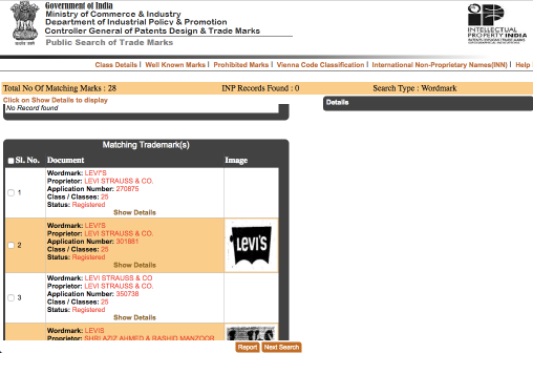
 Trademark Registration

The above picture shows the result of a company names Levis under class 25. Levis Strauss & Co. is the owner of the clothing and do own this mark internationally. You can select the option of show details which would display information about the company like date of expiry, registered or not, etc. However, if the result shows no matches, then there is no registered company in that name. It is very important to know the result before registering for the trademark. After the search is done, you are ready to register the mark. For registering the trademark follow the step below:

You can make an application for a trademark on Form TM-A. TM-A form is attached in the link http://www.ipindia.nic.in/writereaddata/Portal/Images/pdf/FORM-TM-A.pdf.

Application for registration of a trademark /collective Marks / Certification Mark / Series of the trademark for specification of goods or services included in one or more than one classes. Where the applicant is an Individual / Start-up /Small Enterprise, the prescribed fees for physical filing is Rs. 5000 and for E-filing it is Rs. 4500. TM-A form with prescribed form fees should be made at one of the five offices of the Trade Marks Registry located at Mumbai, Delhi, Kolkata, Chennai, and Ahmadabad.

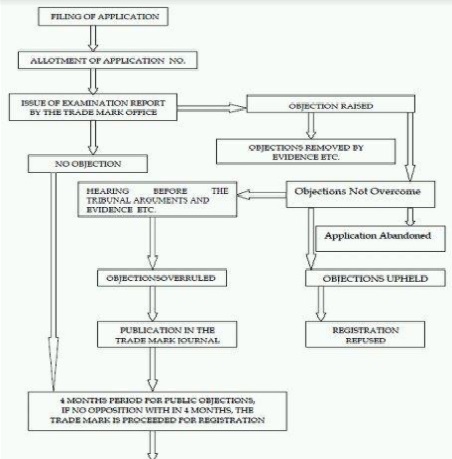
Pre-filing search is important before filing the application. Once registration is done, an official receipt with a TM number will be issued. Then an examination report is generated to which a reply has to be submitted through e-filing or through email at [email protected] within one month from the date of receipt of the examination report. A response to the registration is given by an affidavit, a hearing or by an interview.

The Application will be looked at only if it does not conflict with existing registration or pending trademarks. As the objections raised by the registrar are removed, then the application is then published in the Indian Trade Marks Journal, with endorsements stating that it has been accepted or that it is being published before acceptance. Once it is published, any person can file a notice of opposition to registration within 3 months.

Acceptance or refusal of the trademark will be considered once the opposition proceedings have been completed.

Journal Publication

When the trademark application is accepted by the trademark registrar, the registered trademark is published in the Trademark Journal. All the trademarks that have been registered and accepted are published in the journal according to the class. within 90 days, anyone can oppose the trademark if the trademark is damaging their mark. They have the opportunity to object the trademark within 90 days of publishing. If there is no objection raised within 90 days of the publication, then the mark will be registered within 12 weeks time.

When the trademark is opposed by the 3rd party who’s mark has been damaged then a hearing will be called and both the parties have to appear before the court. The objection can be removed by evidence. Based on the decision of the court, the mark will be decided if rejected or accepted.

Duration of Trademark

  • Trademark can be registered for the duration of 10 years. It can be renewed for a further period of 10 years on payment of the renewal fees. The trademark can be renewed by filling the form TM-R with transaction costs.

Costs for trademark transactions

  • To file a new application (Form TM-A): For physical filing Rs-5000 & For E-filing Rs-4500
  • To file a notice of opposition to oppose an application published in the Trade Marks Journal a (Form TM-O): For physical filing Rs 3000 & For E-filing Rs 2700
  • For Renewal of a registered trademark (Form TM-R): For physical filing Rs-10,000 & For E-filing Rs-9000
  • Surcharge for late renewal (Form –TM-R): For physical filing Rs- 5,000 Plus renewal fee & For E-filing Rs- 4,500 Plus renewal fee.
  • Restoration of removed mark (Form TM-R): For physical filing Rs- 10000 Plus renewal fee & For E-filing Rs- 9000 Plus renewal fee.

Ways to register the trademark

Registration of a trademark can be done by two ways offline or online. Offline registration of the trademark can be done at one of the offices of the trademark register based on the jurisdiction. While online registration is called E-filing of a trademark. E-filing of a trademark application is a new service provided by the trademark office. Link for the same is attached http://www.ipindia.nic.in/e-gateways.htm#comprehensive-e-filing.

For registration of a trademark, go to the link and complete an electronic application form. Then providing the associated attachments and pay the necessary fees.

E-filing is beneficial and more useful than offline registration as it provides trademark application number immediately. It also provides online verification to assure error-free filing and obtain your filing date. It also speeds up the process. All the details can be saved in your PC and can see online history or track status of the applications filed by clicking “Status of filed application”.

Contact

Trade Marks Registry, Mumbai (head office)

Intellectual Property India,
Boudhik Sampada Bhavan, Antop Hill, S.M. Road, Mumbai-400037 Tel: + 022-24132735

(Jurisdiction: Maharashtra, Madhya Pradesh, and Goa)

Shri. O P Gupta, controller general of patents, designs and trademarks, Bhoudhik Sampada Bhavan, Near Antop Hill Head Post Office, S M Road, Antop Hill, Mumbai-400037,

Phone: 022-24132735, Fax:  022-24123322

Website: www.ipindia.nic.in
trademark registration


[1] Section 9 and 11 of Trade Marks Act, 1999

[2] Section 10, The Trade Marks Act,1999

Download Now

How to get Judicial Clerkship at Supreme Court and various High Courts?

1
Judicial clerkship

In this article, Karn Singh of JGLS discusses How to get a judicial clerkship at Supreme Court and various High Courts.

“You learn more in one year of clerking than you learn in eight years of practice” Justice Sonia Sotomayor.

Introduction

Every judge requires an assistance in deciding cases or making up for the mistakes. This task is done by the Judicial Clerk who is essentially an assistant to the Judge in conducting research on the cases that is in front of the judge. The Task of Judicial clerkship differs from court to court and judge to judge. The Task of judicial clerkship in Supreme Court can be very different from a Judicial Clerkship in District Court.

But the knowledge in every court about the judicial process is tremendous. The primary role of a judicial clerk is to assist the judge under the strict deadline and tremendous workload.

One law clerk is assigned to each judge for a year, but some judges require 2 or more law clerk at a time depending on the work a judge has. The law clerk usually begins its tenure in the month of July each year, soon after he/she completes LLB degree. Judicial Clerkship can be on any level either in Supreme Court or High Court. Advocates can be tremendous assistance at the Supreme Court level. Judicial clerks are paid around Rs. 25000 to 30000 per month. The task given to the Judicial Clerkship are preparing a summary of facts, read briefs, lookup and update relevant authorities, conduct general research, and make a record of facts and arguments.

The more detailed task of judicial clerkship

  • Maintaining judges libraries by updating appropriate documents.
  • Attend court sessions to record necessary case information
  • Draft or proofread judicial opinions, decisions, or citations.
  • Participate in conferences between judges and attorney
  • Prepare briefs, statement of issues involved in cases.
  • Research laws, court decisions, documents, opinions, briefs, or other information related to cases.

Advantages of Judicial Clerkship:

  • It allows a fresh graduate to get an overview and in-depth experience of the procedure of the court.
  • One can understand how to argue in the court or how not to argue in the argue. As this is the most important part of a case.
  • Going through a lot of cases will make the graduate understand how to spot the weaknesses or strengths of a case fast.
  • Also, going through 100s of cases will make a graduate perfect in different aspects of the law.
  • As research is an integral part of the judicial clerk, it does enhance the research skill of a graduate.
  • Working as a judicial law clerk will teach a great research technique from the judge he or she is working with.

How to get the judicial clerkship at Supreme Court or High Court

  • The first stage for the Judicial Clerkship at Supreme Court is the entrance test which is held almost year in the month of May. In this written exam, two sections are included. Section 1 includes General English, and General Awareness for 50 marks And Section 2 includes all the law related questions i.e. Indian Constitution, Indian Penal Code, Criminal Procedure Code, Civil Procedure Code and Indian Evidence Act etc for 100 marks.

Guidelines for Written Exam

  • The candidate applying for the exam should be a law graduate having an LLB degree from any law school recognized by Bar Council Of India
  • Candidate studying in the last year can also apply for the clerk cum research assistant.
  • Candidate must know basic computer skills and must know the various search engines like Manupatra, SSC Online, Westlaw etc.
  • The question paper comprises of 150 questions. One mark for the correct answer and 0.25 negative mark for the wrong answer.
  • Minimum marks to qualify is 60% of the total.

After the written test, selected candidates are called for personal interview.

  • A committee of judges interviews the eligible candidate. The interview will carry for 30 marks and 15 marks are the minimum qualifying marks.
  • The selected candidates are allocated work under the sitting judges of the Supreme Court.

If a judge wants more than one law clerk then, a judge can appoint a second clerk.

A judge can either ask the Registrar to appoint one from the list of the shortlisted candidates or can personally recommend someone. If the candidate is fit then he will be appointed as the 2nd clerk.

A lot of people apply for the judicial clerkship. More than 100 candidates apply and around 50-60 candidate is selected. Court starts in the month of July and the clerkships starts in mid-August.

Questions asked in the interview:

  • Firstly, the judges will ask about the internship that is done in the law school. Judges basically look if the candidate knows the basic of the court proceedings and how the court works. So, if you choose to go for clerkship then court internship will matter a lot.
  • The Judge will also ask about the law that is covered in the internship. Law is the most important part in the clerkship and one should know the law properly. Not only from the books but from the practical point of view. In the interview, judges will ask about the law, in what part of law one has interned like criminal law, civil law, or arbitration etc.
  • Judges will also ask about the hobbies and academic interests.

Is the internship with Judge is important to get judicial clerkship job?

No, it is really not important but one should know the basic information about the court and its proceedings.

Difference Between Internship and clerkship:

A Judicial clerkship is referred as long term clerkship. Duration of which is 1 year and if the judge or the candidate wants to expand, it can be expanded for 2 years. A Judicial clerkship is a paid job which is varied from court to court. In Supreme Court, a judicial clerk is paid between INR 25000-30000.

Short term clerkship is the opportunity given to the law students to work as a legal trainee under the honorable Supreme Court judges during their internship period. The duration can vary from 4 to 6 weeks. Short term clerkship is mostly unpaid.

How to apply for short term clerkship:

  • Law students from the school recognized by The Bar Council Of India can directly apply under the name of the university to the Registrar of the Supreme Court of India or The High Court.
  • The Registrar of the court scrutinizes the applications and communicate the same to the head of the institution. The application for the same should be applied 3 to 4 months prior to the date of joining.
  • The registrar will call the applicant if the application is selected or not, 3 weeks before the date of joining.
  • Short term clerkship is basically unpaid.

Conclusion

A judicial clerkship is not a famous job in India. But fresh graduates from many know law school is applying for judicial clerkship as it serves a lot of benefit in one’s career. It is said that you can learn a lot in one year of clerkship than you can learn from seven years of practice. Judicial clerkship gives the insight of the judge’s chamber and how a judge decides a case. In addition, Judge develops a professional relationship with their clerks which can be beneficial for a law graduate. The Graduate should try judicial clerkship at least once in his/her career. This can improve the skills that are required for arguing a case.

Name-Karan Singh

College- Jindal Global Law School

Download Now

What is the punishment for possession of illegal Drugs And Narcotic Substances?

2

In this article, Ashwini Gehlot of Institute of Law, Nirma University Ahmedabad discusses the Punishment For Possession Of Illegal Drugs And Narcotic Substances?

Introduction

Caught in the endless loop of substance abuse, India is home to roughly 3 million medication addicts. The National Crime Records Bureau’s information, as distributed in 2014, revealed that India witnesses almost 10 suicides once a day because of substance addiction.

India passed the Narcotic Drugs and Psychotropic Substances Act, (NDPS Act) in 1985 which was consequently amended in 1989, 2001 and recently, in 2014. India’s driving against anti-drug law endorses firm punishments for drug traffickers and rehabilitation for the users. Surrounded with the purpose to battle drug trafficking, it denies and criminalizes the production, cultivation, possession, sale, use, purchase, import and export, and consumption of narcotic drugs and psychotropic substances. It gives immunity in circumstances where the medications are used for scientific or medical purposes.

The NDPS Act appeared to conceive strict punishments for drug trafficking, to expand implementation powers, implement international convention that India is associated with and to direct psychotropic substances. A predominantly reformatory statute, NDPS furnishes the regulation of drugs. It expresses that capital punishment can be granted as a form of punishment under the Act. The 2014 amendment held that the decision to grant capital punishment lies at the discretion of the court and rather stipulates 30 years of detainment as a substitute.

With a specific end goal to supplement the NDPS Act, the Prevention of Illicit Trafficking in Narcotic Drugs and Psychotropic Substances Act came into existence in 1988. It contains provisions relating to the preventive detention of any and each person who is associated with or accused of drug trafficking.

The worry for combatting drug trafficking magnifies once the judiciary started to rely on Article 47 of the Indian Constitution, which endorses the restriction on the utilization of drugs and directs the State to endeavor to decrease and abolish the utilization of drugs, with the exception of when it is utilized for scientific purposes. The present legislation covers three classes of substances, which are psychotropic substances (LSD, Amphetamines, MDMA Methamphetamines), narcotic drugs (poppy straw, cocoa leaf, cannabis, and opium) and controlled substances (utilized for the production of any psychotropic substance or the narcotic drug).

Drug Law Enforcement Agencies In India

  • Narcotics Control Division
  • Central Bureau of Narcotics (CBN)
  • The Narcotic Control Bureau (NCB )
  • Other Agencies- Directorate of Revenue Intelligence, Central Bureau of Investigation, Customs Commission, Border Security Force.

Legislative Policies In India In Drug Related Matters

The broad legislative policy in the issue is mentioned in the three Central Acts, viz.

  • The Narcotic Drugs and Psychotropic Substances Act, 1985,
  • Prevention of Illicit Traffic in Narcotic Drugs and Psychotropic Substances Act, 1988,
  • Drugs and Cosmetics Act, 1940,

Narcotic Drugs And Psychotropic Substances Act, 1985

India is a party to the 3 United Nations drug convention that is –  “The 1971 Convention on Psychotropic Substances (1971 Convention)”, “The 1961 Single Convention on Narcotic Drugs (1961 Convention)”, and “The 1988 Convention against Illicit Traffic in Narcotic Drugs and Psychotropic Substances (1988 Convention).”

The official record expresses that the NDPS Act was instituted with a specific end goal to give adequate penalties for strengthened enforcement powers, drug trafficking, and to execute international conventions to which India is a member, and uphold controls over psychotropic substances. Three times amendment was made in this Act i.e. in 1989, 2001 and currently, in 2014.

The NDPS Act restricts/prohibits the production, cultivation, sale, possession, trade, purchase, use, consumption and import/export of psychotropic substances and narcotic drugs except scientific or medicinal as per the law.

The Act covers three wide classes of substances:

  1. Psychotropic Substances or those secured under the 1971 Convention and also other psychoactive substances, for example, ketamine which is not yet grouped under 3 international convention;
  2. Narcotic Drugs, that is, those secured under the 1961 Convention;
  3. “Controlled Substances” that are utilized to make psychotropic substances or narcotic drugs.

NDPS Amendments, 2014

The NDPS Act was amended in early 2014 for the 3rd time and some new provisions come into force from on 1 May 2014. The principal highlights include:

  • Creation of another class of “essential narcotic drugs”, which the central government can regulate and determine consistently throughout the country.
  • Widening the goal of the law from containing unlawful use to promoting the scientific and medical use of psychotropic substances and narcotic drugs.41 with regards to the rule of “balance” amongst control and accessibility of narcotic drugs that supports the international drug control treaties.
  • Including the expressions “recognition and approval” of the treatment center and “management” of drug dependence, in this manner permitting for the foundation of lawfully binding treatment standards and proof/evidence based medical interventions.
  • Making capital punishment optional for a subsequent offense including a specific amount of drugs U/S 31A. The court will have some other alternatives to impose detainment/imprisonment for a term of 30 years under this section.
  • Increased punishment from a maximum of 6 months imprisonment to 1-year imprisonment for small quantity offenses.
  • Authorizing private sector inclusion in the processing concentrated poppy straw and opium.
  • Raising the rank of officers approved to conduct arrest and search permit holders for affirmed NDPS violations.
  • More detailed provisions for relinquishment of the property of people summoned on charges of drug trafficking.

https://lawsikho.com/course/certificate-criminal-litigation-trial-advocacy
click above

Punishment For offenses

NDPS Act considers drug offenses as very grave and serious in nature and so, punishments for them are very stiff. Offenses under this Act are cognizable and non-bailable. The quantum of sentence and fine differs with the offense. For most of the offenses, the punishment relies upon the quantity of drug included – little amount, more than little however not as much as the business amount or business amount of drugs. Commercial and small amounts are notified for each drug.

Under NDPS Act, criminal conspiracy, abetment and even attempt to carry out an offense pull in the same punishment as the offense itself. Habitual or repeat offenses attracts 1 and half times the punishment and capital punishment in some cases. Since the punishments under this Act are rigid and inflexible, a few procedural safeguards have been given in the Act. A few immunities are additionally accessible under the Act.

drugs

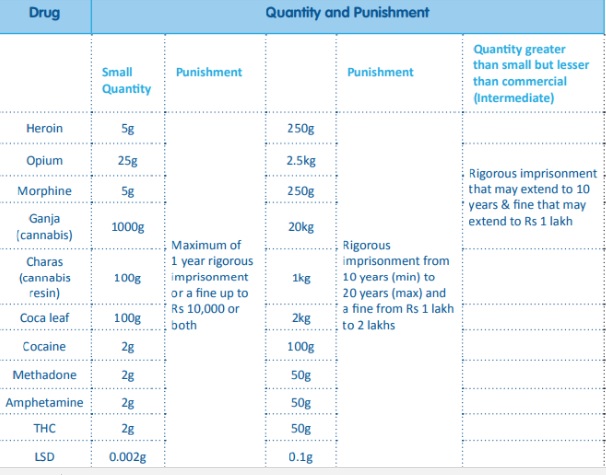
Quantity And Punishments

Offences And Penalties

Offenses Penalty Sections of the Act
Cultivation of coca plants or opium, cannabis without license Punishment is-Rigorous imprisonment-up to 10 years + fine up to Rs.1 lakh Opium – 18(c) Cannabis – 20 Coca-16
Embezzlement of opium by licensed farmer Rigorous imprisonment -10 to 20 years + fine Rs. 1 to 2 lakhs (regardless of the quantity) 19
Manufacture, production, sale, possession, transport, purchase, import/export inter- state, or use of psychotropic substances and narcotic drugs. for small quantity of drugs, the punishment is rigorous imprisonment up to 6 months or fine of  Rs. 10,000 or both. More than little quantity but less than business quantity – Rigorous imprisonment. up to 10 years + fine up to Rs. 1 Lakhs. Commercial/Business quantity – Rigorous imprisonment 10 to 20 years + fine Rs. 1 to 2 Lakhs Prepared opium-17 Opium – 18 Cannabis – 20 Manufactured drugs or their preparations-21 Psychotropic substances -22
Import/export or transshipment of psychotropic substances narcotic drugs. Same as above 23
External dealings in NDPS-i.e. Controlling and engaging in trade whereby drugs are supplied to an individual outside India and also drugs are obtained from outside India. Rigorous imprisonment 10 to 20 years + fine of Rs. 1 to 2 lakhs (Regardless of the quantity) 24
Knowingly allowing one’s premises to be used for committing an offense Same as for the offense 25
Violations pertaining to controlled substances (precursors) Rigorous imprisonment up to 10 years + fine Rs. 1 to 2 lakhs 25A
Financing traffic and harboring offenders Rigorous imprisonment 10 to 20 years + fine Rs. 1 to 2 lakhs 27A
Attempts, abetment and criminal conspiracy Same as for the offense Attempts-28 Abetment and criminal conspiracy – 29
Preparation to commit an offense Half the punishment for the offense 30
Repeat offense In most of the cases, the punishment is One and half times the penalty for the offense. And death penalty in some cases. 31 Death – 31A
Consumption of drugs Morphine, cocaine, heroin -Punishment is Rigorous imprisonment up to 1 year or fine up to Rs. 20,000 or both. And for consumption of some other drugs- Imprisonment up to 6 months or fine up to Rs. 10,000 or both. And there is immunity from the legal proceedings provided to addicts if he/she volunteering for treatment. 27 Immunity – 64A
Punishment for violations not elsewhere specified Imprisonment up to six months or fine or both 32

Examples In Indian Judiciary

  • February 2012: Chandigarh district court sentences Paramjit Singh, discovered with 10 kg of heroin in 2007, to death. In 1998 he had been captured with 1.02 kg of heroin.
  • February 2008: Ahmedabad sessions court sentences Omkarnath Kak, found with 28 kg of charas in 2003, to death. In 1988, Kak had been captured for having 40kg of charas.
  • December 2007: A Mumbai special court grants death sentence to Ghulam Malik, found with 142 kg of hashish in 2004. Approx 1.8 kg of hashish had been recuperated from Malik on a prior event.

Immunity In Drug Cases

  1. Officers acting in the discharge of their duties in good faith under the Act are exempted from legal proceedings, suits and other prosecution (Section 69).
  2. Addicts accused with consumption of drugs under section 27 or with offenses including little quantities will be exempted or protected from any prosecution if they volunteer for dead-diction. This exception might be withdrawn if the addict does not undertake complete treatment (Section 64 A ). It is important to note that it is not obligatory that the drug, if any, found with the addict in little quantity, require not be for personal use.
  3. Offenders State or Central governments can delicate immunity to a wrongdoer in order to get his evidence in the case.This immunity is allowed by the government and not by the court (Section 64).
  4. Minors, offenses committed under any law by individual less than 18 years old will be secured by the Juvenile Persons (Care and Protection) Act. This Act seeks to ameliorate such juveniles instead of punishing them under the respective Acts. It prevails over any other Act in regard to people underneath the age of 18. Subsequently, such persons cannot be prosecuted under the NDPS Act too.

Loopholes in The Act And Suggestions

Referred to as a hasty piece of enactment that was passed under tremendous pressure, India’s chief law to handle drug trafficking isn’t free from pitfalls. It doesn’t have a reasonable outline between the definition of an addict and a consumer. The definitions set up is neither backed by laws nor by ethics. It notices terms like use, possession, and consumption yet neglect to illustrate what they truly mean. The non-appearance of any political initiative in setting up machinery sanctioned to enforce and regulate rehabilitation acts as a bottleneck. The scarcity of related institutions in charge of training the judicial machinery, the insufficient rehabilitation facilities and such factors have advanced the inadequacy of law to deal with the widespread drug menace in India. The ineffectual enforcement of the statute and the deficiency of rehabilitative organization has only added to the rundown of shortcomings. Brutal and stringent, the statute intensely hampers the criminal justice system.

The strictness of the NDPS Act is revealed by the provision for granting capital punishment in instances of repeated offenses, similar to the manufacture, production, transportation, possession and import/export of drugs.

The lack of data and statistics regarding drug addiction in no way whatsoever arises from the absence of substance abuse. A glaring gap, the range of drug abuse and its consequences on one’s health and overall well-being remains an unchartered territory. The paucity of data with respect to the nature and extent of drug dependence, which are key factors to be examined before formulating drug policies, hinders the accomplishment of the statute’s objective.

Provisions of criminalizing the utilization of drugs, punishing the possession of drugs for individual utilize, imposing the death penalty and other different aspects of the enactment are far harsher than those specified in the UN drug control convention. Despite the endeavors taken by civil society groups to show the incapability of these extreme provisions, legislators have neither surveyed nor replaced these systems. Drug policy execution is attempted by the state and central governments, as well as by ministries. Thus, this offers to ascend to circumstances of abandoning one’s duty and overlapping in the enforcement.

Suggestions

Unless viable measures are taken quickly, the reformative aim of the legislation will go futile. In spite of the fact that illuminating presences and society’s representatives can be brought in to recommend and evaluate changes in the drug policy, these measures have not yet been put into utilization. Inspecting the cruel provisions and respecting the privileges of each one of those people who rely upon drugs is an unquestionable requirement. Reinforcing the connection between Government divisions and reaching common society representation, for example, medical experts and patient groups can uphold viable plan of drug policies. Conducting research and accumulating information on drug dependence, substance use and the repercussion on the health of the individuals who infuse/inject drugs can help to stand for the war against drug abuse. The transformation of the NDPS Act itself is the principal walk to be taken if the Government genuinely tries to reaffirm its dedication towards wiping out India’s drug crisis.


LawSikho has created a telegram group for exchanging legal knowledge, referrals and various opportunities. You can click on this link and join:  

https://t.me/joinchat/J_0YrBa4IBSHdpuTfQO_sA

Follow us on Instagram and subscribe to our YouTube channel for more amazing legal content 


References

  1. com. (2017). ‘High’ time Indian drug laws are sent to rehab. [online] Available at: http://www.legallyindia.com/views/entry/high-time-the-drug-law-is-sent-to-rehab [Accessed 17 Jul. 2017].
  2. gov.in. (2014). Punishment for offenses |. [online] Available at: http://www.dor.gov.in/Punishment_for_offenses [Accessed 17 Jul. 2017].
  3. Rao, P. (n.d.). Drug Laws In India. [online] http://www.antidrugs.gov.il. Available at: http://www.antidrugs.gov.il/download/files/indian_drug-laws.pdf [Accessed 17 Jul. 2017].
  4. Anon, (n.d.). [online] Available at: http://shodhganga.inflibnet.ac.in/bitstream/10603/18155/12/12_chapter6.pdf [Accessed 17 Jul. 2017].
  5. Tandon, T. (2015). Drug policy In India. [online] http://idhdp.com. Available at: http://idhdp.com/media/400258/idpc-briefing-paper_drug-policy-in-india.pdf [Accessed 17 Jul. 2017].
  6. The Telegraph. (2012). Crime and punishment. [online] Available at: https://www.telegraphindia.com/1120314/jsp/opinion/story_15247652.jsp [Accessed 17 Jul. 2017].


Download Now

Online Gambling laws in India

1
onlilne gambling

In this article, Bhavna Thakur discusses laws regulating Online Gambling in India.

Betting is characterized as wagering, gaming or partaking in a lottery. An individual is betting at whatever point he or she takes the risk of losing cash or possessions, and when winning or losing is chosen generally by shot. Digital betting is otherwise called web betting, is a general term for betting utilizing the web.

History of Gambling

There’s a considerable measure of confirmation that betting amusements existed in old circumstances. From tiles found in China dating from 2300 BC and ivory dice found in Egypt from 1500 BC to betting stuff having a place with Bronze Age Greek officers, unmistakably betting is as old as human progress itself.

The Romans expounded on betting, relating stories of workers and sovereigns betting with dice, and archives have even been discovered recounting gigantic betting obligations and the battles that broke out finished them. While confirmation of any early Roman online poker room embarrassments is thin on the ground (it must involve time) there is proof of stacked dice, found in the remnants of Pompeii going back to 79 AD, instantly before the city got covered in a million tons of hot magma and fiery remains when Vesuvius blew.

Also, it was all around archived that two rulers named Olaf, one Norway’s ruler, the other Sweden’s, moved dice to decide how domain ought to be partitioned.

Betting has made some amazing progress since Ancient Egypt, with the web based betting world ceaselessly developing in 2015 and past. Join the rich history of betting by attempting one of our suggested locales, offering benefits that incorporate.

  • Safe and secure saving money alternatives
  • Splendid scope of diversions
  • A comprehension of client’s’ needs, from years in industry

Web gaming and electronic wagering laws in India are so far creating. We have no dedicated laws for electronic gaming, electronic wagering, online dream sports, online poker, et cetera in India. Really, we have no laws that can sufficiently oversee honest to goodness issues of web gaming, electronic wagering, online dream sports, e-games, et cetera in India. Thusly we have disavowals and impediments that have been constrained by central laws and laws of different states making the entire gaming and wagering Indian gaming and wagering industry is before long torment from nonattendance of a techno legitimate structure that can supervise online gaming and electronic wagering related issues.

Starting late the Indian government has explained about the Foreign Direct Investment (FDI) in E-Commerce Sector of India. FDI is confined in lottery business including Government or private lottery, online lotteries, and wagering and betting including betting clubs et cetera. To the degree the points of central government are concerned, it is not for allowing FDI in lotteries, wagering and betting. Further, central government moreover declined to give its feeling on the legality or wrongdoing of online beguilements and web wagering in India. As needs be the online gaming and electronic wagering agents of India are at present required to agree to various laws of India, both central and likewise state sharp.

“The Sikkim state government has issued its first license to an online gambling operator”

Types of Gambling

  • Slot machines
  • Lottery
  • Scratch cards
  • Poker
  • Black jack
  • Roulette
  • Bingo
  • Sport betting and racing
  • Online gambling

Web based betting locales or permitting wards

Authorizing experts are simply national governments which have sanctioned enactment giving them the privilege to permit and direct the operation of web based betting. Nations by and large do this to create income. Authorizing experts have been situated in little countries with constrained normal assets or an unsophisticated economy. Inside these locales, there is generally a vast focal association that the two issues licenses and arrangements licensees. Holding a permit from one of these bodies gives a site the privilege to make its administrations accessible in various world betting markets. In many parts of the world, working a betting site without such a permit is unlawful.

At the point when an administrator needs to open another betting site, they look for authorizing specialists similarly we search for another place to play blackjack or wagered on our most loved games. These experts have criteria that layout what a web based betting premium must do keeping in mind the end goal to gain and after that keep up an administrator’s permit.

Online Gambling

The State of Sikkim is the main state in India which has authorized a law for internet betting and dons wagering.The Sikkim was passed on June 28, 2008 with the dual objects of controlling and regulating online gaming through electronic or non-electronic formats, and imposing a tax on such games in the State of Sikkim.The Sikkim,were subsequently passed on March 4, 2009 (and the same have been amended from time to time)

Most Gambling Legislation restricts the demonstration of

  • Owning, continuing, possessing or having consideration and administration of a gaming house/regular gaming house.
  • Progressing or outfitting cash for the reasons for betting to people frequenting any such gaming house.
  • Betting in like manner gaming house or present with the end goal of betting in Common Gaming House.
  • Betting or suspected betting in any open road, place or avenue.
  • Printing, distributing, offering, dispersing or in any way circling anything with the expectation of supporting or encouraging betting.
  • Betting fundamentally (This is not material to each state. Just the Gambling Legislation of states like Orissa restrict the demonstration of gaming itself)The obligation for offenses under the Gambling.

Enactments generally vest with

  • The proprietor of the gaming/basic gaming house.
  • The individual keeping or having charge of the gaming/basic gaming house.
  • The individual betting or having instruments or records of wagering or associated with betting or having such instruments.

All Gambling Legislations endorse punishments which are pretty much comparative. The Bombay Prevention of forces a fine and detainment for guilty parties. A first offense is culpable with a fine of in any event INR 500 (around USD 8) and 3 months detainment, a moment offense is culpable with a fine of at any rate INR 1,000.

PIL Filed For Banning Online Lotteries From Other States In State Of Maharashtra

The PIL expressed that state government has allowed just 13 online lotteries. Be that as it may, administrators with authorizations from states like Mizoram, Arunachal Pradesh, Sikkim, and Meghalaya, are directing on the web lotteries where comes about are reported in like clockwork on single-digit. The solicitor named the whole movement as absolutely unlawful. As per lottery rules confined by Maharashtra government, it’s required for administrators to pay propel impose on a wide range of online lotteries in the state. Be that as it may, the lottery organizations tested legitimateness of standards and the high court had given a break remain on it. Exploiting it, the online lottery organizations from outside states stayed away from installment of assessment to the tune of Rs 933.14 crore amid 2007-09. In 2009, the high court lifted the break stay and enabled the state government to gather the expense, however no recuperation has been made.

Recent case in South Delhi

Police on Friday (7th july 2017) busted an illegal online casino at Kotla Mubarakpur in south Delhi and arrested four persons in this connection, Deepak Chandra, Raj Kumar, Arif Khan and Prakash have been arrested. Deepak used to operate the gambling den and handle all the cash and maintain transaction details. The alleged mastermind of the racket, a woman named Neetu, is absconding. Police seized money Rs 35,800, seven CPUs, a portable workstation and a landline phone set among other items.Even, however, internet betting is unlawful in India, the market is assessed to be a couple of thousand crore rupees. Just Sikkim has set down directions for controlled and checked web based betting.

Conclusion

At the present time – most betting in India is illicit. Be that as it may, lawful betting exists for horse dashing, lottery, and so on. There is additionally a high number of wagering locales lawful in the UK which benefit Indians with just minor bother. The law right now appears to be more worried about terrifying Indians not to bet, than it does much to counteract it. It appears to be exceedingly likely completely lawful betting will come to India sooner or later – how far away that is, is impossible to say.


Download Now

Statutory Rape laws in India

7
statutory rape

In this article, Himanshi Srivastava of Amity Law School Lucknow discusses the provision of Statutory rape as per the Indian laws.

What is Statutory Rape?

Statutory Rape is defined in Section 375 of Indian Penal Code, (amendment of 2013) which states that “any male, who does an intercourse with any female who is below the age of 18, with or without her consent will be constituting a Statutory Rape”. This offence is created to save the exploitation of the minor by the adults. In this kind of rape, the adult will get punished if he had any kind of physical interaction with a woman/girl, in the age of  18 or below, no matter if she has voluntarily participated in the act or not. The consent of the minor is immaterial and will not be considered any defence to the accused.

Statutory Rape is always in a shadow as the voice of victims goes unheard or they will not get any support from the society and our system. The minors who gets suffered from these acts, lives a horrifying life and it creates a massive disaster in their mind. The narrow minded people who do these acts, should be given the strict punishment so that it gives the pact lesson to the wrongdoers.

Age of Consent

The age of consent in India is 18 years old. The age of consent is the minimum age at which an individual is considered legally old enough to consent to participate in sexual activity. The individual within 17 years of age or younger, will not be considered to be legally old enough to give their consent to participate in any kind of sexual activity.

Statutory rape law is violated in circumstance where an individual engages himself in the sexual activity with a person under age of 18. The age of consent lowers to 15 years old in case if the couple is married.

The Protection of Children against Sexual Offences Act, 2012 was passed by both the Houses of Parliament on May 22. This Act aims to define various offences against the minor/children to provide penalties to them.  Before this Act was passed, the age of consent was 16 years of age. As the new Act came into force the exploitation of children will reduce at some extent.

Key Points of Statutory Rape

  1. The Statute for this offence is The Protection of Children against Sexual offences Act, 2012 (POCSO) but it is regulated by the Section 375 of IPC.
  2. This Act regulates the exploitation against the children by the adults,
  3. The consent is immaterial of the victim in these type of offences,
  4. This offence includes punishment under Section 376 of IPC.

Definition as given in Section 375 of IPC:

Old Provision:

Section 375 defines Rape as:

A man is said to commit “rape” who, except in the case hereinafter excepted, has sexual intercourse with a woman under circumstances falling under any of the six following de­scriptions:

  1. First – Against her will.
  2. Secondly – Without her consent.
  3. Thirdly –  With her consent, when her consent has been obtained by putting her or any person in whom she is interested in fear of death or of hurt.
  4. Fourthly – With her consent, when the man knows that he is not her husband, and that her consent is given because she believes that he is another man to whom she is or believes herself to be law­fully married.
  5. Fifthly – With her consent, when, at the time of giving such consent, by reason of unsoundness of mind or intoxication or the administration by him personally or through another of any stupe­fying or unwholesome substance, she is unable to understand the nature and consequences of that to which she gives consent.
  6. Sixthly – With or without her consent, when she is under sixteen years of age.

Explanation – Penetration is sufficient to constitute the sexual intercourse necessary to the offence of rape.

(Exception) – Sexual intercourse by a man with his own wife, the wife not being under fifteen years of age, is not rape.]

New Provision: (As of Amendment 2013)

A man is said to commit “rape” if he:

  1. penetrates his penis, to any extent, into the vagina, mouth, urethra or anus of a woman or makes her to do so with him or any other person;
  2. or inserts, to any extent, any object or a part of the body, not being the penis, into the vagina, the urethra or anus of a woman or makes her to do so with him or any other person;
  3. or manipulates any part of the body of a woman so as to cause penetration into the vagina, urethra, anus or any of body of such woman or makes her to do so with him or any other person;
  4. or applies his mouth to the vagina, anus, urethra of a woman or makes her to do so with him or any other person, under the circumstances falling under any of the following seven descriptions:
  • First. -Against her will.
  • Secondly.- Without her consent.
  • Thirdly.- With her consent, when her consent has been obtained by putting her or any person in whom she is interested, in fear of death or of hurt.
  • Fourthly.- With her consent, when the man knows that he is not her husband and that her consent is given because she believes that he is another man to whom she is or believes herself to be lawfully married.
  • Fifthly.- With her consent when, at the time of giving such consent, by reason of unsoundness of mind or intoxication or the administration by him personally or through another of any stupefying or unwholesome Substance, she is unable to understand the nature and consequences of that to which she gives consent.
  • Sixthly.- With or without her consent, when she is under eighteen years of age.
  • Seventhly.- When she is unable to communicate consent.

Explanation I.—For the purposes of this section, “vagina” shall also include labia majora.

Explanation 2.—Consent means an unequivocal voluntary agreement when the woman by words, gestures or any form of verbal or nonverbal communication, communicates willingness to participate in the specific sexual act:

Provided that a woman who does not physically resist to the act of penetration shall not by the reason only of that fact, be regarded as consenting to the sexual activity.

Exception I.—A medical procedure or intervention shall not constitute rape.

Exception 2.—Sexual intercourse or sexual acts by a man with his own wife, the wife not being under fifteen years of age, is not rape.’

Rationale of Statutory Rape Laws in India

Statutory rape laws are about the circumstances where a private person is lawfully incapable of willing to sexual activity till that person reaches a particular age. The law mandates that although he or she willingly engage in sexual activity, the sex isn’t consensual. Critics argue that the person’s age limit cannot be used to determine the ability to consent to sex, since a young juvenile might possess enough social sense to make aware and mature choices about sex, while some adults might never develop the ability to make mature choices regarding sex, as even several mentally healthy people stay naive and simply manipulated throughout their lives.

Another point of law comes from the fact that minors are generally economically, socially, and legally is not equal to adults. By making it a punishment for an adult to have sex with a minor, statutory rape laws focuses to give the minor some safeguards against adults in a position of power over the youth.

Another heated argument presented in defense of statutory rape laws relates to the difficulty of prosecution in prosecuting a rape case (against a victim of any age) in the courtroom. Because forced sexual activity with a minor is considered a particularly heinous form of rape, these laws helps the prosecution relieving the burden to prove lack of consent. This makes conviction more flexible in cases involving minors.

The aim of statutory rape laws is to protect young minor females from males who might exploit them and do not take responsibility by giving support for the child. In the past, the solution to such problems was often a shotgun wedding, a forced marriage by the parents of the minor girl in question. This rationale is to preserve the marriageability of the minor girl and to stop their unwanted teenage pregnancy.

Analysis of the Statutory Rape falling under the Sixth Clause of the above definition

Any Sexual activity with a woman with or without her consent when she is below 18 years of age constitutes rape. A woman under the age of 18 is considered incapable of giving consent for any kind of sexual activity. The age of consent was raised from 16 to 18 by the Criminal Law (Amendment) Act of 2013.

The Supreme Court in Harpal Singh held that ‘even if the girl of 14 is a willing party and invited the accused to have sexual intercourse with her, the accused would be liable for rape under this clause’.

In Mana Ramchandra Jadhav v. State of Maharashtra the victim left her mother’s house and started living with the accused because her mother had declined the proposal of her marriage with the accused on the ground that she was too young. While she was with the accused they had sexual intercourse which was against her will. The act of intercourse with the prosecution will be covered under this clause.

Exception to this Clause

“Exception 2: Sexual intercourse or sexual acts by a man with his own wife, the wife not being under sixteen years of age, is not sexual assault.”

Since child marriage in India is not yet void and is only voidable, such law was must to restrain men from taking advantage of their marital rights prematurely. No man can be held guilty of rape on his own wife when she is over 15 years of age on account of the matrimonial consent that she has given.

In Bishnudayal v. State of Bihar, where the victim, a girl of 13 or 14, who was sent by her father to accompany the relatives of his elder daughter’s husband to look after her elder sister for some time, was forcibly ‘married’ to the appellant and had sexual intercourse with her, the accused was held liable for rape under section 376.

However under section 376 B, IPC sexual intercourse with one’s own wife without her consent under a decree of judicial separation is punishable by 2 to 7 years imprisonment.

Punishment for Statutory Rape: [Section 376]

As per section 376 of IPC the Statutory Rape comes under the purview of the definition of Rape, so the punishment for Section 375 is:

OFFENCE PUNISHMENT
RAPE

As per Sub- Section (2) of the Section

RIGOROUS IMPRISONMENT FOR 7 YEARS TO LIFE + FINE

RIGOROUS IMPRISONMENT FOR 10 YEARS TO LIFE + FINE

Section 376 reads as:-

Punishment for rape.—

(1) Whoever, except in the cases provided for by sub-section (2), commits rape shall be punished with imprisonment of either description for a term which shall not be less than seven years but which may be for life or for a term which may extend to ten years and shall also be liable to fine unless the women raped is his own wife and is not under twelve years of age, in which cases, he shall be punished with imprisonment of either description for a term which may extend to two years or with fine or with both: Provided that the court may, for adequate and special reasons to be mentioned in the judgment, impose a sentence of imprisonment for a term of less than seven years.

(2) Whoever,—

(a) being a police officer commits rape—

(i) within the limits of the police station to which he is ap­pointed; or

(ii) in the premises of any station house whether or not situated in the police station to which he is appointed; or

(iii) on a woman in his custody or in the custody of a police officer subordinate to him; or

(b) being a public servant, takes advantage of his official position and commits rape on a woman in his custody as such public servant or in the custody of a public servant subordinate to him; or

(c) being on the management or on the staff of a jail, remand home or other place of custody established by or under any law for the time being in force or of a woman’s or children’s insti­tution takes advantage of his official position and commits rape on any inmate of such jail, remand home, place or institution; or

(d) being on the management or on the staff of a hospital, takes advantage of his official position and commits rape on a woman in that hospital; or

(e) commits rape on a woman knowing her to be pregnant; or

(f) commits rape on a woman when she is under twelve years of age; or

(g) commits gang rape, shall be punished with rigorous imprisonment for a term which shall not be less than ten years but which may be for life and shall also be liable to fine: Provided that the Court may, for adequate and special reasons to be mentioned in the judgment, impose a sentence of imprisonment of either description for a term of less than ten years. Explanation 1.—Where a woman is raped by one or more in a group of persons acting in furtherance of their common intention, each of the persons shall be deemed to have committed gang rape within the meaning of this sub-section. Explanation 2.—“Women’s or children’s institution” means an institution, whether called an orphanage or a home for neglected women or children or a widow’s home or by any other name, which is established and maintained for the reception and care of woman or children. Explanation 3.—“Hospital” means the precincts of the hospital and includes the precincts of any institution for the reception and treatment of persons during convalescence or of persons requiring medical attention or rehabilitation.

References

Download Now

All you need to know about Syndicate Loan

0
syndicate loan

In this article, Himanshi Srivastava of Amity Law School Lucknow discusses All you need to know about Syndicate Loan

Introduction

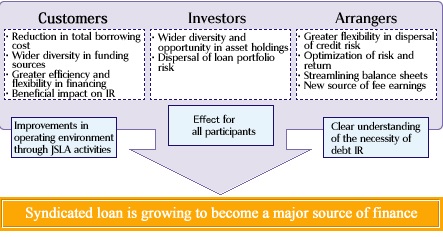
A Syndicate Loan is one of a kind of loan which is provided by the group of lenders to a single borrower. These borrowers can be an association, any large project or a government. The group of people who are offering loan is known as Syndicate, who are working on providing loans to a single borrower. These loans involve a fixed amount of funds or a credit line.

The main function of a Syndicate loan is to provide a loan extended to a single borrower by multiple financial institution group, or “syndicate”, for that purpose. The same terms and conditions will apply to all of the lenders in the syndication process, and there is only one loan agreement.syndicate loan

Features of Syndicate loan

  1. Large amount and long t erm:- It can meet customer’s demand for funds of long term and large amount. It is generally used for new projects loans, large equipment leasing and enterprises, M&A financing in transportation, petrochemical, telecommunication, power and other industries.
  2. Less time and energy for financing:- It’s usually the responsibility of the arranger for doing the preparation work of creating the syndicate or cluster once the recipient and also the arranger have united on loan terms by negotiation
  3. Wide approaches to syndicated loans: The same loan syndications will embrace several sorts of loans, like fixed-term loans, revolving loans, standby L/C line on needs of the purchasers. Meanwhile, the receiver may select RMB, USD, EUR, GBP and different currency or currency portfolio, if needed.
  4. It will facilitate borrowers establish an honest market image: To become a roaring institution of the syndicate, comes from the participant’s full recognition of the borrower’s monetary and operational performance, by that the receiver will build up their name.
  5. Currency: Syndicate adopts mainly RMB but beside it USD,EUR,GBP and other currencies are also available. Multiple currencies can also be used in a syndicated group if demanded by a single borrower.
  6. Term: Three to five years term is for short term funds, seven to ten years for medium and ten to twenty years for long term funds.
  7. Interest Rate:The price of syndicated loan is composed of loan interest and fees.

Lending interest rate shall be set, according to different borrowers, in line with lending interest rate policies, lending interest rate regulations of and provisions of the syndicated loan contracts.

Charges: It includes arrangement fee, underwriting fee, agency fee, commitment fee etc.

Target Customers

  • Customers who require long-term and large-amount loan.
  • Customers with high reputation in the industry, whose operation ability as well as financial and technical strength are recognized by most banks.

Application Qualifications

  • The receiver ought to be the legal persons of enterprises and public establishments additionally as alternative economic organizations approved and registered beneath the laws of its various State.
  • The receiver should be qualified for basic terms and conditions on the borrowers of disposition General Provisions additionally as crediting management policy issued by the Bank.
  • The borrower shall meet requirements of certain level after credit rating by the Bank or other recognized rating agency;
  • The borrower shall be large and medium manufacturing enterprises or project companies with sound operation and finance as well as strong competition in respective industries, which shall be promising in the development.
  • The borrower has established a regular and sound partnership with the lender.
  • In the event of joining the syndicate set up by other banks, the arranger bank shall be a policy bank, state-owned holding bank or foreign bank with sufficient credit and operational strength.

Required Documents

  1. Relevant information on the borrower and their Indian and foreign shareholders and guarantors,
  2. Business license and articles of association of the borrower as well as joint venture or cooperation contracts of foreign-funded enterprises and inland associated enterprises,
  3. Project proposals, feasibility study reports, engineering estimates and other documents approved by government departments and approval documents, as well as the approval documents on the project provided by administrations of taxation, environmental protection, and customs,
  4. Purchase contracts, construction contracts, supply and sale contracts of project equipment.
  5. Other documents or information needed by the bank.

Syndication Loan Process

  1. Pre- sign language Process: It includes period covering following 2 phases:
  2. Pre-mandate stage: Throughout this era, the main points of the planned group is action which are mentioned in the association and finalized through an Indicative Term Sheet. On the completion of Term Sheet, a letter of Mandate is obtained from the recipient. This point of amount is never shorter than one month and may be as long as collectively in a year.
  3. Post-mandate stage: Throughout this era, loan syndication takes place and facility agreements square measure negotiated and finalized. it’s finished by a closing or linguistic communication ceremony. This section would possibly take six to eight weeks.
  4. Post- sign language Process: In this, the total amount covering the execution/ sign language of syndication loan and security documents until full and final adjustment of syndicated loan facility takes place.

Things to Remember

Business of syndicated loan in the main involves arranger, lead bank, manager, participant, agency bank, arranger and alternative members, World Health Organization can perform the duty, relish the correct and assume the chance in keeping with the contract or their various disposition proportion. Syndicate member banks area unit divided into 3main levels: initial, arranger (lead bank); second, manager; third, participants.

  1. The arranger, liable for organization and arrangement of the syndicated loan, could be a bank or banks that undertake preparation of syndicate and distribution on commission of consumers. The arranger sometimes can underwrite the entire issue of syndicated loan.
  2. The banking company underwrites a bigger share of the syndicated loan, ranking the very best among managers. Usually, the agent bank is additionally the arranger.
  3. The manager refers to the position granted by the agent bank in line with loan quantity and level undertaken by every bank within the syndicated loan with larger quantity and additional participants. it is a bank accountable for establishing syndicate throughout the preparation stage..
  4. Participants discuss with the banks World Health Organization settle for invite of the arranger to hitch the loan syndicate and supply loans consistent with shares determined through negotiation. variations with the managers: Less loan subscription, assume no responsibility for enterprise and alternative sensible preparation of the syndicate.
  5. The agency bank is chosen by syndicate members and approved by the receiver throughout the loan amount. when language the loan agreement, the agency bank, on behalf of Syndicate members, is accountable for withdrawal, reimbursement of principal with interest, post-loan management and alternative problems on loan management further as communication between syndicate members and also the receiver, handling contract breach, etc. within the light weight of terms of the loan agreement.
  6. The organiser refers to the bank, designated from lead banks, to supervise the complete syndicated loan and to part undertaken preparation tasks of the bank syndicate.
  7. advisor refers to the bank appointed by the recipient throughout the syndicated loan amount, that provides paid monetary consulting service for the receiver to form correct loan call in face of varied quotations and loan terms provided by alternative banks thus on facilitate all the loan work.

Benefits of Syndicate Loan

Economists and syndicate executives contend that there area unit alternative, less obvious blessings to going with a syndicated loan. These advantages include:

  • Syndicated loan facilities will increase competition for your business, prompting alternative banks to extend their efforts to place market info ahead of you in hopes of being recognized.
  • Flexibility in structure and rating.
  • Syndicated facilities bring businesses the most effective costs in mixture and spare firms the time and energy of negotiating one by one with every bank.
  • Loan terms will be abbreviated.
  • Increased feedback. Syndicate banks generally area unit willing to share views on business problems with the agent that they might be reluctant to share with the borrowing business.
  • Syndicated loans bring the recipient larger visibility within the open market.

Difference between a Consortium loan and a Syndicate Loan

Syndicate loan

While a loan syndication additionally involves multiple lenders and one receiver, the term is usually reserved for loans that involve international transactions, completely different currencies, and a necessary banking cooperation to ensure payments and cut back exposure. A loan syndication is headed by a managing bank that’s approached by the receiver to rearrange credit. The managing bank is usually accountable for negotiating conditions and transcription the syndicate. In return, the recipient usually pays the bank a fee.

The managing bank in a very loan syndication isn’t essentially the bulk investor, or “lead” bank. Any of the taking part banks might act as lead or assume the responsibilities of the managing bank counting on however the credit agreement is required.

Consortium loan

Like a loan syndication, syndicate funding happens for transactions that may not occur with one investor. many banks might comply with collectively supervise one receiver with a standard appraisal, documentation, and follow-up. Consortiums don’t seem to be designed to handle international transactions like a syndication loan; instead, a syndicate might arise as a result of the scale of the project at hand is solely overlarge or too risky for any single investor to assume. typically the collaborating banks type a replacement syndicate bank that functions by leverage assets from every establishment and disbands once the project is completed.

References

Download Now

Are Freelancers subject to TDS Deductions?

1
freelancers

In this article, Ashwini Gehlot discusses Are Freelancers Subject to TDS Deductions?

What Is Freelancer?

A freelancer is somebody who doesn’t work for one organization full-time, however, he is employed by various organizations for specific occupations. For instance, a magazine or site will have a core group of editors who procure freelance to compose articles, or a TV creation team may contract freelance cameramen to take a shot at one series of programs.

What Are The Advantages Of Freelancing?

  • Choose your work

Being a freelancer implies you don’t have a manager guiding you so you can state “no” to jobs you don’t need. You may likewise get the opportunity to work at home for particular projects. For whatever length of time that your work is conveyed to the deadline, most customers wouldn’t mind when and how you do it – making freelancer a decent alternative for individuals who would prefer not to work normal office hours.

  • Better pay

A freelancer can arrange your own rates with the organizations who procure you. Companies are regularly arranged to pay freelancer a better rate than their own staff since they don’t need to pay for things like sick leave as a component of the agreement. The more experience you have then the more money you can ask for.

  • Choose and pick customers

While initially, you may take any customer that will hire you, as you develop, you can pick not to take troublesome customers. You can even fire them.

  • Do the work the way you see fit

While you have to deliver what the customer asks, how the work is done is dependent upon you.

What Are The Disadvantages Of Freelancing?

  • Getting work

There are a number of freelancers out there and landing your initial couple of positions can be hard. Simply being great at what you do isn’t sufficient – you have to network, make contacts and market yourself on the grounds that nobody will contract you on the off chance that they don’t know you’re there! The workload can be erratic – some of the time you may be working throughout the night to meet three deadlines in one week, while even the best freelancers have months where they get no work at all.

  • Managing your money

Not only will you not get a consistent pay cheque for every month, you’ll additionally need to make all the tax and National Insurance arrangements bosses/employers would typically do for you. You have to register yourself as ‘independently employed’ with Inland Revenue, who can give you some counseling. You’ll additionally need to make sure to keep some cash aside for times when you’re sick or there’s no work – and keeping in mind that it may be awesome to have a holiday whenever you need, but remember that nobody will pay you for it!

Tax Deducted at Source

Understanding TDS

TDS regular shortening for Tax Deducted at Source is the reasoning of duty from the pay source itself, at the time of earning. The legislature has embraced the technique for TDS to simplify the tax assessment system and to guarantee that the payer and beneficiary are accounting the same while filing their income tax returns. TDS in basic terms is a part of your tax obligation kept to the government by the payer right at the source.

Who Can Deduct TDS From My Earning?

Company/individual from India having a substantial Tax Deduction Account Number (TAN) can just deduct TDS from your earning. TAN much like PAN is a record number given by the government to enlisted/registered entities making it obligatory for them to deduct TDS. Unless your customer has a TAN they are not qualified to deduct any TDS. Since people/company from outside of India don’t have this they won’t be deducting TDS from your income. So also on the off chance that you are working for a customer who is an individual and doesn’t have a TAN number (most people won’t be having a TAN unless they are maintaining a business on their name), no TDS is applicable. In such cases keeping Tax through Advance Tax (for some situation) become your liability.

What Happens After TDS Is Deducted?

The Individual/company who has deducted the Tax from your earning needs to pay the TDS to the government on your behalf. On the off chance that they neglect to do so, fines are collected from them (you are not in charge of this at all). When they have paid the TDS to the government they will be giving you a certificate called Form 16A which demonstrates that Tax was deducted from your earning on your behalf. Your customer can give this to you after the end of the quarter when the payment was made.

How Much Is The TDS For A Freelancer?

If the case of a freelancer the TDS is 10% of the aggregate payment sum. So let’s say you have invoiced a customer for Rs 50,000. The customer will be making an instalment of Rs 45,000 to you and deducting Rs 5,000 (10%) and depositing it to the government. Once the quarter closes the customer will be giving you a Form 16A which will say the Rs 5,000 deducted from your payment. It will likewise have different subtle elements like receipt number by which payment was made to government, the date when the sum was deposited to government and so on.

TDS And Refunds

Presently since we are clear on the point that customers need to deduct TDS and it is obligatory for them (for entities having a TAN), let’s think of the situation where your profit for the whole monetary year doesn’t fall under tax bracket. So let’s say you made an aggregate earning of 1.8 lakh from various customers and every one of them deducted TDS from your earning which would add up to an aggregate TDS of Rs 18,000 (10% of 1.8 lakh). Let’s additionally think of you as didn’t have some other source of income. Your aggregate salary for the current financial year hasn’t crossed the tax slab of 2.5 lakh (which is tax exempt) and consequently, you don’t have to pay any duties to the administration, what happens at that point? Well, you assert refund from the Income Tax Department. Since TDS was deducted at source without knowing how much your aggregate income for the year would be, you can end up noticeably qualified for refunds in case the aggregate TDS surpasses the amount of your tax liability. In the case above when you file your IT return you will be asking for a refund of Rs 18,000 which will be prepared by the IT division after checking points of interest (details) provided in your return.

Next time you hear the word TDS, don’t stress and comprehend that TDS is likewise your part of the earning and nobody is taking it away from you, they are simply depositing it for your sake to the government which you would have in the long run done.

When To Deduct TDS

The TDS rules for small entrepreneurs or freelancers states that single transaction payment which surpasses Rs 30,000 to experts are liable to TDS at the rate of 10%. Indeed, even freelancer who makes such installments are ordered by law to deduct tax at source and deposit the same with the administration. In any case, this is liable to one caveat–freelancers need to deduct TDS just when they have been examined in the past financial year. A review must be done if their yearly pay crosses Rs 25 lakh. In case, they haven’t crossed this income threshold, at that point, their audit would not have been done and they wouldn’t have to deduct TDS regardless of the possibility that they make payment beyond Rs 30,000.

Legal Provisions And Applicability Of TDS On Freelancers

Section 194J Of Income Tax Act, 1961-

According to Section 194J of Income Tax Act of 1961, an individual ought to deduct TDS at the rate of 10% when the following payment is made to an occupant, in a financial year (higher than Rs.30,000):

  • Amount charged as professional services fee or
  • Non-compete fee according to the Income Tax Act of Section 28(VA) or
  • Amount charged as technical service fee or
  • Royalty.

Professional Services

This is regarding the services performed by a person in the legal, medical, engineering profession or architectural. And various other services which involve advertising, accountancy, technical consultancy, interior decoration or some other profession that is acknowledged by the Board under Section 44AA.

Different administrations/services that are acknowledged under Section 44AA are company secretary, artist, and authorized representative.

Event managers, sports persons, anchors, commentators, referees & umpires, trainers & coaches, team physicians, physiotherapists and sports columnist are also covered under it.

Non-Compete Fees

Section 194J of the act states that non-compete fees are those in which amount is received either in money or kind in return for an contract that binds the individuals from sharing any license, patent,  trademark, franchise  or any business or commercial rights, technique or information likely to be utilized somewhere else for making elsewhere for manufacture, processing or any other temporary service.

Technical Services

It covers the services provided by a person for managerial, technical or consultancy services.

Administrations, for example, construction, mining and an assembly do not come under the category of technical services as a wage from the same would come under head salary of the recipient.

Royalty

  • Under this section implies that the consideration for:
  • Transfer of rights regarding secret formula, invention, design, model, patent or trademark.
  • Utilization or right to utilize an equipment for industrial, commercial, or scientific purposes.
  • Sharing any information related to utilization of a patent, invention, formula, and so on.
  • Utilization of a model, invention, patent, and so on.
  • Transfer of rights related to scientific findings, literary work, video tapes or films for the purpose of no consideration for sale, radio telecom, distribution or exhibition of the same.

Specific Cases

Some specific cases where TDS deduction is applicable U/S 197J, which is decided by the circulars of the department and case laws:

  • Medicinal services rendered in hospitals.
  • The sum which given to HR consultancy and recruitment agencies.
  • Professional expenses charged by film artist from publicizing/advertising organizations.

  • Payment made by organizations/companies to share registrars.

Key Points In Section 194J On TDS

  • Under Section 194J, Rs.30,000 is the most extreme limit which is applicable to every payment or item autonomously. And no TDS will be deducted if the amount paid or likely to be paid does not exceed Rs. 30,000 in a financial year.
  • TDS under this section is additionally applicable to compensation or commission or fees are given to an organization’s executive, despite the fact that the sum is not a part of the main income. In these cases, the Rs. 30,000 limit is not pertinent.
  • TDS will be deducted for all class of person except HUF/Individual but if HUF/Individual is liable to get his tax audit held under section 44AB then this exception will not be applicable and then TDS will be deducted from their income.
  • However, they will not be liable to pay TDS on the amount they get from technical and professional services because such sum will exclusively be paid for the individual purpose of such person or HUF.

Applying For TDS At A Lower Rate

As indicated by Section 197, the individual accepting payment can apply for a reduction of the rate in TDS, through filling in the Form 13 and sending it to the surveying officer.

In case it is affirmed by the officer, a certificate expressing a deduction in the TDS is issued to the assessee.

Time Limit To Deposit TDS Under Section 194J

Guidelines on time limit for depositing TDS under this section are-

  • If the TDS deduction which comes under Section 194J is paid by the government or in place of the government, the deposit has to be made on the same day.
  • In other situations, TDS can be deposited in a week from the end of the month in which the tax deduction has been made.
  • If the payment is made on the last day of the financial year, the TDS deposit must happen within two months from that fiscal year’s end in which it was credited.
  • Some extraordinary cases may be allowed to deduct TDS on a quarterly basis, given that the assessing officer has approved.

References

  1. Brightknowledge.org. (2017). What is freelancing? — Brightside. [online] Available at: https://www.brightknowledge.org/knowledge-bank/media/careers-in-media/what-is-freelancing [Accessed 15 Jul. 2017].
  2. Worknhire.com. (2013). TDS & Refunds for Freelancers in India | WorknHire. [online] Available at: http://worknhire.com/resources/tds-for-freelancers-in-india/ [Accessed 15 Jul. 2017].
  3. ClearTax Blog. (2016). Even freelancers need to file TDS returns. Here’s when and how – ClearTax Blog. [online] Available at: https://blog.cleartax.in/even-freelancers-need-file-tds-returns-heres/ [Accessed 15 Jul. 2017].
  4. Bankbazaar.com. (2017). Section 194J: TDS on Professional & Technical Fees. [online] Available at: https://www.bankbazaar.com/tax/section-194j-tds-on-professional-technical-fee.html [Accessed 15 Jul. 2017].
  5. Duermyer, R. (2017). What is a Freelancer and How Can I Work At Home Freelancing?. [online] The Balance. Available at: https://www.thebalance.com/what-is-freelancing-1794415 [Accessed 15 Jul. 2017].
Download Now

What to do if a child you know is forced into child marriage by their parents?

0
child marriage

In this article, Karan Singh of JGLS discusses Steps to take if a child you know is forced into child marriage by their parents.

“Educating Girls Is One Of The Most Powerful Tools To Prevent Child Marriage”

Girls Not Brides-The Global Partnership To End Child Marriage

Introduction

Let’s talk about marriage and its legality in India. What should one do if you see a forced marriage?. Forced marriage is when the marriage is forced on either spouse by threat, duress, blackmail, harassment etc. When the spouse is not ready and no consent is given for marriage then also the marriage is forced on the spouse is called forced marriage.

The legal age for a boy to marry in India is 21 years and for a girl is 18 years old. If anyone like parents, brother, or relative force the child before the legal age to get married will come under child marriage. An alarming 30.2% or 10.3 crore girls were married before they had turned 18 in 2011 as per Census data[1]. As per data of the National Crime Records Bureau, a total number of 169, 222 and 280 case have been registered under the Prohibition of Child Marriage Act 2006 in the year 2012, 2013 and 2014.[2]

Child marriage is not only illegal but also not healthy for a child as it takes away the childhood of a kid who wants to study or become something. But forcing the child to marry affects the child in various ways.

The main reason for child marriage is gender inequality and the belief in Indian society that girls are inferior to boys. Girls are not values aa much as boys and is a burden to her own family. They are forced to get married in young age as the burden is transferred to the husband’s family. Also, if a girl who has a relationship or becomes pregnant outside the marriage are shamed for bringing dishonor to the family.

The second reason for child marriage is because of the tradition and culture. This future or tradition is followed in many small districts or villages. This is done to save the culture. Traditional practices are not questioned as these practices are going on for a very long time and no one dares to question it.

Poverty is one of the reasons why families in India force her child to marry. As a girl is considered a burden for her family. The Girl child is forced to marry someone so that the family does not have to take care of her any longer. This is the reason why child marriage happens mostly in small villages. Poverty can be considered the main reason for a child marriage in India.[3]

As many as 157 minor girls were rescued from child marriage in last five months in this year by the CWC And the district authority. As per CWC, 90 % of the call on 1098 are from children, mostly friend of those being pushed into child marriage.[4]

In India, there are many rules and Acts that prevent child marriage. There are acts particularly for a common religion and acts that can be followed by any religion. Hindu Marriage Act, Muslim Marriage Act, Indian Christian Marriage Act etc are the provisions given to prevent child marriage for different religions. The prohibition of child marriage act, 2006 also prevent child marriage act. This act can be followed by any religion.

National Commission for Protection of Child Rights (NCPCR) with support from Young Lives India.

On 25th April 2017 National State Legal Authority and Delhi State Legal Authority from different States like Andhra Pradesh, Rajasthan and Telangana State Legal Authority participated in the consultation of National Commission For Protection of Child Rights which focused on the implementation of the Prohibition of Child Marriage Act 2006. During the Consultation, the legal experts and officials focused on different policies which are related to child marriage act like Indian Penal Code, the protection of children from sexual offences act 2012, the juvenile justice act 2015 as well as the personal law of different religion. The aim was to synchronise provisions of these act without disturbing the spirit behind the laws.[5]

Acts that abolishes the practice of child marriage

The Hindu Marriage Act, 1955

Section 5(iii) of the Act states the legal age as for boys 21 and for girls 18. This section of the Act prevents anyone to marry before the legal age. And no-one can get registered under this act if it is marriage is before the legal age.

Muslim Marriage Act

Under this act, the legal age of marriage is the age of puberty. And anyone can get married at the age of 15 years. But marriage before the age of 7 years is Void and this act prevents it.

The Prohibition of Child Marriage Act, 2006

This act prevents child marriage and punishes who entices the child marriage. Section 3 of this act makes the marriage voidable at the option of contracting party being a child. Punishments under this acts are:

  • Punishment for Male Adult: If an adult male above 18 years of age contracts child marriage will be punished with rigorous imprisonment for 2 years or with fine which may extend to 1 lakh rupees both.[6]
  • Punishment for solemnizing Marriage: If any person conducts, directs, abets any child to marry before the legal age shall be punished with rigorous imprisonment for 2 years or with fine which may extend to 1 lakh rupees or both.[7]
  • Punishment for promoting solemnisation of marriage: Any person whether parents or guardian or any other person promotes or does any act to permit child marriage or negligently fails to prevent it from being solemnized shall be punishable for 2 years or with fine which may extend up to 1 lakh rupees or both.[8]

Child Marriage Restraint Act 1929

(Also known as the Sarda Act), passed on 28 September 1929, fixed the age of marriage for girls at 14 years and boys at 18 years. Child Restraint Act was amended in 1978 to increase the minimum age of marriage to 18 for girls and 21 for boys. Child Restraint Act was a legislature which only existed on paper and do not stand anywhere to prevent child marriage. In this Act, the child marriage was punished with Rs. 1000 and it was not voidable. Once the marriage is performed it was valid.

What Steps can you take if you see a child being forced by parents to marry

  • The first step should be to talk to her parents and make them understand that child marriage is wrong and should not be promoted. Make them understand that it is illegal in India to force a child to marry and legal steps can be taken against them. If they do not listen and then also force the child to marry then,
  • Then you should contact the women cell of the local police of the city and file a written complaint against the parents for forcing a child for marriage. Any person can report an incidence of child marriage before or after it has been solemnised. An immediate report needs to be made to the Police, the Child Marriage Prohibition Officer or such persons as may be appointed to assist him/her, first Class Judicial Magistrate or Metropolitan Magistrate.
  • You can even contact the District Child Welfare Committee (CWC) through the child helpline number 1098 which operates all over India.

Childline India Foundation is an NGO that works for children who are in stress. The address for the Childline 1098 is provided below:

CHILDLINE India Foundation

406, Sumer Kendra, 4th floor,

  1. B. Marg, Worli,

Mumbai 400 018, Maharashtra

You can call us on: 022-2495 2610, 2495 2611, 2482 1098 / 2490 1098/ 2491 1098, 2490 3507

Website: http://www.childlineindia.org.in/

  • You can also call the nearest NGOs, that prevents child marriage. Some of the NGOs are provided below:

NGO’s working to curb the menace of child marriages in india

  • Delhi: Butterflies – Delhi Childline Agency, U-4, First Floor, Green Park Extension, New Dehli, Delhi91-11-26191063, 91E-mail: [email protected] ,
  • Hyderabad: Society for Education Research and Development (SEREDE), 204, Pavani Lake View Apartments, Miyapur, Hyderabad – 500050 [email protected] Ph.- 9440679486
  • Bihar: NIDAN 3rd floor, Sudama Bhawan, Boring Road, Patna-1 Ph- 0612-2571702, [email protected]
  • Jharkhand: Rah Society Vill+ P.O- Khairachatar, Bokaro, Jharkhand, Ph- 09308880140, E-mail: [email protected]
  • Maharastra: Nehru Yuva Mandal Farkande Tal. Erandol Dist. Jalgaon, Ph.-02588-245187
  • Rajasthan: Samuhik Vikas Sansthan, Shri Nathulal Choudhary, Patel Road, Niwai, Tonk, Ph- 01438-224310
  • Madhya Pradesh: Gramya Vikas Mandal, Sanaval (BAdagaon), Vidisha, Madhya Pradesh, Ph- 07594-223221, 0942441
  • Rajasthan: Mahila Mandal Agor, Rawala, Senti, Chittorgarh, Rajasthan, Ph-01472-241472
  • Chhattisgarh: Gramin Vikas Parishad, bhatia colony jashpur road pathalgaon, Jashpur, Chhattisgarh, Ph- 7765234000
  • Bangalore: SUMANA (Society for Rural Development), Post Box No. 5, SIDHARTHA LAYOUT, MYSORE Pin: 570011, Mysore, Karnataka, Ph- 082-12470336
  • Punjab: Darpan(an image of innocence), 80, gurdev nagar, pakhowal road, 141001, Ludhiana, Punjab, Ph- 0161-4613463, M:09779913463, E-mail: darpanautism @ com, Website: www.darpanautism.org
  • Uttar Pradesh: Social Welfare Institute, “KANAK VILLA”, Plot No-46, Ganeshpur, Tarna (Near Tata Indicom Tower), Shivpur, Varanasi-221003, (UP)., 09415268049 / 09335318836 / 0542-2283815, Mail- [email protected]
  • West Bengal: Netaji Pathochakra, O. Tikashi via Haria, Block – Khujari – 1, Dist. Midnapur, Pin-721430, Mob. 9433267140, Ph: 03220-276253 (O) / 276277 (Resi of President).

What is the Impact of child marriage on a child?

The Child does face negative impact after the marriage. Girl child feels disempowered and is deprived of the fundamental right to education, health, and safety. The Girl child is not ready to become a mother in such a small age, they are at great risk of experiencing dangerous complications of pregnancy and childbirth. Due to no access to education, her family is more likely to live in poverty. She also suffers from domestic violence from her husband or husband ’s relatives as she is not able to do any household work in such a small age. The Child also has fundamental rights along with basic necessities which she is deprived of.

Young brides face a higher risk of contracting HIV and other sexually transmitted diseases owing to her marriage with an older man with more sexual encounters.[9]

Can a child marriage be annulled after being solemnised

Child Marriage does not automatically become void. It means that if the child marriage is solemnised, spoused can not end it automatically. The divorce order has to be taken from the court if the the age of spouses is more than 18 years.

YES, a child marriage can be annulled after being solemnised. This can be done either by her parents, guardian or by the child himself. Legal remedies after child marriage:

If a child is married before her legal age by her parents or guardian, then also child has the power to repudiate it. There are provisions through which a child can repudiate it.

  • By the help of Guardian- If a child does not want to stay with the husband or wife then he/she can repudiate the marriage with the help of the guardian.
  • The Option of Puberty- A child can file for the option of puberty which provides relief from marriage after 15 years of age till 18 years of age. A child can demand to repudiate the marriage under Muslim or Hindu law.
  • Prohibition of child marriage act- Section 3 of the Act gives power to the child to repudiate the marriage after the age of majority till 2 years. After attaining majority till 2 years, child can order for repudiation in the court. [10]

Are there any compensation provided by the government for such issues?

Taking about maintenance and Custody of the child. The prohibition of child marriage Act, 2006 provides maintenance and custody according to sections:

  • Section 16(3)(g): The Act is empowered to provide support and all possible aid including medical and legal aid to children affected by child marriages.
  • Section 4(1): The adult husband must pay maintenance to the minor girl until her re-marriage. In case the husband is a minor at the time of marriage, his guardian will pay maintenance.
  • Sections 5 and 6: Children born from a child marriage are entitled to custody and maintenance because the law considers such children legitimate for all purposes even after the marriage has been annulled.
  • Section 7: A District Court is empowered to add to, modify or revoke any order relating to maintenance and custody of children born from a child marriage.

Conclusion

Child Marriage in India is increasing day by day and it should be stopped as it is not healthy for the child and their future. Children of India are the future of India and to make India’s future bright we have to stop child marriage.

There are so many provisions that prevent child marriage and it is illegal to conduct a child marriage because of many reasons. But we should not ruin a child’s life for some reason. We should educate a child and not destroy their life. Educate your girl child like you do for your son. They are not brides. This will help the society to prevent child marriage.

“STOP CHILD MARRIAGE”.

References

[1] http://indianexpress.com/article/explained/child-marriage-women-india-census-data-2011-2826398/

[2]http://www.dnaindia.com/india/report-child-marriage-670-cases-registered-in-three-year-period-2207049

[3] http://www.girlsnotbrides.org/why-does-it-happen/

[4]http://www.thehindu.com/todays-paper/tp-national/when-a-helpline-curtailed-child-marriages/article18592993.ece

[5] http://younglives-india.org/news/young-lives-support-legal-consultation-child-marriage

[6] Section 9, The Prohibition of Child Marriage Act, 2006

[7] Section 10, The Prohibition Of Child Marriage Act, 2006

[8] Section 11, The Prohibition Of Child Marriage Act, 2006

[9] http://www.breakthrough.tv/earlymarriage/2013/08/impact-early-marriage-domestic-violence-sexuality/

[10] M. Janaki vs. K. Vairamuthu, Madras HC, 29.02.2016)

Download Now

Is white Hat Hacking legal in India?

0
Hat Hacking

In this article, Jagriti Bharti of Amity Law School Lucknow discusses the legality of White Hat hacking in India.

Hacking

Hacking is a term used for the process of identifying the weaknesses or vulnerabilities in a computer system or networking sites (including private networks) in order to gain access and control to those computer security system and network.

Hacker

In simple terms, a hacker is a person who does hacking. To get it better, hackers are highly skilled and intelligent computer professionals who have vast knowledge and expertise about the technicalities of a computer system. They are the programmers who are skilled in computer operating system and machine codes.

Whenever we read or hear the word “hacker”, we frame a picture of criminal in our mind. Our perception about hackers is of a bad guy. Hackers are not criminals, rather they are the person who performs ethical work by helping others with their skills. A person who breaches the security or steals information from others computer is termed as “crackers” and not “hackers”. There are mainly three types of hacker:

  • Black Hat Hacker: Hackers who hack to make personal gains by either maliciously accessing the data of other computer system or stealing it are black hat hackers. They can even prevent authorised users from accessing the system.
  • White Hat Hacker: They identify the vulnerabilities of a computer system and disclose it to the person concerned in order to protect them from black hat hackers. They use their skills is a constructive manner.
  • Grey Hat Hacker: This kind of hackers have enough computer skill that enable them to hack a system and locate the security threat present in the network security system. Like white hat hackers, they notify the threat to the admin of the network system.

White Hat Hackers

The term “White hat” comes from the old Hollywood movies who used to show “good guy” of the movie wearing white cowboy hats. These hackers are the skilled computer professionals who hack their own computer system in order to find vulnerabilities present in their network security system and make it hack proof. They are just opposite to the black hat hackers. They are “ethical hackers”, experts in computer security system who use their abilities for legal purposes and benefit the society through their work. They use their knowledge and skill to improve the security of a computer system before malicious hackers can discover those weaknesses and exploit them.

Legality of White Hat Hacking in India

Work of white hat hackers is generally ethical and positive. They help companies, organisations, government to protect documents and data of strategic importance. Unlike “hacking”. “Ethical hacking” is legal in India. “Hacking” can be justified as an offence in India under following provisions of law:

Constitutional liability

The expanded ambit of Article 21 of the Indian constitution provides Right to Privacy to its citizens. Hacking into someone’s property or stealing their work is a violation of their Right to Privacy guaranteed to them by the constitution.

Criminal liability

  • Section 441 of IPC: Criminal Trespass

A person enters into the property of another without his permission with the intention to annoy that person in enjoying his property is said to have committed criminal trespass and will be liable for punishment under this section. “Websites” have their basis in the real property and hence this section applies to it also. So, if a person accesses the website illegally i.e. without the permission of the owner, this will be the case of trespass and he will be guilty under this section.

  • Mens Rea

An act to be categorised as crime needs to be committed with malicious intention. No person can be convicted of any offence unless it is proved that he had intentionally committed that offence. Hackers access others computers with the intention to make personal gains and this shows that their intention is malicious. As there act is backed with their intention, they are guilty of hacking.

There are various other sections of IPC which deal with different types of cyber crimes such as;

Cyber frauds (Section 420), email spoofing (Section 463), sending defamatory messages by email (Section 499) etc.

Tortious liability

Whoever dishonestly or fraudulently does any act mentioned in Section 43 of the Information

Technology Act[1] shall be liable to imprisonment for term which may extend to three years or fine up to Rs. 5 lakhs or both.

From the provisions mentioned above, it is clear that “hacking” is a crime in India. “Ethical hackers” has neither intention to steal nor destroy the data of other’s computer and that is the reason why ethical hacking is legal in India.

The legality of white hat hacking doesn’t make it a wide field to pursue a career in it as it is still not very popular in India. The scope of this kind of hacking is very limited. According to the results of a survey[2] conducted by a student of NLU (Jodhpur), it was found that only 5% of the total people surveyed were able to tell the meaning of the “hacking” correctly and the majority of them had the same perception of considering it as a crime.

Need of White Hat Hackers in India

Before discussing the need of white hat hackers in India, let’s first discuss a leading case on cyber crime:

Wanna Cry Ransomware

There are many types of malware that affect the computer, either by stealing the information from the computer or by deleting the information present in the computer. Ransomware is those kinds of malware which prevent the users from accessing their own computer. It usually locks up the computer system, encrypts the data present in it and prevents other software and applications from running.

Wanna Cry Ransomware (or 2.0 bug) was a type of ransomware which demanded 300$ to be paid in Bitcoins to unlock the files of the affected computers. It was more dangerous than other ransomware because of it had the ability to spread itself across an organisation network exploiting vulnerabilities in windows computer which were patched by Microsoft in March 2017. According to “Malware Tech”, a tracker developed by a security researcher, over 200,000 systems were affected in the Wanna Cry attack. India was among the worst affected countries from the Wanna Cry ransomware attack. This threat was due to the extreme digitalization in India but without proper security. The slowdown of Wanna Cry happened soon after “Malware Tech” accidentally developed a kill switch to halt down the ransomware attack.

Wanna Cry was one of the largest ever cyber attack which affected thousands of computers around 104 countries including India. This occurred due to the weak security system or vulnerabilities present in the network system. At this point of time, it was necessary that some actions should be taken by Indian cyber experts in order to put a halt to the disastrous effect of the Wanna Cry attack though it was done by Malware Tech of British cyber experts. Had India employed enough white hat hackers, the attack would not have occurred or the effect of the ransomware destruction must have either been reduced or eradicated quickly.

In recent times, the Indian government has focused more on training youths about the security system. Many institutes have also taken initiative to set up various programmes on security system so that persons who are interested in cyber security can have a platform for their educating themselves. Due to increased digitalization in the country, much more job aspects for white hat hackers have been opened by the government as well as private organisations than earlier but yet there is a long way to go.

[1] 43. Penalty and compensation for damage to computer, computer system, etc.

[2] http://www.legalservicesindia.com/articles/cyhac.htm

Download Now

How much can you earn if you crack CLAT, get a good rank and graduate from a top law school?

1
crack CLAT

This article is written by Ramanuj Mukherjee, Co-founder & CEO at iPleaders. 

How much can you earn if you crack CLAT, get a good rank and graduate from a top law school?

The answer is something that motivates most of the CLAT takers to slog ungodly hours, push back on entertainment and study things they never would otherwise. I have asked hundreds and hundreds of law aspirants in live classes why they want to crack CLAT. Most of them said it plainly: they want to earn lots of money eventually. Others were not so blatant, but I could tell all other things like job satisfaction, influence, fame may be important, but the opportunity to earn lots of money is a key factor in choosing law as a career for a very vast majority of law students.

However, you might have heard, the reality of economics of law practice can be quite different. Approximately 50,000 law graduates are crowding the legal marketplace every year, and BCI has approved close to 1 lakh seats in close to a 1000 law colleges per academic year all over India. There are over 15,00,000 practicing lawyers, and many of them find themselves in very mediocre jobs or practice, and find it difficult to make ends meet. A law degree is not an automatic license to make a fortune.

Just yesterday I interviewed a lawyer from Gurgaon with 7 years experience for a job at ClikLawyer.com, one of my ventures. He is currently earning about INR 20,000 per month from his senior and a few cases he gets on his own. He wanted a salary of INR 30,000 and he was willing to travel 30 km up and down every day in crowded metro for a job that will pay his bills every month.

Another lawyer, a former student of mine, travelled from Bhopal to Delhi after practicing in Bhopal for over 3 years, as he could not eke out a career in his hometown after much effort. He is a fine lawyer, and definitely have very decent level of legal skills and an LLM from a good university. He is now working with a senior lawyer in Delhi, drawing 15k of subsistence allowance for heavy duty work, and taking clients on the side to supplement his income. All in the hope of making it big one day in Delhi’s litigation circle.

At this point, you may argue that those who crack CLAT with good ranks will go to top law schools, get sterling jobs and therefore will never be struggling like this. I wish it was quite like that.

Yes, about 200-300 law graduates, depending on growth of the legal market do get top jobs that pay in excess of 1 lakh per month at entry level. There maybe another 500-800 jobs, again depending on market situation (state of the economy, demand of high calibre legal services, number of big M&A, banking deals etc.) that pay above INR 50,000 per month. Otherwise, a large number of NLU graduates, if not the majority, have to satisfy themselves with jobs that pay between INR 20,000 – INR 45,000.

Do the maths yourself. NLUs are mushrooming in every state, and they always have takers due to CLAT and the ‘National Law University’ tag. Most of them have an intake of over 120, with the student intake going up over the years. That’s over 2000 national law university students each year, given that there are at least 15 NLUs with the number going up every year.

If the NLU tag was ever valuable, it is not so anymore given the level of dilution.

Of course, the CLAT coaching centres won’t tell that to anxious law aspirants or their parents. They sell dreams of 17 lakh per annum jobs on graduation. They don’t tell what percentage of people who crack CLAT will actually get that kind of jobs.

However, am I then discouraging you from studying law or cracking CLAT?

Absolutely not. I studied at NUJS, one of the best National Law Universities, and I am glad that I chose to study law. I cracked one of the highest paid jobs of my time when I graduated, and received multiple offers from top law firms. But that is not what I cherish the most about my law school education.

I don’t just owe my career to the law school education, I owe the very person I am today to it. It immensely benefited me. I was transformed through that experience. I faced many obstacles and hardships on the way, and managed to overcome them – which made me very effective, strong and powerful in face of adversities. My very understanding of who I am, what I can do, my role in the society, the way I see my country, the legal profession, entrepreneurship – everything transformed thanks to law school. I met brilliant people who are my allies till day and without some of them, I will never have achieved what I have managed to achieve and what I today dream of achieving.

I could not recommend a law school education to a young student enough. It is one of the best things that can happen to you – to crack CLAT and start training yourself to become a powerful lawyer.

And yes, extraordinary lawyers, and legal entrepreneurs go on to make a lot of money. Not only in big law firms, but everywhere else as well. To get an idea of what is possible, just go through a few interviews in SuperLawyer.in. A successful litigator in this country can single handedly earn hundreds of crores in a year. I know many NLU graduates who earn crores in a year through legal practice – their own or as partners in big law firms.

Forget the entry level salary of 1 lakh per month. You could earn in crores in a few years’ time. Everyone will not make it – but those who set out to become extraordinary lawyers, and put in the work with patience can definitely get there.

Law is a profession where the winner takes it all. The good thing is that you don’t have to win this year itself. You can slowly train yourself over the years to get there. You will need single minded focus, unwavering motivation, a lot of dedication and the ability to survive bad times and failures.

Law can also be a safe career for many. You can also be reasonably good at something, have a work-life balance and do decently well and have a good life. However, you will still have to put in the work. Don’t expect your entry into a good law school to be a one way ticket to wonderland. Also, the entry into a good law school is just the beginning of your journey, not the end. You can’t afford to grow complacent at the time you enter a good law school.

I want you to be prepared for reality. The first year in law school is brutal. It was so for me and for a lot of others. The other years get increasingly more brutal. You just get used to the brutality and the harsh reality. You become a fighter, you learn how to survive and how to still thrive. That’s an invaluable lesson for life.

And yes, people do commit suicide when they can’t handle the pressure, when things go awry. Do you know that in every batch of every top law school, there are 5-10% who drop out, give up on their ‘lawyer dreams’ and try to find another way to make it in life?

I want you to know that.

Do you know that the a surprisingly large number of people who join those coveted top law firms quit in less than a year? I quit exactly at the 1 year mark, and I didn’t like my time in a big law firm much. I wasn’t the first. 32 people from my batch in NUJS joined top 6 law firms. I was the 19th to quit. 18 of them had quit before 11 months of joining their jobs.

Imagine that. Not only the hard work that goes into cracking an exam like that for a year, but all the work one puts in over 5 years in a top law school, culminating in a coveted job at the biggest law firm in the country, worth 15 lakhs a year. Why would someone quit that in 3 months?

One of my batchmates, a very good friend, did just that. When he was writing law entrance, I went to the same coaching as him. Even then he would say that he wanted to work with Amarchand Mangaldas, which was back then India’s undisputed market-leader amongst law firms. He was one of the first to get that job even before we started our 5th year classes. He quit in under 3 months, and started preparing for civil services. Now he is an IFS officer.

Notwithstanding the happy ending, which took many more years of preparation, why would he quit his dream job? I will leave that to your imagination.

That is the harsh reality CLAT coaching classes will not tell you. I want you to know that.

If after knowing this, you are still ready to play the game, come aboard. You have it in you to survive this high pressure, high stakes’ world where weak people are eaten for breakfast every day. It is not that I like it this way, but over the years I have come to realise that this is how it is and learned to articulate it. You need to know CLAT preparation is just the beginning – life will not get easier after this once you make it into a big law school, just like it will not if you don’t crack it. You will still need to put in all the work required to become a lawyer for whose skills people are ready to pay the big bucks. And a few other things, of course. That is for another day.

If you are interested in finding out an intelligent way to crack CLAT do check out this Legal Aptitude course created by multiple law entrance toppers and a celebrated CLAT coach who played a role in the making of the CLAT All India Rank No. 1 in CLAT 2017.

All the best!

Download Now
logo
FREE & ONLINE 3-Day Bootcamp (LIVE only) on

How Can Experienced Professionals Become Independent Directors

calender
28th, 29th Mar, 2026, 2 - 5pm (IST) &
30th Mar, 2026, 7 - 10pm (IST).
Bootcamp starting in
Days
HRS
MIN
SEC
Abhyuday AgarwalCOO & CO-Founder, LawSikho

Register now

Abhyuday AgarwalCOO & CO-Founder, LawSikho