Download Now
Home Blog Page 1576

Attorney-Client privileges in India

0
attorney-client

In this article, Sahali Manna from KIIT law school discusses in detail the Attorney-client privileges.

ATTORNEY-CLIENT PRIVILEGES IN INDIA

“The practice of law is not a business open to all who wish to engage in it; it is a personal right or privilege….. it is in the nature of a franchise from the state…..” Mookherjee J

Introduction

  • Secrecy and non-disclosure are an integral part of any commercial relationship. The attorney-client relationship mandates the lawyer under a moral obligation to maintain his client’s confidentiality.
  • Without a client’s expressed consent no barrister, attorney, pleader or lawyer is permitted to disclose any communication made to him in the course of employment as the communication which is made between a lawyer and client is a privileged one.
  • A privilege communication solely protects the client’s interest and ensures open and truthful communication between lawyer and client without any fear of disclosure.
  • There is no statutory definition of privileged conversation in Indian law but  Sec 126 and Sec 129 of the Indian Evidence Act of 1872 lays down the benefit of the privileged communication.

Why is legal privilege so important

A person seeks for legal help when he is in deep legal trouble, and expects whatever he will discuss with his lawyer will remain confidential as he discloses all his secrets relating to the case with his lawyer. So, a legal privilege is essentially a right that exists for the sole benefit of the client and ensures full and frank communication between clients and lawyers without any fear of disclosure or incrimination.

The importance of this rule was eloquently explained by the Canadian Supreme Court in a 2001 case (McClure),

“This privilege is fundamental to the justice system. The law is a complex web of interests, relationships, and rules. The integrity of the administration of justice depends upon the solicitor’s unique role who provides legal advice to clients within this complex system.”[1]

The essence of this privilege lies in the fact that trust between both the parties is utmost essential so that the client who seeks representation for his problem lays bare all the essential knowledge without apprehension. Therein, the lawyer can only then fully represent their client’s interest.

Characteristic of legal privilege

Attorney-client privilege is one of the oldest privilege available in the common law system. It can be traced back to the time of Queen Elizabeth. This privilege contains certain characteristic to ensure secrecy and reliability to the client. These are as follows:

  • Gives the client the assurance of confidentiality in case of obtaining legal advice.
  • Encourages full and frank communication between attorney and his client.
  • The duty applies even when the client does not retain the lawyer’s service but has consulted him.
  • The duty continues even after the end of an attorney-client relationship.

What not to disclose under attorney-client privilege

As privileged communication ensures truthful and frank conversation to the clients with their lawyer there are certain matters which must be looked after by the lawyer to hold the faith and trust of his client. So it is basically a lawyer’s duty to keep the secrecy of the conversation with his client.

  • A legal professional is forbidden from disclosing without his client’s consent any communication made to the lawyer in course of and for the purpose of employment.
  • The contents of conditions of any document which came to his knowledge in the course of employment and for the purpose of employment.
  • Any advice by the lawyer to his client in the course of and for the purpose of such an employment.[2]

Exception of the attorney-client privilege

In common law system the lawyer is required to respect his client’s confidentiality and he should not disclose any information to a third-party. But there are some exceptions available to the situation:

  • Sec 126 of the Indian Evidence Act 1872 has been designed solely to protect the client’s interest, therefore it won’t be considered as a privilege if the client himself discloses any conversation between him and his lawyer,
  • Or if the lawyer with his client’s express consent discloses such communication.
  • The attorney must disclose information learned from his client that may prevent somebody’s death or serious injury.
  • There will be no privilege attached to any communication between attorney and client against the person who holds joint interest with the client in the same subject matter.

Example: between shareholders of a company or between partners of a firm.

  • If the client discloses something to his advocate and the advocate is called as a witness then under such circumstances the advocate can disclose such information.
  • Unless the client offers himself as a witness, he can also not be compelled to disclose any confidential matter in the court.[3]

Matters that are not protected by the attorney-client privilege

The duty of confidentiality lies with the lawyer in order to protect his client’s interest but there are some matters which if gets protected can lead to some serious consequences. It can even be unjust on the part of the state.

Followings are some matters not protected by the attorney-client privilege.

  • Like any communication made for an unlawful purpose with the intention of committing a crime.
  • If it is observed by any lawyer that in course of his employment any type of crime and fraud has been committed by his client.[4]

In-house lawyers and the attorney-client relationship

  • During the period of employment in-house lawyers cannot practice as advocates so, they stand outside the ambit of Sec.126 of the Indian Evidence Act. Therefore, any kind of professional communication between an in-house counsel and employees, directors of the company are not protected as a privileged communication.
  • But the employment contract of an in-house counsel generally contains a confidentiality clause which protects the confidentiality of any information. But it should be kept in mind that this “confidentiality clause” and “privileged communication” are two different thing and subject to certain contractual exception, a client can claim damages from the in-house counsel in the case of a breach of a confidentiality clause. [5]

Drawbacks & weakness of attorney-client privileges under the Indian Legal System

One of the major drawbacks of attorney-client privilege is that it is entirely dependent on loyalty. Every coin has two sides. As loyalty can be denoted in a positive sense, it can also be misused. An attorney by showing loyalty to his client can be disloyal to the state which can lead to unfair trials and injustice, on the other hand, an attorney then being disloyal to his own client can cause loss of reputation of his client which may further lead to defamation. An attorney has a responsibility towards his client not to disclose any confidential fact related to the proceedings in any case.

As seen in the case of M. Yovas & others v. Immanuel Joseph & others[6] it was seen that the advocate of the opposite party was summoned to be the witness to testify whether one of the plaintiffs had sent a letter after the commencement of the proceedings between the same parties and secondly, whether the advocate has suggested to any compromise proposal to the plaintiff. In the present instance, the Kerala High Court held that it was proper to refuse to be the witness, in the court of law.[7]

Furthermore, Sec 126 restricts privilege to the client only. And the provision does not include patent agent while in Sec 129 the expression ‘the legal professional advisor’ may not include a patent agent.

Communication between lawyer and client is only privileged under Sec 126 of the evidence act but the communication made between the client and the third party or lawyer and third parties such as technical expert and witness are not privileged if the communication has been made to obtain advice from the lawyer.

Conclusion

The attorney-client relationship has preserved the confidentiality of communication between lawyers and the client since the days of Queen Elizabeth that encourages clients to be completely truthful with their lawyers. Such communications are said to be privileged but with the absence of protection for communication with the third parties, certain categories of intellectual property advisers, technical experts, in-house counsels the laws are not adequate to give protection to the modern attorney-client relationship. As the time is growing complexity in legal proceedings are also growing so certain wording in the provisions needs to be changed in order to bring the same under the ambit of attorney-client privilege.

BIBLIOGRAPHY

Articles referred: 1. In-house counsel and the attorney client privilege by Amarchand & Mangaldas & Suresh & Shroff & Co.

Book referred: The Law of Evidence by Batauk Lal

Website referred: www.nisithdesai.com

[1] [2001] 1 S.C.R. 445

[2] Batuklal, The Law of Evidence, nineteenth edition, Central Book Agency

[3] ibid

[4] ibid

[5] Amarchand & Mangaldas & Suresh & Shroff & co, Inhouse counsel & the attorney-client Privilege, Lex Mundi Publications, 2007

[6] AIR 1996 Ker.1.

[7] Supra 2

Download Now

Job opportunities for law graduates in Indian Army

10
JAG

In this article, Anubhav Pandey discusses Job opportunities for law graduates in Indian Army. The JAG branch.

Job opportunity: Judge Advocate General in the Indian Army

As the window opens for the selection of Judge Advocate General of Indian Army, let us take a look at career prospect of JAG branch.

What is the eligibility criteria? How many vacancies are there? What are the physical standards required? Is there any tattoo policy? What is the mode of selection? In how many levels is the selection procedure divided? How much does a JAG officer gets paid? What is the salary? Are there any TA, DA, canteen facilities for JAG officers too? How tough is the medical screening test for the selection of JAG in the Indian Army? What is the tenure of service of JAG officers? What is the rank of JAG officers in Indian Army? What privileges does a JAG lieutenant get? What is the stipend during training period? Finally, how to apply for JAG branch and documents required to apply for JAG branch?

What is the role played by JAG in Indian Army?

  • A Judge Advocate General of the Indian army advises the military personnel on their day to day matters. Work is very similar to any litigator save, all the works are done for military officers.
  • From the filing of drafts to appearing at courts and military tribunals, JAG officers are equal to the rank of lieutenant and are master in practice of Military laws. In fact, military laws are the bible for JAG officers.
  • If one is interested in litigation, filing court draft, litigating penal offences as well as one has the inner fire to serve the nation, JAG is your call!

Eligibility criteria: JAG in Indian Army

  1. Candidate applying must be an Indian citizen.
  2. Candidate applying must be between the age group  21-27. (as on 1.01.2017)
  3. 55% in graduate, it can either be a 3 year LL.B or 5 year course from any recognised Bar Council of India institution.

What is the number of seats available for JAG branch?

For the position of Judge Advocate General a fixed number of vacancies, 13 for men and 7 for women is reserved. Total seat is 20. vacancies differ from year to year. Vacancies at timecan be less than 20 also.

What are the physical standards required for applying in the JAG branch?

Height, weight, and vision standards.

Gender Height (minimum) Weight Distant Vision
Male 157.5 cms* Correlated with height**

Better eye- 6/6

Worse eye 6/18

Myopia not more than ,3.5D

Hypermetropia not more than 3.5D

Female 152cms*** 42 kg****

Better eye 6/6

Worse eye 6/18

Myopia not more than -3.5 D

Relaxation for Height:

In case of candidates belonging to the North East and hilly areas like Gorkhas, Nepalese, Assamese and Garhwalis, the height is relaxed by 5 cms and weight commensurate with reduced height. In case of candidates from Lakshadweep, the minimum acceptable height is reduced by 2cms.

Particular specification for vision:

  • A candidate must have a good binocular vision and should be able to recognize red and green colours.
  • Candidates who have undergone Radial Keratotomy will be permanently rejected.
  • Candidate who after the age of 20 have undergone any laser operation except for one stated above will be scrutinized on the following grounds-
  1. Uncomplicated stable LASIK/Excimer (PRK) laser procedure done for. Myopia or Hypermetropia, with stable refraction for a period of six months after the procedure.
  2. A healthy retina.
  3. Corrected vision should be 6/6 in better eye and 6/9 in worse eye, with maximum residual refraction of : ± 1.50 in any meridian for myopia or hypermetropia and axial length within permitted limits.

Physical exercise for screening is on the basis of these followings

  • Running 2.4 Km in 15 minutes.
  • Push up – 13 Nos.
  • Sit-ups – 25 Nos.
  • Chin ups- 6 Nos.
  • Rope climbing – 3-4 meters.
https://lawsikho.com/course/certificate-criminal-litigation-trial-advocacy
click above

Is there any tattoo policy for the criteria of selection?

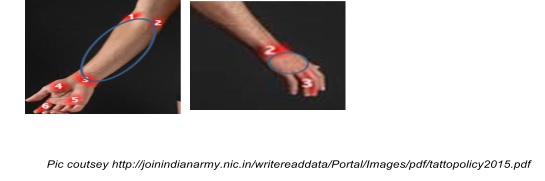
Yes, there exists strict tattoo policy. For candidates belonging to tribal areas, a permanent tattoo is permitted provided it is as per the customs of the tribe.

For any other candidate, tattoos are allowed in the following encircled part in the image below. Tattoo should not be obscene or racist or sexist and must respect the army discipline.

JAG

Selection procedure in JAG examination

JAG

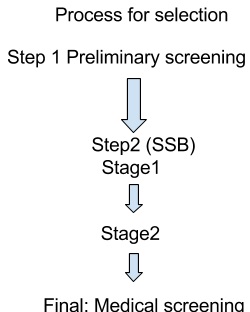
  1. Initial shortlisting of online applications will be done at Recruiting Directorate Army Headquarters and the decision of DG Recruiting will be final. In this regard, no representation will be entertained.
  2. Those who qualify stage 1 can appear for Stage 2. Stage 2 in itself is divided into two sub-stages. Bothe the stages are based on Psychological Aptitude Test.
  3. Only those who qualifies sub-stage 1 of stage 2 will move forward for sub-stage 2 of stage 2. Sub-stage 2 is based on Group Test, Psychological Tests, and Interview which will extend for a duration of 4 days. Those who qualify stage 2 will be finally screened on the medical grounds.

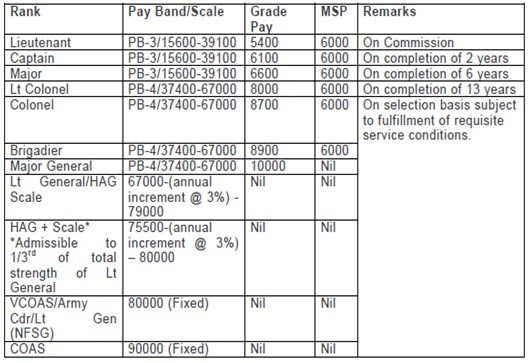
Pay scale of JAG officers

At the entry level, one is allotted the post of Lieutenant.

JAG

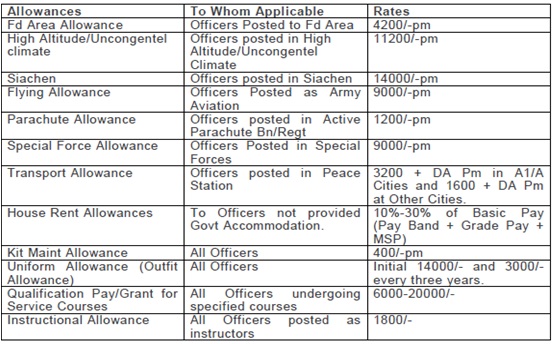
The following allowances are privileged to a JAG Lieutenant

JAG

Training period after selection for JAG in Indian Army

  • Training will be conducted at Chennai and their further posts will be accommodated on the basis of the merit.
  • Forty-nine weeks training duration. A trainee will officially be allotted the post of Lt. JAG only on successful completion if the training period.
  • A candidate in not allowed to marry during the period of training failing to which they will be subject to dismissal.
  • All candidates who successfully complete Pre-Commission training at Officers Training Academy, Chennai will be awarded “ Post Graduate Diploma in Defence Management and Strategic Studies” by University of Madras.
  • All candidates who successfully complete Pre-Commission training at Officers Training Academy, Chennai will be awarded “ Post Graduate Diploma in Defence Management and Strategic Studies” by University of Madras.

Tenure

An overall tenure is of 14 years with subject to certain restrictions. After 10 years of service an SSC officer, if fit and suitable for further continuation will continue for a period of another 4 years.

Privileges provided to JAG officer in Indian Army

Army provides free Medical facilities for self & dependents, Canteen facilities, Entitled Ration, Mess/ Club/Sports facilities, Furnished Govt Accommodation, Car/Housing Loan at a subsidized rate.

The Army provides facilities to pursue any sport of your liking. In addition, one can learn and participate in adventure sports, such as River Rafting, Mountaineering, Hot air ballooning, Hang gliding, Horse Riding etc

How to apply for JAG

  • Open the website “www.joinindianarmy.nic.in”.
  • Click on Officers Entry ‘Apply/Login’ and then click ‘Registration.
  • Follow onscreen instructions for registration. Fill online Registration after reading instructions very carefully. After registration, your profile will open. Click on ‘Apply Online’ to process the application. A page ‘Officer’s Selection-Eligibility’ will open.
  • Your Registration details will confirm your eligibility to apply. Click on ‘Apply’ and a page ‘Application Form’ will open. Proceed with the application as per onscreen instructions. Read onscreen instructions carefully and click ‘Continue’ to fill details under various segments- personal information, communication details, Education details and Details of previous SSB. ‘Save & Continue’ each time before you proceed to the next segment.
  • After filling details of last segment you will move to a page ‘Summary of Information’, wherein you can check & edit entries you have made so far. Only after ascertaining the correctness of all your details click on ‘Submit’. After submitting click on ‘PDF’ and take out two copies of the application form having the Roll Number and other details generated by the system.

Documents required during form filing

  • One copy of the Printout of application form duly signed and self attested photograph affixed.
  • Copy of Matriculation or equivalent certificate for proof of age.
  • Copy of 12th Class Certificate & Marksheet.
  • Copy of Graduation Degree/Provisional Degree (in case of three years LLB after graduation).
  • Copy of LLB Degree/Provisional Degree.
  • Copy of Marks sheets of all years/Semesters.
  • Copy of registration with Bar Council of India/State/Certificate from college/University that the LLB Course in the said institution is recognized by Bar Council of India.
  • All above mentioned certificates are required in original. Originals will be returned after verification at the Service Selection Board itself. Any candidate who does not carry the above documents for the SSB interview, his candidature will be cancelled.
  • The second copy of the printout of online application is to be retained by the candidate for his reference. There is no need to send any hard copy to Directorate General Recruiting.
  • Variation, if any, in name and/or spelling as recorded in Matriculation or equivalent certificate and Graduation or equivalent certificate must be supported by an affidavit and Gazette notification authorizing the change.


LawSikho has created a telegram group for exchanging legal knowledge, referrals and various opportunities. You can click on this link and join:  

https://t.me/joinchat/J_0YrBa4IBSHdpuTfQO_sA

Follow us on Instagram and subscribe to our YouTube channel for more amazing legal content 
 
 
References:
 

[1] (2011) 4 NUJS L Rev 1, Justice Altamas Kabir’s Convocation Address

Download Now

How and when to submit a complaint with National Human Rights Commission (NHRC)

1
NHRC

In this article, Karan Singh from JGLS discusses How and when to submit a complaint with National Human Rights Commission (NHRC).

“To deny people their human rights is to challenge their very humanity” Nelson Mandela

Introduction

“Human Rights” means the rights relating to life, liberty, equality and dignity of the individual guaranteed by the Constitution or embodied in the International Covenants and enforceable by courts in India.[1]

In India, rule of law states that no person shall be subjected to harsh, uncivilised or discriminatory treatment even when the object is the securing of the paramount exigencies of law and order.[2] Under Constitution of India, Article 14 does states that there should be no discrimination on any basis.[3]

Human rights include all such rights which are necessary for a person to live a free, comfortable and proper life. An individual does not just have the right to sustain life but has a right to enjoy it with dignity. One can not be said to have dignity if basic necessity such as clothing, food, shelter, education, health-care, etc is missing[4]. Human rights in India are very hard to fully implement due to overpopulation and increasing poverty. The government considers a human right commission to look into human right violations.

To know the procedure of the National Human Rights Commission (NHRC), we need to know the functions and limitation of the commission and major issues in India. NHRC works for the protection of human rights when there is violation of any human right on any citizen of the country. It helps people to make their life comfortable and protects them from violation of their rights.

The function of the National Human Rights Commission

The NHRC inquire, suo motu or on a petition presented to it by a victim or any person on his behalf or on a direction or order of any court, into complaint of

  • At the time of breach of Human Rights.
  • When police Officer negligently prevents any violation of the rights.
  • NHRC can also intervene any court proceeding that involves any allegation of violation of human rights with the approval of the court.
  • NHRC does jail visits on a regular basis to prisons which are under the state government to keep a check on the persons detained or locked for purpose of the treatment, and also checks on the living conditions of the inmates and makes recommendations accordingly.
  • NHRC also checks on the factors like act of terrorism that prevents the enjoyment of any human rights and makes recommendations.
  • The commission studies treaties and international instruments on Human Rights and recommends for their effective implementation.
  • Intensive research in human rights is also conducted under the commission’s keen eye.
  • Spreads human rights literacy among various sections of society and promote awareness of the safeguards available for the protection of these rights through publications, the media, seminars and other available means.
  • Encourage the efforts of non-governmental organisations and institutions working in the field of human rights.[5]

NHRC basically keeps a check on the State institution and other institution for any violation of the human rights and makes appropriate recommendations. It does help people to maintain a balance and control the authority to use excessive power on the people. For balancing and controlling the powers, NHRC was established.

Major Issues In India Related To Human Rights are

Major issues in India related to Human rights are mostly on the basis of Discrimination, such as problems faced by scheduled castes and scheduled tribes, religious minorities and persons with disabilities. These groups are backward in nature and do not have any power in the society. So, to balance society, NHRC gives rights to these people so that they can live life comfortably.

Issues related to excessive powers of the armed forces and the police is very common in India. The government gives them power to protect the people of the society but some officers use their power to suppress the weaker sections of the society, as in India police use gruesome methods to torture criminals and suspects. Indian police violate many human rights. To stop this, NHRC gives power to the weaker section and commission to keep a check on violation of anyone’s rights.

Some more issues in India are:

  • Right to work and labour rights
  • Custodial torture
  • Extrajudicial killings
  • Sexual violence
  • Conflict-induced internal displacement
  • Child labour
  • Manual scavenging
  • Violence and discrimination against women and children
  • Discrimination faced by lesbian, gay, bisexual and transgender.

Limitation of NHRC

  • NHRC can only recommend and does not have the power to enforce decisions.
  • NHRC cannot inquire in any case, if the complaint is made after one year of the incident. This shows that there is a limitation period in which the victim has to complain. It is, therefore, clear, that the act which are found to be beyond the limitation period, NHRC can not inquire even if the violation is too extensive.

How to file a complaint with National Human Right Commission

There are two ways to file a complaint with NHRC.

Online Complaint with NHRC

First is the online Complain Registration. For this, You have to open the website of the National Human Right Commission and then go to complaints. Under complaints section, there is an option of complaint registration. By clicking that Online complain registration form will appear. Simply, fill the form and register it. Link for the same is provided “http://164.100.51.57/HRComplaint/pub/NewHRComplaint.aspx

Offline Complaint with NHRC

The second option is the offline complain. National human right commission provide application form for complain on their website. Link for the offline form is provided here “http://nhrc.nic.in/nhrc.htm”. Just print the application form under complains. Fill the form and submit it to NHRC within the prescribed period of time.

The complaint can be sent by the following

Also, if police refuses to make an FIR, then you can make a written complain to the NHRC or State human right commission that the police is being biased or corrupt.

In this form, some guidelines are given on how to file a complain with the NHRC.

Guidelines as provided by NHRC for filing of complaints

  • Complains should be made by the victim or any other person on his behalf.
  • Complains should be in Hindi or English or any language included in eighth schedule of the constitution.
  • The complaint shall disclose, i) violation of human rights or abetment thereof

     or; (ii) negligence in the prevention of such violations, by a public servant.

  • The jurisdiction of the Commission is restricted to the violation of human rights alleged to have been committed within one year of the receipt of the complaint by the Commission.

Following types of Complaint(s) are not ordinarily entertainable:

  • Vague, anonymous or pseudonymous;
  • Trivial or frivolous in nature;
  • The matters which are pending before a State Human Rights Commission or
  • any other Commission;
  • Any matter after the expiry of one year from the date on which the act constituting violation of human rights is alleged to have been committed;
  • Allegation is not against any public servant;
  • The issue raised relates to civil dispute, such property rights, contractual obligations, etc;
  • The issue raised relates to service matters;
  • The issue raised relates to labour/industrial disputes;
  • Allegations do not make out any specific violation of human rights;
  • The matter is sub-judice before a Court/ Tribunal;
  • The matter is covered by judicial verdict/decision of the Commission.[6]

When to submit a complain with National Human Right Commission

As declared by universal declaration of human rights “No one shall be subjected to torture or to cruel, inhuman or degrading treatment”.[7]

Any person can file a case whenever his human rights are being violated. If somebody is  being discriminated against, victimised, sexually harassed, you can make a complain with NHRC or someone else on your behalf can make a complain.

Whenever and wherever, there is violation of Human Rights or exploitation of human being, they can inform the National Human Rights Commission within One year.

References

[1]In terms of Section 2 of the Protection of Human Rights Act, 1993 (hereafter referred to as ‘the Act’),

[2] Rubinder Singh v. Union of India, AIR 1983 SC 65

[3] Constitution Of India

[4] Akhtar, Saleem. “Human Rights.” Pakistan Horizon, vol. 53, no. 1, 2000, pp. 17–19., www.jstor.org/stable/41393947.

[5] Section 12, Protection of Human Rights, 1993

[6] http://nhrc.nic.in

[7] Universal Declaration Of Human Rights

Download Now

Cases in which temporary injunction may be granted

1
injunction

In this article, Pallavi Tiwari from Dr. Ram Manohar Lohiya National Law University discusses cases in which temporary injunction may be granted

Injunction and its types

  • An injunction is a preventive remedy granted to a party aggrieved by the acts of another party, and thereby refrain the wrongdoers to pursue the acts performed by them, to evade any further injury and thus considers equity.[1] The law regarding injunction in India is governed by the Specific Relief Act, and falls under two categories Permanent and Temporary.
  • Temporary injunctions have been provided under Rule 1 and 2 of Order 39 of the Code of Civil Procedure, and permanent or perpetual injunctions have been provided under the Specific Relief Act.
  • The difference lies between them as to permanent injunctions where the restraint is to last forever, whereas temporary injunctions, also known as, interlocutory injunctions, may be instituted, at any point of a suit, and shall persist until the court gives any further order or the suit is disposed off.
  • There are two kinds of temporary injunction involving ad interim and temporary injunction wherein the former comes into play when the application for temporary injunction has not been disposed off completely, but it is the immediate reaction, and the latter is granted when the application has been completely disposed off.

Under Rule 1, both the plaintiff and defendants can approach the court[2], and exparte order cannot be given, but if given then it should be of a very small duration.[3] To accomplish the objectives of Temporary Injunction there are few factors that need to be considered:[4]

  • There has to be a prima facie case.[5]
  • A balance of convenience has to be maintained.
  • There has to be an irretrievable damage.

After considering these factors, the cases in which such injunction can be granted has to be looked upon:

  1. Grant of injunction against government bodies and public officer governed by Section 80 of the Code, making it mandatory for the notices to be served prior to the injunction.[6] Injunction in such cases may be granted to maintain a status-quo and thus to prevent the authority to perform a certain task.[7]
  2. Protection against Nuisance: Injunction cannot be granted in every act of nuisance, nuisance should involve factors such as harm to any person physically or mentally or deteriorating the image of the person in public. Injunction in such cases is granted on the basis of equity to stop the defendants from causing the injury or annoyance.

Further, Order 39 Rule 1 and mentions the cases in which temporary injunction may be granted

  1. A temporary injunction can be brought against alienation when the plaintiff fears that the defendants might dispose off the property or assets before the final decree is pronounced by the Courts. A bona fide possessor of property should not be dispossessed pending suit unless there is some substantial reason. The matter should be considered judicially in all its aspects. The plaintiff must show prima facie that he has a strong case that is, either a good title to the property or a special equity in his favor requiring immediate dispossession of the defendant, or the property is in danger of being wasted.[8] If the rightful owner threatens his peaceful possession, he can approach courts of law and pray for equitable relief of injunction to protect his possession.[9] But when it is doubtful to come to conclusion that the plaintiff’s possession of the property is doubtful, O 39, r 1 of the Code has no application.[10]
  2. Where there is an involvement of fraudulent intention to harm the creditors by removing or disposing off the property.
  3. On the basis of equity and justice temporary injunction may be granted.[11]
  4. Where a defendant threatens to dispose off the plaintiff or cause injury to him involving any property in a suit. Where a plaintiff who is out of possession claims possession, the court will not grant an injunction against the defendant in possession under a claim of right unless the threatened injury will be irreparable and an injunction may be granted as to the user of premises which the plaintiff has leased to the defendant.[12] Further, injunction is terms of right to worship are not covered under this rule.
  5. Temporary injunction may granted in cases where property is in danger of being wrongfully sold in execution of a Decree. In a case, certain property attached in execution of a decree obtained by A against B is notified for sale at the instance of A. C, challenging that the property belongs to him and not to B, sues A and B for declaration of his title to the property, and applies for an injunction under this rule to restrain A from bringing the property to sale until the suit is disposed of. If the property in dispute in the suit is in danger of being wrongfully sold in execution of the decree the court has the power to grant the injunction under this rule.[13] However, in a suit by A against B, A cannot get an injunction to restrain B from selling property which is also the subject of another suit by B against A and in which A has not filed an appeal.[14]

In an execution of the decree, where, the property has been sold, injunction can be issued restraining the purchaser from taking possession pending the suit as was observed in Inayat Ullah v. Gurdit Singh[15], that as delivery of possession is part of the sale, the court has the power to issue injunction restraining the defendant from taking possession.

  1. Where a suit is filed to declare that a decree in an earlier suit is vitiated by fraud, an interim injunction to restrain execution can be granted, on prima facie proof of fraud.[16]
  2. Temporary injunction may be granted in Tenancy cases, where is a case named Bhola Nath v. Maharajj Raj Saheb[17], a plaintiff was a lessee who continued in possession over a long stretch of time by holding over after termination of the lessee. The lessor sought to evict the plaintiff otherwise than in due course of law. It was held that the plaintiff could be granted a temporary injunction, restraining the defendant from evicting the plaintiff otherwise than in the course of law.
  3. In case of Coparcenary, in a suit for partition and accounts, when an injunction is sought to restrain the defendant co-sharer from transferring his share pendent lite, the legal position according to the Gujarat High Court was finally observed in the case of Ibrahim Shah Mond v. Noor Ahmed[18]. To avoid situations of multiplicity of proceedings the court should issue an injunction restraining the co-sharer defendant from transferring his share pendente lite.

Order 1 Rule 2 talks about cases where injunction can be granted to restrain repetition or continuous of breach-

  1. Temporary injunctions to restrain the breach of a contract are regulated by the present rule. For example, in the case of Union of India v. Bhuneshwar Prasad[19]that a railway employee who had filed a suit for a declaration that his removal from service was illegal was entitled to an interim injunction restraining the defendant from removing him from service pending the suit, and it was observed that this did not mean that he should be put in charge of his work. If a case is a proper one for specific performance, and an irreparable injury is likely to be caused to the plaintiff unless the breach of contract is forthwith restrained, the court will grant a temporary injunction to restrain the breach of contract.
  2. In cases of injury which is a result of the execution of a decree obtained by fraud and an injunction (to restrain such execution) may be issued in an appropriate case.[20] It was observed in the case of S Hardayal Singh v. Nirmala Devi that any intolerable unlawful disturbance to a neighbor may justify the grant of an injunction and plaintiff needs to show a substantive right in respect of which the plaintiff seeks an injunction.[21]
  3. In the case of Chitra v. Dhrubha Jyoti[22] it was observed that where the husband has obtained a decree of divorce against which the wife appealed, the wife can obtain a temporary injunction restraining the husband from marrying again during the pendency of the wife’s appeal.
  4. After termination of an agency, the agent has no right to remain in possession of the property given by the principal, and thus temporary injunction can be obtained.[23]
  5. Temporary injunction can also be granted in cases if trademark, copyright or patent infringement, governing interlocutory injunction.
  • Three factors have to be considered:
  • (a) whether a prima facie case lies;
  • (b) there is a balance of convenience between the parties;
  • (c) if the injunction is not granted then there shall be an irreparable injury. Same situation lies for copyright and passing off.[24]
  • In trademark infringement suits an injunction would issue as soon as it is proved that the defendant is improperly using the plaintiff’s mark.[25]
  1. Temporary Injunction can be issued in various judgments of the Supreme Court that in law relating to the bank guarantees, a party seeking injunction from encashing of bank guarantee has to show prima facie case of established fraud and an irretrievable injury.[26]
  2. In advertising agreements with an advertising agency the client undertook not to engage any other advertising agency till the dues of the first agency were paid. It was held that temporary injunction to enforce the negative covenant could be issued.[27]
  3. Public interest is one of the material and relevant considerations in either exercising or refusing to grant ad interim injunction, and court should exercise its adequate jurisdiction to do the same.[28] Prima facie merit of the case and balance if convenience of the party cannot be forgone on the ground that ‘what is sought to be done is for the happiness of the many.’

Thus, considering these cases together Order XXXIX Rule 1 and 2 govern the examples in which such temporary injunctions could be granted by courts considering the facts and circumstances of the case.


LawSikho has created a telegram group for exchanging legal knowledge, referrals and various opportunities. You can click on this link and join:  

https://t.me/joinchat/J_0YrBa4IBSHdpuTfQO_sA

Follow us on Instagram and subscribe to our YouTube channel for more amazing legal content.


[1] Shamsher v. Rustom, AIR 1988 Raj 188.

[2] Sathyabhama Amma v. Vijaya Amma, AIR 1995 Ker 74.

[3] Industrial Credit and Investment Corpn. Of India Ltd. v. Grapco Industries Ltd., [1993] 3 LRI 538.

[4] Radhakrishna v. Purnanand, AIR 1978 AP 103.

[5] Prakash Singh v. State of Haryana, 2002 (4) Civil L.J. 71 (P.H.).

[6] Harikishanlal v. State of Jammu & Kashmir, (1994) 4 S.C.C. 422.9c

[7] Seema Arshad Zaheer & Ors. V. Municipal Corporation of Greater Mumbai and Others, (2006) 5 SCC 282.

[8] Ravi Kumar v. Misha Vadhera, AIR 1995 Del 175.

[9] Sarladevi v. Shailesh, AIR 1996 Bom 98.

[10] Dasnam Naga Sanvasi v. Allahabad  Development Authority, AIR 1995 All 418.

[11] Manhohar Lal Chopra v. Seth Hiralal, AIR 1962 SC 527.

[12] Robinson v. Pickering, [1881] 16 Ch D 660.

[13] Brojendra v.  Rup Lall, (1886) 12 Cal 515.

[14] Sankara v. Mahommad Gani, (1936) 59 Mad 746.

[15] Inayat Ullah v. Gurdit Singh, (1930) Lah 850.

[16] Y Venkateswara Rao v. T Venkata Subbayya, AIR 1980 AP 208.

[17] Bhola Nath v. Maharaj Raja Saheb, AIR 1984 All 60.

[18] Ibrahim Shah Mond v.Noor Ahmed, AIR 1984 Guj 126 (DB).

[19] UOI v. Bhuneshwar Prasad, AIR 1963 Pat `96.

[20] Tazmud v. Md. Ulairaja, AIR 1978 Gau 56.

[21] Ram Hoseiry v. JK Synthetics, AIR 1984 Del 350.

[22] Chitra v. Dhrubha Jyoti,  AIR 1988 Cal 98.

[23] Southern Roadways v. SM Krishnan, AIR 1990 SC 673.

[24] Bharat Law House v. Wadhwa Co. Pvt. Ltd., AIR 1988 Del. 68.

[25] Pioneer Hybrid International Inc. v. Pioneer Seeds Co., AIR 1989 NOC 120 (Del).

[26] M/s. Laxmi Marketing Corpn. V. Karnataka State Electronics Development Corpn. Ltd., AIR 1995 Kant 180.

[27] Frank Simoes Advertising Pvt. Ltd. v. Haqq Leasing and Industries, AIR 1988 Del 362.

[28] Mahadeo Salvaram Shelka v. Pune Municipal Corpn., (1995) 3 SCC 33.

Download Now

Who is an Advocate On Record?

0
advocate on record

In this article, Amber Jain discusses all you need to know about the designation of an Advocate on Record.

An advocate is a person accredited with a legal knowledge to appear or plead on behalf of the client in various litigation process before the court of law. He can plead in the court once he is enrolled with the Bar Council.

Advocate on Record

  • Following the pyramidal structure of the court system in India, Supreme Court being the highest court of appeal and court of last resort in the country have to deal with entirely every subject evolved before them. So, it is supportive that these matters should be filed by an experienced and learned person.
  • Hence the system of ADVOCATE ON RECORD (AOR) was introduced by the Supreme Court in framing Rule 2, Rule 4, and Rule 6 of Supreme Court Rules 1966.
  • Advocates on Record can be considered as a designation to practice in Supreme Court. The designation is based on experience and knowledge of an advocate.

Qualifications/Procedure to become AOR

  • AOR is the one who qualified the exam conducted by the Supreme Court and who has been enrolled with the bar for at least five years and worked with an AOR of not less than five years of standing.
  • In the Supreme Court, only the Advocate on Record can file the case on behalf of the party. All the procedural aspects need to be completed by AOR with an assistance of a registered clerk. It is the AOR’s name which appears on cause list, notice from the court are sent on AOR name.

Validity of AOR System in light of Constitutional and Statutory Provisions

Once you fulfilled all the conditions of being an advocate in light of Bar Council Rules you will get the right to practice under Section 30 of the Advocates Act, 1961.

Section 30 of the Advocates Act, 1961

Section 30:- Right of advocates to practise[1].

“Subject to provisions of this Act, every advocate whose name is entered in the State roll shall be entitled as of right to practise throughout the territories to which this Act extends,

  • In all courts including the Supreme Court;
  • Before any tribunal or person legally authorised to take evidence; and
  • Before any other authority or person before whom such advocate is by or under any law for the time being in force entitled to practice.”

Interpretation

Now if we interpret the above-mentioned section it nowhere restricts the advocate to practice in the Supreme Court. The only restriction is that his name should be in state roll.

So if the Act does not put any restriction on advocate’s right to practice then how can the Supreme Court put restrictions on practice. According to the rules of interpretation, the court is not allowed to modify or change the statute unless and until the provisions are defeating the purpose of the Act or if there is some ambiguity in the provisions of the act.

Section 52 of the Advocates Act, 1961

To know the power of the Supreme Court from where it derives its authority to frame the rules lies in Section 52 of the Advocates Act, 1961 which is read as

“Saving. -Nothing in this Act shall be deemed to affect the power of the Supreme Court to make rules under Article 145 of the Constitution

(a) for laying down the conditions subject to which a senior advocate shall be entitled to practise in that Court;

(b) for determining the persons who shall be entitled to 1[act or plead] in that Court”[2].

Interpretation

The opening word of the section clarifies all the doubts. The word “Saving” implies exemption from its conditions and obligations existing in the Act. This section gives power to the Supreme Court to frame the rules for practising in the court subject to Article 145 of the constitution. Here, Article 145 (1) (a) is relevant which says,

“Subject to the provisions of any law made by Parliament the Supreme Court may from time to time, with the approval of the President, make rules for regulating generally the practise and procedure of the Court including rules as to the persons practising before the Court,[3]

These provisions of law are in the Advocates Act, 1961 and nothing is curtailing the Supreme Court power to frame the rules for practicing.

Pre-Independence

The Government of India Act, 1935[4] also had a provisions under Section 214 Rules of Court which says the “Federal Court may from time to time frame the rules for persons practicing in the court and procedure followed in the court with the approval of the Governor-General.

Is the provision of Advocate on Record a violation of Fundamental Right of an advocate who is not an Advocate on Record on the grounds of breach of right guaranteed under 19(1)(g) of the Indian Constitution?

Now the question arises, that whether the restriction imposed by the Supreme Court is in violation of Article 19(1) (g) or not? The response to this question can be well thought-out to be a partial restriction. As the restriction is in terms of the condition. Once you fulfill the condition you are eligible to practice in the court. The eligibility conditions cannot be treated as the violation of the Article 19(1) (g) as it is not the absolute restraint on trade and profession.

Constitutional validity of Rules

These rules were challenged in the Balraj Singh Malik v Supreme Court of Indiathrough Its Registrar General[5] where the court held that Section 30 was to be read with Rule 52 of the Supreme Court Rules, which preserves the rule-making power of the SC under Article 145 of the Constitution. The SC was therefore empowered to decide the manner as well as the right to practise of various classes of advocates before it.

“Reasonable Restrictions”

The condition imposed should be a reasonable condition, however, reasonable condition is not defined anywhere but in one of the landmark judgment of the Supreme Court in case P.P. Enterprises V. Union of India.[6] According to the judgement the expression “reasonable restriction” means restraint imposed on the right should not be arbitrary and excessive beyond the interest of general public.

As in this case the condition that they should be enrolled for 5 years of practice in the Supreme Court under someone then they have to pass an examination after which there name can be registered in AOR category. The intention of the Supreme Court in framing the rules is to promote the quality of litigation in the court as the court is overburdened with the litigation. The object is that they should be trained with the practical aspect of the court proceedings.

New category of Advocates?

The condition/rules do not restrict you from arguing a case, if an Advocate On Record instructed the non-Advocate On Record to plead a case, the non- Advocate On Record can do it in the court. The only restriction is that non-AOR cannot submit his Vakalatnama with the case. The conditions/rules do not create a new category of Advocates which are already there under Section 16 of the Advocates Act, 1961[7] i.e. Senior and Other Advocates.

Conclusion

Therefore, it can be reasonably concluded that AOR system is need of the hour for the court and Advocate On Record is a designation because one must have some distinct skills when pleading in the Apex court. To uphold the standard of quality of litigation Advocate On Record system should be implemented effectively.


LawSikho has created a telegram group for exchanging legal knowledge, referrals and various opportunities. You can click on this link and join:

https://t.me/joinchat/J_0YrBa4IBSHdpuTfQO_sA

Follow us on Instagram and subscribe to our YouTube channel for more amazing legal content 


[1] http://www.barcouncilofindia.org/wp-content/uploads/2010/05/Advocates-Act1961.pdf

[2] Supra Note 1

[3] https://indiankanoon.org/doc/31317790/

[4] http://lawmin.nic.in/legislative/textofcentralacts/GOI%20act%201935.pdf

[5] AIR 2012 Delhi 79

[6] 1982 S.C.C.(Cr.)341

[7] Supra Note 1

Download Now

All you need to know about laws on lie detector tests

2
lie-detector test

In this article, Ritika Agarwal from Institute Of Law Nirma University, Ahmadabad discusses All you need to know about laws on lie detector tests.

Introduction

  • The lie-detector test is a kind of an activity where the accused, suspect, witness or any other person is supposes to tell truth when asked by examiner.  They are also known as Deception Detection test and have wide moral, scientific, legal significance in the society.
  • These test such as narco analysis, polygraph, brain mapping are helpful to investigators in detecting the lies and finally, increase the efficiency of the investigation. It is ardently claimed by investigation agency that no doubt all the information received from the accused can’t be used by them as evidence in the court but still it is a better way to extract information rather than using “Third-degree methods”.
  • Now the main debate is whether the use of inhuman derogatory techniques justified by our constitution? Whether they are violative of basic fundamental rights of accused or any person who is a subject? This article is basically focusing on settled position of law of lie detectors in India decided by Apex court and its good and bad aspect.

Evidentiary value of lie-detector tests

In order to understand whether these tests are reliable or not for this first we need to have crystal clear understanding of how they are conducted and what impact they have on the subject.

Polygraphy method

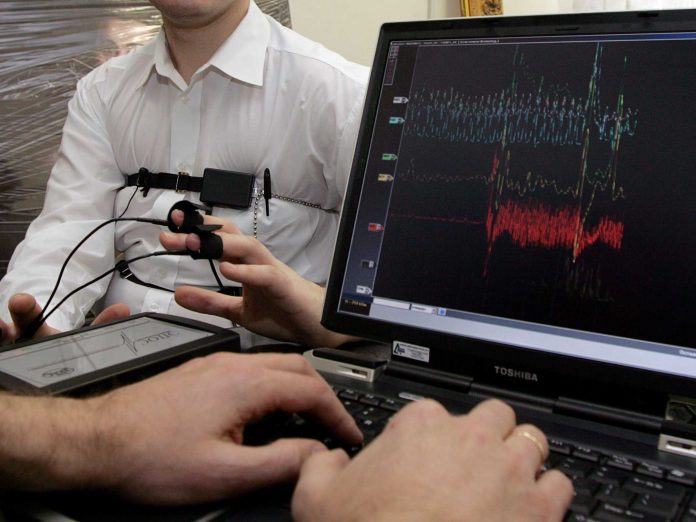
The theory initiating this test is that when a subject (person) is lying to the questions asked by the examiner then his body will produce different physiological responses than he produces in normal course which would be detected by examiner by noting measures such as heart rate, blood pressure, respiratory rate, skin conductance and electromyography as few instrument are stick to the subject for recording these measures.

As we know in theory everything looks easy but in practice, it is quite difficult to implement. This same problem is attached with all these Deception Detection Tests. Let’s have a look at what problem could arise while conducting this test. The measured changes in physiological responses

Let’s have a look at what problem could arise while conducting this test.

  • The measured changes in physiological responses are every time not aroused because of lying and deception but sometimes it could be provoked by anxiety, fear, nervousness, confusion or any other emotions.
  • As well as condition of examination room can also build falsification in reply recorded by the examiner. In spite of this the mental condition of subject plays a most important role.
  • If a person is in depression or not sane or in a state of hyperactivity then it could produce much-distorted results which would ultimately frustrate the core reason of conducting this test.
  • There can be errors because of loss of memory of subject or any other factor which maintains the person’s mental state.
  • But the main failure of this test arises when person deliberately attempts to produce different physiological responses to the question in order to manipulate the examiner so that he can mark the answer as truth rather than a lie.
  • The drawback is examiner can’t make difference between manipulative and genuine responses of the subject. So by looking at all its drawbacks, it can be concluded that they can’t be used as error free pieces of evidence in the court.

Narco Analysis

  • This test is associated with intravenous administration of a drug which forces person to enter into some kind of anesthetic stage. This hypnotic trance stage is helpful for investigators as in this stage the person is more likely to give out concealed information which he never discloses in conscious state.
  • It is useful as it extracts out the hidden conflict in the person’s mind and unsettled feeling regarding past events. The discoveries can aid the investigators to find out the important pieces of evidence or to corroborate pre-existing testimonies and prosecution theories.
  • It is also helpful for accused sometimes if he wants to prove his innocence by this test no doubt the results are not admissible in the court but it supports the case of accused to a greater extent.
  • This test could prove to be useful for activities such as to refresh the memory of witness and to confirm the mental state person to stand trial.

Drawbacks of Narco Test

  • But there are major drawbacks of this test also such as some subjects are capable of preserving their strength to deceive in the anesthetic state also, on the other hand, some can become greatly flexible to questioning.
  • Now, this is specifically troubling because the questions prepared by the investigators may lead to incriminatory responses. Even the drug given didn’t guarantee that the person will only tell the truth.
  • The answers given in a hypnotic stage are not given voluntarily or in an understandable state of mind. Therefore, they can’t be used as evidence in the courts.
  • This test when carried out without consent raises several core issues such as physical incursion on the body by inserting syringes and various agonizing stimuli like pinching, shaking, slapping and such kind of activities to wake a person from half sleep to answer the questions.
  • On the other hand, it also causes mental assault by having unregulated access to sheer private information of the person. However, this test accepted in Second World War but it has not been backed by satisfactory research to legitimize its claims.

Brain Mapping techniques

  • It is also known as “P 300 waves test”. It is a method of discovering whether a person is friendly with some information by gauging the activity in the brain that is prompted by disclosure to selected stimuli.
  • This test consists of examining and measuring ‘event-related potentials’ (ERP) i.e. electrical waveforms emitted by the brain after it has absorbed an external event[1].
  • This whole test is based on the theory that whenever the person is exposed to some pictures, videos, words which contain some relevant (which are related to crime scene or in any manner to a case) and some irrelevant stimuli so that the examiner can record the functioning in his brain when the person is exposed to these stimuli to which he is familiar with.
  • The test has to be performed in an air conditioned and insulated room so to avoid discrepancies rising out of weather conditions.

Drawbacks of brain-mapping techniques

  • The main drawbacks of this test is that it wholly depends upon the familiarity of the subject to the crime scene or any related information but this can be present in person’s mind because of the exposure to the pictures and videos through media or by looking at or reading such things in newspapers, magazines etc or maybe he was just a mere bystander when crime took place.
  • So it can’t be inferred from the test that if the person have some knowledge about such stimuli then he must be related to the crime.

Of these tests, which one has an evidentiary value. Which test is accepted by the Courts in India?

The Apex court overruled various high court judgments and decided that use of narco analysis, polygraph, and brain mapping tests violated subject’s right against self-incrimination in contravention to Article 20(3) of Indian constitution[2]. The article states that “No person accused of an offence shall be compelled to be a witness against himself[3].

According to the various judgments given by high courts regarding this matter, it can be inferred that only if a statement made is incriminating in nature and then used as evidence in court could lead to a violation. Even the Delhi court said that the statement discovered out of these tests can be used as corroborative evidence[4].

The Supreme Court dropped all these judgments and decided that compelling a person to go through these deception detection tests will automatically amount to the requisite compulsion, despite the absence of physical harm done to the administering during the test[5].

Secondly, the court said that because the responses given during these tests are not given consciously or voluntarily thereafter individual have no right to decide whether to answer or not so the responses arises out of all three test amount to the requisite compelled testimony to violate Article 20 (3)[6]

Finally, Supreme court finally dismissed all the arguments and take into considerations the constitutional rights of the accused such as right against self-incrimination, substantive due process rights and the court gave the core understanding of these rights and held used of these three tests violative of constitutional rights.

Conclusion

With all due respect to the decisions given by the Hon’ble Supreme Court on the legality or illegality of lie-detector tests some questions still remain unanswered. The court left open the probability of wrong use of these test as they gave a narrow exception that if the test is carried out by voluntarily given consent of the subject to that test then it can be used as evidence in court. But the dilemma is that even the person is well informed with the consequence of his consent and thereafter voluntarily gave consent then also the consent can’t be said to be given voluntarily. It is a problematic stance.

References

[1] Smt Selvi & Ors. V State of Karnataka, (2010) 7 SCC 263

[2] Ibid, pg 165.

[3] Constitution Of India 1950,  Art 20(3)

[4] Sh. Shailendre Sharma v State, Crl. WP No. 532 of 2008, at 37

[5] Supra note 1, at 158, 165.

[6] Ibid, pg 161, 165

Download Now

All you need to know about the ways of spreading legal awareness in the society

0
legal awareness

In this article, Twinkle Jaiswal from Amity Law School, Lucknow discusses All you need to know about the ways of spreading legal awareness in the society.

What do we understand by the term ‘legal awareness’

Legal awareness lies at the base of any effort toward legal empowerment. Critical knowledge of legal provisions and processes, coupled with the skills to use this knowledge to realize rights and entitlements will empower people to demand justice, accountability and effective remedies at all levels. Legal awareness sometimes called Public legal education and civics education is the empowerment of individuals regarding issues involving the law. Legal awareness helps to promote consciousness of legal culture, participation in the formation of laws and the rule of law[1].

Legal awareness drive

  • It comprises a range of activities intended to build public awareness and skills related to law and the justice system. This term also refers to the fields of practice and study concerned with those activities, and to a social and professional movement that advocates greater societal commitment to educating people about the law.

Anna-Marie Marshall explains that “in order to realize their rights, people need to take the initiative to articulate them. This initiative, in turn, depends on the availability and the relevance of legal schema to people confronting problems.”[2]

  • This is because laws exist as part of a larger organizational ecosystem in which the interests of the organization, as well as those of the actors, become inextricably linked to the ways in which they are enacted.
  • It is different from the education of students in law school seeking a degree in law (which is often simply called “legal education”) and the continuing professional education of lawyers and judges (which is sometimes called “continuing legal education”), public legal education is principally aimed at people who are not lawyers, judges, or degree-seeking law students.

Ways of spreading legal awareness

  • We can spread legal awareness by educating people about their rights, about their duties and about new laws and provisions.
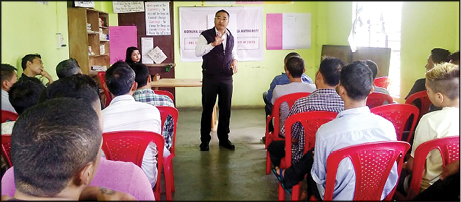
  • First, all we need is a good plan for this purpose. Law Institution consisting Legal Aid Committee can do a lot. The law students in these committees, although lacking legal expertise, have the ability to not only spread awareness but also help enforce the basic rights of those in undeveloped regions.
  • For example, they can associate themselves with an RTI activist organization and help people file RTIs. It is not uncommon for these students to visit rural and undeveloped areas to talk to the people.
  • In some cases, they also organize street plays in the local languages and perform it weekly, each time in a different area. They even help people get in touch with lawyers who can file PILs or other petitions or suits for them. Visiting jails and helping inmates apply for balls or deportation is also part of their programmes.


  • For the purpose posters and paintings can be a better idea. Sticking posters or painting the same matter on trucks and public vehicles is much better idea. But the use of words should be as less as possible. Rather, pictures should dominate such posters as pictures relate more to an illiterate citizen.
  • Even if such person does not understand what the picture is about, the picture should be such that, at the very least, that person will ask someone else what it is about.
  • An animated picture of domestic violence or a real picture of a happy farmer and his family are just some of the many such images that could generate curiosity and interest. It is not practical to make posters of every language. Flow of language changes every few kilometres. Images will speak louder to these people than words.

Using Social Media as a tool for spreading legal awareness

  • Social media nowadays is the best means to regulate a message. To spread the word in urban areas, simply advertising a Facebook page, frequently giving updates on a Twitter account and using other social networking sites can make ample of difference. Now a day, having a mobile is common, even in undeveloped or rural areas.
  • Viral marketing[4] is basically a marketing strategy that compares spread of ideas to spread of viruses. Imagine if one interesting SMS is sent to ten people. Out of those maybe five will forward it to ten other people. And each of those ten send it to ten more… and so on. The message multiplies at an exponential rate.
  • This, of course, is all theoretical. However, imagine if the ‘legal awareness’ campaign associates itself with Mobile Operators and sends just one lakh messages to those mobile numbers that SMS frequently and have a good messaging scheme.
  • Furthermore, imagine if the message is one worth forwarding like for example, ‘Under Section 51 of Cr.P.C., a female can only be searched by another female with strict regard to decency.

Television is also a good means to spread a message. It is easily accessible to all. Advertising on Television can be considered once but directly advertising on Television must be avoided. Advertising your campaign directly on T.V. is an unnecessary waste of time and money. The campaign should cover these two dialects as well as Hindi and some even in English.

Seeking government’s help for widening the scope of legal awareness drives

  • Once a full-fledged campaign is launched, government assistance can be sought. Apart from sponsoring programmes they can also grant tax exemptions for movies, literature, etc. that encourage people to stand up for their rights.
  • Joint meetings with Government officials can give the campaign a better direction. Focus can be put on rights related to right in common land, livelihood, subsidiaries and facilities.
  • Special permissions such as those required for to enter jails and interview with inmates to check if they are not being ill-treated can also only be obtained quicker with Government co-operation. Draft bills can be proposed to be tabled at the state Parliament.
  • These plans are simple yet effective method to connect with the people and make them aware of their rights. It is cost-effective and realistic. A good plan need not constitute one complex strategy with several graph and map references but rather a mixture of several simple ones while keeping in mind short term as well as long term goals.
  • If followed, the people’s lives will be as beautiful as the region. The campaign should cover these two dialects as well as Hindi and some even in English. This is more of a marketing strategy.

People still remember Tata tea’s ‘Jaago re’ which encouraged people to question government authorities, stand against corruption, vote, etc. Did it work? All these little ads, slogans, movements, etc do not directly don’t seem to make much difference, but the statistics of the desired results should speak for itself. After the ‘Jaago re’ campaign, the number of people between age groups 18-25 who applied for election cards increased substantially. Just like advertising increases sale. Comparing a social awareness campaign to a product or service may not seem appropriate, but in

After the ‘Jaago re’ campaign, the number of people between age groups 18-25 who applied for election cards increased substantially. Just like advertising increases sale. Comparing a social awareness campaign to a product or service may not seem appropriate, but in reality, the methods that have to be used to spread awareness of a product and campaign are similar.

[1] Ashok Swain, Ramses Amer Globalization and Challenges to Building Peace(Accessed on 13 April 2017)

[2] Marshall, Anna-Marie (2005). “Idle Rights: Employees’ Rights Consciousness and the Construction of Sexual Harassment Policies.”. Law and Society Review39 (1): 83–124. doi:10.1111/j.0023-9216.2005.00078.

Download Now

Five most important judgments by the Supreme Court of India on Freedom of Speech and Expression

0
Freedom of Speech

In this article, Shreya Rajan from ICFAI University, Dehradun discusses five most important judgments by the Supreme Court of India on Freedom of Speech and Expression.

Five most important judgments by the Supreme Court of India on Freedom of Speech and Expression

“If liberty means anything at all, it means the right to tell people what they do not want to hear” – George Orwell

What is Freedom of Speech?

The power or right to express one’s opinions without censorship, restraint or legal penalty is known as Freedom of Speech.1 Unhindered flow of words in an open forum is the essence of free society and needs to be safeguarded at all times. One’s opinions may, therefore, be expressed by words of mouth, in writing, printing, pictures, or any other mode. This freedom includes a person’s right to propagate or publish the views of other people.2

In India, freedom of speech is guaranteed under Article 19(1) (a) of the Constitution of India. Apart from this, provisions relating to freedom of speech are also contained in various international conventions like Universal Declaration of Human Rights (UDHR), European Convention on Human Rights and Fundamental Freedoms, International Covenant on Civil and Political Rights, etc.

Freedom of speech vis-a-vis Constitution of India

Freedom of speech is one of the six fundamental rights conferred to the citizens of India under Part III of the Constitution. It is one of the most important aspects in the hierarchy of personal liberties provided under Article 19 to Article 22 of the Indian Constitution.

Article 19(1) (a) states that all citizens shall have the right to freedom of speech and expression. But this right is subject to limitations imposed under Article 19(2) which empowers the State to put ‘reasonable’ restriction on various grounds, namely, security of the State, friendly relations with foreign States, public order, decency and morality, contempt of court, defamation3, incitement of offence4, and integrity and sovereignty of India.

Purpose of Freedom of speech and expression

Freedom of speech not only allows people to communicate their feelings, ideas, and opinions to others, rather it serves a broader purpose as well. These purposes can be classified into four:

  1. It helps an individual to attain self- fulfillment;
  2. It assists in the discovery of truth;
  3. It strengthens the capacity of an individual to participate in the decision-making process;
  4. It provides a mechanism by which it would be possible to establish a reasonable balance between stability and social change.

Freedom of speech and of the press lays at the foundation of all democratic organizations, for without free political discussion no public education, so essential for the proper functioning of the popular government is possible.5

Freedom of Silence- National Anthem Case

Freedom of speech also includes the right to silence. In a case6, three children belonging to Jehovah’s witnesses were expelled from the school for refusing to sing the national anthem, although they stood respectfully when the same was being sung. They challenged the validity of their expulsion before the Kerala High Court which upheld the expulsion as valid and on the ground that it was their fundamental duty to sing the national anthem. On appeal, the Supreme Court held that the students did not commit any offence under the Prevention of Insults to National Honour Act, 1971. Also, there was no law under which their fundamental right under Article 19(1) (a) could be curtailed.

Accordingly, it was held that the children’s expulsion from the school was a violation of their fundamental right under Article 19(1) (a), which also includes the freedom of silence.

Freedom of Speech and Sedition

The offence of sedition, in India, is defined under Section 124-A of the Indian Penal Code as, “whoever by words either spoken or written, or by signs, or by visible representation or otherwise brings into hatred or contempt or excite or attempts to excite disaffection towards the government established by law in India shall be punished”.

In the recent case of Kanhaiya Kumar v. State of Nct of Delhi7, students of Jawaharlal Nehru University organized an event on the Parliament attack convict Afzal Guru, who was hanged in 2013. The event was a protest through poetry, art, and music against the judicial killing of Afzal Guru. Allegations were made that the students in the protest were heard shouting anti-Indian slogans. A case therefore filed against several students on charges of offence under Sections [124-A, 120-B, and 34]8. The University’s Students Union president Kanhaiya Kumar was arrested after allegations of ‘anti-national’ sloganeering were made against him. Kanhaiya Kumar was released on bail by the Delhi High Court as the police investigation was still at nascent stage, and Kumar’s exact role in the protest was not clear.

https://lawsikho.com/course/certificate-course-in-advanced-civil-litigation-practice-procedure-and-drafting
Click Above

Case Study

  1. Hamdard Dawakhana v. Union of India9

The validity of the Drug and Magic Remedies (Objectionable Advertisement) Act, which put restrictions on advertisement of drugs in certain cases and prohibited advertisements of drugs having magic qualities for curing diseases was challenged on the ground that the restriction on advertisement abridged the freedom. The Supreme Court held that an advertisement is no doubt a form of speech but every advertisement was held to be dealing with commerce or trade and not for propagating ideas.

Advertisement of prohibited drugs would, therefore, not fall within the scope of Article 19(1) (a).

  1. People’s Union for Civil Liberties(PUCL) v. Union of India10

In this case, public interest litigation (PIL) 11 was filed under Article 3212 of the Indian Constitution by PUCL, against the frequent cases of telephone tapping. The validity of Section 5(2)13 of The Indian Telegraph Act, 1885 was challenged. It was observed that “occurrence of public emergency” and “in the interest of public safety” is the sine qua non14 for the application of the provisions of Section 5(2). If any of these two conditions are not present, the government has no right to exercise its power under the said section.

Telephone tapping, therefore, violates Article 19(1) (a) unless it comes within the grounds of reasonable restrictions under Article 19(2).

  1. Indian Express Newspapers v. Union of India15

The Court, in this case, observed that, Article 19 of the Indian Constitution does not use the phrase “freedom of press”16 in its language, but it is contained within Article 19(1) (a). There cannot be any interference with the freedom of press in the name of public interest. The purpose of the press is to enhance public interest by publishing facts and opinions, without which a democratic electorate cannot take responsible decisions.

It is, therefore, the primary duty of courts to uphold the freedom of press and invalidate all laws or administrative actions which interfere with it contrary to the constitutional mandate.17

Similarly, imposition of pre-censorship of a journal18, or prohibiting a newspaper from publishing its own views about any burning issue19 is a restriction on the liberty of the press.

  1. A. Abbas v. Union of India20

The case is one of the firsts in which the issue of prior censorship of films under Article 19(2) came into consideration of the Supreme Court of India. Under the Cinematograph Act, 1952, films are divided into two categories- ‘U’ films for unrestricted exhibition, and ‘A’ films that can be shown to adults only. The petitioner’s film was refused the ‘U’ certificate, and he challenged the validity of censorship as violative of his fundamental right of freedom of speech and expression. He contended that no other form of speech and expression was subject to such prior restraint, and therefore, he demanded equality of treatment with such forms. The Court, however, held that motion pictures are able to stir emotions more deeply than any other form of art.

Hence, pre- censorship and classification of films between ‘U’ and ‘A’ was held to be valid and was justified under Article 19(2) of the Constitution.

  1. Bennet Coleman and Co. v. Union of India21

In this case, the validity of the Newsprint Control Order was challenged. The Order fixed the maximum number of pages which a newspaper could publish, and this was said to be violative of Article 19(1) (a) of the Indian Constitution. The government raised the contention that fixing the newsprint would help in the growth of small newspapers as well as prevent monopoly in the trade. It also justified its order of reduction of page level on the ground that big dailies devote a very high percentage of space to advertisements, and therefore, the cut in pages will not affect them. The Court held the newsprint policy to be an unreasonable restriction, and observed that the policy abridged the petitioner’s right of freedom of speech and expression. The Court also held that the fixation of page limit will have a twofold effect- first, it will deprive the petitioners of their economic viability, and second, it will restrict the freedom of expression as compulsorily reducing the page limit will lead to reduction of circulation and area of coverage for news and views.

Hence, any restriction on the number of pages or fixation of page level of a newspaper invalid and violative of Article 19(1) (a).

LawSikho has created a telegram group for exchanging legal knowledge, referrals and various opportunities. You can click on this link and join:  

https://t.me/joinchat/J_0YrBa4IBSHdpuTfQO_sA

Follow us on Instagram and subscribe to our YouTube channel for more amazing legal content 


Notes :

  1. Oxford Dictionary
  2. Srinivas v. State of Madras AIR 1932 Mad 70
  3. Defamation: A statement which injures a man’s reputation amounts to defamation. It consists in exposing a man to hatred, ridicule, or contempt. Section 499, Indian Penal Code contains the criminal law relating to defamation.
  4. Incitement to an offence: Offence means any act or omission made punishable by the law for the time being in force. Incitement to an offence, however, is to be determined by the Court with reference to the facts and circumstances of each case.
  5. Romesh Thapper v. State of Madras AIR 1950 SC 124
  6. Bijoe Emmanuel v. State of Kerala 1986 3 SC 615
  7. P. (CRL)558/2016
  8. Section 124- A: Sedition; Section 120- B: Criminal Conspiracy; Section 34: Common Intention
  9. AIR 1960 SC 554
  10. AIR 1997 SC 568
  11. PIL: It is a legal contest fought judicially for the protection of public interest. It may be introduced in the court of law either by the court itself (suo motu) rather than the aggrieved party or by any private party as well.
  12. Remedies for enforcement of rights conferred by Part III of the Constitution of India.
  13. Section 5(2), The Indian Telegraph Act: This section permits the interception of messages in accordance of the provisions of the section.
  14. (Latin); Black’s Law Dictionary: without which not, meaning something that is absolutely essential
  15. 1985 2 SCC 434
  16. Merriam Webster Dictionary: the right of newspapers, magazines, etc, to report news without being controlled by the government
  17. In Re, Harijai Singh AIR 1997 SC 73
  18. Brij Bhushan v. State of Delhi AIR 1950 SC 129
  19. Virendra State of Punjab AIR 1957 SC 896
  20. AIR 1971 SC 481
  21. AIR 1973 SC 106

References:

  1. J.N. Pandey, Constitutional Law of India (52nd Edition)
  2. Indian Law Journal
  3. indiankanoon.org
  4. lawyered.in
  5. lexisnexis.co.in
  6. http://www.thehindu.com/specials/in-depth/JNU-row-What-is-the-outrage-all-about/article14479799.ece


Download Now

How to crack CLAT in 30 days

0
clat science

In this article, Anubhav Pandey from Rajiv Gandhi National University of Law talks on how to crack CLAT in 30 days. Enjoy the reading!

What is the first step towards cracking CLAT? And, the answer came from the most brilliant section of any classroom, the back bench, “By googling it.” It was yet another “How to crack clat session” at a leading coaching institution.” The question still remains unanswered, How to crack Clat in 30 days? Let us walk through a journey and find an answer to the question most often asked by CLAT aspirants, How to crack CLAT in 30 days.

You are 30 days away from cracking CLAT!

Step 1 Realising what CLAT is all about. Analysing the past year papers

The first thing first is to realise the pattern of the exam which you are about to take. It is pertinently important to have an exact idea of the questions which will be asked in the paper.

An aspirant should start right from the papers of 2008 CLAT. Analsing the past year papers is the first step towards cracking CLAT. The question, How to crack CLAT in 30 days is tough to explain and answer, however, getting to know the exam pattern is the first step.

CLAT aspirants should realise the fundamentals of the questions and also the level of understanding of subjects expected from them. This realisation can only be attained from analysing the past year papers.

Let us see how to analyse the past year clat papers.

Take a pen, pencil and a rough sheet in your hand. Divide the rough sheet into five columns. Thereafter, starting from the first question, try to demarcate the sort of question asked in each section.

Let us understand this through an example.

In the GK section try to look for how many questions were asked in the current affairs part and static part respectively. Furthermore, in Static part, further analyse how many questions were asked from HISTORY, Geography, constitution, etc. In this way disect the question paper.

Follow this step in every section. You will get a fair idea on what chapters in each section to emphasise more on and also the aspirants will get to have a fair idea of what is expected out of them from the clat paper.

It will take hardly 3 hours to analyse a year’s paper. Therefore, a sum total of 9X3 = 27 hours for analysing all the past year papers. Hence, Out of 30 days, first  2 days for analysing the past years, paper.

This was the first step towards cracking CLAT in 30 days.

Step 2 Realising the amount of time you have in hand.

A law aspirant desiring of cracking CLAT in 30 days must keep in mind the audacity of time in hand. You only have 30 days and none could be spared in vain. Every day, every minute, every hour counts. Thus, the second step towards, How to crack CLAT in 30 days is explained as follows,

NO REST! ITS TIME TO RUN.

Step 3 How to attempt the subjects. Understanding how many hours you will have to give to particular subjects.

This is the most crucial part. An aspirant needs to realise their strength and weaknesses. This will help you in understanding the quantum of efforts you will be making in each subject.

Let us understand this part with the help of several examples and illustrations.

Illustration 1) Suppose an aspirant from Science background asks the question, How to crack CLAT in 30 days?

Let us not get into the debate of whose chances are strong, Science/humanities and what not. We should realise that the CLAT paper demands, three important skills,

  • Time management.
  • The approach towards attempting questions.
  • Knowledge and how easily you can tackle unfavourable situation (All the CLAT 2015 takers can understand this point)

Therefore, answering the question, an aspirant from science background might find mathematics section comparatively easier than other sections. Therefore, they can devote the time they will be allocating to maths to General Knowledge which most of the aspirant from science background find comparatively difficult.

Illustration 2)Suppose an aspirant from Humanities background asks the same question, How to crack CLAT in 30 days?

Generally, most of the students from Humanities background find the General Knowlege sections comparatively easier than other sections. Therefore, they might allocate the time they will be allocating to GK to other sections which they find more difficult.

Please understand that we cannot afford to negate any section. Every section is equally important. It is just the smart work and presence of mind which an aspirant has to apply while deciding the subjects in which they are strong in and hence, will have to spare less energy in.

Answering the question, how to crack CLAT in 30 days, it is all about how an aspirant is managing their time, subjects, wisely.

DO NOt work hard! Work Smart

And with this, we conclude our third step on, how to crack CLAT in 30 days.

Step 4 Section wise analysis. How much time to give to each section.

Before beginning with this part, this is just a sample schedule which might suit your purpose. An aspirant should choose the number of hours to devote to each section as per their will and fancy. This is how I used to divide my hours in the past one month before taking CLAT.

General Knowledge

GK has had always been a scary section for the majority of aspirants. Let us understand the two aspects of GK sections asked in CLAT.

  1. Current Affairs
  2. Static GK

Current Affairs

An aspirant should be vell versed with the current happenings of 12 months prior to the clat paper. (If time is not n your favour, you might even choose to skip the current events of March and Apri the of previous year.)

So let us begin. There are websites which might be of your purpose and can even become your good friend during your 30 days. Any good current affair website.

For understanding this, please visit the upper secitons of the article, STEP 1

An aspirant should understand that which news is important for CLAT purpose and which is irrelevant. For understanding this, please visit the upper section of the article, STEP 1.

IT will hardly take 7 hours to prepare a months current event which are important for CLAT exams.

The only formula to understand the above statement is to realise which news is important and relevant and which is not.

Illustration 1) On 3rd April, Delhi’s Chief Minister went to Poland for inaugurating Indian Book fair.

Illustration 2) On 3rd April, Prime Minister of India went to Japan for G-(XYZ) Summit.

Out of these two news, an aspirant should realise that the second illustration is important for clat purpose as it focuses on a National and Internation event.

How a month’s current event is 7 hours play?

This is the way to attempt the current event.

  1. Firstly, focus on first 10 ten days events. Give a thorough read to every event. (This will take 45 minutes.)
  2. Second, jot down the important event of those 10 days. (Another 30 minutes)
  3. Finally, before moving towards the next 10 days current event, give a glimpse view again to all the happening of first 10 days. (Hardly 10 minutes).
  4. Continue the same for next 10 days and thereafter, for the next 10 days. In this manner, a month’s current event will get done thoroughly within 7 hours.

A total of 7X 12 = 84 hours for current events. (maximum 5 days)

Static GK

Take any good book on static GK. Focus on chapters such as History, Geography, Constitution, and Miscellaneous. Please understand that static GK can be anything under the Sun. It is very difficult to be a master of the subject, that too in a time span of 30 days, it is almost impossible.

Therefore, an aspirant should make a smart attempt. Focus only on those sections from GK which is heavily tested in CLAT.

Mathematics

Again the same principle as is applied in Static GK applies in Maths section too. There are in total,  10-12 Chapters which are heavily tested in CLAT papers. These includes,

Let us understand, we are not discussing whether maths is boring or ugly, hard or difficult. Our motto is to crak CLAT in 30 days!

Profit loss, Time Speed and Distance, Percentage, Number System, Fractions, Probability, Averages, Time and Work, Ratio and Proportion, Simple and compound interest (those banking questions).

Please see STEP 1 explained above to get a more clear picture of the above problem.

Follow any good banking level books and practice these sections. These 10-12 chapters can be get done with, within 7 days.

Legal Reasoning

Legal reasoning is the most scoring part of all the sections. It is a combination of Reading Comprehension and few legal principles.

The first thing first, an aspirant, to understand the legal principles asked in the legal reasoning part should acquaint themselves with fundamental of laws such as torts, crime, constitution. Any coaching institute’s study material will suffice your cause.

After going through these laws, an aspirant will have more clear understanding of the principles asked in the legal reasoning section.

Please do not start to mug the laws. Go through them, understand what the law says and keep them in the safer side of your memory so that you can recall them whenever needed just by seeing these principles on paper. Do not waste your time learning them.

Logical Reasoning

Logical reasoning is no more different than maths. There are few chapters such as blood relationship, puzzles, syllogism, mostly analytical reasoning part, which is heavily tested in CLAT. An aspirant can get the Logical reasoning section done along with maths within a week.

Understand the concepts, solve a number of problems and hence master in the logical section. This is the formula.

English

I find the english section comparatively more difficult than any other section. There seems to be no beginning and no end, just like static GK. But there is a way out. Practice reading comprehension, para jumble- sentences, and devote an hour a day.

What not to do in English

This is more important than the previous section. An aspirant should not take any attempt towards memorising fancy vocabularies when the time left is only one month. This step will be perfectly fine when you are preparing for the past one year or more. But when you are asking the question, how to crack CLAT in 30 days? Say a big no to memorising fancy vocabularies through fancy books.

Step 5 Coaching or At-home preparation?

This is a paradox. The most difficult part of any aspirants query, the most asked one and perhaps the most difficult to answer.

To begin with, the most important asset which any aspirant has, prior to 30 days before clat is time. Even Kohinoor is cheaper than time. Trust me!

Should I join coaching or prepare from home through test series? How to crack clat in 30 days?

Please understand that every individual aspirant has their personal level of understanding. One might find a section easier which the other find difficult and vice-versa. In the midst of all these confusion, the important thing to understand is the time in hand.

Illustration 1) If you join the crash course series. The scenario of Coaching.

On a daily basis, you will have to attend the classes for a minimum of 6-8 hours a day. It is not only the hours of classes which matters. After the classes, you will feel fatigue surrounding all around you. You might want to take a sleep for an hour after coaching.

The hard truth is you will get less time for self-study which is more important than anything else.

Illustration 2) If you are preparing from home. Availing test series only.

You will have the most important thing with you, time. But there is a negative factor to it too. At times you might get surrounded with doubts which will be hard to understand without the help of a mentor.

There is a solution to the above problem. Mostly coaching institute which provides online test materials provides doubt clearing sessions either online or through the telephone. Use these facilities.

Therefore the call is yours. Ask youself, can you guide yourself with the help of any mentor (friend, brother advising you) or you cannot proceed without coachings. The call is yours.

This was the fifth step to, how to crack clat in 30 days.

Step 6 Attempting Mock

Without step 6, all your efforts will go in vain. In 30 days, an aspirant must take a maximum number of mocks possible. Without Mock tests, none of the efforts will work.

Mock helps you in analysing, how to restructure your preparations. What is going wrong. How to fix the problem. It also gives a fair idea of your standing with other fellow competetors. A minimum number of 20 mocks must be attempted.

Not only attempting mock but analysing them is also pertinently important. Without analysing you will never know what is going wrong.

Step 7 Managing your time while attempting mock

Let me make this utmost clear.

  • 200 questions in 120 minutes.

  • 50 GK questions can be attempted within 10 minutes.

  • Therefore, 150 questions left in 110 minutes.

  • Now. 20 questions from maths section, an aspirant can get it over within another 15 minutes (maximum). Therefore, 130 questions left to answer within 95 minutes.

  • Thereafter, 40 questions from English will hardly take 25 minutes. What we are left is 90 question unanswered and 70 minutes.

  • 50 questions from legal reasoning section should not take more than 35 minutes. What now we are left with is 40 questions from logical section and 35 minutes.

    35 minutes is more than enough to tackle logical section.

Congrats! you are done with CLAT paper within required time period.

This is a mere advice which I used to follow while attempting paper. It is advised that every aspirant should try their own ways and methods while attempting mock.

Now we shall discuss few FAQs

How to get into Top 10 National Law University?

Clat paper is designed in such as fashion that, if a student is excellent in any 3 sections (By excellent I mean literal excellent) and average in two, NLU is yours.

How to get into top 5 National Law University?

Heavy competition! One needs to understand that, every aspirant put their heart and soul for getting into top 5 NLUs. For this one has no choice rather than excelling in every section.

Please remember, it is very difficult to prepare for and crack clat in 30 days but not impossible. There is no rocket science involved. Managing your time, getting your schedule right, and the right direction are the three things. The first two are yours to handle and third is provided to you in this article.

The strongest steel passes through the toughest fire. burn like a sun and thereafter, shine!

All the best and remember, you are 30 days aways from cracking clat!

This was all on how to crack CLAT in 30 days. What are your views on the topic, how to crack CLAT in 30 days? Please comment below and let us know.

Want to play with the basics of Legal reasoning. Here you go! I found one of the best reading materials for CLAT Legal reasoning and legal GK section. Click here!

Download Now

Doctrine of Part Performance & Specific Performance of Contract

0

In this article, Shivam Goel discusses the Doctrine of Part Performance & Specific Performance of Contract.

It is a settled proposition of law that, an agreement of sale comes into existence when the vendor agrees to sell and the purchaser agrees to purchase, for an agreed consideration on agreed terms. It can be oral. It can be by exchange of communications which may or may not be signed. It may be by a single document signed by both parties. It can also be by a document in two parts, each party signing one copy and then exchanging the signed copy as a consequence of which the purchaser has the copy signed by the vendor and a vendor has a copy signed by the purchaser. It can also be by the vendor executing the document and delivering it to the purchaser who accepts it.[1]

An agreement for sale and purchase simpliciter is a reciprocal arrangement imposing obligations and benefits on both parties and is enforceable at the instance of either. The interpretation of such a contract would be governed by the laws of contract relating to the performance of reciprocal promises.[2] Where under an agreement an option to a vendor is reserved for repurchasing the property sold by him, the option is in the nature of a concession or privilege and it may be exercised on strict fulfilment of the conditions on the fulfilment of which it is made exercisable.[3]

It is important to note the following

  • (a) Execution of sale deed does not need any attesting witness like gift deed which requires at least two attesting witnesses at the time of its execution as per Section 123 of the Transfer of Property Act, 1882; and,
  • (b) Section 68 of the Indian Evidence Act, 1872 which deals with examination of attesting witness to prove the execution of document, does not apply to sale deed which is governed by Section 54 of the Transfer of Property Act, 1882.[4]
  • Moreover, it is intrinsic to note the difference between ‘sale’ and ‘exchange’ of property. If a property is transferred in exchange for something other than money, such a transaction would be called an ‘exchange’; the difference between a sale and an exchange is that, in the former, the price is paid in money, while in the latter it is paid in goods, by way of barter.[5]

In the matter of: Suraj Lamp & Industries (P) Ltd. V/s State of Haryana[6], it was held that, an immovable property can legally and lawfully be transferred or conveyed only by a registered deed of conveyance and that sale vide General Power of Attorney (GPA) does not convey any title. A grant of power of attorney is essentially governed by Chapter X of the Indian Contract Act, 1872. A deed of power of attorney is executed by the principal in favour of the agent. The agent derives a right to use his name and all acts, deeds and things done by him and subject to the limitations contained in the said deed, the same shall be read as if done by the donor. A power of attorney is executed by the donor so as to enable the done to act on his behalf. A power of attorney is a document of convenience. Except in cases where power of attorney is coupled with interest, it is revocable.[7]

The law relating to power of attorney is governed by the provisions of the Powers of Attorney Act, 1982. It is well settled therein that an agent acting under a power of attorney always acts, as a general rule, in the name of his principal. Any document executed or thing done by an agent on the strength of power of attorney is as effective as if executed or done in the name of the principal, that is, by the principal himself. An agent, therefore, always acts on behalf of the principal and exercises only those powers, which are given to him in the power of attorney by the principal. Any act or thing done by the agent on the strength of power of attorney, is therefore, never construed or treated as having been done by the agent in his personal capacity so as to create any right in his favour but is always construed as having been done by the principal himself. An agent, therefore, never gets any personal benefit of any nature by acting as power of attorney for his principal.[8]

In the matter of: Joginder Kumar Goyal V/s Government of NCT of Delhi & Ors, W.P. (C) No. 3012/2016 (Date of Decision: 17.05.2016, High Court of Delhi), it was held that, any general power of attorney even if it provides for power to the attorney to convey title on behalf of the grantor or is deemed to be irrevocable cannot be recognized as a deed of title.

Concluded contract is capable of enforcement through a suit for specific performance of contract

  1. According to Section 16 (c) of the Specific Relief Act, 1963 in order to get a decree for specific performance of contract, the plaintiff is not only required to aver his readiness and willingness to purchase the suit property all throughout in his pleadings[9] but he is also required to prove his readiness and willingness to perform his part of the obligations under the contract all throughout in course of trial of the suit.[10]
  2. In the matter of: Ramesh Chandra V/s Chuni Lal[11], it was held that, readiness and willingness cannot be treated as a straitjacket formula. These have to be determined from the entirety of facts and circumstances relevant to the intention and conduct of the party concerned.
  3. In case of specific performance of a contract it cannot be doubted, that the jurisdiction to order specific performance of a contract is based on the existence of a valid and enforceable contract. The law of contract is based on the ideal of freedom of contract and it provides the limiting principles within which the parties are free to make their own contracts. Where a valid and enforceable contract has not been made by the parties to operate amongst them, the court will not make a contract for them. Specific performance of a contract will not be ordered if the contract itself suffers from some defect which makes the contract invalid or unenforceable. For ordering specific performance of a contract it is necessary first to see whether there has been a valid and enforceable contract and then to see the nature and obligation arising out of it. The contract being the foundation of the obligations that the parties are to discharge inter se between each other, the order of specific performance of contact is to enforce those obligations.[12]
  4. In the matter of: Shivaji Yallappa Patil V/s Ranajeet Appasaheb Patil & Ors[13], it was held that, “…The possibility of injury to the interest of third party does not, by itself, disentitle the plaintiff from specific performance but it depends upon the facts and circumstances of each case which will be considered by the court in the exercise of its discretion. The court may properly exercise discretion to decree specific performance, in any case where the plaintiff has done substantial acts or suffered losses in consequence of a contract capable of specific performance…”

Further, in the matter of: Durga Prasad & Anr V/s Deep Chand & Ors[14], the Hon’ble Supreme Court of India while dealing with the issue: ‘…what form of decree should be passed in the case of specific performance of contract where the suit property is sold by the defendant, i.e., the owner of the suit property to another person and later he suffers a decree for specific performance of contract directing him to transfer the suit property to the plaintiff in term of contract…’, observed that:

…Where there is a sale of the same property in favour of a prior and subsequent transferee and the subsequent transferee has, under the conveyance outstanding in his favour, paid the purchase-money to the vendor, then in a suit for specific performance brought by the prior transferee, in case he succeeds, the question arises as to the proper form of decree in such a case. The practice of the Courts in India has not been uniform and three distinct lines of thought emerge. According to one point of view, the proper form of decree is to declare the subsequent purchase void as against the prior transferee and direct conveyance by the vendor alone. A second considers that both vendor and vendee should join, while a third would limit execution of the conveyance to the subsequent purchaser alone. According to the Supreme Court, the proper form of decree is to direct specific performance of the contract between the vendor and the prior transferee and direct the subsequent transferee to join in the conveyance so as to pass on the title which resides in him to the prior transferee. He does not join in any special covenants made between the prior transferee and his vendor; all he does is to pass on his title to the prior transferee…

C

Click here

Doctrine of Part Performance of Contract

Doctrine of Part Performance of Contract is contained in Section 53-A of the Transfer of Property Act, 1882 (hereinafter referred to as ‘TPA’). Section 53-A of the TPA was added to the statute book in the year 1929 and is a modified form of the equity principle of part performance which got developed in England in the case of: Elizabeth Maddison V/s John Alderson, (1883) 8 App. Cases 467. The following postulates are sine qua non for basing a claim on Section 53-A of the TPA:

  1. There must be a contract to transfer for consideration any immovable property.
  2. The contract must be in writing signed by the transferor, or by someone on his behalf.
  3. The writing must be in such words from which the terms necessary to construe the transfer can be ascertained.
  4. The transferee must in part performance of the contract take possession of the property, or, of any part thereof.
  5. The transferee must have done some act in furtherance of the contract.
  6. The transferee must have performed or be willing to perform his part of the contract.

It is settled law that Section 53-A of the TPA confers no right on a party who was not willing to perform his part of the contract. A transferee has to prove that he was honestly ready and willing to perform his part under the contract.

In the matter of: WG. CDR. (Retd.) Sh. Yeshvir Singh Tomar V/s Dr. O.P. Kohli & Ors, CS (OS) No. 2128/2015, High Court of Delhi, Date of Decision: 03.08.2015 (Coram: Valmiki Mehta, J.), it was held that:

That by virtue of the amendment brought about to Section 53-A of the TPA with effect from 24.09.2001 by the Act 48 of 2001, an Agreement to Sell in the nature of part performance cannot create rights unless the agreement is registered and stamped at 90 percent of the duty as of the sale deed as per Article 23-A of the Schedule I of the Indian Stamp Act, 1899 as applicable to Delhi which was accordingly amended by the Act 48 of 2001.

A power of attorney which effectively gives ownership rights of a property by allowing the attorney to sell the immovable property by virtue of Article 48 (f) of the Indian Stamp Act as applicable to Delhi will have to have the stamp duty as a conveyance deed as per Article 23 of the Indian Stamp Act for the amount of consideration.

Summarizing the position of law, the Hon’ble High Court of Delhi ruled as under:

“…7. In view of the aforesaid settled position of law, this suit is not maintainable by virtue of Section 53-A of the Transfer of Property Act read with the amended Article 23-A of the Indian Stamp Act as applicable to Delhi as the Agreement to Sell is unregistered and unstamped and the Power of Attorney besides not entailing the plaintiff to indirectly achieve what cannot be directly achieved is also not stamped on the value of the conveyance deed as required by Article 48 (f) of the Indian Stamp Act as applicable to Delhi…

It is important to note that Article 48 (f) of the Indian Stamp Act as applicable to Delhi states that power of attorney, when given for consideration and authorizing the attorney to sell any immoveable property, the proper stamp duty to be paid, is the stamp duty as levied on conveyance deed for the amount of consideration.

Therefore, the necessary corollary is that, if a power of attorney is executed by X in favour of Y, and X and Y, both are relatives and the purpose of execution of the power of attorney is grant of authority by X to Y to sell of property owned by X. The contents of Article 48 (f) of the Indian Stamp Act as applicable to Delhi would not be applicable because here the power of attorney is not executed for consideration, X and Y being relatives. So, here the power of attorney needs to be stamped at Rs. 50/- only as per the Indian Stamp Act as applicable to Delhi.

Click here

Dictum in the matter of Suhrid Singh V/s Randhir Singh & Ors, AIR 2010 SC 2807

  • In the matter of Suhrid Singh (Supra), the Hon’ble Supreme Court of India held as follows: (a) Where the executant of a deed wants it to be annulled, he has to seek cancellation of the deed. But if a non-executant seeks annulment of a deed, he has to seek a declaration that the deed is invalid, or non-est, or illegal or that it is not binding on him;
  • (b) The difference between a prayer for cancellation and declaration in regard to a deed of transfer or conveyance, can be brought out by the following illustration relating to X and Y, two brothers. X executes a sale deed in favour of Z. Subsequently, X wants to avoid the sale. X has to sue for cancellation of the deed. On the other hand, if Y, who is not the executant of the deed, wants to avoid it, he has to sue for a declaration that the deed executed by X is invalid/void and non-est/illegal and he is not bound by it. In essence both may be suing to have the deed set aside or declared as non-binding. But the form is different and the court fee payable is also different.
  • (c) If X, the executant of the deed, seeks cancellation of the deed, he has to pay ad valorem court fee on the consideration stated in the sale deed. If Y, who is a non-executant, is in possession and sues for a declaration that the deed is null or void and does not bind him or his share, he has to merely pay a fixed court fee as mentioned under Article 17 (iii) of the Second Schedule of the Court-Fees Act, 1870; and,
  • (d) If Y, a non-executant, is not in possession, and he seeks not only a declaration that the sale deed is invalid, but also the consequential relief of possession, he has to pay an ad valorem court fee as provided under Section 7 (iv) (c) of the Court-Fees Act, 1870.

Principles governing payment of Stamp Duty – As laid down in Shiv Kumar Saxena & Ors V/s Manishchand Sinha & Ors, 2004 (2) MPJR 269

In the matter of Shiv Kumar Saxena & Ors (Supra) it was held that-

  1. Stamp duty is leviable on the instrument and not on the transaction;
  2. The substance of the transaction embodied in the instrument determines the stamp duty and not the form or title of the instrument;
  3. To find out the true character of an instrument for the purpose of stamp duty, the document should be read as a whole and the dominant purpose of the instrument should be identified.

Decision in the matter of: Ameer Minhaj V/s Dierdre Elizabeth (Wright) Issar & Ors, Civil Appeal No. 18377 of 2017 (Date of Decision: 04.07.2018, Supreme Court of India):

In the matter of Ameer Minhaj (Supra) it was held that-

On a plain reading of Section 17 of the Registration Act, 1908, it becomes amply clear that the document containing contract to transfer the right, title or interest in an immovable property for consideration is required to be registered, if the party wants to rely on the same for the purposes of Section 53-A of the Transfer of Property Act, 1882 to protect its possession over the stated property. If it is not a registered document, the only consequence provided in Section 17 of the Registration Act, 1908 is to declare that such document shall have no effect for the purposes of Section 53-A of the Transfer of Property Act, 1882.

A document which is required to be registered by virtue of Section 17 read with Section 49 of the Registration Act, 1908 if unregistered, can still be admitted as evidence of a contract in a suit for specific performance.

Section 17 (1A) of the Registration Act, 1908 came into force with effect from 24.09.2001 and it is prospective in operation. According to the purport of Section 17 (1A) of the Registration Act, 1908, an unregistered agreement to sell cannot be made the basis for preferring a suit for part performance of the contract.

Irrevocable Power of Attorney or Agency Coupled with Interest

According to Section 185 of the Indian Contract Act, 1872, consideration (quid pro quo) is not necessary for creating an agency. In the matter of: Vimla Devi V/s Pushpa Devi & Anr[15], it was held that, according to the purport of Section 202 of the Indian Contract Act, 1872, where the agent has himself an interest in the property which forms the subject-matter of the agency, the agency cannot, in the absence of an express contract, be terminated to the prejudice of such interest. Therefore, if X gives authority to Y to sell X’s land, and to pay himself, out of the proceeds, the debts due to him from X. X cannot revoke this authority, nor can it be terminated by his insanity or death. Similarly, if P consigns 100 bales of cotton to Q, who has made advances to him on such cotton, and desires Q to sell the cotton, and to repay himself out of the price the amount of his own advances. P cannot revoke this authority, nor is it terminated by his insanity or death.

It is intrinsic to note that, an instrument of power of attorney is to attract the same stamp duty as a conveyance deed if-

  1. It authorizes the attorney to sell the immovable property on behalf of the owner of the immovable property, or,
  2. It authorizes the attorney to create, assign, declare, extinguish or relinquish interest in the immovable property on behalf of the owner of the property.

However, as per the dictum in the matter of: Hardip Kaur V/s Kailash[16]: (

  • a) The words ‘an interest in property which forms the subject matter of the agency’ in Section 202 of the Indian Contract Act, 1872 are of wider amplitude than the words ‘an interest in or charge on such property’ in Section 54 of the TPA;
  • (b) A right to possession of an immovable property arises not only from a complete ownership right in the property but having a better title or a better entitlement/right to the possession of the property than qua the person who is in actual physical possession thereof;
  • (c) According to the purport of Section 202 of the Indian Contract Act, 1872, a power of attorney coupled with interest is irrevocable and cannot be revoked/terminated even upon the death of the principal;
  • (d) Where the performance of the agency is not to secure the interest or the benefit of the agent then the agency is not irrevocable. The term ‘interest’ regard being had to Section 202 of the Indian Contract Act, 1872 does not mean ownership or title but an advantage, benefit or a legally enforceable right; and
  • (e) Power of attorney coupled with interest executed by debtor in favour of the creditor-bank, giving authority to the creditor-bank to sell the property owned by the debtor to satisfy the dues that creditor-bank has against the debtor is irrevocable power of attorney, but nonetheless, it has to be stamped as per Article 48 (f) of the Indian Stamp Act as applicable to Delhi. Further, even an irrevocable power of attorney which creates, assigns, declares, extinguishes or limits, whether in present or in future, any right, title or interest, whether vested or contingent, of the value of Rs. 100/- and upwards, to or in an immovable property would require compulsory registration in view of Section 17(1) of the Registration Act, 1908.

Whether ‘addenda’ to a registered lease deed would require registration?

In the matter of Prasad Technology Park (P) Ltd. V/s Sub-Registrar & Ors[17], it was observed that:

  1. In case of a lease transaction, the person who transfers the property is known as the lessor, the transferee is known as the lessee and the price paid is called the premium. The price may be paid by way of money or any other thing of value, to be rendered periodically or on specified occasion to the transferor.
  2. A lease transaction is essentially governed by Section 105 of the TPA. If a supplementary arrangement is entered into between the lessor and the lessee albeit the leased premises which does not alter the period of lease and the quantum of the premium that is to be paid then the same cannot be construed as a fresh transaction entailing necessary consequences of payment of stamp duty and registration.
  3. The terms and conditions of a lease can be changed by mutual consent, unless the essential ingredients thereof as contained in Section 105 of the TPA are not altered.

Decision in the matter of: Egon Zhender International (P) Ltd. V/s M/s. Namgayal Institute for Research on Ladakh Art & Culture & Ors, High Court of Delhi, OMP No. 637/2012 (Date of Decision: 25.10.2013, and, Coram: Rajiv Shakdher, J.):

In the matter of: Egon Zhender International (P) Ltd. (Supra) it was held that-

  1. Section 107 of the TPA requires that a lease of an immovable property from year to year or any term exceeding one year or reserving yearly rent, could only be made via a registered instrument. All other leases for immovable property may be made either by an instrument or by oral agreement.
  2. If a lease on account of non-registration could not be admitted as evidence, then all its terms would be inadmissible in evidence, including those which relate to renewal of lease, and that use of such a document for said purposes, is not, a collateral purpose, referred to in proviso to Section 49 of the Registration Act, 1908.
  3. An unregistered document could at best be used for the purposes of demonstrating nature of possession, but it does not create any right in favour of the lessee to continue as such, for a period of a year or more. Creation of lease is not a collateral purpose nor are the terms of lease ‘collateral’ within the meaning of Section 49 of the Registration Act, 1908.

Doctrine of Substituted Performance: The Specific Relief (Amendment) Act, 2018 (18 of 2018), Dated: 01.08.2018:

By virtue of Section 10 of the Specific Relief (Amendment) Act, 2018, Section 20 of the principal Act has been substituted to introduce the concept of ‘substituted performance of the contract’.

Essentials of Section 10 of the Specific Relief (Amendment) Act, 2018-

  1. Where a contract is broken due to non-performance of promise by any party to the contract; the party who suffers by such breach shall have the option of substituted performance through a third-party or by his own agency, and recover the expenses and other costs actually incurred, spent or suffered by him, from the party committing the breach.
  2. No substituted performance of contract can be undertaken unless the party who suffers such breach has given a notice in writing, of not less than 30 days, to the party in breach calling upon him to perform the contract within such time as specified in the notice, and on the refusal or failure of the party in breach to do so, the party at sufferance can get the same performed by a third party or his own agency.
  3. The party at sufferance shall not be entitled to recover the expenses and costs unless the party at sufferance gets the contract performed through a third party or by his own agency.
  4. If the aggrieved party, that is the party suffering from the breach of contract, gets the contract performed through a third party or by his own agency after giving notice of minimum of 30 days to the breaching party, then the aggrieved party shall not be entitled to claim relief of specific performance of contract against the breaching party.
  5. The party suffering from breach of contract shall be entitled to sue the breaching party for the purposes of claiming compensation for the inconvenience and hardship caused to the aggrieved party as a result of the breach of contract committed by the breaching party.

[1] Aloka Bose V/s Parmatma Devi & Ors, (2009) 2 SCC 582

[2] Bhagaban Behera V/s Kishore Chandra Dash, 2018 (1) Civ. C.R. 177 (Ori)

[3] K. Simrathmull V/s Nanjalingiah Gowder,

[4] Bayanabai Kaware V/s Rajendra, (2018) SCCR 1

[5] CIT V/s Motor and General Stores (P) Ltd., AIR 1968 SC 200

[6] 2012 (1) SCC 656

[7] State of Rajasthan V/s Basant Nahata, (2005) 12 SCC 77

[8] Kasthuri Radhakrishnan & Ors V/s M. Chinniyan & Anr, (2016) 3 SCC 296

[9] It is a settled law that, in construing a plea in any pleading, courts must keep in mind that a plea is not an expression of art and science but an expression through words to place facts and law of one’s case for a relief before the court of law. Such an expression may be pointed, precise and sometimes vague but still meaning is to be gathered by reading of the whole of the pleadings. In India most of the pleas are drafted by counsels. To gather the true spirit behind a plea it should be read as a whole. (See: Syed Dastagir V/s T.R. Gopalakrishna Setty, (1999) 6 SCC 337)

[10] Amit Mondal V/s Pannalal Das & Ors, 2018 (1) Civ. C.R. 80 (Cal)

[11] AIR 1971 SC 1238

[12] Satish Kumar V/s Karan Singh & Anr, 2016 (1) Civ. C.R. 686 (SC)

[13] [2018] SCCR 354

[14] AIR 1954 SC 75

[15] 2017 SCC Online Del 8694

[16] 193 (2012) DLT 168

[17] (2006) 1 SCC 473

Download Now
logo
FREE & ONLINE 3-Day Bootcamp (LIVE only) on

How Can Experienced Professionals Become Independent Directors

calender
28th, 29th Mar, 2026, 2 - 5pm (IST) &
30th Mar, 2026, 7 - 10pm (IST).
Bootcamp starting in
Days
HRS
MIN
SEC
Abhyuday AgarwalCOO & CO-Founder, LawSikho

Register now

Abhyuday AgarwalCOO & CO-Founder, LawSikho