Download Now
Home Blog Page 1648

Insider/ Price Sensitive Information- The Basic Concept

0

Republished from A First Taste of Law archives. In this blogpost, Pramit Bhattacharya, Student, Damodaram Sanjivayya National Law University, writes about, basic concept of Insider/ Price Sensitive Information. The post also touches on the subject that what should be done in various scenarios where some Insider/ Price Sensitive Information is leaked.

Knowledge is the key to being successful in any walk of life. This is true for trading and business too. In every company, there exist some piece of information which if made public will have an effect on the value of securities of the company. Such information should be released in the market in such a way that it is not prejudicial to the interest of a particular section and is beneficial for all. Anyone who leaks out such information for acquiring personal gains is guilty of insider trading.

Unpublished price sensitive information means any information which relates to the internal matter of a company and is not disclosed by the company in the regular course of business. If such information is leaked, it affects the price of securities of the company in the stock market.[1]

Insider trading means entering into a transaction with regards to the securities of the company by the insiders of the company such as the employees or the associates, based on the information which they have derived within the company. Insiders are those whose association with the company gives them the access to information about internal information of the company.

Trading by insiders is not totally restricted. Insiders such as employees, associates, directors, etc. can trade as long as they are not using the information which relates to the internal affair of the company and is not present in the public sphere. This type of trading is also regulated through reporting and monitoring.

Securities Exchange Board of India (SEBI) is the regulatory bodies of stocks and securities present in the Indian Capital Market. There are other regulatory bodies also like Central Electricity Regulatory Commission (CERC) and Telecom Regulatory Authority of India (TRAI), but SEBI is one of the prime regulatory body. Functions[2] of SEBI includes-

  1. Development of Market
  2. Protection of Investors
  3. Proper Regulation on Security Markets

In order to fulfill these functions, the regulators must be given genuine powers through various legislations.

One of the most important aspects of “corporate governance” is the concept of insider trading. It has to be made sure that insiders who possess the knowledge about internal matters do not exploit their positions and take undue advantage of that knowledge. To prevent this from happening, companies should publish and circulate sensitive information in proper and suitable manner. They should also make sure that insiders of the company do not enter into transactions based on such information, till the information is made public. For this, the company should have an internal system of regulation that discloses information sufficiently and at the opportune moment, maintain confidentially norms, report in a proper manner and come up with specific rules or code of conduct for the insiders. Insider trading is not trading with the knowledge of market regulators but trading with the knowledge of unpublished and undisclosed information.

What is Insider/ Price Sensitive Information?

Any matter which is unpublished and is not available in the public domain, and relates to internal matter is known as insider information. This information might have a material effect on the price of the securities if disclosed. Any information regarding public matters can’t be called sensitive information, because, without any specific information, the price of the securities will not be affected. In accordance with the Regulations provided by the SEBI, no insider (including employees, directors or associates of the company) shall either on his own behalf or on behalf of any other person deal in securities of the company on the basis of such price sensitive and insider information.[3]

Section 15G of the SEBI Act, 1992 states the penalty for insider trading. An issuer of securities may face unexpected events or situations which will have an impact on the price of the securities and the business activities. It is very crucial that the issuer of securities makes a proper assessment to decide what information can turn out to be price sensitive and need to be disclosed. The company may also go for suspension of its securities, if necessary, till a formal step can be taken. Some examples[4] can be given of such events-

  • The signing of important deals and contracts.
  • Entering into a crucial joint venture with some other company.
  • Exceptional matters such as merger, acquisition, etc.
  • Fund-raising campaign.
  • A large amount of loss relating to foreign exchange.
  • Cancellation of an agreement with any party which may affect the business operations.
  • Any significant change in the accounting policy of the company which will affect the business activities.
  • Comments on potential future earnings by the company.
  • Premature removal of any Chief Official of the company before their term ended.

There cannot be a definite list of events which might impact the price of securities if disclosed. It depends on case to case. What may be price sensitive for one may turn out to be irrelevant for the other. An example of this can be given. A fundraising campaign will be considered material for a company which is facing insolvency. But the same thing will become relevant when the company starts functioning properly.

The Listing Rules ensures that the market functions properly and efficiently through timely and competent disclosure of insider information. They also make sure that any information which is being disclosed is done in a general manner, and it is not disclosed only to a particular section. Clause 32 (b)[5] of the new listing puts the issuer under a duty to keep the Stock Exchange, holders of their listed securities and their shareholders informed about price sensitive information as soon as it is reasonably practicable. This is often known as the general disclosure obligation. The principle behind this policy is to set out practices and policies in relation to-

  • Administration of the company policies;
  • Monitoring of any event so that any information which has the potential to become insider/ price sensitive information is identified and the Board of Directors can take decisions regarding such information.

Disclosure of Information

The guiding principle relating to insider/ price sensitive information is that it should be announced and disclosed in a proper manner without any delay after it becomes known to the management of the company. Until any such disclosure is made, the management of the company should ensure that the information remains strictly confidential, and no insider of the company trades on the basis of such information.

The issuer company may consider implementing additional means of broad communication such that the news will be disseminated to the shareholders and the public in a timely and uniform manner.

Unusual Movement in Trading Volume and Prices of the Securities

The Stock Exchange usually informs the issuing company if they see any unusual and eccentric movement in the trading volume or price of its securities. In such circumstances the issuing company should respond immediately to the Exchange, and if practicable, issue a statement through the Board of Directors, as to whether the company is aware or not about the reasons for such unusual movement in the trading volume and price of securities.

Guidance in Particular Situations

  1. Unintended Publication of Insider Information– If the company comes to know that some information, which might affect the price of its securities has been published inadvertently to a third party, the issuer should make an announcement and disclose the information to the general public so that the third party isn’t able to take advantage of the information. If necessary, they should suspend the trading of their securities till the information is properly disclosed.
  2. Profit Warning Statement– where the company gains the knowledge that the actual results may be significantly worse than what they estimated, the company should publish a “profit warning” statement as it may impact the price of the securities in the market.
  3. Profit Forecast- If the company makes a public forecast and later realizes that the basis on which the forecast was made may not be correct, it should make an announcement, as soon as possible and should disclose the impact of the incorrect estimates. They should also disclose how the actual outcome will differ from the previous forecast.
  4. Incomplete Negotiations- If a company has entered into any discussion and negotiations which related to some price sensitive or insider information, sometimes it becomes difficult to maintain the confidentially as a lot of parties are involved in the discussion and negotiations. In case the discussion or the negotiation has reached a delicate stage, where any information related to it will affect the securities of the company or if major elements of the negotiations are yet to be finalized, the company should consult with the Exchange as soon as possible and if necessary suspend trading of securities until such negotiations are finalized.
  5. Annual Report and Meeting- A Company should always communicate with the investors. A company can strengthen its goals and provide indications about the future to its investors through the annual reports. Such arrangement should be made by the company so that they can aptly disclose and discuss price-sensitive information in the meetings with the investors.
  6. Making a party an “Insider”- Sometimes, it may happen that a Company is compelled to give confidential information to some parties, for example, to potential business partners, financers, parties with whom they are negotiating, or underwriters. Before a meeting, a proper procedure should be followed where the opposite party should be told that whatever information is being provided to the party is strictly confidential, and the party wouldn’t be able to trade in the company’s security using the provided information before it is made public. The party should give consent to become an “insider” which should be recorded.
  7. Employees- many employees have access to insider information because of the nature of their duty. The employee should be made aware that they are under the obligation to keep the information confidential. There should be an internal policy in place that restricts the access of an employee to price sensitive information. Also, strict action should be taken against any employee who leaks such information.

It can be very easy for a person with insider information to take advantage of the fact that he has got a piece of information about which others have no knowledge and engage in deals which will benefit him personally. But business ethics calls for prudence and that such information shouldn’t be used for trading.


[1] S. Ramesh, S. Padmalata And Asis … vs Securities And Exchange Board Of … on 22 June, 2004

[2] http://www.lawctopus.com/academike/price-sensitive-information/#_ftn1

[3] Dsq Holdings Limited vs Securities And Exchange Board Of … on 15 October, 2004

[4] Supra 2

[5] http://www.corporate-cases.com/2013/01/clause-32-of-listing-agreement.html

Download Now

Which Side Have You Taken?

0
Which Side Have You Taken?

Everyone dreams. Much fewer people know how to set up goals that lead you to live your dreams. Even fewer people stick to those goals when things get difficult and keep working at them.

Too many people criticize other people, and seldom does something original themselves.

More people are in the career of criticizing rather than the number of people trying to do something on the cutting edge. It’s a dangerous phenomenon – one would wonder how does the civilization progress at all?

There are people who take a cynical view of everything and think that there’s nothing they can do to make a difference. It’s an easy option. It’s a lazy and ultimately depressing choice. There are others who see an opportunity when they see a problem.

Time to think: Which side are you on?

Will you ever want to change sides?

Hint: if you are in doubt, there’s a simple way to know which side you belong to – just see who are your friends. People easily make friends with other people with the similar approach to life. Friends reinforce our worldviews. A super-optimistic girl is unlikely to date a cynical fellow. Negative, cribbing, demotivating people have friends who do the same to them.


Download Now

Why My Death Is So Important In My Life

0
Why My Death Is So Important In My Life

Do you think death is a monster?

Being comfortable with death is very important in my belief system. I could have whiled away my time without a care, or I would have lived in inertia and fear – if I could pretend that death doesn’t matter, that death is a phenomenon which is a far away possibility and I need not think of it now, when I am 24 and is going through possibly the highest point of my youth. But I can not think death is far away, having almost encountered it a few times, and seeing men and women, much younger and perhaps more deserving than me to live, dying meaninglessly. Death will come, and no one can predict how early or how late.
The inevitable possibility of my death is my best weapon – I use it to destroy my fears. What am I afraid of? I am afraid of not trying things that I want to do before I die, not of failure. Death will erase the slate clean anyway. I must fill up the canvas with every kind of stroke that I can imagine – and make a picture emerge – rich, bold, and beautiful. At least I must try. I must resist inertia, I must not play safe, I must do what I believe in instead of making cheap compromises.

My death is my best friend, who drives me to achieve my potential, to be the best person I can ever be.

I have drawn much from the stoic philosophy to build my belief system over years – and here’s something that may interest you: http://www.fourhourworkweek.com/blog/2009/04/24/on-the-shortness-of-life-an-introduction-to-seneca/

Download Now

5 Things You Should Not Do in Law School

0
5 Things You Should Not Do in Law School

1. Pass Regionalistic Comments

Law School tends to represent all regions of India. That is one of the most amazing things. You will find people from Kashmir to Kerala, from Gujarat to Arunachal Pradesh. Now prima facie this sounds like the typical unity-in-diversity India, but then people from different regions have different habits, and you might get tempted enough to pass comments such as Bengalis have an accent or Hindi is the national language or so. One word- don’t. Just don’t do it. Doing such stuff would not only give you the permanent tag of being a regionalist and it might change the impression people have about you. Don’t do it- intentionally or innocently.

2. Lose Confidence

Law School has studs. Period. You will hear about the best schools in India like rhymes, all the time. You will hear of people who have gone for the best student exchange program outside India, have got President’s Award and so and so. I won’t say that don’t let it rub on you, because sure as hell, it will. But don’t let it affect your self-confidence. You are in the same league. You earned a law school sit as much as anyone else did. That means you are an equal. That’s it. Believe it and let other people’s success inspire you to do great things.

3. Piss Off Your Seniors and Faculty

Pissing off seniors in the initial few months of the college is quite easy. It can be anything, like retorting or trying to be over- confident. Again, the word is Don’t. They are going to be your mentors/ advisors/ notes and books giver. They probably know much more than you do about the system.You are definitely going to be at a loss by pissing them off.

Pissing off teachers is a totally new class of activity- and is a bit technical to understand and is dependent on the type of teachers. There are the strict ones, who for sure would jack you if you don’t follow the prescribed reading, while there are others who seek oodles of respect and might take it against you if you do anything that even in the slightest sense affects their dignity. Be Prudent. If you don’t want your grades to get affected or if you want any letter of recommendation in the future, you need to be on the right side of teachers. And just like students discuss merits of teachers amongst themselves, teachers do the same

4. Do Nothing

Law School sometimes takes over you. You feel tired, exhausted, burnt out. And you decide to chuck everything and get into “I’m-not-doing anything- I’m not debating/ mooting/ getting into committees” phase. The fact is you may not do these things and it would be perfectly fine. But there is a whole list of activities that you can take up- participating in competitions, writing blogs, working with start- ups. Not doing anything in law school is lethal. Even online courses are a fun way to learn and also gain credible knowledge of the line of work you’re interested in. Consider, for instance, this first ever online course on Mooting that is changing ways in which students prepare for highly respectable moots around the world. Hence, doing online courses is always a great first step. No work and no play, not only make Jack a dull boy but a dumb boy lagging far behind.

5. Study throughout the Semester

That’s a real killer- of time and joy. There are many more interesting academic and nonacademic books you can spend your time on. Reading those thick modules that you are anyway going to forget by the time end-semester exam approaches, is plain and simple stupid.

I used to read every day after coming back from class in 1st year and honestly, now when I retrospect, that was one of the most stupid thing I did in Law School, when I could have spent that time in studying stuff in areas of my interest, participating in competitions or writing blogs.

Keeping yourself engaged in various activities throughout the semester, hones your brain. I experienced that in my 2nd year when I study just before the exams and for the remaining time, I was doing many other things such as preparing materials for IMS, taking credit courses etc. That year I scored real awesome grades. But yes, this does not apply to subjects where it’s mandatory to read before going to the class!

Hope this post was helpful. Feel free to drop down your comments.

Download Now

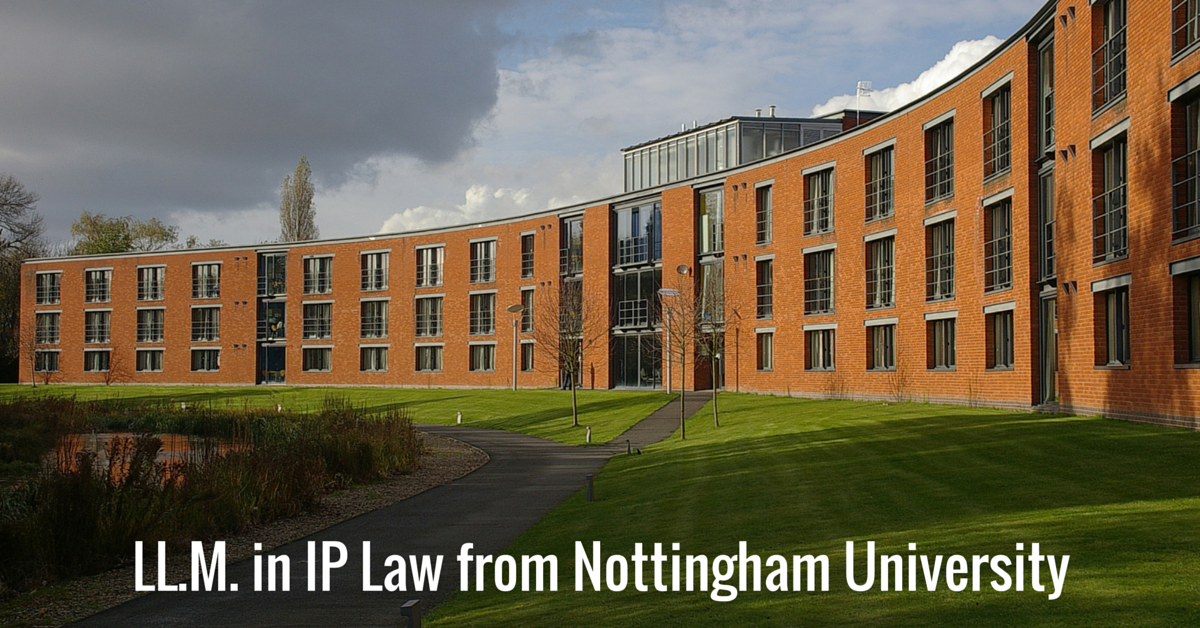
LL.M. in IP Law from Nottingham University

0
LL.M. in IP Law from Nottingham University

Anwesha Pal, who recently finished her LL.M. in IP Laws from Nottingham University shares her experience and some beautiful snaps of the picturesque university. If you are planning to pursue master’s in IP Laws, you would probably consider Nottingham – so read on to learn more!

What was your motivation behind doing LL.M.? When and why did you decide that you need to do master?

I have always wanted to teach and when I realized that teaching law at prestigious institutions is indeed possible, I decided on pursuing Master’s degree in Law. LLM is an academic degree. Therefore, if you are thinking<!–more–> more about having a career in academics, LLM is a must for you. Also, an international exposure could be an added benefit in more ways than one. LLM should be done primarily if you want to study further to increase your knowledge of a particular subject area of your discipline and to move into research and pursue higher research degrees for which Masters would be a pre-requisite. It is not entirely true in the present day job market that only a Master’s degree in law will help you in grabbing high paying jobs.

How did you choose the university? Where else did you apply? How should one go about choosing a university?

To do an LLM, I thought The UK would be best suited to my needs. I was interested in Intellectual Property laws and other commercial laws. I had applied to King’s College London, QMUL, University of Warwick and University of Nottingham. I went through the course structure for each, the faculty concerned with the subjects I chose to study, the place of study and the costs involved.

The university of Nottingham has one of the best faculties for Intellectual property laws in The UK and one of the most intensive courses in Masters of International Commercial Laws. With an amazing library and a brilliant atmosphere for studies and a superbly picturesque campus, every second spent there studying has been worthwhile.

Any interesting details about the course worth sharing?

To start with, our Intellectual property law course instructors were Dr. Estelle Derclaye and Dr. Paul Torremans who are very renowned in their fields. For all the other subjects, the seminars were coupled with lectures from Mahesh Uttamchandani from the World Bank, Pascal Kamina for Intellectual Property law and some other eminent dignitaries.

How was your experience? Tell me about the faculty and facilities. Anything memorable that is stuck in your mind?

Situated 2.5 hours from London, the facilities in and around this University are innumerable. The 24 hour access to all the buildings and the library within the University was very helpful since we had to prepare for the day-to-day seminars on almost all the days and additional research for our papers due at the end of the term.

The faculty was very helpful and understanding. The staffs in the school of law were equally well-informed and organised.

The hand-outs and the manuals were extremely helpful in preparing for the classes and the student’s portal was very well designed to cater to all our research needs. The university of Nottingham has an access to innumerable journals across the globe in almost all the major areas of research and studies. The library is huge and divided into levels. The basement and the ground levels being group study zones designed with brightly coloured walls and brilliantly designed cafeteria and a Starbucks in the corner. The other two levels above it are the silent study zones with inbuilt study carrels that have a plethora of books and journals for almost all the Humanities related subjects.
The University of Nottingham, UK is divided into 4 campuses where the University Park Campus is the one where a school of law is situated amidst beautiful gardens and a lake with swans and lots of greenery. Overall it is an idyllic place for studies. The hopper bus services are very effective which transfer you from one campus to the other for free. These are double-decker buses which run every few minutes.
A funny thing to note here would be that two of University of Nottingham’s campuses had been shown in one of the Bollywood flicks called Teri Meri Kahaani, which some of our European and English professors went to watch too!!

Well, I think one of the best experiences while living in the UK was when I got the opportunity to watch the Olympics (rhythmic gymnastics) in the Wembley Stadium.

How’s the Indian fraternity over there? Are there many Indian students?

The Indian community in the University is not very big. The LLM Class of 2011-12 had around 100 students out of which 25 were Indians and a few Indian origin UK citizens. The Asian community is pretty big there with a lot of students from China, Korea and South East Asia. There are many societies such as the Indian society, the Hindu society, the ISKCON society and so on where you can meet a lot of Indians too who are in various fields of study at Nottingham. These societies make you feel like you are a part of a family away from home and the activities during Holi and Diwaliwere very well organised which a lot of our friends from various cultures and ethnicity apart from the Indians celebrated along with us. There are quite a few excellent Indian restaurants that have all-you-can-eat buffets in store. They are preferred by Indians and non-Indians alike.

How is the recruitment/ placement situation for overseas students?

Ever since the UK did away with the PSW (Post study work visa), the placement situation has not been very encouraging for international students in The UK. However, there are a lot of companies including the banking companies and other organisation that introduce the graduate program each year. One can always apply for the same and get recruited at the end of the training period.</span><span>For students applying to law firms in the UK, I found in addition to the international law firms such as Clifford Chance, Herbert Smith and the likes, there are many ethnic minority law firms which release their training contract schemes and vacation schemes every year. The best place for the information regarding employment opportunities is in the law fairs organised by your Universities.

The University of Nottingham has the reputation of getting the majority of students employed each year, undergraduates and postgraduates alike. </span><span>However, if you are interested in a career in academics, you should keep an eye out for various research associate positions in various Universities in the UK including your own University. The Careers and Employability Services cell of the University of Nottingham were very helpful with such information.

How was the academic schedule? Was there a lot of academic work?

The academic schedule was brilliantly designed, although the courses were very demanding. The course was a mix of the full year and half year options along with a dissertation at the end which summed up to 180 credits overall.The students were at the liberty to choose the subjects </span><span>they wanted to take. The assessments for all the subjects were not the same. For some, 15 page essays had to be submitted, whereas for some there were exams in the end. The majority of the subjects one took decided the specialisation such as Masters in International Commercial Laws, European Laws, Human Rights Laws, Maritime law and so on.

Yes, there was a lot of academic work. For the LLM students, there were 2-hour seminars each day for the subjects one chose. The hand-outs for these seminars were given out and additional reading materials were put on the portals a week in advance. Studying the given topics thoroughly was a must since the seminar could not be followed otherwise and moreover one would not be able to take advantage of the seminars and the discussions in the class, if they were not familiar with the topics. Also, the class performance, which was instrumental in getting recommendations from the professors, was gauged according to one’s participation in the class.

Formative assessments were also very crucial in understanding the expectations of the professors with regards to our assessments. These were not marked and were meant for practice alone. Apart from that, all the professors were very approachable and always ready to help with your doubts.

The accommodation that I had booked before I left for the University was Broadgate Park. It is situated in Beeston that is a 5 minutes’ walk from the School of Law and other administrative buildings. The road leading to the university goes alongside huge playgrounds, a lake with swans and a small hillock paved with neatly trimmed lawns and bushes with concealed lights that give you the feeling of living in a scenic resort.

The experience was a brilliant one. The best part of it was when I was placed in the student’s accommodation with girls from various countries in my flat. I made new friends from various cultures, learnt a lot from them and shared my own too.

With vast green expanses, sunny days were greeted by the students whiling away their time on these lawns, debating over issues of politics over barbeques during the summer break, playing games and flying kites.

Broadgate Park also organises balls every half a year. The Christmas ball is an extravagant affair with European expert acrobats performing difficult acts followed by prom dances by the guests later on in the night.
The accommodation that I chose was that of a single study, although there is a wide variety of accommodations that one can choose from, including monetarily cheaper options.
The flat that I was allotted had flatmates from Canada, Uganda and China. I found really good friends in them. They were very accommodating and immensely helpful. Exploring Nottingham with them was an experience I would never forget. Social get-togethers with classmates were another highlight that was a very culturally enriching experience. I encourage the students going abroad to take advantage of the international experience as a whole and not limit their world to studies alone.
The accommodation also organises feasts on various occasions for free for the residing students. At such events, one can get sumptuous grub, cultural exchange and make new friends.
Nottingham is a beautiful town that hosts one of the biggest fairs in Europe which is called the Goose fair. The largest Indonesian festival in the UK was held here as well. It is the land of Robinhood and his friends and you can even find the roads of the town named after them such as the Maid Marian Way, Friar Tuck lane and so on.

Tell us about your classmates – was there a predominantly international crowd? What was the general age group of students?

My classmates were predominantly European and Chinese students. However, there was an eclectic mix of students from the Continent of Africa and other Asian countries. The style adopted in their countries regarding research and studying case laws is very different from the ones adopted in India. The way of teaching was mostly in the form of discussion and reading beyond what was enlisted in the seminar handouts.
The general age of students varied from 24 to 40 years. I met students from Pakistan and Africa who were in their 40s and were either already teaching at various institutions in their countries or working at solicitor firms or were Barristers in London. There was even a student from the Czech Republic who was in his mid-thirties and had been working at Clifford Chance for a few years. Some of them were working in Government organisations in their countries.

Did you get time for any extra-curricular activities?

The course had been designed very beautifully that it even left quite some time for pursuing activities other than the one that were related to academics. During the summers when the lake was not frozen, one could participate in rowing activities around the lake or join the swimming club or the belly dancing societies to learn something new. There are several student-run activities for the health conscious too. Also, one could even join the baking club to learn baking or help with the charity functions. There was even a Quidditch society for the Harry Potter buffs. There were societies that enacted the period wars and wore costumes to look more convincing.

For those who were passionate about volunteering, there were charities that needed volunteers to work at the local departmental stores and places like the British Heart Foundation and Cancer Research Institutions to help raise money.

However for people who wanted to earn some extra bucks during the breaks, Nottingham being a University town was full of opportunities for students to work in. The ones offered by the University was the Note-taking services and other related support work for the disabled or the less abled students in the University. The pay was very attractive with almost 16 to 20 pounds per hour with an extra holiday pay. Jobs offered by the University were by far more lucrative than any other jobs that were being offered by other organisations.

How does one go about scholarships? Does the institute offer any scholarship?

There are many scholarships on offer such as the Commonwealth Shared Scholarship Scheme, The Developing Solutions Masters Scholarship, IELTS Scholarships, Charles Wallace India trust Scholarship, Aga Khan foundation Scholarships, Goa Education Trust (GET) Scholarships, Chevening Scholarship and so on. The detailed information is given on the University’s website. The University does offer a scholarship. This scholarship is given by the International Office of the University. The same has been provided on the website.

What are your future plans? Going forward, how do you expect this experience to influence your career?

My plan at the moment is to focus on my academic career and move ahead with it. I believe the experience that I have had at Nottingham coupled with my under-graduation from NUJS would be a stepping stone to an academic career that I have always dreamt of. I hope to find better opportunities for my higher research degrees with my experience in Nottingham.

Download Now

What’s Your Job Profile? An Entrepreneur’s Mantra

0
What’s Your Job Profile? An Entrepreneur’s Mantra

It’s my job to take up challenges that others don’t take up,
It’s my job to solve problems that others can’t solve,
It’s part of my job to get criticized,
It’s part of my day to get torn apart,
It’s part of my job to collect myself,
It’s part of my job to fail,
It’s not my job to give up.

Download Now

Why Business Law and Our Experimental Workshop In Goa

0
Why Business Law and Our Experimental Workshop In Goa

We want to do loads of workshops in Goa. Republished from A First Taste of Law archives.

So as you probably know – I and Abhyudaya (my co-founder at iPleaders) have quit our law firm jobs and have been developing a business law course instead. Why? Why now? The answers to these questions we have no choice but to share.

Is it necessary to know the business law at all?

Everyone knows some law. In fact, knowing the law is a prerequisite to living in society.

You need to know some law if you want to do business. You know the standard practices – you have to learn them right at the beginning. Talk to older people, who are into a particular trade or sophisticated profession for many years, and you’ll see they know the laws, rules and government policies that apply in their domain better than any lawyer.

When a business is small, knowing the law and running the business according to law is often optional, especially in India where law enforcement is not very stringent. Very small businesses remain out of the radar of law enforcement agencies – and implications of the violation of law are small and manageable.

However, as the business scales up, violations can be expensive for everyone – there can be huge fines, the risk of imprisonment for promoters and investors not to speak of negative publicity. All these can result in huge losses for the business, and for society – in the loss of a useful product or service.

You do not want your startup to face this eventuality– especially when it is so easy for you to learn the practical aspects of the law.

Navigating the great Indian Legal Jungle

It is not an easy task to unravel the mysteries of Indian law – there are thousands of statutes, tens of thousands of rules, regulations and government policies. The majority of these laws are made for businesses – different sectors, businesses of different sizes, different businesses based on activities, investments, manpower, resource consumption or geographic location are treated differently. The body of Indian laws is humongous and very complex.

Apart from complexity, lack of access is a big issue with legal resources. Laws are almost invariably written in complex language, and difficult to find. Despite internet growing at an exponential speed, organized legal knowledge available on the internet that is aimed at non-lawyers is negligible. There are hardly any legal books published for non-lawyers. There is pretty much only one way to learn the relevant laws in an industry – through years of experience of being in that industry and seeing the law in action.

As a result of this, legal knowledge and good legal service is valued extremely highly in India – which means a good corporate lawyer can command very high fees. It is extremely difficult for startups in the early phase to hire a good lawyer due to high costs and relatively low numbers of corporate lawyers.

If, as an entrepreneur, you think about the law only when you are in trouble, you are not adopting an optimal strategy for your business.

Even when an entrepreneur approaches a lawyer, he does so either because he is already in trouble with legal authorities or a counterparty in a contract, or because he wants a contract drafted. That means he loses out on legal insights in taking a day to day business decisions and fails to identify or address a preventable legal risk.
On the other hand, in a startup, day-to-day application of the law, or legal compliance requirements can be quite simple, and can be picked up by pretty much anyone who has a willingness to learn. If given access to good learning resources, he can learn the basic concepts of law and practical application skills, which makes the involvement of a lawyer mostly redundant. This applies equally to managers who take decisions – and knowing the practical law is a great way to distinguish one’s profile from that of other managers.

Why should educational institutions/ students be interested in a diploma course at this point of time?

1. Startups create new products and services, employment opportunities for the larger population and can thus fuel economic growth. Indian entrepreneurs are making waves globally. Today, startup and angel networks have matured, and early stage entrepreneurs/ student entrepreneurs are willing to mentor, guide and support them. This creates a conducive ecosystem for startups today.


“India’s high rate of economic growth can only be sustained if approximately 1 million jobs are created per month. If India can, in the next decade, provide its next generation with the education and training for entrepreneurial ventures, it will not only create the jobs necessary to stay on a growth trajectory, it will foster more start-ups, accelerate growth, and spawn creative industries for the benefit of millions, including many residing outside India.


There is now an established pipeline of student entrepreneurs, with a community ready to create and support them—something that has never before existed in India.”


See Centre for Strategic and International Studies article on Entrepreneurship in India: The Next Wave, Vol 1, Issue 9, 14 December 2011


2. Venture capital investments are on the rise, and venture capital has been the preferred route for investing for risk capital, as early-stage entrepreneurs come up with more path-breaking ideas, compared to private equity. It is much easier to obtain funding for ideas now than before.


“Investment in start-ups and early-stage companies totalled just $300 million in 2010. But last year, it expanded more than four-fold, making up $1.2 billion of the $9.3 billion in total risk capital.” See Economic Times story: “Venture capital beats private equity as Indian start-ups attract millions of dollars in funding”, 8 February 2012


Experimental workshop in Goa

As an experiment, we conducted a workshop on the “Startup Founder’s Guide to Business Law and not paying Lawyers” (which was a crash course version of the diploma) for students of BITS, Goa. Here’s what they said:

“Damn good! Very informative” – Anirudh, student, BITS Pilani (Goa campus)

“Course was extremely useful, but time was a constraint.” – Rathin Shah, student, BITS Pilani (Goa campus)

“This workshop is definitely enlightening. I don’t claim I understand everything, but surely it increased my interest in business.” – Mihir Kakrambe, student, BITS Pilani (Goa campus)

“OMG! You finally got good lectures who did a decent job. This workshop was better than others at BITS Pilani Goa Campus.” – Abhinav Motheram student, BITS Pilani (Goa campus)

Download Now

Overconfident? So what? Analyzing Overconfidence

0
Overconfident? So what? Analyzing Overconfidence


What is over-confidence?

Since a lot of people since my childhood have often accused me of overconfidence, I thought it is high time to do some research on it.

Is there really something called over-confidence? The dictionary says that it is more confidence than a situation warrants. Well, that’s pretty straight forward.

However, we all have different interpretations and outlooks about every single situation. For a lot of people, the economy is bad – especially the laid off workers may think doomsday is approaching. The entrepreneur who is getting to hire people for less salary wouldn’t think so. Have you heard of recession baby start-ups? Google was one of them.

Anyway – I started with one simple question. Is over-confidence a real thing? Or is it that we call someone over-confident if the there outlook of a situation is more positive than ours? In that case, over-confidence simply being relative to someone else’s outlook, over-confidence becomes someone else’s problem rather than my own personality flaw.

The social overconfidence

There’s another way to look at over-confidence. Very often people complain that someone is being over-confident when the person seems to assume or claim a position of superiority that we are not comfortable in conceding to them. Some people are socially confident, which some other people can find threatening or inexplicable. Well, why is he acting so cool – who does he think he is? This is just over-confidence!

Is it just optimism?

As I hang out with more entrepreneurs, I come across more guys who will be easily classified as over-confident by most. What kind of people will quit their jobs, spend their last bit of savings while they work long hours for free, trying to make their idea come real and build a big business with the meagre resources that most start-ups start with? However, while the rest of the world finds the confidence mysterious, the entrepreneur usually knows exactly what he is doing, why he is the right person to do it and why it would work. He does not the whole story and figures out a lot of things along the way, but he knows a lot more than the outsiders. What is over-confidence to a lot of people, is just know how for him.

I didn’t leave the geyser on! type of confidence.

I exclude from the scope of over-confidence mere behaviors which are geared towards compensating lack of evidence. Who left the geyser on in the toilet? I didn’t do it, very sure. 100% sure.

Well, information like this is not always possible to remember correctly, and impossible to verify due to lack of evidence. A lot of people try to overcome such a situation through a show of confidence to support their statement in the absence of any evidence they can rely on. The confidence is needed to convince the audience, although it is often baseless. This is not really confidence; this is more like fake confidence being projected to achieve an end. I would like to exclude this from the scope of this discussion to keep things simple.

What the NLP teacher told me about over-confidence and belief systems

I learned about a different genre of over-confidence altogether when I came across a great NLP and creativity trainer – he taught me the importance of belief systems in performance and success. Even if it is over-confidence by standards of other people, it helps to hold on to unrealistic levels of confidence and optimism. In fact, he showed me how a lot of extremely successful personalities simply live in an alternative reality – a reality they have tweaked to create high level of confidence, which allows them to target the highest, very ambitious goals. It helps them to work harder at those goals than everyone else thinks is prudent, and helps them to overcome the failures and rejections that come their way much more frequently than others due to their chosen path. I have noticed this trait in many entrepreneurs too.

Over-confidence and social status

A study also shows that “over-confidence” helps people to reach high social status. That’s barely surprising – in the world full of confused people without perspectives but great things to achieve – other people rally behind those who have strong belief systems and lend the belief system to others. There is a great risk of this being misused, and in history many over-confident men and women have misused this power. In a world threatened by information overload, we are looking for people with perspective, leaders who can put things in context, those who we can trust more than ever. If they do not show extraordinary confidence in what they say and do, will we really believe them?

Over-confidence in psychology – the Overconfidence Effect

In the study of psychology, there is a well-established bias – called the overconfidence effect. This says that when confidence is high, people tend to believe that their decisions or judgments are much more accurate than the actual average accuracy.
Read these specific quotes of some psychologists:

“People are overconfident. Psychologists have determined that overconfidence causes people to overestimate their knowledge, underestimate risks and exaggerate their ability to control events. Does overconfidence occur in investment decision making? Security selection is a difficult task. It is precisely this type of task at which people exhibit the greatest overconfidence.” – Nofsinger (2001)

  •  “Overconfidence is greatest when accuracy is near chance levels
  • Overconfidence diminishes as accuracy increases from 50 to 80 percent, and once accuracy exceeds 80 percent, people often become underconfident. In other words, the gap between accuracy and confidence is smallest when accuracy is around 80 percent, and it grows larger as accuracy departs from this level.
  •  Discrepancies between accuracy and confidence are not related to a decision maker’s intelligence.” – Plous (1993)

Takeaways

So do we live our lives afraid of the over-confidence effect? I have a few action points:
What people do not know they will often write off as over-confidence – no need to pay attention when you are actually engaging in information arbitrage.

Over-confidence can be good and very beneficial. We need strong belief systems to survive the wear and tear of the difficult paths that we choose. We certainly need conviction to lead.

Over-confidence can be detrimental to decision making. However, being decisive is important too – and taking a decision in an under-confident manner is worse than being over-confident. How do we factor in and counter-act the overconfidence effect then? Keep safety nets as a matter of practice whenever possible but be fully confident in what you are doing at the moment. Once started on a path, go full throttle. Build in safety mechanism before that, not after you start the work.

It’s easy to say – but I know how many times I have to venture out without those safety gears. I know some of them will pay off, others will go bad. This has been story of my life so far. It is important to survive – we get another shot if we are alive and still optimistic.
Let’s not gamble, but it’s not good to let the opportunities pass by either. How do you tell the difference?

It’s quite a paradox. If you have something to shed light on, please do so in the comments.


Download Now

How to Not Turn Your Kickass Internship Into Got-kicked-in-ass internship

0
How to Not Turn Your Kickass Internship Into Got-kicked-in-ass internship

Internship-

I believe gives you the opportunity to learn new stuff, meet new people, explore new places. Many a times such internship converts into PRO, Call Back or some wonderful contacts that you can use later. However, many a times we end up messing it up maybe because we are not aware of the work culture or some stupid mistake on our part. How do you avoid screwing it up?

1. Listen-

Be all ears. Listen to every word that is being spoken to you. People who are assigning jobs to you are as sure as hell busy. They don’t want to waste their time in repeating what they are saying because<!–more–> you are not paying attention. If you miss something important they told you, you are surely going to screw up the work given to you. The person who assigned you the work will hate you for that.

Audrey McLaughlin said, “When you listen, it’s amazing what you can learn. When you act on what you’ve learned, it’s amazing what you can change.” Listening carefully would certainly “change” the quality of the work you do.

2. Cling to a Pen and a Notebook-

Pair up your ears with a pen and a notebook. Write everything you hear. It not only avoids annoying your boss by going to her again for the points you missed or forgot but will help a lot when you start working. An intern who carries a pen and a notebook with her is way more trustworthy than one who brings just herself.

3. When Confused, Ask-

If there is something you didn’t understand- don’t hesitate in asking a question. It’s better to ask for a clarification than to commit an error. Generally, when you are assigned any work- you are working under a time constraint. you can’t afford to mess up your work by assuming things or misinterpreting the instruction given and then enter into a time crisis.

5. Clarify and ask-

these are the golden rules to follow in case of any sort of confusion.

6. Show your Curiosity-

Showcase your curiosity to learn stuff, volunteer where there is such opportunity. Show that you are mentally present and loving it.

7. There is no getting away with things-

Nobody cuts you slack in an internship- even if they do, assume that they don’t- as it leaves a bad impression in either case. Don’t think- you can get away with coming late to the office, facebooking when you are supposed to work- and all the other techniques you plan to adopt in order to dodge the work. Making a puppy face may save you from scolding, but will certainly not save your professional reputation.<

8. Smile like Sun Shine-

Don’t try a poker face. The expressionless face is simply annoying. Also don’t try lost puppy face, nobody is interested in knowing the story behind your long lost face, even if it resembles the story of Marlyn Monroe. Just Smile. Be positive. There is nothing more to it.

9. Be at Ease-

You should be friendly, sweet and nice. I know it is easy to say but when you are tensed, out of place or under-confident – your work and your relationships at the workplace suffers. You have to gather yourself and portray a picture of happy + confident you. Try to get over the influence the place has on you. Start with the basic principle of smiling, and being at ease.

10. Distinguish between polite- friendly/ hey-I’m-your-buddy-friendly/ I’ll-lick-your-feet-friendly-

Now once you are at ease with yourself, don’t go over the board. Don’t entertain the idea of sucking up to someone, you might think that by being extra super sweet, you will earn some brownie points but as a matter of fact, you earn an impression of being a total cling-on case. At the same time, don’t let the idea of being pally take over you. Just because you don’t need to be a neurotic edge intern, you are not going to treat your boss like your best friend.

The idea is that you don’t need to make your boss the next superman (don’t suck up) or your best friend, an angel in disguise. Be polite and friendly but remember that she is your boss. There is a very thin line between all the three attitude you might exude in your behaviour, learn to distinguish and follow the right course.

11. Branch Out/ Network-

The internship offers an excellent opportunity to meet new people, make “contacts”- something much sought after in law school. Build a good rapport with your colleagues, boss- good enough to contact them when you need any help. Don’t forget to keep in touch.

Hope this post was helpful. Feel free to share your internship experiences in the form of comments below.

Download Now

Is an LLM from Oxford helpful for a career in litigation?

0
Is an LLM from Oxford helpful for a career in litigation?

Roshan Santhalia graduated from NALSAR University in 2011 and pursued an LLM (MSc.) in criminal law at Oxford University immediately afterward. He is currently a litigator based in Delhi, and primary practices at the trial courts and the Delhi High Court.

What was your motivation behind doing LL.M.? When did you finally decide that you need to do master?

I have always wanted to litigate in the courts right from the beginning of law school. My primary and predominant motivation for pursuing an L.L.M. was to improve my capabilities as a litigating lawyer. Moreover, I have always believed that as a first generation lawyer the brand of a big University L.L.M. shall help me build my litigation practice. As of now the plan seems to be working. It was by the end of the second year in law school that I had made up my mind that I am going to take up an L.L.M. after my first law degree.
Roshan at District Courts Complex, Saket

How did you choose the university/ college? How should one go about choosing a university?

I believe that choosing the right university for your LLM is extremely important. I have always advised my juniors to not apply to Universities which are average or below average. With the upsurge in the global education market, there have been numerous universities which have come up with their LLM programs. It is important that every LLM aspirant emphasizes on two aspects of the LLM program. These are the overall brand reputation of the University and the quality of the faculty in the area of the specialization of the LLM aspirant. For instance, an aspirant might want to go to Oxford because of the brand name it has, but, if he/ she wants to specialize in IPR laws then Berkeley or Stanford are much better options. The right balance needs to be struck between these two factors and an ideal combination would be one in which the target University has a good brand name along with having a good faculty in the area of the desired specialization of the aspirant.

What did you study? Why did you decide to take this particular subject?

I took up Criminal Justice at Oxford because I have always wanted to practice criminal law. All throughout my law school career, I have devoted a major portion of education and learning in the field of criminal law. I believe that every aspirant should first locate his or her lead in a particular area of law. An area which interests the aspirant much more than other areas of law and other similar factors should be taken into consideration. It is important that by the end of the first half of one`s law school career, he/ she should decide his/ her lead area so that he/ she can concentrate and build his/ her CV accordingly.

How is your experience so far? Tell us about the faculty and facilities. Anything memorable that is stuck in your mind?

It’s been about 6 months since I completed my Masters. I would say that my experience as a Masters student was a bit unbalanced. The academic side of my entire experience took away all the time in which I should have probably socialized and done other extracurricular activities in and around the town in which I was living. I was very lucky to be a part of the class to which luminaries like Professor Andrew Ashworth and Professor Lucia Zedner taught. One does not need to worry about the faculty if he/ she is going to renowned Universities. Professors abroad are extremely Professional and diligent. They would never ever give you an opportunity to be critical of them in any form or manner.

How’s the Indian fraternity over there? Are there many Indian students?

Indians are everywhere, isn’t it? I believe that all the good LLM schools across the world have excellent Indian fraternity. We have done very well across different disciplines and therefore, one will never find any dearth of friendly and helpful Indian students in any University. Not to forget, the sons and daughters of Indians who have settled abroad also form a substantial portion of the Indian fraternity abroad.

How is the recruitment/ placement situation for overseas students?

Pre-recession times, I hear that the placement rate for overseas students was good. Contemporary times, I believe that it has become very difficult for anyone who does an international LLM to get a job in the international markets. One needs to be appreciated that LLM is a masters degree and therefore, it is more analytical, jurisprudential and theoretical in nature. As compared to this, the JD`s and other undergraduate equivalents in foreign law schools teach the practical aspects of the local laws to their students. Therefore, the undergraduate students always have a better bet with the local jobs of that particular jurisdiction. Having said this, I must say that exceptional candidates who do very well in their LLM programs do end up getting good jobs too.

How is the academic schedule? Is there a lot of academic work?

Yes. A lot of academic work. LLM programs across the globe are designed in a manner that huge amount of course content can be compressed in one single year. As I have answered before, a major portion of my time which should have been spent discovering other things around Oxford was taken up by the excessive academic pressure which was exerted by the LLM course on me. One should be mentally prepared for a lot of academic reading during the course of their LLM program.

What about accommodation? Share some photographs of your hostel and campus!

Accommodation varies from University to University. Oxford and Cambridge have a collegiate system which means that every student will be allotted a college which shall essentially take care of the residence and food for that student. US universities, I have heard has halls of residence within their faculty of law or very near to it.

Tell us about your classmates – is there a predominantly international crowd? what is the general age group of students?

My class had students from all over the world. I had classmates from all the seven continents. The general age group of students is anything between 24 – 30. However, there are certain students who are also more than 30-year-old.

How does one go about scholarships? Does the institute offer any scholarship?

Comprehensive scholarships to high quality law schools are very difficult to get. Again the mode of scholarship and the way in which one can get it varies from one law school to the other. The US and UK employ different mechanisms to provide academic scholarship to deserving candidates. One needs to do his/ her research very well to apply for all the appropriate scholarships. You can either get a full scholarship or tuition fees waiver depending on your class rank in the undergraduate law school and the interview which you give to the scholarship committee.

Going forward, how do you expect this experience to influence your career?

I believe that every LLM has two major components to it. One is the substantive component of the course which basically relates to the substantive law and theories which you have gained from your LLM course. The other component is the improvement in your capabilities to analyze, think, draft etc. on different legal issues. I believe that my higher education experience has added much more to the second component as mentioned above than the first. The first component is primarily municipal/ local in nature as the theories and substantive law which one learns in his/ her Masters can be most related to that particular jurisdiction in which the law school is located. In contrast to this, skills of analysis, drafting and how to critically develop a perspective on any particular area of law are skills which are universally applicable in all different fields and sectors of law.

Download Now
logo
FREE & ONLINE 3-Day Bootcamp (LIVE only) on

How Can Experienced Professionals Become Independent Directors

calender
28th, 29th Mar, 2026, 2 - 5pm (IST) &
30th Mar, 2026, 7 - 10pm (IST).
Bootcamp starting in
Days
HRS
MIN
SEC
Abhyuday AgarwalCOO & CO-Founder, LawSikho

Register now

Abhyuday AgarwalCOO & CO-Founder, LawSikho