

In this blog post, Shruti Sharma, a Legal Associate at BetterPlace Safety Solutions Pvt. Ltd. who is currently pursuing a Diploma in Entrepreneurship Administration and Business Laws from NUJS, Kolkata, describes the process for transfer of shares.


In this blog post, Shruti Sharma, a Legal Associate at BetterPlace Safety Solutions Pvt. Ltd. who is currently pursuing a Diploma in Entrepreneurship Administration and Business Laws from NUJS, Kolkata, describes the process for transfer of shares.
In this blog post, Kaushik Neogi, a student pursuing his LL.B (4th year) from Delhi Metropolitan Education, affiliated to Guru Gobind Singh Indraprastha University and a Diploma in Entrepreneurship Administration and Business Laws from NUJS, gives a detailed analysis of the applicability of the GST Act, 2016 and the GST Valuation Rules, 2016.

The GST regime is the Indian government’s initiative to check and curtail the existing tax system of indirect taxes in India. Currently, the indirect taxes imposed in India are on goods and services, some levied by the Centre and some by the States.
The GST regime intends to classify most indirect taxes under a single taxation regime. GST is a value added tax levied on goods and services. The implementation of GST is aimed to increase tax compliance, broaden the tax base and to avoid leakages and distortions due to inter-state tax variations.[2]
The Finance Ministry in June 2016 released the Model GST Law[3] under which the following were released-
Goods and Services Tax Act, 2016, The Integrated Goods and Services Tax Act, 2016 & GST Valuation (Determination of the Value of Supply of Goods and Services) Rules, 2016.
 Extent and Applicability:
Section 1 provides for the Short title, extent, and commencement, as per 1(2) the Act will extend to the whole of India, meaning this tax regime for Indirect taxes will be applicable in the State of Jammu and Kashmir too.
This is the first time when an indirect tax law has been uniformly made applicable to the state of Jammu and Kashmir along with the rest of India.
| Composite supply | Section 2(27) |
o two or more goods; provided in the course or furtherance of business, whether or not the same can be segregated.” |
| Continuous supply of goods | Section 2(30) |
|
| Continuous supply of services | Section 2(31) |
|
| Input service | Section 2(54) |
|
| Input | Section 2(55) |
|
| Input Service Distributor | Section 2(56) |
|
| Input tax | Section 2(57) |
|
| Output tax | Section 2(72) |
|
| services | Section 2(88) |
|
Section 3 of the Act provides for the meaning and scope of supply.
As per 3(1) Supply includes:
made or agreed to be made for consideration by a person in the course or furtherance of business;
| SCHEDULE I
MATTERS TO BE TREATED AS SUPPLY WITHOUT CONSIDERATION |
|
When there is Permanent disposal or transfer of business assets. |
| When the business assets are Temporarily applied for a private or non-business use. |
| When Services are put to a non-business or private use. |
| When Assets are retained after the registration. |
| When there is a supply of services and goods by one taxable person to another taxable/nontaxable person in the course or furtherance of business.
Note* supply of goods by a registered taxable person to a job-worker in terms of section 43A shall not be treated as a supply of goods. |
3(2) provides that the matters mentioned in Schedule II shall apply for determining what is, or is to be treated as a supply of goods or a supply of services.
| SCHEDULE II
MATTERS TO BE TREATED AS SUPPLY OF GOODS OR SERVICES |
|
| Transfer
|
§ transfer of goods or § of an undivided share in goods or § of right in goods
|
| Land and Building |
§ Tenancy; § easement; § lease; or § license
|
| Treatment or process | Any treatment or process which is being applied to another person’s goods is a supply of services.
|
| Transfer of business assets |
|
| The following shall be treated as “supply of service.”
|
|
| The following shall be treated as supply of goods | Supply of goods by any unincorporated association or body of persons to a member thereof for cash deferred payment or other valuable consideration. |
According to 3(2A) a person acting as an agent who, for an agreed commission or brokerage, either supplies or receives any goods and services on behalf of any principal, such transaction shall be deemed to be a supply.
3(3) provides that Subject to sub-section (2), the Central or a State Government may, upon recommendation of the Council, specify, by notification, the transactions that are to be treated as—
3(4)provides that not contrary to anything contained in sub-section (1), the supply of any branded service by an aggregator, as defined in section 43B, under a brand name or trade name owned by him shall be deemed to be a supply of the said service by the said aggregator.

Section 7 of the Act provides for levy and Collection of Central/State Goods and Services Tax on all intra-State supplies of goods and services at the rate to be specified later, and 7(2) provides that every taxable person shall pay the tax as per the provisions of the Act.
7(3) provides for the provision of reverse charge on certain categories of goods and services to be specified, where the tax shall be payable by the person receiving such mentioned goods and services.
Section 8 of the Act Provides for compounded Levy. Under which the Central or State government may permit a registered taxable person whose turnover in a financial year does not exceed 50 lacs of rupees, to pay, in lieu of the tax payable by him, an amount calculated at such rate, not less than 1%, of the turnover during the year.
Section 9 of the Act defines a taxable person as a person who carries on any business at any place in India and who is registered or required to be registered under Schedule III of this Act for payment of tax.
| SCHEDULE III Person to be registered under paragraph 1. |
|
Every supplier is to be registered in the State from where he makes the supply of goods and services. Where the aggregate turnover in a financial year of the supplier does exceed Rs. 9 lakh. |
9(3) provides for the persons who are not to be considered as taxable persons under the act being-
Under the provisions of Section 10 if the Central or a State Government is satisfied that it is necessary for the public interest, have the power to grant exemption from tax following certain recommendations and procedures. Section 11 provides for remission of tax on supplies found deficient in quantity.
Section 12 provides for time of supply of goods. The main provisions of this section are explained in the table below-
| 12(2) | The time of supply of goods shall be the earliest of |
|
| 12(3) | In case of continuous supply of goods |
|
The date of receipt of payment, whichever is earlier, shall be the time of supply. 12(5)
In case of supplies in respect of which tax is paid or liable to be paid on reverse charge basis, the time of supply shall be the earliest of:
If the goods (being sent or taken on approval or sale or return or similar terms) are removed before it is known whether supply will take place, the time of supply shall be
Section 13 provides for time of supply of services. The main provisions of this section are explained in the table below-
| 13(2) | The time of supply of services shall be |
|
| 13(3) | In case of continuous supply of services, the time of supply shall be |
|
| 13(5) | In case of supplies in respect of which tax is paid or liable to be paid on reverse charge basis, the time of supply shall be the earliest of |
|
| 13(6) |
|
|
Section 14 provides for Change in rate of tax in respect of the supply of services. The main provisions of this section are explained in the table below-
| 14(1) | Not contrary to anything contained in section 13 | The time of supply, in cases where there is a change in the effective rate of tax in respect of services, shall be determined in the following manner, namely- In case the taxable service has been provided before the change in effective rate of tax –
In case the taxable service has been provided after the change in effective rate of tax-
|
For the purpose of this section, “the date of receipt of payment” shall be the date on which the payment is entered in the books of accounts of the supplier or the date on which the payment is credited to his bank account, whichever is earlier:
Provided that the date of receipt of payment shall be the date of credit in the bank account when such credit in the bank account is after 4 working days from the date of change in the effective rate of tax.
Section 15 provides for the Value of taxable supply. Under the provisions of this Section-
| 15(1) | The value of a supply of goods and/or services shall be the transaction value that |
“Is the payable or price paid for the said supply of services and/or goods where the price is the sole consideration for the supply and the supplier, and the recipient of the supply is not related.” |
| 15(2) | The transaction value under sub-section (1) shall include | § “Any amount that the supplier is liable to pay in relation to such supply but which has been incurred by the recipient of the supply and not included in the price actually paid or payable for the goods and/or services”; § “The value, apportioned as appropriate, of such goods and/or services as are supplied directly or indirectly by the recipient of the supply free of charge or at reduced cost for use in connection with the supply of goods and/or services being valued, to the extent that such value has not been included in the price actually paid or payable”; § “Royalties and license fees related to the supply of goods and/or services being valued that the recipient of supply must pay, either directly or indirectly, as a condition of the said supply, to the extent that such royalties and fees are not included in the price paid or payable”; § “Any taxes, duties, fees and charges levied under any statute other than the SGST Act or the CGST Act or the IGST Act”; § “Incidental expenses, such as, commission and packing, charged by the supplier to the recipient of a supply, including any amount charged for anything done by the supplier in respect of the supply of goods and/or services at the time of, or before delivery of the goods or, as the case may be, supply of the services”; § “Subsidies provided in any form or manner, linked to the supply”; § “Any reimbursable expenditure or cost incurred by or on behalf of the supplier and charged in relation to the supply of goods and/or services”; § “Any discount or incentive that may be allowed after the supply has been affected: Provided that such post-supply discount which is established as per the agreement and is known at or before the time of supply and specifically linked to relevant invoices shall not be included in the transaction value.” |
| 15(3) | The transaction value under sub-section (1) shall not include | “Any discount allowed before or at the time of supply provided such discount is allowed in the course of normal trade practice and has been duly recorded in the invoice issued in respect of the supply.” |
| 15(4) | The value of the supply of goods and/or services in the following situations which cannot be valued under sub-section (1) | “Shall be determined in such manner as may be prescribed in the rules.
|
| goods of like kind and quality | “Means goods which are identical or similar in physical characteristics, quality and reputation as the goods being valued, and perform the same functions or are commercially interchangeable with the goods being valued and supplied by the same person or by a different person.” |
| services of like kind and quality | “Means services which are identical or similar in nature, quality and reputation as the services being valued and supplied by the same person or by a different person.” |
| transaction value | “Means the value of goods and/or services within the meaning of section 15 of the CGST Act.” |
Rule 3 Provides for methods of determination of value. Under this Rule-
Rule 4 provides for determination of the value of supply by comparison. Under this rule-
Rule 5 provides for computed value method. Under this rule-
Rule 6 provides for the residual method. Under this rule-
Rule 7 provides for rejection of declared value and Rule 8 provides for valuation in certain cases.
 Conclusion
The provisions discussed in this post are covering the main aspects of the model law relating to definitions, taxability, and supply. The model law apart from these subjects provides for the procedures relating to assessment, audit, registration and various other guidelines. Along with provisions relating to input credit available to the taxpayers, offenses under the Act and transitional provisions provide for a smooth and hassle free implementation of this new tax regime.
Footnotes:
[1]http://www.prsindia.org/uploads/media/Constitution%20122nd/Brief–%20GST,%202014.pdf
[2]http://finmin.nic.in/workingpaper/gst%20reforms%20and%20intergovernmental%20considerations%20in%20india.pdf
[3]http://www.cbec.gov.in/htdocs-cbec/gst
[4]http://www.cbec.gov.in/resources//htdocs-cbec/deptt_offcr/model-gst-law.pdf
[5]http://www.cbec.gov.in/resources//htdocs-cbec/deptt_offcr/model-gst-law.pdf

In this blog post, Yashika Joshi, who is currently pursuing a Diploma in Entrepreneurship Administration and Business Laws from NUJS, Kolkata, writes a detained note on licenses issued by copyright owners.

A license is the transfer of interest in copyright. In a license, the right to use a copyright is given to another party with some restrictions on such usage. A license can grant the right in the copyright of work which is already in existence or copyright in some future work which is yet to come in existence. A licensee can use the copyrighted work without any claim of infringement or unauthorized use being brought by the owner of the copyright against the licensee.
A license agreement should contain the following details in order to be enforced:
The license should be in writing and should be duly signed by the owner of the copyright or his duly authorized agent. Details about the present or future copyright work where the licensee of a future work dies before such work comes into existence then his legal representatives will be entitled to the benefit of the license, provided there is nothing contrary to it.

A license can be of two types:
Voluntary license is covered under Section 30 of Indian Copyright Act, which defines voluntary licensing as:
The owner of copyright in any existing work or the prospective owner of copyright in any future work may grant any interest in the right by license in writing signed by him or by duly authorized agent.
Therefore, the owner of the copyright of an existing work or a prospective owner of a future copyright can grant an interest in the right by way of license, in a case of the copyright of a future work the license will come in force only when the work comes into existence.
A compulsory license is covered under Section 31 of Indian Copyright Act. It is a term used for the statutory license which gives an exclusive right to do an act without the prior permission of the owner of the copyright. Section 31 provides for compulsory licensing of copyrighted work which is withheld from the public.
In case a copyright owner has refused to:
The copyright board, can after providing a reasonable opportunity to the copyright owner to be heard, subsequently conducting an investigation and being satisfied, may order the Registrar of Copyrights to issue a compulsory license to the complainant so that he can republish the work, broadcast or communicate the work to the public, etc.
The primary objective of compulsory licensing is to make available the copyrighted work to the general public. The copyrights give protection to the work of writers, artists, etc. so that they can benefit from the results of their hard work and creativity. However, such work should be available to the people for access. Sometimes, the owners of copyright are not willing to part from their work so in such a case, in order to make the work available to the people, compulsory licenses are granted by the Registrar of Copyrights.

An exclusive license means a license which confers on the licensee or the licensee and the person authorized by him to the exclusion of all other persons (including the owner of the copyright), any right comprised in the copyright in work. An exclusive licensee is one who has got such a right [Sec 2(j)].
In the non-exclusive license, the owner of the copyright is not deprived of his right to grant a license to persons other than the licensee. He may use the copyright himself as well.
The license can be for an indefinite period or limited to a definite period. In case the license is to publish a literary or some other work, then the publisher cannot be restrained from selling the unsold copies published in the license period after the expiry of that period. This is subject to any agreement to the contrary.
There can be an implied license, i.e., licenses can be implied by the circumstances or by a course of conduct. If a person sends a letter to the editor of newspaper or magazine, then it is implied that the editor has the right to publish it as well. This might be subject to any royalty payment.
If the licensee does not exercise the right granted to him in the license deed within one year, then the license with respect to such right will be deemed to be lapsed after the expiry of one year unless otherwise specified in the license deed.
If the period of the license is not mentioned in the deed, then it will be deemed to be for five years.

In the case of any dispute between the licensor and licensee, the aggrieved party can file a complaint with the Copyright Board, which will hold an inquiry and pass suitable orders which may include an order for any royalty payable.
An order for the revocation of the license cannot be passed before the expiry of a period of five years unless the terms of the agreement are too harsh for the licensor and where the licensor is also the author
Copyright might have more than one owner. In such a case, if a joint owner grants a license of the copyright or any part of it without the consent of other owners/co-owners, then the co-owner can sue that joint owner and the licensee to whom such right has been granted.
Consideration forms an important part of granting a license for copyright. If there is not a consideration, then the license is revocable, however, if there is some consideration then it is irrevocable as interest is created in the copyright.

In this blog post, Abhishek Kumar, a student of law at Delhi University, who is currently also pursuing a Diploma in Entrepreneurship Administration and Business Laws from NUJS, Kolkata, discusses he concept of private placement in public.

The private placement is funding of securities which are sold not through a public offering, but rather through a private offering, mostly to a small number of chosen investors. It usually alludes to the non-public offering of shares in a public company. Private Investment in Public Equity deals is one type of private placement. Private placements may typically consist of offers of common stock or preferred stock or other forms of membership interests, warrants or promissory notes (convertible promissory notes included), bonds.

Private placements fall into either of two categories:
Traditional private placements as long-term loans from a separate or groups of investors. Investors receive their investment money back, besides the agreed upon additional profit percentage, no sooner the company reaches the required profit margin and can pay them.
Structured private placements offer investors the opportunity to make additional income as the stock prices increase, all the while protecting them if the stock price falls. This protection, allows shareholders to gain additional stock up to the value of their original investment if the stock price falls.
Pension funds and pension pools are often invited to participate in the non-public offering, making it possible for the issuing company to collect a great deal of money before any of the remaining shares of stock are offered to the public in some initial public offering. In this scenario, private investors can often secure a significant interest in options that are anticipated to provide steady returns over the long-term.
As with the stocks, private investors have the opportunity to purchase the bond issues before they are offered to the general public. The bonds may be structured with a short-term maturity date (<3 years). It is also possible to obtain bonds that provide a steady amount of returns in the form of interest over a much longer period (as long as 20 years).
The terms of the notes are structured to comply with governmental regulations in the country of origin, with most providing some guidelines for when the note can be called, and the buyer can redeem the note. This particular type of investment opportunity may come with an attractive rate of interest that is paid when the note is settled in full, or it may provide periodic payments according to a schedule agreed upon by the buyer and the seller. Private placement investments are traded by industrial investors that specialize in private investments, rather than being offered to investors who buy smaller lots in the marketplace.
| Advantages | Disadvantages |
|
|
|
|
|
|
|

The earlier version of the Companies Act, 1956 contained loopholes in the provisions relating to private placements. It can be very well illustrated in the case of Sahara Group (Sahara India Real Estate Corporation & Ors v. SEBI (2012) 10 SCC 603[1]).
SEBI found that under the garb of an OFCD, Sahara was running an extensive para-banking activity without conforming to regulatory disclosures and investor protection norms pertaining to public issues.
The court directed Sahara to furnish details of the OFCDs it had issued including subscriptions and refunds within a stipulated time and submit these to SEBI.
Companies took advantage of various such lacuna and overlapping powers of the Ministry of Corporate Affairs (MCA) and SEBI. The new provisions of the Companies Act, 2013 have now made the law more secure to prevent any malpractices.
Private Placement has been defined under Section 42 of the new Companies Act, 2013: “Private Placement means any offer of securities or invitation to subscribe securities to a select group of persons by a company (other than by way of a public offer) through the issue of a private placement public offer letter and which satisfies the conditions specified in this section.”This new Act of 2013 sets out the manner in which a company can raise capital in securities as follows[2]:

A capital-raising tool, primarily used in India, whereby a listed company can issue equity shares, fully and partly convertible debentures, or any securities other than warrants which are convertible to equity shares to a qualified institutional buyer.
Apart from the preferential allotment, this is the only other speedy method of private placement whereby a listed company can issue shares or convertible securities to a select group of persons.
QIP scores over other methods because the issuing firm does not have to undergo elaborate procedural requirements to raise this capital.
To be able to engage in a QIP, companies need to fulfill certain criteria.
‘Qualified Institutional Buyer’ shall mean:
a) Public financial institution as defined in section 4A of the Companies Act 1956
b) Scheduled commercial banks c) Mutual funds
d) Foreign institutional investor registered with SEBI
e) Multilateral and bilateral development financial institutions f) Venture capital funds registered with SEBI.
g) Foreign venture capital investors registered with SEBI.
h) State industrial development corporations.
i) Insurance companies registered with the Insurance Regulatory and Development Authority (IRDA).
j) Provident Funds and Pension Funds with minimum corpus of Rs.25 crores;
These are not required to be registered with SEBI as QIBs. Any entities falling under the categories specified above are considered as QIBs for the purpose of participating in primary issuance process.
Time saving: QIBs can be raised within a short span of time rather than in FPO, right Issue takes a long process.
Rules and regulations: There are fewer formalities with regard to rules and regulation, as compared to follow-on public issue (FPO) and rights Issue.
Cost-efficient: The cost differential in terms of legal fees, is huge.
Lock-in: It provides an opportunity to buy non-locking shares and as such is an easy mechanism if corporate governance and other required parameters are in place.

The issuing company may issue the securities only by a placement document, and a merchant banker needs to be appointed for such purpose.
Footnotes:
[1] http://www.business-standard.com/article/companies/sebi-vs-sahara-5-things-you-need-to-know-113100400713_1.html
[2] FAQs on issues http://www.sebi.gov.in/faq/pubissuefaq.pdf

In this blog post, Prakhil Mishra, a student of Institute of Law, Nirma University, Ahmedabad, who is currently pursuing a Diploma in Entrepreneurship Administration and Business Laws from NUJS, Kolkata, gives an insight into how a stock exchange works as an intermediary between companies and investors.

In the mid 16th century when the Europeans started looking for business opportunities in Asia and America, the big people felt that they wanted a lot of money and this demand was not being fulfilled by the kings of that epoch. The wealthy guys demanded a lot of interest and taking a loan from them is always a very risky venture. Thus, they felt they need to raise money from a bunch of common people. Thus, in 1602, the Dutch East Indian company became the first company to issue shares of its company in the Amsterdam Stock Exchange and get traded on a continuous basis. This is how a very important segment of the secondary market has come into existence.
The stock exchange is a market where the securities are bought and sold. It is a place where the public companies’ shares are traded and issued through exchanges and over the counter markets. To understand stock exchange, it is essential to know about the stock market.

The stock market is a juncture which provides a scope for investors to contribute to the achievements related to finance of the companies whose shares they hold in equity. In a free market economy, stock market plays a vital role in selling the shares of the companies to the people which consequentially gets exchanged by a proportion of ownership in the hands of investors. It envisages its growth by collecting small initial sums and making it large over time. It involves minimal risk for them to do so. A stock exchange to that instance would be a more specific area where the trading is executed. It is the place where actual business is done. It is a very important figure in raising capital of the companies listed on it as it is a hub of the primary and secondary market. At present, there are 21 stock exchanges in the country of which National Stock Exchange and the Bombay stock exchange are the largest ones.
To invest through a stock exchange, people may either register themselves as the member of a particular stock exchange or they may do it indirectly through a broker. A stock exchange has a relevance of its own because for a company which is going for Initial Public Offerings; it is a pre-requisite to list its specified securities in at least one recognized stock exchange having nationwide trading terminals. The stock exchange is the backbone of Equity Market in India. The dominating players of this market are NSE and BSE. Their remarkable indices NIFTY of NSE and SENSEX of BSE is always keenly observed and monitored by the investors. This stock market helps several ways such as:
In this article, we are focusing on the importance of Stock exchange in raising capital of the businesses.

The Securities which are traded on a stock exchange are shares issued by the companies, unit trusts, and other pooled investment products and bonds. The stock exchange is a secondary market for Initial Public Offerings done by public companies. It is markets where in the first instance businesses crack their securities issuance. It helps secondary markets to facilitate companies, governments, and other groups to obtain finance through debt or equity based securities. For example, NSE’s vast network provides an imperative infrastructure backbone for conducting online IPOs through the Book Building process. Issuers can access the various markets situated in the most remote areas of the country, through the NSE’s Book Building process called NEAT IPO. NSE’s reverse Book building mechanism offer issuing company to buy back company stock from the market. The NSE system offers a nationwide bidding facility in securities.[1]
What a stock exchange does is that it provides investors with the quotations of the investment. It is being done by publishing the stocks of all the companies on a common portal for the convenience of the investors. With this, investors convey their wish to buy shares of a particular company, and that is being communicated to the respective company and lieu of that company provides a share certificate to that investor.
Stock exchanges are accurately named. They are organizations where money can be exchanged for securities or securities for money. It is for this reason that they are often referred to as capital markets since it is in the capital that their dealings consist. The Stock Exchange itself never buys or sells securities, but is an association which provides facilities and rules under which its members can deal in securities with each other. Its true function consequently consists in bringing buyers and sellers of securities together and thereby increasing the negotiability of the stocks and bonds in which dealings are allowed. Naturally, the Stock Exchange itself does not fix or establish security prices; these depend on the conditions of supply and demand expressed on the Stock Exchange, but originating from all parts of the country.

Stock exchange acts as an intermediary between the investors and the companies. It is a channel whereby all the securities are listed, issued and traded in a day to day business. It also provides the data related to financial statistics of the country. It gives a parameter to judge the economic status of the country. Therefore, stock exchange is very cardinal when it comes to the open market economy and government. It becomes incumbent to seek a platform whereby proper listing of the securities and trading of the same could be done, and Stock Exchange provides the said platform.

In this blog post, Pritishree Dash, a student of National University of Advanced Legal Studies, Kochi, who is currently pursuing a Diploma in Entrepreneurship Administration and Business Laws from NUJS, Kolkata, discusses if debentures can be converted into shares and vice versa.

Every company limited by shares must have a share capital which is the amount invested in the company to carry out its functions. The share capital can be divided into small shares of a different kind. A share is the interest of a member in a company measured for liability and dividend. Section 2(84) of the Companies Act, 2013 defines “share” which means a share in the share capital of a company and includes stock.
A debenture is like a certificate of the loan or a loan bond evidencing the fact that the company is liable to pay a specified amount with interest and although the money raised by the debentures becomes a part of the company’s capital structure, it doesn’t become share capital. A debenture is a method of borrowing. Section 2 (30) of the Companies Act, 2013 defines inclusively debenture as debenture stock, bonds or any other instrument of a company evidencing a debt, whether constituting a charge on the assets of the company or not. The term debenture covers both secured and unsecured debentures. Section 71 of the Act enables that a company may issue debentures with an option to convert such debentures into shares, either wholly or partly at the time of redemption. The issue of debentures with an option to convert such debentures into shares, wholly or partly, has to be approved by a special resolution passed at a general meeting. On the basis of convertibility, Debentures may be classified into following categories:
(A) Non-Convertible Debentures (NCD): These instruments retain the debt character and cannot be converted into equity shares.
(B) Partly Convertible Debentures (PCD): A part of these instruments are converted into equity shares in the future at the notice of the issuer. The issuer decides the ratio for conversion. This is normally decided at the time of subscription.
(C) Fully convertible Debentures (FCD): These are fully convertible into Equity shares at the issuer’s notice. The issuer decides the ratio of conversion. Upon conversion, the investors enjoy the same status as ordinary shareholders of the company.
(D) Optionally Convertible Debentures (OCD): The investor has the option to either convert these debentures into shares at the price decided by the issuer/agreed upon at the time of issue.

A company may issue debentures with an option to convert debentures into shares, either wholly or partly at the time of redemption, provided that the issue of debentures with an option to convert such debentures into shares shall be approved by a special resolution passed by the shareholders at a duly convened general meeting of the company. Under SEBI (ICDR) Regulations 2009, “specified securities” means equity shares and convertible securities. The “convertible security” has been defined to mean a security which is convertible into or exchangeable with equity shares of the issuer at a later date, with or without the option of the holder of the security and includes convertible debt instrument and convertible preference shares. Additionally, the issuer of convertible debt instruments has to be in compliance with the following:
(a) obtain a credit rating from one or more credit rating agencies;
(b) appoint one or more debenture trustees in accordance with the provisions of Section 117B of Companies Act, 1956 [new section 71(5) of the Companies Act, 2013] and Securities and Exchange Board of India (Debenture Trustees) Regulations, 1993;
(c) create debenture redemption reserve in accordance with the provisions of Section 117C of Companies Act, 1956 [new section 71(4) of the Companies Act, 2013;]
(d) if the issuer proposes to create a charge or security on its assets in respect of secured convertible debt instruments, it shall ensure that:
The issuer shall redeem the convertible debt instruments in terms of the offer document. SEBI (Issue and Listing of Debt Securities) Regulations, 2008 deal with compliances with respect to non-convertible debt instruments and apply to (a) Public issue of debt securities and (b) listing of debt securities issued through public issue or on private placement basis on a recognized stock exchange. It deals with aspects which include the filing of offer documents, disclosures, price discovery mechanism through book building and other routine public issue aspects.

Section 81(3) of the Companies Act, 2013 permits companies to issue convertible debentures. Convertible debentures are converted into equity shares on maturity. The conversion date and rate of conversion is stated in the prospectus. The company does not redeem convertible debentures. Convertible debentures can be classified into fully convertible and partly convertible debentures.
A resolution for conversion has to be approved at the board meeting. The shareholders, as well as the debenture holders’ approval, is taken for conversion. A special resolution is passed to that effect. A copy of the special resolution is filed with the Registrar of companies within the 30 days of its passing. A letter of the option is sent to the debentures holders, and one copy of the same is filed with SEBI. The secretary then verifies the consent sent by the debenture holders for conversion. A debenture is converted into equity shares. A notice of the conversion is sent, and the debenture holders are asked to return debenture certificates. Secretary carries out the process of allotment of the shares. After allotment, changes have to be made in the Register of charges. Shares certificate is issued to the holders, and their names are entered in the register. A return of the allotment has to be filed with the Register of Companies.
LawSikho has created a telegram group for exchanging legal knowledge, referrals and various opportunities. You can click on this link and join:
https://t.me/joinchat/J_
In this blog post, Tanvi Amlani, a student of GGSIP University, who is currently pursuing a Diploma in Entrepreneurship Administration and Business Laws from NUJS, Kolkata, discusses the concept of post-grant opposition of patent in India along with the laws that concern it.

A patent is a government authority or a license which is granted to the originator for his creation generally for a specific period. This is a special exclusive right which is conferred as a privilege to the holder giving him or her the status of an inventor and prohibiting others to make use of the creation as their own.
Patents are attached with special public disclosures of the invention and come under the category of intellectual property. Laws regarding patents are wide and vary according to the national laws of the sovereign states in addition to the international agreements which define the extension and limits of various kinds of intellectual property rights.

Patents are granted to individuals who create new and useful products, designs, ideas and many other innovations which are new and distinguished to the society. They may include non-obvious inventions which may prove useful to the society.
There are certainly highlighted benefits which are granted by law to the patent holders in general such as:
Keeping in mind the true spirit of patent law, patents being an exclusive right which confers special privilege must be granted only to inventors who truly deserve it.

The history of patent law in India starts from 1911 and with more advancement in the field due to technological advancements; the law in the year 2005 brought into its ambit almost all the required fields such as food, chemicals, drugs, and microorganisms.
After the amendments, a few provisions were repealed, and certain additions were made such as those enabling the grant of compulsory license. The provisions relating to pre and post grant oppositions laws were also added.
The term ‘post’ itself explains the meaning of the above-stated phrase. It reveals that the opposition or objection should be after the grant of the patent under this head. This is contradictory to what is termed as pre-grant opposition. The major difference between the two is the timing at which they are permitted to be claimed and also the person by whom such opposition is brought into consideration with respect to the concerned patent.
Any interested person may submit an objection to the patent delivered to the holder within 12 months of the grant of opposition. There is a special class of people who come under this category of interested persons such as those engaged in, or in promoting, research in the same field to which the invention relates. The interest must be commercial in nature and a reasonable, valid interest.
Section 25(2) of the Indian Patent Act, 1970 declares the grounds acceptable to approve post-grant opposition:-
The pre and post grant opposition laws in patents provides a strong and zero error two tier system of opposition proceedings under patents law. The latter works as an additional filter resulting in optimum security to the original creator and protects the inventor from frivolous claims.

In this blog post, Surbhi Agarwal, a student of UPES, Dehradun, who is currently pursuing a Diploma in Entrepreneurship Administration and Business Laws from NUJS, Kolkata, discusses the the major provisions contained in the SICLD Act, 2000.

The Semiconductor integrated circuit is an integral part of every computer chip. The main idea behind the Semiconductor Integrated Circuits Layout-Design Act (SICLD), 2000 is to provide protection of Intellectual Property Right (IPR) in the area of Semiconductor Integrated Circuit Layout-Designs and for matters connected therewith or incidental thereto. The Act fulfills the obligations of TRIPS agreement (Art.35 to 38) regarding the protection of semiconductor integrated circuits layout-designs. Therefore, the major provisions contained in the SICLD Act are as follows:
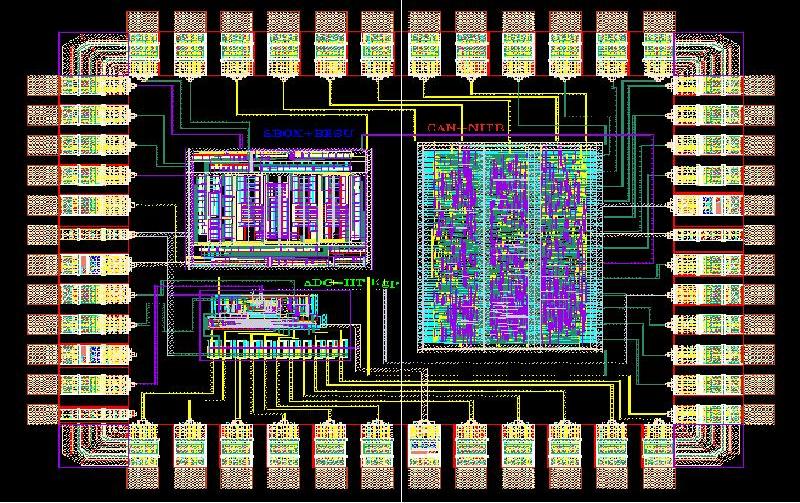
SICLD Act defines the following as:


The Act also provides for a penalty in case of breach of layout designs. The person will be punishable with imprisonment for a term which may extend to three years, or with fine which shall not be less than fifty thousand rupees but which may extend to ten lakh rupees or with both.[19]
The Act confers power on the Central Government to formulate rules to execute the provisions of the legislation. This Act is a novel legislation to grant protection for the scientific and technological inventions and to prevent the exploitation of such works by an unauthorized user.
Any countries accord to the citizens of India similar privileges and rights as granted to its citizens; the Central Government may specify such country to be a convention country and provide the citizens of such convention countries the similar privileges as granted to citizens to India under the Act.[20]
The intellectual property protection for Integrated Circuit Layout design is a key factor throughout the world, and more so in India, because it does not have a strong intellectual property protection policy in software. As integrated circuit layout designs are in its early years in India, it is important that the country boasts of a strong protection policy right in the beginning itself and SICLD Act provides such a strong protection policy.
The number of Indian companies focusing on integrated circuit design is beginning to grow, and this would force major semiconductor companies to set up their offices and address the needs of the domestic market. This will encourage a lot more companies to base their operations in India.
The Indian legislation, therefore, provides a comprehensive protection to the layout designs of semiconductor integrated circuits as recognized intellectual property and bundle of rights to the proprietor of the registered layout-design.
Footnotes:
[1] Section 2(r) of the Act.
[2] Section 2(h) of the Act.
[3] Section 2(e) of the Act.
[4] Sec 3 of the Act.
[5] Section 4 of the Act
[6] Section 5 and 6 of the Act
[7] Sec 7
[8] Sec 8
[9] Sec 10
[10] Sec 11.
[11] Sec 15.
[12] Sec 16
[13] Sec 17
[14] Sec 20
[15] Sec 32
[16] Sec 42
[17] Sec 43
[18] Sec 53
[19] Sec 56
[20] Sec 93

In this blog post, Shubham Khunteta, a student of National Law University Odisha, Cuttack, who is currently pursuing a Diploma in Entrepreneurship Administration and Business Laws from NUJS, Kolkata, writes about the remedies available to a person for the infringement of his copyright.

The fundamental object of the copyright law is to energize creators, arrangers, and specialists to do unique works by remunerating them with a select good fit for a predefined period to recreate the works for distribution and offering them to public.
The law in this manner endeavors to prevent one from appropriating to himself what has been created by the works, aptitude, and capital of another. The copyright law is concerned with the negative right of avoiding replicating of physical material existing in the field of writing and craftsmanship.

The two essential schools of thought for copyright are the European framework translating copyright as Moral Right and the American framework keeping copyright as an Economic Right. Copyright as monetary right implies that copyright insurances are expected to empower development by securing what is legitimately the property of the maker in light of his work and “imaginative start” and is in this manner concerned more with adjusting the privileges of makers with business sector access[1].
Then again, Copyright as Moral Right view the work as being somehow an augmentation of the maker’s self and consequently sees a requirement for more far-reaching insurances. This distinction, for the most part, speaks to the contrast between the American (monetary) support and the European (good) defenses and is very much delineated by the varying methodologies of the United States and the European Union to the topic of securing privileges of the creators.
The teaching of Moral Right (every now and again found in French as Droit assurance), which is the basic premise of European school, is an altogether more extensive development of copyright. While financial rights can be purchased and sold, and are associated with the “work” as an item, moral rights are seen as something naturally controlled by the “writer” of the “works” due to his “virtuoso.” As one-course book phrases it, the ethical privileges of writers with deference to their works are understood as “basic, normal rights, emerging from an origination of the work as an expansion of the creator’s identity.[2]
Market financial aspects perceives licensed innovation as a public good which is:
(1) Non-excludable; and
(2) Non-rivalrous, implying that more than one individual can appreciate the property without barring each other from its advantages. Copyrights, however restraining infrastructures for a timeframe, are in this way endured in light of the fact that creators and designers would, seemingly, have no business sector motivating force to make truant the privilege to bar others from their works.
There has for some time been an open deliberation in the United States about whether one ought to hold all the more nearly to John Locke’s perspective of property as an unending right in personhood, which is a result of one’s blending his/her work with nature.
To be sure, numerous changes to copyright laws have been made that convey the United States nearer to European models
Intellectual property rights are enforced by an action for infringement of those rights before the District Court or High Court. There are three kinds of remedies against infringement of copyright, namely:
This includes the injunction, damages, and an account of profits. A suit or other common procedures identifying with infringement of Copyright can be recorded in the District Court having a ward.”
The time of constraint for documenting of a suit for harms for infringement first of Copyright is three years from the date of infringement”. Section 5 read with Section 54 gives that an exclusive licensee can likewise document a suit for infringement. Be that as it may, where the suit is established by the exclusive licensee, unless the court coordinates, the proprietor of the copyright must be made as a respondent, and when such proprietor is made a litigant, he will have the privilege to question the case of the exclusive licensee.
The essential cure looked for in most copyright suits is an order to control the respondent from keeping on doing acts which constitute infringement. The law relating to infringements is contained in Specific Relief Act, 1963.
The proprietor of the copyright in a work is in the title to recuperate the harms for the misfortune or harm costs him by the infringement of the copyright. Get it is no arrangement in the represents the recompense of extra harms in exceptional circumstances, for example, the egregiousness of the infringement.
The Act additionally announces that all infringing duplicates of any work in which copyright subsists and all plates utilized or planned to be utilized for the creation of such duplicates should be considered to be the property of the proprietor of the copyright. It then qualifies him for taking procedures for the recuperation of ownership of the infringing duplicates and plates or in appreciation of the transformation thereof.
The plaintiff is also entitled to require the defendant to account for the profits made by him by his piracy instead of claiming damages for infringement or conversion.
This includes imprisonment and heavy fine and seizure of infringing copies of the work, which will be delivered to the copyright owner.
This comprises of moving the Registrar of Copyrights to boycott the import of infringing duplicates into India when the infringement is by a method for such importation and conveyance of the reallocated infringing duplicates of the proprietor of the copyright and looking for the conveyance.
A compelling and speedy cure is made accessible by the Act to avoid importation into India the duplicates of a marketing specialist work made outside India, which is made in India, would encroach on copyright in the work.
Section 53 of the Copyright Act engages the Registrar of Copyrights in making a request precluding the importation into India of such duplicates for the utilization of the proprietor of the copyright in any work, party his obligation authorized agent in the wake of making such request as he esteems.
Footnotes:
[1] <http://shodhganga.inflibnet.ac.in/bitstream/10603/33710/3/chapter3.pdf>accessed on 30/08/2016
[2] <https://www.icsi.edu/Docs/Website/EconomicandCommercial%20Laws.pdf>accessed on 30/08/2016
[3]< http://shodhganga.inflibnet.ac.in/bitstream/10603/33710/3/chapter3.pdf>accessed on 29/08/2016
[4] <http://blog.ipleaders.in/remedies-available-copyright-infringement-india/>accesed on 30/8/2016
[5]http://www.mondaq.com/india/x/444510/Trademark/IPR+Criminal+Remedies+In+India+Civil+vs+Criminal+Remedy+In+IPR+Search+Seizure+Raids+By+Police>accessed on 29/08/2016
[6] <http://www.ssrana.in/Intellectual%20Property/IP-Enforcement-And-Litigation/Administrative-Remedies-in-India.aspx>accessed on 29/08/2016

In this blog post, Sayan Mukherjee, a student of University of Calcutta, who is currently pursuing a Diploma in Entrepreneurship Administration and Business Laws from NUJS, Kolkata, discusses the concept of assignment in copyright along with the most probable disputes related to it.

Copyright, a unique intellectual property meant for the creative brothers and sisters around the world is res incorporalis. In that sense, it has no tangible existence but is a proprietary right and can be disposed of.
In modern life, every individual is aware of the concept of Copyright because of the expansion of media and communication throughout the world. Today’s world has no shortage of ideas, thoughts, modes of expression, and its distribution, which the world media has upheld through the gift of technology coupled with a wider scope of communication and share. This very thing has directed out attention towards the creative world, their rights and obligations, along with their grievances in the form of disputes faced by the creators.
The Copyright Act, 1957 as amended in 2012 is the current vehicle to settle and guide the creators towards betterment and give them some pecuniary opportunities so that they are further encouraged to bless the world with their creativity.

Nobody is entitled to copy, reproduce, publish or sell an original writing, painting, dramatic production, sculpture, etc. without the permission of the creator. Thus, law provides a right to the owner of the copyright (i.e. the creator) to transfer the ownership of the copyright to a third party. For instance, in the case of making a complete movie – all the creative persons with their idea turned into relevant works come to a producer, assign their rights that subsist in their work in return for a royalty. These works are then summed up to form a complete movie. Yes, the process isn’t that easy and involves many questions that arise both at the time of assignment and especially after it.

It may be noted in this context, that the author has an alternative for the shortcomings or confusions of assignment of copyright. They can register their work with a copyright society and thereafter license it to whomsoever they desire.

Moral rights are independent of the author’s copyright and shall remain with the author even if he has assigned his copyright.

The feasibility of Copyright Assignment is highly questioned because of the rising counts of Copyright Infringement cases. The sole objective of assignment process is to provide both pecuniary as well as distribution benefits to the original work of the creator. It cannot be used to deprive the original owner permanently from his creation.
Copyright Assignment is an inevitable necessity in this dynamic world. People can’t be self-sufficient in every respect. For the better frame of the Art, the ownership right of the creation needs to change hands and bring out the full potential of the original work by exploring various tiers of creativity.
Footnotes:
[1] Inserted by Copyright (Amendment) Act, 2012.
[2] Pine Labs Private Limited vs. Gemalto Terminals India Private Limited and others (FAO 635 of 2009 and FAO 636 of 2009)
[3] Inserted by Copyright (Amendment) Act, 2012.
[4] Inserted by Copyright (Amendment) Act, 2012.
[5] Saregama India Ltd. V. Suresh Jindal AIR 2006 Cal. 340.
[6] Inserted by 2012 Amendment.






 Allow notifications

