Download Now
Home Blog Page 1698

Different Ways To Word A Tag Along Clause

0

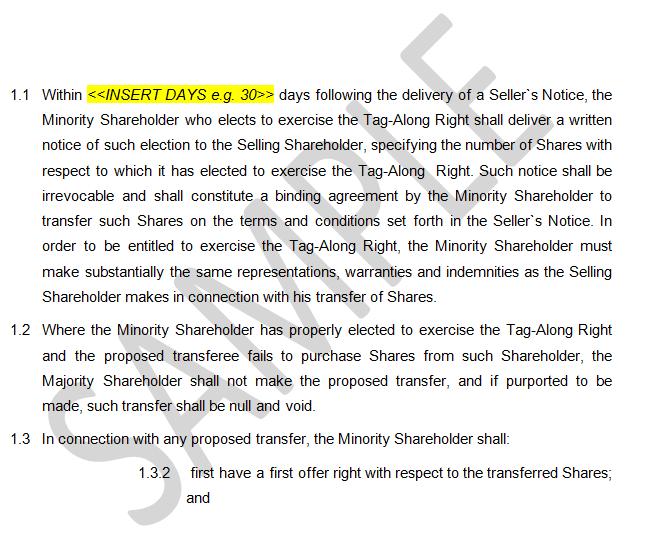
In this blog post, Kriti Kakkar, Student of Lucknow University and Diploma in Entrepreneurship Administration and Business Laws by NUJS lists the different ways to word a tag along clause. 

P_20160415_161250-e1461220112376-768x1024


Different Ways To Word A Tag Along Clause

In a startup or another business endeavor including more than one person who contributes monetarily or something else, pays to guarantee that their commitment is recognized in a protected and responsible way. “Shareholder’s Agreement” (SHA) is restricted in which such security can be recompensed to all partners.663430630

The meaning of Shareholder’s Agreement is a coup contract between the shareholders of an enterprise, characterizing the shareholders’ rights, benefits, insurances, and commitments. The shareholder’s agreement, as a rule, incorporates the company’s articles of joining and ordinances.

The shareholder agreement gives a sort of proprietorship that an accomplice putting resources into a business might appreciate it as it has the crucial rights. The understandings accommodate matters, for example, confinements on exchange of shares (right of first refusal, right of first offer), constrained exchanges of shares (tag-along rights, drag-along rights), designation of executives for representation on sheets, majority necessities and veto or majority rights accessible to specific shareholders at board level or shareholder level.

A shareholder agreement can, however, put confinements on the exchange of shares from one gathering to the outsider. This is done to counteract subjective or exploitative exchange of shares. A ‘exchange limitation’ confines shareholders from moving their shares in the organization.

What does a Shareholder’s Agreement regularly include:

  1. Nomination of Directors – The agreement might designate the rights to specific partners to be on board and additionally choose the composition of the Board.
  2. Roles and commitments of every shareholder.
  3. Financing prerequisites, majority necessities and veto rights.
  4. Representation and Warranties from the Company.
  5. Restrictions on the exchange of shares (right of first refusal, the right of the first offer).
  6. Forced exchange of shares (tag-along rights, drag-along rights) and abridging of further issue of shares.
  7. Defining Shareholding Threshold: There can be a minimum shareholding under the agreement. A party must have to enjoy the rights as under the Shareholding Agreement.
  8. Determining and designating unique rights to the certain shareholder.


What do Shareholder Agreements do?

Shareholder Agreements is a way for the founding members to regulate or even restrict the amount of shares allotted to the shareholders. The courts usually do not accept the company legislation unless the legislation is incorporated in the articles of association, yet they offer a way in which owners of a company can invite and incentivize talent – all the while regulating the flow of actual stake.

The clauses in this regard often found in a Shareholders’ Agreement to regulate the transfer of shares are:

  1. Right of First Refusal: The right of first refusal is a contractual right; the entity is given an opportunity to enter into business with any partner he wants. The entity is given such an opportunity and also has the right to refuse, this opportunity however usually has an asset. When and if the entity of the first right refuses the opportunity the owner of the asset is free to bid his business with someone else. business-document
  2. Right of First Offer:This clause enables a preferential option to certain stakeholders in which the prices of the shares are fixed beforehand. The holder of the right to first offer must be given a bid to buy the shares from the respective shareholder who wants to sell. If the holder of the right of the first offer refuses then, the shareholder is free to sell his shares to anyone.
  3. Drag-along Rights: A drag along right allows a shareholder of a company (Usually a majority shareholder or institutional investor) to force the remaining shareholders to accept an offer from the third-party to purchase the whole company, where the majority shareholders have accepted that offer, on the same terms. The other (usually minority) shareholders are then ‘dragged along’ and forced to sell their shares at the same time and the same price for each share.
  4. Tag-along Rights: On the lines of Drag-on rights, tag along is a provision which allows the minority stakeholders to participate in the sale of the shares along with the majority shareholders for a good price at the same time. The minority stakeholders then tag along with the majority stakeholders.
  5. Buy-back Rights: This gives the company a chance to buy back shareholders unvested shares at a lower price of a fair market value. The situation under which the shares are bought varies and can be through resignation or death etc.
  6. Call Option: This option gives the holder a right to buy the shares at an already determined rate also known as ‘strike price’ between the date of purchase and the options expiration date.improving_the_appearance_of_your_technical_document
  7. Put Option: As the name suggests it allows a shareholder to share his shares at an already decided price also known as the ‘strike price.’
  8. Anti-Dilution: An anti-dilution provision is a provision in an option or a convertible security. It protects an investor from dilution resulting from later issues of stock at a lower price than the investor originally paid. Also known as an “anti-dilution clause.
  9. Pre-emptive: Under the pre-emptive right, the Company brings to the table any future shares that might be issued, first to the Shareholder (on a professional rate premise) before offering it to some other gathering, and additionally permit the shareholder to look after his/her shareholding design.

Can A Shareholders’ Agreement Bind a Third Party?

Privately owned companies are similar to affectionate families. They have a tendency to appreciate the confirmation and solace to control what they do; be it the connection between the partners or fashioning ties with outsiders. Ordinarily, under the present Indian Law, it ties the two gatherings under it. With a specific end goal to make it binding to a third-party company regulated matters must form part of public domain – i.e., it must reflect in company bylaws (visible to public). This gives reasonable notice to others.


Download Now

What Are The Penalties For Non-Adherence Of FDI Regulations?

0

In this blog post, Dhiren Sehgal, a recent graduate of Jindal Global Law School and currently a student of the Diploma in Entrepreneurship Administration and Business Laws course by National University of Juridical Sciences (NUJS), Kolkata and iPleaders, discusses the penalties for non-adherence of FDI regulations.
Screenshot (13)


Penalty

On violation or contravention of any of the FDI regulations, then by way of non-adherence or breach or contravention of any rule or regulation or any notification/circular or press release; even if it’s an order which has been issued via exercising of the powers which has been given by the virtue of the FEMA provisions; or if there is a contravention of any conditions which have been authorized by the Government of India/ Foreign Investment Promotion Board (FIPB) or by the Reserve Bank of India for that matter, then he shall be liable, upon adjudication, to a penalty up to thrice the sum involved in the act of non-adherence where the sum can be quantified or determined. In cases where the sum isn’t quantifiable or can’t be determined then a sum of up to Two Lakh Rupees.monetary_penalty

In cases where the non-adherence is of a continuing nature then, a further penalty is inflicted which may extend to rupees five thousand per day, the contravention or non-adherence continues to the initial day of non-adherence. When a person leads to the commission of a contravention or non-adherence of any of the provisions of this Act (FEMA) or of any rule or order issued thereunder is a company (company implies any corporate body and incorporates a firm or other association of people or individuals as characterized in the Companies Act), each individual who, at the time the non-adherence was committed, was accountable for, and was dependable to, the company for the behavior of the business of the company and also the company, should be regarded to be liable of the non-adherence and might be at risk to be tried or proceeded against and penalized accordingly.

Any Adjudicating Authority decreeing or adjudicating any contradictions or non-adherence for any of the FDI regulations, may, in the event that he supposes fit in addition to any punishment, or penalty which he may inflict for such non-adherence can direct that in any cash or currency, security or some other property in context of which the non-adherence has occurred shall be seized and confiscated by the Central Government.


Appealing and Adjudication

With the intention and purpose of adjudicating and settling of any contradiction or non-adherence of FEMA, the Ministry of Finance according to the provisions enshrined in the Foreign Exchange Management (Adjudication Proceedings and Appeal) Rules 2000, selects officers of the Central Government as the Adjudicating authority for holding an inquiry in the way recommended. A sensible and a rational opportunity must be given to the individual charged to have conferred contradictions or non-adherence against whom an objection has been made for being listened before forcing any punishment or penalty.

The Central Government may name according to the provisions contained in the Foreign Exchange Management (Adjudication Proceedings and Offer) Rules, 2000, an Appellate Authority/Appellate Tribunal to hear appeals against the orders or the judgments of the adjudicating authority.


Rules of Compounding Proceedings

Under the Foreign Exchange (Compounding Proceedings) Rules 2000, the Central Government may designate a ‘compounding Authority’ an officer either from Enforcement Directorate or Reserve Bank of India for any individual repudiating or non-adhering any provisions of the FEMA. The Compounding Authorities are approved and authorized to compound the sum or amount that is involved or is central to the negation or non-adherence to the Act made by the individual. No non-adherence shall be compounded unless the sum required in such contradiction or contravention is quantifiable. Any second or resulting non-adherence committed after the expiry of a time of three years from the date on which the non-adherence was already compounded might be deemed to be a first non-adherence.FDI_small

The Compounding Authority may require any data can call for any information, record or some other archives applicable to the compounding procedures. The Compounding Authority should pass an order of compounding after managing and affording a chance of being heard to all the worries and concerns as speedily and not later than 180 days from the date of an application made to the Compounding Authority. Compounding Authority should issue an order indicating the provisions of the Act or the rules, directions, demands or orders made thereunder in the context of which the non-adherence has occurred alongside details of the alleged non-adherence.

Any individual who negates or doesn’t adhere to any provision of the FEMA, 1999 [except area 3(a)] or contradicts any standard, order, rule, regulation issued in exercise of the powers guaranteed under this Act or repudiates any condition subject to which an approval is issued by the Reserve Bank, can apply for compounding to the Reserve Bank. Applications are looking for compounding of contraventions under section 3(a) of FEMA, 1999 might be submitted to the Directorate of Enforcement.


Sensitive Contraventions

The non-adherence, at first sight, including IRS evasion, national and security concerns including genuine and serious infringement of the regulatory framework, and so forth, are delicate and sensitive non-adherences.


Technical Contraventions

It is clarified that whenever a contravention or a non-adherence is identified by the Reserve Bank or conveyed to its notification by the entity which is involved in the contravention by the way of a reference other than through the endorsed application for compounding, the Bank will ponder on deciding:1461305746-FDI

  • Whether a non-adherence is technical and/or minor in nature and, all things considered, can be managed by the method for an authoritative/preventative advice;
  • Whether it is material and, consequently, is required to be compounded for which the important and necessary compounding procedures must be taken after and followed or
  • Whether the issues included are delicate/sensitive in nature and, subsequently, should be referred to the Directorate of Enforcement (DOE). Notwithstanding, once a compounding application is recorded or filed by the concerned entity suo moto, admitting the non-adherence, the same won’t be deemed as “technical” or “minor” in nature and the compounding procedure shall be initiated in consonance with section 15 (1) of Foreign Exchange Management Act, 1999 read with Rule 9 of Foreign Exchange (Compounding Proceedings)
Download Now

Service Tax V/S Service Charge

0

In this blog post, Mithun Pillai, a Management Trainee at a Textile Company in Mumbai and a student pursuing his  Diploma in Entrepreneurship Administration and Business Laws from NUJS, Kolkata, distinguishes between service tax and service charge. 

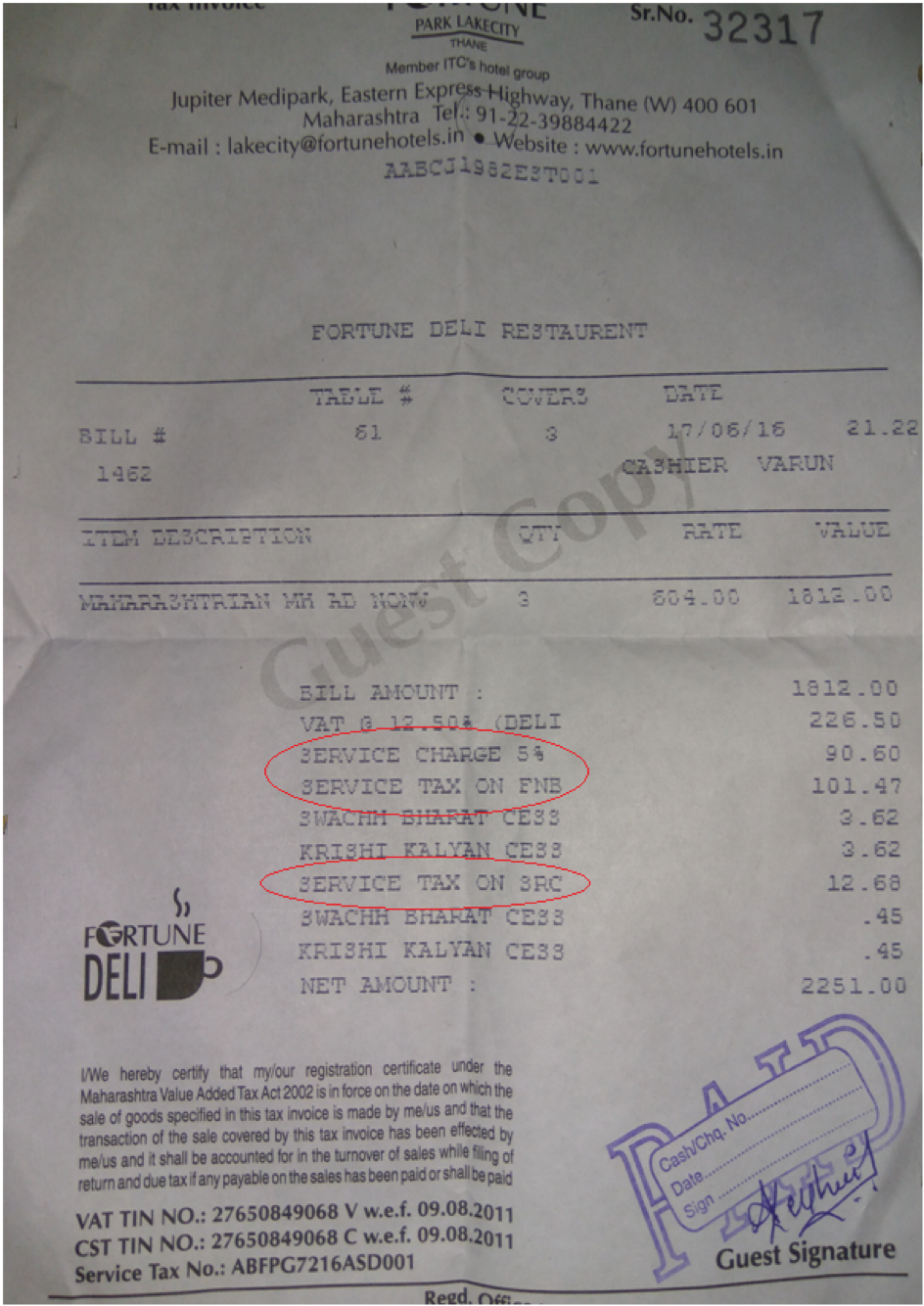
After a sumptuous meal at one’s favorite restaurant, the waiter brings the bill (or ‘check’ for the classy bourgeois) with a sweet yet sinister smile we imagine, and we accept it graciously with a dull sense of foreboding. What happens next is a ritual that most of us are quite familiar with. 1362590085-6561
We try to make sense of the drab text on the bill. The name and address of the restaurant seem alright. Confirming the list of food and beverage items ordered feel like a triumph. But then comes the price and tax components. It certainly doesn’t help that the blood has already started to rush away from our brain to shower its attention on our gut.  Already light-headed, trying to understand the intricacies of tax components feel like decoding the Da Vinci code if Da Vinci was a Chartered Accountant (in all probability he was; that dude had a famously gifted mind). After a few futile minutes, some of us call it a day, pay up and leave. Others notice that service tax and service charge are charged separately even though they sound similar. They might wonder about it; they may even inquire about it with the staff but in the end, they too have to pay up because it’s not illegal to charge both service tax and service charge at the same time. But the situation is not as simple as that. Some eligibility conditions and compliances have to be taken care of, and I will be elaborating on them further.


Service Tax

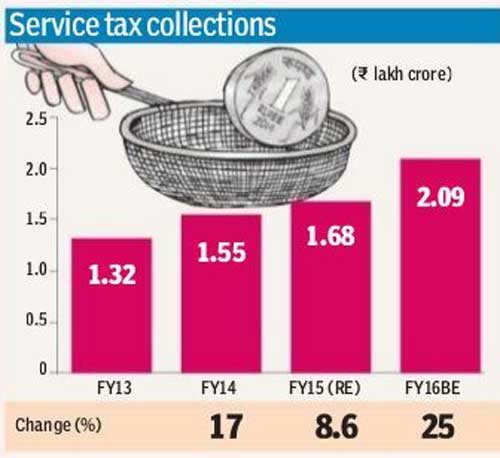
Service tax is an indirect tax levied by the Central Government on service providers except some services which are notified as under a negative list and a Mega Exemption list as specified by the government. Specifically, Entry 97 of Schedule VII of Constitution of India empowers Central Government to levy Service Tax through Chapter V of Finance Act, 1994. Indirect tax means that even though the responsibility of paying the tax lies with the service provider, the tax amount itself can be collected from (i.e., tax burden can be shifted to) the service receiver. This tax was introduced in 1994 by the thenPicture2 Finance Minister Dr. Manmohan Singh. Earlier the Service tax was 12.36%. It was then increased to 14% (Education Cess & Higher Secondary Education Cess subsumed) along with Swachh Bharath Cess@ 0.5%. Currently, the incumbent Finance Minister Arun Jaitley while presenting the Budget for 2016-17 proposed Krishi Kalyan Cess@ 0.5% as well. Thus, w.e.f  1st June 2016, all eligible services occurring on or after 1st of June will have to pay 15% as service tax. In general, service tax is collected by the government on the following basis:

  • Cash basis- Liability to pay tax when payment is received.
  • Accrual basis- Liability to pay tax when service is provided even though actual payment may happen later (like on credit)

Currently, only individual service providers are allowed to pay tax on a cash basis and further only if their revenue has ever exceeded ten lacs per annum. Company service providers have to pay tax on an accrual basis.


Service Charge

Service charge is not a tax. It is not levied or collected by the Government but by the restaurant itself. The common reasoning provided by eateries are that the amount serves as an alternative compulsory tip which is then equally distributed among the staff right from the transporters who get the raw materials like material through the chefs/cooks who prepare the food and finally to the waiter/host who serves and looks after the customers. Thus the service charge is a bonus for the staff members above their daily wages. Although in reality it is viewed as a less-than-scrupulous means of generating black money among restaurateurs.Picture1

In the first image if we go through the price components we notice that service tax, Krishi Kalyan Cess and Swachh Bharath Cess appears to be charged twice. Actually, and charges are on the Service charge collected @5%. Thus even the Service charges collected by the restaurant are further taxed. But it is important to note as a customer that the banks should notify on their menu (second image) all the taxes charged and that includes service charge as well. Generally speaking, service charges range from 5% to 15%.

Restaurants exclusively having Air Conditioning or Central Heating are granted an abatement of Service tax by the government. This is because, they can be considered as a provider of goods and services both and thus are separately charged on both fronts. According to Article 366- 29A- (f) of Constitution of India all food and beverage are deemed outside the scope of service tax because they are viewed as goods and hence on account of the value added by virtue of cooking the final meal (product) they become liable for VAT. And since it’s extremely difficult to calculate and differentiate the portions of the total amount which are taxable as VAT and Service tax government has provided an all-encompassing abatement of 60% in taxable amount for Service tax to minimize the risk of double/extra taxation. Thus, only a restaurant having an Air Conditioning or Central Heating can charge 15% on 40% of the total amount or effectively, 6% of the total amount. This makes it easier to calculate both VAT and Service tax on the same total amount.


Download Now

FIR: First Information Report and Police Complaint – How It Works

16

In this blog post, Vinit Kumar, a Third Year student of Law from NLU, Odisha, analyses the concept of  “FIR and police complaints” and it’s importance in the Indian legal system.

Introduction

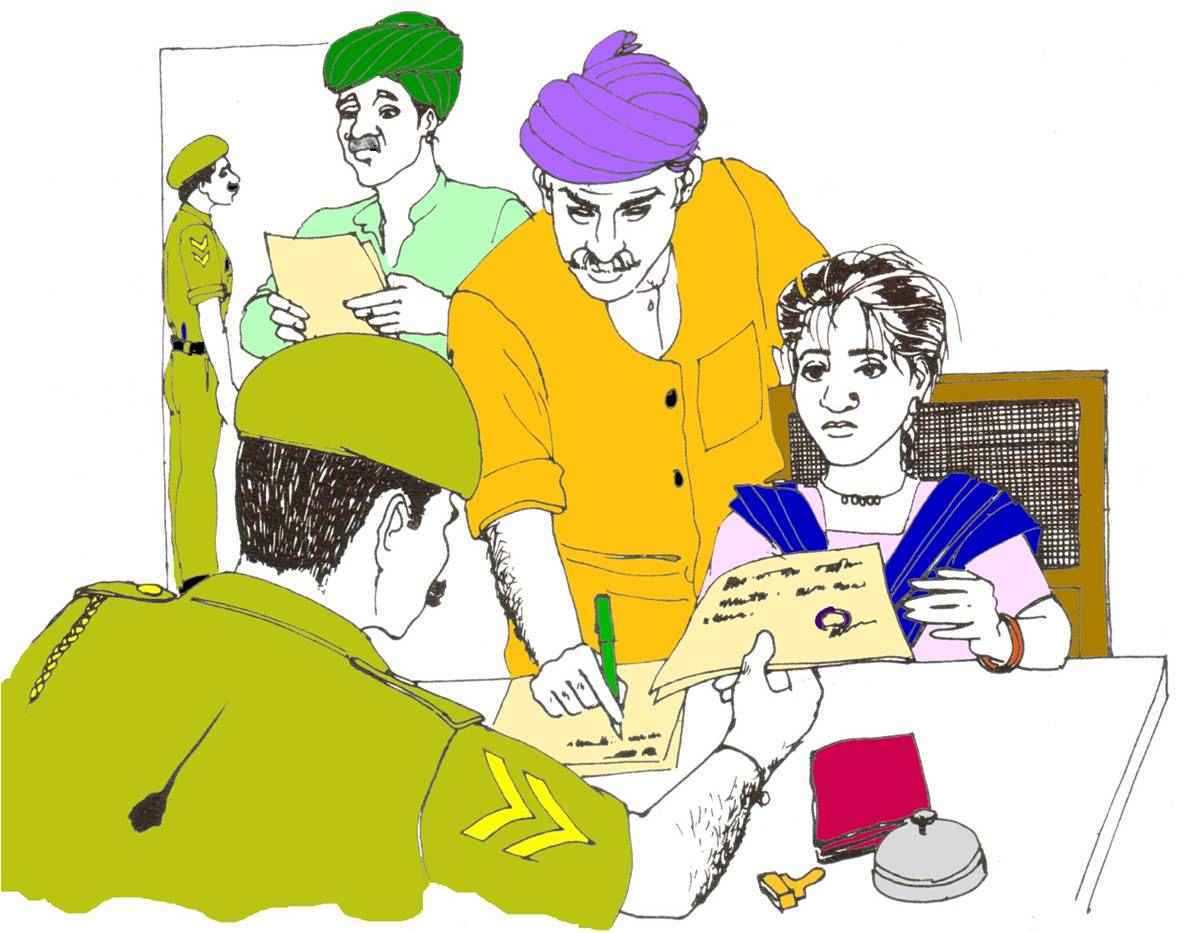
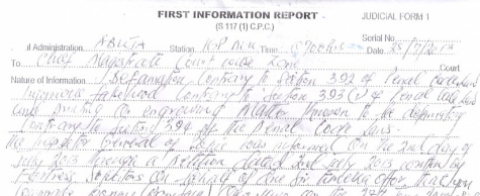
The basic purpose of filing a FIR is to set criminal law into motion and not to state all the minute details therein[1]. A First Information Report is the initial step in a criminal case recorded by the police and contains the basic knowledge of the crime committed, place of commission, time of commission, who was the victim, etc. The definition for the First Information Report has been provided in the Code of Criminal Procedure, 1973 by the virtue of Sec. 154, which lays down that:first-information-report

Every information relating to the commission of a cognizable offence, if given orally to an officer in charge of a police station, shall be reduced to writing by him or under his direction, and be read Over to the informant; and every such information, whether given in writing or reduced to writing as aforesaid, shall be signed by the person giving it, and the substance thereof shall be entered in a book to be kept by such officer in such form as the State Government may prescribe in this behalf”.[2]

The Hon’ble Supreme Court of India, while delivering its judgment in the matter of T.T.Antony vs. State of Kerala & Ors.[3], laid down certain important points regarding Sec. 154 of the Cr.P.C.:

“ Information given under sub-section (1) of Section 154 of Cr.P.C., is commonly known as the First Information Report (FIR), though this term is not used in the Code….And as it’s nick name suggests, it is the earliest and the first information of a cognizable offence recorded by an officer in charge of a police station”.[4]          

In another case[5], the Court held that:

“After all registration of FIR involves only the process of entering the substance of the information relating to the Commission of a cognizable offence in a book kept by the officer in charge…as indicated in Sec. 154 of the Code”.

Click here for free materials!criminal litigation 

Who Can Lodge an FIR?

FIRs can be registered by a victim, a witness or someone else with knowledge of the crime.[6] As per the laws laid down u/s 154 of the Cr.P.C., the complainant can give information about the offence either in written or orally. In regard to who can file an FIR, the Apex Court of India has observed that;

“Section 154 does not require that the Report must be given by a person who has personal knowledge of the incident reported. The section speaks of information relating to the commission of a cognizable offence given to an officer in charge of a police station”.[7]

The police is obliged to read the FIR back to the complainant in case it is conversed to them orally to prevent the possibility of any differences in the oral and the written versions.[8] Further it is the duty of the complainant to report to the police station in person in case he had given the information on a telephone.[9] Rajasthan High Court, in the matter of Tohal Singh vs. State of Rajasthan, has opined that:Picture-fir
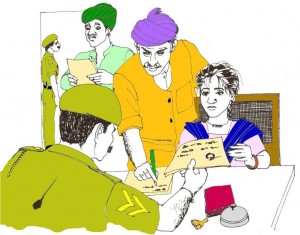
“if the telephonic message has been given to officer in charge of a police station ,the person giving the message is an ascertained one or is capable of being ascertained the information has been reduced to writing as required under S.154 of Cr.Pc and it is faithful record of such information and the information discloses commission of a cognizable offence and is not cryptic one or incomplete in essential details, it would constitute FIR”.[10]

However in a case wherein though the police officer went to the scene hearing rumours but recorded a statement at the police station, it was held that in circumstances of the case that statement could be accepted as FIR.[11] The police are required to give a copy of the FIR to the complainant free of charge.[12]


Providing a Copy of FIR to the Accused

Under Indian criminal law, the informant, as seen earlier, is entitled to get a copy of the first information report lodged by him at the police station free of cost. It is a necessary document in a criminal case and can majorly support the case of the informant or the victim. However, the accused person is also entitled to get a copy of the first information report. Sec. 207 of the Code of Criminal Procedure, 1973 entitles the accused to get the copy of the first information report the investigation has been completed by the police in the said case, and the charge sheet has been filed in the Court. The provision states that the Magistrate, in such circumstances, must furnish to the accused a copy of the FIR free of cost.tumblr_mqpjdo0ZSh1r49m26o1_500

Further, on analysis of Sec. 173 (5) and (7) of the Code pf Criminal Procedure, 1973, it can be easily implied that the police may also provide c copy of the first information report to the accused free of cost after the filing of the charge sheet. The essential pre-requisite of both Sec. 207 and Sec. 173 is that the police must have filed the charge sheet in the subjected matter.

There have been some cases where the Court has provided the accused with the copy of the FIR even before filing of charge sheet and on his request and payment of a certain fee. Under the Indian Evidence Act, 1872 Sec. 74 lays down the definition of a ‘public document’. In many decisions, the Courts in India have held the first information report to fit within the definition of ‘public document’ and hence, have held that u/s 76 of the Evidence Act, certified copy of the FIR has to be given to the accused person on his request on payment of the applicable legal fees by every public officer (such as the officer in charge of the police station) having the custody of such document. [13] The decision of Allahabad High Court in the matter of Shyam Lal vs. the State of U.P.[14], Karnataka High Court’s ruling in the matter of Chnnappa Andanappa Siddareddy vs. State[15], and the decision of Bombay High Court in the case of Mohammed Khalid Shaikh vs. State of Maharashtra[16] [decided on 4 March 2010] are most cited judgments in this regard where the Courts have held that FIR fits the definition of ‘public document’ u/s 74 of Indian Evidence Act.


Cognizable Offences

Cognizable Offences have been defined u/s 2(c) of the C.P.C., 1973. This is the class of offences in which the police has the power to make an arrest without a warrant. These offences are serious in nature, and thus the aim is to prevent the culprit or accused of harming others. Hence, the police have been given authority to make an arrest without a warrant so that precious time involved in all the legal procedures of issuing a warrant is saved. What offences fall under the category of cognizable offences has been specified in the first schedule of the Code of Criminal Procedure, 1973. Though there is no pre-defined pattern of classification of offences into cognizable and non-cognizable offences but on a study, it can be seen that offences having a punishment of more than three years are classified as cognizable offences and those who have punishment for less than three years are referred to as non-cognizable offences.

As per Sec. 156(1), the police has the authority to investigate a case involving a cognizable offence without prior permission of the Magistrate. Sec. 156(1) lays down that:

“Any officer in charge of a police station may, without the order of a Magistrate, investigate any cognizable case which a Court having jurisdiction over the local area within the limits of such station would have the power to inquire into or try under the provisions of Chapter XIII.”[17]

Section 156 (2) further reads,

“No proceeding of a police officer in any such case shall at any stage be called in question on the ground that the case was one which such officer was not empowered under this section to investigate.”

The term ‘cognizance’ as such has not been defined in the Code. The word as such has no esoteric or mystic significance in Criminal Law or procedure. In reference to Courts or judicial process, it simply means when the Court ‘takes notice judicially.’[18]


Difference between an FIR & a Police Complaint

The main point of difference between a first information report and a police complaint is that an FIR relates a cognizable offence whereas a police complaint can be filed for both non-cognizable and cognizable class of offences. Though the basic meaning of both is a complaint but they are different in terms of offences they deal with, punishments, legal consequences, evidentiary value, etc. further, a complaint is to be given to a magistrate either by the way of spoken words or in writing, whereas the first information report is lodged at the police station nearby the place of commission of crime.Untitled-10

According to s. 2(d) Cr.P.C., a complaint is the allegation of fact which constitute a complaint.  Further, a complainant and a first informant need not be the same person.[19] Indian criminal laws do not provide any strict form for a complaint, and thus an affidavit or a petition may also amount to a complaint in the court of law.[20] The general rule is that any person having knowledge of the commission of an offence can file a complaint, even though the concerned person is not personally interested or affected by the offence, except in cases of offences relating to marriage, defamation and offences mentioned in ss. 195 to 197 Cr.P.C.[21] When an informant approaches the police authorities relating the information about the commission of a cognizable offence it is called filing a complaint. This ‘first information’ in the form of a complaint when registered as prayed for by the informant u/s. 154 Cr.P.C., it constitutes ‘FIR’ which should on the face of it and in the light of subsequent events disclose the information within the meaning of this section.[22]

A Magistrate can take cognizance of a complaint u/s 190 of the Code of Criminal Procedure, 1973. When a Magistrate takes cognizance of an offence[23] (upon receipt of a complaint or otherwise), he examines the complaint in accordance with Section 200 by examining the facts and the witnesses. If he finds that the complaint is with merits, the case is deemed committed for trial and the magistrate issues the process under Section 204. If the offence is exclusively triable by Court of Session, the Magistrate commits the case to Court of Session under Section 209.

As per Sec. 190, the Magistrate is empowered to take cognizance of an offence in three ways provided therein. However, if he chooses to take cognizance on the basis of a complaint then to investigate and decide upon the matter further, he is bound to follow the provisions laid down by Sec. 200 to Sec. 203 of the Cr.P.C. and if the case demands, also under Sec. 204.

In the case of a first information report, the offence involved is of cognizable nature and thus the police has authority to initiate the investigation in the said case without prior permission from the Magistrate and then file a charge sheet. On the other hand, when a Magistrate takes cognizance of an offence on the basis of a complaint, he orders an investigation in the matter and can also direct the police to lodge an FIR if he feels that the offence is of a serious nature. He is not empowered to take sou moto cognizance on the complaint if he is satisfied that there is no grave offence requiring an immediate course of action. He can act upon the complaint only if it reveals a prima facie commission of an offence.[24]

The Court, in the matter of P. Kunhumuhammed vs. State of Kerala[25] held that:

“The report of a police officer following an investigation contrary to S. 155(2)[3] could be treated as complaint under S. 2(d) and S. 190(1)(a) if at the commencement of the investigation the police officer is led to believe that the case involved the commission of a cognizable offence or if there is a doubt about it and investigation establishes only commission of a non- cognizable offence”.

Thus, if at the initial stages of investigation, it is found that the offence committed is of a non-cognizable nature, then the report submitted after investigation cannot be treated as a ‘complaint’ within the scope of Sec. 2(d) or Sec. 190(1)(a) of the Cr. P.C.

In the case of the first information report, the police is authorised to investigate the matter and then search and seizure of the evidence they find. The police then proceeds to file a charge sheet against the accused in the Court u/s 173 of the Code of Criminal Procedure, 1973 at the end of investigation. Further, the court then decides upon the charges.

The Office in Charge, on receipt of a complaint by an informant that reveals a non-cognizable offence committed within the limits of its jurisdiction, enter the substance of the case in the station diary and refer the informant to approach the concerned Magistrate[26] on whose order only can the police investigate such cases with the same powers as exercised in a cognizable case, except the power to arrest without warrant.[27] Where a case relates to two or more offences of which one is cognizable, then the case will be considered to be a cognizable offence, notwithstanding the fact that other offences are non-cognizable.[28]


Refusal to Lodge an FIR by the Police

Sometimes, the police may refuse to lodge a first information report. This can be both legal and illegal. In cases where they don’t have jurisdiction or is not in their legal capacity to take cognizance or the offence is of non-cognizable nature, it will be held legal. But where police refuses to file the complaint for blatant reasons, without any substantial legal ground, it is contrary to law. When a police officer refuses to register the FIR on the ground that it discloses a non-cognizable offence, he must inform the informant and direct him to file a complaint to the magistrate. In case the offence committed is beyond the territorial jurisdiction of a police station, information should be recorded and forwarded to the appropriate police-station having jurisdiction, otherwise refusing to record on this ground will amount to dereliction of duty.[29]

The compulsoriness of registering any information is also based on the understanding that the FIR is not a substantive piece of evidence [30] and can only be used to contradict or corroborate the contents.[31] As per Sec. 155(1) of the Cr.P.C., of a police officer receives information about commission of a non-cognizable offence committed in jurisdiction of the police station, he should enter the substance of the case in the station diary and refer the informant to approach the concerned Magistrate.

Remedies

  • If the concerned officer in charge refuses to register a first information report about commission of a cognizable offence within his territorial jurisdiction under Sec. 154(3), the informant can approach the Superintendent of Police or the Commissioner of the police with a written complaint. If, upon analysis of the complaint, the S.P. of the Commissioner is satisfied that it discloses a cognizable offence, he may either investigate the case himself or direct his subordinate to register the FIR and initiate investigation in the matter.
  • If the above listed remedies go in vain, the informant is legally entitled to file a complaint to the Judicial Magistrate/ Metropolitan Magistrate u/s 156(3) read with Sec. 190 of the criminal procedure thereby praying FIR. to be registered by the police and investigation into the matter. A Writ Petition in the respective High Court may be filed for the issuance of Writ of Mandamus against the defaulting Police officers, inter alia, to Register the FIR and directing him to show cause (a) why he has not registered the FIR; (b) why disciplinary proceedings for “Misconduct” should not be initiated against him for dereliction of duty; (c) why he should not be suspended from Police service for interfering in the administration of justice and shielding the accused person.[32] In a civil matter, a contempt petition can be filed before the High Court against the officer who refused to lodge an FIR Hon’ble Supreme Court, recently, in Lalita Kumari[33] case, has held that the Police must register FIR where the complaint discloses a cognizable offence.fir
  • Refusing to register an FIR on jurisdictional ground could now cost a policeman a year in jail.[34]A Letter Petition may be logged and submitted to the Chief Justice of the concerned High Court / Chief Justice of India, Supreme Court, praying them to take Su Moto Cognizance of the alleged contempt of the Court. Further, a copy of said letter may be sent to the concerned Police Officer. The status of such letter petition can be inquired through an application under the Right to Information (RTI).
  • A Writ Petition may be filed in respective High Court for seeking damages/compensation, if the inaction of the Police on the complaint/non-registration of FIR, has resulted in frustration/deprivation of ―life and liberty‖ of any person, guaranteed under Article 21 of Constitution of India.[35]
  • Also, u/s 166A(c), if the Public servant concerned fails to record any information given to him under sub-section (1) of section 154 of the Code of Criminal Procedure, 1973, in relation to cognizable offence punishable under section 326A, section 326B, section 354, section 354B, section 370, section 370A, section 376, section 376A, section 376B, section 376C, section 376D, section 376E or section 509 of the Indian Penal Code, he is punishable with rigorous imprisonment for a term which shall not be less than six months but which may extend to two years, and shall also be liable to fine.

The Apex Court of India has held that genuineness, reliability and credibility of the information is no ground to refuse to register the information.[36] In another case, it was held that refusal to record information is declaration of duty by a public officer.[37] However, to prevent misuse of the remedies provided for refusal to lodge complaint, the court has ruled that:

“A vague, indefinite or unauthorised piece of information cannot be regarded as first information merely because it was received first in point of time. Likewise an unclear message over the phone simply stating that a person is lying dead on the road does not amount First information report”.[38]

The word ‘information’ has been used carefully by the legislature u/s 154(1) of the Cr.P.C. “wherein the expressions, “reasonable complaint” and “credible information” are used. Evidently, the non-qualification of the word “information” in Section 154(1) unlike in Section 41(1)(a) and (g) of the Code may be for the reason that the police officer should not refuse to record an information relating to the commission of a cognizable offence and to register a case thereon on the ground that he is not satisfied with the reasonableness or credibility of the information”.[39]

In Kathiravan vs. State[40], the court held that:

“It is quite obvious that the officer in-charge of the police station, on receipt of a complaint (information) disclosing commission of a cognizable offence, is duty bound to register a case and such officer cannot probe into the allegations to find out whether they are true or not before registering a case. However, it does not mean that in no case the officer in-charge of the police station can conduct a preliminary enquiry to make a decision as to whether a case can be registered for being investigated upon in accordance with the provisions of Cr.P.C. But such cases are only exceptions to the general rule. Such exception should not be generalised by the police to say that the police do have a discretion either to register the case or to conduct a preliminary enquiry to make a decision whether to register a case or not”.


Evidenciary Value

The police can make three different kinds of statements. The first kind of statement is one which can be recorded as an FIR, the second kind of statement is one which can be recorded by the police during the investigation, and third kind of statement is any kind of statement which would not fall under any of the two categories mentioned above.[41]

Evidence is the matter of testimony manifesting fact on particular precision or circumstances.[42]

The first information report is not considered a substantive piece of evidence in the court of law because it is not given in a trial, given in the absence of oath, and is not scrutinized by cross-examination.[43] But the relative importance of a first information report is far greater than any other statement recorded by police during the course of investigation. It is the foremost information the police gets about commission of an offence and thus it can be used to corroborate the story put forward by the informant u/s 157 of the Indian Evidence Act, 1872 or to contradict his version of facts u/s 145 of the Act in case he is summoned as a witness in the case by court.[44] On an analysis of the Indian Evidence Act, 1872, it can be inferred if the circumstances demand corroboration of testimonies of any kind of witness, then Sec. 157 is to be invoked which lays down that for there to be corroboration of any form the earlier statement must relate to the same fact or the same time, it must also be before an authority which has the legal competence to conduct investigation of the particular fact which is being discussed, and needs to be proven in the court.[45] But the Apex Court has given different opinion in the matter of Nisar Ali vs. State of U.P.[46], ruling that:

“The FIR is a kind of evidence whose contradictory value is only for the person who has lodged the FIR (the informant) and it cannot be used to contradict the statement made by any other person, witness”.

The decision given in the case of Damodar Prasad vs. State of Maharashtra[47] further strengthens this view of the Court, which says:

“It necessarily has to be the person who is informing the police about the crime at the first instance.”

The accused can utilize the FIR to make the person lodging the FIR look less credible and therefore make the value of the FIR as a piece of evidence goes down.[48] However this is only applicable to the informant and not to any other person. Even if the informant is contradicted and the FIR loses some credibility the other witness are enough for conviction of the accused, that is, the value of the FIR is not that substantial.[49]

It may happen that the informant is the accused himself. In such cases, the first information lodged by him cannot be used as an evidence against him because it is embodied in the basic structure of our constitution that a person cannot be compelled to be a witness against himself.[50] In a number of cases, it has been held by the Court the only possible action that can be taken on the basis of FIR is to either corroborate or contradict the statements given by such informant as per the provisions of the Evidence Act. The court went on to hold that if the maker is also the accused even this is not possible. Apex Court has held that:

“The contents of the FIR can only be used for contradiction and corroboration of the maker and not any other eye witness”.[51]

It was held in Pandurang Chandrakant Mhatre vs. State of Maharashtra[52], that it is fairly well settled that first information report is not a substantive piece of evidence and it can be used only to discredit the testimony of the maker thereof and it cannot be utilised for contradicting or discrediting the testimony of other witnesses.


Confessional Statement

Where a person named in the FIR is to be summoned, the FIR can be taken into consideration if the charge sheet has not been prepared as it is a very important evidence at that stage.  Further, if the FIR is a confessional one, it can be admissible.[53] A confession is received in evidence on the presumption that no person will voluntarily make a statement which is against his or her interest, unless it be true.[54] In case of a confession by the accused, the Court must look into two tests, i.e. (a) whether the confession is perfectly voluntary, and (b) if so, whether it is true and trustworthy. Satisfaction of the first test is s sine qua non for its admissibility in evidence and if the circumstances of the case throw any doubt on its voluntary nature the confession must always be rejected.[55] If the confession is shown to be made in consequence of inducement, threat or promise, it is inadmissible in evidence as it will lack the important element of voluntary action on the part of accused and may be a result of undue influence, coercion, threat, blackmailing etc.[56]data-files

As for the second test, the Court must examine the evidence available, the contents of the statement so made and then apply to them the test of probability.[57] If the court finds that the material statement in the confession is inconsistent with the evidence of eye witness, it must be held that the prosecution has failed to prove that the confession is true and it must be put aside.[58]

Confession can form the sole basis of conviction against its maker on the conditions that it is true and voluntary; it fits in the circumstances of the particular case which may at least create an impression that it is true and it either admit in terms of the offence or at any rate substantially all the facts which constitute the offence. There is no compulsion that a true and voluntary confession needs to be materially corroborated for using it against its maker.[59]

The Hon’ble Supreme Court held that “Though the FIR is not supposed to an encyclopedia of the factors concerning the crime, yet there must be some definite information vis-`- vis the crime”.[60]


Death of Informant

In certain cases, the first information report can be used u/s 32(1) of the Indian Evidence Act, 1872 or under Sec. 8 of the Act as to the cause of the informant’s death or as a part of the informant’s conduct.[61] If the informant deceases, the first information report can be unquestionably used as a substantive evidence. A pre-requisite condition must be fulfilled before F.I.R. is taken as a substantive piece of evidence, i.e.. the death of the informant must have nexus with the F.I.R. filed or somehow having some link with any evidence regarding the F.I.R. this is a derivation of Sec. 32 of the Indian Evidence Act, 1872, by the Court in the matter of Damodar Prasad vs. State of U.P[62]. This view was earlier displayed by Court in the case of Kapoor Singh vs. Emperor[63]. The courts of this land have also said that an FIR can be a dying declaration if the informant dies of his injuries after lodging the same.[64] However, when the FIR clearly implicates the person who is the accused and contains the details of the incident this is not considered to be a dying declaration.[65] The essential element of certainty must be fulfilled and there must be no doubt left that it might be a disappearance.

Another important thing is that for an F.I.R. lodged by a deceased person to be treated as a substantial, its contents must be proved. “It has to be corroborated and proved for there to be any value of the same in the case”.[66] To consolidate this view, it was further held that:

“If the informant died during the trial, and the prosecution starts to treat the FIR as a dying declaration without ascertaining the questions as to his death, then is cannot be a dying declaration”.[67]

FIR can be used by the defence to impeach the credit of the person who lodged the FIR U/s-155(3) of I.E. Act.[68]

In case the death of the informant has no nexus with the complaint lodged, i.e. he died a natural death and did not succumb to injuries inflicted on him in relation to a matter, the complaint is not applicable. The Court has upheld this view in the matter of Umrao vs. State of M.P., ruling that:

“If the complainant who had been belaboured died a natural death and not because of the injuries caused to him, Sec.32 (1) is not applicable”.

The Supreme Court, with a view to prevent any misuse of law and ensure the justice is served, has held that:

Non-examination of the complainant on account of his death could not be factual on its own to the prosecution case, and it will depend on the facts of each case. If the prosecution story as revealed by the witnesses in the court is directly contradictory to the contents of FIR, it may have one effect and on the other hand, if the contents of FIR are in conformity with the evidence during the trial, it may have altogether a different effect”.[69]

The value of F.I.R depends on the circumstances of each case, nature of the crime, information, and opportunity of witnessing the offence.[70] F.I.R got recorded by the police has been taken as dying declaration by the Honorable Supreme Court, when the person did not survive to get his dying declaration recorded.[71]


Delay in Lodging an F.I.R.

As per the law, the first information report is to be registered as soon as possible so that no time is wasted and the culprit is caught timely and no danger is present to others. But sometimes, there is a delay in lodging the F.I.R. It may be due to the ignorance or actions of the police or mistake by the informant himself. If there is a delay on the part of police, they must provide substantial grounds for such delay and no vague basis of delay would be sufficient in the eyes of law. The police would not be liable under Indian criminal law if the delay was inevitable and upon reasonable grounds. Further, such different contexts of delay in lodging first information report has different legal consequences.  Though the law itself has not prescribed any time for lodging F.I.R., it is an accepted rule that it should be filed promptly. If a delay is caused explanation for the delay should be given in the F.I.R. because such a delay can cause embellishment, which can be considered an afterthought in the Court. In Bathula Nagamalleswara Rao & Ors. vs. State Rep. By Public Prosecutor[72] the Apex Court held that:

“Delay in lodging of FIR, if justifiably explained, will not fatal. An undue delay in lodging a First Information Report is always looked with a certain amount of suspicion and should as far as possible be avoided”.

Delay in F.I.R. can be understood under following three categories:

  1. Delay by an informant in lodging F.I.R.
  2. Delay in recording the F.I.R. by the officer in charge of the police station.
  3. Delay in dispatching the F.I.R. to the magistrate.

Delay by Informant in Lodging an F.I.R

The court might look into various minor detains while deciding upon delay caused in lodging F.I.R., such as distance between the nearest police station and the place of commission of crime, time of the commission of crime, whether the informant has any conveyance when he approached the police, type of crime, societal and financial status of the aggrieved party, area they belong to, etc. The Court, in the case of Munna @ Pooran Yadav vs. State of Madhya Pradesh[73], held that the distance of six kilometres between the village and the police station cannot be ignored and the delay of approximately 1 hour caused in lodging F.I.R. is the result of this distance, and hence the F.I.R. was held genuine. The law demands a reasonable explanation for the delay caused in registering the F.I.R., whether it was on the part of the informant or the part of the police. In a rape case, where the F.I.R was lodged 10 days after the commission of crime, it was explained that the reason was that honour of the family of prosecutrix was involved, and thus, members of the family took time to decide whether or not is would be feasible to lodge a first information report in the matter, the Court accepted this explanation as a justified ground for the delay.[74]


Delay in Recording the F.I.R. by the Officer in Charge of the Police Station

In some cases, the police choses to first visit the scene of the crime to ascertain an idea about the incident and afterwards records the F.I.R. on the statement of witnesses present. This might amount to be wrongful on the part of police as in case of a cognizable offence, the police must register the complaint first and then it has power to investigate the case. This amounts to inordinate delay and the first information report is likely to be quashed on the ground of inordinate delay. The Court has held that F.I.R quashed due to inordinate delay in investigation not to be interfered with.[75]

In the matter of Tara Singh and others vs. The State of Punjab[76], the court gave an important view on the law regarding delay in recording F.I.R. in the following words:

“The delay in giving the FIR by itself cannot be a ground to doubt the prosecution case. Knowing the Indian conditions as they are, one cannot expect these villagers to rush to the police station immediately after the occurrence. Human nature as it is, the kith and kin who have witnessed the occurrence cannot be expected to act mechanically with all the promptitude in giving the report to the police. At times being grief-stricken because of the calamity it may not immediately occur to them that they should give a report. After all, it is but natural in these circumstances for them to take some time to go the police station for giving the report. Of course, in cases arising out of acute factions, there is a tendency to implicate persons belonging to the opposite faction falsely. In order to avert the danger of convicting such innocent persons the Courts should be cautious to scrutinize the evidence of such interested witnesses with greater care and caution and separate grain from the chaff after subjecting the evidence to a closer scrutiny and in doing so the contents of the FIR also will have to be scrutinised carefully. However, unless there are indications of fabrication, the Court cannot reject the prosecution version as given in the FIR and laters substantiated by the evidence merely on the ground of delay. These are all matters for appreciation and much depends on the facts and circumstances of each case”.

Human life is most essential and in an incident, attempts should be made to make sure that the victim lives. Rushing to Hospital to save victim’s life instead of first going to police station is a satisfactory explanation for delay in filing F.I.R.[77]

If the delay is unexplained and some blatant reasons are at the base of the excuse, then such a delay could prove fatal for the prosecution case. However, the delay alone is not sufficient to prove fatal to the prosecution. This rule of law has been upheld by Courts in many cases. In Ramdas & Ors vs. State of Maharashtra, Hon’ble Supreme Court held that “mere delay in lodging FIR not by itself necessary fatal to prosecution case”.[78] Similarly, recently, Bombay High Court, in a rape case, held that delay in lodging the first information report (FIR) by a rape survivor cannot be a ground for acquittal of the accused.[79] Further, the delay alone in itself cannot be a ground for suspicion that the F.I.R is not credible, just as the promptness is not sufficient reason to believe that it is perfectly authentic. In Kesar Singh vs. State of Haryana[80] the Apex court observed that delay of 6 days in lodging FIR is not fatal to the prosecution case. In this case injuries were inflicted on the deceased and death occurred after six days, deceased remained in the hospital for treatment, matter was not reported to Police by doctors.


Delay in Dispatching the F.I.R. to the Magistrate


Sometimes, the first information report reaches the Magistrate late due to certain administrative actions as they are time taking and out of the control of both informant and police. If such a delay, on the part of the officer in charge, can be explained, then the reliability of F.I.R. would automatically increase. In a case where the dispatch of the report to Magistrate was delayed on account of floods, it was held by the court that the delay has been explained and cannot prove fatal to the prosecution.[81] There is no hard and fast rule that delay in filing FIR in each and every case is fatal and on account of such delay, prosecution version should be discarded.handcuffs1

Following are some circumstances which can be said to be reasonable explanations for delay on lodging F.I.R. are: fear of accused persons (psychological cause of delay)[82], fear of damage of honour of family[83] (psychological cause of delay), delay sue to shock caused by murder[84], Delay in FIR due to infliction of grievous injuries, to the injured person (physical cause of delay)[85], motive of falsely implicating the accused[86], when facts mentioned in the complaint cannot be altered by mere delay[87], rough road, bad weather, non-availability of transport, when amicable settlement was started. In the case of Rahit Hazra & Others vs. State of West Bengal[88], the unexplained delay in registering F.I.R. was, as per the court, one of the reasons that did not let the prosecution prove its case beyond reasonable doubt.

Condonation of Reasonable delay in Lodging FIR– Delay in many cases brings the prosecution case out of the court and court has to look into the matter seriously for the purpose so that justice may be done to the victim person. All reasonable delay in lodging the FIR must be condoned in the interest of Justice, and the accused should not be allowed to take defences of technicalities and delay in Justice delivery system.

No Second F.I.R. – Hon’ble Supreme Court of India has expressed its views on delay in registering F.I.R. and laid down that there cannot be a second F.I.R. The first statements and story of informant is to be penned down in the F.I.R. and if there is a second complaint, the scope of getting a first-hand information is narrowed down. The Court has ruled that “A First Information Report cannot be lodged in a murder case after the inquest has been held.”[89] This view was upheld by the Apex Court of India in the matter of Mokab Ali & Others vs. State of West Bengal[90], where the inquest was held before the registration of first information report. Also, the registered F.I.R. reached the magistrate three days after registration.


False F.I.R.

Irrespective of country, region or society, a false complaint is a phenomenon that cannot be ignored. These false F.I.R. can be lodged by an informant or by police to implicate a person in a case. Cases regarding the latter mode of registrations of a false F.I.R. are found more the earlier one. Under Indian criminal law, lodging a false F.I.R. against someone is a punishable offence u/s 182 and u/s 211 of the Indian Penal Code.

Sec. 182 prescribes a punishment for six months and fine in case any person gives false information to a public servant, on the basis of which the public servant takes certain action which he might not have taken if he had known the true state of facts. On the other hand, u/s 211, there is an ono use of the term ‘public servant’. As per this provision, any person who institutes or causes to be instituted any criminal proceedings against a person to cause him injury, knowing that the complaint and allegations are false, is liable to face imprisonment for a period which may extend to two years. Further, if the charge alleged discloses an offence which is punishable by death, or a minimum imprisonment for seven years, is punishable with imprisonment for a maximum period of 7 years.

It is the duty of the authorities to initiate proceedings u/s 182 IPC if they conclude that the complaint given is a false one. The Punjab & Haryana High Court, in the matter of Harbhajan Singh Bajwa vs. Senior Superintendent ofnPolice, Patiala & Anr.[91], has given a wide explanation of Sec. 182 and it was held that:

“Whenever any information is given to the authorities and when the said authority found that the averments made in the complaint were false, it is for the said authority to initiate action under Section 182 I.P.C. The offence under Section 182 I.P.C. is punishable with imprisonment for a period of six months or with fine or with both. When the authorities themselves found in the years 1996 and 1997 after due investigation that the averments made by Ashwani Kumar in his complaint were false, it is for them to initiate proceedings immediately or within the prescribed period as provided under Section 468 Code of Criminal Procedure. The acceptance of the cancellation report by the Court is immaterial. It does not save the limitation under Section 468 Cr.P.C. which prescribes the period of one year for taking cognizance if the offence is punishable, with imprisonment for a term not exceeding one year. Since the offence under Section 182 I.P.C. is punishable with imprisonment for a period of six months only, the authority should file the complaint under Section 182 I.P.C. within one year from the date when that authority found that the allegations made in the complaint were false. Since more than four years lapsed from the date when the authority found the allegations were false, no question of filing any complaint under Section 182 I.P.C. at this belated stage arises”.

Madras High Court is of a view the principal object of the FIR from the point of view of the informant is to set the criminal law in motion and from the point of view of the investigating authorities is to promptly record it so as to reduce the doubt created by the delay, if any, in registration regarding embellishment and possibility of false implication of the accused.[92]

In this regard, the possibility of the fallout of police practise ignoring complaints on the grounds of trivial, petty or minor nature can be brought home. Nowadays, people tend to lean towards informal resolution of disputes, and this has somehow led to vitiate the whole complaint process. Thus to ensure either registration of the case or with an aim to extract a better deal from the tribunal process, or as the officer alleged that to implicate someone falsely, the public may sometimes engage in unfair practices of misrepresentation of facts in the complaint of falsely alleging someone as accused in a particular incident.  There is a statutory deterrent in Sec. 211, but the Courts sometimes chose to avoid taking that path as they are already overburdened.

But, as held in the case of Rajinder Singh Katoch vs. Chandigarh Administration & Ors.[93]:

“Although the officer in charge of a police station is legally bound to register a first information report in terms of Section 154 of the Code of Criminal Procedure, if the allegations made by them gives rise to an offence which can be investigated without obtaining any permission from the Magistrate concerned; the same by itself, however, does not take away the right of the competent officer to make a preliminary enquiry, in a given case, in order to find out as to whether the first information sought to be lodged had any substance or not”.

The judiciary on numerous occasions has held that (i) when the petitioner approaches the police and prays for registration of FIR, the police with the statutory duty to register a cognizable offence has thus no option but to register it in the form in which it receives and thereafter starts investigation[94]; (ii) it has no discretion or authority to (a) enquire about the credibility of the information before registering the case[95], or (b) refuse to register the case on the ground that it is either not reliable or credible.[96] Where the police refused to register FIR on the basis of a written report on the grounds of false allegations as concluded in an ex parte preliminary enquiry, the High Court directed the registration of the FIR and fresh investigation treating the ex parte preliminary enquiry as non-est.[97] The Court has ruled that the police should not start an investigation in a case or on the basis of a complaint, with a presumption that it is false and fabricated.[98]

The Court has discussed the important elements of Sec. 182 while delivering a verdict in the matter of Santosh Bakshi vs. State of Punjab & Ors.[99] As follows:

(i) A piece of information was given by a person to a public servant. (ii) The information was given by a person who knows or believes such statement to be false. (iii)Such information was given with an intention to cause or knowing it to be likely to cause (a) such public servant to do not to do anything if the true state of facts respecting which such information is given were known by him, or (b) to use the lawful power of such public servant to the injury or annoyance of any person.


Remedy

If a person gets to know that an F.I.R. has been registered against him and he knows that it is false and baseless, as a precaution he has the freedom to apply for anticipatory bail u/s 438 of the Code of Criminal Procedure, 1973. The aggrieved or accused person can file a complaint about the offence of defamation in the Court. Further, a person against whom such false complaint has been filed can file a petition u/s 482 of the Cr.P.C. praying to quash the F.I.R. on the ground that (a) acts” and “omission” attributed towards the accused person in the FIR does not constitute any offence; or (b) No incidence of offence as alleged in the FIR has happened; or (c) the FIR contains “bare allegLation” without attributing whatsoever “acts or omission” on the part of the accused person, towards the commission of the offences.

The Law Commission of India, in its 243rf Report in the year 2012 recommended an amendment in Sec. 358 of the Cr.P.C. in order to discourage the practice of false/frivolous complaints which is a reason for harassment of some people and results in an arrest.[100]

Under section 195(1)(a) CrPC, a person making a false complaint can be prosecuted on a complaint lodged with a court of competent jurisdiction by the public servant to whom the false complaint was made or by some other public servant to whom he is subordinate.[101]


Quashing of F.I.R

The Indian legal system has empowered the High Courts with power to quash criminal proceedings in a case if it is satisfied that such quashing is necessary to meet the ends of justice and to prevent misuse of power, rights, and freedoms provided by law. The High Court and Supreme Court have the power to quash F.I.R. on lawful grounds by the virtue of Sec. 482 of the Code of Criminal Procedure, 1973. These powers of the Courts are referred to as ‘inherent powers of Court’.

In the matter of Devendra & Ors. vs. State of U.P. & Anr.[102], it was held that:

“it is now well-settled that High Courts ordinarily would exercise its jurisdiction under Sec. 482 of the Cr.P.C. if the allegations made in the F.I.R., even if given face value and taken to be correct in their entirety, do not make out any offence. When the allegations made in the F.I.R. or the evidence collected during the investigation, do not satisfy the ingredients if an offence, the superior courts would not encourage harassment in a criminal court for nothing”.news6276

Earlier, it was held in the matter of Dr. Sharda Prasad Sinha vs. State of Bihar[103], that:

“It is now settled law that where the allegations set out in the complaint or the charge-sheet do not constitute any offence; it is competent to the High Court exercising its inherent jurisdiction under Section 482 of the Code of Criminal Procedure to quash the order passed by the Magistrate taking cognizance of the offence.”

The Apex Court specified the circumstances when the proceedings could be quashed u/s 482 Cr.P.C. and laid down that in the following cases an order of the Magistrate issuing process against the accused can be quashed or set aside:

  1. Where the allegations made in the complaint or the statements of the witnesses recorded in support of the same taken at their face value make out absolutely no case against the accused or the complaint does not disclose the essential ingredients of an offence which are alleged against the accused;
  2. Where the allegations made in the complaint are patently absurd and inherently improbable so that no prudent person can ever reach a conclusion that there is sufficient ground for proceeding against the accused;
  3. Where the discretion exercised by the Magistrate in issuing process is capricious and arbitrary having been based either on no evidence or on materials which are wholly irrelevant or inadmissible; and
  4. Where the complaint suffers from fundamental legal defects, such as want of sanction, or absence of a complaint by legally competent authority and the like.

The cases mentioned by us are purely illustrative and provide sufficient guidelines to indicate contingencies where the High Court can quash proceedings.[104]

The Apex Court has recently laid down guidelines according to which the FIR can be quashed in the following circumstances[105]:

  1. Where the allegations made in the first information report or the complaint, even if they are taken at their face value and accepted in their entirety do not prima facie, constitute any offence or make out a case against the accused.
  2. Where the allegations in the first information report and other materials, if any, accompanying the FIR do not disclose a cognizable offence, justifying an investigation by police officers underSec.156(1) of the Code except under an order of a Magistrate within the purview of Sec.155(2) of the Code.
  3. Where the uncontroverted allegations made in the FIR or complaint and the evidence collected in support of the same, do not disclose the commission of any offence and make out a case against the accused.
  4. Where the allegations in the FIR do not constitute a cognizable offence but constitute only a non-cognizable offence, no investigation is permitted by a police officer without an order of a Magistrate as contemplated under Sec. 155 (2) of the Code.
  5. Where the allegations made in the FIR or complaint are so absurd and inherently improbable on the basis of which no prudent person can ever reach a just conclusion that there is sufficient ground for proceeding against the accused.
  6. Where there is an express legal bar engrafted in any of the provisions of the Code or the concerned Act (under which a criminal proceeding is instituted) to the institution and continuance of the proceedings and/or where there is a specific provision in the Code or the concerned Act, providing efficacious redress for the grievance of the aggrieved party.
  7. Where a criminal proceeding is manifestly attended with mala fide and/or where the proceeding is maliciously instituted with an ulterior motive for wreaking vengeance on the accused and with a view to spite him due to a private and personal grudge.

The Court, while delivering judgment in Madhavrao Jiwaji Rao Scindia case[106], has observed that where matters are also of civil nature i.e. matrimonial, family disputes, etc., the Court may consider “special facts”, “special features” and quash the criminal proceedings to encourage genuine settlement of disputes between the parties.


Limits to Inherent Powers

The powers under section 482 Cr.P.C. are recognised as forming the ground on which the judicial review of criminal matters rests.[107] The Supreme Court, in Supreme Court Bar Association v. Union of India & another[108], has made a long and strong exposition of inherent powers both of the High Court and the Supreme Court. The fundamental problem faced in this regard is to keep the powers and authority of the High Courts and Supreme Court within the boundaries of constitutionality and legality. The SC can punish an advocate for the offence of contempt of court under Art. 129 read with Art. 142of the Indian Constitution but the revoking license of an advocate can be an excess use of inherent powers as it is the function of the Bar Councils.

The power conferred on the High Court under Article 226 and 227 of the Constitution and under Section 482 of Cr. P.C. have no limits. But, more the power more due care and caution is to be exercised while invoking this power.[109] The gravity and scope of the powers of the High Court prompts one to think of the possible limitations in applying the inherent powers; section 482 Cr.P.C. proclaims that nothing in the Code shall affect or limit the inherent powers.[110] Matters which are specifically included under the Code are made immune to inherent powers.[111]

If you want to learn more about drafting effective FIRs, you can take up this course that is created by iPleaders, India’s leading legal online education provider.

[divider]

References:

[1] State of U.P vs. Krishna Mater & Ors, 2010 (2) L.S 42 (SC)

[2] Sec. 154, The Code of Criminal Procedure

[3] MANU/SC/0365/2001

[4] T.T.Antony vs. State of Kerala & Ors., (para 18)

[5] Dilawar Singh vs State Of Delhi (MANU/SC/3678/2007)

[6] CHRI 2006, 3-4

[7] Hallu vs. State of M.P, 1974 AIR 1936

[8] Ibid, 2009, 23

[9] Accessed at: https://www.justice.gov/sites/default/files/eoir/legacy/2014/02/04/IND103687.E.pdf

[10] Tohal Singh vs. State of Rajasthan, 1989 Cri LJ 1350 (Raj HC )

[11] Pattad Amarappa vs. State of Karnataka, AIR 1989 SC 2004

[12] CHRI, 2009, 22; Maharashtra Police n.d.; Professor, 3 Mar. 2011

[13] Does an accused have a right to get copy of the FIR registered by police, Dr. Ashok Dhamija (Accessed at: http://tilakmarg.com/opinion/does-an-accused-have-a-right-to-get-copy-of-the-fir-registered-by-police/) (Dec. 26, 2014); See Iayat Bhai Lalu Bhai Patel vs. State of Gujarat, 1992 Cr LJ 2377 (Gujarat)

[14] 1998 Crl. L.J. 2879

[15] 1980 Crl. L.J. 1022

[16] Criminal Application No. 709 of 2010

[17] Sec. 156(1), The Code of Criminal Procedure, 1973

[18] Ajit Kumar Palit vs. State of W.B., AIR 1963 SC 765


[19] Accessed at: http://shodhganga.inflibnet.ac.in/bitstream/10603/21778/14/14_chapter%204.pdf

[20] Ibid

[21] Ganesh Narayan Sathe, (1889) 13 Born 600; Miyabhai Pirbhai, (1963) 2 Cr LJ 141

[22] R. Deb, Police and Law Enforcement, S.C. Sarkar Sons Private Limited, Calcutta, 1982, p. 61

[23] Sec. 190, The Code of Criminal Procedure, 1973

[24] Mopammud Atullah vs. Ram Saran, 1981 Cr LJ 616; Bhagwan Das vs. Bihar, 1978 Cr LJ NOC 59 (Pat)

[25] 1981 Cri LJ 356 Ker HC

[26] Sec.155(1) Cr.P.C.

[27] Sec. 155(2) & (3) Cr.P.C.

[28] Sec. 155(3) Cr.P.C.

[29] State of A.P. vs. Punati Ramulu, AIR 1993 SC 2644; 1993 Cr LJ 3684

[30] Rusi Mistry, AIR 1960 SC 39; Ratanlal and Dhirajlal’s The Code of Criminal Procedure, p. 220

[31] Malkan Singh vs. State of UP, 1990 Cr LJ 2763

[32] Accessed at: http://www.ourlaw.in/2015/06/what-to-do-police-refuses-to-register-FIR.html

[33] Lalita Kumari vs. Govt. of Uttar Pradesh, (2014) 2 SCC 1

[34] The Times of India, Jun 10, 2013 (Accessed at: http://timesofindia.indiatimes.com/india/Refusing-to-file-FIR-may-land-cop-in-jail-for-a-year/articleshow/20514798.cms)

[35] Accessed at: http://www.legalserviceindia.com/lawforum/index.php?topic=2876.0

[36] Haryana vs. Bhajan Lal, AIR 1992 SC 604

[37] State of A.P. vs. Punati Ravulu, AIR 1993 SC 2644

[38] Takwani, “Criminal Procedure”, ed.3, pg. 69  , lexis nexis student series

[39] Radha vs. State, Crl. Misc.(C) No. 3494/2008, para 32(g)

[40] Accessed at: http://www.saveindianfamily.org/registration-of-case-a-must-for-police-enquiry-if-offence-is-cognisable-says-hc/

[41] Accessed at: http://www.lawyersclubindia.com/articles/Evidentiary-value-of-FIR-6747.asp

[42] Overview of Evidence (Jones and Barletta Publishers) (Accessed at: http://samples.jbpub.com/9780763766610/CH01.pdf)

[43] K.N. Chandrasekharan Pillai, R.V. Kelkar’s Criminal Procedure,( 5th ed 2001),119

[44] Hasib vs. State of Bihar, [(1972) 4 SCC 773]

[45] Sec. 157, The Indian Evidence Act, 1872

[46] Nisar Ali vs. State of U.P., 1957 Cr LJ 550 SC

[47] AIR 1972 SC 622

[48] Shanker vs. State of U.P., AIR 1975 SC 757

[49] Dharma Rama Bhagare vs. The State of Maharashtra, (1973) 1 SCC 537

[50] Art. 21, The Constitution of India, 1950

[51] Ram Chander vs. State of Haryana, (1981) 3 SCC 191

[52] CRIMINAL APPEAL NO. 986 OF 2007

[53] Nisar Ali vs. State of U.P., 1957 550 SC

[54] Moslemuddin v. state, (1996) 48 DLR 588

[55] Dr. Sarkar Ali Akkas, Law of criminal procedure, 2nd revised end, AnkurPrakashani, P 86

[56] Section 24, Evidence Act 1872

[57] An Analysis on the Probative Value of Evidence: A Review, Md. Alamin, Md. Gajiur Rahman (Accessed at: www.iosrjournals.org) (Volume 20, Issue 11, Ver. V (Nov. 2015))

[58] Sarwansingh v. State of Punjab(1957) SCJ 699

[59] State v. Shafique (1991) 43 DLR(AD) 203

[60] Gorle S. Naidu vs. State of A.P. and Ors, Appeal (crl.)  232-234 of 1997

.[61] First Information Report and Its Evidentiary Value, (Accessed at: http://lawthing.blogspot.in/2013/04/first-information-report-and-its.html)

[62] Damodar Prasad vs. State of U.P., AIR 1975 SC 757

[63] AIR 1930 Lahore 450

[64] Munna Raja vs. State of M.P., AIR 1976 SC 2199

[65] Pancham Yadawa vs. State of U.P., 1994 Cr LJ 848 (All)

[66] E.J.Goud & others vs. State of A.P., 2004 (2) ALD (CRL)241 (AP)

[67] Sukhar vs. State of U.P., (1999) 9 SCC 507

[68] Shanker vs. State of U.P. AIR 1975 SC 757

[69] Hakirat Singh vs. State of Punjab,  AIR 1997 SC 323

[70] AIR 1973 SC 476

[71] 1976 2199 (SC)

[72] 2008(2) CRIMES 188 (SC) at page 189

[73] AIR 2009 SC 1344

[74] Harpal singh vs. State of H.P, (1981)1SCC560

[75] (1990 Crl.L.J 1306)

[76] Tara Singh and others vs. The State of Punjab, AIR. 1991 SC 63


[77] Raghbir Singh vs. State of Haryana, 2000 Cr. L.J. 2463

[78] AIR 2007 SC 155, para 23

[79] Accessed at: http://www.hindustantimes.com/mumbai/delay-in-fir-against-rape-not-ground-for-acquittal-bombay-hc/story-AdEK63KWsmxepf4wtU5NyO.html

[80] 2006(2) RCR(Criminal) 744(P&H)

[81] Silak Ram & Anr. vs. State of Haryana, AIR 2007 SUPREME COURT 2739

[82] Haji Lal Deen vs. State, 1977 Cri. L.J. 538; Karam Singh vs. Charan Singh, 1984 Cri. L.T. 37

[83] Harpal Singh vs. State of H.P., 1981 Cri. L.J. 1

[84] State of Punjab vs. Jagbir Singh, 1973 S.C.C. (Cri.) 886

[85] Bankey Lal vs. State of U.P., 1971 Cri. L.J. 1540 (para 13)

[86] Ram Jag vs. State of U.P., A.I.R. 1974 S.C. 606

[87] Ratna Ram vs. State of Haryana, 1982 Cri. LJ. N.O.C. 8

[88] C.R.A. No. 245 of 1999 (Accessed at: http://www.wbja.nic.in/wbja_adm/files/20100324_CRA_245_1999_J.pdf)

[89] Ramesh Baburao Devaskar & Others vs. State of Maharashtra, (2009) 1 SCC (Cri) 212

[90] C.R.A. No. 111 of 2000 (Accessed at: http://www.wbja.nic.in/wbja_adm/files/20100324_CRA_111_2000_J.pdf)

[91] Criminal Misc. No. 9841-M of 2000 (Dated April 18th, 2000), (Accessed at: https://ipc498a.files.wordpress.com/2007/06/punjabandharyana-sec182-example.pdf)

[92]  Nalli vs. State of Tamil Nadu, (1993 Cr LJ 1409 [Madras])

[93] 2007(4) R.C.R.(Criminal) p.762

[94] Munna LaI vs. State of H.P., 1992 Cr LJ 1558 (HP)

[95] Nauratai Ram vs. State of Haryana, 1995 Cr LJ 1568 (P&H)

[96] Gurmito vs. State of Punjab, 1996 Cr LJ 1254 (P&H)

[97] Tulsi Ram vs. State of M.P., 1993 Cr LJ 1165 (MP)

[98] 1985  SCC (Cr) 464

[99] Accessed at: http://judis.nic.in/supremecourt/imgs1.aspx?filename=41712

[100] Law Commission of India Report No. 243

[101] Vigilance Manual, Central Vigilance Commission, Vol. 1 Ed. 6 (2005)

[102] Devendra & Ors. vs. State of U.P. & Anr,. [2009 (7) SCALE 613]

[103] (1977) 1 SCC 505

[104] Nagawwa V. vs. Konjalgi, (1976) 3 SCC 736

[105] Sundar Babu & Ors vs. State of Tamil Nadu, Criminal Appeal No. 773 OF 2003

[106] Madhavrao Jiwaji Rao Scindia & Anr.vVs. Sambhajirao Chandrojirao Angre & Ors., AIR 1988 SC 709

[107] Pepsi Foods Ltd. vs. Special JUdicial Magistrate, 1998 (5) SCC 749

[108] (1998) 4 SCC 409

[109] Supra, Note 99

[110] Accessed at: http://shodhganga.inflibnet.ac.in/bitstream/10603/5947/10/10_part%20iv.pdf

[111] Reghubir Singh vs. State of Bihar, AIR 1987 se 149

Download Now

Structuring Advice For Businesses In Saarc Countries

0

In this blog post, Prajoy Dutta, a Third Year student of B.A. LLB(HONS) from Institute of Law, Nirma University, Ahmedabad and a Diploma in Entrepreneurship Administration and Business Laws from NUJS, Kolkata, provides structuring advice for businesses in SAARC Countries. 

20160101_120352-2-1

The growth of the startup culture in India has been nothing short of exciting, dramatic and exponential. Companies initially started up by their founders in garages and apartments are now valued at billions of dollars and stand to acquire other new-age startups to fuel their growth or be acquired by their larger competitors. As per a NASSCOM report[1] on the Indian startup ecosystem, India ranks third among all global startup ecosystems with more than 4200 new age companies. SAARC-LogoThree to four startups are born every day with nearly five billion dollars of funding coming in 2015, and this growth is fueled by a large number of people coming on to the internet, thereby leading to a large consumer base for all these startups[2]. Remarkably, with just a month or so into 2016, around $300 million dollars have been invested into Indian startups, the most recent example being Shop clues’ funding round[3].

Keeping in mind that a company, in order to be successful and operate to its fullest capacity would need a safe and commercially viable business environment, this article advises entrepreneurs on the best way to structure businesses in the SAARC nations.

The SAARC nations are Nepal, Bhutan, India, Pakistan, Bangladesh, Sri Lanka and Afghanistan.


Nepal[4]

The best form of structuring a company: Limited Liability Company.

Advantages:

  1. A Limited Liability Company can be registered in Nepal with merely one shareholder and one director, and they can be of any nationality. The minimum capital that is required for incorporation is US $1, and generally, the entire registration process can be completed within one month.download
  2. The costs of operating a business is also low in Nepal. The average monthly salary is US $ 76, according to the World Bank. Moreover, the office space annual rent is only US $12 per square foot. Manufacturing of goods thus can be very inexpensive.
  3. Another factor that encourages the setting up of companies in Nepal is that the Nepal government is in the process of establishing SEZ’s which will offer some investment incentives such as
    • Exemption from corporate tax.
    • No duties on imports.
    • No capital controls.
    • Easier visa requirements for expatriate staff.

  Disadvantages

  1. Bureaucracy and lack of transparency makes company registration in Nepal burdensome and costly.
  2. Doing business will be very challenging since corruption is endemic.
  3. Business disputes in courts take up to three years to get resolved.


Bangladesh[5]

Structuring Advice:  Though a company looking to expand to Bangladesh may like to set up a branch office, which is permissible under the Bangladesh Companies Act, it isn’t a recommended business structure, since the branch offices carry an unlimited liability. Other forms of structuring include Public Limited Company [PLC] and representative office [RO]. The best form of business structure, however, is a Limited Liability Company or an LLC.

The Bangladesh LLC is the structure most preferred by entrepreneurs who wish to incorporate a business in Bangladesh. An LLC requires at least two shareholders and two directors, which can be either individuals or legal entities. A paid-up capital of US $1 is required. The company must also submit audited accounts to the Bangladesh Income Tax Authority.


Pakistan

a-new-business-model-a-new-structure-a-new-business-0Structuring Advice: The best form of structure for setting up a company in Pakistan would be a Private Limited Company or a Limited Liability Company. Other forms of company structures such as a Joint Stock Company or a Representative Office do exist. However but are not recommended for entrepreneurs. A representative office cannot import or export materials,  he /she can only be engaged with research and advertising, and is not allowed to sign sales contracts with Pakistani clients. One could choose to set up a branch office. However, it comes with a major disadvantage i.e. it can only be set up if the parent company has an existing contract with a Pakistani company or a Pakistani government company.[6]

A limited liability company in Pakistan requires a low share capital of US $1000 and only two shareholders and two directors. This structure is ideal because companies can enter into any legal commercial activity without too many restrictions.[7]


Sri Lanka

Sri Lanka is ranked as South Asia’s best country for doing business by the World Bank and the 2nd least corrupt country by Transparency International.

Structuring Advice: The best form of company structure is again, the very popular Limited Liability Company. No paid up share capital is required to be paid, and the company requires a minimum of two shareholders and one director. A Sri Lankan company would require a company secretary residing in the company to complete incorporation.[8]

A branch office can also be set up by a foreign company; however, branch companies require to pay a Branch tax which is equal to 10% of all funds remitted abroad in addition to the common corporate tax that is required to be paid by all companies.[9]


Maldives

Structuring Advice: For foreigners and foreign companies that wish to incorporate a business in the Maldives, there are two options available. They can either register a company or a partnership. These companies are generally referred to as Foreign Investments and are governed in a joint manner under the Companies Act of Maldives or the Partnerships Act of Maldives and the Law on Foreign Investments in Maldives.[10]structure

Before incorporation, all foreign companies are required to get a foreign investment approval and sign an agreement with the Ministry of Economic Development

For areas specified in the Tourism Act of Maldives, a prior approval letter will be required from the Ministry of Tourism.[11]


Bhutan

The best form of business structure in Bhutan would be a Limited Liability Corporation.


Afghanistan

Structuring Advice: In Afghanistan, an LLC is considered as the best and most preferred manner for structuring a business. An LLC cannot have less than two or more than 50 owners, its shares cannot, however, on a public exchange, and shareholders are not authorized to transfer, exchange, or sell the company.[12] The paid up capital of a limited liability company must not be less than 100000 Afghanis.[13] The business must be registered with the Afghanistan Central Business Registry (ACBR) in the Ministry of Commerce and Industry.[14]

Other forms of company structures such as partnership firms and sole proprietorship do exist, however, they attract liability and thus are not well suited for a commercial business that wishes to grow without much hindrance.


India

Structuring Advice: The most commonly preferred form of company structure in India is, that of a Private or a Public Limited Company or a Limited Liability Company. A Private Company can be incorporated with a minimum paid up share capital of US $1650, with two directors and two shareholders[15]. A Public Company can be incorporated with a minimum paid up share capital of US $8060 and with three directors and seven shareholders. The shareholders can be of any nationality but one of the directors must be Indian.[16]

Other forms of structures such as partnerships and sole proprietorship do exist. However, they attract liability and do not allow a very easy expansion. A Limited Liability Partnership, however, is exempt from this.


[divider]

References:

[1] Anonymous, Start-up’s landscape: Young, diverse and inclusive, NASSCOM, 02/02/2016, http://www.nasscom.in/india-startup-ecosystem; see also, Anonymous, India Ranks Third in Global Startup Ecosystem: NASSCOM, The Economic Times, (Feb. 2, 2016), http://tinyurl.com/jagfzpe.

[2] Ibid.

[3]Athira Nair, Most of India’s top startups are already making a killing in 2016, YourStory, (Feb. 2, 2016), http://yourstory.com/2016/01/startup-milestones-2016/. See also: Jai Vardhan, ShopClues set to join Unicorn club, secures over $100M in Series M Round, YourStory, (Feb. 2, 2016), http://yourstory.com/2016/01/shopclues-funding-unicorn/.

[4] Nepal Company Registration, Healy Consultants, http://www.healyconsultants.com/nepal-company-registration/setup-llc/, last seen on 31.05.16 at 10.42pm

[5] Bangladesh Company Registration, Healy Consultants, http://www.healyconsultants.com/bangladesh-company-registration/setup-llc/, last seen on 31.05.16 at 10.42pm

[6] Business Entities in Pakistan, Healy Consultants, http://www.healyconsultants.com/pakistan-company-registration/setup-llc/, last seen on 28.05.16 at 10.00am

[7] Ibid.

[8] Sri Lanka Company Registration, Healy Consultants, http://www.healyconsultants.com/sri-lanka-company-registration/, last seen on 28.05.16 at 10.11am

[9] Ibid.

[10] Cost of Doing Business, Invest Maldives, http://investmaldives.org/investmaldives/strategic-investment-guide/cost-of-doing-business/, last seen on 28/05/16 at 10.25am.

[11] Ibid.

[12] A.W.H Syal, S. Abrar, M.A Noorzai,  A Guide to Business Structures in Afghanistan, available at https://www-cdn.law.stanford.edu/wp-content/uploads/2015/12/A-Guide-to-Business-Structures-in-Afghanistan-AUAF-Legal-Clinic-Program.pdf, last seen on 31/05/16 at 10.18pm

[13] Ibid.

[14] Supra 12

[15] Business Entities in India, Healy Consultants, available at http://www.healyconsultants.com/india-company-registration/setup-llc/, last seen on 31/05/16 at 10.27 pm.

[16] Ibid.

Download Now

Service Tax On Educational Courses

1

In this blog post, Mrinal Litoria, a student pursuing his BA LLB from the Rajiv Gandhi National University of Law, Patiala and a Diploma in Entrepreneurship Administration and Business Laws from NUJS, Kolkata, describes the levying of service tax on educational courses. 
IMG_20160416_160623698


Service tax is levied under section 66B of the Finance Act 1994 on “service” other than services enumerated in the negative list. Also, by the power given to the central government by section 93 of the Act, any service, which is not on the negative list, may be exempted by way of issuing a notification to this effect. Therefore an activity which comes under the purview of the definition of service is not covered under the negative list and also is not expressly exempted by the central government, will bear the levy of service tax.

Service

Service is an “activity carried out by a person for another for consideration”.[1]

In the context of educational courses and services the Central Board of Excise and Customs, under Department of Revenue (Ministry of Finance), has explained the meaning of ‘activity for consideration’ as follows-

“The concept of ‘activity for consideration’ involves an element of contractual relationship wherein the person doing an activity does so at the desire of the person for whom the activity is done in exchange for consideration. An activity is done without such a relationship would not be an ‘activity for consideration’ even though such activity may lead to accrual of gains to the person carrying out the activity”[2]

“There can be many activities without consideration. An artist performing on a street does an activity without consideration even though passersby may drop some coins in his bowl kept after feeling either rejoiced or merely out of compassion. They are, however, under no obligation to pay any amount for listening to him nor have they engaged him for his services. On the other hand, if the same person is called to perform on payment of an amount of money then the performance becomes an activity for consideration.”[3]


Taxation of Educational Services

The operation of Chapter V (Service Tax) of Finance Act, 1994 on the education sector is affected by –

  1. Section 66D(l) of Finance Act, 1994[4] (Negative list).
  2. Notification 25/2012-ST (popularly known as the mega exemption) issued by the Government of India through Department of Revenue (Ministry of Finance).[5]

It is pertinent to note in this regard that the Finance Act, 2016 (No. 28 of 2016), by section 149, has omitted Section 66D(l) of Finance Act, 1994, but the definition provided therein has been retained in Notification NO-9/2016-Service Tax. Therefore the effect remains intact by entry 9 in the Notification 25/2012-ST, which in its updated version provides-

“9. Services provided,-

  1. By an educational institution to its student, faculty, and staff;
  2. To an educational institution, by way of,-
    1. Transportation of student, faculty, and staff;
    2. catering, including any mid-day meals scheme sponsored by the Government;
    3. security or cleaning or housekeeping services performed in such educational institution;
    4. services relating to admission to, or conduct of examination by, such institution;[6]sertax

The term “educational institution” is defined by notification NO-9/2016-Service Tax[7], issued on 1st March 2016, under its paragraph 1(b)(ii). It provides that-

“(ii) for clause (oa), the following shall be substituted with effect from such date on which the Finance Bill, 2016, receives the assent of the President of India, namely: –

“(oa) “educational institution” means an institution providing services by way of:

  • pre-school education and education up to higher secondary school or equivalent;
  • education as a part of a curriculum for obtaining a qualification recognized by any law for the time being in force;
  • education as a part of an approved vocational education course;”

Therefore it can be concluded that any service related to education other than those covered under Mega Exemption and the Negative list will be subject to service tax. But it is worthwhile to note that under Entry 8 of the Mega exemption (Notification No.25/2012-ST) services by way of training or coaching in recreational activities relating to arts, culture or sports are also exempted from service tax.


Educational Institution

In the case of Sole Trustee, Loke Shikshana Trust v. CIT[8], the Hon’ble Supreme Court said that-

“education means systematic instruction, schooling or training given to the person in pursuit of education for the purpose of training and developing the knowledge, skill, mind and character.”

With this context in mind, the definition of educational institutes can include a variety of institutions and organizations under its folds. Therefore the definition may be understood as follows-

  • Pre-school Education- All children between the age of 3 to 6 years come under the ambit of pre-school education[9]. It includes play schools, pre-nursery and nursery schools, crèche, day care center, pre-kindergarten or any such purpose school or center by whatever name called.
  • Education up to Higher Secondary or Equivalent- includes school education which is up to higher secondary (12th standard) or equivalent level (say, intermediate). The use of the term equivalent denotes that even if an International school providing international certificate is operating in India, it would be subject to service tax.educationloan_thinstcok
  • Education as a part of curriculum leading to recognized qualification – includes courses offered after the completion of schooling (Class 12th), the services are covered are exempted only if certain requirements are fulfilled, i.e.,
    • Education must be imparted as a part of curriculum
    • such education should be for obtaining a qualification (say a degree, diploma, certificate, etc.)
    • such qualification should be recognized by any law (Indian law only) for the time being in force.

For the education service to avail the benefit of being in the negative list the requirements as mentioned above have to be necessarily fulfilled, only then can they get any exemption. The use of words “law for the time being in force” implies that such laws as are applicable in India at a given point of time. Education services rendering foreign qualifications shall be liable to the payment of Service Tax. It may be noted that in India recognition to and permission to start a new degree or diploma courses is granted by bodies such as University Grants Commission (UGC), All India Council for Technical Education (AICTE), etc.

  • Education as part of an approved vocational education course- As per the Notification No.9/2016-ST, issued by the Central Board for Excise and Customs, Cl. (ba), under paragraph 2 of Notification No.25/2012-ST (Mega Exemption), shall provide the definition for ‘approved vocational education course’, which says-

“(ba) “approved vocational education course” means, –1362590085-6561

  1. a course run by an industrial training institute or an industrial training center affiliated to the National Council for Vocational Training or State Council for Vocational Training offering courses in designated trades notified under the Apprentices Act, 1961 (52 of 1961); or
  2. a Modular Employable Skill Course, approved by the National Council of Vocational Training, run by a person registered with the Directorate General of Training, Ministry of Skill Development and Entrepreneurship[10];”

It is, therefore, clear that the term ‘Educational institutions’ includes a wide variety of educational courses and services offered at various levels of academics. It is to be interpreted in an abroad sense and the case of S. Azeez Basha v. Union of India[11], the term ‘educational institutions’ includes universities as well. Such interpretation in the context of Article 30 of Constitution of India, 1950, would hold true for service tax matters as well.


Conclusion

Education is the most important sector of any economy, for it is only through proper and affordable education that citizens can play a contributory part in it and not be the other way round i.e. burdensome. It is essentially appreciable that school education and recognized degree/diploma/certificate courses are exempt from service tax. However tuitions or coaching classes, other than those provided for under Entry 8 of Notification No.25/2012-ST, are chargeable to service tax (however they earlier enjoyed certain exemptions).

The term ‘educational institutions’ plays an important role in the operation of service tax on this sector. Although it has been a policy of the government to reduce exemptions as far as possible, the definition of ‘educational institutions’ after undergoing various mutilations, still has a wide application.

The central government has taken a move to omit the negative list from the Finance Act, 1994, and provide for the same in the exemption notification (No.25/2012-ST). Although no reasons have been given by the Ministry of Finance or the Central Board of Excise and Customs, it is easily understandable that any change to a provision in the Finance Act would require an amendment by the Parliament, which in turn is a hefty procedure. On the other hand, notifications like the present exemption notification can be modified or withdrawn by the government at any time.


[divider]

References:

[1] Section 65B(44) of the Finance Act 1994.

[2] Taxation of Services: An Education Guide, CBEC, June 20, 2012, Para. 2.3, pg 8.

[3] Taxation of Services: An Education Guide, CBEC, June 20, 2012, Para. 2.3, pg 8.

[4] As available on http://www.cbec.gov.in/resources//htdocs-servicetax/st-act-ason24oct2013.pdf, Last Accessed on: 30/06/2016.

[5] As available on http://www.cbec.gov.in/htdocs-servicetax/st-notifications/st-notifications-2012/st25-2012, Last accessed on 30/06/2016.

[6] As available on http://taxindiaupdates.in/mega-exemptions-notification/, Last Accessed on 30/06/2016.

[7] As available on http://www.cbec.gov.in/resources//htdocs-servicetax/st-notifications/st-notifications-2016/st09-2016.pdf, last accessed on 30/06/2016.

[8] Sole Trustee, Loke Shikshana Trust v. CIT, (1976) 1 SCC 254

[9] Women and Children Development Department, Government of Odisha, http://wcdodisha.gov.in/node/35.

[10] As available on http://www.cbec.gov.in/resources//htdocs-servicetax/st-notifications/st-notifications-2016/st09-2016.pdf, last accessed on 30/06/2016.

[11] S. Azeez Basha v. The Union of India, AIR 1968 SC 662, 670.

Download Now

Good and Services Tax Bill – An Overview

0

In this blog post, Neha Tandon, a student at Svkm’s Pravin Gandhi College of Law, Mumbai and pursuing a Diploma in Entrepreneurship Administration and Business Laws from NUJS, Kolkata, analyses the recently introduced GST Bill. 

FullSizeRender


What is GST?

Goods and Services Tax (GST) will be a comprehensive nationwide indirect tax on the manufacture, sale, and consumption of goods and services throughout the territory of India.

GST is a tax which will be collected at every stage of purchase or sale of goods or services based on the input-tax credit method and would make not just manufacturing but also interstate transportation of the goods much more efficient.


Salient Features of the GST Bill

  • The goods and services tax will be applicable on the supply of all goods & services.
  • It will not only serve the Centre but also the state it will be a dual GST levying on a common base.
  • The GST, which will be levied at the state level, will be termed as State Goods and Services Tax and the GST, which will be levied at Centre level, will be termed as Centre Goods and Services Tax.1470405119_gst_144860918286_650x425_112715010030
  • The CGST and the SGST will be levied at a rated which will be mutually agreed upon by the Centre and the state.[1]
  • The GST will replace taxes which are imposed by the Centre such as Duty of Excise, Additional Duties of Excise (Goods of special importance), Additional duties of excise (textile and textile produce), additional duties of customs, Special additional duty of customs, service tax and surcharges.
  • The state taxes that will be replaced within the GST are central sales tax, luxury tax, entry tax, entertainment tax which shall not be imposed on local bodies, taxes on advertisements, taxes on lotteries, taxes on betting and gambling, state cease and surcharges related to the supply of goods and services. [2]
  • GST will apply to 5 petroleum products namely
    • Petroleum crude
    • High-speed diesel
    • Motor spirit (petrol)
    • Natural gas
    • Aviation turbine fuel at later date which is to be decided by the GST council[3]
  • The Bill states that the Centre may levy an additional tax of up to 1%, on the supply of goods in the course of inter-state trade for two years or longer, as per the recommendation of GST council.
  • Alcohol is likely to be exempted from GST
  • Direct tax such as corporate tax will be exempted from GST
  • The government is discussing the combined GST and is expected to be around 14-16%.


Introduction to the GST Bill

In 2006-2007 the government started making efforts to introduce the GST ACT. The enactment process finally began on 10th of November 2009 by the issue of white paper for the purpose of discussion on GST.

The GST bill which is also known as the constitutions 122nd amendment bill was introduced in the Lok Sabha on 19th of December in the year 2014 and was passed by the Lok Sabha on 6th of may, 2015.

As of now, the GST bill is waiting for its approval from the Rajya Sabha.

In the case of CGST, the location of the supplier and the recipient within the country is immaterial. And in the case of SGST, it would be chargeable only when the supplier and the recipient both are located within the state. In place of CST, the government is proposing to introduce IGST, which is to levy a tax on inter-state supply of goods and services which consist of SGST and CGST.


Steps Required for the Implementation of the GST Bill

The GST bill has been pending in the Rajya Sabha for a long time, and with the Congress which is refusing to come on board. Unlike the constitutional amendments the goods and services tax bill will be required to be passed by simple majority.maxresdefault

Finance Minister Arjun Jaitley has expressed that he is confident that the GST bill will be passed in the monsoon session of Rajya Sabha. [4] After that, at least 50% of the states legislatures have to ratify the constitutional amendments[5]. Both the Lok Sabha and the Rajya Sabha have to pass the GST bill, and the states will also be required to pass their own GST bills.  The total number of votes required for the passing of the GST bill is 164 if all the members are present in the house and voting and the two-third majority mark will strike to 155 if the AIDMK’s 13 members abstain. [6]

However, the Congress party wants the GST rate to be a creation of an independent mechanism and to resolve the disputes which arise between revenue sharing among the states.


Benefits of the GST Bill for India

The introduction of goods and services tax bill will completely reform the system of indirect tax in India. Bringing together various central and state taxes into a single tax which will benefit the common national market. Experts are of the view that the introduction of GST will boost India’s economic development and also improve tax collections.GST-Bill

It will be a huge benefit for the consumers as the burden of tax on the interstate logistics will become cheaper. It will also help in building a corruption-free tax administration. As far as the states are concerned, it has been estimated that India will gain $15 billion[7] A year by implementing the goods and services tax, and it will also promote exports and raise employments. For individuals and companies, it is beneficial to Centre and State tax will be collected at the point of sale, both Centre and state goods and services tax will be charged on the manufacturing cost. The major benefit for the individuals will be that the prices of will come down. Lower the prices, more the consumption which will help companies.

As of now many goods are sold within the state so that paying the CST can be avoided. By the introduction of GST, several products which are of good quality manufactured in one part of the country will find more market because there will be no CST and no entry tax.

As a whole Goods and Services tax will be beneficial for India as it will it bring uniformity in the taxation system in the country.


[divider]

References:

http://www.legalservicesindia.com/article/article/silent-features-of-gst-bill-2016-2116-1.html

https://caasmeet.wordpress.com/2015/10/10/gst-steps-for-preparedness-for-implementation/

https://medium.com/@legalnow_in/5-things-you-need-to-know-about-the-gst-bill-9f5ee83f7ae6#.7zwah07xc

http://www.business-standard.com/article/economy-policy/all-you-need-to-know-about-the-gst-constitutional-amendment-bill-116060300761_1.html

http://www.prsindia.org/uploads/media/Constitution%20122nd/Brief–%20GST,%202014.pdf

[1] Manjunath Kakkalameli, Silent features of GST Bill(23rd June,16) http://www.legalservicesindia.com/article/article/silent-features-of-gst-bill-2016-2116-1.html

[2] Ayushi Sharma, five things you need to know about the GST bill(23rd June,16) https://medium.com/@legalnow_in/5-things-you-need-to-know-about-the-gst-bill-9f5ee83f7ae6#.ag1mkkrv1

[3] http://www.prsindia.org/uploads/media/Constitution%20122nd/Brief–%20GST,%202014.pdf

[4] Arup Roychoudhury, All you need to know  about the GST constitutional amendment bill(23rd June 2016) http://www.business-standard.com/article/economy-policy/all-you-need-to-know-about-the-gst-constitutional-amendment-bill-116060300761_1.html

[5] Supra

[6] Wheels of RS turning for  govt on GST bill(23rd June,16)  http://timesofindia.indiatimes.com/india/Wheels-of-RS-turning-in-favour-of-govt-on-GST-bill/articleshow/52842513.cms

[7] What is GST(23rd June 2016) http://www.gstindia.com/about/

Download Now

What Are The Pre-Conditions For Doing An IPO In India For A Start-Up?

1
Inter-ministerial board startup india

In this blog post, Meghana Bhargava, a Bangalore-based Lawyer with an Independent Practice and a student pursuing a Diploma in Entrepreneurship Administration and Business Laws from NUJS, Kolkata, lists and describes the pre-conditions that have to be taken into account before doing an IPO in India for a start-up. 

22


Introduction

The Start-up India initiative launched on 16th January 2016 released a Start-up India Action Plan[1]that defines Start-up as an entity, less than five years old and having an annual turnover of less than INR 25 crore in any of the preceding financial years, working towards innovation, development or commercialization of new products and services generally technology driven.startup-business-concept

The general understanding of the term Start-up is a young venture usually a small company, initially funded and operated by its founders, typically offering products or services that are innovative. One of the biggest markers for a Start-up is that the product or services offered are unique enough and which have huge market potential. Start-ups are usually technology or intellectual property driven with innovation at their core and in order to expand quickly, look for investments and funding from angels, venture capitalists or through a public offer.


Governing Laws

  1. Companies Act, 2013 ( read with Rules as applicable)
  2. SEBI (Issue of Capital and Disclosure Requirements) Regulations, 2009 (ICDR Regulations)


Discussion

Structural change of the Start-up

Most Start-ups in India are either Private Limited Companies or Limited Liability Partnerships and in a few cases Partnership Firms. To do an IPO, the business is required to be a Public Company, i.e., authorised by its constitutional documents to have more than fifty shareholders and have no restrictions on the transferability of its shares. Therefore the first step towards an IPO is to restructure the company into a Public Company.

Private Company to a Public Company

Conversion of a Private company into a Public company involves alteration of memorandum and article of association of the company[2]. Upon completion of formalities, the Registrar shall consider the application for change in class of company, close the existing registration and issue a fresh certificate of incorporation.[3]definition-of-equity

Partnership firm or Limited Liability Partnership (LLP)  to a Public Company

A Partnership firm or an LLP that wishes to convert into a Public company can incorporate a company which can take over the business of the firm or LLP under the provisions of Part 1 of Chapter XXI of the Companies Act and Companies (Authorised to Register) Rules, 2014.Upon completion of formalities, the Registrar shall consider the application and objections if any, if the registrar is satisfied that the company should be registered, the Registrar shall issue a certificate of incorporation.[4]It is noteworthy that all applicable sections and rules under the Companies Act, 2013 regarding this have been notified and are in force.

However, depending on the company and structural complexities, there may be some ground difficulties. Therefore the other option would be to incorporate a new company to take over the business and dissolve the old entity.

The Pre-conditions to doing an IPO

The eligibility criteria to doing an IPO is specified in the SEBI (Issue of Capital and Disclosure Requirements) Regulations, 2009 (ICDR Regulations). Start-ups, therefore, have to ensure that they are compliant with the regulations or satisfy the pre-conditions before making an IPO.

Chapter II and Chapter III, Part I of the ICDR Regulation list the conditions that the company has to satisfy at the time of filing offer document for public issue, here below is a summary of the same:2015-11-29-1448821418-4718017-startupglossary

  1. Ensure that, if the company is in existence for less than three years or does not meet certain financial strength tests, allot at least 50% of the shares forming part of the IPO to retail and institutional investors.
  2. Ensure that neither the company nor its affiliates are barred from accessing the capital market by SEBI or any other authorities; and none of the promoters[5], directors or persons in control of the company were or are a promoter, director or person in control of any other company which is barred from accessing the capital market, under any order or directions made by SEBI.[6]
  3. Ensure to make an application for listing of the specified securities in at least one recognised stock exchange having nationwide trading terminals.
  4. Ensure to appoint one or more merchant bankers, at least one of whom shall be a lead merchant banker and shall also appoint other intermediaries, in consultation with the lead merchant banker, to carry out the obligations relating to the issue.[7]
  5. Ensure that it shall not make an allotment under a public issue if the number of prospective allottees is less than 1000.
  6. Ensure to enter into an agreement with a depository for dematerialisation of specified securities already issued or proposed to be issued.
  7. Ensure all existing partly paid-up equity shares of the company have either been fully paid up or forfeited.[8]
  8. Ensure that there are no outstanding convertible securities or any other right which would entitle any person with any option to receive equity shares excluding convertible debt instruments issued through an earlier initial public offer, ESOPs and or fully paid-up outstanding convertible securities that are to be converted on or before filing the red herring prospectus.[9]
  9. Ensure equity shares offered for sale to public have been held by the sellers for a period of at least one year prior to the filing of draft offer document with the Board subject to exemptions as provided in Regulation 26 (6) of the ICDR Regulations, 2009.
  10. Ensure that it satisfies all five sub-regulations to Regulation 26 so as to be eligible to make an IPO under this regulation (Profitability route)[10], summarily listed here:
  11. Net tangible assets of at least INR 3 crore for three full years.
  12. Distributable profits in at least three years.
  13. The net worth of at least INR 1 crore in three years.
  14. The issue size should not exceed five times the pre-issue net worth.
  15. If there has been a change in the company’s name, at least 50 per cent of the revenue for preceding one year should be from the new activity denoted by the new name.download
  16. Where the company fails to meet the financial criteria, it is required to make the issue under Regulation 26 (2) through compulsory book built or Appraisal route. The compulsory book-built route requires at least 50% subscription by Qualified Institutional Buyers, and the appraisal route requires 15% participation in the project by scheduled commercial banks or public financial.
  17. Ensure that the promoters contribute 20 percent of the total capital. This is known as ‘minimum promoter’s contribution’ and is locked-in for three years.[11]
  18. Ensure that the contribution of non-promoter entities, e.g. investors, is locked-in for a period of 1 year. However, VCs registered with SEBI are exempt from this requirement of lock-in.[12]
  19. Obtain grading for the IPO from one or more credit rating agencies registered with SEBI.
  20. Ensure corporate governance compliances are met as required under clause 49 of the listing agreement.
Once the above compliance requirements are met, the Start-up has to submit a registration statement to SEBI with the details of its finances as well as its business plan. SEBI will scrutinize these documents and conduct its investigation / background checks and call for further documentation as required. When SEBI is satisfied with the documents, it gives a go ahead for the IPO to happen.


Conclusion

As one can see, the regulation requirements and procedures are extremely complicated and lengthy and do not differentiate between regular companies and Start-ups with regard to the pre- conditions to doing an IPO.

However, it is worthy to note that Start-ups have another option, rather than the regular route, they can list on the Institutional Trading Platform (ITP). SEBI has relaxed several norms governing IPO with regard to listing on the ITP. For instance, on the ITP the lock-in period for the promoter’s capital is six months as opposed to three years for the normal IPO, the disclosure requirements are less stringent, this might appeal where Start-ups are hesitant to make public several company information and also the ITP gives investors an easier exit from the Start-up.

That said, on ground, the fact remains that even as on 25th May 2016, according to the SEBI Chairman UK Sinha, no Start-ups had so far listed on the ITP[13], Start-ups preferring to raise private equity capital rather than going in for public issue.


[divider]

References:

[1] Also defined via Ministry of Commerce and Industry ( Department of Industrial Policy and Promotion) notification dated 17-02-2016

[2]Sec 13 and Sec 14. Alteration of articles of the Companies Act, 2013 read with Rule 33 of the Companies (Incorporation) Rules, 2014.

[3]Section 18 of the Companies Act, 2013.

[4]Form no. INC 11

[5] As defined under 2(za) of the ICDR Regulation, 2009

[6]Regulation 4 of the ICDR Regulation, 2009

[7]Regulation 5 of the ICDR Regulation, 2009

[8]Regulation 4 of the ICDR Regulation, 2009

[9]Regulation 26 (5) (a) to (c) of the ICDR Regulation, 2009

[10]Regulation 26(1) (a) to (e) of the ICDR Regulation, 2009

[11]Regulation 36 of the ICDR Regulation, 2009

[12]Regulation 36 of the ICDR Regulation, 2009

[13]http://m.thehindubusinessline.com/markets/stock-markets/sebi-to-tweak-guidelines-for-listing-of-startups/article8646330.ece

Download Now

How Are Mutual Funds Regulated In India?

1
amfi

In this blog post, Tapas Patra, a Deputy Manager in the technical department of a State run energy company (CPSE), who is currently pursuing a Diploma in Entrepreneurship Administration and Business Laws from NUJS, Kolkata, discusses how mutual funds are regulated in India.

tapas

A mutual fund is a trust made up of money collected from public or investors through the sale of units for investment in securities such as stocks, bonds, and money market instruments. Mutual Funds in India are governed by the Securities Exchange Board of India (Mutual Fund) Regulations 1996 with the exception of Unit Trust of India (UTI) as it was created by the UTI Act passed by the Parliament of India.  All mutual funds must be registered with SEBI.

DREAMSTIME - MUTUAL FUNDS CHOICES ILLUSTRATION

Structure of mutual fund in India

Mutual Funds in India primarily have a 3-tier structure i.e. Sponsor (1st tier), Public Trust (2nd tier) and Asset Management Company (3rd tier).  Sponsor is any person who himself or in association with another corporate, establishes a mutual fund. The Sponsor seeks approval from the Securities & Exchange Board of India (SEBI). Once SEBI approves it, the sponsor creates the Public Trust as per the Indian Trusts Act, 1882. Since Trusts have no legal identity in India, the Trust itself cannot enter into contracts. Thus, Trustees are appointed who are authorized to act on behalf of the Trust. The instrument of trust must be in the form of a deed between the Sponsor and the trustees of the mutual fund registered under the provisions of the Indian Registration Act. The Trust is then registered with SEBI leading to formation of mutual fund. Henceforth, the Trust is known as mutual fund. Sponsor and the Trust are two separate entities.

The Trustee’s role is only to act as internal regulators of mutual fund where they see, whether the money is being managed as per the objectives. Trustees appoint the Asset Management Company (AMC), to manage money collected through sale of mutual fund’s units. The AMC’s Board of Directors have at least 50% of independent directors. The AMC is also approved by SEBI. The AMC functions under the supervision of its Board of Directors, the direction of the Trustees and SEBI. AMC in the name of the Trust floats new schemes and manage these schemes by buying and selling securities. In order to do this, the AMC needs to follow all rules and regulations prescribed by SEBI and as per the Investment Management Agreement it signs with the Trustees.

Regulation of mutual funds

Mutual funds are regulated primarily by Securities and Exchange Board of India (SEBI). In 1996, SEBI formulated the Mutual Fund Regulation. SEBI is also the apex regulator of capital markets and its intermediaries. Issuance and trading of capital market instruments also comes under the purview of SEBI. Along with SEBI, mutual funds are regulated by RBI, Companies Act, Stock exchange, Indian Trust Act and Ministry of Finance. RBI acts as a regulator of Sponsors of bank-sponsored mutual funds, especially in case of funds offering guaranteed returns. In order to provide a guaranteed returns scheme, mutual fund needs to take approval from RBI. The Ministry of Finance acts as supervisor of RBI and SEBI and appellate authority under SEBI regulations. Mutual funds can appeal to Ministry of finance on the SEBI rulings.

https://lawsikho.com/course/diploma-companies-act-corporate-governance
Click Above

 sebi-625_625x300_51440419852

Some SEBI regulations for mutual funds

Mutual funds must set up AMC with 50% independent directors, a separate board of trustee companies with minimum 50% of independent trustees and independent custodians to ensure an arm’s length relationship between trustees, fund managers, and custodians. As the funds are managed by AMCs and the custody of assets are with trustees, a counter balancing of risks exists as both can keep tabs on each other.

SEBI takes care of the track record of a Sponsor, integrity in business transactions and financial soundness while granting permission. The particulars of schemes are required to be vetted by SEBI. Mutual funds must adhere to a code of advertisement.

As per the current SEBI guidelines, mutual funds must have a minimum of Rs. 50 crore for an open-ended scheme, and Rs. 20 crore corpus for the closed-ended scheme. Within nine months, mutual funds must invest money raised from the saving schemes. This protects the mutual funds from the disadvantage of investing funds in the bullish market and suffering from poor NAV after that. Mutual funds can invest a maximum of 25% in money market instruments in the first six months after closing the funds and a maximum of 15% of the corpus after six months to meet short-term liquidity requirements.

SEBI inspects mutual funds every year to ensure compliance with the regulations.


LawSikho has created a telegram group for exchanging legal knowledge, referrals and various opportunities. You can click on this link and join:  

https://t.me/joinchat/J_0YrBa4IBSHdpuTfQO_sA

Follow us on Instagram and subscribe to our YouTube channel for more amazing legal content 

 
Download Now

Which Businesses Can Register Under the MSMED Act?

9

In this blog post, Rahul Ranjan, a Third Year student studying at Vinoba Bhave University, Hazaribagh, Jharkhand and pursuing a Diploma in Entrepreneurship Administration and Business Laws from NUJS, Kolkata, lists and describes the various businesses that can be registered under the MSMED Act. 

id proof_0008


Introduction

In the era of a fast-changing economy, the MSMEs sector is considered as a backbone of any economy and plays a vital role in providing employment to the larger sections of society at a comparatively lower cost than larger industries along with the industrialization of rural and backward areas, which results in the assurance of a more equitable distribution of national income and wealth.

As per the annual report of the Ministry of MSMEs 2015, the MSME Sector contributes around 40% to the GDP of India and counting with the aim at facilitating the promotion and development of small and medium Enterprises. In any economy, MSMEs have been regarded as the engine of economic growth and for promoting equitable and regional development. The MSMED Act 2006 is nothing else but an advancement and merger of the Ministry of SSI and the Ministry of Agro & Rural Industries. It provides for the first-ever legal framework for the recognition of the concept of enterprises which comprise of both Manufacturing and Services entities. It defines the Medium enterprises for the first time and classifies the three tiers of these enterprises namely, Micro, Small, and Medium Enterprises.

Eligibility Criteria For Business To Get Registered Under MSMED Act, 2000

As per the provisions of the MSMED Act 2006, the eligibility criteria of businesses is determined according to the definition of enterprises which are categorized under the Head of Manufacturing Enterprises and Service Enterprises.

  • Manufacturing Enterprises- The enterprises engaged in the manufacturing and production of goods and defined in terms of investment in Plant and Machinery.
  • Service Enterprises -The enterprises engaged in providing or rendering of services and defined in terms of investment in equipments.

Screen Shot 2016-08-17 at 9.21.35 pm

https://lawsikho.com/course/diploma-entrepreneurship-administration-business-laws
Click Above

Nature Of Businesses To Be Registered Under The MSMED ACT, 2006

Given below is a list of several businesses which are eligible for getting registration under the MSMEs Sector. The nature of businesses eligible to get registered under this Act depends on the registration policy of both the Central government and the State government. The major heads of business which ordinarily get registration under the MSMED Act 2006 are as follows:

  1. Leather Apparels
  2. Injection Moulding Thermoplastic Products like hair brushes, umbrella frames, plastic toys, etc.
  3. Natural Fragrance and Flavours
  4. Placement and Management Consultancy Services
  5. Training and Educational Institute
  6. Energy Efficient Pumps
  7. Xeroxing
  8. Beauty Parlour and crèches
  9. Auto Repair, Services and Garages
  10. X-Ray Clinics
  11. Tailoring
  12. Equipment Rental & Leasing
  13. Photographic lab
  14. Servicing of Agricultural Farm Equipment. For example, tractor pump repairing, ring boring machine, etc.
  15. Back Office Operation Relating to Computerised Data
  16. STD/ISD Booths
  17. Retail Trade with low Capital
  18. Multi Channels Dish cable T.V. with Dish Antenna
  19. Laundry and Dry Cleaning
  20. Toughened Metallic Ware
  21. Automotive Electronic Component products like electric stoves up to 3 KW, electric auto tan door, FHP Motor A.C., etc.
  22. Electronic Surveillance and Security
  23. Mechanical Engineering Excluding Transport Equipment. For example, steel almirahs, cocks and valves, wire cutters, etc.
  24. Engineering and Fabrication
  25. ‘Servicing Activities’ engaged in maintenance, repair, testing and servicing of all type of Electronic/Electric Equipment/Instrument, i.e., Measuring or control of instruments, T.V., Tape Recorders, VCRs, Radios, Transformer, Motors, Watches.
  26. Micro Nutrients For Plants
  27. Active Pharmaceutical Ingredients and Ayurvedic Products
  28. Khadi Products and Hosiery Products
  29. Handicraft Activities like Spinning, Weaving, Artisans, etc.
  30. Printing and Paper Products
  31. Coir Industry
  32. Wood Products and Furniture
  33. Poultry Farm
  34. Bicycle parts
  35. Stationery Items. For example, ball point pens and fountain pens.
  36. Computerised Call centre
  37. Rubber Products
  38. IT Solution Provider. Services include creation of server bank, application service provider, smart card customization service provider, etc.
  39. Industrial Testing Labs
  40. Auto Parts Components. For example, horn button, door channels, wiper blade components, battery cell tester, etc.
  41. Glass and Ceramics. For example, roofing tiles glass, flooring tiles granite, etc.

Operating Cycle Of Business Under MSME Sector

Screen Shot 2016-08-17 at 7.33.47 pm

MSMEs Business Cycle


LawSikho has created a telegram group for exchanging legal knowledge, referrals and various opportunities. You can click on this link and join:  
 
https://t.me/joinchat/J_0YrBa4IBSHdpuTfQO_sA

 
Follow us on Instagram and subscribe to our YouTube channel for more amazing legal content


Download Now
logo
FREE & ONLINE 3-Day Bootcamp (LIVE only) on

How Can Experienced Professionals Become Independent Directors

calender
28th, 29th Mar, 2026, 2 - 5pm (IST) &
30th Mar, 2026, 7 - 10pm (IST).
Bootcamp starting in
Days
HRS
MIN
SEC
Abhyuday AgarwalCOO & CO-Founder, LawSikho

Register now

Abhyuday AgarwalCOO & CO-Founder, LawSikho