Download Now
Home Blog Page 1699

Due Diligence Report: what actions are to be taken?

2

In this blog post, Sakshi Samtani, a student of K.C. Law College, Mumbai, who is currently pursuing a Diploma in Entrepreneurship Administration and Business Laws from NUJS, Kolkata, discusses the actions that can be taken pursuant to a due diligence report. 

When a company is acquired or undergoes a merger, a significant transfer of power and responsibility takes place to the hands of the new owners. To minimize the risk and liability on themselves, a due diligence report is carried out. The commercial term ‘due diligence’ has evolved over a period. The report is a detailed investigative process in the form of detailed research. The report includes a study of collections, review, and appraisal of business information, financial information, legal information and identification of the state of affairs, liabilities and exposures of the firm being acquired or undergoing the merger, otherwise also known as the target entity, etc. It is applicable when a company’s shares or commercial assets are acquired; a joint-venture project is initiated, in the case of financial transactions and issuance of securities along with other general pre-contractual inquiries. It is important to remember that the due diligence report occurs only after the term sheet has been drawn out and executed. During the process of a merger or acquisition for big companies and multinationals corporations, a lot of money, a lot of documents and a lot of people are involved and to minimize each of their risks, a due diligence report is further encouraged. The risks and liabilities mentioned include, but are not limited to, non-compliance issues, tax claims, the credibility of the brand and its products, etc. For example, a company that is in the midst of a merger but has evaded tax in the past still faces a liability, which would now be the responsibility of the acquiring firm. In most cases, the due diligence report would serve to dissuade a firm from proceeding with this merger. Thus, the report saves both companies a huge waste of time and resources.

diligence

However, in the case of a discrepancy or non-compliance with laws being found after the due diligence report is carried out, the investing firm or individual may decide to invalidate the transaction or be at free will to lower the agreed upon price of the transaction. In other cases, the investor may choose to protect himself and his company with specific indemnity warranties and representations or may request for insurance that covers liabilities such as product liability, environmental risk and various other risks that may arise. A venture capitalist or investor may choose to invest conditionally in a company based on a successful due diligence report that claims that all issues and internal matters of the company have been discovered.

Due diligence illustrates a specific standard of care. In India, there is no positive statutory duty requirement on the part of the buyer or investor to carry out due diligence, nor is there any liability of facing a criminal penalty for failure to execute due diligence.

When conducting a due diligence exercise, it is important to note that Company Law compliance of the company can be scrutinized for the previous three years. The Tax and environmental records of the firm over the previous seven years can also be taken into consideration during this examination. This amount of time for a due diligence process over which one may look back at records is very vital.

The importance and significance of due diligence are increasing over time. Multiple official statues in India recognize their vitality. An introduction of compulsory regulations and provisions for carrying out due diligence have been put in place through Securities and Exchange Board of India (Mutual Funds) Regulations 1996 for foreign contributions by Indian firms. These are done through global depository receipts or American depository receipts.

Dilligance.f97288f6543cbacfa469b00a600f1677195

The process of Due Diligence may be carried out for multiple purposes and in multiple fields for various reasons. The kinds of due diligence extends far beyond just legal due diligence to financial due diligence, factory due diligence, tax due diligence, technology due diligence, labor due diligence and environmental due diligence, amongst several others. Firms or investors or both may choose the kind of due diligence they wish to carry out based on the industry or market in which they are involved in, or with. For example, a company looking to acquire a construction company in all probability may choose to carry out a labor due diligence, especially if there has been unrest from relevant labor groups or unions or there have been complaints in the past with relation to the treatment of workers.

At the onset of a due diligence process, certain documents and information are requested in connection with a potential acquisition of the Target Business of the Company looking to be acquired or invested in. All references to the company and its Target Business refer to the firms’ direct and indirect subsidiaries. All the documentation requested must be provided either as original copies or certified true copies that are duly signed by authorized personnel of the Company, to validate their authenticity for the acquirer.  These documents and information will also be updated during the due diligence process and must be subsequently dated at each update.

One of the most important document groups that are looked into is the company’s corporate books and records. This would include the company’s Memorandum of Association, Articles of Association, its Certificate of Incorporation, minutes of the board of directors meetings, details of the firm’s assets, various registers such as Register of Investments and copies of audited financial statements, etc. The company’s government compliances and filings must also be scrutinized during a due diligence review. The documents for these would include but are not limited to notices relating to violation or infringement by the company of any Indian or foreign laws, the firms anti-bribery and anti-corruption policies, government permits and licenses, and a list of all the laws affecting the operations, and everyday running’s of the Target Business.

Acquirers or Investors would also like to assess the debt and loan situation of a company they may be interested in. During the due diligence procedure, they may request for details of lenders, debtors and creditors along with the time span for the existence of debts for the Company. Along with this, relevant communications that have been documented, copies of agreements and a list of payments that are yet payable by the company are a few of the documents that may also be requested.

For business and material agreements; all joint venture collaborations, partnerships, trademarks and licensing agreements relating to the Target Business must be made evident. Copies of all contractual agreements of the company must be shared, which includes lists of their top suppliers, distributors, technical collaborators, franchise agreements, advertising contracts and a lot more.

For joint ventures, a due diligence report is vital when a new partner comes on board with an existing business for such a business venture. However, when new businesses are being formed to facilitate a new joint venture, there is not much need or scope for a due diligence procedure to be carried out.

Merger-control-580x270

When an irregularity is discovered, pursuant to the due diligence report, the actions taken to regularize, rectify or invalidate these irregularities are added to the ‘conditions precedent,’ also called CPs. Fulfillment of this is a pre-condition to the investment being brought in.

To determine the importance of the risks, liabilities and deficiencies and the subsequent attention that needs to be given to them, every due diligence process must have a materiality threshold. In most cases, the lawyers exercise their judgment concerning materiality threshold, however, for larger transactions and business dealings, the parties or investment bankers have a say in the matter. It is also understood that the materiality threshold is dependent and varies with the extent of the transaction and kind of investment.

Materiality thresholds are maintained lower for strategic investments where due diligence reports are exercised extensively and intricately. On the other hand, the materiality threshold is maintained comparatively higher for venture capitalists or private investors who are concerned purely with the financial investment. In most of these cases, a limited due diligence is carried out. Moreover, while investors look to protect themselves while investing through warranties and indemnities from the company and its promoters, the majority shareholders and management also face similar financial risks as the investor. However, it is them, the management and majority shareholders who are at risk of losing a lot more in the case of a crisis and hence, they too take adequate measures to prevent materialization of those risks.




Download Now

Factors Affecting Your Credit Rating

0

In this blog post, Swati Mohatta, who is currently pursuing a Diploma in Entrepreneurship Administration and Business Laws from NUJS, Kolkata, discusses what credit rating is and what are the factors that might affect the credit rating.

IMG-20160611-WA0008

There is too much debt floating around in the world today, and people are greatly underestimating the importance of keeping and maintaining a strong credit rating. If we are not diligent when it comes to making our purchases and fulfilling our financial obligations, credit rating can take a substantial hit and our ability to perform a range of financial transactions in the future can be seriously affected.

credit-ratings

Credit rating systems

The credit reporting system takes into account not only the negative information that is currently on a person’s credit file but also the positive factors. So everything goes into account when determining the sort of score we have on your file.

In India, the average of credit score that lies between 622 and 1200 is considered to be pretty good. Any higher, we are on the right track, any lower and we might have a bit of work to do when it comes to getting our credit rating up to an acceptable level.


Negative credit information

There is a range of information associated with our financial history that offers insight into our creditworthiness. These are taken into account in determining  our ultimate credit rating:

  • Any credit applications and inquiries we have made in the last five years, and whether or not these applications have been successful or unsuccessful and why.
  • Payment records from our current credit accounts. Not only does this include our credit cards, but it also includes our mobile phone, gas and electricity accounts.
  • And overdue accounts or payment defaults in our history and any failure to meet payments.
  • Any bankruptcies or insolvencies we are involved in as well as court judgments.
  • A range of public record information, including directorships and proprietorships.

Positive credit information

In India, there is a range of positive credit information that can significantly increase our credit rating and overall perception of creditworthiness – so long as we have been in control of our finances. Some positive factors include:

  • The types of credit accounts we have owned such as a credit card or home loan and the record of successfully meeting financial obligations about these accounts.
  • Credit limit usages and account balance details.
  • Successful repayment history which shows an overall ability to meet our financial obligations.


70

Ways we can increase our credit rating

It is said, that if we find ourselves with a low ranking– there are some measures we can take to improve our score significantly. These include:

  • Applying for a credit card

As long as we are in a position to make repayments, having a credit card can increase your credit rating. Just make sure you take care of all your repayments on time, and avoid charging too much to our credit card.

  • Make appropriate applications for credit

Submitting multiple loan applications and having them rejected can have a substantial impact on our overall credit rating, so if we need to make a loan application make sure we do your research first and make sure we are definitely in a position to do so. If we have made multiple inquiries in a short amount of time, some credit providers may look upon it negatively and this will seriously affect your rating.

  • Paying off bills, loans or credit cards

Making sure we have met all our different financial obligations is quite important when it comes to determining our overall credit rating. If we fail to do so, it can have a negative impact on our credit rating. Something as small as a 30-day late payment can decrease your credit rating, and overdue accounts are kept on your file for up to five years, so it goes without saying – don’t risk it; pay on time.

  • Keep track of our credit report and rating

This is especially important if we have changed jobs or moved house recently, and we should be checking our credit rating at least every one to two years to ensure there are not any errors that have passed through.


The things we do that affect our credit score and how do we  fix them

creditscore

 Applying for credit several times

This usually involves submitting loan applications to several banks, hoping that one of it will be approved. However, each time we apply for credit, it will be recorded in our credit report, which is noted as an inquiry. Credit can be a loan, mortgage or utility application. If we have made a lot of inquiries in a short amount of time, some credit providers may see this negatively and reject our application.

If we continue to apply for credit after we were refused it from a credit provider, these inquiries will significantly reduce our credit score. The Solution is that before applying, research different lenders and choose the most appropriate one to submit our credit application to.


Paying our bills, loans or credit cards late

An overdue debt and whether we have paid it on time or not will be listed on our credit report when it is 60 days or more overdue. However, a 30-day late payment may also decrease our score. Overdue accounts are kept on our file for up to 5 years.

The Solution for such circumstances is pay on time, every time. But if we really can’t, make sure to at least pay off an overdue debt within 60 days of getting the first notice of payment so that it doesn’t appear on our credit file. Also pay down our non-overdue debts gradually, as our credit score shows our ability to manage our credit and debt, so if we pay it completely at once, it will be deleted from the report. Hence we can pay our bills, loans and credit cards on time, by using direct debit and schedule automatic payments from the account.

When we are not paying our bills or meeting loan repayments

If we refuse to pay our phone bill even after receiving further requests from our utility provider to do so, or we don’t meet our loan repayments, we could risk having these listed as an overdue debt or defaults on our credit report, which will bring down our credit score. Defaults are kept on your file for up to 7 years.

It could be better off paying the bill and then disputing the amount after that. However, if we can’t pay our bills or meet repayments due to unexpected circumstances, speak with utilities and credit providers and to see if we can apply for a hardship variation and negotiate a repayment plan. We could also consider consolidating our personal and credit card debts into our mortgage so we can manage to pay them off each month.


Not removing errors in our credit report

If we find an error on our credit report and choose to fix it later rather than sooner, our credit score will not improve and will affect our future credit applications.

So we can tell the privacy commissioner that there is an error on our file. If we are applying for a loan, we must our lender that a correction is pending.We will need to prove that the item is not correct, such as a letter declaring that the account is not ours or that it has already been paid. We could also talk to the company who added the default on our file, claiming that we owe money to them. They could have simply mistaken us as somebody else who does owe them money.


Not keeping track of our credit report

If we have changed jobs or moved house over the years, we could end up losing track of the details in our credit report, which could adversely affect your credit rating.


Other ways to improve credit ratings


  • Get a credit card

If we have and use a credit card, it will build our credit rating and show that we are capable of handling and managing debt. However, remember that every credit we apply for will be added to our credit report and can lower our rating. If we already have a credit card, it’s best to ask for a higher credit limit instead of applying for a new card.

  • Use different types of credit

We can increase our credit rating if we can prove that we can manage different types of credit and also pay them all on time. For example, using a loan to purchase a car and a mortgage to buy a house.

  • Use someone else’s credit

Have someone with a good payment history add us as a credit card holder to their credit account. This way, their payment history will be included on our credit report as well, giving a perfect account. If the account is open for a long time, it will also show a long history of managing it well.

  • Keep unused accounts open

Even if we have paid off our credit card, don’t close the account. Keeping the account open without negative reports over a long period will have a positive effect on our credit rating, therefore the higher our credit rating, the higher our chances are of getting our credit application approved.


Download Now

Conditions Precedent In Investment Transactions

0
Image source:https://lawsikho.com/course/diploma-m-a-institutional-finance-investment-laws

In this blog post, Shubham Khunteta, a student of National Law University Odisha, Cuttack, who is currently pursuing a Diploma in Entrepreneurship Administration and Business Laws from NUJS, Kolkata, discusses the conditions precedent clause in investment transactions.

Merger-control-580x270

Introduction

Whenever a protected investment transaction is entered into between the investors and investees, they come up with certain clauses so as to preclude any detrimental transaction, which helps in maintaining the good, comprehensive and harmonious relationship between them. These clauses are quite essential to validate such transactions because if they are not bonded and written well, there can be deleterious consequences that can be legal, social, personal, etc. Among these clauses, one such clause is conditioned precedent clause that underscores the conditions regarding compliance, approvals from the regulating authorities, prescription by the Article of Association, commonly agreed terms, to be settled first to make the transaction completed after its execution into the agreement.

A conditions precedent has to be fulfilled by the seller after the agreement is executed but before or prior the closing of transactions. Buyer can dispense with the conditions precedent if they are not necessary for the carrying out of transaction but the necessary approvals fundamental to the transactions can’t be dispensed with in ordinary fashion.

maxresdefault

Process

The share purchase agreement and the share subscription agreement, entered into by the buyer for the purpose of investment, provide the date by which each of the conditions precedent are to be complied with, and if such conditions are not fulfilled, then although the agreement is executed, the termination of it can be done by the buyer before the closing of transaction.

In the investment in securities of the company by the investor, investor needs to see that various approvals and requisite actions such as, before completing the transaction, the need if arises and requires for amendment to companies Article of Association necessitating shareholders’ approval should be done as a conditions precedent, so as to complete the investment transaction. This whole work is carried out after the execution of agreement but before the completion of transaction i.e. in between the period the agreed period. During that period, negotiations for waiver of certain unnecessary conditions and approval relations confabulations are made, and if the common ground is arrived at, then the transaction can be said to be completed if it satisfies the conditions.

Some common conditions precedent include:

  • Establishing the necessary action required
  • Setting the event that the action is precedent to
  • Creating the method for verifying that the action is satisfied


Investor’s viewpoint

The Shareholder Subscription Agreement and Shareholder’s agreement solidify the investment, but the investor should be guaranteed that equity is there to be provided and that it is “clean” i.e. there is no contestation to the equity and that it can be distributed without worries of litigation. Additionally, the investor is allowed to carry out the due diligences, particularly the legal and accounting ones.


Investee’s viewpoint

The conditions precedent to definitive document signature in the term sheets and presented should be fair, because there can be circumstances when a condition precedent can become unfair, though. For example – If an investment round was predicated on finding the co-investor, the new investor might require the co-investor before signature of the term-sheet. However, if the new investor is abnormally selective, this could hold up the necessary investment for the company. The investee should put a time-limit or a clause that states that approval should not be unreasonably withheld.

Another type of condition precedent is one before funding. These focus on actions that take place after signing the definitive documents, but before funds have been transferred, and the investment round considered closed. Some illustrations of such clause are-

  • Payment of money by the investor before completion of investment agreement;
  • Registration by foreign investors with the Indian regulatory authorities for investment in India, if they want to invest in India and other requirements like PAN card etc.
  • Consent of the existing shareholder if the shares are offered to a new shareholder under the Share Transfer Agreement,
hand holding coins and build coin graph

Conclusion

As we know, investment decisions are subject to risks, so to avert such risk situations to the maximum possible extent and to have recognized transactions, these clauses are very important to exercise one’s right and to have the qualitative transactions. So, it is advised to read these clauses carefully before acting on the agreement and completing the agreement.

For example: In the case of Mishapur Investment Ltd. v. ITO, question arose:

Whether the sale of shares was effected through an agreement dated 2-7-1997 or it was effected through an agreement dated 5-3-1999. Copy of the agreement dated 2-7-1997 is filed before us and from its perusal; we find that this agreement was executed between the assessee along with its group concern and British Gas Asia Pacific Holding (P.) Ltd. Through this agreement, assessee along with its group concerned expressed their desire to sell the shares of Gujarat Gas Company Limited and the purchaser, i.e., British Gas Asia Pacific Holding (P.) Ltd. has also expressed their desire to purchase it. In this agreement, certain conditions are stipulated which are to be complied with by the parties shortly. Through this agreement, the purchaser has also agreed to make the advance payment of consideration payable in clause 4, but, it should be subject to the execution and delivery to the purchasers of the custodian agreement together with the share certificate and executed shares, transfers in the blank for the 25,65,000 shares to be deposited therein. On satisfaction of the condition precedent referred to, the purchaser will instruct the remittance of the deposit into a designated account in the name of the purchaser with Barclays Bank, Bombay. From a reading of this clause 4, we would find that though the consideration was stipulated, parties were required to do certain acts on their part. If they successfully do that Act, and the part amount of sale consideration was passed to the vendor, shares would be transferred and it amounts to a valid sale of shares through balance amount is required to be paid after some time. In that eventuality, whatever interest earned on the due amount, it would not form a part of sale consideration. It may be either a business income of the assessee if the assessee is doing the business of investment in shares or income from other sources.

The Purchaser acknowledges that it is aware of the possible condition of approval that may be imposed by the Foreign Investment Promotion Board/ Secretariat of Industrial Assistance which is set out in the form FC (SIA) for applications for foreign investment and technology agreement.

Download Now

Effect Of Companies Act On Minority Squeeze Out

0
minority, majority road sign illustration design over a white background

In this blog post, Harshit Singh Jadoun, a Third Year student of B.A. LLB(HONS) from Institute of Law, Nirma University, Ahmedabad and a Diploma in Entrepreneurship Administration and Business Laws from NUJS, Kolkata, analyses the effect of the Companies Act on a minority squeeze out. 

Profile

Introduction

India no doubt acts as a crucial player in world economy by attracting enormous amounts of investment in various sectors and as well as endowing investments to different countries in order to make healthy relations with other countries so that it can further strengthen its position in the world market and can be known as a key financial player in the global economy. The various public and private limited companies play a major role in intensifying the position of India through a continuous process of negotiations along with investments in foreign businesses that contributes significantly to the growth of the Indian economy.

Businesspeople playing tug of war

There has been consistent development in the laws regulating the functions of all types of companies and the area governing them is no more a gray matter including the rights of the shareholders of the company. Albeit, all the shareholders, do not participate actively in the day-to-day running of the company’s business, but they are no doubt an indispensable part of the company and they play a significant role in the corporate governance. As soon as the person becomes a part of a company he is bestowed with certain rights and privileges that are drafted under the Articles of Association or Memorandum to which they consent depending upon the specific shares. However, there has always been a bifurcation relating to rights and privileges of the majority, and minority shareholders where the former since the inception of the Company Act has always been in a dominant position and decision taken in the name of the democratic institution has always overshadowed the interest of the minority shareholders. Inter alia rights and duties of the shareholders, there is a very pertinent issue named as minority squeeze out in which the majority shareholders try to eliminate the minority shareholders by buying their stocks and compensating them accordingly.

The present article attempts to take the lid off the rights of minority shareholders that existed earlier and aimed at disclosing amendments and changes brought in the company’s act further strengthening their locus in the daily functioning of the company.


Minority Squeeze Out: Definition

The definition of minority squeeze out can be derived easily and is very evident and apparent from the name itself that when majority shareholders try to eliminate the minority shareholders by buying their shares and then accordingly paying compensation to them is the very essence of the concept. However, the issue is regarding the consent of the minority shareholders and the percentage of share that a shareholder should acquire to buy the funds of minority shareholders. Squeezing out minority has always been a debatable issue involving several technicalities and at the time it even becomes a tedious job when court proceedings come into the picture. The company act of 1956 had provision like Section 395 where the transfer of share can take place but with due consent of the minority shareholders which made the task practically arduous which lead the company to take resort of Section 100 that allows the company to go for selective reduction of share capital by squeezing out the minority shareholder.

However, with the introduction of Company’s Act of 2013 considerable changes and amendments have been brought and are subsequently discussed in this manuscript.


Impact of the Companies Act, 2013

Section 236 of the Companies Act of 2013 deals with regard to the minority squeeze out where several changes have been brought trying to remove all the previous rigour that took place while eliminating minority shareholders by buying their funds, but the opinion of various scholars and jurists pertaining to it still suggests that there still prevails ambiguity and uncertainty as to various aspects related to reducing the share capital of the company by putting the minority shareholders at a fragile end. The status quo is that there are certainly many lacunas and loopholes in the act and taking care of the interest of the minority shareholders continuous to be a myth in the corporate governance.

minority, majority road sign illustration design over a white background

After giving a peripheral reading to the Section 236, of the act, it can be deduced that the shareholders who acquire 90% of the equity share capital of the company can buy out the shares of minority shareholders after the determination of exit price by a registered valuer. In contrast to the earlier companies act many major changes have been introduced in this such as the “acquiring entity” includes the “acquirer” or the “person acting in concert” who are defined under India takeover code which is contrary to earlier provisions which contained only “companies”. Moreover, the provision clearly indicates that transfer of share is not the only way through which reduction of capital could take place, but it can also take place from an amalgamation, share exchange conversion of securities or for any other reason. An appreciable change that has been brought by the new companies act is regarding the determining the value of the exit price by a registered valuer; this modification has helped in removing the ambiguity that existed related to squeeze out in Section 100 of the company’s act of 1956. Prior to the companies act of 2013 the modus operandi involved while buying out the minority share was very strenuous and involved court proceedings which proved to be painstaking, however the contemporary act has reduced the rigorous process of court proceedings and has made the course much flexible where the squeeze out can be carried out without court intervention which nevertheless keeps the minority shareholders on an unstable platform. Inter alia alteration, one that has given a reasonable sort of relief to the minority shareholder is that they would be entitled to the share of additional compensation that the shareholder would receive consequent to the minority-by-out if the sale is at a higher price than minority buyout.[1]

The legislation does not seem to be drafted considering the interest of the minority shareholders rather it suffers from certain ambiguity and has left several issues ignored with a scope for wide interpretation against the concern of minority shareholders. Along with the facts as mentioned earlier, the legislation has severe loopholes which are discussed as follows:Minority_Shareholders

  1. The legislation does not articulate clearly on the issue that whether the minority shareholder is bound to sell their shares once the offer notice is sent to the majority shareholders. Section 236 mentions about the notification that is to be sent to the minority shareholders before acquiring their share and then without any provision regarding obtaining the consent of the shareholders the section states the majority shareholders to publish their sales record after they have bought the shares. Moreover if in any case, the majority shareholders are not able to buy all the shares the let out minority shareholders will be governed by the company’s act 2013. In all, there is a major uncertainty as to whether the minority shareholders are obligated to sell their share.
  2. Another very pertinent query that arises is that is the criteria to calculate the exit price is authenticated and qualifies all the requirement to ascertain the accurate exit price. The contention regarding ascertaining the proper exit price has been raised in the court several times and where the shareholder is a foreigner investor the exit price has to be calculated as per Indian foreign exchange laws and other necessary regulations. In the present act the value of shares of the company can be computed in following ways:
  3. If it is a public listed company, then the offer price has to be calculated according to the guidelines laid down by Security Exchange Board of India.
  4. On another hand, if it is a private company or an unlisted public company then the offer price would be determined by considering the highest price paid by the acquirer for acquisition in the last twelve months and fair prices of share as determined by registered value.[2]

Conclusion

In a nutshell, it can be said that Section 236 is not a complete reasoned legislation and does not carve a proper way with regard to minority squeeze out and leaves the certain area where the company will face predicament resolving certain issues. The legal framework associated with regulation of companies and it’s agent it no doubts very intricate and more and more legislation and judicial precedents over the time has made it more complex instead of making it simple and lucid. There is a serious need for the legislature to come up with some simplified text which is well structured and is equally concerned about shareholders irrespective of their capital. The legislature should look for a balanced approach to preserving the interest of both promoters as well as non-promoters of the company while working in consonance with all the guidelines of Security Exchange Board of India and several other regulators in India.


[divider]

References:

[1]Tarunya Krishnan, Khaitan &Co, New provision on minority buy-out | Is the buy-out a squeeze-out?, Lexology, http://www.lexology.com/library/detail.aspx?g=76064aa9-4fd5-4a9c-9430-be50e6fbd796, Last saw on 28/06/2016.

[2] Akash Choubey, Partner and Sukanya Hazarika, Associate Khaitan &Co, Minority Squeeze Out Impact of Companies Act,2013, (2014) PL (CL) January 60, SCC Online

Download Now

Constitution of a One Person Company

0

In this blog post, Vidit Mehra, a law student, pursuing his LL.B. from Symbiosis Law School, Pune, analyses the constitution of a One Person Company in the light of the Companies Act, 2013

Vidit


Introduction

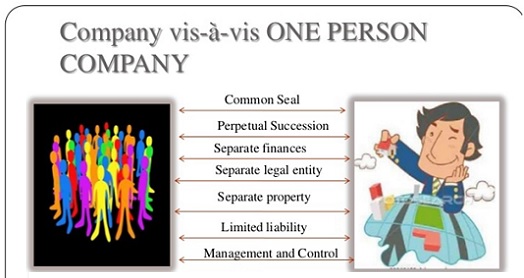
The word company has no strict or formal, technical or legal meaning. According to the Companies Act, a company means a company formed and which is registered under the Companies Act. [1] A company is incorporated under the Companies Act, 2013 or under any other previous law. In common law, a company is a legal person or legal entity, separate from and capable of Perpetual Succession which is surviving beyond the lives of its members[2]. It has rights and duties of its own. It can be called as a legal device for the attainment of any social and economic end. The history of Indian Company Law began with Joint Stock Companies Act of 1850. After which the cumulative process of amendment and consolidation brought us to the most comprehensive and one of the most complicated piece of legislation, the Companies Act, 1956. One-Person-Company-ConceptBut even so, it is not exhaustive of all the modes of bringing business concerns. Special Acts of the Parliament can form organisations for business or commercial purposes. The Life Insurance Corporation of India, for example, has been formed for business in life insurance under the Life Insurance Corporation Act, 1956. Such institutions are called “corporations.” Business firms or other institutions incorporated under the Companies Act are known as companies. After some process of amendment, the Companies Act of 1956 has been replaced by the Companies Act of 2013. The new act has only been amended and has consolidated certain portions of the company law. This new act has introduced many things, and one of it is the Formation of the One Person Company. A relatively new concept which came into the existence.  We will see and discuss at length about this new type of company, its structure, composition, process, comparison with different countries and need of it in the light of the Companies Act, 2013.

Types of Companies under Section 3

A company may be of three types, namely:

  1. Public Company: Where the business is formed consisting of seven or more persons.
  2. Private Company:  A business consisting of two or more persons when formed.
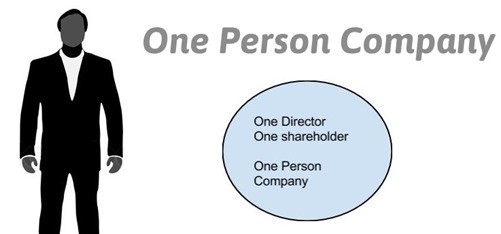
  3. One Person Company:  A business consisting of only one person when formed.

Section 2(62) of Companies Act, 2013 describes a one person company. Under this, the sole shareholder has to get a DIN (Director Identification Number) and digital signature certificate after which he must apply for the name of the company and consent of the nominee in prescribed forms after which members have to subscribe their names to the memorandum of the company. The memorandum has to indicate the name of another person with his prior written consent in the prescribed form. No minor can be a member or nominee of a one person company. opcThe nominated person assumes the role of a member in the event of the death of the subscriber’s death or his incapacity to perform a contract. The consent has to be filed with the Registrar at the time of formation/incorporation of a one person company along with its Memorandum and Articles. Such a person may withdraw his consent in a prescribed manner. The member of such a company may also change the name of such person by following the laid procedure by intimating the change to his nominee and by indicating in the memorandum or otherwise. This change has to be notified to the Registrar, and it will not be taken as an alteration of the memorandum. Payment of the requisite fee is made to the Ministry of Corporate Affairs along with the Stamp Duty and after scrutiny of documents at the Registrar of Companies, the sole shareholder shall receive a final certificate of incorporation.

Any company formed under this section may either be a company limited by shares or a company limited by guarantee or an unlimited company.

Registration of a company can be secured by filing an application with the Registrar of Companies under Section 7(1)[3]. The application should be sent along with following documents:

  • Memorandum of Association
  • Articles of Association
  • A copy of the agreement, if any, which the company proposes to enter into with any person for his appointment as a managing or a full-time director or a manager.
  • A declaration that all the requirements of an Act have been complied with. The declaration should be signed by an advocate or any proposed director, manager or secretary of the company or by a charted accountant who is in a full-time practice in India. These documents must be in print or computer printing by laser but not in Xerox.

Section 7 of 2013 Act introduced new requirements like filing of an affidavit that has to be filed by each of the subscribers to the memorandum and persons named as the first directors if any in the article. It should also include that he has not been convicted of any offences in connection with promotion, formation or management of any company or found guilty of any fraud or misfeasance or of any breach of duty to the company under the Act or preceding company law during the preceding five years and that the documents filed for registration contain correct and complete information and true to the best knowledge and belief, address of communication, particulars of name, Director Identification Number, residential address, nationality and other particulars including proof of identity as may be prescribed and particulars of interests of person mentioned in the articles as the first directors of the company in other firms or bodies corporate with their consent to act as directors of the company in such form and manner prescribed. The company must preserve and maintain the copies of all documents at their registered office till its dissolution under the Act. Also, there is a restriction on conversion of a one person company to any other form of company for two years from the date of incorporation, except if the threshold limit is increased by 50 lakhs.

Being a new concept, a one person company has been adopted to reduce legal framework and promote ease at doing business. A one person company can be called as a mixture of Sole Proprietorship and Company. It has a member limited liability. While in the Companies Act 1956, there was a provision of a minimum of two directors and shareholders were required to form a private limited company, however, in the case of a one person company after the Companies Act 2013, the same person can be a director and shareholder. There are new opportunities for Entrepreneurs and Sole Proprietor who may take advantage of limited liability and corporate structured approach which was not there before. The fundamental objective of a one person company is 100 percent shareholding, and only a natural person and citizen of India is entitled to form this type of company. Any other legal entities like societies or trusts cannot form a one person company.  Also, a person handling a one person company is not allowed to be a 100 percent shareholder in two companies at the same time. A one person company may have only one director but there can be up to 15 directors at the same time, and this number cannot be increased as per the Act. If the incorporation document is silent on this clause, it is assumed that sole shareholder is the sole director which shall be the case in most of the cases. As far as the taxation policy of a one person company goes,fwk-siegel-fig15_002 the finance ministry has not laid any specific provisions for it. It is assumed that the taxation policy will be as per a private limited company. Net profits which are calculated by deducting expenses from sales shall be taxed at 30 percent along with Education Cess and Krishi Kalyan cess. Compliances are relaxed which are normally applied to other private limited companies. Section 96 of Companies Act, 2013 which talks about annual meetings is not applicable to a one person company, and only the resolution shall be communicated by a member of the company and minutes entered, signed and dated by a member shall be deemed to be the date of the meeting. There is no requirement of preparing cash flow statements in annual financial statements, and such annual returns can be signed by the director instead of a getting it signed by the Company Secretary. Section 100 to 111 are not applicable to a one person company for further ease and Section 176 which talks about holding minimum four board meetings in a year shall also not apply.

It is provided in the Statute that when a one person company reaches a paid up capital of 50 lakh rupees or more or when the average turnover exceeds 2 crores or more for a period of 3 years, the company shall be converted into a private limited company after making a few necessary changes in the memorandum of association and articles of association and shall comply with all the requirements of a private limited company.  In case a private limited company wishes to get converted into a one person company, the above said compliances might be reversed, i.e., paid-up capital of less than 50 lakh rupees and an average turnover of fewer than two crores in a period of 3 years will entitle it to become one person company.

Conclusion-

Minimum paperwork, ability to form a separate legal entity with a single member, provision of conversion to other types of companies through induction of more members and amendment in a memorandum of association are few main objectives of the introduction of this concept to India. It is not wrong to say that it is still in its early stage, and teething problems may arise because the market will take its own time to get adapted to this new mode of business. It holds a bright future for young business person and entrepreneurs. The risks are limited to the extent of the value of shares held by such person in that company. This concept is expected to give a big boost to the small structured businesses. The only care that should be taken is that there shall be zero regulatory mess ups and non-compliance which can hamper the growth of Limited Liability Partnerships. India is opening its door to FDI and investments but before that, we need to create a strong foothold for our people who can tread on the path of sustainable growth, year on year. To reach the GDP of China, India needs to have sustainable growth for years in a continuation. A one person company was much required and may prove to be a stepping stone for it.

[divider]

References:

[1] Section 2(20)

[2] Salomon v. Salomon & Co. (1859-99) All ER Rep 33: 1897 AC 22

[3] It must be made to the Registrar in whose jurisdiction the registered office of the company is situated.

Download Now

Criminal Liability Of Directors And Company On Non-Payment Of Taxes

0

In this blog post, Mamta Ramaswamy, a student pursuing her Diploma in Entrepreneurship Administration and Business Laws from NUJS, Kolkata, discusses the criminal liability of the Directors and the Company on the non-payment of taxes. This article is written only for educational purposes and does not constitute a legal advice.

Download Now

Advantages of an LLP Over a Private Limited Company

0

In this blog post, Rounak Biswas, a fourth-year law student at Symbiosis Law School, Pune, and pursuing a Diploma in Entrepreneurship Administration and Business Laws from NUJS, Kolkata, analyses the advantages of an LLP over a Private Limited Company. 

PICTURE@Rounak Biswas


Introduction

Limited Liability Partnership (LLP) and Private Limited Companies are recent developments in the field of corporate law in India. LLP was introduced in India through LLP Act, 2008 whereas Private Limited Company is an old vehicle having its rules modified in 2013 by the Companies Act, 2013. Nowadays one can see that these two have become the most widely used vehicles in doing business. Here in this blog, I have intended to put up the differences between the two, and how LLP is better than Private Limited Company.


Definition – LLP and Private Limited Company (LLC)

LLP can be defined as a hybrid of a company llpand partnership incorporating the good points of both so as to facilitate the business. The LLP structure is not restricted to be used by a certain class of professionals but by anyone who wants to do business. In a simple kind of partnership, all the partners are jointly and severally liable for their actions, which is not true for an LLP. A partner is liable only for his act and only to the extent of his contribution of its capital. In a word, LLP has distinct legal identity compared to its partners[1]. LLP needs at least two designated partners while incorporation. However, there is no limitation as to the maximum number of partners in an LLP. LLP has perpetual succession.

A Private Limited Company is defined as a voluntary association of at least two members and not more than two hundred members. Like LLP they have a perpetual succession and have limited liability. However, the shares held by the members are not freely transferable, and if a transfer is allowed, that should be between the existing members of the company.


LLP and Private Limited Company – Key Points

Limited Liability Partnership (LLP) and the Private Limited Company has certain differences which are entirely understandable in the definition only. Both LLP and Private Limited Company have certain similarities when it comes to the incorporation. For example – at least two persons/ members are required for setting up an LLP and Private Limited Company. The only difference here being an LLP does not have any maximum limit as to the upper limit of the membership whereas LLC has an upper limit of two hundred when it comes to the shareholders.Limited-Liability-Partnership-Bill-2015

When it comes to the incorporation of LLP, one needs to apply for the Designated Partner Identification Number (DPIN) for the two designated partners of the partnership and digital signatures should be obtained for at least one of them who will be authorised to work in case of the legal, taxation and compliance matters. This is followed by an application for the name availability and obtaining a name for the LLP to be incorporated. This is followed by making of an LLP agreement and filing of incorporation document available with the registrar of companies and on successful filing certificate of registration is being given. In the case of LLC, the first and foremost task is to select the name of the company followed by the application for Director Identification Number (DIN) and digital signatures. This is followed by the drafting of Article of Association (AoA) and Memorandum of Association (MoA). The AoA, MoA, and other documents (if mentioned) on being filed successfully, Certificate of Incorporation of the LLC is being given. This charts out how the LLP and LLC are being formed.

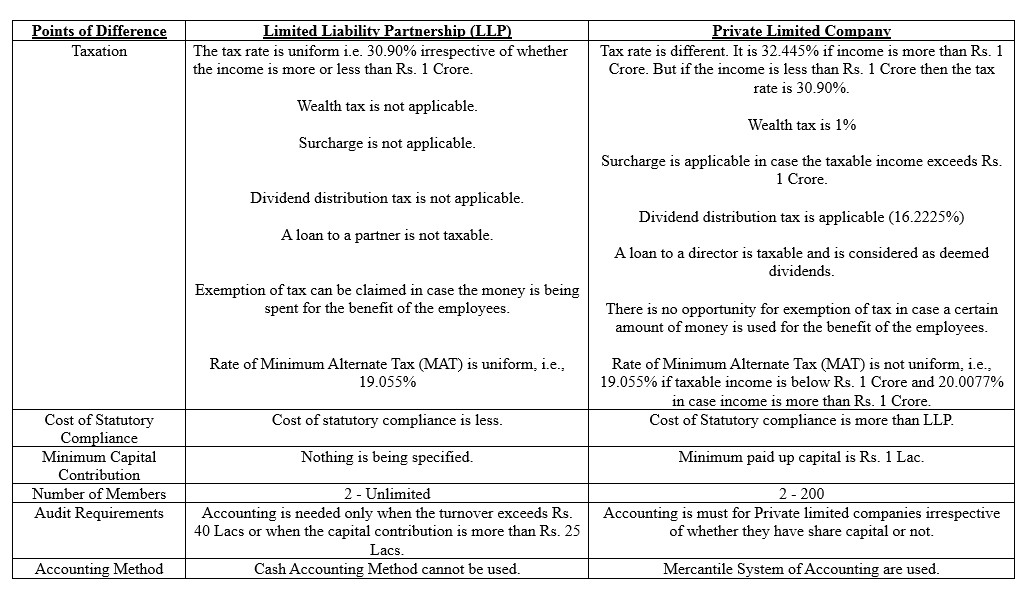
Now coming to the point where they differ, the same can be understood in a better and detailed way in the below umentioned tabular form –

55

Advantages of LLP over Private Limited Company – Conclusion

Thus barring a few condition, and the disinterest of Venture Capitalists and Angel Investors due to more or less risky nature of investments LLP is far more advantageous then LLC as on one hand the compliance cost is less and on the other hand taxation is less too in case of LLP. The simplicity in carrying business under LLP places it in a far more advantageous position than the LLC. It does not mean that everyone should start following the LLP model of business. But it can be said that the way LLP helps in facilitating the business is almost unrivalled, and the LLC are placed in a little bit disadvantageous position due to this, as we all know the human tendency is always to do something which involves lesser costs.


[divider]

References:

[1] http://www.charteredclub.com/what-is-a-limited-liability-partnership-llp/

Download Now

Issue Of Shares With Differential Voting Rights – Validity And Procedure

3

In this blog post, Poonam Sharma, an Advocate in Bangalore and a student pursuing a Diploma in Entrepreneurship Administration and Business Laws from NUJS, Kolkata, analyses the validity and procedures involved with the issuance of shares with respect to differential voting rights. 

Scanned photograph


Introduction

The common law rule of one share, one vote is considered convenient for corporate governance, both from the point of view of the shareholders and the management of a company. But there are instances where a company intends to have better control over its decision-making powers or processes rather than share such powers with shareholders who have a minimal shareholding in the company. dvr_032013094353In order to structure such intentions, Company law provides for shares with differential rights as to voting, dividend or otherwise.

Shares with differential voting rights are ordinary equity shares only with a variation in the voting rights. Such class of shares may have fewer voting rights as compared to a regular class of equity shares in a company. Shareholders who hold a small percentage in a company and only concerned with returns on their shares would prefer to opt for shares with differential voting rights as this reduces the obligation on them with regard to the management of the company and satisfies them in financial aspects.

Issuance of Shares with Differential Voting Rights

Section 86 (ii) of Companies Act, 1956 read with Companies (Issue of Share Capital with Differential Voting Rights) Rules, 2001 provided for a company to have equity share capital with differential rights as to dividend, voting or otherwise in accordance with rules as prescribed. Such rules had various conditions included but not limited to the requirement of a company having distributable profits for three financial years preceding the year in which it had decided to issue shares with differential voting rights[1], company making no default in filing annual accounts and annual returns for three financial years immediately preceding the year in which it had decided to issue shares with differential voting rights[2], no failure by the company in the repayment of its deposits or interest on the due date or date of redemption thereon[3] and authority to issue such shares with differential rights by the Articles of Association of the company[4]. The issue of such shares must not exceed 25% (twenty-five percent) of the share capital issued[5]. These were the conditions to be complied with in order to issue shares with differential voting rights until the introduction and enforcement of the Companies Act, 2013 in this regard.definition-of-equity

Section 43 (a) (ii) of the Companies Act, 2013[6] (“Act”) states that a company may issue equity shares with differential voting rights provided it is in accordance with Rule 4 of the Companies (Share Capital and Debentures) Rules, 2014 (“Rules”). Initially in order to issue equity share capital with differential voting rights Section 43 (a) (ii) and its corresponding stringent Rules were mandatorily applicable to both private and public companies, but on and from the date of June 5, 2015, the Ministry of Corporate Affairs has vide its notification[7] exempted private companies from the applicability of Section 43 and Rules, and private companies are now free to structure their share capital in a manner they deem best in the interests of the company.

However, public companies have not been exempt and are still required to comply with the conditions under the Rules. In order to ensure a public company can issue shares with differential voting rights, the following conditions[8]and procedure under the Rules need to be mandatorily fulfilled:

  • the Articles of Association of the company must authorize the issue of shares with differential rights;
  • the issue of shares must be authorized by an ordinary resolution passed at a general meeting of the shareholders:

Provided that where the equity shares of a company are listed on a recognised stock exchange, the issue of such shares shall be approved by the shareholders through postal ballot;

  • The shares with differential rights shall not exceed 26% (twenty-six percent) of the total post-issue paid up capital including equity shares with differential rights issued at any point in time;
  • The company must have a consistent track record of distributable profits for the last three years;
  • The company must not have defaulted in filing financial statements and annual returns for three financial years immediately preceding the financial year in which it is decided to issue such shares;
  • The company should not have any subsisting default in the payment of a declared dividend to its shareholders or repayment of its matured deposits or redemption of its preference shares or debentures that have become due for redemption or payment of interest on such deposits or debentures or payment of dividend;
  • The company should not have defaulted in payment of dividend on preference shares or repayment of any term loan from a public financial institution or State level financial institution or scheduled Bank that has become repayable or interest payable thereon or dues with respect to statutory payments relating to its employees to any authority or default in crediting the amount in Investor Education and Protection Fund to the Central Government;
  • The company should not have been penalized by Court or Tribunal during the last three years of any offence under the Reserve Bank of India Act, 1934, the Securities and Exchange Board of India Act, 1992, the Securities Contracts Regulation Act, 1956, the Foreign Exchange Management Act, 1999 or any other special Act, under which such companies being regulated by sectoral regulators.

The Board’s report for the financial year[9] and the explanatory statement annexed to the notice of the general meeting to be issued to shareholders of the company[10] must contain details such as the total number of shares to be issued with differential rights, details of such issue, percentage of shares with differential rights to the post issue paid up equity capital at any point of time, the reasons for issue, price at which such shares are proposed to be issued either at par or premium, basis on which the price is arrived at, details of the total number of shares proposed to be allotted to promoters, directors and key managerial personnel and other persons in case of private placement or preferential issue, percentage of voting rights such class would carry, the diluted Earnings Per Share pursuant to such issue and the pre and post issue shareholding percentage as per clause 35 of the listing agreement. The company must ensure that it shall not convert its existing equity share capital with voting rights into equity share capital carrying differential voting rights and vice versa[11]. The holders of equity shares with differential rights shall enjoy all other rights such as bonus shares, rights shares which the holders of equity shares are entitled to, subject to the differential rights with which such shares have been issued[12]. Upon such issue, the company shall maintain a Register of Members under Section 88 to record all the relevant particulars of the shares issued along with the details of the shareholders[13].fwk-siegel-fig15_002

It is pertinent to note that the Rules have clarified that existing equity shares with differential rights will continue to have the rights that have been provided at the time of their issuance and have accordingly been grandfathered[14]. Shares with differential voting rights would be valid provided a company has the powers to issue and structure such class of shares under the Articles of Association of the company.

When it comes to the instrument and rights of a shareholder, they have the freedom to enter into any arrangement with a company, provided it is in accordance with applicable company law. Although shares with differential voting rights may seem disadvantageous to a shareholder due to reduced management control over the company, a company could structure it such that it proves beneficial to such a shareholder with a higher rate of dividend or a discounted rate of trading for these shares. Tata Motors in 2008 became the first company to issue shares with differential voting rights as it issued 6.4 crore shares with differential rights at INR 305 per share to fund the acquisition of Jaguar Land Rover wherein these shares carried one-tenth the voting rights of ordinary shares and thereafter three other companies including Pantaloons Retail India, Gujarat NRE Coke and Jain Irrigation Systems have followed suit[15]. Pantaloons issued bonus shares with differential voting rights with an additional 5% dividend but one-tenth voting rights to ordinary equity shares. Gujarat NRE Coke and Jain Irrigation Systems also issued similar bonus shares with differential voting rights. Although not a popular choice, such shares are highly beneficial to those shareholders who are only looking to get rich and have minimal obligations towards a company.


[divider]

References:

[1] Rule 3(1), Companies (Issue of Share Capital with Differential Voting Rights) Rules, 2001.

[2] Rule 3(2), Companies (Issue of Share Capital with Differential Voting Rights) Rules, 2001.

[3] Rule 3(3), Companies (Issue of Share Capital with Differential Voting Rights) Rules, 2001.

[4] Rule 3(4), Companies (Issue of Share Capital with Differential Voting Rights) Rules, 2001.

[5] Rule 9(d), Companies (Issue of Share Capital with Differential Voting Rights) Rules, 2001.

[6]Enforced with effect from April 1, 2014.

[7] G.S.R 464 (E), Exemptions to private companies notification, Ministry of Corporate Affairs, June 5, 2015.

[8]Rule 4(1) (a) – Rule 4(1) (h), Companies (Share Capital and Debentures) Rules, 2014.

[9] Rule 4(4), Companies (Share Capital and Debentures) Rules, 2014.

[10] Rule 4(2), Companies (Share Capital and Debentures) Rules, 2014.

[11]Rule 4(3), Companies (Share Capital and Debentures) Rules, 2014.

[12] Rule 4(5), Companies (Share Capital and Debentures) Rules, 2014.

[13] Rule 4(6), Companies (Share Capital and Debentures) Rules, 2014.

[14] Explanation to Rule 4, Companies (Share Capital and Debentures) Rules, 2014.

[15] ‘How to benefit from shares with differential voting rights’, Business Standard, March 2013.


Download Now

Employer’s Responsibilities For Tax Filing Of Employees

0

In this blog post, Khushali Chauhan, who is presently working in Jade Blue Lifestyle India Ltd. and is also pursuing a Diploma in Entrepreneurship Administration and Business Laws from NUJS, Kolkata, writes about the responsibilities of employers for tax filing of employees. 

IMG_8675

The Income Tax Act, 1961 has made the income of a person chargeable to tax. The employer is responsible for the payment of Tax Deducted at Source (TDS) on the salary that is paid to the employees whose annual salaries are above the maximum amount exempted from tax.

Persons responsible for paying

Section 204(i) of the Act mentions “persons responsible for paying” which means the employer himself or if the employer is a Company, the Company itself including the Principal Officer. Section 2(35) of the Income Tax Act has specified principal officer to mean:

  1. Secretary, Treasurer, Manager or agent of the company.
  2. Any person connected with the management or administration of the company or upon whom the assessing officer has served the notice of his intention to treat him as a principal officer.[1]

The DDO, responsible for crediting, or as the case may be, paying such sum is the “persons responsible for paying” as per Section 204(iv), in the case of credit, or as the case may be, if the payment is by or on behalf of Central Government or State Government or PSUs.

TDS

The process of TDS

Although there are many ways of the tax deduction, tax deduction at source aims at taxation at the very source of income. It is essentially an indirect method of “collecting tax which combines the concepts of “pay as you earn” and “collect as it is being earned.”[2] While for the taxpayer this is a convenient and hassle-free form of tax payment, for the Government it’s a regular source of revenue.

Every person responsible for paying any income which is chargeable under the head ‘salary’ shall deduct income-tax on the estimated income of the assessee under the head salaries.[3] The tax is required to be calculated at the average rate of income tax by the rates that are given by the Government at that point of time, and the tax shall be deducted at the time of each payment. Tax on salaries won’t be deducted unless they exceed the maximum amount not chargeable to tax (Rs. 2,00,000/- or Rs.2,50,000/- or Rs. 5,00,000/-, that varies with the age of the employee). The employer is required to deposit the same with the government within the prescribed time. Later, a certificate of deduction of tax at source (Form No.16 or Form 16AA) is to be issued to the employee. Finally, the employer/deductor is required to prepare and file quarterly statements in Form No.24Q with the Income-tax Department. Sub-Section 2 of Section 192 provides that where a person has more than one employer, he may furnish the particulars of salary payments and TDS to the employer of his choice.[4]


TDS amount and process

As per Section 192, the employer is required to deduct tax at source on the amount payable at the average rate of income tax. Thus, the employer is required to compute the total salary income payable to an employee during the financial year in the beginning. After considering the incomes exempt, the tax liability of the employee should be determined by the rates as applicable in a given year. Every month, 1/12 of this net tax liability, as computed above, is required to be deducted from the employee’s salary. An Education and Higher Education Cess of 3% on the income tax is levied on the income tax.

The employer may, at his option, make payment of the tax on non-monetary perquisites given to an employee himself without making any TDS from the salary of the employee under Sections 192 (1A) & 192 (1B) of the Income Tax Act. The employer will have to pay this at the same time when he pays income chargeable under the head “salaries” to the employee. The employer has a right to adjust any shortfalls or excess in the deduction of tax already made.

The deductor is also required to deposit the tax so deducted in Government account within the prescribed time and format as per Section 200 of the Income Tax Act. The tax has to be deposited to the credit of the Central Government in any of the branches of RBI, SBI or any authorized bank either in cheque or cash or draft drawn on local banks.[5]

Every deductor is required to furnish a certificate to the employee to the effect that tax has been deducted along with certain other particulars. In the case of employees receiving a salary, the certificate has to be issued in form No.16. Form 26AS shows the amount of TDS, which has been deducted and is available as a credit against our Income Tax liability if any and has to be furnished by the income tax authority.

A return of TDS is a comprehensive statement containing details of salary paid and taxes deducted thereon from the employees along with other prescribed details.[6] It is mandatory to file a return as it certifies that the tax has been deducted and has been paid along with all other details. Such a return was to be prepared and signed by the DDO or the prescribed officer in the case of a government office, the managing partner/ partners in the case of a firm or the principal officer in the case of every company, etc.

TAN or tax deduction and collection account number is a unique number allotted to the deductor/ collector of tax at source for the purpose of identification of every deductor.  The deductor has a responsibility to quote TAN in various challans and certificates. The deductor is responsible for quoting the PAN of the employee as well.


TDS under the head salary or income other than salaries

Estimation of tax on salary and deduction of tax is the responsibility of the employer. For that, the employer is required to fix the salary payable and accordingly determine the tax liability. The employer is required to compute the gross salary and then deduct the amount that is exempt from taxation. Deductions are made according to Section 16 to arrive at the net salary payable.

An employee may have other income chargeable to tax such as interest income, capital gains and income from house property, etc. Subsection 2B of Section 192 enables the employee to furnish particulars of such income and any TDS thereon to the employer/drawing & disbursing officer. The person responsible for making payments shall take such income and the loss, if any, under the head income from house property into account for the purpose of computing tax deductible under Section 192.

 penalty

Penalties

Where the employer has failed to deduct tax, he is liable to pay interest. Where the employer has deducted the tax at source but failed to deposit wholly or partly, he is an assessee in default and liable to pay interest. In the case of Yashpal Sahni v. Assistant Commissioner[7], The court said it was the employer’s responsibility towards employees to deduct the applicable tax at source on their income at the applicable rates and where the tax was deductible at source, the taxpayer shall not be called upon to pay the amount himself to the extent of deduction. But if the employees’ total income exceeds the maximum amount not chargeable to tax and the employer is deducting no TDS, then the employee is under an obligation to pay tax through the advance tax route.[8]


Footnotes:

[1] Tds On Salaries, Income Tax Department, available at            http://www.incometaxindia.gov.in/booklets%20%20pamphlets/tds-on-salaries.pdf

[2] Ibid

[3] Section 192 of the I.T.Act, 1961

[4] Supra, note 1.

[5] Supra, note 1.

[6] Ibid.

[7] 2007 (109) Bom L-R 1537.

[8] http://taxguru.in/income-tax/tds-on-salary-employees-responsibility-if-employer-defaults.html


Download Now

Annual Compliance of Partnership Firms

0
Compliance and audit in word tag cloud on white

In this blog post, Prerana Sridhar, a final year law student from School of Law, Christ University (Bangalore), and pursuing a Diploma in Entrepreneurship Administration and Business Laws from NUJS, Kolkata, analyses the annual tax compliances that need to be initiated by a partnership firm.

Prerana Sridhar - Picture


Partnership is an agreement between two or more people who have agreed to share the profits of a business carried on by all of them together or any of them acting for them all. People who have entered into partnerships are separately called “partners” and collectively “a firm.”[1] Partners are obligated to carry on the work of the firm to the greatest advantage, to be just and to produce true accounts and complete information of all things affecting the firm to all other partners.

The definition of partnership contains three elements –

  • There must be an agreement entered into by all persons concerned;
  • The agreement must be to share the profits of business;
  • The business must be carried on by all or any of the persons concerned, acting for all.[2]

Compliance means conforming to a rule, policy, standard or law.  Compliances are required as it obligates people to work in line with the law. Compliances ensure that the incorporation and business of a firm are in conformity with the law.


Common Compliances

The common compliances required under the Act:

  1. Registration of firm in Form I with a time limit of 1 year.
  2. Change in Firm Name or Principal Place or Nature of Business in Form II with a time limit of 90 days.
  3. Closing and Opening of Branches in Form III with a time limit of 90 days.compliance
  4. Change in Name/Address of Partner in Form IV with a time limit of 90 days.
  5. Change in Constitution or Dissolution in Form V with a time limit of 90 days.
  6. When a minor becomes major and elects to become or not to become a partner in Form VI with a time limit of 90 days.[3]

A partnership firm is a popular form of business controlled by people acting for all and working under a personal liability. Partnership firms are relatively easy to start and are prominent amongst small and medium-sized establishments in the unorganized sector. With the introduction of Limited Liability Partnerships in 2008 in India, partnership firms are losing their importance due to the added advantages offered by a Limited Liability Partnership.

There are two types of partnership firms, registered and unregistered partnership firms. A firm needs to comply with Section 58 of the Partnership Act, 1932 to be fully registered. It is not compulsory to register the firm, but it is more advantageous to register a firm. Partnership firms are formed by drafting the Partnership Deed by the partners.[4]

Business man with check boxes over navy blue background

Partnership firm must file their annual tax return with the Income Tax Department. Other tax compliances like VAT or service tax filing may be necessary based on the business performed and the nature of the firm. A partnership firm is not obligated to file its annual accounts with the Registrar each year, unlike a Limited Liability Partnership or Company. It is not obligatory for Partnerships to prepare audited financial statements each year. However, a tax audit may be necessary based on the turnover and other criteria.

Partnership firm is viewed as a separate entity for the purpose of taxation. It is not necessary for the partnership to be registered. So partnership firm is taxed under the income tax slab for firms and partners are taxed under the income tax slab for individuals.


Tax Compliance

Section 2(23) (i)[5] takes the meaning of the “firm” from. Section 4 of the Indian Partnership Act, 1932 which defines firm as “Persons who have entered into a partnership with one another are called individually “partners” and collectively “a firm”, and the name under which their business is carried on is called the “firm name.”

Obtaining Permanent Account Number and Tax Deduction Account Number registration from the Income Tax Department for a Partnership Firm from the relevant Authorities once the Partnership Firm is registered is necessary.


Tax Rate

In the case of every firm, the rate of income tax on the whole of the total income will be 30% percent surcharge on income tax.

The amount of income-tax computed in accordance with the preceding provisions of this Paragraph, or the provisions of section 111A or section 112 of the Income Tax Act, 1961 shall, in the case of every firm, having a total income exceeding one crore

3d human character that push a big percent symbol

rupees, be increased by a surcharge for the purposes of the Union calculated at the rate of twelve per cent, of such income-tax, provided that in the case of firm mentioned above having total income exceeding one crore rupees, the total amount payable as income-tax and surcharge on such income shall not exceed the total amount payable as income-tax on a total income of one crore rupees by more than the amount of income that exceeds one crore rupees.[6]

When it comes to the mode of paying the tax by a partnership firm, it can be stated that taxes can be paid in any of following modes:

  • Physical Mode – Payment by furnishing the hard copy of the challan at the designated bank, i.e., Challan ITNS 280.
  • e-Payment mode – Payment by using the electronic mode. Added to this, e-payment is mandatory for a firm who is liable to get its accounts audited[7].


Filing of Return of Income

It is mandatory for every partnership firm to file the return of income irrespective of the amount of revenue or loss.[8] A company can file its return of revenue in ITR 5.  ITR 5 is for persons other than:

  • Individual,
  • HUF,
  • Company and
  • Person filing Form ITR-7.

It is mandatory for a firm to file a return of income electronically with or without digital signature. A partnership firm may also file a return of income under Electronic Verification Code. However, a firm liable to get its accounts audited under Section 44AB shall furnish the return electronically under digital signature.

Return Forms can be filed with the Income Tax Department in any of the following ways, –

  • by furnishing the return in a paper form;
  • by furnishing the return electronically under digital signature;
  • by transmitting the data in the return electronically under electronic verification code;
  • by transmitting the data in the return electronically and thereafter submitting the verification of the return in Return Form ITR-V.[9]


Particulars Regarding Due Dates for Filing Returns

A firm who is required to get its accounts audited under the Income Tax Act, 1961 or under any other law, the due date will be September 30 of the assessment year.

In any other case, it will be July 31 of the assessment year.


Conclusion

The advantages of Partnership Firms are that they are easy to start, have minimal compliance requirements, relatively inexpensive and annual filing is not required. But on the other hand, Partnership firms have unlimited liability and partners are personally liable for the acts of the firm. All the partners are jointly liable for the debt of the firm. They can share the liability among themselves, or anyone can be asked to pay all the debts even from his personal properties.

By observing the compliance requirements of partnership firms, it can be concluded that partnership firms do not have optimum compliance requirements. To enforce an efficient compliance with the law, more compliance can be imposed on such firms. These compliances can vary depending on the nature of the business. Compliances can be implemented in light of Wealth Tax, 1957, Excise Duties, Customs Act, 1962, Service Tax and Local taxes.  Labor Laws such as Provident Fund Act, 1952, Employees State Insurance, 1948, Minimum Wages Act, 1948, and Factories Act, 1948 can be included for compliance purposes. Miscellaneous compliances can be included such as compliance under Shops & Establishments Act, IPR Protection procedures, and Pollution Control Laws. Added to this, Partnership firms can be obligated to maintain books of accounts and registers, etc.

Hence, it can be concluded by stating that Partnership firms do not have optimum annual compliances for efficient conformity with the law, and more compliance requirements can be imposed to make it a stricter, more efficient structure.


[divider]

References:

[1] P C MARKANDA, The Law of Partnership, Edition 2010, Page 9

[2] P C MARKANDA, The Law of Partnership, Edition 2010, Page 11

[3] Forms under the Indian Partnership Act, 1932

[4] P C MARKANDA, The Law of Partnership, Edition 2010, Chapter VII

[5] Income Tax Act, 1961

[6] Paragraph C of First Schedule of Finance Bill, 2016 (Passed on May 14, 2016) – As per Section 167A of Income Tax Act, 1961

[7] Section 44AB of the Income Tax Act, 1961

[8] Section 139 of Income Tax Act, 1961

[9] http://www.incometaxindia.gov.in/tutorials/5-filing%20of%20return%20of%20income.pdf

Download Now
logo
FREE & ONLINE 3-Day Bootcamp (LIVE only) on

How Can Experienced Professionals Become Independent Directors

calender
28th, 29th Mar, 2026, 2 - 5pm (IST) &
30th Mar, 2026, 7 - 10pm (IST).
Bootcamp starting in
Days
HRS
MIN
SEC
Abhyuday AgarwalCOO & CO-Founder, LawSikho

Register now

Abhyuday AgarwalCOO & CO-Founder, LawSikho