Download Now
Home Blog Page 1704

20 Biggest Private Limited Companies In India

3

In this blog post, Rohit Kumar, who is running his own proprietorship firm based in Delhi under the name of RK Consultant & Associate and is also pursuing a Diploma in Entrepreneurship Administration and Business Laws from NUJS, Kolkata, writes about the 20 biggest private limited companies in India. 

ACS 040599P

Normally, we have a misconception about the scale of operations, turnover, and other criteria of private limited companies, as we perceive them to be small. Also, we always mistakenly understand that private limited company is established by family members just to give their business the shape of a legal entity.

All these are some of the most common misconceptions that people have while choosing a business structure. Choosing a business structure is more of a strategic decision and such a decision is totally dependent on pros and cons associated with a particular business model. Choosing a private limited company for a business model comes with its own perks which have led to the establishment of some of the biggest private limited companies in India. This article lists down the 20 biggest private limited companies in India.

Let’s start them listing one by one:

3fe6027858667.55e61091bc63d

  1. Google India Pvt. Ltd.

  •  Industry Type: Information Technology | software
  • Registered Office: Bangalore
  • CIN: U72900KA2003PTC033028

About Company: Google is a brand besides a multinational technology company. Its main business is internet-related services and products. Google was founded by Larry page and Sergey Brin when they were Ph.D. students at Stanford University.

Famous Product & service: Google search engine and Gmail services.

mariotthotel-kxB--621x414@LiveMint

  1. Marriott Hotels India Pvt. Ltd.

  •  Industry Type: Hospitality| Hotel/Resort
  • Registered Office: Mumbai
  • CIN: U55102MH1993PTC160831

About Company: The Company is running its full chain of Hotels and Resort under the brand of Marriott International. Its parent company is based in Washington D.C. and was recently on the ‘Forbes Best Company to work for’ list. This was founded by J. Willard Marriott who began with only two motels in the 1950s.

Famous Hotels & Resort in India: JW Marriott Hotel New Delhi Aerocity, Courtyard Gurgaon and so on.

XuBsjokt

  1. American Express (India) Private Limited

  •  Industry Type: Financial Services & Insurance| Banking /Credit Services
  • Registered Office: Delhi
  • CIN: U74899DL1994PTC059865

About Company: The Company provides a wide range of financial and accounting services. This Company was founded in 1994 which is a subsidiary company of American Express International, Inc.

  1. Sap Labs India Private Limited

  •  Industry Type: Information Technology
  • Registered Office: Bangalore
  • CIN: U72200KA1995PTC018484
https://lawsikho.com/course/diploma-entrepreneurship-administration-business-laws
click above

About Company: This Company makes enterprise software to manage business operations and customer relations.

  1. Forbes Marshall Private Limited

  • Industry Type: Manufacturing & Production
  • Registered Office: Pune
  • CIN: U28996PN1985PTC037806

About Company: It is an engineering and energy conservation solutions provider, especially for the processing industry. Its formation root can be traced to a partnership between J.N. Marshall and Darius Forbes in Pune in the 1940s. It has four manufacturing units in India which are located at Kasarwadi, Pimpri, Hyderabad, and Pune.

3775

  1. Life Style International Private Limited

  • Industry Type: Retail | Clothing
  • Registered Office: Bangalore
  • CIN: U00063KA1997PTC023058

About Company: It is an Indian fashion retailer chain promoted by the landmark group. It started its operation in the year 1999 with its opening of the first store in Chennai.

Currently, it has 43 stores in 26 major cities.

A lifestyle store retails domestic as well as international brand such as Nike, Louis Philippe, etc.

https://lawsikho.com/course/diploma-companies-act-corporate-governance
click above
  1. DHL Express (India) Private Limited

  • Industry Type: Transportation | Package Transport
  • Registered Office: Mumbai
  • CIN: U64120MH2001PTC131743

About Company: DHL Express India is an Indian wing of the German logistics company Deutsche Post DHL which is into the business of international express mail services. Deutsche Post DHL is considered to be the world’s largest logistics company operating around the world, particularly in sea and air mail.

27com16

  1. Pitney Bowes India Private Limited

  •  Industry Type: Information Technology | Software
  • Registered Office: Delhi
  • CIN: U72200DL2004PTC126016

About Company: It is an Indian subsidiary of Pitney Bowes Inc. It is a global technology company offering innovative products and solutions that enable commerce in the areas of customer information management, location intelligence, customer engagement, shipping and mailing, and global ecommerce. Pitney Bowes India acquired the mailing business division of Kilburn Office Automation Ltd. on December, 2004.

microsoft-india

  1. Microsoft Corporation (India) Private Limited

  • Industry Type: Information Technology
  • Registered Office: Delhi
  • CIN: U74899DL1988PTC032549

About Company: It is a subsidiary of American software company Microsoft Corporation, headquartered in Hyderabad. In India, Microsoft has employed almost 6500 people and is working closely with Indian Government.

  1. Adobe Systems India Private Limited

  • Industry Type: Information Technology | Software
  • Registered Office: Delhi
  • CIN: U99999DL1997PTC088801

About Company: Adobe Systems India Pvt. Ltd. is a subsidiary company of Adobe System Incorporated, an American multinational computer software company. It is known for its products such as Photoshop, Adobe Reader, PDF, etc.

  1. Netapp India Private Limited

  • Industry Type: Information Technology | Storage/Data Management
  • Registered Office: Bangalore
  • CIN: U72200KA2000PTC032301

About Company: It is a subsidiary of NetApp Inc. which is into the business of storage and data management headquartered in California.

oberoi_feb14

  1. Oberoi Hotels Private Limited

  • Industry Type: Hospitality | Hotel/Resort
  • Registered Office: Kolkata
  • CIN: U55101WB1946PTC014548

About Company: It is a Global Hotel Company having a head office in Delhi. This was founded in 1934. The Oberoi operates more than 30 hotels and two river cruises in five countries.

  1. Starwood Hotels & Resorts India Private Limited

  •  Industry Type: Hospitality | Hotel/Resort
  • Registered Office: Delhi
  • CIN: U55101HR2013FTC051253

About Company: It is a subsidiary of Starwood Hotels, and Resorts Worldwide, Inc. which is an American hotel and leisure company headquartered in Stamford, Connecticut. It offers hotels, spa centers, resorts, and residences. It operates under the brand names of St. Regis, The Luxury Collection, W Hotels, Westin, Le Méridien, Sheraton, Four Points by Sheraton, Aloft, and Element. The company was incorporated in 2013.

fotografia_201341913346

  1. Hibu India Private Limited

  •  Industry Type: Information Technology
  • Registered Office: Bangalore
  • CIN: U72300KA2005PTC038031

About the company: it is a subsidiary of Hibu, formerly known as Yell Group plc, which into the internet business and is headquartered in the UK. It has its presence in many countries. This company runs sophisticated marketing plan.

  1. Paypal Payments Private Limited

  •  Industry Type: Information Technology | Software
  • Registered Office: Mumbai
  • CIN: U74990MH2009PTC194653

About Company: It is a subsidiary company of PayPal Holding Inc. which is an American company that provides online payment platform worldwide.  Online money transfers are electronic alternatives to the traditional system of payments through checks and money orders.

  1. One97 Enterprise Mobile Solutions Private Limited

  •  Industry Type: Information Technology
  • Registered Office: Delhi
  • CIN: U74999HR2011PTC044282

About Company: Paytm is a brand of the company which is India’s largest electronic goods and mobile e-commerce platform. It is also an e-payment solution provider in India. It has more than 3200 regional offices in India and also has a global presence.

  1. Aspire Systems (India) Private Limited

  •  Industry Type: Information Technology
  • Registered Office: Mumbai
  • CIN: U72200MH1998PTC116124

About Company: It is a Software Development Services Company. It provides services like software testing, Infrastructure Application Support, etc.

AAEAAQAAAAAAAAJ6AAAAJGRkMzNjODQ3LTg5NzItNDJhMS05OWY4LTU4ZDFkZDQyOTc4ZA

  1. Tavisca Solutions Private Limited

  •  Industry Type: Information Technology | Software
  • Registered Office: Pune
  • CIN: U72100PN2008PTC132281

About Company: It is an online travel booking engine. It helps the travel industry by providing technology-related services and lets the travel businesses focus on their core business.

  1. Gozoop Online Private Limited

  •  Industry Type: Professional Services | Advertising and Marketing
  • Registered Office: Mumbai
  • CIN: U72900MH2010PTC202960

About the company: It is digital product and services company having its headquarters in Mumbai, India. It provides services such as social media marketing, searches engine optimization, online advertising, web designing and development and much more.

Impetus-Logo

  1. Impetus Infotech (India) Private Limited

  • Industry Type: Information Technology | Software
  • Registered Office: Gwalior
  • CIN: U72100MP2000PTC014455

About Company: It is a product development, software services, and solutions company. This company focuses on innovative ways of analyzing data for business.


LawSikho has created a telegram group for exchanging legal knowledge, referrals and various opportunities. You can click on this link and join:

https://t.me/joinchat/J_0YrBa4IBSHdpuTfQO_sA

Follow us on Instagram and subscribe to our YouTube channel for more amazing legal content 


Download Now

How To File An Application For Rectification Of Income Tax?

0

In this blog post, Abhishek Kumar, a student of law at Delhi University, who is currently also pursuing a Diploma in Entrepreneurship Administration and Business Laws from NUJS, Kolkata, writes about the procedure for filing an application for rectification of Income Tax.

DSCN7046

Section-154 of Income Tax Act provides for the remedy of rectifying the assessment of income tax.

What kind of errors can be rectified?

Under Section-154(1), errors which can be rectified are:

an error of fact
2. an arithmetic mistake, or
3. a small clerical error, or
4. error due to overlooking compulsory provisions of law.

Who are empowered to rectify?

A rectification can be filed by a Taxpayer (assessee) bringing the mistake to the notice of the authority concerned, or, an Income Tax Authority. The authorities concerned are:

  1. Income Tax Assessing Officer (under Section-143(1))
    2. Commissioner (Section-23 or Section-264)
    3. Commissioner (Appeals) (Section-250)
    4. Other Income Tax Authorities (Section-116)
  2. The Appellate Tribunal (under Section-254(2) but not Section154 as it is not an income tax authority).

    Some Important points regarding filing application for rectification under Section 154(1)
    One cannot use this rectification request for changing bank account or address details of one’s Income Tax Return. If upon rectification there is a change in income, in that case, one must file a Revised Income Tax Return. No new deductions or exemptions are allowed to be claimed in the rectification request.

Time limit for rectification under Section 154

Rectification of an order can be made only within four years from the end of the financial year. However, the time limitation shall not be applicable where correction is made under Section 155.  If the assessee makes an application for rectification , the authority shall pass an order within a period of 6 months from the end of the month in which the application is received by it making the amendment or refusing to allow the claim. The opportunity of being heard is given to  assessee if rectification results in enhancement or reduction or increase in liability of the assessee. Moreover, the authority concerned must give notice to the  assessee. Even when Returns are already processed in Central Processing Centre (CPC) Bangalore, a rectification request can be filed. When the income tax return was filed online, only online rectification is allowed.

How to file a rectification request under Section 154(1) online

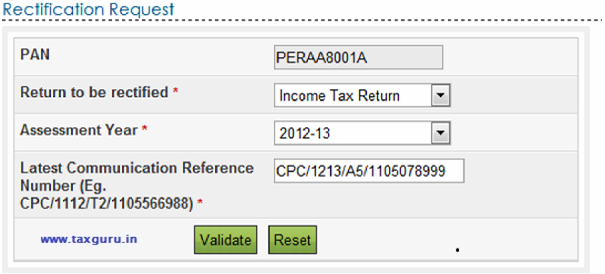
Step 1 – Login to the e-Filing application and go to  > My Account > Rectification Request.

Step 2 – Select Return to be rectified as “Income Tax Return” from the drop down available.

Step 3 – Select the Assessment Year for which Rectification is to be e-Filed. Enter the Latest Communication Reference Number (as mentioned in the CPC Order)

Step 4 – Click “Validate”.

aa

Step 5 – Select the ‘Rectification Request type.’

Step 6 – On selecting the option “Taxpayer is correcting data for Tax Credit mismatch only”, three check boxes TCS, TDS, IT are displayed. You may select the checkbox for which data needs to be corrected. Details regarding these fields will be prefilled from the ITR filed. The user can add a maximum of 10 entries for each of the selections. No upload of any ITR is required.

These Three fields are as follows:

‘Taxpayer Correcting Data for Tax Credit mismatch only’ − on selecting this option, three check boxes, TCS, TDS, IT, are displayed. You may select the checkbox for which data needs to be corrected. You can add a maximum of 10 entries for each of the selections. No upload of an Income Tax Return is required.

‘Taxpayer is correcting the Data in Rectification’ − select the reason for seeking rectification, Schedules being changed, Donation and Capital gain details (if applicable), upload XML and Digital Signature Certificate (DSC), if available and applicable. You can select a maximum of 4 reasons

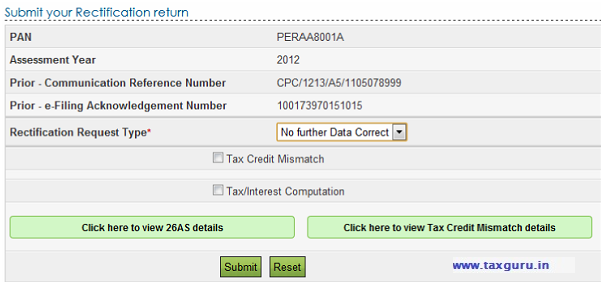
‘No further Data Correction required. Reprocess the case’ − On selecting this option, three check-boxes, Tax Credit mismatch, Gender mismatch, Tax/ Interest mismatch are displayed. You may select the checkbox for which reprocessing is required. No upload of an Income Tax Return is required.

Step 7 – Click the ‘Submit’ button.

jacj

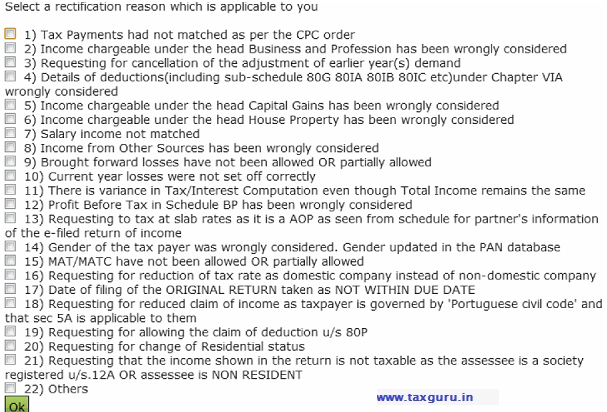
Step 8 – On selecting the option “Taxpayer is correcting Data in Rectification”, select the reason for seeking rectification. Schedules being changed, Donation and Capital gain details (if applicable), upload XML and Digital Signature Certificate (DSC), if available and applicable. You can select a maximum of 4 reasons.

ksD

Select a Rectification Reason

Step 9 – On selecting the option “No further Data Correction Required. Reprocess the case”, checkboxes to select are: Tax Credit Mismatch, Gender Mismatch (Only for Individuals), Tax / Interest Mismatch are displayed. The user can select the checkbox for which reprocessing is required. The user can view their 26 AS details by clicking on ” Click here to view 26AS details” button and view their Tax Credit Mismatch details by clicking on “Click here to view Tax Credit Mismatch details” button.

jHGS

Step 10 – Click the “Submit” button. A popup appears.

sfv

Step 11 – Click on “OK” button to submit the rectification.

Step 12 – On successful submission, following message is displayed.

JHDGS


Download Now

Proccedure To Transfer Shares In A Private Company

0
Hands exchanging money
In this blog post, Arushi Chandak, a student pursuing her 2nd Year Student, BA.LLB. (Hons.) from Symbiosis Law School, Pune, and a Diploma in Entrepreneurship Administration and Business Laws from NUJS, Kolkata, details the procedure to be followed while transferring shares in a private company. 

Introduction

Before embarking on a Step-by-Step guide into the nuances of transferring shares in a Private Limited Company, it is imperative to understand and grasp exactly the concept of a Private Limited Company. 55

A Private Limited Company is a type of privately held business entity that offers limited liability to stakeholders, usually not more than 50, restricted to their shares, but that places certain restrictions on its ownership, as defined in the company’s bylaws or regulations and Articles of Association. The restrictions with regard to ownership that is essential that shareholders cannot sell or transfer their shares without offering them first to other shareholders for purchase and shareholders cannot offer their shares to the general public on a stock exchange are meant to prevent any hostile takeover attempt. Therefore, the ownership of a private limited company is determined by the shareholding of the Company. Induction of new investors or the transferring of any part or full part of the ownership requires the transfer of the movable property of the Company; the shares.

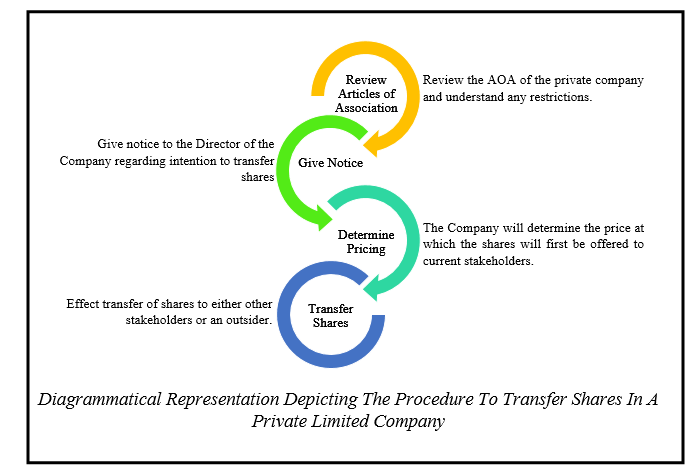
Below is a Step-by-Step Guide to explain the procedure to transfer shares in a Private Limited Company:

Step 1: Review the Articles of Association

The Articles of Association or AOA of the Private Limited Company needs to be reviewed. Before beginning the share transfer procedure, any restrictions that have been placed on them must be first addressed. Being a sort of ‘closed corporation’ of its stakeholders, the AOA contains certain share transfer restrictions. These restrictions that are imposed upon the rights of the shareholders to transfer shares are usually in two forms:shutterstock_180080384_2152151474

  • Rights of Pre-emption: If a shareholder desires to sell some or all of his shares, he/she must first offer such shares to the other existing members of the Private Limited Company. The price at which each share is to be sold is usually determined by the Directors or the Auditor of the Company. The value of the shares may also be determined based on any formula or method prescribed in the Articles of Association if any. It is only if no existing member or shareholder is interested in buying the shares can the shares of the Company be freely transferred to an outsider.
  • Powers of Directors to refuse: The Director of the Private Limited Company may have the powers under the Articles of Association to refuse registration of the transfer of shares under prescribed certain circumstances.

It is notable to mention that only restrictions imposed under the Articles of Association have any legal binding. Private agreements between the shareholders are not binding on either the company or on the shareholders. Therefore, simply put, the Articles of Association can only restrict any transfer of shares but the right to transfer shares of a Private Limited Company cannot be completely prohibited or banned.


Step 2: Give Notice

The shareholder that wishes to transfer his or her shares must give notice, in writing, to the Director of the Company expressing his or her intention to do so.


Step 3: Determine Pricing

Following the expression of intent vide a written notice, the price per share has to be determined in accordance with the Articles of Association and the Directors of the Company or the Auditor of the Company. These shares, at the decided price, will first be offered to the present shareholders of the Company.


Step 4: Transfer of Shares

If any of the present shareholders come forward, before the last date to purchase the shares, for buying the shares, at the prescribed price, such shares must be allotted to them. But, if none of the existing shareholders are interested in purchasing the available shares, or if there are excess shares available, the company may transfer the shares to an outsider. The prospective buyer is required to fill up the share transfer deed in Form No- SH.4.safeman_business

Thus, the final process of transferring the shares of a Private Limited Company goes from obtaining the share transfer deed in the prescribed format, executing the share transfer deed, duly signed by the Transferor and Transferee and stamped as per the Indian Stamp Act and the Stamp Duty Notification in force in the State concerned. A witness is required to sign the share transfer deed with his or her signature, name, and address. Attaching the share certificate or allotment letter with the transfer deed, it needs to be delivered to the Company, which must process the documents and if approved, issue new share certificate in the name of the transferee. The completion of all the formalities and approval will result in handing over the new share certificates.


Conclusion

In my opinion, the procedure elucidated above is sound. Such a procedure allows the Private Limited Company to settle issues within themselves at the first instance before bringing in an outsider into the internal affairs of the Company. This provides the company with more stability and helps the Company grow.

Download Now

Structuring A Playschool Business In India

0

In this blog post, Supallab Chakravorty, who is currently pursuing a Diploma in Entrepreneurship Administration and Business Laws from NUJS, Kolkata, discusses the process for structuring a playschool business in India.

20150154b55f6c67819

Introduction

Taking up play school business is a business stance that is gaining popularity among the entrepreneurs of India. The primary reason this venture as a business is gaining popularity is because of its lucrative nature in terms of low investment, even lesser legal compliances and huge outcome. Kidzee, a popular chain of playschool franchisee provider quotes an ROI on its franchisee to be 200% in 4 years; such is the outcome of this business. Once settled, this business does not give you the stress like recessions and low impacts.  Healthcare and education are two such sectors which are least affected by any kind of economic crises.


Analysis of the Market

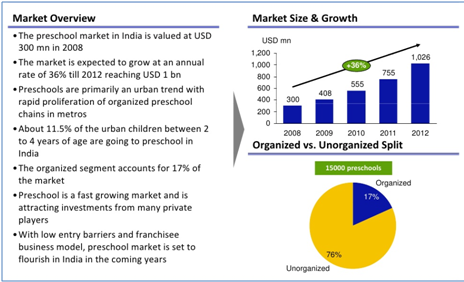
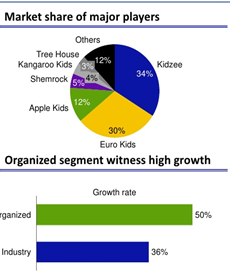
The business model has a good cash inflow and potential of seeing substantial growth based on the entrepreneurial drive driving it. The potential of growth in this sector is humongous. Following are a few graphs that will show the potent growth in this business filed. Accordingly, the competition in the market is also substantially high. The graph below would display the same.[1]


Image 1: Size of playschool business market in India and share of market held by competitors

jghgjhg


hagd,ja


Structuring a playschool business in India – Process Chart

But no matter how lucid and easy going business field one might be in, one certainly needs a good business plan to grow aggressively in the market. As it is commonly said, a stagnant business/product is as good as a dead business. Therefore, to start a business too, one needs a good business structure. Here are a few items that are supposed to be in the checklist in starting a playschool business:

  1. Selecting a business model

When one plans to start a playschool business in India, he has two options in hand i.e. either start his own venture or take up a franchise. Both of them have their own set of advantages and disadvantages.

On getting a franchisee, there are certain benefits like there are certainly advantages like:

  • There is no requirement of aggressive marketing or campaigning that is taken care of by the brand-name holder.
  • The terms set out in the agreement for setting up a business model is easier and has very low investment criteria.

 Let us take a look at the top franchisors and the criteria they site

  • Required investment for Kidzee Playschool is just Rs. 5 to 10 lakhs and the required floor area is 2500 square feet
  • The net investment to open a Tree House play school franchise in India is also under Rs. 10 lakhs and the minimum required area is 1000 square feet.
  • A Hello Kids play school is about Rs. 10 lakhs, and the required floor area is a minimum of 1000 square feet.
  • One needs a minimum investment of Rs. 10 lakhs to open a Shemrock franchise preschool in India as well as a floor area of 2500 square feet.
  • The cost of opening Euro Kids franchise is 10-15 lakhs and area required is 2000 square feet.
  • The return on Investment assured by this franchise is easy to achieve and are considerably high. The risk factor involved in such franchise business is very less.
  • Professional support in terms of setting up the school (pre-defined infrastructure, staff and administration), managing it, getting market recognition etc. are some advantages of having a brand franchise.

However there are certain disadvantages also attached to the franchise form of business.

  • The disadvantages come with the contract. Not every brand franchisor will let you go away with the business know how and the brand value it has carried for so long. Therefore before entering into any form of contract, please take note of the following clauses:
    • Events of Default clause – may cause the termination of contract without any material default on your part;
    • Exit Option Clause – The contract may not allow you to exit easily and you are stuck for a long time with a bad business deal;
    • Non-Compete, Non Solicit Clause – It may restrict you to venture with other brands of play school or start your own venture;
    • Penal clauses – It may impose unnecessary penalties on minimum defaults and may give rise to unnecessary litigation;
    • Trademark and franchising Clauses are important because that is the sole advantage you are deriving out of the franchise agreement therefore conduct a thorough due diligence on it; and
    • Survival Clause – Refers to the clauses that survive post termination of contract. A bad survival clause will trigger a good deal for you.

Starting-your-venture

Setting up one’s own venture

Setting up one’s own venture also has its own set of advantages and disadvantages.

Advantages

  • One gets to handcraft one’s own business model. One can choose a partner and a scale of business investment of his choice.
  • There is a certain degree of freedom as he is not bound by a standard form of agreement.
  • He gets to apply his own expertise, entrepreneurial ideas into it and design an innovative venture.

Disadvantages

  • There are a large number of formalities that need to be completed. That all has to be done meticulously.
  • Apart from the investment of money and space, time and efforts are also required from the part of the venture holder. There are several important tasks like planning and finalizing the curriculum, setting up the administration and infrastructure based on the norms and rules as required by the curriculum and much more.


  1. Commercials

One of the important aspects before venturing into legal formalities is to have the commercial structure clear. What could be the source of funds? How much of debt or equity needs to be injected in the business:

Investment Required

  1. Land and Building – Ranging from 1000 square feet to 2500 square feet
  2. Capital Investment – Ranging from Rs. 7,00,000 to 10, 00,000 (depends on the scale of business.)
  3. Furniture like plastic chairs, tables and classroom equipments amounting to 40,000- 80,000
  4. Play equipments like rockers, slide etc. Also book racks, wall hangings and staff furniture needs to be considered.[2]
  5. Appropriate Human Resources qualified to man the organisation. Minimum wages that need to be paid out is 80 rupees per day. 1 staff per 10 students and 1 teacher per 20 students. A venture like this typically has 20 -50 students.[3]

The Return on Investment as quoted from famous franchises is approximately 2 to 3 years[4] depending on the franchise and the scale of the business. Setting up a franchise is easier. The process is as follows:

  • A simple forms needs to be filled in their website.
  • They are going to conduct the survey if one meets their criteria to select a favourable location, do the marketing and campaigning.
  • You will be able to start a playschool with their guidance at every step.
  • There are several portals which provide gateways to apply to these playschool franchises. Like www.startingfranchise.in

But if the venture is one’s own, then certain factors have to be kept in mind before making an investment in order to reach an ROI. The factors that need to be taken care of are as follows:

  1. Geography – Parents till the initial stages of the growth of the child do not want to send their children far, therefore it has to be in a residential area with open spaces around. Again depends on the locality.
  2. Demographic Profile – Once the location is fixed, than one needs to look for the demography of the area. A place with a nuclear family would be more likely to send their children to play school than places with joint family where the child mostly gets its education from elders. Also it is advisable to keep a tap on the type of income group people that live there. It will help set the fee structure.
  3. Market Survey – Conduct a survey to find out the potential number of students and the preference of the kind of playschool.

Break Even Point

Step 1: 

  • From the industry standard, let us keep the Break Even Point (where both Fixed Cost and Variable Cost are absorbed) at 1.5 years
  • The Fixed Cost is assumed at initial stage as INR 7, 00,000 (FC)
  • The Variable Cost is expected to be 4, 00,000 (TVC)
  • Also, we set a target to break-even our business in 1.5 years.

Step 2:

  • Find out the annual fees that your competitors are charging to estimate your fees.
  • Let’s assume that the fees charges would be INR 25,000 per student and the number of students to be X. Therefore the Total Revenue (TR)would be INR25, 000X.

Step 3: 

Contribution = TR – TVC

  • 25,000X — 4, 00,000.’

Step 4:

  • We have kept the break even timeline as 1.5 years. Whatever is earned over and above our variable costs, will be used to cover the fixed expenses. Post that all earnings would be to be profits of the institution
  • Divide FC by Contribution to get your breakeven period in years.
  • Therefore we get the following equation:
  • 700,000 / (25,000X — 400,000) = 1.5.
  • The value of X stands as 34.67.
  • Thus we need at least 35 students for first 1.5 years to realise all costs.
  • Even after the breakeven point, the profit will be INR 4, 75,000.


Potential Investors

  1. Aavishkaar
  2. Acumen
  3. Centre for Innovation, Incubation and Entrepreneurship
  4. Michael and Susan Dell Foundation
  5. Rural Technology Business Incubator
  6. LGT- Liechtenstein Global TrustVenture Philanthropy
  7. UnLtd India
  8. Footprints Child Care


3. Legal Formalities

news6276

In case of playschools, the legal compliances are very minimalistic. Thus the cost of litigation that may arise out of such process is also very less.

  1. The Shops and Establishments Act is not applicable

 In case of playschools, the Act is silent and one can run your playschool without a registering under Shops and Establishment Act.

Labour laws:

The following labour laws have to be kept in mind:

1. Provident Fund payments – If there are more than 20 employees the organisation has to abide by provident fund rules otherwise may be subject to penal provision under 14B of the Act of 1952.

Checklist of the same could be found at http://epfindia.nic.in/Applicability.htm

2. The Minimum Wages Act, 1948 – The minimum wages for primary schools is Rs. 80.

3. As per the Payment of Bonus Act, 1965 – If there are more than 20 employees, one needs to pay a 1 month at anytime during the year.

Forming the entity:

If you start your own institution, it can be done either as a partnership or as a Section 8 company or even an NGO under a trust. It is usually easier to form a partnership, and cheaper and quick to register. Forming a company can take up to 4 weeks, and costs around Rs. 35000. Be careful with the formation of the partnership deed and the profit sharing.

LLP in India has certain regulations which need to be abided by, according to the LLP Act, 2008 in India. Although the regulations are more than partnership firms but less than floating a company given the ever increasing regulations for companies under Companies Act.


Running it in a residential area:

Most playschools are located in residential areas. The first thing that needs to be looked into is whether the rental agreement permits it. Also, if it is an apartment or consortium or society apartment, the bye-laws of the apartment/association/ society consortium should be looked into for permits to run a playschool. Otherwise, there is no running a playschool in residential premises. Requisite permission has to be taken from the society it is operating in.

It has been decided by Courts in different states that a chartered accountant, yoga teacher and lawyer can carry on their work in residential premises so there is no reason why a playschool cannot be carried on as well, as long as the disturbance to neighbours is minimized.[5]

Maharashtra Preschool Centres (Regulation of Admission) Act of 1996 or Tamil Nadu Private School Education Act:

These Acts provide for compulsory registration of pre schools in certain state. Only in a few states, one needs permission from appropriate authority for starting preschool in Maharashtra. It should be education officer of Municipal Corporation who will provide with the certificate. However this is the only state where you need such permission. The procedure is broadly as follows:

  1. Name the institution. It should not duplicate
  2. Define your budget.
  3. Develop a preschool curriculum [6]


  1. Deciding a curriculum

The final step to see the business set up to reach its initial stage is setting up a curriculum for the day school. This depends upon the type of playschool being formed Children of this age group are mostly very active and require engage in various activities. Their mindset is set to explore, observe and grasp and learn quickly. Their socio economic backgrounds may be different and so shall be their languages thus every child is different in terms of energy and understanding.

There can be different programs based on the age group:

  1. Mother Toddler program for 9 months and 2 years of age: Mother Toddler program again is designed to help mothers understand child’s socialisation needs and help them develop their skills while playing.
  2. Early Childhood Teacher training program (E.C.C)/Nursery teacher training program:
    launching this year – Such programs are aimed towards training students to be ready for pre primary or early school. Theory plus practical courses of 7 months are advisable for this stage.
  3. Day Care centre curriculum – It is a different sort of set up. Most of the parents are working and are unable to provide teaching time to their kids. Such parents look for quality preschools where their child could get proper early childhood education.

An ideal playschool curriculum fulfils all the requirements of a child. A typical preschooler’s curriculum includes a good mix of reading, preschool worksheets, writing and math exercises along with colourful fun preschool activities. Such wide scale of activities helps children in learning and developing their skills in all the fields. Children are quite fascinated by playful activities and colourful objects and also appreciate the playful moments. There are professional advisors who can help in developing a good playschool curriculum. It is advised to consult them because it is the first learning stage of the child and should not be dealt with.

Footnotes:

[1] SOURCE: http://www.netscribes.com/

[2] Source: http://bangalore.citizenmatters.in/articles/3686-quick-guide-to-starting-a-playschool?utm_source=copy

[3] Source : http://indalytics.com/case-studies/pre-school/how-to-conduct-feasibility-study-before-starting-a-preschool/

[4] Source : http://www.startingfranchise.in/2013/03/how-to-open-kidzee-school-franchise.html

[5] V. Sasidharan v. Peter and Karunakar, (1984) 65 FJR 374 (SC); National Union of Commercial Employees v. Industrial Tribunal, (1962) 22 FJR 25; Dr. Devendra M. Surbi, Case(AIR 1969 SC 63 6T); Dev Brat Sharma v. Dr. Jagjit Mehta, C.A. No. 4216 of 1988

[6] Find the Sample Form in the annexure

Download Now

Exemptions Available To Private Companies With Respect To Meetings

0

In ths blog post, Ankita Sharma, a student of National Law University, Assam, who is currently pursuing a Diploma in Entrepreneurship Administration and Business Laws from NUJS, Kolkata, writes about the exemptions available to private companies with respect to conducting meetings.

AAEAAQAAAAAAAAlcAAAAJDE0ZGNmMDk2LTA0YzEtNDk5ZS1hYTc4LThkYmM4ODI3NTRjNg

A private company is a company with private ownership, i.e., a company whose shares may not be offered to the public for sale and which operates under legal requirements less strict than those for a public company. In general, the shares of these businesses are less liquid, and the values are difficult to determine. Section 3(1) (iii) of the Companies Act, 1956 defines a private company as one which:

  • Has a minimum paid-up share capital of Rs.1 Lakh or such higher capital as may be prescribed; and
  • By its Articles Association:
  • Restricts the right of transfer of its share;
  • Limits the number of its members to 50 which will not include members who are employees of the company and members who are ex-employees of the company and were members while in such employment and who have continued to be members after ceasing to be employees;
  • Prohibits any invitation to the public to subscribe for any shares or debentures of the company; and
  • Prohibits any invitation or acceptance of deposits from persons other than its members, directors or their relatives.

The Companies Act 2013 introduced few changes in the definition for a private company, first the new requirement increases the limit of the number of members from 50 to 200 and secondly, the definition does not state that a company inviting or accepting deposits from persons other than its members, directors or their relatives cannot be a private company.[1]

Further, the 2013Act notified certain exemptions for private companies. One of such exemptions, which is the topic of discussion here, is the exemption to private companies with respect to conducting meetings. Some significant features relating to general meetings of members as provided under 2013 Act are summarized as under:

boardmeeting

  • Notice of general meeting and voting (Section 101, 102)

A notice of the general meeting has to be given before at least 21 clear days’ either in writing or by electronic mode and for calling a general meeting at a shorter notice, consent of at least 95% of the members entitled to vote is required for both Annual General Meeting and Extraordinary General Meeting. Further, the 2013 Act provides that the explanatory statement to be annexed to the notice of a general meeting also has to provide such information and facts that may enable members to understand the meaning, scope, and implications of the items of business to be transacted. A member may exercise his vote at a meeting by electronic means as prescribed. This measure is expected to enhance participation of members in proceedings of general meeting and enable them to exercise their rights without being present at the meeting.


  • Quorum for general meeting (Section 103)

The presence of members in person will only be counted for the purpose of determining a quorum. To provide a Quorum for a private company, at least two members must be personally present.

  • Proxy (Section 105)

Any member of a company who is entitled to attend and vote at a meeting of the company is entitled to appoint another person as a proxy to attend and vote at the meeting on his behalf. A person can be appointed as a proxy for a member or such number of members not exceeding 50 and for a such number of shares as may be prescribed. The provision will have to be kept in mind for shareholders who are not likely to be present personally for the meeting.

board_mtg

  • Poll (Section 109)

The conditions for demanding a Poll at a general meeting on any resolution is made uniform for all companies having share capital.

However, these above provisions, i.e., Sections 101 to 107 and Section 109 of the Companies Act 2013 which deal with the requirements of convening and conducting of general meetings by all companies, such as service of notice of general meeting[2], explanatory statement[3], Quorum[4], chairperson of the meetings[5], appointment of proxies[6], restriction on voting rights[7], voting by show of hands[8] and demand for poll[9] shall not apply to a private company unless otherwise specified in the respective sections or the articles of a private company provided otherwise. The Article of Association can provide for lenient provisions in respect of the matters governed by Section 101 to 107 and 109. However, the Ministry of Corporate Affairs (MCA) in 2015 revised the Companies Act 2013 and notified that the provisions of Sections 101 to 107 and Section 109 of the 2013 Act should apply to a private company unless otherwise specified in the respective Sections or the Articles of a private company provide otherwise.

Further, the 1956 Act provides that a private company could lay down its procedure in respect of the conduct of its general meetings either by its Article of Association or by passing a resolution agreed to by all the members.[10] But this power was not available under the 2013 Act. However, the 2015 notification has restored this power and provided private companies with the flexibility to decide their procedure for conducting general meetings by incorporating the provisions in their Articles of Association.


Conclusion

Private companies have a vital role to play in the growth of the economy. Most of the start-ups are floated as private companies and therefore it is important that such companies are not pressured with cumbersome compliances. The Companies Act, manifestly one of the most important instruments of doing business in India, must occupy a key place in the Prime Minister’s goal of making India a good place to do business. In this context, the exemption notification for private companies is a much awaited one. With these exemptions, it is far expected that many companies would be able to carry on.

Footnotes:

[1] Section 2(68) of the Companies Act, 2013.

[2] Section 101 of the Companies Act, 2013

[3] Section 102 of the Companies Act, 2013

[4] Section 103 of the Companies Act, 2013

[5] Section 104 of the Companies Act, 2013

[6] Section 105 of the Companies Act, 2013

[7] Section 106 of the Companies Act, 2013

[8] Section 107 of the Companies Act, 2013

[9] Section 109 of the Companies Act, 2013

[10] Proviso to Section 166(2) of the Companies Act, 1956


Download Now

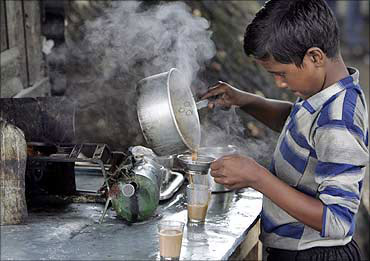
New Law Legitimizes Child Labour

2

In this blog post, Kalpana Purushothaman analyses the new child labour bill and raises some important concerns that arise in the wake of this bill. 


After a period of 30 years, the government has introduced a new child labour law which claims that it bans all forms of child labour till the age of 14. Sadly, the country is buying into an illusion. The truth is that the amendment to the Child Labour Prohibition and Regulation Amendment Bill 2016, passed by the Parliament continues to allow children to be employed in family-based enterprises. Secondly, the employment of children in most hazardous occupations like tanning, bangle-making, zari work, carpets, domestic labour, e-waste and numerous others that till recently were recognised as hazardous for children will now be permitted.


 Legitimises Child Labour

The government claims that it has bchild-labouranned all forms of child labour up to the age of 14 years, however, with the new Bill it has de-incentivized education by legalising family-based work. ‘Family’ is defined in the proposed bill as child’s mother, father, brother, sister and father’s sister and brother and mother’s sister and brother. It uses the word ‘help’ to describe the child’s involvement in the family enterprise (after school hours and during vacations). The problem lies in the inclusion of this proviso in the law, especially since we are well aware that the notion of family is very extensive and ambiguous in our country.

This is exactly the kind of legal loophole that has led to the continuation of child labour till now. Past experience of implementation of the law that had a similar proviso (Section 3 of the CLPRA, 1986) has amply shown that this was the one way in which children were tied to home-based work and exploited.


Reinforces Caste Based Occupations

Since most family based occupations in India are caste based, the exception in Section 3 in the law, which allows children to work in family occupations, will only keep the caste system intact. For example, a potter’s son/daughter to be a potter, a weaver’s child to be a weaver, a tanner’s child to be a tanner and so on. In a feudal, caste-driven Indian society what do these provisions amount to? Without a doubt, this will worst affect the Dalit and the marginalised who are at the bottom of the caste hierarchy, a ghastly example of which was the recent beating and humiliation of several Dalit youth in Gujarat.


Child Labour Over Child Protection?

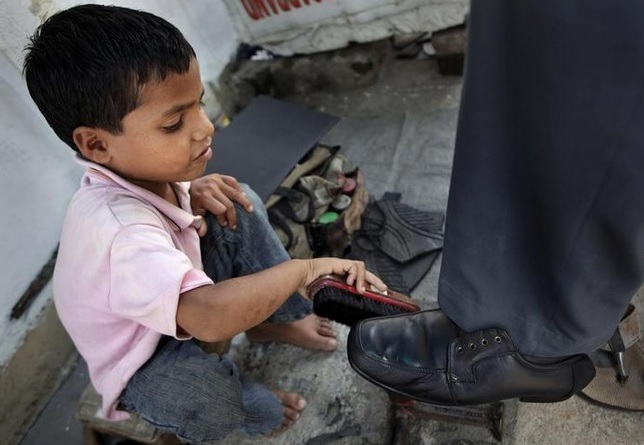
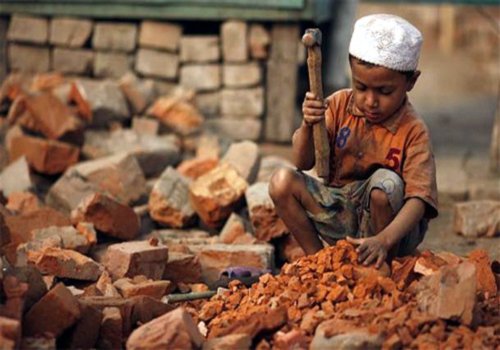
Although all children are banned from working in hazardous occupations, the 16 occupations and 65 processes that were listed as hazardous in the 1986 law has now been replaced by three occupations and 29 Industries-Homing-Child-Laborprocesses that are in the Factories Act which covers only the organised sector. This reduction in the number of occupations that fall into this category and no provisions in it for an increase in this list, means that children will be employed in domestic work, hotel and dhabas, brick kilns and several other such places that have now come to be recognized as extremely hazardous occupations and fall in the unorganized sector.

Although the Government’s data claims there is a significant decrease in the number of child labour in the country, in reality, the number of children already working in the unorganised are multiplying. For example, the 2011 Census shows that child labour in urban settings has actually increased – and that is where the unorganised sector is. Besides, every day newer ‘occupations’ are coming up which are hazardous and dangerous. But they will not find a place in the law.


No Rights for Poor Children

While the Parliament unanimously passed the Indian Institutes of Technology(Amendment) 2016 to benefit the young wizards of India, the same Parliament, barring MPs from the ruling NDA, expressed surprising empathy for India’s children to oppose the passing of this regressive Bill. Indeed, this Bill must be seen and analysed in the context of the dilution of labour laws and standards in the country and the move towards greater informalisation of labour and the push towards manufacturing in the unorganised sector. As Mr. Shankar Aggarwal, Secretary Ministry of Labour and Employment is quoted saying “All the amendments are being done keeping in mind three things—need of the times, workers’ protection and creating an environment for more job creation,” ….“Every year, the country needs to create an excess of 10 million jobs and for that manufacturing sector is key. The proposed labour reforms will help the pace of industrialization while keeping workers’ rights intact.”22child5

Clearly, the main stress of the Ministry is to create jobs to meet the needs of manufacturing, not so much to protect children. In this backdrop, when production is pushed into the homes, who is to regulate the entry of children into the workforce? This is nothing but keeping the un-scrutinised and the unregulated informalisation of labour alive so that corporates can ‘make in India’ without having to deal with the labour unions and the labour laws.

1263It seems that the government is in a state of intellectual and policy disarray. While on one hand it talks about Skill India, and Girls’ education, on the other hand by passing this law dilutes the efforts keep their children out of school, as the Parliamentary Standing Committee examining the Bill had cautioned: “The ministry is itself providing loopholes by inserting this proviso since it would be very difficult to make out whether children are merely helping their parents or are working to supplement the family income. Further, allowing children to work after school is detrimental to their health as rest and recreation are important for their physical and cognitive development.”

Child labour in India has become so normalised that there is neither shock nor shame – it is a ‘necessary evil’. It is evident that the government is happy to put the burden to make ‘Make in India’ a success only on the children from Poor, Dalit, Muslim and Tribal families but shouldn’t a country vying for the global high table aim higher for its children?

Do consider signing the petition, “President of India: Request for review of Child Labour (Prohibition and Regulation) Amendment Bill.”

I think this is important.

Here’s the link: https://www.change.org/p/president-of-india-request-for-review-of-child-labour-prohibition-and-regulation-amendment-bill-b8c1f5fb-ce0a-4014-a8b6-1a68c85865ac


Download Now

Tax Applicable On A Restaurant Bill In India

0

In this blog post, Aditya Shekhar, who is currently pursuing a Diploma in Entrepreneurship Administration and Business Laws from NUJS, Kolkata gives a detailed analysis of the taxes applicable on a restaurant bill in India. 

26434483


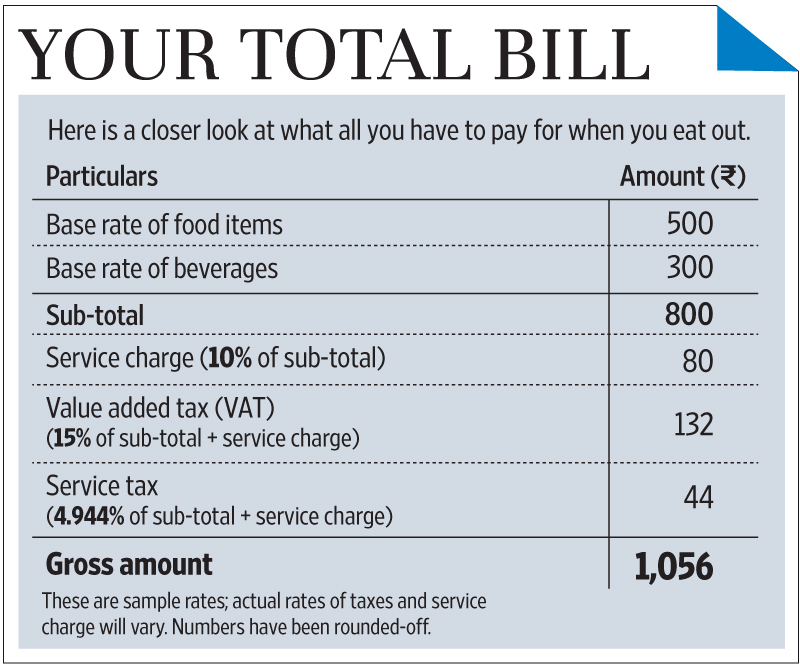
It has often been observed that a lot of people are dissatisfied with the inflated prices mentioned in the food bill they receive after their meal. Now the bill can be divided broadly into:

  • Food item’s cost

It essentially describes the price which is required to manufacture the item and depends entirely on the restaurant.

  • Value Added Tax

Value Added Taxes (VAT) are levied by the state government on the value addition to goods by an entity, who is engaged in manufacturing or distribution process.[1] The VAT is applicable specifically on the food which is made in that restaurant. If the item is packed, then VAT cannot be levied on the same, as it has already been included in the Maximum Retail Price of the item. Additionally, it is the sole discretion of a state to fix the VAT, and it can vary between two different states. Apart from that, VAT imposed on alcoholic beverages is a little higher than the VAT imposed on a food items. Recently, the Uttrakhand High Court in the case of M/S Valley Hotels and Resorts v. Commissioner, Commercial Tax Dehradun[2] gave a landmark judgment in which it held that “where element of service has been so declared and brought under the Service Tax vide Government of India Notification dated 06.06.2012, (i.e. 40% of bill amount to the customers having food or beverage in the restaurant was made liable to service tax) no Value Added Tax can be imposed thereon.” The Hon’ble Court has seemed to have addressed the issue very carefully and held that VAT cannot be imposed on the same value of the transaction.

restaurant-bill-master

  • Service Tax

Introduced in 1994, it was initially levied only on a specific group of goods but subsequently, in 2012, its ambit spread out to include everything except the negative list of services.[3] The Service Tax in a restaurant is charged because of the various amenities such as the ambiance, the hospitality and other facilities provided by the restaurant. The Service Tax is given to the central government and is currently pegged at around 12.36% which has been recently increased to 14%. However, since the whole bill can be attributed either to the cost of raw materials or the cost of service, therefore the tax cannot be imposed on the whole amount. Moreover, it is extremely difficult to segregate the service component and material component of the restaurant/house without inviting further litigation. The service tax law presumes a certain portion of the final invoice as the cost of material and balance as the charge of services, which is known as abatement.[4] Therefore it is to be levied only on 40% of the total bill which makes it 4.944% which has been enunciated under Section 2(c) of the Service Tax (Determination of Value) Rules 2006. Service providers are authorized to charge 40% of the bill amount only and 60% of outdoor catering.[5] The other prerequisite thing to be kept in mind while dealing with service tax is that it is applicable only on the restaurants which provide air conditioning services (fully or partially).

  • Service Charge

The restaurant owners levy this charge for the service being provided. This charge has to be displayed properly on the menu card and depends solely on the discretion of the restaurant owner and usually varies from 5% to 10%.

w_money_col

Conclusion

Although, most of the times we are not able to do anything when it comes to the reduction of the bill, certainly a minimal level of vigilance is required so as to ensure that the restaurant authorities do not dupe us. Recently, a lawyer based in Mumbai caught the restaurant authorities for not displaying their service charge on the menu and then later charging the same without proper intimation of the tax details. He went to the police who had no clue about the Sections to be charged against the restaurant authorities. It simply goes on to prove the amount of ignorance we have as taxpayers towards paying our taxes. Similarly, service taxes are not to be levied on takeaways and home deliveries as there is an absence of services. Also, it has become a practice nowadays that restaurants combine the food and beverages prices and tax them equally which is a corrupt practice.

Footnotes:

[1] http://lawsikho.com/learn/NUJS-EABL—-February-2016-batch/NUJS-Diploma-Course-in-Entrepreneurship-Administra/2798/11056 (last visited on June 30, 2016).

[2] http://tbauk.com/Article_Vat/Servive_tax_Vat_on_Resturant.pdf (last visited on June 30, 2016).

[3] http://www.news18.com/news/business/how-restaurants-dupe-customers-in-the-name-of-service-tax-and-service-charges-1083434.html (last visited on June 30, 2016).

[4] http://www.moneycontrol.com/news/tax/knowing-service-tax-service-chargevatrestaurant-bill_5963701.html (last visited on June 30, 2016).

[5] http://timesofindia.indiatimes.com/city/chandigarh/Sec-26-restaurant-charges-excess-service-tax-to-pay-up/articleshow/51131365.cms(last visited on June 30, 2016).


Download Now

Structuring Of E-Commerce In India

0

In this blog post, Aranya Saha, a student of Jogesh Chanda Chaudri Law College, Calcutta University, who is currently pursuing a Diploma in Entrepreneurship Administration and Business Laws from NUJS, Kolkata, writes about the sturcturing of e-commerce in India.

2016-08-06 20.35.21

In the present state of affairs, internet has a very wide impact on our lives. Today, the number of the internet users in the world is close to 3 billion. The era of e-commerce started in the year 1995. With the passage of time, we now find almost everything being done through the medium of e-commerce. From matrimonial site to job portals, even hotel bookings to online travel agents. The medium of e-commerce in India has got extensive popularity because it is less time consuming and can be accessed from anywhere and at anytime. The Smartphones too have a great impact on the business of e-commerce. It is because people can access the internet on their Smartphones and can buy and sell goods and service in a hassle free manner.

ecommerce-7-638

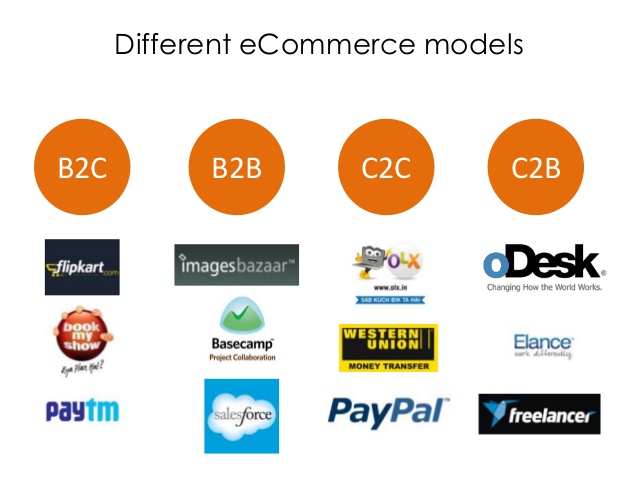
The electronic commerce business can be categorized into business to business (B2B), business to consumer (B2C), consumer to consumer (C2C), consumer to business (C2B), or the recently evolved business-to-business-to-consumer (B2B2C). Out of these the most popular is the B2C which enables selling of goods and services from the business houses to the consumers and the process of (C2C), which enables selling of goods by the customers to customers, e.g., OLX and Quiker.

Every business being conducted in the electronic platform have their specific website as well as applications for the Smartphones. Anyone can get access to these websites and can easily get their work done. These business houses are the same as the regular business as they sell their products or services at the fixed rates or through auctions. However, they do not have any face to face communications business is done through electronic mode. It is very likely that consumers are the beneficiary in this process as they can get their products or make their bookings while staying at their residence. The customers need not travel to get the products or stand in a queue to make the reservations. They also provide certain customer helpline services which work 24×7 through which, only by placing a call they can get assistance.

In India, close to 70% of the people are engaged in agriculture. The rural sector, being not so developed, does not influence the e-commerce business. It is because this business concept very much influences the urban sectors. The people living in urban sectors are mostly workaholic and not have much time to spare in order to buy their necessities. They keep ordering from the necessities from their own place and get their products delivered to their destinations. People get their products at cheaper rates from those of the stores. This is one of the reasons for choosing online retail option over offline. These businesses are not only private firms but include the public companies too, like the Indian Railways which has its specific site, the IRCTC, from which anyone can make an account and get their reservations done without going to the reservation counters.

E-Wallet

lancement-orchestres-machine-vendre

This method of business has made wide use of e-wallet. The online transactions can now be made either by debit card or credit card or through net banking. The customer also gets the privilege of cash on delivery. The customer can make the payment online, which is a very secure method and can avoid fraudulent practices. With the use of one-time password (OTP), an online payment can only made once. The Reserve Bank of India is the apex bank which controls the working of all other bank commercial banks and financial institutions. They issue credit/debit cards to their customers on the basis of the guidelines issued by the RBI. These electronic cards used to make online transactions are mostly not preferred by the consumer in the e-commerce business. The consumer may have trust on the big business houses, but they do not repose that trust with the small e-commerce business houses. Hence they prefer the option of cash on delivery.

The concept of e-commerce is certainly a boon for the economy but this concept comes with its own set of cons. The e-commerce business mostly harms the retail outlet. People do not prefer going to outlets and looking for the items they wish to purchase as it wastes their expensive time. Somewhere, it seems that this is a demerit for the unskilled manpower.

E-Commerce in India

E-commerce business is subject to protection under the Indian laws. Every business functioning in the electronic medium has their IP addresses. They get a license for the use of that software. In some cases, the business houses enter into agreements with some third party which operate the software but nowadays, they are mostly operated solely by them. The patent can protect them right in a limited way. Again, there is copy right protection for the websites. These websites are designed only for a particular business house by competent professionals. They are copyright protected and cannot be copied by any other person in making his website, else legal action can be taken against him.  As every person has a separate personality, every business house too has its personal logo and brand name. These are trademarks of the company and the offender who misuses them is likely to be subjected to penal or imprisonment.

E-commerce in India has a very wide physical boundary which results in a large amount of transactions every single minute. Sometimes, it becomes very difficult to maintain the system. The transactions are liable to pay the taxes governed by Central Board of Direct Taxation”. The income earned by these companies is governed by the Income Tax Act, 1961. Indirect tax is also charged on the transactions of e-commerce, such as goods and services tax, customs duty, sale tax, are all included in the transactions of e-commerce depending upon the nature of the products that are transacted.

Print

In comparison to the e-commerce trend in the other countries, India is found to be lagging behind in this concept. The trend of e-commerce faced a steep rise in the economy because people like new and advanced concepts. This concept, being a totally new form, attracted a huge population towards it. Clothes, gifts, medicines and even second hand products can be bought through e-commerce. The consumers as well as the business houses have access to a large field of operation. It undoubtedly profits the business houses but somehow, it also benefits the consumers, otherwise, this concept would not have flourished. The Indian government also introduced various steps to reduce cascading effect, which reduces the administrative cost and helps in reducing the price of the commodity through e-commerce. This has invited many business houses to create their own web sites and use the system. It gives profit to the companies. In the long run, its impact is tremendous as it is likely to change the structure of the Indian economy.


Download Now

What Is The Business/Organizational Structure Of BCCI And Why Is It Registered In Tamil Nadu?

0


In this blog post, Nilesh Agarwal, an Entrepreneur with several businesses and a student pursuing his Diploma in Entrepreneurship Administration and Business Laws from NUJS, Kolkata, provides details on the registration and the organizational structure of the BCCI. 
 

331062-bcci


INTRODUCTION

The Board of Control for Cricket in India (hereinafter called BCCI) is the national governing body for cricket in India. It’s a consortium of state cricket associations and the state associations where they select their representatives who in turn elect the BCCI officials. Cricket in India at all levels is governed and managed by the Board of Control for Cricket in India, the wealthiest Board in the cricket world.

 In this era of globalization, more and more power is handed over to private bodies within the ambit of the Constitution. Globalization has led to these private bodies to become so powerful that at times they affect the policymaking of a country. No field has remained untouched by globalization, not even sports. In today’s world sports has become a business for the corporate world and the consumers are the global audiences. Globalization has had a devastating effect on sports as a result of which the focus of legal regulation of sports has shifted from the Government onto the autonomous sports federations who now govern the sport. This aspect of globalization is particularly dangerous as it allows these private autonomous organizations, which are free from Government control[1] to create their own rules and constitution, which most likely, cater to their own convenience. They take decisions that have a profound effect on the careers of players and have a significant economic consequence[2], which ends up creating a ‘throw away culture’[3]. The throwaway culture essentially means that anyone and everyone is replaceable, and if an individual does not follow these economic decisions, then they can be replaced. In India, an example of such an autonomous organization that is outside the realm of Government control is the Board of Control for Cricket in India (hereinafter “BCCI”), which controls the game of cricket.

This report will discuss the background of the BCCI including its formation, the Right to Information Act controversy, questioning whether the BCCI should be a State and will focus on the landmark judgment by the Supreme Court in the case of Board of Control for Cricket in India vs. Cricket Association of Bihar and Ors[4].


 BCCI: BACKGROUND

The BCCI acts as a governing body for cricket in India and is based out of Mumbai. It is the richest sporting body and the richest cricket board in the world[5].Over the years, BCCI has become akin to a “corporate colossus”, with an annual surplus of Rs.385 crore and total assets worthRs.3,308 crore, as reported by India Today in May 2013[6]. BCCI has indeed come a long way since its formation in December 1928. Initially, BCCI functioned as an “unregistered association, and in 1940 it got registered under the Societies Registration Act, 1860. Later, with the enactment of the Tamil Nadu Societies Registration Act, 1975 (hereinafter “TSRA”), it was registered once again as a private club consortium”.[7] Over the years the BCCI has emerged as a monopoly by regulating cricket in India at all levels, be it the “grass-root level, the national level, the international level or even private cricket”[8] (for example the Indian Premier League). However, the one lesson we have learned from time is that monopolies don’t necessarily produce the best results. For example “Microsoft’s domination of the desktop computer through Windows operating systems did not produce the best software (Windows Vista[9]). The US’ monopoly of geopolitical power during 1990-2010 only brought more war and political strife.”[10]  The function of a monopoly is to ensure that it retains power and uses that power to make more money while not caring about serving its customers. In India, BCCI is doing exactly that by using its monopoly in India to perpetuate its power and money-making abilities.sc-or-bcci
The constitution of BCCI forms a Working Committee and various other Committees and Members. The BCCI’s constitution provides for annual elections at its Annual General Meeting (AGM) for all posts, with a bar on the re-election of an incumbent president beyond two consecutive years, “provided that the General Body may in its discretion re-elect the same person as president for the third consecutive year”.

The main working of BCCI’s daily affairs is looked after by the Working Committee. The President is mainly questioned about its working, and he leads the Board officially. The Secretary helps in the operation of the bank accounts as a sole signatory and also his name is used when the Board sues or is sued by an outsider if disputes arise.

Over the years, cricket in India has had a dark cloud cast over it with allegations of match-fixing and betting which have questioned the working of the BCCI as a regulatory body.[11]BCCI has not only faced criticism from the citizens of India but also from its own members. An anonymous senior board official described BCCI as a regulatory body which stands for control and not cricket, which exists not for cricket or the players, but for itself.  He further went on to say that “It is an edifice built on power, arrogance, money, and the insecurity that comes with the fear of losing all of those things.”[12]


RIGHT TO INFORMATION ACT CONTROVERSY

The one thing in India that an individual cannot escape from is not traffic, but a scam. Be it housing, coal or even the allocation of 2G spectrum, there is bound to be a scam somewhere or the other. Similar is the situation when it comes to cricket in India[13][14]. With cricket getting murkier and murkier by the day, BCCI has come under a lot of scrutiny over the years and with an increasing number of Indians having requested information on its financial dealings. The BCCI has been in the right by refusing to divulge the concerned information as it did not come under the purview of the Right to Information Act, 2005 (hereinafter “RTI Act”) for it was not considered a “State” under Article 12 of the Constitution.

To bring any entity as a public authority within the ambit of the RTI Act, it has to satisfy at least one of the requirements of Section 2(h) of the RTI Act[15], as under:

Section 2 (h): “public authority means any authority or body or institution of self-government established or constituted:

(a) by or under the Constitution;

(b) by any other law made by Parliament;

(c) by any other law made by State Legislature;

(d) by notification issued or order made by the appropriate Government, and includes any —

(i) body owned, controlled or substantially financed;

(ii) non-government organization substantially financed, directly or indirectly by funds provided by the appropriate government”.

rti-right-to-information

The argument that BCCI used was that it did not fall under any of the categories that were given in Section 2(h) of the RTI Act; hence it was not a public authority. As a Society under the Tamil Nadu Societies Registration Act, 1975, BCCI has not been established by or under the Constitution nor has it been constituted by any law made by Parliament or any State Legislature, “nor has been constituted or established by notification issued, or order made by any government, nor it gets any funds directly or indirectly from any government and does not have any nominee on its board, nor is subject to audit by CAG.”[16]

However, according to BCCI officials, an individual need not worry about the financial dealings of BCCI being looked into by auditors. As Mr. Gangaraju, Chairman of the BCCI Finance Committee said, “We are supposed to send our auditors’ reports to the BCCI. If there is a misuse of money, one can detect it. Like any other government department, the BCCI sends our reports to its auditors. So, the BCCI has a system to check the use of money given to the state associations.”[17]Thus, even though an individual can get information related to certain scams in the country, getting information on the financial wrong doings of BCCI would be close to impossible unless it magically becomes an instrument of the State.


WHY IS THE BCCI NOT A ‘STATE’

Article 12 of the Indian Constitution states that “In this part, unless the context otherwise requires, “the State” includes the Government and Parliament of India and the Government and the Legislature of each of the States and all local or other authorities within the territory of India or under the control of the Government of India”[18]

Over the years, BCCI has been brought to court with its legal status being questioned in various cases viz; Mohinder Amarnath & others vs. BCCI[19], Ajay Jadeja vs. Union of India & others[20] and Rahul Mehra and Anr. vs. Union Of India[21] before the Delhi High Court. The other decisions are by the Supreme Court[22]: BCCI vs. Netaji Cricket Club and Ors[23], Zee Telefilms Ltd & Anr vs. Union of India & Ors.[24]and A.C. Muthiah vs. BCCI & Anr[25]

In the Mohinder Amarnath’s case, the BCCI was held not to be an instrument of the State whereas in the Ajay Jadeja case the Court held that writs could be maintained against the BCCI. However, the case was not held to be a precedent because Mr. Jadeja withdrew his writ petition. It was only in the Rahul Mehra case that the Court held in the affirmative that writs could be maintained against the BCCI; however, it did not express a comment on the BCCI’s status as an instrument of the State as per Article 12. The decision to maintain writs against BCCI was done keeping BCCI’s monopolistic nature in regulating and controlling the game of cricket in India and the nature of its duties and functions that it carries out. It relied on Article 226(1) which says “Notwithstanding anything in Article 32 every High Court shall have powers, throughout the territories in relation to which it exercises jurisdiction, to issue to any person or authority, including in appropriate cases, any Government, within those territories directions, orders or writs, including writs in the nature of habeas corpus, mandamus, prohibitions, quo warranto and certiorari, or any of them, for the enforcement of any of the rights conferred by Part III and for any other purpose[26] The High Court held that the BCCI did fall under the Article as the words “any person or authority” did include private bodies carrying out public duties. vodafone-tax-case-hc-allows-penalty-proceedings-to-go-on

Subsequently, the Supreme Court in the case of BCCI vs. Netaji Cricket Club and Ors acknowledged BCCI’s monopoly over Cricket in the country. The Honorable Court with regard to the enormity of power exercised by BCCI held that BCCI is bound to follow the doctrine of fairness and good faith.[27]

It was only in the case of Zee Telefilms Ltd and Anr vs. Union of India and Ors[28] in 2005 that the Supreme Court addressed and elaborately discussed the status of BCCI as an instrument of the State as per Article 12. The Supreme Court came to the conclusion that BCCI was not an instrument of the State. It ultimately held that since BCCI is not “financially, functionally and administratively controlled by the Government cumulatively, it could not be held as a State, and thus the writ petition under Article 12 was not maintainable.”[29] The Court said that the only amount of control that the Government had over BCCI was purely regulatory in nature and noting more. Even though BCCI does carry out some duties akin to a State, violation of these duties will allow citizens to file Writ petitions against BCCI as per Article 226. This decision was reaffirmed in the case of A.C. Muthiah vs. BCCI & Anr[30] where the Court held that the BCCI was a “private autonomous body, and its actions had to be judged only like any other similar authority exercising public functions.”[31]

In the case of Board of Cricket Control in India vs. Cricket Association of Bihar and Ors[32]the issue of BCCI being a State instrument was brought up. The Court relied on the principles laid down in the cases of R.D. Shetty vs. Union of India[33]and Ajay Hasia vs. Khalid Mujib[34]. In the case of R.D. Shetty vs. Union of India[35] the Court had laid a five-point test to determine whether an “other authority”[36] would be an instrument of the State. “As per the test the classifications were:-

  • The entire share capital is owned or managed by the government;
  • It enjoys a monopoly status;
  • Department of Government is transferred to corporation;
  • Functional character is governmental in essence;
  • Deep pervasive State control” [37]

The Court, while deciding whether BCCI is a State Instrument took into account the principles of an absence of “deep and pervasive control and lack of substantial government funding”[38] and decided to rule out BCCI as ‘state’ under Article 12. While ruling out BCCI as a State, the Supreme Court upheld the decision in the case of Zee Telefilms Ltd and Anr vs. Union of India and Ors[39]and reiterated that even though BCCI was not a State instrument, it was still liable to Writ petitions as per Article 226, if it violates any of its important public functions.


WHY THE BCCI SHOULD REALLY BE A STATE

The dissenting judgment in the case of Zee Telefilms Ltd and Anr vs. Union of India and Ors[40]was made by the bench comprising Justice Sinha and Justice Variava, who were of the opinion that BCCI should be a ‘State’. The dissenting judgment was inspired by Justice Matthew’s opinion in the case of Sukhdev Singh v. Bhagatram[41] which propounded the Public Functions Test as a criterion to find out instrumentalities of state under the expression other authorities’ within Article 12. This test is often viewed as a response by the judiciary to globalization. According to Justice Sinha, the requirements that the “other authorities” should fulfill were:

“(a) Finding of state financial support together with an unusual degree of control over the management and policies of the body that may lead to an inference that the body is a State entity.331062-bcci

(b) Another important indicator is discharging of important public function with state support being an irrelevant consideration.

(c) A corporation is an agency or instrumentality of the government for carrying on a business for the benefit of the public.”[42] The test also states that “The combination of state aid and the furnishing of an important public service may result in a conclusion that the operation should be classified as a state agency. If a given function is of such public importance and so closely related to governmental functions as to be classified as a government agency, then even the presence or absence of state financial aid might be irrelevant in making a finding of state action. If the function does not fall within such a description, then the mere addition of state money would not influence the conclusion.”[43]

The Minority Bench in the Zee Telefilms case was of the opinion that selecting the Indian Cricket Team does classify as a public function and relied on the Rahul Mehra case which said “when a government stands by and lets a body like the BCCI assume the prerogative of being a sole representative of India for cricket by permitting BCCI to choose the team for India for appearance in events like the World Cup, then it necessarily imbues the BCCI with the public functions at least in or so far as the selection of the team to represent India and India’s representation in International Cricket is concerned.”[44] The bench was also of the opinion that a body discharging public functions and exercising monopoly power would be an authority under Article 12. The BCCI controls and regulates the game of cricket, and even has a final say in the matters of selection and disqualification of players, umpires and others connected with the game touching their right to freedom of speech and occupation as seen with the whole Indian Cricket League (hereinafter “ICL”) fiasco. The players who participated in the tournament were banned from playing for India and only were considered to be eligible to play for their country after a one-year ‘cooling down period’[45]. Prior to the ‘cooling down period, on’ the players had to apologize to the BCCI for making a mistake by joining the ICL. The BCCI’s monopoly over the game extends to such a level that it is the sole body in the country that makes rules and regulations which is a state function in terms of Entry 3 of the Seventh Schedule to the Constitution, hence acquiring the status of a monopoly.[46]It frames pension schemes and incurs expenditure on coaches, trainers, etc. It sells broadcast and telecast rights and collects admission fee to venues where the matches are played.[47]


WHAT EVENTUALLY HAPPENED

The case of Board of Cricket Control in India vs. Cricket Association of Bihar and Ors[48]was considered as a landmark judgment. The case was a result of a Public Interest Litigation filed by the Cricket Association of Bihar against a probe panel on the Indian Premier League spot-fixing. No, it did not classify BCCI as a State Instrument, but it did bring a mammoth change within the BCCI. The case arose as a result of the excessive power that has been bestowed to BCCI by making it an autonomous body. Being an autonomous body BCCI has the power to make laws to regulate itself and amend these laws as per its own whims and fancies. An example of this was the amendment to the BCCI’s Clause 6.2.4.

Prior the amendment, the clause read as follows “No Administrators shall have, directly or indirectly, any commercial interest in the matches or events conducted by the Board.”[49] This Clause was amended in September 2008, nine months after the inception of Chennai Super Kings, an IPL franchise formed in January 2008.The Chennai franchise was sold to India Cements for $91 million, making it the fourth most expensive Team in the League behind Mumbai, Bangalore and Hyderabad.[50] India Cements acquired the rights to the franchise for 10 years. The current ICC Chairman, Mr. N. Srinivasan was the de facto owner of the Chennai Super Kings, by means of his position as the Vice-Chairman and Managing Director of India Cements Ltd. The conflict of interest arose in September when BCCI elected Mr. Srinivasan as the Secretary of BCCI. However, in that very meeting an amendment was made to clause 6.2.4 which then read as “No Administrators shall have, directly or indirectly, any commercial interest in the matches or events conducted by the Board excluding events like IPL or Champions League Twenty 20.”[51]BCCI-emergency-meeting
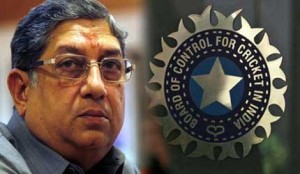
This amendment was earlier challenged in the case of Muthiah vs. BCCI &Anr[52] where it was held that Rule 6.2.4 shall have to be tested on a threefold basis viz. (i) whether the amendment is made by the authority competent to do so; (ii) whether the authority competent to bring about an amendment has followed the procedure prescribed for the same; and (iii) whether the amendment falls foul of any statute or principle of law, violation whereof cannot be countenanced.[53] It was held that BCCI was a private autonomous body who was the authority competent enough to make that amendment.

However, the amendment was in contention to be in violation of the principles of natural justice.  In an ideal world the principle of natural justice would not allow any members of the BCCI to hold any commercial interest in the events organized by BCCI. Holding a commercial interest in such events would bring about a serious conflict of interest between the duties of administrators on the one hand and their personal/commercial interest on the other, which was exactly what the amendment leads to.

The first instance of a conflict of interest arose when the BCCI awarded compensation of a sum of Rs.10.40 crores to Chennai Super Kings on account of the cancellation of the Champions League Tournament 2008. An undisputed fact was that Mr. Srinivasan was among those who contributed to the making of, and taking the decision to award that amount as compensation to his own Team. It is true that a similar amount was awarded to Rajasthan Royals the other finalist, but that does not mean that “Mr. Srinivasan, participated and deliberated in the proceedings leading to the award of a hefty amount of compensation, he was not privy to a self-serving decision that benefited India Cements Ltd. a company promoted by Mr. Srinivasan. The fact that some others also participated in the decision-making process as members of the IPL Governing Council does not cure the legal flaw arising out of the benefactor also being the beneficiary of the decision.”[54]

The next instance of a conflict of interest arose when a similar award of a sum of Rs.13.10 crores came in the year 2009, which too fell afoul of Mr. Srinivasan’s duty on the one hand, and interest on the other.  “The decision to award an amount higher than the one awarded earlier appears to have led to public criticism raising the pitch further for Mr. Srinivasan’s removal from the BCCI on the principles of conflict of interest. Return of the amount because of a public outcry may no doubt mean that Mr. Srinivasan tried to come clean on the subject even when his company may have suffered a loss, but it may as well mean that the return of the amount came only under public pressure and in recognition of the fact that the amount was not actually due and payable and yet was paid to the detriment of BCCI, who is a trustee of general public interest in the sport of cricket and everything that goes with it.”[55]bcci_650_050815072423

The third and most glaring example where Mr. Srinivasan’s commercial interest came in direct conflict with his duty as President of BCCI was when his son-in-law Mr. Gurunath Meiyappan was caught betting on and against his own Team.  “A clear conflict of interest has arisen between what is Mr. Srinivasan’s duty as President of BCCI on the one hand and his interest as father-in-law of Mr. Gurunath Meiyappan and owner of Team CSK on the other. The argument that Mr. Srinivasan owns only 0.14% equity in India Cements Limited (ICL) is of no avail, if not totally misleading, when we find from the records that his family directly and/or indirectly holds 29.23% of the equity in ICL with Mr. Srinivasan, his wife and daughter as Directors on the Board of that Company.”[56]

Citing these instances the Court decided to strike down the amendment citing that the amendment was in violation of public policy. Over time, the idea of public policy has not remained static but has evolved. In today’s world public policy comprises of “those principles of law that ensure justice, fair play and bring transparency and objectivity and promote probity in the discharge of public functions[57] If any such rule, contract or arrangement “defeats or tends to defeat the high ideals of fairness and objectivity in the discharge of public functions no matter by a private non-governmental body will be opposed to public policy.”[58]The amendment made by the BCCI to rule 6.2.4 permitted and protected the Administrators “to have commercial interests in breach or conflict with the duty they owe to the BCCI, or to the people at large must be held to be against public policy, hence, illegal.”[59]


WHAT NOW FOR THE BCCI

All good things must come to an end and this is exactly what happened in the case of the Board of Cricket Control in India vs. Cricket Association of Bihar and Ors[60].While delivering the judgment in the case, the Supreme Court affirmed that BCCI was amenable to the writ jurisdiction of the High Court under Article 226 of the Constitution of India. A writ jurisdiction is essentially the right to seek a remedy against the state, the route open to a private citizen questioning a state or state body of any wrongdoing.[61]The court pointed out that by picking the Indian Cricket Team and by regulating the sport in the country, BCCI was carrying out public functions and any violation of such a function would open the doors for litigation under Article 226, even when it is not ‘State’ within the meaning of Article 12.[62]The Court also formed a Committee which was to determine the punishment for the accused found guilty, and the fate of the two IPL teams, Chennai Super Kings and Rajasthan Royals.Indian_Premier_League.svg

The Committee comprised of retired Chief Justice of India, RM Lodha, and retired Supreme Court judges, Ashok Bhan and R. Raveendran. The Committee had been tasked with to determine appropriate punishments for Gurunath, Kundra and their respective franchises, Chennai Super Kings and Rajasthan Royals, following on from the Mudgal Report, examine the role of Sundar Raman, the IPL Chief Operating Officer in the IPL 2013 scandal and, if applicable, impose a suitable punishment on him on behalf of BCCI. The Committee was also tasked with suggesting amendments to the processes followed by BCCI with a view to preventing sporting frauds and conflict of interests, and also to streamline the Board’s working to make it more responsive to the expectations of the public at large.

The Committee Report is seen as a cleanup of cricket in India and keeping that in mind the Committee decided to suspend Chennai Super Kings and Rajasthan Royals because of the 2013 betting scam involving their top officials, Gurunath Meiyappan and Raj Kundra. Mr. Meiyappan and Mr. Kundra were suspended for life from any cricketing activity.

This punishment was decided due to the “disrepute”[63] and disgrace brought by their actions to the game of cricket, hence they did not deserve any leniency. “The fact that Mr. Meiyappan was an integral part of CSK, he ought not to have indulged in corrupt practices. Any person who has true passion for the game will never be involved in betting.  Mr. Meiyappanhas not only indulged in betting but he has brought disrepute to cricket & the IPL. Being the face of the franchise, Mr. Meiyappan’s actions reflect on the owners of India Cements,”[64]said Justice Lodha.The panel held the same view for Mr. Kundra’s actions.

One of the biggest changes coming out of the ruling is that the Courts are now willing to go into micromanagement, and deep into the governance structure of a sports body. This is considered as the area where the Court has moved forward from the Zee Telefilms case. Up till the case of the Board of Cricket Control in India vs. Cricket Association of Bihar and Ors, BCCI’s stance was that since it was an autonomous body only its public functions could be challenged and not any of the amendments the BCCI made to its rules and regulations. To quote a lawyer, whose clients include eminent sports personalities, “The most significant part is how specific the process has been laid out to determine the punishment. They have named the Committee. They have given them specific guidelines. They have made the findings a fact. This is the whole exercise of power under Article 226.”[65] Earlier the Court’s decision used to be more of an oversight and would tell the accused that a particular function has not been carried out properly and that they should go back and do it properly. Therefore, constituting and naming the Committee was considered a big development.Law-Judgement

As per Gopal Sankaranarayanan, an advocate in the Supreme Court, the case of Board of Cricket Control in India vs. Cricket Association of Bihar and Ors is one of the first instances in which the functioning of the BCCI has been scrutinized with reference to actual cricket. “It is not a question of telecast rights. This is more in the nature of public interest litigation because it is dealing with a lack of transparency, conflict of interest, and match-fixing. All these are important issues, (for) all of which even a fan can file a petition.”[66]Thus, a potential scenario now where the BCCI or the state associations can be pulled up would be with team selections. “If a parent of a player feels he has been left out for whatever reasons, he/she could easily file a writ asking for procedures, etc. This need not stop only at team issues. It could also be administrative selections.”[67]

As a result of the Supreme Court’s decision to strike down the amendment to Clause 6.2.4, no one with any commercial interests in any BCCI events could contest for the BCCI elections. This resulted in a difficult decision for Mr. Srinivasan who effectively had to choose between the BCCI presidential post and owning the Chennai Super Kings.


REGISTRATION OF THE BCCI IN TAMIL NADU

The reasons for BCCI’s registration in Tamil Nadu, backdrops to the pages of history. When the Board was established, Bombay got the upper hand and became it’s headquarters. This was because Bombay was facilitated with an advanced port which the English cricket administrators used for transport and communication purpose. But along with Bombay, eventually, two other offices were established, viz., Madras and Delhi, so that the Board can have better control over the game of cricket in India. Yet, BCCI continued to operate as an unregistered body.

During the phase of Second World War, Mr. Paramasiva Subbarayan, the former Chief Minister of Madras Presidency, was appointed as the 5th President of BCCI (term: 1938-46). He was a Madras-based administrator and operated all the important affairs of the Board from the Treasury Office of BCCI in Madras. Thus, it was during his tenure and under his initiation that BCCI got registered under the Central Legislation- Act XXI of 1860 at Madras on 28/11/1940. Company Registration Services

During the term of 17th President of BCCI (Mr. M. Chinnaswamy), the body was deemed registered under Tamil Nadu Societies Registration Act, 1975, when the act came into force on 22/05/1978. This was in accordance with the provisions of section 53 of the said statute.

Other reasons for such registration may be stated herewith:

  • Simple process of registration (current provision- Chapter II of Tamil Nadu Societies Registration Act, 1975), Guided by its own Rules and Regulations.
  • The limited scope of interference by an outsider.
  • Tax exemption due to charitable nature of operation- affiliation to certificates 12A and 80G of the Income Tax Department


CONCLUSION

Cricket in India is one of the few activities that bring together the people of the country, apart from religious ceremonies. The sport has an impact on the day to day lives of almost everybody in India, and cricketing results are often the reason behind national pride and patriotism. Over time the sport has been rocked by scandals and controversy and many a time at the center of it has been the BCCI.

Over the years BCCI had developed into a corporate colossus which only cared about making money. The BCCI, being a private autonomous organization had been free from government control which resulted in them creating their own rules and constitution, which catered to their own convenience. By holding a monopoly over Cricket in India, BCCI amassed an incredible amount of power and in that process forgot a very important thing which was “with great power comes great responsibility.” After becoming powerful, they became reckless and grew greedy for more money and more power. The amendment to Clause 6.2.4 of the BCCI was the most glaring example of how BCCI has remained hungry for power and money. Once the entire betting and match-fixing scandal broke out the BCCI did everything in its power to save face. They appointed a Committee to ‘investigate’ and probe into the matter, which surprisingly gave a clean chit to almost everyone who was accused, citing a ‘lack of evidence’ against them. This came as a shock to the entire nation as there was enough evidence floating in the media and on the World Wide Web against the accused.  It was at this point that the judiciary finally decided to step in and decided to form a separate committee to investigate and a separate committee to decide the punishment for the accused.

The best thing about the Indian Judiciary, even though it sits on the sidelines, is that it hasn’t remained stagnant and has evolved to meet the changes in Society. To fight the malpractices of globalization, the Judiciary developed something called a public functions test to put a check on these private autonomous bodies. As a result of this test, BCCI was made amenable to writs under Article 226, and by doing so the Judiciary dislodged the BCCI Administrators from a very comfortable couch that they were sitting on, once and for all.

The decision taken by the Court should be considered as a stepping stone for ensuring more transparency within BCCI. The Legislature should strongly consider enforcing more regulations on BCCI to maintain certain checks on the body. Without having any regulations on itself we have seen BCCI grow as a body to become one of the most powerful organizations in the world. The BCCI’s influence isn’t restricted to India but it also extends to the International Cricket Council (hereinafter “ICC”). Be it the “Monkeygate” Scandal or the Umpire Decision Review System, the ICC always listens to the BCCI. By leaving the BCCI unregulated may just see it develop into a body like The Fédération Internationale de Football Association (hereinafter “FIFA”) and unearth a large scandal in the years to come.

Being an avid sports follower in a country where million others worship cricket as a religion, it is disheartening to see the sport witness such dark days. It isn’t enough to restrict the BCCI to just Income Tax raids and making it amenable to Writs, but what is required is a law made by the legislature to recognize the BCCI as a national body to keep the BCCI in check.


[divider]

BIBLIOGRAPY

ESPNcricinfo. Retrieved 6July 2015

Retrieved 7 July 2015


JUDGMENTS

DELHI HIGH COURT

  • MohinderAmarnath& others. V BCCINO.632/89
  • Ajay Jadeja v Union of India & othersDLT 14, 2002 (61) DRJ 639
  • Rahul Mehra And Anr. v Union Of India(2005) 4 Comp. LJ 268 Del, 114 (2004) DLT 323

SUPREME COURT 

  • BCCI v Netaji Cricket Club and Ors (2005) 4 SCC 741
  • Zee Telefilms Ld and Anr v Union India and Ors (2005) 4 SCC 649
  • AC Muthiah v BCCI and Anr (2011); 6 SCC 617
  • Board of Cricket Control in India vs Cricket Association of Bihar and OrsCIVIL APPEAL NO.4235 OF 2014


[1] Ken Foster. “Is there a Global Sports Law?” Entertainment Law 2.1 2010: 1-18 at 1 Warwick University,

http://www2.warwick.ac.uk/fac/soc/law/elj/eslj/issues/volume2/number1/foster.pdf

02.07.2015<http.www2.warwick.ac.uk>

[2]The Legal Status of BCCI as instrumentality of State Under Article 12 of the Indian Constitution,http://www.commonlii.org/in/journals/NALSARLawRw.2013/6.pdf   Obtained from the NALSAR Law Review Journal, published in 2013

[3] Pope Francis. www.reuters.com/article/2015/02/28/us-pope-economy-idUSKBNOLWONZ20150228

02.07.2015<www.reuters.com>

[4] CIVIL APPEAL NO.4235 OF 2014

[5] “Mahendra wins a bitter battle”. The Hindu. 30 September 2004. Retrieved 2nd July 2015.  www.thehindu.com/2004/09/30/stories/2004093009412100.htm

[6]http://indiatoday.intoday.in/story/how-indian-cricket-is-controlled-bcci-srinivasan-meiyappan/1/277758.html.  India Today. Published online by KunalPradhan and G.S. Vivek on 31 May 2013

[7] Ibid[2]

[8] Ibid[2]

[9]http://www.zdnet.com/article/the-top-five-reasons-why-windows-vista-failed/

[10] “If cricket has to live in India, the BCCI’s monopoly must die”. The Firstpost. 7th January 2012. Retrieved 2nd July 2015.  http://www.firstpost.com/sports/if-cricket-has-to-live-in-india-the-bccis-monopoly-must-die-174943.html

[11]Board of Cricket Control in India vs Cricket Association of Bihar and Ors. CIVIL APPEAL NO.4235 OF 2014

[12]http://indiatoday.intoday.in/story/how-indian-cricket-is-controlled-bcci-srinivasan-meiyappan/1/277758.html.  India Today. Published online by KunalPradhan and G.S. Vivek on 31 May 2013

[13] With reference to the scam discovered in Jammu and Kashmir Cricket Association.  http://www.dnaindia.com/sport/report-jammu-and-kashmir-cricket-association-rocked-by-another-scandal-2008967

[14]http://www.hindustantimes.com/cricketnews/bcci-money-speaks-across-the-board/article1-1334125.aspx

[15]  The 2005 RTI Act, <http://righttoinformation.gov.in/webactrti.htm>

[16] Appeal No.1336/ICPB/2008.  CENTRAL INFORMATION COMMISSION

[17]Ibid [13]

[18]http://www.constitution.org/cons/india/p03012.html

[19] CW.NO.632/89

[20] DLT 14, 2002 (61) DRJ 639

[21] (2005) 4 Comp. LJ 268 Del, 114 (2004) DLT 323

[22] Ibid[2]

[23] (2005) 4 SCC 741

[24] (2005) 4 SCC 649

[25] (2011) 6 SCC 617

[26]http://www.constitution.org/cons/india/p06226.html

[27] Ibid[2]

[28] (2005) 4 SCC 649

[29] Ibid[2]

[30] (2011) 6 SCC 617

[31] Ibid[2]

[32] CIVIL APPEAL NO.4235 OF 2014

[33] AIR 1979 SC 1628

[34] AIR 1981 SC 487

[35] Ibid [26]

[36] Ibid[13]

[37]http://blog.mylaw.net/bcci-is-not-state-under-article-12-the-story-of-other-authorities/

[38] Ibid[26]

[39] Ibid[23]

[40] Ibid[23]

[41] AIR 1975 SC 1331

[42] Ibid[26]

[43] Ibid [26]

[44] Ibid[16]

[45]http://www.espncricinfo.com/icl2008/content/story/402028.html Retrieved 7 July 2015

[46] Ibid[16]

[47] CIVIL APPEAL NO.4235 OF 2014

[48] CIVIL APPEAL NO.4235 OF 2014

[49] CIVIL APPEAL NO.4235 OF 2014

[50]“Big business and Bollywood grab stakes in IPL”. ESPNcricinfo. Retrieved 4July 2015

[51] Ibid [43]

[52] Ibid[26]

[53] Ibid [26]

[54] Ibid [43]

[55] Ibid[43]

[56] Ibid[43]

[57] Ibid[43]

[58] Ibid[43]

[59] Ibid [43]

[60] Ibid[43]

[61]http://www.espncricinfo.com/india/content/story/823401.html

ESPNcricinfo. Retrieved 6July 2015

[62] Ibid [43]

[63]Lodha Committee Report.

[64]http://www.ibnlive.com/cricketnext/news/ipl-scandal-gurunath-meiyappan-raj-kundra-banned-from-cricket-for-life-548311-78.html

[65] Ibid[56]

[66] Ibid[56]

[67] Ibid[56]

Download Now

Benefit Of Indexation While Computing Capital Gain On transfer Of Short-Term Capital Asset

0

In this blog post, Varun Chauhan, an Associate at Dhir and Dhir Associates, New Delhi with the Corporate Advisory and Loan Structuring Team who is currently pursuing a  Diploma in Entrepreneurship Administration and Business Laws from NUJS, Kolkata, deliberates on whether the benefit of Indexation is available while computing Capital Gain arising on transfer of Short-Term Capital Asset.

IMG-20160807-WA0000

Before discussing the primary question on availability of benefit of indexation, it is important to apprise ourselves of some key terms and concepts that are going to appear in the forthcoming deliberation.


Key terms

Capital Asset:

capital_asset

A capital asset is a type of asset that is not easily sold in the regular course of a business’s operations for cash and is owned for its role in contributing to the business’s ability to generate profit.[1]

Section 2(14) of The Income Tax Act, 1995 further defines Capital Asset as:

“Capital Asset” means property of any kind held by an assessee, whether or not connected with his business or profession, but does not include-

  • any stock-in-trade, consumable stores or raw materials held for his business or profession;
  • For personal effects, that is to say, movable property (including wearing apparel and furniture, but excluding Jewellery) held for personal use by the assessee or any member of his family dependent on him.

Explanation – for this sub-clause, “Jewellery” includes-

  • Ornaments made of gold, silver, platinum or any other precious metal or any alloy containing one or more of such precious metals, whether or not containing any precious or semiprecious stone, and whether or not worked or sewn into any wearing apparel;
  • Precious or semi- precious stones, whether or not set in any furniture, utensil or other article or worked or sewn into any wearing apparel;
  • Agricultural land in India, not being land situated –
  • In any area which is comprised within the jurisdiction of a municipality (whether known as a municipality, municipal corporation, notified area committee, town area committee, town committee, or by any other name) or a cantonment board and which has a population of not less than ten thousand according to the last preceding census of which the relevant figures have been published before the first day of the previous year; or
  • in any area within such distance, not being more than eight kilometres, from the local limits of any municipality or cantonment board referred to in item (a), as the Central Government may, having regard to the extent of, and scope for, urbanisation of that area and other relevant considerations, specify in this behalf by notification in the Official Gazette;
  • 5 per cent Gold Bonds, 1977, or 7 per cent Gold Bonds, 1980, or National Defence Gold Bonds, 1980, issued by the Central Government;
  • Special Bearer Bonds, 1991, issued by the Central Government;
  • Gold Deposit Bonds issued under the Gold Deposit Scheme, 1999 or deposit certificates issued under the Gold Monetisation Scheme, 2015.


Capital Gain:

Any gain/profit that is derived after disposing of/transferring a Capital Asset is known as Capital Gain. Such income in the form of gain/profit is taxable under Indian laws (Income Tax Act, 1995) under the head ‘Capital Gains’.


Categorization of Capital Assets as Short Term and Long Term:

For the purpose of taxation, Capital Assets are usually segregated by their period of holding. Any Capital Gain derived from their disposal is taxed accordingly. The minimum period of holding for declaring a Capital Asset as Long Term depends on upon the nature of the underlying asset. Otherwise, a Capital Asset is deemed as Short Term Capital Asset and taxed accordingly. The following Table[2] shows the segregation based on the period of holding for different categories of Capital Assets:

Nature of Capital Asset Minimum period of holding (to be termed as Long Term)
Listed Shares (equity and preferential) 1 year
Unlisted Shares (equity and preferential) Two years[3]
Physical Gold and e-Gold 3 years
Gold ETF Bonds and Gold Mutual Funds 3 years
Other Listed Securities [debentures (including NCD), units of UTI, Government securities, and Zero Coupon Bonds, etc.] 1 year
Other Unlisted Securities [debentures (including NCD), units of UTI, Government securities, and Zero Coupon Bonds, etc.] 3 years
Real Estate Property 3 years
Units of equity oriented funds 1 year
Debt funds (whether quoted or not) 3 years

Indexation and Cost Inflation Index:

Indexation is a technique to create a proportionate balance between the taxable incomes (capital gain) with the current rate of inflation. As the capital gain/profit is taxable, the technique of indexation provides a level playing field to an assessee so that only real component of his income (capital gain) is taxed. For this purpose, Government has prepared a Cost Inflation Index (CII) taking Financial Year 1981-82 as the base year. Every year Government updates the CII for taxation purposes. Following is the CII[4] updated till 2016-17:

Financial Year CII Financial Year CII
Before 1/4/1981 100 1985-86 133
1981-82 100 1986-87 140
1982-83 109 1987-88 150
1983-84 116 1988-89 161
1984-85 125 1989-90 172
1990-91 182 2004-05 480
1991-92 199 2005-06 497
1992-93 223 2006-07 519
1993-94 244 2007-08 551
1994-95 259 2008-09 582
1995-96 281 2009-10 632
1996-97 305 2010-11 711
1997-98 331 2011-12 785
1998-99 351 2012-13 852
1999-00 389 2013-14 939
2000-01 406 2014-15 1024
2001-02 426 2015-16 1081
2002-03 447 2016-17 1125
2003-04 463    


Indexed Cost of Acquisition:

Indexed Cost of Acquisition (ICA) is calculated to defeat the effects of inflation on your Capital Gain. This method, as already discussed, helps to achieve the real motive behind taxing the income of a person. As inflation engulfs a large portion of a person’s returns from different investments (by reducing the purchasing power of money), it becomes all the more important to chalk out a policy to minimize this risk of paying enormous unjustified tax on Capital Gains so that only real Capital Gain can be taxed. With the help of CII, Indexed Cost of Acquisition (ICA) can be ascertained as follows for computing Indexed Capital Gain:

ICA = Cost of Acquisition of Capital Asset * CII of the year of Transfer/CII of the year of Acquisition


Tax Scheme for Capital Gains

CGT

The benefit of Indexation discussed in the preceding paragraphs, is available only to the Long Term Capital Gain Transactions i.e. where a person has earned some profit/gain on disposing/transferring a Long Term Capital Asset. This benefit is not available in transactions involving transfer/disposal of Short Term Capital Assets.

The rationale behind this rule is to revamp investment sentiment in the economy. By providing the benefit of Indexation only to the Long Term Capital Gain Transactions, Government ensures that people invest in the Capital assets for a comparatively longer period, thereby infusing steady money into the economy. Therefore, Indexation acts as an incentive for taxpayers and ultimately results in more money being pooled in for more productive endeavors.

Tax rates for Short Term Capital Gain (STCG) are higher than the tax rates for Long Term Capital Gain (LTCG). Moreover, tax amount in LTCG cases further reduces because ICA (derived after using CII) is deducted from the Total Consideration Value of the underlying Capital Asset to calculate the Indexed Capital Gain (ICG). The ICG is used for assessing Long Term Capital Gain Tax.


Illustration:

Mr. A acquires a plot of land for Rs 10000 on 21st June 2010. He sells that land on 20th February 2015 for Rs 15000. Apparently, his non-indexed Capital Gain amounts to Rs 5000 (15000-10000). But Mr. A can take benefit of Indexation as his period of holding is more than three years (as the minimum period of holding for real estate asset is three years). For calculating ICG of Mr. A, we need to ascertain his Indexed Cost of Acquisition (ICA) by applying the formula mentioned in the preceding paragraph i.e.:

                   ICA = 10000 * 1024/711 = 14402.25

                   Therefore ICG of Mr. A amounts to:

                   Total Consideration Received (15000) – ICA (14402.25)

= Rs 597.75

                   Mr. A needs to pay his Capital Gain Tax on his ICG of Rs.597.75 only, instead of Non Indexed Capital Gain of Rs.5000.

An assessee can take the benefit of Indexation if he makes Capital Gain on his Long Term Capital Asset. Earlier, he also had the option to choose if he wants to use this benefit or not in certain circumstances, but now this practice has been done away. The following Table shows current tax rates for both the categories of Capital Gain Transactions:

Nature of Capital Gain Tax Rate
LTCG 1.    On Shares (equity and preferential)


2.    On Other Capital Assets


NIL


20% with Indexation Benefit

STCG 1.    On Shares (equity and preferential)


2.    On Other Capital Assets

15%


Added to Income of Assessee and taxed as per his Income Tax Slab Rate.

Therefore, any LTCG transaction can avail the benefit of Indexation which lowers the taxable amount of Capital Gain earned in that transaction. In this manner, the assessee is relieved of the tax burden to a great extent. And sometimes even the tax liability becomes nil when the Indexed Cost of Acquisition (ICA) amounts to a greater value than the actual sale consideration.

However, such benefit is not available to any STCG transaction. Any STCG is added to the income of the assessee and taxed according to his Income Tax Slab Rate only.

Footnotes:

[1]Definition given by Investopedia, Can be reached at:

Http://www.investopedia.com/terms/c/capitalasset.asp?layout=infini&v=5F&adtest=5F&ato=0 last visited on 20th June 2016.

[2] Data borrowed from Income Tax Department Tutorial ‘Tax On Long-Term Capital Gains’, Can be reached at http://www.incometaxindia.gov.in/Tutorials/15-%20LTCG.pdf , last visited on 22nd June 2016.

[3] With effect from the assessment year 2017-18 onwards. Currently, it is three years.

[4] As taken from the Website of Income Tax Department, Government of India, Can be reached at http://www.incometaxindia.gov.in/Pages/charts-and-tables.aspx, Last visited on 22nd June 2016.


Download Now
logo
FREE & ONLINE 3-Day Bootcamp (LIVE only) on

How Can Experienced Professionals Become Independent Directors

calender
28th, 29th Mar, 2026, 2 - 5pm (IST) &
30th Mar, 2026, 7 - 10pm (IST).
Bootcamp starting in
Days
HRS
MIN
SEC
Abhyuday AgarwalCOO & CO-Founder, LawSikho

Register now

Abhyuday AgarwalCOO & CO-Founder, LawSikho