Download Now
Home Blog Page 1718

Procedure to Change the Name Clause of a LLP

0

In this blog post, Aakansha Bansal, a student pursuing her Diploma in Entrepreneurship Administration and Business Laws from NUJS, Kolkata, details the procedure to be followed while changing the name clause of a LLP.

IMG_5930


What is a LLP?

The Limited Liability Partnership Act, 2008 was published on January 9, 2009, in the official Gazette of India and was notified on March 31, 2009. In the first week of April 2009, the first Limited Liability Partnership was established in India. LLP is an organization which enumerates the elements of both a Partnership as well as a Company.LLP1

LLP comes with an advantage of the limited partnership which is similar to that of a company. It overcomes the drawbacks of the traditional partnership to a great extent. The relationship of the principal and the agent which is the main ingredient of a partnership firm is relaxed in the LLP. In a LLP, the principle of agency is not followed, and none of the partners are liable for each other’s acts. The partners are the agents of a LLP only and not of each other. It has the advantages of a partnership firm as it enjoys the benefits of informality and tax advantages.


Characteristics of a LLP

A LLP is a separate legal entity in the eyes of the law; it is distinct from its members. It can deal in its name and can sue and be sued in its name and not in the names of its partners. Unlike in the case of companies, there is no need of any minimum capital.


LLP Agreement

There should be a minimum of two persons to start a LLP. However, there is no limit to the maximum number of persons which could be admitted to the limited liability partnership. It must have at least two individuals as ‘designated partners’. The rights and duties of the partners of a LLP are governed by the LLP AGREEMENT. However, forming a LLP agreement is not compulsory. If there is no agreement between the partners, their conduct would be regulated by the provisions of the Limited Partnership Act, 2008.


Name of the LLP

The name of a LLP should either end with “Limited Liability Partnership” or “LLP”. The name of a LLP can be reserved by filling Form 1 to the registrar.

NAMECHANGE-300x300The proposed name of the LLP should not be –

  1. Offensive or undesirable in the eyes of the Central Government.
  2. Registered by another company or LLP.

If the above two clauses do not hinder the proposed name, then the registrar may approve the name of the LLP. The LLP needs to be incorporated within three months from the date of approval of the name. If the LLP fails to comply with this requirement, then the approved name shall lapse and would be available for another applicant.

In the case of a foreign entity, the application for reserving the name shall be filled in eForm 25. The name shall be reserved for 3 years and unlike in case of Indian entities, there is a provision for renewal of name as well, i.e., even if the name is not adopted within 3 years and the reserved name lapses then  there is no need of any fresh application and the proposed name can be renewed if the application of renewal of name is made within a reasonable time.


Change of Name

A partnership firm, a private company, and an unlisted public company can convert themselves into a LLP. However, in this case, LLP shall take the same name as that of the partnership firm or a company and on conversion, it cannot change its name.

There is, however, no such limitation on a LLP for changing its existing name. An existing LLP may change its name voluntarily or by the directions of the Central Government.

SECTION 19 of the Limited Liability Partnership Act, 2008 lays down the procedure for the change of the name of  a LLP.

The Limited Liability Partnership can change its existing name by following the procedures as laid down in the LLP Agreement. If however a LLP Agreement is silent on how the name would be changed, the consent of each and every partner is required for changing the name.

Draft Resolution:

“RESOLVED THAT pursuant to the provisions of section 19 and other applicable provisions, if any, of the Limited Liability Partnership Act, 2008 (as amended or re-enacted from time to time) and Clause ……… [Clause Number] of the LLP Agreement dated ……., the existing name of the LLP is changed from ……….. [Existing name] to ………… [New name] as agreed upon by the partners of the LLP and in furtherance to this the LLP Agreement shall be amended accordingly.

RESOLVED FURTHER THAT Mr/Ms …………[Name of Designated Partner] designated partner be and is at this moment authorized to sign necessary documents, forms, do necessary filings with the Registrar of LLP and to do any such acts and deeds that may be necessary in this regard.”


Procedure for the change of the name of an existing LLP

Following is the procedure for the change of the name of an existing LLP: 

  • MEETING: A meeting shall be held to obtain the consent of the partners for the change of name. Prior notice shall be served upon the partners before convening the meeting stating the purpose of the proposed meeting. The meeting shall be concluded by passing a proper resolution.
  • APPLICATION: After obtaining the consent of all the partners, an application needs to be filled in Form 1 for the availability of the proposed name with the Registrar. Approximately 5 to 6 names should be mentioned in the order of priority.
  • ATTACHMENTS: Following attachments need to be filed along with Form 1 with the Registrar –
    • A copy of the minutes of the meeting in which the consent of the partners was obtained along with the resolution.llp-services-250x250
    • A copy of the direction of the Central Government if the change is due to the order of the said Government.
  • FEES: The fees as prescribed by the LLP Act, 2008 have to be paid by way of credit card only.
  • APPROVAL OF NAME: The ROC will then approve the name if in the opinion of the Central Government it is not undesirable or if it is not identical with the name of any existing LLP or a body corporate.
  • Period: The approved name is available for 3 months. If the concerned LLP did not change its name within three months from the date of approval, then it would lapse. The Limited Liability Partnership Act, 2008 does not give the applicant a benefit of renewing the lapsed name. The applicant would then have to start with a fresh procedure and would be burdened with a payment of fresh fees.
  • FORM 5: After receiving the notice of approval, the applicant will then have to intimate the Registrar regarding change of name in FORM 5.
  • FRESH CERTIFICATE OF INCORPORATION: The Registrar after satisfying himself that the name is changed as per the prescribed procedure, and the new name is one which was reserved for the concerned LLP, shall issue a fresh certificate of incorporation in Form 16 in the new name.
  • DATE OF CHANGE: The changed name shall be effective from the date of the certificate mentioned above.
  • SUPPLEMENTAL AGREEMENT: After that, the LLP will have to execute a supplemental agreement for the change in the name of LLP Agreement.
  • INTIMATION TO REGISTRAR: LLP is required to intimate the Registrar for changes made in the LLP Agreement through the supplemental agreement in Form 3.
  • POST-CHANGE REQUIREMENTS: After the LLP has successfully changed its name, it has to deal in the new name, and the changed name must appear in all the official documents of the LLP. The LLP has to deal with the outsiders in the changed name. All the name plates, business cards, etc., of the LLP have to be substituted by the new name. However, the former name of the LLP by which it was known to the world before the change should appear under the changed name of the Limited Liability Partnership for a certain time.


Things to be Avoided while Naming the LLP

The following things must be avoided in the name:

  1. Use of identical names with that of an existing LLP or body corporates.
  2. Use of general names such as ‘silk manufacturing’ or ‘jute textiles’, etc.
  3. Use of the word ‘sahakari’ or ‘co-operative’.
  4. The Emblems and Names (Prevention of Improper Use) Act, 1950 prohibits certain kinds of names. Therefore, use of such names should also be avoided.
  5. Use of the name of national heroes such as ‘Bhagat Singh enterprises’.
  6. Use of meaningless or vague alphabets such as GFVCGCBDH Ltd.
  7. Names containing numbers like 15th.
  8. Prefixing words like modern, new to the names of already established, successful firms whether in India or outside.
  9. Use of surnames or names except that of partners or directors.
  10. Use of the name of state or country.


Conclusion

It is not always necessary that the LLP will continue in the same name. It may change its name whenever it deems fit. The name of the LLP may be changed voluntarily or mandatorily.

Ideally, the manner in which the name of the LLP should be changed should be mentioned in the LLP Agreement itself. However, if nothing is mentioned about the same then the procedure as laid down in Section 19 of the Limited Liability Partnership Act, 2008 must be followed.


 

Download Now

Women’s Right To Worship In India

1

In this blog post, Disha Pareek, a student of Rajiv Gandhi National University of Law, Punjab, writes about the extremely discriminatory, regressive and draconian traditions in India that prohibit women from entering the premises of certain temples. She also discusses how the Indian Judiciary has taken steps towards the abolition of such traditions and the reinforcement of women’s rights.

Untitled

“Every rapist, murderer, thief or delinquent is allowed to enter a temple, but a menstruating woman cannot, this is the only crime she has committed.”

The demand for entering the sanctum of the temple is not new. Decades ago, the Dalits were barred from entering the temple because of untouchability. And for 400 years now, women are disallowed from entering the sanctum of various places of worship in India. But the recent Supreme Court and High Court of Bombay’s judgments have changed the scenario.


History of social reform

51646063

Dalits had been discriminated against for decades, and the demand for independence from the British and the clutches of discrimination against Dalits ran parallel. But later, they gained equal rights with those of other communities.

But we are in the 21st century and relying on age-old traditions, which are many a times, unreasonable, and placing them above showcases puts India as a very backward and regressive country on the world plane. For centuries, many places of worship, including temples and shrines have used the tool of tradition to keep women out of these places of worship. But it should be kept in mind that these bans are not compatible with the laws of India and even the Constitution of India.

Reasons for such practice

  • The patriarchal set up in India has enforced such traditions and customs which are inherently opposed to women’s rights.
  • The women themselves, due to illiteracy and lack of exposure, are unaware of their Constitutional and legal rights.
  • The social reformers, who stand up for such a cause, are either killed or are coerced to shut their mouth (rationalist Narendra Dabholkar).
  • The politicians lack the will to adopt any such measures due to vote bank politics.
  • Traditions are in a greater hierarchical position than legislations, the rudimentary social values, which have now become archaic, are still in fashion. It is believed that if women enter into the altar or the sanctum sanctorum of the temple, it will be in contravention to the celibacy of God.
  • The concept of purity also comes into play; the physical attribute of the women is linked to the purity of an idol and a temple even today.

Controversy in Indian places of worship

shani_story_647_012616050550

The background of the controversy dates back to the year 2000. Narendra Dabholkar, a popular rationalist protested so that women as a matter of right can worship on the ‘prohibited platform.’

The popular Shani Shignapur Temple in Maharashtra which made it into headlines for more than a month has prohibited women from entering the sanctum sanctorum of the temple. Sanctum is the holy place where the idol is placed. Different social reformists have now and then criticized this practice. But this became controversial in January 2016 when a woman mistakenly entered the sanctum and afterwards, in order to purify the idol of God, it was bathed in milk. This act degraded women and after this, Trupti Desai (a social activist) with her organization ‘Bhumata Brigade’ lead 1000 women activists and entered the temple forcefully as a gesture against the prevailing gender biased rules.

Until the year 2011, the level of discrimination was such that the women were not even allowed to enter the temple’s premises as well.  The sad truth is that when these women activists were marching towards the temple, around 4000 people (including women) stopped them; the women in the Shignapur believe that if they enter the altar, a disaster will follow. In Maharashtra, the Maharashtra Temple Entry Act, 1956 has banned women from entering the premises of temples as the Act did for Dalits.


Bombay High Court verdict, 2016

As a victory for women rights activists, Bombay High Court paved the way for women’s entry into Shani temple and said that no law could prevent women from entering the temple, and there should be same law for everybody irrespective of any consideration.

This particular judgment had far-reaching implications as this judgment was reiterated on various occasions. The petitioners contended that the prohibition is arbitrary, unreasonable and illegal. The court also referred to the Maharashtra Hindu Place of Worship (Entry Authorisation) Act, 1956, Section 3 of which clearly states that no person could be prohibited from entering any temple by any person, and no custom or usage shall be considered superior to the provisions of the Act, and whosoever acts in the contravention of Section 3 shall be imprisoned for a term of 6 months or a fine of Rs 500.[1]The court had also opined that the government should give proper publicity to the Act and issue circulars, informing the general public at large about the Act and its provisions.


Sabarimala Temple controversy

The temple is located near the Western Ghats ranges in Kerala; this prominent temple is under the scanner of Supreme Court as a petition challenging the present custom of disallowing women from entering the temple is in motion. Here also, the practice is solely based on age-old traditions and no reasoning has been given.

Ruling by the Supreme Court

In Indian Young Lawyers Association v. Union of India[2] the Apex Court, while taking cue from the Bombay High Court decision on Shani Shignapur temple, held that no law or custom could justify the ban on entry of a woman to the temple. The court also criticized the 1991 Kerala High Court judgment S Mahendran v. the Secretary, Travancore Devaswom Board, Thiruvananthapuram[3]in which the High Court of Kerala upheld Section 3(b) of Kerala Hindu Places of Public Worship (Authorisation of entry) Rules which prohibits entry of woman and justifies the same.

National law

The Constitution of India, which is considered as the holiest legal document contains provisions which demand equality and non-discrimination.

  • Equality before law: Article 14 of the Constitution of India states that there is a right to equality to every citizen of India, although reasonable classification is permissible. Relying on an age-old tradition dating back to 400 years ago cannot be permissible as it is unreasonable and arbitrary. Therefore, the women under the provisions of this article can claim equal rights with that of men.
  •  Articles 25, 26 and scope for state intervention: Where Clause 1 of Article 25 gives the right to all persons to profess, propagate and practice their religion and on the other hand Article 26(b) grants the right of managing the own affairs of religious denominations in the matter of religion. Article 25 (2) while overriding both of the above provisions allows state’s intervention in any religious practice for reasons of social welfare or to throw open any institute for all the sections of the citizen, thus allowing women to enter places to worship can be done by the state as well.


International law


International law is based on the pillars of equality and non-discrimination. India being a signatory to many international documents, one of which is Universal Declaration of Human Rights (UDHR)[4] mandates that every individual has freedom of religion without any discrimination.

Another international covenant, International Convention of Civil and Political Right (ICCPR) says that there is freedom of religion to one and all, but this is not absolute and can be restricted to protect public safety, health, order or any similar consideration. These limitations in no way are concerned with women’s entry into places of worship.

01women-temple

Conclusion

While some of the customs that have been followed from time immemorial cannot and should not be scrapped because they, many a times, attach a sense of morality and faith and by which a person’s conduct can be controlled, but the patriarchy that has sustained for such a long time and is still in place degrades a woman in such a way that it takes years for the whole community to rise again to Phoenix.

The Judiciary has a pivotal role to play; it is more or less an independent institution and unlike the government, it has nothing to do with vote bank. Also, the women should be aware of all their rights and traditions should no longer create a sense of terrorism among people.

Footnotes:

[1] Section 3&4, Maharashtra Hindu Place of Worship (Entry Authorisation) Act, 1956

[2] Writ Petition (Civil) 373 of 2006

[3] AIR 1993 Ker 42

[4] Article 18, Universal Declaration of Human Rights, available at http://www.un.org/en/universal-declaration-human-rights/


Download Now

What to Look out for in Co-working Space Agreements?

3
In this blog post, Sylvine Sarmah, a student pursuing her B.A.LL.B (4th year) from National Law University, Assam and a Diploma in Entrepreneurship Administration and Business Laws from NUJS, Kolkata, discusses about the various essentials that need to be looked at while drafting a co-working space agreement. 

2016-06-01-12-47-28-548-2


Introduction

Co-working is a concept that has been in existence globally since 2005. This innovative and efficient concept was brought about by Brad Neuberg, a software engineer from San Francisco, who inaugurated the first communal workspace. Co-working spaces are basically ‘membership-based workspaces where diverse groups of freelancers, remote workers, and other independent professionals work together in a shared, communal setting.’[1] The concept of co-working spaces arose because independent contractors, freelancers, entrepreneurs and work-at-home professionals began yearning for human interaction at their workspaces as an isolated work platform did not inspire creativity.

Co-working spaces and entities providing such co-working spaces are growing at an exponential rate in India because a new start-up is being launched every other day, and there is a dearth of space in India. Moreover, these entrepreneurs face a major problem of financial constraints when they start out. Co-working does away with some of the initial hurdles of starting a business by providing affordable working spaces and ultimately saving money.hotdesk

One of the most important elements of co-working space is the agreement between the co-working facility and a member of the co-working space. While, the most elementary way to go about this agreement is to work with a lawyer or a firm to draft such co-working space agreements, however, not every entrepreneur can afford a legal agent. Furthermore, such co-working space agreements should most preferably be personalized legal documents catering to the specific needs of each co-working space facility. Hence, it would only be feasible for an entrepreneur running a co-working space to be well aware of the basic requirements of a co-working space agreement. This is because, whoever, drafts the agreement, be it a legal agent or the entrepreneurs themselves, they must always do their homework so that they can work out simple and practicable clauses in the document that best address their requirements.


Essentials of a Co-working Space Agreement

Here is a list of essentials one must look out for while drafting a co-working space agreement:

Contract should be universal: Anyone can use a co-working space, be it a group of freelancers, start-ups or independent professionals. Moreover, they might want to take up space permanently, i.e., for a long term, temporarily and could be drop-ins or nomads. Therefore, such agreements should be universally applicable to all types of members requesting the service of such co-working spaces. The most competent way to do this is by drafting co-working agreements in the form of a service agreement as opposed to a lease agreement.  Service agreements provide the user with a license to use the space, along with any services and amenities, on the terms and conditions that the parties agree.[2] The benefit of such service agreements is that they provide for flexibility and hassle-free unilateral termination of agreements unlike lease agreements, which bring with themselves some restrictions and cumbersome procedures. Furthermore, since co-working spaces are expected to provide a friendly and comfortable workspace, it is best that such agreements should be drafted in a comprehensible language instead of legal jargon whenever possible, so as to make the co-working facility seem more approachable and welcoming.Non-Compete

Nature of the agreement: The nature of the agreement should be such that it gives mere permission to the member of the co-working space to use the premises and the ancillary facilities that come with the co-working space. The bundle of rights brought about by the ownership of the facility will remain with the owner of the co-working space. The agreement should not create any form of tenancy right, title, interest or possession for the member client. The agreement must clearly state the duration of the validity of such a service agreement and the mode through which it will be extended, if and when the need arises.

Respect for community interests: While drafting such agreements, the one specific factor that must always be kept in mind is that the co-working space is a shared office that has been created for the benefit of the entire community of members availing the service. It is crucial that the agreement includes terms and conditions that urge the members not to impede the interests and smooth functioning of other members. Efficient operation of the co-working space is only possible when members respect each others’ right and take the prior consent of the fellow members as well as the facility owners before using the space in a manner that imposes on the interests of the other members such as hosting events, posting signs, etc.

Confidentiality: Co-working spaces involve a significant amount of risks to a breach of confidentiality, not only between the facility provider and the member client but among the members as well. Since co-working space is a shared environment, there is every possibility that sensitive information might be overheard by workers of a fellow member entity. Therefore, the agreement must first include a non-disclosure clause that protects all non-public information of the clients such as personal information provided by the clients while signing up for the service, mail that the clients may receive which is properly channelized through the co-working space’s mail service, sensitive electronic data that is transferred through the co-working space’s internal network, etc. The agreement must further include a stipulation that requires members to keep sensitive information associated with any fellow member entity undisclosed. The inclusion of such a clause will help avoid some unforeseen legal consequences.Coworking_Space_in_Berlin

Monthly fees and payments: Some of the most important clauses of such service agreements are the ones about the payment of monthly fees, fees for standard recurring services and additional services, renewal fees, the penalty for late payment of fees and security deposit. The agreement must meticulously elucidate on the amount of fees that needs to be paid to the co-working facility for each and every service provided to the client, along with the day and the mode of the periodical payments. It is also important that the agreement specifies the penalty clauses for late payment of fees and the policies concerning the security deposit that has to be made by the client and the deposit refund that the client is entitled to after the client has settled all its accounts with the facility and performed all the necessary obligations.

Insurance: Most co-working facilities refrain from taking the responsibility of looking after the properties brought by the clients to the premises of the co-working space. Hence, the agreement must clarify that the facility is not responsible for any loss or damage to the property of the client brought to the premises by them, and therefore, the clients must arrange for insurance of their property. The agreement ought to recommend clients to purchase rental insurance that covers them as well as their equipment.

Fair use of the premises: A co-working space being a communal space, it is only prudent that the agreement includes conditions dealing with the physical aspects of the space and the equipment provided by the facility as well as equipment of the members. Terms of the agreement should require the members to use the address of the premises as a business address only and for any other purpose, prior consent of the facility owner must be taken. The agreement must include clauses prohibiting installations in or alterations to the premises without the prior permission of the co-working facility owners as changes and installations would not only affect the members making the changes, but the fellow member clients using the premises as well.DSCF8229-Edit

Clauses laying down conditions about access to the premises of the co-working space, timings, services and facilities provided by the co-working space also need to be included. The agreement must incorporate terms and conditions which ensure that the member clients utilize the equipment provided by the facility as well as the property of fellow member clients with care and caution and such terms and conditions must also encompass a clause making the member clients liable for any damage or destruction to the property of the facility or fellow members by any employee of that member client.

Most importantly, the agreement must compel member clients not to engage in any online or business activities of a questionable moral character that may damage or otherwise adversely affect the reputation of the co-working facility or that of the fellow members of the space. Such compulsion must also include clauses prohibiting the members from using the internet connection provided by the facility for downloading or using trademarked or copyrighted material without permission, pyramid schemes, spam, identity theft, defaming or harassing others, or uploading, downloading or dissemination of unlawful, profane or indecent material.

Policies of the premises: Each co-working space facility will have a different outlook on smoking, alcoholic beverages, children, pets, and parking. The agreement should also include its policy regarding those above and such policies must adhere to any specific request made by the proprietor of the co-working space.service-level-agreement_2

Termination of the agreement: Since co-working space agreements are service agreements and not lease agreements, the termination of such agreements is fairly easy. Such agreements can be terminated unilaterally by any of the parties to the agreement. However, the period of notice that needs to be provided by either party must be mentioned in the agreement. All the preconditions of handing over the premises to the co-working facility must also be distinctly specified in the agreement.


Conclusion

Co-working spaces are fast proving to be efficient and affordable platforms for start-ups and independent professionals to set up their place of operation. For any entrepreneur wanting to venture into the rapidly growing lucrative business of running co-working spaces, the points as mentioned above would provide sufficient elementary knowledge on the document indispensable to such a business, i.e., the co-working space agreement.


[divider]

Footnotes:

[1] Gretchen Spreitzer, Peter Bacevice, Garrett Lyndon, ‘Why People Thrive in Co-working Spaces’, (2015), HBR  28

[2] Gordon Hunter, ‘Legal Issues with Co-working Spaces’, (Fasken Martineau, 12 May 2013) <https://faskenstartup.com/2013/12/05/legal-issues-with-coworking-spaces/> accessed on 31 May 2016

Download Now

AFSPA – An Abomination In The North East

1

In this blog post, Sunidhi, a student of the Rajiv Gandhi National University of Law, Patiala writes about Armed Forces Special Powers Act (AFSPA), 1958. The blog post compares AFSPA with law prevalent in the rest of India and the atrocities faced by people due to this Act.

7

The Armed Forces Special Powers Act (AFSPA), 1958 owes its inception to the Britishers. It was first enforced in 1942 by the Britishers to suppress the Quit India Movement. AFSPA, 1958 was originally enforceable in Assam and Manipur only but with an increase in terrorist activities in that region, the Act was expanded to all the Seven Sisters.

The AFSPA has conferred special powers on Indian Armed Forces in North-East India (disturbed area). A similar Act was passed in Jammu & Kashmir in 1990, and it is still in force. If in any State or Union territory of India, the Governor of the State or the Administrator of the Union Territory or Central Government is of the opinion that the whole or any part of the State or Union Territory is in a dangerous or disturbed situation, then that area can be declared as ‘disturbed area’ and AFSPA can be imposed in that region.

This Act empowers Indian Armed Forces to shoot, arrest or search any person and to destroy any place where laws are being violated, or the officer believes that the laws are being violated. No prosecution will lie against that officer who has taken such an act in North-East India under this Act except with the previous sanction of the Central Government. This Act is criticized by many because it curbs the fundamental rights of the citizens as well as others. It also violates the human rights of an individual.


No prosecution since its inception

photo

The Act was passed 58 years ago in 1958 with only seven sections. Still, it is one of the most brutal and inhuman legislation. Section 4 and 6 give immense power to the army officers to destroy anyone’s life. Section 4 gives the power to kill or arrest the suspect and destroy any dangerous place. Section 6 rescues officers from criminal prosecution if any action is taken under this Act. Numerous people have been killed, raped, and their properties have been destroyed under the garb of this Act. But till date no officer has been punished for committing violence against civilians. In 1960s, many villages were burnt down by army officials in Nagaland and Mizoram but no one has been punished for such cruelty till date. No effort has been made to rehabilitate all those villagers who were forced to leave their homes and their property at gunpoint. This horrible history is less known to Indians.


Violation of human rights and fundamental rights of victims

Article 3 of The Universal Declaration of Human Rights, 1948 declares that everybody has the right to life, liberty, and security of person. Article 14 of the Indian Constitution guarantees equality before the law. Article 21 guarantees the right to life and personal liberty not only to citizens but everyone. And many more provisions of the law de jure (according to law) protect rights of everyone. But in reality, what happens is that the houses of civilians are destroyed, and they are herded together at common sites where they spend a very miserable life. A life without even the basic necessities. Hence, the words of law remain enforceable on paper only.


AFSPA v. Domestic law for rest of India


  • Power to arrest

Section 4 of AFSPA gives power to officers to arrest anyone, without a warrant, who has committed cognizable offense or is suspected to have committed a cognizable offense.

Section 41 of CRPC, states that police can arrest a person, without a warrant, if substantial proof is available against the suspect;the person is a proclaimed offender; or against whom a reasonable complaint has been made.


  • Power of search and seizure

Section 4 of AFSPA states that an officer can search a premise without a warrant only on his/her belief that the suspect has entered the premise.

Section 47 states that police can search a premise where he/she reasonably believes that the suspect has entered without a warrant.


  • Power to open fire even to the extent of causing death

1725546052

Section 4 of AFSPA empowers officers to open fire to the extent of causing death if he/she believes that it is necessary to maintain peace and order.

Section 76 of IPC states that any act done by a person by mistake of fact and not by mistake of law which the person is bound to do by law is no offense. Section 100 states that if a person, to avoid death in private defense kills, someone is not offense, under some restrictions.


  • Immunity from legal consequences

Section 6 of AFSPA immunes army officers from persecution, suit or any other legal proceedings, except with the prior sanction of Central Government, for the acts committed under this act.

Section 197 of IPC states that neither Judges nor public servants can be prosecuted for an offense alleged to be committed while performing their services except with the prior sanction of the government.

Thus, it can be concluded that AFSPA has given too much of powers to army officers whereas the law for the rest of India has many safeguards to protect citizens from atrocities of officers.


Need to amend the law

AFSPA

AFSPA, 1958 has done more harm than the good it was supposed to do. It is high time that the act should be amended as the cruelties done by the officers are increasing due to unaccountability. The number of murders, rapes, and cases of violence is increasing day by day. Under the garb of AFSPA, the officers have committed numerous crimes and escaped punishment. The army personnel are trained for dealing with terrorists. They are not trained in how to deal with the civilians. As a result, the army personals mistreat the civilians. And the civilians have to face consequences of this ‘draconian law’.

There is an urgent need to amend the Act and make the officers accountable for the reckless killings, murders, and rape of innocent civilians. They should also be trained to deal with civilians in an appropriate way and should not treat the civilians as terrorists.


Download Now

Victimology – A Separate Field?

0

In this article, Pramit Bhattacharya, Student, Damodaram Sanjivayya National Law University, Visakhapatnam, writes about the concept of Victimology, the scope of Victimology and how it is important to focus on the victim as well, apart from the offender. The article also focuses on the contribution of the United Nations towards the concept of Victimology and the role of the Indian Constitution is also highlighted when talking in the Indian context.
1451539_599879256736892_1144192258_n

Crime is a social phenomenon. No matter how strong is the criminal justice system, no matter which country or area it is, no matter how severe the punishments are, crime do take place thin the society. Whenever any crimes take place in the community, most of the discourse and discussion pertains to the criminological aspect of the crime. People often talk about concepts like mens rea and actus reus. However, it is critical that with the criminological dimension of the crime, the concept of victimology is also given due focus and attention.

“The history of crime and punishment in the whole civilized world reveals a steadily increasing concern with the treatment of criminal and a virtual blackout of attention to the situations of the victim.”[1]

A byproduct of any crime in the society is the victim. The ironic thing is that the victim remains the forgotten party, for whose remedy at the first place the whole system was established. Almost half a decade ago Justice Benjamin Cardozo spoke about the plight of the victims saying that “justice” is due to the accused, but it is due to the accuser also. The work of the Criminal Justice System is to maintain that balance of justice. But even so, crime victims are seldom treated justly.


What is Victimology?

The term “Victimology” was first used by French lawyer Benjamin Mendelsohn in the year 1947.[2] Victimology is the study of a crime from the point of view of the victim or the sufferer. A varied view exists as to what should come under the concept of Victimology. Some people are of the view that victimology is a subfield of Criminology itself. Another view is that victimology should be considered as a separate field of inquiry, independent in itself. One more question which is posed now and again is, what is the scope of victimology and how many victim related concepts can be placed under victimology. Some people are of the view that only the relationship between a victim and the offender should fall within the scope of victimology. Others believe that apart from the relationship between the victim and the offender, concepts like needs of the victim, the function of the institution which respond to these needs and the role of a victim should also fall within the purview of victimology. One more issue which has not been given the attention it deserves is the breadth of the definition of term “victim.” One approach is to limit the definition to victims of only traditional crimes like rape, murder, robbery, etc. Others believe that since the field is specifically focusing towards the victims, the definition should be broader which even covers various groups like immigrants, prisoners, people who are charged with a crime but proved guilty, prisoners, etc.AAEAAQAAAAAAAAcUAAAAJDc3MGFkMzZkLWMyNzMtNGU5NS04MGZjLTE2YWJkYzYyMjFiNw

The concept of victimology is rather new in the realms of the legal field. One of the major roles of victimology is to increase the understanding regarding impacts of a crime on a victim. The aim of this field is to study the crime in a manner which gives importance to responsibility and role of the victim and his offender.

Today, the definition of a victim more or less includes any person who suffers any loss or injury due to the action of any other person. The exact meaning of victimology can be said to be the relationship between the victim and the offender.

According to Viano, there are several terms which are related to the victims and as a whole to victimology.[3]

  • Victimhood- the state of being a victim
  • Victimization- the action of victimizing a person
  • Victimizer- the offender or the person who victimizes other

As victimology is the relation between the offender and the victim, there can be two major sub-areas in the field of victimology.

  • The first is based on the nature of the relationship between the victim and the offender and it relates to the scientific study criminal behavior.
  • The other sub-area deals majorly with the role of the system of compensation and restitution to the victim.

Scope of Victimology

Shinder, 1982– “…it investigates the relationship between the offender and the victim in crime causation. It deals with the process of victimization, of becoming a victim, and in this context directs much of its attention to the problem victim-offender, sequence, i.e., the question of whether or not victimization can have criminogenic effects or can encourage crime”.[4]por_110213

The definition given above makes it amply clear that the primary focus is on the victim. They are predominant figures in the field of the study. The main subject matter of the study of victims is the legal relationship which the victim has with the legal system of the country. Victimology has come of age. At least in words, the needs and rights of the victims are being acknowledged, if not in deeds. The victims have been in most cases been used as a political tool depending on the circumstances in which the crime was committed. But in a very short time, the concept of victimology has gained momentum and moved from the field of a few pioneers to the glittering chambers of the United Nations.


United Nations’ Contribution in the Field of Victimology

United Nations was constituted to maintain peace and protect human rights all over the world. Furthering the very same purpose, the United Nations has contributed a lot, to protect the human rights of the victims. lawFrom time to time, the UN has reminded the world that the victim also is a major part of the Criminal Justice System by calling for regular Conventions and Declarations. One of the significant step forward in the area of victimology in the last couple of decades was the approval of the “UN Declaration of Basic Principles of Justice for Victims of Crime and Abuse of Power” by the General Assembly on the 11th of November, 1985.[5] The broadest definition of a “victim” has been provided for in para 1 and 2[6] of the Declaration which states that victims are not only those who suffer any loss or injury, but victims also include dependents and family of the direct victim of the crime and also any person who has himself suffered any injury while trying to help and aid the victim or to prevent the victimization of the victim. Following rights have been granted to the victims of crime under the Declaration:

  1. Access toshutterstock_72049372 Justice and Fair Treatment- It is stated that the victim should be treated in a dignified manner, and they have the right to speedy remedy and justice under the laws of the nation. It is also essential to provide proper information to the victim regarding his role, scope, and progress of the proceeding of their case. It is also important to note the concerns and the views of the victim without being prejudicial to the accused. The victim should also be given all the necessary legal aid during the ongoing proceedings. Ensuring safety and protecting the privacy of the victim has also been given due attention.
  2. Restitution- Any third-party or offender who is responsible for the predicament of the victim should provide restitution to the victim and his/ her dependents. The Government should also consider the concept of restitution as a method of punishment, apart from other forms of sanctions.
  3. Compensation- Sometimes, the offender cannot fully restitute the victim for his losses. In such cases, the government should seek to provide some monetary compensation to the victim and his dependents, who are also affected, so that the victim can start a new life without any further problems. The state should set up a separate fund, which is specifically for the victim.

Compensation under the Indian Constitution

The Apex Court has continuously interpreted the Constitution of our country in a way to protect life and liberty of people and uphold their rights in the society. One of the most important Articles of our Constitution is Article 21. It has been interpreted in numerous ways by the Courts in India. The Supreme Court has interpreted Art. 21 in a manner which also includes compensation to victims under its purview. In a landmark case, the Supreme Court suggested that the National Commission for Women should come up with a new scheme which provides a compulsory compensation to victims of sexual offenses.[7]victims

The Law Commission of India has also supported the concept of compensation to victims, through its many Law Commission reports like the 142nd, 144th, 146th, 152nd, 154th, and the 156th Report, which are of prominence in the field of victimology and victim compensation. Following various judicial pronouncement and Reports, the legislature added Section 357A to the Code of Criminal Procedure Code in the year 2009.[8] In its 42nd Report, the Fifth Law Commission dealt with three patterns of compensating a victim of crime as reflected in the Criminal Codes of countries like Germany, France, and Russia. The three patterns are:

  1. Compensation by the State.
  2. Compensation by the offender by imposing some sanctions.
  3. Duty to repair the damage caused by the offender, i.e., restitution.

The concept of Victimology is gaining importance in the field of Criminal Justice System slowly but surely. The Judiciary and the Legislature also need to put in a little more efforts to help the growth of the concept, because though rules and provisions exist, the plight of the victims, not only in India but all over the world has not improved much (especially in underdeveloped and developing countries). The victim is scarred for life as their position in the society changes due to the impact of the crime. It is the state’s duty to counter-balance the sufferings of various victims all over the country. If the status of victims is alleviated, it would be the first step in the reduction in crime and hence will lead to a certain amount of control over the crimes.


[divider]

Footnotes:

[1] Michael Fooner, Victim Induced Criminality, science, vol 153.

[2] VN Rajan, Victimology in India, Ashish publication house

[3] Viano, Emilion C, Victimology: The study of victim: An International Journal, vol 1, no1

[4] http://www.lawctopus.com/academike/victimology-emerging-trends-compensation/

[5] http://www.un.org/documents/ga/res/40/a40r034.htm

[6] https://www.unodc.org/pdf/compendium/compendium_2006_part_03_02.pdf

[7] Delhi Domestic Working Women’s Forum Vs UOI, (1995) 1 SCC 14.

[8] Victim compensation scheme – http://www.lawzonline.com/bareacts/Criminal-procedure-code/section357A-Code-of-criminal-procedure.htm

Download Now

Importance Of Paternity Leaves In India

3

In this blog post, Charvi Arora, a student of the University of Petroleum and Energy Studies, Dehradun writes about the importance of paternity benefits to be granted to the fathers in India.

13179429_1296390640375770_8575843077847635900_n


Maternity is a matter of fact, and paternity is an indispensable element. Paternity leave helps a husband support his wife at the time of delivery of the child, while also being present during and the days before and after the birth of the child. It helps the father form an attachment with the newborn child. This is helpful when the father is not stressed about meeting the deadlines of his work and other work stress and rather focus on the needs of the child.

Working women in India, due to the enactment of Maternity Benefit Act, 1961  are given certain benefits before and after the birth of the child for 12 weeks (This will soon be increased to 26 weeks by the Labor Ministry on the recommendation of the Ministry of Women and Child Development).[1] On the other hand, the struggle for the demand for paternity leave has been going on for the past ten years. However, there has been no amendments to current laws.


Importance of the Presence of the Father 

Parenting is the responsibility of both the mother and the father. The presence of the father at the birth of the child makes him understand the sensitive needs of the newborn baby. This attachment makes him more helpful towards his wife and makes him a better and an affectionate father too.

47561482Paternity leave for the father makes the bond of the couple even stronger and special as the father will be more supportive towards his wife and will help share the burden of taking care of the newborn baby.

It benefits the whole family with increased confidence and comfort with parenting in men. They learn how to take child-care duties and get involved in child lives in the early stages of life.


Laws Relating to Paternity 

The history of paternity leaves dates from 1977 when the Central Civil Services Leave Rules introduced the paternity leave, a new concept in the government services.

In India, some of them might not be aware that the Central Government has a mandated paternity leave policy providing leave for a government employee for 15 days to take care of his wife and the newborn child. But the Central Government has mandated certain conditions along with this leave such that the leave can be taken only when the father has less than two surviving children and can avail this leave of 15 days before or within six months from the date of birth of the child. If he does not avail paternity leave within that period, it will be considered as lapsed. He will be paid the leave salary equal to what he draws before taking the leave.[2]

In the western countries, corporations offer long paternity leaves which help a father to take over certain additional responsibilities of the family. For example, an employee receives 13 weeks leave with 80 per cent pay in Italy, eight weeks in Sweden and 45 weeks in Norway, both offering 80 per cent pay to employees on paternity leave. Canada gives its employees 35 weeks of leave with 55 per cent pay. Sweden was the first country to introduce the concept of paternity leaves.[3]

Corporate Agenda

In the corporate sector of India, Human Resource advisors have considered the request for granting paternity leave as new organizations employing young employees need to include these changes to the employee profiles. The corporate sector is planning to provide for equal opportunities with no prejudices towards men or woman.36548778

Traditional and small-scale organizations involved in the manufacturing or construction businesses struggle to introduce new changes in their structure. These changes are necessary because though there is an equal role of both parents in the development of the child at an early age, the father also has an equal responsibility in the nurturing of the child.

In fact, provisions should be amended for the benefit of the fathers so that a progressive environment is fostered in the family.

For providing this leave in private firms, all the suitable measures are to be provided for in the Human Resource Policies of a firm as it is the duty of the HR department to deal with these kinds of matters.

Paternity leave is to be acknowledged equally as maternity leave because gender bias is not taken into consideration in any organizations.

In India, paternity leave is granted in Infosys (paternity leave is provided for five days which is also a paid leave which can be availed for a maximum of 2 children), NIIT (7 days paid leave is awarded) and in Microsoft(2 weeks paid leave is given to its employees).

According to a 2014 International Labor Organization report, at least 78 countries around the world are providing paternity leave to encourage the involvement of fathers in the development of the child. Around 70 countries provide for paid paternity leave.

Introducing paternity leave would benefit the whole society as proper nourishment would be given to the newborn child as it is given everywhere in the world. These ecosystems include access to good crèches, care-giving certification and other social security measures to help support working parents.[4]

A judgment in The Delhi High Court, 2009 passed a decision allowing paternity leaves in private schools.

Conclusion 

Some companies in India have also initiated to analyze the importance of providing paternity benefits as a necessity for the fathers and offering various incentives for new employees. Many doctors have advised this as an essential step to not only strengthen the bond between the family but also to help bring about new developments in the economy.Paternity LeaveIn the recent years, India is planning to have a more accommodating policy on paternity benefits compared to other countries. However, many sectors like areas of domestic work, agriculture sector, and small and large-scale production factories within the nation are still struggling to even provide maternity benefits for mothers-to-be, directly violating the Maternity Benefit Act, 1961.

The need for a work culture that is friendly and cooperative and includes long-term leaves both in rural and urban areas is much needed.

In my opinion, for granting paternity leave to the fathers, they shall be paid salary equal to the pay last received immediately before proceeding on leave. Whereas there is no provision on providing paternity leave in Indian Labor laws for specifically to the private sector employees. The government employees are entitled to 15 days as stated above. Organizations can also provide professional counseling on topics like child care, stress management, and early parenthood. It is equally important and essential that the father takes major responsibility in nurturing the child and therefore, organizations need to support this in all possible ways.

The law gives this provision in the case of an adoption as well. This leave is authorized for government employees in India and as such, no law has been instructed in the private sector to make this leave compulsory. It is open to interpretation by different companies individually. The law should be family friendly and make policies according to it. As the women get certain maternity benefits for giving birth, so the men equally should have a hand in supporting their wives and welcoming the newborn with great happiness. Countless studies have also shown that it is necessary for the father to have affectionate relations with the child at an early stage.


[divider]

Footnotes:

[1] http://epaper.timesofindia.com/Repository/ml.asp?Ref=QkdNSVIvMjAxMS8wNS8wOCNBcjAwNjAw&Mode=HTML

[2] http://www.helplinelaw.com/family-law/MPBI1/maternity-and-paternity-benefits-in-india.html

[3] http://timesofindia.indiatimes.com/life-style/relationships/work/Time-for-paternity-leave-policies/articleshow/47954505.cms

[4] http://scroll.in/article/809769/lessons-from-the-noise-of-urban-innovation-in-dhaka-the-worlds-second-least-liveable-city

Download Now

Essentials To Be Included In A Co-Founders’ Agreement

0

In this blog post, Rebecca Furtado, an Instructional Analyst and a Lawyer who is currently pursuing her MA from Indira Gandhi National Open University, New Delhi and a Diploma in Entrepreneurship Administration and Business laws from NUJS, Kolkata, discusses the clauses that need to be included in a Co-Founders’ Agreement to minimize the chances of co-founder disputes. 

IMG_3821

Today, we see a lot of people entering into partnerships in every spectrum of the business sector. Gradually, with the increasing size of the business, the partnership converts into a corporate company. With the growing trend of technology and the need to ease our lives, a new trend of companies building prototypes have emerged. These companies have a definite goal in mind – profit through innovative thinking.

It’s pertinent to note that these companies are not subsidiaries of the age old traditional companies; rather they are the brainchild of youngsters who believe in making the world rather livable. With the rise of these Startups in India, the chances of risks are higher and the loss of money even higher. It’s important to look at some high-prolific cases to understand the need for a thorough and crystal clear co-founders’ agreement. The Viral Fever’s co-founders battle and the recent ousting or in politer terms the very public resignation of the Housing CEO are some of the very public spats that have grabbed both the media and the public by their eyeballs. Both have one common motive in mind, and that includes the money pumped into the start-ups. While the court judgment stated that Prashant Raj was entitled to compensation but not equity in the Viral’s co-founder, Prahsnat Raj’s battle against Arunabh Kumar, the Housing CEO questioned the integrity of the investors and mismanagement of funds.

housing_lookup

These episodes cast a harsh spotlight on the pitfalls of engaging in a startup. Ideas written on scraps of paper or long brainstorming sessions all seem in mortal peril when terms and clauses are not clearly defined. This brings us to an important question relating to the promotion of start-ups. Some of the most commonly listed causes that lead to the breakdown of a start-up include lack of capital funds, poor demand estimation, the spat between co-founders, lack of focus, low scale marketing standards or simply no emphasis on the customers. What takes precedence is that the breakdown of these start-ups ultimately is hardwired due to the lack of funds or showdowns with investors.

To mitigate such losses and protect ones’ financial self, it’s important to have a co-founders’ agreement in place. A co-founders’ agreement in layman terms is an agreement that legalizes the professional relationship between founders of a start-up. The main objective of a co-founders’ agreement is an open dialogue between the founders and airing out of doubts about the management, finance, operations and possibility of dissolution of the company (start-up).

Some of the essentials of a co-founders’ agreement include the following clauses. Let’s take a look at each of these clauses:

co-founder-agreement1

  • The description of the project – this includes the objectives of the project and the service markets that will come under its working.
  • Ownership of the company – this deals with the amount of shares held by the co-founders and their investors. It also includes the equity held by each of the members. It also includes the voting rights vested upon each of the founders.
  • Roles and Responsibilities – this includes the roles that each founder has to play in the smooth functioning of the company. It includes specific responsibilities with decision-making responsibilities for the role assigned to the founder. These roles should be listed down in the agreement to avoid vague assumptions and disagreements at a later stage.
  • Conflict resolution – this includes the method to be undertaken in case of a conflict. Conflict resolution mechanisms include the inclusion of an arbitration clause, and if possible the arbitrators can be listed in the agreement.
  • Non-compete restrictions – to protect the integrity of the company and to protect economic interests it’s pertinent to note that restrictions on non-competition by co-founders should be added to the agreement. This means that non-compete restrictions will prevent a founder from opening another company that coincides with the economic interest of the present company.
  • Firing and non-performance clause – this includes the firing procedure to be adopted or disciplinary measures to be adopted by the management in case of non-performance of duties by the co-founder. This may also include legal liability of a co-founder in the case of non-performance of duties by the co-founder.
  • Compensation provisions – this includes reimbursement of costs incurred by the members or co-founders in the initial stages of the start-up. This may also include monthly provisions or provisions in case of fallout.
  • Winding off or shut down – Incase of winding off the business, there needs to be a clear model to indicate the provisions that have to be included in cases of winding or closure of the company.

To ensure free accessibility and economic growth of a start-up as well as protecting individual co-founders interests, it’s important to include a co-founders agreement before beginning the business together.


Download Now

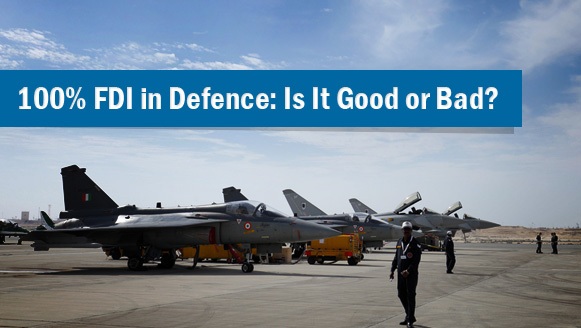
100% FDI In the Defence Sector – Good Or Bad?

0

In this blogpost, Pranav Rudresh, a student of Lloyd Law College, Greater Noida writes about the current move of the government of introducing 100% FDI in the defense sector along with the upside and the downside to this move.

IMG_20160415_145319347-e1461738121934-768x1024

FDI or Foreign Direct Investment is an investment which is made by any company into a particular economy/country. It is a method of direct investment into any economy. It is a key component in global integration. It is one of the major forms of cross-border investment. A company or enterprise, resident in its nation, can operate its enterprise in another country by investment. FDI is amongst the key issues of foreign policies for almost all the countries. The enterprises based in developed economies can invest directly and open its branches in another country (underdeveloped or developing). It can use its resources for its work and in return give money to the workers. This not only helps in the development of the economy but also gives the workers a fair idea of how an enterprise operates. It provides long lasting interests to the enterprise as well.

fdi-in-defence

The investing company can make its overseas investment in some ways – either by setting up a subsidiary or associate company (with the same name of the company) in the foreign country and also by a partnership with shares of an overseas company, or through a merger or joint venture. In India, the FDI was first brought up after the economic crisis of 1991. Former Prime Minister Manmohan Singh and the then Prime Minister Shri PV Narasimha Rao are credited for bringing FDI in India which relaxed the economy and generated more than one crore jobs. In 2015, India became the largest destination for FDI surpassing China.

An example of FDI can be an Indian company taking a majority stake in a company in China. Another example would be a Canadian company setting up a joint venture to develop a mineral deposit in Chile.

For a developing nation like India where over-population and poverty together are a major issue, FDI is an important sector with which the government can bring employment to all sectors at large scale. Recently, the Modi-led government enacted 100% FDI in defense as well as the civil aviation department (the FDI has been eased in other departments as well such as food, medicine, etc.). It is to be noted that all this FDI has been allowed via approval of the central minister Shri Venkaiyah Naidu as he stated that it is a need of the hour.

The advantages and disadvantages of 100% FDI in defense sector

While this move may prove to be a big boost for our economy, there are some points against it as well. Firstly, let’s take a look at what are the positives of 100% FDI in defense sector:

  • FDI is better than debt.
  • It will push for growth and development.
  • Intends to transform India into one of the manufacturers from one of the largest importers.
  • Will bring technological advancement to India.
  • Make economy widely open.

Like the two sides of a coin, despite being beneficial, the liberalization of FDI has also bought some negatives. To mention a few:

  • Might kill domestic sector.
  • Indian investors may not comply with foreign defense manufacturers.
  • Most nations would know the defense manufacturing limits of India.


How will FDI be beneficial?

fdi-in-defence (1)

A good FDI can significantly pave the way for an increase in farmers’ income, employment to youth and an impetus for the growth of the small and medium industry. This would help start micro, small and medium industries which would pave the way for jobs to the youth. FDI can lead to the creation of a congenial atmosphere to attract the investment. It is better to take debts and pay them later than loans at higher interest rates that too with the currencies all around the world being highly unstable, especially in a developing country like India.

At present, India is amongst the largest importers of machinery in the defense sector. Compared to the developed countries, India lacks defense equipment production capability. Greater FDI inflow in defense provides a chance of substantive economic
advantages. The increased flow of funds from a foreign source leads to more employment opportunities for the local population. It also means that taxes and other revenues will flow back to the local economy. Most industry associations and foreign firms have demanded that FDI cap be increased to 100 percent since they believe that the Government of India will insist on Indian control over any defense manufacturing company. India’s main aim is technology enhancement and foreign vendors will not transfer critical technologies without ownership and management control of the Indian venture. An increase in FDI levels to 100 percent may thus overcome a few of the drawbacks currently faced by the FDI cap with the previous percentage. The FDI cap thus needs to be at a higher rate so as to make a significant difference to the Indian defense industry.


How will 100% FDI in the defense sector hurt India?

Naturally, it is going to kill the domestic sector and Indian defense manufacturing sector related organizations such as DRDO are going to suffer major setbacks. While the transfer of technology from foreign sources may increase, the advantages of having homemade products will decrease. It is not necessary that the Indian manufacturing sector will be able to give 100% cooperation with the foreign companies. It is a clear fact that Indian companies won’t be able to compete with the international manufacturers. This will even prove to be worse for DRDO, which has not been able to give its 100% since its establishment due to lack of local resources.

One of the major setbacks that India will face with 100% FDI in the defense sector will be that the economies that will invest in production in India will know the defense product manufacturing limit of India. If India aims to be a superpower, it cannot be possible just with the production of what the other developed nation are or have been producing. The technological setback thus makes the FDI a matter of concern.


Conclusion

For a country with hostile neighbours, it is the biggest priority of the government is to ensure its safety. Any economy cannot be self-sufficient, and it is not possible to battle against problems like terrorism just by risking of lives. Technology thus becomes an important tool in covering such hazards. The harsh reality is that our defense sector needs a good overhaul, and our government needs to allocate sufficient budgets for production of defense material. The military expenditure of a developed nation like USA is around 600 billion dollars compared to a mere 65 billion dollar expenditure by India when it comes to maintenance of the army and defense equipment. Thus to achieve the defense capability dreams that India has, higher FDI may be a pure and important source that needs to be brought up. It must however be kept in mind that it does harm the local industries.


Download Now

Essentials of Travel Insurance Policy

1

In this blog post, Akansha Srivastava, a student of Amity Law School, Amity University, Noida, writes about the Essential Terms and Conditions one must go through before purchasing a travel insurance policy.

AAEAAQAAAAAAAAIOAAAAJDliMzI2ZmVjLTExZTItNDgxNC05YmVkLWM2NTJjZWJlZjViYw


What precisely is ‘Travel Insurance’ and why one needs insurance while traveling?

It is, fundamentally, a kind of insurance which conceals medical costs and lost baggage and other such misfortunes that might take place while traveling broadly or universally. The insurance helps you with a considerable amount of losses. A few nations like Cuba won’t even give you access into their territory unless you have travel insurance. Arranging a holiday can be as hectic as working from 9 to 5 in a Government office. One may believe that a bag, passport and tickets are all you need however what happens if you lose your luggage at the airplane terminal? Then again, what if one of the passengers has a genuine medical condition? On the other hand, if there is a crisis at home and you have to cut short your trek and head back home? Would you let go of all the money that was utilized as a part of booking the expensive arrangements for accommodation? I guess no. This is where your travel insurance company steps in, which deals with a wide range of possibilities that may happen during a domestic or international visit or holiday be it a loss of record or medical crisis or even your travel agent cheating you or ripping you off your money.

travel-insurance

Travel insurance gives people an opportunity to travel safely and conveniently. Despite the fact that travel insurance does not keep one sound or safe and you may arrange a very risk free and sheltered getaway for yourself, however, once in a while there are events which lead to huge losses to the point that a man gets penalized or falls into the debts for a considerable length of time.

Presently there are a variety of travel insurances in the business sector with various approaches which cover a number of losses. Purchasing travel insurance can be the trickiest and the confusing part of planning a holiday. Be that as it may, before going on to purchase travel insurance, one must remember the sort of holiday that the person wants. Is it a performance trip or a family trip? The destination and length of the holiday along the medical history state of every single person who is going with you are vital factors that one needs to be remember before picking out the type of travel insurance one needs for the trip.

Following are the factors that need to be kept in mind while looking for travel insurance:

  1. Medical Costs: An important factor to be considered is the medical costs that one may need to bear during the trip. One needs to ensure that the travel insurance covers the expenses related to health issues that one might encounter and the associated medications that one might need during the travel. A condition that is usually there in this policy arrangement is that if your treatment is not that critical and can hold up until you complete your trip and head home, then that would not be secured under this policy.
  2. Individual Liability: This condition takes care of the costs that one is obligated to pay to another person during travel because of accidental bodily harm or if the property of the other individual is harmed by the insured traveler.
  3. 02Lost property/ personal belongings: If your stuff is lost or destroyed or harmed during your travel, then the costs would be secured under this policy. You would be required to provide every detail about your assets that are lost/harmed/demolished within a restricted time frame. On the off chance that the same happens in an airplane terminal, then a report needs to be composed and submitted by the aircraft company to the insurance agency.
  4. Cancellation of Trip or missed takeoff: This service comes in use when it is possible that one needs to cancel his trip or cut it short because of unforeseen circumstances. In such a case, the insurance covers the non-refundable costs of travel and conveyance. If a flight/train/watercraft is missed because of circumstances that are found to be satisfactory to the insurance agency, then the costs are likewise secured under such policies.
  5. Delay/Travel surrender: If the tour is deferred or canceled because of conditions like terrible climate or other circumstances then the insurer will repay the costs. One ought to check the circumstances that are acknowledged by the organization before getting overwhelmed and purchasing the insurance.
  6. Money: Under this condition, if one loses money or if a cheque or prepaid ticket is lost or stolen, then the insurer is obligated to cover the costs. If there should arise an occurrence of theft, a neighborhood police report ought to be given as proof.
  7. Loss of passport: These policies insure one against costs of extra settlement on the off chance that one loses his travel permits till the time another visa is issued.
  8. 1257941978php1BaO8KWounds during sports: This area covers costs that are incurred when one gets harmed while playing a game. The essential thing to remember here is that there are just a couple games that the policies cover. Insurers need to cover more games and exercises.
  9. Trip Duration: There are some travel insurances that covers you just for a week. One ought to choose a term of the travel insurance coinciding with one’s own particular span of the trip.
  10. Prohibited Destinations: There are a couple of nations or spots that are not secured under certain travel insurances.
  11. Previous conditions: It is important to reveal the medical history of the prospective insured; else the insurer won’t pay for the costs on the grounds that there was concealment of a material fact.
  12. Liquor and Narcotics: Even though the policy says that it would cover the costs in the event that one is at a risk of paying somebody for a substantial harm done, however, in the event that the same is done while being inebriated then it would not be appropriate and your travel insurance would not cover such costs.

Filing your claim

Presently since we’ve secured the terms and conditions, the next thing that comes to mind is the means by which a claim can be made. When you make a claim, it is an extremely normal thing that the travel insurance agency, regardless of how great it is, will either abstain from paying or will pay as less as it could, reasonably. With the specific end goal to ensure that you do get paid for your claim, you ought to take care that you have every one of your receipts, essential structures, and legitimate documentation in the light of the fact that these reports will only help you make your claim procedure brisk.

The entire procedure may appear to be extremely confounded and astounding, yet there is nothing bewildering in it. Truth be told, one can get a travel insurance online as well. The four best travel insurance agencies as indicated by www.reviews.com are-

  • HTH Travel Insurance

HTH Travel Insurance offers, without a doubt, the most direct travel insurance policies to a significant number of associations. If you’re traveling in a group, their courses of action end up being extensively sensible, with exceptional rates being available to groups of five or more people traveling together. HTH Travel Insurance moreover gives presumably the most versatile arrangements around by enabling you to pick your extension limits and your deductibles. In case you pick this one, you needn’t trouble yourself with trip insurance degree. There’s moreover the decision to purchase remedial simply travel security, which covers any emergency medical treatment you require while you’re out of the country.


  • WorldNomads.com

wn-logo-withtag-rgbmed_4fd17c4492a61

WorldNomads.com is another travel insurance supplier that offers some uncommonly sensible rates. They give a good deal of emergency, therapeutic and dental insurance along with their regular insurance plans. Additionally, WorldNomads.com offers the most widespread coverage for sports activities covered in a travel insurance plan. Settling on them is a good choice if you’re planning to try any of the high-risk adventurous activities during your journey. Make sure your policy covers it, though! The best piece of news is that WorldNomads.com’s rates are altogether cheaper than those you’ll find of various associations, so it doesn’t matter how far or what kind of activities you plan to include in your holiday , you’re pretty much going to pay the same cost irrespective of these factors.


  • Allianz

Allianz completes the list of the low-cost travel insurance suppliers, performing better than the ordinary. You can pick between a single-excursion insurance plan and an annual plan depending upon how frequently you travel. If you foresee taking a couple of trips throughout of the year, a yearly game plan could help you save a great deal more in the light of the fact that it covers a vast number of outings taken within a 12-month time frame. Another remarkable thing about Allianz Travel security is that their policies aren’t as restrictive as the others in the business. They let you insure trips with expenses up to $100,000, something that is one of the most remarkable features of Allianz among fellow travel insurance suppliers.

Aside from these, there are travel insurances for pets also that furnish a man with the losses that happen as for one’s pet whether it is a canine or guinea pig.


Download Now

Time is of Essence in a Contract

1

In this blog post, Akansha Srivastava, a Student, Amity Law School, Amity University, Noida, writes about the importance of time in a contract.


AAEAAQAAAAAAAAIOAAAAJDliMzI2ZmVjLTExZTItNDgxNC05YmVkLWM2NTJjZWJlZjViYw


Introduction

In India, the laws relating to “time as the essence of a contract” is specified in Section 55 of the Indian Contract Act, 1872, which provides that if someone promises something to be done at a specified time and it is not performed at the same time, the contract becomes voidable if it was the intention of the parties to make time the essence of the contract. Further, it says that if the parties did not have the intention to make time the essence of the contract, the promisee should be entitled to claim compensation for any loss incurred. Finally, this section says that if time is intended to be of essence but performance is accepted in some way other than what had been agreed on, compensation cannot be claimed unless he gives notice to the promisor.


Intention of the Parties

In India, the question as to whether time is of the essence to the contract would question which needs to be clarified at the time of execution of the contract. An express stipulation in this matter cannot be concluded as the intention of the parties. If a contract in its terms provides that time is the essence of the contract, but other terms of the agreements show that the parties do not intend time to be of the essence, the court has held that time is not the essence. The intention of the parties can be ascertained from:

sheet of a calendar with the number of days and clock close-up

  • The express words used in the content
  • The nature of the contract itself
  • The nature of the property which forms the subject matter of the contract
  • The surrounding circumstances

It has been held in the case of China Cotton Exporters v. Behari Lal Ram Charan Cotton Mills Ltd that in commercial contracts time is ordinarily of the essence of the contract. The rule is that except in commercial contracts, time is not of the essence of the contract. This presumption can be rebutted by showing the intention of the parties. Time is presumed not to be of the essence in contracts relating to immovable property, but of the essence in contracts of renewal of leases. Under Common Law, download (1)stipulations as to time in a contract giving an option for renewal of a lease of land were considered to be of the essence of the contract even if they were not expressed to be so and were construed as conditions precedent. The onus to plead and prove that time is of the essence of the contract is on the person alleging it, thus giving an opportunity to the other party to adduce rebuttal evidence that time was not of the essence. Where both the parties are engaged in business and articles are purchased by one party from the other party for business purposes, the transaction falls within the term ‘mercantile transaction. ’[1]

Extension Of Time

The time for performance can be extended only by an agreement arrived at between the promisor and the promisee. A mere extension of time and nothing more is only a waiver to the extent of substituting the extended time for the original time and not an utter destruction of the essential character of time, where the other party did not communicate any acceptance, the time for performance was not extended.

When Time is Not of the Essence

Time is not the essence where the contract provides for damages for delay in completion or even for the extension of time in certain cases. Despite express provisions making time the essence, some contracts may be construed to be otherwise where these provisions are inconsistent with the intention of making the time as an essence of the contract. Time is not of the essence where the time for performance was extended twice, and the object of a purchase was not a commercial undertaking.

Time was not of the essence when the contract did not specify a date for the completion but merely provided for the proper completion to happen as soon as possibly expected. A party’s general right to have the contract performed within a reasonable time. Time was held as a non-essence when in a contract for import and supply of sugar, the port of discharge had not been named and the surveyor not been appointed without whose certificate the question of payment does not arise.

https://lawsikho.com/course/diploma-advanced-contract-drafting-negotiation-dispute-resolution
Click Above

Acceptance after the Specified Time and Waiver

If a party waives his rights by taking benefits under the contract made after the fixed time, he cannot rely on the time being the essence of the contract to avoid the contract. A claim under this will be barred if the promisee accepts performance after the stipulated time unless he had submitted a notice to the promisor of his intention to do so.Deal. handshake of Business People

In the case of State of Kerala v. M.A. Mathai, it was held that if there are any delays in the performance of reciprocal obligations by an employer, the contractor gets the right to avoid the contract but if he does not avoid the contract and accepts the belated performance, he cannot claim compensation for any loss sustained by him due to delay in performance, unless he gives a notice of the same to the delaying party.

Legal Provisions

Let’s look at the provisions of the Indian Contract Act that refer to time and place for the fulfillment of a contract.     

  • Section 46: This section talks about the time for performance of the promise, where no application is to be made and no time is specified. Where, by the contract, a promisor is to perform without application by the promisee, and no time for performance is specified, the engagement must be performed within a reasonable time.  Explanation: The question “what is a reasonable time” is, in each particular case a question of fact.
  • Section 47: This section talks about the time and place for the performance of a promise, where time is specified, and no application is to be made. When a promise is to be performed on a certain day, and the promisor has undertaken to perform it without application by the promisee, the promisor may perform it at any time during the usual hours of business on such day and at the place at which the promise ought to be performed. Explanation: A promises to deliver goods to B’s warehouse on 1st January. On that day A brings the goods to B’s warehouse, but after the usual hour for closing it, and they are not received. A has not performed his promise.w12
  • Section 48: This section talks about the application for performance on a certain day to be at a proper time and place.When a promise is to be performed on a certain day, and the promisor has not undertaken to perform it without application by the promisee, it is the duty of the promisee to apply for performance at a proper place and within the usual hours of business. Explanation:  The question “what is a proper time and place” is in each particular case, a question of fact.
  • Section 55: When a party to a contract promises to do a certain thing at or before a specified time, or certain things at or before specified time, the contract, or part of it that  has not been performed, becomes voidable at the option of the promisee, if the intention of the parties was that  time should be of the essence of the contract. If in case of a contract voidable on account of the promisor’s failure to perform his promise at the time agreed, the promisee accepts performance of such promise at any time other than that agreed, the promisee cannot claim compensation for any loss occasioned by the non-performance of the promise at the time agreed, unless, at the time of such acceptance he gives notice to the promisor of his intention to do so. [2]

Case Law

In Startups v. Macdonald, S agreed to sell 10 tons of oil to M and to deliver it to him within the last 14 days of March. Delivery was rendered at 8:30 pm on 31st March. M refused to accept. It was held that the tender of the oil was in the circumstances equivalent to performance and that S was entitled to recover damages for non-acceptance.

Conclusion

If the parties do not have the intention to make time the essence of a contract, the promisee should be entitled to claim compensation for any loss incurred.


LawSikho has created a telegram group for exchanging legal knowledge, referrals and various opportunities. You can click on this link and join:  

https://t.me/joinchat/J_0YrBa4IBSHdpuTfQO_sA

Follow us on Instagram and subscribe to our YouTube channel for more amazing legal content 


Refrences:

[1] http://www.legalindia.com/time-is-of-the-essence-clause-in-commercial-contracts-in-india/

[2] http://www.legalservicesindia.com/article/article/time-is-the-essance-of-the-contract-1396-1.html

Download Now
logo
FREE & ONLINE 3-Day Bootcamp (LIVE only) on

How Can Experienced Professionals Become Independent Directors

calender
28th, 29th Mar, 2026, 2 - 5pm (IST) &
30th Mar, 2026, 7 - 10pm (IST).
Bootcamp starting in
Days
HRS
MIN
SEC
Abhyuday AgarwalCOO & CO-Founder, LawSikho

Register now

Abhyuday AgarwalCOO & CO-Founder, LawSikho