Download Now
Home Blog Page 1724

Do Crime Against Women get reported in India?

0

In this Blog Post, Sakshi Bhatnagar, a student of National Law University Odisha, Cuttack writes about the position of crime reporting of offenses committed against women in India. She presents this data with statistical proof. 

12019813_1167341736613639_2035022244513496011_n


Crime statistics are imperative and crucial inputs for evaluating the personal satisfaction and human rights circumstance. In the general public, such reports are used by authorities at various levels for the purpose of framing new policies, and ascertaining the position of current ones. In any case, this framework has not been investigated over time from the perspective of scope, exactness, opportuneness and importance.[1]

With an aim of comprehensive improvement of the statistical system in the country, a mechanism called the ‘Conference of Central and State Statistical Organisations’ (COCSSO) was set up by the Ministry of Statistics & Programme Implementation. Reporting on crime and criminal justice help Governments to assess and monitor the conditions, circumstances, and trends of the well-being of the society and the social impact of public expenditures and policies. The collection of reliable and comprehensive criminal justice statistics in countries is of immense importance to everyone involved with criminal justice, especially to the criminal justice administrator.


Violence Against Women and Recording and Reporting of Violence Against Women

Crimes against women have been a barrier to complete development of the society and the situation is not unknown to any authority. The reluctance of public authorities to deal with it are long-standing themes of public debate in India. They have been part of India’s Public Policy agenda since the landmark rape case in 1972 of a teenage girl known only as Mathura.[2] Another highly publicized case that apparently paved the way for new implantations in legal procedure was the Nirbhaya case that happened 40 years after the above cited Mathura case in 2012. The response of the appropriate authorities was, despite such a long gap, was more or less the same, of reluctance. They leave no doubt that violence against women is a serious challenge to Indian society, law enforcement, and judicial affairs. These extremely publicized incidents focus attention on the widespread however poorly .understood downside of violence against women. molestation rape kidnap crime woman girl child_0_0_0_0_0_0_0_0_0
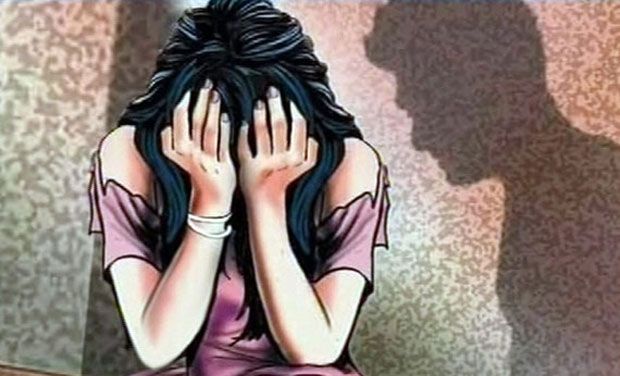
Internationally, violence against women is recognized as ‘one of the most systematic and widespread human rights violations.[3] One reason of this may be that violence is rooted in the gendered and social structures instead of random acts done by individual minds; and ‘cuts across age, socio-economic, educational and geographic boundaries; affects all societies, and is a major obstacle to ending gender inequality and discrimination globally.[4]

In international rankings, India’s overall rate of reported lethal violence is low to mid-level, compared to far off societies such as Brazil, the Russian Federation, or South Africa.[5] India’s low rate of national violence, however, conceals it’s large absolute scale, with an annual average of 35,848 violent deaths of men and women between 2007 and 2012.[6]From a sexual orientation point of view, these insights give just an impression of viciousness against women

The key figures for violent crimes against women in India are the annual statistics released by the National Crime Records Bureau (NCRB). As a police agency operating under the Ministry of Home Affairs, the NCRB is responsible for all official, national crime statistics, relying on data submitted by state and city law enforcement agencies’.[7] In 1989,a separate section on ‘Crimes against Women’ was introduced by the agency to its annual report. In this section, acts of violence against women are recorded under two separate categories: the Indian Penal Code (IPC), and crimes recorded under specific gender laws, called the Special and Local Laws.[8]

NCRB reporting also involves judgments by police about the causes of a crime—a problem most evident in certain categories, such as motives for sexual affairs or killings due to allegations of witchcraft which raises questions about misreporting.[9]


Gendered Underreporting

Underreporting by law enforcement agencies of violent crime against women is a global concern.[10]By adequately disguising the genuine size of the issue, underreporting redirects open and political consideration, accordingly hindering conceivably viable reactions. Evidence of massive underreporting in India comes from a study in 2010 that found that approximately 66 percent of New Delhi’s women had been sexually harassed during the previous year, on an average of two to five times.[11]The weakness of Indian crime data, especially poor reporting and lack of comprehensiveness, limits insights into all aspects of Indian violence and acts as a challenge to complete societal development.

Close-up of secretary’s hands doing paperwork

As per the data available, the NCRB reported just 82 cases of infanticide nationwide in the year 2014—a remarkably low figure for such a large country.[12]The concept of missing women in Asia explains much about the gendered underreporting of violent crimes against women in this region. 25 years ago, Amartya Sen, through his writings, showed that India and other countries in Asia were missing millions of women due to selective abortion, infanticide, and unequal treatment of female children, including the denial of food and health care.[13]In India, notions of shame, modesty, and honor remain the dominant concepts in public discourse for justifying sexual assaults on women.[14]


Sex-selective Foeticide and Female Infanticide

Gender-based discrimination begins early in a human life in India. A family with an apparent predilection for having a son, rather than a daughter, can use prenatal testing to determine the sex of a fetus and organize a sex-selective abortion to escape birth of a girl[15]. In 1996, India enacted a law to avert prenatal scanning for the purposes of determining the sex of a fetus. Such a law is tremendously difficult to enforce because an extensive yet poorly regulated private medical system exists. Not everyone is aware of the existence of such a law, mainly in the remote areas.

The deficiencies of official reporting on female foeticide and infanticide appear implausibly low for a country of more than 1.2 billion. The trends may be more meaningful than the individual figures as they indicate a steady rise in reported foeticide cases but the national total in 2013 was still only 221 reports, which is not enough to register statistically in overall crimes against women. Meanwhile, the number of reported infanticide cases has gone down.123

These figures only hint at the inadequacy of official crime figures. Studies suggest that, in reality, 4 to 12 million foetuses-virtually all female -may have been aborted in India over the past three decades[16]. This estimate excludes the crucial aspect of post-birth infanticide or death due to willful neglect. The data on missing women refers not just to the systematic prevention of the birth of females through sex-selected foeticide but also to the widespread killing of female infants and young girls, typically under the age of six. The methods of female infanticide vary, with many traditions. One researcher observed the methods of inducing pneumonia and diarrhea:

The infant was wrapped in a wet towel or dipped in cold water as soon as it was born or when it came back home from the hospital. If, after a couple of hours, if it was still alive, it was taken to a doctor who would diagnose pneumonia and prescribe medicine, which the parents promptly threw away. When the child finally died, the parents had a medical certificate to prove pneumonia. Sometimes the infant was given a drop of alcohol to create diarrhea, another ‘certifiable disease’.[17]

A critical study shows skewed survival rates for girls of one month to five years of age, who are 25 to 50 percent more likely to die of pneumonia and diarrhea than boys of the same age[18]Domestic violence is yet another strong reason for the abnormally high rate of female deaths.

The reported ratio of girls born for every 1,000 boys born has increased since 2000. In that year, only 892 girls were reported born for every 1,000 boys, suggesting a notable rate of foeticide and infanticide. By 2008, 904 girls were reported born for every 1,000 boys[19]. This increase in births of girls is offset, however, by a steady decline in girls to boys under the age of six, a decrease from 927 girls for every 1,000 boys in 2001, to 914 girls in 2011[20].

Domestic Violence

Girls and women are often subjected to physical and sexual abuse, both inside the home and outside. Although definitive surveys and estimates are lacking, domestic violence appears to be the most common form of violence perpetrated against women[21]. That said, it seems to go virtually unreported to police except for some of its nastiest manifestations. This makes domestic violence probably the most precarious category of violence against women for which systematic data is lacking. In lieu of criminal reporting, survey research on domestic violence is the strongest indicative measure of its significance. Survey findings put forward that approximately 40 percent of women in India who have ever been married have been subjected to spousal violence. The same survey shows an estimated one percent of married women have acted violently towards their husbands[22].

Shockingly, a survey done by the Population Reference Bureau found that 30 percent of women and 26 percent of men in India agree that wife-beating is acceptable[23]. Other research shows that women who marry young usually meaning before 18 in India are more likely than women who marry later to believe this and to experience domestic violence[24].

MODEL RELEASED. Domestic violence. Silhouette of a woman protecting herself from a blow from her partner by holding her arms in front of her face.

Domestic violence means violence between spouses and violence perpetrated by other family members. It is widely presumed to include physical intimidation and violence towards daughters-in-law, typically carried out by members of extended families who live in the same household. In 2013, police records capturing ‘Cruelty by Husband and Relatives’ against women the principal category for the most grave of such incidents accounted for 38 percent of all the crimes covered under the Indian Penal Code, 1860.

The key state response to domestic violence is the Protection of Women from Domestic Violence Act 2005, which extends to the whole of the country, except for the states of Jammu and Kashmir [Gazette of India, 2005, art. 1(2)]. While the Act contains no new punitive features, it emphasizes on protecting the fundamental civil rights and humanitarian needs of women, such as a woman’s right to reside violence-free in her matrimonial or parental home.


Dowry-related Violence

Under the country’s Dowry Prohibition Act, 1961, dowries in India almost always paid by families of the bride were declared illegal; yet it is still a common practice in the culture of marriage in India. Research confirms that the practice continues unchecked and dowry-based violence has become more common, despite official efforts to suppress it[25]. A study conducted by the UN on the culture of dowry and domestic violence in India found that the crimes related with dowries tend to relate to financial demands made by the families of bridegrooms and the tensions caused by changing social traditions and emerging opportunities for women.

Dowry expectations can amount to several times the annual wealth of a poor family. When the bride’s family cannot afford the dowry requested, conflict may result, sometimes culminating in lethal attacks committed by the family of the groom on the bride and threats of breaking the marriage. A new bride might be abused by her husband’s family until her parents pay certain debts or provide gifts requested. Similarly, dowries have grown to include other ritual occasions, such as gifts to mark the birth of a child or other significant events. 8a0ed22bd4ba6c3585f35d1a4e581894
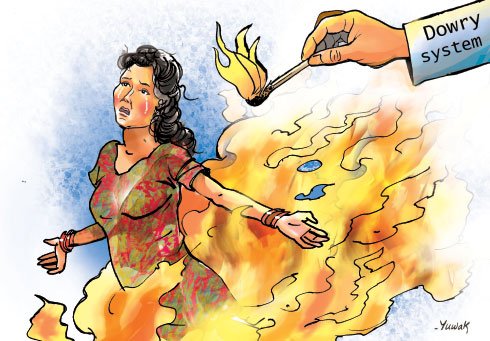
The social and financial burden of such expectations can affect a family’s decision to selectively abort a female fetus or kill a baby girl, as she, in turn, will incur considerable dowry costs when she attains marriageable age. Another extreme example of dowry-related violence is burning to death a bride who can be dismissed as a kitchen accident or suicide. Sometimes, the family of the bride fears the hampering of their image and position in the society due to which, they do not file any complaints or any case against the family of the groom. What is to be understood is that such a fear encourages the culprits as they are assured that no legal complications will arise.

Reports of dowry-related violence in India have been rising. NCRB figures show a surge from 4,836 dowry deaths reported in 1990 to 8,083 in 2013—an increase of more than 67 percent. As with other forms of violence against women, this figure is widely regarded as incomplete. The states where most dowry violence occurs are concentrated in the north of the country: certain states report no dowry-related deaths at all. Some of these reports may point to more favorable regional social environments while others suggest poor reporting practices.


Honour Killing

“Honour” killings are among the most severe indications of violence against ladies and young women around the world.[26] Such killings carried out for the sake of custom, are executed by male relatives to attest power over ladies’ decisions of a close partner or opportunity of development.[27] Murdering for the sake of respect may take numerous structures. A young lady or woman might be stoned, compelled to submit suicide in the wake of being reprimanded in broad daylight, or blazed and distorted with corrosive, which thus can bring about death or suicide.[28]

Universally, honour killings are accepted to be extremely under reported.[29] In India, the NCRB information does not have a different classification for such killings. Rather, reports rise just about entirely through the media and NGOs. UN bodies have likewise communicated concern that respect related violations and murders are under-archived, once in a while examined by police, and typically go unpunished.[30] timthumb
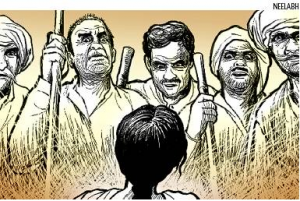
The Supreme Court unequivocally ensures the act of khap/katta panchayats, taking the law into their own hands and enjoying hostile exercises which put in danger the individual existences of the general population wedding as per their will. To the extent India is concerned, “honor killings” are for the most part reported from the States of Haryana, Punjab, Rajasthan and U.P. Bhagalpur in Bihar is likewise one of the known places for “honor killings.” Indeed, even a few occurrences are accounted for from Delhi and Tamil Nadu. Getting hitched to individuals from different stations or the couple leaving the parental home to live respectively and we’d incite the unsafe demonstrations against the couple and prompt relatives. The Law Commission of India attempted to learn the quantity of such occurrences; the blamed included, the particular reasons, and so forth, to have a thought of the general wrongdoing rate in such cases.[31] The Government powers have cited this in AnverEmon’s Article on Honour Killings. States where episodes frequently happen have been tended to outfit the data. The main reasons for honor killings seem to be love marriages, wish to marry outside the village or caste or against the consent of the parents. Relational unions between the couple having a place with same Gotra (family name) have likewise frequently prompted the savage response from the relatives or the group individuals. This is a troublesome circumstance to be into be not kidding, as it is seen as a condemnable demonstration to both, wed outside the group and inside of the same family name. The Caste gatherings or Panchayats, prominently known as ‘Khap Panchayats’[32], attempt to receive the excellent course of ‘moral vigilantism’ and uphold their diktats by accepting to themselves the part of social or group Watchmen.


Violence Against Women In Public Spaces

As ladies and young girls venture out from the private circle of home and family and into open spaces for advanced education, paid business, and social engagement, they go up against new dangers of sexual animosity intrinsic to a culture that frequently supports or neglects lewd behavior in the city.[33]In an endeavor to comprehend savagery against ladies in urban open spaces, some universal associations and NGOs have directed free studies. In 2010, an overview upheld by UN Women in regards to the boundaries to making New Delhi more secure for ladies, what’s more, young girls found that the ‘trepidation of being badgering’ in broad daylight spaces was as genuine an issue as the ‘experience of being bugged’.[34]

More than 85 for every percent of ladies reviewed reported fears of inappropriate behavior out in the open.Almost 66% reported having confronted episodes of lewd behaviour—from foul remarks to being grabbed, stalked, or sexually attacked—somewhere around two and five times in the earlier year. As anyone might expect, vast extents of ladies said that they maintained a strategic distance from open places, particularly around evening hours. The remarkable extent of their encounters may clarify the power of the general population response to the group rape and murder of 2012 in Delhi.[35]


Rape and Sexual Assault

Assault is seen as a show of dominance by male members of the family over the female members. Females are beaten up if they do not abide by the ‘instructions’ given by their husband and if they do anything which is considered outside of their traditional roles. While reporting seems low, the quantity of reported episodes has risen forcefully lately, from 24,206 in 2011 to 33,707 in 2013—a 39 for each percentage increment in two years.[36]This increase in reporting comes following quite a while of steady and low reporting. Existing NCRB information does not uncover whether the increment is because of another ability among casualties and families to report the wrongdoing, to an adjustment in the readiness of police to record such violations, or to an ascent in the assault cases themselves. The aggregate number of assaults reports for which the culprits were known not casualties was 31,807.[37]According to NCRB information, 93 ladies are assaulted in India every day. The conditions of Madhya Pradesh and Rajasthan recorded the most elevated number of cases in 2013 with 4,335 and 3,285 individually. The most elevated rates of reported assault were in the Delhi national capital domain and the north-eastern condition of Mizoram[38]. Whether these states emerge due to higher real occasions or the complete reporting is indeterminate. An outstanding issue in assault cases is the character of assailants. Of the 33,707 assaults formally recorded in 2013, the casualty apparently knew her rapist.marital-rape-law-in-india

The principal concern is Dalits (‘mistreated’ in Hindi and Marathi, vitally alluded to as ‘untouchables’), who are at the base of India’s rank progressive system. Dalits seem significantly more prone to be deceived, and a great deal more averse to see their affirmations considered significant by the legal framework. An unmistakable investigation of brutality against Dalit ladies observed them be as much of hazard from fierce assaults inside of their group as from non-Dalits.[39] Family strife is frequently a reason for the bad passing of a lady among Dalits. The social dimensions of brutality against Dalit women were uncovered by a study that found that some may see assault as “appointed” because of their twofold detriment of being Dalit and female (Sengupta, 2009).

Equity is routinely denied to Dalits, in spite of legal changes, for example, the Scheduled Castes and Scheduled Tribes (Prevention of Atrocities) Act 1989, proposed to enable powers to manage savage wrongdoings against these groups. Police can be hesitant to handle rank related viciousness, register cases, or react to pleas for help. An examination of brutal violations carried out by non-Dalits against Dalit ladies uncovered efficient defers or a through and through inability to acknowledge reports of affirmed wrongdoings, to explore, or to arraign culprits).


Conclusion

Though the crimes against women are continuously rising, there has not been any new initiative to record these crimes, and the traditional practices are still followed. These reports, which are produced by the government authorities are questionable on many bases and cannot be completely relied upon. All this ultimately hampers the process of framing effective policies. There is an immediate need to rectify the errors in the reports and cover the offenses, which were not covered previously, under new categories.


[divider]

Footnotes: 

[1]Report of the Committee on Crime Statistics, Ministry of Statistics & Programme Implementation (29.06.11)

[2]Basu, 2013

[3]UN Women, 2013, p. 2; UNFPA, UNIFEM, and OSAGI, 2005

[4]UN Women, 2013, p. 2

[5]Acharya and Karp, 2011, p. 2

[6]Geneva Declaration Secretariat, n.d.

[7]Shrinivasan, 2013; Acharya and Karp, 2011, p. 2

[8]NCRB, 2014, p. 79

[9]NCRB, 2014,pp. 55–56

[10]Dziewanski, LeBrun, and Racovita, 2014, p. 11

[11]Jagori and UN Women, 2011, pp. 20–21

[12]NCRB, 2014, p. 96

[13]Lyn, 2011; Sen, 1990

[14]Verma, Seth, and Subramanium, 2013, p. 14

[15] UNICEF, 2006, p. 4

[16] Ram et al., 2013, p. e224

[17]Aravamudan, 2007, pp. 2022

[18] Ram et al., 2013, pp. e224–e25

[19] UNFPA, 2010

[20] NFHS, 2007, p. xxx; GoI, 2012, p. 6

[21] Smith et al., 2003, p. 13

[22] NFHS, 2007, pp. 508, 521

[23] PRB, 2011, p. 2

[24]Jejeebhoy, 1998, p. 859

[25] Banerjee, 2014

[26]HRC, 2012, Para. 43

[27] HRC, 2012, Para. 43

[28]HRC, 2012, Para. 45

[29]HRC, 2012, Para. 44

[30]HRC, 2012, paras. 43–44

[31]Prevention of Interference with the Freedom of Matrimonial Alliances (in the name of Honour and Tradition): A Suggested Legal Framework. Report No.242

[32]AnverEmon is a professor of Islamic Law.

[33]Jager and UN Women, 2011, p. 43

[34] HRC, 2012, paras. 95-99

[35] HRC, 2012, paras. 100-101


[36] NCRB, 2014, p. 81

[37] NCRB 2014, p. 399

[38]NCRB, 2014, p. 387

[39]Navsarjan Trust, 2011, p. 6

Download Now

Section 498A of IPC – A Shield or A Weapon?

0

In this blog post, Osita Kirti Ranjan, a student of Vinoba Bhave University, Jharkhand writes about section 498A of India Penal Code, 1860 and tries to portray two characteristically different sides of the same provision in the context of the Indian society. She tries to explain the legislative intent of enacting the provision and compares it with the actual implications of implementation of this provision India today.

 498a


A woman has predominantly been at a disadvantageous position in the society. She has to go through many obstacles at every stage of her life.  But her life becomes worse when she is married to a wrong person and is subjected to cruelty. Not only her husband but the relatives of her husband also start demanding dowry. They coercively demand money, jewelry, any property or a share in the property.

If she fails to fulfill their unlawful demands, then she is harassed and has to face mental and physical cruelty. Often she ends up committing suicide due to depression or is murdered by her in-laws. This is the very pathetic condition of unnatural death of young girls.  It is a criminal offense, and the entire family can be jailed under Section 498A of India Penal Code based on a complaint in the police station.

Section 498A was introduced in the Indian Penal Code by Criminal Law (second Amendment) Act, 1983. It was brought with the view of curbing domestic violence, marital violence and to protect women from dowry harassment and abuse committed by husband or in-laws.


Legal aspect of Section 498A

Section 498A states that – Whoever being the husband or relative of husband of the woman, subjects such woman to cruelty shall be punished with the imprisonment for a term which may extend to three years and also be liable to fine.

Explanation- for the purpose of this section, “cruelty” means-

  1. Any willful conduct which is of such nature as is likely to drive the woman to commit suicide or to cause grave injury or danger to life, limb or health (whether mental or physical) of the woman; or
  2. Harassment of the woman where such harassment is to (or “intending to”) coercing her or any person related to her meet any unlawful demand for any person related to her meet such demand.


Analysis of the section shows that the following amounts to cruelty:

  • Any conduct that is likely to drive a woman to suicide
  • Any conduct which is likely to cause grave injury to the life, limb or health of the woman,
  • Harassment with the purpose of forcing the woman or her relatives to give some property.
  • Harassment because the woman or her relatives are either unable to yield to the demand for more money or do not give some share of the property.


Section 113A of Indian Evidence Act

This has been added to the Indian Evidence Act to raise plausibility either dowry death or abatement to suicide of a married woman. This section shall have the same meaning as defined in section 304B of IPC. The acknowledged object is to combat the menace of dowry death and cruelty.


  • Cruelty: An evil

Kaliyaperumal vs. State of Tamil Nadu

It was held that cruelty is an essential common element in offenses under both the sections 304B and 498A of IPC. Both these offenses are distinct, but one who is convicted for dowry death can also be convicted for 498A of IPC. Section 304B does not define the meaning of cruelty, but the meaning of cruelty and harassment gave in Section 498A applies in section 304B as well.

  • Kinds of cruelty covered under this section as follows:

  1. Cruelty by vexatious litigation
  2. Cruelty by deprivation and wasteful habits
  3. Cruelty by persistent demand
  4. Cruelty by extra-marital relations
  5. Harassment for non-dowry demand
  6. Cruelty by non-acceptance of baby girl
  7. Cruelty by false attacks on chastity
  8. Taking away children


  • Misuse of 498A

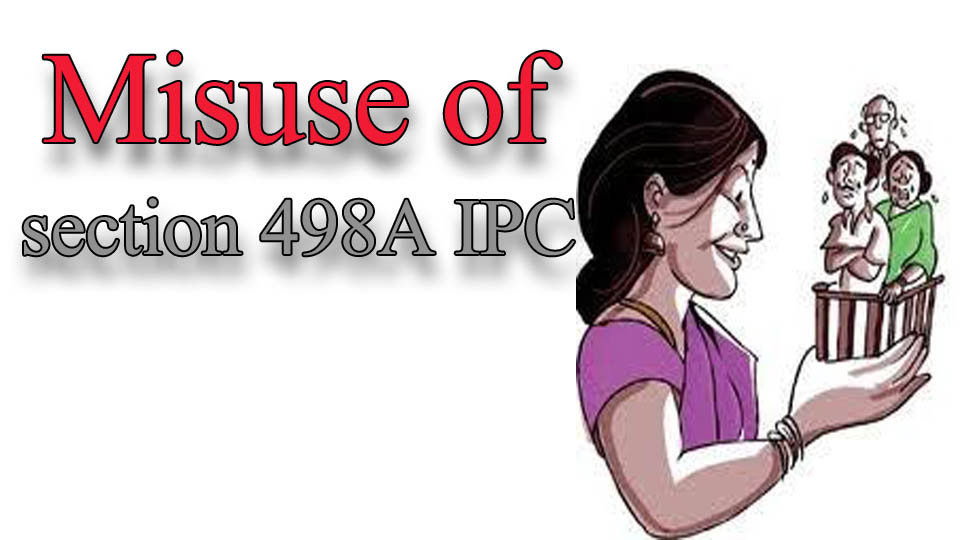
Misuse-of-section-498A-IPC

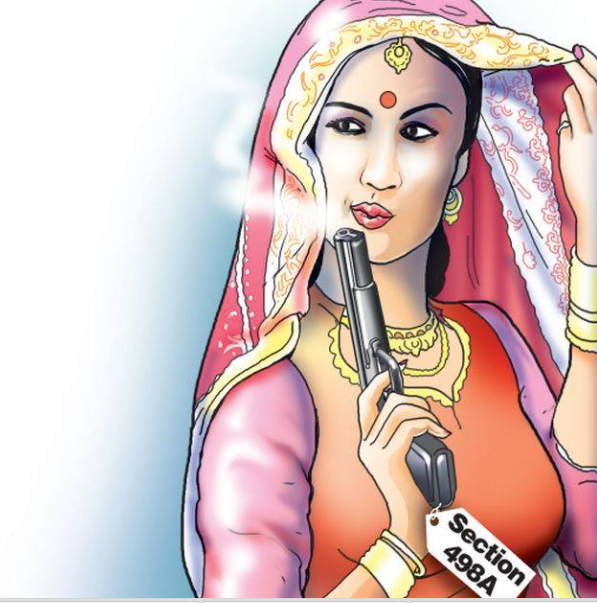
Every coin has two sides. There is no doubt that this law has helped many women get justice, but this scenario is changing. This shield is becoming a weapon for the disgruntled wife to take revenge from her husband. It has become the easiest way to get out of the marital institution. Now-a-days social conditions have changed. Women do not hesitate to establish physical relationship men other than her husband. When they are involved in adultery and are caught in that act, then they smartly cover up their wrongdoing with dowry harassment to get social sympathy.  On the other hand, some wives want control over their husband. They compel their husband not to support his family and break his bonds with them and give up his responsibilities. His failure to do so will result in a 498A case against him. If her parents fail to marry her to a guy of her choice, she uses 498A as a weapon to get out of the marriage arranged by her parents.

Rajkumar vs. State o f M.P 120 of 2004

Wife was murdered brutally in her room. Her husband was accused under Ss. 498A and 302 of IPC.  There was a deficiency of evidence material enough to prove the allegation against the accused husband. It was held that mere doubt against a man is not enough for conviction.


Judiciary and police department

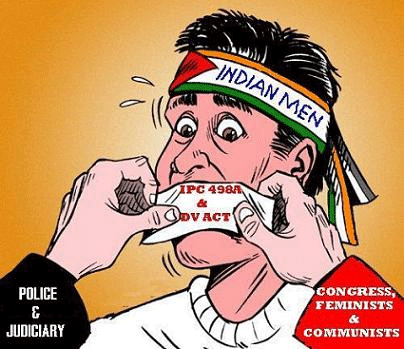
ipc498a

We always talk about gender equality but what happens when an innocent husband is trapped by his greedy wife and her relatives. Husband is beaten up by his wife or her relatives. Sometimes such an injury can be very fatal. But the judiciary does nothing against wife and her relatives. Wife and her relatives are given a free license to engage in atrocious behaviour in the name of 498A. First, they commit the crime and then file a complaint of 498A to cover it up. Despite that, judges do not follow the due process in such cases and allow any number of adjournments to the wife when she does not attend the court hearings. Also, judges do not dismiss the case when the wife does not attend the court for several years. Judiciary should stop working as an agent for such a wife.

On the other hand, police arrest the accused husband without proper investigation and they try to make money and demand a bribe from both the sides. They go to husband’s place of occupation and insult him in public and harass him.  There is huge corruption in the system. Interim bail does not provide any relief to the husband because he will ultimately be put behind the bars with the help of his wife or her relatives and alleged police officers. It is observed that bed-ridden mother-in-laws and father-in-laws are made accused of this section. Sister-in-laws living in abroad are also being accused under dowry laws. This is an absolute injustice to the husband if he is innocent.


Amendment is needed

The Delhi High Court urged the government to review the provisions. Judge J.D. Kapoor urged the government to review this law while rejecting the plea by Savitri Devi seeking for the arrest of her brother-in-law and sister-in-law. He also added that this provision was implemented with the good intentions but after a passage of time it is giving a bad taste and hitting the foundation of marriage itself, and it is not good for the health of society at large.

Screenshot (9)

Delhi High Court also added that Ss. 498A and 406 of IPC should be made bailable because this is becoming a tool for demand of ransom. Some people treat it as legal terrorism. It was reported that about 35% rise in deaths of husbands was due to them being caught in dowry disputes during 2007-09. Dowry deaths in case of women grew by just about 3.5% during the same period. The act of appellant in filing a false complaintamounts to cruelty and can be ground to the dissolution of marriage. Besides, this section should be turned into a compoundable. If parties are ready to solve their dispute by deciding to put an end to their marriage by mutual divorce then, it should be allowed.

Supreme Court has come to the rescue of all such families who have falsely been arrested on such charges. The Supreme Court ruled that the police cannot arrest accused in such cases automatically, and it must give reasons for taking such steps which would be judicially examined. SC directed all State governments to ensure that police do not resort to arresting in all offenses punishable up to seven-year jail term including dowry harassment cases.


Conclusion

It is very essential to protect a woman in the patriarchal system, but it does not mean that justice is only meant for women. Article 14 of Constitution is to be upheld as well. There should not be any form of gender bias. There is an extreme need to review some provisions under Section 498A so that innocent men and their families do not suffer because of a disgruntled wife.

Download Now

How To File A Complaint Against Builders In CREDAI

15

In this blog post, Sunidhi Pubreja, a student of Rajiv Gandhi National University of Law, Patiala has written a comprehensive guide to filing a complaint in CREDAI and further explained the key points that need to be kept in mind by the complainant while filing such complaints.

13151554_1000701696685887_5139115040198882872_n


Introduction


Thinking about investing your savings in real estate and the most common advice you will get from experts is to be diligent while choosing a builder. Being diligent means taking notice of builder’s previous work, quality of service provided by him/her, compliance with the plan, etc. This industry is plagued with fraudulent builders. So, the buyer needs to be cautious, and it is wise to invest with a builder who is registered with a credible governing body such as CREDAI.

1

What Is CREDAI?

CREDAI stands for Confederation of Real Estate Developers’ Associations of India. CREDAI is a regulatory body of builders developed to administer the working and dealing of builders and to control the increasing number of fraudulent builders in this industry. It works to promote the interest of builders as well as investors and to bring transparency in the dealings between the two.

CREDAI seeks to create a favorable policy climate to ensure housing for all. CREDAI specially articulates the concerns of private housing providers. To generate confidence in this industry CREDAI has set a code of conduct and it is mandatory for all the members to abide by it. For example, consistent agreement clauses for all the investors, launch of projects only after securing all the approvals, detailed area statements of the saleable item, etc.


Malpractices Of Builders

The builders, too, earn huge amount of profit befool the buyers. The builders indulge in such malpractices whose consequences are faced by buyers. For example, DLF was served with a public notice by Bangalore City Corporation, Bruhat Bangalore MahanagaraPalike (BBMP), regarding for not obtaining necessary clearance approvals such as environment, power, etc. Its major impact was on those buyers who had already invested their money in it. The authorities stated that such flats would not get No Objection Certificate (NOC) as the necessary clearance has not been obtained, so it is illegal to start construction for the same. Hence, it bars the buyers from completing other transaction with civic authorities.

The builders promise to complete the construction on time, but they delay the construction without any genuine reason just to charge extra-exorbitant amount of money from buyers. They even misrepresent the facts, they may not provide agreed quality of products for construction, or indulge in any other fraudulent activity. Once the construction starts and the builders start demanding the exorbitant amount of money the buyers feels stuck in it.


However many times, despite our best efforts we feel deceived by our builders. What does one do in that case? The buyers have recourse to file a complaint against the builder if they feel cheated by their builders. First, the buyers can warn the builder about his/her malpractices. If the builder still does not stop his corrupt activities, then the buyer can approach the governing body if the builder is registered with a governing body. If the buyer is still not satisfied, then he can file a civil or criminal suit depending upon the nature of the complaint. There is no hierarchy in this chain.

https://lawsikho.com/course/labour-law-hr-managers 

How To File A Complaint Against a Builder?

Untitled


To redress your grievances you can directly approach the builder. Nowadays, the rule of Caveat Venditor is prevalent in the market so most of the builders are customer oriented and would gladly oblige the customer or offer compensation if required.

  1. The preliminary action against the buyer is to write to grievance cell of the company of the builder for redressal of his/her grievance.
  2. If the developer is a member of CREDAI and he/she is not obliging, the complaint can be taken up with the CREDAI Chapter in the city having the Consumer Grievance Redressal Forum to resolve the issue.

CREDAI has established a Consumer Grievance Redressal Forum where an aggrieved buyer can register a complaint against CREDAI member developer. By translating investor interest protection into a mechanism, the apex body of real estate developers resolves consumer complaints expeditiously and prompts bestselling practice amongst the developer fraternity. The mechanism consists of the respective developer downloading the complaint lodged by the buyer from the website and informing the number of days that will be needed for resolution of the complaint. The period to resolve complaints ranges from 7 to 45 days depending on the nature of the complaint. To reduce the incidence of complaints, the developers are encouraged to adopt standard procedures, protect buyer’s interest and embrace transparent practices.[1]

To keep the resolution process free from internal influences, a provision has been made for experienced Legal and Technical Experts of developers to facilitate such resolutions. So far, Consumer Redressal Forum has registered approximately 1265 complaints and effectively resolved 1119 cases (as in June 2014). Out of the remaining 146 cases, 115 are in the process of being resolved. The above figure shows that CREDAI NCR has already resolved around 90% cases. The success rate shows that general customer is gaining confidence in Consumer Grievance Forum of CREDAI NCR.[2]


Guidelines to be remembered before filing a complaint with CREDAI

3

  • CGRF functions neither as quasi-judicial nor as an arbitrator but only as a mediator.
  • The Secretariat of Association can only register the complaint against a member builder only.
  • The processing fee for filing a complaint is Rs 2000/- and in no case, more money can be demanded. In case the builder is found guilty at then, he is obliged to pay this amount.
  • Once the grievance has been resolved by CGRF, it shall not be entertained again on a complaint from same parties.
  • If the verdict of CRGF goes against the member, then he is obliged to comply with it. But if he does not comply with it CREDAI can then cancel his/her membership and expel him/her.
  • If the matter is sub judice and both the parties agree to resolve the issue through CRGF, then CRGF will take cognizance of the offense. Otherwise, it has no jurisdiction to take the matter.


The Procedure to file a complaint with CREDAI

  • You can file a complaint against the builder online at http://credai.org/register-your-complaint. Once the complaint is received by them, a serial number is allotted to it and sent to the member against whom it is filed.
  • After the complaint has been sent to the respective member, he is required to send a reply within a stipulated time from the date it was received by him/her. If the builder fails to reply then, the buyer has to report the same to the Grievance Committee for required action. And the committee sends the message of the builder to the complainant, and he has to reply within seven bank working days.
  • If the committee feels necessary, then it can also order its members to carry out the inspection at the site to resolve the issue.
  • If the complainant is not satisfied with the reply of the buyer, then it has to inform the committee. Then the committee will call both the parties together and tries to resolve the matter with a mutually acceptable order and end the matter.
  1. CREDAI is a national-level governing body. There are many other local levels governing bodies as well which can help a buyer to resolve the grievance if the builder is a member of that local level body. For example, Ahmedabad Realtors Association (ARA), Bangalore Realtors Association India (BRAI), Coimbatore Association of Realtors (COREAA), Andhra Pradesh Realtors Association (APRA), Realtors and Estate Consultants Association of Kolkata (RECA), South Metro City Association of Realtors (SMART), Association of Real Estate Consultants -Nasik (ARC), Real Estate Agents Association of Rajkot (REAAR), etc. are branches of National Association of Realtors-India (NAR). NAR India is a registered non-profit society registered in 2007 and is an umbrella organization covering real estate associations in India.
  2. The buyers who bought property with a builder who is not a registered with CREDAI builders can approach the National Consumer Helpline (1800-11-4000) and CORE (http://core.nic.in/Complainant/CRegistration.aspx). These two help lines take care of all the complaints of a consumer and provide a remedy to them against unscrupulous activities of the seller.
  • National Consumer Helpline aims to provide telephonic advice, information and guidance to empower Indian consumers and persuade businesses to reorient their policy and management systems to address consumer concerns and grievances adopting world class standards.[3]
  • Core Centre aims to work in close cooperation with all the stakeholders in protecting consumer interests by providing state-of-art infrastructure for consumer’s grievances redressal, training, research, and class action litigation having necessary resources.[4]

So, these two forums help you redress your complaint if you fail to register your complaint because the builder is not the member of CREDAI or any other governing body.

  1. The buyer also has recourse to file a complaint against the unscrupulous activities of the builders before the Competition Commission of India. Competition Commission of India (CCI) has the power to enquire anti-competitive and unambitious practices and impose rigorous sanctions on the delinquent builder. A fully functional committee with a Chairperson and six members appointed by the Parliament, the Commission, works towards protecting the rights of the consumers.
  2. The last resort, if the consumer is still not satisfied, is that he/she can then approach the consumer/ civil/ criminal court depending upon the nature of the complaint and take a legal action against the defaulting builder. He/she can even claim damages for the amount of interest he could have earned if he/she had invested the money somewhere else or any other damages incurred by the buyer due to fraudulent practices of the builder. Depending upon the facts of the case if the judges are convinced that the buyer has incurred some real damages the court may award special damages or punitive or non-compensatory damages (These damages are not awarded in order to compensate the plaintiff, but in order to reform or deter the defendant and similar persons from pursuing a course of action such as that which damaged the plaintiff).

So, next time if a builder has befooled you or your known ones beware of the mechanism to file a complaint against the defaulters and get an appropriate remedy.


LawSikho has created a telegram group for exchanging legal knowledge, referrals and various opportunities. You can click on this link and join:  

https://t.me/joinchat/J_0YrBa4IBSHdpuTfQO_sA

Follow us on Instagram and subscribe to our YouTube channel for more amazing legal content 


Footnotes:

[1]Available at http://credai.org/cgrf, last accessed on July 5, 201 at 1:50 p.m.

[2]Ibid.

[3]Available at http://www.nationalconsumerhelpline.in/, last assessed on July 5, 2016, at 3:26 p.m.

[4]Available at http://www.cccindia.co/corecentre/guest/aboutus.asp, last assessed on July 5, 3:28 p.m.


Download Now

Issues with the Indian judicial system

3

In this blog post, Pranav Rudresh, a student of Lloyd Law College, Greater Noida, and Rida Zaidi, a law student of the Faculty of Law, Aligarh Muslim University. The article tries to look into the various factors that contribute to the inefficiency of the judicial system in India.

Introduction

The Indian judicial system, a part of world’s largest democracy, is very old to follow. Right from the monarchical rule to the British era and the modern system of the independent India, the Indian judicial system has always tried to seek justice for the innocent and punishment for the guilty. The modern day judicial system administers a common law system of legal jurisdiction. The laws are codified, and different types of punishment are given depending upon the crime of the culprit.

Let’s take a look at how the Indian judiciary works. There are various levels of judicial bodies in India. If we look at the hierarchy, it is as follows:

  • The Supreme Court.
  • The High Courts.
  • The District Courts.
  • The Village Courts/Panchayats.

All these courts have their jurisdictions and are to follow the laws according to the Constitution of India. It is their duty, as mandated by the Constitution, to be its watchdog. They do so by calling into scrutiny any act of the legislature or the executive, who otherwise, are free to enact or implement these, from overstepping the boundaries set for them by the Constitution. The Indian judicial system is independent from legislative and executive bodies in India.

https://lawsikho.com/course/certificate-course-in-advanced-civil-litigation-practice-procedure-and-drafting?p_source=YouTube_EndScreen

Issues with the Indian judicial system

Despite the independence of the judiciary from the executive and legislative bodies, the Indian judicial system faces a lot of problems. We will now discuss a few problems that the Indian judicial system faces.

The major issues that the Indian judicial system faces are:

  • The pendency of cases.
  • Corruption.
  • Lack of transparency (particularly in the appointment of judges).
  • Judicial vacancies.
  • Under trials of the accused.
  • Lack of information and interaction among people and courts.

Let’s now try to elaborate the following points.

The pendency of cases

“Judicial discipline requires promptness in delivery of judgments.” The courts have observed in the case of Anil Rai v. State of Bihar (2001) that delay in reasoned judgement by the courts amounts to a violation of the Right to Life as guaranteed under Article 21 of the Constitution. The Court also laid down that after the operative part of the decision is delivered, the judgement should also be delivered within 2 months from the date of delivery of the operative part. If the court fails to adhere to the following guidelines, any of the parties to the suit can file an application before the Chief Justice of the High court. If the judgment, for any reason, is not pronounced within a period of six months any of the parties of the said case become entitled to move an application before the Chief Justice of the High Court with a prayer to withdraw the said case and to make it over to any other Bench for fresh arguments.

One of the primary issues with the Indian judicial system is the pendency of cases. If the vacancies are filled, pendency would go down and make the justice delivery system efficient. According to a report of 2015, there were close to 400 vacancies for the post of judges in the 24 High Courts of the country. The pending number of cases in the Supreme Court has mounted to around 60,000. There are some 25-30 million cases in various courts. Budget allocation for the judiciary is just 0.2 percent of the GDP. The judge-population ratio is 10.5-11 to one million, which should be at least 50-55 to one million.

One of the dazzling defects of the Indian Judiciary is the huge pendency or backlog of cases at all levels of the Indian Judiciary. About four lakhs of them are cases in the High court, 65,000 in the Supreme Court. The rate of the backlog of cases is increasing with every passing day. The number of institutions of a suit is quite large in comparison to the number of judges that have to dispose of it. For 1 million people there are only 17 judges at levels of the Judiciary. The litigants have to wait for years to have their rights determined by the court of law. According to the Code of Civil Procedure 1908, in a civil suit, there cannot be more than three adjournments. According to a report of Vidhi Centre, 70% of civil cases get more than three adjournments. The infrastructure of the courtrooms is not sufficient for the delivery of quality judgements, moreover, the lower Judiciary is still not equipped with technological resources and most of the work is done through the traditional way of paperwork. The quality of the judges of the subordinate courts is also not acceptable which leads to a high rate of cases being appealed before the High courts. The Supreme court does not have any listing calendar even when a case is listed there is no certainty that the case would be heard on that particular day. There is no time fixation up to which a case has to be finally disposed of which increases the load of pendency of cases.

A large number of cases that are pending in the Supreme Court as well as the other lower courts has defeated the purpose of the judicial system. A famous proverb says, ‘justice delayed is justice denied’. Judiciary is no longer attracting the best legal talent because of disparity in the income of bright young lawyers and the emoluments of judicial officers. To attract persons of true potential to the judicial cadre, the system must improve their service conditions, particularly the conditions of the trial court judges.

In general, when the victim is not economically well off, they need to suffer as they are financially weak and hence cannot afford high profile lawyers who can win the case in a limited span of time. Meanwhile, the rich can easily afford expensive lawyers and change the course of dispensation of the justice in their favour (not necessarily true if the lawyer follows ethical standards). This also creates a big blockade for international investors and corporations who want to conduct business operations in India. According to a report, in Mumbai, India’s financial hub, the courts are burdened with age-old land disputes which act as a hurdle to the city’s industrial development. Thus, the pendency of cases and lack of lawyers and judges is a big challenge to the Indian judicial system.

Corruption

Like the other pillars of democracy, the executive and the legislative, the judiciary too (in some instances) has been found to engage in corruption. There has not been established any system of accountability. In the case of judicial processes, even the media is unable to give a proper and clear picture of the corruption scenario. The media seems to be more focused on exposing corruption in other fields, especially the executive. A minister taking a bribe or distributing money during elections may become a headline, but a courtroom clerk taking a bribe and altering the date of the trial remains unnoticed.

As per the constitutional provision, there is no provision yet for registering an FIR against a judge who has taken bribe without taking the permission of the Chief Justice of India. Obviously, visiting the CJI, seeking his permission, and then registering an FIR is not what a poor man will prefer to do. This will prove  to be more expensive and time consuming for him, besides the court and lawyer’s expenses.

The Professional arrogance of the judges whereby judges do not do their homework and arrive at decisions of grave importance while ignoring precedent or judicial principle delays justice and adds to trial’s spam. In 2011, Soumitra Sen, a former judge at the Calcutta High Court became the first judge in the India to be impeached by the Rajya Sabha alleged for misappropriation of funds.

Lack of transparency (particularly in the appointment of judges)

In the recent past, there have been many debates around all over the nation regarding the Collegium system and the new system that the government wants to introduce for the appointment of judges, the NJAC. Well, be it the collegium system or the NJAC, none seem to be transparent enough to make the selection process of judges clear and understandable to the common public. All democracies are swiftly moving toward an open government and a citizen’s right to know — an international trend increasingly being supported by judicial decisions. Further, the right to know is a part of the freedom of speech and expression and the present secretive system, as implemented by the collegium system, violates this fundamental right. The principle of open trials and justice is highly essential for the fair administration of justice.

The Judiciary is that organ of the Government which is not accountable for its actions. The Right to Information Act does not apply to the Judiciary. Under a recent judgement, the Court has held that the office of the Chief Justice of India also falls under the Right to Information Act,2002. Transparency of the Judiciary enhances the support of its citizens. Where the Judiciary is transparent, people are assured that justice is being served. There is a lack of transparency in the Judiciary as to many aspects such as the appointment of the judges and in the administration of justice. The January press conference of 2018 consisted of the then Chief Justice of India- Ranjan Gogoi and four senior judges- Justice N V Ramana, Justice D Y Chandrachud, Justice Sanjiv Khanna and Justice Deepak Gupta. It was set up regarding what extent the information about the appointment of the judges should be accessed by the general public. If the Judiciary defends its standing of not making the information open for the public to access, it means it is restricting the people’s Right to Information in the light of judicial independence. Lack of transparency in the Judiciary makes the people sceptical about the fairness of the Judiciary in carrying out its functions and their faith in the Judiciary is somewhat minimized. 

The current government led by Prime Minister Modi states that the introduction of NJAC shall be more transparency in appointment of judges. The supreme court of India, however, denied the fact and said there is a need for the even higher level of law for the appointment of judges as NJAC is not “perfect.” According to the SC, the bar council was invited to amend the NJAC saying that the committee must comprise of the Chief Justice of India and four senior judges of the supreme court.

Well, let’s say on this matter the government and the supreme court stand face to face, but the fact is still unanswered whether the stated amendment or even the current proposal bring transparency in the selection of judges and make the framework clear to the common public?

Judicial vacancies

Judicial vacancies have always been one of the most serious concerns of the Judiciary. The pendency of the cases is also a result of the judicial vacancies not being filled. A total of 454 posts of High court judges are lying vacant in all 25 High courts across the country against the sanctioned strength of 1098 judges. The Apex court alone has 8 vacancies against the sanctioned strength of 34 judges. Earlier this year the country was in a ‘state of crisis due to the increased number of vacancies and directed the Central Govt to make notifications regarding the appointments within 3-4 weeks. The Government has also made the Chief justices aware regarding the appointments to be made of judges from varied social backgrounds such as the scheduled caste, scheduled tribes, minorities, women, etc. Recently, the Ex-Chief Justice of India Justice Dipak Mishra made a remark regarding the gender imbalance in the judiciary and he desired to have 50% reservation for women in the Judiciary at all levels. This proposal reflects the concern of the representation of women in the Judiciary which is very poor. There is only 1 woman judge in the Supreme Court against 27 male judges. There has never been a woman Chief Justice of the Supreme Court of our country. Out of 25 high courts in India, there is only one woman Chief Justice that is of Telangana High Court. There has been an alarming increase in judicial vacancies by 40% after the pandemic normalised. The Government is taking every measure to cope up with the vacancies yet the problem continues.

Accused under trial

Another drawback that  arises from the above-stated drawbacks is the under trials of the accused. Precisely, for those who have committed a crime, it is OK, but is it fair for an innocent to spend more time in jail just for waiting for his trial? The Indian jails are full of people under trials; they are confined to the jails till their case comes to a definite conclusion. Mostly, they end up spending more time in the jail than the actual term that might have had been awarded to them had the case been decided on a time and, assuming it was decided against them. Moreover, all the expenses, pain and agony that are used by them to defend themselves in courts are worse than serving the actual sentence. Under trials are not guilty till convicted. On the other hand, the rich and powerful people can bring the police to their sides, and the police can harass or silence inconvenienced and poor persons, during the long ordeals in the courts.

The prisoners who are undertrials face several hardships. They spend more time in jail before being proved as guilty compared to the situation where the convicted is proved guilty for an offence by the court of law. The main factor behind this is that the offences are classified into bailable and non-bailable offences. The majority of prisoners are not financially well off and are illiterate or if they are literate there is no awareness about their fundamental rights. The undertrials undergo physical and psychological torture as they are confined within four boundaries of a prison cell and are cut off from their families. The condition of the prison cells in which these undertrials are confined is pathetic and this adversely affects their health resulting in some health problems. The Judiciary is quite inefficient in aiding these undertrials for a speedy trial.

Lack of interaction among people and courts

For any Judiciary to be successful, it is necessary that the general public must know the mechanics of judiciary. The society must participate in the court proceedings. However, it is the duty of public as well to make sure that they are participative enough to have the knowledge related to the judiciary. The law officer and makers must be close to the public and seek their opinion on a particular law or judgments.

Reforms to be made in the working of the judiciary

The Judiciary needs to take measures to strengthen its shortcomings and to be capable enough to perform all its functions. The reformative measures are as follows-

Switching to the hybrid mode

The COVID-19 pandemic has made the courts switch to a new way of functioning which is the hybrid mode. The working of the courts through the virtual mode has presented several obstacles and thus through the hybrid mode where one party can appear through the way of video conferencing and the other party can appear in the physical courts, the obstacles could be reduced.

Increase in the strength of judges

The executive and legislature should take steps to fill the judicial vacancies so that the pendency of the cases is reduced. There should be a system that fills the vacancies as and when it is notified to the people. There should not be any delay in the appointment after the notification is made and names are advanced before the collegium system. A commission should be set up for appointing competent and skilful judges who would give judgements in one go and the remedy of review and revision is not consumed. The judges should be appointed from varied social backgrounds. 

Strengthening the disposal of the tribunals

One of the reforms which should be initiated in the Judiciary is to make the tribunal courts well organised by having systematic case hearings, time-fixation of the cases to be heard within a particular time frame, providing requisite edifice, and assisting and monitoring their case-load.

Establishment of fast track courts

The fast-track courts were established in the year 2000 for trying the backlog of cases before the Judiciary at all levels. The Government should establish fast-track courts in all districts which would give speedy trials and would prevent the aggrieved party from being harassed till the time the final decision is delivered. Fast-track courts should also be established for serious offences like offences against children and women where the judgement ought to be decided as soon as possible.

The appointment of judges should be transparent

The system of appointing judges should be done by a judicial commission that would appoint judges. The commission would comprise impartial persons and the entire process should be open and accessible for the general public to scrutinize. The information regarding the judges should be disclosed up to the extent that their privacy has not trespassed. 

Conclusion

There is no doubt upon the credibility of the Indian judiciary system. It is one of the largest judicial systems around the world having a law for almost all sorts of criminal activities. If we look at the history, the Supreme Court, since its inaugural sitting on 28th of January 1950 has delivered over 25000 reported judgments. But the issues of corruption, pending cases, lack of transparency in the judiciary cannot be avoided. Thus if the judicial system removes these backlogs, we might see Indian judicial system as the best judicial system in the world. Also, the faith of the common person in judiciary may be restored before it’s completely lost.

LawSikho has created a telegram group for exchanging legal knowledge, referrals and various opportunities. You can click on this link and join:  

https://t.me/lawyerscommunity

Follow us on Instagram and subscribe to our YouTube channel for more amazing legal content 

Download Now

An Analysis of Delhi Shops Establishment Act, 1954

0

As an employee, it is essential for you to know about your rights and entitlements that have been granted to you by law. As an employer too, one should be aware of the limitations that have been imposed by law on terms of service of an employment contract. In this blog post, Suhani Chanchlani of Amity Law School, Delhi, GGSIPU, examines provisions of the Delhi Shops Establishment Act that every person should be aware of as an employee or employer in a shop or a commercial establishment located in the Union Territory of Delhi.


IMG-20160409-WA0007

Applicability

The Act extends to the whole of the Union Territory of Delhi. It applies to all shops and commercial establishments which include any premises wherein any trade, business or profession is carried out. It relates to the regulation of terms of services, leaves, wages, hours of work and other conditions of the work of employees employed to work in such shops or commercial establishments.

Salient Features of the Act

Registration of the Establishment

  • shop-establishment-act-registration-consultants-250x250The proprietor of every establishment must send a statement in the prescribed format to the Chief Inspector along with the fees. This statement must contain following particulars:-
    • Name of the employer and manager(s) if any.
    • Name of the establishment if any is designated to it.
    • Postal address of the establishment
    • Category of the establishment, if it is a shop, commercial establishment, hotel, theater or another place of amusement or entertainment, restaurant or other eating house.
    • Number of employees working in the establishment
    • Such other particulars as may be prescribed.
  • This statement with the particulars as mentioned above must be sent from 90 days of coming into force of this Act. In case a new establishment is formed, the proprietor must send the statement from the day the establishment commences work.registration
  • In the event of any difference of opinion between the Chief Inspector and the Proprietor on the category that the establishment belongs to, the matter shall be referred to the state government, and any decision made in addition to that shall be final for the purpose of this Act.
  • On receipt of the statement, the Chief Inspector after being satisfied on the correctness of the particulars of the statement shall register the establishment in the Registrar of Establishments and also issue a registration certificate in the prescribed format to the proprietor of the establishment.
  • It is the duty of the proprietor of the establishment to intimate the Chief Inspector about any changes that may occur with regards to the information submitted to the Chief Inspector in the statement at the time of the registration.
  • If the proprietor closes his establishment, it is his duty to inform the same to Chief Inspector within 15 days of closing. The Registrar would accordingly cancel the registration certificate and remove the name of the establishment from the register of establishments.

Important Provisions on Hours of Work

  • No adult can be made to work more than nine hours in a day or 48 hours in a week. But at the time of making accounts or for the purpose of any such prescribed activity, adults can be made to work for more than the prescribed hours provided that the working hours do not exceed 54 hours in a week. Moreover, any person made to work overtime is entitled to be paid at double the rate per hour he is paid to work for normal working hours.
  • No employee can be made to work for more than five hours continuously without a period of rest or meal of at least half an hour. The total period of work inclusive of time given for rest or meal must not exceed more than 10 hours in a day.
  • Employers cannot employ the child, i.e., persons below the age of 14 years regardless of the fact that the child is a member of the family that is running the business.
  • No young person or woman shall be allowed or required to work whether as an employee or otherwise in any establishment between 9 p.m. and seven a.m. during the summer season and between 8 p.m. to 8 a.m. during the winter season.
  • No shop or commercial establishment on any day, be opened earlier than such hour or closed later than such hour, as may be fixed by the Government by general or special order made in that behalf.

Important Provisions on Holidays and Leaves

  • Every shop and commercial establishment shall remain closed on a close day. The closed day is that day of the week on which the shop or the commercial establishment remains closed. Closed days can be specified for different classes of shops and establishments.
  • In addition to the closed day, every shop and commercial establishment shall remain closed on three of the National holidays each year.
  • Every employee shall be allowed at least twenty-four consecutive hours of rest (weekly holiday) in every week.
  • No deduction can be made from the salary of the employees for holidays on closed days or for national holidays. If an employee is employed on a daily wage, he shall nonetheless be paid his daily wage for the holiday and where an employee is paid on piece rates, he shall receive the average of the wages received during the week.leaves-KT-Holidays
  • Every employee is entitled to privileged leave after 12 months of continuous employment for a total period of not less than 15 days.
  • Such an employee who wants to avail the benefit of privileged leave may intimate his employer in writing about the period from which he would like to take leave. The employer is bound to respect this request unless he has a valid cause. An employer must respond to such request within seven days from the date when such a request is made.
  • An employee is also entitled to take sick leaves of not less than 12 days in a year. An employer cannot refuse leave to the employee when he is sick, his wife or child is sick, he has sustained a physical injury on account of an accident, or when there is a death in the family.
  • An employer cannot refuse sick leaves to any employee. However, if an employer doubts the correctness of the assertion of an employee to take a sick leave, then he can either ask the employee to present a medical certificate from a registered doctor or get the employee or his wife or child as the case may be, to be examined by a doctor at his expense to verify the particulars of the sick leave application.
  • An employer cannot terminate the employment of an employee who has been working continuously for more than three months without giving a notice of at least one month in writing or wages in lieu of such notice period.
  • An employer can terminate the employment of an employee if he has committed something on account of his wilful misconduct. However, such employee must be given an opportunity to explain himself before his dismissal.

Important Provisions on Wages

  • Wages must be paid to employees regularly, and payment of wages cannot be delayed by over one month.
  • An employee must be given wages without any deductions. However, an employer can deduct wages in the following manner:-
    • Fines
    • Deduction for absence from work.
    • Deduction for loss incurred from the damage caused to goods specially entrusted in the custody of the employee or for the loss of money that the employee was responsible for keeping an account.
    • Deduction for house accommodation provided by the employer. moneyfile--621x414
    • Deduction for the provision of any amenity or service by the employer as the government may authorize to be charged through a general or special order.
    • Deduction for any advances made or for adjustments of wages paid more than regular wages.
    • Deductions for the purpose of payment of income tax by the employee.
    • Deductions that have been so mandated by an order of the Court or by any other competent authority.
    • Deductions for a subscription to provident funds.
    • Deductions for a scheme of insurance that has been approved by the government or deductions for payments made to a recognized co-operative society.
  • If an employer imposes a fine on the employee, he must intimate him about the amount of the fine and must also assign a reason for the imposition of such fine. An opportunity must be given to the employee to offer an explanation in the presence of another person.

Letter of Appointment to Employee

6a00d8341bfae553ef0120a640a740970cIt is mandatory for every employer to issue a letter of appointment on the appointment of an employee in the establishment. Such document must contain following particulars:-

  • Salary or the rate of wages.
  • Designation of the employee and the kind of work for which employed whether it is manual work, clerical, supervisory or any other.
  • Concessions and benefits that have been conferred to an employee that is special to his post if any.

References:-

  1. http://www.delhi.gov.in/wps/wcm/connect/doit_labour/Labour/Home/Acts+Implemented/Details+of+the+Rules+Implemented/The+Delhi+Shops+Rules,+1954/The+Delhi+Shops+and+Establishments+Rules,+1954.
Download Now

Unconventional Trademarks

0

In this blog post, Pramit Bhattacharya, Student, Damodaram Sanjivayya National Law University and Himanshu Mahamuni, a student of Government Law College, Mumbai, write about unconventional trademarks. The law in India regarding unconventional trademarks has also been discussed in this post.

Introduction

Whenever we are talking about trademarks, whether conventional or unconventional, the concept of Intellectual Property Rights (IPR) comes in. IPR gives the ownership rights right to a person, who has created any creative or innovative product, to own innovation or creative idea in the same manner as any other physical product.[1] Trademark, like copyrights and patents, is one of the parts of IPR laws, and its function is to protect the “mark” of the product or the service. So, a trademark can be defined as any mark which can be represented which can be represented in some form and can distinguish the product or service which it is representing. A trademark can be any particular color, any particular shape, name, shape, signature, sound, etc.[2] trademarksoftheworld

In recent times, the field of IPR has seen a lot of development, especially with regards to trademarks. The TRIPS agreement recognizes various kinds of trademarks. India has also made necessary changes in its laws to comply with the provisions of the TRIPS agreement. There are certain kinds of unconventional trademarks which are beyond the current regime of trademark laws, both at the international and the local level. So it becomes important to know how these unconventional trademarks are recognized.
It is noteworthy that trademark laws in India have always kept its pace with the ever changing times.[3] The current trademark law in India is the third one and is in full compliance with the international standards. The legislature has been working constantly to create laws which are in compliance with the globally accepted TRIPS Agreement. trademark (1)

Every day, new technology is being developed. New products are being created and sold. Nowadays, even the way to advertise the products has also changed. With the growing competition in the economy due to globalization and liberalization policy, the selling power of a brand is no longer limited to the quality of products. It also depends on how much people recognize a product, and how much customer base can a product create through its mark. Apart from marks, jingles, songs or stories which are related to the product can also create recognition of a product or a brand among its customers.[4]

In India, the earliest law relating to trademarks was the Trade and Merchandise Act, 1958. It was later replaced by the Trademarks Act, 1999, through which the law relating to trademarks was amended and consolidated. The introduction of the new Act was considered necessary by the legislature so that India could comply with the Trade-Related Aspects of Intellectual Property Rights (TRIPS) Agreement and to meet its obligation as the member of the World Trade Organization. Going by the old act, unconventional trademarks like any particular sound, color scheme, etc. couldn’t be registered.

Both, international treaties and national laws aim to provide a wide definition for the word trademark. According to Article 15 (1) of TRIPS[5] The agreement, Trademark means any sign or combination of signs which can distinguish the product from any other product. For instance, registration of sound as a trademark is very common in the US and the European Countries.

The Indian Legislature and the Judiciary have adopted a developing approach towards the Trade Mark laws and hence the position in India is not yet concrete. The Indian Judiciary is taking guidance from precedents where the matter is settled to develop its law.

NICE classification of trademarks

India follows the NICE classification of Goods and Services put forth by the World Intellectual Property Organization (WIPO). NICE classification has 86 signatories to it which makes it globally recognized and acceptable. Under NICE products can be trademarked into 45 classes; 34 classes (1-34) of goods and 11 classes (35-45) of services.

The Trademarks can be broadly classified into five categories

  • Generic – These are general names depicting the name of the product itself;
  • Descriptive – As the name suggests the mark describes the characteristics of the products;
  • Suggestive – This mark proposes a mark which is suggesting the characteristics of the product;
  • Arbitrary – Here the mark exists in popular vocabulary but has no logical relationship with the product;
  • Invented/Coined – These marks are unique and new words that have no dictionary meaning.

The invented/coined and arbitrary marks are the strongest and easiest to protect e.g. Adidas and Apple respectively. These marks cannot be misinterpreted or prejudiced as other meanings. The generic names are considered to be the weakest which can never function as a trademark. Recently in February 2021, Intellectual Property Appellate Board (IPAB) issued an interim stay order of registration of the trademark of the word ‘N95’ on the ground that it is a generic word.

What are Unconventional Trademarks?

When talking about trademarks, traditionally trademarks can be defined as any mark which is unique to the product and was identified with the origin of the product. An unconventional trademark is a new type of trademark which does not fall into the category of conventional or traditional trademarks. These trademarks fulfill the conditions of being a trademark but are difficult to register because of their unusual nature.[6]

TrademarkIn recent years, the registering authorities have faced many challenges due to the number of trademarks brought forth for being registered. These unconventional trademarks included texture, shape, scent, outline, body movement, and even Tarzan’s yell.[7] This rise in the number of unconventional trademarks can be attributed to the non-concrete legal definition provided for a trademark. On one hand, trademark laws emphasize on having an open definition for the term, where the function of the mark is given primary importance.[8] Any mark which fulfills the commercial function of differentiating the said product from other products can be registered as a trademark. On the other hand, the development of the law relating to a trademark has been in a way which gave more preference to traditional and conventional marks.

Certain conditions are required to be fulfilled to register an unconventional trademark-

  • The mark should be intrinsically distinctive.
  • The mark should be able to distinguish the particular product from other products.
  • The mark should be capable of graphical representation.

These kinds of unconventional trademarks raise a fascinating question that what all can be included within the ambit of a trademark. Considering the Indian scenario, the laws are developing. It was reported that the sound marks for Yahoo![9] And Allianz Aktiengesellschaft[10] Were registered by the Indian Trade Mark Registry. The Delhi High Court also gave a favorable decision against a trade mark infringement which was claimed by “Zippo Lighters” to protect the shape of their products.[11]

It has been observed that earlier unconventional trademarks were thought to be unregisterable. But this situation has changed and even trademarks like shape, color, sound, smell, etc. are being registered as trademarks.[12]

Registration and enforcement of trademark

Registration

By following the given steps one can successfully register and get legal protection for their trademark-

  1. File for a trademark in the trademark registry office available within the territorial limit in the prescribed manner, hereafter acceptance and rejection is at the hands of the registrar. 
  2. After the acceptance of the application, the Registrar may withdraw the acceptance and proceed as if the application had not been accepted if he is satisfied that it was accepted in error or at the request of the applicant after hearing his side, at his desire. 
  3. After the application for registration has been accepted by the registrar, it should be advertised in the prescribed manner or before it is accepted, because of circumstances, given by the registrar. 
  4. The accepted trademark is open for the opposition to the public for four months after the advertisement of the trademark to the registrar in writing. 
  5. Registrar may permit correction or amendment to any to the application, whether before or after the acceptance. The whole process shall be completed within twelve months from the date of the application to be eligible for registration. 
  6. When the Application to the trademark is accepted, whether the application has been opposed or the opposition was ruled in favour of the applicant, the Registrar shall issue to the applicant a certificate in the prescribed form of the registration thereof, sealed with the seal of the Trade Marks Registry. The registration of a trademark shall be for a period of ten years but may be renewed from time to time in accordance with the provisions of this Section. 

India also recognizes the concept of the “Well-Known Trademark” and the principle of “Trans-Border Reputation”. Under the concept of Well-Known Trademark, as the name suggests, companies that have a physical existence in India and are recognized as distinctive are given protection, whereas in Trans-Border Reputation despite having no physical presence in India, they are offered protection because of their reputation. Some of the examples of the former are Google, Yahoo, Reliance, etc. and Apple, Volvo, Gillette, etc. are examples of later. 

Enforcement

The TM Act, 1999 protects trademarks under the remedy for passing off. Registration of the trademark is not necessary in India to get protection against infringement. A civil or criminal action can be filed against the violation of a trademark. There are high punishments in case there is an infringement of the trademark.

According to Section 103  and Section 104, of the 1999 Act a penalty for applying false trade marks, trade descriptions, etc. and a penalty for selling goods or providing services to which false trademark or false trade description is applied respectively has been given. The penalties are as follows: 

  • Imprisonment for a term not less than six months which may extend up to three years.
  • A Fine not less than fifty thousand rupees which may extend to two lakh rupees.

In case of civil cases, the court have can give punishments as follows-

  • Interim or Permanent Injunction order
  • Search and seizure by a police officer
  • Demand accounts of profits
  • Forfeiture of Infringing goods
  • Cost of legal proceedings

Courts in India have taken strict actions where massive losses have been incurred due to infringement. The plaintiffs have been compensated with punitive damages in such cases. In Cartier International AG v. Gaurav Bhatia (2016) the plaintiff had a successful business in India. With the boom in the e-commerce market, the plaintiff alleged that the defendant sold counterfeit products of various luxury brands including theirs on his website. On raiding the defendant’s place various counterfeit products were found. Plaintiff produced many methodologies estimating the sale of counterfeit products and the profit made out of it. The defendant deliberately stayed away from the Court proceedings. The Court found the defendant guilty and ordered a permanent injunction and granted damages of Rs. 1 crore as a consequence of damage. 

Sound as a trademark

The sound marks associated with the sensory marks have earned its recognition as unique before the approval of the legal field. Some of the famous brands recognised by their sounds are the “trumpet music” of Gemini, the “intel chimes” of Intel, etc. These types of brands distinct the sound mark when it reached the audience, long before the legal protection. India registered its first unique distinctive sound in 2008 on Yahoo for its famous “Yodel”. Allianz Aktiengesellschaft was soon granted its sound trademark in 2009.

Legal provisions for sound trademark

India adopted the provisions of EUIPO and released the Trademark Rules, 2017. It directed the manner in which a sound mark should be registered under Section 26. Sound marks were not restricted before, but they were not even recognised under any specific prescribed formula that could be registered. Section 26 (1)(iii)(ii) requires the sound mark to be presented in an MP3 format with its length not exceeding 30 seconds, and along with a graphical representation through musical notations of the particular mark to be accepted as a trademark.

However, the registration of a distinct sound mark according to the definition given in requires it to be graphically represented along with being distinguishable. The definition nowhere refers to unconventional marks such as sound. The definition makes it unclear to mark any sound mark as a trademark. The EUIPO provisions of ‘30 seconds’ along with the graphical notations are the provisions that make the sound marks to be eligible to be registered. In an International case of Shield Mark BV v. Joost Kishodn Memex (2003), the Court held that the sound marks were eligible to be registered as a trademark if graphical representation along with distinctiveness of sound is met. 

Procedural requirements of soundmarks

The registration of a trademark in India needs to be graphically represented because it precisely determines the sign to be trademarked and easy to understand to another person. India has adopted the doctrine of the Shield Mark case. The registry accepts the musical notes and assumes as all-encompassing proof to register a sound mark. But the doctrine does not differentiate between musical and non-musical sounds. 

The Trade Marks Rules and Manual state that in certain cases the application form is necessary to mention the manner in which the mark is unconventional. The OHIM Examiner’s manual notes down the importance of the categorisation as follows, firstly to establish the legal requirement for the mark to be represented, secondly, it can help understand what the applicant is seeking to register and finally it facilitates research in our database. However, the open-ended definition leaves many unconventional categories unmentioned in the rules. That’s why the examiners may ask for better particulars, including a written description of the trademark. However, the written description should not be compulsory for the sound trademarks and a liberal approach must be adopted for the additional information required. 

Colour as a trademark

Colour as a trademark is difficult to acquire as it inherently lacks distinctiveness and it becomes very difficult to distinguish its shades. To obtain a colour trademark the colour must be used in a specific manner to perform the trademark function of uniquely identifying the commercial origin of products or services. The consumer should be able to recognise the colour and use it as a trademark for specific goods and services, not that they merely associate the colour with the producer. A single colour trademark is very peculiar to obtain as it is difficult to prove that consumers assume the association of goods and services based solely on a single colour. The single colour often faces objection by the Trademark Examiner and is inherently liable to prove the capacity to distinguish its products. A combination of colours does not face that much scrutiny but it is necessary to prove that the colours are likely to strike the relevant consumer as an indication of trade source. 

Legal provisions for colourmark

The manual has clearly laid down that weighty evidence is necessary to overcome objection wherever the exclusive right to colour is sought. The manual recognises one right over a colour trademark. In the case of Colgate Palmolive Company v. Anchor Health & Beauty Care Pvt. Ltd. (2009), Colgate claimed an interim injunction against the use of the container in the red and white colour. The Court held that if the first glance of the article without going into the minute details of the colour combination, getup or layout appearing on the container and packaging gives the impression as to deceptive or near similarities in respect of these ingredients, it is a case of confusion and amounts to passing off one’s own goods as those of the other with a view to encash upon the goodwill and reputation of the latter. Colgate was successful in protecting its colour combination of red and white in that order as a trade dress on the container and packaging. The Court also took a proactive role in the case of Deere & Co. & Anr v. Mr Malkit Singh & Ors. (2008), to protect the plaintiff’s green and yellow colour combination used uniquely on its tractors manufactured for agricultural use on the basis of reputation, distinctiveness and instant source of identification of plaintiff’s products, more so as such colour combination was in use for 100 years and the public at large had come to associate the yellow wheels and green body with Deere tractors.

Procedural requirements of colourmark

The applicant must submit evidence displaying that the said colour combination or colour that has been claimed is solely associated with the applicant. The public is also required to associate the colour with the goods mentioned in the application. A public survey showing the association of a combination of colours as an applicant’s product or brand can act as evidence. The burden of proof to prove that the particular combination of colours has acquired distinctiveness in the course of trade or has acquired secondary meaning due to bonafide uninterrupted usage lies entirely on the applicant. 

Shape as a trademark

A shape can be trademarked for any distinctive shape of goods or their packaging or any 3D object capable of being represented graphically. The shape mark is prohibited for the shapes consisting from the result of nature of goods themselves; that is necessary to obtain a technical result, and that gives substantial value to the goods. The shape must not be formed from the nature of goods itself and must be differentiated from the goods or services, for which they can be practised. The shape must be necessary to obtain a technical result of the product and not a result of some technical process used in manufacturing the goods for which the shape has been registered. The shape itself must not give ample value to the goods because other manufacturers of similar products may lose out on the value of their goods if the shape being registered is a crucial part of the product completion method and adds an element of value to complete goods in terms of design or outward appearance. 

Legal provisions of shapemark

To mark the distinctiveness of the shape mark the Indian Registry has adopted EU’s observation in Section 9(1) that allows registration of all types of trademarks including shapes. In the case of Nestle v. Cadbury UK Ltd (2016), Nestle’s Kit Kat chocolate bar attempted to trademark its 3D shape of the four-fingered bar had acquired immense popularity and distinctiveness and consumers directly associated the bar with Kit Kat. Cadbury opposed the application of Nestle claiming that it was not distinctive and does not qualify to be registered as a trademark. The European Court denied Nestle’s application ruling in favour of Cadbury stating that recognition of the shape mark does not necessarily mean that the consumers identify it exclusively as a trademark for the company. The Indian TM Act has very similar provisions to the European statute as both of them rely on the European Intellectual Property Office (EUIPO) for its framing. 

Procedural requirements of shapemark

The distinctive evidence is adopted from the windsurfing factors in the manual. It structures the evidence in the application, by the applicant’s market share under that mark, the intensity and geographically widespread usage, investment in promoting the mark, evidence of consumer recognition of the sign as a mark and evidence from the trade that the sign is considered to function as a mark. The evidence acquired must be distinctive to stand alone as a trademark to show that the relevant public trusts in the shape and not general evidence. The finished product to be able to claim distinctiveness must consist of three-dimensional views of the trademark of the end product and prove it by furnishing additional evidence to satisfy the registrar.

Scent as a trademark

The non-traditional trademarks such as scent trademarks are acknowledged under the category of trademark because of the trademark’s wide definition and dynamic interpretation. However, it might be the hardest to prove because of complications in fulfilling the graphical interpretation of ascent. A scent can be interpreted in the form of a chemical composition but it cannot be qualified as a graphical representation. 

Legal provisions of scentmark

Any trademark has to undergo the Functionality doctrine that makes the product ineligible for being protected under trademark law if the features of a product carry the nature of being a function of it. In the case Ralf Sieckmann v. Deutsches Patent und Markenamt, the appellant requested for registration of the trademark of the chemical composition of “methyl cinnamate”, but failed to obtain it due to failure to comply with its graphical representation. The Indian Draft Manual of Trade Marks, 2015 enumerated the same standards of requirements as in the above case. 

Procedural requirements of a scentmark

For a smell to qualify as a scent mark, it should directly be attributed to the concerned commodity, and give it a sense of particularity and distinctiveness. The smell must qualify to be associated with the commodity and cannot be an outcome of the properties of the commodity that is emanating naturally from the product. The EU Trademark Directive, 2019 removed the requirement of graphical representation. Indian laws are yet to adopt such an approach and still have some scope of confusion in such olfactory trademark cases.

Motion as a trademark

The act and the draft manual does not explicitly mention the motion pictures as a trademark. A motion mark consists of a moving short clip with a picture sound. The first motion mark can be traced to the Nokia’s connecting hand clip. On the request of Toshiba Corporation for its motion mark for ‘TOSHIBA’, the Trade Marks Registry, Delhi HC objected to the application initially that the motion mark was not accepted in India but later accepted it and registered it as a motion mark. 

Legal provisions of motionmark

Rule 2(1)(k) of the Trade Marks Rules, 2017 states the definition of graphical representation as to the representation of a trademark for goods or services represented or capable of being represented in paper form and includes representation in digitised form. Thus, the moving elements need to be represented on the paper to grant a motion mark. This requirement makes the process difficult as the correct representation of the movement of the elements along with the sound cannot be presented on the paper wholly. As a result, only a handful of motion marks have been registered so far. 

Procedural requirements of motionmark

The applicant is required to prove the distinctiveness of the motion mark same as any other trademark. The applicant should be able to prove through the multimedia clip that the public recognizes the trademark and associate it with particular goods or services. The requested motion clip must be capable of influencing the sales of the brand through its use. The applicant is, however, not allowed to monopolise general features that are common and essential to all the traders in the industry.

Laws in India

The trademark law in India has developed a lot since the last decade. To meet its obligation under the Paris Convention for Protection of Industrial Property and the TRIPS Agreement, the Trademarks Act, 1999 was enacted (in force since 2003). After the enactment of the Act, a lot of further development was made, for instance, electronic filing of a trademark application.

22736556_mlSection 2 (1) (zb) and 2 (1) (m) of the Trademarks Act[13] Should be read together. Interpretation of these two sections shows that definition of a trademark includes packaging, shapes, color, etc. Notwithstanding these provisions, special care should be taken when registering trademarks like color, smell, sound, shape, etc.

It is not necessary that nonconventional trademarks can always be defined and represented in a graphical manner, but they still can be used to describe a product, provided that they clearly define the product.

The Indian Legislation, on the other hand, has laid explicitly the need for marks to be graphically represented. It is conditional that a mark should be graphically represented when-[14]

  1. The sign can be precisely determined by the graphical representation.
  2. The mark or sign can be replaced by the graphical representation.
  3. It is practicable for a person to understand what the trademark stands for.

Therefore, when India granted registration for sound trademarks, India simply borrowed the Shield Mark doctrine which was given in the case of Shield Mark BV v Joost Kist, by the ECJ. The ECJ regarded the description of sound by its written description and held that since the written description of a sound lacked the clarity and precision, it cannot be considered a graphical representation. But the Court also opined that if the sound was distinctive and people were able to recognize it, there was no reason why such sound couldn’t be registered as a trademark.In India, the Trade Mark Registry has not explored much in the area of sound as a trademark. The government has turned its attention towards formulating clearer laws and efficient and transparent working of the Registry.

Conclusion

Technically speaking, there exists no difference between conventional and non-conventional trademarks. The law clearly states that if a sign or a mark is capable of distinguishing a product from other products it can be considered as a trademark. Even unconventional trademarks fulfill that requirement. It is just that unconventional trademarks are of mystifying origin, and hence, it is just a bit difficult to register them. The law relating to trademarks is very dynamic. The law should also be flexible so that it can accommodate the changes taking place.

References

[1] Anita Rao and V.Bhanoji Rao, Intellectual Property-A Primer(1st edition, Eastern Book Company)

[2] Source http://www.businessgyan.com/content/view/623/220/

[3] Introduction to Intellectual Property-theory and Practice(Kluwer Law International,1997)

[4] Rachna Bakru & Manav Kumar, “India’s Approach to Non-Conventional Trademarks”,http://www.worldtrademarkreview.com/Magazine/Issue/32/Country-correspondents/India-Ranjan-Narula-Associates

[5] Agreement on Trade-Related Aspects of Intellectual Property Rights, Apr. 15, 1994, Marrakesh; Agreement Establishing the World Trade Organization, Annex 1C (1994) 33 I.L.M. 1197.

[6] Emerging Trends In Intellectual Property Law: Non-Conventional Trademarks by Institute of International Trade, available at www.iitrade.ac.in

[7] Non-Conventional Trade Marks In India By Dev Gangjee Vol. 22(1)

[8] Unconventional Trademarks: The Emergent Need For A Change by Harsimran Kalra

[9] P. Manoj, Yahoo Awarded India’s First Sound Mark; Nokia in Queue LIVE MINT, Aug. 22, 2008; Yahoo! Yodels into India’s Trade Mark Registry MANAGING INTELLECTUAL PROPERTY WEEKLY NEWS, Sep. 1, 2008.

[10] Yet Another Sound Mark Granted, available at, http://spicyipindia.blogspot.com/2009/ 07/yet-another-sound-mark-granted.html.

[11] Zippo, IA 7356/2006, (High Court of Delhi) (13 July 2006) (H.R. Malhotra, J)

[12] Vaver D, “Unconventional And Well Known Trademarks”, Singapore Journal of Legal studies, 1 (2005) 16.

[13] https://indiankanoon.org/doc/117176/

[14] http://www.lawctopus.com/academike/sound-unconventional-trademark/#_edn26.


LawSikho has created a telegram group for exchanging legal knowledge, referrals and various opportunities. You can click on this link and join:

Follow us on Instagram and subscribe to our YouTube channel for more amazing legal content.

Download Now

Capital Restructuring and Buyback of Shares

0

In this blog post, Pramit Bhattacharya, Student, Damodaram Sanjivayya National Law University, writes about the concept of Capital Restructuring through Buybacks of Shares. This post highlights the different methods of buybacks which are used by a company to repurchase its shares. This post also looks into the provisions which governed buybacks of shares under both Companies Act, 1956 and Companies Act, 2013.


1451539_599879256736892_1144192258_n

In today’s competitive world, and dynamic market condition, a company, has to adapt itself and reinvent itself to maintain its competitiveness and survive in the market. Financial, managerial and operational activities are often subject to restructuring to maintain this competitive advantage.

Capital restructuring falls under operational restructuring framework. It is a change in the capital structure of a company to deal with a shift in the financial stability of the business. Buyback of shares or stock purchase is one of the most prominent methods companies use to restructure their capital structure. The procedure through which a company acquires its stock from the market is called buyback of shares. One motive to buyback shares is to increase the value of the shares. By purchasing the shares available in the market, the supply of the shares reduce when demand remains the same. This enhances the value of the shares. The second motive of a buyback is to eliminate any threat of controlling shares. When a company has an excess of cash, the company buybacks its shares. A buyback is also done to eliminate the risk of takeover from any other company.

Buy_Back_of_Shares_28042558There are many benefits of a buyback of shares. Buyback can be considered as one tome return of cash. Instead of paying dividends a company can use the excess cash to repurchase the shares and increase their value. Share buy-backs are also one of the quickest ways to restructure the capital.

On the other hand, engaging in buybacks too often may have certain negative impacts. First of all, when a company is using cash to buyback the shares, the liquid assets gets eroded, and the company may lose growth opportunities. Secondly, the market may perceive this as a danger sign that the company does not have any profitable venture in which they can invest and hence it’ll impact the company. Also, if the repurchases are not adequately managed, there stands a huge risk of insolvency also.

The process of buyback includes several methods like open market purchase, private negotiations with the shareholders and tender purchase.

In the case where the method of tender purchase is used, it is to buyback a large number of shares. The company floats its cash in the market with a few conditions like how many shares the company wants to repurchase, at what price the company will repurchase the shares, and till what time such tender offer will be kept opened.

In markets, which are developed, the method of open market purchases is preferred. Firstly, it is cheaper than tender purchase. And secondly, they can be spread over a longer period. This method is used to repurchase a small number of shares at a time, instead of a significant number of shares at one go.

Buyback-of-Shares-1Coming to private negotiations, this method is used to eliminate the threat from any individual who seeks to gain controlling shares in the company. In the case of this procedure, a small number of investors are involved who hold a large percentage of shares. To summarize, there can be three ways of buyback-[1]

  • Repurchase through tender offer
  • Repurchase through open market
  • Repurchase through personal negotiation

Under the Companies Act, 1956, the buyback of shares was regulated by Section 77A, 77AA, and 77B. This was before the Act of 2013. The Security Exchange Board of India also formulated rules regarding buyback of shares which were given under the SEBI (Buyback of Securities) Regulations, 1999. Under the Companies Act, 2013, buyback of securities is dealt with, under section 68-70.


Buyback under the Companies Act, 1956

Earlier companies were not allowed to purchase their shares, apart from a few exceptions which were given under Section 77 of the Companies Act, 1956. Through the Companies (Amendment) Act, 1999, Section 77A was inserted, and the change was made, and companies were allowed to buyback their shares. Sub-section (1) mentions the funds through which buyback could be done. The sources of funds which were allowed to be used were the proceeds from the earlier issue of shares, the premium on securities and the free reserves of the company.[2]  No repurchase of the same kind of shares is allowed from the proceeds of the earlier issues.

Sub-section (2) states the formalities which are to be followed. There has to be a provision in the Articles of the Company, which authorizes a buyback of shares. When such authority is exercised, a special resolution by shareholders should be passed. This allows for buyback of shares to the extent of 25% of free reserves and total-paid up capital of the company. A resolution by Board of Directors can also be passed; wherein they can decide to buyback shares of the company. But the extent of the buyback is limited to 10% of the total paid-up equity capital and free reserves of the company.[3]

bankIf a resolution is passed authorizing a purchase of shares but it does not fulfill the statutory regulations, then the resolution will not have a binding force. It cannot be enforced against the company.

Another important thing which is essential that the company has to ensure stakeholders about its financial status. A declaration of solvency is to be given to SEBI and Registrar of Companies, and this declaration has to be given even before the resolution for a buyback is passed.[4] Also, in case a company has decided to buyback its shares, it cannot issue any new shares or securities of the same kind within six months.[5] However, the company is under no restriction to issue bonus shares and discharge any of its existing or previous obligations. The restriction which is placed on the company is only with regards to the type of shares which has been bought back. They are free to issue any different kind of securities.

The buyback can’t be done through any other channel or any other company. The issuer has to buyback the securities directly. Buyback even through subsidiaries is not allowed. The repurchase can’t be done through any investment company also.[6] A company cannot repurchase its shares or go for buyback if it has defaulted in repayment of a term loan or payment of deposits or redemption of debentures and preference shares.


Buyback under Companies Act, 2013 and the Changes Made

Under the 1956 Act, Section 77A (4) mentioned that the buyback has to be done within 12 months after passing the resolution for it. This discouraged many companies for fixing a specific time frame for the buyback options. They used to keep the option open for the entire 12 months. But many instances have happened where the company couldn’t get even the minimum number of shares which were required for a buyback. It had also been observed that companies use to exercise their buyback option at their discretion and the price they quoted for the shares differed from the current market price that prevailed. There was no specific provision either in the Companies Act, 1956 or the SEBI Regulations which mentioned the quantity and price of the securities which the companies wanted to buyback. One more thing which was observed that the companies used this option to artificially increase the price of their securities by creating a demand-supply flux.

Gavel-Money_originalUnder the 2013 Act, buyback of securities is governed by sections 68-70. Changes have been made by the new Act regarding finances and funding, where the company looks to but back share for the benefit of the employees. This is allowed, only if through a special resolution, the company approves the scheme.[7]

Here are some significant changes which have been introduced through the new Act- [8]

  1. The 2013 Act has added compliance with provisions relating to declaration of dividend as an eligibility condition for buy-back.[9]
  2. With the approval of the General Body, buyback up to 25% of free reserves and paid up capital is allowed. In the case of buyback of equity shares, the buyback is limited to the extent of 25% of the paid-up equity capital only.[10] The exclusion of a number of free reserves decreases the amount substantially; wherein buyback wouldn’t be viable for the company in most cases. This restriction is there to protect the interest of equity shareholders of the company.
  3. The new Act also states that there should be a minimum gap of one year between two buybacks. Under the 1956 Act, this restriction was only applicable to buybacks which were approved by the Board. But now, such restriction is placed even upon buybacks which have been approved by the General Body.
  4. The Act of 1956 spoke about the transfer of some amount on redemption of preference shares to the Capital Redemption Reserve. The Act of 2013 provides for the creation of CRR not in relation to reference of preference shares. The 2013 Act also states that CRR created in relation to buyback can be used to issue bonus shares.[11]
  5. The Act of 1956 spoke about the mode of buyback of odd lots of securities, but this provision has been removed in the 2013 Act.
  6. Under the old Act, a company was not allowed to buyback shares in case it has defaulted in some payment or redemption. Under the new Act, this rule has been made more stringent. Any company which has defaulted in any manner is not allowed to buyback for a period of subsequent three years even when the default has been made good.

Concluding Remarks

One of the main purposes of a repurchase of shares is to protect the interest of creditors and shareholders of the company.

In India, the legal setup regarding buybacks should be changed and amended keeping the current scenario in mind. There are laws and regulations of issues like these, but still, scams take place. In such a case, allowing unregulated buyback can result in manipulation of share price and also go against the interest of small shareholders.


[divider]

Footnotes:

[1]https://www.moneyinstructor.com/doc/capitalrestructuring.asp

[2]The Companies Act 1956, s 77A (1).

[3]https://www.taxmanagementindia.com/visitor/detail_manual.asp?ID=626

[4]The Companies Act 1956, s 77A (6).

[5]The Companies Act 1956,s 77A (8).

[6]The Companies Act 1956, s 77B

[7]The Companies Act 2013, s 68 (5).

[8]http://www.lawctopus.com/academike/capital-restructuring-via-buy-back-of-shares/#_ednref1

[9]The Companies Act 2013,s 68 (1).

[10]The Companies Act 2013,s 68 (2) proviso.

[11]The Companies Act 2013,s 69 (1) and (2)

Download Now

Custody of a Person under Criminal Law in India

0
criminal records

In this blog post, Pramit Bhattacharya, Student, Damodaram Sanjivayya National Law University, writes about the issue of custody of a person under criminal law in India. The post highlights the provision of Section 167 of the CrPC and also other related Sections. Rights of a person in custody are discussed in this post. The post also highlights the remedies on which a person in custody may rely upon.

1451539_599879256736892_1144192258_n

Many time it happens that when a person is arrested in connection with a crime or suspicion of a crime, the police may not be able to complete the investigation within 24 hours and present the person in front of the magistrate. At this point in time, with it is important to keep the person away from the society, for the security of the society and the security of the person himself. It is also necessary that he is present for further investigation and inquiry and does not evade the law. In such a case, the person may be kept police custody. The person any also be submitted to judicial custody.

Holding a person in custody for further inquiry and investigation is governed by Section 167 of the Code of Criminal Procedure. Section 167[1] provides that a person may be kept in police custody to the extent of 15 days at the order of the Magistrate. Inthe case of an Executive Magistrate, the Executive Magistrate may grant custody of police to the extent of seven days. A Judicial Magistrate has the power to grant police the custody of a person for 15 days. Police custody can only extend up to the period of 15 days. Beyond this, even if the custody of the person is required, it has to be judicial custody.2015_8$largeimg227_Aug_2015_211955467

A judicial custody may extend up to the period of 90 days if the person is arrested in connection to a crime which is punishable by an imprisonment of 10 years or more, life imprisonment, and capital sentence. In any other case, the judicial custody of such person may extend up to the period of 60 days.[2] After the period of 60 or 90 days, the person is entitled to bail, till the time police have not filed the charge sheet. Once the police files the charge sheet, the person cannot claim bail as a matter of right.

As already stated above, the Magistrate may grant police or judicial custody of the person. The detaining authority may be changed during the pendency of the detention, subject to the fact that the period of detention has not crossed the 15 days mark. If in between police custody, the person is shifted to judicial custody, the number of days served in police custody is deducted from the number of days of judicial custody.

The difference between police custody and judicial custody, first of all, relates to the authority. Also, in a case of police custody, a person can be interrogated, but in judicial custody, a person cannot be interrogated except in exceptional circumstances. Police custody starts as soon as a person is arrested, but judicial custody starts when the Magistrate orders it.


Rights of the Person in Custody

Rights of a person start as soon as the person is arrested. Under Article 22[3] of the Indian Constitution provides for protection of the arrested person. He has to be informed about the reason for his arrest. Article 22 (1) states that the person should be allowed to consult a lawyer of his own choice. Section 50[4] of the CRPC is a supplementary to Article 22 (1) and (5) which states that the person should be given the reason for his arrest and has the right to bail.


A deep reading of Section 167 (1) states that the officer in charge of a police station or the investigation officer dealing with the case can only ask for police custody only when there are reasonable grounds, and there is no chance that the investigation can be finished within 24 hours as mentioned under Section 57 of the CRPC. Hence, the power to grant police custody is not mechanically give to the magistrate. He should ensure that there is sufficient cause to grant police custody. This was also stated in the case of Raj Pal Singh v the State of UP.[5]

cases-of-false-imprisonmentThe accused has the right to be brought before the magistrate within 24 hours of his arrest. Thisperiod of 24 hours is calculated excluding the time taken for transportation of the accused from one place to the other. If no Judicial Magistrate is available, the accused has to be taken to Executive Magistrate, who may, if he thinks fit, grant police custody to the extent of 7 days. In the judicial pronouncement of CBI v Anupam J Kulkarni[6], the question regarding arrest and detention of a person was dealt with. The Court stated that under Sec 167 (2) of the CRPC, a Magistrate has the power to grant police custody, but again, the police custody should not exceed the time limit of 15 days as a whole.

The term “not exceeding fifteen days in whole” is of vital importance. If Section 167 (2) and (2A)[7] is read together, it becomes clear that a judicial magistrate can send a person to police custody, where the person has been forwarded to him by the Executive Magistrate after deducting the period of police custody which has already been granted by the Executive Magistrate.

There are other rights also if the arrested person become ill or is medically unfit. They shouldn’t be moved until they are fit enough.  Also, in the case of women accused, who is to be arrested in connection with any crime, she has the right not to be taken in custody until she has recovered and there is no personal risk to her health. In such circumstances the accused person should be sent to the nearest dispensary and shouldn’t be taken in custody until and unless a medical practitioner certifies that they have recovered and can be moved or taken into custody. The police have to take the permission of the Magistrate to place the accused under detention at their homes or the place where the accused has been taken for treatment. This kind of detention which beyond the period of 24 hours can be allowed under Section 57[8] of the CRPC, subject to special order given by the Magistrate under Section 167 of the CRPC

The basic principles of natural justice also have to be followed. The accused has the right to get over with his case as soon as possible. In the judicial pronouncement of Elumalai v State of TN[9], the Court held that speedy trial is right of the accused also, and the prosecution should complete the investigation and file their reports as quickly as possible to ensure a speedy trial.


Remedies

First of all, if a person has been arrested and the custody has extended up to the period of 90/60 days, the person can give an application for bail.  The bail will be valid only till the charge sheet is filed.reviews03+pic

The person who has been arrested and kept in custody can file the writ of habeas corpus if he feels that the proper procedure hadn’t been followed while taking him into custody, or no reason for the arrest was given, or the custody wasn’t granted by the proper authority, or if it did not pass through the proper structure and framework of the law. The Writ can be filed either under Article 32[10] or Article 226[11] of the Constitution. The point here to be noted here is that the writ wouldn’t provide relief to the person in custody, if the custody is done in a valid way, no matter how many rights of the person has been violated.

In the case of K Sanyal v District Magistrate, Darjeeling[12], the Apex Court was of the view that when a person has been sent to police custody, and such order of sending the person does not prima facie looks illegal, or for that matter without jurisdiction, the writ of habeas corpus cannot be granted.

In the case of K v State of Rajasthan,[13] the Supreme Court also opined that if the detention of the accused is done legally, and a bail application has been moved by the accused, any previous illegality in detentions should not be considered and bail should be given only on the merits of the present case.


Concluding Remarks

In India matters of law enforcement is very tricky. The rights of the underprivileged section of the society often get buried under factors like red tapism, corruption and lethargic attitude of the authorities. For instance, let us take Section 167 (c)[14] of the CRPC which states that a person should be released on bail if there are no sound reasons of ground to keep him in custody. But the section also states very specifically that the person would be released on bail only if he can furnish the amount of the bail. In case he is not able to furnish the amount, the person keeps on languishing in custody, even when there is no reason to keep him under custody. The Supreme Court, in the case of Laxmi Narain Gupta v State,[15] made a very important observation. It observed that many accused or suspects remain in custody just because they are poor and can’t furnish the bail. While they are entitled to bail and are not able to furnish it, their rights are being violated because the orders for remand are being passed as a routine thing.

The problem also occurs when people are not aware of their rights.

While Section 167 has been denied by the statute very clearly, the same can’t be said about other provisions like the inability of the police to get custody when a person is ill, or if taking a person into physical custody is not practicable at all.

These questions remain unanswered, and both the victim (accused or the suspect in this case) and the authorities face challenges when such situation arises.

The law tries to provide as many safeguards as it can against abuse. But the need of the hour is to remove the contradictions and other ancillary barriers. Section 167 should also be amended to make its scope broader, where more remedies are available. The executive should also play their role and make sure that people are aware of their rights.


[divider]

Footnotes:

[1]https://indiankanoon.org/doc/1687975/

[2] Section 167 (2) (a) (i) and (ii)

[3]https://indiankanoon.org/doc/581566/

[4]https://indiankanoon.org/doc/1848903/

[5]1983 CriLJ 1009

[6]AIR 1992 SC 1768

[7] subs. by Act 45 of 1978, s, 13, for paragraph (a) (w, e, f, 18- 12- 1978 ).

[8]https://indiankanoon.org/doc/571025/

[9]1983 Mad LW (Cri) 121

[10]https://indiankanoon.org/doc/981147/

[11] https://indiankanoon.org/doc/1712542/

[12]1990 CriLJ 2685

[13]1980 Cri LJ 344

[14]For the avoidance of doubts, it is hereby declared that, notwithstanding the expiry of the period specified in paragraph (a), the accused shall be detained in custody so long as he does not furnish bail , supra 2

[15]2002 CriLJ 2907

Download Now

Doctrine of Vicarious Liability

0

In this blog post, Pramit Bhattacharya, Damodaram Sanjivayya National Law University writes about the concept of Vicarious Liability in the case of civil and criminal law. The post also touches upon the issue of liability of Corporations, the State and the licensee with regards to the doctrine of vicarious liability.

1451539_599879256736892_1144192258_n

Under the concept of vicarious liability, one person is held responsible for the wrong committed by the other. The doctrine of vicarious liability is also known by the name of joint liability. Vicarious liability can occur under both civil and criminal law. Such a liability arises only when there is some legal relation between the two parties, or the parties are somehow connected to each other.


Tort Law or Civil Law

There are some essential conditions which should be fulfilled to constitute vicarious liability under torts or civil law.


Relation

There should be some relationship between the wrongdoer and the other party. The relationship can be of principal-agent, master-servant, employer-employee, etc. Under service also there are two categories-

  • Contract of Service- Under this contract, one person is already under the contract of the other, and the service is of particular nature. This is a kind of general contract, and there is not many limitations on the controlling power over the other, for instance, master-servant relationship.
  • Contract for Service- This is a contract for a particular reason, and there is a limitation on the controlling power over the acts of the other, for instance, employer-employee relation.

vicarious-liability-personal-injury

Ratification

Under torts or civil law, a person may also be liable for the wrongful act or omission of some other party in the following ways-

  • If the person abets the wrongful act or omission committed by the other person.
  • If the former ratifies or authorizes the act of the other knowing that the act committed or omission done was tortious in nature.
  • As standing towards the party who committed a wrong in such a relation that it entails responsibility for the acts or omission done by the other person.

The concept of “in the course of employment” also comes into play when the doctrine of vicarious liability is evoked. An act is deemed to be done in the course of employment if the authority to give a wrongful act is given by the master to the servant; or some legal act is done by the servant in an illegal way.

The judicial pronouncement of Short v J&W Ltd.[1] is the first case which gave the conditions that were needed to be fulfilled in order to make the master vicariously liable for the acts of the servant. The Court observed that the master should have the power to select his servant. Further the master controlled the way his servant worked, and the master also had the right to dismiss or suspend the services of the servant. But in the Indian case of Dharangandhara Chemical Works v State of Saurashtra,[2] it was held that sometimes these condition needed to be diluted because it was not always possible to fulfill all the conditions simultaneously. But the control of the master wouldn’t be diluted, and he’ll be liable for the acts of the servant.


liability

Reasons for Holding the Master Vicariously Liable

  • Respondent superior- this principle follows the rule that let the principal or master be responsible.
  • Damages- for the purpose of giving the damages to the aggrieved party and to stop the blame game between the servant and the master.
  • Avoiding exploitation of the servant- master is also held liable for the acts of the servant because many time the masters exploit their servants by first directing the servants to do some tortious act and then firing them to avoid responsibility.
  • Qui facet alium facet perse any act which is done by the servant in the course of his employment is considered to be done by the master, and in principle means that the master has done the act.


Criminal Law

Under criminal law also one person can become liable for the act of the other if he is a party to the offense. For instance, a driver of a car which goes and robs a bank will also be liable even though the driver did not get out of the car. The principle which is followed in the criminal law is that a person may be held liable as the principal offender, even though the actus reus was committed by some other person. The person committing the act on the instruction of the other will not be considered as innocent and will also be held liable. The law focuses on the relationship between the two parties and attributes the act of the one to the other. It should be noted that the concept of vicarious liability is a civil concept and in the case of criminal law it is an exception rather than a rule.


Indian View

Although the doctrine of vicarious liability is generally applicable to civil law, in some exceptional cases it is applicable in criminal cases also. Section 149 of the IPC. Under Section 149 of the IPC if any member of an unlawful assembly commits any offense in furtherance of a common objective, every member of that unlawful assembly will be held liable for that offense.

22736556_mlSection 154[3] of the IPC relates to occupiers or owner of a land. If such occupier or owner or any person who has some interest in the piece of land does not inform the proper public authority about unlawful assembly on that land, or do not take necessary steps taking place on the land, will also be held liable for such activities. The liability has been fixed on the assumption that being the owner or the occupier of the land; the person will be able to control the activities which is happening on their property. Section 155[4] also makes a person vicariously liable on the owner or occupier of the land for the omission of their agent or manager if any activity takes place on the land and the agent or manager does not prevent illegal activities happening on their property. Section 156[5] imposes personal liability on the agent or the manager if some illegal activity takes place on the particular property.

Section 268[6] and Section 269[7] deals with public nuisance and makes the master personally liable if the servant is creating any public nuisance. Section 499[8] of the IPC also makes the master personally liable in case the servant defames somebody (provided it falls under the definition of defamation given under this section).


Liability of Corporations in Cases of Criminal Wrongs

The earlier view was that a corporation cannot commit a criminal wrong. But that view has changed in the present scenario. A corporation has a separate legal entity and is an artificial person. But it cannot work on their own. It works through its agents. So whenever some act is committed by a company which is not legal, its agents are punished and hence, the liability is necessarily vicarious. A corporation cannot commit crimes like rape, murder, perjury, etc. But it has been recognized that a company can commit activities which have criminal intent.


Liability of State for Acts of Employees

In England, the state cannot be held liable for the acts which have been committed by its servant. The principle behind this is based on the doctrine of Rex non-potestpeccare[9] which states that the King can do no wrong.

In India also, the same position existed till 1967 and the State couldn’t be sued for the action of its servants. But in the judicial pronouncement of Superintendent and Remembrance of Legal Affairs, West Bengal v Corp. of Calcutta,[10] it was held by the Court that the principle that the State isn’t bound by any statute is not the law of the land after the Constitution has come into force. Civil and criminal statues now apply to citizens and state alike. In the case of Saheli v, Commissioner of Police,[11] the Court was of the opinion that the concept of sovereign immunity does not hold good with the evolution of law, and Constitutional Regime and the State can also be made liable.

80510147-crop-600x338


Licensee and his Liabilities

The licensee is responsible for the acts done by this employee I the course of the employment. Even if the acts were done were opposite to the instructions given by the licensee, he still would be held liable. In the case of Emperor v. Magadevappa Hanmantappa,[12] this proposition of law was made clear. The accused held a license under the Indian Explosive Act, 1884. The Act stated that the manufacture of any explosives should be done away from a dwelling place. It should be done in a building exclusively meant for the manufacturing purpose. One day the servant took some material from the building to carry out some manufacturing process. At that time, there was an explosion. The accused was held liable for the same by the Court.


Conclusion

It can be said that the concept of vicarious liability is a civil one, but with the evolution of law, the Courts have started to apply the doctrine to criminal cases also. Sometimes it becomes very important to fix a liability on the principal, so as to protect the interest of the aggrieved party and also to avoid blame game between the parties, which in turn may delay justice.


[divider]

Footnotes:

[1](1946) 62 T.L.R. 427

[2]1957 AIR 264

[3]https://indiankanoon.org/doc/1034470/

[4]https://indiankanoon.org/doc/1062869/

[5]https://indiankanoon.org/doc/833310/

[6]https://indiankanoon.org/doc/209076/

[7]https://indiankanoon.org/doc/734195/

[8]https://indiankanoon.org/doc/1041742/

[9]http://www.duhaime.org/LegalDictionary/R/RexNonPotestPeccare.aspx

[10]AIR 1960 SC 1355

[11]1990 AIR 513

[12]AIR 1927 Bom 209

Download Now

The Right to Privacy

0

In this blog post, Pramit Bhattacharya, student, Damodaram Sanjivayya National Law University, writes about the concept of Right to Privacy. Although there is no specific legislation which deals with the Right to Privacy, there are some other laws which deal with it. The post also looks at the Privacy Bill, 2011, which might become a Privacy Law shortly.


1451539_599879256736892_1144192258_n

With the broadening of the legal spectrum, we’ve achieved a lot. The Courts in India have interpreted the Constitution in numerous ways, which has given us a lot of rights. We have the right to life, the right to food, the right to a healthy environment, the right to information, etc. Add to this the right to be left alone. Ring any bells?

Well, it is the right to privacy. This right is conferred not only upon individuals but every person of the country. Interpretation of this statement means that the right to privacy applies to body corporates and artificial persons also.

The term privacy, in this context, refers to use and disclosure of certain private information.

There is no specific legislation in India which deals with privacy and protection of data. But the right to privacy can be derived from various other laws which pertain to issues like the contractual relationship between parties, intellectual property, information technology, etc., now, although there is no specific legislation for the protection of privacy, the Indian Courts do recognize this right as an implied right.


Right to Privacy under the Constitution of India

Article 21 of the Constitution can be said to have the widest meaning. There has been the innumerable interpretation by the Courts regarding this Article. Article 21 states that no person shall be deprived of his life and liberty, except through the procedure laid down by the law. This Article also includes under its wide range the right to privacy. Right to privacy can also be termed as the ‘right to be left alone.” The Apex Court of our country has given various judicial pronouncement regarding the issue. The phrase “right to be left alone’ was coined in the landmark case of Kharak Singh v the State of UP.[1] Although a minority judgment with regards to the current issue, the Court emphasized on the need to recognize such right as privacy is one of the essential elements of personal liberty. download

About a decade later, the Court reinstated its view in the case of Govind v State of MP where Justice Mathews through the Court stated that the right to privacy would have to go through the process of case-to-case development.[2] The concept was further discussed and deliberated in the case of R Rajagopalan v State of Tamil Nadu[3] where the court stated that the right to privacy is an implicit right which has been provided under Article 21 of the Constitution. It was also observed by the Court that an individual has the right to protect his privacy, the privacy of his family marriage, childbearing, procreation, education, among other things and no one has the right to publish any details about these things without the consent of the person, regardless of the fact that whether the information is true or false, and whether critical or laudatory in nature, until and unless such information is the part of the public records.

Looking at the above judicial pronouncements, it becomes very clear that the Courts also supports the right to privacy of a person. The importance of this right can also be ascertained by the fact that the right falls under the purview of Article 21 (according to the interpretation provided by the Courts), which is one of the most important Articles of our Constitution, and which cannot be suspended even in time of grave emergencies.


Privacy under Contract Law

In the Indian legal setup, the Indian Contacts Act, 1872 governs the formation of a contract. There are certain ways in which the contracting parties can decide to keep the information about the contract confidential by adding the confidentiality clause in the agreements while framing of the contract. Breach of the clause may lead to the termination of the contract between the parties. Through the privacy or the confidentiality clause, the parties many disclose only that amount of personal information which has been agreed between them or which is necessary for the formation of the contract. Any unauthorized disclosure by any of the parties may attract damages as a result of a default.

nj-expungement-law

Privacy under Torts Law

Torts law is uncodified and unwritten law and is followed through precedents. But this does not mean that it does not recognize the right of privacy.  The right to privacy is enshrined in the law of torts also in the form of harassment, trespass, defamation, nuisance and breach of confidence. For instance, the tort of defamation follows the principle that every person has the right to protect his personal life and reputation and no other party can injure his reputation by publishing any defamatory matter about him or by making personal information public


The Obligation to Maintain Privacy under Certain Relationships

There are some specific inter-personal relationships where the parties are under the duty to maintain confidentiality and secrecy. For example, the communication between the husband and wife is privileged, and anything communicated between the parties cannot be used against them.

Other such relationships include the relationship between a doctor and a patient, a client, and an attorney, and a customer and his insurer. The parties are under professional and ethical obligation to protect the information provided by the other party and thereby upholding their right to privacy. [Sec 126[4] of the Indian Evidence Act, 1872, talks about “professional communication”]


Information Technology Act, 2000

The IT Act, 2000 also talks about compensation and punishment in case any person data is misused, or wrongfully disclosed. The Act creates personal liability on a person if he uses any computer system and data stored therein in an unauthorized and illegal manner.

download (1)

Intellectual Property Law

The Indian Copyright Act prescribes mandatory punishment for violation of copyrights depending on the gravity of the offense. In simple language, a Copyright violation can be termed as an unauthorized use of personal data of a person without his or her consent.


Credit Information Companies Regulation Act, 2005 (CICRA)[5]

As per the CICRA credit information belonging to individuals in India is to be collected as per the privacy norms which has been laid down by the CICRA. The entities who are collecting the data and maintain the records of the data are to be held liable if there is any alteration of leakage of the data.  CICRA has created a strict framework for information about credit and finances of the individuals and companies in India.


The Privacy Bill, 2011[6]

The Privacy Bill, 2011 is the draft bill of a potential privacy law which we may have in our country. The bill provides for the right of privacy for the citizen of this country. The bill also lays down some regulations which have to be followed in the collection, maintenance, use and publication of personal information of the citizen and also provides for penalization if the violation of any right takes place.

Privacy lawSome relevant sections mentioned in the Bill are as follows-

  • Section 3 talks about the right to privacy.
  • Section 5 talks about infringement of privacy.
  • Section 15 talks about the security of personal data.
  • Section 16 talks about the notification in case of breach of security.
  • Section 22 talks about trans-border flow of personal data.
  • Section 23 talks about interception of communication
  • Section 24 provides for safeguards in case there is an interception of communication.
  • Section 26 talks about installation and use of CCTV cameras.
  • Section 27 talks about protection of CCTV images.
  • Section 32 talks about the establishment of the Data Protection Authority of India.
  • Section 43 talks about National Data Controller registry.
  • Chapter X as a whole talks about offenses and penalties.

There exists a need to have a concrete law which protects the “Right to Privacy” of individuals. This has become an imperative issue since now a days, with the advent of the internet, a lot of personal data gets leaked. Also, many customer- service businesses possess a lot of personal information about their customers which can be misused in many ways, if the information falls into wrong hands.it is very clear that despite many judicial pronouncements by the Courts, ethical arguments in favor of right to privacy, and non-mandatory regulations, the right to privacy, without a specific law remains only a de facto right.


Concluding Remarks

The urgency for a need of such a statute which protects the privacy of individuals is reinforced by the absence of any monitoring system which safeguards the private and personal information of individuals. There is also need to have a uniform law which is compatible with international privacy laws because now the flow of data has become trans-national due to globalization. For instance, India is set to become the global Centre for setting up and operating call centers. The BPO sector in India is on a rise. In such a case, a large amount of data has already been collected, and if such operations remain unregulated, the situation for the Indian customers could deteriorate as they are not protected by any privacy law which guards their interests.


[divider]

Footnotes:

[1] AIR 1963 SC 1295: (1963) 2 Cri LJ 329

[2] (1975) 2 SCC 148: 1975 SCC (Cri) 468

[3] 1995 AIR 264, 1994 SCC (6) 632

[4] http://ncw.nic.in/Acts/THEINDIANEVIDENCEACT1872.pdf

[5] http://www.lawctopus.com/academike/position-perspective-privacy-laws-india/

[6] http://cis-india.org/internet-governance/draft-bill-on-right-to-privacy

Download Now
logo
FREE & ONLINE 3-Day Bootcamp (LIVE only) on

How Can Experienced Professionals Become Independent Directors

calender
28th, 29th Mar, 2026, 2 - 5pm (IST) &
30th Mar, 2026, 7 - 10pm (IST).
Bootcamp starting in
Days
HRS
MIN
SEC
Abhyuday AgarwalCOO & CO-Founder, LawSikho

Register now

Abhyuday AgarwalCOO & CO-Founder, LawSikho