Download Now
Home Blog Page 1798

What Does It Take To Be An Outstanding Mediator?

0
What Does It Take To Be An Outstanding Mediator?

This article was contributed by Shruti Verma of Lloyds Law School. It is being republished from A First Taste of LAw.

What Does It Take To Be An Outstanding Mediator?

Basically, Mediation is a process in which an impartial third party called the MEDIATOR assists the parties to a dispute in reaching a mutually satisfactory and agreed settlement of the dispute.

Thus, in other words, we can say that mediation is a process by which the disputing parties engage the assistance of a neutral third party to act as a mediator. The mediator acts as an intermediary who has no authority to make any binding decisions but who uses various procedures, techniques and skills to help the parties to resolve their disputes by negotiated agreement without adjudication. Mediation is generally conducted before a single mediator who does not judge the case but helps facilitate a discussion and eventual resolution of the dispute. Mediation enjoys a great success rate partly because the parties are brought together in a neutral environment where they can freely and confidentially present their position in front of a neutral third party who then
attempts to limit the issues and put them in perspective.

A mediator shall always consider 3P’s while exercising his duties which are as follows:

  1. Supporting the PEOPLE
  2. Controlling the PROCESS
  3. Solving the PROBLEMS

Thus, it’s the duty of a mediator to support people and guide them in reaching an agreement of settlement. He is also bound to control the process of mediation and solve the problems of the disputant parties.
A mediator shall also possess the following characteristics to be an outstanding mediator:

  • He must not be impatient while performing his job.
  • He must give full attention to the disputant parties and stay focused.
  • He must have an ability to empathize and be gentle, to withhold judgment.
  • He must be able to direct and confront the disputant parties.
  • He must have credibility through experience and impact.
  • He must also possess the personality probing skills of a good psychiatrist.
  • He must have a good sense of humor.
  • A mediator is required to be a positive person.
  • A mediator shall me tough as well as polite with the disputing parties.
  • He must be understanding and warm.
  • He must be worthy and a trustworthy person.
  • He must acquire self-knowledge and must be self-disciplined.
  • He must be modest and neutral.

Thus, the above mentioned are some of the qualities a mediator should possess so as to be a successful as well as an outstanding mediator. Use of mediation is an attempt by the society to resolve their differences between themselves rather than relying on the judicial system. As firstly, the judicial system consists of very formal proceedings whereas on the other hand mediation is a very informal process of resolving disputes. Secondly, judicial proceedings cannot be kept private and confidential, on the other hand in mediation all the proceedings can be held privately. Thirdly, judicial proceedings are highly time consuming and costly, whereas mediation has been proved to be a faster mode of reaching a settlement agreement. Thus, all the above-mentioned things are to be kept in mind of a person acting as a mediator so as to become an outstanding mediator.

Download Now

What Did I Learn From My 3 Best Internships So Far

0
What Did I Learn From My 3 Best Internships So Far

An article by Mustafa Zaidi, Final year Law Student, University of Lucknow. If you want to share your law school relate experiences, email them to [email protected]. This was first published in A First Taste of Law.My Three Best Internships So Far

“I hear, and I forget, I see and I remember, I do and I understand.”

“Internship” is an opportunity offered by an employer to potential employees, called “interns,” to work at a firm for a fixed, limited period of time. Interns are usually undergraduates or students, and most internships last for any length of time between one week and 12 months.

An “internship” is a method of on-the-job training for white-collar and professional careers. Internships for professional careers are similar in some ways to apprenticeships for trade and vocational jobs, but the lack of standardization and oversight leaves the term open to broad interpretation. Interns may be college or university students, high school students, or post-graduate adults. These positions may be paid or unpaid and are usually temporary.

Generally, an internship consists of an exchange of services for experience between the students and an organization. Students can also use an internship to determine if they have an interest in a particular career, create a network of contacts or gain school credit. Some interns get placement in the organization / firm they have interned in. This can be a significant benefit to the employer as experienced students often need little or no training when it comes to regular employment. Unlike a trainee program, employment at the completion of an internship is not guaranteed.

The internship is one the most important thing in a law student’s life.

Good grades and knowledge of the law are indispensable things, but internships are as important as good marks and knowledge

Law is the most diverse field of study and practice in the universe that is developing and expanding day by day. To keep a person up to date with the changing laws, one need to take a close look at the practical side of those laws and that practical side can only be looked into by closely reading, understanding and interpreting the laws.

One can read the laws from books, over the internet. But being a student problem arises in understanding and applying these laws. One can’t just understand and interpret these complex laws on his own. To do this, the student needs a mentor who is well versed with these laws theoretically and practically. Here comes the role of internships. We all know it’s the court of the country which interpret the laws and to accomplish these task lawyers play a very vital role. Lawyers and advocates are best suited to teach law students the practical nuances of laws of the country and by internship a law student achieves the same.

What did you learn in your last internship? Share with us.

Internship makes a student more serious and responsible because a lawyer’s irresponsible act has some very serious consequences. In an internship, a student learns how to work as a team and cope with the pressure of completing the task without flaws. Internship makes a student comfortable with the working of the court, offices and corporate houses because believe me it’s not easy for anyone to sit and start working at the place where you are uncomfortable. All I can say is that it’s not a law school which makes a student a lawyer or attorney, but the experience gained by him in any internship that makes him a lawyer or attorney or advocate.

Like any other law student, my life at law school is really happening and the best thing happened with me while I was in a law school is internships. Yes I was nervous to face the courtroom, Yes I was nervous to sit and work in a corporate office, Yes I was nervous to explain my point and research work with a lawyer but now I am not, it is just because of those internships I did at different judicial, quasi-judicial organizations and at corporate and litigation firms.

I have learned so many things from an internship that it’s really hard, even for me to pen down those things because now when I look back those things seems to be very normal.

1. Attitude is everything-

Very few situations in life are exactly what you want them to be, No one is going to treat you exactly how you think you should be treated and things aren’t always going to go your way. That’s fine. How you react to these situations is what matters. Things are very tough, don’t make your day and your life more miserable, just put up a smile and make things easier for you.

2. Be Punctual-

The internship taught me to be punctual, because if a lawyer is not punctual he may miss a court hearing which may lead to the conviction of his client or may lead to any other non-favorable order. Moreover, punctuality shows your eagerness and willingness to work and learn; your dedication for work and commitment.

3. Be Confident and Look Good-

The second important thing which internship taught me was to look good which itself means to dress well. A potential client will never hand over his case to a lawyer with shabby looks because somewhere in his mind the client makes an impression that a person who can’t take his own responsibility, how come he will take responsibility of others.

4. Communicate with Seniors-

Another thing that I learned from the internship is never to hesitate to ask your senior if you don’t understand something, always try to explain your point to others. Although when an intern explains a not so favorable point to his senior, an intern always gets a thrashing but never mind we are students we are there to learn. If those small and meaningful thrashings are the cost of learning the art of advocacy, we are more than happy to bear that small cost to learn such an art.

5. Be hungry for Work-

Another thing that I learned from the internship is to be always hungry for work. Never ever sit on your seat and expect your associates and partners to call you and assign you work, instead go to them, introduce yourself and politely ask for work. Believe me, you will get work in second or third go.

6. Meet the Deadline-

Meeting the deadline is one of the things that almost every intern learns from internships. Getting work from associates or partners is not the goal. An intern’s goal should always be to complete his/her assignment on time and responsibly. If you have been given any research by your senior then take your time and do the quality research because in the end its the quality of research matters not the time within which one has completed his research.

7. Be polite-

Internship transforms a student not only professionally, but personally as well. Wherever we go to intern, there are some people who do not belong to well-doing families like us and they are not that literate, they are the clerks, peons, guards etc. behave with them nicely and politely because sometimes these people’s act like the ladder to success. I remember that a clerk taught me to operate the photocopier machine and because of him once I saved myself because when you working on a very serious case at 2 am in the night with your senior and your senior asks you to get him a copy of something, you can’t tell him that you don’t know how to copy and if you said this to your senior, then only almighty God can save you.

8. Be adjusting-

People who are not adjusting face a lot of problems in internships and in a job, as well. Be like a tree, it stands straight but to save itself from the wind, it blows down. At this point remember one thing some trees lose their existence because they bow so much. Learn to adjust but never make yourself so comfortable with these adjustments that you lose your existence. Someone has to adjust so it’s better you do and carry on with your work. Adjustments are the part of life, and you are no exception to it.

9. Be willing to stay back at office till late-

I remember that in one of my internship I stayed back in the office till 2 am and I was doing all the work from clerical to research and everything. I was busy with the work when the head of the firm called me. I went there and he asked me about myself and further asked me that what am I doing at this point of time in the office, I said sir the team is overburdened with work so I stayed back to assist you people. He said don’t you want to go home or sleep, I said no I am comfortable, on that he said you are working late, it’s good, but that doesn’t mean you can take day off from work. I want you to be in office at 8 in the morning all freshened and dressed in court uniform I said sure sir. In the morning we were packing our bags to go to the court for case hearing when someone patted my back and it was no one else than the head of the organization, I greeted him morning, and in return he extended his hand for a handshake. That feeling was out of the world when the head of the organization pats your back and shakes hand with you in front of 20 other peoples.

10. Hard work never goes unnoticed-

This rule applies not just to the internships but also to the life outside the firm you interned. We all know that firms give PPO’s, but they offer it very rarely. Firms offer PPO’s to hard working and deserving interns. Never think that you will not be offered PPO, or you don’t have that caliber in you. You just have to work hard and diligently and the rest will fall in place itself. Show your seniors that given a chance to work for the firm, you will prove to be an asset. I am sure your hard work will bring you the best result for you.

11. You can do anything (even it requires a little assistance) –

It’s true and having this positive attitude will take you farther. Having that mindset in mind will motivate you to take risks and try new things that may benefit your employer. If you want to contribute an idea at the next staff meeting. Try it out. There’s no harm in taking that risk. Just remember each day that you can do anything and if you need help, never be afraid to ask. In the end the day, your boss will probably love that you came to them and will use it as a teaching opportunity.

12. Work on different field-

Many firms have this policy to attach the intern with any specific team, if you are interning in such a firm which follows this policy then you can’t do much about it but if you are working in a firm where they don’t follow this policy, than try to work with as many seniors you can and on different and various fields because that will help you in near future to choose your field wisely.

13. Mistakes happen-

This is a rule not only for internships but for the life which is a good thing to learn early on. If you make a mistake no matter how big, it’s always good to own up to it first. Acknowledge that you did something incorrectly and don’t try to cover it up or blame some factor out of your control. Your supervisors will respect you more for it. Once the mistake is made, learn from it and ask for help, if needed, on how to improve for future.

14. A clean workplace is a happy workplace-

I guess some people can work in clutter. I am not one of those people. Cleanliness is just so much more conducive to productivity. Everything is right where it is supposed to be, and you don’t have to sift through Ritz cracker crumbs to find a pen.

15. Talks with your co-workers-

Co-workers have a lot of experiences, and they have obviously made it in that particular field. Ask them how they got this far and what advice they have for you. You could learn a lot and get some ideas.

16. Be thankful-

The best thing to do is send a handwritten note thanking them for the experience and opportunity to work with them. It’ll leave them with good thoughts about you and you can most likely refer to them for a recommendation later.

17. Stop acting being so serious-

Last but not the least thing which I learned from an internship is to stop being so serious. You are a student and just an intern, don’t behave like an associate or partner. Take a break from your schedule and have fun with co-interns. I am not saying that you act irresponsibly but what I am saying is you have time, take a break have tea or coffee chit chat with your colleagues refresh yourself because you are just an intern. Leave some tension and worries for associates and partners because stress kills your work efficiency and if you can’t work efficiently, no firm or company is going to give you a job.

“Shine like sun and be like a star because it’s the sun which lights the whole world but at the same time be cool, calm and composed like a star.”

In the end I must say that a law student should do as much internship as he can within the span of his course but not at the cost of his lectures and study because experience comes handy with knowledge and degree, without degree or knowledge experience is nothing. An employer gives you job more on the basis of your knowledge and degree not just on the number of internship certificates you have, if you have experience it’s good for you but degree and knowledge has no substitute.




Download Now

Are Menthol cigarettes more harmful for men than other cigarettes?

0
Myth Busting While Trying to Quit: Menthol v. Normal Cigarettes

This was originally published in A First Taste of Law.

Are menthol cigarettes really any worse?

Myth Busting While Trying to Quit: Menthol v. Normal Cigarettes

I have heard it a lot of times.
Smoking menthols? Hehe.

You know right?

It apparently makes you impotent. As soon as I heard it, I dismissed it as an urban myth. Never bothered. I kept smoking menthols.

So what happened? It’s obvious – isn’t it?
I became impotent.

Just kidding.

I have been trying to quit smoking. I find it difficult to smoke other cigarettes – those hurt the throat.
Menthols don’t. So what’s the truth? I decided to look it up.

After going through some medical papers, it seems that menthol was shown to be just about as harmful as any other cigarettes, apart from the fact that it makes cardio-vascular worse compared to other cigarettes.
All cigarettes are very bad for reproductive health – and menthols are not any worse.

Here’s some conclusions from a medical paper:

Menthol is a biologically active compound that may damage or kill cells.
Menthol does not appear to alter the cytotoxic effects of tobacco smoke.
Menthol reduces feelings of respiratory discomfort, but there are no corresponding physiological effects.

The data regarding the effect of menthol on cardiovascular responses to cigarette smoke are inconclusive, however there is some evidence that smoking menthol cigarettes may produce worse cardiovascular effects as compared to nonmenthol cigarettes.

And also:
“based on the data reviewed in this paper, menthol cigarettes do not generally appear to be more harmful than nonmenthol cigarettes; both cigarettes produce significant negative effects on health outcomes, including respiratory disease, cardiovascular outcomes and cancer. However, there is some indication that menthol cigarettes may result in worse acute cardiovascular outcomes.”
However, here’s the catch: They are more addictive. They are easier on the respiratory system, causes less discomfort compared to other cigarettes. Hence one is more likely to keep smoking menthols. That makes quitting more difficult.

Download Now

Doing LL.M. in arbitration law from Switzerland

0
Doing LL.M. in arbitration law from Switzerland:

Doing LL.M. in arbitration law from Switzerland:How about doing your LL.M. from Switzerland?

While most Indian lawyers do not look beyond USA and UK for their masters, what really matters is the course and the faculty rather than the country. How about an LL.M. which is jointly offered by the Geneva University Law School and the Graduate Institute of International and Development Studies, Geneva? <b>Rukmini Das</b>, an alumnus of NUJS who is currently pursuing one of the most sought after international dispute settlement courses told us about her experience of doing an LL.M.

At the LL.B. level, we only touched upon all the main branches of law, learning only a little more when we took optional subjects. I decidedly 5th year that I would pursue an LL.M., was not yet sure when or where. However, following the herd mentality, I started working in a corporate law firm, right after graduation. Halfway through the year, although I liked the work atmosphere, loved my colleagues and superiors, I realized that I cannot see myself doing this year after year. This was not my area of interest! Then I started applying for LL.M.

How did you choose the university/ college? Where else did you apply? How should one go about choosing a university?

I came across the course I am studying now, on the website of the International Law Students Association (ILSA), while preparing for the Jessup Moot in 5th year (ILSA organizes Jessup). This is not a particular university/college, it is a programme organized jointly by the Geneva University Law School and the Graduate Institute of International and Development Studies, Geneva. I want to stress that I selected the course, not the School. This is very important for anyone deciding on an LL.M. [for example, Harvard is famous for its business law, and maybe some other kinds of law, but may not be the best for all branches of law. Don’t go to Harvard for the sake of Harvard, as long as your other option is among the better ones].

The main reason for zeroing in on the course that I did? The faculty! Recruitment chances are also a consideration.

I had also applied to Queen Mary’s arbitration programme (chose not to take it up) and Cambridge University (did not get a call).

What are you studying now? Why did you decide to take this particular subject? Any interesting details about the course worth sharing?

I am studying the Masters in International Dispute Settlement (MIDS). I selected this for the course structure and content. It is one of a kind in the world (<a href=”http://www.mids.ch/” target=”_blank”><span>www.mids.ch</span></a>). There are so many interesting things, I don’t know where to begin! Though the course focuses on private and public international dispute settlement (why I selected it in the first place), there are opportunities to take optional courses from the regular courses offered at the graduate institute and Geneva university law school, which means I can also take courses in substantive law subjects. There are also many intensive courses offered at MIDS, over 2-3 days, by the best in the profession. Tutorials are also an integral part of the curriculum, not to forget conferences, site visits to international institutions, etc. I could go on and on.

How is your experience so far? Tell us about the faculty and facilities. Anything memorable that is stuck in your mind?

The Course directors (professors of our main courses on dispute settlement), the staff all make us feel like part of a family, with regular cocktail events which give us an opportunity to talk about stuff outside class. The experience has been mind blowing! Everything is memorable. Especially memorable were the public international law tutorials because of our Tutor, who is now a professor at Geneva University, and I feel really bad for future MIDS students, who will not have the opportunity to be taught by him.

Facilities are great, giving us access to 2 libraries (Geneva Uni and Graduate Institute) as well as facilities coming with them.

How’s the Indian fraternity over there? Are there many Indian students?

My class has only 33 students, with one other Indian. There have been 2 Indians in every year of the programme, which commenced in 2008. The graduate institute has many Indian students, in economics, social sciences, development studies. I am not sure of Geneva University.

How is the recruitment/ placement situation for overseas students?

All students are overseas in my class – not a single Swiss citizen. We get all the help possible from the career services of the graduate institute. We keep getting information on internship and job openings, via email. Career services is always there to help us with any questions we may have.

How is the academic schedule? Is there a lot of academic work?

Because of the immense flexibility in courses we can choose, in terms of optionally and intensives, and the conferences and institution visits we go for, hardly anybody has the same schedule as another. Schedules also vary from week to week. There is a LOT to read, a LOT. One week (the worst), we had to read about a 1000 pages. Except for that week, readings are in the vicinity of 500 pages and are manageable if you manage your time well. Moreover, if you like the reading material, which you should since you selected the courses, time should just fly. Classes are not just one-way lectures with note-taking, they are full of interesting discussions, made even more exciting with the presence of students from around 25 countries and teachers of such vast experience.

What about accommodation?

Depends on how much money you have. Of course, Geneva is among the most expensive cities in the world. Taking that into consideration, accommodation offered by MIDS administration is pretty good. Kitchens are provided, there is no concept of a “mess”. Cooking is ideal anyway – saves a lot of money!

Tell us about your classmates – is there a predominantly international crowd? What is the general age group of students?

I don’t have a single Swiss classmate. The students largely come from Europe, few from North and South America, and a decent number from Asia. I don’t have any classmates from Africa, but that is probably a coincidence this year. I have met quite a few at the Graduate Institute, part of other courses. Ages of my classmates range from 23 to 32 years. Many have come for their second LL.M., some have come here in the middle of their Ph.D.

Do you get time for any extra-curricular activities?

No. Partly because there’s too much to read, partly because a lot of the Geneva University activities requires a good knowledge of French!

How does one go about scholarships? Does the institute offer any scholarship?

MIDS offers a few scholarships every year (from an external sponsor). As far as I understand, they are merit-cum-need based. There are also scholarships offered by the Swiss government for Indian students, but the deadline generally expires before the MIDS offer letter arrives.

What are your future plans? Going forward, how do you expect this experience to influence your career?

My future plans are related to public international law. No further comments on that! Too early to say anything concrete.

The MIDS is perfect for the faculty there, the opportunities one gets for contact-building, the variety of job opportunities in a single city! I strongly recommend it.

Download Now

Electronic Piracy, Right to Internet and Human Rights

0
Electronic Piracy, Right to Internet and Human Rights

Is combating piracy by disconnecting individuals from Internet a violation of Human Rights? This is being republished from A First Taste of Law.

Electronic Piracy, Right to Internet and Human Rights

The internet is a medium of communication, and the very method of communication is basic to all humankind. That is the view of Frank La Rue, UN’s Special Rapporteur on the publicizing and demonstration of Right to Express and Opinion. In this guest post, Donnie Ashok, who manages technological issues for iPleaders, writes about the right to internet and La Rue’s report.

La Rue was tasked to write a report on the Internet as a global medium of communication and expression.

On completion of his task he substantiated that removal of one’s access to the internet should come at complete rarity and “few, exceptional and limited circumstances prescribed by human rights law” and that an infringing person’s right to the internet is covered under the basic human right of expression.

“I don’t say that internet access is a new right,” he told Click from the BBC World Service. The right is about expression, the right to enlighten oneself with human knowledge, with different streams of the idea, opinions, imaginations, etc.

The report considers Internet censorship from two angles:

Freedom to access internet as means of education, communication, research, networking- the tool which reformed the politics of middle-east very recently.

“Which means no censorship, no blocking [or] filtering unless in the very qualified and very detailed exceptions – for the protection of children, of national security and others that are legitimate but in a very exceptional way.”

Criminal laws (eg. defamation) should not be used to stifle opposition opinions during elections etc, in democratic issues.
Also, La Rue commented upon policies which bar people from getting onto the internet at all. “You cannot talk about the right to freedom of expression or to access information over the internet unless there is a specific policy by all states to guarantee everyone in their territory some form of access,” he said.

Condemned measures

Many a times the geographical difference has been exemplified by varied attempts on cracking down on illegal downloads and peer to peer file-sharing, warez sites, etc. La Rue’s proposals are in conflict with those formulated previously by many others.

UK’s Digital Economy Act which heavily protects copyrighted material and provides to take “technical measures” and restricts and even removes internet access from those deemed to be breaking copyright laws has been singled out and brought to limelight in this report.

La Rue condemned such enactments and wrote in the report that he was “deeply concerned by discussions regarding a centralized ‘on/off’ control over Internet traffic”.

Nicolas Sarkozy laid out his internet agenda at the e-G8 forum in May.

HADOPI Law – an acronym of the department in France which enforces it – includes a highly controversial “three strikes” rule.

This rule put in and pushed firmly by Nicolas Sarkozy despite strong opposition and public criticism, enforces a new government agency to contact illegal file-sharers, spammers, peer-to-peer site “users”, online pirates, all sites which links to stolen or cracked software, etc, and mail them written warnings, if the subject ignores the writings for up to three times, he’d get booked, and would be brought before a judge.

Punishment would range from fines to imprisonment and the worst could be a complete suspension of all their online accounts, including social networks, emails, servers, etc, for about 5 years.

Recently, amidst the news of ‘Arab Spring’, Sarkozy has also made further attempts to lead the world in formulating the new-gen internet rules at the e-G8 forum.

Part of his opening speech was like a warning “the internet is not a parallel universe where legal and moral rules and more generally all the basic rules that govern society in democratic countries do not apply”.

Google chairman Eric Schmidt stated that “technology will move faster than governments, so don’t legislate before you understand the consequences” later in the forum.

Google’s Eric Schmidt warned that net controls could stifle innovation

Counter-balancing rights

La Rue’s report that “cutting the internet as a means of punishment is stupidity” has been supported by Jim Killock of the Open Rights Group.

“Obviously that means that they can’t communicate with their elected representatives, their friends. “It means their jobs are disrupted. And that’s just a stupid way of punishing something which is essentially a minor financial misdemeanor.”

In the past, it has gone on record as describing a three strikes rule as “appropriate”.

However, most of the leaders present in the forum refused to comment on La Rue’s report, and would give no indicator over whether it’s a good road to tread on.

But here Killock understands La Rue’s underlying implications and could feel the need of immediate formal adoption as it has already been making a desired effect.
“You can’t say that just because somebody’s misbehaved you can take something as fundamental as communication away from them.”
“I think our idea is better than theirs, and it would take little or no effort to establish the ideal policies La Rue’s report contains,” he said.

“Internet access now is like the right to walk down the road.

“Yes, sometimes you take that right away, but it’s usually because you’ve murdered or swindled to such a degree that you’re a danger to the public. There are counter-balancing rights, including Right to Intellectual Property, and Government must set the balance in a fair and proportionate way” stated the Department for Culture, Media and Sport, they pointed out that by following such ideals another basic human right to property would get flouted if copyrights are man-handled by enthusiastic servers.

It was overall implied at the forum that “temporary suspensions” should not happen for some time soon.

“This is not part of our current plans and could not be introduced until at least a year after the initial obligations are in place, and only then on the basis of clear evidence of need and appropriateness and after close consideration by Parliament.”

The suggestions in Mr La Rue’s report do not require any action on the part of government – or indeed even the UN.

Yet as the internet as deemed universal right in the Swiss it can arguably shift from being a luxury into a right, governments are facing the difficult task to balance both the copyright holders and the webmasters with their unique rights.

Or, as Mr Schmidt made clear, governments may just have to accept that they might never be able to keep up with technology.

Click here The humanitarian value of warez piracy.. Alternatively google this as search term.

Download Now

Age Limit on Admission to Law Colleges

6
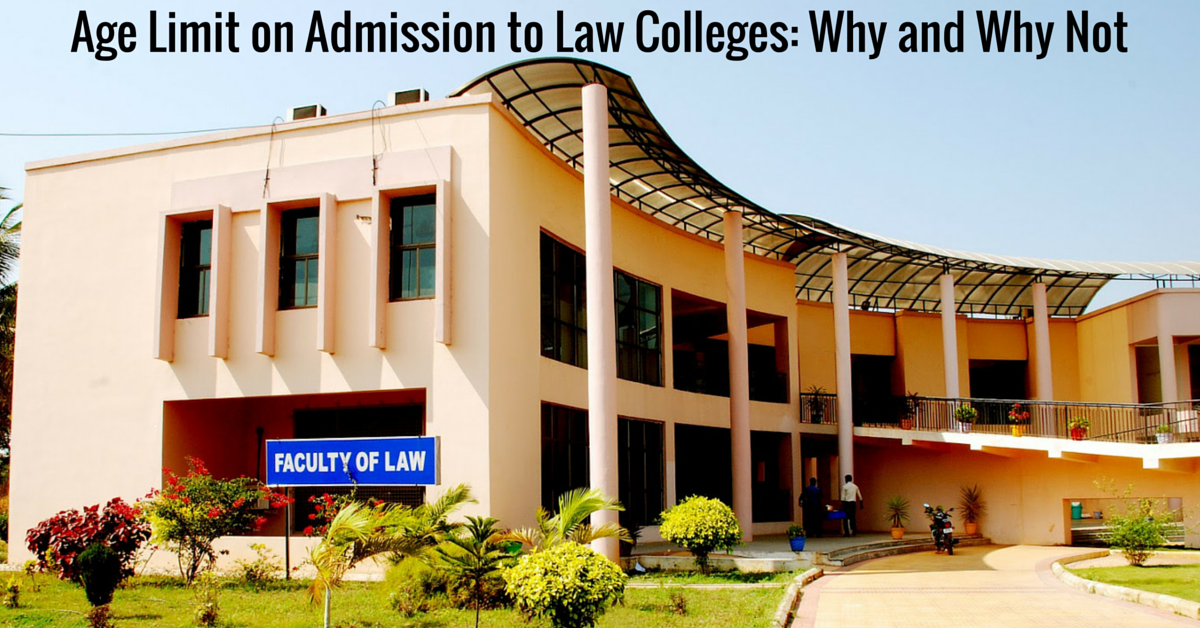
Age Limit on Admission to Law Colleges: Why and Why Not

This article has been republished from A First Taste of Law. The most popular posts from the old blog that is now closed are being reshared here.

Download Now

International Law Students Association (ILSA): How it for started in India

1
International Law Students Association(ILSA): 2nd Annual Conference at NUJS

This post was originally published in the now defunct blog A First Taste of Law, and covered the International Law Students’ Association’s early activities in India. This may now make a very interesting read for those who are law students currently or are familiar with the work of ILSA. International Law Students Association(ILSA): 2nd Annual Conference at NUJS

Well, if you have heard of ILSA, that is probably because it organises the famous Jessup moot in Washington. The first chapter of ILSA in India was constituted in NUJS in 2007. Since then, ILSA activities in India have intensified, and NUJS won the bid for organising the annual conference of ILSA during the last annual conference in Bello Horizonte, Brazil.

The 2nd ILSA International Conference, 2009 was held over a period of four days from 22nd to 25th July 2009 at the National University of Juridical Sciences (NUJS), Kolkata, India. The theme for the conference was, “Trade and the Environment: Does International Law Have the Answers?” Like any other international conference it had a list of acclaimed keynote speakers, but it was made special by the young visitors who flocked the NUJS campus and the conference venue, and even rocked the party to mark the end of a 4 day festivity. The conference had about three hundred visitors, mostly students from different universities in India and the rest of the world (see below for a list of the colleges that participated).

The first Keynote address was delivered on 22nd July, immediately after the Opening Ceremony in the Royal Bengal Room at the City Centre in Salt Lake, followed by a Grand Dinner. It was followed by a lecture on Conflicting Multilateral Treaties and the WTO, delivered by Professor Reifenberg from the University of Michigan. Presentations began in the university in all earnest from the next day. Classes were suspended in NUJS from 23rd to 25th July, as the entire infrastructural setup of the university, including all the classrooms, was used to host the conference. Of course, the announcement came as a breather for NUJS Students.

The Thai Consul to Kolkata presented a paper titled ‘How Trade Deals with Unsustainable Development in Marine Life Sources’. More keynote addresses were held in the newly built auditorium (it can host 400 in the audience as of now) in NUJS. Keynote speaker Bill McKibben, who has written for numerous American newspapers, delivered a lecture on ‘Charter for Human responsibilities Panel on Climate Change’. Mr. Nitya Nand from The Energy and Resources Institute (TERI), New Delhi, delivered a speech on titled ‘Environmentalism versus Mercantilism’. The valedictory address was given by Dr. Philippe Cullet from the University of London.

On the 24th of July, an indefinite transport strike had been called in Kolkata, and public transport was unavailable. The organizers had some backup plans, and the conference went on smoothly, with 4 privately arranged Toyota Innovas and a fleet of Kolkata Cabs being used to receive arriving participants.

The end of the conference was marked by the party for volunteers and participants at a club ‘the Shack’ at Mani Square Mall, and party is said to have lasted almost the entire night. The floor, it is heard, was choc-a-bloc; and people, after all the hard work put into the conference, partied harder than ever. Amity Boye, the ILSA Executive Director, and Caroline Cowen, who was the Jessup Outreach Coordinator in 2008-2009, and Julia Riley, the Student Vice President of the ILSA, were also present at the party.

The keynote speakers and ILSA personnel told us they were truly impressed by the show put up at NUJS: both the organization of the event and the quality of papers presented. It seems the second ILSA conference was a big success, for everyone who took part.

Another interesting consequence of this conference is that now many Law Universities in India have set up ILSA Chapters. The most recent one was set up by Gujarat National Law University, Gandhinagar. They are planning to organize an international moot court competition, which is going to be an ILSA event. Kinshuk and Prachi Jhunjhunwala, President and Chief-Coordinator of the Organising Committee, respectively, of the ILSA Conference in NUJS, have recently visited the Kalinga Institute of Industrial Technology (KIIT), Bhubaneshwar to inaugurate an ILSA event. To host an ILSA Conference, concerned institutes have to submit bids, outlining how they would be able to host the event. The theme for the conference, the choice keynote speakers to be invited is left up to the bidders. We hope the conference held in NUJS would lead to greater awareness about the importance of networking among law students, at a national as well as an international level.

List of Colleges that participated

  • National Law Universities

NLSIU, Bangalore, NALSAR, Hyderabad. NUJS, Kolkata, National Law University (NLU), Jodhpur, National Law University (NLU-D), Delhi, NUALS, Cochin, Hidayatullah National Law University (HNLU), Raipur, Gujarat National Law University (GNLU), Gandhinagar, National Law Institute University (NLIU), Bhopal, Rajiv Gandhi National Law University (RGNLU), Patiala, Ram Manohar Lohia National Law University (RMLNLU), Lucknow, Chanakya National Law University, Patna

  • Other Indian Universities

University Institute of Legal Studies, Patiala, Kalinga Institute of Industrial Technology (KIIT), Bhubaneshwar, University of Petroleum and Energy Studies, Dehradun as well as the Bidholi Campus, Nirma University Institute of Law, University of Allahabad (Law Faculty), Amity Law School, Delhi, Army Institute of Law, Mohali, Christ University, Bangalore, ILS Law College, Pune, Symbiosis Law College, Pune, Punjab University

  • Foreign Universities

University of Otago, New Zealand, Moi University, Kenya, Rivers State University, Nigeria, University of Cardinal Stefan Wyszynski, Bahcesehir University, School of Law, Turkey, Australian National University, University of Missouri, Columbia


Download Now

Legal GK Round Up For CLAT

0
Legal GK Round Up For CLAT 2010

This article has been republished from A First Taste of Law. The most popular posts from the old blog that is now closed are being reshared here on popular request.

Legal GK Round Up For CLAT 2010

This is legal gk round up 1, and there are 3 more round-ups on this blog so far. You can access them by clicking on the links given on the column on the right. Find some super important legal gk for CLAT 2010 here.


There is no end to preparing GK, but the wise students know where to concentrate for the best results. The people who set questions for competitive exams are influenced by the things happening around us right now. Some GK topics are brought into prominence by recent developments. The trait of a successful CLAT cracker includes an ability to identify these developments and follow them. Also, remember that paper setters of the CLAT are people who are lawyers and law teachers, and they have certain interests that others may not be enthusiastic about. I shall tell you in this post what the legal world is abuzz with so that you can take a cue and start working on some issues.I shall not be framing exact questions here, but tell you the topics you need to read up on. Look them on google, or Wikipedia or wherever else it suits you. Those of you who have attended my legal GK workshops will already know why I prefer preparing broad topics as opposed to mugging up specific questions (I shall explain my approach in another post sometimes, for now it suffices to say that rather than reading thousands of individual questions, it is better to understand which areas or topics these questions are aiming at, and to read up on those topics as this exercise has better long-term benefits, primarily in terms of better recall and conclusive understanding.)

Firstly, International Legal Developments – Questions have been coming from this area ever since the beginning of law entrances. In last years CLAT, it was conspicuously absent. It is slated to make a big comeback this year if I am reading the signs right. Make sure you are updated with this area, otherwise you would be taking a big risk. Also, certain national events become important and noteworthy because of international developments, I shall include them here itself.

  • Lisbon Treaty becomes law in December, changing the structure of EU.
    Other issues it brings back in prominence: Rome Treaty, Strasbourg, Pirate Party (related to IP), European Commission, European Constitution (it was proposed, and rejected by EU citizens), Euro (currency)
  • New Constitutions around the world: Nepal, Latin American Countries
    Other issues it brings back in prominence: American constitution, similarity with Indian constitution
  • Climate Change: Bali roadmap, Copenhagen, proposal for climate change law in India

Other issues it brings back in prominence: Bt Brinjal, Bt Cotton, El Nino, La Nina, Kyoto Protocol, other conventions on climate change, Rajendra Pachauri, UNFCCC and the list can go on 🙂

  • Establishment of Supreme Court of UK
    Other issues it brings back in prominence: highest courts in other countries, court structure in India, Lord Denning, Indians who are members of House of Lords, British Parliamentary System, casino online the Commonwealth, Common law system, Privy Council
  • Nobel Prize in Economics: for work to do with economic analysis of law
    Brings back in prominence: Sir John Nash, Game Theory, Antitrust Law, Competition Commission of India, other Nobel prize questions, Amartya Sen and “The Idea of Justice” – his recent book
  • USA National Health Services reforms
    Brings to prominence: Indian counterpart National Health Bill, Obama and his agenda, democrat party and republican party
  • Financial Crisis and legal developments with respect to that: Credit rating agencies, SEBI, SEC (US), RBI, banking regulations, banking terminology (such as capital adequacy, repo rate etc), economic concepts such as recession, deflation, inflation, hyperinflation, depression, Adam Smith, Keynes, law and economics, stimulus packages

And finally, Legal developments in India:


  1. Naz foundation v. UoI: decision of Delhi High Court
    other issues it brings back to prominence: sec. 377, lawyers collective, gay rights movement around the world. Anti-discrimination laws in our country, including domestic violence act, protection of scheduled castes and scheduled tribes, women’s right movements
  2. Ambani feud over Gas, and involvement of NTPC
    Other issues it brings back in prominence: PSU, Public sector, Justice Raveendran and Katju recusing themselves from hearing, conflict of interest, natural justice principles, MoU and its enforceability, energy security of India, arbitration
  3. Judges asset declaration, right to information
    brings back into prominence: corruption related issues, Madhu Koda case
  4. New bills underway, right to education bill, Gram Nay lays Bill (this one has already been enacted)
  5. Taxation reforms: GST, Direct Tax code
    brings back into prominence: Income tax, progressive taxation, different sources of revenue to the government, excise duty, customs, transfer pricing, export-import, the balance of trade
  6. Judicial reforms: new bill to reduce caseloads, appointing temporary judges, new salaries of judges
  7. Courts can ask a person to undergo mental fitness test
    brings back into prominence: self-incrimination, narco-analysis
  8. New court fee structure for companies proposed
  9. LLP act

Well, this is a long list of things already, see what you can do to tackle these. If there is any suggestion as to what could be added to this list, please comment. Also, I plan to come up with another round up in some time, but I shall do that only if this post is found useful. To that end, I shall be glad to get some feedback.

Download Now

What should you do if someone publishes your nude pictures without your consent

25

This article is written by Bhavesh Guliani, a student of CLC, Delhi University, on what to do if someone has published your nude pictures without your consent.

Download Now

Four Must Watch Movies: If You Are a Law Student

0

This article has been republished from A First Taste of Law. The most popular posts from the old blog that is now closed are being reshared here.

Jishnu Sanyal, all set to join a law school this summer, shared some movies that are close to our hearts.

Being an ardent movie viewer, while I was waiting eagerly (well maybe not so much) for the CLAT results, I was on a lookout for Law School Movies, hoping that there must be some movies that might just give me some ideas of life inside a law school (well lets put it straight, just an excuse for watching some more movies). Since Bollywood has not really interested in making good law related movies (I’ll come back to this later in the post), my only choices were from Hollywood. I came across four movies which young law students will surely find interesting. So just before you start packing for law school, you do want to catch these movies, or store them on your hard drive for future use. At least look out for them once you are in your law school, most of them have a lot of movies shared on LAN. NUJS has a huge database of music and movies shared on LAN.
DISCLAIMER – One of the movies I mention here might just change the way YOU THINK about the profession. Guess which one?

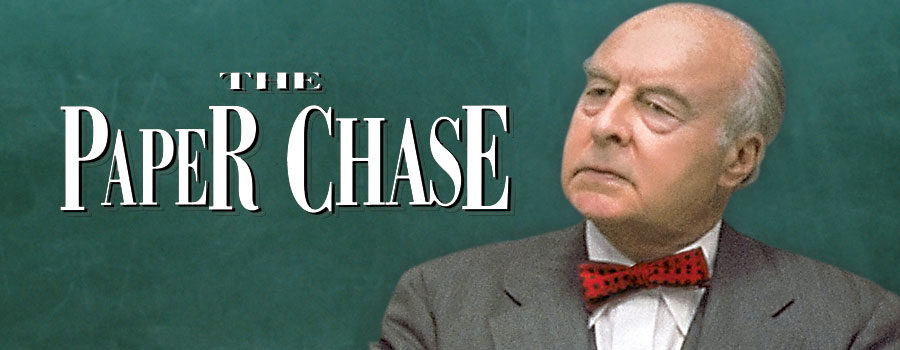
THE PAPER CHASE

the_paper_chase
This is a 1973 film starring Timothy Bottoms, Lindsay Wagner, and John Houseman, and directed by James Bridges. Based on John Jay Osborn, Jr.’s 1970 novel, The Paper Chase, the film narrates the story of James Hart, a first-year law student at Harvard Law School, and his encounters with Professor Charles Kingsfield (played by John Houseman), the brilliant, demanding contracts teacher whom he both hero worships and at the same time finds incredibly intimidating. A television series was also created based on the movie.
James Hart a young, serious, hardworking student enters the coveted Harvard law School only expecting the basic pressures of a law school curriculum. But he finds himself in the fearful adversary of the school’s most imperious, mordant contracts professor, Charles W. Kingsfield Jr. (John Houseman). Their relationship grows even more tortuous when the young man discovers that the woman he is dating is the professor’s daughter (sounds like 3 Idiots isn’t it, I wonder where Chetan Bhagat got his inspiration from). The film is an extremely faithful adaptation of the novel. In the end, both in the novel and the movie James folds his final report card into an airplane and sends it sailing into the Atlantic Ocean.
Professor Charles W. Kingsfield Jr. is a character you must look out for. His most famous line from the film exemplifies his own view of his role as a law professor: “You teach yourselves the law, but I train your minds. You come in here with a skull full of mush; you leave thinking like a lawyer.” The phrase “think like a lawyer” has since become a jargon among law professors and students.

LEGALLY BLONDE

legallyblonde
A 2001 comedy film produced by Marc E. Platt, directed by Robert Luketic, and based on the 2001 novel of the same name by Amanda Brown. It stars Reese Witherspoon as a exuberant, extrovert sorority girl who struggles to win back her ex-boyfriend by proving that she is “serious” enough to earn a law degree, along with Luke Wilson as a young attorney she meets during her studies, Matthew Davis as the ex-boyfriend, and Selma Blair as his new fiancée.
Elle Wood is a Beverly Hills raised, mollycoddled and capricious blonde beauty that would go to any extent to keep her man. Even when it means venturing out of her comfort zone and going to law school! So when Warner Huntington III (Elle’s boyfriend) suddenly dumps her and heads off to HarvardLawSchool, Elle takes matter into her own perfectly manicured hands. She writes LSAT and heads for law school too!! Getting Warner back would now be just a matter of time, right? Well I am afraid it would be nothing close to easy. Elle’s about to begin her toughest fight ever – for love, honour, justice and respect for blondes everywhere!

THE PELICAN BRIEF

pelican brief
The Pelican Brief is a 1993 legal crime thriller based on the novel of the same name by John Grisham. Directed by Alan J. Pakula who is known for dark-hued suspense pictures such as Klute, The Parallax View, All the President’s Men, and Presumed Innocent, the film stars Julia Roberts in the role of young law student Darby Shaw and Denzel Washington as Washington Herald reporter Gray Grantham.
The story of the film is about 24-year-old Tulane University law student Darby Shaw who is enmeshed in an affair with Thomas Callahan, her alcoholic professor. Darby writes up a discerning theory about the recent murder of two Supreme Court justices, by using legal databases in her library. The theory comes to be known as Pelican Brief. When Callahan shares this so-called “Pelican Brief” with buddy Gavin Verheek, an FBI lawyer, the document finds its way to wrong hands. Darby is forced into hiding when Callahan is murdered as she was being stalked by the relentless assassin Khamel. Gray Grantham (Denzel Washington), Washington Herald investigative reporter is Darby’s only hope of escaping Callahan’s fate and proving her theory. This John Grisham adaptation is fairly faithful to the best-selling novel which many of us are already familiar with. In my opinion the film has a few shortcomings, but the charisma and chemistry of the leads goes a long way toward compensating that and makes it a perfectly entertaining movie for any aspiring or actual law student.

THE RAINMAKER

the-rainmaker-movie
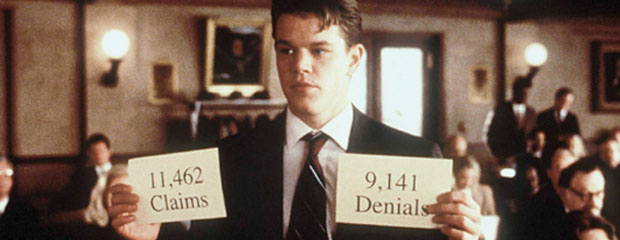
The Rainmaker is a 1997 American film directed by Francis Ford Coppola and starring Matt Damon. It is based on the 1995 novel of the same name by John Grisham.

“All students enter law school with a certain amount of idealism and desire to serve the public, but after three years of brutal competition we care for nothing but the right job with the right firm where we can make partner in seven years and earn big bucks.” – Rudy Baylor. Rudy went to law school because he genuinely believed all the myths about helping people. Graduation found him waiting tables to pay off his student loans, rather than going to work for a prestigious firm just because his family had no high-placed connections. Eventually, Rudy was left with no options but to join Memphis-based ambulance-chasing (they don’t teach that in law school) outfit of Bruiser Stone (Mickey Rourke). There he partners up with Deck Shifflet (Danny DeVito), a “para-lawyer” who knows the ropes but has flunked the bar exam six times. During one of his ambulance chasing ventures in a local hospital he finds a young woman, Kelly Riker (Claire Danes),who has landed up there due to the savage beatings of her husband. The attraction between Rudy and Kelly is immediate and obvious, but she’s afraid to file for divorce for fear that her husband will kill her.

The Feds close in on dubious Bruiser as an aftermath of his innumerable shady dealings. Rudy and Deck are forced to jump the ship and sets up their own office with only $10,000 which they earned from one of their successful ambulance chasing venture. Rudy has only a single case: suing an insurance company Great Benefit for failing to make good on a claim owed to his client, a leukemia patient, Donnie Ray Black. When the inevitable happens and Donnie Ray dies, it becomes a wrongful death suit, with Rudy representing Donnie Ray’s mother Dot Black. The opposition consists of a host of high table lawyers led by Leo F. Drummond. But the judge, Tyrone Kipler, a fair man, allows Rudy some latitude in presenting his case. But in spite of all intimidating circumstances Rudy has faith in his cause , as he puts it “I’m alone, I’m… outgunned… but I’m right.” Rudy and Deck appear like first-timers and are actually shown acting nervous and inexperienced in court. They stumble over their words (or their feet) making numerous gaffes. The Rainmaker is mostly a character study of Rudy.

His relationship with Kelly, his courtroom struggles, and his growing involvement with his clients – is designed to underscore his evolution as an individual. Matt Damon as Rudy Baylor does a fine job of portraying the uncertainty of someone who believes he has the moral high ground, but at the same time realizes that his lack of experience could take the case away from him. Danny DeVito is seamless as the more cynical, financially-driven Deck, providing occasional moments of comedy, like he reduced those big fat ethics books which adorn the shelves of the library into 3 simple gospels “a lawyer should fight for his clients, refrain from stealing money and try not to lie”.

Although a serious movie, it provides you with a fair share of dark humor. Here’s a few lawyerly jokes cracked by Rudy Baylor in course of the movie “What’s the difference between a lawyer and a hooker? A hooker will stop screwing you when you’re dead.” “How do you know when a lawyer is lying? His lips are moving.”

Indian movie on law anyone?
Well there goes the four Hollywood movies, I was also searching for a few Bollywood ones, and I was highly disappointed. I found a 1960 movie called Kanoon and another 1983 one called Andha Kanoon. Anyone watched these? One of my friends told me about a movie called FOX which was released in 2009, its about the life of a criminal lawyer or something. It had Arjun Rampal in the lead, was a below average performer, and I doubt anyone noticed it.
Few months ago I heard that there would be a Bollywood remake of “My Cousin Vinny” but sadly afterwards I found out that the lead role would be played by Govinda. I would not be very optimistic about it.
Well law schools may not be regarded in the bracket of IITs in popular perception yet, but still, after 3 Idiots, can we expect a decent Law movie from the esteemed directors and producers in Bollywood? Till then we have to make do with Hollywood and Boston Legal.
One more thing, please don’t ask where can you get these movies, neither me nor Ramanuj promotes piracy.

Do check out our new website where we write on legal issues for businesses and startups: http://iPleaders.in

Download Now
logo
FREE & ONLINE 3-Day Bootcamp (LIVE only) on

How Can Experienced Professionals Become Independent Directors

calender
28th, 29th Mar, 2026, 2 - 5pm (IST) &
30th Mar, 2026, 7 - 10pm (IST).
Bootcamp starting in
Days
HRS
MIN
SEC
Abhyuday AgarwalCOO & CO-Founder, LawSikho

Register now

Abhyuday AgarwalCOO & CO-Founder, LawSikho