Download Now
Home Blog Page 1818

The AIB Knockout and the emerging legal issues

0


This article is written by Vaishnavi Shukla, a student of Bangalore Institute of Legal Studies

The AIB (All India Bakchod) controversy is what the whole nation is discussing about. As we all know AIB is India’s edgiest comedy collective, featuring co-founders Tanmay Bhat and Gursimran Khamba along with fellow comedians Rohan Joshi and Ashish Shakya. The Roasting of stars which went viral is a comedic art form that originated in 1949 in New York and has been adapted across the world since.

An insight into the story

On December 20th the AIB knockout roast of Ranveer Singh and Arjun Kapoor was organized in south Mumbai and on 28th January 2015 the video was uploaded on You Tube. On 2nd February 2015, Akhilesh Tiwari the president of Brahman Ekta Sanstha in Mumbai filed a written complaint at Sakinaka police station for the usage of filthy and abusive language in the AIB Knockout. Police initiated an inquiry into the complaint against the participants who were from Bollywood, namely, film-maker Karan Johar, actor Arjun Kapoor and Ranveer Singh. An enquiry was also ordered against the event organizers and participants, by the Maharashtra Government.

Read on to know why the government has ordered a probe into the ‘roast’ that had the internet in splits. Along with it, we will discuss the two sides of the coin, being, opinions of people supporting it and people resenting against it. The legality of the whole AIB issue is a major concern i.e. whether they were right to organize a programme like that or not, will also be a part of the article.

Offensive or Comic? People’s take on it

People from Film fraternity, politics and the public have strongly come up with their personal opinion or say in this issue. Some consider it nasty, filthy and offensive and to some it is nothing but just a piece of joke which needs to be taken in a lighter sense. Politically, it has become a major issue because of the usage of filthy and offensive language, but the film industry has come out in full support for the AIB, and not to forget the public, specifically the younger audience, which has offered its support and considers it funny and non-offensive.

The Viral Fever (TVF), an internet parallel of the AIB, argued that

“If such moral policing continues, it would lead to the death of creativity”.

They insist that if the same continues, “there will be no freedom of speech on the internet medium and that would mean that they would have to think within the confines of what is permissible.

Alia Bhatt, actress and an audience in the AIB show tweeted:

“Some “not taking life so seriously” lessons are needed. DESPERATELY!!!!”

Karan Johar, the host of the AIB knockout of Ranveer and Arjun also tweeted:

“Not your cup of tea…don’t drink it!!!”

Social networking sites are flooded with tweets terming the video to be a matter of national shame. On the other hand, there are also strong groups of people standing in support of it and defending everyone involved in it.

Both ‘AIB National shame’ and ‘we stand by AIB Knockout’ are trending on social networking sites.

Some tweets which came in protest to the AIB Knockout:

“AIB National Shame: Shame on those celebs too who praised this show on twitter, and they talk about women empowerment, pathetic #AIBRoast”

“#AIB National Shame is not freedom of expression or media! It is an expression of perverted depraved minds that endanger social norms!”

“A bunch of jerks having some shitting views on opening up society does not imply the whole nation having same views “AIB National Shame”

Well, to some it is a serious issue and some laugh it off. It is not surprising to find varied opinions because comic preferences vary from person to person.

Recent Developments

The latest report in this regard is that Bollywood stars have been named in a new police case in Pune, which involves Deepika Padukone, Ranveer Singh, Sonakshi Sinha, Arjun Kapoor and director Karan Johar. This FIR accuses them and comedy collective AIB of obscene behavior and content in a public place. YouTube is also named for distributing the offensive content according to the FIR filed by a police inspector. The FIR was registered in the wee hours of 6th Feb under Sec 292 and Sec. 294 of IPC.

Vinod Tawde, the Cultural Affairs Minister was quoted saying:

“Officials of the department will examine videos of the show for content. If found vulgar, action will be initiated.”

He further explained:

“Some people reported to me that the performance had vulgar language, and inquired if the performers had the censor certificate. I asked Cultural Affairs Director Ajay Ambekar to conduct an inquiry. There is no problem if they have a certificate. If they don’t, we need to find out how the stadium allowed such a performance without a censor certificate. It’s a crime then and we will have to register an FIR. In the state, our censor board is supposed to give permits.”

“If the AIB roast was vulgar and not in accordance with the law, then we will act,” said Devendra Fadnavis, Maharashtra CM.

In midst of all the controversies on 4th Feb. 2015 the AIB team took down its video from YouTube and wrote an open letter to everyone explaining why they did so. Further explaining the work they do, the AIB team wrote:

 “People who’ve been following our work will know that we’ve always tried to experiment with content, be it on YouTube or a live comedy show, with the sole intent of making people laugh and/or think. AIB Knockout was another such attempt to try something new and bring the roast format to a country where celebrities aren’t often known to laugh at themselves.

Legal Grounds

As we all know that an inquiry is being conducted into the AIB issue after Akhilesh Tiwari’s FIR at Sakinaka police station in Mumbai, coming to a conclusion whether the Knockout is legal or illegal, would be too early.

Alleging obscenity, two complaints have been filed in Mumbai. “The Christian community has given us a representation. We are looking into the legal aspects of it,” said senior police officer S Jayakumar.

Also, Mr. Ashok Pandit the lately added member of the Censor Board in a recent interview stated:

“All staged performances, plays or stand-up comedies in Mumbai have to get permission from the Maharashtra police. They also have to submit their request for permission to the cultural ministry. The AIB has done none of these. They got no bloody clearance to have the show”.
On the other hand, the organizers argue that they had permission. However, there are no proper reports which clearly mention that the knockout which was conducted in front of such a large audience had any kind of clearance.

Ratna Kapur in her book “The profanity of prudery: The moral face of obscenity law in India” wrote:

“Sexual speech has become a highly contentious terrain in India, with an increasing call by the state, progressive groups and women’s organizations to restrict or curtail such speech. This call is being made at a time when the public space available for the expression of previously repressed sexuality has been expanding. The discomfort around sexual expression is related to the discomfort around sex generally.”

“The prudery that surrounds sexual expression informs the legal regulation of sexual speech in India. The increasing call for censorship, by the religious right as well as women’s groups, reinforce a conservative position around sex generally, and women’s right to sexual expression more specifically. In the light of discriminatory impact of all the call for censorship, is it an appropriate or even an effective legal response? The legal regulation of sexual speech is based on conservative sexual morality that views sex as a bad and corrupting influence that ought to be contained”.

Whether conservative or not? This is a question whose answer varies from person to person; not everyone can be expected to freely exercise sexual expression of thoughts as some might want to keep it private.

However, our Indian Penal Code has a different story to say. The AIB allegedly did not act according to what the law permits; their acts are considered offensive and vulgar. One major reason behind this is the fact that the Roasting of stars format is new to India and this is one country where stars are not known for laughing at themselves. Well, the (#AIBNATIONALSHAME) consider that sexual expression, using offensive language for women publically and the participation of well-established stars for the same cannot be considered comic.

In order to decide whether it was lawful or not, we need to know what Sec.292 and Sec.294 of IPC talks about; these being the sections AIB team is charged with:

Sec. 292 of the Indian Penal Code:

  • Sale, etc., or obscene books, etc.
    For the purposes of sub-section (2), a book, pamphlet, paper, writing, drawing, painting, representation, figure or any other object, shall be deemed to be obscene if it is lascivious or appeals to the prurient interest or if its effect, or (where it comprises two or more distinct items) the effect of any one of its items, is, if taken as a whole, such as to tend to deprave and corrupt persons who are likely, having regard to all relevant circumstances, to read, see or hear the matter contained or embodied in it.
  • Whoever-
    (a) Sells, lets to hire, distributes, publicly exhibits or in any manner puts into circulation, or for purposes of sale, hire, distribution, public exhibition or circulation, makes, produces or has in his possession any obscene book, pamphlet, paper, drawing, painting, representation or figure or any other obscene object whatsoever, or
    (b) Imports, exports or conveys any obscene object for any of the purposes aforesaid, or knowing or having reason to believe that such object will be sold, let to hire, distributed or publicly exhibited or in any manner put into circulation, or
    (c) Takes part in or receives profits from any business in the course of which he knows or has reason to believe that any such obscene objects are, for any of the purposes aforesaid, made, produced, purchased, kept, imported, exported, conveyed, publicly exhibited or in any manner put into circulation, or
    (d) Advertises or makes known by any means whatsoever that any person is engaged or is ready to engage in any act which is an offence under this section, or that any such obscene object can be procured from or through any person, or

Sec. 294 of the Indian Penal Code:

Whoever, to the annoyance of others-
(a) Does any obscene act in any public place, or
(b) Sings, recites or utters any obscene song, balled or words, in or near any public place,
Shall be punished with imprisonment of either description for a term which may extend to three months, or with fine, or with both.

The charges under Sec. 292 and 294 of IPC if proved will land the AIB team into more trouble. Sec. 294(b) says that any person, who sings, recites or utters any obscene song, balled or words, in or near any public place shall be punished with imprisonment extending up to 3months or fine or both.

Concluding this, all we can hope is ‘May justice is served right’.

ALL THE BEST AIB#.

Download Now

Law related to donation by companies to political parties in India

1

This article is written by Somya Mishra, a student of Bangalore Institute of Legal Studies

Government and citizens both are interrelated to each other and since political parties are a link between them, they are always expected to be accountable to the public at large. It is essential to have comprehensive and transparent accounting methods and systems so that the true financial position of the parties could be revealed. A political party that agrees to take funds from a company but is reluctant to make full disclosure is disallowed to receive such funds.

Amongst the various sources of funding to the political parties, company is one of them.

Relevant provisions for political parties’ donations and contributions in India

According to Sec 29B of the Representation of People’s Act, every political party is entitled to accept contribution offered to it by any person or company voluntarily, other than a Government company. No political party is allowed to accept any contribution from any foreign source as defined under Sec 2 of the Foreign Contribution (Regulation) Act, 1976.

According to Sec 29C of the Representation of People’s Act, the political parties are required to declare the details of contributions of more than Rs. 20,000 and prepare a report for the same in each financial year. Here, contribution includes contributions from both private persons as well as companies.

It is made mandatory for the political parties to submit to the Election Commission of India a list of donations they receive of over Rs. 20,000, giving names and addresses of the donors (Sec 29-C, RPA). If they fail to do so, then such political parties are disentitled from getting any tax relief under that Act.

Sec 182 of Companies Act, 2013 states that the companies donating contributions to the political parties must be in existence for a minimum period of three years. Also, the companies can donate only up to 7.5% of its profit in a year and is bound to disclose the amount in its profit and loss account. This exercise of the power of the companies can take place only with the approval of the board of directors through a resolution. If a company violates any of the provisions of this section, the company shall be punishable with fine which may extend to five times the amount so contributed; and every officer of the company who were involved in such violation shall be punishable with imprisonment for a term which may extend to six months and shall also be liable to fine of 5 times the amount contributed.

The government enacted the ‘Electoral Trusts Scheme, 2013’ in order to streamline the process of funding and to ensure the transparency of corporate funding to the political parties’ poll expenses. According to this scheme, Electoral Trust companies were set up and were promised tax benefits in proportion to the funds they provided to various political outfits.

The Corporate Affairs Ministry amended its ‘Name Availability Guidelines’ for the companies to enable registration of non-profit companies. The companies were required to have the phrase ‘Electoral Trust’ before their names and get registered, so as to differentiate them from other companies, as allowed under Sec 25 of the Companies Act, 1956 under the Electoral Trusts Scheme, 2013. The companies were supposed to have an affidavit to the effect that they would be limited only for the purpose of registration of companies under the Electoral Trust Scheme of Central Board of Direct Taxes.

The companies were allowed tax benefits on one condition, i.e. only if they distribute 95% of total contributions received by them in any financial year to the registered political parties within that year itself. The Electoral Trust companies were not allowed to accept contributions from foreign citizens or companies. They need to take the PAN number of all contributors who were resident Indians and passport number of NRI citizens at the time of receiving the contribution.

https://lawsikho.com/course/diploma-companies-act-corporate-governance
Click Above

Current Status of Political Funding

Under the current legal requirements, political parties are generally not completely transparent in their finances and thus a huge proportion of their income remains unaccounted for. There are unknown sources of funding reported by political parties in their annual disclosure report such as ‘sale of coupons’, ‘Aajiwan Sahayog Nidhi’, ‘relief fund’, ‘miscellaneous income’, ‘voluntary contributions’, ‘contribution from meetings/morchas’ etc. for which there is no information available in the public domain.

BSP has been an excellent example of such lack of transparency in the political parties’ disclosure. Since last 8 years, it has not disclosed even a single name of the donor who has contributed above Rs. 20,000 to them, though every year its total income has been in crores.

This egregious level of opacity in the financial disclosure of political parties certainly creates a suspicion towards the dubious sources of income which ultimately effects our electoral process.

DETAILS NEEDED TO ENSURE WHETHER A COMPANY IS GENUINE OR NOT?

  1. Registration data of the company website: This may provide information relating to the name of the person who created the website, which may help to further gather information about the company. The information as to the period since when the website is in existence and when will it expire, is necessary. If a website is created only for a short span of time, it may indicate some scam.
  1. Reviews of the company on the internet: Reviews from the public often help to believe on the genuineness of a company. The more the positive reviews, the more faith is built on the company.
  1. Proper certification and licenses: It is important to ensure that the company has complied with the regulations of the Companies Act and has the proper certificates and licenses proving the authenticity of the company.
  1. Company’s credit report: All the credit report related to the company must be taken down. In order to ensure the legitimacy of a company, the company’s credit score, their contact details, financial performance as to the profit and loss accounts of the company, number of directors- their personal & professional information, everything needs to be recorded.
  1. KYC of the corporate entity: KYC (Know Your Customer) is very important as it provides a detailed information about the company. It seeks copy of the PAN card, copy of Certificate of incorporation, Memorandum of Association, Articles of Association, Board resolution, Photo identity proofs of authorised person and registered address. This totally secures against any fraud from the company.
  1. Contact on the given registered address and phone number: The company must be rechecked as to whether they have given a genuine contact number and address by calling on that number and confirming it.
  1. Discrepancies and lack of professionalism: One should thoroughly go through the website and see to it that no such discrepancy is found. The kind of information which it shares shows how coordinated the business is. They must be original and not copied from elsewhere.


The AAP Controversy

Just 4 days before the Delhi elections, AAP has been engulfed into a big controversy, a controversy over political funding. AAP has been charged with the allegation of money laundering from AVAM (AAP Voluntary Action Manch) for 4 companies which have funded the party with 50 lakh each, namely Goldmine Buildcon, Skyline metal, Infolance software & Sunvision agencies, are believed to be bogus companies. ‘HAWALA AT MIDNIGHT’ has been the breaking news these days. These companies are found to have fake addresses and no profits or loss accounts since 3 years. The directors of these companies are directors of more than 1 company. One Hem Prakash Sharma is a director of 56 companies and Dharmendra Upadhyaya of 18 companies, which indicates a suspicion.

Though the companies are registered with ROC, it is not enough to prove the genuineness of the company as it provides information only regarding its registered address, its existence and its paid-up capital. Whether the company is doing business currently or not is not provided under ROC.

AAP rules say that all donation up to Rs 10Lakh are vetted by the Advisory Committee and for donations above that, it is scanned by the Political Advisory Committee.

BJP has also alleged that AAP has flouted foreign exchange law as it routed money from a foreign company which is not supposed to donate money to an Indian Company. However, a recent disclosure from Mrs. Mann, who made this donation along with her husband, threw some light on this issue. AVAM had alleged against AAP that the money was paid to them by cheque and a dubious transaction has taken place. Mrs. Mann stated that the basic facts offered by AVAM are incorrect and they paid through credit card and not through cheque. Since she claims to be an Indian citizen, it is not even the violation of Sec 3(1) of Foreign Contribution (Regulation) Act, 1976 which restricts political parties to accept contributions from foreign companies.

Although AAP has tried clearing its hands from this allegation, the controversy is still on.


Need for strict implementation

There is a grave need for a strict mechanism for ensuring that there is final transparency and accountability on the part of the political parties. In order to put forward a true picture of the financial position of the political parties, there must be a standardized procedure and framework of reports. Institute of Chartered Accounts of India (ICAI) has taken a step towards this direction on the request of the Election Commission of India (ECI). ADR considers it the top most priority.


LawSikho has created a telegram group for exchanging legal knowledge, referrals and various opportunities. You can click on this link and join:  

https://t.me/joinchat/J_0YrBa4IBSHdpuTfQO_sA

Follow us on Instagram and subscribe to our YouTube channel for more amazing legal content 
 
Download Now

Activities allowed in residential basements in Delhi, Noida, and Gurgaon

18
activities allowed in residential basement in Delhi, Noida and Gurgaon

This article is written by Vaishnavi Shukla, a student of Bangalore Institute of Legal Studies. Here, she explains about the activities allowed in residential basement in Delhi, Noida and Gurgaon.

Download Now

8 duties that the employers must comply with under the Sexual Harassment of Women at Workplace Act, 2013

14
sexual harassment at workplace

This article is written by Pallavi Pareek and Amartya Bag, on the duties employers must comply under the sexual harassment of women at workplace act, 2013.

Download Now

Debentures and debenture trustee under Companies Act, 2013

3
debenture trustee

This article is written by Mridul Gupta, a student of UPES, Dehradun, on the Debentures and Debenture Trustee under Companies Act, 2013.

Debentures

In business, issuing debentures is one of the ways to raise money for the working of the company. It is very different from equity shares or other kinds of shares (both preference and equity). The basic distinction being, when one buys the shares of the company he becomes the part owner of the company, but when one buys debentures issued by the company he becomes a creditor to the company. We can conclude that debenture is a kind for formal loan given to the company by another individual. The company is under obligation to repay the loan within a specified period of time with interest.

The advantage of being of being a debenture holder is that, in case of winding-up/bankruptcy the debenture holders are considered to be the creditors and they are the ones who would be re-payed first.

Issuance of debentures is one of the ways of raising debt finance for a company. Debenture is a recognized instrument used by the companies, which evidences creation of a debt, whether such debt creates a charge on the assets of the company or not. Under the Companies Act, 2013, debentures being a security, it can be issued by a private company only through the route of private placement.  A company can issue debentures with an option to convert such debentures into shares, either partially or fully, at the time of redemption of the share. However, before such option is given, it must be approved by the shareholders of the company by a special resolution in the general meeting of the company. Issuance of such debentures does not give the debenture holder any voting rights.

On the basis of convertibility the debentures are of two types:

CONVERTIBLE: these are the debentures that can be converted into equity of the company on the expiry of the specified period of time.

NON-CONVERTIBLE: these are the debentures that in no case can be converted into equity shares of the company.

In case, the company opts for issuance of secured debentures, it needs to meet the following conditions:

  • The date of redemption of such secured debentures should be made within 10 years from the date of issue. However, companies involved in infrastructure projects, infrastructure finance companies, infrastructure debt fund non-banking finance company can issue debentures which can be redeemed within a period not exceeding 30 years.
  • Such issuance shall be secured by the creation of a charge in favour of the debenture trustee, on the properties or assets of the company (including specific movable and immovable property of the company), which must be of a sufficient value needed for the due repayment of the amount of debentures and the interest.
  • The company shall appoint a debenture trustee before the issue of prospectus or letter of offer for subscription of its debentures.
  • The company shall execute a debenture trust deed to protect the interest of the debenture holders within sixty days from the date of allotment.

The company issuing debenture must create a debenture redemption reserve (DRR) account out of the profits of the company, which will be utilized only for the redemption of debentures. However, All India Financial Institutions (AIFIs) regulated by Reserve Bank of India and Banking Companies are not required to maintain DRR account for both public as well as privately placed debentures. NBFCs and companies engaged in manufacturing and infrastructure enjoys certain relaxation regarding maintenance of DRR account reserves.

If a company is issuing secured debentures or making an offer, or issue prospectus for more than 500 subscriptions of its debentures, it must appoint one or more debenture trustee as per the conditions laid down in the Companies (Share Capital and Debentures) Rules, 2014.

DEBENTURE TRUSTEE

Informally debenture trustee is a person who is responsible for issuance and distribution of debentures. A debenture trustee is a person or entity that serves as the holder of debenture stock for the benefit of another party. When a company is looking to raise capital, one method of accomplishing this is by issuing stock as a form of debt with the obligation to repay the debt at a specific interest rate. The trustee serves as a liaison (the person who keeps in contact with different groups) between the company that issued the debentures and the debenture holders that are collecting interest payments.[1]

According to SEBI Rules, 1993- “debenture trustee” means a trustee of a trust deed for securing any issue of debentures of a body corporate [section 2 (bb)]. (Applicable to public companies only)

Eligibility for a debenture trustee: To act as debenture trustee, the entity should either be a scheduled bank carrying on commercial activity, a public financial institution, an insurance company, or a body corporate. The entity should be registered with SEBI to act as a debenture trustee.

https://lawsikho.com/course/diploma-companies-act-corporate-governance
Click Above

Duties, rights and liabilities of a debenture trustee:

All appointment to be made of the debenture trustee(s) shall be made under section 71 of the Companies Act, 2013.

Rights

  • Section 18 (c) a company in no cases can issue debentures before appointment of a debenture trustee.
  • The company cannot issue debentures before obtaining the consent of the debenture trustee.
  • The company has to specify the name of the name of the debenture trustee in the offer letter.
  • The debenture trustee can call for periodical performance report of the company
  • The trustee can call for reports regarding the use of funds raised through issue of debentures.
  • The trustee can communicate promptly to the debenture holders’ defaults, if any, with regard to payment of interest or redemption of debentures and action taken by the trustee therefor.
  • The trustee can appoint a nominee to board of director of the company.
  • Before the trustee appoints the nominee the conditions must be satisfied:

1. two consecutive defaults in payment of interest to the debenture holders; or

2. default in creation of security for debentures; or default in redemption of debentures

Liabilities

  • No one can be appointed as a debenture trustee if he has a share ownership in the company.
  • He cannot be appointed if he is a promoter of the company, employee or the manager.
  • No appointment for Creditor to the company.
  • The vacancy of the debenture can be filled by the company by the consent of the other trustees.

Duties

  • The trustee ensures that there is no breach in the terms of issue of debentures.
  • The trustee can take steps to remedy the breach (above mentioned).
  • The trustee is the person who informs the debenture holders about such breach.
  • The trustee ensures that all the condition regarding creation of security for debentures is met
  • The trustee convenes the meeting between the company and the debenture holders
  • The trustee is the person who ensures that the debentures are redeemed as per the conditions agreed upon.
  • The trustee can take steps to resolve the dispute between the company and the holders
  • The trustee has to take necessary steps to ensure the interest of the debenture holders


LawSikho has created a telegram group for exchanging legal knowledge, referrals and various opportunities. You can click on this link and join:  

https://t.me/joinchat/J_0YrBa4IBSHdpuTfQO_sA

Follow us on Instagram and subscribe to our YouTube channel for more amazing legal content 
Download Now

How can Indian lawyers practice in US (New York)?

20
indian lawyers practice in US

How can Indian Lawyers practice in US (United States)? What do the US rules state? This post discusses how an India-qualified lawyer (with a 3-year or 5-year LLB degree) can practice in the United States, without having to pursue the undergrad law degree, that is, the Juris Doctor or J.D. in a US college.

As per § 520.6 of the Rules of the Court of Appeals for the Admission of Attorneys and Counselors at Law, lawyers who have qualified from a common law jurisdiction and pursued law for more than 2 years) can submit their law degrees for ‘review and analysis’ – if this process is successful they will not be required to take the New York Bar exam.

This rule will be applicable to Indian students. However, this is easier said than done, and the review process by the American Bar Association (ABA) can take quite long, as much as or longer than one year. There is also no guarantee that the degree will be approved.

What is the alternative? The rules state that those who did not pursue a 2-year law degree or who qualified from a non-common law jurisdiction need to pursue an LLM in the US, before being eligible to take the exam. This option is typically the one used by Indian lawyers who want to obtain US-qualification as well.

Which bar exams are necessary to qualify for practice in New York?

Under the US system, the bar exam of any state has two components:

  • Multi-State Bar Exam – This is based on federal laws. Recall that US has a very clear distinction between federal law and state law system. This exam tests you on constitutional law, evidence, contracts, torts, criminal and real estate and trusts.
  • State Bar Exam of the relevant state where one seeks to practice.

Is an online LLM sufficient for being eligible to take the New York bar exam?

The cost of an LLM degree in the US can be quite significant, and can easily be anywhere between INR 30 – 60 lakhs for a one-year program. Tuition in the US is already very expensive, but a substantive component of this is the high living cost there.

Many US universities such as New York University, Boston University and Northwestern University offer online LLMs. An online LLM offers few advantages over a classroom LLM – it can be taken by lawyers who can continue to work in India, while pursuing the degree, they do not need to incur living costs in US (this is the biggest cost advantage) and in some cases tuition fees may also be lower. The next question is – does an online LLM qualify one to sit for the New York Bar Exam?

The New York rules are very clear about how the LLM degree must be acquired, in order to qualify you to take the New York Bar Exam:

[LLM instruction] shall be in classroom courses at the law school in substantive and procedural law and professional skills.

x        –        x        –        x

[A]ll coursework for the program shall be completed at the campus of an American Bar Association approved law school in the United States.

x        –        x        –        x

No credit shall be allowed for correspondence courses, on-line courses, courses offered on DVD or other media, or other distance learning courses. 

https://lawsikho.com/course/diploma-entrepreneurship-administration-business-laws
Click Above

The above excerpts categorically explain that pursuing an online LLM will not qualify you for practice in New York.

Did you find this useful? Are you looking to practice in another state in the US or in another country? Let us know by commenting below. In case you have already given a US state bar exam, we would love to hear about your experience. 

For reference, Rule 520.6 is reproduced below.

Rule 520.6 of the NY Bar exam -Study of Law in Foreign Country; Required Legal Education

(a) General. An applicant who has studied in a foreign country may qualify to take the New York State bar examination by submitting to the New York State Board of Law Examiners satisfactory proof of the legal education required by this section.

(b) Legal education. The applicant must satisfy the educational requirements of either paragraph (1) or (2) of this subdivision.

(1) The applicant shall show fulfillment of the educational requirements for admission to the practice of law in a country other than the United States by successful completion of a period of law study in a law school or schools each of which, throughout the period of the applicant’s study therein, was approved by the government or an authorized accrediting body in such country, or of a political subdivision thereof, to award a first degree in law, and satisfaction of the following requirements:

(i)(a) Durational requirements. The program and course of law study successfully completed by the applicant was substantially equivalent in duration to the legal education provided by an American Bar Association approved law school in the United States, and in substantial compliance with the instructional and academic calendar requirements of section 520.3(c)(1)(i) and (ii) and (d)(1) of this Part; and

(b) Substantive requirements. Such other country is one whose jurisprudence is based upon the principles of English Common Law, and that the program and course of law study successfully completed by the applicant were the substantial equivalent of the legal education provided by an American Bar Association approved law school in the United States.

(ii) Cure provision. An applicant who does not meet the requirements of subparagraph (i)(a) or (i)(b) may cure either the durational or substantive deficiency, but not both, under the following circumstances:

(a) Durational deficiency. If the applicant does not meet the durational requirements of subparagraph (i)(a), the applicant may cure the deficiency by providing satisfactory proof that the applicant has at least two years of foreign legal education that meets the substantive requirements of subparagraph (i)(b) and that the applicant has graduated from an LL.M. degree program at an American Bar Association approved law school in the United States meeting the requirements of subdivision (b)(3) of this section.

(b) Substantive deficiency. If the applicant does not meet the substantive requirements of subparagraph (i)(b), the applicant may cure the deficiency by providing satisfactory proof that the applicant meets the durational requirements of subparagraph (i)(a) and that the applicant has graduated from an LL.M. degree program at an American Bar Association approved law school in the United States meeting the requirements of subdivision (b)(3) of this section.

(2) The applicant shall show admission to practice law in a country other than the United States whose jurisprudence is based upon principles of English Common Law, where admission was based upon a program of study in a law school and/or law office approved by the government or an authorized accrediting body in such country, or of a political subdivision thereof, and which satisfies the durational requirements of subparagraph (1)(i)(a) but does not satisfy the substantive requirements of subparagraph (1)(i)(b) of this subdivision, and that such applicant has successfully completed an LL.M. degree program at an American Bar Association approved law school in the United States meeting the requirements of subdivision (b)(3) of this section.

(3) An LL.M. degree shall be satisfactory to qualify an applicant otherwise meeting the requirements of subsections (b)(1)(ii) or (b)(2) to take the New York State bar examination provided the following requirements are met:

(i) the program shall consist of a minimum of 24 credit hours (or the equivalent thereof, if the law school is on an academic schedule other than a conventional semester system) which, except as otherwise permitted herein, shall be in classroom courses at the law school in substantive and procedural law and professional skills;

(ii) a minimum of 700 minutes of instruction time, exclusive of examination time, must be required for the granting of one credit hour;

(iii) the program shall include a period of instruction consisting of no fewer than two semesters of at least 13 calendar weeks each, or the equivalent thereof, exclusive of reading periods, examinations and breaks, and shall not be completed exclusively during summer semesters, but a maximum of four credit hours may be earned in courses completed during summer semesters;

(iv) the program shall be completed within 24 months of matriculation;

(v) all coursework for the program shall be completed at the campus of an American Bar Association approved law school in the United States, except as otherwise expressly permitted by subdivision (b)(3)(vii);

(vi) the program completed by the applicant shall include:

(a) a minimum of two credit hours in a course or courses in professional responsibility;

(b) a minimum of two credit hours in legal research, writing and analysis, which may not be satisfied by a research and writing requirement in a substantive law course;

(c) a minimum of two credit hours in American legal studies, the American legal system or a similar course designed to introduce students to distinctive aspects and/or fundamental principles of United States law, which may be satisfied by a course in United States constitutional law or United States or state civil procedure; credit earned in such course in excess of the required two credit hours may be applied in satisfaction of the requirement of subdivision (b)(3)(vi)(d); and

(d) a minimum of six credit hours in other courses that principally focus on subject matter tested on the New York State bar examination.

(vii) The program completed by the applicant may include:

(a) a maximum of four credit hours in clinical courses, provided (1) the clinical course includes a classroom instructional component in order to ensure contemporaneous discussion, review and evaluation of the clinical experience; (2) the clinical work is done under the direct supervision of a member of the law school faculty; and (3) the time and effort required and anticipated educational benefit are commensurate with the credit awarded; and

(b) a maximum of six credit hours in other courses related to legal training taught by members of the faculty of the law school or of the university with which the law school is affiliated, or taught by members of the faculty of any university or college with which the law school offers a joint degree program, provided such courses must be completed at the campus of such university or college in the United States.

(viii) No credit shall be allowed for correspondence courses, on-line courses, courses offered on DVD or other media, or other distance learning courses.

(c) Proof required. The applicant shall submit to the State Board of Law Examiners such proof of compliance with the provisions of this section as the Board may require.

(d) Effective date for implementation. Except for the requirements of subdivisions (b)(3)(iii), (v) and (viii), which are effective May 18, 2011, the provisions of Rule 520.6(b)(3) shall first apply to LL.M. programs commencing during the 2012-13 academic year and to applicants applying to take the July 2013 bar examination, subject to the saving clause of Rule 520.1(b).


LawSikho has created a telegram group for exchanging legal knowledge, referrals and various opportunities. You can click on this link and join:

https://t.me/joinchat/J_0YrBa4IBSHdpuTfQO_sA

Follow us on Instagram and subscribe to our YouTube channel for more amazing legal content 


Download Now

Confidentiality of proceedings under Prevention of Sexual Harassment of Women at Workplace Act, 2013

2

 Are details of sexual harassment proceedings required to be kept confidential? 

The Sexual Harassment of Women at Workplace (Prevention, Prohibition and Redressal) Act, 2013 states that the following details must not be known to the public, press or media in any manner:

  • Identity, name and address of the aggrieved woman, respondent and witnesses
  • Information pertaining to conciliation and inquiry proceedings
  • Recommendations of ICC (or LCC)
  • Action taken by the employer  (or the district officer)

Note that it is not just the complainant’s identity, but also that of the accused which is protected.

Under the law, disclosing name, address, identity or any other particular that lead to the identification of the aggrieved woman and witnesses is prohibited. However, information about the ‘justice’ secured to the aggrieved woman is permitted to be released to such entities. (See Section 16 of the Act.)

Note that from a plain reading, it seems that this requirement of confidentiality kicks in after a complaint has been filed. In a real scenario, there may be intermediate steps before the complaint is filed, such as approaching HR, a grievance officer or ombudsman, or a counselling officer. Is confidentiality available at this stage? This is not clear under the act, and will depend on the interpretation taken by a court. Not ensuring confidentiality at this stage can have reputational implications. What will happen if the victim files a complaint later on? There is a legal risk involved.

How can confidentiality be ensured before the complaint is filed?

It is safest if the organization’s anti-sexual harassment policy contains pointers on this. There could even be guidelines for employees which ensure that those who hear about incidents from colleagues who are friends do not share this information in any adverse manner, even unintentionally.

Disclosure within the organization

The act prohibits disclosure to the public, media and press, but does not specify the permissibility of disclosure of such information within the organization. Which persons and officers within the organization are permitted to know about such incidents? Should proceedings be kept confidential from colleagues or unrelated members of the senior management team?

The answer lies in whether there are certain categories of people who will necessarily need to know about the complaint. For example, the ICC members, HR or the compliance team. It is nearly impossible for these persons to not know about a complaint.

It also depends on whether disclosure to such persons will constitute disclosure to ‘public’. Unrestricted flow of information even within the organization has the risk that this information will increase chances of information leak to the broader public, which is prohibited.

Hence, it is optimal to keep flow of information restricted even within the organization. Ideally, it should only be disclosed on a need-to-know basis. For this, a corresponding obligation of confidentiality should be imposed on every individual with whom the information is shared. Consequences for breach of confidentiality may be specified under the policy.

Consequences of breach of the policy

What are the consequences of breach of confidentiality? The Act states that consequences for breach of confidentiality may be prescribed either in the service rules (applicable for the organization) or as prescribed by the government through rules.

Service rules are clearly applicable to those who work in government organizations, but what about the private sector? In certain industries, ‘Standing Orders’ are applicable, which may be included within the ambit of service rules. However, it is possible that standing orders do not contain provisions pertinent to these matters. Also, what about organizations to which standing orders don’t apply? Do employment policies or anti-sexual harassment policies qualify as service rules?

The answer to this is not clear, but in case the employer doesn’t specify consequences under the anti-sexual harassment policy or assuming that an anti-sexual harassment policy is not included within service rules, a penalty of INR 5,000 (five thousand only) is applicable, which can be recovered by the employer.

The penalty does not seem to be strict. What if the employer is responsible for the breach? What if a key management team member is responsible for the breach? Would the employer be in a position to recover that amount realistically?

While the penalty is not strict, employment policies usually contain statements or assurances to employees, assuring them of a work environment which is friendly or non-discriminatory or not hostile. Employees may be able to proceed contractually against the organization invoking these rights if confidentiality is breached. Arbitration may also be invoked in cases where the employment contract contains an arbitration clause.

Systems and mechanisms to ensure confidentiality

Irrespective of legal risks, there are serious reputational implications for breach of confidentiality, and this discussion will now proceed further on the basis of this assumption.

How can one ensure that the legal right of confidentiality is guaranteed at a practical level? How does it permeate through the organization? There are three facets of this:

  • Anti-sexual harassment policy – The anti-sexual harassment policy of the organization needs to clearly state what form of confidentiality protection is available. It must provide examples that explain different situations where confidentiality is / is not available. Consequences of breach of confidentiality and whom to complain to in the event of its breach must be explained.
  • Training programs for employees – Training programs for employees need to clearly explain the degree of confidentiality protection and the situations in which confidentiality is available, so that employees understand the organizational stance and the contents of the policy.
  • ICC and management trainings – The complaints committee needs to be clearly educated about systems and processes that need to be adopted to preserve confidentiality, how to ensure information about proceedings and complaints cannot be stolen, circumstances when disclosure to somebody can be made, the amount of information that can be disclosed under such circumstances and conditions to be imposed on a person to whom information is closed.

Officers and key personnel who need to take initiative in this process

This work cannot does not come solely within the job description of a single category of persons, but requires the involvement of human resources, legal and compliance team, training department, public relations and corporate communications team.

It is quite interesting how a simple legal protection of confidentiality has so many ramifications when applied at the ground level. Significant expertise is also required to be developed for effective implementation. Over 2 million organizations need to comply with the law, which implies that more than 10,000 experts need this training. In fact, this realization had led the National University of Juridical Sciences, Kolkata to start an online executive certificate course for HR managers and compliance professionals.

Did you find this useful? Do you have questions around sexual harassment law implementation? Do you want to acquire skills which can help you in implementing the law for your organization or other entities? Let us know by commenting below.

(Abhyudaya Agarwal is a founder of iPleaders, the legal education startup which has helped NUJS in capturing industry and implementation insights around sexual harassment prevention laws from practitioners. You can find out more about this initiative here).

Download Now

Need for improved accessibility in public transportation for visually impaired in India

1

This article is written by Turab Chimthanawala

Visual Impairment is a handicap and such people are dependent even in routine activities. If the right help is not available at the right time they may have to suffer adversely. However, if the environment is suitably modified and made more familiarised for them, by using their other senses can do even complex tasks independently and with considerable ease. One area where the visually impaired people face great hardship is public transport. Although a good public transport system is a major contributor to the growth of an economy, the Indian public transport system is far from friendly for the visually challenged. Thus there is a need to make suitable improvements in the public transport system to ensure easy access by the visually challenged.

RAIL TRANSPORT

The Indian railway network although being one of the world’s largest, except the fare concessions it is far from friendly for visually handicapped persons. However the recently started Delhi Metro modelled on the rail networks in foreign countries, is well equipped to accommodate the needs  of visually handicapped persons. Thus my suggestions for improvement in the Indian railway are to some extent based on my observations of the Delhi Metro.

Modifications in railway stations

  1. To enable easy navigation of visually handicapped persons, there should be enlarged maps put up at the railway stations explaining the entire outlay of the station including the different platforms. The large junctions should have help desks at the entrance.
  2. All platforms should have tactile paths for the easy navigation of visually handicapped persons and to prevent mishaps railings should be put up at the end of platforms.
  3. Since such people rely more on their auditory senses, the announcements made at the station should be loud and clear, in local language(s).
  4. Mobile applications should be developed wherein the passengers can check the status of their bookings, whether confirmed or waiting and their seat numbers, thus removing the hassle of checking up the charts at stations.

Modifications in trains

  • Systems must also be installed in all trains to announce the name of the upcoming station. The announcement should also specify the side on which the passengers should embark.
  • To enable visually challenged people to figure out their seats the seat numbers should be written in bold or devices should be installed on side of every berth to speak out the berth number on pressing a button.
  • The attendants in the trains should be counselled to help the visually challenged persons wherever possible.
  • Toilets which are far from comfortable  even for  sighted persons need to be restructured with emphasis not only on cleanliness but they should be better lit.
  • Although there is definitely an effort by the railway authorities to allot lower berths to handicapped persons, suitable steps should be taken to design such ladders which enable visually handicapped persons to climb up to the upper and middle berths independently with ease.

BUS

Bus is one of the most important public transport in India and buses connect places in contiguous and interior areas which cannot be reached by rail or air. Thus if this transport is suitably modified for visually handicapped persons, we would take a major step towards independence of visually impaired. According to me the following modifications should be made.

  • Audio announcements should be installed in buses to enable visually handicapped persons to know when their destination has been reached. Such trials are been conducted by ‘Transport for London’ on London buses and are certainly worth a trial in Indian buses.
  • Another application worth installing is Trekker, a GPS audio system, that announces street names as the bus approaches
  • As has been the case in some foreign countries, the Indian transport authority should also set up solar powered talking bus stops, especially in the metros that, upon pressing a button on the bus stop, gives audio information on bus times, bus routes etc.
  • In some of the crowded bus stops, escorts should be present to assist the person in boarding and embarking
  • Bus number should be in bold on the front side of the bus to be clearly seen.
  • At the time of recruitment, the drivers and conductors should be counselled about how to deal with visually handicapped persons. Drivers and conductors should be careful and ensure blind persons have boarded and embarked from the bus.
  • The first row should be  reserved  for impaired and this should be publicly notified

AIRPLANE

Air transport, although ‘so-called; sophisticated is not friendly for visually handicapped persons. Some modifications are imperative to ensure smooth air travel for the visually handicapped persons in the true sense.

Airplanes

To enable visually handicapped persons to independently find their seats, buttons should be fitted on the side of the seats to speak out the seat number

It should be the responsibility of the air hostess to personally acquaint the visually handicapped persons with all safety instructions

Airports

  • Since in the large airports like Mumbai and Delhi, there is a cent percent chance of getting lost even for sighted persons, illuminated and Enlarged maps should be put up clearly laying out the different terminals and gates. The large airports should also have help desks in every terminal.
  • Since it becomes problematic for visually impaired people to identify their luggage at the time of embarking they should be allowed to carry more cabin luggage.
  • Interactive ‘KIOSKS’ should be set up near the boarding pass counters and the lounges which can be accessed by visually impaired persons, which provide information about those flights  ready for security check, boarding, take off.
  • While booking tickets there should be a checkbox asking whether the passenger is visually impaired and if it is ‘checked’ the entire Public Address System should be modified, such persons should receive updates about security check , boarding , special treatment by airport staff , Braille or enlarged copy of boarding pass etc.

These are just suggestions for the independent access of public transport for the visually impaired. But a lot needs to be done to make the transport system more acclimatised for visually handicapped persons. I just pray and hope that the ‘Modi Wave’ which has tried to rectify every troubled area, throws some light on this sector as well.

Download Now

How to transfer shares in India under Companies Act, 2013?

4
transfer shares

This article is written by Yash Bagra, a student of Nirma University, on how to transfer shares in India under Companies Act, 2013.

The shares of a company are movable property and are generally freely transferable.  Though there might be certain restrictions on transfer of shares of private companies provided in the articles of the company, such restrictions are generally added to protect the rights of one set of investors or the shareholders. However, shares of a public company are always freely transferable. Under section 56 of the Companies Act, 2013 a company will register a transfer of securities of the company (which includes shares), only when a proper instrument of transfer as per the format laid down in Form No SH. 4 (when such securities are held in the physical form). The form needs to be duly stamped, with adequate value, dated and executed by or on behalf of the transferor and the transferee.

The form needs to be sent to the company by the transferor or the transferee within a period of sixty days from the date of execution, along with the share certificate/certificate relating to the securities. In case there is no such certificate, the application must be sent along with the letter of allotment of securities.

A company will not register a transfer of partly paid shares, unless the company has given a notice in Form SH-5 to the buyer and has obtained no objection from the buyer within two weeks from the date of receipt of notice.

What is the time limit for issuing certificate on transfer of shares?

A company should deliver all the certificates of transferred securities within a period of one month from the date of receipt by the company of the instrument of transfer, unless the company is prevented from such delivery due to an order of the Court or instruction by other authority,

What is the applicable stamp duty on transfer of shares?

Companies Act, 2013 requires that where share transfer form is delivered to the Board it should be duly stamped, with adequate value, and dated and cancelled as per section 12 of the Indian Stamp Act. The seller of the shares is responsible for the payment of the stamp duty.  The seller must pay stamp duty at the rate of Rs 0.25 for every Rs 100 of share. Special adhesive stamps bearing the word “share transfer” shall be used for stamping for share transfers.

Under 8A of the Indian Stamp Act, securities issued in electronic form need not be stamped provided the issuer pays stamp duty on the total amount of securities issued. Also the transfer of registered ownership of share from a person to a depository or from a depository to a beneficial owner shall not be liable to any stamp duty.

How to determination of valuation of shares for purpose of affixing stamps on the transfer deed happens?

In case of listed companies, it is very easy to find out the price of the shares from the stock exchanges. However, in case of private companies, the value of the shares are difficult to obtain, in such cases the value of the shares for the purpose of determining the stamp duty, will be taken on the basis of the average market value of the shares at the time of transfer or the agreed price between the seller and the buyer, whichever is higher. However, generally the Articles of a private company might contain provisions which provide that the shares must be sold at a fair price determined by the directors or the company’s auditors.

https://lawsikho.com/course/diploma-companies-act-corporate-governance
Click Above

Steps involved in transfer of shares in a private company

Generally, transfer of shares in a private company is governed by the articles of association of the company. Generally, a private company follows the following steps:

  1. i) The seller should give a written notice to the company about his intention to transfer his share.

(ii) The company would in turn notify other members of the company, stating that certain shares are available which can be purchased by the members. It would generally state the price of such shares along with the time limit within which the members should notify their interest of purchasing such shares.  However, if none of the members agrees to purchase the shares, the shares can be transferred to an outsider, to which the company cannot refuse.

iii) Once there is a prospective buyer, one need to fill up the share transfer deed in Form No- SH.4

  1. iv) The transfer deed needs to be duly executed both by the transferor, which should be duly stamped, with adequate value, dated and cancelled.

(v) Attach the relevant share certificate or allotment letter with the transfer deed and send the same to the company within sixty days from the date of execution.

  1. vi) Execute Shareholders Agreement and Share Transfer Agreement to regulate the relationship between the shareholders.

Transfer procedure under the depositories system

Under Section 56(4) of the Companies Act, 2013, when a company is transferring the securities through a depository, the company should immediately inform the details of allotment of securities to the depository. If any depository or depository participant has fraudulently transferred the shares, it shall be liable under section 447.
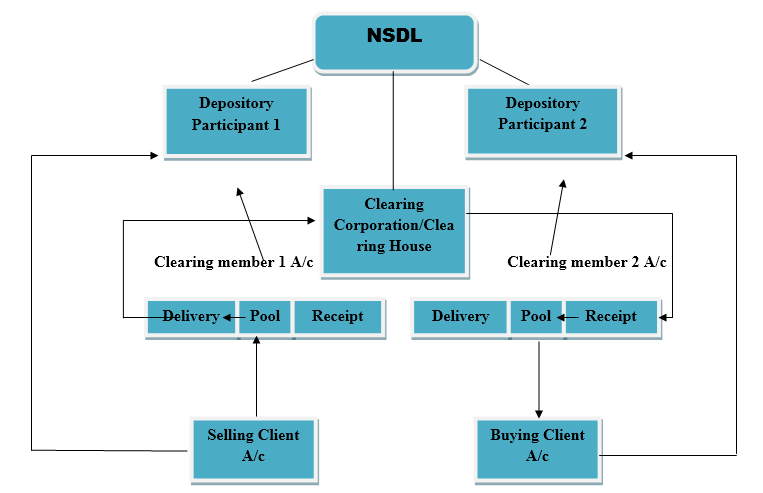
Diagram below explains the depository system in case of transfer of shares. This procedure will apply when the investor or transferor has informed the company about his intention to transfer and is doing under the depository system.

transfer of shares

Step 1: Firstly, seller has to give delivery instruction to Depository Participant 1 (DP1) to debit his account and transfer the concerned securities to Clearing Member1 Pool A/c with DP1. Clearing Member1 than gives parallel receipt instruction to DP1 to accept in his clearing account securities transferred by seller through DP1, if he has not already given standing receipt instruction for all credits into his clearing account. Securities are in turn transferred from selling client A/c to clearing member pool A/c with DP1.

  • Step 2: Now, Clearing Member1 gives delivery to Clearing Corporation (CC) instruction to DP1 to debit his Clearing Member1 Pool A/c and credit his Clearing Member1 Delivery A/c. The transfer takes place on the execution date which is mentioned in the instruction. Delivery which is supposed to be given to CC instruction will be as per final/ net delivery obligation.
  • Step 3: Till settlement day securities which are to be transferred lay in the clearing member1 Delivery A/c. Securities lying in clearing member1 delivery A/c are automatically transferred to the Clearing Corporation/ Clearing House at the time of pay in. There is no requirement of debit instruction for this transfer. There is no set deadline time for pay-in of securities to the Clearing Corporation/ Clearing House as it varies from one exchange to another.
  • Step 4: Now, automatic transfer of securities from Clearing Corporation/ Clearing house to clearing member 2 pool A/c with Depository Participant 2 (DP 2) at the time of pay out takes place and no instruction is required because of the automatic transfer.
  • Step 5: Securities are transferred from clearing member2 receipt A/c to clearing member 2 pools A/c. Receipt account of clearing members is nothing more than a transit account used for maintaining audit trail.
  • Step 6: Clearing Member 2 gives a delivery instruction to DP 2 to debit his Clearing Member 2 Pool A/c and credit Buying Client A/c with DP 2. Buyer gives parallel receipt instruction to DP 2 to accept in his account securities transferred from Clearing Member 2 Pool A/c through DP 2 unless he has not given a standing instruction to receive credits to his account.

Note: – National Securities Depository Limited (NSDL) does not handle these funds. Buyer gives cheque to Clearing Member 2 and subsequently he gives it to the Clearing Corporation/ Clearing House. After the cheque is cleared by clearing bank, the Clearing Corporation/ Clearing House allow credit of securities to clearing member 2 and thereafter, communicate the same to NSDL.

  • Step 7: Lastly, securities are transferred to Buying Client A/c from Clearing Member 2 Pool A/c with DP 2. The securities will remain in clearing member pool A/c until delivery instruction is given by him.

NOTE: For further clarifications NSDL bye laws (9.6) and business rules 12.2 can be taken as a basis of information.

When does transfer of shares complete?

A transfer is complete when all the formalities such as execution of the transfer deed and handing over the share certificates are complete.


LawSikho has created a telegram group for exchanging legal knowledge, referrals and various opportunities. You can click on this link and join:  

https://t.me/joinchat/J_0YrBa4IBSHdpuTfQO_sA

Follow us on Instagram and subscribe to our YouTube channel for more amazing legal content 

 
Download Now

Multi-level Marketing in India

4

This article is written by Somya Mishra

INTRODUCTION

Let me tell you a real life story about multi-level marketing. There is a very well-known company called the Hindustan Unilever Ltd. which followed multi-level marketing system for selling its products in the beginning. It offered people to become its members, buy their products and recruit as many members as they could to the scheme. They were promised commissions on the number of members they could add on to the group and were also offered a part of the payments of their subsequent members on whatever sale they made. They had to buy a certain amount of products every month in order to continue their membership. My father was very fascinated with the idea of making easy money in addition to his regular job. He actively participated in this scheme and was able to add on a number of members to his chain through his friends and colleagues in the locality. The plan was running smoothly, only after 2-3 months when my father stopped getting payments/commissions from the company. When asked they promised to pay the amount along with the bonus the next month altogether. However, at last it was found that the branch of this company in our area closed down without paying the investors their payment and my father too suffered a great loss.

I had a negative experience which doesn’t mean that everyone will suffer the same. So I won’t be deciding on the pros and cons of this system and will rest it on the readers to decide for their own.

Now I will be dealing with what does a multi-level marketing system mean, its advantages, disadvantages and how does it become a means for various financial scams in India.

DEFINITION

Multi-level marketing is a type of direct-selling method. In this, a person gets a part of the profits from their immediate retail customers and also a considerable part from the company according to the amount of sales they bring for the company. They achieve these sales mainly through word of mouth, their personal relationships with their families and acquaintances and their referrals. This system is mainly based on getting more & more distributors for the product rather than selling the product to the customers. The people who are recruited by the person are called that person’s ‘downline’.

ADVANTAGES OF MLM

MLM is a very popular system followed for businesses in India. There are many advantages that follow:

  1. It is not necessary to hire a full-time employee for this kind of marketing. A person can continue with his job and only work for the other company as a part-time employee.
  2. It adds to the income of a person who does this kind of marketing only as an additional job for him. He can work according to his comfort and earn money.
  3. The affiliate doesn’t have to keep the stocks with him always. He can first take the order from all his members and then combine it into a single large order from the company and distribute it finally.
  4. The person is not restricted to market for a particular company. He may choose to market any product he is interested in.
  5. The start-up cost of this business is very low or almost negligible.
  6. It is very easy to create downlines and increase the business revenue for oneself because as the amount of downline increase, the main person doesn’t need to work more but can still earn good remuneration through it.
  7. The work load shifts from a single person to a number of distributors which increases the business efficiency.
  8. There is already a pre-existing business and marketing plan in this system. The investors don’t have to put their efforts into making new plans as to how to carry on with the structure and functioning of the business.

DISADVANTAGES OF MLM

Following are some of the disadvantages of MLM system:

  1. The system of MLM mainly deals with how a person communicates and advertises the products and so everyone can’t be expected to have expertise in communication skills.
  2. This system is not a long-term business. It has a saturation point beyond which a person gets mere marginal profits. This system can’t be expected to continue for a long term because as the number of downlines increase, the number of people to be added upon as their downline reduces. Thus, the system reaches its saturation point.
  3. One of the disadvantages of this kind of business is ‘downlines’ because as the number of downlines increase, the affiliate gets a lesser profit from his business. So what the downline earns, the affiliate earns a lot less than it.
  4. Niche products and services are usually promoted through multi-level marketing which fails to attract buyers often.
  5. This system requires more expenses but yields less results. The members are required to buy a certain amount of products every month in order to continue their membership. It puts a burden on them to add on members to their chain, or else they would face a loss.
  6. The sole aim of these members is to add as many members as they can to their chain so as to increase their income. In order to attain this, they market the products without enough information about it and without having the personal satisfaction of that product.
  7. The MLM system requires a financial commitment to the company. More likely than not, the members will have to commit to purchasing a certain volume of product each month to remain eligible to participate in the scheme.
  8. This MLM system is generally misused by the companies in cheating people and has added to the number of financial scams.

RECENT DEVELOPMENTS IN MLM SYSTEM IN INDIA

The MLM sector is one of the fastest growing non-store retail formats in India. It has provided with a large number of employment opportunities for various people in India and has also added to the self-employment opportunities to many of them. In the recent years, an Inter Ministerial Committee was set up under the supervision of Ministry of Consumer Affairs to discuss and formulate the requisite legislation and guidelines governing the Multi-Level Marketing companies in India.

There were certain parameters identified by this Committee for governing the MLM system in India:

  • All the companies engaged in Multi-Level Marketing/direct selling business must be registered under the Companies Act;
  • Proper licenses and authorization are necessary for every company registered under this scheme;
  • Payments must not be misappropriated and be tied directly to product sales;
  • Under MLM new recruits must have the ability to move up in the sales system;
  • Companies must not waste the unsold stocks and repurchase any unsold inventory; and
  • The customer should be given opportunity to return the products unsold at the end because the supply and demand cannot be predicted beforehand.

Clause 2(c) of The Prize Chits and Money Circulations (Banning) Act 1978 has always been a concern for the industry. Thus, Ministry of Corporate Affairs and Ministry of Finance, Department of Financial Services are observing the sector from a close and working towards bringing clarity in the legislation available.

MLM SCAMS IN INDIA

  1. Amway scam

This case was an allegation against Amway India in 2002 which attempted to collect money from the people with the intention to deceive them by involving them in a money-chain scheme. The accused- Pinckney, a US citizen, and the directors — Sanjay Malhotra and Anshu Budhraja have been charged under section 420 of Indian Penal Code (cheating) along with sections dealing with chit funds and the Prize Chits and Money Circulation Schemes (Banning) Act, 1978.

  1. Speakasia scam

The company in dispute was a Singapore based marketing company that lured a huge population of people to enrol in a quick rich scheme and collected a sum of Rs 2,200 crores from 2 lakh people.

The investors were asked to invest Rs 11000 on an annual basis and were promised that their investment would be recovered within three months. Investors were required to open an account on the company’s website and fill two survey forms. By filling these forms, participants were said to receive Rs 4000 per month and Rs 1000 was fixed per person for referring the same scheme to others. They were assured of an annual payment of Rs 52,000. The whole operation and survey was ultimately found to be false.

  1. Stock Guru India

This scam was a mastermind of a couple- Ulhas Prabhakar and his wife Raksha, who tempted investors by promising 20% of interest per month on their investment and also refunding the primary investment in seven months. A senior income tax official was also removed from the finance ministry for accepting bribes to cover the scam. Since then, the couple has been serving their term behind bars, and the IT-official of Stock Guru has also been arrested.

  1. QNet scam

QNet was a Hong kong based multi-level company which was alleged to have duped thousands of investors by selling them plastic and glass products that were termed as miraculous for treating diseases like cancer. The case was investigated by the Mumbai Police Economic Offence Wing (EOW) which asked the Computer emergency response team (CERT) to block certain websites but there was no positive response from them. Thus, the police approached the court for the enforcement of the same and finally the court accepted the plea.

CONCLUSION

I have spoken to many of my friends and acquaintances in my vicinity who are into this Multi-level marketing, and they find this business to be unique and attractive. The companies make tons of money by selling outrageously overpriced products every month to their captive audience buyers. Though MLM Scams have been on the rise in India, still people fail to protect their hard earned money from these scams, which is a sad truth.

Download Now
logo
FREE & ONLINE 3-Day Bootcamp (LIVE only) on

How Can Experienced Professionals Become Independent Directors

calender
28th, 29th Mar, 2026, 2 - 5pm (IST) &
30th Mar, 2026, 7 - 10pm (IST).
Bootcamp starting in
Days
HRS
MIN
SEC
Abhyuday AgarwalCOO & CO-Founder, LawSikho

Register now

Abhyuday AgarwalCOO & CO-Founder, LawSikho