Microfinance refers to investment of small sums of money to people in need of it. Peer-to-Peer (P2P) lending in microfinance refers to lending directly to borrower. P2P lending is a relatively new tool of microfinance in India. However, it already has substantial presence worldwide.
While Microfinance Institutions (MFIs) invests into these micro loans in addition to maybe facilitating such investments by individuals. Marketplaces only facilitate P2P transactions between individuals. Reputed P2P microfinance marketplaces, such as the Lending Club, distributed loans worth $2.42 billion in 2013 up 177% from 2012. While Rangde, one of India’s more famous marketplace, was launched in 2008, P2P lending collapsed in India in 2010 after the failure of SKS, an Indian microfinance institution. It only revived after the advent of Kiva, world’s largest MFI for social micro lending, in India on August 2012. A lot of similar Indian websites (to which the aforementioned limitation does not apply) have since come into existence that includes Milaap, i-lend, and micrograam.
Difference between Kiva and the Rest
The main regulatory difference between a MFI and a market place in India is that the former is a financial institution and comes under the RBI while the RBI does not have authority over a marketplace like i-lend or rangde since it only facilitates lending between a borrower and a lender and does not operate as a finance institution. Kiva is therefore under RBIs jurisdiction while marketplaces like Rangde and i-lead are not.
Kiva, a non-profit MFI, offers loans to borrows at 0% interest and collects no fee for facilitation from either the lender or the borrower. Kiva is entirely a social enterprise and runs mostly on grants, donations and loans from institutions, individuals or nations. Built for similar purpose of social upliftment, marketplaces, like Rangde, typically charge the borrower 8.5% interest on a loan out of which 2% is returned to the investor and 1.5% is kept with Rangde.
These marketplaces thus charge a substantial fee without any financial capital or financial risk undertaking. Financial risk undertaking is important for there is significant risk of default in microfinance industry as the loans are unsecured. The creditworthiness check of a borrower is done completely by the marketplace.
One can still appreciate the fact that Rangde provides credit at 8.5% interest in rural as opposed to the 100% – 1000% by moneylenders. However, to attract investors, for increasing the loan capital, sites like i-lend, a self-proclaimed social venture, offer high interest rates starting from around 15% and can extend upto 24%. I-lend alsochargesborrowers 3% of the loan amount (or Rs.1,000 whichever is higher) and investors (1.5% of the investment amount or Rs.750, whichever is higher). This increases the effective interest rate for the borrower by a minimum of 3-4%.
Further, i-lend allows the lender to sue the borrower and on behalf of the lender can employ “collection agents”. The relevant clause in the agreement is given below:
“i-lend on behalf of Investor will take such necessary steps as permitted by law against the borrower to realize the amounts due along with the interest at the decided rate and other fees / costs as agreed in this Agreement including appointment of collection agents, appointment of attorneys/ consultants, as it thinks fit.”
Microfinance and Poverty
Microfinance and its effect on poverty have been questioned recently by a recent study in India by MIT economists. The results were shocking as the study found little direct effect of micro financing and alleviation of poverty. According to the study:
“…mistake that the microcredit enthusiasts may have made is to overestimate the potential of businesses for the poor, both as a source of revenue and as a means of empowerment for their female owners.”
This is because these borrowers lack the technical skill or expertize required to start a sustainable profit making business. Even if successful, the business does not generate enough revenue to draw them above the poverty line. Therefore, there has not been a significant direct impact from microfinancing.
For a rural borrower, microcredit is the only alternative to moneylenders. This places microfinance institutions, which offer microcredit, in a delicate position with power to exploit a rural borrower. As the microfinance shifts to private industry, goals of social upliftment are come in conflict with profit maximizing. Therefore, it is difficult for a for-profit MFI to manage the interest of the investors for better returns and still promote social causes. Often these MFIs end up charging an exorbitant interest rate and employing “collection agents” who end up coercing the rural borrower into payment. Compartamos Banco, a Mexican MFI, charges around 86%, much more than it needs to cover its costs. Similar trends have been seen in India with SKS finance allegedly being responsible for the suicide of farmers in Andhra due to inability to pay loans. Further, there has been a global increase in average interest rates. This has further diluted the social impact of these ventures and turned them into profit making enterprises, which now simply retain the garb of being social entrepreneurs in order to attract sympathetic investors.
Microfinance is nevertheless a powerful social and investment tool but the problem lies in the current unregulated scenario. The absence of a regulatory authority gives these marketplaces, which aren’t even Micro Finance Institutions (MFIs), freehand to charge exorbitant transaction rates under the guise of social entrepreneurship. Therefore there is an urgent need of intervention and protection by the Government. The delay in the micro finance bill will only aggravate these problems.
‘Bail’ connotes the process of procuring the release of an accused charged with certain offence by ensuring his future attendance in the court for trial and compelling him to remain within the jurisdiction of the court.[1] The concept of bail has come under the scope of human rights since the UN declaration of Human Rights of 1948.
The objective of an arrest is to ensure the appearance of the accused before the court for justice to be delivered. However, if a person’s appearance can be guaranteed without him having to be arrested, there is no reason to violate his liberty. Therefore, a bail can be granted as a conditional release to the accused person.
Section 436 to 450 of the Criminal Procedure Code mentions the provisions with respect to Bail and Bail bonds.
Bail has been defined by Black’s Law Dictionary as “the security required by a Court for the release of a prisoner who must appear at a future time”. It further says that, verb Bail means “to obtain the release of oneself or another by providing security for future appearance.”
Bail therefore presupposes the deprivation of liberty of the person to be released and when he is released from such restraint or custody he is said to be released on bail.
Categories of Bail
Bailable cases
These are the cases where the grant of bail is a matter of course and right. In view of section 436 Cr. P.C. 1973 a person accused of bailable offence at any time while under detention without a warrant and at any stage of the proceedings has the right to be released on bail. [2] When the offence is bailable and accused is prepared to furnish bail, police officer has no discretion to refuse bail.[3]
Non Bailable Cases
If a person is accused of a non-bailable offence, he cannot claim the grant of bail as a matter of right. But the law gives special consideration in favour of granting bail where the accused is under sixteen, a woman, sick or infirm, or if the court is satisfied that it is just and proper for any other special reason to give rather than refuse bail [Section 437 (1) CrPC].
In case of an offence punishable with death or life imprisonment, the person is not released on bail if the prima facie evidence makes it reasonable to consider him guilty. Also in case of such offences the person cannot be released on bail without giving an opportunity of hearing to the public prosecutor (Section 437 CrPC).
A person is not released on bail if the offence is a cognizable offence and he had been previously convicted of an offence punishable with death, imprisonment for life or imprisonment for seven years or more, or he had been previously convicted on two or more occasions of a cognizable offence punishable with imprisonment for three years or more but not less than seven years (Section 437(2) CrPC).
The accused is released on bail if there are no reasonable grounds for believing that the accused has committed a non-bailable offence pending further inquiry into his guilt.
How to apply for a bail in India
Once a First Information Report (FIR) is filed or a charge is filed against a person, he/she would need to furnish his/her details including information and thumbprints as well. Their background will be checked out. If the charge is a meagre one, they can immediately apply for bail but if it is a complex one, they may have to wait for around 24 hours before they could apply for it. Some offences are also non-bailable. So, the bail plea filing would depend on the type of offence or accusation against a person.
Depending upon the stage of a criminal matter, the process of applying for Bail varies:
If the individual is not yet arrested by the court but fears an arrest from the police, he can hire a lawyer to file an Anticipatory Bail application. For instance, if a husband anticipates that his wife may file a false 498 A case against him, he can file an Anticipatory Bail before the Police and register an FIR against him.
If a person has already been arrested by the Police and taken into custody, a lawyer can file a Bail application according to the format given in the CrPC. This application must be filed and approved by the court and then presented to the Police to get the individual out of police custody.
The Bail amount that has to be deposited would be set upon the discretion of the court. Sometimes, a standardised Bail amount is set that has to be deposited to the court for less serious crimes.
Considerations by the court while granting bail
The provisions of CrPC regarding bail confer discretionary powers on the courts to grant bail to accused pending trial, since the jurisdiction is discretionary; it has to be exercised with great care and caution. The court is required to record in writing its reasons or special reasons for releasing a person on bail. The Supreme Court in various cases has laid down guidelines for the lower courts for exercising their discretion while granting bail.
In Kalyan Chandra Sarkar v. Rajesh Ranjan @ Pappu Yadav and Anr.[4] in para 11 it was observed that “The court granting bail should exercise its discretion in a judicious manner and not as a matter or course. Though at the stage of granting bail a detailed examination of evidence and elaborate documentation of the merit of the case need not be undertaken, there is a need to indicate in such orders reasons for prima facie concluding why bail was being granted particularly where the accused is charged of having committed a serious offence. Any order devoid of such reasons would suffer from non-application of mind. It is also necessary for the court granting bail to consider among other circumstances, the following factors also before granting bail; they are:
(a) The nature of accusation and the severity of punishment in case of conviction and the nature of supporting evidence.
(b) Reasonable apprehension of tampering with the witness or apprehension of threat to the complainant.
(c) Prima facie satisfaction of the court in support of the charge.
Bail to under-trial prisoners
The issue of bail to under trial prisoners has been in a debate because of the increasing under trial population in the jails approximating around 64.7% of the total prison population. The National Human Rights Commission has repeatedly given detailed guidelines regarding the release of undertrials on bail. The personal liberty of a person can be deprived only when he is proved guilty otherwise it would be a violation of his human rights. In Mantoo Majumdar v. the State of Bihar the Supreme Court upheld the undertrials’ right to personal liberty and ordered the release of the petitioners on their own bond and without sureties as they had already spent six years awaiting their trial in prison. The Central Government and various State governments have requested the High Courts to release the undertrials who are entitled to bail. Advocate Vijay Aggarwal had filed a petition asking the court to formulate a policy for the release of prisoners charged with offences carrying a maximum punishment of 7 years of imprisonment. The petition demanded the release after one year imprisonment of the under trial. But the move was opposed by the Government which was against the formulation of a general policy and demanded that the cases be dealt with based on their particular factual situation.
Section 167(2) Cr.P.C. requires the investigating agency to complete the job of investigation and file the charge-sheet within the time limit of either 60 or 90 days as the case may be on failure of which the accused would be entitled to be released on bail. But the current situation shows the disregard of the above condition laid down in the code.
Endnotes
Nathurasu v. State, 1998 Cri LJ 1762 (Mad).
Ratilal Bhanji Mithani v. Asstt. Collector of Customs, AIR 1967 SC 1939
Dharmu Naik v. Rabindranath Acharya 1978 CrLJ 864 : Kanu Bhai v. State of Gujarat
1972 (B) Guj LR 748.
(2004 (7) SCC 528)
LawSikho has created a telegram group for exchanging legal knowledge, referrals and various opportunities. You can click on this link and join:
This article is written by Madhurima Dutta from RMLNLU, Lucknow.
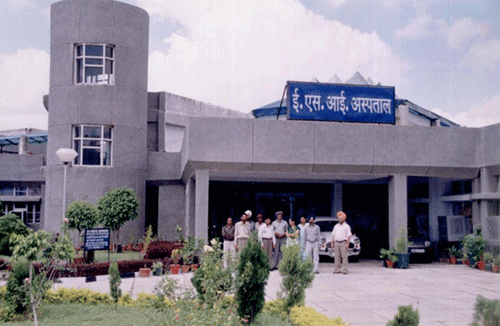
an ESI hospital in Punjab
ESIC is an autonomous corporation under Ministry of Labour and Employment, Government of India. Employees’ State Insurance is a self-financing social security and health insurance scheme for Indian workers. For all employees earning Rs 15000 or less per month as wages, the employer contributes 4.75 percentages and employee contributes 1.75 percentages, total share 6.5 percentage. This fund is managed by the ESI Corporation (ESIC) according to rules and regulations stipulated there in the ESI Act 1948.
The industrial sector plays a major role in improving the wealth of a country. In order that industries focus on their core areas, i.e., best possible utilisation of the available resources and improving the productivity of the factors of production, without worrying about protecting the workforce from the physical and financial distress arising out of sickness, maternity, employment injury, etc, the ESI Scheme was devised.
The employers play a major role in the functioning of the Scheme, through registration of its employees, remittance of contribution and through compliance with the provisions of the Act.
Administration
At the national level, the ESIC Scheme is administered by a statutory body called the ESIC (Employees’ State Insurance Corporation), set up under ESI Act of 1948. This statutory body comprises of representatives on behalf of employers, employees, the Central Government, various State Governments, medical professionals and the Parliament members.
A Standing Committee is constituted from amongst the members of the Corporation that acts as the Executive Body for the administration and implementation of this ESIC Scheme.
The Medical Benefit Council which is a statutory body, advises ESIC pertaining to matters connected with the provision of medical care/healthcare to the beneficiaries of this Scheme. The Chief Executive of the ESIC is the Director General who is also ex-officio member of the Corporation and of its Standing Committee.
As part of the decentralization process, Regional Boards have been constituted in each State of Indian Union. To make this scheme more effective and to make the entire process more accountable, Local Committees have been formed as advisory bodies at the grass-root level for smooth functioning of the ESIC Scheme.
Infrastructure
To manage day-to-day administration and operations, the headquarters of ESIC is situated at New Delhi. Besides headquarters, there are Regional Offices and Sub-Regional Offices in various states of India along with 800 and above Branch Offices at industrial towns throughout India.
ESI Corporation
Registration under ESIC Act
Registration is the process by which every employer of an establishment/ company/ organization and its every employee who are employed for wage purposes are identified for the purpose of this ESIC Scheme and their individual records are set up for them.
The first stage in this process is to obtain the particulars about each factory/shop/establishment that can be covered under ESIC Act.
Thereafter to identifying such an organization, allotment of a number i.e. Code No. is carried out by the Regional Office.
The above mentioned process helps in maintaining track of contributions/assistance payable/paid and the associated obligations of the employers.
Consequent step is the registration of employees of covered factories by the Regional Office and identifying such individuals by allotment of a number i.e., insurance number.
This procedure facilitates in setting up essential records for documenting the benefits for which the insured employee may be entitled under this ESIC Scheme based on the eligibility criteria.
An individual record of every employer/employee will facilitate smooth conversion in future from time to time. It will operate as a regulator and keep a proper track for maintaining the records for the purpose of obtaining compliance from the employers and providing benefits to concerned insured persons.
Registration of Employers
Section 2A of the ESI Act states as under:
2A. Registration of factories and establishments-Every factory or establishment to which this Act applies shall be registered within such time and in such manner as may be specified in the regulations made in this behalf.
1.3. As a follow-up of this provision in the Act, Regulation 10B has been inserted in the ESI (General) Regulations, 1950. This regulation is as follows:
10B – Registration of factories or establishments
The employer in respect of a factory or establishment to which the Act applies for the first time and to which an Employers’ Code No. is not yet allotted and the employer in respect of a factory or an establishment to which the Act previously applied but has ceased to apply for the time being, shall furnish to the appropriate Regional Officer not later than 15 days after the Act becomes applicable, as the case may be, to the factory or establishment, a declaration of registration in writing in form 01(hereinafter referred to as employers’ registration form).
The employer shall be responsible for the correctness of all the particulars and information required to be furnished on the employer’s registration form.
The appropriate Regional Office may direct the employer who fails to comply with the requirements of paragraph (a) of this regulation within the time stated therein, to furnish to that office employer’s registration form duly completed within such further time as may be specified and such employer shall, thereupon, comply with the instructions issued by that office in this behalf.
Upon receipt of the completed employer’s registration form, the appropriate Regional Office shall, if satisfied that the factory or the establishment is one to which the Act applies, allot to it an employer’s code number (unless the factory or the establishment has already been allotted an employer’s code number) and shall inform the employer of that number.
The employer shall enter the employer’s code number on all documents prepared or completed by him/her in connection with the Act the rules and these regulations and in all correspondence with the appropriate office.
Advantages for employers
Employers are absolved of all their liabilities of providing medical benefits to their employees and their family members or dependants in kind or in the form of fixed cash allowance, lump-sum grant, reimbursement of actual expenses, or opting for any other medical insurance policy of limited scope unless it is a contractual obligation of the employer.
Employers are granted exemption pertaining to the applicability of Maternity Benefit Act, Workmens’ Compensation Act etc in respect of employees covered under the ESIC Scheme.
This results in employers possessing a productive and well-secured workforce, at their disposal which is an essential ingredient for better productivity of an organization.
Employers are absolved of any responsibility in times of physical distress of their employees or workers such as employment injury, sickness or physical disablement thereby resulting in loss of wages since the responsibility of paying cash benefits shifts from the employer to the ESIC Corporation in respect of insured employees.
Any amount or sum paid by way of contribution under the ESIC Act is deducted in computing ‘Income’ under the Income Tax Act.
Coverage of factory/establishment
In the first instance, this Act is applicable to all non-seasonal factories utilizing power and employing ten or more individuals, as well as is applicable to non-power using manufacturing organizations and establishments employing 20 or more persons for wages and falling under the ambit of an implemented geographical area. As of now, employees of establishments, companies or factories that fall within the ambit of coverage and earning wages not exceeding Rs. 10,000/- per month are covered under this ESIC Scheme.
Under Section 1(5) of the Act, the provisions of ESIC Act have been extended to the following classes of establishments:
Shops and Commercial establishments
Cinemas, including preview theatres
Hotels & Restaurants
Clubs
Newspaper establishments
Road Motor Transport establishments
Under Section 1(5) of the ESIC Act, the Indian Government is empowered to extend the Scheme to any other establishment or class of establishments, commercial, industrial, agricultural or otherwise, with the passage of time. A State Government may extend the provisions of this Act in consultation with the ESIC and with the prior approval of the Central Government, after submitting six months notice of its intention in the official gazette; provided that where the provisions of this Act have been brought into force or implemented in any part of State, the said provisions shall stand extended to any such establishment or class of establishments within that part, if such provisions have already been extended to similar establishments or class of establishments in another part of that same State.
Finances
This ECIS Scheme is primarily funded by contributions raised from insured employees and their employers in the implemented areas across India as a small but specified percentage of wages payable to such employees.
Employees in receipt of an average daily wage of Rs 40/- or less are exempted from payment of their share of contribution but are entitled to all social security benefits under this scheme.
The contribution rates are as follows:
Employees’ contribution – 1.75 % of wages
Employers’ contribution – 4.75 % of wages
Under the provisions of this Act, the State Governments contribute 12.5 percent of expenditure on medical expenses incurred on ESIC beneficiaries in their respective States within the per capita ceiling. Any expenditure exceeding this ceiling is borne entirely by the respective state governments.
The contributions made by employees and their employers are deposited in a common pool known as the ESIC Fund that is utilized for payment of cash benefits to the insured persons and their family members including dependants in addition to providing medical facilities to the beneficiaries under this scheme. The administrative and other expenses of the Corporation are also met from this pool fund.
Exemptions
The provisions of the ESIC Act are not applicable to factories or establishments under the control of Central Government / State Governments because such employees working with PSUs are in receipt of social security benefits that are substantially similar or superior to the benefits provided under the ESIC Act. The case of each such Public Sector Undertaking (PSU), is decided on merit by comparing the quality and quantity of benefits being provided to the employees by the concerned managements with those being conferred and admissible under the ESIC Act.
Contributions
The amount payable to the Corporation by the Principal Employer in respect of an employee is termed as Contribution. It comprises the amount payable by the employee and the employer.
It is obligatory on the part of the employer to calculate and remit ESIC contribution that comprises of employers’ share 4.75% plus employees’ share of 1.75% that needs to be paid on or before 21st of the following month to the month to which the salary is related. For example suppose if an employee who draws up to Rs.70/- as daily average wage, then such an employee is granted exemption from payment of his/her share of contribution. The employer is however required to pay employer’s share of 4.75% of the salary receivable by the employee.
Recovery of contribution
In the first instance the Principal Employer is required to pay employers’ share of contribution in respect of every employee whether employed directly or through immediate employer. The employees’ share may thereafter, be recovered by making deduction from their wages for the wage period for which their contribution is made, however is payable. No such deduction may be made from any wages to their employees other than those relating to the period in respect in which contribution is payable.
Medical Benefit
The ESIC Scheme provides wide-ranging variety of medical treatment to insured individual and their dependants (including their family members). This is made possible through a network of ESIC Dispensaries & Panel Clinics, Diagnostic Centres and ESIC Hospitals etc. Super-speciality medical facilities are provided to the beneficiaries through advanced super-speciality medical institutions that are recognized and empanelled for the purpose on referral basis. The ESIC has set up a Revolving Fund in most of the States across India for ensuring smooth flow of funds for facilitating super-speciality treatments of ESIC beneficiaries.
All the insured individuals and their dependants including their family members under ESIC scheme are entitled to free, full and comprehensive medical care under the ECIS Scheme. The Medical benefit package covers all aspects of healthcare ranging from primary to super-speciality facilities.
Sickness Benefit
Sickness Benefit represents cash payments made to an insured person periodically during the period of certified sickness occurring in a benefit period when insured person undergoes medical treatment and attendance with abstention from work on valid medical grounds.
The maximum duration of Sickness Benefit is 91 days in two consecutive benefit periods. However, there is a waiting period of 2 days which is waived if the insured person is certified sick within 15 days of the spell for which sickness benefit was last paid. The sickness benefit rate is approximately equivalent to 50% of the average daily wages of the insured person.
Extended Sickness Benefit
After exhausting the Sickness Benefit payable up to 91 days, an insured person if suffering from Cancer, Tuberculosis, Leprosy, Mental or malignant diseases or any other specified long-term ailment, then such an employee is entitled to Extended Sickness Benefit at a higher cash benefit rate of about 70% of average daily wage for a period of two years.
Enhanced Sickness Benefit
For undergoing sterilization operations for the purpose of family planning, insured persons are eligible to Enhanced Sickness Benefit which is double the rate of sickness benefit.
Maternity Benefit (Section 50 of ESI Act)
Maternity benefit comprises of periodical cash payments to an insured woman as certified by a duly appointed medical officer or mid wife in cases such as confinement or miscarriage or sickness arising on account of pregnancy, confinement, premature birth of child or miscarriage.
Disablement Benefit
Disablement benefit is admissible for disablement that is caused by employment injury. At the first instance, Temporary Disablement Benefit (TDB) is payable as long as the temporary disability lasts. If the employment injury results in partial or total/permanent disability, then Permanent Disablement Benefit (PDB) is payable till the death of the insured individual.
No contributory conditions have been prescribed for this benefit.
Dependant Benefit
Dependants’ benefit consists of periodical payments to dependants or family members of an insured individual who dies on account of an employment injury sustained as an employee under the ESIC Act. There are no contributory conditions or any criteria in order to qualify for such benefits. Thus, in case in an unfortunate or unforeseen incident suppose even if an individual dies of employment injury even on the first day of his employment, his dependants or family members are entitled to the aforesaid benefit.
Funeral Expenses
The funeral expenses are made to meet the expenditure incurred on the funeral of deceased insured individual. This amount is paid either to the eldest surviving member of the family or in his/her absence to that individual who actually incurs the funeral expenses.
Get all the templates, formats, step by step guides, checklists and information you need related to employment laws in one place, free of cost. we have simplified compliances, record-keeping, contracts, policies, disputes and litigation for you. Never struggle with employment and labour law again in your life. Click here to download the Legal handbook for HR managers.
LawSikho has created a telegram group for exchanging legal knowledge, referrals and various opportunities. You can click on this link and join:
This article was written by Himanil Raina of NALSAR. This would help you to make up your mind about whether to start a sole proprietorship or One Person Company, and what registrations you would need to carry on business as well. Over to Himanil.
Richa Arya of NLIU writes on what happens when debt is not paid.
Insolvency: does obligations of pending debt pass on to children after death?
Liability of the son to pay father’s debts is enshrined in the ancient Indian literatures. The ancient Hindu Law makes it son’s pious obligation to discharge the debts of his father. In case of Sridhar v. Mahidhar[1] it was illustrated that the obligation of the son was an independent obligation irrespective of the fact whether the son inherited any property from the father. Also the son was not liable to pay immoral or Avyavaharika debts incurred by his father or grandfather but only Vyavaharika debts.
With the coming of Hindu Succession Act, 1956 this pious obligation of the son to pay debts was converted into his legal obligation. The joint family stands partitioned immediately before the death of the coparcener by the application of the act and the property devolves by succession. The heirs are now absolutely liable for all the debts on the share of the property inherited by them. However, if they inherit nothing, they need to pay nothing to any debtors. Similarly, if the debt is bigger than the value of the estate inherited – the entire estate will go into servicing as much of the debt as possible, but the inheritor will have no personal obligation to pay any debt beyond that.
Click Above
Hindu Succession Act, 2005 has finally abolished the doctrine of son’s pious obligation and now the son cannot be made to discharge the debts of his father solely on the basis of his religious obligation. Thus now the liability of the children to discharge debts of their father extends only to the extent of the assets inherited by them. The children cannot be made to pay the debts out of their personal assets.
In case of an insolvent the question of the children paying the debts does not arise as his properties are taken away by the receiver appointed by the court as per section 56 of the Provincial Insolvency Act, 1920 Act who then distributes it among the creditors. Children are liable to pay the pending debts only to the extent they inherit from the deceased and since in case of an insolvent they either do not inherit any property or only get the surplus after the discharge of all debts (section 67 of Provincial Insolvency Act, 1920) so they are not obliged to pay the pending debts out of their personal assets. But the Children are liable to pay the debts which were jointly incurred by them with the deceased and as per section 44(3) of the Provincial Insolvency Act, 1920 an order of discharge for the insolvent does not release such a partner in the debts from his duty to discharge the debts.
Can there be any criminal proceedings against a person who is unable to pay his debt? What proceedings can be pursued under law?
Prison for debtors – these laws have been abolished in India
When a person is unable to pay his debts, the insolvency laws in India provide him with the relief from the harassment of his creditors whose claim he is unable to meet. The insolvency laws also provide machinery for the satisfaction of all the creditors. It is based on the Roman Principle cession bonorum meaning surrender by the debtor of all his goods for the benefit of his creditors in return for immunity from court process. Thus if a person is unable to pay his debts an insolvency petition may be presented before the court either by the creditor or by the debtor.
The presentation of the petition by the debtor is deemed as an act of insolvency and the court may make an order of adjudication. The order of discharge by the court releases the bankrupt from all current and provable debts. On being declared insolvent, the court appoints official assignee or receiver, who takes charge of the property of the insolvent, which is then divided among creditors to pay the debts.
The insolvent is no more associated with the property once the official receiver takes charge. Thus under law a creditor can pursue the insolvency proceedings against the debtor to get his claims satisfied by the declaration of the person as insolvent.
The fact of insolvency or bankruptcy alone is not enough to start criminal proceedings against a person. However, the insolvency laws have several criminal provisions to deal with certain immoral acts by an insolvent. The debtor may be subject to criminal proceedings for the offences committed by him under section 69 of the Provincial Insolvency Act, 1920 and sections 102 and 103 of the Presidency Towns Insolvency Act, 1909 but would not be subject to criminal proceedings just because of the fact of insolvency.
Section 102 of the Presidency Towns Act punishes an undischarged insolvent for obtaining credit to the extent of fifty rupees or upwards from any person without informing such person that he is an undischarged insolvent.
Section 103 of the Presidency Towns Act and section 69 of the Provincial Insolvency Act, 1920 punish a debtor who fraudulently with the intent to conceal the state of his affairs or to defeat the objects of the act; destroys, withholds, replaces or alters the contents of the books, papers etc. which are subject to investigation under the acts.
The above sections also punish a debtor who fraudulently with intent to diminish the sum to be divided amongst his creditors or of giving an undue preference to any of the said creditors discharges or conceals any debt due to or from him or charges, mortgages or conceals any part of his property of any kind.
Section 69 of the Provincial Insolvency Act, 1920 also punishes the debtor who fails to perform the duties imposed on him by section 22 or to deliver up possession of any part of his property which is divisible among his creditors under the Act and which is for the time being in his possession under his control to the Court or to any person authorized by the Court to take possession of it.
LawSikho has created a telegram group for exchanging legal knowledge, referrals and various opportunities. You can click on this link and join:
This article was written by Soni Bhola, a student of RMNLU, Lucknow during her internship with iPleaders.
A compulsory license is an authorization which is granted by the government without the permission of the patent holder to a licensee under certain circumstances. It is an involuntary contract between a willing buyer and an unwilling seller imposed and enforced by the state. Compulsory license is a statutorily created license allowing an individual or a company seeking to use another’s intellectual property can do so without seeking the patent holder’s consent, in return of a set royalty or fee for the license.
Across the globe the compulsory license on Intellectual Property Rights (IPRs) is granted on almost similar grounds like –
Charging unreasonably exorbitant prices of an essential facility or commodity, or
Market demand not sufficiently met, or
Where substantial public interest is affected by the way IPR holder is exercising its right.
Abuse of IPR leading to exclusion of competitors in an industry.
Now, the compulsory licensing has been mandated by several international agreements like WIPO (World Intellectual Property Organization), Paris Convention For The Protection Of Industrial Property and WTO Agreement on Trade Related Aspects of Intellectual Property Rights (TRIPS). These international agreements have given several grounds to their contracting states to grant compulsory licensing like promotion of public health and nutrition or public sectors of vital importance or of socio economic and technological importance.
In anti-trust violations also the compulsory licensing may be resorted to as a remedy where patent has been abused or where the protected product is vital to national interest or the licensee getting the compulsory license is the government. Therefore, in situations where the interest of society at large should be given more importance than the personal rights in the form of IPRs, compulsory licensing is granted.
Justification for Compulsory Licensing
“Between our trade and our health, we have chosen to look after our health.” ~Luiz Inacio Lula da Silva (President of Brazil) (on compulsory licensing of AIDS drugs )
The IPRs prohibit imitation and copying of products, product characteristics, industrial designs etc and in a way they also contribute to fair competition in market. On the other hand the competition law may restrict the exclusivity provided by IPR if the exclusivity has been exploited to exclude others from business by anti-competitive means. Therefore, a too high or too low protection of both the IPRs and competition may prove bad for market as it will unnecessarily create distortions in the trade. An optimum level of protection to both IPR and competition law is thus, desirable for promotion of competition in markets.
For instance, countries like, South Africa, Kenya, Malaysia, Thailand, etc have resorted to compulsory licensing of HIV drugs. Another example of compulsory licensing could be Bayer v. Natco[1] where Mr. P.H. Kurian, Controller of Patents, India while awarding the license, observed, “a right cannot be absolute. Whenever conferred upon a patentee, the right also carries accompanying obligations towards the public at large. These rights and obligations, if religiously enjoyed and discharged, will balance out each other. A slight imbalance may fetch highly undesirable results. It is this fine balance of rights and obligations that is in question in this case.” Now, instead of Rs.2.8 lakhs, the cancer drug Nexavar is available at Rs.8800, at just 3% of its earlier price.
Indian Scenario
Compulsory licensing of IPRs in India has raised a lot of eye brows as the Indian pharmaceutical industry is third largest pharmaceutical industry in the world, second only to United States and Japan. There is great a number of pharmaceutical companies in India and most of them are producing generic drugs. For the first time, compulsory licensing was granted in the case of Bayer v. Natco
Compulsory licensing has triggered positive outcomes for India, despite this, in India as of now there is no settled position as to when Competition Commission of India (CCI) would grant a compulsory license, though the provisions of Competition Act 2002 seem to confer a lot of powers to CCI. Earlier in the years prior to the enactment of the 2002 Competition Act, MRTP Act (Monopolies and Restrictive Trade Practices) was in force under which, the monopoly itself was bad in law but after the Competition Act 2002 only abuse of monopoly attracts penalty from CCI. This reflects a policy shift by Indian Government keeping in mind the global trends in business and economy. The CCI in its decisions has placed a great emphasis on interest of common man, than on competitors or the competitive process.
In India, the following situations may attract compulsory licensing where IP holder:
Charges unfair and discriminatory prices; or
Limits production of goods and services; or
Restricts technical or scientific development of goods and services; or
Desecrates consumer welfare.
Since the provisions under the Competition Act use the term ‘may’ therefore, given the circumstances the CCI may pass an order of compulsory licensing if that is the need of hour. The CCI has gone ahead by imposing a grand penalty to DLF in Belaire Owners Association v. DLF Limited and HUDA[2] to the tune of Rs. 630 Crore for abusing its dominant position, just to ensure that consumer interest is not overlooked by such big companies. Similarly, CCI may be called upon to pass Compulsory licensing order if necessary to rectify the anti-competitive practice; or to ensure consumer welfare and to promote and sustain competition.
Pros:
Compulsory licensing acts as a remedy to the abuse of IPR. It serves to strike balance between two disparate objectives- rewarding patentees for their invention and making the patent products available to large population in developing and underdeveloped countries at affordable rates.
In compulsory licensing the IP holder whose right has been licensed to others, gets royalty as set by the court or government. Hence, though profitability of an IP is diluted to a great extent by compulsory licensing still the incentive for innovation does not vanish completely.
Compulsory licensing of IPRs would be an apt remedy and will deter the companies if they abuse their dominant positions. Looking at the Indian conditions, one can say that compulsory licensing will spur growth and development in Indian industrial sectors. Keeping in mind the size of Indian market the incentive for innovation will not erode to the extent that might deter companies from entering in to innovative endeavors as courts grant reasonable royalties in cases where compulsory licensing has been awarded. Compulsory licensing will make the products more accessible to public and it will be beneficial for public welfare.
Cons:
Compulsory licensing of IPRs to rectify the unfair trade practice by an IPR holder should be least resorted to. It may deter foreign direct investment in industrial sectors. Apprehensions of compulsory licensing of IPRs may cause companies to not to venture in to Indian jurisdiction as their right of patent or any other IPR may be licensed to others bringing down the profitability.
Since the abuse of IPR is a very reasonable likelihood where an enterprise has its rights protected under Intellectual Property (IP) laws. The monopoly protected by IPRs is though permissible under laws but the fact remains that it is very prone to abuse. Enterprises are often tempted to indulge into anti-competitive practices trying to extend their monopoly into areas where they do not have rights protected by IPRs. This kind of monopoly puts these enterprises in to a position where they can dictate their terms over whole of the industry and sometimes which can be violative of free competition rules.
Compulsory licensing can be seen as an effective remedy in such cases where the public interest is involved to a large extent and anti-competitive practices of companies have damaged the interest of consumers as well as competitors in legal sense.
If you are a restaurant owner or managing a popular restaurant chain, then read on. Intellectual property protection for restaurants and food chains does not start and end with registering your restaurant’s trademark. Protecting and registering intellectual property can increase the valuation of the company not just in the accounting books, but increases brand stability and brand perception in long run. In case, you are planning for an IPO or want to raise money from venture capitals, having registered IPs can be helpful to draw the attention of potential investors that you are really serious about your business.
Protecting Brand Identity
One of the primary IP protections that a restaurant can avail of is registering its trade name and logo as a trademark. In most cases the logo or the name of the restaurant is determined by a public relation or marketing agency taking into consideration the customer considerations and perceptions. However, it is advisable to take advice from a lawyer, who can tell you about existing registered trademarks or potential stability of the mark as a good trademark. Many restaurant owners might be tempted to name their restaurant after their surname or anyone in the family, but a trademark like “Khosla’s” or “Tanisha’s” is a very weak and might be hard to contest in case of use by another restaurant. A trademark should ideally be fanciful (madeup names like “bluO”) or arbitrary (unrelated with the service or goods, for example “Vapour”, “Route 04”, “The Flying Saucer Cafe” for restaurants or cafes). Suggestive names for restaurants or having names in foreign languages or names of towns of foreign places (though not the major cities like Paris, Amsterdam, London, etc) in combination with other words can also be a safe choice like “Zerzura” (a mythical city or oasis in Egypt).
Interior decors
You must have spent a lot on getting the catchy and uber cool look of your restaurant chains, but someone else opens a store in the same locality copying the minute details of your restaurant. What are your options? Do you know you can even protect your restaurant chain’s unique interior decor? The store design can consist of unique colour combinations, custom furniture and other store decors, which can be helpful for advertisement and creating customer recognition and association with the brand. Store designs can be protected as trade dress under certain circumstances like longer use, consistency and uniqueness. Trade dress protection initially was granted to protect the “look and feel” of packaging of a product. However, the Courts have expanded the meaning of trade dress and applied “look and feel” test to protect store and restaurant interior decors and looks. For example, Cafe Coffee Day (CCD) outlets have a very unique colour combination and similar looking furniture in all the stores, which can be easily identified and distinguished even without the logo and name CCD written anywhere. Such distinguished interior setup and formats may be protected as trade dress.
Websites
In the current world, having a website for any organisation is a must. Domain names are considered to be trademark, and you can file a trademark infringement suit against anyone who uses your restaurant’s name as a domain name for fraudulent purpose. It is suggested that you must book your domain name even before launching your restaurant.
The design, images and illustration used in a website are protected under copyright laws. There is no specific need to apply for copyright of the website or to give a public notice at the bottom of the website stating “All rights Reserved”. However, you can register the website, which might be helpful for establishing ownership in case of an infringement suit. If you are getting your website designed by a freelancer or any other agency, it is advised that the agreement must contain a copyright assignment clause granting you the copyright of the website created.
Recipes and Cookbook
Do you know what spices go in the KFC’s chicken? No one knows about it in public, because KFC have maintained secrecy over their recipe for years. If you have a proprietary recipe which is known only to you, it is advisable that you make your employees sign a non-disclosure and non-compete agreement. Moreover, you should monitor that the recipe is known only to a selected few person in the restaurant. In case someone is leaving the job, consider conducting an exit interview to remind the person of his obligations on secrecy.
Though you cannot prevent another restaurant from using the recipe you wrote down in your cookbook, but what you can prevent is from selling the cookbook in his own name. Recipes per se might not be protected as a copyright as most of the recipes might be just be list of ingredients. However, when the recipes are written in an explanatory manner along with illustrations and photos copying the same can be violation of copyright. Many celebrity chefs have their signature dish and might have a unique way of preparing things. Encouraging celebrity chefs to write cookbooks during the work hour and having an explicit IP assignment clause in the employment agreement can earn you extra income from the royalties of selling the cookbooks.
Menus
Apart from registering the restaurant’s name, you can register the name of your signature dishes which might have a distinct name from the generic name of the dish. For example, KFC and McDonalds uses the trademark sign “TM” with the names of its menu items, which are though not registered, it gives a signal to the public or probable violators that these are business names and should not be used.
You can protect the design of the menu, including photos and other illustrations and arrangement of food items made in a particular manner as copyright. However, in case of enforcement of copyright, the courts might test the originality of the menu. To make the menu unique apart from usage of unique illustrations, images and menu items, one must consider using descriptive menus, which not only increases the originality but rather carefully drafted descriptive menus can have a positive psychological affect on the guests.
Patent and design protection
While smaller restaurant might not have anything to protect as patent or design. However, bigger restaurant chains like KFC, McDonalds and Subway have lot of patents over kitchen equipments which are used in their day to day activities. If you are developing custom equipment, consider getting a patent or design protection for that equipment.
Merchandising
Once a brand has been established, you might consider using the brand name for merchandising, which can act as a separate source of revenue. Cafe chains like Starbucks and Cafe Coffee Day have their own merchandise like cups and mugs. If you are planning to give merchandising rights to a third party, take advice from lawyers on ways to protect your IP in the best way.
Fake profiles on social media are a problem most users face. Fake profiles of celebrities are rampant, as are also profiles with fake names and details. These fake profiles are often used to commit cybercrime anonymously or with an untraceable identity. It’s definitely alarming that there has been a 168% rise in such cybercrimes in the last one year.
It is very interesting that now-a-days many real world thefts have their roots in social media. Burglars are creating networks of fake profiles to target potential victims, as such connections allow them to uncover a variety of personal information about users and their whereabouts, making their homes an easier target.
The survey found that 56% of social media users had discussed an event, evening or holiday plans ‘wall to wall’ on Facebook, potentially providing opportunities for them to be targeted by criminals.
By befriending a number of the target user’s other friends beforehand, the victim is even more likely to accept the fake friend, inadvertently giving the burglar access to all their personal information.
The cases of Cyber extortion have also increased owing to excessive personal data available in social networking profiles, and this data is accessible to fake profiles in your friend list.
When we come across a fake profile, the first step is to report the same to the service provider like facebook or twitter. Most of these Intermediaries/ Service Providers have facility for reporting and blocking fake profiles.
click above
For example, in the case of facebook the following procedure has to be followed to report an abusive page:
Go to the Page you want to report
Click the gear icon below the Page’s cover photo
Select Report Page
Choose the reason you’re reporting the Page and click Continue
Facebook will then review the reported material and remove anything that violates their Statement of Rights and Responsibilities. If warranted they also warn or disable the person responsible.
Fake Timelines created to imitate real people (impostor accounts) are not allowed on Facebook. If someone created an account pretending to be you:
Go to the Timeline
Click the gear icon and then select Report
Click Report this account
Click This person is pretending to be me or someone I know and then complete the on-screen directions
Click Submit to Facebook for Review
SECTION 66D of the Information Technology Act, 2000 deals with CHEATING BY PERSONATION USING COMPUTER OR COMPUTER DEVICE, which brings within its ambit fake social media profiles.
Whoever, by means for any communication device or computer resource cheats by personating, shall be punished with Imprisonment of either description for a term which may extend to three years and shall also be liable to fine which may extend to one lakh rupees.
This brings into its ambit:
Making a social networking profile in a fake name.
Making a social networking profile in some other person’s name.
Performing social networking activity in such other name.
Sending emails or messages from some other person’s email id or messaging account.
However, in most cases the purpose of making a fake social media profile has a hidden criminal intention of the perpetrator. It is either means to commit the cyber crimes of cyber stalking, cyber defamation.
Both these cyber crimes are punishable under Section 66 A of the Information Technology Act, 2000 which makes “using a computer or communication device to send data which is injurious or offensive” an offence. It states that:
Any person who sends, by means of a computer resource or a communication device,-
(a) anyinformation that is grossly offensive or has menacing character; or
(b) any information which he knows to be false, but for the purpose of causing annoyance, inconvenience, danger, obstruction, insult, injury, criminal intimidation, enmity, hatred, or ill will, persistently makes by making use of such computer resource or a communication device,
(c) any electronic mail or electronic mail message for the purpose of causing annoyance or inconvenience or to deceive or to mislead the addressee or recipient about the origin of such messages
shall be punishable with imprisonment for a term which may extend to three years and with fine.
Explanation: For the purposes of this section, terms “Electronic mail” and “Electronic Mail Message” means a message or information created or transmitted or received on a computer, computer system, computer resource or communication device including attachments in text, image, audio, video and any other electronic record, which may be transmitted with the messageCYBER STALKING
The offence of cyber stalking involves using a computer or communication device to send information which is grossly offensive, menacing , annoying, and intimidating for a victim.
There are many cases where victims are threatened that if they do not pay money to the perpetrator, their photos would be morphed or any other form of humiliation will have to be faced by them.
CYBER DEFAMATION
Cyber defamation involves using a computer or communication device to make false statements about a person and cause insult and humiliation to such person. Apart from legal recourse under cyber laws, the victim has legal redress under the law of torts too.
IDENTIFYING THE REAL FACE BEHIND THE FAKE ACCOUNT
Advanced Cyber Forensic Tools and analysis of log files has made it possible to trace the real people behind fake profiles. Their names and addresses can be easily traced in order to take legal action against them.
LEGAL RECOURSE
A victim must file a complaint with the cyber crime cell or Adjudicating Officer in the format mentioned in the Information Technology Act, 2000 with the fees payable.
Also, the victim must contact the intermediary to take temporary action against the offender.
It is always advisable to interact with people you personally know on social media, however, if you do interact with people you don’t know well it is best to check out mutual friends.
If you do spot any fake profiles on social media, you must report the same, as you not only will save yourself from cyber crimes, but also many others who could fall prey to such scammers.
LawSikho has created a telegram group for exchanging legal knowledge, referrals and various opportunities. You can click on this link and join:
Indian religions like Hinduism, Buddhism and Jainism have always preached kindness and compassion to animals. Despite such rich culture and heritage, animal cruelty is rampant and common place in India. In today’s world of consumerism, animals are soft targets for anyone trying to make a quick buck and the animals thus fall to this exploitation. The government came up with The Prevention of Cruelty to Animals Act, 1960 (PCA) to rescue the animals from such exploitation and numerous statutory bodies have been setup, but still the pace of animal welfare and protection is moving at snails pace.
Below we take a look at various issues plaguing animal welfare in India.
Neglect of Street Dogs after birth control procedure
Animal organisations after completing Animal Birth Control surgeries often release dogs into a neighbourhood different from where they were picked. These dogs are weak after the surgeries and after being placed in a new area are quite vulnerable to attacks by existing community dogs. These attacks can at times be fatal.
Battery Cages
Recently Animal Welfare Board of India (AWBI) has issued an advisory to the state governments to stop using new battery cages and phase out existing ones by 2017. India is the third largest producer of eggs with 70% of the produce sourced from commercial poultry farmers. They confine the hens to battery cages where each bird has a space less than an A4 sheet of paper. This is a clear violation of the PCA Act which requires caged animals to be provided reasonable opportunity of movement.
Cosmetic Testing on Animals
India’s Union Health Ministry recently adopted draft rules imposing a nationwide ban on testing cosmetics on animals. Bureau of Indian Standard rules were revised to establish the ban. But there is still a loophole under which animal tested products can be imported in the country. An import and sales prohibition of such products also needs to be in place. Drug Technical Advisory Committee, the highest health advisory body in India has recommended banning such products. PETA had earlier obtained an undertaking from Air India where the airline stated that it would refuse to transport animal to laboratories. But now Air India has backtracked after bucking under pressure from animal experimenters.
Dolphinariums
Last year the Indian Government announced that it will not allow building of dolphinariums in India and they will be banned altogether. Dolphins survive poorly in captivity and are subject to stress, aggression from pool mates and premature death. India lists all whales and dolphins in the schedule of its Wildlife Protection Act, prohibiting their killing and capture.
Meat and Dairy Industry
Today the Indian dairy industry is growing at a brisk pace but still is not able to meet the market demand. Majority of cattle breeders use Oxytocin, a schedule H drug, despite its use being illegal. The drug is used so that the cattle can produce large quantities of milk. Its side effects make the cattle suffer severe stomach cramps that feel like labour pains. It acts as a slow poison after regular consumption and with passage of time gives rise to different diseases. Naturally a cow lives up to 18 years but because of being milked day and night it lives only for 6 or 7 years and is later sent to slaughter houses for their meat and skin.
In India it is technically illegal to kill healthy, young cattle. Butcheries have found a way around this and they deliberately maim healthy animals so that they can declared fit for slaughter. Horrors include their throats being slit in full view of other animals and being skinned alive. Despite the central government directives regarding animal welfare, little has been done on the ground.
Elephants in captivity
Recently PETA carried out an inspection of elephants in Jaipur which showed widespread and rampant abuse of captive elephants used for tourist activities. After the findings were shown to Animal Welfare Board of India (AWBI), it withdrew its permission to use elephants in the annual elephant festival leading to the cancellation of the event.
Dissection in Educational Institutes
Despite a directive from the Ministry of Environment and Forests instructing educational institutions to follow UGC guidelines for ending animal dissection and experimentation, University of Delhi forces students to dissect animals. This is happening despite the fact that there are virtual dissection software available.
Animal Cruelty in circuses
After receiving complaints of ill treatment of animals in circuses, Central Zoo Authority and AWBI recently issued show cause notices to 16 circuses. The notice stated that it is considering withdrawing the recognition of circuses as a ‘captive animal facility’, thereby making it illegal for the circuses to keep wild animals.
Reality of law enforcement
All these incidents above illustrate that though there has been some development with regard to animal welfare but the apathy of government officials is slowing down the pace. There is no synchronisation between various government departments. Whatever little the government does is after being constantly nagged and pushed by various animal rights organisations and activists. Also the role of Indian Judiciary needs to be complemented for waking the government from their slumber on the issue of animal welfare.
Maybe the government does not consider this as an important issue because there is hardly any pressure on them to do so. It is only when the people will raise their voice en masse, the government will be forced to take some concrete action rather than merely offering lip service.
The government needs to be proactive and take suo moto action whenever they come across cruelty to animals. The PCA Act requires the state governments to setup Society for the Prevention of Cruelty to Animals (SPCA) in every district, but animal activists allege that barring a few almost every other SPCA is ineffective.
Mindless cruelty to animals is an early indication of future criminality. In a paper published in The International Journal of Offender Therapy and Comparative Technology, it states that the FBI has since late 70’s considered animal cruelty to be a possible indication of future serial murderers. This is all the more reason why the government should take active steps to curb and monitor this inhumane practice of animal cruelty.
What can you do?
When you come across any instance of illegal animal cruelty as discussed above, do not feel that you are helpless or that you cannot do anything. By using the law creatively, we can make the lives of wrongdoers difficult – and experience says that any resistance goes a very long way in prevent cruelty towards animal.
Step 1: Inform local animal lovers or NGOs – but do not expect that they will do everything. They will definitely offer some guidance – but they are also very resource strapped, always. You need to take action and not be a burden on them. If they can help though, that is awesome. You should inform them anyway, in case you need some back up and support.
Step 2: Confront the perpetrators. Tell them that they are doing something illegal and that you are going to lodge a complaint with the police unless they put an immediate end to it. Note that if what they are doing involve wildlife, they are in for serious trouble. Wildlife involves everything apart from a few domestic animals like dogs, cats, cows, buffalos, farm birds like chicken. Monkey, snakes, elephant, bear, most birds including parrots are wildlife and harming or capturing them is a serious crime that involves imprisonment. If domestic animals are being hurt unreasonably or unnecessarily, it is still a crime under the law for which there is a punishment although it is just a very insignificant fine. Even then, if you register a police complaint the perpetrators will be troubled and tell them that.
Step 3: If they do not listen, record evidence of their wrongdoing on the phone. This will unnerve them. Also tell them that you will share the recording on social media.
Step 4: Along with the recording (if not of wrongdoing itself, then of the injured or hurt animal etc.) go to the police station and lodge complaint. If wildlife is involved, inform the wildlife department also. Police may be insensitive and refuse to lodge complaint. Tell them that if they refuse to take it you will send it to the SP directly by registered post. Also tell them that many people from animal rights NGOs will come to insist if they do not register complaint.
Step 5: Inform animal rights NGO people to take medical care of the hurt animal if necessary.
Additional step in case of serious or recurring instances:
Contact the Honorary Animal Welfare Officer (HAWO) of your state and inform him about the ill treatment/cruelty being meted out. The list of HAWO along with their contact details can be found on Animal Welfare Board of India website, awbi.org. The HAWO is required to bring the incidents of cruelty to wild animals immediately to the notice of Wildlife Department. The HAWO shall also report to and convince the enforcement agencies of the State Government to take immediate remedial action in cases pertaining to cruelty/abuse of any animals, including domestic animals.
The greatness of a nation and its moral progress can be judged by the way its animals are treated.
Kalpana Purushothaman now works with Centre for Child and the Law at National Law School, Bangalore. She has been working with juvenile delinquents for many years now, helping them to get justice. There is not enough being done in this space, but she along with her team at CCL is doing some pioneering work. She wrote this article with the title “Do you need to be a legal expert to be a counselor for juveniles in conflict with the law?” for a google group of people working on child psychology. She gave us permission to carry this article as I told her that this must reach a wider audience. Please share it widely, and ask those who can help to read – because those children need all the help we can get. Over to Kalpana.
Juvenile justice?
Balaji* was a bright 16 year boy who lived in one of the slums I worked in a few years ago. A smart kid with a lot of questions, he always came up with the most creative excuses for not attending the life skills classes that my team used to conduct in the community. Then one day, Balaji went missing and didn’t turn up for more than 2 weeks. No one knew what had happened to him or where he had gone. We later heard that he had been apprehended by the police for allegedly stealing a bicycle in his area. I never saw Balaji again in my class. I often wondered what had happened to him but didn’t quite know where to look or whom to ask.
It would be years before I began looking for answers. I thought I had nothing to do with the police, the legal system or anyone who got involved in it in any way. I was after all, only a counselor.
The one question that almost every counselor wanting to work with juveniles has asked me has been, ‘so are you a lawyer as well?’. Variations of this question are, “do you need to be a legal expert to work with children in conflict with the law? ‘, ‘oh, I don’t know anything about law, have never been to any court even, do you think I can work with juveniles?
I am not a lawyer. I had no experience of courts of any kind either. What I did have was an interest in working with children. An educational background in rehabilitation science, psychology and counseling helped. Working with an NGO that provided life skills training through various after-school programs gave me the exposure into the lives of children from disadvantaged and vulnerable backgrounds. Through my work I came to know children who trusted me with their stories of abuse, neglect, deprivation and struggle. I was honored to also be allowed glimpses into their stories of change, triumphs over struggles of daily living, transitioning into adulthood and negotiating the myriad turns in the journey of their lives.
What puzzled and often disturbed me though were the occasional stories that floated from time to time, about some of the kids I knew from a few slums in Bangalore where I used to volunteer my time and services. These were the stories about the kids who went missing and when I asked the other children about them, I would be told the police had ‘picked them up’. When I tried to find out more, I would be told they had got into trouble and would either be sent for a ‘work –up’ by the police or to ‘jail’.
I would later learn that ‘work-up’ meant an investigation by the police for a suspected involvement in some crime and that ‘jail’ referred to the “Observation Home”, a place where those alleged to have committed an offence were housed, during inquiries pending before the Juvenile Justice Board.
Today I work as a counselor for juveniles in conflict with the law as a part of the Juvenile Justice team at CCL NLSIU that provides multi-disciplinary services (legal and psycho-social) services, providing counseling services to juveniles alleged to have committed an offence and also to some of their families.
While I do not claim to be a legal expert, knowledge of the law, especially those relating to children, and the Juvenile Justice (Care and Protection of Children) Act, 2000 has helped tremendously in understanding the context in which counseling takes place for this particular group of children – namely the legal setting.
What has helped me to become a counselor for juveniles in conflict with the law:
a. A passion for counseling children & adolescents.
b. An interest in working with children in distress, difficult circumstances, disadvantaged backgrounds, etc.
c. Understanding the legal context and settings in which children in conflict with the law are brought into situations of counseling.
d. Intensive volunteering with children from deprived backgrounds, custodial settings, etc. for several years.
My journey with understanding children and childhood is an ongoing one – it started with my own childhood, continued with my training to work with children, intensified when I became a parent and has acquired a different depth through my work with children in conflict with the law. I continue to learn from each of the children I am privileged to know and work with.”
Kalpana Purushothaman
*(Name of the child changed to protect identity)*
(The author is a senior counselor and researcher working with juveniles as part of the Juvenile Justice Program of the Centre for Child & the Law, NLSIU, Bangalore).
*Trigger Questions:*
1. Write to us and tell us about your thoughts on children in conflict with the law and how different would it be to counsel this group of children
2. If you are already a practitioner working with children in conflict with law in some way, we invite you to share your feedback and personal stories of your work.
We hope this post has encouraged you to reflect more about counseling children in conflict with the law and further triggered your
interest in being part of the movement to ensure mental health rights for children in conflict with the law.
To know more or share your views about this article, write to us on j[email protected]
Centre for Child and the Law (CCL)























 Allow notifications





