Download Now
Home Blog Page 346

Top universities for pursuing LLM from Canada

0

This article has been published by Diganth Raj Sehgal.

Do you want to boost your employability? Do you want to have a handsome salary? Interested in specializing in a particular area of law? If your answer to all these questions is Yes then you are in the right place. One of the perfect ways to achieve all these things is to pursue LLM. 

Imagine a situation where you saved up 1 Lakh rupees to invest. What is the first question that comes to your head? Do you invest it in cryptocurrency, share market, or mutual funds? Now, before deciding where to invest you need to research where to put your money to get the best returns. The best place to invest would be where you know that there will be guaranteed long-term benefits of your investment. 

Likewise pursuing a Masters’s degree in law is an investment in yourself and your future. Before choosing a particular college, you need to gather all the information and analyze it, eventually picking the best option which will make you a person that possesses a plethora of skills. 

Wondering where to pursue your LLM from? Confused between various countries with the best colleges? I have a suggestion in mind for you. Why not pick Canada? 

Let me tell you an interesting fact. Canada is one of the countries where 3 in 4 Indian students have been approved for a study permit. Did you know that just this year, 67,000 Indian students were approved to study in Canada? There are multiple surveys showing that Canada has the best policies for international students and post-study work opportunities. This makes it one of the best countries to pursue your Masters’ degree from! 

If I have your attention, then I urge you to continue reading this article till the end and find out all you need to know about top universities in Canada from where you can pursue your LLM. 

  1. University of Alberta 
  • Eligibility
  1. You must have a UG degree in LLB.
  2. You must have a score of a minimum 7.0 in IELTs with atleast 6 bands.
  3. You must complete the FGSR Academic Integrity and Ethics Training Requirement. This is a course provided by the Faculty of law. The duration for the same is 3 hours.
  4. You must complete the Graduate Ethics Training (GET) course. 
  • Top courses offered 

At this University you can either opt for Course-based LLM or Thesis-based LLM. For the latter, not only will you have to present your thesis but also produce three major research papers. 

  • Course duration and cost

It takes a minimum of 12 months to complete this course. The cost of doing Course-based LLM is INR 5.7 Lakhs while the cost of doing thesis-based LLM is INR 5.3 Lakhs. 

  1. University of Ottawa 
  • Eligibility 
  1. You must have a UG degree in LLB.
  2. You must have passed that degree with a score of 70% or an equivalent which will be calculated as per the guidelines of the University of Ottawa. 
  • Top courses offered 
  1. LLM in Global Sustainability and Environmental Law
  2. LLM in Health Law, Policy and Ethics
  3. LLM Concentration in International Humanitarian and Security Law
  4. LLM Concentration in Law and Social Justice
  5. LLM Concentration in Law and Technology
  6. LLM Concentration in Legislative Studies
  • Course duration and cost 

The duration of this course is between 16-24 months. There are 4 semesters in every course. The cost of pursuing LLM from this University is INR 5.7 Lakhs. 

  1. York University 
  • Eligibility 
  1. An honors degree (minimum 4 years of study)
  2. GPA equivalent to Grade ‘B’.
  3. IELTS (Minimum score of 7.0) or TOFEL.
  • Top courses offered 
  1. LLM in Canadian Common Law
  2. LLM in International Business Law
  3. LLM in Tax Law
  4. Research LLM – Master of Law (the Research LLM is a full-time research-intensive degree, ideal for students who want to delve deeply into specific areas of study and for those who are considering advancing to the PhD.)
  • Course duration and cost

Research LLM takes a minimum of 12 months for completion whereas the other three courses require completion of 36-credit hours on the basis of which their duration is calculated. The cost for pursuing Research LLM is INR 12 Lakhs whereas the other three courses cost INR 26 Lakhs

  1. University of Saskatchewan 
  • Eligibility 
  1. An undergraduate degree in LLB.
  2. A good score in the final two years of UG degree. 
  3. IELTS (minimum score 6.5 with no less than 6 bands)
  • Top courses offered 

The LLM programme is Thesis-based.

  • Course duration and cost

The duration of this course is 12-16 months with a cost of INR 4.5 Lakhs per year. Scholarships and travel grants are available to deserving students. 

  1. Queen’s University 
  • Eligibility 
  1. An undergraduate degree in LLB.
  2. A score equivalent to B+ average. 
  3. IELTS (minimum score 7.0)
  • Top courses offered 
  1. LLM in Political and Legal thought 
  2. LLM
  • Course duration and cost

The duration for both the courses is 12 months and the fee for pursuing the same is INR 8 Lakhs

  1. University of Victoria 
  • Eligibility 
  1. An undergraduate degree in law wherein you have scored an equivalent of B+ score or 6.0 GPA.
  2. IELTS (minimum score 7.0 with 7 bands)
  • Top courses offered 

This University offers thesis-based LLM. 

  • Course duration and cost

The minimum duration for the completion of this course is 12 months, however, you can take as long as 5 years to complete the course. The cost of pursuing this course is INR 3 Lakhs per 2 semesters

  1. University of Windsor 
  • Eligibility 
  1. An LLB degree is preferable, however, the University makes an exception in some cases if you have impeccable grades and skills to pursue and complete LLM.
  2. IELTS (minimum score 7.0)
  • Top courses offered

The University offers a full-time LLM course that includes legal theory, a graduate seminar and teaching of research methods. There are two types of LLMs offered: 

  1. One year regular LLM 
  2. Two year LLM with Certificate in University Teaching and Learning
  • Course duration and cost

The duration of the courses is 12 and 24 months respectively. Per year, the cost of the course is INR 14 lakhs

  1. University of Toronto
  • Eligibility 
  1. An undergraduate degree in law (or its equivalent).
  2. In the final year of UG degree, a score equivalent to B+ average.
  3. IELTS (minimum score 7.5 with 7 bands)  
  • Top courses offered 

The LLM program can be undertaken with a strong emphasis on a thesis (long or short, in combination with some coursework), or coursework-only (with a course-based writing requirement).

The thesis-intensive format allows students to elect to write a thesis of between 4 and 16 credits, written in combination with some coursework. The top courses offered are: 

  1. LLM in Business Law
  2. LLM in Criminal Law
  3. LLM in Legal Theory
  4. LLM in Health Law, Ethics and Policy 
  • Course duration and cost 

The duration of the course is 12 months and the cost for pursuing the same is INR 26 Lakhs.

  1. University of British Columbia 
  • Eligibility 
  1. The academic equivalent of a 4-year bachelor’s degree from University of British Columbia. 
  2. IELTS (minimum score 7.0 with a minimum score of 7.0 in writing and reading)
  • Top courses offered
  1. LLM in Common law (LLMCL)
  2. LLM in Taxation law
  • Course duration and cost

The duration for completion of the course is 12 months and the fees is INR 5.5 Lakhs. 

  1. McGill University  
  • Eligibility 
  1. LLB degree. (or equivalent) 
  2. CGPA 3.0/4.0. (or equivalent) 
  3. IELTS (minimum score 6.5)
  • Top courses offered 

The University offers both Course-based and Thesis-based LLM programmes. 

  1. LLM in Air and Space Law
  2. LLM in Bioethics 
  3. LLM in Environmental Law
  • Course duration and cost

The University expects students pursuing Course-based LLM to complete their degree in 3 academic terms, i.e., 12 months whereas Thesis-based LLM students are expected to complete their course within 16-24 months. The cost of pursuing Course-based LLM is INR 15 Lakhs whereas the cost of pursuing Thesis-based LLM is INR 10 Lakhs. 

Want to pursue your dreams but financial constraints are holding you back? Don’t worry! If you want to pursue LLM from Canada and are not wanting to spend a fortune, check out the following scholarships!

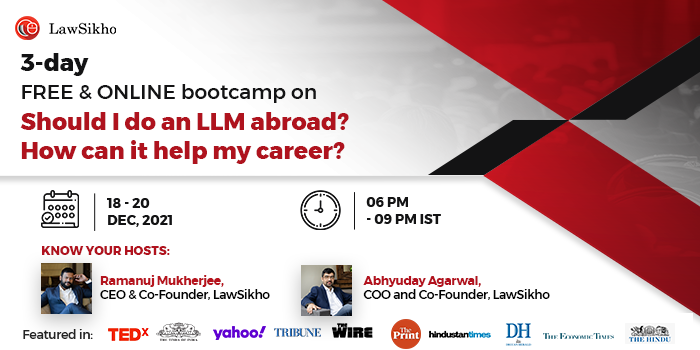
Your LLM will cost you, but I can assure you that this Bootcamp will not! You are one simple click away from registering for our 3-day free Bootcamp and taking the first step towards investing in your future. 

Here, you will gather enough information that will clear any confusion you have regarding which country is best for you to pursue LLM from, which course is the best, and which is the right way for you to go about achieving your dreams.

So mark the date, LawSikho is offering a free Bootcamp on “LLM from abroad and its importance in boosting your career”, from 18th December to 20th December at 6 PM. 

India to Canada is a 14hr-long flight, the company of a friend during the journey would be nice, right? Do share the link with your friends too!  


LawSikho has created a telegram group for exchanging legal knowledge, referrals, and various opportunities. You can click on this link and join: https://t.me/joinchat/L9vr7LmS9pJjYTQ9

Follow us on Instagram and subscribe to our YouTube channel for more amazing legal content.

Download Now

France v. Russia for “Shampanskoye” : an impending GI dispute

0
Image Source: https://rb.gy/ugod5l

This article is written by Anjali Baskar, pursuing Diploma in Intellectual Property, Media and Entertainment Laws from LawSikho.

This article has been published by Abanti Bose.

Introduction

Do you like Basmati rice or Alphonso mangoes? Many of us enjoy these delicacies but do not know that they are named after the place from which they originate. Similarly, you might have heard of the wine “champagne”, coming from a place with the same name in France. The use of this term has been legally protected for a long time through a type of intellectual property, known as a geographic indication (GI). It is a sort of recognition attached to goods that are unique to a specific territory, and have qualities because of it being originated in a geographical region. The features of these products are thus not incidental and should exist by virtue of the product being firstly produced in a location and its reputation of being associated from there. Internationally, GIs are governed by the WTO TRIPS Agreement and under the Geneva Act of the Lisbon Agreement on Appellations of Origin and Geographical Indications. There was an amendment under the Federal Russian Law No. 468-FZ introduced on December 27, 2019, titled “On Viticulture and Winemaking in the Russian Federation” that came into force on 2nd July, 2021. At the instance of the President of the Russian Federation, Vladimir Putin mandated that all foreign producers of sparkling wine should explicitly mention it on the back of the label on all imported bottles for commercial purposes or sale in the country. France felt that this law was discriminatory because of the fact that Russian producers were exclusively allowed to use the Russian word for champagne (“shampanskoye”) on their labels. 

Significance of the Champagne tag in France

France designed a system that identifies GIs and protects it by making it unlawful to produce or sell a product similar to that word, which is known as the “Appellation d’Origine Contrôlée” or Appellation of Original Control (AOC). For champagne, this appellation is not only imposed within France but across 121 other countries where it is being sold, excluding Russia as a signatory. French champagne producers are allowed to write “champagne” in Latin on the label of their imported bottles, but not in Cyrillic. Even if they wrote in Latin, they had to add “sparkling wine” in the Cyrillic script on the back of their bottles.

The legal position of GIs in Russia

Article 1516.1 of Part IV of the Russian Civil Code lays down the definition for GIs, which is similar to Article 22.1 of the TRIPS Agreement. This emphasises that at least one of the stages of processing or production of the item should be carried out in that particular region. Appellations of origin of goods (AOG) are recognised under Section 76(3) and para 2 of Article 1516.1, which deals with the status of intellectual property in accordance with facets of individuality and intellectual activity. This is a type of GI that is protected on exclusive origin from a certain geographic environment and has special properties because of that place. They are not in high demand, because the procedures to register and use AOGs for domestic and foreign manufacturers can be difficult to complete. The process involves meeting certain procedures as prescribed by law. AOG, unlike the examples given at the beginning of the article, do not have to always have the place of origin attached to the term. Some examples of AOGs recognised and registered in Russia include “KURAI”, a wind musical instrument from Bashkortostan or “NARZAN”, which is mineral water native to the Stavropol region. If the designation is related to a certain type of good but is not related to the territory or place where it is produced, it is not considered an AOG, especially under Russian law. An example is Swiss cheese, because it is a certain type of cheese, but not associated with only being produced in Switzerland. Even feta cheese was granted AOG status from Greece after years of struggle in 2005 because it had to prove why it needed recognition when more volumes of the cheese were being imitated by other European countries. After it was recognised, the other countries had to change the name to “salad cheese” or “Greek-style cheese”, but those outside the EU and/or not bound by the Lisbon System still were allowed to use the term “feta”. Russia signed the Minsk Agreement related to “Measures for Preventing and Suppressing the Use of False Trademarks and GIs in 1999”, but GIs were still not governed in detail. AOGs were recognised way before all kinds of GIs were, but GIs finally got a legal framework on July 26, 2018, via the Federal Law Nr. 230-FZ, to boost regional and local brands in Russia. Only 229 GIs have been registered in Russia, out of which around 32 were from foreign applicants.

Why was the Russian Amendment enacted?

The Russian Federation had introduced this law back on October 16, 2019, but discussions by the Federal Assembly of Russia (the State Duma) lasted 3 years before it was enacted. The legislative intent behind amending this rule was to help protect the interests of local or indigenous wine producers, and further boost their exposure to the foreign producers. They wanted to eliminate obstacles in the way of domestic viticulture and the wine-making industry, encourage an increase in the number of native winemakers, support and promote Russian-made wines in domestic and foreign markets and introduce a Russian system for the protection of these products under GI and Appellation of Origin. 

Impact on foreign winemakers selling in Russia

EAmbrosia, an EU GI register, indicates that champagne has been a Protected Designation of Origin (PDO) with the number “PDO-FR-A1359” since 1973. PDO is a term used within the EU and encompasses one of the concepts of GIs as a whole. This appellation indicates that only those who produce sparkling wine from Champagne, France can use the GI tag “champagne” on their labels. This obviously differs from the Russian Amendment, which asks even these original manufacturers to relabel imported wines to “sparkling wine”. Russia has a long history of using brand names that translate to “Soviet Champagne” and “Russian Champagne” for wines that originate in the USSR. The latter is defined under Article 3, para 58.3 of the new law, to solely promote interests in development of regional makers. Under para 43.1 of the same Article, the definition of “Russian cognac” has been enumerated for the first time. Cognac again originates from France, registered in 1989 in eAmbrosia with the number “PGI-FR-02043”. The general rule is that products with GIs or their subsets like champagne and cognac need to comply with established standards of procedure and production to be named so. A problem arises because “Russian Cognac” and “Russian Champagne” contradict Article 1516.2(5), which does not grant GI or AOG status to a trading name that misleads consumers about where the product is manufactured, even if registered in Russia. They will also be illegal in other countries where a GI has already been granted for champagne and cognac. This is one of the major reasons why this new law is not fruitful to regional or foreign producers in Russia.

Conclusion

GIs are significant because they confer distinct and non-transferable rights to their owner, which is similar to what a trademark does in its essence. They facilitate a way for the right holder to market their products, thus increasing demand via exclusivity, for example, the Kancheepuram silk sarees or Portugal’s Port and Douro wines. In India, grants of GIs are currently regulated by the Geographical Indications of Goods (Registration and Protection) Act, 1999. As of November 2021, the current status of the dispute is that France has negotiated a postponement in Russian law until the end of 2021. The Associate Minister for Foreign Trade, Frank Riester, stated that even though this isn’t a permanent solution, it is certainly a better option than the original rule. Russia exports by French winemakers ranks at 15th, wherein 2 out of 150 million champagne and other wine bottles are sold there. Some argue that upper-class Russians do not confuse cheaper domestic wines with authentic champagne made in France, so the law is not adversely affecting French producers as much. The Director-General of the Champagne Committee, Charles Goemacre, called for a temporary ban (example: Moët Hennessy halted production there) on exporting French champagne to Russia, but removed it in September 2021 and agreed to relabel according to the rules after a compromise was made, but the dispute is still far from over.

References


Students of Lawsikho courses regularly produce writing assignments and work on practical exercises as a part of their coursework and develop themselves in real-life practical skills.

LawSikho has created a telegram group for exchanging legal knowledge, referrals, and various opportunities. You can click on this link and join:

https://t.me/joinchat/L9vr7LmS9pJjYTQ9

Follow us on Instagram and subscribe to our YouTube channel for more amazing legal content.

Download Now

Contract of adhesion

0

This article has been written by Shubham Singh pursuing the Diploma in Advanced Contract Drafting, Negotiation and Dispute Resolution from LawSikho

This article has been published by Oishika Banerji

Introduction

In today’s business-driven world, everyone, deliberately or unwittingly, ends up dealing with and agreeing to a few terms and conditions, as well as adhering to a contract’s procedural requirements. A standard type of contract is encountered in some form or another while downloading a programme, installing antivirus software, purchasing an airline ticket, or looking for a home to rent. Contracts of adhesion, form contracts, boilerplate contracts, and take-it-or-leave-it contracts are examples of conventional types of contracts. Contracts of Adhesion are standard form contracts in which one party (generally the stronger side) drafts the contract and another party (generally the weaker side) signs it with no authority to negotiate or amend the contract’s terms and conditions. Because the contractual parties’ bargaining powers or positions differ, such contracts are entered into on an uneven footing.

What is an adhesion contract?

An adhesion contract is one in which one party has much more influence than the other in determining the contract’s terms. Generally, in a contract of adhesion, the offeror or party with the stronger influence provides the  same set of standard terms and conditions to all the customers who approach him. These terms and conditions provided by the offeror are not negotiable implying that the customer or the contract’s weaker party has only the option to refuse the contract or they have to accept it as it is, they cannot ask for terms and conditions to be added, removed or altered. Sometimes, people also refer to contracts for adhesion as boilerplate contracts or basic contracts.

Today, the majority of contracts signed by regular people are not the product of individual negotiations. A collective bargaining agreement between trade unions and employers, for example, will establish an employee’s employment contract. Adhesion contracts are frequently used in insurance, leasing, automobile purchases, loans, and other transactions involving a large number of consumers who are all bound by the same agreement. In a bank loan contract, the bank and its agent have the ability to form the contract, while the potential loan taker has merely the right of refusal; the customer cannot reject the offer or establish a new contract that the bank may accept. 

In earlier days, or since the mass-production economy began, consumers have been vulnerable to contracts of adhesion. The usage of adhesion contracts has increased rapidly in today’s digital and technology-driven era, as many online services and goods are available in the market, and in order to use them, one must accept the user agreement with the terms provided by the service provider.

It is worth noting that each sector or business would have a contract of adhesion that is essentially the same. The provisions or conditions incorporated into such contracts will reflect the same goal of bringing consistency to the market for a certain commodity or service. For example, while signing a lease deal, the typical language states that the renter is responsible for maintaining the property. This is largely done to provide consistency to the market, which will help to reduce the costs that an owner may incur.

History of adhesion contracts 

Although adhesion contracts have their origins in French Civil law, they did not enter American jurisprudence until Edwin W. Patterson’s landmark essay in the Harvard Law Review in 1919. The method was later accepted by most American courts, thanks in part to a 1962 Supreme Court of California decision that endorsed adhesion analysis.

Like other aspects of contract law, the validity and enforceability of adhesion contracts have developed through time. Although case law and interpretation vary by jurisdiction, adhesion contracts are commonly recognized as a cost-effective way to perform traditional transactions. Adhesion contracts, when done correctly, saves firms and consumers time and money in legal fees. The law regulating adhesion contracts, on the other hand, is always developing because digital adhesion contracts signed online have been challenged in court for concealing terms or making some portions difficult to notice. A digital adhesion contract must now be as close to a paper contract as practicable.

Interpretation of adhesion contracts 

A general contract is made and entered into after negotiations have been carried out  between all the parties who have similar equitable semblance of bargaining power. It is done so as to protect the weaker party such that no unfair terms or conditions get enforced. This is not the case when the interpretation is employed in the Contract of Adhesion.

Adherence contracts are interpreted more severely since the weaker party has a greater burden. Since it is impossible to determine whether the consent provided is genuine or not, the distinction between consent to be contractually bound and acquiescence to the contract’s provisions is critical in contract interpretation. As a result, how the contract’s provisions are presented to the other party is a crucial factor in determining whether the deal is fair.

Benefits and drawbacks of adhesion contracts 

Bank lending, insurance, mortgages, leases, and huge purchases are all popular uses for adhesion contracts. Although adhesion contracts tend to promote efficiency and speeds up the purchase process, their usage is debatable owing to some of the possible benefits and drawbacks they may bring, including:

1. Improving business efficiency

Adhesion contracts remove the need for personalized contracts that are unique to each customer by offering a standardised contract that lays out non-negotiable terms and conditions, which promotes efficiency and helps both the buyer and the seller to save some time and improve business efficiency.

2. Lowering transaction fees

Transaction costs are sunk expenses incurred as a result of taking part in a transaction or a good exchange. Communication, negotiation, and enforcement expenses are among them. Adhesion contracts significantly decrease these expenses by delivering all of the information in a legally binding, non-negotiable contract.

3. The buyer’s risk

Non-negotiable clauses are included in adhesion contracts, which are effectively “take it or leave it” contracts. The parties who drafted the contract frequently do so in such a way that any costs associated with the loss or damage of the products being purchased are borne by the buyer. It exposes the buyer to unacceptably high risk, as the buyer may have no alternative but to sign the contract.

4. Unjust terms and unequal power relations

When the drafting party has a lot of negotiating power and the buying party has next to none,  none, and the goods being sold are important to the buyer (like medicinal goods or a house), the buyer may have no choice but to agree on the contract – even if the terms and conditions are unfair and completely in favour of the selling party.

Enforceability of adhesion contracts 

A contract must be presented as a “take it or leave it” transaction in order to be recognized as an adhesion contract, with one party having no opportunity to negotiate due to their inferior bargaining position. However, adhesion contracts are scrutinized, and this inspection typically takes one of two aspects.

To determine whether an adhesion contract is enforceable, courts have typically applied the law of reasonable expectations. Specific sections of an adhesion contract, or the entire deal, may be declared unenforceable under this concept if the contract provisions exceed what the weaker party may reasonably expect. The prominence of the terms, the purpose of the terms, and the circumstances surrounding contract acceptance all influence whether a contract’s expectations are reasonable or not.

In contract law, the doctrine of unconscionability has been used to challenge some adhesion contracts. Unconscionability is a fact-specific theory based on the same equitable principles—specifically, the concept of good faith negotiating. Unconscionability in adhesion contracts generally arises when one party lacks meaningful choice as a result of one-sided contract clauses mixed with excessively onerous terms that no one would or should accept. Simply expressed, a contract might be deemed unenforceable in court if it is very unfair to the signing party.

According to Indian law, there has been no determination that adhesion contracts are unconscionable in itself. However, the courts have dealt with situations in which parties were on uneven footings while negotiating leverage. The Indian Contract Act, 1872 specifically has two clauses that deal with this situation: Section 16 (3) and Section 23.

In accordance with Section 16 (3) of The Indian Contract Act, 1872 it says that: “Where a person who is in a position to dominate the will of another, enters into a contract with him, and the transaction appears, on the face of it or on the evidence adduced, to be unconscionable, the burden of proving that such contract was not induced by undue influence shall lie upon the person in a position to dominate the will of the other.

Furthermore, Section 23 of the Indian Contract Act of 1872 addresses agreements, which are morally reprehensible or contrary to public policy. The Supreme Court of India ruled in Central Inland Water Transport Corporation Limited v. Brojo Nath Ganguly that “an unfair or unreasonable contract entered into between parties of unequal bargaining power was void as unconscionable under Section 23 of the Act.” As a result, if the seller, who has more bargaining power, imposes any unfair, unconscionable, unreasonable, or unconstitutional clauses or terms and conditions, the Indian Courts will intervene and evaluate the contract.

Conclusion 

Due to the large-scale commercialization of activities, companies that serve millions of consumers daily began making contracts with them using a standard form of contract or an adhesion contract, allowing them to occupy a large market share, rather than dealing with each customer individually, which would necessitate a separate contract, which would be a time-consuming and expensive procedure. However, because such contracts are characterized as “leave it or take it,” the inferior party, namely the customer, may be exploited. Since they approved and signed the terms and conditions, the customer does not have an acceptable legal remedy. However, it is also the obligation of the corporate behemoths to maintain a decent Adhesion Contract that does not include one-sided benefits and protection. It is up to the customers to call up any flaws, inequities, or unjust terms that they are exposed to. As a result, courts should consider the evolution of such contracts and guarantee that impartial conditions are enforced between the bargaining parties.

References

  1. The Indian Contract Act, 1872.
  2. Central Inland Water Transport Corporation Limited v. Brojo Nath Ganguly.

Students of Lawsikho courses regularly produce writing assignments and work on practical exercises as a part of their coursework and develop themselves in real-life practical skills.

LawSikho has created a telegram group for exchanging legal knowledge, referrals, and various opportunities. You can click on this link and join: https://t.me/joinchat/L9vr7LmS9pJjYTQ9

Follow us on Instagram and subscribe to our YouTube channel for more amazing legal content.

Download Now

Trading-off citizen’s privacy for national interest

0
Image source: https://blog.ipleaders.in/the-right-to-privacy/

This article is written by Ansruta Debnath, a student of National Law University Odisha. This article discusses the question of the extent to which trading-off right to privacy for national interest is fair and justified.

Introduction

Privacy has been a hotly debated topic, with its implications in a wide array of topics. In the digital world, doubts over privacy have arisen. But the point of contention is not whether privacy is possible, but whether a government can do what it likes all in the name of national interest. Indians and people from the rest of the globe are not unfamiliar with the invasion of privacy by their respective governments. Thus, it becomes crucial to analyze whether trading off privacy for national interests is fair and just and to understand the extent to which such trading-off might be permitted. 

Defining the terms

Privacy

A quick Google search on privacy shows a definition of the term as the “state in which one is not observed or disturbed by other people”. In the present context, ‘not being observed’ is the basic essence of privacy. Every person, by virtue of being a human being, has the basic right to privacy. In the landmark case of Justice K.S. Puttaswamy (Retd) v. Union of India (2017), the Supreme Court declared the Right to privacy as a fundamental right and stated that the said right flowed from the Right to life that was enshrined in Article 21 of the Indian Constitution.   

Privacy permits us to build walls and maintain boundaries to protect ourselves from undue intrusion into our lives, allowing us to decide who we are and how we wish to interact with the world around us. Privacy allows us to set limits on who has access to our bodies, locations, and objects, as well as our conversations and information. Privacy, thus, denotes autonomy and human dignity.

National interest

National interest, in general, refers to the interest of the nation as a whole and not individual or individual groups. Governments take decisions and make policies all in the name of national interest. In a democratic setup like India, it becomes tricky to define what all can be done in the name of national interest because if there is an excessive infringement of rights being done by the government to “protect” national interest, the government turns into an authoritarian and totalitarian government.

What gets supremacy

The general rule is that rights can be restricted for national interest to a reasonable degree. Article 19, which contains rights of speech, association, etc. is not absolute but subject to constraints like integrity and sovereignty of India. Protecting integrity and sovereignty is a very basic national interest, and thus, reasonable restrictions in the name of national interest are justified. Even the right to life is not absolute and it can be taken away by the procedure established by law. Thus, it automatically follows that even the right to privacy, as a fundamental right, is not absolute. Balance must be struck because both these concepts have equal importance in today’s technology-driven world. Just like the areas where privacy needs to be protected is increasing, simultaneously, there are increasing avenues to commit crimes without detection. Technology has become all-encompassing, easily available, and astoundingly advanced. In this environment, safeguarding one’s identity and privacy is as simple as compromising it. Surveillance, whether voluntary or involuntary, of one’s bodily identification through the use of legal or illegal force, is relatively simple through technology.

A balance between the right to privacy and national interest 

It becomes obvious that there must be a balance between a citizen’s right to privacy and the necessity of a government to infringe upon it. In the case of Justice K.S. Puttaswamy (Retd) v. Union of India (2017), the Supreme Court of India laid down that intrusion into life or personal liberty under Article 21, which forms the “bedrock of the privacy guarantee”, would have to be “just, fair and reasonable”. Moreover, Justice Chelameswar, who was part of the nine-judge bench in this case, added another test for privacy claims which deserve the “highest standard of scrutiny” and can be justified only in case of a “compelling state interest”. The most important test is, however, given by Justice Chandrachud. The test called the ‘test of proportionality’, states that invasion of life or personal liberty must meet the three requirements: 

  1. legality, i.e. there must be a law in existence; 
  2. legitimate aim, which he illustrates as including goals like national security, proper deployment of national resources, and protection of revenue; and 
  3. proportionality of the legitimate aims with the object sought to be achieved.

The judgement makes amply clear that intrusion, whether constitutionally valid, needs to be checked on a case-to-case basis and that a common blueprint identifying what is an excessive intrusion and what is not cannot be properly defined. Thus, it is the onus on a democratic government to ensure that they don’t arbitrarily infringe upon their citizen’s right to privacy with the excuse of national interest. 

Current trend: excessive aberrations 

The state has a legal obligation to maintain internal security, law and order, and to prevent crime. In furtherance of this obligation, the state has every right to do whatever is legitimate and reasonable in the exercise of its power. Surveilling people who might affect and cause harm to the security of India is a very normal and natural thing. Although the right to privacy of the said individuals is being affected, in this case, national interest trumps privacy. But, problems arise when the national interest isn’t genuine and the need to violate privacy is being exercised to fulfil the needs of the government. Instead of selective individual surveillance, when continuous mass surveillance is done, the state turns into an Orwellian, despotic government and loses its identity as a democracy. 

Indian laws on surveillance: wide and vague

As mentioned before, a reasonable degree of surveillance has become normal now. Two main laws govern surveillance in India, the Indian Telegraph Act, 1885 and the Information and Technology Act, 2000. Both these Acts allow invasion of privacy to protect national security and national interest. 

Section 5 of the Telegraph Act allows tapping of phones and interception of messages in a public emergency or the interest of public safety. However, these terms of “public emergency” and “public safety” are quite vague, giving ample scope to the government to invade an individual’s privacy under such circumstances. The Supreme Court in People’s Union for Civil Liberties v. Union of India (1996) pointed out a lack of procedural protections in the provisions of the Telegraph Act and established specific parameters that need to be fulfilled to legally intercept anything. Yet, aberrations of those guidelines still probably remain. 

To strengthen the legal foundation for electronic surveillance, Section 69 of the Information Technology Act and the Information Technology (Procedure for Safeguards for Interception, Monitoring, and Decryption of Information) Rules, 2009 were brought about. Under this Act, any electronic data communication can be intercepted.  The scope to intercept, monitor and decrypt digital information is much wider in the case of the Information Technology Act because of the phrase “for the investigation of an offence” in Section 69. This phrase takes away the narrower, albeit undefined, ambit of “public emergency”. 

Pegasus spyware

Unfortunately, the current trend of excessive infringement of the right to privacy is an indicator of the gradual transformation of the Indian Government into a surveillance state. The Pegasus fiasco is just one of the many examples. Pegasus, which is an Israeli spyware, was said to have been used in 2019 to extract, monitor and actively collect data from the phones of over two dozen Indian academics, lawyers, journalists and Dalit activists. Initially licensed to governments to track terrorists and criminals, allegations were made that the government was using that spyware ahead of the 2019 Lok Sabha elections. Even though they were simply allegations, the Indian Government has till now not been able to satisfactorily respond to widespread claims. In essence, the government never specifically denied that they have been illegally using the spyware, dismissed the allegations and refused to discuss the issue in the 2021 monsoon session of the Parliament, all in the name of national security and interest. The Supreme Court of India, headed by Chief Justice of India NV Ramana admitted numerous petitions regarding the Pegasus spyware, and in October 2021 constituted an independent expert technical committee headed by former Justice R.V. Raveendran to examine all the allegations. Making it clear in the order that the State is not entitled to “a free pass every time the spectre of “national security is raised”. A “thorough inquiry” into allegations of unauthorised surveillance using the spyware has been set as the task of the committee. 

Aadhar and its problems 

The Aadhar card scheme was launched in 2010 and is a twelve digit individual identification number issued by the Unique Identification Authority of India on behalf of the Government of India. The number serves as a proof of identity and address, anywhere in India. The Aadhar essentially stores all types of information from demographic to biometric data and is linked to the Permanent Account Number (PAN) and our bank accounts. Its launch triggered numerous questions on whether it breached the citizen’s right to privacy, something which got exacerbated by the 2018 Aadhar data breach, which the World Economic Forum declared as the largest recorded breach in its Global Risks Report.

Thus, apart from data protection concerns, the main contention was that the biometric data being stored by the government would just become another means of surveillance. 

International forum

Article 12 of the Universal Declaration of Human Rights, which was internationally adopted in 1948, states “no one shall be subjected to arbitrary or unlawful interference with his privacy, family, home or correspondence, nor to unlawful attacks on his honour and reputation and that everyone has the right to the protection of the law against such interference or attacks.” Furthermore, Article 17 of the International Covenant on Civil and Political Rights (1966) reiterates the same principle. Thus, even in the international forum, the basic principles of the right to privacy resonate. 

The International Covenant on Civil and Political Rights, to which India is a signatory also stated as a general comment (No. 16) to Article 17 that personal information collected and stored on computers, data banks, and other devices, whether by public authorities or private people or groups, must be governed by law. States must take effective steps to guarantee that information on a person’s private life does not fall into the hands of others who are not legally entitled to receive, handle, or use it, and that it is never used for purposes that are incompatible with the covenant. To ensure the most effective protection of one’s private life, every individual should have the right to know, in an understandable manner, if and what personal data is saved in automated data files, and for what purposes. 

Need for established law

In 2012, a Planning Commission-appointed group of experts led by Justice (retd.) A.P. Shah issued a thorough report outlining a framework for a Privacy Act. It stated that such legislation should recognise all aspects of the right to privacy and address issues about data security, protection from unauthorised interception and monitoring, use of personal identifiers, and physical privacy. Outlining a set of privacy principles, the committee stated that the data controller should be held accountable for the collection, processing, and use of data. The government cannot neglect its obligation to safeguard citizens from the risks of the cyber era in its eagerness to gather data in electronic form and better target subsidies.

Yet, adequate privacy legislation has still not come into existence. The above discussion makes it quite clear that there is an urgent need for the said legislation. Countries like the United States have already begun the process of legislating comprehensive data privacy laws, with individual states bringing about laws like the Californian Consumer Privacy Act, 2018. The European Union on the other hand brought about the extensive General Data Protection Regulation in 2018. 

Conclusion

The initial question that was asked at the beginning of the article was whether trading off citizens’ right to privacy is fair. It can be concluded that while that trade-off is legitimate to a certain degree, excessive invasion of privacy does not have any legal basis. Using national interest as an excuse cannot be permitted anymore. Laws in foreign jurisdictions have shown that comprehensive privacy laws are possible. The only thing left to do is for the lawmakers to make them.

References

  1. What is Pegasus spyware: All you need to know | India News
  2. Explained: The laws for surveillance in India, and concerns over privacy
  3. Conflict and Scope of Fundamental Right to Privacy: Who’s Watching You? – Academike
  4. Privacy versus National Interest – An overview – The Law Blog
  5. Justice K.S.Puttaswamy (Retd) vs Union Of India on 26 September 2018

LawSikho has created a telegram group for exchanging legal knowledge, referrals and various opportunities. You can click on this link and join:

https://t.me/joinchat/L9vr7LmS9pJjYTQ9

Follow us on Instagram and subscribe to our YouTube channel for more amazing legal content.

Download Now

Legal applicability of defamation notice sent to Netflix India for ‘Hasmukh’

0

This article is written by Rida Zaidi, a law student of the Faculty of Law, Aligarh Muslim University. The author tries to deal with the legal applicability of the defamation notice sent to Netflix India for a satirical show ‘Hasmukh’ which exposes the ills of the legal profession.

This article has been published by Rachit Garg.

Introduction

“Legal profession has always been an important limb for the administration of justice. Without the profession of law, the courts would not be in a position to administer and provide justice efficiently. Such an act of defaming the legal professionals among the general public in India through an online TV series on web portals is clearly an act falling within the ambit of defamation.”

The legal profession is noble employment and is the very fabric of every society. Lawyers undertake to serve people from all walks of life with utmost diligence. Legal Community rests the interest of the people above all. Though the goodwill of the titled profession of law gets maligned sometimes by the media houses or by certain people who promote that the law profession is full of corruption and fallacy. One such example is of a comedy series named ‘Hasmukh’ streaming on Netflix India which made certain derogatory comments regarding the legal community and the law professionals. It has jeopardized the sentiments of the law professionals as they feel that through the series the grandeur and image of the said community would depreciate as the online streaming platform on which this series airs is Netflix India which bears around 150 million subscribers. Two advocates have sent a defamation notice to the streaming platform Netflix India and the producers and comedian for removing or deleting the false and inauthentic content which brings disregard to the entire legal community from their platform. They have also warned the producers and the performers to do the needful otherwise this could lead to the initiation of civil or criminal proceedings against them. 

This article shall deal with the legal relevancy of the defamation notice sent and what the Court concluded regarding the said issue.

Contents of the defamation notice

The defamation notice was sent by advocate Abhishekh Bhardwaj and advocate Hardik Vashishth to Netflix entertainment services who were the broadcasters, Emmay Entertainment who were the producers and Vir Das who was the performer. The notice stated the following concerns-

  1. The notice pointed out that Netflix is one of the largest online streaming platforms which enjoys subscribers from every corner of the World.
  2. The series ‘Hasmukh’’s season 1 of episode 4 titled ‘Bumbai mei Bambu’ alleged the lawyers as ‘rapists, scoundrels, thieves and goons’
  3. The derogatory statements made against the law community and its professionals would dishonour and disregard the standing of the noble profession of law and would damage the cordiality of the legal profession. It may also lead to impugning their role in the eyes of the general public.
  4. The damage that it will cause cannot be justified by any reasoning or logic whatsoever, as the stretch of damage is non-compensable through any monetary compensation.
  5. The series ‘Hasmukh’ is an intentional attack on the reputation of the lawyers and has resulted in character assassination of the law professionals who have selflessly served every section of society.
  6. The derogatory statements made by the protagonist of the show has defamed the lawyers and their white-collar job.
  7. The advocates have called for an unconditional apology by the producers and the performer that the aspirations made by them in the series ‘Hasmukh’ is frivolous and has defamed the lawyers.
  8. They have also asserted the removal or deletion of the particular content from the Netflix platform.
  9. They have also stated that if the producers and the performer failed to comply with their notice they would initiate both civil and criminal proceedings for which all the cost and consequences shall be borne by the production, the performer, the streaming platform Netflix.

Defamation under the Indian Penal Code

Defamation, as defined under Section 499 of the Indian Penal Code (1860), is publishing any statement by either word spoken or written or expressed through signs and gestures defaming someone in the eyes of the reasonable people of the society or have reason to believe that such imputation would harm the reputation of the concerned person or body of persons. Section 500 of the Indian Penal Code prescribes simple imprisonment for the offender which may extend to two years or more or with a fine or both.

Exceptions of defamation

The exceptions of defamation under Section 499 of the Indian Penal Code are as follows-

  1. Truth in a defamatory remark

Where the information published is such which is true and is made for the public good, it acts as a defence for defamation.

  1. Just Criticism of Public Servant

Where a public servant has discharged his functions in his official capacity and it appears to be wrong to someone belonging to the class of general public is not an act of defamation.

  1. Comments made in good faith

The important ingredient lies in the fact that the concerned statement or information is made or delivered in good faith.

  1. Fair comment regarding public men

Where criticism is expressed against public men, it does not amount to defamation.

  1. Recordings of decisions of case proceedings

Where any information is regarding the decision of a court case or reports of a Court case, it shall not be defamatory.

  1. Quality of comments or witnesses

Where the comments are regarding the merits of a case or regarding the conduct of the witnesses.

  1. Critiquing literature

Where an author has submitted his work for judgement in the eyes of the general public, any review given by someone regarding that particular work of the concerned author would not amount to defamation.

  1. Censuring authority

When someone disapproves of another’s conduct that would not amount to defamation except if the disapproving party is the censuring authority or it has a binding authority arising out of any valid contract.

  1. Lawful authority

Where a person or body of persons has lawful authority to condemn another.

  1. Where a person imputes against another for the sake of protection of his interests or the public good, it does not amount to defamation.

Ashutosh Dubey v. Netflix India & Ors (2020)

Plaintiff- Ashutosh Dubey

Defendants- Netflix India & Ors

Facts of the case

  1. The plaintiff seeks an injunction notice against the further airing of episode 4 of season 1 of the show ‘Hasmukh’
  2. The protagonist has made some serious disparaging and defamatory comments against the lawyers which malign their reputation.

Contentions of the plaintiff

  1. The learned counsel asserted that the remarks that were made against the lawyers were not at all humorous or satirical and do not fall within the boundaries of a critique.
  2. The derogatory remarks were extremely dishonouring against the legal profession and its professionals. Furthermore, it creates a stigma upon the image of the lawyers in the eyes of the general public.

Contentions of the defendant

  1. The learned counsel for the defendants contended that the plaintiff has no prima facie evidence to show that he received any personal injury or violation of any of his rights which entitles him to the grant of an injunction.
  2. The series is a satirical dark comedy surrounding the protagonist who is a comedian who pursued his career by performing in comedy shows. In the particular episode 4 of the series ‘Hasmukh,’ he encountered a lawyer who was greedy, violent and duped him into entering an unfavourable Contract for which the lawyer charged him exceptionally high fees and eventually the protagonist murders him.
  3. The lawyers cannot be defamed as ‘class of lawyers’ and the plaintiff cannot be defamed as an individual by general reference of the class to which the individual belongs.
  4. Whenever any defamatory remarks are made they are made against a definite and determinate body of persons or an individual so that it can be said that it is imputed against these persons.
  5. The plaintiff has failed to show any cause behind instituting the suitor that he has encountered any injury or an irreparable loss.
  6. The series is a fictional one and is a result of imagination and humour and it must be taken in that particular way only.
  7. The particular comments were made by the protagonist in the concerned episode when he was deceived by the professionals of the law field and eventually as a result of his experience he made the satirical comments.
  8. As the web series is a satirical dark comedy, the comedian has just tried to expose the ills of all professions including the law profession and to deliver satirical comments a point is exaggerated to the extent that it becomes satirical.
  9. As the viewers are well versed with the fact that it is a comedy show any statement made by the protagonist would not be believed by them as a matter of truth and they would take it with a pinch of salt.
  10. Satire is a work of art and uses various techniques such as exaggeration, reversal, parody, etc. to ridicule its subject to the extent that it becomes satirical.
  11. Granting an injunction would result in the interference of freedom of speech and expression of the defendants which is guaranteed under Article 19(1)(a) of the  Constitution.

Observation of the Court

The Court observed that, for the imputation of defamation under Section 499 of the Indian Penal Code derogatory remarks are to be made against an identifiable group of persons or individuals and in the present case the remarks that were made by the protagonist against the legal community were not made against a determinate or definite body of persons and lawyers as a class cannot be defamed. Furthermore, the plaintiff cannot assert that the general reference of satire that was made was specifically directed towards him. The plaintiff failed to show any evidence as to prove that he received any injury or violation of any of his rights by delivering such remarks by the protagonist. The derogatory remarks that were made against the legal profession which seeks to disparage the reputation of lawyers in the eyes of the general public were held by the Court to be made out of satire as the show was satirical. The series ‘Hasmukh’ is a satirical dark comedy that tries to expose the ills of the legal profession, particularly in the 4th episode. Satire is delivered by exaggerating the point to the extent that it becomes humorous. The Court dismissed the application of interim injunction by the plaintiffs as granting one would result in the restriction of fundamental rights of the defendants which is freedom of speech and expression as guaranteed under 19(1)(a) Article of the Constitution.

Precedent judgements referred in this case

  1. Asha Parekh & Ors v. State of Bihar & Ors(1977)

The Patna High Court observed that for an offence of defamation the words or visible representations made should be imputed concerning a class of persons and whose reflection has to be established by the plaintiff and where it cannot be established that is the plaintiff is not able to prove any personal injury incurred on him or violation of any of his rights and when the remarks apply equally to the rest of the people belonging to that class, the case does not attract Section 499 of the Indian Penal Code.

  1. Shahrukh Khan v. State of Rajasthan & Ors(2008)

The Rajasthan High Court held that for any defamatory statement to be actionable it should be remarked against a definite and identifiable group of persons and lawyers as a class is too wide. It is not a homogenous group of persons and is a heterogenous one. Furthermore, it is too varied and is ever-changing as old lawyers depart and new lawyers enter the profession.

Conclusion

Defamation is the act of defaming another either through words spoken or written in a way that his reputation gets injured in the eyes of the reasonable men of the society. One such incident mentioned here is regarding a defamation notice sent to Netflix India for streaming a satirical show on its platform which disparages and disreputes the image of the lawyers and the legal profession. The advocates which sent the concerned notice stated that it has hurt the sentiments of the law professionals as it injures the goodwill of the lawyers who belong to a noble profession and works selflessly for society. It has asked the defendants for the removal, deletion of the defamatory content otherwise they would initiate civil or criminal proceedings. Another suit was instituted regarding the same issue where the Court held that the granting of the interim injunction would mean interference in the exercise of the fundamental rights of the defendants which goes against the essence of democracy. The show is a satirical dark comedy exposing the ills of the legal profession and was not intended to disrepute the lawyers’ reputation. Therefore, the Court dismissed the application for grant of an interim injunction by the plaintiff.

References

  1. https://www.livelaw.in/news-updates/defamation-notice-sent-to-makers-of-netflix-show-hasmukh-over-remarks-on-lawyers-155519
  2. https://globalfreedomofexpression.columbia.edu/cases/ashutosh-dubey-v-netflix-inc/
  3. https://lawstreet.co/celebstreet/hasmukh-defamationnotice-netflix/
  4. https://www.latestlaws.com/latest-news/defamation-notice-served-to-netflix-s-show-hasmukh-over-inauthentic-content-against-legal-community

LawSikho has created a telegram group for exchanging legal knowledge, referrals and various opportunities. You can click on this link and join:

https://t.me/joinchat/L9vr7LmS9pJjYTQ9

Follow us on Instagram and subscribe to our YouTube channel for more amazing legal content.

Download Now

Top 20 universities for LLM in the United Kingdom

0
Image source - https://bit.ly/323Dgt2

This article has been written by Amulya Bhatia and has been published by Diva Rai.

Imagine this…

You want to purchase a new pair of jeans for yourself so you go to the mall. You step into the first store that you see and buy the first pair of jeans that comes into sight. When you go home and try the jeans, you realize that the fit, style, or color doesn’t suit you at all.

Now tell me, is it wise to purchase a piece of clothing so callously? This shows the importance of analyzing all options and aspects before making any decision, even if it is concerning something as simple and trivial as buying clothes.

What about the big decisions which have a direct bearing on your future? For example, decisions as confusing as choosing the right university to pursue LLM from. There’s nothing to worry about though. We got you! 

This article lists down the top 20 universities for LLM in the United Kingdom to make the exhausting task of choosing a university a little easier for you.

But hold on, before deciding the kind of jeans you want, you have to choose where to buy these jeans from, right? Whether it is Zara, H&M, or Forever 21? Similarly, before learning about the best universities for LLM in the UK, it is important to question why choose UK at all?

Pursuing LLM abroad has the power to boost your career and take it to the next level due to benefits like obtaining a specialized degree, obtaining practical experience abroad, growing your international network, an opportunity to trail a career in academia, and studying from a globally recognized university. These reasons make it all the more important to decide where to do LLM from. 

The United Kingdom is a popular destination for LLM aspirants who wish to study at some of the oldest and most prestigious universities in the world. Some of the world’s largest and most well-known law firms are based in the UK, such as Clifford Chance LPP and DLA Piper, providing a massive potential to law students to gain work experience or maybe even get placed at these firms. The range of legal programs offered by these top universities can excite you and leave you flabbergasted at the same time! But, we are here to help you.

Here’s a list of the top 20 universities to pursue LLM from in the UK:

1. University of Cambridge 

The University of Cambridge is one of the oldest and most reputed universities in the whole world. The Faculty of law is considered to be top-notch and is highly regarded. The school offers an LL.M. as well as a Master in Corporate Law (MCL). 

  • The cost to pursue an LLM from the University of Cambridge ranges from Rs. 35,00,000- 50,00,000.

2. University of Oxford

This University also has a long history which makes it all the more distinguished. The university continues to remain a thriving community of scholars who are dedicated to forming a fruitful community of academics. The school has been listed as the top school in International Tax Law and Finance Law by LLM GUIDE. 

  • The cost to pursue an LLM from the University of Oxford ranges from Rs. 30,00,000 to 40,00,000 annually.

3. The London School of Economics and Political Science

On top of the charts for academics, the Department of Law at this university is one of the largest and esteemed in the world. 

London School of Economics and Political Science offers to LLM aspirants specialization in: 

  • in Human Rights Law, 
  • Intellectual Property Law, and 
  • European Law,

while being the leading law school for International Tax Law, Competition Law, and Banking/ Finance/Securities Law. 

  • The cost to pursue an LLM from The London School of Economics and Political Science from Rs. 23,00,000 to 40,00,000. 

4. University College London

The University is research-oriented with diverse researchers, professors, students, alumni, and leading academics. Law at UCL is ranked number 3 in the UK by the Times Good University Guide 2022

  • The cost to pursue an LLM from the University College, London ranges from Rs. 25,00,000 to 40,00,000.

5. Queen Mary University of London

Queen Mary University is an established university situated in London. With one of the best programs for law in the world, the university offers students the freedom to create their customized degrees by offering a wide range of LLM modules. 

  • The cost to pursue an LLM from the Queen Mary University of London ranges from Rs. 25,00,000 to 45,00,000.

6. King’s College London

The Dickson Poon School of Law is the law school of King’s College London. The University has consistently maintained a position in the top 10 universities for law and is recognized globally as UK’s premier law school. If law school isn’t just about academics for you, this university is your go-to. They have a proactive student community engaged in pro bono and mooting activities alongside their core studies. 

  • The cost to pursue an LLM from the University of Oxford ranges from Rs. 26,00,000 to 40,00,000.

7. University of Edinburgh – Edinburgh Law School

University of Edinburgh is one of the oldest universities in the UK. Edinburgh Law School is the department of law under this university. The law school is research-oriented and is dedicated to teaching law. Joining Edinburgh Law School is your chance to join a thriving community of researchers and legal professionals who are the best in the world. 

  • The cost of studying LLM from the University of Oxford ranges from Rs. 24,00,000 to 30,00,000.

8. University of Durham – Durham Law School

Durham Law School is a world leader in legal education and research. They are research-oriented and have engaged through their research both nationally and internationally. The law school has produced good results in both, providing the students a wide range of electives to choose from, and executing a good employment rate. 

  • The cost of studying LLM from the University of Oxford ranges from Rs. 22,00,000 to 28,00,000.

9. University of Nottingham – School of Law

The School of Law at the University of Nottingham has one of the country’s top legal research centers. The school offers a wide range of LLM programs that cover: 

  • Human Rights Law, 
  • Maritime Law, 
  • Public International Law, and more. 
  • The cost of studying an LLM from the University of Oxford ranges from Rs. 20,00,000 to 25,00,000.

10. University of Bristol – School of Law

Bristol was named as the best place to live in the UK which makes it an even better place for a student. Whether it is international-level research or social life, this university has it all. The law school finds itself in the top 10 and offers many LL.M. programs, ranging from Commercial Law to European Legal Studies. 

  • The cost to pursue an LLM from the University of Oxford ranges from Rs. 18,00,000 to 23,00,000.

11. University of Aberdeen – School of Law

The University other than being in the top 10 in the UK, has a student satisfaction rate of 94%. They offer an extensive range of courses to specialize in with a very supportive environment. The School of Law takes pride in focusing on issues in contemporary times from a legal lens. 

  • The cost to pursue an LLM from the University of Oxford ranges from Rs. 18,00,000 to 25,00,000.

12. Swansea University – Hillary Rodham Clinton School of Law

The law school holds several accolades for having the best research centers with an international reputation. As a student of the Hillary Rodham Clinton School of Law, you shall be trained to fight for a place in the cut-throat legal world. 

  • The cost to pursue an LLM from the University of Oxford ranges from Rs. 17,00,000 to 21,00,000.

13. Cardiff University – Cardiff Law School

Cardiff Law School, located at the heart of Wales’, is well-known for its socio-legal research and high level of teaching. The law school offers a wide range of courses for LLM aspirants. 

  • The cost to pursue an LLM from the University of Oxford ranges from Rs. 25,00,000 to 30,00,000.

14. University of Glasgow – School of Law

The LLM program is a year-long at the University of Glasgow with an annual intake in September. The law school offers different specializations in the field of corporate law, and also allows the students to choose their electives and create a program of their choice in this field. 

  • The cost to pursue an LLM from the University of Oxford ranges from Rs. 13,00,000 to 18,00,000.

15. University of Kent – Kent Law School

Kent Law School pays special emphasis to the skills of negotiating and mooting and allows the student to gain practical knowledge through pro bono cases by Kent Law Clinic. The university is also in the top 10 in the world for its research intensity. 

  • The cost to pursue an LLM from the University of Oxford ranges from Rs. 17,00,000 to 24,00,000.
Image source: https://lawsikho.com/course/certification-course-in-international-commercial-arbitration

16. SOAS University of London

The Law department at SOAS University of London is meant for students that wish to make a difference as the programs focus on how law can positively impact society. The SOAS alumni include lawyers, judges, politicians, businessmen/women, and activists throughout the world. 

The University offers specialization in: 

  • Environmental Law, 
  • Human Rights Law, 
  • International Commercial Law and 
  • Economic Law. 
  • The cost to pursue an LLM from the University of Oxford ranges from Rs. 23,00,000 to 30,00,000.

17. University of Birmingham – School of Law

World-class teaching, a wide range of legal programs, and an opportunity to push your legal career on the right track is what studying at this law school would look like. 

Birmingham offers specialization in: 

  • Commercial Law, 
  • Criminal Law, 
  • International Commercial Law, 
  • International Law and Globalisation, 
  • International Law: Crime, 
  • Justice and Human Rights; and 
  • International Trade Law. 
  • However, there is flexibility to create a customized degree based on your interests.
  • The cost to pursue an LLM from the University of Oxford ranges from Rs. 20,00,000 to 28,00,000.

18. University of Manchester – School of Law

The law school at the University of Manchester is globally recognized. Through this degree, you can enter the legal profession as a barrister through an award recognized by the Bar Standards Board or take the first steps to qualification as a solicitor through our collaboration with BARBRI to prepare you for the Solicitors Qualifying Exam after graduation. 

  • The cost to pursue an LLM from the University of Oxford ranges from Rs. 24,00,000 to 30,00,000.

19. University of Strathclyde – The Law School

The University of Strathclyde is the second-oldest university in the United Kingdom. The law program at the university is research-based, focused on how the law must change along with changing times. Human rights, criminal justice, and internet law are some of the programs available for LLM aspirants to pursue here. 

  • The cost to pursue an LLM from the University of Oxford ranges from Rs. 18,00,000 to 25,00,000.

20. University of Dundee

The law school in the university doesn’t focus solely on legal knowledge and gives importance to understanding complex problems based on which persuasive arguments can be given. The University is best known for its International Criminal Justice and Human Rights program. 

  • The cost to pursue an LLM from the University of Oxford ranges from Rs. 19,00,000 to 27,00,000.

What exactly are you waiting for now? Dig deep into this wide range of universities to understand which suits you best. 

Oh! I know what you’re thinking now. 

The United Kingdom is one of the most expensive places to live in. So how exactly can one afford to study LLM in the UK? Don’t worry, we’ve got you. Here’s what you can do.

The most common solution is to find out the availability of scholarships offered by the university that you wish to study in. Many of the scholarships in the UK are open to meritorious international students. These scholarships can be partial or fully paid, depending on the criteria, course, and the institution offering them. For example, the University of Dundee is offering partial scholarships to make its programs affordable for all students. 

The UK government also offers loans to selective international students for their master’s degrees. For example, England offers master’s loans of up to £11,570 for courses starting in 2021-22.

While there are tons of other ways to finance your LLM, what about jobs, freelance opportunities, a career as an academic and other benefits of pursuing LLM? How do you get the most out of them? 

Here is a bonus for you!

We are here with a FREE 3-day online Bootcamp to answer any and every question around ‘Should I do an LLM abroad? How can it help my career?’ from 18-20 December, 6-9 pm Indian Standard Time.

Registration Link: https://lawsikho.com/llmbootcamp

The Bootcamp will be hosted by Ramanuj Mukherjee, CEO & Co-Founder of LawSikho, and Abhyuday Agarwal, COO & Co-Founder of LawSikho.

If you have already registered, don’t forget to share this opportunity with your friends, colleagues, or classmates!


LawSikho has created a telegram group for exchanging legal knowledge, referrals and various opportunities. You can click on this link and join:

https://t.me/joinchat/L9vr7LmS9pJjYTQ9

Follow us on Instagram and subscribe to our YouTube channel for more amazing legal content.

Download Now

Why is international commercial arbitration a preferred mode for dispute resolution in international transaction

0

This article has been written by Anisha Saksena, pursuing a Diploma in International Business Law from LawSikho.

It has been published by Rachit Garg.

Introduction

With the emerging trend of doing business “internationally”, international commercial contracts have become the backbone of international trade. From the United Nations Convention on Contracts for the International Sale of Goods (Vienna) in1980 to the UNIDROIT Principles of International Commercial Contracts in 1994 and the Hague Principles on Choice of Law in International Commercial Contracts in 2015,  international commercial contracts have had a long journey of recognition and application. 

It is an obvious fact that if a commercial relationship emerges, there are chances of having disputes between the parties. International commercial disputes can lead to major trade conflicts with serious political and economic repercussions. That is why it is essential that these disputes get resolved fairly, quickly and efficiently. For the purpose of settling the existing or future disputes arising from an international commercial contract, the parties usually decide and specify the dispute settlement forum beforehand by adding a “choice of forum for dispute resolution” clause along with “applicable law” clause in their contract. This is done so that there is no inconvenience or discrimination to either party or conflict regarding the choice of forum after the contractual relationship is made.  The forum decided can either be a local court via litigation as per the agreed applicable law or any alternative dispute resolution court. 

The most commonly used alternative dispute resolution (ADR) court is International Commercial Arbitration. Arbitration is a consensual mechanism used for dispute settlement where disputes are heard outside of courts before one or more arbitrators. These arbitrators are chosen by the parties and the award granted by the arbitrators is final and binding on the parties. Without the element of ‘final’ and ‘binding’, there can be no international commercial arbitration.

International commercial arbitration is the most preferable mode for dispute resolution in international transactions around the world. This article explains the reasons as to why international commercial arbitration is the preferred mode for dispute resolution in international transactions.

Why Is International Commercial Arbitration Preferable?

Ease Of Enforcement

The arbitral awards have a higher degree of recognition as compared to a decision of foreign court. The credit for such recognition goes to the Convention on the Recognition and Enforcement of Foreign Arbitral Awards, also called  “the New York Convention of 1958”. As said by the Secretary of UNCITRAL, Renaud Sorieul, the Convention on the Recognition and Enforcement of Foreign Arbitral Awards is the cornerstone of the international arbitration system. 

According to the Article III of the New York Convention, 1958, arbitral awards are binding and enforceable in accordance with the rules of procedure of the territory where the award is relied upon. The New York Convention has made the enforcement of arbitral awards far easier than the enforcement of a court judgment.

The New York Convention has been signed by over 169 countries; this means that most of the major countries have accepted the recognition of arbitral awards and its enforcement process. Thus, the enforceability of an arbitral award can be ensured due to the New York Convention.

On the contrary, when it comes to foreign court judgments, its enforceability, outside of the country whose court rendered it, cannot be ensured. Although there are several conventions enforcing the foreign court judgments like the Lugano Convention 2007 or the 2019 Hague Convention on the recognition and enforcement of foreign judgments in civil and commercial matters, they are not as widely accepted as the New York Convention. This makes the enforceability of the foreign court judgment uncertain. The enforceability depends on the country’s procedural laws which vary country to country and the Convention that the country has signed. 

For instance, in the United States of America, the States rely on state laws and common laws instead of a uniform federal law for the recognition and enforcement of foreign judgments. The State laws are derived from two main model acts, which  are the  Uniform Foreign Money Judgments Recognition Act, 1962 and the Uniform Foreign-Country Money Judgments Recognition Act, 2005. In order to recognize and enforce the foreign judgment, the party has to prove that the Uniform Foreign-Country Money Judgments Recognition Act, 2005 applies to the judgment. States like Arizona, Georgia and Massachusetts, have made it mandatory that the foreign judgments will be recognized in their states only if the American judgments are enforceable in the country in which that particular foreign judgement was made. If American Judgments are not enforceable in that particular country then this is called ‘the lack of reciprocity’ and it is a mandatory ground for non-recognition of foreign court judgments in these states. In some states of America like Florida, Idaho, North Carolina, Maine, Ohio and Texas, this ground is a discretionary ground for recognition.

Moreover, according to Section 328 of German Code of Civil Procedure, foreign judgments, involving claims other than non-pecuniary claims, cannot be enforced in Germany if there is lack of reciprocity.

Both of these instances prove that enforceability of foreign judgments is not guaranteed and its process is very complex due to the varying laws around the world. On the other hand, arbitral awards are easily enforceable because they are internationally recognized due to the widely accepted New York Convention.

Privacy And Confidentiality

Major corporations, especially in high profile cases, want to resolve their disputes without getting in the eye of the general public, competitors and media as this can bring bad publicity for their firm. Since most of the court proceedings are held in public, the element of “privacy” and “confidentiality” cannot be obtained in litigation. 

However, the arbitral process is a very private and confidential process. In some arbitral rules, parties are free to provide a provision in their arbitration agreement stating that the arbitration procedure will be private and confidential. The confidentiality can be to an extent that even the existence of the arbitral proceedings between parties is not allowed to be revealed. 

According to Article 30 of the London Court of International Arbitration (LCIA) Rules:- 

Unless the parties expressly agree in writing to the contrary, the parties undertake as a general principle to keep confidential all awards in their arbitration, together with all materials in the proceedings created for the purpose of the arbitration and all other documents produced by another party in the proceedings not otherwise in the public domain – save and to the extent that disclosure may be required of a party by legal duty, to protect or pursue a legal right or to enforce or challenge an award in bona fide legal proceedings before a state court or other judicial authority.

More Control Over Parties

Arbitration gives more control to the parties over the proceedings than any other court could give. Litigation is not flexible like international commercial arbitration.

Arbitration is a consensual procedure. This means that the parties have to agree and give their consent to arbitrate. Only after the parties consent, an arbitration procedure can occur. 

Parties have the right to choose the arbitrators and the number of arbitrators. Parties even have control over the authority of the arbitral tribunal. They can limit the authority of the tribunal to which they have agreed in their arbitration agreement. They can also agree to various essential details of proceedings that can make the arbitral procedure cheap, private and time-effective. In litigation, there are no such rights to the parties.

Furthermore, the parties can choose their preferred date of hearing or trial, the place of arbitration and the governing law. They can also agree to a procedure that is most appropriate for resolving their disputes. 

Neutrality

Litigating in the ‘home-country’ of one party can be unfair to the other party. Generally, courts are biased against the foreign party and rule in favor of the local party. 

In addition to that, litigating in a domestic country is expensive enough; forget about litigating in foreign country. There are language barriers that can waste  a lot of time. It is very difficult and costly to litigate in a country whose language may or may not be known by the foreign party’s lawyers or/and may or may not be the language of the contract. Also, the foreign party may not be acquainted with the procedural laws of another party’s national courts. All these will not just waste time but will also increase the cost of litigation for the foreign party. 

It is unfair for one party to bear so many difficulties and the other party to be at ease because the case proceedings are held in their domestic court.

Arbitration is a perfect choice for fair settlement of disputes. Parties can choose their arbitrators and the applicable law. With the help of international arbitration rules which are applied by multinational tribunals, parties can have a fair and neutral dispute settlement. The International Chamber of Commerce (ICC) Rules of Arbitration, 2021 are widely accepted rules that provide a  neutral framework for the resolution of cross-border disputes.

According to Article 18 of the UNCITRAL Model Law on International Commercial Arbitration, 

“The parties shall be treated with equality and each party shall be given a full opportunity of presenting his case.”

This has started a trend to allow full autonomy to the parties and the tribunals with regard to the conduct of the proceedings thus guaranteeing neutrality.

Cases When State Is A Party 

When a State is a party, its domestic courts will apparently be biased against the foreign party as the State can easily influence its domestic courts. Moreover, arbitration in that State can also be influenced by the State. In such cases, the other party has an option to arbitrate in any arbitration organization situated in a third country. There are so many competitive and leading arbitration organizations around the world that provide neutral and efficient arbitration procedures. 

Expertise And Quality-Judgments 

As said before, parties can choose the arbitrators for their arbitration procedure. These arbitrators can be chosen on the basis of their expertise or experience in the field/industry to which the particular dispute is related. They can select arbitrators who are experts in  International Arbitration as well. This ensures that the award is granted after carefully considering all the aspects of the disputes.

On the other hand, in domestic courts, there are higher chances that the proceedings will be held by a judge who has little to no expertise/experience that is relevant to the dispute. Due to lack of sufficient time and overload of cases, courts, sometimes, cannot provide good  judgments whereas arbitration can provide great  judgments.

Not Appealable 

Court judgments can be appealed in higher courts. This leads to delay in enforcing the court judgments. But arbitral awards are final and non-appealable on the merits and therefore quickly enforceable. Only in certain cases, the arbitral awards are appealable, for example  if a party was incompetent at the time of execution of arbitration agreement or if the composition of the tribunal or the arbitral procedure was not according to the arbitration agreement.  

Faster And Cheaper

The litigation process involves high cost, excessive documentation and is very time-consuming. The path of litigation is a very lengthy and an expensive path. There are strict rules and regulations of the court that the parties have to abide by. 

On the other hand, parties can choose for a speedy arbitration at lower costs. Arbitration is a very cost-effective process. There are  no court fees in arbitration and the parties can agree for a fast-track procedure or any other procedure that is tailor-made for their dispute. In some arbitral rules, parties can set a time limit for the award to be granted and can also limit the extent of time-consuming or expensive procedures e.g. limiting the extent of document disclosure. This is also one of the reasons as to why firms prefer International Commercial Arbitration for dispute settlement. 

Conclusion

Due to several conventions, arbitral awards have become recognized throughout the world and are easily enforceable. This has led to an increase in the usage of the cost-effective process of International Commercial Arbitration in the disputes involving transnational relations/transactions. 

Litigation has become less preferable in  international transactions due to its lengthy and expensive nature. Moreover, the parties also fear that the litigation process in the country of one party can be biased and unfair against the foreign party. 

On the other hand, international commercial arbitration is more attractive because the parties have an advantage of having a more fair and desirable procedure for solving their disputes. Arbitration procedure gives more control to the parties. And the icing on the cake is the aspect of “privacy and confidentiality” in the arbitration process. Parties can solve their disputes without the bad publicity that generally comes along when disputes, especially high profile cases, are handled through litigation. 

Hence, it can be concluded that International Commercial Arbitration has proved to be a preferable method of dispute resolution in international transactions.

References

American Private International Law, 2008 – Prof. Symeon C. Symeonides – Kluwer Law International 

https://uncitral.un.org/en/texts/arbitration/conventions/foreign_arbitral_awards/status2

https://www.nyulawglobal.org/globalex/International_commercial_contracts.html

https://www.nyulawglobal.org/globalex/International_Commercial_Arbitration.html

https://www.gesetze-im-internet.de/englisch_zpo/englisch_zpo.html

https://www.hcch.net/en/instruments/conventions/status-table/?cid=137

https://www.hfw.com/The-New-Hague-Judgments-Convention

https://papers.ssrn.com/sol3/papers.cfm?abstract_id=3246053

https://www.international-arbitration-attorney.com/what-is-international-arbitration/

https://www.lw.com/thoughtleadership/guide-to-international-arbitration-2017

https://www.asil.org/sites/default/files/ERG_ARB.pdf


LawSikho has created a telegram group for exchanging legal knowledge, referrals and various opportunities. You can click on this link and join:

https://t.me/joinchat/L9vr7LmS9pJjYTQ9

Follow us on Instagram and subscribe to our YouTube channel for more amazing legal content.

Download Now

Landmark judgments under the Motor Vehicles Act, 1988

0

This article is written by Ms. Nikara Liesha Fernandez from the School of Law, Christ University Bangalore. This article deals with some of the key provisions of the Motor Vehicles Act, 1988 and how the courts of law have applied these provisions in their landmark judgments over time. 

This article has been published by Diva Rai.

Introduction

Due to industrialization and urbanization, with cities turning into metropolitans and commercial powerhouses, the growth of the automobile sector has also been exponential over time. It has now become a common feat that every urban household has at least one car which they use as their family car. Being such a huge market, there are a lot of problems which this industry poses to the public as well as the environment in general.

Rules were necessary to ensure the safety of drivers on the public roads as well as that of the vehicles to ensure that the environment was not getting polluted due to their engine exhausts and other dangerous gases emitted by them. This article aims at discussing the various important cases of the Motor Vehicles Act, 1988 (MVA). In addition to clarifying such concepts, as will be evident from the following judgments, the courts have attempted to modify such concepts as well to best suit the varying circumstances of each case. Two unique aspects of this Act are with regard to the principle of no-fault liability and insurance of motor vehicles against third party claims which will be elaborated upon further in this article.

The principle of no-fault liability

Section 140 of the Motor Vehicles Act, 1988 deals with the principle of ‘no-fault liability’. According to this principle, the owners of motor vehicles are liable to pay for the compensation of the victims of accidents caused by them. The criteria through which a person can claim no-fault liability is where the death or permanent disablement of a person arises due to the use of a motor vehicle, thus rendering the owner to be jointly as well as severally liable to pay compensation for the same. The fixed amount to be paid in the case of death is Rs. 50,000 and in the case of permanent disablement (that includes permanent privation of eyesight, hearing or the joints or permanent disfigurement of the head or face as well as permanent destruction or impairment to the powers of any member or their joints), a sum of Rs. 25,000. 

Another feature of the principle of no-fault liability is that the claimant is not required to establish that the death or permanent disablement was due to any wrongful act/neglect/default of the owner. The same claim cannot be defeated nor can compensation for the same be reduced on the basis of the share of the claimant in his/her responsibility in causing the death/ permanent disablement of the victim. 

It is important to note that a person who is charged under Section 140 of the MVA is also liable to pay compensation under any other law. The amount paid under Section 140 of the MVA will also be reduced from the compensation granted under Section 163A if such a situation arises. The main purpose of Section 140 is to provide aid in cases of emergencies and as such the claims under this section are to be disposed of first even if a claim is made under Section 163A and the individual is later required to pay the difference in the sums (if the first amount is more then the second amount need not be paid).

Cases

The Oriental Insurance Co. Ltd v. Hansrajbhai V. Kodala & Ors (2001)

In this case, the question was with regard to whether a claim for compensation under Section 163A on the structured formula basis would be in addition to or an alternative measure to a claim for compensation under Section 140 of the MVA. 

The Court held that the compensation granted under Section 163A is a final measure and not an interim one. As such, the adjustment of compensation paid under Section 140 is awarded under the fault liability principle that is payable under Section 168 of the MVA and not under Section 163A. 

Thus, Section 163A excludes the payment of compensation on the basis of the fault and the addition to claim compensation under Section 163A is in addition to Section 140 was rejected by the Court. 

National Insurance Co.Ltd v. Sinitha & Ors (2011)

In this case, the question posed to the Court was with respect to whether a claim under Section 163A of the MVA fell under the principle of fault or no-fault liability. 

The rationale that helped the Court arrive at its decision, in this case, was the fact that since it was open to the concerned party to defeat any claim under Section 163A on the grounds of wrongful act/neglect/default unlike a claim under Section 140. Although Section 140(3) is similar to the provision under 163A which states that the aggrieved party need not establish the wrongful act/neglect/default of the opposite party, a provision similar to Section 140(4) is absent. This gives the opposite party a chance to defeat the claim. From this rationale, it is evident that the burden of proof rests on the defence and as such, it is founded on the fault principle. 

Further, the titles of both the sections themselves clearly state their intention i.e. ‘No fault’ as compared to ‘Third-party risks’. The Court held that although the structured formula basis was a shortcut to provide a quick remedy, it can still lead to a substantial claim and thus cannot be banned from any defense as in the no-fault principle. The overriding effect of Section 163A would still prevail as the same cannot be diluted. 

Insurance against third party risks

The insurance against third party risks refers to the safety net granted to third parties who are any individuals other than the insurer and the holder of the insurance policy. The third-party has been given an inclusive definition to cover all possible individuals including the Government. The onus of payment rests on the insurer who is responsible to cover all liabilities that may arise in the case of death or bodily injury caused to any person, property or third party arising out of the use of the vehicle covered by the insurance policy in a public place.

It also includes the liability in the case of death or bodily injury to any passenger of a public service vehicle, damage of third party property and death/bodily injury of the third party even if it occurs in a place other than the place of use of the vehicle due to an act of omission. There are certain limitations to the liability of the insurer which are enumerated under Section 147 of the Act. 

Cases for third party risks

United India Insurance Co. Ltd. v. Karam Chand & Ors. (2011) 

In this case, the Court established the principle that third parties include all those who suffer as a result of the use of the said motor vehicle in a public place. These parties could be the occupants of the vehicle or even any other persons travelling by road or in any other vehicle who fall victim to the accident. All these individuals are liable to be awarded compensation as a result of such an accident. The compensation is to be awarded by the insurance company that the concerned vehicle holds a policy with. 

Smt. Tulasi Sahukar v. New India Assurance Company (2010) 

In this case, the issue addressed by the Court was with regard to the third party liability after the death of the insured and during the process of transfer of ownership of the vehicle. 

The Court held that the transfer of the insurance policy to the wife of the deceased was automatic and was deemed to have happened even if the policy had not changed the name of the beneficiary despite the transfer of ownership of the vehicle has already occurred. 

Thus, the liability of the insurer would still be valid and does not cease to be in effect even if the owner fails to intimate the insurer about the death as per the provisions of the Act. The insurer would thus still be liable to compensate third party victims who the policy owner has harmed.

Uttar Pradesh State Road Transport Corporation v. National Insurance Co. & Ors. (2021)

In this case, the question put before the Supreme Court was whether the insurance company or the corporation/owner of the vehicle was liable to pay the award of compensation declared by the High Court. The argument of the defendant was that since the Corporation was operating the said vehicle when the accident took place, they were liable to pay the award.

The Court answered this question by reiterating the precedent set by it which stated that “when the effective control and command of the bus is with the Corporation, the Corporation becomes the owner of the vehicle for the specified period”. Further, through the principle of vicarious liability, both the vehicle in question as well as the insurance policy is deemed to be transferred to the person in whose control the vehicle is for the time being and it would be the insurance company’s duty to compensate the same. 

Cases relating to motor vehicle insurance policies

Divisional Manager, Oriental Insurance Company Ltd. v. Tushar Ranjan Dash & Ors. (2010)

In this case, the issue that the Court addressed was with regard to the situation that arises in the event of cancellation of an insurance policy prior to an accident. 

According to the facts of this case, the insurance company themselves unilaterally cancelled the insurance policy prior to the accident due to the dishonour of a cheque deposited towards the premium by the insured party. 

The question that arose was whether the legal heirs of the deceased victim/third party could still claim compensation from the insurance company.

The Court held that since the contract of insurance contemplates third parties who are not signatory to the party, this essence needs to be maintained and thus regardless of the cheque being dishonoured or not, they were protected by such an insurance contract. The dishonour of the cheque does not absolve the insurance company of their responsibility, however, after compensating the third party in this case, the company can require the insured to repay the same amount to the company. 

New India Assurance Co. Ltd. v. Rula & Ors. (2000)

In this case, the Court again highlighted that the cancellation of an insurance policy by the insurer, solely on the grounds of the insurance premium not being paid due to the cheque being dishonoured, does not cancel their liability to third parties. Whether the premium has been paid or not is not the concern of the third party. The third party is only concerned with whether there is the existence of a policy or not. It is solely on this basis that the third party claims compensation from the insurer. 

National Insurance Co.Ltd v. Parvathaneni & Anr (2009)

The Supreme Court of India, in this case, held that when it has been established that in the instance of a cheque towards the insurance premium being dishonoured thus rendering the insurance company free from the liability of paying the compensation amount to the claimants, then the concept of pay and recover is in contradiction to the same. The Court logically held further that when a person has no liability to pay at all, he/she cannot be compelled to do the same. 

The doctrine of pay and recover

The Doctrine of ‘pay and recover’ is covered under Section 149 of the MVA. The basic essence of this policy is that the insurer is required to dispose of the claims for third party compensation as quickly as possible as they are most in need of financial aid at the time of an accident or emergency. This, however, does not absolve the holder of the policy completely from paying any amount to the insurer for indemnifying them. In case the sum is substantial and the owner does not have such a large amount present with him/her at the moment, the insurance company can pay on behalf of him/her and recover the same amount over a period of time. 

National Insurance Co. Ltd v. Swaran Singh & Ors. (2004) 

In this case, the question dealt with was what defences could be used by the insurance company to prove that they are not liable to pay any sum of money according to the doctrine of pay and recover.

The Court held that only if the defence used by the insurer has formed a fundamental part of the accident can the insurer escape their liability. The defences available to the insurer are as follows-

  1. If the owner of the insured vehicle or driver of the same was carrying a fake license.
  2. If the owner of the insured vehicle or the driver of the same carried no license whatsoever.
  3. If the owner of the insured vehicle or the driver of the same carried an expired license and no application had been made for the renewal of the same either.
  4. If the license held by the driver or owner of the vehicle carried another class of vehicle which was not that which caused the accident.
  5. If a person holding a learner’s license was solely driving the vehicle. 

Thus, the onus of proof rests on the insurer to prove the validity of his defence. The insurer shall also prove that the insured was guilty of negligence and failed to exercise reasonable care in fulfilling the policy criteria. The rule put forward by the court in determining the verdict of this case and for future cases resembling the same was the rule of main purpose. 

The same principle was applied by the Supreme Court of India in the case of Shamanna vs. The Divisional Manager (2018). 

In the case of National Insurance Co. Ltd vs Laxmi Narain Dhut (2007), the Supreme Court of India applied the golden rule of interpretation and came to the conclusion that fake licenses cannot be renewed by any Licensing Authority and that even if by some chance such renewal was to occur, the same cannot be said to take away the effect of the fake license by validating it. The court also shed light on the difference between third party rights and own damage cases.

Parminder Singh v. New India Assurance Company Ltd. (2019)

In this case, the Supreme Court of India held that in the event of the permanent functional disability of an individual in the age group of 15-23 years old, thus ruining his/ her prospects of living a normal family life as well as having no capacity to hold a regular job and thus not having the ability to earn a living for the rest of his/her life, the functional disability of the individual can be said to be 100%. As a result of the same, the plaintiff was entitled to a lump sum compensation. 

As for the question of who was liable to pay such compensation, the Court held that the insurance company was absolved from the same as per the conditions discussed in the case above wherein the principle of ‘pay and recover’ cannot apply in cases where the driver of the offending vehicle does not possess a valid driving license. The insurance company in this case was directed to pay the enhanced compensation to the victim and recover the same from the owners and drivers of the offending vehicles later. 

Loss of consortium and loss of love and affection

The Supreme Court of India in the case of The New India Assurance Company vs. Somwati (2020) dealt with the issue of whether only the wife of the deceased in a motor vehicle accident is entitled to a consortium or whether the same can be awarded to the parents and children of the deceased as well. The concepts dealt with in this case was that of parental, filial and spousal consortium. The Court thus upheld the need for all the aforementioned forms of compensation as they all fall within the ambit of relief provided to aggrieved individuals through the beneficial Motor Vehicles Act, 1988. Compensation on the grounds of ‘loss of love and affection’ was however not granted by the Court as there was no justification of providing the same under a separate head when it was deemed to be covered under the loss of consortium itself. 

Conclusion

In order to provide more stringent measures and an exponential increase in penalties, which were the need of the hour in order to control issues such as road and environmental health, road safety, the fitness of vehicles and provide additional means of compensation for victims of road accidents such as during the ‘golden hour’ and to the ‘Good Samaritan’, the legislature enacted the Motor Vehicles (Amendment) Act, 2019. This Act also provided for the establishment of a National Road Safety Board under the Central Government as well as a National Transportation Policy and National Register for Driving Licenses and Vehicle Registration. Another interesting feature brought forward by this amendment was the inclusion of taxi aggregators under the ambit of the MVA as well as providing for means to obtain driving licenses online and better insurance policies. 

References

  1. https://www.indiacode.nic.in/bitstream/123456789/9460/1/a1988-59.pdf 
  2. https://indiankanoon.org/
  3. https://www.casemine.com/ 

LawSikho has created a telegram group for exchanging legal knowledge, referrals and various opportunities. You can click on this link and join:

https://t.me/joinchat/L9vr7LmS9pJjYTQ9

Follow us on Instagram and subscribe to our YouTube channel for more amazing legal content.

Download Now

Top universities for LLM in Singapore

0

This article has been written by Oishika Banerji and has been published by Sneha Mahawar

Introduction

Can an island with only 56.9 lakh population can offer some of the world’s best universities to pursue an LLM program from? 

Yes, it definitely can! You guessed it right. We are talking about Singapore. 

Marina Bay Sands pool, rich country, Singlish language, Merlion statue, expat city, unique laws, land of shopping malls, clean city, and …. well well this list is not going to end for Singapore is home to everything a person dreams of having. Imagine your university being there, that too with an amazing faculty, multiple career growth opportunities and some of the best LLM programs. 

Dreaming? Let us start aiming! 

Here I present to you a list of top universities in Singapore that are globally recognized for the LLM programs offered by them:

National University of Singapore (NUS) – Faculty of Law

  • Subjects in which the LLM program is offered are Asian Legal Studies, Corporate & Financial Services Law, Intellectual Property & Technology Law, International Arbitration & Dispute Resolution, International & Comparative Law, and Maritime Law.
  • The LLM program is offered for a period of 12 months and the tuition fees for the same is 35,650 SGD.

New York University School of Law (NYU) / National University of Singapore (NUS)

Singapore Management University (SMU)

The LLM programs offered by SMU are provided hereunder.

Master of Laws in Cross-border Business and Finance Law in Asia (Full-time/ Part-time)

The time period is 12 months.

Extra details are available here (For Full-time) and here (For Part-time)

Dual LL.M. in Commercial Law (Singapore and London)

  • The program is delivered in London and Singapore. Graduates receive two LL.M. degrees: one from SMU and the other from Queen Mary University of London (QMUL).
  • The tuition fees are £14,000 to QMUL in January and S$28,000 w/GST to SMU in August.
  • The duration of the program is 16 months. 

Sorbonne-Assas International Law School – Singapore Campus (Full-time)

  • Offers LL.M. in International Business Law with the course duration being 9 months.
  • Program offered in partnership with the Université Panthéon-Assas (Paris II) and INSEAD Business School. Students can receive a certificate of participation from INSEAD after completion of an additional four months of management courses.
  • Program is offered in Paris, Singapore, Dubai, and Mauritius.

National University of Singapore (NUS) / East China University of Politics and Law (ECUPL) (Full-time)

  • The LL.M. in International Business Law (IBL) is taught in both Singapore and Shanghai and is awarded solely by the National University of Singapore.
  • The duration of the course is 12 months and a tuition fee of 35,650 SGD is required. 

Birmingham City University

  • Full-time LLM in International Business Law is offered by this University. Core taught modules include:
  • International Corporate Law
  • Transnational Commercial Law
  • Corporate Criminality and Tax Evasion
  • Advanced Legal Research Methods
  • Some more optional modules are:
  • International Intellectual Property Law
  • Conflict Resolution in Business
  • Global Comparative Competition Law
  • Corporate Compliance
  • Comparative International Corporate Insolvency Law
  • Course fees and the process of applying are provided here and here respectively. 

London School of Business and Finance (Full-time/ Part-time)

  • Master of Law in International Business Law offered.
  • Course duration is 11-23 months, with a tuition fee of 23,000 SDG

ITC School of Laws, Singapore 

BAC College Singapore is a popular choice for students intending to pursue an international legal and business education. The law program enjoys the distinctive reputation of being the only PEI in Singapore to have produced 1st Class (Honours) and consistent Second (Class (Honours) students on the University of London Bachelor of Laws program.

Bonus knowledge: You can also check out SAA Global Education Centre.

Now that you have the list of top LLM universities in Singapore, you must be wondering what more do we have in store for your career in LLM.

We invite you to our 3-day FREE online Bootcamp to answer your questions around Should I do an LLM abroad? How can it help my career? from 18-20 December, 6-9 pm Indian Standard Time.

Registration Link: https://lawsikho.com/llmbootcamp

The Bootcamp will be hosted by Ramanuj Mukherjee, CEO & Co-Founder of LawSikho, and Abhyuday Agarwal, COO & Co-Founder of LawSikho.

They will teach you how to pursue an LLM abroad thereby erasing the confusion created in the minds of several LLM aspirants.

If you have already registered then don’t forget to invite your friends, colleagues, or classmates to this Bootcamp.


Students of Lawsikho courses regularly produce writing assignments and work on practical exercises as a part of their coursework and develop themselves in real-life practical skills.

LawSikho has created a telegram group for exchanging legal knowledge, referrals, and various opportunities. You can click on this link and join:

https://t.me/joinchat/L9vr7LmS9pJjYTQ9

Follow us on Instagram and subscribe to our YouTube channel for more amazing legal content.

Download Now

Noida fraud case : a fraudster made 3700 crores via an online trading scam

0
Online scam
Image Source - https://rb.gy/zodrhf

This article has been written by Ayush Tiwari, a student of Symbiosis Law School, NOIDA. This article discusses the 3700 crores online trading scam famously known as The Noida Fraud case.

This article has been published by Sneha Mahawar

Introduction

In this age of the internet where everything is online, trading is also no exception. There is no doubt that trading in recent times has become easier because of the internet and you can trade from anywhere and at any time and everything is at the tip of your finger. However, it has made you vulnerable to scammers as well. The Noida Fraud case is just an example of these types of online trading scams, hence, this article aims to analyse the scam and state the legal provisions that can be used if one becomes a victim of such crimes. 

An analysis of the scam

This scam was India’s first online Ponzi scheme; for those who don’t know what a Ponzi scheme is, It is named after “Charles Ponzi” who used this scheme for the first time in the 1920s in the United States. ‘A Ponzi scheme is a financial scam in which investors are promised high returns in exchange for their money. Participants in Ponzi schemes focus all of their efforts on obtaining new customers. The funds are raised from new investors and were utilised to pay “returns” to the original investors.’ 

This scam was conspired by Anubhav Mittal a B.Tech graduate, and his two aides Shridhar Prasad an MBA, and Mahesh Dayal who worked as the technical head of the scam. The scam was carried out with the help of Mittal’s four companies, Ablaze Info Solutions Pvt Ltd, Social Trade Pvt Ltd, 3W Digital Pvt Ltd, and Intmaart Pvt Ltd. These companies operated through an online portal which was named socialtrade.biz and then later as frenzzup.com. Through these portals, they flushed nearly Rs 3700 crore into their bank accounts within a year. 

Through these portals they offered various schemes to invest money; these schemes ranged between Rs. 5,750 to 57,500. The investors were promised that all they had to do after making the investment was click on links provided to them and like specific posts on social media. According to investors, the company acquired the business from a third party to increase the latter’s online hits on a digital platform. Each day, the investors got 25, 50, 75, or 125 URLs on their phones, depending on the subscription options they chose. The company paid Rs 5 per like through the links and also claimed that for every like given through the links they were earning Rs 6 and they were getting paid by the concerned companies and Facebook as well and called it “digital marketing”. The company also claimed that it would track the links to verify that investors followed through and did not use any fraudulent tactics to achieve their objective every day. 

Then, after some time, customers began approaching the police with different complaints about not receiving money, and FIRs were filed against the firm and its owner. The matter was soon taken over by the Special Task Force, who discovered that the connections or URLs provided to the investors were fraudulent, and the corporation had no commercial dealings with any third parties. Even all the URLs ended up at the same Ghaziabad-based fake server. The scheme was bound to fail as money that came due to subscription was the only revenue the company generated. STF found out that over a lakh police complaints were filed against the company for non-payment of the dues and within a year they fraudulently took over Rs 3,700 crore from more than 6 lakh people. The trio was arrested soon after by the Directorate of Enforcement (ED) under the Prevention of Money Laundering Act, 2002 (PMLA) and police also found Rs 520 crore deposited in a dozen accounts of the firm all over the country. 

Legal provisions

In the Noida fraud case, the ED, as well as the UP Police, registered the case under various provisions of Indian Law which are mentioned as under:

Indian Penal Code, 1860

The following sections of the Indian Penal Code were applicable in this case, which are as follows:

  • Section 34– According to this Section, if numerous people commit criminal conduct with the same intent, each of them will be held accountable for the offence as if it were committed by the person. The punishment for this crime is provided in Section 120-B of the IPC.
  • Section 406– It imposes punishment for criminal breach of trust by imprisonment of any sort for a time up to three years, a fine, or both.
  • Section 420– Under this Section, if a person deceives someone and induces him:
  1. to deliver any property to a person, or 
  2. to form or alter, or destroy the entire or any part of valuable security, or something signed or sealed which can be converted into a valuable security

Shall face imprisonment of either kind for a term up to seven years, and will also be charged with a fine.

  • Section 467– Whoever forges a document claiming to be valuable security, a will, or a document claiming to give authority to any person to make or transfer valuable security, or to receive the principal, interest, or dividends thereon, or to receive or deliver any money, movable property, or valuable security, or any document claiming to be an acquittance or receipt acknowledging the payment of money, or an acquittance. Any person who does it shall be punished with life imprisonment or a term which can extend to ten years and fine as well.
  • Section 468–  Anyone who commits forgery with the intent of using the forged document or electronic record for the purpose of defrauding is punishable by up to seven years in jail as well as a fine.
  • Section 471–  Anyone who uses as genuine any document that he knows or has cause to believe is a forged document shall be penalised as if he had fabricated it.

Prize Chits and Money Circulation Schemes (Banning) Act, 1978

The following provisions of the Prize Chits and Money Circulation Schemes (Banning) Act,1978 were applicable in the Noida fraud case:

  • Section 3–  It deals with the banning of prize chits and money circulation schemes or enrolment as members or participation therein. The punishment for this crime is provided in Section 4 of the same Act.
  • Section 5– It deals with the other offences in connection with prize chits or money circulation schemes and their penalties.
  • Section 6– It holds that every person part of a company will be jointly and severally liable under this Section.

Besides the above-mentioned provisions, the Indian legal framework offers a plethora of legal provisions which are capable of dealing with financial frauds, online or otherwise. These provisions are given under various statutes which are mentioned as under:  

The Companies Act, 2013 

The Companies Act, 2013 deals from the perspective of corporate frauds. Under Section 447 of the same Act ‘corporate fraud’ is defined as “It involves any omission, hiding of a fact, or abuse of position offered by any individual with the aim to deceive, take benefit from, or harm the company’s, investors’, or shareholders’ interests, regardless of whether any unjust gain or loss is involved.” This provision also states that the person who misrepresents himself or herself is subject to imprisonment for a term of 6 months to 10 years, as well as a fine. If the fraud is against the public interest, the minimum sentence is three years in jail.

The Chit Funds Act, 1982

Under The Chit Funds Act, 1982 the schemes which are allowed to function are regulated and registered by the state governments, and the officer who is in charge of regulation and the security deposit is the Registrar. The Registrar is also responsible for attaching the security deposit and the property if a company acts to defy the Act. All chit companies are prohibited from appropriating chit collections or receiving any deposits according to the Act. Fund operators switched to higher-value funds due to increased operating costs.

Why are people falling for online trading scams

Scams using online trading platforms are widely publicised on the internet and social media. They usually offer large, guaranteed earnings and use false endorsements to entice others to engage in their scams. Consumers are then directed to professional-looking websites where they are persuaded to invest, either through a managed account where the firm conducts transactions on their behalf or by trading directly on the firm’s platform. The majority of clients claim that they first received some returns from the company to give the impression that their trade was successful. They’ll be urged to increase their investment or refer a friend or family member to do so. The returns, however, eventually stop, the customer’s account is suspended, and the customers are no longer able to contact the firm.

How to protect oneself

  • Try to research on your own.
  • Not giving credentials to anyone or allowing them to use or control your phone.
  • Check for whether they are real agents and not just imitating someone else.
  • Pressurised to invest more and quickly to get unimaginable rewards.
  • Be aware of advertisements on the internet and on social media that promise large returns from online investing.

Modus Operandi for genuine earning

In this case, the fraudsters assured the users that they would earn money for clicking on the fake links provided by them. Usually, such luring ads have headlines like “make quick money sitting at home”, “how can students earn up to Rs. 15,000 per month”, “easy money just click this link” etc. However, this is not the case with genuine ads. They work in a completely different manner. In fact, it is quite the opposite. The user develops a website and registers to host advertisements on it. When visitors to the user’s website click on the advertisements, the user receives a set amount of money per click. 

Conclusion

The Noida fraud case is a stellar example of how modern techies tend to fraud people of their hard-earned money. This is only one of the many scams that take place on a very frequent basis in these times. It is important for users to beware of luring schemes and understand the fact that huge amounts of money will never come easy. A person will know a fraud when he sees one if he’s aware of the laws and procedures relating to investments. This has grown to be a very important requirement for citizens across the world now that the world is constantly evolving technologically. 

References


Students of Lawsikho courses regularly produce writing assignments and work on practical exercises as a part of their coursework and develop themselves in real-life practical skills.

LawSikho has created a telegram group for exchanging legal knowledge, referrals, and various opportunities. You can click on this link and join:

https://t.me/joinchat/L9vr7LmS9pJjYTQ9

Follow us on Instagram and subscribe to our YouTube channel for more amazing legal content.

Download Now
logo
FREE & ONLINE 3-Day Bootcamp (LIVE only) on

How Can Experienced Professionals Become Independent Directors

calender
28th, 29th Mar, 2026, 2 - 5pm (IST) &
30th Mar, 2026, 7 - 10pm (IST).
Bootcamp starting in
Days
HRS
MIN
SEC
Abhyuday AgarwalCOO & CO-Founder, LawSikho

Register now

Abhyuday AgarwalCOO & CO-Founder, LawSikho