Download Now
Home Blog Page 559

Zomato’s acquisition of drone making startup TechEagle innovations and the compliance for drones in India

0
Image source: https://blog.ipleaders.in/critical-ma-deals-india-2020/

This article has been written by Saswata Roy pursuing the Diploma in M&A, Institutional Finance, and Investment Laws (PE and VC transactions) from LawSikho.

Introduction

Zomato is an Indian international restaurant aggregator and food delivery company founded by Deepinder Goyal and Pankaj Chaddah in 2008. Zomato is currently present in more than 22 countries. Recently Zomato went for Initial Public Offering for an amount of Rs. 9,375 crores. The IPO includes a fresh issuance of equity shares totaling Rs. 9,000 crores and Rs. 375 crores offered for sale from existing shareholders. In its lifetime, Zomato had gone into various M&A deals. In this article, we will discuss the acquisition of TechEagle by Zomato.

The journey of Zomato so far

Zomato was originally called Foodiebay when it was first started in 2008 as a restaurant directory/food discovery platform in the NCR region. Foodiebay was created so that a digital copy of a restaurant menu was available online and people who were going to eat at that restaurant would not have to ask for paper menus. As Foodiebay was growing popular with an increasing consumer base, it expanded to various cities. 

The founders of Foodiebay wanted the startup to be more than a food discovery platform. Keeping this vision in mind and to avoid a possible lawsuit from eBay over the use of the name ‘Foodiebay’, they changed the name to Zomato. Zomato started its food delivery service in 2015.

Zomato started expanding not only through India but through various countries. By 2012, Zomato had expanded its services to Sri Lanka, the United Arab Emirates, Qatar, South Africa, the United Kingdom, and the Philippines, and by 2013, it had expanded to New Zealand, Turkey, and Brazil. The expansion outside India continued and now Zomato has a presence in 22 countries outside India.

In 13 years of Zomato, it had gone through various M&A deals. The following table contains the complete list of acquisitions done by Zomato.

Name

Date

Reason

MenuMania (New Zealand)

July 2014

A strategic move to establish Zomato’s presence in the Pacific.

Obedovat (Slovakia)

August 2014

To build the largest resource of restaurant information in Slovakia.

Lunchtime (Czech Republic)

August 2014

To build the largest resource of restaurant information in the Czech Republic.

Gastronauci (Poland)

September 2014

Strategic Expansion in Europe.

Cibando (Italy)

December 2014

Establishing a presence in Italy.

Urbanspoon (US)

January 2015

Zomato’s Entry in the US. Also, Urbanspoon had a strong presence in UK, Australia, and Canada.

Mekanist (Turkey)

January 2015

Establishing a strong presence in Turkey and thereby increasing restaurant coverage to 50,000 across Turkey from about 27,500.

MapleGraph Solutions Private Limited (India)

April 2015

Acquiring cloud-based point-of-sale products for restaurants will help Zomato create its own Android-based POS system that uses custom hardware for a reliable and customizable product experience.

Nextable (US)

April 2015

To implement easy, online reservations in restaurants. With both MapleOS and Nextable, Zomato can now offer POS solutions, table management, and reservation system services to restaurant businesses.

Sparse Labs (India)

September 2016

Zomato acquired this logistics technology startup to improve the delivery experience.

Runnr (India)

September 2017

Zomato acquired this hyperlocal logistics startup to strengthen its delivery service.

Tonguestun Food Network Pvt Limited (India)

September 2018

To cater to a large corporate market.

TechEagle (India)

December 2018

To enable a drone-based delivery ecosystem in India.

Uber Eats India (India)

January 2020

To increase market share in India.

Fitso (India)

January 2021

Zomato’s strategy of diversifying its revenue streams beyond the core food delivery business and into sports and nutrition


TechEagle and its acquisition

TechEagle Innovations Private Limited is a company founded by IIT Kanpur alumni Vikram Singh which produces drones. TechEagle had been actively involved in the development of unmanned aerial vehicles, with an emphasis on custom-made drones that could carry a payload of up to 5 kg. 

On 5th December 2018, Zomato acquired TechEagle to start working on drone-based delivery of foods. With this acquisition, Zomato could create a hub-to-hub delivery network powered by hybrid multi-rotor drones. 

The reason behind the acquisition

  • The idea of drone delivery is not new. Google, Amazon, Uber, as well as IBM, were already looking into drone deliveries. Amazon has even filed a patent for the in-flight recharging of drones while IBM had a patent for coffee delivery by drones based on one’s cognitive state. Back in 2018, similarly Uber also had its eye set on drone delivery of food. As was reported by the Wall Street Journal, Uber’s website was advertising for an operations executive who could help in making delivery drones functional within the next year and commercially operational in multiple markets by 2021. Once they had their fleet of drones, Uber could easily have an upper hand in food delivery. It has to be noted that UberEats was a competitor of Zomato in India at that time. With its fleet of drones, UberEats would be difficult to compete with.  
  • Zomato was already looking to increase its delivery fleet on the ground. It had acquired Sparse Labs and Runner in 2016 and 2017 respectively to boost its food delivery and logistics network. Zomato already had 75,000 restaurant partners then and through its two acquisitions, it had good delivery services. Acquiring a drone-producing startup was the next logical step up keeping in mind the future of delivery.
  • Drone delivery is the future of delivery. Purchasing or even producing drones is indeed quite expensive, however, one has to keep in mind the long-term picture. In the future, the cost of drones is bound to reduce with the arrival of better technology. Food delivery by drones would be far more efficient than food delivery by humans and even more cost-efficient in the future.

Food delivery by drones: a reality?

In 2014, a remote-controlled four-rotor drone was utilized by Francesco’s Pizzeria in Mumbai to send an order to a skyscraper 1.5 km away. They posted a video on YouTube which caught the attention of police authorities. Police authorities were not happy with this stunt as prior permission was required from civil aviation authorities and remote-controlled drones posed a threat to national security.

This was the first usage of drone delivery of food in India. In 2016, in New Zealand, Domino’s Pizza used a drone to deliver the Peri-Peri Chicken and Chicken and Cranberry pizzas.

In 2017, an Iceland company, AHA launched drone delivery of food in its country. AHA teamed up with Flytrex, an Israeli drone service company, and persuaded transport authorities of Iceland to let them start food delivery via drones across Elliðárvogur. The drones would be loaded with products and fly autonomously along a predetermined route, saving a significant amount of time. AHA delivers on behalf of both restaurants and shops; so, when a customer orders goods online via drones, the shops and restaurants would deliver the goods to AHA’s offices. Then a company employee would load the goods on a drone and dispatch the drone to the customer. The customer gets a notification about the drone delivery and can even track the progress of such delivery. When the drone reaches the destination, the customer has to enter a PIN into the app, which causes the drone to lower the package. 

Flytrex, in 2019, started testing food deliveries for restaurants via drones in Raleigh, North Carolina, where it was picking up the food and then lowering it at the point of delivery. Uber also received permission from the Federal Aviation Administration to test drone delivery in San Diego. However, Uber’s model was slightly different. It was using drones for only a part of delivery, where drones would carry the food from the restaurant to an UberEats delivery driver. From there the UberEats delivery driver will complete the last mile to hand-deliver the food to the customer. 

Drone regulation

Although drones were used in India primarily for cinematography and commercial purposes, there was no regulation confirming the legality of drones. The rest of the world had already moved forward in the drone business and law authorities had created rules and guidelines for using drones. India’s drone business could not attract investors due to the fear that the government might ban the use of drones in the coming future. A national policy on drones was much needed. The Ministry of Civil Aviation drafted Drone Regulation 1.0 which came into effect on 1st December 2018. 

Key features of drone regulation 1.0

  • The Drone Regulation 1.0 classifies Remotely Piloted Aircraft Systems (often referred to as drones) into five categories: nano, micro, small, medium, and large.
  • Except for nano drones and those held by the National Technical Research Organisation (NTRO), the ARC, and the Central Intelligence Agencies, all drones must be registered.
  • Except for nano drones operating below 50 feet, micro drones operating below 200 feet, and drones owned by NTRO, ARC, and Central Intelligence Agencies, drone operators must obtain an Unmanned Aircraft Operator Permit.
  • Except for nano drones, drones must have the following mandatory equipment: (a) GNSS (GPS), (b) Return-To-Home (RTH), (c) Anti-collision light, (d) ID-Plate, (e) Flight controller with flight data logging capability, and (f) RF-ID and SIM/ No-Permission No Takeoff (NPNT).
  • Drones can be used only within visual line of sight, during daytime, and up to a maximum height of 400 feet.
  • If drones must operate in restricted airspace, they must file a flight plan and acquire an Air Defence Clearance (ADC) / Flight Information Centre (FIC) number.
  • Drones are not permitted to operate in some regions. These “No Drone Zones” include areas such as airports, near international borders, Vijay Chowk in Delhi, the State Secretariat Complex in state capitals, strategic locations/vital and military sites, and so on.
  • Each flight will require users to request authorization to fly via a mobile app (with the exception of the micro category), and an automated mechanism will approve or deny the request instantly. Any drone that does not have a digital permit to fly will be unable to take off, preventing illegal flights and protecting the public. Unmanned traffic management (UTM) serves as a traffic controller and regulator in the drone airspace. Military and civilian air traffic controllers (ATCs) collaborate closely to ensure that drones stay on allowed flight paths.

Drone Regulation 2.0

Drone regulation 2.0 was released by the Ministry of Civil Aviation on January 15, 2019.

  • It broadens the operational airspace for drones by enabling them to fly above the present 400-foot limit and beyond the visual line of sight.
  • The policy aims to create separate airspace, known as the Drone Corridor, to keep commercial drone activities separate from manned aircraft. This will be made possible via a UTM system, which will be in charge of managing drone-induced traffic.
  • It includes rules for expanded activities like flying outside visual line of sight, commercial freight delivery, and autonomous operations that do not require active human participation.
  • It allows for the employment of algorithms to control a drone by removing the demand for a human remote pilot.

The Drone Rules, 2021

The Unmanned Aircraft System Rules (UAS Rules), 2021, were enacted by the Central Government and went into effect on March 12, 2021; however, after receiving constructive feedback from academia, industry, and other stakeholders, the Central Government plans to implement certain rules in supersession of the UAS Rules, 2021, in the exercise of the powers conferred by Sections 5, sub-section (2) of section 10 and sections 10A, 10B and 12A of the Aircraft Act, 1934 (22 of 1934). The deadline to submit public comments was August 5, 2021.

Certain key features of this draft include:

  • The number of forms and amount of cost is being reduced. 
  • Yellow zone reduced from 45 km to 12 km from the airport perimeter
  • No flight authorization is required up to 400 feet in green zones and up to 200 feet in the area between 8 and 12 km from the airport boundary. 
  • Drone operations by foreign-owned corporations registered in India are not restricted.
  • For R&D entities, there is no necessity for a certificate of airworthiness, a unique identifying number, previous approval, or a remote pilot license.
  • The weight limit for drones covered by the Drone Rules in 2021 has been increased from 300 kg to 500 kg. This will also apply to drone taxis.
  • The maximum penalty under Drone Rules, 2021 reduced to INR 1 lakh

Registration of drone in India

A list of certified drones that can be registered and operated in India can be found here. Drones except for nano drones or those owned by NTRO, ARC, and Central Intelligence Agencies have to be registered via Digital Sky Portal. The Digital Sky Portal is an online platform that is part of the No Permission No Takeoff (NPNT) enforcement system.

Operators will get a Unique Identification Number (UIN) and an Unmanned Aircraft Operator’s Permit (UAOP) after completing the registration process. Operators will also need to file a flight plan 24 hrs prior to the flight. There are various specified zones for flying. While applying through the digital sky platform, the applicant will see three different color zones: Red Zone: no flying allowed, Yellow Zone (controlled airspace): permission required before flying, and Green Zone (uncontrolled airspace): automatic authorization.

Documents required for registration

All drones, except nano and micro drones operating in uncontrolled airspace, intending to operate in controlled airspace up to 400 feet (120 m) above ground level shall be equipped with the following additional equipment/capabilities:

  • SSR transponder (Mode ‘C’ or ‘S’) or ADS-B OUT equipment
  • Barometric equipment with capability for remote subscale setting
  • Geo-fencing capability
  • Detect and Avoid capability

Following is the list of Standard Operating Procedure to be furnished by an operator:

  • Take-off/landing
  • Collision avoidance
  • Noise abatement
  • Flight plan filing
  • Local airspace restriction
  • Right-of-way
  • Communications
  • RPA emergency including loss of C2 link
  • Safe recovery of RPA through controlled airspace in case of RPA system failure precludes the ability to remain outside controlled airspace, etc.

Zomato and TechEagle parted ways

Zomato and TechEagle decided to go separate ways in June 2020. Both entities would now operate as separate individual entities. With the help of TechEagle, Zomato had built in-house capabilities to build and test drones. It also has successfully tested drone delivery in India. The official statement from Zomato regarding the deal falling apart was due to the reason that the goals of both the companies were no longer aligned. TechEagle has now opted to use drones to deliver contactless medical and essentials.

Conclusion

Even though TechEagle is no longer a part of Zomato, the Tech Eagle had already helped Zomato in building Zomato’s team for making and operating drones. With the new Drone Rules, 2021 coming in, and drone delivery seeing a rise in various parts of the world, it is evident that in the coming years that drone delivery of food in India will become the new normal.

It was reported in June 2021 that Swiggy will also start food delivery via drones. Food and medical goods will be delivered by drones, according to the food-delivery behemoth. Swiggy has teamed up with ANRA Technologies to distribute food by drone. ANRA Technologies has secured final permits from the Ministry of Defence (MoD), the Directorate General of Aviation (DGCA), and the Ministry of Civil Aviation to begin BVLOS trials.

Since Zomato already has a home-grown drone team, it will eventually get an upper hand in drone deliveries of food. 


Students of Lawsikho courses regularly produce writing assignments and work on practical exercises as a part of their coursework and develop themselves in real-life practical skills.

LawSikho has created a telegram group for exchanging legal knowledge, referrals, and various opportunities. You can click on this link and join:

Follow us on Instagram and subscribe to our YouTube channel for more amazing legal content.

Download Now

The Federal system : a critical study of the legislative and administrative relations between the Union and the State

0
federal system
Image Source: https://rb.gy/dlbcyk

This article is written by Gitika Wadhwani from Jagran Lakecity University Bhopal. This article deals with the federal system in India and its benefits and disadvantages to India and its people and the relation between Union and states. 

Introduction 

Federalism is a system in which powers are divided between the Centre and states. Both have their spheres wherein they could exercise their powers without any encroachment by the other. The United States of America is the oldest federation in the world. India has a federal system of government but it differs from that of the USA. In India, powers are divided between the central and local authorities but there is no strict demarcation; rather there is a coordinated functioning between the Union and states and at times the federation is turned into a unitary system. Therefore, India is called a quasi-federal country. 

Analyzing the federal system in India

India is a federal country where powers are divided between Unions and states but with certain unitary features. It is called a quasi-federal system which has certain features of the federal state and some features of the unitary state. These features are reflected in the constitution.

Federal features of India

  1. There is a dual government, that is, Union government and state governments. 
  2. There is a clear division of powers between the Union and states under the Seventh Schedule of the Constitution.  
  3. The Indian Constitution is rigid in the sense that it cannot be amended easily under Article 368. Some amendments require a special majority, and some other amendments require the approval of at least half of the states. This rigid process of amendment is an important feature of a federal system. 
  4. In a federal system, the judiciary is independent of legislature and executive. In India, the judiciary is independent and free to decide the validity of the law and maintain the sanctity of the constitution. 
  5. The Indian Constitution is the supreme law of the land and no one can exercise its powers beyond the principles of the Constitution.  
  6. A federation has a bicameral system which means the legislature has two houses. India has a bicameral legislature that comprises two houses, that is, Lok Sabha and Rajya Sabha at the national level, and legislative assembly and legislative council at the subnational level. 

Unitary features of India

Certain features reflect the unitary system in India. Article 1 of the Constitution defines India as a union of states and not the United States, which means union holds all the states. Indian federation is not a result of an agreement between the states who can be separated whenever they want.  

  1. India has a single Constitution for both the centre and states and they have to function according to the framework of the Constitution. 
  2. In India, people have only single citizenship which is a feature of the unitary system of government. 
  3. The Indian constitution is a flexible document that can be amended as per the needs and requirements of society.
  4. India has an integrated judiciary, which means a unified hierarchy of courts where the decision of the apex court is binding on all lower courts. 
  5. The administrative services such as IAS and IPS are created and kept under the control of the Union.  
  6. During the proclamation of emergency, the powers are shifted to the Union and the Union has more power over states. 

The relation between union and state in reality – coming out of bookish language

The relation between Union and States can be divided into three broad categories:

Legislative relations

Articles 245, 246, 247, 248, 249, 250, 251, 252, 253, 254 and 255 of the Constitution talk about legislative relations between the Centre and States. The legislative powers are divided mainly based on two criteria:

Territorial jurisdiction 

  • Under Article 245, the Parliament has the power to make laws for the whole or any territory of India. The laws made by the Parliament cannot be challenged on the ground of extra-territorial operation.
  • Whereas, the state may make laws for the whole or any part of the state. 

The Doctrine of Territorial Nexus 

The state legislature can make laws only applicable to their respective states; the laws made by one state and applied to another state can be challenged on grounds of extra-territorial operation unless there is a nexus between the state and the object.

The State of Bombay v. RMDC (1957)

In this case, the State of Bombay came up with a Bombay Lotteries and Prize Competitions  Control and  Tax (Amendment) Act (1958) to levy taxes on the lottery or prize competitions; the respondent whose newspaper was published in Bangalore, but was circulated in Bombay, also contained such crossword puzzles. The state government levied a tax on the respondent company. The respondent challenged the Act, saying that it is only applicable to the state of Bombay. The court held that if there is a nexus between the state and the object, sought to be achieved through the law, then it cannot be said to be extra-territorial. Therefore, the respondent is entitled to pay the taxes as their newspapers are being sold in the State of Bombay. 

A similar pronouncement was made in the case of the State of Bihar v. Charusila Dasi (1959)

Subject matter 

Article 246 deals with the subject matter on which Parliament and the State legislatures can make laws. The subject matter is divided into three lists in the seventh schedule:

  • The Union list contains subject matters on which the Parliament can make laws.
  • State list contains the subject matters on which State legislatures can legislate.
  • The concurrent list contains the subject matter on which both Parliament or state legislature can make laws, but in case of conflict between central and state laws, the former will prevail. 

If we talk about legislative relations in a real sense between the Union and States, it can be pointed out that India has a strong centre than states, though the power to legislate is distributed between the Union and States based on subject matters all the important matters are under the union list and concurrent list under which the union has more power over states. Also, all the residuary powers (Article-248) are with the Union. Parliament can also legislate on subject matters under state lists if:

  1. It is necessary for the national interest (Article-249).
  2. During the proclamation of emergency (Article-250), the centre becomes more powerful and parliament can make laws concerning the matters under the state list. 
  3. Parliament can make laws for two or more states if the houses of legislature of those states pass the resolution to make the laws for their states by the parliament (Article-252).
  4. Lastly, all the legislation related to international agreements (Article-253) has been made by the Parliament. All these powers of the Parliament show that though India is a federal country it has a strong centre and at times it becomes unitary. 

Administrative relations

Article 256, 257, 258, 259, 260, 261, 262, and 263 of the Indian Constitution deals with the administrative relation between Union and states. 

  • The Union can give direction to the state as it may appear necessary to the government in the exercise of its to the states who need assistance. executive powers. 
  • The executive power of the state shall be exercised in such a manner that it does not prejudice the executive power of the union, and the union can direct the state to maintain and construct the means of communication that is of national or military importance. 
  • The administrative powers are divided between the Union and States but the union has more power it can deal with disputes relating to water in any inter-state river for which Parliament by law may provide for adjudication. The President has the power to establish the inter-state council. The Parliament is empowered for the creation of an All-India service on the resolution passed by the Rajya Sabha which is common to the Union and states.  

Financial relations 

Article 264-291 deals with financial relations between the Centre and the states. 

  • The stamp duties mentioned in the union list are levied by the Central government, but collected by the state government within their state and proceeds from such duties are assigned to the states. 
  • The union government has the power to levy service taxes which shall be collected and appropriated by the centre or states following the principles formulated by the Parliament. The Union government levies and collects taxes on the sale and purchase of goods, but such tax is assigned to the states in the way prescribed by the Parliament by law.
  • The Union provides grants-in-aid.

The financial relationship between the Union and states shows that the former has power over most of the financial matters of the latter, which are assisted and highly dependent on the former in terms of finance.

The relation between Union and States shows that India is federal in nature but unitary in spirit, powers are divided between Union and States but states are not sovereign. In case of national importance and conflict between the union and states, the role of the union is supreme. Time and again this supremacy of union has been reflected. Whenever there is a threat to the country, be it during the Indo-China war, the Indo-Pakistan war, or any internal disturbance, the union has been seen playing a vital role over all the states to deal with the situation. Even if we talk about the current situation then during covid times the role of the union has been major, all the powers related to directions, decisions were shifted to the union because of the extraordinary situation. This shows that India is a quasi-federal country. The distribution of powers is not rigid but dynamic. 

The federal system – pros or cons for India and its people 

The federal system in India has its pros and cons for India and its people.

Pros

  1. India is a diverse country with a population of around 1.38 billion, where it is not possible to monitor and regulate every state and its people. Therefore, giving powers to states to deal with their people on certain subjects reduces the burden of the Union and ensures efficient working at the local level.  
  2. The federal system ensures democracy and freedom as there is no single government that will act like a dictator or creates a monopoly. 
  3. There is no misuse of powers, and constitutionalism is ensured through a written constitution which is an important feature of the federal system. 

Cons

  1. The federal system may lead to a polarised society because in India people in different states have different cultural practices.
  2. People may prioritize regionalism over patriotism which may lose the harmony and integrity of the country.
  3. In India, the concept of federalism cannot be seen in its true sense as the union has more power in certain cases like amendment powers, residuary powers to legislate, emergency powers. 
  4. The difference in economic conditions between various states also poses a threat to a federation, because the economically viable states may dominate the weaker states. 

Conclusion 

India has a quasi-federal system of government where there is a division of powers between the centre and states. There are separate lists that deal with the subject matters on which the union and state can legislate. Despite this division, there is a strong centre that has more powers in certain subject matters and under certain circumstances, this federal system may turn unitary. With such a wide diversity of people, it is difficult for the centre to regulate everything. Therefore, decentralizing through this federal system plays an effective role in the smooth functioning of the country. At the same time, unity and national integrity of the nation as a whole has to be maintained which can be done only through the supervision of the centre in all the states. 

References


Students of Lawsikho courses regularly produce writing assignments and work on practical exercises as a part of their coursework and develop themselves in real-life practical skills.

LawSikho has created a telegram group for exchanging legal knowledge, referrals, and various opportunities. You can click on this link and join:

Follow us on Instagram and subscribe to our YouTube channel for more amazing legal content.

Download Now

The procedure for filing a complaint against a lawyer

0
Competition lawyers
Image Source - https://rb.gy/gtgyrp

This article is written by Prabha Dabral from IMS Unison University, Dehradun. This is an informative article which deals with the step-by-step detailed procedure for filing a complaint against a lawyer.

Introduction

Whenever a person commits an offence, they become eligible to face the legal consequences for it. A Complaint is the first formal action taken against such a person.  In other words, a complaint is an allegation made to a magistrate so that a lawsuit can be initiated. It is defined under Section 2(d) of the Criminal Procedure Code (Cr. P. C.), 1973. A complaint can be filed with a Metropolitan Magistrate or equivalent court with an intention to request action on it.

Though the First Information Report (FIR) serves a similar purpose under Section 154 of the CrPC, the only difference is that the FIR is filed for a cognizable offence (serious offences) which sets criminal law into motion whereas a complaint can be filed for both cognizable and non-cognizable offences. The non-cognizable offences are the offences that are less serious and require the police to issue a warrant for doing an investigation on the matter.

There can be many reasons to file a complaint against a lawyer. He is a person who represents their client in a lawsuit but just like any other human being, he can violate the law too. In such a case, a lawsuit can be initiated against them. One of the common offences that they commit is professional misconduct. It refers to the improper or unacceptable behaviour of a professional person or failure to meet the mentioned professional obligations. A lawyer after accepting fees for a case and not appearing on the trial or day-to-day proceedings may harm the case. This is an example of professional misconduct. Some other examples of misconduct include neglect or negligence, fee disputes and misappropriation of money, etc.  A client can sue their lawyer on this basis. 

Submitting the complaint

Indian lawyers are governed by The Advocates Act, 1961. Under Section 4 of this Act, a statutory body called the Bar Council of India (BCI) was established. It is an apex governing body that regulates the legal practice and legal education of all the lawyers of India. It also governs all the other State Bar Councils and prescribes standards of professional conduct.

The BCI has many committees to accomplish its functions, the Disciplinary Committee is one of them. If a client is aggrieved by the misconduct of their lawyer, then he can take remedy by filing a complaint before the State Bar council. He is not seeking a remedy for himself but is pointing out the misconduct and asking the professional body to protect the standards of the profession. When the matter goes to the State Bar Council, its disciplinary committee steps up to handle the matter. In case, the lawyer is not enrolled with any State Bar, the aggrieved can complain directly to the BCI. To know if a lawyer is enrolled with any State Bar Council, one can file an application under the Right To Information (RTI) Act, 2005.

Procedure for filing complaints against a lawyer

As per Section 35 of The Advocates Act 1961, in case an advocate commits a professional misconduct then he is liable for punishment. One can file a complaint in the Bar Council of the particular state and if the disciplinary committee of the council finds the complaint to be genuine then proceedings are initiated against that advocate. So, for initiating the proceedings, a complaint is the first step taken as per the procedure mentioned below-

Language of complaint

The complaint against a lawyer must be in the form of a petition. It can be in English, Hindi or in any regional language that is declared to be a state language. In case, the complaint is filed in Hindi or any other regional language, it shall be submitted with a copy of its translation into English.

Verification of complaint

The complaint must contain the details of the lawyer against whom the complaint is made as well as the personal details of the petitioner. The details regarding the name, address, phone number, enrollment number of the lawyer must be there. The complaint has to be duly signed and verified as required under the Civil Procedure Code (CPC), 1908.

Fees and removal of defects in a complaint

Every complaint is to be accompanied by the fees which are prescribed in the Bar Council of India Rules (i.e. 500 rupees or more, depending upon the state where the case is filed). These rules have been placed under Section 49 of the Advocates Act, 1961. The secretary of the Bar Council may require the complainant to pay the fees if the prescribed fees have not been paid. The secretary can also ask the complainant to remove the defects as he may find necessary.

Moreover, to support the complaint the petitioner is required to contain an affidavit on a non-judicial stamp paper of Rs 10/- and attest it by the Oath Commissioner or the Notary. If the complaint is in order, it shall be registered and shall be placed before the Bar Council for an order to be passed.  

Notice to the lawyer

Once the above proceedings are completed, the complaint is referred to one of the disciplinary committees of the State Bar Association. Then the registrar shall efficiently send a notice to the concerned lawyer.

The notice asks the lawyer to showcase within a specified time period. Moreover, it asks the lawyer to submit the statement of defence, documents and affidavits in support of their defence. In case, the advocate or his representative do not appear in the court after receiving the showcase notice, then the matter shall be heard and determined in his absence.

Date of enquiry

After the notice is sent, the committee discusses whether the complaint is genuine and there is a requirement for the matter to be investigated. In case, the committee thinks that the concerned lawyer is liable, then the disciplinary committee of the State Bar Council chooses a date to hear the matter.

The date, hour and place of the enquiry are fixed by the chairman of the disciplinary committee. The date of enquiry must not be later than 30 days from the receipt of the reference. The registrar gives the notice regarding the date and time of enquiry to the complainant, the concerned advocate and the Attorney General or the Additional Solicitor General of India in whose presence the case is to be decided.

The notice may be sent through messenger or by registered post. The complainant is supposed to pay the cost of the notices unless the disciplinary committee directs otherwise.

Appearance

Parties can appear in person or through an advocate who should file a vakalatnama and give the name of the Bar Council in which he is enrolled, his telephone number and his residential address.

In case either the complainant or the respondent do not appear in an inquiry before the Committee, then the Committee may proceed with an ex-parte decree. This decree is passed when either of the parties is absent on the hearing date. It gives power to the judge to pass an order in favour of the party that is present there. If both the parties are absent then the complaint is rejected and the petitioner has to file a fresh complaint.

Record of evidence and proceedings

Every document that is recorded by the Committee as evidence shall be signed by the Chairman or by any member of the Committee in absence of the Chairman.

Every disciplinary committee has to make a record of its day-to-day proceedings. A case diary is to be maintained by the registrar in which all the relevant information is to be recorded. For example, the date of filing, the date for the hearing, details of service of the notices, statements or petitions filed and other proceedings in matters before the committee.

All the above proceedings are considered to be judicial proceedings. Hence, these are governed under Section 193 and Section 228 of the Indian Penal Code (IPC), 1860.

Judgement

The disciplinary committee shall hear and determine the matter. The findings of the committee along with a reason to support that finding may be given in the form of a judgement. The registrar shall send a certified copy of the final order to each of the parties in the proceedings free of charge. The order is to be signed by all the members of the committee and then sent to the office of the Bar Council. In case the committee believes that the matter should be cross-examined and must be in the interest of justice, the procedure for the trial of civil suits shall be followed.

Grounds on which enquiries are dropped

The enquiries before the disciplinary committee shall never be dropped solely because it has been withdrawn, settled or otherwise compromised or the complainant does not wish to proceed with the enquiry. There are certain grounds for the dropping of enquiries as mentioned below-

  1. When the complainant dies during the proceedings of the enquiry and no representative is there to conduct the case. If this happens then the disciplinary committee, based on the allegations made and the evidence available, shall make a suitable order either to proceed with the enquiry or to drop it.
  2. When the enquiry is against only one advocate and he dies, the committee shall drop the proceedings.
  3. When the enquiry is against more than one advocate and one of them dies, then the committee may continue the enquiry against the others unless it decides otherwise.

Consequences of filing a complaint

After filing a complaint under Section 35 of the Act, the advocate concerned is given equal opportunity of being heard.  After the advocate is heard, the disciplinary committee of a State Bar Council under Section 35(3) of the same Act may make any of the following orders-

  1. Dismiss the complaint if it does not seems to be a genuine one
  2. Initiate the proceedings 
  3. Reprimand the advocate
  4. Suspend the advocate from practice for a particular period
  5. Remove the name of the advocate from the State roll of advocates in severe cases

In a case, New India Assurance Co. Ltd. v. A.K. Saxena AIR [2004], the respondent was an advocate. A dispute escalated between the client and the advocate because of which the advocate was asked to return the files to his client. He was ready to return the files on the condition of getting his fees paid. The client filed a complaint claiming the return of his files. The court held that it is open for the advocate to file a recovery suit against his client for the fees to be paid but retaining the files of the client comes under the breach of professional duty.

In another case, the State of Punjab and ors v. Ram Singh ex. Constable [1992], the gunman of the Deputy Commissioner of Police (the respondent) was found heavily drunk while roaming around the bus stand wearing a service revolver. He was dismissed from the service due to such an act. He filed a suit claiming that such dismissal is illegal, ultra vires and opposed to the principle of natural justice as dismissal can only be done for the gravest act of misconduct. The court restored the order of dismissal and held that the word ‘misconduct’ does not have a precise definition but it can be connoted from the context, delinquency in the performance and its effect on the discipline. The court also has given a list of acts that are considered professional misconduct. They are-

– Moral turpitude;

– Improper or wrongful behaviour;

– A forbidden act;

– Carelessness or negligence in the performance of duty; and

– Disobedience of established set of rules or code of conduct.

Appeal to the Bar Council of India

If a lawyer’s conduct is unprofessional owing to which the State Bar Council withdraws the license of that concerned lawyer or awards some other punishment, he still has a chance to take the matter to the Bar Council of India if he thinks injustice is done to him.

After an order is passed against an advocate, the Advocate-General of the State may prefer an appeal to the Bar Council of India within 60 days from the date of the communication of the order. The appeal to the Council shall be made in the form of a memorandum in writing. Later, the Registrar of the Bar Council of India shall issue a notice to the State Bar Council for the complete records to be sent to the Council. 

The disciplinary committee of the Bar Council of India then shall hear such appeal and may pass an order as it deems fit. It has the power to even vary the punishment that was awarded by the disciplinary committee of the State Bar Council. The committee of the Bar Council of India shall exercise all the powers that are exercised by the Civil Court or Court of Appeal under C.P.C. The order that is passed is then communicated to the parties and the Secretary of the State Bar Council Concerned. 

Related case laws 

In a case, Suo Motto Enquiry vs Nand Lal Balwani [BCI Tr. Case No. 68/1999], the respondent (an advocate) hurled the shoes and shouted some slogans in the Supreme Court of India. Proceedings for both contempt of court and professional misconduct were initiated against him. The Supreme Court found him guilty and awarded him imprisonment for 4 months along with some fine. He was also found guilty of professional misconduct as per the disciplinary committee of the Bar Council of India. As a punishment, his name was removed from the Bar Council of Maharashtra and Goa.

In another case, V.C. Rangadurai v. D. Gopalan and Others [AIR 1979 SC 281], the court observed that law is a noble profession and is viewed as a profession for the people. The nobility of this profession lasts as long as the members maintain their commitment to integrity and service to the community. Hence, the legal profession is viewed as a responsibility towards the people. This is why every delinquent who deceives his client deserves to be frowned upon.

Conclusion

Society considers the legal profession as a noble profession. Just like any other profession, professional ethics is very important in law. To maintain the nobility of this profession, there are certain professional norms that a person has to observe. When a person does not comply with these norms, it leads to misconduct.

There is a fair chance of a lawyer losing a case or having a disagreement with his client. But neither the loss nor disagreement with a client alone is sufficient grounds for filing a complaint against a lawyer. However, a lawyer who is guilty of misconduct or malpractice can be sued. Filing a complaint against a lawyer is a serious matter and one must be very sure that their concern with a lawyer involves professional misconduct.

References


Download Now

What are the representations and warranties of social media assets that protect the buyer in an M&A transaction

0
Image source: https://rb.gy/fvodbq

This article has been written by Aswathy, pursuing the Diploma in M&A, Institutional Finance, and Investment Laws (PE and VC transactions) from LawSikho.

Introduction 

One of the biggest business revolutions that the world has seen in the past decade has been the exponential growth of e-commerce. The advent of the COVID-19 pandemic has forced the entire world to go digital with all their activities, including shopping, and this has acted as a boost to the already growing trend of online consumers. For an e-commerce business, their social media presence is one of their key channels of marketing and brand image, and goodwill, and in most cases counts as one of the legs that the company stands on. A company’s social media presence is classified as social media assets. Social media assets (hereinafter “SMA”) include all of the company’s active social media accounts, websites, blogs, YouTube channels, and mobile applications, and their components such as the followers or subscribers, content shared on these platforms, the likes, and comments on various posts etc.

Relevance of SMA and buyer’s interests 

Most e-commerce businesses attract a large part of their customers through the company’s social media presence, especially through platforms such as Instagram, Linked In, and YouTube. Social media acts as the bridge to one of the major barriers faced by e-commerce businesses; that is not being able to provide the customer a real-time experience or feeling of the product. Although not a 100% substitute, social media helps the company to demonstrate their products through various ways and hence showcase to the customer the experience or feeling that the product can deliver. Visual branding via social media tremendously aids today’s companies to communicate to their customers what using the product could feel and look like, through pleasing and appealing aesthetics and visuals. 

Therefore SMA brings with it its own value and is one of the important assets of the company. Hence in M&A transactions, it is pertinent that the acquirer does not undermine assigning value to and conducting due diligence on the digital assets of the company with a focus on SMA. Similar to how a buyer hedges themselves from liabilities and risks that may arise from the acquisition of assets of a company, it has become crucial for buyers to also protect themselves against risk exposure associated with the social media assets of a company. 

Risks associated with SMA : what to look out for

1. Title/ownership 

The selling company not having complete ownership or true control over their social media assets is one of the most displeasing things that a buyer may encounter post-closing of the deal. If the target company does not have ownership, employees may claim ownership to the same. Due to frequent termination or change of personnel that may take place during an acquisition process, this conflict of ownership between employees and the target company is especially crucial during M&A deals. Because they believe that the social media assets are their intellectual property, these dissatisfied employees who managed and controlled the social media accounts may refuse to hand over the passwords and credentials of these accounts.    

2. Lack of proper policies 

The target company must have adequate internal policies and guidelines relating to social media. This should include guidelines relating to the content shared or posted by employees, and for gaining access to the accounts. Further, buyers must also look out for policies that ensure that all employee-generated social media IP remains with the company. Target’s policies addressing infringement risks associated with user-generated content is also crucial. A lack of integrated policies which address all of the above may expose the buyer to numerous risks. 

3. Third-party claims 

Another risk that buyers may be exposed to while acquiring the social media assets of a target company is third-party claims for violations or infringement associated with the user-generated content. Companies will be responsible for their user-generated content and any claims on it such as trademark or copyright infringement, false advertising, or even defamation suits, based on the content put out by them. Companies can also be held accountable for influencer-generated content created for advertising their product or brand. The company must have a policy to control the authenticity of the content generated by sponsored influencers. The absence of the same can lead to high-risk exposure of the SMA. 

4. Compliance 

Social media usage has to be in compliance with the applicable rules and regulations, such as the Information Technology Act 2000 and the rules thereunder. Further, laws relating to intellectual property rights are also applicable to all user-generated content. Non-compliance with the law or any violations is yet another risk that SMA’s may carry. While checking compliance, buyers must also look out for company policies that ensure that employees and any influencers that they partner with,  follow all rules and regulations. 

5. Contractual/technological challenges with respect to a transfer of SMA content 

Another impediment associated with social media assets is any contractual restrictions with respect to the transfer of social media accounts and their contents. This could include agreements entered into in the context of brand tie-ups, collaborations, partnerships with influencers, etc. This could affect the buyer’s taking over of the SMA post-closing. Further, any technical issues are also foreseeable when it comes to the process transfer of ownership of social media assets.

Representations and warranties that will protect the buyer 

Having adequate safeguards in place is key to minimise buyer’s exposure. Considering the broad definition of social media accounts, a comprehensive set of social media representations and warranties would require the seller to provide a list of all social media accounts that the target company uses, operates, or maintains, as well as identification for each of them. This includes account names, user names, nicknames, display names, handles, and other identifiers registered, used, or held by or for the target company on social media. Further, the following are a few additional representations and warranties that can protect the buyer’s interests : 

  • That none of the social media accounts and their content violates or infringes any intellectual property rights of any third party.
  • That the usage and operation of the social media accounts have been in compliance with: 
  1. all applicable agreements such as terms of use, terms of service, and all terms and conditions, 
  2. all the existing rules and regulations that are applicable to them.
  • That the company has an employee’s social media policy which provides that the company shall have complete ownership and control over the SMAs and intellectual property associated generated by the employee for the company.
  • That the employee’s terms of the contract include appropriate guidelines and restrictions regarding the use of the company’s social media accounts.
  • That the employee’s terms of the contract require all employees to relinquish all social media account login credentials, passwords, and any and all log-in information to the company upon the event of termination of employment, or at any other time upon company’s request.
  • That the buyer shall not be liable for any claims, suits, proceedings, complaints or other notices arising from the target company’s social media content and usage. 

Case study 

One of the landmark case laws in this matter is the U.S case of PhoneDog v. Noah Kravitz of the U.S District Court for the Northern District of California. Noah Kravitz was an employee of PhoneDog LLC, a company engaged in the review and promotion of mobile products and services. PhoneDog used various social media accounts for the same, and the same was operated by PhoneDog’s employees. Noah Kravitz, an employee, had created a Twitter account “@PhoneDog_Noah,” to promote PhoneDog and its services. When Kravitz was leaving PhoneDog four years later, he refused to hand over the Twitter account, and changed its name to  “@noahkravitz,” and used its 17,000 followers base to promote his new employer. PhoneDog sued Kravitz for misappropriation of trade secrets and interference with economic advantage. Although the parties subsequently settled the matter and Kravitz continued using the  “@noahkravitz” account, the Court had held that Kravitzs’ actions in the matter amounted to misappropriation of trade secrets. Companies with written policies on social media account ownership and written guidance on how workers should connect professionally with consumers climbed from 55% to 69% post this case, in the following years. 

Conclusion 

Social media assets are crucial to today’s businesses. Even from a financial standpoint, social media keeps marketing expenses low by reducing the need for conventional advertising, such as placing an ad in the newspaper or on the bus. A lot of the M&A activity in the recent past has included businesses that have a strong digital presence. Further, with more Thrasio model companies and startups entering the M&A space, there is bound to be an increase in acquisitions of e-commerce companies. Social media assets and its associated risks and liabilities form an important part of such deals. Therefore, buyers cannot afford to overlook the intricacies of the same.

References 


Students of LawSikho courses regularly produce writing assignments and work on practical exercises as a part of their coursework and develop themselves in real-life practical skills.

LawSikho has created a telegram group for exchanging legal knowledge, referrals, and various opportunities. You can click on this link and join:

Follow us on Instagram and subscribe to our YouTube channel for more amazing legal content.

Download Now

Killing animals in India, including stray animals : a punishable offence

0
Image Source: https://bit.ly/2VZIaEn

This article is written by Ms. Somya Jain, from the Vivekananda Institute of Professional Studies. The article analyses various legislations that punish an offender when killing an animal. Further, the article has highlighted the role of the judiciary in expanding the scope of rights available to animals. 

Introduction

Humans have dominated the animal species for a very long time and have continued to repress the rights of the animals to impose their rights. Animals have been forced to depart from their natural habitat only to be subjugated by the whims and fancies of humans. The animals are caged for the purpose of entertainment, tortured for fulfilling the “unrequired requirements” and traded for earning materialistic happiness. Considering the existence of those animals which are not much resourceful like the stray animals, humans have deployed them as being their properties and the concept of human morality with respect to animals have completely been disguised. The question that arises is whether any protection is provided to the animals and if it is, then what is the extent to which a person can be punished for his sins committed against animals?

Animal Welfare Laws in India that punish the offender

The protection of animals has been recognised in the scriptures of India. Traditionally speaking, ancient scriptures like Vedas and lores have clearly specified the need to protect and respect animals at all times. But, people failed miserably in observing these ancient writings in their real lives. However, providing security and ensuring their existence, by all means, continue to remain in the form of laws in India. Time and again, the government has tried to implement a robust system to fortify animals from all prospective attacks on them. Let us analyse these welfare laws along with their scope in ensuring the security of animals. 

Constitution of India

The Constitution of India establishes a duty on both the State as well as on people to ensure security and conservation of animals at all costs.  

  • According to Article 48A, it is the responsibility of the State to improve the strength of animals and safeguard the wildlife of the country. It shall strive to enhance the population of animals and ensure that they are protected from all attacks. 
  • According to Article 51A(g), it is the Fundamental Duty of every citizen to protect and improve forests and wildlife and to have compassion for all living creatures. 
  • Due to the expansive interpretation taken by the courts, the rights of the animals are also protected under Article 21 of the Constitution. Every species has a right to life and security, in accordance with the law of the land, and this right is not merely limited to human beings but is expanded to include within its ambit animals and birds as well. 

Indian Penal Code

Indian Penal Code (hereinafter IPC) establishes various provisions safeguarding the rights of animals. Some of the provisions are:

  • Section 47 of IPC defines the term ‘animal’. According to this provision, an animal denotes any living creature other than a human being.
  • Section 428 states that if any person kills, poisons, maims or renders any animal useless of the value of ten rupees or above then the person will be charged under this Section. The person shall be punished with imprisonment of two years or with a fine or both.
  • Section 429 establishes protection for some specific animals who are most exploited in India. According to the Section, any person who kills, poisons, maims or renders any elephant, camel, horse, mule, buffalo, bull, cow or ox useless of any value or other animals of value over fifty rupees, then that person will be punished with imprisonment extending to five years or with fine or both.
  • Section 377 states that any person who involves in carnal intercourse against the order of nature with any animal then he/she shall be punished with imprisonment for life or for a term extending to ten years and shall also be liable for a fine.  
  • Section 378 deals with the theft of property and it includes animals within its ambit. Accordingly, when any person accuses an animal to move without the consent of the owner, will be said to commit theft of that animal. 
  • Section 503 deals with charging a person for criminal intimidation. As far as the rights of the animals are concerned, any person who prevents any animal caretaker illegally or forcibly from keeping pets or feeding street animals then the person will be charged with the offence of criminal intimidation. In a recent case of Dr. Maya D Chablani v. Radha Mittal (2021), the Delhi High Court recognised the various rights that should be observed by every State, authority and society. These rights include: 
  1. Freedom from hunger, thirst and malnutrition.
  2. Freedom from fear and distress.
  3. Freedom from physical or thermal discomfort.
  4. Freedom from pain, injury and disease.
  5. Freedom to express normal patterns of behaviour.

Further, the court held that stray dogs or community dogs have the right to food and citizens have the right to feed these dogs. But, to exercise these rights, care and caution should be taken so as it does not infringe any rights of other persons or cause any harm, hindrance, harassment and nuisance to other individuals or members of the society. In the present case, the Court has also established guidelines to be followed in exercising these rights in accordance with the guidelines of the Animal Welfare Board of India.

Prevention of Cruelty to Animals Act, 1960

The Prevention of Cruelty to Animals Act, 1960 (hereinafter PCA Act, 1960) is the first enacted law for safeguarding the rights and protecting the animals from pain and suffering inflicted by humans. Some of the main features of the Act are enumerated below:

  • The Act has established the definition of animals to include any living creature other than human beings and different forms of animals. 
  • In order to protect the animals from lifetime agony and pain, the Act has set forth punishments for offenders who cause unnecessary suffering and cruelty towards animals. 
  • The Act further discusses different forms of cruelty inflicted on animals, its exceptions and the process of killing a suffering animal, when cruelty has been imposed, to avoid any further suffering for that animal. 
  • One of the features that the Act specifies is the establishment of the Animal Welfare Board of India (hereinafter AWBI). Chapter II of the Act deals with the functions of the AWBI like providing financial assistance to shelter homes for animals, advising the government the amendments and rules essential for reducing and preventing any type of suffering, imparting education and awareness on humane treatment of animals, advising the government on the medical facilities to be provided in animal hospitals etc. 
  • The Act underlines the guidelines to be followed while experimenting on an animal for scientific purposes and exhibition of performing animals along with their offences.
  • This Act provides for the limitation period of 3 months beyond which no prosecution shall lie for any offences under this Act.

Under the PCA Act, 1960, cruelty against animals is treated as a punishable offence and punishment is imparted in such cases. Section 11 of the Act identifies various acts of human beings which are considered as cruelty against animals. As per this Section, any person committing an act of:

  • Beating, kicking, overriding, overloading, torturing and causing unnecessary pain to any animal, administering any drug or medicine which is injurious for animals, carrying an animal that causes pain, keeping an animal in a cage or confinement where no reasonable movement or exercise is provided to the animal, restraining any animal with food, water, shelter, abandoning an animal without reasonable cause, mutilating or killing animals through methods like strychnine injections, using an animal as bait for the entertainment purposes, shooting an animal when released from captivity, then the person will be liable, in case of a first offence, with a fine of not less than ten rupees but which may extend to fifty rupees, and in case of a second or continuing offence within three years of the previous offence, with a fine, not less than twenty-five rupees but which may extend to hundred rupees or with imprisonment for a term which may extend to three months, or with both.
  • This Section also establishes some exceptions to the above acts of cruelty. It states that the acts of dehorning a cattle or the castration or branding or nose-roping of any animal, destruction of stray dogs in lethal chambers, extermination or destruction of any animal under the authority, experimentation on animals, destruction or the preparation for the destruction of any animal as food for mankind unless unnecessary pain and suffering are immune from the purview of cruelty under this Section.

After 60 years of practising unchanged and unamended Act, recently the Union Ministry of Fisheries, Animal Husbandry and Dairying proposed to amend the Act. Some of the prominent changes that are proposed include if a person commits an act of killing or shows gruesome cruelty towards an animal then a hefty penalty of 75,000 rupees will be charged or imprisonment up to 5 years will be imparted. Further, the proposal is said to raise the penalty charged against the first offenders from a minimum of 10 rupees to a maximum of 50 to not less than 750 rupees but extended up to 3,750 rupees per animal. Some other noted changes are:

  • A new Section will be added under Section 11. According to proposed Section 11(A), gruesome cruelty or life-threatening cruelty against animals will be charged with a penalty of Rs. 50,000 per animal or the cost of the animal. It also carries imprisonment for 1 year which is extendable to 3 years. Section 11(B) states that killing an animal would cost a penalty of Rs. 75000 per animal or three times the cost of the animal with imprisonment of three years which may extend to five years or both. Section 11(C) states exemptions to the above provisions. According to this, i) accident ii) in defence of self or property (iii) by an act of god or war (iv) any other unforeseen circumstance outside the control of any person are considered to be the exceptions. 
  • Further, under Section 12 the practice of doom dev or injecting any substance to improve lactation of milking animals the draft proposes to charge Rs. 75000 as the penalty with imprisonment of three years which may be extended to five.  
  • It also increases the limitation period under the PCA Act from three months to two years, as well as a new chapter for the formation of state animal welfare boards.

Wildlife Protection Act, 1972

The Wildlife Protection Act, 1972 aims to preserve the wildlife species of both fauna and flora and establishes reserved places for their survival. The Act also lays down restrictions on various animal species to be hunted down. Some of the salient features with respect to safeguarding the interest of animals are:

  • The Act prohibits the hunting of animals mentioned under Schedule I, II, III and IV. In order to hunt these animals, special permission from the Chief Wildlife Warden is essential. 
  • The Act constitutes several Boards to deal with matters related to wildlife. National Board for Wildlife is a statutory body established under the Act that is responsible for advising the government on wildlife conservation, reviewing and approving various projects relating to wildlife, promoting the conservation and development of wildlife. A separate State Board for Wildlife has also been directed to be set up in each state under the said Act.
  • Central Zoo Authority is yet another body incorporated under the Act. It recognises and regulates zoos across the country and also establishes regulations for transferring an animal from one zoo to another nationally or internationally.  
  • National Tiger Conservation Authority was constituted in the year 2005 to strengthen the tiger reserves. In accordance with the Project Tiger, which necessitates the conservation of tigers, the Authority was established to guarantee a path of revival by restricting the hunting of tigers. 
  • Wildlife Crime Control Bureau was constituted under the Act to fight the ever-growing crime rates against wildlife in the country. The said authority is liable to collate and collect information related to organised wildlife crime and to disseminate the same, assist the government to render success in prosecutions of wildlife crimes and assist the government to frame relevant policies regarding the treatment of offenders.  

Biological Diversity Act, 2002

The Biological Diversity Act, 2002 aims to conserve biological resources, which includes plants, animals and micro-organisms along with their by-products and other species, manage their sustainable use and lastly fair sharing of the benefits accrued from the biological resources with the community. The offence of threatening a species under this Act will all be covered as cognisable and non-cognisable offences. The Biodiversity Management Committee constituted under the Act is responsible for promoting conservation, sustainable use and documentation of biological diversity including preserving the domesticated stocks and breeds of animals. 

Other Welfare Laws

In addition to above stated laws, there are several laws that treat cruelty against animals as a punishable offence. Some of these offences are:

Judicial Activism on the rights of animals

The judiciary has time and again upheld the rights of animals with a new perspective. The courts have very well recognised the need to protect and safeguard the interest of animals along with providing them security. In a recent case of Kerala High Court, the court renamed the case on a dog that was allegedly killed by 3 people. The case In Re: Bruno (Suo Moto Public Interest Litigation Proceedings initiated by the High Court in the matter of executive and legislative inaction of the State Government in the matter of Protection of Animal Rights) 2021, the Court observed that the name would in itself be a tribute to a dog that was succumbed to the acts of humans. Although the case is in the trial, the court directed the State to set up veterinary hospitals and institutions for treating the animals. Further, the State government should also ensure that municipalities and other corporations, that are imposed with a statutory obligation to provide dog shelters, cattle sheds etc. should be complied with. Further, the State government should initiate adoption camps and awareness programmes to sensitise people on the matter. The District Administration should enquire into the complaints of infringement of animal rights and cruelty towards animals and places where pet owners are denied to keep one in their residential apartments. The Municipality should erect signposts at the dedicated feeding spots in order to prevent harassment faced by the feeders while feeding community dogs. 

In the case of Animal Welfare Board of India v. A.Nagaraja & Others (2014), the Court observed that there are ‘five freedoms’ given to animals. These include freedom from hunger and thirst; freedom from discomfort; freedom from pain, injury, and disease; freedom from fear and distress and freedom to express normal behaviour. Further, in the present case, the court held that bulls should not be used in any kind of races or bullfights and prohibited from practising events like Jallikattu which is a bull-taming sport. The Court recognised that Section 3 and Section 11 of Prevention of Cruelty to Animals read with Article 51- A(g) and (h) of the Constitution of India guarantees the right to live in a healthy and clean atmosphere and right to get protection from human beings against inflicting unnecessary pain or suffering. 

In another case of Karnail Singh and others v. State of Haryana (2019), the Punjab and Haryana High Court held that the entire animal kingdom of their respective states will be considered a legal personality and have a separate identity with corresponding rights, duties and liabilities of a legal person. All the citizens of the State were declared persons in loco parentis as the human face for the welfare/protection of animals. However, a similar petition was filed in the Supreme Court regarding recognition of the entire animal kingdom as a legal entity providing them all the rights to sue and be sued along with underlying duties. The Court served notice to the government and the case is still ongoing in the courts. 

In the case of Subhas Bhattacharjee v. State of Tripura (2019), the Tripura Court found the practice of offering a sacrifice of animals in temples of the state to be unconstitutional. The Court noted that according to Article 25 of the Constitution of India, religious practice can be restricted in light of other fundamental rights and on the grounds of violating public order, health or morality. The Court while upholding the fundamental rights of animals stated that sacrificing animals, in pursuant of religious practice, is against the norms of morality and is disturbing the mental peace of an individual. Further, as per Section 28 of the PCA Act, which secures any person from punishment due to killing an animal in accordance with religion or community, can only be applicable in the case of essential ceremonies only. 

In another case of N. Prakash v. State of Kerala & Anr. (2020), the Kerala High Court observed that the choice to rear cats, their breeds and the type of food to be given to the act is coerced under the Fundamental Right to Privacy under Article 21 of the Indian Constitution. 

Recently, Karnataka High Court took a suo moto case on the gruesome massacre of around 38 monkeys in Bangalore. The case was taken up after people allegedly poisoned a group of Bonnet Macaques (monkeys) killing over 38 of them. The Court studied the reports that stated over 50 monkeys were stuffed in gunny bags and were beaten mercilessly and then were thrown away. 

Conclusion

Under the garb of modernising thoughts, humans have flattered themselves of their existence in the world, forgetting about the other stakeholders who are suffering at the hands of humans. The increasing number of cases of cruelty against animals merely shows the insensitive yet gruesome nature of people. It is high time when we need to understand that the word is a linkage between many prevalent communities including animals. Without their existence, humans would cease to exist. Therefore, considering the substantial role played by animals in our lives, we need to sensitise those who wilfully hurt animals. Proper implementation of laws is the need of the hour in addition to instilling the compassionate feeling in an individual. 

References


LawSikho has created a telegram group for exchanging legal knowledge, referrals, and various opportunities. You can click on this link and join:

Follow us on Instagram and subscribe to our YouTube channel for more amazing legal content.

Download Now

Working capital management of SBI (2019-2020)

0
Image source: https://rb.gy/cbfusu

This article is written by Srijita Adak, pursuing a Diploma in Advanced Contract Drafting, Negotiation, and Dispute Resolution from LawSikho.

Introduction

With the help of the definition of banking under the Banking Regulation Act, 1948, we can assume that banking is not a very easy process to run. In this complicated process, to run the bank easily it is an essential obligation of a bank to deal with the working capital effectively. As the working capital is the operation liquidity of a business. It should neither be inadequate nor excessive. Working capital management strategies of a firm greatly affect the benefit, liquidity, and design soundness of the association. A fundamental objective of working capital management is to deal with the current resources and current liabilities of the firm so that a palatable degree of working capital is kept up with.

In the event that a business association doesn’t extend their networking capital enough, they need to fight for covering its bills. Yet, if they increment the functioning of working capital too much, the productivity of the association can be reduced. To stay away from issues, associations need to use sound decisions which crossover between how current assets and current liabilities are utilized. The reason behind the working capital management is to guarantee that adequate money is accessible to meet everyday income needs, pay wages and pay rates when they fall due, pay creditors to guarantee proceeds with provisions of labor and products, pay government tax assessment and supplier of capital-profits and guarantee the long-term endurance of the business organisation.

Working capital and working capital management

In short, working capital is the overabundance of current assets over current liabilities. Working capital has customarily been characterized as the overabundance of current resources over current liabilities. It is in this manner that it is said that the destiny of huge scope interest in fixed resources is regularly controlled by a generally limited quantity of current resources. As the working capital can be the lifesaver of an organization, on the off chance this lifesaver may break down. So, a company must have sufficient working capital.

Networking capital demonstrates the difference between current assets and current liabilities. Net Working limit demonstrates the liquidity position of the firm. 

Working Capital/Net Working Capital = Current Assets – Current Liabilities.

Current assets are assets that can be converted to cash in 1 operating cycle or a maximum 1 yr. Example- Cash, Accounts Receivables, Inventory (Raw Material + WIP Stocks + Finished Goods). Current liabilities are accounts payable (short-term liabilities payable in 1yr.). Example-bank loans, cash credit, overdraft, overdue – salaries, rent, etc. 

Working capital management refers to managing the working capital of an enterprise. By calculating the current assets and current liabilities, net working capital can be overseen which is needed for working capital management. This ensures the availability of ample funds at the time of need.

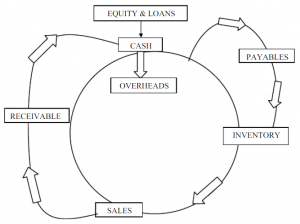
Working capital cycle

It is the timeframe that slips by where money starts to be used on the creation of an item and the assortment of money from a client. There are inventories, receivables, and payables and each one of them has two degrees- time and money. Exactly when they come to administering working capital time is money. In the event that you can get cash to move quicker around the cycle (gather monies due from indebted individuals all the more rapidly) or lessen the measure of cash restricted (decrease inventory level comparative with sales). The business will produce more money or it should acquire less cash to finance working capital. As an outcome, we could diminish the expense of bank revenue or we will have extra free cash accessible to help the expansion of deals, development, or speculation. 

Banking sector

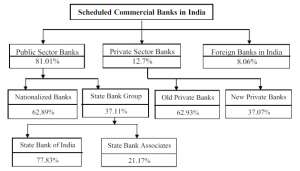
Banking sector is a stepping stool to different areas for their improvement and their development. Accordingly, a solid bank area is needed for the financial development of a country. After the changes in 1991, banks are developing by jumps and leaps. The amendment of the Banking Regulation Act in 1993 saw the evolution of new private sector banks. This fragment extensively comprises:

  1. Commercial Banks,
  2. Co-operative Banks.

Here we need to understand the commercial banking structure. It consists of-

  1. Scheduled Commercial Banks,
  2. Unscheduled Banks.

Scheduled Commercial Banks set up those banks which have been added to the second schedule of the Reserve Bank of India (RBI) Act, 1934. RBI accordingly adds those banks for this schedule that satisfy the guidelines put down vide region 42 (60) of the Act. This sector can be divided into-

  1. Public sector,
  2. Private sector,
  3. Foreign sector.

The main shareholders of the public sector are either Government of India or the Reserve Bank of India. The public sector consists of-

  1. State Bank of India (SBI) and its subsidiaries,
  2. Other nationalised banks.

The law administering banking exercises in India is known as the “Negotiable Instruments Act 1881“. The financial exercises are mentioned hereinafter: 

  1. Taking deposits from public/others (deposits), 
  2. Lending cash to the public (loans), 
  3. Moving cash starting with one spot then onto the next (remittances), 
  4. Going about as trustees, 
  5. Going about as mediators, 
  6. Keeping assets in safe authority, 
  7. Assortment business, 
  8. Government business.

The present situation of banks

At present, by and large, banking in India is considered as genuinely developed. Indeed, even as far as nature of resources and capital ampleness is considered, Indian banks are considered to have spotless, solid and straightforward accounting reports when contrasted with different banks in equivalent economies in their district. The Reserve Bank of India is a self-sufficient body, with insignificant pressure from the public authority. The expressed strategy of the Bank on the Indian Rupee is to oversee unpredictability expressed conversion scale and this has generally been valid with no expressed conversion scale. With the development in the Indian economy expected to be solid for a long while particularly in its administrations area, the interest for banking administrations especially retail banking, home loans and speculation administrations are required to be powerful. M&A, takeovers, resource deals and considerably more activity (as it is unwinding in China) will occur on this front in India.

The first run through a financial investor has been permitted to hold over 5% in a private sector bank since RBI declared standards in 2005 that any stake surpassing 5% in the private sector banks would should be checked by them. Presently, India has 88 Scheduled Commercial Banks (SCBs), 28 Public Sector Banks, 29 Private Banks (these don’t have government stake; they might be freely recorded and exchanged on stock trades) and 31 Foreign Banks. They have a consolidated organization of more than 53000 branches and 17000 ATMs. As indicated by a report by ICRA Limited, a rating office, the public sector banks hold more than 75% of absolute resources of the banking sector, with private and foreign banks holding 18.2% and 6.5% separately.

SBI

SBI’s roots can be traced back to the first bank of India, the Bank of Calcutta, which was founded in 1806. However, SBI’s direct predecessor was the Imperial Bank of India. The State Bank of India arose as a pacesetter, with its tasks completed by the 480 workplaces containing branches, sub workplaces, and three local head offices, acquired from the imperial bank. Rather than filling in as simple archives of the local area’s reserve funds and loaning to reliable gatherings, the State Bank of India obliged the requirements of the clients, by banking deliberately. The bank served the heterogeneous monetary necessities of the arranged financial turn of events.

Organisational structure

The organisational structure of SBI is very strong. There are other private financial banks that were in a difficult situation in light of overburden and in the meantime SBI was dealing with multiple times of responsibility. You can discover SBI branches and ATMs in regions we won’t anticipate that they should be there.

Products and services

Individual banking

  1. SBI Term Deposits, 
  2. SBI Loan for Pensioners, 
  3. SBI Recurring Deposits Loan Against Mortgage of Property, 
  4. SBI Housing Loan Against Shares and Debentures, 
  5. SBI Car Loan Rent Plus Scheme, 
  6. SBI Educational Loan Medi-Plus Scheme. 

Different services

  1. Farming/rural banking, 
  2. NRI services, 
  3. ATM services, 
  4. Demat services, 
  5. Corporate banking, 
  6. Internet banking, 
  7. Mobile banking, 
  8. Worldwide banking, 
  9. Safe deposit locker, 
  10. RBIEFT,
  11. E-Pay,
  12. Gift cheques,
  13. Treasury operations,
  14. Associates and subsidiaries.

Working capital management of SBI

To analyse working capital management, we need to know the working capital of SBI. So, to determine the working capital we need to analyse the total current assets and the total current liabilities. Then we have to subtract them. 

  • Calculation of current assets of SBI from the Balance Sheet of SBI:

Particulars

March 2020 (in USD)

March 2019 (in USD)

Cash & cash equivalents

37,669,727

70,698,904

Loans and advances to banks

21,301,184

103,239,935

Loans and advances to customers

480,676,142

279,108,746

Investment securities

109,471,373

148,714,650

Total Current Assets

649,118,426

601,762,235


  • Increase or decrease of current assets of SBI

Particular

2019

2020

Current Assets

601,762,235

649,118,426

Increase(/Decrease)


47,356,191

%Increase(/Decrease)


7.87%


  • Current assets of SBI in graphs

  • Calculation of current liabilities of SBI from the balance sheet of SBI

Particulars

March 2020 (in USD)

March 2019 (in USD)

Deposit from customers

438,352,611

484,045,968

Other borrowed funds 

71,500,000

46,089,650

Subordinated liabilities

6,817,208

8,082,246

Current tax liabilities

1,345,589

673,195

Total Current Liabilities

518,015,408

538,891,059


  • Increase or decrease of current liabilities of SBI

Particular

2019

2020

Current Liabilities

538,891,059

518,015,408

Increase(/Decrease)


-20,875,651

%Increase(/Decrease)


-96.13%


  • Current liabilities of SBI in the graph

  • Networking capital and a current ratio of SBI

Particulars

2019

2020

Current Assets

601,762,235

649,118,426

Current Liabilities

538,891,059

518,015,408

Net Working Capital

62,871,176

131,103,018

Increase(/Decrease)


68,231,842

%Increase(/Decrease)


108.53%

Current ratio

1.1

1.3

  • Networking capital and current ratio in graph

Findings

This is an analysis of working capital management for the year 2019-2020. The findings of this analysis are-

  1. Here the current ratio for both the years is more than 1; So, the company can easily meet the short-term liability.
  2. In the year 2020, the current ratio is between 1.2-2 which is a healthy ratio that means the company has utilized its working capital efficiently. So, the funds are neither idle nor locked up in inventories or receivables.
  3. The working capital has increased by 108.53% in the year of 2020.
  4. As the working capital has increased in the year of 2020, the liquidity position is good.
  5. Working capital expanded due to augment in the current assets rather than expansion in the current liabilities. 
  6. The company’s current assets have influenced the benefit of the organisation as it was in every case more than necessity.
  7. In both the years, the current assets are more than current liabilities which demonstrates that SBI has utilised its long-term assets for transient pre-requisite though long-term assets are more expensive than short-term assets. 
  8. More current assets segments show that sundry debtors have a significant part in current assets which shows the efficient management of wasteful receivables.

Overall the organization has a great liquidity position and adequate assets to reimbursement of liabilities, however, the company has acknowledged a moderate monetary approach to keeping up with more current resources balance.

Suggestions

After analysis we can come up with some suggestions which can be utilized for the development of the company. They are-

  1. The company should keep up with appropriate administration in inventory. 
  2. Current assets should not be surpassed over on the grounds that they may increment the investment of the organization. The networking capital ought to be in an equilibrium condition and it should not change unnecessarily. 
  3. Organisation should raise assets through short-term origins for the transient necessity of assets, which is similarly prudent in contrast with long-term reserves. 
  4. Organisation should take control of the debt holder’s assortment period which is a significant piece of current resources. 
  5. Organisation needs to take control on cash balance since cash is non acquiring resources and can be expanding cost of assets.

All over the organization ought to deal with the NWC of the organisation so that it should improve the adequacy and proficiency of the organisation’s benefit.

Conclusion

Working capital management is a significant part of monetary administration. The investigation of working capital management of State Bank of India has uncovered that the current proportion is in an expanding pattern. The examination has been led on working capital administration which will assist the organization with dealing with its working capital productively and viably. 

Overall the organisation has a great liquidity position and adequate assets to reimbursement of liabilities. Organisation has acknowledged traditionalist monetary arrangement and hence keeping up with more current resources balance. Organisation is expanding deals volume each year which is upheld to the organization for supporting it to sustain in India. From this analysis, we can see that the general working capital (WC) of the State Bank of India has expanded by in excess of 100% over the most recent years which is a critical pattern and this pattern gives a strong structure for the wellbeing of the organisation.

References

Books:

  1. Financial management by I. M. Pandey
  2. Financial Management by Dr. Satish Inamdar.
  3. Business Environment by K. Aswathappa and G. Sudarsana Reddy.

Websites:

  1. www.sbi.co.in
  2. www.rbi.org.in
  3. www.moneycontrol.com
  4. www.capitalmarket.com
  5. www.scribd.com

Students of LawSikho courses regularly produce writing assignments and work on practical exercises as a part of their coursework and develop themselves in real-life practical skills.

LawSikho has created a telegram group for exchanging legal knowledge, referrals, and various opportunities. You can click on this link and join:

Follow us on Instagram and subscribe to our YouTube channel for more amazing legal content.

Download Now

How does Flipkart-Walmart deal affect the Indian economy

0
Image Source: https://bit.ly/3iNfAyy

This article is written by Vanya Verma from the Alliance University, Bangalore. This article talks about the key elements of the Flipkart-Walmart deal and their positive and negative impacts on the Indian economy.

Introduction

The Flipkart-Walmart deal will benefit Flipkart to give leverage to Walmart single-channel knowledge and expertise supply chains in the market. In the retail market, Walmart has been able to establish a positive reputation but not in the e-commerce market and by signing this deal it will strengthen its market reputation in the e-commerce sector too. Both Walmart & Flipkart will be having different operating structures and separate brands in the market.

A brief about Flipkart

Flipkart was launched as an e-commerce website in October 2007. Earlier it was retailing only with books, and then slowly afterwards in 2010 it started launching new portfolios like movies, music, and mobiles, and in 2012 with fashion and lifestyle. Flipkart was founded by Helion Venture Partners and Junglee in 2008. Flipkart raised $190 million in four years that is from 2009 to 2012 from the well-known venture capitals in the market like Tiger Global and Accel Partners. In the same year, Flipkart changed its business model from directly selling goods to the customers to a marketplace model. Then in the same year, i.e. 2012, Flipkart raised $150 million from Naspers which was an internet major of South Africa. 

By 2013, Flipkart was being contemplated as a successful startup and by mid of the year 2013, further $200 million were raised by the Flipkart from its already existing investors and $160 million from investors like Vulcan Capital, Morgan Stanley, etc. Flipkart’s valuation was $1.6 billion by the end of 2013. In 2014, Myntra got acquired by Flipkart. By the end of 2014, Flipkart’s valuation was $11 billion after it raised huge amounts from Greenoaks, GIC Singapore, etc. and by the end of 2015, it was $15.5 billion, after it raised $700 million from its existing investors. However, from 2016 onwards the business of Flipkart has not been very profitable as the investor Morgan Stanley had started cutting to the value of the share of the company, due to which by the end of 2016, the valuation of the company fell to $5.6 billion. 

A brief about Walmart

Walmart is an American multinational retail corporation which also has its retail branches in India. Walmart has established various hypermarkets, grocery stores, and discount shops all over the country. Walmart is the largest e-commerce market which has acquired 77% stake by investing $16 billion in Flipkart. “Walmart India”- Wal-Mart India Private Limited is an entirely owned subsidiary of Walmart Inc., which is the world’s leading retailer, well-known for its expertise and efficiency in supply chain management, logistics, and sourcing. 

Back in 2007, Walmart made an entry in India through a joint venture with Bharti Enterprises. It opened its first store on 29th May 2009 in India in Amritsar, Punjab. In 2013 Walmart India became a wholly-owned subsidiary of Walmart Stores. Currently, 21 Cash & Carry stores are owned and operated by Walmart India in 9 states across the country, that is under the brand name of Best Price Modern Wholesale Stores (“Best Price”). Their business in India is based on membership and they have more than one million members, out of which majority are small resellers (mom & pop stores). The other business segments that are members of Walmart are restaurants, hotels, offices, and institutions, which is supported by Walmart with high-quality products at competitive, consistent and transparent prices for the prosperity of the business.

Key facts about the deal

  • Finally, after trying for more than 15 years, Walmart managed to penetrate the Indian market. The Indian e-commerce landscape till now was dominated by two firms that are Amazon and Flipkart but it is determined that Walmart-Flipkart deal will change the scenario.
  • Competition Committee of India (CCI) approved the proposed acquisition of the Bengaluru based Flipkart Private Limited by Walmart International Holdings Inc. 77% controlling stake in Flipkart was acquired by Walmart for $16 billion in 2018 and making it as the biggest e-commerce deal in the world. The residues will remain with its earlier investors which includes Flipkart’s co-founder Binny Bansal, Tiger Global Management LLC, Microsoft Corporation and China’s Tencent Holdings Ltd. 
  • The entry of Flipkart into Walmart substantiates the capability of the Indian retail market. After this deal, in the Indian e-commerce market, there will be a tough competition between Amazon, Walmart and Paytm Mall.
  • This deal can help Flipkart leverage Walmart’s omnichannel retail skill and comprehensive supply chain information. 
  • The aim of Walmart through this acquisition is to extend its B2B (Business to Business) sales across India. 
  • Vice-Chairman of NITI Aayog, Rajiv Kumar announced that there will be a positive impact by the Walmart-Flipkart deal on India’s foreign investment inflows as per the norms of India’s Foreign Direct Investment (FDI). 
  • Doug MacMillan, CEO of Walmart said that in his opinion, India is one of the most remarkable retail markets in the world (contemplating how it managed to become Amazon of India). This deal of Walmart with Flipkart is to commend the company’s prominent role in revamping the Indian marketplace. According to MacMillan, this deal might also help Flipkart to achieve its goal of being a publicly listed company.
  • This deal will help Flipkart, not just with profits but will also create an opportunity for Flipkart to expand its market beyond fashion and smartphones. Amazon in the year 2017 got approval to function in grocery and perishable food items, in which Flipkart was lagging behind till now. With the help of this deal, Flipkart can now re-furnish its system using the expertise of Walmart in running offline stores, access to manufacturers and sellers, supply chain and also a chance to enter into the grocery sector.
  • Through this Flipkart-Walmart deal, Walmart will leverage e-commerce market presence of Flipkart in the country with an active base of 54 million customers. Walmart till now was able to retain powerful global physical existence for years only in retail space but lacked e-commerce space till date. This deal will stimulate both the presence of offline Flipkart and Walmart’s online presence in India as for now both have aimed at maintaining distinct brands and operating structures.
  • Amazon dominance in the e-commerce industry in India will come to an end with the Walmart-Flipkart deal. This deal will create more competition in the market to attract more customers which will lead to additional advantages for the customers. The competition will create diverse products and bring in more selection options at low prices to the customers. 
  • Further, the principal beneficiary is the farmer. The purpose as to why Walmart challenged Amazon is because Walmart has a leading edge in taking fresh farm produce with the help of sophistically developed cold chains and this is lacking in Amazon. This will also help in preventing the losses that are caused due to the spoiling of a significant percentage of fruits and vegetables because of insufficient logistics and warehouses.
  • Ajay Srinivasan, Director of CRISIL Research, also asserted the same saying that “The deal indicates India’s consumption market attractiveness for the global majors”. With Walmart acquiring a stake in Flipkart, we expect an enhanced thrust in the segment of online grocery. We expect that online grocery will be the fastest-growing segment in the e-retail space, growing at the rate of 65-70 per cent to touch Rs 10,000 crores in revenues by 2020.”

Why was Flipkart acquired by Walmart?

  • According to Morgan Stanley, India’s online retail will grow to 1,200%, $200 billion (30% CAGR) by 2026 from $15 billion in 2016. The average wages are rising by 2% annually and there is even growth in internet penetration as data costs are becoming more competitive, which makes the Indian e-commerce space more lucrative.
  • In e-commerce, Flipkart has the largest market share, so with the help of this acquisition, it will be easy for Walmart to achieve the next leg of growth in India with the Flipkart’s 175 million registered user base.

Positive impact of acquisition on Indian Economy

  • Employment: Walmart is popular for its practice of innovation and service. It is being expected with revamping of new business models, because of that, the Indian e-commerce market will witness extensive growth with improved productivity. The employment opportunities will increase with the rise in productivity for both skilled and unskilled labour that will result in economic growth and capitalism.
  • Collateral Benefits: The e-commerce market after demonetization and GST faced a major slow down. This deal will direct brand new funds and rejuvenate the Indian e-commerce market. More foreign firms and venture capitalists will be attracted to enter India as it is the world’s largest giant pour funds. 
  • Low prices, more variety: As there is a competition among the e-commerce giants to be at the top, the localization and differentiation of products will give rise to more variety and develop a diverse product market at low prices in order to attract the customers which shall eventually prove beneficial for the customers.
  • Research and Development: In order to have a greater market penetration across the country, the key element is efficiency which is a result of research and development. Walmart is well known for its culture of service and innovation, this will help it to grow and scale up the business in India, in order to generate more revenue and in creating technological spillovers and learning effects for the domestic firms as well. The external demand for Indian goods will increase because of the refined nature of the products.
  • Efficient Supply Chain: The expansion of e-commerce business requires a valuable supply chain and logistics that needs infrastructural development. This will give a fillip to the Indian infrastructure and agriculture and also benefit the farmers, as well as, they would be able to provide more demand as Walmart has extensive experience in logistics, retailing, inventory and supply chain management. This can particularly help the perishable goods business which is Walmart’s forte.
  • Economic Growth: Walmart will expand its business across the country which will stimulate output growth and increase employment opportunities. With optimistic business attitudes, it will be a stimulus to economic growth and capitalism. Further, this deal will be subjected to tax leading to a surge in domestic revenue gains.
  • ESOPS (Employee stock option Plan): Many existing employees will make windfall gains from their stock options through this deal. This will increase the entry of more workers in the e-commerce sector who had earlier left due to the downturn and can also assimilate labours from the traditional and old brick-and-mortar industries that can benefit in formalisation of more of the Indian labour force.
  • Mom and Pop stores: Walmart is looking forward to extending its supply chain arm with the help of partnerships with around 60 lakhs kiranas. This partnership will increase the presence of Walmart in the small stores.
  • Premji Invest is anticipated to gain up to four times from the Flipkart-Walmart deal as its share in Myntra (bought by Flipkart in 2014) has also been acquired by Walmart. It has been anticipated that the gains will be more than $130 million on the $25 million investment. This will bring an inflow of more funds pouring in the Indian economy as profits attract investors from India and other countries.

Negative impact of the acquisition on the Indian Economy

  • Big data mining: Even though Walmart-Flipkart seems very profitable for the Indian economy, still the deal witnessed some warnings and protests from trade unions, retailer associations and also political organizations. They are worried about the fact that as of now India does not have any national e-commerce policy or a regulatory body for e-commerce. Ample information and data of the Indian clients including their personal details, search history, purchasing history, etc can go under the control of the US company. This can be exploited by personal stakes like the one which happened in the recent Facebook-Cambridge Analytica case too. Thus, there is a requirement to keep a system of checks and balances in order to avoid any issue of data breach of the Indian customers.
  • Impact on sellers: The biggest retail deal in the world between Walmart and Flipkart will influence the whole segment of the competitors and consumers. Where a customer is the master, the Flipkart’s online sellers are worried about the fact that Walmart would clear them off as it has an image of slaughtering the independent small companies with ultra-low costs. It is being expected by the smaller businesses that Walmart might get its own private labels and brands with the help of Flipkart to provide to the Indian customers that will lead to extra pressure upon them. The products could be brought at hyper-competitive costs, that will create a problem for other sellers and rip off the market.
  • Brick and Mortar Stores may shut down: The small businesses that sell at ultra-low prices through Flipkart are being scrapped by Walmart. Chances are that Walmart may replace the domestic MSMEs with its own labels having the hyper-competitive prices, this can result in a threat to brick and mortar stores as they already fear of being shut down due to the competitive pressure.
  • The ruining of small players: Small Players (Mom and Pop stores) will be ruined by this as due to such high competitions, the market spaces shrink and ultimately forcing the small firms to exit from the market. To survive, the firms try to excessively cut the price rate at the cost of profitability and viability which drives to inefficiency.
  • Threat of Pan India Protests: The government has already been warned of the pan India protests by the Tamil Nadu Vanigar Sangankalin Peramaippu federation of traders. It is estimated that many more such trade unions might call for protests which will eventually hurt our economy, cause infrastructural damages resulting in social chaos. 
  • Backdoor entry for Walmart: Foreign Direct Investment (FDI) in single-brand retail allows 100% FDI in India. 100% FDI is not permitted in Walmart as it is a multi-brand retail chain, so it concentrates only upon cash and carry business. Flipkart has already avoided such restrictions in direct selling which will be utilised by Walmart.

Conclusion

Flipkart and Walmart, both will be profited by this deal. The level of investment will be increased as it will give a surge to further investment by foreign firms in the Indian market. This deal will boost the level of competition in the e-commerce sector. Walmart, as being one of the biggest retail markets, penetrating into the world of e-commerce will unlock new doors for the labour class by providing them employment. The deal will allow the offline market players to alter their business model and to modify the tools and techniques in order to yield better profits in the e-commerce market. The success of Flipkart under Walmart would confide on how it is able to effectively execute a world-class supply chain in India, amidst all the challenges in the Indian context. The economy of India will witness a rising graph with more investments. But to avoid exploitation and to maximize benefits, efforts should be made in order to bring uniformity in the marketing structure of e-commerce.

References


LawSikho has created a telegram group for exchanging legal knowledge, referrals, and various opportunities. You can click on this link and join:

Follow us on Instagram and subscribe to our YouTube channel for more amazing legal content.

Download Now

What is an employee intellectual property agreement

0
Image Source: https://rb.gy/pkobnt

This article is written by Hannah Boban pursuing a Diploma in Advanced Contract Drafting, Negotiation, and Dispute Resolution from Lawsikho.

Introduction

Innovative minds often come up with innovative ideas and intellectual property is a creation of such ideas in the mind. As per law, the owner of such an idea is the person which brings it into existence unless there is a contract to the contrary. Many of us think that the employer owns the intellectual property that an employee creates in the course of his employment. However, an employer assuming that all rights of the employee over such intellectual property are extinguished might be careless in his approach. The employee still owns the claim rights of an author, moral rights and rights to object to alterations to work. So, it becomes crucial to include the conditions determining the ownership of intellectual property in the contracts of employment, agreements of independent contractors or in agreements of a designer or consultant.

Hence, it becomes critical to include terms determining the ownership of intellectual property in employment contracts, independent contractor agreements or agreements with a consultant or designer. In this article, we will understand the concept of an employee’s intellectual property and what are the important clauses that should be drafted in an employee’s intellectual property agreement. 

What is the meaning of “in the course of employment?”

If an employee brings any innovative ideas in the course of business or employment, the employer can claim the same if it was already mentioned in the contract and the employee also agreed to the same. But in case the intellectual property is created outside the course of the employment, an employer cannot claim the rights over it. For example, if an employee is hired in the accounting team of a designing company and if that employee designs a new pattern for a product of the company, he can be entitled to the intellectual property right in that design as he has done something outside the course of his employment, i.e. he has done something outside the terms of the employment of an accountant post. So it is necessary to have clarity on the duties of the employees to differentiate the scope of and what will constitute “in the course of employment” in the agreement agreed upon by both the parties. 

Now let’s see what all should be stated in the terms of an agreement between the employer and the employee. 

It should be always remembered that an agreement with an employee should not be an oral agreement, it should always be a written agreement. It will be always best if the employer gets the agreement signed by the employee before the date of commencement of the employment. Most of the companies have their own standard template of employment agreements for various kinds of jobs in the company. For example, the agreement for a designer will be different from that of a developer or a tester.

In a case where the employment agreement is not signed before the commencement of the employment due to any valid reasons, all the rights and liabilities will be affected from the date of commencement of the employment.

Terms that must be included employee intellectual property agreement

Now let’s look into the broad terms that must be included in any agreements that define intellectual property right:

  1. The intellectual property created by an employee or by an independent contractor or a consultant during the course of employment  will be owned by the employer;
  2. Terms to the effect that the employee/independent contractor/consultant will sign any documents reasonably required (such as a deed of assignment) to record the employer’s ownership of the intellectual property created during his employment. This obligation should continue during and after employment. An employer should ensure that any assignment or license deals with existing rights and future rights;
  3. The confidentiality clause requires the employee or the consultant or the independent contractor to keep any information of the employer to be confidential and neither disclose the same nor use it in any matter outside the course of the employment;
  4. A clause should also be drafted for the employee or the consultant about whether they should disclose the new inventions and should a record be maintained to prove the originality of the work and the date of its creation;
  5. A clause where all the scope and definition of confidential information must be mentioned in the agreement. It must include the intellectual property created by the employee in the course of their employment, all the business information and any other intellectual property of the employer itself. The business information includes business plans, marketing strategies and plans, the company’s financial information, customer lists and any other details of the company necessary to be stated in the agreement. 
  6. It must also include a term which states whether there is any waiver of moral rights by the employee during the employment over the intellectual property.
  7. It must be made sure that a term for restraining the former employee on the competition for a specified period of time and in a specific geographical area. It should be made sure that such restraints are reasonable.

Key points for drafting the agreement

For the best legal document it should be kept in mind to draft the agreement with the following key points:

  • Any ideas, discoveries or inventions must be properly disclosed to the company by the employee if such ideas, discoveries or inventions are related to the business of the company and is during the course or period of employment.
  • The company will be considered as the owner of such ideas, discoveries or inventions.
  • If an employee is hired particularly for any invention, or for developing a work product, then the right on such invention or work products are the employers since it was created out of the employer’s expense and request.

Let’s look into an example: If an app developer is strictly appointed by an employer for the development of a particular app, then once the app is developed and the course of employment of the employee has come to an end, the intellectual property right belongs to the employer.

It should be also kept in mind by the employer to get the signature of the employee appointed in an intellectual property assignment agreement to avoid any future problem of the same. 

  • In the case of a startup company, in order to protect the important assets and to inform the investors of a startup company, which has an intellectual property which will be used as the pillar of the company for its success, the start-up must draft an intellectual property clause in its agreement which will be signed by everyone involved in the start-up which will also include the promoters, developers and the employees. 

Now let’s see some of the provisions that must be included in the employee intellectual property agreement:

Provisions to be included in the employee intellectual property agreement

First of all, we should understand that there is no standard form for employee intellectual property agreement. So it must be carefully drafted and signed by the employee for its legal binding. No matter what the situation is, or where the agreement is made it should be made legally binding

Mostly the employee intellectual property agreement has at least the following three clauses in common:

1. Assignment clause

Generally speaking, an assignment clause is where the rights, duties, or contractual obligations are transferred from one party/person to another person/party. The assignment may be wholly or partly. The clause must also mention the conditions under which a party/person can assign these rights, duties or obligations. 

In an employee, intellectual property agreement the assignment provision, the employee assigns to the employer his/her inventions/discoveries/ideas and also transfer the true and total ownership of the intellectual property. In this provision, it can either narrow down or broaden any inventions/ discoveries/ ideas or nearly anything the employee creates.

Example of an assignment clause in employee intellectual property agreement:

“I agree that all inventions that are (a) developed using equipment, supplies, facilities, or trade secrets of the company; or (b) result from work performed by me for the company; or (c) related to the Company’s current or anticipated research and development will be the Company’s sole and exclusive property and are hereby assigned by me to the Company.”

2. Disclosure clause

A disclosure clause in an employee intellectual property agreement is drafted in such a way that the employee informs the employer of the intellectual property that was developed as per the assignment clause. It should be noted that everything must be clearly and properly disclosed in this clause.

Example of a disclosure clause in employee intellectual property agreement:

“While I am employed by the Company, I will promptly inform the Company of the full details of all inventions, discoveries, improvements, and innovations, whether or not patentable, copyrightable, or otherwise protectable, that I conceive, complete, or reduce to practice (whether jointly or with others) and which: (a) relate to the Company’s present or prospective business, or actual or demonstrably anticipated research and development or (b) result from any work I do use any equipment, facilities, materials, trade secrets, or personnel of the Company or (c) result from or are suggested by any work that I may do for the Company.”

3. Power of attorney clause

Finally, there’s a clause where the employee appointed in the company appoints the company as an employee’s power of attorney to execute documents or take actions on behalf of them. The benefit of this clause is that the company will then have the power to sign documents or execute any other agreements on behalf of the employee to assign the intellectual property right to the business.

Usually, every company have this clause as a fairly standard one. The power of attorney provision guarantees the employer can register and administer the ownership rights without the employee, regardless of whether the employee is willing and able to assist.

Example of the power of attorney clause in employee intellectual property agreement:

“If the Company is unable to secure my signature on any document necessary to obtain or maintain any patent, copyright, trademark, or other proprietary rights, whether due to my mental or physical capacity or any other cause, I hereby irrevocably designate and appoint the Company and its duly authorized offers and agents as my agents and attorneys-in-fact to execute and file such documents and do all other lawfully permitted acts to further the prosecution, issuance, and enforcement of patents, copyrights, and other proprietary rights with the same force and effect as if executed by me.”

Sample of an employee intellectual property agreement

Employee confidentiality and intellectual property assignment agreement

This EMPLOYEE CONFIDENTIALITY AND INTELLECTUAL PROPERTY ASSIGNMENT AGREEMENT (the “Agreement”) is made and entered into by and between [Company name] and [NAME] (“Employee”), as of [DATE] (the “Effective Date”). 

Each of Company and Employee hereinafter may be referred to individually as a “Party” or, collectively, as the “Parties.” 

In consideration of Employee’s employment with Company, the compensation Employee will earn in connection with such employment, Company providing Employee with access to Confidential Information (as defined below), and other good and valuable consideration, the sufficiency and receipt of which Employee acknowledges, Employee agrees as follows:

  1. Confidential Information:

i. Confidential information and trade secrets defined. Employee hereby acknowledges and understands the term “Confidential Information” means any data, information, or material of Company or its owners or its affiliates relating directly or indirectly to Company or its owners or Affiliates: clients and customers or potential clients and customers (collectively “Customer(s)”); competitors; vendors; advertisers; employees; contractors; suppliers; or business partners, that is discovered or developed by, or disclosed to, Employee through Employee’s relationship with Company, that is not generally ascertainable from public information, whether it is expressly identified as “confidential” or “trade secret,” that includes, but is not limited to: financial information; invoices; business plans; business and contract applications; contracts; forms; research; price lists; marketing materials; advertising materials and developments; sales materials and reports; copyrighted materials; Trade Secrets; the particular needs and requirements of Customers; identities of potential Customers; and all accompanying Customer data. Employee hereby acknowledges and understands the term “Trade Secret(s)” includes, but is not limited to, a confidential, proprietary, and/or sensitive: formula; software; methodology; model; architecture; pattern; compilation; program; device; method; technique; or process, that is discovered, developed in whole or part by Employee, or disclosed to Employee, through Employee’s relationship with Company, including any information, data, or material concerning the business of the Company, and all other information related to Company and its owner and Affiliates businesses, that is not generally known and readily ascertainable by proper means by any other person and/or Employee. This includes, but is not limited to, all inventions or discoveries made by Employee and/or Company (or its owners or Affiliates) resulting in whole or part from Employee’s relationship with Company. The term “Trade Secret(s)” also includes, but is not limited to, Customer lists, invoices and reports containing specifically developed information, such as the name, address, phone number, buying history and other traits of Customers, along with any other information that Company derives a competitive advantage from and that Company makes reasonable efforts to maintain a secret. For purposes of this Agreement, “Affiliates” means an individual, a partnership, a corporation, a limited liability company, an association, a joint-stock company, a trust, a joint venture, or an unincorporated organization, that directly, or indirectly through one or more intermediaries, controls, or is controlled by, or is under common control with, Company.

ii. Use and restriction. Employee acknowledges that Employee will have access to and be provided with Confidential Information in connection with performing services for Company. Employee expressly recognizes that the efficacy and profitability of Company and its owners and Affiliates is dependent in part upon Employee’s protection of the Confidential Information. Employees may use the Confidential Information solely in connection with performing services for Company and its owners and Affiliates. To ensure the continued confidentiality of the Confidential Information, the Employee agrees to hold the Confidential Information in strict confidence. Employee shall not, either during Employee’s relationship with Company or for such period as such information remains Confidential Information after termination, disclose or use for Employee’s own benefit or for the benefit of any other individual or third party, directly or indirectly, any of the Confidential Information, except as such disclosure or use is expressly authorized by Company in writing. Employee hereby agrees to adhere to the method and form of protection of Confidential Information required by Company, subject to change at Company’s sole discretion. Employee shall not communicate any Confidential Information, even in furtherance of Company’s business, to any individual or third party not privy to the Confidential Information, without express consent by Company and the individual or third party’s agreement to be bound by confidentiality terms that adequately protect Company’s Confidential Information.

iii. Exceptions. The confidentiality and restriction on the use of Confidential Information under this Agreement shall not apply to Confidential Information to the extent that such Confidential Information: is now, or hereafter becomes, through no breach of this Agreement by Employee, generally known or available to the public; was known to Employee without an obligation to hold it in confidence prior to the time such Confidential Information was disclosed to Employee by Company; is disclosed or used, as applicable, with the prior written consent of Company and in accordance with any limitations or conditions on such disclosure or use that may be imposed in such written consent; or was or is independently developed by Employee without any use of or reference to the Confidential Information. In addition, notwithstanding any other language in this Agreement to the contrary, Employee understands that Employee may not be held criminally or civilly liable under any federal or state trade secret law for the disclosure of a trade secret that is made (a) in confidence to a federal, state or local government official, either directly or indirectly, or to an attorney if such disclosure is made solely for the purpose of reporting or investigating a suspected violation of law or for pursuing an anti-retaliation lawsuit; or (b) in a complaint or other document filed in a lawsuit or other proceeding, if such filing is made under seal and Employee does not disclose the trade secret except pursuant to a court order.

iv. Required disclosure. The confidentiality obligations under this Agreement shall not apply to Confidential Information to the extent that such Confidential Information is required to be disclosed pursuant to the order or requirement of a court, administrative agency, or other authority, or otherwise by operation of applicable law. In the event of such order or requirement, Employee, if and to the extent permitted by law, shall give Company written notice thereof and of the Confidential Information to be disclosed as soon as practicable prior to the disclosure of such Confidential Information and shall provide such reasonable assistance as Company may reasonably request, at Company’s sole expense, in seeking a protective order or other appropriate relief in order to protect the confidentiality of the Confidential Information.

v. Other Nondisclosure Agreements. In the event that Company is subject to the terms of any confidentiality or nondisclosure agreement relating to some or all of the Confidential Information that imposes greater restrictions on the disclosure and/or use of such Confidential Information, then Employee shall comply with such greater restrictions to the extent that Employee is made aware of them in advance and in writing.

vi. Property of Company. Employee specifically acknowledges and understands that all Confidential Information and all of Company’s and its owners and its Affiliates strategies and files, including, but not limited to, computer data, reports, materials, records, documents, notes, memoranda, and other items, and any originals or copies thereof, related to the business of Company or its owners or its Affiliates, which Employee either is provided, prepares, uses, or simply acquires during the term of this Agreement, are and shall remain the sole and exclusive property of Company and, to the extent applicable, shall not be removed from Company’s premises without the prior consent of Company.

vii. Return or Destroy Confidential Information. Employee agrees, immediately upon the termination of the relationship between Employee and Company for any reason or upon earlier request by Company to make a diligent search for any and all documents, computer discs, electronic files, software, tapes, computer printouts, or any other material constituting Confidential Information described in this Section 1, and shall: cease using the Confidential Information; promptly return to Company or destroy all Confidential Information and any copies thereof; certify in writing (if requested in writing by the Company) that Employee has complied with the obligations of this Subsection vii.

viii. Return of Company Property. Employee agrees, immediately upon the termination of the relationship between Employee and Company for any reason or upon earlier request by Company to promptly deliver to Company all Company property not covered by Subsection vii.

2. Intellectual Property

i. Prior Inventions. Any intellectual property, including, but not limited to, any ideas, inventions, patents, trademarks, service marks, copyrights, creations, know-how, work product, and other developments or improvements, if any, patented or unpatented, that Employee, alone or with others, conceived, created, invented, developed, reduced to practice, or caused to be conceived and or caused to be reduced to practice prior to the earlier of (a) commencement of Employee’s employment with Company or (b) when Employee first provided services to Company, is listed on Schedule I attached hereto (“Prior Inventions”).

ii. Pre-Existing Work. If, in the course of Employee’s relationship with Company, Employee uses, relies upon, provides, or incorporates any Prior Invention or any other intellectual property Employee owns, or in which Employee has an interest, into any idea, invention, patent, trademark, service mark, copyright, creation, know-how, work product, and other development or improvement conceived, created, invented, written, developed, furnished, produced, or disclosed in whole or in part, alone or with others, whether or not during working hours, by Employee during the term of Employee’s employment with Company, Employee hereby grants Company, under all of Employee’s intellectual property and proprietary rights, the following worldwide non-exclusive, perpetual, irrevocable, royalty free, fully paid up rights: (a) to make, use, copy, modify, create derivative works of such intellectual property; (b) to publicly perform or display, import, broadcast, transmit, distribute, license, offer to sell, and sell, rent, lease or lend copies of the intellectual property, and derivative works of the intellectual property; and (c) to sublicense the rights in this Subsection 2(iii) to third parties.

iii. Work made for hire. Any work of Employee for which copyright could be claimed developed in the course of Employee’s employment with Company will be deemed “work made for hire” under federal copyright law and all ownership rights to such work belongs exclusively to Company. To the extent any invention does not qualify as a work for hire under applicable law, and to the extent, any invention is subject to copyright, patent, trade secret, or other proprietary right protection, Employee hereby assigns, and agrees to assign, all rights therein to Company.

iv. Required undertakings. Employee agrees, both while an employee of Company and thereafter, to assist Company and its owners and Affiliates, at Company’s sole expense, in any and all attempts to obtain patents, copyrights, and/or trademarks or other intellectual property protection on any work Employee participated in developing and agrees to execute all documents necessary to obtain such rights in the name of or to transfer such rights to Company. If, because of Employee’s mental or physical incapacity or for any other reason whatsoever, after the Company’s reasonable effort to secure Employee’s signature, Company is unable to secure Employee’s signature to apply for or pursue any patents, copyrights, or other protection for any invention assigned to Company under this Agreement or otherwise, Employee irrevocably designates and appoints Company and its duly authorized officers as Employee’s agent and attorney-in-fact to act for Employee and on Employee’s behalf and stead to file any applications and to do all other lawfully permitted acts to further the prosecution and issuance of any patents, copyrights, or other protections with the same legal force and effect as if executed by Employee.

v. Limited Exclusion. This Section 2 does not apply to any inventions or intellectual property for which no equipment, supplies, facility or Confidential Information of Company was used, and which was developed entirely on Employee’s own time, and (a) which does not relate (i) directly or indirectly to the business of Company or (ii) to Company’s actual or demonstrably anticipated research or development, or (b) which does not result from any work performed by Employee for Company.

3. Non-disparagement

Subject to Section 5, Employee agrees that during and after Employee’s period of employment with Company Employee will not, publicly or privately, disparage or defame Company or its Affiliates, or any of Company’s or its Affiliates’ employees, officers, governors, members or agents.

4. Injunctive Relief

In the event of a breach or threatened breach of any covenant in Sections 1, 2, or 3, Employee agrees that Company will be irreparably harmed, that money damages alone cannot adequately compensate Company, and that Company shall be entitled to temporary and injunctive relief as well as all applicable remedies at law or in equity available to Company against Employee including if the Company is the prevailing party in an action to enforce the terms of this Agreement, reasonable attorneys’ fees and costs incurred in bringing any action against Employee or otherwise enforcing the terms of this Agreement. Employee further agrees that in any such action, Company shall be entitled to relief without posting any bond or security.

 5. No Unlawful Restriction 

Employee understands and agrees that nothing in this Agreement or otherwise is intended to or will prevent or interfere with Employee’s ability or right to (a) provide truthful testimony if under subpoena to do so, (b) file any charge with or participate in any investigation or proceeding before the U.S. Equal Employment Opportunity Commission or any other federal, state or local governmental agency, (c) engage in any conduct protected under the National Labor Relations Act, or (d) respond to a subpoena, court order or as otherwise provided by law.

 6. Miscellaneous

i. At-will employment. Employee’s employment with Company is “at will,” which means it may be terminated at any time and for any or no reason, at the option of either Employee or Company.

ii. Assignment. All of the terms and provisions of this Agreement shall be binding upon and inure to the benefit of and be enforceable by the respective heirs, executors, administrators, legal representatives, successors and assigns of the Parties, except that the duties and responsibilities of Employee under this Agreement are of a personal nature and shall not be assignable or delegable in whole or in part by Employee.

iii. Severability. If any provision of this Agreement or application thereof to anyone or under any circumstances is adjudicated to be invalid or unenforceable in any jurisdiction, such invalidity or unenforceability shall not affect any other provision or application of this Agreement which can be given effect without the invalid or unenforceable provision or application and shall not invalidate or render unenforceable such provision or application in any other jurisdiction. If any provision is held void, invalid or unenforceable with respect to particular circumstances, it shall nevertheless remain in full force and effect in all other circumstances.

iv. Entire agreement. This Agreement together with the Employment Agreement effective as of [DATE] sets forth the entire agreement of the Parties and supersedes any and all prior agreements and understandings concerning Employee’s employment by Company. This Agreement may be changed only by a written document signed by Employee and an authorized representative of Company.

v. Governing law. This Agreement shall be governed by, and construed and enforced in accordance with, the substantive and procedural laws of the State of Minnesota without regard to rules governing conflicts of law.

vi. Jurisdiction. Employee irrevocably and unconditionally (a) agrees that any legal proceeding arising out of this Agreement shall be brought in a court of general jurisdiction in the State of [JURISDICTION], (b) consents to the non-exclusive jurisdiction of such court in any such proceeding, and (c) waives any objection to the laying of the venue of any such proceeding in any such court. The employee also irrevocably and unconditionally consents to the service of any process, pleadings, notices or other papers.

vii. Attorneys’ Fees. In the event of any litigation or other proceeding concerning any controversy, claim or dispute between the parties hereto, arising out of or relating to this Agreement, the breach thereof or the interpretation hereof, the prevailing party will be entitled to recover from the other party reasonable expenses, attorneys’ fees, and costs incurred therein or in the enforcement or collection of any judgment or award rendered therein. The “prevailing party” means the party determined by the court to have most nearly prevailed, even if such party did not prevail in all matters, not necessarily the party in whose favour a judgment is rendered. Further, in the event of any breach by Employee under this Agreement, Employee shall pay all the expenses and reasonable attorneys’ fees incurred by Company in connection with such breach if the Company is the prevailing party.

viii. Counterparts. This Agreement may be executed in any number of counterparts (including facsimile counterparts or counterparts delivered by electronic transmission (e.g., PDF attachment)), each of which shall be an original, but all of which together shall constitute one instrument.

IN WITNESS WHEREOF, the Parties have executed this Agreement as of the Effective Date first above written.

Employee Name

Signature

Company Name

Signature

Conclusion

So, now we understand the importance of an employee intellectual property agreement and how it can affect the company if such an agreement is not drafted. This agreement acts as a layer of protection to the company especially a new company in avoiding any future problems. Much care must be given to the intellectual property of an employee. It can either help in the growth or destruction of the company.

References


Students of Lawsikho courses regularly produce writing assignments and work on practical exercises as a part of their coursework and develop themselves in real-life practical skills.

LawSikho has created a telegram group for exchanging legal knowledge, referrals, and various opportunities. You can click on this link and join:

Follow us on Instagram and subscribe to our YouTube channel for more amazing legal content.

Download Now

Critically analyzing the terms and condition policy of T-Series

0
Image Source: https://rb.gy/nlbnpn

This article is written by Mithi Jaiswal pursuing a Diploma in Advanced Contract Drafting, Negotiation, and Dispute Resolution from Lawsikho.

Introduction

Terms and conditions are a document laying down the set of rules governing the contractual relationship between the service provider and the user. When it comes to the music industry in India, T-Series is at the pinnacle. It is a pioneer Music Label Company and Movie Production powerhouse. Over the years, it has represented and produced artists like Sonu Nigam, Falak, Adnan Sami, and Himesh Reshammiya. Recently, T-Series became the highest subscriber channel on YouTube with 134 Million Subscribers. It currently has 184 Million Subscribers.

This article endeavours to examine the terms and conditions (hereinafter referred to as “T&C”) of the website of T-Series, i.e., www.tseries.com. The blog will also analyze the meritorious and demeritorious parts of these T&C. Finally, the author will conclude the blog by providing suggestions based on the analysis.

Background

T-Series is owned and operated by Super cassettes Industries Pvt. Ltd. (hereinafter referred to as “SCIL). Late Mr. Gulshan Kumar established the T-Series in 1983. Mr. Bhushan Kumar, son of Mr. Gulshan Kumar, is the current chairman and Managing Director of T-Series, who took over the reins in 1997. He has now built T-Series into a $500 Million business of music and films. The scope of the blog is limited to only terms and conditions; therefore, the author will only be focusing on the terms and conditions of T-Series.com. Let’s start with an overview of terms and conditions in general. 

Terms and conditions of services are a set of rules which a user must follow to avail him of the services offered by the website. Moreover, terms and conditions also function as a disclaimer to the user for exemption liabilities that may arise on the use of the website. These T&C have a legally binding nature impliedly agreed by the user upon the use of the services by said user. The owner of the website can enforce these T&C against the user if he does not follow the rules of the use articulated therein. Similarly, the user can enforce these T&C against the owner if the owner refuses services arbitrarily.

Analysis of terms and conditions

T&C of Tseries.com are entered between SCIL and the user. However, to avoid confusion, T-Series has been used instead of SCIL (Company that owns T-Series). Now, that we have understood the basics, let us, deep-dive, into major clauses of the terms and conditions of T-Series which has been dealt with in detail under the following subtopics:

1. Access to the services

T-Series provides services to the user such as feeds, RSS, and various contents of varied types. These services are available for the user’s own non-commercial use. The company also exempts itself, its subsidiaries, its agents, or other concerned persons from any responsibilities for the action or non-action of the user concerning the contents of the sites. Consequently, T-Series also reserves the right to amend, delete or add the T&C, content of the website, and any feature or services offered on the website. The onus is on the user to keep checking the websites to gain familiarity with the changes. 

This section also mandates that by mere use of the website, the user is bound to agree with the T&C and the responsibility is on the user that he has the legal capacity to enter into the agreement and make purchases on the website. Since it is a website, the jurisdiction becomes an important issue, therefore, the company has specified that the agreement is void in those jurisdictions; thereby revoking the right to access the website.  

2. Site content

T-Series provides the user to use the content for non-commercial use only with further impositions such as;

  1. Limited use.
  2. Non-exclusive right. 
  3. Non-transferable right.
  4. Non-sub licensable right.

However, the terms provide an option for business use only after taking written permission from the company. The company also exempts itself from any infringement whatsoever, on account of materials or content provided by the user. Lastly, T-Series also reserves the right to criminal and civil remedy for violation of the T&C. 

T-Series also grants itself a transferable, infinite, royalty-free, and non-exclusive right to the user’s content which is provided by the user. The company also provides itself with all intellectual property rights associated with the content provided by the user. Further, the onus is on the user to not post defamatory, libellous, abusive, or offensive content on the website. The owner of the website, T-Series also reserves the right to remove all or any content on the website. 

The company also debars the users to use logos of SCIL and other marks, logos, products, and service names owned by SCIL. Any breach thereof, of T-Series or any third party by contents of the user, shall make the user solely responsible. Lastly, this clause also provides T-Series with a right to terminate the account of users on fraudulent, abusive, or illegal practices. 

3. Restrictions

The clause provides various restrictions on the user described as follows;

  1. The user is solely responsible for the activity performed while availing himself of the services of the website. 
  2. The user cannot or even attempt to gain access to private information such as passwords of any website user or to gain unauthorized access to the site and its connected sources. 
  3. The user cannot use the website for any illegal purposes. 
  4. The user cannot breach the security of T-Series computer systems or hack the servers or transfer or store any illegal material on the website.

The breach of any or all of these above-mentioned restrictions may attract civil or criminal liability on the user. 

4. Warranty disclaimer

This clause releases the liabilities on T-Series which may arise by the user’s access to the website. The company absolves itself of any control or duty which may arise when users use the website like the identity of users accessing the site, impact of contents on users, interpretation of contents. Moreover, T-Series also absolved itself from the decency, legality, accuracy, or copyright compliances. It provides the content on a “is as” basis, i.e., in the original condition.

Further, the company also protects itself from breach of privacy of any communication or information shared on the website. However, the company states that the T-Series has taken adequate safeguards. Lastly, this clause also relieves the company from any damages or losses which may arise to users while using the website’s services.

5. Indemnity and limitation of liability

Indemnity clauses provide compensation on account of damages or losses suffered by the company on account of the user’s access to the website or violation of T&C or any other IPR infringement. This clause protects T-Series alongside its parent company, its subsidiaries, any associated company, employees, or agents. Thereby, it provides well-rounded protection to itself and its associated company and persons. 

Similar protection has been provided via the limitation of liability clause whereby, the company, as well as its parent company, its subsidiaries, any associated company, employees, or agents, are exonerated from the acts such as – 

  1. Excess fee-charging for availing services. 
  2. Direct or indirect loss or damage on the access to the website. 
  3. Any direct or indirect loss due to this agreement, or delay or inability to use the website. 
  4. Or any other criminal or civil liability arising out of the use of the website.

Observations from the prior analysis

SCIL is a prominent music company and after careful perusal, few observations can be drawn from the earlier analysis. One of the foremost features of their T&C is the well-drafted clauses. The clauses work in tandem to serve their purpose without mellowing each other’s effect. They provide well-round protection to the company, its parent companies, its subsidiaries, its associated firms, its employees, and agents. 

Another striking feature of their T&C is the jurisdiction aspect as it becomes difficult to enforce the agreement owing to varying state legislation. To overcome this problem, the agreement has been declared void in those jurisdictions; thereby revoking the right to access the website. This safeguards the interest of the company as well as its related organizations and persons. Lastly, the agreement is applicable only for individuals and not for corporations or other entities. This secures the interests of the T-Series against any protection offered by the law to corporations. Moreover, it becomes impractical to imprison an artificial person such as a company. Thus, these clauses are very comprehensive. These features can be incorporated by other firms to protect their interests. 

However, there are a few downsides to T&C of T-Series.com as well. As they are standardized contracts, the bargaining power of the individual is very less. Moreover, the clauses are heavily one-sided, giving little to no room for users. This can be seen from earlier analysis as well. The company has absolved itself from practically every liability arising out of its conduct or the user’s conduct.  As mentioned earlier, such protection has been extended to other entities associated with the T-Series as well. Lastly, the company has also absolved itself from any liability whatsoever for the contents on their website including the quality control of contents as well as privacy of the users. 

Conclusion

Thus, in this blog we discussed the T&C, background of terms and conditions as well as the T-Series, carefully scrutinized their T&C, and weighed their plus points alongside their drawbacks. The clauses are very well contemplated, comprehensive, and provide all-around protection to the company. Therefore from the company’s point of view, they are written well. The issue arises when we look from the user’s perspective as they leave no room for them. The rules are heavily one-sided and there is little to no protection in case of default by the company. Therefore, it needs to be seen whether such one-sided conditions will change over time to protect its users as well as incorporate IT intermediaries’ rules and data protection laws.

References


Students of Lawsikho courses regularly produce writing assignments and work on practical exercises as a part of their coursework and develop themselves in real-life practical skills.

LawSikho has created a telegram group for exchanging legal knowledge, referrals, and various opportunities. You can click on this link and join:
Follow us on Instagram and subscribe to our YouTube channel for more amazing legal content.

Download Now

Evaluation agreements required for a software start-up

0
Image source: https://rb.gy/nf7odc

This article is written by Shivam Sharma pursuing a Diploma in Advanced Contract Drafting, Negotiation, and Dispute Resolution from Lawsikho.

Introduction

India was the third-largest start-up market for the year 2020. Its valuation stood at an impressive USD 11.8 billion. Fuelled by finance from private equity and venture capital, the growth in the start-up market is unprecedented. Yet nine out of ten startups in India witness a decline in their revenue. An important factor in this decline in revenue is an inability to reach out to new customers. One possible solution to this obstacle is an Evaluation Agreement.

This article explains what an evaluation agreement is and why is it important for startups. But the importance of evaluation agreements is not restricted to mere start-ups, it also extends to the potential clients of the start-ups. The article explains the numerous clauses in an Evaluation Agreement and illustrates these clauses with the help of a sample clause. 

What is an Evaluation Agreement?

It is an agreement between two or more parties. The parties under the said agreement agree to test and evaluate a new product or service offered by one of the parties. The purpose of the agreement is to evaluate the said product or service and in case the results of the evaluation are positive, further negotiations are undertaken to facilitate a sale or subscription of the product. Such agreements are limited by time and scope. Time, because the evaluation is to be done in a small duration which usually spans a couple of months. Scope, because in usual parlance, the product offered for evaluation is devoid of some of its capabilities during the evaluation period. This is because the business offering its product under the Evaluation Agreement wants the other party to purchase such product and unlocking all premium features is one way to incentivize such purchase.

Why do startups need Evaluation Agreements?

There are two main reasons for the same:

  • Getting new customers and pushing the sales numbers

Since start-ups have little to no recognition in the market, it is hard for them to sell their products to potential customers. Most potential customers are cautious in using new software, especially when such software has only been lab-tested. The Evaluation Agreement offers a trial run for such software and the customers get to see and feel their level of comfort and compatibility with the product offered. If the trial run shows positive outcomes, it becomes much easier for both parties to negotiate and facilitate the final sales. 

  • Testing of the waters

As stated above, most softwares are developed and tested in a lab environment and their interaction with real-world elements is often unpredictable. A trail run facilitated by the Evaluation Agreement is a necessary feedback mechanism for any new software start-up. This ensures that the start-up has enough room for fixing any discrepancies in their product and also to make necessary tweaks as per the unique demands of a potential customer.

Why are companies interested in such agreements?

The true purpose of an Evaluation Agreement:

  • To check whether the product offered is a good fit

Every business has its own set of unique challenges and problems. To counter them, companies require innovative products. Usually, these products come from new startups who haven’t yet proved themselves. On top of that, the company is not certain whether the product offered is indeed the requisite solution to the problem it is facing. By entering into an Evaluation Agreement, the company gets to test the product and see how much reliance it can place on both the product and the start-up offering the product.

  • Pursuit of potential avenues for investment

In addition to solving the problems they are facing; businesses are also looking for expansion in businesses that are new and untapped. A new business usually offers potential exponential growth. If a company finds that a start-up has the right idea, the right execution of that idea and the right people to execute that idea, it will invest in that start-up. The Evaluation Agreement helps the company make such an assessment. 

Types of Evaluation Agreements

Broadly, Evaluation Agreements are of two types:

  • Short evaluation

These agreements do not include a purchase/license clause. This means that once the period of evaluation expires, the other party does not have the option to buy the software. The parties have one of two options. Either both the parties go their separate ways or they come together to negotiate the terms of purchase of the software from the start-up.  

For instance, company A sells anti-viruses. It enters into a Short Evaluation Agreement with a potential client, Zee Ltd. The term (duration) of the agreement was 3 months. At the end of the 3 months, Zee Ltd. came to the conclusion that the anti-virus offered by A is very useful for its operation. Zee Ltd. cannot simply buy the anti-virus from A, as there are no purchase clause present in the Short Evaluation Agreement. Now, A and Zee Ltd. will have to negotiate a new agreement in order to make the sale-purchase happen.

  • Long evaluation

These agreements do include in them a purchase/license clause that allows the other party to continue using the software even after the expiration of the term of evaluation. The most imperative part of the agreement is the clause of purchase and license. Thus, the entire agreement, which includes the terms of purchase of the software, has been completely negotiated even before the term of the evaluation period has begun. At the end of the evaluation period, there is no pressing need to renegotiate the terms as in the case of Short Evaluation. 

Continuing the example given above, let’s assume that company A entered into a Long Evaluation Agreement with XYZ Ltd. The duration of the agreement is 5 months. At the end of the said 5 months, XYZ Ltd. wants to purchase the anti-virus from A. This time, XYZ Ltd. can simply buy the product under the existing agreement as the Long Evaluation Agreement contains the option to buy the product at the end of the 5-month term. There is no requirement to get into new negotiations. 

Important clauses in an Evaluation Agreement

Having seen what is an Evaluation Agreement and why it is required, we now see some of the most important clauses under an evaluation agreement:

  • Purpose of the evaluation

This is generally found as part of the recitals of the agreements or follows as a separate clause immediately after the Recitals. It defines the purpose of the evaluation; what are the products and services which are being evaluated and; what are the offered products and services trying to accomplish. It also restricts the scope of the agreement by putting a cap on how the product could be used by the potential customer.

  • Intellectual property (IP)

Perhaps the most important aspect of the entire agreement. The agreement must succinctly:

  1. Define what is the meaning of ‘intellectual property’ in the context of the agreement;
  2. Make the above definition as broad as possible;
  3. Make it clear as to who owns the Intellectual Property;
  4. Make it clear that the other party does not own the said Intellectual Property and will have no rights over the IP offered, post the evaluation period under the agreement.

This is also the clause where the start-up can inculcate all feedback, results, and any other relevant data to be part of the IP. This way the other party becomes duty-bound to revert back such important information to the start-up. Another addition can be an explicit statement declining any share in profits to the other party which has accrued as a result of the above-stated feedback. Most importantly, this section protects the IP of the start-up. The other party gets barred from using or copying the software in any unauthorized fashion.

  • Return of IP and confidential information

This clause mandates that once the evaluation is completed, the said IP must be returned and all confidential information must be destroyed. It is important to note that the Confidentiality Clause will not cease to operate with the determination of the agreement. Instead, it will be binding on all the parties to the agreement, long after the agreement is terminated.

  • Term of evaluation

This is a simple clause. It defines when the evaluation period begins and when it ends. In usual parlance, such a period begins with the effective date of the agreement and ends on a specified date under the agreement.

  • Expenses

Who is obligated to pay for any expenses that arise for the evaluation itself? What shall be the mode of payment of such expenses? When are these expenses to be paid? All these questions are answered under this clause. 

  • Evaluation and review of the process

This clause establishes who will be conducting the evaluation and whether or not the evaluation itself will be supervised by someone representing the start-up. It can also prescribe the forms and files which need to be maintained concerning the evaluation. Such forms and files become important for the start-up as they offer indispensable feedback. 

  • Disclaimer and limitation of liability

New software is as much a threat as it is a fix. The software may end up damaging the business of the potential client. Thus, it becomes imperative that the start-up defines the acts for which it is and the acts for which it is not to be held liable. It is also imperative that the damages themselves are capped. For a startup, this clause must be as broadly defined as possible.

Conclusion

Evaluation Agreements are a boon to start-up businesses. They are a safety net for start-ups in that they allow them to share their intellectual property without the fear of their IP getting stolen. Start-ups also get invaluable feedback from potential customers. Yet, as indispensable as these contracts seem to be, they are in no way easily negotiated. Small start-ups might face a great deal of resistance from companies in terms of the restrictions on use. Still, the Evaluation Agreement will inevitably play a larger and greater role in the coming years for software startups.

Sample Evaluation Agreement

Product Evaluation Agreement

This Evaluation Agreement (hereinafter referred to as “Agreement”) is entered into on this 6th day of July, 2020 (the “Effective Date”)

BETWEEN

InfoSoft Pvt. Ltd, CIN XXXXXXXXXX, a private company established under the provisions of Indian Companies Act, 2013 and having its registered office at 31 Vir Bhuvan, JVPD 10th Road, Opp. UCO Bank, Juhu Vile Parle, Mumbai, 400049 (hereinafter referred to as the “Start-up” which expression shall unless repugnant to the context or meaning thereof be deemed to mean and include its successors and permitted assigns)

AND

BCAL Enterprise, CIN XXXXXXXXXX, a private company incorporated under the Companies Act, 2013 and having its registered office in Noida, Uttar Pradesh, India (hereinafter referred to as the “Customer” which expression shall unless it is repugnant to the context or meaning thereof be deemed to mean and include its successors and permitted assigns)

(Hereinafter the parties individually shall be referred to as “Party” and collectively as “Parties”)

Now the Parties agree as follows:

  • Purpose: 
    1. That the purpose of this Agreement is to set forth the terms and conditions for the use and evaluation of products which are offered by the Start-up to the Customer which includes but shall not be limited to:
  • Server appliances;
  • Online tools;
  • Software;
  • Software as service (SAAS).

2. The above-mentioned products and services (hereinafter referred to as the “Products”) are offered by the Start-up to the Customer on a temporary basis and the term of which shall be defined under clause 7 of this Agreement. 

  • Evaluation:
      1. That the Product provided by the Start-up to the Customer are for evaluation purposes only.
      2. That the Customer shall conduct such evaluation for a period of 60 (sixty) days from the evaluation order book date (“Book Date”) or the date of issuance of license keys for Products, whichever is sooner (“the Evaluation Period”).
      3. That at the expiry of the Evaluation Period, the Customer may purchase the Product from Start-up at the current list price.
      4. That at the expiry of the Evaluation Period if the Customer chooses not to purchase the Product, the Customer’s subscription to the Products of the Start-up under this Agreement shall automatically be terminated.
  • Intellectual Property:
    1. That all rights owing to the Products are there with the Start-up and its licensors.
    2. That the Products under this Agreement are offered to the Customer only for the purpose of evaluation during the Evaluation Period;
    3. The Customer shall have no right to and shall not engage either directly or indirectly in:
  • Copying of the Products;
  • Reverse engineer or disassemble the product with the objective to discover the source code or algorithm of the Products;
  • Transfer, sub-license, rent, lend, lease or otherwise distribute the Products without the explicit authority of the Start-up.
  • Modify or alter or in any way create derivative work of the Products without the authorisation of the Start-up.
  • Use the Products for any other purpose except for the one defined under the terms of this Agreement.

4. Use the Products after the expiration of the Evaluation Period.

  • Return of Intellectual Property:
      1. That the Customer shall have no rights to use the Products after the expiration of the Evaluation Agreement. 
      2. That all the rights, title, interest and property to the Products under this Agreement shall remain with the Start-up and its licensors.
      3. That the Customer shall be liable for any damages or loss caused to Products or the Start-up owing to the Customer use of the Product after the expiration of Evaluation Period or the use of the Products by the Customer in any manner which goes against the terms of this Agreement. 
  • Term and Termination:

This Agreement shall commence from the Effective Date and shall terminate at the end of the Evaluation Period unless it is terminated by the Start-up beforehand.

  • Limitation of Liability:
      1. During the Evaluation Period, the Start-up shall provide each Product as is and the Start-up makes no express warranties, express or implied, with respect to such Product.
      2. To the extent permitted by the applicable law, in no event shall the Start-up be liable under the provisions of this Agreement for any negligence, incidental, special or consequential damages of any kind, or any economic loss arising to the Customer owing to the use of the Products of the Start-up.
  • Confidentiality:

The Parties agree:

  1. That the Parties shall retain in confidence all the information disclosed by a Party to the other Party in pursuant to this Agreement which is designated to be confidential.
  2. Notwithstanding the above clause, the Start-up may collect Customer Confidential Information for the purpose of further data analysis by the Start-up.
  • Expenses: 

The Parties agree:

  1. That all expenses for using the Product during the Evaluation Period by the Customer shall be borne by the Customer exclusively. 
  2. That the Start-up shall not be held liable for the payment of any expense or for any reimbursement incurred by the Customer during the Evaluation Period.

IN WITNESS WHEREOF, THE PARTIES HAVE CAUSED THIS DEED TO BE EXECUTED THE DAY AND MONTH AND THE YEAR ABOVE WRITTEN.


Students of Lawsikho courses regularly produce writing assignments and work on practical exercises as a part of their coursework and develop themselves in real-life practical skills.

LawSikho has created a telegram group for exchanging legal knowledge, referrals, and various opportunities. You can click on this link and join:

Follow us on Instagram and subscribe to our YouTube channel for more amazing legal content.

Download Now
logo
FREE & ONLINE 3-Day Bootcamp (LIVE only) on

How Can Experienced Professionals Become Independent Directors

calender
28th, 29th Mar, 2026, 2 - 5pm (IST) &
30th Mar, 2026, 7 - 10pm (IST).
Bootcamp starting in
Days
HRS
MIN
SEC
Abhyuday AgarwalCOO & CO-Founder, LawSikho

Register now

Abhyuday AgarwalCOO & CO-Founder, LawSikho