Download Now
Home Blog Page 58

Right against exploitation

1

This article is written by Neha Gururani and further updated by Kruti Brahmbhatt. This article discusses the right against exploitation provided under the Indian Constitution with the issue of child labour and the various legislations for the protection of child rights. The article also discusses various landmark case laws and international laws safeguarding the rights against exploitation, and explains what is the right against exploitation. 

Table of Contents

Introduction

India, being the largest democracy, tracks the progress and development, which had great struggles. For centuries, slavery has been a major concern in India. After the enactment of the Indian Penal Code (IPC), 1860, slavery was abolished. The right to live with liberty and dignity has been given under the Indian Constitution, which has no scope for exploitation, slavery, and ill-treatment. Despite being fundamental rights, these articles hardly had any significance or any judicial pronouncement concerning them. However, later on, these articles turned out to be instruments for the courts to improve the condition of the people. 

The term exploitation means that where a person forces or misuses power to render services. The basic feature of the Indian Constitution is against such exploitative practices.  Along with Article 23  and Article 24, exploitation violates Article 21 of the Constitution, which includes the right of a person to live a life with dignity. 

Article 23 of the Indian Constitution : prohibition of ‘traffic in human beings’ and forced labour

Antisocial practices such as bonded labourers, beggars, trafficking human beings, prostitutes, etc. had been prevalent in Indian history. The people who have been the victims of these practices were brutally exploited; it used to be a usual practice wherein they were being forced to work, without fair compensation. Meeting the basic necessities seemed to be a nightmare. 

Such antisocial practices were abolished under Article 23 and Article 24 of the Constitution. These provisions expressly prohibit human trafficking, forced labour, and other similar activities. Any person violating these provisions shall be punished. 

Objectives of Article 23 of the Indian Constitution

  • Article 23 guarantees a fundamental right to the individuals, which provides protection against all exploitative practices. 
  • It is applicable to both citizens and non-citizens. 
  • This right protects individuals against the exploitative practices of the state as well as private individuals. 
  • The parliament is authorised to enact laws, under Article 35, which deals with the punishments against anyone violating fundamental rights. This imposes a duty on the state to abolish such immoral practices. 

Article 23 (1) of the Indian Constitution 

Article 23(1) strictly prohibits human trafficking, begar, and other similar activities. This provision ensures that everybody has a right to life and work with dignity. It focuses on abolishing the antisocial practices wherein the person would be treated as enslaved. These practices were the social evils that ignored the basic human rights of a person. Contravention of this provision shall be a punishable offence. 

Begar

The term “begar” mentioned in the article means compulsory work without any compensation for it. This practice was prevalent before the enforcement of the Constitution. The main victims of these practices were the children, who were forced to beg and work. Such a practice was a clear violation of the fundamental rights of individuals.  

The High Court of Madhya Pradesh, in the case of Suraj Narain vs. State of Madhya Pradesh (1960), stated, “to ask a man to work and then not to pay him any salary or wages of beggar. It is a Fundamental Right of a citizen of India not to be compelled to work without wages.” In other words, a begar is a person who is compelled to work without wages and against his/her will. 

Human trafficking

According to the Black’s Law Dictionary, the meaning of the word “trafficking” is to carry on an illegal commercial activity, such as selling drugs or substances that are banned. The term human trafficking means illegally moving someone from one place to another with or without their consent for illegal work. Human beings are bought and sold just like goods, especially women and children. The term “slavery” is not prescribed in Article 23, but is included under human trafficking. 

Human trafficking includes sexual slavery, prostitution, illegal migration, and forced labour. Women and children are the main targets for such crimes. The objective of Article 23 of the Indian Constitution is to prohibit human trafficking and forced labour. The term human trafficking is broad enough to include the prohibition of women’s trafficking for immoral purposes. In the case of Vishal Jeet vs. Union of India (1990), the honourable Supreme Court observed that the problem of human trafficking is not just social but also socio-economic. Hence, the focus must be on the prevention of human trafficking rather than punitive. Further, to combat the problem of human trafficking, the Supreme Court in this case laid down guidelines for the advisory committees of the states and the Central Government.  The guidelines were: 

  • The state and the central government take swift action against child prostitution.
  • Formation of a separate advisory committee under the state and the central government.
  • The court directed that all children and inmates from the red light areas and those who are engaged in the “flesh trade” must be sent to protective homes and then must be rehabilitated. 

In the case of Gaurav Jain vs. Union of India (1997), the rehabilitation of prostitutes and their children was the issue before the Supreme Court.  The Court, in this case, had issued several directions for the rehabilitation of the children of the prostitutes, child prostitutes and had further issued directions to establish juvenile homes for them. 

In the case of Geeta Kanchan Tamang vs. the State of Maharashtra (2009), the Court denied the mercy petition of the accused women traffickers. The court stated that while deciding such matters, the court must consider that such a heinous crime is prohibited under Article 23 of the Constitution of India and that it is a fundamental right of every citizen to live without fear or threat of trafficking. 

Other forms of forced labour 

Article 23(1)  prohibits other similar forms of forced labour. Forced labour means when a person is forced to work unwillingly, either by coercion, violence, or intimidation or against debt.  This phrase “other forms of forced labour” is here interpreted as ejusdem generis. All other kinds of forced labour are covered in this form, except for the ones that can be either considered “begar” or human trafficking. 

Bonded labour is also prohibited under this article, wherein, the person is forced to work for life against his debt. The payment of wages would be significantly less than the work done by the worker. These debts are passed on to the next generation if the workers are unable to clear their debts. Under this practice, a few powerful persons in the society would exploit the weak or poor people of the society. 

The Supreme Court, while ruling in various cases, has expanded the term “forced labour” under Article 23(1) of the Constitution. In the case of People’s Union for Democratic Rights vs. Union of India (1982), the Supreme Court interpreted the scope of Article 23. Bhagwati J. held as follows- “The scope of Article 23 is vast and unlimited. It is not merely ‘begar’ which is prohibited under this Article. This Article strikes at forced labour in whichever form it may exist, as it violates human dignity and opposes basic human values. Hence, every form of forced labour is prohibited by Article 23 without considering whether forced labour is being paid or not. Also, no person shall be forced to provide labour or services against his will, even if it is mentioned under a contract of service. The word ‘force’ has a very wide meaning under Article 23. It not only includes physical or legal force but also recognises economic circumstances which compel a person to work against his will on less than the minimum wage. It was directed by the court to the government to take necessary steps punishing the violation of the fundamental rights of the citizens guaranteed under Article 23 by private individuals.”

Justice Wadhwa, in the case of State of Gujarat vs. Hon’ble High Court of Gujarat (1998), while commenting on the case of People’s Union for Democratic Rights vs. Union of India, observed that the court had clearly said that every form of labour, whether it is begar or something else, is prohibited under Article 23 of the Constitution. Regardless of whether the person was paid or not to work, if the labour was forced, then it shall come under the purview of Article 23. Further, Justice Wadhwa stated that under Article 23, no one can be forced to provide labour or service, even if it is under a contract of service. The court stated that payment of full wages when labour exacted is forced will attract the prohibition contained in Article 23.

In Sanjit Roy vs. State of Rajasthan (1983), in accordance with the Famine Relief Act, 1964, the state had employed people for a certain work. The state employed them because they were suffering from famine. The state paid them below the minimum wage on the ground that it was a help given to them. Bhagwati J. held that-  “The payment of wages lower than the minimum wage to a person employed in Famine Relief Work is violative under Article 23. The state is not allowed to take undue advantage of the helplessness of such people with an excuse of helping them to meet the situation of famine or drought.”

In Deena vs. Union of India (1983), it was held by Chandrachud C. J. that- “The labours taken from the prisoners without paying remuneration was ‘forced labour’ and violative of Article 23 of the Constitution. The prisoners are entitled to payment of reasonable wages for the work taken from them and the Court is under a duty to enforce their claim.”

In the case of Rohit Vasavacia vs. General Manager, (1983), without any adequate safeguards, the workers had to handle urea manually. They were not allowed to leave the premises as per their desire, and no proper wages were paid to them. The Gujarat High Court considered this as forced labour prohibited under Article 23. The Court held that when, due to economic compulsions, the workers are forced to work in inhuman or subhuman conditions without safety measures, irrespective of the wage given to them, it shall be forced labour under Article 23.

However, the Supreme Court in the case of the State of Karnataka vs. Umadevi (2006), did not consider it to be forced labour. The Court did not consider it in forced labour because the employees accepted the employment, knowing the terms and nature of their employment. However, the Supreme Court ensured that the minimum wages were being paid to the workers.

Article 23(2) of the Indian Constitution 

Article 23(2) states that the state may impose compulsory services for public purposes. These compulsory services can include national defence, removal of illiteracy and other public utility services, (electricity, water, air and rail services, postal services, etc.). These compulsory services for public purposes shall not be considered exploitation or forced labour. The state, however, cannot discriminate based on religion, race, caste, class, or any of them. The word “public intent” used in Article 23(2) clearly states that the services must be availed of for the common good of the public at large and not against any individuals. 

Bonded Labour System (Abolition) Act, 1976 

The Bonded Labour System (Abolition) Act, 1976, aims to abolish the bonded labour system throughout the country. It was enforced on October 25, 1975. The practice of bonded labour was considered a cognizable offence, which is punishable by law under this Act. It prevented the economic and social exploitation of the weaker sections of society. Under this Act, accepting payment against a bonded debt, compelling a person to work, advancing a bondage debt, enforcing the bonded labour system, etc., were held to be punishable offences. 

Some of the salient features of the Act are as follows: 

  • All the bonded labourers were free from the obligation to repay their debts or any services against their debt. 
  • Appointment of authorities and committees by the central and state governments. The committee must ensure implementation of the provisions of the Act. 
  • Provides protection for the property, homestead, and other rights of the freed bonded labourers. It prohibits any eviction or dispossession of any such property. 
  • The Act provides punishment for anyone who violates the provisions of the Act. 
  • The Act imposes a duty on district administration to restore the bonded labourers to possession of the home shed or other residential premises.
  • It also imposes an obligation on the state government to rehabilitate bonded labour. The state government has to rehabilitate the freed bonded labourers socially and economically.

The Immoral Traffic (Prevention) Act, 1956 

The Immoral Traffic (Prevention) Act, 1956, was enacted by the Parliament in pursuance of the International Convention signed in New York on May 9, 1950, to suppress the immoral trafficking of women and girls. Later, this Act was amended with the Immoral Traffic Prevention Act. The objective of the Act was to prevent the trafficking of females for sexual activities. 

Some of the salient features of the Act are as follows: 

  • Section 2(a) provides the definition of a brothel, which means any place, either house or room, used for prostitution for another person’s gain or for any mutual gain of prostitutes. 
  • Under Section 5, any person who procures, induces, or takes a woman or girl for prostitution purposes, with or without her consent, shall be held punishable on first conviction with rigorous imprisonment for a term of not less than one year and not more than two years, and also with a fine that may extend to two thousand rupees. 

If a person is convicted second or subsequently, then they shall be punishable with rigorous imprisonment for a term of not less than two years and not more than five years, with a fine that may extend to two thousand rupees.

In the case where the offence is committed against a person’s will or a child, a person shall be punishable with 14 years or life imprisonment.

Article 24 of the Indian Constitution : prohibition of employment of children in factories, etc

The employment of children below the age of 14 years is strictly prohibited in factories, mines or any other hazardous employment under Article 24. The objective of this provision is to ensure the health and safety of the children. Under the directive principles of state policy given under Article 39, it is the duty of the state to ensure the health and strength of the workers. The state must make sure that men, women, or children are not abused and forced due to economic necessity. 

Children, being the future of the nation, have to be provided with good food, education, and health. It is essential to ensure the progress and development of children for the development of the nation. In the case of Unni Krishna vs. State of Andhra Pradesh (1993), the Supreme Court held that education up to the age of 14 years is a fundamental right. Additionally, the right to life includes the right to health and the right to potable water. All these rights have been declared to be fundamental rights, and the child is equally entitled to all of these fundamental rights.

However, employment in harmless jobs or non-risky areas is not prohibited. For instance, working in agricultural fields, grocery shops, etc. 

Objectives of Article 24 of the Indian Constitution

  • Safeguards children from working in hazardous and exploitative practices. 
  • For effective implementation of the Article, it has to be read with Article 39(e) and (f). 
  • Children can be employed only for harmless work. 

In People’s Union for Democratic Rights vs. Union of India (1982),. Bhagwati J. held that- “The contention given by the Government is not at all acceptable. The construction work is hazardous employment and therefore, children below 14 years must not be employed in the construction work even if the construction work is not specifically mentioned under the schedule of the Employment of Children Act, 1938. The state Government is advised to take immediate necessary steps in order to include the construction work in the schedule of the Act and to ensure that Article 24 is not violated in any part of the country.”

In the case of M. C. Mehta vs. State of Tamil Nadu (1996), it was held by Hansaria J. that- “The children below 14 years cannot be employed in hazardous activities and the state must lay down certain guidelines in order to prevent social, economic and humanitarian rights of such children working illegally in the public and private sector. Also, it is violative of Article 24 and it is the duty of the state to ensure free and compulsory education to them. It was further directed to establish a Child Labour Rehabilitation Welfare Fund and to pay compensation of Rs. 20,000 to each child.”

Legislations for the protection of child rights

To accomplish the obligations carried out by Article 24 and in certain international instruments like the UN Convention on the Rights of the Child (1989), the Parliament of India enacted some acts for the welfare and prosperity of children.

The Child Labour (Prohibition and Regulation) Act, 1986

This Act prohibits the employment of children below the age of 14 in any kind of hazardous employment. It prohibits approximately 13 occupations and 51 processes for the employment of children. This Act was amended by the Child Labour (Prohibition and Regulation) Amendment Act, 2016. This act prohibits the engagement of children in all occupations, and it prohibits the engagement of adolescents in hazardous occupations. 

The few highlights of the act are as follows: 

  • The Act completely prohibits the employment of children below the age of 14 years.
  • The children are allowed to work only after school hours or during vacations under the condition that the occupations are not hazardous
  • The children between the ages of 14 and 18 were categorised as adolescents. They are not allowed to work in any hazardous occupations.
  • The government can bar such employment or occupations where adolescents are working in hazardous conditions.

The Mines Act, 1952

This Act explicitly mentions, under Section 40, that a person working in the mine should not be less than 18 years old.  Section 45 of the Mines Act, 1952, prohibits any person below the age of 18 years in any part of the mine above ground where any operation connected with or incidental to any mining operations is being carried on.

The Factories Act, 1948

It prohibits the employment of children under the age of 14 in factories. This Act prescribes certain restrictions and proper procedures for employing children over the age of 14 years. Later, in 1954, the age of the children was amended from 14 years to 17 years, which means that children below the age of 17 years could not be employed in factories. 

The Plantation Labour Act, 1951

Under this Act, children over 12 years of age can be employed. Additionally, it also lays down guidelines that require periodical fitness checkups of children who are employed above the age of 12. 

The Motor Transport Workers Act, 1961

Children below the age of 15 years are prohibited from being employed in the motor transport sector under this Act. 

The Apprentices Act, 1961

Apprenticeship training below the age of 14 years is prohibited under this Act. 

The Beedi and Cigar Workers (Condition of Employment) Act, 1966

Any children below the age of 14 years can’t be employed in any industrial premises with manufactured beedis and cigars, this is prohibited under this Act. 

Other initiatives 

Apart from these legislative provisions, various committees and commissions are established to look into the issues related to child labour. Various NGOs work to promote child welfare and development. Children who were either victims of bonded labourers practices or child labour are being kept in the rehabilitation centres, where they are given opportunities to develop and grow, which gives a new shape to the lives of children. These initiatives protect them from being exploited again. 

National Commission for the Protection of Child Rights

The National Commission for the Protection of Child Rights (NCPCR) is a commission established in 2007 under the Commission for Protection of Child Rights Act, 2005. The aim of establishing this statutory body is to effectively enforce the laws, policies and programmes. Also, to ensure that the laws and provisions made are in accordance with the rights provided under the Indian Constitution and the UN Convention on the Rights of the Child. 

The NCPCR has to examine, review, and recommend the provisions regarding child rights and has to ensure that they are effectively implemented. The commission has to promote awareness and investigate complaints, or it may even take suo motu notice of issues related to the violation of child rights. Additionally, the National Commission has to examine and monitor the provisions, guidelines, formulation, and implementation of the two major Acts regarding children’s rights, i.e., the Right of Children to Free and Compulsory Education Act, 2009, and the Protection of Children from Sexual Offences (POCSO) Act, 2012.

State Commissions for the Protection of Child Rights 

Under the Commission for Protection of Child Rights (CPCR) Act, 2005, the state government has to constitute the state commission, which must have the duty to exercise its powers and protect child rights. 

Landmark judgements surrounding right against exploitation

People’s Union for Democratic Rights vs. Union of India (1982) 

This is a landmark case that not only expanded the scope of Article 32 but also gave a wide interpretation of Article 24. In this case, the Delhi development authority, New Delhi Municipal Commissioner, and Delhi administration had engaged contractors as principal employers under Section 7 of the Contract Labour (Regulation and Abolition) Act, 1970, for the project of construction of hotels, stadiums, etc., for the government of India. The workmen were hired from Rajasthan, Uttar Pradesh, and Orissa.

Herein, the male workmen were given ₹9.25 per day and females at ₹ 7 per day. Additionally, children below the age of 14 were employed in such hazardous conditions, and from the wages, Rs. 1 shall be given to the Jamadars.

The fact-finding team wrote a letter to Justice Bhagwati, which was later considered as a Public Interest Litigation (PIL) in this case, which stated that the workers were not given equal pay and were forced to work beyond their working hours. The team, while reviewing the workers, also found that children were dying of malnutrition, and due to such hazardous conditions, they had to suffer from serious accidents. One of the grounds for the petitioner’s argument was that Article 24 of the Constitution was violated and the working conditions were exploitative for the workers.

The Court held that the employment of children under 14 years of age must be prohibited. Article 24 of the Indian Constitution strictly prohibits the employment of any child below the age of 14 in any hazardous occupation. The Court also emphasised that the project is carried out by the government department or through a contractor. The labour laws were to be strictly followed.

Bandhua Mukti Morcha vs. Union of India & Others (1997) 

In this case, a large number of labourers were employed in stone quarries in the state of Haryana. The labourers herein were working under inhumane and pathetic conditions. No medical aid was provided to them, and no safety rules were given. Further, they were kept in sketchy, torn huts without roofs. The children below the age of 14 years were employed in industries violating Article 24 of the Constitution. It was observed that the state authorities were not properly enforcing the labour laws. 

The Supreme Court in this case ordered the release of these bonded labourers and also took cognizance of certain complaints of the workmen at stone quarries. As per the workers, there was no provision for pure drinking water, no conservancy facilities, and the absence of medical facilities, etc., so the court ordered the state authorities to provide these basic facilities to the workers.

The Court strictly emphasised the rehabilitation of these bonded labourers; otherwise, their conditions would be worse than before. The Court had stated that it was the fundamental right of everyone in the country to live with human dignity and be free from exploitation, which is the fundamental right of the citizen under Articles 21 and 23. Additionally, the Court held that child labour has to be banned and also referred to various provisions of the UDHR and other conventions for child rights. 

M.C. Mehta vs. State of Tamil Nadu & Others (1996) 

In this case, the PIL was filed before the Supreme Court under Article 32 of the Indian Constitution. It was against the employment of children in the Sivakasi fireworks industry. It violated the fundamental rights of the children guaranteed under Article 24 of the Indian Constitution. The industry had about 2941 children employed in the manufacturing process of matches and fireworks, which was hazardous, giving rise to serious accidents. 

The petitioner had filed the petition as the respondents failed to comply with the directions in a suo moto petition to eradicate child labour. 

The Supreme Court observed that this violation of Article 24 is a national problem despite being a fundamental right.  

The court had observed it to be a failure on the part of the state to implement various legislation, such as the Child Labour (Prohibition and Regulation) Act, 1986, which failed to fulfil the duty as per Article 39(e) and (f), Article 41, Article 45 and Article 47 of the Constitution. The Court had ordered Sivakasi Industries to pay a compensation of ₹20,000 to every child employed. Additionally, the state had to implement all the constitutional provisions. 

Neeraja Chaudhary vs. State of Madhya Pradesh & Others (1984)  

The bonded labourers who were released in the case of Bandhua Mukti Morcha, were not properly rehabilitated, and this was brought to the attention of the Supreme Court by Neeraja Chaudhary in the present case. It was claimed that it was the duty of the state to rehabilitate these bonded labourers. 

The Supreme Court stated, “Whenever it is found that any workman is forced to provide for no remuneration or nominal remuneration, the presumption would be that he is a bonded labourer unless the employer or the state Government is in a position to prove otherwise by rebutting such presumption.” 

Herein, the Supreme Court observed that it was extremely important to rehabilitate these labourers; otherwise, they would again relapse into bondage. The Court placed the entire responsibility on the state and directed it to provide rehabilitation within a month. The Court also observed that it would be cruel and heartless to release the bonded labourers back to the existing social and economic system, wherein the labourers are deprived of basic needs such as food, shelter, drinking water, clothing, etc. Such a situation of poverty and destitution is present in Indian rural life for a large number of people, where these labourers cannot be released. The Court emphasised that it was the “plainest requirement of Article 21 and Article 23 of the Constitution that bonded labourers must be identified and released, and, on release, they must be suitably rehabilitated.”  Hence, all efforts must be made to see that freed bonded labourers are properly and suitably rehabilitated after identification and release. 

Additionally, the Court stated that any failure on the part of the government to implement the provisions of the Bonded Labour System (Abolition) Act would be the clearest violation of Article 21 and Article 23. 

International perspective on rights against exploitation 

India, being a member of the United Nations, has ratified many international conventions, like the International Labour Organisation (ILO) Conventions, in order to safeguard the rights of children and labourers. The UDHR clearly states that all human beings are born free and equal in dignity and rights, which strictly prohibits exploitative practices. Under Article 4 of the UDHR, it strictly prohibits slavery and servitude.

UN Global Compact 

UN global compact provides 10 principles which are derived from different conventions. Four principles deals with the rights of the labourers

These are as follows: 

  • Principle 3: states that businesses must uphold the freedom of association and the effective recognition of their rights to collective bargaining.
  • Principle 4: abolishes all forms of forced labour and compulsory labour.
  • Principle 5: effective abolition of child labour
  • Principle 6: eliminates all kinds of discrimination with respect to occupation and employment.

International Labour Organisation (ILO)

The ILO provides legally binding obligations on the countries to ratify the guidelines, maintain standard labour practices, and safeguard the rights of the labourers. These guidelines are useful for taking legislative and administrative measures for the protection and advancement of the interests of the labourers. The main objective of the ILO is to provide a standard of work and ensure that men and women get equal opportunities to work and get equal treatment. 

So far, India has rectified the below-mentioned conventions and rights that have been provided by the ILO, which are as follows: 

United Nations Convention on the Rights of the Child 

The United Nations has adopted many conventions and treaties, and the United Nations Convention on the Rights of the Child, 1989, is one of them. Since the child is physically and mentally immature, it needs special care and protection. Hence, this convention provides legal protection for the child before and after his birth. Under UNCRC, all human beings below the age of 18 are considered children. UNCRC provides the basic rights for these children. For instance, the right to life, survival, and development. Right to education, right to protection against violence and abuse, right to express themselves, and right to have a relationship with their parents.

Article 19 of the Convention on the Rights of the Child provides that the state must take all appropriate measures to protect the child from all forms of physical and mental violence, injury or abuse, neglect or negligent treatment, maltreatment, or exploitation. This also includes protection against physical abuse.

Conclusion

For a very long period, the stronger section of society has exploited the weaker section of society. In such a case, it is essential that the weaker are protected and uplifted; it is important to provide them equal opportunities in each area so that they can empower themselves. In order to free society from such social evil, it is important that people are aware of their fundamental rights. The lack of awareness among these sections of society gives more power to exploitative practices. It is extremely important to uphold human dignity and prohibit forced labour and human trafficking. Educating such workers regarding their rights can ensure the eradication of exploitative practices and the building of a welfare state. 

The prevalence of child labour in society is a malediction. It acts as an obstacle to the development and growth of the country. The bright future of a country depends on the health and development of its children. Indeed, child labour blemishes vandalise and devastate the bright future of a country, which turns out to be a huge hurdle in the progress of the country. Hence, proper implementation and awareness of these laws are an absolute necessity. 

Frequently Asked Questions (FAQs) 

Is Article 23 operative against the government only? 

No, the right under Article 23 and Article 24 of the Indian Constitution is operative against the government as well as private individuals or entities. The right against exploitation is a fundamental right enshrined under the Indian Constitution that can be enforced even against private individuals. The state is under an obligation to take steps against the violation of these rights and ensure that no one is exploited. 

Is forced hard labour by prisoners under the purview of Article 23? 

In the case of Prison Reforms Enhancement of Wages of Prisoners vs. Unknown (1983), the High Court of Kerala held that Article 23(1) is a right guaranteed to all citizens, and there can be no reason as to why the prisoners should lose their rights to receive reasonable wages. The court also stated that no person can be made to do labour forcefully. 

Hence, the forceful hard labour by prisoners falls under the purview of Article 23(1), the prisoners can be asked to work. However, they cannot be forced to work without receiving any remuneration for their labour. 

What are the Indian Penal Code provisions against human trafficking and forced labour?

The significant provisions regarding human trafficking and forced labour under the Indian Penal Code, 1860, are: 

  • Section 366A prescribes that if a minor girl under 18 years of age is induced to go to any place for any kind of intercourse, forced, or seduced with another person, it shall be a punishable offence. 
  • Section 366B prescribes that if a girl under 21 years of age is imported with the intention of having forced or seduced intercourse with another person, it shall be a punishable offence.  
  • Section 374 prescribes punishment when any person is unlawfully compelled to work against his will. 

References

Download Now

Role of trademarks in brand identity

0

This article has been written by Apoorva Jitendra Maurya pursuing a Diploma in International Contract Negotiation, Drafting and Enforcement from LawSikho.

This article has been edited and published by Shashwat Kaushik.

Introduction

Trademarks help in distinguishing products not only for consumers but also for legal and business mechanisms. Trademarks are used to identify and protect logos, slogans,  words, designs, and other elements that signify a relationship with a company or individual. Service marks are used interchangeably with trademarks but service marks identify and distinguish a service from another, and they do not cover the product.

In this fiercely competitive and fast-paced business landscape, exclusivity, uniqueness, recognition, reputation, and consumer trust of the brand play an important role in having that edge over the others in the race.  Further, it has become a widespread phenomenon to copy the products of big brands and sell them at a lower rate in tier 2 and tier 3 cities and rural areas. This affects the brand image of the product and can lead to potential losses and damage to the company’s name and reputation. For instance, it is prevalent to see products of branded shoes of Adidas, Nike, and Puma sold in the famous market of Delhi, Sarojini Nagar Market, at a cheaper price. If one observes closely, they are fake products, and the names are clearly “ABIDAS”, “KIKE”, “HUMA”. Such tactics, although they benefit the seller, harm the image and goodwill of the company as it faces a loss in reputation and brand value.

What is a mark

Mark is defined under Section 2(m) of the Trademark Act 1999, and it states that “mark includes a device, brand, heading, label, ticket, name, signature, word, letter, numeral, shape of goods, packaging or combination of colours, or any combination thereof.”

What is a trademark

A trademark is a word or symbol or a combination of both used by entrepreneurs, business owners, manufacturers, companies, etc. in connection with the product or service. A trademark is defined under Section 2(zb) of the Trademark Act of 1999, and it states that “trademark means any mark that is capable of being represented graphically and distinguishing the goods and services of one person from those of others, and the mark may include the shape of goods, their packaging, and a combination of colours.”

What is the objective of a trademark

The object of a trademark is to establish distinctiveness and protect the rights of the person manufacturing and selling goods and services. The object of the trade mark has been explained by the Hon’ble Supreme Court of India in Dau Dayal vs. State of Uttar Pradesh, wherein it was reiterated that the protection of the rights of the manufacturer and seller with unique and distinguishable marks is the main objective of trademarks. Trademark law ensures protection against infringement, passing off, misuse, fraud, and counterfeiting of the marks. Generally, the remedy against such actions lies in the civil courts and high courts of the respective states, but the law also gives the right to approach criminal courts for prosecution of offenders and speedy justice. 

  1. Brand identification: A trademark distinguishes a product or service from similar offerings in the market. It creates a unique identity for the brand, making it easier for consumers to recognise and differentiate it from competitors.
  2. Legal protection: Registering a trademark provides legal protection to the owner. It grants exclusive rights to use the mark and prevents unauthorised parties from using it without permission. This legal protection helps to safeguard the brand’s reputation and prevents infringement of intellectual property rights.
  3. Quality assurance: A trademark often signifies a certain level of quality associated with the brand. Consumers tend to associate familiar trademarks with products or services they trust, which can lead to increased customer loyalty and repeat business.
  4. Marketing advantage: A strong trademark can be a valuable marketing tool. It helps establish brand recognition, making it easier for consumers to find and choose products or services from that particular brand. This can lead to increased sales and market share.
  5. Competitive advantage: A well-established trademark can provide a competitive advantage in the marketplace. It can discourage competitors from using similar marks, protecting the brand’s unique identity and market position.
  6. Business valuation: A strong trademark can contribute to the overall value of a business. It is considered an intangible asset and can be a significant factor in determining a company’s worth.
  7. International recognition: Registering a trademark internationally can protect the brand’s identity and legal rights across multiple countries. This is particularly important for companies operating in global markets.

What is brand identity

Brand identity is a critical aspect of any business, as it serves as the visual and emotional representation of the brand to the world. It encompasses various elements such as colours, logos, designs, typography, and even sounds that collectively contribute to the overall perception and recognition of a brand.

At the core of brand identity lies the desire to create a unique and distinct image that sets a brand apart from its competitors. This is achieved through careful consideration of various factors, including the brand’s purpose, values, and target audience. A well-crafted brand identity should effectively communicate the brand’s personality, evoke emotions, and create a lasting impression on consumers.

One of the key components of brand identity is colour. Colours have the ability to convey powerful messages and emotions. For instance, blue is often associated with trust and reliability, while red might suggest passion and excitement. Choosing the right colours for a brand’s logo, website, and marketing materials is crucial in establishing a consistent and recognisable visual identity.

Another critical element of brand identity is the logo. A logo is a visual representation of a brand that serves as its symbol and is often the first point of contact between a business and its potential customers. An effective logo should be simple, memorable, and versatile enough to be used across different platforms and applications.

Typography plays a significant role in brand identity as well. The choice of fonts and typefaces can greatly influence the overall tone and feel of a brand. Serif fonts, for example, might evoke a sense of tradition and sophistication, while sans-serif fonts might convey a more modern and minimalist aesthetic.

In addition to these visual elements, brand identity also includes auditory components such as sound logos and jingles. These elements can help create a distinctive and recognisable brand experience. For instance, the iconic NBC chimes or the McDonald’s jingle have become synonymous with the respective brands and are instantly recognisable.

Building a strong brand identity takes time, effort, and consistency. It involves creating a cohesive and unified brand experience across all touchpoints, including marketing materials, customer service interactions, and product packaging. A positive brand identity not only helps in attracting and retaining customers but also contributes to brand loyalty and advocacy.

In today’s competitive business landscape, a well-defined brand identity is more important than ever. By investing in and nurturing a strong brand identity, businesses can create a lasting connection with their customers and establish themselves as leaders in their respective industries.

Essentials of a trademark

There are some elements that are essential in a trademark; they are as follows:

  • Distinctiveness: A trademark needs to be recognisably different and unique in nature.
  • Invention: The trademark should preferably be an invented word.
  • Pronunciation: The trademark should be easy to pronounce and remember. For instance, “Zara” for clothes, “Dmart” for low cost grocery and home products, “Swiggy” for food delivery services, etc.
  • Deceptively similar: Deceptively similar is defined under Section 2(h) of the Trademark Act 1999 as “A mark shall be deemed to be deceptively similar to another mark if it so nearly resembles that other mark as to be likely to deceive or cause confusion.” The mark should not be deceptively similar, as it leads to confusion in the mind of an average human.

Why is brand identity and protection important

Trademarks are an integral part of brand identity, as they highlight the essence of a brand, including but not limited to its reputation and goodwill. They also serve as a powerful and effective marketing tool to convey the quality, reliability, and authenticity of a product or service.

Consumers find it easy to recognise a well-established brand, which over time fosters customer loyalty and trust. A unique brand can differentiate a company from its rivals and increase consumer preference and recall. Because of their perceived worth and quality, well-known brands frequently fetch greater rates for their goods and services.

Trademarks also prevent confusion among consumers; for instance, we can easily distinguish between an original brand of Bisleri water bottle and a fake one. For a simple and average human, the distinguishing factor would be the correct spelling on the water bottle. This distinguishing factor may vary from product name, product quality, product image, brand name, etc.

However, if intellectual property rights are enforced, a brand can be protected and prevented from being exploited. Here is where the trademark comes and helps in the identification of the original, authentic brand and its protection against unfair use, misrepresentation, or any other kind of infringement.

Registration of trademark

 In order to enforce the rights, the trademark needs to be registered with theOffice of the Controller General of Patents, Designs, and Trademarks (CGPDTM). The head office of CGPDTM is in Kolkata, with branch offices in Mumbai, Delhi, and Chennai. The registration process involves the following steps:

  • Filing of the application: The applicant needs to file a trademark application under the appropriate class and give all the necessary details and information regarding the “applied mark.”
  • Scrutiny: The Registry scrutinises the Applied Mark and generates an examination report.
  • Objections: If there are any objections regarding the applied mark, the applicant is duly notified about the same and the examination report is sent to the applicant.
  • Reply: The applicant is given an opportunity to defend his mark and file a reply to the objections raised in the examination report within one-month time period from the date of the examination report. The registrar needs to be duly satisfied with respect to the uniqueness and distinctive nature of the applied mark. 
  • Decision: If the registrar is duly satisfied, he/she accepts the registration.
  • Hearing: If he/she is not satisfied with the reply, then the hearing takes place wherein the applicant explains and justifies the distinctive nature of his mark and the final decision to accept or reject the applied mark is made.

Upon registration, trademark holders acquire exclusive rights to use, exploit, transfer, and assign the mark in relation to the goods and services for which it is registered. Additionally, the trademark holders obtain the right to sue and initiate proceedings against infringement, passing off, and unauthorised uses of their trademarks.

Judicial observations

In Eveready Industries India Limited vs. KSC Industries, the plaintiff has been in the business since 1905 and has established a substantial goodwill and brand identity over the years. Plaintiff’s mark “EVEREADY” is associated with its brand and has become an integral part of the company’s identity. The plaintiff alleged that the defendant’s use of the mark is dishonest and aims to exploit the plaintiff’s goodwill, reputation, and brand value. The Hon’ble Delhi High Court conducted a prima facie comparison and found that the “EVEREADY” mark of the plaintiff and “EVERYDAY” of the defendant are deceptively similar and thereby granted an ad-interim ex- parte injunction restraining the defendants from using the mark in any manner.

In Karim Hotels Private Limited vs. Nizamuddin, the Hon’ble Delhi High Court made certain observations wherein Karim’s Hotel Private Limited filed a trademark suit for infringement against Karin’s for using a mark “KARIN’S ” similar to the registered mark of the plaintiff “KARIM’S ”. The Hon’ble Single Bench of Sanjeev Narula, J., granted relief to Karim’s, the plaintiff, and noted that the use of the mark by the defendant was not distinguishable from the mark of the plaintiff, and further, if the defendant’s mark is continued to be used, it will cause grave loss and damage to the business of the plaintiff. Additionally, the Hon’ble Court also noted that it was a deliberate attempt on the part of the defendants to deceive the consumers.

Trademark infringement

Trademark infringement, a pressing issue in the business world, occurs when an unauthorised party employs a trademark that closely resembles or is identical to a registered trademark, leading to consumer confusion and potential dilution of brand value. As a business owner, safeguarding your brand from such infringement is of paramount importance. This section delves deeper into the nuances of trademark infringement and provides essential tips to protect your brand effectively.

Understanding trademark infringement:

  1. Similarity and Identity: Trademark infringement involves the use of a mark that is similar or identical to a registered trademark. Similarity assessment considers factors such as visual, phonetic, and conceptual similarities, evaluating whether consumers might perceive the marks as originating from the same source.
  2. Likelihood of confusion: The likelihood of confusion is a crucial factor in determining trademark infringement. Courts assess whether consumers are likely to be misled or confused by the similar trademarks, leading to mistaken purchases or damaged brand reputation.
  3. Dilution of brand value: Trademark infringement can dilute the distinctiveness and strength of a registered trademark. When consumers encounter similar marks, the association between the trademark and the brand’s unique qualities may be weakened, diminishing its ability to distinguish goods or services in the marketplace.
  4. Impact on business: Trademark infringement can have significant consequences for businesses. It can result in lost sales, damage to reputation, and legal liability. Additionally, it can hinder business expansion and growth opportunities.

Protecting your brand from trademark infringement:

  1. Trademark Registration: Registering your trademark with the appropriate intellectual property office provides legal protection and establishes your ownership rights. Registration serves as a public notice, deterring unauthorised use and making it easier to enforce your rights in case of infringement.
  2. Vigilance and monitoring: Actively monitor the marketplace for potential trademark infringements. Regularly conduct trademark searches to identify similar or identical marks that may pose a threat to your brand. Prompt action can prevent further damage and strengthen your legal position.
  3. Enforce your rights: If you discover trademark infringement, take prompt action to enforce your rights. This may involve sending cease-and-desist letters, engaging in negotiations, or pursuing legal remedies such as injunctions and damages.
  4. Educate customers: Educate your customers about your trademark and its significance. By raising awareness, you can help consumers distinguish your products or services from those of infringers, minimising the likelihood of confusion.
  5. Consider alternative dispute resolution: In some cases, alternative dispute resolution methods such as mediation or arbitration can be effective in resolving trademark disputes without resorting to costly litigation.

By understanding the intricacies of trademark infringement and implementing these protective measures, business owners can safeguard their brands, maintain their competitive edge, and ensure the continued strength and integrity of their trademarks.

Conclusion

As quoted by the famous American historian and educator Daniel J. Boorstein:

“An image is not simply a trademark, a design, a slogan, or an easily remembered picture. It is a studiously crafted personality profile of an individual, institution, corporation, product, or service.”

Every mark denotes and represents an individualistic persona, which needs to be protected and respected. Trademarks play an important role in shaping the brand identity by incorporating the brand’s values, reputation, and consumer trust. Through registration and enforcement, trademarks provide legal protection against infringement, unauthorised use, and ensuring market exclusivity and consumer trust. The effective management and protection of trademarks will be instrumental in fostering customer welfare, goodwill, innovation, and economic growth.

References

Download Now

The impact of data collection and statistics on preventing crime: an overview

0
IPC

This article has been written by Hnunbiaklian Kullai pursuing a Startup Generalist & Virtual Assistant Training Program from Skill Arbitrage.

This article has been edited and published by Shashwat Kaushik.

What is crime

Crime is a deviant behaviour against the established norm. The established norm may be the Constitution of a country as a formal document or custom with traditional precedents. Crime, sui generis, is a bane to the existence of civilisation and therefore warrants a stiff resistance from individuals and society at large.

Perception of crime: methodology

Information surveys are vital in shaping the perception of crime. Such surveys take the form of primary data collection or secondary data collection. More often than not, this exercise includes a mix of both methods. 

Primary surveys extract raw data from the target field, which is richly mined from the scene of the crime, for example, forensic teams gather evidence from the crime scene for evidence of foul play. One of the more recent cases finds mention of the Lakhimpur Kheri incident in Uttar Pradesh. 

It was reported that a minor 13-year-old girl suffered multiple mutilations to her body, eventually leading her to succumb to her injuries. Surveillance teams from nearby police stations were engaged to probe and enquire into the incident. Information collected at the spot has a lesser propensity of being doctored; therefore, primary data gathering takes precedence over the secondary method in terms of quality of data. 

Armchair research or a secondary form of data collection, has its strengths as well. For one, it facilitates the comparison of information that has been archived, the National Crime Records Bureau for instance. This form of scholastic analysis provides room for debate and discourse in the larger scheme of things. 

It is, therefore, left to the wisdom of the general public and more so to the Courts of Law to mould, shape, and tinker with their own perception of crime by surgically examining the resources available before them.

Statistics of crime in India

India as we know it has a total cognisable crime prevalence of 58,24,956 against its 1,379.7 million strong population in 2023. Since 1953, there has been an increase of 52,22,982 cognisable crimes in total. This is an alarming scenario because we observe an explosion to the extent of 89.7% from the time the Indian Constitution came into effect. 

2021 data from the National Crime Records Bureau reveal that undertrials share a substantial slice of the criminal pie chart at 427,165 individuals. 2.7 percent of these undertrials have been locked behind bars for over five years and counting. 

In Tihar jail, there are 16,759 undertrials, including 621 females. 15 individuals, all of whom are males, serve time as detainees in the capital’s penitentiary. Convicted felons constitute 8.9 percent of the inmates. It should, therefore, raise alarms in the corridors of justice that innocent lives may be brought to naught if undertrials remain guilty until they are proven to be innocent. 

In the 2023 data revealed by the National Crime Records Bureau, Uttar Pradesh pivoted itself to the top in terms of crime against women. The state received a maximum number of registered FIRs at 65,743.

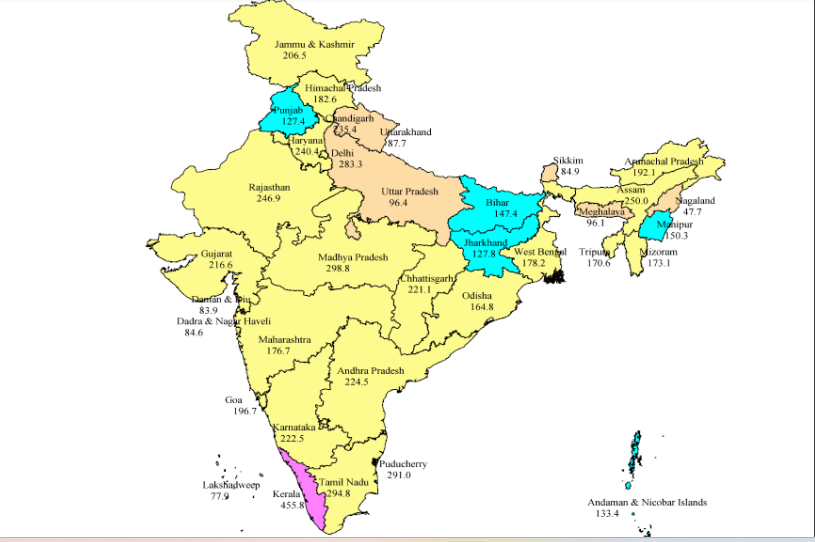
Fig. Rate of IPC crime in India, 2012 (Ministry of Statistics and implementation)

Why are crimes increasing in India

The growing trajectory of crimes is multifaceted. It is attributed to social, political, economic, cultural, international, environmental, and legal factors. Socio-economic offences, in recent years, have made an indelible mark in the legal fabric of the state.

Such offences come to the fore as fraudulence, bribery, money laundering, embezzlement, insider trading, corruption, etc. Domestic crimes have stretched themselves beyond national boundaries, for example, the Nirav Modi case and the Vijay Mallya case, garnering international media attention. 

Retributive sanctions for criminal offences in India fall behind on effective and timely disposal of cases. It does not help the fact that our judicial system is overworked, underfunded, understaffed, and finally, cocooned by a much-needed infrastructure upgrade. 

Case backlogs form a chorus at each level of the judiciary, ranging from the Learnt District Courts, Hon’ble High Courts and the Hon’ble Apex Court. There are 50 million criminal and civil suits pending as we speak. It would take a generous estimated timeline of 300 years to put the disputes to rest. Not to mention that this is exclusive to the future cases currently being drafted and discussed. 

Special courts, though in session, are working with a maximum strength of 12 benches pan-India. 754 Fast track courts have a steady disposal rate per capita; however, cases pile on the daily. Adequate staffing poses a silent yet formidable challenge to the efficient functioning of the aforementioned learnt courts in their respective jurisdictions. 

Political claw-rooms bare their fangs, one against another, to ensnare their competitors in a vicious cycle of litigation. Whether those charges and allegations stand the test of our Supreme Document is a relevant but different matter. 

What should be the crux of concern is that some laissez-faire-esque forces are working behind the curtains, enabling it, fostering it, and nurturing it until ultimately it becomes too malicious to rein it in, for its bridles fall short of any measure of morality and decency.

In light of such misconstrued use of the legal system, mention may be made of the landmark cases that project the political party scenario of our country in all but a positive light. Indira Nehru Gandhi case of 1975, Lakshmi Charan case of 1985, Kihoto Hollohan case of 1992, INC (I) case of 2002, Jagjit Singh case of 2006, B.P Singha case of 2010, etc. render to us as popular spectators of this parliamentary democracy a vivid pen picture of how far down things can spiral if left to its own meritorious or unmeritorious devices. It is but a stark reality showcasing the abuse of the justice system. 

Extradition cases with respect to fugitive economic offenders like Nirav Modi, Mehul Choksi, and Vijaya Mallya do little to engender confidence in the criminal justice system. Stakeholders and shareholders alike have found no recourse for proportional compensation for their investments from the aforementioned fugitives. 

This creates a snowball effect, eventually causing an avalanche of investors, both active and potential, to withdraw their capital portfolios in the domestic market. This augurs badly for the Indian economy and the poorer sections of the population receive the shorter end of the stick. 

Prosecution for illegal smuggling of endangered animals and animal parts such as Chinese pangolins, rhino horns, elephant tusks/ivory, and bear gall bladders have fallen short of making an example for those who are aspiring felons. According to the Association of Zoos and Aquariums, the demand for skin, fur, claws, and teeth has inundated the black market. 

The population of tigers, leopards, and jaguars is shrinking as a result of enforcement laxities. That poachers have succeeded despite stringent sanctions and regulations points to a larger problem in the nature of a systemic issue.

Ramifications of statistics on crime prevention

The most important effect has to be spreading awareness about the prevalent crimes in society. Rape, for example, has been documented and analysed to raise awareness on women’s safety in society. In data recovered from 2022, there were as many as 31,000 registered rape cases that year. Both registered and unregistered cases are estimated to exceed at least 50,000.

The second most important result is accountability to society. Human trafficking has been brought to the attention of the public at large. In popular media, a movie titled “Sound of Freedom” has provoked a palpable sentiment of disgust towards the perpetrators of child trafficking and equally garnered empathy and collective remorse towards those who had the unfortunate fate of enduring such trauma. In 2023, India oversaw the rescue of 839 victims and apprehended 170 others involved in human trafficking.

It also moulds public policy, which can better mirror the demands of society. Forced labour is still rampant in India. This modern avatar of slavery has ensnared 11 million people and shows no sign of decrease. This is a result of poverty manifesting as the lack of basic needs of food, water, and shelter. The labourers are mostly employed in raw material-guzzling industries such as electronics, palm oil, solar panels, gold, and garments. The Drafting Committee of the Indian Constitution preemptively included Article 23(1), which prohibits “begar” in any form.

It reinforces belief in a democratic society. Audit reports of the Comptroller and Auditor General of India remind the executive branch of the government to exercise prudence and austerity in their expenditure. If expenditures are disproportionate to the receipts causing loss to the exchequer, the constitutional authority reprimands the erring agencies, and the media amplifies it. 2G spectrum allocation, CoalGate, Delhi CommonWealth Games 2010, Padmanabhaswamy Audit are some of the watermark events where data stood in judgement against elected officials. 

It provides a moral compass that sensitises the public about the archaic practices of society. The Times of India reported in 2023 that caste-based violence against scheduled castes has escalated by 13% in 2022. The Prevention of Atrocities Act has been enacted and enforced to prosecute such heinous acts.

It has the effect of checking social and familial crimes. Data on domestic violence became an eye opener when it exposed the misdeeds that were hidden in plain sight. Physical, emotional, and sexual violence garlands the domestic violence scene in India. According to the India Development Review, 32 percent of married women have suffered in silence until they came to a breaking point. The Domestic Violence Act was a watershed in providing women and wives with the remedy against abuse committed within the confines of their household.

Role of vigilance in data gathering for prevention of crime

As we stand at the precipice of completing a quarter of the 21st century, it becomes essential, now more than ever, to have a Night Watchman approach towards data collection in the larger context of the criminal justice system. Every other sector of the economy, be it primary, secondary, tertiary, or quaternary, is data-driven and data-governed. 

Therefore, there is no excuse for laxity on the part of investigators and scholars alike to mine such information as may be relevant for the effective delivery of justice. 

While exercising vigilance, one must take caution that numbers so recorded reflect and reveal the ground realities on which it is primarily based. This is indispensable for the very reason that numbers hold up a mirror to society and hold individuals accountable for their acts of omission, commission, or both. 

Hence, it is prudent for officers on the ground to extrapolate information from the scene of the crime rather than reading their own biases into an otherwise sensitive case, which in effect they all tend to be. 

Do statistics stay true to ground realities, or are they merely a jumble of digits at the helms of the powers that be?

Yes and no. Yes, because there is a strong conviction that numbers are absolute figures and therefore representative of an objective reality. No, because numbers and figures derive their value from whoever, by authority, is allowed to interpret them. Further, it is at the discretion of those in positions of power to publish the data or withhold information from the public. 

Article 19(1) of the Indian Constitution guarantees to its citizens the right to information. The Central Information Commission is the principal agent created under an Act of Parliament to facilitate the exercise of this fundamental right. During 2016-17, 32344 cases were disposed-off by the statutory body out of the 34982 pending cases before it. In 2023, the disposal rate of RTI appeals had crossed 90 percent. 

This, therefore, shows that active citizenry can prevail despite the acumen of red-tapism in the iron cage of bureaucracy.

Bodies engaged in collecting data

Various non-government organisations (NGOs) engage themselves, independently or by way of empanelment, in mining information through active rounds of questionnaires, online and offline. Observer Research Foundation, Global Initiative Against Transnational Organised Crime, Red Dot Foundation, Wildlife Protection Society of India, and Navjyoti India Foundation have been active participants in ensuring that information is accessible for all, especially through the digital media. 

They are at the vanguard of protecting civil liberties as they continue to partake actively and assertively in bringing about lasting change in society. They do so by paying routine visits to far flung areas of the country, for example, Kathua, Kanpur, and Muzaffarpur, where the rural inhabitants are overwhelmed by illiteracy, unemployment, poverty, and caste-based marginalisation. 

The print and digital media have been deploying journalists as foot soldiers for getting first-hand information on the current happenings at ground level. National dailies like The Hindu, The Indian Express, Hindustan Times, and Times of India keep us on the loop about  government actions affecting our lives. Digital platforms like the wire, print, etc. give us real-time updates on the latest news. 

What is the future of crime prevention in India

The answer is no-brainer if the preceding paragraphs are to be held accountable. Big Data on criminal activities, whether or not they received media attention, should be diligently maintained and efficiently archived.

Every station house officer in the country, through effective administrative orders, should be made to update data in their respective portals. The use of information technology at the grass-roots level of policing can hedge against the tampering of data. 

There should be a nodal official for overseeing criminal data entries in the offices of the District Superintendents of Police and Deputy Commissioners of Police. The office of the Director Generals of Police/Commissioners of Police should have an official at the rank of a Deputy Inspector of Police to verify the data entries and confirm them for official release and subsequently for public use. 

Various faculties of law in universities and national law universities across the country can act as custodians of records and maintain the same in digital format and hard copy. Law students can play an important role in helping the agencies collect and analyse information. 

This would help nurture the spirit of inquiry in the participating students. It would also pay dividends in the long run in the form of establishing a legal posterity of educated and driven minds across the country. 

Data science steps involved in crime prediction

Data science steps involved in crime prediction:

  1. Data collection:
    • Gather data from various sources, such as police records, social media, and sensor networks.
    • Clean and organise the data to ensure its accuracy and consistency.
  2. Exploratory xata nalysis:
    • Analyse the data to identify patterns, trends, and relationships between different variables.
    • Use visualisation techniques to gain insights into the data and identify potential crime hotspots.
  3. Feature engineering:
    • Extract relevant features from the data that can be used for crime prediction.
    • Create new features by combining or transforming existing features to improve the predictive power of the model.
  4. Model selection:
    • Choose the appropriate machine learning model for crime prediction based on the nature of the data and the desired outcomes.
    • Popular models include decision trees, random forests, and neural networks.
  5. Model training and evaluation:
    • Divide the data into training and testing sets.
    • Train the model on the training set and evaluate its performance on the testing set.
    • Use metrics such as accuracy, precision, and recall to assess the model’s effectiveness.
  6. Hyperparameter tuning:
    • Adjust the model’s hyperparameters, which control the learning process, to optimise its performance.
    • Use techniques like grid search or Bayesian optimisation to find the best combination of hyperparameters.
  7. Feature importance:
    • Analyse the model to determine the importance of each feature in making predictions.
    • Identify the most influential features that contribute to crime prediction.
  8. Model interpretation:
    • Explain the model’s predictions and decision-making process.
    • Use techniques like SHAP (SHapley Additive Explanations) or LIME (Local Interpretable Model-Agnostic Explanations) to understand how the model arrives at its conclusions.
  9. Deployment and monitoring:
    • Deploy the trained model into a production environment to make real-time crime predictions.
    • Continuously monitor the model’s performance and retrain it as needed to ensure its accuracy and reliability.
  10. Ethical considerations:
    • Address ethical concerns related to data privacy, bias, and fairness.
    • Ensure that the crime prediction model is used responsibly and does not lead to discrimination or harm to individuals or communities.

Conclusion

The Indian Penal Code 1890, the Criminal Procedure Code 1973, and the Indian Evidence Act 1873 have had their day in the sun in the numerous back and forths between the bar and bench. Their interpretations have been comprehensive but never exhaustive. Since the inception of these criminal laws, myriad evidences and records have been compiled to deliver justice in the best way the courts know how within the precincts of the Constitution of India. 

In light of the new criminal laws, namely, Bharatiya Nyaya Sanhita, Bharatiya Nagrik Suraksha Sanhita, Bharatiya Sakshya Adhiniyam, which came into force on 1 July 2024, information gathering surveys, open-ended and semi-open-ended questionnaires, interviews, field studies, and archival exercises should receive new vigour and push from the legal fraternity as well as from the general public.

What these new laws say will positively be a product of documentary submissions, which will have a feedback effect on crime prevention. It is not hyperbole to argue that data from the ground is made flesh in the courtrooms. That is how laws have made their beginnings and that is how they are sustained thereafter with the resilience to stand the test of time. 

Crime prevention is only as effective as the information that is available to tackle the symptoms and their causes. It is a diagnostic and surgical approach, anything below that falls short and becomes a non-starter. No one is absolved from the responsibility of faithfully adhering to the facts of the case. Therefore, statistics, when used proactively, can speak truth to power.

References

Download Now

Dispersal of unlawful assemblies under CrPC

0

This article has been written by Samiksha Madan pursuing a Diploma in International Contract Negotiation, Drafting and Enforcement from LawSikho.

This article has been edited and published by Shashwat Kaushik.

Introduction

The word “Assembly” means “an assembly of more than one person in one place for a common cause or purpose”. For example, children gather for morning prayer, students gather for a seminar hall lecture, office workers gather for a meeting, people gather for last rites, etc. But it is not necessary for every meeting to be legal in the eyes of the law; sometimes a meeting is also held to carry out an illegal activity, which is an act punishable under the Code of Criminal Procedure. The more is not always the merrier!

Right to assemble under Indian Constitution

The Constitution of India guarantees the right to assemble peacefully and without arms under Article 19(1)(b). However, this right is not absolute and can be reasonably restricted in certain situations.

The framers of the Constitution recognised that the right to assemble is essential for a democratic society. It allows citizens to come together to express their views, protest against government policies, and hold their elected representatives accountable. However, they also recognised that this right could be abused if not properly regulated.

Article 19(2) of the Constitution allows the government to impose reasonable restrictions on the right to assemble in the interests of national security, public order, and public health. These restrictions can include limits on the number of people who can gather, the time and place of assembly, and the use of weapons or other dangerous objects.

The Supreme Court of India has interpreted Article 19(2) to mean that the government can only impose restrictions on the right to assemble if there is a clear and present danger to national security or public order.

In recent years, there have been a number of cases involving the right to assemble. In one case, the Supreme Court upheld a government ban on a protest march that was scheduled to take place near the Parliament building. The Court found that the march would have posed a clear and present danger to national security.

The right to assemble is a fundamental right that is essential for a democratic society. However, this right can be reasonably restricted in certain situations to protect national security, public order, and public health. The Supreme Court of India has played an important role in interpreting Article 19(2) and ensuring that the government’s restrictions on the right to assemble are justified and proportionate.

There is freedom to organise public meetings and gatherings, to organise hunger strikes, but it must be peaceful and without weapons. The sole purpose should be to educate the public and spread ideas.

Article 19 of the Indian Constitution guarantees six fundamental rights to all citizens, which are essential for the development of a free and democratic society. These rights are:

  1. Freedom of speech and expression: This right enables individuals to express their thoughts, ideas, and opinions freely, without fear of censorship or retribution. It includes the freedom to express oneself through various mediums, such as speech, writing, art, and music.
  2. Assemble peaceably and without arms: This right allows individuals to gather and assemble peacefully for various purposes, such as political rallies, religious gatherings, or social events. It promotes the exchange of ideas, fosters community spirit, and enables collective action.
  3. Form associations and unions: This right allows individuals to form associations, clubs, societies, and unions to pursue common interests. It enables people to organisess themselves for various purposes, including social, cultural, political, and trade union activities.
  4. Move freely throughout the territory of India: This right allows individuals to move freely within the borders of India without any restrictions. It promotes national integration, facilitates trade and commerce, and enables people to explore different parts of the country.
  5. Reside and settle in any part of the territory of India: This right allows individuals to choose their place of residence and settle in any part of India. It promotes social and economic mobility, enables access to education, employment, and healthcare, and fosters a sense of belonging and inclusiveness.
  6. Practice any profession or carry on any occupation, trade, or business: This right allows individuals to choose their profession or occupation freely and engage in any lawful trade, business, or activity. It promotes economic freedom, encourages entrepreneurship, and enables individuals to contribute to the growth and prosperity of the nation.

These six rights enshrined in Article 19 are crucial for the preservation of individual liberty, the promotion of democratic values, and the overall development of a just and equitable society.

Earlier, Article 19 laid down seven rights. But after the 44th Amendment Act of 1978, the right to acquire, hold and dispose of property was changed from a fundamental right and placed under Article 300A as a constitutional right.

In the landmark case of Himmat Lal vs. Police Commissioner, Bombay 1972, the Supreme Court of India delivered a significant judgement that reaffirmed the fundamental right of citizens to assemble peacefully. The case challenged a provision that granted the Commissioner of Police sweeping powers to prohibit all public meetings and processions.

The Court held that this provision violated the freedom of assembly guaranteed under Article 19(1)(b) of the Indian Constitution. The judgement emphasised that the state has a legitimate interest in maintaining public order and preventing unlawful activities. However, it cannot use this interest as a pretext to curtail the fundamental rights of citizens.

The Court held that the state can only enact laws that favour the freedom of assembly of citizens. It can impose reasonable restrictions in the name of public order, but it cannot prohibit all assemblies altogether. The Court recognised that public meetings and processions play a vital role in a democratic society, as they allow citizens to express their views, protest against injustices, and hold their leaders accountable.

The Court’s decision in Himmat Lal vs. Police Commissioner has been cited as a precedent in subsequent cases involving the freedom of assembly. It has helped to ensure that the state cannot arbitrarily restrict the right of citizens to gather peacefully and express their opinions.

The judgement also highlights the importance of judicial review in safeguarding fundamental rights. It demonstrates that the judiciary can act as a check on the powers of the state and protect the rights of individuals against excessive government interference.

Unlawful assembly under IPC

Chapter VIII of Indian Penal Code 1860 deals with offences against public peace, Section 141 of Indian Penal Code 1860 defines unlawful assembly – an assembly of five or more persons is intended to be an “unlawful assembly” if the joint purpose of the persons forming the assembly is:

  • Intimidation is the use of criminal force to intimidate the government or any public official.
  • Resist the law or any legal process.
  • Commit a felony, a criminal misdemeanour or other crime.
  • Take possession of any property by force or prevent anyone from using it.
  • To force someone to act against their legal rights.

The important foundations of an illegal association are:

  • The number of people forming it, i.e., 5.
  • Their common object.
  • The common purpose must be one of the five unlawful acts mentioned in Section 141 above.

Section 149 of the Indian Penal Code, 1860, addresses the criminal liability of members of an unlawful assembly. It establishes that each member of such an assembly is held accountable for any offense committed in furtherance of the common purpose of the assembly. However, mere presence at the scene of an unlawful gathering does not automatically make an individual liable for any wrongdoing.

The crux of Section 149 lies in determining the existence of a “common purpose” among the members of the unlawful assembly. This common purpose serves as the basis for attributing guilt to each individual. The law infers the common purpose from the actions and language of all the members involved.

In the landmark case of Gangadhar Behera and others vs. State of Orissa (2002), the Supreme Court of India shed light on the interpretation of Section 149. The Court emphasised that a mere physical presence within an unlawful assembly, without active participation or shared criminal intent, is insufficient to establish guilt.

The Court held that to establish liability under Section 149, the prosecution must demonstrate that each member had knowledge of the common purpose and acted in furtherance of that purpose. This requires an examination of the specific acts and statements of each member to ascertain their individual involvement and intent.

The implications of Section 149 extend beyond individual culpability. It serves as a deterrent against unlawful assemblies and encourages individuals to refrain from participating in activities that may lead to criminal consequences. By holding each member accountable for the actions of the group, the law aims to maintain public order and prevent the escalation of violence or disorder.

In summary, Section 149 of the Indian Penal Code, 1860, establishes the principle of shared responsibility among members of an unlawful assembly. It emphasises the need to prove a common purpose among the participants and requires the prosecution to demonstrate the individual involvement and intent of each member. By doing so, the law aims to ensure that only those who actively contribute to the criminal objective of the assembly are held accountable for their actions.

Illustration: A, B, C, D and E decided to rob a bank together; they also had guns, with the intention of killing people who came between them. In this case, even if A and B were only involved in the planning and not the murder, they would be held responsible as if they were killing people.

This section deals with two main parts:

  1. Offence committed by a member of an unlawful assembly of five or more members.
  2. The offence must be committed against a common purpose according to Section 141 of the Criminal Code, knowing its consequences.

It is not essential that the unlawful assembly agree beforehand to be prosecuted after the offence, as was the case in Sanjeev Kumar Gupta vs. State of Uttar Pradesh, 2015.

It is not necessary to prove which member of the illegal congregation committed the act; mere presence can increase the criminal liability, as stated in State of Uttar Pradesh vs. Dan Singh (1997).

Punishments under Indian Penal Code

Section 143 of the Indian Penal Code, 1860 specifies that if a person knowingly joins a group knowing that it is unlawful, he shall be punished with imprisonment for a term which may extend to 6 months, with a fine, or with both.

Section 144 of the Indian Penal Code, 1860 defines an unlawful assembly as anyone armed with deadly weapons capable of causing death and is punishable with imprisonment for a term which may extend to two years, fine, or both.

Section 145 of the Indian Penal Code, 1860 provides that a person who willfully remains in a common unlawful union after being ordered by law to separate shall be punished with imprisonment for a term which may extend to two years or with fine, or both.

Unlawful Assembly under CrPC

The Code of Criminal Procedure (CRPC) lays down the procedure for investigation of crimes, arrest of suspects, collection of evidence, determination of guilt or innocence of the accused and punishment of the guilty. It came into force in 1973 and came into force on 1 April 1974. It will be replaced by the Bharatiye Nagarik Suraksha Sanhita (BNSS) effective 1 July 2024, repealing nine sections of the existing CRPC and making amendments to 160 sections. The BNSS also carries out a time-bound investigation, trial and adjudication within 30 days of the completion of charges.

The prevalence of such unlawful assemblies, as the title of this article suggests, is mentioned and explained in Chapter X: Maintenance of Public Order and Peace under sections 129, 130, 131 and 132 of the Criminal Procedure Code 1973. Part A deals with unlawful assemblies.

By Civil Power: CrPC Section 129(1) Any Judge or Chief Officer of a police station or in his absence any officer other than the rank of Sub-Inspector may order the dispersal of any unlawful assembly which may disturb the public. peace

Disobeying the order and persisting in unlawful assembly are punishable with imprisonment which may extend to two years or with fine or with both as mentioned in Section 145 of the Indian Penal Code, 1860.

(2) if such assembly does not disperse after receiving the order and shows that it does not wish to remain, the magistrate or police officer referred to in subsection (1) may by this power disperse:

  • Any male person who is not an authorised person
  • Can arrest and imprison any person involved in an unlawful assembly

The Karam Singh vs. Hardayal Singh case has three conditions:

  • Unlawful assembly of 5 or more persons for violence or disturbing public peace and order
  • The people must be given an order and notified of their assembly
  • The assembly refused to disperse

Disturbing the order and being in company, according to Section 151 of the Penal Code 1860, is punishable by unlawful assembly after an order to break up.

The police cannot start shooting without getting any prior orders. In this case, the state must compensate the meeting and all its victims for shooting without prior permission.

Section 129 deals with two types of assembly:

  • Unlawful assembly under Indian Penal Code Chapter VIII, Section 141 of 1860.
  • Assembly of 5 or more persons with intent to commit violence or disturb public peace.

Armed use of forces: CrPC Section 130(1) the attending chief executive judge can issue an order for the dispersal of an illegal assembly by the armed forces if it cannot be dealt with by civilian force and it is necessary to ensure public safety.

(2) A magistrate may, with the support of a group of persons belonging to the armed forces (army, air force and navy), issue an order for the arrest and detention of persons who have participated in an illegal assembly.

(3) every officer of the armed forces shall, in breaking up a congregation and in arresting and detaining such persons, use as much force as is necessary and cause as little injury as possible to any person or property.

Certain officers of the armed forces, in the absence of competent authority: CrPC Section 131 

Where communication with the executive magistrate is not possible, although the unlawful assembly poses a threat to public safety, any officer or officer of the Armed Forces directs the assembly and separates it with the assistance of armed officers under his command, arrest and detention. However, if he can speak to the magistrate while performing, he must do so and follow instructions, whether or not he is allowed to continue performing.

Section 132 of the IPC talks about immunity from prosecution for acts committed under the preceding sections, which means it protects people from prosecution for acts committed under sections 129, 130 and 131 above.

No person shall be prosecuted in a criminal court for an offence under section 129, 130 or 131, except

  • with the permission of the Central Government if that person is a soldier or officer;
  • with the consent of the State Government in other cases;

2. [a] no executive magistrate or police officer acting in good faith under any of the said sections;

[b] any person failing to do anything in good faith under section 129 or section 130 of expropriation;

[c] any officer of the armed forces acting in good faith under article 131;

[d] no member of the armed forces does any act in compliance with any order which he has been required to obey;

shall be deemed to have committed an offence.

In this section and in the following sections of this chapter:

[a] the expression “armed forces” means the army, navy and air forces acting as land forces and includes any other armed forces of the Union so acting;

[b] “officer” means, in relation to the armed forces, a person appointed, published or serving as an officer of the armed forces, including a non-commissioned officer, officer, senior officer, non-commissioned officer and clerk;

[c] member – a person in the armed forces who is not an officer. 

Prevention given under CrPC

Part C of Chapter X deals with cases of urgent disturbance or perceived danger. Section 144 of the CrPC empowers the Executive Judge to authorise any state or territory to issue an order prohibiting the assembly of four or more persons in an area We usually hear from Gautam Buddh Nagar, Noida, UP. By law, any member of such an “unlawful assembly” can be tried for rioting.

Conclusion

The dispersal of unlawful assemblies is a complex issue that balances the right to assemble with public order. Authorities must follow strict legal procedures to break up such meetings if necessary. A number of options can also be used to deal with an illegal assembly in order to maintain public order and minimise the risk of harm to members of the assembly as well as the public.

References

Download Now

Mazhar Husen vs. Bodha Bibi (1898)

0
Islamic-Law-Law-of-the-Muslim-World-eJournal.-June-14

This article has been written by Akanksha Singh. The article is a comprehensive piece of work on the case analysis of Mazhar Husen vs. Bodha Bibi (1898). This article provides a detailed study of this landmark case and aids in understanding the concept of wills under muslim law. It also deals with the detailed analysis of the judgement along with relevant case laws and precedents involved in this case. The article gives a comprehensive learning experience to all the readers. 

Table of Contents

Introduction

The 1898 ruling in the case of Mazhar Husen vs. Bodha Bibi (1898) is considered a seminal work in the Muhammadan law. This case becomes significant as it clarifies the complex rules regulating testamentary dispositions under Islamic law. The judgement is unique with regards to the interpretation of the Muhammadan law, concerned with the Shia sect. The strict regulations governing wills under Muhammadan law are intended to maintain fair distribution among heirs and to avoid arbitrary or extravagant bequests that might upset family peace or violate fixed inheritance shares. The book titled ‘The Spirit of Islam’ written by Amir Ali says that “A will from the Mussalman point of view is a divine institution since its exercise is regulated by the Quran”. Under the Muslim law, the will is placed at a very significant place in the life of the people. The importance of the will can be understood from the Hadith named ‘Ahmad and Ibn Majah’. This says that:

“A man may do good deeds for seventy years but if he acts unjustly when he leaves his last testament, the wickedness of his deed will be sealed upon him, and he will enter the Fire. If (on the other hand), a man acts wickedly for seventy years but is just in his last will and testament, the goodness of his deed will be sealed upon him, and he will enter the Garden.”

This landmark case of the year 1898 is a crucial resource for legal academics and practitioners working with Islamic wills because it provides significant insights into the judicial interpretation and implementation of these principles. As per the Muslim law, in the event that a will is left, the property is divided among his or her heirs in accordance with the laws of testamentary succession. In simple terms, it means that the property is divided in accordance with the terms of the testament or will. The laws of intestate succession are used in order to divide up the property among the heirs when a person passes away without leaving a testament (will), or intestate. 

Implications of the case under the Muslim Personal Law

Under the Muslim law, an Islamic will is known by the name of ‘Al-wasiyya’. As per Muslim law, the testamentary document, generally called as the ‘will’ is known as ‘Wasiyat’. The legator makes a Will or Wasiyat which is a document giving proprietary rights in favour of a legatee. The will becomes effective after the death of the legator. The legator or testator is a person making the will. The testator retains complete ownership and control of the property as long as he or she is alive. The ability of the owner of the property to transfer such property inter vivos or by any other testamentary disposition is unaffected by a will. In no way, especially before the death of the testator, is it binding on them. It is reversible by formal cancellation or by another will made on the same property in the future. The will of a person who after making such will subsequently becomes of unsound mind is void and cannot be executed after. 

There are a few important terminologies used in this case that are essential to understand clearly. In a will, there are multiple parties involved. The term testator is used for the person who makes or creates the will whereas the term legatee is used for the person or persons in whose favour the will is being created. In other words, the person who is intended to inherit or the person on whom the property of the testator will devolve. The subject matter, that is, any type of property of the testator, of the will is called the legacy. Additionally, the testator of the will might appoint a person who will be responsible for the will to be executed in accordance with the contents of the will after the death of the testator. This person is known as ‘Executor’. While the testator did not appoint any executor of the will, the court might appoint an administrator for the same purpose.  

Details of the case 

  • Case name: Mazhar Husen vs Bodha Bibi
  • Case No: 0029 of 1898
  • Equivalent citation/neutral citation: (1899) ILR 21 91, 25M.I.A. 219  
  • Subject of the case: Muhammadan Will, Suicide of Testator
  • Court: Privy Council
  • Coram: Hobhouse, Macnaghten, Morris and R. Couch, JJ.
  • Petitioner/Appellant: Mazhar Husen
  • Respondents: Bodha Bibi
  • Judgement date: 3rd August 1898
  • Held: Appeal Dismissed

Facts of the case 

In the case of Mazhar Husen vs Bodha Bibi, a letter contained the details and directions regarding the property of Ibn Ali, the testator of the letter or will of the 1st of August, who died shortly after writing the letter. Ibn Ali, the testator, died on the 2nd of August, in the year 1898. Ibn Ali possessed some property. In the aforementioned letter written by the testator, shortly before his death, the testator had assigned his property in favour of his three sisters, who were the daughters of the testator’s paternal uncle, in equal share. In this case, the testator did not die from a natural death. The testator died after administering poison, named arsenic, to himself in an attempt to suicide. The testator died within a few hours of administering poison to himself. 

As per the facts of the case, the letter clearly stated that the testator had taken poison with the intention of suicide. The testator had further mentioned that he wanted the words and directions written in the letter by him to be followed after his death. There were two appeals filed before the High Court of Allahabad by special leave from two decrees, dated 11th January 1894 and 17th March 1891 respectively, of the Subordinate Judge of Allahabad. Bodha Bibi was the plaintiff in both of these suits, which were heard together in the original and appellate courts. Bodha Bibi was the widow of Amir Ali. Nasiban Bibi joined Bodha Bibi in one of the suits. In both the cases, the defendants were the same. The defendants were Haidri Begam, Nazir Bandi, Habib Bandi, and Rahim Bandi. Later, after the death of Haidri Begam, she was represented by her husband Syed Mazhar Husen. Further, Rahim Bandi was represented by her husband Fayed Fazal Husen. The respondents claim the property in dispute under the letter or will of 1st of August, 1898. 

In all of the abovementioned suits, the possession of the property mentioned under the letter had allegedly been bequeathed by the letter written by the deceased Syed Ibn Ali was to the extent of one-third of his estate. The one-third of his estate consisted of zamindars and other immovables, which were bequeathed in the favour of his three first cousin sisters. The plaintiff had filed the suit to claim the properties back from the defendant. The plaintiff, claimed, as the assignees of the property, all the interest on the property from the legatees, which was bequeathed to them by the letter or will of Syed Ibn Ali.  

Issues raised 

In this case, two issues were made out before the court. They are given below:

  • The first question before the court was whether the letter dated 1st August 1898 amounted to a will under the Muhammadan law or not.
  • The second question before the court was whether the will became invalid if the letter dated 1st August 1898 was written after Ibn Ali had administered poison to himself or not.

Laws or concepts involved in this case

The word ‘bequeath’ as per the law of Shia means “An act of conferring a right in the substance or the usufruct of a thing after death”. As per the article by Syed Amir Ali on the Muhammadan law regarding the Shias, there are multiple ways to direct a bequest. One such way is the usage of any expression that sufficiently indicates the intention of the testator, to bequeath his property. 

In the 25th volume of the weekly reporter page 121, a ruling of their lordships of the Privy Council held that there is no need for a particular form, even of a verbal declaration, as long as the intention of the testator can be sufficiently established. The law of Shia under the Muhammadan law is applicable in the case of Mazhar Husen vs Bodha Bibi (1898). As per the law of Shia, a will becomes invalid if it is made by the testator who was injured by his own actions or who tried to commit suicide. 

However, in this case, it was held that a will written under a circumstance where in the testator was injured by his own actions or tried to commit suicide can be considered valid if it can be inferred or proved that the will was made in contemplation of taking poison but before actually taking the poison. The onus of proving contrary to the aforementioned relies on the party impugning with. Thus, it implies that under Shia law, a will made by a testator who later committed suicide is valid when while making the will, the testator had not taken any steps towards to commission of suicide.  

Arguments of the parties

Arguments by the appellant 

Advocate J.D. Mayne and Advocate W.A. Raikes, while arguing for the appellant, contested that by considering the state of the mind of the testator, there would have been little or no difference whether the testator had taken poison before or after writing the letter. They further mentioned that there are not numerous sources on it. 

Arguments by the respondent

Advocate G.E.A. Ross, while arguing for the respondent, contested that the question of whether the letter dated 1st August 1898 is a will as per the Muhammadan law has already been established. 

Judgement of the case

On both the aforementioned issues, the appellants got a decision in their favour by the Subordinate Judge of Allahabad. The Subordinate Judge of Allahabad held that the letter and its content shall not mean a bequest. The Subordinate Judge of Allahabad further held that the letter was written after Ibn Ali had administered poison to himself. An appeal was put against the decision of the Subordinate Judge of Allahabad before the Privy Council. The respondents rely on the bequest that is mentioned in the letter written by Ibn Ali to his general attorney, Syed Zain-ul-Abdin. The Privy Council accepted the contents of the letter concerned in this case and held that the contents of the letter is not disputed now. The lordships in this case agreed to the fact that the deceased Ibn Ali had taken poison after he sent the letter. The court thus dismissed the appeal with cost. 

There was an appeal against this decision of the Subordinate Judge of Allahabad, before the divisional bench. The divisional bench reversed the decision of the Subordinate Judge of Allahabad. The divisional bench held that the letter dated 1st August 1898 can be considered as a will under the Muhammadan Law, as followed by the Shia sect. The division bench said that the letter did not become invalid solely because of the reason that the letter was executed by the suicide, who had administered poison to himself in an attempt to suicide. 

The judgement of the division bench was based on the inferences drawn from the letter concerned in this case, by considering the Muhammadan law, and by referring to the evidence on record. Subsequently, the division bench held that it was of the opinion that the letter was not written after Syed Ibn Ali took poison, rather the court inferred from the circumstances that the letter was written on 1st August 1898 and the testator died on 2nd August 1898 after administering poison to himself in order to commit suicide. The bench then held that the bequest was not bad because of it being made before committing the act of suicide.  

Based on the circumstantial evidence, the Privy Council held that the testator had written the letter before taking the poison and sent the letter to his friend, who lived at a distance of some twenty miles. Thus, the court dismissed the appeal and imposed the costs. 

Analysis of the case 

While delivering the judgement, the court acknowledged the fact that in case, the letter did not amount to a valid bequest of the property of the testator to his three cousin sisters, his property would have been devolved on his mother, Hindri. The court relied upon the contents of the letter dated 1st August 1898, as the contents of the letter were accepted to be undisputed. The court arrived at the judgement based on the following facts of the letter. 

The letter stated, as a matter of fact, that Syed Ibn Ali wrote a letter in the forenoon of the 1st of August 1898 to his mukhtar, Zain-ul-Abdin. The letter appeared to have been written an hour before the death of the testator. The letter clearly mentioned that the mother of the testator, that is, Syed Ibn Ali, shall not be given any share of his property. He further wrote in the letter that his property shall be equally given to his three cousin sisters, who were the daughters of his paternal uncle. This was written in the clause 10 of the letter as follows:

“You should not have the property given to (my) grandmother and paternal uncle’s wife, but you should give the whole to my three sisters, who are my paternal uncle’s daughters. You should see that they all get an equal share, and in the same manner, as stated by me in paragraph 3.”

The Subordinate Judge of Allahabad while dealing with the issue of whether the letter of the deceased testator is a valid will under the law of Shias, the Judge held that in the letter dated 1st August 1898, there is no ‘Tamlik Ain’ which means ‘Constituting a proprietor of the property itself’. The Subordinate Judge further said that there is no ijab, that is, ‘proposal’ as well in this case. The ‘Ijab’ is an essential element for the enforcement of a bequest with regard to the profits. For the existence of ‘Tamlik Ain’, the letter should have stated clearly that the daughter of the paternal uncle of the testator shall be the rightful owner of the property after the death of the testator. Further, the Subordinate judge said that for the existence of the ‘Ijab’, the letter should have consisted of a clear statement stating that the testator had given his property to his three cousin sisters. The Subordinate judge further held that by reading the words of the letter, it is indicated that the intention of the testator was to avoid giving his property to his mother. The passages of the letter do not show any intention of the testator to carry out a bequest or to give the properties completely to his cousin sisters. The Subordinate Judge of Allahabad further held that based on the aforementioned observations, it can be inferred that the letter cannot be considered as a valid will under the Muhammadan law, as observed by the Shia sect. The judge concluded that a bequest cannot be carried on from such a writing or declaration by a letter. 

Further, on the question of whether the will was valid or invalid based on the ground that it was written after the testator administered poison to himself. To come to a decision on this question, the Subordinate judge referred to the book named ‘Riyaz-ul Masal’, popularly known as “Sharah Kabin, Volume IV, Chapter on Wills. This book contains a paragraph in Arabic, which is translated as;

“If anyone wounds himself intentionally so as to endanger his life, and then makes a bequest, then such a bequest shall not be accepted as valid will”. 

An appeal was preferred to the High Court, which the High Court refused to entertain on the ground that the decree of the case was not in the final one, within the meaning of Section 595 of the Code of Civil Procedure. However, the High Court of Allahabad accepted the appeal based on a special leave to appeal on 24th November 1894. The court noted that there were questions as to whether the testator wrote the letter after taking the poison. 

The book ‘The Spirit of Islam’ written by Amir Ali further contains a passage stating that if a person who is lunatic or in a state of intoxication and has inflicted a deadly wound on himself, makes a bequest in such a state, then such a bequest is void. It also mentioned that any bequest made in a state when the person making the bequest is wounded or has done an act which will result in death necessarily, then such a bequest is illegal. The Subordinate Judge of the Allahabad High Court further mentioned that a person making such a bequest falls under the category of a person who is dead and thus the provisions related to the living wills are not applied to the testator in the present case. The other passages also said that a valid bequest exists when the person is of sound mind while making it. The Subordinate Judge mentioned that the aforementioned book is not the only book containing such provisions. Books such as Tahzib, Maula-yah Zar-ul-Fakih, Vasail Tashaya, Furu Kaft, Sharaya-ul-Islam, and Mulchtasar Mani contain the same principle that a bequest as aforementioned shall be illegal. In the book, Javahar-ul-Kalam also mentioned the following:

“One who Voluntarily does an act from which he thinks he must die is to be classed with one who has committed suicide, instance, one who has taken poison will come under the same category.”

Thus, the Subordinate Judge at Allahabad inferred that even if the court assumes that the letter dated 1st August 1898 written by Syed Ibn Ali amounted to a will, such will was completely void and unenforceable because the will was created after Ibn Ali attempted to end his life. 

Relevant judgements on the subject of wills under Islamic law

There are several decisions under the Muhammadan law which deal with the wills. 

Ghulam Mohammed vs. Ghulam Hussain (1932)

In the case of Ghulam Mohammed vs. Ghulam Hussain (1932), the court determined that a bequest made in the favour of an heir is void unless the other heirs agree to it after the death of the testator.

Fukan vs. Mst. Mumtaz Begum (1971)

In the case of Fukan vs. Mst. Mumtaz Begum (1971), the Rajasthan High Court ruled in this case that a bequest made in the favour of an heir was invalid until and unless other heirs gave their approval, regardless of whether the bequest represented one-third of the whole property.

Abdul Manan Khan vs. Murtaza Khan (1991) 

In the case of Abdul Manan Khan vs. Murtaza Khan (1991), the Patna High Court once more determined that a bequest of property made in the favour of an heir is void unless the other heirs have given their assent to such bequest after the death of the person who made the will.

Conclusion 

The landmark case of Mazhar Husen vs. Bodha Bibi (1898) had a far-reaching impact as it not only established a precedent for future cases involving related difficulties or similar situations, but it also defined the legal position under Muhammadan law regarding the execution and limitations of wills. The judgement emphasised the need to strike a balance between testamentary freedom and the right of the heirs to inherit property and reaffirmed the need to abide by the established restrictions on testamentary bequests. In doing so, it emphasised the fine balance that Islamic law aims to preserve between personal freedom and family responsibilities.

A Muslim will must be interpreted largely in line with the rules established by the Muhammadan Law, taking into consideration the language used, the social context, and the surrounding circumstances. A will acts from the death of the testator, just like in contemporary law. When a will contains ambiguities, the court should, to the greatest extent feasible, give effect to the purpose of the testator. In other words, the court, while dealing with any uncertainty or dispute with the contents of the will, shall try to give effect to the intention of the testator. 

One of the pivotal aspects of the case is that the ruling gave a clarification as to the validity of a will made by a person who subsequently died by his own actions by administering poison to himself in an attempt to commit suicide. The in-depth examination of the ability of the testator to make a will and the legality of the will by the court established a framework for evaluating testamentary documents in the context of Islamic law. The ruling established a strong precedent for similar cases in the future by closely examining the procedural elements, such as the requirement for witnesses and the evidence standards needed to show a will. In order to ensure that Islamic law was applied fairly and accurately in a case of 1898 under a colonial setting where courts had to reconcile British legal norms with Islamic jurisprudence, procedural clarity was crucial and the case ensured that the application of the Islamic law was fair and accurate. 

Frequently Asked Questions (FAQs)

What is the difference between the law of Sunni and the law of Shia with regard to the case of ‘Mazhar Husen vs Bodha Bibi (1898)?

While there are multiple differences between the law of Shias and the law of Sunnis, the difference that is relevant in context with the case of Mazhar Husen vs Bodha Bibi (1898) is the law on the validity of a will. Under the law of Sunnis, the will remains valid even if the person who made the will commits suicide subsequently. However, under the Shia law, the will clearly becomes invalid if the person who made the will commits suicide later unless it can be established that the will was made by the deceased testator before he actually took any step towards the commission of the act of the suicide. 

What is the limitation put on the disposition of the property under the law of Shias?

Under the law of Shia, the bequest of a property by a testator to their heirs is valid only up to the extent of the one-third of the property.  

References

Download Now

Gaurav Nagpal vs. Sumedha Nagpal (2009)         

0

This article is written by Shefali Chitkara. This is an exhaustive article that covers the analysis of the case of Gaurav Nagpal vs. Sumedha Nagpal (2009), exploring the laws governing the custody and guardianship of children and the concept of ‘welfare’ of the child. This article deals with the background of the case, relevant facts, issues that were raised before the Hon’ble Supreme Court and the judgement given by the court. The author has also highlighted the judgements that were referred to in this case and the important subsequent judgement that referred to the present case. Further, the significance of this case is also mentioned.

This article has been published by Shashwat Kaushik

Table of Contents

Introduction

When determining any question of custody or guardianship of a child, it is an established principle that the welfare of the child is of paramount importance. The present case of Gaurav Nagpal vs. Sumedha Nagpal (2009) is a great example where the child has become the focus of controversy between the partners. The parties fought a number of legal battles and even the gates of the Supreme Court have been approached by the parties. This case has widened the meaning of the term “welfare” and it is now said to include both physical and moral well-being and also due consideration has been given to the ties of affection. 

Laws regulating custody and guardianship in India

Before going into the details of the case, it was necessary to understand the laws regulating custody and guardianship in India.

We have personal laws and even secular laws dealing with the issue of custody and guardianship of a child. The provisions within the matrimonial acts can be invoked only when there is some pending proceeding under that Act. Otherwise, a statute made separately for dealing with this issue particularly has to be applied by the parties. Specifically for Hindus, we have the Hindu Minority and Guardianship Act, 1956 (hereinafter referred to as “HMGA”) and we also have the Guardians and Wards Act, 1890 (hereinafter referred to as “GWA”) which is a secular law for the appointment of a guardian for a child, irrespective of the religion, caste, gender, etc. The provisions under both these Acts or other personal laws dealing with the custody and guardianship of a child, are complementary to each other and not in derogation and the courts have a duty to harmoniously read them if case demands so. 

The custody rights of parents are primarily determined by keeping the best interests of the child as the paramount consideration. This principle ensures that all decisions and actions taken by the court prioritise the child’s overall well-being, safety, and stability over the rights and preferences of the parents. In evaluating custody arrangements, the courts typically consider several factors. These include the emotional bonds between the child and each parent, the parent’s ability to provide for the child’s physical and emotional needs, the child’s adjustment to home, school, and community, and the mental and physical health of all parties involved. The court may also take into account the child’s wishes, particularly if the child is of sufficient age and maturity to express a reasoned preference. Joint custody, where both parents share decision-making responsibilities and physical custody, is often favoured to ensure that the child maintains a meaningful relationship with both parents.

There is no hard and fast rule regarding the question of whom to give the custody of the child but there are a few accepted general rules which are highlighted in various decisions of the courts in India as well as in England:

  1. A minor child or a child of tender age should be generally under the custody of a mother since a father is not seen as capable of providing maternal affection as needed by a child for his/her proper growth.
  2. The boys who are older are generally placed under the custody of the father.
  3. The girls who are older are generally placed under the custody of the mother.
  4. Ordinarily, custody should be given to either of the parents, however, if the welfare of the child so requires, it may be given to a third person.

There is a minute difference between the term “custody” and “guardianship”. The word “custody” refers to the physical control over a person or a property whereas guardianship is similar to trusteeship and a guardian acts as a trustee. The custody can be for a temporary period and for a specific purpose, the same was held in the case of Ramesh Tukaram Gadhwe vs. Sumanbai Wamanrao Gondkar (2007).

Details of the case

Case title

Gaurav Nagpal vs. Sumedha Nagpal

Case citation

AIR 2009 SCC 557

Date of the judgement

November 19, 2008

Court

Supreme Court of India

Case Type

Civil Appeals No. 491 of 2006 and 5099 of 2007 from the decision of learned single judge of the High Court of Punjab and Haryana

Name of the appellant

Gaurav Nagpal

Name of the respondent

Sumedha Nagpal

Bench

Justice Dr. Arijit Pasayat and Justice G.S. Singhvi (two-judge bench).

Provisions involved

Facts of the case

The appellant, the husband, and the respondent, the wife, got married on October 14, 1996 and a child was born to them on November 15, 1997. It is alleged by the appellant, the father of the child, that the respondent, the mother of the child, abandoned the child on August 8, 1999. However, as per the respondent, when she was attending to household chores, the appellant whisked away their minor child after which she filed complaints. The appellant was then arrested and produced before the court at Bahadurgarh. 

An application was filed before the Sub Divisional Judicial Magistrate, Bahadurgarh, requesting the court to hold an inquiry, as to the whereabouts of the minor child. The Magistrate passed an order directing the appellant to produce the child on the next date of hearing. However, as the respondent could not reach the court in time, the Magistrate granted bail to the appellant and declined the prayer for production of the minor child. 

Thereafter, the respondent, filed an application for issuance of a writ in the nature of habeas corpus before the High Court at Delhi on August 25, 1999. This writ was, subsequently, dismissed by the High Court on January 14, 2000 on the grounds of lack of territorial jurisdiction. Against the High Court’s decision, the respondent filed a special leave petition under Article 136 of the Indian Constitution and also a writ petition under Article 32 of the Indian Constitution. The Supreme Court gave the interim custody of the 20-months-old child to the father.

Further, a maintenance petition was filed by the respondent before the Delhi High Court and a petition seeking guardianship of the child before the learned Additional District Judge, Jhajjar, which was later withdrawn by the respondent and filed before the District Court of Gurgaon. A reply was filed by the appellant opposing the application on the ground that the respondent was the one who deserted the child. The learned Civil Judge on May 2, 2002 ordered the dismissal of the application for interim custody, and the court reasoned that any disturbance by changing the custody of the child now would not be conducive to the welfare of the child and would traumatise him and affect the mental health of the child who had already started developing love and affection towards his father and his family members. 

Subsequently, the respondent filed a revision petition before the High Court. The court granted her visitation rights by order dated September 30, 2002, and continued the interim custody of the child with the appellant. The following terms were laid down for the visitation rights as fixed by the High Court:

  1. Every last Saturday of the month – 9 am to 5 pm,
  2. For a week in the same above-mentioned manner in summer vacations,
  3. For one day in Dussehra holidays – 9am to 5pm,
  4. For one day in Diwali Holidays – 9 am to 5 pm.

Further, a contempt petition was filed by the respondent for violation of the above-mentioned terms by the appellant. The District Judge of Gurgaon allowed the petition of the respondent and gave custody of the child to the respondent. 

Proceedings before the High Court

An appeal was filed by the appellant before the Punjab and Haryana High Court against this order dated January 6, 2007. An interim order was passed by the High Court which stayed the custody order which was granted to the respondent and continued the order relating to visitation rights for the respondent which was previously given. 

According to the appellant, the conviction order passed by the High Court dated March 9, 2005 through which the appellant was convicted for contempt of court was wrong and assailed by the appellant in Criminal Appeal No. 491 of 2006. The District Court noted that the child had remained in the custody of the appellant for a period of 7 years and taking him out of his custody now would seriously affect the sentiments and upbringing of the child but, on the other hand, the child should also not be deprived of the mother’s home and love. 

The appellant took the stand before the High Court that the lower courts did not hold him disabled in his role as a father and, thus, there was no perfect reason for the court to grant custody of the child to the respondent. The only fact that the respondent is the mother of the child cannot be considered for allowing that petition of custody to the respondent. It was also submitted that the father is a legal guardian as per Section 6 of the HMGA and the welfare of the child lies with the father, his large income and in his joint family, the child is taken care of by the appellant, his mother, brother and also his brother’s wife and three nephews. The overall development of the child was possible due to the warmth of the joint family and keeping the child away from those surroundings which could have deprived him of love and affection. It was also pointed out that the respondent will not be able to provide a good education for the child with her meagre income and the child is afraid of her mother. It was further submitted against the contempt proceedings by the appellant before the High Court that the appellant was not a criminal and there was no contempt committed by him and the complaints lodged against him were only related to some technical violations. 

On the other hand, the respondent alleged that the appellant had shifted his residence to Bahadurgarh by deception and fraud and the child was snatched from her custody on August 1, 1999. After this, she approached various courts to obtain custody of the child. It was further submitted that the appellant was also convicted for the failure to comply with the orders of interim custody and sentenced to one month’s imprisonment and, though the order of sentence was stayed, the order of conviction still continues to be in force. She also submitted that this conduct of the appellant in disobeying the orders of the court implied that he has no respect for the rule of law and the mere fact of not being financially as strong as the appellant cannot be considered for denying the custody of the child to her. She also pointed out that the appellant did not have any fixed residence and he shifted from Delhi to Bahadurgarh and then to Gurgaon and back to Delhi where he claims to reside but the same is owned by his brother. She further alleged that the appellant had deliberately poisoned the mind of the child against the respondent. 

After all these contentions by both parties, the High Court considered Section 13 of the HMGA, which provides for the foundation of the child’s custody. The High Court noticed and tried to answer the question- “Should the child be permitted to stay with the father, who inculcates fear and apprehension in the mind of a minor, against his mother and thwarts court orders with impunity?” The High Court answered the same negatively and noted that “the daily trauma the child appears to undergo while being tutored against the mother would be in excess of the trauma likely to be faced while entrusting to the respondent”. The High Court also observed that the minor child should be allowed to grow with a healthy regard to both the parents and any parent, who poisoned his mind against the other parent, cannot be said to be acting in the welfare of the minor. Thus, the court also upheld the decision of grant of custody to the respondent. Against this judgement, an appeal had been filed before the Supreme Court by the appellant. 

Issues raised before the Hon’ble Supreme Court

The following major issues were raised before the Supreme Court in this case: 

  1. Whether the High Court was right in upholding the decision of the lower court for granting the custody of the child to the respondent i.e., the mother?
  2. What are the guidelines to be considered while deciding any issue regarding the custody of the child?
  3. What is meant by the “welfare” of the child that is to be considered while deciding on the custody of the child?

Arguments advanced by the parties

Contentions raised by the appellant

While supporting the appeal, the appellant reiterated the stand taken by him before the High Court. The main contentions were:

  1. The Trial Court and also the High Court did not hold the appellant disabled in his role as a father and, thus, there was no perfect reason for the court to grant custody of the child to the respondent.
  2. The only fact that the respondent is the mother of the child cannot be considered for allowing that petition of custody to the respondent.
  3. The father is a legal guardian as per Section 6 of the HMGA and the welfare of the child lies with the father and in his joint family, the child is taken care of by the appellant, his mother, brother and also his brother’s wife and three nephews.
  4. It was also argued that the appellant lives in a posh locality and the house is built on nearly 3000 sq. yards whereas the respondent resides with her parents in a two-bedroom flat. Apart from that the appellant has a good educational background and since the child has been residing for more than seven years with him, the courts should not have directed handing over custody to the respondent.
  5. The respondent will not be able to provide a good education for the child with her meagre income and the child is afraid of her mother.
  6. The child was reluctant to go with the mother and this should also be considered by the court for refusing to grant custody of the child to the mother.
  7. The appellant placed reliance on the case of Mausami Moitra Ganguli vs. Jayant Ganguli (2008) wherein, on similar facts and circumstances, the Supreme Court dismissed the appeal filed by the mother for custody of the child. 

Contentions raised by the respondent

The major contentions raised by the respondent were:

  1. They pointed out that the factual scenario of the case of Mausami Moitra Ganguli vs. Jayant Ganguli was entirely different from the present case and, thus, the same cannot be applied here.
  2. It was also pointed out that the appellant did not have any fixed residence and he shifted from Delhi to Bahadurgarh and then to Gurgaon and back to Delhi where he claims to reside but the same is owned by his brother. The appellant had deliberately poisoned the mind of the child against the respondent.
  3. Further, she was not even aware that the appellant was a divorcee and the first wife was mistreated by the appellant and his family on account of alleged meagre dowry and was ousted from her matrimonial home along with her minor child. 
  4. When the respondent was attending to household chores, the appellant took away their minor child and also sent him to Delhi. The respondent was also kept in illegal confinement at the house of Sh. Bal Kishan Dang from where she managed to escape on August 8, 1999. Due to such conduct of the appellant, various telegrams were sent to the authorities and a complaint was also registered in the Police Station, Sarai Rohilla alleging wrongful confinement and kidnapping of the child. Even the father of the respondent lodged a complaint in the Police Station at Bahadurgarh. 
  5. It was also averred by the respondent that, though the appellant had claimed to be the owner of various companies, he had committed various frauds. 
  6. The respondent also alleged that the appellant played fraud by concealing the fact that he was earlier married and his marriage broke as he similarly tortured the previous wife due to which she committed suicide within 6 months of marriage. The criminal cases involving offences under Sections 498A, 406, 323, 506, 343 and 109 of the Indian Penal Code, 1860 were also pending against the appellant and his family members in the CBI Court, Patiala. 
  7. It was also contended that, when the child was in the custody of the father, he was shifted from one school to another in Haryana and Delhi which also became a hindrance in the proper growth of the child. 
  8. The appellant committed repeated defaults in bringing the child to court on various dates and this was also noted by the Local Commissioner of Police in his report of October 10, 2003. 
  9. It was also contended that the appellant had wilfully disobeyed the orders of the High Court and had poisoned the mind of the child against the mother. 
  10. It was also argued that the respondent- mother may not be as financially sound as the appellant, but that alone cannot disentitle her from the custody of the child. She resides in Gulabi Bagh which is well located and surrounded and there is a park nearby. The colony has 8-10 parks and it is a better location where the child can be well developed. Therefore, it cannot be said that the respondent resides in an area which is unsuitable to the minor child.

Laws discussed in Gaurav Nagpal vs. Sumedha Nagpal (2009)

The main laws and provisions relevant to this case and which were discussed during the hearing of this case are as follows:

Hindu Minority and Guardianship Act, 1956

Section 4 of Hindu Minority and Guardianship Act

This Section covers the important definitions under the Act. Section 4(b) of the Act defines “guardian”. As per the definition, guardian means “a person having the care of the person of a minor or of his property or of both his person and property”. The definition of “guardian” includes the following:

  • A natural guardian as mentioned in Section 6 of the Act, 
  • A guardian appointed by the will of the minor’s father or mother, appointed or declared as such by the court, and 
  • Any person empowered to act as such under any enactment relating to the court of wards. 

The meaning of the term “guardian” was referred to by this court while expanding on the scope of the welfare of the child and deciding on the matter of the guardian of a child. Further, Section 4(a) defines “minor” as a person who has not attained the age of eighteen years. 

Section 6 of Hindu Minority and Guardianship Act

Section 6 talks about the natural guardian of a Hindu minor child. The following categories were given by the Act:

  • For a boy or an unmarried girl, the natural guardian is the father and, after him, the mother. Proviso states that the custody of the child, who is below five years, shall be with the mother;
  • For an illegitimate boy or an illegitimate unmarried girl, the natural guardian is the mother and then the father; and
  • In the case of a married girl, her husband is her natural guardian. 

The appellant referred to this Section and claimed custody of the child back on the ground that he is the natural guardian of the child as per this Section. The court, however, observed that the right of the father as a natural guardian, which is statutorily recognised, may also be refused considering the welfare of the child.

Section 13 of Hindu Minority and Guardianship Act

Section 13 is the most relevant section in this Act which directly mentions that the welfare of minors is to be given paramount consideration while appointing someone as the guardian of the child. The court also reiterated the same in the present case and gave a liberal construction and the widest meaning to the word “welfare”. It was held that, in custody matters relating to a child, a proper balance should be maintained between the rights of both the parents and the welfare of the child and the choice made by the child is held to be important while considering his welfare. 

Guardians and Wards Act, 1890

Section 4 of Guardians and Wards Act

Section 4(1) of the Act defines a minor as a person who has not yet attained the age of majority under the provisions of the Indian Majority Act, 1875. Further, Section 4(3) defines “ward” as a minor for whose person or property, or both, there is a guardian. 

Section 7 of Guardians and Wards Act

While considering the object and purpose of the Guardianship and Wards Act, 1890, the court highlighted the scope of Section 7 which talks about the power of the court to make orders as to guardianship while keeping in mind the welfare of the child. The court noted that the purpose of the Act is not merely physical custody of the minor but it includes the due protection of the rights of the health, maintenance and education of the child. 

Section 17 of Guardians and Wards Act

Similarly, the court also referred to Section 17 of the Act which highlighted the matters to be considered by the court while appointing a guardian of a child. It states that the court should act in a manner and be guided by what appears in the circumstances to be for the welfare of the minor. While considering what is relevant for the welfare of the child, the court should give regard to the age, sex and religion of the child, and the capacity and character of the proposed guardian. If the child is mature enough to make an intelligent decision regarding his/her custody, then the court may consider his/her preference. It also states that no person should be appointed as a guardian against the will. 

Sections 10 and 13-A of the Hindu Marriage Act, 1955

Before the question of custody of the child, the proceedings relating to divorce and judicial separation were going on between the parties and the court also talked on the same and stated that there should be conciliation in judicial separation and divorce proceedings in the interests of the child. Section 10 talks about the decree of judicial separation that could be passed by the court on the presentation of a petition on any grounds as mentioned under Section 13(1) of the Act. Further, Section 13-A talks about the alternative relief of judicial separation in cases of divorce. 

Section 2(b) of the Contempt of Courts Act, 1971 

Section 2(b) defines civil contempt as “wilful disobedience to any judgement, decree, direction, order, writ or other process of a court or wilful breach of an undertaking given to a court”. In this case, the appellant (husband) was convicted for contempt of directions given by the court regarding custody of the child. The Supreme Court further noted that the contempt sentence in matrimonial disputes can be modified for the welfare of the child. The High Court convicted the appellant for flouting court orders with regard to the visitation rights of the mother. However, later the sentence of imprisonment was restricted to the period already undergone by the Supreme Court in the interests of the child. 

Judgement in Gaurav Nagpal vs. Sumedha Nagpal (2009)

The judgement was delivered by the Hon’ble Supreme Court. The Supreme Court held that the conclusion given by the Punjab and Haryana High Court, while granting custody to the mother, does not suffer from any infirmity. Even if the mother does not have sufficient financial ability to maintain the child, the father can be asked to pay for the educational expenses of the child in addition to the maintenance for the respondent. The Supreme Court also granted visitation rights to the father, partially modified the order of the District Judge and the High Court; imposed a cost of ₹ 25,000 on the appellant. The visitation rights given to the appellant were as follows:

  1. During long vacations of more than two weeks, the child will be in the custody of the father for seven days.
  2. The period will be determined by the father after intimation to the mother.
  3. For two times every month, Saturday or Sunday or any festival day, the father shall be allowed to visit the child from morning to evening and it will be the duty of the father to take the child and leave him back at the mother’s place.

Regarding the contempt of court charges, the Supreme Court upheld the finding of guilt of the appellant for disobeying the order of the court and committing the contempt. However, the court restricted the sentence of the appellant to the period already undergone by him.

Rationale behind the judgement

The Supreme Court first dealt with the law regarding custody in various countries including English Law and American Law. 

Under English Law

The court referred to Halsbury’s Law of England and quoted- “Where in any proceedings before any court the custody or upbringing of a minor is in question, then, in deciding that question, the court must regard the minor’s welfare as the first and paramount consideration, and may not take into consideration whether from any other point of view the father’s claim in respect of that custody or upbringing is superior to that of the mother, or the mother’s claim is superior to that of the father.” The court noted that, if the minor is capable of exercising his choice, the court must consider his wishes before granting the custody order. 

Under American Law

The court also noted that the American Law is not different from the English Law. It quoted from the case of Howarth vs. Northcott (1965)“The employment of the forms of habeas corpus in a child custody case is not for the purpose of testing the legality of a confinement or restraint as contemplated by the ancient common law writ, or by statute, but the primary purpose is to furnish a means by which the court, in the exercise of its judicial discretion, may determine what is best for the welfare of the child, and the decision is reached by a consideration of the equities involved in the welfare of the child, against which the legal rights of no one, including the parents, are allowed to militate.”

Under Indian law

Further, it determined that the legal position in India also follows the above law. Further, the court, after referring to all the above-explained provisions under Indian Law, concluded that the principles enshrined for the custody matters of a child have to be considered by every court and the paramount consideration must be given to the welfare of the child, not the rights of the parents. The court stated that, merely because a father is a natural guardian, it cannot supersede the paramount consideration given to the welfare of the child. The same was highlighted in the case of Surinder Kaur Sandhu vs. Harbax Singh Sandhu (1984).

Court’s observations on the writ of habeas corpus

Regarding the habeas corpus, the court noted that a writ of habeas corpus can also be sought for custody of a minor child. In such cases also, the paramount consideration which is required to be kept in view by a writ-court is ‘welfare of the child’. It was also highlighted that generally, the basis for issuance of a writ of habeas corpus is an illegal detention; but in the case where such a writ is asked for the detention of a child, the law is concerned not so much with the illegality of the detention but with the welfare of the child.

The interpretation of “welfare”

The court observed that a parent cannot be granted custody only because there is no defect in his care and attachment towards the child and children are not considered to be the mere chattels or toys of the parents. Thus, there should be a proper balance between the requirements of the welfare of the child and the rights of parents on the other side. Further, the court expanded the meaning of the word “welfare”. The word “welfare” as mentioned under Section 13 of the HMGA should be construed literally and in its widest sense. The court should consider both the moral and ethical welfare of the child and also the physical well-being. 

Analysis of the judgement 

This case stands as an example for giving the priority to the welfare of the child over the rights of the parents in child custody cases. The Supreme Court has emphasised enough that the paramount consideration in custody matters is the child’s welfare. In this case, the court considered that the father could not provide substantial evidence to prove that mother’s care was detrimental to the child but instead was held to be poisoning the mind of the child against the mother. 

Even though the mother was not able to provide assistance for the child properly due to financial difficulties, it cannot be considered as a ground for refusing the custody to the mother and instead maintenance from father was proposed as a perfect solution in such cases. The court took an appropriate stand by considering the welfare of the child and the rights of both the parents by allowing for the visitation rights to the father as well. 

Recent judgement which referred to Gaurav Nagpal vs. Sumedha Nagpal (2009)

Ramneesh Pal Singh vs. Sugandhi Aggarwal (2024)

Facts of the case

In this case, the parties were married in 2002 and have two children. The father was posted in Jammu and Kashmir and it was decided that the children will live with their mother in New Delhi. Their relationship was not going well and, finally, on August 8, 2015, the wife decided to leave her matrimonial home for one night. Upon returning on the next day and finding the house locked, she filed a missing children’s report and also an application under Section 12 of the Protection of Women from Domestic Violence Act, 2005. Further, a petition under Sections 7, 9 and 25 of the GWA was also filed seeking custody of the children. A similar application for custody was also filed by the father which was transferred to the Family Court of Delhi from the Family Court, Bikaner, Rajasthan. The interim custody of the children was granted by the court to the mother. This was stayed by the High Court of Delhi and custody was given to the mother on alternative weekends. Shared custody was given to both parents by the High Court. Against the same, the father filed an appeal before the Supreme Court of India.

Judgement of the case

The Supreme Court in this case reiterated that the main consideration for the courts, while deciding any application for guardianship, is the welfare of the children. The court also referred to the present case of Gaurav Nagpal vs. Sumedha Nagpal (2009) while considering the term “welfare”. The court noted that the children of the parties were well informed and well educated while residing with their father and even the minor child was well settled and they have expressed their strong desire to reside with the father. Though such desire of children cannot in itself be determinative of custody, it must be given due weightage while deciding on the custody. Thus, the Supreme Court held that the High Court was wrong in interfering with the judgement given by the Family Court which granted custody to the father. 

Conclusion

The case of Gaurav Nagpal vs. Sumedha Nagpal (2009) is a significant legal dispute concerning child custody. The Supreme Court emphasised that, in matters of child custody, the paramount consideration should be the welfare of the child. The court highlighted that the child’s welfare encompasses various factors, including the child’s health, education, emotional development, and overall well-being. The court pointed out that the custody arrangement should not be influenced solely by the parents’ legal rights but should primarily focus on what is in the best interest of the child.

This judgement referred to the principle that, in custody battles, the child’s best interests take precedence over the parents’ preferences or disputes. It reaffirms the judiciary’s role in ensuring that custody decisions prioritise the child’s welfare, stability, and holistic development, reinforcing the notion that every child has the right to a nurturing and supportive environment. This decision highlights the judiciary’s commitment to prioritise the child’s holistic development and stability over the parents’ individual claims. The judgement serves as a precedent, emphasising that, in all custody disputes, the child’s welfare should remain the central focus.

Frequently Asked Questions (FAQs)

What should be the priority of the courts while deciding the issue regarding the custody of the child?

The court is bound to consider the welfare of the child first as per Section 13 of the Hindu Minority and Guardianship Act, 1956 which is of paramount consideration while deciding any issue on custody of the child and then the other factors that would contribute to the growth and development of the child must be considered. 

What is meant by the “welfare” of the child?

The word “welfare” as mentioned under Section 13 of the Hindu Minority and Guardianship Act, 1956 should be construed literally and in its widest sense. The court should consider both the moral and ethical welfare of the child and also the physical well-being. 

Is it necessary to give the custody of the child to his/her natural guardian?

No, the court in this case also stated that it is not a rule to grant custody of the child to the natural guardian and the custody will be given based on the welfare of the child. 

What is the general rule regarding the natural guardian of a child?

According to Section 6 of the Hindu Minority and Guardianship Act, 1956, the father is the natural guardian of a boy and an unmarried daughter and, after him, the mother is the natural guardian. 

Who is the natural guardian of a child below the age of five years?

A mother is a natural guardian of a child, who is below the age of five years, as per the proviso to Section 6 of the Hindu Minority and Guardianship Act, 1956.

Which is the secular law governing the matters of custody and guardianship of children?

The Guardians and Wards Act, 1890 is a secular act which governs the matters relating to custody and guardianship of a child. 

Which law governs the custody matters in case of marriages registered under the Special Marriage Act, 1954?

Section 38 of the Special Marriage Act, 1954 empowers the District Court to issue orders in the cases of custody, maintenance and education of minor children when the marriages are registered under the Special Marriage Act, 1954.

What are the twin objectives of the “welfare principle”?

The “welfare principle” is aimed at ensuring the growth and development of the child in the best environment at the first instance and the public interest that stands served with the optimal growth of the child who is the future of the nation. 

In which judgement, it was held that the rule of estoppel is not applicable to the custody orders?

In the case of Rosy Jacob vs. Jacob A. Chakramakkal (1973), it was held that the estoppel is not applicable to the custody orders even when the order is passed with consent of the child and considering the welfare of the child. 

References

Download Now

Guardianship of a child under Muslim Law

1
Legal guardian
Image Source: https://rb.gy/iint1p

The article was written by Shreya Pandey from Banasthali University, Jaipur, and has been updated further by Kaustubh Phalke. This article provides a legal analysis of the guardianship of a child under Muslim law. The author has tried to give a brief overview of the topic, provisions related to guardianship, rights and duties of the guardian, termination of guardianship under Muslim law, and the difference between Shia and Sunni guardianship.  Further, the author has tried to explain the topic in simpler terms and essential points to be kept in mind before the appointment of the guardian.

Table of Contents

Introduction

A minor can be said to be a human incapable of protecting his interests and rights due to a lack of diligence while making decisions. A minor is hence safeguarded by a person known as a ‘guardian’. This is done to fulfil the minor’s legal competency and to make decisions for his benefit on the minor’s behalf. 

A guardian is a person who is primarily responsible for a child’s health, needs, education, and other essential needs. Under Muslim law, a father is a natural guardian, and in his absence or at his death, the paternal grandfather becomes the guardian of the child. A guardianship is a responsibility to take care of the child’s person and his property for his benefit and interest, and the person to whom such responsibility is given is known as a guardian. The guardian is legally responsible for the child. When someone is given merely the custody of the child till he reaches a certain age, he is termed as ‘Hizanat’. A mother is not a natural guardian of a child under Muslim law but may claim custody of the child till he reaches a certain age, i.e., she can claim for hizanat.


Meaning of minor and guardianship 

Guardianship means to guard someone incapable of taking responsibility or is not mature enough to protect his interests or rights. Guardianship is a responsibility created by state law under which the court gives a duty to a person or an entity to make decisions for the benefit and best interest of the ward. Under Muslim law, the guardianship is called Hizanat.

In the Arabic language, guardianship is known as ‘Wilayat’ whereas custody is known as ‘Hidhanat’. Hidhanat refers to the possession of the child and holding the responsibility for its upbringing. Wilayat refers to protect and defend.

As per the principles of Muslim jurisprudence, the natural guardian of a child is his father, known as the ‘Wali’ of the minor’s person and property. Sharia law gives importance to both parents i.e. it considers the equal role of both parents for the custody of the child. Hence, a mother is given preference while deciding on the custody of a child under seven years of age. All Sunni schools of thought have a consensus on this.

The Muslim law discusses four concepts of guardianship in the context of the family responsibilities towards the child:

  1. Hizanat (custody of child)
  2. Wilayat-e-nafs(guardianship of person)
  3. Walayat-e-mal (guardianship of property)
  4. Walayat-e– Nikah (guardianship in marriage )

According to Section 3 of the Indian Majority Act, of 1875, a minor is a person who is domiciled in India and is below 18 years of age. 

He is deemed to be incapable of making decisions on his own for his own interest. Hence, the law requires a major and legally competent person to make decisions for his interest and benefit and to take care of his health, needs, education, and other essential needs.

According to Section 4 of the Guardians and Wards Act, of 1890, a guardian is a person having the care of the person of the minor or his property or both. For a limited purpose of marriage, the person having the right and duty to dispose of the marriage of a girl or a boy is deemed to have care of his or her person. 

The Quran is the foundation for the concept of guardianship; hence, there is a minor difference between the Shia and Sunni schools.

Provisions relating to appointment of a guardian under Muslim Law

When a court deems fit to appoint a guardian in favour of a child for the best interest of his person or his property, it may make an order regarding such an appointment. The appointment of guardians is dealt with under the Guardians and Wards Act, of 1890. The following are the provisions relating to the appointment of a guardian:

Section 6 of Guardians and Wards Act

This Section provides that the question of guardianship shall not be interfered with by the court if the appointment of the guardians of the minor’s person or property or both has been made lawfully under a will. 

Section 15(1) of Guardians and Wards Act

As per Section 15(1), the court may appoint the joint guardianship of a child’s person or his property or both. Where one of the guardians dies, the other one may continue to be a guardian of the child.

Section 19 of Guardians and Wards Act

As per this Section, The court shall not appoint a guardian for a minor under the following conditions:

  • Whose property is under the superintendence of the court of wards?
  • Who is a married female, and her husband is deemed to be fit in the opinion of the court.
  • Other than a married female whose parents are living and are fit in the opinion of the court.

Section 21 of Guardians and Wards Act

As per this Section, a minor cannot act as a guardian for another minor. He can be the guardian for his wife or child, or if he is the managing member, i.e., the Karta of the undivided Hindu family, then he can act as a guardian for the wife or child of another minor member of that family.

Section 24 of Guardians and Wards Act

This Section talks about the duty of the guardian. The guardian must protect the interest of the minor and take every possible step in the best interest of the minor. He shall take care of the minor’s health and education and will provide every necessary support to him.

Section 25 of Guardians and Wards Act

As per this Section, if, in the court’s opinion, it is beneficial for the minor to stay in the custody of the guardian and he absconds, then the court may make an arrest order under Section 100 of CrPC

The guardianship will not be terminated on the ground that the ward lives with someone who is not their legal guardian and does so against the will of their guardian.

Section 26 of Guardians and Wards Act

This Section restricts the guardian from removing the ward without the court’s permission from the jurisdiction of the court by which he was appointed or declared. The exceptions of this provision are that the guardian shall not be a collector or must not be a guardian appointed by will or other instrument. The leave may be special or general and may be defined by the order granting it.

Section 27 of Guardians and Wards Act

This Section talks about the duty of the guardian to take every essential step in the favour of the minor’s person or his property as it is his own. He is obligated to act prudently. He has the responsibility to perform all the acts that are adequate and necessary for the realisation, protection, or benefit of the property.

Types of guardians under Muslim Law

The law of guardianship in Muslims came from certain verses in the Quran and a few hadiths. Under Muslim law, the following are the types of guardians:

Natural guardian

A natural guardian is a person who has all the legal rights and powers to control the activities of a child. It is also known as Dejure guardian or guardian by law. The natural guardian of a child under Muslim law is considered to be the father only, and the mother is not considered a natural guardian even after the death of the father. The father is considered to be the only natural guardian of the child, even if the custody of the child is not with him. Even then, he has control over all the decisions relating to the child. 

In Imambandi v. Mutsaddi (1918), the court held that till the father is alive, he is the sole and supreme guardian of his minor children. 

In Sunnis, the father is the natural guardian of a child, and after the father’s death, the guardianship is passed on to the executor. An executor is a person appointed by the father or grandfather to act as guardian on their behalf. 

In Shias, the natural guardian is the father, but after the father’s death, the guardianship is passed on to the grandfather, if alive. If the grandfather is alive, then the guardianship will be vested upon him even though the father has appointed an executor. The executor of the father has no right to act as a legal guardian of the child.

The Father’s right to be a natural guardian is inevitable even if the custody of the child is given to the mother since the mother cannot be considered to be the natural guardian of the child; hence, she has no right to enter into the property of the child. The executor would become the guardian only in two cases, either the death of the grandfather or his absence. If the grandfather appoints an executor before his death, then after his death, the executor appointed by the grandfather becomes the guardian.

The guardianship of the father is extended only to his legitimate children. He has no guardianship entitlement over the illegitimate children. He cannot claim the custody of such children even after the death of the mother except when the court declares him guardian of such child. A Muslim mother cannot be the guardian of the illegitimate children. Rather, she is only allowed to have custody of such children.

Testamentary guardian

Testamentary guardianship refers to guardianship pertaining to a will. A testamentary guardian is a guardian who is appointed under a will. A testamentary guardian is also known as wali, guardian, amin, or kaim-mukam. As per both the school of thought, the father can appoint a testamentary guardian. He shall be competent to be a guardian, i.e., he shall be an adult sane person, and a prodigal person cannot be appointed as a guardian because that will not be good for the welfare of the child. The acceptance of the testamentary guardianship is an essential part. This acceptance can be expressly or implied, but it is not allowed to be renounced or refused without the permission of the court once it has been accepted. A non-Muslim can be made a testamentary guardian; however, this is not allowed under Shia law.

In Sunnis, the father has full power to appoint a testamentary guardian. The grandfather is empowered to be appointed as a testamentary guardian in the absence of the father or his executor. The executor is also known as wasi or the guardian of the minor. As per the Shias, the appointment of the guardian would be valid only if the grandfather has died. Otherwise, the grandfather is empowered to appoint the testamentary guardian. In both Shias and Sunnis, the mother has no power to appoint a guardian for her children except in two cases:

  1. By the father’s will, she has been appointed as executrix.
  2. She is the owner of a property that will devolve to her children after her death.

By the will of the father or grandfather, a mother can be appointed as a testamentary guardian or executrix of a child. In Sunnis, a non-Muslim mother can be made a testamentary guardian, but in Shias, a non-muslim mother cannot be appointed as a guardian. This school of thought believes that a non-muslim cannot be a guardian of the person as well as his property.

According to all Muslim authorities, a non-muslim person cannot be appointed as a testamentary guardian; if such an appointment is made, it is null and void. However, it may be set aside by the Kazi according to the Malikis and the Shaif law. A zimmi (a protector as per Muslim law) can be a validly appointed testamentary guardian of the minor’s property but not of the minor’s person. The Shias also take the same view.

Guardian appointed by the court

In the absence of natural and testamentary guardians, the court is empowered to appoint a guardian of a child known as a statutory guardian or certified guardian.  The appointment of a child’s guardian belonging to any community is governed by the Guardians and Wards Act, of 1890. Interestingly, since the guardian for marriage has been nowhere discussed in this Act, the court cannot appoint a guardian for it. When there is a conflict between two laws, i.e., the Muslim personal law and the Guardians and Wards Act of 1890, then the latter shall prevail.

If a mother re-marries, as regards the mother or a female guardian, marries a person not related to the child within the prohibited degrees of relationship is a bar to the guardianship. The custody of an infant will still be with the mother if she has separated from her former husband, but if she remarries, the custody will then be given to the former husband. If a mother fails to  be the guardian due to absence or disqualification, then the following female relations in priority are entitled to guardianship:

  1. Mother’s mother
  2. Father’s mother
  3. Full sister and other female relations, including aunts.

The district court is empowered under the Act to appoint a guardian after considering the age, sex, wishes of the child, wishes of the deceased parents, and welfare of the child. The High Court also has inherent power to appoint a guardian for a minor, which the court sparingly exercises.

De-facto guardian

Such a person who is neither a natural guardian, testamentary guardian, statutory guardian, etc, and has placed himself in charge of the minor’s person or his property is known as a de facto guardian. He has no right over the person or property of the minor and is merely a custodian of the person and his property. A de facto guardian is generally a relative of the child, and hence he has no right to alienate the property without being appointed as the guardian by the will or by the court. He is thus an officious intermeddler known as ‘fazooli’ and has no right to alienate the property without the permission of the court.

Guardianship in marriage (jabr)

This is the most vibrant feature of Islamic law since it gives the power to the father to impose the status of marriage on his minor children. This power is called ‘jabr’, the right of guardianship is called ‘wilayat’, and the guardian is called ‘wali’. The essential for a valid marriage is that the parties to the marriage have attained the age of puberty. An exception to this general rule is that the marriage is contracted on behalf of minors by the guardians. Under all the schools of Muslim law, the father has this exclusive right to tie his minor children in the relation of marriage without their consent till the age of attaining puberty, known as ‘bulugh’. Interestingly since the guardian for marriage has been nowhere discussed in the Guardians and Wards Act, the court cannot appoint a guardian for the same.

The following is the list of priorities in the appointment of guardians for marriage under Sunni law:

  1. The father.
  2. The father’s father, how high so ever.
  3. Full brother and other male relations on the father’s side, in order of inheritance given under residuary.
  4. Mother.
  5. Maternal relations within the prohibited degree.
  6. The Qazi or the court.

Under Shia law, only the father has the right to become the guardian in marriage and, in his absence, the father’s father.

The minor has the right to repudiate the marriage if it has been contracted by a guardian other than the father or his grandfather. The minor is eligible to use this power at the age of 15 or 18 years of age i.e., the majority. The age limit for this power is still unclear. He cannot exercise any such power in case the marriage has been contracted by his father or grandfather except when the marriage is contracted through fraud or negligence.

Powers of natural and testamentary guardians under the Muslim Law

The powers of the natural guardians and testamentary guardians are nearly the same:

Power of alienation

The guardian has the power to alienate the property of the minor for his utmost benefit. The immovable property of the minor can be sold out for the conservation of the minor, but this sale can only be made under exceptional circumstances. In the case of Meethiyan Sidhiqu Vs. Muhammed Kunju Pareeth Kutty and Ors. (1996), the apex court stated that the father, as a natural guardian, has the right to sell the property of the minor but the sale of the property by the mother is void.

Power to grant a lease

The executor has the power to grant the property of the minor on a lease, this may be done for the advantage of the minor. The property may be given on lease for the maintenance of the minor. The guardian may also pledge the goods or movable property for the benefit of the minor but not for a longer period than his minority. In the case of Zeebunnissa Begum vs. Mrs H. B. Danagher and Anr (1936), the Madaras High Court held that the guardian has the power to lease out the property of the minor for his benefit, but he cannot let it on lease for a period extending the minority of the minor.

Power to carry on business

The guardian has the power to carry on business and enter into partnerships on behalf of the minor. The fatawai alamgiri (a very large collection of legal codes reflecting the Mughals’ primary means of attempting to rule their empire) empowers an executor to partnerships on behalf of the minor, and he may enter into partnerships with others. In the case of Jafferali Bhaloo Lakha vs. Standard Bank of South Africa Ltd. (1929), the court held that the liability of the minor is to the extent of his share in the partnership, i.e., he cannot be held personally liable for any liability.

Power to incur debts and enter into contracts

The guardian has the power to incur debts on behalf of the minor only when necessary. The minor may not be bound for the debt incurred if the court deems that the debt incurred was a necessity.

Power to make partition

The guardian has the power to make the partition of the property on the behalf of the minor. In case the guardian is appointed to deal with all the matters of the minor, the executor may then make the partition of the property and separate the share of the minor. If all the members are minor then the partition is invalid but if some of them are major and are present at the time of the partition, then they can separate their share and hand over the share of the minor to him. The guardian cannot separate shares of each minor as it is unlawful, the whole partition will result in invalidity.

Other powers

The guardian holds the right of preemption on behalf of the minors. It can refuse or accept an offer of a share under such right, and if done in good faith, the minor will be bound by such an act. The de jure guardian, i.e., the legal guardian, has the power to acknowledge debts on behalf of the minor.

Duties of a guardian under Muslim Law

Duty to support

The guardian must support the ward and should take due care of the education, health, and every necessary facility for the ward. He must take due care of the ward in the legal matters as well. He shall act as the parent of the ward.

Duty to defend the minor

The guardian must defend the minor in every aspect possible. It is his duty to use reasonable and necessary force to protect the infant. He shall take all the necessary steps for the protection of the minor.

Duty to file suits

The guardian shall have the duty to file the suit on behalf of the minor. As per Order 32 of the Civil Procedure Code, 1908, under which no other person can act as a guardian or a next friend where a competent authority has already appointed a guardian. 

Duty for arranging the marriage of the ward

The guardian must arrange the marriage of the ward and make all the necessary arrangements for his marriage.

Duty to control the acts of the wards

The parents generally must engross good values in the minor, but in the absence of the parents, the guardians are duty-bound to teach them good values. They must take care of the conduct of the wards. 

Duty of the father to take charge

Under Muslim law, the father is considered the natural guardian of the child but the mother has the right to take custody of the child up to a certain age. After reaching that age the father must take custody of the child and make all the necessary arrangements for a good upbringing of the child.

Duty of the guardian to not use the ward’s property

The guardian should not make any profit out of the property of the minor. He is not allowed to sell his own property to the minor to make a profit out of that sale. Though he can use the property for the benefit of the minor.

Duty to maintain records

It is the duty of the guardian to make a record of his income and expenditures for the benefit of the minor. He shall make these records with utmost honesty.

Custody of the children under Muslim Law

The custody under Muslim law is known as ‘Hizanat’, and usually, the mother has the right to custody for a period prescribed under Muslim law. The mother’s interest is slowly recognised for the welfare of the children. The right to hizanat under Muslim law is considered a right to rearing. Under Muslim law, the legal guardians are entitled to the physical custody (tahwil) and upbringing of the minor (parvarish) of the minor. The right of the mother to the custody of the child continues even if she has separated from her husband, except she has not apostate. The Muslim law made a distinction in the custody of a boy and a girl. The following is the distinction between the custody of sons and daughters. 

For sons:

As per the Hanafi, Shafi, and Hanabali schools, the mother’s right to keep the hizanat of the son is seven years.

As far as Maliki school is concerned, the right exists up to the age of puberty, and after the completion of this age, the right is shifted to the father.

As per Shia school, the right of the mother exists until the son attains two years of age and then the right shifts to the father.

For daughters:

As per Hanafi School, the right of a mother exists up to the puberty of her daughter. 

As per Maliki, Shafi, and Hanabali schools, the mother has the right till the girl is married.

As per Shia school, especially the Ithna-Ashari school, the right extends up to seven years of age. In all the schools of Muslim law, the right of the mother for the custody of her married daughter below the age of puberty exists in preference to the husband.

Grounds of removal from guardianship

A guardian, whether de jure or de facto, can be removed from the duty of guardianship. The court holds all the powers to remove the ward from the custody of guardianship of the guardian. Following are the grounds for removal of the guardians under Section 39 of the Guardians and Wards Act, 1890:

  • If the guardian has committed an abuse of trust which resulted in adverse effects on the minor.
  • When the guardian has failed to perform his duty and responsibilities towards the ward.
  • When the guardian becomes incapable of performing his duties and responsibilities.
  • When the guardian is negligent in taking proper care of the ward and omits his duties and responsibilities towards the ward.
  • He can be removed on the grounds of violation of the provisions of the Guardian and Wards Act.
  • When the guardian has some adverse interest in fulfilling his duties and responsibilities towards the ward.
  • When the guardian stands convicted for some offence punishable by law,
  • When the guardian ceases to reside within the local limits of the court’s jurisdiction.
  • When the guardian is declared to be insolvent or bankrupt.

Difference between Sunni and Shia guardianship

Sr. no.Sunni Shia 
1There can be several relations other than that of the father and grandfather, who can be the guardians of marriage.Only the father and grandfather are guardians of the marriage
2The minors have the right to repudiate the marriage arranged by guardians other than the father and grandfather after attaining the age of majority.The marriage shall be wholly ratified to make it wholly effective.
3The mother is entitled to the right of guardianship up to 7 years of age in the case of a boy and up to the age of puberty in the case of a girl.The mother is the guardian of the son up to 2 years of age and of the daughter up to 7 years of age.

Conclusion 

Guardianship arises from the incapacity of a minor or person of unsound mind etc. A guardian should take care of the ward and should fulfil all the necessary needs of the ward as he is the young blood that will form the foundation for the country. The guardian is not only responsible for taking care of the minor’s person but his property as well hence he should not make any profit out of the ward’s property and shall be honest towards the benefits of the ward. The guardian has the responsibility to take care of the marriage and the overall development of the child. Fathers under Muslim law are considered more dominating and the general right of the father to control and supervise the child always succeeds. The mother is not recognised to be a natural guardian in any condition under both laws, even after the death of the father the mother is not entitled to guardianship. The main consideration while appointing guardians should be that the welfare of the child should be considered. 

Frequently Asked Questions (FAQs)

Can the guardian under Muslim law delegate his duties to the other person?

Yes, the guardian under the Muslim law can delegate his duties to relatives, caregivers etc, as far as the benefit of the minor is not affected. Such delegation should not be violative of Islamic principles and beliefs.

What are the rights of the ward under the guardianship under Muslim law?

According to Islamic teachings, a ward has the right to be treated with dignity and respect, proper education, good care, maintenance, and other necessary support from the guardian. He has the right to be represented and protected, and the right to inheritance.

How can a person challenge the appointment of a guardian under Muslim law?

An interested person may challenge the appointment of a guardian if he feels that the guardian has breached his responsibilities and duties. The court will then review the evidence and adjudicate the matter thereon.

References

Download Now

Shares and share capital of the company

0

This article is written by Aadrika Malhotra. It talks about the concept of share capital in a company with a detailed analysis of how share capital helps raise company profits. Share capital is typically divided into equity share capital and preference share capital, depending on factors such as voting rights and dividends. This article delves into each type, outlining their characteristics and the associated liabilities for shareholders. 

Table of Contents

Introduction 

The Companies Act, 2013 (‘the Act’) details all laws related to companies and their functioning in India, including shares and share capital. A company is a form of organisation whose capital is contributed largely by its shareholders, who are the real owners of the company. This capital is the amount that is invested in the company to carry out the company’s activities. Since a company is an artificial person, all operations of the company are dependent upon its AOAs and MOAs that are signed with it. It has a corporate legal entity distinct from its shareholders and members, which means that the liability of the shareholders for the company depends a lot on shares. All companies limited by shares must have a share capital, and this share capital cannot be generated by the company on its own and has to be collected by several people. Although the issuance of share capital is not necessary for a company to be incorporated, it is crucial for running the business based on capital.   

An overview of shares

Shares in a company show the percentage of ownership of a person or member in that company, which is a single unit that is further divided into several units with their own price. All of these units are of a specific amount, and when someone purchases these units, they also purchase certain defined units of the share capital of the company, which makes that person a shareholder in the company. The term share has been defined under Section 2(84) of the Act, which means a share in the share capital of the company and includes stock. It signifies the interests of the shareholders in the company, measured for the purposes of liability and dividends. A share, debenture, or any interest held by a member of a company is deemed movable property and can be transferred as stipulated in the company’s articles of association. A member has the option to transfer any “other interest” in the company following the procedures outlined in the articles.                                                    

Certificate of shares

A share certificate is a document that is attested by the company and acts as legal proof of the ownership of shares. There is a difference between the share that makes up the share capital and the share certificate. This certificate can either be a part of the company’s share capital or be owned by the shareholder while still being part of the company. Section 44 of the Act mentions that shares are movable properties and are transferable. This differs from a share certificate which under Section 46 is stated as a certificate under the common seal that specifies the shares held by members of the company. It is issued under the company’s seal, signed by two directors, a managing director and a company secretary. It is the prima facie evidence that the title acts as estoppel to the title and an estoppel to the payment. 

Estoppel to the title 

A share certificate, after it is issued to the shareholders, binds the company in two ways: either as a declaration by the company to the entire world about whose name the certificate is made under or to whom the certificate is given. The company here is thereby estopped from denying the title of the shares under the share certificate to the shareholder.  

Estoppel to the payment 

If the certificate states the shareholder has paid in full for all shares under that particular share certificate, the company is estopped as against a bona fide purchaser of the shares, i.e., the shareholder, from alleging that the shareholder has not paid the shares in full. If the statement in the certificate is not true, there will be no estoppel against the company.     

Section 56(4) states that every company, unless prohibited by law, must deliver all certificates within a period of two months from the date of incorporation for the subscribers to the memorandum of the company and within two months from the date of allotment if any shares are allotted by the company. The issuance of share certificates shall be done in pursuance of a resolution issued by the Board, and if the letter of allotment is lost, the company may register the transfer of those on terms of indemnity as the Board may deem fit. Such certificate shall be issued with the company seal and shall be affixed by either two directors duly authorised by the Board of Directors or the secretary as authorised by the Board.

The share certificate shall contain particulars such as the name of the person and the date of issue, which shall be recorded in the registrar of members. These share certificates and documents have to be maintained as per the following requirements:  

  • All blank forms that are used for the share certificates are to be printed by the board in a resolution. The form shall be machine-numbered, and the engravings on the forms will be kept under the custody of the secretary and the board. 
  • The committee of the board, the company secretary, or the director assigned by the board shall be responsible for the maintenance and safe custody of the documents related to the issuance of share certificates and blank documents.  
  • All of these documents shall be preserved with care for at least thirty years, and they should be preserved forever if any of these cases are disputed before the Board. All share certificates that were surrendered by the shareholders are supposed to be destroyed within three years, as passed by the resolution by the Board. 

Issuance of duplicate certificates 

Section 46 of the Act, read with Rules 6 of the Companies (Share Capital and Debentures) Rules, 2014, states that duplicate share certificates can be issued to the shareholders if the original share certificate is lost or misappropriated. If the share certificate has been lost or misplaced, the shareholder must inform the company of the loss through a letter sent at the email address of the company or by post. The letter must detail the name, address, folio number and share certificate number. 

Once the company receives the letter, it should freeze the transfer of shares for at least thirty days to avoid fraud. After the company registration procedure is completed, the shareholder will be guided to issue a duplicate certificate once the identity of the shareholder is established. The following documents are required to issue a duplicate share certificate:

  • Agreement to guarantee out-of-court stamp paper, 
  • Affidavit on non-judicial stamp paper, 
  • FIR with the complete data about the lost share certificate, including the name of the shareholder, folio number, share certificate number, and the number of shares.
  • Advertisement about the lost certificate. 

Penal provision

M&A

Section 447 of the Act provides the penalty for the issuance of false shares by the company with an intention to defraud the public. The fine for such fraud shall be imprisonment for a term not less than six months extending to ten years with a fine of not less than the amount involved in the fraud.

Share capital in Company Law : an overview

Share capital refers to the capital raised by the company by issuing common or preferred stock, as the case may be. It is not important for a company to have a share capital; the case might be that it is a company limited by guarantee. The amount contributed by the shareholders is dependent on them, and they can buy shares divided into equal amounts. Simply put, share capital is the total value of funds raised by a company through the issuance of shares to its shareholders.

Authorised capital 

The Memorandum of Association of a company states the amount and division of share capital in the company. This amount is called the authorised or nominal capital of the company as per Section 2(8) of the Act. 

Issued capital 

Section 4(1)(e)(i) of the Act mentions that this share capital is present in the capital clause of the memorandum, which can be issued depending upon the requirements. The portion of this share capital that is issued to the public is known as the ‘issued capital,’ which is distributed from time to time through subscriptions. 

Subscribed capital 

The part of the issued capital that is subscribed by the public is called the ‘subscribed capital’, which, as per Section 2(86) of the Act, is the part of the share capital that is subscribed by the members for the time being. The minimum subscription requirement presently is ninety percent of the issued capital, and the company has flexibility in calling the subscribed capital. 

Paid-up capital 

The actual amount that the company receives from the subscribed capital is called the ‘paid-up capital’ as per Section 2(64) of the Act, and the capital that forms the ‘uncalled share capital’ can be set aside as ‘reserve share capital.’ 

Called-up capital 

The part of the subscribed capital that the company calls up for payment is called the ‘called-up capital’ as per Section 2(15) of the Act. 

The simple formula for this paid-up capital can be: 

Paid-Up Capital = Number of Equity Shares Issued * The Face Value Called Up 

For example, let’s say that ABC has an authorised share capital of Rs 10 lakh, which is divided into equity shares worth Rs 1 lakh with a face value of Rs 10 per share. Here, let’s assume that the shareholders fully pay for 50,000 equity shares at the decided face value. To calculate the paid-up capital, we would have to follow the formula as follows: 

Paid-Up Capital = Number of Equity Shares Issued * The Face Value Called Up 

Paid-up capital = 50,000 shares * 10 rupees per share 

Paid-up capital= Rs 5 lakh 

This capital is reported in the balance sheet of companies in the shareholders’ equity section in separate line items depending upon the sources, like common stock, preferred stock, and additional paid-in capital. Common stock and preferred stock shares are reported in accounts at their par value at the time of sale, and the amount received in excess of this par value is called the additional paid-up capital. The share capital amount reported by a company includes only those payments made directly by the company and later sales and purchases or the rise or fall of these shares have no effect.    

Kinds of share capital in Company Law

Section 43 of the Act mentions the two types of share capital that a company can have: 

  • Equity share capital 
  1. With voting rights 
  2. With differential rights as in dividends, voting, or any other in accordance with the rules prescribed.
  • Preference share capital ,unless otherwise specified by the company’s Articles of Association (AOA) or Memorandum of Association (MOA). 

Equity shares 

Equity share capital means all share capital that is not preference share capital, which represents ownership in a company. All equity shareholders are eligible to voting rights in the company and are eligible for a share of the company’s profits, thus bearing a high risk with the possibility of higher returns as well. The dividend that the shareholders get is not fixed in equity shares, and the company might not give any profits to its equity shareholders even if it has them. Though, as per Section 43(a) and Section 50(2), all equity shareholders get a right to vote on every resolution that is passed in the company, and their voting can be determined by the pool of paid-up capital until otherwise provided by the AOA and MOA.  

Equity share capital is divided on the basis of differential (dividend) and voting rights, with the former providing the shareholders with much fewer voting rights. Long term, small investors can reduce their voting power to make up for the difference and seek higher dividends. Rule 4 of the Companies (Share Capital and Debentures) Rules, 2014 lays down the conditions for the issuance of equity shares: 

  • The AOA of the company is responsible for the issuance of equity shares with differential rights, such as dividends. 
  • The shares are issued by the passing of a resolution at a general meeting of the shareholders, where if the equity shares are listed on a stock exchange, the issuance of shares will be decided upon by the shareholders through a postal ballot. 
  • The equity shares that provide differential rights should not exceed more than 26 percent of the total post-issued paid-up capital shares. 
  • The company giving out the equity shares must have a consistent track record of distributable profits for at least three years and should not have defaulted in filing facial statements or returns for those three years and the three years preceding the year the shares are issued. 
  • The company should not have defaulted on the payment of its dividends, repayment, or redemption of preference shares to its shareholders.
  • The company should not have defaulted on the payment of dividends, preference shares, and the repayment of loans taken from a public or private institution or a bank that requires statutory payments. 
  • The company should not have been penalised by any court or tribunal for at least the last three years under the Companies Act passed by the Central Government or SEBI that pose sectoral restrictions. 

Companies that have their equity shares listed on a stock exchange can have their shares issued by postal ballot with the shareholders’ approval. Section 102 talks about the statement to be annexed to a general meeting talking about the issuance of these shares. Though the company cannot cover its existing differential rights for its shares with voting rights or the other way around.

Preference shares 

Preference shares are the shares where the shareholders get preferential rights related to the capital they hold and a dividend over equity shares. Preference shares are shares with a fixed rate of dividend and preferential rights over ordinary equity shares. People who buy preferential share capital get priority in dividend declarations, and at the time of winding up, they are the first ones to receive money. They have the right to vote only when the matter directly or indirectly affects them. This dividend may be a fixed amount that is payable to the shareholders to give them preference over the equity shareholders and to give them a higher claim over the assets of the company without the privilege of voting rights. 

Preference shareholders can only vote on resolutions that directly concern them or affect their rights as preference shareholders or the winding up of the company. If the preference dividend is not paid for two years or more, the preference shareholders will get the right to vote on every resolution. 

In summary, preference share capital with reference to any company limited by shares means that part of the issued share capital of the company that carries or would carry a preferential right with respect to:

  • Payment of dividend, either as a fixed amount or an amount calculated at a fixed rate, which may either be free of or subject to income-tax; and
  • Repayment, in the case of a winding up or repayment of capital, of the amount of the share capital paid-up or deemed to have been paid-up, whether or not there is a preferential right to the payment of any fixed premium or premium on any fixed scale, specified in the memorandum or articles of the company.

Kinds of preference shares 

Preference shares can be categorised into:

  • On the basis of rights to dividends:  Cumulative and Non-cumulative preference shares 
  • On the basis of convertibility: Convertible and Non-Convertible preference shares 
  • On the basis of maturity period: Redeemable and Irredeemable preference shares 
  • On the basis of participations in surplus profits: Participating and Non-Participating preference shares 

Cumulative and non-cumulative preference shares 

In circumstances where the company cannot generate profits or fails to give dividends. In this case, the cumulative preference shareholders can get paid from their profits made in the subsequent years for the current year’s dividends in arrears, which until fully paid will lead to the fixed dividend keep on accumulating. 

Non-cumulative preference shares give the shareholder the right to obtain a fixed amount of dividends from the profits each year. If there are no profits or dividends available, the preference shareholders will not get anything and neither can they claim unpaid dividends as well in the next few years. 

Convertible and non-convertible preference shares

Convertible preference shares are the shares of the company that are issued on the terms liable to be converted to certain ordinary shares or cash at a certain time. These shares may be converted on the sale of initial public offering of the company or at a set conversion price. The number of ordinary shares given to the shareholders will depend on the conversion method used. Non-convertible preference shares are shares that cannot be converted into equity shares. Shareholders with non-convertible preference shares get preferential benefits during the distribution of dividends and the dissolution of the company. 

Redeemable and irredeemable preference shares

As per Section 55 of the Act, Preference shares can be either redeemable or irredeemable as mentioned earlier. Redeemable preference shareholders are repaid after an estimated period of time which is known as redemption of preference shares. This amount will be repaid to them after the completion of the stipulation period, which on the contrary the ones that cannot be paid are known as irredeemable preference shares. 

Section 55 of the Act states that a company cannot issue irredeemable preference shares and can issue shares that are supposed to be redeemed in a period not exceeding twenty years. There are certain conditions for this redemption that have been stated in the Act: 

  • Such redemption can be made in two ways, i.e. 
    • Profits that would be available for dividend 
    • Proceeds of the issue of shares 
  • Shares that are not fully paid cannot be redeemed. 

In case a company redeems the shares out of the profits of the company, a sum equal to the nominal amount of the shares as to be set aside as reserve amount that is to be redeemed with the Capital Redemption Reserve Account. If the Capital Redemption Reserve Account was the paid-up share capital of the company, the provision relating to the reduction of share capital of the company of this Act, i.e Section 66 will apply. The capital reserved can be utilised by the company to pay up unissued shares to be paid up as bonus shares. 

The preference shares can be redeemed if the class of companies comply or if its accounting statements are up to the standards as prescribed by Section 133 of the Act.  

If there is any premium payable on redemption, it will be provided for out of profit from the company before the shares are redeemed. 

Rule 10 of the Act states that a company that deals with infrastructure projects may issue preference shares for a period exceeding twenty years but not thirty years which would be subject to a redemption of a minimum of ten percent from the preference shares per year after the twenty years have expired. 

Participating and non-participating shares 

Participating preference shares are entitled to a fixed preferential dividend and they have a right to participate in the surplus profits of the company along with the equity shareholders once the certain dividend amount has been paid to them. If there is still some surplus left after paying both the equity and preference shareholders during winding up of the company, then the participating shareholders will get the share of the additional surplus of the company. These shareholders only get the fixed preferential dividend and the return of capital during winding up after meeting all external liabilities. The rights to these shareholders should be set down in the AOA and MOA of the company or in the terms of issue.         

Other types of share capital in Company Law 

There are shares which are used to raise the capital of the company. Those shares are:

  • Sweat Equity Shares
  • Employee Stock Option Scheme
  • Bonus Issue
  • Rights Issue

Sweat Equity Shares

According to Section 2(88) of the Act, sweat equity shares are issued by a company to its directors or employees at a discount with some other consideration that does not include cash, like the know-how for getting rights to intellectual property or some other value additions from them. It is a mode of payment of shares to the employees of a company that allows it to retain the employees as well as reward them for their services by giving them incentives for their contribution to aid the development of the company.  

As per Section 102 of the Act, the special resolution passed for the sweat equity share should contain: 

  • The date of the board meeting at which consideration for the shares was brought on;
  • The rationale behind the issuance of the shares;
  • The class under which these shares would be issued;
  • The total number of shares to be issued;
  • The class of employees or the directors to whom these shares would be issued;
  • The terms and conditions, along with the valuation for the insurance of these shares;
  • The time period of employment or association of the concerned shareholders;
  • The names of the employees or directors to whom these shares will be issued;
  • The price at which these shares will be issued;
  • The consideration at which these shares will be issued;
  • The ceiling on the remuneration received at a managerial level, and if disputed, the procedure for how it would be dealt with;
  • The statement of effect by the company acknowledging the accounting standards;
  • The value of the diluted earnings per share for the securities calculated according to the accounting standards. 

After the sweat equity shares are issued, this resolution will cease to exist after twelve months from the authorisation. The company cannot issue sweat equity shares for more than 15% of the total paid-up capital of the company. The total amount of these shares should also not exceed more than 5 crores, or 25% of the total paid-up capital of the company. The directors of the company also get issued sweat equity shares, and those shares will be non-transferable to anyone for 3 years, during which they would be in a lock-in period. 

Sweat equity shares are valued at a fair price by a valuer who will give a fair determination of the price and the valuation of any intellectual property rights. The valuation also includes the know-how of the employees or the directors. The price of the sweat equity shares shall be fixed by the valuer after the submission of a proper report to the board of directors with the proper justification, which would be sent to the shareholders after holding a general meeting. Any non-cash consideration in a depreciable asset will be carried into the balance sheet of a company in accordance with the applicable accounting standards. If those considerations do not meet accounting standards, they will be expensed for other financial activities.    

It is issued for the purpose of:

  • Contribution to the financial activities of the company.
  • Contribution to the intellect of the company.
  • Value addition to the employees.

According to Section 54 of the Act, whatever limitations on profits and dividends are applicable to equity shares are applicable to sweat equity shares as well. Section 53 of the Act voids any other shares provided at a discount except for sweat equity shares and lays down the punishment for the company as a fine, which shall not be less than 1 lakh rupees and might extend to 5 lakhs and imprisonment for six months for each individual responsible for that penalty. The preliminary requirements for the issue of sweat equity shares are as follows:

  • It should be authorised by a special resolution passed by the company. 
  • The resolution must specify the number of shares, the class of directors, and the current market price valuation.
  • If the equity shares of a company are listed on a recognised stock exchange board, the issue of sweat equity shares shall be looked over by the SEBI ( Securities and Exchange Board of India) and its rules. 
  • For the issuance of sweat equity shares, an employee must be a permanent employee of the company who might be working for the Indian office or a foreign one and/or a director of the company. 

Employee’s Stock Option Scheme

According to Section 2(37) of the Act, an employees stock option is a scheme or option given to the employees, directors, or officers of a company along with the holding or subsidiary companies that gives these people a benefit or the right to purchase or subscribe to the shares of the company at a future date at a predetermined price. SEBI, in its guidelines, clarifies that it is a right and not an obligation that is granted to all permanent employees of the company. 

The objective behind the issuance of this scheme is to provide incentives and reward the employees of the company to make the company more profitable. Rule 12 of the Companies (Share Capital and Debentures) Rules, 2014, lays down certain requirements of this scheme: 

  • The issuance of the scheme would need the approval of the shareholders through a special resolution.
  • This option is not transferable to any other person who was not previously entitled to it.
  • There should be a minimum period of one year between the grant of the scheme and its vesting, and after this period, the exercising limit of this scheme will be decided by the company. 
  • Any amount payable by the employee during the grant of the scheme will be returned or refunded.
  • Any company that does not comply with the SEBI rules, apart from a listed company, cannot issue the scheme.
  • The company that is granting the scheme has to maintain a separate register that contains all the details about these shares.
  • An employee who is a promoter of the company is not eligible for this scheme, nor is any director who already owns 10% of the company’s equity shares. 

Bonus Issue

Bonus shares are issued to existing members according to Section 63 of the Act, where the company can issue paid-up bonus shares to its members in the following manners: 

  • Free reserves: These reserves must be built out of only genuine profits or shares premium collected in cash.   
  • Securities premium account: It is a reserve account made from a company’s profits made by issuing shares of a certain face value for a higher price. 
  • Capital redemption reserve account: It is an account made when the company redeems its redeemable preference shares out of profits kept for paying dividends.  

Capitalising reserves that were created by the revaluation of assets will not be the parameters for the issue of bonus shares, nor can they be issued in lieu of dividends. 

Criminal litigation

Conditions 

  • The AOA of a company should mention that bonus shares can be alloted to the shareholders. If such is not mentioned in the AOA, it is altered by a special majority resolution.
  • A special resolution is passed by the Board of Directors, managers, and top level management, where they see if there is profit made by the company. If there is a lot of accumulated profit, in that case, the resolution is passed and a bonus is issued to all shareholders.
  • There should be no previous defaults in the payments of interest to the debenture holder or of dividends.
  • There should be no pending salaries or provident funds for any employee, etc. 

If the board passes a resolution declaring the bonus shares will be issued, it cannot withdraw the resolution. 

Restriction on Issuing Bonus Share

As mentioned in the sweat equity share, there is a class of shares. A company can’t issue bonus shares if they have outstanding fully or partly convertible debt instruments at the time of issuing bonus shares. Unless there is a reservation made of equity shares of the same class in favour of such holders of convertible debt instruments on the same terms and proportion to the convertible part.

The equity shares reserved for the holder of the fully or partly convertible debt instrument shall be issued at the time of conversion of such convertible debt instrument on the same terms or proportions as the bonus shares were issued. 

In the case of Standard Chartered Bank and Anr. Etc. v. Custodian and Anr. Etc. (2000), the court held that bonus shares are a distribution of capitalised undivided profits of the company. Bonus shares lead to an increase in the company’s capital because they transfer the amount from the company’s reserve towards its capital, which results in the issuance of extra shares to its shareholders.  

Rights Issue

Section 62 of the Act talks about rights issues, which is an easy way of procuring finance for a company. The previous shareholders of the company have the right to subscribe for the new shares of the company. There is no prospectus or offer for sale of shares issued in rights issue, and equity shareholders of the company are given the offer through an application form, which entitles them to take up shares at a price way below the listed price. Shareholders who do not want to keep their rights to the shares can sell them to other third parties at a specified price. Shareholders can also renounce their rights to the company and sell the shares to the public in a manner prescribed by the board of directors. 

Compliance with rights issue

  • It has to be mentioned in the articles of association of the company.
  • A notice to the shareholders regarding the same has to be sent.
  • This offer should be available for 15-30 days.
  • The existing shareholders may renounce or accept this offer.
  • The number of shares and the price of such shares have to be mentioned. 

Voting rights 

Section 47 of the Act states that every equity shareholder has a voting right in the company, which is proportionate to the number of shares they hold in the paid-up equity share capital of the company. Preference shareholders of a company have the right to vote on the following: 

  • Resolutions passed before the company which directly affect the rights attached to their preference shares. 
  • Resolutions passed for the winding up of the company. 
  • Repayment for the reduction of the share capital. 

These voting rights are in proportion to the shares held by the shareholders in the paid-up preference share capital of the company. The proportion of the voting rights of the preference shareholders and equity shareholders will depend upon the proportion of the paid-up share capital of each. Preference shareholders have the right to vote on every resolution passed by the company if the dividends held in those preference shares are in arrears for 2 years or more. 

Issue of shares at premium

When a company issues shares at a premium, a sum equal to the amount of premium received on those shares will be transferred into a securities premium account. According to Section 52 of the Act, the provisions for the reduction of shares of a company apply on this premium account as well as if it is a part of the paid up share capital of the company. These shares can be applied by the company: 

  • Towards the issuance of unissued shares of the company in the form of fully paid bonus shares. 
  • Towards writing off the preliminary expenses of the company. 
  • Towards writing of the expenses or discounts allowed on the issuance of any shares or debentures of the company. 
  • Towards providing the premium payable for the redeemable preference shares of the company. 
  • Towards the purchase of more shares and other securities. 

The companies classifying under Section 133 of the Act can also utilise this premium account in the following manner: 

  • Paying up unissued equity shares to the members of the company in the form of bonus shares. 
  • Writing off the expenses incurred on the insurance of equity shares. 
  • Purchase of its own shares or other securities. 

Allotment of shares 

Allotment of shares is the procedure followed by a company to give its shares to the investor in an exchange for a purchase offer to signify the act of allotting. The investors make the offer through application forms or prospectus supplied by the company for these shares, and the acceptance of this application by the company amounts to the allotment of the shares. 

The court in the case of Sri Gopal Jalan & Co. v. Calcutta Stock Exchange Association Ltd, (1964) defined the allotment of shares as the appropriation of the unappropriated capital of the company by giving a certain number of shares to certain people. 

Procedure for allotment of shares 

  • Before allotting the shares to new shareholders, the company must take into account the shares allotted to the existing shareholders and analyse how much more shares it should give out;
  • The board of directors will hold a meeting to pass a resolution for the allotment of shares; 
  • The company has to sign the Form MGT-14 and the special resolution passed with the register of the companies;  
  • The secretary then makes the necessary arrangements with company’s bank for collecting the money to issue the letters of allotment to the investors, mentioning the shares allotted to them;
  • If necessary, the company has to file a return of allotment form within 30 days of the allotment along with the name and address of the allottees, value of shares, amount paid, and amount payable; 
  • The company needs to prepare the register of members in accordance with Section 88 of the Act;
  • The person either gets issued a share certificate or they can see the allotment of their shares in their Demat account.   

Calls and forfeiture of shares

If a member of the company fails to provide a valid call within the stipulated period of time, the company can sue that member for the recovery of the amount of the call after waiting for a reasonable period of time. The articles of association of a company generally provide for the forfeiture of shares for non-payment of any calls. Power for forfeiture of shares is enacted bona fide and in the interest of the company and should not be collusive or fraudulent. All shareholders cease to be members when this forfeiture takes place, as per the liabilities provided under clause 1 of Schedule 32 of the Act. These forfeited shares become the property of the company, which also involves a reduction in the share capital until these shares are reissued. The company can also reissue these shares at any point in time at a discounted price, provided that the total amount paid by the previous owners of the shares and the reissued amount are not lesser than the par value. If the shareholders do not pay the amount for the shares in the stipulated time, the directors of the company can pass a resolution for the forfeiture of those shares with  proper notice.  

Calls on shares 

The company collects the unpaid balance of the allotted shares after the application and allotment amounts in accordance with the terms and conditions of the shares by making calls: 

  • First call: The unpaid balance is supposed to be collected with the first call itself, which would also be treated as the final one. 
  • Second call: If the call amount is collected in instalments, the other call is known as a second call. 
  • Last call: The last instalment is collected in the final call, known as the last call. 

This amount is part of the issue price of the share or debenture issued by the company to its shareholders or members that has not yet been paid. The board of directors has the party make these calls in accordance with resolutions passed in the general meetings, which can be made anytime during the timeline of the company and its winding up as well. Non payment of these calls will render the shareholders or members an interest payment of 10% per annum. 

Calls in advance 

Articles of association corresponding to the shares of the company authorise it to accept the money remaining on the shares, irrespective of the calls not made by the company. Companies can accept a part or the whole payment made by the shareholders even if the calls are not made, and they can pay an interest agreed upon by the board and the members for the sum of the shares set at a maximum rate of 12% per annum. The amount received for calls in advance is not refundable, and it has to be paid along with the interest. 

Calls in arrears 

Shareholders may not pay the called amount on the due date, which is known as calls in arrears or unpaid calls. These represent the debit balance of all the calls in arrears and appear as notes to account for in the balance sheet. The directors, through the articles of association of the company, can charge interest on these calls in arrears, which shall not exceed more than 5% per annum and shall be paid on all unpaid amounts on these shares. When the call amount is received, the amount of interest received will be credited into the interest account, and the call money will be credited into the call’s arrears account. 

Reduction of share capital and dematerialization 

Reduction of share capital refers to the reduction of the issued, paid-up, and subscribed share capital of the company as laid down under Section 66 of the Act. The buyback and redemption of preference shares are also considered as the reduction of capital and do not require approval from the Tribunal. The reduction of the share capital for the company is subject to confirmation by the National Company Law Tribunal (NCLT).  

Dematerialisation is a process by which the physical share certificate of an investor is taken back by the company in exchange for an equivalent amount of securities in electronic form. The investor opens an account with the depository participant, who then requests the dematerialisation of the share certificate so that the dematerialised holdings can be credited into the investor’s account. This process is optional, and the investor can still hold his shares in physical form. Though the investor will still have to demat the shares if he wishes to sell them through the same stock exchange. If an investor purchases shares, he will get the delivery of those shares in the form of a demat.    

Investors have to trade in a dematerialised form to trade in the shares of a listed company, and the company enlists its shares with the depositories. The Depositories Act, 1996, set up two depositories in India: 

There are several advantages to a depository system: 

  • Paper forms of shares that are held can be lost, damaged, or stolen easily, which can be avoided through the depository system. 
  • Shares under this system are held in electronic form, similar to bank accounts, which makes trading for these shares easier.  
  • Trading in the shares of a company has also been mandated by SEBI under the compulsory Demat segment. 
  • Banks prefer dematerialised securities to provide credit facilities because demat securities attract lower margins and rates of interest compared to physical securities. 

Transfer and transmission of shares

A transfer of shares is done when a shareholder transfers shares to another person in the form of a gift or sale. This transfer, when done by law, particularly by inheritance, is known as the transmission of shares, which is caused by either death or insolvency of the shareholder. Section 56 of the Act lays down the procedure for the transfer of shares and states that a deceased shareholder’s shares can be transmitted through a legal representative even if he is not a member. 

The basic difference between the transfer and transmission of shares is that the former is a voluntary act and the latter is an operation of the law. Transfer of shares requires the existence of a stamp duty, unlike the transmission of shares, which even a private listed company cannot refuse. The transferee does not have the same amount of liabilities that the transferor will have in the process of transferring shares, though in the transmission of shares, the original liabilities apply. While the transfer of shares is not permitted during a lock-in period, the transmission of shares takes place even during lock-in because it is an operation of the law. Transmission of shares does not require any operation or interference of the court of law, though the transfer of shares cannot be possible without an official liquidator.     

Buy-back of shares

Buy-back is a tool for the financial reengineering of the company to purchase or buy back its shares from its existing shareholders when the company has sufficient cash balance with it, and the market price of the securities is much lesser than their face value. Section 68 of the Act permits the buy-back of shares by a company, either public or private, as listed. Section 68(1) lays down the sources for such buy-back: 

  • Free reserves: These are the reserves the company has as per the last audited balance sheet available for distribution and share premium but not available for the share application amounts. 
  • Securities Premium Account: It is a reserve account that is made from the profits earned by the issuance of shares at a premium. 
  • Proceeds of any shares or other securities, though the buy-back of the shares will not be made out of the proceeds of an earlier issue of shares of the same kind of shares or securities. 
  • The maximum buy-back limit of the aggregate paid-up capital or reserves of the company is 25%, which requires a specific balance amount with the company to accommodate the total value of the buy-back of shares.  

No company shall purchase its own shares unless: 

  • The buy-back is authorised by its articles of association, which can be altered to authorise the buy-back. 
  • A special resolution needs to be passed at a general meeting or the buy-back of shares, depending on the quantum of the buy-back. In a listed company, the approval of the directors can only be obtained by a postal ballot. The board of directors can approve the buy-back of shares up to 10% of the total paid-up capital and free reserves of the company. Shareholders can approve a buy-back of 25% through a special resolution of the total equity capital, reserved, or paid-up capital. 
  • The ratio of the aggregate secured and unsecured debts that the company owes after the buy-back should not be more than twice the paid-up capital and the free reserves of the company (2:1). The central government can notify a higher ratio for certain classes of companies so that the shares are fully paid-up. 
  • The buy-back of the shares and securities listed on a recognised stock exchange will adhere to the rules specified by the SEBI, and the buy-back in respect of the shares of other specified securities other than the other listed securities is in accordance with the rules specified in Chapter IV of the Act.  
  • No offer of buy-back stands that is made within a period of 1 year from the date of the closure of the preceding buyback.  
  • The company, after the completion of the buyback, shall file it with the register of the SAPI in a matter of 30 days.  If the company buybacks securities, it shall extinguish its securities within 7 days of the completion of the buyback.
  • If a company purchases its own shares out of the free reserves during the buyback, the amount equal to the nominal value of the shares will be transferred to the share redemption reserve, and the details of this transfer shall be included in the balance sheet with no other issues until after 6 months of the buy-back.  

The notice of the meeting at which the special resolution for the buyback is passed will be accompanied by an explanatory statement consisting of: 

  • Full and complete disclosure of material facts;
  • necessity for buy-back; 
  • the class of the shares and securities to be purchased; 
  • amount to be invested;
  • time limit for the completion of the said buy-back. 

Section 70(1) of the Act prohibits the buy-back of shares in certain circumstances: 

  • No company shall directly purchase its own shares and securities through: 
    • Any subsidiary company that has its own subsidiary companies;
    • any investment company or group of investment companies; 
    • a default made by the company in the repayment of the deposits made by it either before or after the initiation of the Act on any interest payment, debenture, redemption of preference shares; or the payment of dividends, loans, or other interests still owed to pay to any financial institution. Though if the company remedies this default within three years, it can still issue buy-backs.    

Advantages and disadvantages of buy-back 

There are several advantages and disadvantages of buy-back for a company depending upon the shares and securities withheld: 

  • The company can use its unutilised surplus cash if there are no other proper investment opportunities. 
  • Buy-back of shares and securities can improve the return on capital, net profitability, and earning per share of the company. 
  • Buy-back can also be used to enable settlement amongst the dissatisfied members of the company. 
  • The company can buy the shares of the retiring employees, and the existing management can also keep control over the company because there would be less shares to sell. 
  • The remaining shareholders of the company can also be satisfied because of the increased amount of dividend and the increased market value of shares. 
  • Buy-back brings liquidity to the investors, and it rationalises the capital structure of the company.  

The disadvantages of buy-back are as follows: 

  • Buy-back can also be misused by the companies by endangering the investors through insider trading.  
  • The promoters before the buy-back of shares may understate the earrings by manipulating the valuations and accounting policies of the company which would lead to a fall in the price of shares and the promoters would buy them at the lowest prices. 
  • The insiders would be able to make more money when the company buy-backs these shares at a higher price. 
  • Buy-back of shares can lead to the artificial manipulation of stock prices and also weaken the position of the minority shareholders because buy-back enables the management to increase their control over the company. 

Rights of shareholders 

Shareholders and members of companies enjoy the following rights: 

  • Section 47 of the Act gives all the equity members the right to vote pertaining to their shares in the company on every resolution passed by the board. That voting right will be in proportion to the amount of shares they hold in the paid-up share capital of the company. The preference share capital holders will only get the voting rights on the resolutions that directly affect the amount of shares they hold in the company. If the dividend on a specific class of preference shares is not paid-up for 2 years or more, those preference shareholders will get to vote on every resolution passed by the company. 
  • If a company accepts the unpaid share capital which is not yet called up, the shareholders will not be entitled to any voting rights of that share capital paid by them. 
  • Every equity shareholder has the right to obtain dividends and interim dividends declared by the directors of the company yearly as stated in Section 143 of the Act.  Every preference shareholder has the right to obtain the preferred dividend as per the terms of the issue of their preference shares. Participating preference shareholders will have the right to obtain extra dividends from surplus profit of the company which may be in proportion to the amount of the paid-up capital on its shares if its articles authorise it to do so. 
  • Every shareholder of the company has the right to uniform calls on shares when the calls are made by the company for a class of shares for the unpaid capital. 
  • Every shareholder of the company has the right to be paid during the winding up of the company for their shares. Preference shareholders of the company have the right to be paid for their preference shares or repayment of the capital and participating preference shareholders have the right to participate in surplus capital as well. Equity shareholders have the right of payment from the capital that is left after repaying the creditors and the preference shareholders.  
  • Section 48 of the Act, restricts the variation in the shareholders’ rights Except with the consent of the shareholders of not less than three fourths of the total issued shares whose rights are being modified. Such modification can be made through a special resolution through a shareholders meeting if such modification can be kept according to the memorandum of association and the articles of the company. If the variations in one class of shares affect the other class of shares as well, the three-fourth consent of that other class has to be obtained as well. Descending shareholders holding not less than 10% Of the issued shares of the class which Is under variation shall apply with the restriction of the variation. 
  • Every shareholder of the company has the right to participate in the Annual General Meeting along with a notice, financial statements, auditors report, and directors report of the meeting. 
  • Every shareholder of the company will have the right to transfer the shares and securities or other interest of the company to other members and shareholders. As per  Section 44 of the Act, shareholders of a public company can easily transfer their shares without any restrictions. Shareholders in private companies need the approval of the board for transfer of their shares. Securities holders have the right to nominate people to whom the securities would be vested after their death. If the nominee of the securities is a minor, the holder has to appoint a person who will be responsible for those securities during the minority period of the nominee. 
  • Every equity shareholder of the company has a pre-emptive right to be offered shares when the company further issues capital under Section 62 of the Act.     

Liabilities of shareholders

The liabilities and duties of shareholders of a company are subjected to terms and conditions stated in the articles of the company. The members are obligated to take part in the meetings of the company and vote on resolutions that they have the power to vote on. Shareholders of the company have to take an active interest in decision-making and the appointment of directors, auditors, alteration of memorandums and articles of the company. The shareholders also have to pay the full amount of their shareholding and if required, pledge or mortgage their shares since they are movable property. Share certificates in physical forms can be pledged to raise loans and securities can be pledged to retain the loan amount. If some rights or shares are  transferred to the creditor, it amounts to the mortgage of shares and where shares are in dematerialised form with the depositories, the pledge and mortgage have to be registered with the depository.        

Conclusion

Shares are the cornerstone of any major financial activity taking place in a company, and a company’s share capital is the total number of shares that it has. Every business organisation needs funds for its business activities that it has to raise through several means. The company can raise this cash either internally, through external sources, or by issuing shares and raising capital. Share capital not only helps in getting investment from investors but also helps the company in re-investing in itself. Shares are divided into equity shares and preference shares, which are further divided into other subcategories based on dividends and voting rights. Every shareholder of a company has certain rights and liabilities towards the company that they have to adhere to. A company that wants to increase its share capital and increase its equity can do so by obtaining authorisation from the company’s board of directors for issuing and selling additional shares. Understanding share capital comprehensively is crucial for both companies and their investors to make smart business choices. Companies, on the other hand, can manage their capital structure better and improve their finances in the long run.  

Frequently asked questions (FAQs) 

Are share capital and equity the same?

Share capital is a part of the company’s equity that is raised from issuing equity or preference shares which makes it different from other types of equity accounts. Capital is a subcategory of equity that includes assets and property, and both the company and investors find it highly profitable. 

What is the time limit for share allotment? 

According to the SEBI regulations, companies have a time frame of thirty days to allot shares before closing the subscription of public issues. 

Can the share capital be withdrawn? 

The share capital issued cannot be withdrawn because it provides stability and sustainability for the creditors. Though, buy-back allows the company to withdraw these shares for capital reduction and re-allotment. 

Can a company issue more shares than its authorised share capital? 

A company cannot issue more shares than its authorised share capital if it wishes to do so, it first has to increase its authorised capital through a special resolution passed by the board of directors. 

What is the difference between share and stock? 

Shares in the consolidated form bear distinct numbers, whereas stocks are the consolidated value of the share capital. A share comes into existence before the stock and forms a part of the share capital of the company. 

What is the difference between reserve capital and capital reserve? 

Reserve capital is the part of the uncalled capital of a company which the company decides not to call for the winding up of the company. Capital reserve is created out of capital profit and can be written off for capital losses of the company.    

References 


Students of Lawsikho courses regularly produce writing assignments and work on practical exercises as a part of their coursework and develop themselves in real-life practical skills.

LawSikho has created a telegram group for exchanging legal knowledge, referrals, and various opportunities. You can click on this link and join:

https://t.me/lawyerscommunity

Follow us on Instagram and subscribe to our YouTube channel for more amazing legal content.

Download Now

Contracts for purchase of franchised fast-food restaurants

0

This article has been written by Avneet pursuing a Diploma in International Contract Negotiation, Drafting and Enforcement from LawSikho.

This article has been edited and published by Shashwat Kaushik.

Introduction

When indulging into the arena of franchised food restaurants, one must be aware of all the crucial aspects of contracts because they act as a road map in governing the relationship between the franchisor and franchisee. Franchising acts as a way of expansion and it can be seen in many sectors such as Academic, Wellness and health, Consumer services, etc. However, the largest sector in this industry continues to be food and beverage. In the Indian context, the franchising of fast food restaurants is growing exponentially owing to liberalisation and globalisation of the Indian economy. Apart from that, the availability of comparatively low cost human resources, ample foreign direct investment (FDI) routes, and the enormous clientele also prove to be favourable factors for India. Several popular global restaurant chains, like Domino’s, Starbucks, Subway, and McDonald’s, have prosperously established their presence in the Indian market. Likewise, many Indian brands have also adopted the franchise model for expansion.

It is one of the largest growing business ventures in India as well as abroad. This is also an adequately stable market because of expanding consumerism. Almost every corner of a city has at least one or two franchised fast food chains. Therefore, the legal agreements governing their establishment also need to be fully drafted, as they play a pivotal role in outlining the responsibilities of both parties involved.

Why is there a need for franchise contracts

The contacts for purchase of franchised fast food restaurants are elaborate and intricate documents, as they underpin the establishment of a successful business partnership. The contracts cover all aspects ab initio, such as territory rights, franchise fees, royalty payments, termination, marketing, etc. Therefore, both parties involved in the contract should thoroughly work out the terms and conditions that pave way for mutually advantageous and thriving ventures in the competitive world of food franchising. The necessity of contracts in this regard can be summarised by the following points- 

Lucidity

A contract for purchase of franchised food restaurants is a comprehensive document that includes numerous elements, as mentioned above. Having these elements in writing ensures that they have the consent of the parties and also helps to prevent any misunderstanding or ambiguity.

Legal protection

Franchising contracts also most likely have clauses related to the use of trademarks, proprietary rights and recipes, operational information, and marketing resources. All these clauses safeguard the investment in the franchise. Further, it also establishes the exclusive rights of the franchisor and the rights of the franchisee for efficient management of the restaurant. 

Consistency & uniformity

These contracts ensure uniformity in standards, quality control, operational processes, and technical management across all franchise locations. This consistency is essential for upholding brand reputation and ensuring homogeneity in customer service at all locations. 

Legal compliance

Franchise contracts ensure that both parties are adhering to the necessary legal requirements of the particular state or country in which the contract is to be effective. Regulations regarding disclosure requirements, franchise law, or any other relevant statute reduce the potential legal issues that may arise. 

Dispute resolution

Franchise contracts also have provisions regarding dispute resolution, the mode of which can be determined by the parties. The parties may agree to submit to a court’s jurisdiction or go through mediation, arbitration or any other form of alternative dispute resolution technique. These provisions ensure that conflicts can be addressed promptly. 

Kinds of franchise contracts 

Master franchising contract

The Master Franchise Agreement, a legally binding contract, comes into play when an established restaurant or fast food chain owner enters into an agreement with an individual or entity, granting them the right to carry out franchising operations within a specific territory or region. This individual or entity is referred to as the ‘master franchisee.’

Through this agreement, the master franchisee gains the exclusive right to develop and sub-franchise the brand within the specified territory, effectively becoming a franchisor in their own right. They are responsible for identifying potential franchisees, evaluating their suitability, and granting them the necessary licences or permissions to operate under the brand’s name and business model.

The master franchisee holds the authority to establish the terms and conditions for sub-franchisees, including franchise fees, royalties, and operational standards. They oversee the implementation and maintenance of these standards, ensuring that all sub-franchisees adhere to the brand’s established quality and customer service guidelines.

In return for the rights and privileges granted by the master franchise agreement, the master franchisee typically makes an initial payment to the owner of the brand and agrees to pay ongoing royalties based on the revenue generated by their sub-franchisees. The master franchisee is also responsible for marketing and promoting the brand within their territory, as well as providing training and support to their sub-franchisees.

The master franchise agreement plays a vital role in expanding the brand’s reach and presence in new markets, while providing the master franchisee with the opportunity to establish a successful business as a regional franchisor. This type of agreement fosters collaboration and enables the brand to leverage the expertise and resources of the master franchisee to achieve mutual growth and success. Therefore, the master franchisee acts as a representative of the owner in the concerned market, overseeing its operation and management. This type of franchising allows for rapid expansion with the aid of expertise and resources of the master franchisee. Examples of some fast food chains that generally use master franchising contracts include KFC, Taco Bell, Domino’s Pizza, etc.

Single unit franchise contract

A single unit or direct franchise contract is a type of franchise agreement in which a franchisor grants permission to a franchisee to operate only one specific outlet of the brand in a specific location. This contract is typically used for small or medium-sized enterprises (SMEs) that are looking to expand their business but want to do so at a controlled and regulated pace.

There are several advantages to a single unit franchise contract for SMEs. First, it allows them to enter the franchise market with a relatively small investment. This is because they only need to open one outlet, rather than multiple outlets. Second, a single unit franchise contract gives SMEs more control over their business. They are responsible for all aspects of operating their outlet, including hiring and training staff, marketing, and customer service. This allows them to tailor their business to the specific needs of their local market.

Third, a single unit franchise contract can help SMEs build a strong relationship with their franchisor. This is because the franchisor will be providing them with ongoing support and guidance. This support can be invaluable in helping SMEs succeed in their business.

Of course, there are also some disadvantages to a single unit franchise contract. First, it can limit the growth potential of an SME. If they want to expand their business beyond one outlet, they will need to negotiate a new franchise contract with the franchisor. Second, a single unit franchise contract can be more expensive than a multi-unit franchise contract. This is because the franchisor will typically charge a higher royalty fee for a single unit franchise.

Overall, a single unit franchise contract can be a good option for SMEs that are looking to expand their business but want to do so at a controlled and regulated pace. It is important to weigh the advantages and disadvantages of a single unit franchise contract before making a decision. The franchisee usually pays the initial franchise fee and ongoing royalties to the franchisor in exchange for the right to use the brand name, business model, and trademark. Therefore, this type of franchising encourages entrepreneurship with the help of a popular brand or company. Examples of companies that prefer single unit franchise contracts include Wendy’s, Dairy Queen, Dunkin’, etc.

Multi unit franchise contract

In multi unit franchising, a brand or fast food chain gives the right to establish and operate multiple outlets of that brand to a particular individual or entity within a specific or different location over an area. The outlets capitalise on the popularity of the respective brand. This type of franchising is beneficial for companies or brands that seek to expand their consumer base and operations within a specific area, state or country. It also ensures uniformity in economic practices and streamlines the operations of the different outlets. For instance, a franchisee may have the right to establish and operate multiple Subway outlets at different locations in a city. 

Company owned franchise contract

A company owned franchise contract is applicable in situations where a company or the franchisor continues to possess the right of ownership or directly control the established franchised outlets. Therefore, it does not grant these rights to the franchisee. The purpose behind such franchising can be to ensure consistency in operations, standards and the quality of the flagship locations. The franchisee may have limited rights, such as following the operational standards set by the franchisor and receiving training and support. Examples of fast food chains that follow company owned franchise models are Chick-fil-A and In-N-Out Burger, as they usually establish direct control over most of their outlets for administering oversight. 

Area development contract

In this model of franchising, a person or entity is conferred with the exclusive right to establish and operate numerous franchised outlets within a specific geographical territory over a set period of time. The purpose is to build a network or monopoly of restaurants within a set area. Area development franchising and multi unit franchising may seem relatively the same; however, the difference between the two models lies on the ground that in a multi unit franchise contract, a person or entity may be given the right to open and operate multiple outlets over different geographical locations, whereas in area development franchising, the right to establish outlets is within a specific geographical location only. 

Conversion franchise contract

A conversion franchising is the process of converting an established autonomous restaurant into a franchised outlet of a popular brand. The independent restaurant owner decides to partner with a popular brand or the franchisor to operate the restaurant under the franchisor’s brand name, standards and guidelines. This helps the franchisee use their existing resources for capitalization of profits with the backing of a brand. The contract in this regard deals with terms of conversion such as rebranding, menu modifications, renovations, and changes in operational standards. 

Elements of a contract for purchase of franchised fast food restaurants 

Title

The title shall signify the name of the agreement or contract, along with describing its nature and scope. It shall be specified what kind of contract is being executed, such as multi unit franchise contract, single unit franchise contract, master franchise contract, etc. it should also clearly express the subject matter of the contract, i.e., whether it involves a mobile restaurant, fast food outlet, cafe chain or fine dine restaurant. By incorporating these elements, the parties will have no ambiguity regarding the type of contract or business being established. 

Details of parties

The parties involved in a contract for purchase of franchised fast food restaurants are identified as the franchisor and franchisee. The franchisor is the brand or owner of a fast food chain who gives permission to the other party to establish franchised outlets of the brand or chain in such manner as may be agreed upon. The franchisee is the person or entity on whom the right to open and operate a franchised outlet has been conferred.

The contract should clearly specify all the details of the franchisor as well as the franchisee, including their legal names, brand name, address of the concerned franchised outlet, contact information or any other pertinent details as may be required. In the case of individuals, their name, personal details, contact details, social security number or successor’s details shall be mentioned. When an entity is a party to the franchise contract, then their corporate identification number, registration number, and the statutes or acts under which they have been incorporated shall be mentioned.

Location

The contract should also expressly lay down the location and specific premises of the franchised outlet. The exact address of the restaurant being purchased should be mentioned. Additionally, the contract shall also include details related to the lease, ownership or possession of property where the restaurant is located. A master franchise, multi unit franchise, or area development contract should clearly specify the geographical area or territory in which the franchisee has the right to own and operate franchised outlets. This implies that the contract should mention the exclusive as well as non exclusive territory rights of the franchisee. 

Rights and obligations of parties

The contract should also expressly mention all the rights and liabilities of the franchisor and franchisee. The rights and obligations should be defined with utmost clarity and should be as exhaustive as possible. These should represent the commercial intent of both  parties. The rights and obligations may vary depending upon the nature of the contract. However, some of the basic rights and obligations of parties in a contract for the purchase of a franchised fast food restaurant may be as follows:

Franchisor rights

  1. Authority over brand/ company label- The franchisor is the person in control of the brand or label. The right to maintain  brand image, specify standards, and establish working mechanisms vests in the franchisor. The purpose is to ensure uniformity in brand representation and customer service across all franchised outlets. The franchisor is entrusted with the right to protect the trademark and identity of the company. 
  2. Technical assistance- The franchisor has the right to impart training to the franchisee and subsequent employees across outlets to educate them regarding the operating procedures, guidelines and regulations of the brand. The franchisor shall also provide resources for successful and smooth operation of the restaurant. 
  3. Emolument- There are certain payments to which the franchisor is entitled, such as initial franchise fee, some percentage of total sales, marketing fee, upfront cost, etc. these payments are in exchange for right to use the brand name and establish franchised outlet. There may also be some other type of emolument to which franchisor is entitled, depending on the contract between the parties. 
  4. Inspection or quality assurance- The franchisor may also have the right to lay down and implement guidelines, standards, and procedures for the franchised outlet to ensure consistency in consumer experience. The franchisor can also conduct inspections upon the franchised outlets to conduct quality surveillance.

Franchisee rights

  1. Use of brand image- The franchisee has the right to use the brand image, name, logo and intellectual property to run the franchised outlet. The purpose is to attract a large consumer base by leveraging the reputation of the established brand.
  2. Receive assistance- The franchisee has the right to receive technical assistance and support from the franchisor. This includes the right to receive operational guidelines, marketing assistance and access to approved products and services. 
  3. Jurisdictional rights- The franchisee can have the right to establish and operate the franchised outlets in a certain territory or area. This entrusts the franchisee’s territorial rights to prevent competition from other companies. 
  4. Profit accumulation- Apart from giving a certain portion of the profit to the franchisor, the franchisee also retains the profits from the earnings of the outlet. 

Franchisor obligations

  1. Marketing and promotion- Usually, the franchisor has the duty to promote the brand through marketing campaigns. The intent is to attract a large consumer base. The franchisor has the responsibility of conducting strategic research and implementing plans. This can also include paid promotional messages through different routes, such as hoardings, channels, etc.
  2. Dispute resolution- The franchisor has the responsibility of laying down mechanisms for resolving conflicts between the parties in order to ensure a harmonious relationship.
  3. Evaluations & assessment- The franchisor also has the obligation to conduct timely evaluations and assessments of the franchised outlets. This involves conducting quality checks and ensuring compliance with operational standards, procedures, terms and conditions of work.

Franchisee obligations

  1. Payment of fees- The franchisee is obliged to pay the franchise fee, royalty, marketing & advertising costs, and some other fees, depending on the terms and conditions of the contract.  
  2. Compliance with guidelines- The franchisee has the responsibility to adhere to the operational guidelines, standards and procedures laid down by the franchisor while running the franchised outlet. 
  3. Providing reports- The franchisee is obliged to issue reports at regular intervals to the franchisor regarding the operation of the restaurant.
  4. Legal compliance- The franchisee is under the duty to comply with all legal prerequisites of the area in which the outlet is established, including regulations, safety and quality standards in operation of the restaurant.

Franchise fee

In a contract for purchase of a franchised fast food restaurant, the franchisee has to pay an upfront cost to the franchisor for the use of the brand name and operating systems, known as the franchise fee. It is a one time payment that gives the franchisee the right to operate and establish the restaurant. Apart from that, the franchisee also has to pay certain other fees to the franchisor, such as marketing fees, training fees, renewal fee and royalty. A detailed analysis of all such payments gives a clear indication as to the requirement for investment for the brand or company. 

The contract should expressly mention the quantum, mode and timeline of the payments. If a party to the contract is an international person or entity, then the contract shall specify the currency in which the payments should be made. Furthermore, the penalty or interest rate on default in any payment shall also be mentioned. 

Representations and warranties

Representations refer to a set of statements made by the franchisor about some underlying facts of the business. These are in the form of assurances regarding the operation of the restaurant. Warranties are meant to be assertions or promises made by the franchisor regarding the quality of something or the truthfulness of the information provided. It is an acknowledgment undertaken by the franchisor that the information provided is true to the best of his knowledge. Representations and warranties may be made in context of financial status of the company, legal compliance, ownership and title, competency of the parties, standards of service, etc.

These should be defined clearly, as it actively determine the nature and kind of liability in case any false representation or warranty is made, which leads to the breach of the contract.  

Intellectual Property Rights (IPR)

The contract should clearly define all the intellectual property rights involved in the transactions, including unregistered trademarks and patents. In relation to a contract for purchase of a franchised fast food restaurant, the IPR may refer to rights related to brand, recipe, logo, trademark, equipment or machines, etc. In order to effectively run the franchised outlet, the franchisee is conferred with these rights. However, the contract should also mention the restrictions, obligations and duties of the franchisee while exercising these rights in order to prevent any infringement. The contract shall also specify the ownership of these rights, licence requirements (if any), or whether these rights can be assigned to a third party. The terms and conditions governing the IPR may vary depending on the nature of contract.

Confidentiality clause

In a franchise contract, the parties are required to undertake certain measures to protect sensitive information of the brand or company, known as the confidentiality clause. These confidential obligations are imposed not only upon the franchisor and franchisee but also extend to the employees, heirs and representatives of the parties. The confidentiality obligation may relate to non disclosure of any customer data, recipes, financial information, procedural mechanisms, etc. The purpose is to leverage a competitive edge over other businesses. 

Termination

Every franchise contract shall mention the circumstances under which the contract may be terminated. These circumstances may relate to insolvency, non compliance with operational standards or infringement of franchise terms, depending upon the contract. Apart from that, the termination clause should mention the steps to be followed to secure termination, such as notice period, representation, etc. In certain cases, the termination may also lead to the renewal  of the contract, if agreed upon between the parties. The contract should also specify the ramifications and consequences of the termination.

Breach of contract

The breach clause is one of the most significant and course altering elements of a franchise contract. Therefore, it should be clear and exhaustive. It should mention the circumstances or grounds for breach, such as termination, failure to meet quality standards, injunction, default in making payments, etc. The reasons may vary depending upon the terms agreed upon between the franchisor and franchisor. 

Apart from that, the breach clause shall also specify the consequences of the breach, such as imposition of any penalty, specific performance, legal remedy, damages or compensation. In order to mitigate the ramifications of the breach, remedies should also be mentioned. The remedies may be in the nature of corrective actions, damages fines, etc. The contract should also mention the process to be followed by the parties in order to effectuate the breach. This clause should be made with the utmost clarity in order to reduce the potential for any disputes between the franchisor and franchisee.

Indemnification

Indemnification implies making good any loss or damage suffered by the non defaulting party due to the occurrence of any event. For instance, if the franchisee faces a legal action on account of default on part of franchisor for not disclosing any prior issue with the brand at time of signing the franchise agreement; the franchisor shall be liable to indemnify the franchisee any loss suffered by him in dealing with such situation. Indemnification adds a sense of added security and protection between the parties from being made liable in case of any encumbrance or default arising out of fault of the other party. The clause shall expressly mention the amount or  extent to which indemnification can take place. The indemnification may be voluntary or statutory, i.e., Court ordered. In order to prevent any conflict in this regard, the contract should define the loss and liability for indemnification.

Dispute resolution

In case of any conflict or dispute between the parties due to any terms between the parties or any other matters, there should be a proper dispute resolution system set in place. The contract should mention the method for dispute resolution, such as submitting to the jurisdiction of civil courts, mediation, negotiation or arbitration. It shall also mention the seat and language of arbitration. The contract should also specify the procedure to be followed within the method agreed upon. For instance, whether the parties will choose an arbitrator each or whether there will be a sole arbitrator. The time period for completion of the procedure should also be defined. Furthermore, the clause should lay down the governing law or statute for the dispute resolution method, such as the Arbitration and Conciliation Act 1996, Code of Civil Procedure 1908. 

Non-compete clause

In order to maintain the competitive edge of the franchised brand or restaurant, a  contract for the purchase of a franchised fast food restaurant must include a non-compete clause. The function of this clause is to prevent the franchisee from becoming a competitor to the franchised brand or company. It bars the franchisee from establishing or operating any similar trade or business that could compete with the franchisor’s business. For instance, it may prohibit the franchisee from operating a fast food restaurant in the nearby area or same town for some specific period of time to prevent a clash with the franchised outlet. A non compete clause may also include a non solicit clause to prevent the franchisee from poaching the established consumer base of the franchised brand.

Liability clause

The contract should expressly mention the liquidated damages payable on account of default by any party to the contract. The liability should be fixed to prevent any disputes. In the context of a franchise contract, liability may arise on account of property damage, compromised quality, customer injuries, employee claims, etc. The quantum of liability and damages should be predetermined. In a franchise contract, the liabilities are limited in nature. This helps in establishing boundaries to determine to what extent each party is willing to assume the financial burden.

Jurisdiction

When the parties agree to submit their disputes to the authority of a court, then the contract should specifically mention the court that will have jurisdiction over the matter. If the parties are based in different states or countries, they may mutually agree to submit their disputes to the jurisdiction of a court in a specific town or city or where the brand’s headquarters are located. Furthermore, this clause may also mention the applicable or governing laws for addressing the disputes.

Amendment clause

The franchise contract may also include an amendment clause empowering the parties to modify, amend, introduce or set aside any terms of the contract. The purpose is to prevent the hassle of redrafting in the future. The clause should mention the procedure to be followed to amend the contract. Further, the amendments or modifications should be in writing and expressly agreed to by both parties in order to be effective. However, if the amendment relates to any material fact or term in the contract, such as a change in parties, then the entire contract should be redrafted. 

Insurance clause

The contract must include an insurance clause depicting the coverage requirements that the franchisee must maintain at all times to protect the parties from any unprecedented damage. The insurance may relate to worker’s insurance, liability insurance, property or compensation insurance. The franchisor can also be named as an additional insured under the insurance policy, depending on the terms and conditions agreed upon between the parties. 

Supply chain

The franchise contract should also include a clause defining and outlining the approved suppliers for receiving products. This power is generally vested in the franchisor to ensure consistency in customer service. The clause should also mention the approved product specifications, such as ingredients and packaging material. Apart from that, it should also mention the delivery or transportation details, if required. 

Operational guidelines

The contract should clearly define the operational standards, guidelines, and procedures to be followed in functioning of the restaurant. This establishes the structural foundation for smooth functioning of the franchised outlet. This clause includes all the specifications regarding quality control, menu description, health and safety regulations, cleanliness, customer service guidelines, etc.

Legal provisions governing contracts for purchase of franchised fast food restaurants in India 

Although there is no specific statute dealing with franchise contracts in India, general provisions of other legislations such as the Indian Contract Act 1872, the Arbitration and Conciliation Act 1996, the Trademarks Act 1999, the Patents Act 1970, the Competition Act 2002 etc govern the different aspects of franchising contracts in India. These legal provisions are discussed below-

Indian Contract Act, 1872

Franchising is also a contract under the Indian Contract Act, 1872 (hereinafter referred to as ICA). Therefore,  almost all the provisions governing contracts are also applicable on franchising agreements in India. Section 11 of the ICA mentions certain essential conditions in order to effectuate a valid contract, which also need to be fulfilled in case of a franchising contract. These conditions are as follows-

  • Offer and acceptance- There must be a proposal by the franchisor or the owner of the brand communicated to the franchisee to establish a franchised outlet. The franchisee must accept the offer made by the franchisor and communicate the same to the franchisor. 
  • Consideration- Every contract must have some considerations that flow from one party to the other. In a franchising contract, the franchisee must pay a franchise fee or upfront cost to the franchisor in exchange for the right to own and operate the franchised outlet. Furthermore, the consideration must be lawful.
  • Competency of parties- Both the franchisor and franchisee should have attained majority, be of sound mind and not be disqualified by law from entering into a contract.
  • Lawful object- The purpose or the object of contract should be lawful, not illegal. Therefore, the franchising contract should not be made for the purpose of conducting unlawful activities.
  • Apart from these conditions, the ICA deals with discharge, breach, validity, enforceability, and termination of the franchising contract as well. 
  • Discharge- The ICA provides different methods through which a contract can be discharged, such as by impossibility of performance, agreement, or performance of contractual rights and obligations.
  • Consequences of breach- Section 7375 of ICA deal with consequences of a breach of contract. The remedies available in such an instance can be in the nature of a suit for damages, specific performance, rescission of contract or liquidated damages. 

IPR laws

The Trademarks Act 1999 lays down several provisions governing trademark registration, protection of trademarks, assignment, licencing, etc. These provisions also govern franchise contracts in India. Some of these provisions are discussed as follows-

Trademark registration- The Trademarks Act lays down procedures for registration of trademarks, brand names, and logos for the restaurant. This ensures the exclusivity of the concerned brand or company and prevents others from using identical specifications.

Licensing- In a franchise contract, licencing of trademarks implies an agreement between the franchisor and franchisee, whereby the franchisor confers upon the franchisee the right to use the registered trademark subject to different conditions for a specific time period.

Trademark protection- The Act also lays down provisions for legal protection of registered trademarks. The intent is to prevent fraudulent use of the trademarks. It also provides recourse to legal action in the nature of a suit when a registered trademark is used without permission.

The Patents Act of 1970 serves as a cornerstone legislation that establishes the framework for protecting and registering new technologies, inventions, and intellectual properties in the United Kingdom. This act aims to foster innovation and creativity by providing exclusive rights to individuals or organizations that develop unique and novel creations.

In the restaurant business, where culinary artistry and innovation play a pivotal role, the Patents Act of 1970 holds particular significance. Many restaurant brands invest significant resources in developing their own versions of cooking machinery, unique recipes, and innovative processes that set them apart from their competitors. These creations often become the intellectual property of that brand and are protected under the provisions of the Patents Act.

By obtaining patents for their inventions, restaurant brands can secure exclusive rights to their creations for a specified period. This protection prevents other entities from copying, manufacturing, or distributing their patented technologies or recipes without their consent. This legal framework encourages restaurants to invest in research and development, as they can be confident that their efforts will be recognized and protected.

For instance, a restaurant may develop a revolutionary cooking appliance that allows for precise temperature control, enabling chefs to create consistently delicious dishes. Under the Patents Act, the restaurant can apply for a patent to protect the design and functionality of this appliance. This patent would grant the restaurant exclusive rights to manufacture and sell this appliance, preventing competitors from replicating it without permission.

Similarly, restaurant brands may develop signature recipes or unique processes that contribute to the exceptional taste and quality of their dishes. These recipes and processes can be protected as trade secrets under the Patents Act. By keeping these creations confidential and limiting access to authorized individuals, restaurant brands can maintain a competitive edge and prevent unauthorized disclosure or use of their intellectual property.

The Patents Act of 1970 not only safeguards the rights of restaurant brands but also promotes fair competition within the industry. It ensures that restaurants are recognized and rewarded for their creativity and innovation, encouraging them to continue pushing the boundaries of culinary excellence. By providing a legal framework for protecting intellectual property, the Patents Act fosters a vibrant and dynamic restaurant landscape, benefitting both consumers and businesses alike.

The Designs Act 2000 is a crucial piece of legislation aimed at safeguarding the unique industrial designs of companies, including restaurants. This Act extends protection to the characteristics of any shape, pattern, composition of lines, or colour applied to any article. Its primary objective is to preserve the integrity and distinctiveness of visual identities. For instance, material packaging designs are granted protection under this Act, ensuring that businesses can maintain their unique visual appeal and brand recognition.

Furthermore, the Copyright Act, 1957 serves as another essential law in the context of restaurant businesses. It focusses on protecting literary, artistic, musical, and other creative works. In the restaurant industry, the Act can be utilised to copyright various elements such as menu designs, culinary offerings, logos, and even unique recipes. This protection is of paramount importance as it prevents unauthorised copying or reproduction of these creative works, preserving the originality and artistic integrity of restaurants.

Moreover, the Copyright Act provides remedies in the event of copyright infringement. These remedies include interlocutory injunctions, which can temporarily halt infringing activities, and pecuniary remedies such as damages or profits awarded to the copyright holder. This legal framework ensures that restaurants have recourse in cases of copyright violations, enabling them to seek legal action against unauthorised use of their protected works.

By leveraging the provisions of the Designs Act 2000 and the Copyright Act 1957, restaurants can effectively safeguard their intellectual property rights. These laws offer a robust legal framework to protect the visual identity, creative works, and unique offerings of restaurants, fostering innovation, creativity, and fair competition within the industry.

Competition Act, 2002

The Competition Act 2002 governs commercial competition in India. It aims to promote healthy competition in the industrial and commercial sectors by preventing unfair trade practices and fraudulent measures. In the context of restaurant franchising businesses, the Competition Act 2002, ensures that restaurants do not engage in activities that are harmful to their competitors or other franchises, develop any unfair pricing mechanisms, or restrict the franchisee’s right to function as per will as may be legally permissible. Apart from that, the Act also goes on to prohibit the execution of anti-competitive agreements, i.e., those agreements that permit activities related to production, supply and distribution that have a negative effect on competitors. Further, it prevents the arbitrary use of market power by those in dominant positions. The Act also establishes a Competition Commission of India, which is conferred with the power to enter into contracts and take legal action if the same are subsequently breached. 

Law of torts

In the event of any action or inaction on the part of the franchisor or franchisee, that causes loss or damage to the other party, the aggrieved party can sue the defaulting party under a civil action for damages. The law of torts, though largely uncodified, plays a crucial role in this regard by facilitating monetary compensation. Therefore, a restaurant business or franchise can sue for negligence, interference, misrepresentation, defamation, etc. In the context of restaurant business, if the franchisor or franchisee fails to meet quality standards, resulting in harm to consumers, then a suit for negligence can be brought. Further, if the franchisor or franchisee misrepresents any fact about the financial aspect of the business, then a suit for misrepresentation can be brought up. Henceforth, the intent is to protect not only the parties to the contract but also the consumers. 

Companies Act, 2013

In order to establish a restaurant franchise in India, the concerned parties are required to obtain permission and a licence from the Ministry of Corporate Affairs under the provisions of the Companies Act 2013. The Act governs the procedure of incorporation and registration of companies or brands in India, which is the foremost step in conducting business. The Act also lists down certain mandatory disclosure requirements for companies related to their financial status, working and other aspects in order to enable the other party to make an informed decision before entering into a franchise contract. Furthermore, the Act ensures that companies function in a transparent and accountable manner, in order to protect the interest of investors and stakeholders. The Act also governs Related Party Transactions (RPT) and lays down the concept of corporate social responsibility (CSR) with the aim of promoting fairness in business functioning. 

Consumer Protection Act, 2019

The Consumer Protection Act of 2019 serves as a vital piece of legislation in safeguarding the rights of consumers in the realm of restaurants and various other businesses. This Act stands as a testament to the paramount importance placed on consumers’ entitlements to comprehensive information pertaining to quality standards, safety protocols, and pricing mechanisms employed by restaurants. By ensuring consumers are privy to such crucial details, the Act empowers them to make informed decisions regarding the services they choose to engage with.

Moreover, the Consumer Protection Act of 2019 prohibits restaurants from engaging in deceptive advertising tactics aimed at enticing consumers. Restaurants are held accountable for any harm or losses incurred by consumers as a result of their services. This provision grants consumers the ability to seek compensation should they suffer any detrimental consequences due to restaurant negligence or malpractices.

The ramifications of the Act extend beyond mere legal implications. By establishing clear lines of accountability and demanding transparency from restaurants, it instills a heightened sense of responsibility within the industry. Restaurants are compelled to operate with integrity, fostering an environment of trust and confidence among consumers.

The Consumer Protection Act 2019 stands as a beacon of hope for consumers, empowering them to advocate for their rights and seek legal recourse when necessary. Its enactment has revolutionized the consumer-restaurant dynamic, paving the way for a more equitable and consumer-centric marketplace.

Foreign Exchange Management Act, 1999

When one of the parties to a franchise agreement is not a resident of India, the contract falls under the purview of the Foreign Exchange Management Act of 1999 (FEMA). This act serves as the governing framework for such agreements, ensuring compliance with India’s foreign exchange regulations.

Some notable examples of fast food franchises operating in India that are subject to FEMA regulations include Dominos, McDonalds, and KFC. These franchises must adhere to FEMA’s requirements and procedures to establish and operate their outlets in India.

FEMA plays a crucial role in regulating foreign investment in franchise outlets in India. It outlines the permissible routes and conditions for foreign investment, ensuring that businesses comply with India’s foreign exchange policies.

Additionally, FEMA governs the purchase of trademarks and the payment of royalties to foreign franchisors. These transactions require prior approval from the Reserve Bank of India (RBI) to ensure that they align with FEMA regulations.

To maintain transparency and accountability, FEMA mandates that businesses and franchises report specific business and investment transactions to the RBI. This reporting requirement helps the RBI monitor foreign exchange inflows and outflows associated with franchise operations in India.

Overall, FEMA serves as a comprehensive framework for regulating franchise agreements involving non-resident parties in India. Its provisions aim to facilitate foreign investment while ensuring compliance with India’s foreign exchange laws and promoting transparency in business transactions.

Arbitration and Conciliation Act, 1996

When parties involved in a franchise contract mutually agree to resolve disputes through arbitration, the provisions outlined in the Arbitration and Conciliation Act, 1996 come into play. Arbitration serves as a widely opted-for dispute settlement mechanism due to its time-efficient nature and streamlined procedures compared to traditional court systems.

The Act meticulously outlines the process for appointing and selecting arbitrators, ensuring impartiality and neutrality in resolving disputes. It stipulates that arbitrators must possess the necessary qualifications, expertise, and independence to adjudicate disputes fairly and effectively. The process involves considering factors such as the subject matter of the dispute, the parties’ preferences, and the availability of potential arbitrators.

One of the key features of the Act is its emphasis on confidentiality. Arbitration proceedings are generally held in private, allowing parties to maintain the privacy of sensitive information and discussions. This confidentiality provision helps foster open and honest communication between the parties, facilitating a more harmonious resolution process.

The Act further safeguards the impartiality of arbitration proceedings by mandating the disclosure of any potential conflicts of interest by arbitrators. Arbitrators are required to disclose any relationships, financial interests, or biases that could influence their ability to render an impartial decision. This transparency measure enhances the credibility and legitimacy of the arbitration process.

The Act also addresses the enforcement of arbitral awards, which are legally binding and enforceable as court decrees. If a party fails to comply with an arbitral award, the other party can seek its enforcement through the appropriate courts. The Act provides mechanisms for the recognition and enforcement of foreign arbitral awards as well, facilitating the resolution of cross-border disputes.

In summary, the Arbitration and Conciliation Act of 1996 serves as a comprehensive framework for the conduct of arbitration proceedings in franchise contracts. Its provisions ensure the fair and impartial selection of arbitrators, the confidentiality of proceedings, the disclosure of conflicts of interest, and the enforceability of arbitral awards. These safeguards contribute to the effectiveness and efficiency of arbitration as a dispute resolution mechanism in the context of franchise agreements.

Conclusion 

The restaurant franchising sector in India has been growing rapidly for the last three decades. The success can be attributed to the large consumer base, cheaper resources and liberalisation of the Indian economy. However, despite these factors, there is no industry specific law or proper regulatory and legislative mechanisms. International franchise brands may see this as a drawback, consequently affecting the commercial sector’s growth. Therefore, the need of the hour is to take concrete steps to ensure the formulation of an express franchise law framework in India to enhance the expansion of the restaurant and fast- food sector in India. 

References

Download Now

Impact of early financial education on long-term financial stability

0

This article has been written by Sunil Kumar Pathak pursuing a Personal Branding Program for Corporate Leaders from Skill Arbitrage.

This article has been edited and published by Shashwat Kaushik.

Introduction

Financial knowledge is the ability to understand and employ different sets of financial skills in an efficient way, including personal financial management, savings, and budget management. Financial literacy helps an individual achieve financial stability in his life.

In the ever changing dynamics of the financial environment, financial literacy since early childhood has become of paramount importance for making an individual financially independent. Financial skills like budgeting and saving go a long way towards creating wealth for an individual. Early financial knowledge allows an individual to traverse the path of financial dynamics and plan their savings, fund the education of their kids, and plan a retirement corpus for themselves in an efficient way. By navigating the intricacies of personal finance, helping adolescents with the avenues to make informed decisions, and nurturing a sense of financial responsibility.

The present article looks into how financial literacy empowers individuals to take on challenges, seize opportunities, and secure their financial lives in the long term. In a rapidly evolving world, financial education is important to secure younger individuals financial goals from an early age. The RBI data manifests a critical gulf in financial literacy amongst adults, emphasising the urgency of financial education in schools. Dr. D. Subbarao, former Governor of RBI, is of the opinion that “financial literacy strengthens individuals with knowledge and skills necessary to make informed decisions about finance, investments, and future planning. A prudent financial decision is critical to economic well being. Financial literacy and its importance for making investment accessible across India. The survey by S&P shows that 75% of Indian adults and older lack the concept of basic financial understanding. This gap is greater for women as far as financial literacy goes. This gap can only be bridged by building a financial curriculum from an early age for individuals, which will impart the necessary financial skills throughout each stage of their career. Financial literacy will inspire increased involvement among the youth in the financial markets and other investment avenues to set financial goals and objectives, develop credit discipline, and avail facilities of financial avenues from the institutions.

The risk of illiteracy

Financial literacy empowers individuals to make investment decisions with the help of a set of financial skills and knowledge. One of the common pitfalls of financial illiteracy is the amalgamation of debt.

The importance of early financial education

A financially illiterate individual without any knowledge of credit scores, interest rates, responsible borrowings, or the magic of compounding may find himself in massive debt. Dr. Swati Bhatt, a lecturer at Princeton University, believes that early financial literacy lays the groundwork for responsible financial behaviour and empowers people to make informed financial decisions throughout their lives.

Examples of successful financial education initiatives

Some organisations and government initiatives have been professing awareness about financial literacy at the grassroots level. Some of them, namely the National Institute of Securities Markets (NISM), are promoting financial literacy in children through their programmes and initiatives.

Another financial literacy initiative named “Money Smart Kids,” launched by the Securities and Exchange Board of India (SEBI), introduces schoolchildren to basic financial concepts through interactive workshops and games, fostering a culture of financial responsibility. 

Long-term effects on financial stability

By teaching financial literacy to young minds, the long-term effects on financial stability can be leveraged. This is because a financially savvy mind will invest wisely by creating a diversified portfolio, managing debt wisely, using mental budgeting, and exercising self-control for long-term financial goals. Mental budgeting lets you calculate and evaluate future and present savings expenses and debt. This helps in the non-accumulation of debt. This financial literacy metamorphoses into prosperity and justifiable development and creates financial sustainability in individuals, society, enterprises, and national economics.

Responsible spending habits

A financial education since early childhood in an individual inculcates a sense of responsibility and ownership in him that prioritises his needs over his wants and checks his overspending. It is a natural habit for an individual to overspend and thus accumulate debt without much income.

Boosts saving

Financial literacy since early childhood ingrains a sound knowledge of the decision-making process in the mind to navigate the financial arena. Here, schools and parents can play a decisive role as motivators in shaping young minds outlook towards money matters. Thus, an individual uses this financial acumen to the best of his advantage. Thus, it boosts savings and increases his financial worth.

Preparing for emergencies

There are lots of challenges and unpredictability when traversing daily chores, and it’s mainly due to money matters. When an individual is empowered with knowledge and resilience in money matters, the path to financial success becomes easier. A financially savvy person can gauge any unseen eventualities beforehand, like recession, a job loss, or any financial emergency. Only people who are equipped with financial knowledge have preparedness or know the importance of creating an emergency fund to weather storms from any unseen eventualities, and that too without compromising their financial status.

Early financial education is the stepping stone to creating a knowledgeable group of individuals. The idea of inculcating and enshrining money habits, planning for future financial goals, understanding debt and credit, and being prepared for future uncanny events cannot be underestimated. A financially savvy person recognises the significance of creating an emergency corpus. In the present market scenario, we should always be prepared with an emergency fund with at least six months of expenses. It is a decisive way to avoid debt.

Parental saving socialisation

We all develop financial education through parental financial socialisation, which inculcates and develops financial skills and knowledge to make responsible financial decisions throughout our lives. Its parents who first impart financial knowledge through conversation converging on money matters by sending kids to markets to buy household articles to know firsthand knowledge of financial intricacies.

This can include:

  • Discussing budgeting, savings, and financial goals.
  • Setting up bank accounts.
  • Monitoring spending.
  • Imparting financial education and habits.
  • Help them create a home budget.
  • Saving and investing for the future.
  • Increased saving.

 A financial education since the nascent age goes a long way in creating a good investment and amassing wealth. Most people are not financially savvy and lack knowledge of financial terms such as interest rates, compounding, credit scores, debt, and budgeting. Any individual with a solid financial mind can calculate the good financial value of their investment with a set of good financial skills. So we may make the assumption that early financial literacy helps in making informed financial decisions, which helps in wealth creation and financial security.

Facilitates debt reduction

A financially savvy person is less likely to fall into the trap of debt and financial loss compared to a financially uninformed person. A person with a sharp mind and savvy financial skills can avoid garnering unnecessary loans or splurging more than earning. This can only be achieved by educating young minds in all spheres of finance to save them from  debt traps. It is with good financial acumen that a person achieves debt reduction in his financial goals.

So, a financially savvy individual is less likely to fall into the trap of debt accumulation and financial stress over a period of time. Any individual can ward off financial stress, debt, and scams and minimise tax burdens by skilfully investing and thus improving their credit score.

Enhance financial planning

As per some research and studies, financially savvy individuals and those with literacy are able to plan their future goals, including retirement planning and children’s education and marriage, and accumulate wealth to cope with this purpose. Early financial education equips and arms an individual with financial vision and goals and helps them achieve a secure future.

Improved credit management

A financially educated person, from an early age, uses improved credit management to secure the future with good investment decisions. An illiterate financial person can accumulate huge debt through bad spending without planning. Which might steer towards a negative credit score, bankruptcy, and financial pitfalls. And thus spell doom for a person financially.

Increased financial inclusion

The government has some schemes running for financial inclusion for vulnerable sections of society to uplift them socially. Early financial inclusion can close the gap in India by equipping them to make informed financial decisions for their own good.

Mitigates financial stress

An early financial education creates an informed investor and strengthens his ability to manage his finances in a prudent manner. This makes the individual financially well off due to prudent investment.

Provides long-term financial stability

 Early exposure to financial tools for an individual creates financial independence and wealth accumulation in the long run. The accumulated wealth and satisfaction of it are ingrained in a person’s personality. As a kid, after being educated in financial matters since early days, he makes well-informed financial decisions and manages his resources later efficiently.

Conclusion

Introducing the finance curriculum in school education can significantly transform our country’s financial landscape. By equipping students with financial knowledge and skills from an early age, we can empower them to make informed financial decisions throughout their lives.

A comprehensive finance curriculum should cover various aspects of personal finance, including budgeting, saving, investing, credit management, and financial planning. By learning these concepts, students will gain a deeper understanding of how money works and how to make it work for them.

Furthermore, financial education can help students avoid costly mistakes and protect themselves from financial risks. By understanding the pitfalls of debt, predatory lending practices, and investment scams, students can make informed choices and safeguard their financial future.

A financially literate population can have a positive impact on the economy as a whole. Financially savvy individuals are more likely to make sound investment decisions, contribute to retirement savings, and plan for their financial future. This can lead to increased economic stability and growth.

References

Download Now
logo
FREE & ONLINE 3-Day Bootcamp (LIVE only) on

How Can Experienced Professionals Become Independent Directors

calender
28th, 29th Mar, 2026, 2 - 5pm (IST) &
30th Mar, 2026, 7 - 10pm (IST).
Bootcamp starting in
Days
HRS
MIN
SEC
Abhyuday AgarwalCOO & CO-Founder, LawSikho

Register now

Abhyuday AgarwalCOO & CO-Founder, LawSikho