Download Now
Home Blog Page 1433

Federalism in India – Analysis of the Indian Constitution

3
federalism in india

In this article, Pragya Bansal discusses federalism in India.

Introduction

Federalism in India is a historical advancement. The Federal configuration under the present constitution and its tangible operations can be grasped only on the broad canvas of its long expedition. This essay showcases Federalism in India in a twofold modus: The history of Federalism in India and the Federal Scheme under the present-day Constitution of India. The term “federal” is derived from the Latin foedus, which means, “covenant”. This embodies ideas of promise, obligation, and undertaking; and consequently, the federal idea draws on collaboration, reciprocity, and mutuality. Federalism is a method of segregating powers so that the central and local governments are each within a domain, harmonizing and autonomous. To be lucid, federalism postulates a constitutional apparatus for bringing unity in diversity by toning the divergent forces of centripetal and centrifugal trends in the country for the attainment of conjoint national targets.

The Emergence of Federalism and its Evolution

The idea of federalism was initially a religious one and it was from this divine perception that the up-to-the-minute political doctrine of federalism materialized.[1] The Bible is regarded as the first book to discuss the problems of federal polity. Ancient Israel offers the first example of a union of constituent politics grounded on a sense of shared religion nationality.

In India, Between 321 and 185 B.C. in Magadha, the Mauryans for the first time assimilated a number of kingdoms and republics[2] which might be the first sub-continental state in Indian history India.[3] And the Mughals, beginning with Sher Shah’s land revenue system and taking shape with Akbar’s division of his empire into 12 Subahs or Provinces provide excellent examples of a federal government.[4]

The turning junction in India’s federal scheme came when it was taken over by the British forces. But where did the idea come from?

Postmodern Philosophy in Different Nations: Meaning, Definition, and Features of Federalism

The classic definition of federalism is that offered by K.C. Wheare, who described the federal principle as the method of dividing powers so that the general and regional governments are each within a sphere coordinate and independent.”[5] A similar definition of federalism was offered by A.V. Dicey, who identified the three leading characteristics of a “completely developed federalism” as including the distribution of powers among governmental bodies (each with limited and coordinate powers), along with the supremacy of the constitution and the authority of the courts as the interpreters of the constitution.[6]

In the modern period, the Constitution of the United States of America, of 1787, is treated as the first experiment in establishing a federal system of government. Subsequently, federalism as a mode of political organization was embodied in the Constitutions of Switzerland, the Dominion of Canada and the Commonwealth of Australia and India.

A vital feature is the division of power between the central government and the constituent units under a constitutional scheme that cannot be changed legally by an ordinary method of central legislation. It is also essential that the arrangement assures the ability of the central government to carry out its purposes within the scope of its authority over the whole area. Hence in a federation, we find:

  • Two sets of government constitutionally coordinate
  • Division of powers between center and units.
  • A federal court as a guardian of the constitution; and
  • Supremacy of the constitution which is rigid.

India: A Brief History of Foundation of today’s Federalism

The genesis of the present federal system in India lies in the Simon Report of May 1930 which supported the idea of a federal government in India. This support for the federal form of government for the India of the future was further affirmed in the in the First Round Table Conference of 1930.[7] Mr. Ramsay Mac Donald, the then Prime Minister of Great Britain, speaking at the final plenary session of that Second Round Table Conference said[8]:

There is still difference of opinion, for instance as to the composition and powers of the Federal Legislature, and I regret that owing to the absence of a settlement of the key questions of how to safeguard the Minorities under a responsible Central Government, the Conference has been unable to discuss effectively the nature of the Federal Executive and its relationship with the Legislature”.

After the Third Round Table also flopped significantly, the British Government issued a White Paper in March 1933, which proposed a new Indian Constitution with an accountable government in the provinces and the principle of dyarchy at the Centre. As a result of the publication of the White Paper, a Joint Select Committee of both Houses of Parliament was appointed by His Majesty’s Government in April 1933 to evaluate and survey the proposals of the White Papers. These proposals were enacted into law and received the assent of the British Crown and became ultimately the basis for the Government of India Act of 1935.

The significance of the Act of 1935 lies in the fact that the provinces were endowed with a legal personality under a national scheme, and that the character of the national scheme was ultimately a federal system. This meant the abolition of the principle of dyarchy at the provincial level and its retention at the Centre.

But the federal construction that India follows today is poles apart from what the British came to us with. The biggest hint of federalism in India lies in the history of its foundation in 1947 when after the Partition of Pakistan from the Indian subcontinent all the provinces, presidencies, and princely states were united under an instrument of accession that signifies that all these previously sovereign or reliant states came together to be called one nation-state. The development and the journey of India as a federal country can be broadly understood by dividing it into two parts: The constitutional/legal provisions and the face of federalist India brought in by the Judiciary.

The Constitutional Character of Federalism in India: Two-way Analysis

The constitution of India is unique with respect to its extreme detail and substance. The uniqueness of the Indian constitution is also in the fact that although it is federal in character, it declares India to be a union of states.[9]

The constitution provides for a single citizenship like the United Kingdom and unlike the United States America that provides for dual citizenship. Single citizenship gives the constitution a unitary facet where all citizens are united under one identity as an “Indian”.

The constitution of India establishes a dual polity with the jurisdiction of making laws on different subject matters is divided between union and the state governments.[10] The distinguishing feature here is that the residual powers lie in the hands of the central government.[11] This attribute which is different than other countries takes makes the Indian federalism a bit intricate to fathom.

Another feature that marks India to be a federal country in nature is the written constitution. Indian constitution is the lengthiest and the bulkiest constitution in the world which clearly defines everything from rights to remedies. This strengthens the federal nature of the country and assures security to the state and citizens.

The powers in the country are split amongst the three pillars of democracy: the Legislature, the Executive, and the Judiciary. All these three props are complementary and supplementary to each other with an independent judiciary which is the upholder of the supremacy of the constitution and get to the bottom of disagreements flanked by center and states or between 2 states. This guarantees a stringent remedial system. But is that sufficient? The judiciary although independent is an integrated institution and thus gives the essence of unitary government to the constitution. Other terms of the same constitution provide for the president to appoint the constitutional heads of all states i.e. governors[12] and they hold their office to the desire of the president. Doesn’t that mean that the heads of the state are appointed to the pleasure of the central government? One may wonder.

The constitution of India is both stern and elastic at the same time. The rigidity of the constitution is an indispensable feature of federalism. But the same rigid constitution has hit a century of amendments in less than 75 years of Independence.

The Constitution provides for a bicameral legislature consisting of an Upper House (Rajya Sabha) and a Lower House (Lok Sabha). The Rajya Sabha is the stand-in for the states of Indian Federation, while the Lok Sabha represents the people of India as a whole. The Rajya Sabha (even though a less powerful chamber) is required to conserve the federal stability by protecting the interests of the states against the uncalled-for interference of the Centre.

Other than the aforesaid provisions the following provisions of the constitution clash with the federal nature of it:

  • Union has the power to make new states or alter the boundaries of existing states.[13]
  • Union has the power to make laws on state matters and if both state and union adjudicate on a certain matter, the latter will prevail.[14]
  • The emergency articles of the constitution when conjured up, give a unitary character.[15]

Judicial Character of Federalism in India

The Indian judiciary has time and again heard a number of cases involving the issue of the federal character of the Indian constitution. To understand what it had to say I have collected a few cases in a chronological order that will help in understanding the judiciary’s take on this.

State of West Bengal v. Union of India[16]:

The Constitution of India is not truly Federal in character. The  basis of the distribution of powers between the  Union and States is that only those powers which are  concerned with the  regulation of local problems are vested in the  States and  the residue, especially those which tend to maintain the economic industrial and commercial unity of the country are left  to  the  Union.” 

State of Rajasthan v. Union of India[17]

In a sense, the Indian Union is federal. But the extent of federalism in it is largely watered-down by the needs of progress and development of the country which has to be nationally integrated, politically and economically co-ordinated and socially, intellectually and spiritually uplifted. With such a system, the States cannot stand in the way of legitimate and comprehensively planned development of the country in the manner directed by the Central Government

State of Karnataka v. Union of India[18]

The Indian Constitution is not federal in character but has been characterized as quasi-federal in nature. Even though the executive and legislative functions of the Centre and States have been defined and distributed, there runs through it all a thread or rein in the hands of the Centre in both the fields. “

Kesavananda Bharati v. State of Kerala[19]

Some of the judges, in this case, held federalism to be a part of the basic structure of the constitution which means it can’t be tampered with.

S.R. Bommai v. Union of India[20]

In this case, 4 different opinions were given by judges

1. Justice Ahmadi: Because of no mention of the words like ‘federal’ he declared it to be a quasi-federal constitution.

2. Justice Sawant & Kuldip Singh: Federalism is an essential feature of the constitution.

3. Justice Ramaswamy: Declared India to be an “Organic Federation” designed to suit the needs of the parliament.

4. Justice Jeevan Reddy and Justice Agarwal: Federalism in the constitution has a different meaning in accordance with the context.          This case posed restrictions on the arbitrary use of article 356.

Challenges to Federal Character of India: 3 Recent Incidents

India’s federal experiment has undergone, over the past sixty years, many trials and tribulations.

  • Formation of Telangana under Article 3 of the constitution raised a lot of questions against the federal nature of the polity.
  • 100th amendment of the constitution where land was transferred to Bangladesh has posed as a serious threat to federalism in India.
  • Introduction of Goods & Services Tax is a moot point. Whereas the supporters of GST argue that states too should levy taxes under it, the naysayers argue on the autonomy of states.

Merits and Demerits of Federalism in India

Federalism in a diverse country like India has both merits and its consequences. Division of power helps in the easy governance of the 7th largest country but then a country with the second largest population needs a united government to govern people of almost every possible religion that exists. The integrated and independent judiciary is definitely a merit for the nation as it helps in proper remedy for rights. On the other hand, a written constitution with the kind of flexibility and rigidity possessed by the Indian constitution is a boon when it comes to the codification of rights but the same rigidity can stand as a bane if amendments need to be made. However, amendments to the Indian constitution are not that tough after all.[21]

Present and Future of Federalism in India: Conclusion

The motto of “Unity in diversity” has always been very important to India and a federal government helps to establish a country with mutual tolerance and existence. However, for a country like India which is divided on the linguistic and communal basis, a pure federal structure would lead to disruption and division of states. With too much power given to a state, it will want to shift away from the union and establish its own government. I believe that is the reason why Jammu & Kashmir’s special powers are in question in the public time and again.[22]

To overcome all this and the aforementioned demerits we need to strike a balance between both unitary and federal features of the country. States should be autonomous in their own sphere but they can’t be wholly independent to avoid a state of tyranny in the nation. People of India need protection and security from such things and that is what the constitution of India with its special provisions provides. It establishes a state which is both a union and a federation at the same time and thus gives India a structure of a quasi-federal government which has united the diversity of India for past 71 years and will do the same for the centuries to come.


LawSikho has created a telegram group for exchanging legal knowledge, referrals and various opportunities. You can click on this link and join:

https://t.me/joinchat/J_0YrBa4IBSHdpuTfQO_sA

Follow us on Instagram and subscribe to our YouTube channel for more amazing legal content.
 
References:
 

[1] Daniel J Elazar, Religious Diversity and Federalism, 53 ISSJ 2001.

[2] Romila Thapar, A History of India 82 (Penguin: Harmondsworth, 1966)

[3] 2 Percival Spear, A History of India 40-52 (Penguin Books: Baltimore, Maryland, 1965),

[4] 4 Wolseley Haig, The Cambridge History of India (S. Chand and Company Ltd: New Delhi, 1979).

[5] K.C. Wheare, Federal Government, 11(London: Oxford University Press, 4th ed.  1963).

[6] A.V. Dicey, Introduction to the Study of the Law of the Constitution, 140(London: Macmillan, 7th ed.  1908).

[7] 2 Sethi, R. R. & Mahajan, V. D., Constitutional History of India, 136 (S. Chand & Co., Delhi 1956).

[8] 3 Final Plenary Session, Second Round Table Conference, (145 1st December 1931).

[9] INDIA CONST. art. 1.

[10] INDIA CONST. Schd. 7.

[11] INDIA CONST. art. 248.

[12] INDIA CONST. art. 155 & 156.

[13] INDIA CONST. art. 2 & 3.

[14] INDIA CONST. art. 249, 250, 251 & 253.

[15] INDIA CONST. art. 352, 356, 360.

[16] State of West Bengal v. Union of India, 1963 AIR 1241.

[17] State of Rajasthan v. Union of India, 1977 AIR 1361

[18] State of Karnataka v. Union of India, 1978 AIR 68.

[19] Kesvananda Bharti v. State of Kerela, (1973) 4 SCC 225.

[20] S.R. Bommai v. Union of India, 1994 AIR 1918, 1994 SCC (3).

[21] INDIA CONST.  art. 3.

[22] INDIA CONST. art. 370.
Download Now

State enacted anti conversion law in India

1
religious d
Image Source - http://www.rediff.com/news/report/in-india-religious-tolerance-is-deteriorating/20160617.htm

In this article, Sanghamitra Sengupta discusses Freedom of religion and anti conversion laws in India.

The role of religion in the Indian society cannot be ignored. Religion has an impact on every sphere of an Indian’s life, be it politics or family ties. In India, there is a large diversity found in terms of religious groups, with Hindus, Muslims, Christians, Sikhs, Parsis and many others finding themselves coexist in the same space. But, as comforting as the thought of unity in diversity sounds, it has its own share of problems. India has witnessed numerous forced religious conversions in the past and is in fact, still witnessing many. These conversions go against the tenets of basic human rights and should not be tolerated in a civilized democratic state.

Anti-conversion laws during colonial rule

Anti-conversion laws gained popularity in colonial India due to the influx of British Christian missionaries. In order to keep Hindu culture intact, efforts were made to explain to people the ill practice of forceful religious conversion. Udaipur State Anti-Conversion Act, 1946 and Raigarh State Anti Conversion Act, 1936, are examples of legislation enacted by princely states to counter conversion. On the other hand, British India had no anti-conversion laws.

Post-colonial scenario regarding anti-conversion laws

    • It wasn’t easy for the parliament to collectively agree on a legislation dealing with anti-conversion, which would be applicable to all Indians. Numerous bills were introduced in the parliament post independence but none were concluded to be codified laws.
    • Indian Conversion (Regulation and Registration) Bill was introduced in 1954 which required individuals to register with government officials before converting to another religion. Members of the Lok Sabha rejected this bill but introduction of bills didn’t end here.
    • Backward Communities (Religious Protection) Bill was introduced in 1960 but the motive of this bill was slightly different. This bill sought to introduce a law that would check conversion of Hindus to “non-Indian” religions. The bill defined Non-Indian religions as Islam, Christianity, Judaism and Zoroastrianism.
    • Freedom of Religion Bill was introduced in 1979 to allow official curb of inter-religious conversion.
    • None of the above mentioned bills were passed due to lack of parliamentary support. The prime reason for rejection of these bills is that India being a secular country and having anti-conversion laws at the same time would contribute to a paradoxical situation.
    • States have enacted anti-conversion laws after such laws failed at the union level.

States with laws against religious conversion

There are 6 out of 29 states in India that have enacted legislation to check illegal religious conversions and regulate conversions. They are Arunachal’’ Pradesh, Odisha, Madhya Pradesh, Chhatisgarh, Gujarat and Himachal Pradesh. Let’s take a look at some of the states and their legislation regarding religious conversion,

Odisha

    • Odisha was the first Indian state to enact an anti-conversion legislation, the Orissa Freedom of Religion Act in 1967.
    • The purpose of the act is to forbid individuals from using force, inducement or any fraudulent means to convert somebody else’s religion.
    • Punishment under the act is an imprisonment term of one year with a fine that may or may not be imposed and can be up to INR 5000. If force is used to convert religion of a minor, woman, individual belonging to SC/ST category, punishment may be increased to imprisonment term of 2 years and a fine of INR 10000.
    • The crime of conversion under the act is a cognizable offence and hence an arrest or investigation can be initiated without a warrant or authorization of court.
    • Investigation can only be made by an officer not below the rank of an Inspector of Police.
    • Orissa Freedom of Religion Rules was introduced in 1989 which rested an obligation on the priest conducting the conversion ceremony. The rules mandate the priest to intimate the time, date, place of ceremony, name and address of the person who is converting, to the District Magistrate (DM), 15 days before the conversion ceremony. A fine of INR 1000 will be imposed on the priest if this is not complied with.
    • In 1973, the High Court of Odisha declared that the legislation was unconstitutional. The HC stated that the Act was against Art. 25 (1) of the Indian Constitution. The court also stated that the legislature of Odisha, being a state legislature lacked the competence to legislate on matters of religion, under the seventh schedule of the constitution.
    • In the case, Rev. Stainislaus v. State of Madhya Pradesh, the decision of the HC was overturned.

Madhya Pradesh

  • Madhya Pradesh’s Freedom of Religion Act, enacted in 1968, mandates the process of an individual requesting for permission to convert his religion from the state government. Any individual who wishes to convert his religion and does so without seeking the government’s permission will be punished, as per this act.
  • The act states that no person shall convert or attempt to convert any person’s religion by the use of force, allurement or fraudulent means. The difference between this legislation and Odisha’s legislation is the usage of the word allurement. Odisha’s act mentions the word inducement instead of allurement.
  • There have been instances where the nature of such acts restrict one’s freedom of religion. In 2014, four Dalits were arrested, under this act, because of their act of conversion to Islam. Their motive to escape caste discrimination and independent decision to convert was ignored by the state government.
  • Punishment under this Act is the same as that of the Odisha legislation on the same subject.
  • Unlike the Odisha HC, the Madhya Pradesh HC upheld the constitutional validity of the act.
  • In 2006, there were efforts made by the state to amend the legislation by making it necessary for the priest conducting the conversion ceremony to serve a notice to the DM a month prior to the ceremony. Punishment for violation of this requirement was as harsh as a year of imprisonment and a fine of INR 5000.
  • The proposed amendment also sought to mandate the individual converting to present himself before the DM and declare his intent. Noncompliance would attract a fine of INR 1000. The DM was also to serve a notice to the Police Superintendent, for him to investigate the matter and satisfy himself of the conversion.
  • The Governor of MP rejected the proposed amendment, saying, it would violate Freedom of Religion, guaranteed by Article 25 of the Indian Constitution.

Gujarat

  • Gujarat Freedom of Religion Act, 2003 was enacted to prohibit conversions from one religion to another by use of force, allurement, or fraudulent means. The prime ingredient of the act is similar to that of MP and Odisha.
  • The punishment imposed on a person forcibly converting another’s religion is however higher in Gujarat. An imprisonment term of 3 years and a monetary fine of INR 50,000 is imposed on the offender.
  • In other states such as Odisha and MP, only prior notice to the conversion has to be served to the DM but in the case of Gujarat, a person wanting to convert must seek prior permission from the DM to do so. Gujarat is the only state to impose the necessity of seeking permission before converting one’s religious faith.
  • In 2006, an amendment bill was sought to be passed by the BJP state-level government. The bill’s aim was to change the definition of convert so as to allow inter-denomination conversion of the same religion. For this purpose, Jain and Buddhists were taken as a denomination of the Hindu religion, Shia and Sunni were taken as a denomination of Islam and Catholic and Protestant were taken as a denomination of Christianity.
  • There were numerous objections raised by the Jain and Buddhist community for being considered as a denomination for the Hindu religion. The amendment was thus considered to be objectionable and returned to the state legislature by the Governor of Gujarat.

Himachal Pradesh

  • The Himachal Pradesh Freedom of Religion Act, 2006 is similar to the other state legislations on the same matter.
  • Section 4(1) of the act mandates the person converting to another religion to serve a notice to the District Commissioner 30 days prior to the conversion ceremony. Failure to serve this notice will attract a punishment too.
  • The Himachal Pradesh HC struck down Section 4 of the Act, along with Rules 3 and 5 of the Himachal Pradesh Freedom of Religion Rules, in a landmark decision. Rule 3 was similar to Section 4 and dealt with a prior notice which had to be served to the District Commissioner. Rule 5 dealt with investigation of the conversion if the Inspector was dissatisfied with the conversion.
  • The courts held that the provisions were in violation of Article 14 of the Indian Constitution.

Judiciary’s stand on religious conversion

  • Rev Stainislaus v. State of Madhya Pradesh

  • In this Supreme Court judgment, the judges were faced with the question of whether right to convert is a right included within right to practice and propagate one’s religion. The court clarified that right to propagate only implies persuasion or exposition to one’s religious tenets and not forcibly causing another to convert his religion. The court also delved into the “freedom of conscience” guaranteed by Article 25 under which conversion of another’s religious faith would be objectionable.
  • The court also clarified the competency of state governments with regard to anti-conversion laws. The court stated that states have complete jurisdiction regarding the matter as Entry 1 of List 2 of the Seventh Schedule deals with “public order” which is essentially linked to conversion of religious faith and hence, conversion remains a state matter and must not be confused with “religion” which is a central matter.

Conclusion

As much as the need for anti-conversion laws is felt, it is an established fact now that these laws make conversion a public affair by making it necessary to seek permission before converting or serving a notice to the DM. Those who oppose these laws are of the opinion that these legislations rarely result in convictions as it is very difficult to prove coercion or allurement as the reason behind one’s conversion of religious faith. There are a lot of individuals who personally want to convert their religious faith but abstain from doing so because of fear of imprisonment and unnecessary publicity.

Download Now

How to conduct disciplinary inquiry under the Industrial Establishment (Standing Orders) Act and Rules, 1946

0

In this article, Naba Khan of Aligarh Muslim University & Prashant Sharma of IIMT & School of Law, G.G.S.I.P.U discusses how to conduct Disciplinary Enquiry and what are the administrative rules to be followed under the Industrial Establishment (Standing Orders) Act and Rules, 1946.

Introduction

A disciplinary enquiry is carried out, based on the principles of natural justice, whenever any employee commits any misconduct, in order to decide the fate of their employment. No specific clauses are provided with respect to the procedure of the disciplinary enquiry except the Industrial Employment (Standing Order) Rules that provide lists of acts and omissions considered as misconduct for the purpose of industrial establishments not being in coal mines and for the purpose of industrial establishments being in coal mines.

The Industrial Establishment (Standing Orders) Act is applicable to the ‘Industrial Establishments’ employing a hundred or more employees, while the rest are on the discretion of State Government. The establishments that are not covered by the Standing Orders Act frame their rules prescribing acts and omissions, known as the Service Rules. In recent years, however, courts have laid down various principles that indicate the correct procedure to be followed and basic formalities to be observed by the employer in such cases.

Disciplinary Enquiry

The disciplinary enquiry is carried out by the disciplinary committee of the respective establishment in relation to the matters of misconduct of the employees. Such committee generally comprises of:

  1. Workers Representative, such as the member of Trade Union, as specified under Rule 14 (4)(b-a) of the Industrial Employment (Standing Orders) Central Rules, 1946.
  2. Employers Representative, such as the head of the department where the workman was employed, and
  3. An Independent Officer, i.e. an enquiry officer.

An internal hearing, to ascertain the guilt of the workmen of the alleged misconduct, is conducted by the administrative officer. Domestic Enquiry is mandatory in order to dismiss an employee; however, it is not necessary for suspending him by way of punishment.

Administrative Rules for Disciplinary Enquiry

The Principle of Natural Justice

The management of the industrial establishments must satisfy the principles of natural justice while maintaining a neutral attitude towards the workmen. The delinquent employee must be apparently informed about the charges levelled against him and shall be provided with an opportunity to be heard so he can refute them and establish his innocence. He must be given an occasion to cross-examine the witnesses in his defence and evidence at the enquiry should be adduced in his presence. The punishment awarded, if proven guilty, should be in proportion to the misconduct committed. These principles of natural justice are specified in Sections 2(b), 5(2), 10A (2) and 13A of The Industrial Employment (Standing Orders) Act, 1946.

In Union of India vs. T. R. Verma, 1957 AIR 882 (1958 SCR 499), the court laid down that the principles of natural justice require the charge sheeted employee shall have an opportunity of adducing the relevant evidence and that the evidence of the employer should be taken in his presence; he should be given the opportunity of cross-examining the witnesses examined on behalf of the management, and that no materials should be relied upon against him without giving him an opportunity to explain to them. Following the procedure, the evidence recorded at an enquiry is not open to attack.

Right to Make Representation

A delinquent workman should have a right to represent against the findings recorded in the enquiry report to the disciplinary authority. The right has been laid down in the case of Union of India vs. Mohd.  Ramzan Khan, 1991 AIR 471, 1990 SCR Supl. (3) 248.

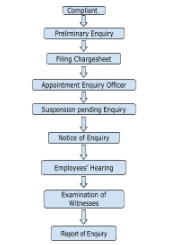
Procedure for a Disciplinary Enquiry

Fig 1: Procedure for a Disciplinary Enquiry

The principle of natural justice clarifies that no man shall be punished or condemned without giving an opportunity to justify himself. The Industrial Tribunals, based on this, have laid down the following procedure:

Preliminary Enquiry

In a landmark judgment of Amulya Ratan Mukharjee Vs. Eastern Railway, (1962) LLJ- 11- 540, Cal- H.C., it observed by the Hon’ble High Court of Calcutta that:

  • “Before making a charge, the Authorities are entitled to have a preliminary investigation or a “Fact-Finding enquiry” when they receive a complaint from an employer. This is not considered to be a formal enquiry at all and in such an enquiry, no rules are observed.
  • There can be ex-parte examination or investigation and ex-parte report. All this is to enable the authority to apprise themselves of the real facts and to decide whether the employee should be charge-sheeted.
  • But the departmental enquiry starts from the charge sheet. The charge sheet must be specific and must set out all the necessary particulars. It is no excuse to say that the delinquent who had knowledge of previous proceedings should be taken to have known all about the charge sheet.”

(see here)

Charge Sheet

A charge-sheet essentially contains detailed particulars of the misconduct, specific charges against the workman and the relevant clauses of the Standing Order under which the workman is liable to the punished.

In Sur Enamel and Stamping Works (P) Ltd. vs. Their Workmen,1963 SC 1914, the Hon’ble Supreme Court, in an attempt to lay down the procedure for conducting an enquiry for industrial adjudication, provided that an enquiry cannot be said to have been properly held unless:

  1. the workman proceeded against must be informed clearly of the charges levelled against him;
  2. the witnesses must be examined in the presence of the workman;
  3. the workman must be given a fair opportunity to cross-examine the witnesses including himself if he so wishes; and;
  4. the Enquiry Officer must record his findings with reasons in his report. (see here)

Generally, standing orders provide the manner of serving the charge sheet on the workman concerned and where it is prescribed the procedure should invariably be followed. It can be given personally or by post to the delinquent worker.

Click here

Appointment of Enquiry Officer

Saran Motors Pvt. Ltd., New Delhi Vs. Vishwanathan 1964 11.LLJ 139, it was observed that:

  • “Enquiry Officer should be properly and duly authorised by the competent authority to hold a domestic enquiry into the charges alleged against an employee. Any person, even an outsider, may be appointed as an enquiry officer, provided rules or Standing Orders do not bar such an appointment. (see here)
  • The Enquiry Officer has the obligation to explain the procedures of enquiry and chargesheet against the concerned workman.”

Suspension Pending Enquiry

  • In the case where a workman who is placed under suspension by the employer pending investigation or inquiry into complaints or charges of misconduct against him, the employer shall pay to such workman subsistence allowance in accordance with the provisions of Section 1O-A of the Industrial Employment (Standing Order) Act, 1946 which provides:

“Where any workman is suspended by the employer pending inquiry into complaints or charges or misconduct against him, the employer shall pay to such workman subsistence allowance:

  • at the rate of 50% of the wages which workman was entitled to immediately preceding the date of such suspension, for the first 90 days of suspension and;
  • at the rate of 75% of such wages for the remaining period of suspension if the delay in the completion of disciplinary proceedings against such workman is not directly attributable to the conduct of such workman.”

Explanation by Employee

After a charge sheet has been served on the accused workman, he may send his explanation cum reply in this manner:

  1. admitting the charges and pleading for mercy.
  2. denying the charges in totality.
  3. requesting for more time to submit the explanation.

Notice of Enquiry

On receipt of the charge sheet, the employee sends his reply to the Authority. If the Authority found the reply to be unsatisfactory, he may get a show cause notice from the Authority. This procedure is applied in the case of Associated Cement Co. Ltd vs. Their workmen and Other 1964 65 26 FJR 289 SC. (see here) which further states that:

“The workman should be given due intimation of the date on which the enquiry is to be held so that he has an opportunity to prepare his defence at the enquiry.”

Supply of relevant materials

Management may ask for any document in proof of charge. So, according to the

principles of natural Justice, such copies of those documents should be supplied to the delinquent workman. A workman who is to answer to charge must not only know the accusation but also the testimony by which the accusation is supported as enumerated in the case of  Meenglass Tea Estate vs. workmen, 1963 11, L.L.J, 392 (S.C.) (see here)

Examination of Witnesses

There is no provision of law under which the Enquiring officers holding domestic enquiries can compel the attendance of witnesses as under the Codes of Civil Procedure or Criminal Procedure.

Further, some general rules for examination of the witness are mentioned in the judgment of Tata Engineering and Locomotive Co. Ltd. vs. S.C. Prasad, (1969) 11 L.L.J. 799 (S.C.) (see here)

It was observed by the Hon’ble Supreme Court that:

  • “If the allegations mentioned in the charge sheet are denied by the workman in the domestic enquiry proceedings, the onus for proving those allegations will be upon the shoulders of the management and;
  • the witnesses, called by the Management, must be allowed to be cross examined by the workman and;
  • the workman must also be given a reasonable opportunity to examine himself and can add any further pieces of evidence that he might choose in support of his plea.”

Report of Enquiry Officer

  • Once the employer and the workman have been heard, the Officer is required to prepare a reasoned enquiry report which contained every findings in the enquiry and submit it with the Authority.  
  • Lastly, it is the duty of an enquiry officer to send the Report to the Accused.

Conclusion

Any act or omission of an employee, whether amounts to the misconduct or not, is to be governed in accordance with the provided list in the Industrial Establishments (Standing Order) Rules. Although no statute or law specifically lays down the procedure to conduct the disciplinary enquiry, the various judgements of the Industrial Tribunals, however, have laid down a basic idea of the procedure that ought to be followed while conducting such an enquiry. The prime principle that is to be taken care throughout the procedure of the enquiry is the principles of the natural justice that shall be ensured at every step and action to assure the delivery of justice.

Download Now

Assessing the Constitutional Vires of sections 12(2)(b) and 14 of the The Fugitive Economic Offenders Act, 2018

1
Image Source - https://thewire.in/law/cabinet-approves-fugitive-economic-offenders-ordinance-2018

This article is written by Siddharth Kumar.

The Parliament of India has passed the Fugitive Economic Offenders Act, 2018 (hereinafter referred to as the “Act”) in its Monsoon Session in 2018. The Act represents the Government’s ambitious endeavour to buttress the multitudinous peril of economic offenders who cheat and defraud the country and its constituents only to seek haven outside of India, in an attempt to evade prosecution. The past is replete with instances of such offenders who have more or less successfully fled from justice under Indian laws subsequent to benefiting off of scams that have cost the country billions of dollars and have led to a sharp downfall in investor confidence in the country.

Now that this law is in force, the question of its constitutionality is no longer merely an intellectual analysis but a pertinent question that, no doubt, finds a home in the minds of the individuals and entities negatively affected by the Act.

Overview of the Act

The Act sets out primarily by defining a “Fugitive Economic Offender” under Section 2(f) as an individual against whom a warrant has been issued in relation to a scheduled offence under the Act and who has consequently left India to escape criminal prosecution or being abroad, refuses to return to India, to face such prosecution. In the course of further provisions, the Act sets out the modalities of declaring an individual as an FEO by the Special Courts along with the legal repercussions to be borne by such an individual at various stages, under its provisions. The aforementioned repercussions are in the nature of, firstly, the pre-trial attachment of properties, secondly, the confiscation of potentially all of the properties of the FEO upon being declared the same and, lastly, the bar on filing or defending any civil claims before any court or tribunal in India along with similar provisions to the same effect against a company whose majority shareholder, promoter or a key managerial person is an FEO.
The relevant offences that circumstance the invocation of the Act are stipulated under the Schedule to the Act and are derived from the Indian Penal Code, 1860; the Negotiable Instruments Act, 1881; Securities and Exchange Board of India Act, 1992; Companies Act, 2013; Central Goods and Services Tax Act, 2017; etc..

1. Constitutionality of the power to confiscate the offender’s property under Section 12(2)(b)

Under Section 12(2)(b) of the Act, the Special Court is empowered to order to the effect that any properties or benami properties other than the proceeds of the crime, in India or abroad, are to vest with the Central Government, with all rights of the properties free from all encumbrances upon the individual being declared a Fugitive Economic Offender. This provision presents a contentious question as to whether the Government is justly empowered to lay claim over properties extending beyond the proceeds of crimes in question or whether the same would be a violation of the Offender’s Article 14 right to equality before law?

The relevant test in the abovementioned analysis was affirmed by the Hon’ble Supreme Court of India in the case of State of Jammu & Kashmir Vs. Shri Triloki Nath Khosa and Ors. where it laid down the two pronged test of classification that must be based on an intelligible differentia and having a rational nexus to the object of the law, being sought to be achieved. In the present analysis, the author submits, the Act does pass muster these tests under Article 14 of the Constitution.

• Saving of the Provision

Firstly, the differentia between a Fugitive Economic Offender and a non-Fugitive Economic Offender is manifestly clear as the former has evaded from criminal prosecution under the Indian jurisdiction by staying abroad, upon the issue of an arrest warrant in his name, as against the latter who has not made such an international evasion. Secondly, the classification previously mentioned has a rational nexus to the object of the Act that is sought to be achieved that is manifest from a bare perusal of the Preamble of the Act which affirms it to be, to provide for measures to deter fugitive economic offenders from evading the process of law in India by staying outside the jurisdiction of Indian courts, to preserve the sanctity of the rule of law in India and for matters connected therewith or incidental thereto. Under this Act, what is sought is not to punish the FEO but to create a position/pressure which would prevent the FEO to effectively stay abroad and thereby, to return back to India to face prosecution and the order of confiscation of his property beyond what constitutes proceeds of crime is an integral in necessitating such a return.

The abovementioned rational nexus has the effect of saving from unconstitutionality, some other provisions of the Act including the attachment of properties upon suspicion of them being siphoned off under Section 5 and the imposition of preponderance of probabilities as standard of proof applicable to the determination of the facts by the Special Court which are made essentially in relation to criminal offences by way of Section 16(3) of the Act.

Illustratively, the confiscation of properties beyond the proceeds of the alleged crime against the offender under the Prevention of Money Laundering Act, 2002 would be violative of Article 14 of the Constitution as there is no rational nexus between the confiscations of properties beside the proceeds of crime of the offender and the object of the Act which is, to prevent money-laundering and to provide for confiscation of property derived from, or involved in, money-laundering and for matters connected therewith or incidental thereto. The aforementioned object in and of itself, imputes a limitation upon such a confiscation in its implications.

2. Constitutionality of the bar on civil claims under Section 14

The stipulation of Section 14 of the Act is that the Fugitive Economic Offender, so declared by the Special Court under Section 12 of the Act, would, subject to the discretion of the relevant Court or Tribunal, be disallowed from putting forward or defending any civil claim before it. This bar finds application upon any and all civil claims, including civil proceedings which have no nexus with the offence(s) in question including but not limited to divorce proceedings, succession petitions, suits relating to family disputes, consumer complaints etc.. Further, under Section 14(b) of the Act, a Company or LLP would suffer the same fate where an FEO either files a claim on its behalf or is a promoter or key managerial personnel or majority shareholder of the Company or having a controlling interest in the LLP.
The bar so stipulated under the Act is elementally different from an Order of Moratorium under the Insolvency and Bankruptcy Code, 2016 as while the latter stipulates the halt on all relevant proceedings for both litigants, the former has the effect of disabling the FEO from filing or defending any and all civil claims. This has the implication of essentially ex-parte proceedings where the FEO/Company/LLP (as the case may be), only to his/its prejudice, has no voice to make any and all representations.

In following with the expansive interpretation of Article 21 of the Constitution as was affirmed by it in the case of Maneka Gandhi Vs. Union of India, the Hon’ble Supreme Court of India in its decision in the case of Anita Kushwaha Vs. Pushap Sudan has held that the Right to life inheres in itself the Fundamental Right of Access to Justice. The bar on the FEO/Company/ LLP under the impugned provision has the effect of disabling him/it from having access to any form of civil justice both as its seeker or its respondent. Therefore, in so far as Section 14 of the Act limits the right of the impugned persons from seeking access to justice, this bill would stand in violation of this Fundamental Right guaranteed under Article 21 of our constitution.

• Saving of the provision

The violation of the Fundamental Right of Access to Justice under the Act cannot result in the Act being struck down de-facto, as the Hon’ble Courts must keep in view the compelling state interest behind such a law in the ultimate analysis of its constitutionality.

Recently, in its landmark decision in the case of Justice K S Puttaswamy (Retd.) and Anr. Vs. Union of India and Ors., the Hon’ble Supreme Court of India has held that while adjudging constitutionality under Article 21, the court must have view of the reasonable restriction upon these rights imposed in pursuance of compelling social, moral, state and public interest.
In the case of this Act, there is compelling state and public interest that is ought to be furthered. These are, firstly, to deter economic offenders from evading the jurisdiction of Indian courts, secondly, to bring to justice Fugitive Economic Offenders. These recurring incidences of fugitive escapes by economic offenders have led to a sharp fall in investor confidence and the abuse of the due-process of finance and business along with huge losses caused to the persons and companies of the country.

The subject speaks of its own importance, comprehending within its consequences nothing less than the future and growth of the Indian economy that is pestered with these frivolous and fraudulent misdeeds which have only led to harsh roadblocks in its trajectory of growth. The author submits that this Act does therefore, pass muster the test of Constitutionality under Article 21 of the Constitution in view of the compelling state and public interest furthered by this law.

Further, the Act does also pass muster the test of Constitutionality under Article 14 (as aforementioned) as the classification is based on an intelligible differentia and such classification has a rational nexus with the object sought to be achieved by the Act in the same manner as Section 12(2)(b).

Conclusion

In recent times, the Hon’ble Supreme Court has given due regard to matters of compelling public, social, moral and state interests along with other reasonable restrictions to uphold the constitutional validity of various laws. For example, it had upheld the constitutional validity of the Conservation of Foreign Exchange and Prevention of Smuggling Activities Act, 1974 and Smugglers and Foreign Exchange Manipulators (Forfeiture of Property) Act, 1976 which stipulate for preventive detention consequent to certain offences under the Act and the forfeiture of the illegally acquired properties of smugglers and foreign exchange manipulators, respectively. The Hon’ble Supreme Court upheld the constitutionality of COFEPOSA and SAFEMA in the case of Attorney General for India Vs. Amratlal Prajivandas. Further, in the case of Dropti Devi and Anr. Vs. Union of India and Ors., R M Lodha, his lordship as he then was, held that the menace of these economic offences needs to be curbed. Notwithstanding the disadvantages that measures such as preventive detention may entail, and though Article 21 holds a fundamental position under the Constitution of India, it is paramount to assess the validity of these laws keeping in view, the gravity of the offence or evil that is sought to be countered by way of such a measure.

The Fugitive Economic Offenders Act, 2018 aims to tackle a peril of today that has far reaching implications upon the core of investor confidence and the well-being of the economy. The disdain and disregard shown by the Fugitive Economic Offenders is of such a nature that is representative of a deeply worrying state of affairs and a growing community of individuals who seek not to make a living honestly, but to make one, essentially based upon wrongful gains derived by way of scams and fraudulent enterprises, who seek a safe exit from the consequent liability of their actions by evading the grasp of justice. The Act represents an efficacious endeavor to curb the far reaching menace that are, Fugitive Economic Offenders.

Download Now

How to Combine Gardening Leave Clause and Non-compete Arrangement

0
Gardening Leave Clause and Non-compete Arrangement

In this article, Swati Garg, an Advocate and an LL.M. graduate from Gujarat National Law University discusses how to Combine Gardening Leave Clause and Non-compete Arrangement.

Gardening leave

Gardening leave refers to the period between the employee is given a notice of termination and his actual termination. During this period, the employee is not allowed to continue working either at the workplace or work from home or any another location. He is entitled to his salary for the notice period but he is not allowed to work for his current employee or his new or any other employee.  

Purpose of gardening leave

The concept of gardening leave is very beneficial for an employer in the following ways:

  1. Termination is bound to make every employee unhappy. Gardening leave prevents an employee from indulging in any detrimental behaviour such as creating a scene at the workplace during his notice period.
  2. An employee can be uncooperative and unprofessional during the notice period as they are already being terminated. This may affect the environment of the workplace.
  3. An employee may try to persuade the clients to follow him to his new job if he is permitted to come and work.
  4. Moreover, if an employee is permitted to continue his work, he will have access to company’s database which he can misuse for his own benefit.

Rights and obligations of the employer during gardening leave

  1. An employee is not allowed to work at the workplace, or work from home or from any other station. He is prevented from accessing the company’s data or contacting the people with whom company deals (clients, suppliers, distributors etc.).
  2. An employee is entitled to his salary or any other benefits. But he may not be allowed to use and may be asked to return company’s vehicle, smartphone, laptop, or any other product.
  3. However, employee cannot work with another employer during the gardening period. He has to remain available in case his current employer needs him.

Non-compete agreement

Non-compete agreements became popular as a strategy used by the companies to discourage their employees to leave their company. This kind of agreement prohibits an employee from joining a company directly in competition with his current company. For example, an employee working at ola, leaving Ola to join Uber. These agreements restrict employees to share the information crucial to their organisation. These agreements restrict the employees for a specified time and/or within a specified geographic area.

By joining a company which is in direct competition with the current company, an employee can use the trade secrets and confidential information such as client list, business strategies of his current company. This may lead to other company gaining a competitive advantage.

Validity of garden leave and non compete agreement in India

In India, non-compete agreements and garden leave are known as restrictive covenants. Prima facie they are considered as a restriction on employee’s freedom of trade and business as given in Article 19 of Indian constitution. Moreover, under section 27 of Indian Contract Act, any restriction imposed on a person for exercising his choice of trade or business is void.

In the case of Niranjan Shankar Golikari v. Century Spg & Mfg Co. Ltd., ((1967) 2 SCR 378.) the Supreme Court in this case explaining the difference between the garden leaves and non-compete agreements emphasised that the employer has a right to restrict the employee during the contract term but after termination restrictions can be put on non-disclosure to another company but employer can not restrict employee from joining another company in similar trade.

The supreme court reiterated its position in the case of Percept D’Mark (India) Pvt. Ltd. v. Zaheer Khan & Anr. (AIR 2006 SC 3426.) that non-compete agreements extending beyond the contract are unenforceable.

Sample of non-compete clause

Illustration 1: Non-compete clause (Employer: Bank)

1.1) Employee agrees that for a period of two years after the earlier to occur of (i) the end of the Primary Term of this Agreement or (ii) the termination of Employee’s employment with Employer, Employee shall not, directly or indirectly, individually or as an employee, consultant, partner, officer, director or shareholder or in any other capacity whatsoever:

  1. solicit the banking business of any customers of the Bank;
  2. acquire, charter, operate or enter into any franchise or other management agreement with any financial institution,
  3. serve as an officer, director, employee, agent or consultant to any financial institution, or
  4. establish or operate a branch or other office of a financial institution,
  5. knowingly recruit, hire, assist others in recruiting or hiring, discuss employment with, or refer others concerning employment, any person who is, or within the preceding twelve (12) months was, an employee of the Bank; provided, however, that nothing in this Section 1(a)(iii) shall apply to employment other than with a financial institution.

1.2) As consideration for Employee’s covenant not to compete herein, Employer shall pay to Employee an annual payment equal to the sum of [ amount ] plus the average annual bonus received by Employee during the term of this Agreement (the “Non-Compete Payment”). Such payments shall be made in equal semi-monthly instalments after termination of employment.

2. If any court of competent jurisdiction should determine that any term or terms of non compete covenants are too broad in terms of time, geographic area, lines of commerce or otherwise, such court shall modify and revise any such term or terms so that they comply with applicable law.

Illustration 2: Garden leave

2.1) Executive will provide a Notice of Termination to the Company no less than [number of days] prior to any termination of Executive’s employment (whether for Good Reason or without Good Reason) during the Term of Employment, and the Company will provide a Notice of Termination to Executive no less than [number of days]  prior to any termination of Executive’s employment for Cause or without Cause during the Term of Employment; provided that the Company may elect to terminate the Garden Leave (as defined below) and Executive’s employment at any time during the Garden Leave if Executive is terminated for Cause.

2.2) During this [number of days] notice period (the “Garden Leave”), Executive will

  • continue to be an employee of the Company and will make himself available to provide such services directed by the Company that are reasonably consistent with Executive’s status as a senior executive of the Company and
  • continue to be paid his Base Salary and to be eligible to participate in the Company’s benefits programs, but will not be eligible to earn any annual bonus with respect to a calendar year that ends after the commencement of the Garden Leave.

2.3) During the Garden Leave, the Company may require Executive to resign from any position with the Company and/or remove any or all of Executive’s duties or responsibilities, which will not constitute Good Reason or otherwise be a violation of this Agreement.

2.4) Executive agrees that he will not commence employment with any entity during or in connection with the commencement of the Garden Leave.

2.5) During the Garden Leave, Executive will take all steps reasonably requested by the Company to effect a successful transition of client and customer relationships to the person or persons designated by the Company.

2.6) Notwithstanding the foregoing, the Company in its sole discretion may waive all or any portion of the [number of days]  notice requirement by providing written notice to Executive accelerating the last day of the Garden Leave period; provided that the Company’s exercise of its right to waive all or any portion of the [number of days]  notice requirement and accelerate the last day of the Garden Leave period will not be treated as a termination of Executive’s employment by the Company without Cause or as giving Executive any basis for terminating his employment for Good Reason.

Download Now

How to Draft a Golden Handcuff Provision

0
Golden Handcuff
Image Source - https://www.glassdoor.co.in/Photos/Virtual-Employee-Office-Photos-IMG935304.htm

In this article, Swati Garg, an Advocate and an LL.M. graduate from Gujarat National Law University discusses How to Draft a Golden Handcuff Provision

Golden handcuff

In today’s world, a company wants to retain good employees. Accordingly, the company gives financial incentives to key employees to avoid them from changing jobs. These incentives are known as ‘golden’ handcuffs.

Examples of these incentives can be release of additional bonuses for people who stay beyond a few years, employee stock options that will vest in employees only after certain years, deferred salary hikes, or other forms of compensation that fall due after staying for a certain period. These amounts are forfeited if the employee quits before.

Apart from these positive incentives, golden handcuffs can be in the form of negative/prohibitive incentives. For example, a non-disclosure clause to prevent an employee from disclosing sensitive information, or a non-compete clause to prevent an employee from working with company’s competition for some period, thus discouraging the employee to leave the company. These have already been discussed separately so we will discuss financial incentives here which serve as handcuffs.  

The purpose of these golden handcuffs is not limited to rewarding good employees but also to restrict them from shifting to other competitive companies even if they offer better packages. A company spends significant resources to find, hire and train a good employee and it would be a waste if the employee leaves the company after a short duration only.

Sample of different types of golden handcuff provisions

Version 1: Non-compete clause (Employer: Bank)

    1. Employee agrees that for a period of two years after the earlier to occur of (i) the end of the Primary Term of this Agreement or (ii) the termination of Employee’s employment with Employer, Employee shall not, directly or indirectly, individually or as an employee, consultant, partner, officer, director or shareholder or in any other capacity whatsoever:
      • solicit the banking business of any customers of the Bank;
      • acquire, charter, operate or enter into any franchise or other management agreement with any financial institution,
      • serve as an officer, director, employee, agent or consultant to any financial institution, or 
      • establish or operate a branch or other office of a financial institution,
      • knowingly recruit, hire, assist others in recruiting or hiring, discuss employment with, or refer others concerning employment, any person who is, or within the preceding twelve (12) months was, an employee of the Bank; provided, however, that nothing in this Section 1(a)(iii) shall apply to employment other than with a financial institution.

As consideration for Employee’s covenant not to compete herein, Employer shall pay to Employee an annual payment equal to the sum of [amount] plus the average annual bonus received by Employee during the term of this Agreement (the “Non Compete Payment”). Such payments shall be made in equal semi-monthly instalments after termination of employment.

2. If any court of competent jurisdiction should determine that any term or terms of non compete covenants are too broad in terms of time, geographic area, lines of commerce or otherwise, such court shall modify and revise any such term or terms so that they comply with applicable law.

How to Draft Golden Parachute and Golden Handshake Provision 

Version 2: Financial Incentives

  1. As compensation for services rendered under this Agreement, Employee shall be entitled to receive from the Bank a salary equivalent to [ amount ] per year (which annual amount shall be pro-rated for any partial year), payable in equal semi-monthly/monthly installments of [amount], payable on such days as the Bank normally pays its employees, prorated for any partial employment period.
  2. Upon execution of this Agreement, Employer shall grant to Employee, non qualified stock options to purchase up to [number] shares of Employer’s voting common stock at an exercise price equal to [amount] per share. One-third of such options shall vest on each of the first, second and third anniversaries of date of grant and shall be exercisable over a period of [years] from date of grant; provided, however, that if Employee’s service with the Bank and/or Employer under this Agreement is terminated for any reason before the completion of [years], all of such options shall not vest in the employee.
  3. During the Term of this Agreement, Employer shall provide or cause the Bank to provide to Employee, his spouse and dependants insurance coverage providing benefits for sickness and hospitalization in such amounts and on such terms as generally available to all employees or officers of the Bank as approved from time to time. Further, Employer shall provide or cause the Bank to provide to Employee insurance coverage benefits for disability in such amount and on such terms as are generally available to other similarly situated or comparable officers of the Bank and Employer.
  4. During the Term of this Agreement, Employee shall receive such additional fringe benefits and bonuses as allowed under the Bank’s stated policies as may be determined from time to time in the sole discretion of the Employer; provided, however, Employee shall be entitled to participate, on the same basis as other similarly situated senior officers of Employer and its affiliates, in all incentive and benefit programs or arrangements made available by Employer and its affiliates to such senior officers.

CLICK HERE

Points to remember while drafting golden handcuff provision

  1. Employer should clearly lay down the incentives which an employee will get. Employer should not only focus on to make the employee happy but also should include non-compete and non-disclosure clauses to protect himself.
  2. Employer should try to provide lucrative incentives after a long interval of time.
  3. Employer should also bear in the mind the cost to company while giving such incentives.

For example: Providing a stock option is risky than providing insurance policy. Suppose A company X is giving its employee stock options which he can exercise after 5 years and in other case the same company is giving its employee an insurance option of the same value. Now in the first scenario, employee can leave the company after 5 years and the company will lose not only its employee but also its stocks. However, in the second scenario, if the employee wants to shift to company Y, that company Y has to also buy out the insurance policy which can be discouraging for them.

Download Now

How to Draft Golden Parachute and Golden Handshake Provision 

1
golden parachute
Image Source - https://www.shutterstock.com/video/clip-7982173-stock-footage-business-teamwork-people-and-technology-concept-business-team-with-laptop-computer-papers-and.html

In this article, Swati Garg, an Advocate and an LL.M. graduate from Gujarat National Law University discusses how to draft a golden parachute and golden handshake provision.

Golden parachute as the same suggests is some kind of protection when one is falling down. In business world, merger is a major event which may lead to loss of jobs for many key employees. A golden parachute refers to benefits given to a key/top executive in case there is a merger or acquisition of the company and executive is terminated or let go due to the merger or takeover. These benefits can be in the form of cash bonus, retirement packages, a severance package, stock options, etc.

These golden parachutes can be beneficial both for the employer and employee. For an employee, it serves as security in case there is a restructuring in the company. For an employer, it helps in maintaining cordial relations and minimizing risk of legal proceedings in case there is a dismissal of an employee post-merger.

As the clauses would have already been laid out, if there is a disagreement between the top executives with the new management, it will be easy to terminate them. Moreover, these clauses also act like anti-merger mechanisms, making acquisitions more expense for acquirers. In case of hostile takeover, or any potential merger, the other party will have to consider about paying these compensations.

Golden handshakes are upgraded versions of the golden parachute. They include better incentives and cover a lot more scenarios unlike the golden parachute where incentives are given only in the case of a merger or acquisition. Golden handshakes can be defined as incentives given to employees in case of dismissal, corporate restructuring or in case of their retirement. These incentives range from stock options, compensation, severance package, equity, etc.

Provisions of Golden Handshake under the Indian Company Act, 2013

Section 202 of the Companies Act, 2013 states the provisions for golden handshake in India. As per the section, these provisions will apply only to:

  1. Managing director
  2. Whole-time director
  3. Manager

They will be compensated for any loss to office or as consideration for retirement. However, following are the situations where they won’t be compensated.

  1. If during the restructuring of the company (including mergers and amalgamations), if the managing or whole-time director or manager resigns from the office but they are hired as the managing or whole-time director or manager of the restructured company.
  2. If director resigns himself not in relation to above mentioned point.
  3. If the company is wound up due to the negligence or default of the director.
  4. If the director is involved in terminating his own office.
  5. If the director is found guilty of fraud, breach of trust, gross negligence or gross mismanagement in relation to the affairs of the company or any of its subsidiary company.
  6. If the commencement of the winding up of the company starts within twelve months before or after director loses his office, and the company is unable to even repay its shareholders.

drafting skills

Calculation of remuneration of the managing or whole-time director or manager

The payment to these key employees should not exceed what they would have been paid had they completed their term or been in office for next three years. As per section 202 of the Companies Act, 2013, this can be calculated as the average remuneration he has been getting from past three years or if he has been in the office for a shorter time, then average remuneration for that period.

It is important to note here that this section does not prohibit any other payment made to the managing or whole-time director or manager, in any other capacity.

Samples of Golden Parachute and Handshake

Version 1

If Executive’s employment shall be terminated by Company, then, upon such termination, except as hereinafter provided, Executive shall be paid all accrued but unpaid base salary on the next payroll date and any accrued bonus due, and otherwise all compensation and benefits for Executive hereunder shall terminate contemporaneously with the termination of such employment, except for all Other Benefits that are accrued but unused, incurred but unreimbursed or otherwise owing, as applicable, to Executive as of the date of termination.

Provided, however, that, if such termination shall not be due to any event or circumstance caused by the executive itself which can be gross negligence, gross incompetence, willful misconduct, or any disability on part of executive, inclusive of the fact that executive has himself exercised his right to termination, then Company shall provide Executive with a lump sum cash payment equal to two times Executive’s annual base salary on the date of such termination, plus all Other Benefits that are accrued but unused, incurred but unreimbursed or otherwise owing, as applicable, to Executive as of such date. Any severance payment due to Executive pursuant to this paragraph shall be paid to Executive on the 60th day after the date of Executive’s termination of employment with Company.

Version 2

If there has been a Change of Control after [date] in connection with the termination of employment giving rise to Executive’s right to receive a Basic Termination/Severance Payment, an additional amount equal to one times Executive’s annual base salary on the date Executive became entitled to receive a Basic Termination/Severance Payment. Any additional severance benefit due to Executive shall be paid to Executive on the 30th day after the date of Executive’s termination of employment with Company.

Version 3

If the Term of Employment is terminated in respect of any Change of Control Termination [Comment: Change of Control can be separately defined], if and when a full and complete release of claims against the Bank and its affiliates in the form of Exhibit A is fully effective and is delivered within fifteen (15) days of termination, and provided the Executive has not instituted any suit, arbitration or other dispute resolution procedure and is not otherwise in breach of this Agreement, the Executive shall be entitled to receive as severance pay (in addition to the payment of the Base Salary through the date of termination), an amount equal to eighteen (18) months of the Executive’s then payable Base Salary, payable within five (5) days following the date the full and complete release of claims against the Bank and its affiliates in the form of Exhibit A is fully effective.

Version 4

If, during a Protection Period, the Executive is involuntarily Terminated other than for Cause or voluntarily Terminates for Good Reason, the Company shall:

  1. Provided that the Release has become irrevocable, within 60 days following the Executive’s Termination, pay to the Executive a lump sum cash amount equal to two times the Executive’s Annual Direct Salary, subject to applicable withholdings and taxes;
  2. Provided that the Release has become irrevocable, within sixty (60) days following the Executive’s Termination, pay to the Executive a lump sum cash amount equal to twenty-four (24) times the sum of
    • The monthly COBRA premium for the group health, dental and vision insurance in which the Executive (and the Executive’s family, if applicable) was enrolled immediately before the Executive’s Termination, and
    • The monthly premium for the Company’s group life and disability insurance coverage for the Executive, subject to applicable withholdings and taxes; and
  3. Pay to the Executive the Accrued Obligations.

Points to remember while drafting a golden parachute or golden handshake clause

Termination grounds

  • Employer should clearly specify the grounds which will entitle an employee to invoke a golden parachute or golden handshake clause. They should also specify the grounds of termination which would not entitle an employee to claim compensation.
  • Subsequently, it would be a better option for the employer to put a clause specifying that if after termination employee institutes a suit against the employer, his claim to the golden handshake or golden parachute will be forfeited.

Compensation

  • The employer should specify the kind of compensation/incentive which will be provided to the employee in case of termination.
  • Usually the compensation provided is in monetary form. Companies nowadays are providing stock options also. But this might not be in their best interest. For example, giving 10% stock options in addition of a severance package to a top executive in case of a merger will result into paying hefty severance package and still the executive can claim a part of the ownership of the company.

Therefore, what kind of incentives have to be given should be thought clearly.

  • They should also specify when will an employee get the compensation either on the termination date or 1-2 months after the termination date. Giving compensation after few months from termination can help an employer escape from providing compensation if the employee has instituted a suit.

Download Now

Sage University launches an LLB program that helps law students to prepare for judicial exams

2
The Chancellor Sanjeev Agarwal at the inauguration of the law institute

You may have heard of law schools that promise to help law students to get a job in a law firm, or excel in litigation. You may have also heard of schools that prepare students for IIT JEE specifically apart from the board exam curriculum. Such institutes are usually quite popular amongst students.

However, you have probably not heard of a law school that is designing its curriculum to specifically help law students to gear up for judicial exams. The fact that Indore based Sage University, which has began its first batch of 5 year BA LLB and BBA LLB courses in August 2018, have decided to launch such a specialized judicial exam training facility for its students within its standard law curriculum, is a great testimonial to the popularity of judicial services as a career option in Indore as well as central India.

Judiciary has emerged as a top career choice for talented law students across India. The syllabus of judicial exams can be quite heavy and diverse, with a lot of focus on local laws.

Of course, if a law school dedicates some time from the teaching and examinations towards preparing students in these laws keeping a focus on skills like judgment writing, precedence analysis and the hard core skill of exam taking, then it can give the students quite a bit of advantage.

On enquiry, we found that law graduates usually begin their preparation for judicial services exams only after graduation from college. At this point, they join various tutorials that can charge 1 lakh to 1.5 lakh per candidate. This is not only exorbitant, but also causes a lot of wasted time.

If a law school is willing to co-opt training for judicial services, apart from teaching the standard syllabus prescribed by Bar Council of India, it can be a very interesting proposition for the students since they can save on time as well as money.

From this perspective, this unique initiative by Sage University is likely to meet great success. The fees of the college is also very reasonable, at only INR 50,000 per year.

This initiative is very significant in light of massive vacancy in lower courts at present. Times of India reported on 1st January 2018 that vacancy at District Court level is currently at an all time high. In some cases, very few people could be selected through judicial exams as vast majority failed to meet minimum cut off marks, leading to a crisis all over India.

If universities come forward to train lawyers for judicial exams and groom them over all to become better judges, it can make a big difference to the vacancy situation.

If you want further details about the program, check it out over here: Sage University Law Program.

Download Now

Franchise agreement – The Fifth in The Series of 5 Important IP Contracts

0

IP Licensing Agreements – The First in The Series of 5 Important IP Contracts

Here is the fifth and the last article of the series, 5 Important IP Contracts.  In this article, Varshita Dogra of VIPS discusses Confidentiality or Non-Disclosure Agreements.

This article is written by Varshita Dogra and updated by Harsh Kedia, pursuing a Diploma in Advanced Contract Drafting, Negotiation and Dispute Resolution from Lawsikho.com.

Franchise agreement

Franchise agreement, technically, are not IP contracts but a major part of Franchise agreement deals with intellectual property. Franchising is essentially a structured and sophisticated form of licensing. A company would engage into franchising its business, when it has strong and distinguishable intellectual property, such as its trademarks, trade dress, copyright, know-how, trade secrets, relevant industrial designs, patents, business concepts or methodologies, in order to capture new markets and expand its presence.

The expertise of an IP lawyer would be desirable/beneficial while drafting a Franchise agreement. Franchising is one of the most effective way to exploit another company’s IP as it provides the person taking the franchisee with an infrastructure that enables successful protection. When properly structured and run, franchising provides benefits and satisfaction to both the parties.

Although licensing forms the heart of a franchise agreement, there are a lot of technical differences between a licensing agreement and a franchise agreement. A franchise agreement involves a number of formalities required for setting up a franchise. It also goes into detail about maintaining quality and standard of product or service being provided. The control of a franchisor is comparatively more than that of a licensor in the usage of intellectual property by the franchiser.

There are two types of franchising :

  1. Product and trademark franchise, wherein the franchisee uses the franchisor’s trade name and sells the franchisor’s products. Such form of franchising is popular in businesses like motor vehicle dealerships, soft drink bottlers and gas stations.
  2. Business format franchising, wherein the franchisee uses the franchisor’s entire business concept including the trade names, goodwill, know-how, trade secrets, etc. of the franchisor. This form of franchising can be commonly seen in fast food chains such as McDonalds, Pizza Hut, Dominos etc.

Key Clauses in a Franchise agreement

As there is no specific law in India governing the franchising industry, it is even more crucial that the Franchise agreement is drafted well. It can prove to be fatal for either the franchisor or the franchisee if the agreement is not made with proper precaution.  

The agreement sets out the type of franchise arrangement, the grant of the license, the extent of the rights granted and the duties, rights and obligations of the parties as per the agreed terms. Usually, these agreements are in the form of dos and donts as a list of things to adhere to and things to strictly avoid during the course of business. Franchisors exercise control and supervision over the exploitation or use by the franchisee of their IPRs, know-how and confidential information.

  • Use of intellectual property by the franchisee

It is necessary to specify in a Franchise agreement, the details of the intellectual property in regard of which the rights to use are being licensed. It must also be specified that the marks so being licensed are only with regard to the operation of the franchised unit at location where such franchise is settled. Most of Franchise agreement have a clause requiring the franchisee to notify the franchisor in case there has been infringement of the intellectual property by any third person. It is necessary to specify in the Franchise agreement, the prohibition on usage of the trademark by the franchisee; post termination of the franchise agreement.

  • Fees and royalty clause

Usually Franchise agreement include payment of a non-refundable franchise fees which is a one-time fee and royalty as well. This clause also specifies the mode of payment and due dates, for payment of both the franchise fee and the royalty as decided between the franchisor and franchisee.

  • Business Operations (only in business format franchising)

This clause contains detailed information about the level of support that will be provided by the franchisor for running the business and responsibilities of the franchisee. It specifies the details of the goods and services that can be offered by the franchisee and fixed quality standards for these goods and services. Generally for a business format franchising, it is also required that the franchisee exclusively purchase raw material or goods from franchisor and maintain accounts as per the franchisor’s requirements. The franchisor also makes sure to include a clause granting right to the franchisor to inspect the unit at regular intervals.

  • Confidentiality Clause

One of the biggest concerns for any franchisor is to ensure confidentiality of the intellectual property (trade secrets, know-how, patents, etc.) while entering into a Franchise agreement. Strict clause for confidentiality specifying the penalties for non-compliance is a must in any Franchise agreement. In order to ensure that the franchisee keeps the information confidential, it is also suggested to enter into a separate confidentiality agreement which specifically deals with protection of the confidential information of the franchisor.

  • Advertising and Brand Promotion

Franchisors spend a significant amount of resources for promotion of their brand. Therefore, a franchise agreement also covers the aspect of advertising and brand promotion. Usually, the responsibility lies on the franchisor to promote the brand and the franchisee is supposed to contribute by taking active part in brand building activities.

  • Training, Supervisions and Support

Training with respect to know-how, trade secrets and working of the business model of a franchise is necessary to ensure that the franchisee is able to meet the standards set forth in the agreement by the franchisor. It is the duty of the franchisor to provide as much support, training and supervision as required by the franchisee.

  • Assignment or transfer of franchise

A transfer of franchise usually cannot be made, unless expressly stated in theFranchise agreement. If the franchisor seeks to allow transfer of franchise, a clause specifying that the transfer cannot be made without approval of the franchisor would be appropriate.

  • Indemnity Clause

Franchise agreement usually cover indemnity rights requiring the franchisee to indemnify and defend the franchisor for incidents arising at or in connection with the franchisee’s business or location and requiring the franchisee to name the franchisor as an additional insured on its insurance provisions. Suits against a franchisee and its franchisor as co-defendants are increasingly common. Whether because plaintiffs are simply seeking deeper pockets or because plaintiffs do not understand the nature of franchising, plaintiffs often name the franchisor as a co-defendant whenever suing its franchisee for incidents arising in connection with the franchisee’s location or business. For example, a restaurant patron may sue a franchisee and franchisor in connection with a slip-and-fall at the franchisee’s restaurant. A franchisee may sue its franchisor and sister franchisee for the other franchisee’s alleged encroachment. Although indemnification clauses are generally enforceable, they are subject to certain limitations and defenses. A party cannot be indemnified for its own negligence absent an explicit, conspicuous commitment to do so that includes the word “negligence” in the indemnification clause.

Due to globalisation and liberalisation the business relations between the countries have expanded in a very rapid speed and this increased the growth of business outside the home territory. For any business the first and foremost motive is to gain more and more profits and this can happen by diversifying and expanding the business. Various methods were used to expand and grow the businesses throughout the globe. Among those, franchising is one of the techniques adopted by the people to grow and expand their businesses. 

Though franchising is not well defined in the Indian law but in a normal context it means permitting any other person to use the business of the company. Franchising is a way by which a franchisor grants certain rights pertaining to the business and allows the franchisee to use such rights; for example trademarks, intellectual property etc. Franchisor is the one who permits the other person i.e. to the franchisee to carry out the same business activity as that of the franchisor. This is one of the best ways to expand the business without transferring any actual rights to franchisee. The franchisee only gets a certain right along with some obligations but they are not treated as partners or shareholders of the company. We all witness business by way of franchising in our surroundings on a daily basis. For example, Dominos which is an American multinational pizza restaurant chain, but we can find several outlets across the globe. This is done by way of franchising. There are few types of franchising agreements which prevails in India. Some of these are:

Product Franchises

In product franchises the franchisor grants the right to see the products manufactured by the franchisor. This is the most common type of franchise business. For example, there are certain brands which manufactures products like cakes, etc. like Mio Amore, a famous brand which deals in cakes and pastries and by granting rights to various franchisors, these are sold in the market. In turn the franchisee pays an amount to the franchisor according to the agreement between them. 

Manufacturing Franchises

When the franchisor grants the right to the franchisee to manufacture as well as sell such products in the markets then such agreement is referred to as a manufacturing franchise. The most common example for this type of franchise agreement is dominos and pizza hut. The franchisee manufactures the foods which are to be sold by him in the name of such brands. The franchisee is provided with all the relevant raw materials and recipes which are originally used by the franchisor for making such products. 

Business franchise ventures

In this type of franchise agreement, the franchisee buys and sells from the franchisor. The only difference between business franchise ventures and other types of franchise agreement is that in the former case the franchisee is restricted from selling the products to the client which is decided by the franchisor.

Franchising though appears to be a very easy and convenient way of expanding the business, but if we see from the perspective of the franchisor and the franchisee, there are certain difficulties which they face while performing this activity. No doubt there are many pros of this style of business but yet there are certain cons too. Through this article I am going to talk about the various problems faced by both the parties in general as well as the legal issues which they face. Any franchising agreement which is made internationally are governed by many laws for example the Indian Contract Act 1872, Competition laws, Intellectual Property Laws, Foreign Exchange laws, Income tax laws and many other laws. It is very important to keep in mind the laws governing the agreement before executing it. 

Franchising Agreement

There are no specific laws in India which governs any franchising agreement. But acts like Indian Contract Act 1872, Sales of Goods Act 1930 or Specific Relief Act 1873 applies to commercial agreements and franchising agreement comes under commercial agreements. For any agreement to be legally enforceable, the contract should not violate any of the following elements mentioned in the Indian Contract Act. they are:

  1. An agreement, i.e. an offer and an acceptance of the offer;
  2. lawful consideration for the agreement;
  3. lawful object and purpose of the agreement; 
  4. free consent of the parties to the agreement; and 
  5. capacity of the parties to enter into an agreement.

If such franchising agreement violates any of the essentials then such contract shall not be legally enforceable. 

Another issue that could arise is of competing with the franchisor’s business during the term of the franchising relationship. In the landmark case of Gujarat Bottling Co. Ltd. and others v. Coca Cola Co. and others (1995 AIR 2372, 1995 SCC (5) 545), the Coca Cola Co. had imposed a restriction on Gujarat Bottling Co. Ltd from entering into an agreement with any other beverage manufacturing company during the term of their contract. When the case came up before the Supreme Court as being in restraint of trade, the Court held the following: 

There is a growing trend to regulate distribution of goods and services through franchise agreements providing for grant of franchise by the franchiser on certain terms and conditions to the franchisee. Such agreements often incorporate a condition that the franchisee shall not deal with competing goods. Such a condition restricting the right of the franchisee to deal with competing goods is for facilitating the distribution of the goods of the franchiser and it cannot be regarded as in restraint of trade.”

The Court therefore held that a negative agreement restraining the franchisee from manufacturing, bottling, selling, dealing or otherwise being concerned with the products or beverages of any other brands or trademarks/trade names during the subsistence of a franchise agreement including the period of one years’ notice, is not violative of Section 27 of the Contract Act. However, the Court did not address the issue of a negative covenant post-termination of the agreement. This is an issue that the parties must bear in mind while formulating the contract.

Intellectual Property

As we know there are certain transfer of rights and obligations in franchising, the most important right which is transferred is Intellectual Property. As most of the businesses grow because of the inventions they had made or because of the trademark of such company, it is the foremost duty of the franchisor to ensure that there should not be any misuse of such intellectual property rights of the company. For example, the business of Dominos, Coca-Cola depends upon the secret of the ingredients or drinks they manufacture. If such an agreement is not made with regards to the intellectual property laws prevailing in the country, then there is large possibility of exploitation of such intellectual property rights. Such franchising agreement should comply with the IPR laws according to the business of the franchisor. 

Consumer protection

In most type of franchising agreement, the franchisee acts as the agent of the franchisor. This is because it is the franchisor who decides the way in which the business is to be conducted, the norms which are to be followed and at the end of the day the franchisee needs to inform the franchisor about the business. As per the Indian Contract Act 1872, the principal is liable for the acts of the agents done in the course of the business. There may be circumstances under which the franchisee violates some of the provisions of the consumer protection act and therefore a legal suit may be brought against such franchisee. The franchisor while making such agreement has to deal with such future circumstances and execute in that manner. 

Confidentiality

As we know most of the agreement consists of a confidentiality clause which restricts either party to keep the information of the business with them. In case the information pertaining to the contract are shared by any third party then in such cases the other party should be indemnified. Mere indemnification can only give monetary relief to the victim but every business runs from different ideas. If the main idea is shared by any competitor then the whole business can go into losses. In the case of franchising it is necessary for the parties to execute a clause which fully restricts them from sharing any information. 

Competition law and unfair trade practices

Due to the growing trade practices is the one of the most important tasks of the government to prohibit unfair trade practices. In India Competition Act 2002, has been enacted to prevent restrictive trade practices or control power of the dominating companies. There may be cases in which the franchisor wants the franchisee to sell a particular product at a particular price or the franchisee makes false representation or provides false reports to the franchisor. To avoid such cases the agreement between the parties needs to be drafted in a very careful manner. 

Corporate and securities issues

All the companies in India are regulated by the Companies Act 2013 and in case the franchisor or the franchisee is a company then the regulations made under Companies Act should be kept in mind. All the companies are registered in India and it is mandatory to provide financial statement to the ROC (Registrar of Company) If in any case the franchisee makes any false report then the franchisor can be held liable or in case the franchisor makes some defaults then the franchisee will also get affected. Same is in the case of securities laws. If the company is listed in any stock exchange then such company comes under the purview of the SEBI (Securities and Exchange Board of India) and the SEBI regulations are appliable to them. If the franchisor is an Indian company the franchisee is a company from other country or vice versa then the FEMA (Foreign Exchange Management Act, 1999) regulations will be applicable. The parties before getting into a contract should comply with all these regulations. 

Taxation

The franchisee in turn of using the intellectual property of the franchisor pays royalty fee. Such fees are chargeable. According to Section 9 of the Income Tax Act, certain income such as interest and royalty are deemed to arise and to accrue in India under specified circumstances. Business profits under the franchise business are taxed up to 30%. Therefore, the parties should look into the tax laws before executing the final document.

Conclusion

These were some of the legal problems which are faced in the case of franchising. Though it is not mandatory to register such agreement in India, but is always advisable to register such agreement. After the new economic policy of 1991, the rate of expanding business throughout the world has increased at a very rapid speed and the government of India has taken several measures to allow the foreign companies to invest in India and setup their companies. Most of the company by the way of franchising and on a single brand basis conducts business in India. Franchising provides a ready-made market for the parties as the brand name is already known to the public and the parties don’t need to incur expenses on advertising the products it is much easier for the franchisor to set up such business outside the home country. From the viewpoint of the franchisee they are benefited as they don’t need to struggle in finding customers. There is already goodwill of such company in the market so the cost of promoting the business is reduced. All the franchising agreements should be made keeping in mind the international laws as well the domestic laws. 

To know exactly how a franchise agreement looks like and what are the common and basic clauses which are used while drafting any franchise agreement, you are requested to go through the sample franchise agreement template by clicking on the link mentioned below. 

Sample Franchise Agreement- https://www.wonder.legal/in/creation-modele/franchise-agreement-in

Sources:

  • Legal issues in franchising by Nishith Desai Associates.
  • The law reviews.
  • FranchiseIndia.
  • Clear tax.
  • Franchise Asia

Students of Lawsikho courses regularly produce writing assignments and work on practical exercises as a part of their coursework and develop themselves in real-life practical skill.

LawSikho has created a telegram group for exchanging legal knowledge, referrals and various opportunities. You can click on this link and join:

https://t.me/joinchat/J_0YrBa4IBSHdpuTfQO_sA

Follow us on Instagram and subscribe to our YouTube channel for more amazing legal content.

Download Now

How To Practice Contract Drafting At Home

3
liquidated damages meaning

Contract drafting is the quintessential skill needed for a lawyer. It helps to supplement one’s incomes in the initial years of legal career, help build clientele, open more avenues in the legal industry, etc. But there is no practical way to learn this art than to practise and work on it. You can read drafting books, search for sample agreements on the internet, read the bare acts and theoretical books, etc. Or, you could do a contract drafting course instead!

There are a lot of contract drafting courses out there. They give you a hint of what the real-life work might be like. They will give reading material, probably conduct tests and assignments before awarding the certificate or diploma.

The best way to learn according to me is by practice. Just like any sports or art form, training is an inseparable part of becoming an expert. I had devised my own training method ages ago. For almost 4 years or maybe more, I tried drafting using samples from the internet. The free ones were not always great. It had to be reworked a lot! For instance, I found out the hard way that an actual shareholders agreement differs from the four page samples online!

Then there was a time, I had to draft an MoU for a startup. It was a nightmare to find the right sample to convert into a desirable MoU. I hit the books, internet but was distraught to find no decent sample. Then I asked a friend for help. That is how I got it done. But it is the longer route. It took me years to manage drafting the simplest agreements. I knew the essential clauses to be drafted. I knew the legal provisions, safeguards needed, clients briefings, etc. But every time I tried drafting, I froze with apprehension that stems from lack of experience.

How many times have you thought of drafting a contract and just blanked out? I did it a lot!

I sat in front of the screen and my notebook detailing the structure, but I just could not type and second guessed myself constantly. I often wished someone would teach me how to draft one. But I went straight from litigation to an in-house role, so there was no time to learn from scratch. Law firms provide a lot of hands on experience, so maybe the lawyers there did not share my fears. Yet, recently when I asked about this to my peers , superiors and even juniors, it turns out, many were quite at loss like me.

The point is how do you get to learn then? Where do you go to get the practise? Does it have to take years of on the job learning? How does one get the skills prior to entering the legal industry and be still well prepared?

At LawSikho, the course structure is slightly different. We give you hard copies of study materials, weekly classes, 2 assignments per week (over the course of 50 weeks), feedback sessions, coaching for professional networking and more! You can check out the contract drafting course to know more.


Click here for free materials!
contract drafting

To give you the taste of what the exercises one may expect, I am sharing drafting exercises below for you all to try at home. Try it out and let me know with your comments, as to how did you enjoy practicing your drafting skills.

________________________________________________________________________

Sample Drafting Exercise

Suboshish is young and dynamic entrepreneur who has started his own startup based in Delhi, “Ragpicker Pvt. Ltd.” which makes products like a mouse pad, phone covers, bags, laptop covers, specs cover, jewellery boxes, wallets, etc. made out of waste and recycled material. During a conference on Entrepreneurship Administration, he met Mr Dev Anand Goel, owner of “Environ Law firm” and renowned advocate who has appeared before the National Green Tribunal in multiple cases. He has been an advisor to numerous Government project and assisted them in making projects more environment-friendly. He was the mastermind behind the closure of companies near Punsari Village in Gujarat, which was using plastic to make curtains which caused immense pollution and health menace in the nearby villages where these factories were established.

Suboshish has approached Mr. Dev Anand Goel to be an Expert Advisor in his startup which would not only help him expand the product line of the startup but will also enhance his goodwill exponentially instantly. Mr. Dev Anand is also intrigued by the Suboshish’s description of the company and accepts the offer of being the Advisor for the step.

Both have now met to negotiate and settle the terms of Advisors Agreement.

  1. Mr Dev Anand is a lawyer by profession. Suboshish wants Mr. Dev to be available for taking care of the legal complications that might come in the way of business apart from providing Board-level guidance. Mr Dev wants a detailed description of the roles to be expected out of him as an advisor. He suggests that a new schedule should be appended to the contract which clears out his role as an advisor/mentor of the company. At the same time certain room must be left in the agreement so that if the work to be done by the advisor is to be expanded, there would be enough flexibility to do so. Description of the extent of powers that will be given to Mr Dev needs to be clear. Eg: Can Mr Dev enter into contracts binding the company?


  1. Suboshish will be using Mr. Dev’s association with the Company to build his brand value in the market and attract more clients. He wants a written consent from Mr. Dev to include his status, his name, his image and profile in various promotional materials including but not limited to executive summaries and Company’s web page.


  1. Mr. Dev understands that Ragpicker is a startup and it will be difficult for them to remunerate him in terms of money. He is willing to take equity shares in the company at a price equal to fair market value of the Company’s stock which shall vests according to the following schedule: 30% in the first year, 40% in the second year and rest in the subsequent year. However, Subhoshish wants to stipulate a condition in the agreement which will ensure that the company does not suffer loss in case the advisor leaves/ retires/ dies/ fired before expiry of period of three years from the date of execution of this agreement. He also proposes that resolution of disputes involving Ragpicker (except disputes arising out of this contract) should be outsourced to Environ law firm for which he is ready to prepare another agreement. Suboshish is acceptable of the idea but wants to formulate a clear date by which this agreement will be signed and come into force and wants to formulate a clause in this agreement with respect to that. Mr. Dev on the same hand also wants to know about the timeline of the approvals Suboshish will have to take from the Board of Directors of his company about both the proposals.


  1. Suboshish understands that Mr. Dev may have to travel outside Delhi for any third party/ client meetings that Suboshish might want him to attend. The company is ready to bear the expenses for all of that but wants prior written notice describing the nature and maximum amount of such expense. Notice can be made by sending an email.


  1. This agreement will be in force until 5 years from the date of signing of this agreement. It can be renewed as well as reviewed after that. It may be terminated by either party with one month prior written notice to the other party.


  1. Suboshish is aware of the network of Mr. Dev and the kind of work that he is doing. He does not doubt the integrity of Mr Dev but at the same time is worried about the amount of information that Mr Dev will be exposed to by being a crucial member of the Board meetings. Suboshish thus wants a non-disclosure clause in the Agreement to ensure Advisor does not use confidential information for his own use in any manner which may deprive the company of its due profits. Advisor will agree to take all reasonable measures to protect the secrecy of and avoid disclosure or use of confidential information of the Company in order to prevent it from falling into the public domain or the possession of persons other than agents of the Company or persons to whom the company consents to such disclosure. Upon request by the company, any materials or documents that have been furnished by the Company to Advisor in connection with the services shall be promptly returned by Advisor to the Company.


  1. Mr. Dev being an advisor feels that he can contribute in expanding the product line of the business of Ragpicker but he would like to get a share out of the profits earned for the sales of the products that are a direct result of Mr. Dev’s effort. Suboshish is ready to share the profits of the product only if gets Trademark registration and has more than 1000 units of sale. All intellectual property in the product made will lie with the company and Mr. Dev will have no rights over it.


  1. Both Suboshish and Mr. Dev are mature enough and ready to resolve their disputes that may arise in future through Arbitration. The seat of arbitration will be in Delhi and parties must send notice of dispute within 30 days from the date the dispute arises. Suboshish is apprehensive about the impartiality and independence of Sole Arbitrator and hence wants a panel of three arbitrators, one appointed by the company, one appointed by Mr. Dev and one will be mutually appointed by the two arbitrators. The rules with respect to procedure, fee, duties of arbitrators and parties shall be governed by ICADR rules. Both parties agree to opt for fast track arbitration as per the amendment in the Arbitration and Conciliation Act, 1996. The award by the panel will be final and binding on the parties and they shall be governed by Arbitration and Conciliation Act, 1996.

TASKS

Prepare an appropriate contract to capture the above relationship. You can download the base draft from the attachment/download panel as a reference point. Your draft should also reflect a reasonable picture so that the agreement is likely to be executed by both parties with minimum negotiation.

Ensure that you include adequate clauses to incorporate the above division of responsibilities and commercial points in the base draft. Identify suitable terms and conditions that need to be inserted/amended keeping in mind the aspirations of both the parties as per the problem.

© Addictive Learning Technology Pvt. Ltd. Any unauthorized use, circulation or reproduction shall attract suitable action under applicable law.


Download Now
logo
FREE & ONLINE 3-Day Bootcamp (LIVE only) on

How Can Experienced Professionals Become Independent Directors

calender
28th, 29th Mar, 2026, 2 - 5pm (IST) &
30th Mar, 2026, 7 - 10pm (IST).
Bootcamp starting in
Days
HRS
MIN
SEC
Abhyuday AgarwalCOO & CO-Founder, LawSikho

Register now

Abhyuday AgarwalCOO & CO-Founder, LawSikho