Download Now
Home Blog Page 1445

3 Skills Lawyers Have That The Rest Of The World Would Die For

0
lawyer skills

This article is written by Mohona Thakur from Team iPleaders.

Have you ever worked with a law firm? Ever heard the associates mention how miserable their lives were? Wondered what they were complaining about? Was it no social life? Or long working hours? Or a terrifying boss that gave them zero scope to make any error?

Ever been told that you need to stop being so ‘technical’ while texting? Been asked to stop pointing out the right and wrong of ‘A’ particular situation because you were thinking of it legally?

Ever wondered how every other person thinks that Google equips them at lawyering? That they know the laws as much as a lawyer does, if not better than a lawyer! How do you handle such situations? Does it re-assure you of half-a-decade of education that you gained from university to become a lawyer?

All the questions posed above lead to three different skill sets that we as lawyers have, that other working professionals would die to have. This also, in a way, makes us marketable across various other professions, if we do ever want to leave the law.

Here is a comprehensive list of 3 skill-sets that we lawyers possess that are extremely valuable:

  • Burning The Midnight Candle – Working Long Hours

Lawyers generally work into the night throughout the work week, and more often than not on weekends too. Ever asked a Supreme Court lawyer how they spent their Sunday? The most common response would be, “I was briefing a Senior Counsel in a matter listed on Monday for admission.”

Lawyers work long weekdays, throughout the weekend and then on public holidays. No kidding.

Let me give you an example. I was handed over the task of drafting an opinion for a sugar mill giant (among various other tasks) which was due in the week after the Dussehra holidays. Naturally, when we have a public holiday in the week, and have tonnes of work to finish, we prioritise. Since the clients weren’t getting back to us until the next Friday, I scheduled the draft opinion to be given to my Partner by that Monday. However, to my surprise, I was called to office on Dusshera to submit the opinion by the end of the day. Ten days before the client meeting.

In our profession, there is no scope of complaining. We deliver when we are required to. It doesn’t matter whether we are working on a transaction overnight on Friday, or drafting a petition on Saturday on an urgent basis, or briefing a number of senior counsels on Sunday.

Is it exhausting? Is it stressful? Yes. It is the primary cause of my dark circles and premature greying. How do we keep up? Naturally since we work long hours, and most part of our job is purely intellectual, we need to ensure that we function at our best always. This requires us to train ourselves.

How do we ensure that we are a hundred-percent ready for the job?

Generally, freshers come into the profession rather unprepared and with overwhelming expectations. This is only until they realise that they are not ‘where’ they think they are and need to take a step back. Five years of law school doesn’t necessarily equip you with the skill sets that this industry demands. In order to constantly deliver, no matter what time of the day it is, freshers need to know what is required of them.

A fresher working in the legal team of an IT company shall have to have basic understanding of GDPR compliance, something that is not taught in law schools. An in house counsel with a print media company needs to know the laws that govern surrogate advertising in India. Online courses on media and entertainment laws very broadly cover print media and regulations.

As for experienced lawyers, going the extra mile or another extra mile after that are expected day to day as a lawyer.

  • Naturally Spotting The Issue

Have you ever come across daily Hindi TV serials? I’m sure some of you may yet not have been influenced by the culture of Prime Video or Netflix. If you ever do happen to have a few minutes in a day, do watch these no-brainers to test your lawyer-instincts. You’d be surprised at what you actually notice.

Ever noticed married couples on TV getting divorced on a 100 Rupee stamp paper? In fact they wanted to get it absolutely right which is why they decided to use green legal size paper! I mean, sure. Sign on a two-page 100 Rupee stamp paper (instead of a 50 page divorce petition) and voila, you’re divorced!

This is a very basic example of spotting issues. Where did we learn it? Remember the ‘I’ in the IRAC? It is an integral part of our jobs. Whether we are reviewing a commercial contract or working on a trademark litigation, we are always looking for issues and solving them. We are essentially the troubleshooters.

Over the years, as we strain ourselves working day and night, we also work our skills of issue-spotting. With every new contract we draft or review, every other matter that comes on our desk. We grow.

  • Clear Communication Skills

Lawyers write. A lot.

Over the five years at law school, thanks to various writing assignments, moots, and the likes, we lawyers have been trained to write. And write well. We can draft a comprehensive legal opinion, various agreements, draft a full-fledged write petition, craft explanatory emails. Our profession requires us to write, every day and be damn good at it.

This is a skill set that not many are gifted with, and fewer acquire over the years. Therefore, adequate training for not only writing, but writing what’s relevant is required. In a live webcast on YouTube, Ms. Shruti Priya, Senior Counsel, TrueCaller India, emphasised on the need for lawyers to not only know how to spot issues, but also effectively communicate them to their clients. She drew attention to the fact that while the drafting skills of lawyers are supremely good, what we need to focus on is simplifying the issues for the clients. Most clients do not have the time to go through a ten page document to understand what they can do and cannot do. It needs to be broken down for them. You can see her speaking about spotting the right issues and communicating in the right manner here.

Writing is an integral skill we lawyers possess that we often underestimate. It needs to be honed over time through regular practice. If you are yet to be a lawyer and still wish to be able to write effectively, start practising today. Pick up a recent development that you may have noticed in any particular field of law, begin research and start writing. You can only become better with time. And if you belong to the category of students who wishes to be guided through the process of effective writing, there are online courses that offer you the guidance.

So keep in mind, what we lawyers do on a daily basis may seem like a professional hazard; long working hours, spotting issues, assertive communication. But, if you look at these from a third person’s perspective, you may only see positives. Look at these professional hazards as your strengths; then aim to build them, and don’t stop.

Who wouldn’t want an employee who is ready to work holidays and delivers constant results? Who wouldn’t want a trouble shooter as a quality in their employee? Who wouldn’t want a person who can clearly and effectively communicate?

Employers would shell out a truck load of cash for just a troubleshooter. Imagine what happens if they find a lawyer!


Download Now

Importance of Proofreading

5
Proofreading
Image Source: https://c2.dq1.me/uploads/article_block/13148/article_featured_image/29904/thumb_candidate-1112794-2014-10-15-19-21-13.jpg

This is a Guest Post written by Jyoti Chauhan which discusses on the importance of proofreading.

Introduction

Proofreading is a final reviewing process of the content for being it presented in front of public/ audience. Proofreading consists of two words “proof” and “read”, which implies it is a process of making a content “error-proof after reading it”. Therefore, proofreading is a process which makes it error proof while reading by oneself so that the content can serve its purpose. Proofreading makes written content fit/suitable for communicating the correct message to the target group i.e. reader, customers, audience, students, etc. It ensures that the message contained in the substance is clear for delivering the planned activity in the interest of the target group. Proofreading is reading a content with caution and mark errors if any. Proofreading means simply giving an overview of the already written document. Proofreading is nothing but re-reading what we’ve written with a fresh perspective.

Proofreading gives the writer an opportunity to review their work, to ensure that it flows well, doesn’t cause the reader to stumble (unless intentional), and still conveys a clear meaning.

To be simply put, Proofreading is the final stage of the editing process, focusing on surface errors such as misspellings and mistakes in grammar and punctuation. Proofreading is important to ensure that there is not any:

  • Grammatical error, Capitalization error, Numbering error
  • Spelling error
  • Inconsistency in the format of the document,
  • Misplaced words, Sentence structure error
  • Punctuation mistakes

Why do we proofread?

Before submitting or printing an academic research paper, essay, email, memo, or any other written document, it is very important to carefully proofread it. Proofreading of written material is the final step that must be taken before a document can be considered complete. Proofreading helps us to check that we have included everything we wanted to say in any piece of writing. It gives us a chance to review our work and add in anything we may have missed out. It helps us iron out any little, unnecessary errors we may have made. Proofreading shows that we take pride in our work and that it is the best one can make it. It can help in gaining extra marks in exams and could even make the difference between an entire grade.

If we want our readers to be able to focus on the content of our writing, not the mistakes and errors that we have been overlooked and remain in our writing. When our written work is perfect, it shows others that we pay attention to detail and care about the things that we produce. This gives our writing added strength and authority.

Proofreaders generally have one main objective: to ensure that a written document is absolutely perfect in terms of grammar and vocabulary.

Content is important. But like it or not, the way a paper looks affects the way others judge it. When we’ve worked hard to develop and present our ideas, we don’t want careless errors distracting our reader from what we have to say. It’s worth paying attention to the details that help us to make a good impression. Therefore, we proofread essays, CVs, cover letters, emails, blogs, and tweets.

A lot of people underestimate the importance of proofreading and simply decide to skip it, usually due to deadline constraints. What people don’t realize is that a thorough proofread can be the difference between an outstanding essay and a mediocre essay. Alternatively, if we are writing for publication or business purposes, submitting a document that hasn’t been proofread can damage our reputation, as it will almost certainly contain errors.

Effective proofreading is absolutely vital to the production of high-quality scholarly and professional documents. When done carefully, correctly and thoroughly, proofreading can make the difference between writing that communicates successfully with its intended readers and writing that does not. No author creates a perfect text without reviewing, reflecting on and revising what he or she has written, and proofreading is an extremely important part of this process.

  • Other useful methods of proofreading involve using professional proofreading and/or editing services by trained and experienced proofreaders. There are also useful digital and online tools and apps which can assist in proofreading like spell-checkers, track change review options, Grammarly– grammar checker, and other software-driven programs available.
  • Furthermore, proofreading usually results in more succinct, readable, and clear content; making the reading experience easier, interesting, informative, educational, and enlightening.

Proofreading making a content fit for publication, it also increases chances for publication

Imagine spending all of our time and energy coming up with a concept, and researching for hours before writing it for another few days and when we finally put our work out there – the only thing people notice are the typos. Or worse, it gets rejected or discredited because of grammatical errors. Frustrating, isn’t it? Hence, proofreading all written content is of utmost importance.

After proofreading we will get an error free report ready for publication. To ensure correctness of the script we have just written and making necessary edits and refine to make it more concise, precise and error free.

Without a controversial thought, proofreading is vital and extremely important for our writing because it makes our content, error free and gives it an allowance for publishing!

Proofreading is a critical part of the writing process that involves English experts scrutinizing a written document in order to identify and rectify grammar, punctuation, spelling and vocabulary errors. Good writing always involves modification and revision, and proofreading is a fundamental part of this process. People need proofreaders in order to be sure that their work does not contain any mistakes.

Why is proofreading important when submitting our scholarly writing for publication? As a general rule, the editors responsible for accepting or rejecting the manuscripts that academics and scientists submit for publication are inundated with text. They receive far more submissions than the journals and publishers for whom they work can ever publish, so they are looking for reasons to reject manuscripts as much as they are seeking reasons to accept them. A manuscript that accurately and precisely adheres to a publisher’s guidelines, boasts a structure that organizes material in a logical and effective fashion, and uses language that clearly and efficiently communicates facts and ideas is sure to receive more positive attention and far more likely to be successfully published than a manuscript that does not achieve such a high standard. Since these are the very aspects of scholarly writing that a professional proofreader can help us perfect, engaging the services of a qualified academic or scientific proofreader can prove invaluable, particularly if our manuscript has been rejected due to problems with language and formatting. Once we have benefitted from the services of a professional proofreader, we will no doubt be able to determine for ourselves why proofreading is so very important to successful authors.

Proofreading is the last step between us and our reader, which is why it is necessary to take the time to ensure that our writing is accurate, clear, and easily understood. Proofreading helps us to check that we have included everything we wanted to say in any piece of writing. It gives us a chance to review our work and add in anything we may have missed out. Proofreading shows that we take pride in our work and that it is the best we can make it.

Proofreading important for making the Perfect CV for getting your dream job

Imagine we are applying for a job and see an ad for a role that seems ideal for us; the right salary, the right position, in the right location. We feel that we have all the right requirements and experience to apply, so we email our CV and add a brief personal statement. Then we finally hit the send button and forget about it.

A few days letter we go back to our email and realize that we have misspelt the job title and missed out some vital words and letters. This may not matter for some jobs, but there are many roles that specifically require excellent English skills; in this instance, our lack of proofreading may have cost us our dream job.

It is important to note that over 70% of interviewers discard applicants based on the typos, grammatical and spelling mistakes in a personal statement or a CV. This demonstrates how great the negative impact of errors in written work can be, and further shows how important proofreading actually is.

If we want our CV to be taken seriously, our essays to make their points effectively, and our short story to be safe from being instantly binned, we must proofread our work before we send it off anywhere. Then we proofread it again. Then get a family or friend to proofread it after that. Then, depending on how important we feel the document is, even pay a professional proofreading service to proofread it too.

Proofreading for students

If we are sitting exams soon, try to leave ourselves a few minutes at the end of each exam paper so that we can check through all our answers – remember that even one more mark can make all the difference. Use the spelling checker but be aware of its limitations…

Students in particular really feel the benefits of academic proofreading, as not doing so can often result in the loss of up to as much as 10% of their overall grade. Good proofreading can make all the difference between our work making a positive or a negative impact upon the reader.

What does our writing say about us?

In many situations, we need to use our writing skills the first time we contact someone new, whether this is an application letter to a college/university, an e-mail to a potential employer about a job or even when we write a response to an exam question. We all know that first impressions count and in these situations, what we write is like a way of introducing ourselves to someone we have never met before. Therefore, we need to consider what impression we want to give about ourselves. What might our writing say about us as a person? Does it show that we care about our work?

What might a few unnecessary errors in our writing suggest about us to a stranger? If we want to create a good impression of ourselves, it is vital that our writing shows the best work we are capable of achieving, and proofreading will help us to do this.

Proofreading in translation

Proofreading also has a lot to do with the translation process. Proofreaders go through the translated document and ensure that the translated content exactly matches the source document, and also makes sense to the end user.

Proofreading techniques followed by proofreaders

Most importantly, make sure we have a good knowledge of punctuation and grammar before we try to proofread. Unless we know what is correct, we will be in no position to spot mistakes.

  • Avoid distractions. Try to proofread in a quiet environment, with no disturbances such as phones, music, background chatter and so on.
  • It can help if we read the piece out loud. This helps us to spot faulty sentence construction and bad grammar.
  • Give ourselves frequent breaks away from the job, whether it is printed or on screen. Only we know how long we can read before we start to lose concentration, so set ourselves a fixed period of time, after which we take a break.
  • Remember that we are not just proofing the words and punctuation. We also need to spot inconsistencies in style and formatting, such as headings that suddenly switch font size, or a change in the size or style of bullet points.
  • Be methodical. Take one line at a time. Use a ruler to guide our eyes so that we don’t inadvertently miss the odd line.
  • We need to concentrate on reading one word at a time. This needs practice. When we read normally, we only skim over the words, fixing our eyes on maybe four words in one line. Most people can only accurately take in about six letters in one stare, so we are relying on our (not very accurate) peripheral vision to read the letters on either side of our stare.
  • We need to make a conscious effort to stare at each word in turn. This isn’t as slow as it sounds; it’s just a different reading technique.
  • If we are proofing our own work, leave a decent period of time between finishing the writing and proofing it. We’ll spot more mistakes if we read it with a fresh approach, as if it were a document we had never seen before.
  • Don’t rely on proofreading on screen. We will pick up most mistakes this way, and it’s easier to correct them, but there will be some we’ll miss. Always do a final proofread of the hard copy.
  • Always get someone else to do a final proofread of our own work – we tend to be blind to our own mistakes.

Conclusion

Proofreading is one of the most important and beneficial ways to ensure that what we are writing will not lead to any misunderstandings or make us sound unprofessional. We are all human, and nobody is perfect, but the last thing we need is for an individual (especially one we are looking to impress) to disregard or be perplexed by what we are trying to say due to a spelling or grammar issue. This is why proofreading is such an important aspect to writing.

Proofreading is the very last step in the writing process. However, just because it comes last, does not mean that it is the least important. Proofreading ensures that the document is completely free of errors and polished to a high standard.

Proofreading is important as it can add power to our writing; without it, our work has a higher chance of containing errors. Errors, such as poor sentence structure, typographical errors, misspellings, tense confusion, and grammatical mistakes can really undermine our potential and credibility as an applicant for a new job, as a blogger, a writer, or an academic.

Therefore I would suggest “Try to get into the habit of proofreading everything we write – it’s worth spending a few extra moments on any piece of work we do to make sure it is the best we can make it”.

Download Now

Duties of an Unpaid Seller under Sale of Goods Act

1

In this article, Vatsala Sharma discusses the duties of an unpaid seller under the Sale of Goods Act.

Introduction

The Sale of Goods Act, 1930 expressly lists down the rights and duties of both the buyer and the seller. It also contains express provisions relating to what an unpaid seller is and what his rights are. What it lacks is an enumeration of duties that might arise of the seller who is unpaid. By a careful and thorough reading and understanding of the provisions relating to unpaid seller under the act, one might come across certain implied duties of the unpaid seller which he is entitled to fulfill in order to establish his rights as a seller who is “unpaid”.

Unpaid seller under the Sales of Goods Act, 1930

In a general sense, an unpaid seller is the one who has sold his goods but has not received the full price of the goods he has sold by the customer or the carrier. Here it is also important to note that the seller remains unpaid even if a part of the payment remains unpaid. For example, if A sells a bike to B worth 50,000 and B pays 48,000 but fails to pay 2,000. A still is an unpaid seller.

Talking legally, an unpaid seller as according to the Sale of Goods Act, 1930 is the person or the seller of the goods who has been left “unpaid” in the following cases:

  1. When the whole price of the goods sold by the seller has not been paid or tendered to him by the buyer. For example, A buys a chair worth rupees 4000 from B but refuses to pay the amount, the rights of B as an unpaid seller arises.
  2. In the case when a bill of exchange or other negotiable instrument has been received as a conditional payment by the seller and the conditions on which it was received has not been fulfilled because the dishonor of the instrument has occurred. For example, A buys a television set from B and the payment has been made via cheque to B, but later the cheque bounces due to the insufficiency of funds in the account.

A seller also includes any person who is in the position of working as a seller. This also includes any agent of the seller to whom any bill of lading has been signed or any consignor or agent who has himself paid. For instance, A buys a washing machine from B, B delivers it to A’s house through C, A is liable to pay C.

Duties of an Unpaid Seller

Though there is no express provision relating to the duties of an unpaid seller under the Sale of Goods Act of 1930, there are certain implied duties which can be understood through the provisions and those are as follows:

Duty to inform the buyer in case of dishonor of cheque or other negotiable instrument.

  • It is the duty of the seller that he informs the buyer of the dishonor of cheque before exercising his rights as an unpaid seller. As according to Negotiable Instrument Act, Section 138 (2), after the dishonor of the cheque has occurred, it is the duty of the payee or the holder to give a notice in writing to the drawer of cheque within 30 days of the information by the bank that the cheque has been dishonored and thus make a demand for such payment.
  • It is also the duty of the holder of cheque to present it to the bank within six months from the date on which it is drawn or within the validity period of the cheque.
  • Therefore, it is important to understand that the seller cannot directly exercise his right to lien, right to stoppage in transit, or right to re-sell without informing the buyer about the default.

Duty to deliver back the goods after the payment has been made after the exercise of right to stoppage in transit.

  • In general it is the duty of the seller to deliver the goods and the buyer to accept them which may be altered by changing the terms and conditions of the contract.
  • But in case of an unpaid seller, he has the right to stop the goods in transit and the right to lien if there is any default in the payment by the buyer.
  • In case the default is rectified, the duty of the seller to deliver the goods resumes and he shall deliver the goods as according to the terms and conditions of the contract. He is also bound to deliver them within a reasonable period of time.

Duty to give notice to the carrier or bailee in possession of the goods, or to his principal for stoppage in transit.

  • Section 52 of the act empowers the unpaid seller to exercise his right to stoppage in transit by taking actual possession of the goods or by giving a notice of his claim to the carrier or bailee who is in the possession of the goods.
  • In case of the notice, the duty of the seller arises that he must give the notice within a reasonable time and under such circumstances that the principal can communicate the prevention of the delivery to the buyer by exercising his reasonable diligence. The carrier shall then, re-deliver the goods to the seller according to his directions.

Duty to maintain the goods in a deliverable state.

  • When the seller exercises his right to stoppage in transit or right to lien, he needs to make sure after the default is rectified, that the goods are in deliverable state and of the same quality and quantity as promised in the contract as the sale is not generally cancelled by the mere exercise of right to lien or stoppage in transit.

Duty to give notice to the buyer of his intentions to re-sell.

  • The unpaid seller has the right to re-sell the goods in the cases when the goods are of perishable nature or when he sends a notice to the buyer during the exercise of his right to lien or stoppage that he intends to re-sell the goods.
  • If even after the notice the buyer does not make the payment within a reasonable time, the seller has the right to re-sell the goods and recover the damages for any loss due to breach of contract from the buyer.
  • If the seller does not give such a notice to the buyer, he shall not be entitled to recover the damages from the buyer.

Duty to exercise his right to lien and right to withhold delivery only for payment of price.

  • The right to lien can be exercised by the unpaid seller only for the price due by the buyer and not for any other charges like rent for maintenance or other expenses.
  • Also, his right to withhold the property expires as and when the payment is made.

Duty to bear the expenses of redelivery when exercising his right to stoppage in transit.

  • It is well explained in section 52 clause 2 that when the carrier or other bailee who is in the possession of the goods in transit, redelivers those goods to the seller on account of notice given by him, he shall bear the expenses of such redelivery. That is to say that the costs of redelivery shall be borne by the seller himself and not the bailee or the carrier.

Duties arising in case of a sub-sale or pledge by the buyer.

  • Duty not to exercise his right to stoppage in transit and lien in contradiction to the rights of transferee:

There are cases when the buyer without establishing his legal title or making the whole payment, makes a sub-sale or pledges the goods to a third party. In such cases, the rights of an unpaid seller that is his right to stoppage in transit, right to lien and right to re-sell are defeated and he can only exercise such rights upto the extent that it does not affect, or in any case harm the rights of the third party whether he is a transferee or a buyer of such goods.

  • Duty to satisfy the amount secured by pledge to the pledgee out of any other securities of the buyer:

As already mentioned above, a seller cannot in any way affect the rights of a third party when a sub-sale or pledge is made by the buyer without establishing his legal title on the goods. The third party being an innocent party, who bought the goods in good faith, has his rights secured. Therefore, when the transfer of such goods is by way of pledge, the unpaid seller has a duty to satisfy the amount secured by the third party. He can do so by any manner or by way of any other goods of the buyer.

Duty to exercise his right to lien only when he is in the possession of them.

  • It is clear from the statute book that an unpaid seller has a lien on the goods for the price “while he is in possession of them”. Therefore, in case when the unpaid seller does not have possession of the goods, he cannot have lien on such goods. This has also been upheld by the Hon’ble High Court of Delhi in the judgment of Pawan Hans Helicopters Ltd. vs. Aes Aerospace Ltd.
  • However in the case of Suchetan Exports Pvt. Ltd. vs. Gupta Coal Ltd. and Ors. The Hon’ble Supreme Court held that wherein the contract for sale expressly provides that the seller would retain its lien over the goods and title would pass to the buyer on payment of the full price of the goods, then the unpaid seller of the goods is entitled to exercise lien over the goods, even if the possession of the goods may not be with the unpaid seller.10

Comparison between the Rights and Duties of a seller

For a better and thorough understanding of other duties of seller, whether paid or unpaid here is a comparative study of his right and duties:

  RIGHT   DUTIES
1. He can reserve the right of disposal of the goods until certain conditions are fulfilled. [sec 25 (1)] 1 He is liable to make necessary arrangements for the transfer of property in the goods to the buyer.
2. He can assume the acceptance of the goods by the buyer in following cases:
(i)  The buyer conveys his acceptance;
(ii) Does an act adopting the sale; or
(iii)Retains the goods without giving a notice of rejection, beyond the specified date (or reasonable time), in a sale on approval. (sec 24)
2. To ascertain and appropriate the goods to the contract of sale
3. To deliver the goods only on an application of delivery by the buyer ( sec 35) 3. To pass the title of the goods absolutely and effectively to the buyer.
4. Delivery of the goods can be made  in installments, when so agreed [Section 39 (1)] 4. Delivery of goods in accordance with the terms of the contract (Section 31)
5. Exercise of right to lien and retain possession of the goods, until payment of the price is made.[Section 47 (1)] 5. Ensuring that the goods supplied conform to the implied/express conditions and warranties.
6. Exercise the right of stoppage in transit and resume possession of the goods, until payment of the price (Section 49 clause 2 and Section 50) 6. To put the goods in a deliverable state and to deliver the goods when applied for by the buyer (Section 35)
7 To resell the goods under certain and suitable circumstances. (Section 54) 7 To deliver the goods within the time specified in the contract or within a reasonable time and a reasonable hour. [ sec 36 (2) and (4)]
8 To withhold delivery of the goods when the property in the goods has not passed to the buyer [sec 46 (2)] 8 To bear all expenses of and incidental to making a delivery (that is upto the stage of putting the goods into a deliverable state [Section 36(5)]
9 To sue the buyer for price when the property in the goods has passed to the buyer or when the price is payment on a certain day, in terms of the contract, and the buyer fails to make the payment  (sec 55) 9 To deliver the goods in the agreed quantity. [Sec. 37 (1)].
    10 To deliver the goods in installments only when so desired by the buyer. [Sec 38 (1)]
    11 To arrange for insurance of the goods while they are in transmission or custody of the carrier. [Sec. 39 (2)].
    12 To inform the buyer in time, when the goods are sent by a sea route, so that he may get the goods insured  [Sec. 39 (3) ]

Conclusion

An unpaid seller in addition to these duties and liabilities have some other moral duties such as to check for the possible reasons of non-payment and rectify them in case he finds any error on his part. Thus, it must be understood that the unpaid seller cannot arbitrarily exercise his 3 given rights but must also provide reasonable and appropriate opportunity to the buyer to rectify his errors and thus ultimately fulfill the contract in a better-coordinated way.

Download Now

The Legality of Felling more than 16000 Trees in Sarojini Nagar, Delhi

0
Image Source - https://www.hindustantimes.com/delhi-news/delhi-participates-in-chipko-movement-to-save-14-000-trees-from-felling/story-4QfK3m3uleQXYv3Qe86WGO.html

This article is written by Qamar of RMLNLU. 

Introduction

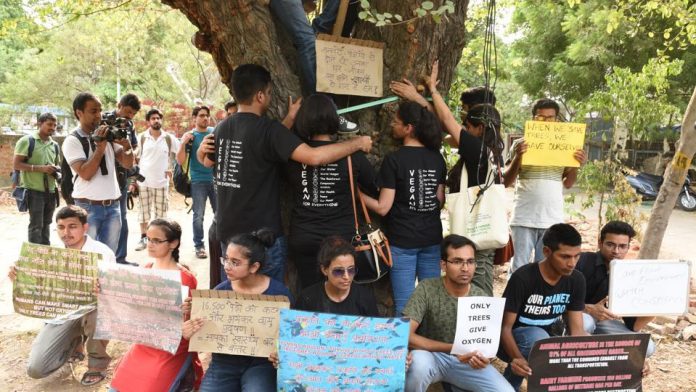
On June 24, 2018, #DelhiChipkoAndolan was trending on twitter when over 1500 people protested in the Sarojini Nagar area of south Delhi against the proposed cutting of over 16000 trees for a project by the National Building Construction Corporation (NBCC).

As the above hashtag rightly conveys, the citizens of Delhi took the matter into their own hands against the felling of their already depleting green cover. Amidst the clamour that has been going on regarding the legality of this urban deforestation, some relief was seen when the Delhi High Court put a stay on the project till July 4. The Ministry of Urban Development in 2016, had proposed redevelopment of seven residential accommodation colonies under the name of ‘Master Plan 2021’ aiming to cater to the city’s population.[1]

Bypassing the Law

As a responsible citizen of Delhi, you are expected to think how the government can approve the cutting down of trees on such a magnitude, which could majorly turn the air of this city from unhealthy to toxic. It is important to know how the legal framework, both at the centre and the state level, allow such proposals to pass. But before going into that, let us look at the obligations of the state towards the environment.

  • In the case of Vellore Citizens Welfare Forum v. Union of India, it was laid down that the precautionary principle, in the context of the municipal law, observes that environmental measures shall be taken by state and must be anticipated, prevented and the cause of environmental degradation shall be attacked.[2]
  • In case of serious irreversible damage, lack of scientific certainty should not be a reason for the postponement of measures that need to be taken to prevent environmental degradation and the onus lies on the developer to show that his action is environmentally benign.[3]
  • The above principles along with the other provisions of the constitution reiterate the obligations of the state towards the environment to align it with the principle of good governance.

Central Government

A project of such nature and scale has to get an Environmental Clearance prior to the work getting started. The procedure to get an environmental clearance for any project has been laid down in the Environment Impact Assessment, Notification 2016(EIA).

EIA plays a major role when it comes to any developmental project and it is basically a procedure to know the positive and negative aspects of any proposed activity. It may also be said that it is a decision-making process to decide whether a developmental project must start or not. EIA is a process of identifying, predicting, evaluating and mitigating the biophysical, social and other relevant effects of development proposals prior to major decisions being taken and commitments made.[4] Housing projects come under category B1, in which the EIA report has to be mandatorily filed. When EIA report is filed for getting prior environmental clearance, the process goes through namely, four stages:

  1. Screening
  2. Scoping
  3. Public Consultation
  4. Appraisal
  • Screening is an important phase for every environmental clearance. This phase decides the nature and scale of the project depending on which the categories are allotted. The category decides whether the EIA report needs to be filed for approval or not. Under the current law, building projects with an area of more than 20,000 square meters require a mandatory impact assessment study.[5]
  • Scoping is about setting out the issues to be considered in the EIA, the parameters and the broad approach that is to be taken during the assessment to correctly assess the environmental issues.
  • Public Consultation refers to the phase of stakeholder analysis. It is a process by which the concerns of local affected persons and others who have a plausible stake in the environmental impacts of the project or activity are ascertained with a view to taking into account all the material concerns in the project or activity design as appropriate. All Category ‘A’ and Category B1[6] projects or activities shall undertake public consultation. However, it is not a necessary practice for all buildings/ construction projects/ Area Development projects and Townships as they come under the exception clause of public consultation in the environment impact assessment notification, 2016[7]
  • Appraisal means the detailed scrutiny by the Expert Appraisal Committee or State Level Expert Appraisal Committee of the application and other documents like the Final EIA report, outcome of the public consultations including public hearing proceedings, submitted by the applicant to the regulatory authority concerned for grant of environmental clearance.

It is evident that there is no legal recourse as far as the Environment Impact Assessment and the grant of environmental clearance is concerned by the Ministry of Environment and Forest. Filing a PIL was the only plausible option and the protest at Sarojini Nagar is an unavoidable moral question to the government.

Delhi Government

Delhi has its own act to save trees under the name of Delhi Preservation of Trees Act, 1994. Section 29 of the Act states that the Government has the power, subject to such conditions, if any, as may be imposed; the Government may, if it considers it necessary so to do in the public interest, by notification, exempt any area or any species of trees from all or any of the provisions of this Act.

Therefore, here is how the proposed project becomes a legally sound act even when undertaken by the government of Delhi. The lieutenant governor can pass such orders of felling 11000 trees in Sarojini Nagar, 2294 trees in Netaji Nagar and 1454 trees in Nauroji Nagar in the name of ‘development’ and ‘public interest’ by exercising the powers conferred to the government under Section 29 of the Delhi Preservation of Trees Act, 1994. The irony is that the same act establishes the Tree Authority in the capital region for the preservation of trees. The purpose of this act is to save trees from depletion by human activities.

Duties of the Tree Authority mentioned in the Act

  1. The preservation of all trees within its jurisdiction.
  2. Carrying out a census of the existing trees and obtaining, whenever considered necessary, declarations from all owners or occupants about the number of trees on their lands.
  3. Development and maintenance of nurseries, the supply of seeds, saplings, and trees to persons who are required to plant new trees or to replace trees which have been felled.
  4. Getting plantation and transplantation of trees necessitated by the construction of buildings. New roads or widening of existing roads or replacement of trees which have failed to come up along roads or for safeguarding danger to life and property.
  5. Organization of demonstrations and extension services for the purposes of this Act and assisting private and public institutions connected with planting and preservation of trees.
  6. Undertaking such schemes or measures as may be directed from time to time by the Government for achieving the objects of this Act.
  7. Undertaking a critical study of the proposals of various government departments and private bodies for construction of buildings, roads, factories, irrigation works laying out of, electric telephone. telegraph and other, transmission lines with regard to the protection of existing trees and planting of more trees, wherever possible.[8]

Compensatory afforestation is not the answer

The backup plan of these proposed projects, which carry out felling of trees at such a magnitude, is compensatory afforestation. It does not need a scientist to understand that five saplings cannot replace five fully-grown trees planted. Let us look at the reasons as to why planting trees are not the damage reversed.

  • A fully-grown tree is an ecosystem in itself, providing oxygen to five people.
  • Saplings need to be protected and it takes years for them to grow into a full-fledged tree.
  • Bad record of organization and government regarding compensatory afforestation.

The acquisition of land in exchange for a hollow promise of compensatory afforestation has been unprecedented. What is more unfortunate is that the felling of trees is being formalized by neglecting the ground realities and the possible consequences that might occur. Compensatory Afforestation Fund Act, 2016 came into force for setting up Compensatory Afforestation Fund Management and Planning Authority (CAMPA) at both central and state level to ensure expeditious and transparent utilization of amounts realized in lieu of forest land diverted for non-forest purpose.

What you can do to save a tree from being cut down

There are three steps:

  • Challenge the cutting down of a tree.
  • Ask for proof of permission to cut down the tree.
  • Call 100 or Tree helpline number (2337 8600)

To read more on your legal capacity to save a tree from being cut down. Click on this document released by the Delhi Forest Department.

Conclusion

As a responsible citizen, you are expected to speak up for the trees. No matter where it stands, everyone has the right to breathe its oxygen. The current issue highlights how the city is being developed lately at the cost of our trees and our health. Delhi has already started witnessing dust storms because there are fewer and fewer trees to grab the dust, and NO, the saplings being planted in their place are not enough.

References

[1] http://pib.nic.in/newsite/PrintRelease.aspx?relid=146815

[2] (1996) 5 S.C.C. 647.

[3] Id.

[4] S.C.SHASTRI, ENVIRONMENTAL LAW 150 (5 ed. 2015).

[5] Item 8 of the Schedule (Construction/Township/Commercial Complexes/ Housing of EIA Notification 2006.

[6] See Para 4 (iii) of the EIA Notification 2006.

[7] See Para 7 (III)(i)(d) of the EIA Notification 2006.

[8] See Chapter IV of THE DELHI PRESERVATION OF TREES ACT, 1994.

Download Now

How To Make A Career In Media and Entertainment Law

4
media and entertainment law

My career in media and entertainment law was a beautiful stroke of luck.

I was informed of a job opening by a lawyer with whom I had negotiated in a prior internship. He was impressed with my work and referred me to the legal head on his own. There were a few rounds of interviews before I was selected. However, I cannot disregard the fact that the reference helped me find the gateway to my career. I was lucky!

Now, as I write about my experiences and insights, I get many queries from lawyers and law students alike. They want to know how to make their way to a career in media and entertainment law.

I think that is the weird part of our legal education system. By the time we graduate, we should have enough knowledge about our desired field. But that is not how the present system works. We are not taught enough about the viable career options. I remember my media law paper was an optional subject. True that it had the largest number of people in the class, but it should have been one of the compulsory subjects. I didn’t even know that moots on media law existed until recently!

Even the subject in college was taught by a professor with theoretical knowledge and no practical experience. We had a couple of workshops where lawyers working in the industry came and delivered lectures, but that was not enough exposure to the industry. Now there are media and entertainment law courses available, but there are very few institutes which offer a masters in the subject.

What should law students and lawyers do to pursue a career in media and entertainment law?

I believe that with enough hard work and dedication anything is possible. But it helps tremendously to know where to begin. Once that is figured out, you can take the necessary steps towards a successful career.

Here are the few things I have learned which may contribute towards building a career in this field:


  • Learn media and entertainments laws


Know your laws!

Any lawyer must know the laws first. So you can begin by reading about media laws. There is copyright laws, trademark laws, patent laws, design laws, i.e., intellectual property laws. But that does not constitute media laws alone.

Did you know that defamation and sedition laws in India constitute media laws? Yes, these are two sections from the Indian Penal Code, but form a core part of media laws.

Were you aware that Article 21 of the Constitution of India that guarantees freedom of speech and expression is the genesis of media laws? Yes. It maybe constitutional law, but Article 21 is where media laws was born.

There are various bare acts, books, journals, media and entertainment law courses, blogs, websites which will help build your knowledge base. You also need to know about contract laws, negotiation and dispute resolution to put the knowledge into effect.

To understand any legal concept, I prefer to start with the bare acts and then go through the commentaries or articles on a specific topic. They are available in libraries – physical and digital. You just have to look them up. Put in the work. It will work.

For instance, what will I do if I need to know whether the title of a cinematograph film can be protected under IP laws? I will read up the IP laws and figure out whether it should be copyrighted or trademarked. In case of a film title, procuring a trademark and using it helps. But foremost one must register the film title with the authorized association like the Association of Motion Pictures and Television Programme Producers (AMPTPP), the Film and Television Producers’ Guild of India (Guild) and the Indian Motion Picture Producers’ Association (IMPPA). You can read more about the topic here.

But theoretical knowledge is not enough. One also has to test the knowledge in the practical field. The best way to do that is through hands-on work or if you’re still in law school, try this course here that gives exercises based on real-life situations.


  • Gain practical knowledge


The best way to learn media and entertainment law is through internships or working with law firms and lawyers in the field. But, it is easier said than done.

Of the many queries I have received so far, the common query is regarding how to get internships in media and law industry. My suggestion would be to make a list of top lawyers, law firms, media companies dealing with media and entertainment law. You can find their information online. Almost all of them have a careers page or contact details. Just get in touch with them and ask about their internship programme or hiring procedure and apply! You can even follow their LinkedIn pages to keep up with the call for intern or job opportunities.

You need to have a crisp resume and a cover letter. You can check for templates online or from your college seniors, recruitment cells or do an internship course or resume building course for a well-prepared application. Don’t worry about stipend or salary if you get a good opportunity to learn. Once in the door, you will be able to develop skills that allow you to make money on the side like contract drafting, legal notices, etc.


  • Write Articles


I cannot emphasise enough on the practice of writing. Lawyers are the eternal learners. They need to keep up with the ever-changing laws and keep themselves updated. For this, they not only have to read current legal articles, but also write themselves.

Law students and even lawyers should have a habit of writing. The articles should be on the are of law you’re interested in, like media and entertainment laws. If you’re keeping yourself updated about laws and learning, then you would have developed your ideas and take on topics. Just write them! It is that simple.

Of course, all good articles are backed by a solid research and writing skills. You write what you know, so you have to research thoroughly to write a crisp article. Share it on social media and forums. Keep the article simple and on point. It should have a logical structure, your take on it, and most importantly it must serve a purpose. Your article should make legal experts, peers, professors take their time out and read it.

A good article not only effectively demonstrates your legal acumen, but also the command of the subject matter. It makes a prospective recruiter see you as a knowledgeable candidate. I have had two job offers in a little over two months just after I started writing! My resume is still the same, the only thing that changed was the writing.


  • Skill development and networking


Keeping your brain on its toes is only one step towards learning. You need to keep honing your skills which has practical applications, like your writing skills, contract drafting skills, researching skills, etc. You can do workshops, online courses, practise to develop these skill sets. The idea is to keep learning marketable skills so that you can demonstrate your value as a potential candidate.

But just being learned and skilled is not enough. You have to be able to display these skills to the right audience. You should have a professional social media presence as well, like LinkedIn. Start networking with the people in your area of interest and otherwise. You never know where the opportunity might come from. I regularly see posts on LinkedIn by recruiters looking for candidates. Sometimes, you can even approach recruiters and enquire about their internship or professional hiring programmes.

You must not stop learning. If you find yourself short time, organise it to have a more productive day. All the best lawyers are busy people, but they keep themselves sharp to stay at the top of their game.


  • Know your industry


I remember before my interview, I had no idea what my company did and how. But by the day of the interview, I had figured out their growth per cent in the past three years, their history online. In fact, I even slipped it in the middle of a conversation to show that I came prepared!

How can you know about the media and entertainment industry? Keep up with the news both in and out of courts. Even the seemingly fluff pieces in this industry might be of value for a lawyer. I found out a prominent singer was launching a recreated version of our song through a newspaper. I informed the bosses immediately, and necessary actions were taken swiftly.

The importance of knowing your industry is quintessential for any lawyer. You have to assist, advise and work with various departments. Unless you know the ins and outs of the industry and the company, you cannot perform your best. You must understand the industry to know what works best for it. For instance, in media and entertainment, rights are granted territory-wise. So a lawyer representing a producer must realise while negotiating that for a Tamil or Hindi film which territories might have the largest demographic. This way they can focus their efforts accordingly.

Is this the ultimate guide to establish yourself in the media and entertainment industry? No.

These are some of the things that I know of, which have yielded results. There is a lot of hard work and persistence required after everything. You have to put yourself out there and keep on trying until you make it happen. Don’t be complacent, keep on improving, for there are no shortcuts to a successful career in media and entertainment law.

Good luck!


Download Now

Best legal research internships in India

0

In this article, Ana Khan gives a list of ten best legal research internships in India.

Introduction

Theory and Practical are the two important segments of any curriculum and in the professional courses like LLB, the practical aspect plays an important role. Though law school teaches every student the theoretical aspects in depth but the application of these aspects are not covered under any law school. For the purpose of understanding the applicability of the law, it is mandatory for every law student to do an internship and learn the practicality of the profession.

Where to find legal internships.

There are various online portals through which internship can be applied at various organizations.

Some of the websites are mentioned below:

  1. www.lawctopus.com
  2. www.internshala.com
  3. www.livelaw.in
  4. www.hellointern.com
  5. www.lawlex.org
  6. www.lawmantra.co.in

How to apply for an internship

  1. Search for any law firm, NGO or any research organization in which you would like to intern.
  2. Find the relevant email id of the organization/firm for the internship application.
  3. Make your CV/Cover Letter for the purpose of internship and send it to the organization.
  4. Keep the track of your application by reminding them once in a week (not more than that).

Best Legal Research Internships in India

Legal research internships are found at various Research Organizations, NGO, Lawyers, Government Organizations, Companies and Law firms. All are discussed below:

PRS Legislative

PRS track the functioning of the Parliament and works with the MP’s and MLA’s. Interns can assist these MP’s and MLA’s with their work. During the Parliament session, interns have to work for the upcoming issues and during the non-session periods, the interest of the individual is taken into consideration.

Main tasks assigned:

  1. The work mainly involves data inferences, assisting in research for a Member of the Legislative Assembly.
  2. On the last day of the internship, interns are expected to submit a report and make the presentation on the same.

Work Culture:

  1. All the analyst are easily approachable and very eager to answer the questions you ask.
  2. They will always make sure to provide you with some work

Stipend:

No stipend.

Application Procedure:

Interested persons can fill in the application form. The form has to be filled out in one session, and there is no option of saving responses.  You are expected to:

  1. write a short statement of purpose (not more than 500 words)
  2. upload an up-to-date resume in PDF format
  3. upload a writing sample of any policy issue. (not more than 1000 words) in PDF format

Contact details:

New Delhi office PRS Legislative Research 3rd Floor, Gandharva Mahavidyalaya, 212, Deen Dayal Upadhyaya Marg, New Delhi – 110002 Tel: (011) 2323 4801-02 Email: [email protected]

Centre for Legislative Research & Advocacy

CLRA is an independent not-for-profit research organization which focuses on research, advocacy, and networking where you have given a chance to assist the Member of Parliament. CLRA works closely with civil society groups, parliamentary institutions, legislators, political parties, civil servants, and media to create participatory and collective wisdom and praxis in the policy and decision-making process.

Main tasks assigned:

  1. The work is mainly research-based.
  2. Making reports and questions which Member of Parliament could ask in the session.

Work Culture:

The Work environment is very relaxed. MPs are really supportive and always eager to answer your questions.

Stipend

No stipend.

Application Procedure

Please ensure that your Internship CV adheres to the basic guidelines before hitting submit button. Interested candidates can send their CVs to [email protected]om or [email protected]g

Contact Details

  New Delhi Office Centre for Legislative Research and Advocacy (CLRA) C/o IMPF, 173, North Avenue, New Delhi – 110001 011-23092911 [email protected], [email protected]

Centre for Public Policy Research

Centre for Public Policy Research is a research organization dedicated to extensive and in-depth research on current economic, social, and political issues.

Main tasks assigned

  1. To observe proceedings with court officials, lawyers, and police.
  2. Translation of documents from Hindi to English.

Work Culture

The staff is really hard working and inspires the interns to work more.

Stipend

No stipend

Application Procedure

To apply as an Intern, please Click here to fill the online Application form

Those interested in part-time jobs or volunteering can also apply

Contact Details

New Delhi Office Centre for Public Policy Research B5/143, Safdarjung Enclave,New Delhi- 110029, India. Email [email protected]
Kochi Office Centre for Public Policy Research ‘Anitha’, 1st floor S.A Road, Elamkulam, Kochi- 682020, Kerala, India Ph: +91 484 4043895

 Center for Death Penalty, NLU Delhi

The center on the death penalty is providing internship policy on the rolling basis. The name has been transformed to Project 39a. The policy launched to develop a robust and rewarding internship programme that will provide meaningful exposure to the complexities and nuances, in particular, of the administration of the death penalty and the criminal justice system in India.

Main tasks assigned

  1. Interns may be asked to assist in litigation activities, research projects or initiative public outreach.
  2. Interns will also be expected to assist in administrative matters.

Work Culture

Going by the reputation of the college, the expectation from the internship is very high.

Stipend

Rs.10,000 for every 4 week period of internship.

Application Procedure

Interested applicants must send the following information–

  1. Curriculum Vitae
  2. Cover Letter indicating the programme enrolled in, current year of study, the name of the university and the exact dates of the internship
  3. Statement of Purpose of not more than 500 words explaining their interest in interning with the Centre.

The application form is accessible here:

https://docs.google.com/forms/d/e/1FAIpQLSeQJjkMBQr1v1zfhhFAp-V9TIqADYfpqd3khfxWztHH_uCpCQ/viewform?c=0&w=1

NOTE-Applicants should apply at least 8 weeks but not more than 12 weeks in advance from the proposed date of their internship. Please allow for at least 4 weeks for processing the applications.

Contact Details-

New Delhi Project 39A National Law University, Delhi Sector 14, Dwarka, New Delhi – 110078 Phone no. +91 11 2803 2533 Fax no. +91 11 2803 6432 [email protected]

Vidhi Centre for Legal Policy

The Vidhi Centre for Legal Policy is an independent think tank doing legal research and assisting the government in making better laws. Vidhi is committed to producing legal research of the highest standard with the aim of informing public debate and contributing to improved governance.

Main tasks assigned

  1. To compile a list of cases which is filed to the Supreme Court by the NGO.
  2. To prepare a case analysis/case brief.
  3. To prepare a list of cases disposed of by various tribunal each year.

Work Culture

The staff is really cooperative and one of the best legal research internships.

Stipend

No stipend

Application Procedure

  • The application for an internship should be submitted by clicking on the link below. Please note that the link will remain active only for the first 20 days of every month.
  • Applicants are required to apply 2 (two) to 6 (six) months prior to the proposed date of the internship.

The internship form is accessible here:

https://docs.google.com/forms/d/e/1FAIpQLSd1gCe1h7tBfX144XUustZfTfVQwbgfEEonmGAf24Cn4vnMAQ/viewform

Contact Details-

DELHI BRANCH     D-359, Lower Ground Floor, Defence Colony New Delhi 110024 011 4310 2767
BENGALURU BRANCH 43, Residency Road, Shanthala Nagar, Bengaluru 560025

The Energy and Resources Institute (TERI)

For biotechnology or environmental law freaks, there is no better place than TERI to invest your time in. One of the largest developing institutions, it does not have a formal internship program. It ensures a range of research opportunities’ for its interns in areas of environmental law jurisprudence, sustainable development and the like. Apply soon, you may just be the next Marshall Eriksen!

Main tasks assigned

  1. To do research work.
  2. Data entries and tabulations as excel sheet.

Work Culture

The staff is generally quite helpful and it depends upon your mentor.

Stipend

No stipend.

Application Procedure

Click the link below to apply.

http://ngobox.org/job-detail_Intern-/-Summer-Trainee-at-TERI_25197

Contact Details:

New Delhi, Lodhi Road Branch Darbari Seth Block, IHC Complex, Lodhi Road, New Delhi – 110 003, INDIA Tel: (+91 11) 2468 2100, 4150 4900 Fax: (+91 11) 2468 2144, 2468 2145 Email: [email protected]. (TERI)
New Delhi, Vasant Kunj Branch Plot No. 10, Institutional Area, Vasant Kunj, New Delhi – 110 070 Tel: (011) 7180 0222 (25 lines) Fax: (011) 2612 2874 Email: [email protected]
Gurugram (Gurgaon) Branch Gurgaon – Faridabad Road, Opposite Pathways School, Gwal Pahari, Gurugram – 122 102

HRLN (Human Rights Law and Network)

HRLN is a non-profit, non-governmental organization. HRLN provides pro-bono legal services to those with little or no access to the justice system, conducts litigation in the public interest, engages in advocacy, runs helplines, conducts legal awareness programmes.

Main tasks assigned

  1. The main task is mostly research work, drafting applications, affidavits.
  2. The legal work which was assigned also includes the personal meeting of clients.
  3. Work of translation is also being given to the interns.
  4. Research on what the Supreme Court held in Human Rights cases.

Work culture

Employees are very humble and delegate some of their work to the interns to provide them with work experience.

Stipend

No stipend

Application Procedure

If you are interested to undertake an internship programme, please send your application form, a recommendation letter, writing sample and CV to [email protected] with a title in the subject line of your email: ‘Internship at SLIC: (mention month)’.

Download Application Form

Contact Details

 
Chandigarh Branch Human Rights Law Network # 3177/2, Sector-44 D Chandigarh-160047 Tel: 0172-4603177                 Email: [email protected]
Uttar Pradesh Branch Human Rights Law Network 20-A, Hastings Road, Ashok Nagar, Allahabad – 211 001 Email: [email protected]
Bangalore Branch Human Rights Law Network No.20, Park Road, Tasker Town Shivaji Nagar Bangalore -560051
West Bengal Branch Human Rights Law Network 3, Parbati Chakraborty lane Flat-1A, Sohini Apartment Kolkata-700026 Telephone No: +91-33-4008-3355 Email: [email protected]
Mumbai Branch Human Rights Law Network First Floor, Jalaram Krupa 61, Janmabhoomi Marg Fort, Mumbai – 400 001 Tel: +91-22-2282 0109/2282 0192 Email: [email protected]
New Delhi Branch 576, Masjid Road, Jangpura New Delhi – 110014 +91-11-24374501 +91-11-24376922(Fax) [email protected]
Madhya Pradesh Branch Human Rights Law Network MILIND WANKHEDE (ADVOCATE) E-7/11 S.B.I.COLONY, ARERA COLONY, NEAR 11 No. STOP BHOPAL. M.P. PIN – 462016 Mob.09301692528 [email protected]
The other branches of HRLN are Shimla, Dharamshala, Almora, Tehri, Jaipur, Srinagar, Chennai, Cochin, Trivandrum, Hyderabad, Cuttack, Imphal, Itanagar, Gangtok, Kohima, Guwahati, Ranchi, Patna, Nagpur, Ahmedabad, Jabalpur, Indore, Raipur.

PUCL

PUCL is a human rights organization formed by Jay Prakash Narayan as People’s Union for Civil Liberties and Democratic Rights (PUCLDR) later the name changed to People’s Union for Civil Liberties. Main tasks assigned
  1. Visit shelter homes, consumer courts and make a report regarding this.
  2. Submit a report on a legal issue.
  3. If you’re lucky enough you’ll get a chance to attend seminars based on any legal and social issue.
Work Culture The staff is very friendly and always encouraged to ask more and more questions. Stipend: No stipend How to apply: Drop your CV and Cover letter at [email protected] Contact Details:
New Delhi Branch 270-A, Patparganj, Opp Anand Lok Apartments, Mayur Vihar I, Delhi 110 091 India+91-011-2275 0014 (phone); +91-011-4215 1459 pp (fax)
Jaipur Branch 48, Van Vihar, Tonk Phatak, Jaipur, Rajasthan 302018

PILSARC

The Public Interest Legal Support and Research Centre (PILSARC) is a non-profit legal backup center based in Delhi. It provides support to various Human Rights Institution.

Main tasks assigned

  1. The main task is to do a lot of research on Refugee Law.
  2. The other task to do is drafting of legal opinions.

Work Culture

The office is highly resourceful and the workplace is very friendly.

Stipend

No stipend

Application Procedure

If you wish yourself to apply here, mail your applications at  [email protected] or [email protected].

Contact Details:

New Delhi A-131, New Friends Colony, 110065, Email: [email protected]

iPleaders

iPleaders consists of a team of lawyers hell-bent on figuring out ways to make the law more accessible. A major focus area of iPleaders has been researching and developing resources through blogging, educational resources, workshops, and interactive software that entrepreneurs can use themselves as an aid during decision making

Main tasks assigned

  1. The main task is to write blogs for the iPleaders and some of them will be published on the website, you have to write about the legal issues which will be provided by the mentor.
  2. You have to do a lot of research work on the issue.

Work Culture

The staff is very friendly. As the staff is very young there is no such thing as “generation gap”, they all will understand your problem and situation. The only thing to keep in your mind is your “work” and “timings”, they are very punctual about the timings, that is, from 10 am to 7:30 pm.

Stipend

The stipend is paid on the performance basis like if you complete 50 articles during the tenure of your internship, then you will get Rs.5000/- as a stipend.

Application Procedure

Drop your CV along with Cover Letter at [email protected]

Contact Details:

Delhi Office 33A, 1st Floor, M. B. Main Road, Saidulajab, Delhi:110030
Kolkata Office Technopreneurs Surrogate Ventures, 2nd Floor, Techno India University, EM1/4, Sector V, Salt Lake, Kolkata: 700091
Goa Office Bootstart, Greenland View, Dandoswada. Mandrem, Goa: 403527

Ace your Internship

To be successful in securing and excelling in a corporate internship, you need to plan and prepare well ahead. We observed the process and journey of securing a corporate law internship and converting one into a job offer for hundreds of law students and then identified the elements that worked and that didn’t work. This program is developed to enable you to acquire those skills before you even walk into a corporate internship. You will be able to build yourself into a person whom a law firm seeks out. A wide range of topics are covered in a huge amount of detail, such as:

  • How to draft an effective CV
  • How to write an effective cover letter
  • Guides for performing different kinds of tasks at an internship
  • How to excel at due diligence
  • How to excel at proof-reading assignments and learn for the future
  • Comprehensive technical skills training on M&A, Corporate, Debt Finance, FDI, General Corporate and Stamp Duty
  • Hacks for high-powered Google, Manupatra, MCA and BSE searches
  • Presentation and formatting techniques
  • Learn how to read and interpret financials of a business
  • Internship Plan for mapping out your internship progress
  • How to write expert-level articles that catch client and recruiter attention
  • How to draw complex corporate structures in PowerPoint from Day 1
  • How to build expertise in any area of law
  • How to network effectively before, during and after your internship
  • Detailed interview preparation modules for technical and HR-style interviews

References:

  1. http://www.prsindia.org/aboutus/internships-at-prs/
  2. http://www.clraindia.org/trust.php
  3. https://www.cppr.in/internships/
  4. http://www.livelaw.in/call-interns-centre-death-penalty-nlu-delhi/
  5. https://vidhilegalpolicy.in/
  6. http://www.hrln.org/hrln/join-us/interns-a-volunteers.html
  7. https://ipleaders.in/home

Download Now

Nature of Fourth Schedule of Arbitration and Conciliation Act, 1996

4
Fourth Schedule

In this article, Swati Garg, an Advocate and an LL.M. graduate from Gujarat National Law University discusses the Fourth Schedule of Arbitration and Conciliation Act, 1996.

Arbitration and Conciliation Act, 1996 (herein referred to as the Arbitration Act) was amended by the Arbitration and Conciliation (Amendment) Act, 2015 which inserted Fourth Schedule in the Act. By inserting the schedule, legislators have tried to regularize the fees of arbitrators in domestic arbitration as opposed to leaving it to the discretion of arbitral tribunal or the parties.

Prior to the 2015 Amendment, Section 31(8) of the Arbitration Act provided that fees of the arbitrators would be fixed by the arbitral tribunal if it has not been already agreed upon by the parties.

With 2015 Amendment, Parliament inserted Fourth Schedule wherein a Model fee chart is provided for arbitrator fees. As per this chart, for a sole arbitrator, fees would be 25% in addition to the fees prescribed. Subsequently, it has empowered the High Court, in its discretion, to determine the fees of arbitral tribunal keeping into consideration the Model fees as specified in the Fourth Schedule.[1]

Model fees chart as provided in the Fourth Schedule

Sum in dispute Model fee
Up to Rs. 5,00,000 Rs. 45,000
Above Rs. 5,00,000 and up to Rs. 20,00,000 Rs, 45,000 plus 3.5 per cent of the claim amount over and above Rs. 5,00,000
Above Rs. 20,00,000 and up to Rs. 1,00,00,000 Rs. 97,500 plus 3 per cent of the claim amount over and above Rs. 20,00,000
Above Rs. 1,00,00,000 and up to Rs. 10,00,00,000 Rs. 3,37,500 plus 1 per cent of the claim amount over and above Rs. 1,00,00,000
Above Rs. 10,00,00,000 and up to Rs. 20,00,00,000 Rs. 12,37,500 plus 0.75 per cent of the claim amount over and above Rs. 10,00,00,000
Above Rs. 20,00,00,000 Rs. 19,87,500 plus 0.5 per cent of the claim amount over and above Rs. 20,00,00,000 with a ceiling of Rs. 30,00,000

If there is only a sole arbitrator, he shall be entitled to an additional amount of 25 per cent on the fee payable.

In lieu of their powers, Delhi High Court and Rajasthan High Court have already framed rules regarding arbitrator’s fees. Punjab and Haryana High Court has adopted the model fees prescribed in the fourth schedule in toto[2] whereas Delhi and Rajasthan High Court has departed from the same and have set the fees lower than what is prescribed in the Arbitration Act.[3]

Parties will be benefited from this fixation of fees as usually prices quoted in adhoc arbitration are higher than this. Parties having no say in this, have to comply with these demands of humongous fees. Though the Supreme Court and various High Courts have frowned upon this act of charging of higher fees by Judges.[4] For the parties, these model fees are a welcoming step.

However, the question which arose here is regarding the applicability of Fourth Schedule, if it is mandatory or just directory. The use of the word ‘Model’ in the Schedule and power of High Court to make rules for fixation of fees has created an ambiguity as to the applicability of the schedule. The concern here is what if the High Court doesn’t wish to enact any rules, then is it mandatory for parties to abide by the model fees?

In the case of Kumar & Kumar Associates vs The Union of India & Ors.[5], Patna High Court has clarified that the parties have to abide by the Fourth Schedule.

It is also relevant to mention here that under Section 29 B of the Arbitration Act, there is a provision of fast-track arbitration which has been inserted by 2015 amendment act. Apart from taking a mere six months of time to complete the proceedings, section 29 B (6) let the parties and arbitrator decide the fees.

Who pays the Arbitration fees?

Section 31 A of the Arbitration Act empowers the arbitral tribunal to determine as to which party pays the fees. The general rule is that the unsuccessful party pays the share of fees of the successful party, however, the arbitral tribunal can decide differently by passing a reasoned order in writing. The arbitral tribunal has to keep the below-mentioned points[6] in mind before deciding on the share of the party:

  1. the conduct of all the parties;
  2. whether a party has succeeded partly in the case;
  3. whether the party had made a frivolous counter-claim leading to delay in the disposal of the arbitral proceedings; and
  4. whether any reasonable offer to settle the dispute is made by a party and refused by the other party.

To save oneself from such outcomes, parties are allowed to make an agreement for dividing the cost of arbitration but it will only be valid if such agreement is made after the dispute came into existence.

Conclusion

Arbitration is one of the best mechanism to resolve a dispute without the intervention of the court yet high arbitrator fees have discouraged parties from opting for it. The model fees are acting as a deterrent against the practice of demanding such exorbitant fees. Many courts have adopted the same, yet many haven’t. Though there is still a need for the Supreme court ruling as the fees aren’t mandatory and High courts have the power to make rules regarding it, still this fresh change has brought a sigh of relief for parties.

References

[1] Section 11(14) of the Arbitration Act

[2] https://highcourtchd.gov.in/sub_pages/left_menu/Rules_orders/high_court_rules/vol-I-pdf/chap4partEV1.pdf

[3] http://www.dacdelhi.org/topics.aspx?mid=21; http://www.bareactslive.com/RAJ/RJ485.HTM

[4] https://timesofindia.indiatimes.com/city/delhi/HC-scraps-ex-judge-panel-over-high-fee/articleshow/31300401.cms; http://www.lawyersclubindia.com/news/SC-snubs-retd-Judges-for-charging-heavy-fee-in-arbitration-cases-10521.asp;
https://indianexpress.com/article/india/india-others/hc-govt-officials-cant-charge-fees-in-arbitration-cases-need-guidelines/

[5] https://indiankanoon.org/doc/125836906/

[6] Section 31 A (3) of the Arbitration Act


Download Now

Abetment under the Indian Penal Code

0
abetment ipc

This article is written by Dhruv Bhardwaj, a student of Amity Law School, Delhi and Qamar of RMLNLU. The article has been compiled and updated by Subodh Asthana, a student of Hidayatullah National Law University. In this article they will discuss the concept of Abetment under the Indian Penal Code and the theories of abetment under the Indian Penal Code.

Introduction

Law keeps a check on human behaviour. It categorizes them into criminal and non-criminal behaviours. However, every non-criminal behaviour even something as simple as buying a knife for your kitchen becomes criminal when there are criminal intentions behind it.

The concept of abetment widens the horizons of criminal law to incorporate these criminal intentions and penalize them even when the person who bought the knife did not actually kill anyone but handed it over to someone else to do it. To explain the concept of abetment, the word ‘abet’ should be given a deep scrutiny. In general use, it means to aid, advance, assist, help and promote.

In the case of Sanju v. State of Madhya Pradesh[1] the honorable Supreme court defined ‘abet’ as meaning to aid, to assist or to give aid, to command, to procure, or to counsel, to countenance, to encourage, or encourage or to set another one to commit.[2] The definition of ‘abet’ as laid down, makes it clear that abetment only occurs when there are at least two person involved, which further directs us towards the arrangement and operation of the act. 

In usual parlance, a person is held to be liable only if he or she has personally committed a crime. Detouring from the usual concept, the concept of Abetment says, that he who has helped the criminal or provided him with any assistance in any form can also be  held to be liable. This article will discuss at length, the nitty gritty of Abetment laws in India.
Meaning of Abetment

In common parlance, the word ‘abet‘ signifies help, co-activity and support and incorporates within its ambit, illegitimate reason to commit the crime. So as to bring an individual abetting the doing of a thing under any of the conditions specified under Section 107 of the Indian Penal Code, it isn’t just important to demonstrate that the individual who has abetted has participated in the means of the transactions yet additionally has been associated with those means of the transaction which are criminal. 

Abetment under the Indian Penal Code

Abetment is constituted by:

  1. Instigating a person to commit an offence; or
  2. Engaging in a conspiracy to commit it; or
  3. Intentionally aiding a person to commit it.

The offense of abetment by instigation relies on the intention of the individual who abets and not upon the act which is finished by the individual who has abetted. The abetment might be by instigation, connivance or purposeful aid as given under Section 107 of the Indian Penal Code However, the words articulated in an angry state or omission without any intention cannot be termed as instigation.

For an individual to be called liable for Abetment, and so as to proceed against an individual for a criminal offense under Section 107, prosecution must claim the component of mens rea. Negligence or carelessness can’t be named to be abetment in order to punish the liable, according to the arrangement of penal laws.

So as to establish abetment, the abettor must have appeared to “deliberately” support the commission of the wrongdoing. In such a case we need to just prove that the wrongdoing charged couldn’t have been done without the association as well as intervention of the supposed abettor isn’t sufficient with the prerequisites of Section 107. 

When we talk about a sting operation which is typically carried out in public interest, it must be noted that the same is done by instigating the accused.

Thus the person in question, who is generally honest, is tricked into carrying out a wrongdoing on the confirmation of secrecy and confidentiality of the transaction bringing up the potential issues with respect to how such a victim can be considered in-charge of wrongdoing, which he would not have done had he not been given the assurance. In such conditions, should the individual, i.e., the sting administrator be held criminally liable for commission of the offense? This is a bewildering question when there is a claim that the sting administrator is asserted to have committed the abetment of the offense.

The Supreme Court in Rajat Prasad v. C.B.I saw that a wrongdoing does not stand crushed or exonerated just in light of the fact that its benefit extends to the general public at large.

Suppose an individual failed to prevent an offense from taking place, so the inquiry emerges as to whether this failure will add up to Abetment or not. This situation of law later has been attested by the Supreme Court, which anyway held that even though he isn’t an accomplice, the Court would even now need proof on material specifics, as he is the main observer of the wrongdoing and as it is dangerous to hang the accused on his sole declaration, except if the Court feels persuaded that he is talking reality.

Such confirmation need not, be that as it may be, on the subject of the actual commission of the offense; what the law requires is that there ought to be such support of the material piece of the story connecting the person who is blamed with the wrongdoing as will assure a reasonable man that the man can be viewed as an honest person and his statement can be relied upon. Often, abetment may also consist of a passive assistance.

For example, in a case where the accused was found with a spear on the scene of the fight, his participation in the fight was proved. It was immaterial whether or not they actually made use of their weapons, they were still held liable for the injuries caused to the defendant party. 

In the case of Tuck v. Robson, a publican( the person who manages a pub or a bar) by not making any effort to make his customers leave the premises after the pub was closed, was said to have aided the crime of abetment of consumption of the liquor after the hours in which it was permitted. Similarly, let’s talk of a situation wherein an owner of a car who was not driving on that particular instance and had entrusted the task of driving the car to his friend that day. The friend was involved in driving in a very haphazard manner and the owner of the car was charged with abetment because he had failed to stop the driver from indulging in such driving.

On having analysed the law, It was seen that an act involving any sort of assistance or inducement was needed in order to book a person for abetment. Thus if we talk about a case wherein mere abstention from preventing an offence is said to have happened, it is generally not considered enough in order to book a person for abetment. But in a case where a person is in direct control of the conduct of the other person and then he fails to prevent the other person from committing the offence, it will constitute abetting.

The aforementioned provision of law hypothesizes the presence of one, who perpetrated the offense. It is important to talk about, in a nutshell, the ramifications of the articulation ‘Perpetrator’. For the most part it is clear who the culprit is, he is the person who, with the significant mens rea, shot the deadly shot in the homicide, or indulges in sexual intercourse or appropriates the property in robbery. Obviously, there can be more than one perpetrator, as where two men by their joint violence murder the other individual.

Two individuals may likewise be joint culprits, where each with the relevant mens rea does acts which together comprise an adequate representation of the actus reus of an offense; for instance, in an offense including driving, A and B have been held both to drive, where A was inclining over and controlling the steering while B worked the foot pedals the gears. On the off chance that an individual makes use of an innocent agent so as to obtain the commission of an offense, that individual, not the agent, is the culprit, despite the fact that he is absent at the location of the wrongdoing and does nothing with his very own hands.

An innocent agent is one who performs the actus reus of an offense yet is himself lacking responsibility, either by reason of inadequacy or infancy or in light of the fact that he needs mens rea or has a safeguard, for example, pressure.

A striking case of innocent agency is the case where a girl, following up on her mom’s guidelines, gave some powder to her dad to calm his cold. Obscure to the little girl, it was a toxic substance and consequently the father died.

It was held that the mother was the culprit of the wrongdoing since the little girl who was coming up short on the mens rea, was an innocent agent by means of whom, the mother had carried out the wrongdoing. Obviously if, as the report takes note of, the little girl had realized that the powder was poison, she would have been blameworthy as culprit and the mother as an accessory.

A bribe-giver is an accessory, just when he gives it with the aim of acquiring some favour which was not possible to acquire by legitimate means, yet the person who offers it to aid detention of a crime is not an accessory, the important mens rea being missing. People giving unlawful gratification under stress, dread and compulsion are not accomplices.

It isn’t vital for each situation that the key wrongdoer put up at the same trial must be indicted for the offense charged, before the abettor can be sentenced for abetment of that offense. Each case must be decided keeping in mind its own set of facts.

By and large, the facts demonstrate that there can be no conviction for abetment when the prosecution has neglected to substantiate the commission of the essential offense, but conviction of the abettor for his act of abetment would be perfectly justified, even when the principal offender is acquitted, provided the evidence on record satisfactorily establishes that the offence was committed in consequence of abettor’s act of abetment.

A case may arise in which, on the evidence of the same witness, whose evidence has been found to be insufficient for the conviction of the principal offender, the conviction of the abettor would be quite proper.

So far as the principal offender is concerned, the same evidence may be suffering from an infirmity from which it may not suffer so far as the abettor is concerned, and in such a case, though the Court may have acquitted the principal offender by giving him the benefit of doubt, it would be perfectly justified in convicting the abettor, by reason of the fact that the same considerations which applied to the principal offender do not apply equally to the case against the abettor. 
Punishment for Abetment under the Indian Penal Code

For the public at large, the very concept of Abetment being tried as a separate offence and being punishable might sound really bizarre because it is so imbibed in most people that only the perpetrators of the crime will be punished. The Penal Code in its abetment laws clearly lays down the sections, explaining extensively, the different walks of punishments that the abetment laws notify. They are covered as follows:

In Section 109 of the Indian Penal Code, the one who abets an offence is given the same punishment as that of the principal perpetrator of the crime if the actus reus of the principal offender has occurred as a result of the inducement made by the abettor. Section 109 of the Penal Code is applicable in case no separate provision is made for the punishment of such an abetment.

Section 109 of the Penal Code ends up being relevant regardless of whether the abettor is absent when the offense abetted is committed given that he has instigated the commission of the offense or has connected with at least one or more different people in a conspiracy to commit an offense and in accordance with that conspiracy, some unlawful act or unlawful exclusion happens or has purposefully helped the commission of an offense by an act or illicit oversight.

This section explains that if the Penal Code has not independently accommodated the punishment of abetment as such then it is punishable with the discipline accommodated for the original offense. Law does not expect instigation to be in a specific structure or that it should just be in words. The instigation might be by behaviour or conduct. Whether there was instigation or not, is an inquiry to be settled on the distinct facts of each case.

It isn’t essential in law for the prosecution to demonstrate that the real intention in the brain of the individual abetting was instigation and that was it, provided there was instigation and the offense has been committed or the offense would have been committed if the individual who was the main offender had the same intention and knowledge as the thing that was likely to have been done by the person who is instigated.

It is only if this condition is satisfied that an individual can be blameworthy of abetment by instigation. Further the actus reus abetted ought to be done as a consequence of the abetment or in pursuance as given in the Explanation to this Section. 

Section 110 of the Indian Penal Code gives that even if the individual abetted commits the offense with an intention different than the intention possessed by the main perpetrator of the crime, yet the abettor will be charged with the punishment provided for the offence abetted. The liability of the individual abetted isn’t influenced by this section.

Section 111 of the Indian Penal Code continues the development on abetment laws around the phrase “each man is deemed to intend the corollary outcomes of his act.” If one man actuates another to execute a specific wrongdoing, and that other, in pursuance of such instigation, executes not just that wrongdoing but carries out another wrongdoing in advancement of it, the former is criminally liable as an abettor in regard of such last mentioned wrongdoing, in the event that it is one which, as a person with the intelligence of a reasonable man, at the time of inducement would have known to be committed in order to carry out the original crime.

Section 112 of the Indian Penal Code expands the guidelines articulated in the previous section. Under it, the abettor is held liable for the offense abetted and also the offense committed. A joint scrutiny of Sections 111, 112 and 133 make it richly evident that if an individual abets another in the commission of an offense and the chief goes further from there on and accomplishes something more which has an alternative outcome from that planned by the abettor and makes the offense an aggravated one, the abettor is liable for the consequences of the acts of his principal.

The essence of the issue is an enquiry of this sort is whether the abettor as a sensible man at the time that he is being instigated or has been purposefully supporting the main perpetrator would have predicted the likely results of his abetment.

Section 113 of the Indian Penal Code ought to be read together with Section 111. Section 111 accommodates the doing of the actus reus which is not the same as the one abetted, though this section manages the situation when the actus reus done is equivalent to the guilty act abetted however its impact is not the same.

Section 114 of the Indian Penal Code is possibly only brought into activity when conditions adding up to abetment of a specific wrongdoing have first been proved, and after that the presence of the accused at the commission for that wrongdoing is demonstrated furthermore. Section 114 talks about the case, where there has been the wrongdoing of abetment, however where additionally there has been real commission of the wrongdoing abetted and the abettor has been present there, and the manner by which it manages such a case is this. Rather than the wrongdoing being still abetment with circumstances of aggravation, the wrongdoing turns into the very wrongdoing abetted. The section is clearly not punitory. 

Section 114 isn’t relevant for each situation in which the abettor is present at the commission of the offense abetted. While Section 109 is a section which talks about abetment, Section 114 applies to those cases in which not only is the abettor present at the time of the commission of the offense but abetment was done beforehand and done independently of his presence. 

There is a very fine line between Section 34 of the Indian Penal Code and Section 114 of the Indian Penal Code. As per Section 34, where a criminal act is done by numerous people, in promotion of the basic aim of all, every one of them is liable as though it were finished by himself alone; so that if at least two or more people are present, helping and abetting in the commission of the murder, each will be tried as the main perpetrator of the crime, however it probably won’t be clear which of them really perpetrated the crime.

Section 114 alludes to the situation where an individual by abetment, prior to the commission of the wrongful act, renders himself obligated as an abettor, is present when the actus reus takes place, however takes no active part in its doing. A joint act falling under Section 34 however does not include a mere order from one person to another and the carrying out of that order by the other which may only be instigation of the latter’s act.

Section 115 of the Indian Penal Code criminalises the abetment of specific offenses which are either not committed at all, or not committed in pursuance of abetment or only in part committed. 

The detainment discussed in this section is for a term which may stretch out to seven years, and will likewise be obligated to fine. What’s more is that, if any act for which the abettor is liable in consequence of the abetment, and which causes hurt to any person, is done, the abettor shall be liable to imprisonment of either description for a term which may extend to fourteen years and shall also be liable to fine.

‘Express Provision’ alludes to sections in which explicit instances of abetment of offenses punishable with death or detainment for life are talked about. 

‘Such Abetment’ alludes to the abetment of the offense indicated in the section itself, to be specific, an offense culpable with death or detainment for life.

Section 116 of the Indian Penal Code accommodates the abetment of an offense punishable with detainment. There is no corresponding section in the Code identifying with abetment of an offense culpable with fine only.

Three distinct conditions of fact may emerge after an abetment:

  1. No offense might be committed. For this situation, the wrongdoer is culpable under Section 115 and 116 of the Penal Code for mere abetment to perpetrate a wrongdoing.
  2. The very act at which abetment is targeted may be committed, and will be culpable under Sections 109 and 110 of the Penal Code.
  3. Some act extraordinary however corollary from the act which was abetted might take place in which case the abettor will be tried under the punishments of Sections 111,112 and 113.

Sections 116 and 306 of the Penal Code

Section 116 of the Penal Code is “abetment of offense culpable with detainment if offense not committed.” But the core of the offense under Section 306 itself is abetment. To put it in other words, if there is no abetment there is no doubt of the offense under Section 306 becoming an integral factor. It is not foreseeable to have abetment of an abetment. Thus there can’t be an offense under Section 116 read with Section 306.

The Supreme Court has never set down in Satvir Singh v. State of Punjab that under no condition an offense under Section 306 read with Section 511 of the Penal Code can be committed. Suicide and its attempt from one perspective and abetment of commission of suicide and its attempts on the other are dealt with diversely by law and hence the person who abets the commission of a failed attempt of suicide can’t be held to be liable only under Section 309 read with Section 116 of the Penal Code. To actualize the scheme of law, he must be held to be culpable under Section 306 coupled with Section 511 of the Penal Code.

Section 117 of the Penal Code discusses abetment by the general public or in excess of ten people. Abetment has a reference both to the individual or individuals abetted, and to the offense or offenses the commission of which is abetted. This section manages the previous, whatever might be the idea of the offense abetted while Section 115 deals with the latter without regards to the person abetted.

Under this section it will be adequate to demonstrate any instigation or other method of abetment, however neither the impact proposed, nor some other impact pursues from it. The gravemen of a charge under this section is simply the abetment, the instigation to general wilderness, not the specific offense of which the commission is induced. The section covers all offenses and is a general arrangement for abetment of any number of people surpassing ten.

In a situation where excess of ten people are induced to commit an offense punishable with death, the offence goes under Section 115 just like it comes under this section. Abetment of the commission of murder, regardless of whether by a solitary individual or by a class of individuals surpassing ten falls under Section 115.

In the latter case it might fall under this section also, however as this section recommends a lesser punishment, Section 115 is the more fitting arrangement for such an offense. Albeit both the sections are relevant, there can’t be discrete sentences under the two sections for a similar criminal act, and the conviction ought to appropriately be under that section which delivers the higher punishment.

The previous Chief Court of Oudh had held and set out that it is illicit to continue under this section which allows for a higher punishment of an offense for the discipline of which a lighter and separate penalty is given by the provisions of Section 9 of the Indian Salt Act. 

A mere intention or preparation to instigate is neither instigation not abetment. In order to constitute an offence under this section by pasting leaflets, it is necessary that either the public should have read the leaflets or they should have been exposed to public gaze.

https://lawsikho.com/course/certificate-criminal-litigation-trial-advocacy

Chapter V

One needs to understand the stages of the commission of a crime in criminal law, before tackling abetment. The four stages of a crime are-

  1. Formation of mens rea.
  2. Preparatory phase.
  3. Acting in accordance with the preparation or ‘Attempt’
  4. Injury caused.[3]

Different Penal Codes will pick a different path in order to decide the guilt gradations for different stages and subsequently the punishment. Sometimes one person commits an offence at the instigation of another person, while some other person may only be present there for help at the time of the commission of the offence, and still, some other person might help the principal culprit in procuring the tools. Therefore, it becomes necessary to mark the nature and degree of participation. Like the other inchoate offences, abetment is a preliminary crime and not a self-contained offence.

‘Abetment’ simply cannot be called an offence. It is more of a concept providing a premise to the construction of offences like abetment to do a thing and abetment to suicide.[4] The rationale is to widen the scope of criminal law so that there are some penal sanctions to the preparatory stages of a crime also. Chapter V of the IPC on abetment covers the different gradations of a criminal act considering the abettor is a different person and not directly involved in the act.

Section 107-120 in Chapter V relates to the definition of the crime, punishment duration and other particulars mentioned in the Indian Penal Code. Section 107 of IPC defines abetment to do a thing which was further interpreted in the case of Kishori Lal v. State of M.P[5]

  • Section 108 talks about as to when the offence of abetment is complete. Section 108-A gives the code extra territorial jurisdiction for an offence committed in a foreign country.
  • Section 109 state the term of punishment whereas section 110 prescribes the punishment for a criminal act which is abetted with a  different set of knowledge and intentions and committed with a different set of knowledge and intention.
  • Section 111 penalizes the unintended probable consequence of abetment which is supplemented by section 113.
  • Section 114 makes the abettor liable for the main offence if he is present at the time of the commission of an offence.
  • Section 115 and 116 penalizes abetment distinctively, in case the offence is not committed.
  • Section 117 deals with abetment of offences by the public generally or large groups of persons.
  • Section 118 prescribes the penalty for concealing the existence of a design in another to commit a grave offence.
  • Sections 119 and 120 provide for punishment in the case of public servants and others respectively for concealment of a design in another person to commit the offence not covered by S. 118.

The offence of abetment is a separate and distinct offence[6] provided in IPC. A person abets the doing of a thing when (1) he instigates any person to do that thing; or (2) engages with one or more other persons in any conspiracy for the doing of that thing; or (3) intentionally aids, by act or illegal omission, the doing of that thing, These things are the essentials of abetment as a complete crime. The meaning of abetment being a separate and distinct offence is the reiteration of the rationale behind punishing the preparatory stages of a crime so that the law is a deterrence not only in theory but also in practice.[7]

Elements of Abetment

The offence of abetment depends upon the intention of the person who abets, and not upon the act which is actually done by the person who he abets.

For the purposes of the first two clauses of this section, it is immaterial whether the person instigated commits the offence or not or the persons conspiring together actually carry out the object of the conspiracy. It is only in the case of a person abetting an offence by intentionally aiding the other to commit that offence that the charge of abetment against him would be expected to fail when the person alleged to have committed the offence is acquitted of that offence.

The court noted that in Faguna Kanta Nath v. State of Assam, the appellant was tried for an offence under Section 165 A for having abetted the commission of an offence by an officer, who was acquitted, and it was held that the appellant’s conviction for abetment was also not maintainable. But subsequently in Jamuna Singh v. State of Bihar, it was considered not desirable to hold that an abettor cannot be punished if the person actually committing the offence is acquitted. The court said that the abettor’s guilt depends upon the nature of the offence abetted and the manner of abetment.

It is only in cases of intentional aiding that the abettor would have to be acquitted with the principal offender. Following this state of the ruling, the Supreme Court ordered the acquittal of the single abettor when the main offender as also all other abettors already stood acquitted.

The Supreme Court has reiterated that before anybody can be punished for abetment of suicide; it must be proved that the death in question was a suicidal death. The Supreme Court held that the offence of abetment is a separate and independent offence. Where the offence is committed in consequence of the abetment but there is no provision for punishment of such abetment, the abettor is to be punished along with the offender for the original offence. 

Abettor

Abetment under the Penal Code involves active complicity on the part of the abettor at a point of time prior to the actual commission of that offence, and it is of the essence of the crime of abetment that the abettor should substantially assist the principal culprit towards the commission of the offence. Nowhere, concurrence in the criminal acts of another without such participation therein as helps to give effect to the criminal act or purpose, is punishable under the Code.

The definition of an Abettor is laid out in Section 108 of the Indian Penal Code. Abettor under this section, means the person who abets (1) the commission of an offence, or (2) the commission of an act, which would be an offence if committed by a person not suffering from any physical or mental incapacity. In the light of the preceding section, he must be an instigator or a conspirator or an intentional helper. Merely because the accused’s brother was carrying out criminal activities in her house, the appellant cannot be held guilty unless there is some material to show her complicity. The section is coupled with five explanations which are discussed below:

Explanation 1

If a public servant is guilty of an illegal omission of duty made punishable by the Code, and a private person instigates him, then he abets the offence of which such public servant is guilty, though the abettor, being a private person, could not himself have been guilty of that offence.

Explanation 2

The question regarding the abettor’s guilt depends on the nature of the act abetted and the manner in which abetment was made. Commission of the act abetted is not necessary for the offence of abetment. The offence of abetment is complete notwithstanding that the person abetted refuses to do the thing, or fails involuntarily in doing it, or does it and the expected result does not follow. The offence of abetment by instigation depends upon the intention of the person who abets, and not upon the act which is actually done by the person whom he abets.

Explanation 3

This explanation makes it clear that the person abetted need not have any guilty intention in committing the act abetted. It applies to abetment generally and there is nothing to indicate that it applies only to abetment by instigation and not to other kinds of abetment. The offence of abetment depends upon the intention of the person he employs to act for him. 

Explanation 4

The explanation is to be read as follows: “When the abetment of an offence, is an offence, the abetment of such an abetment is also an offence”. In view of Explanation 4 appended under Section 108 of the Penal Code, the contention of the accused that there cannot be any abetment of an abetment is unknown to criminal jurisprudence, holds no merits and consideration. 

Rationale of Punishing those involved in an Abetment

It goes without saying that a threat by a group of criminals is greater than a threat by a single person. If we dive deeper into this scenario, we can make out why a team or a gang of criminals is more likely to succeed than a single criminal. First off, a single person committing a crime would be limited in terms of execution of the crime as he would not be able to foresee everything beforehand. He would try to act around his plan which will proceed with a very narrow sighted execution.

As opposed to a single perpetrator, imagine how many possibilities a gang of criminals might open. Each one could think of his/her idea and all of them in conjunction could come up with a totally foolproof plan. Also, an aspect that may be grossly overlooked is the encouragement side of the crime. When someone is acting all by himself, there is little he can do to uplift his encouragement but when a bunch of people are on a mission together, losing motivation will be a rare sight.

Differences between Abetment and a Common Intention

  • Abetment is a stand alone offence and can be punished all by itself but having a common intention is no offence on its own and has to be read with in consonance of other crimes.
  • For Abetment, the accused may not be present at the crime scene but under Common Intention, his presence is an indispensable element and participate whether actively or passively. 
  • For Abetment, the crime need not be committed but for Common Intention, the crime must be committed. 

Types of Abetment under the Indian Penal Code

Abetment by Instigation

A person is said to ‘instigate’ another to an act, when he actively suggests or stimulates him to the act by any means of language, direct or indirect, whether it takes the form of express solicitation, or of hints, insinuation or encouragement.

The law does not require that instigation, in a case of abetment by instigation, should be in particular form or that it should be only in words and may not be by conduct; for instance, a mere gesture indicating beating or a mere offering of money by an arrested person to the constable who arrests him, may be regarded as instigation, in the one case to beat and in the other to take a bribe. Whether there was instigation or not, is a question to be decided on the facts of each case. It is, however, not necessary in law, for the prosecution to prove that the actual operative cause in the mind of the person abetted was the instigation, and nothing else, so long as there was instigation and the offence has been committed or the offence would have been committed, if the person committing the act had the same knowledge and intention as the abettor. It is impossible for any human tribunal to decide exactly how much the instigation actually weighed in the mind of the person abetted, when he committed the act or offence. The mere commission to bring the notice of the higher authorities, offences committed by other persons, may form the foundation for disciplinary action against him in a departmental way, but it cannot in law amount to abetment of the offence committed by his fellow clerk.

Instigation is to urge forward, provoke, incite or encourage to do “an act”. To satisfy the requirement of “instigation”, though it is not necessary that actual words must be used to that effect or what constitutes “instigation” must necessarily and specifically be suggestive of the consequence. Yet a reasonable certainty to incite the consequence must be capable of being spelt out.

Where the accused had, by his acts or omission or by a continued course of conduct, created such circumstances that the deceased was left with no other option except to commit suicide, in which case, “instigation” may have to be inferred. A word uttered in a fit of anger or emotion without intending the consequences to actually follow, cannot be said to be instigation.

Thus, to constitute ‘instigation’, a person who instigates another has to provoke, incite, urge or encourage the doing of an act by the other by “goading” or ‘urging forward’. In order to hold a person guilty of abetting it must be established that he had intentionally done something which amounted to instigating another to do a thing. Instigation may also be of an unknown person. A mere permission does not amount to instigation.

Wilful Misrepresentation or Wilful Concealment

Explanation 1 to this section says that a person who (1) by wilful misrepresentation, or (2) by wilful concealment of a material fact which he is bound to disclose, voluntarily causes or procures, or attempts to cause or procure a thing to be done is said to instigate the doing of that thing. Instigation by ‘wilful concealment’ is where some duty exists which obliges a person to disclose a fact.

Harassment from the Superior Officers

Deceased was a qualified engineer who had suffered persistent harassment and humiliation and also had to endure continuous illegal demands made by the accused and upon non-fulfilment of which he would be mercilessly harassed by the accused by a prolonged period of time. Such harassment coupled with the utterance of words to the effect that, had there been any other person in his place, he would certainly have committed suicide. In Madan Mohan Singh v. State of Gujarat, the deceased was a driver in the Microwave Project Department.

He had undergone a bypass surgery for his heart, just before the occurrence of such incident, his doctor had advised him against performing any stressful duties. The accused was a superior officer to the deceased. When the deceased failed to comply with the orders of the accused, the accused became very angry and threatened to suspend the deceased, rebuking him harshly for not listening to him. The accused also asked the deceased how he still found the will to live, despite being insulted so. The driver committed suicide. 

For the purpose of bringing home any charge against the accused, the Supreme Court stated that there must be allegations to the effect that the accused had either instigated the deceased in some way, to commit suicide, or engaged with some other persons in a conspiracy to do so, or that the accused had in some way aided any act or illegal omission o cause the said suicide. If the making of observations by a superior officer, regarding the work of his subordinate, is termed as abetment to suicide, it would become almost impossible, for superior officers to discharge their duties as senior employees.

No straight-jacket formula can be laid down to find out as to whether in a particular case there has been instigation which force the person to commit suicide. In a particular case, there may not be direct evidence in regard to instigation which may have direct nexus to suicide. Therefore, in such a case, an inference has to be drawn from the circumstances and it is to be determined whether the circumstances had been such which in fact had created the situation that a person felt totally frustrated and committed suicide.

Abetment by Conspiracy

‘Conspiracy’ consists in the agreement of two or more persons to do an unlawful act or to do a lawful act by unlawful means. So long as such  design rests in intention only, it is not indictable. When two carry it into effect, the very plot is an act itself, and the act of each of the parties, promise against promise, capable of being enforced, if lawful, is punishable if for a criminal object or for the use of criminal means. It is not necessary that the abettor should concert the offence with the person who commits it. It is sufficient if he engages in the conspiracy in pursuance of which the offence is committed. Where parties concert together, and have a common object, the act of one of the parties, done in furtherance of the common object and in pursuance of the concerted plan, is the act of all. 

Before the introduction of conspiracy, except in cases provided for by Section 121A, 311, 400, 401, 402 of the Code, was a mere species of abetment when an act or an illegal omission took place in pursuance of that conspiracy, and amounted to a distinct offence for each distinct offence abetted by conspiracy.

For an offence under the second clause of this section a mere combination of persons or agreement is not enough; an act or illegal omission must take place in pursuance of that conspiracy, and amounted to a distinct offence for each distinct offence abetted by conspiracy.

For an offence under the second clause of this section, a mere combination of persons or agreement is not enough; an act or illegal omission must take place in pursuance of the conspiracy. But for an offence under section 120 A of the Indian Penal Code, a mere agreement is enough if the agreement is to commit an offence.

 Let us discuss the difference between Abetment and Conspiracy. Criminal conspiracy postulates an agreement between two or more persons to do, or cause to be done, An illegal act or an act which is not illegal by illegal means. It differs from other offences because mere agreement is made an offence even if no step is taken to carry out that agreement.

Though there is close association of conspiracy with incitement and abetment, the substantive offence of criminal conspiracy is somewhat wider in amplitude than abetment by conspiracy as contemplated under Section 107 of the Indian Penal Code. There is no analogy between Section 120 B and Section 109 of the Indian Penal Code. There may be an element of abetment in a conspiracy; but conspiracy is something more than an abetment.

By illegal omission

The definition of abetment as given in Section 107 of the Penal Code not only includes instigation but also intentional aiding by an illegal omission. Accordingly, the appellant, being the person responsible for creating circumstances provoking or forcing the victim to take the extreme step to avoid a more miserable life and not making any attempt to save her life, was liable to be convicted for the offence of abetment of suicide.

In a case where a lady advocate was attending the chamber of her senior advocate, the accused. On the day of the incident she was talking with the accused at her residence. At that moment in his presence, she poured kerosene on her and set herself on fire. The accused did nothing to save her. It was held that this did not amount to “illegal omission” and he was not held guilty of abetment to suicide. 

Abetment of offences under other laws

The offence of aiding and abetting is applicable to all statutory offences unless specifically excluded by statute and accordingly it was held to apply to offences created by the English Public Order Act 1986. Abetment of an offence under the Prevention of Corruption Act, 1988 can be made by a non-public servant. Abettors are to be prosecuted through trial under the Prevention of Corruption Act. 

Attempt

Merely because the section opens with the words “ if any person commits suicide” it cannot be held that in a case of unsuccesful suicide there is no attempt to abet the commission of suicide. Suicide and its attempt, on the one hand, and abetment of commission of suicide and its attempt on the other are treated differently by law and therefore the one who abets the commission of an unsuccessful attempt to commit suicide cannot be held to be punishable merely under Section 309 read with Section 116  of the IPC.

To implement the scheme of law he has got to be held punishable under Section 306 of the Indian Penal Code read with Section 511 of the Penal Code. The Supreme Court has never laid down in Satvir Singh v. State of Punjab that under no circumstance, an offence under Section 306 of the Penal Code read with Section 511 of the Penal Code can be committed. The Supreme Court did not have the occasion to consider whether a conviction for an offence of attempt to abet the commission of suicide is punishable under Section 306 read with Section 511 of the Penal Code. 

Act done with Criminal Intimidation is not Abetment

Illegal gratification, unfortunately, is a normalized practice in the system. Now this, practice makes the bribe giver an accomplice to some illegal act even if the bribe is extorted from them. The honourable Supreme Court clarified this dilemma in the case of Dalpat Singh v. State of Rajasthan[8] by stating that :

Those who gave illegal gratification to the appellants (Reserve Police constables) cannot be considered as accomplices as the same (bribe) was extorted from them.[9]

Broadly it can be said that the three strategies of committing the crime of Abetment are by

  • Instigating
  • Engaging
  • Intentional Aiding

Instigating

Instigating someone literally means to incite, provoke, urge or bring about by persuasion to do anything. The word ‘instigate’ has been interpreted in the case of Sanju v. State of M.P[10] One might argue that the actus reus and the mens reus do not merge to a single person, therefore, abetment to do a thing should not be an offence. In abetment by instigation, there has to be some active involvement of the abettor towards the preparatory phase of the crime.

This is broadly considered as the actus reus in the crime of abetment, combined with the intention of getting something done or illegally omitted would constitute a complete criminal offence. However, there needs to be sufficient proof that the individual has willfully influenced and coerced the individual to commit a crime[11] but at the same time, it is not necessary for the person abetted to have the same guilty intention or knowledge.[12] The person abetted can totally have a different set of intention and knowledge, still, the offence is committed because the preparatory phase is being dealt with in isolation to the execution phase.[13]

The entire liability of the abettor is decided within the first two stages of the crime. Now even if the execution gets a different result, the crime has been committed. Advice amounts to instigation only when intended to actively suggest or stimulate the commission of an offence. Mere acquiescence does not amount to instigation. Presence of mens reus is a necessary concomitant of instigation.[14]

In any event, in determining the criminal responsibility of the defendant in the case, it becomes necessary to determine not only the criminality of an order/suggestion/proposition in itself but also as to whether or not such an order was criminal on its face. Criminal law also rests on the fact that most times people have a free will.[15]

Lord Kenyon in the case of Higgins[16] said that, “a mere intent to commit evil is not indictable, without an act done; but is there not an act done, when it is charged that the defendant solicited another to commit a felony? The solicitation is an act sufficient to constitute an overt act of high treason.”

Commission of the offence is not necessary for the first two clauses of Section 107

  • It is immaterial whether the person instigated goes ahead to commit the crime or a group conspiring together executes the object of the conspiracy.[17] Abetment as an offence is complete in itself a distinct.[18] When the alleged abettor has instigated another or engaged with another in a conspiracy to commit an offence. It is not necessary for the offence of abetment that the act abetted must be committed.[19]

Mere verbal permission or silent assent would not constitute instigation

  • If A tells B that he intends to loot a bank C, B says do as you like, A succeeds in looting the bank C, here B cannot be said to have instigated.

Willful misrepresentation or Concealment is sufficient to constitute abetment

  • A, a public officer, is authorised by a warrant from a Court of Justice to apprehend Z, B, knowing that fact and also that C is not Z, wilfully represents to A that C is Z, and thereby intentionally causes A to apprehend C. Here B abets by instigation the apprehension of C.

Direct or Indirect Instigation

  • Where a person gives to an unlawful assembly a general order to beat, it is a case of a direct instigation. The instigation would be indirect when instead of such an order a person raises a slogan “Cowards die many times before their death, the valiant die but once” will intend to provoke. This is direct instigation whereas indirect instigation would be A instigating B to commit a crime not by saying so but by harping upon the wrongs he has suffered.

Engaging

Means being actively involved in the suggestion or stimulation of the commission of the crime such as in a conspiracy. The sections 120A and 107 of the Indian Penal Code dealing with the offences of conspiracy have clearly stated the difference between the two. The case of Noor Mohammad Momin v. State of Maharashtra[20] shows the difference between criminal conspiracy and abetment to conspiracy. Criminal conspiracy has a wider jurisdiction than abetment by a conspiracy. An individual is guilty of conspiracy with the mere agreement between a group of people to commit an offence.

Ingredients of Abetment by Conspiracy

  1. A conspiracy between two or more person.
  2. An act or illegal omission may take place in furtherance of that conspiracy.

Under chapter V a mere combination of person or agreement is not enough, an act or illegal omission must also take place in pursuance of the conspiracy and the act or illegal omission must also be in order to the doing of the thing agreed upon between them.[21] Explanation 2 of Section 107 has to be read together with Explanation 5 of section 108, which provides that it is not necessary to the commission of the offence of abetment by conspiracy that the abettor should concert the offence with the person who commits it. It would be sufficient if he engages in the conspiracy in pursuance of which the offence is committed. It has been held that where a criminal conspiracy amounts to an abetment under Section 107, it is unnecessary to invoke the provisions of Section 120A and 120B, as the Indian Penal Code makes specific provision for the punishment of such a conspiracy.[22]

  • A, a servant enters into an agreement with thieves to keep the door of his master’s house open in the night so that they might commit theft. A, according to the agreed plan keeps the doors open and the thieves take away the master’s property. A is guilty of abetment by the conspiracy for the offence of theft. But should the thieves not come; A will not be liable under this section.

Intentional Aiding

A person is said to abet the commission of an offence if he intentionally renders assistance or gives aid by doing an act or omitting to do an act. Mere intention to render assistance is not sufficient.

Ingredients

  • Doing an act that directly assists the commission of the crime, or
  • Illegal omission of a duty you are bound to do, or
  • Doing any act facilitates the commission of a crime.[23]

For instance, two factory workers begin quarrelling and the owner in a fit of anger shouts that if he had a weapon he would teach them a lesson. Now, if another labourer in the factory on hearing this hands him a weapon and the owner subsequently injures them with it, the labourer who supplied the weapon which facilitated the act is guilty of abetment through assistance.[24]  

A person, it is trite, abets by aiding, when by any act done either prior to, or at the time of the commission of an act, he intends to facilitate and does in fact facilitate the commission thereof, would attract the third clause of Section 107 of the Penal Code. Doing something for the offender is not abetment.

Doing something with the knowledge so as to facilitate him to commit the crime or otherwise would constitute abetment. In order to constitute abetment by aiding within the meaning of the third paragraph of Section 107, the abettor must be shown to have intentionally aided the commission of the crime.

A person may invite another casually or for a friendly purpose and that may facilitate the murder of the invitee. But, unless it is shown that the invitation was extended with a view to facilitate the commission of the murder, it cannot be said that person extending the invitation had abetted the murder.

The language used in this section is “intentionally aids” and therefore, active complicity is the gist of the offence of abetment under the third paragraph of Section 107 of the Indian Penal Code. Abetment includes instigating any person to do a thing or engaging with one or more persons in any conspiracy for the doing of a thing, if an act or illegal omission takes place in pursuance of that conspiracy and in order to the doing of that thing, or intentional aid by any act or illegal omission to the doing of that thing.

On facts held, in the instant case, there was no direct evidence to establish that the appellant either aided or instigated the deceased to commit suicide or entered into any conspiracy to aid her in committing suicide.

Where the principal offender killed the victim with a knife provided by the defendant who later claimed that he thought the knife would be used only to threaten, the defendant’s conviction for murder was upheld, the Court of Appeal saying that the trial judge was correct to direct the jury that the defendant could be so convicted if he contemplated that the principal offender might kill or cause serious bodily harm to the victim as part of their joint enterprise.

It is also not necessary to show that the secondary party to a conspiracy to murder intended the victim to be killed provided it is proved that he contemplated or foresaw the event as a real or substantial risk.

Mere absence from the scene of the crime cannot amount to unequivocal communication of withdrawal from the enterprise. The accused was recruited with certain others by a person to kill his wife. At a predetermined time she was taken to the agreed place and killed. The accused was not present when the killing took place. It was held that he was rightly convicted in that he had lent encouragement and assistance before the commission of the crime. 

Merely being present at the crime scene does not amount to aiding

  • Unless the intention was to have an effect by being present or the person was aware that an offence is about to be committed or he actively supports or holds some position, rank in committing of the offence.

Chapter VII

This chapter relates to the offences against an officer, soldier, sailor or airman in the army, navy or air force of Government of India. In addition, these words are common to all the sections right from Section 131 to 140.

Ingredients

  1. Abetment of committing a mutiny by an officer(officer, soldier, sailor or airman in the army, navy or air force of Government of India)
  2. Attempting to seduce any officer from his allegiance or his duty.

Mutiny is the uprising against the lawful authorities in the army. It can be very well compared to sedition. The concept of abetment in this chapter is analogous to Chapter V and Chapter XVI. The only difference being Chapter VII comes under the category of offences against the state, hence severe penal sanctions.

Chapter XVI

Abetment to Suicide

Instigation as a form of abetment has generally been the most essential consideration in cases of abetment to suicide and dowry death. Another important consideration to charge anyone for abetment to suicide is to prove beyond doubt that the death in question is a suicidal death.[25] Section 306, IPC reads as if any person commits suicide, whoever abets the commission of such suicide, shall be punished with imprisonment of either description for a term, which may extend to ten years, and shall be liable to fine. The definition of abetment in section 306 needs to conform with the definition given under section 107 of the IPC.

If A persuades B to kill himself and he does it, then according to this section, A would be liable as an abettor. Proving the direct involvement [26] by the accused in such abetment to suicide is necessary.[27] However, abetment of suicide is a long mental process and rarely easy to prove. A conviction cannot be handed over under 306 unless clear mens rea is proved. The elements that need to be satisfied in order for an offence to come under section 306 IPC are suicidal death, and abetment thereof held in Sangarabonia Sreenu v. State of Andhra Pradesh.[28]

Let us look at some of the recent developments regarding Abetment to Suicide which put forth the ingredients of the offence as well.

Abetment involves a mental process of instigating a person or intentionally aiding a person in doing a thing. Without a positive act on the part of the accused to instigate or aid in committing suicide, conviction cannot be sustained. Deceased committed suicide by hanging himself because of the alleged illicit relationship between his wife and the accused. Accused took the wife of deceased away from the house of her brother and kept her with him for four days. There is definitely a proximity and nexus between the conduct and behaviour of the accused and wife of deceased with that of suicide committed by the deceased. 

Where a married girl committed suicide by burning herself in her in-law’s house, her in-laws were held guilty of abetment because they were persistently torturing her for inadequate dowry and had gone to the extent of accusing her of illegitimate pregnancy. The judge in this case held that all these tortures and taunts caused depression in her mind and drove her to take the extreme step of putting an end to her life by sprinkling kerosene oil on herself and setting it afire.

Section 306 of the Penal Code prescribes punishment for abetment of suicide while Section 309 of the Penal Code punishes attempt to commit suicide. Abetment of attempt to commit suicide is outside the purview of Section 306 of the Penal Code.

In another case of the same kind, a husband persistently demanded more money from his wife, quarrelling with her everyday. On the fateful day when she happened to say that death would have been better than this, she heard only this in reply that her husband would feel relieved if she ended her life. Immediately thereafter he set herself on fire. The husband was held guilty of instigating her to commit suicide. Where the deceased committed suicide within 35 days from the date of her marriage, and the allegation of cruelty was also fully established, accused is found guilty.

  • Clear mens rea to commit the offence is a sine qua non for conviction under Section 306 IPC[29]
  • Merely because wife committed suicide in matrimonial house, husband and in-laws can’t be charged for abetment to suicide.[30]
  • In order to convict a person for abetment of suicide, there has to be a clear mens rea to commit an offence. [31]

Relevant Case Laws

The law of abetment has undergone major changes very recently. The changes are laid out by the landmark cases below:

Conclusion

Thus, contrary to popular belief, not only the perpetrator of the crime but also his or her accomplice will be liable in the case. 

To know more about abetment of suicide, please Click Here

References

  1. See Sanju v. State of Madhya Pradesh, (2002) 5 SCC 371.
  2.  See Kartar Singh v. State of Punjab, 1994 Cri LJ 3319.
  3.  Indian Penal Code, K A Pandey, B M Gandhi, EBC 4th Edition
  4.  Law Commission of Ireland Report, Consultation Paper on Inchoate Offences, 2008
  5.  See (2007) 10 SCC 797
  6.  See State of Kerala V. S. Unnikrishnan Nair, (2015) 9 SCC 639.
  7.  See Section 108 IPC, Explanation 2
  8.  See Dalpat Singh v. State of Rajasthan, AIR 1969 SC 17 (2
  9.  Id
  10.  Supra Note 1
  11.  Muthammal v. Maruthatla (1981)
  12.  See Section 108 IPC, Explanation 3.
  13.  See Section 109 IPC
  14.  See Swamy Prahaladdas v. State of M.P. & Am., 1995 Supp. (3) SCC 43
  15.  See Morissette v. United States, 342 U.S. 246, 250 (1952)
  16.  See (1801) 2 East 5.
  17.  See Faguna Kanto v. State of Assam, AIR 1959 SC 673.
  18.  SUpra note 6.
  19.  See Jamuna Singh v. State of Bihar, AIR 1967 SC 553.
  20.  AIR 1971 SC 885, (1971) Cr Lj 793 (SC)
  21.  See Section 107 IPC, Explanation 2.
  22.  AIR 1960 Pat 459 (468)
  23.  See Faguna Kanta Nath v. State of Assam, AIR 1959 SC 673.
  24.  (1874) 12 WR 527
  25.  See Air 1942 Mad 92 (93)
  26.  M. Mohan v. State 2011(3) SCC 626
  27.  Jagannath Mondal v. State of West Bengal
  28.  (1997) 4 Supreme 214
  29.  Pramod Shriram Telgote v. State of Maharashtra, Crl. Application (APL) No. 293 of 2013.
  30.  See Channu v. State of Chattisgarh, 2017 SCC OnLine Chh 1234
  31.  See Gurucharan Singh v. State of Punjab, 2016 SCC OnLine SC 1415

Students of Lawsikho courses regularly produce writing assignments and work on practical exercises as a part of their coursework and develop themselves in real-life practical skills. LawSikho has created a telegram group for exchanging legal knowledge, referrals, and various opportunities. You can click on this link and join: https://t.me/lawyerscommunity Follow us on Instagram and subscribe to our YouTube channel for more amazing legal content.

Download Now

Powers of The Prime Minister and The Cabinet

0
functions of prime minister
Image Source - http://www.gyanipandit.com/list-all-prime-ministers-of-india-biography-hindi/

In this article, Sofia Agrawal of KIIT School Of Law, Bhubaneshwar discusses the powers of Prime Minister and the Cabinet.

Introduction

Our Indian system comprises three organs of the Government:

  • Legislative: These are those bodies who have the power to make laws.
  • Executive: Those bodies who execute the laws and conduct of public and national affair.
  • Judiciary: Those bodies who are responsible for dealing with all legal cases.

The Executive system is the most powerful organ of the Government. It is that organ which implements the laws passed by the legislature and who head the Government Departments. The Prime Minister is the head of the Government and leads the executive organ of the Government. The Cabinet Ministers are the senior ministers of the Council Of Ministers and they exercise the executive authority in the Republic Of India. The Prime Minister is appointed by the President and the Council Ministers and Cabinet Ministers shall be appointed by the President on the advice of the Prime Minister.

Prime Minister

India follows a Parliamentary system of Government in which the Prime Minister is the leader of the executive system of Government Of India and also the head of the Council Of Ministers. Prime Minister is the real custodian of all the executive authority.

To know more about the powers of the Indian Prime Minister in brief, please refer to the video below:

Tenure

The full term of the office of Prime Minister is  5 years but they can hold their office only if they enjoy the majority in the Parliament and the term can end sooner if loses the vote of confidence in the Lok Sabha. Once they lose their majority, the period of holding their office also comes to an end.

The Indian Parliamentary system does not follow the democratic system of US where if the President holds his office twice and has completed his office, he/she cannot again hold their position. In India this system is not followed, here the President, Prime Minister can hold their office many times till they attain their discharge period.

Atal Bihari Vajpayee, The 13th Prime Minister of India. His first tenure as a Prime Minister was from 16th May 1996-1st June 1996, he held the office for 13 days but due to loss of support from the other parties to obtain the majority, he resigned. Then again he was chosen as a Prime Minister with a full majority from 19th March 1998- 22nd May 2004.

Pandit Jawaharlal Nehru held the office in a row as a Prime Minister for 4 times from 15th August 1947-27th May 1964.

Thus in India, the Ministers can hold their office for many times till they enjoy their vote of confidence in the Lok Sabha.

Salary

Particulars Amount (in rupees)
Basic Pay 50,000
Sumptuary Grant 3000
Daily Allowance 62000(@2000 per day)
Constituency Grant 45000
Gross Salary per month 160000

Qualifications

  1. Must be a citizen of India.
  2. Must be the member of either of the Houses of the Parliament i.e The Lok Sabha and The Rajya Sabha.
  3. Should complete 25 years of age if he is a member of the Lok Sabha and 30 years of age if he is a member of the Rajya Sabha.

Disqualifications

Following are the disqualifications of Prime Minister:

Office Of Profit

Article 102(1)(a) of The Indian Constitution which bars the Prime Minister to hold the office of profit. Office of profit is defined as the financial amount which is given to the occupant to gain a financial advantage in the form of salaries, perks and other benefits. The office of profit has not been defined in the Constitution of India or under the Representation of People’s Act, 1951.

In Jaya Bachchan v. Union Of India[1]

The Office Of Profit is defined as follows:

  • Office of Profit is an office which is capable of yielding a profit or pecuniary gain.
  • Holding an office under the Central or State Government to which the salaries, remuneration, allowances are paid amounts to hold the office of profit.

Unsound Mind

The Prime Minister and other members disqualify if he/she is of unsound mind and stands so declared by the competent Court.

Not a citizen of India

The Prime Minister disqualifies if he/she is not a citizen of India or has voluntarily acquired the citizenship of the foreign state.

Other Disqualification

  1. If he is an undischarged insolvent.
  2. Disqualified under any law made by Parliament.
  3. Disqualified for being a member of either House of Parliament.

Cabinet Ministers

Cabinet Ministers are the Senior Ministers of the Union Council of Ministers. These Ministers are led by the Prime Minister. They play the role as a supreme decision- making the body in India. Since these Prime Ministers and Cabinet Ministers are the Member Of Parliament so their tenure of work, qualifications and disqualifications are same. The Cabinet Ministers have the powers to sit in the both Houses Of Parliament, The Rajya Sabha and The Lok Sabha. The current Cabinet is led by Prime Minister Narendra Modi

Tenure

The full term of the office of the Cabinet Ministers is 5 years but these ministers can be changed upon the discretion of The Prime Minister.

Examples Illustrating Prime Minister’s Discretionary Power:

Minister of Human Resource Development

Earlier this Ministry was in the hand of Smriti Irani and now replaced by Prakash Javadekar on the discretion of the Prime Minister.

Minister of Minority Affairs

Earlier this Ministry was in the hand of Najma A. Heptulla and now replaced by Mukhtar Abbas Naqvi.

Qualifications

  1. Must be a citizen of India.
  2. Must be the member of either of the Houses of Parliament The Rajya Sabha and The Lok Sabha.
  3. Should complete 25 years of age if he is a member of the Lok Sabha and 30 years of age if he is a member of the Rajya Sabha.

Hierarchy of The Council Of Ministers


Disqualifications

  1. Should not hold the office of profit during the time of the election.
  2. If he is an undischarged insolvent.
  3. Disqualified under any law made by Parliament.
  4. Disqualified for being a member of either House of Parliament.
  5. Not a Citizen of India or has voluntarily acquired the citizenship of Foreign State.

Removal Of The Cabinet Ministers

  1. Upon self-resignation.
  2. Upon direction from the Judicial authorities for committing any violation of the law.
  3. Upon dismissal by the President for any minister’s unconstitutional acts.
  4. Upon ceasing eligibility to be a member of Parliament.

Is Prime Minister Part Of A Cabinet?

Prime Minister is the Chairman and part of the Cabinet.

Prime Minister has the following functions in the Cabinet:

  • The resignation of the Prime Minister implies the resignation of the Cabinet.
  • Prime Minister allocates posts to the Cabinet Ministers within the government.
  • Prime Minister has the power to select and dismiss the Cabinet Ministers.
  • He allocates portfolios or department to the Cabinet Ministers.

As quoted by, Dr B.R.Ambedkar,”The Prime Minister is the keystone of the arch of the of cabinet and until we endow that office with the statutory authority to nominate and dismiss Ministers there can be no collective responsibility“.

Powers Of The Prime Minister And The Cabinet

Prime Minister

Power to appoint the Authorities

  • Prime Minister has the right to give advice to the President in relation to the appointment of the Government Authorities.
  • Such authorities include The Comptroller and Auditor General of India, Attorney General Of India, Solicitor General Of India, Election Commissioners, Chairman and Members Of The Finance Commission.
  • Prime Minister also has the right to give advice to the President on the appointment of The Council Of Ministers and The Cabinet Ministers.

Power as the Leader of the House Of Parliament

  • Prime Minister is the Leader of the Lower House Of Parliament i.e The Lok Sabha.
  • He advises President with regard to the summoning of the sessions of The Parliament.
  • The Prime Minister can recommend the President for the dissolution of the Lok Sabha.
  • Prime Minister in consultation with the Speaker of the lower house decides the Agenda of the House.

Aid and Advice the President

  • Prime Minister is the Chief Advisor of The President.
  • The Prime Minister advises The President in all the matters of the state.
  • Prime Minister Informs The President regarding all the decisions taken in the Cabinet Meeting.
  • The Prime Minister advises and gives all the information to The President regarding the emergency situation or any changes in the foreign policy.
  • Prime Minister advises the President to take necessary steps in the economic, financial, political and developmental situations of the country.

Power as the Chairman of The Cabinet                                  

  • The Prime Minister is the Leader of The Cabinet.
  • The Prime Minister presides over the meetings and decides the agenda of the meetings.
  • All the decisions of the Cabinet meetings are decided by the approval and consent of The Prime Minister.
  • The reject or accept of the proposal of the Cabinet discussions is in the hand of The Prime Minister.
  • The Prime Minister guides, directs, controls and coordinates all the activities of the Minister.
  • The Prime Minister allocates various portfolios and ministries among the Ministers.
  • In case of any wrongdoing and difference in the opinion, the Prime Minister can ask a Minister to resign or advise The President to dismiss the Power of the Minister.
  • Is the Chairman of the NITI Aayog National Development Council, National Integration Council, Inter-State Council, National Water Resources Council.

Power to Remove The Minister

  • The Minister remains in the office according to the pleasure of The Prime Minister.
  • The Prime Minister can demand resignation from any Ministers at any time and the Minister is duty bound to accept it.
  • In April 2010 when Manmohan Singh was the Prime Minister, Shashi Tharoor, the Minister of State for External Affairs had to resign from his office under the allegation of the corruption in the IPL case. (see here)

Emergency Powers

  • The President declares the emergency only under the advice of the Prime Minister.
  • Under Article 352 of The Indian Constitution, The President can declare an emergency on the basis of the written request by the Prime Minister.
  • In the year 1975-1977, the then President Fakhruddin Ali Ahmed with the written request and consent from the Then Prime Minister Indira Gandhi imposed emergency. The reason behind this was threat to National Security and bad economic conditions.

Thus, the Prime Minister has the power to impose an emergency when the situation is as such.

Coordinating Power

  • The Prime Minister is the chief coordinator between the President and the Cabinet.
  • The Prime Minister communicates the President all the decisions of the Cabinet and puts before the Cabinet the decisions of the President, thus acting as the medium of the communication.
  • It is the responsibility of the Prime Minister to coordinate the activities of all the department and to secure the cooperation among the ministers.  

Other Powers

  • Prime Minister is the Leader of the Nation. The general elections of the country are fought in his name.
  • Plays a key role in determining Indian Foreign Policy and relations with other countries.
  • Power to allocate and change the department of the Ministers.

Cabinet Ministers

Power to formulate the policies

  • The Cabinet Ministers formulates both external and domestic policies and are considered as the policy-making organ of the government.
  • The Cabinet takes decisions on the various matters such as defence, economic policy, industrial policy, formulation of new states and the President’s rule in the state.
  • The decisions made by the Cabinet are communicated to the Deputy Minister and Minister of the state which helps the cabinet ministers in managing the business of the government jointly.
  • The members of the Planning Commission are appointed by the Cabinet.

Power over the Executive

  • The Cabinet Ministers have the supreme control over the Executives.
  • The real functionaries in the executive authority are the Cabinet Ministers.
  • The Cabinet Ministers presides over the Ministries of the Government and carries out the policies and gets approved by the Parliament.

Power as the Coordinator

  • The Cabinet Ministers act as the coordinator of the various department of the government.
  • Various Ministries of the government are coordinated by the cabinet ministers.

Financial Powers

  • It is the responsibility of the Cabinet Ministers to look after the expenditure of the Government.
  • The Finance Minister of the Cabinet prepares the annual budget which contains the estimated incomes for the ensuing year and also has the power to introduce the money bill with the consent of the President.
  • It is the responsibility of each cabinet ministers to see that the proposals of his ministry are approved in the house.
  • The Cabinet and the administrative departments take the initiative of preparing, defending and presenting the bill in the Parliament.

Power of Making Appointments

  • The President appoints the high power authorities on the recommendation of the Cabinet Ministers.
  • Such important authorities include Ambassadors, High Commissioners, Attorney General of India, Governors of the States, Supreme Court and High Court Judges and the members of the Union Public Service Commission.

Other Powers

  • Cabinet Ministers provide information to the public by answering questions put to them by the members of the Lok Sabha.
  • The special address of the President to the Parliament is prepared by the Cabinet.
  • The Cabinet Ministers is responsible for planning and implementing of Amendments to the Constitution.

Constituent Assembly Debates on Powers Of Prime Minister and Cabinet Ministers

Certain Constituent Assembly Debates on the Powers of Prime Ministers and Cabinet Ministers are-

Pros

  • This is a logical consequence of the general principle of this Draft Constitution, namely, that the Government is to be upon the collective responsibility of the entire Cabinet to the Legislature. [2]
  • At the same time, in the Cabinet, the Prime Minister or the Chief Minister or by whatever title he is described would be the Principal Adviser and I would like to fix the responsibility definitely by the Constitution on the Chief Minister, the individual Ministers not being in the same position.[3]
  • Whatever may be the procedure or convention within the Cabinet itself, however, the decisions of the Cabinet may be taken, so far as the Governor is concerned, I take it that the responsibility would be of the Chief Minister who will advise also about the appointment of his colleagues or their removal if it should be necessary.[4]
  • It is but in the fitness of things that he should be made directly responsible for any advice tendered to the Constitutional head of the State, namely, the Governor.[5]

  Cons

  • So far as the consideration of this Article 144 is concerned, I would make the following suggestion, if that will be acceptable to those who are responsible for this draft: “The Governor’s ministers shall be appointed by him and shall hold office during his pleasure.”[6] 
  • This is pleased by Article 143 and in that Article, a provision has been made that “there shall be a Council of Ministers”.[7]
  • Naturally, therefore, we must mention as to who is to appoint this Council of Ministers. [8]
  • I think the better form would have been merely to mention that “the Council of Ministers shall be appointed by the Governor.”[9]
  • At the same time to make a further provision that “they shall hold office during his pleasure” is undesirable.[10]
  • My opinion is it is not necessary and is derogatory to the position which we are going to give to the Prime Minister of the State and the Council of Ministers. [11]
  • Probably this provision is a remnant of the old idea that the Ministers hold office during the king’s pleasure. [12]
  • Things have changed since then and it is not necessary that we should incorporate the same language, namely, “they shall hold office during his pleasure”.[13]
  • I admit that if the Governor is the appointing authority, naturally he should have the power in certain circumstances for which provision may be made, in this section that the Council of Ministers may be dissolved or some new ministers shall be appointed, we need not say that “they shall hold office during the pleasure of the Governor.[14]
  • “That “Governor” we have decided will be nominated by the President and I do not think it will be proper to say that the minister shall hold office during his pleasure, but so far as Article 144 reads now, I do not think it is proper that we should lay down that in the case of a Governor of the type which we have already decided upon the Council of Ministers shall be appointed by him and they shall hold office during his pleasure. [15]
  • The wording of the Article is not happy and proper and, therefore, I would appeal that this part of Article 144 is taken out of the Constitution. [16]

Conclusion

India follows the Quasi Federal democracy where the Prime Ministers are elected for the people, of the people and by the people. It is the duty of the Prime Minister and Cabinet Minister to work for the welfare of the people and work for the Nation. So, the responsibility of the Prime Minister and Cabinet Minister is that they should carry out their powers and responsibilities very sincerely and honestly.

Endnotes

[1] AIR 2006 SC 2119, Para 6
[2]CONSTITUENT ASSEMBLY DEBATES, Book No. 8, session 96, Page No. 28 speech by K.T.SHAH, available at https://cadindia.clpr.org.in/constitution_assembly_debates/volume/8/1949-06-01 (Last visited on July 16, 2018)
[3] Ibid
[4] Ibid
[5] Ibid
[6] CONSTITUENT ASSEMBLY DEBATES, Book No. 8, session 96, Page No. 167 speech by H.V PATASKAR, available at        https://cadindia.clpr.org.in/constitution_assembly_debates/volume/8/1949-06-01(Last visited on 16th July)

[7] Ibid
[8] Ibid
[9] Ibid
[10] Ibid
[11] Ibid
[12] Ibid
[13] Ibid
[14] Ibid
[15] Ibid
[16] Ibid

Download Now

‘Fake News’ In The Era Of Modi and Trump

0
cyber laws

Fake News!

The tweets, articles and videos circulated on Whatsapp, Facebook, Twitter, etc. which are nothing but a fabrication, fiction and editing of content, used to incite the people in taking ghastly actions against individuals and communities at large.

You hear about it on the news. A Hyderabad IT engineer was lynched just last week for handing out chocolates to children under the suspicion of being a child-trafficker. According to authorities, the killings are being related to text messages and videos shared on WhatsApp. The viral messages portray gory details of how children are abducted for their organs. The mob’s rage did not wait to check the truth to the rumors and ended up killing one and severely injuring three others.

It led me to question the cyber laws in place and their effectiveness in the era of fake news.

Fake news has affected not only India but has spread across the globe. Remember the TV18 owned website Faking News? It’s a leading news satire website in India. If you google them today, the first post you see reads somewhat like this: “Sairat makes offer money to Karan Johar to stop calling ‘Dhadak’ a remake of Sairat.”

While most you understand satire, not all do and very many a times what is meant to be not-news turns out to be big news in today’s day and age of social media.

I did a little bit of digging and found out about what makes this tick amongst our generation. And what consequences does it entail.

Where did ‘fake news’ originate?

Internationally, the term became dominant in the news from around 2016 and continued till date, mostly used as the dismissive response of US President Trump for any allegations. He has infamously clubbed all the dissenting media as ‘fake news’.

But the Wire, the Huffington Post, the Business Standard etc., have all reported and written about the troll army of BJP which originated around 2013-2014. There was even a controversial tell-all book called  I Am a Troll: Inside the Secret World of the BJP’s Digital Army, by Swati Chaturvedi.

Then there was a BBC story on the origin of ‘fake news’. I recall hearing the term repeatedly during the Trump Election of 2016 and even now. The BBC story suggests how it originated in a small Eastern European town called Vales, where a group of about 140 news websites were spreading news which was fake to sway the elections!

These fake news feed off of the misinformation, lies and spinning one’s version. But the uniqueness of the situation is that due to technological advancement, this misinformation coupled with social media algorithms and the right promotional mechanisms are quite potent.

The potency of the situation can be ascertained by the fact that even the government asked netizens to stop circulating fake news. In 2017, the Union minister Rajyavardhan Rathore called out to the netizens to be “soldiers” by not forwarding “malicious” content on social media circulated by “enemies”.

You can become an expert in cyber laws and keep up with the laws, but these social media challenges can still sometimes feel like a bouncer bowled at you. All you can do is duck down in time or be hit!

How do fake news and political trolls work?

These fake news are circulated by a bunch of dedicated people who are given assignments to spread fake news and target dissenting individuals. They use insults of varying degrees, threats, racial or religious slurs, dismantling anyone who opposes their leaders.


  • In the era of Trump


According to a recent Times interview of the former Russian troll, Vitaly Bepalov, he answered a lucrative job posting of “Content Manager” in 2014, for the Internet Research Agency (now known as the troll factory). The ad did not describe the job, but it was clear from day one to Vitaly what he had to do. He had to create fake social media accounts and post comments as instructed. It turns out the bigger picture was aimed at disrupting the 2016 US Elections. There was an indictment of 13 Russian individuals and 3 companies as per the investigation of special counsel Robert Mueller. The individuals had worked for the Internet Research Agency at various times.

In the US, the aftermath of said fake news probably affected the outcome of the 2016 US presidential election. Special counsel Robert S. Mueller III’s investigation of interference in the presidential campaign is progressing. As of last week, he has indicted 12 Russian intelligence officials for hacking the servers of the Democrats, stealing data and publishing files to damage the 2016 presidential elections.

The US President has repeatedly called the investigation a ‘witch hunt’, which merely goes on to show the strain in the political and intelligence services’ relation. But this raises a very pertaining question: What can we do to deal with the fake news propaganda which supports the political agendas?


  • In the era of Modi


The rampant fake news has not only seemingly distorted the integrity of a presidential election abroad, but it also has some ghastly results closer to home, in India like mob lynching, riots, destruction of property, targeting dissenters.

The trolls closer to home have been instrumental in disrupting lives through riots, lynching and discrediting their dissenters. According to a news report the authorities found upon investigation of the 2013 Muzaffarnagar riots, that the culprits had based it on a Whatsapp clip of the situation at Kawaal! The 2015 lynching of a Muslim ironsmith in Dadri was based on Whatsapp pictures of few bones which the mob believed was of beef meat.

Even the politicians have inadvertently let it slip from time to time that their ‘workers’ have been instrumental in smear campaigns. In 2016, Defence Minister Manohar Parrikar had drawn flak from the opposition for suggesting that actor Aamir Khan should be “taught a lesson” for his comments on intolerance. It was also alleged that there was a smear campaign against Snapdeal which ended upon the removal of their advertisement.

Such stories are endless. Don’t believe me, check your family groups on Whatsapp and your Facebook wall or your Twitter feed. There is enough polarising content and fake news out there. The political parties have IT cells these days working tirelessly to propagate divisive sentiments into the minds of the viewers and readers. The sheer abundance of such content is beyond the managing ability of Whatsapp or Twitter.

Laws to counter the fake news

These trolls factory or the IT cells are the fake news generator. That is evident, and even the political figures like Amit Shah have acknowledged its growing strength. He is the man behind the influential social media campaign of BJP after all. He knows how social media can be best used to promote oneself.

The US is the forerunner of free speech laws. In cases of hate speech and actionable threats people are duly prosecuted and jailed. But in India, there is inadequate action taken against similar crimes on social media like hate speeches, rape and death threats, etc. They are neither condemned or banned, let alone jailed.

The protection of freedom of speech should not be extended to such trolls on social media who incite people by hate speeches or give rape or death threats. There should be stricter laws for such cases. You can learn more about the existing laws against hate speeches through comprehensive media law courses.

In India, we have cyber laws in place to deal with the online obscenity or threats. There are cyber cells which not only registers the complaint but also investigates it. With the rise in social media and applications, the vulnerabilities have increased. Therefore, we need to more educated about the cyber laws. There are online cyber law courses which teach the nitty-gritty of the subject.

Some legal experts want to hold the intermediaries like Twitter, Facebook, Whatsapp, liable for providing the platform for such abuse of social media. These intermediaries have time and again claimed to remove the fake accounts, taking stricter actions and revising privacy policies. But they seem to have barely any effect on the content circulation. In order to regulate content, there has to be some imposition of liability on these intermediaries. If they can support the sharing of content, they should be able to figure out its regulation for public welfare.

But the biggest concern in India presently is, the outburst on social media of fake news leading to mob lynching. The Supreme Court yesterday asked the Parliament to draft strict legislation against mob-lynching. CJI Dipak Misra leading a three-judge bench held that it was the State’s obligation to protect its citizen and maintain the integrity of the pluralistic social fabric of the country against mob violence.

In the US the investigative agencies are investigating the presidential elections, and special counsels are appointed for the same. But in India, such a scenario is unimaginable where investigative agencies will investigate the IT cells of political parties for abusing the social media and spreading fake news.

How to fight the fake news epidemic?

Trust but verify.

This simple principle will help you to identify what is true and what is not. The trolls target a particular demographic for their agenda of spreading fake news. So whenever someone sends you some inciting or politically inclined message, look it up online. More often than not, a quick search reveals the fake from the real news.

Try and teach others, especially those new to social media and technology, to use it properly and not share anything blindly with each other. Educating each other is essential. Maybe learn more about cyber crimes and how to deal with. You can learn more about cyber laws, tech-legal aspects of such social media crimes, and their practical application here.

The only solution to fake news is awareness and abstain from spreading it. If we learn and be more aware, we can cut-off the trolls at the source. If enough people, stop sharing and believing everything on social media blindly, fake news will not spread as much.

In my opinion, be Trump or Modi, the social media and public relations has been their strength to power. Whether they have used it or abused it, we can only keep guessing until there are stricter laws to regulate social media.

Download Now
logo
FREE & ONLINE 3-Day Bootcamp (LIVE only) on

How Can Experienced Professionals Become Independent Directors

calender
28th, 29th Mar, 2026, 2 - 5pm (IST) &
30th Mar, 2026, 7 - 10pm (IST).
Bootcamp starting in
Days
HRS
MIN
SEC
Abhyuday AgarwalCOO & CO-Founder, LawSikho

Register now

Abhyuday AgarwalCOO & CO-Founder, LawSikho