Download Now
Home Blog Page 1446

Best Intellectual Property Law Internships in India

1

In this article, Vatsala Sharma discusses Best Intellectual Property Law Internships in India.

With the development of Intellectual Property Rights in India, there has been a major upsurge in various sectors including the economic and educational sector. With the signing of TRIPS (Trade-Related Aspects of Intellectual Property Rights) agreement by India, the industry of Intellectual Property is exponentially growing. Patent work has emerged as a highest paying work in the United States of America, with lawyers charging between US $500 to US $ 1500 an hour. In India, the costs of obtaining each patent range from Rs. 75000/- to Rs. 200,000/-. People are getting highly aware of their Intellectual Property rights and there has been a rise in the applications filed against infringement of such rights. With India becoming a hub of startups and R&D centers as well as big potential market for products of MNCs, a career option in Patents and other Intellectual Property issues cannot and should not be ignored by Lawyers and young law graduates.

A survey on the trend of patents applications and design applications filed in India over last 15 years clearly shows a rising trend after the year 2002-03.
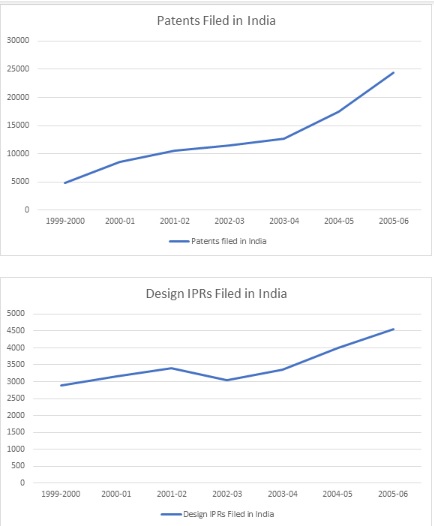
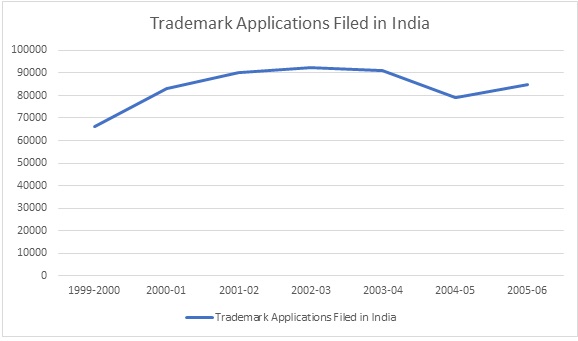
Thus, this growing trend has also shown a great increase in law students willing to make a career in IP law, provided its vast knowledge and its increasing scope in India. A person who is enthusiastic enough to make a career in this field, here are some of the places where he/she might like to intern.

Note – Application Process and Official Address listed at the end.

SpicyIP Internship Programme

About the Internship Programme

The SpicyIP Internship Programme offers law students and graduates the chance to engage in meaningful research, writing and analysis in the field of IP and innovation law and policy. The interns will be required to provide high-quality research and writing assistance for various research papers, book projects, blog posts, public interest petitions, reports, advocacy campaigns and other initiatives undertaken by SpicyIP with the aim of fostering a more transparent, collaborative and productive IP/innovation ecosystem in India.

S.S Rana and Company

S.S Rana and Company is a Delhi based law firm which works in the diverse areas relating to Intellectual Property Law such as trademark, copyright and patent. It is also working towards excellence in other fields such as litigation and corporate. With the developing interest of law students in making a career in Intellectual Property law, the firm provides wide range of internship opportunities in all the fields to willing and enthusiastic students.

With a belief that academic knowledge needs to be ably supported and balanced with corporate ethics, it provides an opportunity to the interns to benefit from their expertise and skills. It also provides career security by retaining some of their able trainees and interns.

Work Environment

With a cheerful staff, the office has a friendly and positive work atmosphere and one is always welcome with their doubts and eagerness to learn. The interns are expected to be productive and to perform to the best of their abilities.

Timings

The office timings are generally from 9 A.M to 6:30 P.M.

Federation of Indian Chambers of Commerce & Industry (FICCI)

The Federation of Indian Chambers of Commerce and Industry (FICCI) is an association of business organizations in India. Established in 1927, it is the largest and oldest apex business organisation in India. The Intellectual Property Rights (IPR) Division at FICCI is intensively involved with issues relating to the protection and enforcement of Intellectual Property Rights. It has taken decisive steps in raising the levels of awareness about Intellectual Property Rights amongst the citizens of India.

To enhance the knowledge of young generation it also provides online certificate courses as well as effective internships to students. It helps them to work with diverse talents from across India and have a deep insight into the working of IPR.

Work Environment

They provide a variety of work in IP research ranging from conventional patents issues to the recent noisemakers.

The basic work in the office involves research, attending ministry meetings and various conferences, preparing minutes of the meetings, drafting them, and submitting a research paper at the end of the internship. In totality, it is an ideal opportunity to work in the field of Intellectual Property law.

Timings

The office timings are generally from 9:45 A.M to 5:45 P.M.

Anand and Anand Associates

Ranked among the top 40 law firms in India by RSG India, Anand and Anand is a full-service IP law firm and a big name engaged in providing various Intellectual Property solutions to their clients.

Interning at Anand and Anand not only provides an enormous amount of knowledge to a law student willing to create a career in Intellectual Property law, but also is a sure-shot stamp of bright and successful future. It deals with various areas relating to Intellectual Property such as copyright, patents, design and trademark.

Work Environment

An intern is required to choose any one department from patent, trademark and litigation. Basic work includes research, drafting and case analysis.

Timings

The timings of the office are generally from 9:30 to 6:30, which may be extended depending on the workload.

A Trademark lawyer in Intellectual Property Appellate Board

Intellectual Property Appellate Board was set up with the objective of hearing and adjudication of appeals against the orders given by the Registrar under the Indian Trademarks Act, 1999. The aim of IPAB is speedy disposal of appeals and rectification of applications. Intellectual Property Appellate Board is headquartered in Chennai and it has its benches in Delhi, Mumbai, Kolkata, and Ahmedabad.

A trademark lawyer in India assists trademark holders in every possible way. They not only provide guidance and counsel the clients on registration and subsequent use of trademarks but also make sure that the trademark does not infringe upon rights of another.

Trademark Lawyers are also hired by big corporate companies and firms to provide assistance and guidance in matters relating to trademarks of the Company. Working under a trademark lawyer not only enhances one’s knowledge under Trademarks Act, but also provides an in-depth experience of working at Intellectual Property Appellate Board. This will enhance one’s knowledge about the active involvement of government to protect the intellectual property rights of the citizens.

Copyright Office

The copyright office is a government body constituted to protect copyrights of an individual or a body and also to ensure proper regulation and application of the Copyright Act, 1957. It is an act which came into force in January 1958 to regulate and amend laws relating to copyright. This Act has been amended six times till date since then, i.e., in 1983, 1984, 1991, 1994, 1999 and 2012. 

Work Environment

An internship in copyright office provides an in-depth knowledge and analysis of the Copyright Act, which is one of the very crucial and vital statute relating to copyrights protection. The practical aspects of copyright protection can be learnt thoroughly through this office.

The basic objective of internship at copyright office is to familiarize the interested and willing students of law with the provisions of Copyright Act and its application including registration formalities & copyright policy. The main tasks in the internship involves filing of application for copyright and to observe the copyright procedure. One is also taught how to work on the copyright software for the registration of the application and also have to make corrections in the applications filed. The eligibility criteria, educational qualifications of the internship are as follows-

Eligibility Criteria

The internship is for Indian National only. Internship is open to students from recognized Institutions and Universities with exposure to Intellectual Property Rights (IPR) particularly in Copyright Law. They do not take students with a placement in their hand.

Educational Qualifications

Students pursuing following courses can apply:

  • Second and third year of the Bachelors degree in Law (3 year course after graduation)
  • Fourth and final year of the integrated five year course in Law.
  • LLM of Ist Year or final year

The application process and scheme of internship is provided on the official site by the name “guidelines for internship”. The official site is copyright.gov.in.

Timings

The office timings for the interns are 9:00 A.M to 5:00 P.M.

Lall and Sethi

Lall & Sethi is an organization dedicated to the IP laws including trademarks, copyrights, designs, patents, confidential information & trade secrets, entertainment and sports laws, information technology laws, etc. The firm has an excellent litigation team dealing in various fields within Intellectual Property with Advocate Chander Lall as its founding Partner. They have their reach in 7 other countries apart from a strong foothold in India. They also cover other Intellectual Property management and transactional services.

Internship at this firm helps you to learn the drafting and pleading skills in the field of Intellectual Property laws.

Work Environment

The type of work involves research, drafting trademark applications, replies to office objections and oppositions and other work and also preparing research notes for written submissions. Interns also accompany the litigation team to the High court and District courts to gain insight of a case one may have worked on.

Timings

The office timings are generally from 9:30 A.M to 7:00 P.M except when there are deadlines.

Chadha and Chadha

Chadha & Chadha IP is a Patent & Trademark Agency. The Firm stands for highest quality of work in all aspects of Intellectual Property including Patents, Trademarks, Copyrights, Designs, Plant Varieties, Emerging IPs, Licensing and transactional IP. It is based in New Delhi with 10 offices in India.

Work Environment

Main tasks include research work and drafting of various Trademark documents. One is assigned a certain team to work in. The work environment is really good and relaxed. Associates make sure to explain everything in detail before giving work. The associates would also review your work and also point out the mistakes.

Timings

The timings generally depend upon the type of work and the workload. The reporting time is 8:30 A.M in the morning.

Krishna and Saurastri

Krishna & Saurastri Associates LLP (KSA) is a full-service Intellectual Property (IP) Law firm that is focused on providing cost efficient IP legal services. The offices are in Mumbai, New Delhi, Bangalore, Pune and Ahmedabad. The firm’s practice areas include intellectual property counseling, prosecution, litigation and transactions. This includes patents, trademarks, copyrights, designs, geographical indications, plant varieties, domain names and semiconductor IC layouts.

The firm has been ranked among the top tier Indian IP law firms consistently by leading domestic and international legal publications.

Work Environment

The work basically included research on various intellectual property related topics. Interns are given the majority of the work in IP litigation like trademark disputes etc. Also, the work involved Patent Prior Art search and filing of applications for Trademark registration.

Timings

The office timings are generally from 9:30 A.M to 6:30 A.M depending upon the workload.

IPR Attorney Associations

To spread awareness about the importance of Intellectual Property Rights, the advocates and the IP Practitioners formed the IPR Attorney Association at the beginning of 2011. The IPR Attorney Association was duly registered under the Tamil Nadu Societies Registration Act, 1975.

The firm promotes and encourages the innovation of the intellectual minds of the people, and its motives include safeguard of the national treasures and making the people aware of the Intellectual Products registered under IP Law. To fulfill the same, the association has taken great efforts in organizing various activities involving the youth.

Work Environment

Mainly the interns are allotted work on different projects and one might be asked to write letters to officials and drafting.

Timings

Timings for male interns is 10 A.M to 7 P.M or 8 P.M, and for female interns it is till 6 P.M.

Remfry and Sagar

The firm deals with all aspects of trademark prosecution and maintenance covered and handle infringement litigation. Many of its members are thought leaders in the international IP community and are influential in the development of India’s IP infrastructure. Remfry & Sagar is a firm that advises more than 8000 clients worldwide on their trademarks, patents, designs, copyright, geographical indications, domain names and unfair competition issues. They also work with many reputed businesses and Fortune 500 companies, as well as start-ups, policy makers and government enterprises.

Work Environment

The main work that is given during the internship at Remfry and Sagar is drafting and the work given is no different than the work being done by the associates. It has a great work culture.

Timings

9:30 A.M to 6:00 P.M from Monday to Friday.

Application Process and Official Address

Name Application Process Office Address
S.S Rana and Company Upload a CV ON their official website www.ssrana.in. 81/2, 2nd & 3rd Floors, Aurobindo Marg, Adhchini, New Delhi.
Federation of Indian Chambers of Commerce & Industry (FICCI) Send an updated CV along with a cover letter on [email protected]. FICCI, Near Mandi House metro station, Delhi.
Anand and Anand Associates Send a CV and cover letter on [email protected]. One can also fill up the internship form given on their official website www.anandandanand.com. Delhi, Noida, Chennai and Mumbai. The addresses of all the four offices are provided on the official website www.anandandanand.com.
A Trademark lawyer in Intellectual Property Appellate Board Contact any trademark lawyer and follow up. Intellectual Property Appellate Board is headquartered in Chennai and it has its benches in Delhi, Mumbai, Kolkata, and Ahmedabad. Get the address from its website https://ipabindia.org/
Copyright Office By following the application process for internship provided on the official site by the name “guidelines for internship”. The official site is copyright.gov.in. Boudhik Sampada Bhawan, Plot No. 32, Sector 14, Dwarka, New Delhi.
Lall and Sethi E-mailing CV along with cover letter to [email protected]. Office address is D-17,South Extension– II, New Delhi.
Chadha and Chadha Send an internship application on the firm’s Email ID – [email protected]. The office addresses are available on the official website https://www.candcip.com/contact-us.
Krishna and Saurastri Fill up the application form on http://www.krishnaandsaurastri.com/?p=careers_student. Office is in 5 different cities. The official address of all the five offices is provided on the official website http://www.krishnaandsaurastri.com/?id=45&pid=6&p2id=6 .
IPR Attorney Associations Apply on the official website by filling this form http://www.iprattorneyassociation.com/summer_internship.php Old No 49, YMIA New india Building, First Floor 2 line Beach Road, Morre Street, Chennai.
Remfry and Sagar [email protected] One needs to apply here and follow up followed by a telephonic interview Remfry House at the Millennium Plaza, Sector 27, Gurugram – 122 009 New Delhi National Capital Region, India

Conclusion

The firms and organizations listed above are not based on any ranks but are one of the best places to intern in order to have a stronghold in Intellectual Property Law both theoretically and practically. With the increasing interest in this area of law, these internships are sure to provide a strong base for the future of those willing to secure their career in the field of Intellectual Property Law. Apart from these, there are a lot of other firms working really well in this area and sure to give a deep knowledge of the subject.

Download Now

Reopening of Partition in a Hindu Joint Family

1

In this article, Adil Khan discusses the reopening of partition in a Hindu Joint Family.


Abstract

A Hindu joint family is a fundamental aspect of the life of Hindus-an ancient and unique institution. A Hindu Joint Family consists of the common ancestor and all his male lineal descendants up to any generation along with their wife(s) or widows and unmarried daughters of the common ancestor and of the lineal male descendants.

The Mitakshara Concept of the coparcenary is based on the notion of son’s birth right in the joint family property. Not merely a son, but also a son’s sons and son’s son’s son acquire an interest by birth in the joint family property. The members of the coparcenary having a vested interest by birth are called as coparceners. All the coparceners in the coparcenary have a right to call for partition subject to some exceptions.

This research paper will first shortly overview what partition is, who and how can a partition be affected and ask for a share in the joint family property, and then finally discusses the circumstances in which a partition already affected can be reopened. The paper then proceeds with a short note on the position of female members in the Hindu joint family/ coparcenary and ends later with the concluding lines.


What is a Partition?

Partition means a numerical division of property and bringing a Hindu Joint family to an end. The joint family ceases to be joint and transforms into a nuclear family after partition. In a coparcenary, the coparceners hold the property as one common unit, partition means the fixing of the shares of each coparcener.

According to the Mitakshara Law, it is the adjustment of the diverse interests regarding the whole, by distributing them into particular portions of the aggregate. Thus, partition implies the crystallization of the fluctuating interest of a coparcenary into a specific share in the Hindu Joint Family.

  • De jure Partition

Dejure partition brings the severance of status or interest. This happens when the community of interest is broken, either at the instance of one of the coparcener or by the agreement of all the coparceners. In such a partition, the shares become clearly demarcated and are no longer fluctuating.

  • De facto Partition

This is a partition by metes and bonds. This happens when the unity of possession is broken. It is only after the de facto partition, the respective shares of the coparceners become their exclusive shares.

In the Mitakshara school, partition simply means the severance of status or interest. It does not mean that a partition is affected only after the division of property in specific shares. A definite and unequivocal intention of a coparcener to separate himself from the family is all necessary to affect partition. Thus, a partition is deemed to be complete by the severance of the status that is de jure partition.

Types of Partition

There are two types of partition.

Total partition

In total partition, the whole property of a Hindu Undivided Family undergoes a total division of property and the same will be divided in between all the coparceners and family cease to exist as a Hindu Undivided Family.

Partial partition

Partial partition can be made when some of the members go out on partition & other members continue as being a member of the family. In such a partition, the rest of the coparceners maintain the joint status with respect to the remaining property.

Who can affect partition?

Every coparcener in the coparcenary has the right to ask for partition provided that he should be a major and of sound mind. The demand of the coparcener to seek partition whether reasonable or not, if manifested clearly can never be ignored by the Karta and he is bound to comply with it.

There are two necessary conditions of partition, which brings about the severance of the joint status or interest.

  • The formation of intention to separate.
  • The declaration of an intention to separate. The declaration involves the expression of intention plus communication of the intention to sever. The declaration of intention that actually severs the status can be verbal or in writing, but it must be clear and unambiguous. The unequivocal communication of intention must be the conscious and informed act of the coparcener.

Father, son, grandson, great-grandson, son conceived at the time of partition but born after partition, adopted son, minor coparcener, absent coparcener, alienee, and daughters not only have a right to call for partition but are also entitled a share on partition at the same time.

However, a father has a superior right to ask for partition. He cannot only affect a partition between himself and his sons, but can also impose a partition on his sons inter se. In exercise of the power of the father to call for partition, the consent of sons is immaterial. But the father while exercising such power must act bona fide. If the division made by him is unequal, fraudulent or biased, partition can be reopened. With respect to the minor’s share, the father retains his control as a guardian. However, the minor’s share after partition would constitute as his personal property and even the father has no right to alienate it without court’s permission. The minor coparcener cannot avoid the partition affected by his father, till he attains majority. He can, however, repudiate it after attaining majority.

Since, section 8 of the Hindu Succession Act makes no distinction between the separated son and undivided sons in the matter of succession to the separate property of Mitakshara Hindu, it is to be noted that, if there are other sons to father which have separated from him, then they can also claim to inherit father’s separate property along with the undivided after born sons. But where a coparcener who has relinquished his share in the partition, the son begotten after the renunciation can’t claim status of a coparcener, as his father can no longer be regarded as a part of the coparcenary.

There is another category of the members of the joint family who have no right to partition, but if partition takes place, they are entitled to share.

The son born out of the void or voidable marriages is a legitimate child of the parents and is statutorily entitled to inherit their separate property, but he cannot inherit from any other relation of the parents. A statutory legitimate child would be entitled to inherit the property of the father but would not be a coparcener with him and would not get a share at the time of the partition. In other words, he is not entitled to seek partition during the lifetime of the putative father, it is only after the father’s death, he is entitled to a share on partition.

Reopening of partition

Under the Shastric law, Manu says ‘once a partition is made, once a damsel is given in marriage and once a gift is made is irrevocable and irretraceable.’

A partition is generally irrevocable. The logic behind is that erstwhile coparceners hold their shares as their separate and exclusive property, they may enter into transactions relating to them, so as to create valid titles in favour of even third parties.

However, there are certain exception to the principle that “shares are divided only once.”

It may become imperative in certain situations to have redistribution of the properties in order to prevent gross injustice to the members of the family. However, a plea that the partition was unfair cannot be countenanced when the facts show that it has been undertaken after due and proper deliberations. Thus, when readjustment of properties is not possible the entire partition has to be reopened.

A partition can be reopened under the following circumstances-

Fraud

Fraudulent distribution of properties, unless the person affected by the fraud acquiesces in with full knowledge of all material facts.

A partition may be reopened, if any coparcener has obtained an unfair advantage in the division of the property by fraud upon the other coparceners. A coparcener may conceal the Joint Family Property at the time of partition, to gain an unjust and undue advantage over the others; the partition can thus be reopened on the discovery of fraud. However, fraud cannot be added as a ground at a later stage of trial and also if no fraud pleaded initially in the plaint, the plea cannot be allowed to be changed belatedly that the partition was fraudulent.

Son in womb or conceived and born after partition

Sons, grandsons and great grandsons have a right to partition. With respect to the son conceived at the time of partition but born after partition, Hindu law equates a person in a womb to a person in existence. The partition should be postponed till the birth of the child if the pregnancy is known, but if the coparceners do not agree with the delay, then the share equal to the share of the coparceners should be reserved. But in cases where no share of the posthumous child is reserved, then he can demand for the reopening of partition after his birth through any representation. The right of such a son depends upon whether his father has taken a share for himself at the time of partition from his sons-

  • When the father has not taken a share for himself, the after born son has a right to get the partition reopened.
  • But when the father has taken or reserved a share for himself, the after born son becomes a coparcener with his father

such son born after the partition is entitled to have the partition reopened, but in lieu thereof he is entitled, after the father’s death, to inherit not only the share allotted to the father on partition, but also the separate property of the father.

Adopted son

According to Section 12 of the Hindu Adoption and Maintenance Act, 1956 adopted sons have the same right to partition as that of the natural son. Even if after his adoption, a son is born to a father, then also shares of adopted sons and natural sons will be equal. Thus, an adopted son is entitled to reopen the partition.

Disqualified Coparcener

Persons suffering from any defect which disqualifies them from inheriting are equally disentitled to a share on partition.

Various grounds of disqualification were recognised by the Hindu law, such as congenital and incurable blindness, insanity, deafness, dumbness, virulent and incurable leprosy and other incurable diseases that made sexual intercourse impossible.

All these grounds except congenital lunacy or insanity have now ceased to exist as a part of the Mitakshara law by virtue of the Hindu Inheritance (Removal of Disabilities) Act,1928.

Further, if a member of the family has not a congenital disqualification, but later becomes insane, he will not be deprived of his interest.

The disqualified coparcener who neither has a right to call for partition nor is entitled to a share, after recovering from his disqualification can call for the reopening of the partition.

Absentee Coparcener

A coparcener absent at the time of partition, who has a share in the coparcenary, has a right to call for the reopening of the partition if the partition has taken place in his absence.

Minor coparcener

In partition, the right of the minor coparcener is as same as that of the major coparcener. A minor is a person of immature intellect and the court has the duty to protect his rights by acting as parens patriae.

If minor’s interests are prejudiced by the Karta by squandering the Joint Family Property, the minor’s guardian or the next friend of the guardian may file the suit for partition on behalf of the minor.

The suit filed itself will bring the partition of the joint family property.

The court has the duty to look whether the partition is for the benefit of the minor or not, if the partition is prejudicial to the minor, the court must demand injunction and not allow the partition.

Property added after partition

The reopening of partition can also be affected when some properties were left out, either by mistake or deliberately or when some properties which have been earlier lost or seized were discovered.

If a distribution of the additional properties can be effectively made without reopening the partition, then the earlier partition should not be disturbed.

The Position of Female Members in a Hindu Joint Family

No female has a right to partition, but if a partition occurs, there are certain females who are entitled to share such as father’s wife, mother, paternal grandmother and coparcener’s widow in certain instances.

In the case of a coparcener, a severance of status is enough, and his subsequent demise would not disentitle his legal representatives to claim his share. But for females, the entitlement arises only when the partition takes place by metes and bounds and not just by the severance of the status. However, if the partition takes place and she though entitled, is not given a share, she is empowered to reopen the partition and claim her share.

The only detriment here is that, if the female dies before the partition has been affected, her share does not pass to her legal representatives, but remains in the common pool of the joint family property.

On and from the commencement of the Hindu Succession Act (Amendment) Act 2005, the daughter of the coparcener shall be by birth, the coparcener in her own right, have the same rights in the coparcenary property, and will be subjected to the same liabilities as she would have, if she had been a son.

Thus, she will be counted as a coparcener herself without any reference to her marital status. This amendment is however prospective in application and does not benefit daughters where an undivided coparcener dies prior to the amendment.

Conclusion

The partition is generally irrevocable in nature. However, for the purposes of equity, it is advisable to reopen the partition already affected. Even the laws of Manu advise the additional distribution of property which was added subsequent to the partition. The rationale behind is to prevent gross injustice to the member of the family.

The research paper tries to cover almost every instance where a partition could be reopened. The paper is informative in nature and does not convey any personal self-generated thoughts and opinion. All the websites and books used for reference are cited for acknowledging the authenticity.

Bibliography

  • Donald R. Davis Jr. Dharma in practice: Acara and authority in Medieval Dharam shastra, Journal of Indian Philosophy, 2004.
  • CJ Fuller, “Hinduism and Scriptual Authority in Modern Indian Law”, 1988.
  • RK Aggarwal, Hindu law, Central Law Agency, (25th Edition) 2016
  • Principles of Hindu Law, Universal law publishing co. Pvt.ltd.
  • The Hindu Succession act 1956, Eastern Law House
  • Dr. Ashok K. Jain, Family law Lectures, Ascent Publications.
  • Poonam Pradhan Saxena, Family Law II Lectures, Lexis Nexis, (3rd Edition) 20
Download Now

Powers of Lieutenant Governor – Analysis of the Constitutional Provisions

5
Lieutenant Governor
Image Source - https://www.ndtv.com/delhi-news/amid-row-over-power-sharing-delhis-lt-governor-transfers-3-officers-1881111

In this article, Kopal Tewary of RGNUL discusses the Powers of Lieutenant Governor and analyses the Constitutional Provisions.

Governor and Lieutenant Governor

Governor is the head of the state, appointed by the President. After the 7th Constitutional Amendment, 1956 a Governor can be appointed for more than one state.

Lieutenant-Governor is the head of a Union Territory.

However, in India, the post is present only in the Union Territories of Andaman and Nicobar Islands, Delhi and Puducherry. In other Union Territories, administrators are appointed.

The functions and powers of a Governor and a Lieutenant Governor are, more or less, the same. The LG, like the Governor, acts a titular head of the Union Territory. But, the powers of an LG are wider than that of a Governor. This is because, a Governor of a state has to act solely on the aid and advice of the Council of Ministers, whereas, the LG does not need the approval of the Council of Ministers on every matter. In case of Delhi, the government exercises no power in the domain of land, law, and police. The LG has complete discretion to decide upon any of these matters.

Role of Lieutenant Governor in Delhi

The First Schedule of the Constitution of India grants Delhi the status of a Union Territory. It is administered by the President, acting to such extent as he thinks fit, through an Administrator to be appointed by him (under Article 239).

The 69th Constitutional Amendment Act, 1991, added article 239AA to the constitution. the Union Territory of Delhi is called the National Capital Territory of Delhi and the Administrator thereof appointed under Article 239 is designated as the Lieutenant Governor. (Article 239AA)

The Sec. 41 of the GNCT (Government of National Capital Territory) of Delhi Act, 1991 delineates the realm of the powers of the Lieutenant Governor in Delhi. The Lieutenant Governor shall act in his discretion during a matter that falls outside the range of the powers conferred on the Legislative Assembly. The section reads as follows:

  1. Matters in which Lieutenant Governor to act in his discretion.

(1) The Lieutenant Governor shall act in his discretion in a matter–

(i) which falls outside the purview of the powers conferred on the Legislative Assembly but in respect of which powers or functions are entrusted or delegated to him by the President; or

(ii) in which he is required by or under any law to act in his discretion or to exercise any judicial or quasi- judicial functions.

(2) If any question arises as to whether any matter is or is not a matter as respects which the Lieutenant Governor is by or under any law required to act in his discretion, the decision of the Lieutenant Governor thereon shall be final.

(3) If any question arises as to whether any matter is or is not a matter as respects which the Lieutenant Governor is required by any law to exercise any judicial or quasi- judicial functions, the decision of the Lieutenant Governor thereon shall be final.

  • According to this section, if the Lt. Governor is under any law required to act in his discretion, his decision on that case will be final.
  • The LG exercises his authority with the help of Police Commissioner of Delhi and Vice Chairperson, Delhi Development Authority (DDA) who have their independent administrative setups.
  • Lt. Governor is Ex-officio Chairman of DDA, however he exercises his executive functions through Appellate Authority under various Acts/Rules/Regulations as applicable in Delhi.
  • In the case of difference of opinion between the Lieutenant Governor and his Ministers on any matter, the Lt. Governor can refer it to the President for decision and act according to decision given on that by the President.
  • Under President’s Rule, the Lt. Governor becomes full-fledged executive head of the government. He has the power to appoint a group of advisors which will act as Council of ministers.
  • The time duration of President’s rule in the UT is also subject to the discretion of the Lt. Governor.

The post of Lt. Governor was first established in September 1966 after the Delhi Administration Act, 1966 came into effect. At the commencement of the primary session after each election to the Assembly and at the commencement of the first session of every year, the Lt. Governor addresses the House.

Powers of Lieutenant Governor

The powers and functions of the Lt. Governor of NCT of Delhi are derived from the constitutions and several statutory provisions. Some of them are:-

(i) Provisions of the Constitution. (Art 239)

(ii) Provisions of the Government of National Capital Territory (GNCT) of Delhi Act, 1991

(iii) Provisions under various Acts of the Parliament.

(iv) Delhi Police Act 1978, Delhi Development (DDA) Act 1957, (Delhi Municipal Corporation) DMC Act 1957, Environmental Protection Act, etc.

(v) Delegation through executive orders issued under Article 239(1) by the President under various law.

Article 239AA

Art 239AA of the Constitution of India has some special provisions with respect to Delhi. The article was inserted in the constitution through the 61st Constitutional Amendment Act. The article lays down the basis of the powers conferred upon the Lieutenant Governor of the Union Territory by the Constitution.

The article reads as follows:

There shall be a Council of Ministers consisting of not more than ten percent, of the total number of members in the Legislative Assembly, with the Chief Minister at the head to aid and advise the Lieutenant Governor in the exercise to his functions in relation to matters with respect to which the Legislative Assembly has power to make laws, except in so far as he is, by or under any law, required to act in his discretion.’

However, the interpretation powers of the LG in Delhi and the extent of the control exercised in the decisions and functioning of the government have been murky since last few months. It has been a subject of debate for the country as the differences between the state government and the LG reached unprecedented heights. The Supreme Court, in a recent judgement, laid down broad parameters for the governance of Delhi while enunciating the powers resting with the LG.

Supreme Court’s Verdict on the Powers of Lieutenant Governor

In its verdict on July 4th, 2014, the Supreme Court clearly laid down the extent and boundaries of the powers vested in the post of Lieutenant Governor of the Union Territory of Delhi. The verdict was given in the case which arose out of the power tussle between the Delhi government and the Centre continuing since last few months. The Supreme Court said that Lieutenant Governor Anil Baijal does not have independent decision making powers, and is bound to act on the aid and advice of the Council of Ministers.

The CJI Dipak Misra and Justices Sikri and Khanwilkar gave the majority verdict.

The Court said that “all decisions of the Council of Ministers, who are elected representatives of the people of Delhi, must be communicated to the Lieutenant Governor but that does not mean his concurrence is required”. The court ruled that “there is no room for absolutism and there is no room for anarchism also”. It further said the LG should not act in a mechanical manner and stall the decisions of the Council of Ministers.

Roots of the case

The root of the case lies in the appeal made by the incumbent government of Aam Aadmi Party in Delhi against the decision of the Delhi High Court stating that the Lieutenant Governor is the sole administrator of the region. The Centre had issued a notification on May 21, 2015, giving certain rights to the LG which the Aam Aadmi Party claimed were “unprecedented powers” on matters like public order, police and services.

The fundamental conflict between the Delhi government and the Lieutenant Governor has its roots in Article 239AA of the Constitution, which gives Delhi the special character of a Union territory. It grants Delhi a Legislative Assembly that has a Lieutenant Governor as the administrative head. The subjects of law, police and public order are beyond the jurisdiction of the Delhi government. The government has full powers to legislate on the rest of the subjects.

The struggle has ensued since the Lt. Governor took charge of the office from Najeeb Jung. Before that, the AAP government has also been in constant discord with the former LG Najeeb Jung. Over the past few months, Delhi Chief Minister Arvind Kejriwal and Lieutenant Governor Anil Baijal have been having certain disagreements. Consequently, as has been alleged by the AAP government, Baijal has been stalling and obstructing decisions made by the government. For eg. In March 2018, Anil Baijal had rejected the Delhi government’s proposal for doorstep delivery of ration. CM Kejriwal had hit back alleging that the “important” measure had fallen victim to “petty politics”.

In June, CM Kejriwal, along with three cabinet colleagues- Deputy CM Manish Sisodia, PWD Minister Satyendar Jain, and Labour Minister Gopal Rai, held a sit-in protest at Baijal’s office alleging that Indian Administrative Service officers working for Delhi had gone on an unofficial strike and are not letting the government run smoothly. After Delhi Chief Secretary Anshu Prakash was allegedly assaulted by an AAP MLA earlier this year. On the succeeding day, PWD Minister Satyendar Jain launched a hunger strike upon the failure of the LG to meet the protesting ministers.

Important Observations

  • Bound by the aid and advice of Ministers

In his judgement, Chief Justice Misra stated that: “The L-G is bound by the aid and advice of the Council of Ministers of the Government of Delhi.” He cannot act on his own. The Council of Ministers has to communicate its decision to the L-G, but this does not mean that it is bound by the recommendation of the L-G. All five judges of the bench concurred on this point.

2. Can refer a matter to the President in case of uncertainty

It was also held in the judgement that the “L-G does not exercise his power under the proviso to clause (4) of Article 239AA, which states that the L-G can refer a matter to the President of India if there is doubt about under whose purview it falls. The L-G has not been granted any independent decision-making power. He has to either act on the ‘aid and advice’ of the Council of Ministers, or he is bound to implement the decision made by the president on a reference being made by him.”

3. Must not be mechanical

The bench ruled that “The L-G cannot act in a mechanical manner without due application of mind so as to refer every decision of the Council of Ministers to the President. The difference of opinion between LG and Council of Ministers should have a sound rationale and there should not be exposition of the phenomenon of an obstructionist but reflection of the philosophy of affirmative constructionism and profound sagacity and judiciousness.”

4. Collective responsibility

In the judgement, the judges emphasised that the state government and the L-G must work together to maintain constitutional harmony and avoid clash of powers. The CJI opined that, “Ours is parliamentary form of government guided by the principle of collective responsibility of the Cabinet… The principle of collective responsibility is of significance in the context of aid and advice. If a well-deliberated legitimate decision of the Council of Ministers is not given effect to due to differences with the L-G,the concept of collective responsibility would stand negated…” The court further ruled that in order to balance the constitutional federal structure, the LG cannot interfere in each and every matter of the government. Rather, he should intervene only in exceptional cases.

5. Powers of the Government to legislate on matters without interference

The bench stated that under Article 239AA, the executive power of Delhi government “is co­extensive with the legislative power of the Delhi Assembly” and therefore, the executive power of the Council of Ministers spans over all subjects in Concurrent List and all but three, namely, land, police, and public order in the State List. However, if Parliament makes law in respect of certain subjects falling in the State List or the Concurrent List, the executive action of the state must conform to the law made by the Parliament.”

6. No anarchy or absolutism

According to the judges, “there is no space for anarchy and absolutism in our Constitution, and the L-G does not have to refer every matter to the President of India.” Justice Chandrachud said that the Lieutenant Governor must remember it is the elected government that is answerable to the people. Governance will come to a standstill if every decision is referred to the President. The popular will of the people, which has its legitimacy in a democratic, setup cannot be allowed to lose its purpose in simple semantics.

7. No Governor – status of Lieutenant Governor

The judges, interpreting Art. 239AA, said that “the status of the NCT of Delhi is sui generis and the status of the L-G is not that of a governor. He remains an administrator, in a limited sense, which gives special status to Delhi as the NCT, stating that the region will be under the control of the L-G.” Justice Chandrachud added that “the court has to further democratic values. In a democratic governance, the real power and substantive accountability is vested in elected representatives… the sovereignty of the people, the democratic way of governance and secularism is intrinsic to the Constitution. The basic structure imposes restrictions on the exercise of constituent power.”

8. Prior consent of LG required, though not mandatory

Justice Chandrachud observed that every decision of the government should get the prior consent of the L-G. But the court also observed that the Lieutenant Governor’s consent was not mandatory in every matter. Justice Ashok Bhushan added that the opinion and decision of the elected government has to be respected, but the Constitution does not provide that the L-G has to concur with all decisions of the government.

Demand for statehood

As a consequence of the ongoing events, the demand for granting statehood to Delhi has also surfaced. Amid anticipation of the Supreme Court verdict, the AAP government decided to open 3,000 centres across the city where signed forms in support of the party’s full statehood demand for Delhi will be deposited by the party workers. Under the campaign, the AAP workers will go door to door and collect signatures supporting their full statehood demand for Delhi.

Points of difference between the Lieutenant Governor of Delhi and Puducherry

Both Delhi and Puducherry has an elected legislature and government. But, the functions and powers of the Lieutenant Governors of Delhi and Puducherry are marked by certain differences.

  • The LG of Delhi enjoys greater powers than the LG of Puducherry.
  • The LG of Delhi is vested with “Executive Functions” that enable him to exercise powers in matters connected to public order, police and land “in consultation with the Chief Minister, if it is so provided under any order issued by the President under Article 239 of the Constitution”.
  • While the L-G of Delhi is guided by the Government of National Capital Territory of Delhi Act, 1991, and the Transaction of Business of the Government of National Capital Territory of Delhi Rules, 1993, the L-G of Puducherry is guided by the Government of Union Territories Act, 1963.
  • Articles 239 and 239AA of the Constitution, as well as the Government of National Capital Territory of Delhi Act, 1991, clearly underline that the role of Centre is more prominent in the UT of Delhi, where the L-G is the eyes and ears of the Centre. Under the constitution, the Delhi Assembly has the power to legislate on all subjects except law and order and land.
  • Whereas, the Puducherry Assembly can legislate on any issue under the Concurrent and State Lists. However, if the law is in conflict with a law passed by Parliament, the law passed by Parliament prevails.

Simply Put

Simply put, the court dictated that the state government and the LG ought to work collectively, with the LG working on the aid and advice of the Council of Ministers, except on matters which are outside the legislative powers of the state government.

The state government, on the other hand, must seek the acceptance of the LG on all the decisions, though not mandatory. 

After the judgement, the raucous regarding the unclear dimensions of the powers of the Lieutenant Governor in Delhi will come to an end. The Supreme Court has, by clearly pronouncing the extent of the LG’s powers, put to rest the highly contentious issue in the UT. Consequently, this will limit the encroachment of the government and the LG in each other’s functional spheres.

Download Now

How Bar Council’s elections are regulated

0
Bar Council Election

In this article, Astha Gupta of Rajiv Gandhi National University of Law, Punjab discusses the election process of State as well as the National Bar Council Body and how they are regulated.

Introduction

BCI aims to wage a battle against the incompetency and ineptness of the existent legal apparatus of the country. The enactment of the Advocates Act, 1961 [Act No. 25 of 1961] led to the creation of BCI (Section 4) and the State Bar Councils (Section 3) which aimed at improving the standard of the legal education and legal profession in the country. Section 7 of the act discerns the functions of the Council which includes laying down standards of professional conduct and etiquette for advocates and to safeguard their rights, privileges and interests at the very same time. Also, it aims to promote legal education and lays down standards of such education in consultation with the Universities in India imparting legal education and the State Bar Councils and to recognise Universities whose degree in law shall be a qualification for enrolment as an advocate and, for that purpose, to visit and inspect Universities.

The Hon’ble Supreme Court in the case of Indian Council of Legal Aid and Advice v. Bar Council of India has reaffirmed that every State Bar Council of India has the utmost duty to ensure that the rights granted under the Act are not misused by an advocate. The Bar Councils have been created at the State level as well as the Central level not only to protect the rights, interests and privileges of its members but also to protect the litigating public by ensuring that high and noble traditions are maintained so that the purity and dignity of the profession are not jeopardized.

Composition of BCI

The Bar Council of India consists of-

  1. Chairman elected by BCI for a period of 2 years (Current: Manan Kumar Mishra)
  2. Vice-Chairman elected by BCI for a period of 2 years (Current: Satish Abarao Deshmukh)
  3. Elected members from each State Bar Council (Elected for a period of five years).
  4. The Attorney General of India (ex-officio member)
  5. The Solicitor General of India (ex-officio member)

Additionally, BCI comprises of various committees like the Legal Education Committee, Legal Aid Committee, All India Bar Examination Committee etc. that make recommendations to the Council. The members of these committees are elected from amongst the members of the Council.

Members of State Bar Council

Electorates Members
>15,000 15
<15,000 and >10,000 20
<10,000 25

The members are elected in accordance with the system of proportional representation by means of the single transferable vote from amongst advocates on the electoral roll of the State Bar Council.

Also, the following are the ex-officio members:

State Bar Council Ex-officio member
Delhi Additional Solicitor General of India
Assam, Nagaland, Meghalaya, Manipur and Tripura Advocate General of each of the State of Assam, Manipur, Meghalaya, Nagaland and Tripura
Punjab and Haryana Advocate-General of each of the State of Punjab and Haryana
All other states Advocate-General of the state

Who can contest and participate in the elections?

The elected members of a State Bar Council shall be elected by and from amongst advocates, vakils, pleaders and attorneys who, on the date of the election, are entitled as of right to practice in the High Court and are ordinarily practising within the territory (including a Union Territory) for which the Bar Council is to be constituted. [Section 53 of the Advocates Act]

Conduct of the elections

Section 15 of Advocates Act states that a Bar Council may make rules to carry out the election of members of the Bar Council by secret ballot and also lay down guidelines regarding the manner of election of the Chairman and the Vice Chairman of the Bar Council.

The term of office of members of State Bar Council

According to Section 8 of Advocates Act, the term of office of an elected member of a State Bar Council (other than an elected member thereof referred to in section 54) shall be five years from the date of publication of the result of his election.

Provided that where a State Bar Council fails to provide for the election of its member before the expiry of the said term, the Bar Council of India may, by order for reasons to be recorded in writing, the Bar Council of India may, by order, extend the said term for a period not exceeding six months.

Disqualification of members of Bar Council

According to Section 10B of the Advocates Act, a person can cease to be a member of the Bar Council in the following 3 situations:

  1. If he is declared by the Bar Council of which he is a member to have been absent without sufficient excuse from three consecutive meetings of such Council.
  2. If his name is, for any cause, removed from the roll of advocates.
  3. If he is otherwise disqualified under any rule made by the Bar Council of India.

Constitution, functions and procedure of Committees of the Bar Council of India

  1. The Council may appoint from amongst its members, one or more Committees as it may deem necessary, in addition to those specified in the Act and delegate such powers, duties, and functions to such Committees as it deems fit.
  2. Any casual vacancy in the above Committees shall be filled up by the Council.
  3. Save where the Chairman or the Vice-Chairman is a member of the Committee or the Sub-Committee, the Committee or the Sub-Committee shall choose its Chairman for the meeting unless at the time of the constitution thereof the name of the Chairman has been specified.
  4. Unless otherwise determined at the time of the election, the term of the members of the Committees of the Council shall be as follows:
    1. Executive Committee – 2 years
    2. Disciplinary Committee – 3 years
    3. Legal Education Committee – 4 years
    4. Legal Aid Committee – 2 years
    5. Advocates Fund Committee – 2 years
    6. Any other Committee not falling under the above clauses – 2 years

Election procedure for various committees

The Executive Committee

  1. The procedure for the election of the Members of the Executive Committee shall be by secret ballot.
  2. A casual vacancy in the Committee shall be filled up by election by the Council.
  3. The Committee shall elect its own Chairman and Vice Chairman. The Chairman shall preside over the deliberations of the Committee and in his absence, the Vice-Chairman shall preside.
  4. The Committee shall be the executive authority of the Council and shall be responsible for giving effect to the resolutions of the Council.

The Legal Education Committee

  1. The procedure for the election of the Members of the Legal Education Committee shall be by secret ballot.
  2. The names of the remaining five members of the Committee to be co-opted shall be proposed and seconded by the members of the Council. In case more than five persons are proposed they shall be chosen by a show of hands. If there is equality of votes, the Chairman of the meeting shall have a casting vote.
  3. A casual vacancy in the Committee shall be filled in by the Council from amongst its members or non-members as the case may be.

The Disciplinary Committee

  1. The procedure for the election or co-option of the members of the Disciplinary Committee shall be by secret ballot.
  2. Any casual vacancy shall be filled in by Council by election or co-option from amongst its members or non-members as the case may be.
  3. The Chairman or the Vice-Chairman of the Executive Committee shall assign and allocate all matters relating to the Disciplinary Committees amongst them if more than one such Committee is constituted or is in existence.
  4. In case of the absence of a Bar Council of India’s member during the sitting of the Disciplinary Committee of the Bar Council of India, the remaining two members of the said Committee may request any available Bar Council of India member to fill the vacancy caused by such absence.

Election Process not to be questioned on the grounds that due notice  has not been given to any person entitled to vote

No election of a member to a Bar Council shall be called in question on the ground merely that due notice thereof has not been given to any person entitled to vote, if notice of the date has, not less than thirty days before that date, been published in the Official Gazette. [Section 14 of Advocates Act]

Resort in case of absence of elections

In case of absence of elections for the State Bar Council for a period of five years and the extended time, according to Section 8A of the Advocates Act, a Special Committee will be constituted which will consist of-

  1. The chairman who shall be the ex-officio member of the State Bar Council (Usually the Advocate General of the state)
  2. Two members nominated by the Bar Council of India from amongst advocates of the State Bar Council.

The Special Committee shall hold elections within a period of six months from the date of its constitution which can also be extended by the Bar Council of India in case of any reasonable cause of the delay.

Bar Council of India Certificate and place of practice (Verification) Rules, 2015

The object of the implementation of these rules was-

  1. The maintenance of a record of all Advocates of the country.
  2. To introduce certain electoral reforms in the Bar Council/ Bar Association elections because there are cases of rigging in the polls and allegation of bogus voting.

Thus Bar Council of India has decided to undertake the detail verification & then prepare Voter’ list along with a recent photograph of the Advocate (Voter).

Certificate of Practice

Verification of Certificate of Practice is done by the State Bar Council. It shall be valid for five years only & is liable to be verified every five years by filing an application for verification in advance within a period of six months before the validity period expires.

The necessity of “Certificate of Practice”

For practice, an Advocate shall have to necessarily hold a valid & verified certificate of practice either from All India Bar Examination Rules or under Verification Rules 2015.

Exemption of certain categories of Advocates

Senior Advocates designated under Section 16 of the Act & Advocates on Record of Supreme Court of India are not required to fill up the Form for Verification. They are simply required to send two passport size photographs with their names & current Address to concerned Bar Council through their respective Associations so that their names be included in voters list of State Bar Council.

Advocates to be a member of the Bar Association

  • An Advocate is required to get himself registered as Member of the Bar Association where he practices Law or intends to practice Law.
  • If an Advocate does not intend to be a member of any Bar Association regd. Under State Bar Council then he shall require to intimate the same to State Bar Council & explain as to how shall he be getting benefits of any Welfare schemes floated by State Bar Council or Local Bar Association. The decision of the State Bar Council will be final.
  • On leave from One Bar Association & joining of another or change of field of Law- Intimation of such change with all relevant particulars to the State Bar Council of which he is a member within a period of one month.
  • Bar Association to apply to respective Bar Council within whose jurisdiction they are located, for being recognized under these Rules.

Shortcomings in the verification rules

  1. Two new classes of advocates; practising and non-practising advocate, are formed. Hence, some kind of discrimination is bound to follow. It disregards all the advocates who could be doing non-litigious practice.
  2. The purpose it aims to achieve remains unattained. One could be an advocate who never goes to Court but still, if he could manage to get his name onto at least one vakalat in a year, he would be considered as a practising advocate.
  3. The process of application by itself is very tiresome for the advocates.

Loopholes in the election process

  • Undue delays in the conduct

The State Bar Councils are widely accused of undue delays in the election process and henceforth of likely stay in the law enforcement mechanism in the country. To cite an example, in Bihar, the elections were scheduled to happen in 2015 but did not happen until this year which is almost after 7 whole years since the last elections. The scenario is not much different for around 14 more states.

  • Inconsistencies among various bar councils

There is no set standard of the way elections are to be conducted and also no uniformity in the eligibility of the candidates among various State Bar Councils. For example, to be eligible for the Bar Council of TamilNadu and Puducherry elections, a lawyer has to have either 10 reported judgements or must have contested five judgments in each year in the previous five years. This is not the case with any other Bar Council of the country. Consequently, there are very high chances of degraded quality and faltered judgements due to the lack of any uniform standard for all the councils in the country.

  • BCI not truly representative

BCI, as it makes rules and lays down guidelines for the whole of the country, is supposed to be representing all the states and areas in an equal manner. However, presently this is not the case. Rather, any State Bar Council having less than 5,000 advocates is not allowed to send members to BCI. Hence, BCI only represents nineteen states out of a total of twenty-nine. Also, with the formation of the Special Committees in a lot of states which consists of a major chunk of nominated members, the Bar Councils are increasingly being governed by members who are nominated rather than elected.

  • Occupancy of office post completion of tenure

According to the proviso to sub-section(3) of Section 4 of the Advocates Act, every member of BCI shall continue to hold office as a member of the Bar Council of India until his successor is elected. Hence the members whose tenure is over are still occupying the office due to non-conduction of fresh elections. To cite an example, the Senior Advocate Manan Kumar Mishra who is currently the chairman of the Bar Council of India is elected from Bar Council of Bihar and his term at the Bar Council of Bihar has expired a long time ago. Consequently, his membership in BCI also should have expired long back but that is not the case due to the aforementioned clause.

  • Not enough disciplinary powers with BCI

Relating to the ample amount of work that the BCI is allocated, it does not have proportionate power to initiate disciplinary proceedings. Rather, the power to initiate such proceedings lies exclusively with the State Bar Council’s Disciplinary Committee. With the lack of these powers, it becomes very difficult for the BCI to work effectively and efficiently.

Conclusion

In a country like India which is so widely chastised for being overly indulgent in corruption and misconduct regarding its electoral demeanour, it is the need of the hour that our legal system stays away from all such allegations and assertions. Henceforth, being considered the apex body of lawyers, the Bar Council of India elections ought to be conducted in the most impeccable manner possible.

In the present scenario, though there are a lot of loopholes in the manner in which the elections are conducted and carried forward, there is still space for a lot of reforms and regulations in the same. However, at the very same time, the effort of certain authorities and concerned members is highly appreciative in the field and reformation may take time but it will surely happen in the near future.


Students of Lawsikho courses regularly produce writing assignments and work on practical exercises as a part of their coursework and develop themselves in real-life practical skills.

LawSikho has created a telegram group for exchanging legal knowledge, referrals, and various opportunities. You can click on this link and join:

https://t.me/lawyerscommunity

Follow us on Instagram and subscribe to our YouTube channel for more amazing legal content.

Download Now

Why do Indian Manufacturers need to focus on Smart Supply Chain management & Logistics Solutions?

4
Supply Chain

In this Guest Post, Rahul Rai, RCPL Logistics Pvt. Ltd. discusses the need to focus on Smart Supply Chain management and Logistics Solutions by Indian Manufacturers.

Logistics & Supply chain is the backbone of the manufacturing sector. The presence of a smartly strategized supply chain management system and an efficient network of advanced logistics infrastructures, not only facilitate smooth and seamless transportation of products and goods, i.e from the point of manufacturing to that of the consumption, but also accelerate economic prosperity. It increases the level of exports and import, generate millions of employment and give your organization a significant place in the global supply chain matrix.

While a systematically organized supply chain can serve as a competitive tool, increase your operational efficiency, and boost your market share revenue, a smartly coordinated network of logistic infrastructure can help you to meet your customer’s requirements, just in due time. And perhaps that is why, manufacturers backed by an efficient supply chain management and improved logistic facilities, automatically enjoys an extra edge over their competitors.

But managing the gigantic network of supply chains is not a five-finger exercise.  It is a time -consuming process which demands huge investment and as well as a large fleet of skilled industry experts who are well trained to execute and maintain such a seamless supply and delivery process. However, for a manufacturing industry, it would be quite economical to be a part of a third party logistics service providers, rather than creating their own supply chain & logistics management facilities.

Below I have explained a few points which will help you to comprehend the very fact that why Indian manufacturers need to put the highest degree of focus and attention in smart supply chain & logistics solutions.

Few Statistical Validations

According to the recent economic survey of 2017-18, logistics and supply chain in India, alone, is providing more than 22 million plus jobs and the further advancement of these sectors can guide to a 10% fall in the indirect-logistics-costs which in return would lead to 5-8% of average annual growth in exports.

In addition to this, the economic survey of 2017-18 also estimates that the net value of Indian logistics market would jump to the US $ 215 billion within the next two fiscal years as compared to the present market worth of US$ 160 billion.

But in a country like India, where most of its manufacturing companies do not possess a sound supply chain management strategy and adequate logistic infrastructures, it would be quite wise for them to get aligned with the best supply chain management companies in India, just to ensure robust industrial production, fast product delivery and above all an elevated corporate image.

Comply with Evolving Market Dynamics

The rapidly growing competition in today’s globalized market, the inception of millions of commodities with short life cycles and the overwhelming expectations of consumers have forced manufacturing enterprises, from all over the country, to invest a greater amount of focus and attention on the existing conditions of their supply chain system.

So, if you are into manufacturing and want to continuously sustain in a globalized competitive environment for a long period of time, then you must adopt the best logistic services as soon as possible.

Create Visibility & Avoiding Disruptions

Transportation and logistics management plays an essential role in creating an absolute visibility into your supply chain system. Here, at RCPL, we are backed by a computer controlled online transportation management system (TMS) that can logically analyze your past-transportation data and track the real-time movements of packaged products and goods, in and out of your business. Later, our logistics managers can reuse this logically analyzed data to optimize your entire supply chain process and to avoid possible disruptions.

Driving Higher Customer Satisfaction

As the markets are growing at an exponential rate, so do your customer’s expectations. Your clients will always expect you to deliver a fast, time-bound and effortless product delivery services.

Such sort of formidable and exigent mandates further initiates a ripple effect in your existing supply chain activities, creating an urge to deliver an instantaneous and accurate supply chain solution.

So, in order to sustain in today’s highly competitive market, you have to endorse for an effective supply chain management policy which should be capable enough to meet the needs of your consumers and clients within the ambit of a stipulated time.

Join hands with the RCPL, one of the most rated logistics companies in Delhi. Here, we are providing a wide spectrum of cargo & logistics services which can not only maximize your supply chain performance but would also help you to provide the highest degree of customer satisfaction.

Maximizing your corporate Revenue

A smart supply chain and logistics management can increase your corporate revenue. By adopting a market-oriented supply chain services, you will be able to establish a positive brand-image in front of your clients. This in return, would help you to create a substantial amount of goodwill in your respective market.

Get aligned with RCPL, one of the best logistics companies in Delhi. With our advanced transportation and supply chain system, you will be able to track, monitor, & report the respective location of your cargoes and containers. Thus making the process more safe, secure and efficient.

Smart Cargo & Logistics Solutions

Leading to Better Operational Efficiency, Higher Productivity & Amplified Brand Value. Since the days of the neoliberal economic reforms, private- sector-businesses from all over the world is experiencing a tremendous growth in their entire chain of the supply and demands.

As a consequence of such a remarkable economic transition, businesses and industries, irrespective of their purpose, size, production and supply capacity,  has finally found a completely new way to expand their reach and horizons, resulting to the neo-economic boom which we are enjoying in today’s globalized world.

However, amid all of these socio-economical hue & cry, one thing that most of the companies and industries have in common is their desperate urge for a much more sophisticated logistic service with no geographical boundaries and fastest product delivery.

Following is a list of a few vital points, elaborating the facts that why do you even need to adopt advanced logistic services and how can you accelerate your business growth with the help of that.

(1) Build your own Logistic Strategy

Having a knowledgeable and experienced third-party logistics company on your side is going to help you in strategizing a perfect supply and delivery model for your business. You would be able to figure out possible & amicable solutions for the several immediate deadlocks, existing in your supply chain.

Without a market-oriented logistic strategy, the entire supply chain your business may get collapsed and you may face several operational hindrances that. Be a part of India’s most rated cargo & logistic company and utilize the power of logistics as your competitive advantage.

(2) Navigate your Growth & Expansion

The growth and expansion of retail, e-commerce, manufacturing, FMCG and CPG sectors are heavily dependent on the performance of their operational policy.  That is why companies, operating in these sectors, always believe to partner with a reliable logistic service company who always dare to deliver anything and everything,  almost anywhere and everywhere.

(3) Expanding your Network & Business Reach

For most of the businesses and industries, growth is a factor which proportional to size and influence of their business network and geographical reach. As companies grow and expand their business further, it would be wise for them to engage with the best cargo companies who can at least dare to take all kinds of unprecedented operational-challenges, irrespective of any time limitation, geographical boundaries and other natural obstacles.

(4) Deal smartly with large customer Influx

Your customer base is not going to be stagnant anymore. With globalization, privatization and digitization becoming more rampant, most of the businesses that are directly interlinked with the products and services of our daily consumptions, are already facing a huge influx of customers in their business websites. It is where you need the fastest and biggest of the logistics companies in the market who have that adequate capacity to manage such an intense pressure of supply and demands on an everyday basis.

(5) Scale your Transportation Cost

From the Location of your manufacturing facilities to remote packaging warehouses and varying Rural- product-delivery points, all of these heavily impact your transportation cost. Progressive and futuristic organizations always keen to see value in choosing the right cargo & logistic partners who can help them in scaling their fluctuating transportation budget, as they do both in case of resource management and capacity building.

Conclusion

The success of every business, whether it is a manufacturing industry or an e-commerce entity, do rely on how efficiently and swiftly they are managing their entire operational management, especially the affairs related to the supply and delivery of their products.

Any minor malpractices or mismanagement in your supply chain can lead to vital business disaster, ultimately tarnishing your corporate image, your brand value and above all the public trust that you have built over the years.

As the number of customers and their expectations are booming at a rapid pace, you as a businessman cannot wait for too long to reintroduce a whole new set of operational policies. It would be better for you to make a partnership with the best cargo services providers who can not only provide you with a deep insight in these aspects but would also help you to deliver your products within in the ambit of targeted time.

So if you a businessman who is almost fed up of spending a hell lot of money in transportation, I would like to advise you to consult the best logistic and cargo companies near you or your locality. Small or medium class businessman with a limited sphere of geographical influence, can also subscribe to domestic cargo services, as they will are very familiar with the local terrain and maps.


Download Now

Key Highlights of Pesticides Management Bill, 2017

0
Pesticides Management Bill, 2017

In this article, Vatsala Sharma discusses the Key Highlights of Pesticides Management Bill, 2017.

Introduction

With the growth of population in India, there has been a subsequent increase in the mouths to feed and thus ultimately the increase in production of crops.

  • For the better production of crop, in recent years there has been a tremendous increase in the use of pesticides. The demand for pesticides has increased from 53882 metric ton in the year 2012-2013 to 68487 metric ton in the year 2016-2017 in the entire nation whereas the consumption has increased from 55540 metric ton in the year 2010-2011 to 57000 metric ton in the year 2016-2017.
  • Thus, the need of the hour is better and effective legislation to regulate this increasing use of pesticides. Therefore, the Pesticides Management Bill, 2017 has come into picture with certain aims for better regulation of the pesticides.

The Pesticides Management Bill, 2017 aims to regulate the import, manufacture, export, storage, sale, transport, distribution, quality and use of pesticides with a view to—

  • control pests;
  • ensure availability of quality pesticides;
  • allow its use only after assessing its efficacy and safety;
  • minimize the contamination of agricultural commodities by pesticide residues;
  • create awareness among users regarding safe and judicious use of pesticides,
  • to take necessary measures to continue, restrict or prohibit the use of pesticides with a view to prevent its risk on human beings, animals or environment.

History of the Bill

    • In the year 1958, a commission of enquiry was appointed by the central government. After the deaths in Kerala and Madras, by poisoning through the consumption of imported wheat contaminated by pesticides accidentally which was shipped together with food grains, there was need for some serious remedial measures.
    • An expert committee of Indian Council of Agricultural Research (ICAR) headed by Prof. M.S Thacker studied the whole question of Pesticide use and prevailing legislation from 1964 to 1967.
    • On the recommendations of the expert committee, a comprehensive Insecticides Act was passed in 1968 to regulate the import, manufacture sale, transport, distribution and use of insecticides.
    • Thus the Insecticides Act came into force on 1st August 1971.
    • But due to the alarming rate of pesticides related deaths such as death of children who consumed mid-day meal in Bihar due to high level of pesticides intake and the death of more than 30 farmers due to infection caused by spraying of pesticides on the fields in several districts of Maharashtra again brought the attention towards pesticide regulation.

  • Thus, to replace the Insecticides Act, 1971 and to bring an altogether a new legislation rather than just a set of amendments came the Pesticides Management Bill, 2008.
  • After the demand for certain changes in and suggestions made by the standing committee of the Parliament came a new draft named Pesticides Management Bill, 2017 which was passed for comments on 19th February 2018.

Highlights of the Bill

  • The Pesticides Management Bill seeks to replace the Insecticides Act, 1968.
  • The draft came into wake of several pesticide-related deaths in recent months.
  • The draft bill proposes an increase in penalties on sale of spurious, substandard and misbranded pesticides and gives State Governments more power to deal with the issue and take action against them.
  • The draft contains clauses relating to allowance of provisional registration of new pesticides in India in case of “national exigency” for a period of 2 years.
  • The draft provides for punishment to anyone who ‘uses’ a pesticide in contravention to the provisions of this Act.
  • The proposed Bill provides for paying of compensation to the affected farmers or users under the provisions of Consumer Protection Act, 1986.
  • The Bill contains detailed clauses for registration of new molecules.
  • It has also tightened the guidelines for registration and licensing of new molecules.
  • It includes a broader category of offences and provisions for paying compensation to the farmers.
  • The state government has to report all cases of poisoning to the centre on a quarterly basis according to the draft.
  • States can ban chemical pesticides for up to 6 months, unlike the current provision which allows ban for up to 2 months.
  • According to the bill, the maximum punishment for violation (such as sale of prohibited or spurious pesticides) is a penalty of up to 50 lacs and up to five years’ imprisonment due to which the pesticide industry is concerned.

Authorities under the Bill

Offices set up under the Central Government

Authority Function Composition
Central Pesticides Board To advise the government on standards for the manufacture, sale and distribution of pesticides, and their monitoring and disposal. It shall also advise the government on safety and toxicity standards. To make regulations for monitoring its procedure by approval of the central government. 40 members; 10 shall be ex-officio government officials, 18 shall be representatives of various ministries, government bodies and institutions; 12 shall be nominees of the central government.
Registration Committee To register pesticides, restrict or prohibit their use, and prescribe guidelines for the manufacture and advertising of pesticides. Total of 10 members ex-officio from different ministries, government departments and institutions and 1 chairperson.
Central Pesticides Laboratory To carry out functions specified under the Act. Other accredited laboratories may also carry out functions of CPL. Officers of such labs cannot have a financial interest in the pesticides business.

Offices set up under the State Government

Authority Function Composition
Licencing Officer To licence manufacture and distribution of pesticides. Can also revoke or suspend licenses To be appointed by State governments; qualifications to be prescribed.
Pesticide Inspectors To take samples of pesticides for analysis; to enter/search premises or examine/seize documents or stop the distribution of pesticides if violations are suspected, with the permission of magistrate. Qualifications to be prescribed by central or state government; cannot have financial interest in manufacture/import/export or sale of pesticides.
Pesticide Analysts To test samples of pesticides according to provisions of the Act. Qualifications to be prescribed; no financial interest in pesticides.

Registration of Pesticides under the Pesticides Management Bill

The procedure to be followed for the registration of the pesticides as according to the Bill is as under

  • Application to the Registration Committee

Any person who desires to import, export or manufacture any pesticide has to apply to the Registration Committee for the registration of such pesticide. There has to be separate application for each pesticide.

The application should be in the prescribed form and should include all the particulars including claims regarding expected performance, efficacy and safety along with the details relating to the usage, infrastructure available or proposed to be made available to manufacture and to stock such pesticide.

It shall be the responsibility of all applicants to provide complete information on all the known inimical effects of the pesticide on human beings, animals and the environment.

  • Enquiry by the Registration Committee

The committee will enquire on all such matters it considers necessary after receiving a receipt of the application being complete in all respects for the registration of a pesticide.

The committee shall satisfy itself that the pesticide to which the application relates conforms to the claims made by the importer, manufacturer or exporter relating to the expected performance and efficacy of the pesticide as well as its safety to human beings, animals and environment, and availability or provision of requisite minimum infrastructure to manufacture and stock that pesticide.

  • Registration

On being satisfied of the fulfillment of all the above conditions, the registration committee shall register such pesticide.

No pesticide will be registered for import or manufacture unless tolerance limits are specified for its residues on crops and commodities as according to the Food Safety and Standards Act, 2006.

Insecticides registered under the provisions of the Insecticides Act, 1968, immediately before the commencement of this Act, shall be deemed to be the registered pesticides under this Bill.

  • Allotment of registration number

After the registration has been made, a registration number will be alloted to the applicant on the payment of a prescribed fee.

  • Issuance of certificate of Registration

After the registration number has been alloted to the applicant, a certificate of registration will be issued to him as a token within a prescribed period.

Refusal to register the pesticides

The Registration Committee may refuse to register the pesticide on following grounds:

  • If the precautions that were claimed by the applicant as being sufficient to ensure safety to human beings or animals cannot be easily observed.
  • If the use of the pesticide involves serious risk to human beings or animals or environment.
  • If infrastructure to manufacture or stock that pesticide is inadequate.

Suspension or cancellation of registration by the Registration Committee

The registration certificate shall stand cancelled on the following grounds after giving the registrant a reasonable opportunity to be heard :

  • If the Registration Committee, either suo motu or otherwise, is prima facie satisfied of violation of any provision of the Act, any rules or of the conditions of certificate of registration.
  • If the registrant fails to submit a copy of the manufacturing licence and satisfy the Registration Committee of having set up necessary manufacturing facilities and started production of that pesticide within a period of three years in case of manufacture.
  • If the registrant fails to submit a copy of the licence to manufacture, stock, distribute or sale within a period of one year in case of import.
  • If the infrastructure is found inadequate in case of an inspection of the manufacturing premises or processing facility of that registrant with respect to adequacy of infrastructure to manufacture and stock.
  • If there is an adverse impact of a pesticide of a particular registrant on crops, human beings, animals or environment the registration committee may cancel the registration by its own motion or on receiving evidence of such adverse impact, to minimize the risk of such adverse impact through risk assessment or risk benefit analysis.
  • If it is found by way of an inspection that the facility of manufacturing and laboratory are sub-standard or that the capacity is inadequate for manufacture of registered pesticide, certificate of registration shall be cancelled by the Registration Committee.
  • If it is found that the data submitted by the applicant is false or misleading or has been deliberately suppressed, such registration shall be cancelled by the Registration Committee,
  • If on the ground of efficacy and safety, the registration of the pesticides is cancelled under sub- section (4).

Licensing of pesticides

Who can apply?

  • Any person who desires to manufacture, sell, stock or exhibit for sale, distribute any pesticide or to undertake commercial pest control operations with the use of any pesticide.
  • who possess the prescribed qualifications himself or is possessed by any other employee.

If the above conditions are fulfilled, one may make an application to the licensing officer for grant of a licence.

How to apply

  • Application shall be made in the prescribed form and shall contain all the prescribed particulars.
  • It shall be complete in all respects.
  • Payment of prescribed fees shall be made. While prescribing fees for the grant or renewal of licences under this section, different fees may be prescribed for the sale or distribution of pesticides for domestic use and for other purposes.

On receipt of the above requirements, the licence officer shall grant a licence within a period of 3 months from the date of receipt.

The licence shall be issued for a particular period which has to be renewed from time to time.

A separate license shall be issued for manufacturing stocking, distributing or sale of household pesticide.

Revocation or suspension of licence

If the licensing officer is satisfied, either on a reference made to him in this behalf or by himself of the following, he shall revoke or suspend the licence after giving the holder an opportunity of showing cause on the following grounds:

  • The licence granted under section 17 has been granted because of misrepresentation of an essential fact.
  • The holder of a licence has failed to comply with the conditions subject to which the licence was granted
  • The holder has contravened any of the provisions of this Act or the rules

Prohibition of import, export and manufacture of certain pesticides

No person shall import, export or manufacture any pesticide by himself or by any person on his behalf in the following conditions:

  • If the pesticide is misbranded, of sub-standard or spurious.
  • When the sale, distribution or use of any pesticide is prohibited for time being under section 33.
  • If the conditions on which the pesticide was registered are contravened.
  • If there any pesticide in contravention of any other provision of this Act or any rule.
  • If the manufacture of the pesticide is not in accordance with the conditions of a licence issued for such purpose.
  • If the import, export of a pesticide is in contravention of the provisions of the Prior Consent Procedure specified for certain hazardous chemicals and pesticides in international trade.
  • If the import, export or manufacture of pesticide is done without mandatorily declaring stock position of the pesticide manufactured, imported or intended to be exported.

Prohibition on sale, stock, exhibit for sale, distribute, transport or use

No person shall, himself or by any person on his behalf, sell, stock or exhibit for sale, distribute, transport, use, or cause to be used:

  • any pesticide which is not registered under this Act;
  • any pesticide, the sale, distribution or use of which is for the time being prohibited under section 33;
  • any pesticide in contravention of any other provision of this Act or of any rule made thereunder;
  • any pesticide in a packing other than its original packing in which it was primarily packed by the manufacturer;
  • any pesticide which has outlived its shelf-life as evident from its label;
  • any pesticide without disclosing its expected performance as claimed and usage instructions as suggested by the manufacturer or importer to farmers and end-users, as the case may be, while applying for grant of certificate of registration under section
  • any pesticide registered in India to be exported except directly between the premises of manufacture for which the licence has been obtained and the port of exit
  • any pesticide within the country, which is registered in India only for the purpose of export.
  • any pesticide except in accordance with the conditions of a licence issued for such purpose under this Act.

Offences and Punishments under the Bill

Section Offence Punishment
Section 35 Use of pesticide in contravention of the act Fine(1 lakh-5 lakh)/Imprisonment(upto 6 months) or Both
Section 36 Obstruction of a pesticide Inspector Fine (25,000 rupees)
Section 37 Imports, exports, manufactures, sells , stocks or exhibits for sale or distributes any misbranded pesticide- Fine(1 lakh-5 lakh)/Imprisonment(upto 2 years) or Both
Section 38 Imports, exports, manufactures, sells , stocks or exhibits for sale or distributes any sub-standard pesticide Fine(1 lakh-5 lakhs)/Imprisonment(upto 2 years) or Both
Section 39(1) Handling of a pesticide without a certificate of registration, or a valid license, handling of a spurious pesticide, handling of an ineffective pesticide on the crop for which it is intended or a higher toxicity pesticide, handling of a pesticide in contravention of section 33, 23 of the Bill. Fine(10 lakhs-50 lakhs)/Imprisonment(upto 5 years)+cancellation of licence, and sealing of manufacturing premises
Section 39(2) Contravention of any other provisions of the act or rule, contravention of any condition of a certificate of registration or licence, failure to perform as per the claims of efficacy and safety at the time of registration. Fine(50 thousand-2 lakhs)/Imprisonment(upto 1 year) or Both

Probable Loopholes in the Bill

  • Centre of Science and Environment (CSE) is of the view that following the global standards, the regulation of pesticide use has to come under health ministry and not agriculture ministry, as provided in the draft bill. As agriculture ministry promotes use of pesticide to raise crop productivity, it is not the apt body to regulate the act. It is said that a promoter cannot be a regulator.
  • According to Pesticide Action Network (PAN), the draft bill needs to be more comprehensive so as to address the multiple concerns relating to pesticides in India. It has to be much more than mere laying down of steps of registration. For instance, adding any facilitating provision for transparency, consultative and sharing mechanisms.
  • The Pesticide Management Bill, 2017 is almost similar to the Pesticide Management Bill, 2008 which was rejected by the farmers’ group. Many suggestions made by the parliamentary panel are not complied with. For example, suggestions were made that data protection be extended to five years and data submitted with application to not be reused by another applicant for three years, which the current draft does not have.
  • Agriculture is a state subject under entry 14 of List 2 according to the Constitution of India. Thus, bill should empower the state governments not just in terms of licensing of trade but also a major role should be given in the registration process and various other matters such as prohibition and restrictions on sale of pesticide and regulation of marketing and advertising.
  • The bill lacks clear liability in case of damage caused by the use of pesticides. Parliamentary panel while making suggestions suggested that inspectors should also be held liable for growth and approval of spurious pesticides but, this has not been incorporated.
  • The definitions in the bill are ambiguous in nature. The definitions of terms spurious and pests leave a huge scope of interpretation. There is also a need to define ‘uses’ in the bill so that the farmers are not burdened to prove proper use of pesticides to avoid punishment in the Bill.
  • The clause laying down that the affected persons should take resort to Consumer Protection Act if needed reveals that the farmers’ and affected persons’ interests are not being protected by the Bill as they may not even be ‘consumers’ as defined in the said Act. There should be more clarity on this provision. Else, it is important that The Pesticides Management Bill 2017 itself should include a time-bound, simple and accessible mechanism as clauses for compensation, redressal and remediation.
  • The Bill is also faulty on keeping efficacy and pest control as the primary goal rather than safety as the recent pesticides death call in more of the safety issue rather than pest control.

Comparative Analysis with the Insecticides Act, 1968

Topic The Insecticides Act, 1968 The Bill
Coverage This act covers insecticides which are defined as any substance included in the Schedule to the Act. This Bill covers pesticides which are defined as any substance of chemical or biological origin used to control the spread of pests in agricultural commodities or animal feed.
Powers of registration Committee Power to cancel the registration of an insecticide lies with the central Government. Committee can suspend or cancel registration in case of violations of the Act or by adverse impact on crops, humans or animals.
Conditions and process of registration The Act did not require tolerance limits for pesticide residues to be specified. Tolerance limits are specified under the Prevention of Food Adulteration Act, 1954. Bill requires tolerance limits to be specified as a condition for registration. Such limits are specified by the Food Safety and Standards Authority, set up under the Food Safety and Standards Act, 2006.
Provision for protection of data of applicants There is no protection of data submitted for registration. Same data could be used by multiple applicants. Data submitted for registration by one applicant cannot be used by others for three years, without permission.

Conclusion

Every year, there are about 10,000 reported cases of pesticide poisoning in India. In 2015, about 7,000 people died because of accidental intake of insecticides and pesticides. While India urgently needs to address pesticide mismanagement in several aspects, the new pesticide management bill looks like a positive solution to this chronic problem. Though certain loopholes still persist in the bill, it looks like a strict version of the previous statute. One can hope for a positive impact on the deteriorating conditions of the farmers and other persons being affected by mismanagement of pesticides.

Download Now

Settlement of Spousal property: A Brief Overview

0
Spousal Property

In this Guest Post, Pranitha Pai discusses briefly on the settlement of Spousal Property

 Introduction

In India, the institute of marriage is given a lot of importance. According to the Hindu Law, it is said that the man is incomplete without his wife and vice versa. Even in the West people say that the wife is the better half of her husband and the other way round.

Once married, the property of the couple which they buy together is termed as the spousal property. But this does not include the property which the wife had got as a part of her stridhan. But what happens when a couple wants a divorce? Who gets the spousal property? How is the property divided?

Divorce was and is still considered to be an inauspicious thing in India. So, what the Indian women know is that they are entitled to maintenance after divorce from their husband so that they can maintain the same standard of life. But what very less number of women know is that they too are entitled to get a share in the property (spousal) upon divorce. It is a well-known fact that every woman has got a right to residence after divorce if she has not remarried. The confusion arises when the property has been bought by a man after marriage in the name of his wife but she has not contributed anything financially in the buying of the property.

Thus, there are many laws in India which deal with settlement of spousal property. In this article, the author would like to mainly focus on women’s property such as stridhan and her right on her husband’s property after divorce.

 What is Spousal Property?

Marital property is basically all the assets and liabilities acquired during the course of the marriage.  Assets might include hSome, cars, furniture, shares in a company, rental income and savings. Liabilities can include any debt, such as mortgages or other loans and leases.

The concept of what is a spousal property (also known as marital property) and what is a separate property is a matter of confusion, but what is understood so far is that spousal property includes all the movable or immovable property bought by the husband or wife through their mixed earnings after marriage or a separate property which is used extensively by both the parties equally or a gift which they got together during their marriage. Now, separate property includes property bought before marriage or property inherited individually or a gift received before marriage or property bought exclusively from one’s own hard earned money and then it is used by that person itself.

Now the confusion only arises when there is a divorce and then the question of distribution of spousal property arises. As far as the marriage is going strong, the spouses do not care as to in who’s name the property is bought and who is paying the money. They plan their future as a lifelong affair and are repugnant to the idea of divorce[1]. Earlier the concentration was more on current needs such as food, clothing etc, but now with the concept of instalment purchases and mortgages, married couples are concentrating more on immovable property such as house etc. So, the spouses either contribute financially equally or with their skills and hard work.

 Meaning of Marriage Settlement

According to the Merriam Webster, the legal definition of a marriage settlement is basically a written contract between the husband and the wife upon their divorce talking about things like custody, maintenance and property division.

 What does the settlement of spousal property mean?

As discussed above, when a property is bought by the couple during their marriage never do they think about division of their property upon divorce because no one ever thinks about that. They always use all their properties together and so frequently that, it is difficult to conclude as to who needs it more. It is only during the divorce proceedings that the calculation of the amount of property division is done.

Now divorce is a very difficult situation for the women when compared to the men because not all women will be qualified enough to work and earn a handsome salary. Sometimes the divorced lady is at a much tougher position than a widow when compared financially. When a man dies then the widow becomes his heir and thus can get his property through succession[2]. But in a divorce this is no such thing, the lady is not the heir and thus the question of maintenance and support comes into the picture.

For maintenance, there are many provisions in the Indian Law which talk about both interim maintenance and alimony[3].

Calculating maintenance is not that difficult when compared to calculating the amount of share in the divided property because of the fact that there are generally two types of women when we look at them for the contribution towards the buying of that property. One of them is the working class who, earns enough money so that she can pool in her money with that of her husband’s to buy any property and the other one is the stay at home, who does not earn but takes care of the family, children and the whole house and also supports her husband in almost every way even if not financially. It is said that her physical contribution is no less than her husband’s financial contribution[4]. It is very difficult to calculate the share in the property as to how much will the stay at home women will get upon divorce. Thus in the case of White v White [2001] 1 A.C. 596 the English court has said that the domestic and the financial contribution of both the spouses have to been seen and evaluated equally. In this above-mentioned case the court also clarifies the meaning of Section 25 (2) (f) of the Matrimonial Causes Act, 1973, so it says that this S

ection does not talk about the contribution of the parties in terms of wealth but rather talks about the contribution made by the parties towards the welfare of the family[5].

So the broad issue which the author would like to answer is – How to find a compromise between the husband and the wife so that both of them are treated equally? and  How to recognise the contribution of the working as well as the non- working woman equally in this type of non- contractual relationship such as buying of property in a marriage?

Indian courts rarely talk about the quantification of a housewife’s contribution in the family. However there are some tiny efforts put in by the Apex court and thus in the case of Malay Kumar Ganguly v. Dr. Sukumar Mukherjee and Ors (2009) (10) SCALE 675 says- “For compensating a husband for loss of a wife, therefore courts consider the loss of income to the family. It may not be difficult when she had been earning. Even otherwise a wife’s contribution to the family in terms of money can always be worked out. Every housewife makes a contribution to her family. It is capable of measuring in monetary terms although the emotional aspect of it cannot be[6].”  

In all those countries where ever there are laws relating to the settlement of matrimonial property upon divorce all of them follow the rule of equal division. So, the basic idea is that each spouse should exit the marriage on the same economic or financial level[7]. Michael Davie in “Matrimonial Property in England and American Conflict of Laws”  says that each spouse will retain all those properties with themselves with which they had entered into the marriage which means this is their separate property. So, all those properties which they buy or acquire after their marriage then that is a part of their matrimonial property.

Discussion on the topic of the settlement of spousal property in UK

Earlier according to Blackstone, upon marriage the woman automatically lost her legal identity. The husband and the wife were seen as one single unit. And thus he says “depend almost all the legal rights, duties and disabilities that either of them acquires by marriage[8]”. So, if we go by this principal then whatever the woman gets (any property) after her marriage or during the marriage as a gift unless and until it is specified that it is for own personal use then it would automatically go to the husband as she has no legal identity. Thus, in other words, even if the husband died most of the property rather than going to the wife it would go to his legal heirs[9]. This principle was practiced till 1870 and thus the policy which was practiced by the husband was “what is yours is mine; is mine is my own [10]”. But after making certain amendments and laws[11] finally in 1935 the  Law Reform (Married Women and Tort Feasors) Act, came up which finally recognised the concept of equality of status and capacity, separation of property and separation of liabilities[12].

So now in the English Law, the main focus is on to make adequate financial provisions for the spouses and children and then make a proper division of  the property among the spouses[13]. So, according to Section 39 of the Maintenance Agreement Act, 1957 UK law the husband has got a right in the property of the wife if she has been proved guilty of adultery. Similarly, according toection 27 and 28 of the said Act, the wife has got a right in the property of the husband if he is proved to have deserted her for no particular reason. Thus, the court of England has always tried to discourage vices and has tried to encourage morality[14].

Nowadays the court of England is following the one-third policy according to the Matrimonial Causes Act, 1973 when no specific share or division is proposed by the parties to the case. What the judges say is that one-third is just the starting point and they can increase it if needed like in the case of desertion, cruelty, adultery[15]. Lord Dennings has justification for this policy in the case of Watchel v Watchel[16]. He said – “ …. In any calculation the court has to have a starting point. If it is not to be one-third, should it be one-half or one-quarter? A starting point of one third of all the combined resources of the parties is good as and rational a starting point as any other…. In these days of rising house prices, she should certainly have a share in the capital assets which she has helped create. The windfall should not all go to the husband. But we do not think it should not be as much as one-half if she is also to get periodical payments for her maintenance and support.” 

But at the same time if it is proved that the matrimonial home is in name of both the parties then the court gives an equal share to both the parties. It is only when the husband has contributed financially and the wife just stays then only the police of one-third is used.

Settlement of spousal property in India and the concept of women’s property

In contrast to the English Law women in India did not have to struggle so much for their share in the spousal property. The laws in India were such that they have had provisions for the settlement of spousal property in different situations. Guroodas Banerjee says “Nowhere were proprietary rights of women recognised so early as India, and in very few ancient system of law have these rights been to largely conceded as in our own [17].”  So, when the Indian Divorce act of 1869 was made it was made similarly to that of the Matrimonial Causes Act of 1857. So, Section 39 of the Indian Divorce act says that if the women are guilty of adultery and there has been a divorce or a judicial separation then the husband and her children will be entitled to a share in her property. Similarly, in the Parsi Marriage and Divorce act of 1936 Section 50 says that if the wife is guilty of adultery then the property is divided and then her children can get their own share for their benefits. For Muslim divorced wives no provision for disposal/distribution of property is made on ranting divorce under Dissolution of Muslim Marriage Act, 1939 but now s.3 (d) of the Muslim Women (Protection of Rights on Divorce) Act, 1986 makes provision for the return of property of a divorced woman that was given to her before at or after the marriage.[18]

But in the case of Hindu law, the position of the women has been good, it means that she could own her individual property. The marriage does not affect her position. According to Section 27 of the Hindu Marriage Act of 1955 what the definition of spousal property meant was any adjustments made by the parents of the couple at or about the time of marriage will be termed as the joint property of the couple. So, according to a judgement given by the Madhya Pradesh High Court in the case of Rajendra Singh v Tulsa Bai[19] said that a petition under Section 27 of the Hindu marriage act is only maintainable if it is about the joint property of the couple and not their exclusive property.

In the case of Akasan Chin v Paravati[20] the court said that every court has the power to settle property in the name of one of the spouses for his/ her benefit till the time the property is jointly belonging to them (husband and wife both) and that the property does not come under the factum of ‘separate property’. Thus, Section 27 of the Hindu Marriage Act, 1955 does not talk about the separate property but only talks about the jointly owned property of the couple in dispute. In order for a husband or a wife to get his or her separate property then they would have to institute a separate suit altogether which would not come under this divorce case[21].

The meaning or interpretation of the words ‘belonging jointly’ by M.M. Punchhi, J. of the Punjab and Haryana high court in Surinder Kumar v. Madan Gopal Singh[22] was given. He did not follow the narrow interpretation. He said that the word ‘belong’ does not, necessarily reflect title to the property in the sense of ownership. According to, him the word ‘belong’ denotes the joint use in their day to day living”, whether the property was received “individually or collectively”. Therefore, the entire emphasis is on the nature of the property and not on the fact that it was jointly’ presented.   Thus he said “Properties and articles presented from any source and to any one of them which by very nature of the present, or by intention of the donor, or by agreement of spouses, has come to be jointly in use by both the husband and the wife, can well be said to belong jointly to both the them.”

In the case of Rashmi Kumar v Mahesh Kumar Bhada[23] the Supreme Court has said that any kind of property be it movable or immovable, if it is gifted to the woman before marriage or at the time of marriage then it is exclusively her property and it is to be termed as stridhan. No one has got the right to take away the stridhan from her not even her own husband. Under the Islamic Shariah law, it is known as Mehr.

If the women gives her stridhan to her husband or any of his relatives and then they use it inappropriately or convert the property then they have committed a criminal breach of trust under Section 405 and Section 406 of the IPC[24] .

The wife can give her stridhan to her in laws or husband so that they keep it safely but once she demands it back from them then it is their duty to return it because they (the in laws) do not have a right of ownership or possession over the stridhan. Any kind of alienation or conversion or misappropriation done by the in laws or the husband then they are guilty of crime provided under sections 405 and 406 of the IPC. The wife can demand her stridhan at any point of time and she can use it in whichever way she wants to because she is the absolute and exclusive owner of the stridhan property. The husband of the woman can use the stridhan only during times of famine or stress or emergency etc. But the husband has the duty to give back the stridhan or something equal to the value of that used stridhan to the wife whenever she needs it. Now stridhan can include in it-

  1. Gifts given to the woman before the ceremonial fire during the marriage.
  2. Gifts given to the woman during the bridal procession
  3. Gifts given to the woman by her in-laws or husband
  4. Gifts given to the woman by her parents or brother[25]

So, now a property exclusively belonging to the husband would be ‘Vara Dakshina’ money given to the groom by the bride’s father at the time of marriage[26] . And any inherited property exclusively in his name or any property bought by him before his marriage.

Now comes the interesting part and that is if there is a house that was exclusively bought or that belonged to the husband and if after marriage his wife also stays in that house then that house becomes the dwelling house. This means that she would have a right to residence in that property if there is a divorce[27].

Women’s property rights are also mentioned in Section 14 of the Hindu Succession Act, 1956 and Section 2 of the Women’s Estate and Widow’s Remarriage Act, 1956 which says that a widow would have a right in her dead husband’s property till she remarries or dies.

Presently, in India, only the State of Goa has a different set of laws. The Portuguese drafted these laws (the Goa Civil Code, which follows the Portuguese Civil Code) when they ruled over Goa – and are still in force.  So, in Goa, there has been a continuing practice of uniform civil code for the past 500 years. In this state, marriage is considered as a contract and civil registration of a marriage is compulsory. So if there is no pre-nuptial contract then during divorce if there is a separation of property then the customs prevails. The customs say that at the time of the marriage the bride and groom have to register all kind of properties that they have so that all these properties are to be treated as separate property during separation. If this step of registering the separate property is not done then that property is to be treated as a part of the community property or the property belonging jointly to the wife and the husband. So therefore in Goa upon divorce without any prenuptial agreement the wife and the husband get the equal amount that is a 50% share each in the joint property. Thus, what the Portuguese believed was that this system of giving an equal share to both the parties ensured equality and fairness. They said that we should respect the contribution of the housewife in the buying of that joint property even if she did not contribute financially. We should respect the fact that some women upon their marriage give up their careers and become full time housewives who take care of the welfare of the family emotionally and physically which is equal to the financial contribution made by the husband[28].

So in order to know the amount of contribution of the housewife or to know the value of the housewife Justice Prabha Sridevan gave out a formula to calculate the value of the housewife and thus she said “ Value of Housewife = Husband’s Income + Wife’s income+ Value of husband’s household services, which means that the value of the housewife will be increasing inversely proportional to the extent of the husband’s participation in the household activities.” In the same case, the Hon’ble judge also mentions about the Australian Family Property Law which says that “while distributing property in matrimonial matters the one has to consider the contribution of the party towards the marriage, matrimonial home, children born out of such wedlock and towards the welfare of the family.” And she also talks about the fact that “The homemaker, by applying herself to the tasks at home liberates her spouse to devote his time and energy and attention to tasks that augment his income and generate the property for the family[29].” Thus, if we try to understand what the Hon’ble judge wants to say then she says that even though the housewife does not contribute financially towards the buying of the property or the maintenance of the property but still her acts (physical and emotional) towards the upkeep of the welfare of the family are equal to the financial contributions made by her husband.  Therefore, she is equally entitled to the matrimonial house or property just like her husband upon divorce.

Hence, the amount to be given to the wife upon divorce from her husband is totally the discretion of the judge because of the main reason that there is no such law in India giving out the exact amount to be given.         

Amendment to the Marriage Laws in India in 2013

Finally, in the year 2013, there was a bill that was passed by the Rajya sabha saying that now the women would get 50% share in the property of the husband upon divorce. This is the “THE MARRIAGE LAWS (AMENDMENT) BILL, 2013”.

A major change is that this rule is applicable to all the properties of the husband acquired before and after the marriage, whereas as in the earlier law the wife gets share only in those properties which are acquired by husband only after marriage. So, if it is a joint property then first she will get her 50% share then later the half of 50% share of the husband too. Thus, giving her a 75% share in the property and the husband just a 25%.

What the author thinks is that this is an anti-male law, because now the husband will be in a lower position. Even though the Parliament has the right to make special laws for women under Article 15 but still both the sexes should be in an equal footing rather than doing this kind of injustice. Both the parties while going through a divorce suffer emotionally as well as financially. Which means that it is not always the wife who suffers but the husband can also suffer equally, thus if we have such a law then the husband will suffer more than the wife. We should try to have all the laws in our country which are gender neutral and equal. Because of the fact that after marriage when  a couple buys property then both are the equal partners of the property in a fair and a legitimate manner hence why is it that the wife will get 75% of the property and the husband just 25% when actually he has contributed equal amount to build or buy this property. Why is it that the women is not supposed to give her streedhan which she has got in her own name and only the husband has to now give his separate property which includes the ancestral property, vara dakshina and property received through gift during divorce? Isn’t this discriminatory? Earlier there was a hue and cry that women were always discriminated but now all the laws in the name of uplifting the female section of the society are drafting such laws that are actually keeping the women on a higher pedestal than men rather than  keeping them on an equal footing. This amendment can give rise to misuse of this law, a similar situation as to the misuse of Section 498A of the Indian Penal Code. One of the problems that this amendment would have started is, that it would have led to a decrease in the sanctity of marriage. None of the husbands would ever trust their wives and thus they would never buy property in his name and rather would buy it in his mother’s name or father’s name or any other relative’s name so that his wife will not have a right in that property upon divorce.

But now fortunately this amendment was only passed by the Upper house and not by the Lower house and thus the Hindu Marriage Act, 1955 and the Special Marriage Act, 1954 has not been amended.

Conclusion

While there were times when women were deprived of their share in wealth at the time of divorce in India and there was a requirement of strong laws which focuses on rights of women. But with this particular amendment nothing will be changed except for the fact that now there are more loopholes for women to exploit and that the sanctity and the purity of marriage will be lost because no husband will want to buy a property in his name and thus there will be a lack of trust among everyone in the family towards the wife. So, now luckily as this amendment will not take place thus this abovementioned tension is reduced.  Hence, it would be great if there would have been some kind of balanced law, and some thought should have gone for the worst cases.

What is recommend is that, India should start following the concept of a pre-nuptial agreement because it would take care of all the rights and shares of both the spouses in the marriages and after the marriage ends. Then there would be no confusion either as to whether a wife will get 50% or less or more than that, it will not be problem to calculate the share of a housewife and a wife who is earning and the court also will not have to waste its time in matters like to determine whether a property is separate or joint and as to how will the contribution of the housewife be converted in quantities when it is known to everyone that mental and emotional contribution cannot be quantified. Separate property should always remain separate property and no law whatsoever should try to merge it in the realm of joint or marital property.

References

[1] Kahn-Freund, “Recent Legislation on Matrimonial Property”, (1670) 33 M.L.R. 601, at pp. 605-607

[2] Hindu Succession Act, 1956

[3] Includes Hindu Marriage act, Special Marriage act, Parsi marriage and divorce act, Indian divorce act, section 125 CrPC etc.

[4] English law now recognizes, “The contributions made by each of the by looking after the home or caring for the family” as one of the consideration which fee court has to take into account while making any financial’provision on divorce. See section 25(1) (f) of the Matrimonial Causes Act, 1973. The provision first originated in section 5(1) (f) , Matrimonial Proceedings and Property Act, 1970.

[5] Jhuma Sen, Matrimonial Property Rights: Is India ready for a law? Available at (http://docs.manupatra.in/newsline/articles/Upload/F2587F8B-1162-415A-8E76-6F4019530939.pdf) Last visited on 9 May 2017

[6] Supra Note 5

[7] Ibid

[8] Blackstone, “Commentaries on the Laws of England,” Vol. I, at p. 430.

[9] For a succinct summary of law on this point, see Dicey, “Lectures on the Relation between Law and Public Opinion in England During the Nineteenth Century,” 2″‘* ed., (1952) at p. 372/12.

[10] Virendra Kumar, “Alimony and Maintenance.” 1″ ed., 1978 at p. 37.

[11] Married Woman’s Property Act, 1870; Married Women’s Property Act, 1872; for a summary of Law see B.K. Sharma, Divorce Law in India, pp. 362 et. seq

[12] Section I (a) of the Law Reform ( Married Women and Tort Feasors) Act 1935, provided; “…..a married woman shall be capable of acquiring, holding and disposing of, any property… as if she were a feme sole.”

[13] Dr. Paras Diwan “The Law of Marriage and Divorce” 5th ed. (2008) Pg. 716.

[14] B.K. Sharma, Vijay Nagpal in “Disposal/Distribution Of Spousal Property In The Wake Of Dissolution Of Marriage”.

[15] Ibid

[16] (1973) 1 All ER 829 (CA)

[17] “Hindu Law of Marriage and Streedhana.” 5* ed.. (‘1915) at p. 370

[18] B.K. Sharma, Vijay Nagpal in “Disposal/Distribution Of Spousal Property In The Wake Of Dissolution Of Marriage”.

[19] 1 (1996) DMC 572 MP

[20] AIR 1967 Ori 167

[21] Jhuma Sen, Matrimonial Property Rights: Is India ready for a law? Available at (http://docs.manupatra.in/newsline/articles/Upload/F2587F8B-1162-415A-8E76-6F4019530939.pdf) Last visited on 9 May 2017

[22] 1980 H.L.R. 507 followed in Yudhister Raj v. Sarla Kumari, 1981 H.L.R 37 (P &H).

[23] (1997) 2 SCC 397

[24] Pratibha Rani v Suresh Kumar (1985) 2 SCC 370, Ajay Kumar Ghosh v Kajal Ghosh I (1999) DMC 224 (Cal)

[25] Pratibha Rani v Suraj Kumar 1985(2) SCC

[26] Interpretation of the word jointly by the Karnataka High Court and all the things that might come under this word.

[27] Kanchan B.R v Akash alias Usuf Hussian 1 (2001) DMC 574 Del

[28] Supra Note 5

[29] Supra Note 5

Download Now

What Are Your Rights If You’re Fired?

0

Recently a friend called me at 1 am after his night shift ended. Half asleep, I asked him what’s wrong. It turns out he had a work-related dilemma. Minutes ago he was asked to dismiss someone from his team as the client had escalated a complaint against him. Now this is an IT Company, so there are no unions to bargain or fight for the guy.

My friend was feeling bad as the person in question has had a spotless record and just erred once. The problem unfortunately was that his one mistake cost a lot of money to the client. So there was no scope of second chances or a do-over.

This guy had a family and was seeking mercy from whoever could offer. That is why my friend was in a dilemma; whether to help the employee or listen to his boss? The HR and the boss were pushing for dismissal from the project and the company. But the problem is, did they have sufficient cause of action for termination of services? They wanted to cite non-performance as the reason for his dismissal.

Come to think about it, is one mistake big enough to be considered non-performance? Or should a series of such incidents be considered so? Who decides whether to take one episode or multiple into account? How can one party have such unbridled power? Is there no relief for the employee? Is this the modern version of slavery?

All the employed people in their cushioned jobs have only the law to protect their rights. The employment agreement more often than not favours the company, and the individual employee has little to no bargaining power!

This led me to think about my past and present employment agreements. How much bargaining power did I have while accepting them? Sure, they were mostly standard. But did I know enough before signing the document? Did I waive off my statutory rights as well? Was the agreement enforceable? What would amount to non-performance of duties or misconduct on my part?

These questions made me regret the fact that I had very little knowledge of these laws, in spite of being a lawyer. So what do you do when you are out of law school and need to not only be updated about the law, but also understand it from scratch? Read bare acts online, google for comprehensive articles like this one on 13 Laws Every HR Must Know and 8 Important Rights of Private Employees, do online courses on labour and employment law and know more about the rights and duties as an employee.

Here are the answers to some of my aforementioned queries:

Can an employee waive his statutory rights through his employment agreement?

Sometimes employers draw agreements where employees have to waive off their statutory rights as well. But thankfully the law protects against such atrocities. The labour laws have provisions to safeguard against such waivers.


  • Section 14 of the Payment of Gratuity Act 1972 states that “the provisions of this Act or any rule made thereunder shall have effect notwithstanding anything inconsistent therewith contained in any enactment other than this Act or in any instrument or contract having effect by virtue of any enactment other than this Act.”
  • Section 27(1) of the Maternity Benefit Act 1961 states that “the provisions of this Act shall have effect notwithstanding anything inconsistent therewith contained in any other law or in the terms of any award, agreement or contract of service..”
  • Section 30 of the Contract Labour (Regulation and Abolition) Act 1970 states that “the provisions of this Act shall have effect notwithstanding anything inconsistent therewith contained in any other law or in the terms of any agreement or contract of service, or in any standing orders applicable to the establishment…”
  • Section 34-A of the Payment of Bonus 1965 states that “…the provisions of this Act, shall have effect notwithstanding anything inconsistent therewith contained any other law for the time being in force or in the terms of any award, agreement, settlement or contract of service.”


Any agreement would be void according to the Indian courts, if there is a waiver or relinquishment of statutory rights of an employee, including the gratuity, statutory bonus, maternity benefit, overtime, etc.  Although owing to an imbalance in bargaining capacity between an employer and an employee, a waiver of statutory right might be void. But a general waiver of contractual rights may be enforceable, based on the facts of the case.

Fair grounds for dismissal

Before knowing what unfair dismissal is like, we must know the grounds for fair dismissal of an employee.

Private sector employees can be management staff or workmen. The term ‘workman’ has been defined under the Industrial Disputes Act, and would mean all persons employed in any industry but does not include an employee who is in a managerial, administrative or supervisory role. The workmen are governed by labour laws like the Factories Act, the Payment of Wages Act, etc. The non- workmen are governed mostly by their employment contract and the Shops and Establishment Act of the state in which they work.

The employment agreement lays down the conditions for dismissal of an employee from the services. Usually, termination takes place as misconduct, discharge or retrenchment.

They are related to misconduct, non-performance, lying about qualifications or experience, statutory restrictions, undisclosed information, information theft, willful insubordination or disobedience, fraud or dishonesty, willful damage or loss of employer’s property, bribery, habitual lateness or absence, striking unlawfully and sexual harassment, etc. But these are the fair reasons for the dismissal of an employee.

Unfair dismissal of an employee

There are situations where the grounds for termination is arbitrary or unclear. It sometimes seems that these grounds were almost dragged to bring them under the purview of the employment agreement, under the broad heads like non-performance or misconduct on the part of the employee.

Basically, an employer has to prove the grounds of termination or dismissal before a disciplinary committee or the court. If he fails to do so, then he has to adequately compensate the employee for the wages of the said period.


  • Reasons related to maternity or pregnancy


Pregnant female employees cannot be discharged or dismissed on account of the absence of their pregnancy. Such employees are not to be employed by the employer within six weeks of delivery or miscarriage. If dismissed, they can still claim maternity benefits.


  • Violation of employment contract


If the employer does not follow the due procedure of dismissal like provide notice or give a chance for the employee to be heard, then it amounts to unfair dismissal. If the contract’s conditions are violated by the employer, like non-payment of salary, long working time, irregular contribution towards PF, gratuity, bonus, etc. and refusal leads to dismissal, then it is an unfair dismissal. The entitlements of an employee are not waived off in case of termination.


  • Discrimination


If there is discrimination based on gender, race, religion, caste, etc. at work which leads to the termination of an employee, then that would amount to unfair dismissal. For instance, if the employee gets the boot because of displaying his religious beliefs in his appearance, the employer cannot terminate citing the code of conduct.

  • Personal Biases

Maybe your boss has a grudge against you, or he gives an illegal instruction which you refused to comply with, or he has an ongoing dispute with you. But an employee cannot be terminated from services based on such reasons.

One of my bosses did not appreciate my questions when he asked me to deviate from the company’s policies. I tried following the policies, and he held a grudge against me which came out during my performance evaluation. I was not terminated, but there was no way to prove his personal bias in such a situation. I eventually quit the job for various other reasons, but this episode stayed with me.

Recourses

Usually, the termination of an employee is a tedious process, and an employee can be terminated by giving due cause and notice or by non-renewal of annual contract, etc.

But there are cases like the IT employee who made one colossal mistake. The company removed him from the project and put him on probation. His record had been spotless, so there was not much for them to do there.

  • In other cases, an employee should write in an email or letter detailing the entire grievance and ask for a cause. In case there is no satisfactory response, an employee may send a legal notice through a labour lawyer asking for back pay and clearances of dues, etc.
  • In case of a violation of contract, the employee can approach a labour court if he/she fall under the workmen category. If not, then they could approach the civil courts for redressal.

The problem with proving unfair dismissal is that the employers usually find a way to dismiss an employee under the garb of fair dismissal. They may allot more work and then cite non-performance or missing deadlines, etc. Or they may cite coming late to work as not complying with the company’s policies. The point is any small or big unrelated issue could be cited as a reason for termination. This becomes difficult for an employee to prove as all such records are the company’s property.

Therefore it is imperative for everyone to know their way around labour laws. You don’t need to cram the provisions in your head. But you should gain a practical working knowledge of the same through labour law courses or webcasts or workshops.

So learn your way around the system in time. Don’t let a one-sided system take away your rights. You have the right to fight unfair dismissal.


Download Now

A Critical Analysis on the Abortion Laws in India

1
Abortion Laws

In this guest post, Saurabh Kumar critiques Indian Abortion Laws

Introduction

This article is an attempt at understanding India’s abortion laws. It aims to critique these laws with the help of the following research questions-

  • How did abortion laws evolve across countries over a period of time?
  • What is the current level of awareness about abortion laws and methods?
  • What are the current statistics with regards to approval for abortions legally and mortality rate associated with the current medical practices related to abortions?
  • What are the salient features of the Medical Termination of Pregnancy Act, 1971 (MTP)? How is it related to the Prevention of Child Sexual Offences Act, 2012 (POCSO) and the Pre-Conception and Pre-Natal Diagnostic Techniques Act of 1994 (PC-PNDT)?
  • What are the shortcomings that India’s abortion laws suffer from? How does it affect people and what can be done to rectify these follies?

History of the Pro-Choice Movement

“Pro-choice” movement is the phrase used to describe a woman’s bodily right to continue with her pregnancy or use medical procedures to go bring it to an end. Such medical procedures should be legally approved and medically safe. Abortions had been prevalent way back in 450 BC, as suggested by the works of Hypocrites. In 4th century AD, abortion was allowed only till the first three months of pregnancy. In the middle ages and until the 1900s, abortions were not allowed legally in many countries. For instance, England in 1869 came up with a legislation called “Offences Against the Persons Act”, that outlawed abortions for any reason.

The first country to allow termination of pregnancies on a slew of legal grounds was the Union of Soviet Socialist Republics (USSR) in 1920. Nazi Germany, practised selective abortions, as seen in the 1933 legislation called “Law for the Prevention of Progeny with Hereditary Diseases”, that was used to terminate differently abled children. They were closely followed by Japan in 1948 and several European countries in the 1950s. Interestingly, Britain reversed its stand in 1967 and started allowing abortions. USA has a fractured history of abortion rights. In the 1950s, the medical community in America started discussing “planned parenthood”-a subtle synonym to describe abortions. This laid the ground for the American legal institute to plead for abortions to be legally allowed in cases other than rape in 1959.  In the 1960s, Mississippi, California and Colorado became the first states to allow abortions. However, by the 1970s, only 16 of the 50 states supported the abortion rights movement. Later due to the US Supreme Court’s decision in Roe V Wade, in 1973, allowed abortions nationally. This, however, caused a political and legal friction between “pro-life” groups and abortion lobby in America[2].

Current Statistics Related to Abortions

Roughly 60 per cent of the world’s current population resides in countries, where “induced abortions”, i.e. abortion with intent is allowed on a relatively liberal scale. But, about 1/4th of the world’s population reside in places where “induced abortions” are completely banned or allowed sparingly when a lady’s life is at risk. Sometimes, abortions are not permitted by that country’s legislation, but doctors cite medical norms and ethics to sparingly perform acts of “induced abortions”[3].

According to medical data collected worldwide, 25 per cent of all pregnancies have resulted in abortions between the years 2010-2014. However, due to medical inadequacies and legal restrictions, only half of them are performed in safe medical conditions. As a direct consequence, roughly half a lakh women lose their lives and up to 5 million women are disabled for life. According to available data, of the 56 million odd abortions in more than 180 countries, between 2010-2014, only 55 per cent were conducted in a safe manner. The rest of them took place in unsafe conditions, roughly 3/4th of which could or did result in the death of the aborting mother[4].

The World Health Organisation (WHO) has repeatedly sought legal approval of abortions as a regulatory framework ensures the greater bodily safety of women. For example, in about 60 nations where abortion laws have been liberal, over 90 per cent of the abortions are carried out in completely safe conditions. This is in sharp contrast with about 60 developing countries with relatively stringent abortion laws, where only half of all abortions were carried out in safe conditions, while in countries where abortions are mostly disallowed, only 1/4th of all abortions are safely carried out. In India, the mortality rate amongst aborting mothers is relatively high. About 3,500 women die annually due to botched up abortion procedures, with every 2nd abortion procedure being carried out in very unsafe conditions. These deaths can be prevented with a better regulatory framework[5].

Legal Framework for Abortions in India

Owing to its colonial legacy and Great Britain’s act of outlawing abortions between 1869 to 1967, Section 312 of the Indian Penal Code (IPC) disallowed as an induced act of miscarriage. However, post-independence things changed significantly. In 1952, India introduced family planning programme to check its expanding population. In 1964, the Central Planning Commission formed a committee- under the leadership of the Health Minister of the state of Maharashtra, Shri Shantilal Shah, to look into the need to bring in changes to the IPC and introduce other needed legislation to deal with termination of pregnancies purposefully. The committee submitted its report in 1966, which called for deletion of Section 312 of IPC and the need to bring in a special law to deal with termination of pregnancies. They cited the changes in Great Britain’s abortion laws to support the need for India’s abortion laws to be changed. As a result, an exclusive abortion-related legislation- the Medical Termination of Pregnancy (MTP) Act, 1971, came into being[6].

MTP Act is in force in all parts of the country except Jammu and Kashmir. It follows stringent regulations to allow abortions. For example, only registered medical practitioners, approved under section 2 (h) of Indian Medical Council Act, 1956, can carry out the termination of pregnancies via induced miscarriage. It only allows gynaecologists or obstetric specialists to carry out acts of termination of pregnancies. MTP Act allows pregnancies to be brought to an end in the first three months with the approval of only a single registered medical specialist. But, if the duration of pregnancy has crossed five months, the approval of at least 2 medical specialists is needed. The termination in case the duration of 5 months has passed, is approved on the following grounds under section 3 of the MTP Act – progeny conceived from an act of sexual harassment, the child suffering from any disability detected before his/her birth, mother’s life is at risk etc. MTP Act also allows induced miscarriage of pregnancies to be carried out in cases of children aged less than 18 years with the consent of their parent/s or legally approved guardian/s. Similarly, in cases of persons of unsound mind, consent of parent/s or legally approved guardian/s is needed for induced miscarriage[7].

MTP Act has been complemented with several rules and regulations over the years. For instance, the Union government in 2003 came up with the “MTP Regulations”, which is to be followed in all centrally administered territories or Union Territories (UTs). According to the aforementioned regulations, all the Registered Medical Practitioner (RMP), must maintain abortion records and submit them to the Chief Medical Officer (CMO). The union government asked states to follow suit and come up with similar laws to regulate abortion procedures. The union government also came up with the Comprehensive Abortion Care (CAC) Training and Service Delivery Guidelines, 2010, which has been amended in 2014. It aims to train medical practitioners and staff to clamp down upon the deaths of mothers from unprescribed induced miscarriage practices. The Pre-Conception and Pre-Natal Diagnostic Techniques (Prohibition of Sex Selection)  (PCPNDT)Act, 1994, has also been used to supplement abortion laws and regulations to ensure that girl child deaths through illegal induced miscarriages are looked into and avoided in the future[8].

Public Knowledge about Abortion Measures

Indian Institute of Population Studies (IIPS), an NGO dealing with demographic studies, conducted a survey in 7 south Indian and an equal number of north Indian states to find out about the level of awareness amongst youngster aged 18-24 years regarding abortion procedures and laws in India[9].

They found that states in southern India were more aware when it came to knowledge about medicinal means to carry out induced miscarriage, with about 1/3rd of men and half of the women surveyed were aware vis-à-vis the national average of roughly 25 per cent men and 30 per cent women. It was also found that over 75 per cent of men and women surveyed knew that sex determination and resultant abortion is outlawed. This seems to suggest that the Indian government’s attempt to counter sex determination tests and resultant induced miscarriages have succeeded to a certain degree. Roughly 2/3rd of men surveyed and 3/4th of women surveyed knew about the 20-week norm to abort a child legally in India. However, less than 40 per cent of men and about 45 per cent of women surveyed knew about unmarried women being legally allowed to opt for induced miscarriage. Only 1/4th of men and women surveyed knew about married women being legally allowed to opt for induced miscarriage. It was also found that married youths and those in urban areas were more aware of abortion rights and methods than their unmarried and rural counterparts. Similarly, youth in South India and Maharashtra were more aware of their sexual rights, abortion rights and methods as well as Sexually Transmitted Diseases (STDs) and ways and means to prevent them[10].

Problems with India’s Abortion Laws and Suggested Remedial Measures

Indian legislation dealing with abortions, while novel in its intentions and purpose, suffers from some procedural and legal hindrances that make its application problematic and creates unpleasant consequences as described below-

  • Over-priced medicines – There are two ways of aborting a baby- either via surgical tools or with the help of medicines. These medicines are utilized either orally or through the vagina for terminating an unborn foetus. In many cases, due to cost and other health-related concerns, women go for oral medicines disbursed by specialist doctors. These doctors often sell these birth control medicines at exorbitant prices, taking undue advantage of a woman’s ignorance and helplessness. The MTP Act, in its attempt to ensure birth control, gives wide-ranging powers to doctors, which is routinely misused by doctors to fill in their pockets. Therefore, the need of the hour is to ensure that oral or vaginal pills used for medical termination of pregnancies should be compulsorily included in the national list of essential medicines, which are to be obligatorily sold at government approved affordable prices for a woman’s convenience[11].
  • Misuse of PCPNDT Act – The PCPNDT Act outlaws sex-selective acts of termination of pregnancy. This was due to sonography and other modern technology being misused to determine the gender of the unborn child and aborting it prematurely in cases of girl child. Of late, PCPNDT Act has been wrongly used by law enforcement agencies to clamp down on all abortions as they feel that by clamping down on abortions in general, they will be able to save female children who are being regularly terminated at birth. Doctors too are wary of abortions due to the potential of being prosecuted under the PCPNDT Act, which invites harsh punishment for offenders[12]. The “conflict” between PCPNDT and the MTP Act feels manufactured. The PCPNDT outlaws any medical action that is meant to determine the gender of an unborn child. If any individual/s act on such determination of gender of an unborn child and terminate the pregnancy because the child’s gender was female, such an action is to be prosecuted, while the offending individual/s and the doctor and other medical professionals involved are to be punished. MTP Act, on the other hand, allows induced miscarriage of unborn children, be it male or female, on grounds like rape-induced pregnancy, the mother’s life being at risk, the child suffering from any disability etc. The very purpose of the MTP Act is wildly different from the PCPNDT Act. While the formers help to aid genuine cases of abortion, the latter aims to stop sex determination and sex-selective abortion, MTP Act does not allow sex determination of the child. Thus, it is imperative for law enforcement agencies to understand the purpose behind both the laws and apply it accordingly[13].
  • The conflict between POCSO and MTP– The MTP Act allows minors to terminate their pregnancies with the consent of their legal guardians. This is meant to ensure anonymity and expedite the process of termination of pregnancy to ensure that health complications do not affect the minor. POCSO Act, on the other hand, makes it legally obligatory for doctors attending to termination of pregnancy of minors to report such cases of minors getting pregnant to law enforcement authorities. In case the doctor does not report this and goes ahead with the abortion process, he/she will also be legally prosecuted. As a result, minors do not prefer going to registered doctors and visit quacks or other medical service providers who may carry out abortion in an unsafe manner. This defeats the whole purpose of MTP Act which seeks to protect the identity of women undergoing induced miscarriage process. The situation in India is even more dire as about half of all brides are minors, who may not get access to best of legal services to terminate teenage pregnancy or may have to risk their life and limb by undergoing an unsafe surgery. Therefore, there is a need to look into this friction between the MTP Act and the POCSO Act and get rid of it as this is putting the lives of a lot of young women at potential risk[14]. India is a party to the Convention on Rights of Child (CRC), a legal instrument created by the United Nations in 1992 to look into the welfare of children. According to the CRC, children should not be allowed to be a part of any sexual activity which is not willful or natural. This was meant to protect children from sexual rackets and sexual predators. But, the CRC did not suggest that sexual autonomy of children should be completely curtailed. It sought to simply protect children from being sexually exploited. This was also cited by Justice Verma Committee in their final report in 2012 on amending India’s criminal justice system to deal with rapes. They cited Article 34 of the CRC to counter POCSO’s provisions outlawing any consensual sexual activity involving minors. Therefore, the POCSO Act needs urgent amendments in order to allow consensual sexual activity among minors with an adequate level of secrecy to terminate teenage pregnancies with the least legal resistance possible[15].
  • Lack of adequate doctors– India lacks the sufficient number of registered and trained medical practitioners to take care of its looming abortion requirements. This has resulted in pregnant women going for unsafe abortion procedures, which causes about 4000 deaths annually. AYUSH practitioners, auxiliary nurses can be trained to advice oral and vaginal pills to pregnant ladies opting for abortions. This will help bring down the number of deaths due to unsafe abortion procedures as well as help a lot more women avail proper medical services. As suggested in the 2014 MTP amendment bill, this provision would have been no less than revolutionary. However, due to political and administrative reasons, this bill was not passed[16].
  • Clash with disability rights movement– MTP allows abortion up to 20 weeks. It is to be noted that the MTP Act came up in the 1970s. Technology has made huge strides these days. It is not only possible to detect defects in pregnant women late into the pregnancy, but the abortion process too has become much more streamlined and safer, even late into the pregnancy. However, as the MTP Act does not take into account these technological advancements, the application of the law has been scratchy at best. For example, in a 2008 case, when a mother approached Bombay high court to abort her 20 week old foetus, whose heart condition was detected late into the pregnancy, the court while noting the obsolescence of the MTP Act as well as the advancement in technology, decided to turn down their request due to the 20 week period norm. Similarly, in a 2017 judgment, the Calcutta High court did something completely different by allowing a 25-week old pregnancy to be terminated on similar grounds. Thus, the courts too have not been uniform in the application of the law. This shows that both the law and its application need to be looked into with appropriate course correction[17]. However, a major question that crops up is whether the MTP Act clashes with the disability rights movement in India? The 2008 case cited above deals with the conundrum faced by a certain Nikita Mehta. She was able to discover a heart defect in her foetus of 20 weeks, which could not have been detected beforehand. The defect was incurable. A major opposition against allowing large-scale abortions of fetuses with incurable defects is that it hampers the rights of such specially-abled children. Article 21 of the constitution allows everyone the right to life with respect and dignity. However, as cited by many parents, it is difficult in a country like India to take care of specially-abled children due to fiscal constraints and societal pressure. India has never been considered disabled friendly. There is clear lack of fiscal and infrastructural means to take good care of the differently abled. In fact, many scientists and researchers have not been able to discern if a foetus can be considered a living organism? They have not been able to determine if and when a foetus starts developing emotional and cognitive skills like other -humans. Thus, till better state support comes up, abortion of the differently abled fetuses with incurable ailments may be allowed on a case to case basis depending on the level of disability and the parent’s ability to deal with the same[18].
  • The legal process is overdrawn and slow– There have been instances in the past, where the judiciary has been found wanting in its response to abortion petitions. For example, in a certain case, a lady suffering from HIV had to deliver a baby as the judiciary was not expedited enough in dealing with her petition. As a result, the 20 week period was lost and induced miscarriage posed risk to both mother and child. The legal system thus needs to put its act together. In cases of abortion petitions, the whole process of hearing should be fast-tracked keeping in mind the 20 week period to have a safe and legally permissible abortion in India. A special bench may also be constituted to fast-track such trials[19].
  • Need for major policy change- India’s abortion laws and procedures are archaic. They aim to prevent population explosion and guarantee women’s rights but are filled with loopholes and restrictions. Abortions are not a guaranteed right but can be taken up under selective conditions like a child suffering from any physical or psychological impairment, pregnancy being a result of rape, teenagers becoming pregnant etc. This leads to a lot of undue restrictions on women, which must be done away with. The Act must become facilitating and not restricting[20].

    Conclusion

Therefore, in conclusion, while India’s abortion laws are indeed meant to help emancipate its women-folk, its application and substantive elements suffer from some serious follies. There is a need to update MTP Act to bring it in consonance with modern day technology and medical methods. There is also a need to amend POCSO Act to do away with its clash with MTP Act. India’s medical and legal infrastructure too needs improvement. Therefore, the need of the hour is for government and elements of civil society to come together and improve the substantive and implementational elements of India’s abortion laws and policy.

References

[1] All About Popular Issues, History of the Pro-Choice Movement, available at https://www.allaboutpopularissues.org/history-of-the-pro-choice-movement-faq.htm (Last visited on May 7, 2018).

[2] Id.,1.

[3] Center for Reproductive Rights, The World’s Abortion Laws (May, 2008), available at https://www.reproductiverights.org/sites/crr.civicactions.net/files/pub_fac_abortionlaws2008.pdf (Last visited on May 7, 2018).

[4] Hindustan Times, Safe abortions: Why India needs more trained providers, November 25, 2017, available at https://www.hindustantimes.com/columns/safe-abortions-why-india-needs-more-trained-providers/story-PVXmYCEeGZiFSDxAdiCwPP.html (Last visited on May 7, 2018).

[5] Id., 4.

[6] Lawyerslaw.org, The Medical Termination of Pregnancy Act, 1971, February 25, 2015, available at https://lawyerslaw.org/the-medical-termination-of-pregnancy-act-1971/ (Last visited on May 7, 2018).

[7] Id., 6.

[8] Report of Ministry of Health & Family Welfare Government of India, Guidance: Ensuring Access to safe Abortion and Addressing Gender Biased Sex Selection, page 6, (February 2015), available at http://www.fogsi.org/wp-content/uploads/2015/12/mtp-guidance-handbook.pdf (Last visited on May 7, 2018).

[9] INDIAN INSTITUTE OF POPULATION STUDIES, Youth in India: Situation and Needs 2006–2007, available at http://iipsindia.org/pdf/India%20Report.pdf (Last visited on May 7, 2018).

[10] Id., 9.

[11] Livemint, Abortion comes at a steep price in India, November 10, 2017, available at https://www.livemint.com/Science/a5QMsT48DwglFGzgIzIQ6H/Abortion-comes-at-a-steep-price-in-India.html (Last visited on May 7, 2018).

[12] The Indian Express, What’s wrong with India’s abortion laws?, December 6, 2017, available at http://indianexpress.com/article/gender/whats-wrong-with-indias-abortion-laws/ (Last visited on May 7, 2018).

[13] Vandana Prasad, Contrived Confusions:  No Contradictions Between PCPNDT and MTP Acts, Vol. 50, Issue No. 10 ECONOMIC AND POLITICAL WEEKLY (March 7, 2015).

[14] Rathi, Supra note 12.

[15] JUSTICE J.S. VERMA COMMITTEE, Report of the Committee on Amendments to Criminal Law, 443-444 (January 23, 2013).

[16] Rathi, Supra note 12.

[17] The Huffington Post, Why Is India’s Abortion Law Failing Its Women On So Many Fronts?, August 4, 2017, available at https://www.huffingtonpost.in/2017/08/04/why-is-india-s-abortion-law-failing-its-women-on-so-many-fronts_a_23063014/ (Last visited on May 7, 2018).

[18] Neha Madhiwalla, The Niketa Mehta case: does the right to abortion threaten disability rights?, Vol 5, No 44, INDIAN JOURNAL OF MEDICAL ETHICS (2008).

[19] Kokra, Supra note 17.

[20] Id., 19.

Download Now

What action can you take if you see your neighbour engaging in domestic violence?

0
Personal Loan Default

In this article, Krati Bhardwaj of New Law College, Bharti Vidyapeeth, discusses the actions to be taken when you see someone engaging in domestic violence.

Introduction

“Seen, heard, felt at some point still ignored.” There are people who have seen domestic violence at some point or heard about it from someone, and some of them even been the victim of this at some point but you know what is common among all these people? They all have ignored this issue, even the sufferer. Suicides committed by women is common in a patriarchal society like India where are women are daily beaten to death.

What is Domestic Violence?

According to the Protection of Women from Domestic Violence Act, domestic violence is defined as violence or domestic abuse is the violence which occurs when one person physically or psychologically abuses another person. So it can be said that domestic violence is not limited to physical abuse, it also includes emotional, economic, verbal, sexual abuse like marital rape, beating or choking to death etc.

Who can be the victim of Domestic Violence

  • This type of violence can occur within a family, by spouse, ex-partner, also include cohabitants (people in live in relation).
  • This may sometimes take the form of child marriage or forced marriages.
  • It is seen globally that women are majorly the victim of domestic violence.
  • The cases of domestic violence go unreported so it can be considered to be one of the unreported crime.

Reasons

There is no particular reason which causes such violence but people generally finds a reason to cause abuse. Few of them are:

  • Some people find it the way to control their partner due to low self-esteem
  • Men believe they have the right to do anything to women irrespective of their consent
  • Violent behaviour due to drugs or alcohol
  • Financial issues
  • Disagreement between partners
  • When the husband is unemployed and wife is the sole earner, this causes envy and the person finds domestic violence way to dominate the women.

Children learn from their parents, if they see these kinds of situations prevailing in their homes then they will think that violence is the only way to resolve the dispute. Boys who witness this violence tends not to respect or value women. Whatever may be the cause but the action of the abuser does not justify his behaviour.

Laws related to Domestic violence

  • Protection of Women from Domestic Violence Act, 2005

This act aims at protecting women from domestic violence. If any person believes that someone has committed or is likely to commit such offence can inform to the concerned Protection Officer. The complaint can be filed against the partner or his family members but as per the recent judgment in Kusum Lata Sharma vs State & Anr, no sister can file a complaint against her brother’s wife or her own sister. A mother-in-law, however, cannot file a complaint against her daughter-in-law but she can file a complaint case against her son mentioning the name of the daughter-in-law as the agent of her son.

The ambit of the term “domestic violence” is wide and covers all sort of household arrangement. For instance, if the child is born out of a live-in relationship, he will be entitled to the property. Both the child and the woman cannot be threatened with economic abuse as per the judgment in Bharata Matha & Ors v. R. Vijaya Renganathan & Ors.

Features of the Act

  • Any person can file the complaint on behalf of the aggrieved party like the neighbour, social worker, relatives.
  • Every woman has the right to reside in the shared household without the fear of being thrown out of the house. Not only she has the right to reside in a house but also a part of it can be alloted to her for personal use even if no legal claim exists.
  • The respondent may be restrained from entering the area or room allotted to the aggrieved person or from having any type of communication including personal, oral, written, electronic or telephonic contact.
  • This Act also protects from the events that are likely to take place in future.
  • Speedy justice is aimed by this Act as the first hearing should take place within 3 days from the complaint being filed and it must be disposed within 60 days of the first hearing.

Remedies available

  • Monetary Relief: Respondent can be directed to meet the expenses incurred and losses suffered by the aggrieved person. The monetary relief granted should be adequate, fair and reasonable and consistent with the standard of living to which the aggrieved person is accustomed. Maintenance can be granted as per the nature and circumstances of the case either by the way of lump sum payment or monthly payment.
  • Compensation order: Aggrieved person can be compensated for the injuries sustained including mental torture and emotional distress, caused by the acts of domestic violence.

Penalty

  • Breach of protection order by the respondent is an offence under Section 31 of the Act and shall be punishable with imprisonment of one year, or with fine which may extend to twenty thousand rupees, or with both.
  • Protection officer shall be liable to imprisonment for a term which may extend to one year, or with fine which may extend to twenty thousand rupees, or with both if he fails or refuses to discharge his duty under Section 33.
  • Section 498-A of Indian Penal Code (IPC)

This Section makes domestic violence a criminal offence. Any cruelty to the women by the husband or the relative of husband will be punished with imprisonment upto three years or fine.

The word “cruelty” includes:

  • Any act which can induce a woman to commit suicide or cause danger to her life, health;
  • Harassing the woman to meet the unlawful demand for the property or valuable security.

The aggrieved woman’s relative can file the complaint on her behalf. This is beneficial when a woman cannot file a complaint due to the fear of being caught up or being unable to escape from the house.

How to stop such abuse

No matter how old you are, what’s your caste, colour, sex, or whether you are educated or not, this can happen to anyone anytime. What matters is what steps we can take if we see our neighbour engaging in domestic violence.

  • Talk about it

Many people fail to disclose this issue because they feel this is how things ought to be. Many women bear this for the interest of their family and children. Ask the victim to talk about it with their friend or family if they are not willing to talk about it to any stranger. Support from family can help in relieving the victim from such torture. Moreover, friends and family are more aware than anyone else.

  • Whom to approach?
    a) Reach out to Police

It is the duty of the police to respond to every domestic violence complaint irrespective whether the complainant is the victim or not. The complaint should be taken by the police in writing and should contain the following information:

  • the relationship and sex of the parties;
  • the names of the parties;
  • the date, place and time the alleged conduct occurred;
  • information relating to the history of domestic violence between the parties;
  • the date and time the complaint was received; and
  • the type of abuse and the weapon used, if any.

Complaint & Investigation Cell under National Commission for Women

The Complaints and Investigation Cell of the commission process the complaints received oral, written or suo moto under Section 10 of the NCW Act.

The complaints received relate to domestic violence, harassment, dowry, torture, desertion, bigamy, rape, refusal to register FIR, cruelty by husband, deprivation, gender discrimination and sexual harassment at workplace.

The complaints are tackled as below :

  • Investigations by the police are expedited and monitored.
  • Family disputes are resolved or compromised through counseling.
  • For serious crimes, the Commission constitutes an Inquiry Committee which makes spot enquiries, examines various witnesses, collects evidence and submits the report with recommendations. Such investigations help in providing immediate relief and justice to the victims of violence and atrocities. The implementation of the report is monitored by the NCW. There is a provision for having experts/lawyers on these committees.

The State Commission, the NGOs and other experts are involved in these efforts.

The complaints received shows the trend of crimes against women and suggest systemic changes needed for the reduction in crimes.

The complaints are analyzed to understand the gaps in routine functioning of government in tackling violence against women and to suggest corrective measures.

The complaints are also used as case studies for sensitization programmes for the police, judiciary, prosecutors, forensic scientists, defence lawyers and other administrative functionaries.

As per the 1997 Supreme Court Judgment on Sexual Harassment at Workplace, (Vishakha Vs. State of Rajasthan) every employer is required to provide for effective complaints procedures and remedies including awarding of compensation to women victims. In sexual harassment complaints, the concerned organization are urged to expedite cases and the disposal is monitored.

What should the victim do

  • Call 100 or 1091(women emergency helpline number) and report it to the concerned authority.
  • If possible write down the police report or incident number and keep with your records.
  • One can reach to the below mentioned NGOs for help:
S.NO. Name Email id Contact No.
1. Maitri [email protected] 91 11 24122692
2. Breakthrough Trust [email protected] 91-11-41666101-06
3. All India’s Women Conference [email protected] 91-11-23389680 / 1165
4. Jagori Women’s Resource Centre [email protected] 91 11 2669 1219
5. CARE ——- 0120-4048250
6. Shakti Shalini [email protected] 011-24373737

Some other helpline numbers:

  • DIAL 1298 Women Helpline (Mumbai)
  • Dial 1091 Women Helpline (Bangalore)

Helpline numbers in Pune:

  • Aks Helpline Numbers: 8793088814
  • For legal advice, call: 8793088815
  • For psychological counselling, call: 8793088816

Reforms needed

  • Formulating laws will not work until a check is kept on them whether they are executed properly or not.
  • A different cell should be set up to for each state like that of Australia to address the issue of domestic violence
  • Laws cannot change the mindset of the people so it is really important for people in our society to change their thinking.
  • Family counselling centres should be set up
  • Awareness campaign should be conducted to educate the women about their rights
  • Education of girl child should be promoted

Conclusion

The issue of domestic violence needs a cooperation of people with the government to eradicate it from the root. This issue needs to be dealt properly otherwise this will be continued for generations. The victim should be aware of his/her right so that they are not exploited in their relationship. Our country needs to work a lot in this area to stop this horrendous abuse because there are places even today where child marriage takes place. Government can frame the law but this will not stabilize the mindset of the men in our patriarchal society. A changed mindset will give a new horizon for the betterment of the condition of women in our society.

References

Download Now
logo
FREE & ONLINE 3-Day Bootcamp (LIVE only) on

How Can Experienced Professionals Become Independent Directors

calender
28th, 29th Mar, 2026, 2 - 5pm (IST) &
30th Mar, 2026, 7 - 10pm (IST).
Bootcamp starting in
Days
HRS
MIN
SEC
Abhyuday AgarwalCOO & CO-Founder, LawSikho

Register now

Abhyuday AgarwalCOO & CO-Founder, LawSikho