Download Now
Home Blog Page 1444

Special Status of Jammu & Kashmir

1
special status of Jammu & Kashmir

In this article, Alankrita of NUSRL discusses the reason behind special status of Jammu & Kashmir.

Historical Background

Jammu & Kashmir has the contrast of being the only state in the Indian Union that negotiated in terms of accession. The then ruler (Maharaja Hari Singh) of Jammu & Kashmir at the time of independence from the British rule decided not to join either India or Pakistan and thereby remain independent. But then after 2 months on 6th October 1947, the border areas (some of which is now called PoK) of Jammu & Kashmir were attacked by the Azad Kashmir Forces supported by the Pak Army. Subsequently, after the attack, the ruler decided to join India because of their own lack of Army and Weapons. So in October 1947, accession was made by the ruler considering certain promises made by Pt. Jawahar Lal Nehru(The then Prime Minister of India). It was the aftereffect of these promises that Article 370 was included in the constitution of India. And only matters related to Defense, Foreign relations, Communication and Finance of Jammu & Kashmir comes under the jurisdiction of Constitution of India.

Thus, the special power and autonomous status give the state of J&K the right to have its separate constitution and flag, unlike others.

What is a Special Status?

A State is said to have special status if all the provisions of a Union don’t apply to that state. Different states may have different provisions. Article 370[1] of the constitution of India gives such special status to the state of Jammu and Kashmir. Article 371 of the Indian Constitution provides special status to 10 other states which are Assam, Nagaland, Sikkim, Manipur, Mizoram, Goa, Andhra Pradesh, Arunachal Pradesh, Maharashtra and Gujarat.

What is the special status of Jammu & Kashmir?

As the ruler of Jammu & Kashmir entrusted only four matters i.e. Defense, Foreign Relations, Communication and Finance to the dominion of India and hence there is a limitation put on Parliament to make laws in the Union List and the Concurrent list for those matters only which falls under the above four. Any law in relation to other matters other than these four has to be ratified by the state legislature of Jammu & Kashmir. This concludes that President can extend other articles to the State of Jammu & Kashmir despite the fact that it has freedom from some provisions of the constitution of India. Thus, under part XXI of the Indian Constitution which deals with temporary, transitional and special provisions Jammu & Kashmir has been granted special status under Article 370.

The Constitution of J & K

The Constitution of J&K is different from that of other states in the following aspects:

Fundamental Rights, DPSP & Fundamental Duties

  • Part IV Principles of State Policy (DPSP) and Part IVA i.e. Fundamental Duties are not applicable to the State of Jammu & Kashmir where on the other hand it is applicable to other states. DPSP actually means that the states are required to do some things for the welfare of the community.
  • Fundamental Right to Property is still guaranteed in J&K i.e. Articles 19(1)(f) and 31(2) of the Indian Constitution are applicable in this state.
  • The only Fundamental Right which has been added in the history of Indian Constitution which Right to Education is not extended to the State of J&K.
  • A special constituent assembly set up by the State has framed a separate constitution of this state and it is the only Indian State that has its own official flag.
  • It is the only state which does not have to provide a detailed record of money flowing in the state and where and how is it used.
  • Land or Property of this state cannot be purchased by the Indians of other states.

Without the consent of state legislature, Parliament cannot make any law relating to:

  • Modification of name or territories of the state.
  • The international agreement affecting the final settlement of any part of the territory of the state.

-In respect of J&K, the residuary power is with the state government and not with the Union of India.

-The permanent residents of the J&K state have been granted with some special provisions with respect to employment under state; settlement of the state; attaining of immovable property in state etc.

-Any amendment in the Constitution of India cannot extend to J&K unless it is extended under Article 370(1) by the order of the president.

Emergency Provision

  • President cannot declare an emergency under Article 352 of the constitution of India for the state of Jammu & Kashmir without the consultation of the State Governor.
  • Financial emergency (allowances reduction & salaries) under Article 360 cannot be declared by the Union of India in relation to J&K. Only in a situation of War and External Aggression, the Union can declare an emergency.
  • Governor’s rule has to be imposed for breaking down the constitution of the state of Jammu & Kashmir. Thus on the ground of failure to comply with the directions, the Union has no power to suspend the constitution of the State.

High Court of J&K

Limited power rests with the High Court of J&K as compared to other High Courts within India. It doesn’t have the power to declare any law unconstitutional and also it can issue writs only for the enforcement of fundamental rights, unlike other High Courts which can issue writs under Article 226 in relation to other matters also.

Official Languages

The official language of the state is Urdu but for official purposes, the use of English is permitted unless the state legislature provides otherwise. Provisions of Part XVII is applicable only partly to J&K. It is applicable only when it relates to:

  1. The Official language of the Union.
  2. The official language for communication between one state and another; or between a state and the Union.

iii. The Language of the proceedings in Supreme Court.

Relations with Pakistan Occupied Kashmir

  • Pakistan administered Kashmir is defined as “Pakistan occupied Territory” under Article 48 of part VI of the J&K constitution.
  • Also, there is a provision of 24 seats in the J&K state assembly for the Pakistan administered Kashmir under Article 48 of the J&K constitution.

Procedure for Amendment of State Constitution

The provisions of the Constitution of the State can be amended by the Legislative Assembly Act of the state passed by not less than two-thirds of the total members. President’s approval is needed to come into effect if an amendment seeks to affect the Governor or Election Commission. Extension of Amendment to the State of J&K can only be done by an order of the President under Article 370(1). Whether Article 370 can be amended when the constituent assembly of the State no longer exists is still a debatable question.

Incorporation of Article 35A in the Indian Constitution

Whether the president has the power to amend the constitution?

Article 35A has been incorporated in the Constitution by Presidential Order which states about the rights and privileges of the permanent resident of the Jammu and Kashmir which exclude any person from all State’s benefits who is not the permanent resident of the State.

Now the question arises that whether the President of India has the power to amend the Constitution? It is observed that under Article 123, the president of India has power to make ordinance in the case of urgency when either house of the parliament is not in session and that too for a shorter period i.e. for a period of six months. It is an exception in making a law, not a general rule or permanent measure. Then nowhere in Article 370, the President of India has the power to amend the constitution or insert a new article. It gives power to the president only to make exceptions or modifications with the concurrence of the Government of state. And under 368 the Parliament has the power to amend the constitution and the president does not have the power to amend. In Re Delhi Laws Act[2] it was held that the word ‘modify’ means the only alteration without radical transformation. But in Puranlal Lakhanpal v. President of India & Ors.[3] it was held by the court that the president had the power to make the modification and that the word modification can be interpreted to include ‘radical transformation’ and also it is considered that the widest meaning should be given to the word ‘modification’ and in that sense, it should include the amendment.

Therefore, we can conclude that the president has the power to make radical transformations as there is no reason to limit the meaning of the word ‘modification’ under Article 370(1) of the Indian constitution.

Demand for Abolition of Article 370

There are arguments provided by both, those who are in favour of and those who are against the abolition of this Article. Those who are in favour say that it has designed certain mental barriers. It is also claimed by them that it the root cause of all the problems in the state of J&K. Also, it is believed that it is Article 370 which encourages extremists activities in J&K and other parts of the country. It is also argued that it was a temporary arrangement and it was supposed to wear down gradually and that it is like a reminder to the Muslims of J&K that they still have to coalesce with the rest of the country. Also, the people who are against Article 370 provide reasons that it should be abolished s in order to promote National Integration and they cite this by a slogan i.e. “One Nation, One Citizenship”.

Whereas on the other hand, those who are against the abolition of this Article argue that it will have serious consequences. It is contended that it will encourage extremist to demand election which will lead to the internationalization of the issue of J&K. It is further argued that the contention that it will give rise to extremists activities is groundless as the states which don’t have any special status like the state of Assam and Punjab have also faced such problems. It will not only violate the grave undertaking given by India through accession but would also give unnecessary distrust in the minds of the people of J&K, making the issue more sensitive.

Conclusion

As per what constitutional experts say Article 370 should not be repealed or abolished. Rather it should be extended to the remaining states of India. Extension of such a provision to other states would provide greater freedom to them for making laws. And such an Autonomy will give greater scope for development. But for doing this centre should continue to support backward states which are ponderously dependent on Central Government Aid.

Also, Armed Forces Special Powers Act (AFSPA) has been enforced in Jammu & Kashmir since 1990, which gives provides special power to Indian security forces. Therefore a special status should be there if such a rule is implemented as it cannot be denied that it is a disturbed zone. Also, this rule is not helping the state as it doesn’t permit any person living outside the territory of J&K to buy any property here which eventually hampers the development scene of the state and that is why the state lags behind in Industrial growth. There are lesser job opportunities for people and as no outside companies can set up here, therefore it leaves a blank in the infrastructure scene.

[1] Indian Constitution,1949 art 370

[2] 1951 AIR 332

[3] 1951 AIR 332
Download Now

Abuse of Intellectual Property Rights

2
Abuse of Intellectual Property Rights
Image Source -

In this article, Kopal Tewary of Rajiv Gandhi National University of Law discusses abuse of Intellectual Property Rights.

Introduction

Intellectual property (IP) is the intangible creation of the human intellect. The domain of Intellectual property is very vast, covering novel ideas, innovative creations, unique designs or methods of development, literary and artistic works etc.

Intellectual property Rights (IPR) are the rights assigned to the creators of intellectual property regarding its exclusive use. When conferred, IPR empowers the creators to prevent others from using or tampering with their products without their prior permission or authorization, by taking legal action against them.

Need and Emergence of IPR

The concept of IPR is not a recent one. Its emergence can be traced back to the Renaissance Era. A Venetian Law regulating trade protection and the conferment of copyright to Johannes Gutenberg for the first ever printing press can be cited as the rudimentary stages in the development of modern laws on IPR.

The 19th century saw a series of new discoveries and inventions, coupled with a rapid increase in the production of mechanised products with the help of new advanced technologies.

As competition in the market increased, a need was felt to curb the malpractices that emerged simultaneously such as to prevent the opportunists from benefitting from the creations of individuals, counterfeiting, taking unfair advantage of the goodwill of a business, etc., and, at the same time, to grant certain privileges to inventors so as to reward and encourage innovations.

The TRIPS (Trade Related Intellectual Property Rights) Agreement, signed under the aegis of the World Trade Organization in 1995, is by far the most comprehensive agreement on intellectual property rights. The areas of intellectual property that it covers are:

  1. Copyright and related rights
  2. Trademarks, including service marks
  3. Geographical indications
  4. Industrial designs
  5. Patents
  6. Layout- designs (topographies) of integrated circuits
  7. Undisclosed information, including trade secrets
  8. Control of Anti-Competitive Practices in Contractual Licenses.

Abuse of Intellectual Property Rights

Intellectual property abuse, basically, is a defence for a suit of IP infringement. When such defence proves to be justified in a case, then the defendant is spared from the liability of granting immediate relief to the plaintiff. However, the misuse doctrine does not prevent the party to rely on the courts in case of any future infringement. The intellectual property owners may return to court once they have “purged” the misuse, for example, by striking anti-competitive provisions in their licensing agreements.

A transparent and somewhat definite legal and judicial take on abuse of intellectual property rights has largely remained limited to patent misuse, later extending to copyright misuse, which branched out of the former.

Both trademark and trade secret misuse are still subjects of academic debate and lack any practical application in courts.

Different forms of Intellectual Property Rights abuse have been elaborated under the following heads:

Patent misuse

At times, patent owner wrongfully uses the patent surpassing its legitimate scope. Patent misuse is the unjustified use of the acquired patent rights. Examples of patent misuse include illegal tying of products and services to the patented invention, price fixing, fraudulently making the customers pay royalties on items the patent of which has expired, and the like.

The concept of patent misuse first surfaced in the case of Adams v Burke, decided by the US Supreme Court in 1873. The court held that after the first authorized sale of a patent product by the patentee, the product becomes the complete property of the purchaser, rendering the patentee devoid of his monopoly rights over the product. Subsequent purchasers acquire the same rights over the product as the seller had, and may use it in the same way the owner could have used. This came to be known as the exhaustion doctrine.

However, in the 19th century, not many facets of patent misuse were acknowledged by the judges. In the famous case of Henry v. A.B. Dick Co, the United States Supreme Court upheld the validity of licensing the use of tied or other related products along with the originally patented product. Usually known as the Inherency doctrine, this theory states that it was the inherent right of a patent owner, in lieu of his having exclusive rights over his product, to exercise the right to license the product on any terms and conditions he chose.

In 1917, the United States Supreme Court overruled the A.B. Dick case in Motion Picture Patents Co. v. Universal Film Mfg. Co. In this case the Supreme Court held that ‘the scope of every patent is limited to the invention described in the claims. The patentee can claim nothing beyond them.’ It condemned the licensing of materials which formed no part of the patented invention and were merely necessary for its operation.

In Brulotte v. Thys Co. (1964), the United States Supreme Court held that a patent holder’s attempt to collect royalties beyond the term of the patent constitutes misuse of the patent.

An essential condition for using patent misuse defence is that it must hamper the competition in the market.

When a company accuses a patent owner of misuse, then the allegation must fulfill 2 conditions:

  • The valid patent was used as a way to change business outcomes
  • The anti-competitive effects extended outside of the patent’s scope

The patent misuse doctrine requires that the alleged infringer show that the patentee has impermissibly broadened the ‘physical or temporal scope’ of the patent grant with anticompetitive effect. Patent misuse does not affect a patent’s validity.

Since the 20th century, there have been significant developments through various legislations and judicial decisions that have further broadened the scope and understanding of the patent systems so as to eliminate the loopholes and make it more user- friendly.

Copyright misuse

Copyright misuse occurs when a company or an individual makes unjustified use of a copyright which is beyond its legal capacity and in violation of the Copyright Act of the concerned country. A copyright owner could commit misuse by violating any public policy choices embodied in the Copyright Act, such as by using a license agreement to extend the length of its copyright monopoly. Copyright misuse can also occur when the assertion of copyright is aimed at suppressing speech.

It is believed that Copyright misuse derives its basis from patent misuse as, while patent abuse finds mention in various cases since the 19th century, copyright misuse found recognition in the legal fraternity only a few decades ago.

Morton Salt Co. v. GS. Suppiger (1942) case, decided by the United States Supreme Court, laid the foundation of the concept of copyright misuse. While the reasoning given by the court refers to patent misuse, the commentary and the dicta address the issue of copyright misuse.

In Alcatel U.S.A., Inc. v. DGI Technologies (1999), it was held that the defense of copyright misuse has its historical roots in the unclean hands doctrine, i.e, which means that the suit of infringement filed by the plaintiff, who himself has abused the privilege conferred upon him by the copyright, is not itself justified. In the instant case, the Court found copyright misuse where the holder of a copyright in software licensed its use on the condition that the licensee also use it only in conjunction with the copyright holder’s hardware. It prescribed the use of the copyright to secure an exclusive right or monopoly, which is not granted by the Copyright Office of a country and which is contrary to public policy to grant.

Upon the improper use of a copyrighted work, the work will provide no copyright rights to its owner. In order to retain the rights, it is important that the activity constituting the misuse must be ceased.

In the case Tekla Corporation v. Survo Ghosh, decided by the Delhi High Court on 16th May 2014, Justice Endlaw of the Delhi High Court held that “copyright misuse does not constitute a legitimate defense for copyright infringement in India.”

Patent trolls

Patent Trolls, formally known as ‘Non-Practicing Entities (NPEs) or Patent Assertion Entities (PAEs)’, are companies which tend to earn a fortune from frivolous patent infringement lawsuits. While normal companies use their patents to protect their product from being counterfeited and sold in the market, patent trolls often acquire patents cheaply from bankrupt companies and, instead of using such patents in operations, these companies charge hefty licensing fees on other persons or businesses which appear to infringe any of their acquired patents.

Fees can range from ten to hundred thousand dollars, whereas patent lawsuits can cost the individuals or companies in millions. Hence, when such are the costs, many companies prefer to concede and settle, even if they believe there to be no patent infringement.

This practice is a lucrative option for making money with minimal risks. Small mobile and software companies, mostly startups, are most vulnerable in this case and an easy target of patent trolls.

According to the RPX Corporation (RPXC) “NPE Litigation Report,” around 4,500 patent infringement lawsuits were filed in 2014. Out of those, patent trolls were responsible for 2,791 cases, i.e. 63% of the total, whereas actual operating companies filed only 1,667.

A landmark case that came as a relief for companies in the United States, as it would mitigate the threat of phoney patent suits, was decided by the United States Supreme Court recently. The Court, in TC Heartland v. Kraft Foods (2017), unanimously ruled that patent cases should be tried where the defending company is based, rather than in a court of the plaintiff’s choosing. Until now, patent cases could be heard anywhere throughout the country, causing the companies to find the courts where the odds would be in their favour, often resulting in biased results and over burdening of certain courts.

However, not all the suits filed by patent troll companies are a hoax.

According to Bloomberg, Apple was ordered by a federal court in Texas to pay $502.6 million to a patent troll called VirnetX in April 2018, in an eight-year-old legal battle over FaceTime and iMessage patents. Apple and VirnetX had been fighting in court since 2010, when the patent-holding company alleged that Apple infringed on four of its patents related to internet-based communications.

Way to combat patent trolls

In order to allay the threat of patent troll litigation, companies can hire ‘patent-tracking companies’ on an annual-fee basis. They acquire information to track down the potentially disputable patent rights before their acquisition by patent trolls to be used against companies.

Tax Avoidance

According to Prof. Andrew Blair-Stanek of University of California, Multinational Corporations use Intellectual Property (IP) to avoid taxes on a massive scale, by transferring their IP to tax havens for artificially low prices. Read more

He states that there are two main reasons which make acquired intellectual property rights ideal for tax evasion.

  • First, unlike workers or physical assets like factories or stores, IP can easily be moved to tax havens via mere paperwork.
  • Second, the uniqueness of every piece of IP makes a precise fair market value nearly impossible to establish, allowing multinationals to justify low valuations that result in the least tax. Virtually all IP-based tax-avoidance schemes involve assigning an artificially low price to a piece of IP at some point in time.

Competition laws

Competition policy consists of a set оf laws and regulations and policies that promotes free and fair competition іn markets and aims to prevent anti-competitive business practices аnd unnecessary government interventions, avoiding concentration аnd abuse оf market power. As such, competition laws and IPR may seem inherently contradictory to each other, as while Competition law prevents artificial entry barriers and seeks to remove monopolization оf thе production processes by encouraging entrance іnto industries by new players, IPR promotes the concentration of monopoly power in the hands of few.

However, when looked from a broader view, these two laws have always complemented each other in their implementation. In order to understand the complications in applying competition law and IPR simultaneously, it is important to analyse the laws adopted by several countries and how they have framed their legislation in order to counter these problems.

Harmonization of IPR and Competition Laws: TRIPS

While the negotiations over the TRIPS Agreement were going on, many countries expressed their serious concern over the regulation of unfair competition and abusive monopoly powers of the IP rights holder.

Subsequently, after much deliberations, Article 40 of the TRIPS agreement was inserted to address the issue of IPR misuse and combat it through necessary government intervention:

Article 40

  1. Members agree that some licensing practices or conditions pertaining to intellectual property rights which restrain competition may have adverse effects on trade and may impede the transfer and dissemination of technology.
  2. Nothing in this Agreement shall prevent Members from specifying in their legislation licensing practices or conditions that may in particular cases constitute an abuse of intellectual property rights having an adverse effect on competition in the relevant market. As provided above, a Member may adopt, consistently with the other provisions of this Agreement, appropriate measures to prevent or control such practices, which may include for example exclusive grant back conditions, conditions preventing challenges to validity and coercive package licensing, in the light of the relevant laws and regulations of that Member.

Article 40 of the Agreement empowers the member countries to specify any exploitation of monopoly rights and adopt such laws that may be necessary to curb the abuse of IPR.

Compulsory Licensing

According to World Trade Organisation,

Compulsory licensing is when a government allows someone else to produce a patented product or process without the consent of the patent owner or plans to use the patent-protected invention itself. It is one of the flexibilities in the field of patent protection included in the WTO’s agreement on intellectual property — the TRIPS (Trade-Related Aspects of Intellectual Property Rights) Agreement.

The right over the product still rests with the owner, who is entitled to royalty by the users. This is an effective statutory measure to deter complete control of the owner over the unfettered use (or misuse) of the product.

Article 31 of the TRIPS agreement provides for the grant of compulsory licensing under certain exceptional situations such as national emergency or other circumstances of extreme urgency or inadequate exploitation of the patent in the country.

Conclusion

Intellectual Property Rights have so far proved to be a boon for mankind by promoting inventions and rewarding intellect, thereby spurring economic growth and by creating new jobs and industries. According to WIPO:

An efficient and equitable intellectual property system can help all countries to realize intellectual property’s potential as a catalyst for economic development and social and cultural well-being. The intellectual property system helps strike a balance between the interests of innovators and the public interest, providing an environment in which creativity and invention can flourish, for the benefit of all.

However, abuse of such rights may undermine the spirit and defeat the purpose of granting them. Their misuse yields nothing but increased costs, mental stress, tainted reputation and depleted growth of businesses.

References

Download Now

All You Need To Know About Writing For iPleaders Blog

0
blog

This article has been written by Ramanuj Mukherjee, CEO, iPleaders

Why should you publish on iPleaders blog

Are you a lawyer looking to publish your insightful articles? A law student looking for a break to publish your college projects that you have converted into articles? Are you a regular legal author and commentator looking for a platform where you can reach out to a large number of discerning legal readers? If you have written an article on law, legal career, legal industry, lifestyle of lawyers, law colleges or even life on campus, iPleaders blog will be happy to publish your article as long as it is original, unpublished and exclusively published on iPleaders blog.

The biggest reason to publish your article on iPleaders blog is the massive and targeted reader base. If you want to publish your article before a huge audience of lawyers, law students, other professionals with an interest in law, then there is no bigger platform that you can find in India, and perhaps even the world.

We run each submission through plagiarism and grammar check software, and if there are either language mistakes or more than 30% unoriginal content, we reject the article without further enquiry. We do not send any rejection reports given the massive number of submissions we receive every week. However, if your article is not published within a week and you do not hear from us, the article is in all probability rejected. We try to publish articles within 72 hours of submission. Sometimes, it goes upto 7 days in holiday season.

Below, we will explain all the things you need to know if you want to submit an article to iPleaders. But first, let us tell you about what is iPleaders and how is the blog doing.

About iPleaders

iPleaders is India’s largest legal blog and online legal education company. iPleaders blog has reached an iconic status amongst those looking for answers to specific legal questions, with over 60 lakh individuals using over the course of a year. It is followed by a large number of lawyers and law students for getting regular legal updates and knowledge.

Here is the Alexa rankings of iPleaders blog, Mondaq.com, BarandBench.com and LegallyIndia.com, showing that iPleaders blog enjoys far more traffic and attention. These graphs will also show that iPleaders blog is growing fast, with a graph growing straight up, while other graphs meander, or plateau. These screenshots were taken on the Alexa website in May 2018. Since then, iPleaders blog has grown even more!

iPleaders Blog: Alexa India Rank 3,517

Legally India: Alexa India Rank 9,924

Mondaq: Alexa India Rank 6,008

BarandBench: Alexa India Rank 8,462

Livelaw is the biggest online legal website today, thanks to fantastic legal news coverage. At iPleaders, we can easily increase our traffic with legal news. However, focussing on legal articles, answering legal questions and making legal information accessible, we have chosen to stay away from high traffic genres like news, jobs and internships. The advantage of this approach is that we get a very high quality traffic looking for a specific kind of information. While this traffic is harder to build, it is also more rewarding. This makes iPleaders blog a very interesting destination for lawyers and law firms to showcase their knowledge and expertise to a specific kind of audience.

What is iPleaders

iPleaders runs India’s largest online legal education platform and offer over 30 courses currently running, and over 4000 enrollments a year through our online legal education website and mobile app LawSikho.

We have a pan India presence through 3 offices in Delhi, Kolkata and Goa, and full time employee as representatives in several important cities such as Bangalore, Pune, Mumbai. We have a strength of over 30 full time employees who design, deliver and market online courses including an in-house technology team creating breakthrough learning technology. Two third of our employees are qualified lawyers committed to change the landscape of legal media and education in India.

iPleaders Blog: growing 300% year on year

A major focus area of iPleaders has been creating access to legal knowledge and insights through blogging. We publish articles that help not just law students and lawyers but also the layman to understand the law and the practical implications of it.

iPleaders has a large media outreach in the legal community, with over 28,000 unique visitors per day on the iPleaders Blog (and over 7 lakh unique visitors per month). With over 5 minutes on an average spent by every reader on the blog and 2400+ authors, we command a large following as the leading source of reliable legal information in this space.

We’ve been recently ranked as the 3rd best legal blog in India by FeedPost. We maintain an average of publishing about 13 articles every week. Here is the latest analytics data of our blog which shows that we have had over 5 Million unique users over a period of one year as of 19th May:

The story behind iPleaders blog

iPleaders blog was started in 2009 by Ramanuj Mukherjee and Abhyuday Agarwal while they were still law students at NUJS, Kolkata. The blog grew over the years in both quality and quantity. 

There was a time when we used to publish one article a day. Then it become one article every month. Now we get some many articles every day that we cannot possibly even process all of them.

iPleaders blog is run by volunteers and some financial support from LawSikho.com. It is not a commercial venture to make a lot of money, but a passion project to make a massive amount of quality legal information and insights available to the people. However, we certainly do hope to make enough money someday to sustain the blog’s growth, a permanent staff and expansion.

How to submit your articles

All you need to do is visit this link and submit the article. It is a simple interface. If you are not logged in, the system will ask you to log in. If you are not yet a registered member, you have to register yourself first, then login, and then you can submit your article.

Promotional articles are chargeable

If you want backlinks to various landing pages, your own website or promote a product or service, we charge for the same. If you submit such an article, it will not get approval. For this kind of articles, simply contact [email protected]. We will take a small and reasonable fee for such a promotional article.

What is the standard expected

We get hundreds of article submissions every month, and most of them get rejected for bad language or low quality. We expect articles to be of a high standard. Perfect English is expected, and good quality legal analysis is necessary. There must be some value for the readers in the article to take away, otherwise it is futile to publish an article.

Here are some of the very popular articles (which have been read tens of thousands of times):

How to get a gun license

How to file a cyber complaint

How to negotiate rent agreement or lease agreements

Law firms that pay highest salary in India

We will not publish very short articles. Articles that have at least 1200 – 2000 words are preferred. There must be substantial information, analysis etc. However, do not just copy paste judgments and statutes to increase word counts. That will show as over 30% non original content on plagiarism software and such articles will be summarily rejected.

Also, we expect the article to be legally correct and justifiable. Unjustified, unestablished claims will not get published.

What to keep in mind while writing for iPleaders blog

  • Plagiarism will not be tolerated. We will reject all articles that have more than 30% unoriginal content.
  • If you borrow an idea or information, please mention the source.
  • After you publish the article with us, do not publish it elsewhere. When you publish on iPleaders blog, you agree to give us an exclusive license to the article. You can publish the link on linkedin, or even the first para on Linkedin pulse, but do not publish the whole article there.
  • Take topics that have reader interest. That way you can ensure maximum exposure of your article.
  • Articles published on iPleader blog always rank very high, as Google considers our platform a source of highly relevant legal information. So apart from our regular readers, all those who google the topic will get to read your article from iPleader blog over the years.

How to write an article that gets maximum traffic

  • Choose your topics carefully. Write on topics about which many people are curious, or things that are increasing in relevance. For example, regulation of cryptocurrency is a great topic to write on, because many people are getting interested in it. It is also a great idea to answer specific questions that many people would be having, such as:
    • How to file a consumer complaint?
    • What can I do if I see someone is illegally cutting a tree?
    • How can I file a writ petition?
    • What are the different stages in a criminal trial?
    • What can I do if I am falsely accused of a crime?
  • Remember that the heading is very important. If you have the right headline, it will attract the right crowd. Try to convey the real value of your article through the headline. Always try to write about practical questions and highly relevant issues in your areas of expertise.
  • Make sure that your article answers as many questions related to the topic as possible, but especially those questions that people commonly have – such as contact details, costs, timelines, steps involved in doing something, common mistakes, FAQs. Your article should ideally cover the FAQs. This kind of articles tend to rank high on google rather than general treatise or analysis. Remember, when people who will read your article get the answers they are looking for, they will be delighted and spread the article further. That is how you gain a large audience over time. Google will also be happy to send more traffic to your article because the readers like it.
  • Instead of writing large chunks of text, please try to write in short paragraphs, include tables, as many headings and subheadings as possible, and bullet points. Such articles are favourably considered by the search engine algorithms of Google as such content is always easier to read.
  • Edit and proofread your articles before sending. Cross check facts, grammar, law and claims you make. Not doing this can lead to summary rejections. Here is how to edit your own article. Do read this.

Useful guides and resources

Start by reading this article that explains the entire process of writing a legal article without wasting time in unproductive pursuits.

A great and very long guide on how to write a kickass blogpost that actually grabs attention. This is all you will need to read on this subject.

Here is how to ensure that your blogpost ranks on top 10 in google search every time.

Well, that’s it. You really don’t need to read or research more than this. It is fine even if you don’t read all of these right at the beginning. What is the most important thing then? That is to write frequently, again and again. Every day if you can. Or once a week. Less than that is not nice at all. The best results come through only when you write regularly. I for example, set aside time to write every single day. Usually it takes me 2 days to write an article, but what mileage I have got from these articles in my career! That will be another story.

All the best!

Download Now

How to update your Aadhaar Card Details

1
Software updates
Image Source - https://rb.gy/3k4lg4

This article is written by Ritu Rajput. 

Introduction

India has embraced an interesting ID framework ordinarily known as Aadhaar or Unique Identification number (UID) that would take into account every one of the necessities of individuals dwelling in India. An interesting 12-digit number which is issued to each inhabitant living in India in view of their statistic and biometric information. The government initiated this step with an intention to set up a system to put an end to duplicate/fake identities supported by verification and authentication in a cost-effective manner.

Aadhaar has the following components

Name of Aadhaar Issuing Authority   Unique Identification Authority of India
Aadhaar Customer Care Number 1947
Inception of aadhaar Card September 2010
Validity of Aadhaar Card Lifetime
Number Of Enrolments 120 crore (approximate)

(Source of Information)

Aadhaar Details That can be Updated

Demographic Information Name, address, Date of birth/Age, Gender, Mobile Number, Email Address, Relationship Status and Information Sharing Consent
Biometric Information Iris, Fingerprints and Facial Photograph

Demographic Data Update

  • Changes in life events such as marriage may prompt residents changing their basic demographic details such as name and address. Address and a mobile number could also change due to change or relocation to fresher or to newer areas. Occupants/residents may also want changes in their relative’s details due to changes in life events. Also, residents could have other reasons to change their mobile number, email address etc.
  • Any error or mistakes made during the enrolment process wherein the resident’s demographic data may have been captured incorrectly. Changes to “DOB/Age” and “Gender’ fields are expected primarily due to enrolment errors.
  • Where the inhabitant may want to change the local language of enrollment to another that he/she prefers from the existing language. Then, all the demographic information that is printed on Aadhaar letter will need to be updated in the new local language.
  • UIDAI may likewise ascertain the availability of POI (Proof of Identity), POA (Proof of Address) and other documents collected at the time of enrolment/update. It notifies the resident to update their demographic information and to submit the required archives if there is any problem.

Biometric Data Update

  • Age <5 years at the time of starting enrolment – Providing with all the biometric data, the child should be re-enrolled when he/she attains an age of 5 years. A deduplication would be done for the child at this stage.
  • Age between 5 and 15 years at the time of enrolment – The resident should furnish all biometrics for updates when the resident attains an age of 15 years.
  • Age >15 years at the time of enrolment – Residents are prescribed that they should update their biometric data after every 10 years.  
  • UIDAI also verifies the quality of biometric which is captured during enrolment/update. All the residents whose biometrics are below the decided threshold level are to be notified by UIDAI to update their biometrics.

Modes of Update – Online & Offline Aadhaar correction

Online Aadhaar correction

Step 1

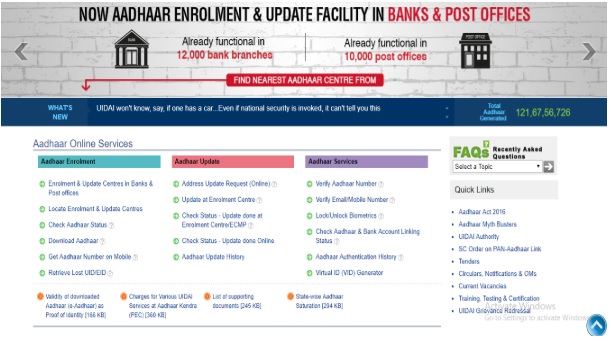
First, go to official Aadhaar Card Update Portal

Step 2

Then click on Update Aadhaaar Button.

Step 3

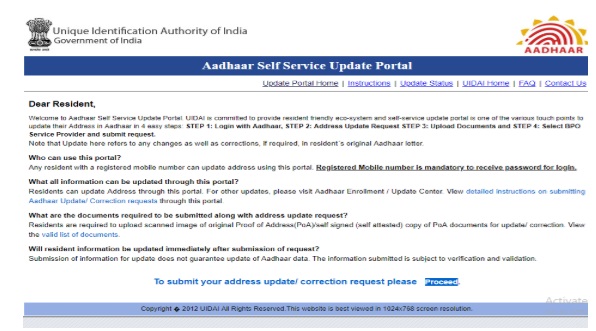
Next, you will get to a new page with a link:  

https://ssup.uidai.gov.in/ssup-home#/ and then on the bottom of the similar page you see “To submit your update/correction request online please Proceed.”  

Step 4

This link will redirect you to aadhaar Card Update Portal.

Note: Check the instructions here by UIDAI for residents who used the Aadhaar web portal.

Step 5

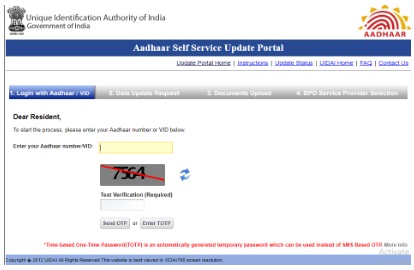
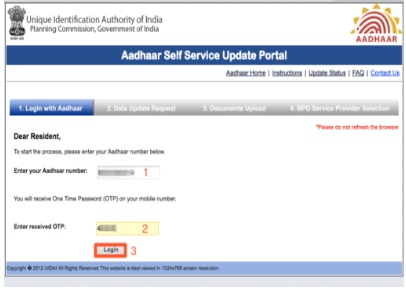
At the point when the page will be opened, there you will see an alternative requesting your Aadhaar card number. Enter your 12 digits Aadhaar number and tap on “Send OTP”. You will get One Time Password on the registered mobile number with UIDAI.  

Note: This is valid only for 15 minutes.

Step 6

Enter OTP in the required field and tap on “Login”.

Step 7

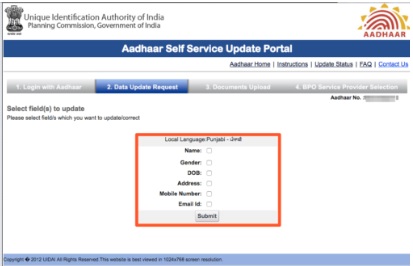
Now you will see different choices like Name, Address, Date of Birth, Mobile Number. Tick the choice you want to update and tap on Submit Button.

Step 8

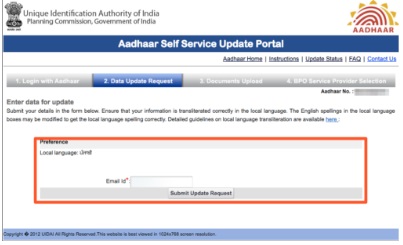
Enter new updated information and click on “Submit Update Request” button.

Step 9

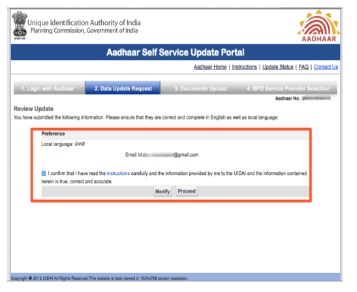
Then, cross check all the details again and have a look if they are precise or not. If all the details filled by you are precise, tap on “Confirm” button and then “Proceed”. In case, if you’ve mistakenly entered anything wrong then click on “Modify” button so you can modify the desired data.

Step 10

Further, you have to upload all the documents after scanning them so that all the verification can be done to the modifications you requested for your Aadhaar card. Once all the documents are uploaded, tap on the Submit Button.

Note: Make sure that uploaded documents should have the same information that you are asking for. The uploaded documents should be attested self-signed. The documents can be in PDF, Microsoft Word or jpg format.

Step 11

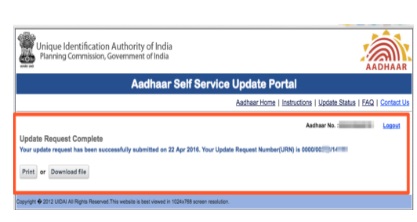
You will see “Your update request has been successfully submitted.” Your Update Request Number (URN) is 0000/00986/96XXX” on your screen. You will also get a confirmation message and Update Request Number on your registered mobile number.

Note: Make sure to note down this URN number because it will help you to track the status of Aadhaar Card Update. You can also download the acknowledgementt slip by clicking on “Download File” button on this page.

Step 12

At last, tap on the “Logout” button.

Offline Aadhaar Correction

Step 1

Firstly visit Aadhaar Card Update Portal.

Step 2

Next click on Download Form button.

Note:

  • Check the directions here by UIDAI for residents who will send the update request by post.
  • It’s necessary to fill a form in capital letters only and write the working mobile number.
  • Whatever data you want to get updated whether it is your name, address, Date of Birth or anything add self-attested photocopies of the documents.
  • You’ve to fill the form in English as well as in local language.

Step 3

On each attached document do write your 12 digit Aadhaar Update that is issued to you by UIDAI.

Step 4

You should seal the envelope properly and do write “Aadhaar Update/Correction” on the envelope and it should be in clear letters.

Step 5

Here are the addresses where you can post the document.

Address 1:

UIDAI

Post Box No. 10, Chhindwara,

Madhya Pradesh – 480001, India

Address2:

UIDAI

Post Box No. 99, Banjara Hills,

Hyderabad – 500034, India

Step 6

You will receive an intimation of the update request receipt when it is received.

Step 7

For the update of your mobile number, the notification for the update will be sent to the given mobile number.

Note: If you want to track your Aadhaar card update status, click here to check the steps.

Documents required for updating or correcting Aadhaar Card details

Documents required for Proof of Identification
  • Passport
  • PAN Card
  • Ration/PDS Photo Card
  • Voter ID
  • Driving license
  • Government photo ID card/service photo ID card issued by PSU
  • NREGA Job Card
  • Photo ID card issued by a recognized educational institution
  • Arms license
  • Photo Bank ATM card
  • Photo credit card
  • Pensioner photo ID card
  • Freedom fighter photo ID card
  • Kissan Photo Passbook
  • CGHS/ECHS Photo card
  • Address card having name and photo, issued by the Department of Posts
  • Certificate of identity having photo issued by Gazetted Officer or Tehsildar on an official letterhead
  • Disability ID card
Documents required for Proof of Address
  • Bank statement or passbook
  • Post office account statement or passbook
  • Passport
  • Ration Card
  • Voter ID
  • Driving license
  • Government photo ID card/service photo ID card issued by PSU
  • Electricity bill, water bill and telephone landline bill (must be recent and not over 3 months old)
  • Property Tax receipt (must be recent and not over 3 months old)
  • Credit Card statement (must be recent and not over 3 months old)
  • Signed letter having a photo from a bank on the letterhead
  • Caste and Domicile Certificate with photo issued by State Government.
  • Disability ID card/handicapped medical certificate
  • Gas connection bill (should be recent and not over 3 months old)
  • For minors – passport of parents
  • Pensioner card
  • Freedom fighter card
  • Arms license
  • Kissan passbook
  • Signed letter having photo issued by recognized educational institution on letterhead
  • NREGA job card
  • CGHS/ECHS card.
  • Certificate of address having photo issued by MP/MLA/Gazetted Officer/Tehsildar on letterhead
  • Certificate of address issued by village panchayat
  • Income tax assessment order
  • Vehicle registration certificate
  • Registered agreement of sale, lease, or rent
  • Photo identity card issued by Department of Posts
  • Signed letter having photo from registered company on letterhead
  • Insurance policy
  • Passport of Spouse
  • Marriage Certificate issued by the Government containing address
Documents required for Date of Birth
  • Birth Certificate
  • SSLC Book/Certificate Passport
  • Certificate of Date of Birth issued by Group A Gazetted Officer on letterhead
  • PAN Card
  • Marksheet issued by any Government Board or University
  • Government Photo Id Card / Photo identity card issued by PSU containing DoB
  • Central/State Pension Payment Order
  • Central Government Health Service Scheme Photo Card or Ex-Servicemen Contributory Health Scheme Photo card
Documents required for Proof of Relation to Head of Family
  • PDS Card
  • MNREGA Job Card
  • CGHS/State Government/ECHS/ESIC Medical card
  • Pension Card
  • Army Canteen Card
  • Passport
  • Birth Certificate issued by Registrar of Birth, Municipal Corporation and other notified local government bodies like Taluk, Tehsil etc.
  • Any other Central/State government issued family entitlement document
  • Marriage Certificate Issued by the Government

When to Update Aadhaar Card

  1. Change in Name, Mobile number, and Address.
  2. Errors in details during Enrolment Process.
  3. Updating the Local Language.
  4. UIDAI demands documents like proof of identity, proof of address and others.
  5. A child may be enrolled in the Aadhaar Scheme when they are below the age of 5. However, once they attain 5 years of age, they need to be re-enrolled. Once a child crosses 15 years of age, it is important to update all the biometric information. All the residents should update their information every 10 years.
  6. In case of an accident or if a person suffers an illness that may impact their biometric proof, the resident should apply for Aadhaar Update.
  7. Incorrect Biometric Capture, quality of biometrics are below the decided threshold, or in case of authentication problems.

Unique Identification Authority of India (UIDAI)

The statutory body for Aadhaar is The Unique Identification Authority of India (UIDAI), Government of India. UIDAI was established in 2016, under the Ministry of Electronics and Information Technology (MeitY) with a mission to provide good, efficient and transparent governance to the people of India.

Function

  • As of now, it is obligatory to interface the PAN and bank account with the Aadhaar.
  • An online, as well as offline platform, is provided by UIDAI to provide services to people.
  • The services range from updating the details of the registered person to correction of data, checking the status of orders raised. To avail these services on an offline platform, an individual may visit an enrolment center with the required documents and have the issues resolved.

Role

  • To create approach, strategy and framework for issuing Aadhaar number to people who request for the same by submitting, their demographic information and biometric information by undergoing the procedure of enrollment.
  • To guarantee security and confidentiality of identity information and authentication records of people.
  • To ensure compliance of Aadhaar Act by all individuals and agencies.
  • To make regulations, rules and various other guidelines consistent with the Aadhaar Act, for carrying out the provisions of Aadhaar Act.

Conclusion

The Aadhaar program was introduced in 2009. Since then, a lot may have changed – you may have gotten married (changed surnames), moved to a different city or locality or even lost/changed your mobile number.

The Aadhaar Enabled Payments System (AEPS) is currently in its initial stages. You can use your Aadhaar Card to authorize payments that will require your biometrics – fingerprint and iris scan. So, it is very much important to update your Aadhaar Card. Updating your Aadhaar card is important because the card could replace your regular or credit cards soon.

Download Now

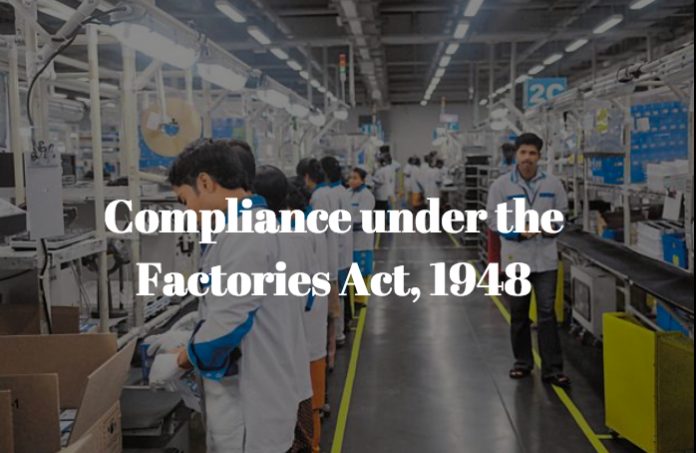
The Complete Compliance Checklist under the Factories Act, 1948

0
Factories Act

This article is written by Kanti, a student at the University of Delhi. In this article, she provides the complete compliance checklist under the Factories Act, 1948.

The Factories Act, 1948 is a social act which was passed to strengthen the position of workers, who are working in the factories across the country.

To whom does it apply?

This Act is applicable to all factories which have employed 10 or more than workers on any day of the preceding 12 months, engaged in manufacturing process being carried out with the aid of power or twenty or more than twenty workers are employed in manufacturing process being carried out without the aid of power.

Definition of factory

Section 2(m) of the Factories Act, 1948 defines ‘factory’ as any premises-

  • Where ten or more workers are working or were working on any day of the preceding twelve months, and in any part of which a manufacturing process is being carried on with the aid of the power, or is ordinarily so carried on, or
  • Where twenty or more workers are working or were working on any day of the preceding twelve months, and in any part of which a manufacturing process is being carried on with the aid of the power, or is ordinarily so carried on, but does not include:
  1. Mines subject to the operation of the Mines Act, 1952,
  2. A mobile unit belonging to the armed forces of the Union,
  3. Railway running shed or a hotel, restaurant or eating place.

Compliance Checklist under the Factories Act:

Under the Factories Act, the following compliances should be followed-

Section 6 and 7 (Licensing of Factory)

The occupier of the factory is required the previous permission from the State Government or the Chief Inspector in writing for the site on which factory is to be situated.

And to get a license, the occupier must send the notice under section 7 of the act to the Chief Inspector, at least 15 days before he begins to use the premise as a factory containing the following details

  • Name and address of the occupier
  • Name and address of the factory
  • Name and owner of the premise
  • Address for communication
  • Nature of the manufacturing process to be carried in the factory
  • Total horsepower to be installed
  • Name of the manager of the factory
  • Number of workers likely to be employed
  • Other particulars which may be prescribed

Chapter III (Health Provisions)

  • Cleanliness– Every factory must be clean and there should be no accumulation of dirt. Floor, windows, passage, benches of workrooms, staircase etc. should be cleaned on a regular basis with disinfectant.   
  • Disposal of wastes and effluents– the factory shall have proper arrangements for the treatment of wastes and effluents.
  • Ventilation and Temperature– the factory premises should have adequate ventilation by the circulation of the fresh air. The walls and roofs should be of such quality that temperature in the factory doesn’t rise beyond the reasonable conditions of comfort.
  • Dust and Fume– If the work carried in factories is such that dust and fume are released in substantial quantities, effective measures should be taken to prevent its accumulation in any workroom.
  • Artificial Humidification– If the humidity in any factory is increased artificially, the water used for this purpose should be taken from a public water supply or should be purified before it is used.
  • Overcrowding– No room in any factory shall be overcrowded to the extent that it becomes injurious to the health of the workers employed in the factory.
  • Lighting– The working area for the workers and the passage have adequate and sufficient light, natural or artificial or both.
  • Drinking Water– There should be suitable points in every factory which provide a sufficient supply of drinking water and the ‘drinking water’ shall be mentioned in the language understood by the workers.
  • Latrines and Urinals– Sufficient latrine and urinal accommodation should be there in every factory and they should be accessible to the workers all the time while they are present in the factory. The accommodation so provided should be separate for male and female with proper lights and ventilation.
  • Spittoons– Every factory shall have a sufficient number of spittoons placed at a convenient place. The spittoons should be clean regularly.
https://lawsikho.com/course/labour-law-hr-managers
click above

Chapter IV (Safety provisions)

  • Fencing of Machinery– Every moving part of a prime mover and every flywheel should be fenced securely unless they are safe to be used otherwise.
  • Work on Near Machinery in Motion– When it becomes necessary to examine any part of the machinery while the machinery is in motion, such task should be done only be a specially trained adult male worker wearing tight fitted cloth.
  • Employment of Young Persons on Dangerous Machines– Only a fully instructed person about the dangers arising in connection with the machine and precautions to be observed, shall be allowed to work on dangerous machines under the supervision of a person who is knowledge and experience of the machine.
  • Striking Gear and Devices for Cutting-off Power– An appliance should be provided and maintained to move driving belts to and from fast and loose pulleys.
  • Self-Acting Machines– No self-acting machine shall be kept in such a space over which any person is liable to pass.
  • The Casing of New Machinery– Every set, screw, bolt or key in all machinery driven by power and installed in a factory should be encased effectively to prevent danger.
  • Prohibition of Employment of Women and Children near Cotton-openers– Ia cotton-opener work is done by the factory, no woman or child should be employed for pressing cotton in such work.
  • Hoists and Lifts– Every hoist and lift should be sound, adequately strong and properly maintained.
  • Lifting Machines, Chains, Ropes and Lifting Tackles– All parts of lifting machines, chain, rope and lifting tackle should be of good construction, sound material and free from defects. They should be thoroughly checked by a competent officer at least once in 12 months.
  • Revolving Machinery– Revolving machinery shall be permanently affixed to or placed and there should be a notice indicating the minimum safe working area around the machinery.
  • Pressure Plant– If a factory is using any machinery which is operated at a pressure above the atmospheric pressure, then the pressure should be kept under check.
  • Floors, Stairs, and Means of Access– All floors, stairs, and passages should be properly constructed and maintained.
  • Pits, Sumps, Opening in floors etc.-If there is any vessel, tank or pit in the floor which may be a source of danger shall be securely covered or fenced.
  • Excessive Weight– No worker employed in the factory shall be made to carry or move any load which might cause any injury to him.
  • Protection of Eyes– If any process is carried out in the factory which involves a risk of injury to the eyes from particles or fragments, suitable goggles or effective screens should be provided to the workers who are working in such circumstances.
  • Precautions Against Dangerous Fumes, Gases etc.- No person should be allowed to enter any confined space until precautionary measures have been taken to remove such fumes and gases.
  • Precautions Regarding the Use of Portable Electric Light– No portable electric light of more than 24 volts should be used in any confined space or chamber or tank.
  • Explosive or Inflammable Dust, Gas etc.– All precautionary measures should be taken to prevent an explosion of gases which are likely to explode on ignition.
  • Precaution in Case of Fire– The factory should take all the practical measures to prevent the outbreak of fire and its spread, both inside and outside the factory. Safe means of escape should be in the factory for the persons, in case of a fire.
  • Maintenance of Building– The building of the factory should be maintained properly so that it does not cause any injury to the health of the workers.
  • Appointment of Safety Officer– In a factory, where the number of employers is more than 1000 than the factory is required to appoint a safety officer.

Chapter V (Welfare Provisions)

  • Washing Facilities– Separate and adequate facilities to be provided for male and female worker. The facilities should be clean and conveniently accessible.
  • Facility for Storing and Drying Clothing– The factory should provide a suitable place for keeping the clothes not worn during the working hours and for the drying of wet clothes.
  • Facilities for Sitting– The workers who are obliged to work in a standing position should be given proper suitable sitting arrangements during their rest hours.
  • First-aid Appliances– First-aid boxes or cupboards containing with necessary contents, should be maintained and provided during all the working hours.
  • Canteens– If the factory has more than 250 workers employed, minimum one canteen should be provided and maintained by the occupier.
  • Shelters, Restrooms, and Lunch Rooms- A factory having more than 150 workers should provide adequate and suitable restrooms and lunch rooms, with provision for drinking water.
  • Creches– If the factory employs more than 30 women workers, it should provide a suitable room for the use of children under the age of 6 years of such women.
  • Welfare Officers– If a factory has more than 500 employers, such numbers of welfare officers should be employed as may be prescribed.

Chapter VI (Working Hours of Adults)

  • Weekly Hours– Any adult worker should not be allowed to work in a factory for more than 48 hours a week. 
  • Weekly Holidays– No worker should be made work for continuously 10 days without any holiday. No worker should work on the first day of the week unless he has or will have a holiday on one of the 3 days immediately before or after the said day.
  • Compensatory Holidays– If a worker is deprived of any of the weekly holidays, he should be allowed take that holiday in that month or within the two months immediately following that month.
  • Daily Hours– No worker should be allowed to work in a day more than 9 hours a day. (Subject to the previous approval of Chief Inspector)
  • Intervals for Rest– The working hours of an adult worker should be set in a way that he doesn’t work for more than 5 hours without taking an interval for rest of at least half an hour.
  • Spread over– The working periods of an adult worker in a factory shall be arranged in such a manner that they do not work for more than ten and a half hours a day including the intervals for rest.
  • Night Shifts-If a worker works on a night shift, the hours he has worked for after the midnight should be counted in the previous day.
  • Prohibition of Overlapping Shifts– Not more than one worker should be given works of the same kind at the same time.
  • Extra Wages for Overtime– If any worker works for more than 48 hours in any week, he should be entitled to wages at the rate of twice his ordinary rate of wages.
  • Restriction on Double Employment– A worker should not be allowed to work in a factory if he is already doing work in one.
  • Notice of Periods of Work for Adults– A notice should be put every day clearly showing the periods in which adult worker may be required to work that day.
  • Register of Adult Workers– Every factory is required to maintain a register of adult workers showing the name and nature of the work of a worker.
  • Hours of Work to Correspond with Notice and Register– No worker should be allowed to work any work other than mentioned in the notice and the register.

Chapter VII (Employment for young persons)

  • Prohibition of Employment of Young Children– No child who is less than 14 years of age be allowed to work in any factory.
  • Non-adult Workers to Carry Tokens– An adolescent should not be allowed to work in a factory unless a certificate of fitness has been granted to him under section 69 of the Act.
  • Certificate of Fitness– A certifying surgeon can issue a certificate of fitness to an adolescent only when the manager of the factory and the guardian of the adolescent sign a document that he will be employed in that particular factory.
  • Working Hours for Children– No child should be allowed to work more than four and a half day in a day and should not be allowed to work in the night at all.
  • Notice of Periods of Work for Children– Every factory should display and maintain a notice every day for the periods during which children will be allowed to work.
  • Register of Child Workers– A register should be maintained in the factory mentioning the name of the child worker, the nature of his work, the group in which he is included, the shift of his group and his certificate of fitness. No child worker should be allowed to work in the factory unless his name is entered in the register of child workers.
  • Hours of Work to Correspond with Notice– No child should be employed in the factory otherwise in accordance with the notice of periods of work for children displayed in the factory.

An adolescent (both male and female) who has obtained a certificate of fitness can work in the factory only during the time period of 6 A.M.- 7 P.M.

Chapter VII (Annual Leave with Wages)

  • Annual Leave with Wages– Every worker who has worked for 240 days or more in a factory in a year should be allowed to have leaves with wages in the subsequent year.
  • Wage During Leave Period– A worker who has taken leave under section 79 or 80 of the act, shall be entitled to wages at a rate equal to the daily average of his total earnings for the day during the month immediately preceding his leave.
  • Payment in advance in Certain Cases– A worker who has been allowed leave for less than four days, in the case of an adult, and five days, in the case of a child, should, before his leave begins, be paid the wages due for the period of the leave allowed.     

In addition, the occupier a Health Register in respect of persons employed in occupations declared to be dangerous operation under section 87 of the Act.

  • Maintain a Bound Inspection Book.
  • Annual return to be filed on time.
  • Report form Health Officer.

Read the full Factories Act, 1948 HERE.


Get all the templates, formats, step by step guides, checklists and information you need related to employment laws in one place, free of cost. we have simplified compliances, record-keeping, contracts, policies, disputes and litigation for you. Never struggle with employment and labour law again in your life. Click here to download the  Legal handbook for HR managers

LawSikho has created a telegram group for exchanging legal knowledge, referrals and various opportunities. You can click on this link and join:  

https://t.me/joinchat/J_0YrBa4IBSHdpuTfQO_sA

Follow us on Instagram and subscribe to our YouTube channel for more amazing legal content 

 
Download Now

Media and Entertainment Law Diplomas In India

0
media and entertainment law course

This article is written by Mohona Thakur from Team iPleaders.

If you have a keen interest in the field of media and entertainment law, and have made up your mind about pursuing a career in it, a list of the only institutions across India that offer this programme may be handy!

Google for ‘top law schools for media laws’, you fill find a couple of sorry LLM guides with no relevant information.

The truth is, most law schools do not have this subject even as an optional. The reasons could be many. To begin with, media laws in itself isn’t an absolutely prominent field of law that too many lawyers show an inclination for. Although massive opportunities are arising on the back of a burgeoning media and entertainment industry, with many opportunities for lawyers opening up very fast, studies with respect to media laws is at its nascent stage. Besides, law schools do not have qualified professors with adequate knowledge in this area for them to offer this as a subject in the first place.

With the lack of the subject in any decent curriculums in law schools, there are a few law schools across the globe and online academies that have taken a step towards consciously building a curriculum in this area of law.

When it comes to a conscious academic or career choice, no one would risk gaining unreliable information. They would rather hear it from the horse’s mouth. I thought I would bring the horse to you, you could always have a word with it yourself.

Here is a carefully curated list of courses across India that offer the niche subject of media and entertainment laws (in varied forms) with the links to their website from where you can take it forward:

  • Diploma in Media and Laws by New Law College, BVP University, Pune

Eligibility: You must be a graduate from a recognised university in India or abroad.

Duration: 1 Year

Course Type: Full-Time

Examination Type: 80% Theoretical and 20% Internal Assessment

What’s in it for you – the good, bad and ugly!

For those of you looking for a diploma certificate by recognised law college, this may be a good idea. However, this course seems to have been launched recently. There is no available information about the course curriculum and structure. For more information on admissions, you can visit this page.

While the degree awarded is a diploma and comes from a NAAC accredited college, unless you are physically present in Pune, you shall not be able to pursue this course. If you’re in Pune and want to pursue a full time diploma, please do visit their college in Kothrud.

In addition, in order to pursue diploma, you need to have a graduate degree. Therefore, if you are a law student, in a five year law course, this is not an option for you.

  • LawSikho’s Diploma in IPR, Media and Entertainment Laws

Eligibility: You must have completed 10 + 2 from a recognised board in India or abroad.

Duration: 1 Year

Course Type: Online

Examination Type: 600 Marks, 100 Marks MCQ and 500 Marks Exercise & Assignment Based

What’s in it for you – the good, bad and ugly!

It’s a relatively new course that was launched in May, and the first batch is to commence from August. Therefore, it doesn’t have any alumnus as yet. But then, all the other courses are pretty new too.

What’s interesting is that this media law course has an overwhelming industry panel with people like Forbes 30 under 30 lawyers, lawyers presently practising in this space.

The course contains 16 modules and covers all aspects of the media industry – print, radio, broadcast, telecom, digital. They teach through interactive videos and also have study material in hard copy. In addition, apart from feedback sessions, the course endorses weekly exercises that teach hands on the kind of work that you will be required to do when you work in this space as a lawyer. You can see the course content here. There are total 50 classes throughout the year (once every week), which you can attend at night (8-9 pm on weekdays).  If you miss a class, you could watch the recording later. This is definitely very convenient for busy lawyers and law students.

Cherry on the cake? You can access this course anytime and sitting anywhere in the world, even on your cell phones. Double cherry on the cake? They provide sample material for their course, for you to see and decide. You can subscribe for the sample material here.

The course also promises to help you with internships if you are a law student, and with jobs if you are a lawyer based on your performance in the course which is a huge added advantage.

  • Post Graduate Diploma in Media Laws, NALSAR Proximate Education

Eligibility: Bachelor’s degree or equivalent from a recognised university

Duration: 1 Year

Course Type: Distance-Education

Examination Type: 90 Mark Theory Papers x 4 Modules and 40 Marks for mandatory attendance for classes

The brand name is possibly the only take away for this PG Diploma, apart from 4 fat modules on Media Laws in India. The modules cover widely four broad categories – policy and media law, constitution and media laws, convergence and advertising laws.

The eligibility criteria is a bummer as it doesn’t allow law students enrolled in the five year law course to apply (since they do not hold a bachelor’s degree).

The course was sold at INR 16,500 last year. However, the course requires the students to mandatorily attend classes that only take place in selected metro cities on specified dates twice during the year. The cities that the classes take place in are: Hyderabad, Mumbai, Delhi and Kolkata. In case you do not belong to these cities, it would be a choice you’d have to make between spending extra to get those 40 marks or opt out and lose on the 40 marks.

For more details on their admission procedure, you can visit their website here.

Presently, in India, these are the only three organisations offering a diploma in media laws. Very few law schools have come up with media laws as an optional paper. However, given the vast dimension that media and entertainment laws cover, a semester worth of studying can at maximum introduce you to the basics.

If you are serious about pursuing a career in this field, you shall have to take an extra effort and not only find internships in this field, but also continue enhancing your knowledge and skill set by pursuing media law courses that not only add a certificate to your resume but also value.

Good luck!

Download Now

How to Teach Practical Aspects of Law for Career Success

0
learning law

This article has been written by Ramanuj Mukherjee, CEO, iPleaders with inputs from Abhyuday Agarwal, COO, iPleaders.

How do Indians learn law?

Here is how law is taught in Indian law schools, whether traditional law colleges or the hallowed National Law Universities.

You attend lectures by law teachers, who usually have little to no practical experience of doing actual legal work (especially because full time law teachers are not supposed to practice law in India, due to a strange regulation put in place by the Bar Council of India). The academic expertise they claim is usually based on text books they read, or research they do around legal doctrines. On the other hand, students join law schools and pay big fees in the hope that they will score good jobs when they graduate, with big law firms, in-house corporate teams or at least with a chamber of a good lawyer.

The distance between what those firms, in-house legal teams and lawyers practice and what the teachers teach in law school is massive.

In law schools, you learn sections of important statutes, commentary by jurists around these sections and if you are in a good law school, then case laws which is essentially interpretations of these statutes. There are supposed to be clinical classes, where you are also supposed to learn the practical side of law towards the end of law school, such as drafting and negotiation, client counselling, but those classes breeze by without sufficient weightage.

The result is that most law students graduate from law school completely unprepared to deal with the work that they are supposed to handle as lawyers. A law student usually takes contract law classes within first two years of joining the law school. However, if you ask them, you will see that they have no idea about what are the usual clauses in common legal contracts, or how to create a negotiation strategy. They surely read the Civil Procedure Code, but have no idea as to how a civil suit is filed at the registry of a court, or how litigation strategy is designed, or how to draft a basic petition or application for that matter. They would inevitably study the Companies Act, with no idea as to how corporate governance is designed or enforced, or how to do basic compliances under the same act.

Basically, graduate lawyers suffer from a tremendous lack of knowledge as well as skills with respect to client work, and have little idea about the legal work that happens in the real world.

So how do Indians learn legal work that will make them employable, or allow them to serve paying clients?

They are completely on their own with respect to this. When you hear that it takes 5 years or 10 years to establish oneself in the legal practice and to begin to earn enough to earn a sum good enough to survive with decent living standards, that is because of this issue. Senior lawyers hire junior lawyers for a pittance, and often openly say that the junior is lucky to even get a place to stand in their office. This is a very unusual thing, but from the seniors perspective they have to take responsibility for training an unskilled person to do work that requires high level of skills, and hence, they can’t afford to pay too much to such a novice.

This is why although lawyering is generally very well paid work, young lawyers earn too little, and continue to work very hard for their seniors, in the hope of making it big one day.

However, it is entirely possible to build your own practice early on from scratch, or to even command a good salary while working at a good chamber. It is similarly very much possible to secure a well paying job with great growth opportunities at a good law firm or in-house legal team. However, that requires you to have some practical skills. What are these practical skills that you should learn to get the coveted jobs and then to perform like a champion? We have made a comprehensive list for you. I have taken these lists from our course manuals at LawSikho, where we try to inculcate these skills with each lesson and each exercise. I will come to details of how we manage to teach these skills later.

Here are 10 ultra-important skills that law schools do not teach you, but you must acquire in order to find early success in your legal career:

  • The ability to find, understand and analyse any law whatsoever
  • The ability to put an argument or a point across in writing or through a speech
  • The ability to draft and negotiate contracts
  • The ability to come up with a legal strategy or legal position given a specific situation, and the ability to advice clients regarding the same
  • The ability to plan and manage a legal process efficiently from the beginning till a remedy is obtained or deal is closed. Also known as project management skill – every case or matter is a project after all.
  • The ability to understand and support the commercial/pecuniary objectives of clients, as well as comprehensive understanding of business models, organizational models and business logic behind any transaction
  • The ability to process a large amount of information to quickly arrive at what is important in any given situation
  • The ability to invent a solution through creativity, but supported by legal analysis
  • The ability to understand and implement procedural aspects of law with a very high level of attention to details (eg. deftly handling the registry of a court, or ensuring quick enforcement of a decree in a clogged legal system)
  • The ability to represent the interests of an unrelated person dispassionately, coherently, only based on legal logic before an authority or another party

Law firm specific skills

(Some of these skills may appear as though they are similar or overlapping, but they may not be.)

  • Understanding of the documentation, review and execution process
  • Ability to communicate precisely, clearly and frequently with different stakeholders of the client through a mix of emails, conference and phone calls, including sharing legal or policy updates and their possible impact on the specific transaction or the client’s business generally
  • Ability to interact with regulators and their staff to identify practical roadblocks and interpretations of regulatory provisions for a transaction
  • Ability to interact effectively with non client parties (they don’t pay you) such as the investee company (in case you are engaged by the acquirer)
  • Ability to collaborate within a hierarchical team
  • Ability to break the work down in appropriate units and delegate to juniors and interns to mentor them and to enhance output
  • Ability to understand the client’s eventual outcomes and incorporate that in the documentation process and strategy without specific instruction each time
  • Ability to identify concerns and “what-ifs” from time to time as a multi-legged transaction evolves over time and take initiative to present workable solutions for the client
  • Ability to give high quality, super-specialised advice
  • Ability to conduct due diligence exercises efficiently
  • Presentation of the client’s factual data, goals, legal and regulatory provisions together in clear ways to give clear opinion to the client of what is possible, what is not and how to achieve the results the client wants  
  • Knowledge and skills related to specific practice areas (Investment transactions, M&A, finance and banking deals, general corporate, projects, Technology Media & Telecom, dispute resolution etc)

In-house legal team specific skills

  • Ability to support various business functions in a company (eg. sales, marketing, R&D, Board of Directors, promoters) through legal advice, contracts and other legal work
  • Ability to build, manage and lead a team of lawyers and support stuff
  • Ability to instruct and manage external lawyers
  • Ability to track and manage specific outcomes of legal contracts and ensuring that the company gets what it bargained for
  • Ability to visualize standardized legal documentation and policies to reduce risk and protect the company’s interests
  • Ability to prepare and maintain different kinds of dashboards to report compliance and other strategic inputs for the management
  • Ability to identify the right local lawyers in different courts in multiple states and districts to engage for different kind of matters
  • Ability to have working relationship with different kinds of senior counsels to engage in appellate matters, writs and special leave petitions
  • Ability to engage law firms at a suitable price point for the company which provide required services

Litigation specific skills

  • Filing skills and dealing with the court registry
  • How to strategize the prayer and the most suitable interim remedies to protect the client’s interest and secure early relief
  • Drafting pleadings, applications and petitions
  • Counselling clients about legal strategy
  • Briefing senior counsels and collaboration with other litigators who are looking at other parts of the case
  • Ability to create and manage an effective team that supports your practice –  juniors and court clerks for your work at different forums
  • Creation of case strategy – which facts and interpretations should be used in which forum and which facts should be ignored to present your case in the best light
  • General investigation skills –  to find out facts and gather evidence to build a strong case
  • Project management skills – every case is a project that requires professional management
  • Ability to ensure through effective communication that a client experiences value and satisfaction through your work (most litigators do great work but have no time to communicate the value to a client and the client often experiences unavailability of the litigator and a high level of uncertainty in the matter)

How should we teach law in that case?

If the current legal education system is repeatedly failing, year after year, to provide training to law graduates that make them employable or ready for the legal industry, what can be done about it? This is exactly why my co-founder, Abhyuday, and I started platforms like iPleaders and LawSikho.

Here is why there is a legal education-employment bottleneck – every law student and young lawyer needs to thoroughly understand this.

I spoke about the bottleneck and the skill deficit in this article here, too.

Before I tell you how we go about it, let me tell you how we did it wrong for years despite identifying the right problem.

Biggest drawback of online education

If I give you a manual for swimming, and then you learn it by heart, and then I ask you to take an exam. You clear it with flying colours. Now, I give you a certificate with glowing swimming credentials. However, will you be willing to jump into the sea based on this knowledge?

The problem with online legal courses is the same. While law colleges failed to offer reasonable skill training, online courses commit a worse crime – they promise to fill the gap and then don’t.

We had anticipated the problem, and tried to bridge the gap through lucidly written material, videos, live webinars, question answer forums. However, year after year we saw that despite significantly improving our material, interface and engagement, a large number of students who buy online courses never finish the same. A majority of them appear for the exam, get the certificate, and still a large chunk do not even bother to do that.

That made us wonder – what could be the reason?

Law is hard. There is no denying that. It’s complex no matter how easy the language we use and how many mindmaps we create. It requires a lot of attention. It requires time. It requires discipline. And a lot of learners drop off somewhere, and simply give up. Many others just focus on somehow finishing the course, getting the certificate.

This is very concerning for us. It is true that we take the money upfront, and no matter how many people drop off we still had a steady flow of students. We always got a minimum of 10-20% success stories. A portion of the students always consist of diligent and disciplined students who properly finish the course, do all the assignments, follow instructions, get the mentorship they wanted in the first place, and bag amazing internship and job opportunities. They also spread the positive word of mouth about how much our courses helped them. That always attract more good students to come and take up our courses.

Still, 50-60% students failed to significantly benefit from the courses they paid for. This was our failure. Also, these people are likely to say negative things about the course. A few times I got comments that the course is not good enough or does not provide enough value for money. Then as concerned as I would be, I always find the number of such people and then call them up. Usually they turn out to be people who haven’t done our course or a student who enrolled but did not have the perseverance to go through the hard part of the course. While we understood that this is an online course, and we cannot chase people to complete their online courses or finish their exercises, to give the proper time required, it meant that we will never become the extraordinary educational organization we dream of becoming.

100% success rate is the holy grail of education. Just think of what made IIMs or NLS Bangalore famous. It was the 100% good placements! To reach that level, we have to ensure despite being an online education platform, we have to create 100% success rate.

Is that even possible? Probably not. However, to become a world class education platform, and to fulfill our ambition, we had to improve our game. The job of dreamers, entrepreneurs and hustlers is to turn the impossible into inevitable. So we started to figure that out. It took years of effort because we hit a solution that works.

What could be the solution? What do you think?

Here is what we do.

Provide study material ‘filled with insights’ for self study

We only care about actionable insights that can move you towards accomplishing an objective or arriving at a solution. We skip all the commentaries on sections, cases laws and jargons and cut to the chase, and answer practical questions you will have to deal with. Consider the following sets of questions:

Set 1

  • How can you do X?
  • When should you do Y?
  • What is the most optimal method to achieve Z outcome?
  • How can you save costs while accomplishing A?
  • How can you do B in the most expeditious manner?

Set 2

  • What is the history and origin of a particular concept?
  • What are the drawbacks of the definition in the statute?
  • Was a particular case correctly decided?
  • What is the difference between the judgments of different courts on a particular point?

Do you notice the difference between the two sets of questions? The kind of discussion that the first set of questions provokes is relevant to immediate reality, while that provoked by the second set of questions is academic. More people want and will be willing to pay you to get answers to the first set of questions.

Answering the second set of questions is not always as important, unless it helps us arrive at a desired outcome, or avoid an undesired outcome in reality. In fact, if you are interested, once you know how to answer the first set of questions, you can answer the second set on your own.

We are more interested in identification of how to achieve real life solutions and inquire into what the law is from that perspective.

This makes our courses lightweight, easy to study, and directly beneficial. Compared to a textbook, every hour you spend on this material gives you a lot more RoI (Return on Investment) and it is also easier to follow. Also, reading this material or watching the video is only a small part of the course. The real amazing part is the exercises and live classes, I will come to that next.

Self-study material that is capable of application

Most lawyers (even in big firms) do not have a habit of using detailed systems and processes (unless the firm provides them something in an exceptional case), with the result that there can be inconsistency in your work. If you draft 5 contracts every day, you might find that the contracts vary in content, uniformity and even quality. Any risks owing to a missing clause may not be discovered right then, but years later when there is a dispute. In fact, if you use a compare function, you will find differences.

We create study materials which are not just knowledge-based but can be used repeatedly to improve your quality of work and reliability in real-life. For example, in the Contract Drafting Diploma, we share an exhaustive checklist consisting of more than 25 clauses that ensures that every contract you draft is exhaustive.

Let’s take another example. We suggest lawyers to share an Information Requisition Form with clients when they want transaction-specific details about a contract from a client to capture detailed information accurately into the contract. Recently, one of our students who is a working professional pre-filled this and shared the form on his own initiative with his lawyer. The lawyer was surprised and moved at how it made his work easier – he had never seen a client share something like this.

Our intention here is that you grow yourself by using systematic methods of learning from the starting. If you do it for sufficient time, you will be able to build your own methods, systems and processes in new situations to get results you want. It will also make delegation more effective in future, when you decide to build a team, hire or groom juniors. 

Weekly exercises

The standard model of learning where a teacher gives a lecture in a class has a crucial drawback:

  • It does not require you to apply the knowledge you are learning
  • It puts your brain in a passive mode, so you may not always be thinking on your feet when you receive the knowledge

There is evidence of it at play – many of us love acquiring ‘gyaan’ but find it difficult to apply it. That’s not your fault, it’s because of how you have been conditioned!

We realized that there has to be minimal friction between acquiring knowledge and its application, otherwise the acquisition of knowledge and its application become two unconnected and uphill tasks.

We decided to provide simulation exercises every week that mimic the most-common and frequent (though not easy, some are fairly complex) situations someone would face in real life. When you solve these problems every week, your experience of knowledge acquisition and knowledge application is direct and connected. There is no friction. As a result, you acquire highly personalized insights which enable you to apply the learning repeatedly and with reliability in a future situation. Your brain says, “I have done this before”. You’ve been there and done that.  

Live feedback classes

We have been providing access to recorded videos and interactions with experts since 2012, but you are the observer there. We realized that personalized feedback is important, and this part of online education needs to be repeated for every batch of students.

We conduct weekly classes that give you feedback for the previous exercise you performed, and teach you relevant concepts for the next week’s exercise. From the feedback you and others get, you are able to identify multiple ways to improve and incorporate real-life situations in a contract.

This is important because in real life, you do not have only one correct answer. There can be multiple ways of approaching and solving a problem and achieving the same result. These feedback sessions enable you to see that happen, because different people tackle problems differently.

In one month, people who were mortified of writing contracts have started feeling confident and drafting fairly good clauses.  

Micro-Skills

We observed experts in action, and we realized that they all apply multiple sets of skills which they have acquired over time to arrive at a solution. When you face a real situation, the reason you find it complex and others don’t is because experts have a wider set of skills to choose from, sequence and combine, to get the result. In fact, that is the reason why your seniors at work can solve some problems very easily but you as a fresher cannot. Most of us who are good with performing tasks even turn blind to the fact that they have a lot more experience and practice than others.

We have drilled down to the most fundamental micro-skills involved in performing a task, and created exercises with the intention to impart these micro-skills. Gradually, these build in complexity. From time to time, students are also provided more complex exercises to give them the opportunity to apply different sets of micro-skills together.

In fact, an entrepreneur had once approached someone who was pursuing higher studies in cyber law to draft terms and conditions and privacy policies. She had then refused as she had had no real world exposure, but is now confident of taking up such work.

Download Now

Tax Exemptions Available to a Startup as per the Indian Taxation Laws

0
Tax Exemption
Image Source: https://blog.ipleaders.in/wp-content/uploads/2018/04/Tax-Exemptions-Tax-Scan.jpg

In this article, Rituparna Padhy, pursuing Diploma in Entrepreneurship Administration and Business Laws from NUJS, Kolkata discusses on tax exemptions available to a startup.

Introduction

According to the Nasscom Startup Report of 2017, India is the third largest startup ecosystem, with over 9000 technology startups. To further improve the legal framework for startups, the BJP Government launched the scheme ‘Startup India’ in 2016. The scheme focused on providing tax exemptions to the newly-emerged and upcoming startups in addition to the previously existing taxation laws.

Startup India

Startup India is a scheme introduced by the Ministry of Commerce and Industry (Department of Industrial Policy and Promotion [DIPP]) of Government of India and supported by the Small Industries Development Bank of India (SIDBI). It was launched on 16 January 2016, with the objective to make India a nation of ‘Nation Creators’ instead of ‘Job Seekers’. The action plan of this initiative is based on three pillars:

  1. Simplification
  2. Funding Support and Incentives
  3. Industry-Academia Partnership and Incubation.[1]

Intending to give motivating forces to new businesses and help their extension in the underlying period of their business, the plan was introduced to give a deduction of 100% of the benefits and increases derived by a qualified start-up that identifies with “innovation development, deployment or commercialization of new products, processes or services driven by technology or intellectual property.”[2]

What is an ‘eligible startup’?

As per the Startup India Action plan, the DIPP has established the followings conditions to be fulfilled by a startup to become ‘eligible’ for tax exemptions:

  1. Being incorporated or registered in India for less than seven years and for biotechnology startups up to ten years from its date of incorporation.
  2. The annual turnover not more than Rs. 25 crores in any of the previous financial years (FYs).
  3. Aims to work towards innovation, development, deployment or commercialization of new products, processes or services driven by technology or intellectual property.
  4. Not formed by splitting up or reconstruction of a business that is already in existence.
  5. Must have obtained certification from the Inter-Ministerial Board setup for such a purpose.
  6. Incorporated as a Private Limited Company, or a Registered Partnership Firm, or a Limited Liability Partnership.[3]

Who grants the tax exemptions?

The Inter-Ministerial Board set up by the DIPP validates startups for granting tax benefits. The Board comprises of:

  1. Additional Secretary, Department of Industrial Policy and Promotion, Convener
  2. Representative of Ministry of Corporate Affairs, Member
  3. Representative of Ministry of Electronics and Information Technology, Member
  4. Representative of Department of Biotechnology, Member
  5. Representative of Department of Science & Technology, Member
  6. Representative of Central Board of Direct Taxes, Member
  7. Representative of Reserve Bank of India, Member
  8. Representative of Securities and Exchange Board of India, Member.[4]

The above board shall validate startups as being eligible for two tax exemptions.

What are the tax exemptions?

Tax exemptions can come under two categories:

Income Tax Exemption on profits under Section 80-IAC of Income Tax Act

A startup recognized by the DIPP can apply to the Inter-Ministerial Board for “a full deduction of tax on the profits and gains from business as per the Income Tax Act.”[5] The deduction is for “any three consecutive years out of seven years from the year of incorporation of the startup.”[6]

The recognized startup must only be a private limited company or a limited liability partnership and thus registered as per the Companies Act[7], the Partnership Act[8], or the Limited Liability Partnership Act[9]. Such a startup, incorporated after 1 April 2016 and before 1 April 2021, can qualify for a 100% tax rebate on profit for a period of three years in a block of seven years, provided that annual turnover does not exceed Rs. 25 crores in any financial year. This is to help the startups to meet their working capital requirements during their initial years of operation.

Income Tax Exemption on investments above fair market value received

A DIPP recognized Startup, being a private limited company, shall be eligible to apply to the Inter-Ministerial Board for exemption from “income tax on investments above fair market value made by resident angel investors, family or funds which are not registered as venture capital funds.”[10]

Provided the following conditions are fulfilled:

  1. the aggregate amount of paid-up share capital and share premium of the Startup after the proposed issue of shares does not exceed ten crore rupees,
  2. the investor/proposed investor, who wishes to subscribe to the issue of shares of the Startup has —the average returned income of twenty-five lakh rupees or more for the preceding three financial years, or
    the net worth of two crore rupees or more as on the last date of the preceding financial year, and
    the Startup has a certified report from a merchant banker that specifies elaborately the fair market value of shares.”[11]

The eligible startups can also apply for tax exemptions under the following categories as per the Startup India Action Plan –

Exemption from tax on long-term capital gains

The Income Act allows eligible startups to exempt themselves from taxation on a long-term capital gain if such a long-term capital gain or a part thereof is invested in a fund notified by Central Government within a period of six months from the date of transfer of the asset.[12] The maximum amount that can be invested in the long-term specified asset is Rs. 50 lakhs. Such amount shall remain invested in the specified fund for a period of 3 years. If withdrawn before 3 years, the exemption will be revoked in the year in which money is withdrawn.

Tax exemption to individual/HUF on investment of long-term capital gain in equity shares of eligible startups

Section 54-GB of the Income Tax Act has now been amended to include an exemption on capital gains invested in eligible startups.[13] Thus, if an individual or Hindu Undivided Family(HUF) sells a residential property and invests the capital gains to subscribe the 50% or more equity shares of the eligible startups, then tax long-term capital will be exempt provided that such shares are not sold or transferred within 5 years from the date of its acquisition.[14] The startups shall also use the amount invested to purchase assets and should not transfer assets purchased within 5 years from the date of its purchase.[15] The ‘new assets’ in the above section shall also include computers or computer software in case of technology driven startups so certified by the Inter-Ministerial Board’s Certification notified by the Central Government in the official Gazette.[16]

Set off of carry forward losses and capital gains allowed in case of a change in shareholding pattern

The carry forward of losses in respect of eligible startups is allowed if all the shareholders of such company who held shares carrying voting power on the last day of the year in which the loss was incurred continue to hold shares on the last day of the previous year in which such loss is to be carried forward.[17] The restriction of holding of 51 per cent of voting rights to be remaining unchanged under Section 79 of the Income Tax Act has been relaxed in case of eligible startups.[18]

Analyzing Startup India Action Plan

Tax collection is typically not the essential worry for most of the new startups who are attempting to make back the initial investment. Since startups don’t make benefits in their initial period, the advantages of a three-year charge occasion are effectively just notional. The Finance Act of 2016 allowed exceptions to long haul capital increases if those are put resources into units of determined assets. The exclusion was likewise allowed for “long terms capital gains arising upon transfer of a residential property if such gains were invested in a start-up eligible as per the recent taxation laws.”[19] Yet, there have been few examples of these advantages being lapped up by the start-up community in the vast majority of the states. Exemption from “angel tax” was a more relevant step as an investment by residents in the eligible start-ups could benefit due to this concession. While this amendment holds potential, it falls short of the intended impact as only “13 start-ups have been certified so far for receiving the said tax benefits.”[20]

Conclusion

The Startup India Action Plan of 2016 focuses on improving the startup ecosystem in India and includes tax exemptions on capital gains and on investments above Fair Market Value. It is noteworthy that the government has thought of separately making startups a focal point of attention, given the entrepreneurial turn the youth is increasingly taking. While the initiative has been effective to some extent, its impact is still restricted because of bureaucratic impediments. The Action Plan should be regularly reviewed and amended so as to accommodate the market demands while maintaining a conducive atmosphere for the startups to prosper.

References

[1] PM Modi in Mann Ki Baat: ‘Start-Up India, Stand Up India’ Action Plan on January 16. The Times of India. December 28, 2015. Accessed April 12, 2018. https://timesofindia.indiatimes.com/india/PM- Modi-in-Mann-Ki-Baat-Start-Up-India-Stand-Up-India-action-plan-on-January- 16/articleshow/50340724.cms.

[2] s. 31, s. 32 and s. 41, Finance Bill, 2016.

[3] #StartUpIndia.” Accessed April 12, 2018. https://www.startupindia.gov.in/startup-registration.php. Official website of the Startup India Action Plan launched by the Government of India in 2016

[4]  “Tax Incentives.” Accessed April 13, 2018. https://www.startupindiahub.org.in/content/sih/en/startupgov/imb.html.

[5] s. 80-IAC, Income Tax Act, 2017.

[6] s. 80-IAC, Income Tax Act, 2017.

[7] s. 3 and s. 7, Companies Act, 2013.

[8] s. 58 and s. 59, Partnership Act, 1932

[9] s. 12, Limited Liability Partnership Act, 2008.

[10] “Tax Incentives.” Accessed April 13, 2018. https://www.startupindiahub.org.in/content/sih/en/startupgov/imb.html

[11] “Tax Incentives.” Accessed April 13, 2018. https://www.startupindiahub.org.in/content/sih/en/startupgov/imb.html

[12] s. 54-EE, Income Tax Act, 2017.

[13] s. 54-GB(6)(d), Income Tax Act, 2017

[14] Startup India: Eligibility, Tax Exemptions and Incentives.” Accessed April 15, 2018. https://cleartax.in/s/startup-india-tax-exemptions-eligibility

[15] Startup India: Eligibility, Tax Exemptions and Incentives.” Accessed April 15, 2018. https://cleartax.in/s/startup-india-tax-exemptions-eligibility

[16] s. 31, s. 32, s. 41, Finance Bill, 2016.

[17] Startup India: Eligibility, Tax Exemptions and Incentives.” Accessed April 15, 2018. https://cleartax.in/s/startup-india-tax-exemptions-eligibility

[18] s. 79(b), Income Tax Act, 2017.

[19] “Startup India Action Plan Falling Short.” Accessed April 16, 2018. https://www.livemint.com/Opinion/dsoVRGzssN5LKBQnWlj74K/Startup-India-action-plan-falling-short.html 

[20] “Startup India Action Plan Falling Short.” Accessed April 16, 2018. https://www.livemint.com/Opinion/dsoVRGzssN5LKBQnWlj74K/Startup-India-action-plan-falling-short.html.


Download Now

Article 29 and 30 of the Constitution of India

1
Article 29 and 30

In this article, Ana Khan of Jamia Milia Islamia discusses Article 29 and 30 of the Indian Constitution.

Introduction

India is a dynamic constitutional democracy with a feature of accommodating pluralism in thought and language so as to preserve cohesiveness and unity in diversity. The meaning of diversity has different connotations such as geographical, religious, linguistic, racial and cultural. To say India is linguistically diverse is not an exaggeration or any subjective thing. According to the 8th Schedule of the Indian Constitution, it recognizes 22 languages, which are:

  1. Assamese
  2. Bengali
  3. Bodo
  4. Dogri
  5. Gujarati
  6. Hindi
  7. Kannada
  8. Kashmiri
  9. Konkani
  10. Maithili
  11. Malayalam
  12. Manipuri
  13. Marathi
  14. Nepali
  15. Odia
  16. Punjabi
  17. Sanskrit
  18. Santhali
  19. Sindhi
  20. Tamil
  21. Telugu
  22. Urdu

A linguistic or religious minority community can conserve its language and culture through educational institutions but “no citizen shall be denied admission into any educational institution maintained by the state or receiving aid out of state funds on grounds only of religion, race, caste, language or any of them1”. Jamia Millia Islamia and Aligarh Muslim University are the prominent examples of minority educational institutions.

The Scope of Article 29 and 30 of the Constitution

These two articles confer four distinct rights.

  1. The Right of citizens to conserve its language, script or culture [Art.29(1)]1Any section of the citizens residing in the territory of India or any part thereof having a distinct language, script or culture of its own shall have the right to conserve the same
  2. The Right of a citizen not to be denied admission into state maintained and state-aided institution on the ground only of religion, race, caste, or language [Art.29(2)2]-”No citizen shall be denied admission into any educational institution maintained by the State or receiving aid out of State funds on grounds only of religion, race, caste, language or any of them
  3. The Right of all the religious or linguistic minorities to establish and administer educational institutions of their own choice [Art.30(1)3]-“All minorities, whether based on religion or language, shall have the right to establish and administer educational institutions of their choice.
  4. The Right of an educational institution not to be discriminated against in the matter of State aid on the ground that it is under the management of a minority [Art.30(2)4]-“The state shall not, in granting aid to educational institutions, discriminate against any educational institution on the ground that it is under the management of a minority, whether based on religion or language.

To preserve language, script, and culture

Article 29(1) extends to all the citizens irrespective of the fact whether they are in majority or minority, the only condition being that such section must have a distinct language, script or culture of its own.

It is an absolute right for the minorities to preserve its language and culture through educational institutions and cannot be subject to reasonable restrictions in the interest of the general public.

Restrictions on the ground of religion, race, caste or language

Article 29(2) is an individual right given to citizen and not to any community. The present clause gives an aggrieved person, who has been denied admission on the ground of his religion. If a person has the academic qualifications but is refused admission only on the grounds of religion, race, caste, language or any of them, then there is a clear breach of the fundamental right under this section.5

Right to Establish and Administer Educational Institution

https://lawsikho.com/course/diploma-entrepreneurship-administration-business-laws
click above

Article 30(1) is further divided into two parts, that is:

Right to establish

To claim the benefit under article 30(1) it is not necessary-

  1. That the institution must seek to conserve the language, script or culture of the minority community; what is necessary is its establishment by the minority community, it may impart religious or secular education wholly unconnected with language, script, and culture.
  2. That admission into such institution must be confined exclusively to members of the minority community, and not a single member of the majority community or other minority communities should have its advantage.6

Case Study of Aligarh Muslim University (AMU) {Azeez Basha v. Union of India}

In the case of Azeez Basha v. Union of India 7, the Supreme Court held that if an educational institution is not been established by the minority community then they have no right to administer it. The term “established” and “administered” have to be read in coordination. The University Grants Commission Act prohibits the formulation of “University” established by the educational institution unless and until it is governed by law.

  1. Wanchoo clearly stated that the article cannot be read to mean that even if the minority institution had been established by any other authority (Act of Parliament), in this case, the religious minority cannot avail the services of the university because “establish” and “authority” are the terms which are complementary to each other.

In the case of Dr. Naresh Agarwal v. Union of India8, where 50% of the seats to be filled on the basis of entrance examination conducted by Aligarh Muslim University and the other 50% of the seats was reserved for Muslim Candidates. The petitioners in this case, who are Hindu by caste have been deprived of their right to participate in the process of admission against that 50%. The Allahabad High Court followed the judgment of Azeez Basha v. Union of India and held that AMU is not a minority institution and struck down the amendment which was made in the favor of Aligarh Muslim University.

Definition of Minority

The term ‘minority’ is not defined anywhere in the Constitution of India but the judges have interpreted the meaning in many different cases which are mentioned below:

  • Re-Education Bill [9]

Supreme Court through J. S.R Das held that “minority” means a community which is numerically less than 50% of the total population.

A similar judgment was passed by the Kerala High Court in the case of A.M Patroni v. Kesavan10 in which it was held that “any religious or linguistic community which is less than 50% of the total population shall be considered as a “minority”.

  • D.A.V College, Bathinda v. State of Punjab & Ors [11]

For the purpose of article 30(1) a community may constitute a minority based on language, even though they may not have a separate script; it would be enough if they have a separate spoken language.

Right to administer

The word “administer” under article 30(1) of the Constitution means the right to manage and conduct the affairs of the institution. It is open to a university to impose reasonable conditions upon a minority institution for maintaining the requisite educational standard and efficiency like-

  1. Qualifications of teachers to be appointed in the institution;
  2. Conditions of service e.g the age of superannuation of teachers;
  3. Qualifications for entry of students;
  4. Courses of study (subject to special subjects which the institution may seek to teach)
  5. Hygiene and physical training of students.12

In State of Bombay v. Bombay Education Society13, it was held that “Where…..A minority like the Anglo Indian community, which is based, inter-alia, on religion and language has the fundamental right to conserve its language, script and culture under Article 29(1) and has the right to establish and administer educational institution of their choice under Article 30(1)5 surely then there must be implicit in the fundamental right, the right to impart instruction in their own institutions to children of their own community in then own language…….such being the fundamental right the police power of the state to determine the medium of instruction must yield to the fundamental right to the extent it is necessary to give effect to it and can not be permitted to run counter to it”

In St. Xavier’s College v. The State of Gujarat, the court held that the right to administer is the right to ‘conduct’ and ‘manage’ the affairs of the institution.

Admission Procedure in Minority Educational Institution

In St. Stephen’s College v. University of Delhi14, the preference is given to Christian students by St.Stephen’s College was challenged.

The Supreme Court by the majority of 1 to 4 held that the college is not bound to follow the university circulars as it will deprive the college of their minority character. The right to select students for admission is an important facet of administration. This power also can be regulated but the regulation must be reasonable and should be conducive to the minority institutions. The impugned directive of the university to select students on the uniform basis of marks secured in the qualifying examinations would deny the right to the college to admit students belonging to the Christian community. Unless some concession is provided to the Christian students15

The court decided the two categories for the selection process:

  1. Category I – 50% of the seats reserved for the minority community.
  2. Category II – remaining 50% are selected on the basis of merit.

But in T.M.A Pai Foundation v. State of Karnataka [16], it was held that “A minority institution may have its own procedure and method of admission as well as selection of students, but such a procedure must be fair and transparent, and the selection of students in professional and higher education colleges should be on the basis of merit. The procedure adopted or selection made should not tantamount to maladministration. Even an unaided minority institution ought not to ignore the merit of the students to the colleges aforesaid, as in that event, the institution will fail to achieve excellence”.

The court also overruled the decision in St. Stephen‟s case. The court has now granted the power to the state to fix quotas for minority students.

Role of National Commission for Minority Educational Institution – A boon for minority educational institution

The National Commission for Minority Educational Institution has the original jurisdiction to determine the minority status of any educational institution as held by the Hon’ble Supreme Court of India.

Justice Nariman, who authored the judgment, said the NCMEI Act grants the Commission to act upon all the queries relating to the status of a minority institution.

A power of cancellation was also vested in the NCMEI to cancel a certificate granted either by an authority or the NCMEI.17

Whether Jamia Millia Islamia is a minority institution?

On 22nd February 2011 National Commission for Minority Educational Institution (NCMEI) has declared Jamia Millia Islamia a religious minority institution and that the university will have the benefit of being a minority institution under article 29 and article 30 of the Constitution.

According to Section 2 (o) of the JMI Act says “University” means the educational institution known as “Jamia Millia Islamia” founded in 1920 during the Khilafat and Non-Co-operation movements in response to Gandhiji’s call for a boycott of all Government-sponsored educational institutions, which was subsequently registered in 1939 as Jamia Millia Islamia Society, and declared in 1962 as an institution deemed to be a University under section 3 of the University Grants Commission Act, 1956, and which is incorporated as a University under this Act.18

On 5th March 2018, an affidavit is filed by the incumbent Government in the Delhi High Court regarding the minority status of Jamia Millia Islamia where they cited the case of Azeez Basha v. Union of India to justify their stand, in which the apex court held that university incorporated under the act of parliament cannot be claimed as a minority institution.

The affidavit concludes that JMI is not a minority institution as it was set up by the Act of Parliament and funded by the central government and it was not set up by any minority sect.

Conclusion

Our constitution aims at “Unity in Diversity”. The minority status is not only dependant on the basis of religion but also on linguistic minorities. These provisions are inserted in the constitution so that minorities can also preserve and develop their culture.

In St. Xavier College v. State of Gujarat[19] that “the spirit behind the provision of the following article is conscience of the nation that the minorities, religious as well as linguistic, are not prohibited from establishing and administering educational institutes, of their choice for the purpose of giving their child the best general education to make them complete man and women of the country.”

1. India Const. Art. 29 cl.1.

  1.  India Const. Art. 29 cl. 2.
  2. India Const. Art. 30 cl.1
  3. 5. Durga Das Basu, Shorter Constitution of India, 346 (Wadhwa and Company Law Publishers, Nagpur,13th edition,2001).
  4.  Durga Das Basu, Shorter Constitution of India, 349 (Wadhwa and Company Law Publishers, Nagpur,13th edition,2001).
  5.  1968 AIR 662, 1968 SCR (1) 833.
  6. 2005 (4) AWC 3745, 2005 (4) ESC 2489.
  7. AIR 1958 SC 956.
  8. AIR 1965 Ker 75.
  9. 1971 AIR 1731, 1971 SCR 677.
  10. Durga Das Basu, Shorter Constitution of India, 356 (Wadhwa and Company Law Publishers, Nagpur,13th edition,2001).
  11.  1954 AIR 561, 1955 SCR 568.
  12. (1992) 1 SCC 558.
  13.  Dr. J.N Pandey, Constitutional Law of India,402(Central Law Agency, Allahabad,54th edition,2017)
  14. AIR 2003 SC 355.
  15.  Krishnadas Rajagopal, Supreme Court rules NCMEI has wide powers, The Hindu, (18th April,2018,22:36),https://www.thehindu.com/news/national/supreme-court-rules-ncmei-has-wide-powers/article23590265.ece
  16. https://www.jmi.ac.in/upload/jamiadocs/JAMIA/ActStatutes.pdf.
  17.  1974 AIR 1389, 1975 SCR (1) 173.

Download Now

Upcoming laws that will further Empower Indian women

0
Upcoming laws that will further Empower Indian women

In this article, Ana Khan discusses Upcoming Laws That Will Further Empower Indian Women.

Introduction

  • Cases under ‘crime against women’ category reported an increase of 2.9 percent in 2016 over 2015.
  • Majority of these cases are regarding “cruelty by husband or his relatives” (32.6 percent) followed by “assault on women with intent to outrage her modesty” (25.0 percent), “kidnapping and abduction of women” (19.0 percent) and “rape” (11.5 percent).
  • Rape cases have reported an increase of 12.4 percent from 34,651 cases in 2015 to 38,947 in 2016. Madhya Pradesh and Uttar Pradesh reported the highest incidents of rape with 4,882 (12.5 percent) and 4,816 (12.4 percent) respectively, followed by Maharashtra 4,189 (10.7 percent) during 2016.
  • Uttar Pradesh reported 14.5 percent (49,262) of the total cases of crimes against women followed by West Bengal (9.6 percent) (32,513 cases), during 2016. Delhi reported the highest crime rate (160.4) compared to the national average of 55.2.

Constitutional provisions

Our Constitution provides the articles for gender equality and empowerment of women. Some of the articles mentioned below are:

  1. Equality before the law which is defined under Article 14 of the Indian Constitution.
  2. Article 15(1) and Article 15(3) of the Indian Constitution.
  3. Protection of personal life and liberty which is defined under article 21 of the Indian Constitution.
  4. Article 39(a) of the Indian Constitution.
  5. Provision of just and humane conditions of work and maternity relief which is defined in article 42 of the Indian Constitution.

Crime against women

1. Kidnapping Under section 359, 360 and 366 of Indian Penal Code, 1860.
2. Eve teasing Under section 509 of the Indian Penal Code,1860.
3. Chain Snatching Under section 378 of Indian Penal Code,1860.
4. Rape Under section 376 of Indian Penal Code, 1860.
5. Sexual Harassment Under section 354A of Indian Penal Code,1860.
6. Honour Killing Under section 299, 300, 301, 302, 303, 304, 307, 308, 120A, 120B, 34, 35.
7. Domestic Violence under section 498A of Indian Penal Code,1860.
9. Cyber Crime Under section 354A of Indian Penal Code, Section 66E, 67A Information Technology Act,2008.
10. Dowry Death Under section 304B of Indian Penal Code,1860, section 4 of Dowry Prohibition Act,1961
11. Acid Attacks under sections 326A and 326B of Indian Penal Code,1860.
12. Stalking under section 354D of Indian Penal Code,1860.
13. Assault to outrage the modesty of a woman under section 354 and 354B of Indian Penal Code,1860.

Upcoming Laws that will further empower Indian Women

Women’s Reservation Bill, 2008

The main objective of this bill is to represent females in Lok Sabha and state legislative due to lack of their representation in these areas.

The main features are of this bill are mentioned below:

  • 108th Amendment bill of the Constitution reserves one- third of the seats reserved in the Lok Sabha and state legislative for women.
  • One-third of the total number of seats reserved for Scheduled Caste and Scheduled Tribe reserved shall be reserved for the women of those groups.
  • Reserved seats may be allotted by rotation to different constituencies.

The Indecent Representation of Women (Prohibition) Bill, 2012

The main objective of the bill is to protect the indecent representation of women which is growing faster with the new technology.

The main focus of the bill is as follows:

  • Indecent Representation of a Woman means derogating a woman in such a way which is opposed to public policy.
  • The bill widens the scope of Indecent Representation of Women Act, 1986 to cover under this bill new forms of technologies like internet, cable television etc.
  • The bill forbids the publication of any material which makes the indecent representation of women provided it has been used in the field of science, literature or for bonafide religious purposes.
  • For representing women indecently the punishment provided is imprisonment for 3 years and fine ranging from Rs.50,000 to Rs. 1 Lakh.

Surrogacy Regulation Bill, 2016

The main objective to introduce this bill is to protect women from being exploited. It has become a practice for women of lower sections of the societal structure to rent their wombs for money. A venture where the rich exploit the women stricken from poverty.

The main objectives of the Bill are:

  • The intending couples should be the Citizen of India, they should complete at least 5 years of marriage and the female must be infertile.
  • Only medical expenses shall be provided to surrogate mother and she will be called as the biological mother of the child.
  • Central & State Government shall appoint authorities to grant eligibility certificates and also regulate surrogacy clinics.
  • Exploiting the surrogate mother shall be punishable for an imprisonment of 10 years & fine up to 10 Lakh.
  • Surrogate mother must be a ‘close relative’ of the child in order to save women from exploitation.

The Muslim Women ( Protection of Rights ) Bill, 2017

This bill makes triple talaq, a punishable offense which was decided by Supreme Court in Shayara Bano v. Union of India, 22nd August 2017.

It makes triple talaq as “void and illegal”.

  • Clause 3 of the Bill says: “Any pronouncement of talaq by a person upon his wife, by words, either spoken or written or in electronic form or in any other manner whatsoever, shall be void and illegal.”
  • Clause 4 of the Bill states, “Whoever pronounces talaq referred to in section 3 upon his wife shall be punished with imprisonment for a term which may extend to three years and fine.”
  • Clause 7 says, “an offense punishable under this Act shall be cognizable and non-bailable within the meaning of the Code.” (The Code of Criminal Procedure, 1973.

The Menstruation Benefit Bill, 2017

The main objective of the bill is to understand the problems faced by the women in day to day life and also to provide menstrual leave of 2 days to every working woman in order to give them a healthy work environment.

The main features of the act are:

  • Women working in a private and public sector should be given 2 days of menstrual leave in a month.
  • Better facilities at the workplace during the menstrual cycle of a woman.

Trafficking of Persons (Prevention, Protection, and Rehabilitation) Bill, 2018

The main objective of the bill is to protect women from being exploited in the name of human trafficking.

The bill focuses on the following lines:

  • It mainly focuses on the aggravated forms of trafficking such as forced labor, begging, trafficking woman or child for the purpose of marriage and child abuse, injecting chemical substance for the purpose of sexual maturity. The punishment prescribed for these offenses are of minimum 10 years or life imprisonment.
  • The Punishment is prescribed for a person who has encouraged trafficking by means of promoting or facilitating it.
  • The Identity of victims & witnesses shall remain confidential.
  • Victims shall be entitled to relief within 30 days and time-bound trial within a period of 30 days from taking into consideration.
  • The bill has created “Rehabilitation Fund” for the first time which will be used for the physical, mental and social well being of the victim which includes education, skills, health, support and legal assistance.
  • The punishment prescribed ranges from 10 years to life imprisonment & fine up to 10 lakh.

Conclusion

So many bills are still pending in the parliament and the upcoming laws are definitely going to help women a lot but the problem is that in the 70 years of Independence only the minuscule population of the women are ready to discuss their issues. To overcome this problem we need to spread the legal education in different sectors of the society through various means like street plays, door to door campaigns. So that people should be aware of their rights and we really need to work towards the gender sensitization.

References

Download Now
logo
FREE & ONLINE 3-Day Bootcamp (LIVE only) on

How Can Experienced Professionals Become Independent Directors

calender
28th, 29th Mar, 2026, 2 - 5pm (IST) &
30th Mar, 2026, 7 - 10pm (IST).
Bootcamp starting in
Days
HRS
MIN
SEC
Abhyuday AgarwalCOO & CO-Founder, LawSikho

Register now

Abhyuday AgarwalCOO & CO-Founder, LawSikho