
Download Now
Home Blog Page 1478

Legal framework regulating Municipal Solid Waste Management in India

4
Municipal Solid Waste Management
Image Source - http://ujtrjnhsnls.epac.to/

In this Article, Apoorva Singh Vishnoi of RGNUL discusses the law on Municipal Solid Waste management in India.

Introduction

India is the third largest producer of waste, specifically municipal solid waste (MSW), in the world[1] with 109,589 tons of waste per day[2]. It has disproportionately high urban waste generation rates per capita because of lack of proper MSW management infrastructure[3]. This country has long been familiar with woes brought by MSW and its substandard disposal. For example, in 1994, a plague broke out in Surat and was attributed to “uncollected solid waste blocking drains” by the official inquiry on its causes[4]. The infamous 2005 flood in Mumbai was also caused due to drains being blocked by plastic bags (its direct consequence being the introduction of Maharashtra Plastic Carry Bag Rules, 2006)[5]. One could find many other incidents and phenomenon which can be linked with the incompetence of civic bodies in MSW management[6].

But when it comes to waste management policy, we may as well as have been in Neolithic time. Until 2000, we didn’t even have any law concentrating on how to deal with MSW. Environmental related legislation such as Water (Prevention & Control of Pollution) Act, 1974, Air (Prevention and Control of Pollution) Act, 1981 and Environment Protection Act, 1986 was introduced but the subject of MSW was neglected legislatively. Certain rules like Hazardous Wastes (Management and Handling) Rules, 1989 and Biomedical Waste (Management and handling) Rules, 1998 dealt with the subject only tangentially. This glaring overlook was compounded by the cash-strapped status and general indifference of the civic bodies towards maintaining a functional MSW disposal system.

Almira Patel v. Union of India [7]

It was only after a writ petition, Almira Patel v. Union of India was filed before Supreme Court that the Central government swung into action and notified Municipal Solid Wastes (Management and Handling) Rules, 2000[8]rules under Section 5 of Environment Protection Act, 1986. These rules finally provided a uniform framework for the local authorities around the country on MSW management.

Before the ruling in Almira Patel, there existed some judgments touching upon this matter. In B.L. Wadhera v. Union of India and Ors.,[9] it was observed by the Supreme Court that “The capital of India is one of the most polluted cities in the world. The authorities, responsible for pollution control and environment protection, have not been able to provide the clean and healthy environment to the residents of Delhi.”

In another case, Municipal Council, Ratlam vs. Vardhichand[10] it was held that “it is not open for the municipalities to plead a lack of funds as a defense for not carrying out its duties. Indeed, a responsible Municipal Council constituted for precise purpose for preserving public health and providing better facilities cannot run away from its principal duty by pleading financial inability.”

But Almira Patel case was the first one that extensively dealt with the subject at such a level. By Supreme Court’s order of 1998, a Committee was formed “to look into all aspects of urban solid waste management”. On submission of its report, the Government came up with the 2000 MSW rules.

The Supreme Court in its 2000 judgment would rebuke various authorities for lack of initiative or inaction and give direction prohibiting accumulation of garbage or other polluted obnoxious matters, cleaning of public premises, ensuring proper and scientific disposal of waste, levying charges for littering etc.

Municipal Solid Wastes (Management and Handling) Rules, 2000

The 2000 rules were applicable on “every municipal authority responsible for the collection, segregation, storage, transportation, processing, and disposal of municipal solid wastes”. It fixed certain responsibility for municipal authorities, State Governments, and UT Administrations as well as Central Pollution Control Board and the State Board or the Committees in infrastructure development, setting up landfills and other waste processing and disposal facilities, monitoring and ensuring eco-friendly compliance and submitting Annual Reports.

Subsequent cases

Almira Patel Case

  • Regrettably, there is a lot of difference between formation and implementation of rules.
  • The petitioner in Almira Patel case would go on to follow up her first petition with many others on the implementation of the rules and Supreme Court judgments on MSW.
  • In an order dated 4th October 2004 in Almira Patel case, Apex Court pointed out the lackluster implementation by the States and UTs of the 2000 rules.
  • A Committee was formed shortly afterward and following the submission of its report, pilot projects of Ministry of Non-Conventional Energy Sources for the creation of energy from waste were given green light by the Supreme Court.
  • But these projects have proved to be non-starters because of land acquisition problems[11] and more importantly, the non-segregation of waste at the source i.e. division of garbage into ‘wet’ and ‘dry’ garbage for the optimum running of the waste plant[12].
  • Almira Patel then filed numerous applications with NGT on various aspects of MSW management. NGT has directed taking measures to ensure landfill sites do not catch fire in Delhi[13], paying of compensations by railway stations for non-compliance of MSW Rules[14] and dealing of and segregating of MSW by National Highways Authority of India[15] in the latest applications filed by her.

Capt. Mall Singh v. Punjab Pollution Control Board [16]

  • Some NGOs were also apprehensive that these waste plants may end up as pollution creation plant. Before National Green Tribunal, in Capt. Mall Singh v. Punjab Pollution Control Board, the Environmental Clearance to MSW Management and Sanitary Landfill facilities was thus challenged.
  • While the objections raised were not accepted, the state governments were once again directed to implement the 2000 Rules and to divide the states into the cluster for the location of these plants.

Karamjit Singh & Others v. State Of Punjab [17]

  • Many cases have dealt with roadblocks in setting up MSW Plant. In Karamjit Singh & Others v. State Of Punjab[17], a petition was filed by colony residents to remove garbage dump in their vicinity and stop throwing of waste by medical colleges.
  • The Punjab and Haryana High Court ruled in their favour. In addition, it directed setting up of Municipal Solid Waste Management Plant for larger public interest.

Invertis University v. Union Of India [18]

In this case, National Green Tribunal applied “principle of proportionality” based on the concept of balance was applied when a dispute arose on the location of MSW Management Project in Bareilly where there was a conflict between the need to build an MSW plant and the environmental and health concerns of the resident.

Solid Waste Management Rules, 2016

  • Under a major overhaul of environmental rules in 2016, these Rules[19] were introduced in supersession of 2000 Rules. They expanded the scope of application of MSW rules by including places of pilgrims, airports, special economic zones, ports and harbors, defence establishments and every domestic, institutional, commercial and any other non-residential solid waste generator under its ambit.
  • The Rules for the first time prescribe the duty of MSW generator. A Central Monitoring Committee is to be constituted for monitoring the implementation. Criteria for land filling and waste-to-energy plants are also provided.
  • The Rules moreover prescribe duties of Ministries and Departments other than Ministry of Environment & Forests. Ministry of Housing and Urban Affairs (Ministry of Urban Development in the Rules) will issue technical guidelines and National Policy on MSW, in addition to providing training and financing and promoting R&D.
  • Departments of Fertilizers & Chemicals (presently divided in Department of Chemicals and Petrochemicals and Department of Fertilisers and put under Ministry of Chemicals and Fertilizers) will aid market development for city compost. Ministry of Agriculture will propagate utilization of compost on farm land. Ministry of Power will have to compulsorily purchase power generated from waste-to-energy plants.
  • Central Pollution Control Board will have to coordinate with the State Pollution Control Board, review environmental standards, monitor implementation, publish guidelines and prepare an annual report on implementation.
  • Duties are also assigned to Secretary–in-charge of Urban Development in the States and Union territories, District Magistrate, Village Panchayats, and manufacturers or brand owners of disposable products and sanitary napkins and diapers.

Ancillary Rules

While the 2000 and 2016 rules deal with MSW generally, the following rules cover specific categories of waste that overlap with MSW:

  1. Hazardous Wastes (Management and Handling) Rules, 1989 (amended in 2000 and 2003) (superseded)
  2. Biomedical Waste (Management and handling) Rules, 1998 (superseded)
  3. Recycled Plastics Manufacture and Usage Rules, 1999
  4. Batteries (Management and Handling) Rules, 2001 (amended in 2010)
  5. Hazardous Wastes (Management, Handling, and Transboundary Movement) Rules, 2008 (amended on 21st July 2009, 23rd September 2009, 30th March 2010 and 13th August 2010) (superseded)
  6. E-waste (Management and Handling) Rules, 2011 (superseded)
  7. Plastic Waste (Management and Handling) Rules, 2011 (superseded)
  8. E-Waste (Management) Rules, 2016
  9. Hazardous and Other Wastes (Management and Transboundary Movement) Rules, 2016
  10. Construction & Demolition Waste Management Rules, 2016
  11. Bio-medical Waste Management Rules, 2016
  12. Plastic Waste Management Rules, 2016

Guidelines

These technical guidelines are given by CPCB and deal with various aspects of waste management:

  • Guidelines on Implementing Liabilities for Environmental Damages due to Handling & Disposal of Hazardous Waste and Penalty
  • Guidelines for Common Hazardous Waste Incineration Criteria for Hazardous Waste Landfills Protocol for Performance Evaluation and Monitoring of the Common Hazardous Waste Treatment Storage and Disposal Facilities including Common Hazardous Waste Incinerators
  • Guidelines for Setting up of Operating Facility: Hazardous Waste Management
  • Guidelines for Proper Functioning and Upkeep of Disposal Sites
  • Guidelines for Environmental Sound Recycling of Hazardous Waste as per Schedule-V of Hazardous Waste (Management Handling and Transboundary Movement) Rules, 2008
  • Guidelines for the Selection of Site for Landfilling
  • Guidelines for Transportation of Hazardous Wastes
  • Guidelines for Storage of Incinerable Hazardous Wastes by the Operators of Common Hazardous Waste Treatment, Storage and Disposal Facilities and Captive HW Incinerators
  • Guidelines for Conducting Environmental Impact Assessment: Site Selection for Common Hazardous Waste Management Facility Manual for ‘Sampling, Analysis, and Characterization of Hazardous Wastes’.

Conclusion

Despite the existence of the better framework for MSW than in the 1990s, as a walk in any non-posh areas of any city will show you, garbage disposal continues to be a problem. While the 2016 Rules set some lofty goals, the delay in implementing the Rules within the time-frame set by them means that they might prove to be a sequel to the 2000 Rules in terms of the state of implementation and the common man will continue to grapple with heaps of garbage. The Rules do not provide for any complaint or grievance redressal system and a suffering party will have to approach the respective State Pollution Control Board or the NGT for deliverance.

Development of Legal framework regulating Municipal Solid Waste Management in India in a nutshell
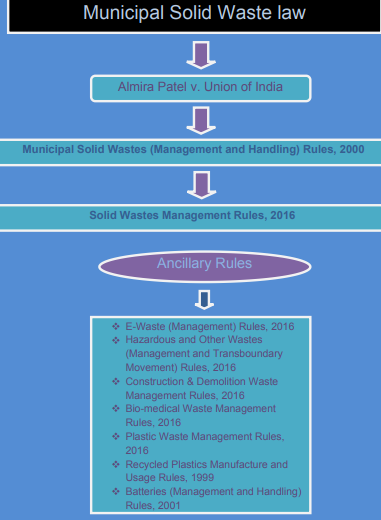
Municipal Solid Waste Management

References

[1]ISWA Report 2013, International Solid Waste Association,

http://www.iswa.org/fileadmin/galleries/Publications/ISWA_Reports/ISWA_Report_2013.pdf

[2]Daniel Hoornweg, & Perinaz Bhada-Tata, What a Waste: A Global Review of Solid Waste Management, Urban development series, Knowledge Papers no. 15, World Bank (2012), https://openknowledge.worldbank.org/handle/10986/17388

[3]Id.

[4]Solid Waste Management In The World’s Cities, Water And Sanitation In The World’s Cities 2010, UN Habitat (2010).

[5]V Prasad Modak, Strategic Action Plan for Integrated Solid Waste Management Plan, Pune (Vol. I), UNEP DTIE IETC & Pune Municipal Corporation (PMC) (2007).

[6]DHNS, Dump yards turn death traps for ragpickers in Hyderabad, DECCAN HERALD November 24, 2011,

www.deccanherald.com/content/207155/dump-yards-turn-death-traps.html

[7]2000(2) SCC 166.

[8] Notification No. S.O. 908(E), dated the 25th September 2000.

[9] (1996) 2 SCC 594

[10] AIR 1980 SC 1622

[11] Priyanka Singh, Municipal solid waste treatment plant remains a non-starter,

TIMES OF INDIA, June 16, 2014,

timesofindia.indiatimes.com/city/lucknow/Municipal-solid-waste-treatment-plant-remains-a-non-starter/articleshow/36674835.cms

[12] P. U. Asnani, Solid Waste Management, India Infrastructure Report (2006), www.iitk.ac.in/3inetwork/html/reports/IIR2006/Solid_Waste.pdf.

[13] National Green Tribunal, Original Application No. 199 of 2014; Original Application No. 61 of 2017; Original Application No. 281 of 2016; Original Application No. 428 of 2017, available at

www.indiaenvironmentportal.org.in/files/landfill%20Delhi%20NGT%20Order.pdf.

[14] National Green Tribunal, Original Application No. 552/2017; Original Application No. 553/2017; Original Application No. 554/2017; Original Application No. 555/2017, available at

www.indiaenvironmentportal.org.in/files/solid%20waste%20management%20Delhi%20rail%20platforms%20NGT%20Order.pdf.

[15] National Green Tribunal, Original Application No. 199 of 2014; Original Application No. 61 of 2017; Original Application No. 281 of 2016; Original Application No. 428 of 2017, available at

www.indiaenvironmentportal.org.in/files/Ghazipur%20Landfill%20management%20NGT%20Order.pdf

[16] Appeal No. 70 of 2012, National Green Tribunal

[17] Punjab-Haryana High Court, C.W.P.No.3611 of 2009 (O&M).

[18] National Green Tribunal, Application No. 86 OF 2013

[19] G.S.R. 320 (E) dated 18th March 2016.
 

Download Now

How Not To Prepare For CLAT : 5 Weeks & 5 Mistakes To Work On

18
Image Courtesy : https://s3-ap-south-1.amazonaws.com/tr-wp-media-uploads/exams/wp-content/uploads/2016/02/11061951/How-to-prepare-for-CLAT-EXAM.jpg

In this article Sarang Khanna, Content Marketing Executive at iPleaders, talks about how not to prepare for CLAT. 5 common mistakes that need to be eliminated and worked on. 

You have just had your first, very deserved, sigh of relief after the much disputed board exams this year. Guess what? It’s now time for CLAT. With the ever increasing applications and popularity of this exam, your anxiety is entirely understandable. I still remember when I started preparing for my CLAT back in 2011, with under 2 months left for the exam, I could barely make head or tail of the preparations.

However, massive internet literature on the exam today has made it easier for everyone to organize their time well and undertake a ‘planned strategy’ for preparations. Or has it? If you ask me, as helpful as posts like mine could prove in upping your CLAT game, they are also enough to leave you confused and diminish any possibility of following a productive approach. Moreover, if everyone is treading on the same overcrowded street, what are your chances of overtaking any of them?

Here, I try to discuss 5 don’ts of CLAT prep, which if you successfully eliminate during the next 5 weeks of your preparation, you will definitely have a shot at a much better score.

5 weeks, 5 mistakes to work on. Let’s see what they are!

Take That First Test Immediately – The Reality Test

One might argue that it’s now too late to start your preparation from scratch. Well, to put it simply, it never is. Although, the more you delay your reality check from this point onwards, the more your preparation is going to suffer. Aimlessly beginning to start section-wise preparation without the groundwork can be fatal.

Take that mock test. Be it online, or from one of your offline institutes. Taking a few mocks before even starting your prep will help construct your personal plan of action. Identify your shortcomings and devise a strategy accordingly.

Don’t Be Overwhelmed

The most common queries that come to us regarding CLAT also point towards the most common mistakes students make these days. It is having 10 different sources for every other subject. Frankly, CLAT does not demand such extensive research on any section. DO NOT fall into the trap by following your peers who are referring to multiple sources. Stick to the basics.

Remember, CLAT is an aptitude test. It is an assessment of who you already are, and a month of excessive mugging cannot dramatically change that. Follow single sources for each subject, ideally, and be completely thorough with them.

Take Your Time, But Not Too Much

We all work at our different paces. For you, reading comprehension must be like kid’s play, while I might require to re-read a passage before fully understanding the gist of it. It is alright to be slow at something , provided you understand the essence and eventually become faster at it.

Legal reasoning is another tricky section that tests both, your patience and understanding. With negative marking in place, you are better off being late than being wrong. Having experience and the required frame of mind are the only two ways of going around this section.

Don’t Underestimate Legal Reasoning

Only yesterday, a CLAT 2018 aspirant told me, “I am a dropout, already in my first year of law school. I think I know enough law now to do great at legal aptitude.” I couldn’t help but burst his bubble of overconfidence right after he finished. Confidence is a good thing, but not when it is flowing from false evidences.

It might arguably be good to have a legal inclination while attempting this section, but you need to realize that it is not meant to test your legal knowledge, but only your application of it. In fact, some of you would even agree with me when I say that prior legal knowledge may be a bad thing when you are dealing with the questions in this section.

For instance, try solving this simple legal aptitude question, and give us the correct answer in a comment, if you can.

Principle: Willful rash driving is an offense.

Facts: Mr. Tiwari was driving his car after drinking alcohol. Police books him for willful negligent driving. Is the act of the police lawful?

(a) Yes, because Mr. Tiwari was driving rashly

(b) Yes, because Mr. Tiwari was drunk while driving.

(c) No, because Mr. Tiwari was not rash; he was only drunk while driving.

(d) No, because Mr. Tiwari is doing nothing illegal.

Are you prepared enough to solve trickier questions than this in your first go? Can you skillfully assess and answer the legal aptitude questions that involve multiple principles?

Visit here to practice more such questions.

This section, with questions like these, has always proved to be the distance you need to go for that national law school of your dream. Misinterpreting this can heavily discount your scores. A one stop solution for everything legal aptitude is this course designed by the very best in the industry. Take a look for yourself and do things differently in order to compete.

Don’t Delve in Last Minute Mugging

General Knowledge and English vocabulary can be very intimidating as the D-day approaches closer. It is best to update yourself on both these areas every day, rather than trying to master these sections individually in a small period of time.

Developing English proficiency and General Knowledge (both static and current) requires long and sustained efforts and doing them continuously every day alongside other subjects. Reading a newspaper or a good magazine everyday can help with both English and GK together. It is also an extremely bad idea to try to mug voluminous Pratiyogta Darpans during these last moments of the exam.

Similar is the case with Math. A strategy that I found best was to carefully spread out all my topics from different sections everyday, and do them at different times of the day to maximize understanding and productivity. Switching subjects after every little while kept me fresh and going for longer hours than usual. Figure out your own ways to add to your speed.

Last minute jitters are natural, but keeping your calm, and following the simple well thought out strategy that suits you will help you ace it. Remember, you are the best judge of yourself. I, or any other coaching gurus, can only help you so much. This exam, in many ways, is the extension of your personality and so is the preparation of it. Only you know best how to mould it and get past others and reach the top.

To end all your worries about Legal Reasoning and Legal GK, visit here and enroll.

Here’s wishing you the very best of luck for the 13th of May.

Download Now

Sexual Harassment in the Hotel Industry and What Can You Do About It

0
image courtesy - www.express.co.uk

Sexual Harassment in hotel industry is more common that it seems. It is disgraceful and embarrassing to learn the plight of the women who work in the hospitality industry. So what can one do about it? Is change possible? What can you do if you come across such an incident? In this article Aditya Shrivastava, Manager, Content Marketing at iPleaders has some interesting insights to offer.

When you clicked on the link to this article what was the first thought on your mind? Just another saucy article about the prevalence of “open-sex” culture in the hotel industry? A lot of us think that men working in the hotels – right from the managers to the chefs or women, for that matter, are most likely open to the idea of having consensual sex. That’s the most common perception and attitude, “Indians” have for women who work in the hotel industry.

I would like to request you to take a moment and google “Sexual Harassment at Hotels.” You will be embarrassed to see the results. In a report by The Guardian, “9 out of 10 workers said they have experienced sexual abuse..Preliminary research gathered from workers in the hospitality industry found that 89% said they had experienced one or more incidents of sexual harassment in their working life.

It is perhaps due to such concentration of regular sexual harassment of female workers in bars, clubs, hotels, resorts, and restaurants that it is now considered normal in the hospitality ecosystem. You can find innumerable testimonies of staff accusing their employers of failing to protect them from regular sexual abuse.

Adding to this saga are not only small or inexpensive hotels. Even prestigious hotels like the Taj have time and again been accused of not being able to protect their employees. It was in 2015 as per a report by The Economic Times that a female executive alleged that the Taj Group’s then CEO Rakesh Sarna of sexual abuse. However, as per the same report, Sarna was given a clean chit by an independent panel constituted by the company. Eventually, Sarna quit the company predominantly due to ‘personal reasons’ as per BSE filings in another report by The Economic Times.

In 2017, a video of a woman being abused by the Pride Plaza’s security manager, with a third person (woman’s immediate supervisor) present in the room and not reporting the matter. The aftermath of it? The woman was sacked from the job for reporting the matter. In 2017 June, one of the Taj Group’s subsidiaries, Ginger Hotels was in news for an alleged case of sexual harassment by Rahul Pandit, CEO of Roots Corporation.

Here are some facts that can blow your mind :

  • In a survey conducted by Hindustan Times, 69.8% victims did not complain about sexual harassment at workplace.
  • A 2015 FICCI report found that there is an increase in the number of sexual harassment complaints at the workplaces. The numbers almost double every year.
  • National Crime Records Bureau’s data reveals that out of 8,685 cases filed under Section 509 of the Indian Penal Code (outraging the modesty of women), 119 occurred at the workplace and 714 cases were reported at places related to work.
  • As per the same report, 557 women were raped by their employers or co-workers.

Why is the situation so terrible?

As per this report by rediff.com, the number of women working in the hotel industry is fairly less. The article recites a story of a young girl named Kiran. She was one of four girls in a class of forty during her course. Thirty-six boys and four girls. It is because of such a scarce number that women’s agony and pain generally go unnoticed or unreported. A major reason for the same is society’s perception about the female employees in the hotel industry. They do not understand that it is similar to any other day-job and it needs to be equally respected.

So what can one do about it?

As per this report, Human Resource (HR) experts blame bad or no orientation program for training the employees or the management. In the article, an  HR expert who handled Corporate HR and Training of many hotel companies in India says, “Today, most of the people dealing with labor and HR matters are ignorant of the rules and compliances to be followed while handling matters concerning allegations of sexual harassment. How many hotels’ annual reports mention the number of employee orientation programmes they undertake in the hotel. Sensitisation is most important at all levels about what all comes under sexual harassment.

In a society where depriving a woman out of modesty is considered “normal,” people need to be sensitized at all levels. There need to constant seminars, the inclusion of sexual harassment policies in the brochures, induction programs, online courses, a detailed list of what should be done and who should be called in case of harassment provided to each and every individual in the organization.

If you are a woman or someone who is witnessing any such harassment, here are some of the steps you can take:

  1. Do not stay quiet! Say no! If there is any person from the management (or the visitors) walk away if they make you uncomfortable. There is no job which demands you to be respectful towards those who demean you.
  2. Demand a copy of the sexual harassment policies from the hotel you are going to join if they haven’t already given you one. It is important for you to know how much the organization is willing to protect you. 
  3. Keep your friends and family informed if you sense anyone trying to make advances towards you. However, it is always better to file a written complaint with the Internal Complaints Committee (ICC) if the advances are too strong to overlook. 
  4. Keep yourself updated about the law. You can read articles like these or take a course which can inform you about your rights. If you are an HR, it is all the more important for you to know the sexual harassment laws and keep the employees informed about the possible remedies. You can actually help the organization design a comprehensive sexual harassment policy. 
  5. Never accept a plea from your workplace that is along the lines of “it is a first time and won’t be repeated.” Remember a crime once committed is committed and there are no two ways about it.

As a last resort, remember you can always file a written complaint to the ICC within 3 months of such crime being committed against you. If you think that it won’t be of help, file the complaint with the Local Complaints Committee (LCC) or the police station near you. Remember there is an Act in place to come to your rescue.

It doesn’t matter which industry you are working in. Harassment is harassment. Get up and speak before it gets too late.

The law is with you.


Download Now

3 Challenges Lawyers Face In Their Day To Day Jobs And What Can They Do About It

0
Image Courtesy - www.appearme.com

In this article, Aditya Shrivastava, Content Marketing Manager at iPleaders talks about what are the 3 challenges that every lawyer faces and what can they do about it.

Isn’t it always easy to assume that someone else is progressing when you are not? Or someone’s path is way easier than yours? The friend who got placed through an easy internship? Or the one who got through a big law firm because her dad’s friend was a partner at the firm?

It is convenient to perceive that someone else’s journey is much easier than yours. Isn’t it? We have all had these thoughts. It is very natural to have them too. We all go through these notions that everyone is taking smarter steps, their plans were in place well in advance, their continuous effort (or presumably no effort) is taking them where they are, while we are still stuck at:

  1. Marching forward and then taking a step back
  2. Taking breaks due to confusion
  3. Forgetting why we embarked on the journey in the first place

A lawyer’s life can often feel like that. It is not restricted to the courtroom blunders in litigation or missing out on the big clients in corporate law firms. It is about constantly reminding oneself that success does not necessarily come from wise, ultra-productive and well-planned decisions.

When I was opting for the law as a career, my relatives kept telling me that it is a constant struggle. You will have to keep reading and keep yourself abreast with the latest law (which wasn’t an effort, thanks to courses like these).

Law is a constant trying-to-figure-out-what-the-hell-is-going-on kind of situation. And this is exactly what makes it so brilliant. It cannot be pre-planned. Yes, you can make conscious choices and increase your chances of getting desirable outcomes, however, that won’t necessarily grant you immunity from challenges, hurdles, and hardships.

For example, getting a placement through my law school was a task. I was struggling very hard. It was then that I took up this course. It made my life better as thanks to the practical insights I got here, I managed a pre-placement offer in a law firm. In spite of getting the job, like what I was doing was a different struggle.

Try to think it through, “sometimes challenges are exactly what we need for understanding our priorities and making the right choice.”

When I was working at an MNC, my life was pretty easy. Same job, same processes, same rigmarole, same humdrum. The minute I took the decision of following my passion for writing, life seemed miserable in the beginning. I had to move from a comfortable lifestyle in a city to a humble life in a small town in Goa. Writing was not as easy as I presumed it would be. I took it as a challenge. Today, facing those challenges has been given me returns. Think of challenges as long-term investments. They make you come closer to success, thereby giving you returns.

To remind us that we are working towards a goal and a mission of making ourselves better, life throws massive challenges at us. These challenges, if passed, are the ones which mean that we are coming closer to success or progress. Here are few signs:

1. When you hear no more than once

You could be a lawyer who is supposedly absolutely brilliant with your work. Be it the area of law or be it arguments, you are amazing at it. However, there could be a time when a judge or your senior could simply reject your line of thought in a certain case. It could happen over a period of time, over and over again.

The first time I approached a top law firm my application was rejected. It was maybe because I had applied too late and they didn’t have an opening. The next time I made sure I applied months in advance. I got the internship, and as I was rejected once, I gave it my best shot. I took up this course in advance to get a strong-hold on business laws. Consequently, I was offered another internship there and ultimately a job. The original ‘no’ actually pushed me a little closer to where I wanted to be!

“No” is generally an indicator that you need to try a bit harder, push your limits and wait for the magic to happen. I wouldn’t probably have worked so hard to make it happen if it wasn’t for the rejection.

2. You have “wasted” your time on a client or a case

In the legal profession, there are times when lawyers are expected to work very hard for a client or a case and it does not turn out to be as fruitful as expected. Either the case does not turn out in their favor or they feel that those were undue prolonged work hours with no returns.

For example, during my internship at the very same law firm I was asked to work on a project related to a corporate restructuring deal. A pharmaceutical company in Tamil Nadu was restructuring and I was asked to check the transferability of 56 licenses under various Tamil Nadu legislations at 8 o’clock in the evening. I sat down for the whole night to do my bit of research and finally sent the report at 7 am in the morning. Later that day, my senior told me that she had forgotten to tell me that the deal was canceled. I felt disappointed. “What a waste!” was my first thought.

What I gradually learnt was investing time in research or such tasks may not pay off immediately but they are always helpful later at some point in time. It is never useless.

3. Your work or workplace makes you uncomfortable

Being uncomfortable at work isn’t a very good feeling. There may be times when you might feel out of the place or too dumb as compared to your colleagues. In a law firm or a company for that matter, there is always a constant war to figure who is better! Who will make partner this year? Who will be assigned to the new client? Who gets to work with the senior partner on a new project?

Have you ever wondered why do you feel inferior while surviving through such tough competition?

It is probably because of 2 reasons: a) either you have not showcased your true potential; b) you or your work come across as a threat to others.

Would you like to give in to such situations?

No, I hope. Remember a famous Bollywood movie once said, “If people are making it hard for you to survive, you are progressing.”

Keep striving towards betterment and know that you are doing well. It perhaps might not be the best time, but it surely will get better.

Wait till the clouds to show you the silver lining.


Download Now

Difference between Listed and Unlisted Company

1
Image Source - http://www.managers.org.uk/insights/news/2017/december/the-slow-murder-of-the-listed-company

In this Article, Riya Kothari pursuing Diploma in Entrepreneurship Administration and Business Laws from NUJS, Kolkata discusses the difference between Listed and Unlisted Company.

Introduction

According to various sources, listed companies are those which are included and traded on a particular stock exchange. The stock exchanges have various prerequisites that a company must fulfill and continue to fulfill in order to be and stay listed.[1] A private company needs to go public in order to sell its share to the public; once it goes public they register themselves with a stock exchange. The reason companies like to go public is so that they can reduce their debt and have means of financing themselves apart from bank loans. A public company need not always be listed. An unlisted public company is one which is not listed on any stock exchange but can have an unlimited number of shareholders to raise capital for any commercial venture.

A company may not be registered for a number of reasons, such as-

  1. Not large enough to quantify for stock exchange listings.
  2. Very few shareholders listing.
  3. Is not seeking public investors.

What is Listed Company?

A company whose shares are traded on an official stock exchange. It must adhere to the listing requirements of that exchange, which may include how many shares are listed and a minimum earnings level.[2]

What is Unlisted Company?

These are companies that are not listed on the stock exchange, so they are privately owned. Since they are not on the list, they do not have the opportunity to raise funds. They are becoming capital investors. The trading of the shares is “over the counter”, where the specifications of the agreement can be made in accordance with the requirements of the parties concerned (buyers and sellers); therefore, the exchange of controls is avoided. Unlisted companies have better control over their business operations.

Some questions that come to mind are- Can an unlisted company issue shares on private placement? What is the liability of directors in such a case? What happens if the shares of these companies don’t get listed on any stock exchange? Do the investors of this company have an exit route?[3]

The question of whether an offer of shares or debentures to a few people amounts to a public offering will depend on the facts and circumstances of each case.

The important point to keep in mind is that:

  • When an offer of this type is treated as a public offering, it must comply with all applicable Sebi requirements in the case of an initial public offering.
  • This company would have the obligation to comply with the rules applicable to public companies not listed for the issuance of shares on preferential terms.

Rules of Unlisted Public Companies (preferential allocation), 2003

These rules are applicable to all unlisted public companies with respect to preferred issues (private placement) of shares, fully convertible bonds, partially convertible bonds or any other financial instrument, which would be convertible or exchanged with equity securities. The public unlisted company must make the specified disclosures in accordance with those rules.

Rights of Investor

  1. The potential investor has the right to request from the public company that is not listed on the stock exchange an informative note with the highlights of the proposed private placement, which the company must provide.
  2. Investors should bear in mind that buying shares offered by an unlisted public company via a private placement with the promise of the same listing do not mean that the shares will automatically be included in the list.
  3. Nor does it mean that a stock exchange would be obliged to quote such shares.
  4. An unlisted company must comply with SEBI’s requirements and make the initial public offering (IPO).[4]
  5. Therefore, a mere promise to quote at a later date will depend on several factors. In addition, it is possible that the said company does not commit in writing to the shares listed on any of the recognized stock exchanges. Any investment in equity is still fraught with risks, which vary according to several factors.
  6. The directors of the unlisted public company, who has offered shares in a private placement, incur no additional liability if they have complied with the provisions of the Companies Act during the private placement.
  7. However, if the private placement offer is misleading or if the directors have committed fraud with the investors, they could be considered personally liable. However, investors should keep in mind that even if the directors of the unlisted company had promised that such shares would be listed and that such listing would not occur, even if legal action could be brought against them, it would be difficult to seek effective action.
  8. In case the shares are not on the list, then the investors have no way out and if they intend to sell the shares, they have to wait for the people who sold them those shares.

Key Differences Between Listed and Unlisted Company

Listed and unlisted are the two types of core companies. While profit maximization is the primary goal of both, there are many differences between listed and unlisted companies, depending on the size, structure, and methods of obtaining capital.

    1. The main difference between the listed company and the unlisted company is its ownership; listed companies are owned by many shareholders, while unlisted companies are owned by private investors.[5]
    2. The decisions of the companies are made by the board of directors appointed by the shareholders, which includes the executive and non-executive directors. Board compositions are often specified and governed by various corporate governance requirements.
    3. Decisions must be taken into account in some important decisions. Shareholders are entitled to two forms of return by investing in a listed company. They are:
  • Dividends

It is a sum of money paid by the company to its shareholders on their profits. Some shareholders prefer to collect dividends while others prefer to reinvest the amount of money to which they are entitled in the business, the so-called concept of reinvestment of dividends.

  • Capital gains

Capital gains are profits from the sale of these investments.

It is not mandatory for a company to appear on the list to succeed. Unlike listed companies, disclosure requirements for financial results are not subject to strict rules, so they are flexible and less complicated.[6]

Recent Development

  • In the budget, there was a cut in corporate tax announced which is going to benefit the listed companies.[7]
  • More than 2,700 companies listed on the Bombay Stock Exchange (BSE) are likely to earn revenues from the proposed budget for 2018 of the existing 30%. The analysts have given their approval to the development and hope that the generated surplus will help in the creation of employment. It is believed that a large part of MSMEs will benefit from the cut in the corporate tax rate.
  • “The focus on rural development and the ‘common man’ was largely expected, but the announcement of the new cost formula plus minimum support prices and the introduction of an LTCG tax on equity is a negative surprise. On the other hand, the company’s tax reduction, the commitment to medium-term fiscal consolidation and the continuous spending on infrastructure are positive aspects, “said Sonal Varma, Nomura’s Indian economist in a note.
  • Amar Ambani, partner and head of research at IIFL, believes the move will be beneficial for a number of non-bank financial companies and state finance councils (SFBs) that focus on small business finances.
  • “The budget addresses the needs of the agricultural sector and MSMEs, through which it is intended to achieve an inclusive growth agenda, the formalization of the economy and the creation of employment.”
  • The FM’s promise to reduce the corporate tax rate from 30% to 25% for companies still limited to MSMEs leaves large contributors to wait another year, however, 99% of MSMEs with a turnover of up to 2.5 billion rupees would benefit from the reduction in the rate, “said a note from Deloitte India.

Conclusion

Legally speaking, in the case of an unlisted public company, it is not necessary that such shares be resold to the promoters or the persons from whom they were acquired. These shares can be sold to anyone, but it would normally be difficult to find a buyer for unlisted shares. The legal position is that anyone who buys such shares can have the same transferred on their behalf in the company’s registry without any objection from the company. Of course, the seller and the buyer must respect normal compliance, such as the appropriate transfer document, the publication of transfer stamps, etc. In conclusion, it can only be said that it would be desirable for investors to move away from unknown companies listed on the stock exchange. Unless promoters are personally known, investors must refrain from investing in shares or obligations offered by a publicly-listed company. Otherwise, investors would run the risk of obtaining shares that could be difficult to sell even at a discount.


LawSikho has created a telegram group for exchanging legal knowledge, referrals and various opportunities. You can click on this link and join:

https://t.me/joinchat/J_0YrBa4IBSHdpuTfQO_sA

Follow us on Instagram and subscribe to our YouTube channel for more amazing legal content 
 

References

[1] https://www.investopedia.com/terms/l/listed.asp

[2] Definition of listed company http://lexicon.ft.com/Term?term=listed-company

[3] Risks of investing in an unlisted company (2006, November) http://www.financialexpress.com/archive/risks-of-investing-in-an-unlisted-company/157353/0/

[4] Guidelines for company listing

http://www.bseindia.com/Static/about/listsec.aspx

[5] Difference between listed and unlisted companies (2017, January) http://www.differencebetween.com/difference-between-listed-and-vs-unlisted-company/

[6] Ibid

[7] Wadhwa, P (2018, February) 2,206 BSE listed companies to gain from the cut in corporate tax

http://www.business-standard.com/budget/article/2-706-bse-listed-companies-to-gain-from-cut-in-corporate-tax-rate-118020200214_1.html


Download Now

Alteration of Share Capital under Companies Act, 2013

1
alteration of shares
Image Source - http://ecceconferences.org/business/running-a-successful-business-is-with-expert-guidance.htm

In this article, Sashvat Aggarwal, pursuing Diploma in Entrepreneurship Administration and Business Laws from NUJS, Kolkata explains Alteration of Share Capital under Companies Act, 2013.

Introduction

The capital of a company is separated into units of a fixed denomination and such unit is a share. A share in the share capital of a company and includes stock which is defined under Section 2(84).

Section 2(8) of The Companies Act 2013, defines that “Authorised capital” or “nominal capital” means such capital which is authorized by the memorandum of a company to be the maximum amount of share capital of the company. The companies are allowed to alter the authorized share capital according to the procedures mentioned in Section 61 to 64 read with Section 13 and 14 of the Companies Act. An increase or decrease in the share capital of a company may be carried out as and when the company requires thus leading to an alteration in the company’s share capital. The alterations to the capital clause have to be done according to the Companies Act, 2013.

The procedure involved in altering the Share Capital

  1. It has to be confirmed whether a company is authorized to increase its share capital according to the Articles of Association (AOA) and if it does not authorize then the procedure for such alteration has o be carried out.
  2. A board meeting should be called for an Extraordinary General Meeting (EGM) to get the approval of the shareholders for such alteration.
  3. The EGM should be called comprising of the shareholders by sending a notice mentioning the purpose of the scheduled meeting regarding the alteration of the MOA and AOA thus altering the Share capital of the company.
  4. The Special resolution shall be passed to alter the MOA and AOA thus altering the Share Capital of the Company.
  5. Authorising the board to file necessary forms and resolutions with Registrar of Companies (ROC) having jurisdiction.
  6. The e- form SH-7 with ROC on payment of a stipulated fee.

Once the AOA has been altered the board meeting has to be called by the company. Every member, legal representative or the assignee, the auditor(s) and every director of the company has to be given a notice of 21 days prior to the actual date of the meeting. The notice shall be written or in an electric form. The general meeting can also be convened at a shorter notice if 95 percent of the members who are allowed to vote at the meeting give their consent in the manner prescribed written or electronic.

The place of the meeting, the date of the meeting and the hour of the meeting shall be specified in the notice along with the business agenda of the meeting which is mentioned under Section 101 of the Companies Act. Along with the notice a statement should be attached therewith specifying the particulars and objects regarding every point of extraordinary business to be carried on at the general meeting, concerning the financial or any other kind of interest related to all the directors and the managers and people related to the key managerial persons according to section 102 of the CA, 2013.

Once the formalities of the notice have complied with the company shall call an EGM and the members have to vote either in favor or against the alteration of the authorized share capital. An ordinary resolution is passed by the board members after holding of the EGM.

Alteration of the MOA and AOA

  1. The power of a limited company to alter its share capital is given under Section 61 of the Companies Act, 2013. Sub-clause further states that a limited company having a share capital may, if so authorized by its articles, alter its memorandum in its general meeting to:
    1. Increase its authorized share capital by such amount as it thinks expedient
  2. The authorized share capital of the company can be increased by altering the memorandum of association. The provisions regarding the alteration of memorandum of association and Articles of association are given under Section 13 and 14 of the Companies Act respectively.
  3. A company may alter the provisions of the memorandum after it has passed a special resolution thus complying with the procedural requirements given under Section 13.
  4. An alteration has to be made in the Memorandum Of Association and the Articles Of Association under clause 5 and 4 respectively.
  5. According to Clause 5 ‘, The Authorized Share Capital of the company is INR 1,00,000/- divided into 10,000 Equity Shares of INR 10 each. The minimum paid up share capital of the company is INR 1,00,000.
  6. Alteration of AOA with regards to increasing of share capital is given under Clause 4.
  7. Section 14 of the Companies Act, 2013 also states that where the company does not have the authorization to amend its AOA then the alteration can be carried out by the procedure of passing a special resolution.
  8. Section 14 states that the alteration to a company’s articles can be done only by passing a special resolution and the order of approval of the alteration carried out has to be filed with the ROC accompanied with the hard copy of the actual altered articles not later than fifteen days in the manner which is prescribed. The alteration is only valid if there was a provision in the original articles

Registrar to be given Notice

The registrar of companies shall be notified within a period of thirty days from such alteration and a copy of the altered memorandum has to be provided as well. In case of default by the company or any of its officers, the company or its officers shall be liable and punishable with a fine which may extend up to thousand rupees for each day of delay or rupees five lakh whichever is less. The above provision is given under Section 64 of the Companies Act.

Purpose of the form

Whenever a company alters its share capital or number of members independently or increases the share capital by conversion of debentures/loans due to the order of Central Government, then a return shall be filed with the registrar within 30 days of such alteration. The return shall also be filed where the company redeems any redeemable preference shares.

Stamp duty can be paid electronically through the MCA portal and the following documents are to be attached

  1. Notice of extraordinary general meeting
  2. Certified true copy of the ordinary resolution
  3. Altered Memorandum of association
  4. Altered AOA, if any.

E-Form MGT 14 to be filed

While the filing of the Form MGT- 14 the provisions mentioned under section 117 (1) and Section 192 of The Companies Act 2013 have to be dealt with. Under sub-section 3 clause 1 of Section 117, the provision mentioned therein also apply to a special resolution.

The copy of all the decision taken with respect to the matters which are specified under subsection 3 along with the explanations under section 102 shall be attached therewith to the notice convening the EGM in which the proposed resolution shall be passed should be filed with registrar not exceeding thirty days along with the stipulated fees which has to be paid as specified under Section 403 of the Companies Act.

Section 117(1) states that a copy of the resolution which has the effect of altering the articles and copy of every agreement referred in sub-section 3 shall be attached to every copy of the articles issued after passing of the resolution or making of the agreement.

Repercussions of not filing the form

According to section 117 (2) where the company fails to comply with the provisions mentioned in sub-section (1) the company shall be liable to pay a fine which shall not be less than five lakh rupees and may extend up to twenty-five lakh rupees. Each officer of the company who has defaulted along with the liquidator of the company shall be liable to pay a fine of rupees one lakh which may extend up to five lakh rupees.

Attachments

The below-mentioned documents have to be attached:

  1. The true copy of the resolution with the copy of explanations under Section 102.
  2. Altered MOA (Mandatory in case any change in MOA).
  3. Altered AOA

Therefore, by complying with the above provisions and procedure the company can alter its capital clause by altering the MOA and AOA when it needs to raise more money.

Download Now

Essential Legal Contracts For Your Startup: Can You Draft Them On Your Own?

0
Image courtesy : https://i.ytimg.com/vi/fcjmVj5fM5k/maxresdefault.jpg

In this article Sarang Khanna, Content Marketing Executive at iPleaders, talks about the essential legal contracts for your startup that you MUST know about. Also, how to minimize your costs of getting them drafted.

Businesses are set up by putting plans into action. Anyone who has started a business, knows the importance of having tangible reproduction of ideas and expectations. Contracts are just that. Contracts state the expectations of the parties and define their boundaries. Contracts legally bind individuals and/or businesses to their words, and give both parties certain rights. They are enforceable by law, and there are assured penalties for any breach.

Contracts are a great safeguard for any business, and especially important for young startup companies. To have a written agreement in place is often the first step done right which paves the way for several others. Partnership = Contract. Employment = Contract. Investment = Contract. License = Contract. For almost any relationship that you or your business indulges in, there needs to be a contract.

Let’s look at some of the most essential agreements that you will have to draft (or get drafted) in order to have organized and successful operations at your new startup. We will also try to give you an idea of how much each of these contracts can cost if you want it to be drafted by lawyers and what can you do to save that crucial capital.

Founders Agreement  

For an early age startup, this is a crucial agreement that defines ownership, responsibilities, operations and decision making policies. It is a commonplace mistake for young companies to not be aware for the basic and essential clauses that founder agreements must contain.

What if your co-founder deserts you in between? What if they misuse their decision making power to land you in a legal soup? It is always better to have a detailed founders agreement in place, even before you have formally incorporated the company.

The purpose of founders agreement is to minimize the surprises and confusion that come along with having a young company trying to scale up. This contract helps avoid disagreements, and also acts as a guide in case they crop up. Although a fairly basic type of contract, but it can still cost anywhere between 3000-10,000 Rupees if you get it drafted by a professional.

Non-Disclosure Agreement (NDA)

It all starts with an idea, doesn’t it? What if that idea itself is stolen, when you are prematurely looking for partners and investors to work with? Is there a way to protect your idea? Well, a Non-Disclosure Agreement (NDA) could be your answer.

However, ideas are hard to protect, and moreover, investors don’t sign it. The real value lies in execution of that idea and NDA’s can only protect you so much before you have started your business. They are not a magical spell that would give you 100% safeguard against theft of ideas.

Does the term ‘confidential information’ in your contract include ideas and concepts? Should you have a non-compete clause in your NDA? Well, it depends on which side of the contract you’re on. There is always one party that has information to protect and the other party that is getting the information. How broad you want to keep the definition of ‘confidential information’ then becomes a matter of negotiation. Further, non-compete clauses in NDA’s  are rare and also problematic to enforce. Often you can risk losing your potential partner just by having this clause in place. Beware!

Truth is, NDA’s are and will be violated. The threat of litigation, which is often empty, has stopped acting as a deterrent. One can sue to enforce the non-disclosure agreement in case of breach, unfair competition, actions against the terms and misuse of trade secrets, among others.

To know which clauses to add in your NDA is imperative. These agreements are detailed, and lawyers can charge you anything upwards of 10,000 Rupees to draft one for you. To know how you can draft this on your own, you can refer here for details!

Rent Agreements

If you are not primarily an online business, you will require an office space to work out of. Rent and lease agreements are required when hiring a commercial space. Sometimes, even for online businesses operating out of homes, violation of terms of residential agreements can force you to move into a commercial space.

Can you imagine what could happen if your leased office space becomes of no use to your business due to unforeseen circumstances? I personally know of a business that suffered immensely when the government decided to shut all neighboring streets around their shop, as they had to lay down the metro line. With the construction of metro and then an additional flyover, traffic went drastically down and the business was rendered useless. Livelihood is at stake in scenarios like these.

Your rent agreement can have solutions in place in case of such problems. Do you have the right to further sublet in your contract?  Do you have the right to terminate the agreement if the purpose of use (business) becomes impossible? Read your lease contracts carefully before signing. Know the fundamentals before hand and add relevant clauses that save you from these horrifying times. To know more about the crucial basics of rent agreements, click here.

License Agreements

Several licenses are required when you are doing a business in India. In a country obsessed with paperwork, there is a license for everything. From simple tax registrations, to import-export licenses, trade licenses, shop and establishment license, end user license agreements, etc. The list can go on.

Are you a restaurant operating in the bustling localities of Delhi? You’ll require an additional license from the fire department. Not a restaurant but only a food delivery service being operated out of your own home? You will require a food and health license from FSSAI. Setting up a small waste disposal factory in the outskirts of your city? You’ll need an air and water pollution control permit.

For every business that you can think, there is a long list of licenses that you need in order to start operations. Find out which all licenses apply in your line of work. Do your research and then move forward after fulfilling all legalities.

Vendor Agreements

You have to enter into vendor contracts for many additional services that your business must require. No business is self sufficient, and having the right vendor agreements during the early stages of your business is essential. These agreements are useful for setting expectations between parties before the transaction of sales or services takes place.

However, the underlying context of even a few words in the vendor agreements can transfer large risks from one party to another. I have personally encountered so many problems in vendor agreements that go unnoticed until it’s too late. One needs to be extra cautious with vendor agreements and must read and understand each paragraph and also make changes to protect themselves.

Imagine if a hidden or cleverly worded clause in your vendor agreement could suddenly trigger your cost hike for a service that you are buying from a vendor. What if due to some violation of law by your vendor, your business becomes liable for something illegal? Can you think of smart clauses to add to your agreement in order to be protected beforehand in such eventualities? Comment below and let the community know.

Employment Contracts, Investment Contracts, Protection of Intellectual Property, Terms and Conditions, Franchise Agreements, etc. etc. etc.

When being a part of any kind of deal with any party,  you need to have a contract. Sure, it may seem a little daunting for young companies to indulge into intimidating legalese, but contracts are your best friends. They are the outlines to so many operations of your business and they ensure organization so that you don’t have to. (Ideally!)

Often beginners make the mistake of being party to an unenforceable contract and let go of all their worries by just signing one. Remember, you will not cease to be vulnerable if you do not understand the basics of what you are signing and how contracts operate. Not only for lawyers, contracts have become a vital part of everyone’s life today. Even if you are a pakoda-seller outside another eatery you will still need to negotiate your terms of contracts to operate out of that given place. Let’s say you are a student trying to rent a room next to your college, you will again need to be aware of contracts.

Contracts are everywhere, and as I already mentioned, they have the ability to be your best friends. For businesses, they are crucial in running them and defining their trajectory. It is best for everyone to understand and to know how to draft all contracts. Resources like this can and have empowered normal people like you and me by allowing us to take matters in our own hands. Not to mention the huge amounts you can save by drafting your own contracts.

Empower yourself and your business, and don’t let clauses make you leave defenseless.

Amen!


Download Now

How to manage your studies and co-curricular activities inside the law school

0
mnaging your studies
Image Source - https://depositphotos.com/109765548/stock-photo-confused-student-looking-up-questioning.html

In this article, Namita Chandwani, of Indore Institute of Law College discusses ways to manage your studies and co-curricular activities inside the Law School.

Introduction

Co-curricular activities are activities that happen outside the classroom yet fortify or supplement classroom educational programs somehow. They are ungraded and don’t offer any type of scholarly credit, however, they do give corresponding learning of some shape. Examples of co-curricular activities may incorporate National Honor Society, understudy board, school sports groups, math clubs, chess clubs, ability appears, spelling honey bees, writing competitions, debates, mock trials, school newspapers, and drama productions These exercises occur outside the customary classroom and offer no review or scholarly credit, however they give supplementary and integral guideline and instruction for understudies.

Co-Curricular Activities in Law School

Law schools search for candidates who exceed expectations inside the classroom, as well as get engaged in different extracurricular exercises outside the school, too. Be that as it may, the contribution isn’t sufficient; you should indicate exhibited administration and energy for the movement. In other words, it isn’t sufficient to simply be on a sports team or the debate team. The esteem originates from what you have proficient as a part or pioneer of the group?

The following Co-curricular activities are great places to begin:

  • Debate team: Where students are prepared to demonstrate great correspondence, communication, and basic leadership aptitudes.
  • Public speaking: Where students are prepared to certainly express their thoughts and talk before a crowd of people.
  • Sports: Where students get the opportunity to create and rehearse fellowship, collaboration, and vital arranging.

Debating

Debating is an activity that would help you a considerable measure to oblige the law profession and studies. Debate empowers you to think logically, building up your thinking force and speech abilities. As a lawyer, this would be an absolute necessity in the later life for any law student. In a debate competition, you are given a motion to contend with, and to prepare yourself to get ready on that topic you’re given an exceptionally certain and little measure of time. You must be a decent audience and particularly light-footed at the time of debating also to counter the opponents logic and to build up your own particular one.

Moot Court Competition

In a moot court competition, you turn into a legal advisor for now without moving on from your graduate school. In any case, it requires a great deal of research and moment utilization of lawful learning. To make the memorial paper for the opposition you need to experience a considerable measure of lawful books and along with these, you are obtaining a great deal of learning intuitively. The questions asked by the judges in the moot court empowers you to follow up on that each minute under the weight which would help you to confront the judges and judges later on.

It takes preparation, it takes hard work, it takes determination. However, more than anything, it takes guidance and resources to do well in mooting.

You got to work hard, but you need to work in the right direction. It makes a huge difference if you have someone along the way to point you in the right direction.

Mooting is incredibly competitive, and you have no opportunity to make mistakes and learn. If you make mistakes, it is costly, you lose competitions or don’t make it to the next round. You get to compete so few times, that unless you win you get to learn very little from your mistakes in that one or two rounds. The next opportunity may come next year, and when it does, you can’t really afford to make more mistakes.

What are the advantages of Co-curricular Activities?

Co-curricular exercises can give students a great deal of fascinating and important activities outside the conventional classroom. There are numerous points of interest to involvement in co-curricular activities, including:

  • Allowing students to explore qualities and abilities outside the academics.
  • Helping students create more grounded time-administration and organizational skills.
  • Teaching the significance of finishing on responsibilities.
  • Giving students the chance to build friendships and take an interest in group activities outside of the tight circle of the customary classroom.
  • Helping to manufacture certainty and confidence.
  • Providing an approach to keep students administered outside of school hours.
  • Channeling their energies in positive ways instead of manhandling or wrongdoing.
  • Building aptitudes that are not really instructed in the classroom but rather are as yet critical for what’s to come.

Need for Co-curricular activities

Today’s world is a competitive world which is full of undue uneasiness and overemphasizes. The formal, non-formal and in addition, casual organizations in our general public are under a mess. The informal organizations are overwhelmed by the will of parents and individuals from society. The parents and different individuals in the informal organizations are affected by imprints and divisions prompting accomplishment of economic well-being in the general public. The Teachers in the formal institutions are likewise affected by the false indicators of student’s achievement i.e. the crude scores in the examinations. The dependency on marks is additionally obvious in the non-formal arrangement of training in types of evaluations. A college education reaches beyond classes, books, and research paper; a few lessons are found out in the choir, on the basketball court or in living arrangement lobbies. Co-curricular activities offer students an opportunity to create administration, correspondence, and time management skills.

Co-curricular activities include

  • Physical Activities
  • Literary Activities
  • Social Activities
  • Aesthetic and Cultural Activities
  • Craft Activities
  • Leisure Activities
  • Civic development Activities
  • Moral development Activities
  • Patriotic Activities

12 Best ways to manage your studies and co-curricular together

Manage your time

In secondary school, guardians, teachers, mentors, and directors will probably remind you when assignments were expected and enable you to deal with your opportunity. In college, you should figure out how to do this without anyone else’s help. In a perfect world, you should plan consistent everyday study time. In the event that you are engaged with a movement that takes up a lot of time, for example, games or music, it is basic to prepare. Get a digital or paper organizer and utilize it!

Try not to delay

The vast majority shall to some degree, however, a busy student needs to deal with keeping away from this. Delaying will lead you to be more worried than should be expected, fall behind in your work and turn in less than desirable projects. Take huge tasks and break them into little pieces. As opposed to packing for an exam in one night, spread your study in smaller time allotments throughout the week.

Get organized

“Work smarter not harder” applies, particularly to occupied students. Save time by utilizing a different notebook for each class and keeping note cards, highlighters and different assets easily available. Try not waste significant minutes of study time endeavoring to find a book, notebook or highlighter. Sort out your book bag and work area to expand your study time.

Try not to put all your investments tied up in one place

A few students go to a college basically to study, go to graduate school or seek their dream job. Others come basically to play soccer or the trumpet. The best ones consider their classes important yet discover time to find and take an interest in different activities. Taking Part in the variety of activities and openings helps you learn and develop as a person as well as builds your resume for the future. Consider what you need your resume to look like after you become a graduate

Learn to say “no” and “help”

Be straightforward with what you can deal with. You will most likely be unable to go out with friends on Friday night if you have to do your homework.

Find a Balance

It is never a smart thought to just focus on one specific area. Attempt to locate a sound harmony between your academic workload, partaking in social and extracurricular activities, and giving yourself time to relax. Put yourself on a calendar, yet don’t make it so strict that you never have time to unwind. Having this adjust will help with your time management.

Study with a Group

A standout amongst other approaches to deal with your chance is to study in groups. Study groups disseminate your studying efforts, as well as enable you to make new social and expert associations.

Keep up a Consistent Schedule

It is critical to discover a timetable that works for you and stick to it. Skipping meals or having irregular rest cycles isn’t successful over the long run. Eat well, exercise regularly, and make sure to get a good night of sleep. Rather than getting associated with various exercises, stick to only a couple of that you are really passionate about.

Balance Coursework

It is important to adjust your exertion in various classes based on their importance. For instance, if a course puts a higher grade emphasis on ventures than written tests, at that point it is more essential to devote a greater amount of your time towards projects than getting ready for exams. Once in a while, I see people skipping classes to set aside a few minutes for different assignments, wanting to complete those subjects later. I could never prescribe this, as going to classes makes the topic much simpler to study.

Have the Right Attitude

In particular, it is fundamental to trust that you can deal with your opportunity and be hopeful. Push yourself rather than surrendering most activities without investigating. Negativity is the greatest obstacle to becoming successful and time administrative.

Study in a common region

You might be tempted to peruse or take a shot at a project in your room. Rather, wander out to the neighborhood library or even stop and work while taking in your environment. The change of scenery will revive and keep you inspired while additionally promising restricted communication with others. Just make sure to move inside in if it gets too distracting.

Check in with your schoolmates

Make it a point to know at least three individuals in each class, and check in with them as often as possible. This will keep you engaged with class work while likewise reassuring social interaction.

Set aside a Saturday or Sunday every weekend just for social activities

For instance, realizing that Saturday is your “off” day will enable you to put limits on how much time you can commit to schoolwork versus to socializing. On the off chance that you don’t falter from the example you set up, this division will also keep you on track – if Saturday is for play, at that point Sunday is for work.

Reach out to your friends for advice and guidance

Review that as much as you can recognize college and Co-curricular activities or hang out with companions, considering can likewise be a movement that you do with or close to others. Even if you aren’t working on the same projects you and your friends are on the same vessel. Watching or straightforwardly asking your friends how they adjust their work and social lives can be useful. When you do this, you reduce the criticalness to associate with friends in other tedious ways. That way, you can give more opportunity to homework on the off chance that you have to or notwithstanding for free downtime.

Methods for Saving Time

Make a master to-do list

  • This is a rundown of all your scholastic, extracurricular, and social objectives, wants, and commitments. Do these both for short and long-term goals you’d got chance to meet. This will enable you to unmistakably observe what your objectives and interests are right now and will give you a thought of how you should be dividing up your time.
  • Include anything that you need or need to commit time to in your list. In the event that you have a task due one week from now, compose it in. On the off chance that you have at the top of the priority list to finish a college application by one month from now, put that on the list too.
  • What’s more, indeed, playing that wonderful new computer game for an hour the day it turns out ought to likewise be calculated into your rundown.

Complete the tasks you delineated on your to-do list

  • Stick entirely to your due dates. On the off chance that you take after your course of events, it will be less demanding to monitor what regardless you have to do. It will likewise relieve you of the pressure that regularly accompanies not having entirely set due dates.
  • Cross off each task as you finish it. This will enable you to the work you have done and what you have left to do. You will likewise feel an extraordinary feeling of approval when you think back and see all that you’ve achieved. Reward yourself every so often. You’re meeting your objectives. Keep up the great work.

Organize your everyday exercises by making a timetable to plainly outline your day/week

  • A timetable will drive your profitability by enabling you to clearly see what you have to do and when you have to do it. Point it more towards everyday assignments rather than long-term objectives, and make it as detailed as possible.
  • Leave somewhat of a pad for surprising occasions and for changes between various activities in your timetable. You never recognize what could emerge, and you need to be prepared and sufficiently adaptable to the goal that unforeseen conditions don’t toss your calendar and your profitability. Schedule breaks into your timetable. Breaks are helpful for mental keenness – don’t belittle their power. Go for a nice walk or watch an amusing creature video – simply get your brain out of “work” mode for a couple of minutes.

Complete the most urgent items in your timetable prior to the day

This way you can likewise guarantee that you get the greater part of your most time-sensitive work done.

Conclusion

In every one of these exercises winning would build your ethical certainty, this lifts up your soul. Also, on the off chance that you lose you end up arranged for the difficulties that are to come in the life. All the experiences specified here are by one means or another bound to help you in your legal career or profession. So as a law student as instead of restricting yourself among books; get included and investigate yourself.

The best part of Co-curricular activities at law school is that they are a part of academics, and makes educating and learning experience energizing for both students and teachers. Students through classroom activities like tests, quizzes, debates, recitation and any more academic recreations learn better. Hence, Co-Curricular activities alongside academics are basic for each student.


Download Now

3 Skills To Increase Your Chances Of Getting To A Yes

0
image courtesy - https://www.care2.com

A lawyer or a law student, we all require skills to get others to say yes. In this article, Aditya Shrivastava, Manager Content Marketing talks about how to develop 3 Skills To Increase Your Chances Of Getting To A Yes. 

Let’s say you are a law student. How would you feel if you could get your faculty to accept your ideas? Or if you are an employee, you managed to convince your employer to say yes to a new project proposal. What if an HR at a biglaw firm accepted your internship application? It is possible.

Today, I will try to discuss a little bit of psychology with you. Ever heard of the term compliance? It’s a type of social influence where an individual does what someone else wants them to do, following his or her request or suggestion.

If you have read my earlier article, What Can Lawyers Learn From The Wolves? you will realize that I have a strange fascination towards animals. I noticed the early traits of compliance in man’s most loyal friend, the dog, for the first time. A dog is very peculiar. If you ever throw anything at it, it will fetch it for you. Most of the times, dogs are not required to be trained at it. They just have a tendency to follow. Cats are no different. They will eat from their plate only. Not just them, my grandmother in my early childhood days used to feed a cow everyday. She had a peculiar way of calling them. They would come running to her.

Such is the complex nature of what psychologists call a ‘fixed action pattern.’ It is a subset of compliance. It is mostly a precise, predictive and an instinctive response out of a specific trigger. This trigger simply automates an action in the animal. If you baby talk with a dog, it will automatically trigger him to come and act playful with you.

Are fixed-action patterns unique on to animals? Or do humans also have such tendency? Can we use a trigger to get a desirable response? Can we get them to say yes? Let’s try to decode it.

I was reading an article by Dean Rieck on Copyblogger, one of the most celebrated blogs in the world. I am quoting exactly what he has written in his blog to demonstrate how such behaviour is prevalent in human beings. There is no better way to explain it.

“In Influence: The Psychology of Persuasion, Robert B. Cialdini, a respected social scientist and specialist in the area of compliance psychology, says that “… automatic, stereotyped behavior is prevalent in much of human action …”

He cites an experiment by Harvard social psychologist Ellen Langer, where you can see this concept in action. Langer approached people waiting in line to use a copy machine and asked, “Excuse me, I have five pages. May I use the Xerox machine?” About 60% said “yes.”

Under similar circumstances, she did the same thing, but instead asked, “Excuse me, I have five pages. May I use the Xerox machine because I have to make some copies?” In this case, an overwhelming 93% said “yes.””

So what does the above example demonstrate?

It is undeniable that people like to have a reason for the things they do. A reason gives them a direction to make well-informed decisions and give justifications of what action they are willing to take. In the above mentioned experiment, although “because” does not really give a well-informed reasoning, however, as the general mindset is that because is followed by a reason, it acts as a trigger for them to say yes.

Once the trigger is set, the brain responds by passing a motion as a matter of following up. This is generally a yes. You don’t have to learn whose trigger is what. For an instance, every time I had tried to question my company law professor in class he would generally diss the idea. Who was I? A student learning the law with little knowledge and no authority. Once I took up an online course on business laws and started explaining my doubts to him, he slowly started paying attention to me. I had figured his trigger point.

Ensure that you design a strong trigger point. Be the grandmother who could make cows run to her. Here are 3 powerful triggers that can get you some good results:

1. Make Them Reciprocate!

Human beings have this crazy urge to do something in return for something may have helped them. Ever offered a seat to someone? Did they say thank you? Ever called someone to your home for a lavish dinner? Did they invite you to their home just before leaving your place? Richard Leaky, a paleontologist, once said, “This urge to do something in return is so strong that it is the very essence of being a human.”

Now try to use this technique with your client. Give them something for free. It could be a free consultation, a court diary, an almanac. It could be anything. If you are a student, try to go to your faculty and offer them a book, or a volunteer a presentation.

Here’s a trick you can try with the HRs: Tell them that you are willing to do an assignment to prove your credibility. This action of yours may trigger their brain to think about your willingness to work for the organization. You might observe a drastic change in their behaviour if you put in honest effort. I must warn you though, while this may work in your favour, there are equal risks involved. An HR might possibly think that you aren’t confident about your own resume. It ultimately boils down to the way you put this offer across. Choose your words wisely!

  1. Commitment And Consistency

All of us have a tendency to remain consistent. Our attitudes don’t change as frequently. Our actions and words are same as they were. Thus, when we are made to commit to a certain thing, there is an undying urge to remain constant at it. You can check it for yourself. You might be committed to certain brands, restaurants or a certain place in a restaurant that you always prefer.

This tendency of individuals to stay committed is what you need to build on. This is one way to go about it.

For example, try to figure out if an HR of a biglaw firm has gone through your application. As the HRs would want to appear sincere, they would often say yes. Build up on that. When could you expect a response on the application? If they say they aren’t sure then ask them when could you follow up. Follow up on time. Eventually you would get them to make a decision or take a stand. This is you getting them to make a psychological commitment.

3. Gain Knowledge And Specialize!

We are living in an age of specialization. Being lawyers, we are prone to nothing but having an authority for everything we say or do. We need proof. It does not matter that we could perhaps use our own brain and do a bit of research to come to a conclusion. But the minute we see an expert, we tend to seek answers. No wonder, all the fashion, business, money, property gurus have taken the markets and news channels by storm.

Can you imagine what if people looked up to you? Is that possible?

Have you ever noticed the aura around the topper of your class? Or the Senior advocate? Why is that? It is because they demonstrate expertise. They have solid information of what they are doing. Laws, acts, citations, cases are at the tip of their fingers. This is where they ace it.

You need to do that do. You can start by sitting in library every day. Start reading about the laws you want to specialize in. Build your knowledge and gain their trust. If you can’t do that, take up courses which can help you grow and learn. Do you want to be a successful corporate lawyer? You can take up this course to get an overall view of the same. If you sit in an interview and answer all questions asked, why would anyone say no to you? Your responses would trigger a yes.

Everyone adores rarity!

It’s a common observation that the fear of losing out is far more powerful than the hope of gaining something. It is a basic human instinct. You might not try as hard at work to get an incentive as much you will to not miss out on a days income. This is a tendency that is common in everyone. They don’t want to miss out on a chance to lose something desirable. The minute you trigger that fear – you are out to get a positive response.

What if you create an impression that missing out on you or your knowledge is an actual loss? If you prove your knowledge, rarity can be self proven.

These are tough tasks, but certainly possible. If you have read my article, 5 Ways In Which You Can Influence you will realize that it is not actually a tough task to mould the air your way. Getting people to agree, if learnt, makes life easy. If you are a lawyer, it is even better!

You can try these techniques and write back to me at [email protected] and tell me if they work. I will be looking forward to your responses.

Good luck!


Download Now

Rights of Insiders to Trade in the Stocks of their Company

0
Rights of insiders
Image Source - http://www.topicsupply.com/online-stock-trading/

In this article, Neha Verma, pursuing Diploma in Entrepreneurship Administration and Business Laws from NUJS, Kolkata discusses the rights of insiders to trade in their company’s securities.

Introduction

Insider trading is a malpractice by which officers or employees of the Company in possession of or having access to unpublished price sensitive information of the Company’s securities misuse such information for trading or dealing in those securities for their personal advantage. Directors, officers, agents or employees of the Company gain unfair advantage over other investors dealing in the Company’s securities by utilizing non-public price sensitive information in their possession for their personal gains.

The Securities Exchange Board of India (SEBI) formulated SEBI (Insider Trading) Regulations, 1992 to curb the menace of insider trading of Companies securities. In May 2015, SEBI announced and implemented SEBI (Prohibition of Insider Trading) Regulations, 2015 (“the SEBI regulations) and repealed the SEBI (Insider Trading) Regulations, 1992. These regulations have been implemented with a view to monitor and manage the trading in securities of a Company by its directors, employees and other connected persons.

It is not possible to completely prohibit insiders from dealing in the securities of the Company therefore the SEBI regulations have provided the insiders a right to trade in their Company’s securities only under certain circumstances and after carrying out all compliances in this regard. The insiders are also required to make timely disclosures of their holding, trading and dealing in securities of the Company.

Definitions

Insider Trading

The definition of “Insider Trading” has not been provided under the SEBI (Prohibition of Insider Trading) Regulations, 2015. However, as per Section 195 of the Companies Act, 2013, the term “Insider Trading” can be defined as:

  • an act of subscribing, buying, selling, dealing or agreeing to subscribe, buy, sell or deal in any securities by any director or key managerial personnel or any other officer of a company either as principal or agent if such director or key managerial personnel or any other officer of the company is reasonably expected to have access to any non-public price sensitive information in respect of securities of company; or

  1. an act of counselling about procuring or communicating directly or indirectly any non-public price-sensitive information to any person.

Who is an insider?

Insider trading is basically undertaken by the people connected with the Company and privy to non-public information which is critical for taking investment decisions in the securities of the Company. To better understand the concept of insider trading, the definitions provided under SEBI (Prohibition of Insider Trading) Regulations, 2015 have been described below.

As per the SEBI (Prohibition of Insider Trading) Regulations, 2015, “insider” is a person who is:

  1. a connected person as defined in SEBI regulations, or  
  2. in possession of or has access to unpublished price sensitive information i.e. information not generally available to the public and is important for taking investment or trading decisions

Simply put, a connected person is any person associated with the company, directly or indirectly who has

  • Regular communication with officers/employees of the company;
  • Has access to unpublished price sensitive information.

Categories of ‘connected persons’

  1. An immediate relative of a Connected person; or
  2. A subsidiary company or holding company or associate Company; or
  3. An asset management company, trustee company or an investment company or a director or an employee thereof; or
  4. An official of a clearing house or corporation or an official of a stock exchange; or
  5. A banker of the Company; or
  6. An employee or official of a self-regulatory organization authorized or recognized by the Board; or
  7. A member of the Board or an employee of a public financial institution; or
  8. A member of the board of the asset management company of a mutual fund or is an employee thereof or a member of board of trustees of a mutual fund; or
  9. Any trust, Hindu Undivided family, concern, company, firm or association of persons wherein a director of Company or his immediate relative or banker of the Company has interest or holding of more than ten per cent; or
  10. An intermediary or a director or an employee of the intermediary of the Company.

What is unpublished price sensitive information?

Unpublished Price Sensitive Information can be defined as

any information which directly or indirectly relates to a Company or its securities and which if generally available has the power to materially affect the price of the Company’s securities.

Such information is not generally available to the public.

Unpublished price sensitive information is mostly information of a Company relating to

  • financial results,
  • dividend,
  • changes in key managerial personnel,
  • changes in capital structure,
  • any acquisitions, mergers, de-mergers, disposal, delisting and expansion of business and
  • other such transactions and also includes information related to material events as provided in the listing Agreement.

Rights of Insider to Trade in Stocks

Insider trading is prohibited as per SEBI regulations and Companies Act, 2013. However there are certain circumstances where insiders are legally allowed to trade in the securities of their Company.

Regulation 4 of SEBI regulations permits insider trading in securities of the Company, in the following conditions:

  • Inter se Transfer of Securities between Promoters

The trading or dealing in securities is an off-market inter se transfer of securities between promoters who were in possession of unpublished price sensitive information and the transaction carried out by them was an informed and conscious trading decision which did not breach regulation 3 of the SEBI regulations;

  • Trading by Non-individual Insiders

In the event insider trading is carried out by non-individual insiders then they have to prove that:

  1. The individuals who took the trading decisions were not in possession of unpublished price sensitive information when they took the decision to trade in securities of the Company and these trading individuals were different from individuals who were in possession of unpublished price sensitive information; and
  2. suitable and sufficient arrangements were in place to ensure that the insider trading regulations are not violated and the unpublished price sensitive information is not transferred or disclosed by the individuals in possession of such information to individuals who take trading decisions and there is no evidence to establish breach of these arrangements;
  3. Trading or dealing in securities was pursuant to a trading plan formed in accordance with regulation 5 of SEBI regulations as explained hereinafter.

Trading Plan

Regulation 5 of SEBI regulations states that an insider has the right to formulate a trading plan to trade in securities of the Company provided he obtains the approval of the Compliance officer for such trading and he has made public disclosure of the trading plan before carrying out trading in such securities in accordance to his trading plan.

The Trading plan as set up by the insider shall have to comply with the following:

  1. Trading on behalf of the insider pursuant to such trading plan can commence only after lapse of 6 months from public disclosure of such trading plan. However, an insider may become liable if it is proved that he was in possession of non-public price sensitive information at the time of formulation of trading plan and implementation of the same;
  2. Trading plan shall not entail trading in securities for the period of twenty days prior to the last day of any financial year for which the Company’s financial results are to be declared and second trading day after disclosure of financial results;
  3. It shall entail trading for a period of at least twelve months;
  4. not involve overlap of any period for which another trading plan already exists;
  5. it should not involve trading or dealing in securities for market abuse; and
  6. it shall provide for nature of trade, value of trades to be effected or the number of securities to be traded including intervals at or dates on which such trades shall be effected.

However, an existence of trading plan does not ensure complete immunity from insider trading proceedings or proceedings for market abuse if it can be proved that unpublished price sensitive information was deliberately made generally available to take advantage of a trading plan already in existence.

Approval of Trading Plan

The trading plan as formulated by an insider needs to be submitted to the Compliance Officer of the Company for review and approval. After a trading plan has been submitted for approval then it becomes the duty of the Compliance Officer to peruse and review the trading plan to assess whether the trading plan is in compliance of SEBI (Prohibition of Insider Trading) regulations or not. The Compliance officer also has the authority to ask for any express undertakings from the insider as may be required for the assessment of trading plan and to approve and monitor the implementation of the plan.

After the trading plan is approved by the Compliance Officer then it becomes irrevocable and the insider has to mandatorily implement the plan without either deviating from the plan or trading in securities outside the scope of the trading plan. However, the trading plan shall not commence if at the time of formulation of plan the insider was in possession of unpublished price sensitive information and such information has not become generally available at the time of commencement of implementation of plan and the Compliance Officer shall ensure that such commencement is deferred until the information becomes generally available so as to avoid violation of Regulation 4(1) of SEBI regulations.

It is the duty of the Compliance officer to inform the stock exchanges where the securities of the Company are listed as soon as approval to any trading plan is granted.

Disclosures of Trading by Insiders

SEBI regulation requires insiders to make disclosures about the securities traded by them. Such disclosures shall also include disclosures of trading by an insider’s immediate relatives and trading by any other person from whom such person takes trading decisions.

The disclosures of trading in securities shall also include trading in derivatives of the securities provided that trading in derivatives of securities is permitted under any law for the time being in force. The traded value of derivatives shall be taken into account for the purpose of disclosures under the regulations.

Any aforesaid disclosures received by the Company shall be maintained by it for a minimum period of five years from the receipt of such disclosures in a format as prescribed by SEBI regulations.  

Code of Fair Disclosure

The Board of directors of each and every Company whose securities are listed on a stock exchange are required to formulate and publish on its website a code of practices and procedures for fair disclosures of unpublished price sensitive information that it intends to follow for complying with SEBI regulations made in this regard. Every such code of practices and procedures for fair disclosures of unpublished price sensitive information as formulated by the Board should be immediately notified to the stock exchange where the securities of the Company are listed.

Code of Conduct

The Board of directors of every market intermediary and listed Company is required to devise a code of conduct to regulate monitor and report trading by its employees and other connected persons for ensuring compliance with SEBI regulations. The code of conduct also contains norms for “Chinese Wall” procedures and processes for permitting designated persons to “cross the wall”.

Trading Window

The term ‘Trading Window’ means a period of trading in the securities of a Company by its ‘designated persons’. As per the Code of Conduct as prescribed by SEBI regulations, the “designated persons” of a Company i.e. employees and connected persons designated on basis of their functional area may execute trades in securities of the Company subject to their compliance of SEBI regulations in this behalf. For this purpose, a notional trading window is used as an instrument of monitoring trading by designated persons.

Whenever the Compliance officer has reason to believe that any designated person is in possession of unpublished price sensitive information then the Compliance officer may close the “trading window” of securities to which such price sensitive information relates to. When the trading window is closed then the designated persons and their immediate relatives cannot trade in those securities for which the trading window has been closed.

Case Laws on Insider Trading

Some of the case laws on insider trading are being mentioned below:

In the case of Rakesh Agarwal vs. SEBI (see here), the Securities Appellate Tribunal (SAT) held that:

“If an insider deals in securities of the Company based on the unpublished price sensitive information for no advantage to him, over other, it cannot be said to be against the interest of investors. As per SAT’s view if the objective of the SEBI Regulations is taken into consideration for prohibiting the insider trading, then the intention or motive of the insider has to be taken cognizance of. SEBI’s regulation does not specifically consider mens rea as an element of insider trading.”

In the case of Chandrakala vs. SEBI (see here), the Securities Appellate Tribunal (SAT) held that:

“The prohibition contained in regulation 3 of the SEBI insider trading regulations apply only when an insider trades in securities of the Company based on any unpublished price sensitive information and not otherwise. It means that the trades executed by the insider should be motivated by the information in the possession of the insider. If an insider trades in securities of a listed company, it may be presumed that he traded on the basis of unpublished price sensitive information in his possession unless contrary to the same can be established by the insider as the burden of proof in such cases, lies upon the insider.”

The international scenario for insider trading is more stringent as compared to India and as can be gauged from decisions in cases like “Rajat Gupta insider trading case” wherein Rajat Gupta, former Managing Director of Mckinsey & Co. was found guilty in an insider trading case and awarded a prison sentence of two years.

Conclusion

SEBI (Prohibition of Insider Trading) Regulations and Section 195 of the Companies Act, 2013 both have been laid down with the common object of controlling insider trading in companies and therefore the directors, officials and other connected persons should endeavor to ensure that any trading in securities by them is in compliance of these laid down laws and regulations. The SEBI regulations permit trading in securities by insiders in accordance with an approved trading plan or in case of off-market inter se transfer of securities between promoters or in case of non individual investors if the people taking investment decisions are different from people having non-public price sensitive information or arrangements have been made to ensure that unpublished price sensitive information cannot be passed from individuals having this information to individuals taking investment decisions.  

References

  • STATUE

  1. Companies Act, 2013
  2. SEBI (Prohibition of Insider Trading) Regulations, 2015

  • ONLINE SOURCES

  1. https://www.firstpost.com/world/rajat-gupta-case-what-about-insider-trading-in-india-503443.html
  2. https://blog.ipleaders.in/basics-insider-trading/
  3. https://indiacorplaw.in/2018/02/sebi-failing-regulating-insider-trading-india.html


Download Now
logo
FREE & ONLINE 3-Day Bootcamp (LIVE only) on

How Can Experienced Professionals Become Independent Directors

calender
28th, 29th Mar, 2026, 2 - 5pm (IST) &
30th Mar, 2026, 7 - 10pm (IST).
Bootcamp starting in
Days
HRS
MIN
SEC
Abhyuday AgarwalCOO & CO-Founder, LawSikho

Register now

Abhyuday AgarwalCOO & CO-Founder, LawSikho