Download Now
Home Blog Page 1500

Legal Position of Cybersquatting in India

0
cyber squatters
Image Source - http://kellywarnerlaw.com/cybersquatting-cases-on-rise/

In this article, Hemant Bhadana discusses the legal Position of Cybersquatting in India.

Introduction

In this Article, we will discuss the concept of Domain Name, Cybersquatting and it’s legal position in India and at International level. Cybersquatting has increased drastically in the last decade and has devastating effects on the rights of Intellectual Property holders. This article will provide an overview of the problem and factors associated with it along with the cases, types and legal scenario of cybersquatting in India and other countries.

What is a Domain Name?

A domain name refers to the name of a website and the address by using which Internet users can have access to a particular website. A domain name is used for finding and identifying computers on the Internet. A domain name can be any combination of letters and numbers, and it can be used in combination of the various domain name extensions, such as .com, .net and more.

It is essential to register a domain name before one can use it. Every domain name is unique. No two websites can have the same domain name. To illustrate, If someone types in www.abcin.com, it will go to domain name holders website and no one else’s. Domain names need to be renewed on a yearly basis and it is essential to do it swiftly in order to avoid it getting registered by cybersquatters.

A domain name holder earns money by the way of Pay-Per-Click advertising on a website i.e. for each click on the displayed adverts on the website “Domineers” earn money. A single domain name can earn hundreds of dollars a day and many domain name holders have thousands and even millions of domain names.

Domain names are more than just addresses, as the court suggested in

Cardservice Int’l v McGee: “A customer who is unsure about a company’s domain name will often guess that the domain name is also the company’s name”

MTV Networks Inc v Curry: “A domain name mirroring a corporate name may be a valuable corporate asset, as it facilitates communication with a customer base”

What is Cybersquatting?

According to Wikipedia ‘Squatting’ means occupying an abandoned or unoccupied space or building, usually residential, that the squatter does not own, rent or otherwise have permission to use.

Thus, Cybersquatting refers to the practice of registering names, especially well-known company or brand names, as Internet domains, in the hope of reselling them at a profit.

Examples of Indian Cybersquatters who messed with Facebook, Google and other Biggest Names:-

The Guy who owned Google.com for a minute

  • Former Google Employee named Sanmay Ved owned Google.com for a minute in September 2015. He purchased the domain name for just $12 after he discovered that ‘Google.com’ was available for sale.
  • Google paid him $6006 which was doubled later on when Google discovered that he donated the money to ‘Art Of Living’ Foundation.

Why Facebook CEO Mark Zuckerberg paid $700 to a Kochi’s Engineering student

Amal Augustine, a final year engineering student registered the domain name maxchanzuckerberg.org which was bought by Facebook’s CEO for $700.

Cybersquatting on Bollywood stars

  • Techies have squatted on domain names like salmankhan.com and amithabhbachan.com.
  • Also, Yoga.in was sold for ₹1 crore by a German guy named Mathias Stricker.
  • Furthermore, a company named Axsiom made $10000 by selling www.gurunanak.com.

Types of Cybersquatting

Various ultramodern ways have been created to curb potentially lucrative addresses which in turn resulted in creating a cobweb for trademark owners affecting them economically when they plan to deliver their products directly to consumers using the internet. Types are as follows:-

Cybersquatting: Bad-Faith intent registration; a cybersquatter can sell to the highest bidder.

Typosquatting: also called as URL hijacking. Cybersquatting form wherein the internet users make typographical errors while inputting a website address into the web browser. Once the user types the incorrect address, they are lead to a substitute website by the cybersquatter.

Examples of Typosquatting are

  • Omitting the “dot” from the domain name: wwwexample.com;
  • A normal misspelling of the intended site: exemple.com
  • Differently phrased domain name: examples.com
  • A different top-level domain: example.org
  • Another problem is ‘‘renewal snatching’’ in which the Cybersquatter registers the particular domain name which the real holder forgets to re-register. The domain names are not registered for a fixed period and if the domain name holder fails to re-register it before expiry then it can be purchased by anybody.

Legal Scenario of Cybersquatting in India

Distinct from many developed countries, India has no Domain Name Protection Law and cybersquatting cases are dealt under Trade Mark Act, 1999.

The Hon’ble Supreme Court in Satyam Infoway Ltd vs Sifynet Solutions Pvt Ltd; AIR 2004SC3540 has observed the following.

“As far as India is concerned, there is no legislation which explicitly refers to dispute resolution in connection with domain names. But although the operation of the Trade Marks Act, 1999 itself is not extraterritorial and may not allow for adequate protection of domain names, this does not mean that domain names are not to be legally protected to the extent possible under the laws relating to passing off”.

In India, victims are provided with various option to combat Cybersquatting. These are the available options
• By sending cease-and-desist letters to the Cybersquatters.
• Initiation of arbitration proceedings under ICANN’S rules.
• Option for a trial in a state or federal court.

Whatever strategy a victim may choose but he should not undermine the negative effects that cybersquatting can have if left unchecked.

Also, filing a case with the in registry is also another good option as the registry is controlled by National Internet Exchange of India (Nixi) and it puts the case to fast-track dispute resolution process from where within the 30 days of filing a complaint decision are transferred.

Cybersquatting is a primary concern specifically for the domains having financial transaction because of the cyber squatters taking benefit in robbing and fooling individuals by obtaining their Credit Card details. There are several IT teams dedicated to have a timely check on these domains.

As always, Indian legal system is silent on this matter too, the current or proposed Information Technology Act in India has no specific provisions for punishing cyber squatters, at best, the domain name can be taken back. As there is an absence of legal compensation under the IT Act, to prevent squatters from stealing domains further, .in registry had initiated proactive steps to grant compensation to victim companies. However, it is just a beginning and still, there is no effective system or laws to combat Cybersquatting.

Immediate Need for Definite cybersquatting laws in India

• To combat Cybersquatting and to punish the offenders there is an urgent need of bringing a strict law.
• A new law should contain legal solutions for the trademark owners against the defendants so that it will be easy for the plaintiff to obtain statutory damages and gain compensation for the damages for registering in bad faith.
• There is a need for a law which would act as a weapon for preserving the Intellectual Property of the trademark holders in the virtual world.

Cybersquatting Cases in India

Yahoo! Inc. v. Akash Arora and Netlink Internet Services

This was the first cybersquatting case in India. In this case, the plaintiff, who is the registered owner of the domain name “Yahoo.com” successfully obtained an interim order restraining the defendant from using “Yahooindia.com” or any other trademark/ domain name deceptively similar to the plaintiff’s trademark.

Sbicards.com vs Domain Active Property Ltd

In this case, WORLD INTELLECTUAL PROPERTY ORGANISATION ordered the Australian entity (Defendant) to transfer the Sbicards.com to the Indian company, as the Administrative Panel found that the Defendant has hijacked the domain name with mala fide intentions of selling it later for a hefty sum to the State Bank of India subsidiary.

Legal Scenario in International Context

The first instance of cybersquatting in the United States arose in 1994 and is on the uninterrupted rise globally since then. A person named Dennis Toeppen started it, he used various known trademarks to register domain names and eventually became unsuccessful in defending those when trademark owners sued him.

The important cases which led to the development of ACPA (Anti-Cybersquatting Consumer Protection Act) are Intermatic V. Toeppen 947 F. supp 1227 (N.D.Ill. 1996) and Ponavision V Toeppen 141 F.3e 1316 (1998). The court ruled in favour of plaintiffs in both cases.

These cases played a vital role in creating awareness among the trademark holders on the vulnerability of domain names and made them vigilant about these modern day Cyber extortionists or Cybersquatters.

A victim of cybersquatting in the United States has two options:

  • Sue under provisions of the Anti-Cybersquatting Consumer Protection Act
  • Use an international arbitration system created by the Internet Corporation of Assigned Names and Numbers (ICANN).

Many countries have specific laws against Cybersquatting beyond the normal rules of Trademark law. On the contrary, even celebrities like Rockstar Bruce Springsteen and Actor Kevin Spacey failed to gain control over their domain names on the internet.

Another issue is jurisdiction, as mentioned above, Judge Gary A. Feess of the US District Court of Central District of California, in the case of Kevin Spacey ruled that the complaint needs to be filed in a Canadian court, where the holder of the Kevinspacey.com lives. Kevin later got success to obtain the domain name through the Forum (Alternate Dispute Resolution) F.K.A National Arbitration Forum.

In the case of courts, jurisdiction has always been a major issue. As per the courts, the seat of the trial should be the place of the plaintiff, the defendant or the place of the service provider through which the name is registered.

WIPO System for Administration of Disputes:-

World Intellectual Property Organization (WIPO) on tackling cybersquatting

Since 1999, the World Intellectual Property Organization (WIPO) has provided an arbitration system wherein a trademark holder can attempt to claim a squatted site. In 2006, there were 1823 complaints filed with WIPO, which was a 25% increase over the 2005 rate. In 2007 it was stated that 84% of claims made since 1999 were decided in the complaining party’s favour.

The World Intellectual Property Organisation Arbitration and Mediation Centre have developed a system to provide an Internet system for administration of commercial disputes pertaining to Intellectual Property.

This Dispute solving mechanism is one of its own kind, which is introduced for both evidence filing and document exchange purpose. It is an efficient and economical service. In this dispute solving mechanism the arbitration takes place online. However, the physical filing of the original documentary evidence is still required.

Largely, the process will be conducted online and is designed to be completed in less than 45 days along with a setup or provision for parties to approach courts for resolving disputes between them or to contest the procedural outcome.

Conclusion

Cybersquatting is a virus for which there is an urgent need of developing or finding an effective Anti-dote in form of efficient laws otherwise this virus can turn into a plague encouraging the cybersquatters to prey on vulnerable Domain Name Holders.

Envisioning the present conditions existing around the world, cybersquatting is considered to be a menace with no frontiers. Although, the effective and proactive involvement of WIPO has played a crucial role in solving disputes regarding domain names and in evolving concrete principles in this field.

Still, a lot needs to be accomplished either by bringing strict laws to punish squatters or by giving legal remedies to Service Marks and the Trademark owners as it can protect them against defendants who wrongfully acquire domain name with mala fide intention.

Lastly, providing an option of obtaining Statutory Damages to the plaintiff will act as an important tool for trademark holders in protecting their Intellectual Property online.


Download Now

Legal Steps to take if your landlord is harassing You

10
Landlord Harassing

In this article, Utkarsh Sharma of RGNUL discusses the legal steps to take if your landlord is harassing you.

It is estimated that about 42% of the urban population of the world lives as a tenant. This also holds true in India as due to exorbitant rates of properties in the metro cities, and many people are in the form of migrant workers. Living as a tenant can be a comfortable deal but sometimes there are cases where one can face rental issues and other related problems like getting an unwarranted eviction notice, or the unruly behaviour of the landlord. So, let us understand various safeguards regarding the harassment by the landlord.

Legal Steps to be taken in different cases of Harassment

Lodge a Police Complaint

If you are harassed by your landlord, the first thing that needs to be done is to lodge a complaint with the Police. You can lodge the complaint by following the below mentioned steps:

  • The tenant should go to the police station having jurisdiction over the area where the offence is committed.
  • Report to officer-in-charge/ station house officer and tell the officer to register the complaint.
  • Also mention the names of the witnesses, if there were any witnesses present.
  • In case the information is given on the telephone, you should subsequently go to the police station for registration of F.I.R.
  • After filing the FIR, you should not forget to take the copy of the FIR for further procedures.

Harassment Through Trespass

In a tenancy agreement, the tenant is in possession of the flat, while the landlord is the owner of the flat. Under the law of tort, if the landlord were to interfere with the possessory rights of the tenant, the latter would have a claim in trespass, despite the landlord being the owner of the flat.

Criminal Trespass

Section 441 of Indian Penal Code, 1860 which defines ‘criminal trespass’ as ‘Whoever enters into or upon property in possession of another with intent to commit an offence or to intimidate, insult or annoy any person in possession of such property, or having lawfully entered and unlawfully remains there.’

If the landowner trespasses, then the tenant must go ahead and lodge a police complaint under Section 441 of the Indian Penal Code. The tenant can also plead for interim relief from the court restraining the trespasser from causing any further damage. Interim or temporary relief can be granted at any period of a suit. It is also impertinent for you to know the particulars of the trespasser and make note of the instances of trespass. Details like the date, time, the number of times the person trespassed along with a photograph or video would add to your benefit.

Harassment Through Nuisance

Section 268 of the Indian Penal Code defines nuisance when the person is guilty of a public nuisance when he does any act which causes injury, danger or annoyance to the public or the people in general who live or occupy the property in the neighbourhood. If this type of harassment is faced by the tenant from the landlord then the tenant can file an application under Section 268 of IPC in the court of magistrate. It can include the acts of landlord like substantial interference with enjoyment of land, this may present as foul odours, noxious gases, smoke, dust, loud noises, and excessive light or high temperatures.

The tenant can make a complaint under Section 133 of CRPC which talks about the conditional order by the District Magistrate or a Sub-divisional Magistrate or any other Executive Magistrate specially empowered in this of behalf by the State Government for the removal of the nuisance.

Sexual Harassment

There have been a number of cases registered with the police in which the landlords committed sexual harassment of various nature such as- passing lewd comments, staring, intimidation, trespass for causing sexual harassment, even insertion of cameras for the recording of activities. If this type of harassment is faced by the tenant from the landlord, the tenant can file a complaint with the local police. It is important to collect and preserve evidence and then giving the same to the police.

Harassment Through Mischief

Section 425 of IPC states that whoever with intent to cause, or knowing that he is likely to cause, wrongful loss or damage to the public or to any person, causes the destruction of any property, or any such change in any property or in the situation thereof as destroys or diminishes its value or utility, or affects it injuriously, commits mischief. You can file suit for declaration and mandatory injunction in a civil court as well. You can also claim damages in the same suit.

Landlord Filing Case For Eviction on False Grounds

In several cases, it is seen that the landlord files a notice of eviction on false grounds. For example, the landlord may evade the receipt of rent for a month and then use the same fact of willfully failing to pay rent as a ground to evict the tenant. However, in such cases also, the Rent Control Act can provide a remedy to the tenant.

Legal consequences of evicting a Tenant using unlawful force

Illegally evicting a tenant by the landlord is considered as a case of harassment by the landlord. And in this case, the tenant can sue the landlord and from the latest rulings of the court, it is observed that the court has taken a strict stand against this practice. The tenant is entitled to actual money damage which results from the illegal eviction. This may include compensation for temporary housing, for the food that spoiled when the electricity was cut-off, or for property that disappeared when the tenant was locked out by the landlord. Some states may allow a tenant to recover monetary penalties, such as two or three months rent or two to three times the actual damages. A tenant may also be able to remain on the premises, receive free occupancy, or vacate the premises and collect their security deposit from the landlord.

What is meant by lawful eviction – The appropriate way of asking the tenant to leave

In order to know the rights as a tenant, one needs to understand the proper procedure which is needed to be followed, which amounts to a lawful eviction. Below are the general steps which are to be followed and may vary in each state:

Step 1 – The landlord needs to serve the tenant with the termination notice. The termination of tenancy can be for a reason or without a reason. In the case of termination for a cause or reason, three type of termination notices are available:

  • Pay Rent or Quit- The tenant needs to pay rent within a set time (usually three to five days) or he has to vacate the premises.
  • Cure or Quit: The tenant needs to correct the violation of the lease or rental agreement within a certain time.
  • Unconditional Quit: The tenant need to vacate the premises without the opportunity to cure the violation or pay the rent.

In case of termination without the cause, the landlord needs to serve the tenant with a 30-day or a 60-day notice to vacate the property.

Step 2 – The landlord needs to file a complaint with the court. The complaint must contain the justification of the eviction and may also contain a request for back rent and damages.

Step 3 – Within the time specified, the tenant needs to respond the complaint. The tenant can also use the answer to deny the allegations or submit a defence. A tenant may also assert that the eviction is retaliation or that the missing rent was used to make necessary repairs that the landlord was supposed to make.

Step 4 – The enforcement official then receives the judgment and will notify the tenant of the eviction and the number of days the tenant has to move. If within the specified time, the tenant fails to vacate the premises, the law enforcement official may physically remove the tenant.

Steps to be followed by the tenant in case of Eviction by the landlord on False Grounds

The tenant should approach the Rent Controller giving his/her reasons. Once the tenant is summoned by the Court, he/she will be required to put forth his/her case with adequate evidence for support. The following points can be used for the accumulation of evidence:

  • Notice to Receive Rent: If the landlord fails to receive the rent deposited by the tenant, he/she should issue a notice asking the landlord to specify the bank details for depositing the rent. The notice should clearly mention the non-receipt of the rent on the part of the landlord and the option that one is exercising as a tenant. If the bank details are received within ten days, the tenant should deposit the rent as soon as possible.
  • Money Order: If the landlord fails to reply to the above notice, the tenant must send the rent to the landlord through Money Order. The Money Order coupons should be kept safely as proof.
  • Petition in Court: If the landlord refuses to accept the Money Order also then the tenant should file a petition before the appropriate court and get the court order to deposit future rents in the court.

Can a tenant claim rent reduction in case of deterioration of services?

Under the law and also decided in various judgments, it is unlawful for a landlord to disconnect essential services such as water and electricity or to restrict a tenant from using common amenities for the recovery of rental dues or for any other reasons. If a landlord is found to indulges in such activities, the tenant may approach the Rent Control Court to restore essential services and can take action against the landlord. It is recommended that the tenant should not stop paying the rent to the landlord for any reason.

Not Returning the Security Deposit

In order to safeguard your interest, make sure that your landlord gives you a receipt for the deposit. If you have not violated any clause of the rent agreement the landlord is legally obligated to return the security deposit in accordance with the agreement. In case of refusal by the landlord, you can give a legal notice for returning of advance money and if he refuses then file an application before rent controller.

Steps to be followed by a harassed tenant to protect themselves

  1. The tenant should always keep a log of every encounter with the landlord. One should make sure to take note of the time, date, and what was said.
  2. Write a letter to your landlord asking for the harassment to stop. Send the letter with proof of mailing and keep a copy of the letter.
  3. Always keep the copies of the rental agreements, letters, notices, photos, names of witnesses, and any other evidence which can be used to support your claim.
  4. Call the police if one feels like he/she is in danger or the safety is threatened.

Rights of a Tenant under the Indian Laws

  • Right to a house that is fit to be lived in: Unsafe conditions, such as plaster coming down from the ceiling, holes in the floor, bad wiring, and the like are considered unfit. It is the landlord’s responsibility to see that the house meets the minimum standards of accommodation.
  • Right to be fully informed: As per the law, a tenant should be fully informed of all the contents, terms and conditions of the contract and only upon the consent of the tenant the agreement must be signed which then becomes a valid document.
  • To have appropriate contact information: The tenant is entitled to have appropriate contact information like telephone number, email address, postal address, etc. and the landlord should be available to be contacted.
  • Right to Privacy: The landlord cannot walk into the house without prior permission or information unless there is a true emergency like a fire or a flood in the bathroom.
  • Right to have Essential Services: It is unlawful to disconnect essential services such as electricity and water or restrict a tenant from using common amenities by the landlord, for the recovery of rental dues or for other reasons.
  • Entitled to Reimbursement: The tenant is entitled to reimbursement for any repair work which he/she had carried out which were the landlord’s responsibility.
  • Entitled to have visitors to stay overnight or for short periods: The tenant is entitled to have visitors to stay overnight or for short periods unless these are specifically forbidden in the tenancy agreement.
  • Right to be informed prior to the termination of the tenancy: The tenant is entitled to a certain amount of prior notice of the termination of tenancy.
  • To get the advance deposit returned: The landlord must return the deposit to the tenant at the end of the lease term with interest set by a statute.
  • Rights of Legal heirs of the tenant: Legal Heirs are also tenants and are entitled to receive all the protection available to the tenant under the Rent Control Act of various states.
  • Right to claim rent reduction in case of deterioration of services: In the case of deterioration of services due to any reason as the reduction in accommodation space or poor maintenance will result in lowering of standard rent and the tenant can apply to the Rent Collector for re-fixation of the rent.

Conclusion

The harassment of tenants by the landlords had always remained to be of great concern. The landlords misuse their powers and harass the tenants in different ways. But, the law has given specific protection to the tenants. Almost all the states of the country have provisions and have given similar rights to the tenants against various kinds of harassments by the landlord. With knowledge of these rights, a tenant can enjoy a perfect living at the house. It is worthwhile if some of the important rights of both landlord and the tenant are highlighted in the contract. A simple step like that can save from many complaints, lawsuits and harassment.


LawSikho has created a telegram group for exchanging legal knowledge, referrals and various opportunities. You can click on this link and join:  

https://t.me/joinchat/J_0YrBa4IBSHdpuTfQO_sA

Follow us on Instagram and subscribe to our YouTube channel for more amazing legal content 


References:

  1. http://www.thehindu.com/business/Economy/what-are-the-rights-of-a-tenant-under-the-law/article17758497.ece.
  2. https://www.portiqo.com/blog/rights-tenant-indian-law/.
  3. http://www.livelaw.in/tag/rent-control-court/.
  4. http://www.legalservicesindia.com/article/article/protection-of-tenants-against-eviction-2103-1.html.


Download Now

Recent changes in The Insolvency And Bankruptcy Code

0
Recent changes in The Insolvency And Bankruptcy Code
Image Source - http://realtyplusmag.com/govt-appoints-review-committee-for-insolvency-bankruptcy-code/

In this article, Anant Bakkliwal discusses recent changes in the Insolvency And Bankruptcy Code.

Introduction

The Insolvency and Bankruptcy Code, 2016 (Hereinafter referred to as ‘The Code’) was passed by the Parliament in May 2016 and became operational in December 2016. This code provides for a market-determined and time-bound insolvency resolution process which focuses on a creditor-driven insolvency process. A paradigm shift from the existing regime of ‘Debtor-in-Possession’ to ‘Creditor-in-Control. The relative effect could be seen on whole of the economy as capital and productive resources could now be redeployed relatively faster.

However, the empirical practice of the Code saw certain loopholes, which couldn’t be settled by just NCLT rulings, and thus the country witnessed The Insolvency and Bankruptcy Code (Amendment) Ordinance, 2017. There has been a huge amount of Rs 25.26 Lakhs Crore of the NPAs which highlights on some of the shortcomings such as eligibility of resolution applicants but others are yet to be acknowledged, both of which can be explained in the following order.

Issues Addressed by the Amendment

Expanding the Scope of Insolvency

Previously, the Code’s application except on the Companies (established under Companies Act, 2013 and any other special Act) and Limited Liability Partnerships was limited only to ‘Partnerships and individuals’ but now Section 2(e) has been replaced. This amendment widens the Code’s implementation to include Personal guarantors to corporate debtors and all kind of firms such as proprietorship firms as well as partnership firms. Moreover, the Code also envisages to include other individuals which leave the scope to add any other entity as and when needed by the procedure.

Eligibility of Resolution Applicant

One of the major objectives of the amendment is to strengthen the Insolvency Resolution Process for the purpose of which certain prohibitions are introduced for the entities who can submit a resolution plan. These Changes are explained as follows:

  • Definition: While the original definition of the ‘Resolution Applicant’ recognized any person who submitted resolution plan to the resolution professional, the amendment made the position of resolution applicant very specific. It stressed upon resolution applicant as an entity individual or joint who submits a plan only when an invitation has been sent to him by Resolution Professional under the amended Section 25(h) of the Code.

The government’s determination is clearly visible from the amendment made in the definition of Resolution Plan in Section 5(26) where for the purpose of accepting the plan, the word ‘any person’ was replaced by ‘Resolution Applicant’.

  • Invitation Criteria: While in the previous regime of The Code, eligibility norms for resolution applicant were pretty facile, instances can be taken from Section 36 of the IBBI Regulation, 2016 which allowed the submission of resolution plan from ‘Any potential applicant’, which is a very vague worded expression and any person through hook or crook can become part of such touchstone.

Now by amending Section 25(2) (h), the situation where any person could put forward a resolution plan has been narrowed to only those entities who passes through the approval of the committee of creditors and keeping in view the scale and complexity of operations of business of the Corporate Debtor to avoid frivolous applicants.

  • Introduction to Section 29A: The ordinance has also demarcated some additional requirements for the applicants before their plan is approved by the Resolution Professional. The important point to note here is that this condition also implies to Section 35(1)(l) which actually bar the promoters of companies undergoing the resolution process from bidding for their own companies, which includes some big shots such as Essar Steel, Bhushan Steel, Jaypee Infratech, ABG Shipyards etc. Some criteria of ineligibility are:

Wilful Defaulters are

  1. Those individuals which have Non-Performing Assets for a period of one year or more has elapsed from the date of such classification;
  2. Those who have executed an enforceable guarantee in favor of a creditor, in respect of a Corporate Debtor;
  3. Those prohibited by Securities Exchange Board of India or convicted of any offence punishable for two or more years;
  4. This also includes connected persons to the above, such as those who are Promoters or in the management of control of the Resolution Applicant, or will be Promoters or in the management of control of Corporate Debtor during the implementation of the Resolution Plan, the holding company, subsidiary company, associate company or related party.

As a result of the newly introduced Section 29A of the Code, sister concerns of the debtor, as well as corporate guarantors will also be ineligible to bid for these companies.

Reliability of the Process

It is important for investors to have faith in the procedure and the government’s desperation to leave no stones unturned for this purpose against the wilful defaulters is quite clear from the changes made in Section 35(1)(l). This section deals with the sale of the movable and immovable property. Same eligibility criteria, which are laid down on the resolution applicant, are imposed on the buyers of such assets also, causing the promoters to not even be able to bid for such assets.

Promoters buying their own stressed assets is not justified to the creditors who can use those assets to set off the amount due to them. This has also been pointed out by Ranjish Kumar, chairman of the State Bank of India who said: “Promoters are within their rights to submit bids in the resolution process of stressed assets under Insolvency & Bankruptcy Code which is not justified.” However, the changes made in Section 35 will surely keep a check on the promoters and their related party using their shell companies in the process of liquidation for any kind of recovery of their assets.

Effects of Amendments

The government’s desperation to keep on edge, all the ineligible characters from the insolvency proceedings is quite visible from the changes made in Section 30(4). Not only Section 29A is imposed on any future resolution applicant but the same is bound to affect any and every resolution plan submitted which is not in compliance with Section 29A even when no other resolution plan is sought to be available.

Earlier the plan could be accepted by a simple majority of seventy-five percent but now the feasibility, as well as the viability of the plan needs to be kept in check in addition to the eligibility standards of the applicants. This is bound to affect approximately 300 insolvency proceeding across the nation.

Punishments and Penalties

Although offences and their respective penalties are laid down in Chapter VII of the code. But those penalties are very specific in nature and will not extend to any other individuals and hence, a lot of entities are not covered in Chapter VII. Instances can be taken from the Resolution Professional whose duties are carefully laid down in the code but in the case of any negligence or contravention, there is no provision for any deterrent action.

But now the ordinance has introduced Section 235A which extends to any person or offence for which no punishment is provided in the Act and gives the power to the IBBI to put a penalty up to Rs. 2 Crore.

Issues not addressed by the amendment

Regarding The Dues of Public Depositors

The Code has downright disregarded the presence of creditors other than financial creditors and operational creditors. Especially, credits like public deposits, defined under section 2(1)(xii) of the Non-Banking Financial Companies Acceptance of Public Deposits (Reserve Bank) Directions, 1998 which holds a significant place in providing funds to a company. Public depositors are institutionally segregated as compared to other finances and unfortunately, do not have any legislative support to demand their claims as Insolvency and Bankruptcy Board of India Regulations, 2016 only provides for forms of submissions of claims by operational creditors and financial creditors.

Although Insolvency and Bankruptcy Board of Indian in its press release dated, 16th August 2017 has stated that there could be claims from a creditor who is not a financial creditor or an operational creditor and introduced specific form for submitting its claims but the same is vaguely worded and is not substantiated. Although the ordinance’s objective is to increase the reliability of the investors but no steps have been taken in order to curb this issue.

Voting Rights of Operation Creditors in the Committee of Creditors

It is unfortunate that despite the size of the debt due, the operational creditors’ role is limited to a mere spectator only. It is laid down in Section 21(2) that Committee of Creditors shall comprise of financial creditors only and if a person is financial as well as an operational creditor then that person is allowed to vote only till the extent of his/her financial debt. Moreover not all the operational creditors are allowed to attend the meetings of the CoC and only those who have an aggregate due of at least 10% of the total debt are sent the notice for the meeting. Although operational creditors have the right to put forward a resolution plan at the end of the day, the same has to be approved by a committee compromising of financial creditors only.

No Provision of Notice by Financial Creditors

One of the major issue, the Code as well as the ordinance failed to address is that the provision under Section 7 nowhere talks about servicing of notice to the corporate debtor, as in the words of Section 7 a financial creditor can directly approach the Tribunal. The only condition that needs to be satisfied is that he must show that the corporate debtor has defaulted on the payment of due debt and that too of an amount as small as Rs 1 lakh only.

This stands in clear violation of the principle Audi Alteram Partem that is a basic aspect of natural justice. Insolvency affects an entity to its very core and involves a lot of financial issues as well; therefore it is crucial that a notice is served to the corporate debtor before the admission of the application. The provision of notice would provide the opportunity to the corporate debtor to bring his side of the facts to the observation of the Adjudicating Authority as to whether any such default has actually occurred.

Loss of Jobs

The present insolvency law has taken into consideration many factors that were failed to be noticed before, but the one thing amongst that was been ignored is the loss of jobs. The Code addresses the claim of financial creditors, operational creditors (secured and unsecured), insolvency costs and others as well but completely overlooks the employees. It is estimated that during the Code’s operation 2400 employees have lost their permanent jobs.

Reallocation of the resources might have saved some of those jobs but the Committee of Creditors owing to their own interest and the Code’s stringent time limits are hardly observed to make an effort for the employees. The socio-economic harm caused by this is beyond the measure of any statistics.

Insolvency not to be a Substitution for Recovery

The Code’s major objective was of consolidation relating to Insolvency. In practice, it is something parallel to the process of winding up under the regime of Companies Act, which was prevalent before the inception of the Code. It is also submitted even when the Code was not in existence, winding-up petition was not a legitimate means for seeking to enforce payment of the debt.

It should also be noted that the Code provides a very strict deadline of 180 days (and a 90 days extension with permission) for completion of the corporate insolvency process. If the process is not effective then the only result that will follow is liquidation. This feature might be eulogized by the proponents but the legislative authority has conveniently overlooked the fact that Negotiating under constant threat of liquidation may lead parties not to consider any other recovery mechanism and would ultimately lead to wide going-concern fire sales (translating into creditor under-recoveries). The most unfortunate part is that the companies who have greater chance to survive if provided proper debt restructuring would be salvaged affecting jobs and livelihoods as well.

Cost of the Insolvency Process

The code provides for an industry of Insolvency Resolution Process regulated by a Board, as borrowed from the United Kingdom, where IRPs acts as an agent of the creditors, which for sure reduces the cost of the inter-creditor agency.

However, through empirical studies conducted on the UK bankruptcy regime, it is revealed that while adoption of the IRP model resulted in higher realizations, they also correspondingly increased costs of bankruptcy and thus did not materially improve creditor recoveries. Because of which the cost of insolvency and bankruptcy process burdens the insolvency company itself and a well-established IRPs industry can harm the overall success of the Code.

Conclusion

The code indeed proved to be an umbrella to have brought together all the proceedings and no wonder, the inception of the Code is often termed as ‘silver bullet’ by economists as it helped recover Rs 9 lakh Crore bad loans in the prescribed time. However, the root of all drawbacks was the Code seemed to be a bit over-ambitious. In order to combine to pros of other nation’s insolvency laws, the Code overlooked some serious domestic issues especially jobs and non-institutionalised investors as well as creditors.

Coming on to the ordinance which is overestimated as being brutal for the promoters of the company actually, it just focuses on keeping the wilful defaulters at bay and promoters when fulfilled their financial obligation are welcomed for liquidation and being an applicant as well.

On the other hand, the ordinance, still, in its entirety fails to address many other problems in the Code which if addressed properly would result in an efficient revival rather than salvation and would certainly enhance the ease of doing business in India.

Finally, it suffices to say that, although it is a strong political step against the entities that take huge loans and then fails to pay back owing to their mismanagement but economically it might lead to a downfall as a promoter, as bidders, would always inspire better bids.

Download Now

Is Right to Die a Fundamental Right in India?

0
Right to Die a Fundamental Right
Image Source - https://www.toprankers.com/exams/right-to-death-for-indian-citizen/

In this article, Aishwarya Deep Singh critically analyses the debate on Right to Life vs Right to Die and answers whether the right to die is a fundamental right guaranteed under the Indian Constitution or not.

Introduction

The privilege to bite the dust is an idea in light of the conviction that an individual is qualified to end his/her own life or to experience willful killing. Ownership of this privilege is usually comprehended to imply that a person with a terminal sickness ought to be permitted to end his/her own life or to utilize assisted suicide or to decay life-drawing out treatment. The topic of who, in the event that anybody, ought to be enabled to settle on this choice is regularly integral to face off regarding.In India, Right to Die is basically seen as voluntary euthanasia or attempted suicide. This right, being an issue of controversy since 1994, starting from the case of P. Rathinam v Union of India.[1] Out of so many fluctuations in the judgments, this dispute is still not well established.

Lawyers usually connect the privilege to kick the bucket with the possibility that one’s body and one’s life are one’s own, to discard as one sees fit. Be that as it may, an honest to goodness state enthusiasm for averting nonsensical suicides is in some cases contended.

The word willful extermination started in Greece implies a decent death.[2] Killing incorporates different measurements, from dynamic (acquainting something with cause demise) to uninvolved (withholding treatment or steady measures); intentional (assent) to automatic (assent from watchman) and the doctor helped (where doctors recommend the drug and tolerant or the outsider oversees the prescription to cause death).[3] Demand for untimely completion of life has added to the open deliberation about the part of such practices in contemporary human services. This level-headed discussion cuts crosswise over intricate and dynamic perspectives, for example, lawful, moral, human rights, wellbeing, religious, financial, profound, social and social parts of the acculturated society. Here we contend this unpredictable issue from both the supporters and adversaries’ viewpoints, and furthermore endeavors to introduce the predicament of the sufferers and their parental figures. The goal is to examine the subject of willful extermination from the restorative and human rights point of view given the foundation of the current Supreme Court judgment in this specific circumstance.[4]

Controversy between Article 21 and Section 309 of the Indian Penal Code

In India, abetment of suicide and endeavor to suicide are both criminal offenses. In 1994, the sacred legitimacy of Section 309 of the Indian Penal Code was tested in the Supreme Court. The Supreme Court proclaimed that IPC Sec 309 is unlawful, under Article 21 (Right to Life) of the constitution in a milestone judgment.[5] In 1996, an intriguing instance of abetment of the commission of suicide (IPC Sec 306) came to Supreme Court. The denounced were sentenced in the trial court and later the conviction was maintained by the High Court. They engaged the Supreme Court and fought that ‘right beyond words’ incorporated into Article 21 of the Constitution and any individual abetting the commission of suicide by anybody is just aiding the authorization of the center directly under Article 21; henceforth their discipline is an infringement of Article 21. This influenced the Supreme Court to reevaluate to and to reexamine the choice of appropriate to kick the bucket. Quickly the issue alluded to a Constitution Bench of the Indian Supreme Court. The Court held that the privilege of life under Article 21 of the Constitution does exclude the privilege to die.[6]

With respect to, the Supreme Court rethought its choice on suicide. Abetment of suicide (IPC Sec 306) and endeavor to suicide (IPC Sec 309) are two offenses; henceforth Section 306 can survive free of Section 309. It has likewise plainly expressed that a man endeavors suicide in sadness, and consequently he needs assistance, instead of discipline. Accordingly, the Supreme Court has prescribed to Parliament to consider the practicality of erasing Section 309 from the Indian Penal Code.

Medical Status

The better choice is not to rebuff anybody for endeavouring suicide however the law might be permitted to stay on the statute book as the odds of manhandling of its erasure are high.”

Envision a public in which patients are routinely euthanized—regardless of whether they need their lives to end or not—if their misery can’t be eased without dulling their cognizance, wiping out their freedom, or debilitating their pride. In such a public, protectors of existing conditions may contend that the obligation to avoid enduring and outrage makes the arrangement basic. A convincing reaction would be that, while enduring, insult, and loss of freedom are unfortunate, just the individual persisting them ought to choose whether they are excruciating. On the off chance that a patient is able to choose, no one other than that patient ought to have the expert to choose whether life merits proceeding.

The exceptionally same contention, in any case, can be progressed against the present practice, pervasive in many nations, of denying individuals from looking for help to end their lives. Albeit a few people may choose that the anguish and outrage that describe their lives are not adequately terrible to make life not worth proceeding, other individuals in a similar circumstance will consider their condition horrendous. Similarly, as it is inappropriate to compel individuals to pass on, so is it wrong to constrain individuals to persist conditions that they observe to be unendurable.

The choice about whether to keep living in such conditions is among the most critical that can be made. Similarly, as individuals esteem having control over where to live, which occupation to seek after, whom to wed, and whether to have kids, so individuals esteem having control about whether to keep living when personal satisfaction decays. That is the reasons the privilege of life and the privilege to kick the bucket are not two rights, but rather two viewpoints or depictions of a similar right. The privilege of life is the privilege to choose whether one will or won’t keep living. The privilege to die is the privilege to choose whether one will die (when one could keep living). On the off chance that the privilege to life was just a privilege to choose to keep living and did not likewise incorporate a privilege to choose not to keep living, at that point, it would be an obligation to live instead of a privilege to life. The possibility that there is an obligation to keep living, paying little respect to how awful life has progressed toward becoming, is an impossible one for sure.

The privilege to die requires elucidation. It requires not be a privilege to help with consummation one’s life. Rather, it requires just add up to a privilege not to be kept from picking up help with closure one’s life. This refinement is significant. On the off chance that the privileges to kick the bucket were a privilege to positive help, at that point others would foul up on the off chance that they neglected to help. What is agonizing over such a rights guarantee is, to the point that it could force on the individuals who have moral misgivings concerning willful extermination or helped suicide an obligation regardless to help other people kick the bucket. That claim is more dubious. Along these lines, the privilege to kick the bucket requires being translated just as a privilege not to be kept from being helped by the individuals who will help. At the end of the day, the individuals who think helped suicide and willful extermination are unethical ought to not be compelled to (help) kill others. Nonetheless, they ought to also not be permitted to keep others from offering help to the individuals who have sensibly verified that their lives are not worth proceeding. No one ought to be compelled to help, nor constrained not to help.

Some may inquire as to why help is vital. On the off chance that individuals need to die, for what reason would they be able to not simply execute themselves? There are, indeed, great reasons that help might be either vital or attractive. In a few circumstances, individuals have turned out to be so feeble or incapacitated that they are truly unfit to slaughter themselves. In the event that individuals have no alternative of help, they may be compelled to murder themselves before they feel that life has turned out to be unendurable, simply because they realize that they will be unable acquire help at a later stage, once their condition crumbles. Indeed, even individuals who can murder themselves may incline toward the help of others, and particularly medicinally prepared individuals. This is because slaughtering oneself can be a chaotic, undignified, or unduly excruciating act, and a demonstration that may superfluously force on others. Tossing oneself before preparing or off an extension, for instance, can make impressive injury others, and those are grisly approaches to kick the bucket. An overdose could prompt a more noble demise, yet lay people regularly know too minimal about how dependably to end their lives that way.

Neglecting to overdose appropriately or being found before death has happened could leave a man in a vegetative condition, which is precisely what that individual may have been looking to keep away from. With the help of a minding, skilled specialist, individuals can orchestrate to die at a picked time, in protection and with pride. It is along these lines completely reasonable that individuals may favor this choice to taking their own particular lives unassisted.

Important Judicial Verdict on Right to die

In the words of Pipel and Amsel “Contemporary proponents of ‘rational suicide’ or the ‘right to die’ usually demand by ‘rationality’ that the decision to kill oneself be both the autonomous choice of the agent desired by liberals, and ‘a best option under the circumstances’ choice desired by the stoics or utilitarian, as well as other natural conditions such as the choice being stable, not an impulsive decision, not due to mental illness, achieved after due deliberation, etc.[7]

Starting from the case of State v. Sanjay Kumar[8] the Delhi High Court criticizing section 309 of IPC as an ‘anachronism and a paradox’ and then followed by a different view of different High Courts on section 309.

In the case of Naresh Marotrao Sakhre v. Union of India[9] observed the difference between Euthanasia and suicide. Suicide being an act of self-destruction, to terminate one’s own life without the aid or assistance of any other human agency whereas euthanasia being different as it involves the intervention of a human agency to end one’s life. This mercy killing is from nowhere covered in section 309.

In P. Rathinam v. Union of India[10] the court giving a relief to the misers attempting suicide, section 309 was held to be irrational and deserves to be effaced from the statute book to humanize our penal laws. It attempts in doubly punishing the man who is tremendous pain and would be undergoing ignominy because of failure to commit suicide.

Soon, this was also overruled in the case of Gian Kaur v. State of Punjab[11] and it was held that right to life does not include right to die or to be killed. It was further held that right to life was a natural right embodied in article 21, but suicide was unnatural termination or extinction of life and therefore, ‘incompatible and inconsistent’ with the concept of the right to life. The right to life includes right to live with human dignity would mean the existence of such a right up to the end of natural life. However, the court appears to approve passive euthanasia by holding that one may have the right to die with dignity as a part of the right to live with dignity.

Thus, any form involving unnatural termination of life has been held to be illegal. Even just an attempt of suicide is punishable shows the credibility accorded to the sanctity of life and right to life. While decriminalizing of euthanasia if seen in Indian perspective won’t work even also on grounds of humanity as it involves a third person.

Thus, this controversy needs to be resolved.

Debates on Right to Die

It is said that it is our life and we should have the control over it. It should be to us that if the circumstances require we should have the right to terminate it. In this era of globalization and of potential technologies it is important to grant us extreme longevity.

Some recent instances of few individuals seeking assisted suicide from incurable diseases have severely raised the issue of dying as a matter of individual or state. While looking on the religious side of death many religions consider it to be a sin. Whether it be suicide or euthanasia.

We can see that in the west euthanasia is legalized in most of the countries. Doctors perform voluntary euthanasia but do doctors have the right to decide which patient’s life is valuable and who’s not?

Talking of the religious side today, it is believed that the religious arguments are valid only for religious believers. We cannot put restriction on all people. But on the other hand, it is believed that only God can take life.

It is said to make a practice of considering it a crime to make people live with who with justification does not wish to continue. When we are particularly considered to taking life some people believe it to have been a slippery slope to legalized murder but yet there is a lack of evidence to clearly prove this fact.

Right to die – Legal position in other countries

As of the records available, we know that human euthanasia is legal in Netherlands, Belgium, Ireland, Colombia, and Luxembourg and assisted suicide is legal in Switzerland, Germany Japan, Canada, and Albania and some parts of USA.

The United States Of America– We see that active euthanasia is illegal throughout the USA but in Oregon, Washington, Vermont, California and a country of Mexico assisted euthanasia is legal.

Australia In 1995, it became world’s first legislation by legalizing euthanasia, but assisted suicide was made legal only for a period and now it is not. Due to the death of four patients under Rights of the Terminally Ill Act 1995, the act was overturned by Australia’s federal parliament in 1997.

France- The country’s controversy is not much big because of the ‘well -developed hospice care program’. But in 2000 after the case of Vincent Humbert, it did jumpstart a new legislation which states that when medicine serves ‘no other purpose than the official support of life’ they can be ‘suspended or not undertaken.’

As of now, the Australian state of Victoria has become the first state to legalize assisted dying in the world. The bill has been passed in the parliament and it will make assisted dying legal in the state from 2019 onwards. After the mark of Victorian legislation as the world’s first parliament to undergo an extensive process to introduce voluntary assisted dying, other countries have also introduced laws through a referendum or a court process.

Conclusion and Suggestions

Starting from the case of Maynard.[12] She had to move to Oregon in order to take the advantage of Death with Dignity law when discovered with brain cancer. This case brought us to the light of ‘nobody has the right to take away the option of dying from someone who is terminally ill.’ Does the state and not the individual has the full right of deciding the death of a person?

In P. Rathinam v. The of India and other[13] it was said that section 309 should be eradicated from the penal code as it doubly punishes the sufferer who attempts suicide. It was held to be cruel in its nature and was violative of article 21 of the Indian Constitution.

But a clear distinction was made in Naresh M Sakhre v. Union of India[14] between euthanasia and suicide.

Later in Gian Kaur v. State of Punjab[15], it was held that article 21 guarantees only Right to Life.

All the above inferences lead to the fact that any termination of life is illegal whether it be euthanasia, assisted suicide or assisted dying. Hence, while deciding this debate there should be the resolution of the conflicts between the sanctity of life and the rights of self-determination and dignity of human beings.

Law Commission of India in its 20th report[16] recommended removing section 309 IPC from the statute book. The states and union territories were requested on this recommendation and accordingly, 18 states and 4 union territories supported the deletion.

In the landmark case of Aruna R Shanbaug v. Union of India[17] the Supreme court gave a distinction between active and passive euthanasia. It held that active euthanasia being completely illegal passive euthanasia upon the circumstances of the case can be availed. Passive euthanasia is when the doctor switches to the support system or when the person is deprived of all the nutrition, foods and results in starvation. Active euthanasia is being prescribed medicines by the doctors. This is illegal because this involves the killing of a human. But when this is a painless and dignified death why is it prescribed for the passive euthanasia? Just because of active euthanasia involving killing?

If we spend money on the patient, being very well aware that this will not in any circumstances keep him alive then it is purely a waste of expenditure of the family. And knowing the high expenses incurred in medical will it not deteriorate the financial condition of the family?

Hinduism accepts the right to die for those who are tormented by terminal diseases or those who have no desire, ambition or no responsibilities remaining; and allows death through the non-violent practice of fasting to the point of starvation (Prayopavesa).Jainism has a similar practice named Santhara. Other religious views on suicide vary in their tolerance and include denial of the right as well as condemnation of the act. In the Catholic faith, suicide is considered a grave sin.

Instead of legalizing the right to die and allowing it generally it can be allowed in rarest of rare cases. It can also be allowed in appropriate cases of passive euthanasia by taking the consent of the patient or by the information and consent provided by the doctors.

REFERENCES and FOOTNOTES:

[1] P Rathinam v. Union of India (1994) SCC 394

[2] Lewy G. Assisted suicide in the US and Europe. New York: Oxford University Press, Inc; 2011.

[3] Dowbiggin I. A merciful end: The euthanasia movement in modern America. New York: Oxford University Press, Inc; 2003.

[4] Aruna Ramchandra Shanbaug vs. Union of India & Ors. Writ Petition (Criminal) no. 115 of 2009, Decided on 7 March 2011.

[5] P. Rathinam vs. Union of India, 1994(3) SCC 394

[6] Gian Kaur vs. the State of Punjab, 1996(2) SCC 648

[7] Gandhi A, Chaturvedi SK, Chandra P. Desire for death in cancer patients – an Indian Study. Presented at the International Congress of the International Psycho-Oncology Society, Copenhagen 2004

[8] State v. Sanjay Kumar, (1985) Crl. Law Journal, 93

[9] Naresh Marotrao Sakhre v. Union of India 1995 Cri L J 96 (Bom)

[10] P. Rathinam Vs Union of India and another AIR 1994 SC 1844: 1994 Cri. L. J. 1605: (1994) 3 SCC 394,

[11] Gian Kaur vs. the State of Punjab, 1996(2) SCC 648

[12] http://edition.cnn.com/2014/10/07/opinion/maynard-assisted-suicide-cancer-dignity/index.html

[13] P. Rathinam vs. Union of India, 1994(3) SCC 394

[14] Naresh Marotrao Sakhre v. Union of India 1995 Cri L J 96 (Bom)

[15] Gian Kaur vs. the State of Punjab, 1996(2) SCC 648

[16] http://lawcommissionofindia.nie.in/reports/rep196.pdf

[17] Aruna Ramchandra Shanbaug vs. Union of India & Ors. Writ Petition (Criminal) no. 115 of 2009, Decided on 7 March 2011.

Download Now

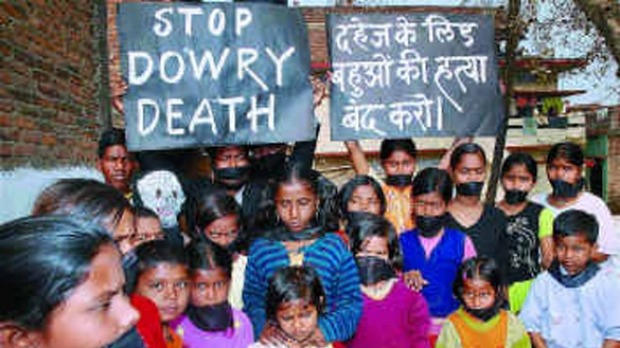
Rajesh Sharma v State of UP – Case analysis on Dowry Death and Section 498A of the Indian Penal Code

3
Rajesh Sharma V. State of UP
Image Source - http://www.countercurrents.org/2016/07/06/dowry-deaths-indias-shame/

In this Article, Vaibhav Pasi analyses the judgment given by the Supreme Court in the case of Rajesh Sharma V State of UP and highlights the flaws in the reasoning given by the Court.

Introduction

India has been a strongly patriarchal society because of its cultural and religious factors. For centuries we have followed the social norm where women are considered to be inferior to men in every aspect of life. Though with time, the paternalistic view has diminished to some extent but the ideology of men supremacy is still intact. Women are limited to household work and manage the house and family. Following the same belief, the law which governs us and the related jurisprudence reflects this women subjugation.

Problem of Dowry in Indian Society

Dowry has been the real menace in Indian society. India faces a high rate of deaths of women in dowry-related crimes. The substantial reduction in the risk of physical violence and sexual violence reflects that how husbands are satisfied and show how dowry defines the woman’s position in the house. The reason for this aggression is the fact that patriarchal society supports this kind of violence at home.

Law governing cases of Dowry Death

Section 498A of the Indian Penal Code deals with the violence against married women by their husbands or relative of their husband. Since its inception, the law has been the point of debate in society because of its misuse by some wives. The law is non-compoundable, hence once a person gets accused, the matter can’t be settled outside the court.

Case Analysis

Facts of the case

Rajesh Sharma and Sneha Sharma got married on 28th November 2012 and father of Sneha Sharma gave the appellant dowry to his fullest capacity. But appellants were not happy with the amount of dowry and they started abusing the complainant and was daily beaten and exploited by the husband. The appellant then left the complainant Sneha at her home because her pregnancy was terminated. On that, she summoned Rajesh Sharma under IPC sec 498A and 323.

Decision of Session Court and High Court

The session court in its judgment found Rajesh Sharma guilty under section 498A. But later Sneha summoned her parents in law and the brother and sister of the husband. The said petition was accepted by session judge Jaunpur on 3rd July 2014. The appellant then approached the High Court against the order of summoning. Though the matter was referred to mediation center but without any avail. Then the High Court found no ground to support this petition and rejected it.

The Central issue arising, in this case, was to check the constant tendency to rope in all the family members in the crime. It was stated in the petition that Sneha Sharma herself left her matrimonial home and her father in law was a retired government employee and her mother in law was a housewife whereas it was also stated in the petition that her sister in law and brother in law were unmarried government employee and had no interest in demanding the dowry from Sneha. After Rejection of petition in the High Court, appellant then moved to Supreme Court.

Issue involved in the case

The Supreme Court judgment of the case of Rajesh Sharma vs State of Uttar Pradesh[1] comes out with judges prescribing some measures to curb the misuse of the Sec 498A. The judgment after its pronouncement has been the point of criticism from various feminist NGOs and women social activists. The issue, in this case, was whether the family of the accused be also detained in the act and how to save the innocents. Granting of leave to appellant was not an issue but the reasoning given was flawed to some extent.

Flaws in the reasoning of Supreme Court Judgment

  • Reflection of patriarchy and male values

    • The very depressing fact in this case which everyone talks about is the judge instead of looking the ground reality of the law has taken the support of the data to come to his conclusion.
    • The judges did not concede even once that the law up to substantial extent has reduced the physical violence and dowry-related crimes
    • The judges not even once thought about what are the implication of a diluted dowry law. This belief fuels from a patriarchal Society which upholds men supremacy and power with pride.
  • Feminist perspective: How women rationale is subjected inferior to men.
    • Feminists[2] will criticise this judgment that it shows how male values are deeply entrenched in our society that still reflects in its every aspect.
    • The judgment also talks about how women file the complaint on the trivial issue and lack the ability to foresee the consequences of that act, shows that Women rationality, reasonableness, and other ability are considered to be less than that of men.
    • Any woman who tries to protect her rights and fight for her rights is being named as ‘disgruntled’ by the court which goes to show that anything which is different from the ‘malestream’ thinking will be termed as deviant conduct.
    • The court also says that family in Indian society is far more important for peace and harmony in society and that implies that a wife and her roles are stated as per male understanding of the word ‘wife’.
    • Women are supposed to work for the unity of a family and have to comply with whatever her husband says. That’s the word ‘wife’ deprives women of her natural rights which are pre-existing and every human being is entitled to it.
    • The fact judges show in judgment that 30 percent of accused in the cases are mother or sister of husband shows that how women rationality and thinking has also been strongly influenced by the male perspective and they have kind of internalized the dominant male views.
  • Realists’ perspective

    • Though apparently, it seems the judges have stated how a law in practice differs from its precepts and with society always changing there is need to reevaluate the law and take into account the real situation. But this reasoning of the judges is completely flawed as judges without removing the ought spectacle before looking at the law they started criticising the law and how it has created a floodgate for no. of cases.
    • The fact that judges only chose to view the National Crime Records Bureau data and did not take into consideration the surveys and analysis of various NGOs and other data goes to show the judges predisposition towards male domination.
    • The fact that NCRB data only shows how number of cases are being filed and only 14 percent of them get convicted goes to show the intricacies involved in Indian Judicial processing and the patriarchal nature of society as most of the women out of fear give up and those who still fight termed false may be because of inappropriate police investigation.
    • For many women, the daily occurrence of violence and stigmatization has been so normalized that they have internalized these things and they only approach a court when the case is of extreme violence.

      The guidelines issued before the arrest.

    • Court has constituted a committee and every case related to dowry will go to this committee which gives this committee uncheck power and it can work as a justice dispensation system.
    • No arrest will be done until the committee gives its report to the magistrate that shows the justice to the victim will be delayed.
    • Committee members who act as a judicial body can be influenced and bribed by accused[3].
    • The judge’s discretion is based on nothing but his/her background and the judgment reflects that background.
    • The precedence judges use also reflects their male-dominant view as most of the cases they used is to support their reasoning that 498A is being misused.

Suggestions

What was required for judges, in this case, was to look at more than one source for their reasoning and a positivistic approach was needed in the judgment. Because now the form of the law is diluted it hardly serves the purpose. The struggle and fight of many women activist behind this law are forgotten in favoring male values. The court needed to re-examine the effect and purpose of the law and then judge the case in light of both and relation to each other.

Conclusion

The major problem our judicial system has, is the falling acknowledge and judicial recognition of rights of women. Rajesh Sharma vs State of Uttar Pradesh judgment reflects how justice for women in Indian society is far from realized. The judgment in itself presents the male-centric Indian judiciary which makes women fight hard for their rights. Indian judiciary needs feminization and it needs to protect rights of men and women equally. Instead of taking measure to curb the menace of dowry, judgment has made the situation even worse. Women who raise voice against such violence and protest will fear to protest as they will be either thrown out of their home or the judiciary will render them as a ‘disgruntled’ wife. Thus, the effect and purpose of law should be rechecked by the judiciary and it should do the needful.


Download Now

1st M.A.B.I.J.S International Essay Competition 2018 – Register by Feb 26, Submit by March 20

0
Family members under money laundering act

ABOUT US

Mohammad Abdul Bari Institute of Juridical Science, a legal education centre thriving for excellence and performing as one of the best law colleges. Established in the year 2008 the Institute has moved a long way and stood against odds and proved itself to be a contender as Best Law College. The institute has entered into MOU with Lex Research Hub, an online learning platform for the legal scholar, founded with an objective to provide information relating to curriculum activity, guidance for the competitive examinations and offer courses for the students of management, law, social sciences and professionals. We are using modern technology to disrupt the traditional legal education across the country.

Mohammad Abdul Bari Institute of Juridical Science is a private law college in Domkal, Murshidabad, West Bengal. It was established by Maniknagar Social Welfare Society in the year 2008. The college is affiliated to University of Kalyani and also approved by the Bar Council of India.

University of Kalyani

The University of Kalyani, established in 1960, is a state-government administered, affiliating and research university in Nadia district of West Bengal, India. It offers courses at the undergraduate and post-graduate levels, the university was established on 1 November 1960 by the Kalyani University Act 1960 of the state of West Bengal.

The University of Kalyani is a State-University and its activities are guided by the Kalyani University Act, 1981, the Act is supplemented by Statutes, Ordinances, Regulations and Rules. This act replaced The Kalyani University Act, 1978, which in turn replaced The Kalyani University Act, 1960, the University Grants Commission accorded recognition to the university.

The university is placed in an urban setting touching the boundaries of some rural areas. The eastern bank of the Ganges is only 2000 meters from the University and it is close to Kalyani Ghoshpara railway station, 10 minutes walking distance to Administration Building from the station, and the other campuses are around it. During Second world war this land was under the control of American army which maintained an arms depot here, few roadways and other constructions are still there to prove that past history.

Faculty of Engineering-Technology & Management 3, Faculty of Arts & Commerce. Colleges are independent from the university but they follow the course curriculum of the university, colleges are headed by the principal and teachers of the colleges as appointed via West Bengal college service commission. Colleges have responsibility for admitting undergraduates and organising their classes. The University of Kalyani has been awarded A grade by the National Assessment and Accreditation Council. This was one big achievement by the biologists in the field, list of universities in India Official website

FACULTY

TEACHER IN CHARGE

  • SOUMIK ASH {M. (BURDWAN UNIVERSITYY)}

ASSISTANT PROFESSOR

  • ESHA RUHUL AMIN {A. (POLITICAL SCIENCE) B. Ed. (KALYANI UNIVERSITY)}

ASSISTANT PROFESSOR

MRS. ANAMIKA DAS

ASSISTANT PROFESSOR

  • MRS. DOLLY BISWAS {M. (VIDYASAGAR UNIVERSITY)}

ASSISTANT PROFESSOR

  • PIALEE PARBHIN {M. (ALIAH UNIVERSITY)}

ASSISTANT PROFESSOR

  • MD SABIKUR RAHAMAN {M. (ALIAH UNIVERSITY)}

ASSISTANT PROFESSOR

  • MRS. SANGEETA RAHAMAN AKBAR {M. (BURDWAN UNIVERSITY)}

ASSISTANT PROFESSOR

ABDUL HALIM

ASSISTANT PROFESSOR

AMIT DAS (SOCIOLOGY)

ABOUT THE COMPETITION

A. B. Institute of Juridical Science in association with Lex Research Hub, is proud to present the 1st International Essay Competition for Law Students, Faculty members, Research Scholars and Professionals.

THEME

Submissions which deal with any aspect of Legal, Social & Economic Issues will be considered.

Important Dates

Last date of registration 26th February, 2018.

The essays must be submitted on or before 20th March 2018.

ELIGIBILITY CRITERIA

Any student pursuing an undergraduate, postgraduate or professional course in any recognized University/College in India & professionals, Research Scholar, Advocates, Professors, and Academicians are eligible to participate in the Competition.

Only one submission per author shall be entertained.

Co-authorship by a maximum of two persons is permitted.

GUIDELINES FOR SUBMISSION

  1. The essays must be submitted in English only.
  2. The essays should be the original work of the authors. Any kind of plagiarism will lead to disqualification.
  3. The essays published elsewhere or selected/submitted for publication elsewhere shall be disqualified.
  4. The name(s) of the author(s) should not be mentioned anywhere in the essay.
  5. The word limit for the essay is 3000 – 4000 words, not including footnotes.
  6. The essays should be typed in:Times New Roman, Font Size 12 and Line Spacing 1.5.
  7. Every citation must follow the ILI style. The footnotes must be typed in: Times New Roman, Font Size 10 and Line Spacing 1.
  8. The margins should be 1” or 2.54 cm on all sides.
  9. All text should be justified.

SUBMISSION PROCEDURE

  1. The essays must be sent by email to [email protected] with the subject ‘MABIJS 1st International Essay Competition  2018’.
  2. The body of the e-mail must specify the name(s) of the author(s).
  3. The essay may be attached in ‘.doc’ or ‘.docx’ format.
  4. The participants are required to send the following details in a separate word document attached to the e-mail:
    1. Theme Chosen
    2. Title of the Essay
    3. Name(s) of the Author(s)
    4. College/ Institute/ University of Author(s)
    5. Programme Enrolled & Year of Study of Author(s)
    6. E-mail address & Contact No. of Author(s)

PRIZES

1st Place: Trophy + Medal + Certificate

2nd Place: Trophy + Medal + Certificate

3rd Place: Trophy + Medal + Certificate

All Participants will be issued Electronic Certificates

REGISTRATION

  • Registration fee is 350/- INR only for Single Author.
  • In case of Co-authorship Registration fee is 600/- INR only.
  • For International Participants: $10 per Author
  • In case of International Co-authorship Registration fee is $15 only.
  • For Professionals: Registration fee is 1000/- INR per Author.
  • In case of Professional Co-authorship Registration fee is 1500/- INR only.

FOR THE PAYMENT OF REGISTRATION FEES

PAYTM – 8001324635

              OR

Payment can be made by NEFT/IMPS/RTGS/Demand Draft or Bank transfer in favourof :

Beneficiary Name: SONAM HASSIM

Account Number: 29428100002054

Bank: Bank of Baroda

Branch: Basantapur, West Bengal

IFSC Code: BARBOBASMUR

MICR Code: 742012504

The transaction ID along with scanned /photo copy/screenshot of the transaction must be attached along registration form provided herewith.

Important Note

  1. All original essays submitted for this competition shall become the sole property of M. A. B. Institute of Juridical Science &Lex Research Hub. MABIJS &Lex Research Hub shall have the right to publish the entries.
  2. The decision of the Jury shall be final and binding.
Contact

Faculty Co-ordinator – Mr. Soumik Ash, Assistant Professor – 07479023268

Lex Research Co-ordinator – Mr. SonamHassim – 8001324635

For further queries, contact us at [email protected]

The Brochure – HERE

The Registration form – HERE

More details about the essay are available Click Here

Download Now

Unsoundness of Mind in Contract

0
Confidentiality or Non-Disclosure Agreements

In this article, Abhishek Mishra discusses the capacity to enter into Contracts With Person Of Unsound Mind.

When we learn something new, the first question which strikes our mind is why we need it and what its applicability is in our day to day life. So before we discuss our topic we must know the purpose of the contract. The basic purpose of contract law is to provide a framework within which individuals can freely contract. The word freely means that there should be full and free consent of the parties. Consent can be free only when it is rational and deliberate. Rational consent can only be given when a person is of sound mind. The author through this article will try to do an analysis of the role of unsoundness of mind in case of a contract with the help of statutes, case laws and judgements with respect to English and Indian law.

English law vs. Indian law: An analysis

English contract law is the primary source of its Indian counterpart. Even then there is some dissimilarity between the two. The author will further in this article try to analyse those dissimilarities.

What is sound mind for the purpose of contracting?

Under English law, Persons who have been identified with a mental incapacity are protected from entering contracts. Now, the question is who lacks capacity under English law? A person under English law lacks capacity in relation to a matter if at the material time he is unable to make a decision for himself in relation to the matter because of an impairment of, or a disturbance in the functioning of, the mind or brain. It is immaterial whether the impairment or disturbance is permanent or temporary. A person cannot be declared incapable merely on grounds of age or appearance or on the basis of any assumptions which is the result of his behaviour. A person is considered as unable to make decisions for himself if he fails to understand the information relevant to the decision, to retain that information, to make use of that information for making the decision, or to communicate his decision by talking, using sign language or any other means. A person is not declared incapable only on the grounds that he is able to retain the information relevant to a decision for a short period, in this case, information, includes information about the reasonably foreseeable consequences of deciding one way or another, or failing to make the decision.

Now let’s come to the definition of sound mind with respect to the Indian Contract law. According to section 12 of The Indian Contract Act,1872, A person is said to be of sound mind for the purposes of making a contract, if, at the time when he makes it, he is capable of understanding it and of forming a rational judgment as to its effect upon his interests. In Kanhaiyalal v. Harsing Laxman Wanjari (AIR 1944 Nag 232), it was held that mere weakness of mind is not unsoundness of mind. Mental incapacity, arising out of any reason, deprives a person not only of a full understanding of transaction but also of the awareness that he does not understand it. A person of unsound mind is thus not necessarily a lunatic. It is sufficient if the person is incapable of judging the consequences of his acts. In Inder Singh v. Parmeshwardhari Singh (AIR 1957 Pat 491), justice Sinha explained the effect of section 12 in following passage:

“According to this section, therefore the person entering into the contract must be a person who understands what he is doing and is able to form a rational judgement as to whether what he is about to do is to his interest or not. The crucial point, therefore, is to find out whether he is entering into the contract after he has understood it and has decided to enter into that contract after forming a rational judgement in regard to his interest…. It does not mean that the man must be suffering from lunacy to disable him from entering into a contract. A person may to all appearances behave in a normal fashion, but, at the same time, he may be incapable of forming a judgement of his own, as to whether the act he is about to do is to his interest or not.”

This distinguishes it from lack of ability arising due to illiteracy and unfamiliarity with the language.

Is a person of unsound mind competent to contract?

Indian law has a different opinion from English law on this issue. Under English law, a person of unsound is competent to contract, although the contract can be avoided at his option if he satisfies the court that he was incapable of understanding the contract and the other party had the knowledge of the same. Thus, under English law, the contract is voidable at his option. It becomes binding on him only if he affirms it, Imperial Loan Co v. Stone ((1892) 1 QB 599 (CA)), in this case Lord Esher said that a mentally disordered person can only set aside a contract entered into with a person of sound mind in following circumstances: “When a person enters into a contract and afterwards alleges that he was so insane that he did not know what he was doing, and proves the allegation, the contract is as binding on him in every respect, whether it is executory or executed, as if he had been sane when he made it, unless he can prove further that the person with whom he contracted knew him to be so insane as not to be capable of understanding, what it was about.” The position of English law is same for drunken people as it is for a person who is mentally afflicted; such contract is not altogether void but is voidable at the option of the person who entered into the contract in such a state of drunkenness as to not know what he was doing and such fact is known to the other contracting party, Surrey v. Gibson ((1845) 13 M&W 623). Even under English law, contract by a lunatic person is not void. In Campbell v. Hooper ((1855) 3 Sm&G 153), where a mortgagee sought a decree for repayment of debt and evidence showed mortgagor was lunatic when contracted and in addition to it mortgagee was unaware of it. It was held that mere fact of lunacy cannot make a contract invalid. If the other party had knowledge of it, it becomes voidable at the option of the lunatic. Thus it is clear that under English law what is most important is that the other person with whom the person of unsound man contracted had the knowledge of the former being in an unsound state of mind or not.

On the other hand under Indian law a person of unsound mind when is state of unsoundness is not competent to contract. The agreement of a person of unsound mind is void, Amina Bibi v. Saiyid Yusuf (ILR (1922) 44 All 748). However, a person who is usually of sound mind but occasionally of unsound mind may not make the contract when he is of unsound mind whereas a person who usually is of unsound mind but sometimes becomes sound can contract in those intervals when he is sound. In Nilima Ghosh v. Harjeet Kaur (AIR 2011 Del 104) it was discussed that the most relevant thing for declaring an agreement void is whether the person in question was suffering from mental disability on the date of execution of the agreement.

India Contract law also treats a drunken person similar to a person of unsound mind. In Ashfaq Qureshi v. Aysha Qureshi (Nivedita Yadav) (AIR 2010 chh 58), where a Hindu girl was married to a Muslim man, the girl filed a suit on the grounds that she was not in her sense as she was under intoxication at the material time and was not conscious of ongoing conversion and nikah ceremony. And also that she had not lived with that man for a single day. She proved all the stated facts and thus the marriage was declared void on the grounds that as she was intoxicated so she was not in a position to take a decision and forming a rational judgement in regard to his interest.

On whom does the burden of proof lie?

In every case initially, the presumption is in favour of sanity but the presence or absence of it at the time of making the contract is a question of fact in all cases. It is immaterial that the person was insane in a previous or a post time after the point of time when the contract was made except for it is likely to create a suspicion of likelihood of such disorder at the time of formation of contract, M’Adam v. Walker ((1813) 1 Dow 148 (HL)). The onus of proving insanity is on the person who alleges it, Mahomed Yakub v. Abdul Quddus (AIR 1923 Pat 18717). In Lakshmi v. Ajay Kumar (AIR 2006 P&H 77) it was held that it must be proved that the point of insanity was at the time of formation of the contract. In Mohanlal Madangopal Marwadi v. Sadasheo Sonak (AIR 1941 Nag 251), it was held that, in the case where a person is usually of unsound mind, the burden of proving that he was of sound mind at that time lies on the person who affirms it. Whereas, in the case where a person is usually in a sound state of mind the burden of proving that he was in an unsound state of mind lies upon the person who challenges the validity of the contract. However, in case of drunkenness or other cause, the onus lies on party who sets up that disability to prove that it existed at the time of the contract and it has to be proved that the party was so drunk as to unable to comprehend the meaning and effects of an agreement, and, under the English law also that the other party was aware of his condition.

Conclusion

As going through this research work it is established that Indian contract law is heavily borrowed from its English counterpart but both differ in some aspects, and the English model seems to have a wider ambit than its Indian counterpart.

REFERENCES:

  • Primary sources
    1. Mental Capacity Act, 2005 c 9.
    2. The Indian Contract Act, 1872 (Act 9 of 1872).
  • Secondary source
    1. DR Avtar Singh, Law of Contract And Specific Relief (Eastern Book Company, Lucknow, 12th edn., 2017).
    2. Pollock And Mulla, The Indian Contract And Specific Relief Acts (LexisNexis, Gurugram, 14th edn., 2013).
    3. Manupatra
    4. SCC Online


Download Now

Last chance to rectify Director’s disqualification status

0
lawyer’s work with respect to the Takeover Code in M&A transactions

Ministry of Corporate Affair had undertaken actions with respect to provisions of Annual Return Filing in the month of September 2017. Under the considered specification, the Ministry has deactivated Director Identification Number (DIN) of 309,614 Directors associated with the companies which failed to submit the financial statements and annual report for a continuous period of three financial years starting. Effect to which has disallowed the companies to file the returns by authorising the said directors. Henceforth, the default would have been continued except appointment of non-disqualified directors.

However, the Ministry of Corporate Affairs has granted another chance to fulfil with the said requirements of Annual Compliance of Private Limited Company. The Ministry has issued the scheme of Condonation vide General Circular No. 16/2017 dated 29.12.2017. The scheme is duly explained here for your kind reference and understanding.

First, let us know why the DINs were deactivated

Non-filing of annual Returns and Financial statements with MCA after Pvt Ltd Company registration is considered as offence on part of the companies and associated directors. Where the penalties are levied on both companies and directors, additional punishment in name of Disqualification of Directors is also prescribed under Section 164(2) read with Section 167 of Companies Act, 2013. The referred provisions disqualify the Directors of the defaulting companies and DIN of concerned directors would be deactivated.

Here, defaulting companies shall be read as any company that has failed to file:

  1. Annual Return in Form MGT – 7; OR
  2. Financial Statement in Form AOC – 4

with MCA for a continuous period of 3 years.

Directors being responsible for all administrative and compliance requirements of the company, they are held liable for failure of compliance. Continuous failure on for compliance with said provisions after online company registration are considered as offence on part of Directors also. Therefore, in the month of September, 2017, pursuant to provisions of Indian Companies Act, 2013, the step of deactivation of DIN has undertaken with respect to directors of concerned company that has not filed returns since Financial Year 2013-14 to 2015-16.

What is current way-out to comply with requirements?

As mentioned earlier, the Ministry of Corporate Affairs, has granted a chance to the affected directors and companies to be compliant after the payment of additional fees and fees for condonation of the delay caused in name of Condonation of Delay Scheme, 2018.

Highlights of Scheme

The said scheme is made effective from 01.01.2018 and will remain in force till 31.03.2018. By circulation of the said scheme, the Ministry has first re-activated the DIN of the directors that has earlier been deactivated. Important to note is that the re-activation is for a temporary period, during which the directors will be able to file the prescribed forms with the Ministry.

Applicability

The scheme shall be applicable to all defaulting companies excluding the companies which have been struck off/ whose names have been removed from the register of companies u/s 248(5) of the Act. The defaulting company is permitted to file the documents which were due till 30.06.2017.

Procedure

  • The DINs of concerned disqualified directors will be temporarily activated till the validity of the scheme i.e. 31.03.2018.
  • The defaulting companies shall file the documents in the prescribed forms by payment of normal as well as additional fees. Following are the documents to be filed with the Ministry within prescribed time for Financial Year 2013-14 to 2015-16:
  1. E-form AOC – 4 or any other form as applicable for filing of Financial Statements;
  2. E-form MGT – 7 or any other form as applicable for filing of Annual Return;
  3. E-form ADT – 1 for intimation of Appointment of Auditors;
  4. Form 66 for submission of Compliance Certificate with Registrar (if applicable).

One can calculate the fees applicable on filling at http://www.mca.gov.in/mcafoportal/enquireFeePreLogin.do.

  • Once the requisite documents are filed, the company shall apply for condonation of delay by filing of form e-CODS with MCA by payment of fees prescribed i.e. Rs 30,000/- only. Kind note shall be taken that the said e-form would be available after 20.02.2018. However, stakeholders are advised to complete the filing of requisite documents without waiting for the availability of said e-form for filing.

On successful filing of e-CODS by payment of fees, the disqualification of the directors will be removed. Therefore, the DIN of the Directors will remain active even after the expiry of the scheme.

With respect to the defaulting companies, whose names have been removed from the register of companies and which have filed the application of revival (up to the date of this scheme), the DIN of concerned directors shall be re-activated only after order of revival from NCLT.

Failure to file the documents & e-CODS

Where the companies fail to file the overdue documents or form e-CODS even after the expiry or conclusion of the scheme and directors are found disqualified under provisions of Companies Act, 2013, the DIN of concerned directors will be deactivated on expiry of said period.

Failure to Avail Condonation of Delay Scheme

In event of failure to avail, the benefit from the Condonation of Delay Scheme, 2018, the disqualification of concerned director will continue for a period of 5 year from the date of failure. During given period of disqualification, the concerned director shall not be able to be appointed as director in any company or re-appointed as a director in the company where he is holding the position of director.

Conclusion

The ministry has undertaken very stringent steps under provision of Companies Act, 2013 in order to make the companies obliged to fulfil the compliance requirements in the manner prescribed. The step of deactivation of DIN is the clue to companies and stakeholder for future actions against non-compliance from the companies and stakeholders. Therefore, now is the need of the hour to be aware of the provisions and fulfilment of same on time after online company registration. One can consult the experts at LegalWiz.in to get assistance with regards to applicability of provisions and compliance requirements of the company. Get in touch with the professionals at [email protected].

About Author

The Author of the Article is co-founder at India’s leading online Legal Service Provider, LegalWiz.in. He can also be reached at [email protected] for Incorporation and Annual Compliance requirements of Private Limited Company other personalised solutions.

Download Now

Opportunities for Lawyers before IPAB

0
career in intellectual property law
click above

In this article, Amandeep Singh discusses opportunities for Lawyers before IPAB.

“Lawyers are the foot soldiers of the Constitution.”

Introduction

It is said that for as long as there have been people there is a requirement of lawyers. In this era of globalization, it is probably going to get further force as more lawyers would be required to deal with cases emerging out of trademarks and related disputes because of developing the significance of the World Trade Organisation (WTO). The scope for lawyers is increasing day by day and they have various private and government opportunities depending on the choice of their practice. This article talks about the opportunities a lawyer gets before Intellectual Property Appellate Board (IPAB).

What is IPAB?

Intellectual Property Appellate Board was set up on 5th September 2003 with the objective of hearing and adjudicating appeals against the orders given by the Registrar under the Indian Trademarks Act, 1999 and also the decisions are taken by the court under Indian Geographical Indication of Goods Act, 1999. The aim of IPAB is speedy disposal of appeals and rectification of applications. Intellectual Property Appellate Board is headquartered in Chennai and it has its benches in Delhi, Mumbai, Kolkata, and Ahmedabad.

  • Section 83 of the Trademarks Act, 1999 provides for the establishment of Appellate Board by the Central Government which is to be known as the Intellectual Property Appellate Board to exercise jurisdiction, powers, and authority conferred by this Act.
  • The provision in the Geographical Indications of Goods (Registration and Protection) Act 1999 provided for the registration and better protection of indication marks which are related to goods. Among various features of the Geographical Indications of Goods (Registration and Protection), Act was the provision which provided for appellate remedy before the Intellectual Property Appellate Board (IPAB) set up under the Trademarks Act of 1999.
  • Section 117 G of the Patents (Amendment) Act, 2002 provides that all the cases of appeals against the order of the Controller i.e. the Government and all the cases rectification of application pending before any High Court shall be transferred to the Appellate Board and the board shall may either proceed with the case de novo or from the stage at which it was transferred.
  • Now that the Finance Act, 2017 has come into force, the Copyright Board has been merged with the IPAB and now all the pending cases which lay before the Copyright Board are transferred to the Intellectual Property Appellate Board.
  • To regulate its proceedings, the IPAB made The Intellectual Property Appellate Board (Procedure) Rules, 2003 so that there is no illegality in the proceedings and there is no use of excessive power.
  • All the decisions are taken by the Intellectual Property Appellate Board in pursuance of any appeal before it shall be final and binding.
  • IPAB is a managerial body that has appellate jurisdiction over the decision of the Controller of Patents or trademarks. However, IPAB has no statutory powers to trial infringement proceedings.
  • The IPAB exercises appellate jurisdiction against the orders of the Central Government in matters relating to –

Any decisions related to

  1. Investor Names
  2. Patent of Addiction
  3. Anticipation
  4. Potential Infringement
  5. Compulsory license of a patent
  6. Revocation of patent for non-working
  7. Substitution of applicants
  8. Any Amendment/revocation of patent
  9. Amendment of Application and specification
  10. Restoration of lapsed patents
  11. Surrender of patents
  12. Divisional Application
  13. Dating of Application
  14. Revocation of patents to satisfy interest of the public
  15. Any registration of patent assignment

Composition of IPAB

Section 84 of the Trademarks Act, 1999 provides for the Composition of Appellate Board,

  1. The Board comprises of :
    1. Chairman,
    2. Vice-Chairman
    3. Technical member (Trademarks) and
    4. Technical member (Patents).
  1. The jurisdiction, powers, and authority of the Appellate Board will be exercised by the Benches which are set up in different places.
  2. The Bench will consist of one Technical member and one Judicial member.
  3. The Chairman has the power to transfer a member from one bench to another bench.
  4. The Chairman, in addition, can discharge the functions of the Judicial Member or a Technical member of more than one bench at the same time.
  5. The Chairman may authorize Vice-Chairman or a Judicial Member or a Technical member of one bench to discharge the functions of a Judicial member or a technical member of another bench.
  6. If any question arises as to under which bench, the subject matter falls, the Chairman will decide that which bench will look into the matter.

Qualifications for appointment in IPAB

Section 85 of the Trade Marks Act, 1999 provides for Qualifications for appointment as Chairman, Vice-Chairman, or other members of IPAB.

  1. A person shall be qualified for appointment as the Chairman of IPAB if and only if;
    1. He is, or has been a Judge of a High Court; Or,
    2. Has for at least 2 years held the office of Vice-Chairman of IPAB.
  2. For being a Vice-Chairman of IPAB, a person is required to
    1. Hold the office of a Judicial Member or a Technical Member of IPAB for at least 2 years
    2. Or he has been a member of Indian Legal Services and has held a post in grade 1 of that service for at least 5 years or held any higher post in Indian Legal Service for at least 5 years.
  3. To be a Judicial Member in IPAB, one
    1. Must be a member of Indian Legal Service and he must have held the post in grade 1 of that service for at least 3 years.
    2. Or he must have held a civil judicial office for at least 10 years.
  4. To be appointed as a Technical Member in IPAB, a person – Has to be an advocate of a proven specialized field of Trade Mark law for at least 10 years.
  5. The Chairman, Vice-Chairman and both the members i.e. the Judicial and Technical members shall be appointed by the President of India.
  6. Every bench will comprise of a Judicial Member and a Technical Member.
  7. In the event that the Members of a Bench vary in the opinion of any right, they shall express the point or points on which they differ, and make a reference to the Chairman who should either hear the points himself or refer the case for hearing on such point or points by at least one or more members and such point or points shall be decided according to the decision of majority of the Members who have heard the case, including the members who initially heard it.

Lawyers in IPAB

A trademark is more or less the identity of a good or service which is present in the market. Any symbol, name or mark can be called a trademark if it distinguishes one good from another. And for maintaining the unique identity of a good or service, it is essential to protect the trademark from being copied or being infringed upon. And that is where the expertise of a Trademark Attorney comes into use.

  • A Trademark Attorney or a Trademark Lawyer is a person who is an expert in matters related to trademark laws and designs and practices and provides legal advice regarding the matter. He is a professional having extensive knowledge of trademarks and usually deals with Court cases relating to trademark.
  • In India, any person who has taken the course of study in the rules of practice in patent office i.e. trademark laws, or has graduated from a law school and is a member of the Bar can be a Trademark Lawyer.
  • To practice trademarks laws before Intellectual Property Appellate Board or in the Trademark Office, a lawyer must get himself registered and he must also be registered to practice law in at least one of the states in India.
  • He must also have passed the IPAB Trademark Law Bar Exam after which only he can practice trademark laws before IPAB.
  • The work in IPAB is similar to the work done by a lawyer in other Courts but as we know that IPAB only deals with the appeals, so only the proceedings related to appeals are practiced in the IPAB.

Role of a Trademark Lawyer

A trademark lawyer in India assists trademark holders in every way. They not only provide guidance and counsel the clients on registration and subsequent use of trademarks but also make sure that the trademark does not infringe upon rights of another. Trademark Lawyers are also hired by big corporate companies and firms to provide assistance and guidance in matters relating to trademarks of the Company.

  • A Trademark Lawyer helps ensure that an application is properly registered with the applicable trademark office. During this process, the Lawyer generally advises his or her clients on the probability of the application becoming the registered trademark.
  • Also, the Lawyer evaluates whether any risks are involved in adopting a certain slogan, word or logo. The Lawyer also helps the client to check and ensure the potential mark or name does not violate the rights of any other person or entity.
  • If the client decides to move forward with pursuing the mark, the lawyer files the application and communicates with the trademark office as needed.
  • In an infringement or dilution case, a Trademark Lawyer can represent either the plaintiff or the defendant. In this role, the lawyer must evaluate evidence and develop a theory of his or her client’s case.
  • Other responsibilities include preparing and filing any appropriate paperwork with the Court, facilitating the discovery process, and interviewing or deposing witnesses.
  • If the case goes to trial, the lawyer represents his or her clients to Court. If the case is settled outside of Court, the lawyer usually superheads negotiations for his or her client.
  • The job of a Trademark Lawyer usually involves working with a client, review of paperwork which too is filed, filing for registration of a trademark on behalf of the client, and following up on registration so that the client is satisfied.

Opportunities for lawyers

There are various opportunities for lawyers who are working in Intellectual Property Appellate Board and practicing trademark laws.

  • A Trademark Lawyer can become a Chairman of IPAB not directly but if he has served as a High Court Judge. To be the High Court Judge one has to serve as a standing lawyer in the High Court for at least ten years and then he can be appointed as a High Court Judge by the President of India in consultation with the Chief Justice of India (CJI). Once, he has served as a Judge of High Court, he can be appointed as the Chairman of IPAB.
  • A lawyer can also be the Vice-Chairman if he has been a member of Indian Legal Services and has held a post in grade 1 of that service for at least 5 years or held any higher post in Indian Legal Service for at least 5 years.
  • A Trademark Lawyer can also be a Judicial member in IPAB if he has been a member of Indian Legal Service and he must have held the post in grade 1 of that service for at least 3 years. Or he must have held a civil judicial office for at least 10 years.
  • A Trademark Lawyer if he has been advocating in a proven specialized field of Trademark Law for at least 10 years.
  • A Trademark Lawyer gets opportunities in relation to work which he gets in IPAB like working with the client, registering the Trademark. He can also work as a Trademark Agent in the Trademark Office or in IPAB. For that, a lawyer has to be a registered trademark agent and he has to successfully pass the IPAB Trademark Office Exam or if he has served for 4 years or more as an IPAB Trademark Examiner before entering private trademark practice.

Appellate Role of IPAB

Section 91 of the Trade Marks Act, 1999 provides that “any person aggrieved by an order or decision of the Registrar under this Act, may refer an appeal to the Appellate Board within a period of 3 months from the date on which the decision sought to be appealed against is communicated to such person preferring the appeal.”

  • An appeal shall lie to the Appellate Board from, inter alia, any decision, order or direction of the Controller or Central Government under Section 15 and Section 25(4) of the Patents Act, 1970.
  • These provisions prima facie affirm the appellate role performed by the IPAB vis-a-vis the Registrar of Trade Marks and the Controller of Patents.
  • However, the nature of the appellate role of IPAB remains unclear in the light of the instances where both the IPAB, and the Registrar or the Controller as the case may be, are competent authorities to exercise their jurisdiction on the same matter.

In context of patent law

  • In the case of J Mitra & Co. V. Assistant Controller of Patents and Design, in 2008, the Supreme Court of India was required to opine on the relationship between the IPAB and the Controller of patents.
  • Though the case primarily considered the peculiar situation created by a delay in enforcement of the amended Section 116 and 117A, Patents Act, the observations made therein are significant. The Apex Court had noted that,

“By Patents (Amendment) Act 2005 for the first time a dichotomy was inserted in the Patent Law by providing vide Section 25 (1) for ‘opposition to pre-grant’ and vide Section 25 (2) for ‘opposition to post-grant’ of patent the Legislature intended an appeal under Section 117A (2) to the Appellate Board from any decision, order or direction of the Controller, inter alia, under Section 25(4) the Legislature intended that there shall be only one statutory appeal against grant of the patent. The Legislature intended to obliterate appeal from ‘pre-grant proceedings’, which existed earlier.”

  • It is very clear from Section 25(4) that the IPAB practices appellate jurisdiction over the Controller as for the post-grant opposition orders, regardless of whether the opposition is fruitful or not.
  • However, the jurisdiction of the IPAB with respect to a pre-grant opposition was further elucidated upon by Justice Muralidhar of the Delhi High Court in 2010 in UCB Farchim V. CIPLA Ltd. In this case, the question which arose was whether an appeal to the IPAB is maintainable against the order given by the Assistant Controller refusing the grant of the patent due to a pre-grant opposition? In deciding this question, Muralidhar drew a pertinent distinction between a successful and an unsuccessful pre-grant opposition.
  • As respects, people who have not achieved success in the pre-grant opposition stage to prevent a grant of patent, the Court noticed that as long as these are people intrigued, inside the importance of Section 25(2) and 64, Patents Act, their remedy is to document a post-grant opposition and wait for the decision of the Controller. On the off chance that they are still aggrieved by that decision, they can file an appeal before the IPAB under Section 117A or petition for denial under Section 64.
  • It is interesting to note that Section 117A, Patents Act, 1970 permits an appeal to the IPAB against an order of the Controller under Section 25(4) of the Act which deals with post-grant oppositions but does not deal with pre-grant oppositions.
  • However, Section 117A does provide for an appeal to the IPAB against the decision of the Controller under Section 15 of the Act, refusing a grant of a patent in case a pre-grant opposition is considered to hold merit.
  • Accordingly, if one reads the decision of cases J Mitra and UCB Farchim conjointly, it implies that the IPAB will exercise its appellate jurisdiction over the Controller of Patents in the following two circumstances and no other:
  1. Under Section 25(4), Patents Act, 1970, an appeal against any order given by the Controller relating to a post-grant opposition filed by an interested person irrespective of the outcome.
  2. Under Section 15, Patents Act, 1970 if the pre-grant opposition is successful and results in the rejection of the patent application.
  • It must be taken into consideration that mere success of a pre-grant opposition is not sufficient for the IPAB to have appellate jurisdiction over the Controller because even if the opposition is successful, the Controller can require the patent application to be amended to his satisfaction and eventually grant the patent, instead of rejecting it out rightly.
  • In such circumstances, no appeal to the IPAB will be maintainable.

In the context of Trade Mark Law

In relation to Trade Marks Law, the role of IPAB is relatively clearer.

  • In Costa & Co. Pvt Ltd V. Union of India, Vipin Sanghi, Justice of Delhi High Court, dealt with an interesting question, the question before him was related to the power of the IPAB to transfer to itself the rectification applications pending before the Registrar that involve substantial evidentiary overlap, even though there was no statutory basis to exercise such power.
  • In response, Justice Sanghvi relied on a ruling of the Hon’ble Supreme Court of India in Tirupati Balaji Developers Pvt Ltd V. State of Bihar, held that the conferral of the appellate jurisdiction carries with it certain consequences as a necessary concomitant of that power.
  • This includes the power to exercise incidental and ancillary powers without which the conferral of principal power can be rendered redundant.
  • Further, only the existence of appellate jurisdiction obliges the lower jurisdiction to render all of its assistance to the higher jurisdiction to enable the exercise of appellate jurisdiction effectively and the superior forum may issue a stay order or restraint order or may suspend, expedite or regulate the proceedings in the subordinate forum.
  • In the absence of same, the hierarchy becomes meaningless.
  • Placing reliance on such reasoning, the court held that the IPAB, being an appellate authority by virtue of Section 91, Trade Marks Act, 1999, had the power to transfer to itself the rectification applications pending with the Registrar. The rationale adopted here was threefold.
  1. In case of a rectification application, the order of the Registrar is subject to an appeal to the IPAB by the aggrieved party. Thus, ultimately it is the view of the IPAB which would be final and binding upon the parties.
  2. While exercising the appellate authority, it would be shameful if IPAB cannot take cognizance of the fact that there are still many proceedings pending between the same parties, involving the same issues, the IPAB should take appropriate measures to preserve consistency in the decision-making process; simultaneously saving the parties from harassment and excess costs of litigation.
  3. Section 125(2) of Trade Marks Act, 1999 gives authority to the Registrar to transfer rectification application to the IPAB no matter at what stage the proceeding is but only if he thinks fit. However, every transfer order was given by the Registrar, including an order refusing to transfer a pending application to the IPAB, is appealable by reason of Section 91, Trade Marks Act.
  • Relying on the same, the Court said that in such an appeal under Section 91, the IPAB is competent to arrive at a conclusion that the Registrar ought to have referred the pending application to the Board in the first place.
  • As such, the IPAB can direct the Registrar to refer to it the pending applications, and if it has the jurisdiction to pass such an order in appeal, then there is no reason why it cannot do so otherwise in proceedings pending before it.
  • In conclusion, despite there being a jurisdictional overlap, the cited judicial pronouncements positively affirm the extent of appellate jurisdiction exercised by the IPAB over the Registrar and the Controller of Patents under varying circumstances.

Conclusion

Being a Trademark Attorney or a Trademark Lawyer in IPAB is very interesting as there are a number of opportunities which a lawyer can get but he has to pass the IPAB Bar Exam to practice trademark law there. But on a whole, the job of a trademark lawyer is a very lucrative one, since the field of intellectual property i.e. trademarks, patents, copyrights, geographical indications and industrial designs is a less visited one but now it is growing at a large scale in the country. Thus it is required to have good and experienced lawyers to bail the common people out of the difficulties in this field of Intellectual Property.

Download Now

Facilities provided by the Copyright Office and how to access them

0
repealing
Image Source - https://www.thebalance.com/how-to-copyright-a-book-2800079

In this article, Akanksha Mathur of National Law University, Delhi discusses how to file various copyright applications and the procedure for accessing facilities provided by the Copyright Office.

With the advent of intellectual property, laws related to copyright have become more important than ever. As the creator of any intellectual property, it is important to understand what a copyright is, how it is issued, what rights are conferred by it and where one can get it issued.

What is a Copyright?

A copyright is the exclusive and assignable legal right, given to the originator for a fixed number of years, to print, publish, perform, film, or record literary, artistic, or musical material. It is a form of intellectual property protection available for original works of authorship that are fixed in a tangible form, whether published or unpublished. The categories of works that can be protected by copyright laws include paintings, literary works, live performances, photographs, movies, and software.

Copyright law does not cover the actual concepts, ideas, techniques, or facts in a particular work, but rather protects their form of material expression. Because of this, a work must be tangible to receive copyright protection.

Laws Governing Copyrights in India

Indian Copyright Act, 1957

Copyright law in India is governed by the Indian Copyright Act, 1957. It came into effect from January 1958 and has been amended six times since then to-

  • Bring it in conformity with the World Intellectual Property Office (WIPO) Copyright Treaty and the WIPO Performances and Phonograms Treaty
  • To protect the music and film industries
  • To protect the author of any work
  • To address the concerns of the physically disabled
  • To remove operational facilities
  • For the enforcement of rights.

Copyright Rules, 2013

The Copyright Rules of 2013 had been issued by the Ministry of Human Resource Development of the Union Government in the exercise of the powers granted to it by Section 78 of the Indian Copyright Act, 1957.

It succeeded the Copyright Rules of 1958 and provided a guideline for the functioning of copyright laws in India.

What can be Copyrighted?

A copyright protects the form of expression of original works of authorship. Things which can be copyrighted include-

  • Literary works
  • Musical works, including any accompanying words
  • Dramatic works, including any accompanying music
  • Pantomimes and choreographic works
  • Pictorial, graphics, and sculptural works
  • Motion pictures and other audiovisual works
  • Sound recordings
  • Architectural works

These categories are to be viewed in a broad sense as they have also been expanded to include other things, such as computer programs, maps, architectural plans etc.

Things which cannot be copyrighted include-

  • Works not given a tangible form of expression
  • Works containing common property information that do not contain original authorship.
  • Titles, names, short phrases and slogans
  • Symbols or designs that are familiar
  • Variations of typographic ornamentation, lettering, or coloring
  • Listings of ingredients or contents

Rights of a Copyright Owner

The Indian Copyright Act confers copyright protection to original works of authorship under Section 13 and vests these with the owner.

Copyright protection is given in terms of the-

  • Economic Rights of the Author

Economic rights are conferred upon the author of an original work under Section 14 of the Indian Copyright Act, 1957. These are

    • For literary, dramatic and musical works

      • to reproduce the work in any material form including the storing of it in any medium by electronic means
      • to issue copies of the work to the public
      • to perform the work in public or communicating it to the public,
      • to make any cinematograph film or sound recording in respect of the work
      • to make any translation or adaptation of the work.
    • For computer programs

      • to reproduce the work in any material form including the storing of it in any medium by electronic means
      • to issue copies of the work to the public
      • to perform the work in public or communicating it to the public,
      • to make any cinematograph film or sound recording in respect of the work
      • to make any translation or adaptation of the work
      • the right to sell or give on hire, or offer for sale or hire any copy of the computer program regardless whether such copy has been sold or given on hire on earlier occasions
    • For artistic works

      • to reproduce the work in any material form, including depiction in three dimensions of a two-dimensional work or in two dimensions of a three-dimensional work
      • to communicate or issues copies of the work to the public
      • to include the work in any cinematograph work
      • to make any adaptation of the work.
    • For a cinematograph film or a sound recording

      • to make a copy of the film including a photograph of any image forming a part thereof
      • to sell or give on hire or offer for sale or hire, any copy of the film
      • to communicate the film to the public.
    • For a painting, sculpture, drawing or of a manuscript of a literary, dramatic or musical work

      • to make a copy of the film including a photograph of any image forming part thereof
      • to sell or give on hire or offer for sale or hire, any copy of the film
      • to communicate the film to the public.
      • to share in the resale price of such original copy provided that the resale price exceeds rupees ten thousand.
  • Moral Rights of the Author

    The author is also accorded moral rights to his work under Section 57 of the Indian Copyright Act. These are-

    • The Right of Paternity

      This refers to the right of an author to claim authorship of a work and prevents others from doing so.

    • The Right of Integrity

      The right of integrity is provided to the authors of an original work to empower them to prevent the distortion, mutilation or alteration of their work, along with any other action in terms of that work which would be prejudicial to their honour or reputation.

Is it Necessary to Register a Work to Claim Copyright?

No, it is not necessary to register a work to claim a copyright. A copyright is acquired as soon as a work is created and no formalities are needed to be undertaken in order to acquire a copyright.

However, a certification of registration of a copyright is important as it has the ability to serve as primary evidence in any dispute related to the ownership of a copyright in a court of law.

Regulatory Authorities

Two regulatory authorities have been set up to regulate the registration of copyrights in India and handle the disputes related to them. These are-

  • The Copyright Board of India

The Copyright Board is a quasi-judicial body set up under Section 11 of the Indian Copyright Act, 1957. It is responsible for the task of adjudication of disputes related to copyright registration, assignment of a copyright, grant of license for works that are to be withheld from the public, unpublished Indian works, production and publication of translations and works for certain specified purposes. It also hears other miscellaneous cases in matters instituted before it.

  • The Copyright Office

The Copyright Office was set up under Section 9 of the Indian Copyright Act, 1957. It was put under the immediate control and supervision of the Registrar of Copyrights.

How To e-File an Application

To file an application to file an application for copyright registration, visit http://copyright.gov.in/UserRegistration/frmLoginPage.aspx and register yourself as a new user. An application can be filed by filling up Form-XV, the SoP and SoFP and paying the required fee.

A checklist of the particulars that an applicant should keep in mind while filing an application can be found here.

How To Find Out Whether Your Application Has Been Accepted Or Rejected

After an application has been filed and a diary number has been allotted, the status of the application can be checked at http://copyright.gov.in/frmStatusGenUser.aspx.

Status of Copyright Application

The Copyright Office also publishes a list of the applications received by it, the applications that are awaiting further work and the applications due for a hearing online on its website as well.

What Are The Charges For Filing An Application?

The Copyright Office charges a fee for issuing compulsory licenses as well for filing any application.

S.No Application/Compulsory License Fee
1 For a license to republish a Literary, Dramatic, Musical or Artistic work (Sections 31, 31A,31B* and 32A) Rs. 5,000/- per work
2 For a license to communicate an any work to the public by Broadcast(Section 31(1)(b)) Rs. 40,000/- per applicant/per sataton
3 For license to republish a Cinematograph Film (Section 31) Rs. 15,000/- per work
4 For a license to republish a sound recording (Section 31) Rs. 10,000/- per work
5 For a license to perform any work in public (Section 31) Rs. 5,000/- per work
6 For a license to publish or communicate to the public the work or translation (Section 31A) Rs. 5,000/- per work
7 For a license to publish any work in any format useful for person with disability (Section 31 B) Rs. 2,000/- per work
8 For an application for a license to produce and publish a translation of a Literary or Dramatic work in any Language  (Section 32 & 32-A ) Rs. 5,000/- per work
9 For an application for registration or copyright in a:
(a)Literary, Dramatic, Musical or Artistic work Rs. 500/- per work
(b)Provided that in respect of a Literary or Artistic work which is used or is capable of being used in relation to any goods (Section 45) Rs. 2,000/- per work
10 For an application for change in particulars of copyright entered in the Register of Copyrights in respect of a:
(a)Literary, Dramatic, Musical or Artistic work Rs. 200/- per work
(b)Provided that in respect of a literary or Artistic work which is used or is capable of being used in relation to any goods (Section 45) Rs. 1,000/- per work
11 For an application for registration of Copyright in a Cinematograph Film (Section 45) Rs. 5,000/- per work
12 For an application for registration of change in particulars of copyright entered in the Register of Copyrights in respect of Cinematograph film (Section 45) Rs. 2,000/- per work
13 For an application for registration of copyright in a Sound Recording (Section 45) Rs. 2,000/- per work
14 For an application for registration of changes in particulars of copyright entered in the Register of Copyrights in respect of Sound Recording (Section 45) Rs. 1,000/- per work
15 For taking extracts from the indexes (Section 47) Rs. 500/- per work
16 For taking extracts from the Register of Copyrights (Section 47). Rs. 500/- per work
17 For a certified copy of an extract from the Register of Copyrights of the indexes (Section 47) Rs. 500/- per copy
18 For a certified copy of any other public document in the custody of the Register of Copyright or Secretary of the Copyright Board Rs. 500/- per Copy
19 For an application for prevention of importation of infringing copies (Section 53) per place of entry Rs. 1,200/- per work

Facilities Provided by the Copyright Office and How to Access Them

The Copyright Office provides for e-filing of applications on its website.

  • The Registration of a Copyright

The registration of a copyright is not mandatory, but can be done to ensure that no one else uses it, and to safeguard the author’s efforts in the future. A copyright is registered by the Copyright Office under Section 45 of the Indian Copyright Act, 1957.  

  • An application needs to be made to the Copyright Office under Form-XIV, along with the attachment of the following documents-
    • Four copies of the artwork
    • Applicants details of name, address and nationality proof
    • Nature of interest of the work of the applicants
    • Work title
    • Authors details and death certificate in case of the death of the author
    • First Publication date, place, publishers name, etc.
    • NOC from the trademarks registry
    • Power of attorney on Indian stamps paper
  • After the application is filed, along with the fee, a diary number is issued and a mandatory 30-day waiting period is instituted for the filing of objections.
  • The work is then scrutinised by the examiner for discrepancies. If no discrepancy is found, the application is sent for approval to the Deputy Registrar of Copyrights.

The online application form for the registration of a copyright is available here.

  • The Registration of Changes in the Particulars of a Copyright

Rule 71 of the Copyright Rules, 2013 provides for the registration of changes in the particulars of a registered copyright.

To register changes, an application is required to be made under Form-XV to the Copyright Office, along with the attachment of the following documents-

    • Original Power of Attorney, if the application is filed through an attorney
    • Notarized copy of the Deed, if any (For example, a deed of assignment/partnership/dissolution etc.)
    • An affidavit attesting that no case is pending in any court of law relating to the Registration Of Changes in question
    • Attested Copy of the Death Certificate if the original copyright holder is deceased
    • Notarized Copy(ies) from Extract of ROCs along with the Works

The online application form for the registration of changes in the particulars of a copyright is available here.

  • The Relinquishment of a Copyright

A copyright can be relinquished by the author under Section 21 of the Indian Copyright Act, 1957.

An application needs to be made under Form-I to the Copyright Office along with an affidavit specifying the extent of relinquishment of rights by the author.

The online application form for the relinquishment of a copyright can be found here.

  • A Proforma for any Discrepancy in a Copyright

A proforma is issued by the Copyright Office in case of the following discrepancies in the registration of a copyright-

  1. Under Rule 70 (3) of the Copyright Rules 2013, that application for registration of a copyright can be signed by the author/owner only. It does not provide for an attorney to sign an application, including the Statement of Particulars (SoP) and the Statement of Further Particulars (SoFP) on behalf of the applicant. This requires the resubmission of Form XIV, along with the SoP & SoFP duly signed by the applicant.
  2. If Para 2 of Form XIV is incomplete, the applicant is required to send notice by registered post copies of Form XIV, SoP & SoFP to other parties concerned under Rule 70 (9) of the Copyright Rules, 2013.
  3. If the application for registration, SoP & SoFP are not submitted in the prescribed format, another copy must be submitted.
  4. If the Name/Address/Nationality of the applicant is not furnished.
  5. If it is not clarified whether the applicant is the author/publisher/owner/assignee of the work being copyrighted.
  6. If the appropriate class of the work is not indicated.
  7. If the title of the work as it appears on the work itself is not reflected. The work to be registered for copyright must have a title which should be short and should correspond to the work.
  8. If the language of the work mentioned does not correspond to the language actually used in the work. For revision, all the languages used in the work must be mentioned.
  9. If Col.7 of SoP is incomplete, it is necessary to furnish the Name/Address/Nationality of the author (artist/photographer). If the author is deceased, the date of death must be mentioned, along with a notarized affidavit regarding inheritance of right(s) /NOC from all the legal heirs of the deceased author in favour of the applicant.
  10. If it is not indicated whether the work is published or unpublished at the time of applying for a copyright.
  11. If the year/country of first publication/name/address/nationality of the publisher has not indicated.
  12. If the year/country of subsequent (last) publication/name/address/nationality of the publisher has not been indicated.
  13. If the name, address and nationality of the person who holds the various rights comprising the copyright in the work are not furnished, they are required to be mentioned. In case the applicant himself intends to hold all the rights in the work, his particulars as already given against Col.2 may be mentioned. In case the applicant is a partnership firm, the names of all the partners and their respective shares in the copyright may be indicated.
  14. If the author intends to authorize other people to assign or license the copyright on his behalf, the name, address and nationality of such person may be indicated.
  15. If Col. 13 has been left incomplete.
  16. As per Rule 70 (6), a Search Certificate from The Trademarks Registry is mandatory if the artistic work is to be used or is to be capable of being used in relation to any goods, irrespective of whether a trademark is registered or not. Otherwise, it must clearly be stated in Col.14 of SOP that the work is neither used nor is it capable of being used in relation to any goods.
  17. If the work is not identical with the work attached with the Search Certificate, 5 copies of the work identical in respect of size/colour/design are required to be furnished.
  18. If the name/address/nationality of the person whose photograph appears on the work is not intimated. If that person is someone other than the applicant, a No Objection Certificate, in original may be obtained from that person [from heir(s) if the person is deceased/from the guardian in the case of minor] and forwarded to the Copyright Office.
  19. A Firm itself cannot be the author of a work. Details of the person who has actually created the work must be furnished under Section 2(d) of the Copyright Act, 1957.
  20. If the author of the work is someone other than the applicant, a No Objection Certificate, in original from the author is required, clearly indicating that he has no objection if the copyright in the work is registered in the name of the applicant. In case the author is partner/proprietor/employee of the applicant firm, the same may be clarified.
  21. As provided under Section 15 of the Copyright Act 1957, please intimate if your work is already registered or capable of being registered under Designs Act, 2000. If not, please file an affidavit to the effect that the work is not registered/applied for registration under the Designs Act.
  22. If the work is published by a person or a firm other than the applicant, a No Objection Certificate, in original, may be obtained from that person/firm and forwarded to this office.
  23. If a lesser number of copies of a work than required are submitted, the remaining number of copies are to be submitted.
  24. If the Statement of Further Particulars (SoFP) is not filled in properly.
  25. If the Power of Attorney (POA) has not been submitted or is not in order, it has to be submitted on stamp paper duly accepted by attorney/signed by the applicant. Incomplete POA is returned herewith.
  26. In Col. 15 of SoP details have to be given whether it is registered under Design Act, 2000.
  27. In Col. 16 of SoP if an artistic work is registered under the Design Act, details have to be given on whether it is applied to an industrial process, and the number of times it has been reproduced.
  28. If it is mentioned in Col. 14 of SoP that work is not capable for use on goods but it seems to be capable of being used on goods, Form TM 60 from the Trademark Registry must be provided, along with the submission of the difference of fee (i.e. Rs.2000-500 = 1500/-)
  29. In case of the Sound Recording & Cinematograph category, if a copy of the agreement is not provided, a No Objection Certificate from various copyright holders is required.
  30. As per the Rule 70 (5) for registration of Computer Programme or Software, the applicant has not provided source code and object code.

These discrepancies are to be removed within 45 days, or the application is considered to be abandoned.

The online proforma can be found here.

Complaint Redressal Machinery Of Copyright Office And How To File Objections

Whenever an application is filed with the proper details, it is published on the website of the Copyright Office for a mandatory period of 30 days. Within this period, an objection can be filed with the Copyright Office through post or email.

If an objection is received, the application is remanded for hearing in front of the Registrar of Copyrights in order to give both parties an opportunity to present their side of the dispute. The issue is then decided by the Registrar.

If any complaint still exists, the decision of the Registrar can be appealed to by filing an appeal in front of the Intellectual Property Appellate Board of India.

References

  1. http://www.legalserviceindia.com/article/l195-Copyright-Law-in-India.html
  2. http://copyright.gov.in/documents/handbook.html
  3. http://smallbusiness.findlaw.com/intellectual-property/what-may-be-covered-by-copyrights.html
  4. http://copyright.gov.in/Default.aspx
  5. https://www.indiafilings.com/learn/wp-content/uploads/2014/10/Copright-Registration-Process-Flow.png
Download Now
logo
FREE & ONLINE 3-Day Bootcamp (LIVE only) on

How Can Experienced Professionals Become Independent Directors

calender
28th, 29th Mar, 2026, 2 - 5pm (IST) &
30th Mar, 2026, 7 - 10pm (IST).
Bootcamp starting in
Days
HRS
MIN
SEC
Abhyuday AgarwalCOO & CO-Founder, LawSikho

Register now

Abhyuday AgarwalCOO & CO-Founder, LawSikho