Download Now
Home Blog Page 1567

Corporate Social Responsibility in India

2
Corporate Social Responsibility

In this article, Mohammed G A who is currently pursuing M.A. IN BUSINESS LAWS, from NUJS, Kolkata and Hiteshi Wadhwani, a fourth year law student from SVKM’s NMIMS Kirit P. School of Law, Mumbai, discusse Corporate Social Responsibility in India.

INTRODUCTION

The concept of Corporate Social Responsibility (CSR) rests on the philosophy of give and take. As the corporate entities utilize valuable resources from the society in the form of raw materials, human resources etc., for its operations, the corporates should act as trustees of the society and must give back something for the welfare of the society. In common parlance, CSR is a term broadly used for defining the responsibilities of corporate world towards the society & environment. While the term CSR is not novel in this corporate world but its scope and meaning has endured major changes from considering it as a mere voluntary charitable activity in comparison with the obligations of the Corporate towards the outer world. There are many large corporate groups who have been actively involved in the CSR activities but regrettably, the number is relatively less. With the objective of inciting more corporate groups to contribute in the process of development of the society by way of CSR, the Government of India has actually implemented the concept of CSR in the new Companies Act 2013. On February 27, 2014[1], the Government of India has notified the guidelines for CSR spending under Section 135 Companies Act, 2013 and Schedule VII[2] of the Companies Act as well as the provisions of the Companies (Corporate Social Responsibility Policy) Rules, 2014 (CSR Rules) which has come into effect from 1 April 2014.

This scope of this article begins by developing a general understanding of the concept of CSR, based on global practices, Indian tradition, and the object and provisions of the Companies Act, 2013. It further emphasises the key features of Section 135 of the Companies Act, 2013, Schedule VII of the Companies Act 2013 and the Companies (Corporate Social Responsibly) Rules, 2014 and highlights its implications to companies.

CSR IN GLOBAL CONTEXT

There is no universally accepted definition for the term CSR, but to understand the meaning of it in simple words, one might go through the definition which has been given by the European Commission. The definition states that “CSR is the responsibility of the enterprises for their impact on the society…Enterprises should have in place a scheme to integrate ethical, social, environmental and consumer concerns in their business and core strategy, in close collaboration with their stakeholders”.[3]According to the Unites National Industrial Development Corporation (UNIDO), “Corporate social responsibility is a management concept whereby companies integrate social and environmental concerns in their business operations and interactions with their stakeholders”.[4]

The concept of CSR has been introduced all across the world but different countries have different ways of application. But the common thing is that all the countries use the LBG model to measure the real value and effect of their community investment to the society and business. In developed countries like USA CSR team in the Bureau of Economic and Business Affairs heads the Department’s involvement with U.S. businesses in the advancement of responsible and ethical business practices. In US corporate community contributions by US companies are ten times higher than those of their British counterparts[5] and further, US companies typically disclose CSR activities on their websites like the provision of combating climate change or providing better health care which has not appeared until recently on the websites of European companies.  In EU, the CSR policy is built upon guidelines and principles laid down by the United Global Compact, United Nations Guiding Principles on Business and Human Rights, ISO 26000 Guidance Standard on Social Responsibility and OECD Guidelines for Multinational Enterprises.

The institutional context of CSR for Countries such as Japan, South Korea and Taiwan, was in terms similar to that of European Continent. They are characterized by a high bank and public proprietorship, masculine and long-term service, and coordination and control systems based on long-term relations and partnerships rather than markets. The Japanese ‘Keiretsu’, Taiwanese conglomerates or the Korean ‘Chaebol’ have a legacy of CSR analogous to European companies comprising social services, life-term employment, and health care as a consequence of response from the regulatory and institutional environment of business but not merely due to voluntary corporate policies.

In the developing countries, many multinational companies have been the major driving force for the recent surge in CSR activities in these developing nations. For example, campaigns against Nike’s labour practices in its Asian supply chains and Shell’s role in Nigeria had sparked substantial changes toward more responsible CSR practices in MNCs. Further, the domestic companies in the developing countries have contributed to CSR activities such as improvement of the infrastructure of education, health, and transport etc. Likewise, as the example of the Grameen Bank[6], instituted by Nobel Peace Prize winner Muhammad Yunus substantiates, a vital topic on the CSR agenda is the inspiration of small-scale entrepreneurship through micro-credit, and the financial empowerment of women and other disregarded minorities.

CSR IN INDIA

Philanthropy and CSR are not a new concept for India or Indian Companies. CSR in India has traditionally been seen as a philanthropic activity, which was more of a kind of voluntary spend rather than a statutory obligation under any of the statutes. If we look at the Indian heritage, there were three types of philanthropic or charitable activities which were traditionally practised namely Dana, Dakshina and Diksha. Dakshina was one which was given in exchange/return of something; Diksha was something thing which was given for your own enlightenment and Dana was the purest form of charity which was done without expecting something in return.  Keeping in view of Indian Tradition, this was an activity which was voluntarily performed by the people without any deliberation.  As a consequence of this, there is limited documentation on specific activities related to this concept. Further, the corporates entities in India such as Tata can self-esteem themselves on more than one hundred years of reliable business practices, including far-reaching philanthropic activities and society involvement.[7]

India is the first country in the world to have a statutory compliance requirement on CSR spending whereas, in other countries like UK, France, Germany etc., there have been voluntary guidelines. The Companies Act, 2013 has instituted the idea of CSR under Sec 135 of the Companies Act, 2013, to the forefront and through its disclose-or-explain directive, is promoting greater disclosure and transparency.  The Act stipulates that companies which meet a certain set of criteria will have to spend at least 2% of their average profits in the last three years towards CSR activities.  Schedule VII of the Act, which lists out the CSR activities, advises communities be the focal point. On the other hand, by conversing a company’s relationship with its stakeholders and assimilating CSR into its core operations, the CSR rules suggest that CSR needs to go beyond communities and beyond the concept of philanthropy.  In case, entities are unable to comply with the CSR provisions under the Act, they would be required to give explanations/reasons for not spending the amount on CSR activities. The approach is to ‘comply or explain’. If they fail to do so, they would face action, including a penalty.

CSR under the Companies Act 2013

Some of the key features of CSR under the Companies Act, 2013 have been analyzed under the below subheadings

CSR provisions and applicability

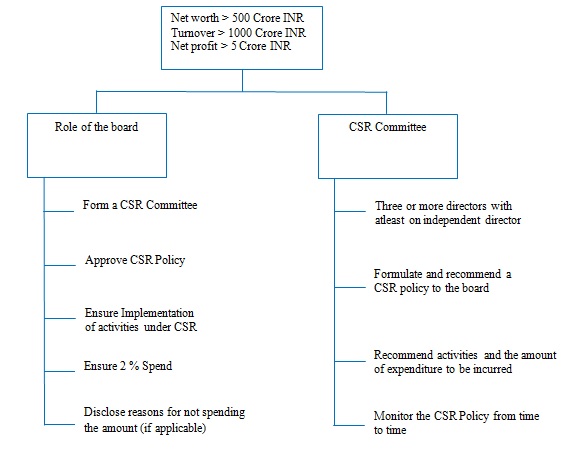
According to Section 135, Companies Act, 2013, the CSR provisions will be applicable to private limited and public limited companies, as well as their holding and subsidiary companies and foreign companies that have offices in India and meets any of the following criteria:

  1. Company must have a net worth of INR 500 crore of more in any financial year;
  2. Company must have an annual turnover of INR 1,000 crores or more in any financial year;
  3. Company must have a net profit of INR 5 crore or more during any financial year.[8]

Companies that meet any of the aforesaid criteria must spend at least two percent (2%) of their average net profits made during the previous three financial years on CSR activities.

An inclusive definition of CSR

While the Companies Act used CSR as a nomenclature without actually defining it, the notified CSR rules have defined the term “CSR” to mean and include but not limited to:

  1. Projects or programs relating to activities enumerated in the Schedule; or
  2. Projects or programs relating to activities undertaken by the Board in pursuance of recommendations of the CSR Committee as per the declared CSR policy subject to the condition that such policy covers subjects specified in the Schedule.

This inclusive definition of CSR is of importance as it permits the companies to involve in projects or programs relating to activities enumerated under the Schedule. It also gives flexibility to the companies by permitting them to choose their ideal CSR engagements that are in accordance with the CSR policy.

CSR Committee and Policy

Every qualifying company will be required to constitute a Committee (CSR Committee) of the Board of directors (“Board”) consisting of 3 or more directors, including at least one independent director.[9] The CSR rules 2014, states that an unlisted company and a private company which are not required to appoint an independent director shall constitute a CSR committee without an Independent director.[10] A private company having only two directors shall constitute its CSR committee with two such directors.[11] In the case of a foreign company, the CSR Committee shall consist of at least two persons wherein one person shall be Indian resident and another person shall be nominated by the foreign company.[12]

The CSR Committee shall articulate and endorse to the Board, a CSR policy which shall specify the activity or activities to be undertaken by the company; recommend the amount of expenditure to be incurred on the activities referred and monitor the CSR Policy of the company.[13]The Board shall take into considerations of the suggestions made by the CSR Committee and approve the CSR Policy of the company.[14]

Role of the board and the CSR committee:
Computation of Net profit

Every company incorporated under Companies Act will have to report its net profits accrued during the financial year for the purpose of ascertaining the criteria stated under Section 135(1) of the Companies Act, 2013. There are a distinct set of rules governing the Indian and Foreign Company in this aspect.

(a) Indian Company: The methodology for computation of net profit has been explicitly provided in the CSR Rules. According to the CSR Rules for the determination of the ‘net profit’, of a company profits made by the company from its overseas branches or dividend income received from another Indian company have to be disregarded. Further, the 2% CSR is to be computed as 2% of the average net profits made by the company during the last three financial years.[15] Also, the computation of net profit is in accordance with Sec 198 of the Companies Act, 2013 which is mainly net profit before tax.[16]

(b) Foreign Company: CSR rules states that the net profit of a foreign company incorporated in India shall be determined in conformity with the profit and loss account and balance sheet of a foreign company which will be formulated in accordance with Section 381(1)(a) read with Section 198 of the Companies Act.[17]

Scope Activities under CSR

Schedule VII of Companies Act, 2013, provides a wide spectrum of activities which may be undertaken by the body corporates in India. Apart from the specified activities, the Government may prescribe any other activity which it thinks proper to be included within the ambit of CSR.[18] The activities that can be done by the company to achieve its CSR obligations include

  1. eradicating extreme hunger and poverty;
  2. promotion of education;
  3. promoting gender equality and women empowerment
  4. reducing child mortality and improving maternal health,
  5. combating human immuno-deficiency virus, acquired, immune deficiency syndrome, malaria and other diseases
  6. ensuring environmental sustainability;
  7. employment enhancing vocational skills;
  8. social business projects;
  9. contribution to the Prime Minister’s National Relief Fund or any other fund set up by the Central Government or the State Governments for socio-economic development and relief and funds for the welfare of the Scheduled Castes, the Scheduled Tribes, other backward classes, minorities and women and
  10. such other matters as may be prescribed by the government of India.[19]

General Circular No. 21/2014 of Ministry of Corporate affairs had clarified that the entries in the Schedule VII have to be interpreted liberally so as to encapsulate the crux of the subjects listed in the said schedule. The items enumerated in Schedule VII of the act are based on broad concepts and expected to cover a wide range of activities. The General circular also provides an elucidatory list of activities that can be included under CSR. In a similar manner, CSR expenditure can be spent on many more activities which are relatable to the ones which are enumerated under Schedule VII.[20]

The Ministry of Corporate Affairs, in order to provide clarity to the execution of CSR, has enumerated the activities which shall not be treated as CSR activities. The following do not constitute as activities falling under CSR:

  1. Activities undertaken in pursuance of the normal course of business by the company;
  2. Activities undertaken outside India;
  3. Activities that are exclusively for the benefit of employees of the company and their families;
  4. One-off events such as awards/ marathons/ advertisement/ charitable donations/ sponsorships of TV programmes etc. would not be regarded as part of CSR expenditure.
  5. Expenses incurred by companies for complying with any Act/ Statute of regulations (such as Land Acquisition Act, Labour Laws etc.)
  6. Contributions made either directly or indirectly to any political parties under Section 182 of Companies Act 2013.[21]

Implementation of CSR

As per the Companies Act, 2013, the activities enumerated in Schedule VII can be executed in the following ways:

  1. It must be carried out within India, preferably at the local areas and the areas around where the company operates.
  2. It may be performed as CSR projects or activities or  programs which may either be fresh or ongoing;
  3. It may be carried out with the aid of a registered trust or society, or a charitable company functioning within India which is established by the funding company, its parent, subsidiary or associate company; or which is not established by the funding company, its parent, subsidiary or associate company if it has a proven track record of undertaking similar activities for at least three years;[22] and
  4. It may be conducted in association with other companies provided that each eligible company is able to report its CSR activities individually.[23]
  5. It may also use up to 5% of its CSR spending in a financial year for training its own employees/personnel for implementing CSR activities or for developing the required facilities/capacities of their own personnel or implementing agencies.

Reporting

It is mandatory for the companies to publish the CSR report on their company’s official websites annually[24]. The Board of directors of the Company must prepare an annual report on the CSR activities of the company in a separate format specified in the CSR rules. The CSR report, inter alia, must contain a brief overview of the CSR policy, the composition of the CSR committee, average net profit in the preceding three financial years, 2% of the average net profit of the company, the amount of expenditure that was spent on CSR activities and any amount which have left unspent. In the case of a foreign company, the balance sheet failed under sub-clause (b) of Section 381(1) shall contain an annexure regarding report on CSR. If the company fails to spend the minimum required portion of its net profit on CSR activities, the reasons for failing to do so must be mentioned in the Board report.

Penalty for Contravention of CSR provisions

According to Section 134(3)(O) the companies Act 2013, the board of directors need to mandatorily disclose all the relevant information about its Company’s CSR policy and its implementation on an annual basis. Section 134(8) of the Act states that if the company fails to comply with the aforementioned provision, it shall be liable to pay a fine which shall not be less than Rs. 50,000 but may extend to INR 25,00,000. Further, every defaulting officer shall be punishable with an imprisonment for a term, not more than 3 years or with a fine which shall not be less than INR 50,000 but may extend to INR 5,00,000 or with both. This essentially infers that the Act penalizes a company for failure to disclose information about its CSR policy but does not hold them liable for not undertaking CSR activities.

However, Section 450 read with Sec 451 of the Act, which deals with general penalties for contravention of the rules and repeat offences, contains a provision for punishing a company or its officers in case no specific punishment is provided for a particular offence. Sec 450 of the Act states that if a company contravenes with any provisions of the Act or any rules thereunder, the company and any defaulting officer are liable to pay a fine which may extend to INR 10,000 and INR 1,000 per day if the contravention continues after the first fine.

According to Section 451 of the Act, where the defaulter is punished either with fine or with imprisonment and where the identical offence is committed for the second or successive occasions within a period of three years, then, that company and every officer thereof who is in default shall be punishable with twice the amount of fine for such offence in addition to any imprisonment provided for that offence.

FALL OF THE GIANTS: FAILURES TO THE CORPORATE GOVERNANCE

While the market has been super volatile in the current times, the issue before the pandemic also did not make any sky-rocketing performance by the companies. The failure of corporate governance by the most widely known companies in India has shaken the shareholders. The downfall of the major unicorns in the country has ensured that the surviving companies duly follow the corporate governance responsibility and ensure transparency in operations. While the major companies have been complaining of the new legislations under the indirect tax as a cause for their downfall, it is important to highlight over here that the lethargy of the companies in duly following the legislative guidelines cannot be used as an argument to justify their failure of corporate governance. The major giants such as café coffee day, Yes bank, DHFL are some among the few companies which were on the peak in the past but the same companies are on the verge of shut down due to insufficient funds and failure of working.

  • FALL OF CAFÉ COFFEE DAY (CCD):

CCD was one of the major coffee giants of India with more than 1500 outlets across the country. It has been in business since the late 19th century and has a history of growing the most authentic coffee beans. While Starbucks was a huge giant of the west, CCD proved to be the one of our country. The company decided to go public in the year 2015 in order to increase the profitability and involve investments from the public but still had major debt toll. While the company was at a surge due to enormous loan and debt, the public offering of shares did not help the firm to change their financial aspects. In the year 2017, the company faced yet another setback where the tax department raided the company and the proprietor had to pay a whooping amount of Rs 2000 Crores to the tax department.

While the company was in heavy debt, the taxes raided from the company worsen the situation. The company was already facing losses in the previous year’s amounting to 50-60 Crores. Thereafter the proprietor due to such heavy setback suddenly disappeared in the year 2019 and was not heard of and thereafter his dead body was founded. The cause of such suicide was the enormous debt on his head and the inability to pay the same to the private lenders. The private equity investors forcing him to buy back the shares or give quick returns on the amount invested burdened the proprietor on another level. While we see rise in the number of stores and multiple people going to such food stores, the debt piling up came out to be strange news for all. 

After such whooping loss, the company was sold to Blackstone legal entity in 2019 hoping that the financials of the company can get better, but the same has not been observed until now and this marked a clear learning for the investors to check up the financials of the company before investing. Also the companies were alerted after this incident to show case all the necessary details about the company to the investors. Even though the company went public in 2015, CCD still could not revive to a better position and India lost one of its own major coffee giants due to enormous debts.

  • THE YES BANK FIASCO:

YES bank is yet another financial lending institution which worked efficiently until the major blunder happened. In March 2020, the Reserve Bank of India took over the complete control of Yes Bank operations in India. While the bank was formed as a non-bank financial company, it started its full fledged lending operations by the year 2003. The bank had been at the forefront of various corporate organizations that could not secure loans from other banks and was agreeing to the loan requests of major giants in the country without much seeing the financial conditions of the borrowers or the point that he belonged to the defaulter’s category.

The condition or the working capacity of the bank suffered huge setback due to the inability of the bank to raise capital in order to address the losses the bank had to suffer. There had been a huge out flux of deposits by the banks and the investors were also very disregarded because of the inability of the bank to provide for the interest on the assets pledged with the bank. The bank faced huge mis-happening of corporate governance where the loan was providing without checking the financials, the board taking decisions without informing the stakeholders, the promoters being the sole authority to take major decisions.

The RBI took complete control over the bank to ensure that the people who had been associated with it do not face a huge setback and hence had numerous meetings with the board to ask about ways in which the balance of liquidity and debt can be ensured. RBI even came up with the policy of telling investors to invest the bank in order to help the bank raise capital from the public markets. However the same did not prove to be a bug time success for Yes Bank because the investors were reluctant to invest in such banks which are in huge debts. Thereafter RBI was forced to seek the help of central government in order to provide an additional moratorium period on YES bank to ensure the bank comes back to its business some time soon.

  • STANDSTILL OF JET AIRWAYS:

Jet Airways is one of the largest airlines of India until 2018 with more than 10 percent market share in the airline industry. But in the year 2019, it faced a huge debt setback and had to carry out its operations due to enormous debts and further the company even did not have enough money to pay their pilots and other employees. The company was in the debt if more than Rs 8000 Crores. There have been various airlines that have gone completely bankrupt such as the Kingfishers, the Deccan airlines, but Jet Airways proved to be in one of these lists shook the airline market. The major factor responsible for such downfall is the corrupt practices of its chairman and his lethargic attitude towards the fulfillment of corporate governance criteria.

The chairman and his family had the entire stake of the airline and as already discussed when the board is under the influence of the promoter, then the corporate malfunctions tend to happen because they have the power and capability to take decisions that profit them. The promoters of Jet Airways were also negligent in taking various decisions and majorly this was the reasons that two most prominent independent directors of Jet Airways resigned in the year 2018. While the TATA’s wanted to save the country’s airline and offered to invest in the company but the same was denied by the board giving insufficient reasons. The sole decisions were being made in the company for the welfare of promoters rather than the stake-holders.

Corporate governance ensures that the shareholders and the stakeholders are in the same loop as the promoters and the directors and that every decision should be well informed to every personnel of the company. The chairman of the company worked in such lethargic manner that he had the capability to deny the basic salaries to its employees after completion of their work and even denied them job security. The corporate social responsibility followed by the company was negligible and the enormous debt amount forced the employees to leave the job because even with the intervention of court, the company was unable to pay the basic to their employees.

GLOBAL PERSPECTIVE OF CORPORATE GOVERNANCE

  • WELLS FARGO SCANDAL:

Wells Fargo is the major financial services company which has its headquarters based in the city of California, US. The banking service was known worldwide as the one who avoids committing any dumb mistakes that other financial lending institutions tend to do and was always appreciated to have been customer support system and cordial relations with the stakeholders. The institution was further always appreciated for the active engagement with the customers and an increase in the sales culture. The main mistake which led to the downfall of the company is the malpractices by their own employees who have been opening various bank accounts of the customers and have been selling debit and credit cards to the already existing customers without even their knowledge. There were also circumstances observed where the signatures of the customers were forged in order to sell their financial services to the customer.

There were more than five thousand employees who had been a part of this scandal and the bank has the liability to pay off more than $3 Million to the customers whose accounts have been hacked and money manipulated. It was highlighted in various reports that the heavy targets imposed by the bank of the employees surged the malpractices because of the pressure of opening up accounts. In the year 2016, the bank took off the liability by paying more than $180 million to the regulators who filed multiple law suits against the banks.

The main cause of this scandal was the inherent sales pressure by the banking sector on their employees with such altruistic sales target that they will have to resort to unfair means in order to complete the same and save their job. Further it is of utmost importance to highlight here that while the employees were excessively dealing in the sales of credit cards, etc, the successful corporate governance in the form of audit committees; the risk management task force would have highlighted the discrepancies if any and would have highlighted the unscrupulous practices. But due to lethargy in enforcing the corporate governance mechanism, the banking company had to face a lot of turmoil.

  • COLLAPSE OF CARILLION:

Carillion is one of the leading construction company of the United Kingdom and has always believed in making a better tomorrow for all. The company was the most renowned one and had multiple projects handing varying from Canada to Iran. But in the year 2018, after a sudden financial failure, the company became incapable in performing any of the given projects. The company in itself had more than forty thousand employees and revenue more than 4 billion Euros for each financial year. While with the downfall of the company, not just the practices came to an end, the small employees and their salaries were also put up at stake. 

The major problem of the collapse was the low profit margin of the company and an increase in debts where the board of the company was unable to take up this issue and manage the risk factor. The financial council of the UK looked into the audits of the company in previous years which clearly did not give any red flags highlighting the financial unsoundness of the company. The cash flow to the company was very meager and majorly the money was spent on the acquisition of raw materials and distributing services. The company has been major involved in relying on additional contracts to minimize the losses but the same did not work well for the company.

The additional problem highlighted in this case if the inability of the board to decrease the debt and additionally increasing the debt ratio of the company by taking up different contracts. Corporate governance with the help of various stakeholders ensures that the debt to equity ratio is balances and excessive debt should be dealt in an efficient yet swift manner. Without an efficient check mechanism, even the big giants cannot be saved and eventually collapse and hence it is of major importance to highlight the concept of corporate governance in the company to ensure smooth and healthy functioning.

PM CARES: UNDER THE AMBIT OF CORPORATE SOCIAL RESPONSIBILITY?

While the pandemic was at the surge in India, the central government came up with the initiative of PM cares fund which basically invited help in monetary manner from various people across the world that shall help the government in combating the virus. The prime minister of our country is the chairman of the fund. Furthermore, the amount donated by the people is not disclosed by the government and the government claimed it to be private fund where the government shall not be accountable to give any public disclosure. Even though in the recent times, the fund has been subjected to various questions due to lack of transparency and the accountability, there have been various companies who have been donating their bit in the name of corporate social responsibility these funds.

Ministry Of Corporate affirs circular dated April 10th, 2020

The Ministry of Corporate Affairs as per the circular dated 10th April,2020 answered various question related to CSR and the PM cares fund where they said the fund is under the ambit of CSR initiative by the companies. Moreover if the companies have donated their bit to the state relief funds, then the same shall not be considered as CSR as the state initiative is not included in the Schedule VII of the Companies Act, 2013. The contributions that have been made to the national as well as the state disaster management authority shall be covered under the ambit of CSR. The circular further highlights that it is the moral obligation of the companies to pay wages to their employees and helping the staff in the lockdown period is the moral duty of the company and the same not to be included under CSR. The circular highlighted that the ex-gratia payment in addition to the wages if paid to the employees or the daily wage workers, then the same can come under the ambit of CSR. 

While the circular initiated the payments from the companies in the name of CSR, the denial that the contributions to the state relief funds was not given any appropriate reason. Also as per the researcher, the ministry of corporate affairs should have mandated on the companies to provide for adequate salaries to the employees as a measure under CSR rather than considering as a moral duty because until and unless the legal compliances are placed, the companies do not think about the stakeholders at large. Further the need of the hour to combat the pandemic in our country would be to help the people on the ground level rather than donating to such organizations. 

The basic help from the companies to provide for insurance covers to the employees, helping the employees family who tested positive in a financial manner, helping the employees receive mentally when they lose their loved ones, giving bit temporary paid leaves so that people when they test positive, acquiring basic medicines and other needs for their employees can prove to be some highly helpful CSR initiatives that the companies can perform. It is always better to know where the money of the organization is spent and whether it is spent for the upliftment of the people rather than giving up to the government organizations that are not even transparent in their actions.

CONCLUSION

From the above analysis, it is evident that CSR is a noble initiative wherein the corporate entities which reap the benefits of resources available at the society helps to fill the gap of socio-economic inequality prevalent in the country and address the problems faced by the society at large.  In most of the countries, CSR activities was a voluntary obligation by the companies or by regulatory. India is the first country in the world to have a mandatory statutory compliance requirement on CSR spending, which was incorporated under Section 135 of the Companies Act, 2013 and has come into effect from 1 April 2014. As a consequence of this, various companies have taken on extensive projects addressing the socio-economic concerns and have supplemented the government’s efforts of sustainable development and engage the corporate world with the country’s development.

However, there are certain lacunas like; there was no tax clarity on the CSR spending, ambiguity on the computation of financial accounts of foreign companies, an absence of clarity on the regulations of CSR vis-a-vis foreign contribution. Even though there are certain lacunas, they should not be permitted to become an obstacle in implementing the true spirit of CSR.  Thus, the government and corporate entities must mutually work together for an effective implementation and addressing their concerns.

BIBLIOGRAPHY

 STATUTES

  • The Companies Act, 1956
  • The Companies Act, 2013

RULES

  • Companies (Accounts) Rules, 2014
  • Companies (Corporate Social Responsibility) Rules, 2014

SCHEEDULES

  • Schedule VII of Companies Act, 2013

NOTIFICATIONS

  • Ministry of Corporate Affairs. Schedule VII. [GSR 130 E] dated 27th Feb, 2014.
  • Ministry of Corporate Affairs. Corrigenda to Schedule VII.  [GSR 261 (E)] dated 31st Mar, 2014.
  • Ministry of Corporate Affairs. Enforcement Notification S.O. 902(E) dated 26th Mar 2014.
  • Ministry of Corporate Affairs. Further Amendment to Schedule VII. [GSR 568 (E)] dated 06th Aug, 2014.
  • Ministry of Corporate Affairs. Companies (Corporate Social Responsibility Policy) Amendment Rules, 2014. [GSR 644(E)] dated 12th Sep, 2014.
  • Ministry of Corporate Affairs. Further Amendments to Schedule VII. [GSR 74 (E)] dated 24th Oct 2014.
  • Ministry of Corporate Affairs. Companies (Corporate Social Responsibility Policy) Amendment Rules, 2015 [GSR 43(E)] dated 19th Jan, 2015.
  • Ministry of Corporate Affairs. Companies (Corporate Social Responsibility Policy) Amendment Rules, 2016. [GSR 540 (E)] dated 23rd May, 2016.
  • Ministry of Corporate Affairs. Exemption to Specified IFSC Private Company [GSR 09(E)] dated 04th Jan, 2017.
  • Ministry of Corporate Affairs. Exemption to Specified IFSC Public Company [GSR 08(E)] dated 04th Jan, 2017.

CIRCULARS

  • Ministry of Corporate Affairs. Clarifications with regard to provisions of Corporate Social Responsibility under Section 135 of Companies Act,2013.General Circular No. 21/2014 bearing No. 05/01/2014-CSR. (Issued on 18th June, 2014)
  • Ministry of Corporate Affairs. Clarification with regard to the provisions of Corporate Social Responsibility (CSR) under Section 135 of Companies Act, 2013. General Circular No. 36/2014 bearing No. 05/01/2014-CSR. (Issued on 17th Sep, 2014)
  • Ministry of Corporate Affairs. Constitution of a high level committee to suggest measures for improved monitoring for the implementation of Corporate Social Responsibility policies by the companies under Section 135 of Companies Act, 2013. General Circular No. 01/2015 bearing No. 05/09/2014-CSR. (Issued on 3rd Feb, 2015)
  • Ministry of Corporate Affairs. Frequently Asked Questions (FAQs) with regard to Corporate Social Responsibility under Section 135 of Companies Act,2013.General Circular No. 01/2016 bearing No. 05/19/2015-CSR. (Issued on 12th January, 2016)
  • Ministry of Corporate Affairs. Clarifications with regard to provisions of Corporate Social Responsibility under Section 135 of Companies Act,2013.General Circular No. 05/2016 bearing No. 05/01/2014-CSR. (Issued on 16th May, 2016)

BOOKS

  • A Ramaiya, Gudie to Companies Act: Providing Guidance on the Companies Act, 2013 (18th edition, LexisNexis 2015)
  • Taxmann’s, A Comparative Study of Companies Act 2013 and Companies Act 1956

(Taxman Publication Pvt. Ltd., 2013 edition)

ARTICLES

  • Elankumaran, S., Seal, R., & Hashmi, A. 2005. Transcending Transformation: Enlightening Endeavours at Tata Steel. Journal of Business Ethics, 59(1): 109-119.
  • Brammer, S., & Pavelin, S. 2005. Corporate community contributions in the United Kingdom and the United States. Journal of Business Ethics, 56: 15-26.
  • EC, Green Paper, Promoting a European Framework for Corporate Social Responsibility, COM (2001) 366 (18/07/2001), para 20.
  • CII and PWC. 2013. Handbook on Corporate Social Responsibility in India. Available at: https://www.pwc.in/assets/pdfs/publications/2013/handbook-on-corporate-social-responsibility-in-india.pdf

WEB SITES

References.

[1] Press Release dated 27th February 2014; http://pib.nic.in/newsite/erelease.aspx?relid=104293

[2]Schedule VII deals with the activities which may be included by companies in their CSR policies

[3] EC, Green Paper, Promoting a European Framework for Corporate Social Responsibility, COM (2001) 366 (18/07/2001), para 20, available at http://eur-lex.europa.eu/legal-content/EN/TXT/PDF/?uri=CELEX:52001DC0366&from=EN. Accessed on 21 March 2017

[4] http://www.unido.org/csr/o72054.html. Accessed on 21 March 2017

[5] Brammer, S., & Pavelin, S. 2005. Corporate community contributions in the United Kingdom and the United States. Journal of Business Ethics, 56: 15-26

[6] http://www.grameen-bank.net/

[7] Elankumaran, S., Seal, R., & Hashmi, A. 2005. Transcending Transformation: Enlightening Endeavours at Tata Steel. Journal of Business Ethics, 59(1): 109-119

[8] “Any financial year” referred under Sub-Section (1) of Section 135 of the Act read with Rule 3(2) of Companies CSR Rule, 2014, implies ‘any of the three previous financial years’

[9] Section 135(1) of the Companies Act

[10] Pursuant to Section 149 of the Companies Act, 2013 and Companies (Corporate Social Responsibility Policy) Rules, 2014, Rule 5(1(i))

[11] Companies (Corporate Social Responsibility Policy) Rules, 2014, Rule 5(1(ii))

[12] Companies (Corporate Social Responsibility Policy) Rules, 2014, Rule 5(1(iii))

[13] Section 135 (3) of the Companies Act

[14] Section 135 (4) of the Companies Act

[15] Companies (Corporate Social Responsibility Policy) Rules, 2014, Rule 2(1)(f)

[16] Frequently Asked Questions (FAQs) with regard to Corporate Social Responsibility under Section 135 of Companies Act,2013.General Circular No. 01/2016 bearing No. 05/19/2015-CSR. (Issued on 12th January, 2016)

[17] Section 198 of the Companies Act, 2013 deals with calculation of profits; Companies (Corporate Social Responsibility Policy) Rules, 2014, Proviso to Rule 2(1)

[18] The Companies Act, 2013, Schedule VII

[19] The Companies Act, 2013, Schedule VII

[20] Clarifications with regard to provisions of Corporate Social Responsibility under Section 135 of Companies Act,2013.General Circular No. 21/2014 bearing No. 05/01/2014-CSR. (Issued on 18th June, 2014)

[21]General Circular No. 21/2014, Ministry of Corporate Affairs, (June 18, 2014), http://www.mca.gov.in/Ministry/pdf/General_Circular_21_2014.pdf

[22] Companies (Corporate Social Responsibility Policy) Rules, 2014, Rule 4(2); See Ministry of Corporate Affairs, Notification Companies (Corporate Social Responsibility Policy) Amendment Rules, 2016. [GSR 540 (E)] dated 23rd May, 2016

[23] Companies (Corporate Social Responsibility Policy) Rules, 2014; Rule 4(3); See Ministry of Corporate Affairs, Notification Companies (Corporate Social Responsibility Policy) Amendment Rules, 2016. [GSR 540 (E)] dated 23rd May, 2016

[24]Companies (Corporate Social Responsibility Policy) Rules, 2014, Rule 8 and 9

Download Now

Legal actions against Ransomware attacks

1
ransomware

In this article, Shriji Pandey put forth legal actions to take when someone sends you a ransomware virus. 

Legal actions against Ransomware attacks

  • What can you do when someone is not only playing with your privacy but also, infringing various rights of yours and breaking several laws just by using a computer sitting far away in his house?
  • Ransomware, a malware, a type of Trojan virus, which like most computer viruses, often arrives in the form of a phishing email, or spam, or a fake software update – which after infecting the computer when the recipient clicks a link or opens an attachment, holds the computer hostage by encrypting data,  demanding ransom payment for decrypting everything.
  • WannaCry ransomware cyber attack is the latest worldwide cyber attack which usually attacks Microsoft Windows Operating systems and the payment demanded in less traceable Bitcoin cryptocurrency. Business and Public Institutions have been one of the major targets but the private individuals aren’t untouched now. The illegal activities come under the category of cybercrime.

Cyber crime is broadly divided into two categories based on the usage of computer as

  1. Target (example, Hacking, Virus Attack)
  2. Weapon (example, cyber terrorism, IPR violations, pornography)

Ransomware attacks attract both Criminal and Civil legal actions depending upon the individual harms suffered, actions of the criminal and illegality of the actions according to the nature of wrong committed.

Ransomware attack is a breach of Right to personal liberty guaranteed under the Indian Constitution

Prima Facie it is an infringement of our Fundamental Right to Privacy covered under Article 21- Right to Life of Constitution of India. Information Technology (Reasonable Security Practices and Procedures and Sensitive Personal Data or Information) Rules, 2011 provides protection to personal information. Prior to these Rules, in India remedies for invasions of privacy existed under tort law and the Supreme Court of India accorded limited constitutional recognition to the right to privacy (under Article 21). These Rules provide the only codified provisions protecting the privacy of individuals and their personal information. Rule 3 of the Rules provides an aggregated definition of sensitive personal data as follows:

Sensitive personal data or information of a person means such personal information which consists of information relating to –

  • Password;
  • Financial information such as bank account or credit card or debit card or other payment instrument details;
  • Physical, physiological and mental health condition;
  • Sexual orientation;
  • Medical records and history;
  • Biometric information;
  • Any detail relating to the above clauses as provided to body corporate for providing service; and
  • Any of the information received under above clauses by a body corporate for processing, stored or processed under lawful contract or otherwise

Ransomware attack: An act of Extortion under IPC

These malware attacks are a clear case of Extortion. According to Section 383 of IPC, Whoever intentionally puts any person in fear of any injury to that person, or to any other, and thereby dishonestly induces the person so put in fear to deliver to any property or valuable security, or anything signed or sealed which may be converted into a valuable security, commits ‘Extortion’.

Ransomware attack: A tortious lilability

The attack can be covered under Law of Tort under Trespass to Chattel, also known as trespass to goods or trespass to personal property, defined as “an intentional interference with the possession of personal property…proximately causing injury.” Trespass to chattel, does not require a showing of damages. Simply the “intermeddling with or use of…the personal property” of another gives cause of action for trespass. Since CompuServe Inc. v. Cyber Promotions, various courts have applied the principles of trespass to chattel to resolve cases involving unsolicited bulk e-mail and unauthorised server usage as well. Generally, trespass to chattels possesses three elements – Lack of Consent, Actual Harm and Intentionality. In the ransom attack to your computer, these elements constitute the tort covering intangible property like in the case, the computer.

Ransomware attack: Punishment under the IT Act

The present act is also punishable with imprisonment for a term which may extend to three years and with fine under Section 66A of IT Act through 2008 amendment, which states that “Any person who sends, by means of a computer resource or a communication device

  • any information which he knows to be false, but for the purpose of causing annoyance, inconvenience, danger, obstruction, insult, injury, criminal intimidation, enmity, hatred or ill will, persistently by making use of such computer resource or a communication device,
  • any electronic mail or electronic mail message for the purpose of causing annoyance or inconvenience or to deceive or to mislead the addressee or recipient about the origin of such messages shall be punishable with imprisonment for a term which may extend to three years and with fine.”

Cyber crimes can involve criminal activities that are traditional in nature, such as theft, fraud, forgery, defamation and mischief, all of which are subject to the Indian Penal Code. Cyber Crimes are broadly covered under –

  1. The Information Technology Act:
  • Tampering with Computer Source documents – Section 65
  • Hacking with Computer Systems, Data alteration – Section 66
  • Publishing obscene information – Section 67
  • Un-Authorised access to protected system ­­– Section 70
  • Breach of Confidentiality and Privacy – Section 72
  • Publishing false digital signature certificates – Section 73
  1. IPC and Special Laws:
  • Sending threatening messages by email – Section 503
  • Sending defamatory messages by email – Section 499
  • Forgery of electronic records – Section 463
  • Bogus websites, cyber frauds – Section 420
  • Email spoofing – Section 463
  • Web-Jacking – Section 383
  • E-mail Abuse – Section 500
  1. Some Special Acts:
  • Online sale of Drugs under Narcotic Drugs and Psychotropic Substances Act
  • Online sale of Arms Act

Ransomware attack and data Theft

Data theft is a misnomer as it is no theft under law. Instead, the valid term is Data Crime/Criminals. Depending on the nature of the relationship between the victim and the criminal, the nature of legal actions may defer. For instance if the criminal is amongst one of the employees provided there is an agreement between the employer and the employee, it can be a ‘Criminal Breach of Trust’ which is punishable under Section 405(data treated as a ‘Property’) and the Punishments are covered under Section 406-409 of Indian Penal Code, 1860.

Here, some provisions of IT Act, 2000 can also be invoked to aforesaid provisions of IPC like Section 43(b) which deals with penalties and compensation regarding unauthorised access to the computer and damages suffered due to this. Data Theft is also covered under Section 2(o) of Copyright Act, 1957 which deals with literary works. It is a Criminal offence under Section 63 Of the act which makes it A cognizable and non-bailable offence under First Schedule of Code of Criminal Procedure (CrPC), 1973 and more than 3 years of imprisonment if proven guilty.

How to file a complaint against Ransomware attack

How to seek justice? Like any other criminal case, the ransomware attack victims need to file a complaint first to seek remedy from the Judicial system of the country. The complaint can be filed in the concerned Police Station as a FIR. To tackle the issue of cyber crimes, CIDs (Criminal Investigation Departments) of various cities opened up Cyber Crime Cells in different cities as well. Chapter 10 and 13 of the IT Act talks about the Offences (and the said penalties awarded under it, if proven) under the Act and the power given to the victims against it and during the procedure of investigation, respectively.

Section 48 of the IT Act, 2002 establishes the Cyber Appellate Tribunals around different places in the country. Section 57 provides Appeal to Cyber Regulations Appellate Tribunal. –

(1) Save as provided in sub-section

(2), any person aggrieved by an order made by the controller or an adjudicating officer under this Act may prefer an appeal to a Cyber Appellate Tribunal having jurisdiction in the matter.

Jurisdictional Challenges In Case Of Foreign Defender

India at present does not have a proper extradition law to deal with crimes that have been committed over the Internet.  To address this issue, India should become a signatory to the Convention of cyber crimes treaty and should ratify it. The Supreme Court of India, in the case of SIL Import v. Exim Aides Silk Importers , has recognised the need for the judiciary to interpret a statute by making allowances for any relevant technological change that have occurred. Until there is specific legislation in regard to the jurisdiction of the Indian Courts with respect to Internet disputes, or unless India is a signatory to an International Treaty under which the jurisdiction of the national courts and the circumstances under which they can be exercised are spelt out, the Indian Courts will have to give a wide interpretation to the existing statutes, for exercising Internet disputes. But some of the legislation currently present, can still be helpful.

Section 75 of the Information Technology Act, 2000  implies that the Act shall apply to an offence or contravention committed outside India by any person if the act or conduct constituting the offence involves a computer, computer system or computer network located in India. While

Section 3 and 4 of the Indian Penal Code, 1860 deals with the extra-jurisdictional power given to the Indian Courts.  Code of Criminal Procedure, 1973, Section 188 provides that even if a citizen of India outside the country commits the offence, the same is subject to the jurisdiction of courts in India. In India, jurisdiction in cyberspace is similar to jurisdiction as that relating to traditional crimes and the concept of subjective territoriality will prevail. Moreover, Section 178 deals with the crime or part of it committed in India and Section 179 deals with the consequences of crime in Indian Territory.

In the present scenario where the cyber crimes are increasing to an alarming extent, the present need of the hour is to have broad-based convention dealing with criminal substantive law matters, criminal procedural questions as well as with international criminal law procedures and agreements. The IT Act, 2000 would be crippled without proper means and ways of implementing it.

Download Now

Death Penalty and Clemency

0

Introduction

The Death penalty is a punitive measure, where the life of a person is taken by the State by following the due procedure of law. Whenever a person commits a crime that is grave enough, in the eyes of judiciary that he/she does not deserve to live anymore is hanged to death. In India, death penalty under Indian Penal Code is approved for murder, gang robbery with murder, abetting the suicide of a child or insane person, rape, waging war against the government and abetting mutiny by a member of the armed forces. Death sentence is also prescribed under some anti-terror laws for those convicted of terrorist activities. But generally, the court announces death sentence for murders that also in ‘rarest of the rare cases’ as stated by the Supreme Court in the Bachan Singh V State of Punjab (1980). This makes the death punishment a unique form of punishment because of the nature of irreversibility attached to it.

Though death penalty has existed since long back, recently there has been a huge uproar about the abolishment of capital punishment. Many countries have eradicated death penalty but it still prevails in around 58 countries today, with highest number of penalties being recorded in Iran and Iraq. India has recorded around 477 death penalties according to a research conducted by NLU-Delhi but the Supreme Court reports on 3-4 deaths per year.

Procedure

As the nature of the penalty is irreversible, the law provides enough chances for scrutiny of the decision. If awarded by the lower court, death penalty should be assented by the high court of that state as to avoid any error [Section 366(1), CRPC]. Further the High Court can look into the case and can announce the judgment accordingly. Even after this the convict has a chance to appeal with the Apex Court [Article 134(1) (a) & (b), COI]. After the final verdict of the Supreme Court, there lies a last opportunity of acquittal for the convict.

Clemency Process

Under Article 72 and Article 161, the Constitution of India has created a provision for leniency of capital punishment. Under these Articles, the President of India and the Governor of the respective state has the power to grant pardon or commute or remit the death sentence in certain cases. For this, a request for pardon is filed before the President or the respective Governor. In case of states first the mercy petition is sent to the Governor and if disapproved it is then sent to the Ministry of Home Affairs for the consideration of President of India. Similarly in case of Union Territories, it is first sent to Lieutenant-Governor / Chief Commissioner / Administrator. The Ministry of Home Affairs renders advice to the president about the petition and the President is bound to act in accordance to that advice. The power to grant pardon includes further examination of related factors that are pertinent to the sentence such as age, sex, mental stability and socio-economic conditions. The president need not provide reasoning for his decision.

Though the judiciary has no rights for reviewing the decision of rejecting the petition as held in Kehar Singh V. Union of India, but in Shatrughan Chauhan V. Union of India courts may review whether all relevant materials were scrutinized by the executive or not. According to the Apex Court if it is found that the executive has not touched upon each and every relevant area before rejecting the plea it will be the Violation of Article 21 of COI and the court will hence be able to commute the sentence of the convict. In Shatrughan Chauhan’s case the judiciary reprimanded the executive for its delayed functioning. The sentence can be commuted on the grounds like- delay in execution, insanity, solitary confinement, dependence on judgment per incuriam and procedural failure. Further, inordinate delay constitutes torture and violates law.

The trend

According to information released by the government under the RTI Act, of the 77 mercy pleas decided by Presidents between 1991 and 2010, 69 were rejected. Only 8 about 10% of those who wanted mercy were securing the scaffold. R Venkataraman rejected 44 mercy pleas, the most by any President. Current President Pranab Mukherjee has also not been merciful as such he has rejected 37 pleas in 4 years of his tenure. Whereas APJ Abdul Kalam has been quite merciful as he took up only 2 pleas and left behind dozens. Such irregularities prove that the Presidents allow their personal view to influencing their decision hence making it very subjective as to which convict may be granted plea and which may not.

Last Rights

Prisoners also have a right to dignity and execution of death sentence should be carried out in a quick and simple manner allowing the convicts to exhaust all legal remedies. Human dignity is one of the foremost right availed even by the death penalty holders enshrined in Article 21. Prisoners have a right to legal Aid and receiving written copy of mercy petition’s result. Regular health checkups are also mandatory. The court also stated that the government should carry put a post-mortem as to prove that the execution was carried out according to the guidelines.

Conclusion

Death penalty is still legal (might not be voted for) in India, though fiercely debated after the Afzal Guru case. So until this debate boils down to a conclusion, capital punishment stands tall and hence needs to be followed with due procedure of law. The president’s pardoning power can indeed save a human life and is the last resort for a convict to escape death. It is expected from the executive to be quick and fair in its decision. But still a parameter has not been fixed as to what amount of time taken will be counted as delay. Also the safety and living conditions of the prisoners often stand jeopardized. Also some presidents have been way too merciful while some sharp. The processes of law need to make sure that the convict is able to use all his legal remedies fully.

REFERENCES

Download Now

Key clauses in employment contracts

0
employment


In this article, Tirumala Chakraborty who is currently pursuing M.A. IN BUSINESS LAWS, from NUJS, Kolkata, discusses Key clauses in employment contracts.

Key clauses in employment contracts

An employment contract is a legally enforceable agreement stipulating the terms and conditions of the employment in addition to recognizing the rights, expectations, and obligations of both the employer and the employee. Employment contract is a bilateral agreement based on an offer, acceptance, consideration, competent parties, legal object and free consent. An employment contract is entered into for an agreed duration with respect to exchange of service and remuneration. There are several regulations which by itself are complex in nature governing the relationship between the employer and employee

Once such agreement is executed with consent between the employer and the employee, the same is said to binding on both parties. The important clauses in a contract of employment are appointment, term of the employment, responsibility, remuneration, payment of salary, sickness and disability, termination, confidentiality, indemnification, notice, restrictive obligations, choice of law and jurisdiction. Every employee executing such contract is under an obligation to perform his part of the duty as has been set out in the contract while it shall be the duty of the employer to protect the employee from harm or injury, and make fair compensation for any loss or damage arising from any job-related accident. In addition to such specified obligations, the contract of employment also includes terms and conditions relating to promotions, rewards and terminations.

NATURE OF SUCH CONTRACTS

An employment agreement laid the foundation of the employment relationship between an employer and employee. It can be made verbally or in writing and like any other agreement it specifies various terms and conditions under which a person who accedes to perform duties as directed by the employer in exchange of salary for an agreed period of time. A contract of employment must include various details in relation to such employment such job description, payments, benefits, rules and regulations for termination etc. An employment contract starts with the acceptance of the offer of employment or the terms and conditions offered by the employer. The acceptance is the assent given to the proposal offered and it has the effect of converting it into a promise and any alteration or modification to such existing contract can be made only with approval of both the parties. Any breach of the terms and conditions to which both the employer and employee are bound will result to repudiation of such contract.

Any contract of employment signed with an Indian company is governed by the Indian labour law. There is no provision in the Indian laws that make it mandatory for an employer to provide a written contract of employment or written statement to his newly hired employee. In India, usually a simple letter of appointment signed between the employer and employee serves the purpose of the employment contract.  The common intention of the parties to create legal obligations and the promise to employ and be employed forms the integral part  of the agreement and thus from a cultural perspective, it can be said that contracts in India are not seen as binding as it is in other developed countries.

KEY CLAUSES OF EMPLOYMENT CONTRACTS

An employment contract is drafted, signed and executed between the employer and employee mainly to prevent nondisclosure of information such as trade secrets, non-competition, non-solicitation as well as protection of confidential information. The key clauses that a contract of employment should include are briefly described below:

CONFIDENTIALITY CLAUSE / NON – DISCLOSURE OBLIGATIONS

A well draft contract of employment should include a confidentiality clause that gives protection to company’s sensitive information such as trade secrets and client data and obligates the employee to keep such information confidential from the public. This particular clause restricts the employee from disclosing confidential information to any third person without the permission of the employer. A separate agreement commonly referred to as non- disclosure agreement can also be drafted and executed for this purpose as the confidentiality clause overlaps with clauses such as restrictive covenants, non- solicitation clauses etc. In the matter of Diljeet Titus versus Mr. Alfred A. Adebare and Others (2006 (32) PTC 609 (Del)), the High Court of Delhi rejected the contentions of the defendants and restrained them from using the information taken away illegally at the termination of the employment. The Court restrained the defendants from using that information as it was necessary to protect the interests of the plaintiff’s business.

It is indeed very important to include a confidentiality clause in an employment agreement as it somewhat gives assurance to the business that the hired employees of the company will not expose the trade secrets to the other competitors in the market. By signing the non- disclosure agreement the employee is agreeing that disclosure of company’s secret or misusing that information lead to breach of such contract. The Indian Penal Code and the Information Technology Act, 2000 provides for Criminal prosecution and imprisonment or fine (or both) as consequences for breach of confidentiality and disclosure provisions. The Information Technology Act, 2000 under Section 66e talks about the punishment for violation of privacy policy and  various other related acts such as tampering with computer source document (Section 65), hacking (sec 66) etc.

In absence of a clearly written confidentiality clause in the contract of employment, the employer will have to count on the judiciary and the rules provided in common law. The most important issue that has to be taken into consideration while adjudicating a matter in relation to this is the whether the revealed information is a secret which is exclusively available to that particular organization or it is just a general information for the public domain.

RESTRICTIVE CLAUSES

This is one of the key clauses to be included in an employment contract. It is mainly designed to protect the legitimate interest of the business and simply not to avoid competition. This clause restricts an ex employee from using integral information such as business strategy, customer details etc. in relation to his prior employment. Restrictive covenants provide protection both to the business and the employer during the employee’s employment period and even after such period ends. This clause disallows an employee from competing with his ex employer for a certain period of time after he has disassociated himself from the business and stops him from misusing the invaluable information to the competitors those who are seeking to poach upon the market of the business he was associated with.

An employer must be mindful while drafting a restrictive covenant and certain factors such as the extent of geographical area, the time length for imposing such post employment restrictions, type of information that is being protected etc are to be considered in a much substantial way. The extent of restrictive covenants must be in respect to the position of the employee within the business. It is more likely and reasonable to put a restriction on the senior employees as they are more aware of the organization’s sensitive information.

Though there are several types of restriction to be imposed the most common types of restriction that are used by employers are discussed below:

Non-compete covenants

Under a non –compete covenant or contract, it is agreed by an employee not to enter into or start a similar trade or profession in competition against his prior employee. In India, the Contract Act under Section 27 of the Act deals with the legality of non- compete clauses and says that every agreement by which any person is restrained from exercising a lawful profession, trade or business of any kind is void. Whenever a covenant in regard to restraint of trade or profession is call into question, the burden of proof lies on the person who is probing to uphold it and it is the duty of the Court to determine to what extent it establishes a restraint of trade. Non – compete covenants can be effective during the period of employment and can only be challenged on the ground of being onerous. After the termination of employment, restrictive covenants are considered to be void under Section 27 of the Indian Contract Act. Restraining a person from carrying on a trade generally aims at avoiding competition and has monopolistic tendency and this is both against an individual’s interest as well as the interest of the society and on that ground such restrains are discouraged by law. The right to freedom of profession, trade and business is confirmed by the Constitution of India under Article 19(1)(g), so any agreement which interfere this freedom is void.

In England also an agreement made for restraining someone from a trade is void and it was laid down by the House of Lords in the  famous case of Nordenfelt versus Maxim Nordenfelt Guns & Ammunition Co. Ltd. [(1894)  A.C  535]. It was held that both the general and the partial restraint of trade are prima facie void.

Non-solicitation covenants

This is often included in a non – compete agreement, non disclosure agreement but can be also be drafted as a separate agreement. Under this, an employee simply agrees not to solicit or give advice to the client of the organization after he leaves the organization. This particular covenant prevents an ex employee from dealing or soliciting the clients or customers of his former employee; regardless of which party has given the proposition. It also prevents the employee from soliciting his colleagues to quit the job for example trying to recruit them away from the organization.

TERMINATION

An essential part of a contract of employment is the termination clause. A clause containing the employment period and its termination should be included in a contract of employment. It is a statutory clause written in the contract of employment which states that either party to the contract may terminate the relationship of employment by serving a certain amount of notice such as one month notice. A termination clause specifically mentions the terms and obligations to be complied by the employer and employee upon termination of the employment. This clause must include certain details such as the amount of notice period to be served by the employee, compensation to be paid upon such termination etc. Employment contract has an implied term that every employee will serve a reasonable termination notice.

The relationship of employment between an employer and his employee gets terminated either on resignation of the employee or situation arises where an employee gets terminated with or without a cause. Though it is not reasonable to terminate an employee without a justified cause but in such a case, employee is entitled to compensation or damages for the loss of earning caused due to such wrongful termination. The most common legal grounds for terminating an employee include violation of rules and regulations of the contract, grave misconduct or his disability to discharge his duties. An employee is also obligated to indemnify his employer in case he fails to perform his part of duties or for the loss or damage caused to the employer due to his action. In India, the relationship between an employer and his employee is governed by the Industrial Disputes Act, 1947 and this Act is considered as the most important labour law of the country. This Act prescribes the rules to be followed for termination or retrenchment of workmen from the employment and the amount payable as compensation for such termination.

Termination clause is considered to be one of the key clauses in employment contract and must be clear and explicit. It should be properly drafted and executed in order to make it enforceable.

COMPENSATION AND BENEFITS

A standard contract of employment must define compensation. Any compensation or benefits deriving from the employment should be included in the contract. It allows amending the salary, incentives, benefits and other compensation of the employees. It includes the base salary, bonus or incentives, information about hikes. Every particular about the payment of bonus and compensation should be stated in the contract. A separate provision can be made for “no additional compensation” which means even if an employee becomes an elected director of the company, he will not be benefitted with to any additional compensation for such achievement. A “no additional compensation” is mainly inserted in the agreement meant for executive level employees.

The benefit plan and the percentage of benefit to be borne by each party should be stated unambiguously. It should clearly state the type of benefits the company offers its employees for example health insurance. Usually, an amount to premium is required to be paid by the employee for availing such benefits. It should also specify the possibility of sharing profit from the company.

JURISDICTION AND GOVERNING LAWS

It is pertinent to mention that disputes may arise out of a contract and for resolving such legal dispute some parties prefer to go for arbitration and in such case they include an arbitration clause in the contract while other rely on the judiciary to adjudicate the dispute rises between them. By including a jurisdiction clause, the parties to the contract clearly specifies the judicial Court or forum which will have the right to resolve the legal dispute between the employer and the employee in relation to their employment contract. A jurisdiction clause may either provide for exclusive jurisdictional rights which mean the specified courts will only have the rights to dealt with the dispute or they may provide for non – exclusive jurisdiction. In case of a non- exclusive jurisdiction clause, the specified courts may hear the dispute but here the parties are free to approach other courts if they think it to be apropos to refer the matter to some other courts.

A governing law clause in an employment contract sets out the choice of law of the parties to the contract.  Laws relating to employment vary from state to state and hence it is advisable to state the set of governing laws clearly in the contract. This clause of governing laws helps in avoiding the initial confusion regarding which set of laws should be applied to adjudicate the dispute between the parties to the contract. Some of the state laws are much in favor of the employee while others are seen as more beneficial to the employer than the employees. The laws of a particular state will be the governing law if any legal dispute arises between the employer and the employee in relation to the contract irrespective of the fact where it is filed. Where a contract is connected to several places, it is particularly important to set out the choice of law. There are several legal systems with possible relevance to the contract in a case where the parties to the contract are in different countries and the place for performance is a third country. Thus, it is very much essential to decide expressly which legal system will govern such dispute.

RESOLUTION OF DISPUTES AND GRIEVANCES / ARBITRATION CLAUSE

In an employment relationship, a grievance between an employer and employee is a complaint raised by either party against the other and should be dealt either in a formal or in an informal manner for resolution of such grievance in the workplace. There could be several reasons for filling such grievance that include breach of terms and conditions of the contract, discrimination, harassment etc. This is exactly where the need for inclusion of an arbitration clause lies in the employment contract like any other contracts. This clause specifies that any dispute arising out of that employment relationship will be resolved through arbitration, a form of dispute resolution and prevents the party from approaching a judicial Court. Now a days many employers prefer to include an arbitration clause in the contract of employment since this method of dispute resolution is much cost effective and less time consuming. This clause must contain details about the arbitration procedure such as the binding nature of the arbitration award, appointment of arbitrators and the place for arbitration sitting.

OTHER CONTENTS OR CONSIDERATIONS

An employment contract should also have these contents apart from the key clauses that have been discussed above. We may note below certain other contents in a contract of employment:

Name of the parties

In a contract of employment, the first and the foremost thing to be included is the detail of the parties to the contract. Like any other standard form of contract, there must be at least two parties to form an employment contract. The person who makes the proposal is generally called the employer and the person to whom the proposal of employment is made is called the employee. It should contain the details of the employer’s organization as well as the name and full address of the person to be employed.

Appointment

When the proposal of employment is accepted by the employee, a contract of employment has to be made for appointing the employee. The appointment date or the starting date of the employment should be mentioned. The employee should keep in mind that he is starting a fresh and the  employment rights that he gained from his prior employment will no more be taken into consideration. Though, this rule is not applicable in case an employer is taking over the entire organization with the existing employees.

Job description

The contact should mention the primary responsibility to be taken by the employee and it should also include the description of the job specified in the offer letter of the employee. The department or the detail of the reporting person with whom the employee will work should be clearly mentioned by the employer in the contract of employment.

Location

Another important content is the place of work where the employee will work. If there is any probability that the place of work might change in future should also be specified by the employer. This allows greater elasticity for the employer.

Schedule and employment period including hours of work

To give a meaning to the employer- employee relationship, the contract should specify the employment period clearly in the contract. The employee should know whether he is employed for a continuous period or for a set time period. This includes the number of hours an employee is expected to work and other working options such as working at night, working from home etc.

Probationary period, if any

A probationary period is the trial period used by the employer to assess his employees. This trial period is usually applicable in case of new employees as well as existing employees placed in a new position. During this stretch of time the employer expects his employee to learn and fulfill his expectations at the end. The employer has the option to extend the probationary period if he thinks it to be appropriate. Any trial or probationary period which the employer expects his employee to serve before getting the opportunity to work as a permanent employee should be stated in the contract of employment.

Salary including deductions and payment term

An employment contract should clearly specify the gross salary to be offered to the employee for his employment. Any tax deductions, deductions made for the purpose of insurance or any kind of deductions from the employee’s salary should be mentioned. The contract should also state the payment date or when the payment is to be made by the employer.

Other expenses

There are situations where an employee will have to borne certain work related expenses while discharging his duties for example travelling expenses. An employer should specify it to the employee that which all expenses will be reimbursed. This allows maintaining clarity in the employment relationship.

Holidays

A contract should specify the exact number of holidays to be enjoyed by the employee during the period of employment and restrictions on holidays, if any. This should also state whether the employee can carry over any unused holidays into the next year or get any payment in lieu of such holidays on termination of the employment.

Time off and sick leaves

This spells out the number of days an employee can take off from his work and whether the public holidays are included or excluded from this amount of time. It is usually an employer who gets affected when an employee takes time off from his work due to sickness. But it is expected that the employee must inform the employer and provide him with a doctor’s certificate. The provision for any sick pay should be stated clearly in the contract. But it is always better to have a separate policy in regard to sickness and absence in order to avoid complexities.

Vacation policy

There should be a vacation clause in the contract of employment that calculates the amount of vacation days an employee is entitled to enjoy annually or monthly during his employment period. This discretionary power lies on the employer. The clause additionally includes the details regarding rolling-over unused vacation into the coming year and the procedure for scheduling such.

Notice

The notice period applicable in case of both employer and employee should be stated unambiguously in the contract of employment. This clause also includes the actions to be taken by either party in case the other fails to comply with it.

Retirement

A person gets terminated from his employment automatically on reaching the standard retirement age.  Most organizations prefer to draft a separate retirement policy for their employees rather than inserting it as clause in the contract of employment.  The retirement policy ensures the justified retirement age and is not required in cases where employee decides their date of retirement.

Pension

A standard form of employment contract provides a provision for pension to his employees on compulsory termination after attaining the standard age of retirement. This includes the details of the pension scheme to be offered by the organization. If the organization has no provision for pension, it is also required to be mentioned in the contract of employment.

CONCLUSION

The concept of employment agreement is similar to any other contract in force. A comprehensive employment contract provides the key duties and responsibilities of the employee duties and responsibilities and helps him to understand exactly what his employer is expecting him to do. The main object of an employment contract is to prevent disclosure of information, non-competition, non-solicitation as well as protection of confidential information so it is always advisable to execute a written contract of employment between the employer and the employee. In practice, the employer signs a letter of appointment with the proposed employee prior to entering into the employment contract. An appointment letter is usually executed with a view to cover the probation period of an employee till the time such employee is made permanent in the organization by the employer.

BIBLIOGRAPHY

Legislation

  • Indian Contract Act, 1872.
  • Information Technology Act, 2000.
  • Industrial Disputes Act, 1947
  • The Constitution of India

Books referred

  • Law of Contract by R.K Bangia
  • Dutt on Contract by Salil Kumar Roy Chowdhury and H.K Saharay
  • K Malik’s Commentary on Industrial Disputes Act, 1947

Dictionaries referred

  • Oxford Dictionary
  • Black’s law Dictionary

Websites referred

Case Laws

  • Diljeet Titus versus Mr. Alfred A. Adebare and Others (2006 (32) PTC 609 (Del))
  • Nordenfelt versus Maxim Nordenfelt Guns & Ammunition Co. Ltd. [(1894) C  535]


Download Now

Distressed assets situation in India

0
alienation
Image Source: https://bit.ly/2OV0zeH

In this article, Tejaswinee Roychowdhury who is currently pursuing M.A. IN BUSINESS LAWS, from NUJS, Kolkata, discusses Distressed assets situation in India.

INTRODUCTION

An asset of a company is its resource which has an economic value and the potential for future benefit. The balance sheet of a company reports such assets, and they are meant to expand the firm’s value or ease the operations of the firm. [1] These assets also act as financial securities for future as in case of bankruptcy, mortgages, payments of debts, etc., these assets are sold so that the company can try to sustain.

Often, it so happens, that a company which is swimming in unpaid debts is forced by the bank (or in some cases by the order of the Court) to sell their assets. In such cases, the company may go into liquidation or wind up. Such sale occurs at a low price and the reason may be bankruptcy, debt recovery, or regulatory constraints. The assets that are put on such sale are known as ‘distressed assets’. If a debt is sold, i.e., assets or property sold with legal incidents, then such a debt becomes a distressed debt. [2]

Today, companies try to sell their assets before attaining complete bankruptcy. The company issues financial instruments that are known as ‘distressed securities’. These securities include corporate bonds, bank debts, trade claims, and common and / or preferred shares. Owing to their incapacity to meet financial commitments, these instruments are lowly valued. There is, however, an implied risk factor that manages to offer high returns to potential investors. [3] This is the reason there is a growing trend towards investments in distressed assets, distressed asset funds, etc. with an increase in Asset Reconstruction Companies (ARCs), Securitization Companies (SCs) and Financial Institutions (FIs).

THE PRESENT SCENARIO IN INDIA

ASSET QUALITY REVIEW

India’s banking sector has been suffering blow after blow in asset quality management given the fact that multiple large scale and small scale projects ran into hurdles along the way, such as, poor evaluation of project, extensive delays in project, poor monitoring and poor accounting leading to cost overruns, which disallowed the borrowers from repayment of their loans. Mostly the public sector banks suffered severe impacts and there was a slowdown in growth of credit.

Therefore, the RBI, following the European Central Bank’s (ECB) tests on supervising the Euro banks after the big financial crisis, came up with certain effective measures to remedy the situation and deal with distressed assets before it’s too late. Such efficacious methods to lower the stress of distressed assets include lowering the financial stress of the project such as the JLF, the SDR technique (necessitating the banks’ debt-for-equity swap process and change of management in companies), and the 5/25 mechanism (so that loans for long-term projects, such as infrastructure industries and core industrial sectors, are refinanced every 5 years when they have a tenure of 25 years or above).

Further, in order to make an assessment of how effectively the ‘Bad Loan Management Schemes’, drawn up by the bank Boards individually, were working and in order to make sure that the banks were taking proactive measures to clean up balance sheets, the RBI launched an Asset Quality Review (AQR) as a part of the bank’s mandate to improve the banking sector, clean up bad loans and boost the quality of their balance sheets by March 2017. [4]

FACTORS CONTRIBUTING TO DISTRESSED ASSETS SITUATION

The most important factors that contribute to the distressed asset situation in India today include,

  • Excessive amounts of leverages and over-investments during strong economic phases;
  • A steady and persistent economic slowdown after the Financial Year of 2011, thus, impacting corporate demand;
  • An ease of access to the external debt market and depreciation of the value of the Indian Rupee;
  • Industry-specific issues, such as issues peculiar to mining / infrastructure / textiles / aviation / iron & steel, to name a few, which added to the distressed asset issue within the banking sector. [5]

SALE OF DISTRESSED ASSETS

In 2016, a Data Report by Thompson Reuters Eikon shows that Indian Companies’ distressed assets sales have been the highest in the year of 2016 since the liberalization of the Indian Economy. 2016 has seen sale of distressed assets valued at a total of $40.85 billion. A comprehensive chart of the data as collected from 1986 till 2016 (November 7th) has been provided below in Fig 1. This data by Reuters covers the Indian companies’ tangible assets, branches, divisions, operations as well as subsidiaries sold off by parent companies. [6]

Fig 1. Data Report by Thompson Reuters Eikon as on 7th November, 2016. [7]

The sale of distressed assets, as noted earlier, also covers liquidation of companies and bankruptcy of companies. Fig 2 shows the top 10 Indian Companies that have been in the Reserve Bank of India (RBI) defaulters’ list in 2016 (as of April 1, 2016). [8] Further, Fig 3 shows the top 10 Indian Companies that have been in the State Bank of India (SBI) defaulters’ list in 2016 (as of June 30, 2016). [9] These companies, by reason of unpaid debts and bankruptcy, have had their distressed assets sold at comparatively low prices and is fairly responsible for the distressed asset sale boom in 2016 as provided in the Reuters Data. Such companies are also known as ‘wilful defaulters’. A Wilful Defaulter is defined by the RBI as a unit (like a corporation in this case) which has defaulted in making payment or repayment / meeting its payment or repayment obligations to the creditor / lender (mostly banks, LIC, etc.) even when it has the capacity to honour the obligations in question. [10]

Company


Industry Outstanding

Amt (Cr)

Wilful

Defaults

Listed KeyCreditor (Amt – Cr) Company Status
 

Usha Ispat


Metals,

Mining


16911


5093


Trading Suspended, 2007


LIC (8619)


Lloyds Steel


Steel


9478


6309


Yes


BOI (6724)


Acquired by Uttam Galva Group


Hindustan cables Ltd.


Telecom cables


4917


0


No


BOI (2439)


Winding Up


Hindustan Photofilms MFG Co.


Photo films


3929


0


No


LIC (1781)


Wound Up


Zoom Developers


Real Estate


3843


137


No


Oriental Bank of Commerce

(524)


Prakash Industries


Mining, Steel & Power


3665


2233


Yes


LIC (2171)


Operational


Cranes Software

International


IT


3580


2505


Yes


BOI (3443)


Operational


Prag Bosimi Synthetics


Textile


3558


0


Yes


IDBI (848)


Operational


Kingfisher


Aviation


3259


0


No


PNB (672)


Wound Up


Malvika Steel


Steel


3057


0


No


GIC (2490)


Wound Up

Fig 2. Top 10 Indian Companies that have been in the Reserve Bank of India (RBI) defaulters’ list in 2016 (as of April 1, 2016)


Name of Company

(Wilful Defaulter) and State


Outstanding Amount

(In Crore)


Kingfisher Airlines (Karnataka)


1201.19


Agnite Education Ltd. (Tamil Nadu)


315.45


Shreem Corporation Limited (Maharashtra)


283.08


First Leasing Co. of India Ltd (Tamil Nadu)


235.29


Teledata Mareen Solution P Ltd (Tamil Nadu)


166.85


Harman Milkfood (Punjab)


148.16


PKS Limited (West Bengal)


144.61


JB Diamonds (Maharashtra)


140.96


Zenith Birla (India) Ltd (Maharashtra)


139.59


MP Shan Text. Pvt. Ltd. (Tamil Nadu)


129.48

Fig 3. Top 10 Indian Companies that have been in the State Bank of India (SBI) defaulters’ list in 2016 (as of June 30, 2016)

PROCEDURE OF SALE OF DISTRESSED ASSETS – CURRENT RBI GUIDELINES ON SALE OF DISTRESSED ASSETS BY BANKS

The RBI has on 1st September, 2016, issued a notification on “Guidelines on Sale of Stressed Assets by Banks” as a part of the already existing “Framework for Revitalising Distressed Assets in the Economy”. The framework and guideline have been created as a part of the enforcement of and regulations under the Securitisation and Reconstruction of Financial Assets and Enforcement of Security Interest Act, 2002 (SARFAESI Act).

The Framework covers the sale of financial assets, procedure and norms to be followed during such sale, reasonable valuation of the assets and powers of functionaries and other such persons regarding the decision making procedure towards such sale.

The Framework aims to enhance transparency in the sale of distressed assets. Such transparency, as per the guidelines, are set to be attained in the following way [11] –

  • Identifying distressed assets beyond a specified economic value (as determined by the bank) and Special Mention Account classified assets for sale shall be a decision to be taken by the bank’s corporate head office so as to ensure a proper value realisation for the bank by virtue of early identification of such assets.
  • The banks are required to identify and prepare an internal list of the assets that are to be put on sale to FIs, ARCs and SCs. This identification procedure should be held at least once every year, ideally, when the year begins and take approval from their Board prior to it.
  • The minimum rate at which the ‘doubtful asset’ is to be sold should be reviewed on a periodic basis by the Board / the Board Committee. A view and a documented rationale should be taken on the exit / sale of such asset. As per the above provisions, the assets that are identified for sale should be listed for the purpose of sale.
  • It is not necessary that prospective buyers of distressed assets be restricted to ARCs or SCs. Banks may offer assets to other banks / NBFCs or Financial Institutions with the necessary capital and expertise in resolution of distressed assets. In fact, participation of more buyers entails a better price discovery for the assets.
  • Since a wide range of buyers are to be attracted, there should be public solicitation of invitation for bids so as to ensure maximum participation from prospective buyers. It is desirable that an e-auction platform be used in such a situation so that there is ease in conducting the auction sale. Further, the auction should be an open process so that there is better price discovery. Banks are required to formulate and lay down policies approved by the Board in this case.
  • The banks are required to provide the prospective buyers an adequate time (with a floor of 2 weeks depending on the size of the assets) for due diligence in determining the authenticity of all documents involved, discover frauds, determine the best price according to the market, etc.
  • It is required of the banks to have clear and unambiguous policies with due considerations for the valuation of assets that are to be sold at the auction. There must be clear specifications as to internal valuation acceptance and need for external valuation. However, where the exposure is beyond Rs. 50 crores, the bank is required to obtain two external valuation reports.
  • The costs of such abovementioned valuation exercises are required to be borne by the bank so as to ensure the protection of the interests of the bank.
  • The rate of discount used by the banks in the valuation procedure has to be spelt out and mentioned in the policy. This may either be the cost of equity or the average cost of funds or opportunity cost or any other relevant rate, subject to a floor of the interest rate which was contracted along with any penalty which may be there.

Further, the Framework also provides for restriction on investment by banks themselves in security receipts which are backed by assets sold by them so as to ensure ‘true sale’ of distressed assets and creation of a vibrant distressed assets market, disclosure of investments on security receipts, debt aggregation (where a bank offering the distressed assets for auction sale offers the first right of refusal to the ARCs and SCs that have already acquired the highest and a significant share, matching the highest bid), Swiss challenge method (for placing the Board Approved Policy for auction in light of Paragraph 2 of the annex of the circular [12]) and buy back of financial assets (The guidelines of the RBI do not prohibit banks from taking over certain standard accounts from ARCs and SCs.

Thus, where the ARCs and SCs have successfully executed a scheme for restructuring the distressed assets acquired by them, the banks, using due diligence, have the option to take over such assets after the ‘specified period’, subject to the account performing satisfactorily during such ‘specified period’. Further, banks may frame a policy approved by the Board which contains multiple aspects governing such take over such as type of assets, due diligence requirements, viability criteria, performance requirement of asset, etc. However, it is to be noted that a bank can never take over from ARCs and SCs the assets that they have themselves sold earlier. [13])

INVESTMENTS IN DISTRESSED ASSETS

Distressed assets in India continue to reach alarming levels with every financial year. With such a surge in distressed assets and bad loans, investors in distressed assets are steadily rising to the occasion. Investing in distressed assets is not just beneficial for the banking sector and economy but also extremely beneficial in managing non-performing assets. Additionally, such investors have the potential of ending up as big time winners where they invest at high prices and the business performs better than what was expected of it once the crisis is over. [14] Such investors can be Financial Institutions (FIs), Asset Reconstruction Companies (ARCs), Banks, Securitization Companies (SCs) and even individual persons. Investors can also create funds for the distressed assets which are discussed after ARCs.

ASSET RECONSTRUCTION COMPANIES

In India, mostly ARCs function as distressed asset investors along with a considerable number of SCs. ARCs function somewhat like an asset management company. They transfer the assets they acquire to trusts at the same price and then these trusts issue security receipts to the ‘qualified institutional buyers’ while the ARCs receive management fees from these trusts. In case of any upside between the realized and acquired price, the same is shared amongst the trust beneficiaries (including FIs and Banks) and the ARCs. [15]

This way the ARCs ensure that the banks are able to concentrate on their core business instead of constantly worrying about bad loans. They also help in shaping up industry expertise in arranging loan-resolutions so as to develop secondary markets for distressed assets. ARCs aim to ‘restore the operational efficiency of financially viable assets’ post acquisition and ‘unlock their true potential value or disposing them of for more effective use of blocked funds.’ This way they also stabilize the economy of the country. [16]

Fig 4 shows the evolution of ARCs in India from 1993 since BIFR formed under the SICA. The BIFR and SICA are discussed at the end of the Article.

Fig 4. ARC Evolution in India. Source – Assocham India, EY, “ARCs at the crossroads of making a paradigm shift”, July 2016 (http://www.ey.com/Publication/vwLUAssets/EY-ARCs-at-the-crossroads-of-making-a-paradigm-shift/$FILE/EY-ARCs-at-the-crossroads-of-making-a-paradigm-shift.pdf)

Some of the top Investors in the Indian Distressed Assets Market include,

Temasek Holdings Pte. Ltd – The Singapore-based firm describe themselves as an equity-only investor wanting to invest in the business of non-performing assets.

Infrastructure Leasing & Financial Services Ltd (IL&FS) – Created a pool with the Lone Star Fund so as to invest almost $2.5 billion in distressed asset purchases.

WL Ross & Co – The US-based firm which also holds a large share in OCM India Ltd, expressed their wish to invest in the textile industry distressed assets.

SREI Alternative Investment Managers Ltd – This Kolkata-based firm is reported to have set aside Rs. 2000 crores in order to invest in debt instruments and assets by buying them.

TPG – The private equity firm has already invested $1.5 billion in India’s distressed assets and are looking to invest more as they see a great investment opportunity in India.

DISTRESSED ASSET FUNDS

While some investors (companies, private equity firms, etc.) invest in distressed assets by buying such assets, transferring them, and by buying loans and debt instruments, there are some investors who choose to set up a fund from where the distressed companies can take easy loans so as to nurture themselves back to health. Such investments are indirect investments.

Often, the Government also helps set up such funds. In fact, it was a bright day for the Indian companies (based in Maharashtra) with distressed assets when Jayant Sinha, Minister of Maharashtra State for Finance, expressed on 31st May, 2016, “We will have a significant stressed asset fund” as reported by CNBC TV-18. It was further reported that there were plans of infusing Rs. 70,000 crores with the help of SBI and some other global funds into the public sector banks for a period of three consecutive financial years starting FY 2016. [17]

Some of the top National and Global Funding Groups include

Piramal Enterprises Ltd – They partnered with Bain Capital Credit, the private equity fund as there seems to be over $1 billion investing opportunity in distressed assets in India.

State Bank of India – The bank, in association with Canada-based Brookfield Asset Management Inc., launched a Rs. 7,000 crores distressed asset fund.

ICICI Bank Ltd – The bank collaborated with Apollo India Credit Opportunity Management LLC in order to apply for an ARC licence, eventually looking forward to setting up a fund for distressed assets.

Apollo Global Management – The US-based global private equity firm partnered with ICICI Venture in 2014 and raised a fund of $825 million for distressed assets.

Tata Capital Special Situations Fund-Trust – It is a funding venture started by the Tata Group and regulated by the SEBI which invests in companies with ‘under-utilized capacities, high leverage, low profitability compared to industry and which have a potential to grow with financial and operating inputs.’ [18]

CONCLUSION

ROLE OF THE JUDICIARY AND ITS CURRENT POSITION

Recently, on 3rd January, 2017, the Supreme Court had directed the Central Government to publish a list of corporate loan defaulters who owe Rs 500 crores or above to various banks in India. The SC Bench comprising of the the-then CJI TS Thakur, Justice A M Khanwilkar and Justice D Y Chandrachud. Despite RBI’s vehement arguments against the same, the Bench opined that the 57 debtors in the sealed cover had defaulted over Rs. 1 lakh crores (as in October, 2016) and it was a ‘phenomenal amount’ which must be disclosed to the public. “Borrowers have taken money from banks and defaulted in repaying the loan. You call this information confidential? It may affect borrowers but how does making information public affect RBI?” [19]– in these words the SC made it very clear that the path that leads up to such massive debts are a matter of public concern as well and therefore, the names of such defaulters should not remain in a sealed cover. This was the opinion of the Bench in a hearing related to Vijay Mallya’s Kingfisher Airlines case after Mallya was able to flee the country taking advantage of such a secrecy.

This opinion of the Supreme Court can very well be described as the Role of the Judiciary in the context of Distressed Asset situation in India. The banks will eventually have to sell the assets of such companies so as to recover the debts. The Bench had further expressed grave concerns about the current scenario in the 34 Debt Recovery Tribunals (DRTs) in India. Just like every other Court, the DRTs too have a massive number of cases pending and debts to be recovered from various large scale and small scale defaulters. While small scale defaulters such as individuals or small businessmen usually have such small scale defaults that need not be required to be recovered from sale of distressed assets, there are definitely cases where the Court decides execution of the decrees / awards vide attachment and sale of the defaulters’ property. Nevertheless, such cases are not treated with enough importance causing them to remain pending over years. Thus, the cases where big corporate loan defaulters owe more than Rs. 500 crores to the banks should be brought to light, as a matter of public policy, and as a tool for creating awareness to help uplift the situation of the DRTs.

Justice Chandrachud pointed out certain statistics that will be helpful in further understanding the situation of the DRTs in India. The DRTs were set up in India in 1993 and by 1995-96, more than 15 lakh cases had been filed by various financial institutions and nationalized banks seeking to recover over Rs. 6000 crores. By October 2015, the DRTs managed to disposed of only about 1.34 lakh cases and recovering Rs. 70725 crores in the process. Currently, more than 70,000 cases are pending in the 34 DRTs across the country which involves more than Rs. 5 lakh crores recovery; and the corporate loan defaulters alone owe more than Rs. 1 lakh crores. It has thus been pointed out by the eminent judge that improvement of infrastructure of the DRTs is more than necessary at this point. Where DRT cases are supposed to be disposed of within 180 days of filing, there are cases that have been pending for over 10 years.

The situation and infrastructure of the judiciary is something on which the Distressed Assets Situation of India depends a lot. The SC Bench pointed out that absence of infrastructure of DRTs is ‘symptomatic of each DRT’ as they lack the manpower and the resources. The SC directed the Central Government to file an affidavit before the Bench with details of a “specific action plan including time-schedules within which the existing infrastructure (of DRTs) would be upgraded so as to achieve the time-frame of 180 days for disposal of claims”. [20]

REHABILIATAION OF COMPANIES (SICA, 1985)

India is the only country in South Asia that has a formal law of rehabilitation of companies vide the SICA enacted in 1985. The SICA empowered the BIFR, a quasi-judicial body, to take appropriate measures for the revival and rehabilitation of potentially viable sick industrial companies and for the liquidation of unviable companies. Just like the Banks’ Asset Quality Reports, the BIFR also makes inquiries to find out if any company has become a sick company and appoints an Operating Agency to prepare reports of the same. The SICA required that when an industrial company becomes sick, the board of directors of such company should make a reference to the BIFR to determine the steps that need to be taken within 60 days of finalization of duly audited accounts for the financial year when it becomes sick. However, no reference can be filed in case the distressed assets have already been acquired by any ARC. Owing to BIFR’s non-punitive and easy going faulted legislative structure, this system under the SICA has fallen into disrepute and the Central Government has strengthened regulations through the banking sector and the Debt Recovery Tribunals along with the SARFAESI Act. [21]

References

[1] Investopedia (www.investopedia.com/terms/a/asset.asp)

[2] Financial Times Lexicon (http://lexicon.ft.com/Term?term=distressed-asset)

[3] Investopedia (http://www.investopedia.com/terms/d/distressedsecurities.asp)

[4] “On swachh balance-sheet mission, RBI to review banks’ loan quality”, Business Line, 9 December 2015; “RBI expects banks to clean up their balance sheets by March 2017”, Mint, 1 December 2015

[5] Assocham India, EY, “ARCs at the crossroads of making a paradigm shift”, July 2016

(http://www.ey.com/Publication/vwLUAssets/EY-ARCs-at-the-crossroads-of-making-a-paradigm-shift/$FILE/EY-ARCs-at-the-crossroads-of-making-a-paradigm-shift.pdf)

[6] Sachin P. Mampatta, Ashwin Ramarathinam, “India sees highest asset sales since liberalization”, Nov 15 2016, Livemint

(http://www.livemint.com/Companies/6DrlXKxx4HtfUD8TBBg9yK/India-sees-highest-asset-sales-since-liberalization.html)

[7] Reuters Data, 7th November 2016 (C:\Users\Tejaswinee\Desktop\download)

[8] Garima Chitkara and Manisha Pande, “RBI Defaulters List: Meet the Top 10”, Apr 26, 2016, Newslaundry (https://www.newslaundry.com/2016/04/26/rbi-default-list-meet-top-10)

[9] Dipu Rai, “Meet SBI’s top 100 wilful defaulters”, 5 Nov, 2016, DNA (http://www.dnaindia.com/money/report-meet-sbi-s-top-100-wilful-defaulters-2270272)

[10] Ibid 8

[11] Paragraph 2, Annex, Guidelines on Sale of Stressed Assets by Banks, RBI/2016-17/56, DBR.No.BP.BC.9/21.04.048/2016-17

(https://www.rbi.org.in/Scripts/NotificationUser.aspx?Id=10588&Mode=0)

[12] Ibid 11

[13] Paragraph 8, Annex, Guidelines on Sale of Stressed Assets by Banks, RBI/2016-17/56, DBR.No.BP.BC.9/21.04.048/2016-17

(https://www.rbi.org.in/Scripts/NotificationUser.aspx?Id=10588&Mode=0)

[14] Dan Caplinger, “Distressed Assets: Investing Essentials”, Aug 14, 2014, The Motley Fool (https://www.fool.com/investing/general/2014/08/14/distressed-assets-investing-essentials.aspx)

[15] Ibid 5

[16] Ibid 5, 15.

[17] Aparna Iyer, “Govt planning fund to invest in distressed assets of banks: Jayant Sinha”, 1 Jun 2016, Livemint

(http://www.livemint.com/Industry/6gC3ratQCcciLUT0j88SaN/Govt-looking-at-a-significant-stressed-asset-fund-Jayant.html)

[18] http://www.tatacapital.com/private_equity/ssf_overview.htm

[19] As Quoted by – Dhananjay Mahapatra, “SC: Make public list of corporate loan defaulters”, 4 Jan 2017, TOI (http://timesofindia.indiatimes.com/india/sc-make-public-list-of-corporate-loan-defaulters/articleshow/56322793.cms)

[20] Ibid 19

[21] Sumant Batra, “Insolvency Laws in South Asia: Recent Trends and Developments”, Insolvency Laws – Issues and Perspectives, Edited by P. Satyanarayana Prasad, Amicus Books, The Icfai University Press, 2007. Pg. 193 – 234

Download Now

Combination (Merger Control) Regulations

0
combination

In this article, Shatarupa Chaki who is currently pursuing M.A. IN BUSINESS LAWS, from NUJS, Kolkata, discusses  Combination (Merger Control) Regulations.

Abstract of the research undertaken

  1. This paper describes Merger Control regulations of India only
  2. “Combination” covers “acquisitions, mergers, amalgamations and de-mergers”. While this paper will primarily cover “mergers” but may overlap with other definitions of “combination”. Moreover, “Mergers and Acquisitions” or “M & A” is a commonly used terminology, loosely referring to “combinations”, especially involving mergers and “amalgamations” (as defined by the relevant laws) and the words “Merger” and “Merger and Acquisition” are often used loosely and interchangeably (usually for business and commercial purposes) to refer to “amalgamations” under relevant laws. Hence, the paper covers relevant regulations related to “Combinations” and not just “mergers” in the strictest sense.
  3. Legal definitions, where required, have been maintained without any dilution or modifications as provided under relevant laws

What Are “Combinations”

Following the economic liberalization reforms, when India joined the free market economy, Mergers and Acquisitions, or M&As as it is commonly known, became a common phenomenon throughout India, making it one of the most sought after ways for companies to gain strategic advantage in both domestic and international markets, to expand and diversify their businesses, gain competitive advantage, reduce costs, and unlock value.

Looking at a legal and structural distinction between Mergers and Acquisitions:

A Merger is an arrangement, between two or more companies, that assimilates the assets of all the merging companies and vests their control under one company – which can be an existing entity (one of the companies being merged) or a completely new entity. In such cases, all the concerned companies lose their pre-merger identities (forming a completely new entity) or become a part of the identity of the company under which the control is being vested.

An Acquisition happens when one company buys the ownership of another company and its assets, both tangible and intangible. Such a purchase may include one company buying the controlling interest in the share capital of another company or in the voting rights of the other company.

So, in an acquisition situation, the acquiring company purchases the interests of the acquired company’s shareholders who then cease to have any interest or right in the acquired company, whereas in Mergers both companies pool their interests, so that the shareholders of both the companies still have their interests from their existing companies and also get interests in the new merged entity.

Advantages of “Mergers and Acquisitions”

Mergers and Acquisitions are an important way for companies to grow and become stronger and larger organizations. M&As add the following value:

  1. Builds a company’s reputation
  2. Reduces and optimizes operating expenses and costs
  3. Allows scalability
  4. Gives access to management and technical talent and manpower, niche skills and knowledge, proprietorial information etc.
  5. Gives access to new product lines or expansion of current portfolio, adding of more customer categories etc.
  6. Helps companies grow their market share by complementing, supplementing, or diversifying their current business lines / products / services etc.
  7. Gives quick access to new markets or allows easy diversification by allowing entry into a new industry
  8. Consolidates the market
  9. Gives access to new technology, manufacturing capacity or suppliers
  10. Builds goodwill through brand acquisition

Background to the Current Regulations

In the wake of liberalization and privatization in India in the early nineties, came the realization that India needed to build a transparent, well-regulated, investor friendly environment, to build an economy that encouraged and nurtured competition by allowing free market forces to shape businesses and companies, while preventing any abuse of power and with that realization, it became obvious that the existing Monopolistic and Restrictive Trade Practices Act, 1969 (“MRTP Act”) was not equipped to handle “competition” especially in the open market / open economy scenario. So, it became imperative to move the focus of competition laws from curbing monopolies to ensuring a climate of growth and investment.

“Competition”. Meaning and benefits

Competition is when sellers (this includes literally anyone, i.e. individuals, companies, businesses, enterprises etc.) work towards attracting buyers / customers (of the goods and services being offered by such sellers) with the expectation of achieving business objectives such as increasing profits, market share, sales volume, market value, customer base, market penetration, changing customer preferences etc.

Competition, when fueled by the free market, gives free rein to entrepreneurial forces, innovation, and productivity, and offers consumers a vast array of cost effective choices while optimizing resource allocation; all of which fuels economic growth and technical break-throughs, creating a positive growth spiral with technology and growth fueling each other.

To ensure that the free market remains free, and that the economy continues to grow, countries across the globe protect their markets and economies by enacting competition laws that protect free market forces while curbing any anti-competitive strategies and practices being employed by companies and enterprises for their own short-term gains.

In the same way, India, also enacted the Competition Act, 2002 as an omnibus code to deal with matters relating to the existence and regulation of competition and curbing monopolies. The Act is intended to supersede and replace the MRTP Act in a phased manner. The Act is procedure intensive and is written in a simple way to make it more flexible and easy to comply with. Though the Act operates in tandem with other laws, the provisions of the Act, takes precedence over other Acts in case of any inconsistencies.

It is through the Competition Act that the Merger Controls are enacted in India.

Key Points on Combination Regulations (Under the Competition Act, 2002):[1]

The Regulatory Framework and The Relevant Regulatory Authorities

The Competition Act 2002 is the principal legislation in India, that regulates combinations, i.e. acquisitions, mergers, amalgamations, and de-mergers. It is an omnibus legislation that works in tandem with other laws and Acts (e.g. The Companies Act 2013). The sections, 5 and 6 of the Act, that deal with the regulation of combinations and have come into force since 1 June 2011.

The procedure for notifying combinations is set out in the following Regulations of the Competition Commission of India

  1. Regulations 2011, as amended on 7 January 2016 – this regulation details the procedures related to the transaction of business as related to combinations.
  2. Regulations 2009 – details out general regulations

The Competition Commission of India (CCI) is the regulatory authority responsible for reviewing proposals for combinations and assessing whether such combinations are likely to adversely affect competition in Indian markets.

Combinations where the involved companies, exceed the assets/turnover thresholds as defined under the Act (details given below), is mandatorily required to obtain the CCI’s approval for such combinations.

The CCI can charge the Director General (DG) with a Phase II investigation of a combination as required. The DG performs all investigations under the aegis of the CCI.

The Primary Responsibility of CCI

The CCI is primarily responsible for regulating combinations to ensure that “competition” is not adversely affected (“appreciable adverse effect on competition or AAEC”) and uses the following criteria to determine the same:

These are described in section 20(4), of the Competition Act:

  • What is the impact this combination will have on the market share in the relevant market?
  • What is the extent of barriers to entry?
  • What is the level of combination already present in the relevant market?
  • What is the degree of countervailing power?
  • To what extent are substitutes available?
  • What is the extent to which the market is likely to be able to sustain effective competition?
  • How much do imports impact the actual and potential level of competition in the market?
  • Will this combination eliminate a strong competitor?
  • What is the nature of and to what extent is vertical integration taking place with this combination?
  • Is there a possibility of a failing business?
  • What will be the impact of the nature and extent of innovation?
  • Will this combination contribute to economic development despite the likelihood of an AAEC?
  • Will the benefits of the combination outweigh any negative impact it may otherwise have?

The Process

  1. Companies/enterprise who cross certain thresholds and do not have any exceptions that are applicable to them, as described in the Act are required mandatorily to notify the CCI of the intended combination
  2. The CCI is expected to respond (passes an order or issues directions) within 180 days. The Competition Act allows for a deemed clearance if the CCI does not pass an order within 210 days from the date of notification
  1. The CCI may conduct a two-phase investigation and at the end of either at the end of Phase I or Phase II, the CCI can reach any of the following decisions:
  2. Unconditionally clear the combination
  3. Approve the combination, subject to modifications or remedies
  4. Block the transaction completely if it believes that the combination is likely to cause an AAEC and that it cannot be addressed adequately through modifications.
  5. The Act further defines rights of third parties and prescribes remedies, penalties and appeals and regulation of specific industries
  6. Joint ventures and their treatment remain nebulous

Notifiable And Triggering events

Notifiable Events:

  1. The acquisition by one or more companies/enterprises /parties of the control, shares, voting rights or assets of one or more companies/enterprises/parties, where the acquiring companies/enterprises/parties meet the specified assets/turnover thresholds as defined in the Act.
  2. If a person/party/group takes control over an enterprise with which it competes, where the parties or the acquiring person/party/group meet the specified assets/turnover thresholds.
  3. Mergers or amalgamations, where the enterprise remaining, or the new enterprise that is created, or the group to which the enterprise will belong after the merger/amalgamation, meets the specified assets/turnover thresholds.

Thresholds

In event of the following threshold of assets / revenues being exceeded, combinations need to be notified and approval needs to be obtained from the CCI.

The thresholds are as follows (having any one would trigger the approval process)

  1. Where the combined assets or turnover of both enterprises within India are either:
    1. Combined assets of the companies are INR 2000 crores
    2. Combined turnover in India of INR 6000 crores
  2. Where the combined assets or turnover of both enterprises within India and Worldwide are either:
    1. Combined global assets of USD 1 billion (approx. INR 1200 crores, calculated at an exchange rate of INR 63 to the US Dollar), including combined assets in India of INR 1000 crores
    2. Combined global turnover of USD 3 billion (approx. INR 3600 crores, calculated at an exchange rate of INR 63 to the US Dollar), including a combined turnover in India of INR 3000 crores
  3. Where the acquiring group has:
    1. Assets in India of INR 8000 crores
    2. A turnover in India of INR 24000 crores
  4. Where the acquiring group has:
    1. Global assets of USD 4 billion (approx. INR 4800 crores, calculated at an exchange rate of INR 63 to the US Dollar), including assets in India of INR 1000 crores
    2. Global turnover of USD 12 billion (approx. INR 14400 crores, calculated at an exchange rate of INR 63 to the US Dollar), including a turnover in India of INR 3000 crores.

Exemptions to the Notification Requirements

  1. Where the target enterprise has either Indian assets of less than INR 350 crores or an Indian turnover of less than INR 1000 crores. (This is applicable till March 2021 by the order of the Government of India)
  2. Combinations that are not likely to cause an appreciable adverse effect on competition

So, when thresholds are met and no exemption is available then it is mandatory to notify the CCI of the proposed “combination”.

Timeline for Companies entering into a Combination

A combination must be notified to the CCI within 30 days of either,

  1. Executing a binding agreement for acquisition
  2. Passing of the board resolution approving the combination (in the case of a merger/amalgamation).

However, the following are allowed as an exception, to provide a post facto notification within 7 days from the acquisition of share subscriptions, financing facilities or an acquisition made under an investment agreement or loan agreement:

  1. Public financial institutions
  2. Foreign institutional investors
  3. Banks or venture capital funds

Timelines for CII

The CII is expected to pass an order or issue directions within a period of 180 days from the date of notification.

The Competition Act allows for a deemed clearance if the CCI does not pass an order within 210 days from the date of notification.

Responsibility for notification

For acquisitions, the acquirer must file the notification. For mergers/amalgamations, the parties to the combination must jointly file the notification with the CCI.

References to “Amalgamation / Merger” Under Various Other Acts (Previous and Current with Comparisons)

The Companies Act, 1956 and 2013[2]

The 1956 Act

In the 1956 Act, the terms “amalgamation” and “merger” are used interchangeably, however neither of these two terms are afforded a precise definition under the Act.

Sections 390 to 395 of the 1956 Act, dealt with arrangements, amalgamations, mergers, and the procedures to be followed under them, compromise, scheme of amalgamation, approvals etc. However, once again it fails to define the terms “merger” or “acquisition”.

Company law in India underwent a complete overhaul and a new law was finally passed in 2013.

However, the provisions relating to mergers covered in Sections 230 to 240 have been notified and have been implemented only since December 15, 2016.

The 2013 Act

The following are the key changes introduced in the 2013 Act and comparisons between the 1956 and 2013 Acts regarding “mergers”. In the 2013 Act, also the word “mergers” continues to be used interchangeably with “amalgamations”.

Key changes to the Framework under the 2013 Act

  • Definition of “Amalgamation” provided
  • Introduction and formation of the National Law Company Tribunal (“Tribunal“) for adjudicating on various matters related to companies (including “amalgamations”). The Tribunal takes over the jurisdiction of High Courts for sanctioning mergers by virtue of having jurisdiction over the Registered offices of companies

Chapter XV of the 2013 Act deals with “Compromises, Arrangements and Amalgamations”, and details out the various provisions related to them. However, other than the provisions covered under Chapter XV, various other provisions also become applicable at different stages in the process of amalgamation.

Amalgamation is defined as below

  • In an amalgamation, the property, assets, and liabilities, of one (or more) company are transferred to and absorbed by either an existing company or a new company. So, the transferring company integrates with the company to which it is being transferred and while the first company loses its separate identity it does so without actually closing.

The 2013 Act also introduces a new quasi-judicial body, the National Law Company Tribunal (“Tribunal“) which adjudicates on various matters related to companies and the Tribunal has also been granted the jurisdiction to sanction mergers, that has been with High Courts till now, by virtue of being granted jurisdiction over the Registered Offices of the companies seeking merger.

Changes in the Process under the 2013 Act

  • Retention of the “Scheme” with changes in procedures
  • Recognition of different types of mergers and separate procedures for the same
  • Penalties

Describing the process under the 1956 Act, will help set the context for the changes under the 2013 Act. Some of the key steps described in the 1956 Act are described below.

Under the 1956 Act, companies which have reached a consensus to merge were expected to prepare a “scheme” of amalgamation/merger (“Scheme“). The Lenders (financial institutions and/or banks), if any, of the merging companies were required to provide in principle approval to the “Scheme”, followed by the approval of the respective Board of Directors of the merging entities. Post the approval by the Boards, listed Companies, involved in the merger, then required that all price-sensitive information be communicated to the stock exchange immediately, to seek approval from the capital market regulator, Securities, and Exchange Board of India (“SEBI“), which was done simultaneously with the public notification. The companies would then apply to the relevant High Court seeking an order to convene shareholders’ and creditors’ meeting. This would allow any Shareholder wishing to raise an objection to the Scheme do so during the court proceedings.

The 2013 Act retains the elements of preparing the Scheme and additionally:

  • Recognizes cross border mergers
  • Sets out separate procedure for merger of small companies and those of holding with wholly-owned subsidiaries
  • Prescribes thresholds for objections
  • Describes mandatory filings to ensure legal compliance.

What has changed in the process

  1. Regulatory/Third party approvals: The 2013 Act requires that notice of the Merger be sent along with such other documents as the Scheme and valuation report, not only to shareholders and creditors, but also to various regulators like the Ministry of Corporate Affairs, the Reserve Bank of India (in cases, where non-resident investors are involved), SEBI and Stock Exchanges (for listed companies), Competition Commission of India (in cases where the prescribed fiscal thresholds are being crossed and the proposed merger could have an adverse effect on competition), Income Tax authorities and any other relevant industry regulators or authorities which are likely to be affected by the merger. This ensures compliance of the Scheme with any and all other regulatory and statutory requirements that need to be followed by the merging entities. The 2013 Act also prescribes a 30-day period for the regulators to make representations, failing which the right would cease to exist. The 1956 Act provided no such period, leading to considerable delays in the court proceedings since it was mandatory to receive approvals from all relevant authorities before proceeding.
  2. Approval of the Scheme through postal ballot: The 1956 Act required the presence of the shareholders and creditors in the physical meetings, either in person or by proxy, to cast their vote for/against the Scheme. In the 2013 Act, the shareholders and creditors have also been given the option to cast their vote through postal ballot.
  3. Valuation Report: Though the 1956 Act does not require companies to submit a valuation report, most listed companies did so from a perspective of good governance and transparency. The Courts required the valuation report to be submitted along with the application. The 2013 Act mandates that the valuation report needs to be made readily available to shareholders and creditors.
  4. Objections: The 2013 Act allows objections to be raised only by shareholders holding 10% or more of equity and creditors whose debt represent 5% or more of the total debt as per the last audited financial statements. This helps companies to avoid frivolous objections/litigation.
  5. Accounting Standards: As a matter of practice, frequently the Scheme provided for accounting treatment that would deviate from the prescribed accounting standards necessitating a note to this effect in the balance sheet of the company. This was frowned upon by the tax authorities. Consequently, in case of listed companies, the listing agreement was amended to provide that an auditor’s certificate stating that the accounting treatment is in accordance with the accounting standards was required to be filed for seeking approval of the stock exchanges. The 2013 Act makes such prior certification from an auditor mandatory for both listed and unlisted companies.
  6. Merger of a listed company into an unlisted one: The 2013 Act specifically allows the order by the Tribunal to state that the merger of a listed company with an unlisted company will not automatically make the unlisted company listed. It will continue to be unlisted until all the applicable listing regulations and SEBI guidelines have been complied with. In addition, if the shareholders of the listed company choose to exit, the unlisted company would have to facilitate the exit with a pre-determined price formula which shall be within the price specified by SEBI regulations. The 2013 Act captures SEBI guidelines for listing shares of unlisted companies and for merger of listed companies and merger of listed companies with unlisted companies.

The new kinds of mergers being recognised

Apart from the changes mentioned above, the 2013 Act provides for separate provisions for the following:

  1. Cross border mergers
  2. Merger of two small companies
  3. Holding with wholly-owned subsidiaries

However, corresponding changes in other laws are yet to be done, in order for this to be implemented in its entirety.

  1. Cross-border mergers: The 1956 Act allowed cross-border mergers only when the Company transferring was a foreign company. However, the 2013 Act allows, in-principle mergers between an Indian and a foreign entity, provided it is located in a jurisdiction notified by the central government in periodic consultation with RBI. Such mergers require RBI approval and the Scheme can allow for payment in cash or depository receipts or both. The payment in cash or depository receipts allows those shareholders to exit, who do not want to be part of the of the merged entity. However, The Income Tax Act only grants tax exemptions on mergers if the receiving Company is an Indian company and does not recognize a foreign company, as the receiving company as described under the 2013 Act.
  2. Merger of “small companies” and holding with wholly-owned subsidiaries: The 1956 Act did not differentiate between companies’ basis their nature or size and expected court approval for all companies wishing to enter into an amalgamation. The 2013 Act allows for a separate procedure for small companies and the holding and wholly-owned subsidiaries. Section 233 of the 2013 Act allows for a simplified fast track procedure for these mergers and does not require the approval of the Tribunal, provided consent is obtained from the following: (a) Shareholders holding 90% in value (b) Creditors representing 9/10th of debt (c) Approval of the Scheme by the Regional Director, Ministry of Corporate Affairs with “no objections” from the Official Liquidator and Registrar of Companies. Approval of the Tribunal is not required for such mergers. This allows these smaller merging entities to be exempted from the following: (a) In the case of a listed company – file documents required to be filed under the listing agreement (b) give notice to various authorities, (c) provide auditor’s certificate of compliance with applicable accounting standards. However, if the Regional Director is allowed to approach the Tribunal if s/he believes of the opinion that the Scheme is not in the interest of the stakeholders. The Tribunal may then follow the entire amalgamation procedure, prescribed under the 2013 Act. This allows for both flexibility as well as good governance.

The Income Tax Act, 1961

The Income Tax Act, 1961 defines the term ‘amalgamation’ under section 2(1B) of the Act as the merger of one or more companies to form one company in such a manner that all the properties and liabilities of the amalgamating company(s) become the properties and liabilities of the amalgamated company, and not less than three-fourth shareholders of the amalgamating company become the shareholders of the amalgamated company.

Conclusion

The law makers have made every effort to ensure that Combination Regulation is:

  1. Simplified
  2. Easy to implement
  3. Holds authorities and companies accountable to ensure speedy implementation
  4. Aligns various laws / Acts and remove contradictions

However, different parts of the Acts have yet to be notified or have existed for too short a period for the industry and law makers to be sure of its efficacy and will continue to require focus from law makers to not only remove any issues that may be there in current legislations and alignments among various Acts, it will also need to be scrutinized periodically to keep the legislation relevant and topical.

[1] Retrieved from http://us.practicallaw.com/0-501-2861?source=relatedcontent, Law stated as at 17-May-2016, Authors: Shweta Shroff Chopra, Partner and Toshit Shandilya, Associate, Shardul Amarchand Mangaldas & Co

[2] “India: Merger Regime Under The Companies Act, 2013”, Author: PSA Legal, Retrieved from http://www.mondaq.com/india/x/289180/Corporate+Commercial+Law/Merger+Regime+Under+The+Companies+Act+2013


Download Now

All you need to know about filing an RTI

1
Right to information

In this article, Aditi Lakhanpal put forth the procedure for filing an RTI.

Right to Information

Exordium 

“Democracy must be built through open societies that share information. When there is information, there is enlightenment. When there is a debate, there are solutions. When there is no sharing of power, no rule of law, no accountability, there is abuse, corruption, subjugation and indignation.” Atifete Jahjaga [i]

In spite of the fact that India has won its battle of sovereignty in 1947 making democracy its big stick, unfortunately, the fact was to some degree different. The superiority was conceded to the societal Democrat, not to the common man at that juncture. There were various occurrences to inquiry the right to information since it was in practice with the framework of the society we survived in. Under the façade of red-tapism, unprofessional conduct, highhandedness, nepotism in addition to above all deep-seated corruption in the most awful and unparalleled practice increased. Right to Information was like a rain on desert as an educative measures an Act to provide for setting out the practical regime of right to information for citizens to secure access to information under the control of public authorities in order to promote transparency and accountability in the working of every public authority, the constitution of a Central Information Commission and State Information Commission and for matters connected therewith or incidental thereto while the Constitution of India has established democratic Republic and whereas democracy necessitates a conversant electorate and transparency of facts which are essential to its operational as well as  to control exploitation and to hold Administrations and their agencies held responsibly.  Disclosure of facts in certain practice is expected to clash with further communal interests although conserving the utmost of self-governing model, at present, hence, it is pragmatic to make available for endowing definite facts and figures to voters who yearning to have it.

Prominence of RTI

The right to Information Act 2005 has welcomed as a revolution in India’s progression as a democracy. RTI has proved to be fruitful to citizens in the following manner,

  • A payment of Rs 10 is required to acquire information on the Administration’s actions and verdicts. If an application is being sent thru registered post or courier, the additional cost of Rs .10 to 25 Rupees are required. The fee for receiving the information of around five pages would be Rs. 10. Even if you supplement the postage price of getting the information the entire cost will be about 70 rupees.
  • The law makes it necessary that the information has to be provided within 30 days.
  • If a few thousand Citizens spend approximately Rs. 70 per month and about 60 minutes in their own house they can file a new RTI application and acquire information about matters, which concern them.
  • The authority on getting answerability, plummeting exploitation, impacting policy decisions in addition to safeguarding improved governance are now with us. Individually we can mark an immense role in accomplishing the Realm we want. A minor determination of our own place can bring Swaraj.

Imperative Facts

In the case of, Pradeep S. Ahluwalia v. Delhi Tourism & Transportation Development Corporation[ii], learned council held the following:-

  • If the Public Information Officers, First Appellate Authorities and the Commissions allow reiterated RTI applications, at that point, there will be no termination of the ‘information litigation’ and the public powers that will be at the in receipt of an end for no liability of theirs.
  • Public dogma concerns that: ‘it is of the importance of the Public that there should be a culmination to litigation’ and ‘no man should be overtaxed, over for the same reason’
  • It is embedded from the order and the provisions of the Right to Information Act, 2005 that every single citizen has a right to attain information from a concerned public power, but then, only once and not perpetually.
  • Constant filing of RTI applications, by prolonged information-inquirers, has the influence of blockage the public offices by barricading the open flow of information to the eligibility and honest RTI applicants, above and beyond precluding the officers of the concerned public authority from carrying out the responsibilities attached to their office.

In the case of Sarbajit Roy versus DERC[iii]  was the landmark decision of the Central Information Commission. In this case, it was held that private bodies are not included within the domain of the Act directly.

Procedure of filing an RTI

The necessary requisites of an application filed under the RTI Act are[v],

  • The aspirant must be the civilian of India.
  • The request must cover the details of facts and figures required.
  • The proof of payment of application fee should be hemmed in.
  • The address of the aspirant should be accessible for directing a reply.

Private particulars excluding those essential for communicating an applicant are not required to be stated.

How to file an RTI plea

The Act proposes a simple process to acquire information. However, some public establishments have their own specific formats; there is no obligation to stick to the prescribed set-up.

  • Classify the constituent part one wants to have information from since some matters fall under the purview of State governments and some to local authority such as the municipal administration/Panchayat, while others are controlled by the Central government.
  • The application can be submitted either by hand or type, in English, Hindi or the official language of the area. One can also take the assistance of public information officer to put the application in writing.
  • The application must be addressed to the State/Central Public Information Officer. Provide the name of the concerned office from where you wish to seek information, and the complete, exact address.
  • Mention your request in the specified form and state the period/year your application falls into. In order get documents, the applicant is required to make a payment of Rs. 2 per page.
  • Payment of Rs 10 is required to plea the request either by cash, bank draft, money order or a court fee stamp. The application must bear the stamp. Applicants below the poverty line (BPL) are excluded from making any sort of payment provided they attach a copy of the BPL certificate along with the application.
  • Your full name and address, contact details, the email address should be mentioned and sign the application properly.
  • Send your application either by post or hand it over in person to the concerned department.
  • The law mandates that information should be provided within 30 days. If this does not happen, one can file an appeal. The first appeal should be addressed to ‘The Appellate Authority’ mentioning the name and the address of the department. The appellate authority is required to revert within 30 days from the date of receiving of the appeal. If the Appellate authority fails to do so, then further appeals lay with the Information Commission, the Chief Information Commissioner, State/Central Information Commission.

Procedure to file RTI online

At Online RTI, lawyers hired are specialists at handing out RTIs, so one need not fear about it. Basically just click on your problem, submit your application, and your case will be considered at the top of the government’s row.

Certain Guidelines

  1. The only fresh application can be filed online.
  2. The aspirant is required to mention the necessary details, by clicking on “Submit Request”.
  3. Once the form is duly filled, then next comes the making prescribed payment either through debit/credit cards of Master/Visa or using RuPay card. Once payment is made, the application can be submitted.
  4. On positive submission of an application, a unique registration number will be dispensed, to the applicant for future references.
  5. For the first appeal to the first Appellate Authority, the applicant is required to click at “Submit First Appeal” and then fill up the page that will appear.
  6. For first appeal no payment to be made.
  7. The applicant should provide his/her mobile number in order to receive SMS alert.
  8. Applicants can view the status of their first appeal by clicking on “View Status”. [vi]

This is the link for the same.  https://rtionline.gov.in/

Conclusion

When it comes to RTI, there are ombudsmen on numerous points to safeguard the Act is mailed in letter and spirit. The Act has hired a ‘perform or perish’ approach, also setting up an instrument to give out information.

Every single régime is required to appoint one member as a public information officer (PIO). When a department gets an RTI request, it is the calling of the PIO to make available the information to the candidate within 30 days. Failing to it will result in a monetary penalty that can be levied on the PIO. If PIO makes an aspirant wait a long period of time, then PIO is subjected to more fines that can be imposed on him/her. In the past, it has been observed that PIOs have been asked to pay up the fine in thousands of rupees.

In the absence of the right to information, there cannot be genuine symbolic régime and an approachable government. Setting free from administrative despotism as well as a primate cannot be accomplished if this right to information is established and it is carried out in cooperation of communication and essence. Deprived of an access to information to admin’s process the electorates can never really play a part in the government of the county.

Suggested Readings

How And When To File To RTI

Is The Right To Information Applicable To The Private Sector

Right to Information and Statistics State-wise.

[i] https://www.brainyquote.com/quotes/keywords/information.html

[ii] 1999 VAD Delhi 185, 1999 CriLJ 4145, 81 (1999) DLT 111, II (1999) DMC 461, 1999 (50) DRJ 818

[iii] 30 November 2006

[iv]http://www.thehindu.com/news/cities/chennai/do-you-know-how-to-file-an-rti-plea/article6160644.ece

[v] http://www.rtifoundationofindia.com/how-file-rti-application-2

[vi] https://rtionline.gov.in/guidelines.php?appeal

Download Now

Education Sector In India – Legal Perspective and Analysis

0
education sector


In this article, RAJAN S who is currently pursuing M.A. IN BUSINESS LAWS, from NUJS, Kolkata, discusses Education Sector in India,  a legal perspective, and analysis.

Education Sector in India – Legal Perspective and Analysis

Providing quality Education to people is the most vital contribution towards Nation growth and also it will lay a strong foundation of good citizenship. Government shall analyse the Global Trend time to time and provide the appropriate knowledge to people with skills through systematic schooling and training for work.

In India Education has a rich and thought provoking history. In the ancient days, knowledge was orally taught by sages to scholars. In this system knowledge and skill was imparted from one generation to the other. Later, the Gurukul system was followed in which all section of children in society were studied ranging from princes of states to their subjects. Over the day, after British rule, the education system in India has been westernised. In 18th century school education flourished in India which taught subjects like literature, art, philosophy, logic, architecture, astronomy, law and medicine.

In early 1950s, promoting the school education among Indian citizen was big challenge to government, parents were happy to send their children for work due to their family poverty. Very few rich parents were sending their children to school. In order to promote the education, government has introduced lot of schemes such as free education, education with free lunch, scholarships, reservation to encourage the minority communities & lower caste people, scholarships for first graduate in a family etc.

In India, education system has two major divisions of core and non-core business. Schools and higher education are core division, whereas pre-schools, vocational training and coaching classes are non-core business.

Like other country, Indian education system has stages like Nursery, Primary, Secondary, Higher Secondary, Graduation, and Post-Graduation. The basic reading and writing skills are taught in Nursery, tactics and enhanced level of reading and writing skills through organized classes from one to five. The age category of children for this stage is from six to eleven. Likewise, in secondary school enhanced level of language, mathematics, and basic science will be taught for the children age between eleven and fifteen, progressively in the classes from six to ten.

The Higher secondary school is vital for the child age between sixteen and eighteen and it provides specialized education in different streams a child may want to pursue further in graduation.

Indian Constitution and the Right to Education

Indian Constitution provides fundamental right to education under Article 21A for Indian citizen. While Right to education was previously recognized by United Nations and Universal Declaration of Human Rights.

Article 46 promotes the education and economic interests of Scheduled Castes, Scheduled Tribes and other weaker sections, it also protects them from social injustice and forms of exploitation. Other Articles such as 330, 332, 335, 338 to 342 and entire 5th and 6th schedules has special provisions to ensure the implementation of aforesaid Article 46.

The International Covenant on Economic, Social and Cultural Rights has recognized the Right to Education under Article 136. India is committed to implement the said covenant during the General Conference on 14 December 1960. Through this covenant the role of the international organizations are not just stopping at conducting conference and preparing the documents, the implementation process of the said covenant also includes operational programmes, guaranteeing access to education of women, minorities, migrants, refugees, indigenous people and handicaps.

Indian constitution places the education as a coexisting responsibility of both the Centre and the State. The Centre is responsible for the standard of higher and technical education, whereas the state is responsible for school education.

Indian constitution under article 19 (1)(g) settled its position very clear that, the activity of running and/or establishing an education institution cannot be treated as “trade” or “commerce”. In case of Institute yields surplus amount after its expenditure under educational purposes, such surplus cannot be considered as a profit from the educational institution and the same shall not be used for any other purpose.

Download Now

What is the maximum ceiling for director’s remuneration? Also, which section of the companies act governs executive compensation?

4
director

In this article, Rajeev Kumar discusses the maximum ceiling for director’s remuneration. Also, Rajeev talks about the relevant section of the companies act governing executive compensation.

in Directors play a key role in a public company, their relationship with the company is not like an employee of a company and they have the trustee relation between the government and the company. Directors are having the significant role over the affairs of the company subject to the superintendence and total control over the board of the company. In the existing global scenario, a maximum ceiling for remuneration for directors is an important issue, especially for public company.

In the competitive corporate global scenario to retain the talent of an employee, an adequate and reasonable remuneration is required. Remuneration drives the efficiency of managerial in order to get the maximum output of the company.

It is also equally important not to overreach with gross payable amount which is comprised of base salary, annual bonus, stock options and long term incentive plans of a managerial.

In India, first time law has been prescribed in 1956 as company act for maximum remuneration of the managerial. Sections 198, 309, 310 and 311 read with schedule XIII of the Companies Act, 1956 regulate with the managerial remuneration in India.

Regular amendment has been made in the law regarding the company act. Recent amendment was made for remuneration of the managerial in 2013 as Company act 2013 which replaced the earlier company act 1956.

Executive are top level managerial, who is having keys managerial role between the company and shareholders. A well and balance designed compensation attracts the executives to motivate to works and creates the long term firm value. Several regulations and provisions have been implemented in India for compensation for executives. As per the recent regulation, company act 2013 becomes the important act for appointment and remuneration of managerial.

Chapter VIII of company acts 2013 clearly state ‘how much compensation is to be given to executive’. It is also essential to know executive who is eligible for the compensation.

As per the section 2 (51) of the company act, the key managerial personnel are:

  • The CEO or the managing director or the manager.
  • The Company Secretary.
  • The Whole-time director.
  • The Chief Financial Officer
  • Any other officer as may be prescribed.

Section 197 of the company act defines the total remuneration to the managerial persons, whose total remuneration of executives is based on the net profit of a company, which computed as per the manner adopted in the section 198.

As per company act 2013, a maximum ceiling of remuneration is exempted for Private limited company; a private company can pay any amount to the managerial. Once upon a time as per the leading news paper, Naveen Jindal, executive vice-chairman and managing director of Jindal Steel & Power was highly paid CEO in India, whose estimated commission value received from the profit was Rs 39.7 lakh apart from the perks and salary.

Company act 2013 prescribed the maximum ceiling of remuneration which is applicable to public company or a private company which is subsidiary of public company known as deemed public company. Company act 2013 clearly regulated how much remuneration is prescribed to Managerial in India.

When a company has adequate profit, following regulations has been adopted as per company act 2013,

  • As per the section 197, prescribed the maximum ceiling for payment of managerial remuneration by a public company to its director, whole time director or manager should not exceed the 11% of the net profit of the company in that financial year computed in accordance with section 198 except that the remuneration of the directors shall not be deducted from the gross profits.
  • The public company in the general meeting may consent the payment of remuneration exceeding the 11% of the net profits of the company with the approval of central government and provisions of Schedule V. The net profits for the purpose of this section should be computed as per guidance adopted in section 198.
https://lawsikho.com/course/diploma-companies-act-corporate-governance
Click Above
  1. In case if there is only one managing director or whole time director, the remuneration payable by public company shall not exceed 5% of the net profits of the company.
  2. Wherein a public company is having more than one such director then total remuneration payable by public company to them shall not exceed 10% of the net profits of the company.
  3. The remuneration payable to directors who are neither managing directors nor whole-time directors shall not exceed 1% of the net profits of the company, if there is a managing or whole-time director or manager.
  4. The remuneration payable to directors who are neither managing directors nor whole-time directors shall not exceed 3% of the net profits of the company, if there is no managing or whole-time director or manager.

Fee payable to director to the attending meeting of the board/committees shall be exclusive of above fee as aforesaid.

If, in any financial year, a company has no profits or its profits are inadequate, the company shall not pay to its directors, including managing or whole time director or manager, any remuneration exclusive of any fees payable to directors except in accordance with the provisions of Schedule V and if it is not able to comply with Schedule V, with the previous approval of the Central Government.

In cases, where Schedule V is applicable on grounds of no profits or inadequate profits, any provision relating to the remuneration of any director which purports to increase or has the effect of increasing the amount thereof, shall not have any effect unless such increase is in accordance with the conditions specified in that Schedule and if such conditions are not being complied, the approval of the Central Government had been obtained.

Fixing the 11 percent without any framework to address the issue, evoke questions in mind when the company is having million dollars net profit; total remuneration payable to the directors will be a gigantic sum, which is unjustified and disparity in the global market. Provision also evokes certain sense of control over excessive remuneration.

Enron is also an example of biggest corporate failure in American company, where top level management violated the several accounting and Security Exchange Commission Laws in order to satisfy their desire for profits in the short term, completely ignoring the long term interests of the shareholders, employees and the business itself. In international front, such corporate failure warns us International financial crisis.

Act contemplated the situation of inadequate profits or no profit of a company and prescribed the maximum amount in that situation, however, it does not address the real issue inadequacy or no profits of a company.

It has become big crux over the compensation policies of the company. 

As prescribed in section 197(4), the remuneration payable to the directors including managing or whole-time director or manager shall be inclusive of the remuneration payable for the services rendered by him in any other capacity except the following:

(a) the services rendered are of a professional nature, and

(b) in the opinion of the Nomination and Remuneration

Appointment and Remuneration of Key Managerial Personnel 11 Committee (if applicable) or the Board of Directors in other cases, the director possesses the requisite qualification for the practice of the profession.

As prescribed in the section 197(5), a director may receive remuneration by way of fee for attending the Board/Committee meetings or for any other purpose as may be decided by the Board. Provided that the amount of such fees shall not exceed the amount as may be prescribed.

The Central Government through rules prescribed that the amount of sitting fees payable to a director for attending meetings of the Board or committees thereof may be such as may be decided by the Board of Directors or the Remuneration Committee thereof which shall not exceed the sum of rupees 1 lakh per meeting of the Board or committee thereof.

The Board may approve sitting fee payable to independent and non-independent directors other than whole-time directors.

As prescribed in section 197(6), A director or manager may be paid remuneration either by way of a monthly payment or at a specified percentage of the net profits of the company or partly by one way and partly by the other.

As prescribed in section 197(7), an independent director shall not be entitled to any stock option and may receive remuneration by way of fees, reimbursement of expenses for participation in the Board and other meetings and profit related commission as may be approved by the members.

As prescribed in the section 197(14), any director who is in receipt of any commission from the company and who is a managing or whole-time director of the company shall not be disqualified from receiving any remuneration or commission from any holding company or subsidiary company of such company subject to its disclosure by the company in the Board’s report.

If any director draws or receives, directly or indirectly, by way of remuneration any such sums in excess of the limit prescribed in section 197 or without the prior approval of the Central Government, where it is required, he shall refund such sums to the company and until such sum is refunded, hold it in trust for the company.

The company shall not waive the recovery of any sum refundable to it under sub-section 9 mentioned above, unless permitted by the Central Government.

Where any insurance is taken by a company on behalf of its managing director, whole-time director, manager for indemnifying any of them against any liability in respect of any negligence, default, misfeasance, breach of duty or breach of trust for which they may be guilty in relation to the company, the premium paid on such insurance shall not be treated as part of the remuneration payable to any such personnel.However, if such person is proved to be guilty, the premium paid on such insurance shall be treated as part of the remuneration.

LawSikho has created a telegram group for exchanging legal knowledge, referrals and various opportunities. You can click on this link and join:  

https://t.me/joinchat/J_0YrBa4IBSHdpuTfQO_sA

Follow us on Instagram and subscribe to our YouTube channel for more amazing legal content 

 
Download Now

Setting up Project Office in India

0

‘Project Office’ refers to a business place which represents the interest of foreign company undertaking a project in India.

Project office of a foreign company can be set up in India only after obtaining the permission from Reserve Bank of India. Before setting up project office in India, foreign companies must have entered into contract with an Indian company to start a project, further

  • The project should be funded by International Financing Agency;
  • The project should be cleared by an appropriate authority;
  • Funding of project should be done by inward remittance from abroad;

However, if the above conditions are not satisfied or the parent entity is set up in Pakistan, Bangladesh, Iran, Sri Lanka, Afghanistan, China, Hong Kong or Macau, then for the purpose of approval such application are send to the General Manager, Foreign Exchange Department, Central Office Cell, Reserve Bank of India, New Delhi Regional Office, 6, Parliament Street, New Delhi-110 001, India.

Important points to be noted

  • Proprietary concerns which are established abroad are not allowed to start a project office in India.
  • A foreign entity’s project office is allowed for the acquisition of any property for carrying out activities which are permitted by Reserve Bank of India or for their own use.
  • Only non-interest bearing current accounts can be maintained by a project office in India.
  • If at the time of setting up of project office in India, approval from Reserve Bank is not obtained then it is necessary to inform about the project office to Registrar of Companies in the prescribed form to inform about the set up of project office with all important documents within the time specified.

Post setting-up compliance

  1. Within 5 working days when the operations of the entity are undertaken, a report is sent to Director General of Police.
  2. For the purpose of submission, Annual Activity Certificate has to be obtained from auditor and it is submitted to RBI through AD bank and Director General of Police of the state on yearly basis.
  3. Report is to be furnished by foreign entity’s project office to the concerned regional office of RBI carrying the following details:
  • Full name and complete address of foreign company,
  • Date on which the contract is signed.
  • Address, e-mail address, telephone number and other details about the project office.
  • Time period of the project office.
  • Details regarding the project.
  • Details of the authority who awarded the project

Within 2 months of establishment, the project office has to submit this report to the concerned regional office of the Reserve Bank of India.

Download Now
logo
FREE & ONLINE 3-Day Bootcamp (LIVE only) on

How Can Experienced Professionals Become Independent Directors

calender
28th, 29th Mar, 2026, 2 - 5pm (IST) &
30th Mar, 2026, 7 - 10pm (IST).
Bootcamp starting in
Days
HRS
MIN
SEC
Abhyuday AgarwalCOO & CO-Founder, LawSikho

Register now

Abhyuday AgarwalCOO & CO-Founder, LawSikho