Download Now
Home Blog Page 1652

What Should You Do When You Break Up – A Checklist

0
What Should You Do When You Break Up - A Checklist

This is not for tiny – winy breakups – definitely not for teenagers. This is for serious, grown-up relationships that entangle your life to no ends.

When you are done with sulking, or crying, or disbelieving – it’s time to turn the page and move on. Probably to better things – at least if you are like me. Also, you probably need to take care of a few things soon. Here is a reasonable list so that you don’t forget:

  • Time to dust off that gym membership card. You used to look better before you went headfirst into the relationship vortex. You can do with all the good hormones and confidence that comes as free perks with gymming.
  • Go swimming. Water heals.
  • Something more practical – change your Facebook and Gmail passwords. Those accounts will be opened and read to understand what you are doing, to check if you are flirting with anyone else. No one is above curiosity and emotions.
  • Make sure your credit card is safe. No bank accounts should remain in the joint name. You may have debts to settle, but you got to let the feelings sink in first on both sides. If you have made the ex-nominee to some policies – got to change them too!
  • If you are a guy, take the time to repair some of the friendships you probably sacrificed or went cold on. Women need not be told this.
  • Break up is a major change in life – and this is time to do some lifestyle jujitsu. Instead of getting hurt by the force channel use it creatively to improve your lives. Studies show it is easier to kick bad habits and addictions like smoking while you are still recovering from a serious breakup.
  • If you are still grieving, it could be one of your most creative periods. Write whatever you feel like.
  • If you were in a serious relationship based on equality, the chances are high that you were putting up with a lot of bullshit you believe in. Try to remember how life is when you can call those things bullshit on anyone’s face again.
  • If this checklist helped, other checklists are not going to help much.

There is a great freedom in being single again. Time to return to square one 🙂

Download Now

What the Hare Ramas taught me about Happiness

0
What the Hare Ramas taught me about Happiness

Republished from A First Taste of Law archives.

Today morning I woke up and then walked up to my window like I never do. There was a commotion down the street, in front of August Kranti Maidan. The Hare Ramas were dancing on the road. Their hands in the air, looking upwards to the sky, they were jumping silly like kids and chanting with all the energy they could muster – accompanied by a careless simple music that does not demand any skill.
Their infectious happiness caused people on the busy Bombay street to stand and just look at them. I can bet all of them have been wondering if they can just let it loose, start dancing for no reason like the bunch of happy men dancing on the street in front of them.

Nagar sankeertan. It’s a tradition started by Mahaprbhu Nemai ages back which had once taken the shape of a social revolution.
I stood there and told myself – joy is a state of mind, and the mind is mine. Real happiness comes from within, and it needs not be influenced by external factors. Each of those men had a different childhood, different financial status, different problems are life for sure. None of that could hold them back from losing themselves in happiness. Each one’s happiness was restricted only by his own imagination. We can not be happy like that when we presume that to be happy we have to be successful, healthy, wealthy and buy a BMW.
We do many things hoping to be happy someday. We chase mirage after the mirage. Our thirst for happiness often clouds our vision, our decisions, and our strategies. I am trying to imagine how powerful a person is who can separate what he does from his search of happiness. A person who is happy from within is a person who is a soldier unafraid and undeterred by failure or rebuke. He does not do things he does not want to do just so that he can buy happiness in the evening or another day. He works for his true calling, he does only what he wants to do, only what is important to him. Can you see what an edge that gives a person over the rest of the clamouring, selfish world?
How he decides what he wants and what is important is another question.
It’s past lunchtime, I am still in a mental state that will not be tarnished by what is happening around me in this law firm. I will share my joy with everyone I speak to.


Download Now

A Brief Analysis On The Maruti’s Labour Unrest And Strike

2

In this blog post, Meghana Balan, a Bangalore-based Lawyer with an Independent Practice and a student pursuing a Diploma in Entrepreneurship Administration and Business Laws from NUJS, Kolkata, discusses the recent labour unrest and strike at Maruti. 

Download Now

All About Lock-in And Penalty Clauses

0

In this blog post, Seuj Bikash, an Advocate, presently practising in the Gauhati High Court who is also currently pursuing a Diploma in Entrepreneurship Administration and Business Laws from NUJS, Kolkata, details Lock-in and Penalty Clauses. 

Download Now

Labour Law Compliances Checklist Under The Sexual Harassment Of Women At Workplace Act, 2013

0

In this blog post, Tanisha Agarwal, a student of Institute of Law, Nirma Universtiy, Ahmedabad, who is currently pursuing a Diploma in Entrepreneurship Administration and Business Laws from NUJS, Kolkata, discusses the labour law compliances under the Sexual Harassment of Women at the Workplace Act of 2013.

Download Now

All About Labour Law Compliance For Sick Industrial Companies (SICA)

0

 n this blog post, Tusharika Bhattacharya, a student, pursuing her Final Level of the Company Secretary Course from the Institute of Company Secretaries of India and pursuing a  Diploma in Entrepreneurship Administration and Business Laws from NUJS, Kolkata, discusses the Labour Law Compliances for Sick Industrial Companies (SICA).

Download Now

All About Dispute Resolution Machinery and Provisions For Appeal Under Employees’ Provident Fund And Misc. Provisions Act, 1952

0

In this blog post, Ashok K. K. Vasudevan, the Managing Director at Festo Global Production Centre, India and a student pursuing a Diploma in Entrepreneurship Administration and Business Laws from NUJS, Kolkata, describes the Dispute Resolution Machinery and Provisions for Appeal under the Employees’ Provident Fund and Miscellaneous Provisions Act of  1952.

Download Now

Why I Decided To Study Law And My Experience At ITM Law School, Gurgaon

0
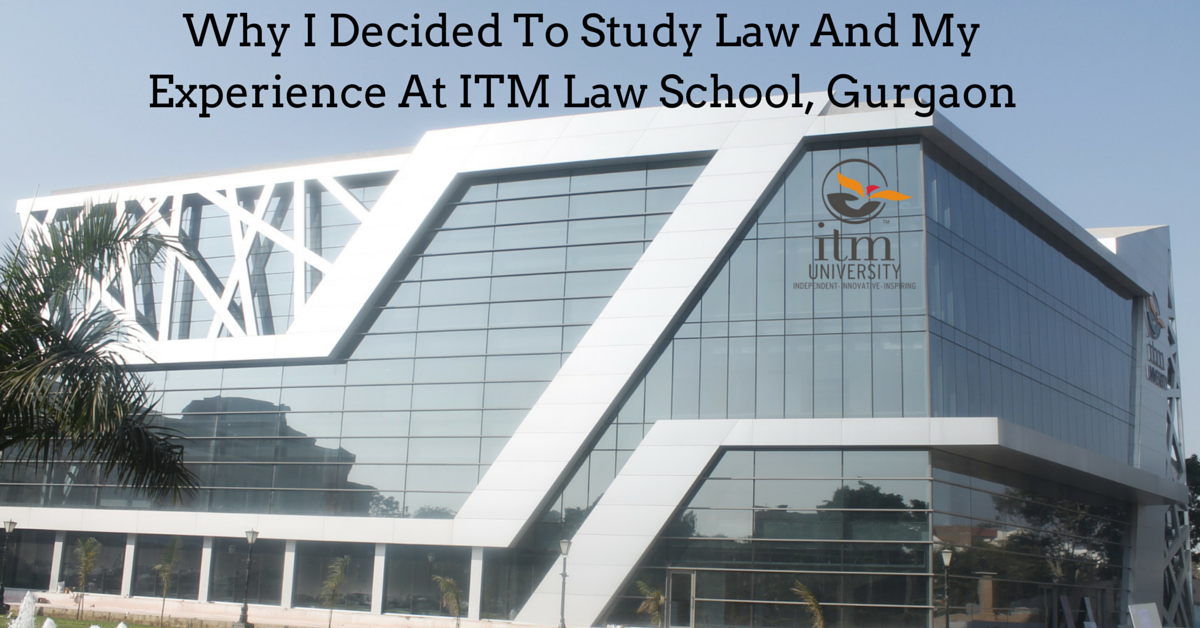
Why I Decided To Study Law And My Experience At ITM Law School, Gurgaon

This article was written by Latika Vyas. If you want to share the story of your law school, please write to me at [email protected]. This is being republished from A First Taste of Law archives.

They say an individual is a man till the law of nature governs him; else he’s just a beast. Our nature is governed and bound by law. For me, the introduction to law happened from the time I learned how to differentiate between different colours. I learned the nitty-gritty of the law from my grandfather, now a retired District Court judge. My house was a bookshelf full of law journals, case studies and bare acts and case laws. Sitting with him over a cup of coffee and just suggesting some vague ideas in his high profile client cases; I thought I was his lawyer. But only until, I saw the condition of womenfolk in my native place; I realised that just passing lame judgements and remarks won’t help, I had to get down and dirty in the puddle to clean it. Women being harassed for dowry, a girl child, rapes; were all that I heard and saw. Being blamed for own rapes was what shattered me as a female. This is when I decided to make my little effort towards turning the beasts back into a human. Along with my inner conscience, my grandfather’s clientele, the seriousness of the cases, the adrenaline pumping discussions, the ever-final conclusions; was my ball of fire; my battle of troy. Battle because I knew I had to fight my parents, my family for my career choice.

And hence, I took up law as my career choice.

Law for me has not been an easy option.

My parents, like other parents, wanted me to pursue the safe career options; like engineering, medicine, arts; as for them a successful career lay inside the courtroom and not outside in a black blazer. For them fighting for somebody else is just a waste of time, a waste of effort and a waste of a study degree. I feel if subjects such as physics, biology, and commerce can be taught in schools, and then why not law. Had we as humans been taught the importance of law, we could have matured into responsible human beings and not animals. Our boys could have respected females from a young age and not fed upon their bare souls. I didn’t want to be the one sitting in a black blazer outside some dingy courtroom; I wanted to be the one inside the courtroom fighting for my gender’s right to justice. And this is when, law happened. Just sitting for CLAT made me feel closer to my dream. And inch by inch, I reached ITM Law College.

My first day at ITM law school, I was a clueless teenager, hopping from one department to another.

A batch of 110 students and five years and I was one among those many. And I knew I had to shine throughout. A total of 64 subjects and a lot of case studies motivated and brought out the competitive streak in all of us.

I remember my days at ITM vividly; they’ve been a part of my life both professionally and personally. On the professional front; ITM law school threw such challenges at me, that I knew only my hard work would sail me through that. I knew I had to survive and ITM forced me to learn it that way. A bunch of integrated subjects both of law and management brush up my mind and case studies, presentations, moot courts, seminars, conferences and internships hardened my resolve towards being a better lawyer from day 1. My college always pushed me and provided a highly competitive environment. Soon I realised that I had to constantly be on my toes for my survival by updating myself. ITM motivated me to look for what next was coming up rather than glorifying my past laurels. There were subjects from 2 distinct fields’ management and law but at the end after learning them I understood that the law is all about management and management is all about being lawful.

More than 40 plus subjects we have studied till date some of them became part of interest to decide our future career options .law was not the only interest, management also attracted, but that to be together. I liked many of management subjects like human resource, strategic management; financial management which helped me to decide my honours stream which is corporate honours .all those first 2 years management subjects helped to understand the need of law in management world. There were many questions and queries which disturbed when I talked to people around me and I realised most of them were biased for litigation not for corporate they found corporate law as a need but not good as to establish my career. Big challenges after opting honours subject was to mug up heavy international law and schemes, for once there was a thought to give up but faculty were so helpful and understanding that they made our dilemma very crystal clear and then it was the final decision to start up and gear up to my career there is nothing can be called as perfect, but imperfection leads to better perfect situations. The moot court exercises exposed us to the practical aspect of the law. The internships helped us to enhance our knowledge and apply it practically. The internships really groomed us and we got to learn different aspects of the law. We worked with NGO’s, lawyers, law firms and other legal bodies. All the students wanted to intern at best places which in turn were a hard task. The actual competition began from here the only conversation among students and teachers during this time were only about internships. The faculty was really cooperative and helped us in arranging internships.

We have to start working before semester starts because of 6 different subjects we always have 6 different projects and presentations which takes place at every alternative week and beyond that we had very strict examination schemes which we have to clear for our promotions and to intern. It is not only academic sessions but also co-curricular activities we had to participate to maintain our hobbies and interests. After working with many lawyers and law institutions, we started looking at the logic behind courts decisions rather than just believing written texts in our books and it completely changed my outlook towards the subject. Law is about helping others which help to be a better person every day to maintain our dignity, money is not the only thing which can satisfy you or help you to get sound sleep this reality of life I personally realised every early when I actually faced conditions of those people who can’t fulfil their basic needs for living no shelter no clothes most importantly no water and food, I felt like a very lucky person who has everything for a luxurious life but one thing was very fishy despite so many government schemes they were allotted with they never received even if they received they never enjoyed them completely and then there was a question of WHY? As a teenager there were many things going around and shook all of us who were working in that remote rural areas, we have visited each and every door of 12 villages and collected bundle of cases about how our legal system is so mismanaged. After this amazing court experience of fraud cases and case of fraud against people, court according to me is not at all a normal place there is no point of being emotional while fighting a case or deciding a case, hence it was proved that facts, evidence are more important than truth, even if a defaulter is innocent and he don’t have proof for his innocence he is legally guilty.

After working with many legal bodies I was actually forced by myself to decide whether I want to be a better lawyer or a better human being and I decided to be both, I actually can’t change everything but I can’t avoids things I see around me . Moreover when I worked with an arbitrator I improved my skills and changed the way I use to see things, I more started thinking to find out way which is available by our legal system and that attorney really improved me not only as a to be lawyer but also as a human being and then I felt like I don’t study law to become a student I study law to become a lawyer. He removed that boundary of my own dilemma and taught me one should never stop discovering new opportunities and should learn from their failures rather than being zeroed at particular career. I am thankful to my parents, family and my Teachers plus ITM University for being always there to support and allowed us to say exactly what we like to say. One person I don’t want to miss is my ex LAW SCHOOL DIRECTOR Mr. Sanjeevy Shanthakumar who gave me this lifetime opportunity and his words I can never forget “make this classroom your parliament and start your journey as lawyers”.

Date:20.11.14


Download Now

My Best Law Internship And Why It Was The Best

0
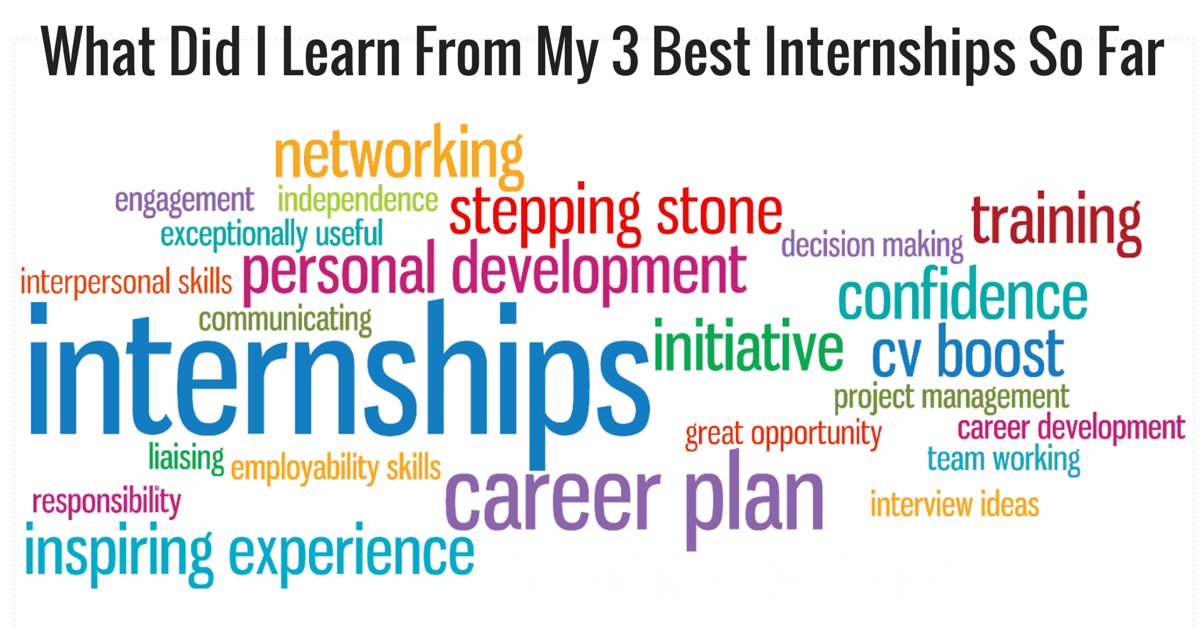
What Did I Learn From My Best Internship And Why It Was The Best

THis article is being republished from A First Taste of Law archives. This article is written by Shephalika Srivastava, 5th year law student at University of Lucknow. If you want to share your write ups about your law school, write to me: [email protected]

The famous scientist, Thomas A. Edison has said, “We often miss opportunity because it’s dressed in overalls and looks like work.” Opportunities always knock at our doorsteps, for it is upon us to seek, grab and make the best out of it. Even if the opportunity does not knock, one must build a door.

So, I just listened to my conscience and grabbed the opportunity of interning with National Human Rights Commission, Delhi, this summer.

My experience of interning at NATIONAL HUMAN RIGHTS COMMISSION (NHRC) was the most pleasing one of all the internships I have done up till now. The duration of the summer internship programme at NHRC was from 2nd of June to 1st of July, 2014. The one month internship programme at NHRC is a paid internship programme.

The selected interns from outside Delhi were allowed ordinary second-class train fare to New Delhi and back to their place of study through the shortest route. For interns other than from Delhi (NCR) an amount of rupees eight thousand were paid as stipend. Students from Delhi and National Capital Region (NCR) were paid rupees four thousand as stipend. An amount of rupees fifteen thousand was distributed to interns who were placed in first, second and third position in the order of the merit. The interns were also given the facilities of reading materials and identity card, library, computer with internet services.

The first day began with the introduction of the students.

We were total 60 students from every corner of the Country. We were made acquainted with the senior ranked officers and also the training department at NHRC. Our training officer under whose support and guidance we accomplished the internship was Mr. Sudershan Kr. Jain, who is the senior research officer at NHRC. My co-interns hailed from distinct educational courses running across the Indian sub-continent. Avenues for interning with the Commission was opened for the students pursuing LL.B., LL.M., MA in human rights, PG students of Political Science, Sociology, Masters in Social Work, Criminology, Public Administration, Rural development, History, Economics, Commerce, Anthropology, International relations and any of the disciplines of Social Sciences.

In the daily course we were made to understand the working of the Commission, how the issues related to human rights violation is brought into the notice of NHRC and also how the suo moto cognizance is taken by the Commission. In the mid of the daily strict schedule, every day the interns were distributed the refreshment coupons for breakfast, lunch and teatime which also brought in ourselves the feeling of amity and togetherness.

As it was a four weeks curriculum, in the first week we were required to go through the magnificent library of the Commission and choose a book of our taste for submitting a book review on it.

As I am always keen to put forward my opinions mostly on the issues relating to women, I wrote a review on ‘Child Marriage in India’, a book by ‘Jaya Sagade’. The author, in this book, analysed the reasons behind the child marriages which are still taking place in most of the parts of India despite of enactment of the legislation in 1929 to ban such an evil practice. It is the face of the reality today that children are being deprived of their childhood because of it. The author is a powerful critique and states the loopholes and lacunae of the Indian law, many of whose provisions contradict themselves and also the shortcomings of the provisions relating to the age of marriage, consent of marriage, its validity, etc., the contribution of various customs which violate the human rights and also role played by the civil society.

The second week kept us occupied with the State Presentation.

The topic of the state presentation was the ‘Human rights scenario in the state to which the interns belong to.’ Here we got an opportunity to put forward our state conditions and problems. As our team comprised of total ten members from Uttar Pradesh, we unearthed and presented the ghastly developing crime rates in our State. The Power Point Presentation helped in bringing out the real scene of the pathetic condition prevailing in the state of Uttar Pradesh. The bar graphs, the data, the real picture exposed the high level of human rights violation in the State. We also lime lighted the work done by NHRC in our state and also the work done by Uttar Pradesh State Human Rights Commission.

The third week came up as a challenge as all the students were allotted their teams to work upon the Project.

Total eight teams had to submit the Project work related to Human Rights issues and the topics were to be given by the dignitaries of the Commission. Our team had to submit the project on “Silicosis Problem in India.” We went through some of the files and cases which NHRC had taken up especially of the states- Jharkhand, Bihar and Orissa, where this issue is most prominently reported. We were surprised to come across some of the reports which stated that more than 50% of the labourers working in the mining industry suffered from this occupational disease. And another shocking factor which came before us was that these workers were unaware of the disease they suffer from because of the illiteracy rate and also as they are hired for low wages so they could not afford to meet the medicinal expenses for their treatment. Moreover, the most of the mining unit lacks the facility of free medical aid for these poor people. The violations of the legislations enacted were done on a large scale. We, the team of eight members allotted the Indian States which were prone to such hazardous disease, amongst ourselves and with the combined efforts of all the teammates our project was a huge success.

In the last week of such an outstanding internship we were made to visit the Dasna Jail, situated in Ghaziabad district of Uttar Pradesh and also to the Naaz Foundation NGO situated in Delhi.

The Jail visit was an amazing experience. We came across some of the hardened criminals and also got the chance to meet Dr.Rajesh Talwar and Dr. Noopur Talwar, the convicts of Arushi murder case and also Moninder Singh Pandher involved in Nithari case. On questioning about Surinder Koli, another convict of the Nithari case we were told that he was kept in solitary confinement. We were not allowed to ask any personal questions so we questioned regarding the treatment of the prisoners in the jail and their condition in the jail. We also saw different cells for women and men prisoners.

The Jail comprised of a huge kitchen which is looked after by the prisoners themselves.

The prisoners cook their meals themselves, they are also involved in the activities like gardening, washing clothes, painting, sketching, etc. The cleanliness of the jail campus is looked after the prisoners themselves. The peculiar thing which we found about the male prisoners was that they were dressed up in maroon and yellow uniforms. The yellow uniform prisoners were the lifetime convicts. There were separate prisons which were for those prisoners who were suffering from highly communicable disease. There is also a small hospital in the jail premises to look after the ill prisoners. We also had an interactive session with the Jail Superintendent and also with the prisoners who wanted us to know their grievances so that the true picture of their cases could be known to common people like us. Next, we were taken to Naaz Foundation NGO which is the home for children suffering from AIDS and also of homosexual people.

Our exclusive visit to the police stations was also a memorable experience. For the police station visit as well, the interns were divided into five groups and each group in charge was a Nodal Officer who was appointed for our visit. The five police stations were chosen in such a way that it covered whole of the area of Delhi. I visited Shakarpur Police Station under the leadership of Mr. S.N. Mishra. The points we noted during the Police Station visit were-

  • Daily working/functioning of the Police Station.
  • Whether the guidelines laid down by the Hon’ble Supreme Court in the case of D.K. Basu vs. State of West Bengal is followed by the Police Station or not.
  • Contact of the police officers with the general public.
  • The condition of the lock ups, barracks, safety and security, facilities for lady police officers in the Police Station.
  • Notice boards in the Police Station related to Right to Information, Juvenile Justice Act.
  • Maintenance of the Daily Diary (Roznamcha), inquest registers and other records.
  • Behaviour of the police officers while dealing with the complainant, their communication levels and also their attitude in dealing with crime against women.

Besides this, each day was occupied with the classroom sessions. Sessions on-

  • Immoral Traffic (Prevention) Act, 1956.
  • Role of media in NHRC.
  • Health and Human Rights.
  • Human Rights and Police Need of Reforms.
  • Mental Health in India and Human Rights.
  • Human Rights Aspect of Jail.
  • Elimination of Bonded Labour System.
  • Human Rights Related to Disabled People.
  • Human Rights and Environment.
  • Special Provisions Available for Schedule caste, Schedule tribes and other backward classes.
  • Rights of the refugees.
  • Problems faced by Rag Pickers.
  • Rights of Women.
  • Rights of Elderly Persons.
  • Session on Armed Forces Special Power Act, 1958 (AFSPA).
  • Migrant Workers and Human Rights.
  • Interactive session with senior IPS officer, Mr.SC SINHA.
  • Human Rights and Manual Scavenging, a session with Human Rights activist, Mr. BEZWADA WILSON.
  • Interactive session with the Hon’ble Chairperson of National Human Rights Commission, K.G.
  • BALAKRISHNAN, J.
  • Interactive session with Justice D.MURUGESAN.
  • Films were shown and discussions relating to Child labour, Anti Trafficking, Health and education in Human
  • Rights context were held.

We were also taken to an Orphanage Home named, ‘Baal Sahyog’ situated in the heart of the Delhi, Connaught Place.

We met children of every age-group we interacted with them, shared our experiences and played games. They organised for us musical programme and showed their talents by singing and playing musical instruments like guitar, violin, piano, drums and flute. We also visited the primary school and the dispensary which was in the orphanage campus itself and took note of its conditions. On interacting with the orphanage authorities we came to know about the challenges faced by both staff members and children in their day to day life and also enquired about how NHRC supports them.

Our next programme was Cultural Programme which was to be organised by all the interns on the eve of the Valediction Day in the NHRC campus.

Everyone decided their roles beforehand and contributed their bit. The Programme started with Saraswati Vandana and included Bihu dance, Assamese song, a film prepared on women emancipation, a Bengali poem composed by one of the interns, Gidda dance and a skit prepared by interns on sexual abuse amongst males.

The last day of the internship was the Valediction Day of the Summer Internship Programme, 2014.

On completion of the internship, the certificates were distributed to us on the basis of the attendance, punctuality, discipline, participation in class during the sessions, state presentation, project presentation and project report, debate and book review and also on this day we got the much awaited stipend. We were also handed over with the list of NHRC non-priced publications which were fifty four in number. And we were privileged of taking away any number of those publications along with us. As per my interest I took away the following publications along with me, titled-

  • The Protection of Human Rights Act, 1993.
  • Report on Prevention of Atrocities against Schedule Caste.
  • Dalit Rights.
  • Women’s Right to Health.
  • Rights of the Disabled.
  • Children in India and their Rights.
  • Human Rights Manual for District Magistrates.
  • Universal Declaration of Human Rights.
  • Guidelines regarding “Arrest”.
  • Manual for Human Rights for Police Officers.
  • Starvation, Malnutrition and Malnutrition related Deaths of Children in 15 Tribal Districts of Maharashtra-
  • Report of An Enquiry Conducted by Dr. Lakshmidhar Mishra IAS (Retd.)
  • Living Conditions and Human Rights of Inmates: Status in 18 Prisons of the Four States in Southern Region,
  • 20 Prisons of the Eight States and UT of Chandigarh in Northern Region and Fourteen Prisons of the Five States in North-Eastern Region.

So, at last but not the least, I can call the internship at National Human Rights Commission to be the best internship I have done till date.

I came to know about the different aspects of Human Rights which all human beings possess by virtue of their being human. Human Right is the basic and inalienable right which belong to us because of our very existence. From this internship I have learnt so much and everything in a quite expansive manner. Thereby, I personally feel and recommend that once in a lifetime everyone should intern, contribute or be a part of this beautiful cause and institution to look into the proper functioning of the government and in some way or the other, act as a saviour of HUMAN RIGHTS. As a human being we should also look into the issues of violation of Human Rights by the state and take a step ahead to fight back the atrocities suffered in this regard. By merely studying Human Rights as a subject in the course, I was totally unaware about the multi-dimensional and practical aspect of the Human Rights until I did the internship in one of the most prestigious institution of our Country.

SHEPHALIKA SRIVASTAVA

5TH YEAR, LL.B. HONS.

FACULTY OF LAW, UNIVERSITY OF LUCKNOW



Download Now

What An MD Of A 100cr+ Business Empire Taught Me About Public Speaking

0
What An MD Of A 100cr+ Business Empire Taught Me About Public Speaking

Some lessons in life take many years to realize. This is one of them. I was blessed by someone with a great insight, it stayed with me, but I did not really appreciate it at that time. Only through many years of experiences, one day the lesson came back to me and I realized what I had learned on a random afternoon of 2007, at the lobby of Hotel Hindustan International in Kolkata.

Before I dive into the story, I need to give you a bit of background. Until December of 2005, I spent a year doing little but preparing for law entrance exams (there was no CLAT at that time) and learning English. I cracked NUJS entrance in 2005 itself through the waiting list and did not take it up for several reasons. One was that I knew very little English and didn’t feel that I was well prepared to take on the challenge. I rather gave myself one year to improve my English and join law school at the top rather than as a struggling candidate.

Throughout the year, I also made sure that I left no stone unturned for my preparation. I wanted to be prepared for every eventuality, I could not afford anything to derail my plans. This was naturally one of the most elaborate strategic preparations I had ever done in my life. I spent hours discovering and implementing sophisticated techniques to learn, practice, retain lessons and found the quickest, most efficient ways to do so. In terms of my ability to learn, this phase was life changing. Studying will never be difficult again because of the systems I started deploying.

My hard work paid off in 2006, I scored the 2nd highest in the NUJS national entrance test and took up admission.

That was the end of my law entrance prep. I, however, missed the thrill of preparing for the law entrance. What happens to all the notes I made, the techniques I discovered and refined through continuous experiments and applied successfully? How will I ever use it again?

So when an opportunity came through to teach kids for law entrance (this is very common now – but back in 2007 not too many law students were doing it), write modules for courses and create a CLAT curriculum for IMS Learning Pvt Ltd, one of India’s giant in the entrance exam business at that time – I grabbed that opportunity. Soon, we were doing quite well – in fact setting industry standards others were being forced to play catch up to.

Kamlesh Sajnani was the Managing Director of IMS, which was doing 100+ crores in revenue at that time. When IMS Kolkata had its first batch get into various law schools, IMS arranged for a reception for the students at Hotel Hindustan International along with a press meet. I was invited too. When I turned up, Rajneesh Singh, the Product Head for Law Entrances and my mentor, asked me to speak about my experience with the students.

While I was quite good at writing in English by this time, speaking wasn’t quite the forte. I managed to get into a flow somehow whenever I was in a classroom, but this was quite another thing. I was superlatively nervous as I went up the aisle. I spoke what I could think of as relevant – which is mostly how teaching the students have been an eye-opening and empowering experience for me. I stuttered, I stopped at a few places. The tone of my voice must have given away that I was very nervous. I was even trembling – although I am not sure if the trembling was visible. Anyway, I finished, people clapped and I went back to my seat.

I was mortified to come to a great event like this and screwing up. I stood in a corner plaintively sipping on Mirinda. Later, Mr. Sajnani walked up to me and congratulated me on my speech. I was taken aback – is he kidding? I was definitely the worst speaker in the room. Mr. Sajnani read my expression and told me something. I don’t recall the exact words so many years later – but this is what was the substance. “There are enough people who can come prepared and deliver a perfectly polished speech. There are too few people who can speak from their heart. You spoke from your heart, you used your instincts to decide what to say when – and people can see everything you are saying is genuine. They will connect with you much better. Keep it this way, don’t move over to the polished side.”

To be honest, I heard him carefully but it did not make any sense to me at that time. It took me many more years to learn that the best public speakers do not speak to impress people, but to communicate and influence. It is important to deliver a perfect to structure, polished speech in a moot or debate, but in real life – a little rusticity can make your communication more effective, authentic, and even charming. Preparation often comes in the way of talking about what we really should be talking about – and in the way we should talk – heart to heart, person to person. We should talk about the things we really want to talk about, things that we think of as we fall asleep and thoughts that do not let us sleep. We never need any preparation to talk about those things.

Download Now
logo
FREE & ONLINE 3-Day Bootcamp (LIVE only) on

How Can Experienced Professionals Become Independent Directors

calender
28th, 29th Mar, 2026, 2 - 5pm (IST) &
30th Mar, 2026, 7 - 10pm (IST).
Bootcamp starting in
Days
HRS
MIN
SEC
Abhyuday AgarwalCOO & CO-Founder, LawSikho

Register now

Abhyuday AgarwalCOO & CO-Founder, LawSikho